
The Four Principles of Management: A Practical Guide
The principles of management provide a practical foundation for organising people, coordinating resources and achieving organisational objectives. Whether managing a small business, supervising a professional team or overseeing a large organisation, managers need a structured approach to ensure that daily activities support long-term business goals.
The four widely recognised functions of management are planning, organising, leading and controlling. These functions explain how managers establish objectives, allocate responsibilities, guide employees and evaluate organisational performance. Together, they create a continuous management process that supports productivity, accountability and effective decision-making.
Understanding the principles of management is important for learners and professionals who want to develop business management knowledge and leadership capabilities. These concepts are relevant across industries, including manufacturing, construction, healthcare, education, retail, finance and environmental management.
This practical guide explains each management function, its importance, workplace applications and contribution to organisational success. It also explores how managers can apply these principles to improve business performance, employee productivity and effective organisational management.
What are the Four Principles of Management?
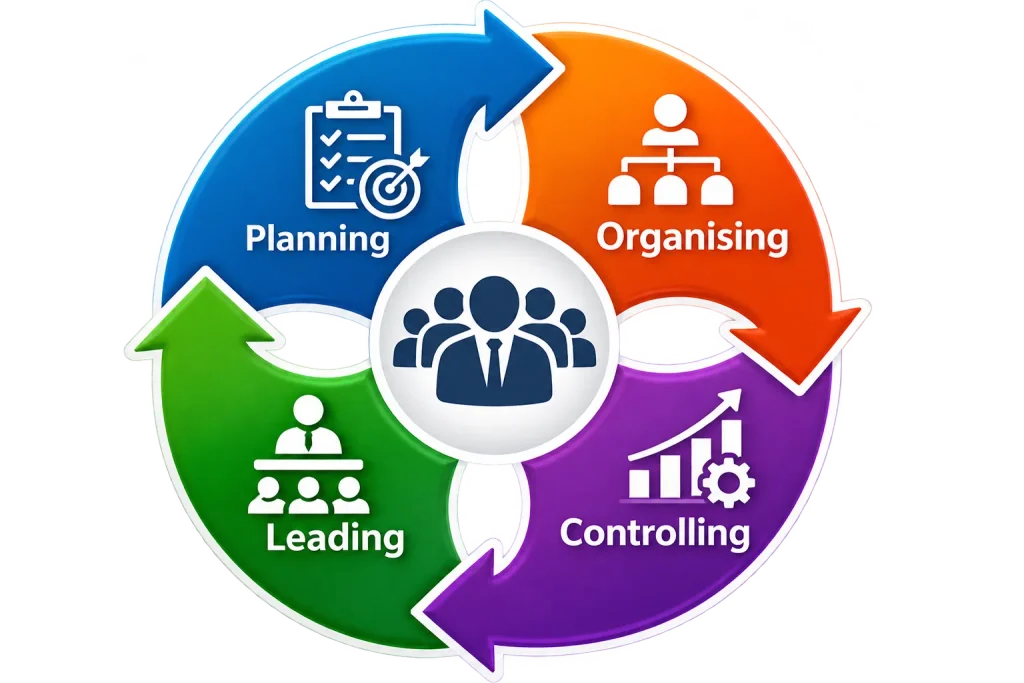
The four principles of management, commonly described as the four functions of management, are planning, organising, leading and controlling. They provide a structured approach to managing organisational activities and achieving business objectives.
Management involves more than assigning tasks or supervising employees. It requires managers to identify priorities, coordinate resources, communicate expectations and evaluate results.
According to the management framework explained by OpenStax, these four functions work together as an integrated process rather than independent activities.
The four principles can be understood as follows:
- Planning: Establishing objectives and deciding how to achieve them.
- Organising: Arranging people, resources and responsibilities to implement plans.
- Leading: Guiding, motivating and communicating with employees.
- Controlling: Monitoring performance, comparing results with objectives and taking corrective action.
| Management principle | Main purpose | Practical management activity |
|---|---|---|
| Planning | Establish objectives and priorities | Preparing business plans and setting targets |
| Organising | Coordinate resources and responsibilities | Allocating tasks and assigning employees |
| Leading | Guide and motivate employees | Communicating expectations and resolving conflicts |
| Controlling | Evaluate performance and results | Monitoring KPIs and implementing improvements |
These functions are applicable to organisations of different sizes and industries. Their successful implementation helps managers maintain operational efficiency while ensuring that business activities remain aligned with organisational objectives.
1. Planning: Establishing Organisational Objectives
Planning is the first function of management. It involves determining organisational goals, identifying the resources required and selecting appropriate strategies to achieve desired results.
Effective planning helps managers understand what needs to be accomplished, when activities should take place and who will be responsible for delivering them.
Without proper planning, organisations may experience unclear priorities, inefficient resource utilisation, missed deadlines and unnecessary operational costs.
Why is Planning Important in Management?
Planning provides direction and helps organisations prepare for opportunities and potential challenges.
Its importance includes:
- Clear objectives: Establishes measurable organisational and departmental goals.
- Better decision-making: Helps managers evaluate alternatives before taking action.
- Resource management: Identifies the financial, human and physical resources required.
- Risk reduction: Helps identify potential problems and prepare appropriate responses.
- Time management: Establishes schedules, priorities and delivery deadlines.
- Performance improvement: Provides measurable targets against which results can be evaluated.
Types of Management Planning
Managers use different types of planning to establish organisational objectives, coordinate activities and achieve business goals. Each type of planning serves a specific purpose and helps managers make effective decisions at different organisational levels.
The four main types of management planning include:
- Strategic Planning: Focuses on long-term organisational goals and overall business direction. Senior managers develop strategies to explore growth opportunities, improve performance and strengthen organisational success. For example, a manufacturing company may create a five-year plan to expand production capacity and improve product quality.
- Tactical Planning: Converts strategic objectives into departmental action plans. Middle managers identify the activities and resources required to achieve broader business goals. For example, a marketing department may develop an annual promotional strategy to support business expansion.
- Operational Planning: Concentrates on daily activities, short-term targets, schedules and employee responsibilities. It ensures that routine business operations run efficiently. For example, a warehouse manager may prepare weekly staff schedules and delivery arrangements.
- Contingency Planning: Prepares organisations for unexpected situations that could interrupt normal operations. It involves identifying potential risks and developing alternative solutions. Examples include equipment failure, supply chain disruptions, staff shortages and unexpected financial pressures.
Practical Example of Planning
Consider a construction company preparing to deliver a commercial building project.
The project manager must establish the project objectives, identify the required workforce, estimate costs, arrange materials and prepare a realistic schedule.
The manager also needs to consider possible delays, equipment availability and health and safety responsibilities.
By developing a structured project plan, the organisation can coordinate its activities and monitor progress against agreed targets.
How Can Managers Improve Planning?
Managers can improve planning by following a systematic process:
- Identify the organisation’s current position.
- Establish clear and measurable objectives.
- Evaluate available resources.
- Identify potential risks and opportunities.
- Develop suitable strategies and action plans.
- Assign responsibilities and deadlines.
- Review the plan and make adjustments when necessary.
Planning should remain flexible because market conditions, technology, customer expectations and organisational priorities can change.
2. Organising: Managing People and Resources Effectively
Organising is the management function responsible for arranging resources, assigning responsibilities and establishing relationships between different roles and departments.
After deciding what needs to be achieved, managers must determine how the work will be completed.
Effective organising ensures that employees understand their responsibilities and have access to the resources required to perform their duties.
Why is Organising Important?
Organising transforms management plans into practical workplace arrangements.
Its main benefits include:
- Clear responsibilities: Employees understand their individual duties.
- Better coordination: Departments work together towards shared objectives.
- Efficient resource allocation: Equipment, budgets and personnel are distributed appropriately.
- Improved accountability: Managers can identify responsibility for specific activities.
- Reduced duplication: Clear task allocation prevents unnecessary repetition.
- Stronger communication: Reporting relationships and communication channels become clearer.
Key Elements of Organising
Organising is an essential function of management that involves arranging employees, resources, responsibilities and business activities to achieve organisational objectives. It ensures that every employee understands their role, departments work together effectively and resources are available to complete assigned tasks. Effective organising improves workplace coordination, accountability, operational efficiency and overall business performance.
The key elements of organising in management include:
- Organisational Structure: Establishes reporting relationships, authority levels and employee responsibilities within a business. Common organisational structures include functional, divisional, matrix and project-based structures.
- Division of Work: Involves breaking organisational activities into specific tasks and assigning them to employees or departments according to their knowledge, skills and professional capabilities. It improves efficiency and ensures clear job responsibilities.
- Delegation of Authority: Allows managers to assign responsibilities and appropriate decision-making authority to employees. Effective delegation improves workflow, develops employee capabilities and reduces unnecessary managerial involvement in routine activities.
- Resource Allocation: Ensures that essential resources, including employees, equipment, materials, technology and financial budgets, are available where they are required. Proper resource allocation supports productivity and efficient business operations.
- Coordination: Ensures that employees, teams and departments work together towards common organisational goals. Effective coordination improves communication, reduces duplicated activities and strengthens teamwork across the organisation.
Practical Example of Organising
A manufacturing organisation wants to introduce a new product.
The production manager coordinates the manufacturing team, procurement department, quality assurance personnel, finance team and marketing department.
Each department receives specific responsibilities:
| Department | Assigned responsibility |
|---|---|
| Procurement | Purchase raw materials and equipment |
| Production | Manufacture the product |
| Quality assurance | Inspect products and monitor quality |
| Finance | Monitor production expenditure |
| Marketing | Prepare promotional activities |
| Human resources | Coordinate workforce requirements |
This organised approach ensures that each department contributes to the same business objective.
How Can Managers Improve Organising?
Managers can strengthen organisational arrangements by:
- Identifying the activities required to achieve objectives.
- Dividing work into manageable responsibilities.
- Assigning tasks according to employee capabilities.
- Establishing reporting relationships.
- Providing appropriate resources and authority.
- Creating effective communication channels.
- Reviewing workloads and departmental coordination.
An effective organisational structure should provide clarity without creating unnecessary administrative complexity.
3. Leading: Guiding and Motivating Employees
Leading is the management function concerned with influencing, supporting and motivating employees to achieve organisational objectives.
It involves communication, teamwork, decision-making, conflict resolution and employee development.
While organising establishes responsibilities, leading ensures that employees understand their roles, remain motivated and work towards shared goals.
A manager who demonstrates effective leadership can create a productive working environment where employees feel supported and understand how their contributions influence organisational performance.
Why is Leading Important in Management?
Leading is essential because organisational success depends on the performance and cooperation of people.
Its importance includes:
- Employee motivation: Encourages employees to perform effectively.
- Better communication: Ensures that instructions and expectations are understood.
- Team development: Strengthens cooperation and professional relationships.
- Conflict resolution: Helps address workplace disagreements constructively.
- Change management: Supports employees during organisational changes.
- Employee development: Encourages learning, professional growth and improved capabilities.
- Workplace culture: Promotes accountability, respect and shared organisational values.
Different Leadership Approaches
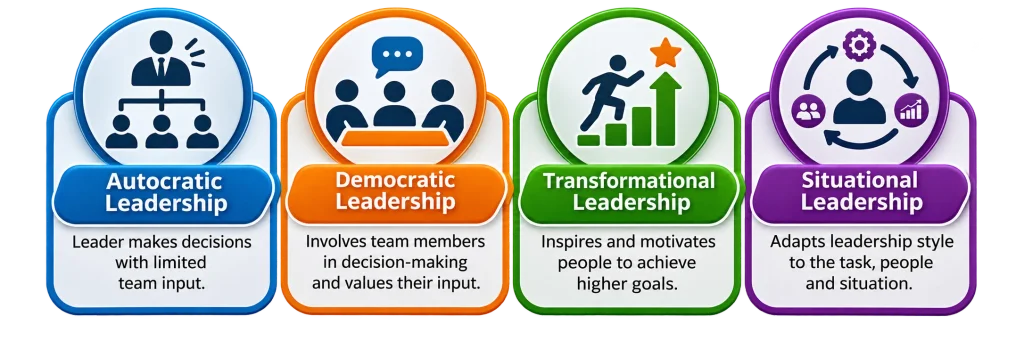
Leadership is an important function of management that involves guiding, motivating and supporting employees to achieve organisational objectives. Managers use different leadership approaches depending on workplace conditions, employee experience, team capabilities and business requirements. Selecting an appropriate leadership style helps improve employee engagement, communication, teamwork and overall organisational performance.
The four common leadership approaches used in modern management include:
- Autocratic Leadership: An autocratic leader makes decisions independently and provides clear instructions to employees. This approach is useful when urgent decisions are required, tasks need close supervision or employees require direct guidance to complete their responsibilities.
- Democratic Leadership: Democratic leadership encourages employee participation in discussions and decision-making. Managers consider team opinions, promote collaboration and encourage the exchange of ideas, helping create an inclusive and productive working environment.
- Transformational Leadership: Transformational leaders inspire employees through a clear organisational vision and encourage innovation, professional development and continuous improvement. This approach helps strengthen employee motivation and commitment to long-term business objectives.
- Situational Leadership: Situational leadership involves adapting management behaviour according to employee experience, competence and workplace requirements. For example, experienced employees may receive greater independence, while newly appointed team members may require additional guidance, supervision and support.
Practical Example of Leading
Imagine a company introducing a new digital management system.
Some employees may be comfortable with the technology, while others may be uncertain about using it.
The manager must communicate the reasons for the change, explain the expected benefits, arrange training and encourage employees to ask questions.
By providing support and listening to employee concerns, the manager can improve acceptance of the new system and reduce resistance to change.
How Can Managers Develop Effective Leadership?
Managers can improve their leadership capabilities through the following practices:
- Communicate objectives and expectations clearly.
- Listen to employees and consider their feedback.
- Recognise good performance and encourage improvement.
- Provide appropriate training and development.
- Delegate responsibilities according to employee capabilities.
- Address conflicts professionally.
- Demonstrate integrity and accountability.
- Encourage collaboration and continuous learning.
Effective leadership does not depend solely on managerial authority. It also requires trust, professional behaviour and the ability to influence people positively.
4. Controlling: Monitoring and Improving Performance
Controlling is the management function concerned with measuring organisational performance, comparing actual results with planned objectives and taking corrective action when necessary.
It helps managers determine whether business activities are progressing according to established plans.
Controlling does not simply mean supervising employees or finding mistakes. It involves using reliable information to identify performance gaps, improve processes and maintain organisational standards.
Why is Controlling Important?
Controlling ensures that organisational activities remain aligned with business objectives.
Its benefits include:
- Performance measurement: Helps managers evaluate actual results.
- Quality improvement: Identifies problems affecting products and services.
- Cost management: Highlights unnecessary expenditure and resource wastage.
- Risk management: Helps identify operational weaknesses.
- Accountability: Establishes whether responsibilities and targets are being fulfilled.
- Corrective action: Enables managers to address problems before they become more serious.
- Continuous improvement: Supports regular evaluation and process development.
Main Steps in the Controlling Process
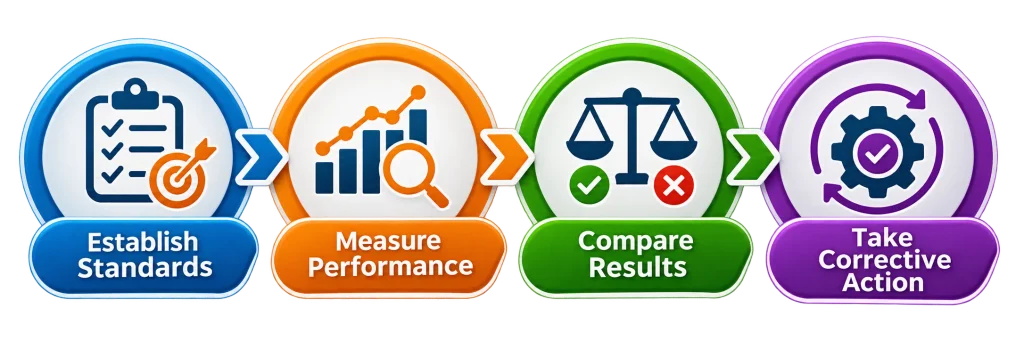
The controlling process is an essential management function that helps organisations monitor performance, measure progress and ensure that business activities meet established objectives. It involves setting clear performance standards, reviewing actual results, identifying gaps and taking corrective action where necessary. Following these steps enables managers to maintain quality, improve operational efficiency and support continuous business improvement.
The four main steps in the management control process are:
- Establish Performance Standards: Managers define measurable targets and performance expectations based on organisational objectives. These standards may include production targets, customer satisfaction levels, delivery deadlines, quality requirements and employee performance indicators.
- Measure Actual Performance: Managers collect and review information to understand how effectively business activities are being performed. Common methods include performance reports, workplace inspections, employee feedback, operational records and key performance indicators (KPIs).
- Compare Results with Standards: Actual performance is compared with established targets to identify gaps, delays, errors or other deviations. This comparison helps managers recognise areas that require improvement and understand whether organisational objectives are being achieved.
- Take Corrective Action: When actual performance does not meet the required standards, managers identify the underlying causes and introduce suitable improvements. Corrective actions may include additional employee training, resource adjustments, process improvements or changes to operational procedures.
Management Control Process at a Glance
- Establish Standards: Define targets and performance expectations.
- Measure Performance: Collect relevant operational and performance information.
- Compare Results: Identify performance gaps and deviations from targets.
- Take Corrective Action: Implement improvements and review their effectiveness.
An effective controlling process is not limited to identifying mistakes; it also supports continuous performance improvement, better decision-making and the achievement of long-term organisational goals.
Practical Example of Controlling
A food manufacturing company establishes a target to reduce product defects.
The quality manager reviews inspection records, identifies recurring defects and compares actual results against the company’s quality objectives.
The investigation identifies that inconsistent machine settings are contributing to the problem.
The manager arranges equipment adjustments, additional employee training and more frequent quality inspections.
The organisation then monitors subsequent production results to determine whether the corrective measures have improved performance.
Key Performance Indicators in Management
Key Performance Indicators (KPIs) are measurable values used to evaluate progress towards organisational objectives.
| Management area | Example KPI | Purpose |
|---|---|---|
| Finance | Operating costs | Monitor financial performance |
| Production | Output per shift | Evaluate productivity |
| Quality | Product defect rate | Assess product quality |
| Human resources | Employee turnover | Monitor workforce stability |
| Customer service | Customer satisfaction | Evaluate service performance |
| Environmental management | Energy consumption | Monitor resource efficiency |
| Project management | Milestone completion | Assess project progress |
Managers should select indicators that are relevant, measurable and connected to actual organisational priorities.
How Do the Four Principles of Management Work Together?
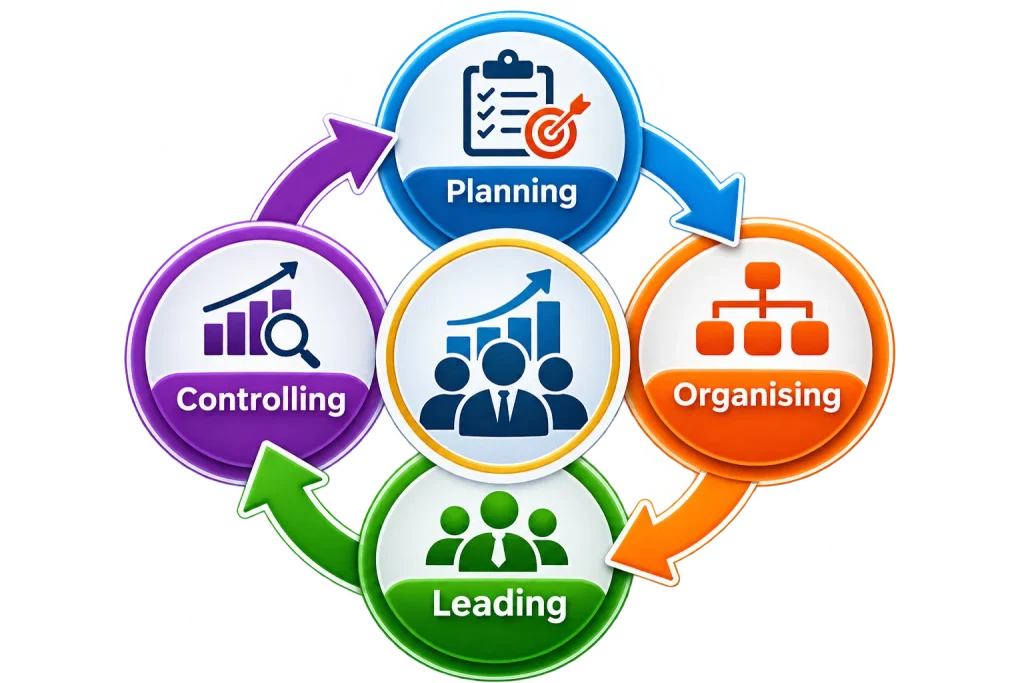
The four principles of management are interconnected. Planning establishes what an organisation wants to achieve, organising determines how resources and responsibilities will be arranged, leading guides employees during implementation, and controlling evaluates whether the intended results have been achieved.
Managers cannot rely on one function alone. Even a well-developed business plan may fail if responsibilities are unclear, employees lack motivation or performance is not monitored.
Relationship Between the Four Management Functions
| Function | Main management question | Expected result |
|---|---|---|
| Planning | What do we want to achieve? | Clear objectives and strategies |
| Organising | How will we achieve it? | Structured responsibilities and resources |
| Leading | How will we guide people? | Motivated and coordinated employees |
| Controlling | Are we achieving our objectives? | Measured results and corrective action |
The Management Cycle in Practice
Consider an organisation planning to introduce an environmentally responsible production process.
- Planning: Management establishes objectives for reducing energy consumption, improving resource efficiency and minimising waste.
- Organising: The organisation assigns responsibilities to production teams, procurement personnel and environmental management staff.
- Leading: Managers explain the objectives, provide employee training and encourage participation in environmental improvement activities.
- Controlling: Performance is measured through energy consumption records, waste monitoring and operational reports.
If the results do not meet expectations, managers investigate the causes and revise their plans.
This demonstrates that the four functions create an ongoing cycle. Controlling provides information that can improve future planning, while effective leadership and organisation help ensure that improvement activities are implemented successfully.
Importance of the Four Principles of Management in Modern Organisations
The four principles of management—planning, organising, leading and controlling—are essential for achieving organisational success in today’s competitive business environment. These management functions help organisations manage people, resources and operations effectively while responding to technological developments, international competition, changing customer expectations and sustainability requirements.
Applying the four principles of management enables businesses to improve efficiency, strengthen decision-making, increase employee productivity and manage organisational change. Their importance can be seen in the following areas:
Improving Organisational Efficiency
Effective management improves workplace efficiency by reducing unnecessary activities, allocating resources appropriately and coordinating departmental responsibilities. When managers apply all four management functions, business operations become more structured, productive and aligned with organisational objectives.
For example, a retail business can improve operational efficiency through:
- Planning: Forecasting stock requirements and setting inventory targets.
- Organising: Coordinating warehouse activities and assigning employee responsibilities.
- Leading: Guiding and motivating staff to complete daily tasks effectively.
- Controlling: Monitoring inventory levels, product availability and operational performance.
Strengthening Business Decision-Making
The four principles of management support informed business decision-making by helping managers identify priorities, evaluate available resources, guide implementation and assess results. This structured approach enables organisations to respond to challenges, manage potential risks and make decisions that support long-term business objectives.
Supporting Employee Productivity
Employee productivity improves when workers understand their responsibilities, receive appropriate guidance and have access to the resources needed to perform their duties. Managers can use effective management practices to establish clear expectations, strengthen workplace communication and monitor individual and team performance.
Key benefits include:
- Clearer roles and responsibilities across departments.
- Better communication between managers and employees.
- Improved teamwork and coordination.
- Greater employee motivation and accountability.
- More effective monitoring of individual and organisational performance.
Managing Organisational Change
Modern organisations regularly face changes in technology, customer expectations, market competition and operating conditions. The four management functions provide a practical framework for planning, implementing and evaluating organisational change while supporting employees throughout the process.
Managers can apply these functions in the following ways:
- Planning: Identify the reasons for change, establish objectives and prepare an implementation strategy.
- Organising: Allocate resources, assign responsibilities and coordinate relevant departments.
- Leading: Communicate changes, motivate employees and provide guidance during implementation.
- Controlling: Monitor progress, evaluate outcomes and introduce improvements where required.
Supporting Sustainable Business Practices
The principles of management also help organisations integrate environmental responsibility and sustainability into everyday business operations. Managers can establish sustainability objectives, assign responsibilities, encourage employee participation and monitor the effective use of resources. This approach makes sustainable business practices part of organisational planning and performance management.
Examples of management activities that support sustainability include:
- Incorporating environmental objectives into business plans.
- Assigning sustainability responsibilities to relevant teams.
- Encouraging employees to reduce energy and resource consumption.
- Introducing initiatives to minimise workplace waste.
- Monitoring energy usage, waste generation and sustainability performance.
By applying planning, organising, leading and controlling together, modern organisations can strengthen operational performance, support responsible business practices and achieve sustainable organisational development.
Practical Workplace Examples of the Four Principles of Management
The four principles of management—planning, organising, leading and controlling—can be applied across different industries to improve workplace performance and achieve organisational objectives. Understanding these management functions through practical workplace examples helps learners connect management theory with real business situations. Whether in manufacturing, healthcare or environmental management, managers use these principles to coordinate employees, allocate resources, monitor performance and support continuous improvement.
The following examples demonstrate how the four principles of management work in different professional environments.
Example 1: Management in a Manufacturing Organisation
A manufacturing company aims to increase production efficiency, maintain product quality and reduce operational delays. Managers apply the four management functions to coordinate production activities, manage resources and monitor manufacturing performance.
- Planning: The production manager establishes manufacturing targets, prepares production schedules and identifies opportunities to reduce delays and improve output.
- Organising: Machinery, raw materials, employee responsibilities and production schedules are arranged to ensure efficient manufacturing operations.
- Leading: Supervisors communicate production requirements, guide employees, encourage teamwork and support workers in achieving quality and productivity targets.
- Controlling: Production and quality teams monitor output levels, product defects, equipment performance and manufacturing costs to identify areas requiring improvement.
This structured management approach helps the company identify operational weaknesses, improve production processes and maintain consistent product quality.
Example 2: Management in a Healthcare Organisation
A healthcare facility wants to improve patient services, strengthen departmental coordination and ensure effective use of available resources. Applying the four principles of management helps healthcare managers organise staff responsibilities and evaluate service delivery.
- Planning: Management establishes patient service improvement objectives, identifies staffing requirements and prepares plans for efficient healthcare operations.
- Organising: Duties are allocated among clinical teams, administrative staff and departmental supervisors to maintain effective coordination.
- Leading: Department managers communicate expectations, support teamwork, guide employees and address operational challenges.
- Controlling: Management evaluates service delivery, staffing levels, patient feedback and operational performance to assess progress against established objectives.
By applying these management functions, healthcare organisations can improve coordination, manage resources effectively and identify opportunities to enhance service quality.
Example 3: Management in an Environmental Management Department
An organisation aims to reduce workplace waste, improve resource efficiency and strengthen its environmental performance. Managers use the four management principles to establish sustainability targets and involve employees in responsible resource management.
- Planning: The environmental manager establishes waste reduction targets, identifies resource efficiency opportunities and develops an environmental improvement plan.
- Organising: Responsibilities are distributed among procurement, production, facilities and waste management teams to coordinate sustainability activities.
- Leading: Employees receive guidance on resource conservation practices and are encouraged to participate in environmental improvement initiatives.
- Controlling: Management monitors waste records, energy consumption and resource utilisation to measure progress against established objectives.
This approach helps organisations evaluate their environmental performance, identify resource-saving opportunities and support continuous improvement.
These practical workplace examples demonstrate that the four principles of management are interconnected and relevant across different industries. By combining planning, organising, leading and controlling, managers can improve operational efficiency, strengthen employee coordination and achieve measurable organisational results.
Common Management Challenges and How to Overcome Them
Although the four principles provide a structured approach, managers may encounter difficulties when applying them in real working environments.
Understanding these challenges helps learners develop practical problem-solving and decision-making capabilities.
| Management challenge | Possible consequences | Recommended management response |
|---|---|---|
| Poor planning | Missed deadlines and unclear priorities | Establish realistic objectives and schedules |
| Unclear responsibilities | Confusion and duplicated work | Define roles and reporting relationships |
| Weak leadership | Low motivation and poor communication | Improve employee engagement and guidance |
| Inadequate monitoring | Problems remain unidentified | Introduce relevant performance indicators |
| Limited resources | Delays and operational inefficiency | Review resource allocation and priorities |
| Resistance to change | Slow implementation | Communicate changes and provide support |
| Poor coordination | Departmental conflicts | Strengthen communication and teamwork |
| Inconsistent performance reviews | Repeated operational problems | Conduct regular performance evaluations |
Recommendations for Effective Management
Effective management requires clear objectives, strong leadership, informed decision-making and continuous performance evaluation. Managers can improve organisational performance by applying practical management strategies that support employee productivity, efficient resource allocation and the achievement of business goals. The following recommendations can help managers strengthen their professional management practices across different industries.
- Set Clear and Measurable Objectives: Establish specific, realistic and measurable organisational goals that provide clear direction to employees. Well-defined objectives help managers communicate expectations, monitor progress and evaluate business performance effectively.
- Encourage Employee Participation: Involve employees in workplace discussions, planning activities and decision-making processes. Employees often have valuable practical knowledge of daily operations, allowing managers to identify workplace challenges and discover opportunities for improvement.
- Use Evidence-Based Decisions: Make informed management decisions by considering relevant performance data, financial records, operational reports and employee feedback. Evidence-based decision-making helps managers evaluate alternatives, manage risks and select appropriate business strategies.
- Develop Management and Leadership Skills: Continuously improve essential management capabilities, including communication, delegation, planning, problem-solving, teamwork and decision-making. Developing these professional skills enables managers to guide employees effectively and respond to changing organisational requirements.
- Review Performance Regularly: Monitor organisational and employee performance through regular reviews, progress reports and measurable performance indicators. Continuous performance evaluation helps managers identify problems, assess results and introduce corrective actions when required.
By following these recommendations, managers can apply the four principles of management more effectively. Consistent planning, organised operations, supportive leadership and regular performance monitoring contribute to improved workplace productivity, operational efficiency and long-term organisational success.
How Can Learners Develop Practical Management Skills?
Developing management skills requires more than understanding theoretical definitions. Learners need opportunities to analyse business situations, evaluate management decisions and apply concepts to realistic organisational challenges.
A structured business management education can help learners develop the knowledge required to understand organisational operations and management responsibilities.
Important areas of professional development include:
- Business planning and strategic decision-making.
- Leadership and management of teams.
- Organisational behaviour and employee motivation.
- Financial management and resource allocation.
- Marketing and business development.
- Operational management and performance evaluation.
- Communication and professional relationship management.
- Business research and analytical thinking.
- Problem-solving and organisational improvement.
Learners should also develop the ability to interpret business information, evaluate alternative solutions and explain how management decisions influence organisational performance.
Conclusion
The four principles of management—planning, organising, leading and controlling—form the foundation of effective business management. These essential management functions help organisations establish clear objectives, allocate resources efficiently, motivate employees and monitor performance. Applying these principles improves organisational productivity, teamwork, decision-making and operational efficiency.
Understanding the principles of management enables learners and aspiring managers to develop practical leadership and business management skills. By applying these management practices, professionals can support organisational growth, continuous improvement and long-term business success. Developing further knowledge through a professional business management qualification can also strengthen management capabilities and workplace performance.