
The 7 Functions of Business Management Explained with Examples
Business management involves planning activities, organising resources, managing employees, coordinating operations and making informed decisions to achieve organisational objectives. Effective management ensures that business activities are carried out efficiently, resources are used responsibly and employees understand their roles in achieving shared goals.
The seven functions of business management are planning, organising, staffing, leading, coordination, controlling and decision-making. Each function has a specific purpose, from setting clear objectives and allocating resources to guiding employees, monitoring performance and selecting the most appropriate actions to address business challenges.
When these functions work together, organisations can improve productivity, strengthen teamwork, manage risks and respond more effectively to changing business conditions. Understanding these functions helps business owners, managers and aspiring professionals develop practical management skills, solve operational problems and support long-term business growth.
Although some management models group business activities into four or five core functions, this guide explores seven practical functions to provide a broader understanding of how managers plan activities, organise teams, lead employees and monitor results. It also explains how these functions contribute to better decision-making and overall organisational performance.
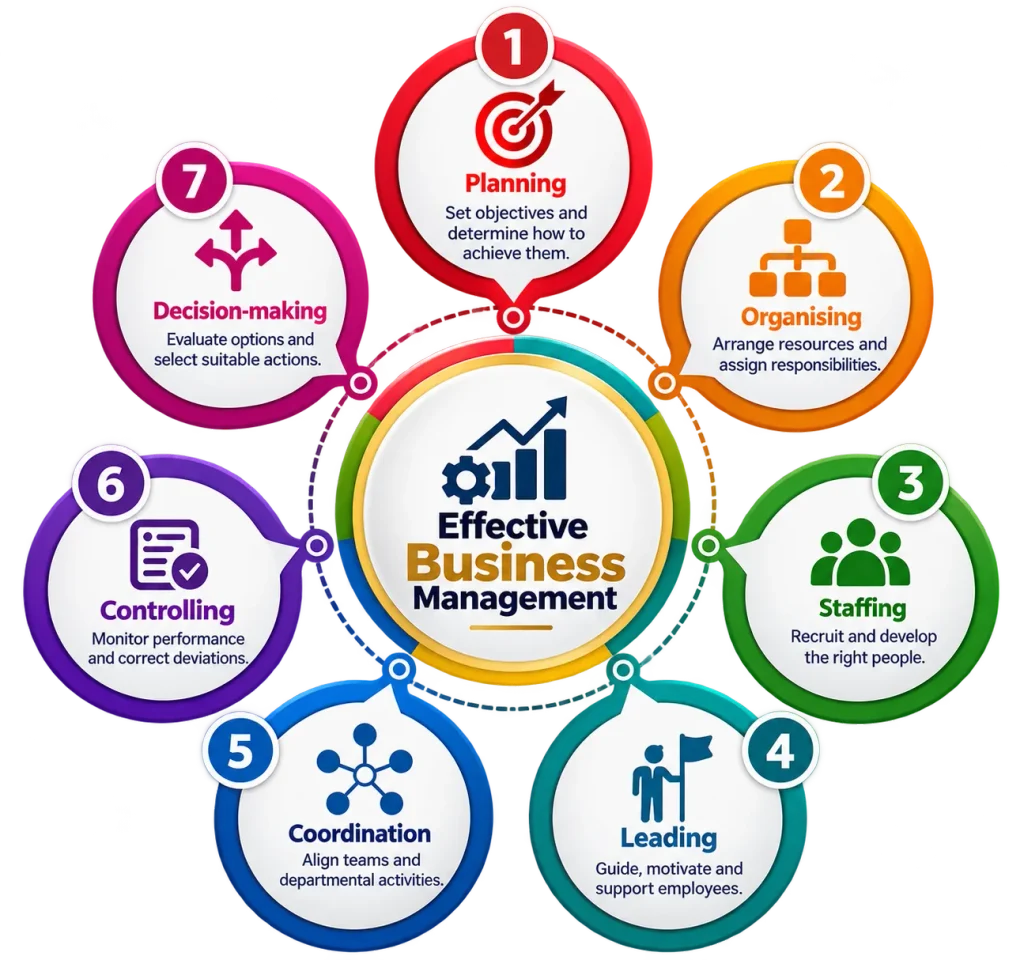
What are the 7 Functions of Business Management?
The seven functions of business management are the interconnected activities managers use to guide people, resources and business processes towards organisational goals.
The functions are:
- Planning – establishing objectives and deciding how to achieve them.
- Organising – arranging resources, responsibilities and workflows.
- Staffing – recruiting, developing and retaining suitable employees.
- Leading – motivating, guiding and supporting employees.
- Coordination – aligning departments, teams and business activities.
- Controlling – monitoring performance and correcting problems.
- Decision-making – evaluating alternatives and selecting appropriate actions.
Together, these functions help businesses translate their objectives into practical activities and measurable results. They are not isolated tasks; managers often perform several of them simultaneously.
1. Planning: Setting Business Objectives and Strategies
Planning is the process of establishing business objectives and determining the actions, resources and timeframes required to achieve them.
It provides direction by helping managers understand what the organisation wants to accomplish, which activities are necessary and how progress will be evaluated.
Why is Planning Important in Business Management?
Effective planning helps businesses:
- Establish clear short-term and long-term objectives.
- Anticipate potential risks and operational challenges.
- Allocate financial, human and physical resources.
- Set priorities and deadlines.
- Prepare for changes in customer demand and market conditions.
- Establish measurable performance targets.
Without adequate planning, businesses may waste resources, miss deadlines or pursue activities that do not support their strategic objectives.
Example of Planning in Business
Consider a small retail business in Manchester that wants to increase online sales over the next six months.
The manager reviews previous sales figures, identifies popular products, researches customer preferences and establishes a sales target. The manager then develops a plan covering website improvements, digital marketing, stock availability and customer service.
The business assigns responsibilities to team members and establishes monthly performance targets.
This example demonstrates how planning converts a general ambition into specific actions.
Types of Business Planning
Business managers commonly use several levels of planning:
- Strategic planning: establishes the organisation’s long-term direction and major objectives.
- Tactical planning: translates strategic objectives into departmental plans.
- Operational planning: identifies the daily and weekly activities required to implement those plans.
- Contingency planning: prepares alternative responses to unexpected events.
Effective planning should remain flexible. Managers need to review assumptions and adjust their approach when customer needs, costs or market conditions change.
2. Organising: Allocating Resources and Responsibilities
Organising involves arranging people, resources, responsibilities and processes so that business plans can be implemented effectively.
After establishing objectives, managers must determine who will perform each task, what resources are needed and how different activities will fit together.
Key Activities in Organising
The organising function may include:
- Establishing departmental responsibilities.
- Assigning tasks according to employee skills.
- Allocating budgets, equipment and materials.
- Defining reporting relationships.
- Establishing procedures and workflows.
- Delegating appropriate authority.
- Identifying dependencies between business activities.
A well-organised business reduces duplication, clarifies accountability and helps employees understand their responsibilities.
Example of Organising in Business
Imagine a training provider preparing to launch a new business management course. The manager must ensure that all departments understand their responsibilities and work towards the same objective.
To organise the launch effectively, the manager divides tasks between different teams:
- The academic team prepares course materials and learning resources.
- The marketing team develops promotional content to attract Learners.
- The administration team manages enrolments and registration.
- The finance team monitors costs and maintains the budget.
- The Learner support team responds to enquiries and provides assistance.
Each team receives clear responsibilities, deadlines and instructions. The manager also establishes a communication process to share updates about enrolments, marketing activities and course preparation.
This organised approach helps departments work together efficiently, avoid duplicated tasks and prepare for a successful course launch.launch date without unnecessarily repeating tasks.
How Organising Improves Business Performance
Organising helps businesses use their resources more effectively. It can improve workflow, reduce confusion, strengthen accountability and make it easier to identify operational weaknesses.
However, organisational structures should reflect the size and needs of the business. A small business may operate successfully with a simple structure, while a larger organisation may require several management levels and specialised departments.
3. Staffing: Recruiting and Developing the Right People
Staffing involves ensuring that an organisation has suitable people with the knowledge, skills and experience needed to perform its activities.
Employees influence service quality, productivity, customer satisfaction and innovation. Effective staffing therefore requires more than recruiting people to fill vacant positions.
Main Activities Within the Staffing Function
Staffing may involve:
- Identifying workforce requirements.
- Preparing job descriptions and person specifications.
- Recruiting and selecting candidates.
- Conducting appropriate induction activities.
- Providing training and professional development.
- Evaluating employee performance.
- Supporting employee retention and progression.
- Planning for future workforce needs.
Managers should consider both current operational requirements and the capabilities the organisation may need in the future.
Example of Staffing in Business
A growing logistics company in Birmingham receives an increasing number of customer orders.
Management identifies a need for additional warehouse employees and delivery coordinators. The company reviews workload data, defines the required skills and recruits suitable candidates.
New employees receive training in workplace procedures, customer service and relevant operational systems. Supervisors monitor their progress and provide feedback.
As a result, the organisation is better positioned to manage increased demand while maintaining service standards.
Why Staffing Matters
Appropriate staffing helps businesses place the right people in suitable roles. It can support productivity, employee engagement and service quality.
Poor staffing decisions, by contrast, may contribute to high employee turnover, skills shortages, inconsistent performance and increased recruitment costs.
Workforce planning should also consider equality, fair recruitment practices, employee wellbeing and applicable employment requirements.
4. Leading: Motivating and Guiding Employees
Leading is the management function concerned with influencing, motivating and supporting people so they can contribute effectively to organisational objectives.
Managers use communication, leadership approaches, feedback and interpersonal skills to help employees understand expectations and perform their responsibilities.
Important Elements of Effective Leadership
Effective leadership may involve:
- Communicating business objectives clearly.
- Setting expectations and providing direction.
- Motivating employees and recognising contributions.
- Encouraging teamwork and collaboration.
- Managing workplace disagreements.
- Supporting professional development.
- Helping teams adapt to change.
- Demonstrating accountability and ethical behaviour.
Leadership is not limited to giving instructions. Effective leaders also listen to employees, understand workplace challenges and create opportunities for constructive feedback.
Example of Leading in Business
Suppose a customer service team is experiencing declining performance because employees are struggling with a new customer management system.
The team manager discusses the difficulties with employees, identifies gaps in their knowledge and arranges additional training.
The manager introduces regular feedback sessions, recognises improvements and establishes achievable performance targets.
This approach addresses the underlying problem while helping employees develop confidence and competence.
Leadership Styles and Their Business Applications
Different situations may require different leadership approaches.
- Democratic leadership: encourages employee participation and shared discussion.
- Autocratic leadership: concentrates decision-making authority with the leader and may be appropriate in certain urgent situations.
- Transformational leadership: inspires employees around a shared vision and encourages improvement.
- Coaching leadership: focuses on developing individual skills and long-term performance.
No single leadership style is appropriate for every situation. Managers should consider the task, employees’ capabilities, organisational culture and level of urgency.
5. Coordination: Connecting Teams and Business Activities
Coordination involves aligning the activities of individuals, departments and business functions so that they contribute to shared objectives.
While organising establishes responsibilities and structures, coordination helps ensure that the work of different teams fits together effectively.
For example, a marketing campaign may generate customer demand, but the sales, finance, inventory and customer service teams must be prepared to support that demand.
Why is Coordination Important?
Coordination helps organisations:
- Improve communication between departments.
- Reduce conflicting priorities.
- Prevent duplicated work.
- Align departmental targets with business objectives.
- Manage deadlines and dependencies.
- Resolve operational bottlenecks.
- Deliver a more consistent customer experience.
Poor coordination can create delays even when individual departments perform their own tasks successfully.
Example of Coordination in Business
Consider an e-commerce company planning a seasonal promotional campaign.
The marketing department schedules advertisements, the purchasing team checks stock availability, the warehouse prepares fulfilment capacity and the customer service team reviews expected enquiry volumes.
Management establishes shared deadlines and a central reporting process.
If marketing promotes a product that is unavailable, the campaign may disappoint customers and waste advertising expenditure. Coordination helps prevent this problem by connecting marketing plans with inventory and operational capacity.
Practical Ways to Improve Coordination
Businesses can improve coordination through:
- Regular cross-departmental meetings.
- Shared project schedules and task management systems.
- Clear communication channels.
- Defined responsibilities and deadlines.
- Common performance indicators.
- Timely reporting of risks and delays.
Coordination is particularly important when businesses expand, introduce new products or operate across multiple locations.
6. Controlling: Monitoring and Improving Performance
Controlling is the process of measuring business performance, comparing actual results with established objectives and taking corrective action when necessary.
It helps managers determine whether plans are producing the intended outcomes and whether resources are being used appropriately.
The Four Main Steps in Management Control
The controlling function generally involves four steps:
- Establish performance standards.
- Measure actual performance.
- Compare results with the standards.
- Investigate significant differences and take corrective action.
These steps create a feedback loop that allows managers to improve performance and revise plans when circumstances change.
Example of Controlling in Business
A manufacturing business sets a monthly target of producing 5,000 units while keeping defective products below an agreed threshold.
At the end of the month, the manager reviews production reports and discovers that the business produced only 4,400 units. The defect rate has also increased.
The manager investigates equipment downtime, material quality and production processes. The review identifies a maintenance issue that has reduced output.
The company schedules maintenance, reviews production procedures and monitors subsequent results.
This example shows how controlling helps managers identify problems and implement evidence-based improvements.
Common Business Performance Indicators
Businesses can monitor performance using key performance indicators (KPIs), including:
- Revenue and sales growth.
- Operating costs and profit margins.
- Customer satisfaction.
- Employee turnover.
- Production output.
- Delivery times.
- Product defect rates.
- Project completion rates.
The most appropriate indicators depend on the organisation’s objectives and operating environment.
Controlling should not simply focus on identifying mistakes or blaming employees. Its purpose is to understand performance, manage risks and improve results.
7. Decision-Making: Selecting the Best Course of Action
Decision-making is the process of identifying a problem or opportunity, evaluating available options and selecting an action that supports business objectives.
Managers make decisions about staffing, budgets, marketing, suppliers, technology, customer service and long-term business strategy.
Good decisions require relevant information, sound judgement and an understanding of potential risks.
Steps in Effective Business Decision-Making
A structured decision-making process can include:
- Define the problem or opportunity.
- Gather relevant information.
- Identify possible solutions.
- Evaluate costs, benefits and risks.
- Select the most appropriate option.
- Implement the decision.
- Monitor results and learn from the outcome.
The process may be straightforward for routine operational decisions but more detailed for significant financial or strategic choices.
Example of Decision-Making in Business
A small business is considering whether to open a second branch.
The owner examines customer demand, projected operating costs, staffing requirements, available finance and competition in the proposed location.
Three options are considered: opening a permanent branch, operating a temporary sales location or expanding online sales.
After comparing the expected costs and potential benefits, the owner chooses to test demand through a temporary location before committing to a long-term lease.
This decision allows the business to gather further evidence while limiting its initial financial commitment.
Why Evidence-Based Decisions Matter
Evidence-based decision-making helps managers reduce avoidable uncertainty and explain the reasons behind their choices.
Useful sources of information may include:
- Financial statements and budgets.
- Customer feedback and market research.
- Employee performance reports.
- Operational data.
- Supplier information.
- Risk assessments.
- Forecasts and scenario analysis.
Managers should also recognise the limitations of available information. Data can be incomplete, forecasts can be inaccurate and business decisions may involve competing priorities.
Comparison Table: The Seven Functions of Business Management
| Management function | Main purpose | Practical business example |
|---|---|---|
| Planning | Establish objectives and actions | Creating a six-month sales growth plan |
| Organising | Allocate resources and responsibilities | Assigning departments to a product launch |
| Staffing | Recruit and develop employees | Hiring and training additional warehouse staff |
| Leading | Motivate and guide employees | Coaching a team to improve customer service |
| Coordination | Align teams and activities | Connecting marketing campaigns with stock availability |
| Controlling | Measure results and correct problems | Investigating production targets that have not been met |
| Decision-making | Evaluate options and select actions | Comparing the costs and risks of opening a new branch |
Although each function has a distinct purpose, the functions operate together. Effective business management requires managers to combine them rather than treat them as independent activities.
How Do the Seven Functions Work Together?
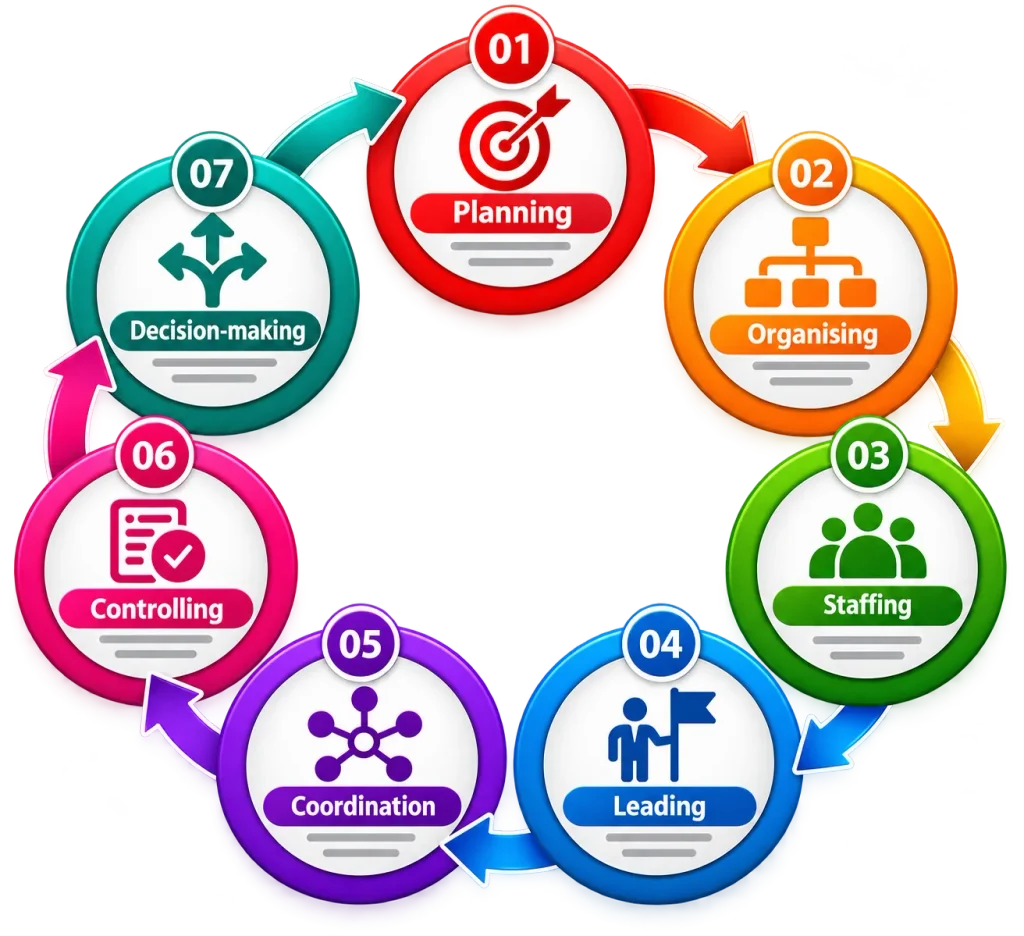
The seven functions of business management work together as an interconnected process that helps organisations achieve their objectives. For example, when launching a new product, managers establish objectives, organise resources, identify staffing requirements, lead employees, coordinate departmental activities, monitor performance and make decisions based on results.
Each function has a distinct purpose, but all seven contribute to effective business operations:
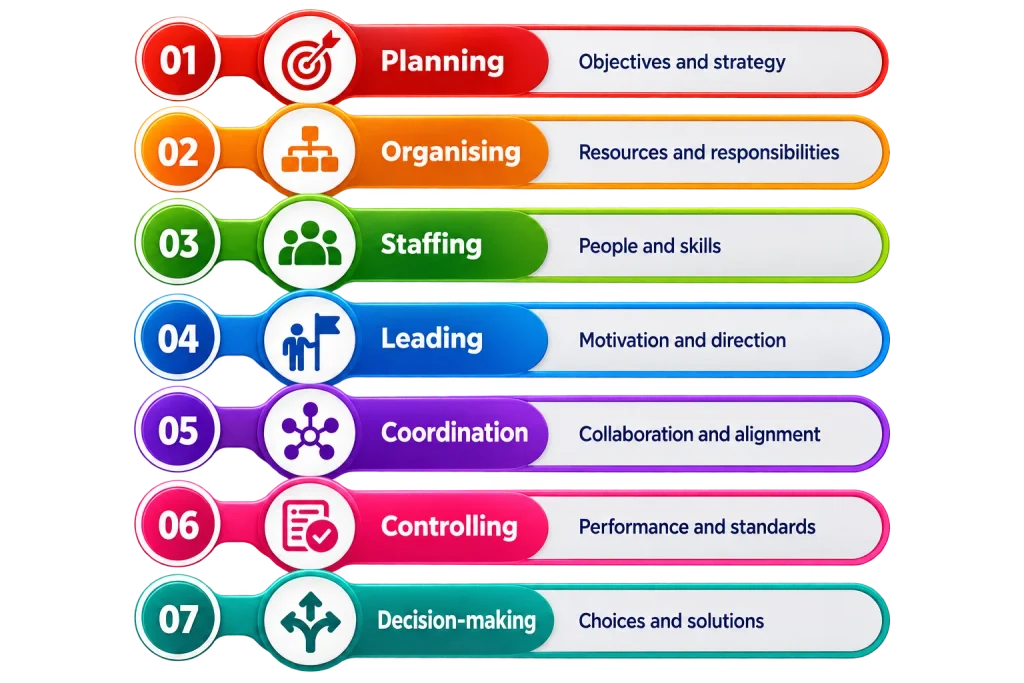
- Planning: Establishes business objectives and identifies the actions needed to achieve them.
- Organising: Allocates resources and assigns responsibilities to ensure work is completed efficiently.
- Staffing: Ensures the organisation has the right people with the necessary skills and experience.
- Leading: Guides, motivates and supports employees in achieving business goals.
- Coordination: Aligns departmental activities and improves communication between teams.
- Controlling: Monitors performance, identifies problems and supports corrective action.
- Decision-making: Evaluates available options and selects appropriate actions based on business needs.
These functions operate continuously rather than in a strictly linear sequence. Managers use performance information to revise plans, adjust resources and make better decisions, allowing businesses to respond to changing circumstances and improve overall performance.
What Are the Benefits of Effective Business Management?
Effective business management helps organisations achieve their objectives, use resources efficiently and improve overall performance. By applying the seven functions of business management, managers can strengthen teamwork, minimise operational challenges and support sustainable business growth.
The key benefits of effective business management include:
- Better Resource Utilisation: Planning and organising help allocate staff, time, money and equipment efficiently, reducing waste and improving productivity.
- Improved Employee Performance: Staffing and leading develop employee skills, clarify responsibilities and encourage effective teamwork.
- Stronger Operational Coordination: Coordination improves communication between departments, manages dependencies and reduces unnecessary delays.
- More Effective Risk Management: Planning and decision-making help assess risks, while controlling identifies problems and supports corrective action.
- Improved Business Performance: Performance monitoring enables managers to evaluate targets, identify weaknesses and implement improvements.
- Greater Adaptability: Effective management helps businesses respond to changing customer expectations, technological developments, competition and operating costs.
However, achieving these benefits depends on how effectively management practices are implemented. Regular performance reviews, clear communication and continuous improvement are essential for turning management principles into measurable business results.
Common Mistakes in Business Management
Managers may understand the functions of business management but struggle to apply them consistently.
Common mistakes include:
- Setting objectives that are vague or difficult to measure.
- Allocating responsibilities without considering employee capabilities.
- Recruiting staff without identifying the actual workforce requirement.
- Failing to communicate expectations.
- Allowing departments to work towards conflicting priorities.
- Monitoring too many performance indicators without clear purpose.
- Making major decisions without reviewing relevant evidence.
- Ignoring feedback when results do not meet expectations.
Businesses can reduce these problems by establishing clear objectives, assigning accountability, maintaining effective communication and regularly reviewing performance.
Managers should also recognise that the seven functions require different skills. Financial awareness, communication, leadership, problem-solving, strategic thinking and data interpretation can all contribute to effective management.
Developing Business Management Skills Through Professional Learning
Understanding the functions of business management provides a strong foundation for professional development and career growth. Developing management knowledge can help individuals improve their leadership abilities, make informed decisions and contribute effectively to organisational success.
Learners who want to strengthen their business management skills can explore key areas such as:
- Leadership and team management
- Human resource management
- Marketing and customer relations
- Finance and accounting
- Business strategy and planning
- Organisational behaviour
- Decision-making and problem-solving
- Business operations and performance management
Studying these areas helps Learners understand how different business functions work together to achieve organisational objectives. It can also develop practical skills in resource allocation, employee motivation, operational coordination and performance evaluation.
Combining theoretical knowledge with practical experience enables aspiring managers, business owners and professionals to apply management principles in real workplace situations. Continuous learning and professional development can further strengthen their ability to respond to business challenges, support innovation and contribute to sustainable organisational growth.
Conclusion
The seven functions of business management—planning, organising, staffing, leading, coordination, controlling and decision-making—help businesses achieve their objectives and manage resources effectively. Each function plays an important role in improving productivity, supporting employees and maintaining efficient operations.
Understanding these functions enables aspiring managers, business owners and professionals to make informed decisions, solve workplace challenges and improve organisational performance. By applying these principles consistently, businesses can adapt to change, strengthen teamwork and support long-term growth.