
Leadership vs Management: Differences and Workplace Examples
Leadership and management are two essential capabilities that influence how organisations operate, develop employees and achieve business objectives. Although these terms are frequently used interchangeably, leadership and management have different responsibilities, approaches and contributions to workplace performance. Understanding leadership vs management helps learners, professionals and aspiring managers recognise how organisations establish direction, coordinate resources, motivate employees and maintain operational effectiveness.
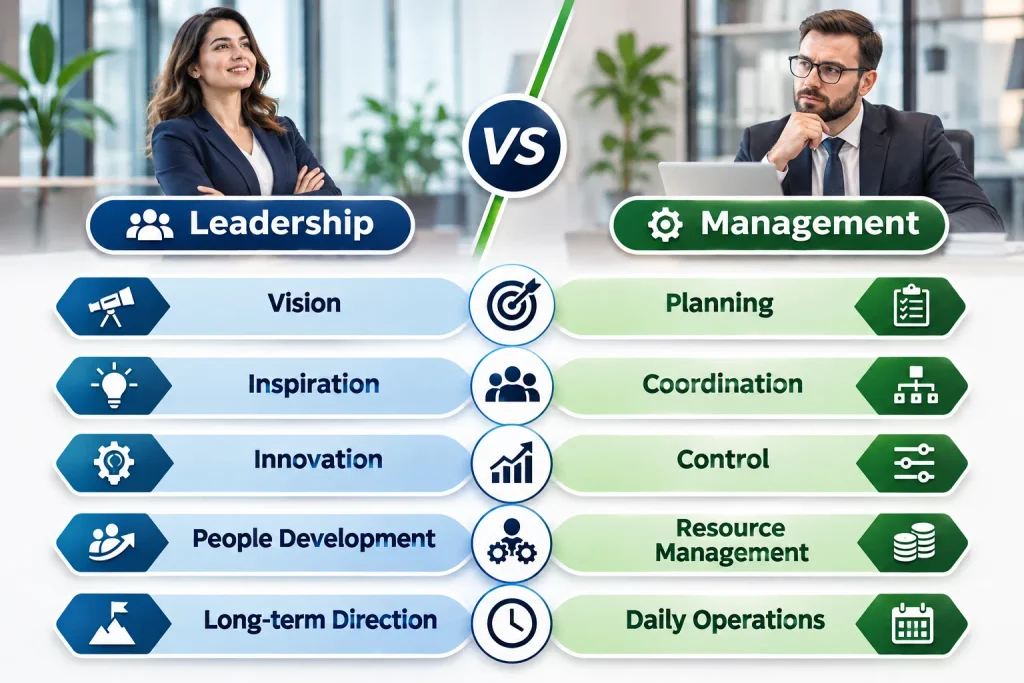
Leadership focuses primarily on creating a vision, influencing people, encouraging innovation and guiding teams towards shared goals. Management, on the other hand, concentrates on planning, organising, supervising activities, allocating resources and ensuring that organisational objectives are achieved efficiently. Both functions are important in workplaces across industries, including construction, healthcare, education, manufacturing, hospitality and business services.
This guide explores the meaning of leadership and management, their key differences, practical workplace examples, responsibilities, essential skills and the importance of combining both approaches to achieve sustainable organisational success.
What is Leadership?
Leadership is the ability to influence, inspire and guide individuals or groups towards achieving shared objectives. It involves establishing a clear direction, communicating a vision, encouraging employee participation and helping people understand the purpose behind their work.
A leader does not necessarily need a formal managerial position. Employees at different organisational levels can demonstrate leadership by taking responsibility, identifying opportunities, supporting colleagues and suggesting improvements. Effective leadership is based on trust, communication, personal influence and the ability to encourage others to perform effectively.
In modern organisations, leadership is particularly important when businesses experience change, face unexpected challenges or introduce new strategies. Leaders help employees understand why change is necessary and encourage them to contribute towards organisational development.
Key Characteristics of Effective Leadership
- Vision and direction: Establishing a clear understanding of organisational goals and long-term priorities.
- Inspiration and motivation: Encouraging employees to perform effectively and remain committed to shared objectives.
- Communication: Explaining expectations, sharing information and listening to employee concerns.
- Decision-making: Evaluating opportunities, challenges and potential consequences before making important decisions.
- Adaptability: Responding positively to changing business conditions, technologies and customer expectations.
- Employee development: Supporting professional growth through feedback, coaching and mentoring.
- Innovation: Encouraging creative thinking and identifying opportunities to improve organisational performance.
- Accountability: Demonstrating responsibility, ethical behaviour and consistency in professional decisions.
Workplace Example of Leadership
Imagine a manufacturing organisation experiencing declining employee engagement and reduced production quality. Employees have become reluctant to suggest improvements because they believe their opinions are not considered.
A team leader takes a proactive approach by organising discussions, listening to employees and identifying the reasons behind the problem. The leader encourages staff to share practical suggestions, introduces collaborative problem-solving sessions and communicates a clear vision for improving workplace performance.
Instead of simply instructing employees to increase production, the leader explains how their contributions affect product quality, customer satisfaction and organisational success.
This demonstrates leadership because the individual influences employee attitudes, builds confidence and encourages people to work towards a shared improvement objective.
What is Management?
Management is the process of planning, organising, coordinating, directing and controlling organisational resources and activities to achieve defined objectives. It involves ensuring that employees understand their responsibilities, operational processes are followed and available resources are used effectively.
Managers translate organisational objectives into practical activities. They establish work schedules, allocate responsibilities, monitor performance, manage budgets and ensure that projects are completed within agreed requirements.
Management is essential for maintaining stability, consistency and accountability. Without effective management, organisations may experience poor coordination, inefficient resource utilisation, missed deadlines and unclear responsibilities.
For example, a construction manager must coordinate workers, equipment, materials, schedules and project documentation to ensure that construction activities are completed safely and efficiently. These responsibilities require structured planning, monitoring and control.
Key Characteristics of Effective Management
- Planning: Establishing objectives, schedules, priorities and operational activities.
- Organising: Assigning responsibilities and arranging resources to complete work.
- Delegation: Distributing tasks according to employee capabilities and organisational requirements.
- Performance monitoring: Reviewing progress against agreed targets and identifying areas requiring improvement.
- Resource allocation: Managing budgets, equipment, materials, time and workforce requirements.
- Problem-solving: Addressing operational difficulties and implementing corrective actions.
- Coordination: Ensuring that departments and employees work together effectively.
- Accountability: Monitoring responsibilities and ensuring that agreed procedures are followed.
Workplace Example of Management
Consider a construction company responsible for completing a commercial building project within a specific timeframe.
The project manager develops a work schedule, assigns responsibilities to engineers and supervisors, arranges construction materials, monitors labour requirements and tracks project expenditure.
When a material delivery is delayed, the manager reviews the programme, coordinates with suppliers and adjusts the schedule to minimise disruption.
This demonstrates management because the individual focuses on organising activities, controlling resources, monitoring performance and ensuring that the project remains aligned with its objectives.
Leadership vs Management: What is the Main Difference?
The main difference between leadership and management is that leadership focuses on influencing people and establishing direction, whereas management focuses on organising resources and coordinating activities to achieve organisational objectives.
Leadership answers questions such as:
- Where should the organisation go?
- Why is change necessary?
- How can employees become motivated?
- How can people work towards a shared vision?
Management addresses different questions:
- What activities need to be completed?
- Who is responsible for each task?
- What resources are required?
- How will progress and performance be monitored?
Both functions are interconnected. Leadership provides purpose and direction, while management creates the structure and processes required to turn that direction into measurable results.
The distinction is useful for understanding professional responsibilities, although real workplace roles frequently combine both functions. A department manager may establish a long-term improvement vision while also managing budgets, schedules and employee performance.
12 Key Differences Between Leadership and Management
The following table explains the major differences between leadership and management across common workplace responsibilities.
| Comparison Area | Leadership | Management |
|---|---|---|
| Main focus | People, vision and direction | Processes, resources and performance |
| Primary purpose | Inspiring people towards shared goals | Achieving defined organisational objectives |
| Approach | Influencing and motivating | Planning and coordinating |
| Time orientation | Often long-term and future-focused | Often focused on immediate and ongoing priorities |
| Decision-making | Encourages strategic thinking and participation | Uses information, procedures and operational requirements |
| Authority | Can be based on personal influence and trust | Often supported by formal organisational authority |
| Employee relationships | Builds commitment and confidence | Establishes responsibilities and accountability |
| Change | Encourages innovation and transformation | Plans and implements operational changes |
| Risk approach | Explores opportunities and new possibilities | Evaluates and controls operational risks |
| Performance | Encourages growth and collective achievement | Measures results against defined targets |
| Communication | Creates understanding and shared purpose | Provides instructions, updates and operational information |
| Success measurement | Commitment, direction, innovation and long-term development | Efficiency, productivity, deadlines and target achievement |
These differences should not be interpreted as strict boundaries. Successful managers often demonstrate leadership behaviours, while effective leaders need management knowledge to ensure that their ideas can be implemented.
Leadership vs Management: Differences in Workplace Responsibilities
Leadership and management become easier to understand when their responsibilities are examined in practical organisational situations.
Strategic Planning
Leadership involves identifying long-term opportunities, communicating organisational priorities and helping employees understand the direction of the business.
Management involves translating strategic priorities into operational plans, allocating resources, setting deadlines and monitoring implementation.
Example: A business leader proposes expanding into a new international market. The management team researches costs, prepares budgets, allocates employees and develops an implementation schedule.
Employee Motivation and Performance
Leadership encourages employees to develop confidence, take initiative and contribute to organisational success.
Management establishes performance expectations, monitors employee output, conducts reviews and identifies training requirements.
Example: A department leader encourages employees to improve customer service by recognising their contributions. The manager introduces customer service targets, monitors feedback and arranges additional training.
Decision-Making
Leadership decisions frequently involve organisational direction, innovation and future opportunities.
Management decisions generally concern operational priorities, resource distribution, work schedules and immediate problem-solving.
Example: A company leader decides that sustainability should become a major organisational priority. Managers then develop waste reduction procedures, monitor energy consumption and assign environmental responsibilities.
Managing Organisational Change
Leadership helps employees understand the reasons for change and builds confidence in the proposed direction.
Management coordinates the practical implementation of change through planning, communication, training and progress monitoring.
Example: A business decides to introduce new digital management software. The leader explains how the technology will improve organisational performance, while the manager arranges training sessions, implementation schedules and technical support.
Conflict Resolution
Leadership encourages mutual understanding, respect and constructive relationships between employees.
Management investigates workplace disagreements, follows organisational procedures and establishes practical solutions.
Example: Two employees disagree about the distribution of responsibilities. A leader encourages open communication, while the manager reviews job descriptions and reallocates tasks where necessary.

Practical Workplace Examples of Leadership vs Management
Understanding leadership vs management through realistic workplace situations helps learners recognise how these capabilities operate in different industries.
Example 1: Leadership and Management in a Healthcare Organisation
A Nurse’s Role in Interprofessional Collaboration in Health Care | The University of Tulsa
A hospital department is experiencing increased workloads, communication difficulties and delays in patient services.
Leadership responsibilities:
- Communicating a shared commitment to improving patient care.
- Encouraging healthcare professionals to share concerns.
- Building teamwork between different healthcare departments.
- Promoting a culture of continuous improvement.
- Supporting employees during operational changes.
Management responsibilities:
- Preparing staff duty schedules.
- Coordinating workforce availability.
- Monitoring service delivery and departmental performance.
- Managing equipment and resource requirements.
- Reviewing operational procedures and outstanding issues.
Workplace outcome: Leadership helps establish a shared commitment to better patient services, while management coordinates the resources and activities needed to improve operational performance.
Example 2: Leadership and Management in Construction
Construction manager explaining to the civil engineers the plans for construction works
A construction company is delivering a large commercial project involving engineers, contractors, suppliers and site supervisors.
Leadership responsibilities:
- Communicating project priorities and shared objectives.
- Encouraging collaboration between contractors.
- Promoting a positive safety culture.
- Supporting employees in resolving complex challenges.
- Encouraging improvements in construction practices.
Management responsibilities:
- Developing construction schedules.
- Allocating labour and equipment.
- Coordinating material deliveries.
- Monitoring expenditure and project progress.
- Maintaining project documentation and reporting.
Workplace outcome: Leadership encourages cooperation and commitment, while management ensures that construction activities are properly coordinated and monitored.
Example 3: Leadership and Management in a Manufacturing Organisation
A manufacturing business wants to reduce production waste and improve product quality.
| Leadership Activities | Management Activities |
|---|---|
| Communicating the vision for improved quality | Establishing production quality targets |
| Encouraging employees to identify problems | Monitoring production performance |
| Promoting innovation and improvement | Scheduling inspections |
| Building employee commitment | Allocating inspection resources |
| Encouraging responsibility | Recording non-conformities and corrective actions |
Workplace outcome: Leadership develops a culture in which employees value quality improvement, while management establishes the systems and processes needed to monitor production performance.
Example 4: Leadership and Management in an Office Environment
An organisation is introducing a new customer relationship management system.
The department leader explains how the new system will improve communication, customer service and information sharing. They encourage employees to participate in the transition and provide feedback.
The office manager arranges employee training, distributes responsibilities, coordinates technical support and monitors the implementation schedule.
Workplace outcome: Employees understand the purpose of the change and receive the operational support needed to adopt the new system.
Leadership vs Management: A Workplace Responsibility Comparison
The following table summarises how both capabilities contribute to common organisational activities.
| Workplace Activity | Leadership Contribution | Management Contribution |
|---|---|---|
| Team development | Builds trust and shared commitment | Assigns responsibilities and monitors progress |
| Business growth | Identifies opportunities and future direction | Develops budgets and operational plans |
| Quality improvement | Encourages a quality-focused culture | Implements inspections and performance controls |
| Environmental sustainability | Promotes environmental responsibility | Coordinates waste, energy and resource monitoring |
| Employee development | Inspires learning and professional growth | Organises training and evaluates performance |
| Project delivery | Creates purpose and encourages collaboration | Controls schedules, resources and deliverables |
| Workplace safety | Encourages responsible behaviours | Coordinates risk controls and safety procedures |
This comparison demonstrates that leadership and management are complementary rather than competing functions.
Leadership Styles and Management Styles: Understanding the Difference
Leadership and management styles describe how individuals guide employees, make decisions, communicate expectations and organise workplace activities. The appropriate approach depends on organisational objectives, employee experience, the nature of the work and the challenges being addressed.
The Chartered Management Institute identifies several recognised approaches to management and leadership, including situational, transformational, transactional, democratic and autocratic approaches. CMI+1
Common Leadership Styles
Transformational Leadership
Transformational leadership focuses on inspiring employees to achieve improvements beyond their usual expectations. Leaders communicate a compelling vision, encourage innovation and support professional development.
Example: A business leader encourages employees to develop more sustainable production methods and introduces opportunities for staff to contribute innovative ideas.
Democratic Leadership
Democratic leadership encourages employee participation in decision-making. Leaders invite suggestions, consider different perspectives and promote collaborative problem-solving.
Example: A department leader consults employees before introducing a new working arrangement.
Autocratic Leadership
Autocratic leadership involves making decisions centrally and providing clear instructions. This approach may be useful when immediate decisions are required, responsibilities must be clearly established or circumstances demand strong direction.
Example: A site supervisor gives direct instructions during an emergency response.
Situational Leadership
Situational leadership involves adapting leadership behaviour according to employee competence, confidence and the requirements of a particular situation.
Example: A manager provides close guidance to a new employee but gives an experienced team member greater independence.
Common Management Styles
Directive Management
Directive management involves establishing clear instructions, responsibilities and performance expectations.
Example: A production manager provides employees with specific instructions about manufacturing schedules and quality requirements.
Participative Management
Participative management involves consulting employees and considering their input when making operational decisions.
Example: An operations manager invites team members to suggest improvements to the daily workflow.
Transactional Management
Transactional management focuses on defined responsibilities, performance expectations, monitoring and recognition or corrective action.
Example: A sales manager establishes monthly targets and reviews individual performance against agreed objectives.
Delegative Management
Delegative management involves assigning responsibilities and allowing employees to complete tasks with an appropriate level of independence.
Example: A project manager delegates a research assignment to an experienced team member and monitors progress through agreed reporting arrangements.
Why Do Organisations Need Both Leadership and Management?
Organisations need leadership and management because achieving business objectives requires both clear direction and effective operational execution.
Leadership helps employees understand organisational priorities, develop confidence and remain motivated. Management ensures that responsibilities, resources, procedures and performance targets are properly coordinated.
An organisation with strong leadership but weak management may have an inspiring vision but struggle to implement it. Employees may understand what the organisation wants to achieve without having the resources, responsibilities or processes required to deliver results.
Similarly, an organisation with strong management but weak leadership may operate efficiently but struggle to innovate, respond to change or maintain employee commitment.
Five Major Benefits of Combining Leadership and Management
Combining leadership and management helps organisations connect long-term goals with effective daily operations. Leadership provides direction, motivation and strategic thinking, while management focuses on planning, coordination and performance monitoring. Together, these capabilities improve organisational performance, employee engagement and sustainable business growth.
Five major benefits include:
1. Improved Organisational Performance
Leadership establishes priorities and motivates employees, while management ensures that activities are properly organised and monitored. This combination helps organisations achieve measurable results.
- Aligning business objectives with daily activities.
- Improving team productivity and operational efficiency.
- Monitoring progress towards organisational targets.
2. Better Employee Engagement
Effective leadership encourages employees to share ideas, take responsibility and contribute to organisational success. Management supports this approach by providing clear expectations, regular feedback and appropriate resources.
- Building employee confidence and motivation.
- Encouraging teamwork and collaboration.
- Providing guidance and performance feedback.
3. More Effective Decision-Making
Leadership supports strategic thinking and helps organisations identify future opportunities. Management evaluates operational information, available resources and potential consequences to ensure decisions can be implemented effectively.
- Identifying challenges and business opportunities.
- Evaluating information before making decisions.
- Selecting practical solutions based on organisational needs.
4. Improved Change Management
Successful organisational change requires clear direction and effective implementation. Leaders explain the purpose of change and encourage employee support, while managers coordinate activities, training and performance reviews.
- Communicating organisational changes clearly.
- Preparing employees for new responsibilities.
- Coordinating implementation activities.
- Monitoring progress and addressing challenges.
5. Stronger Organisational Sustainability
Leadership promotes environmental responsibility and long-term organisational thinking, while management translates these priorities into practical workplace activities. This approach helps organisations improve resource efficiency and monitor environmental performance.
- Reducing energy consumption and material waste.
- Encouraging responsible use of workplace resources.
- Monitoring environmental performance.
- Supporting continuous improvement and sustainable operations.

How Leadership and Management Support Environmental Sustainability
Leadership and management are particularly important when organisations want to improve environmental performance and establish responsible business practices.
Environmental sustainability requires more than introducing policies or setting environmental targets. Organisations must influence employee behaviour, establish clear responsibilities, monitor operational activities and evaluate improvement opportunities.
Leadership contributes by developing an environmental vision and encouraging employees to consider the environmental consequences of their decisions.
Management supports these priorities by establishing procedures, allocating resources and monitoring environmental performance.
Practical Workplace Example: Reducing Environmental Impact
Consider a manufacturing organisation that wants to reduce electricity consumption, material waste and unnecessary water usage.
| Activity | Leadership Responsibility | Management Responsibility |
|---|---|---|
| Energy efficiency | Promote responsible energy use | Monitor electricity consumption |
| Waste reduction | Encourage sustainable workplace behaviour | Establish waste segregation procedures |
| Water conservation | Communicate environmental priorities | Monitor water usage |
| Employee participation | Encourage improvement suggestions | Assign environmental responsibilities |
| Performance improvement | Establish long-term environmental objectives | Review performance indicators |
The organisation can measure progress through practical environmental performance indicators, including:
- Electricity consumption per production unit.
- Water consumption per operational activity.
- Percentage of waste recycled.
- Total material waste generated.
- Number of employees participating in environmental initiatives.
- Progress against environmental improvement targets.
For example, a sustainability leader may encourage departments to reduce unnecessary electricity consumption. The facilities manager can then review energy records, identify inefficient equipment and introduce operational controls.
This demonstrates how leadership establishes environmental commitment while management supports measurable implementation.
Essential Leadership and Management Skills for Workplace Success
Although leadership and management have different primary purposes, many professional skills are relevant to both responsibilities.
Developing these capabilities helps individuals supervise teams, coordinate organisational activities and contribute to business performance.
Important Leadership Skills
- Communication and Influence: Effective leaders communicate ideas clearly, listen to employees and encourage people to work towards shared objectives.
- Emotional Intelligence: Understanding emotions and recognising how workplace behaviour affects others helps leaders build stronger professional relationships.
- Strategic Thinking: Leaders need to understand organisational priorities, evaluate future opportunities and consider the long-term consequences of decisions.
- Adaptability: Workplace conditions can change because of new technology, customer expectations, organisational restructuring and market developments. Leaders must respond constructively.
- Conflict Resolution: Leaders should encourage respectful communication and help employees resolve disagreements before they affect team performance.
- Motivation and Coaching: Supporting employee development and recognising contributions can strengthen engagement and professional confidence.
Important Management Skills
- Planning and Organisation: Managers must establish priorities, coordinate activities and ensure that work is completed within agreed timeframes.
- Delegation: Effective delegation involves assigning responsibilities according to employee competence, available resources and operational requirements.
- Performance Monitoring: Managers should review progress, compare actual results with targets and identify areas requiring corrective action.
- Financial Awareness: Understanding budgets, costs and resource requirements helps managers make informed operational decisions.
- Problem-Solving: Managers need to identify operational challenges, evaluate possible solutions and implement appropriate actions.
- Risk Management: Identifying potential risks and establishing suitable controls helps organisations protect employees, resources and business operations.
Leadership vs Management Skills Comparison
| Skill | Leadership Application | Management Application |
|---|---|---|
| Communication | Inspiring and influencing people | Providing instructions and updates |
| Decision-making | Establishing strategic direction | Resolving operational issues |
| Problem-solving | Encouraging innovation | Implementing practical solutions |
| Delegation | Developing employee ownership | Assigning specific responsibilities |
| Motivation | Building commitment | Supporting performance |
| Planning | Establishing future priorities | Preparing operational schedules |
| Accountability | Demonstrating responsibility | Monitoring assigned duties |
How Can You Develop Leadership and Management Skills?
Developing effective leadership and management skills requires continuous learning, practical workplace experience and regular self-assessment. Individuals can strengthen these capabilities by understanding management principles, improving communication, making informed decisions and learning how to coordinate teams effectively.
Students, supervisors, aspiring managers and experienced professionals can follow these practical steps to improve their professional abilities and workplace performance.
Step 1: Understand Leadership and Management Principles
Start by learning the key responsibilities, principles and differences between leadership and management. Understanding leadership theories, management approaches and organisational behaviour helps professionals recognise how both capabilities contribute to business success.
Focus on developing knowledge of:
- Leadership styles and management approaches.
- Employee motivation and organisational behaviour.
- Team development and workplace performance.
- The relationship between leadership and business objectives.
Step 2: Improve Workplace Communication
Effective communication is essential for guiding employees, managing responsibilities and building positive professional relationships. Practise active listening, explaining expectations clearly and providing constructive feedback to improve workplace collaboration.
Develop these communication skills:
- Communicating organisational goals and expectations.
- Listening carefully to employees and colleagues.
- Providing clear instructions and constructive feedback.
- Handling workplace disagreements professionally.
Step 3: Develop Decision-Making Capabilities
Strong leaders and managers must evaluate information, identify challenges and select appropriate solutions. Learning to assess different options and their possible consequences helps professionals make confident and responsible decisions.
Improve decision-making by:
- Identifying workplace problems and their causes.
- Evaluating relevant information before taking action.
- Comparing possible solutions and their outcomes.
- Understanding strategic and operational decisions.
Step 4: Gain Practical Team Coordination Experience
Practical experience helps individuals understand how to manage team responsibilities and achieve shared objectives. Participating in group projects, workplace improvement activities and team assignments provides opportunities to practise leadership and management skills.
Gain experience in:
- Distributing tasks and assigning responsibilities.
- Coordinating team activities and monitoring progress.
- Resolving disagreements and workplace challenges.
- Encouraging collaboration and shared accountability.
Step 5: Develop Strategic and Operational Awareness
Understanding how business objectives connect with daily operations helps professionals make better decisions. They should recognise how employee performance, financial resources, customer satisfaction and operational efficiency contribute to organisational success.
Build your understanding of:
- Organisational goals and business strategies.
- Resource allocation and operational planning.
- Employee performance and productivity.
- Customer satisfaction and business improvement.
Step 6: Evaluate Your Performance
Regular self-assessment allows professionals to recognise their strengths and identify areas requiring improvement. Seeking feedback from supervisors, colleagues and team members can also provide valuable insights into communication, decision-making and team management abilities.
Make performance evaluation part of your development by:
- Requesting constructive feedback from colleagues.
- Reviewing personal and team performance.
- Identifying areas for professional improvement.
- Setting achievable development goals.
Step 7: Pursue Relevant Professional Learning
Professional education and structured business management training can provide a strong foundation for developing leadership and management capabilities. Relevant learning helps individuals understand leadership theories, team development, organisational strategy and effective management practices.
A structured qualification can help learners develop knowledge of:
- Leadership principles and management responsibilities.
- Team leadership, motivation and performance management.
- Business operations and organisational communication.
- Human resource management and strategic concepts.
For learners seeking formal business education, the OTHM Level 5 Extended Diploma in Business Management includes a dedicated unit titled Leading and Managing Teams, alongside other areas of business and management.
Common Misconceptions About Leadership and Management
Several misconceptions about leadership and management can create confusion about their roles and importance in the workplace. Understanding these differences helps professionals recognise that both capabilities are essential for effective teamwork, organisational performance and business success.
Common misconceptions include:
1. Leaders Are Always Managers
Leadership is not limited to individuals with formal managerial positions. Employees at different organisational levels can demonstrate leadership by:
- Identifying workplace problems and suggesting solutions.
- Encouraging colleagues to work towards shared goals.
- Taking initiative and supporting positive changes.
2. Managers Cannot Be Leaders
Managers can also be effective leaders by developing the ability to influence, guide and motivate their teams. They demonstrate leadership through:
- Communicating clearly with employees.
- Providing guidance, coaching and support.
- Encouraging teamwork and strategic thinking.
3. Leadership Is More Important Than Management
Neither leadership nor management is always more important. Their value depends on the organisation’s situation and objectives.
- Leadership is particularly valuable during organisational change and business transformation.
- Management is essential for coordinating complex projects, meeting deadlines and maintaining operational efficiency.
4. Management Only Involves Giving Instructions
Management involves a wider range of responsibilities than simply directing employees. It focuses on organising resources and ensuring that workplace activities achieve their intended results.
- Planning and organising operational activities.
- Coordinating employees and workplace resources.
- Monitoring performance and evaluating results.
- Identifying opportunities for improvement.
5. Leadership is Only About Motivation
Motivating employees is an important leadership responsibility, but effective leadership also involves setting direction, making decisions and guiding teams through challenges.
- Establishing clear goals and organisational direction.
- Making informed decisions and accepting accountability.
- Communicating effectively during uncertainty.
- Supporting employees through workplace changes.
6. Leadership and Management Are Separate Career Paths
Leadership and management are different but closely connected capabilities. Professionals often need both throughout their careers to manage responsibilities and achieve organisational objectives.
- Managers may use leadership skills to inspire and develop employees.
- Team leaders may apply management skills to organise daily activities.
- Senior professionals often combine both capabilities to improve performance and support organisational growth.
Leadership vs Management: Which Is More Important?
Neither leadership nor management is universally more important. Both are essential for organisational success, as they support different but interconnected workplace responsibilities. Leadership focuses on establishing direction, motivating employees and encouraging innovation, while management ensures that organisational activities are properly planned, coordinated and monitored.
The importance of each depends on the organisation’s needs and challenges. For example, during business expansion, leadership encourages employees to support the company’s vision, while management develops operational plans and allocates resources.
Leadership is particularly important for:
- Establishing organisational vision and direction.
- Motivating employees and building team confidence.
- Encouraging innovation and positive workplace change.
- Developing strong professional relationships.
- Promoting long-term organisational growth.
Management is particularly important for:
- Planning and organising workplace activities.
- Allocating financial and human resources.
- Monitoring employee and organisational performance.
- Maintaining operational efficiency and consistency.
- Achieving organisational targets within agreed deadlines.
Successful organisations combine both capabilities to maintain effective operations, develop employees and achieve sustainable business objectives.
Can Someone Be Both a Leader and a Manager?
Yes, an individual can perform both leadership and management responsibilities. In many organisations, managers are expected not only to supervise employees and coordinate activities but also to motivate teams, communicate organisational objectives and encourage professional development.
For example, an operations manager responsible for a team of 20 employees may prepare work schedules, allocate resources, monitor productivity and review performance. These activities demonstrate management capabilities. The same individual may also encourage employees to suggest improvements, introduce innovative working methods and develop a positive team culture, demonstrating leadership capabilities.
Management responsibilities include:
- Preparing work schedules and operational plans.
- Assigning tasks and distributing responsibilities.
- Managing resources and monitoring productivity.
- Reviewing employee performance.
- Ensuring that organisational objectives are achieved.
Leadership responsibilities include:
- Motivating employees towards shared goals.
- Encouraging teamwork and collaboration.
- Communicating a clear organisational vision.
- Supporting employee development.
- Promoting innovation and continuous improvement.
Combining leadership and management skills helps professionals become more effective in their roles, manage workplace challenges and contribute to long-term organisational success.
Conclusion
Understanding the differences between leadership and management is essential for achieving workplace success. Leadership provides vision, motivation and direction, while management focuses on planning, organising resources and monitoring performance. Both contribute to improved teamwork, productivity, decision-making and organisational growth.
Developing effective leadership and management skills helps individuals become confident professionals who can guide teams, solve workplace challenges and achieve organisational objectives. By combining both capabilities, professionals can contribute to a productive, collaborative and sustainable working environment.