
Business Management Skills: 15 Skills Employers Value
Business management skills are the abilities professionals use to plan activities, lead teams, manage resources, solve problems and achieve organisational objectives. Employers value managers who can combine technical business knowledge with strong communication, leadership, analytical thinking and decision-making.
Whether you want to become a manager, progress into a leadership position, establish a business or improve your current performance, developing these skills can help you handle workplace responsibilities more effectively.
The most important business management skills include:
- Leadership and team management.
- Communication and active listening.
- Analytical thinking.
- Problem-solving and decision-making.
- Financial literacy.
- Strategic planning.
- Time management and prioritisation.
- Emotional intelligence.
- Negotiation and conflict resolution.
- Adaptability and change management.
- Project management.
- Commercial awareness.
- Digital literacy and data interpretation.
- Delegation and accountability.
- Relationship building and collaboration.
These skills are valuable across industries, including retail, manufacturing, education, healthcare administration, professional services and entrepreneurship. Their importance depends on the role, organisation and level of responsibility.
The Skills England framework highlights transferable skills such as planning, organisation, leadership, communication, problem-solving, numeracy and digital literacy. These capabilities provide a strong foundation for effective management in today’s workplace.
What are Business Management Skills?
Business management skills are the practical, analytical and interpersonal abilities needed to coordinate people, processes, finances and resources towards defined business goals.
They help managers translate organisational objectives into actionable plans, communicate expectations, monitor performance and respond to changing circumstances.
For example, a manager responsible for improving customer service may analyse customer feedback, identify training needs, allocate staff responsibilities, monitor service performance and adjust procedures. Completing these activities requires several management skills working together rather than relying on one isolated ability.
Business management skills generally fall into four categories:
- People skills: leadership, communication, emotional intelligence and conflict resolution.
- Analytical skills: critical thinking, financial literacy, problem-solving and data interpretation.
- Organisational skills: planning, time management, project coordination and delegation.
- Strategic skills: commercial awareness, long-term planning, adaptability and business development.
Effective managers develop a balance of these competencies. Strong technical knowledge alone may not be sufficient if a manager cannot communicate decisions, support employees or allocate resources effectively.
15 Essential Business Management Skills Employers Value
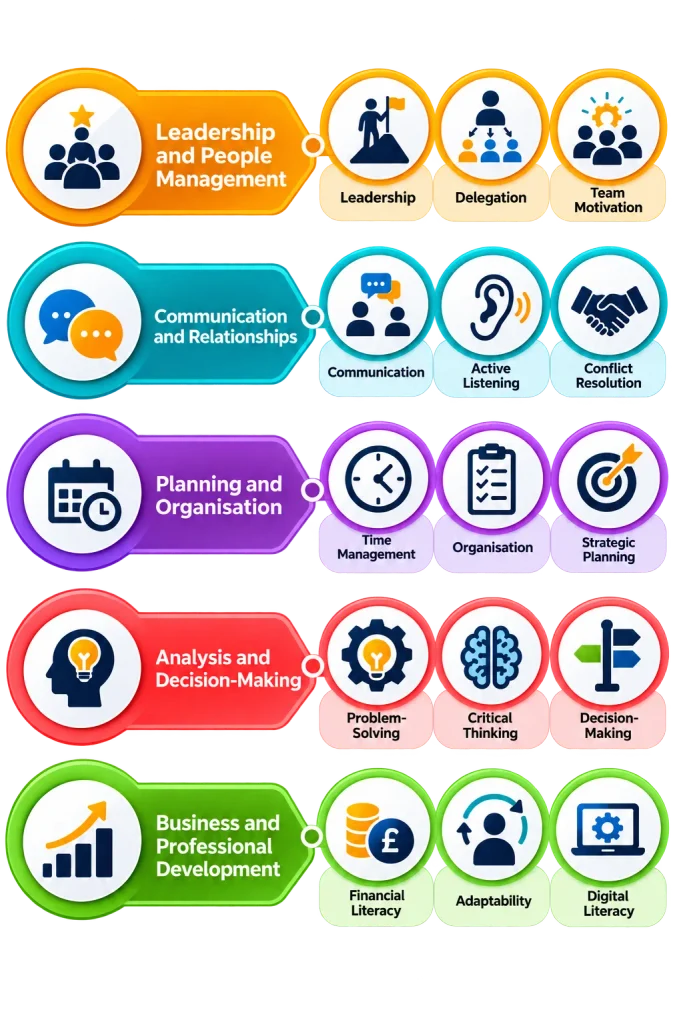
1. Leadership and Team Management
Leadership is the ability to guide, motivate and support people towards shared objectives. Employers value managers who can establish direction, explain expectations, encourage collaboration and take responsibility for team performance.
Effective leadership is not simply about giving instructions. It also involves listening to employees, recognising individual strengths, providing constructive feedback and helping team members develop their capabilities.
For example, a department manager introducing a new customer service procedure must explain why the change is necessary, clarify individual responsibilities and support employees who need additional training.
You can develop leadership skills by:
- Taking responsibility for a small project or team activity.
- Setting clear objectives and reviewing progress.
- Providing constructive feedback.
- Learning how different leadership approaches affect team performance.
- Asking colleagues for feedback on your management style.
Employers may assess leadership through examples of initiative, team coordination, accountability and the ability to achieve results through others.
2. Communication and Active Listening
Communication is one of the most important business management skills because managers regularly exchange information with employees, customers, suppliers, senior leaders and other stakeholders.
Effective communication involves expressing ideas clearly, listening carefully, adapting messages to different audiences and checking that information has been understood.
Managers use communication to explain priorities, conduct meetings, prepare reports, resolve misunderstandings and present recommendations.
Active listening is equally important. Managers who listen carefully can better understand employee concerns, identify customer needs and recognise potential problems before they become more serious.
Practical ways to improve communication include:
- Writing concise, well-structured emails and reports.
- Preparing clear agendas for meetings.
- Asking relevant questions before making assumptions.
- Summarising decisions and agreeing on next steps.
- Adapting communication to the audience and situation.
For example, a manager explaining a performance target to senior executives may focus on results, risks and financial implications. When communicating with employees, the same manager may need to explain individual responsibilities and available support.
3. Analytical Thinking
Analytical thinking involves examining information systematically, identifying patterns and evaluating evidence before reaching a conclusion.
Managers use analytical thinking to understand business performance, investigate operational difficulties, assess customer behaviour and compare possible courses of action.
Rather than immediately accepting the first explanation for a problem, an analytical manager considers the available evidence and looks for underlying causes.
Suppose a retail business experiences declining sales. An effective manager might examine sales records, customer feedback, product availability, seasonal demand and marketing activity before recommending changes.
Important analytical thinking practices include:
- Collecting reliable and relevant information.
- Comparing performance against objectives.
- Identifying trends and unusual results.
- Distinguishing assumptions from evidence.
- Evaluating the limitations of available information.
Analytical thinking is particularly useful when managers must make decisions involving competing priorities, uncertain outcomes or limited resources.
4. Problem-Solving and Decision-Making
Problem-solving involves identifying an issue, investigating its causes, developing possible solutions and selecting an appropriate response. Decision-making is the process of choosing a course of action based on objectives, evidence, constraints and potential consequences.
These skills are closely connected because managers regularly encounter situations that require timely and considered decisions.
For example, if a supplier repeatedly delivers materials late, a manager could investigate the cause, review contractual arrangements, assess alternative suppliers and develop a contingency plan.
A structured problem-solving process can help managers:
- Define the problem clearly.
- Gather relevant evidence.
- Identify possible causes.
- Generate and compare solutions.
- Evaluate risks, costs and benefits.
- Implement the chosen solution.
- Monitor the outcome and make adjustments.
Good decision-making also requires recognising when more information is needed and when a decision must be made within a reasonable timeframe.
Managers should avoid allowing personal assumptions, pressure or incomplete information to dominate important business decisions.
5. Financial Literacy
Financial literacy is the ability to understand and use financial information when planning activities, allocating resources and evaluating business performance.
Managers do not always need to be qualified accountants, but they should understand the financial implications of their decisions.
Useful areas of financial knowledge include:
- Budget preparation and monitoring.
- Revenue, costs and profitability.
- Cash flow and working capital.
- Financial forecasting.
- Cost control and resource allocation.
- Variance analysis and financial reporting.
Consider a manager planning a new marketing campaign. The manager should estimate the campaign’s costs, identify the available budget, establish measurable objectives and review whether the results justify the expenditure.
Financial literacy helps managers understand the relationship between operational decisions and business outcomes.
It also supports more informed conversations with finance teams and senior management.
6. Strategic Planning
Strategic planning involves setting longer-term objectives, evaluating the business environment and determining how resources and activities should be organised to achieve desired results.
Managers need to understand both immediate operational requirements and the wider direction of the organisation.
A business may aim to enter a new market, improve customer retention, introduce a product or increase operational efficiency. Strategic planning helps management assess the feasibility of these objectives and determine the actions needed to pursue them.
Important strategic planning activities include:
- Establishing measurable objectives.
- Reviewing internal strengths and weaknesses.
- Identifying external opportunities and threats.
- Assessing competitors and customer needs.
- Allocating resources to key priorities.
- Establishing performance measures and review points.
Strategic plans should not remain static documents. Managers need to review progress and adapt their approach when market conditions, customer expectations or organisational priorities change.
7. Time Management and Prioritisation
Time management involves organising work so that important activities are completed efficiently and deadlines are met.
Managers often balance meetings, employee support, reporting, operational issues and longer-term planning. Without effective prioritisation, urgent tasks can repeatedly displace activities that contribute to important business objectives.
Effective time management includes:
- Identifying high-priority tasks.
- Breaking large assignments into manageable activities.
- Setting realistic deadlines.
- Allocating sufficient time for complex work.
- Reducing unnecessary meetings and interruptions.
- Reviewing progress and adjusting schedules.
For example, a manager preparing a quarterly performance review may schedule data collection, consultation with team leaders, report preparation and a final review in advance.
This approach reduces last-minute pressure and makes it easier to identify delays before they affect delivery.
Managers should also recognise that being busy does not necessarily mean being productive. The objective is to use time on activities that produce meaningful results.
8. Emotional Intelligence
Emotional intelligence is the ability to recognise, understand and manage emotions while responding appropriately to the feelings of others.
This skill can help managers build trust, handle difficult conversations and maintain constructive working relationships.
A manager with strong emotional intelligence is more likely to recognise when an employee is frustrated, understand how their own behaviour affects others and respond calmly during disagreements.
Emotional intelligence can support:
- Self-awareness and self-regulation.
- Empathy and active listening.
- Constructive feedback.
- Conflict management.
- Employee motivation.
- Professional relationships.
For example, an employee who misses a deadline may be dealing with unclear instructions, competing workloads or a lack of resources. An emotionally intelligent manager investigates the situation before deciding how to respond.
Emotional intelligence does not mean avoiding difficult decisions. It means approaching those decisions with awareness, fairness and professional judgement.
9. Negotiation and Conflict Resolution
Negotiation involves discussing competing interests to reach an acceptable agreement. Conflict resolution involves addressing disagreements constructively and working towards a practical outcome.
Managers use these skills when discussing supplier contracts, allocating budgets, agreeing deadlines, resolving team disputes and managing stakeholder expectations.
Effective negotiation requires preparation, clear communication and an understanding of the other party’s priorities.
Managers should aim to protect legitimate business interests while considering whether a mutually beneficial agreement is possible.
Practical techniques include:
- Identifying the desired outcome before discussions begin.
- Understanding the other party’s needs and constraints.
- Using evidence to support proposals.
- Separating the problem from the individuals involved.
- Exploring alternative solutions.
- Recording agreed actions and responsibilities.
For example, if two departments require the same limited resource, their managers could review business priorities, assess the consequences of delay and agree on a schedule that addresses the most urgent requirements.
A constructive approach can preserve professional relationships while helping the organisation resolve practical difficulties.
10. Adaptability and Change Management
Adaptability is the ability to respond effectively to new information, changing priorities and unexpected circumstances. Change management involves planning and supporting transitions so that people and business processes can move from an existing situation to a desired future state.
Businesses may need to respond to new technologies, changing customer expectations, economic pressures, updated procedures or organisational restructuring.
Managers must therefore be willing to review established practices and help employees understand new requirements.
Effective change management includes:
- Explaining why change is necessary.
- Identifying the people and processes affected.
- Communicating expectations clearly.
- Providing appropriate training and support.
- Monitoring concerns and implementation risks.
- Reviewing results after implementation.
For example, introducing new customer relationship management software may require staff training, updated procedures and a transition period.
A manager who recognises these needs can reduce confusion and help employees adapt more effectively.
Adaptability also means learning from unsuccessful decisions and changing course when evidence shows that an approach is not working.
11. Project Management
Project management is the process of organising and controlling activities to achieve defined objectives within agreed constraints, such as time, budget, scope and available resources.
Managers use project management skills to coordinate product launches, training programmes, system upgrades, marketing campaigns and process improvements.
Effective project coordination requires a clear understanding of the desired outcome and the steps needed to achieve it.
Key project management activities include:
- Defining project objectives and scope.
- Breaking work into tasks and milestones.
- Assigning responsibilities.
- Establishing deadlines and resource requirements.
- Identifying risks and dependencies.
- Monitoring progress and communicating changes.
- Evaluating the final outcome.
For example, a business planning a new website may need to coordinate content writers, designers, developers and marketing staff. A project manager helps ensure that each contributor understands their responsibilities and that delays are identified early.
Even professionals who do not hold a formal project management title can benefit from learning these methods.
12. Commercial Awareness
Commercial awareness is an understanding of how an organisation operates, generates income, manages costs, serves customers and responds to its competitive environment.
It helps managers recognise the business consequences of operational decisions.
For example, a manager considering longer customer service opening hours should assess potential customer benefits alongside staffing costs, demand patterns and expected revenue.
Commercially aware managers consider questions such as:
- Who are the organisation’s customers?
- What needs do its products or services address?
- How does the organisation generate revenue?
- Which costs have the greatest effect on performance?
- What factors influence customer loyalty?
- How might competitors or market changes affect the business?
Commercial awareness is useful across sectors because managers need to understand how their decisions contribute to organisational sustainability and performance.
It also encourages employees to look beyond their immediate tasks and consider the wider business implications of their work.
13. Digital Literacy and Data Interpretation
Digital literacy involves using technology effectively, safely and appropriately to complete work, communicate information and support decisions.
Modern managers may use spreadsheets, project management platforms, customer relationship management systems, reporting dashboards and collaboration tools.
They also need to interpret the information these systems provide rather than relying on technology without understanding its limitations.
Important digital management skills include:
- Using business software confidently.
- Interpreting reports and dashboards.
- Understanding basic data quality.
- Protecting confidential business information.
- Communicating effectively through digital platforms.
- Evaluating AI-generated information critically.
- Recognising when human review is necessary.
For example, a sales manager may use a reporting dashboard to compare monthly sales against targets. The manager must still investigate unusual results, check data quality and consider external factors before making recommendations.
Digital tools can improve efficiency, but effective management depends on sound judgement as well as technical capability.
14. Delegation and Accountability
Delegation involves assigning tasks and appropriate authority to other people while retaining responsibility for the overall outcome.
Effective managers recognise that they cannot personally complete every task. They must distribute work according to priorities, employee capabilities and available resources.
Good delegation requires clear instructions, agreed deadlines and suitable support.
Managers should explain what needs to be achieved, establish boundaries for decision-making and provide opportunities for employees to ask questions.
Accountability means ensuring that responsibilities are understood and that progress and outcomes are reviewed fairly.
Effective delegation involves:
- Matching tasks to appropriate skills.
- Explaining expected results.
- Providing the necessary resources.
- Agreeing milestones and reporting arrangements.
- Offering support without unnecessary interference.
- Reviewing outcomes and providing feedback.
For example, a team leader may delegate preparation of a monthly performance report to an experienced employee while retaining responsibility for reviewing the final report and presenting its findings.
Delegation can support employee development, improve workload distribution and give managers more time to focus on strategic responsibilities.
15. Relationship Building and Collaboration
Relationship building involves developing constructive professional connections with colleagues, customers, suppliers and other stakeholders. Collaboration means working with others to achieve shared objectives.
Business management rarely takes place in isolation. Managers depend on information, expertise and cooperation from different people and departments.
Strong relationships can improve communication, support problem-solving and help teams coordinate their activities more effectively.
Managers can strengthen collaboration by:
- Treating colleagues and stakeholders respectfully.
- Sharing information appropriately.
- Agreeing on shared objectives.
- Recognising different perspectives.
- Following through on commitments.
- Addressing misunderstandings promptly.
- Giving credit to people who contribute to success.
For example, a marketing team planning a product launch may need input from sales, finance, operations and customer service. Collaboration helps these teams coordinate their responsibilities and identify potential issues before launch.
Relationship building is especially valuable when a manager must influence people who do not report directly to them.
Business Management Skills Comparison Table
The following table summarises the 15 skills, their practical applications and examples of how employers may assess them during recruitment or performance reviews.
| Business management skill | Workplace application | Example of demonstrating the skill |
|---|---|---|
| Leadership | Guiding teams towards objectives | Coordinating a team to complete a project |
| Communication | Sharing information and expectations | Preparing a clear business report |
| Analytical thinking | Interpreting information | Identifying the causes of declining sales |
| Problem-solving | Resolving business challenges | Developing a solution to recurring delays |
| Financial literacy | Managing budgets and costs | Identifying opportunities to control expenditure |
| Strategic planning | Establishing business priorities | Developing a departmental action plan |
| Time management | Organising work and deadlines | Completing tasks according to agreed priorities |
| Emotional intelligence | Managing relationships and emotions | Handling a difficult employee conversation constructively |
| Negotiation | Reaching workable agreements | Agreeing delivery terms with a supplier |
| Adaptability | Responding to changing circumstances | Helping a team adopt a new procedure |
| Project management | Coordinating tasks and resources | Managing a product launch |
| Commercial awareness | Understanding business performance | Assessing the costs and benefits of a new service |
| Digital literacy | Using technology and business data | Interpreting a performance dashboard |
| Delegation | Assigning responsibilities effectively | Distributing tasks according to team members’ capabilities |
| Relationship building | Supporting collaboration | Coordinating work across several departments |
These skills are interconnected. For example, a manager improving operational performance may need analytical thinking to identify the problem, financial literacy to assess costs, communication to explain the proposed changes and leadership to coordinate implementation.
How Can You Improve Your Business Management Skills?
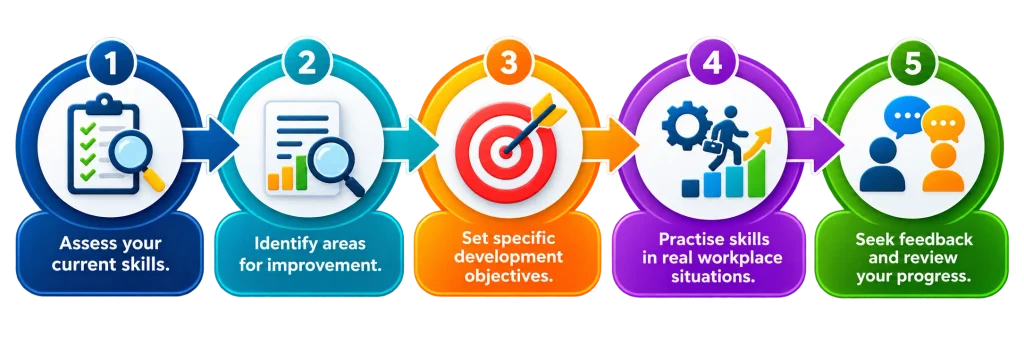
Developing business management skills requires a combination of structured learning, practical experience, feedback and reflection. You do not need to master all 15 skills at once. A focused development plan can help you improve the abilities most relevant to your current responsibilities or career goals.
1. Assess Your Current Strengths
Start by identifying the skills you already demonstrate and those that require improvement.
Review your recent work experiences and consider questions such as:
- Can I explain decisions clearly and confidently?
- Do I use evidence when solving problems?
- Can I organise competing priorities effectively?
- Do I understand the financial implications of my decisions?
- Can I manage disagreements professionally?
- Do I take responsibility for my work and follow through on commitments?
You can also ask a supervisor or colleague for constructive feedback. Comparing your self-assessment with another person’s observations may reveal strengths and development needs that you had not previously recognised.
2. Set Specific Development Objectives
Identify two or three management skills that would most improve your performance. Set clear, measurable goals and realistic deadlines.
For example:
- Communication: Deliver a clear project update at your next team meeting.
- Financial literacy: Practise reviewing a departmental budget and explaining key variances.
Specific objectives help you track progress and focus on meaningful improvements.
3. Practise Through Workplace Responsibilities
Practical experience helps turn theoretical knowledge into usable management skills.
Look for opportunities to:
- Lead a small project or team activity.
- Prepare a budget or performance report.
- Coordinate tasks across departments.
- Participate in a negotiation.
- Analyse a business problem and recommend a solution.
- Organise a meeting and record agreed actions.
- Support the implementation of a new process.
After each activity, review what went well, what could be improved and what you would do differently next time.
4. Seek Feedback and Review Your Performance
Feedback helps you identify strengths and areas for improvement. Ask colleagues about your communication, leadership and decision-making skills.
- Listen openly to constructive feedback.
- Identify areas for improvement.
- Record achievements and lessons learned.
- Set practical goals for professional development.
5. Explore Structured Business Management Learning
Professional courses can strengthen your understanding of leadership, finance, marketing and business operations.
When choosing a course:
- Consider your career goals and current skills.
- Review the course content and learning outcomes.
- Check entry requirements and assessment methods.
- Ensure the qualification aligns with your professional needs.
Which Business Management Skills Should You Prioritise?
The most useful skills depend on the responsibilities of the role you want to perform. A team leader, finance manager and business owner may need different combinations of competencies.
| Career goal | Skills to prioritise | Practical development activity |
|---|---|---|
| Aspiring manager | Leadership, communication and delegation | Lead a small team task |
| Operations manager | Project management, analytical thinking and problem-solving | Review a workflow and recommend improvements |
| Finance-related manager | Financial literacy, analytical thinking and decision-making | Prepare and explain a budget variance report |
| Business development professional | Negotiation, communication and commercial awareness | Prepare a client proposal |
| Entrepreneur | Strategic planning, financial literacy and adaptability | Develop a basic business plan |
| Project coordinator | Time management, communication and project management | Create a project schedule and progress report |
| Department supervisor | Emotional intelligence, delegation and conflict resolution | Conduct a constructive performance discussion |
| Marketing manager | Analytical thinking, digital literacy and commercial awareness | Evaluate campaign performance against objectives |
Common Mistakes to Avoid When Developing Management Skills
Developing effective management skills requires continuous learning, practical experience and self-awareness. While aspiring managers often focus on improving their technical knowledge, certain habits can limit their professional growth and reduce their effectiveness in the workplace.
Recognising these mistakes can help managers make better decisions, build stronger teams and improve their overall performance.
1. Focusing Only on Technical Knowledge
Understanding business processes and technical procedures is important, but successful management also requires strong interpersonal, organisational and decision-making skills. Managers who concentrate exclusively on technical expertise may struggle to communicate effectively or manage team responsibilities.
To avoid this mistake:
- Develop communication and leadership skills alongside technical knowledge.
- Practise teamwork, collaboration and conflict resolution.
- Improve your ability to make informed business decisions.
- Balance task-related expertise with people management.
2. Trying to Manage Every Task Personally
Managers who attempt to control every activity can become overwhelmed and limit their team’s development. Effective management involves trusting employees, distributing responsibilities and maintaining appropriate oversight.
To improve delegation:
- Assign tasks according to employees’ skills and experience.
- Communicate responsibilities and expectations clearly.
- Provide the resources and guidance needed to complete tasks.
- Monitor progress without unnecessary interference.
- Encourage employees to take ownership of their work.
3. Making Decisions Without Sufficient Evidence
Relying entirely on personal opinions or assumptions can lead to ineffective business decisions. Although experience and intuition can be valuable, managers should consider relevant information, potential risks and alternative solutions before taking action.
A more effective approach involves:
- Gathering reliable and relevant information.
- Identifying the underlying causes of problems.
- Comparing possible solutions.
- Evaluating risks, costs and potential outcomes.
- Reviewing results and adjusting decisions when necessary.
4. Ignoring Constructive Feedback
Feedback helps managers recognise their strengths, identify weaknesses and understand how their behaviour affects others. Ignoring feedback can prevent professional development and allow ineffective working practices to continue.
Managers can make better use of feedback by:
- Listening carefully without becoming defensive.
- Asking questions to clarify specific concerns.
- Identifying practical areas for improvement.
- Applying appropriate suggestions to daily activities.
- Reviewing progress and requesting further feedback.
Constructive feedback should be treated as an opportunity to learn and improve rather than simply as criticism.
5. Assuming
Developing Business Management Skills Through Professional Education
Professional education can help aspiring managers and business professionals develop the knowledge and practical skills needed to succeed in modern organisations. Structured learning complements workplace experience by providing a deeper understanding of business operations, financial management, leadership and strategic decision-making.
Business management education covers several important areas that help Learners strengthen their professional capabilities, including:
- Leadership and team management: Developing the ability to guide teams, delegate responsibilities and support employee performance.
- Business communication: Improving written, verbal and interpersonal communication with colleagues, customers and stakeholders.
- Finance and accounting: Understanding budgets, financial reports, expenditure and basic business performance measures.
- Business operations: Learning how different organisational functions work together to achieve business objectives.
- Marketing management: Understanding customer needs, market opportunities and commercial activities.
- Human resource management: Developing knowledge of employee relations, workforce planning and staff development.
- Strategic management: Building the ability to establish objectives, evaluate opportunities and make informed long-term decisions.
These subject areas provide a foundation for developing essential business management skills. However, effective management requires more than theoretical knowledge. Learners also need opportunities to apply what they learn, practise workplace skills, evaluate outcomes and respond constructively to feedback.
To make professional development more effective, aspiring managers should focus on the following activities:
- Set clear learning objectives based on current strengths and development needs.
- Apply management concepts to realistic workplace situations and business challenges.
- Participate in team projects to practise leadership, communication and collaboration.
- Develop financial awareness by reviewing budgets, costs and performance information.
- Seek constructive feedback from experienced colleagues and supervisors.
- Monitor progress and identify areas requiring further improvement.
Before enrolling in a professional education programme, prospective Learners should review the course content, entry requirements, assessment methods and delivery arrangements to ensure the learning opportunity aligns with their career goals.
Choosing the Right Business Management Learning Pathway
Selecting suitable professional education can help Learners build relevant knowledge and prepare for greater workplace responsibilities. When evaluating learning opportunities, consider whether the programme covers the business functions, management principles and practical competencies most relevant to your objectives.
A well-planned learning pathway, combined with workplace experience and continuous professional development, can help aspiring managers strengthen their confidence, improve their decision-making and develop the capabilities required to manage people, resources and business activities effectively.
Conclusion
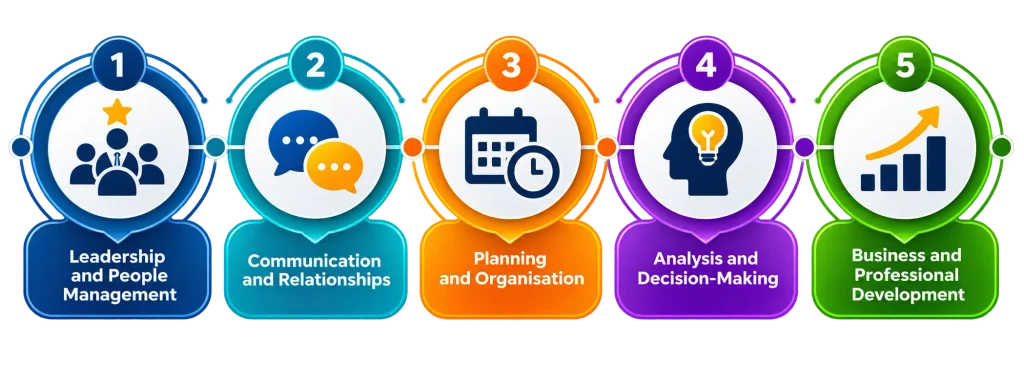
Developing strong business management skills helps professionals lead teams, make informed decisions and achieve organisational goals. Skills such as communication, leadership, problem-solving, financial awareness and time management contribute to effective workplace performance across industries.
Continuous learning, practical experience and constructive feedback can help you strengthen these abilities and prepare for greater responsibilities. By identifying areas for improvement and setting clear development goals, you can build confidence, improve your performance and support long-term career growth.