
Business Management vs Business Administration: Key Differences
Business management and business administration are closely related disciplines that help organisations operate efficiently, achieve their objectives and respond to changing business environments. However, they differ in their typical emphasis, responsibilities and approaches to organisational performance.
The main difference between business management and business administration is that business management generally focuses on leading people, making operational decisions and achieving organisational objectives, while business administration places greater emphasis on coordinating business functions, maintaining efficient processes and supporting the overall operation of an organisation. These distinctions are useful guidelines rather than strict boundaries, because many roles and qualifications cover both areas.
Understanding business management vs business administration can help aspiring professionals, entrepreneurs and Learners choose an appropriate educational pathway and identify the skills they want to develop. This guide explains the meaning of each discipline, compares their responsibilities, explores career pathways and examines how business management education can support professional development in the UK, Pakistan and international markets.
What is Business Management?
Business management is the process of planning, organising, leading and monitoring an organisation’s activities to achieve defined objectives. It involves making decisions about people, finances, resources, operations and business strategy to improve performance and support sustainable growth.
Business managers work across different sectors, including retail, finance, healthcare, hospitality, manufacturing, professional services and technology. Their responsibilities depend on the organisation’s size, structure and objectives.
Key Functions of Business Management
Business management commonly involves the following functions:
1. Strategic planning
Managers establish objectives, assess business opportunities and determine how an organisation can achieve its priorities. Strategic planning may involve evaluating competitors, identifying market changes and deciding where resources should be invested.
2. Leadership and team management
Business managers guide employees, allocate responsibilities, communicate expectations and support professional development. Effective leadership helps teams understand their objectives and work towards shared results.
3. Resource allocation
Managers determine how available resources, including staff, equipment, budgets and time, should be distributed. Appropriate resource allocation helps organisations balance competing priorities and manage costs.
4. Performance monitoring
Managers review business performance using reports, financial information, customer feedback and key performance indicators. They use this information to identify problems, evaluate progress and make improvements.
5. Decision-making and problem-solving
Management involves assessing alternatives, considering risks and selecting appropriate courses of action. Decisions may relate to staffing, customer service, operational efficiency, investment or business development.
Example of Business Management in Practice
Consider a hypothetical retail company experiencing declining sales and increasing operating costs.
The business manager reviews sales performance, identifies changes in customer demand, evaluates staffing arrangements and works with the marketing team to develop an improvement plan. The manager subsequently monitors the results and adjusts the plan where necessary.
This example demonstrates how business management combines leadership, analysis, resource allocation and decision-making to address organisational challenges.
What is Business Administration?
Business administration refers to the coordination and organisation of business activities, processes and resources that support an organisation’s effective operation. The term covers a broad range of functions, including office administration, business operations, record management, scheduling, reporting and coordination between departments.
Business administration is not limited to clerical tasks. Depending on the role, it can include budgeting, operational planning, policy implementation, process improvement and coordination of business functions.
Key Functions of Business Administration
1. Organising business processes
Business administrators help ensure that procedures are documented, responsibilities are clear and routine activities are completed efficiently. They may coordinate workflows and identify opportunities to improve administrative systems.
2. Maintaining records and documentation
Accurate documentation supports accountability, communication and informed decision-making. Administrative responsibilities may include maintaining business records, preparing reports, organising contracts and updating internal systems.
3. Coordinating schedules and activities
Administrators often organise meetings, maintain calendars, coordinate appointments and help departments meet deadlines. Effective coordination reduces confusion and supports productivity.
4. Supporting financial and operational activities
Depending on their position, business administrators may assist with invoice processing, expenditure records, budget monitoring, purchasing and preparation of financial reports.
5. Supporting communication
Business administration often involves communicating with employees, customers, suppliers and other stakeholders. Administrators help information reach the appropriate people at the right time.
Example of Business Administration in Practice
Consider a hypothetical training company that delivers professional courses to Learners in several locations.
Its business administrator coordinates enrolments, maintains Learner records, schedules training sessions, prepares reports and communicates timetable changes. By keeping these processes organised, the administrator helps trainers and managers concentrate on delivering the organisation’s objectives.
This example illustrates how business administration supports the systems and processes that enable an organisation to operate effectively.
Business Management vs Business Administration: Key Differences
The distinction between business management and business administration is primarily one of emphasis. Business management often concentrates on leadership, decision-making and performance, while business administration commonly focuses on coordination, processes and operational support.
The exact division varies between employers, job descriptions and educational programmes.

Comparison Table
| Comparison Area | Business Management | Business Administration |
|---|---|---|
| Main focus | Leading people and achieving business objectives | Coordinating processes and supporting organisational operations |
| Typical responsibilities | Strategy, team leadership, resource allocation and performance management | Scheduling, documentation, reporting and business process coordination |
| Decision-making | Often involves operational and strategic decisions | Often involves procedural and operational decisions, depending on seniority |
| Leadership | Frequently includes directing teams and departments | May include coordinating employees, projects or administrative teams |
| Planning | Business objectives, departmental priorities and performance targets | Workflows, schedules, administrative procedures and operational activities |
| Financial involvement | Budget planning, cost control and performance evaluation | Financial records, invoice processing and budget administration, depending on the role |
| Common job titles | Business manager, operations manager and department manager | Business administrator, office manager and administrative coordinator |
| Essential skills | Leadership, analysis, decision-making and strategic thinking | Organisation, communication, accuracy and process coordination |
| Measures of performance | Achievement of objectives, productivity, profitability and team performance | Accuracy, efficiency, timely completion and quality of administrative processes |
| Potential development | Team leadership, operations management and business strategy | Senior administration, office management and business operations |
The table describes common patterns rather than universal rules. For example, a senior business administrator may manage a team and contribute to strategic decisions, while a business manager in a small organisation may also complete administrative work.
Is Business Administration Part of Business Management?
Business administration and business management overlap significantly, but neither term has one universally applicable scope across every organisation or course.
Administration supports the coordination of business functions, while management typically involves directing resources and people towards organisational objectives. Both contribute to effective operations, and many business roles require knowledge of both disciplines.
For example, a manager may establish a departmental performance target, while an administrator prepares the reports and coordinates the processes needed to monitor progress.
Main Responsibilities of Business Managers
Business management responsibilities depend on the manager’s seniority, sector and area of specialisation. Nevertheless, several activities commonly feature in management roles.
Strategic and Operational Planning
Managers translate organisational objectives into practical plans. They may establish departmental targets, identify priorities, assess risks and coordinate activities across teams.
At an operational level, this could involve improving service delivery, reducing avoidable costs or ensuring that employees have the resources needed to complete their work.
Leadership and Employee Development
Business managers support employee performance by communicating expectations, delegating responsibilities and addressing workplace challenges. They may also contribute to recruitment, performance reviews, training and succession planning.
Effective leadership requires an understanding of individual capabilities, team dynamics and organisational culture.
Financial and Performance Management
Managers frequently work with budgets, sales reports, expenditure information and operational indicators. Their role is to understand what the information reveals and determine whether changes are needed.
For example, a manager may investigate rising costs and work with finance colleagues to identify savings without compromising service quality.
Managing Change and Improvement
Businesses must adapt to customer expectations, competition, technology and economic conditions. Managers help evaluate proposed changes, communicate their purpose and monitor their implementation.
These responsibilities make analytical thinking, communication and problem-solving important components of business management.
Main Responsibilities of Business Administrators
Business administrators help maintain the systems, records and processes required for consistent organisational performance.
Business Documentation and Reporting
Administrators may prepare reports, maintain records, organise correspondence and update internal databases. Accurate information helps managers and other employees understand business activities and fulfil their responsibilities.
Scheduling and Coordination
Scheduling meetings, arranging appointments, coordinating deadlines and maintaining calendars are common administrative activities. These tasks become particularly important when several departments or locations must work together.
Process and Office Management
Business administrators may monitor procedures, coordinate supplies, support procurement and identify administrative inefficiencies. In more senior roles, they may supervise support staff and implement improvements to operational systems.
Communication and Stakeholder Support
Administrators frequently act as a communication link between departments, customers and external suppliers. Professional communication helps prevent misunderstandings and ensures that requests are directed to the appropriate people.
Business administration can therefore involve considerable responsibility, particularly when the role includes confidential information, compliance-related documentation or coordination across multiple business functions.
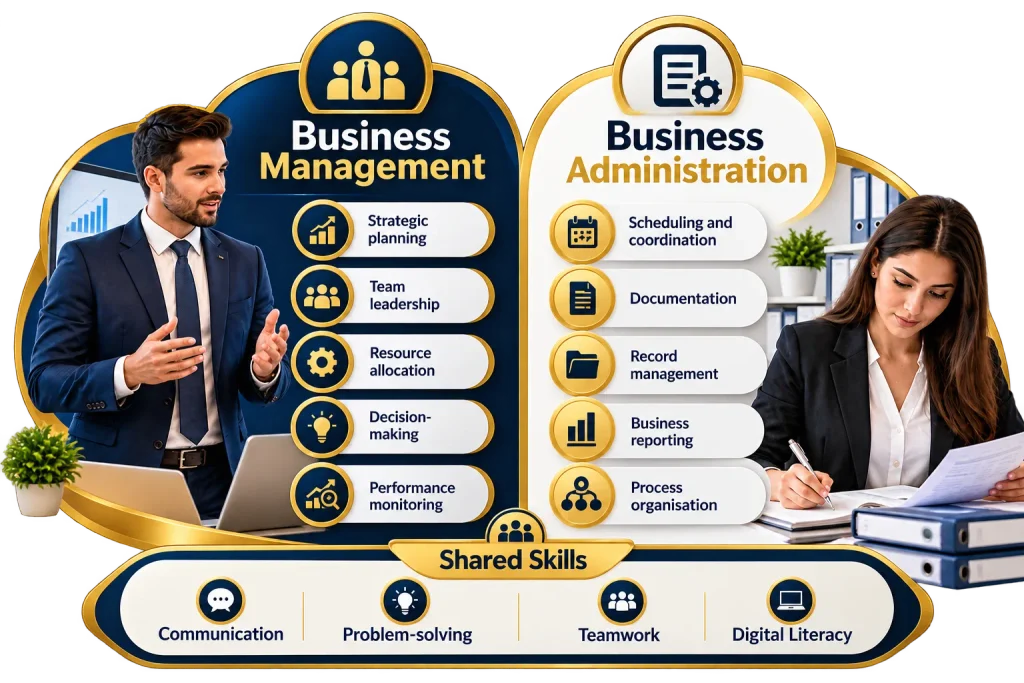
Essential Skills for Business Management and Administration
Although business management and business administration have different areas of emphasis, both require strong professional skills.
Skills for Business Management
Individuals interested in business management should consider developing:
- Leadership and team motivation.
- Strategic and operational planning.
- Critical thinking and problem-solving.
- Financial awareness and budget management.
- Decision-making and risk assessment.
- Communication and negotiation.
- Performance monitoring and evaluation.
- Change management and organisational development.
These capabilities help managers make informed decisions, coordinate teams and respond to business challenges.
Skills for Business Administration
Business administration commonly requires:
- Organisation and time management.
- Written and verbal communication.
- Attention to detail and accuracy.
- Record-keeping and documentation.
- Scheduling and task coordination.
- Digital literacy and business software skills.
- Report preparation and information management.
- Customer service and stakeholder communication.
Some administrative positions also require financial, human resource or project coordination knowledge.
Skills Shared by Both Disciplines
Communication, teamwork, adaptability, digital competence and problem-solving are valuable in both fields.
A business administrator who understands performance reporting can provide better support to managers. Similarly, a business manager who understands administrative procedures can make more realistic decisions about workloads, resources and operational requirements.
The most effective professionals understand how their responsibilities connect with other business functions.
Business Management vs Business Administration: Which Is Better?
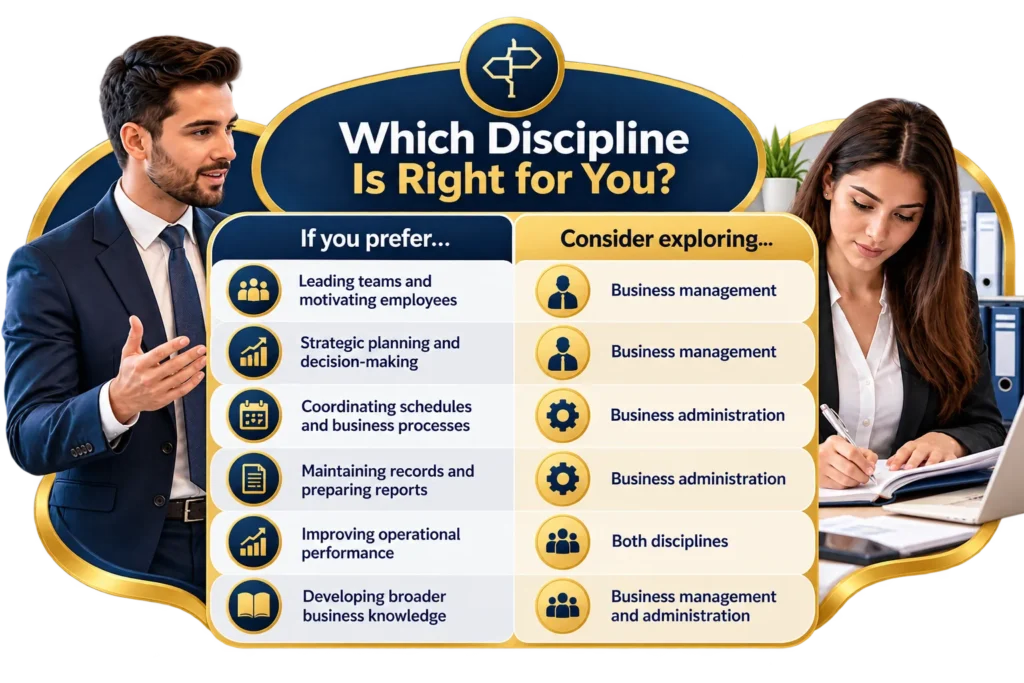
Neither discipline is universally better. The right choice depends on your interests, existing experience, preferred responsibilities and long-term career objectives.
Business management may be a suitable direction if you want to lead teams, make business decisions, coordinate resources and contribute to organisational strategy.
Business administration may be more appropriate if you enjoy organising processes, maintaining accurate records, coordinating activities and supporting efficient business operations.
Choose Business Management If You Want to:
- Develop leadership and supervisory capabilities.
- Understand business strategy and organisational performance.
- Coordinate teams and departmental activities.
- Contribute to planning, budgeting and decision-making.
- Progress towards management responsibilities.
- Develop broader knowledge of business operations and leadership.
Choose Business Administration If You Want to:
- Develop organisational and coordination skills.
- Support office operations and business processes.
- Work with documentation, reporting and scheduling.
- Help departments communicate and operate efficiently.
- Build experience in business support or office management.
- Develop towards senior administrative or operational positions.
These options are not mutually exclusive. A Learner can begin in business administration, gain practical experience and later progress towards management responsibilities.
Likewise, someone studying business management may benefit from administrative experience because it provides a practical understanding of how business systems operate.
Career Pathways in Business Management and Administration
Business management and business administration can lead to a variety of career pathways. However, completing a course or qualification does not automatically make someone eligible for a particular position. Employers may also consider relevant experience, technical skills, professional competence and the responsibilities of the vacancy.
Potential Business Management Career Pathways
Depending on their qualifications and experience, individuals may work towards roles such as:
- Assistant Business Manager.
- Business Development Executive.
- Operations Coordinator.
- Assistant Operations Manager.
- Department Supervisor.
- Team Leader.
- Project Coordinator.
- Marketing Coordinator.
- Human Resources Coordinator.
- Business Owner or Entrepreneur.
More senior positions, including operations manager or business development manager, may require substantial practical experience and evidence of management capability.
Potential Business Administration Career Pathways
Relevant positions may include:
- Business Administrator.
- Administrative Assistant.
- Office Coordinator.
- Office Manager.
- Business Support Officer.
- Operations Administrator.
- Project Administrator.
- Human Resources Administrator.
- Customer Service Coordinator.
- Administrative Team Leader.
The scope of these roles varies between employers. For example, an office manager may supervise employees and manage budgets, while an administrative assistant may concentrate on scheduling, documentation and communication.

How to Choose the Right Educational Pathway
Choosing a business qualification requires more than comparing course titles. Consider the knowledge you want to develop, the roles you are interested in and the entry requirements of the programme.
Use the following checklist to assess your options.
Step 1: Identify Your Career Interests
Decide whether you are more interested in leading people, analysing business performance, coordinating processes, managing projects or supporting administrative functions.
You may have interests in several areas, which is common in business-related careers.
Step 2: Review the Course Curriculum
Examine the subjects included in each programme. Look for relevant coverage of leadership, business operations, finance, marketing, human resources, communication and strategy.
A broad business management programme may be useful if you want to understand how different departments contribute to organisational performance.
Step 3: Check Qualification Details
Confirm the awarding organisation, qualification title, level, credit value, assessment approach and applicable entry requirements.
Where regulatory status matters, check the relevant official register rather than relying solely on marketing descriptions.
Step 4: Consider Your Existing Experience
Your current role may influence which skills you need to develop. An administrator who already understands business processes may wish to study leadership and strategic planning, while an aspiring business administrator may prioritise organisation, communication and operational coordination.
Step 5: Assess Practical Relevance
Consider whether the programme’s content relates to your intended responsibilities. Course descriptions, unit specifications and assessment requirements can help you determine whether the learning outcomes match your objectives.
Step 6: Plan Your Next Development Step
Think about how you will apply what you learn. You might seek additional responsibilities at work, contribute to a business improvement project or pursue further study, depending on your circumstances and the relevant progression requirements.
Common Mistakes When Comparing Business Management and Business Administration
Understanding the differences between these disciplines is easier when common misconceptions are avoided.
Mistake 1: Assuming Administration Means Only Clerical Work
Business administration can include process coordination, financial reporting, procurement, project support and operational planning. Senior administrative roles may also involve supervising teams and managing resources.
Mistake 2: Assuming Every Manager Develops Business Strategy
Strategic responsibility depends on the position. A frontline manager may concentrate on scheduling, service quality and team performance, while senior managers may contribute to organisation-wide strategy.
Mistake 3: Treating the Two Disciplines as Completely Separate
Business management and administration frequently overlap. Managers need reliable administrative systems, while administrators benefit from understanding business objectives and management priorities.
Mistake 4: Choosing a Qualification Based Only on Its Title
Course titles do not always reveal the full curriculum. Reviewing learning outcomes, units, assessment requirements and awarding organisation information provides a clearer basis for comparison.
Mistake 5: Assuming a Qualification Guarantees a Job
Qualifications can support professional development, but recruitment decisions depend on many factors, including experience, competence, location and employer requirements.
A realistic career plan combines relevant learning with opportunities to apply knowledge in practical situations.
Conclusion
Business management and business administration both play important roles in organisational success, but they differ in their primary focus. Business management emphasises leadership, strategic planning, decision-making and performance, while business administration focuses on coordinating processes, maintaining records and supporting efficient business operations. Understanding these differences can help you choose a career pathway that aligns with your interests, skills and professional goals.
For Learners looking to develop their business knowledge, a relevant qualification can provide a foundation for further professional development. The OTHM Level 5 Extended Diploma in Business Management offers an opportunity to explore key business functions, including leadership, finance, marketing and operations. Explore the programme at Lexiton International to determine whether it aligns with your learning objectives and career aspirations.