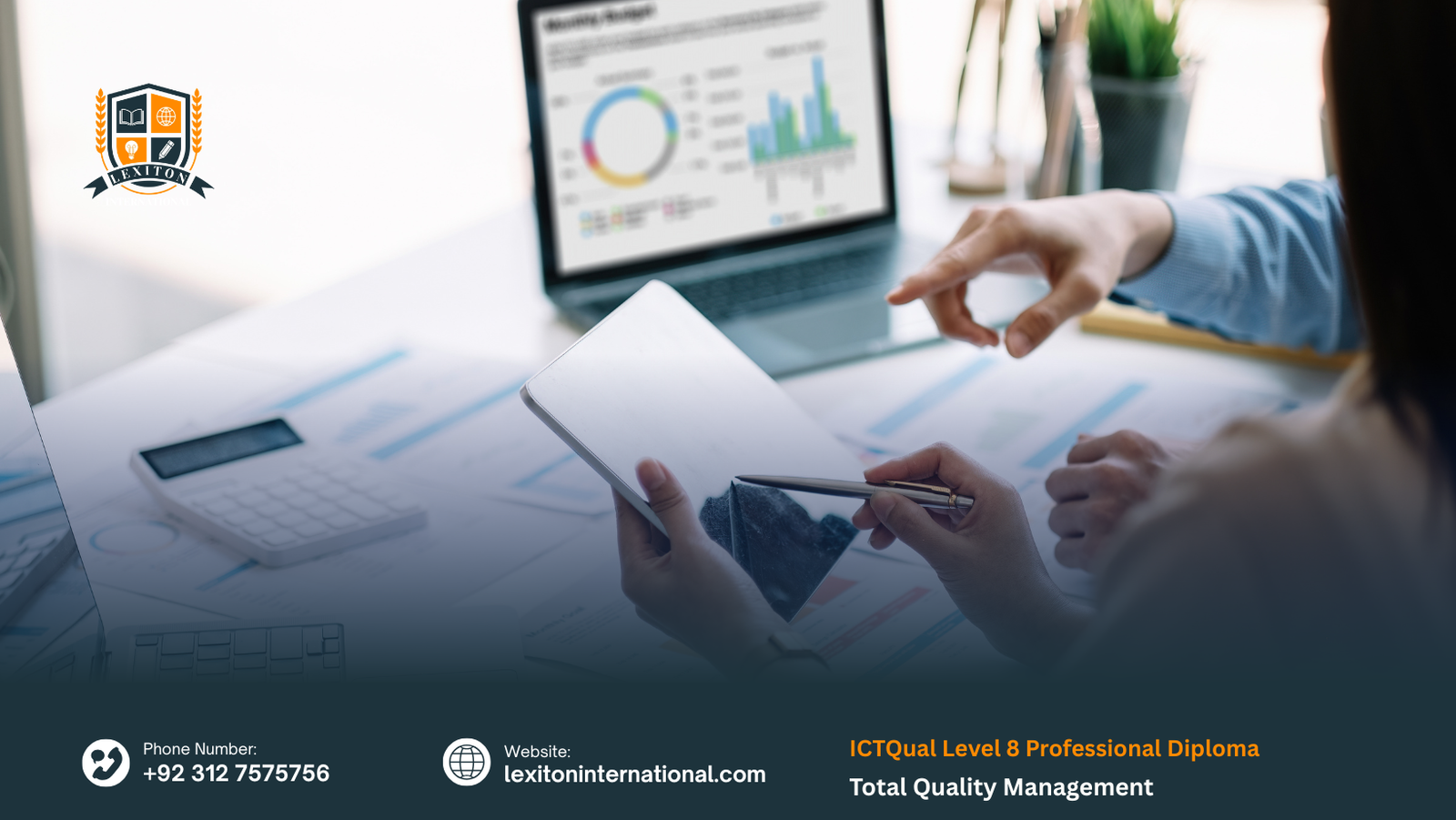
ICTQual Level 8 Diploma in Total Quality Management
The ICTQual Level 8 Professional Diploma in Total Quality Management is an advanced course designed for people who want to improve quality in products, services, and business processes. It focuses on building strong understanding of how organisations can work in a more efficient and effective way. Learners also gain knowledge about meeting customer needs and maintaining high standards. This course is useful for those aiming to grow in quality-focused roles.
This qualification covers important areas like quality planning, quality control, process improvement, and performance management. It helps learners identify problems in systems and find simple ways to fix them. The course also explains how to reduce errors, save time, and improve overall productivity. It is designed to support real workplace situations and practical decision-making.
This diploma is suitable for managers, quality officers, supervisors, engineers, and operations staff. It is also helpful for anyone who wants to start or grow a career in quality management. After completing the course, learners can progress into roles such as quality manager, quality assurance officer, or process improvement specialist across different industries.
- Age Requirement: Learners must be at least 21 years or older at the time of enrollment.
- Educational Background: A Level 7 qualification or equivalent in management, engineering, business, or a related field is recommended.
- Experience: Relevant work experience in quality management, operations, production, or supervision is helpful for better understanding.
- Language Proficiency: Good English skills are required to understand course materials, complete assessments, and communicate clearly.
Mandatory Units
Skills You Will Gain
Advanced Principles of Total Quality Management
- Philosophy and Evolution of TQM:
- Understand the historical context and evolution of Total Quality Management (TQM), recognizing its transition from a focus on quality control to a holistic organizational philosophy.
- Evaluate the philosophical underpinnings of TQM and its implications for modern business practices.
- Strategic Quality Management:
- Analyze the role of strategic planning in quality management, discerning techniques for aligning quality objectives with organizational goals.
- Develop strategies to create a culture of continuous improvement within the organization.
- Quality Leadership and Change Management:
- Identify the characteristics of effective quality leaders and evaluate their role in driving organizational change initiatives.
- Formulate strategies for fostering leadership commitment and employee engagement in quality improvement efforts.
- Quality Management Systems (QMS):
- Demonstrate proficiency in the design, implementation, and maintenance of Quality Management Systems (QMS), adhering to standards such as ISO 9001.
- Explore approaches for integrating QMS into organizational processes to enhance overall quality performance.
Advanced Quality Tools and Techniques
- Statistical Process Control (SPC):
- Master advanced statistical techniques for process monitoring and control, including the application of control charts, process capability analysis, and hypothesis testing.
- Apply statistical process control methods to ensure the consistency and predictability of organizational processes.
- Design of Experiments (DOE):
- Understand the principles of Design of Experiments (DOE) and its applications in optimizing processes and enhancing product or service performance.
- Utilize systematic experimentation to identify key factors affecting quality and improve process efficiency.
- Lean Management Principles:
- Apply advanced Lean management principles and methodologies, such as Value Stream Mapping and Kaizen, to eliminate waste and streamline processes.
- Implement Lean techniques to improve efficiency and reduce variability across the organization.
- Six Sigma Methodology:
- Gain expertise in Six Sigma methodology, including DMAIC and DFSS, and utilize advanced statistical tools to achieve process excellence.
- Lead Six Sigma initiatives to drive continuous improvement and enhance organizational performance.
Advanced Quality Assurance and Auditing
- Advanced Quality Planning and Assurance:
- Develop advanced quality planning techniques, including FMEA and APQP, to proactively identify and mitigate quality risks.
- Implement robust quality assurance processes to ensure the consistency and reliability of products or services.
- Supplier Quality Management:
- Implement strategies for effectively managing supplier quality, including supplier selection, evaluation, and performance monitoring.
- Strengthen supplier relationships to enhance the quality of incoming materials and components.
- Advanced Quality Auditing:
- Conduct advanced quality audits, including internal audits, supplier audits, and third-party certification audits, to assess organizational processes and systems.
- Employ techniques for conducting thorough and objective assessments of quality management practices.
- Quality Metrics and Performance Measurement:
- Define and track key quality metrics and performance indicators to monitor and improve organizational performance.
- Utilize advanced techniques such as defect rates and process capability indices to drive continuous improvement efforts.
Advanced Quality Improvement Strategies
- Total Quality Management Tools and Techniques:
- Apply advanced TQM tools and techniques, such as QFD and Poka-Yoke, to drive quality improvement and innovation.
- Integrate TQM principles into organizational processes to enhance overall quality performance.
- Organizational Learning and Knowledge Management:
- Foster organizational learning and knowledge sharing to leverage lessons learned from quality improvement initiatives.
- Promote a culture of continuous innovation and improvement within the organization.
- Customer Relationship Management (CRM):
- Utilize CRM techniques to gather customer feedback, manage customer relationships, and enhance customer satisfaction and loyalty.
- Implement strategies to meet and exceed customer expectations and drive customer-centric quality improvement initiatives.
- Sustainability and Ethics in Quality Management:
- Integrate sustainability principles and ethical considerations into quality management practices.
- Evaluate the impact of quality decisions on environmental sustainability, social responsibility, and stakeholder trust.
Advanced Topics in Total Quality Management
- Topic Selection and Proposal Development:
- Select a specific topic within the field of Total Quality Management and develop a research proposal outlining research objectives and methodology.
- Literature Review and Conceptual Framework:
- Conduct a comprehensive literature review to identify relevant theories and concepts related to the chosen topic and develop a conceptual framework for the research.
- Data Collection and Analysis:
- Collect and analyze primary or secondary data using advanced research methods and techniques to explore research questions and hypotheses.
- Findings and Recommendations:
- Present the findings of the research project, critically analyze the results, and draw meaningful conclusions and recommendations for practice in Total Quality Management.
The ICTQual Level 8 Professional Diploma in Total Quality Management is designed for professionals who want to improve quality, performance, and efficiency in their organisation. It is ideal for people working in operational, technical, or management roles who aim to build strong quality management skills.
Who Is This Course For
- Quality managers who want to improve systems and processes.
- Quality assurance officers responsible for checking standards and compliance.
- Operations managers focused on improving efficiency and productivity.
- Production supervisors working in manufacturing or service industries.
- Engineers involved in process improvement and quality control.
- Business professionals aiming to move into quality management roles.
- Individuals seeking a career in total quality management and business improvement.
The ICTQual Level 8 Professional Diploma in Total Quality Management helps learners build advanced skills in quality improvement, process control, and organisational performance. It supports strong career growth in quality-focused roles across many industries.
Future Progression
- Quality Manager roles responsible for overall quality systems and standards.
- Quality Assurance Manager positions focusing on compliance and improvement.
- Operations Manager roles improving efficiency and business performance.
- Process Improvement Specialist positions in manufacturing and services.
- Senior roles in production and industrial quality control departments.
- Consultancy roles in total quality management and business improvement.
- Leadership positions in quality, operations, and performance management sectors.
Curious About This Course?