
Lesson no 3 : Know how to manage and lead the delivery of an operational plan
Managing and leading the delivery of an operational plan is a fundamental responsibility for effective managers and team leaders. Creating an operational plan provides a clear framework for what needs to be achieved, but successful performance depends on how effectively the plan is implemented, communicated, monitored and adapted. Managers must translate planned activities into coordinated action, ensure that people understand their responsibilities, allocate resources appropriately, maintain quality standards and respond effectively when circumstances change.
An operational plan provides a practical link between organisational objectives and day-to-day performance. It identifies priorities, activities, responsibilities, resources, timescales, performance measures, quality expectations and risks. However, a plan does not deliver results by itself. Effective leadership is required to mobilise people, coordinate activities, remove barriers and maintain focus on agreed outcomes. Managers therefore need to combine planning skills with leadership, communication, decision-making, problem-solving and performance management capabilities.
Managing delivery begins with ensuring that the operational plan is clearly understood by everyone involved. Employees and relevant stakeholders need to know what is expected, why the activities matter, when tasks must be completed and how successful performance will be measured. Managers should communicate objectives and priorities clearly while creating opportunities for questions, feedback and clarification. Effective communication helps establish accountability and reduces the risk of misunderstanding, duplication or conflicting priorities.
Resource management is another important element of operational delivery. Managers must ensure that people, budgets, equipment, technology, information and other resources are available when required. Resources need to be allocated according to operational priorities and reviewed throughout implementation. Where shortages, delays or competing demands arise, managers must make informed decisions about priorities and take appropriate corrective action without losing sight of organisational objectives.
Leading delivery also involves managing people effectively. Managers must provide direction, encourage collaboration, delegate responsibilities appropriately and support employees in achieving their objectives. Effective leadership involves recognising individual and team capabilities, addressing performance issues constructively and creating an environment in which people understand their contribution to operational success. Where activities involve multiple teams or departments, managers must also coordinate communication and dependencies to ensure that work progresses effectively across organisational boundaries.
Monitoring is central to successful operational delivery. Managers need to compare actual performance with planned targets, milestones, budgets, quality standards and key performance indicators. Regular monitoring allows emerging problems to be identified before they become significant failures. Performance information can also help managers determine whether resources are being used effectively, whether activities remain on schedule and whether the expected outcomes are being achieved.
Operational delivery rarely takes place in completely predictable conditions. Customer requirements, staffing levels, budgets, technology, regulations, organisational priorities and external circumstances may change during implementation. Managers therefore need to remain flexible and capable of adapting the operational plan when justified. Adaptation should be controlled and evidence-based rather than reactive. Changes should be assessed for their impact on objectives, resources, timescales, risks, quality and stakeholders before decisions are implemented.
Risk management is closely connected with delivery. Managers should identify risks that could prevent operational objectives from being achieved and ensure that appropriate controls and contingency arrangements are in place. When risks materialise, leaders must respond promptly, communicate clearly and coordinate appropriate actions. Effective risk management therefore supports continuity, resilience and the achievement of planned outcomes.
Quality and outcomes must remain central throughout implementation. Delivering activities on time is not sufficient if the quality of the work is poor or the intended outcomes are not achieved. Managers should therefore use appropriate measures to evaluate both operational performance and the value generated by the activities. This may include productivity measures, service standards, customer feedback, financial indicators, completion rates, error levels, employee performance measures and outcome-based indicators.
Effective reporting also supports operational leadership. Managers need to provide accurate and timely information about progress, achievements, problems, resource use, risks and required decisions. Reporting should be appropriate to the audience and focused on information that supports accountability and decision-making. Where performance is below expectations, managers should explain the causes, identify corrective actions and communicate realistic timescales for improvement.
The lesson therefore focuses on the practical leadership and management processes required to move from an approved operational plan to successful delivery. It considers how managers communicate the plan, allocate and coordinate resources, lead people, manage performance, monitor progress, address problems, control risks, maintain quality and adapt activities when circumstances change. It also explores the importance of accountability, stakeholder relationships, effective decision-making and continuous improvement.
By understanding these principles, learners can develop a more systematic approach to operational delivery. They can recognise that effective operational management is not simply about completing planned tasks; it is about ensuring that people and resources work together effectively to achieve measurable organisational outcomes. Strong operational leadership provides the coordination, direction and responsiveness needed to turn organisational objectives and operational plans into sustained workplace performance.
1.Assess Methods of Managing and Leading the Delivery of an Operational Plan
Introduction to Managing and Leading Operational Delivery
An operational plan establishes what an organisation, department, team or function intends to achieve and provides a structured framework for translating organisational objectives into practical activities. However, an operational plan only creates potential for performance; it does not guarantee that the planned outcomes will be achieved. Effective delivery depends on the ability of managers and leaders to organise work, coordinate people and resources, communicate expectations, monitor performance, manage risks, solve problems and make timely decisions.
Managing and leading operational delivery are closely connected but represent different dimensions of management practice. Managing focuses strongly on planning, organising, coordinating, controlling and monitoring resources and activities. Leading focuses on providing direction, influencing people, creating commitment, encouraging collaboration and maintaining motivation towards agreed outcomes. Effective middle managers need to perform both functions because operational delivery requires structured control as well as effective leadership of people.
A manager may have an excellent operational plan containing clear objectives, realistic timescales, appropriate resources and measurable KPIs. Nevertheless, delivery can still fail if employees do not understand their responsibilities, resources are poorly coordinated, communication is ineffective, performance problems are ignored or changing circumstances are not addressed. Conversely, highly motivated employees may work hard but fail to achieve organisational objectives if there is insufficient structure, prioritisation or performance control.
Managing and leading delivery therefore involves creating a connection between the operational plan and everyday workplace behaviour. Managers must ensure that planned activities are converted into action and that action produces the required outputs and outcomes. This requires a systematic approach that combines operational management methods with appropriate leadership behaviours.
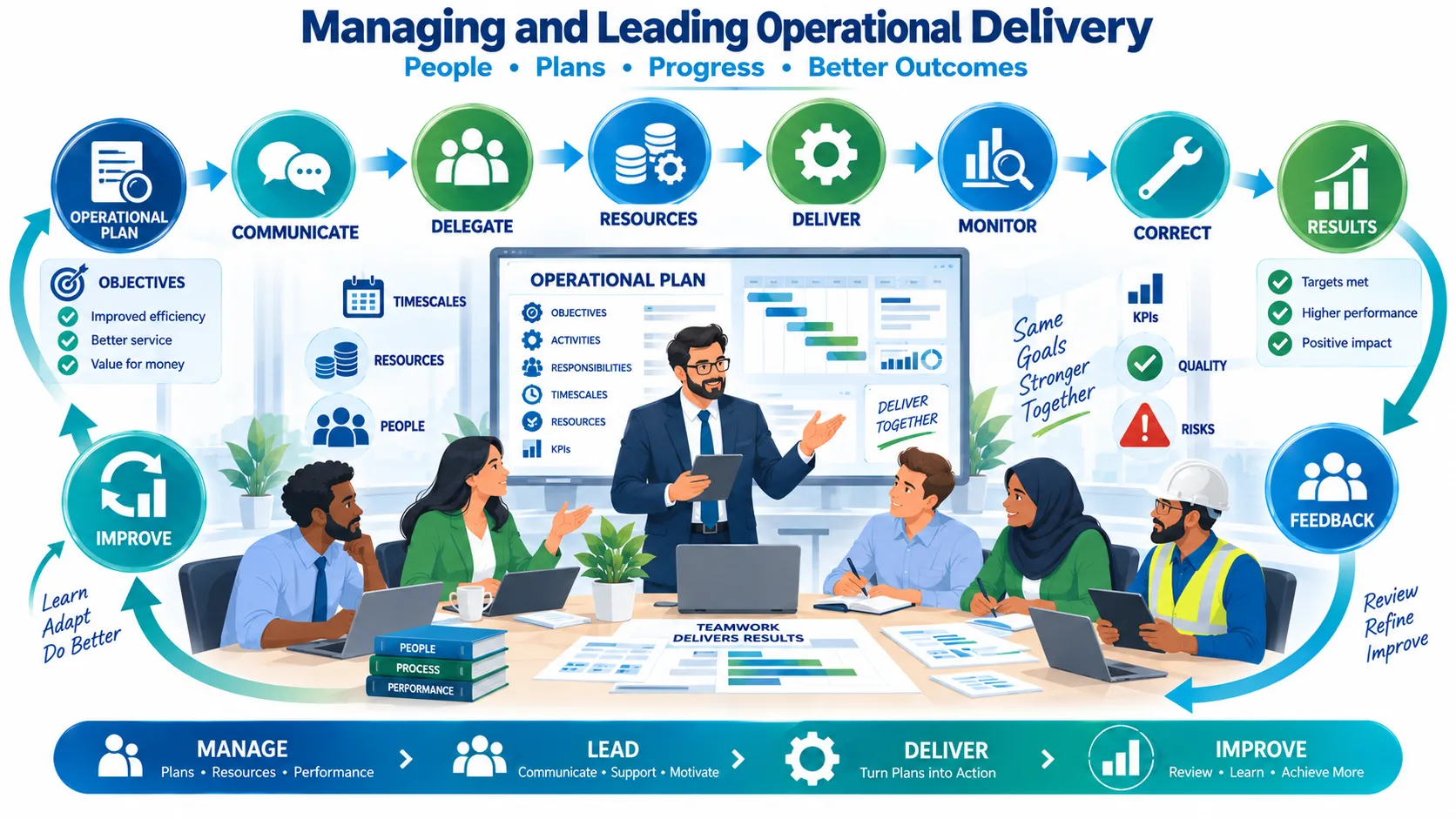
Definition of Operational Plan Delivery
Operational plan delivery refers to the process of implementing the activities, responsibilities, resources, timescales, performance measures and controls identified within an operational plan to achieve agreed organisational or departmental objectives.
Delivery is therefore broader than simply completing tasks. A successful delivery process considers:
What needs to be achieved.
Why the activity is important.
Who is responsible for delivering it.
What resources are required.
When activities need to be completed.
What quality standards must be achieved.
How performance will be measured.
What risks could affect delivery.
How progress will be monitored.
How problems and deviations will be addressed.
How stakeholders will be informed.
How changes will be managed.
Whether the intended outcomes have actually been achieved.
Definition of Managing Operational Delivery
Managing operational delivery is the structured process of organising, coordinating, allocating, monitoring and controlling operational activities and resources so that an approved operational plan is implemented effectively and achieves its intended objectives.
Management provides the operational framework within which delivery takes place. It ensures that work is organised, responsibilities are understood, resources are available and performance is controlled against agreed expectations.
Definition of Leading Operational Delivery
Leading operational delivery is the process of providing direction, influence, motivation, support and accountability to people so that they work collectively towards the objectives and outcomes established in the operational plan.
Leadership is particularly important when delivery involves change, uncertainty, competing priorities or significant stakeholder expectations. People need more than instructions; they need to understand the purpose of the work and recognise how their contribution supports wider organisational objectives.
The Difference Between Managing and Leading Delivery
Although management and leadership overlap, they should not be treated as identical concepts.
| Area | Managing Operational Delivery | Leading Operational Delivery |
|---|---|---|
| Primary focus | Activities, resources, processes and performance control | People, direction, motivation and commitment |
| Main purpose | Ensure planned work is organised and delivered effectively | Inspire and influence people towards agreed outcomes |
| Typical activities | Scheduling, resource allocation, monitoring and reporting | Communicating vision, motivating, coaching and influencing |
| Decision-making | Often based on plans, data, procedures and controls | Often combines evidence with judgement, influence and organisational context |
| Performance | Measures outputs, targets, costs, quality and timescales | Encourages ownership, engagement, accountability and continuous improvement |
| Change | Controls and coordinates changes to delivery | Helps people understand, accept and respond to change |
| Communication | Provides information, instructions and progress reports | Creates understanding, commitment, dialogue and shared purpose |
| Effective result | Work is controlled and coordinated | People are engaged and committed to achieving results |
Effective middle managers integrate both approaches. Over-management can create excessive control and reduce initiative, while leadership without adequate management can create enthusiasm without sufficient structure. Strong operational delivery requires both.
Establishing Clear Operational Direction
One of the first methods of managing delivery is to establish clear operational direction. Employees should understand the objectives they are expected to achieve and how their work contributes to organisational priorities.
Managers should translate the operational plan into clear messages that are meaningful at team and individual level. An organisational objective such as improving customer satisfaction by a defined percentage may need to be translated into operational actions such as improving response times, increasing first-contact resolution, strengthening staff training and monitoring customer feedback.
This translation process is particularly important for middle managers because they often operate between senior leadership and operational teams. They must interpret organisational priorities and convert them into practical expectations without distorting the original strategic intention.
Effective Methods for Establishing Direction
Managers can establish direction by:
Clearly communicating operational objectives.
Explaining the purpose behind each priority.
Identifying the most important activities.
Clarifying expected outputs and outcomes.
Setting realistic timescales.
Identifying dependencies between activities.
Confirming responsibilities.
Establishing performance expectations.
Explaining quality standards.
Identifying key risks and controls.
A useful principle is that employees should be able to answer three questions:
What are we trying to achieve?
What is my contribution?
How will we know whether we have succeeded?
If employees cannot answer these questions, the operational plan may not have been translated effectively into workplace action.
Communicating the Operational Plan
Communication is one of the most important methods of leading operational delivery. Even a technically strong plan can fail if employees and stakeholders do not understand what is required.
Communication should be two-way rather than simply managerial instruction. Managers need to communicate expectations while also listening to concerns, identifying operational barriers and collecting feedback from employees who are directly involved in delivery.
Methods of Operational Communication
Depending on the workplace context, managers may use:
Team briefings.
One-to-one meetings.
Departmental meetings.
Digital collaboration platforms.
Operational dashboards.
Written action plans.
Internal newsletters.
Progress reports.
Performance review meetings.
Project or implementation meetings.
Informal workplace discussions.
Stakeholder updates.
The most effective communication method depends on the nature and urgency of the information. A significant operational risk may require immediate direct communication rather than waiting for a scheduled monthly report.
Assessing the Effectiveness of Communication
Managers should evaluate whether communication has produced understanding rather than assuming that sending information means communication has been successful.
Useful indicators include:
Employees can accurately explain their responsibilities.
Tasks are completed without repeated clarification.
Fewer avoidable errors occur.
Stakeholders receive information at the required time.
Employees raise issues early.
Teams understand changing priorities.
Feedback demonstrates understanding.
Operational decisions are implemented consistently.
Practical Example
A training organisation introduces a new learner-support process. Senior management establishes the objective of improving learner response times. The middle manager must translate this objective into operational expectations.
The manager may communicate:
The target response time.
Which team members are responsible.
How learner enquiries should be recorded.
Which enquiries require escalation.
How performance will be monitored.
What quality standards apply.
When the new process begins.
The manager then invites feedback from staff because employees may identify practical problems that were not visible during planning.
This demonstrates that communication is not merely about distributing the plan. It is about creating operational understanding and enabling effective implementation.
Delegation and Allocation of Responsibility
Delegation is a key method for managing operational delivery. Managers cannot personally complete every activity within an operational plan. Effective delegation distributes responsibility to people with the appropriate competence, authority and capacity.
Delegation should not simply involve assigning tasks. Managers should clarify the expected result, authority available, resources required, timescale, quality standard and reporting expectations.
Effective Delegation Process
A structured delegation process can involve:
Identify the activity or outcome.
Determine the competence required.
Select an appropriate individual or team.
Explain the purpose and expected result.
Clarify responsibilities and boundaries.
Provide necessary authority.
Allocate resources.
Agree deadlines and milestones.
Establish reporting arrangements.
Monitor progress without unnecessary interference.
Provide support where required.
Review the final outcome.
Effective delegation creates accountability while also developing employee capability.
Poor Delegation
Poor delegation may occur when managers:
Assign tasks without explaining the objective.
Give responsibility without sufficient authority.
Delegate to someone without the required capability.
Fail to provide resources.
Set unrealistic deadlines.
Interfere excessively.
Fail to monitor progress.
Accept responsibility without giving employees ownership.
The assessment of delegation therefore requires managers to consider both task requirements and people capability.
Resource Management and Coordination
Resources are fundamental to operational delivery. An operational plan may identify activities that cannot realistically be completed without sufficient people, finance, equipment, technology, information or time.
Resource management involves ensuring that the right resources are available, used effectively and adjusted when operational circumstances change.
Common Operational Resources
Resources may include:
Employees and specialist expertise.
Financial budgets.
Equipment.
Technology.
Premises.
Materials.
Information.
Data.
External suppliers.
Management time.
Training resources.
Communication systems.
Managers should assess resource requirements before implementation and continue monitoring resource availability during delivery.
Resource Allocation Process
A practical resource-management process involves:
Identify required activities.
Determine resources required for each activity.
Compare requirements with available resources.
Identify gaps or constraints.
Prioritise resources according to organisational importance.
Allocate resources.
Monitor utilisation.
Identify emerging shortages.
Reallocate resources where justified.
Evaluate whether resource use is producing the intended results.
Assessing Resource Effectiveness
The important question is not simply whether resources have been used, but whether they have been used effectively.
For example, a department may spend its full training budget but still fail to improve employee performance. This indicates that expenditure alone is not evidence of successful operational delivery. Managers need to consider whether the resources generated measurable operational value.
Performance Management
Performance management is another major method of managing operational delivery. It ensures that actual performance is compared with agreed expectations.
Managers should establish performance measures that are meaningful, reliable and directly connected to operational objectives.
Key Performance Management Methods
These may include:
Key performance indicators.
Service-level measures.
Quality measures.
Productivity measures.
Completion rates.
Budget monitoring.
Customer satisfaction measures.
Employee performance indicators.
Error and defect rates.
Response-time measures.
Outcome measures.
Performance management should combine quantitative and qualitative information where appropriate.
For example, a customer service team may measure the number of enquiries handled each day. However, measuring volume alone may encourage employees to prioritise speed over service quality. A more balanced approach could include response time, resolution rate, customer satisfaction and quality assurance.
The Performance Management Cycle
An effective cycle is:
Set expectations → Measure performance → Compare results → Identify gaps → Take action → Review improvement
This cycle should be continuous rather than restricted to formal annual reviews.
Monitoring Progress Against the Operational Plan
Monitoring enables managers to determine whether delivery is progressing as planned.
Managers should compare actual performance against:
Objectives.
KPIs.
Milestones.
Timescales.
Budget.
Quality standards.
Resource requirements.
Risk controls.
Expected outputs.
Expected outcomes.
Monitoring should focus on meaningful information rather than collecting excessive data.
Effective Monitoring Process
A structured process can involve:
Establish the baseline.
Confirm planned targets.
Collect reliable performance data.
Compare actual results with planned results.
Identify significant variances.
Investigate causes.
Assess potential impact.
Agree corrective action.
Assign responsibility.
Set a review date.
Record the decision.
Evaluate whether the corrective action worked.
This process turns monitoring into a management tool rather than a reporting exercise.
Using KPIs to Lead Operational Delivery
Key performance indicators provide measurable evidence of progress towards operational objectives. Effective KPIs help managers identify whether activities are producing the expected results.
A strong KPI should be:
Relevant to the objective.
Clearly defined.
Measurable.
Reliable.
Understandable.
Time-related.
Within reasonable operational influence.
Capable of supporting management decisions.
Managers should avoid selecting too many KPIs because excessive measurement can create administrative burden and reduce attention to genuinely important priorities.
Leading Through KPIs
KPIs can also support leadership by creating shared understanding of success. When teams know what matters and why, they are better positioned to prioritise their work.
However, KPIs should not be used mechanically. Managers must interpret performance information in context.
For example, a temporary decline in productivity may result from staff training, system implementation or exceptional customer demand. Treating every variance as poor performance could lead to inappropriate management action.
Managing Through Milestones and Review Points
Milestones divide longer operational activities into identifiable stages. They provide opportunities to assess progress before the final deadline.
For example, a digital system implementation might use milestones such as:
Requirements confirmed.
Supplier selected.
System configured.
Testing completed.
Staff trained.
Pilot completed.
Full implementation completed.
Post-implementation review completed.
Milestones allow managers to identify problems early and prevent small delays from becoming major operational failures.
Benefits of Milestone Management
Milestones can:
Create short-term focus.
Improve accountability.
Make progress visible.
Support early intervention.
Improve stakeholder communication.
Highlight dependencies.
Reduce uncertainty.
Support realistic forecasting.
Risk Management During Delivery
Operational plans operate within changing environments, so managers must continually manage risks.
Risk management involves identifying events or conditions that could negatively affect objectives and implementing controls to reduce their likelihood or impact.
Operational Risk Management Process
A practical process is:
Identify the risk.
Assess likelihood.
Assess potential impact.
Determine overall significance.
Identify existing controls.
Develop additional controls where necessary.
Allocate ownership.
Establish monitoring arrangements.
Prepare contingency actions.
Review risks as circumstances change.
Managers should avoid treating risk registers as static documents. New risks may emerge during implementation and existing risks may change in significance.
Example
An organisation plans to introduce a new customer relationship management system. A major operational risk is insufficient employee adoption.
Possible controls could include:
Early employee involvement.
Training.
User testing.
Clear implementation guidance.
Support during transition.
Feedback mechanisms.
Monitoring of adoption rates.
This demonstrates how leadership and management work together. Management establishes controls, while leadership helps employees understand and accept the change.
Problem-Solving and Corrective Action
Operational delivery rarely proceeds without problems. Effective managers therefore need structured problem-solving methods.
A manager should distinguish between symptoms and root causes. Treating symptoms may provide temporary improvement while allowing the underlying problem to continue.
Structured Problem-Solving Process
A useful process involves:
Define the problem clearly.
Gather relevant evidence.
Identify the root cause.
Generate possible solutions.
Assess advantages and disadvantages.
Consider risks and resource implications.
Select the most appropriate response.
Assign responsibility.
Implement corrective action.
Monitor results.
Evaluate whether the problem has been resolved.
Capture learning.
Methods such as the 5 Whys, root-cause analysis, process mapping, brainstorming and cause-and-effect analysis can support this process.
Decision-Making During Operational Delivery
Managers make decisions continuously during implementation. Decisions may concern resources, staffing, priorities, suppliers, schedules, quality, risks or changing stakeholder requirements.
Effective operational decision-making should be evidence-based while also recognising that managers sometimes need to act under time pressure.
Decision-Making Process
Managers can:
Define the decision required.
Establish the desired outcome.
Gather relevant information.
Identify constraints.
Identify options.
Assess risks and consequences.
Consult relevant people.
Compare options against operational objectives.
Make the decision.
Communicate the decision.
Implement the chosen action.
Review the outcome.
The quality of a decision should be assessed by both the decision process and its consequences.
Leading People Through Operational Delivery
Operational plans are delivered through people, making leadership behaviour central to success.
Managers should create an environment in which employees understand expectations, feel able to raise concerns and take appropriate ownership of their responsibilities.
Effective leadership behaviours may include:
Providing clear direction.
Demonstrating confidence and consistency.
Listening actively.
Recognising good performance.
Providing constructive feedback.
Coaching employees.
Supporting problem-solving.
Encouraging collaboration.
Managing conflict.
Promoting accountability.
Remaining calm during operational pressure.
Adapting leadership style to circumstances.
Situational Leadership
Different operational circumstances may require different leadership approaches.
For example:
A newly formed team may require more direction and structure.
An experienced team may benefit from greater autonomy.
A team facing a critical operational incident may require decisive leadership.
A capable team implementing improvements may benefit from coaching and participation.
The most effective manager is therefore not necessarily the one who uses one leadership style consistently. Instead, effective leadership involves selecting an approach that suits the people, task, risk and operational context.
Employee Engagement and Motivation
Employee engagement can significantly influence operational delivery. Employees are more likely to contribute effectively when they understand the purpose of their work and feel that their contribution is valued.
Managers can support engagement by:
Explaining the purpose of operational objectives.
Involving employees in relevant decisions.
Recognising contributions.
Providing development opportunities.
Giving meaningful feedback.
Removing unnecessary barriers.
Encouraging ideas for improvement.
Treating employees fairly.
Creating psychological safety for appropriate challenge and feedback.
Motivation should not be reduced to financial incentives. Recognition, autonomy, meaningful work, development, fairness and supportive leadership can also influence engagement.
Teamwork and Cross-Functional Coordination
Many operational plans involve several teams or departments. Effective delivery therefore requires coordination across organisational boundaries.
A delay in one department can affect the performance of another. Managers should identify dependencies and establish mechanisms for coordination.
Methods of Cross-Functional Coordination
These may include:
Joint planning meetings.
Shared operational dashboards.
Cross-functional working groups.
Clear escalation routes.
Responsibility matrices.
Shared KPIs.
Common deadlines.
Regular progress reviews.
Defined handover procedures.
Managers should make dependencies visible rather than assuming that departments will coordinate automatically.
Managing Stakeholder Relationships
Operational delivery often affects internal and external stakeholders. Stakeholders may include employees, customers, suppliers, senior managers, regulators, partners and service users.
Stakeholder management involves understanding expectations, communicating appropriately and maintaining productive working relationships.
Stakeholder Management Process
Managers can:
Identify relevant stakeholders.
Understand their interests.
Assess their influence.
Identify expectations.
Determine information requirements.
Establish appropriate communication.
Monitor stakeholder concerns.
Manage conflicts or competing expectations.
Provide progress information.
Review relationships throughout delivery.
Effective stakeholder management reduces resistance, improves information flow and can increase support for operational objectives.
Quality Management During Delivery
Operational delivery should focus not only on completing activities but also on achieving required quality standards.
Quality management involves establishing standards, monitoring performance and taking action when results do not meet expectations.
Quality methods may include:
Quality assurance.
Quality control.
Process reviews.
Audits.
Customer feedback.
Peer review.
Sampling.
Error monitoring.
Standard operating procedures.
Continuous improvement reviews.
Managers should ensure that quality measures are realistic and relevant. Excessive quality controls can slow operations, while insufficient controls can create errors, complaints and reputational damage.
Managing Change During Operational Delivery
Operational plans often need to change because circumstances change. New organisational priorities, staffing issues, technology, customer requirements, financial constraints or external developments may affect implementation.
Effective change management requires controlled adaptation rather than informal or unmanaged alterations.
Operational Change Process
A manager should:
Identify the proposed change.
Understand why it is required.
Assess its impact.
Consider resources.
Assess risks.
Consider stakeholder implications.
Check legal, organisational and ethical requirements.
Determine whether approval is required.
Update the operational plan.
Communicate the change.
Implement it.
Monitor the effect.
Example
A department plans to launch a new service within three months. During implementation, available funding is reduced.
An ineffective response would be to simply remove activities without assessing consequences.
A stronger response would involve:
Reviewing the operational objective.
Identifying essential and non-essential activities.
Assessing the impact of reduced funding.
Considering alternative resources.
Consulting stakeholders.
Revising timescales if necessary.
Protecting critical quality standards.
Updating KPIs.
Communicating the revised plan.
This demonstrates controlled flexibility.
Using Management Information and Dashboards
Digital dashboards and management information systems can support operational delivery by providing timely visibility of performance.
Managers can use dashboards to monitor:
KPI performance.
Work volumes.
Completion rates.
Budget utilisation.
Customer satisfaction.
Quality indicators.
Staff availability.
Risks.
Milestones.
Outstanding actions.
However, technology should support managerial judgement rather than replace it. A dashboard can identify that performance has declined, but managers still need to investigate why.
Accountability and Governance
Accountability ensures that people understand who is responsible for delivering activities and reporting results.
Managers should establish clear ownership for:
Objectives.
Activities.
Resources.
Risks.
KPIs.
Decisions.
Corrective actions.
Reporting.
Governance provides the structures through which decisions, responsibilities, controls and performance are overseen.
Strong operational governance may include:
Clear decision-making authority.
Defined escalation routes.
Regular performance reviews.
Documented decisions.
Risk ownership.
Appropriate approvals.
Accurate reporting.
Clear accountability.
Without accountability, operational problems may be passed between individuals or departments without resolution.
Coaching and Supporting Employees
Managers should not rely entirely on instruction and supervision. Coaching can improve capability and encourage employees to solve operational problems independently.
A coaching approach may involve asking questions such as:
What is preventing you from achieving the objective?
What options have you considered?
What resources would help?
What risks do you see?
What action will you take?
How will you know whether the action worked?
Coaching is particularly valuable when employees have sufficient capability to solve problems but need support to develop confidence, judgement or ownership.
Managing Underperformance
Where operational performance is below expectations, managers must respond constructively and fairly.
The first step should be to understand the reason for the performance gap rather than immediately assuming that the employee lacks commitment.
Potential causes may include:
Unclear expectations.
Insufficient training.
Inadequate resources.
Excessive workload.
Conflicting priorities.
Poor processes.
Lack of authority.
Personal capability gaps.
Inadequate management support.
Once the cause is established, appropriate action can be taken.
This might involve:
Clarifying expectations.
Providing coaching.
Offering training.
Adjusting resources.
Improving processes.
Setting a performance improvement objective.
Establishing review points.
Leading Through Conflict
Operational delivery can create conflict because people may have competing priorities, different interpretations of responsibilities or disagreements about resource allocation.
Managers should address conflict early rather than allowing it to damage operational performance.
Effective conflict management may involve:
Listening to each perspective.
Establishing the facts.
Separating people from the problem.
Clarifying shared objectives.
Identifying areas of agreement.
Exploring options.
Agreeing responsibilities.
Recording decisions where appropriate.
Monitoring whether the resolution works.
A manager should remain impartial and focus on operational requirements, organisational values and fair treatment.
Reporting Operational Performance
Reporting is a critical part of delivery because senior managers and stakeholders need accurate information about whether the operational plan is achieving its objectives.
Effective operational reporting should provide information about:
Progress.
Achievements.
KPI performance.
Milestone completion.
Resource use.
Budget position.
Risks.
Problems.
Corrective actions.
Forecast performance.
Decisions required.
Reports should focus on information that supports action rather than simply presenting large volumes of data.
Effective Reporting Structure
A useful operational report may include:
Executive summary.
Progress against objectives.
KPI performance.
Key achievements.
Significant variances.
Risks and issues.
Resource and financial position.
Corrective actions.
Forecast.
Decisions or support required.
Continuous Review and Improvement
Operational delivery should not be viewed as a straight line from planning to completion. Effective managers continuously review whether the chosen methods are producing the required results.
The continuous improvement cycle can be expressed as:
Plan → Deliver → Measure → Review → Improve → Re-plan
Managers should identify lessons from:
Successful activities.
Operational failures.
Customer feedback.
Employee feedback.
Performance data.
Risk events.
Quality problems.
Resource constraints.
Stakeholder feedback.
Lessons should then be converted into practical changes rather than simply recorded.
Assessing Different Methods of Managing and Leading Delivery
No single method is appropriate for every operational environment. The effectiveness of a method depends on factors such as organisational culture, workforce capability, operational complexity, urgency, risk, stakeholder expectations and the degree of uncertainty.
Directive Management
Directive management involves providing clear instructions, responsibilities and expectations.
It can be effective when:
Time is limited.
Risks are high.
Roles need immediate clarification.
Employees are inexperienced.
Compliance requirements are strict.
A serious operational problem requires decisive action.
However, excessive use can reduce employee autonomy and engagement.
Participative Management
Participative management involves employees in planning, problem-solving and decision-making.
It can be effective when:
Employees possess valuable operational knowledge.
Commitment to change is important.
Problems are complex.
Innovation is required.
The organisation values collaboration.
Its limitation is that participation can require additional time, particularly when urgent decisions are required.
Performance-Driven Management
Performance-driven management focuses strongly on targets, KPIs and measurable results.
It is useful where:
Outcomes can be measured reliably.
Performance needs close monitoring.
Service standards are important.
Managers require objective evidence.
However, excessive focus on numerical targets can encourage undesirable behaviours if measures are poorly designed.
Coaching-Based Leadership
Coaching-based leadership focuses on developing employee capability and encouraging independent problem-solving.
It is particularly effective with capable employees who benefit from autonomy and development.
Its limitation is that coaching may not be appropriate when immediate direction is required or where an employee lacks the minimum competence required for the task.
Collaborative Leadership
Collaborative leadership brings people together around shared objectives.
It is useful for:
Cross-functional delivery.
Complex operational challenges.
Organisational change.
Stakeholder-dependent activities.
Innovation and improvement.
However, collaborative approaches require effective facilitation and clear accountability to avoid slow decision-making.
Integrated Operational Delivery Method
In practice, the strongest approach is usually an integrated method rather than reliance on one management technique.
A middle manager may combine:
Clear direction for organisational priorities.
Participative planning for operational detail.
Delegation for task ownership.
Coaching for employee development.
KPI monitoring for performance control.
Risk management for operational resilience.
Collaborative leadership for cross-functional work.
Directive intervention for urgent problems.
Continuous improvement for long-term effectiveness.
This integrated approach allows the manager to adapt to circumstances while maintaining control of operational outcomes.
A Practical Process for Managing and Leading Operational Delivery
A structured delivery process can be used to bring the different methods together.
Stage 1: Confirm the Operational Objective
Review the organisational objective and confirm exactly what the operational plan is intended to achieve.
Managers should identify:
Required outcomes.
Key priorities.
Success measures.
Quality expectations.
Stakeholder requirements.
Relevant constraints.
Stage 2: Translate the Plan into Operational Expectations
Convert the plan into clear team and individual responsibilities.
Ensure that:
Activities are clearly defined.
Responsibilities are allocated.
Deadlines are realistic.
Dependencies are identified.
Resources are available.
Stage 3: Communicate and Engage
Explain the plan to relevant employees and stakeholders.
Use communication to:
Establish understanding.
Explain purpose.
Clarify expectations.
Address concerns.
Obtain feedback.
Build commitment.
Stage 4: Mobilise Resources
Ensure that people, finance, equipment, technology and information are available.
Address resource gaps before they create avoidable delivery problems.
Stage 5: Implement Activities
Begin delivery according to agreed priorities and timescales.
Managers should provide sufficient direction while allowing employees appropriate autonomy.
Stage 6: Monitor Performance
Collect performance information and compare actual results against planned expectations.
Use KPIs, milestones, quality indicators and management information.
Stage 7: Identify and Address Variances
Where performance differs significantly from the plan:
Identify the cause.
Assess the impact.
Decide whether corrective action is required.
Allocate responsibility.
Implement the response.
Review effectiveness.
Stage 8: Manage Risks and Change
Review risks continuously and respond to changing operational conditions.
Adapt the plan where evidence demonstrates that changes are necessary.
Stage 9: Lead People Through Challenges
Maintain communication, motivation and accountability during periods of difficulty.
Managers should remain visible and accessible while maintaining appropriate performance expectations.
Stage 10: Report and Review
Provide accurate information to relevant stakeholders and review overall performance.
Identify lessons and improvement opportunities.
Stage 11: Improve and Adapt
Use evidence from delivery to strengthen future operational performance.
The objective is not simply to complete the original plan but to achieve the intended organisational outcomes as effectively as possible.
Practical Example: Improving Customer Service
Consider a customer service department whose operational plan aims to improve customer satisfaction and reduce response times.
The manager may begin by communicating the objective and explaining how it supports organisational priorities.
The manager then:
Reviews baseline customer service data.
Sets response-time and satisfaction KPIs.
Allocates responsibilities.
Reviews staff capacity.
Introduces daily performance monitoring.
Holds weekly operational reviews.
Identifies recurring causes of delay.
Coaches employees where capability gaps exist.
Adjusts staffing during peak periods.
Escalates technology problems.
Reviews customer feedback.
Reports performance to senior management.
If response times improve but customer satisfaction declines, the manager should not conclude that the plan is successful simply because one KPI has improved. Instead, the manager should investigate whether employees are prioritising speed over quality.
This illustrates why operational leadership requires balanced judgement rather than mechanical target management.
Practical Example: Implementing a New Digital System
An organisation introduces a new digital system to improve operational efficiency.
The manager responsible for delivery needs to:
Communicate the purpose of the system.
Identify implementation activities.
Assign responsibilities.
Coordinate with the technology team.
Arrange staff training.
Establish implementation milestones.
Monitor system performance.
Track employee adoption.
Manage technical risks.
Collect user feedback.
Address resistance.
Report progress.
Adapt implementation where necessary.
A purely technical management approach may overlook employee concerns. A purely people-focused approach may fail to control implementation deadlines. Effective delivery requires both management and leadership.
Practical Example: Cost Reduction Without Reducing Quality
An organisation introduces an operational objective to reduce operating costs while maintaining service quality.
The manager should avoid simply reducing resources by a fixed percentage. Instead, the manager should:
Analyse current costs.
Identify unnecessary expenditure.
Examine processes for inefficiency.
Review resource utilisation.
Identify technology opportunities.
Consult employees.
Protect critical quality requirements.
Establish cost and quality KPIs.
Monitor customer outcomes.
Review the impact of changes.
This demonstrates the importance of balancing competing operational priorities.
Common Barriers to Effective Operational Delivery
Managers may encounter several barriers during implementation.
Unclear Objectives
If objectives are vague, employees may interpret priorities differently.
Poor Communication
Insufficient communication can result in confusion, resistance and inconsistent implementation.
Weak Accountability
If nobody clearly owns an activity, problems may remain unresolved.
Inadequate Resources
Insufficient staffing, funding or technology can prevent planned activities from being completed.
Unrealistic Timescales
Overly ambitious deadlines can create pressure, reduce quality and increase employee stress.
Excessive Control
Micromanagement can reduce autonomy and slow decision-making.
Insufficient Monitoring
Without monitoring, managers may discover performance problems too late.
Poor KPI Design
Measures that focus on the wrong behaviours can encourage employees to optimise the metric rather than the organisational outcome.
Resistance to Change
Employees may resist new processes when they do not understand the purpose or perceive personal disadvantage.
Weak Cross-Functional Coordination
Dependencies between teams can create delays when communication and accountability are unclear.
Failure to Adapt
Continuing with an ineffective plan simply because it was approved can result in poor outcomes.
Key Benefits of Effective Operational Delivery Management
Effective management and leadership of operational delivery can provide significant organisational benefits.
Improved Achievement of Objectives
Clear direction, accountability and monitoring increase the likelihood that operational objectives will be achieved.
Better Resource Utilisation
Managers can identify resource gaps and reduce unnecessary expenditure or duplication.
Stronger Employee Performance
Clear expectations and effective support help employees understand and achieve their responsibilities.
Improved Accountability
Defined ownership ensures that activities and corrective actions have responsible individuals.
Better Quality
Regular monitoring and quality controls help identify problems before they affect customers or stakeholders.
Faster Problem Resolution
Structured problem-solving allows managers to identify causes and take corrective action.
Greater Operational Resilience
Risk management and contingency planning help organisations respond to unexpected challenges.
Stronger Stakeholder Relationships
Transparent communication and reliable delivery increase stakeholder confidence.
Improved Decision-Making
Accurate performance information enables managers to make evidence-based decisions.
Continuous Improvement
Regular review creates opportunities to learn from operational experience and improve future performance.
Key Concepts to Remember
The most important concepts in managing and leading operational delivery include:
Operational delivery converts planned activities into practical results.
Management provides structure, coordination and control.
Leadership provides direction, influence, motivation and commitment.
Effective managers combine management and leadership rather than treating them as separate activities.
Communication must create understanding, not merely distribute information.
Delegation requires responsibility, authority, resources and accountability.
Resource management ensures that operational activities are realistically supported.
KPIs provide evidence of performance but must be interpreted within context.
Milestones enable managers to monitor progress before final deadlines.
Risk management should continue throughout delivery.
Problem-solving should focus on root causes.
Decision-making should consider evidence, risks, consequences and organisational priorities.
Employee engagement supports sustainable operational performance.
Stakeholder relationships influence successful implementation.
Quality must be managed alongside cost, time and productivity.
Operational plans should be adapted when circumstances justify change.
Reporting should support accountability and decision-making.
Continuous improvement strengthens operational delivery over time.
Managerial Assessment Checklist
A middle manager can assess the effectiveness of operational delivery by asking:
Direction
Are operational objectives clear?
Does the team understand why the objectives matter?
Are priorities clearly communicated?
People
Does everyone understand their responsibilities?
Are employees appropriately skilled?
Is delegation effective?
Are employees engaged and supported?
Resources
Are sufficient resources available?
Are resources being used effectively?
Are emerging resource constraints identified early?
Performance
Are KPIs meaningful?
Is progress monitored regularly?
Are variances investigated?
Is corrective action taken promptly?
Risk
Are significant risks identified?
Are controls effective?
Are risks reviewed as circumstances change?
Are contingency arrangements available?
Quality
Are quality standards clear?
Is quality monitored alongside productivity?
Is customer or stakeholder feedback considered?
Leadership
Is the manager providing appropriate direction?
Is leadership style adapted to circumstances?
Are employees encouraged to take appropriate ownership?
Are conflicts addressed constructively?
Change
Are changes assessed before implementation?
Are stakeholders consulted where appropriate?
Is the operational plan updated when necessary?
Are changes communicated clearly?
Reporting
Is performance information accurate?
Are significant issues escalated?
Does reporting support decision-making?
Are lessons captured and acted upon?
Professional Management Insight
Effective operational delivery is not achieved by simply enforcing the operational plan exactly as originally written. The role of the middle manager is more sophisticated. Managers must protect the purpose and objectives of the plan while remaining responsive to evidence, changing circumstances, operational risks and stakeholder needs.
A strong manager therefore distinguishes between the objective and the method used to achieve it. The organisational objective may remain fixed while the operational approach needs to change. For example, an organisation may remain committed to improving customer satisfaction, but the activities used to achieve that improvement may need to change because customer behaviour, staffing capacity or technology has changed.
Effective leadership also recognises that people are not simply resources within an operational plan. They are active contributors who interpret priorities, identify problems, provide expertise and influence the quality of delivery. Managers who create ownership and accountability are more likely to achieve sustainable performance than managers who rely exclusively on instruction and control.
The strongest operational managers therefore create a disciplined but responsive delivery environment. They establish clear expectations, allocate resources, monitor performance and maintain accountability while also listening, coaching, influencing and adapting. They know when to be directive, when to involve others and when to provide employees with greater autonomy.
Ultimately, the effectiveness of an operational plan should be judged by whether it produces the intended organisational outcomes, not simply whether every activity was completed exactly as originally scheduled. Effective management and leadership ensure that operational plans remain purposeful, measurable, achievable and responsive throughout implementation.
Summary
Managing and leading the delivery of an operational plan requires a combination of structured management practices and effective leadership behaviours. Managers must translate objectives into practical expectations, communicate priorities, allocate resources, delegate responsibilities, monitor KPIs, manage risks, solve problems and report performance.
Leadership adds the human dimension by creating direction, engagement, motivation, accountability and commitment. Managers must recognise that different operational circumstances require different approaches. Directive management may be appropriate during urgent or high-risk situations, while participative, collaborative or coaching approaches may be more effective when employee expertise, innovation and commitment are important.
Successful operational delivery is therefore a continuous management cycle:
Clarify objectives → Communicate → Allocate resources → Delegate → Deliver → Monitor → Analyse → Correct → Adapt → Review → Improve
When this cycle is managed effectively, organisations are better positioned to achieve their objectives while maintaining quality, controlling resources, managing risk and responding to changing operational demands. For practising and aspiring middle managers, the ability to combine operational control with effective leadership is essential to turning plans into measurable and sustainable organisational performance.
2.Examine Techniques for Problem-Solving and Decision-Making
Introduction to Problem-Solving and Decision-Making
Problem-solving and decision-making are fundamental management and leadership capabilities. Managers responsible for delivering an operational plan rarely work in conditions where every activity proceeds exactly as expected. Staffing shortages, resource constraints, customer complaints, technology failures, missed deadlines, quality problems, budget pressures, conflicting priorities and changing organisational requirements can all affect operational performance.
The ability to recognise problems, understand their causes, evaluate available options and make appropriate decisions is therefore essential to successful operational delivery. Managers must be able to respond to immediate operational issues while also considering their wider impact on organisational objectives, employees, customers, stakeholders, resources, quality and risk.
Although problem-solving and decision-making are closely related, they are not identical. Problem-solving is primarily concerned with understanding and resolving a gap between the current situation and the desired situation. Decision-making is the process of selecting an appropriate course of action from available alternatives. A manager may solve a problem by making several decisions, while some decisions may be required even when no specific problem exists.
For example, if customer response times have increased significantly, the manager first needs to establish why the problem has occurred. The investigation may reveal insufficient staffing during peak periods, an inefficient workflow or a technology issue. The manager then needs to decide which corrective action will provide the most effective response. This illustrates the relationship between problem-solving and decision-making.
Effective managers do not rely solely on instinct or personal opinion. They use structured techniques, reliable information, professional experience, stakeholder knowledge and appropriate judgement. At the same time, they recognise that not every situation requires an elaborate analytical process. The most effective approach depends on the seriousness, urgency, complexity, uncertainty and potential impact of the situation.
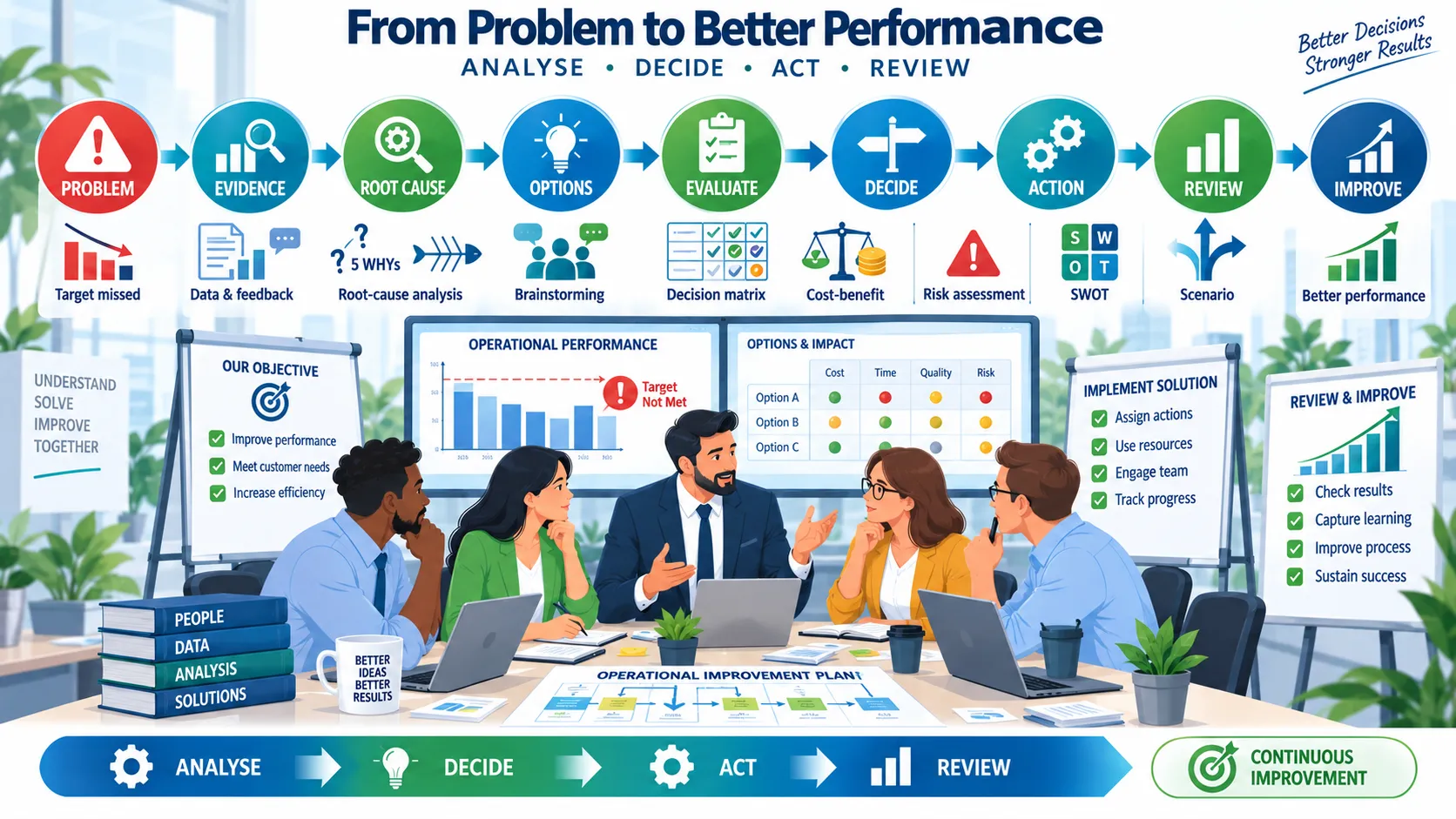
Definition of Problem-Solving
Problem-solving is a structured process of identifying a problem, understanding its causes, developing possible solutions, selecting an appropriate response, implementing corrective action and evaluating whether the desired improvement has been achieved.
A problem exists when there is a difference between the current state and the required or expected state.
For example:
Planned customer response time: 24 hours.
Actual average response time: 48 hours.
Required improvement: reduce the gap between actual and planned performance.
The manager should not automatically assume that employees are working inefficiently. The performance gap could have several causes and should be investigated before action is taken.
Definition of Decision-Making
Decision-making is the process of identifying a choice that needs to be made, considering relevant information and alternatives, evaluating potential consequences and selecting a course of action.
Decision-making can involve:
Choosing between alternative suppliers.
Allocating limited resources.
Prioritising operational activities.
Selecting corrective action.
Approving changes.
Responding to risks.
Determining staffing arrangements.
Selecting improvement methods.
Escalating significant issues.
Deciding whether an operational target remains realistic.
Relationship Between Problem-Solving and Decision-Making
Problem-solving and decision-making frequently operate as a connected management cycle.
A typical sequence is:
Identify problem → Analyse causes → Generate options → Evaluate options → Make decision → Implement solution → Monitor results → Review
Problem-solving identifies what needs to change, while decision-making determines how the organisation or team should respond.
Strong managers therefore avoid making decisions before understanding the problem. They also avoid excessive analysis when a timely decision is necessary.
Why Problem-Solving Is Important in Operational Delivery
Operational plans are based on assumptions about resources, timescales, demand, employee capability, technology and organisational conditions. These assumptions may change during implementation.
Effective problem-solving enables managers to:
Protect operational objectives.
Reduce delays.
Improve efficiency.
Maintain quality.
Control costs.
Address customer concerns.
Reduce operational risks.
Improve employee performance.
Prevent recurring problems.
Support continuous improvement.
A manager who reacts to problems without understanding their causes may create temporary solutions that do not resolve the underlying issue. Effective problem-solving therefore requires both analytical thinking and practical judgement.
Why Decision-Making Is Important in Operational Delivery
Managers make decisions throughout the operational planning and delivery cycle. Decisions influence the allocation of resources, performance, employee behaviour, customer outcomes and organisational costs.
Good decision-making helps managers:
Use evidence effectively.
Prioritise competing demands.
Manage uncertainty.
Respond to risks.
Allocate resources appropriately.
Resolve operational problems.
Maintain accountability.
Protect quality.
Respond to changing circumstances.
Achieve organisational objectives.
Poor decisions can have consequences beyond the immediate issue. A decision to reduce staffing, for example, may reduce short-term costs but increase workload, response times, employee dissatisfaction and customer complaints.
This is why managerial decisions should be evaluated in terms of both immediate and longer-term consequences.
The Structured Problem-Solving Process
A structured problem-solving process provides managers with a logical framework for dealing with operational issues.
Stage 1: Identify and Define the Problem
The first stage is to establish exactly what the problem is.
Managers should distinguish between:
Symptoms.
Causes.
Consequences.
Underlying problems.
For example, increased customer complaints are a symptom. The underlying cause could be delayed responses, inconsistent service quality, inaccurate information or a system failure.
A clearly defined problem should describe the actual performance gap without immediately assuming its cause.
A useful problem statement may identify:
What is happening?
Where is it happening?
When did it begin?
Who is affected?
How significant is it?
What evidence demonstrates the problem?
Stage 2: Gather Evidence
Managers should collect reliable information before deciding what action is required.
Evidence may include:
KPI data.
Customer feedback.
Employee feedback.
Quality records.
Financial information.
Operational reports.
Process information.
Incident records.
Audit findings.
Performance trends.
The quality of the decision depends partly on the quality of the evidence available.
Managers should distinguish between facts, assumptions and opinions. An employee saying that “the system is always slow” may be useful feedback, but objective system-performance data may be required to establish the extent of the issue.
Stage 3: Analyse the Root Cause
Root-cause analysis seeks to identify why the problem is occurring rather than simply describing what has happened.
A problem may have multiple contributing causes.
For example, declining customer satisfaction could result from:
Longer response times.
Staff shortages.
Inadequate training.
Poor system functionality.
Incorrect information.
Inconsistent processes.
High workload.
Poor communication between departments.
Addressing only one factor may not resolve the problem.
The 5 Whys Technique
The 5 Whys technique involves repeatedly asking “why?” to move from an immediate symptom towards an underlying cause.
Example
Problem: Customer orders are being delivered late.
Why?
Orders are not processed quickly enough.
Why?
The processing team receives incomplete information.
Why?
Information is not consistently captured during the initial customer interaction.
Why?
The process does not require all essential fields to be completed.
Why?
The operational procedure has not been reviewed since the service changed.
The root issue may therefore be a process-design problem rather than simply poor employee performance.
Benefits of the 5 Whys
Simple to understand.
Low cost.
Easy to facilitate.
Useful for routine operational problems.
Encourages deeper questioning.
Helps challenge assumptions.
Limitations of the 5 Whys
It may be less effective when:
There are multiple root causes.
Problems are highly complex.
Causes interact with one another.
The facilitator stops questioning too early.
Participants rely on assumptions rather than evidence.
For complex problems, managers may need additional techniques.
Cause-and-Effect Analysis
Cause-and-effect analysis helps managers identify different categories of factors contributing to a problem.
A common structure considers categories such as:
People.
Processes.
Technology.
Equipment.
Environment.
Materials.
Management.
Information.
For example, if service quality has declined, a manager could investigate:
People: capability, staffing, workload
Processes: unclear procedures, duplication, delays
Technology: system reliability, usability
Information: inaccurate or incomplete data
Management: unclear priorities, inadequate supervision
Environment: workspace, operational conditions
This prevents managers from immediately blaming individuals for problems that may actually be caused by systems or processes.
Pareto Analysis
Pareto analysis helps managers identify which causes contribute most significantly to a problem.
The principle is that a relatively small number of causes may account for a large proportion of the impact.
For example, a customer service manager may analyse 1,000 complaints and discover that most complaints relate to a small number of recurring issues.
The manager can then prioritise the causes that offer the greatest opportunity for improvement.
Benefits of Pareto Analysis
Helps prioritise effort.
Supports evidence-based improvement.
Prevents managers from treating every issue equally.
Helps focus limited resources.
Provides a visual basis for decision-making.
It should not be treated as an absolute rule that exactly 80% of results always come from 20% of causes. The principle is primarily useful for identifying significant contributors.
Process Mapping
Process mapping visually represents how work moves through an organisation.
Managers can use process mapping to identify:
Delays.
Duplication.
Unnecessary approvals.
Bottlenecks.
Handover problems.
Unclear responsibilities.
Rework.
Unnecessary steps.
Practical Example
A manager discovers that customer enquiries require approval from three different people before a response can be issued.
Process mapping may reveal that one approval stage adds little value and creates a significant delay.
The manager can then assess whether the process should be simplified.
Brainstorming
Brainstorming is a technique for generating a wide range of possible solutions.
It is particularly useful when:
The problem has several possible solutions.
Innovation is required.
Employees have different areas of expertise.
Team involvement is valuable.
During brainstorming, managers should initially encourage ideas without immediately criticising them. Evaluation can occur after sufficient options have been generated.
Effective Brainstorming Principles
Clearly define the problem.
Include relevant participants.
Encourage diverse ideas.
Avoid premature judgement.
Record suggestions.
Group similar ideas.
Evaluate options afterwards.
Mind Mapping
Mind mapping can help managers explore relationships between causes, consequences and possible solutions.
It is particularly useful during early problem analysis when the situation is broad or unclear.
A manager might place the central problem in the middle and then branch into:
People.
Processes.
Resources.
Technology.
Customers.
Risks.
Financial factors.
External factors.
This can help create a broader view of the situation.
Decision-Making Techniques
Once a problem has been understood and possible solutions identified, managers need to evaluate alternatives and make a decision.
Decision Criteria
Managers should establish criteria against which options can be assessed.
Criteria may include:
Cost.
Quality.
Time.
Risk.
Feasibility.
Resource requirements.
Customer impact.
Employee impact.
Strategic alignment.
Legal requirements.
Ethical considerations.
Sustainability.
Long-term consequences.
The importance of each criterion will depend on the context.
Decision Matrix
A decision matrix provides a structured way to compare options against agreed criteria.
For example, a manager selecting a new software provider could assess:
Cost.
Functionality.
Implementation time.
Supplier support.
Security.
Scalability.
User experience.
Each option can be scored against the criteria and weighted according to importance.
Benefits
A decision matrix can:
Make comparisons more transparent.
Reduce reliance on intuition.
Encourage consistent criteria.
Make assumptions visible.
Support stakeholder discussions.
Provide an audit trail for significant decisions.
However, scoring should not create a false impression of mathematical certainty. A high numerical score does not automatically mean that an option is the best decision. Professional judgement remains important.
Cost-Benefit Analysis
Cost-benefit analysis compares the expected costs of an option with its anticipated benefits.
Costs may include:
Financial expenditure.
Staff time.
Training.
Technology.
Implementation disruption.
Maintenance.
Opportunity costs.
Benefits may include:
Increased productivity.
Reduced errors.
Improved customer satisfaction.
Reduced operating costs.
Increased revenue.
Improved employee capability.
Better compliance.
Reduced risk.
Managers should consider both tangible and intangible benefits where possible.
Example
A department considers introducing automated customer notifications.
The costs include software, implementation and staff training.
Potential benefits include:
Reduced manual administration.
Faster communication.
Fewer missed appointments.
Improved customer experience.
The manager should consider whether the benefits justify the investment and whether there are risks or alternative solutions.
SWOT Analysis
SWOT analysis considers:
Strengths.
Weaknesses.
Opportunities.
Threats.
It can support operational decision-making by encouraging managers to consider both internal and external factors.
For example, when introducing a new service:
Strengths
Existing skilled employees.
Strong customer relationships.
Weaknesses
Limited capacity.
Outdated systems.
Opportunities
Growing demand.
New technology.
Threats
Competitor activity.
Rising costs.
SWOT is useful for structured discussion but should be supported by evidence rather than assumptions.
Risk-Based Decision-Making
Managers should consider risk when evaluating decisions.
An option may appear attractive but expose the organisation to significant operational, financial, legal, reputational or safety risks.
Risk-based decision-making requires consideration of:
Likelihood.
Impact.
Existing controls.
Residual risk.
Mitigation.
Contingency arrangements.
For high-risk decisions, managers may need additional approval or specialist advice.
Scenario Analysis
Scenario analysis considers how different possible future situations could affect a decision.
For example, when planning staffing levels, managers may consider:
Expected demand.
Higher-than-expected demand.
Lower-than-expected demand.
Unexpected staff absence.
Technology disruption.
This allows managers to evaluate whether a decision remains effective under different conditions.
Scenario analysis is particularly valuable when uncertainty is high.
Evidence-Based Decision-Making
Evidence-based decision-making involves using reliable information to support managerial choices.
Relevant evidence can include:
Performance data.
Financial data.
Customer feedback.
Employee feedback.
Benchmarking.
Previous experience.
Research.
Quality information.
Risk information.
Evidence does not eliminate judgement. Instead, it provides a stronger basis for judgement.
Managers should also be aware of confirmation bias, where people search for or give greater weight to information that supports what they already believe.
Intuitive Decision-Making
Experienced managers sometimes make rapid decisions based on professional knowledge and pattern recognition.
Intuition can be valuable when:
Time is limited.
The manager has substantial relevant experience.
The situation is familiar.
Reliable data are unavailable.
Immediate action is required.
However, intuition becomes risky when:
The situation is unfamiliar.
The consequences are significant.
Bias may influence judgement.
Evidence is readily available but ignored.
The manager is emotionally affected.
The strongest approach is often to combine professional judgement with available evidence.
The Decision-Making Process
A structured decision-making process can involve the following stages.
Stage 1: Identify the Decision
Clearly establish what needs to be decided.
Stage 2: Define the Desired Outcome
Determine what a successful decision should achieve.
Stage 3: Establish Constraints
Identify limitations involving:
Budget.
Time.
Staffing.
Technology.
Policies.
Legal requirements.
Quality.
Stakeholder expectations.
Stage 4: Gather Information
Collect relevant and reliable information.
Stage 5: Generate Options
Identify realistic alternatives rather than assuming there is only one solution.
Stage 6: Evaluate Options
Compare options against agreed criteria.
Stage 7: Assess Risks
Consider potential negative consequences.
Stage 8: Consult Appropriate Stakeholders
Seek input from people with relevant knowledge, responsibility or authority.
Stage 9: Make the Decision
Select the option that best supports the operational objective within the identified constraints.
Stage 10: Communicate the Decision
Explain:
What has been decided.
Why it was decided.
Who is responsible.
What happens next.
When implementation begins.
Stage 11: Implement
Convert the decision into action.
Stage 12: Monitor and Review
Assess whether the decision produced the intended outcome.
Group Decision-Making
Managers frequently need to make decisions with teams or colleagues.
Group decision-making can provide access to:
Diverse expertise.
Different perspectives.
Operational experience.
Alternative ideas.
Greater ownership.
However, group decisions can also create problems.
Potential disadvantages include:
Slow decision-making.
Groupthink.
Dominant personalities.
Conflict.
Lack of accountability.
Pressure to reach consensus.
Managers should therefore structure group discussions effectively.
Techniques for Effective Group Decisions
These can include:
Structured brainstorming.
Nominal group technique.
Voting.
Weighted decision matrices.
Facilitated discussion.
Independent option generation before group discussion.
The manager should ensure that participation does not remove accountability.
Nominal Group Technique
The nominal group technique provides a structured way for participants to generate and prioritise ideas.
A typical process involves:
Clearly define the issue.
Allow individuals to generate ideas independently.
Ask participants to share ideas.
Record all ideas.
Clarify suggestions.
Allow participants to rank or score options.
Identify the highest-priority options.
Discuss the results.
Agree action.
This can reduce the influence of dominant individuals and give quieter participants an opportunity to contribute.
Managing Bias in Decision-Making
Managers need to recognise that decision-making can be affected by cognitive and organisational biases.
Common examples include:
Confirmation Bias
Seeking information that supports an existing belief.
Availability Bias
Giving excessive weight to information that is recent or easily remembered.
Anchoring
Relying too heavily on the first information received.
Status Quo Bias
Preferring existing arrangements simply because they are familiar.
Sunk-Cost Bias
Continuing with a failing approach because significant resources have already been invested.
Groupthink
Prioritising agreement over critical evaluation.
Managers can reduce bias by:
Considering alternative explanations.
Asking someone to challenge the preferred option.
Using evidence.
Comparing multiple alternatives.
Involving different perspectives.
Reviewing assumptions.
Separating facts from opinions.
Problem-Solving and Emotional Intelligence
Problem-solving is not purely analytical. Managers must also understand the human dimension of operational problems.
Employees may become defensive if they believe that an investigation is intended to blame them. Customers may become frustrated when problems are not resolved quickly. Team members may disagree about causes or solutions.
Emotional intelligence can help managers:
Listen effectively.
Remain calm.
Recognise emotional responses.
Avoid unnecessary blame.
Manage conflict.
Communicate difficult decisions.
Maintain constructive relationships.
The objective should be to solve the problem while preserving professional relationships and organisational trust.
Escalation and Management Judgement
Not every problem should be resolved at the manager’s immediate level.
Managers should establish when an issue needs to be escalated.
Escalation may be appropriate when:
The issue exceeds delegated authority.
Significant financial impact is involved.
Legal or regulatory implications exist.
There is serious safety risk.
The organisation’s reputation may be affected.
Senior approval is required.
Specialist expertise is needed.
Operational continuity is threatened.
Effective escalation is not a sign of weak management. Appropriate escalation demonstrates awareness of authority, risk and governance.
Problem-Solving in High-Pressure Situations
Urgent operational problems may require rapid decisions.
For example, a critical technology failure may immediately affect customer service.
The manager may need to:
Establish the immediate impact.
Protect people and critical services.
Activate contingency arrangements.
Communicate with stakeholders.
Allocate available resources.
Escalate appropriately.
Stabilise operations.
Investigate the underlying cause later.
Review the incident.
Implement preventative improvements.
In such circumstances, the manager may initially focus on stabilisation rather than complete root-cause analysis.
This demonstrates an important principle: the appropriate problem-solving technique depends on urgency and risk.
Preventative Problem-Solving
Effective managers should not only react to problems. They should also identify potential problems before they occur.
Preventative approaches include:
Risk assessment.
Trend analysis.
Quality monitoring.
Preventative maintenance.
Staff training.
Process reviews.
Scenario planning.
Contingency planning.
Early-warning indicators.
For example, if performance data show a gradual increase in customer complaints, the manager can investigate the trend before complaints reach a critical level.
Corrective Versus Preventative Action
Corrective action responds to an existing problem.
Preventative action seeks to reduce the likelihood of a problem occurring.
For example:
Corrective: Investigate why orders were delayed and resolve the immediate backlog.
Preventative: Improve the order-processing process and introduce monitoring to prevent similar delays.
Both are important for sustainable operational performance.
Practical Example: Staffing Shortage
A department experiences unexpected staff absence during a busy period.
The manager must first assess the operational impact.
Possible options include:
Redistributing work.
Adjusting priorities.
Using available internal staff.
Authorising overtime where appropriate.
Delaying non-critical activities.
Using temporary support where organisational procedures permit.
The manager should assess each option against:
Service impact.
Cost.
Employee workload.
Quality.
Risk.
Timescales.
The decision should protect critical operational outcomes while avoiding unnecessary pressure on employees.
Practical Example: Declining Quality
A service team experiences an increase in errors.
The manager should not immediately conclude that employees are careless.
A structured investigation may reveal:
New employees have insufficient training.
Procedures are unclear.
Workload has increased.
The system has changed.
Quality checks are inconsistent.
The manager can then select an appropriate combination of solutions.
Possible actions include:
Additional training.
Process redesign.
Improved documentation.
Additional quality checks.
System improvements.
Workload adjustment.
The solution should address the actual cause.
Practical Example: Customer Complaint Escalation
A major customer complains that a service has failed to meet agreed standards.
The manager should:
Establish the facts.
Review service records.
Listen to relevant employees.
Identify the service failure.
Assess contractual or organisational requirements.
Consider customer impact.
Determine appropriate corrective action.
Communicate with the customer.
Review whether the process needs improvement.
A strong manager treats the complaint not only as an immediate issue but also as an opportunity to identify systemic improvements.
Practical Example: Choosing Between Two Operational Priorities
A manager has limited resources and must choose between:
Implementing a new internal efficiency system.
Improving a customer-facing service process.
The manager should compare both options against organisational objectives.
Relevant criteria could include:
Strategic importance.
Customer impact.
Financial impact.
Risk.
Urgency.
Resource requirements.
Expected outcomes.
Implementation time.
The manager should avoid selecting an option simply because it is personally preferred.
Evaluating the Effectiveness of Problem-Solving Techniques
The effectiveness of a problem-solving technique can be assessed according to several factors.
Accuracy
Did the technique help identify the actual cause?
Efficiency
Did it achieve useful results within reasonable time and resource limits?
Participation
Did it involve relevant people appropriately?
Practicality
Could the proposed solution realistically be implemented?
Sustainability
Did the solution address the underlying problem rather than merely the symptom?
Measurability
Can the impact of the solution be evaluated?
Organisational Alignment
Does the solution support wider organisational objectives?
A technique should therefore be judged by its suitability for the situation rather than by whether it is considered fashionable or theoretically sophisticated.
Evaluating the Effectiveness of Decision-Making Techniques
Decision-making techniques can be assessed using similar criteria.
Managers should ask:
Was sufficient evidence considered?
Were realistic alternatives identified?
Were risks assessed?
Were relevant stakeholders consulted?
Was the decision proportionate to the situation?
Was the decision made within appropriate authority?
Was the impact on people considered?
Were legal, ethical and organisational requirements considered?
Was the decision implemented effectively?
Did it achieve the intended outcome?
Key Benefits of Effective Problem-Solving and Decision-Making
Improved Operational Performance
Problems are identified and resolved before they cause significant disruption.
Better Use of Resources
Managers can focus resources on issues with the greatest operational impact.
Reduced Risk
Structured analysis helps identify potential consequences before decisions are implemented.
Improved Quality
Root-cause analysis and corrective action reduce recurring errors.
Greater Employee Confidence
Employees are more likely to trust managers who respond to problems fairly and constructively.
Stronger Customer Outcomes
Effective decisions can improve service quality, response times and customer satisfaction.
Greater Accountability
Structured decisions create clear ownership for actions and outcomes.
Continuous Improvement
Problems become sources of organisational learning rather than recurring failures.
Improved Agility
Managers can respond more effectively to changing circumstances.
Common Mistakes in Problem-Solving and Decision-Making
Managers should avoid:
Acting before defining the problem.
Treating symptoms rather than causes.
Relying entirely on personal opinion.
Ignoring employee expertise.
Failing to consider alternatives.
Over-analysing minor issues.
Making decisions without considering risks.
Ignoring long-term consequences.
Allowing dominant personalities to control group decisions.
Continuing with ineffective approaches because of previous investment.
Failing to communicate decisions.
Not monitoring whether solutions worked.
Blaming individuals before investigating systems and processes.
Failing to escalate significant risks.
Treating every problem as equally urgent.
Key Concepts to Remember
The essential concepts for effective managerial problem-solving and decision-making include:
A problem is a gap between current and desired performance.
Problem-solving focuses on identifying and resolving causes.
Decision-making focuses on selecting an appropriate course of action.
Effective problem-solving should distinguish symptoms from root causes.
Evidence improves the quality of managerial judgement.
The 5 Whys can help identify underlying causes.
Cause-and-effect analysis supports investigation of multiple contributing factors.
Pareto analysis helps prioritise significant causes.
Process mapping identifies workflow problems and bottlenecks.
Brainstorming generates possible solutions.
Decision matrices support structured comparison.
Cost-benefit analysis evaluates value and resource implications.
SWOT analysis supports consideration of internal and external factors.
Risk-based decision-making considers potential consequences.
Scenario analysis supports decisions under uncertainty.
Intuition can be valuable when supported by experience but should not replace evidence unnecessarily.
Group decision-making provides diverse perspectives but requires effective facilitation.
Managers should actively challenge cognitive bias.
Urgent situations may require immediate stabilisation before detailed analysis.
Corrective action resolves existing problems.
Preventative action reduces the likelihood of recurrence.
Significant matters should be escalated appropriately.
Effective solutions should be monitored to determine whether they actually worked.
Managerial Problem-Solving and Decision-Making Checklist
Before solving an operational problem, a manager should consider:
Problem Definition
What exactly is the problem?
What evidence demonstrates that it exists?
What is the difference between the symptom and the underlying cause?
Who or what is affected?
Evidence
What reliable information is available?
Is additional information required?
Are assumptions being confused with facts?
Analysis
What are the possible causes?
Are there multiple contributing factors?
Could process, people, technology or resource issues be involved?
Options
What possible solutions exist?
What are their advantages and disadvantages?
Are there realistic alternatives?
Decision
Which option best supports the operational objective?
What are the risks?
What resources are required?
Does the decision comply with relevant requirements?
Who has authority to make the decision?
Implementation
Who will take action?
What resources are required?
What is the timescale?
How will the decision be communicated?
Review
Did the solution work?
Has the original problem been resolved?
Have unintended consequences occurred?
What has been learned?
What preventative action is required?
Professional Management Insight
The strongest managers understand that problem-solving and decision-making are not isolated technical activities. They are part of everyday leadership.
A manager may have access to sophisticated analytical tools, dashboards and performance data, but effective judgement is still required to interpret information and decide what action is appropriate. Equally, a manager with extensive experience may make rapid and accurate decisions, but relying exclusively on experience can create blind spots if circumstances have changed.
Effective managerial practice therefore combines evidence, analysis, experience, stakeholder insight, professional judgement and organisational values.
Another important principle is proportionality. Not every operational problem requires a lengthy investigation or formal decision-making process. A minor scheduling issue may be resolved quickly by an experienced manager. A significant decision involving major financial expenditure, legal risk, employee impact or organisational reputation requires considerably greater analysis, consultation and governance.
Managers must also understand that the best decision is not always the decision that produces the fastest immediate result. A quick solution that creates another problem later may represent poor operational management. For example, reducing staffing may immediately lower costs but create service delays and increased employee workload. Strong decision-making considers the wider system and longer-term consequences.
Problem-solving should also create organisational learning. If the same problem occurs repeatedly, managers should question why previous solutions have failed. Recurring problems often indicate weaknesses in processes, systems, training, communication or organisational design.
Finally, effective leaders create a culture in which employees feel able to identify problems early. If employees believe that reporting problems will result in blame or criticism, issues may remain hidden until they become more serious. A constructive problem-solving culture encourages employees to raise concerns, provide evidence and contribute to solutions while maintaining appropriate accountability.
Summary
Problem-solving and decision-making are essential to the successful delivery of operational plans. Managers must be able to identify performance gaps, investigate root causes, generate solutions, evaluate alternatives and implement appropriate decisions.
Techniques such as the 5 Whys, cause-and-effect analysis, Pareto analysis, process mapping, brainstorming, decision matrices, cost-benefit analysis, SWOT analysis, risk assessment and scenario analysis provide structured approaches to managerial thinking. However, no single technique is suitable for every situation.
Effective managers select techniques according to the nature of the problem, the level of urgency, available information, complexity, risk, resources and stakeholder requirements. They combine analytical methods with professional experience and judgement while actively challenging assumptions and bias.
The overall problem-solving and decision-making cycle can be summarised as:
Identify → Define → Gather Evidence → Analyse → Generate Options → Evaluate → Decide → Implement → Monitor → Review → Improve
When this cycle is applied effectively, managers are better able to protect operational performance, manage risks, allocate resources, improve quality, support employees, respond to changing circumstances and achieve organisational objectives.