
Lesson no 4 :Know methods for measuring the impact of stakeholder engagement on organisational performance
Effective stakeholder engagement is an important contributor to organisational performance, sustainability and long-term success. Organisations depend on relationships with customers, employees, suppliers, business partners, senior leaders, regulators, investors and other stakeholder groups to achieve strategic and operational objectives. However, simply communicating with stakeholders or involving them in organisational activities does not demonstrate that engagement has been successful. Managers need to understand whether stakeholder engagement is creating measurable value and contributing to improved organisational outcomes.
This lesson, “Know Methods for Measuring the Impact of Stakeholder Engagement on Organisational Performance”, develops learners’ understanding of how organisations can assess the effectiveness and value of their stakeholder engagement activities. It focuses on practical methods that managers can use to collect evidence, evaluate outcomes and determine whether stakeholder relationships are supporting organisational performance.
Stakeholder engagement can influence many areas of organisational performance. Effective engagement may improve customer satisfaction, employee engagement, supplier performance, service quality, operational efficiency, innovation, decision-making, reputation and stakeholder trust. Poorly managed engagement, however, may result in misunderstandings, unresolved conflict, dissatisfaction, delays, increased costs and weakened relationships. Measuring impact therefore enables managers to understand what is working, identify areas for improvement and make evidence-based management decisions.
The lesson explores both quantitative and qualitative approaches to measuring stakeholder engagement. Quantitative measures can provide numerical evidence through indicators such as customer satisfaction scores, employee engagement results, retention rates, complaint levels, response times, supplier performance measures, project outcomes and financial or operational indicators. Qualitative methods can provide deeper insight into stakeholder experiences through interviews, focus groups, surveys, feedback discussions, observations and structured stakeholder reviews.
A key principle is that stakeholder engagement should be measured against clearly defined objectives. Managers should establish what the engagement activity is intended to achieve before selecting measures. For example, if the objective is to improve customer relationships, relevant measures may include satisfaction, complaints, retention and feedback. If the objective is to strengthen employee involvement, managers may consider participation, engagement, communication quality and employee feedback.
The lesson also considers the importance of establishing baselines, selecting appropriate key performance indicators, comparing results over time and interpreting stakeholder feedback alongside organisational performance data. Managers should avoid relying on a single measure because stakeholder engagement is multidimensional and its impact may appear through both immediate and longer-term outcomes.
For middle managers and leaders, measuring stakeholder engagement is not simply a reporting exercise. It is a management process that supports accountability, continuous improvement, better decision-making and stronger stakeholder relationships. By using appropriate evidence and reviewing results systematically, managers can demonstrate the organisational value of stakeholder engagement and identify practical actions that improve performance.
1.Examine Methods for Measuring the Impact of Stakeholder Engagement on Organisational Performance
Stakeholder engagement is an important management activity because organisations rely on productive relationships with people and groups that influence, support or are affected by organisational decisions and activities. Customers, employees, suppliers, business partners, senior leaders, regulators, investors, project teams and community representatives may all contribute to organisational performance in different ways. Effective engagement can improve communication, strengthen trust, support better decision-making and help organisations understand changing needs and expectations.
However, stakeholder engagement should not be assessed simply by counting how many meetings were held, how many emails were sent or how many stakeholders attended an event. These activities show that engagement took place, but they do not necessarily demonstrate that the engagement created value or improved organisational performance. Managers therefore need appropriate methods for measuring the impact of stakeholder engagement.
Measuring impact involves collecting and analysing evidence to determine whether stakeholder engagement has contributed to intended organisational outcomes. The evidence may be quantitative, qualitative or a combination of both. Effective measurement connects stakeholder engagement activities with relevant performance outcomes and helps managers understand what has changed, why it changed and what action may be required.
For middle managers, this capability is particularly important because they often translate strategic stakeholder objectives into operational activity. They may be responsible for customer relationships, employee engagement, supplier performance, project stakeholders or cross-functional collaboration. Measuring the impact of these relationships allows managers to demonstrate value, identify weaknesses, justify resources and support continuous improvement.
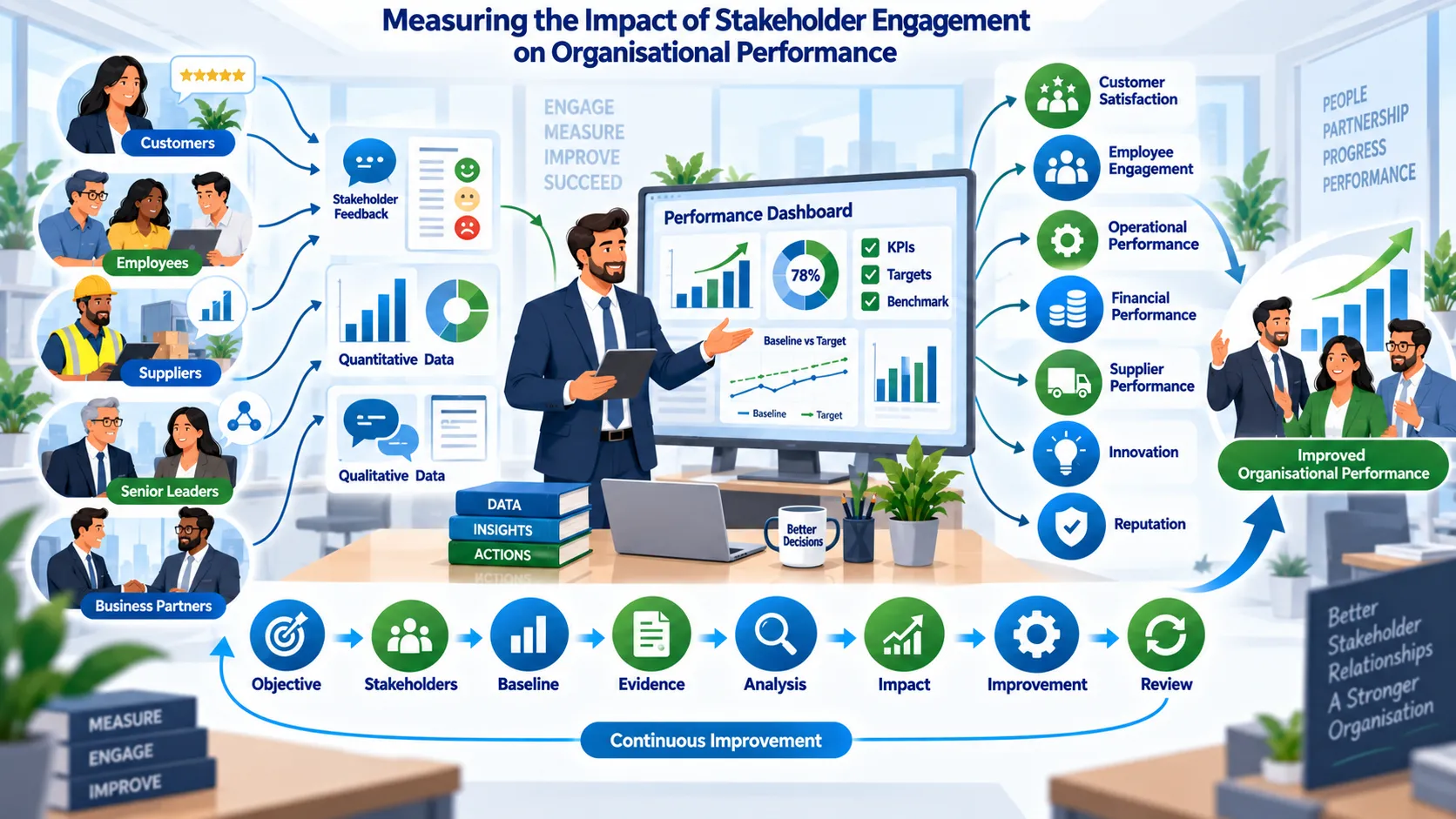
Understanding the Meaning of Measuring Stakeholder Engagement Impact
Measuring stakeholder engagement impact is the systematic process of collecting, analysing and interpreting evidence to determine how stakeholder engagement activities influence organisational relationships and performance.
The concept has three interconnected elements:
Stakeholder engagement activity: what the organisation does to involve, communicate with or collaborate with stakeholders.
Stakeholder outcomes: what changes for stakeholders as a result of the engagement.
Organisational outcomes: what changes for the organisation as a result of stakeholder relationships and engagement.
For example, an organisation may introduce monthly customer feedback meetings. The activity is the meetings themselves. A stakeholder outcome may be improved customer understanding and responsiveness. An organisational outcome may be fewer complaints, improved customer retention and stronger service performance.
This distinction is important because activity does not automatically equal impact.
Activity, Output, Outcome and Impact
Managers should distinguish between four related concepts.
Activity
Activity refers to what the organisation does.
Examples include:
Holding stakeholder meetings.
Conducting surveys.
Running workshops.
Sending stakeholder communications.
Establishing consultation forums.
Conducting supplier reviews.
Output
An output is the immediate result of an activity.
Examples include:
Number of stakeholders attending a workshop.
Number of completed surveys.
Number of meetings conducted.
Number of stakeholder issues recorded.
Number of improvement suggestions received.
Outcome
An outcome is a change resulting from stakeholder engagement.
Examples include:
Improved stakeholder satisfaction.
Increased employee participation.
Faster issue resolution.
Better communication.
Increased supplier cooperation.
Improved stakeholder trust.
Impact
Impact refers to the broader effect of stakeholder engagement on organisational performance.
Examples include:
Improved customer retention.
Reduced operating costs.
Higher employee productivity.
Improved supplier performance.
Reduced complaints.
Increased innovation.
Stronger organisational reputation.
Better achievement of strategic objectives.
A manager should therefore avoid treating the number of meetings held as evidence that engagement has had a positive organisational impact.
Why Measuring Stakeholder Engagement Matters
Measurement gives managers evidence about whether engagement activities are achieving their intended purpose.
Without measurement, managers may rely heavily on assumptions such as:
“Customers seem happier.”
“Employees appear more involved.”
“The supplier relationship seems stronger.”
“The workshop was successful.”
These observations may be useful, but they are not sufficient on their own.
Structured measurement enables managers to make better-informed judgements.
Supporting Evidence-Based Decision-Making
Managers can use performance evidence to determine whether an engagement approach should be:
Continued.
Expanded.
Modified.
Reduced.
Replaced.
For example, if customer engagement has increased significantly but customer satisfaction has not improved, the manager may need to review the quality and purpose of the engagement rather than simply increasing the number of meetings.
Demonstrating Organisational Value
Stakeholder engagement requires time and resources.
Measurement can help demonstrate whether resources are contributing to organisational outcomes.
For example:
Employee consultation may reduce resistance to change.
Supplier collaboration may reduce delivery problems.
Customer feedback may identify service improvements.
Partnership working may create new opportunities.
Stakeholder involvement may identify operational risks earlier.
Supporting Continuous Improvement
Measurement enables managers to identify what works and what does not.
A manager can compare results over time and use findings to improve:
Communication.
Engagement methods.
Stakeholder relationships.
Decision-making.
Service delivery.
Internal processes.
Key Concepts in Measuring Stakeholder Engagement
Several concepts are central to effective measurement.
Baseline
A baseline is the starting point against which future performance can be compared.
For example, an organisation may record a customer satisfaction score before introducing a new engagement approach. The score provides a baseline for evaluating later results.
A baseline helps answer:
“What was performance like before the intervention?”
Key Performance Indicator
A key performance indicator, or KPI, is a measurable indicator used to assess performance against an objective.
Stakeholder-related KPIs might include:
Customer satisfaction.
Complaint levels.
Employee engagement.
Stakeholder response rates.
Supplier delivery performance.
Issue-resolution time.
Retention rates.
Participation levels.
KPIs should be relevant to the purpose of the engagement activity.
Target
A target defines the level of performance an organisation aims to achieve.
For example:
“Reduce customer complaints by 15% over six months.”
The target gives managers a clear basis for evaluating progress.
Benchmark
A benchmark provides a point of comparison.
An organisation may compare:
Current performance with previous performance.
One department with another.
One supplier with another.
Results against an organisational target.
Performance against an established standard.
Stakeholder Feedback
Stakeholder feedback is information provided by stakeholders about their experiences, perceptions, concerns and expectations.
Feedback may be:
Positive.
Negative.
Neutral.
Quantitative.
Qualitative.
Feedback should be analysed rather than simply collected.
Quantitative Methods for Measuring Stakeholder Engagement Impact
Quantitative methods use numerical information to measure stakeholder engagement and organisational performance.
They are particularly useful when managers need to identify trends, compare performance or monitor progress against targets.
Surveys and Rating Scales
Stakeholder surveys are one of the most widely used measurement methods.
Surveys can measure:
Satisfaction.
Trust.
Communication quality.
Responsiveness.
Perceived value.
Engagement.
Confidence.
Likelihood of continued cooperation.
Rating scales can allow stakeholders to score aspects of their experience.
For example:
“Rate the quality of communication from 1 to 5.”
Survey results can then be compared over time.
Customer Satisfaction Measures
Customer satisfaction can provide evidence about the effect of customer engagement on organisational performance.
Possible indicators include:
Satisfaction scores.
Complaint volumes.
Repeat business.
Customer retention.
Service ratings.
Response times.
Resolution rates.
A manager should avoid interpreting one measure in isolation.
For example, a rise in satisfaction alongside improved retention and reduced complaints provides stronger evidence than a small increase in satisfaction alone.
Employee Engagement Measures
Employee engagement can help managers assess the effectiveness of internal stakeholder engagement.
Measures may include:
Employee survey scores.
Participation rates.
Absence trends.
Employee turnover.
Retention.
Feedback participation.
Internal communication ratings.
If employee engagement activities are introduced to support organisational change, managers can compare employee engagement data before and after implementation.
Participation Rates
Participation rates show the extent to which stakeholders engage with a particular activity.
Examples include:
Percentage of employees attending consultation sessions.
Percentage of customers completing feedback surveys.
Percentage of suppliers participating in review meetings.
Number of stakeholders contributing improvement suggestions.
Participation is useful, but it should not be confused with positive impact.
High attendance does not necessarily mean stakeholders were satisfied.
Complaint and Issue Measures
Changes in complaints and stakeholder issues can provide valuable evidence.
Managers may measure:
Number of complaints.
Complaint categories.
Resolution time.
Repeat complaints.
Escalated complaints.
Percentage resolved within agreed timescales.
A decline in complaints may indicate improvement, although managers should consider whether reporting behaviour has also changed.
Response-Time Measures
Response time can help assess whether stakeholder communication has become more effective.
Examples include:
Customer response time.
Supplier query response time.
Employee issue-resolution time.
Time taken to respond to stakeholder requests.
Improved response time can contribute to stronger stakeholder relationships and service performance.
Qualitative Methods for Measuring Stakeholder Engagement Impact
Quantitative measures provide numerical evidence, but they may not explain why stakeholders feel or behave in particular ways.
Qualitative methods provide deeper insight.
Interviews
Interviews enable managers to explore stakeholder experiences in greater detail.
Questions may examine:
What stakeholders value.
What concerns they have.
Whether communication has improved.
Whether they feel listened to.
What could be improved.
Why their perceptions have changed.
Interviews are particularly useful when issues are complex or sensitive.
Focus Groups
A focus group brings a selected group of stakeholders together to discuss an issue.
It can help managers explore:
Shared experiences.
Different perspectives.
Common concerns.
Suggestions for improvement.
Reactions to organisational change.
The manager should ensure that dominant participants do not prevent others from contributing.
One-to-One Feedback Discussions
One-to-one discussions can be useful when stakeholders have concerns they may not want to express in a group.
They can support:
Open communication.
Relationship review.
Problem identification.
Trust building.
Sensitive feedback.
Observation
Managers may observe stakeholder interactions to identify patterns that may not appear in formal feedback.
For example, a manager may observe:
How employees respond during meetings.
How customer service teams interact with customers.
How suppliers participate in review meetings.
Whether stakeholders actively contribute to discussions.
Observation should be interpreted carefully and supported by other evidence where appropriate.
Open-Ended Feedback
Open-ended survey questions allow stakeholders to explain their views in their own words.
For example:
“What is the most important improvement we could make to stakeholder communication?”
Responses can reveal themes that numerical ratings may not identify.
Combining Quantitative and Qualitative Evidence
The strongest measurement approaches often combine quantitative and qualitative methods.
Quantitative evidence can answer:
“How much has performance changed?”
Qualitative evidence can help answer:
“Why has performance changed?”
For example, customer satisfaction may increase from 72% to 84%. This provides numerical evidence of improvement.
Customer interviews may reveal that customers value faster responses and clearer communication. The qualitative evidence helps explain the numerical result.
Together, these methods provide a more complete understanding.
Measuring Stakeholder Engagement Through Organisational Performance
The purpose of measuring stakeholder engagement is ultimately to understand its relationship with organisational performance.
Managers can examine several performance areas.
Financial Performance
Stakeholder engagement can affect financial outcomes through:
Customer retention.
Repeat business.
Reduced complaints.
Lower supplier costs.
Improved productivity.
Reduced operational waste.
However, managers should be careful when claiming direct causation.
A change in revenue may have several causes, including market conditions, pricing, competition and economic circumstances.
Customer Performance
Customer engagement can be evaluated through:
Customer satisfaction.
Retention.
Complaints.
Repeat purchases.
Service quality.
Resolution rates.
Employee Performance
Employee engagement can be assessed through:
Engagement scores.
Retention.
Participation.
Productivity.
Absence trends.
Feedback.
Supplier Performance
Supplier engagement can be assessed through:
On-time delivery.
Quality.
Responsiveness.
Issue-resolution time.
Reliability.
Contract performance.
Operational Performance
Stakeholder engagement may influence:
Process efficiency.
Decision-making speed.
Error rates.
Service delivery.
Productivity.
Resolution times.
Innovation Performance
Stakeholder involvement can generate ideas and identify opportunities.
Managers may measure:
Number of ideas generated.
Number of ideas implemented.
Stakeholder participation in innovation activities.
Improvement outcomes.
Time from idea to implementation.
Developing a Stakeholder Engagement Measurement Framework
A measurement framework provides structure for evaluating engagement.
Step 1: Define the Engagement Objective
The manager should establish what the engagement is intended to achieve.
Examples include:
Improve customer satisfaction.
Increase employee involvement.
Strengthen supplier performance.
Reduce stakeholder conflict.
Improve decision-making.
Support organisational change.
Step 2: Identify the Stakeholders
Determine which stakeholder groups are affected.
These may include:
Employees.
Customers.
Suppliers.
Senior leaders.
Partners.
Project teams.
Regulators.
Step 3: Define Expected Outcomes
The manager should determine what successful engagement should produce.
For example:
“Employees understand the proposed change and contribute practical implementation suggestions.”
Step 4: Establish a Baseline
Measure the relevant performance position before the engagement intervention.
Step 5: Select Appropriate Measures
Measures should be linked directly to the objective.
For example:
| Engagement Objective | Possible Measures | Organisational Outcome |
|---|---|---|
| Improve customer relationships | Satisfaction, complaints, retention, feedback | Customer loyalty and service performance |
| Increase employee involvement | Participation, engagement scores, suggestions | Better implementation and employee commitment |
| Strengthen supplier relationships | Delivery, quality, responsiveness | Operational reliability |
| Improve stakeholder communication | Response time, communication ratings, issue resolution | Faster decisions and fewer misunderstandings |
| Support innovation | Ideas, participation, implementation rates | Process or service improvement |
| Reduce stakeholder conflict | Complaints, escalations, resolution time | Stronger relationships and reduced disruption |
Step 6: Set Targets
Targets should be realistic and relevant.
For example:
Increase customer satisfaction from 75% to 85%.
Reduce complaint resolution time by 20%.
Increase employee participation in consultation activities.
Improve supplier on-time delivery.
Step 7: Collect Evidence
Managers should use appropriate methods, such as:
Surveys.
Interviews.
Performance reports.
Feedback meetings.
Operational data.
Customer records.
Supplier reviews.
Step 8: Analyse Results
The manager should identify:
Trends.
Improvements.
Deterioration.
Differences between stakeholder groups.
Unexpected results.
Relationships between engagement and performance.
Step 9: Interpret the Findings
Managers should ask:
Did engagement achieve the intended outcome?
What changed?
Why did it change?
Which stakeholders benefited?
Were there unintended consequences?
Is there sufficient evidence to support the conclusion?
Step 10: Take Action
Measurement should lead to management action.
Possible actions include:
Continue the current approach.
Change communication methods.
Increase stakeholder involvement.
Address unresolved concerns.
Improve processes.
Change performance measures.
Step 11: Review and Improve
Measurement should become part of an ongoing cycle.
A useful cycle is:
Objective → Baseline → Measure → Analyse → Interpret → Improve → Re-measure
Measuring Impact Over Time
Stakeholder engagement impact may not appear immediately.
Some outcomes can occur quickly.
Examples include:
Faster responses.
Better communication.
Immediate issue resolution.
Other impacts may take longer.
Examples include:
Improved trust.
Increased retention.
Stronger partnerships.
Improved organisational reputation.
Sustainable performance improvement.
Managers should therefore select appropriate measurement periods.
Short-term measurements can provide early indicators, while longer-term measures can demonstrate whether improvements have been sustained.
Leading and Lagging Indicators
Managers can use both leading and lagging indicators.
Leading Indicators
Leading indicators provide information about activities or conditions that may influence future performance.
Examples include:
Stakeholder participation.
Number of improvement suggestions.
Response rates.
Training participation.
Engagement activity completion.
Lagging Indicators
Lagging indicators show results that have already occurred.
Examples include:
Customer retention.
Employee turnover.
Complaint levels.
Supplier performance.
Financial results.
Using both types gives managers a more complete picture.
Measuring Stakeholder Trust
Trust is an important but sometimes difficult aspect of stakeholder engagement to measure.
Managers may use:
Stakeholder trust surveys.
Interview feedback.
Repeat engagement.
Willingness to share information.
Stakeholder cooperation.
Reduction in unnecessary escalation.
Trust should not be measured through a single question alone where a more comprehensive assessment is possible.
Measuring Communication Effectiveness
Communication is often central to stakeholder engagement.
Possible measures include:
Response time.
Stakeholder understanding.
Communication satisfaction.
Number of repeated queries.
Number of misunderstandings.
Feedback quality.
Attendance and participation.
For example, if repeated customer queries decrease after communication materials are improved, this may provide evidence that communication has become clearer.
Measuring the Impact of Collaborative Engagement
Collaboration can create value by combining stakeholder knowledge and expertise.
Managers can measure:
Number of stakeholders participating.
Number of ideas generated.
Number of ideas implemented.
Decision-making time.
Quality of outcomes.
Stakeholder satisfaction.
Implementation success.
However, the manager should assess the quality of collaboration rather than simply counting participants.
A meeting involving ten stakeholders may be less effective than a focused session involving five stakeholders with relevant knowledge.
Measuring Stakeholder Engagement During Change
Organisational change provides an important context for stakeholder measurement.
Managers can assess:
Employee understanding.
Participation.
Resistance levels.
Feedback.
Customer disruption.
Implementation progress.
Issue resolution.
For example, if employees are involved in change planning and the organisation experiences fewer implementation problems, the manager can investigate whether effective engagement contributed to that result.
Attribution and Causation
One of the most important measurement challenges is determining whether stakeholder engagement actually caused a performance improvement.
Suppose customer satisfaction rises after a new engagement programme is introduced.
The increase may be influenced by:
Better engagement.
Improved product quality.
Reduced prices.
Competitor changes.
Market conditions.
Improved technology.
Therefore, managers should avoid claiming direct causation without sufficient evidence.
A more professional approach is to examine multiple sources of evidence and assess whether the engagement intervention plausibly contributed to the outcome.
Benchmarking Stakeholder Performance
Benchmarking involves comparing performance against an appropriate reference point.
Managers may compare:
Current results with previous periods.
Different stakeholder groups.
Different departments.
Different suppliers.
Different locations.
Organisational targets.
Benchmarking can help identify areas requiring attention.
However, comparisons should be fair. Different stakeholder groups may have different characteristics and expectations.
Return on Engagement
Managers may also consider the organisational value generated from stakeholder engagement relative to the resources invested.
For example, an organisation may invest time and resources in supplier collaboration.
Possible benefits may include:
Reduced delivery failures.
Fewer quality problems.
Faster issue resolution.
Lower operational disruption.
The manager can compare the resources used for engagement with measurable improvements.
This should not always be reduced to a simple financial calculation because stakeholder value can also include:
Trust.
Reputation.
Knowledge.
Innovation.
Relationship stability.
Risk reduction.
Practical Example: Measuring Customer Engagement
A service organisation introduces quarterly customer feedback meetings because customer complaints have increased.
The manager establishes a baseline:
Customer satisfaction: 72%.
Complaint rate: 8%.
Average complaint resolution: 5 working days.
Customer retention: 82%.
After six months, the organisation measures:
Customer satisfaction: 81%.
Complaint rate: 5%.
Resolution time: 3 working days.
Retention: 86%.
Customer interviews indicate that customers particularly value improved communication and faster responses.
The manager now has quantitative and qualitative evidence suggesting that stakeholder engagement has contributed to improved customer outcomes.
However, the manager should still consider other changes that occurred during the same period.
Practical Example: Measuring Employee Engagement
An organisation introduces employee consultation sessions before implementing a new operational process.
The manager measures:
Participation rates.
Employee engagement scores.
Number of suggestions.
Employee understanding of the change.
Implementation problems.
Following implementation, the manager compares results with the baseline.
If employees demonstrate higher understanding, greater participation and fewer implementation problems, the manager can investigate whether effective engagement contributed to the improvement.
Practical Example: Measuring Supplier Engagement
A manufacturing organisation establishes monthly supplier review meetings.
Before the intervention:
On-time delivery: 88%.
Quality issues: 12 per month.
Average issue resolution: 10 days.
Six months later:
On-time delivery: 95%.
Quality issues: 7 per month.
Average resolution: 5 days.
Supplier interviews indicate that clearer communication and joint problem-solving contributed to the improvement.
The manager can use these findings to evaluate whether the engagement approach should continue.
Benefits of Measuring Stakeholder Engagement Impact
Effective measurement provides several benefits.
Better Management Decisions
Managers can make decisions based on evidence rather than assumptions.
Greater Accountability
Measurement allows managers to demonstrate what engagement activities achieved.
Improved Stakeholder Relationships
Feedback and performance information can identify areas where relationships need attention.
Stronger Organisational Performance
Effective stakeholder engagement can contribute to:
Better customer outcomes.
Improved employee engagement.
Stronger supplier performance.
More effective decision-making.
Improved innovation.
Better Resource Allocation
Managers can identify which engagement activities create value and allocate resources accordingly.
Early Identification of Problems
Measurement can reveal:
Declining satisfaction.
Increasing complaints.
Reduced participation.
Supplier deterioration.
Communication problems.
Early identification allows managers to act before issues become more serious.
Limitations and Challenges of Measuring Stakeholder Engagement
Measurement itself presents challenges.
Difficulty in Establishing Causation
Many factors influence organisational performance.
Subjective Feedback
Stakeholder perceptions may differ.
Measurement Bias
Stakeholders may provide socially desirable or emotionally influenced responses.
Low Response Rates
A survey with limited participation may not provide representative evidence.
Poorly Selected KPIs
A measure may be easy to collect but have little relevance to the engagement objective.
Over-Reliance on Numerical Data
Numbers may show what changed but not explain why.
Time and Resource Requirements
Interviews, surveys and analysis require management resources.
Changing Stakeholder Expectations
Measures may need to change as stakeholder needs evolve.
Best-Practice Principles for Measuring Stakeholder Engagement
Managers should follow several principles.
Measure What Matters
Select measures that directly relate to the engagement objective.
Use Multiple Sources
Combine stakeholder feedback with organisational performance data where appropriate.
Establish a Baseline
Know the starting position before assessing change.
Use Clear Targets
Define what successful performance looks like.
Measure Over Time
Avoid making conclusions from isolated results.
Consider Different Stakeholder Perspectives
Different groups may experience the same engagement differently.
Interpret Evidence Carefully
Avoid claiming that engagement caused an outcome without sufficient evidence.
Turn Findings Into Action
Measurement should support practical improvement.
Review Measures Regularly
KPIs should remain relevant to organisational objectives and stakeholder needs.
A Practical Managerial Measurement Cycle
Measuring the impact of stakeholder engagement should be treated as a continuous management process rather than a one-off exercise. Managers need to establish what they want stakeholder engagement to achieve, identify suitable evidence, assess changes in performance and use the findings to improve future engagement. A structured measurement cycle helps managers move logically from setting objectives through to learning and improvement.
The following ten-stage cycle provides a practical approach that middle managers and leaders can use to evaluate stakeholder engagement and its contribution to organisational performance.
1. Define
The first stage is to define the purpose and objective of the stakeholder engagement activity. Managers should be clear about what they want to achieve before deciding how success will be measured.
For example, an organisation may want to improve customer satisfaction, increase employee participation, strengthen supplier relationships or reduce stakeholder complaints. A clearly defined objective provides a basis for selecting appropriate measures.
Managers should consider:
What is the purpose of the engagement?
Which organisational objective does it support?
What change is expected?
Which stakeholder group is being engaged?
What would successful engagement look like?
A clear objective prevents managers from collecting large amounts of information that has little practical value.
2. Identify
The second stage is to identify the stakeholder groups affected by the engagement activity. Different stakeholders may experience the same organisational activity in different ways, so measurement should consider the perspectives of relevant groups.
For example, a service improvement project may involve customers, employees, suppliers and senior managers. Each group may have different expectations and performance indicators.
Managers should identify:
Key stakeholder groups.
Their interests and expectations.
Their relationship with the organisation.
Their potential influence.
The outcomes that matter to them.
Identifying stakeholders ensures that measurement reflects the people and groups who are most relevant to the engagement objective.
3. Establish a Baseline
The third stage is to establish the current level of performance before or at the beginning of the engagement activity. This is known as the baseline.
A baseline provides a starting point against which future results can be compared. Without a baseline, managers may find it difficult to determine whether performance has actually improved.
For example, before introducing a new customer engagement programme, an organisation may record:
Customer satisfaction at 74%.
Complaint resolution within five working days.
Customer retention at 80%.
These figures can then be compared with results after the engagement programme has been implemented.
A useful baseline should be relevant to the objective being measured and based on reliable information.
4. Measure
The fourth stage involves selecting and collecting appropriate evidence.
Managers should use measures that are directly connected to the engagement objective. Both quantitative and qualitative evidence may be required.
Quantitative evidence may include:
Satisfaction scores.
Participation rates.
Complaint numbers.
Retention rates.
Response times.
Supplier performance.
Employee engagement scores.
Qualitative evidence may include:
Interviews.
Focus groups.
Open-ended survey responses.
Stakeholder discussions.
Observations.
Feedback meetings.
Using different methods can provide a more complete understanding of stakeholder engagement.
5. Compare
The fifth stage involves comparing the collected results against an appropriate reference point.
Managers may compare current performance with:
The original baseline.
Organisational targets.
Previous periods.
Appropriate benchmarks.
Different stakeholder groups.
For example, if customer satisfaction increased from 74% to 83%, the manager can identify an improvement of nine percentage points.
Comparison provides context for understanding whether performance has improved, remained stable or deteriorated.
However, managers should ensure that comparisons are meaningful. Different stakeholder groups, business conditions or operational circumstances may affect results.
6. Analyse
The sixth stage involves analysing the results to identify patterns, trends, differences and relationships.
Managers should look beyond individual figures and consider what the evidence is showing overall.
For example, a manager may discover that:
Customer satisfaction has increased.
Complaints have decreased.
Response times have improved.
Customer retention has remained unchanged.
This combination of results requires further investigation. It may indicate that engagement has improved customer experience but has not yet influenced longer-term retention.
Analysis should therefore involve asking:
What has changed?
How significant is the change?
Which stakeholder groups are affected?
Are there noticeable trends?
Are some measures improving while others are declining?
What relationships appear between engagement and performance?
7. Interpret
Analysis identifies patterns, while interpretation considers what those patterns actually mean.
Managers should avoid assuming that a change in performance was automatically caused by stakeholder engagement. Organisational performance can be affected by many factors, including market conditions, technology, pricing, staffing, competition, economic circumstances and operational changes.
For example, customer satisfaction may increase after a stakeholder engagement programme is introduced. However, the organisation may also have launched a new product during the same period.
The manager should therefore consider:
What evidence supports the conclusion?
What other factors may have influenced the result?
Do stakeholder comments support the numerical findings?
Is the evidence consistent across different sources?
Is there enough evidence to make a reliable judgement?
Careful interpretation improves the credibility of management decisions.
8. Act
The eighth stage is to use the findings to take appropriate action.
Measurement has limited value if the organisation collects information but does nothing with it.
Depending on the findings, managers may decide to:
Continue the existing engagement approach.
Improve communication.
Increase stakeholder involvement.
Change engagement methods.
Address stakeholder concerns.
Improve internal processes.
Provide additional resources.
Change performance targets.
Introduce corrective action.
For example, if supplier feedback indicates that unclear communication is contributing to delivery problems, the manager may introduce clearer requirements and regular supplier review meetings.
Action transforms measurement into practical organisational improvement.
9. Review
The ninth stage involves reviewing whether the actions taken have produced sustainable improvements.
Managers should not assume that a short-term improvement represents long-term success. Performance should be monitored over an appropriate period.
For example, a customer satisfaction score may increase immediately after a service improvement but decline several months later if the new process is not maintained.
Managers should therefore review:
Whether agreed actions were completed.
Whether performance improvements have been sustained.
Whether stakeholder satisfaction has changed.
Whether new problems have emerged.
Whether stakeholder expectations have changed.
Whether additional action is required.
Regular review helps maintain the effectiveness of stakeholder engagement.
10. Learn
The final stage is to use the findings and experience to improve future stakeholder engagement.
Managers should consider what the organisation has learned from the measurement process.
Useful questions include:
Which engagement methods worked well?
Which methods were less effective?
Which stakeholder groups responded positively?
What caused difficulties?
Were the selected KPIs appropriate?
Was the baseline reliable?
Could measurement have been improved?
What should be done differently next time?
The learning can then be incorporated into future:
Stakeholder engagement plans.
Communication strategies.
Performance measures.
Relationship-management processes.
Risk-management activities.
Service improvements.
Organisational decision-making.
Learning ensures that measurement contributes to continuous improvement rather than becoming a routine reporting exercise.
The Measurement Cycle in Practice
The ten stages can be viewed as a continuous management loop:
Define → Identify → Baseline → Measure → Compare → Analyse → Interpret → Act → Review → Learn
The cycle then returns to the beginning. New objectives may be established, stakeholders may change, new baselines may be created and different measures may be required.
For example, an organisation may introduce a stakeholder engagement programme to improve customer service. The manager defines the objective, identifies customers as the key stakeholder group, establishes current satisfaction and complaint levels, collects feedback, compares results with the baseline, analyses the findings and interprets the reasons for change. The manager then implements improvements, reviews their effectiveness and captures lessons for future customer engagement.
This continuous approach allows managers to respond to changing stakeholder expectations and organisational circumstances.
Why the Measurement Cycle Is Important for Managers
The cycle provides managers with a practical structure for connecting stakeholder engagement with organisational performance.
It helps managers:
Set clear engagement objectives.
Identify relevant stakeholders.
Establish measurable starting points.
Collect reliable evidence.
Monitor performance.
Identify trends and emerging issues.
Make evidence-based decisions.
Take corrective action.
Demonstrate accountability.
Improve stakeholder relationships.
Support continuous improvement.
The cycle also encourages managers to move beyond measuring activity alone. Instead of asking only how many meetings were held or how many stakeholders participated, managers can evaluate what those activities achieved and whether they contributed to meaningful organisational outcomes.
Practical Example
A middle manager introduces monthly employee engagement meetings because employees have expressed concerns about communication during organisational change.
The manager first defines the objective: improve employee understanding and involvement in the change process.
The manager then identifies affected stakeholder groups, establishes a baseline through an employee survey and measures current levels of understanding, participation and confidence.
After three months, the manager compares new results with the baseline. Employee understanding has increased, participation has improved and fewer employees report uncertainty about the change.
The manager analyses the results alongside employee comments and finds that regular updates and opportunities to ask questions were particularly valuable.
The manager then acts by continuing the meetings and introducing additional feedback sessions. After another review period, the manager checks whether improvements have been sustained.
Finally, the manager records the lessons learned and applies them to future organisational change activities.
This example demonstrates how the measurement cycle connects stakeholder engagement activity with measurable organisational outcomes and continuous improvement.
Key Learning Point
The practical managerial measurement cycle provides a structured way to evaluate whether stakeholder engagement is delivering meaningful value. It begins with a clear objective and continues through stakeholder identification, baseline measurement, evidence collection, comparison, analysis, interpretation, action, review and learning.
The cycle is most effective when managers use relevant measures, combine quantitative and qualitative evidence and interpret results carefully. It should not be treated as a rigid process that produces automatic answers. Managers must apply professional judgement and consider the context in which performance changes occur.
Ultimately, effective measurement enables managers to answer three important questions:
What did we do to engage stakeholders?
What changed as a result?
What should we do differently or better in the future?
By applying this cycle consistently, managers can make stakeholder engagement more measurable, evidence-based and aligned with organisational performance and continuous improvement.
Key Takeaways
Measuring the impact of stakeholder engagement enables managers to assess whether their engagement activities are producing meaningful benefits for both stakeholders and the organisation. Effective stakeholder engagement should contribute to organisational objectives rather than simply involve holding meetings, sending communications or collecting feedback. Managers therefore need to examine whether engagement has influenced relationships, stakeholder experiences and measurable organisational outcomes.
A key principle is to distinguish between engagement activities, outputs, outcomes and organisational impact. Activities describe what the organisation does, such as conducting stakeholder meetings, surveys, workshops or consultation sessions. Outputs represent the immediate results, such as participation levels or the number of responses received. Outcomes describe changes resulting from engagement, such as improved communication, increased trust, greater stakeholder satisfaction or faster issue resolution. Organisational impact considers the wider contribution, including improved customer retention, employee engagement, supplier performance, operational efficiency, innovation or achievement of strategic objectives.
Managers can use a combination of quantitative and qualitative measurement methods to build a reliable picture of stakeholder engagement performance. Quantitative methods provide numerical evidence that can be tracked and compared, while qualitative methods provide deeper insight into stakeholder experiences, perceptions, expectations and concerns.
Relevant measurement methods include:
- Stakeholder surveys and satisfaction ratings.
- Customer satisfaction and retention measures.
- Employee engagement surveys.
- Stakeholder participation rates.
- Complaint volumes and resolution rates.
- Response and issue-resolution times.
- Individual stakeholder interviews.
- Focus groups and stakeholder workshops.
- One-to-one feedback discussions.
- Observation of stakeholder interactions.
- Open-ended feedback.
- Operational and performance data.
- Benchmarking against targets or previous performance.
- Key performance indicator (KPI) monitoring.
A structured measurement process should begin by defining the purpose and objectives of stakeholder engagement. Managers should then identify the relevant stakeholder groups, establish the expected outcomes and create a baseline against which future performance can be assessed. Appropriate measures and KPIs should be selected, realistic targets established and evidence collected systematically. Results should then be analysed, interpreted and compared with previous performance, targets or suitable benchmarks.
Managers should also consider whether changes in organisational performance can reasonably be associated with stakeholder engagement. Performance is often influenced by multiple factors, so managers should avoid assuming that every improvement has been caused by engagement activities. Combining different sources of evidence can provide a more balanced and credible assessment.
For middle managers and leaders, measuring stakeholder engagement supports evidence-based management, accountability and continuous improvement. It helps identify which engagement approaches are effective, where relationships require attention and how organisational resources can be used more effectively.
The most important question is therefore not simply, “Did we engage our stakeholders?” but rather:
“What difference did our stakeholder engagement make to stakeholders and organisational performance?”
Answering this question through relevant, reliable and carefully interpreted evidence enables managers to transform stakeholder engagement from an activity-focused process into a measurable, outcome-focused and continuously improving management practice.