
Lesson no 3 : Understand the factors which contribute to effective project management
Effective project management is essential for organisations that need to convert strategic priorities, business requirements and improvement opportunities into measurable results. A project may have a clear objective and an appropriate budget, but successful delivery depends on much more than having a project plan. Managers must coordinate people, resources, activities, stakeholders, risks, communication, quality, finance and organisational expectations throughout the project lifecycle. Understanding the factors that contribute to effective project management therefore enables managers to make informed decisions, respond to challenges and maintain control over project performance.
Effective project management begins with clear objectives and scope. Project teams need to understand what the project is intended to achieve, what is included within the project and what falls outside its boundaries. Clear objectives provide direction, while a well-defined scope helps prevent uncontrolled changes and conflicting expectations. Objectives should be realistic, measurable and aligned with organisational priorities so that project performance can be evaluated objectively.
Effective planning is another fundamental factor. Managers need to establish activities, milestones, timescales, dependencies, resources, responsibilities and risks before and during delivery. Appropriate planning tools and techniques help managers understand how work should be sequenced, where constraints may occur and which activities require particular attention. However, effective planning must remain flexible enough to respond to changing circumstances.
The people and leadership dimension is equally important. Projects are delivered by people, and managers need to establish clear responsibilities, encourage collaboration, communicate expectations and create an environment in which team members can contribute effectively. Strong leadership supports motivation, accountability, problem-solving and informed decision-making, particularly when projects encounter pressure or uncertainty.
Stakeholder engagement and communication also influence project success. Stakeholders may have different interests, levels of influence and expectations. Managers therefore need to identify relevant stakeholders, understand their requirements, communicate appropriately and address concerns before they become significant project problems.
Other important factors include resource management, financial control, risk management, quality management, monitoring and control, change management and effective governance. These factors are interconnected. For example, insufficient resources can affect schedules and quality, while uncontrolled changes can increase costs and create additional risks.
This lesson examines the key factors that contribute to effective project management and considers how managers can apply them in different organisational and project contexts. It focuses on the practical relationship between planning, people, resources, stakeholders, risk, quality, monitoring and leadership, enabling learners to understand how these elements work together to support consistent project delivery and organisational results.
1.Discuss Methods of Managing Data and Information in a Project Environment
Effective management of data and information is a fundamental factor in successful project management. Projects generate and depend upon substantial amounts of information throughout their lifecycle, including project requirements, plans, schedules, budgets, risk information, stakeholder records, performance data, contracts, quality records, meeting documentation, decisions, progress reports and lessons learned. If this information is inaccurate, incomplete, inaccessible, duplicated or poorly controlled, managers may make inappropriate decisions and project performance can be negatively affected.
For middle managers and project leaders, data and information management is not simply an administrative responsibility. It is a management control mechanism that supports planning, decision-making, communication, accountability, monitoring and reporting. A project manager needs reliable information to understand what is happening, compare actual performance with planned performance, identify emerging problems and decide whether corrective action is required.
The methods used to manage project data and information should therefore be appropriate to the size, complexity, risk, duration and organisational context of the project. A small internal improvement project may rely on a shared project folder, structured spreadsheets and regular status reports. A large transformation project may require integrated project-management platforms, controlled databases, document-management systems, formal information governance and defined access permissions.
The fundamental principle is that the right information should reach the right people at the right time in a reliable, secure and usable form.
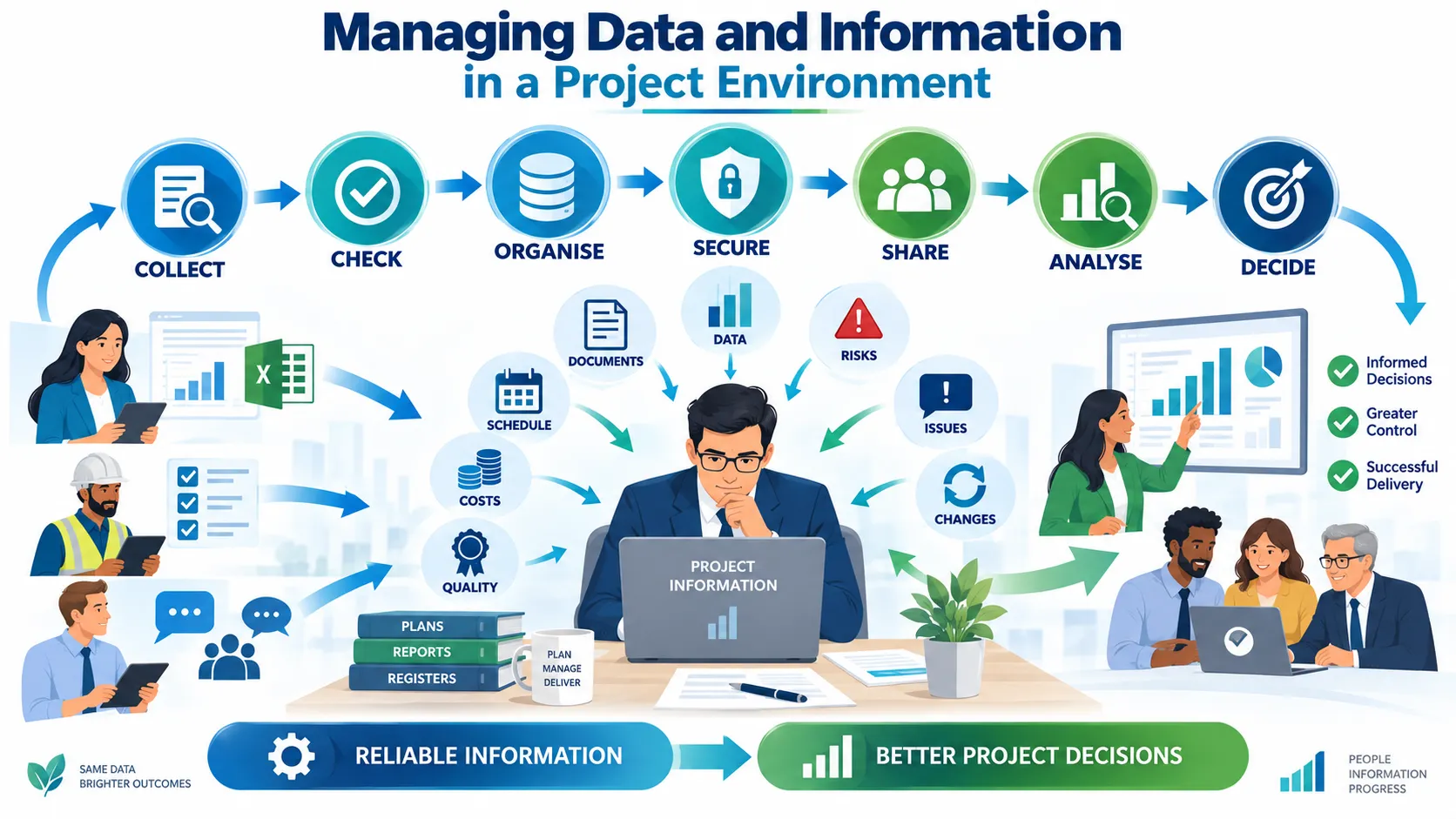
Understanding Data and Information in a Project Environment
Although the terms data and information are often used interchangeably, they have different meanings in project management.
Data refers to individual facts, figures, records or observations collected during project activity. Examples include the number of tasks completed, expenditure to date, number of defects, hours worked, customer responses or dates recorded against project milestones.
Information is data that has been organised, interpreted or analysed so that it can support understanding and decision-making.
For example, recording that a project has spent £75,000 is data. Comparing £75,000 of actual expenditure against an approved budget of £60,000 and identifying a £15,000 adverse variance creates useful management information.
Project managers therefore need to manage both the collection of data and the conversion of data into meaningful information.
Examples of Project Data
Project data can include:
Project objectives
Task completion records
Dates and milestones
Resource allocation
Staff hours
Costs and expenditure
Supplier information
Risk ratings
Issue records
Quality measurements
Customer feedback
Stakeholder responses
Change requests
Performance indicators
Testing results
Training completion
Benefits measurements
Examples of Project Information
Information generated from project data may include:
Project status reports
Budget variance reports
Schedule performance summaries
Risk dashboards
Stakeholder analysis
Quality reports
Forecasts
Management dashboards
Benefits reports
Exception reports
Decision papers
Project closure reports
Why Data and Information Management Matters
Projects operate in environments where decisions often need to be made quickly. Managers may need to determine whether a milestone can be achieved, whether additional resources are required, whether a risk response is working or whether a proposed change should be approved.
Poor information management makes these decisions more difficult.
For example, imagine a project manager receives three different versions of the project budget from different team members. One version shows £150,000 expenditure, another shows £165,000 and a third shows £172,000. Even if the project team is working effectively, the manager cannot confidently determine the financial position without establishing which information is current and authoritative.
Effective information management creates a reliable foundation for management judgement.
It supports:
Accurate decision-making
Effective project planning
Performance monitoring
Risk management
Stakeholder communication
Financial control
Quality management
Change control
Accountability
Governance
Auditability
Knowledge management
Principles of Effective Project Data and Information Management
Several principles should guide managers when establishing information-management arrangements.
Accuracy
Information should accurately represent the situation it describes.
Incorrect data can result in inappropriate decisions.
For example, if a project dashboard shows that 90% of training has been completed when only 65% of employees have actually completed training, management may incorrectly conclude that implementation is ready.
Completeness
Information should contain sufficient detail for its intended purpose.
Incomplete information can create misleading conclusions.
For example, a project report that identifies an overspend without explaining committed future expenditure provides an incomplete picture of financial performance.
Timeliness
Information must be available when it is needed.
Information that arrives too late may have limited management value.
A weekly project report received two weeks after the reporting period may not support effective intervention.
Consistency
Information should be recorded using consistent definitions, formats and measurement methods.
For example, if one team records a “completed task” when work begins and another records completion only after quality approval, project progress will be difficult to compare.
Accessibility
Authorised users should be able to locate and access relevant information efficiently.
Information that exists but cannot be found is of limited practical value.
Security
Sensitive project information must be protected against unauthorised access, loss, alteration or disclosure.
Traceability
Managers should be able to identify where important information came from and, where appropriate, who created, changed or approved it.
Relevance
Not all available information is useful.
Managers should focus on information that supports project objectives and decisions.
Version Control
Where documents change over time, managers should be able to distinguish the current approved version from previous versions.
Establishing an Information Management Structure
A project should have a clear structure for storing, organising and retrieving information.
Before collecting large amounts of information, managers should determine:
What information is required.
Why it is required.
Who owns it.
Who can access it.
Where it will be stored.
How frequently it will be updated.
How it will be checked.
How long it will be retained.
How obsolete information will be archived.
A simple information-management structure may include folders for:
Project governance
Project planning
Finance
Risks
Issues
Stakeholders
Quality
Procurement
Change control
Progress reporting
Meeting records
Lessons learned
Closure
For larger projects, a structured digital information environment may be required.
Document Management
Document management is one of the most common methods of managing project information.
Projects generate many documents, including:
Project briefs
Business cases
Project plans
Requirements
Specifications
Meeting minutes
Reports
Contracts
Risk registers
Change requests
Test records
Training materials
Handover documents
A document-management approach should make it clear:
Where documents are stored.
Who can edit them.
Who can approve them.
Which version is current.
Which documents are archived.
Which documents contain sensitive information.
Version Control
Version control is particularly important where multiple people contribute to the same document.
A controlled naming convention might include:
ProjectPlan_v1.0
ProjectPlan_v1.1
ProjectPlan_v2.0_Approved
This makes document status easier to identify.
A project team should avoid having several files named:
Final Plan
Final Plan New
Final Plan Updated
Final Plan Latest
Final Plan Latest 2
Such practices create uncertainty and increase the risk of using obsolete information.
Centralised Information Storage
A centralised project repository provides one recognised location for project information.
The repository may contain:
Plans
Reports
Registers
Meeting records
Decisions
Financial information
Project documentation
The primary benefit is the creation of a common information source.
A central repository can reduce:
Duplicate records
Lost information
Conflicting versions
Unnecessary email attachments
Difficulty locating documents
However, centralisation should be supported by access controls and clear ownership.
Shared Digital Platforms
Digital collaboration and project-management platforms can provide integrated information management.
Such platforms may allow teams to:
Assign tasks
Track progress
Store documents
Record issues
Manage risks
Communicate
Track milestones
Produce dashboards
Record decisions
The benefit is that information can be connected rather than stored in isolated systems.
For example, a project task may be linked to:
A responsible person
A deadline
A milestone
A risk
An issue
A supporting document
This provides stronger visibility than separate spreadsheets.
Spreadsheets as a Project Information Tool
Spreadsheets remain useful for many project environments.
They can support:
Budget tracking
Resource calculations
Task lists
Risk scoring
Data analysis
Progress tracking
Stakeholder lists
However, spreadsheets require careful control.
Potential weaknesses include:
Manual data-entry errors
Duplicate versions
Formula errors
Unclear ownership
Limited access control
Accidental deletion
Difficulties managing multiple contributors
A spreadsheet should therefore be treated as a controlled management tool rather than an informal dumping ground for information.
Databases and Structured Data
Large projects may require databases or structured information systems.
These can be useful where projects generate large volumes of:
Customer records
Asset information
Transaction data
Performance measurements
Survey responses
Operational records
Structured data systems improve consistency and can support automated reporting.
Data Collection Methods
Information management begins with effective data collection.
Project data can be collected through:
Forms
Surveys
Interviews
Questionnaires
Observation
System reports
Financial systems
Time records
Progress updates
Testing
Audits
Meetings
Stakeholder feedback
The collection method should match the type of information required.
For example, quantitative performance data may be collected automatically from a system, while stakeholder perceptions may require interviews or surveys.
Data Validation
Data validation involves checking whether information is accurate, complete and suitable for use.
Managers may use:
Automated validation rules
Approval checks
Reconciliation
Sampling
Duplicate checks
Range checks
Cross-referencing
Independent verification
For example, a project manager may compare reported expenditure against finance-system records rather than accepting a manually prepared figure without verification.
Data Quality Management
Data quality should be actively managed throughout the project.
A useful quality review asks:
Is the information accurate?
Is it complete?
Is it current?
Is it relevant?
Is it consistent?
Is the source reliable?
Has it been validated?
Is it presented clearly?
Poor data quality can create false confidence.
Information Classification
Not all project information has the same sensitivity.
Managers may classify information according to organisational requirements, such as:
Public
Internal
Confidential
Restricted
The exact categories will vary by organisation.
Information classification helps determine who should have access and how information should be handled.
Examples of potentially sensitive project information include:
Commercial pricing
Employee information
Customer information
Supplier contracts
Strategic plans
Security information
Financial forecasts
Access Control
Access control ensures that only authorised people can access particular information.
Access may be based on:
Role
Responsibility
Project involvement
Seniority
Business need
A team member responsible for scheduling may need access to the project plan but may not require access to confidential financial or personnel information.
The principle should be to provide appropriate access rather than unrestricted access.
Information Security
Project information should be protected against:
Unauthorised access
Accidental deletion
Loss
Unauthorised modification
Data leakage
Cybersecurity incidents
Security measures may include:
Password protection
Role-based permissions
Multi-factor authentication
Secure storage
Backups
Controlled sharing
Access reviews
Managers should follow organisational information-security requirements rather than introducing informal arrangements that create unnecessary risk.
Backup and Recovery
Important project information should be protected against loss.
A project may be affected by:
Hardware failure
Accidental deletion
System failure
Cyber incidents
Human error
Backup arrangements help ensure that critical information can be recovered.
Managers should know:
What information is backed up.
How frequently it is backed up.
Where backups are stored.
Who is responsible.
How recovery would occur.
Information Sharing and Collaboration
Effective projects depend on information being shared between relevant people.
Information sharing can occur through:
Team meetings
Project dashboards
Email
Collaboration platforms
Reports
Workshops
Presentations
Project portals
The challenge is to achieve the right balance between transparency and information overload.
Avoiding Information Overload
More information does not automatically produce better decisions.
A manager may receive:
Hundreds of emails
Multiple spreadsheets
Long meeting records
Detailed technical reports
Numerous status updates
Yet still lack a clear understanding of the project’s position.
Effective information management converts detailed data into focused management information.
Dashboards
Project dashboards provide a concise visual summary of important information.
A dashboard may display:
Overall status
Schedule
Budget
Risks
Issues
Milestones
Resources
Quality
Benefits
Dashboards are particularly useful for managers who need rapid visibility of project performance.
However, dashboards should be based on reliable underlying data.
A visually impressive dashboard containing inaccurate information is potentially more dangerous than a simple accurate report.
Project Reporting
Reports transform project data into information for decision-makers.
Common reports include:
Weekly status reports
Monthly management reports
Financial reports
Risk reports
Exception reports
Progress reports
Benefits reports
A good report should focus on:
What has happened?
What is happening now?
What is expected next?
What is different from the plan?
What risks or issues require attention?
What decisions are required?
Managing Project Registers
Project registers provide structured records of important project information.
Common registers include:
Risk Register
Records:
Risk description
Probability
Impact
Risk owner
Response
Status
Issue Log
Records:
Issue
Owner
Priority
Impact
Action
Status
Change Log
Records:
Requested change
Reason
Impact
Decision
Approval
Implementation status
Decision Log
Records:
Decision
Date
Decision-maker
Rationale
Impact
Required actions
These registers provide traceability and support effective project governance.
Meeting Information Management
Project meetings generate important information.
Managers should ensure that meetings produce useful records rather than simply accumulating minutes.
Important meeting information includes:
Decisions
Actions
Owners
Deadlines
Risks
Issues
Escalations
A good action record should identify:
What needs to happen?
Who is responsible?
When is it due?
What is the current status?
This creates accountability.
Managing Decisions
Decision management is an important but sometimes overlooked element of project information management.
Project decisions should be recorded because decisions can later affect:
Scope
Cost
Schedule
Resources
Risk
Quality
A decision log helps managers understand why a particular approach was chosen.
It also reduces the risk of repeatedly revisiting decisions without understanding the original rationale.
Managing Stakeholder Information
Stakeholder information should be organised and kept current.
A stakeholder record may include:
Stakeholder name or role
Organisation or department
Interest
Influence
Requirements
Communication needs
Engagement status
Key concerns
This information supports targeted stakeholder engagement.
Managing Financial Information
Financial data is particularly important because project managers need to understand whether spending remains within approved limits.
Financial information may include:
Approved budget
Actual expenditure
Committed expenditure
Forecast expenditure
Variance
Funding
Supplier costs
Managers should establish a clear source of authoritative financial information.
Where project teams maintain separate financial spreadsheets, these should be reconciled against appropriate organisational financial records.
Managing Schedule Information
Schedule information allows managers to understand whether project delivery is progressing according to plan.
It can include:
Planned start dates
Planned finish dates
Actual dates
Milestones
Dependencies
Delays
Forecast completion
Reliable schedule data supports early intervention.
Managing Quality Information
Quality information may include:
Testing results
Defect records
Inspection findings
Acceptance results
Customer feedback
Quality audits
Managers should use quality information to determine whether deliverables meet agreed requirements.
Managing Risk Information
Risk information should be continuously updated.
A risk that was low at initiation may become significant later.
Managers should therefore review:
New risks
Changing probability
Changing impact
Risk responses
Risk owners
Residual risk
This prevents risk information from becoming an outdated document.
Data and Information Governance
Governance establishes how project information should be controlled.
It may define:
Ownership
Responsibilities
Approval processes
Access rights
Reporting requirements
Retention arrangements
Quality standards
Escalation routes
Strong governance is particularly important for projects involving sensitive information or significant organisational risk.
Information Ownership
Every important category of information should have an identifiable owner.
An information owner may be responsible for:
Accuracy
Updating
Access
Validation
Retention
Ownership prevents the assumption that “someone else” is responsible for maintaining information.
Retention and Archiving
Project information should not necessarily be deleted when the project ends.
Some records may need to be retained for:
Governance
Audit
Legal requirements
Organisational learning
Contractual reasons
Future reference
Other information may no longer be necessary and should be disposed of according to organisational policy.
The project manager should therefore understand applicable retention requirements.
Managing Information Across the Project Lifecycle
Information requirements change as the project progresses.
Initiation
The focus may be on:
Business need
Strategic alignment
Initial scope
Stakeholders
Feasibility
Initial risks
Business case
Planning
Information expands to include:
Detailed tasks
Schedule
Resources
Budget
Dependencies
Responsibilities
Communication
Risk responses
Implementation
The focus shifts towards:
Progress
Actual expenditure
Issues
Changes
Quality
Resources
Stakeholder feedback
Monitoring and Control
Managers need:
Performance data
Variance information
Forecasts
Risk updates
Issue status
Change information
Closure
Information focuses on:
Final performance
Acceptance
Financial reconciliation
Outcomes
Benefits
Lessons learned
Handover
Closure decisions
Process for Managing Project Data and Information
A practical information-management process can follow the steps below.
Step 1: Identify Information Requirements
Determine what information is needed to manage the project.
Consider:
Objectives
Decisions
Reporting
Governance
Stakeholders
Risk
Finance
Quality
Step 2: Identify Data Sources
Determine where the required information will come from.
Sources may include:
Project systems
Finance systems
HR systems
Suppliers
Customers
Team members
Operational records
Step 3: Assign Information Ownership
Identify who is responsible for maintaining each important information source.
Step 4: Establish Storage Arrangements
Determine where information will be stored and how it will be organised.
Step 5: Establish Access Rules
Determine who needs access and what level of access is appropriate.
Step 6: Establish Data-Quality Controls
Define how information will be checked and validated.
Step 7: Establish Reporting Arrangements
Determine:
What will be reported?
To whom?
How frequently?
In what format?
Step 8: Maintain Information
Ensure records remain current throughout the project.
Step 9: Review Information Quality
Regularly check whether information remains:
Accurate
Complete
Current
Relevant
Secure
Step 10: Use Information for Decisions
Convert data into useful management information and apply professional judgement.
Step 11: Archive or Dispose of Information
At closure, retain or dispose of records according to organisational requirements.
Evaluating Different Information-Management Methods
Managers should evaluate methods according to project context rather than assuming that one system is always best.
Small Project
A small project may effectively use:
Shared folders
Controlled spreadsheets
Simple task lists
Regular meetings
Short progress reports
This may provide sufficient control without excessive administration.
Medium-Sized Project
A medium-sized project may require:
Central project repository
Structured registers
Project-management software
Dashboards
Formal reporting
Access controls
Large or Complex Project
A large project may require:
Integrated project-management systems
Formal information governance
Automated reporting
Role-based access
Document control
Data-quality processes
Formal retention arrangements
The objective is not to use the most sophisticated technology available. The objective is to use a system that provides appropriate control and useful information.
Practical Example: Digital Transformation Project
An organisation is implementing a new digital customer-service platform.
The project generates information from:
IT
Customer services
Finance
Procurement
Suppliers
Users
The project manager establishes a central information environment.
The project repository contains:
Project plan
Requirements
Risk register
Issue log
Change log
Test results
Training records
Supplier documentation
Financial information is reconciled with organisational finance records.
Access permissions are established so that sensitive commercial information is restricted to authorised users.
The project dashboard provides management with:
Milestone status
Budget position
Open risks
Open issues
Testing progress
Training completion
This allows the manager to make decisions using consistent information.
Practical Example: Training Programme Project
An organisation is developing and implementing a large employee training programme.
The project collects:
Participant numbers
Attendance
Completion rates
Assessment results
Feedback
Training costs
Trainer availability
A structured information-management process allows the project manager to identify that participation is lower than expected in one department.
Rather than relying on assumptions, the manager uses the available data to investigate the cause and works with the department to address the problem.
The data therefore becomes useful information for decision-making.
Practical Example: Construction or Facilities Project
A facilities project may generate:
Contractor information
Materials data
Inspection records
Schedule information
Costs
Health and safety records
Defect information
Centralised document control becomes important because several organisations may need access to the same project information.
Incorrect or outdated drawings, specifications or instructions could create significant delivery problems.
Document version control is therefore a critical control mechanism.
Practical Example: Project Facing a Data-Quality Problem
A project dashboard reports that 95% of activities are complete.
The project manager investigates and discovers that team members have been updating task completion inconsistently.
Some staff mark tasks complete when work begins, while others mark them complete only after quality approval.
The dashboard therefore creates a misleading impression of progress.
The manager introduces:
A clear definition of completion
Standard reporting instructions
Data validation
Regular review
The resulting information becomes more reliable.
This demonstrates that data management is not only about storing information; it is also about ensuring that the information has a consistent meaning.
Benefits of Effective Data and Information Management
Better Decision-Making
Reliable information allows managers to make evidence-based decisions.
Improved Project Control
Managers can compare actual performance against agreed plans.
Faster Problem Identification
Emerging problems can be identified earlier.
Improved Communication
Stakeholders receive clearer and more consistent information.
Stronger Accountability
Records show who made decisions and who owns actions.
Better Risk Management
Current information supports identification and treatment of risk.
Improved Financial Control
Accurate expenditure information supports budget management.
Stronger Governance
Controlled records provide evidence for management and audit.
Improved Knowledge Management
Lessons and project information can be retained for organisational use.
Reduced Duplication
Centralised and controlled information reduces unnecessary duplicate records.
Common Problems in Project Information Management
Multiple Versions of Documents
Several competing versions can create confusion.
Unclear Ownership
Information may become outdated when nobody is responsible for maintaining it.
Poor Data Quality
Incorrect or incomplete data can undermine project decisions.
Excessive Information
Managers may struggle to identify what actually matters.
Insufficient Information
Important decisions may be made without adequate evidence.
Poor Access Control
Unauthorised users may gain access to sensitive information.
Weak Backup Arrangements
Important project records may be lost.
Inconsistent Definitions
Different teams may interpret the same performance measure differently.
Excessive Reliance on Manual Data Entry
Manual processes can increase errors and consume management time.
Poor Archiving
Future teams may be unable to locate important project knowledge.
How Managers Can Improve Information Management
Middle managers can strengthen project information management by establishing practical standards early.
They should:
Define important information requirements.
Establish a single source of truth where appropriate.
Assign information ownership.
Use consistent terminology.
Introduce document version control.
Establish appropriate access permissions.
Validate important information.
Keep registers current.
Automate repetitive reporting where practical.
Focus dashboards on meaningful indicators.
Protect sensitive information.
Establish backup arrangements.
Review information quality regularly.
Capture lessons before project closure.
Key Concepts
The following concepts are particularly important for understanding project data and information management:
Data: Individual facts, figures or observations collected during project activity.
Information: Organised or interpreted data that supports understanding and decision-making.
Data quality: The extent to which data is accurate, complete, consistent, current and suitable for purpose.
Document control: The process of managing documents to ensure that authorised and current versions are used.
Version control: A method for identifying and managing different versions of a document or record.
Information governance: The framework defining how project information is owned, controlled, accessed, maintained and retained.
Access control: Measures used to ensure that only authorised people can access information.
Data validation: Checking information to establish whether it is accurate and suitable for use.
Information repository: A controlled location where project information is stored and managed.
Dashboard: A visual management tool that summarises key project performance information.
Risk register: A structured record of identified project risks and their management.
Issue log: A record of current project problems requiring action.
Change log: A record of requested and approved project changes.
Decision log: A record of significant project decisions and their rationale.
Information owner: The person responsible for maintaining and controlling a defined category of information.
Information security: Measures used to protect information from unauthorised access, loss, alteration or disclosure.
Data retention: The controlled preservation of information for an appropriate period.
Archiving: The structured storage of information that is no longer actively used but may need to be retained.
Professional Judgement in Managing Project Information
Effective information management requires professional judgement.
Managers must decide what information is genuinely necessary and what is excessive.
For example, a project board may need a concise summary of:
Overall status
Budget
Schedule
Major risks
Major issues
Decisions required
A technical project team may need much more detailed information.
Providing exactly the same information to every stakeholder may therefore be inefficient.
The manager should consider:
Who needs the information?
What decision will they make?
How much detail is appropriate?
How frequently should information be updated?
How reliable is the source?
What are the consequences if the information is wrong?
This approach ensures that information management supports management rather than becoming an administrative burden.
Information as a Project Control Mechanism
Data and information should ultimately support control.
The basic relationship can be understood as:
DATA → INFORMATION → ANALYSIS → DECISION → ACTION → RESULT
For example:
Data shows that 20 tasks are overdue.
Information identifies that most delays relate to one supplier.
Analysis identifies a supplier dependency as the main cause.
The manager decides to escalate the issue.
Action is taken through supplier intervention.
The result is monitored through subsequent progress reporting.
This demonstrates the practical value of information management.
Managerial Checklist
Before starting or reviewing a project information-management approach, managers should ask:
What information is essential to manage the project?
Where will the information come from?
Who owns each information source?
Where will information be stored?
Who needs access?
What information is sensitive?
How will information be validated?
How will document versions be controlled?
What reports are required?
How frequently should information be updated?
What dashboards or registers are needed?
How will decisions be recorded?
How will risks and issues be maintained?
What backup arrangements exist?
How will information be retained or archived?
How will the effectiveness of information management be reviewed?
Summary
Effective management of data and information is a fundamental contributor to successful project management. Projects depend on reliable information to plan activities, allocate resources, monitor performance, manage risks, control costs, communicate with stakeholders and make informed decisions.
The distinction between data and information is important. Data represents individual facts or observations, while information is data that has been organised and interpreted to support understanding and action. Managers therefore need systems that not only collect information but also ensure that it is accurate, complete, timely, relevant, secure and accessible to authorised users.
A strong project information-management approach may involve document management, central repositories, shared digital platforms, spreadsheets, databases, dashboards, project registers, reporting systems and structured communication processes. The most appropriate combination depends on project size, complexity, risk and organisational requirements.
Effective management also requires clear ownership, version control, access management, data validation, information security, backup, retention and archiving. These controls reduce the risk of incorrect information being used to make important project decisions.
Information should be managed throughout the entire project lifecycle. During initiation, managers need information about the business need, feasibility, stakeholders and risks. During planning, they require information about scope, activities, resources, budget and dependencies. During implementation and monitoring, they require current performance, financial, quality, risk and issue information. At closure, they need final performance information, acceptance records, benefits data, lessons learned and handover documentation.
For practising and aspiring middle managers, the key principle is that effective project information management should make the project easier to understand, control and improve. It should provide decision-makers with reliable evidence without overwhelming them with unnecessary detail.
The strongest approach is therefore not to collect the maximum amount of information. It is to establish a controlled system that ensures:
Accurate data → meaningful information → informed decisions → effective action → improved project outcomes.
| Method | Definition | Primary Purpose | Key Benefits | Potential Limitations | Typical Project Application |
|---|---|---|---|---|---|
| Document Management | Structured control of project documents and records | Store, organise, update and control project documentation | Version control, accessibility, accountability | Can become administratively demanding | Project plans, contracts, specifications and reports |
| Central Information Repository | A controlled central location for project information | Provide a recognised source for project records | Reduces duplication and conflicting versions | Requires governance and access controls | Medium and large projects |
| Shared Digital Platform | Technology that integrates project tasks, documents, communication and reporting | Support collaborative project management | Improved visibility and collaboration | Requires user adoption and appropriate configuration | Digital transformation and cross-functional projects |
| Spreadsheet | Structured electronic worksheet used to record and analyse project data | Track budgets, resources, tasks and other information | Flexible, accessible and inexpensive | Manual errors and version-control risks | Small and medium projects |
| Database | Structured system for storing and retrieving large volumes of data | Manage complex or high-volume project information | Consistency, scalability and reporting | Requires technical capability | Large data-intensive projects |
| Project Dashboard | Visual summary of key project performance information | Provide rapid management visibility | Supports monitoring and decision-making | Depends on reliable underlying data | Project boards and management reviews |
| Risk Register | Structured record of identified project risks | Monitor and manage project uncertainty | Improves risk visibility and accountability | Can become outdated if not reviewed | All projects, particularly higher-risk projects |
| Issue Log | Structured record of current project problems | Track issues through resolution | Clarifies ownership and actions | Ineffective if updates are not maintained | Implementation and delivery projects |
| Change Log | Record of requested, assessed and approved changes | Control changes to the project | Improves traceability and scope control | Requires disciplined change management | Projects experiencing changing requirements |
| Decision Log | Record of important decisions and their rationale | Maintain decision traceability | Supports accountability and prevents repeated debates | Requires consistent updating | Complex and governance-heavy projects |
| Data Validation | Process of checking project data for accuracy and suitability | Improve information quality | Reduces errors and improves confidence | Requires time and defined controls | Financial, performance and operational data |
| Access Control | Management of who can view or edit project information | Protect sensitive information | Improves security and confidentiality | Poor configuration can restrict legitimate access | Projects involving sensitive or commercial information |
| Backup and Recovery | Processes for protecting and restoring project information | Prevent permanent information loss | Supports resilience and continuity | Requires appropriate systems and testing | All projects |
| Reporting | Conversion of project data into structured management information | Support communication and decision-making | Improves transparency and governance | Poor reports can create information overload | Weekly, monthly and governance reporting |
Final Management Insight
A project manager should treat information as a strategic project resource rather than simply as paperwork.
People, money, time, equipment and information all contribute to project performance. While managers often monitor the first four carefully, poor information management can undermine all of them. An inaccurate budget can result in poor financial decisions, an outdated schedule can hide delays, an incomplete risk register can expose the project to avoidable threats and unclear stakeholder information can weaken engagement.
The most effective managers therefore establish information controls early, maintain them throughout delivery and continually evaluate whether the information being produced is actually helping people make better decisions.
In practical terms, effective project information management means creating a trusted environment in which managers and stakeholders can confidently answer:
What is happening?
What has changed?
Why has it changed?
What evidence supports this view?
What decision is required?
Who needs to act?
When must action be completed?
When project information can answer these questions accurately and promptly, it becomes a powerful management tool that supports control, accountability, collaboration, risk management and successful project delivery.
2.Assess the Use of Problem-Solving and Decision-Making Techniques When Managing Projects
Problem-solving and decision-making are fundamental management capabilities in every project environment. Even a well-planned project can encounter unexpected challenges involving resources, costs, schedules, quality, stakeholders, suppliers, technology, communication, risks or changing organisational priorities. Effective project managers therefore need to identify problems early, understand their causes, evaluate available options and make decisions that protect project objectives and organisational outcomes.
For practising and aspiring middle managers, problem-solving and decision-making should not be treated as separate activities. A problem often creates the need for a decision, while a decision may determine how a problem is resolved. For example, if a key supplier is unable to meet an agreed delivery date, the project manager needs to understand why the delay has occurred, assess its impact, identify possible responses and decide whether to renegotiate the delivery date, use an alternative supplier, change the sequence of activities or escalate the matter.
Effective management requires more than simply choosing the quickest solution. Managers must consider evidence, consequences, risks, resources, stakeholders, organisational priorities and the likely effect of decisions on project outcomes. A decision that solves an immediate problem may create a larger problem elsewhere. For example, reducing testing time may appear to protect a project deadline but could increase quality risks and future operational costs.
Problem-solving and decision-making therefore require structured thinking, professional judgement and an understanding of the wider project environment.
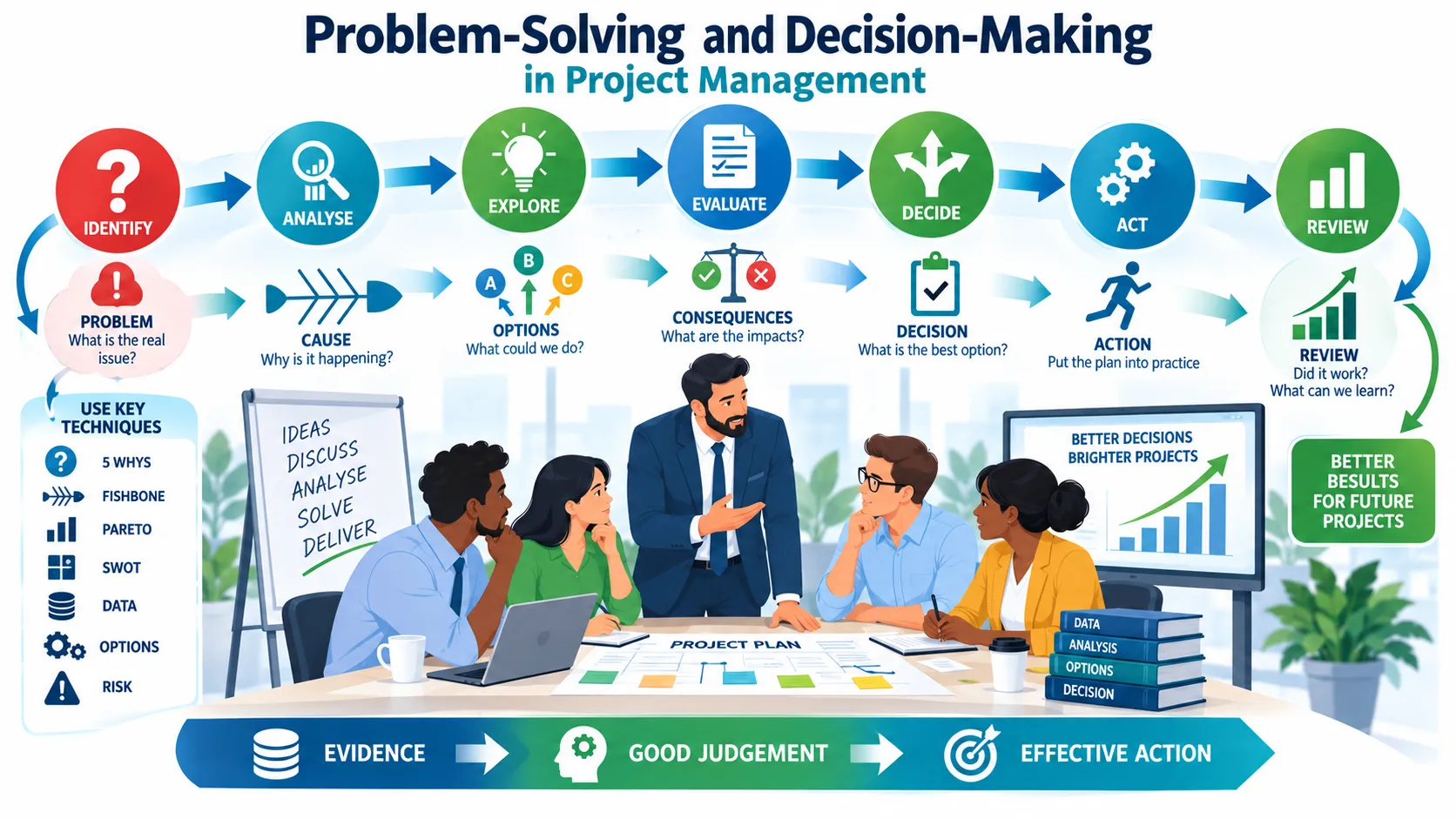
Understanding Problems in a Project Environment
A problem is a situation in which actual project performance, conditions or circumstances differ from what was expected, creating an obstacle to achieving project objectives.
Problems can occur at any stage of a project.
Examples include:
A key activity is delayed.
A supplier fails to deliver.
Project costs increase unexpectedly.
Required resources become unavailable.
Stakeholders disagree about priorities.
A technical solution does not perform as expected.
Quality standards are not being achieved.
Project requirements change.
Communication breaks down.
A risk becomes an actual issue.
Organisational priorities change.
Project benefits become less achievable.
Managers should distinguish between symptoms and underlying causes.
For example, a project may appear to have a “staffing problem” because activities are repeatedly delayed. However, the underlying cause may be poor resource planning, unclear responsibilities, excessive scope or unrealistic scheduling.
Problem Identification
Effective problem-solving begins with accurate identification.
A manager should establish:
What has happened?
What was expected?
What is different?
When did the problem begin?
Who or what is affected?
What evidence exists?
What is the immediate impact?
Could the situation become more serious?
The purpose is to define the problem objectively rather than immediately assuming its cause.
Defining the Problem Clearly
A weak problem statement might be:
“The project is not going well.”
This provides little useful information.
A stronger problem statement might be:
“User acceptance testing is five working days behind the approved schedule because the required test environment was not available when planned.”
The second statement is more useful because it identifies:
The affected activity
The size of the delay
The cause requiring investigation
The relevant dependency
A clear problem statement creates a better starting point for analysis.
Problem-Solving Versus Decision-Making
Although closely connected, problem-solving and decision-making have different purposes.
Problem-solving involves identifying and addressing the causes of an undesirable situation.
Decision-making involves selecting an appropriate course of action from available alternatives.
A typical relationship is:
Problem → Analysis → Options → Decision → Action → Review
For example:
Problem: Project testing is delayed.
Analysis: A specialist resource is unavailable.
Options: Reallocate resources, obtain external support, change sequencing or extend the schedule.
Decision: Obtain temporary specialist support.
Action: Engage the specialist and revise the short-term plan.
Review: Monitor whether testing returns to schedule.
The Importance of Root Cause Analysis
Root cause analysis is used to identify the underlying reason for a problem rather than treating only its visible symptoms.
This is important because treating symptoms may provide only temporary relief.
For example, a project team repeatedly misses internal deadlines.
A manager could respond by telling staff to work faster. However, root cause analysis may reveal that:
Tasks are poorly defined.
Dependencies are not visible.
Responsibilities are unclear.
Estimates are unrealistic.
Requirements change frequently.
The appropriate solution may therefore involve improving project planning rather than simply asking employees to increase their effort.
The Five Whys Technique
The Five Whys technique involves repeatedly asking “why?” to explore the underlying causes of a problem.
For example:
Problem: A project milestone was missed.
Why?
The testing activity started late.
Why?
The test environment was not ready.
Why?
The environment request was submitted late.
Why?
The responsible role was unclear.
Why?
Responsibility had not been clearly assigned during planning.
The analysis suggests that the underlying problem may be responsibility allocation rather than simply a late testing activity.
Benefits of Five Whys
The technique can:
Encourage deeper analysis.
Reduce premature conclusions.
Identify systemic causes.
Support corrective action.
Be used quickly in project meetings.
Limitations
It may be less effective where:
Problems have multiple causes.
Evidence is limited.
The situation is highly complex.
Several independent factors interact.
Managers should therefore use professional judgement when deciding whether Five Whys is appropriate.
Fishbone or Cause-and-Effect Analysis
A cause-and-effect approach helps managers explore multiple potential causes of a problem.
Potential categories may include:
People
Processes
Technology
Resources
Communication
Suppliers
Environment
Requirements
For example, if project quality is below expectations, the manager may examine whether the causes relate to:
Inadequate training
Unclear requirements
Poor testing
Insufficient resources
Technology limitations
Communication problems
This approach reduces the risk of focusing too narrowly on one explanation.
Pareto Analysis
Pareto analysis can help managers identify which causes are responsible for the largest proportion of problems.
The principle is commonly associated with the idea that a relatively small number of causes may account for a large proportion of effects.
For example, a project records 100 defects and discovers:
50 relate to one process.
25 relate to another.
15 relate to data errors.
10 relate to other causes.
Management attention may be prioritised around the most significant causes.
Pareto analysis is useful when project teams need to prioritise limited resources.
SWOT Analysis for Project Problem-Solving
SWOT analysis considers:
Strengths
Weaknesses
Opportunities
Threats
It can support broader project decision-making.
For example, when considering whether to introduce a new digital process, a project manager may examine:
Strengths: Existing technical capability.
Weaknesses: Limited internal expertise.
Opportunities: Improved efficiency.
Threats: Resistance to change.
SWOT is more suitable for strategic or situational analysis than for diagnosing a narrowly defined operational problem.
Brainstorming
Brainstorming involves generating potential causes, ideas or solutions collectively.
It can be useful when:
The problem is complex.
Multiple perspectives are required.
Creativity is important.
The project team needs several possible options.
Effective brainstorming should encourage contributions without immediately evaluating every idea.
The evaluation stage should occur after sufficient options have been generated.
Stakeholder Consultation
Stakeholder consultation can be an important problem-solving technique.
Stakeholders may have information that the project team does not possess.
For example:
Operational staff may understand practical process problems.
Customers may identify service issues.
Technical specialists may identify system constraints.
Finance staff may identify financial implications.
Suppliers may identify delivery constraints.
Managers should therefore avoid solving problems in isolation when relevant expertise exists elsewhere.
Data Analysis in Problem-Solving
Project data provides evidence for understanding problems.
Managers may examine:
Schedule data
Financial data
Quality data
Resource information
Customer feedback
Risk information
Performance indicators
Data can help distinguish between perception and reality.
For example, stakeholders may believe that project progress is declining, but performance data may show that the project is actually on schedule while one highly visible activity is delayed.
Decision-Making in Project Management
Decision-making is the process of selecting an appropriate course of action from available alternatives.
Project decisions may involve:
Scope
Budget
Schedule
Resources
Suppliers
Risks
Quality
Technology
Stakeholders
Change requests
The quality of the decision depends on both the decision process and the information available.
Types of Project Decisions
Routine Decisions
These are relatively straightforward decisions that can be made using established procedures.
Examples include:
Scheduling routine meetings.
Allocating standard resources.
Updating routine records.
Tactical Decisions
These affect project delivery and often require managerial judgement.
Examples include:
Reallocating resources.
Changing task sequencing.
Adjusting communication arrangements.
Strategic Decisions
These may affect the overall direction or justification of a project.
Examples include:
Changing major project scope.
Continuing or stopping a project.
Changing the delivery approach.
Reassessing the business case.
The higher the potential impact, the more robust the decision-making process should be.
Evidence-Based Decision-Making
Evidence-based decision-making involves using reliable information to inform choices.
Managers should consider:
Relevant project data
Stakeholder information
Financial implications
Risk information
Schedule impacts
Quality implications
Organisational priorities
Evidence should not eliminate judgement.
Instead, evidence strengthens judgement.
Decision Criteria
Managers can establish criteria for comparing options.
Possible criteria include:
Cost
Time
Quality
Risk
Resource requirements
Stakeholder impact
Strategic alignment
Feasibility
Sustainability
Operational impact
The criteria should reflect what matters most for the particular project.
Decision Matrix
A decision matrix can help compare alternatives systematically.
For example, a project manager may score three possible solutions against:
Cost
Delivery time
Quality
Risk
Operational impact
The approach does not automatically produce the correct decision, but it makes assumptions and trade-offs more visible.
Cost-Benefit Analysis
Cost-benefit analysis compares expected costs with anticipated benefits.
Managers may consider:
Initial project costs
Ongoing costs
Expected savings
Revenue
Productivity
Quality improvements
Customer benefits
A solution that is technically attractive may not be appropriate if its cost significantly exceeds its expected value.
Risk-Based Decision-Making
Every project decision should consider risk.
A manager should ask:
What could go wrong?
How likely is it?
What would be the impact?
Can the risk be reduced?
Who will own the risk?
What contingency is available?
Risk should not automatically prevent decision-making.
The objective is informed risk-taking rather than risk avoidance at all costs.
Decision Trees
Decision trees can help managers evaluate options where different outcomes are possible.
For example, a project manager deciding whether to use an internal team or external supplier may consider:
Cost
Probability of delay
Quality outcome
Resource availability
Decision trees can be useful when there are several possible pathways and consequences.
Consensus-Based Decision-Making
Consensus involves working towards an outcome that relevant participants can support.
It can be useful when:
Multiple departments are involved.
Stakeholder commitment is important.
The decision requires collective ownership.
Consensus does not necessarily mean everyone gets their preferred option.
It means that participants understand the decision and can support its implementation.
Autocratic or Manager-Led Decision-Making
There are circumstances where a manager may need to make a decision directly.
This may be appropriate when:
Time is extremely limited.
The manager has clear authority.
The decision concerns an urgent project risk.
Delay would create greater harm.
However, managers should still consider available evidence and communicate the rationale.
Consultative Decision-Making
In a consultative approach, the manager seeks input before making the final decision.
This can be effective where:
Specialist knowledge is required.
Stakeholder acceptance matters.
The manager retains formal accountability.
It can provide a useful balance between participation and decision ownership.
Delegated Decision-Making
Some decisions can appropriately be delegated to project team members.
Delegation can:
Increase speed.
Develop team capability.
Reduce unnecessary escalation.
Encourage ownership.
However, delegated authority should be clear.
Team members should understand:
What they can decide.
What limits apply.
When escalation is required.
Managing Cognitive Bias
Managers should recognise that decision-making can be influenced by cognitive bias.
Examples include:
Confirmation Bias
Seeking information that supports an existing view while overlooking contradictory evidence.
Anchoring
Giving excessive weight to the first information received.
Groupthink
Prioritising agreement within a group over critical evaluation.
Sunk Cost Bias
Continuing to invest because significant resources have already been spent.
For example, a project may continue despite declining benefits simply because £500,000 has already been invested.
Managers should focus on future value and current evidence rather than trying to justify past expenditure.
Escalation
Some problems should not be resolved entirely at project-manager level.
Escalation may be necessary when:
Authority limits are exceeded.
Financial thresholds are exceeded.
Strategic implications arise.
Risk becomes unacceptable.
Stakeholder conflict cannot be resolved.
Regulatory implications arise.
Effective escalation should include:
The problem
Evidence
Impact
Options considered
Recommended action
Decision required
This allows senior decision-makers to act efficiently.
Decision-Making Under Time Pressure
Projects frequently require decisions under pressure.
For example, a critical supplier may fail shortly before a major implementation milestone.
The manager may not have time for a lengthy analysis.
A practical rapid decision process is:
Define the immediate problem.
Establish the critical facts.
Identify immediate risks.
Identify realistic options.
Assess consequences.
Make the decision.
Communicate the decision.
Monitor the outcome.
Speed should not eliminate essential judgement.
Managing Project Conflicts
Conflict can create project problems when stakeholders disagree about:
Priorities
Resources
Scope
Responsibilities
Quality
Timelines
Problem-solving can help move discussions away from personal disagreement towards evidence and project objectives.
A manager can:
Define the issue.
Listen to each perspective.
Identify areas of agreement.
Establish evidence.
Clarify project objectives.
Explore alternatives.
Agree actions.
Problem-Solving Process
A structured problem-solving process can be applied as follows.
Step 1: Identify the Problem
Define the difference between expected and actual conditions.
Step 2: Gather Evidence
Collect relevant data and stakeholder information.
Step 3: Analyse Causes
Identify underlying causes rather than treating symptoms.
Step 4: Define the Desired Result
Clarify what successful resolution would look like.
Step 5: Generate Options
Develop realistic alternative solutions.
Step 6: Evaluate Options
Assess cost, time, quality, risk, resources and stakeholder impact.
Step 7: Select the Response
Choose the most appropriate solution.
Step 8: Implement
Assign responsibility and implement the agreed action.
Step 9: Monitor
Check whether the action has resolved the problem.
Step 10: Learn
Capture what can be improved to prevent recurrence.
Decision-Making Process
A practical decision-making process can include:
Define
Clearly state what decision is required.
Establish Criteria
Identify what factors matter.
Gather Evidence
Collect relevant and reliable information.
Generate Alternatives
Identify realistic options.
Evaluate
Compare options against the agreed criteria.
Decide
Select the most appropriate option.
Communicate
Explain the decision and responsibilities.
Implement
Put the decision into practice.
Review
Assess whether the decision produced the intended result.
Practical Example: Project Resource Shortage
A project manager discovers that two critical specialists are unavailable for three weeks.
The immediate temptation may be to delay the project.
A structured approach would examine:
Which activities require the specialists?
Which activities are on the critical path?
Can other qualified staff be reassigned?
Can tasks be resequenced?
Can external support be obtained?
What would each option cost?
What risks would each option create?
The manager then compares the alternatives and selects the option that best protects project objectives.
This is stronger than simply reacting to the problem.
Practical Example: Supplier Delay
A supplier informs the project team that a critical component will arrive ten days late.
The project manager should assess:
The affected activities.
Dependencies.
Critical path.
Customer impact.
Contractual implications.
Alternative suppliers.
Expedited delivery.
Temporary alternatives.
Possible responses may include:
Negotiating accelerated delivery.
Resequencing project activities.
Using alternative resources.
Escalating the supplier issue.
Revising the schedule.
The decision should be based on evidence and project priorities.
Practical Example: Quality Problem
A project team discovers a high number of defects during testing.
A weak response would be to ask the team to fix defects faster.
A stronger approach would investigate:
Why defects are occurring.
Whether requirements are unclear.
Whether testing began too late.
Whether resources are appropriately skilled.
Whether quality controls are effective.
Whether changes have increased complexity.
Root cause analysis may reveal that poor requirements definition is creating repeated defects.
The appropriate response may therefore involve improving requirements before continuing extensive testing.
Practical Example: Stakeholder Disagreement
Two departments disagree about the priority of a project feature.
Department A wants rapid implementation.
Department B wants additional functionality before launch.
The project manager should:
Clarify the agreed project objective.
Identify the impact of each option.
Assess cost and schedule.
Evaluate stakeholder and customer impact.
Consider project risks.
Facilitate discussion.
Make or escalate the decision according to governance arrangements.
The decision should be based on project objectives and evidence rather than the seniority of the loudest stakeholder.
Practical Example: Budget Pressure
A project is forecast to exceed its approved budget.
The manager should avoid immediately reducing quality or scope.
Instead, the manager should investigate:
Causes of the variance.
Remaining commitments.
Forecast costs.
Resource usage.
Supplier costs.
Scope changes.
Potential savings.
Impact of alternative approaches.
Options can then be evaluated before deciding whether to:
Reduce scope.
Reallocate resources.
Renegotiate costs.
Adjust timing.
Seek additional approval.
Practical Example: Changing Organisational Priorities
An organisation changes its strategic priorities halfway through a project.
The project manager should reassess:
Strategic alignment.
Business need.
Expected benefits.
Costs remaining.
Risks.
Resource requirements.
Possible decisions include:
Continue unchanged.
Modify scope.
Pause.
Reprioritise.
Close the project.
The key principle is that previous approval does not mean a project should continue indefinitely when circumstances have fundamentally changed.
Evaluating Problem-Solving Techniques
The effectiveness of a problem-solving technique depends on the nature of the problem.
Five Whys
Strengths:
Simple
Fast
Encourages root-cause thinking
Limitations:
Can oversimplify complex problems
Depends on accurate understanding
Fishbone Analysis
Strengths:
Explores multiple causes
Encourages team participation
Limitations:
Can generate many possible causes without prioritisation
Pareto Analysis
Strengths:
Helps prioritise major causes
Useful with quantitative data
Limitations:
Requires reliable data
Brainstorming
Strengths:
Encourages creativity
Generates multiple solutions
Limitations:
Strong personalities may influence discussion
Ideas may require later evidence-based evaluation
Stakeholder Consultation
Strengths:
Provides different perspectives
Can increase ownership
Limitations:
Stakeholders may have competing interests
Consultation can take time
Evaluating Decision-Making Techniques
Decision Matrix
Useful when several options need systematic comparison.
Strength: Makes criteria and trade-offs visible.
Limitation: Scores can create false precision if criteria are subjective.
Cost-Benefit Analysis
Useful where financial value is important.
Strength: Highlights value and affordability.
Limitation: Some benefits are difficult to quantify.
Decision Tree
Useful when decisions involve different possible outcomes.
Strength: Makes consequences visible.
Limitation: Requires reasonable estimates of probabilities and outcomes.
Consensus
Useful when commitment and stakeholder ownership are important.
Strength: Can improve acceptance.
Limitation: May take longer and can result in compromise.
Manager-Led Decision
Useful during urgent situations.
Strength: Fast and clear accountability.
Limitation: May reduce stakeholder participation and overlook useful knowledge.
Matching Techniques to Project Context
Managers should select techniques based on circumstances.
For a simple operational problem, Five Whys may be sufficient.
For a complex quality problem, Fishbone analysis combined with data analysis may be more appropriate.
For several competing investment options, a decision matrix and cost-benefit analysis may provide stronger support.
For an urgent safety or delivery problem, rapid manager-led decision-making may be necessary.
For a cross-functional decision requiring commitment from several departments, consultation and consensus may be more appropriate.
The important principle is:
Use the simplest effective technique that provides sufficient confidence for the decision required.
Integrating Problem-Solving With Project Controls
Problem-solving should not operate separately from normal project management.
Managers should use:
Risk registers
Issue logs
Change logs
Project dashboards
Progress reports
Financial reports
Stakeholder feedback
These tools provide early warning of potential problems.
For example, an issue log can identify recurring problems while the project dashboard can highlight emerging schedule or cost variance.
Preventive and Corrective Action
Problem-solving can involve both preventive and corrective actions.
Preventive action aims to stop a potential problem from occurring.
Corrective action addresses a problem that has already occurred.
For example:
Preventive: introduce a formal requirements review before development.
Corrective: revise requirements after defects reveal ambiguity.
Effective managers use both approaches.
Continuous Improvement
Problems can provide opportunities for organisational learning.
After resolving a problem, managers should ask:
What caused it?
Why was it not identified earlier?
What controls failed?
What worked well?
What should change?
Can the problem happen again?
Should the lesson be applied to other projects?
This turns problem-solving into continuous improvement.
Ethical Problem-Solving and Decision-Making
Managers must also consider ethical implications.
A decision should not be considered effective simply because it protects cost or schedule.
For example, reducing essential quality checks to meet a deadline may create unacceptable risks for users.
Managers should consider:
Safety
Fairness
Transparency
Stakeholder impact
Data integrity
Accountability
Organisational values
Ethical judgement is particularly important where project pressure creates incentives for short-term decisions.
Key Benefits of Effective Problem-Solving and Decision-Making
Faster Resolution
Structured techniques can help managers address problems efficiently.
Better Decisions
Evidence and systematic analysis reduce reliance on assumptions.
Reduced Project Risk
Potential consequences can be identified before action is taken.
Improved Resource Use
Managers can select solutions that make effective use of limited resources.
Better Stakeholder Relationships
Transparent decision-making can increase confidence and trust.
Improved Quality
Root-cause analysis helps prevent recurring quality problems.
Better Schedule Control
Early problem identification supports corrective action.
Financial Protection
Structured evaluation reduces unnecessary expenditure.
Organisational Learning
Lessons from problems can improve future projects.
Common Errors to Avoid
Managers should avoid:
Solving symptoms rather than causes.
Making decisions without sufficient evidence.
Delaying decisions unnecessarily.
Choosing the easiest option rather than the best option.
Ignoring stakeholder perspectives.
Overlooking risk.
Allowing groupthink.
Continuing projects because of sunk costs.
Failing to record decisions.
Implementing decisions without assigning ownership.
Failing to review whether decisions worked.
Professional Judgement Framework
A useful framework for managers is:
FACTS → CAUSES → OPTIONS → CONSEQUENCES → DECISION → ACTION → REVIEW
Facts
Establish what is actually happening.
Causes
Understand why it is happening.
Options
Identify realistic responses.
Consequences
Assess cost, time, quality, risk and stakeholder impact.
Decision
Select the most appropriate response.
Action
Implement the decision with clear accountability.
Review
Determine whether the desired outcome was achieved.
This framework provides a practical structure without unnecessarily complicating project management.
Managerial Review Checklist
Before making a significant project decision, a manager should ask:
What exactly is the problem or decision?
What evidence do I have?
Is the information reliable?
Am I dealing with the root cause?
Who is affected?
Which stakeholders should be consulted?
What options are available?
What are the costs?
What are the benefits?
What risks could each option create?
What is the impact on scope?
What is the impact on schedule?
What is the impact on quality?
What resources are required?
Does the option remain aligned with organisational priorities?
Is the decision within my authority?
Does it need escalation?
Who will implement the decision?
How will success be measured?
When will the decision be reviewed?
Key Concepts to Remember
Problem-solving: A structured process for identifying, analysing and resolving problems.
Decision-making: The process of selecting an appropriate course of action.
Root cause: The underlying reason why a problem occurs.
Root cause analysis: A systematic approach to identifying underlying causes.
Five Whys: A questioning technique used to explore underlying causes.
Fishbone analysis: A cause-and-effect technique used to explore multiple possible causes.
Pareto analysis: A method for prioritising significant causes using available data.
Brainstorming: A technique for generating multiple ideas or solutions.
Decision matrix: A structured method for comparing options against defined criteria.
Cost-benefit analysis: Comparison of expected costs with anticipated benefits.
Decision tree: A visual method for examining alternative decisions and potential outcomes.
Consensus: A decision approach involving collective understanding and support.
Escalation: The process of referring a problem or decision to a higher authority.
Cognitive bias: A systematic tendency that can influence judgement.
Confirmation bias: Favouring information that supports an existing belief.
Groupthink: Pressure towards agreement that can reduce critical evaluation.
Sunk cost bias: Continuing an approach because resources have already been invested.
Corrective action: Action taken to address an existing problem.
Preventive action: Action intended to reduce the likelihood of a potential problem.
Professional judgement: The informed application of experience, evidence and organisational considerations to a management decision.
Summary
Problem-solving and decision-making are central to effective project management because projects rarely proceed exactly as originally planned. Managers must respond to changing circumstances, unexpected problems, competing stakeholder requirements, resource constraints, financial pressures, quality issues and emerging risks.
Effective problem-solving begins by clearly defining the problem and distinguishing symptoms from underlying causes. Techniques such as Five Whys, Fishbone analysis, Pareto analysis, brainstorming, stakeholder consultation and data analysis can help managers understand problems and develop appropriate responses.
Decision-making then involves evaluating available alternatives against relevant criteria such as cost, time, quality, risk, resources, stakeholder impact and strategic alignment. Decision matrices, cost-benefit analysis, decision trees, consultation, consensus and manager-led decisions can all be useful depending on the circumstances.
No single technique is appropriate for every project situation. A simple problem may require a straightforward analysis, while a complex strategic decision may require multiple techniques and broader stakeholder involvement. Managers should therefore select methods according to the complexity, urgency, risk and significance of the situation.
Effective decision-making also requires awareness of cognitive bias. Confirmation bias, groupthink, anchoring and sunk cost bias can distort judgement. Managers should deliberately challenge assumptions, seek relevant evidence and consider alternative perspectives.
Problem-solving and decision-making should also be integrated with project controls. Risk registers, issue logs, change logs, dashboards, financial information and stakeholder feedback provide valuable evidence for identifying and resolving project problems.
The strongest project managers do not simply react when something goes wrong. They establish systems that identify problems early, investigate their causes, evaluate realistic options, make proportionate decisions and monitor whether those decisions work.
The overall process can be remembered as:
IDENTIFY → ANALYSE → GENERATE OPTIONS → EVALUATE → DECIDE → IMPLEMENT → REVIEW → LEARN
This approach supports stronger project control, better use of resources, improved stakeholder confidence, reduced risk and more reliable achievement of project objectives.
| Technique | Definition | Primary Use | Key Benefits | Potential Limitations | Suitable Project Context |
|---|---|---|---|---|---|
| Five Whys | Repeated questioning used to explore underlying causes | Root cause analysis | Simple, quick and easy to facilitate | May oversimplify complex problems | Straightforward operational or process problems |
| Fishbone Analysis | Cause-and-effect method for exploring multiple causes | Investigating complex problems | Encourages broad analysis and team participation | Can generate many possible causes requiring further evaluation | Quality, process and delivery problems |
| Pareto Analysis | Method for identifying the most significant causes or categories | Prioritising problems | Focuses resources on major contributors | Requires reliable data | Projects with measurable recurring problems |
| Brainstorming | Structured generation of ideas from individuals or groups | Generating possible causes or solutions | Encourages creativity and diverse ideas | Can be influenced by dominant participants | Complex problems requiring multiple options |
| Stakeholder Consultation | Seeking information and perspectives from relevant stakeholders | Understanding problems and evaluating solutions | Improves insight and ownership | Can take time and involve conflicting views | Cross-functional and stakeholder-sensitive projects |
| Data Analysis | Examination of project data to identify patterns, trends or variances | Evidence-based problem identification | Supports objective analysis | Dependent on data quality | Financial, schedule, quality and performance problems |
| Decision Matrix | Comparison of options against defined criteria | Selecting between alternatives | Makes trade-offs visible and structured | Subjective scoring may create false precision | Resource, supplier and solution selection |
| Cost-Benefit Analysis | Comparison of anticipated costs and benefits | Assessing value | Supports financial and value-based decisions | Some benefits are difficult to quantify | Investment and resource decisions |
| Decision Tree | Visual analysis of alternative decisions and possible outcomes | Decisions involving uncertainty | Makes pathways and consequences clearer | Requires reasonable assumptions about outcomes | Complex choices with multiple possible outcomes |
| Consensus | Collaborative approach seeking broad support for a decision | Stakeholder and cross-functional decisions | Encourages commitment and shared ownership | Can take time | Organisational change and cross-functional projects |
| Manager-Led Decision | Decision made by the manager within their authority | Urgent or clearly accountable decisions | Fast and provides clear accountability | May reduce stakeholder involvement | Time-critical project issues |
| Delegated Decision | Decision authority given to an appropriate team member | Routine or specialist decisions | Develops capability and improves responsiveness | Requires clear authority boundaries | Experienced project teams |
| Escalation | Referral of an issue or decision to higher authority | Decisions beyond project authority | Provides appropriate governance and support | Excessive escalation can slow delivery | High-impact financial, strategic or risk decisions |
Final Management Insight
The quality of project management is often demonstrated most clearly when circumstances do not go according to plan.
A project manager who can follow a plan when everything is predictable demonstrates planning capability. A manager who can identify a problem, investigate its causes, evaluate alternatives, make a proportionate decision and learn from the result demonstrates broader management and leadership capability.
Effective problem-solving should therefore be evidence-based, structured, proportionate and focused on root causes. Effective decision-making should be timely, transparent, risk-aware and aligned with project and organisational objectives.
For middle managers, the goal is not to eliminate every project problem. That is unrealistic. The goal is to create an environment in which problems are identified early, discussed constructively, resolved systematically and converted into opportunities for improvement.
The most effective approach is to combine analytical techniques with professional judgement:
Use evidence to understand the situation.
Use structured techniques to explore the options.
Use judgement to select the most appropriate response.
Use monitoring to determine whether the response worked.
Use learning to strengthen future project performance.
This creates a continuous cycle in which effective problem-solving and decision-making become an integral part of successful project management rather than activities that occur only when a project is already in difficulty.
3.Examine Approaches to Identify, Manage and Mitigate Project Risks
Risk management is a fundamental component of effective project management because uncertainty exists in virtually every project environment. Even projects that have been carefully planned can be affected by changes in organisational priorities, resource constraints, supplier failures, financial pressures, technical difficulties, stakeholder resistance, operational disruption and external events. Effective project managers therefore need to identify potential risks early, assess their significance, establish appropriate responses and continue monitoring them throughout the project lifecycle.
A project risk is an uncertain event or condition that, if it occurs, could have an effect on project objectives. The effect may be positive or negative, although project risk management frequently focuses on threats that could prevent successful delivery. Risks can affect project scope, cost, schedule, quality, resources, stakeholders, benefits and organisational outcomes.
Risk management should not be viewed as an administrative exercise involving the creation of a risk register that is then forgotten. It is a continuous management process. A risk that appears insignificant during initiation may become critical during implementation. Similarly, a new risk may emerge because of a change in technology, supplier arrangements, legislation, organisational structure or stakeholder expectations.
For middle managers and project leaders, effective risk management involves balancing caution with progress. Avoiding every risk would make many projects impossible to deliver, while ignoring risks can expose the organisation to unnecessary losses. The objective is therefore to make informed and proportionate decisions about uncertainty.
The fundamental risk-management cycle can be understood as:
IDENTIFY → ASSESS → PRIORITISE → RESPOND → MONITOR → REVIEW
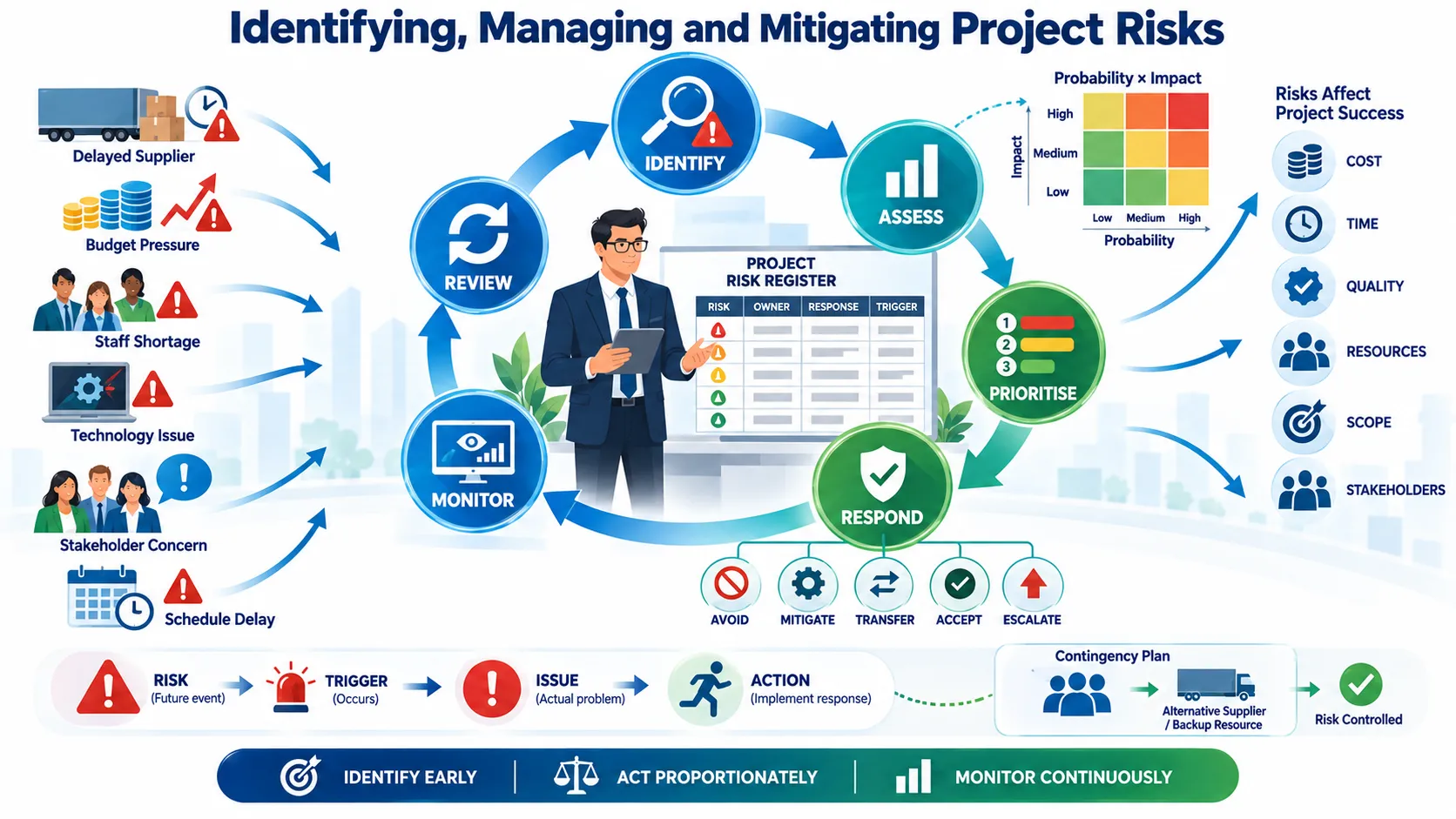
Understanding Project Risk
A risk is different from an issue.
A risk is something that may happen in the future.
An issue is a problem that has already occurred and requires action.
For example:
“The supplier may fail to deliver the equipment on time” is a risk.
“The supplier has failed to deliver the equipment on time” is an issue.
This distinction matters because risks require preventative or contingency planning, whereas issues require immediate management and resolution.
Examples of Project Risks
Project risks may relate to:
Financial resources
Human resources
Technology
Suppliers
Stakeholders
Quality
Schedule
Scope
Communication
Organisational change
Compliance
Security
Operational continuity
External market conditions
A single risk can affect several project dimensions simultaneously.
For example, the loss of a key technical specialist could:
Delay activities.
Increase costs.
Reduce quality.
Increase workload for other team members.
Create stakeholder concerns.
Increase the probability of missing a milestone.
Why Project Risk Management Matters
Effective risk management helps managers anticipate uncertainty rather than simply react to problems.
It supports:
Early identification of threats
Better project planning
Improved resource allocation
More realistic schedules
Stronger financial control
Better decision-making
Improved stakeholder confidence
Protection of quality
Reduced disruption
Increased resilience
Greater likelihood of achieving project objectives
Risk management also helps managers understand where management attention is most needed.
A project may contain dozens of identified risks, but not all deserve equal attention. Prioritisation allows limited management resources to be directed towards the risks with the greatest potential effect.
The Risk Management Process
A structured risk-management process normally includes several connected stages:
Establish the risk-management context.
Identify risks.
Analyse risks.
Evaluate and prioritise risks.
Develop responses.
Assign risk ownership.
Implement responses.
Monitor and review.
Communicate and report.
Capture lessons learned.
This process should be proportionate to the project.
A small internal project may require a simple risk register and regular review, while a major transformation project may require formal risk governance, quantitative analysis and escalation arrangements.
Establishing the Risk Context
Before identifying risks, managers should understand the project environment.
Relevant factors may include:
Project objectives
Scope
Timescale
Budget
Stakeholders
Organisational environment
Regulatory requirements
Technology
Suppliers
Resources
Dependencies
External influences
Understanding context helps managers identify risks that are genuinely relevant.
For example, a project involving customer data has different risks from a project involving office furniture. A major digital transformation has different technology and operational risks from a small process-improvement project.
Risk Identification
Risk identification involves systematically identifying events or conditions that could affect project objectives.
Managers should consider both internal and external sources.
Internal Risk Sources
Internal risks may arise from:
Limited resources
Poor planning
Skills shortages
Weak communication
Unclear responsibilities
Organisational resistance
Inadequate systems
Poor quality controls
Unrealistic schedules
Scope changes
External Risk Sources
External risks may arise from:
Supplier failure
Market conditions
Regulatory changes
Economic conditions
Technology changes
Customer behaviour
Competitor actions
Environmental conditions
Political or social developments
Techniques for Identifying Risks
Different risk-identification techniques can be used depending on project context.
Brainstorming
Project teams identify potential risks collectively.
This is useful because different team members may see risks from different perspectives.
For example:
Finance may identify budget risks.
IT may identify technical risks.
Operations may identify implementation risks.
HR may identify workforce risks.
Stakeholder Consultation
Stakeholders may identify risks that the project team has overlooked.
Customers may identify service risks, while suppliers may identify supply-chain risks.
Lessons Learned
Previous projects can provide evidence about recurring risks.
Managers should ask:
What went wrong previously?
What risks occurred?
What early warning signs existed?
Which responses worked?
Checklists
Organisational risk checklists can help ensure common risk categories are considered.
Interviews
Interviews with specialists and experienced managers can uncover less obvious risks.
SWOT Analysis
SWOT can help identify:
Strengths
Weaknesses
Opportunities
Threats
The weaknesses and threats can highlight potential risk areas.
PESTLE Analysis
PESTLE considers:
Political
Economic
Social
Technological
Legal
Environmental
This is particularly useful for projects affected by external conditions.
Risk Statements
Risks should be recorded clearly.
A weak risk statement is:
“Technology problem.”
A stronger statement is:
“The proposed system may experience integration difficulties with the existing platform, which could delay implementation and increase technical costs.”
A useful risk statement identifies:
The uncertain event or condition
The potential cause
The possible consequence
This makes assessment and response planning easier.
Risk Categories
Categorising risks helps managers ensure that different areas are considered.
Strategic Risks
These relate to organisational direction and project alignment.
Financial Risks
These relate to:
Budget
Funding
Cost increases
Revenue assumptions
Schedule Risks
These relate to:
Delays
Dependencies
Resource availability
Supplier delivery
Resource Risks
These relate to:
Skills
Staffing
Equipment
Capacity
Technical Risks
These relate to:
System performance
Integration
Technology reliability
Technical capability
Quality Risks
These relate to failure to meet agreed standards or requirements.
Stakeholder Risks
These may involve:
Resistance
Conflicting expectations
Poor engagement
Communication problems
Supplier Risks
These may involve:
Late delivery
Poor quality
Financial instability
Contractual problems
Compliance Risks
These may relate to legal, regulatory or organisational requirements.
Risk Analysis
Once risks have been identified, managers need to determine their significance.
Two basic dimensions are:
Probability: How likely is the risk to occur?
Impact: What would happen if it occurred?
A risk with low probability and low impact may require limited attention.
A risk with high probability and high impact requires stronger management.
Qualitative Risk Assessment
Qualitative assessment uses categories or scales to describe risk.
For example:
Low
Medium
High
Or:
Very Low
Low
Moderate
High
Very High
This approach is practical where precise numerical data is unavailable.
Risk Matrix
A risk matrix combines probability and impact to help prioritise risks.
For example:
| Probability | Impact | Overall Risk |
|---|---|---|
| Low | Low | Low |
| Low | High | Medium |
| Medium | Medium | Medium |
| High | Medium | High |
| High | High | Very High |
A matrix should be treated as a decision-support tool rather than an automatic decision-maker.
Managers should consider the wider context and consequences.
Quantitative Risk Analysis
Quantitative risk analysis uses numerical information to estimate potential effects.
It may involve:
Cost estimates
Probability estimates
Schedule impacts
Financial exposure
Scenario analysis
This can be useful for large or high-value projects.
However, quantitative analysis can create false confidence if the underlying assumptions are unreliable.
Risk Prioritisation
Not every risk requires the same response.
Managers should prioritise according to:
Probability
Impact
Urgency
Proximity
Detectability
Strategic significance
Interdependencies
A risk that is unlikely but could cause catastrophic consequences may require more attention than a frequent but minor risk.
Risk Appetite and Tolerance
Organisations differ in their willingness to accept risk.
Risk appetite refers broadly to the amount and type of risk an organisation is prepared to accept in pursuit of its objectives.
Risk tolerance refers to the level of variation or exposure that can be accepted before action or escalation is required.
Managers should understand organisational expectations when making risk decisions.
Risk Response Strategies
Once a risk has been assessed, the manager should determine an appropriate response.
For negative risks, common responses include:
Avoid
Reduce
Transfer
Accept
Escalate
Risk Avoidance
Risk avoidance involves changing the project approach so that the threat no longer exists or is removed.
For example, if a proposed technology creates unacceptable security exposure, the organisation may choose an alternative technology.
Avoidance can be effective but may also remove potential benefits if the risky activity was valuable.
Risk Reduction or Mitigation
Mitigation involves reducing the probability or impact of a risk.
For example, if staff shortages could delay implementation, the project manager may:
Train additional staff.
Recruit temporary specialists.
Cross-train team members.
Adjust scheduling.
The risk may still exist, but its potential impact is reduced.
Risk Transfer
Risk transfer involves moving responsibility for managing certain consequences to another party.
Examples include:
Appropriate insurance
Contractual arrangements
Specialist suppliers
Transfer does not necessarily eliminate the risk. The organisation should still understand residual exposure.
Risk Acceptance
Some risks may be accepted because the cost of responding would be greater than the potential impact, or because the risk is within agreed tolerance.
Acceptance should be deliberate rather than accidental.
A manager should document:
The risk
Reason for acceptance
Owner
Monitoring arrangements
Trigger for further action
Risk Escalation
A risk may need to be escalated when it exceeds project authority or has wider organisational implications.
Escalation may be appropriate when:
Financial exposure exceeds authority.
Strategic objectives may be affected.
Regulatory implications arise.
Risk exceeds organisational tolerance.
Senior-level decisions are required.
Contingency Planning
A contingency plan defines what will happen if a risk actually occurs.
For example:
Risk: Critical supplier may fail to deliver.
Preventive action: Monitor supplier performance and confirm delivery milestones.
Contingency: Activate an approved alternative supplier.
This distinction between prevention and contingency is important.
Risk Triggers
A risk trigger is an early warning sign indicating that a risk may be becoming more likely or may have occurred.
Examples include:
Missed supplier milestones
Increasing defect rates
Staff absence
Budget variance
Repeated stakeholder complaints
Delayed approvals
Managers should define relevant triggers for significant risks.
Risk Ownership
Every significant risk should have a named owner.
The risk owner is responsible for ensuring that the risk is monitored and managed appropriately.
Risk ownership should be clear about:
Monitoring
Response
Escalation
Communication
Review
Assigning a risk without giving the owner appropriate authority or resources is unlikely to be effective.
Risk Register
A risk register is a central tool for recording and managing project risks.
A useful register may contain:
Risk ID
Risk description
Cause
Consequence
Probability
Impact
Overall rating
Risk owner
Response
Actions
Trigger
Target date
Status
Residual risk
The register should be actively used rather than treated as static documentation.
Residual Risk
Residual risk is the level of risk that remains after a response has been implemented.
For example:
Initial risk: High.
Mitigation: Additional testing and specialist review.
Residual risk: Medium.
Managers should understand that mitigation rarely eliminates risk completely.
Risk Monitoring
Risk monitoring involves reviewing whether risk conditions have changed.
Managers should consider:
New risks
Closed risks
Increasing risks
Decreasing risks
Risk triggers
Effectiveness of responses
Residual exposure
Risk review should be integrated into normal project meetings and reporting.
Risk Review Frequency
The frequency of risk review should depend on project context.
High-risk projects may require frequent review.
Lower-risk projects may require less frequent review.
Reviews should also occur when significant changes happen, such as:
Scope changes
Supplier changes
Organisational restructuring
Major schedule changes
New technology
Regulatory changes
Risk Reporting
Risk information should be communicated to appropriate stakeholders.
A project manager may report:
Top risks
Risk trends
Changes in risk ratings
Risk responses
Escalated risks
Decisions required
Senior managers generally need concise information about significant exposure rather than every minor risk.
Risk Communication
Risk communication should be:
Accurate
Timely
Proportionate
Clear
Evidence-based
Managers should avoid both extremes:
Under-reporting: Hiding or minimising significant risks.
Over-reporting: Providing excessive detail that prevents important risks from receiving attention.
Risk and Project Planning
Risk management should influence project planning.
For example, a high risk of supplier delay may require:
Additional schedule contingency
Alternative suppliers
Earlier procurement
Additional stock
Contractual protections
Risk information should therefore influence:
Schedule
Budget
Resources
Scope
Quality
Procurement
Risk and Resource Management
Risk responses often require resources.
For example:
Additional testing requires people.
Staff training requires time and money.
Backup systems require investment.
Alternative suppliers may increase costs.
Managers should therefore include risk-response resources in project planning.
Risk and Financial Management
Risk exposure can create financial consequences.
Managers should consider:
Potential additional costs
Contingency requirements
Supplier exposure
Financial reserves
Cost of mitigation
Cost of failure
A financially inexpensive risk response may be highly valuable if it prevents significant losses.
Risk and Stakeholder Management
Stakeholders can both create and help manage risk.
For example:
Resistance can become a risk.
Poor communication can create misunderstandings.
Stakeholder expertise can help identify risks.
Early engagement can reduce resistance.
Effective stakeholder management is therefore a form of risk mitigation.
Risk and Quality Management
Quality problems can create significant project risks.
Managers should establish:
Quality standards
Testing
Reviews
Inspections
Acceptance criteria
Preventive quality controls can reduce the likelihood of major defects later.
Risk and Change Management
Project changes can create new risks.
A proposed change may affect:
Cost
Schedule
Quality
Resources
Dependencies
Stakeholders
Every significant change should therefore include appropriate risk consideration.
Risk Interdependencies
Risks may interact with each other.
For example:
Staff shortage → delayed work → supplier dependency increases → schedule risk increases → cost increases
Managers should therefore consider relationships between risks rather than treating every risk as completely independent.
Scenario Analysis
Scenario analysis explores possible future situations.
For example:
Best case: Supplier delivers early.
Expected case: Supplier delivers on schedule.
Worst case: Supplier fails and an alternative supplier is required.
Scenario analysis helps managers prepare for different possible outcomes.
Sensitivity Analysis
Sensitivity analysis examines how changes in one factor could affect project results.
For example, a manager may ask:
What happens if costs increase by 10%?
What happens if the project is delayed by one month?
What happens if resource availability falls by 20%?
This can help identify which assumptions are most important.
Risk Workshops
A risk workshop brings relevant participants together to identify and assess risks.
Participants may include:
Project team
Sponsor
Operational managers
Technical specialists
Finance
Procurement
Suppliers
Key stakeholders
Workshops are particularly useful for complex projects because they combine different perspectives.
Risk Management in Different Project Contexts
Small Internal Project
A simple risk register and periodic review may be sufficient.
Technology Project
Greater attention may be required for:
Technical integration
Data
Cybersecurity
Supplier dependency
User adoption
Organisational Change Project
Key risks may involve:
Resistance
Communication
Leadership
Capability
Operational disruption
Regulatory Project
Compliance risks may require:
Formal controls
Evidence
Specialist advice
Approval
Audit trails
Major Transformation
A comprehensive approach may involve:
Multiple risk categories
Formal governance
Quantitative analysis
Scenario planning
Escalation
Practical Example: Technology Implementation
An organisation is introducing a new customer-management platform.
During risk identification, the team identifies:
Risk: Existing systems may not integrate successfully with the new platform.
Probability: Medium.
Impact: High.
Response: Conduct early integration testing and engage specialist technical support.
Trigger: Repeated integration failures during testing.
Contingency: Activate an alternative integration solution.
This demonstrates a structured risk approach.
Practical Example: Employee Training Project
An organisation is implementing a new training programme.
A key risk is:
“Low employee participation may prevent the project from achieving its capability objectives.”
The project manager identifies possible causes:
Operational workload
Lack of manager support
Poor communication
Scheduling conflicts
Mitigation may include:
Early manager engagement
Flexible sessions
Clear communication
Progress monitoring
The risk can then be monitored through participation data.
Practical Example: Supplier Risk
A project depends heavily on one supplier.
The manager identifies the risk of supplier failure.
Possible responses include:
Supplier performance monitoring
Contractual safeguards
Alternative supplier identification
Early ordering
Contingency planning
The manager should assess the cost of these measures against potential project disruption.
Practical Example: Resource Risk
A project depends on a specialist employee who is approaching retirement.
The risk is that specialist knowledge may become unavailable.
Mitigation may include:
Knowledge transfer
Cross-training
Documentation
Additional specialist support
Succession planning
The objective is to reduce dependency on a single individual.
Practical Example: Stakeholder Resistance
A project introduces a new operational process.
Several employees are resistant because they believe the change will increase workload.
The manager identifies resistance as a project risk.
Rather than treating resistance simply as a behavioural problem, the manager investigates:
Reasons for concern
Workload impact
Communication gaps
Training requirements
Stakeholder expectations
Mitigation may include:
Early engagement
Demonstrations
Training
Feedback
Process adjustments
Practical Example: Financial Risk
A project relies on estimated supplier costs.
Market conditions change and supplier prices increase.
The manager assesses:
Remaining budget
Forecast costs
Alternative suppliers
Scope priorities
Contingency
Possible responses include renegotiation, alternative procurement, scope adjustment or additional approval.
Practical Example: Risk Becoming an Issue
A project identifies the risk that testing may be delayed.
The risk is monitored.
The test environment then becomes unavailable.
The risk has now occurred and becomes an issue.
The manager should:
Record the issue.
Assess immediate impact.
Implement the contingency response.
Assign ownership.
Communicate appropriately.
Update the risk record.
This demonstrates the relationship between risk and issue management.
Evaluating Risk Responses
Managers should not assume that every mitigation is automatically worthwhile.
A response should be assessed according to:
Cost
Effectiveness
Feasibility
Timing
Resource requirements
Residual risk
Operational impact
For example, spending £100,000 to mitigate a risk with a maximum potential impact of £20,000 may not be proportionate unless there are other significant consequences.
Cost of Risk Response
Managers should compare:
Cost of mitigation
with
Potential cost or impact of the risk
However, financial comparison alone is not always sufficient.
A risk may create:
Safety consequences
Reputational damage
Customer harm
Regulatory consequences
These factors may justify mitigation even when the financial calculation alone appears unfavourable.
Risk Response Effectiveness
After implementing a response, managers should ask:
Has probability reduced?
Has impact reduced?
Has the risk changed?
Is the response working?
Are additional actions required?
Has a new risk been created?
A risk response should therefore be monitored rather than assumed to be effective.
Common Risk Management Failures
Treating the Risk Register as a Document
A risk register has little value if it is never reviewed.
Identifying Risks Too Late
Late identification reduces the range of available responses.
Using Vague Risk Statements
Poorly defined risks are difficult to manage.
Failing to Assign Ownership
Unowned risks are unlikely to receive consistent attention.
Treating Every Risk Equally
This can overwhelm project teams and reduce focus.
Ignoring Positive Uncertainty
Opportunities can also contribute to project success.
Over-Relying on Probability Scores
Numerical ratings do not replace managerial judgement.
Failing to Monitor Residual Risk
Risk often remains after mitigation.
Ignoring Interdependencies
Several risks may interact and amplify each other.
Failing to Escalate
Risks beyond project authority should be escalated appropriately.
Opportunities as Positive Risks
Risk management can also consider opportunities.
An opportunity is an uncertain event that could create a positive effect.
Examples include:
New technology becoming available
Supplier offering improved terms
Faster implementation
Additional funding
Increased customer demand
Managers may consider strategies such as:
Exploit
Enhance
Share
Accept
The wider principle is that effective risk management manages uncertainty rather than simply eliminating threats.
Leadership and Risk Culture
Risk management is strongly influenced by organisational culture.
A positive risk culture encourages people to report concerns early.
A poor culture may cause employees to:
Hide problems
Avoid escalation
Fear blame
Under-report risks
Middle managers have an important role in creating an environment where risks can be discussed constructively.
A manager should communicate that identifying a risk is not necessarily a sign of failure. Early identification can demonstrate effective management.
Ethical Risk Management
Risk decisions should consider ethical consequences.
Managers should not deliberately accept serious risks simply to protect:
Budget
Schedule
Reputation
For example, reducing essential safety checks to meet a deadline may create unacceptable consequences.
Ethical risk management considers:
Safety
Fairness
Transparency
Stakeholder welfare
Data protection
Quality
Organisational values
Risk Governance
Risk governance defines how significant risks are escalated, reviewed and controlled.
It may specify:
Risk thresholds
Reporting requirements
Approval levels
Escalation procedures
Risk ownership
Review frequency
Strong governance ensures that important risks receive appropriate management attention.
Risk Management Process for Middle Managers
A practical process is:
Step 1: Understand the Project
Review objectives, scope, stakeholders, resources, dependencies and constraints.
Step 2: Identify Risks
Use workshops, stakeholder consultation, checklists, lessons learned and environmental analysis.
Step 3: Describe Risks Clearly
Record cause, uncertain event and potential consequence.
Step 4: Assess Probability and Impact
Determine significance using appropriate qualitative or quantitative methods.
Step 5: Prioritise
Focus attention on the most significant exposures.
Step 6: Select Responses
Choose avoidance, mitigation, transfer, acceptance or escalation as appropriate.
Step 7: Assign Owners
Give significant risks clear ownership.
Step 8: Implement Actions
Ensure risk responses are included in project plans.
Step 9: Monitor
Review risk status, triggers and response effectiveness.
Step 10: Escalate
Escalate risks that exceed authority or tolerance.
Step 11: Review
Update risk assessments when project circumstances change.
Step 12: Learn
Capture lessons for future projects.
Key Benefits of Effective Risk Management
Effective risk management provides several important benefits.
Greater Project Resilience
Projects become better prepared to respond to uncertainty.
Earlier Intervention
Managers can act before risks become major problems.
Better Resource Allocation
Resources can be directed towards significant exposures.
Improved Decision-Making
Risk information provides important context for project decisions.
Greater Stakeholder Confidence
Stakeholders gain confidence when risks are identified and managed transparently.
Better Financial Control
Potential cost exposure can be identified earlier.
Improved Schedule Protection
Mitigation and contingency planning can reduce delays.
Improved Quality
Quality-related risks can be addressed before defects become significant.
Stronger Governance
Clear risk ownership and escalation improve accountability.
Better Organisational Learning
Risk experiences can improve future project planning.
Key Concepts to Remember
Project risk: An uncertain event or condition that could affect project objectives.
Issue: A problem that has already occurred.
Risk management: The structured process of identifying, assessing, responding to and monitoring uncertainty.
Risk identification: The process of identifying potential events or conditions that could affect the project.
Risk analysis: Assessment of probability, impact and significance.
Risk prioritisation: Ranking risks according to their significance and urgency.
Risk response: The action selected to address a risk.
Risk mitigation: Reducing the probability or impact of a threat.
Risk avoidance: Changing the project approach to remove a threat.
Risk transfer: Moving responsibility for certain consequences to another party.
Risk acceptance: Deliberately accepting a risk within agreed tolerance.
Risk escalation: Referring a risk to a higher level of authority.
Risk owner: Person responsible for managing and monitoring a risk.
Risk register: Structured record of project risks and their management.
Risk trigger: An early warning sign that a risk may be occurring or becoming more likely.
Residual risk: Risk remaining after a response has been implemented.
Contingency plan: Planned action to be taken if a risk occurs.
Risk appetite: The level and type of risk an organisation is prepared to accept.
Risk tolerance: The acceptable level of variation or exposure before further action is required.
Risk matrix: A tool for assessing and prioritising risk using probability and impact.
Risk interdependency: A relationship in which one risk can influence another.
Risk response effectiveness: The extent to which an action reduces or manages the intended risk.
Managerial Risk Review Checklist
A middle manager can use the following checklist when reviewing project risks:
Have all major project areas been considered?
Are risks clearly described?
Have causes and consequences been identified?
Is probability assessed appropriately?
Is potential impact understood?
Which risks require the most attention?
Are risk owners clearly assigned?
Are responses proportionate?
Are mitigation actions included in project plans?
Are contingency arrangements available?
Are risk triggers defined?
Is residual risk understood?
Are risk interdependencies considered?
Are stakeholders appropriately informed?
Are significant risks escalated?
Is the risk register current?
Are responses actually working?
Have new risks emerged?
Are risk decisions aligned with organisational tolerance?
Have lessons been captured?
Summary
Effective project risk management enables managers to identify and respond to uncertainty before it unnecessarily threatens project objectives. It is a continuous process rather than a one-time planning exercise.
The process begins with understanding the project context and identifying potential risks through methods such as brainstorming, stakeholder consultation, interviews, checklists, lessons learned, SWOT and PESTLE analysis. Risks should then be clearly described and assessed according to probability and impact.
Prioritisation ensures that management attention is focused on significant risks. Appropriate responses may include avoidance, mitigation, transfer, acceptance and escalation. Contingency planning provides additional protection by establishing what will happen if a risk becomes an issue.
A risk register provides an important control mechanism, but its value depends on active management. Risks need owners, responses, triggers and regular reviews. Managers should also monitor residual risks because mitigation rarely eliminates exposure completely.
Risk management must be integrated with other aspects of project management. Risks can influence scope, schedule, cost, resources, quality, stakeholder relationships and organisational outcomes. Changes should therefore be assessed for their potential risk implications, while project decisions should consider both immediate and longer-term consequences.
Different projects require different levels of risk-management formality. A small project may need a straightforward risk register and periodic review, whereas a complex transformation may require formal governance, quantitative analysis, scenario planning and structured escalation.
Effective managers also recognise that risk management includes opportunities as well as threats. Uncertainty can create positive outcomes, and project leaders can sometimes exploit or enhance these opportunities.
The most important principle is that risk management should be proportionate, evidence-based, proactive and integrated with project decision-making.
The overall process can be remembered as:
IDENTIFY → ANALYSE → PRIORITISE → RESPOND → OWN → MONITOR → ESCALATE → LEARN
When applied consistently, this approach helps organisations protect project objectives, use resources effectively, improve resilience, strengthen stakeholder confidence and increase the likelihood that projects will achieve their intended outcomes.
Final Management Insight
Strong project managers do not attempt to eliminate every risk. Instead, they create the conditions for informed risk-taking.
A project without risk is rarely realistic. What distinguishes effective project management is the ability to understand uncertainty, recognise its potential consequences and make appropriate choices about how much exposure the organisation is prepared to accept.
For middle managers, effective risk leadership means creating a culture in which people feel able to raise concerns early, evidence is used to assess uncertainty, significant risks receive appropriate attention and decisions are made transparently.
The strongest risk-management approach can therefore be expressed as:
SEE THE RISK → UNDERSTAND THE RISK → DECIDE THE RESPONSE → ACT EARLY → MONITOR THE RESULT
This transforms risk management from a compliance activity into a practical management capability that protects delivery and supports better organisational decision-making.