
Lesson no 3 : Know how to procure resources
Effective procurement is an essential management activity because organisations depend on the timely availability of suitable resources to achieve their operational and organisational objectives. Resources may include people, equipment, materials, technology, software, facilities, professional services, stock and external expertise. Knowing how to procure resources enables managers to obtain what is required while balancing cost, quality, availability, risk, compliance and value for money.
Resource procurement is more than simply purchasing goods or services. It involves a structured process of identifying a requirement, defining what is needed, confirming available budgets, identifying potential suppliers, evaluating options, selecting an appropriate source, obtaining the necessary approval, placing an order or agreeing a contract, and monitoring delivery and supplier performance. Effective procurement helps ensure that resources are available when they are needed and meet the required specification.
For practising and aspiring middle managers and leaders, understanding procurement is particularly important because purchasing decisions can have a direct effect on operational performance and financial control. A poorly planned procurement decision may result in excessive expenditure, unsuitable resources, delays, poor quality, supplier problems or unnecessary dependency on external providers. In contrast, well-managed procurement can improve efficiency, support service quality, reduce waste and contribute to the successful achievement of organisational objectives.
Managers also need to understand that the lowest price is not always the best option. Procurement decisions should consider the total cost of obtaining and using a resource, together with its quality, reliability, capacity, maintenance requirements, delivery timescale and expected benefits. Supplier capability and risk should also be assessed, particularly when procuring resources that are critical to operational continuity.
Procurement must also be undertaken responsibly and in accordance with relevant organisational policies, financial controls, legal requirements and regulatory expectations. Managers may need to consider areas such as ethical purchasing, conflicts of interest, data protection, health and safety, sustainability, supplier due diligence and appropriate record keeping.
This lesson explores the principles and processes involved in effective resource procurement. Learners will develop an understanding of how to identify procurement requirements, assess supply options, evaluate suppliers, consider cost and value, manage procurement risks and monitor supplier performance. The lesson also highlights the importance of making evidence-based procurement decisions that are transparent, proportionate and aligned with organisational priorities.
Ultimately, effective procurement enables managers to secure the right resources, from appropriate sources, at the right time, to the required standard and at an acceptable overall cost. This supports efficient resource use, strengthens operational delivery and helps organisations achieve their intended outcomes.
1.Analyse Principles Which Underpin Effective Procurement
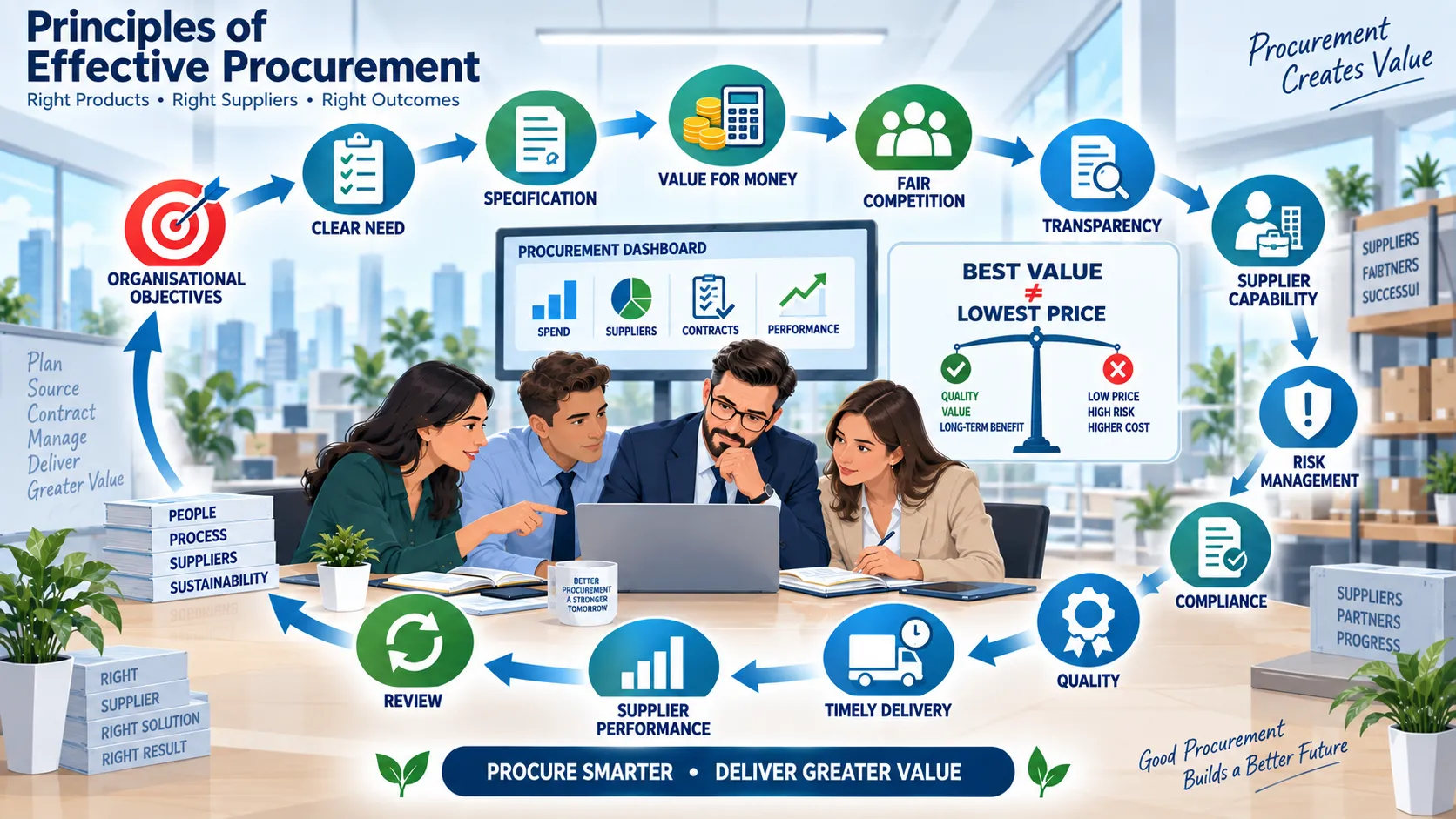
Effective procurement is a fundamental management process that enables an organisation to obtain the resources, products, equipment, materials, technology and services required to achieve its objectives. Procurement decisions can influence financial performance, operational efficiency, service quality, organisational resilience, stakeholder confidence and reputation. For this reason, effective procurement should be based on clearly understood principles rather than informal purchasing decisions or a focus on price alone.
Procurement is particularly important for middle managers because managers frequently identify operational resource requirements and may be involved in defining specifications, preparing business cases, evaluating suppliers, managing budgets, approving purchases within delegated authority and monitoring supplier performance. A manager who understands procurement principles is better positioned to make decisions that are transparent, proportionate, ethical, commercially sound and aligned with organisational objectives.
The fundamental principle is that procurement should obtain the right resource, from an appropriate source, at the right time, to the required standard, at an acceptable overall cost and in a way that supports organisational objectives.
Effective procurement can therefore be viewed as a management cycle:
Organisational objective → Requirement → Specification → Market research → Supplier options → Evaluation → Selection → Contract/order → Delivery → Performance monitoring → Review
Each stage should contribute to the overall value and effectiveness of the procurement decision.
Understanding the Meaning of Effective Procurement
Definition of Procurement
Procurement is the organised process of identifying, sourcing, evaluating, acquiring and managing the goods, services and resources required by an organisation.
Procurement is broader than purchasing. Purchasing normally refers to the transactional activity of buying a product or service, whereas procurement includes the wider process of planning the requirement, understanding the market, selecting suppliers, managing contractual arrangements and evaluating supplier performance.
For example, purchasing office computers may involve placing an order with a supplier. Procurement would include determining the organisation’s technology requirements, assessing compatibility, establishing the budget, identifying suitable suppliers, comparing specifications and total costs, considering security and support, selecting a supplier, agreeing terms, receiving the equipment and reviewing supplier performance.
Definition of Effective Procurement
Effective procurement means obtaining resources that meet the organisation’s requirements and contribute to organisational objectives while achieving an appropriate balance of cost, quality, performance, risk, compliance and value.
Effective procurement should ensure that:
The requirement is clearly identified.
The resource is suitable for its intended purpose.
The specification is clear.
The procurement decision is properly authorised.
Suitable suppliers are considered.
Costs are controlled.
Quality requirements are achieved.
Relevant risks are managed.
Ethical standards are maintained.
Organisational policies are followed.
Applicable legal and regulatory requirements are considered.
Delivery occurs within the required timescale.
Supplier performance is monitored.
Procurement outcomes are reviewed.
Why Procurement Principles Matter
Procurement principles provide a framework for making consistent and defensible decisions. Without clear principles, procurement can become influenced by personal preference, urgency, supplier relationships, incomplete information or short-term cost considerations.
A manager may, for example, select a familiar supplier without comparing alternatives. Although this may appear convenient, it may not provide the best value, quality or resilience for the organisation.
Principles help managers ask structured questions before committing resources:
Is there a genuine organisational need?
Is the requirement clearly defined?
Is the proposed purchase aligned with organisational objectives?
Is the specification appropriate?
Is the budget available?
Have suitable supply options been considered?
Are suppliers being treated fairly?
Is the evaluation evidence-based?
Does the preferred option provide value for money?
Are risks acceptable?
Is the decision compliant with organisational requirements?
Can the supplier deliver the required quality and capacity?
These questions support better management judgement.
The Core Principles Underpinning Effective Procurement
Principle 1: Alignment with Organisational Objectives
Procurement should support organisational and operational objectives rather than operate independently from them.
Managers should understand why a resource is required and what outcome it is expected to support.
For example, if an organisation has an objective to reduce customer waiting times, procurement may involve acquiring additional service technology, communication equipment or temporary staffing capacity. The procurement should be evaluated according to its contribution to reducing waiting times and improving customer experience.
This principle prevents unnecessary purchasing and helps ensure that organisational expenditure is directed towards meaningful priorities.
Applying Strategic Alignment
Before procurement begins, managers should identify:
The organisational objective.
The operational activity involved.
The expected outcome.
The resource required.
The reason the resource is necessary.
The expected benefit.
The measures that will demonstrate success.
This creates a clear link between procurement expenditure and organisational performance.
Principle 2: Clear Definition of Need
Effective procurement begins with a genuine and clearly defined need.
Managers should distinguish between:
What the organisation needs
What users would prefer
What is available in the market
What a supplier is trying to sell
What is genuinely necessary to achieve the objective
A poorly defined need can lead to over-purchasing, unsuitable specifications or unnecessary expenditure.
For example, an organisation may state that it needs “new computers”. A stronger procurement requirement would identify the number of users, software requirements, processing capacity, security requirements, compatibility, expected lifespan, support requirements and budget.
A clear need creates a stronger basis for supplier comparison.
Principle 3: Appropriate Specification
A specification describes what the organisation requires from the resource, product or service.
An effective specification should be sufficiently detailed to communicate essential requirements while avoiding unnecessary restrictions.
A specification may include:
Quantity
Technical requirements
Quality standards
Performance expectations
Delivery requirements
Location
Timescale
Safety requirements
Compatibility
Maintenance
Warranty
Support
Security requirements
Sustainability expectations
The specification should focus on the required outcome as well as technical details where appropriate.
Importance of Outcome-Based Requirements
An outcome-based approach can encourage suppliers to propose innovative solutions.
For example, rather than specifying that an organisation must purchase a particular type of technology, the requirement could specify that the system must securely process customer information, integrate with existing systems and provide access to authorised staff.
This can allow suppliers to offer different technical solutions while still meeting the organisational requirement.
Principle 4: Value for Money
Value for money is one of the most important procurement principles.
Value for money involves achieving an appropriate balance between:
Cost
Quality
Performance
Benefits
Risk
Sustainability
Whole-life cost
The lowest purchase price does not necessarily represent the best value.
For example, a piece of equipment costing £15,000 may appear more attractive than equipment costing £20,000. However, if the £15,000 equipment has higher maintenance costs, shorter useful life and poorer reliability, the more expensive option may provide greater value over time.
Managers should therefore evaluate the overall economic impact.
Whole-Life Cost
Whole-life cost considers the costs associated with a resource throughout its use.
These may include:
Acquisition
Delivery
Installation
Training
Maintenance
Energy
Software licences
Support
Repairs
Upgrades
Replacement
Disposal
This approach helps managers avoid making decisions based solely on initial purchase price.
Principle 5: Fair and Transparent Supplier Selection
Supplier selection should be fair, transparent and based on relevant criteria.
This means suppliers should understand what is required and how proposals will be evaluated where a competitive process is used.
Transparent procurement can help demonstrate:
Why suppliers were considered.
What criteria were applied.
How bids were evaluated.
Why the preferred supplier was selected.
Whether the decision followed organisational procedures.
Transparency is particularly important where procurement involves significant expenditure, public funds or sensitive resources.
Principle 6: Competition
Competition can help organisations identify suitable suppliers and achieve value for money.
Where appropriate, managers may compare:
Prices
Specifications
Quality
Delivery
Service
Supplier capability
Contract terms
Risk
Sustainability
Competitive procurement does not mean selecting the cheapest supplier. Instead, it creates an opportunity to compare alternatives systematically.
Competition should also be proportionate. A low-value routine purchase may not require the same process as a high-value strategic contract.
Principle 7: Proportionality
Proportionality means that the procurement process should reflect the value, complexity, risk and importance of the purchase.
A simple purchase should not necessarily require an unnecessarily complicated process, while a high-risk strategic procurement requires appropriate scrutiny.
Managers should consider:
Financial value
Operational importance
Risk
Complexity
Supplier dependency
Legal requirements
Strategic significance
Potential consequences of failure
Proportionality helps organisations maintain effective controls without creating unnecessary administrative burdens.
Principle 8: Accountability
Accountability means that individuals involved in procurement should be responsible for their decisions and actions.
Managers should be able to demonstrate:
Who identified the need.
Who approved the budget.
Who evaluated suppliers.
Who made the procurement decision.
Who authorised the contract.
Who monitors supplier performance.
Clear responsibilities reduce ambiguity and strengthen governance.
Documentation is particularly important because procurement decisions may need to be reviewed or audited.
Principle 9: Ethical Conduct
Ethical behaviour is fundamental to effective procurement.
Managers should make decisions objectively and avoid allowing personal interests to influence supplier selection.
Ethical procurement involves:
Honesty
Integrity
Fair treatment
Transparency
Confidentiality
Avoidance of improper influence
Proper management of conflicts of interest
Responsible supplier relationships
Managers should declare relevant conflicts of interest and follow organisational procedures for managing them.
For example, if a manager has a personal connection with a potential supplier, this should be disclosed according to organisational policy rather than hidden.
Principle 10: Integrity and Anti-Bribery
Procurement decisions can involve substantial financial value, making integrity particularly important.
Improper payments, gifts or incentives can compromise procurement decisions and damage organisational reputation.
Managers should therefore understand and follow applicable organisational controls relating to:
Gifts and hospitality
Conflicts of interest
Supplier relationships
Financial approval
Record keeping
Fraud prevention
Anti-bribery requirements
Procurement should be based on organisational requirements and objective evaluation rather than personal benefit.
Principle 11: Compliance
Procurement must comply with relevant organisational policies and applicable legal and regulatory requirements.
The exact requirements will depend on the organisation, sector, location, procurement value and type of resource.
Managers may need to consider:
Procurement policies
Financial regulations
Contractual requirements
Employment requirements
Health and safety
Data protection
Information security
Equality requirements
Environmental obligations
Sector-specific regulations
Record-keeping requirements
Compliance should be considered from the beginning of procurement rather than after a supplier has already been selected.
Principle 12: Risk Management
Procurement decisions should include appropriate risk assessment.
Risk may arise from the resource itself, the supplier, the market or the contractual arrangement.
Potential risks include:
Supplier failure
Delayed delivery
Poor quality
Price increases
Supply shortages
Contract disputes
Cybersecurity weaknesses
Data breaches
Regulatory non-compliance
Lack of alternative suppliers
Inadequate supplier capacity
Managers should assess both the likelihood and potential impact of risks.
Risk-Based Procurement
Higher-risk procurements may require:
Greater supplier due diligence
More detailed specifications
Additional approvals
Stronger contractual controls
Performance guarantees
Business continuity arrangements
Multiple suppliers
Contingency plans
More frequent performance reviews
Principle 13: Quality
Procurement should secure resources that meet the required quality standard.
Quality requirements should be defined before suppliers are evaluated.
Managers may assess:
Reliability
Durability
Accuracy
Performance
Safety
Compliance
Service quality
Technical standards
Warranty
Support
Poor quality can create additional costs and undermine operational objectives.
For example, purchasing low-quality materials may initially reduce costs but lead to increased waste, product defects, customer complaints and rework.
Principle 14: Timeliness
Resources must be available when they are needed.
A supplier may provide an excellent product at a competitive price, but if it arrives too late to support the operational requirement, the procurement has not been effective.
Managers should consider:
Lead time
Production time
Delivery schedules
Supplier capacity
Installation
Testing
Staff training
Implementation time
Procurement planning should therefore begin early enough to account for the complete acquisition process.
Principle 15: Supplier Capability
A supplier should have the capability to meet the organisation’s requirements.
Supplier evaluation may include:
Experience
Technical capability
Financial stability
Production capacity
Delivery capability
Quality assurance
Customer references
Service support
Business continuity
Compliance
Security arrangements
A supplier’s ability to meet the requirement should be evaluated rather than assumed.
Principle 16: Sustainability
Sustainability is increasingly relevant to procurement decisions.
Managers may consider the environmental and social impacts associated with products, services and suppliers.
Considerations can include:
Energy consumption
Waste
Packaging
Product lifespan
Recyclability
Transport
Sustainable materials
Supplier environmental practices
Social responsibility
Responsible sourcing
Sustainability should be considered alongside cost, quality, operational performance and organisational objectives.
Principle 17: Confidentiality and Information Security
Procurement may involve sensitive organisational information.
Managers may share:
Technical specifications
Financial information
Customer information
Business plans
Operational data
Security requirements
Commercial information
Information should be handled appropriately and only shared with authorised parties.
Where suppliers will access sensitive information or systems, managers should consider information security and applicable data protection requirements.
Principle 18: Effective Contract Management
Procurement does not end when a supplier is selected.
Where a formal contract is used, managers may need to monitor whether the supplier is delivering according to agreed terms.
Contract management can involve:
Delivery
Quality
Service levels
Pricing
Reporting
Performance indicators
Invoicing
Change control
Complaints
Contract renewal
Termination provisions
Effective contract management helps ensure that the organisation receives the value it expected from procurement.
Principle 19: Supplier Performance Management
Supplier performance should be monitored using appropriate measures.
Possible indicators include:
On-time delivery
Defect rates
Service response time
Contract compliance
Cost variance
Customer satisfaction
Availability
Number of complaints
Issue resolution time
Performance information helps managers identify whether the supplier is meeting expectations.
Where performance is below standard, corrective action may include:
Supplier improvement plans
Additional monitoring
Contractual remedies
Renegotiation
Alternative suppliers
Contract termination where appropriate
Principle 20: Continuous Improvement
Effective procurement should be reviewed and improved over time.
Managers can learn from:
Previous procurement exercises
Supplier performance
Budget outcomes
User feedback
Operational results
Market changes
Contract reviews
Procurement problems
Continuous improvement can help organisations improve specifications, supplier relationships, procurement processes and resource outcomes.
Comparing the Main Procurement Principles
| Procurement principle | Meaning | Why it matters | Practical management application |
|---|---|---|---|
| Strategic alignment | Procurement supports organisational objectives | Prevents unnecessary or poorly targeted expenditure | Link every significant purchase to an operational requirement |
| Clear need | The requirement is properly identified | Reduces unnecessary purchasing | Define what is required and why |
| Specification | Requirements are clearly described | Helps suppliers understand expectations | Set quality, quantity, performance and delivery requirements |
| Value for money | Cost is balanced against benefits and performance | Supports financial sustainability | Evaluate whole-life cost and expected outcomes |
| Competition | Suitable alternatives are considered | Can improve choice and value | Compare suppliers where appropriate |
| Proportionality | Procurement controls reflect risk and value | Prevents unnecessary bureaucracy | Use appropriate procurement procedures |
| Transparency | Decisions are clear and explainable | Supports trust and accountability | Record evaluation criteria and decisions |
| Accountability | Responsibilities are clearly assigned | Strengthens governance | Identify who approves and manages procurement |
| Ethics | Decisions are made honestly and fairly | Protects organisational integrity | Manage conflicts of interest |
| Compliance | Procurement follows relevant requirements | Reduces legal and operational risk | Follow policies and applicable regulations |
| Risk management | Procurement risks are identified and controlled | Protects continuity and objectives | Assess supplier, financial and operational risks |
| Quality | Resources meet required standards | Supports performance and customer outcomes | Evaluate specifications, reliability and performance |
| Timeliness | Resources are available when required | Prevents operational delays | Assess lead times and delivery capability |
| Supplier capability | Suppliers can meet requirements | Reduces delivery and quality risk | Conduct appropriate supplier due diligence |
| Sustainability | Environmental and social impacts are considered | Supports responsible resource use | Assess lifecycle and supplier sustainability |
| Information security | Sensitive information is protected | Reduces information-related risk | Assess supplier access and security controls |
| Contract management | Supplier obligations are monitored | Helps secure expected value | Monitor delivery against contract requirements |
| Continuous improvement | Procurement processes are reviewed | Supports better future decisions | Use performance data and lessons learned |
The Procurement Decision-Making Process
Effective procurement principles can be applied through a structured decision-making process.
Stage 1: Identify the Organisational Requirement
Begin by identifying the organisational objective and operational requirement.
Managers should establish:
What needs to be achieved?
What activity is affected?
What resource is required?
Why is the resource necessary?
What outcome is expected?
Stage 2: Confirm the Resource Requirement
Determine the quantity, quality, specification, location, timing and duration of the requirement.
Managers should also assess whether the organisation already has suitable resources available.
Stage 3: Confirm Budget and Authority
The manager should confirm:
Available budget
Financial limits
Spending authority
Approval requirements
Funding source
Expected total cost
A procurement should not proceed without appropriate financial authorisation.
Stage 4: Develop the Specification
The specification should communicate the essential requirements to potential suppliers.
It should distinguish between:
Mandatory requirements
Preferred requirements
Optional features
This helps prevent unnecessary expenditure.
Stage 5: Research the Supply Market
Managers should understand the available supply market.
Research can consider:
Potential suppliers
Available products
Market prices
New technologies
Supplier capacity
Alternative solutions
Market risks
Stage 6: Identify Procurement Options
Possible options may include:
Existing internal resources
Direct purchase
Competitive quotations
Formal tendering
Framework arrangements
Leasing
Outsourcing
Supplier partnerships
Stage 7: Evaluate Suppliers and Options
Evaluation should use predetermined criteria where appropriate.
Criteria can include:
Cost
Quality
Technical capability
Delivery
Capacity
Risk
Compliance
Sustainability
Support
Strategic fit
Stage 8: Select the Preferred Option
The preferred option should provide the strongest overall value and meet the organisational requirement.
The decision should be evidence-based and appropriately documented.
Stage 9: Obtain Approval
Required approvals should be obtained before commitment.
Depending on organisational procedures, approval may involve:
Line management
Finance
Procurement
Legal
IT
Compliance
Senior management
Stage 10: Contract or Order
The agreed requirements, costs, delivery arrangements and responsibilities should be documented appropriately.
Stage 11: Receive and Verify
When the resource is received, managers or designated staff should confirm that it meets the agreed requirements.
Checks may include:
Quantity
Specification
Quality
Delivery
Damage
Documentation
Functionality
Stage 12: Monitor Performance
The supplier and resource should be monitored against agreed expectations.
Stage 13: Review Outcomes
The manager should assess whether procurement achieved the intended objective.
Questions include:
Was the resource fit for purpose?
Was the budget maintained?
Was the required quality achieved?
Was delivery timely?
Did the resource improve performance?
Did the supplier meet expectations?
Were risks controlled?
What should be improved next time?
Practical Example: Procuring Technology
A customer service department needs a new customer relationship management system because its existing system is causing delays and fragmented customer information.
The manager begins by identifying the organisational objective: improve customer service and response times.
The manager then defines the requirement, including:
Number of users
Customer information requirements
Reporting requirements
Integration
Security
Accessibility
Training
Technical support
Implementation timescale
Several suppliers are identified.
The manager evaluates them against:
Total cost
Functionality
Security
Scalability
Supplier capability
Implementation support
User experience
Contract terms
The cheapest supplier is not automatically selected. Instead, the manager evaluates which solution provides the best overall value and ability to achieve the operational objective.
Following implementation, the manager monitors:
Response times
User adoption
Customer satisfaction
System availability
Support issues
Total expenditure
This demonstrates how procurement principles connect directly to organisational outcomes.
Practical Example: Procuring Materials
A manufacturing organisation requires materials for production.
The manager needs to ensure that the materials:
Meet the required specification.
Are available in sufficient quantities.
Can be delivered on time.
Meet quality standards.
Are competitively priced.
Come from reliable suppliers.
Meet applicable safety requirements.
Selecting a cheaper supplier that consistently delivers late could disrupt production. A slightly more expensive supplier with reliable delivery may therefore provide greater overall value.
The manager should also consider whether multiple suppliers are necessary to reduce dependency and improve resilience.
Practical Example: Procuring Professional Services
An organisation needs specialist consultancy support to implement a new operational process.
The manager evaluates whether to:
Use existing employees
Train internal staff
Recruit a specialist
Contract an independent consultant
Use a consultancy organisation
The manager compares:
Expertise
Cost
Timescale
Quality
Availability
Knowledge transfer
Confidentiality
Risk
The decision should be based on the option that best meets the organisational requirement rather than simply the lowest fee.
Practical Example: Emergency Procurement
Sometimes resources are required urgently because of unexpected circumstances.
For example, critical equipment may fail and need immediate replacement.
Urgency can affect procurement options, but it should not automatically justify ignoring all controls.
Managers should:
Establish the immediate requirement.
Assess the operational impact.
Follow applicable emergency procurement procedures.
Confirm approval requirements.
Document the decision.
Assess available suppliers.
Consider cost and quality.
Record the reasons for the selected option.
Review the procurement after the emergency.
This helps balance operational urgency with accountability and governance.
Common Procurement Problems
Poorly Defined Requirements
If the organisation does not understand what it needs, suppliers may provide unsuitable resources.
Overemphasis on Price
Selecting solely on price can result in poor quality or higher long-term costs.
Weak Supplier Evaluation
Failure to assess supplier capability can increase delivery and quality risks.
Inadequate Documentation
Poor records make it difficult to demonstrate why a decision was made.
Conflicts of Interest
Undeclared personal interests can undermine procurement integrity.
Poor Contract Management
A good supplier selection decision can still fail if performance is not monitored.
Lack of Market Knowledge
Managers who do not understand available alternatives may select unnecessarily expensive solutions.
Inadequate Risk Assessment
Ignoring supplier dependency or supply disruption can create operational vulnerability.
Key Benefits of Applying Effective Procurement Principles
Financial Benefits
Effective procurement can:
Control expenditure
Reduce unnecessary purchases
Improve value for money
Reduce whole-life costs
Improve budget management
Operational Benefits
It can also:
Improve resource availability
Support operational continuity
Improve quality
Increase productivity
Reduce delays
Improve capacity
Governance Benefits
Strong procurement principles support:
Accountability
Transparency
Auditability
Consistent decision-making
Compliance
Risk management
Strategic Benefits
Procurement can contribute to:
Organisational objectives
Innovation
Capability development
Sustainability
Operational resilience
Long-term supplier relationships
Managerial Checklist for Effective Procurement
Before approving or recommending a procurement decision, managers should consider:
Have I clearly identified the organisational need?
Is the procurement linked to an organisational objective?
Is the requirement clearly specified?
Have I considered whether an internal resource could meet the requirement?
Is the budget available?
Am I operating within my authority?
Have appropriate supply options been considered?
Is competition required?
Are evaluation criteria clear?
Have suppliers been assessed fairly?
Have total costs been considered?
Does the preferred option provide value for money?
Is quality appropriate?
Can the supplier meet the required timescale?
Is supplier capacity sufficient?
What risks exist?
What contingency arrangements are available?
Are ethical requirements being followed?
Are conflicts of interest properly managed?
Are legal and organisational requirements satisfied?
Are sustainability considerations relevant?
How will supplier performance be monitored?
How will procurement outcomes be measured?
When will the procurement decision be reviewed?
Key Concepts to Remember
The main principles underpinning effective procurement include:
Strategic alignment
Clear identification of need
Appropriate specification
Value for money
Whole-life cost
Fair competition
Transparency
Proportionality
Accountability
Ethical conduct
Integrity
Compliance
Risk management
Quality
Timeliness
Supplier capability
Sustainability
Information security
Contract management
Supplier performance management
Continuous improvement
These principles should not be treated as isolated requirements. They work together to create a structured approach to procurement decision-making.
Professional Management Insight
An effective procurement manager or middle manager does not simply ask, “Which supplier offers the lowest price?” The stronger question is, “Which procurement option provides the best overall contribution to the organisation’s objectives?”
This requires managers to balance competing priorities.
A high-quality resource may cost more but reduce operational failures. A flexible supplier may cost more per unit but help an organisation respond to unpredictable demand. An internal solution may protect organisational knowledge but require additional training. An external provider may provide specialist expertise but introduce dependency.
There is therefore rarely a single procurement criterion that determines the correct decision.
Effective procurement is a judgement-based management activity supported by evidence, clear principles and appropriate governance.
The strongest managers also recognise that procurement should not be viewed as a one-off transaction. It is a continuous process involving planning, supplier management, performance monitoring and learning.
The complete management cycle can be expressed as:
Need → Specify → Source → Evaluate → Select → Contract → Deliver → Monitor → Review → Improve
When this cycle is managed effectively, procurement becomes a source of organisational value rather than simply an administrative purchasing function.
Summary
The principles underpinning effective procurement provide managers with a framework for obtaining resources in a way that supports organisational objectives, controls expenditure, manages risk and protects organisational integrity.
Effective procurement begins with a clearly defined need and an understanding of the organisational objective that the resource is intended to support. Managers should develop appropriate specifications, consider available supply options, assess suppliers, evaluate total cost and value, consider quality and capacity, manage risks and ensure that procurement decisions comply with relevant organisational and regulatory requirements.
Fairness, transparency, accountability and ethical conduct are also essential. Procurement decisions should be based on objective evidence rather than personal preference or inappropriate influence.
Managers should also consider sustainability, information security, supplier capability and long-term performance where these are relevant to the procurement.
Most importantly, effective procurement is not about finding the cheapest resource. It is about securing the right resource, at the right quality, at the right time, from an appropriate source and at an acceptable overall cost, while achieving the outcomes required by the organisation.
For practising and aspiring middle managers and leaders, understanding these principles provides a strong foundation for making responsible, evidence-based procurement decisions that contribute to financial control, operational performance, organisational resilience and successful achievement of objectives.
2.Analyse the Stages of a Procurement Process
The procurement process provides a structured approach for identifying, sourcing, acquiring and managing the resources required by an organisation. An effective procurement process helps managers obtain suitable goods, services, equipment, materials, technology and external expertise while maintaining appropriate control over cost, quality, risk, compliance and organisational objectives.
For practising and aspiring middle managers and leaders, understanding the stages of procurement is essential because managers may be involved at several points in the process. They may identify a business need, define resource requirements, contribute to specifications, prepare budgets, research suppliers, evaluate proposals, manage approvals, oversee delivery or monitor supplier performance.
Procurement should therefore be understood as a complete management process rather than a single purchasing transaction.
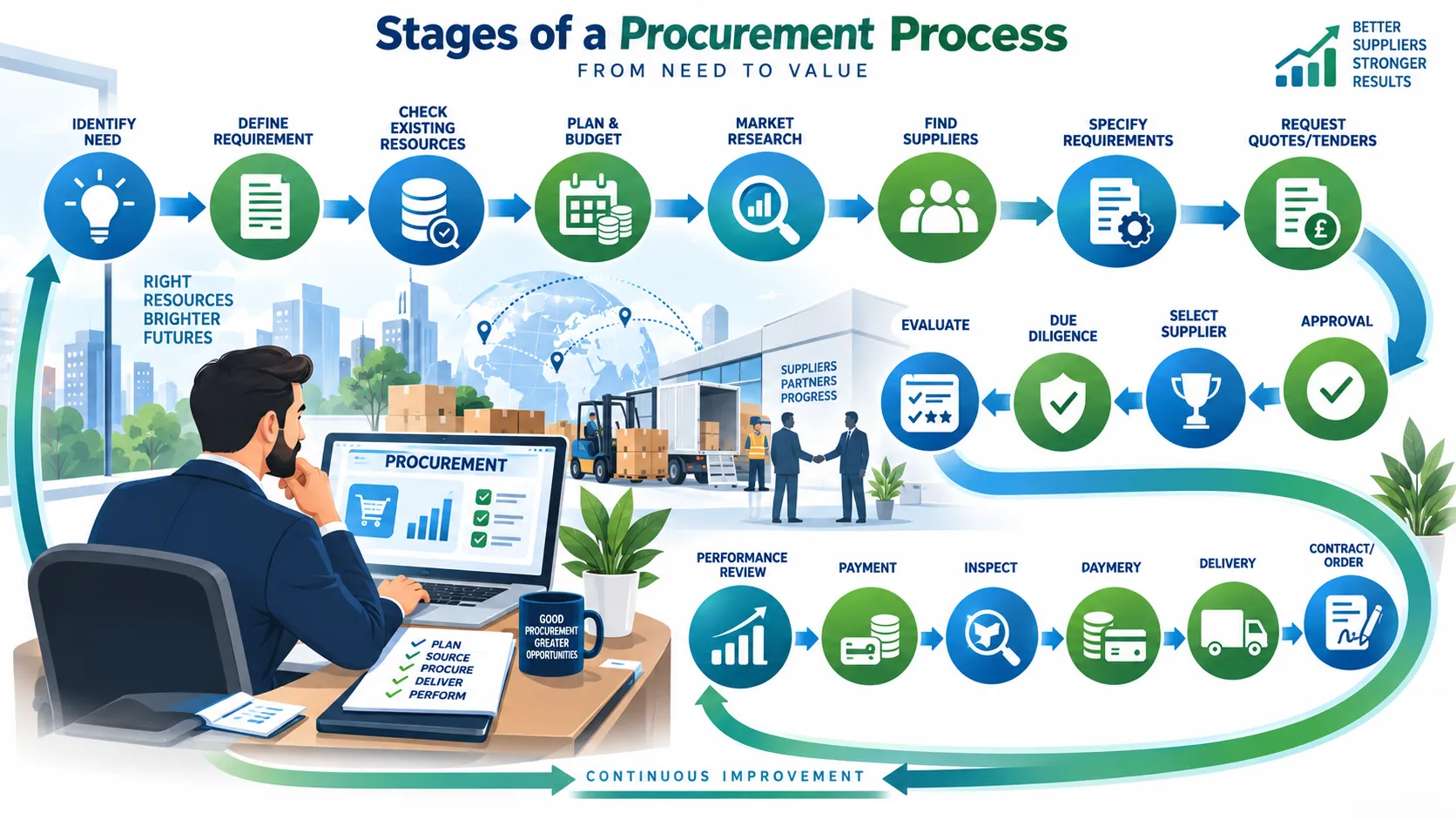
A typical procurement process can be represented as:
Need identification → Requirement definition → Procurement planning → Market research → Supplier identification → Procurement method → Specification → Quotation/tender → Supplier evaluation → Selection → Approval → Contract/order → Delivery → Inspection → Payment → Supplier management → Performance review
The exact stages and level of formality may vary according to the organisation, value and complexity of the procurement, but the underlying principles remain consistent.
Understanding the Procurement Process
Definition of a Procurement Process
A procurement process is a structured sequence of activities used by an organisation to identify a resource requirement, determine how the requirement will be met, obtain suitable goods or services from an appropriate source, and manage the resulting supplier or purchasing arrangement.
The procurement process connects organisational requirements with available supply.
It helps answer:
What is required?
Why is it required?
How much is required?
When is it required?
What specification must it meet?
How will it be sourced?
Who can supply it?
How will suppliers be evaluated?
What will it cost?
What risks exist?
Who has authority to approve the purchase?
How will delivery be managed?
How will supplier performance be monitored?
Procurement Process Versus Purchasing
Purchasing is usually concerned with the transaction of buying a good or service. Procurement is broader and includes planning, sourcing, evaluation, contracting and supplier management.
For example, placing an order for 20 laptops is a purchasing activity. The wider procurement process may involve:
Identifying why the laptops are required.
Confirming the number of users.
Defining technical requirements.
Confirming the budget.
Researching suppliers.
Comparing products.
Evaluating security and compatibility.
Selecting the supplier.
Obtaining approval.
Agreeing terms.
Receiving and checking the laptops.
Monitoring supplier performance.
This distinction is important because effective procurement focuses on achieving organisational value rather than simply completing a transaction.
Why a Structured Procurement Process Is Important
A structured procurement process provides consistency and control.
Without an appropriate process, organisations may experience:
Unnecessary purchases
Poor supplier selection
Excessive expenditure
Inadequate specifications
Poor-quality resources
Delivery delays
Contractual problems
Supplier dependency
Compliance failures
Fraud risks
Weak accountability
Poor value for money
A structured process creates a logical sequence in which managers can evaluate the requirement before making financial or contractual commitments.
It also supports organisational governance by establishing clear responsibilities, approval points and records.
Overview of the Main Procurement Stages
| Procurement stage | Definition | Main purpose | Typical management activities |
|---|---|---|---|
| Identify need | Establish the organisational requirement | Confirm why procurement is necessary | Analyse objectives, demand and resource gaps |
| Define requirement | Specify what is needed | Create a clear basis for procurement | Determine quantity, quality, specification and timing |
| Plan procurement | Establish how procurement will be managed | Ensure appropriate resources and controls | Budget, timeline, responsibilities and procurement route |
| Market research | Understand available supply options | Identify potential solutions and suppliers | Research products, suppliers, prices and market conditions |
| Identify suppliers | Find suitable potential providers | Establish a credible supply base | Supplier research and due diligence |
| Select procurement method | Choose how suppliers will be approached | Ensure proportionate and compliant sourcing | Direct purchase, quotations, tendering or framework |
| Develop specification | Document required standards | Communicate organisational requirements | Technical, performance, quality and delivery requirements |
| Request quotations/tenders | Invite supplier proposals | Obtain comparable supplier information | Issue procurement documents and requirements |
| Evaluate responses | Assess supplier proposals | Compare options objectively | Cost, quality, capacity, risk and compliance evaluation |
| Select supplier | Choose preferred provider | Secure best overall value | Apply evaluation criteria and document decision |
| Obtain approval | Secure required authorisation | Maintain financial and governance control | Management, finance or procurement approval |
| Contract/order | Formalise agreement | Establish obligations and expectations | Agree price, terms, delivery and service requirements |
| Delivery | Obtain the resource | Make the resource available | Coordinate delivery and implementation |
| Inspection and acceptance | Check the resource | Confirm it meets requirements | Verify quantity, quality and specification |
| Payment | Settle supplier invoice | Complete financial transaction correctly | Match invoice with order and receipt |
| Supplier management | Manage ongoing relationship | Maintain expected performance | Monitor service, quality, cost and compliance |
| Review | Assess procurement outcome | Identify value and lessons learned | Evaluate performance and improve future procurement |
Stage 1: Identify the Need
The first stage is to establish whether there is a genuine organisational requirement for the resource.
Managers should not begin by asking which supplier should be used. The first question should be why the resource is required.
The requirement may arise because of:
Organisational growth
Increased customer demand
New operational objectives
Staff shortages
Equipment failure
Technology changes
New services
Regulatory requirements
Quality problems
Capacity constraints
Replacement requirements
Business continuity needs
Planned organisational change
The manager should identify the connection between the requirement and organisational objectives.
Questions Managers Should Ask
What problem or opportunity has created the requirement?
What organisational objective does it support?
What happens if the resource is not obtained?
Is the resource genuinely necessary?
Could the requirement be met through existing resources?
Is the requirement temporary or permanent?
What outcome is expected?
This stage prevents unnecessary procurement and ensures that purchasing decisions have a clear purpose.
Stage 2: Define the Requirement
Once the need has been established, the manager must define exactly what is required.
A poorly defined requirement can result in unsuitable products, unclear supplier responses and unnecessary expenditure.
The requirement should normally establish:
Quantity
Quality
Performance
Technical specification
Delivery location
Delivery date
Required capacity
Duration
Support requirements
Safety requirements
Compatibility
Sustainability requirements
The level of detail should be proportionate to the procurement.
For example, a routine stationery purchase may require a simple specification, whereas the procurement of specialist medical equipment, industrial machinery or complex technology may require extensive technical and performance requirements.
Stage 3: Assess Existing Resources
Before purchasing externally, managers should determine whether the requirement can be met internally.
Existing resources may include:
Employees
Equipment
Stock
Technology
Facilities
Budgets
Internal expertise
This assessment can prevent unnecessary expenditure.
For example, a department may request a new software system because employees are experiencing workload difficulties. However, analysis may reveal that an existing system has unused functionality that could solve the problem with configuration or training.
Managers should therefore consider whether the solution is:
Buy
Make
Reuse
Reallocate
Repair
Upgrade
Share
Develop
before automatically choosing external procurement.
Stage 4: Procurement Planning
Procurement planning establishes how the procurement will be managed.
A procurement plan may identify:
Requirement
Budget
Timescale
Procurement method
Responsible individuals
Approval requirements
Evaluation criteria
Supplier engagement
Risk management
Contract requirements
Delivery arrangements
Performance measures
Planning is particularly important for high-value or complex procurement.
It allows managers to identify potential problems before they occur.
Procurement Planning Questions
Managers should consider:
How much will the procurement cost?
When is the resource required?
How long will procurement take?
Who is responsible?
What approvals are needed?
What procurement route should be used?
What risks exist?
What information is required from suppliers?
How will suppliers be evaluated?
How will performance be measured?
Stage 5: Establish the Budget
The procurement budget should be confirmed before the organisation commits to a purchase.
Managers should consider both the initial cost and ongoing costs.
These may include:
Purchase price
Delivery
Installation
Training
Maintenance
Licensing
Support
Insurance
Storage
Upgrades
Replacement
Disposal
This is known as considering the whole-life cost.
Why Whole-Life Cost Matters
A resource that appears inexpensive initially may create higher long-term costs.
For example, a low-cost printer may have expensive consumables and frequent maintenance requirements. A higher-priced model may have lower operating costs and greater reliability.
Managers should therefore consider total cost rather than purchase price alone.
Stage 6: Conduct Market Research
Market research involves gathering information about available products, services, suppliers, prices and market conditions.
Managers can use:
Supplier websites
Product information
Industry information
Professional networks
Previous procurement records
Supplier references
Market reports
Existing framework arrangements
Benchmarking information
Internal experience
Market research helps managers understand what solutions are available before selecting a procurement route.
It can also identify alternative solutions that may meet the requirement more effectively.
Stage 7: Identify Potential Suppliers
Potential suppliers should be identified based on their ability to meet the requirement.
Supplier selection should consider more than availability.
Relevant factors may include:
Experience
Capacity
Technical capability
Financial stability
Quality
Reliability
Delivery capability
Customer service
Compliance
Security
Sustainability
Business continuity
The number of suppliers considered should reflect the procurement requirements and organisational procedures.
Stage 8: Select the Appropriate Procurement Method
Different procurement situations require different sourcing methods.
Possible approaches include:
Direct purchasing
Single quotation
Multiple quotations
Competitive tender
Framework agreement
Preferred supplier arrangement
Contract procurement
Outsourcing
Partnership arrangements
The appropriate method depends on:
Procurement value
Risk
Complexity
Urgency
Organisational policy
Market conditions
Applicable requirements
Managers should use a proportionate approach.
A routine low-value purchase may require a simpler procedure than a major strategic contract.
Stage 9: Develop the Procurement Specification
The specification communicates the organisation’s requirements to potential suppliers.
An effective specification should be:
Clear
Accurate
Relevant
Measurable
Achievable
Unambiguous
Proportionate
It should avoid unnecessary restrictions that prevent suitable suppliers from competing.
Example of a Weak Specification
“Provide good computers for our staff.”
This is too vague.
Example of a Stronger Specification
“Provide 30 business laptops suitable for daily office productivity, video conferencing and approved organisational software, with required security features, warranty support and delivery within the agreed implementation period.”
The second specification gives suppliers clearer information and creates stronger evaluation criteria.
Stage 10: Request Quotations, Proposals or Tenders
Depending on the procurement method, suppliers may be asked to provide:
Quotations
Proposals
Tenders
Pricing schedules
Technical responses
Service plans
Delivery schedules
Contract information
The procurement documentation should provide suppliers with sufficient information to respond accurately.
Where competition is used, suppliers should generally receive consistent information so that responses can be compared fairly.
Stage 11: Evaluate Supplier Responses
Supplier responses should be evaluated using clear and relevant criteria.
Possible criteria include:
Price
Quality
Technical capability
Delivery
Capacity
Service
Experience
Risk
Sustainability
Compliance
Support
Strategic fit
Evaluation should be objective and evidence-based.
Managers should avoid allowing personal preference or familiarity with a supplier to determine the outcome.
Weighted Evaluation
For more complex procurement, criteria may be given different levels of importance.
For example:
| Evaluation criterion | Example weighting |
|---|---|
| Quality and technical capability | 30% |
| Cost and whole-life value | 25% |
| Delivery and implementation | 15% |
| Supplier experience and capability | 10% |
| Service and support | 10% |
| Risk and compliance | 10% |
The weighting should reflect organisational priorities and the nature of the procurement.
Stage 12: Conduct Supplier Due Diligence
Due diligence involves checking whether a potential supplier is suitable and capable of delivering the requirement.
Depending on the procurement, this may involve assessing:
Financial position
Relevant experience
References
Quality assurance
Certifications
Capacity
Insurance
Security
Compliance
Business continuity
Previous performance
Due diligence helps reduce the risk of selecting a supplier that cannot fulfil the contract.
Stage 13: Select the Preferred Supplier
After evaluation, the organisation identifies the supplier that provides the strongest overall solution.
The preferred supplier should meet the essential requirements and provide appropriate value.
The decision should be supported by documented evidence.
Managers should be able to explain:
Which suppliers were evaluated.
What criteria were used.
How the responses performed.
Why the preferred supplier was selected.
What risks were identified.
How the decision supports organisational objectives.
Stage 14: Obtain Appropriate Approval
Procurement decisions may require approval before an organisation enters into a financial or contractual commitment.
Approval requirements may depend on:
Purchase value
Budget
Procurement method
Contract duration
Risk
Organisational policy
Approval may involve:
Line management
Finance
Procurement
Senior management
Legal or compliance functions
IT or information security teams
Managers should understand their delegated authority and avoid committing the organisation beyond their authority.
Stage 15: Negotiate Terms Where Appropriate
Negotiation may form part of some procurement processes.
Potential areas for negotiation include:
Price
Payment terms
Delivery
Warranty
Service levels
Support
Contract duration
Implementation
Training
Performance measures
Negotiation should be conducted professionally and within organisational authority.
The objective should be to establish terms that provide appropriate value and protect organisational interests.
Stage 16: Formalise the Contract or Purchase Order
Once the supplier has been selected and approvals obtained, the arrangement should be formally documented.
Depending on the procurement, this may involve:
Purchase order
Contract
Service agreement
Framework agreement
Statement of work
Terms and conditions
Documentation should clearly establish:
What will be provided
Quantity
Specification
Price
Delivery
Responsibilities
Payment
Quality requirements
Performance standards
Reporting
Change procedures
Contract duration
Termination provisions
Stage 17: Manage Delivery
After the order or contract is established, managers should ensure that delivery is coordinated effectively.
Delivery management may involve:
Confirming delivery dates
Preparing facilities
Coordinating staff
Arranging installation
Planning training
Preparing systems
Communicating with stakeholders
Managing implementation risks
A supplier can meet contractual requirements but still fail to provide an effective operational outcome if implementation is poorly managed.
Stage 18: Inspect and Accept the Resource
The organisation should check that the goods or services received meet the agreed requirements.
Checks may include:
Quantity
Specification
Quality
Functionality
Condition
Delivery date
Documentation
Safety
Performance
If the resource does not meet requirements, the issue should be recorded and addressed through the appropriate supplier or contract management process.
Stage 19: Process Payment
Payment should normally occur according to agreed terms and organisational financial controls.
Managers or designated staff may need to confirm that:
The order was authorised.
The goods or services were received.
The invoice is accurate.
The agreed price has been applied.
Any discrepancies are resolved.
Effective financial controls reduce the risk of incorrect payments and procurement fraud.
Stage 20: Manage the Supplier Relationship
Supplier management is particularly important for ongoing contracts.
Managers should maintain appropriate communication and monitor whether the supplier is delivering as agreed.
Supplier relationship management may include:
Regular performance meetings
Service reports
Performance reviews
Issue management
Contract reviews
Improvement plans
Relationship management
The relationship should remain professional and focused on organisational requirements.
Stage 21: Monitor Supplier Performance
Performance should be measured against agreed requirements.
Possible measures include:
On-time delivery
Quality
Cost
Response time
Service availability
Defect rates
Customer satisfaction
Contract compliance
Issue resolution
Service-level performance
Performance data allows managers to identify problems early.
Stage 22: Review Procurement Outcomes
The final stage involves reviewing whether the procurement achieved its intended purpose.
Managers should consider:
Did the resource meet the requirement?
Was it delivered on time?
Was the expected quality achieved?
Was the budget maintained?
Did the supplier perform effectively?
Were risks managed?
Did the resource contribute to the organisational objective?
What lessons can be applied to future procurement?
The review should not focus solely on whether the purchase was completed. It should assess whether the procurement produced the intended organisational outcome.
The Procurement Process as a Continuous Cycle
Although procurement can be represented as a sequence of stages, effective procurement is not simply a linear process.
The review stage should feed lessons back into future procurement planning.
The cycle can therefore be represented as:
Need → Plan → Source → Evaluate → Select → Contract → Deliver → Monitor → Review → Improve
This creates continuous learning.
For example, if an organisation discovers that suppliers regularly struggle to meet a particular delivery requirement, future procurement specifications may need to include stronger delivery criteria.
Factors That Influence the Procurement Process
The exact procurement process can vary according to several factors.
Procurement Value
Higher-value procurement may require greater scrutiny and formal controls.
Complexity
A complex technology implementation requires a more detailed process than a routine purchase of office supplies.
Risk
High-risk procurement requires stronger due diligence, controls and monitoring.
Urgency
Urgent requirements may require faster procurement procedures, subject to applicable organisational controls.
Strategic Importance
Strategically important resources may require senior management involvement.
Market Conditions
Limited supplier availability may affect the procurement method and negotiation position.
Resource Criticality
If a resource is essential to operational continuity, managers may require contingency arrangements.
Practical Example 1: Procurement of Office Equipment
An organisation needs 50 new laptops because existing devices are approaching the end of their useful life.
The manager follows the procurement process.
First, the need is established. The replacement supports operational continuity and employee productivity.
The manager then defines the requirement:
50 laptops
Required technical specification
Security features
Compatibility
Warranty
Delivery timeframe
Support
The budget is confirmed and suitable suppliers are researched.
Several supplier options are compared based on:
Price
Technical specification
Warranty
Delivery
Support
Reliability
The preferred supplier is selected, approval is obtained and an order is placed.
On delivery, the laptops are checked against the specification before acceptance.
The manager then reviews supplier performance and records lessons for future procurement.
Practical Example 2: Procurement of Training Services
An organisation needs specialist leadership training for middle managers.
The manager first identifies the learning requirement and expected organisational outcome.
The specification may include:
Target participants
Required subject areas
Delivery format
Duration
Learning outcomes
Trainer expertise
Evaluation requirements
Delivery schedule
Support requirements
Potential providers are identified and evaluated.
The manager considers:
Trainer experience
Relevant expertise
Programme quality
Cost
Flexibility
References
Delivery capability
Evaluation arrangements
The selected provider is then contracted and performance is monitored.
The manager evaluates not only whether the training was delivered but also whether it met the intended organisational objectives.
Practical Example 3: Procurement of Manufacturing Materials
A manufacturing organisation requires a regular supply of raw materials.
The procurement process needs to consider:
Required quantities
Quality specifications
Delivery frequency
Supplier capacity
Storage requirements
Price
Lead times
Reliability
Supply continuity
A supplier offering the lowest price may not be selected if its delivery reliability is poor.
The manager may instead select a supplier offering better overall value and consider a second supplier as a contingency.
Practical Example 4: Procurement of IT Services
An organisation requires external IT support.
The manager defines the service requirements, including:
Helpdesk availability
Response times
Resolution times
Security
System monitoring
Technical expertise
Reporting
Data handling
Business continuity
Potential providers are evaluated using these criteria.
The contract establishes measurable service levels.
Supplier performance is then reviewed through:
Response-time reports
Resolution statistics
User feedback
Security incidents
Service availability
This demonstrates the importance of continuing procurement management after contract award.
Common Procurement Process Failures
Starting With the Supplier Instead of the Need
Managers should first establish what the organisation needs rather than beginning with a preferred supplier.
Poor Specification
An unclear requirement makes supplier comparison difficult.
Selecting Based Only on Price
Price should be evaluated alongside quality, risk, service and total cost.
Insufficient Supplier Due Diligence
Failure to check supplier capability can create significant operational risk.
Inadequate Approval
Procurement without appropriate authorisation can create financial and governance problems.
Poor Record Keeping
Weak documentation makes procurement decisions difficult to audit or justify.
Failure to Monitor Delivery
Managers should verify that goods or services actually meet requirements.
Weak Contract Management
Selecting a good supplier does not guarantee good performance if the contract is not monitored.
Failure to Learn
Procurement problems should generate lessons for future purchasing decisions.
Key Benefits of a Structured Procurement Process
Financial Control
A structured process helps organisations control expenditure and avoid unnecessary purchases.
Better Value for Money
Comparing options helps managers balance cost against quality, performance and benefits.
Improved Quality
Clear specifications and supplier evaluation help secure appropriate resources.
Reduced Risk
Due diligence and risk assessment reduce the likelihood of supplier and procurement failures.
Better Accountability
Clear approvals and records make decisions easier to explain and review.
Improved Supplier Performance
Performance monitoring helps managers maintain expected standards.
Operational Continuity
Effective procurement ensures that essential resources are available when required.
Strategic Alignment
Procurement can be directly connected to organisational objectives.
Greater Transparency
Clear processes support fair and consistent decision-making.
Continuous Improvement
Procurement reviews create opportunities to improve future processes and outcomes.
Managerial Checklist for the Procurement Process
Before completing a procurement, managers should be able to confirm that:
The organisational need has been clearly identified.
The procurement supports an organisational objective.
Existing internal resources have been considered.
The requirement is clearly specified.
Quantity and quality requirements are understood.
The budget is confirmed.
Total cost has been considered.
Procurement risks have been assessed.
The appropriate procurement method has been selected.
Suitable suppliers have been identified.
Supplier capability has been assessed.
Evaluation criteria are clear.
Supplier responses have been evaluated objectively.
The preferred supplier provides appropriate value.
Required approvals have been obtained.
Contract or purchase documentation is clear.
Delivery requirements are understood.
Goods or services are checked upon receipt.
Payment is appropriately controlled.
Supplier performance is monitored.
Procurement outcomes are reviewed.
Lessons are captured for future procurement.
Key Concepts to Remember
The stages of a procurement process provide a structured route from identifying an organisational requirement to reviewing procurement outcomes.
The key concepts are:
Need identification
Requirement definition
Internal resource assessment
Procurement planning
Budget management
Market research
Supplier identification
Procurement method
Specification
Quotations and tenders
Supplier evaluation
Due diligence
Supplier selection
Approval
Contracting
Delivery
Inspection
Payment
Supplier relationship management
Performance monitoring
Procurement review
Continuous improvement
The stages should work together rather than being treated as isolated administrative activities.
Professional Management Insight
Effective procurement requires managers to understand the difference between completing a purchasing transaction and achieving a successful procurement outcome.
A purchase can be completed on time and within budget while still failing to achieve its organisational purpose. For example, an organisation may purchase new technology within the approved budget, but if the technology does not integrate with existing systems or employees cannot use it effectively, the procurement has not delivered its intended value.
Successful procurement therefore extends beyond purchase completion.
Managers should think in terms of:
Requirement → Solution → Value → Outcome
rather than simply:
Requirement → Purchase
The strongest managers also recognise that procurement is a cross-functional activity. Finance may provide budget control, procurement specialists may manage sourcing procedures, legal teams may support contracts, IT may assess technology requirements, human resources may advise on workforce-related procurement and operational managers may monitor delivery.
Effective collaboration between these functions can improve procurement quality and reduce risk.
Another important principle is proportionality. Not every procurement requires the same level of formality. A manager should understand the organisation’s procurement framework and apply appropriate controls according to value, risk and complexity.
Procurement should also be viewed as an ongoing management cycle. Supplier performance information, user feedback, cost data and operational outcomes should influence future procurement decisions.
A mature procurement process therefore follows:
Plan → Source → Evaluate → Select → Contract → Deliver → Monitor → Review → Improve
Summary
The procurement process consists of a series of connected stages that enable an organisation to identify requirements, source suitable resources, select appropriate suppliers, formalise agreements, manage delivery and evaluate outcomes.
The process begins with identifying a genuine organisational need. Managers then define the requirement, assess existing resources, plan procurement, establish budgets, conduct market research and identify potential suppliers.
The organisation then selects an appropriate procurement method, develops a clear specification and requests quotations, proposals or tenders where required. Supplier responses are evaluated using appropriate criteria covering cost, quality, capacity, delivery, risk, compliance and value.
After selecting a preferred supplier, appropriate approval must be obtained before the organisation enters into a contractual or financial commitment. The contract or purchase order should clearly define requirements, responsibilities, pricing, delivery and performance expectations.
Once the resource is delivered, it should be checked against the agreed specification. Payment should be controlled through appropriate financial procedures, and supplier performance should be monitored throughout the relationship.
Finally, procurement outcomes should be reviewed to determine whether the resource achieved its intended purpose and whether lessons can improve future procurement activity.
For practising and aspiring middle managers and leaders, understanding these stages provides a practical framework for making procurement decisions that are structured, transparent, evidence-based and aligned with organisational objectives.
The central principle is that effective procurement is not simply about buying resources. It is about managing the complete process from identifying the need to achieving the intended organisational outcome.
A well-managed procurement process helps organisations obtain the right resource, from an appropriate supplier, at the right time, to the required standard, at an acceptable overall cost and with appropriate control of risk and compliance.
3.Develop Criteria for Resource Specifications
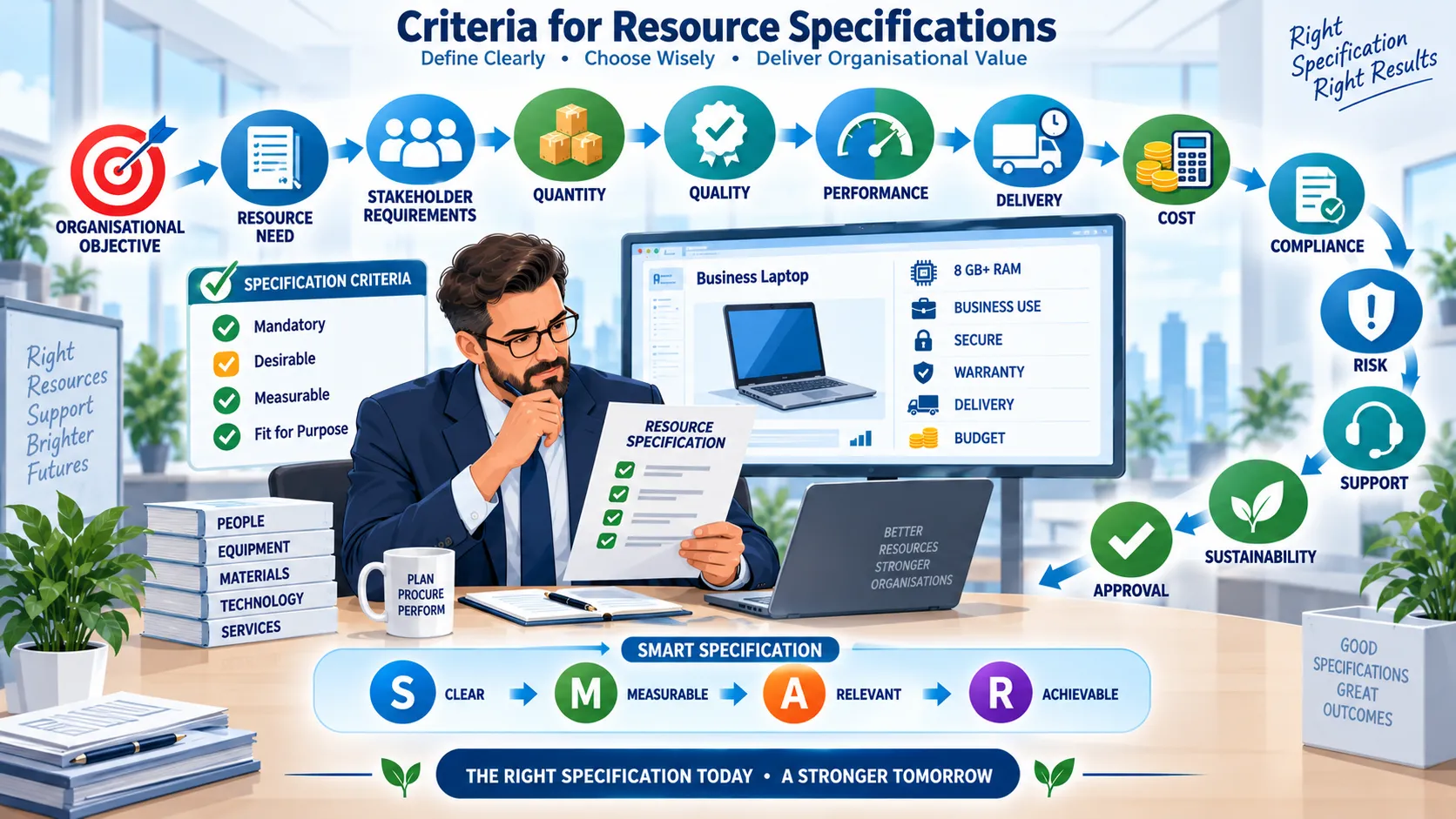
Developing appropriate criteria for resource specifications is an essential stage of effective procurement and resource management. Before an organisation approaches suppliers, requests quotations or evaluates products and services, managers need to establish exactly what the required resource must achieve. Clear specification criteria provide a structured basis for describing requirements, comparing potential solutions and determining whether a resource is suitable for organisational use.
A resource specification should translate an organisational or operational requirement into clear, measurable and realistic expectations. It should help suppliers understand what the organisation needs while enabling managers to assess whether proposed resources meet those requirements. Without clear criteria, procurement decisions can become subjective, inconsistent or overly focused on price.
For practising and aspiring middle managers and leaders, the ability to develop resource specification criteria is particularly important because procurement decisions can affect operational performance, financial control, quality, compliance, employee productivity and customer outcomes. A manager may not personally conduct every stage of a procurement exercise, but they may be responsible for defining the operational requirement and ensuring that the specification reflects what the organisation genuinely needs.
Effective specification criteria should answer several fundamental questions:
What resource is required?
What purpose will it serve?
What must the resource be capable of doing?
What quantity is required?
What quality standard is required?
What performance level is expected?
When and where must it be available?
What safety requirements apply?
What compatibility requirements exist?
What support or maintenance is required?
What legal or regulatory requirements apply?
What sustainability considerations are relevant?
How will the organisation determine whether the resource meets the specification?
The overall objective is to create criteria that are sufficiently detailed to protect organisational interests while remaining realistic, measurable and proportionate.
Understanding Resource Specifications
Definition of a Resource Specification
A resource specification is a clear description of the requirements, characteristics, standards, performance expectations and conditions that a resource must meet to be suitable for an organisation’s intended purpose.
A specification can apply to:
People and staffing resources
Equipment
Machinery
Materials
Products
Technology
Software
Facilities
Vehicles
Professional services
Training services
Maintenance services
External contractors
Consumable resources
The exact content of a specification depends on the type of resource being procured.
For example, a specification for office stationery may be relatively simple, while a specification for a new information management system may need to address functionality, security, integration, accessibility, performance, user capacity, implementation and support.
Definition of Specification Criteria
Specification criteria are the specific characteristics or conditions used to define, evaluate and measure whether a proposed resource meets organisational requirements.
Criteria provide a basis for deciding whether a resource is:
Essential
Acceptable
Preferred
Unsuitable
Effective criteria should be sufficiently clear that different people applying them are likely to reach similar conclusions.
Why Resource Specification Criteria Matter
A clear specification is one of the foundations of successful procurement.
If requirements are unclear, suppliers may interpret the organisation’s needs differently. This can make proposals difficult to compare and may result in the purchase of resources that technically satisfy a vague requirement but fail to meet the operational need.
For example, an organisation requiring a new laptop system may simply state that it needs “high-performance computers”. Different suppliers may interpret high performance differently. One may offer devices designed for general office work, while another may offer equipment designed for specialist technical applications.
A stronger specification would define the required processing capability, memory, storage, operating environment, security, connectivity, software compatibility, warranty and expected lifespan.
Clear criteria therefore improve:
Procurement accuracy
Supplier communication
Supplier comparison
Cost control
Quality assurance
Accountability
Risk management
Operational outcomes
Linking Specifications to Organisational Objectives
Specification criteria should begin with the organisational objective rather than with a preferred product or supplier.
The management relationship can be expressed as:
Organisational objective → Operational requirement → Resource requirement → Specification criteria → Procurement → Resource delivery → Organisational outcome
For example, an organisation may have an objective to improve customer response times.
The operational requirement may be to increase customer service capacity.
The resource requirement may include additional staff and customer management technology.
The specification criteria might then include:
Required number of users
System capacity
Response time
Security
Integration
Availability
Training
Technical support
This approach ensures that procurement is connected to organisational performance.
Core Principles for Developing Specification Criteria
Principle 1: Clarity
Specification criteria should be easy to understand.
Ambiguous terms such as:
Good quality
Fast
Reliable
Modern
User-friendly
High performance
should be avoided unless they are defined through measurable requirements.
For example, instead of saying “fast delivery”, specify an appropriate delivery timeframe.
Instead of “reliable equipment”, define an appropriate availability or performance expectation where this can reasonably be measured.
Clear criteria reduce misunderstandings between managers, procurement teams and suppliers.
Principle 2: Specificity
Criteria should provide enough detail to define the requirement accurately.
Specificity may include:
Quantity
Dimensions
Capacity
Performance
Functionality
Materials
Technical characteristics
Service levels
Delivery requirements
The level of detail should be proportionate to the procurement.
Overly general criteria can create ambiguity, while excessive technical detail may unnecessarily restrict the supplier market.
Principle 3: Measurability
Where practical, criteria should be measurable.
Measurable criteria allow managers to determine whether a supplier has met the requirement.
Examples include:
Delivery within 10 working days
System availability of at least an agreed percentage
Capacity for a defined number of users
Maximum response time
Minimum storage capacity
Maximum acceptable defect rate
Measurability is particularly important when procurement involves performance-based services.
Principle 4: Relevance
Every criterion should have a clear connection to the organisational requirement.
Managers should avoid including features simply because they are attractive or available.
A criterion should answer:
“What organisational need does this requirement address?”
If the answer is unclear, the criterion may not be necessary.
Principle 5: Achievability
Specification criteria should be realistic.
An organisation may want a resource to provide the highest possible quality, unlimited capacity, immediate delivery and the lowest possible cost. In practice, these requirements may conflict.
Managers therefore need to balance expectations with:
Budget
Market availability
Timescale
Technology
Supplier capability
Operational requirements
Achievable specifications increase the likelihood of receiving realistic supplier responses.
Principle 6: Proportionality
The specification should reflect the importance, value and risk of the procurement.
A low-value purchase does not normally require the same level of technical specification as a major strategic procurement.
Managers should consider:
Financial value
Operational importance
Risk
Complexity
Resource criticality
Contract duration
Principle 7: Outcome Orientation
Specifications should focus on the outcome that the resource needs to support.
For example, rather than specifying a particular software brand, an organisation may specify the functions and outcomes the system must provide.
This can allow suppliers to offer alternative solutions and encourage innovation.
Principle 8: Compatibility
Where a resource must work with existing organisational systems, equipment or processes, compatibility should be included as a criterion.
Compatibility can relate to:
Software
Hardware
IT infrastructure
Communication systems
Data formats
Operational processes
Physical facilities
Failure to consider compatibility can result in additional costs after procurement.
Principle 9: Safety
Where relevant, specifications should include appropriate health and safety requirements.
Depending on the resource, these may concern:
Safe operation
Protective features
User safety
Maintenance
Installation
Training
Emergency procedures
Safety criteria should reflect the nature and risks of the resource.
Principle 10: Compliance
Specification criteria should reflect applicable legal, regulatory and organisational requirements.
Depending on the resource, this may involve:
Product standards
Data protection
Information security
Health and safety
Employment requirements
Environmental requirements
Sector-specific requirements
Organisational policies
Compliance requirements should be identified before suppliers are evaluated.
Principle 11: Value for Money
Specification criteria should support value for money.
Managers should avoid unnecessarily demanding specifications that increase costs without providing meaningful organisational benefits.
For example, purchasing equipment with significantly greater capacity than required may create unnecessary expenditure.
At the same time, reducing specifications below the level required for effective performance may result in poor value.
The appropriate specification should provide the required capability at an appropriate total cost.
Principle 12: Flexibility
Some resources need to adapt to changing organisational requirements.
Where relevant, specifications may therefore include:
Scalability
Expandability
Adjustable capacity
Modular features
Flexible contracts
Upgrade options
Flexibility is particularly important for technology and resources affected by changing demand.
Types of Criteria Used in Resource Specifications
Quantity Criteria
Quantity defines how much of a resource is required.
Examples include:
Number of employees
Number of computers
Number of vehicles
Amount of raw material
Number of software licences
Number of training places
Quantity should be based on evidence such as demand, workload, capacity and forecast requirements.
Overestimating quantity can create unnecessary expenditure, while underestimating quantity can create shortages.
Quality Criteria
Quality criteria describe the standard the resource must achieve.
Examples include:
Durability
Accuracy
Reliability
Performance
Safety
Appearance where relevant
Compliance
Service quality
Quality criteria should be linked to actual organisational requirements.
Performance Criteria
Performance criteria define what the resource must be capable of achieving.
Examples include:
Processing capacity
Response time
Availability
Output
Accuracy
Speed
Efficiency
Service levels
Performance criteria are particularly useful for technology, equipment and outsourced services.
Technical Criteria
Technical criteria specify characteristics necessary for functionality and compatibility.
Examples include:
Processing capability
Storage
Connectivity
Operating environment
Technical standards
Dimensions
Power requirements
Software compatibility
Technical criteria should be developed with appropriate subject-matter expertise where necessary.
Delivery Criteria
Delivery criteria define when and where the resource must be supplied.
They may include:
Delivery date
Delivery window
Delivery location
Installation
Packaging
Transportation
Implementation schedule
Delivery criteria are particularly important when procurement is linked to a specific project or operational deadline.
Service and Support Criteria
For services and technology, support requirements may be essential.
These can include:
Helpdesk availability
Response times
Technical support
Maintenance
Training
Repairs
Replacement
Service-level agreements
Reporting
A product without appropriate support may not deliver its intended organisational value.
Financial Criteria
Financial criteria should consider:
Purchase price
Operating cost
Maintenance
Licensing
Installation
Training
Support
Replacement
Disposal
Managers should consider whole-life cost rather than only the initial price.
Sustainability Criteria
Where relevant, sustainability criteria may include:
Energy efficiency
Product lifespan
Recyclability
Packaging
Waste
Sustainable materials
Transport
Environmental management
These criteria can support organisational sustainability objectives.
Risk Criteria
Risk-related criteria may address:
Supplier resilience
Business continuity
Information security
Safety
Reliability
Supply continuity
Data handling
Operational dependency
The level of risk assessment should reflect the importance of the procurement.
Essential, Desirable and Optional Criteria
One of the most useful techniques for developing specifications is to distinguish between different levels of requirement.
Essential Criteria
Essential criteria are requirements that must be met.
Examples include:
Legal compliance
Safety
Required functionality
Minimum capacity
Critical compatibility
Mandatory delivery requirements
Failure to meet an essential criterion may make a supplier or product unsuitable.
Desirable Criteria
Desirable criteria are features that would provide additional benefit but are not essential.
Examples may include:
Additional functionality
Enhanced support
Extended warranty
Additional reporting features
Optional Criteria
Optional criteria may provide additional value where cost and circumstances permit.
This classification helps managers prioritise what genuinely matters.
Developing Effective Specification Criteria
A structured process can help managers develop appropriate criteria.
Stage 1: Understand the Organisational Objective
Begin by identifying what the procurement is intended to achieve.
Questions include:
What organisational objective does it support?
What operational problem needs to be addressed?
What outcome is expected?
Stage 2: Identify the Resource Requirement
Determine what resource is required.
Consider:
Type
Quantity
Timing
Location
Duration
Users
Purpose
Stage 3: Consult Stakeholders
Relevant stakeholders should be involved where appropriate.
Stakeholders may include:
Managers
Employees
Finance
Procurement
IT
Health and safety
Customers
Technical specialists
Compliance teams
Stakeholder involvement can identify practical requirements that may otherwise be overlooked.
Stage 4: Identify Mandatory Requirements
Determine which requirements must be met.
These may relate to:
Safety
Compliance
Functionality
Capacity
Compatibility
Quality
Stage 5: Identify Performance Requirements
Define what the resource needs to achieve.
Managers should consider measurable outcomes where possible.
Stage 6: Determine Quality Standards
Identify the level of quality required for effective performance.
Stage 7: Determine Cost Requirements
Establish budget constraints and consider whole-life cost.
Stage 8: Consider Risk
Identify risks that the specification should address.
Stage 9: Consider Flexibility and Future Requirements
Determine whether the resource needs to accommodate future changes.
Stage 10: Consider Sustainability
Identify relevant environmental and social considerations.
Stage 11: Test the Specification
Before issuing the specification, managers should check whether it is:
Clear
Complete
Relevant
Measurable
Achievable
Proportionate
Non-ambiguous
Stage 12: Approve and Document
The final specification should be documented and approved according to organisational procedures.
A Practical Specification Development Framework
Managers can use the following framework:
PURPOSE → FUNCTION → QUANTITY → QUALITY → PERFORMANCE → DELIVERY → COST → COMPLIANCE → RISK → SUPPORT → SUSTAINABILITY → REVIEW
This framework encourages managers to consider the complete requirement rather than focusing only on the product itself.
Developing Criteria for Different Resource Types
Human Resource Specifications
When procuring external people or staffing services, criteria may include:
Qualifications
Experience
Technical skills
Competence
Availability
Number of personnel
Working hours
Performance expectations
Training
Safeguarding requirements where applicable
Professional standards
Managers should focus on required competence and outcomes rather than unnecessary personal characteristics.
Equipment Specifications
Equipment criteria may include:
Capacity
Dimensions
Performance
Reliability
Safety
Energy efficiency
Maintenance
Warranty
Compatibility
Expected lifespan
Materials Specifications
Materials may require criteria covering:
Quantity
Composition
Quality
Dimensions
Durability
Safety
Delivery
Storage
Sustainability
Technology Specifications
Technology procurement may require:
Functionality
User capacity
Security
Integration
Compatibility
Availability
Scalability
Support
Data requirements
Accessibility
Implementation
Training
Service Specifications
Services may require:
Service scope
Performance standards
Response times
Availability
Staffing
Reporting
Quality
Customer service
Contract management
Service-level measures
Using SMART Criteria
Specification criteria can benefit from SMART principles.
SMART means:
Specific
Measurable
Achievable
Relevant
Time-bound
For example, “provide reliable IT support” is difficult to measure.
A more useful criterion might define:
Required support hours
Maximum response time
Expected resolution period
Service availability
Reporting frequency
This makes supplier performance easier to evaluate.
Distinguishing Specification Criteria from Evaluation Criteria
These two concepts are related but different.
Specification criteria describe what the organisation requires.
Evaluation criteria describe how supplier proposals will be compared.
For example:
Specification requirement:
“The system must support the required number of authorised users.”
Evaluation criterion:
“Supplier proposal demonstrates capacity, scalability and technical capability.”
The distinction is important because managers should first establish what is required and then determine how supplier proposals will be evaluated against those requirements.
Avoiding Over-Specification
Over-specification occurs when requirements include unnecessary features or restrictions.
This can:
Increase costs
Reduce competition
Limit supplier options
Create unnecessary complexity
Reduce innovation
Managers should distinguish between essential functionality and preferences.
For example, specifying an exact brand when several products can meet the operational requirement may unnecessarily restrict the procurement.
Avoiding Under-Specification
Under-specification occurs when the requirements are too vague.
Examples include:
“Good quality”
“Fast service”
“Modern system”
“Experienced staff”
“Reliable supplier”
Without measurable definitions, suppliers may interpret these terms differently.
Under-specification can result in:
Poor supplier comparison
Disputes
Quality problems
Additional costs
Unclear expectations
Practical Example 1: Office Laptop Procurement
An organisation needs laptops for 40 employees.
The manager develops the following criteria:
Essential:
40 devices
Required operating system
Organisational security compatibility
Required processing capability
Minimum storage
Required connectivity
Warranty
Delivery within agreed timeframe
Desirable:
Extended battery performance
Enhanced support
Lightweight design
Optional:
Additional accessories
This approach prevents the organisation from purchasing unnecessary features while ensuring that operational requirements are protected.
Practical Example 2: Customer Service Software
A company wants to improve customer response times through a new customer management system.
The specification criteria include:
Support for the required number of users
Customer record management
Reporting
Workflow management
Secure access
Integration with existing systems
Appropriate availability
User support
Training
Implementation requirements
The manager then evaluates potential solutions against these criteria.
The supplier with the lowest price is not automatically selected. The manager considers whether the system provides the required functionality, security, capacity, support and long-term value.
Practical Example 3: Procurement of Raw Materials
A manufacturer needs a regular supply of raw materials.
Criteria may include:
Required quantity
Material specification
Quality tolerance
Delivery frequency
Lead time
Packaging
Storage requirements
Supplier capacity
Quality assurance
Sustainability requirements
Price
The specification enables suppliers to provide comparable proposals.
Practical Example 4: External Training Provider
An organisation needs leadership training for middle managers.
The specification could include:
Required learner group
Learning objectives
Subject coverage
Delivery format
Duration
Trainer experience
Assessment or evaluation methods
Materials
Delivery timescale
Reporting
Quality expectations
This allows the organisation to compare providers consistently.
Practical Example 5: Facilities Management Service
An organisation wants to procure facilities management services.
The specification may cover:
Cleaning frequency
Response times
Maintenance requirements
Staffing levels
Health and safety
Reporting
Emergency response
Quality standards
Sustainability
Service availability
Performance can then be measured against agreed service levels.
Key Benefits of Effective Resource Specification Criteria
Improved Procurement Accuracy
Clear criteria increase the likelihood that the organisation obtains the resource it actually needs.
Better Supplier Comparison
Consistent criteria allow suppliers to be evaluated against common requirements.
Improved Value for Money
Managers can distinguish between essential functionality and unnecessary features.
Better Quality
Clear quality and performance criteria help secure appropriate resources.
Reduced Risk
Specifications can incorporate safety, compliance, security and continuity requirements.
Improved Accountability
Documented criteria provide evidence of why a resource was selected.
Reduced Procurement Disputes
Clear expectations reduce ambiguity between the organisation and supplier.
Improved Contract Management
Well-defined requirements provide measurable standards for monitoring supplier performance.
Greater Operational Efficiency
Resources that are properly specified are more likely to support operational processes effectively.
Greater Organisational Alignment
Specification criteria can directly connect procurement decisions with organisational objectives.
Common Problems When Developing Specifications
Using Supplier Language Instead of Organisational Requirements
Managers should begin with organisational needs rather than simply copying a supplier’s product description.
Making Requirements Too General
Vague requirements make evaluation difficult.
Making Requirements Too Specific
Excessive technical detail may unnecessarily restrict suppliers.
Ignoring Users
Employees who will use a resource often understand practical requirements that managers may overlook.
Ignoring Total Cost
A specification should consider ongoing operating and maintenance costs where relevant.
Ignoring Compatibility
A new resource may create problems if it cannot work with existing systems.
Ignoring Future Requirements
Some resources need to accommodate growth or changing demand.
Failing to Prioritise
Not every requirement has equal importance.
Confusing Preferences with Needs
Managers should distinguish between what is essential and what is simply desirable.
Quality Assurance Before Issuing a Specification
Before a specification is released, managers should perform a quality check.
The specification should be reviewed for:
Accuracy
Completeness
Clarity
Consistency
Measurability
Achievability
Relevance
Proportionality
Compliance
Cost implications
Risk
Stakeholder requirements
Where specialist technical knowledge is required, the specification should be reviewed by an appropriate subject-matter expert.
Managerial Checklist
Before finalising resource specification criteria, managers should ask:
What organisational objective does this procurement support?
What problem or requirement is being addressed?
What resource is actually required?
How much is required?
When is it required?
Where will it be used?
Who will use it?
What must it be capable of doing?
What quality standard is required?
What performance level is required?
Which requirements are essential?
Which requirements are desirable?
Are the criteria measurable?
Are the requirements realistic?
Is the specification proportionate?
Is compatibility important?
What safety requirements apply?
What legal or regulatory requirements apply?
What support is required?
What are the whole-life costs?
What risks need to be addressed?
Are sustainability requirements relevant?
Have stakeholders been consulted?
Could the specification unnecessarily restrict competition?
Is the specification clear enough for suppliers to understand?
Can supplier performance be measured against the criteria?
Key Concepts to Remember
The key concepts in developing criteria for resource specifications include:
Resource specification
Specification criteria
Organisational alignment
Clear requirements
Measurability
Quality
Performance
Quantity
Capacity
Compatibility
Delivery
Cost
Whole-life cost
Risk
Compliance
Safety
Sustainability
Support
Flexibility
Essential criteria
Desirable criteria
Optional criteria
SMART requirements
Supplier evaluation
Contract performance
These concepts should be considered together when developing a specification.
Professional Management Insight
Developing resource specification criteria is fundamentally an exercise in translating organisational needs into measurable procurement requirements.
A weak specification often creates problems much later in the procurement process. If the organisation has not clearly defined what it needs, suppliers cannot reliably understand what is expected, procurement teams cannot compare responses effectively and contract managers may struggle to determine whether delivery meets expectations.
An effective manager therefore spends sufficient time defining the requirement before approaching suppliers.
The strongest approach is to begin with the desired organisational outcome and work backwards:
Desired outcome → Operational requirement → Resource requirement → Specification → Supplier evaluation → Delivery → Performance
Managers should also avoid designing a specification around a particular supplier or product unless there is a legitimate and properly justified organisational reason to do so. The specification should focus on what the organisation needs rather than unnecessarily restricting how suppliers meet the requirement.
Another important management principle is proportionality. A specification should be detailed enough to control quality and risk but not so restrictive that it increases costs or unnecessarily limits competition.
Managers should also recognise that specifications are living management documents. If organisational objectives, technology, demand, regulation or operational requirements change, specifications may need to be reviewed.
Ultimately, a good resource specification creates a common understanding between the organisation, procurement function, suppliers and operational users. It provides a clear foundation for sourcing, evaluation, contracting and performance management.
Summary
Developing criteria for resource specifications is an essential stage of effective procurement. It enables managers to translate organisational objectives and operational requirements into clear, measurable and realistic resource expectations.
Effective criteria should define what is required in terms of quantity, quality, performance, capacity, delivery, cost, support, compatibility, safety, compliance, risk and sustainability where relevant.
Managers should distinguish between essential, desirable and optional requirements so that procurement decisions remain focused on organisational priorities. Criteria should be clear, specific, measurable, relevant, achievable and proportionate.
A structured process should begin with understanding the organisational objective, identifying the resource requirement, consulting relevant stakeholders, establishing mandatory requirements, defining performance and quality expectations, considering cost and risk, addressing compliance and sustainability, and testing the specification before approval.
Clear resource specification criteria provide significant benefits. They improve supplier communication, support fair comparison, strengthen value-for-money decisions, reduce procurement risks, improve quality and provide measurable standards for contract and supplier performance.
For practising and aspiring middle managers and leaders, the key principle is that effective procurement starts with a clear definition of need. When managers develop strong specification criteria, they create a reliable foundation for the entire procurement process.
The ultimate goal is to ensure that the organisation does not simply purchase a resource, but obtains a resource that is fit for purpose, provides appropriate value, meets required standards and contributes directly to the achievement of organisational objectives.
4.Evaluate the Impact of Financial Performance on Project Outcomes and Analyse Methods for Selecting Suppliers
Financial performance and supplier selection are closely connected to successful resource procurement and organisational performance. When an organisation procures resources, managers must not only consider whether the required goods or services can be obtained, but also whether the financial consequences of procurement support the achievement of organisational objectives.
Financial performance refers to how effectively an organisation manages its income, expenditure, budgets, costs, cash flow and financial resources in relation to its objectives. In a procurement context, financial performance can be affected by purchase prices, supplier costs, contract terms, payment arrangements, operating costs, maintenance, delays, quality problems and unexpected expenditure.
Supplier selection is the process of identifying, evaluating and choosing the supplier that is most capable of meeting the organisation’s requirements and providing appropriate overall value. Selecting a supplier should therefore involve more than comparing prices. Managers should consider quality, capacity, reliability, delivery, financial stability, risk, compliance, sustainability, service and the supplier’s ability to contribute to organisational outcomes.
The two areas are closely related. A supplier that appears inexpensive may create poor financial performance if its products are unreliable, deliveries are late or maintenance costs are excessive. Similarly, a higher-priced supplier may provide better overall financial value if its resources improve productivity, reduce downtime and support higher-quality outcomes.
For practising and aspiring middle managers and leaders, this means procurement decisions should be evaluated from both a financial and operational perspective. The manager needs to understand not only how much a resource costs, but also what financial and organisational outcomes will result from obtaining and using that resource.
The overall relationship can be represented as:
Organisational objectives → Financial planning → Resource requirement → Supplier options → Supplier evaluation → Procurement decision → Resource delivery → Financial performance → Operational outcomes → Review and improvement
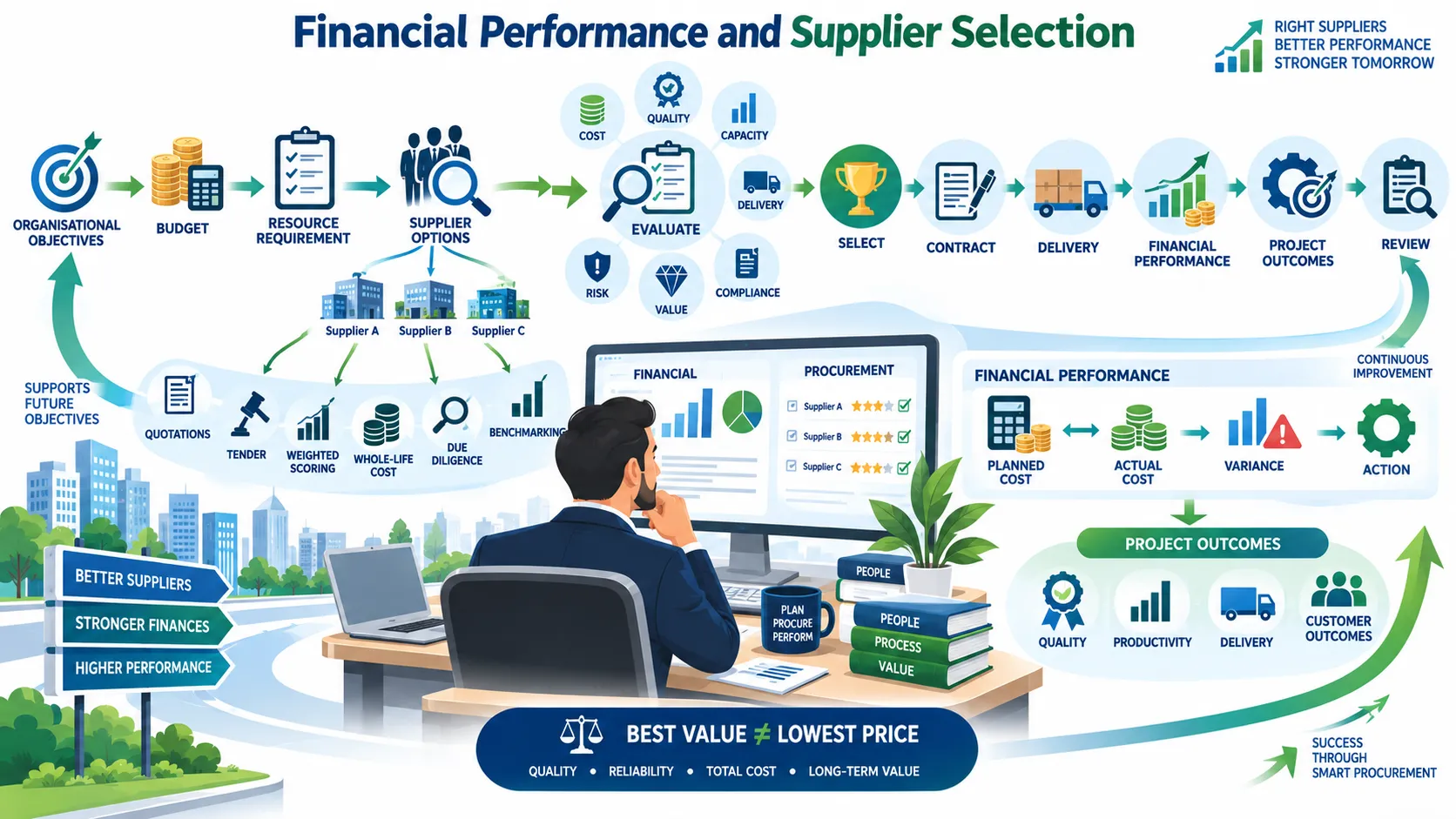
Understanding Financial Performance in Resource Procurement
Definition of Financial Performance
Financial performance is the extent to which an organisation manages and uses its financial resources effectively to achieve planned objectives and maintain appropriate financial sustainability.
Financial performance can be assessed through measures such as:
Budget performance
Revenue
Expenditure
Profit or surplus
Cash flow
Cost variance
Return on investment
Cost savings
Operating costs
Cost per unit
Financial efficiency
Cost-benefit outcomes
In procurement, financial performance is particularly concerned with whether expenditure is controlled and whether purchased resources provide the expected value.
Definition of Supplier Selection
Supplier selection is the structured process of identifying, assessing, comparing and choosing a supplier that can provide the required goods or services to the required standard, within the required timescale and at an acceptable overall cost and level of risk.
Supplier selection should be based on evidence and predetermined criteria where appropriate.
Definition of Project or Operational Outcome
An outcome is the result or change that an organisation intends to achieve through its activities and use of resources.
Examples include:
Increased productivity
Improved customer satisfaction
Reduced costs
Improved service quality
Increased production
Reduced waiting times
Improved employee capability
Successful technology implementation
Improved operational capacity
Financial performance should ultimately be considered in relation to these outcomes.
The Relationship Between Financial Performance and Organisational Outcomes
Financial performance does not operate separately from operational performance. Decisions about budgets and expenditure influence the resources available to deliver activities, while operational decisions can in turn affect financial results.
A simplified relationship is:
Financial resources → Resource availability → Operational activity → Outputs → Outcomes → Financial results
For example, an organisation may reduce its procurement budget by selecting a very low-cost supplier. This may initially improve budget performance. However, if the supplier provides poor-quality materials, production defects may increase. The organisation may then experience additional waste, rework, customer complaints and replacement costs.
The initial financial saving may therefore be outweighed by the wider financial and operational consequences.
This demonstrates why managers should evaluate financial performance over an appropriate period and consider total cost and organisational outcomes.
How Financial Performance Can Affect Outcomes
Cost Control
Cost control involves managing expenditure so that resources are obtained and used within agreed financial limits.
Effective cost control can help an organisation:
Maintain budgets
Reduce unnecessary expenditure
Protect cash flow
Improve financial sustainability
Allocate funds to priority activities
However, cost control should not mean reducing expenditure without considering consequences.
A reduction in procurement expenditure may negatively affect quality or capacity if essential resources are under-supplied.
Budget Variance
Budget variance is the difference between planned financial performance and actual financial performance.
A favourable variance may occur when actual expenditure is lower than planned. An adverse variance may occur when expenditure exceeds the budget.
Managers should investigate significant variances rather than simply recording them.
A cost overrun may result from:
Supplier price increases
Increased demand
Poor estimation
Scope changes
Delivery problems
Inflation
Emergency procurement
Poor contract management
Unexpected maintenance
Resource waste
Understanding the cause of the variance helps managers determine whether corrective action is required.
Cash Flow
Cash flow refers to the movement of money into and out of an organisation.
Procurement decisions can affect cash flow through:
Upfront purchases
Payment schedules
Deposits
Credit arrangements
Subscription costs
Leasing payments
Long-term contracts
For example, purchasing expensive equipment outright may create a significant immediate cash outflow, while leasing may spread payments over time.
The manager should therefore consider whether the procurement arrangement is financially sustainable.
Total Cost of Ownership
Total cost of ownership considers the complete cost associated with acquiring, operating, maintaining and eventually replacing or disposing of a resource.
It may include:
Purchase price
Delivery
Installation
Training
Maintenance
Energy
Licensing
Support
Repairs
Upgrades
Replacement
Disposal
This is particularly important when comparing suppliers.
A supplier offering a low purchase price may not provide the lowest total cost.
Return on Investment
Return on investment can help managers assess whether an investment is expected to produce sufficient financial benefit.
For example, an organisation may invest £50,000 in technology that is expected to generate £80,000 of measurable benefits over an appropriate period.
The manager should consider:
Initial investment
Expected savings
Increased revenue where relevant
Productivity gains
Reduced operating costs
Implementation costs
Maintenance costs
Expected lifespan
Risks
Return on investment should be interpreted alongside non-financial outcomes rather than used in isolation.
Cost-Benefit Analysis
Cost-benefit analysis compares the expected costs of an option with its expected benefits.
For procurement decisions, benefits may include:
Reduced labour costs
Increased productivity
Reduced waste
Improved quality
Faster delivery
Reduced downtime
Increased capacity
Improved customer satisfaction
Not every benefit can be easily converted into a financial figure. Managers should therefore distinguish between financial and non-financial benefits.
Financial Performance and Quality
There is often a relationship between expenditure and quality, although higher expenditure does not automatically guarantee better quality.
Managers need to identify the quality level required to achieve the organisational objective.
For example, purchasing extremely low-cost materials may reduce procurement expenditure but increase product defects.
Conversely, purchasing resources with unnecessarily high specifications may increase expenditure without producing additional organisational value.
The objective is to establish an appropriate balance.
Financial Performance and Operational Capacity
Procurement affects the organisation’s capacity to deliver products or services.
Insufficient expenditure may result in:
Staff shortages
Equipment shortages
Stock shortages
Technology limitations
Reduced service capacity
Delayed delivery
Excessive expenditure can also create problems through:
Underused equipment
Excess stock
Unnecessary staffing
Unused software licences
Excess capacity
Effective financial management therefore requires an appropriate relationship between expenditure and operational demand.
Financial Performance and Project Outcomes
Where procurement supports a project, financial performance can have a direct impact on project outcomes.
Projects often operate within defined:
Budgets
Timescales
Resource requirements
Quality expectations
Deliverables
If procurement costs exceed the project budget, managers may have to make difficult decisions.
These could include:
Reducing project scope
Delaying activities
Reallocating resources
Negotiating with suppliers
Seeking additional funding
Changing suppliers
Reducing non-essential expenditure
These decisions may affect the final project outcome.
Example of a Financial Impact
A project has a procurement budget of £100,000 for specialist equipment.
Unexpected supplier price increases raise the cost to £120,000.
The project manager must determine whether:
The additional £20,000 can be absorbed.
Alternative suppliers are available.
A different specification could meet the requirement.
Existing resources can be used.
The project scope should change.
Additional funding is justified.
If the additional cost is ignored, the project may experience a budget overrun.
If the manager selects an unsuitable low-cost alternative, quality or project performance may suffer.
This demonstrates the importance of evaluating financial performance alongside project outcomes.
Supplier Selection and Financial Performance
Supplier selection has a significant influence on financial performance.
A supplier affects more than the purchase price. The supplier’s performance can influence:
Delivery costs
Quality costs
Maintenance
Downtime
Inventory
Staff time
Administrative costs
Customer complaints
Replacement costs
Contract management
Supplier selection should therefore consider the full financial relationship.
Principles of Effective Supplier Selection
Value for Money
The preferred supplier should provide an appropriate balance between cost, quality, performance and risk.
Quality
The supplier should be capable of meeting the required quality standards.
Reliability
The supplier should consistently deliver according to agreed requirements.
Capacity
The supplier should have sufficient capacity to meet the organisation’s requirements.
Financial Stability
Where appropriate, the organisation should consider whether the supplier is financially capable of continuing to provide the required service.
Delivery Capability
The supplier should be able to meet required delivery timescales.
Compliance
The supplier should meet applicable organisational, contractual and regulatory requirements.
Risk
Supplier risks should be assessed before selection.
Sustainability
Relevant environmental and social considerations should be incorporated into supplier evaluation.
Service and Support
For many resources, after-sales service, maintenance and technical support are important.
Methods for Selecting Suppliers
Method 1: Competitive Quotations
Competitive quotation involves obtaining prices and information from suitable suppliers and comparing the responses.
This may be appropriate for relatively straightforward procurement where the requirement is clearly defined.
Managers may compare:
Price
Quality
Delivery
Warranty
Availability
Supplier capability
Competitive quotations can support value for money while maintaining a proportionate procurement process.
Method 2: Competitive Tendering
Competitive tendering involves inviting suppliers to submit formal proposals against a defined specification and evaluation criteria.
It is often appropriate for more complex, high-value or strategically important procurement.
A tender process may include:
Prequalification
Tender documentation
Supplier responses
Clarification
Evaluation
Due diligence
Selection
Contract award
The process should be managed consistently and transparently.
Method 3: Weighted Scoring
Weighted scoring gives different levels of importance to evaluation criteria.
For example:
| Supplier selection criterion | Example weighting | What managers assess |
|---|---|---|
| Quality and technical capability | 30% | Ability to meet specification and performance requirements |
| Total cost | 25% | Purchase and whole-life costs |
| Delivery | 15% | Lead time and delivery reliability |
| Supplier capability | 10% | Experience, capacity and expertise |
| Service and support | 10% | Maintenance, response and customer support |
| Risk and compliance | 10% | Supplier risks and compliance requirements |
The exact weightings should be determined according to organisational priorities and procurement requirements.
Weighted scoring can reduce the risk that one factor, such as price, dominates the entire decision.
Method 4: Cost-Benefit Comparison
Cost-benefit comparison assesses whether the expected benefits justify the costs associated with each supplier.
Managers may consider:
Initial cost
Operating cost
Maintenance
Expected savings
Productivity
Quality
Risk
Expected lifespan
This approach is particularly useful when suppliers offer different types of solutions.
Method 5: Whole-Life Costing
Whole-life costing compares suppliers based on the expected total cost throughout the resource’s useful life.
This may include:
Purchase
Installation
Operation
Maintenance
Support
Upgrades
Replacement
Disposal
Whole-life costing can identify suppliers that offer better long-term financial value even where their initial purchase price is higher.
Method 6: Quality-Based Selection
Where quality is critical, supplier selection may place significant emphasis on technical capability, quality assurance and performance.
This can be appropriate for:
Specialist equipment
Safety-critical resources
Technical services
Professional services
Complex technology
The organisation should still maintain appropriate financial discipline.
Method 7: Supplier Due Diligence
Due diligence involves verifying information about potential suppliers.
It may include reviewing:
Financial stability
Relevant experience
References
Capacity
Certifications
Quality systems
Insurance
Security arrangements
Business continuity
Compliance
Due diligence helps reduce the risk of selecting an unsuitable supplier.
Method 8: Supplier Performance History
Previous supplier performance can provide valuable evidence.
Managers may examine:
Delivery reliability
Quality records
Complaints
Service-level performance
Invoice accuracy
Contract compliance
Responsiveness
However, previous performance should be assessed objectively and in context.
Method 9: Market Benchmarking
Benchmarking compares supplier proposals against market expectations.
Managers may compare:
Market prices
Service levels
Product specifications
Delivery times
Contract terms
This helps determine whether a proposed price or service arrangement is reasonable.
Method 10: Trial or Pilot Evaluation
For some resources, a trial or pilot may provide evidence of suitability before full implementation.
This can be useful for:
Software
Technology
Equipment
New services
A pilot can help identify practical problems before the organisation makes a larger commitment.
A Structured Supplier Selection Process
Stage 1: Define the Requirement
The organisation should establish exactly what resource is required.
The specification should identify:
Quantity
Quality
Performance
Capacity
Delivery
Support
Compliance
Risk requirements
Stage 2: Establish Evaluation Criteria
Managers should determine how suppliers will be assessed.
Criteria should be:
Relevant
Measurable
Proportionate
Consistent
Linked to organisational objectives
Stage 3: Identify Potential Suppliers
Potential suppliers should be identified through appropriate market research.
Stage 4: Conduct Initial Screening
Suppliers may be screened according to:
Capability
Experience
Capacity
Compliance
Financial stability
Relevant standards
Stage 5: Request Information
Depending on the procurement process, suppliers may provide:
Quotations
Tenders
Proposals
Technical specifications
Pricing
Service information
References
Stage 6: Evaluate Responses
Responses should be assessed against the agreed criteria.
Stage 7: Conduct Due Diligence
Additional checks should be conducted where appropriate.
Stage 8: Compare Total Cost
Managers should consider whole-life financial implications.
Stage 9: Assess Risk
Risk should be evaluated alongside cost and quality.
Stage 10: Select Preferred Supplier
The supplier providing the strongest overall value and fit should be selected.
Stage 11: Obtain Approval
Required organisational approvals should be obtained before commitment.
Stage 12: Contract With the Supplier
The agreed requirements and obligations should be documented.
Stage 13: Monitor Performance
Supplier performance should be measured against agreed standards.
Stage 14: Review the Outcome
The organisation should assess whether the supplier delivered the expected value.
Evaluating Financial Performance After Supplier Selection
Supplier selection should not be considered successful simply because a contract has been signed.
Managers should monitor financial performance throughout the supplier relationship.
Budget Monitoring
Compare:
Planned procurement expenditure ↔ Actual procurement expenditure
Significant differences should be investigated.
Cost Variance Analysis
Managers can identify where actual costs differ from planned costs.
Potential causes include:
Price changes
Additional requirements
Supplier charges
Delivery costs
Contract variations
Unplanned maintenance
Supplier Cost Performance
Managers can monitor:
Invoice accuracy
Price compliance
Additional charges
Contracted rates
Cost increases
Operational Cost Impact
Supplier performance can affect wider organisational costs.
For example, late deliveries may create:
Overtime
Emergency purchasing
Production downtime
Customer compensation
Additional transport costs
These costs should be considered when evaluating supplier performance.
Evaluating Supplier Performance
Supplier performance measures should reflect the requirements established during procurement.
Possible KPIs include:
On-time delivery percentage
Defect rate
Response time
Service availability
Cost variance
Contract compliance
Customer satisfaction
Number of complaints
Resolution time
Invoice accuracy
These measures provide evidence for supplier reviews.
Financial Performance and Supplier Risk
Financial risk can arise from supplier failure, price changes or dependency.
For example, if an organisation depends on one supplier for a critical component, supplier failure could interrupt operations and create significant financial consequences.
Managers can reduce risk by considering:
Multiple suppliers
Alternative products
Contingency stock
Long-term agreements
Price protection mechanisms
Backup arrangements
Supplier financial checks
The appropriate approach depends on the importance and risk of the resource.
Practical Example 1: Selecting a Technology Supplier
An organisation needs a new customer relationship management system.
Three suppliers submit proposals.
Supplier A offers the lowest initial price but has limited support.
Supplier B costs more but provides:
Better integration
Strong technical support
Greater scalability
Longer warranty
Stronger security features
Supplier C has a similar price to Supplier B but requires additional implementation costs.
The manager compares:
Initial price
Implementation
Licensing
Support
Training
Security
Scalability
Maintenance
Expected benefits
Supplier B may provide the strongest overall value even though it is not the cheapest initial option.
Practical Example 2: Manufacturing Supplier Selection
A manufacturer requires raw materials.
Supplier A offers a low unit price but has a history of delayed deliveries.
Supplier B offers a slightly higher price but provides reliable delivery and consistent quality.
The manager considers the financial impact of delays.
Late delivery could create:
Production stoppages
Overtime
Emergency purchases
Customer delays
Lost revenue
Supplier B may therefore provide stronger overall financial and operational value.
Practical Example 3: Office Equipment Procurement
An organisation needs 100 printers.
Supplier A offers inexpensive printers with high consumable costs.
Supplier B offers more expensive printers with lower running costs.
The manager calculates estimated whole-life costs.
Supplier A:
Purchase + consumables + maintenance + replacement
Supplier B:
Purchase + consumables + maintenance + replacement
The analysis demonstrates that Supplier B has a higher initial cost but lower expected total cost.
This is an example of why whole-life costing is important.
Practical Example 4: External Training Provider
An organisation needs leadership development services.
Supplier A offers the lowest fee.
Supplier B charges more but provides experienced facilitators, tailored content, participant resources, evaluation and post-programme support.
The manager considers:
Price
Quality
Trainer expertise
Relevance
Participant outcomes
Support
Evaluation
Organisational objectives
The decision should be based on expected organisational value rather than price alone.
Practical Example 5: Supplier Failure
An organisation relies heavily on a single supplier for critical equipment.
The supplier experiences financial difficulties and cannot fulfil an order.
The organisation faces:
Delayed operations
Emergency procurement
Increased costs
Reduced service capacity
A stronger procurement strategy would have considered supplier resilience and alternative supply options during the selection process.
Common Mistakes in Supplier Selection
Selecting Solely on Price
Price is important but should not automatically determine supplier selection.
Ignoring Whole-Life Cost
Managers may underestimate maintenance, support and replacement costs.
Poor Specification
If requirements are unclear, supplier comparison becomes unreliable.
Inadequate Due Diligence
Failing to check supplier capability can create significant risk.
Ignoring Supplier Capacity
A supplier may be suitable in principle but unable to meet the required volume.
Failing to Consider Delivery
A low-cost supplier that cannot deliver on time may create greater operational costs.
Ignoring Quality
Poor-quality resources can create waste and additional costs.
Overlooking Financial Stability
Supplier financial difficulties can affect continuity.
Using Unclear Evaluation Criteria
Unclear criteria can create inconsistent or subjective decisions.
Failing to Monitor Supplier Performance
Supplier selection is only the beginning of supplier management.
Key Benefits of Effective Supplier Selection
Improved Financial Performance
Effective supplier selection can reduce unnecessary expenditure and improve value for money.
Better Quality
Appropriate suppliers are more likely to provide resources that meet required standards.
Improved Operational Continuity
Reliable suppliers reduce the risk of supply disruption.
Reduced Risk
Supplier due diligence and risk assessment strengthen organisational resilience.
Improved Capacity
Appropriate suppliers can provide the required volume and capability.
Better Delivery Performance
Effective supplier evaluation can improve delivery reliability.
Improved Customer Outcomes
Better resources can contribute to improved service quality and customer satisfaction.
Greater Accountability
Structured selection provides evidence supporting procurement decisions.
Stronger Supplier Relationships
Clear expectations and fair evaluation can support productive supplier relationships.
Better Long-Term Value
Whole-life evaluation helps managers identify suppliers that provide sustainable value rather than short-term price advantages.
Key Benefits of Monitoring Financial Performance
Monitoring financial performance after procurement can help managers:
Identify budget overruns early.
Detect unexpected costs.
Monitor supplier price changes.
Evaluate procurement savings.
Assess return on investment.
Improve forecasting.
Control expenditure.
Protect organisational cash flow.
Identify inefficient procurement.
Support future supplier decisions.
Procurement and Financial Decision-Making Framework
Managers can use the following framework:
Need → Budget → Specification → Options → Cost → Quality → Risk → Supplier → Contract → Performance → Financial Review
At each stage, the manager should ask whether the decision continues to support the organisational objective.
Managerial Checklist
Before selecting a supplier, managers should ask:
What organisational objective does the procurement support?
Is the requirement clearly defined?
Is the specification measurable?
Is the budget realistic?
Have alternative supply options been considered?
Are suitable suppliers available?
What evaluation criteria will be used?
Is price being considered alongside quality and value?
Have whole-life costs been assessed?
Does the supplier have sufficient capacity?
Can the supplier meet the required delivery timescale?
Is the supplier financially stable where this is relevant?
What risks are associated with the supplier?
What evidence supports the supplier’s capability?
Have appropriate due diligence checks been completed?
Does the supplier meet relevant compliance requirements?
Are sustainability considerations relevant?
Are conflicts of interest appropriately managed?
Are the evaluation criteria fair and transparent?
Has the preferred supplier been appropriately approved?
Are contract terms clear?
How will supplier performance be measured?
How will financial performance be monitored?
What contingency arrangements exist?
When will the supplier relationship be reviewed?
Key Concepts to Remember
The main concepts covered in this part include:
Financial performance
Budget control
Cost management
Budget variance
Cash flow
Whole-life cost
Cost-benefit analysis
Return on investment
Value for money
Supplier selection
Competitive quotation
Competitive tendering
Weighted scoring
Supplier due diligence
Supplier capability
Supplier capacity
Quality
Delivery
Risk
Financial stability
Contract management
Supplier performance
Key performance indicators
Sustainability
Continuous improvement
Professional Management Insight
Financial performance should never be considered separately from organisational outcomes. Managers need to understand how financial decisions influence operational capacity, quality, productivity, risk and customer outcomes.
The same principle applies to supplier selection. The supplier offering the lowest price may not provide the best financial outcome, just as the supplier with the highest specification may not provide the best value.
Effective management involves identifying the point at which cost, quality, performance, risk and organisational benefit are appropriately balanced.
A useful management principle is:
Lowest price ≠ Lowest total cost
and:
Lowest total cost ≠ Best overall value
The best procurement decision is normally the one that provides an appropriate balance between financial efficiency and organisational effectiveness.
Managers should therefore evaluate both immediate and longer-term consequences.
For example, spending an additional £5,000 on a more reliable piece of equipment may initially appear to worsen budget performance. However, if the equipment reduces downtime by £20,000 per year, the additional expenditure may contribute positively to overall financial performance.
Similarly, a supplier that costs slightly more may provide significantly better delivery reliability, reducing the risk of operational disruption.
This demonstrates the importance of managerial judgement.
Effective managers also recognise that supplier selection is not a one-time decision. Supplier performance should be continuously monitored and evaluated against agreed financial and operational measures.
The management cycle should therefore be:
Select → Contract → Monitor → Measure → Review → Improve
Where financial or operational performance does not meet expectations, managers should investigate the cause and determine whether corrective action is required.
Summary
Financial performance and supplier selection are important components of effective resource procurement. Financial performance provides managers with evidence about whether organisational expenditure is being controlled and whether resources are generating appropriate value.
Procurement decisions can affect financial performance through purchase prices, operating costs, maintenance, delivery, quality, contract terms, cash flow and supplier performance. Managers should therefore consider whole-life costs and expected organisational benefits rather than focusing solely on initial price.
Financial performance can also influence project and operational outcomes. Budget overruns may lead to reduced scope, delayed activities or changes to resource allocation, while inadequate expenditure can result in poor capacity or quality. Effective financial management therefore requires managers to balance expenditure against operational requirements and intended outcomes.
Supplier selection should follow a structured and evidence-based process. Managers should define the resource requirement, establish evaluation criteria, identify potential suppliers, conduct appropriate screening and due diligence, evaluate proposals, compare costs and benefits, assess risks, select the preferred supplier, obtain approval and establish appropriate contractual arrangements.
Methods such as competitive quotations, competitive tendering, weighted scoring, cost-benefit analysis, whole-life costing, quality-based selection, supplier due diligence, performance-history analysis, market benchmarking and pilot evaluation can help managers make informed supplier decisions.
Effective supplier selection should consider:
Cost
Value for money
Quality
Capacity
Delivery
Reliability
Financial stability
Risk
Compliance
Sustainability
Support
Long-term organisational value
Once a supplier has been selected, managers should continue to monitor financial and operational performance. Measures such as cost variance, delivery performance, quality, service levels, supplier reliability and customer outcomes can provide evidence about whether the procurement decision is delivering the expected value.
For practising and aspiring middle managers and leaders, the central lesson is that successful procurement is not simply about securing a resource at an acceptable price. It is about making financially responsible and operationally effective decisions that contribute to organisational objectives.
A strong procurement decision connects:
Financial performance + Supplier capability + Resource quality + Operational performance + Risk management + Organisational outcomes
When these factors are evaluated together, managers are better positioned to select suppliers that provide sustainable value, protect organisational resources and support successful achievement of objectives.