
Lesson no 3 : Know how to manage stakeholder relationships
Effective stakeholder relationship management is a fundamental management and leadership capability that enables organisations to build trust, maintain productive working relationships and achieve sustainable organisational outcomes. Organisations rarely operate in isolation. Their success depends on relationships with employees, customers, suppliers, business partners, senior leaders, investors, regulators, professional bodies, communities and other groups that can influence or be affected by organisational activities.
Knowing how to manage stakeholder relationships means understanding stakeholder needs, expectations, interests, influence and concerns, and then selecting appropriate approaches to communicate, collaborate, negotiate and maintain those relationships. For managers and leaders, this requires more than simply maintaining regular contact. It involves developing professional relationships that are based on clarity, mutual respect, reliability, transparency and effective communication.
Stakeholder relationships can vary considerably in their purpose and importance. Some relationships may be primarily transactional, such as purchasing goods from a supplier, while others may be collaborative or strategic, such as working with a business partner to develop a new service. Managers therefore need to adapt their approach according to the nature of the relationship, the stakeholder’s level of influence and interest, the organisational objectives involved and the potential risks or opportunities.
This lesson, “Know how to manage stakeholder relationships”, explores practical approaches that managers can use to establish, develop, maintain and improve stakeholder relationships. Learners will examine how effective communication, active listening, trust-building, negotiation, collaboration, expectation management and conflict resolution contribute to positive stakeholder relationships. The lesson also considers how managers can respond to difficult stakeholder situations while maintaining professionalism and protecting organisational interests.
Effective stakeholder relationship management also requires managers to balance different and sometimes competing stakeholder expectations. Customers may prioritise service quality, employees may be concerned about workload and working conditions, suppliers may focus on commercial sustainability, senior leaders may prioritise organisational performance, and regulators may focus on compliance. Managers must therefore make informed judgements about how different interests can be balanced while maintaining alignment with organisational objectives.
The lesson also considers the importance of monitoring and reviewing stakeholder relationships. Stakeholder needs, influence and expectations can change as organisations grow, introduce new technologies, implement organisational change or respond to external pressures. A relationship that was effective previously may therefore require a different management approach over time. Regular review allows managers to identify emerging concerns, recognise opportunities, address relationship risks and strengthen stakeholder engagement.
For practising and aspiring middle managers and leaders, the ability to manage stakeholder relationships effectively supports better decision-making, improved collaboration, stronger organisational performance and more sustainable professional relationships. By applying structured stakeholder management approaches, managers can build stakeholder confidence, resolve issues constructively, manage expectations and create conditions in which stakeholders are more willing to cooperate with organisational goals.
Learners should have a clearer understanding of how to manage stakeholder relationships professionally and strategically, including how to communicate effectively, build trust, manage expectations, address conflict, negotiate solutions, respond to changing stakeholder needs and review relationship effectiveness. These capabilities are essential for managers who are responsible for coordinating people, projects, services and organisational priorities across complex stakeholder environments.
1.Analyse the Role of the Manager in Managing Stakeholder Relationships
Managers play a central role in developing, maintaining and improving stakeholder relationships within organisations. Stakeholder relationships influence organisational performance, customer satisfaction, employee engagement, operational efficiency, reputation, innovation and the organisation’s ability to achieve its strategic objectives. For this reason, stakeholder relationship management should not be viewed as an occasional communication activity. It is an ongoing management responsibility that requires planning, communication, relationship-building, problem-solving, negotiation, monitoring and professional judgement.
The manager acts as an important connection between organisational objectives and stakeholder expectations. Senior leaders may establish strategic priorities, while employees, customers, suppliers, partners and other stakeholders experience the practical consequences of organisational decisions. Managers therefore need to interpret organisational priorities, communicate them appropriately and understand how those priorities affect different stakeholder groups.
The role becomes particularly important when stakeholder interests do not completely align. Customers may expect higher service quality, employees may require additional resources, suppliers may seek improved commercial terms and senior leaders may expect greater efficiency. A manager must balance these expectations while protecting organisational interests and maintaining constructive professional relationships.
Effective stakeholder relationship management is therefore based on more than being friendly or maintaining frequent communication. It involves understanding stakeholder needs, assessing influence and impact, establishing appropriate engagement approaches, building trust, managing expectations, resolving conflict and creating mutually beneficial outcomes where possible.
Understanding the Manager’s Role in Stakeholder Relationship Management
Stakeholder relationship management refers to the systematic process of developing and maintaining productive relationships with people and groups who can affect, influence or be affected by an organisation, its decisions, projects, products, services or activities.
The manager’s role is to make sure that stakeholder relationships are actively managed rather than left to chance. This requires the manager to understand the stakeholder environment and determine which relationships require attention, what stakeholders expect and how the organisation should respond.
Managers commonly act as:
Relationship builders
Communicators
Coordinators
Negotiators
Problem-solvers
Facilitators
Decision-makers
Representatives of the organisation
Risk managers
Performance monitors
Conflict managers
Change leaders
The relative importance of each role depends on the organisation, management position and stakeholder context.
For example, a manager working with a supplier may spend considerable time negotiating delivery requirements and monitoring performance. A manager leading organisational change may focus more heavily on employee communication, consultation and resistance management. A customer-service manager may prioritise customer expectations, complaints and service recovery.
Why Managers Are Important to Stakeholder Relationships
Managers frequently have direct contact with stakeholders and are therefore able to influence how stakeholders experience the organisation.
A manager can strengthen a relationship by:
Communicating clearly.
Following through on commitments.
Responding to concerns.
Providing accurate information.
Demonstrating respect.
Managing expectations.
Resolving problems promptly.
Recognising stakeholder contributions.
Maintaining appropriate confidentiality.
Escalating significant issues.
Conversely, poor management can damage relationships even when organisational policies and systems are otherwise effective.
Examples of poor management include:
Failing to respond to stakeholder concerns.
Making unrealistic promises.
Providing inconsistent information.
Ignoring feedback.
Allowing disputes to continue.
Failing to meet agreed commitments.
Treating stakeholders unfairly.
Escalating issues unnecessarily.
Failing to communicate organisational constraints.
A manager’s behaviour therefore becomes an important representation of the organisation’s values and professionalism.
The Manager as a Stakeholder Relationship Strategist
An effective manager should not manage every stakeholder relationship in exactly the same way. Stakeholders differ in influence, interest, expectations, needs and potential impact.
Strategic stakeholder management begins with analysis.
Managers should consider:
Who the stakeholder is.
Why the stakeholder matters.
What the stakeholder wants.
What the stakeholder expects.
How much influence the stakeholder has.
How the stakeholder may affect organisational objectives.
How organisational decisions affect the stakeholder.
What risks are associated with the relationship.
What opportunities the relationship may create.
What level of engagement is appropriate.
This analysis allows managers to prioritise their attention.
For example, a strategic business partner with high influence and high interest may require frequent senior-level engagement, while a stakeholder with low influence and low interest may only require periodic information.
Stakeholder Mapping
Stakeholder mapping is a useful management technique for understanding stakeholder priorities.
The Power–Interest Grid can classify stakeholders according to their level of influence or power and their level of interest.
The four broad categories are:
High power and high interest: manage closely.
High power and low interest: keep satisfied.
Low power and high interest: keep informed and appropriately engaged.
Low power and low interest: monitor appropriately.
Managers should recognise that stakeholder positions can change. A stakeholder with low interest today may become highly interested after an organisational change affects them.
Stakeholder mapping should therefore be reviewed rather than treated as a permanent classification.
The Manager as a Relationship Builder
Building relationships is one of the most important managerial responsibilities.
Professional stakeholder relationships are normally strengthened through:
Trust
Reliability
Respect
Transparency
Consistency
Responsiveness
Effective communication
Mutual understanding
Appropriate collaboration
Trust develops when stakeholders see consistency between what a manager says and what the manager does.
For example, if a manager promises to provide a supplier with accurate demand forecasts each month and consistently delivers them on time, the supplier is more likely to view the organisation as reliable.
Trust can be damaged quickly when managers:
Break commitments.
Hide important information.
Provide misleading information.
Blame others unfairly.
Fail to acknowledge mistakes.
Change expectations without explanation.
Managers therefore need to recognise that trust is built through repeated behaviour rather than through isolated communication events.
Building Trust with Different Stakeholders
Different stakeholder groups may require different approaches.
With employees, managers can build trust by:
Listening to concerns.
Providing clear expectations.
Applying policies fairly.
Recognising contributions.
Communicating organisational changes honestly.
With customers, managers can build trust by:
Delivering reliable service.
Responding to complaints.
Managing expectations.
Providing accurate information.
Following through on commitments.
With suppliers, managers can build trust by:
Communicating requirements clearly.
Paying according to agreed terms.
Addressing performance problems fairly.
Sharing relevant information.
Working collaboratively on improvements.
With senior leaders, managers can build trust by:
Providing accurate reports.
Raising risks early.
Delivering agreed actions.
Avoiding misleading performance information.
Linking operational information to strategic objectives.
The Manager as a Communication Leader
Communication is central to stakeholder relationship management.
Managers need to communicate with stakeholders in ways that are:
Clear
Accurate
Timely
Relevant
Professional
Consistent
Appropriate to the audience
Communication should not be treated as simply sending information. Effective communication involves understanding whether the stakeholder has understood the message and whether a response is required.
Two-Way Communication
Strong stakeholder relationships normally require two-way communication.
A manager should provide opportunities for stakeholders to:
Ask questions.
Raise concerns.
Provide feedback.
Explain their needs.
Suggest improvements.
Clarify expectations.
Challenge assumptions appropriately.
Two-way communication can reveal information that managers would otherwise miss.
For example, employees may understand practical difficulties with a new process that senior leaders cannot see from performance reports alone.
Active Listening
Active listening is an important management skill.
It involves:
Paying attention.
Asking appropriate questions.
Clarifying meaning.
Summarising important points.
Avoiding premature judgement.
Demonstrating understanding.
Identifying underlying concerns.
A stakeholder may raise a complaint about a service delay, but the underlying concern may actually be uncertainty, poor communication or lack of confidence in the organisation.
The manager should therefore investigate the underlying issue rather than responding only to the surface complaint.
The Manager as an Expectation Manager
Stakeholder expectations can influence satisfaction and relationship quality.
Managers need to establish realistic expectations by communicating:
What the organisation can provide.
What it cannot provide.
Relevant timescales.
Available resources.
Responsibilities.
Limitations.
Decision-making boundaries.
Performance standards.
Expectation management is particularly important when resources are limited or stakeholder demands conflict with organisational priorities.
Practical Example: Customer Expectations
A customer asks a training provider to add several workshops to an existing programme.
The manager should not automatically agree.
Instead, the manager should:
Review the agreed scope.
Understand the customer’s requirement.
Assess available resources.
Identify cost and scheduling implications.
Explain what is currently included.
Explore possible options.
Follow the appropriate approval or change process.
Confirm the final arrangement clearly.
This approach protects the relationship while preventing unrealistic commitments.
The Manager as a Negotiator
Managers frequently need to negotiate with stakeholders.
Negotiation may involve:
Service requirements.
Deadlines.
Resources.
Costs.
Responsibilities.
Quality standards.
Project priorities.
Supplier performance.
Customer expectations.
Partnership arrangements.
Effective negotiation does not mean forcing stakeholders to accept the manager’s preferred outcome. It involves understanding different interests and seeking an acceptable solution within organisational boundaries.
A Practical Negotiation Process
Preparation
The manager should identify:
Desired outcomes.
Stakeholder interests.
Key priorities.
Available alternatives.
Constraints.
Risks.
Approval limits.
Discussion
The manager should:
Listen carefully.
Ask questions.
Clarify requirements.
Present evidence.
Identify areas of agreement.
Option Development
The manager should explore:
Alternative solutions.
Different delivery arrangements.
Resource options.
Timescale changes.
Shared responsibilities.
Agreement
The manager should confirm:
Agreed actions.
Responsibilities.
Timescales.
Performance expectations.
Review arrangements.
Follow-Up
The manager should monitor whether agreed actions are implemented.
The Manager as a Conflict Manager
Stakeholder relationships can involve conflict because stakeholders may have competing interests.
Common causes include:
Different priorities.
Resource constraints.
Misunderstandings.
Poor communication.
Unclear responsibilities.
Performance problems.
Conflicting expectations.
Contractual disagreements.
Organisational change.
The manager should distinguish between constructive disagreement and destructive conflict. Different perspectives can improve decision-making when they are handled professionally.
Conflict Management Process
A manager can use the following process:
Identify the issue.
Establish the facts.
Listen to each stakeholder.
Identify underlying interests.
Clarify areas of agreement and disagreement.
Review relevant policies, agreements or evidence.
Generate possible solutions.
Agree realistic actions.
Document decisions where appropriate.
Monitor the relationship after resolution.
The objective should be to resolve the underlying problem rather than simply end the immediate disagreement.
Practical Example: Employee and Senior Management Conflict
Senior management wants to improve operational efficiency by introducing a new process. Employees believe the proposed process will increase workload.
The manager should not automatically support one side.
Instead, the manager should:
Understand the strategic objective.
Listen to employee concerns.
Analyse the proposed workload impact.
Gather operational evidence.
Identify possible improvements.
Discuss options with senior leaders.
Communicate the final decision clearly.
The manager therefore acts as a bridge between strategic requirements and operational realities.
The Manager as a Stakeholder Coordinator
Many organisational outcomes require several stakeholder groups to work together.
For example, introducing a new digital service may involve:
IT
Operations
Finance
HR
Customers
Suppliers
Senior leaders
The manager may coordinate these groups to ensure that information, responsibilities and decisions are aligned.
Coordination involves:
Establishing clear responsibilities.
Scheduling meetings.
Sharing relevant information.
Managing dependencies.
Tracking actions.
Resolving issues.
Escalating problems.
Maintaining alignment.
Poor coordination can result in duplicated work, delays and conflicting decisions.
The Manager as a Facilitator of Collaboration
Collaboration involves stakeholders working together towards a shared outcome.
Managers facilitate collaboration by creating conditions in which stakeholders can contribute effectively.
This may involve:
Establishing shared objectives.
Clarifying roles.
Encouraging open communication.
Creating psychologically safe discussion environments.
Recognising different perspectives.
Resolving misunderstandings.
Supporting joint problem-solving.
Collaboration is particularly valuable when stakeholders have complementary expertise.
For example, IT specialists may understand technical capabilities while customer-service employees understand customer needs. Bringing both perspectives together can produce a more effective solution.
The Manager as a Problem-Solver
Stakeholder relationships inevitably encounter problems.
Effective managers identify problems early and use structured approaches to resolve them.
A practical problem-solving process is:
Define the problem.
Gather evidence.
Identify affected stakeholders.
Analyse causes.
Generate possible solutions.
Evaluate options.
Agree the preferred approach.
Implement action.
Monitor results.
Review stakeholder response.
Managers should avoid jumping immediately to solutions without understanding the underlying cause.
The Manager as a Representative of Organisational Interests
Managers must balance stakeholder interests with organisational objectives.
This requires professional judgement.
A manager should understand:
Organisational strategy.
Policies and procedures.
Financial constraints.
Contractual commitments.
Operational capabilities.
Stakeholder expectations.
Relevant risks.
Representing organisational interests does not mean ignoring stakeholder concerns. Instead, the manager should seek solutions that protect the organisation while treating stakeholders fairly.
For example, a customer may request a significant discount. The manager should understand the customer’s reasons while considering commercial requirements, pricing policy and organisational sustainability.
The Manager as a Representative of Stakeholder Needs
Managers also have responsibility for bringing stakeholder perspectives into organisational decision-making.
Employees, customers and suppliers may possess valuable information that senior leaders do not directly observe.
Managers can therefore act as an information bridge by communicating:
Customer feedback.
Employee concerns.
Supplier performance.
Market information.
Operational challenges.
Emerging stakeholder risks.
Improvement opportunities.
This role helps ensure that management decisions are based on a more complete understanding of organisational reality.
The Manager and Stakeholder Feedback
Feedback is a valuable source of information for relationship management.
Managers should create appropriate mechanisms for collecting and reviewing feedback.
Examples include:
Customer surveys.
Employee meetings.
One-to-one discussions.
Supplier reviews.
Focus groups.
Project meetings.
Feedback forms.
Performance reviews.
However, collecting feedback without responding to it can damage trust.
A manager should therefore determine:
What has been said?
What themes are emerging?
Which concerns require action?
What can be changed?
What cannot be changed?
Why?
How will the outcome be communicated?
The Manager and Stakeholder Performance
Managers should monitor the health and effectiveness of stakeholder relationships.
Performance indicators may include:
Customer satisfaction.
Complaint levels.
Employee engagement.
Supplier reliability.
Partnership performance.
Response times.
Service quality.
Stakeholder participation.
Number of unresolved issues.
Achievement of agreed outcomes.
Quantitative information can be useful, but managers should also consider qualitative evidence.
For example, a supplier may meet all delivery targets but communicate poorly and provide limited support. Performance assessment should therefore consider both measurable outcomes and relationship quality.
The Manager and Stakeholder Risk Management
Stakeholder relationships can create opportunities as well as risks.
Potential risks include:
Loss of trust.
Customer dissatisfaction.
Supplier disruption.
Employee disengagement.
Partnership failure.
Reputation damage.
Conflict.
Delays.
Increased costs.
Poor communication.
Resistance to change.
Managers should identify risks early and determine suitable responses.
Practical Stakeholder Risk Process
Managers can:
Identify stakeholder-related risks.
Assess likelihood and impact.
Identify risk owners.
Establish preventive actions.
Develop contingency responses.
Monitor warning indicators.
Escalate significant risks.
Review outcomes.
Effective relationship management can reduce the likelihood or impact of many stakeholder risks.
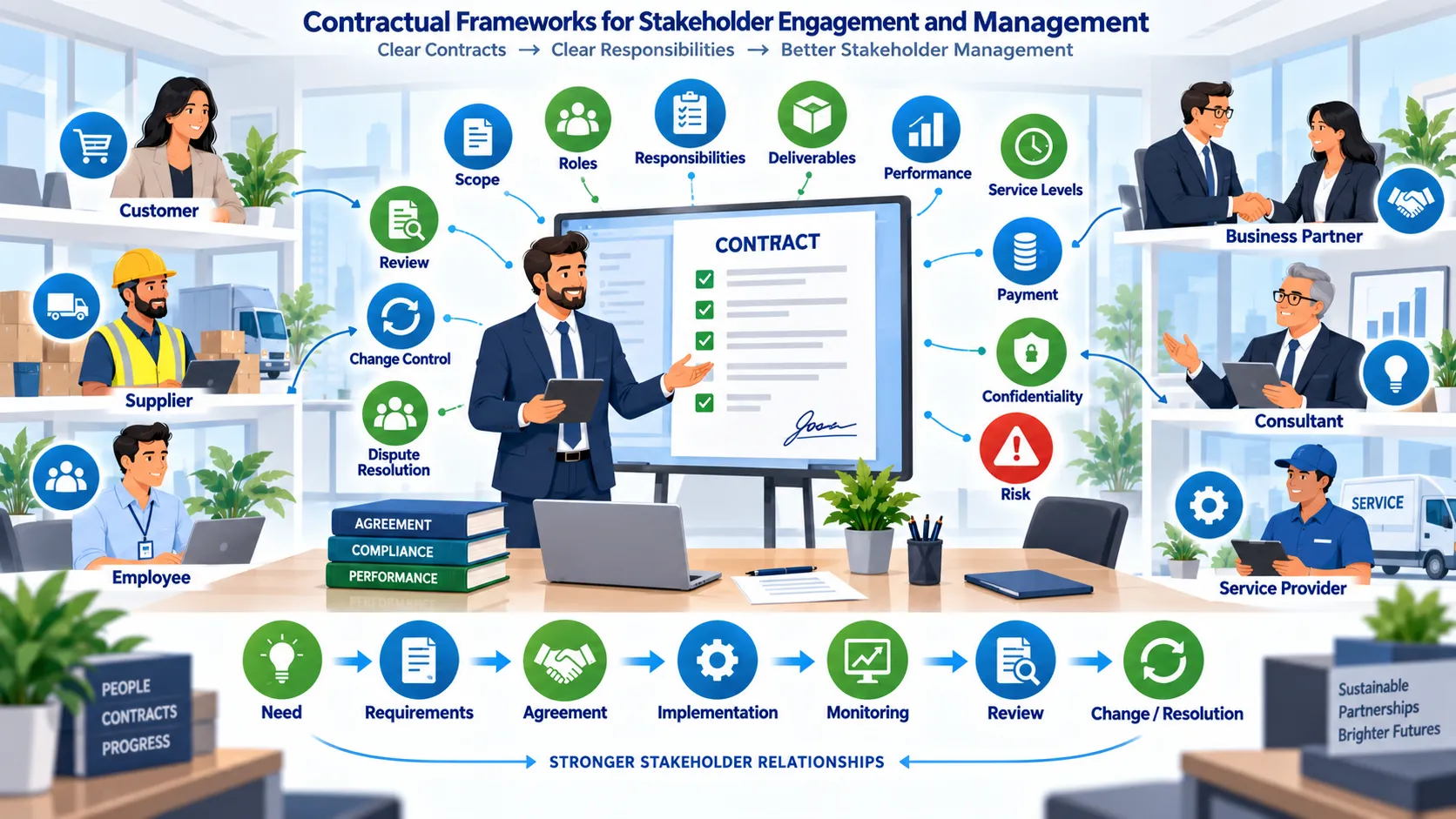
The Manager and Contractual Stakeholder Relationships
Where stakeholder relationships are governed by contracts, managers must understand the formal commitments involved.
These may include:
Scope.
Deliverables.
Service levels.
Payment requirements.
Quality standards.
Reporting.
Confidentiality.
Responsibilities.
Change control.
Escalation.
The manager should ensure that operational activities are consistent with contractual requirements.
However, contractual compliance should not be treated as the complete definition of relationship success. A supplier may meet contractual standards while the relationship remains weak due to poor communication or lack of collaboration.
The manager therefore needs to combine contractual governance with relationship management.
The Manager and Organisational Change
Stakeholder relationships become particularly important during organisational change.
Change may affect:
Employees.
Customers.
Suppliers.
Partners.
Managers.
Senior leaders.
Managers help stakeholders understand:
Why change is required.
What is changing.
Why it matters.
How stakeholders may be affected.
What support is available.
What happens next.
Managers should also create opportunities for appropriate feedback.
Change Engagement Process
A practical approach involves:
Identify affected stakeholders.
Assess likely impact.
Understand concerns.
Define communication objectives.
Communicate the reason for change.
Provide opportunities for questions.
Gather feedback.
Address reasonable concerns.
Implement support.
Monitor stakeholder response.
Adjust the approach where appropriate.
The Manager and Stakeholder Inclusion
Effective managers should consider whether relevant stakeholder voices are being included.
Inclusion does not mean that every stakeholder has equal decision-making authority. It means that relevant perspectives are considered appropriately.
Managers should consider:
Who is affected?
Who has useful knowledge?
Who may experience negative consequences?
Who has legitimate influence?
Who has been excluded from discussions?
What barriers prevent participation?
This can improve decision quality and stakeholder confidence.
The Manager and Ethical Stakeholder Management
Managers have an ethical responsibility to treat stakeholders fairly and professionally.
Ethical stakeholder management includes:
Honesty.
Respect.
Fairness.
Transparency.
Confidentiality.
Responsible information use.
Appropriate accountability.
Managers should avoid:
Making false promises.
Manipulating feedback.
Hiding important information.
Misrepresenting performance.
Favouring stakeholders unfairly.
Using confidential information improperly.
Ethical behaviour strengthens trust and protects organisational reputation.
The Manager and Stakeholder Relationship Lifecycle
Stakeholder relationships develop over time.
A manager may manage the relationship through the following stages:
Identification
Identify the stakeholder and understand why the relationship matters.
Establishment
Set expectations, responsibilities and communication arrangements.
Development
Build trust, improve collaboration and establish effective working practices.
Maintenance
Monitor performance, communicate regularly and resolve emerging issues.
Review
Assess relationship effectiveness and stakeholder satisfaction.
Renewal or Adjustment
Change the relationship approach when stakeholder circumstances or organisational requirements change.
Closure
Where appropriate, conclude the relationship professionally and manage any remaining responsibilities.
Managers should recognise that relationships do not remain static.
Practical Managerial Framework for Managing Stakeholder Relationships
A manager can apply the following framework to most stakeholder situations:
1. Identify
Determine who the relevant stakeholders are.
2. Understand
Analyse their interests, expectations, influence and impact.
3. Prioritise
Determine which relationships require the greatest managerial attention.
4. Engage
Select appropriate communication and involvement methods.
5. Build
Develop trust, reliability and mutual understanding.
6. Manage
Address expectations, performance issues, risks and conflicts.
7. Review
Evaluate the effectiveness of the relationship.
8. Improve
Identify opportunities to strengthen the relationship and organisational outcomes.
This framework provides managers with a practical cycle for managing stakeholder relationships rather than relying on ad hoc communication.
Stakeholder Relationship Management in Different Organisational Contexts
The manager’s role can vary depending on the stakeholder group.
| Stakeholder group | Manager’s primary role | Key management activities | Main relationship focus |
|---|---|---|---|
| Employees | Leader and facilitator | Communication, support, feedback and conflict management | Engagement and performance |
| Customers | Relationship manager | Expectation management, service recovery and feedback | Satisfaction and trust |
| Suppliers | Coordinator and negotiator | Performance monitoring, negotiation and issue resolution | Reliability and value |
| Senior leaders | Strategic communicator | Reporting, escalation and alignment | Strategic objectives |
| Business partners | Collaborator | Joint planning, communication and problem-solving | Shared outcomes |
| Regulators | Professional representative | Compliance communication and reporting | Accountability and assurance |
| Project teams | Coordinator | Planning, communication and issue management | Delivery and collaboration |
| Community stakeholders | Engagement facilitator | Consultation, communication and concern management | Reputation and responsible practice |
This illustrates why stakeholder relationship management requires adaptable leadership rather than one fixed management style.
Practical Example: Managing a Difficult Customer Relationship
A customer has complained repeatedly about service delays.
The manager should not simply defend the organisation.
Instead, the manager can:
Review the customer’s concerns.
Examine service-performance evidence.
Listen to the customer’s expectations.
Identify the causes of delays.
Explain what happened honestly.
Agree appropriate corrective action.
Establish realistic expectations.
Monitor future performance.
Follow up with the customer.
This approach can turn a difficult relationship into an opportunity for service improvement.
Practical Example: Managing an Employee Relationship During Change
A manager is introducing new digital working practices. Several employees are concerned about their ability to use the new system.
The manager can:
Explain why the change is required.
Demonstrate the system.
Listen to concerns.
Identify training needs.
Provide appropriate support.
Gather feedback during implementation.
Recognise progress.
Communicate lessons to senior leadership.
The manager is therefore acting as communicator, facilitator, change leader and employee relationship manager.
Practical Example: Managing a Supplier Performance Problem
A supplier has delivered several orders late.
The manager should:
Review contractual requirements.
Examine delivery records.
Discuss the issue with the supplier.
Identify the underlying cause.
Assess operational impact.
Agree corrective actions.
Establish monitoring arrangements.
Escalate if performance does not improve.
The manager should remain professional and evidence-based rather than allowing frustration to damage the relationship unnecessarily.
Practical Example: Balancing Stakeholder Interests
An organisation wants to reduce operating costs.
Senior management supports the proposal, finance expects savings, employees are concerned about workload and customers are concerned about service quality.
The manager needs to balance these interests.
A suitable approach may involve:
Understanding the strategic requirement.
Analysing employee and customer impact.
Identifying areas where efficiency can be improved without reducing service quality.
Consulting affected employees.
Reviewing customer expectations.
Presenting evidence to senior leaders.
Agreeing practical implementation measures.
Monitoring outcomes.
This demonstrates the importance of professional judgement in stakeholder relationship management.
Benefits of Effective Managerial Stakeholder Relationship Management
When managers manage stakeholder relationships effectively, organisations can achieve several benefits.
Improved Communication
Stakeholders receive clearer and more relevant information.
Stronger Trust
Reliable management behaviour increases stakeholder confidence.
Better Decision-Making
Stakeholder perspectives provide useful information and practical insight.
Improved Collaboration
Stakeholders are more willing to cooperate when relationships are well managed.
Reduced Conflict
Early identification and resolution of concerns can prevent escalation.
Greater Employee Engagement
Employees are more likely to participate when they feel listened to and respected.
Higher Customer Satisfaction
Effective expectation management and service recovery can improve customer relationships.
Better Supplier Performance
Regular performance management and constructive communication can strengthen supply relationships.
Improved Risk Management
Stakeholder relationships can provide early warnings about emerging risks.
Stronger Organisational Reputation
Professional stakeholder management can improve confidence in the organisation.
Greater Change Adoption
Stakeholders are more likely to support change when they understand its purpose and feel appropriately involved.
Challenges Faced by Managers
Managing stakeholder relationships can be demanding because managers operate within competing organisational pressures.
Common challenges include:
Conflicting stakeholder priorities.
Limited resources.
Difficult conversations.
Resistance to change.
Unrealistic expectations.
Time pressures.
Poor communication.
Cultural differences.
Power imbalances.
Contractual restrictions.
Stakeholder dissatisfaction.
Changing organisational priorities.
Effective managers respond by prioritising relationships, communicating clearly and using evidence to support decisions.
Key Managerial Competencies for Stakeholder Relationship Management
Managers need a combination of interpersonal and analytical capabilities.
Important competencies include:
Communication.
Active listening.
Emotional awareness.
Negotiation.
Conflict management.
Problem-solving.
Decision-making.
Relationship building.
Strategic thinking.
Risk awareness.
Performance management.
Collaboration.
Adaptability.
Professional judgement.
No single competency is sufficient. Effective stakeholder relationship management requires these capabilities to work together.
Measuring the Effectiveness of a Manager’s Stakeholder Relationships
Managers should periodically assess whether relationships are producing the intended outcomes.
Possible indicators include:
Stakeholder satisfaction.
Quality of communication.
Achievement of agreed outcomes.
Number of unresolved issues.
Complaint levels.
Employee engagement.
Supplier performance.
Partnership effectiveness.
Response times.
Participation levels.
Trust and confidence indicators.
Managers should combine quantitative measures with qualitative feedback.
For example, a stakeholder relationship may have few formal complaints but still be weak if communication has become infrequent and stakeholders are reluctant to share information.
Continuous Improvement in Stakeholder Management
Stakeholder relationship management should be continuously improved.
Managers can use review findings to:
Improve communication methods.
Adjust engagement frequency.
Clarify responsibilities.
Strengthen feedback mechanisms.
Address recurring issues.
Improve service delivery.
Update stakeholder priorities.
Develop stronger collaboration.
Improve internal coordination.
A continuous-improvement mindset prevents managers from assuming that an established relationship will remain effective without attention.
Best-Practice Checklist for Managers
Before concluding that a stakeholder relationship is being managed effectively, a manager should consider whether:
The stakeholder has been correctly identified.
Their interests and expectations are understood.
Their influence and impact have been assessed.
The purpose of the relationship is clear.
Communication is appropriate and timely.
Expectations are realistic.
Responsibilities are understood.
Stakeholder feedback is encouraged.
Concerns are addressed promptly.
Conflicts are managed professionally.
Contractual commitments are understood where relevant.
Risks are monitored.
Performance is reviewed.
Important decisions are appropriately recorded.
The relationship is periodically evaluated.
Improvement opportunities are identified.
Key Takeaways
The manager plays a central role in managing stakeholder relationships by connecting organisational objectives with stakeholder needs, expectations and interests. Effective managers recognise that stakeholder relationships require continuous attention and cannot be managed successfully through occasional communication alone.
The manager’s role includes:
Identifying and analysing stakeholders.
Prioritising relationships according to influence, interest, impact and risk.
Building trust and professional relationships.
Communicating clearly and consistently.
Listening actively to stakeholder concerns.
Managing expectations realistically.
Negotiating mutually workable solutions.
Coordinating different stakeholder groups.
Facilitating collaboration.
Resolving conflict.
Managing stakeholder-related risks.
Monitoring performance and satisfaction.
Representing organisational interests responsibly.
Bringing stakeholder perspectives into decision-making.
Supporting stakeholders during organisational change.
Maintaining ethical and professional standards.
Reviewing and continuously improving relationships.
The strongest managers understand that effective stakeholder management is both relational and strategic. It requires interpersonal skill, analytical thinking and professional judgement. Managers must understand what stakeholders want while also recognising organisational constraints and strategic priorities.
Ultimately, successful stakeholder relationship management enables managers to create stronger communication, greater trust, improved collaboration, better decision-making and more sustainable organisational outcomes. For middle managers in particular, this capability is essential because they often occupy the critical position between senior leadership, operational teams and external stakeholders. Their ability to manage these relationships effectively can have a direct influence on organisational performance, stakeholder confidence and the successful delivery of organisational objectives.
2.Evaluate the Use of Collaborative Working Techniques to Manage Stakeholder Relationships
Collaborative working is an important approach to managing stakeholder relationships because many organisational objectives cannot be achieved effectively by one person, team or department working independently. Organisations increasingly depend on cooperation between employees, customers, suppliers, business partners, senior leaders, project teams, professional advisers and other stakeholders. Collaborative working techniques provide managers with practical methods for bringing these stakeholders together, sharing knowledge, coordinating activities, solving problems and developing shared solutions.
For practising and aspiring middle managers and leaders, collaboration is particularly important because managers often work across organisational boundaries. They may need to coordinate different departments, engage external suppliers, involve customers in service improvement, work with senior leaders on strategic priorities or bring specialists together to resolve complex operational problems. Effective collaboration enables stakeholders to contribute their knowledge and experience while helping the organisation build stronger, more sustainable relationships.
However, collaboration should not be viewed as automatically beneficial. Simply bringing stakeholders together does not guarantee effective outcomes. Collaboration can consume time and resources, create disagreement, slow decision-making or generate confusion when roles and responsibilities are unclear. Managers therefore need to evaluate which collaborative working technique is appropriate, why it should be used, how it should be implemented and whether it is actually improving the stakeholder relationship and organisational outcome.
The central management principle is that collaborative working should have a clear purpose. Managers should identify the stakeholder problem or opportunity, understand the interests and influence of the participants, select an appropriate collaborative technique, establish expectations and responsibilities, facilitate productive interaction and evaluate the results.
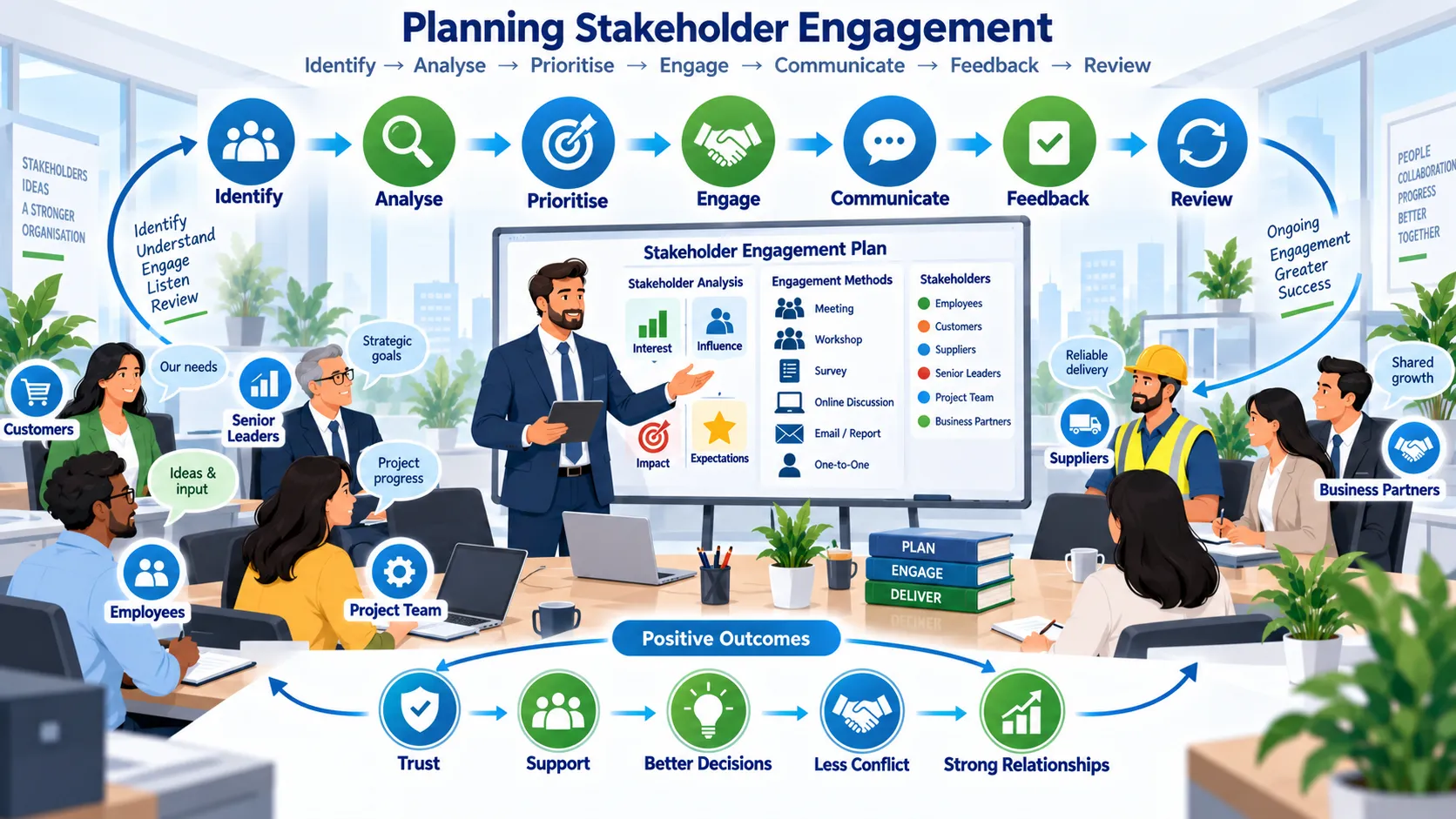
Understanding Collaborative Working
Collaborative working is an approach in which two or more people, teams or organisations work together to achieve a shared or connected objective.
Collaboration involves more than simply communicating information. Effective collaboration requires stakeholders to contribute actively to a process, exchange knowledge, coordinate actions, solve problems or develop outcomes together.
Collaborative working may involve:
Employees from different departments.
Managers and operational teams.
Customers and service providers.
Organisations and suppliers.
Strategic business partners.
Project teams.
Professional advisers.
External specialists.
Community stakeholders.
Senior leaders and middle managers.
The level of collaboration should reflect the purpose of the relationship. Some situations require simple coordination, while others require intensive joint problem-solving or shared decision-making.
Collaboration, Cooperation and Coordination
These terms are related but should not be treated as identical.
Cooperation generally means stakeholders are willing to support each other or work towards compatible objectives.
Coordination involves organising activities, responsibilities and resources so that different parties can work effectively without unnecessary duplication or conflict.
Collaboration usually involves a deeper level of interaction where stakeholders jointly contribute to problem-solving, planning, innovation or decision-making.
For managers, the distinction is useful because not every stakeholder relationship requires full collaboration. A manager should select the appropriate level based on the situation.
Why Collaborative Working Matters in Stakeholder Management
Stakeholders often possess different types of knowledge, expertise, resources and influence. Collaboration enables managers to bring these different contributions together.
For example, a customer may understand service expectations, an employee may understand operational difficulties, an IT specialist may understand technological possibilities and a finance manager may understand budget constraints. A collaborative approach can bring these perspectives together to develop a more practical solution.
Effective collaboration can support:
Better understanding of stakeholder needs.
Shared problem-solving.
Improved decision-making.
Knowledge sharing.
Innovation.
Stronger trust.
Better communication.
Greater stakeholder ownership.
Reduced misunderstanding.
Improved implementation.
Stronger organisational relationships.
Collaboration can also strengthen stakeholder commitment because people are more likely to support solutions when they have had an appropriate opportunity to contribute.
The Manager’s Role in Collaborative Working
The manager has a central role in creating the conditions for effective collaboration.
A manager should not simply organise meetings. The manager needs to establish purpose, structure interaction and ensure that stakeholder contributions lead to meaningful outcomes.
Key managerial responsibilities include:
Identifying appropriate stakeholders.
Establishing a clear collaborative objective.
Selecting suitable participants.
Understanding stakeholder interests.
Clarifying roles and responsibilities.
Establishing communication arrangements.
Creating a respectful environment.
Facilitating discussions.
Managing disagreements.
Encouraging participation.
Preventing domination by one stakeholder.
Monitoring progress.
Making or facilitating decisions.
Recording agreed actions.
Reviewing outcomes.
The manager must also recognise when collaboration is not appropriate. Some decisions may require confidentiality, specialist authority, urgent action or formal approval rather than extensive stakeholder participation.
Principles of Effective Collaborative Working
Shared Purpose
Stakeholders need to understand why they are collaborating.
A shared purpose could involve:
Improving customer service.
Reducing operational costs.
Developing a new product.
Improving employee experience.
Solving a supplier problem.
Implementing technology.
Managing organisational change.
Developing a strategic partnership.
Without a clear purpose, collaborative activity can become unfocused.
Mutual Respect
Stakeholders should recognise the value of different perspectives.
Managers should encourage participants to challenge ideas rather than attack individuals.
Transparency
Relevant information should be shared appropriately so that stakeholders can make informed contributions.
Clear Responsibilities
Collaboration does not remove accountability. Participants should understand who is responsible for particular activities and decisions.
Active Participation
Stakeholders should have meaningful opportunities to contribute where their involvement is appropriate.
Trust
Trust encourages stakeholders to share information, raise concerns and contribute ideas openly.
Constructive Challenge
Effective collaboration allows stakeholders to disagree professionally.
Accountability
Agreed actions should have clear owners and deadlines.
Continuous Review
Managers should assess whether collaboration is achieving its intended purpose.
Key Collaborative Working Techniques
Managers can use a range of collaborative working techniques to manage stakeholder relationships.
Stakeholder Workshops
A stakeholder workshop brings relevant participants together for structured discussion, problem-solving, planning or development.
Workshops are particularly useful when:
A complex problem needs multiple perspectives.
Stakeholders have different experiences.
A new process is being developed.
Organisational change is being planned.
Innovation opportunities need to be explored.
A manager should establish:
Purpose.
Participants.
Agenda.
Expected outcomes.
Ground rules.
Facilitation approach.
Follow-up process.
A successful workshop should produce useful outputs rather than simply discussion.
Practical Example
A training organisation wants to improve its learner enrolment process.
A manager brings together:
Learners.
Admissions staff.
Finance staff.
IT staff.
Quality staff.
Learners explain where the process is difficult. Admissions staff identify administrative bottlenecks. Finance explains payment controls, while IT identifies system limitations.
The manager facilitates the discussion and the group jointly develops improvement ideas.
This technique can strengthen stakeholder relationships because participants can see how their perspectives contribute to the solution.
Cross-Functional Teams
Cross-functional teams bring together people from different departments or professional areas.
They are useful when an organisational objective crosses departmental boundaries.
For example, a customer-service improvement project may involve:
Customer service.
Marketing.
Operations.
IT.
Finance.
Quality.
Cross-functional teams can reduce organisational silos by encouraging people to understand how their activities affect other departments.
Benefits
Broader expertise.
Better information sharing.
Improved coordination.
Greater understanding between departments.
More comprehensive problem-solving.
Potential Challenges
Conflicting priorities.
Different terminology.
Competing departmental objectives.
Unclear authority.
Time commitments.
Difficulty reaching agreement.
The manager must establish a clear shared objective and clarify decision-making responsibilities.
Joint Problem-Solving
Joint problem-solving involves stakeholders working together to identify the cause of a problem and develop an appropriate solution.
A structured process may involve:
Define the problem.
Gather evidence.
Identify affected stakeholders.
Understand different perspectives.
Identify root causes.
Generate solutions.
Evaluate options.
Agree actions.
Assign responsibilities.
Monitor outcomes.
Joint problem-solving can be particularly valuable where no single stakeholder has enough information to solve the problem independently.
Co-Design
Co-design involves stakeholders contributing directly to the development of a product, service, process or experience.
Customers, employees or partners may contribute ideas during development rather than simply reviewing a completed solution.
Co-design can improve stakeholder ownership because participants have an opportunity to shape the outcome.
Examples include:
Customers helping redesign a service.
Employees helping develop a new working process.
Suppliers contributing to product-development improvements.
Learners helping improve an educational platform.
Evaluating Co-Design
Managers should consider:
Whether stakeholders have relevant knowledge.
Whether their involvement is genuinely influential.
Whether decision-making boundaries are clear.
Whether participation improves the final outcome.
Whether the process is proportionate to the project.
Co-design can be highly effective but may require more time than conventional decision-making.
Collaborative Planning
Collaborative planning involves stakeholders contributing to plans that affect their work or interests.
It can be used for:
Projects.
Service improvement.
Organisational change.
Resource planning.
Partnership development.
Supplier management.
Collaborative planning can improve realism because people involved in delivery can identify practical constraints that may not be visible to senior decision-makers.
Joint Review Meetings
Joint review meetings allow stakeholders to assess performance, discuss problems and identify improvements.
They are particularly useful in:
Supplier relationships.
Customer accounts.
Strategic partnerships.
Outsourcing arrangements.
Project management.
A productive review meeting should examine:
Agreed objectives.
Performance evidence.
Issues.
Risks.
Stakeholder concerns.
Improvement opportunities.
Future priorities.
The manager should avoid allowing meetings to become purely administrative. The purpose should be to improve the relationship and outcomes.
Steering Groups
A steering group brings together representatives with relevant authority, expertise or interest to provide oversight and direction.
Steering groups can support:
Strategic alignment.
Decision-making.
Risk management.
Resource allocation.
Escalation.
Stakeholder coordination.
A manager may contribute operational information while senior leaders provide strategic direction.
Communities of Practice
A community of practice brings people together around a shared area of professional knowledge or experience.
For example, managers from different departments may share approaches to:
Leadership.
Customer service.
Digital transformation.
Quality management.
Innovation.
This can strengthen internal stakeholder relationships and support organisational learning.
Digital Collaboration
Digital collaboration uses technology to enable stakeholders to communicate, share information and work together, particularly when participants are geographically dispersed.
Examples include:
Video meetings.
Shared digital documents.
Project-management platforms.
Online discussion spaces.
Collaborative planning tools.
Digital feedback systems.
Digital collaboration can increase flexibility and access, but managers should consider:
Digital accessibility.
Technology reliability.
Data protection.
Information security.
Communication quality.
Stakeholder digital capability.
Meeting fatigue.
Digital tools should support collaboration rather than become a substitute for thoughtful relationship management.
One-to-One Collaborative Conversations
Not all collaboration requires a large group.
One-to-one conversations can be highly effective when:
A stakeholder has a sensitive concern.
A relationship has deteriorated.
Confidential information is involved.
A stakeholder is reluctant to speak in a group.
A specific issue requires detailed discussion.
Managers should use one-to-one conversations appropriately alongside wider collaborative techniques.
Brainstorming and Idea Generation
Brainstorming allows stakeholders to generate possible solutions without immediately evaluating every idea.
It can be useful during:
Innovation.
Service improvement.
Problem-solving.
Process redesign.
Customer-experience development.
Managers should create an environment where participants can contribute ideas without fear of inappropriate criticism.
Following idea generation, managers should introduce structured evaluation based on factors such as:
Feasibility.
Resources.
Stakeholder value.
Risk.
Organisational alignment.
Potential impact.
Negotiation as a Collaborative Technique
Negotiation can be collaborative when stakeholders seek a mutually workable solution.
For example, a customer may need an earlier delivery date while the supplier has capacity constraints. The manager can facilitate discussion around alternative schedules, priorities and resources.
Effective collaborative negotiation involves:
Understanding interests.
Identifying constraints.
Sharing relevant information.
Generating options.
Evaluating alternatives.
Agreeing realistic commitments.
The objective is not necessarily to make everyone equally satisfied. It is to achieve a workable outcome while maintaining professional relationships.
Evaluating Collaborative Working Techniques
Evaluation is essential because different techniques produce different levels of value.
A manager should consider several dimensions.
Purpose
Did the technique address the intended stakeholder issue?
Participation
Did the appropriate stakeholders participate?
Quality of Contribution
Did participants provide useful information, expertise or perspectives?
Decision Quality
Did collaboration improve the quality of the final decision?
Relationship Impact
Did the technique strengthen or weaken stakeholder trust and confidence?
Efficiency
Was the time and resource investment justified by the outcome?
Implementation
Were agreed actions actually delivered?
Sustainability
Did the collaboration create a stronger basis for future stakeholder interaction?
Comparative Evaluation of Collaborative Techniques
| Collaborative technique | Best suited for | Key benefit | Potential limitation | Managerial consideration |
|---|---|---|---|---|
| Stakeholder workshop | Complex issues and shared problem-solving | Brings diverse perspectives together | Can become unfocused | Establish clear objectives and facilitation |
| Cross-functional team | Department-wide projects | Combines specialist expertise | Conflicting priorities | Clarify roles and decision rights |
| Joint problem-solving | Operational problems | Develops shared solutions | Requires stakeholder commitment | Use evidence and identify root causes |
| Co-design | Products, services and processes | Builds stakeholder ownership | Can require significant time | Define influence and decision boundaries |
| Joint review meeting | Ongoing relationships | Supports performance and improvement | Can become routine | Focus on evidence and actions |
| Steering group | Strategic projects | Supports governance and direction | Decision-making can be slow | Define authority clearly |
| Digital collaboration | Distributed stakeholders | Flexible and accessible | Technology and engagement challenges | Select appropriate digital tools |
| One-to-one discussion | Sensitive or complex concerns | Enables focused dialogue | Limited range of perspectives | Use alongside wider engagement where needed |
Selecting the Right Collaborative Technique
The choice of technique should be based on the situation rather than managerial preference.
Managers should ask:
What is the objective?
Which stakeholders need to participate?
How complex is the issue?
What expertise is required?
How much influence do participants have?
Is the issue sensitive?
How urgent is the decision?
How much time is available?
What resources are available?
What level of collaboration is necessary?
What decision-making authority exists?
For example, an urgent operational problem may require a small problem-solving meeting rather than a large stakeholder workshop.
A strategic service redesign may benefit from a longer co-design process involving customers and employees.
Process for Implementing Collaborative Stakeholder Working
Stage 1: Define the Objective
Establish what the collaboration is intended to achieve.
The objective should be specific and connected to an organisational need.
Stage 2: Identify Stakeholders
Determine which stakeholders possess relevant:
Knowledge.
Influence.
Resources.
Experience.
Authority.
Interest.
Stage 3: Analyse Stakeholder Relationships
Consider:
Current relationship quality.
Stakeholder expectations.
Potential conflicts.
Influence.
Impact.
Risks.
Opportunities.
Stage 4: Select the Collaborative Technique
Choose a method appropriate to the objective and stakeholder context.
Stage 5: Establish Roles and Responsibilities
Clarify:
Who participates?
Who facilitates?
Who provides information?
Who makes decisions?
Who records actions?
Who owns follow-up?
Stage 6: Establish Ground Rules
Ground rules can include:
Respect different views.
Allow participants to contribute.
Challenge ideas professionally.
Maintain confidentiality where required.
Focus on evidence.
Avoid personal criticism.
Respect time.
Stage 7: Conduct the Collaboration
The manager should facilitate productive participation and keep discussion focused on the objective.
Stage 8: Capture Outcomes
Record:
Decisions.
Actions.
Responsibilities.
Deadlines.
Risks.
Unresolved issues.
Stage 9: Implement Agreed Actions
Collaboration only creates value when agreed actions are implemented.
Stage 10: Review the Outcome
Assess whether:
The objective was achieved.
Stakeholders were satisfied.
Relationships improved.
Problems were resolved.
Performance changed.
Further collaboration is required.
Managing Power Differences in Collaboration
Stakeholders may have significantly different levels of power and influence.
For example, a senior executive may have greater formal authority than an operational employee, while a major customer may have significant commercial influence over a supplier.
Power differences can affect participation.
A manager should ensure that:
Relevant stakeholders have appropriate opportunities to contribute.
Senior stakeholders do not automatically dominate discussion.
Less powerful stakeholders can raise legitimate concerns.
Decisions remain within defined authority.
Contributions are evaluated based on relevance and evidence.
This does not mean that all stakeholders have equal decision-making authority. It means that stakeholder participation should be managed fairly and appropriately.
Managing Conflict During Collaboration
Collaboration can reveal disagreements that already exist.
A manager should recognise that disagreement can be useful if it helps identify risks or improve ideas.
The manager should:
Allow stakeholders to explain their perspectives.
Clarify the actual issue.
Separate facts from assumptions.
Identify shared interests.
Explore alternatives.
Encourage evidence-based discussion.
Agree practical actions.
Escalate where necessary.
The manager should prevent disagreement from becoming personal conflict.
Building Trust Through Collaboration
Collaboration can strengthen trust when stakeholders experience:
Honest communication.
Consistent behaviour.
Reliable follow-through.
Respect.
Transparency.
Fair treatment.
Trust is particularly important when stakeholders need to share information or accept organisational change.
For example, employees may be more willing to discuss operational weaknesses if they believe the manager will use the information constructively rather than simply assigning blame.
Collaborative Working and Innovation
Collaboration can support innovation by combining different perspectives.
Employees may identify process improvements, customers may identify unmet needs, suppliers may provide technical knowledge and business partners may offer access to new capabilities.
A manager can facilitate innovation by:
Bringing relevant stakeholders together.
Defining the problem or opportunity.
Encouraging idea generation.
Evaluating ideas.
Testing feasible options.
Gathering stakeholder feedback.
Learning from implementation.
Improving the solution.
Collaboration therefore becomes a mechanism for turning stakeholder knowledge into organisational value.
Collaborative Working During Organisational Change
Change often requires collaboration because different stakeholders experience change differently.
A manager may establish collaborative activities such as:
Employee workshops.
Customer feedback sessions.
Supplier planning meetings.
Cross-functional implementation teams.
Steering groups.
The manager should ensure that engagement is genuine and that stakeholders understand the limits of their influence.
Collaboration can reduce resistance by giving stakeholders opportunities to understand the reasons for change and contribute to implementation planning.
Practical Example: Cross-Functional Service Improvement
A professional training organisation has received complaints about delays in learner enrolment.
The manager creates a cross-functional team involving admissions, finance, IT, quality and customer-service representatives.
The group:
Maps the current process.
Identifies delays.
Reviews learner feedback.
Identifies technology problems.
Examines payment requirements.
Develops alternative processes.
Tests the preferred approach.
Reviews results.
The collaborative approach produces a more comprehensive solution because no single department has complete knowledge of the process.
Practical Example: Customer and Supplier Collaboration
A manufacturing organisation is experiencing quality problems with a critical component.
Rather than simply issuing a formal complaint, the manager brings the supplier’s technical team and internal quality team together.
The participants:
Review quality data.
Identify where defects occur.
Examine production processes.
Discuss possible causes.
Develop corrective actions.
Agree monitoring arrangements.
This approach can protect the relationship while addressing the underlying performance problem.
Practical Example: Employee Collaboration During Change
An organisation is introducing a new digital working system.
Employees are concerned about workload and usability.
The manager establishes employee workshops where staff can:
Demonstrate current difficulties.
Review the proposed system.
Identify training needs.
Suggest process improvements.
Raise concerns.
The manager then communicates key findings to the implementation team.
This creates a stronger connection between the people implementing the system and those who will use it.
Practical Example: Collaborative Partnership Development
A training organisation and technology provider want to develop a digital learning service.
A joint project team is established with representatives from both organisations.
The team collaborates on:
Customer requirements.
Technology capabilities.
Service design.
Project milestones.
Quality requirements.
Risk management.
Testing.
Feedback.
The manager needs to maintain the shared objective while also recognising that each organisation has separate commercial interests.
Benefits of Collaborative Working Techniques
Improved Stakeholder Understanding
Collaboration allows stakeholders to explain their needs, concerns and experiences directly.
Better Decision-Making
Different perspectives can improve the quality and completeness of decisions.
Stronger Relationships
Joint activity can create greater trust and understanding.
Increased Ownership
Stakeholders are more likely to support outcomes when they have contributed to their development.
Greater Innovation
Different perspectives can generate new ideas.
Improved Problem-Solving
Complex problems can be addressed using combined expertise.
Better Communication
Regular collaboration can reduce information gaps.
Stronger Organisational Alignment
Cross-functional collaboration helps departments understand shared objectives.
Reduced Silos
Collaboration encourages departments to work beyond narrow organisational boundaries.
Improved Change Adoption
Stakeholders who understand and contribute to change may be more willing to support implementation.
Challenges and Limitations of Collaborative Working
Despite its benefits, collaboration can create challenges.
Time Consumption
Collaborative meetings and workshops require time from multiple stakeholders.
Resource Requirements
Collaboration may require technology, facilitation, specialist expertise and administrative support.
Conflicting Priorities
Stakeholders may have different objectives.
Decision-Making Delays
Too many participants can make decisions slower.
Dominant Participants
Powerful stakeholders may dominate discussion.
Groupthink
Groups may reach agreement too quickly without sufficiently challenging assumptions.
Lack of Accountability
If responsibilities are unclear, participants may assume someone else will complete an action.
Confidentiality Concerns
Some information cannot appropriately be shared with every participant.
Stakeholder Fatigue
Excessive meetings and consultations can reduce engagement.
Managers should therefore evaluate whether the expected value of collaboration justifies the associated cost and complexity.
When Collaboration May Not Be Appropriate
A mature manager recognises that collaboration is not always the best approach.
Limited collaboration may be appropriate when:
A decision is urgent.
Confidential information is involved.
A legal or regulatory requirement restricts participation.
The manager has clear delegated authority.
The issue is routine.
Extensive consultation would create disproportionate cost.
Stakeholder participation would not materially improve the outcome.
In these circumstances, the manager should still communicate appropriately and explain relevant decisions where necessary.
Measuring Collaborative Working Effectiveness
Managers should evaluate collaboration using meaningful indicators.
Possible measures include:
Stakeholder satisfaction.
Participation rates.
Quality of stakeholder contributions.
Number of agreed actions completed.
Reduction in recurring problems.
Decision-making quality.
Project performance.
Customer satisfaction.
Employee engagement.
Supplier performance.
Number of unresolved issues.
Achievement of collaborative objectives.
Managers should not rely only on attendance numbers. A meeting with 20 participants is not necessarily more effective than a focused discussion with five relevant stakeholders.
Qualitative Evaluation
Managers should also gather qualitative feedback.
Useful questions include:
Did stakeholders feel listened to?
Was the discussion constructive?
Were different perspectives considered?
Was the purpose clear?
Were decisions explained?
Did participants trust the process?
Did collaboration improve the relationship?
What should be changed next time?
Qualitative feedback can reveal relationship issues that performance statistics do not show.
Continuous Improvement of Collaborative Working
Managers should treat collaborative working as a process that can be improved.
After each major collaborative activity, the manager can review:
What worked well?
What created difficulty?
Which stakeholders contributed effectively?
Were the right people involved?
Was the method appropriate?
Were decisions made efficiently?
Were actions completed?
Did relationships improve?
What should change next time?
This creates a learning cycle.
Continuous Improvement Cycle
The cycle can be represented as:
Plan collaboration.
Engage stakeholders.
Conduct collaborative activity.
Implement outcomes.
Measure results.
Gather feedback.
Identify improvements.
Adjust future collaboration.
This approach supports increasingly effective stakeholder management.
Digital and Hybrid Collaborative Working
Modern organisations frequently operate through hybrid or remote working arrangements.
Managers need to adapt collaborative techniques to digital environments.
Effective digital collaboration may require:
Clear agendas.
Appropriate meeting lengths.
Shared documents.
Defined communication channels.
Online feedback mechanisms.
Clear action tracking.
Inclusive participation.
Reliable technology.
Managers should avoid assuming that digital communication automatically produces effective collaboration.
For example, a video meeting may allow stakeholders to communicate but still fail if some participants do not feel able to contribute.
Ethical Considerations in Collaborative Working
Managers should ensure that collaboration is conducted responsibly.
Ethical collaboration requires:
Honest communication.
Respect for stakeholder contributions.
Appropriate confidentiality.
Fair treatment.
Accurate representation of stakeholder views.
Transparency about decision-making.
Responsible handling of information.
Managers should not create a false impression that stakeholders have decision-making power if their participation is purely consultative.
Similarly, managers should not manipulate collaborative sessions to produce predetermined outcomes while presenting the process as open decision-making.
Best-Practice Approach for Managers
A manager seeking to use collaborative working effectively should:
Start with a clear objective.
Identify the right stakeholders.
Analyse influence, interest and impact.
Select an appropriate collaboration technique.
Establish clear roles.
Set realistic expectations.
Create respectful communication conditions.
Encourage diverse perspectives.
Manage disagreement constructively.
Keep discussion focused.
Record decisions and actions.
Monitor implementation.
Evaluate relationship outcomes.
Gather stakeholder feedback.
Improve future collaborative approaches.
Key Takeaways
Collaborative working techniques provide managers with practical methods for strengthening stakeholder relationships while achieving organisational objectives. Effective collaboration allows stakeholders to contribute knowledge, experience, resources and perspectives to shared problems and opportunities.
The most important collaborative techniques include:
Stakeholder workshops.
Cross-functional teams.
Joint problem-solving.
Co-design.
Collaborative planning.
Joint review meetings.
Steering groups.
Communities of practice.
Digital collaboration.
One-to-one collaborative conversations.
Brainstorming.
Collaborative negotiation.
The effectiveness of each technique depends on the context. Managers should consider the objective, stakeholder influence, stakeholder interests, complexity, urgency, resources, confidentiality and required level of participation before selecting an approach.
Effective collaborative working can produce significant benefits, including improved decision-making, stronger relationships, better communication, increased stakeholder ownership, innovation and more effective problem-solving. However, collaboration can also create time pressures, resource demands, conflicting priorities, decision-making delays and accountability problems.
The manager therefore has a critical role in evaluating whether collaboration is appropriate and ensuring that it is structured effectively. The manager should define the purpose, identify appropriate stakeholders, establish responsibilities, facilitate constructive interaction, manage conflict, capture outcomes, monitor implementation and review the results.
Ultimately, successful collaborative working is not measured by the number of meetings held or stakeholders involved. It is measured by whether collaboration creates meaningful value, improves stakeholder relationships, supports better decisions and contributes to organisational objectives. For practising and aspiring middle managers, the ability to select and evaluate collaborative working techniques is therefore an essential leadership capability for managing complex stakeholder relationships in modern organisations.
3.Discuss Methods for Managing Conflict in Stakeholder Engagement
Conflict is a normal feature of stakeholder engagement because stakeholders often have different interests, expectations, priorities, responsibilities and perceptions of organisational decisions. Customers may want improved service at a lower cost, employees may seek additional resources and manageable workloads, suppliers may seek commercially sustainable arrangements, senior leaders may prioritise efficiency and performance, while regulators may focus on compliance and assurance. These differences do not automatically indicate that a stakeholder relationship has failed. When managed professionally, constructive disagreement can provide valuable information, reveal risks and contribute to better decisions.
For practising and aspiring middle managers, the ability to manage stakeholder conflict is an essential leadership capability. Managers frequently occupy a position between senior leadership, employees, customers, suppliers and other stakeholders. They may therefore need to resolve disagreements, manage competing expectations, facilitate difficult conversations, negotiate practical solutions and maintain relationships while protecting organisational interests.
Stakeholder conflict becomes problematic when disagreements are allowed to become personal, destructive or unresolved. Poorly managed conflict can reduce trust, delay decisions, damage communication, increase costs, affect employee engagement, reduce customer satisfaction and weaken partnerships. In more serious circumstances, it can contribute to contractual disputes, reputational damage or operational disruption.
Effective conflict management therefore requires a structured and professional approach. Managers should identify the source of conflict, establish the facts, understand stakeholder perspectives, distinguish positions from underlying interests, assess the potential impact, select an appropriate conflict-management method, facilitate constructive discussion, agree actions and monitor the relationship afterwards.
The objective is not necessarily to eliminate disagreement. The objective is to manage disagreement constructively so that stakeholders can work towards appropriate outcomes while maintaining professional relationships.
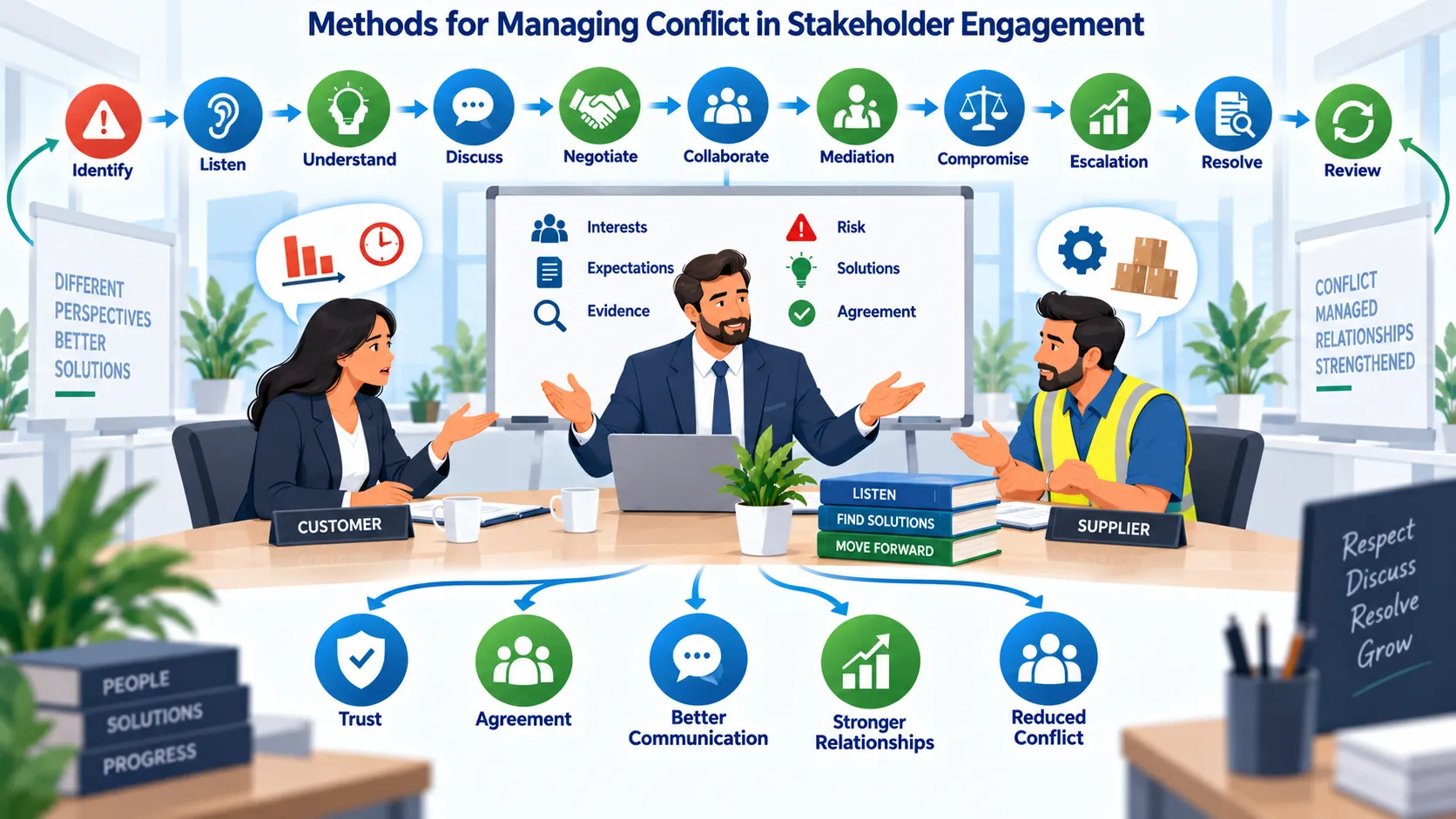
Understanding Conflict in Stakeholder Engagement
Conflict occurs when stakeholders perceive that their interests, objectives, expectations, values, responsibilities or preferred outcomes are incompatible.
Conflict may be:
Between individuals.
Between departments.
Between employees and managers.
Between customers and service teams.
Between organisations and suppliers.
Between business partners.
Between senior leaders and operational teams.
Between contractual parties.
Between organisational objectives and stakeholder expectations.
Conflict can be visible, such as an argument during a meeting, or less visible, such as withdrawal of cooperation, delayed responses, lack of information sharing or repeated failure to support agreed activities.
Managers should therefore recognise that conflict is not always expressed openly.
Constructive and Destructive Conflict
Not all conflict is negative.
Constructive conflict can encourage stakeholders to:
Challenge assumptions.
Identify risks.
Consider alternative viewpoints.
Improve decisions.
Identify weaknesses.
Generate new solutions.
Clarify expectations.
For example, an employee may challenge a proposed process because they have identified a practical operational risk. If the manager listens and investigates the concern, the disagreement may improve the final decision.
Destructive conflict, by contrast, can involve:
Personal attacks.
Blame.
Refusal to communicate.
Withholding information.
Threats.
Persistent hostility.
Unreasonable demands.
Attempts to undermine others.
The manager’s role is to encourage constructive challenge while preventing disagreement from becoming destructive.
Common Causes of Stakeholder Conflict
Understanding why conflict occurs is an important first step.
Conflicting Interests
Different stakeholders may want different outcomes.
For example:
Customers may want lower prices.
Suppliers may want higher prices.
Employees may want additional resources.
Finance may need to reduce costs.
Senior leaders may expect improved profitability.
The manager must identify these competing interests rather than assuming that one stakeholder is automatically correct.
Unclear Expectations
Conflict often develops when stakeholders have different assumptions about what has been agreed.
A customer may believe that additional support is included within a service agreement, while the organisation considers it outside the agreed scope.
Managers can reduce this risk by clarifying:
Scope.
Responsibilities.
Timescales.
Performance expectations.
Communication arrangements.
Decision-making authority.
Poor Communication
Incomplete, delayed or inconsistent communication can create misunderstanding.
For example, if employees receive different information from different managers about an organisational change, uncertainty and conflict may develop.
Resource Constraints
Stakeholders may compete for:
Budget.
Staff.
Equipment.
Time.
Technology.
Management attention.
Managers need to communicate constraints and explain how resources are being prioritised.
Differences in Priorities
Stakeholders may have different objectives.
A sales team may prioritise speed, while a quality team may prioritise compliance and control. The manager needs to find an appropriate balance.
Contractual Disagreement
Conflict can arise over:
Scope.
Deliverables.
Payment.
Service levels.
Quality.
Responsibilities.
Changes.
Performance.
Managers should review the relevant contractual requirements and involve appropriate specialists where necessary.
Organisational Change
Change can create uncertainty and resistance.
Employees may be concerned about:
Workload.
Job responsibilities.
Technology.
Performance expectations.
Skills.
Job security.
Managers should engage affected stakeholders early and communicate clearly.
Differences in Perception
Two stakeholders can experience the same situation differently.
A manager may believe that a delay is unavoidable because of resource limitations, while a customer may perceive it as poor service.
Effective conflict management requires managers to understand both perspectives.
Power Imbalances
Stakeholders may have different levels of influence.
For example, a senior executive may have formal authority over an operational employee, while a major customer may have substantial commercial influence over a supplier.
Managers should ensure that power differences do not prevent legitimate concerns from being raised.
The Manager’s Role in Managing Stakeholder Conflict
Managers play several interconnected roles when conflict arises.
They may act as:
Mediator.
Facilitator.
Negotiator.
Communicator.
Problem-solver.
Relationship manager.
Decision-maker.
Escalation point.
Representative of organisational interests.
The appropriate role depends on the nature and seriousness of the conflict.
A manager should avoid automatically taking sides. Instead, the manager should establish the facts, understand stakeholder interests and determine an appropriate response.
Early Identification of Stakeholder Conflict
Early intervention is often more effective than waiting until conflict becomes severe.
Managers should look for warning signs such as:
Increased complaints.
Missed commitments.
Reduced communication.
Repeated misunderstandings.
Defensive behaviour.
Increased formal escalation.
Declining cooperation.
Delayed decisions.
Increased employee dissatisfaction.
Supplier performance deterioration.
Early warning signs allow managers to address underlying problems before they damage the wider relationship.
A Structured Process for Managing Stakeholder Conflict
A practical conflict-management process can help managers respond consistently.
Stage 1: Identify the Conflict
The manager should establish what the disagreement is actually about.
Questions may include:
What has happened?
Who is involved?
What outcome is each stakeholder seeking?
When did the disagreement begin?
What evidence is available?
What impact is the conflict having?
The manager should avoid making assumptions before understanding the situation.
Stage 2: Establish the Facts
Managers should distinguish evidence from perceptions.
Evidence may include:
Contracts.
Emails.
Performance reports.
Meeting records.
Service data.
Policies.
Customer feedback.
Project documentation.
Fact-finding creates a more objective foundation for discussion.
Stage 3: Identify Stakeholder Positions
A position is what a stakeholder says they want.
For example:
“Customer wants the delivery completed by Friday.”
However, the manager should explore the underlying interest.
The customer’s underlying interest may be:
“Customer needs the service ready for an important business event.”
Understanding interests can reveal alternative solutions.
Stage 4: Understand Underlying Interests
Managers should ask:
Why is this outcome important?
What concern is driving the stakeholder’s position?
What risk are they trying to avoid?
What outcome would they consider acceptable?
This can move the conversation from confrontation towards problem-solving.
Stage 5: Assess Impact
The manager should determine the potential consequences of the conflict.
These may include:
Financial impact.
Operational disruption.
Customer dissatisfaction.
Employee disengagement.
Delayed delivery.
Reputational damage.
Partnership deterioration.
Increased risk.
The level of management response should reflect the seriousness of the situation.
Stage 6: Select an Appropriate Conflict-Management Method
Different conflicts require different approaches.
Possible methods include:
Direct discussion.
Active listening.
Negotiation.
Mediation.
Facilitation.
Compromise.
Collaborative problem-solving.
Escalation.
Formal dispute-resolution procedures.
The manager should select the method that best fits the situation.
Stage 7: Conduct the Discussion
The manager should create an environment where stakeholders can explain their views professionally.
Useful practices include:
Establishing ground rules.
Listening without unnecessary interruption.
Asking clarifying questions.
Summarising key points.
Separating facts from assumptions.
Keeping discussion focused on the issue.
Avoiding personal criticism.
Encouraging practical options.
Stage 8: Generate Possible Solutions
Stakeholders should explore possible ways forward.
Solutions may involve:
Changing timescales.
Clarifying responsibilities.
Adjusting resources.
Improving communication.
Revising processes.
Providing additional support.
Changing implementation arrangements.
Using agreed contractual procedures.
Stage 9: Evaluate Options
Managers should assess solutions against:
Organisational objectives.
Stakeholder needs.
Resources.
Risk.
Cost.
Feasibility.
Contractual requirements.
Operational impact.
Stage 10: Agree Actions
Where possible, stakeholders should agree:
What will happen.
Who will do it.
When it will happen.
What resources are required.
How progress will be monitored.
Stage 11: Record the Outcome
Important decisions should be appropriately documented.
Documentation can reduce future misunderstandings and provide evidence of what was agreed.
Stage 12: Monitor the Relationship
Conflict may appear resolved but underlying relationship problems may remain.
Managers should therefore follow up and assess:
Whether actions were completed.
Whether the stakeholder remains dissatisfied.
Whether communication has improved.
Whether trust has been restored.
Whether further action is necessary.
Key Methods for Managing Conflict in Stakeholder Engagement
Active Listening
Active listening is one of the most fundamental conflict-management techniques.
It involves giving stakeholders appropriate attention and demonstrating that their perspective has been understood.
Managers can use:
Open questions.
Clarification.
Summarising.
Reflection.
Confirmation of understanding.
Active listening can reduce defensiveness because stakeholders feel that their concerns have been heard.
Practical Example
A customer complains that the organisation has repeatedly failed to meet agreed service expectations.
Instead of immediately defending the organisation, the manager asks the customer to explain the impact of the problem and summarises the key concerns.
The manager then reviews the evidence and works with the customer to identify an appropriate response.
The conflict becomes an opportunity to understand the underlying service problem.
Direct Discussion
Direct discussion is appropriate when the issue is relatively straightforward and stakeholders are willing to communicate.
A manager can structure the discussion around:
The issue.
The evidence.
Each stakeholder’s perspective.
The desired outcome.
Possible solutions.
Agreed actions.
Direct discussion is often quicker and less resource-intensive than formal dispute processes.
Negotiation
Negotiation involves stakeholders discussing differences to reach an acceptable arrangement.
Negotiation is useful when stakeholders have competing interests but remain willing to work together.
A manager should prepare by identifying:
Objectives.
Priorities.
Constraints.
Alternatives.
Risks.
Stakeholder interests.
Decision-making authority.
Effective negotiation should focus on interests rather than personal positions.
For example, instead of arguing about whether a supplier must deliver on Friday, the manager could explore why Friday matters and whether another delivery arrangement could meet the underlying business requirement.
Collaborative Problem-Solving
Collaborative problem-solving involves stakeholders working together to identify causes and develop solutions.
It is particularly useful when:
The issue is complex.
Multiple stakeholders have relevant knowledge.
The problem cannot be solved by one party alone.
The relationship needs to continue.
A collaborative problem-solving process can involve:
Defining the problem.
Gathering evidence.
Identifying causes.
Generating options.
Evaluating solutions.
Agreeing actions.
Monitoring results.
Mediation
Mediation involves an impartial person helping stakeholders communicate and explore possible resolution.
A manager may facilitate an informal process, while more serious or formal disputes may require an appropriate independent mediator or specialist.
The purpose is to help stakeholders:
Understand different perspectives.
Clarify issues.
Explore options.
Reach an acceptable agreement where possible.
Managers should recognise the limits of their role and seek appropriate specialist support when conflicts are serious, formal or legally sensitive.
Facilitation
Facilitation involves structuring a discussion so that participants can contribute effectively.
A facilitator helps stakeholders:
Understand the purpose.
Follow agreed ground rules.
Share perspectives.
Focus on the issue.
Identify areas of agreement.
Explore solutions.
Reach appropriate conclusions.
Facilitation is particularly useful when several stakeholder groups are involved.
Compromise
Compromise involves each side making some concessions to reach a workable outcome.
For example, a customer wants an immediate service change, while the operations team requires additional implementation time. A compromise may involve delivering part of the change immediately and completing the remainder later.
Compromise can be useful when:
The issue is relatively balanced.
Both parties have legitimate interests.
A practical solution is required quickly.
However, compromise should not be used automatically. A solution that simply splits the difference may not address the underlying problem.
Accommodation
Accommodation occurs when one stakeholder accepts another stakeholder’s preference to preserve the relationship or because the issue is relatively less important to them.
This may be appropriate when:
The issue is low risk.
The relationship is more important than the particular disagreement.
The stakeholder’s request is reasonable.
The organisation has flexibility.
However, excessive accommodation can create unrealistic expectations or perceptions of unfairness.
Escalation
Escalation involves transferring an issue to a higher level of authority when it cannot be resolved at the current level.
Escalation may be appropriate when:
The issue exceeds managerial authority.
Significant financial risk exists.
A contractual dispute is developing.
Legal or regulatory concerns are involved.
The relationship is seriously deteriorating.
Previous resolution attempts have failed.
Managers should escalate appropriately rather than treating escalation as a failure.
Formal Dispute-Resolution Procedures
Some stakeholder relationships have formal mechanisms for resolving disputes.
These may be included within:
Contracts.
Supplier agreements.
Service-level agreements.
Partnership agreements.
Organisational policies.
Managers should understand and follow the relevant procedures.
Formal processes can provide structure, accountability and consistency, particularly when informal resolution has failed.
Choosing the Appropriate Conflict-Management Method
The most suitable method depends on several factors.
Managers should consider:
Severity of conflict.
Urgency.
Stakeholder relationship.
Degree of disagreement.
Stakeholder willingness to cooperate.
Organisational risk.
Confidentiality.
Decision-making authority.
Contractual requirements.
Potential consequences.
A simple operational misunderstanding may require direct discussion, while a serious contractual disagreement may require formal escalation.
Conflict-Management Methods: Managerial Comparison
| Method | Main purpose | Suitable situation | Main benefit | Potential limitation |
|---|---|---|---|---|
| Active listening | Understand concerns | Early disagreement or complaints | Builds understanding and trust | Does not alone resolve complex disputes |
| Direct discussion | Resolve straightforward issues | Stakeholders willing to communicate | Quick and practical | May fail if emotions are high |
| Negotiation | Reach workable agreement | Competing stakeholder interests | Can preserve relationships | Requires preparation and authority |
| Collaborative problem-solving | Address underlying causes | Complex shared problems | Creates joint solutions | Can require significant time |
| Facilitation | Structure stakeholder dialogue | Multiple stakeholders | Encourages balanced participation | Requires effective facilitation |
| Mediation | Support impartial resolution | Difficult or sensitive disputes | Provides structured neutral dialogue | May require external expertise |
| Compromise | Reach practical middle ground | Balanced competing interests | Can enable timely agreement | May not address root causes |
| Escalation | Obtain higher-level decision | Authority or risk exceeds manager | Provides appropriate governance | Can increase formality |
| Formal dispute resolution | Resolve serious disagreements | Contractual or formal disputes | Provides defined process | Can be slower and resource-intensive |
Managing Conflict Between Customers and Employees
Managers may encounter conflict when customer expectations and employee capabilities differ.
For example, a customer may demand immediate support while employees are managing a high workload.
The manager should:
Understand the customer’s requirement.
Assess the actual service capacity.
Listen to employee concerns.
Review agreed service standards.
Identify available alternatives.
Communicate realistic expectations.
Agree an appropriate solution.
The manager should avoid blaming employees in front of customers or making unrealistic promises simply to end the conversation.
Managing Conflict Between Suppliers and Internal Teams
A supplier may claim that the organisation has changed requirements, while internal staff argue that the supplier failed to meet the original specification.
The manager should:
Review the contractual requirements.
Examine the original specification.
Review communications about changes.
Identify performance evidence.
Listen to both parties.
Determine whether scope changed.
Agree corrective action or escalate where necessary.
Evidence-based management is essential because assumptions can intensify conflict.
Managing Conflict Between Employees and Senior Leaders
Employees may challenge a management decision because they believe it will create excessive workload.
The manager should act as a communication bridge.
This may involve:
Understanding the strategic objective.
Listening to employees.
Gathering operational evidence.
Identifying practical concerns.
Exploring alternatives.
Presenting evidence to senior leaders.
Communicating the final decision clearly.
The manager should not misrepresent either side’s position.
Managing Conflict in Strategic Partnerships
Strategic partners may disagree about:
Investment.
Responsibilities.
Intellectual property.
Priorities.
Project direction.
Commercial returns.
Managers should focus on shared objectives while recognising that each organisation has its own interests.
Useful approaches include:
Joint review meetings.
Negotiation.
Collaborative problem-solving.
Formal governance.
Clear documentation.
Escalation mechanisms.
Maintaining trust is particularly important because strategic partnerships often depend on long-term cooperation.
Managing Conflict During Organisational Change
Change is a common source of stakeholder conflict.
Employees may resist because they believe change will negatively affect them. Customers may worry about service disruption. Suppliers may be concerned about changing requirements.
Managers should use structured engagement to address concerns.
Change Conflict-Management Process
Identify affected stakeholders.
Understand the reasons for concern.
Communicate the purpose of change.
Clarify what is known and unknown.
Invite appropriate feedback.
Identify practical concerns.
Address reasonable issues.
Provide support.
Communicate decisions.
Monitor stakeholder responses.
This approach can reduce resistance while maintaining organisational direction.
Emotional Intelligence in Stakeholder Conflict
Managers need emotional awareness when managing conflict.
Emotional intelligence can help managers:
Recognise emotional reactions.
Remain calm.
Avoid defensive behaviour.
Understand stakeholder perspectives.
Adapt communication.
Build trust.
De-escalate difficult situations.
A manager who becomes defensive during a stakeholder complaint may escalate the conflict. A manager who remains calm and listens carefully can create space for constructive dialogue.
Communication Techniques for De-Escalating Conflict
Managers can use several communication techniques.
Use Neutral Language
Focus on the issue rather than assigning blame.
Instead of:
“You failed to provide the information.”
A manager might say:
“The required information was not received by the agreed date. Let us identify what caused the delay.”
Ask Open Questions
Questions such as:
“What impact has this had?”
“What outcome are you seeking?”
“What do you believe would resolve the issue?”
“What information would help us understand the situation?”
can encourage constructive dialogue.
Clarify Understanding
Managers should confirm that they understand the stakeholder’s position before responding.
Focus on Solutions
Once the facts are established, discussion should move towards practical options.
The Importance of Evidence in Conflict Management
Evidence can help reduce subjective disagreement.
Relevant evidence may include:
Contractual terms.
Performance data.
Customer feedback.
Project records.
Meeting notes.
Service reports.
Financial information.
Policies and procedures.
Evidence does not automatically resolve conflict, but it provides a stronger foundation for professional decision-making.
Managing Conflict While Protecting Relationships
Managers should remember that resolving the immediate disagreement is only part of the task.
The relationship may need rebuilding afterwards.
Managers can support relationship recovery by:
Following through on agreed actions.
Communicating progress.
Acknowledging mistakes where appropriate.
Demonstrating consistency.
Maintaining regular contact.
Rebuilding confidence through reliable performance.
Trust is strengthened when stakeholders see that conflict has resulted in constructive action.
Ethical Considerations in Conflict Management
Managers should manage conflict fairly and responsibly.
Ethical practice includes:
Listening to relevant perspectives.
Avoiding discrimination or unfair treatment.
Maintaining confidentiality where appropriate.
Using accurate information.
Avoiding manipulation.
Not making false promises.
Respecting stakeholder dignity.
Applying organisational policies consistently.
Managers should not exploit power differences to silence legitimate stakeholder concerns.
When Managers Should Seek Specialist Support
Some conflicts may exceed the manager’s authority or expertise.
Specialist support may be appropriate where there are:
Significant contractual disputes.
Serious employment issues.
Legal concerns.
Regulatory issues.
Data-protection concerns.
Significant financial exposure.
Serious allegations of misconduct.
Major reputational risks.
Appropriate support may come from:
HR.
Legal specialists.
Procurement.
Compliance.
Senior management.
Professional advisers.
Seeking support demonstrates responsible management rather than weakness.
Measuring the Effectiveness of Conflict Management
Managers should evaluate whether their approach has worked.
Possible indicators include:
Issue resolution.
Reduction in complaints.
Improved stakeholder satisfaction.
Completion of agreed actions.
Improved communication.
Restored trust.
Reduced escalation.
Improved performance.
Continued stakeholder cooperation.
Managers should also consider qualitative evidence.
Questions may include:
Do stakeholders feel heard?
Is the relationship stronger?
Has the underlying issue been resolved?
Are stakeholders more willing to cooperate?
Have new concerns emerged?
Common Mistakes in Managing Stakeholder Conflict
Avoiding Conflict
Ignoring a problem rarely makes it disappear. It may allow the issue to become more serious.
Taking Sides Too Quickly
Managers should establish facts and understand perspectives before reaching conclusions.
Focusing Only on Positions
The manager should investigate underlying interests.
Becoming Defensive
Defensive communication can increase tension.
Making Unauthorised Promises
Managers should not agree to commitments beyond their authority.
Ignoring Evidence
Decisions based on assumptions may increase conflict.
Escalating Too Early
Minor issues may sometimes be resolved effectively through direct discussion.
Escalating Too Late
Serious issues should not be allowed to deteriorate before appropriate support is obtained.
Treating Compromise as the Universal Solution
A compromise may produce an immediate agreement without resolving the underlying problem.
Failing to Follow Up
A conflict is not necessarily resolved simply because stakeholders stop arguing.
Best-Practice Conflict Management Framework
Managers can use the following framework when dealing with stakeholder conflict:
Identify
Determine what the conflict is about and who is affected.
Understand
Listen to stakeholder perspectives and identify underlying interests.
Evidence
Review relevant facts, records, agreements and performance information.
Assess
Consider impact, risk, urgency and relationship importance.
Engage
Select an appropriate communication or conflict-management technique.
Resolve
Develop and agree practical solutions where possible.
Escalate
Use appropriate governance or specialist support when necessary.
Record
Document significant decisions and actions.
Monitor
Check whether actions are completed and relationships improve.
Learn
Identify what caused the conflict and what could prevent recurrence.
This framework supports a proactive and structured approach to stakeholder conflict management.
Practical Scenario: Customer Complaint and Service Failure
A major customer complains that a service was delivered late and threatens to reconsider the relationship.
The manager should not immediately promise compensation or blame the delivery team.
Instead, the manager should:
Listen to the customer.
Understand the impact.
Review service records.
Check contractual commitments.
Identify the cause of the delay.
Explain the findings honestly.
Discuss practical corrective action.
Agree realistic expectations.
Monitor future performance.
Follow up with the customer.
This approach addresses both the immediate problem and the longer-term relationship.
Practical Scenario: Internal Departmental Conflict
The finance department wants tighter spending controls, while operations believes these controls will delay customer service.
The manager should facilitate a discussion between the departments.
The process may involve:
Clarifying the organisational objective.
Reviewing financial constraints.
Identifying operational impact.
Exploring alternative controls.
Assessing risks.
Agreeing practical procedures.
Monitoring outcomes.
The manager’s role is to help the departments identify shared organisational interests rather than treating the issue as a competition between teams.
Practical Scenario: Supplier Dispute
A supplier claims that a delivery delay was caused by incomplete information from the organisation.
The organisation believes the supplier failed to meet its commitment.
The manager should:
Review the agreed requirements.
Examine communication records.
Identify what information was supplied.
Determine responsibilities.
Establish the actual cause.
Discuss corrective options.
Agree future controls.
Escalate if the issue cannot be resolved.
This evidence-based approach prevents assumptions from becoming entrenched positions.
Benefits of Effective Stakeholder Conflict Management
Effective conflict management can create substantial organisational benefits.
Stronger Stakeholder Relationships
Constructive conflict resolution can increase trust when stakeholders see that concerns are taken seriously.
Better Decision-Making
Disagreement can reveal alternative perspectives and hidden risks.
Improved Communication
Conflict-management discussions can clarify expectations and responsibilities.
Reduced Operational Disruption
Resolving issues early can prevent delays and inefficiencies.
Improved Customer Satisfaction
Effective complaint resolution can restore confidence.
Stronger Employee Engagement
Employees are more likely to engage when concerns are handled fairly.
Improved Supplier Relationships
Constructive problem-solving can strengthen supplier performance and cooperation.
Reduced Risk
Early identification of stakeholder conflict can prevent larger problems.
Better Organisational Reputation
Professional conflict management demonstrates responsible leadership.
Challenges of Stakeholder Conflict Management
Managers should recognise that conflict resolution can be difficult.
Challenges include:
Strong emotions.
Power differences.
Limited information.
Unclear responsibilities.
Unrealistic expectations.
Time pressure.
Cultural differences.
Financial constraints.
Contractual restrictions.
Resistance to compromise.
Lack of trust.
Managers need to adapt their approach to the situation rather than applying a single technique automatically.
Continuous Improvement in Conflict Management
Each conflict can provide learning opportunities.
After resolving an issue, managers should consider:
What caused the conflict?
Were expectations clear?
Was communication effective?
Were responsibilities understood?
Could the issue have been identified earlier?
Was the chosen management technique appropriate?
What should change in future?
Lessons can then be incorporated into:
Communication processes.
Stakeholder engagement plans.
Contract management.
Team procedures.
Training.
Performance monitoring.
Risk management.
This turns conflict management into a continuous-improvement activity rather than simply a reactive response.
Key Takeaways
Conflict is an unavoidable feature of stakeholder relationships because stakeholders often have different interests, priorities, expectations and perceptions. Effective managers do not attempt to eliminate all disagreement. Instead, they manage conflict professionally and use constructive disagreement as an opportunity to identify risks, clarify expectations and improve decisions.
The key methods for managing stakeholder conflict include:
Active listening.
Direct discussion.
Negotiation.
Collaborative problem-solving.
Facilitation.
Mediation.
Compromise.
Appropriate accommodation.
Escalation.
Formal dispute-resolution procedures.
The manager should select the method according to the seriousness, complexity, urgency, relationship and risk associated with the conflict.
A structured approach involves:
Identifying the conflict.
Establishing the facts.
Understanding stakeholder positions.
Identifying underlying interests.
Assessing impact and risk.
Selecting an appropriate management method.
Conducting constructive discussion.
Developing solutions.
Agreeing actions.
Recording significant outcomes.
Monitoring the relationship.
Learning from the experience.
The strongest managers recognise that conflict management is not simply about reaching an immediate agreement. It is about addressing underlying problems, maintaining professional relationships, protecting organisational interests and creating conditions for future cooperation.
For practising and aspiring middle managers, effective conflict management demonstrates leadership maturity. It requires emotional intelligence, active listening, evidence-based decision-making, negotiation, communication, problem-solving and professional judgement. When these capabilities are applied consistently, stakeholder conflict can become a source of learning, stronger relationships and improved organisational performance rather than a barrier to organisational success.