
Lesson no 3 : Know how to manage performance
Managing performance is a fundamental responsibility for managers and team leaders because it directly influences individual effectiveness, team capability and organisational achievement. Effective performance management is not simply about identifying whether employees meet or fail to meet targets. It is a structured and ongoing process of setting clear expectations, communicating standards, monitoring progress, providing feedback, addressing performance gaps, recognising achievement and supporting continuous improvement. Managers who understand how to manage performance effectively can create a workplace where employees know what is expected, receive appropriate support and are encouraged to contribute to organisational objectives.
Performance management begins with establishing clear and realistic expectations. Employees need to understand their responsibilities, required standards, objectives and the behaviours expected within their role. Managers should communicate these expectations clearly and ensure that performance objectives are aligned with team priorities and wider organisational goals. When expectations are unclear or inconsistent, employees may find it difficult to determine what successful performance looks like, making fair assessment more challenging.
An effective approach also requires regular monitoring rather than relying exclusively on formal annual reviews. Managers can use appropriate performance information, observations, feedback, agreed indicators and workplace outcomes to understand progress. Regular monitoring allows potential issues to be identified at an early stage and provides opportunities for timely coaching, guidance and corrective action. It also enables managers to recognise positive performance and reinforce behaviours that contribute to team and organisational success.
Managing performance requires managers to distinguish between different causes of performance outcomes. When an employee does not meet expectations, the manager should avoid immediately assuming that the issue is caused by a lack of ability or motivation. Performance may be affected by skills, training, workload, resources, communication, processes, systems, unclear expectations or other organisational circumstances. Effective managers therefore investigate the situation, consider relevant evidence and discuss the issue with the employee before deciding on an appropriate response.
Support is particularly important when managing underperformance. A professional and constructive approach focuses on understanding the performance gap, agreeing realistic improvement actions and providing appropriate assistance. This may involve coaching, guidance, additional resources, clarification of expectations or opportunities to develop specific competencies. Managers should monitor agreed actions and review progress using relevant evidence so that improvement can be assessed fairly and consistently.
Managing performance also includes recognising and rewarding individuals who exceed expectations. Appropriate recognition can reinforce effective contribution, encourage positive behaviours and demonstrate that strong performance is valued. However, recognition should be based on clear criteria and applied fairly, ensuring that employees understand how achievement is identified and acknowledged.
Ultimately, effective performance management connects individual performance with team and organisational achievement. It enables managers to translate organisational priorities into practical expectations, identify barriers to successful performance, support employees through challenges and recognise meaningful contributions. By applying a structured, evidence-based and supportive approach, managers can create stronger accountability, improve performance outcomes and contribute to the smooth and effective running of the organisation.
1.Discuss Good Practice Principles for Managing Performance
Effective performance management is one of the most important responsibilities of a manager because it influences how individuals contribute to team objectives and how successfully an organisation achieves its wider goals. Good performance management is not simply a formal process for assessing employees against targets. It is an ongoing management practice that helps people understand expectations, perform effectively, receive useful feedback, address difficulties and contribute to organisational improvement.
For middle managers and team leaders, managing performance requires a balance between organisational expectations and individual circumstances. Managers are expected to maintain standards and accountability while also creating an environment in which employees can understand what is required, access appropriate support and improve where necessary. Good practice therefore combines clarity, consistency, fairness, evidence, communication, support, recognition and continuous review.
A strong performance management approach should also distinguish between managing performance and simply reacting to poor performance. Effective managers do not wait until an annual review or serious problem occurs before discussing performance. Instead, they create regular opportunities to clarify expectations, review progress, recognise achievement and identify emerging barriers. This proactive approach makes performance management part of everyday leadership rather than an isolated administrative activity.
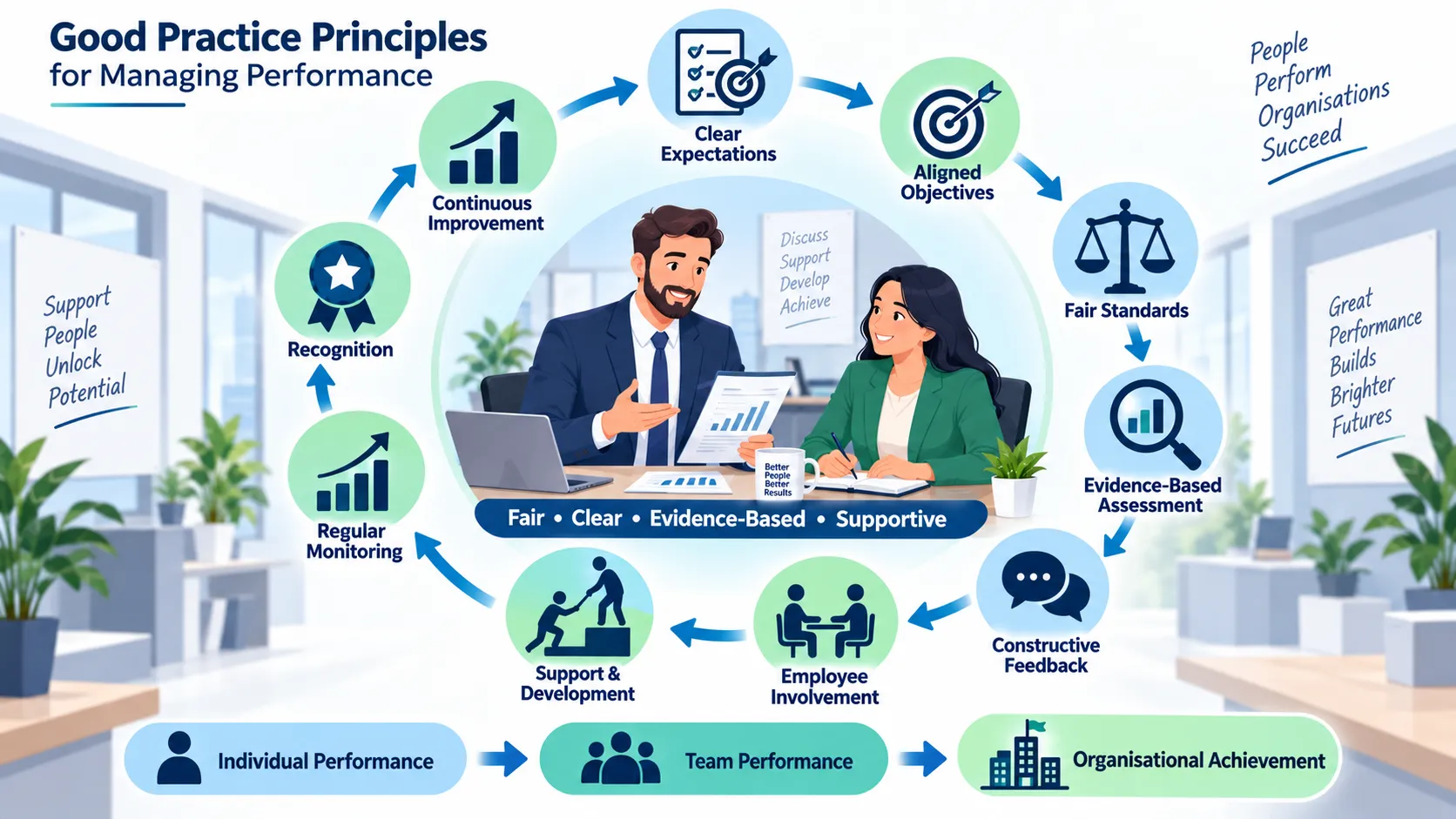
Understanding Good Practice in Performance Management
Definition of Good Practice
Good practice in performance management refers to the consistent application of fair, evidence-based, supportive and effective approaches that enable employees to understand expectations, achieve agreed standards, address performance gaps and contribute to organisational objectives.
Good practice does not mean that every employee must be managed in exactly the same way. Instead, it means that managers apply appropriate principles consistently while recognising legitimate differences in roles, responsibilities, circumstances, capabilities and support requirements.
A good performance management approach should answer several fundamental questions:
What is the employee expected to achieve?
How will successful performance be recognised?
What evidence will be used to assess performance?
How frequently will performance be reviewed?
What support is available?
How will performance concerns be addressed?
How will strong performance be recognised?
How will improvement be monitored?
How does individual performance contribute to team and organisational achievement?
When these questions are addressed clearly, employees are more likely to understand their responsibilities and managers are better positioned to make informed performance decisions.
Performance Management as an Ongoing Process
Performance management should be viewed as a continuous cycle rather than a single event. It begins with establishing expectations and continues through monitoring, feedback, support, review and evaluation.
A simplified performance management cycle can be represented as:
Set expectations → Agree objectives → Monitor performance → Provide feedback → Identify strengths and gaps → Support improvement → Recognise achievement → Review outcomes → Adjust and improve
This cycle encourages managers to address performance matters at the appropriate time. For example, if an employee begins to experience difficulties with a new responsibility, early coaching may prevent the issue from developing into significant underperformance.
Similarly, when an employee consistently exceeds expectations, timely recognition can reinforce effective performance rather than waiting until the end of the performance year.
Principle 1: Set Clear Performance Expectations
Definition
Clear performance expectations are specific statements describing what an employee is required to achieve, how work should be completed and what standards or behaviours are expected.
Clarity is one of the foundations of effective performance management. Employees cannot reasonably be expected to achieve standards that they do not understand. Managers therefore need to communicate responsibilities, objectives, priorities, quality standards and relevant behavioural expectations clearly.
Performance expectations should be connected to the employee’s actual role. They should reflect the responsibilities contained within the job description and contribute to team and organisational objectives.
For example, telling a customer service employee to “provide excellent service” may communicate a general intention but does not establish a sufficiently clear performance expectation. A more useful approach could involve agreed expectations concerning response times, accuracy, communication standards, customer experience and resolution of enquiries.
Characteristics of Clear Expectations
Good performance expectations should generally be:
Relevant to the employee’s role.
Understandable and clearly communicated.
Consistent with organisational objectives.
Measurable where appropriate.
Realistic in relation to available resources.
Time-related where deadlines are relevant.
Connected to required quality standards.
Supported by appropriate behavioural expectations.
Practical Example
A team leader managing an administration team notices that employees interpret “process requests promptly” differently. Some complete requests within one working day, while others take several days.
The manager introduces a clearer expectation that routine requests should normally be processed within an agreed timeframe, while complex cases should be acknowledged promptly and escalated where necessary.
The result is greater consistency because employees understand what is expected and managers have a clearer basis for reviewing performance.
Principle 2: Align Individual Performance with Organisational Objectives
Performance management becomes more effective when employees understand how their work contributes to broader organisational achievement.
Definition of Alignment
Performance alignment is the process of connecting individual responsibilities and objectives with team priorities and wider organisational goals.
Middle managers play an especially important role in this process because they often translate strategic organisational priorities into practical workplace expectations.
For example, if an organisation prioritises customer satisfaction, a middle manager may translate this priority into team-level expectations concerning response quality, communication, service reliability and customer outcomes.
This creates a clear relationship:
Organisational objectives → Team objectives → Individual objectives → Workplace actions → Performance outcomes
Alignment helps employees understand why their objectives matter rather than viewing targets as isolated administrative requirements.
Good Practice Actions
Managers should:
Explain how individual objectives contribute to team performance.
Connect personal targets with organisational priorities.
Avoid objectives that conflict with wider organisational outcomes.
Review objectives when organisational priorities change.
Ensure performance measures reflect meaningful contributions.
Communicate changes clearly and promptly.
Practical Example
A logistics organisation identifies delivery reliability as a major organisational priority. A middle manager therefore sets team expectations around accurate order preparation, timely processing and effective communication when delays occur.
Employees can see how their individual responsibilities contribute to reliable customer delivery.
Principle 3: Use Fair and Consistent Standards
Fairness is essential to employee confidence in performance management. Employees are more likely to accept performance decisions when they believe that standards are reasonable and applied consistently.
Definition of Fair Performance Management
Fair performance management means assessing employees against appropriate and clearly communicated standards while considering relevant evidence and legitimate workplace circumstances.
Consistency does not mean treating every situation identically. A manager may need to provide different forms of support depending on the employee’s circumstances while maintaining appropriate performance expectations.
Good practice therefore involves consistency of principle rather than mechanical uniformity of treatment.
Elements of Fairness
Managers should:
Apply relevant standards consistently.
Avoid favouritism.
Base decisions on evidence.
Give employees opportunities to explain their perspective.
Consider relevant circumstances.
Apply organisational procedures appropriately.
Keep appropriate records.
Avoid making decisions based solely on assumptions.
Fairness is particularly important when managing underperformance. A manager should not label an employee as incapable without first examining whether the performance gap may be related to workload, unclear instructions, inadequate resources, training needs, process problems or other factors.
Principle 4: Base Performance Decisions on Evidence
Definition
Evidence-based performance management is the use of relevant, reliable and appropriate information to understand, assess and improve performance.
Managers naturally develop impressions of employee performance through daily interactions. However, informal impressions should be supported by relevant evidence when making significant performance decisions.
Evidence can include:
Agreed performance indicators.
Quality records.
Work outputs.
Customer feedback.
Employee self-assessment.
Observation.
Performance review information.
Competency assessments.
Relevant workplace records.
Feedback from appropriate colleagues.
The strongest approach is often to consider multiple sources rather than relying on a single indicator.
Avoiding Single-Measure Decisions
A common weakness is assuming that one KPI represents total performance.
For example, an employee may achieve a high volume of completed tasks but have a high error rate. Another employee may produce fewer tasks but deliver consistently accurate and high-quality work.
A balanced evaluation should therefore consider both productivity and quality.
Managers should ask:
What does the measure actually tell us?
What does it not tell us?
Is the evidence relevant?
Is it reliable?
Is there contextual information that changes its interpretation?
Do other evidence sources support the same conclusion?
This approach supports stronger professional judgement.
Principle 5: Diagnose Before Intervening
One of the most important good practice principles is to understand the cause of a performance problem before deciding what action to take.
Definition of Diagnosis
Performance diagnosis is the structured process of investigating the reasons behind a performance outcome or performance gap.
A performance gap does not automatically mean that the employee lacks ability or motivation.
Possible causes may include:
Skills gaps.
Insufficient training.
Unclear expectations.
Excessive workload.
Inadequate resources.
Poor systems.
Ineffective processes.
Communication problems.
Conflicting priorities.
Changing customer requirements.
Organisational circumstances.
Diagnostic Process
A manager can use the following process:
Identify the performance gap.
Confirm the required standard.
Gather relevant evidence.
Discuss the issue with the employee.
Examine possible contributing factors.
Distinguish individual factors from organisational factors.
Identify the most significant causes.
Select an appropriate intervention.
Agree an improvement plan where required.
Monitor and evaluate the outcome.
Practical Example
A sales employee’s performance falls below target. The manager initially considers a skills issue but investigates further.
The employee explains that a new customer segment has been introduced and that the sales system does not provide accurate information for these customers.
The manager therefore avoids immediately assuming poor capability and investigates the system and market changes.
This illustrates professional performance management because the manager diagnoses the issue before selecting an intervention.
Principle 6: Communicate Expectations and Feedback Effectively
Communication is central to performance management because expectations, feedback, concerns, support and recognition all need to be communicated clearly.
Definition of Effective Performance Communication
Effective performance communication is the clear, timely, respectful and constructive exchange of information about expectations, performance, progress, challenges and improvement.
Good managers communicate performance expectations at the beginning of a performance period and maintain communication throughout it.
Feedback should not be reserved for formal reviews. Regular feedback allows employees to understand what they are doing well and where changes may be required.
Characteristics of Effective Feedback
Good performance feedback should be:
Specific.
Timely.
Evidence-based.
Balanced.
Constructive.
Relevant to the role.
Focused on behaviour or outcomes.
Linked to agreed expectations.
Oriented towards improvement where a gap exists.
Managers should avoid vague statements such as “you need to improve your attitude” without explaining the relevant behaviour or expected standard.
A stronger approach identifies the specific behaviour, its impact and the expected improvement.
Practical Example
Instead of saying:
“You need to communicate better.”
A manager could explain that several customer updates were not provided within the agreed timeframe and that this created uncertainty for customers. The manager can then agree a clear communication expectation and provide support where required.
This makes the feedback actionable.
Principle 7: Encourage Employee Involvement
Effective performance management should not be a one-way process in which managers simply tell employees whether they are performing adequately.
Employee involvement allows managers to understand the employee’s perspective, identify barriers and create stronger ownership of improvement objectives.
Why Employee Voice Matters
Employees often possess important information about:
Operational barriers.
Workload pressures.
Customer challenges.
Resource limitations.
Process inefficiencies.
Skills development needs.
Practical solutions.
Changes affecting performance.
Ignoring this information can result in managers addressing symptoms rather than causes.
Good Practice in Employee Involvement
Managers should:
Invite employees to discuss their performance.
Ask open questions.
Listen actively.
Encourage self-assessment.
Allow employees to explain contextual factors.
Involve employees in identifying solutions.
Agree realistic improvement actions collaboratively where appropriate.
Confirm shared understanding of expectations.
Employee involvement does not remove managerial accountability. The manager remains responsible for maintaining standards while ensuring that performance discussions are constructive and evidence-based.
Principle 8: Provide Appropriate Support and Development
Performance management should help employees succeed, not merely identify shortcomings.
Definition
Performance support refers to the practical assistance provided to help an employee meet agreed performance expectations.
Support should be linked to the diagnosed need rather than automatically applying the same intervention to every employee.
Support may include:
Coaching.
Guidance.
Clarification of expectations.
Training.
Mentoring.
Additional resources.
Process clarification.
Work prioritisation.
Regular review meetings.
Access to relevant information.
Matching Support to Cause
The intervention should reflect the cause.
For example:
Skills problem → coaching or training
Unclear expectation → clarification
Resource problem → additional resources
Process problem → process improvement
Workload problem → workload review
Communication issue → targeted feedback and support
This prevents managers from using inappropriate interventions.
Practical Example
An employee repeatedly makes errors when using a new organisational system. The manager observes the work and finds that the employee understands the task but lacks confidence using the new system.
Rather than treating the issue as general underperformance, the manager provides targeted coaching and practical guidance.
Performance is then monitored to determine whether the support produces improvement.
Principle 9: Monitor Performance Regularly
Monitoring enables managers to understand whether agreed expectations are being achieved and whether interventions are effective.
Definition
Performance monitoring is the regular collection and review of relevant information to understand progress against agreed expectations or standards.
Monitoring should be proportionate. Excessive monitoring can create unnecessary administration and may reduce employee autonomy, while insufficient monitoring can allow problems to continue unnoticed.
Good Monitoring Practice
Managers should:
Establish appropriate review points.
Use relevant performance evidence.
Compare progress with agreed expectations.
Identify trends rather than isolated incidents.
Discuss significant changes promptly.
Record important decisions and agreed actions.
Adjust support where evidence indicates that this is necessary.
Regular monitoring also allows managers to identify strong performance.
For example, if an employee consistently exceeds quality expectations, the manager can recognise the contribution rather than focusing only on gaps.
Principle 10: Recognise and Reward Strong Performance
Performance management should not focus exclusively on underperformance.
Recognition is an important management practice because employees who consistently exceed expectations should understand that their contribution is noticed and valued.
Definition of Recognition
Performance recognition is the acknowledgement of an employee’s positive contribution, achievement or behaviour in relation to agreed expectations or organisational objectives.
Recognition may be:
Verbal acknowledgement.
Written appreciation.
Formal recognition.
Opportunities to take on appropriate responsibilities.
Organisational rewards where applicable.
Team recognition.
Development opportunities within the organisation.
Recognition should be linked to meaningful performance and applied fairly.
Avoiding Unfair Recognition
Managers should avoid recognising employees simply because they are highly visible or personally well-liked.
Instead, recognition should be based on relevant evidence such as:
Achievement of demanding objectives.
Consistently high-quality work.
Exceptional customer outcomes.
Valuable team contribution.
Demonstrated organisational behaviours.
Significant improvement in performance.
Principle 11: Manage Underperformance Professionally and Supportively
Managing underperformance is one of the most challenging aspects of leadership.
Definition of Underperformance
Underperformance occurs when an employee’s performance does not meet agreed or required standards over an appropriate period, based on relevant evidence.
A professional response should focus on understanding the gap, identifying causes, agreeing appropriate action and monitoring improvement.
Managers should avoid immediately adopting a punitive approach when a performance problem is first identified.
Supportive Underperformance Process
A practical process is:
Identify the specific performance concern.
Confirm the expected standard.
Gather relevant evidence.
Discuss the concern with the employee.
Listen to the employee’s explanation.
Diagnose possible causes.
Agree appropriate improvement actions.
Provide reasonable and relevant support.
Set clear review points.
Monitor progress.
Review the outcome.
Determine the appropriate next step based on evidence and organisational procedure.
This approach combines accountability with support.
Practical Example
A team member repeatedly misses agreed deadlines. Instead of simply stating that the employee is unreliable, the manager reviews the work, discusses the issue and discovers that the employee has been receiving conflicting priorities from several sources.
The manager works with the employee to clarify priorities and establish a clearer workflow.
The performance is then monitored.
The issue may therefore be partly organisational rather than simply an individual capability problem.
Principle 12: Address Performance Issues Early
Early intervention is generally more effective than allowing performance concerns to continue without discussion.
A small performance gap can often be corrected through a short conversation or targeted coaching. If the issue continues for months without intervention, it may become more difficult to resolve and may affect customers, colleagues and organisational outcomes.
Managers should therefore watch for:
Emerging performance trends.
Repeated errors.
Missed deadlines.
Declining quality.
Increased customer complaints.
Reduced productivity.
Behavioural concerns.
Signs that an employee is struggling with new responsibilities.
Early intervention should not mean premature judgement. It means recognising concerns early and investigating them appropriately.
Principle 13: Maintain Appropriate Documentation
Good performance management requires appropriate records, particularly when significant performance discussions, objectives, support arrangements or review outcomes are involved.
Purpose of Documentation
Documentation can:
Provide an accurate record of agreed expectations.
Support continuity between review meetings.
Provide evidence of actions taken.
Clarify responsibilities.
Support consistency.
Help evaluate progress.
Provide accountability for managers and employees.
Records should be factual, relevant, appropriate and handled in accordance with organisational requirements.
Managers should avoid recording assumptions or subjective comments as though they were established facts.
For example, writing “employee is lazy” is not appropriate evidence.
A more useful record would describe the observable performance issue, such as missed deadlines against agreed dates, together with the relevant discussion and agreed actions.
Principle 14: Apply Confidentiality and Respect
Performance discussions can involve sensitive information. Managers should therefore conduct them professionally and respect employee dignity.
Good practice includes:
Discussing performance concerns privately.
Sharing information only with appropriate people.
Maintaining professional language.
Avoiding unnecessary public criticism.
Handling records appropriately.
Allowing employees to express their perspective.
Separating the person from the performance issue.
A manager should focus on what needs to change rather than attacking the employee personally.
For example, “The agreed reporting standard has not been achieved” is more professional than “You are not good at your job.”
Principle 15: Consider the Whole Performance Picture
A strong manager avoids reducing performance to a single number.
Performance may include:
Productivity.
Quality.
Customer outcomes.
Timeliness.
Accuracy.
Team contribution.
Behaviour.
Compliance with relevant organisational expectations.
Achievement of agreed objectives.
Improvement over time.
Balanced Performance Assessment
| Performance Dimension | Example Evidence | Managerial Use |
|---|---|---|
| Productivity | Completed tasks or outputs | Assess work volume and efficiency |
| Quality | Error rates, quality checks | Assess accuracy and standards |
| Customer Outcomes | Customer feedback and complaints | Assess service effectiveness |
| Timeliness | Completion against agreed deadlines | Assess reliability and delivery |
| Competence | Skills or competency assessment | Identify capability strengths and gaps |
| Behaviour | Observation and relevant feedback | Assess expected workplace behaviours |
| Progress | Comparison with baseline or previous results | Evaluate improvement over time |
| Overall Contribution | Combined evidence and outcomes | Support balanced professional judgement |
The table demonstrates why a balanced approach is important. A manager may find that an employee performs strongly in several areas but needs improvement in another. This creates a more accurate basis for discussion and action.
Principle 16: Use Appropriate Performance Measures
Performance measures should be meaningful and connected to the outcomes the organisation actually values.
A useful measure should provide relevant information rather than simply producing numbers.
Managers should consider:
Relevance.
Reliability.
Validity.
Objectivity.
Practicality.
Timeliness.
Completeness.
Fairness.
Avoiding Excessive Measurement
Collecting large quantities of data does not automatically improve performance management.
Managers should ask whether each measure contributes useful information.
For example, if an organisation measures the number of calls handled by customer service staff but does not consider resolution quality, employees may focus on handling more calls rather than solving customer problems effectively.
This demonstrates the importance of balanced measures.
Principle 17: Review Performance Against Agreed Objectives
Performance reviews should provide an opportunity to assess progress, discuss achievements, identify challenges and agree future actions.
A useful review process can include:
Stage 1: Prepare
The manager reviews relevant evidence, objectives and previous agreements.
Stage 2: Invite Employee Reflection
The employee considers achievements, challenges, learning and areas requiring support.
Stage 3: Review Evidence
Manager and employee consider relevant performance information.
Stage 4: Discuss Strengths
Successful performance should be recognised and reinforced.
Stage 5: Discuss Performance Gaps
Where expectations have not been met, the manager should explain the evidence clearly.
Stage 6: Explore Causes
The discussion should consider whether the issue relates to capability, resources, workload, processes or other factors.
Stage 7: Agree Actions
Specific improvement or development actions should be established.
Stage 8: Establish Review Points
The manager and employee agree how and when progress will be assessed.
This process makes reviews more constructive and future-focused.
Principle 18: Use Feedback as a Two-Way Process
Managers should not assume that they are the only source of useful performance information.
Employees should have opportunities to provide feedback about:
Their objectives.
Resources.
Workload.
Management support.
Organisational processes.
Customer challenges.
Barriers to performance.
The usefulness of existing measures.
Two-way feedback can reveal organisational factors that managers may not see directly.
For example, if several employees report that the same system creates delays, this may indicate a process issue rather than separate individual performance problems.
Principle 19: Adapt Management to Circumstances
Good performance management should be structured but not rigid.
Different employees and situations may require different management responses.
For example:
A new employee may require closer guidance.
An experienced employee may benefit from greater autonomy.
A high performer may need challenging objectives.
An employee experiencing a temporary difficulty may require targeted support.
A team facing a process problem may require organisational intervention rather than individual coaching.
The underlying principles remain consistent, but the management response should reflect the evidence and circumstances.
This is an important aspect of professional managerial judgement.
Principle 20: Evaluate Whether Performance Management Is Working
Performance management itself should be evaluated.
Managers should ask whether the approach is actually producing improvement and contributing to organisational achievement.
Evaluation may consider:
Improvement against performance measures.
Achievement of objectives.
Quality outcomes.
Customer outcomes.
Employee feedback.
Team performance.
Effectiveness of interventions.
Sustainability of improvement.
Evaluating an Intervention
For example, a manager identifies a communication problem and introduces coaching.
The manager should not simply assume that the coaching worked because it was delivered.
Instead, the manager should compare relevant evidence before and after the intervention.
The process can be:
Identify baseline → Introduce intervention → Monitor performance → Compare results → Gather feedback → Evaluate impact → Adjust approach
This ensures that performance management remains evidence-based.
Integrating the Principles into a Good Practice Performance Management Process
The principles discussed above can be integrated into a practical management process.
Step 1: Establish Expectations
The manager communicates role responsibilities, objectives, standards and expected behaviours.
Step 2: Align Objectives
Individual objectives are connected to team and organisational priorities.
Step 3: Agree Measures
Appropriate performance indicators and evidence sources are identified.
Step 4: Monitor Performance
Performance information is collected at suitable intervals.
Step 5: Provide Regular Feedback
The manager discusses progress, strengths and emerging concerns.
Step 6: Diagnose Performance Issues
Where a gap exists, the manager investigates potential causes.
Step 7: Agree Appropriate Action
The manager and employee identify suitable support, development or corrective actions.
Step 8: Recognise Achievement
Strong performance and meaningful improvement are acknowledged appropriately.
Step 9: Review Progress
The manager assesses whether agreed actions have produced improvement.
Step 10: Evaluate Outcomes
The manager considers individual, team and organisational impact.
Step 11: Adapt the Approach
Where the intervention has not achieved the intended outcome, the manager reviews the evidence and adjusts the approach.
This creates a continuous cycle of performance improvement.
Practical Workplace Scenario: Managing a Performance Gap
Consider a middle manager responsible for a customer service team. One employee has experienced a decline in customer satisfaction scores over several months.
The manager does not immediately conclude that the employee has poor customer service skills.
Instead, the manager follows a structured process.
First, the manager reviews customer feedback and performance records. The evidence confirms a genuine decline in customer satisfaction.
The manager then meets privately with the employee and explains the evidence. The employee explains that a recent system change has made it difficult to access customer information quickly.
The manager investigates the issue and finds that other employees are experiencing similar difficulties.
The manager therefore recognises that the performance problem may have an organisational cause.
The manager provides temporary support, clarifies procedures and raises the system issue through the appropriate organisational channel.
Performance is then monitored.
This scenario demonstrates several good practice principles:
Evidence-based assessment.
Employee involvement.
Diagnosis before intervention.
Consideration of organisational context.
Supportive management.
Regular monitoring.
Continuous evaluation.
Practical Workplace Scenario: Recognising High Performance
A project coordinator consistently completes work ahead of agreed deadlines while maintaining high quality and supporting colleagues.
The manager reviews relevant evidence and confirms that the employee is consistently exceeding agreed expectations.
Rather than simply assuming that high performance will continue, the manager discusses the contribution with the employee and identifies what has enabled the strong results.
The manager provides appropriate recognition and considers how the employee’s strengths could contribute to wider team objectives.
This demonstrates that performance management should include both performance improvement and recognition of achievement.
Practical Workplace Scenario: Avoiding a Single-Metric Decision
A warehouse employee’s productivity figures are below the team average.
The manager initially considers the result concerning. However, further evidence shows that the employee handles more complex orders than most colleagues and has one of the team’s lowest error rates.
The manager therefore avoids making a decision based solely on productivity.
Instead, the manager considers:
Order complexity.
Quality.
Accuracy.
Productivity.
Customer outcomes.
Relevant workload factors.
This produces a more balanced assessment.
Common Mistakes in Performance Management
Even when organisations have formal performance management systems, managers may apply them poorly.
Treating Performance Management as an Annual Event
Annual reviews alone are insufficient for effective ongoing performance management.
Relying on Personal Opinion
Managers may allow impressions or assumptions to replace evidence.
Focusing Only on Poor Performance
This can create a negative culture and overlook opportunities to recognise strong contribution.
Using One Measure
A single KPI rarely represents the whole performance picture.
Assuming the Employee Is the Problem
Organisational systems, processes, workload and resources can also influence performance.
Intervening Before Diagnosing
Training or corrective action may be ineffective if the actual cause is different.
Providing Vague Feedback
Employees cannot easily improve if feedback does not explain what needs to change.
Failing to Follow Up
An intervention has limited value if progress is never monitored.
Applying Standards Inconsistently
Different expectations for similar roles can undermine fairness and trust.
Over-Administrative Management
Excessive forms, meetings and measures can shift attention away from meaningful performance improvement.
Key Benefits of Good Practice Performance Management
Effective application of good practice principles creates benefits for employees, managers, teams and organisations.
Benefits for Employees
Employees benefit from:
Clear expectations.
Better understanding of priorities.
Regular feedback.
Recognition of achievement.
Appropriate support.
Greater opportunity to address problems early.
More transparent performance discussions.
Stronger understanding of how their work contributes to organisational goals.
Benefits for Managers
Managers benefit from:
Better-quality performance information.
More consistent decision-making.
Earlier identification of problems.
Stronger employee relationships.
Clearer accountability.
More effective interventions.
Improved ability to recognise strong performance.
Benefits for Teams
Teams can experience:
Greater clarity.
More consistent standards.
Better collaboration.
Improved quality.
Faster identification of barriers.
Stronger accountability.
Greater recognition of contribution.
Benefits for Organisations
Organisations can benefit through:
Improved individual performance.
Stronger team effectiveness.
Better quality outcomes.
Improved customer experience.
More effective use of resources.
Greater alignment between employee activity and organisational objectives.
Improved organisational achievement.
Role of the Middle Manager in Good Performance Management
Middle managers occupy a particularly important position because they connect organisational expectations with everyday employee performance.
Senior leaders may establish organisational priorities, but middle managers translate these priorities into practical objectives, monitor implementation and provide direct support to employees.
A capable middle manager should therefore be able to:
Translate organisational objectives into meaningful team expectations.
Set clear individual objectives.
Communicate standards effectively.
Monitor performance using appropriate evidence.
Provide constructive feedback.
Diagnose performance problems.
Distinguish capability issues from organisational barriers.
Support employees through improvement.
Recognise strong contribution.
Maintain fairness and consistency.
Review the effectiveness of interventions.
Escalate appropriate organisational issues.
Use professional judgement when circumstances vary.
The middle manager should also recognise that performance management is not solely about controlling employees. It is about creating the conditions in which people can understand expectations, perform effectively and contribute meaningfully.
Professional Judgement in Managing Performance
Professional judgement is required because workplace performance rarely exists in simple or identical circumstances.
Two employees may have similar performance results but different underlying circumstances. Similarly, two employees may achieve the same target but contribute in different ways.
Professional judgement involves:
Reviewing relevant evidence.
Considering context.
Avoiding assumptions.
Applying organisational principles consistently.
Listening to the employee.
Considering alternative explanations.
Selecting an appropriate intervention.
Evaluating the impact of action.
Maintaining accountability.
Professional judgement should not be confused with personal preference. A manager’s decision should be explainable through evidence, organisational expectations and reasonable consideration of circumstances.
Good Practice Checklist for Managers
Before making a performance decision, a manager should consider:
Are expectations clear?
Are the objectives aligned with organisational priorities?
Is the performance standard appropriate?
Is there sufficient evidence?
Are multiple evidence sources available?
Has the employee been given an opportunity to provide their perspective?
Have possible underlying causes been investigated?
Could organisational factors be contributing to the issue?
Is the proposed intervention appropriate to the cause?
Has suitable support been considered?
Are strong contributions being recognised?
Are standards being applied consistently?
Are performance discussions respectful and confidential?
Are actions and expectations clearly documented?
Has a suitable review point been established?
Will the impact of the intervention be evaluated?
This checklist helps managers turn good practice principles into practical workplace behaviour.
Summary
Good practice principles provide the foundation for effective performance management. They help managers move beyond a narrow focus on targets and create a structured approach that combines accountability, fairness, evidence, communication, support and recognition.
Effective managers begin by establishing clear expectations and aligning individual objectives with team and organisational priorities. They use appropriate evidence to monitor performance and avoid relying solely on personal judgement or single performance measures. When performance gaps arise, they diagnose the underlying causes before selecting an intervention, recognising that performance may be influenced by skills, training, workload, resources, processes, communication and organisational circumstances.
Good practice also requires managers to provide regular and constructive feedback, involve employees in performance discussions, provide appropriate support and monitor whether agreed actions are producing improvement. Underperformance should be managed professionally and supportively, while strong performance should be recognised fairly and appropriately.
Ultimately, good performance management is a continuous process rather than an isolated annual activity. It connects expectations, evidence, communication, support, recognition and evaluation into a coherent management cycle. When applied effectively, these principles can strengthen individual performance, improve team effectiveness and contribute directly to organisational achievement.
2.Examine the Use of Formal Processes for Managing Performance
Formal performance management processes provide managers with a structured and consistent way of setting expectations, reviewing performance, addressing concerns, supporting improvement and recognising achievement. While effective performance management should include regular informal conversations and day-to-day feedback, formal processes become particularly important when performance needs to be reviewed systematically, when concerns persist, when agreed improvement actions need to be documented, or when organisational procedures require a structured response.
For middle managers and leaders, understanding formal performance management is essential because they are often responsible for translating organisational policies into practical workplace procedures. They may be required to conduct formal performance reviews, document agreed objectives, manage capability concerns, establish improvement plans, monitor progress and make recommendations based on evidence.
A formal process should not be viewed simply as an administrative requirement. When designed and applied appropriately, it provides clarity for both managers and employees. It establishes what is expected, how performance will be assessed, what evidence will be considered, what support is available and how progress will be reviewed. It can therefore strengthen fairness, accountability, consistency and organisational effectiveness.
Formal processes should also be applied proportionately. Not every minor performance issue requires an extensive formal procedure. Managers should normally address routine matters through appropriate day-to-day management, while more significant, persistent or complex concerns may require formal intervention in line with organisational requirements.
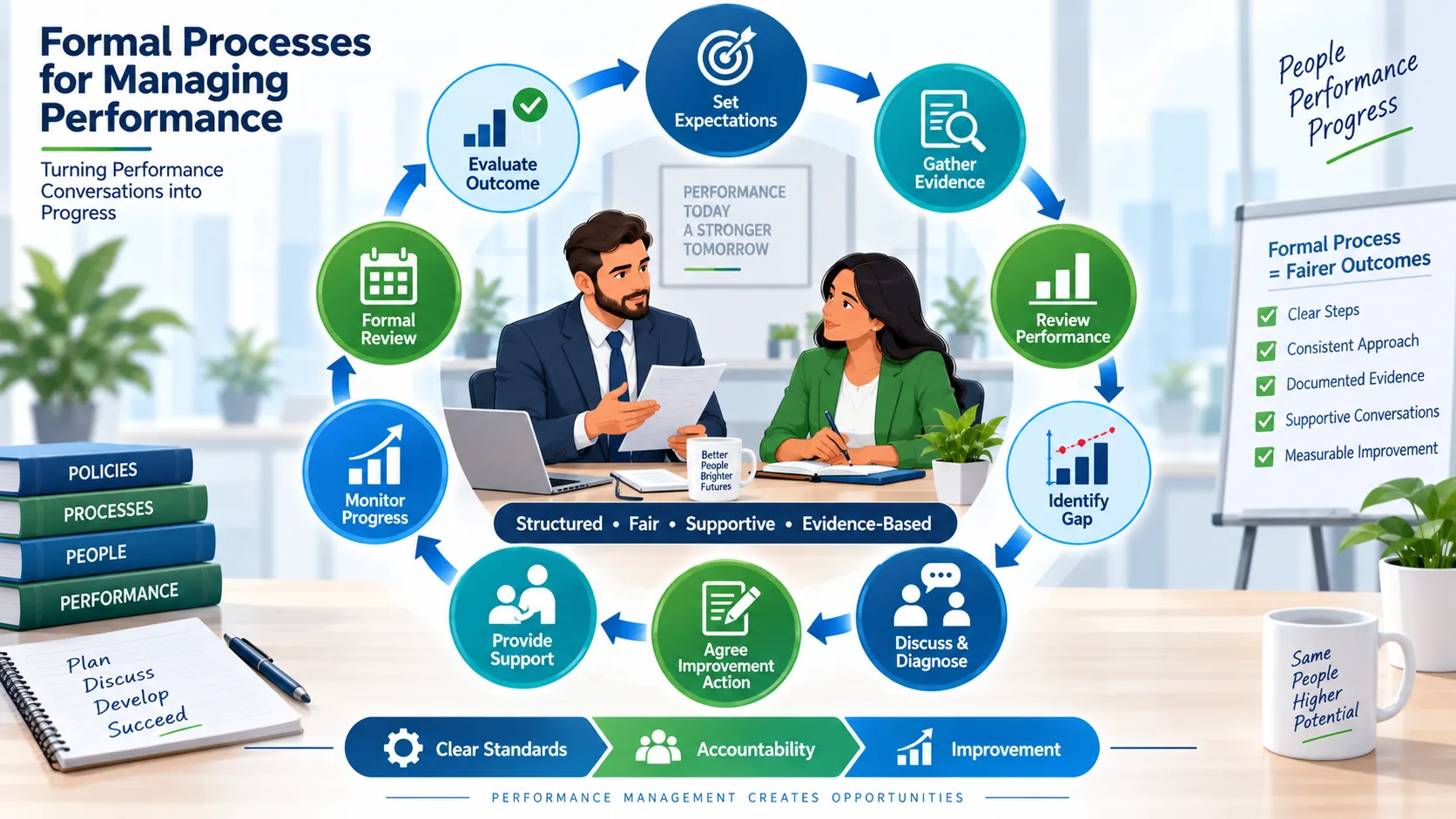
Understanding Formal Performance Management Processes
Definition of a Formal Performance Management Process
A formal performance management process is a structured organisational procedure used to establish, assess, review, improve or document employee performance against agreed standards, objectives, responsibilities or behavioural expectations.
The process normally involves defined stages, responsibilities, documentation and review points. It provides a clear framework for managers and employees to understand how performance matters will be handled.
Formal processes can cover both positive and negative aspects of performance. They may be used to:
Set and review formal objectives.
Conduct structured performance reviews.
Document performance discussions.
Establish performance improvement plans.
Monitor sustained underperformance.
Provide structured support.
Review competency requirements.
Recognise achievement.
Agree development actions.
Escalate persistent performance concerns in accordance with organisational procedures.
The purpose is not to make performance management unnecessarily bureaucratic. The purpose is to create a transparent and consistent process that supports effective performance.
Informal and Formal Performance Management
Formal and informal performance management should not be considered competing approaches. They operate at different points within an effective performance management system.
Informal performance management takes place through normal management activities such as conversations, coaching, feedback, guidance, recognition and routine monitoring.
Formal performance management introduces greater structure when the situation requires it.
Informal Management May Include
Day-to-day feedback.
Informal coaching.
Clarification of expectations.
Routine progress discussions.
Recognition of good performance.
Early conversations about emerging concerns.
Practical guidance.
Informal problem solving.
Formal Management May Include
Scheduled performance reviews.
Documented performance objectives.
Formal performance meetings.
Written improvement plans.
Structured review periods.
Formal evidence gathering.
Documented outcomes.
Defined review dates.
Escalation through organisational procedures where appropriate.
A good manager should know when to use each approach.
For example, if an employee occasionally misses a minor deadline because of an unfamiliar task, informal coaching and clarification may be sufficient. If the same performance issue continues despite repeated support and discussion, a more formal process may become appropriate.
Why Formal Processes Are Important
Formal processes provide a consistent structure for performance management. Without a structured approach, managers may respond differently to similar situations, resulting in confusion, inconsistency and reduced employee confidence.
A formal process helps establish a common understanding of:
Required performance standards.
Employee responsibilities.
Manager responsibilities.
Evidence requirements.
Review arrangements.
Support available.
Improvement expectations.
Timescales.
Documentation requirements.
Possible next steps.
Formal processes are particularly valuable where performance concerns are significant or persistent because they create a clear record of what has been discussed and agreed.
Key Principle: Formal Does Not Mean Punitive
One of the most important concepts for managers is that formal performance management should not automatically be associated with punishment.
A formal process can be supportive, developmental and improvement-focused.
For example, an employee who has struggled to meet a competency requirement may benefit from a formal improvement plan that establishes:
The specific performance gap.
The required standard.
Support available.
Actions to be completed.
Measures of progress.
Review dates.
This creates clarity rather than simply communicating that the employee is performing poorly.
A formal process becomes more effective when it combines accountability with appropriate support.
The Formal Performance Management Cycle
A structured formal process can be understood as a cycle:
Establish expectations → Assess performance → Identify gaps → Discuss evidence → Diagnose causes → Agree action → Provide support → Monitor progress → Review outcomes → Close, continue or adjust the process
Each stage has a distinct purpose.
Stage 1: Establish Performance Expectations
The first stage is to ensure that the employee understands what is expected.
This may include:
Role responsibilities.
Performance objectives.
Quality standards.
Behavioural expectations.
Deadlines.
Relevant performance indicators.
Organisational priorities.
Expectations should be communicated clearly before performance is assessed against them.
A manager should be able to demonstrate that the employee knew what standard was required.
Stage 2: Establish Appropriate Measures and Evidence
The manager identifies how performance will be assessed.
Evidence might include:
KPIs.
Quality measures.
Work outputs.
Customer feedback.
Performance records.
Observation.
Competency assessment.
Employee self-assessment.
Relevant colleague feedback.
The evidence should be appropriate to the role and performance issue.
Managers should avoid creating excessive measurement simply because a formal process is being used.
Stage 3: Review Actual Performance
The manager compares actual performance with agreed expectations.
The purpose is to identify whether there is:
Performance at or above the expected standard.
Minor variation requiring routine management.
A significant performance gap.
Sustained underperformance.
Evidence of improvement.
A single isolated incident may not always represent sustained underperformance. Managers should consider patterns, trends and relevant context.
Stage 4: Identify the Performance Gap
If performance is below the required standard, the manager should identify precisely what the gap is.
For example:
Weak statement:
“Your performance is not good enough.”
Stronger formal statement:
“The agreed monthly reporting standard requires reports to be completed accurately by the specified deadline. Over the previous review period, three reports were submitted after the agreed deadline and two contained significant errors.”
The second approach provides a clearer basis for discussion because it identifies the standard and relevant evidence.
Stage 5: Discuss the Evidence with the Employee
The employee should have an opportunity to understand the concern and provide their perspective.
A formal meeting should be professional, structured and focused on the performance issue.
Managers should:
Explain the purpose of the meeting.
Present relevant evidence.
Explain the expected standard.
Describe the identified gap.
Ask for the employee’s perspective.
Listen to relevant explanations.
Clarify misunderstandings.
Explore possible causes.
Discuss potential solutions.
The manager should avoid treating the formal meeting as a predetermined judgement.
Stage 6: Diagnose the Underlying Causes
Formal performance management should still follow the principle of diagnosis before intervention.
Managers should consider whether the issue relates to:
Knowledge.
Skills.
Training.
Workload.
Resources.
Systems.
Processes.
Communication.
Role clarity.
Competing priorities.
Organisational circumstances.
The purpose is to establish what needs to change and what support may be required.
Example
An employee has repeatedly failed to meet a processing target.
The manager investigates and finds that the employee has received additional responsibilities without an adjustment to workload.
A formal process should therefore consider workload as part of the performance context rather than automatically treating the problem as a capability issue.
Stage 7: Agree Performance Improvement Actions
Where improvement is required, formal processes should establish clear actions.
An improvement plan may specify:
The performance issue.
Required standard.
Improvement objective.
Actions to be completed.
Support available.
Evidence required.
Review dates.
Responsibilities.
Expected timescale.
The plan should be realistic and directly connected to the diagnosed performance issue.
Performance Improvement Plans
Definition
A Performance Improvement Plan, often referred to as a PIP, is a structured document or process that identifies a specific performance gap, establishes expected improvement, outlines support and actions, and defines how and when progress will be reviewed.
A PIP should provide clarity rather than simply create additional paperwork.
Effective PIP Components
A well-designed plan should normally include:
Current performance concern.
Required performance standard.
Evidence supporting the concern.
Specific improvement objectives.
Agreed actions.
Support or resources.
Measurement criteria.
Review dates.
Responsibilities.
Expected outcomes.
Example
An employee’s quality performance has fallen below the agreed standard.
A useful improvement plan might state that the employee must achieve the required quality standard over an agreed review period, complete targeted coaching, apply the agreed checking procedure and participate in regular review meetings.
The plan should explain how improvement will be measured.
Stage 8: Provide Appropriate Support
A formal process should identify what support the organisation or manager will provide.
Support may include:
Coaching.
Training.
Mentoring.
Job guidance.
Additional resources.
Clarification of procedures.
Work planning.
Access to relevant information.
Regular management support.
Process improvement where organisational barriers are identified.
The type of support should reflect the cause of the performance issue.
For example:
Skills gap → targeted training or coaching
Process problem → process review
Resource shortage → appropriate resource intervention
Unclear expectations → clarification
Workload issue → workload review
This demonstrates why diagnosis is essential.
Stage 9: Establish Review Points
Formal processes require clear review arrangements.
A review point provides an opportunity to assess:
Whether agreed actions have been completed.
Whether performance has improved.
Whether the required standard is being achieved.
Whether support has been effective.
Whether further action is required.
Whether the improvement plan should be adjusted or concluded.
Review periods should be appropriate to the performance issue.
A manager should avoid reviewing too quickly if meaningful improvement requires time, but should also avoid allowing a serious issue to continue without appropriate monitoring.
Stage 10: Evaluate Performance Improvement
At the review stage, the manager should compare current performance with the agreed standard and, where available, the baseline.
Relevant evidence may include:
KPI results.
Quality data.
Customer outcomes.
Work samples.
Observation.
Competency assessment.
Feedback.
Previous performance information.
The manager should consider whether improvement is:
Achieved.
Partially achieved.
Not achieved.
Sustainable.
Requiring further support.
Evaluation should focus on evidence rather than assumptions.
Stage 11: Determine the Appropriate Outcome
At the end of a formal review period, several outcomes may be possible.
Successful Improvement
If the required standard has been achieved, the formal improvement process may be concluded in accordance with organisational procedure.
The manager should recognise the improvement and discuss how effective performance can be sustained.
Partial Improvement
If some improvement has occurred but the required standard has not yet been consistently achieved, further support or review may be appropriate.
Insufficient Improvement
If the employee has not achieved the required standard despite appropriate support and reasonable opportunities to improve, the manager may need to follow the next stage of the organisation’s formal procedure.
The appropriate response depends on organisational policy and the specific circumstances.
Formal Performance Reviews
Formal performance reviews provide a structured opportunity to assess performance over an agreed period.
They should not be treated simply as paperwork exercises.
A Formal Review Can Cover
Achievement against objectives.
Quality of work.
Productivity.
Customer outcomes.
Behaviour and organisational expectations.
Competencies.
Strengths.
Areas for improvement.
Development needs.
Barriers to performance.
Support requirements.
Future objectives.
Effective Review Procedure
A manager can structure a review as follows:
Before the Meeting
Review objectives.
Gather relevant evidence.
Review previous commitments.
Identify achievements.
Identify performance gaps.
Prepare questions.
Consider potential support.
During the Meeting
Explain the purpose.
Review achievements.
Present evidence.
Invite employee reflection.
Discuss performance gaps.
Explore causes.
Agree actions.
Confirm support.
Establish review arrangements.
After the Meeting
Document agreed outcomes.
Confirm responsibilities.
Record review dates.
Provide relevant information to the employee.
Monitor agreed actions.
Formal Documentation
Documentation is an important element of formal performance management.
Definition
Performance documentation is the accurate recording of relevant performance expectations, evidence, discussions, decisions, actions and review outcomes.
Documentation supports continuity and accountability.
It can help managers remember:
What was discussed.
What evidence was considered.
What the employee agreed to do.
What support was offered.
What the manager agreed to provide.
When progress would be reviewed.
What outcome was reached.
Good Documentation Should Be
Factual.
Relevant.
Clear.
Accurate.
Professional.
Proportionate.
Consistent with organisational requirements.
Managers should distinguish facts from assumptions.
For example:
Poor documentation:
“Employee is careless and does not care about quality.”
Better documentation:
“Four quality checks during the review period identified errors against the agreed quality standard. The employee was provided with feedback and agreed to use the checking procedure before submission.”
The second statement records observable evidence and agreed action rather than making a personal judgement.
Formal Processes and Fairness
Formal processes can strengthen fairness by ensuring that similar situations are managed through consistent organisational procedures.
However, simply having a formal process does not guarantee fairness. Managers must apply it appropriately.
Fairness requires:
Clear expectations.
Relevant evidence.
Consistent standards.
Opportunity for employee input.
Consideration of relevant context.
Appropriate support.
Accurate documentation.
Consistent application of organisational procedures.
A manager should not use a formal process simply because they personally dislike an employee’s working style.
The process should be connected to legitimate performance expectations.
Formal Processes and Employee Voice
Employee involvement remains important during formal performance management.
An employee may identify information that changes the manager’s understanding of the situation.
For example, a manager may believe that an employee is failing to complete work on time. During the formal discussion, the employee explains that urgent tasks are regularly being added by different managers.
Further investigation confirms conflicting priorities.
The manager therefore needs to consider workload and priority management rather than simply treating the issue as poor individual performance.
This demonstrates how formal procedures can still be collaborative and evidence-based.
Managing Persistent Underperformance Through a Formal Process
Persistent underperformance requires careful management.
Definition
Persistent underperformance refers to continuing failure to meet agreed performance standards over an appropriate period despite reasonable clarification, support and opportunities to improve.
A formal process may become appropriate where:
The performance gap is significant.
The issue continues over time.
Informal support has not produced sufficient improvement.
The required standard is clear.
Appropriate evidence is available.
Additional structured intervention is needed.
Recommended Approach
The manager should:
Confirm the performance standard.
Establish reliable evidence.
Review previous discussions.
Discuss the concern formally.
Identify contributing causes.
Agree improvement expectations.
Provide appropriate support.
Establish measurable review criteria.
Monitor progress.
Document outcomes.
Review the result.
Follow organisational procedures for the next stage if improvement remains insufficient.
The process should remain professional and focused on performance rather than personal criticism.
Managing High Performance Through Formal Processes
Formal performance processes should not focus only on underperformance.
Formal reviews can also provide opportunities to recognise employees who consistently exceed expectations.
Managers can use structured performance reviews to identify:
Exceptional achievement.
Consistently high-quality work.
Strong customer outcomes.
Significant contribution to team objectives.
Positive organisational behaviours.
Meaningful improvement.
Contributions that exceed agreed expectations.
Recognition should be based on clear evidence and appropriate organisational criteria.
Formal Processes and Organisational Consistency
Formal processes help organisations create a common approach to performance management.
For example, an organisation may establish a standard performance review process requiring managers to:
Agree objectives.
Review performance regularly.
Document key discussions.
Provide feedback.
Identify support needs.
Review progress.
Record outcomes.
This reduces the risk that performance management becomes dependent entirely on individual managerial preference.
Consistency is particularly important across departments because employees compare experiences and may question why similar performance issues are managed differently.
Formal Processes and Managerial Accountability
Formal processes create accountability for managers as well as employees.
Managers have responsibilities to:
Communicate expectations.
Provide relevant support.
Review performance appropriately.
Maintain accurate records.
Apply procedures consistently.
Avoid premature assumptions.
Follow agreed review arrangements.
Evaluate outcomes.
A manager cannot reasonably expect improvement if they have failed to communicate the required standard or provide appropriate support.
Formal processes therefore create a shared accountability framework.
Formal Processes and Organisational Objectives
Formal performance management should contribute to organisational achievement.
Individual objectives should connect with team and organisational priorities.
For example, if organisational strategy prioritises service quality, formal performance objectives should not encourage employees to focus solely on output volume at the expense of customer outcomes.
Managers should therefore review whether formal objectives and measures are supporting the outcomes the organisation actually values.
This is particularly important where performance measures can create unintended consequences.
Example: Formal Process for a Customer Service Performance Concern
A customer service employee has experienced declining performance against agreed response standards.
The manager reviews the available evidence and identifies a consistent pattern of missed response targets.
The manager prepares for a formal performance meeting.
During the meeting, the manager explains:
The required standard.
The evidence of the performance gap.
The impact on customers.
The purpose of the formal process.
The employee is then invited to explain the circumstances.
The employee identifies difficulties caused by a recent system change.
The manager investigates and confirms that the system is creating delays, but also identifies a need for the employee to improve prioritisation.
An improvement plan is therefore agreed.
The plan includes:
Clarification of response priorities.
Additional system guidance.
Regular performance monitoring.
Agreed response standards.
Review meetings.
Customer service measures.
At the review stage, evidence shows significant improvement.
The manager recognises the improvement and confirms the next steps for maintaining the standard.
This scenario demonstrates that a formal process can be both accountable and supportive.
Example: Formal Process for Quality Underperformance
An employee consistently produces work with quality errors.
The manager reviews quality records and confirms that errors have occurred repeatedly.
Rather than assuming that the employee is careless, the manager conducts a competency assessment.
The assessment identifies a specific knowledge gap.
The manager therefore introduces targeted support and establishes an improvement period.
The employee receives:
Targeted coaching.
Clarification of the quality standard.
Practical guidance.
Regular review.
Clear quality measures.
At each review point, the manager assesses the evidence.
This demonstrates the importance of linking the formal process to the actual cause of the performance issue.
Example: When a Formal Process May Not Be Necessary
An experienced employee makes an isolated error while working on an unfamiliar task.
The manager reviews the situation and finds that the employee has otherwise consistently achieved the required standard.
The manager discusses the error informally, clarifies the procedure and provides guidance.
There is no evidence of sustained underperformance.
A lengthy formal process would therefore be disproportionate.
This example demonstrates the importance of applying formal processes appropriately rather than automatically escalating every performance concern.
Common Errors When Using Formal Processes
Formal processes can become ineffective if managers focus on procedure rather than performance.
Treating the Process as Punishment
If employees believe that formal performance management automatically means punishment, they may become defensive and less willing to engage.
Starting with a Predetermined Conclusion
Managers should not begin a formal process assuming that the employee is responsible before reviewing evidence.
Using Inadequate Evidence
A formal process should not be based on vague impressions or isolated incidents without appropriate context.
Ignoring Organisational Factors
Managers should consider workload, resources, systems and processes alongside individual capability.
Failing to Provide Support
Formal improvement expectations should normally be accompanied by appropriate support where the situation requires it.
Setting Unclear Objectives
Employees cannot improve effectively when the required standard is vague.
Using Unrealistic Timescales
Improvement periods should allow a reasonable opportunity to demonstrate change while maintaining appropriate accountability.
Failing to Monitor Progress
A formal improvement plan has limited value if the manager does not review progress.
Excessive Administration
Documentation should support performance management rather than become the main purpose of the process.
Applying Procedures Inconsistently
Inconsistent application can undermine trust and organisational credibility.
Key Benefits of Formal Performance Management Processes
Benefits for Employees
Formal processes can provide employees with:
Clear expectations.
Transparent performance standards.
Structured feedback.
Defined improvement objectives.
Appropriate support.
Opportunities to explain circumstances.
Clear review arrangements.
Recognition of achievement.
Greater understanding of organisational expectations.
Benefits for Managers
Managers gain:
A structured decision-making process.
Clear performance evidence.
Better documentation.
Greater consistency.
Defined review arrangements.
Stronger accountability.
Improved ability to monitor progress.
A framework for addressing persistent concerns.
Benefits for Teams
Teams benefit when formal processes:
Establish consistent standards.
Address persistent performance problems.
Reinforce positive performance.
Clarify responsibilities.
Reduce uncertainty.
Support better quality and productivity.
Encourage accountability.
Benefits for Organisations
Organisations can benefit through:
Greater consistency in management practice.
Better alignment between individual and organisational objectives.
Improved performance.
Stronger accountability.
Better quality outcomes.
More effective use of performance information.
Improved employee contribution.
More structured organisational learning.
Professional Judgement When Applying Formal Processes
Formal procedures provide structure, but managers still need professional judgement.
Professional judgement involves deciding:
Whether the concern is significant enough for formal action.
What evidence is relevant.
Whether the performance standard is appropriate.
What underlying causes may exist.
What support is appropriate.
How frequently performance should be reviewed.
Whether improvement has been achieved.
Whether the process should continue, conclude or move to the next organisational stage.
The manager must therefore combine procedural consistency with informed consideration of individual circumstances.
A formal process should never become a substitute for managerial thinking.
Good Practice Checklist for Formal Performance Management
Before initiating or progressing a formal process, managers should consider:
Is the performance expectation clear?
Has the employee understood the required standard?
Is there sufficient evidence?
Is the evidence relevant and reliable?
Is the performance issue significant or persistent?
Has informal management been appropriately considered?
Have possible underlying causes been investigated?
Have organisational barriers been considered?
Has the employee been given an opportunity to explain?
Is appropriate support available?
Are improvement objectives specific and measurable?
Are review dates realistic?
Are responsibilities clearly defined?
Is documentation accurate and factual?
Is the process being applied consistently?
Is the approach proportionate?
Will progress be monitored?
Will outcomes be evaluated?
Is strong performance being recognised where appropriate?
Summary
Formal processes provide a structured approach to managing performance when greater consistency, documentation, accountability and review are required. They complement rather than replace everyday performance management activities such as coaching, feedback, recognition and routine monitoring.
An effective formal process begins with clear expectations and appropriate evidence. Managers should identify the performance gap, discuss the evidence with the employee and investigate possible causes before deciding what action is appropriate. Where improvement is required, formal plans can establish clear objectives, support arrangements, measures and review points.
Formal processes should remain fair, professional and supportive. They should provide employees with opportunities to understand concerns, explain relevant circumstances and participate in improvement. Managers must also recognise that performance can be influenced by organisational factors such as workload, resources, systems and processes.
Documentation is an important part of formal management because it provides an accurate record of expectations, evidence, discussions, actions and outcomes. However, documentation should support the process rather than become the purpose of the process.
Formal performance management can also be used positively to recognise strong performance and reinforce achievement. By applying formal processes consistently and proportionately, middle managers can strengthen accountability, improve performance, support employees and contribute to organisational objectives.
Ultimately, the most effective formal performance management process combines clear expectations, reliable evidence, employee involvement, appropriate support, structured review, professional judgement and continuous evaluation. When these elements are applied effectively, formal processes become a practical management tool for improving both individual and organisational performance.
3.Analyse the Relationship Between Signs and Causes of Underperformance
Underperformance is one of the most challenging issues that managers and team leaders must address. When an employee does not meet an expected standard, the visible result may appear straightforward: deadlines are missed, quality declines, productivity falls, customer complaints increase or objectives are not achieved. However, the visible sign of underperformance is not necessarily the underlying reason for it.
Effective performance management requires managers to distinguish carefully between what is happening and why it is happening. A missed target is a sign; it is not automatically a diagnosis. A decline in productivity is an outcome; it does not, by itself, prove that an employee lacks motivation or capability. Similarly, repeated errors may indicate a skills gap, but they may also result from unclear procedures, inadequate resources, excessive workload, system problems or poorly designed processes.
For practising and aspiring middle managers, this distinction is fundamental. Managers who respond only to visible symptoms may introduce inappropriate interventions that fail to resolve the real problem. Managers who investigate the relationship between signs and causes are more likely to select effective, proportionate and supportive responses.
The central principle is therefore:
Identify the sign → gather evidence → investigate the cause → understand the context → select the appropriate response → monitor improvement
This approach supports fairer decision-making and helps ensure that performance management contributes to individual, team and organisational achievement.
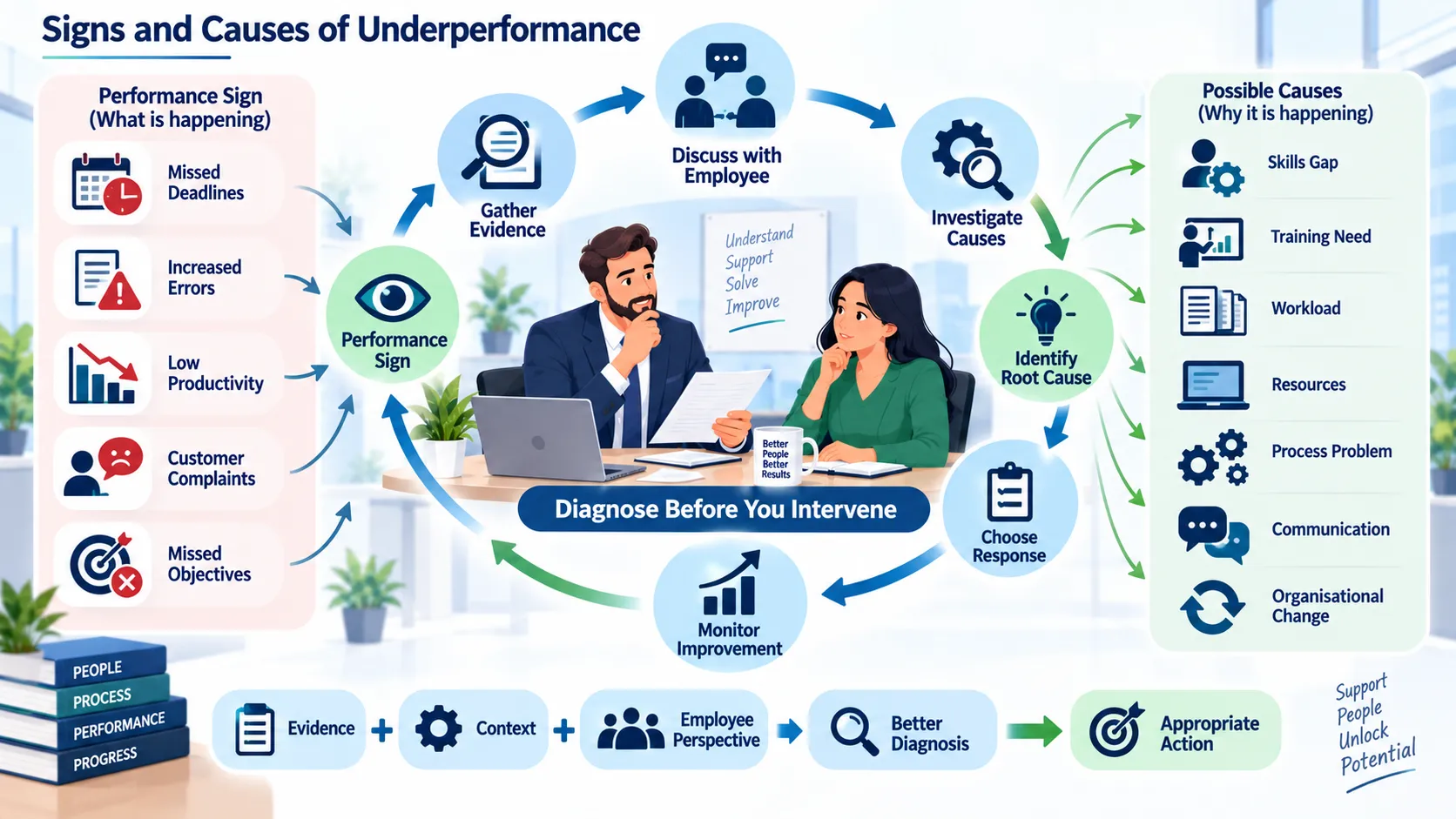
Understanding Underperformance
Definition of Underperformance
Underperformance occurs when an employee’s actual performance does not meet an agreed or required standard over an appropriate period, based on relevant evidence.
The key elements of this definition are important.
First, there must be a clear expectation or required standard. An employee cannot reasonably be considered to be underperforming against a standard that has never been communicated or understood.
Second, there should be evidence of a difference between actual and expected performance. The manager should not rely solely on personal impressions.
Third, the issue should be considered within its appropriate context. A single error does not necessarily indicate sustained underperformance.
Fourth, managers should investigate potential causes before determining an appropriate response.
Definition of a Sign of Underperformance
A sign of underperformance is an observable indicator, behaviour, result or outcome suggesting that an employee may not be meeting an expected performance standard.
Examples include:
Missed deadlines.
Declining productivity.
Increased errors.
Customer complaints.
Reduced quality.
Failure to achieve objectives.
Repeatedly incomplete work.
Increased rework.
Poor communication.
Failure to follow agreed procedures.
Declining reliability.
Reduced contribution to team objectives.
A sign tells the manager what is happening.
Definition of a Cause of Underperformance
A cause of underperformance is a factor or combination of factors contributing to the performance gap.
Potential causes may include:
Skills deficiencies.
Knowledge gaps.
Insufficient training.
Unclear expectations.
Inadequate resources.
Excessive workload.
Poor processes.
Ineffective systems.
Communication problems.
Conflicting priorities.
Organisational changes.
Inappropriate performance measures.
Other workplace circumstances.
A cause helps explain why the performance issue is happening.
The Difference Between Signs and Causes
One of the most important distinctions in performance management is the difference between an observable performance sign and its underlying cause.
For example:
Sign: An employee repeatedly misses deadlines.
Possible causes could include:
Poor workload planning.
Conflicting priorities.
Excessive workload.
Lack of role clarity.
Insufficient skills.
Dependence on another team.
Inefficient organisational processes.
The same sign can therefore have several different causes.
This is why managers should avoid jumping directly from observation to conclusion.
Sign-to-Cause Thinking
A useful way to think about the relationship is:
Performance outcome → Observable sign → Investigation → Possible causes → Root cause or contributing causes → Appropriate intervention
This prevents the manager from confusing symptoms with explanations.
Why the Relationship Between Signs and Causes Matters
If a manager identifies the wrong cause, the resulting intervention may fail.
Consider an employee who consistently makes errors.
The manager might assume:
Errors → Lack of ability → Training required
However, further investigation could reveal:
Errors → New system → Poor system design → Process support required
In this situation, providing additional training alone may not solve the problem.
Similarly:
Missed deadlines → Poor motivation
may actually be:
Missed deadlines → Excessive workload → Competing priorities → Workload management required
The relationship between signs and causes is therefore central to effective diagnosis.
Key Concept: Do Not Confuse Symptoms with Causes
A symptom is the visible result of a problem.
A cause is a factor contributing to that result.
For example:
Symptom: Low productivity.
Possible cause: Inadequate resources.
Or:
Symptom: Customer complaints.
Possible cause: Poor communication procedures.
Or:
Symptom: Repeated quality errors.
Possible cause: Insufficient knowledge of a new process.
The same symptom may have multiple possible causes, and one cause may create multiple symptoms.
For example, excessive workload may contribute to:
Missed deadlines.
Increased errors.
Reduced customer responsiveness.
Reduced employee availability.
Declining quality.
This illustrates why managers need to consider the wider performance picture.
Common Signs of Underperformance
Missed Deadlines
Repeated failure to complete work within agreed timescales can be an important performance indicator.
However, managers should ask why deadlines are being missed.
Potential causes include:
Poor prioritisation.
Unrealistic deadlines.
Excessive workload.
Conflicting requests.
Dependencies on other employees.
Lack of skills.
Unclear requirements.
Inefficient processes.
A manager should therefore establish whether the employee has control over the factors affecting the deadline.
Declining Productivity
A reduction in output may indicate underperformance, particularly when it is sustained and falls below an agreed standard.
However, productivity should be considered alongside:
Work complexity.
Quality.
Resources.
Workload.
Process efficiency.
Customer outcomes.
Changes in responsibilities.
A simple reduction in output does not automatically demonstrate poor capability.
Increased Errors
A rise in errors can indicate a quality problem.
Possible causes include:
Lack of knowledge.
Skills gaps.
Insufficient training.
New procedures.
Poor instructions.
Excessive workload.
Inadequate checking systems.
System problems.
Fatigue caused by workload.
Managers should identify whether errors are isolated or part of a sustained pattern.
Customer Complaints
Customer complaints can provide valuable evidence of performance issues.
However, complaints should be analysed rather than treated as automatic proof of employee underperformance.
Managers should consider:
What customers are complaining about.
Whether the complaints relate to the employee.
Whether similar complaints affect the wider team.
Whether organisational systems contribute to the issue.
Whether customer expectations have changed.
Whether service procedures are clear.
Poor Quality
Quality problems may be indicated through:
Rework.
Errors.
Failed quality checks.
Incomplete documentation.
Customer dissatisfaction.
Inconsistent outputs.
The manager should investigate whether the issue is related to individual competence, process design, resources or other circumstances.
Failure to Meet Objectives
Failure to achieve agreed objectives can indicate underperformance.
However, the manager should consider whether:
Objectives remain realistic.
Organisational priorities changed.
Resources were available.
The employee understood the objective.
Other responsibilities affected delivery.
External factors influenced the outcome.
This demonstrates why objective achievement must be evaluated in context.
Causes of Underperformance
Capability and Skills
Capability refers to the employee’s ability to perform the required tasks effectively.
A capability-related cause may involve:
Insufficient technical skills.
Lack of knowledge.
Difficulty applying procedures.
Inexperience with a new responsibility.
Competency gaps.
A skills or competency assessment can help determine whether capability is contributing to the issue.
Training Needs
An employee may underperform because they have not received sufficient training for a task or change in responsibilities.
Training may be relevant when:
A new system has been introduced.
Procedures have changed.
Responsibilities have expanded.
New technical skills are required.
The employee has identified a knowledge gap.
However, managers should not automatically assume that training is the solution. Training is appropriate only when lack of knowledge or skill is actually contributing to the problem.
Unclear Expectations
Employees may struggle to perform when managers have not clearly communicated:
What needs to be achieved.
Which standards apply.
What deadlines are expected.
Which priorities take precedence.
What behaviours are required.
A performance issue may therefore reflect a management communication problem rather than solely an employee problem.
Workload
Excessive workload is a common contextual factor.
An employee may appear to underperform because they are managing:
Additional responsibilities.
Increased demand.
Multiple urgent tasks.
Conflicting priorities.
Staff shortages.
Increased customer volume.
Managers should examine workload before concluding that the employee simply needs to work harder.
Resources
Performance can be affected when employees lack appropriate:
Equipment.
Systems.
Information.
Materials.
Staffing.
Time.
Operational support.
Where resources are inadequate, individual performance data may not accurately represent individual capability.
Processes
Poorly designed processes can create performance problems.
Examples include:
Duplicate administrative steps.
Unclear approval routes.
Inefficient workflows.
Delayed information.
Unnecessary handovers.
Poorly defined responsibilities.
If multiple employees experience the same performance difficulty, managers should investigate whether the process itself is contributing.
Communication
Communication problems may occur between:
Manager and employee.
Employees.
Departments.
Teams.
Organisation and customers.
Poor communication can result in:
Missed deadlines.
Incorrect work.
Conflicting priorities.
Customer dissatisfaction.
Duplication of work.
Managers should therefore investigate communication patterns when performance issues emerge.
Organisational Change
Changes to systems, structures, responsibilities, customer requirements or processes can affect performance.
An employee who previously performed strongly may experience difficulties following a significant organisational change.
The manager should consider whether the employee has:
Understood the change.
Received appropriate support.
Accessed updated information.
Developed required competencies.
Had sufficient time to adapt.
The Relationship Between Individual and Organisational Causes
One of the most important analytical skills for managers is distinguishing individual causes from organisational causes.
Individual Factors
These may include:
Skills.
Knowledge.
Competence.
Understanding.
Work habits.
Ability to perform a particular task.
Organisational Factors
These may include:
Systems.
Resources.
Processes.
Workload.
Staffing.
Communication.
Organisational change.
Unclear priorities.
Combined Causes
Many performance problems have both individual and organisational causes.
For example, an employee may struggle with a new system because:
The system is difficult to use.
Training was limited.
The employee has not yet developed confidence.
In such a situation, both organisational and individual interventions may be necessary.
Root Cause and Contributing Causes
Not every performance problem has one single cause.
Root Cause
A root cause is an underlying factor that significantly contributes to the performance problem and, if addressed, may reduce or resolve the issue.
Contributing Cause
A contributing cause is a factor that influences the problem but may not be the primary source of it.
For example:
Sign: Increasing errors.
Possible contributing causes:
Increased workload.
New software.
Limited training.
Unclear checking procedures.
Further investigation may show that the primary issue is the new software, while insufficient training increases the impact.
Managers should therefore avoid oversimplifying complex performance problems.
Diagnostic Process for Analysing Underperformance
A structured diagnostic process helps managers move from visible signs towards evidence-based understanding.
Step 1: Identify the Performance Sign
Clearly describe what has been observed.
For example:
“Five customer reports were submitted after the agreed deadline during the previous review period.”
Step 2: Confirm the Expected Standard
The manager should establish what performance was actually expected.
Questions include:
What was the agreed deadline?
Was the deadline clearly communicated?
Was the standard appropriate?
Was the employee aware of it?
Step 3: Gather Evidence
The manager collects relevant information.
This may include:
Performance data.
Work samples.
Customer feedback.
Observation.
Employee self-assessment.
Quality records.
Previous review information.
Step 4: Discuss the Issue with the Employee
The employee should have an opportunity to explain the circumstances.
Useful questions may include:
What factors have affected your performance?
Are there any barriers preventing you from meeting the standard?
Have your responsibilities changed?
Do you have the resources required?
Are the expectations clear?
Is there any support that would help?
Step 5: Identify Possible Causes
The manager considers multiple explanations rather than selecting the first assumption.
Step 6: Test the Causes Against Evidence
The manager considers whether the available evidence supports the proposed explanation.
Step 7: Identify the Most Significant Causes
The manager determines which factors appear most strongly connected to the performance issue.
Step 8: Select the Appropriate Intervention
The intervention should address the identified cause.
Step 9: Monitor the Outcome
Performance should be reviewed after the intervention.
Step 10: Evaluate and Adjust
If the problem remains, the manager should reconsider the diagnosis and intervention.
Using the Five Whys to Explore Causes
The Five Whys approach can help managers move beyond an immediate symptom.
Example
Sign: Reports are regularly submitted late.
Why?
Because the employee is unable to complete them by the deadline.
Why?
Because the employee spends significant time correcting information received from another team.
Why?
Because information is often incomplete.
Why?
Because the information request process is unclear.
Why?
Because responsibilities between the two teams have not been clearly defined.
The final issue may therefore be an organisational process problem rather than an individual motivation problem.
The Five Whys should not be treated as a mechanical exercise. Managers should use professional judgement and evidence to test each explanation.
Using Fishbone Analysis
Fishbone or cause-and-effect analysis can help managers consider several categories of possible causes.
For a performance problem, categories might include:
People.
Skills.
Processes.
Systems.
Resources.
Communication.
Workload.
Organisational circumstances.
This approach is particularly useful when the performance problem appears complex or when several factors may interact.
Comparing Signs and Causes
A useful diagnostic approach is to create a simple distinction between the observed sign and potential causes.
| Observable Sign | Possible Causes | Evidence to Explore | Appropriate Response |
|---|---|---|---|
| Missed deadlines | Workload, skills, priorities, processes | Work records, workload information, discussion | Coaching, priority review or process intervention |
| Increased errors | Skills, training, workload, systems | Quality records, observation, competency assessment | Targeted support or system/process improvement |
| Low productivity | Resources, workflow, skills, workload | KPI data, observation, process review | Resource, workflow or capability intervention |
| Customer complaints | Communication, service process, skills | Customer feedback, work records, employee discussion | Coaching, process improvement or targeted support |
| Missed objectives | Unclear targets, resources, changing priorities | Objectives, performance data, context | Clarification, objective review or support |
| Reduced quality | Competence, workload, procedures | Quality checks, observation, competency evidence | Coaching, process improvement or workload review |
The table demonstrates that the same sign should not automatically lead to one predetermined intervention.
Scenario: Missed Deadlines
A project administrator repeatedly misses reporting deadlines.
The manager initially believes that the employee has poor time-management skills.
Before taking action, the manager reviews workload information and discovers that the employee has recently taken responsibility for additional reports.
The employee also explains that information required for the reports frequently arrives late.
The manager therefore identifies two contributing causes:
Increased workload.
Dependency on delayed information.
The manager agrees revised priorities and raises the information-flow problem with the relevant team.
The employee’s performance improves.
This demonstrates why diagnosis is essential.
Scenario: Declining Quality
A production employee’s quality score falls over three months.
The manager reviews the data and observes the employee performing the task.
The employee appears competent, but the organisation has recently introduced a new process.
The employee explains that the updated procedure is unclear.
The manager discovers that several employees are experiencing similar difficulties.
The likely cause is therefore not simply individual capability.
The manager addresses the process and provides clarification.
This scenario demonstrates the importance of identifying patterns across the wider team.
Scenario: Customer Complaints
A customer service employee receives several complaints about communication.
The manager reviews the complaints and discovers that customers are specifically concerned about delayed updates.
During discussion, the employee explains that they are waiting for information from another department before responding.
The manager investigates and discovers a communication bottleneck.
The appropriate intervention therefore involves improving the information flow rather than simply telling the employee to communicate better.
Scenario: Low Productivity but High Quality
An employee produces fewer completed tasks than colleagues but has consistently high accuracy.
The manager could classify the employee as underperforming based on productivity alone.
However, further analysis reveals that the employee handles more complex cases.
The manager therefore considers:
Complexity.
Quality.
Productivity.
Customer outcomes.
Work allocation.
The evidence suggests that the productivity measure alone does not provide a complete representation of performance.
Scenario: Performance Decline Following Organisational Change
An employee has historically performed strongly but begins making errors following the introduction of a new system.
The manager reviews performance data and observes the employee.
The employee explains that they have received limited guidance on the new system.
The manager identifies a clear relationship between:
Organisational change → Limited system support → Difficulty performing new process → Increased errors
The appropriate response is targeted support rather than assuming a general decline in employee capability.
Avoiding the Motivation Assumption
Managers sometimes explain underperformance by saying an employee is “not motivated”.
This can be problematic because motivation is difficult to establish simply through observation.
For example, reduced output may result from:
Workload.
Lack of resources.
Conflicting priorities.
Skills gaps.
Poor systems.
Unclear objectives.
A manager should therefore investigate the evidence before concluding that motivation is the primary cause.
Avoiding the Training Assumption
Training is another common default response.
A manager may see errors and immediately arrange training.
However, training will not necessarily solve a problem caused by:
Poor software.
Excessive workload.
Unclear procedures.
Inadequate resources.
Conflicting responsibilities.
Training should be used when evidence indicates that knowledge or skills are contributing to the performance gap.
Recognising Multiple Causes
Performance problems can involve several causes simultaneously.
For example:
Sign: Declining customer service performance.
Possible causes:
Increased workload.
New system.
Limited training.
Unclear escalation procedures.
Higher customer demand.
A manager may therefore need to combine several interventions.
These might include:
Workload adjustment.
System support.
Targeted coaching.
Procedure clarification.
Process improvement.
This illustrates why diagnostic performance management should be flexible and evidence-based.
The Role of Evidence in Establishing Causation
Managers should distinguish between correlation and causation.
If two events occur at the same time, it does not automatically mean that one caused the other.
For example, an employee’s productivity declines after a new manager joins the team.
This does not prove that the new manager caused the decline.
Other factors may include:
Increased workload.
Organisational change.
New systems.
Customer demand.
Role changes.
The manager should therefore investigate rather than assume.
The Role of Employee Discussion
Employee discussions are an important diagnostic source because employees often have direct knowledge of operational barriers.
However, employee explanations should be considered alongside other evidence.
A balanced approach is:
Employee perspective + Performance evidence + Observation + Contextual information = Stronger diagnosis
This approach avoids both extremes:
Automatically accepting every explanation.
Automatically rejecting employee explanations.
Signs Across Individuals and Teams
Managers should pay attention to whether the same performance sign appears across several employees.
If one employee experiences a problem, an individual cause may be more likely.
If many employees experience the same problem at approximately the same time, organisational causes may warrant investigation.
For example:
One employee experiencing repeated system errors may indicate an individual competency issue.
An entire team experiencing the same system-related delay may indicate a process or system issue.
This is not an absolute rule, but it is an important diagnostic indicator.
Performance Trends and Patterns
Managers should consider trends rather than isolated incidents.
A single missed deadline may have little significance.
Repeated missed deadlines over several review periods may indicate a meaningful performance issue.
Useful evidence includes:
Frequency.
Duration.
Severity.
Pattern.
Trend.
Comparison with agreed standards.
Trend analysis can help managers distinguish temporary variation from sustained underperformance.
From Diagnosis to Appropriate Action
Once the cause has been reasonably established, the manager should select an intervention that directly addresses it.
If the Cause Is Skills-Related
Possible responses include:
Coaching.
Targeted training.
Practical guidance.
Competency development.
If the Cause Is Workload-Related
Possible responses include:
Priority clarification.
Workload review.
Redistribution of tasks where appropriate.
Resource review.
If the Cause Is Process-Related
Possible responses include:
Process review.
Clarification of responsibilities.
Workflow improvement.
Communication improvement.
If the Cause Is Resource-Related
Possible responses include:
Additional resources.
Equipment or system support.
Access to relevant information.
If the Cause Is Expectation-Related
Possible responses include:
Clarifying objectives.
Revising unclear standards.
Establishing appropriate measures.
Confirming priorities.
The principle is simple:
The intervention should address the cause, not merely the symptom.
Monitoring Whether the Diagnosis Was Correct
Diagnosis should not be treated as permanently fixed.
If an intervention does not improve performance, the manager should ask whether:
The original cause was incorrect.
There are additional causes.
The intervention was insufficient.
The performance measure was inappropriate.
The support was not effective.
The circumstances changed.
This creates a continuous improvement cycle.
Diagnose → Intervene → Monitor → Evaluate → Re-diagnose if necessary
This approach helps managers learn from outcomes.
Risks of Misdiagnosing Underperformance
Misdiagnosis can create several organisational problems.
Ineffective Interventions
The intervention may not address the real problem.
Employee Frustration
Employees may feel unfairly blamed for organisational issues.
Reduced Trust
Repeated inappropriate interventions can weaken confidence in management.
Wasted Resources
Training, coaching or other resources may be used without addressing the actual cause.
Continued Underperformance
The original issue may remain unresolved.
Team Impact
Unresolved performance problems can affect colleagues and customer outcomes.
Poor Managerial Decisions
Managers may make decisions based on assumptions rather than evidence.
Key Benefits of Analysing Signs and Causes
Benefits for Employees
Employees benefit from:
Fairer assessment.
Greater opportunity to explain circumstances.
More appropriate support.
Clearer expectations.
Targeted development.
Reduced risk of inappropriate intervention.
Benefits for Managers
Managers gain:
Better understanding of performance issues.
Stronger evidence for decisions.
More effective interventions.
Greater confidence in professional judgement.
Better ability to distinguish symptoms from causes.
Benefits for Teams
Teams benefit from:
Earlier resolution of performance barriers.
Better processes.
More consistent standards.
Reduced disruption.
Improved collaboration.
Benefits for Organisations
Organisations can achieve:
More effective use of resources.
Improved performance.
Better customer outcomes.
Reduced recurring performance problems.
Stronger organisational learning.
Greater alignment between individual and organisational performance.
Good Practice Principles for Diagnosing Underperformance
Managers should apply several principles consistently.
Diagnose Before Intervening
Do not select an intervention before understanding the problem.
Use Multiple Evidence Sources
Combine relevant performance information rather than relying on one indicator.
Consider Context
Review workload, systems, processes, resources and organisational circumstances.
Involve the Employee
Give the employee an opportunity to explain barriers and provide relevant information.
Avoid Assumptions
Do not automatically attribute underperformance to motivation, attitude or capability.
Focus on Observable Performance
Describe specific results, behaviours and outcomes.
Distinguish Individual and Organisational Factors
Consider whether the issue exists beyond the individual.
Match Intervention to Cause
Use coaching, training, resource support, process improvement or other responses according to the diagnosis.
Monitor Outcomes
Check whether the intervention actually improves performance.
Review the Diagnosis
If improvement does not occur, reconsider the underlying causes.
Managerial Decision-Making Framework
A practical framework for managers is:
1. What is the Sign?
Describe exactly what is happening.
2. What Standard Is Expected?
Confirm the required performance.
3. What Evidence Exists?
Identify relevant and reliable evidence.
4. What Does the Employee Say?
Invite the employee’s perspective.
5. What Could Be Causing the Gap?
Consider individual and organisational explanations.
6. What Evidence Supports Each Cause?
Test assumptions against available information.
7. What Intervention Matches the Cause?
Choose an appropriate response.
8. What Improvement Will Be Expected?
Establish measurable outcomes.
9. How Will Progress Be Monitored?
Select suitable review points and evidence.
10. Did the Intervention Work?
Evaluate the outcome and adjust if necessary.
This framework helps managers maintain a disciplined approach to underperformance.
Practical Manager Checklist
When an employee appears to be underperforming, managers should ask:
What exactly has been observed?
Is the performance standard clear?
Is the issue isolated or recurring?
What evidence supports the concern?
What does the employee say?
Are skills contributing to the problem?
Is training actually required?
Is workload contributing?
Are resources sufficient?
Are systems working effectively?
Are procedures clear?
Are priorities conflicting?
Has organisational change affected performance?
Are other employees experiencing the same problem?
What is the most likely cause?
Are there multiple contributing causes?
What intervention directly addresses the cause?
How will improvement be measured?
When will performance be reviewed?
What will be done if the intervention does not work?
Summary
The relationship between signs and causes of underperformance is central to effective performance management. A sign is an observable indication that performance may not meet the required standard, while a cause explains the factors contributing to that performance outcome.
Effective managers understand that the same performance sign can have different causes. Missed deadlines may result from poor prioritisation, excessive workload, unclear expectations or inefficient processes. Increased errors may be linked to skills, training, workload, systems or procedures. Customer complaints may reflect employee capability, communication problems or organisational processes.
For this reason, managers should avoid making immediate assumptions about motivation, capability or attitude. Instead, they should identify the performance sign, confirm the expected standard, gather relevant evidence, discuss the issue with the employee, investigate possible causes and consider the wider organisational context.
Diagnostic tools such as performance gap analysis, Five Whys, fishbone analysis, observation, employee discussions and competency assessment can support this process. Multiple evidence sources can provide a stronger basis for professional judgement.
The most effective intervention is one that addresses the identified cause. Skills problems may require coaching or training; resource problems may require additional support; process problems may require workflow improvement; workload issues may require priority or resource review; and unclear expectations may require better communication.
Managers should then monitor and evaluate whether the intervention produces improvement. If performance does not improve, the diagnosis should be reconsidered rather than automatically blaming the employee.
Ultimately, effective analysis of signs and causes helps managers move from reaction to diagnosis, from assumption to evidence, and from symptoms to sustainable performance improvement. This supports fairer employee management, stronger team performance and improved organisational achievement.
4.Evaluate Approaches to Respond to Challenges When Managing Underperformance
Managing underperformance is one of the most demanding responsibilities for middle managers and leaders. Performance concerns can affect individuals, colleagues, customers, service quality, productivity and the achievement of organisational objectives. Managers therefore need to respond promptly and appropriately when performance falls below an agreed standard. However, effective management of underperformance requires considerably more than telling an employee that their performance is unacceptable.
A manager must understand the nature of the performance gap, establish reliable evidence, investigate possible causes, communicate concerns professionally, provide appropriate support and monitor whether improvement occurs. The response should also be proportionate to the seriousness and persistence of the issue. Where informal coaching is sufficient, managers should avoid unnecessary escalation. Where underperformance is persistent or significant, a more structured formal process may be required.
The central challenge is to balance accountability and support. Employees need to understand that performance standards matter, but they should also have a fair opportunity to explain relevant circumstances and access appropriate assistance. A manager who focuses exclusively on accountability may create fear and defensiveness, while a manager who focuses exclusively on support may fail to maintain appropriate standards.
Effective performance management therefore requires professional judgement. The manager needs to select an approach based on evidence, context, organisational requirements and the likely cause of the performance problem.
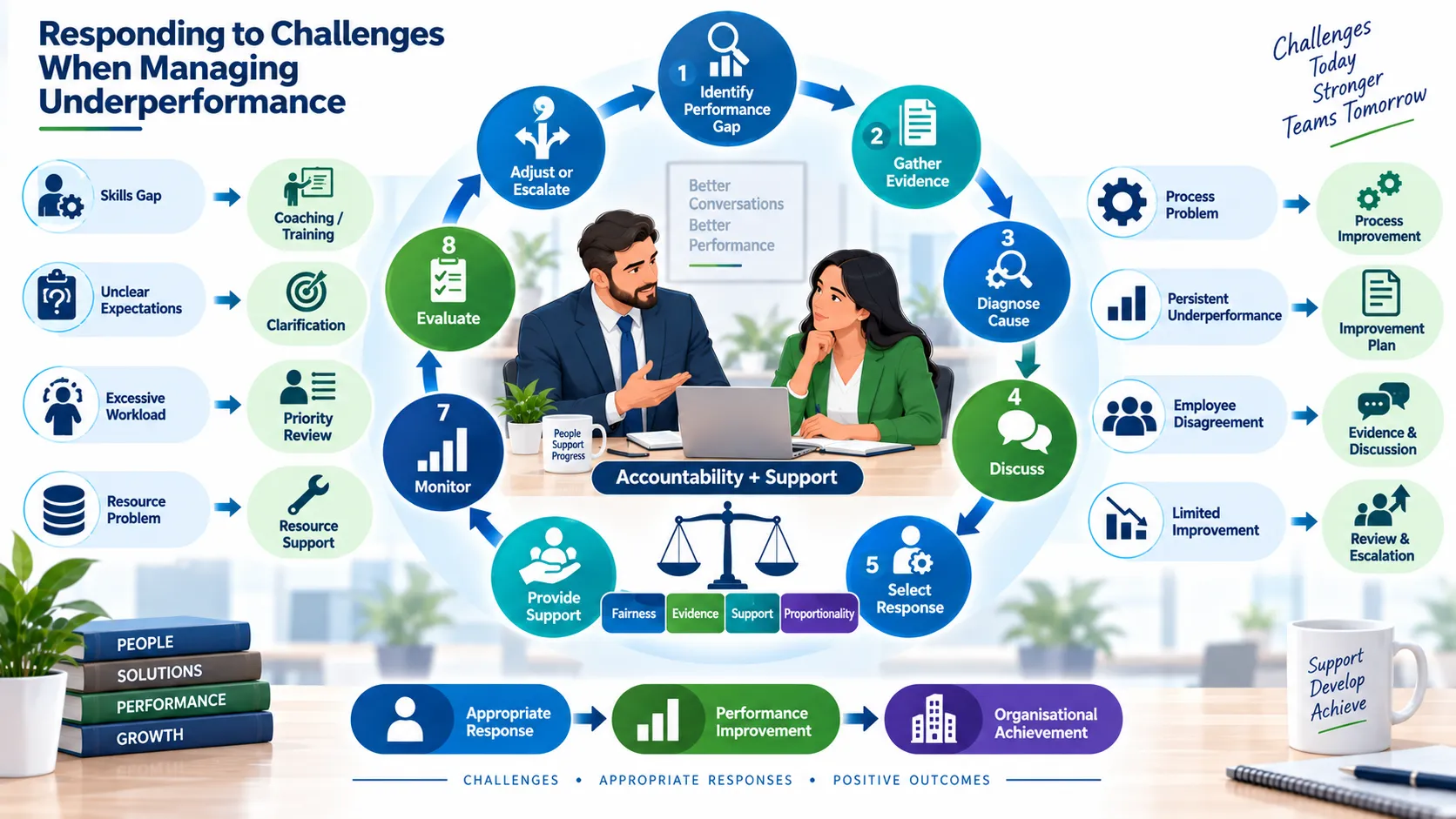
Understanding Underperformance
Definition of Underperformance
Underperformance occurs when an employee’s actual performance does not meet an agreed or required standard over an appropriate period, based on relevant evidence.
Underperformance may involve:
Failure to meet agreed objectives.
Repeated missed deadlines.
Declining quality.
Increased errors.
Reduced productivity.
Poor customer outcomes.
Failure to demonstrate required competencies.
Repeated failure to follow agreed procedures.
Failure to meet expected behavioural standards.
However, managers should distinguish between a genuine pattern of underperformance and temporary or isolated variation.
One missed deadline does not necessarily establish sustained underperformance. Similarly, a single customer complaint does not automatically demonstrate that an employee is consistently performing below standard.
The manager must therefore establish the scale, frequency, duration and significance of the concern.
The Challenge of Managing Underperformance
Underperformance can be challenging because managers may experience uncertainty about:
Whether the problem is genuinely significant.
Whether the employee understands the standard.
Whether the employee has the required capability.
Whether the issue is caused by workload or resources.
Whether organisational processes are contributing.
Whether informal intervention will be sufficient.
Whether formal action is necessary.
How much support should be provided.
How quickly improvement should be expected.
How performance should be evaluated.
These challenges make diagnostic thinking particularly important.
A manager should avoid moving directly from:
Performance gap → Formal action
Instead, the preferred process is:
Performance gap → Evidence → Diagnosis → Discussion → Appropriate response → Support → Monitoring → Evaluation
Principle 1: Identify the Performance Problem Clearly
The first response to underperformance should be to define the problem precisely.
Vague statements such as “your performance is poor” are not sufficiently useful because they do not tell the employee what needs to change.
A clear performance concern should identify:
The expected standard.
The actual performance.
The difference between them.
Relevant evidence.
The period over which the issue has occurred.
The impact of the performance gap.
Example
Instead of:
“You are not meeting expectations.”
A manager might explain:
“The agreed standard requires customer enquiries to be responded to within the specified timeframe. During the previous review period, several enquiries were not responded to within that timeframe.”
This creates a clearer foundation for discussion.
Principle 2: Gather Reliable Evidence
Before deciding how to respond, managers should establish an evidence base.
Evidence can include:
KPI information.
Quality records.
Work outputs.
Customer feedback.
Observation.
Competency assessments.
Employee self-assessment.
Performance review information.
Relevant workplace records.
The evidence should be relevant to the performance concern.
Avoiding Evidence Overload
Managers do not need to collect every available piece of information.
The objective is to gather enough appropriate evidence to understand the performance issue and make a sound decision.
Useful questions include:
Is the evidence directly relevant?
Is it reliable?
Does it demonstrate a pattern?
Does it represent the employee’s actual responsibilities?
Does other evidence support the same conclusion?
Is there contextual information that affects interpretation?
Principle 3: Distinguish the Sign from the Cause
A visible performance problem is not necessarily the cause.
For example:
Sign: Missed deadlines.
Possible causes:
Excessive workload.
Conflicting priorities.
Poor planning.
Insufficient skills.
Unclear expectations.
Delayed information.
Inefficient processes.
The manager should therefore investigate the cause before deciding what response is appropriate.
This is particularly important because an inappropriate intervention can waste resources and leave the original problem unresolved.
Principle 4: Hold an Effective Performance Conversation
The performance conversation is often the first significant managerial intervention.
The manager should create an environment where the issue can be discussed professionally.
A Good Performance Conversation Should:
Explain the purpose of the discussion.
Describe the performance concern clearly.
Present relevant evidence.
Explain the required standard.
Invite the employee’s perspective.
Listen carefully.
Explore possible causes.
Discuss appropriate support.
Agree practical next steps.
Establish how progress will be monitored.
The manager should remain calm and objective.
The purpose is not to “win” the conversation but to understand the problem and agree appropriate action.
Approach 1: Informal Coaching
Informal coaching is often appropriate when the performance concern is relatively minor, emerging or capable of being addressed through guidance and support.
Definition
Informal coaching is a structured but non-formal management conversation designed to help an employee understand a performance issue, identify solutions and improve their performance.
Coaching can be particularly useful when the employee:
Has the basic capability required.
Is unfamiliar with a task.
Needs clearer guidance.
Has made an isolated error.
Needs help improving a specific behaviour.
Would benefit from reflective discussion.
Coaching Process
A manager can:
Identify the specific issue.
Ask the employee to reflect on what happened.
Explore possible causes.
Identify potential solutions.
Agree an action.
Establish a follow-up point.
Review progress.
Benefits of Coaching
Encourages employee ownership.
Can address problems early.
Builds capability.
Supports constructive relationships.
Reduces unnecessary escalation.
Encourages problem solving.
Limitations
Coaching may be insufficient when:
Underperformance is persistent.
The performance gap is substantial.
Previous coaching has not produced improvement.
The employee does not engage with improvement.
A structured organisational process is required.
Professional judgement is therefore required when deciding whether coaching is appropriate.
Approach 2: Constructive Feedback
Feedback is another important response to underperformance.
Definition
Constructive feedback is specific, evidence-based information provided to help an employee understand the impact of their performance and identify how it can be improved.
Effective feedback should focus on performance rather than personal criticism.
Strong Feedback Characteristics
Good feedback is:
Specific.
Timely.
Evidence-based.
Balanced.
Respectful.
Relevant.
Action-oriented.
Linked to agreed standards.
Example
Weak feedback:
“You need to be more organised.”
Constructive feedback:
“Three reports were submitted after the agreed deadline during the review period. Let’s discuss how priorities are being managed and identify what support could help you meet future deadlines.”
The second approach provides evidence and opens the discussion towards improvement.
Approach 3: Clarifying Expectations
Sometimes underperformance occurs because employees do not fully understand what is expected.
Managers should therefore review:
Job responsibilities.
Objectives.
Performance standards.
Deadlines.
Quality expectations.
Behavioural requirements.
Priorities.
Evaluation
Clarifying expectations is a low-cost and often effective intervention when the problem is caused by ambiguity.
However, it will not solve a genuine skills or resource problem.
The manager should therefore determine whether lack of clarity is actually contributing to the performance gap.
Approach 4: Targeted Training
Training may be appropriate when evidence identifies a knowledge or skills gap.
Definition
Targeted training is focused learning support designed to address a specific capability requirement relevant to the employee’s performance.
Training may address:
Technical knowledge.
Procedures.
Systems.
Communication skills.
Task-specific competencies.
Evaluation
Training is useful when lack of capability is the cause.
However, managers should not use training as an automatic response to every performance problem.
If the real cause is:
Poor software.
Excessive workload.
Unclear priorities.
Inadequate resources.
then training alone may have little effect.
The effectiveness of training should therefore be evaluated through subsequent performance evidence.
Approach 5: Coaching and Mentoring Support
Where an employee has the basic skills but needs assistance applying them effectively, coaching or mentoring may be appropriate.
Coaching often focuses on improving performance through questioning, reflection and practical support.
Mentoring can provide guidance based on relevant workplace experience.
The choice should reflect the employee’s needs and the diagnosed cause.
Possible Benefits
Increased confidence.
Improved capability.
Greater self-awareness.
Better problem-solving.
Stronger ownership.
More sustainable improvement.
Approach 6: Additional Resources
Sometimes underperformance results from insufficient resources rather than employee capability.
Resources may include:
Equipment.
Systems.
Information.
Staffing.
Materials.
Operational support.
A manager should therefore ask:
“Does the employee have the resources required to achieve the agreed standard?”
If the answer is no, the manager should address the organisational barrier where possible.
Approach 7: Workload and Priority Review
An employee may appear to underperform because they are managing excessive or conflicting demands.
Managers should consider:
Volume of work.
Complexity of work.
Number of competing priorities.
Deadlines.
Additional responsibilities.
Staffing levels.
Dependencies on other teams.
Practical Example
An employee repeatedly misses reporting deadlines.
The manager discovers that the employee has been assigned several additional responsibilities.
Rather than immediately escalating the issue, the manager reviews priorities and workload.
The employee’s performance subsequently improves.
This demonstrates that workload review can be a more appropriate response than corrective action when workload is contributing to the problem.
Approach 8: Process Improvement
Managers should consider whether organisational processes are creating barriers to effective performance.
A process problem may involve:
Duplicate work.
Poor information flow.
Unclear responsibilities.
Excessive approval stages.
Inefficient systems.
Poor communication between teams.
Evaluation
Process improvement can be highly effective when multiple employees experience similar difficulties.
If several employees are missing the same target because of an inefficient process, individual performance management alone will not resolve the underlying problem.
Approach 9: Performance Improvement Plan
A Performance Improvement Plan can be appropriate where a performance concern is significant, persistent or requires structured monitoring.
Definition
A Performance Improvement Plan is a formal structured arrangement that identifies a performance gap, establishes expected improvement, specifies actions and support, and sets measurable review arrangements.
Key Components
A PIP should normally establish:
The specific performance concern.
The required standard.
Evidence supporting the concern.
Improvement objectives.
Actions.
Support.
Measures.
Review dates.
Responsibilities.
Expected outcomes.
Strengths
A PIP can provide:
Clarity.
Accountability.
Structure.
Consistency.
Measurable expectations.
Defined review points.
Limitations
A PIP can become ineffective if it:
Uses vague objectives.
Sets unrealistic timescales.
Does not address the actual cause.
Provides insufficient support.
Measures inappropriate indicators.
Becomes excessively administrative.
The manager must therefore use professional judgement when designing and applying it.
Approach 10: Increased Monitoring
Where improvement is required, managers may increase the frequency of performance reviews for an appropriate period.
Monitoring may include:
Weekly progress discussions.
Review of agreed KPIs.
Quality checks.
Work samples.
Observation.
Progress against improvement objectives.
Monitoring should be proportionate.
Excessive monitoring can undermine trust and create unnecessary administration, while insufficient monitoring can allow performance problems to continue.
Approach 11: Formal Performance Management
Formal performance management may become appropriate when:
The performance issue is significant.
The problem is persistent.
Informal support has not produced sufficient improvement.
The expected standard is clear.
Relevant evidence exists.
Organisational procedures require formal action.
A formal process should remain professional and supportive.
It should provide clarity regarding:
The performance gap.
Required improvement.
Available support.
Evidence.
Review arrangements.
Possible next steps.
Evaluating Informal and Formal Approaches
Different approaches have different strengths.
| Approach | Most Appropriate When | Key Benefit | Main Limitation |
|---|---|---|---|
| Informal coaching | Emerging or relatively minor concerns | Early, supportive intervention | May be insufficient for persistent issues |
| Constructive feedback | Specific behaviour or result requires improvement | Clear and immediate guidance | May not resolve complex causes |
| Training | Knowledge or skills gap exists | Builds specific capability | Ineffective if cause is organisational |
| Workload review | Excessive or conflicting work contributes | Addresses contextual barriers | May not solve capability issues |
| Process improvement | Systems or procedures create barriers | Resolves organisational causes | May require wider organisational action |
| Performance Improvement Plan | Persistent or significant performance gap | Provides structure and accountability | Can become administrative if poorly designed |
| Formal process | Persistent or serious concerns require structured management | Supports consistency and documentation | Requires careful application and professional judgement |
The table illustrates that there is no universally correct response to underperformance. The appropriate approach depends on the nature, cause and persistence of the problem.
Evaluating the Proportionality of the Response
A response should be proportionate to the performance concern.
Minor or Emerging Concern
A suitable response may be:
Informal discussion.
Coaching.
Clarification.
Feedback.
Moderate or Persistent Concern
A suitable response may include:
Structured coaching.
Targeted development.
Increased monitoring.
Formal improvement objectives.
Significant or Sustained Concern
A formal organisational process may be appropriate, depending on the circumstances and applicable procedures.
The manager should avoid both extremes:
Underreaction: Ignoring or repeatedly postponing a significant performance problem.
Overreaction: Escalating a minor or isolated issue unnecessarily.
Professional judgement involves selecting the appropriate level of response.
Challenge 1: Employee Becomes Defensive
Employees may become defensive when performance concerns are raised.
This can happen because they:
Feel criticised.
Fear consequences.
Disagree with the evidence.
Believe the assessment is unfair.
Feel misunderstood.
Effective Managerial Response
The manager should:
Remain calm.
Explain the evidence.
Listen to the employee.
Avoid personal criticism.
Clarify the standard.
Ask open questions.
Separate the person from the performance issue.
The objective is to maintain a constructive discussion while preserving accountability.
Challenge 2: Employee Disagrees with the Evidence
An employee may challenge the accuracy of performance information.
The manager should not simply dismiss the disagreement.
Instead:
Review the evidence.
Clarify the source.
Check whether the measure is appropriate.
Invite relevant employee information.
Consider other evidence.
Reach a reasoned conclusion.
This reinforces evidence-based performance management.
Challenge 3: The Cause Is Unclear
Sometimes managers cannot immediately identify why performance has declined.
In such circumstances, the manager should avoid premature conclusions.
Useful approaches include:
Further observation.
Employee discussion.
Competency assessment.
Root cause analysis.
Review of workload.
Review of systems.
Examination of process information.
Comparison with team patterns.
The manager should treat uncertainty as a reason for further investigation rather than a reason to assume employee fault.
Challenge 4: Organisational Barriers
An employee may underperform because the organisation has created barriers.
Examples include:
Poor systems.
Insufficient resources.
Inadequate staffing.
Inefficient procedures.
Unclear responsibilities.
Conflicting priorities.
Managers should recognise that accountability can exist at both individual and organisational levels.
Where the organisation contributes to the problem, the manager should address or escalate the organisational issue while continuing to manage the individual’s responsibilities appropriately.
Challenge 5: Lack of Improvement After Support
Sometimes an employee receives appropriate support but performance remains below standard.
The manager should evaluate:
Whether the diagnosis was correct.
Whether support was appropriate.
Whether the employee engaged with the support.
Whether expectations were realistic.
Whether the review period was appropriate.
Whether additional causes exist.
If appropriate support has been provided and the required standard remains unmet, the manager may need to progress through the organisation’s formal performance process.
Challenge 6: High Workload and Limited Management Time
Middle managers may struggle to dedicate sufficient time to performance management because they are responsible for multiple operational priorities.
However, delaying performance concerns can increase the eventual management burden.
Early, focused intervention can often prevent larger problems.
Managers can improve efficiency by:
Scheduling regular short reviews.
Using relevant performance indicators.
Recording agreed actions.
Prioritising significant issues.
Addressing concerns early.
Avoiding unnecessary administration.
Challenge 7: Maintaining Employee Dignity
Underperformance discussions can be uncomfortable.
Managers should maintain professionalism by:
Holding sensitive conversations privately.
Using respectful language.
Focusing on evidence.
Avoiding public criticism.
Avoiding personal labels.
Allowing employees to explain their circumstances.
This helps preserve dignity while maintaining accountability.
Challenge 8: Maintaining Consistency Across Employees
Managers may encounter similar performance problems involving different employees.
They should apply organisational standards consistently while recognising relevant differences in circumstances.
For example, two employees may miss deadlines, but one may have excessive workload while the other may have a clear skills gap.
The response should therefore reflect the evidence.
Consistency means applying fair principles, not automatically giving identical interventions.
Challenge 9: Measuring Improvement
Managers need to determine whether performance has improved.
Improvement measures may include:
Achievement of agreed KPIs.
Quality improvement.
Reduction in errors.
Improved customer outcomes.
Timely completion.
Competency evidence.
Relevant feedback.
Where possible, managers should compare performance against:
Previous performance.
Baseline information.
Agreed standards.
Defined objectives.
Challenge 10: Sustaining Improvement
Improvement during a formal review period does not automatically guarantee long-term improvement.
Managers should consider whether improved performance is:
Consistent.
Sustainable.
Achieved without excessive additional support.
Reflected across relevant performance measures.
For example, an employee may meet a target for one week but return to previous performance levels later.
Sustainable improvement requires continued appropriate monitoring and reinforcement.
The Importance of a Balanced Response
An effective response to underperformance should balance several considerations.
Accountability
The employee remains responsible for meeting appropriate performance expectations.
Support
The organisation and manager should provide appropriate support where required.
Evidence
Decisions should be based on relevant information.
Context
Relevant workplace circumstances should be considered.
Consistency
Appropriate standards should be applied fairly.
Proportionality
The response should match the seriousness and persistence of the issue.
Improvement
The central objective should be meaningful performance improvement where this is achievable.
A Structured Process for Responding to Underperformance
Step 1: Identify
Clearly identify the performance concern.
Step 2: Confirm
Confirm the expected performance standard.
Step 3: Evidence
Gather relevant and reliable information.
Step 4: Discuss
Meet with the employee and explain the concern.
Step 5: Diagnose
Investigate possible individual and organisational causes.
Step 6: Decide
Select the most appropriate response.
Step 7: Support
Provide relevant assistance.
Step 8: Agree
Establish clear improvement expectations.
Step 9: Monitor
Review progress using appropriate evidence.
Step 10: Evaluate
Determine whether performance has improved.
Step 11: Adjust
Modify the intervention if necessary.
Step 12: Escalate or Close
Where appropriate, conclude the process following successful improvement or progress through relevant organisational procedures if improvement remains insufficient.
Scenario: Skills-Related Underperformance
An employee repeatedly produces inaccurate reports.
The manager reviews the work and conducts an observation.
The evidence indicates that the employee has difficulty interpreting a particular reporting procedure.
The employee confirms that they have not received sufficient guidance.
Evaluation
A targeted development intervention is appropriate because the evidence supports a skills or knowledge cause.
A formal punitive response would be disproportionate at this stage if the issue can reasonably be addressed through support.
The manager provides coaching, clarifies the procedure and establishes quality review points.
Performance subsequently improves.
Scenario: Workload-Related Underperformance
An employee has consistently met deadlines in the past but begins missing them after receiving several additional responsibilities.
The manager reviews the workload and finds that the employee has significantly more work than previously.
Evaluation
The manager should not immediately interpret the decline as poor capability.
A workload and priority review is appropriate.
The manager adjusts priorities and monitors performance.
If performance improves, this provides evidence that workload was a significant contributing factor.
Scenario: Process-Related Underperformance
Several employees are failing to meet the same processing target.
The manager investigates and discovers that the workflow requires repeated approval steps that create significant delays.
Evaluation
The problem is unlikely to be resolved through individual performance management alone.
A process improvement approach is more appropriate.
The manager reviews the workflow and works through the appropriate organisational channels to address the barrier.
Scenario: Persistent Underperformance
An employee has received repeated feedback and coaching but continues to perform below the required standard.
The employee has clear objectives, appropriate resources and adequate support.
Evidence demonstrates sustained underperformance.
Evaluation
A more structured formal performance process may now be appropriate.
The manager establishes clear improvement objectives, appropriate review arrangements and continued support in accordance with organisational requirements.
This demonstrates proportional escalation.
Scenario: Employee Challenges the Manager’s Assessment
An employee disagrees with the manager’s assessment and provides alternative evidence showing that some performance indicators were affected by changes in customer demand.
The manager reviews the information and finds that the employee’s explanation is partly supported.
Evaluation
The manager should revise the assessment where appropriate and distinguish between performance factors within the employee’s control and external circumstances.
This demonstrates professional judgement and evidence-based management.
Evaluating Commonly Ineffective Responses
Ignoring the Problem
This allows performance issues to continue and may affect other employees.
Immediate Punitive Action
This can be inappropriate when the cause has not been established.
Automatic Training
Training is ineffective if the actual problem is workload, resources or process design.
Over-Reliance on KPIs
A KPI may not represent the whole performance picture.
Personal Criticism
Criticising personality or character does not provide a clear basis for improvement.
Excessive Monitoring
Unnecessary monitoring can damage trust and increase administrative burden.
Vague Improvement Expectations
Employees cannot demonstrate improvement without clear standards.
Failure to Follow Up
Without review, managers cannot establish whether the intervention worked.
Evaluating the Effectiveness of an Intervention
Managers should evaluate whether the response actually addressed the problem.
Evaluation Questions
Did performance improve?
Did the relevant performance gap reduce?
Was the intervention appropriate?
Was the support sufficient?
Did the employee understand the expectation?
Did the underlying cause change?
Were unintended consequences created?
Is improvement sustainable?
Does further action remain necessary?
Before-and-After Comparison
Where appropriate, managers can compare:
Baseline performance → Intervention → Current performance
For example:
If quality errors reduced significantly after targeted coaching, the intervention may have been effective.
If errors remained unchanged, the manager should reconsider whether the diagnosis was correct.
Professional Judgement and Ethical Management
Managers have a responsibility to manage performance fairly and professionally.
This includes:
Avoiding assumptions.
Maintaining confidentiality.
Using appropriate evidence.
Applying standards consistently.
Listening to employees.
Providing appropriate support.
Avoiding discriminatory or unfair treatment.
Following organisational requirements.
Maintaining accurate documentation.
Professional performance management should protect both organisational standards and employee dignity.
Key Benefits of Effective Responses to Underperformance
Benefits for Employees
Employees benefit from:
Clearer expectations.
Earlier support.
Fairer assessment.
Targeted development.
Greater opportunity to improve.
Constructive feedback.
Better understanding of performance requirements.
Benefits for Managers
Managers gain:
Better performance information.
More effective interventions.
Greater confidence in decision-making.
Improved employee relationships.
Stronger accountability.
More effective use of management time.
Benefits for Teams
Teams benefit through:
Consistent standards.
Reduced disruption.
Improved collaboration.
Better quality.
Stronger accountability.
Earlier resolution of performance barriers.
Benefits for Organisations
Organisations can benefit from:
Improved productivity.
Better quality.
Improved customer outcomes.
Greater organisational achievement.
More effective resource use.
Stronger management practice.
Better alignment between individual and organisational performance.
Manager’s Decision-Making Checklist
Before deciding how to respond to underperformance, managers should ask:
About the Performance
What exactly is the performance problem?
Is the expected standard clear?
Is the problem isolated or persistent?
How significant is the performance gap?
About the Evidence
What evidence supports the concern?
Is the evidence relevant?
Is it reliable?
Are multiple sources available?
Is there a baseline?
About the Cause
Is there a skills gap?
Is training required?
Is workload contributing?
Are resources sufficient?
Are systems working?
Are processes effective?
Are expectations clear?
Are priorities conflicting?
Are organisational changes affecting performance?
About the Response
Would informal coaching be sufficient?
Is targeted feedback appropriate?
Is training required?
Is additional support necessary?
Is workload or process intervention required?
Is a Performance Improvement Plan appropriate?
Is formal action proportionate?
About Follow-Up
What improvement is expected?
How will it be measured?
When will it be reviewed?
What support will continue?
What will happen if improvement occurs?
What will happen if improvement does not occur?
Summary
Managing underperformance requires managers to combine accountability, evidence, support, professional judgement and appropriate organisational processes. Effective responses begin by identifying the performance concern clearly and confirming the expected standard. Managers should then gather relevant evidence and distinguish visible signs of underperformance from the underlying causes.
Different approaches may be appropriate depending on the nature of the problem. Informal coaching and constructive feedback can be highly effective for emerging or relatively minor concerns. Clarifying expectations can address ambiguity, while targeted training can address genuine knowledge or skills gaps. Workload reviews, resource provision and process improvement may be more appropriate when organisational factors are contributing to underperformance.
Where concerns are persistent or significant, structured approaches such as Performance Improvement Plans and formal performance processes may be appropriate. These provide clarity, accountability, measurable objectives, support and defined review points. However, formal processes should not automatically be treated as punitive. They should remain professional, proportionate and focused on improvement.
Managers also need to respond effectively to challenges such as employee defensiveness, disagreement with evidence, unclear causes, organisational barriers, limited management time and lack of improvement after support. In each situation, professional judgement requires the manager to consider evidence, context and the most appropriate response.
The effectiveness of any intervention should ultimately be evaluated. Managers should compare performance with agreed standards, monitor progress and determine whether improvement is meaningful and sustainable. If the intervention does not produce the intended result, the manager should reconsider the diagnosis and adjust the approach where appropriate.
The strongest approach to managing underperformance can therefore be expressed as:
Identify the gap → Gather evidence → Diagnose the cause → Discuss the issue → Select the appropriate response → Provide support → Monitor progress → Evaluate improvement → Adjust or escalate appropriately
When applied effectively, this approach enables managers to address underperformance without losing sight of employee dignity, organisational standards or long-term performance improvement. It supports individuals to perform more effectively, strengthens team capability and contributes to the achievement of organisational objectives.
5.Recommend Techniques for Developing and Managing Individuals Who Exceed Expectations
Individuals who consistently exceed performance expectations can make a significant contribution to team effectiveness and organisational achievement. They may demonstrate strong capability, achieve demanding objectives, produce high-quality work, provide excellent customer outcomes, solve complex problems, support colleagues or contribute beyond the normal requirements of their role. For managers, these employees represent an important source of organisational capability and should be managed deliberately rather than simply being expected to continue performing at a high level without additional attention.
Effective management of high-performing individuals is not limited to providing praise or financial rewards. Managers need to understand what enables strong performance, recognise meaningful contribution, provide appropriate development opportunities, maintain motivation, protect sustainable performance and create opportunities for employees to contribute their strengths to wider organisational objectives.
High performance should also be managed carefully because consistently high-performing employees may face additional risks. They may receive excessive workloads because managers rely heavily on them, become disengaged if their contribution is not recognised, experience limited challenge if their role becomes repetitive, or become frustrated if they are repeatedly asked to compensate for weaknesses elsewhere in the team. A good manager therefore needs to balance recognition, challenge, autonomy, development and sustainable workload.
The central principle is:
Recognise achievement → Understand strengths → Provide appropriate challenge → Develop capability → Increase contribution → Monitor sustainable performance → Recognise continued achievement
For middle managers and leaders, this approach is particularly important because they are responsible for ensuring that individual high performance contributes to wider team and organisational success.
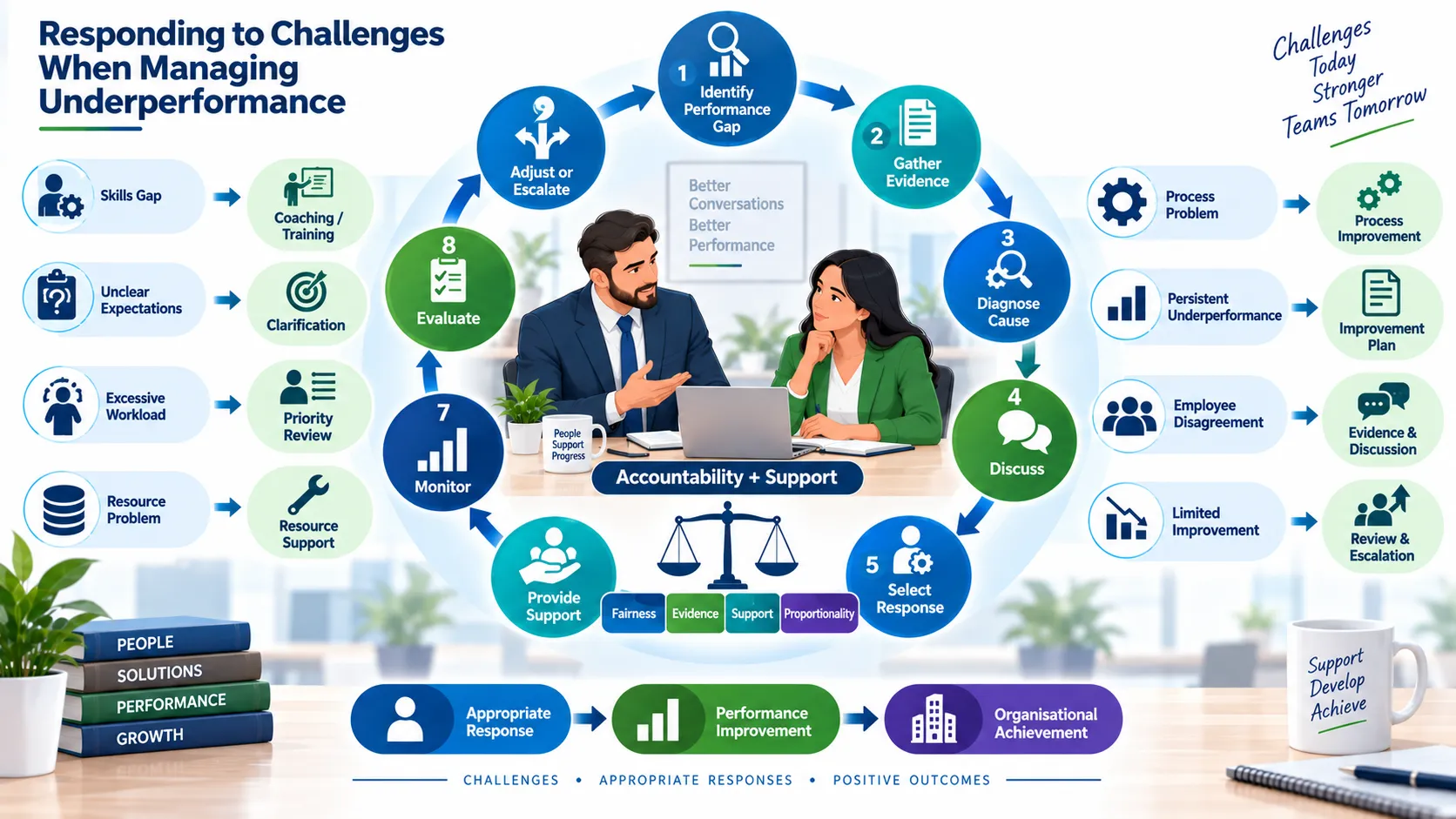
Understanding Individuals Who Exceed Expectations
Definition of Exceeding Expectations
An individual exceeds expectations when their performance consistently goes beyond agreed standards, objectives or requirements in a meaningful and evidenced way.
Exceeding expectations may involve:
Consistently achieving objectives above the required level.
Producing exceptional quality.
Delivering work ahead of agreed deadlines while maintaining standards.
Achieving strong customer outcomes.
Demonstrating advanced competence.
Solving complex workplace problems.
Supporting team effectiveness.
Taking appropriate initiative.
Contributing valuable ideas.
Demonstrating behaviours that strengthen organisational performance.
Exceeding expectations should be assessed against clear standards rather than personal impressions.
An employee who is highly visible or frequently works long hours is not automatically a high performer. Performance should be evaluated through relevant evidence and outcomes.
The Difference Between High Performance and High Workload
Managers should distinguish between high performance and simply working excessive hours.
An employee may work very long hours because:
Workload is excessive.
Processes are inefficient.
Priorities are unclear.
Resources are insufficient.
Work is poorly organised.
By contrast, sustainable high performance involves achieving strong results while maintaining appropriate quality, effectiveness and contribution.
Managers should therefore avoid rewarding unsustainable working patterns.
Good performance management asks:
What outcomes is the employee achieving?
How effectively are they achieving them?
Are quality standards maintained?
Is performance sustainable?
Is the employee supporting wider team objectives?
Are there signs of excessive workload?
Are additional responsibilities appropriate?
This distinction protects high-performing employees from being rewarded with continuously increasing workloads.
Why High Performers Require Effective Management
Managers sometimes make the mistake of assuming that high performers require little management.
Although high performers may require less close supervision, they still benefit from:
Clear objectives.
Constructive feedback.
Recognition.
Development.
Meaningful challenge.
Appropriate autonomy.
Career and capability conversations.
Workload management.
Opportunities to contribute.
Regular performance review.
A high performer who receives little managerial attention may eventually feel overlooked or underused.
The manager’s role is therefore not simply to maintain existing performance but to help the employee sustain and extend their contribution appropriately.
Principle 1: Recognise Achievement
Recognition is one of the most important techniques for managing individuals who exceed expectations.
Definition of Recognition
Recognition is the acknowledgement of an individual’s valuable contribution, achievement, improvement or behaviour in relation to agreed performance expectations and organisational objectives.
Recognition can be formal or informal.
Informal Recognition
Verbal appreciation.
Written acknowledgement.
Positive feedback.
Recognition during team discussions.
Personal appreciation from the manager.
Formal Recognition
Organisational awards.
Formal recognition programmes.
Performance-related rewards where applicable.
Public acknowledgement through appropriate organisational channels.
Additional responsibilities based on demonstrated capability.
Recognition should be meaningful and connected to actual performance.
Practical Example
A project manager completes a complex project ahead of schedule while maintaining quality and customer satisfaction.
The manager should explicitly recognise the achievement, explain its impact and identify the behaviours that contributed to the result.
For example:
“Your project delivery exceeded the agreed objective, while customer satisfaction remained strong. Your planning and early identification of risks made a significant contribution to the result.”
This is more effective than simply saying “well done” because it identifies what was valuable.
Principle 2: Provide Specific and Constructive Feedback
High performers still need feedback.
A common managerial error is to assume that employees who perform strongly do not require feedback.
Constructive feedback can help high performers:
Understand their strengths.
Maintain successful behaviours.
Identify improvement opportunities.
Increase self-awareness.
Prepare for greater responsibilities.
Avoid complacency.
Feedback should remain evidence-based.
Effective Feedback for High Performers
Managers can discuss:
What the employee achieved.
How they achieved it.
The impact of their contribution.
What strengths were demonstrated.
What could be developed further.
Where their skills could contribute to wider objectives.
Feedback should not become exaggerated praise without substance.
High performers benefit from honest and challenging feedback just as other employees do.
Principle 3: Understand the Reasons Behind High Performance
Managers should investigate what enables strong performance.
This can reveal useful practices that may benefit the wider team.
A high-performing employee may demonstrate:
Effective planning.
Strong prioritisation.
Efficient communication.
Advanced technical knowledge.
Effective problem-solving.
Customer awareness.
Strong organisation.
Effective collaboration.
Managers can explore these behaviours and identify whether elements can be shared across the team.
Practical Example
A customer service employee consistently achieves excellent customer outcomes.
The manager observes the employee’s approach and discovers that the employee uses a structured method for identifying customer needs before recommending solutions.
The manager can encourage appropriate sharing of this practice with colleagues.
This transforms individual high performance into wider team learning.
Principle 4: Provide Meaningful Challenge
High performers often benefit from challenging objectives that extend their capability.
Definition of Stretch Objectives
Stretch objectives are challenging but realistic goals that encourage an employee to apply and develop their capabilities beyond their current level of routine performance.
A stretch objective should not be impossible.
It should be:
Relevant.
Challenging.
Achievable with appropriate effort and capability.
Aligned with organisational priorities.
Clearly defined.
Appropriately supported.
Examples
A high-performing employee might be given responsibility for:
Improving a workplace process.
Leading a defined project.
Supporting implementation of an organisational initiative.
Developing a team procedure.
Analysing a recurring performance issue.
Supporting customer service improvement.
The objective should expand contribution without creating unreasonable workload.
Principle 5: Increase Appropriate Autonomy
High-performing employees may benefit from greater autonomy.
Definition of Autonomy
Autonomy is the appropriate degree of independence given to an employee to make decisions, organise work and complete responsibilities within agreed boundaries.
Managers should avoid micromanaging capable employees.
Appropriate autonomy can:
Increase ownership.
Strengthen accountability.
Improve motivation.
Encourage initiative.
Develop decision-making.
Build leadership capability.
However, autonomy should not mean abandonment.
Managers should still establish:
Expected outcomes.
Boundaries.
Resources.
Decision-making authority.
Review points.
The manager can then provide space for the employee to determine how the agreed outcome will be achieved.
Principle 6: Delegate Meaningful Responsibilities
Delegation can be a powerful development technique for high performers.
Definition of Delegation
Delegation is the process of assigning appropriate responsibility and authority for a task, project or outcome to another employee while retaining appropriate managerial accountability.
Effective delegation should provide genuine responsibility rather than simply transferring routine administrative work.
Good Delegation Practice
The manager should:
Identify the responsibility.
Explain the expected outcome.
Confirm authority and boundaries.
Provide necessary resources.
Agree timescales.
Establish review points.
Allow appropriate autonomy.
Provide support when required.
Evaluate the outcome.
Poor Delegation
A manager should avoid repeatedly giving high performers additional routine tasks simply because they are reliable.
This can create workload imbalance and resentment.
Delegation should contribute to development and organisational achievement.
Principle 7: Provide Development Opportunities
High performers should have opportunities to strengthen and broaden their capabilities.
Development may involve:
Coaching.
Mentoring.
Project involvement.
Cross-functional assignments.
Leadership responsibilities.
Problem-solving activities.
Exposure to different organisational processes.
Structured learning.
Peer knowledge sharing.
Development should be connected to the individual’s strengths, interests and organisational needs.
Development Conversation
A manager might ask:
Which aspects of your role do you find most engaging?
Which capabilities would you like to strengthen?
What responsibilities would provide an appropriate challenge?
Which organisational problems could benefit from your skills?
What support would help you succeed?
This encourages employee ownership of development.
Principle 8: Use High Performers as a Source of Organisational Learning
High performers can provide valuable insight into effective workplace practices.
Managers should consider how successful behaviours can be shared without creating unrealistic expectations for other employees.
For example, if a high-performing employee has developed an efficient method for organising customer requests, the manager can explore whether that method can inform team practice.
This should not mean forcing every employee to work in exactly the same way.
Instead, the manager can identify transferable principles.
Examples of Transferable Practices
Effective planning methods.
Useful communication techniques.
Problem-solving approaches.
Customer-handling practices.
Quality-checking methods.
Workflow improvements.
This can transform individual excellence into collective capability.
Principle 9: Encourage Knowledge Sharing
Knowledge sharing can strengthen team resilience.
A high performer may possess valuable expertise that is concentrated in one individual.
Managers should encourage appropriate sharing through:
Peer support.
Team demonstrations.
Process guidance.
Coaching colleagues.
Sharing successful approaches.
Documenting useful procedures.
However, managers should avoid turning high performers into unofficial permanent trainers without recognising the additional responsibility.
Knowledge sharing should be appropriately planned and acknowledged.
Principle 10: Protect Sustainable Performance
One of the most important responsibilities when managing high performers is preventing over-reliance on them.
A manager may repeatedly give difficult tasks to the same high-performing employee because they know the work will be completed successfully.
Over time, this can create:
Excessive workload.
Stress.
Reduced motivation.
Burnout risk.
Work-life imbalance.
Dependency on one individual.
Reduced team development.
Managers should therefore review workload regularly.
Questions to Consider
Is the employee’s workload reasonable?
Are additional responsibilities temporary or permanent?
Is the employee receiving appropriate recognition?
Are responsibilities being distributed fairly?
Is performance sustainable?
Are other employees being developed to share responsibilities?
High performance should not become a reason to overload an employee.
Principle 11: Maintain Fairness in Recognition and Reward
Recognition should be based on evidence and appropriate organisational criteria.
Managers should avoid:
Favouritism.
Personal preference.
Rewarding visibility rather than outcomes.
Rewarding excessive hours alone.
Recognising the same employee repeatedly without clear evidence.
Creating competition that damages teamwork.
Fair recognition helps maintain trust across the team.
Evidence for Recognition
Evidence might include:
Achievement of demanding objectives.
Exceptional quality.
Strong customer outcomes.
Meaningful process improvements.
Significant contribution to team objectives.
Consistent demonstration of expected behaviours.
Sustained improvement.
Principle 12: Link Recognition to Organisational Values and Objectives
Recognition is more powerful when employees understand why their contribution matters.
For example, if an organisation prioritises customer experience, recognition might focus on:
Improved customer outcomes.
Effective communication.
Problem resolution.
Service quality.
If the organisation prioritises efficiency, recognition might focus on:
Process improvement.
Effective resource use.
Reduced duplication.
Improved workflow.
This connects individual achievement with organisational priorities.
Principle 13: Offer Opportunities for Leadership Responsibility
High-performing employees may demonstrate potential to contribute beyond their current responsibilities.
Managers can provide appropriate leadership experiences such as:
Leading a defined project.
Coordinating a task group.
Supporting process improvement.
Facilitating a team activity.
Taking responsibility for a defined workstream.
Supporting colleagues.
These opportunities allow employees to develop leadership behaviours while contributing to organisational objectives.
However, managers should ensure that responsibility is matched with appropriate authority and support.
Principle 14: Encourage Problem Solving and Innovation
High performers can often contribute significantly to organisational improvement.
Managers can invite them to:
Identify recurring problems.
Analyse performance data.
Suggest process improvements.
Explore customer issues.
Develop practical solutions.
Test improvements within appropriate boundaries.
This can increase both engagement and organisational effectiveness.
Practical Example
A high-performing administration employee identifies repeated duplication in a reporting process.
The manager asks the employee to analyse the workflow and propose improvements.
The employee identifies unnecessary steps and recommends a simplified process.
The manager evaluates the recommendation through the appropriate organisational process.
The result is improved efficiency and broader organisational benefit.
Principle 15: Use Coaching to Extend High Performance
Coaching should not be limited to employees experiencing difficulties.
High-performing employees can benefit from coaching that challenges their thinking.
Managers can use questions such as:
What could make this process even more effective?
What risks do you see in the current approach?
How could your method be applied elsewhere?
What would you change if resources were available?
Which capability would most increase your impact?
How could you support wider team performance?
This moves coaching from problem correction towards performance enhancement.
Principle 16: Encourage Reflective Practice
High performers should be encouraged to reflect on how they achieve strong outcomes.
Reflection can help identify:
Strengths.
Successful behaviours.
Areas for refinement.
Lessons from complex situations.
Opportunities for improvement.
A manager might ask:
What contributed most to the successful outcome?
What would you repeat?
What would you change?
What did you learn?
What could be transferred to other situations?
This can strengthen self-awareness and continuous improvement.
Principle 17: Provide Variety and Meaningful Work
High performers may become disengaged if they repeatedly perform tasks that no longer challenge them.
Managers can introduce appropriate variety through:
New projects.
Cross-team work.
Problem-solving assignments.
Process improvement responsibilities.
Customer-focused initiatives.
Mentoring opportunities.
Temporary leadership responsibilities.
The objective is not simply to give the employee “more work”.
The additional responsibility should provide meaningful value and development.
Principle 18: Avoid Assuming High Performers Need No Support
High performance does not mean that an employee has no development needs.
A high performer may still need to develop:
Leadership skills.
Communication.
Strategic thinking.
Delegation.
Conflict management.
Project management.
Decision-making.
Stakeholder management.
Managers should therefore assess development needs based on future responsibilities and current capability rather than assuming that high performance in one role automatically means readiness for every other responsibility.
Principle 19: Use Strengths-Based Performance Management
Definition
Strengths-based performance management focuses on identifying and developing capabilities that enable employees to perform effectively while also addressing relevant areas for improvement.
The approach does not mean ignoring weaknesses.
Instead, it recognises that employees may create greater organisational value when their strengths are appropriately applied and developed.
Managers can identify:
Technical strengths.
Communication strengths.
Problem-solving strengths.
Leadership strengths.
Customer service strengths.
Analytical strengths.
Organisational strengths.
These strengths can then inform development and work allocation.
Principle 20: Create Opportunities for Broader Contribution
High-performing employees can contribute beyond their immediate objectives.
Managers can involve them in:
Team improvement initiatives.
Process reviews.
Organisational projects.
Quality improvement activities.
Knowledge-sharing activities.
Customer improvement initiatives.
Problem-solving groups.
The contribution should remain appropriate to the employee’s role and workload.
Technique: Stretch Assignments
Definition
A stretch assignment is a challenging work responsibility that extends an employee’s current capabilities while remaining achievable with appropriate support.
Examples include:
Leading a small improvement project.
Managing a defined workstream.
Analysing a recurring operational issue.
Developing a process improvement proposal.
Coordinating a specific team initiative.
Benefits
Stretch assignments can:
Build confidence.
Develop decision-making.
Increase organisational contribution.
Strengthen problem-solving.
Prepare employees for broader responsibilities.
Increase engagement.
Risks
Managers should avoid:
Giving impossible objectives.
Adding excessive workload.
Removing necessary support.
Using stretch assignments as unpaid additional work.
Assuming that high performance automatically means unlimited capacity.
Technique: Mentoring and Peer Development
High performers can benefit from mentoring relationships where appropriate.
Mentoring can provide:
Perspective.
Experience sharing.
Reflection.
Guidance.
Professional confidence.
High performers can also contribute as mentors to others, but managers should ensure that this additional responsibility is recognised and does not interfere with the employee’s core objectives.
Technique: Cross-Functional Exposure
Cross-functional work can broaden an employee’s understanding of the organisation.
For example, a high-performing customer service employee might contribute to a process improvement project involving operations and administration.
This can develop:
Systems thinking.
Collaboration.
Communication.
Understanding of organisational interdependencies.
Problem-solving.
It can also help the employee understand how their performance affects wider organisational outcomes.
Technique: Performance-Based Recognition
Recognition should reflect meaningful performance.
A structured approach can include:
Step 1: Identify Achievement
Determine what the employee has achieved beyond expectations.
Step 2: Verify Evidence
Review relevant performance evidence.
Step 3: Identify Impact
Determine how the contribution benefited customers, colleagues, the team or organisation.
Step 4: Select Appropriate Recognition
Choose an appropriate form of acknowledgement.
Step 5: Communicate Clearly
Explain what was achieved and why it matters.
Step 6: Monitor Continued Performance
Continue to review performance rather than assuming recognition replaces management.
Technique: Development Planning
A development plan can help translate high performance into future capability.
A useful plan may include:
Current strengths.
Development objectives.
Target capabilities.
Development activities.
Practical assignments.
Support required.
Review dates.
Evidence of progress.
Example
A high-performing team coordinator demonstrates excellent operational capability but limited experience leading improvement projects.
The manager agrees a development objective focused on leading a defined process improvement initiative.
The employee receives appropriate coaching and regular review.
This extends capability while contributing directly to organisational improvement.
Technique: Increased Responsibility with Clear Boundaries
Additional responsibility should be accompanied by clarity.
The manager should define:
What the employee owns.
What decisions they can make.
What requires approval.
What outcomes are expected.
What resources are available.
When progress will be reviewed.
This allows autonomy without creating ambiguity.
Technique: Recognition Through Greater Responsibility
Responsibility can sometimes be an appropriate form of recognition when the employee genuinely wants broader involvement and has the capability to manage it.
Examples include:
Leading a project.
Coordinating a defined initiative.
Representing the team in an appropriate forum.
Supporting process development.
However, responsibility should not become a substitute for all other forms of recognition.
Technique: Peer Recognition
Appropriate peer recognition can reinforce team culture.
A manager can create opportunities for colleagues to acknowledge valuable contributions.
However, recognition systems should be structured carefully to avoid popularity contests.
Recognition should remain connected to meaningful contribution.
Technique: Sharing Successful Practice
High-performing employees can demonstrate effective approaches to colleagues.
For example:
A high-performing employee consistently maintains excellent quality while meeting demanding deadlines.
The manager asks the employee to demonstrate their planning and checking approach to the team.
Colleagues can then identify practices that may be useful in their own work.
This turns individual performance into collective learning.
Technique: Continuous Performance Review
High-performing employees should continue to participate in performance reviews.
The focus may shift from:
“Are you meeting expectations?”
towards:
“How can we sustain and extend your contribution?”
Review discussions can explore:
Current achievement.
Strengths.
New challenges.
Development.
Organisational contribution.
Workload.
Recognition.
Future objectives.
This keeps performance management active and meaningful.
Scenario: High Performer Receiving Excessive Work
A project coordinator consistently completes work ahead of deadlines.
Because of this, the manager begins assigning additional urgent tasks to the employee.
The employee continues to achieve targets but begins reporting fatigue and reduced engagement.
Evaluation
The manager should recognise that strong performance does not justify unlimited additional workload.
The appropriate response includes:
Reviewing workload.
Redistributing tasks where appropriate.
Discussing sustainable performance.
Maintaining recognition.
Ensuring additional responsibilities are purposeful.
The objective is to protect long-term performance.
Scenario: High Performer Needs Greater Challenge
An employee consistently exceeds routine objectives and demonstrates strong technical capability.
However, the employee reports that the role has become repetitive.
Evaluation
The manager could provide an appropriate stretch assignment, such as leading a defined process improvement project.
The assignment should include:
Clear outcome.
Appropriate authority.
Relevant resources.
Review points.
Reasonable workload.
This provides challenge while contributing to organisational improvement.
Scenario: High Performer with Strong Technical Skills but Limited Leadership Experience
An employee is highly effective in their specialist role but has not previously led others.
The manager should not assume that technical excellence automatically demonstrates leadership capability.
Instead, the manager can provide a controlled leadership opportunity, such as coordinating a defined project or facilitating a specific team activity.
The manager can then provide feedback and coaching.
This develops leadership capability through practical experience.
Scenario: High Performer Who Does Not Want Additional Responsibility
A high-performing employee consistently exceeds expectations but does not want to take on broader responsibilities.
The manager should respect the employee’s preference.
High performance does not automatically require promotion, leadership responsibility or additional duties.
The manager can instead focus on:
Maintaining appropriate recognition.
Supporting continued excellence.
Providing development relevant to the employee’s interests.
Protecting sustainable workload.
Offering meaningful challenge within the current role.
This reinforces the principle that development should be appropriate to the individual and organisational context.
Scenario: High Performer and Team Dependency
A team relies heavily on one high-performing employee to solve difficult problems.
The employee becomes the default source of expertise.
Although this may initially improve team results, it creates organisational dependency.
The manager should:
Identify critical knowledge.
Encourage appropriate knowledge sharing.
Develop other employees.
Document useful processes.
Distribute responsibilities appropriately.
The goal is to strengthen team capability rather than create dependence on one person.
Scenario: Recognition Without Creating Competition
A manager wants to recognise a high-performing employee but is concerned that public recognition may create resentment.
The manager should consider the organisational culture and the nature of the achievement.
Recognition should explain the contribution rather than imply that other employees are less valuable.
For example, recognition can focus on a specific achievement and its impact on team objectives.
This reinforces positive behaviour without unnecessarily creating competition.
Evaluating Techniques for Managing High Performers
Managers should evaluate whether their approach is actually producing positive outcomes.
Questions for Evaluation
Has performance been sustained?
Has the employee remained engaged?
Has capability increased?
Has organisational contribution expanded?
Has workload remained appropriate?
Has the team benefited?
Has knowledge been shared?
Have new responsibilities been successful?
Has recognition been meaningful?
Has the employee received useful feedback?
A technique should be adjusted if it produces negative consequences.
For example, if repeated delegation causes excessive workload, the manager should reconsider the approach.
Common Mistakes When Managing High Performers
Assuming They Need No Management
High performers still require communication, feedback and support.
Giving Them More Work Automatically
Reliability should not become a reason for continual overload.
Providing Praise Without Challenge
Excessive praise without meaningful development may lead to stagnation.
Providing Challenge Without Support
Stretch objectives should remain realistic and appropriately supported.
Treating High Performance as Unlimited Capacity
Strong performance does not mean unlimited time or energy.
Ignoring Development Needs
High performers may still have capability gaps relevant to future responsibilities.
Creating Unhealthy Competition
Recognition should strengthen organisational culture rather than undermine teamwork.
Assuming Technical Excellence Equals Leadership Readiness
Leadership requires additional capabilities and should be developed deliberately.
Using Responsibility as the Only Reward
Additional responsibility is not always an appropriate reward and should not replace meaningful recognition.
Failing to Recognise Improvement
Recognition should include significant improvement as well as consistently high results.
Integrating High-Performance Management into the Performance Cycle
High-performing employees should remain part of the overall performance management cycle.
Stage 1: Set Expectations
Establish clear objectives and standards.
Stage 2: Monitor
Review performance evidence.
Stage 3: Recognise
Identify strong achievement.
Stage 4: Reflect
Explore what enables high performance.
Stage 5: Develop
Identify appropriate capability development.
Stage 6: Challenge
Introduce meaningful stretch opportunities.
Stage 7: Empower
Provide appropriate autonomy.
Stage 8: Support
Provide coaching, resources and guidance.
Stage 9: Evaluate
Assess whether performance and contribution remain strong.
Stage 10: Sustain
Manage workload and support long-term effectiveness.
This demonstrates that high-performance management is an ongoing process rather than a one-time reward.
A Managerial Framework for Developing High Performers
Managers can use the following framework:
Recognise → Understand → Develop → Challenge → Empower → Support → Monitor → Evaluate → Sustain
Recognise
Acknowledge evidence of strong performance.
Understand
Identify the strengths and behaviours contributing to success.
Develop
Create opportunities to strengthen capability.
Challenge
Provide meaningful and realistic stretch objectives.
Empower
Increase autonomy where appropriate.
Support
Provide coaching, resources and feedback.
Monitor
Review outcomes and workload.
Evaluate
Assess whether development and challenge are producing positive results.
Sustain
Ensure strong performance remains healthy, balanced and aligned with organisational objectives.
Key Benefits of Developing High-Performing Individuals
Benefits for Employees
Effective management can provide:
Meaningful recognition.
Greater engagement.
Appropriate challenge.
Increased autonomy.
Capability development.
Stronger confidence.
Greater ownership.
Opportunities to contribute.
Benefits for Managers
Managers can gain:
Greater team capability.
Stronger problem-solving capacity.
Improved delegation opportunities.
More resilient teams.
Additional sources of expertise.
Stronger leadership pipelines within the team.
Benefits for Teams
Teams can benefit from:
Knowledge sharing.
Improved practices.
Stronger collaboration.
Increased capability.
Better problem-solving.
Reduced dependency on individual employees.
Benefits for Organisations
Organisations can benefit through:
Sustained high performance.
Improved productivity.
Better quality.
Stronger customer outcomes.
Greater innovation.
Improved organisational learning.
Stronger internal capability.
Better alignment between individual contribution and organisational objectives.
Professional Judgement When Managing High Performers
Professional judgement remains essential.
A manager should consider:
What evidence demonstrates that the employee is exceeding expectations?
What strengths are contributing to performance?
What development would provide genuine value?
What challenge is appropriate?
What level of autonomy is suitable?
Is additional responsibility genuinely appropriate?
Is the employee’s workload sustainable?
How can individual performance benefit the wider team?
Is recognition fair and evidence-based?
What organisational objectives could benefit from the employee’s capabilities?
The manager should avoid treating all high performers identically.
One employee may want additional challenge, while another may prefer to deepen expertise within their existing role.
One may be interested in leadership responsibility, while another may prefer specialist contribution.
Good management therefore combines consistent principles with individualised judgement.
High-Performance Management Checklist
Managers should regularly consider:
Recognition
Is strong performance being recognised?
Is recognition based on evidence?
Is recognition linked to meaningful contribution?
Development
Does the employee have opportunities to develop?
Are development activities relevant?
Is the employee involved in identifying development needs?
Challenge
Are objectives sufficiently challenging?
Are stretch assignments realistic?
Is appropriate support available?
Autonomy
Does the employee have appropriate decision-making freedom?
Are boundaries clear?
Are review points proportionate?
Workload
Is the employee’s workload sustainable?
Are they receiving excessive additional responsibilities?
Is responsibility distributed appropriately across the team?
Organisational Contribution
Can successful practices be shared?
Can the employee contribute to improvement projects?
Is knowledge being appropriately distributed?
Evaluation
Is performance being sustained?
Has capability developed?
Is the employee engaged?
Has the wider team benefited?
Summary
Individuals who exceed expectations are an important source of organisational capability, but high performance should not be taken for granted. Effective managers recognise strong achievement, provide meaningful feedback, develop capability, introduce appropriate challenge, encourage autonomy and create opportunities for wider contribution.
Recognition should be based on clear evidence and linked to meaningful organisational outcomes. Managers should explain what the employee has achieved and why the contribution matters. High performers should also receive constructive feedback rather than being managed solely through praise.
Development techniques such as coaching, mentoring, stretch assignments, cross-functional exposure, knowledge sharing, project leadership and increased responsibility can help high performers extend their capabilities. However, managers must ensure that development opportunities do not become excessive workloads.
One of the most important considerations is sustainable performance. Reliable high performers can easily become overloaded because managers repeatedly depend on them to complete difficult or urgent work. Effective managers therefore monitor workload, distribute responsibility appropriately and avoid confusing high performance with unlimited capacity.
High performers can also contribute to wider organisational learning. Their successful practices can be explored, shared and adapted where appropriate. This helps transform individual excellence into stronger team capability.
Managers should also recognise that high performance in one role does not automatically demonstrate readiness for every future responsibility. Leadership, delegation, communication, decision-making and broader organisational capabilities may require deliberate development.
Ultimately, the most effective approach is to recognise achievement, understand strengths, provide meaningful development, introduce appropriate challenge, increase autonomy, support sustainable performance and evaluate ongoing contribution.
When these techniques are applied effectively, high-performing individuals are more likely to remain engaged, continue contributing strongly and support the development of others. This creates benefits beyond the individual employee, strengthening team capability and contributing to improved organisational achievement.