
Lesson no 2:Understand the frameworks for stakeholder management
Effective stakeholder management requires organisations to understand who their stakeholders are, what they expect, how much influence they have and how relationships with them should be managed. Without a structured approach, organisations may struggle to balance competing interests, communicate effectively, manage expectations and maintain productive relationships. Stakeholder management frameworks provide practical structures that help managers analyse stakeholder needs, assess their influence and interest, establish appropriate engagement strategies and make informed decisions.
This lesson, “Understand the frameworks for stakeholder management”, explores established frameworks and models that organisations can use to manage stakeholder relationships systematically. Learners will examine approaches such as stakeholder mapping, the Power–Interest Grid, Mendelow’s Matrix, the Stakeholder Salience Model and other relevant stakeholder analysis techniques. The lesson considers how these frameworks help managers identify priorities, determine appropriate levels of engagement, anticipate stakeholder concerns and allocate organisational resources effectively.
The lesson also examines how stakeholder management frameworks can be applied in practical organisational situations. Learners will consider how managers can use stakeholder analysis to improve communication, build trust, manage conflict, support decision-making and strengthen stakeholder engagement. By understanding the purpose and application of these frameworks, learners can develop a structured approach to managing diverse stakeholder groups and supporting sustainable organisational performance.
1.Examine the Contractual Frameworks for Stakeholder Engagement and Management
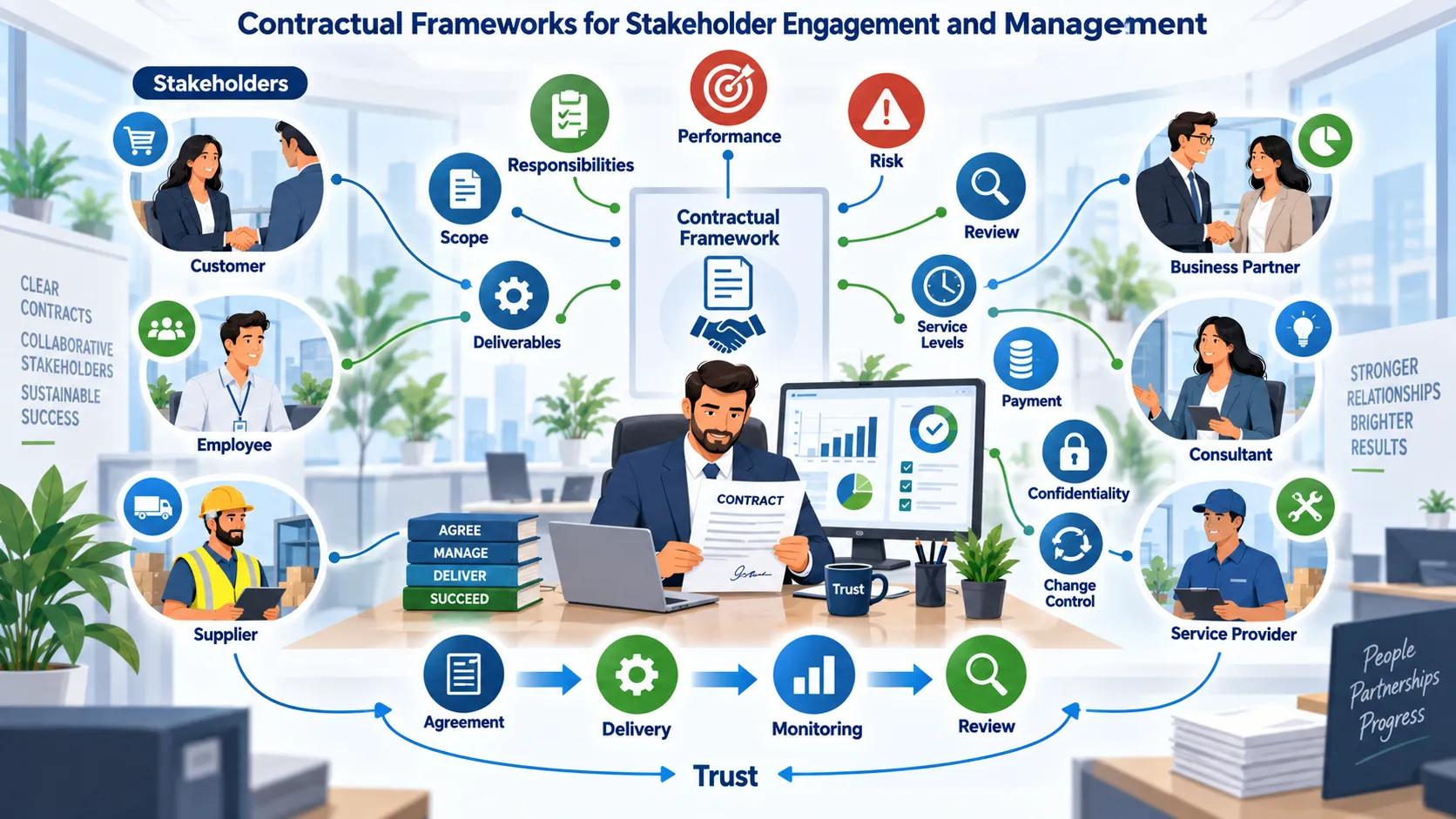
Contractual frameworks are an important foundation for managing stakeholder relationships within organisations. While stakeholder management is often associated with communication, consultation, trust and collaboration, many organisational relationships are also governed by formal agreements that establish responsibilities, expectations, rights, obligations, performance requirements and methods for resolving disagreements. Contracts provide a structured basis for defining what each party is expected to contribute and what each party can reasonably expect in return.
For middle managers and leaders, understanding contractual frameworks is particularly important because they frequently operate between organisational strategy and day-to-day delivery. They may be responsible for implementing contractual commitments, coordinating internal teams, monitoring supplier or partner performance, communicating with customers and escalating contractual risks to senior management. A manager who understands the contractual basis of a stakeholder relationship is better positioned to distinguish between what is legally or formally required, what is commercially expected and what can be negotiated.
Contractual stakeholder management applies across a wide range of organisational relationships. Customers may be governed by service agreements, suppliers by procurement contracts, employees by employment contracts, consultants by consultancy agreements, business partners by partnership or collaboration agreements, and service providers by outsourcing or managed-service contracts. Public-sector and regulated organisations may also operate under formal agreements, licences, framework arrangements and statutory requirements that influence stakeholder engagement.
The purpose of a contractual framework is not simply to create a legally enforceable document. An effective contractual framework establishes a practical structure for cooperation and accountability. It helps stakeholders understand the scope of the relationship, the expected standard of performance, decision-making responsibilities, reporting arrangements, confidentiality requirements, financial arrangements, risk allocation and procedures for dealing with problems.
For managers, the central principle is that contractual stakeholder management combines relationship management with disciplined governance. A positive relationship cannot compensate for consistently failing to meet contractual obligations, while a technically compliant contract can still produce poor outcomes if communication, trust and cooperation are neglected.
Understanding the Meaning of a Contractual Framework
A contractual framework is the structured set of agreements, terms, conditions, obligations, responsibilities, procedures and governance arrangements that define how two or more parties will work together.
In stakeholder management, the contractual framework provides a formal reference point for the relationship. It establishes the boundaries within which the parties operate and clarifies the commitments that each party has accepted. Depending on the relationship, the framework may consist of one detailed contract or several connected documents, such as a master agreement, statement of work, service-level agreement, schedules, policies, specifications and performance measures.
A contractual framework should therefore be viewed as more than a legal document. It is also a management mechanism. Managers use contractual information to coordinate activities, monitor performance, identify risks, manage expectations and support accountability.
Typical elements may include:
Scope of services or work
Roles and responsibilities
Deliverables and outputs
Performance standards
Service-level requirements
Pricing and payment arrangements
Timescales and milestones
Quality requirements
Reporting and review arrangements
Confidentiality requirements
Data protection responsibilities
Intellectual property arrangements
Health and safety responsibilities
Insurance requirements
Risk allocation
Change-control procedures
Escalation arrangements
Dispute-resolution procedures
Termination provisions
Renewal arrangements
The precise structure depends on the nature of the relationship, the industry, the jurisdiction, the size of the organisation and the level of risk involved.
Contractual Frameworks and Stakeholder Management
Stakeholder management focuses on identifying stakeholders, understanding their interests and expectations, communicating effectively with them and developing appropriate engagement strategies. Contractual frameworks add another layer by defining formal commitments.
This distinction is important because not every stakeholder expectation becomes a contractual obligation. A customer may expect rapid responses, but the contract may specify a particular response time. An employee may expect career support, while the employment contract may define only specific contractual responsibilities. A supplier may want greater flexibility, while the contract may establish fixed delivery requirements.
Managers therefore need to understand the difference between:
Contractual obligations: formal commitments contained within an agreement.
Legal obligations: requirements imposed by applicable law or regulation.
Commercial expectations: expectations arising from the business relationship.
Operational expectations: requirements needed to deliver work effectively.
Relationship expectations: behaviours such as trust, cooperation and responsiveness.
Strategic expectations: longer-term outcomes such as growth, innovation or partnership development.
Effective stakeholder management considers all of these dimensions rather than relying exclusively on the contract.
Why Contractual Frameworks Matter to Middle Managers
Middle managers often have direct responsibility for translating contractual commitments into operational activity. Senior leaders may approve a contract, while operational managers and their teams are responsible for delivering what the organisation has promised.
For example, an organisation may sign a three-year contract with a corporate customer requiring monthly reporting, defined service standards and agreed response times. The account manager may then need to coordinate operations, finance, customer service and technical teams to ensure those obligations are met.
The manager therefore becomes an important link between:
Organisational strategy
Contractual commitments
Operational delivery
Stakeholder expectations
Performance management
Risk management
Relationship management
A failure at any one of these levels can affect the wider stakeholder relationship.
Key Principles of Contractual Stakeholder Management
Effective contractual stakeholder management is based on several interconnected principles.
Clarity
All parties should understand what the relationship covers, what is expected and who is responsible for each activity. Ambiguous responsibilities create avoidable disputes and performance problems.
Accountability
Each party should be able to demonstrate whether agreed responsibilities have been fulfilled. Clear ownership makes it easier to identify problems and take corrective action.
Transparency
Relevant information should be communicated openly and accurately. Managers should avoid concealing contractual problems because delays in disclosure can increase their eventual impact.
Consistency
Contractual requirements should be applied consistently. Managers should avoid making informal commitments that conflict with agreed contractual terms.
Proportionality
The level of contractual governance should reflect the importance, complexity and risk of the relationship. A low-value routine purchase may not require the same governance structure as a strategic outsourcing agreement.
Flexibility
Although contracts provide structure, organisations may need to respond to changing circumstances. Proper change-control mechanisms allow legitimate adjustments without undermining governance.
Collaboration
A contract establishes obligations, but successful relationships also depend on cooperation. Managers should encourage stakeholders to solve problems constructively rather than treating every disagreement as an adversarial issue.
Types of Contractual Frameworks Used in Stakeholder Management
Organisations use different contractual arrangements depending on the nature of stakeholder relationships. Managers should understand the purpose of each arrangement and the management implications.
Employment Contracts
Employment contracts establish the formal relationship between an organisation and its employees. They normally define key employment terms such as responsibilities, remuneration, working arrangements, notice provisions and other applicable conditions.
From a stakeholder-management perspective, employment contracts create clarity about the relationship between the organisation and employee. However, effective employee engagement involves considerably more than contractual compliance.
Managers may need to manage:
Job responsibilities
Performance expectations
Working arrangements
Organisational policies
Confidentiality
Conduct requirements
Working hours
Leave arrangements
Performance reviews
Development discussions
Changes to responsibilities
A manager should understand the contractual boundaries of their authority and refer specialist employment matters to HR or appropriate professional advisers when necessary.
Customer Contracts
Customer contracts define what a customer will receive and what the customer is required to provide in return. They are particularly important where services are complex, ongoing or commercially significant.
A customer agreement may establish:
Products or services supplied
Pricing
Delivery dates
Service standards
Quality requirements
Customer responsibilities
Support arrangements
Payment terms
Reporting requirements
Warranties
Limitations of liability
Change procedures
Termination arrangements
For managers, the contract provides a baseline for customer expectations. It can also prevent scope creep, where customers gradually request additional work that was not included in the original agreement.
Supplier Contracts
Supplier contracts establish the requirements for obtaining goods or services from external organisations. They are fundamental to procurement and supply-chain management.
A supplier contract may define:
Quantity
Specification
Quality standards
Delivery schedule
Pricing
Payment terms
Inspection requirements
Warranty arrangements
Service levels
Reporting
Environmental or ethical requirements
Data and confidentiality provisions
Corrective-action requirements
Managers responsible for supplier relationships should use these requirements when monitoring performance.
For example, if a supplier is required to deliver equipment within five working days and repeatedly delivers after ten days, the manager should assess the situation against the agreed contractual performance requirements rather than relying solely on informal conversations.
Service-Level Agreements
A service-level agreement, commonly known as an SLA, defines measurable standards for the delivery of a service.
SLAs are frequently used in:
IT services
Customer support
Facilities management
Outsourcing
Telecommunications
Cloud services
Maintenance
Professional services
An SLA may specify:
Response time
Resolution time
Availability
Service quality
Incident management
Reporting frequency
Escalation procedures
Performance targets
For example, an IT service provider may agree to respond to critical incidents within 30 minutes. The manager responsible for the relationship can use service records to determine whether the supplier is meeting the agreed standard.
Statements of Work
A statement of work, or SOW, provides detailed information about specific work to be completed under a broader contractual relationship.
It may include:
Project objectives
Deliverables
Tasks
Milestones
Responsibilities
Timescales
Acceptance criteria
Resources
Reporting requirements
Statements of work are particularly useful where the organisation has a continuing relationship with a stakeholder but individual projects or assignments change over time.
Framework Agreements
A framework agreement establishes general terms under which future transactions or work packages can be agreed.
Framework arrangements are common in procurement because they can provide organisations with an established group of approved suppliers and agreed commercial conditions.
The benefits can include:
Reduced procurement time
Consistent terms
Greater supplier visibility
Easier repeat purchasing
Improved governance
Greater purchasing efficiency
Managers must still understand the specific conditions applying to each order or work package.
Partnership and Collaboration Agreements
Strategic partnerships often require contractual frameworks because organisations may share resources, information, technology, customers, intellectual property or capabilities.
A partnership or collaboration agreement may clarify:
Strategic objectives
Contributions from each party
Governance arrangements
Decision-making authority
Financial responsibilities
Intellectual property
Confidentiality
Risk management
Performance measures
Exit arrangements
These arrangements can be particularly complex because the stakeholders may remain independent organisations while working towards shared objectives.
Consultancy and Professional Services Agreements
Consultants and professional service providers are often engaged under agreements defining the services to be delivered and the expected outcomes.
Managers may need to monitor:
Scope
Deliverables
Quality
Milestones
Consultant responsibilities
Organisational responsibilities
Fees
Expenses
Confidentiality
Intellectual property
Reporting
Clear contractual arrangements help prevent disagreements about whether a consultant has completed the agreed assignment.
Outsourcing and Managed-Service Contracts
Outsourcing involves transferring responsibility for particular activities or services to an external organisation. Because the external provider may become critical to organisational operations, the contractual framework needs to be robust.
The framework may cover:
Service scope
Performance standards
Business continuity
Information security
Data management
Staffing requirements
Reporting
Risk allocation
Service credits or remedies
Escalation
Governance
Exit and transition arrangements
Managers should recognise that outsourcing can create dependency. A contract may reduce uncertainty, but it cannot eliminate operational risk.
Key Contractual Concepts for Stakeholder Management
Scope
Scope defines what is included within the contractual relationship.
Clear scope is essential because it prevents uncertainty about what one party is expected to deliver.
A manager should be able to answer:
What is included?
What is excluded?
Who is responsible?
What outputs are required?
What assumptions have been made?
What happens if requirements change?
Poor scope definition can lead to disputes, additional costs and delays.
Roles and Responsibilities
Contracts often assign specific responsibilities to each party. Managers need to ensure that these responsibilities are understood internally as well as externally.
A responsibility matrix can help identify ownership.
For example:
| Activity | Organisation | Supplier | Managerial consideration |
|---|---|---|---|
| Define requirements | Accountable | Consulted | Ensure requirements are clear |
| Deliver service | Oversight | Responsible | Monitor agreed standards |
| Quality checking | Responsible | Supporting | Establish acceptance criteria |
| Performance reporting | Review | Responsible | Check accuracy and timeliness |
| Issue escalation | Accountable | Supporting | Follow agreed escalation route |
| Contract review | Responsible | Responsible | Review performance collaboratively |
| Change approval | Authorising | Proposing/supporting | Follow formal change control |
Deliverables
A deliverable is a defined output that one party is required to provide.
Deliverables should be sufficiently clear to allow both parties to determine whether they have been completed.
For example, “provide monthly performance report” is more useful when the agreement specifies:
Required information
Format
Reporting date
Performance measures
Recipient
Acceptance criteria
Performance Measures
Performance measures allow managers to assess whether contractual commitments are being achieved.
Common measures include:
Delivery times
Quality levels
Customer satisfaction
Response times
Availability
Error rates
Completion rates
Cost performance
Compliance levels
Complaint volumes
Performance measures should be relevant to the purpose of the relationship rather than selected simply because they are easy to measure.
Service Levels
Service levels establish agreed standards for ongoing service delivery.
For example:
99.9% system availability
Response to priority-one incidents within 30 minutes
Delivery within an agreed timeframe
Customer enquiries acknowledged within one working day
Managers should distinguish between a target, a contractual commitment and an internal performance aspiration.
Payment Terms
Payment terms define when and under what conditions money is exchanged.
Managers may need to understand:
Payment dates
Invoicing requirements
Milestone payments
Acceptance conditions
Expenses
Penalties or credits where applicable
Disputed invoices
Financial misunderstandings can quickly damage stakeholder relationships.
Confidentiality
Confidentiality provisions protect information that stakeholders should not disclose or misuse.
This can include:
Commercial information
Customer information
Pricing
Business plans
Technical information
Intellectual property
Operational information
Managers should ensure that employees and contractors understand applicable confidentiality requirements.
Data Protection and Information Management
Where stakeholder relationships involve personal or sensitive organisational information, contractual arrangements may establish responsibilities for handling that information.
Managers should ensure that relevant organisational policies and applicable legal requirements are followed. Contractual clauses should not be treated as a substitute for understanding the wider regulatory environment.
Intellectual Property
Intellectual property clauses establish ownership and permitted use of materials, designs, software, documents, inventions or other intellectual assets.
This is particularly important in:
Technology partnerships
Consultancy
Research projects
Marketing services
Software development
Creative services
A manager should understand who owns the outputs and what rights each party receives.
The Contract Lifecycle in Stakeholder Management
Contractual stakeholder management should be viewed as a lifecycle rather than a single event.
Stage 1: Identify the Need
The organisation first identifies why a contractual relationship is required.
The manager should consider:
What business need exists?
Which stakeholder is required?
What outcome is expected?
What risks exist?
What resources are required?
What type of relationship is appropriate?
Stage 2: Identify and Analyse Stakeholders
Stakeholder analysis should be conducted before formalising the agreement.
Managers can consider:
Stakeholder interests
Influence
Expectations
Risks
Dependencies
Expertise
Decision-making authority
Potential conflicts
This ensures that contractual design reflects the wider stakeholder environment.
Stage 3: Define Requirements
The organisation should define what it needs from the relationship.
Requirements should be:
Clear
Relevant
Measurable where appropriate
Realistic
Aligned with organisational objectives
Consistent with available resources
Stage 4: Select the Appropriate Contractual Structure
The organisation determines what type of agreement is appropriate.
This could be:
Employment agreement
Customer agreement
Supplier contract
SLA
Framework agreement
Consultancy agreement
Partnership agreement
Outsourcing agreement
Project statement of work
The chosen structure should reflect the complexity and risk of the relationship.
Stage 5: Negotiate Terms
Negotiation allows the parties to agree responsibilities, commercial arrangements, performance requirements and other conditions.
Managers involved in negotiation should prepare carefully.
Important preparation may include:
Identifying objectives
Establishing priorities
Understanding stakeholder needs
Identifying non-negotiable requirements
Assessing risks
Understanding alternatives
Defining approval limits
Preparing evidence
Establishing escalation routes
Managers should not make commitments beyond their authority.
Stage 6: Review and Approve
Before implementation, the agreement should be reviewed through the organisation’s appropriate governance process.
Depending on the organisation, this may involve:
Procurement
Finance
Legal specialists
HR
Information security
Senior management
Compliance
Operational leadership
The purpose is to ensure that the organisation understands the commitments and risks before entering the relationship.
Stage 7: Implement the Contract
Once the agreement is approved, the manager needs to translate contractual requirements into operational activities.
This may involve:
Briefing employees
Setting responsibilities
Establishing reporting systems
Creating performance measures
Establishing meeting schedules
Setting up communication channels
Creating escalation procedures
Recording important decisions
A contract has limited practical value if operational teams do not understand what it requires.
Stage 8: Monitor Performance
Performance should be monitored against agreed requirements.
Managers should review:
Delivery
Quality
Cost
Timescales
Service levels
Complaints
Risks
Compliance
Stakeholder satisfaction
Evidence-based monitoring is more effective than relying on assumptions or informal impressions.
Stage 9: Manage Changes
Business conditions may change after a contract has been agreed.
Changes might result from:
Customer requirements
New technology
Market changes
Cost pressures
Organisational restructuring
Regulatory changes
Supply-chain disruption
Changes in strategic priorities
Managers should use formal change-control procedures rather than making undocumented informal commitments.
Stage 10: Review the Relationship
Contract performance should be reviewed alongside relationship quality.
Questions may include:
Are contractual requirements being achieved?
Are stakeholders satisfied?
Are communication arrangements effective?
Are disputes increasing?
Are risks changing?
Are the agreed performance measures still relevant?
Is the relationship creating the expected value?
Stage 11: Renew, Renegotiate or Exit
At the end of the contractual period, the organisation may renew, renegotiate or terminate the relationship according to the agreed arrangements and applicable requirements.
Managers should avoid waiting until the final moment to evaluate renewal decisions.
Contractual Governance and Stakeholder Engagement
Contractual governance refers to the structures and processes used to oversee a contractual relationship.
Good governance creates visibility and accountability without unnecessarily restricting productive collaboration.
A governance framework may include:
Contract owner
Relationship manager
Operational contacts
Review meetings
Performance dashboards
Reporting schedules
Escalation routes
Risk registers
Issue logs
Change-control procedures
Formal review points
For strategic relationships, governance may operate at several levels.
Strategic Level
Senior leaders consider:
Strategic alignment
Long-term value
Major risks
Investment
Relationship direction
Tactical Level
Middle managers may focus on:
Performance
Resources
Relationship health
Service issues
Improvement opportunities
Operational Level
Operational teams focus on:
Daily delivery
Quality
Incidents
Communication
Task completion
This layered approach allows senior leaders to focus on strategic issues while managers deal with operational matters.
Contractual Frameworks and Communication
Communication is essential to successful contractual stakeholder management. A contract may define formal reporting requirements, but managers should also establish effective working communication.
Communication can include:
Formal performance reports
Review meetings
Operational meetings
Email communication
Digital collaboration platforms
Issue notifications
Escalation meetings
Improvement workshops
Managers should maintain appropriate records of important contractual decisions and commitments.
A common mistake is assuming that a stakeholder relationship is healthy simply because there are no formal disputes. A stakeholder may be dissatisfied without immediately raising a contractual claim.
Managers should therefore use both quantitative and qualitative information.
Managing Expectations Through Contracts
Expectation management is one of the most important functions of a contractual framework.
Stakeholders can develop expectations that go beyond the original agreement. If these expectations are not managed, conflict may develop.
For example, a customer may request an additional service and assume that it is included. The manager should clarify the contractual scope rather than automatically agreeing.
A professional response may involve:
Reviewing the existing agreement
Clarifying what is included
Identifying the additional requirement
Assessing operational implications
Calculating potential costs
Following change-control procedures
Obtaining approval
Communicating the outcome clearly
This approach protects the relationship while maintaining contractual discipline.
Managing Contractual Risk
Contractual risk is the possibility that a contractual relationship may expose the organisation to financial, operational, legal, reputational or strategic harm.
Examples include:
Supplier failure
Missed deadlines
Poor-quality services
Unclear responsibilities
Data breaches
Unexpected costs
Dependence on one supplier
Inadequate exit arrangements
Non-compliance
Contractual disputes
Managers should maintain awareness of contractual risks throughout the relationship rather than only during contract negotiation.
Risk Management Process
A practical contractual risk-management process involves:
Identify potential risks.
Assess probability and impact.
Determine who owns each risk.
Identify preventive controls.
Establish contingency actions.
Monitor risk indicators.
Escalate significant risks.
Review risks regularly.
Managers should distinguish between risks that can be controlled internally and risks that require cooperation from the stakeholder.
Managing Contractual Disputes
Disputes can arise when stakeholders disagree about obligations, performance, interpretation, payment, scope or responsibility.
The first management response should normally be structured problem-solving rather than immediate confrontation.
Practical Dispute-Management Process
1. Establish the Facts
Review relevant documents, communications, performance records and evidence.
2. Identify the Contractual Requirement
Determine what the agreement actually requires.
3. Understand the Stakeholder’s Position
Managers should understand why the stakeholder believes a problem exists.
4. Assess Organisational Position
Determine whether the organisation has fulfilled its responsibilities.
5. Seek Resolution
Where appropriate, discuss practical solutions with the stakeholder.
6. Escalate When Necessary
If the issue cannot be resolved at operational level, use the agreed escalation process.
7. Record the Outcome
Document the decision and any agreed actions.
Managers should avoid making informal statements that could create confusion about the organisation’s contractual position.
Contractual Compliance
Contractual compliance means fulfilling the requirements agreed within the contractual framework and meeting relevant legal, regulatory and organisational requirements.
Compliance can relate to:
Quality
Delivery
Reporting
Finance
Data handling
Confidentiality
Health and safety
Security
Documentation
Service levels
Managers play an important role because compliance failures often occur during operational implementation rather than during contract creation.
A manager can support compliance by establishing:
Clear ownership
Regular reviews
Performance monitoring
Appropriate documentation
Staff awareness
Escalation arrangements
Corrective actions
Contractual Performance Management
Performance management provides evidence of whether the stakeholder relationship is achieving agreed outcomes.
A useful performance-management cycle is:
Define performance expectations.
Establish measurable indicators.
Collect performance information.
Compare actual results with requirements.
Identify deviations.
Investigate causes.
Agree corrective actions.
Monitor improvement.
Review stakeholder satisfaction.
Report significant findings.
Performance management should not become a purely punitive activity. Where appropriate, it should support continuous improvement.
Practical Example: Managing a Supplier Contract
Consider a training organisation that contracts an external technology provider to maintain its learning management system.
The agreement includes:
System availability requirements
Technical support
Response times
Data-security responsibilities
Maintenance arrangements
Monthly performance reporting
Escalation procedures
The supplier begins missing response-time targets.
The manager should not immediately assume that the supplier is failing intentionally. Instead, the manager should:
Review the contractual SLA.
Examine performance data.
Identify the frequency and severity of failures.
Discuss the issue with the supplier.
Identify root causes.
Agree corrective action.
Monitor performance.
Escalate if improvement does not occur.
Review whether additional controls are necessary.
This example demonstrates how contractual management and stakeholder relationship management work together.
Practical Example: Managing a Customer Contract
A professional training provider has agreed to deliver a corporate training programme for a client. The contract defines the number of training sessions, delivery dates, learner support and reporting requirements.
The customer later requests several additional workshops.
The manager should:
Review the agreed scope.
Determine whether the additional workshops are included.
Clarify the customer’s expectations.
Assess trainer availability.
Calculate resource implications.
Explain the contractual position.
Use the change-control process where required.
Obtain appropriate approval.
Confirm the revised arrangement in writing.
The manager protects the commercial relationship without allowing uncontrolled scope expansion.
Practical Example: Managing a Strategic Partner
A technology company enters into a strategic collaboration with a training organisation to develop digital learning resources.
The contractual framework defines:
Responsibilities
Development milestones
Intellectual property
Confidentiality
Quality requirements
Revenue arrangements
Governance
Review meetings
Exit provisions
The relationship manager should monitor both contractual performance and strategic value.
A partner might technically meet all deadlines but still fail to collaborate effectively. The manager should therefore assess:
Communication quality
Responsiveness
Innovation
Trust
Problem-solving
Strategic alignment
Stakeholder satisfaction
This demonstrates that contractual compliance is necessary but not sufficient for a high-quality strategic relationship.
Benefits of Contractual Frameworks for Stakeholder Management
Well-designed contractual frameworks provide significant benefits.
Greater Clarity
Contracts establish what each party is expected to do, reducing ambiguity.
Improved Accountability
Clear responsibilities make it easier to identify ownership and performance.
Better Expectation Management
Stakeholders have a shared reference point for understanding commitments.
Reduced Risk
Contracts can allocate responsibilities and establish controls for managing potential problems.
Improved Performance Monitoring
Measurable standards enable managers to assess performance objectively.
Stronger Governance
Formal review and escalation arrangements provide organisational oversight.
Better Resource Planning
Defined requirements help managers understand staffing, financial and operational needs.
Improved Decision-Making
Managers can use contractual evidence when evaluating performance and proposed changes.
Greater Consistency
Standard contractual frameworks can create consistent approaches across stakeholder relationships.
Stronger Long-Term Relationships
When contractual expectations are clear and fairly managed, stakeholders may have greater confidence in the organisation.
Limitations and Challenges of Contractual Frameworks
Contractual frameworks also have limitations.
A highly detailed contract cannot anticipate every possible future situation. Excessive contractual complexity can create administrative burden and may make relationships unnecessarily rigid.
Other challenges include:
Ambiguous contract wording
Poor internal understanding
Unrealistic performance requirements
Difficult contract administration
Conflicting stakeholder expectations
Changes in business conditions
Poor communication
Weak performance monitoring
Unclear ownership
Contractual dependency
Disputes over interpretation
Resistance to change
Inadequate documentation
Managers should therefore balance contractual control with relationship-building and practical collaboration.
Common Mistakes in Contractual Stakeholder Management
Several common mistakes can reduce the effectiveness of contractual frameworks.
Treating the Contract as the Entire Relationship
A contract defines formal obligations, but effective stakeholder management also requires trust, communication and cooperation.
Failing to Understand the Contract
Managers should not manage significant contractual relationships without understanding the relevant obligations and performance requirements.
Making Informal Commitments
A manager may unintentionally create confusion by promising additional services or changes without appropriate authority.
Ignoring Performance Data
Stakeholder relationships should be monitored using objective evidence.
Delaying Escalation
Small problems can become major problems when managers fail to escalate appropriately.
Poor Record Keeping
Important decisions, changes and performance issues should be appropriately documented.
Ignoring Stakeholder Interests
Contractual compliance should not prevent managers from understanding legitimate stakeholder needs and concerns.
Failing to Review the Relationship
Contracts should not simply be filed away after signing. They require active management throughout their lifecycle.
Best-Practice Approach for Managers
A professional manager can strengthen contractual stakeholder management by applying the following approach:
Understand the purpose of every significant stakeholder contract.
Know the key obligations, deliverables and performance standards.
Identify contractual owners and responsibilities.
Maintain effective communication with stakeholders.
Monitor performance using reliable evidence.
Address issues early.
Keep appropriate records.
Follow formal change-control procedures.
Escalate significant risks promptly.
Separate contractual requirements from informal expectations.
Work collaboratively when resolving problems.
Review stakeholder satisfaction as well as technical performance.
Ensure teams understand relevant contractual responsibilities.
Seek specialist support for complex legal, regulatory or contractual matters.
Use contract reviews to identify opportunities for improvement.
Contractual Frameworks as a Tool for Sustainable Stakeholder Relationships
The ultimate purpose of contractual stakeholder management is not simply to prevent disputes. It is to establish a reliable foundation for productive and sustainable relationships.
A well-managed contractual relationship can support:
Trust
Accountability
Predictability
Service quality
Performance improvement
Financial control
Risk management
Innovation
Collaboration
Stakeholder confidence
Managers should recognise that contracts and relationships are complementary rather than competing approaches. The contract establishes formal boundaries, while effective leadership creates the conditions for cooperation within those boundaries.
For middle managers, this means being able to move between formal governance and interpersonal relationship management. They may need to enforce a contractual requirement in one situation while negotiating a practical solution in another. Professional judgement is therefore essential.
A Practical Framework for Managers
When managing a stakeholder relationship governed by a contract, managers can use the following sequence:
Identify the stakeholder and purpose of the relationship.
Understand the contractual framework.
Identify key obligations and responsibilities.
Establish performance measures.
Communicate expectations with relevant teams.
Establish governance and review arrangements.
Monitor contractual performance.
Monitor stakeholder satisfaction.
Identify risks and emerging issues.
Address problems early.
Use formal change-control processes.
Escalate unresolved issues appropriately.
Review relationship performance regularly.
Identify opportunities for improvement.
Prepare appropriately for renewal, renegotiation or exit.
This framework provides managers with a practical method for connecting contractual governance with everyday stakeholder management.
Key Takeaways
Contractual frameworks provide a formal structure for stakeholder engagement and management by defining responsibilities, expectations, performance requirements, rights, obligations and governance arrangements. They are used across customer, employee, supplier, partner, consultancy, outsourcing and service-provider relationships.
For managers, the most important considerations include:
A contract establishes formal commitments but does not replace relationship management.
Clear scope reduces ambiguity and prevents uncontrolled expectations.
Defined responsibilities strengthen accountability.
Performance measures provide evidence for monitoring stakeholder relationships.
SLAs can establish measurable service expectations.
Change-control procedures help organisations respond to changing requirements.
Contractual governance creates structured review and escalation arrangements.
Risk management should continue throughout the contract lifecycle.
Effective communication supports both contractual compliance and stakeholder trust.
Disputes should be managed using evidence, structured communication and agreed escalation procedures.
Managers should understand the difference between contractual obligations, legal requirements and informal stakeholder expectations.
Strong contractual stakeholder management combines governance, accountability, communication, negotiation, performance management and professional judgement.
Ultimately, contractual frameworks give organisations a structured foundation for managing stakeholder relationships. When managers understand and apply these frameworks effectively, they can improve accountability, reduce uncertainty, manage risk, support performance and maintain constructive relationships with stakeholders. The strongest approach is not simply to enforce contractual terms, but to use them as a foundation for transparent, responsible and mutually beneficial stakeholder engagement.
2.Specify a Process for Planning Stakeholder Engagement
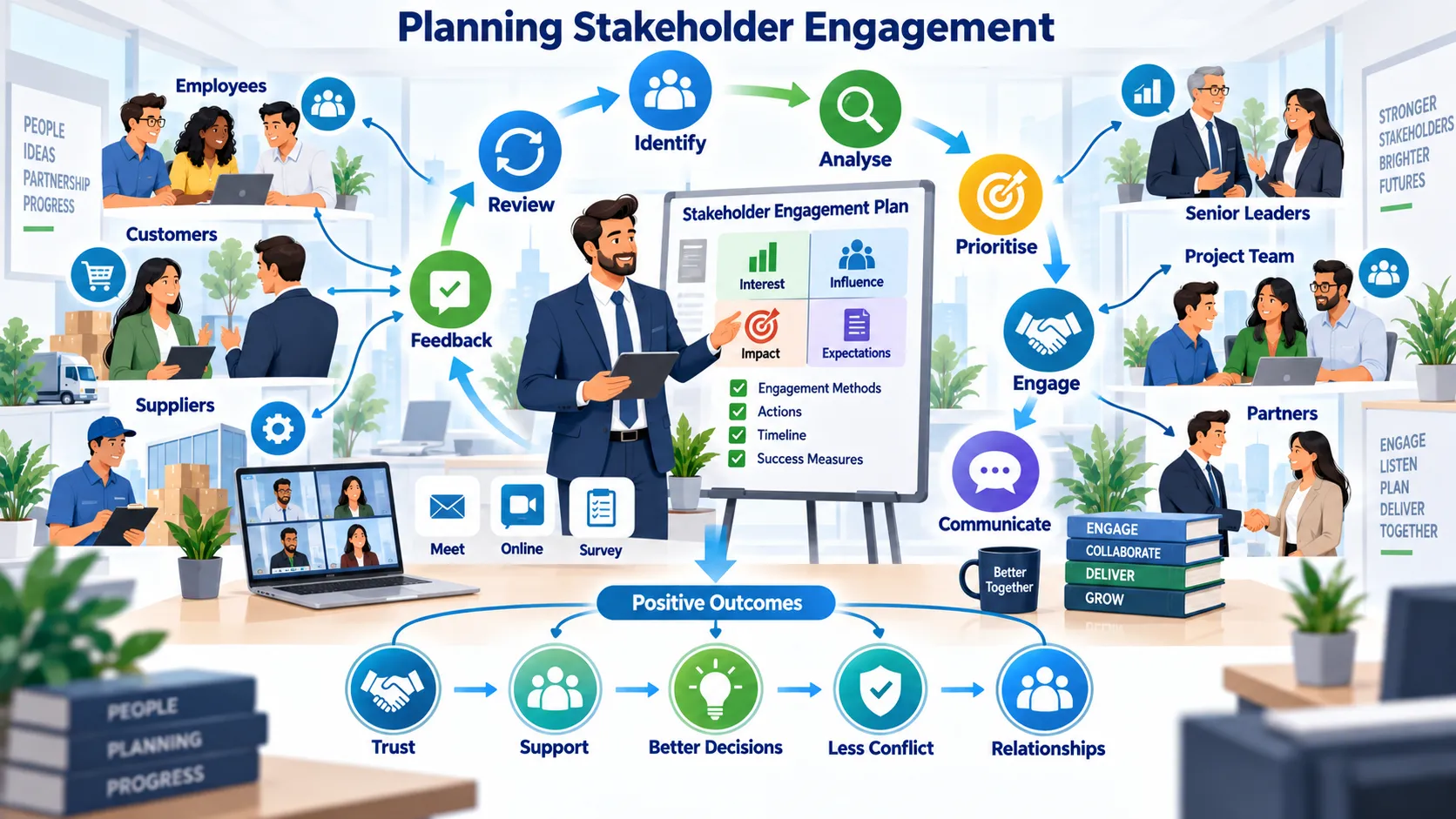
Stakeholder engagement is a structured management activity through which an organisation identifies, understands, communicates with and involves people or groups who can affect, influence or be affected by organisational decisions, projects, services and activities. Effective stakeholder engagement does not happen by accident. It requires deliberate planning to determine who should be engaged, why engagement is necessary, what stakeholders need to know, how they should be involved, when communication should take place and how the organisation will evaluate the effectiveness of its approach.
For middle managers and leaders, planning stakeholder engagement is particularly important because they frequently coordinate people and resources across different organisational levels and stakeholder groups. A manager may need to engage employees about organisational change, customers about service improvements, suppliers about operational requirements, senior leaders about strategic decisions, regulators about compliance matters or partners about collaborative projects. Each stakeholder group can have different interests, expectations, levels of influence and preferred communication methods.
A structured stakeholder engagement plan helps managers avoid inconsistent communication, stakeholder confusion, duplicated effort and unnecessary conflict. It also provides a practical framework for prioritising limited organisational resources. Not every stakeholder requires the same level of attention, and effective managers recognise that engagement should be proportionate to stakeholder influence, interest, impact, expectations and risk.
The process of planning stakeholder engagement should therefore connect stakeholder analysis with organisational objectives, communication planning, resource allocation, risk management, decision-making and performance evaluation. The objective is not simply to communicate information but to create appropriate opportunities for stakeholders to contribute, understand decisions, raise concerns, influence relevant outcomes and maintain productive relationships.
Understanding Stakeholder Engagement
Stakeholder engagement is the process of communicating and interacting with stakeholders in order to understand their interests and expectations, provide relevant information, obtain feedback, involve them in appropriate decisions and develop constructive relationships.
Engagement can range from simply providing information to actively involving stakeholders in decision-making. The appropriate level depends on the stakeholder’s role, influence, interest, the nature of the issue and the potential impact on that stakeholder.
Stakeholder engagement can include:
Providing information
Consulting stakeholders
Seeking feedback
Involving stakeholders in discussions
Collaborating on solutions
Negotiating requirements
Participating in joint decision-making
Building long-term partnerships
Managing concerns and complaints
Reviewing performance and outcomes
A key principle is that engagement should have a clear purpose. Managers should be able to explain why a particular stakeholder is being engaged and what the organisation intends to achieve through that engagement.
Stakeholder Engagement Versus Stakeholder Communication
Communication is an important component of stakeholder engagement, but the two concepts are not identical.
Communication may involve sending information to stakeholders, whereas engagement is broader and can involve two-way or multi-way interaction.
For example, an organisation may send employees an email announcing a new working process. This is communication. If managers then hold workshops where employees can ask questions, provide feedback and suggest improvements, this represents a stronger form of engagement.
Effective stakeholder engagement may therefore involve:
Communication
Consultation
Participation
Collaboration
Negotiation
Feedback
Relationship management
Managers should select the appropriate level rather than assuming that one communication method will satisfy every stakeholder.
Why Planning Stakeholder Engagement Is Important
Planning provides structure and consistency. Without a plan, stakeholder engagement may become reactive, with managers contacting stakeholders only when a problem occurs.
A planned approach allows managers to anticipate stakeholder needs and identify potential issues before they become significant.
Effective planning can help organisations:
Build stakeholder trust
Improve communication
Clarify expectations
Reduce misunderstandings
Identify stakeholder concerns
Improve decision-making
Increase stakeholder participation
Support organisational change
Manage conflict
Identify risks
Improve customer and employee experience
Strengthen partnerships
Improve project delivery
Support organisational objectives
For middle managers, stakeholder engagement planning also helps coordinate internal teams. It ensures that different departments communicate consistent information rather than giving stakeholders contradictory messages.
Key Principles of Stakeholder Engagement Planning
Purpose
Every engagement activity should have a defined purpose. Managers should identify the outcome they want from the interaction.
Possible purposes include:
Informing stakeholders about a decision
Gathering feedback
Understanding stakeholder needs
Gaining support
Identifying risks
Resolving concerns
Co-designing a solution
Negotiating requirements
Building trust
Maintaining a strategic relationship
Relevance
Stakeholders should receive information that is relevant to their role and interests. Providing excessive or irrelevant information can reduce engagement.
Inclusivity
Where appropriate, engagement planning should consider different stakeholder perspectives and ensure that relevant voices are not excluded.
Timeliness
Stakeholders should be engaged at the appropriate point in the decision or project lifecycle. Engaging them too late can create resistance because stakeholders may feel that decisions have already been made without their involvement.
Transparency
Managers should communicate honestly about what stakeholders can and cannot influence. It is poor practice to create the impression that stakeholders have decision-making authority when the organisation has already made the final decision.
Proportionality
Engagement should reflect the stakeholder’s level of influence, interest and potential impact. High-risk strategic stakeholders may require extensive engagement, while low-impact stakeholders may require only periodic updates.
Consistency
Stakeholders should receive consistent information and understand how decisions are being managed.
Responsiveness
Stakeholder engagement should include mechanisms for responding to questions, concerns and feedback.
The Stakeholder Engagement Planning Process
A practical stakeholder engagement planning process can be structured into a series of connected stages.
Stage 1: Define the Organisational Objective
The first stage is to establish what the organisation is trying to achieve.
Stakeholder engagement should support a specific organisational objective rather than becoming an activity without a clear purpose.
The objective may relate to:
Implementing organisational change
Launching a new product or service
Improving customer experience
Managing a project
Introducing new technology
Developing a partnership
Improving employee engagement
Managing organisational risk
Meeting contractual requirements
Improving operational performance
Managers should define the desired outcome before deciding how stakeholders will be engaged.
Questions for Managers
A manager can ask:
What are we trying to achieve?
Why is stakeholder engagement required?
Which decisions need stakeholder input?
What risks could stakeholder support or resistance create?
What outcome would demonstrate successful engagement?
A clear objective provides direction for all later stages.
Stage 2: Identify Relevant Stakeholders
The next stage is to identify stakeholders who may affect or be affected by the objective, decision, project or change.
Stakeholders may include:
Employees
Line managers
Senior leaders
Customers
Suppliers
Business partners
Investors
Regulators
Professional bodies
Local communities
Contractors
Consultants
Service providers
Project teams
Managers should avoid identifying stakeholders only by organisational department. Some stakeholders may be external to the organisation but have substantial influence over outcomes.
Stage 3: Categorise Stakeholders
After identifying stakeholders, managers should categorise them to make the engagement plan more manageable.
Useful categories include:
Internal stakeholders
External stakeholders
Primary stakeholders
Secondary stakeholders
Strategic stakeholders
Operational stakeholders
Directly affected stakeholders
Indirectly affected stakeholders
Categorisation helps managers understand the nature of each relationship.
For example, during implementation of a new customer-management system:
Senior leaders may provide strategic sponsorship.
IT teams may provide technical implementation.
Employees may be direct users.
Customers may experience changes in service.
External software providers may provide technology.
Regulators may have relevant compliance expectations.
Each group requires a different engagement approach.
Stage 4: Analyse Stakeholder Interests and Expectations
Identification alone is insufficient. Managers need to understand what stakeholders want from the situation.
Stakeholders may be interested in:
Cost
Quality
Service
Job security
Performance
Convenience
Compliance
Reputation
Financial return
Strategic growth
Operational efficiency
Innovation
Risk reduction
Expectations should be assessed carefully because different stakeholder groups may want different outcomes.
For example, senior management may prioritise cost efficiency while employees may prioritise workload and usability. Customers may prioritise service quality while finance teams may focus on budget control.
Effective engagement planning must recognise these differences.
Stage 5: Assess Stakeholder Influence and Interest
Managers should assess how much influence each stakeholder has and how interested they are in the relevant issue.
The Power–Interest Grid is a useful approach.
Stakeholders can broadly be considered as:
High power, high interest: manage closely.
High power, low interest: keep satisfied.
Low power, high interest: keep informed and engaged.
Low power, low interest: monitor appropriately.
This analysis helps managers allocate engagement resources effectively.
A stakeholder with high influence and high interest may require frequent meetings and detailed communication. A stakeholder with low influence and low interest may only need periodic information.
Stage 6: Assess Stakeholder Impact
Managers should consider how the organisational activity will affect each stakeholder.
Impact may be:
Positive
Negative
Neutral
Short-term
Long-term
Direct
Indirect
Operational
Financial
Strategic
Reputational
Stakeholders experiencing significant negative impact may require particularly careful engagement.
For example, restructuring may improve organisational efficiency but create uncertainty for employees. Effective managers should recognise this impact when developing the engagement plan.
Stage 7: Determine the Desired Engagement Level
Once stakeholders have been analysed, managers should decide the appropriate level of engagement.
A useful engagement spectrum includes:
Inform
The organisation provides relevant information.
Suitable when:
Decisions have already been made.
Stakeholder input is not required.
Information is necessary for awareness.
Consult
The organisation seeks stakeholder views and feedback.
Suitable when:
Stakeholder perspectives can improve decisions.
Different options are being considered.
The organisation needs information about stakeholder needs.
Involve
Stakeholders participate more actively in the process.
Suitable when:
Decisions directly affect stakeholders.
Practical knowledge is important.
Implementation requires stakeholder commitment.
Collaborate
The organisation and stakeholders work jointly towards an outcome.
Suitable when:
There are shared objectives.
Stakeholders possess important expertise.
Joint problem-solving is required.
Empower
Stakeholders have significant influence or decision-making responsibility within defined boundaries.
Suitable in situations where stakeholders have legitimate authority or where shared governance is appropriate.
Managers should not automatically use the highest engagement level. The correct level depends on the circumstances.
Stage 8: Define Engagement Objectives for Each Stakeholder Group
After deciding the engagement level, managers should define what they want to achieve with each stakeholder group.
For example:
Customer objective:
Understand customer priorities and concerns.
Employee objective:
Explain the change and gather implementation feedback.
Supplier objective:
Confirm delivery requirements and identify operational risks.
Senior leadership objective:
Obtain strategic approval and resource commitment.
Regulator objective:
Confirm compliance requirements and reporting expectations.
Each objective should be specific enough to guide the engagement activity.
Stage 9: Select Appropriate Engagement Methods
Different stakeholders require different engagement methods.
Managers may use:
Face-to-face meetings
Online meetings
Workshops
Surveys
Interviews
Focus groups
Questionnaires
Emails
Reports
Presentations
Town-hall meetings
Consultation documents
One-to-one discussions
Feedback platforms
Project steering groups
Customer forums
Supplier review meetings
The choice should consider:
Stakeholder preference
Accessibility
Urgency
Complexity
Confidentiality
Geographic location
Digital capability
Number of stakeholders
Required level of interaction
For complex issues, a single email is rarely sufficient.
Stage 10: Define Key Messages
Managers should determine what information each stakeholder group needs.
Messages should be:
Accurate
Relevant
Clear
Consistent
Appropriate to the audience
Supported by evidence
Honest about uncertainty
Managers should avoid using unnecessary technical language when communicating with stakeholders who do not require it.
For example, an IT team may need technical implementation information, whereas customers may need a simple explanation of how the change will affect their service.
Stage 11: Determine Timing and Frequency
Engagement should occur at appropriate stages.
Timing may include:
Before a decision
During planning
During implementation
At key milestones
After implementation
During review
Before renewal or major change
Frequency should reflect stakeholder importance and the speed at which circumstances are changing.
High-risk projects may require weekly engagement, while stable supplier relationships may require monthly or quarterly reviews.
Stage 12: Assign Responsibilities
Stakeholder engagement should have clear ownership.
A manager should identify:
Who leads the engagement?
Who provides information?
Who approves messages?
Who records feedback?
Who responds to concerns?
Who escalates issues?
Who reports outcomes?
Without clear ownership, stakeholders may receive delayed or inconsistent responses.
Stage 13: Allocate Resources
Engagement requires resources.
Managers should consider:
Staff time
Budget
Technology
Meeting facilities
Communication materials
Specialist expertise
Translation or accessibility requirements
Data analysis
Administrative support
Resource planning is particularly important for large stakeholder groups or complex consultation exercises.
Stage 14: Identify Engagement Risks
Managers should identify risks that could affect engagement.
Potential risks include:
Stakeholder resistance
Lack of participation
Poor communication
Conflicting expectations
Information overload
Confidentiality concerns
Unrealistic demands
Resource limitations
Cultural differences
Digital access problems
Misinformation
Stakeholder fatigue
For each significant risk, managers should identify suitable controls.
Stage 15: Develop an Engagement Schedule
An engagement schedule provides a practical timetable.
It may identify:
Stakeholder
Engagement objective
Method
Owner
Timing
Frequency
Key message
Expected outcome
Follow-up action
A schedule transforms the engagement strategy into operational activity.
Stage 16: Establish Feedback Mechanisms
Stakeholder engagement should not be one-directional.
Managers should provide mechanisms for stakeholders to provide feedback.
These may include:
Surveys
Feedback forms
Interviews
Meetings
Suggestion channels
Customer service systems
Employee forums
Review meetings
Digital feedback platforms
The manager should also determine how feedback will be reviewed and acted upon.
Stage 17: Record and Analyse Stakeholder Feedback
Collecting feedback is only valuable if it informs action.
Managers should identify:
Key concerns
Common themes
Positive responses
Areas of disagreement
New risks
Improvement opportunities
Requests for clarification
Feedback can be analysed qualitatively or quantitatively depending on its nature.
Stage 18: Act on Feedback
Stakeholders are more likely to engage constructively when they can see that their input has been considered.
Managers should communicate:
What feedback was received.
What action will be taken.
What cannot be changed.
Why a decision was made.
What will happen next.
This demonstrates respect and transparency.
Stage 19: Monitor Engagement Effectiveness
Managers should evaluate whether the engagement plan is achieving its objectives.
Useful indicators may include:
Participation rates
Response rates
Stakeholder satisfaction
Number of unresolved issues
Complaint levels
Meeting attendance
Feedback quality
Decision-making improvements
Reduction in misunderstandings
Project acceptance
Employee engagement
Customer satisfaction
The most appropriate measures depend on the engagement objective.
Stage 20: Review and Improve the Engagement Plan
Stakeholder engagement planning should be dynamic.
Stakeholder influence, interests, expectations and circumstances can change during a project or organisational initiative.
Managers should review:
Stakeholder priorities
Levels of influence
Engagement effectiveness
Communication methods
Emerging concerns
New stakeholders
Resource requirements
Risks
Organisational objectives
The engagement plan should be updated when circumstances change.
Stakeholder Engagement Planning Table
The following table provides a practical example of how a manager can structure an engagement plan.
| Stakeholder group | Main interest | Influence | Engagement objective | Method | Frequency | Managerial consideration |
|---|---|---|---|---|---|---|
| Employees | Work impact, workload, support | High | Explain change and gather feedback | Workshops and team meetings | Regular | Address concerns honestly |
| Customers | Service quality and continuity | High | Understand expectations and maintain confidence | Meetings and surveys | Monthly/at milestones | Manage expectations |
| Suppliers | Requirements, payment and delivery | Medium | Coordinate delivery and resolve issues | Supplier reviews | Monthly | Monitor contractual performance |
| Senior leaders | Strategic outcomes and risk | High | Secure direction and decisions | Executive reports | At key stages | Focus on strategic impact |
| Project team | Delivery, resources and milestones | High | Coordinate implementation | Project meetings | Weekly | Resolve operational issues |
| Regulators | Compliance | High | Confirm regulatory requirements | Formal communication | As required | Maintain accurate records |
| Community | Local impact and reputation | Variable | Understand concerns and communicate impact | Consultation meetings | At relevant stages | Consider reputational issues |
This type of table can be incorporated into a stakeholder engagement plan and adapted as circumstances change.
Developing a Stakeholder Engagement Plan
A formal stakeholder engagement plan should normally contain several core components.
Stakeholder Profile
Record information about:
Stakeholder identity
Internal or external status
Interests
Expectations
Influence
Impact
Current relationship
Engagement Objective
State why the organisation needs to engage with that stakeholder.
Engagement Approach
Define whether the stakeholder should be informed, consulted, involved, collaborated with or given greater decision-making authority.
Communication Method
Specify how engagement will take place.
Timing
Identify when engagement will occur and how frequently.
Responsibility
Identify who owns the engagement relationship.
Resources
Identify the resources required.
Risks
Record potential engagement risks and appropriate mitigation.
Measures
Define how engagement effectiveness will be assessed.
Practical Example: Stakeholder Engagement During Organisational Change
Consider an organisation introducing a new digital customer-service system.
The change will affect employees, customers, IT specialists, senior leaders and the technology supplier.
The manager begins by defining the objective: implement the new system while maintaining service quality and supporting employee adoption.
Stakeholders are then analysed.
Employees have high interest because their daily work will change. Customers have high interest because their service experience may change. Senior leaders have high influence because they control strategic decisions and resources. The technology supplier has significant operational influence because implementation depends on its performance.
The manager then creates different engagement approaches.
Employees may receive:
Workshops
Demonstrations
Training
Feedback opportunities
Implementation updates
Customers may receive:
Service updates
Frequently asked questions
Surveys
Support information
Senior leaders may receive:
Performance reports
Risk updates
Budget information
Decision papers
The technology supplier may participate in:
Weekly implementation meetings
Performance reviews
Issue-resolution meetings
Milestone reviews
This example demonstrates why a single stakeholder communication strategy is unlikely to be effective.
Practical Example: Planning Stakeholder Engagement for a Service Improvement
A training organisation receives repeated customer feedback that enrolment processes are complicated.
The manager wants to redesign the process.
Stakeholders include:
Learners
Admissions staff
Finance staff
IT staff
Marketing staff
Senior management
The manager should not simply redesign the process independently. Instead, stakeholder engagement can provide information about the actual causes of the problem.
Learners can explain where they experience difficulty. Admissions staff can identify operational bottlenecks. Finance staff can explain payment requirements. IT staff can identify system limitations. Senior leaders can confirm strategic and budget constraints.
The manager can then use workshops and interviews to gather information before designing the improvement.
This approach increases the quality of decision-making because different stakeholders contribute different forms of knowledge.
Practical Example: Supplier Engagement Planning
A manufacturing organisation depends on an external supplier for a critical component.
The supplier has significant influence because delays could stop production.
The manager therefore plans a high level of engagement.
The engagement plan may include:
Monthly performance reviews
Delivery-performance reports
Quality meetings
Risk reviews
Forecast sharing
Escalation procedures
Continuous-improvement discussions
The manager also identifies contingency arrangements in case supplier performance deteriorates.
This illustrates the connection between stakeholder engagement, supply-chain risk management and operational continuity.
Planning Engagement for Conflicting Stakeholder Expectations
One of the most difficult aspects of stakeholder management is dealing with stakeholders who want different outcomes.
For example:
Customers may want lower prices.
Employees may want higher pay.
Suppliers may want higher margins.
Investors may want stronger financial returns.
Managers may need to control operating costs.
A stakeholder engagement plan should therefore identify potential conflicts before engagement takes place.
Managers should:
Identify competing interests.
Understand the reasons behind each position.
Establish organisational priorities.
Identify areas of common interest.
Use evidence to support decisions.
Communicate constraints honestly.
Explore alternative solutions.
Explain trade-offs.
Document agreed decisions.
Review relationships after difficult decisions.
Effective stakeholder engagement does not mean satisfying every stakeholder demand. It means managing expectations fairly and transparently while pursuing organisational objectives.
Stakeholder Engagement and Organisational Change
Change management is one area where stakeholder engagement is particularly important.
People often resist change because they:
Do not understand why change is required.
Fear negative consequences.
Lack confidence in the new approach.
Feel excluded from decisions.
Have experienced poorly managed change previously.
Believe their concerns are being ignored.
A manager can reduce these risks through structured engagement.
An effective change-engagement process may include:
Explain the reason for change.
Identify who will be affected.
Assess stakeholder concerns.
Involve stakeholders where appropriate.
Provide accurate information.
Allow questions and feedback.
Address concerns.
Provide practical support.
Communicate progress.
Review the impact after implementation.
Stakeholder Engagement and Digital Communication
Modern organisations increasingly use digital channels to engage stakeholders.
Examples include:
Video conferencing
Email
Collaboration platforms
Online surveys
Customer portals
Learning management systems
Social media
Digital dashboards
Webinars
Digital engagement can improve accessibility and speed, particularly when stakeholders are geographically dispersed.
However, managers should consider challenges such as:
Digital exclusion
Information overload
Misinterpretation
Reduced personal interaction
Technical problems
Cybersecurity
Data protection
Lack of engagement
The appropriate channel should be selected according to stakeholder needs rather than organisational convenience alone.
Stakeholder Engagement and Cultural Differences
International organisations may engage stakeholders from different cultural and professional backgrounds.
Managers should consider differences in:
Communication styles
Decision-making expectations
Formality
Time orientation
Hierarchy
Negotiation approaches
Language
Meeting practices
A communication method that works well with one stakeholder group may not work equally well with another.
Managers should therefore demonstrate cultural awareness and avoid assuming that all stakeholders interpret communication in the same way.
Stakeholder Engagement and Ethical Management
Ethical stakeholder engagement requires honesty, fairness, respect and responsible use of stakeholder information.
Managers should avoid:
Manipulating stakeholder feedback
Misrepresenting decisions
Making false promises
Excluding legitimate stakeholders without justification
Using confidential information inappropriately
Creating unrealistic expectations
Where stakeholder input cannot influence a decision, managers should communicate this clearly.
Ethical engagement strengthens trust and organisational reputation.
Benefits of a Structured Stakeholder Engagement Planning Process
A structured planning process provides several important benefits.
Improved Decision-Making
Stakeholder input can provide practical knowledge that managers may not possess themselves.
Stronger Relationships
Consistent and transparent engagement can strengthen trust.
Better Risk Identification
Stakeholders can identify risks that may not be visible internally.
Improved Change Adoption
People are more likely to understand and support change when they have been appropriately engaged.
Reduced Conflict
Early communication can prevent misunderstandings from becoming major disputes.
Better Resource Allocation
Stakeholder prioritisation helps managers direct time and resources towards the relationships that matter most.
Greater Accountability
Clear ownership ensures that engagement activities do not become neglected.
Improved Customer Experience
Customer involvement can reveal problems and improvement opportunities.
Stronger Employee Engagement
Employee consultation can improve understanding, participation and commitment.
Better Organisational Reputation
Responsible engagement demonstrates that the organisation takes stakeholder interests seriously.
Challenges in Planning Stakeholder Engagement
Planning does not eliminate all stakeholder-management challenges.
Managers may encounter:
Limited resources
Stakeholder resistance
Conflicting expectations
Low participation
Difficult personalities
Poor communication
Rapid organisational change
Incomplete stakeholder information
Stakeholder fatigue
Political or organisational sensitivities
Competing organisational priorities
The manager’s role is to anticipate these challenges and establish practical responses.
Common Mistakes Managers Should Avoid
Engaging Stakeholders Too Late
Late engagement can create resistance because stakeholders may feel excluded.
Treating Every Stakeholder the Same
Different stakeholders have different needs and levels of influence.
Communicating Without a Clear Purpose
Unstructured communication can waste time and create confusion.
Ignoring Feedback
If stakeholders repeatedly provide feedback but see no response, trust can decline.
Overpromising
Managers should not promise outcomes they cannot deliver.
Failing to Update the Plan
Stakeholder priorities can change, so engagement plans should be reviewed.
Relying on One Communication Channel
Different stakeholders may require different methods.
Confusing Consultation with Decision-Making Authority
Consultation means seeking views; it does not necessarily mean that stakeholders have final decision-making authority.
Failing to Record Decisions
Important agreements and actions should be appropriately documented.
Best-Practice Checklist for Managers
Before implementing a stakeholder engagement plan, managers should confirm that:
The organisational objective is clear.
Relevant stakeholders have been identified.
Stakeholder interests and expectations have been analysed.
Influence and impact have been assessed.
Appropriate engagement levels have been selected.
Engagement objectives have been defined.
Communication methods are appropriate.
Key messages are clear.
Timing and frequency are realistic.
Responsibilities are allocated.
Resources are available.
Risks have been assessed.
Feedback mechanisms are established.
Performance measures have been defined.
Review arrangements are in place.
Key Takeaways
Planning stakeholder engagement is a structured management process that enables organisations to determine who needs to be engaged, why engagement is required, what stakeholders need, how they should be involved and how engagement effectiveness will be measured.
For middle managers and leaders, the process can be summarised as:
Define the organisational objective.
Identify relevant stakeholders.
Categorise stakeholders.
Analyse interests and expectations.
Assess influence, interest and impact.
Determine the appropriate level of engagement.
Establish engagement objectives.
Select suitable engagement methods.
Define key messages.
Determine timing and frequency.
Assign responsibilities.
Allocate resources.
Identify engagement risks.
Develop an engagement schedule.
Establish feedback mechanisms.
Analyse stakeholder feedback.
Act on appropriate feedback.
Monitor engagement effectiveness.
Review and update the plan.
The most effective stakeholder engagement plans are purposeful, proportionate, transparent, flexible and evidence-based. They recognise that stakeholders have different interests and levels of influence and that engagement should be tailored accordingly.
For practising managers, the key lesson is that stakeholder engagement should be planned before problems arise. A proactive approach enables managers to understand stakeholder expectations, identify risks, build support, manage competing interests and improve organisational decision-making. When engagement is treated as an ongoing management process rather than a one-off communication exercise, organisations are better positioned to develop productive, sustainable and mutually beneficial stakeholder relationships.