
Lesson no 2 : Understand frameworks, diagnostic and evaluation tools used for performance management
Introduction
Effective performance management requires managers to use structured frameworks, diagnostic methods and evaluation tools to understand how well individuals and teams are performing and whether their contribution supports organisational objectives. Within Unit 504 – Managing Performance, this lesson focuses on how these tools provide a systematic basis for managing performance, identifying performance gaps, supporting improvement and evaluating the impact of performance management on individual and organisational achievement.
Performance management should not rely solely on personal judgement, informal observations or annual reviews. Managers need reliable and relevant information to understand whether expected standards are being achieved, where performance is strong, and where additional support may be required. Frameworks provide structure for managing performance, while diagnostic tools help managers explore the underlying reasons for performance strengths or weaknesses. Evaluation tools then help determine whether performance management activities have produced the intended results.
A performance management framework can provide a consistent approach to setting expectations, establishing objectives, monitoring progress, reviewing outcomes and supporting improvement. It helps managers connect individual responsibilities with team priorities and wider organisational objectives. A structured framework can also promote consistency and accountability by making expectations, performance standards and review processes clearer to employees.
Diagnostic tools have a different but complementary purpose. When performance does not meet expectations, managers need to establish why the gap exists rather than automatically assuming that the employee lacks commitment or capability. Diagnostic approaches can help examine factors such as knowledge and skills, resources, workload, communication, leadership, working processes, role clarity and organisational circumstances. This enables managers to distinguish between performance issues that require individual support and problems caused by wider workplace factors.
Evaluation tools allow managers to assess whether performance management is achieving meaningful outcomes. These may include performance indicators, objective reviews, feedback, quality measures, productivity information, customer outcomes and other relevant evidence. Using a combination of quantitative and qualitative information provides a more balanced understanding of performance and reduces the risk of making decisions based on a single measure.
The effective use of frameworks, diagnostic tools and evaluation methods also supports professional and fair performance management. Managers can use evidence to recognise employees who exceed expectations, identify areas requiring development and address underperformance through appropriate and supportive interventions. This is particularly important for middle managers, who often translate organisational priorities into practical expectations for individuals and teams.
Ultimately, these tools should not be viewed simply as administrative mechanisms. Their value lies in helping managers make informed decisions, improve performance, support employees and strengthen organisational effectiveness. When applied appropriately, frameworks, diagnostic methods and evaluation tools create a clearer connection between performance expectations, evidence, improvement actions and organisational achievement. This makes performance management a purposeful and continuous process rather than a routine assessment exercise.
1.Examine the Impact of Legal and Organisational Frameworks on Performance Management
Introduction
Performance management does not operate in isolation from the wider legal and organisational environment. Managers are expected to set performance expectations, monitor achievement, provide feedback, recognise strong performance and address underperformance in ways that are fair, consistent, evidence-based and appropriate to the organisation. Legal requirements and organisational frameworks provide the boundaries within which these activities should take place.
For practising and aspiring middle managers, understanding these frameworks is particularly important because they frequently have direct responsibility for translating organisational expectations into day-to-day performance practices. A manager may need to set objectives, conduct performance reviews, investigate concerns, recommend development activities, recognise achievement or begin a formal performance improvement process. Each of these activities can have implications for employees, teams and the organisation.
Legal frameworks establish minimum standards and protections that organisations and managers must respect. Depending on the jurisdiction and sector, these may address equality, discrimination, employment rights, working conditions, health and safety, privacy, data protection, reasonable adjustments, working time, disciplinary procedures and employee representation. Organisational frameworks then translate these wider requirements into policies, procedures, standards and management practices that guide behaviour within a particular workplace.
The purpose is not simply to ensure compliance. Effective frameworks can improve the quality of performance management by creating clarity about expectations, responsibilities, evidence, decision-making and appropriate managerial conduct. They can help prevent arbitrary decisions, inconsistent treatment and poorly managed performance concerns.
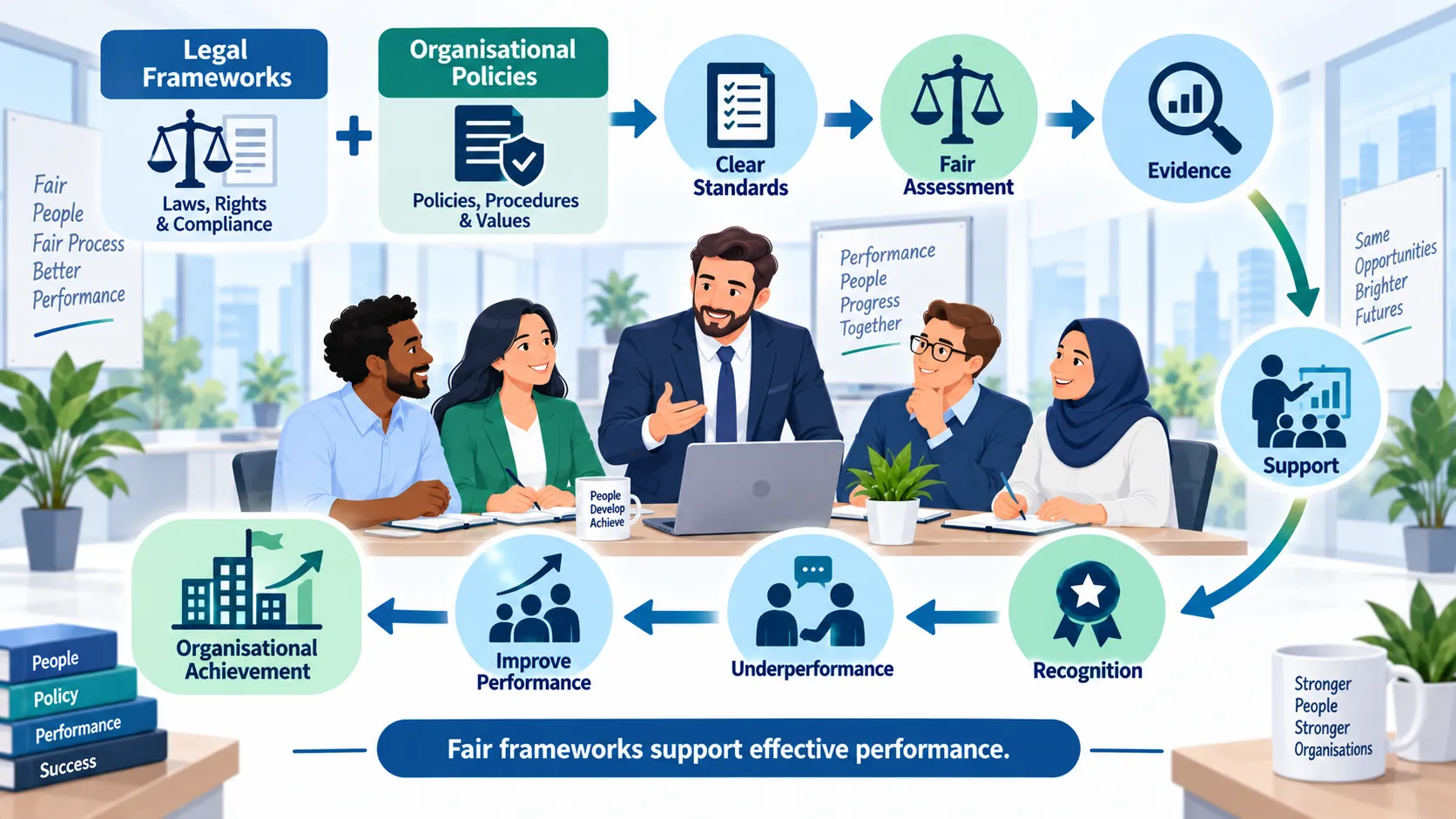
A strong performance management system therefore operates at the intersection of three important areas:
Legal compliance – ensuring performance decisions and processes respect applicable law.
Organisational requirements – ensuring performance management reflects organisational strategy, values, policies and procedures.
Individual performance – ensuring employees understand expectations, receive appropriate support and are assessed fairly against relevant standards.
When these three areas are appropriately aligned, performance management can support both individual and organisational achievement.
Meaning of Legal and Organisational Frameworks
A legal framework is the collection of laws, regulations, statutory requirements and legally recognised principles that establish rights, responsibilities and standards of conduct within employment and organisational relationships.
A legal framework can influence how managers:
set and communicate performance expectations;
collect and use employee information;
monitor workplace behaviour;
conduct performance reviews;
manage absence or capability concerns;
make decisions about development and progression;
respond to underperformance;
provide reasonable adjustments where applicable;
address complaints or disputes;
maintain confidentiality;
apply disciplinary or capability procedures.
An organisational framework refers to the internal structures, policies, procedures, standards, systems and principles established by an organisation to guide how work and people are managed.
Examples include:
performance management policies;
appraisal and review procedures;
organisational values;
codes of conduct;
equality and inclusion policies;
disciplinary procedures;
capability procedures;
grievance procedures;
employee development policies;
reward and recognition policies;
attendance procedures;
health and safety policies;
data protection and information-handling procedures;
job descriptions;
competency frameworks;
organisational performance standards;
delegation and accountability arrangements.
The distinction is important. Legal frameworks establish external obligations, while organisational frameworks establish internal expectations and procedures within those legal boundaries. Managers must understand both.
Why Legal and Organisational Frameworks Matter
Performance management involves decisions about people, and decisions about people can have significant consequences. An employee may receive additional support, development, recognition, increased responsibility or formal action as a result of performance-related decisions.
Without an appropriate framework, managers may unintentionally make inconsistent or unfair decisions.
For example, two employees performing similar roles may have similar performance concerns. If one manager provides coaching and additional resources while another immediately begins formal action, employees may experience the organisation’s performance management system as inconsistent. This can reduce trust and create concerns about fairness.
Frameworks provide managers with a structured basis for decision-making. They establish expectations regarding:
what should be measured;
how performance should be reviewed;
who is responsible for decisions;
what evidence should be considered;
how employees should be informed;
what support should be offered;
how concerns should be escalated;
how records should be maintained;
how decisions can be reviewed or challenged.
This creates greater consistency while still allowing managers to apply professional judgement to individual circumstances.
Legal Frameworks and Performance Management
Equality and Non-Discrimination
One of the most significant legal considerations in performance management is the requirement to avoid unlawful discrimination and unequal treatment. Managers should ensure that performance objectives, assessments, development opportunities, recognition and performance interventions are applied fairly.
Performance decisions should not be influenced by protected characteristics where the relevant law provides protection. Depending on jurisdiction, these may include characteristics such as sex, race, disability, age, religion or belief, pregnancy and maternity, sexual orientation, gender reassignment or other legally protected grounds.
Managers should therefore distinguish between legitimate performance-related evidence and personal assumptions.
For example, a manager should assess an employee against agreed performance expectations rather than assumptions about their personal circumstances or background.
Good practice includes:
applying relevant performance standards consistently;
using evidence rather than stereotypes;
ensuring employees understand the criteria against which they are assessed;
providing comparable opportunities for development;
considering relevant adjustments where legally required;
documenting significant performance decisions;
challenging biased assumptions;
reviewing whether apparently neutral practices create unfair outcomes.
The impact on performance management is significant because equality requirements encourage managers to focus on job-related evidence and legitimate performance expectations.
Disability and Reasonable Adjustments
Where applicable under the relevant legal framework, disability-related requirements can affect performance management significantly. A performance gap may sometimes be associated with a disability, an accessibility barrier or the absence of an appropriate workplace adjustment.
This does not mean that performance standards should automatically be removed. Instead, managers may need to consider whether the employee has the appropriate conditions, resources or adjustments required to meet legitimate expectations.
For example, an employee may have difficulty meeting a particular administrative process because of an accessibility barrier. A manager who immediately interprets this as poor commitment may reach an inaccurate conclusion. A more appropriate approach is to understand the circumstances, consider relevant organisational procedures and determine whether reasonable adjustments or alternative arrangements are required.
Managers should therefore consider:
whether the performance expectation is relevant to the role;
whether barriers are affecting performance;
whether an adjustment is appropriate;
whether specialist advice is required;
whether the organisation’s established process has been followed;
whether the employee has received appropriate support.
This demonstrates why performance management should be evidence-based rather than assumption-based.
Employment Rights and Fair Treatment
Employment law can influence how organisations manage performance, particularly when performance concerns may lead to formal action. Managers should understand that performance management and disciplinary management are not always the same thing.
A genuine capability issue may arise because an employee lacks the knowledge, skills or experience required to perform effectively. A conduct issue may involve behaviour such as deliberate refusal to follow a reasonable instruction. These situations may require different organisational procedures.
Managers should therefore establish the nature of the issue before deciding how to respond.
A useful distinction is:
Capability: Can the employee perform the required work to the expected standard?
Conduct: Is the employee choosing to behave in a way that breaches an expected rule or standard?
Resources: Does the employee have the tools, time and resources required?
Clarity: Does the employee understand what is expected?
Process: Are organisational systems creating barriers to effective performance?
Making this distinction helps prevent inappropriate responses.
Health and Safety Requirements
Health and safety frameworks can also influence performance management. Managers must not establish performance expectations that encourage unsafe working practices.
For example, an organisation may want to increase production output. If employees believe that meeting the target requires them to bypass safety procedures, the performance management system is creating an inappropriate incentive.
Effective performance management should therefore recognise that performance involves more than speed or quantity.
Relevant considerations can include:
productivity;
quality;
safety;
customer outcomes;
compliance;
teamwork;
responsible behaviour;
organisational values.
This illustrates the importance of selecting balanced performance measures.
A performance target should support the organisation’s desired outcome rather than encourage employees to achieve one measure at the expense of another important requirement.
Working Time and Workload
Legal requirements concerning working time, rest periods and employee welfare may also affect performance expectations. Managers should be cautious about assuming that additional hours automatically represent stronger performance.
A team may initially appear productive because employees are working excessive hours. However, sustained excessive workload may contribute to fatigue, mistakes, reduced quality and employee turnover.
Managers should therefore consider whether:
workloads are realistic;
staffing levels are appropriate;
objectives can reasonably be achieved within expected working arrangements;
excessive workload is affecting quality;
employees have sufficient resources;
performance expectations are sustainable.
This supports a broader understanding of organisational achievement.
Privacy and Data Protection
Performance management often involves collecting and recording personal information. Examples may include appraisal records, attendance information, performance data, feedback, development records and formal performance documentation.
Managers must handle such information appropriately and in accordance with applicable data protection and privacy requirements.
The principle of responsible information handling means managers should consider:
what information is necessary;
why it is being collected;
who needs access;
how it should be stored;
how long it should be retained;
whether information is accurate;
whether confidential information is being shared appropriately.
Managers should avoid unnecessarily circulating sensitive performance information.
For example, discussing an employee’s performance concerns openly with colleagues who have no legitimate reason to know may undermine confidentiality and trust.
Employee Voice and Representation
Depending on the organisation and jurisdiction, employees may have rights relating to consultation, representation or formal workplace processes. Organisational performance management systems should recognise these requirements.
Managers may need to understand:
employee consultation arrangements;
representation rights;
formal review procedures;
grievance mechanisms;
appeal processes;
relevant collective agreements;
organisational escalation routes.
The presence of these mechanisms can strengthen procedural fairness by giving employees appropriate opportunities to explain circumstances, provide evidence or challenge decisions through established processes.
Organisational Frameworks and Performance Management
Performance Management Policies
A performance management policy provides an organisational structure for managing employee performance. It should clarify the organisation’s expectations and establish a consistent approach to setting objectives, reviewing performance and addressing performance concerns.
A strong policy may explain:
the purpose of performance management;
responsibilities of managers and employees;
objective-setting requirements;
review frequency;
performance standards;
documentation requirements;
feedback expectations;
development support;
recognition practices;
performance improvement arrangements;
escalation procedures.
For middle managers, the policy acts as an organisational reference point. It helps them understand not only what they are expected to achieve but also how they should manage performance.
Job Descriptions and Role Expectations
Job descriptions form an important organisational framework because they define the core responsibilities associated with a role.
Performance management should be connected to the actual requirements of the job.
If an employee is assessed against responsibilities that were never communicated or that fall outside the reasonable scope of their role, the validity of the performance assessment may be questioned.
Managers should therefore check that:
responsibilities are clearly defined;
objectives relate to the role;
expectations are communicated;
performance standards are realistic;
changes in responsibilities are appropriately discussed.
This creates greater clarity between the employee’s role and the organisation’s expectations.
Competency Frameworks
A competency framework identifies the knowledge, skills, behaviours and capabilities that an organisation considers important for effective performance.
Competency frameworks can complement performance objectives by examining not only what an employee achieves but also how they achieve it.
For example, a manager may achieve a sales target but consistently communicate poorly with colleagues. A competency framework may identify collaboration, communication and customer focus as important behaviours.
This supports a more balanced performance assessment.
Organisational Values and Codes of Conduct
Organisational values describe the principles that influence how an organisation expects people to behave. Codes of conduct may provide more specific expectations.
These frameworks are relevant to performance management because strong performance should normally include appropriate professional behaviour.
A manager should therefore avoid creating a performance system where employees can achieve numerical targets while disregarding important organisational values.
For example:
Target achieved + unsafe behaviour = not necessarily effective performance
Target achieved + poor customer treatment = not necessarily effective performance
Target achieved + serious teamwork problems = potentially incomplete performance assessment
The precise assessment will depend on the role and organisational standards, but the principle is important: performance should reflect the outcomes and behaviours that genuinely matter to the organisation.
Reward and Recognition Frameworks
Reward and recognition systems influence employee behaviour by signalling which contributions the organisation values.
A well-designed recognition framework can reinforce:
achievement of meaningful objectives;
exceptional contribution;
teamwork;
innovation;
customer service;
responsible behaviour;
organisational values;
sustained performance improvement.
However, poorly designed rewards can create unintended consequences.
If employees are rewarded exclusively for output, they may prioritise quantity over quality. If managers reward only visible achievements, valuable behind-the-scenes contributions may be overlooked.
Performance management should therefore connect recognition with the organisation’s wider definition of effective performance.
Capability and Performance Improvement Procedures
Organisations often establish formal procedures for dealing with sustained underperformance. These procedures may define stages such as:
identifying the performance concern;
gathering relevant evidence;
discussing the concern with the employee;
identifying possible causes;
clarifying expected standards;
agreeing improvement actions;
providing appropriate support;
setting a review period;
monitoring progress;
reviewing outcomes;
deciding whether further action is required.
The purpose should be improvement wherever reasonably possible, rather than punishment.
This aligns closely with the Unit 504 emphasis on managing underperformance in a professional and supportive manner.
Key Concepts in Applying Frameworks to Performance Management
| Framework or concept | Meaning | Impact on performance management | Example of managerial application |
|---|---|---|---|
| Legal framework | External laws and requirements governing employment and organisational conduct | Establishes minimum standards for fair and lawful performance management | Applying performance criteria consistently and respecting relevant employee rights |
| Organisational policy | Internal statement of organisational expectations and procedures | Provides consistency and direction for managers | Following the organisation’s performance review process |
| Performance standard | Defined level of performance expected in a role | Provides a basis for assessing achievement | Reviewing whether agreed service standards are being met |
| Competency framework | Defined knowledge, skills and behaviours associated with effective performance | Supports assessment of how work is performed as well as outcomes | Assessing communication, teamwork and technical capability |
| Code of conduct | Organisational expectations concerning professional behaviour | Helps ensure performance decisions consider appropriate conduct | Considering whether behaviour reflects organisational values |
| Capability procedure | Structured process for addressing sustained performance concerns | Supports fair, evidence-based performance improvement | Agreeing an improvement plan with review dates |
| Reward framework | Organisational approach to recognising contribution | Reinforces valued performance and achievement | Recognising exceptional contribution against agreed criteria |
| Data protection requirements | Rules governing responsible handling of personal information | Protects confidentiality and appropriate use of performance data | Restricting access to sensitive appraisal information |
The Relationship Between Legal and Organisational Frameworks
Legal and organisational frameworks should not be viewed as completely separate systems. Organisational policies should operate within the boundaries established by applicable law.
For example, an organisation may create a performance management procedure that requires regular reviews. That procedure should be designed and implemented in a way that respects relevant employment rights, equality requirements and privacy obligations.
The relationship can be understood as:
Law → Organisational Framework → Managerial Practice → Employee Experience → Performance Outcome
Legal requirements establish the external boundaries. The organisation develops policies and procedures within those boundaries. Managers then apply those frameworks in practical situations. Employees experience the quality of those processes through objectives, feedback, recognition, support and performance decisions. The resulting management practice can influence individual and organisational performance.
If any part of this chain is weak, performance management can become ineffective.
From Policy to Practice
A policy may state that employees should receive regular performance feedback. However, simply having the policy does not guarantee effective performance management.
The manager must translate the policy into practice by:
scheduling appropriate reviews;
preparing relevant evidence;
discussing progress;
identifying strengths;
identifying performance gaps;
listening to employee perspectives;
agreeing actions;
providing support;
reviewing progress.
This demonstrates an important distinction between framework compliance and effective performance management.
An organisation may have excellent policies but poor managerial implementation. Conversely, a manager may have strong interpersonal skills but create problems by ignoring required organisational procedures.
Effective performance management requires both.
Process for Applying Legal and Organisational Frameworks
Step 1 – Understand the Performance Requirement
The manager should first establish what the employee is expected to achieve.
This may involve reviewing:
job descriptions;
objectives;
team targets;
competency requirements;
organisational standards;
customer expectations;
relevant policies;
operational requirements.
The objective is to create a clear understanding of legitimate performance expectations.
Step 2 – Identify Relevant Legal Requirements
Managers should consider which legal requirements may be relevant to the situation.
Depending on the issue, this may involve:
equality and non-discrimination;
disability and reasonable adjustments;
health and safety;
employment rights;
privacy and data protection;
working time;
employee representation;
relevant sector-specific requirements.
Managers should not assume that every performance issue is purely an individual matter.
Step 3 – Review Organisational Policies
The manager should identify which organisational procedures apply.
For example:
performance review policy;
capability procedure;
disciplinary procedure;
attendance policy;
development policy;
reward policy;
grievance procedure;
equality policy;
information-handling policy.
This helps ensure the manager follows the organisation’s established approach.
Step 4 – Gather Appropriate Evidence
Performance decisions should be based on relevant and reliable evidence.
Evidence may include:
agreed objectives;
performance indicators;
work samples;
quality measures;
customer feedback;
project outcomes;
documented observations;
review records;
employee explanations.
Managers should avoid relying exclusively on personal impressions.
Step 5 – Assess Context
A performance gap should be examined in context.
The manager should ask:
Was the expectation clearly communicated?
Did the employee have the required capability?
Were resources available?
Was workload reasonable?
Were systems functioning effectively?
Were there relevant changes?
Was appropriate training provided?
Could a workplace barrier have contributed?
Is the standard being applied consistently?
This diagnostic approach supports fairer decision-making.
Step 6 – Discuss the Situation With the Employee
Performance management should include meaningful communication.
A manager should explain:
what is expected;
what evidence has been identified;
where the performance gap exists;
why the gap matters;
what the employee’s perspective is;
what support may be required.
Listening is essential because managers may not have access to all relevant information.
Step 7 – Agree Appropriate Action
The appropriate response depends on the nature and severity of the issue.
Possible actions include:
clarification of expectations;
coaching;
mentoring;
training;
additional resources;
workload adjustment;
process improvement;
closer monitoring;
recognition;
revised objectives;
formal performance improvement arrangements.
Step 8 – Monitor and Review
Performance management should continue after the initial conversation.
The manager should establish:
what improvement is expected;
how it will be measured;
when progress will be reviewed;
what support will be provided;
what evidence will be considered.
Step 9 – Document Appropriately
Relevant performance discussions and agreed actions should be documented according to organisational and legal requirements.
Documentation supports:
continuity;
accountability;
evidence-based decision-making;
consistency;
transparency;
future review.
However, documentation should be proportionate and handled confidentially.
Step 10 – Evaluate the Outcome
The final stage is to determine whether the intervention achieved its intended purpose.
The manager should consider:
Has performance improved?
Have objectives been achieved?
Has the employee developed capability?
Has the team benefited?
Have quality or customer outcomes improved?
Has the original performance barrier been addressed?
Was the process fair and appropriate?
Are further actions required?
This final stage connects directly to the Unit 504 focus on the impact of effective performance management on individual and organisational achievement.
How Frameworks Influence Managerial Decision-Making
Promoting Consistency
Organisational frameworks help managers avoid making decisions based purely on personal preference.
For example, a recognition framework can establish criteria for exceptional performance rather than allowing each manager to reward employees according to subjective preference.
Consistency does not necessarily mean treating every situation identically. It means applying relevant principles and standards fairly while considering legitimate differences in circumstances.
Supporting Fairness
Frameworks can create procedural fairness by explaining how decisions should be made.
Employees are more likely to view performance management as credible when they understand:
what is expected;
how performance is assessed;
what evidence is considered;
how concerns are raised;
what support is available;
how decisions can be reviewed.
Strengthening Accountability
A clear framework establishes responsibilities for both managers and employees.
Employees may be responsible for:
achieving agreed objectives;
following organisational standards;
participating in reviews;
responding to feedback;
undertaking agreed development activities.
Managers may be responsible for:
setting clear expectations;
providing resources;
monitoring performance;
giving feedback;
addressing concerns;
recognising achievement;
following organisational procedures.
This creates shared accountability.
Reducing Organisational Risk
Poorly managed performance decisions can expose organisations to complaints, disputes, employee relations problems and reputational damage.
A structured approach can reduce these risks by encouraging managers to:
use evidence;
follow procedures;
maintain appropriate records;
communicate clearly;
apply standards consistently;
consider relevant circumstances;
seek appropriate advice where necessary.
Supporting Employee Trust
Trust is influenced by how employees experience management processes.
If employees believe that performance decisions are arbitrary or biased, trust may decline. If employees experience clear expectations, respectful communication, consistent standards and meaningful support, confidence in the process can increase.
Therefore, legal and organisational frameworks can indirectly contribute to performance by creating conditions in which employees understand and trust the performance management process.
Practical Workplace Examples
Example 1 – Customer Service Team
A customer service department introduces a target requiring employees to resolve a certain number of enquiries each day.
Initially, productivity increases. However, customer complaints also increase because employees are rushing conversations.
A narrow performance management approach might continue focusing exclusively on the numerical target.
A stronger approach would review:
resolution quantity;
quality;
customer feedback;
accuracy;
compliance;
employee behaviour.
The manager could then revise the performance framework to create a more balanced assessment.
Learning point: Performance measures should encourage the outcomes the organisation genuinely values.
Example 2 – Underperformance Caused by Capability
An employee repeatedly makes errors in a newly introduced software system.
The manager initially considers the employee to be underperforming. During discussion, it becomes clear that the employee received limited training.
The manager therefore provides additional training and coaching, establishes clear quality expectations and reviews performance after an agreed period.
Learning point: Managers should diagnose the cause of underperformance before deciding on an intervention.
Example 3 – Inconsistent Standards
Two employees make similar errors. One receives informal coaching while the other immediately enters a formal performance process.
The difference is not supported by relevant circumstances.
This creates a perception of inconsistent treatment and may undermine confidence in the performance management system.
Learning point: Organisational frameworks should promote consistency and managers should be able to explain legitimate differences in treatment.
Example 4 – Performance and Organisational Values
A sales employee significantly exceeds sales targets but receives repeated customer complaints about aggressive behaviour.
If the organisation values ethical customer service, the numerical result alone does not provide a complete assessment.
The manager should consider both:
the achieved outcome;
the behavioural expectations associated with the role.
Learning point: Effective performance management considers both results and appropriate behaviours.
Example 5 – Organisational Process Problem
A team repeatedly misses deadlines. Initial management reviews suggest that employees are not working efficiently.
Further investigation identifies that approvals must pass through several unnecessary stages, creating delays.
The manager works with relevant colleagues to improve the process while also clarifying individual responsibilities.
Learning point: Not every performance problem is caused by individual employee capability or motivation.
Example 6 – Recognition
An employee consistently supports colleagues, solves customer problems and demonstrates strong professional judgement but does not produce the highest numerical output.
A recognition system based exclusively on numerical results may overlook this contribution.
A broader organisational framework can recognise behaviours and outcomes that contribute to team and organisational effectiveness.
Learning point: Recognition should reflect the organisation’s genuine definition of valuable performance.
Impact on Individual Achievement
Legal and organisational frameworks can support individual achievement by creating clarity, fairness and access to appropriate support.
Employees are more likely to understand what successful performance looks like when objectives and standards are clearly defined.
Frameworks can also help employees understand:
what responsibilities they hold;
how their performance will be assessed;
what support is available;
how feedback will be provided;
how development needs will be addressed;
how strong performance can be recognised;
how performance concerns will be managed.
This clarity can improve ownership and accountability.
Effective performance management can also identify capability gaps before they become significant problems. A manager who regularly reviews performance may identify that an employee needs training in a particular process. Early intervention can prevent repeated errors and support improved performance.
Fair procedures are equally important. Employees are more likely to engage constructively with performance discussions when they believe the process is transparent and respectful.
Impact on Team Achievement
Performance management frameworks also influence teams.
When expectations are consistent across a team, employees have a clearer understanding of how their contribution fits with collective objectives.
Effective frameworks can support:
shared accountability;
clearer roles;
improved collaboration;
better communication;
appropriate recognition;
early identification of performance problems;
more balanced workloads;
stronger team capability.
Unmanaged underperformance can have a particularly significant team impact. High-performing employees may become frustrated if colleagues repeatedly fail to meet agreed standards without appropriate intervention.
Therefore, managing underperformance professionally is not simply an issue between one manager and one employee. It can affect morale, workload, service quality and team effectiveness.
Impact on Organisational Achievement
At organisational level, performance management frameworks help connect individual and team activity with strategic priorities.
A useful relationship is:
Organisational Objectives → Team Objectives → Individual Objectives → Performance Evidence → Feedback and Support → Improved Performance → Organisational Achievement
If individual objectives are disconnected from organisational priorities, employees may work hard without contributing to the outcomes that matter most.
For example, an organisation may prioritise customer satisfaction while a department focuses exclusively on speed. Employees may achieve departmental targets but undermine the organisation’s wider objective.
Effective frameworks therefore help managers align:
objectives;
standards;
behaviours;
measures;
development;
recognition;
improvement activity.
Benefits of Effective Legal and Organisational Frameworks
Benefits for Employees
Clearer performance expectations.
Greater understanding of responsibilities.
Fairer and more consistent assessment.
Access to appropriate feedback.
Identification of development needs.
Appropriate support when performance barriers arise.
Recognition of valuable contribution.
Greater confidence in performance processes.
Improved opportunity to address misunderstandings.
Stronger connection between individual work and organisational objectives.
Benefits for Managers
Clearer decision-making structures.
Better evidence for performance discussions.
Greater consistency between employees.
Reduced reliance on personal judgement alone.
Clear procedures for addressing underperformance.
Better identification of underlying performance causes.
Stronger accountability.
Improved documentation.
Greater confidence when managing difficult conversations.
Better alignment between team performance and organisational priorities.
Benefits for Organisations
Improved organisational effectiveness.
Greater alignment between strategy and employee performance.
More consistent management practices.
Reduced risk associated with poorly managed employee decisions.
Stronger employee trust.
Improved quality and productivity.
Better identification of capability gaps.
More effective recognition.
Earlier intervention in performance problems.
Stronger organisational culture.
Improved individual and team achievement.
Risks of Weak or Poorly Applied Frameworks
The existence of a framework does not automatically guarantee effective performance management. Problems can arise when frameworks are unclear, outdated, overly complicated or inconsistently applied.
Overly Rigid Application
Managers may sometimes treat procedures as inflexible checklists.
For example, a manager may focus on completing every administrative stage while failing to understand the employee’s actual performance problem.
This can produce procedural compliance without meaningful performance improvement.
Excessive Focus on Administration
If managers spend more time completing forms than having useful performance conversations, the system can become bureaucratic.
Performance management should ultimately support better performance, not simply produce documentation.
Inconsistent Application
Different managers may interpret the same policy differently.
This can create:
inconsistent employee experiences;
concerns about fairness;
reduced trust;
confusion about standards;
management disputes.
Manager training and clear organisational guidance can help reduce these risks.
Outdated Frameworks
Organisations change. Roles, technology, customer expectations, working practices and strategic priorities may change.
If performance frameworks are not reviewed, employees may continue to be assessed against outdated requirements.
Effective organisations therefore periodically evaluate whether performance management frameworks remain relevant.
Excessive Reliance on Numerical Measures
Numbers can provide useful evidence, but they rarely explain the entire performance picture.
Managers should consider appropriate qualitative evidence alongside quantitative indicators.
For example:
sales volume can be considered alongside customer satisfaction;
productivity can be considered alongside quality;
attendance can be considered alongside output;
project completion can be considered alongside teamwork.
Failure to Consider Context
A performance framework can become unfair if managers ignore circumstances affecting performance.
Relevant context may include:
organisational change;
resource shortages;
system failures;
workload changes;
unclear instructions;
inadequate training;
team restructuring;
temporary operational disruption.
Managers should consider context without using it automatically as an excuse for poor performance.
Principles for Managers
Principle 1 – Keep Performance Expectations Clear
Employees should know what they are expected to achieve and how performance will be assessed.
Principle 2 – Use Evidence
Managers should distinguish evidence from assumptions and opinions.
Principle 3 – Apply Standards Consistently
Comparable situations should be managed using consistent principles while recognising legitimate differences.
Principle 4 – Consider the Whole Performance Picture
Managers should assess relevant outcomes, behaviours, quality and organisational requirements rather than relying on one indicator.
Principle 5 – Diagnose Before Intervening
A performance gap should be investigated before the manager decides what action is appropriate.
Principle 6 – Provide Appropriate Support
Employees should have reasonable access to the information, resources, training and guidance required to perform effectively.
Principle 7 – Protect Confidentiality
Performance information should be handled appropriately and shared only where there is a legitimate organisational reason.
Principle 8 – Respect Employee Rights
Managers should understand and follow applicable legal and organisational requirements.
Principle 9 – Focus on Improvement
Performance management should aim to improve capability and outcomes wherever appropriate.
Principle 10 – Link Performance to Organisational Achievement
Performance management should ultimately help the organisation achieve meaningful objectives.
Managerial Decision-Making Framework
When faced with a performance management issue, a middle manager can use the following sequence:
Clarify
What was expected?
Identify the objective, standard, responsibility or behavioural requirement.
Evidence
What actually happened?
Gather reliable and relevant information.
Context
What factors may explain the performance outcome?
Consider capability, resources, workload, processes and relevant circumstances.
Framework
Which legal and organisational requirements apply?
Identify relevant legislation, policies, procedures and standards.
Discuss
What does the employee say about the situation?
Give the employee an appropriate opportunity to explain, provide evidence and participate in the discussion.
Decide
What response is proportionate and appropriate?
Determine whether the situation requires clarification, coaching, development, recognition, process improvement or a formal performance response.
Support
What will help improve or sustain performance?
Identify appropriate resources, training, coaching, feedback or other interventions.
Review
Has the intervention worked?
Evaluate performance against agreed expectations and determine whether further action is necessary.
This approach helps managers move away from reactive performance management towards structured professional judgement.
Critical Evaluation of Framework Impact
The impact of legal and organisational frameworks should not be viewed as entirely positive or negative. Their effectiveness depends heavily on how they are designed and implemented.
A well-designed framework can provide clarity, fairness, consistency and accountability. However, if it becomes excessively bureaucratic or is applied mechanically, it may reduce the quality of performance conversations.
Similarly, legal requirements are essential for protecting employee rights and promoting fair treatment, but managers need sufficient understanding to apply them appropriately in practical situations.
The strongest approach is therefore one in which compliance and performance improvement reinforce one another.
For example, an organisation can protect fairness while also maintaining clear performance expectations. It can provide employees with appropriate support while maintaining accountability. It can recognise high performance while ensuring that recognition reflects organisational values. It can address underperformance professionally without automatically assuming poor motivation or commitment.
This balanced approach is central to effective performance management.
Reflective Questions for Middle Managers
Managers can strengthen their practice by asking themselves:
Are my performance expectations clear?
Are employees assessed against relevant role requirements?
Am I using reliable evidence?
Do I distinguish performance outcomes from assumptions about an employee?
Am I applying organisational standards consistently?
Have I considered relevant legal requirements?
Have I followed the appropriate organisational procedure?
Have I considered possible causes of a performance gap?
Have I provided appropriate support?
Do my performance measures encourage the behaviours and outcomes the organisation actually values?
Does my recognition approach reward meaningful contribution?
Am I protecting confidential performance information?
Could my approach unintentionally disadvantage particular employees?
Does the process support both individual and organisational achievement?
Have I evaluated whether the intervention actually improved performance?
These questions encourage reflective management rather than purely procedural management.
Key Learning Points
Legal frameworks establish important boundaries for fair and lawful performance management.
Organisational frameworks translate organisational requirements into practical policies, procedures and standards.
Performance management should operate within both legal and organisational requirements.
Equality and non-discrimination principles influence how performance objectives and decisions should be applied.
Disability-related considerations may require managers to examine barriers and relevant adjustments where applicable.
Health and safety requirements should be reflected in performance expectations and measures.
Privacy and data protection requirements influence how performance information is collected, stored and shared.
Job descriptions and competency frameworks provide useful foundations for defining performance expectations.
Organisational values and codes of conduct help managers consider both outcomes and appropriate behaviours.
Reward frameworks influence which types of performance employees perceive as valued.
Capability procedures provide structured approaches for addressing sustained underperformance.
Evidence-based decision-making reduces reliance on personal assumptions.
Diagnostic thinking helps managers distinguish individual performance problems from organisational barriers.
Consistency supports fairness, trust and accountability.
Effective frameworks should support improvement rather than become purely administrative processes.
Performance management should connect individual objectives with team priorities and organisational objectives.
Managing underperformance appropriately protects not only the individual but also wider team effectiveness.
Effective performance management can contribute to individual capability, team performance and organisational achievement.
Summary
Legal and organisational frameworks provide the foundation within which effective performance management takes place. Legal requirements establish important standards concerning fairness, equality, employee rights, health and safety, privacy and other areas relevant to employment relationships. Organisational frameworks then translate these requirements and organisational priorities into practical policies, procedures, standards and systems.
For middle managers, the ability to apply these frameworks effectively is essential. Managers must understand what employees are expected to achieve, identify relevant performance standards, collect appropriate evidence, consider the context of performance, communicate clearly and follow appropriate organisational procedures.
The impact of these frameworks extends beyond compliance. When appropriately designed and consistently applied, they can improve clarity, accountability, fairness, employee confidence and managerial decision-making. They can also help managers recognise strong performance, identify development needs and address underperformance in a professional and supportive manner.
However, frameworks must not become substitutes for professional judgement. A policy can provide structure, but managers must still understand the individual circumstances of a performance situation. Similarly, a numerical performance measure can provide evidence, but it may not capture quality, behaviour, teamwork or customer outcomes. Effective performance management therefore requires managers to interpret evidence within the relevant legal, organisational and operational context.
Ultimately, the purpose of these frameworks is to support meaningful performance improvement. When legal requirements, organisational policies and managerial practice are properly aligned, employees have clearer expectations and greater access to appropriate support, teams benefit from stronger accountability and organisations are better positioned to achieve their objectives.
The central principle is therefore:
Fair frameworks + clear expectations + reliable evidence + appropriate support + consistent management = stronger individual, team and organisational performance.
2.Evaluate the Diagnostic and Evaluation Tools Which Support Performance Management
Introduction
Effective performance management depends on managers being able to understand what is happening, why it is happening and whether management action is producing the desired improvement. Simply setting objectives or recording performance results is not sufficient. Managers need appropriate diagnostic and evaluation tools to investigate performance, identify strengths and gaps, determine the reasons for underperformance, recognise achievement and assess the effectiveness of interventions.
A diagnostic tool is a structured method used to investigate the factors contributing to a particular performance outcome. Diagnosis is concerned with understanding the underlying reasons for performance rather than simply identifying whether an employee has achieved a target. It helps managers distinguish between different causes of performance problems, including capability, motivation, resources, workload, role clarity, communication, processes, systems and management practices.
An evaluation tool is a structured method used to assess performance, progress, outcomes or the effectiveness of a performance management activity. Evaluation helps managers determine whether an objective has been achieved, whether performance has improved, whether an intervention has been effective and whether the performance management approach is contributing to individual, team and organisational achievement.
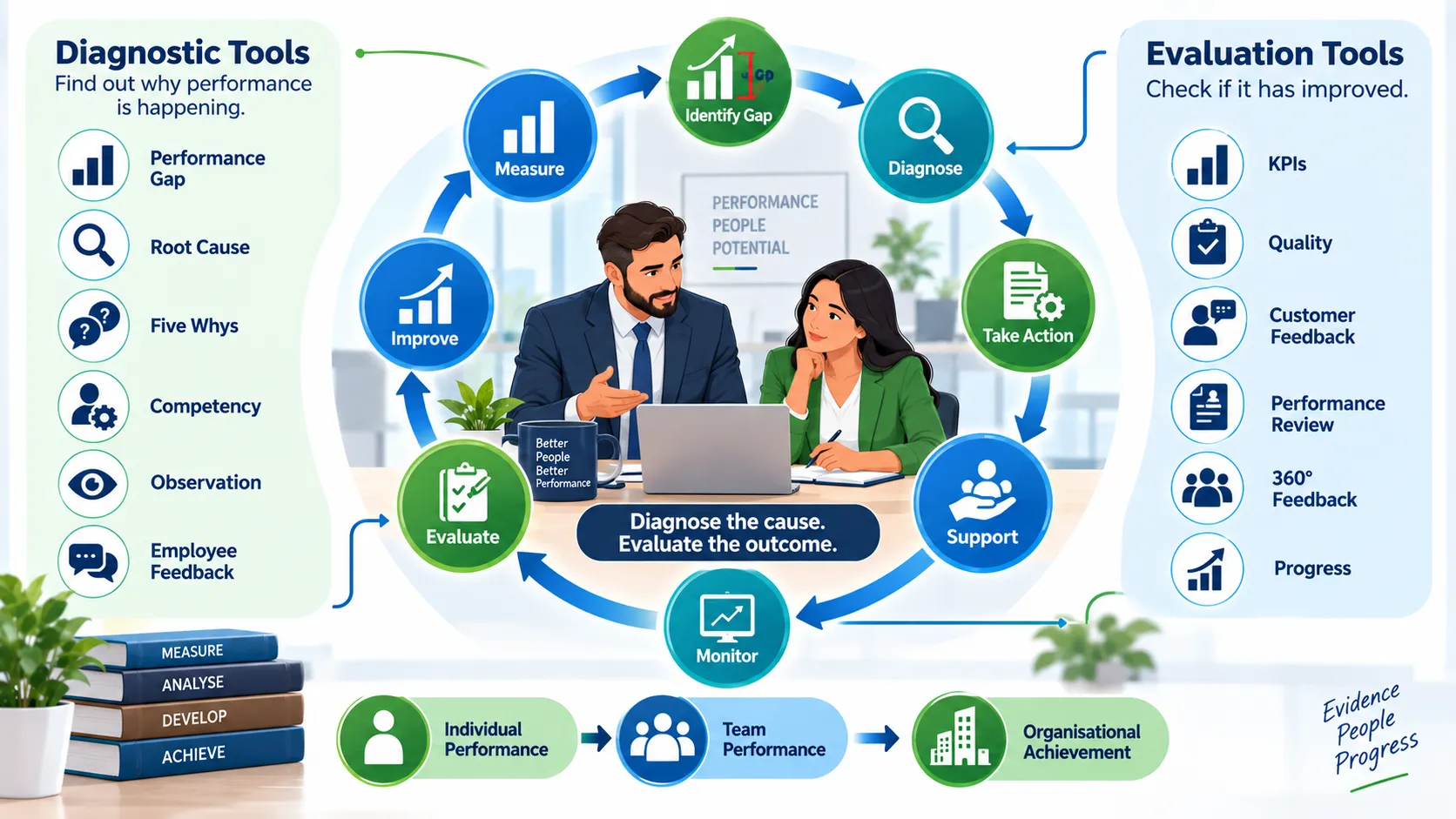
These tools have different purposes but operate together. Diagnosis helps answer “Why is this happening?”, while evaluation helps answer “Has the situation improved and has the intervention worked?”
This distinction is particularly important when managing underperformance. If an employee fails to achieve an agreed standard, a manager should not automatically assume that the employee is unwilling or incapable. The manager should investigate the circumstances and identify the most likely causes. Similarly, if a manager introduces coaching, training or additional support, simply delivering that intervention does not demonstrate success. The manager needs to evaluate whether the intervention resulted in measurable and sustainable improvement.
Diagnostic and evaluation tools therefore support a more systematic performance management cycle:
Set expectations → Measure performance → Identify performance gaps → Diagnose causes → Select appropriate action → Provide support → Monitor progress → Evaluate outcomes → Improve performance
The effective use of these tools supports the central purpose of Unit 504: enabling managers to improve individual and organisational achievement through effective performance management.
The Role of Diagnosis in Performance Management
Understanding Performance Diagnosis
Performance diagnosis involves systematically investigating the factors that influence an employee’s or team’s performance.
Managers should consider both individual factors and organisational factors.
Individual factors may include:
knowledge;
technical skills;
experience;
confidence;
motivation;
engagement;
communication;
decision-making capability;
time management;
understanding of responsibilities.
Organisational factors may include:
workload;
staffing levels;
resources;
technology;
processes;
management support;
communication systems;
organisational change;
unclear responsibilities;
conflicting priorities;
inadequate training;
operational constraints.
A strong diagnostic process avoids reducing a complex performance problem to a single explanation.
For example, an employee who repeatedly misses deadlines may appear to have poor time management. However, further investigation could reveal that the employee has received several additional responsibilities without a corresponding adjustment to workload. The performance gap therefore has a different cause from the one initially assumed.
Why Managers Need Diagnostic Tools
Diagnostic tools help managers make informed decisions.
Without diagnosis, a manager may:
respond to symptoms rather than causes;
provide inappropriate training;
apply unnecessary formal action;
overlook organisational barriers;
misinterpret employee behaviour;
create unfair performance decisions;
fail to resolve recurring problems.
With appropriate diagnosis, the manager can determine whether the appropriate response is:
clarification;
coaching;
mentoring;
training;
additional resources;
process improvement;
workload adjustment;
improved communication;
closer monitoring;
recognition;
formal performance management.
The value of diagnosis therefore lies in improving the quality and appropriateness of managerial action.
Performance Gap Analysis
Definition
Performance gap analysis is the process of comparing expected performance with actual performance to identify the difference between the two.
The basic model is:
Expected Performance – Actual Performance = Performance Gap
For example, if an employee is expected to achieve 95% order accuracy but achieves 88%, there is a measurable performance gap.
However, the gap itself does not explain why the employee has not achieved the required standard.
How to Conduct Performance Gap Analysis
A manager should:
Identify the agreed performance objective.
Establish the required performance standard.
Collect reliable evidence of actual performance.
Compare actual performance with expected performance.
Determine the size and nature of the gap.
Establish whether the gap is isolated or recurring.
Investigate possible causes.
Agree an appropriate response.
Monitor subsequent performance.
Evaluation of Performance Gap Analysis
Strengths:
simple to understand;
provides clear evidence of a gap;
supports objective discussion;
helps prioritise performance issues;
provides a baseline for later evaluation.
Limitations:
identifies the gap but not necessarily the cause;
depends on accurate performance standards;
can encourage excessive focus on numerical differences;
may overlook qualitative factors;
can be misleading if the original target is inappropriate.
Performance gap analysis is therefore an excellent starting point but should rarely be the complete diagnostic process.
Root Cause Analysis
Definition
Root cause analysis is a structured approach used to identify the underlying factors responsible for a performance problem.
The objective is to move beyond the immediate symptom and identify conditions that contributed to the problem.
For example:
Symptom: Project deadlines are repeatedly missed.
A superficial explanation might be:
Employees are not working hard enough.
Root cause analysis might identify:
Unclear responsibilities → duplicated work → delayed approvals → missed deadlines
The appropriate intervention would therefore involve process and role clarification rather than simply increasing employee pressure.
Root Cause Analysis Process
Managers can use the following process:
Define the performance problem.
Gather evidence.
Identify immediate contributing factors.
Ask why the problem occurred.
Explore individual and organisational causes.
Identify relationships between causes.
Distinguish root causes from symptoms.
Identify factors that can realistically be addressed.
Select appropriate improvement actions.
Evaluate whether the underlying problem has been reduced.
Evaluation
Root cause analysis is particularly useful for recurring problems because it encourages managers to look beyond individual blame.
Its strengths include:
deeper understanding;
prevention of repeated problems;
identification of process weaknesses;
better intervention selection;
support for continuous improvement.
Its limitations include:
complex problems may have several root causes;
managers may stop investigating too early;
evidence may be incomplete;
personal assumptions can influence conclusions;
some causes may be outside the manager’s control.
Root cause analysis should therefore be treated as a structured investigation rather than an automatic method for finding one definitive cause.
The Five Whys
Definition
The Five Whys is a simple diagnostic technique that repeatedly asks “why?” to explore the underlying cause of a performance problem.
For example:
Problem: Customer responses are frequently delayed.
Why?
Because requests remain in a queue.
Why?
Because only one employee checks the queue.
Why?
Because responsibility has not been shared.
Why?
Because other employees have not been trained.
Why?
Because training requirements were not reviewed after the service expanded.
The issue may therefore be related to organisational capability planning rather than individual effort.
Strengths and Limitations
The technique is:
simple;
inexpensive;
easy to explain;
useful for team discussions;
effective for straightforward process problems.
However:
not every problem has a single cause;
the number five is not a requirement to stop investigating;
poor questioning can produce simplistic conclusions;
complex organisational problems may require additional tools.
The Five Whys is therefore most effective when used alongside evidence and managerial judgement.
Cause-and-Effect Analysis
Definition
A cause-and-effect analysis helps managers organise possible causes of a performance problem into categories.
A manager investigating declining performance could examine:
people;
processes;
technology;
resources;
management;
communication;
training;
working environment.
This approach is useful because performance is usually influenced by several interconnected factors.
Practical Application
Suppose a team is producing more errors.
The manager could investigate:
People
Do employees have the required skills?
Has workload increased?
Are new employees adequately supported?
Process
Are procedures clear?
Are there unnecessary steps?
Are responsibilities clearly allocated?
Technology
Is the system reliable?
Are employees properly trained?
Resources
Are staffing levels sufficient?
Are appropriate tools available?
Management
Are expectations clear?
Is feedback provided regularly?
This creates a broader diagnostic picture.
Evaluation
Cause-and-effect analysis is valuable because it reduces the risk of focusing exclusively on the employee.
Its main limitation is that it can produce a long list of possible causes without establishing which factors are most significant. Managers therefore need additional evidence to test the relevance of identified causes.
Competency Assessment
Definition
A competency assessment compares the knowledge, skills and behaviours required for effective performance with the employee’s current capability.
Competency assessment can examine:
technical knowledge;
practical skills;
communication;
teamwork;
leadership;
problem solving;
decision-making;
customer service;
digital capability;
professional behaviour.
Importance in Performance Management
Competency assessment is particularly valuable when underperformance may be caused by a capability gap.
For example, an employee may repeatedly make errors in a new software system. Rather than assuming poor motivation, the manager can assess whether the employee understands the system and can perform the required tasks.
If a capability gap is identified, appropriate responses might include:
coaching;
training;
mentoring;
supervised practice;
job shadowing;
additional guidance.
Evaluation
Competency assessments can provide detailed development information, but their quality depends on the competency framework being relevant and clearly defined.
Poorly designed competency frameworks can:
create unnecessary complexity;
encourage subjective judgements;
assess behaviours unrelated to actual performance;
make performance reviews difficult to interpret.
Managers should therefore ensure competencies are genuinely relevant to the role.
Observation as a Diagnostic Tool
Definition
Workplace observation involves directly observing an employee performing relevant tasks or behaviours.
Observation can help identify:
practical skill gaps;
process errors;
communication problems;
unsafe practices;
inefficient work methods;
customer interaction issues;
unclear procedures;
inappropriate behaviours.
Example
A manager receives repeated complaints that an employee communicates poorly with customers.
Rather than relying only on complaints, the manager observes several customer interactions.
The observation shows that the employee has strong technical knowledge but uses unnecessarily complex language when explaining information.
The manager can therefore provide targeted communication coaching.
Evaluation
Observation provides direct evidence and can be particularly useful for practical roles.
However:
employees may behave differently when observed;
one observation may not represent normal performance;
manager bias can influence interpretation;
observation requires time;
some performance outcomes are not directly observable.
Observation is therefore stronger when combined with other evidence.
Employee Discussion as a Diagnostic Tool
Importance of Employee Voice
Employees often possess information that managers cannot obtain through performance data alone.
A structured performance discussion can explore:
barriers;
workload;
resource problems;
unclear expectations;
training needs;
system issues;
conflicting priorities;
employee perceptions;
improvement suggestions.
A manager should ask open and constructive questions rather than simply informing the employee that performance is inadequate.
Useful questions include:
What is preventing you from achieving the expected standard?
Which part of the task is most difficult?
Are the expectations clear?
Do you have the required resources?
Has anything changed recently?
What support would help?
What could the organisation improve?
Evaluation
Employee discussion encourages participation and can reveal contextual information.
However, employee explanations should be considered alongside other evidence. A manager should neither dismiss employee explanations automatically nor accept every explanation without examination.
Professional judgement requires balanced consideration.
Skills Gap Analysis
Definition
A skills gap analysis identifies the difference between the capabilities required for effective performance and those currently demonstrated by an individual or team.
It can support:
training planning;
coaching;
recruitment decisions;
role allocation;
development planning;
succession planning;
performance improvement.
Example
A team is expected to use a new digital reporting system. Performance data shows frequent reporting errors.
A skills gap analysis reveals that most employees understand the technical process but have limited knowledge of data validation.
The manager introduces targeted development rather than repeating general training.
Evaluation
The strength of skills gap analysis is its ability to connect performance problems with specific development requirements.
Its limitation is that not every performance problem is a skills problem.
A highly skilled employee may underperform because of:
excessive workload;
unclear priorities;
poor systems;
low engagement;
organisational conflict.
Managers should therefore avoid assuming that training is the solution to every performance problem.
Evaluating Performance Using KPIs
Definition
Key Performance Indicators (KPIs) are measurable indicators used to monitor progress against important objectives.
Examples include:
sales achieved;
customer satisfaction;
response time;
error rates;
productivity;
project completion;
service quality;
compliance levels.
KPIs can provide clear and trackable evidence.
Benefits of KPIs
provide measurable information;
support objective comparison;
identify trends;
clarify expectations;
support accountability;
provide evidence for performance reviews;
enable progress monitoring.
Limitations of KPIs
KPIs can become problematic when managers use them without considering wider performance.
For example:
Calls handled per hour increases
but:
Customer satisfaction decreases
The KPI indicates increased activity but not necessarily improved organisational performance.
Similarly:
Production increases
while:
Quality decreases
The measure may therefore encourage the wrong behaviour.
Evaluating KPI Effectiveness
Managers should ask:
Does the KPI measure something genuinely important?
Is it directly relevant to the role?
Is the data reliable?
Can employees reasonably influence the result?
Does it encourage the desired behaviour?
Are quality and wider outcomes also considered?
Does it remain relevant as organisational priorities change?
Performance Dashboards
Definition
A performance dashboard presents relevant performance information in a consolidated and accessible format.
A dashboard can help managers identify:
current performance;
trends;
gaps;
changes;
comparisons;
emerging issues.
For example, a customer service dashboard might combine:
response time;
resolution rate;
complaint volume;
customer satisfaction;
quality score.
Evaluation
Dashboards can improve managerial visibility, especially where managers are responsible for multiple performance indicators.
However, dashboards can become overloaded with information.
A dashboard containing dozens of indicators may make it harder rather than easier to identify what matters.
Effective dashboards should therefore prioritise:
relevance;
clarity;
accuracy;
timeliness;
actionable information.
Performance Reviews
Definition
A performance review is a structured discussion and assessment of an employee’s performance against agreed objectives, standards and relevant expectations.
A meaningful performance review may consider:
objectives achieved;
quality;
productivity;
behaviours;
competencies;
development;
challenges;
feedback;
organisational priorities;
future objectives.
Effective Performance Review Process
Review agreed objectives.
Gather relevant evidence.
Compare actual performance with expectations.
Identify strengths.
Identify performance gaps.
Discuss contextual factors.
Invite employee views.
Identify development needs.
Recognise achievement.
Agree improvement actions.
Establish review arrangements.
Record appropriate outcomes.
Evaluation
Performance reviews provide a valuable opportunity to integrate information from several sources.
However, an annual review should not be the only performance management activity.
If managers wait until the end of the year to address a significant performance problem, opportunities for early intervention may be lost.
Effective performance management therefore uses regular feedback and monitoring alongside formal reviews.
360-Degree Feedback
Definition
360-degree feedback collects feedback from multiple relevant perspectives.
Depending on the organisation, these may include:
manager;
colleagues;
direct reports;
internal customers;
external customers;
self-assessment.
Value
360-degree feedback can be particularly useful for evaluating behaviours that are difficult to assess through numerical measures.
For example:
communication;
leadership;
teamwork;
collaboration;
relationship management;
support for colleagues.
Evaluation
Its major strength is breadth.
Its limitations include:
subjectivity;
personal bias;
limited observer knowledge;
feedback influenced by relationships;
inconsistent interpretation.
For this reason, 360-degree feedback is often particularly useful for development and behavioural insight rather than serving as the sole evidence for high-stakes performance decisions.
Customer Feedback
Definition
Customer feedback provides information about how customers experience products, services or employee interactions.
Sources can include:
surveys;
complaints;
compliments;
reviews;
interviews;
customer ratings.
Value
Customer feedback can reveal performance dimensions that internal measures overlook.
For example, a service employee may meet productivity targets while customers experience poor communication.
Evaluation
Customer feedback should be interpreted carefully.
One negative comment does not necessarily establish a persistent performance problem.
Managers should examine:
patterns;
frequency;
relevance;
consistency;
context;
other performance evidence.
Quality Measures
Quality measures evaluate whether outputs meet required standards.
Examples include:
accuracy;
error rates;
defects;
rework;
compliance;
audit results;
service standards.
Quality measures are essential where output alone does not represent successful performance.
A manager should consider:
How much was produced?
and:
How well was it produced?
Both questions may be necessary.
Employee Self-Assessment
Self-assessment encourages employees to reflect on their own performance.
It can identify:
strengths;
challenges;
development needs;
achievements;
barriers;
personal goals.
Self-assessment can increase ownership because employees participate actively in evaluating their performance.
However, self-assessment may be influenced by:
confidence;
experience;
personal expectations;
misunderstanding of standards.
It should therefore normally complement other evidence.
Feedback as an Evaluation Tool
Feedback is not simply a communication activity. It can also provide information about performance progress.
Effective feedback should be:
specific;
timely;
evidence-based;
constructive;
balanced;
focused on relevant behaviour or outcomes;
linked to agreed expectations.
For example:
Weak feedback: “Your performance needs improvement.”
Stronger feedback: “The agreed response standard is two working days. Over the last month, six of twelve cases exceeded that standard. Let’s examine the causes and agree actions to improve response times.”
The second approach gives the employee usable information.
Balanced Performance Evaluation
Why Balance Matters
A major challenge in performance management is deciding what should count as successful performance.
An employee may achieve one target while performing poorly in another important area.
A balanced approach may consider:
Results + Quality + Behaviour + Customer Outcomes + Team Contribution
This provides a broader picture.
Example
A sales employee achieves 120% of target.
However:
customer complaints increase;
colleagues report poor teamwork;
compliance procedures are ignored.
A narrow evaluation might classify the employee as highly successful.
A balanced evaluation would recognise the strong sales outcome while also examining the behavioural and organisational concerns.
This is particularly important because performance management should support overall organisational achievement, not simply isolated target achievement.
Diagnostic Tools Versus Evaluation Tools
It is important for managers to understand the difference.
Diagnostic Tools Ask
Why is performance at this level?
They investigate causes and contributing factors.
Examples include:
performance gap analysis;
root cause analysis;
Five Whys;
cause-and-effect analysis;
competency assessment;
skills gap analysis;
observation;
employee discussion.
Evaluation Tools Ask
What level of performance has been achieved and has the intervention worked?
Examples include:
KPIs;
performance reviews;
dashboards;
quality measures;
customer feedback;
360-degree feedback;
self-assessment;
productivity measures.
In practice, the same source of information may sometimes support both diagnosis and evaluation.
For example, customer complaints may reveal that performance has declined and may also be used to evaluate whether an intervention has improved customer outcomes.
Selecting the Appropriate Tool
Managers should not use tools simply because they are available.
The tool should be selected according to the performance question.
If the Question Is “What Is the Performance Gap?”
Use:
performance gap analysis;
KPI data;
performance records.
If the Question Is “Why Is Performance Below Standard?”
Use:
root cause analysis;
Five Whys;
cause-and-effect analysis;
employee discussion;
observation;
competency assessment.
If the Question Is “Does the Employee Have the Required Capability?”
Use:
skills gap analysis;
competency assessment;
observation;
practical assessment.
If the Question Is “Has Performance Improved?”
Use:
KPIs;
quality measures;
performance review;
customer feedback;
before-and-after comparison.
If the Question Is “How Are Behaviours Affecting Performance?”
Use:
observation;
360-degree feedback;
structured feedback;
employee discussion.
Criteria for Evaluating the Quality of a Tool
Relevance
The tool should provide information directly related to the performance question.
Reliability
The information should be sufficiently consistent to support managerial judgement.
Validity
The tool should genuinely measure the performance area it claims to measure.
Objectivity
The tool should reduce unnecessary personal bias where possible.
Practicality
The tool should be realistic in relation to:
time;
resources;
cost;
managerial capacity.
Timeliness
Information should be available at a time when it can support effective action.
Completeness
The tool should provide sufficient information to understand the issue without creating unnecessary data collection.
Fairness
The tool should be applied consistently and interpreted appropriately.
Using Multiple Sources of Evidence
Triangulation
Triangulation means comparing information from multiple sources to develop a more reliable understanding of performance.
For example:
KPI data + customer feedback + observation + employee discussion
may provide a stronger evidence base than KPI data alone.
Triangulation is particularly valuable where performance is complex or where the consequences of a decision are significant.
Example
A manager observes that an employee’s productivity has declined.
KPI data confirms the decline.
Employee discussion reveals that a new system is creating delays.
Observation confirms that the employee is spending excessive time resolving system errors.
The manager then investigates the system issue.
This is more robust than concluding that the employee has simply become less productive.
Establishing Baselines
A baseline is the starting level against which future performance can be compared.
For example:
Before intervention: 82% accuracy
Target: 95% accuracy
After six weeks: 93% accuracy
The baseline enables the manager to evaluate progress.
Without a baseline, managers may rely on impressions such as:
“Performance seems better.”
A stronger approach is:
“Accuracy increased from 82% to 93% during the review period.”
Measuring Sustainable Improvement
Improvement should not necessarily be judged on one successful result.
Managers should examine whether improvement is:
measurable;
sustained;
relevant;
repeatable;
aligned with organisational objectives.
For example, an employee may improve performance for one week because the manager provides intensive supervision. If performance then falls again, the intervention may not have created sustainable improvement.
Evaluation should therefore consider performance over an appropriate period.
Evaluating Training and Development
Training should be evaluated based on its effect on workplace performance, not simply attendance.
A manager could examine:
Training completed → Knowledge demonstrated → Skills applied → Performance improved
For example:
An employee completes technical training.
The manager then observes whether:
errors have reduced;
tasks are completed correctly;
confidence has improved;
less supervision is required;
quality standards are being achieved.
This creates a clear connection between development and performance.
Evaluating Coaching
Coaching can be evaluated by establishing the original performance problem and measuring subsequent improvement.
Relevant indicators may include:
improved task performance;
increased confidence;
reduced errors;
improved communication;
greater independence;
achievement of agreed standards.
The manager should avoid assuming that coaching was effective simply because the employee participated.
Evaluating Recognition
Recognition is also part of effective performance management.
Managers can evaluate whether recognition:
reinforces desired behaviour;
supports engagement;
encourages sustained performance;
reflects organisational values;
is applied fairly.
For example, if recognition is based exclusively on individual output, employees may become less willing to support colleagues.
A broader recognition approach may reward:
exceptional results;
teamwork;
customer service;
innovation;
responsible behaviour;
sustained improvement.
Evaluating Underperformance Interventions
When an employee is underperforming, the manager should establish clear criteria for improvement.
For example:
Performance issue: Order accuracy below standard.
Current performance: 87%.
Required standard: 95%.
Support: Technical coaching and process guidance.
Review period: Six weeks.
Evaluation: Accuracy, error frequency and quality of completed orders.
This makes the performance management process clearer and more evidence-based.
Evaluating Organisational-Level Impact
Performance management should ultimately contribute to organisational achievement.
Managers should therefore consider whether individual performance improvements affect wider outcomes.
Possible organisational indicators include:
productivity;
quality;
customer satisfaction;
service delivery;
employee capability;
efficiency;
risk reduction;
project completion;
employee retention;
team effectiveness.
For example, if training improves individual capability but does not improve customer service, the organisation should investigate why.
Perhaps:
processes remain inefficient;
systems remain inadequate;
workloads remain excessive;
expectations are unclear.
Evaluation therefore leads back into diagnosis.
The Continuous Performance Management Cycle
Diagnostic and evaluation tools work most effectively as part of a continuous cycle.
Stage 1 – Set
Establish:
objectives;
standards;
responsibilities;
measures.
Stage 2 – Monitor
Collect:
performance data;
feedback;
observations;
relevant evidence.
Stage 3 – Identify
Determine:
strengths;
achievements;
performance gaps;
emerging risks.
Stage 4 – Diagnose
Investigate:
capability;
motivation;
resources;
workload;
processes;
communication;
organisational factors.
Stage 5 – Intervene
Select appropriate actions such as:
coaching;
training;
support;
recognition;
process improvement;
revised objectives.
Stage 6 – Review
Discuss:
progress;
challenges;
evidence;
employee perspective.
Stage 7 – Evaluate
Assess:
performance change;
objective achievement;
quality;
customer outcomes;
team impact;
organisational impact.
Stage 8 – Adapt
Decide whether to:
continue;
modify;
expand;
replace;
conclude the intervention.
This cycle ensures that performance management remains active and responsive.
Practical Scenario – Diagnosing Individual Underperformance
An employee consistently misses a monthly reporting deadline.
The manager initially assumes the employee needs better time management.
The manager conducts a performance gap analysis and confirms that the reporting deadline is being missed.
A structured discussion reveals that the employee spends significant time correcting information received from another department.
The manager investigates the process and discovers that information is frequently submitted late.
The appropriate response is therefore not simply to tell the employee to work faster.
The manager:
clarifies responsibilities;
discusses the issue with the other department;
improves the information submission process;
provides additional support;
monitors reporting performance.
After the process change, reports are consistently completed on time.
Evaluation: The problem was partly organisational rather than purely individual.
Practical Scenario – Evaluating a Quality Intervention
A production team has an error rate of 8%.
The manager introduces:
targeted coaching;
clearer quality standards;
peer checking;
weekly performance reviews.
After eight weeks, the error rate falls to 3%.
However, productivity also falls slightly.
The manager therefore evaluates both:
quality improvement;
productivity impact.
The intervention is successful in reducing errors but may require refinement to maintain productivity.
Learning point: Evaluation should consider both intended outcomes and unintended consequences.
Practical Scenario – Evaluating Customer Service
A customer service team receives frequent complaints about response quality.
The manager introduces communication coaching.
Evaluation includes:
customer satisfaction;
complaint frequency;
quality observations;
employee feedback.
Customer satisfaction improves and complaints decline.
This provides stronger evidence that the intervention has contributed to improvement than simply recording that coaching was completed.
Practical Scenario – Diagnosing Team Performance
A project team repeatedly misses deadlines.
The manager reviews:
project completion data;
workload;
team responsibilities;
communication;
approval processes.
The analysis reveals duplicated responsibilities and unclear approval authority.
The manager redesigns the process and clarifies roles.
Project completion improves.
This demonstrates that diagnostic tools can identify systemic performance barriers, not merely individual weaknesses.
Practical Scenario – Measuring High Performance
A team member consistently exceeds productivity targets.
However, the employee also:
supports colleagues;
maintains quality;
receives positive customer feedback;
demonstrates organisational values.
The manager uses several evidence sources to build a broader performance assessment.
The employee is appropriately recognised for exceptional contribution.
Learning point: Effective evaluation identifies performance that contributes meaningfully to wider organisational achievement rather than focusing exclusively on one numerical measure.
Common Errors in Using Diagnostic and Evaluation Tools
Treating Every Performance Problem as a Skills Problem
Managers sometimes respond to every performance gap with training.
However, training will not solve:
poor processes;
inadequate staffing;
unclear priorities;
system failures;
excessive workload.
Diagnosis must come first.
Using Data Without Context
Numbers provide evidence but require interpretation.
A decline in productivity may result from:
system disruption;
organisational change;
increased complexity;
staffing shortages.
Measuring Too Much
Collecting excessive information can create administrative burden without improving decision-making.
Managers should identify the evidence that is genuinely necessary.
Measuring Too Little
Conversely, relying on one indicator can create an incomplete picture.
Confusing Completion With Success
Examples include:
training completed ≠ capability improved;
review completed ≠ performance improved;
target achieved ≠ overall organisational achievement;
feedback provided ≠ behaviour changed.
Ignoring Employee Perspective
Employees may possess valuable information about barriers that performance data cannot reveal.
Ignoring Unintended Consequences
An intervention may improve one indicator while creating another problem.
Managers should therefore evaluate wider outcomes.
Ethical Use of Diagnostic and Evaluation Tools
Performance information concerns real employees and can influence important decisions. Managers should therefore use tools responsibly.
Good practice includes:
using relevant evidence;
maintaining appropriate confidentiality;
explaining performance expectations;
avoiding discriminatory assumptions;
providing employees with appropriate opportunities to respond;
applying standards consistently;
recording significant decisions appropriately;
using information for legitimate management purposes;
avoiding manipulation of performance data.
Managers should also consider the potential consequences of the measurement system itself.
For example, if employees believe only speed is rewarded, they may reduce attention to quality.
Ethical performance management therefore asks:
What are we measuring?
Why are we measuring it?
How will the information be used?
What behaviour might the measure encourage?
Key Benefits of Diagnostic Tools
Benefits for Employees
More accurate identification of performance barriers.
More targeted development.
Fairer performance discussions.
Greater opportunity to explain circumstances.
Earlier access to appropriate support.
Better understanding of expectations.
Greater opportunity to demonstrate improvement.
Benefits for Managers
Stronger evidence for decisions.
Better understanding of performance problems.
Reduced reliance on assumptions.
More appropriate interventions.
Improved performance conversations.
Better identification of organisational barriers.
Benefits for Organisations
Better problem solving.
Reduced recurrence of performance problems.
More effective use of development resources.
Improved productivity and quality.
Stronger organisational learning.
Better alignment between performance management and organisational objectives.
Key Benefits of Evaluation Tools
Benefits for Employees
Clearer understanding of progress.
Recognition of achievement.
Evidence of development.
More meaningful feedback.
Greater ownership of performance.
Benefits for Managers
Ability to determine whether interventions worked.
Stronger evidence for future decisions.
Better resource allocation.
Improved performance planning.
Better identification of continuing issues.
Benefits for Organisations
Evidence of performance improvement.
Better return from development interventions.
Stronger strategic alignment.
Improved quality and productivity.
Better customer outcomes.
Stronger individual and organisational achievement.
Professional Judgement When Evaluating Tools
The quality of performance management depends not only on the tools selected but also on the judgement of the manager using them.
A competent middle manager should consider:
What question am I trying to answer?
What evidence do I actually need?
Which tool is most appropriate?
Is the information reliable?
Could there be another explanation?
What does the evidence not tell me?
Do I need another source of evidence?
Is the measure encouraging the right behaviour?
Is the approach fair?
What intervention is most appropriate?
How will I know whether the intervention worked?
This prevents tools from becoming mechanical exercises.
A performance dashboard, for example, cannot replace managerial judgement. A KPI cannot automatically explain why performance has changed. A 360-degree feedback report cannot independently determine an employee’s complete performance. A competency assessment cannot prove that training is the only solution.
Tools provide evidence. Managers interpret evidence and make professional decisions.
A Managerial Framework for Choosing Tools
Middle managers can use the following decision sequence.
Question 1 – What Do I Need to Understand?
Is the issue about:
achievement;
underperformance;
capability;
behaviour;
quality;
productivity;
customer outcomes;
team effectiveness?
Question 2 – Is This a Diagnostic or Evaluation Question?
If the manager needs to understand why, diagnostic tools are appropriate.
If the manager needs to determine whether improvement has occurred, evaluation tools are appropriate.
Question 3 – What Evidence Is Available?
Consider:
quantitative data;
qualitative evidence;
observations;
employee views;
customer feedback;
performance records.
Question 4 – Is One Tool Enough?
If the performance issue is complex, combine appropriate tools.
Question 5 – What Decision Will the Evidence Support?
The tool should produce information that can inform practical action.
Question 6 – How Will Success Be Evaluated?
Before implementing an intervention, establish the indicators that will demonstrate improvement.
Key Learning Points
Diagnostic tools help managers understand why performance is occurring at a particular level.
Evaluation tools help managers determine whether performance and interventions have achieved intended outcomes.
Performance gap analysis identifies differences between expected and actual performance.
Root cause analysis investigates underlying causes.
The Five Whys supports structured exploration of causal factors.
Cause-and-effect analysis encourages managers to consider multiple possible causes.
Competency assessment identifies capability strengths and gaps.
Skills gap analysis supports targeted development.
Observation provides direct evidence of workplace behaviour and task performance.
Employee discussions provide important contextual information.
KPIs provide measurable performance evidence but should not normally be used alone.
Performance dashboards can help managers identify trends and emerging performance issues.
Performance reviews provide opportunities to integrate evidence and agree actions.
360-degree feedback can provide broader insight into behaviours and relationships.
Customer feedback can reveal important service outcomes.
Quality measures help prevent excessive focus on quantity.
Quantitative and qualitative evidence should be considered together where appropriate.
Triangulation can strengthen confidence in performance conclusions.
Baselines make it easier to evaluate change over time.
Training and coaching should be evaluated by their impact on workplace performance rather than participation alone.
Managers should consider intended and unintended consequences of performance measures.
Diagnostic tools should not automatically lead to training or formal action.
Evaluation should examine whether improvement is meaningful and sustainable.
Performance tools should support fair, evidence-based and professional management.
The most effective approach is a continuous cycle of measurement, diagnosis, intervention, evaluation and improvement.
The ultimate purpose is to strengthen individual, team and organisational achievement.
Summary
Diagnostic and evaluation tools provide managers with a structured basis for understanding, managing and improving performance. Diagnostic tools help explain why performance is occurring at a particular level, while evaluation tools help determine whether performance has improved and whether management interventions have achieved their intended outcomes.
Performance gap analysis is an essential starting point because it establishes the difference between expected and actual performance. However, identifying a gap is not the same as understanding its cause. Root cause analysis, the Five Whys, cause-and-effect analysis, competency assessment, skills gap analysis, observation and employee discussion can provide deeper insight into the factors influencing performance.
Evaluation tools provide a different but complementary function. KPIs, performance dashboards, performance reviews, quality measures, customer feedback, 360-degree feedback, self-assessment and productivity measures can help managers assess achievement and determine whether interventions are producing meaningful results.
No tool should automatically be regarded as sufficient. A KPI can identify a result but may not explain its cause. Customer feedback can reveal service problems but may not provide a complete assessment of an individual. A competency assessment can identify a capability gap but may not explain wider organisational barriers. A performance review can structure discussion but does not guarantee improvement.
Effective managers therefore select tools according to the performance question, consider the quality of available evidence and use professional judgement when interpreting results. Where appropriate, managers should combine several evidence sources to create a more balanced understanding.
The distinction between activity, output and outcome is particularly important. Completing training does not necessarily mean capability has improved. Completing an appraisal does not necessarily mean performance has improved. Achieving a numerical target does not necessarily mean the organisation has achieved its wider objective.
Effective evaluation therefore asks whether performance management has produced a meaningful difference.
The overall process can be expressed as:
Measure → Diagnose → Understand → Intervene → Support → Monitor → Evaluate → Adapt
When this cycle is applied consistently, managers are better positioned to recognise strong performance, identify genuine performance gaps, provide appropriate support and manage underperformance professionally. The result is a performance management approach that is evidence-based, fair, developmental and aligned with organisational priorities.
Ultimately, diagnostic and evaluation tools are valuable because they help managers transform performance information into informed managerial action. When used appropriately, they strengthen individual capability, improve team performance, support organisational effectiveness and contribute directly to the central purpose of Unit 504: improving individual and organisational achievement through effective performance management.