
Lesson no 2 : Know how to plan resources to meet organisational objectives
Effective resource planning is a fundamental management responsibility because organisational objectives can only be achieved when the right resources are available, in the right quantity, at the right time and in the right place. Resource planning involves identifying what an organisation needs to deliver its objectives, assessing what is currently available, identifying gaps and determining how resources should be acquired, allocated and managed. For middle managers and operational leaders, effective resource planning provides a structured link between organisational objectives, operational activities, workforce capability, budgets, technology, equipment, materials and expected outcomes.
Organisations operate within resource constraints. Financial budgets, employee capacity, working time, equipment, facilities and technology are not unlimited. Managers therefore need to make informed decisions about how available resources should be prioritised. Poor resource planning can result in insufficient staffing, inadequate equipment, service delays, missed deadlines, excessive workload, increased operational risk and failure to achieve organisational targets. Conversely, allocating more resources than necessary can create unnecessary expenditure, unused capacity and reduced efficiency. Effective planning seeks an appropriate balance between resource availability, organisational priorities, operational demand, cost, quality, capacity and risk.
The starting point for resource planning is a clear understanding of organisational objectives. Managers must determine what the organisation intends to achieve and then translate these objectives into specific operational resource requirements. For example, an objective to improve customer service may require additional staffing during peak periods, improved technology, employee training, revised processes and appropriate financial resources. A manager should therefore consider the complete resource requirement rather than focusing on a single resource category.
This lesson explores the processes and principles involved in planning resources to meet organisational objectives. Learners will examine how to identify resource requirements, assess current resources, analyse resource gaps, forecast demand, establish priorities, determine capacity, develop resource plans and allocate resources appropriately. The lesson also considers how managers can evaluate financial implications, assess risks, establish responsibilities and create monitoring arrangements to ensure that resource plans remain effective.
Effective resource planning is also closely connected with organisational flexibility. Resource requirements can change because of fluctuations in demand, changes in organisational priorities, employee availability, technology developments, financial pressures or unexpected operational events. Managers therefore need to review resource plans regularly and adapt them when circumstances change.
The lesson will use practical workplace examples involving workforce planning, financial resources, equipment, materials, technology, facilities and time. These examples will demonstrate how managers can identify resource requirements and make evidence-based decisions about allocation and utilisation.
By the end of this lesson, learners should understand that resource planning is more than estimating how much money or how many employees are required. It is a structured management process that connects organisational objectives → activities → resource requirements → allocation → delivery → monitoring → review. Effective resource planning enables organisations to use limited resources responsibly, maintain operational capacity, manage risks, control costs and increase the likelihood of achieving planned organisational outcomes.
1.Assess Factors Which Impact on Resource Planning to Meet Organisational Objectives
Resource planning is a critical management activity because organisational objectives cannot be achieved unless the organisation has sufficient and appropriate resources available at the right time. Managers must determine what resources are required, how much capacity is available, where resources should be allocated and how resource requirements may change over time. Effective resource planning therefore involves much more than calculating a budget or determining the number of employees needed. It requires managers to assess a wide range of internal and external factors that can influence resource availability, cost, capacity, quality, risk and organisational performance.
For practising and aspiring middle managers and leaders, understanding these factors is particularly important because they frequently operate between strategic decision-making and operational delivery. Senior leaders may establish organisational objectives, while middle managers are often responsible for translating those objectives into realistic resource requirements. They must understand operational demand, assess existing capacity, identify resource gaps and recommend appropriate solutions while remaining within organisational policies, financial limits and regulatory expectations.
A resource plan that ignores important influencing factors can quickly become unrealistic. For example, an organisation may plan staffing based on average demand but fail to account for seasonal increases. The organisation may then experience staff shortages, service delays and declining quality. Similarly, purchasing large quantities of equipment without considering actual utilisation can create unnecessary expenditure and under-used capacity.
Effective resource planning therefore requires managers to ask:
What resources are required, what factors could affect those requirements, and how can the organisation respond appropriately?
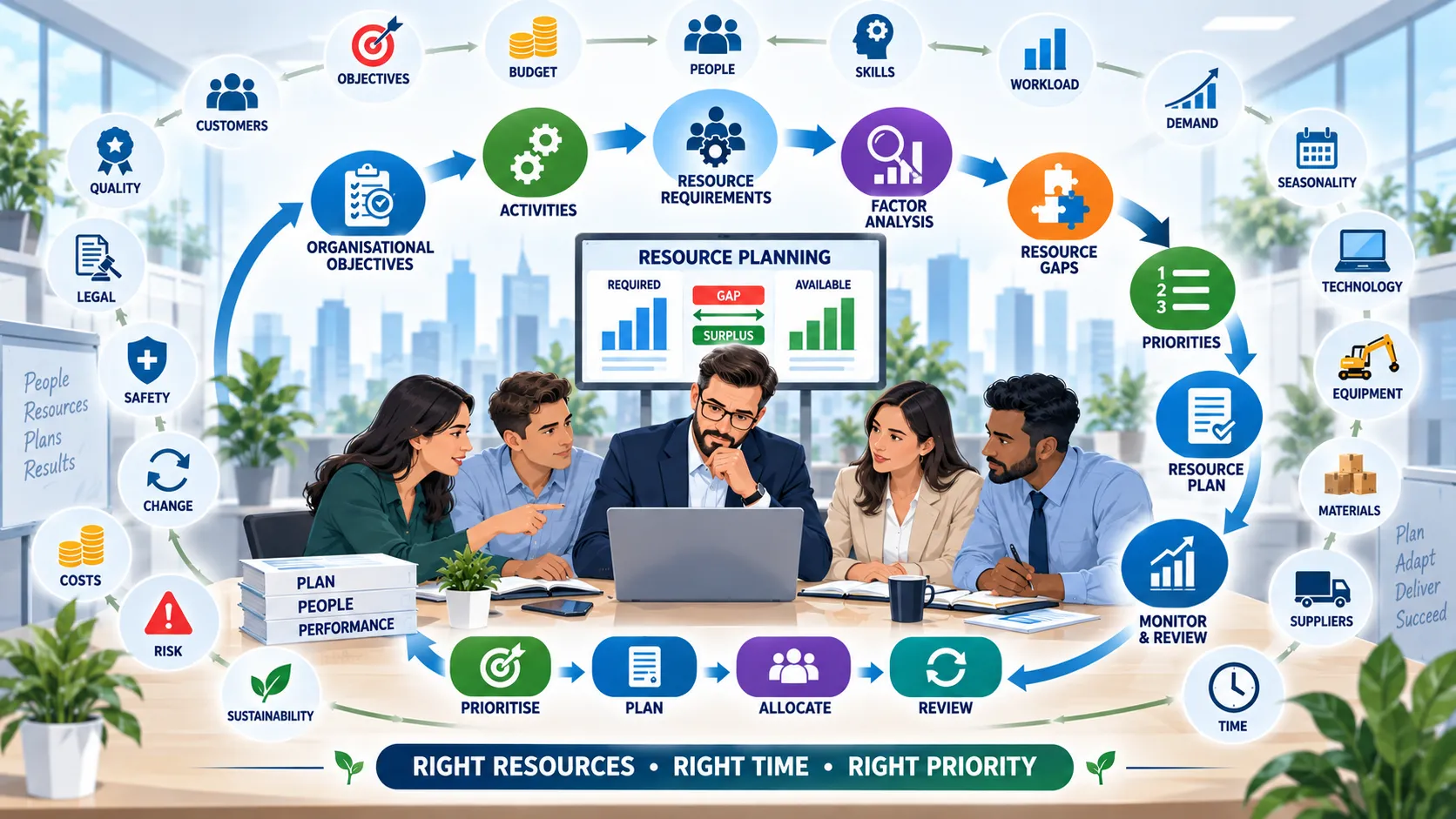
Understanding Resource Planning
Definition of Resource Planning
Resource planning is the systematic process of identifying the resources required to achieve organisational objectives, assessing available resources, identifying gaps, determining how resources will be obtained or allocated, and establishing how resource use will be monitored and reviewed.
Resources may include:
people and workforce capability;
financial resources;
equipment and physical assets;
materials and stock;
technology and digital systems;
information and data;
facilities and workspace;
time;
external suppliers and specialist services.
Resource planning should be directly connected to organisational objectives. Managers should not plan resources simply because particular resources have traditionally been available. Instead, resource requirements should be based on what the organisation is trying to achieve and the activities necessary to achieve it.
Resource Planning and Organisational Objectives
The relationship can be expressed as:
Organisational Objectives → Operational Activities → Resource Requirements → Resource Allocation → Delivery → Outcomes
For example, if an organisation has an objective to improve customer response times, the manager may need to assess:
customer demand;
staffing levels;
employee skills;
technology;
workflow;
budget;
working hours;
service capacity.
The objective therefore provides the basis for determining resource requirements.
Why Factors Affect Resource Planning
Resource planning takes place in a changing organisational environment. Resource requirements can change because of internal decisions, external pressures, financial conditions, customer expectations, technology, legislation, workforce availability and market conditions.
A plan that is appropriate today may require adjustment later.
Managers therefore need to distinguish between:
known resource requirements;
forecast requirements;
uncertain requirements;
potential future requirements;
critical resource dependencies.
This distinction helps managers develop plans that are realistic while remaining sufficiently flexible.
Key Factors That Impact Resource Planning
1. Organisational Objectives and Strategic Priorities
The first and most important factor affecting resource planning is the organisation’s strategic direction and objectives.
Resources should support organisational priorities. If strategic priorities change, resource requirements may also change.
For example, an organisation may initially prioritise cost reduction but later decide that customer experience is a higher priority. The resource plan may then need to change to support additional customer service capacity, training or technology.
Managers should consider:
current organisational objectives;
strategic priorities;
operational targets;
expected outcomes;
organisational growth plans;
service improvement priorities;
performance requirements.
Impact on Resource Planning
Strategic priorities influence:
which resources receive funding;
workforce requirements;
technology investment;
equipment needs;
operational capacity;
training requirements;
external support;
resource allocation between departments.
A resource plan that does not reflect strategic priorities can result in resources being allocated to activities that have limited organisational value.
2. Organisational Structure
The structure of an organisation can significantly influence resource planning.
Different organisational structures distribute responsibilities, authority and resources in different ways. A centralised organisation may control resources through a central function, while a decentralised organisation may allow individual departments greater control.
Managers should understand:
reporting relationships;
departmental responsibilities;
decision-making authority;
centralised resources;
shared resources;
cross-functional dependencies.
Practical Impact
Suppose an organisation has a central IT team supporting five departments. A department planning a new digital project cannot assume that IT resources are immediately available. The resource plan must consider the capacity and priorities of the central IT team.
Organisational structure can therefore affect both resource availability and resource allocation.
3. Financial Resources and Budget Constraints
Financial capacity is one of the most significant factors influencing resource planning.
Organisations have limited budgets, and managers must determine how available funding should be allocated across competing priorities.
Financial considerations include:
available budget;
projected income;
operating costs;
capital expenditure;
staffing costs;
supplier costs;
inflation;
cash-flow considerations;
existing financial commitments.
Managers should not simply identify the resources required without considering whether they are financially achievable.
Budgeting and Resource Planning
A strong resource planning process connects:
Resource Requirement → Estimated Cost → Available Budget → Funding Gap → Management Decision
For example, if a department requires £100,000 to implement a planned improvement but has only £70,000 available, the manager must determine whether:
the activity can be redesigned;
resources can be reallocated;
implementation can be phased;
alternative resources can be identified;
additional funding is justified.
The objective should not automatically be to reduce the requirement by £30,000 if doing so would prevent the organisational objective from being achieved.
4. Workforce Availability
Human resources are often a critical component of resource planning.
Managers need to determine whether sufficient employees are available to complete planned activities.
Workforce availability can be affected by:
recruitment levels;
employee turnover;
sickness absence;
annual leave;
working patterns;
vacancies;
retirement;
workforce demographics;
temporary staffing;
external labour availability.
A workforce plan based purely on headcount may therefore be inadequate.
5. Workforce Skills and Capability
Resource planning must consider not only how many people are available but also what they are capable of doing.
A resource gap can exist even when the organisation has sufficient headcount.
For example, a business may have 20 employees but only three employees with the specialist technical skills required for a new system implementation.
Managers should assess:
qualifications;
technical skills;
experience;
leadership capability;
digital capability;
specialist knowledge;
training needs;
competency levels.
Capability Gap
A capability gap exists when employees do not currently possess the knowledge, skills or experience required to deliver planned activities effectively.
Managers may respond through:
training;
coaching;
recruitment;
internal redeployment;
external specialists;
partnerships;
improved technology.
6. Employee Capacity and Workload
Even when employees possess the required skills, they may not have sufficient capacity.
Capacity is influenced by:
existing workload;
working hours;
productivity;
competing priorities;
operational demand;
absence;
administrative requirements.
For example, assigning an additional project to an employee who is already working at full capacity may create delays in both the existing role and the new project.
Managers should therefore consider available capacity rather than headcount alone.
7. Demand and Workload Forecasting
Resource requirements are strongly influenced by expected demand.
Demand forecasting helps managers estimate the level of resources required in the future.
Demand may be affected by:
customer numbers;
sales volumes;
seasonal patterns;
market conditions;
organisational growth;
new services;
changing customer expectations;
economic conditions.
Example
A customer service centre normally receives 500 enquiries per day but expects 800 enquiries during a seasonal campaign.
If staffing remains based on the normal workload, response times may deteriorate.
The manager may therefore plan:
additional temporary staff;
adjusted shifts;
overtime;
automated responses;
improved self-service;
additional technology capacity.
Demand forecasting allows resource requirements to be planned before operational pressure occurs.
8. Seasonality and Demand Fluctuation
Some organisations experience significant seasonal changes.
Examples include:
retail during holiday periods;
education during enrolment periods;
tourism during peak seasons;
healthcare during periods of increased demand;
financial services during reporting periods.
Managers should identify predictable peaks and plan resources accordingly.
A fixed resource model may create either:
under-resourcing during peak periods; or
over-resourcing during quieter periods.
Flexible resource planning can therefore improve efficiency.
9. Technology and Digital Transformation
Technology can both increase and reduce resource requirements.
For example, automation may reduce manual processing requirements, while implementing a new digital system may initially require additional technical specialists and training.
Managers should assess:
existing systems;
technology capability;
system capacity;
automation opportunities;
implementation costs;
maintenance;
employee digital skills;
technical support;
compatibility.
Technology should be considered as part of the complete resource system rather than in isolation.
10. Equipment and Physical Asset Availability
Physical resources can influence an organisation’s capacity to deliver objectives.
Managers may need to consider:
existing equipment;
equipment condition;
capacity;
reliability;
maintenance;
replacement requirements;
utilisation;
availability;
acquisition costs.
An organisation may technically possess sufficient equipment but still have inadequate operational capacity if equipment is unreliable or frequently unavailable.
Equipment Utilisation
Managers should examine whether equipment is:
fully utilised;
under-utilised;
over-utilised;
shared effectively;
appropriately maintained.
Under-utilised equipment can indicate over-resourcing, while excessive utilisation may indicate insufficient capacity.
11. Materials and Stock Requirements
Materials and stock can significantly affect resource planning, particularly in manufacturing, healthcare, hospitality, retail and other operational environments.
Managers should consider:
expected demand;
stock levels;
usage rates;
storage capacity;
lead times;
supplier reliability;
wastage;
expiry;
price changes.
Too little stock may cause operational disruption, while excessive stock can tie up financial resources.
Effective planning therefore seeks an appropriate balance.
12. Supplier and External Resource Availability
Organisations may depend on suppliers, contractors, consultants and specialist providers.
External resource availability can be affected by:
supplier capacity;
lead times;
pricing;
supplier reliability;
market availability;
contract terms;
specialist skills;
supply-chain disruption.
Managers should consider critical dependencies when developing resource plans.
For example, an organisation may plan to launch a new service in June but rely on a specialist supplier that requires twelve weeks to provide essential equipment. The resource plan must therefore account for the supplier’s lead time.
13. Time and Timescales
Time is a finite resource.
The amount of time available can influence:
staffing requirements;
project capacity;
overtime;
equipment usage;
supplier requirements;
implementation sequencing.
Short deadlines may require additional resources or prioritisation.
For example, completing a major operational change in three months may require more employees or external expertise than completing the same change over twelve months.
Managers should therefore ensure that resource requirements are linked to realistic timescales.
14. Organisational Policies and Procedures
Resource planning must operate within organisational policies and procedures.
Relevant policies may address:
recruitment;
procurement;
budgeting;
expenditure approval;
technology use;
equipment management;
sustainability;
workforce management;
risk management.
Managers must ensure that resource decisions are consistent with organisational governance.
For example, a manager may identify a need for specialist external support but be required to follow an approved procurement process before appointing a supplier.
15. Legal and Regulatory Requirements
Legal and regulatory requirements can influence both the type and quantity of resources required.
Depending on the organisation and sector, requirements may affect:
staffing;
health and safety;
data management;
equipment;
facilities;
environmental controls;
financial management;
service standards.
Managers should therefore identify relevant requirements before finalising resource plans.
Failure to provide legally or regulatorily required resources can create significant operational and compliance risks.
16. Health and Safety Requirements
Health and safety can affect resource planning by creating requirements for:
competent employees;
protective equipment;
safe facilities;
training;
maintenance;
supervision;
risk controls.
Managers must not reduce critical resources simply to achieve financial savings if doing so increases health and safety risks.
Resource planning should therefore consider the resources required to maintain safe working conditions.
17. Quality Requirements
Quality expectations influence resource requirements.
Higher quality standards may require:
more skilled employees;
additional checking;
better equipment;
improved materials;
training;
quality assurance systems;
additional management capacity.
Managers should therefore identify the relationship between:
Resource Level → Quality Standard → Expected Outcome
Reducing resources without assessing quality consequences can undermine organisational objectives.
18. Customer and Stakeholder Expectations
Customers and stakeholders influence resource planning because their expectations can affect the level and type of service required.
Relevant factors include:
customer demand;
service expectations;
response times;
quality requirements;
accessibility;
reliability;
communication requirements.
For example, customers may expect a service to be available seven days a week. Meeting this expectation may require different staffing patterns and resource allocation.
19. Organisational Culture
Organisational culture can influence how resources are planned and used.
A culture that values efficiency may encourage managers to challenge unnecessary expenditure. A culture focused on innovation may prioritise investment in technology and capability.
Managers should consider whether the organisational culture supports:
responsible resource use;
accountability;
innovation;
collaboration;
continuous improvement;
evidence-based decision-making.
Culture can also influence employee willingness to adopt new resource-management practices.
20. Organisational Change
Changes in organisational structure, strategy, processes or technology can significantly alter resource requirements.
Examples include:
mergers;
restructuring;
new services;
digital transformation;
relocation;
expansion;
organisational downsizing;
process redesign.
Managers should review resource plans whenever significant change occurs.
A resource plan designed for the previous operating model may become inappropriate after a major organisational change.
21. Economic Conditions
External economic conditions can affect resource planning.
Managers may need to respond to:
inflation;
changing interest rates;
increased supplier prices;
reduced customer demand;
economic uncertainty;
changes in operating costs.
For example, increasing supplier costs may mean that a previously affordable resource plan becomes financially unrealistic.
Managers may need to consider alternative suppliers, revised specifications, phased implementation or resource reallocation.
22. Market Conditions
Market conditions can affect both resource demand and resource availability.
Managers should monitor:
competitor activity;
customer behaviour;
market growth;
new products;
changes in demand;
supplier availability.
A growing market may require additional staffing and production capacity, while declining demand may require more flexible resource allocation.
23. Inflation and Rising Costs
Inflation can affect:
wages;
materials;
equipment;
technology;
facilities;
supplier contracts;
energy costs.
A resource plan based on historical prices may therefore underestimate future costs.
Managers should review cost assumptions regularly and consider whether contingency allowances are appropriate.
24. Organisational Growth or Reduction
Growth usually increases resource requirements, although the relationship is not always proportional.
For example, a business may double its customer base but avoid doubling staffing levels by introducing automation.
Managers should therefore assess:
Growth in Demand + Productivity + Technology + Capacity = Future Resource Requirement
Similarly, organisational reduction may require careful consideration to avoid removing resources that remain essential to critical operations.
25. Resource Interdependencies
Resources do not operate independently.
For example:
Technology → Requires Skilled People → Requires Training → Requires Finance → Requires Time
If one resource is unavailable, other resources may become less effective.
Managers should therefore identify dependencies before finalising a resource plan.
Example
An organisation purchases a new digital platform but does not provide sufficient employee training. The technology resource exists, but the intended operational benefit may not be achieved.
This demonstrates that resource planning must consider the complete resource ecosystem.
26. Risk and Uncertainty
Resource planning always involves some uncertainty.
Managers may not know precisely:
how demand will change;
whether employees will remain available;
whether supplier costs will increase;
whether technology will perform as expected;
whether implementation will take longer than planned.
Risk assessment helps managers prepare for these uncertainties.
Resource Risk Assessment
Managers should:
Identify important resource assumptions.
Identify potential resource-related risks.
Assess likelihood and impact.
Identify preventive controls.
Consider contingency resources.
Monitor risk indicators.
Review resource plans when risk conditions change.
27. Contingency Requirements
Some organisational activities require contingency planning.
A contingency resource is an alternative or additional resource available to respond to an unexpected event.
Examples include:
temporary staff;
backup equipment;
alternative suppliers;
emergency budgets;
additional storage;
alternative technology systems.
Contingency planning should be proportionate to risk rather than resulting in unnecessary over-resourcing.
28. Sustainability Requirements
Resource planning increasingly needs to consider environmental and sustainability factors.
Managers may evaluate:
energy use;
material consumption;
waste;
equipment lifespan;
transport;
procurement choices;
environmental impact.
Sustainable resource planning can support organisational objectives while reducing unnecessary consumption and waste.
29. Information and Data Availability
Reliable information is essential for resource planning.
Managers need data about:
demand;
workforce;
costs;
productivity;
capacity;
utilisation;
quality;
performance.
Poor-quality information can lead to poor resource decisions.
For example, if a manager receives inaccurate demand data, staffing levels may be incorrectly planned.
30. Performance Data and Historical Trends
Historical performance information can help managers identify patterns.
Managers may examine:
previous workload;
staffing requirements;
seasonal demand;
expenditure;
productivity;
equipment usage;
service outcomes.
However, historical data should not be used blindly. Future conditions may differ from previous conditions.
Managers should combine historical information with current conditions and future expectations.
Resource Planning Process for Assessing Influencing Factors
A structured process can help managers assess the factors that affect resource planning.
Step 1: Define the Organisational Objective
Clarify what the organisation needs to achieve.
Step 2: Identify Required Activities
Determine what activities must be completed to achieve the objective.
Step 3: Identify Required Resources
Identify people, finance, equipment, materials, technology, information, time and external support.
Step 4: Analyse Internal Factors
Assess:
workforce;
budget;
organisational structure;
existing assets;
technology;
processes;
capacity;
organisational culture.
Step 5: Analyse External Factors
Consider:
market conditions;
customer demand;
supplier availability;
economic conditions;
legal requirements;
technology changes;
industry conditions.
Step 6: Assess Current Resource Availability
Determine what resources are currently available and their actual capacity.
Step 7: Identify Resource Gaps and Surpluses
Compare requirements with availability.
Step 8: Assess Cost and Value
Estimate resource costs and expected organisational benefits.
Step 9: Assess Risks and Dependencies
Identify factors that could prevent resources being available when required.
Step 10: Prioritise Resource Requirements
Allocate priority according to organisational importance, risk and expected outcomes.
Step 11: Develop the Resource Plan
Document requirements, responsibilities, costs, timescales and monitoring arrangements.
Step 12: Monitor and Review
Track resource availability, utilisation, cost and performance.
Step 13: Adapt the Plan
Change resource allocation when circumstances or organisational priorities change.
Practical Resource Planning Decision Framework
A manager can evaluate each major resource requirement using five questions:
Purpose
What organisational objective does this resource support?
Requirement
What quantity and capability are actually required?
Availability
What resources are already available?
Value
What outcome or benefit will the resource generate?
Risk
What happens if the resource is unavailable or insufficient?
This framework encourages disciplined and evidence-based decision-making.
Practical Example: Customer Service Expansion
An organisation expects customer enquiries to increase by 40%.
The manager identifies potential resource requirements:
additional staff;
improved scheduling;
technology;
training;
customer self-service;
management capacity.
However, before recruiting, the manager assesses current resources.
The analysis shows that:
staffing is sufficient during quieter periods;
demand is concentrated during specific hours;
existing technology is under-utilised;
employees spend significant time on avoidable administrative tasks.
The manager therefore redesigns shift patterns and improves process automation before requesting significant additional staffing.
The outcome is increased service capacity without proportionately increasing workforce costs.
This demonstrates the importance of considering capacity, technology, workflow and utilisation, rather than relying solely on headcount.
Practical Example: Education and Training Provider
A training organisation wants to increase learner enrolment.
Resource planning identifies:
additional tutors;
learning materials;
digital platform capacity;
learner support;
administrative staff;
classroom capacity.
However, the manager identifies that classroom capacity is limited while digital capacity is available.
Instead of immediately renting additional facilities, the organisation considers increasing blended learning delivery.
The decision may improve resource efficiency while supporting organisational growth.
Practical Example: Manufacturing Organisation
A manufacturing company plans to increase production by 25%.
The manager reviews:
workforce capacity;
machine capacity;
raw materials;
warehouse capacity;
supplier lead times;
maintenance requirements;
quality controls;
budget.
The review shows that machinery can support increased production, but raw material supply is the main constraint.
The manager therefore prioritises supplier capacity and material availability rather than purchasing additional machinery unnecessarily.
This demonstrates the importance of identifying resource bottlenecks and dependencies.
Practical Example: Digital Transformation
An organisation plans to introduce a new customer relationship management system.
The initial resource requirement includes:
software;
implementation specialists;
employee training;
data migration;
technical support;
project management;
budget.
The manager identifies that the organisation has sufficient financial resources but limited internal technical capability.
The resource plan therefore combines internal employees with external specialist support.
This creates a more realistic balance between internal capacity and external resources.
Assessing Resource Planning Quality
A strong resource plan should demonstrate:
clear connection with organisational objectives;
realistic resource requirements;
reliable demand assumptions;
appropriate workforce planning;
clear financial implications;
consideration of technology;
consideration of equipment and materials;
appropriate risk assessment;
clear responsibilities;
realistic timescales;
monitoring arrangements;
flexibility to respond to change.
A weak plan may:
rely on assumptions without evidence;
ignore resource dependencies;
underestimate costs;
overlook workforce capability;
fail to consider demand fluctuations;
ignore risks;
allocate resources according to historical patterns;
fail to monitor utilisation.
Key Benefits of Assessing Resource Planning Factors
Improved Resource Allocation
Managers can direct resources towards the activities most important to organisational objectives.
Better Financial Control
Understanding cost pressures and resource requirements supports more realistic budgeting.
Improved Workforce Planning
Managers can identify staffing and capability requirements before shortages affect performance.
Reduced Operational Risk
Identifying resource dependencies and potential shortages allows preventive action.
Improved Productivity
Better resource allocation can increase the amount of useful output achieved from available resources.
Better Quality
Appropriate resource levels help organisations maintain required quality standards.
Greater Flexibility
Managers who understand resource influencing factors can adapt more effectively to changes in demand and priorities.
Improved Decision-Making
Evidence-based resource planning reduces reliance on assumptions and intuition alone.
Better Organisational Performance
When resources are aligned with objectives, organisations are more likely to achieve intended operational outcomes.
Key Concepts
Resource Requirement
The quantity, capability or type of resources needed to complete planned activities.
Resource Capacity
The amount of work that available resources can reasonably support.
Resource Gap
The difference between resources required and resources currently available.
Resource Surplus
Resources available beyond what is reasonably required for current operational needs.
Resource Allocation
The process of assigning resources to organisational priorities and activities.
Resource Utilisation
The extent to which available resources are actively and productively used.
Resource Forecasting
The process of estimating future resource requirements based on expected demand, objectives and operating conditions.
Resource Dependency
A situation where one activity or resource relies on another resource being available.
Resource Constraint
A limitation affecting the quantity, availability, cost or capability of a resource.
Contingency Resource
An alternative or additional resource planned to support continuity when unexpected circumstances occur.
Managerial Checklist
Before approving a resource plan, a middle manager should ask:
What organisational objective does the resource plan support?
What activities must be delivered?
What resources are required?
What resources are already available?
Are existing resources being fully utilised?
Are there capability gaps?
What is the expected level of demand?
Could demand fluctuate?
Are seasonal factors relevant?
What are the financial constraints?
What are the quality requirements?
What legal or regulatory requirements apply?
What technology is required?
Are equipment and facilities sufficient?
Are suppliers reliable and available?
What resource dependencies exist?
What risks could affect resource availability?
Is contingency planning necessary?
Who is responsible for each resource?
How will resource use be monitored?
When will the resource plan be reviewed?
Professional Management Insight
Resource planning is fundamentally an exercise in balancing organisational ambition with available capacity. Managers must ensure that organisational objectives are supported by realistic resource assumptions rather than optimistic estimates.
A sophisticated resource plan does not simply state how many employees or how much money is required. It explains why resources are required, what outcomes they support, what factors could change the requirement and how the organisation will respond.
Middle managers play a particularly important role because they often have direct knowledge of operational demand, workforce capability, resource utilisation and service performance. They can therefore identify resource problems that may not be immediately visible at strategic level.
Effective managers should also avoid two opposite mistakes:
Under-resourcing: allocating insufficient resources to achieve required objectives.
Over-resourcing: allocating more resources than necessary, resulting in unnecessary expenditure or unused capacity.
The strongest approach is to establish an appropriate balance between:
OBJECTIVES + DEMAND + CAPACITY + COST + QUALITY + RISK + TIME + OUTCOMES
Resource planning should also remain dynamic. If customer demand increases, technology changes, supplier costs rise, organisational priorities shift or workforce availability changes, the resource plan should be reviewed.
This means that resource planning is not a document that is created once and then ignored. It is a management process involving:
PLAN → IMPLEMENT → MONITOR → REVIEW → ADAPT
By applying this approach, managers can make better decisions about resource allocation, improve organisational efficiency and increase the likelihood that available resources will contribute to meaningful organisational outcomes.
Summary
Resource planning is essential for translating organisational objectives into realistic operational resource requirements. Managers must consider a wide range of factors because resource availability, cost, capacity and suitability can change over time.
Important internal factors include organisational objectives, structure, budgets, workforce availability, employee capability, capacity, technology, equipment, materials, information, organisational policies, culture and internal processes. External factors include customer demand, market conditions, suppliers, economic conditions, inflation, legal requirements, technology developments and industry changes.
Managers should also consider quality requirements, health and safety, sustainability, risk, contingency requirements and resource interdependencies. These factors can determine whether a resource plan is realistic and capable of supporting organisational objectives.
A structured process begins with defining organisational objectives, identifying activities and resource requirements, assessing current resources, identifying gaps and surpluses, forecasting demand, analysing financial implications, assessing risks and dependencies, prioritising requirements and developing the resource plan.
The process does not end when resources are allocated. Managers must monitor resource utilisation, compare actual performance with planned requirements and adapt resource allocation when conditions change.
The essential principle is:
The right resources must be available, in the right quantity, with the right capability, at the right time and at an appropriate cost to support the required organisational outcomes.
For middle managers and leaders, the ability to assess the factors influencing resource planning is therefore a critical management capability. It supports effective decision-making, financial control, productivity, quality, risk management, operational resilience and successful achievement of organisational objectives.
2.Examine Approaches for Determining a Change to Resourcing
Determining when a change to resourcing is required is an important management responsibility because organisational objectives, workloads, priorities and operating conditions rarely remain constant. A resource plan that was appropriate when it was created may become unsuitable when demand increases, performance declines, employees become unavailable, technology changes, costs increase or organisational priorities shift. Managers therefore need systematic approaches for identifying when existing resource levels, types or allocations are no longer sufficient or appropriate.
A change to resourcing does not always mean obtaining additional resources. It may involve increasing, reducing, reallocating, replacing, redeploying, sharing or changing the type of resources being used. For example, a manager may respond to increased customer demand by recruiting additional employees, but an alternative response could be to redesign working patterns, automate repetitive activities, improve processes or temporarily redeploy employees from another area. The appropriate decision depends on the cause of the resource issue and the organisational outcome that needs to be achieved.
For practising and aspiring middle managers and leaders, determining a change to resourcing requires evidence-based judgement. Managers must distinguish between a genuine resource shortage and problems caused by inefficient processes, poor scheduling, weak capability, inappropriate allocation or ineffective use of existing resources. This makes resource analysis an important part of operational management.
A useful principle is:
Current Resources + Operational Demand + Performance Evidence + Future Requirements = Resourcing Decision
The purpose of this process is to ensure that any change in resourcing is justified, proportionate, financially responsible and aligned with organisational objectives.
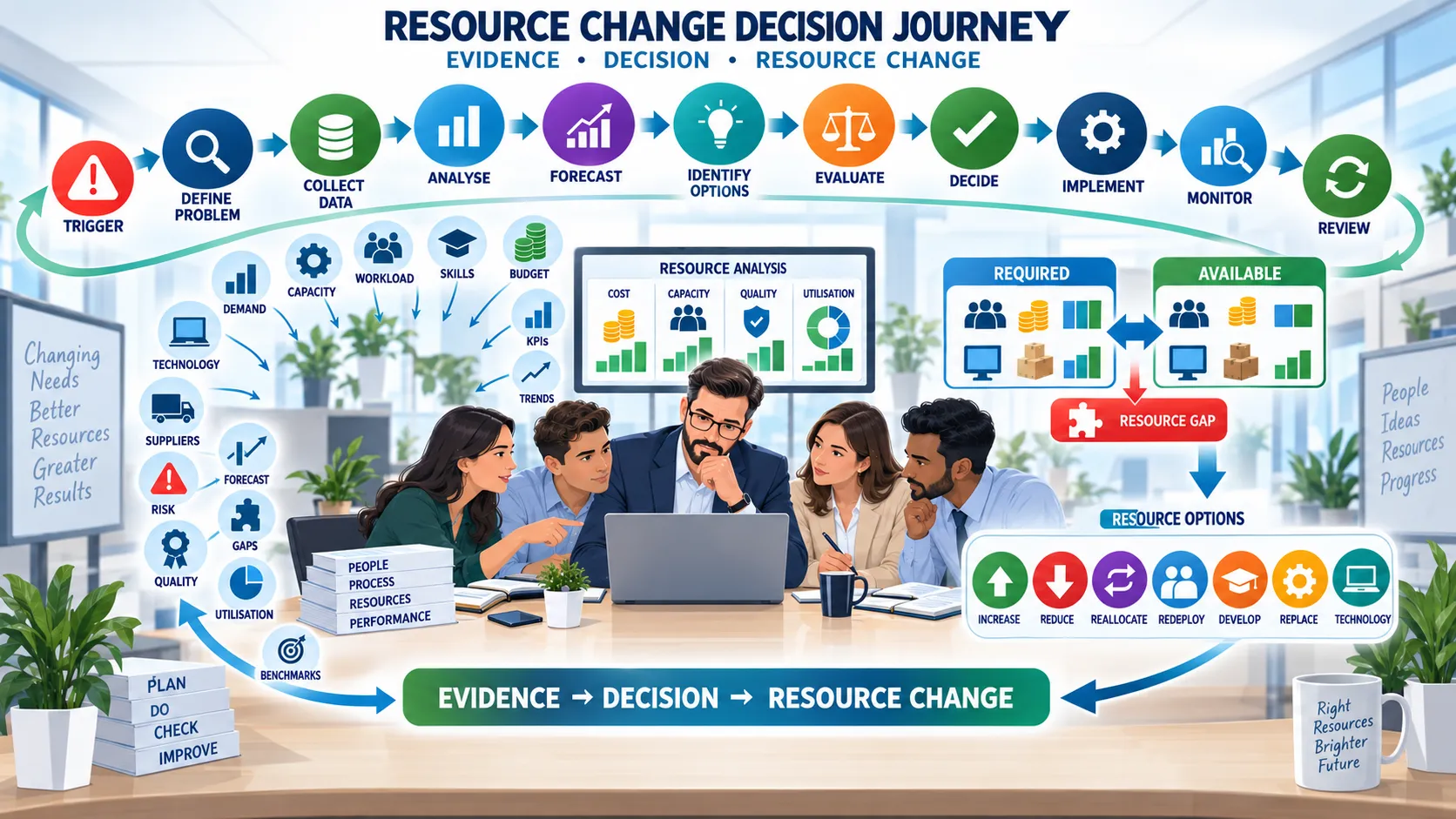
Understanding a Change to Resourcing
Definition of Resourcing
Resourcing refers to the provision, allocation and management of the people, finance, equipment, materials, technology, information, facilities and time required to achieve organisational objectives.
A change to resourcing occurs when an organisation alters the quantity, type, timing, location, capability or allocation of resources because existing arrangements are no longer appropriate for current or anticipated requirements.
A change may involve:
increasing resources;
reducing resources;
reallocating resources;
redeploying employees;
changing employee skills or capability;
replacing equipment;
introducing new technology;
changing supplier arrangements;
increasing or reducing budgets;
changing working patterns;
outsourcing activities;
bringing activities in-house;
sharing resources between teams.
Managers should therefore avoid treating resourcing as a simple question of whether the organisation needs more employees or money.
Why Changes to Resourcing May Be Required
Resource requirements can change for many reasons. Some changes are planned, while others arise unexpectedly.
Common triggers include:
increased customer demand;
reduced demand;
organisational growth;
organisational restructuring;
changes in strategic priorities;
new products or services;
employee turnover;
skills shortages;
sickness or absence;
new technology;
equipment failure;
supplier disruption;
increased operating costs;
changes in quality requirements;
changes in legal or regulatory requirements;
performance problems;
changing customer expectations;
financial pressures;
changes in working practices.
The manager’s responsibility is to determine whether the trigger represents a temporary issue, a permanent change or a situation requiring further investigation.
The Difference Between a Resource Problem and a Performance Problem
One of the most important management judgements is distinguishing between insufficient resources and ineffective resource use.
Poor performance does not automatically mean that additional resources are required.
For example, a customer service team may have slow response times. The initial assumption may be that more employees are needed. However, investigation may reveal that employees spend considerable time completing duplicated administrative tasks.
In this situation, improving the process may resolve the problem without increasing staffing.
Managers should therefore investigate:
resource availability;
resource utilisation;
workload;
productivity;
process efficiency;
employee capability;
demand;
quality;
technology;
management practices.
Only after this analysis should a change to resourcing be considered.
Key Approaches for Determining a Change to Resourcing
1. Demand and Capacity Analysis
Demand and capacity analysis is one of the most important approaches for determining whether resource levels need to change.
Demand represents the amount of work, service requirement or operational activity that the organisation needs to handle. Capacity represents the amount of work that existing resources can reasonably support.
Managers compare:
Demand versus Available Capacity
If demand consistently exceeds capacity, a resourcing change may be required.
If capacity consistently exceeds demand, resources may be under-utilised and a reduction or reallocation may be appropriate.
Assessing Demand
Managers should examine:
current workload;
expected workload;
customer volumes;
seasonal patterns;
future growth;
service requirements;
peak periods;
changes in customer behaviour.
Assessing Capacity
Managers should assess:
employee availability;
working hours;
productivity;
equipment capacity;
technology capacity;
facility capacity;
supplier capacity;
operational constraints.
A capacity gap provides important evidence for determining whether resourcing should change.
2. Workload Analysis
Workload analysis examines the amount and complexity of work assigned to employees, teams or operational functions.
Managers can use workload information to determine whether employees have sufficient capacity.
Indicators of excessive workload may include:
persistent overtime;
missed deadlines;
growing backlogs;
increased errors;
declining quality;
employee pressure;
delayed customer responses;
uncompleted activities.
However, workload should be analysed carefully. High workload may result from inefficient processes rather than insufficient staffing.
Managers should therefore examine both workload quantity and workload composition.
3. Workforce Utilisation Analysis
Workforce utilisation examines how effectively employee capacity is being used.
Managers may analyse:
productive working time;
administrative time;
idle time;
overtime;
absence;
workload distribution;
shift patterns;
employee capability.
For example, a department may have sufficient employees overall but experience understaffing during peak periods. Changing shift patterns may solve the problem without increasing headcount.
This makes utilisation analysis particularly valuable when considering whether additional staffing is genuinely required.
4. Skills and Capability Analysis
A resource shortage can relate to capability rather than quantity.
An organisation may have enough employees but lack the skills required for a new operational requirement.
Managers can assess:
current skills;
required skills;
qualifications;
experience;
technical capability;
digital capability;
leadership capability;
specialist expertise.
The resulting gap may be addressed through:
training;
coaching;
recruitment;
redeployment;
external expertise;
technology.
Skills Gap Analysis
A simple process is:
Identify the capability required.
Assess existing capability.
Identify the gap.
Assess the operational impact.
Determine whether the gap can be developed internally.
Consider recruitment or external support.
Review the cost and timescale.
Monitor whether the capability gap has been addressed.
This approach prevents unnecessary recruitment where existing employees can be developed effectively.
5. Financial and Budget Analysis
Financial analysis is essential when determining whether resourcing should change.
Managers should compare:
planned resource costs;
actual resource costs;
available budget;
forecast costs;
expected benefits;
financial constraints.
A proposed increase in resources should be assessed against its expected contribution to organisational objectives.
For example, employing two additional staff may cost £70,000 annually. If the additional capacity is expected to generate substantial operational benefits, the investment may be justified. However, if demand is temporary, alternative approaches may provide better value.
Budget Variance as a Resourcing Indicator
A significant budget variance can indicate that resource requirements have changed.
Possible causes include:
increased staffing costs;
supplier price increases;
increased overtime;
additional equipment;
unexpected maintenance;
increased material consumption.
Managers should investigate the cause before making a resourcing decision.
6. Performance and KPI Analysis
Performance indicators can provide evidence that current resourcing is no longer appropriate.
Relevant measures may include:
productivity;
response time;
customer satisfaction;
quality;
output;
service capacity;
employee workload;
budget performance;
equipment utilisation.
A sustained deterioration in performance may indicate a resource issue.
However, managers should investigate the cause rather than automatically increasing resources.
Example
If customer response time increases from 24 hours to 48 hours, the manager should examine:
enquiry volumes;
staffing;
employee productivity;
technology;
process efficiency;
absence;
shift patterns.
This creates a stronger evidence base for deciding whether resourcing should change.
7. Trend Analysis
Trend analysis involves examining resource and performance information over time.
A single poor result may not justify a resourcing change. A consistent pattern may provide stronger evidence.
Managers can review trends in:
demand;
workload;
costs;
staffing;
overtime;
productivity;
customer satisfaction;
quality;
equipment utilisation.
For example, if workload has increased steadily for six months while response times have deteriorated, the evidence for increased capacity becomes stronger.
Trend analysis therefore helps managers distinguish between temporary fluctuations and persistent resource requirements.
8. Forecasting
Forecasting is used to estimate future resource requirements.
Managers may forecast:
customer demand;
sales;
workforce requirements;
equipment needs;
materials;
budgets;
service capacity.
Forecasting is particularly important when the organisation expects growth or significant operational change.
A resource change may be required before the shortage becomes visible.
For example, if an organisation knows that customer demand is likely to increase by 25% during the next quarter, managers can plan staffing and technology capacity in advance.
9. Scenario Analysis
Scenario analysis considers different possible future conditions and their resource implications.
Managers may consider:
Scenario A: Demand increases
Additional resources may be required.
Scenario B: Demand remains stable
Existing resources may remain appropriate.
Scenario C: Demand decreases
Resources may need to be reduced or reallocated.
Scenario D: Unexpected disruption occurs
Contingency resources may be required.
Scenario planning helps managers avoid creating resource plans based on only one assumption.
10. Resource Gap Analysis
Resource gap analysis compares required resources with available resources.
A simplified approach is:
Required Resources − Available Resources = Resource Gap
The gap may relate to:
quantity;
skills;
funding;
equipment;
technology;
capacity;
time.
Managers should assess the operational consequences of the gap.
A small resource gap in a non-critical activity may have limited impact, while a small gap in a critical service may create significant risk.
11. Resource Utilisation Analysis
Resource utilisation analysis assesses whether existing resources are being used appropriately.
Managers can review:
equipment utilisation;
employee utilisation;
facility utilisation;
technology usage;
budget utilisation;
stock usage.
Low utilisation may indicate over-resourcing or poor deployment.
High utilisation may indicate capacity pressure.
However, managers should interpret utilisation carefully. A resource operating at 100% capacity may leave no flexibility for unexpected demand.
12. Benchmarking
Benchmarking involves comparing resource use or performance with an appropriate reference point.
Managers may compare:
cost per unit;
productivity;
staffing levels;
service capacity;
equipment utilisation;
response times.
Benchmarking can identify whether current resource arrangements appear significantly different from comparable operations.
However, managers should ensure that comparisons are meaningful. Different organisations may have different customers, processes, quality requirements and operating conditions.
13. Process Analysis
Process analysis examines how work is performed and whether existing processes use resources efficiently.
Managers may identify:
duplicated activities;
unnecessary approvals;
delays;
manual processes;
bottlenecks;
unnecessary handovers;
repeated work.
A resource problem may actually be a process problem.
For example, if employees spend 30% of their working time entering the same information into different systems, process redesign may release significant capacity.
14. Root-Cause Analysis
Root-cause analysis helps managers determine why a resource or performance problem exists.
A manager should avoid responding to symptoms alone.
For example:
Problem: customer response times are increasing.
Possible causes:
increased demand;
staff absence;
inefficient workflow;
outdated technology;
poor scheduling;
inadequate training.
The appropriate resourcing decision depends on the actual cause.
Root-Cause Questions
Managers can ask:
What exactly is the problem?
When did it begin?
What has changed?
Which resources are affected?
What evidence supports the issue?
Is the problem caused by quantity, capability or utilisation?
Could process improvement solve it?
Is the issue temporary or persistent?
15. Stakeholder Feedback
Stakeholder feedback can provide valuable evidence about whether resourcing is adequate.
Relevant stakeholders may include:
customers;
employees;
suppliers;
managers;
service users;
partners.
Feedback may identify issues that quantitative performance data does not fully explain.
For example, customer satisfaction may decline because customers feel that employees do not have sufficient time to provide support.
Managers can combine this information with workload and performance data to assess whether resourcing needs to change.
16. Employee Feedback
Employees are often well positioned to identify resource constraints because they experience operational processes directly.
Managers can seek feedback about:
workload;
equipment;
technology;
staffing;
skills;
time;
processes;
operational barriers.
Employee feedback should be considered alongside objective evidence rather than used in isolation.
17. Risk-Based Resource Assessment
Resource changes may be required when current resource levels create unacceptable operational risks.
Managers should assess:
likelihood of resource failure;
potential impact;
criticality of activities;
quality risks;
continuity risks;
safety risks;
financial risks.
Critical services may require higher resource resilience than lower-risk activities.
Risk-Based Decision Process
Identify the resource-related risk.
Assess likelihood.
Assess potential impact.
Determine current controls.
Identify resource weaknesses.
Consider possible responses.
Compare cost with risk reduction.
Implement proportionate action.
Monitor the result.
18. Quality Analysis
Changes to resourcing may be required when quality performance deteriorates.
Managers should monitor:
errors;
defects;
complaints;
rework;
service failures;
quality audit findings;
customer satisfaction.
However, managers should determine whether poor quality results from inadequate resources or another cause.
For example, increasing staffing may not solve a quality problem if employees lack the necessary skills.
19. Equipment and Asset Condition Analysis
Physical resources may need to change because equipment becomes unreliable, outdated or inefficient.
Managers should assess:
age;
condition;
maintenance cost;
downtime;
utilisation;
replacement cost;
productivity.
A replacement decision should consider total operational value rather than purchase price alone.
20. Technology Assessment
Technology may create a need for resource change.
Managers should determine whether current systems:
meet operational requirements;
have sufficient capacity;
support productivity;
integrate effectively;
remain reliable;
are being used appropriately.
Sometimes technology investment can reduce the need for additional staffing. In other cases, implementing new technology creates temporary requirements for technical expertise and training.
21. Supplier and Supply-Chain Analysis
External resource availability can influence internal resourcing decisions.
Managers should assess:
supplier reliability;
lead times;
costs;
quality;
availability;
contractual requirements;
supply risks.
If an important supplier becomes unreliable, the organisation may need to identify alternative suppliers or increase stock levels as a contingency.
22. Legal and Regulatory Requirements
Changes in legal or regulatory requirements can create new resource needs.
For example, a new requirement may require:
additional trained employees;
new equipment;
revised systems;
additional monitoring;
specialist expertise.
Managers must ensure that resourcing decisions support compliance as well as operational objectives.
23. Strategic Change Analysis
Changes in strategic direction can create new resource requirements.
Examples include:
entering a new market;
launching a new service;
digital transformation;
organisational expansion;
restructuring;
cost reduction;
service improvement.
Managers should review resource plans whenever strategic priorities change.
24. Make, Buy or Share Analysis
When a resource requirement changes, managers may need to consider different sourcing options.
A required capability might be:
developed internally;
recruited;
purchased externally;
outsourced;
shared with another department.
The decision should consider:
cost;
capability;
timescale;
quality;
risk;
organisational control;
flexibility.
For example, a specialist skill required for a short-term project may be more appropriately obtained externally than through permanent recruitment.
25. Cost-Benefit Analysis
Cost-benefit analysis compares the expected costs of a resource change with its anticipated benefits.
Potential benefits may include:
increased capacity;
improved quality;
reduced waiting time;
increased revenue;
lower operating costs;
reduced risk;
improved customer satisfaction.
Potential costs may include:
salaries;
equipment;
training;
technology;
implementation;
maintenance;
supplier fees.
Managers should consider both immediate and longer-term implications.
Determining the Type of Resourcing Change
Once evidence has been collected, managers need to determine what type of change is appropriate.
Increasing Resources
Additional resources may be appropriate when:
demand consistently exceeds capacity;
critical activities are under-resourced;
quality is deteriorating because of capacity constraints;
strategic growth requires additional capability;
risks cannot be controlled with existing resources.
Reducing Resources
Resource reduction may be appropriate when:
demand has consistently declined;
resources are significantly under-utilised;
activities have been discontinued;
technology has reduced resource requirements;
organisational priorities have changed.
Reduction should be carefully managed to avoid damaging critical capability.
Reallocating Resources
Reallocation may be appropriate when:
one department has excess capacity;
another department has a shortage;
priorities have changed;
demand varies between locations or periods.
Reallocation can often improve efficiency without increasing total resources.
Redeploying Employees
Employee redeployment may be suitable where:
skills are transferable;
demand has changed;
vacancies exist elsewhere;
organisational priorities require additional capacity.
Developing Existing Capability
Training and development may be appropriate when the issue is a skills gap rather than a headcount shortage.
Replacing Resources
Replacement may be necessary when existing equipment, technology or other resources are unreliable, obsolete or no longer suitable.
Introducing Technology
Technology may be considered when automation, digital systems or improved information can increase capacity or reduce unnecessary resource use.
A Structured Process for Determining a Resourcing Change
Step 1: Identify the Trigger
Establish what has caused the potential need for change.
Examples include:
performance decline;
increased demand;
increased costs;
resource shortage;
strategic change;
quality problem.
Step 2: Define the Problem
Clearly describe the resource issue.
Avoid vague statements such as “we need more staff”.
Instead:
“Customer response time has increased from 24 to 48 hours over four consecutive months while enquiry volumes have increased by 30%.”
This provides a stronger basis for analysis.
Step 3: Collect Evidence
Gather relevant information about:
demand;
capacity;
workload;
costs;
productivity;
quality;
customer feedback;
resource utilisation.
Step 4: Analyse Root Causes
Determine whether the problem results from:
insufficient resources;
poor allocation;
poor utilisation;
inefficient processes;
capability gaps;
changing demand.
Step 5: Forecast Future Requirements
Determine whether the issue is temporary or likely to continue.
Step 6: Identify Options
Possible options may include:
increase;
reduce;
reallocate;
redeploy;
train;
automate;
outsource;
replace;
share.
Step 7: Evaluate Options
Compare options against:
cost;
benefit;
risk;
quality;
timescale;
flexibility;
organisational objectives.
Step 8: Select the Appropriate Change
Select the option that provides the most appropriate balance between resource requirements and organisational outcomes.
Step 9: Obtain Appropriate Approval
Where required, managers should obtain approval from relevant budget holders or organisational authorities.
Step 10: Implement the Change
Introduce the resourcing change in a controlled manner.
Step 11: Monitor Impact
Monitor whether the change produces the intended improvement.
Step 12: Review and Adjust
If the change does not produce the expected result, investigate why and adjust the approach.
Practical Decision Table
| Evidence or Factor | What It May Indicate | Possible Resourcing Response |
|---|---|---|
| Demand consistently exceeds capacity | Under-resourcing | Increase or reallocate resources |
| Employees have required skills but poor workload distribution | Inefficient allocation | Reorganise schedules or workloads |
| Employees lack specialist capability | Skills gap | Training, recruitment or external expertise |
| Equipment frequently fails | Asset constraint | Repair, replace or upgrade |
| Demand has significantly decreased | Excess capacity | Reduce or redeploy resources |
| Technology can automate repetitive tasks | Efficiency opportunity | Invest in appropriate technology |
| Costs consistently exceed budget | Resource cost pressure | Investigate causes and redesign allocation |
| Quality deteriorates during peak periods | Capacity or workload pressure | Increase or flex resources during peaks |
| One team has excess capacity while another is under pressure | Uneven allocation | Share or redeploy resources |
| Future demand is expected to increase | Anticipated capacity gap | Plan resources in advance |
Practical Example: Customer Service
A customer service team has experienced a 35% increase in enquiries.
Response times have increased from one day to three days, and customer complaints have increased.
The manager initially considers recruiting three employees.
Before making the decision, the manager examines:
enquiry trends;
staffing;
employee workload;
shift patterns;
technology;
administrative activities;
customer feedback.
The analysis identifies that demand has increased primarily during the morning, while staffing levels remain constant throughout the day.
The manager introduces flexible shift scheduling and automates several routine enquiries.
After implementation, response times improve and complaints decline.
The organisation therefore avoids immediately increasing permanent staffing while improving resource utilisation.
Practical Example: Education and Training
A training organisation experiences increased learner enrolment.
The initial response is to recruit additional tutors.
However, analysis shows that existing tutors have capacity during several parts of the working week.
The manager considers:
timetable redesign;
group sizes;
digital delivery;
tutor workload;
administrative support.
The organisation reallocates tutor capacity and improves scheduling.
Additional recruitment is postponed until demand evidence demonstrates that existing capacity will not be sufficient.
This demonstrates the importance of capacity analysis before committing additional resources.
Practical Example: Manufacturing
A manufacturing organisation experiences increasing production costs.
Management proposes reducing staffing.
The operations manager analyses:
employee productivity;
machine downtime;
material wastage;
overtime;
defective production;
equipment utilisation.
The analysis shows that an ageing machine is responsible for significant downtime and waste.
Replacing the machine may therefore be more effective than reducing staffing.
The resourcing change is consequently directed towards equipment rather than workforce reduction.
Practical Example: Technology Implementation
An organisation introduces a new digital system.
The project is on schedule, but employee adoption is low.
The manager considers whether more employees are required.
Analysis shows that the actual problem is limited user capability.
The appropriate resource change is therefore additional training and technical support rather than increased staffing.
This demonstrates why managers should identify the type of resource gap before deciding what change is required.
Practical Example: Seasonal Demand
A retail organisation experiences a significant increase in customer demand during the holiday period.
Permanent staffing levels are sufficient during normal periods but inadequate during peak demand.
A permanent increase in headcount would create excess capacity during quieter periods.
The manager instead considers:
temporary staff;
adjusted shifts;
overtime;
cross-training;
technology.
A flexible resourcing approach allows the organisation to match resources more closely with demand.
Common Mistakes When Determining Resourcing Changes
Assuming More Resources Are Always the Solution
Additional resources may not address the underlying problem.
Relying on One Indicator
A single KPI may not provide enough evidence to justify a significant resource change.
Ignoring Existing Capacity
Managers may overlook resources that are available but poorly allocated.
Focusing Only on Cost
Reducing costs can damage quality or capacity if critical resources are removed.
Ignoring Future Demand
A resource plan based only on current conditions may become inadequate quickly.
Failing to Consider Skills
Headcount does not guarantee capability.
Ignoring Employee Feedback
Operational employees may identify resource problems that performance data alone does not explain.
Making Permanent Changes for Temporary Problems
Temporary demand should not automatically result in permanent resource increases.
Key Benefits of Using Structured Resourcing Approaches
Better Decision-Making
Managers have stronger evidence for determining whether change is necessary.
Improved Financial Control
Resource changes can be assessed against cost and expected value.
Better Capacity Management
Resources can be matched more closely with operational demand.
Improved Productivity
Better allocation and utilisation can increase productive output.
Reduced Resource Waste
Managers can identify under-utilised and unnecessary resources.
Improved Quality
Appropriate resourcing supports consistent service and product standards.
Reduced Operational Risk
Managers can identify and address critical resource gaps before they create serious problems.
Greater Flexibility
Organisations can adjust resource levels according to changing conditions.
Stronger Strategic Alignment
Resources can be redirected towards changing organisational priorities.
Key Concepts
Resource Change
An adjustment to the quantity, type, allocation, timing or capability of organisational resources.
Capacity Analysis
Assessment of the amount of work that available resources can reasonably support.
Demand Analysis
Assessment of current and expected operational requirements.
Resource Gap
The difference between resources required and resources currently available.
Resource Utilisation
The extent to which available resources are actively and productively used.
Skills Gap
The difference between capabilities required and capabilities currently available.
Workforce Capacity
The amount of productive work that available employees can reasonably undertake.
Resource Reallocation
Moving existing resources between activities, teams or priorities.
Resource Redeployment
Moving employees or other resources to a different operational requirement.
Forecasting
Estimating future resource requirements based on expected conditions.
Scenario Analysis
Assessing different possible future conditions and their resource implications.
Contingency Resource
An alternative or additional resource available to respond to unexpected circumstances.
Managerial Checklist
Before recommending a change to resourcing, managers should ask:
What has triggered the potential resource change?
What organisational objective is affected?
What evidence demonstrates that a change is required?
Is the problem temporary or persistent?
What is current demand?
What is available capacity?
Are existing resources being fully utilised?
Is there a skills or capability gap?
Is the problem caused by inefficient processes?
What are the financial implications?
What quality implications exist?
What risks are involved?
What future demand is expected?
Could resources be reallocated?
Could employees be redeployed?
Could training address the issue?
Could technology improve capacity?
Would outsourcing be appropriate?
What alternatives have been considered?
What are the expected benefits?
How will the impact be measured?
When will the resourcing decision be reviewed?
Professional Management Insight
Determining a change to resourcing is fundamentally an exercise in managerial judgement. The strongest managers do not respond to every operational difficulty by requesting additional resources. Instead, they investigate the relationship between demand, capacity, capability, utilisation, cost, quality and organisational outcomes.
A resourcing change should be based on evidence rather than assumption.
For example, if an employee reports that their team needs additional staff, the manager should investigate workload, productivity, scheduling, process efficiency and demand before deciding that recruitment is necessary.
Equally, managers should recognise when additional resources are genuinely required. If demand has increased permanently and existing capacity cannot maintain quality or achieve objectives, refusing to increase resources simply to protect the budget may create greater long-term costs.
The professional management approach is therefore to ask:
What has changed?
What evidence demonstrates the impact?
What resource gap exists?
What is causing the gap?
What options are available?
Which option provides the best balance of cost, quality, risk, capacity and organisational outcomes?
This approach supports responsible resource decisions and helps managers avoid both under-resourcing and over-resourcing.
Resource decisions should also be treated as dynamic. Once a change has been implemented, managers should monitor whether it produces the expected outcome. If the problem remains, the manager should investigate further rather than assuming that the original resource decision was correct.
The overall process can therefore be represented as:
IDENTIFY → ANALYSE → FORECAST → EVALUATE → DECIDE → IMPLEMENT → MONITOR → REVIEW → ADJUST
This continuous approach ensures that resourcing remains aligned with organisational objectives and changing operational requirements.
Summary
Determining a change to resourcing requires managers to assess whether existing resources remain appropriate for current and future organisational requirements. A change may involve increasing, reducing, reallocating, redeploying, replacing or changing the type of resources used.
Important approaches include demand and capacity analysis, workload analysis, workforce utilisation analysis, skills and capability assessment, financial analysis, KPI and performance analysis, trend analysis, forecasting, scenario analysis, resource gap analysis, benchmarking, process analysis, root-cause analysis, stakeholder feedback, risk assessment and quality analysis.
Managers should not automatically assume that poor performance is caused by insufficient resources. The underlying problem may involve poor allocation, inefficient processes, weak capability, poor utilisation, technology limitations or changing demand.
A structured process begins by identifying the trigger, defining the problem, collecting evidence, analysing root causes, forecasting future requirements, identifying options and evaluating those options against cost, quality, risk, capacity and organisational objectives.
Possible resourcing responses include increasing resources, reducing resources, reallocating existing resources, redeploying employees, developing capability, replacing equipment, introducing technology, sharing resources or using external providers.
The most effective resource decisions are evidence-based, proportionate and aligned with organisational objectives. They recognise that both under-resourcing and over-resourcing can create organisational problems.
For middle managers and leaders, the key principle is:
Change resourcing when evidence demonstrates that existing resources are no longer appropriate for achieving required organisational outcomes, and select the response that provides the most appropriate balance between capacity, cost, quality, risk and organisational priorities.
Effective resourcing is therefore a continuous management process rather than a one-time decision. Managers should regularly assess demand, capacity, utilisation, performance and future requirements to ensure that resources remain fit for purpose and capable of supporting organisational objectives.
3.Discuss Sources of Data and Information Used to Plan Resource Requirements
Effective resource planning depends on the quality, relevance and reliability of the information available to managers. Before deciding how many employees are required, what equipment should be purchased, how much stock should be held, what technology is needed or how much funding should be allocated, managers need evidence about current performance, future demand, existing capacity and organisational priorities. Data and information provide this evidence and help managers move from assumptions and estimates towards informed resource planning decisions.
For practising and aspiring middle managers and leaders, the ability to identify and evaluate appropriate sources of data is particularly important. Resource planning decisions can have significant financial and operational consequences. An inaccurate estimate of workforce requirements may result in under-resourcing or unnecessary staffing costs. Poor demand information can result in insufficient stock or excessive inventory. Inadequate information about equipment utilisation can lead to unnecessary purchases, while incomplete information about employee capability can result in inappropriate workforce planning.
Data and information should therefore be treated as important organisational resources in their own right. Managers need to know what information is required, where it can be obtained, how reliable it is, how current it is and how it should be interpreted.
A useful resource planning information cycle is:
Objectives → Information Requirements → Data Sources → Data Collection → Validation → Analysis → Resource Decision → Monitoring → Review
This demonstrates that data is not collected simply for reporting purposes. Its primary management value is created when it supports better resource decisions and contributes to organisational objectives.
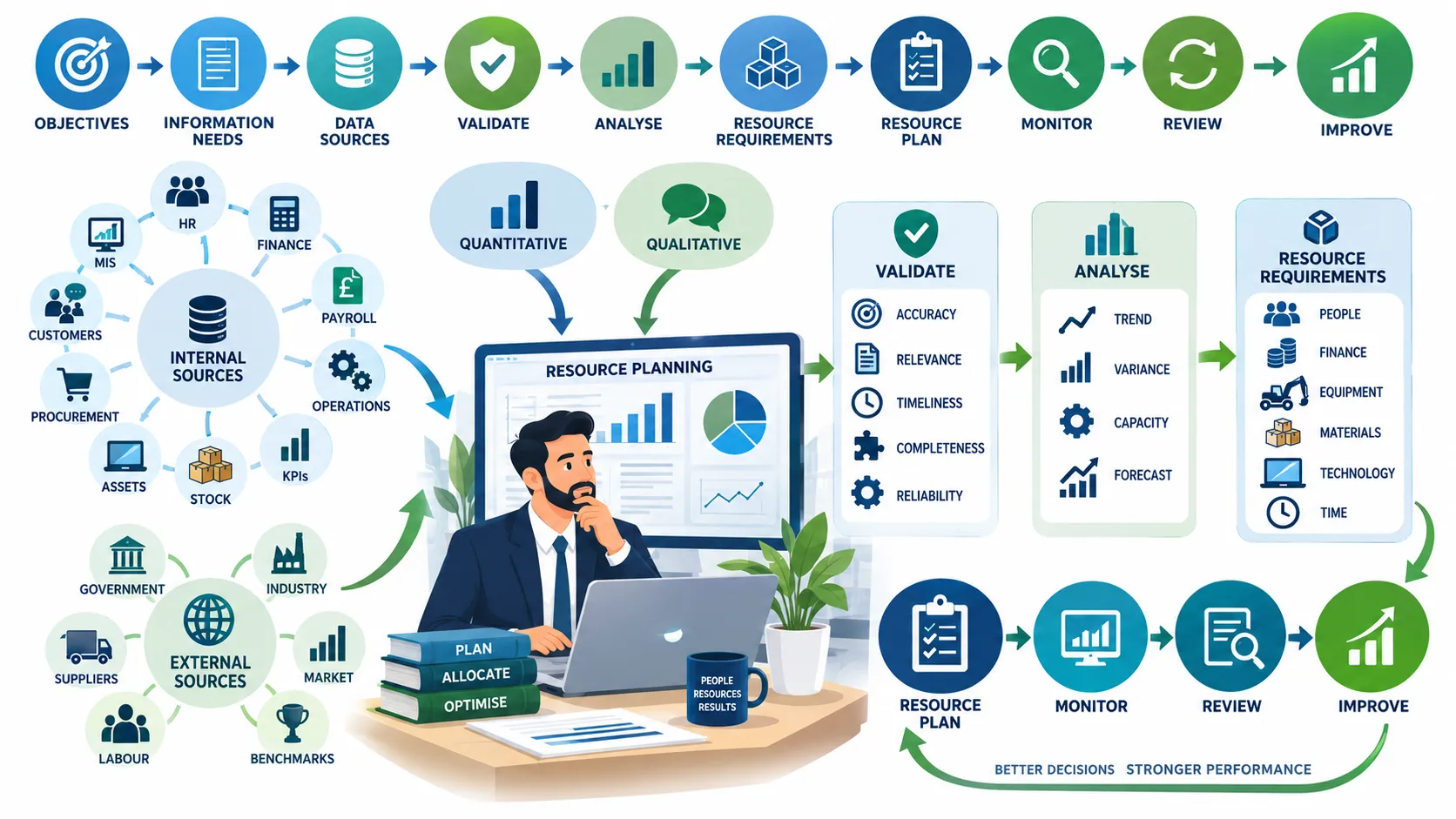
Understanding Data and Information in Resource Planning
Definition of Data
Data refers to individual facts, figures, observations, measurements or records collected about an activity, process, resource or outcome.
Examples include:
number of employees;
hours worked;
customer enquiries;
sales volumes;
stock levels;
expenditure;
equipment usage;
production volumes;
absence levels;
service response times.
Data may be quantitative or qualitative.
Definition of Information
Information is data that has been organised, processed, interpreted or presented in a way that provides meaning and supports decision-making.
For example, 2,400 customer enquiries is data. An analysis showing that enquiries have increased by 20% over the previous six months and are concentrated between 9:00 am and 12:00 pm is information that can support workforce resource planning.
Managers therefore need more than raw data. They need relevant information that explains what the data means and how it relates to resource requirements.
Why Data and Information Matter in Resource Planning
Resource planning involves decisions about limited organisational resources. Reliable information allows managers to estimate requirements more accurately and reduce unnecessary assumptions.
Good data and information can help managers:
identify current resource requirements;
forecast future demand;
understand existing resource capacity;
identify resource gaps;
identify excess capacity;
assess workforce capability;
estimate financial requirements;
monitor resource utilisation;
identify operational trends;
evaluate resource productivity;
identify risks;
compare planned and actual resource use;
support resource allocation decisions.
Without appropriate information, managers may make decisions based on historical assumptions, personal opinion or incomplete evidence.
Characteristics of Good Resource Planning Information
Not every piece of information is suitable for resource planning. Managers should assess information quality before relying on it.
Accuracy
Information should correctly represent the situation being assessed.
For example, if employee absence records are inaccurate, workforce capacity calculations may be unreliable.
Relevance
Information should directly relate to the resource decision being made.
A manager planning staffing levels needs information about workload, demand and employee capacity rather than unrelated organisational statistics.
Timeliness
Information should be sufficiently current for the decision.
Old demand data may not accurately represent current customer behaviour.
Completeness
Important information should not be missing.
For example, workforce planning should consider both employee numbers and employee availability.
Consistency
Data should be collected and recorded using consistent methods so that meaningful comparisons can be made.
Reliability
Managers should have reasonable confidence that the source and method used to collect the information are dependable.
Accessibility
Relevant managers should be able to access information when required, subject to appropriate organisational controls.
Internal Sources of Data and Information
Internal sources are generated within the organisation and can provide valuable evidence about current resources, performance and operational requirements.
1. Financial Records and Management Accounts
Financial information is one of the most important sources used for resource planning.
Managers can use:
budgets;
management accounts;
expenditure records;
cost reports;
revenue information;
financial forecasts;
budget variance reports;
purchase records;
payroll information.
Financial data helps managers understand what resources currently cost and whether available funding is sufficient.
For example, a department planning to increase staffing can examine existing salary expenditure, overtime costs and available budget before making a recommendation.
Financial information can also reveal inefficient resource use. If expenditure is consistently above budget, managers may need to investigate whether resource requirements have changed or whether resources are being used inefficiently.
2. Human Resource Records
Human resource systems provide important information for workforce resource planning.
Relevant information may include:
employee numbers;
job roles;
working hours;
skills;
qualifications;
experience;
absence;
turnover;
vacancies;
recruitment activity;
training records;
employee availability.
This information allows managers to assess whether the organisation has sufficient workforce capacity and capability.
For example, a department may have 30 employees but only five employees with the specialist skills required for an upcoming operational activity.
3. Payroll Data
Payroll records provide information about the financial cost of human resources.
Managers can examine:
salary costs;
overtime;
temporary staffing;
allowances;
working hours.
Payroll information can help managers determine whether workforce resource requirements are financially sustainable.
It can also identify patterns such as consistently high overtime, which may indicate a capacity problem.
4. Employee Attendance and Absence Records
Attendance and absence information helps managers understand actual workforce availability.
Relevant data may include:
sickness absence;
authorised leave;
unauthorised absence;
attendance patterns;
temporary restrictions;
working hours.
High or unpredictable absence can reduce available capacity and may need to be considered when planning workforce requirements.
5. Workforce Skills and Competency Records
Managers can use skills matrices, competency records and training databases to identify workforce capability.
This information helps answer:
What skills are currently available?
Which skills are required?
Where are the capability gaps?
Which employees can be redeployed?
Can existing employees be trained?
This can prevent unnecessary recruitment when existing employees can develop the required capability.
6. Operational Performance Reports
Operational reports provide information about how effectively resources are currently supporting organisational activities.
Examples include:
productivity reports;
service performance reports;
production reports;
workload reports;
quality reports;
customer service reports.
These sources can reveal whether resource levels are appropriate.
For example, consistently increasing response times may indicate that service demand has exceeded available capacity.
7. Key Performance Indicator Data
KPIs provide measurable evidence about operational performance.
Managers may examine indicators relating to:
productivity;
quality;
response times;
customer satisfaction;
output;
cost;
capacity;
resource utilisation.
KPI trends can help managers determine whether a resource change may be necessary.
However, managers should avoid relying on a single KPI. Resource decisions should normally consider a range of relevant indicators.
8. Operational Plans
Existing operational plans are important sources of resource information.
They may identify:
planned activities;
objectives;
staffing;
budgets;
equipment;
materials;
timescales;
responsibilities;
expected outputs;
performance indicators.
Managers can compare planned resource requirements with actual requirements and identify changes.
9. Previous Resource Plans
Historical resource plans can provide useful baseline information.
They may show:
previous staffing levels;
previous equipment requirements;
historical budgets;
previous resource gaps;
previous demand assumptions.
However, managers should not automatically repeat previous allocations.
Historical information should be combined with current conditions and future forecasts.
10. Project Records
Project documentation can provide resource planning information for temporary or change-related activities.
Relevant sources include:
project plans;
project budgets;
project schedules;
resource estimates;
project performance reports;
lessons learned.
These sources can help managers understand resource requirements for future projects.
11. Asset Registers
Asset registers provide information about physical resources.
They may contain information about:
equipment;
vehicles;
machinery;
facilities;
ownership;
condition;
age;
maintenance;
replacement requirements.
Managers can use asset information to determine whether existing physical resources are sufficient.
12. Equipment Utilisation Records
Equipment usage data helps managers understand whether assets are being effectively utilised.
Managers may examine:
hours of use;
downtime;
frequency of use;
maintenance requirements;
operational capacity.
Low utilisation may indicate excess capacity, while consistently high utilisation may indicate a need for additional resources.
13. Stock and Inventory Records
Stock information is particularly important for organisations that rely on materials, products or consumables.
Managers can examine:
stock levels;
usage rates;
reorder levels;
stock turnover;
wastage;
expiry;
shortages.
This information helps managers balance availability with unnecessary inventory.
14. Procurement Records
Procurement data provides information about resources purchased from external suppliers.
Managers can examine:
purchase volumes;
supplier costs;
delivery times;
supplier performance;
contract values;
purchasing frequency.
Procurement information can reveal changing costs and supply risks that affect resource planning.
15. Customer Records
Customer information can be an important source of demand data.
Managers may examine:
customer numbers;
enquiry volumes;
order volumes;
service usage;
complaint levels;
customer preferences;
demand patterns.
This information can help predict future resource requirements.
16. Customer Feedback
Customer feedback provides qualitative information that may explain resource-related performance issues.
Sources can include:
surveys;
complaints;
reviews;
interviews;
feedback forms;
customer service records.
For example, customers may report that response times are too slow. Managers can combine this information with workload and staffing data to determine whether additional capacity is required.
17. Supplier Information
Suppliers can provide useful information about:
availability;
lead times;
prices;
capacity;
supply risks;
product specifications.
Supplier information can be particularly important when resource planning depends on external materials, equipment or specialist services.
18. Management Information Systems
Management information systems bring together operational data to support management decisions.
They may provide information about:
workforce;
finance;
customer activity;
operations;
performance;
resources.
Integrated management information can help managers identify relationships between different resource categories.
For example, a manager may identify that increased customer demand is associated with higher overtime and declining service quality.
External Sources of Data and Information
External information helps managers understand factors outside the organisation that may affect resource requirements.
19. Government and Official Statistics
Government departments and official statistical organisations can provide information about:
population;
employment;
economic conditions;
labour markets;
industry trends;
regional demand.
Such information can support workforce and market planning.
20. Industry Reports
Industry reports provide information about trends within a particular sector.
Managers may use them to assess:
market growth;
technology developments;
workforce trends;
customer expectations;
emerging risks.
Industry information can help organisations anticipate future resource requirements.
21. Labour Market Information
Labour market information can help managers understand the availability and cost of skills.
Relevant information may include:
employment trends;
skills shortages;
salary trends;
availability of specialists;
recruitment conditions.
This is particularly useful when planning recruitment.
22. Economic Information
Economic data can influence resource planning through changes in:
inflation;
interest rates;
employment;
consumer demand;
operating costs.
For example, rising inflation may increase the expected cost of materials, equipment and external services.
23. Market Research
Market research can provide information about:
customer demand;
buying behaviour;
market size;
competitor activity;
customer expectations.
Managers can use this information when forecasting resource requirements.
24. Competitor Information
Competitor analysis can provide insights into:
service levels;
technology;
staffing approaches;
product development;
market positioning.
Competitor information should be used carefully and ethically, but it can help managers understand changing market expectations.
25. Supplier Market Information
Supplier markets can influence resource planning through changes in:
availability;
price;
lead times;
supply capacity;
technology.
Managers may need to adjust resource plans if external supply conditions change.
26. Professional and Sector Bodies
Professional associations and sector bodies can provide information about:
industry trends;
skills requirements;
professional standards;
emerging practices;
workforce development.
Such information can help managers anticipate future capability requirements.
27. Research and Benchmarking Studies
Benchmarking information can help managers compare resource use with relevant external organisations or accepted performance standards.
Examples include:
staffing ratios;
cost per unit;
productivity;
service response times;
resource utilisation.
Managers should ensure that comparisons are appropriate and sufficiently similar to be meaningful.
Primary and Secondary Data
Managers should also distinguish between primary and secondary data.
Primary Data
Primary data is collected directly for a specific organisational purpose.
Examples include:
employee surveys;
customer surveys;
interviews;
observations;
focus groups;
direct workload measurement.
Primary data can be useful when existing information does not answer a specific resource planning question.
Secondary Data
Secondary data has already been collected for another purpose but may be useful for resource planning.
Examples include:
government statistics;
industry reports;
historical organisational records;
published market research;
existing management reports.
Secondary data can save time and resources, but managers should evaluate its relevance and currency.
Quantitative and Qualitative Information
Effective resource planning often requires a combination of quantitative and qualitative information.
Quantitative Information
Quantitative information can be measured numerically.
Examples include:
number of employees;
costs;
sales;
customer numbers;
productivity;
stock levels;
working hours;
response times.
Quantitative data is useful for identifying patterns and comparing performance.
Qualitative Information
Qualitative information provides descriptive insights.
Examples include:
employee comments;
customer feedback;
interviews;
observations;
supplier feedback.
Qualitative information can help explain why a particular resource problem exists.
For example, a productivity figure may show that output has declined, while employee interviews may reveal that outdated equipment is causing delays.
Combining Data Sources
The strongest resource planning decisions often result from combining multiple information sources.
For example, workforce planning may use:
HR records;
payroll data;
absence records;
workload data;
customer demand;
productivity measures;
employee feedback;
financial forecasts.
This provides a more complete picture than relying on one source.
Triangulation of Information
Definition of Triangulation
Triangulation involves using multiple sources or methods of evidence to examine the same issue and improve confidence in the findings.
For example, a manager believes that staffing is insufficient.
Evidence can be obtained from:
customer response times;
employee workload;
overtime;
enquiry volumes;
customer complaints.
If all sources indicate increased capacity pressure, the evidence for a resource change becomes stronger.
Data Analysis Techniques for Resource Planning
Collecting data is only the beginning. Managers need to analyse it.
Trend Analysis
Trend analysis examines changes over time.
Managers can identify whether:
demand is increasing;
costs are rising;
productivity is declining;
staffing requirements are changing.
Variance Analysis
Variance analysis compares planned and actual results.
Examples include:
planned versus actual expenditure;
planned versus actual staffing;
planned versus actual resource utilisation.
Capacity Analysis
Capacity analysis compares available resource capacity with operational demand.
Ratio Analysis
Ratios can help compare resources with activity levels.
Examples include:
employees per customer;
cost per unit;
output per employee;
equipment utilisation rate.
Forecasting
Forecasting uses current and historical information to estimate future requirements.
Managers may forecast:
staffing;
customer demand;
material requirements;
budgets;
equipment needs.
Evaluating Data Quality
Before using information to make a major resource decision, managers should assess its quality.
A practical data-quality review can ask:
Is the source reliable?
Is the information current?
Is it complete?
Is it relevant?
Was it collected consistently?
Are there obvious errors?
Can the information be independently checked?
Does it represent the current operating environment?
Poor-quality information can lead to inappropriate resource decisions.
Process for Using Data and Information to Plan Resource Requirements
Step 1: Define the Resource Planning Question
The manager should establish exactly what needs to be determined.
For example:
“How many employees will be required to meet expected customer demand over the next six months?”
Step 2: Identify Required Information
Determine what evidence is needed.
This may include:
customer demand;
workload;
current staffing;
productivity;
absence;
costs;
future forecasts.
Step 3: Identify Data Sources
Determine where the information can be obtained.
Possible sources include:
HR systems;
financial systems;
operational reports;
customer records;
supplier information;
external statistics.
Step 4: Collect the Information
Gather relevant and appropriately controlled information.
Step 5: Validate the Information
Check for accuracy, completeness and consistency.
Step 6: Analyse the Data
Use appropriate analytical approaches such as:
trends;
variance;
ratios;
capacity analysis;
forecasting.
Step 7: Identify Resource Requirements
Translate findings into specific resource requirements.
Step 8: Compare Requirements with Available Resources
Identify:
shortages;
surpluses;
capability gaps;
capacity constraints.
Step 9: Evaluate Options
Consider whether requirements can be addressed through:
reallocation;
improved utilisation;
training;
recruitment;
technology;
outsourcing;
additional equipment.
Step 10: Make the Resource Planning Decision
Select the option most appropriate for organisational objectives.
Step 11: Monitor the Decision
Track whether the resource plan produces the expected results.
Step 12: Review and Update
Update resource requirements when new information becomes available.
Practical Example: Workforce Planning
A customer service organisation is experiencing increased customer enquiries.
The manager needs to determine whether additional employees are required.
The manager reviews:
enquiry volumes;
response times;
current staffing;
employee working hours;
absence;
overtime;
productivity;
customer satisfaction;
future demand forecasts.
The information shows that enquiry volumes have increased consistently for six months and response times have deteriorated.
However, the manager also discovers that staffing is not aligned with peak demand periods.
The manager therefore considers changing employee schedules before recommending permanent recruitment.
This example demonstrates how multiple sources can support a more effective resourcing decision.
Practical Example: Equipment Planning
A manufacturing organisation is considering purchasing a new machine.
The manager reviews:
existing machine utilisation;
downtime;
maintenance costs;
production demand;
production output;
quality;
forecast demand.
The data shows that current machines operate at high utilisation and downtime is increasing.
Future demand is also expected to rise.
The evidence provides a stronger basis for considering additional equipment.
Practical Example: Materials Planning
A hospitality organisation experiences frequent shortages of key materials.
The manager examines:
historical usage;
seasonal demand;
current stock;
supplier lead times;
wastage;
purchasing records.
The analysis shows that stock levels were based on average demand and did not account for seasonal peaks.
The manager adjusts stock planning to reflect demand patterns while monitoring wastage.
Practical Example: Technology Resource Planning
An organisation is considering introducing a new digital platform.
The manager reviews:
current system usage;
employee productivity;
customer feedback;
technology costs;
system limitations;
employee digital capability;
future operational requirements.
The analysis shows that the existing system is creating significant administrative duplication.
The manager can therefore develop a stronger business case for technology investment based on measurable operational need.
Practical Example: Financial Resource Planning
A department requests an increased budget.
Instead of approving the request immediately, the manager reviews:
previous expenditure;
budget variance;
workload;
performance;
resource utilisation;
future demand.
The analysis reveals that part of the requested increase relates to resources that are currently under-utilised.
The manager therefore recommends reallocating existing resources before increasing the overall budget.
Common Problems With Data Used for Resource Planning
Outdated Information
Old information may not reflect current demand or operating conditions.
Incomplete Information
Missing data can create an inaccurate picture of resource requirements.
Inconsistent Data
Different teams may collect information using different definitions or methods.
Poor Data Quality
Errors can lead to incorrect conclusions.
Over-Reliance on Historical Data
Historical patterns may not predict future conditions accurately.
Data Overload
Managers may have access to large amounts of information but insufficiently relevant information.
Confirmation Bias
Managers may focus on information that supports an existing assumption while ignoring contradictory evidence.
Lack of Context
A performance figure without contextual information may be misleading.
Improving the Use of Data and Information
Managers can improve resource planning by developing clear information requirements and consistent processes.
Good practice includes:
defining key resource measures;
using consistent data definitions;
establishing clear reporting responsibilities;
validating important information;
combining quantitative and qualitative evidence;
using current information;
comparing multiple sources;
reviewing forecasts;
documenting assumptions;
monitoring data quality.
Ethical and Responsible Use of Information
Resource planning may involve employee, customer, financial and operational information. Managers must therefore use information responsibly.
Good practice includes:
accessing information only for legitimate purposes;
protecting confidential information;
using accurate information;
avoiding misleading interpretation;
maintaining appropriate records;
following organisational information policies;
respecting relevant legal and regulatory requirements.
Responsible information use supports trust and better decision-making.
Key Benefits of Using Appropriate Data and Information
More Accurate Resource Forecasting
Managers can estimate future requirements using evidence rather than assumptions.
Better Resource Allocation
Resources can be directed towards areas of greatest need.
Improved Financial Control
Financial data supports better budgeting and expenditure decisions.
Better Workforce Planning
Managers can identify staffing and capability requirements.
Improved Capacity Management
Demand and capacity information helps balance workload and resources.
Reduced Resource Waste
Utilisation and cost information can identify unnecessary or under-used resources.
Better Risk Management
Data can identify emerging resource shortages and dependencies.
Improved Decision-Making
Managers have stronger evidence for evaluating alternative resource options.
Stronger Organisational Performance
Appropriate resources are more likely to be available to support organisational objectives.
Key Concepts
Data
Raw facts, measurements or observations collected about an activity, resource or situation.
Information
Data that has been processed, organised or interpreted to provide meaning and support decision-making.
Primary Data
Information collected directly for a specific purpose.
Secondary Data
Existing information originally collected for another purpose but used for resource planning.
Quantitative Data
Numerical information that can be measured and analysed statistically or mathematically.
Qualitative Data
Descriptive information that provides insight into experiences, opinions, perceptions or reasons.
Demand Data
Information showing the level or pattern of operational requirements.
Capacity Data
Information showing the amount of work available resources can support.
Resource Utilisation Data
Information showing how extensively resources are being used.
Forecasting
The process of estimating future resource requirements using available evidence and assumptions.
Benchmarking
Comparing performance or resource use with an appropriate external or internal reference point.
Triangulation
Using multiple sources or methods of evidence to increase confidence in findings.
Data Quality
The degree to which data is accurate, relevant, complete, consistent, reliable and timely.
Managerial Checklist
Before using information to make a resource planning decision, managers should ask:
What resource decision needs to be made?
What information is required?
Where can reliable information be obtained?
Is the information current?
Is it accurate?
Is it complete?
Is it relevant?
Can the information be verified?
What does the information show about demand?
What does it show about capacity?
What does it show about resource utilisation?
What does it show about costs?
What does it show about quality?
What does it show about workforce capability?
What does it show about future requirements?
Are multiple information sources available?
Do the sources provide consistent findings?
What assumptions have been made?
What risks could affect the information?
How will the resource decision be monitored?
Professional Management Insight
The quality of resource planning is strongly influenced by the quality of information used to support it. Managers should therefore avoid making significant resourcing decisions based solely on instinct, historical habit or individual opinion.
A professional resource planning approach begins with a clear question. The manager then identifies the information needed to answer that question, gathers evidence from appropriate sources, validates the information and analyses it in context.
For example, if a manager believes that a department requires additional staff, the decision should not be based solely on employee requests. The manager should examine workload, demand, productivity, absence, overtime, customer outcomes and future forecasts.
The same principle applies to equipment, technology, materials and financial resources.
Managers should also recognise that data and information have limitations. Historical information may not accurately predict future demand. External forecasts may be based on assumptions. Employee feedback may provide valuable insight but may not represent the entire workforce. Financial information may show expenditure without explaining operational causes.
Strong managerial judgement therefore combines evidence from different sources.
A useful principle is:
Data tells the manager what is happening.
Analysis helps explain patterns and relationships.
Professional judgement determines what action should be taken.
This distinction is particularly important for middle managers because they must often convert complex operational information into practical resource decisions.
Summary
Data and information are essential for effective resource planning because they provide the evidence managers need to determine current and future resource requirements. Reliable information helps managers understand demand, capacity, workforce capability, financial constraints, resource utilisation, performance, quality and operational risk.
Internal sources include financial records, HR systems, payroll, attendance data, skills records, operational reports, KPIs, operational plans, project records, asset registers, stock records, procurement information, customer records and management information systems.
External sources include government statistics, industry reports, labour market information, economic data, market research, competitor information, supplier information, professional bodies and benchmarking studies.
Managers should also understand the difference between primary and secondary data and between quantitative and qualitative information. Quantitative information provides measurable evidence, while qualitative information can help explain experiences, perceptions and causes behind performance results.
The most effective resource planning decisions usually combine several information sources. Managers can use trend analysis, variance analysis, capacity analysis, ratio analysis and forecasting to transform data into meaningful information.
Data quality is equally important. Information should be accurate, relevant, timely, complete, consistent and reliable. Managers should validate important information and avoid relying on outdated or incomplete data.
The resource planning information process can be summarised as:
Identify the resource question → Determine information requirements → Identify sources → Collect data → Validate → Analyse → Identify resource requirements → Evaluate options → Make decisions → Monitor → Review
Ultimately, effective resource planning depends on the manager’s ability to connect reliable evidence with organisational objectives. The purpose of collecting and analysing data is not simply to produce reports; it is to support better decisions about people, finance, equipment, materials, technology, information, facilities and time.
When managers use high-quality information systematically, they are better positioned to identify resource gaps, avoid unnecessary expenditure, improve utilisation, anticipate future requirements, manage operational risks and allocate resources in ways that support organisational objectives.
4.Evaluate Options for the Supply of Resources to Meet Organisational Objectives
Introduction to Resource Supply Options
Effective resource planning does not end when an organisation identifies what resources it requires. Managers must also determine how those resources will be supplied, acquired, accessed or made available. The choice of supply method can significantly influence organisational costs, operational capacity, quality, flexibility, risk, compliance and the organisation’s ability to achieve its objectives.
Resource supply refers to the methods an organisation uses to obtain or access the people, finance, equipment, materials, technology, facilities, information and external services required to deliver its objectives. Depending on the circumstances, resources may be supplied internally, purchased from external providers, rented or leased, outsourced, shared with another organisation, contracted for a specific period, or developed within the organisation.
For middle managers and leaders, evaluating resource supply options is an important decision-making responsibility. A manager may identify a shortage of skilled employees, for example, but recruiting additional permanent staff may not always be the best solution. Depending on demand, the organisation might instead use existing employees more effectively, provide training, use temporary workers, outsource specific activities, introduce technology or collaborate with an external provider.
Similarly, an organisation requiring specialist equipment may consider purchasing, leasing, renting, sharing or outsourcing access to that equipment. Each option creates different financial, operational, contractual and strategic consequences.
The purpose of evaluation is therefore not simply to identify the cheapest supply option. The most appropriate option is the one that provides an effective balance between organisational objectives, cost, quality, capacity, availability, flexibility, risk, compliance and long-term value.
A strong resource supply decision should answer several important questions:
What resource is required?
Why is the resource required?
How much is required?
When is it required?
Where is it required?
What quality or specification is required?
Can the organisation supply it internally?
If external supply is necessary, which options are available?
What will each option cost?
What value will each option provide?
What risks are associated with each option?
What legal, regulatory and organisational requirements apply?
How flexible is each option if demand changes?
Which option provides the best overall contribution to organisational objectives?
For managers, this means resource supply should be treated as a strategic and operational decision rather than simply a purchasing activity.
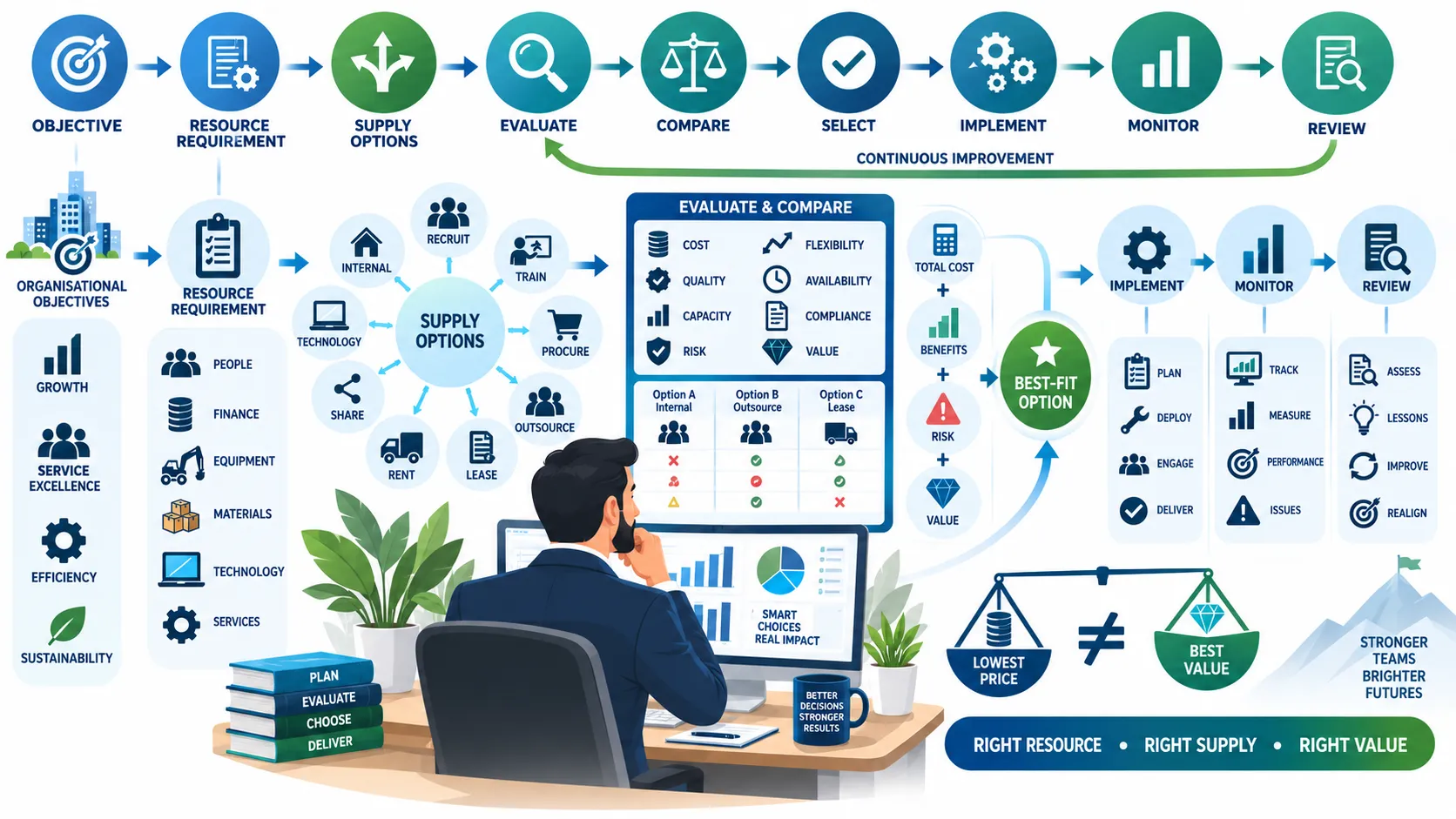
Understanding Resource Supply
Definition of Resource Supply
Resource supply is the process of obtaining, accessing or making available the resources required by an organisation to achieve its objectives.
Resources can include:
Human resources
Financial resources
Equipment
Materials
Stock and supplies
Technology and software
Buildings and facilities
Vehicles
Information and data
Specialist expertise
Professional services
External contractors
Time and operational capacity
The supply decision determines how the organisation obtains these resources and how the arrangement will be managed.
For example, if a business needs additional web development capability, possible supply options could include:
Recruiting a permanent developer
Training an existing employee
Using a temporary employee
Hiring a freelancer
Outsourcing development to an agency
Using a specialist consultancy
Purchasing software that reduces the required development workload
The appropriate decision depends on the organisation’s objectives, available budget, urgency, required skills, expected duration and risk exposure.
Resource Supply and Organisational Objectives
Resource supply should always be connected to organisational objectives. A resource should not be acquired simply because it is available or because another organisation uses it successfully.
Managers should first understand what the organisation is trying to achieve and then determine the resources necessary to support that objective.
For example, an organisation may have an objective to improve customer response times from 48 hours to 24 hours. Achieving this objective may require additional customer service staff, improved software, revised processes or extended operating hours.
The resource supply decision should therefore consider which combination of resources will most effectively support the required outcome.
The relationship can be represented as:
Organisational objectives → Activities → Resource requirements → Supply options → Resource allocation → Operational delivery → Outcomes
If the supply decision is poorly aligned with the objective, the organisation may spend money without achieving the expected improvement.
Why Managers Need to Evaluate Resource Supply Options
Resource supply decisions can create significant financial and operational commitments. A poor decision may result in excessive expenditure, inadequate capacity, low-quality resources, supplier dependency, contractual difficulties or operational disruption.
Evaluation helps managers compare alternatives before committing organisational resources.
A structured evaluation can help determine whether the organisation should:
Make or buy a resource
Recruit or outsource
Purchase or lease equipment
Use permanent or temporary staff
Develop internal capability or obtain external expertise
Hold stock or use just-in-time supply
Use one supplier or multiple suppliers
Invest in technology or maintain existing processes
Centralise or decentralise resource provision
Share resources with other departments or organisations
The objective is to identify the supply arrangement that provides the most appropriate balance of cost, performance, quality, flexibility and risk.
Key Concepts in Evaluating Resource Supply Options
Cost
Cost is the financial expenditure associated with obtaining and maintaining a resource.
Managers should consider both direct and indirect costs rather than looking only at the initial purchase price.
Costs may include:
Purchase price
Recruitment costs
Training costs
Installation costs
Maintenance
Insurance
Licensing
Storage
Transportation
Administration
Contract management
Disposal
Replacement
Staff time
Supplier management
A resource with a low initial cost may become expensive over its lifetime.
Value for Money
Value for money refers to achieving an appropriate balance between cost and the benefits, quality, performance and outcomes obtained from a resource.
Value for money does not necessarily mean selecting the cheapest option.
For example, Supplier A may charge £8,000 while Supplier B charges £10,000. If Supplier B provides significantly better quality, faster delivery, stronger support and a longer warranty, the additional £2,000 may provide greater overall value.
Quality
Quality refers to the extent to which the supplied resource meets the required specification, standards and expected level of performance.
Managers should assess:
Reliability
Durability
Performance
Accuracy
Safety
Compliance
Service standards
Technical specifications
Supplier quality assurance
Warranty and support arrangements
Poor-quality resources can create additional costs through rework, replacement, complaints, downtime and reduced productivity.
Capacity
Capacity refers to the amount of work or activity that a resource can support within a defined period.
Managers need to determine whether a supply option provides enough capacity to meet current and expected demand.
For example, purchasing equipment that can process 100 units per hour may be inappropriate if forecast demand is 200 units per hour.
Flexibility
Flexibility refers to the ability to increase, reduce or modify resource supply when organisational requirements change.
Flexible supply options may be particularly valuable where demand is uncertain or seasonal.
Examples include:
Temporary staffing
Short-term contracts
Equipment rental
Cloud-based technology
Outsourced services
Flexible supplier agreements
However, flexibility may sometimes come at a higher unit cost.
Availability
Availability concerns whether the required resource can be obtained when and where it is needed.
A technically suitable resource is not useful if it cannot be supplied within the required timescale.
Managers should therefore consider:
Lead times
Supplier capacity
Stock availability
Recruitment times
Delivery schedules
Geographic availability
Implementation requirements
Risk
Risk is the possibility that a supply arrangement may negatively affect organisational objectives.
Risks can include:
Supplier failure
Price increases
Delayed delivery
Quality problems
Cybersecurity concerns
Data protection issues
Skills shortages
Contract disputes
Supply interruption
Overdependence on one supplier
Regulatory non-compliance
A supply option with a low price but high operational risk may not provide good overall value.
Main Options for Supplying Organisational Resources
Internal Supply
Internal supply involves using resources that already exist within the organisation.
Examples include:
Redeploying existing employees
Using existing equipment
Reallocating departmental budgets
Sharing internal expertise
Transferring staff between teams
Using existing facilities
Reassigning available stock
Developing internal capability
Internal supply can be efficient because the organisation already understands the resource, its capabilities and its operating environment.
However, internal supply should not be assumed to be cost-free. Redeploying an employee may create a shortage in another department, while using existing equipment may reduce its availability for other activities.
Advantages of Internal Supply
Existing organisational knowledge
Greater control
Potentially lower procurement costs
Easier integration
Existing management arrangements
Greater protection of organisational knowledge
Potentially faster deployment
Reduced external supplier dependency
Limitations of Internal Supply
Existing capacity may be limited
Staff may already have high workloads
Internal capability may not meet specialist requirements
Redeployment may create shortages elsewhere
Training may be required
Existing equipment may be outdated
Internal resources may have opportunity costs
Recruitment of Permanent Employees
Recruitment involves obtaining additional human resources through permanent employment.
Permanent recruitment can be appropriate where an organisation has a sustained and predictable need for a particular capability.
For example, an organisation experiencing long-term growth may recruit additional customer service advisers rather than relying permanently on temporary workers.
Managers should consider the full employment cost, including:
Salary
Employer contributions
Recruitment
Induction
Training
Equipment
Workspace
Management time
Employee benefits
Development
Potential redundancy or restructuring costs
Permanent recruitment can provide stability and organisational knowledge but may offer less flexibility when demand changes.
Temporary or Contract Workers
Temporary workers can provide additional capacity for a defined period.
This option can be useful when demand fluctuates or when an organisation needs short-term support.
Examples include:
Seasonal workers
Temporary administrators
Fixed-term project staff
Temporary customer service employees
Contract specialists
The main advantage is flexibility. The organisation can obtain additional capacity without necessarily creating a permanent workforce commitment.
However, temporary supply may involve higher hourly costs and can create challenges relating to continuity, induction and organisational knowledge.
Outsourcing
Outsourcing involves transferring responsibility for a particular activity or service to an external organisation.
Common outsourced activities include:
IT support
Payroll
Cleaning
Facilities management
Security
Logistics
Recruitment services
Specialist consultancy
Customer support
Website development
Data processing
Outsourcing can provide access to specialist expertise and potentially reduce internal workload.
However, managers must carefully assess contractual obligations, service quality, information security, supplier dependency and the organisation’s ability to manage the external relationship.
Procurement from External Suppliers
External procurement involves purchasing resources from suppliers.
This can include:
Office equipment
Raw materials
Technology
Vehicles
Software
Furniture
Professional services
Training services
Maintenance services
Procurement should normally follow organisational purchasing procedures and any applicable legal, regulatory and governance requirements.
Managers should consider the entire supplier relationship rather than focusing only on the purchase price.
Leasing
Leasing allows an organisation to use an asset for an agreed period in return for regular payments.
Leasing may be suitable for:
Vehicles
IT equipment
Specialist machinery
Office equipment
Technology infrastructure
It can reduce the need for a large initial capital expenditure and may provide access to updated equipment.
However, managers should assess the total cost over the contract period, contractual conditions, maintenance responsibilities and end-of-contract arrangements.
Renting
Renting involves obtaining temporary access to a resource without purchasing it.
This can be particularly useful for short-term requirements.
Examples include:
Temporary equipment
Event facilities
Vehicles
Specialist machinery
Meeting spaces
Renting can provide flexibility and avoid long-term ownership costs.
However, repeated rental may eventually become more expensive than purchasing or leasing.
Shared Resources
Organisations can sometimes meet resource requirements by sharing resources across departments, locations or partner organisations.
Examples include:
Shared IT systems
Shared meeting facilities
Shared administrative teams
Shared specialist equipment
Shared professional expertise
Shared training resources
Resource sharing can increase utilisation and reduce duplication.
However, managers must establish clear arrangements regarding availability, ownership, priorities, costs and responsibilities.
Developing Existing Resources
Instead of acquiring new resources externally, an organisation may develop existing resources.
For human resources, this may involve:
Training
Coaching
Mentoring
Job rotation
Cross-training
Professional development
Internal promotion
Skills development
For technology, development may involve upgrading existing systems rather than replacing them.
This approach can support organisational capability and employee engagement, although development takes time and may not immediately solve urgent resource shortages.
Make-or-Buy Decisions
A make-or-buy decision involves determining whether a resource or service should be produced internally or obtained externally.
For example, an organisation may need a new website. It could:
Develop the website using internal staff
Recruit additional developers
Use freelancers
Contract an agency
Purchase a website platform and configure it internally
The decision should consider cost, capability, quality, timescale, strategic importance and risk.
Managers should avoid assuming that outsourcing is always cheaper or that internal provision is always more controllable. The appropriate option depends on the specific organisational context.
Resource Supply Evaluation Framework
A structured evaluation framework helps managers make consistent and evidence-based decisions.
A useful framework is:
Purpose → Requirement → Options → Cost → Value → Quality → Capacity → Risk → Compliance → Flexibility → Decision → Review
Step 1: Define the Resource Requirement
Managers should clearly identify what resource is needed and why.
Questions include:
What objective does the resource support?
What activity requires it?
What quantity is required?
What specification is required?
When is it needed?
How long will it be required?
What level of quality is expected?
Poorly defined requirements can result in unsuitable supply decisions.
Step 2: Identify Available Supply Options
The manager should identify all realistic options rather than selecting the first available solution.
Possible options may include:
Internal provision
Recruitment
Training
Procurement
Outsourcing
Leasing
Renting
Resource sharing
Partnership
Technology substitution
Step 3: Establish Evaluation Criteria
The organisation should determine what criteria will be used to compare options.
Typical criteria include:
Cost
Quality
Capacity
Availability
Reliability
Flexibility
Risk
Compliance
Sustainability
Strategic fit
Supplier capability
Implementation time
Step 4: Gather Evidence
Managers should collect relevant information before making a decision.
Evidence may come from:
Internal financial data
Resource utilisation records
Supplier quotations
Market research
Previous procurement records
Performance data
Staff feedback
Customer requirements
Supplier references
Risk assessments
Contract information
Forecast demand
Step 5: Compare Total Costs
The evaluation should consider total cost rather than only the initial price.
Total cost may include acquisition, implementation, operation, maintenance and replacement.
A simple comparison might consider:
Initial cost + operating cost + maintenance cost + management cost + exit/disposal cost = estimated total cost
Step 6: Evaluate Benefits and Value
Managers should identify the expected benefits associated with each option.
Benefits may include:
Increased capacity
Improved quality
Reduced waiting time
Increased productivity
Reduced operational risk
Faster delivery
Improved customer satisfaction
Access to specialist expertise
Reduced internal workload
Step 7: Evaluate Risks
Each option should be assessed for potential threats to organisational objectives.
Managers should ask:
What could go wrong?
How likely is it?
What would the impact be?
Can the risk be controlled?
Who would be responsible?
Is there a contingency option?
Step 8: Assess Legal and Organisational Requirements
Resource supply must comply with relevant organisational policies and applicable legal or regulatory requirements.
Depending on the resource, this may involve considerations relating to:
Employment
Procurement
Health and safety
Data protection
Information security
Financial controls
Equality
Environmental requirements
Contract management
Sector-specific regulation
Step 9: Evaluate Strategic Fit
Managers should consider whether the supply option supports wider organisational priorities.
For example, if an organisation has a strategic objective to develop internal capability, repeated outsourcing of a core function may conflict with that objective.
Step 10: Select and Approve the Preferred Option
The preferred option should be supported by evidence.
Where required, managers should obtain approval from:
Senior management
Finance
Procurement
Human resources
Legal or compliance teams
IT
Operational leadership
Step 11: Implement the Supply Arrangement
Implementation may involve:
Recruitment
Contracting
Purchasing
Supplier onboarding
Equipment installation
Staff training
System configuration
Delivery scheduling
Step 12: Monitor Performance
The supply arrangement should be monitored after implementation.
Managers can monitor:
Cost
Quality
Delivery
Utilisation
Availability
Service levels
Customer satisfaction
Supplier performance
Operational outcomes
Step 13: Review the Decision
Managers should assess whether the selected supply option achieved its intended purpose.
The review should determine:
Was the resource available when required?
Was the required quality achieved?
Was the cost within budget?
Did the resource support the objective?
Were risks effectively controlled?
Did the supplier perform as expected?
Should the arrangement continue, change or end?
Comparing Resource Supply Options
The following table provides a practical framework for evaluating common resource supply options.
| Supply option | Definition | Main advantages | Potential limitations | Suitable when |
|---|---|---|---|---|
| Internal provision | Uses resources already available within the organisation | High control, existing knowledge, potentially fast | Limited capacity and possible internal opportunity cost | Capability and capacity already exist |
| Permanent recruitment | Employs staff on an ongoing basis | Stability, continuity and organisational knowledge | Long-term employment costs and reduced flexibility | Demand is sustained and predictable |
| Temporary staff | Uses workers for a defined period | Flexible capacity and rapid response | Potentially higher hourly costs and less continuity | Demand is temporary or fluctuating |
| Training/development | Builds capability using existing employees | Retains organisational knowledge and supports capability | Takes time and may not address urgent shortages | Skills can be developed internally |
| Outsourcing | External provider delivers an activity or service | Specialist expertise and reduced internal workload | Supplier dependency, contractual and quality risks | External capability is more suitable |
| Procurement | Purchases resources from external suppliers | Access to products and competitive supplier markets | Procurement time and supplier risk | Resources need to be acquired externally |
| Leasing | Uses an asset for an agreed period for regular payments | Reduced initial capital requirement and flexibility | Long-term contractual commitment and total cost | Equipment is needed over a defined period |
| Renting | Obtains temporary use of an asset | Flexible and useful for short-term needs | Repeated use can become expensive | Resource need is short term |
| Resource sharing | Multiple teams or organisations share resources | Reduces duplication and improves utilisation | Availability conflicts and coordination requirements | Resources can be shared effectively |
| Technology substitution | Technology replaces or reduces the need for another resource | Can increase productivity and capacity | Investment, implementation and skills requirements | Technology can improve efficiency or scalability |
Evaluating Cost and Financial Implications
Financial evaluation is a central part of resource supply decisions. Managers must understand how the supply option affects budgets, cash flow and overall financial performance.
The cheapest option at the point of acquisition may not be the lowest-cost option over its useful life.
For example, an organisation may purchase low-cost equipment that requires frequent maintenance and replacement. Another supplier may provide more expensive equipment with better reliability and lower maintenance costs. The second option could therefore provide better long-term value.
Managers should consider:
Initial expenditure
Recurring expenditure
Fixed costs
Variable costs
Maintenance
Training
Installation
Support
Replacement
Contract management
Disposal
Potential financial savings
Expected return or benefit
Where appropriate, managers can use cost-benefit analysis to compare alternatives.
Evaluating Quality and Performance
Quality should be assessed against clearly defined requirements.
Managers should establish measurable standards before agreeing to a supply arrangement.
For example, a supplier of IT support may be evaluated against:
Response time
Resolution time
System availability
Number of unresolved incidents
Customer satisfaction
Security performance
Compliance with service-level agreements
This makes it easier to determine whether the supply option is actually supporting organisational objectives.
Evaluating Supplier Capability
When resources are obtained externally, supplier capability becomes an important consideration.
Managers should assess whether suppliers have the capacity, expertise and reliability required.
Supplier evaluation can consider:
Financial stability
Relevant experience
Technical capability
Quality systems
Delivery performance
Customer references
Capacity
Service support
Business continuity arrangements
Information security
Regulatory compliance
Environmental and sustainability practices
A supplier may offer an attractive price but lack the capacity to support the organisation reliably.
Evaluating Risk and Resilience
Resource supply decisions should consider organisational resilience. Resilience refers to the ability of an organisation to continue operating and achieving important objectives when disruption occurs.
A single-source supply arrangement can create significant dependency.
For example, if a manufacturer relies on one supplier for a critical component and that supplier experiences a major disruption, production may stop.
Managers can improve resilience by considering:
Multiple suppliers
Alternative resources
Contingency stock
Backup systems
Alternative staffing arrangements
Contractual protections
Business continuity plans
Emergency procurement arrangements
The most appropriate solution will depend on the criticality of the resource and the cost of maintaining resilience.
Evaluating Flexibility and Changing Demand
Demand does not always remain constant. Managers should therefore consider how easily each supply option can respond to changing requirements.
A permanent employee may provide strong continuity but may be difficult to reduce if demand falls. Temporary workers may offer greater flexibility but may provide less continuity.
Similarly, purchasing equipment creates ownership, while renting or leasing may provide greater flexibility.
Managers should therefore consider both current requirements and likely future changes.
Evaluating Internal Versus External Supply
The decision between internal and external supply should be evidence-based.
Internal supply may be preferable when:
The capability is strategically important
Existing staff have sufficient capacity
Organisational knowledge is important
Quality requires close internal control
Data sensitivity is high
Long-term capability development is a priority
External supply may be preferable when:
Specialist expertise is unavailable internally
Demand is temporary
The activity is not strategically central
External providers have greater economies of scale
Internal capacity is constrained
A rapid response is required
However, managers should assess each situation individually.
Practical Example 1: Customer Service Expansion
A growing organisation experiences a 35% increase in customer enquiries. The customer service team is struggling to respond within its required service standard.
The manager identifies several options:
Recruit permanent staff
Use temporary customer service workers
Extend existing employees’ working hours where appropriate
Introduce customer service automation
Outsource some enquiries
Reallocate staff from another department
The manager reviews demand forecasts, current workload, employee capacity, service performance, cost and expected future demand.
If the increase is expected to continue for several years, permanent recruitment may provide the strongest long-term solution. If demand is seasonal, temporary staffing may provide greater flexibility. If routine enquiries can be automated, technology may reduce future workload.
The best solution may also involve a combination of options.
Practical Example 2: Equipment Supply
A manufacturing organisation requires additional machinery to meet increased production demand.
The manager considers:
Purchasing the equipment
Leasing the equipment
Renting equipment
Outsourcing production
Increasing use of existing machinery
Purchasing may provide greater long-term control but requires significant capital expenditure. Leasing may reduce initial expenditure and provide flexibility. Renting may be suitable if demand is temporary. Outsourcing may avoid equipment investment but reduces direct control over production.
The decision should consider forecast demand, equipment life, maintenance costs, production quality, supplier reliability and strategic priorities.
Practical Example 3: Education and Training Organisation
A training organisation needs additional trainers to support an increase in learner enrolment.
Possible options include:
Recruiting permanent tutors
Using associate trainers
Training existing staff
Contracting specialist trainers
Using digital learning technology
If learner numbers are growing consistently, permanent recruitment may be appropriate. If demand fluctuates by programme, associate trainers may provide greater flexibility.
The organisation should also evaluate tutor quality, learner outcomes, availability, regulatory requirements, subject expertise and cost.
Practical Example 4: Digital Transformation
An organisation plans to implement a new customer relationship management system.
The manager evaluates whether to:
Purchase an existing software package
Use a cloud-based subscription
Develop a bespoke system
Outsource system management
Use existing software and improve its configuration
A bespoke system may provide greater customisation but could involve substantial development costs and implementation risks. A cloud-based solution may provide faster deployment and scalability but creates ongoing subscription costs and supplier dependency.
The manager should evaluate functionality, data security, integration, user requirements, implementation time, cost, scalability and supplier support.
Practical Example 5: Seasonal Demand
A retailer experiences significantly higher demand during certain periods of the year.
Permanent recruitment throughout the year may result in excessive staffing during quieter periods. Temporary workers may provide more appropriate flexibility.
The manager can compare:
Permanent employment
Temporary employment
Overtime
Outsourcing
Automation
Redistribution of work
The decision should consider cost, customer service, employee workload, recruitment availability and forecast demand.
Common Mistakes When Evaluating Resource Supply Options
Managers can make poor resource supply decisions when evaluation is too narrow or based on assumptions.
Focusing Only on Price
Choosing the cheapest supplier without considering quality, reliability, maintenance and service can create higher costs later.
Ignoring Total Cost
A low purchase price does not necessarily represent low total cost.
Selecting the First Available Option
Managers should consider realistic alternatives before committing to a supply arrangement.
Ignoring Future Demand
A resource supply option should consider expected changes in demand rather than only today’s requirements.
Failing to Assess Supplier Risk
External suppliers can create dependency and continuity risks.
Overlooking Internal Capability
Organisations sometimes outsource activities that could be delivered effectively using existing resources.
Assuming Internal Supply Is Free
Internal resources have opportunity costs. Using staff or equipment in one area may reduce availability elsewhere.
Ignoring Quality
A low-cost resource that does not meet the required standard can undermine organisational outcomes.
Failing to Monitor the Decision
Resource supply arrangements should be reviewed after implementation to confirm that expected benefits are being achieved.
Key Benefits of Effective Evaluation of Resource Supply Options
A systematic approach to evaluating resource supply can provide significant organisational benefits.
Improved Cost Control
Managers can compare alternatives and identify options that provide appropriate value for money.
Better Resource Availability
Effective supply planning helps ensure that resources are available when required.
Improved Operational Performance
The right supply arrangement can improve productivity, capacity and service delivery.
Reduced Risk
Comparing supply risks helps managers develop more resilient resource arrangements.
Improved Quality
Evaluation enables managers to assess whether resources meet required standards.
Greater Flexibility
Managers can select supply arrangements that can adapt to changing demand.
Better Strategic Alignment
Resources can be supplied in ways that directly support organisational priorities.
Improved Decision-Making
Evidence-based evaluation reduces reliance on assumptions and personal preference.
Greater Accountability
Documented evaluation provides a clear rationale for management decisions and resource expenditure.
Improved Supplier Relationships
Clear requirements and performance measures can create more effective supplier relationships.
A Practical Procedure for Evaluating Resource Supply Options
Middle managers can use the following procedure when making resource supply decisions.
Stage 1: Identify the Objective
Clearly define the organisational objective that the resource will support.
Stage 2: Define the Requirement
Specify the resource required, including quantity, quality, timing, location and duration.
Stage 3: Assess Existing Resources
Determine whether the organisation already has suitable resources available.
Stage 4: Identify the Resource Gap
Compare current capacity with required capacity.
Stage 5: Identify Supply Options
Consider internal and external options.
Stage 6: Establish Evaluation Criteria
Set criteria such as cost, quality, capacity, availability, flexibility, risk and compliance.
Stage 7: Collect Evidence
Gather financial, operational, supplier and performance information.
Stage 8: Evaluate Costs
Assess both immediate and long-term costs.
Stage 9: Evaluate Benefits
Identify expected operational and strategic benefits.
Stage 10: Assess Risks
Determine the likelihood and impact of significant risks.
Stage 11: Assess Compliance
Check legal, regulatory, contractual and organisational requirements.
Stage 12: Compare Options
Use a structured comparison rather than relying on one factor.
Stage 13: Select the Preferred Option
Choose the option that provides the strongest overall contribution to organisational objectives.
Stage 14: Obtain Approval
Follow the organisation’s governance, financial and procurement procedures.
Stage 15: Implement
Put the supply arrangement into operation.
Stage 16: Monitor
Measure cost, quality, availability, utilisation and outcomes.
Stage 17: Review
Determine whether the selected option remains appropriate.
Stage 18: Improve
Modify, renegotiate, replace or discontinue the supply arrangement when evidence indicates that change is required.
Managerial Decision-Making Checklist
Before approving a resource supply option, managers should consider:
What organisational objective does this resource support?
Is the requirement clearly defined?
Is the quantity appropriate?
Is the resource required permanently or temporarily?
Can the organisation meet the requirement internally?
What external options are available?
What is the total cost of each option?
What benefits will each option provide?
Does the option meet quality requirements?
Does it provide sufficient capacity?
How quickly can it be supplied?
How flexible is the arrangement?
What supplier risks exist?
What legal and regulatory requirements apply?
What contractual commitments will be created?
Does the option support organisational strategy?
What happens if demand changes?
Is there a contingency arrangement?
How will performance be measured?
When will the decision be reviewed?
Key Concepts to Remember
The following concepts are central to evaluating resource supply options:
Resource supply means obtaining or accessing resources required to achieve organisational objectives.
Supply options can be internal or external.
Internal supply may include redeployment, training and resource sharing.
External supply may include procurement, recruitment, outsourcing, leasing and renting.
The cheapest option is not automatically the best option.
Total cost should be considered rather than only initial price.
Value for money considers cost alongside quality, benefits and outcomes.
Resource supply should provide sufficient capacity to meet demand.
Flexibility is important when requirements are uncertain or variable.
Supplier capability and reliability should be assessed.
Risk should be considered alongside cost and performance.
Legal, regulatory and organisational requirements must be addressed.
Make-or-buy decisions should be evidence-based.
Resource supply decisions should support organisational objectives.
Performance should be monitored after implementation.
Supply arrangements should be reviewed and improved when circumstances change.
Professional Management Insight
Effective resource management is not simply about obtaining more resources. It is about obtaining the right resources, through the right supply mechanism, at the right time, at an appropriate cost and with the required level of quality and reliability.
A skilled manager understands that every supply decision involves trade-offs. Increasing internal staffing may improve continuity but increase fixed costs. Outsourcing may provide specialist expertise but create supplier dependency. Purchasing equipment may provide long-term control but require significant capital expenditure. Leasing may improve flexibility but create ongoing contractual commitments.
The strongest management decisions therefore balance multiple factors rather than optimising one measure in isolation.
Managers should also recognise that supply decisions are not permanent. Organisational objectives, market conditions, technology, demand, budgets and supplier markets can change. An arrangement that is appropriate today may become unsuitable in the future.
For this reason, resource supply should operate as a continuous management cycle:
Identify → Analyse → Compare → Evaluate → Select → Implement → Monitor → Review → Improve
This approach allows managers to make evidence-based decisions while maintaining flexibility and alignment with organisational priorities.
Summary
Evaluating options for the supply of resources is an essential part of effective resource planning and organisational management. Once resource requirements have been identified, managers must determine how those resources can be obtained or accessed in a way that supports organisational objectives.
Possible supply options include internal provision, permanent recruitment, temporary staffing, training and development, procurement, outsourcing, leasing, renting, resource sharing and technology substitution. Each option has different implications for cost, quality, capacity, availability, flexibility, risk and organisational control.
A robust evaluation should begin by defining the organisational objective and resource requirement. Managers should then identify realistic supply options, establish evaluation criteria, collect relevant evidence, assess total costs, evaluate benefits, consider quality and capacity, assess risks, check compliance and determine strategic fit.
The final decision should be based on overall value rather than price alone. Once implemented, the supply arrangement should be monitored against agreed measures and reviewed to determine whether it continues to support organisational objectives.
For practising and aspiring middle managers and leaders, the central principle is clear: effective resource supply means securing the resources the organisation needs in a way that provides appropriate value, quality, capacity, flexibility, resilience and alignment with organisational objectives.
A well-evaluated supply decision can help an organisation control expenditure, improve operational performance, manage risk, respond to changing demand and achieve sustainable organisational outcomes.
Part 4 Knowledge Check
Managers should be able to explain:
What resource supply means.
Why resource supply decisions should be linked to organisational objectives.
The difference between internal and external resource supply.
The main advantages and limitations of recruitment, outsourcing, procurement, leasing, renting and resource sharing.
Why total cost is more useful than purchase price alone.
How value for money influences resource supply decisions.
Why quality and capacity must be evaluated.
How supplier capability and risk affect supply decisions.
When internal supply may be preferable to external supply.
How make-or-buy decisions can support resource planning.
How flexibility can influence the choice of resource supply.
Why legal, regulatory and organisational requirements must be considered.
How to use evidence to compare resource supply options.
How to monitor and review resource supply after implementation.
Why resource supply decisions should be reviewed when organisational circumstances change.
Final Management Takeaway
The most effective resource supply decision is not necessarily the cheapest, fastest or easiest option. It is the option that best supports organisational objectives while achieving an appropriate balance of cost, quality, capacity, availability, flexibility, risk, compliance and long-term value.
For managers, effective evaluation means asking not only “How can we obtain this resource?” but also “Which supply option will give the organisation the best ability to achieve its objectives?”
That distinction is fundamental to effective resource planning, procurement and operational management.