
Lesson no 2 : Know how to create an operational plan in line with organisational objectives
Creating an effective operational plan is a fundamental management responsibility because it provides a practical framework for turning organisational objectives into coordinated activities, measurable targets and achievable results. Organisational objectives establish what an organisation intends to achieve, while an operational plan explains how those objectives will be delivered through the effective management of people, resources, activities, timescales, risks and performance. A well-designed operational plan therefore creates a clear connection between organisational direction and day-to-day management.
Operational planning requires managers to understand the organisation’s objectives and translate them into specific operational priorities. This involves identifying what needs to be achieved, determining the activities required, allocating appropriate responsibilities and resources, establishing realistic deadlines and defining measures that can be used to monitor progress. The plan should be sufficiently detailed to guide implementation while remaining flexible enough to respond to changing operational circumstances.
A key principle of operational planning is alignment. An operational plan should not operate independently from the wider organisation. Every major activity, target and resource decision should contribute to agreed organisational objectives. Managers therefore need to examine the organisation’s strategic direction, departmental priorities, customer or stakeholder expectations and available resources before developing the plan. This helps ensure that operational activity contributes directly to organisational performance rather than becoming a collection of disconnected tasks.
Effective operational plans also require clear performance measures. Key performance indicators (KPIs), milestones, quality standards and outcome measures provide evidence of whether planned activities are producing the expected results. Monitoring these measures allows managers to identify progress, recognise emerging problems and take corrective action when performance moves away from the intended direction.
Resource planning is another essential element. Managers must consider the people, skills, finance, equipment, technology, information and time required to deliver planned activities. Resources should be allocated according to organisational priorities, with potential constraints and risks identified before implementation. Responsibilities should also be clearly assigned so that individuals and teams understand their contribution and accountability.
This lesson explores how managers can create an operational plan that is directly aligned with organisational objectives. It considers the process of translating objectives into operational priorities, identifying activities and deliverables, allocating resources and responsibilities, establishing timescales and milestones, setting appropriate KPIs, considering risks and incorporating quality requirements. The lesson also examines how managers can ensure that operational plans remain realistic, measurable and adaptable.
By understanding these principles, learners will be able to approach operational planning as a structured management process rather than simply producing a document. The emphasis is on creating plans that provide clear direction, support effective implementation, enable meaningful performance monitoring and contribute to the achievement of organisational objectives.
1.Examine the Impact of Legal and Organisational Factors on an Operational Plan
Operational planning does not take place in isolation. Managers develop operational plans within a framework of laws, regulations, organisational policies, strategic priorities, governance arrangements, financial controls, ethical expectations and internal procedures. For an operational plan to be effective, it must therefore be both operationally realistic and compliant with the requirements that govern the organisation.
Legal and organisational factors can influence almost every element of an operational plan. They can affect what activities may be undertaken, how employees are managed, what information can be collected and stored, how services are delivered, what resources are required, what quality standards must be maintained and how performance is monitored. Failure to consider these factors can expose an organisation to legal claims, regulatory action, financial losses, reputational damage and operational disruption.
For middle managers and operational leaders, understanding these influences is particularly important because they are often responsible for translating organisational policies and strategic objectives into practical activities. They must ensure that operational plans can be implemented within the boundaries established by legislation and organisational governance while still meeting performance expectations.
The purpose of this part is to examine how legal and organisational factors affect the development, implementation, monitoring and review of operational plans. It also considers how managers can systematically identify relevant requirements, incorporate them into planning decisions and maintain compliance while responding to changing operational circumstances.
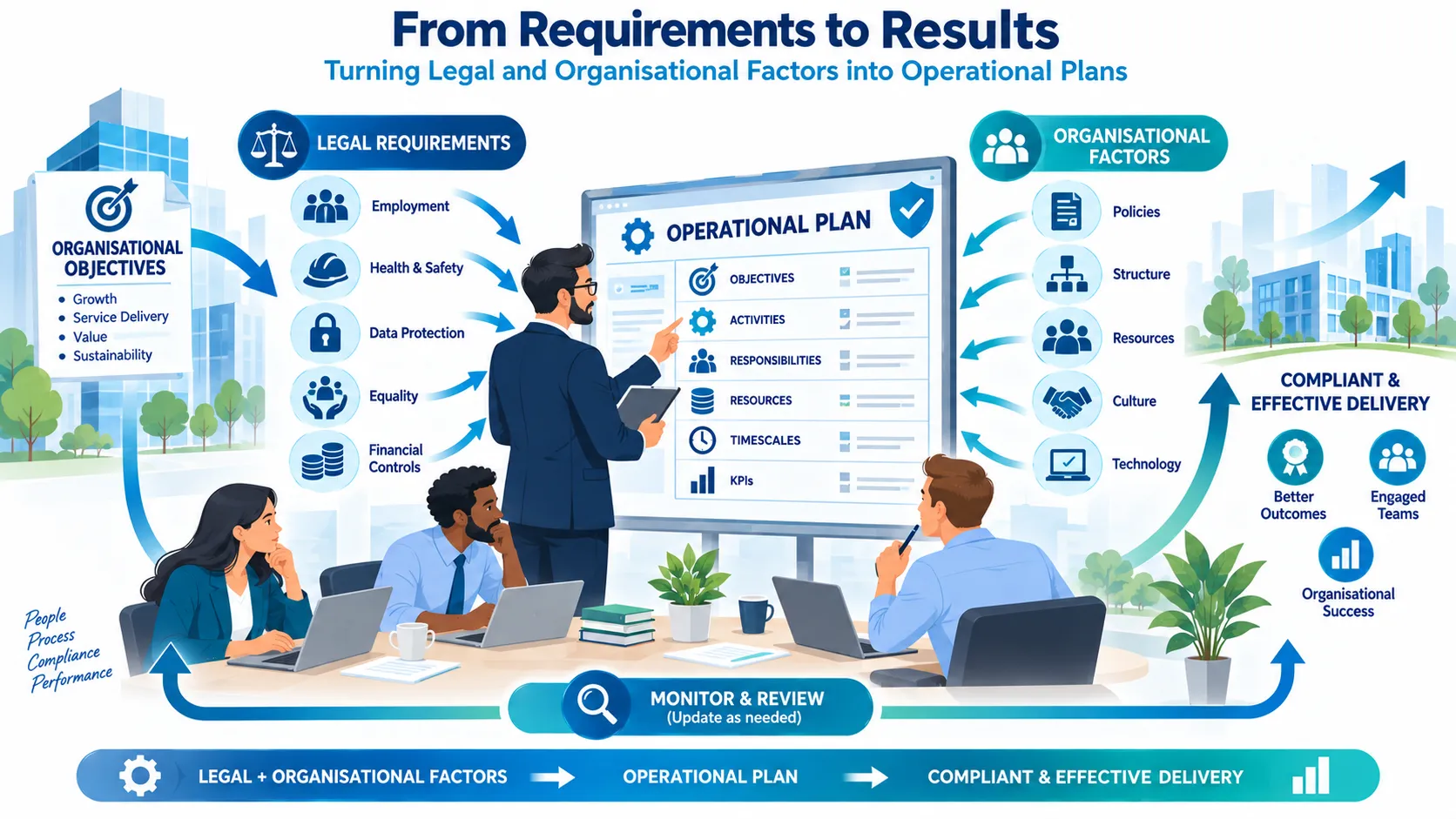
Understanding Legal and Organisational Factors
Before examining their impact, it is important to distinguish between legal factors and organisational factors.
Legal factors are requirements arising from legislation, regulations, statutory duties, regulatory standards, contractual obligations and other legally enforceable requirements relevant to an organisation’s activities. These requirements establish boundaries within which operational decisions must be made.
Organisational factors are internal conditions, systems, policies, procedures, structures, resources and expectations that influence how an organisation operates. They may include organisational strategy, values, governance arrangements, financial controls, policies, management structures, workforce capability, organisational culture and internal standards.
Both categories are interconnected. For example, an organisation may have a health and safety policy because legislation requires appropriate workplace safety arrangements. The law establishes the external requirement, while the organisational policy translates that requirement into internal procedures and responsibilities.
Key Definitions
| Factor | Definition | Potential Impact on an Operational Plan |
|---|---|---|
| Legal requirement | A requirement established by applicable law or regulation that an organisation must comply with | May determine permissible activities, controls, responsibilities, resources and monitoring requirements |
| Regulation | A formal rule or standard issued by a competent regulatory authority | May establish specific operational standards, reporting requirements or quality controls |
| Organisational policy | An internally approved statement setting out how the organisation intends to manage a particular area | Provides consistent direction for operational decisions and activities |
| Organisational procedure | A defined method for carrying out a particular activity | Influences how operational tasks are implemented |
| Governance | The systems through which an organisation is directed, controlled and held accountable | Determines decision-making authority, approvals, oversight and reporting |
| Organisational objective | A defined result the organisation intends to achieve | Provides direction for operational priorities and activities |
| Resource constraint | A limitation affecting available people, finance, time, equipment or other resources | Influences whether planned activities are realistic and achievable |
| Compliance | The condition of operating in accordance with applicable requirements | Requires operational plans to include appropriate controls and monitoring |
| Risk control | A measure designed to reduce the likelihood or impact of a risk | May require additional activities, resources, responsibilities or contingency arrangements |
| Organisational culture | Shared values, behaviours, expectations and practices that influence how people work | Can affect implementation, employee engagement, reporting and adherence to procedures |
The Importance of Legal Compliance in Operational Planning
Legal compliance is a fundamental consideration when creating an operational plan. An organisation cannot simply identify desirable activities and implement them without considering whether those activities are lawful and consistent with relevant regulatory requirements.
For example, a manager planning a new customer data collection process must consider requirements relating to personal information, confidentiality, access controls, retention and appropriate use. Similarly, a manager introducing new workplace equipment needs to consider applicable health and safety requirements, employee training and safe operating procedures.
Legal requirements can therefore influence both the content of the operational plan and the way activities are delivered.
Managers should consider questions such as:
What legislation applies to the planned activities?
Are there industry-specific regulatory requirements?
Are licences, permissions or approvals required?
What contractual obligations apply?
What records must be maintained?
What information must be protected?
What reporting or notification requirements exist?
What standards of safety, quality or service must be achieved?
What employment requirements affect staffing arrangements?
What equality, accessibility or non-discrimination requirements need to be considered?
A strong operational plan identifies these requirements before implementation rather than discovering them after problems occur.
Major Legal Factors Affecting Operational Plans
The exact legal requirements will depend on the organisation, industry, location and nature of its activities. However, several broad legal areas commonly influence operational planning.
Employment and Workforce Legislation
Operational plans frequently involve employees, contractors, temporary workers or other personnel. Managers therefore need to consider employment-related requirements when planning staffing levels, working arrangements, responsibilities, recruitment, training and performance management.
A plan requiring employees to work particular hours, for example, may need to consider working-time requirements, rest periods, contractual arrangements and organisational policies. A plan involving recruitment must also consider lawful recruitment practices and fair treatment.
Managers should therefore ensure that workforce-related activities are:
appropriately staffed;
consistent with employment requirements;
supported by suitable contracts or agreements;
based on fair and transparent processes;
supported by appropriate training;
consistent with working-time and leave requirements;
monitored through appropriate management arrangements.
The operational impact can be significant. If a planned service requires extended opening hours but staffing arrangements do not support those hours, the operational plan may be unrealistic even if the objective itself is strategically appropriate.
Health and Safety Requirements
Health and safety is another major influence on operational planning. Managers have a responsibility to ensure that planned activities can be undertaken safely and that appropriate controls are established.
An operational plan may need to include:
risk assessments;
safe working procedures;
staff training;
appropriate supervision;
personal protective equipment where applicable;
emergency procedures;
equipment inspections;
maintenance arrangements;
incident reporting;
monitoring of safety performance.
Health and safety requirements can directly affect resource allocation. For example, a manager may need to budget for safety equipment, specialist training, maintenance or additional staffing.
A plan that focuses only on productivity without considering safety may create unacceptable operational risks. Effective management requires the achievement of performance objectives without compromising legal and organisational responsibilities.
Equality, Inclusion and Non-Discrimination Requirements
Operational plans can affect employees, customers, learners, service users and other stakeholders. Managers therefore need to consider equality and inclusion when designing processes and allocating opportunities or services.
For example, an organisation introducing a new training programme should consider whether its delivery arrangements create unnecessary barriers for particular groups. Operational planning may need to incorporate accessible facilities, appropriate communication methods, reasonable adjustments and fair selection processes.
Relevant planning considerations may include:
accessibility;
fair treatment;
inclusive recruitment;
equitable access to services;
reasonable adjustments;
non-discriminatory procedures;
monitoring of equality-related outcomes.
This demonstrates that legal compliance is not simply about avoiding penalties. It can also support fairer and more effective operational delivery.
Data Protection and Information Governance
Modern operational plans often depend heavily on information. Managers may collect, process, store, analyse and share personal or commercially sensitive information.
An operational plan involving customer databases, employee records, learner information, financial data or performance information therefore needs to consider data protection and information governance requirements.
Planning may need to specify:
what information is required;
why it is required;
who is authorised to access it;
how it will be stored;
how it will be protected;
how long it should be retained;
how information will be transferred;
how breaches or incidents will be handled;
how data quality will be maintained.
Managers should also avoid collecting information simply because it may be useful in the future. Data collection should have a clear operational purpose and be managed appropriately.
Financial and Tax Requirements
Financial planning is an essential component of operational planning. Managers may need to consider financial controls, procurement requirements, taxation obligations, expenditure approval processes and budgetary restrictions.
For example, a manager may want to purchase specialist equipment to improve operational performance. The plan may need to include:
budget availability;
procurement procedures;
approval thresholds;
supplier requirements;
contractual terms;
value-for-money considerations;
payment arrangements;
financial reporting.
A manager cannot treat an operational objective as achievable simply because the desired activity is technically possible. It must also be financially viable and consistent with organisational controls.
Consumer, Customer and Service Requirements
Organisations delivering products or services may also need to consider requirements relating to customers and service users.
Operational planning may therefore need to address:
service quality;
accurate information;
customer communication;
complaints handling;
contractual commitments;
product or service standards;
accessibility;
customer safety;
response times.
A customer service operational plan, for example, might establish a target for responding to enquiries within a specified period. The manager must ensure that the target is realistic, measurable and supported by sufficient staffing and systems.
Environmental Requirements
Environmental considerations can also influence operational planning, particularly in sectors involving manufacturing, construction, transport, energy consumption, waste or natural resources.
An operational plan may need to consider:
waste management;
energy efficiency;
environmental controls;
responsible resource use;
emissions;
procurement standards;
sustainable operating practices;
environmental risk.
Environmental requirements may create additional operational activities but can also produce long-term benefits through efficiency, cost reduction and improved organisational reputation.
How Legal Factors Influence Operational Plan Components
Legal requirements can affect virtually every component of an operational plan.
Objectives
Operational objectives may need to reflect mandatory legal or regulatory requirements.
For example, an organisation may establish an operational objective to achieve a specified compliance standard or reduce safety incidents.
Activities
Legal requirements can determine which activities must be undertaken.
An operational plan may therefore include mandatory training, inspections, reporting, auditing or monitoring activities.
Responsibilities
Certain responsibilities may need to be allocated to appropriately qualified or authorised individuals.
For example, a manager may need to identify who is responsible for health and safety checks, data protection controls or compliance reporting.
Resources
Compliance may require financial, human, technological or physical resources.
A plan may therefore need additional funding for:
specialist advice;
employee training;
safety equipment;
secure information systems;
audits;
inspections;
monitoring systems.
Timescales
Legal requirements may impose deadlines for reporting, inspections, renewals, reviews or corrective actions.
Operational plans should incorporate these deadlines rather than treating them as separate from normal operational activity.
KPIs and Monitoring
Compliance-related KPIs can provide evidence that legal requirements are being addressed.
Examples include:
percentage of employees completing mandatory training;
number of safety incidents;
percentage of required inspections completed;
number of unresolved compliance actions;
percentage of records meeting required standards.
Organisational Factors Affecting Operational Plans
Legal requirements establish external boundaries, but organisational factors determine how the organisation will operate within those boundaries.
Strategic Direction
The organisation’s strategic objectives provide the foundation for operational planning.
If an organisation’s strategic priority is to improve customer experience, operational plans may focus on:
reducing response times;
improving staff capability;
introducing new service processes;
monitoring customer satisfaction;
improving complaint resolution.
Operational plans must therefore reflect organisational priorities rather than simply responding to individual departmental preferences.
Organisational Structure
The structure of an organisation affects decision-making, communication and accountability.
A highly centralised organisation may require senior approval before significant operational decisions can be implemented. A more decentralised organisation may allow middle managers greater authority.
Managers should understand:
reporting relationships;
delegated authority;
approval requirements;
departmental responsibilities;
escalation arrangements;
communication channels.
An operational plan that assigns responsibilities beyond a manager’s authority may be difficult to implement.
Organisational Policies and Procedures
Policies and procedures establish internal expectations for how work should be undertaken.
Common policies influencing operational plans include:
health and safety policy;
equality and inclusion policy;
data protection policy;
recruitment policy;
procurement policy;
financial control policy;
quality assurance policy;
complaints policy;
information security policy;
business continuity policy;
risk management policy.
Managers should review relevant policies before finalising an operational plan.
Organisational Culture
Culture influences how effectively an operational plan will be implemented.
A plan may be technically excellent but difficult to implement if employees do not understand its purpose or do not support the proposed changes.
For example, a highly hierarchical culture may make employees reluctant to challenge unrealistic targets. A collaborative culture may encourage employees to identify practical improvements.
Managers should therefore consider:
employee attitudes;
openness to change;
communication practices;
trust;
accountability;
willingness to report problems;
attitudes towards quality and compliance.
Financial Resources
Budget availability can significantly influence operational planning.
A manager may identify a desirable operational improvement but discover that available funding is insufficient. In this situation, the manager may need to:
reprioritise activities;
phase implementation;
identify efficiencies;
request additional resources;
revise targets;
explore alternative delivery methods.
Effective operational planning therefore requires financial realism.
Workforce Capability
The skills, experience and availability of employees can determine whether operational objectives are achievable.
Managers should consider:
current staffing levels;
skills gaps;
competence requirements;
training needs;
succession arrangements;
workload;
employee availability;
specialist expertise.
For example, an organisation may introduce a new digital system, but successful implementation may depend on whether employees have the required digital skills.
Technology and Infrastructure
Operational plans often depend on technology, equipment and physical infrastructure.
A plan involving digital service delivery may require:
suitable software;
reliable hardware;
secure networks;
technical support;
employee training;
data management arrangements.
Technology limitations can therefore influence both timescales and resource requirements.
The Relationship Between Legal and Organisational Factors
Legal and organisational factors should not be treated as two completely separate areas. In practice, they interact continuously.
An organisation may respond to legal requirements by developing internal policies and procedures. Managers then incorporate those policies into operational plans.
For example:
Law or regulation → Organisational policy → Management procedure → Operational activity → Monitoring → Review
This relationship creates a chain of accountability.
If the law requires safe working conditions, the organisation may develop a health and safety policy. Managers then establish procedures, allocate responsibilities, provide training and include safety checks within operational plans.
Similarly, legal requirements concerning personal information may lead to an organisational data protection policy. Operational managers then establish procedures for data collection, storage, access and disposal.
Understanding this relationship helps managers avoid treating compliance as an administrative activity separate from operational management.
Process for Assessing Legal and Organisational Factors
A systematic process can help managers ensure that relevant factors are incorporated into an operational plan.
Step 1: Understand the Organisational Objective
The manager should begin by clearly understanding what the organisation or department is trying to achieve.
Questions include:
What outcome is required?
Why is it important?
How does it support organisational priorities?
Who will be affected?
What level of performance is expected?
Step 2: Identify Relevant Legal Requirements
The manager should determine which laws, regulations, standards and contractual requirements apply to the planned activities.
This may involve consultation with:
compliance teams;
legal advisers;
HR specialists;
finance teams;
health and safety professionals;
information governance specialists;
regulatory bodies.
Managers should not rely on assumptions where specialist interpretation is required.
Step 3: Review Organisational Policies
Relevant internal policies and procedures should then be identified.
The manager should ask:
What internal policies apply?
What approvals are required?
Which procedures must be followed?
What organisational standards must be maintained?
Who has decision-making authority?
Step 4: Identify Operational Implications
The manager should translate legal and organisational requirements into practical planning implications.
For example:
Legal requirement → mandatory training → training activity in operational plan → training budget → assigned responsibility → completion KPI
This is the point where compliance becomes operationally meaningful.
Step 5: Assess Risks
The manager should identify risks associated with non-compliance or organisational constraints.
Potential risks may include:
legal claims;
regulatory sanctions;
financial losses;
operational delays;
service failure;
employee harm;
data breaches;
reputational damage.
Step 6: Allocate Responsibilities
Each compliance-related or organisational requirement should have clear ownership.
Responsibilities might include:
monitoring;
reporting;
approval;
implementation;
auditing;
training;
corrective action.
Step 7: Allocate Resources
The plan should include resources required to meet the identified requirements.
These may include:
people;
finance;
equipment;
technology;
training;
specialist expertise;
time.
Step 8: Establish Measures and Controls
KPIs, quality standards and compliance measures should be incorporated into the operational plan.
For example:
100% completion of mandatory training;
100% completion of required inspections;
zero overdue compliance actions;
response to reported incidents within defined timescales.
Step 9: Obtain Appropriate Approval
Where required, the operational plan should be reviewed and approved by appropriate managers, specialists or governance bodies.
Approval provides assurance that the plan is consistent with organisational expectations and applicable requirements.
Step 10: Monitor and Review
Legal and organisational requirements can change. Therefore, managers should periodically review the plan.
Monitoring should consider:
compliance performance;
operational performance;
changes in legislation;
policy updates;
organisational priorities;
resource availability;
emerging risks.
Practical Example: Healthcare Service
Consider a healthcare organisation introducing a new outpatient appointment service.
The strategic objective may be to improve access and reduce waiting times. The operational plan could include extended appointment availability, additional staffing, revised booking procedures and performance monitoring.
However, the manager must also consider legal and organisational factors.
Legal considerations may include:
patient safety;
confidentiality;
data protection;
employment requirements;
professional standards;
accessibility;
record-keeping requirements.
Organisational considerations may include:
staffing budgets;
clinical governance;
internal procedures;
existing appointment systems;
organisational quality standards;
reporting structures.
The operational plan may therefore include:
recruitment or rota changes;
staff training;
revised booking procedures;
information governance controls;
quality checks;
patient feedback mechanisms;
waiting-time KPIs;
regular management reviews.
The example demonstrates that an operational objective cannot be implemented simply by setting a target. The manager must understand the environment within which the target will be delivered.
Practical Example: Education and Training Organisation
An education and training organisation may have an objective to increase learner participation in online programmes.
The operational plan could involve introducing a new digital learning platform, training tutors, developing online resources and establishing learner support processes.
Legal and organisational considerations could include:
data protection;
accessibility;
safeguarding requirements;
intellectual property;
contractual requirements;
quality assurance;
organisational technology policies;
staff competence;
budget limitations.
The manager may therefore establish activities such as:
reviewing platform security;
training staff;
checking accessibility;
obtaining appropriate content permissions;
establishing learner support procedures;
monitoring participation;
reviewing learner feedback.
Relevant KPIs could include:
percentage of tutors trained;
learner participation rate;
platform availability;
learner satisfaction;
completion rates;
number of unresolved technical issues.
Practical Example: Customer Service Operation
Suppose an organisation has a strategic objective to improve customer satisfaction.
An operational manager may create a plan to reduce average response time from three working days to one working day.
The manager must consider whether the proposed service standard is:
legally and contractually appropriate;
supported by adequate staffing;
consistent with customer service policy;
financially sustainable;
supported by appropriate technology;
measurable through reliable data.
The plan may include:
analysing current response times;
identifying causes of delay;
reviewing staffing levels;
redesigning workflow;
introducing response-time targets;
training employees;
monitoring customer satisfaction;
reviewing complaints;
reporting results to management.
This illustrates the importance of examining both external requirements and internal organisational conditions.
Impact of Legal Factors on Managerial Decision-Making
Legal requirements can influence the decisions managers make about priorities, resources, staffing, technology and performance.
Managers must distinguish between what would be desirable and what is permissible.
For example, a manager may want to reduce costs by reducing staffing levels. However, the decision may have implications for:
employee workload;
service quality;
health and safety;
contractual commitments;
working-time requirements;
customer safety;
organisational risk.
A legally and operationally responsible manager therefore evaluates the wider consequences before making decisions.
Legal requirements can also create minimum standards. Strategic ambition may require an organisation to perform better than the legal minimum, but it should never operate below mandatory requirements.
Impact of Organisational Factors on Managerial Decision-Making
Organisational factors can also create constraints or opportunities.
For example, an organisation may have:
a limited budget;
highly skilled employees;
outdated technology;
strong leadership support;
complex approval structures;
a culture resistant to change;
strong stakeholder relationships.
Each of these conditions can affect the operational plan.
A manager should therefore avoid developing an idealised plan based on assumptions. The plan should reflect the actual organisational environment.
Legal and Organisational Factors as Operational Constraints
Constraints are not necessarily negative. They establish boundaries within which managers can design realistic solutions.
For example, a legal requirement may prevent a particular process from being used, but it may encourage managers to develop a safer alternative.
Similarly, a budget limitation may prevent immediate implementation of every planned activity. This may encourage prioritisation and phased delivery.
Managers should therefore distinguish between:
absolute constraints;
mandatory requirements;
resource limitations;
organisational preferences;
areas where flexibility is available.
This distinction supports better decision-making.
Managing Changes in Legal Requirements
One of the challenges of operational planning is that legal and regulatory environments can change.
A plan that was compliant when created may require revision if legislation, regulatory guidance or contractual requirements change.
Managers should therefore establish mechanisms for identifying relevant changes.
These may include:
compliance updates;
professional briefings;
internal governance meetings;
policy reviews;
specialist advice;
regulatory communications;
scheduled compliance reviews.
When a relevant change occurs, managers should assess:
what has changed;
whether it applies to the organisation;
which activities are affected;
whether existing controls remain adequate;
whether responsibilities need to change;
whether additional resources are required;
whether KPIs need revision;
whether staff require additional training.
Managing Changes in Organisational Priorities
Organisational priorities can also change because of:
market conditions;
financial pressures;
customer expectations;
technology;
organisational restructuring;
leadership decisions;
performance problems;
new strategic priorities.
Operational plans should therefore be adaptable.
For example, if an organisation changes its priority from expansion to cost efficiency, an operational manager may need to revise:
activity priorities;
staffing arrangements;
resource allocation;
procurement;
performance measures;
project timelines.
The manager should ensure that changes are controlled rather than simply adding new tasks to an already overloaded plan.
Common Mistakes When Considering Legal and Organisational Factors
Managers can make several mistakes when incorporating these factors into operational planning.
Treating Compliance as an Afterthought
Compliance should be considered during planning, not after implementation.
Assuming One Policy Applies to Everything
Different activities may be subject to different requirements. Managers should identify the policies and legal requirements relevant to the specific activity.
Ignoring Resource Implications
Compliance often requires resources. Managers should identify these costs before finalising the plan.
Failing to Allocate Responsibility
A requirement without an owner can easily be overlooked.
Using Outdated Information
Managers should ensure that relevant legislation, policies and procedures are current.
Overcomplicating the Operational Plan
Compliance should be integrated into operational planning in a practical way rather than creating unnecessary bureaucracy.
Focusing Only on Legal Minimums
Meeting legal requirements may be essential, but organisations may also have higher internal quality, ethical or customer-service standards.
Failing to Monitor Compliance
Including a requirement in the plan does not prove that it is being achieved. Evidence and monitoring are required.
Benefits of Integrating Legal and Organisational Factors
A well-integrated approach provides several benefits.
Reduced Legal and Regulatory Risk
Identifying requirements early helps reduce the likelihood of non-compliance.
Greater Operational Realism
The plan reflects actual organisational constraints and requirements.
Better Resource Allocation
Managers can identify compliance-related resource requirements before implementation.
Improved Accountability
Clear responsibilities make it easier to identify ownership and follow up actions.
Stronger Quality Management
Legal and organisational standards can be incorporated into quality measures.
Better Risk Management
Potential legal and organisational risks are identified before they become operational problems.
Improved Stakeholder Confidence
Employees, customers, regulators, partners and senior leaders are more likely to trust an organisation that demonstrates effective governance and compliance.
More Sustainable Performance
Plans that respect organisational capacity and legal boundaries are more likely to be deliverable over time.
Managerial Checklist for Reviewing an Operational Plan
Before approving or implementing an operational plan, a manager should ask:
Are the organisational objectives clearly understood?
Does every major operational activity support an agreed objective?
Have relevant legal requirements been identified?
Have applicable regulations and standards been considered?
Have organisational policies and procedures been reviewed?
Are responsibilities clearly allocated?
Are the necessary resources available?
Are required approvals identified?
Are legal and organisational risks assessed?
Are relevant KPIs included?
Are quality standards clearly defined?
Are compliance requirements measurable?
Are timescales realistic?
Have employees and relevant stakeholders been consulted?
Is the plan consistent with organisational culture and capability?
Are contingency arrangements required?
Is there a process for monitoring changes in requirements?
Is there a process for reviewing and updating the plan?
Key Concepts to Remember
The most important concepts from this part include:
Legal factors establish requirements and boundaries within which operational activities must be conducted.
Organisational factors determine how those requirements are translated into internal practice.
Operational plans must be aligned with organisational objectives and strategic priorities.
Legal compliance should be considered before operational implementation.
Organisational policies and procedures provide practical guidance for managers.
Legal requirements can affect objectives, activities, resources, responsibilities, timescales and KPIs.
Organisational structure influences authority, accountability and decision-making.
Organisational culture can significantly affect implementation and employee engagement.
Resource availability determines whether operational plans are realistic.
Managers should identify compliance and organisational risks during planning.
Responsibilities should be clearly allocated for implementation and monitoring.
Operational plans should include appropriate quality and compliance measures.
Legal and organisational requirements should be reviewed regularly.
Changes in legislation or organisational priorities may require operational plans to be adapted.
Compliance is not separate from operational performance; it is part of responsible operational management.
Professional Management Insight
For middle managers and operational leaders, the most important lesson is that an operational plan should never be viewed simply as a list of activities and deadlines. A professional operational plan is a controlled management framework that operates within legal, organisational, financial, ethical and operational boundaries.
The strongest managers are able to translate external requirements and internal expectations into practical operational decisions. They understand that compliance, quality, performance and organisational objectives are interconnected. They do not wait for problems to reveal legal or organisational constraints; instead, they identify those constraints during the planning process.
A mature approach involves asking not only, “What do we want to achieve?” but also:
“What are we required to do?”
“What are we permitted to do?”
“What organisational policies apply?”
“What resources are available?”
“Who has authority and accountability?”
“What risks could prevent delivery?”
“What evidence will demonstrate compliance and performance?”
“How will we respond if requirements or circumstances change?”
This approach enables managers to develop operational plans that are realistic, responsible, measurable and aligned with organisational objectives.
Ultimately, legal and organisational factors should be integrated into the operational planning cycle from the beginning. When they are properly considered, managers are better positioned to allocate resources effectively, manage risk, maintain quality, protect stakeholders and achieve organisational objectives. When they are ignored, even a strategically attractive operational plan can become difficult, costly or impossible to implement.
The effective operational manager therefore treats legal and organisational requirements as essential planning inputs rather than administrative obstacles. This creates a stronger connection between organisational objectives, operational activity, governance, compliance and measurable performance.
2.Assess the Ethical Requirements That Influence an Operational Plan
Ethical considerations are an essential part of effective operational planning because managers are responsible not only for achieving organisational objectives but also for ensuring that those objectives are pursued in a responsible, fair, transparent and sustainable manner. An operational plan can be legally compliant and financially achievable while still creating ethical concerns. Ethical management therefore requires managers to consider whether planned activities are fair, responsible and consistent with the organisation’s values and the legitimate interests of people affected by operational decisions.
Ethics can influence almost every component of an operational plan, including objectives, priorities, resource allocation, staffing, customer and stakeholder relationships, data use, procurement, performance management, communication, quality standards and decision-making. Middle managers are particularly important because they frequently translate organisational expectations into practical decisions that directly affect employees, customers, learners, service users, suppliers and other stakeholders.
An ethical operational plan recognises that organisational performance should not be achieved at any cost. Managers must consider how decisions affect people, whether processes are fair, whether information is handled responsibly, whether resources are allocated appropriately and whether the organisation is acting consistently with its stated values. Ethical requirements can therefore influence not only what an organisation does, but also how it does it.
This part examines the ethical requirements that should be considered when creating, implementing and reviewing an operational plan. It explores the meaning of ethical management, the relationship between ethics and organisational objectives, key ethical principles, ethical decision-making, stakeholder interests, fairness, transparency, confidentiality, responsible resource use, conflicts of interest, employee wellbeing, sustainability and ethical performance monitoring.
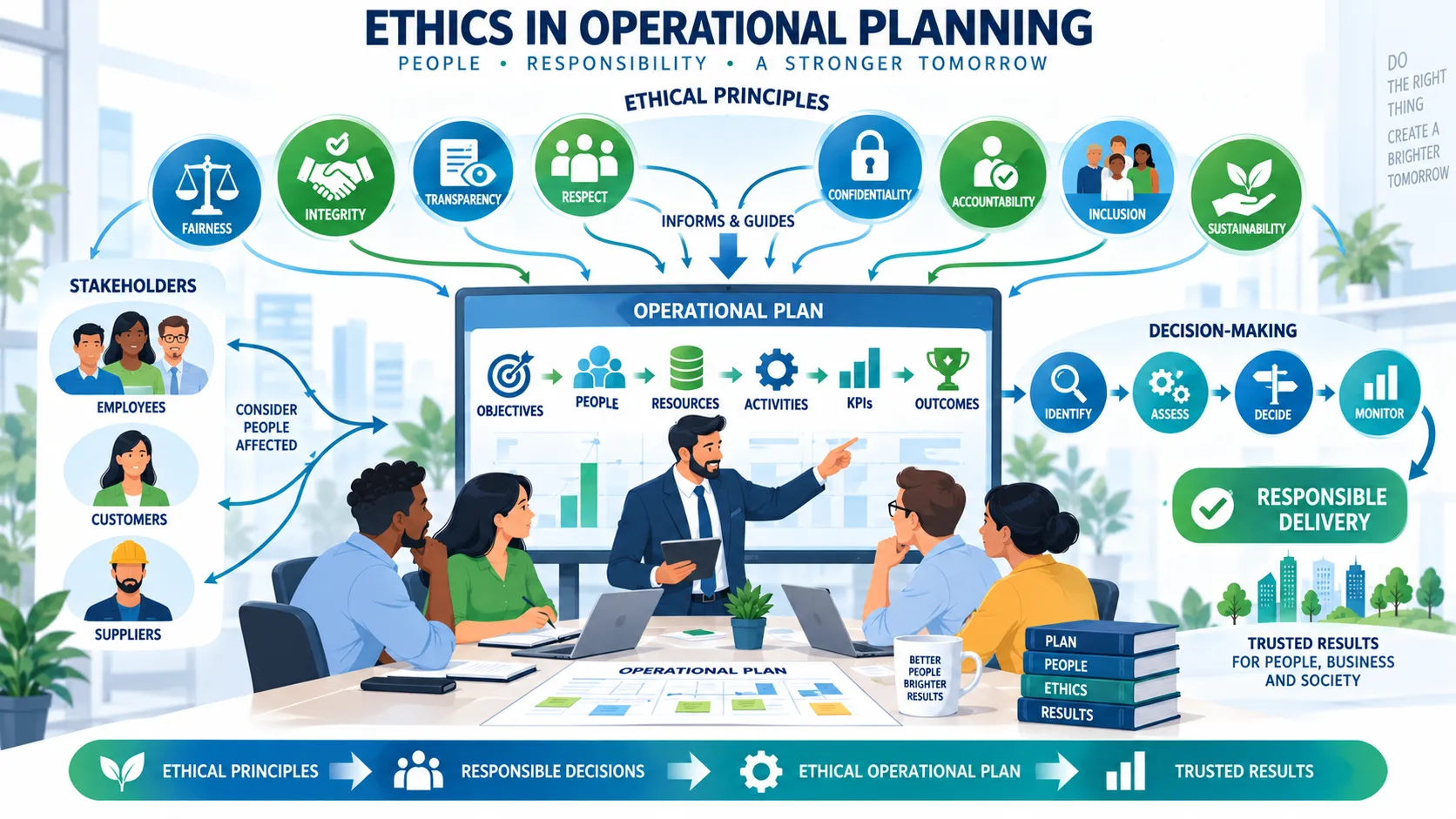
Understanding Ethical Requirements in Operational Planning
Ethical requirements are principles, standards and expectations that guide decisions and behaviour towards what is considered responsible, fair, honest and appropriate. Some ethical expectations may be supported by legislation or organisational policies, while others may go beyond minimum legal requirements.
A useful distinction is that legality asks whether an action is permitted by law, whereas ethics asks whether the action is morally responsible and appropriate.
For example, an organisation may technically be able to introduce a highly demanding productivity target without breaking a specific law. However, if the target creates unreasonable pressure, encourages unsafe behaviour or undermines employee wellbeing, managers should consider whether it is ethically appropriate.
Ethical planning therefore requires managers to consider the wider consequences of operational decisions.
Key Ethical Concepts
| Ethical concept | Definition | Influence on an operational plan |
|---|---|---|
| Integrity | Acting honestly and consistently with accepted principles and organisational values | Encourages truthful reporting, responsible decision-making and reliable performance information |
| Fairness | Treating people reasonably and applying decisions consistently and appropriately | Influences resource allocation, recruitment, performance management and service delivery |
| Transparency | Providing appropriate openness about decisions, processes and information | Supports accountability and stakeholder confidence |
| Accountability | Accepting responsibility for decisions, actions and outcomes | Requires clear ownership, reporting and review arrangements |
| Confidentiality | Protecting information from inappropriate access or disclosure | Influences information handling, access controls and operational procedures |
| Respect | Recognising the dignity, rights and legitimate interests of others | Influences employee management, customer relationships and workplace behaviour |
| Equality | Providing fair treatment and avoiding unjustified discrimination | Influences staffing, access, service delivery and decision-making |
| Sustainability | Considering the long-term social, environmental and economic effects of decisions | Influences procurement, resource use, waste, energy and operational priorities |
| Conflict of interest | A situation where personal interests could improperly influence professional decisions | Requires disclosure, controls and impartial decision-making |
| Ethical accountability | The responsibility to consider and explain the ethical consequences of decisions | Encourages managers to evaluate decisions beyond financial or operational results |
Why Ethics Matters in Operational Planning
Operational plans influence real people and real organisational outcomes. Decisions about staffing, workloads, budgets, suppliers, customers, information and performance targets can create significant consequences.
A manager who focuses only on efficiency may overlook fairness. A manager who focuses only on cost may overlook employee wellbeing. A manager who focuses only on output may overlook quality. A manager who focuses only on customer demand may overlook the impact on employees or suppliers.
Ethical operational planning creates a broader management perspective.
It requires managers to ask:
Is this objective appropriate?
Is the proposed method fair?
Who will benefit?
Who may be negatively affected?
Are different groups being treated appropriately?
Are decisions based on reliable and relevant information?
Are employees being treated with dignity and respect?
Are stakeholders receiving honest information?
Are resources being used responsibly?
Are personal interests influencing decisions?
Are short-term gains creating long-term harm?
Can the organisation justify the decision if it is publicly scrutinised?
These questions help managers identify ethical issues before they become operational problems.
The Difference Between Legal Compliance and Ethical Responsibility
Legal and ethical considerations are closely connected, but they are not identical.
Legal requirements establish minimum standards that organisations must follow. Ethical expectations can extend beyond those minimum standards.
For example, an organisation may be legally permitted to use a particular supplier. However, an ethical review might identify concerns about the supplier’s labour practices, environmental impact or treatment of workers.
Similarly, an organisation may legally collect certain information, but managers should still consider whether collecting it is necessary, proportionate and responsible.
This means that an operational plan should consider two related questions:
Legal Question
Is the planned activity lawful and compliant with applicable requirements?
Ethical Question
Is the planned activity responsible, fair and consistent with organisational values and legitimate stakeholder interests?
Strong operational planning considers both.
Ethical Alignment with Organisational Values
Organisations often communicate values such as:
integrity;
respect;
accountability;
professionalism;
inclusion;
customer focus;
sustainability;
innovation;
fairness;
social responsibility.
Operational plans should reflect these values in practical behaviour.
For example, if an organisation identifies respect as a core value, an operational plan that requires employees to meet unrealistic targets without appropriate support may conflict with that value.
If sustainability is a core organisational value, an operational procurement plan should consider environmental impact rather than selecting suppliers exclusively on price.
If integrity is a stated value, performance reporting should present accurate results rather than selectively reporting favourable outcomes.
Ethical alignment therefore requires consistency between what the organisation says it values and what managers actually plan and implement.
Ethical Requirements and Organisational Objectives
Organisational objectives provide direction, but ethical considerations influence how those objectives should be achieved.
Consider an organisation with an objective to reduce operating costs by 10%.
A purely financial approach might involve reducing staffing, lowering supplier payments or cutting training expenditure. An ethical approach would require the manager to examine the consequences of those decisions.
The manager should consider:
employee workload;
service quality;
health and safety;
customer impact;
supplier relationships;
workforce capability;
long-term organisational sustainability.
Alternative approaches may include improving processes, reducing waste, automating suitable tasks, renegotiating contracts fairly or improving resource utilisation.
This illustrates an important principle:
The achievement of an organisational objective does not automatically justify every method used to achieve it.
Managers should ensure that operational methods remain consistent with ethical expectations.
Ethical Principle of Fairness
Fairness is one of the most important ethical requirements influencing operational planning.
Fairness means making decisions using appropriate and consistent criteria while recognising that different circumstances may sometimes require different forms of support.
Operational planning can involve decisions about:
staffing;
workloads;
overtime;
promotion opportunities;
training;
resource allocation;
customer access;
service priorities;
performance assessment.
Managers should ensure that these decisions are based on relevant factors rather than favouritism, personal preference or inappropriate bias.
Applying Fairness to Resource Allocation
Suppose a manager has a limited training budget and several teams request development opportunities.
An unethical approach might allocate the majority of the budget to employees with whom the manager has a personal relationship.
A fair approach would establish transparent criteria such as:
organisational priority;
role requirements;
identified skills gaps;
performance needs;
service impact;
development requirements.
The decision should then be documented and capable of being explained.
Equality and Inclusive Operational Planning
Ethical operational planning should consider whether activities create unnecessary barriers or unfair outcomes for different groups.
Managers should consider inclusion when planning:
recruitment;
work allocation;
training;
customer services;
communication;
meetings;
facilities;
digital services;
performance systems.
An operational plan should avoid assumptions that all employees or customers have identical needs.
For example, an organisation introducing an online customer service process should consider whether all intended users can reasonably access and use the system.
Ethical planning may therefore require:
accessible communication;
appropriate support;
inclusive processes;
reasonable flexibility;
consideration of different user needs;
monitoring of outcomes across relevant groups.
Respect and Dignity in Operational Planning
Managers influence the working environment through operational decisions.
A plan that introduces new targets, reorganises teams or changes working practices can affect employees’ sense of security, workload and wellbeing.
Respect requires managers to recognise employees as people rather than simply operational resources.
Ethical planning should therefore consider:
workload;
working conditions;
communication;
consultation;
employee voice;
dignity;
wellbeing;
appropriate support.
For example, if a manager wants to increase productivity, simply increasing workloads may create short-term output improvements but could result in fatigue, errors, absenteeism or employee dissatisfaction.
A more ethical approach may involve:
analysing workflow;
removing unnecessary activities;
improving systems;
providing training;
clarifying responsibilities;
setting realistic performance expectations.
Employee Wellbeing as an Ethical Requirement
Employee wellbeing should be considered when operational plans involve changes to workloads, working arrangements, staffing levels or performance expectations.
A plan should not assume that employees can absorb unlimited additional responsibilities.
Managers should assess:
workload levels;
staffing capacity;
working patterns;
pressure points;
training requirements;
support mechanisms;
potential burnout risks;
impact of operational change.
Where significant change is required, managers should communicate clearly and provide appropriate opportunities for employees to raise concerns.
Transparency in Operational Planning
Transparency means providing appropriate openness about decisions, assumptions, processes and outcomes.
Transparent operational planning enables stakeholders to understand:
what is being planned;
why it is required;
who is responsible;
how success will be measured;
what resources are being used;
what risks have been identified;
how performance will be reported.
Transparency does not mean that every piece of information must be publicly disclosed. Confidential, commercially sensitive or legally protected information must still be handled appropriately.
The ethical principle is that information should not be deliberately concealed or manipulated in a way that misleads people who have a legitimate interest in the decision.
Integrity in Performance Reporting
Operational plans normally contain KPIs and performance targets. Ethical management requires managers to report performance honestly.
For example, suppose an operational plan has a customer satisfaction target of 90%, but actual performance is 78%.
An unethical response would be to selectively report only positive customer comments or alter the measurement process to make performance appear better.
An ethical manager would:
report the actual result;
explain the reasons for the variance;
identify corrective action;
establish an improvement target;
monitor progress.
Accurate reporting creates trust and supports better decisions.
Accountability and Ownership
Accountability means accepting responsibility for decisions and outcomes.
An operational plan should identify who is responsible for:
delivering activities;
approving decisions;
managing risks;
monitoring KPIs;
maintaining quality;
reporting performance;
implementing corrective action.
Ethical accountability means that managers do not deliberately shift blame to others when problems arise.
Where an operational activity fails, a responsible manager should examine:
what was planned;
what actually happened;
what assumptions were incorrect;
what controls were in place;
what decisions were made;
what lessons can be learned.
This creates a learning-oriented culture rather than a blame-oriented culture.
Confidentiality and Responsible Information Use
Operational managers frequently have access to sensitive information.
Examples include:
employee records;
customer information;
financial information;
performance data;
commercial information;
supplier information;
strategic plans.
Ethical information management requires managers to use information only for legitimate purposes and prevent inappropriate disclosure.
Operational plans should therefore consider:
who needs access;
what information is necessary;
how information is stored;
how information is shared;
how access is controlled;
how confidential discussions are managed.
Managers should also avoid using confidential information for personal benefit.
Conflict of Interest
A conflict of interest occurs when an individual’s personal, financial or professional interests could influence, or appear to influence, their organisational decision-making.
Operational planning can create conflicts of interest in areas such as:
procurement;
recruitment;
supplier selection;
contract management;
promotion;
resource allocation;
consultancy appointments.
For example, a manager may be involved in selecting a supplier owned by a close personal associate.
Even if the manager believes they can remain impartial, the situation may create a perception of unfairness.
Appropriate controls may include:
declaring the conflict;
removing the individual from the decision;
using independent evaluation;
documenting decision criteria;
obtaining additional approval.
Ethical Procurement
Procurement decisions can have significant ethical implications.
Managers should not automatically select suppliers solely because they offer the lowest price.
Depending on the organisation and procurement framework, managers may also need to consider:
quality;
reliability;
labour practices;
environmental impact;
supply-chain responsibility;
transparency;
conflicts of interest;
value for money.
Ethical procurement seeks to balance cost, quality, risk and responsible business practice.
Practical Example
A manager is selecting a cleaning services provider.
Supplier A offers the lowest price but provides limited information about workforce practices.
Supplier B costs slightly more but provides stronger evidence of responsible employment practices, quality controls and environmental standards.
The manager should not automatically select Supplier A simply because it is cheaper. The decision should consider the full range of relevant organisational and ethical factors.
Sustainability and Ethical Operational Planning
Sustainability requires managers to consider the longer-term consequences of operational decisions.
An operational plan can affect:
energy consumption;
waste;
environmental impact;
use of materials;
transportation;
procurement;
employee wellbeing;
financial sustainability.
Ethical planning considers whether today’s operational decisions create unnecessary costs or harm for future stakeholders.
Examples include:
reducing unnecessary printing;
improving energy efficiency;
reducing waste;
selecting responsible suppliers;
using resources efficiently;
extending equipment life where appropriate;
reducing unnecessary travel.
Sustainability should not be treated as an isolated environmental issue. It can be connected to cost efficiency, organisational reputation, resilience and long-term performance.
Ethical Decision-Making in Operational Planning
Managers may encounter situations where there is no simple answer.
For example, a cost-saving decision may benefit the organisation financially but create additional pressure for employees.
An ethical decision-making process helps managers evaluate such situations systematically.
Step 1: Identify the Decision
Clearly define what decision needs to be made.
Step 2: Identify Stakeholders
Determine who may be affected.
Potential stakeholders include:
employees;
customers;
learners;
suppliers;
managers;
owners;
communities;
regulators.
Step 3: Identify Relevant Values
Consider which ethical principles apply.
These might include:
fairness;
honesty;
respect;
accountability;
confidentiality;
sustainability;
inclusion.
Step 4: Identify Options
Develop realistic alternatives rather than assuming that only one option exists.
Step 5: Assess Consequences
Consider short-term and long-term effects.
Managers should ask:
Who benefits?
Who may be disadvantaged?
What risks arise?
What unintended consequences could occur?
Step 6: Check Legal and Organisational Requirements
Ensure that options are consistent with relevant requirements and policies.
Step 7: Evaluate Fairness
Consider whether the decision can be justified using consistent and relevant criteria.
Step 8: Consult Where Appropriate
Seek input from relevant stakeholders or specialists.
Step 9: Select and Document the Decision
Record the reasoning and relevant evidence.
Step 10: Monitor the Outcome
Assess whether the decision produced the expected results and whether unintended consequences emerged.
Stakeholder Interests and Ethical Planning
Operational plans can affect multiple stakeholders with different interests.
For example:
senior leaders may prioritise cost and strategic performance;
employees may prioritise workload, wellbeing and development;
customers may prioritise quality and responsiveness;
suppliers may prioritise fair contractual relationships;
regulators may prioritise compliance and safety.
Ethical management does not mean satisfying every stakeholder demand. Instead, managers should identify legitimate interests and make balanced, defensible decisions.
Stakeholder Analysis Questions
Managers can consider:
Who is affected?
What is important to them?
What risks do they face?
What information do they need?
What influence do they have?
What obligations does the organisation have towards them?
Could the operational plan create unintended harm?
Ethical Requirements in Setting KPIs
KPIs can influence employee behaviour significantly.
Poorly designed KPIs can unintentionally encourage unethical behaviour.
For example, if a customer service team is measured only on the number of calls completed, employees may rush conversations to increase their figures. This could reduce service quality.
Similarly, if sales employees are rewarded only for sales volume, they may feel pressure to sell products that do not meet customer needs.
Ethical KPI design should therefore consider both quantity and quality.
Appropriate measures might include:
customer satisfaction;
quality outcomes;
error rates;
complaint levels;
compliance performance;
employee wellbeing indicators;
service outcomes.
The key principle is that performance measures should encourage the behaviours the organisation genuinely wants.
Ethical Requirements in Resource Allocation
Resource allocation is one of the areas where managerial judgement is particularly important.
Resources are often limited, meaning that managers must decide where money, staff, equipment and time should be directed.
Ethical resource allocation should be based on:
organisational priorities;
objective evidence;
operational need;
risk;
service impact;
fairness;
value for money.
Managers should avoid allocating resources based on:
personal relationships;
favouritism;
discrimination;
personal financial interests;
political pressure unrelated to legitimate organisational objectives.
Documented decision criteria can strengthen accountability.
Ethical Communication
Communication is another major ethical consideration.
Managers should communicate operational plans accurately and appropriately.
Ethical communication involves:
honesty;
clarity;
respect;
appropriate confidentiality;
avoiding misleading statements;
explaining significant changes;
providing relevant information in a timely manner.
For example, if an operational change is likely to increase employee workload, a manager should not deliberately describe it as having “no impact” simply to avoid resistance.
Transparent communication helps stakeholders make informed decisions and builds trust.
Ethical Management of Change
Operational plans frequently introduce change.
Change may involve:
new technology;
restructuring;
revised working practices;
new performance measures;
changes to services;
changes to staffing.
Ethical change management requires managers to consider how people will be affected.
A responsible approach may involve:
explaining the reason for change;
identifying affected stakeholders;
assessing potential impacts;
consulting appropriately;
providing support;
implementing changes fairly;
monitoring outcomes;
responding to concerns.
This can improve both ethical quality and implementation effectiveness.
Ethical Risk Management
Ethical risks should be considered alongside operational, financial and legal risks.
Examples include:
unfair treatment;
misuse of confidential information;
conflicts of interest;
misleading reporting;
exploitation of employees;
inappropriate supplier relationships;
poor customer treatment;
environmental harm.
An ethical risk register can include:
ethical risk;
affected stakeholders;
likelihood;
potential impact;
existing controls;
responsible person;
mitigation action;
monitoring measure.
This makes ethical considerations more visible within operational management.
Practical Example: Workforce Cost Reduction
An organisation needs to reduce operating costs by 8%.
The operational manager is asked to identify savings.
A narrow approach might immediately reduce staffing.
An ethical assessment would examine:
whether workloads would become unreasonable;
whether service quality would decline;
whether remaining employees have the necessary skills;
whether safety could be affected;
whether vulnerable customers could be disadvantaged;
whether alternative efficiencies exist.
The manager could consider alternatives such as:
reducing process duplication;
improving scheduling;
automating suitable administrative tasks;
reducing unnecessary expenditure;
renegotiating appropriate contracts;
reducing waste;
improving resource utilisation.
This demonstrates how ethical requirements can improve the quality of managerial decision-making rather than simply restricting it.
Practical Example: Performance Management
A manager discovers that one employee has consistently missed performance targets.
The operational plan requires performance standards to be maintained.
An unethical response might be to publicly criticise the employee or immediately impose sanctions without understanding the cause.
An ethical approach would involve:
reviewing objective evidence;
checking whether the target is realistic;
discussing the issue privately;
identifying barriers;
considering training or support;
applying organisational procedures consistently;
monitoring improvement.
This approach balances accountability with respect and fairness.
Practical Example: Data-Driven Customer Service
An organisation plans to introduce customer analytics to improve service quality.
The operational plan should consider:
why information is being collected;
whether the data is necessary;
who can access it;
how it will be protected;
how customers will be informed where appropriate;
how decisions based on data will be reviewed;
whether automated decisions could create unfair outcomes.
The manager should ensure that improved operational insight does not come at the expense of responsible information management.
Practical Example: Supplier Selection
A manager is responsible for selecting a supplier for a major operational contract.
Three suppliers meet the basic technical requirements.
The ethical planning process should consider:
objective selection criteria;
quality;
cost;
reliability;
relevant social and environmental considerations;
potential conflicts of interest;
transparency of the evaluation process.
The decision should be documented so that it can be explained and reviewed if challenged.
Ethical Requirements Across the Operational Planning Cycle
Ethical considerations should be integrated throughout the planning cycle rather than reviewed only at the end.
Planning
At the planning stage, managers should identify ethical considerations and stakeholder impacts.
Design
When developing activities, managers should consider fairness, transparency, resources and potential consequences.
Implementation
During delivery, managers should monitor whether planned activities are producing unintended ethical problems.
Monitoring
Performance information should be accurate, relevant and responsibly collected.
Review
Managers should assess not only whether targets were achieved but also how they were achieved.
Improvement
Lessons should be used to improve future operational decisions.
This creates a continuous ethical management cycle:
Identify → Assess → Plan → Implement → Monitor → Review → Improve
Assessing Whether an Operational Plan Is Ethically Strong
Managers can assess an operational plan by examining several dimensions.
Fairness
Are decisions based on reasonable and relevant criteria?
Transparency
Can important decisions be explained to those with a legitimate interest?
Accountability
Is responsibility clearly allocated?
Respect
Does the plan protect dignity and treat people appropriately?
Integrity
Are objectives, data and performance reports accurate?
Confidentiality
Is sensitive information protected?
Sustainability
Have longer-term consequences been considered?
Stakeholder Impact
Have the interests and potential consequences for affected stakeholders been considered?
Proportionality
Are the methods and controls proportionate to the level of risk and intended outcome?
Common Ethical Problems in Operational Planning
Managers should remain alert to common ethical weaknesses.
Unrealistic Targets
Targets that are impossible to achieve may encourage employees to manipulate information or compromise quality.
Hidden Costs
A plan may appear financially efficient while transferring costs to employees, customers, suppliers or the environment.
Selective Reporting
Managers may be tempted to report positive outcomes while ignoring poor performance.
Favouritism
Resources or opportunities may be allocated based on personal relationships rather than objective criteria.
Conflicts of Interest
Personal interests may influence procurement, recruitment or other decisions.
Misuse of Information
Confidential information may be accessed or shared without appropriate justification.
Lack of Consultation
People affected by significant operational changes may be excluded from relevant discussions.
Ethical Blind Spots
Managers may focus so heavily on financial or operational targets that they overlook wider consequences.
Benefits of Ethical Operational Planning
Ethical operational planning can provide significant organisational benefits.
Stronger Trust
Employees and stakeholders are more likely to trust managers who make transparent and fair decisions.
Better Employee Engagement
Fair treatment, respect and meaningful involvement can support stronger engagement.
Improved Decision Quality
Considering different stakeholder perspectives can reveal risks and alternative solutions.
Reduced Reputational Risk
Ethical behaviour can protect organisational reputation.
Stronger Organisational Culture
Consistent ethical decision-making reinforces organisational values.
Better Long-Term Sustainability
Considering long-term consequences can reduce short-term decisions that create future problems.
Improved Performance
Ethical practices can support quality, employee commitment, customer confidence and operational resilience.
Greater Accountability
Clear decision-making criteria and reporting arrangements make managerial actions easier to review.
Developing an Ethical Operational Planning Procedure
Organisations can establish a practical procedure for integrating ethics into operational plans.
Stage 1: Define the Objective
Clarify what the plan intends to achieve.
Stage 2: Identify Stakeholders
Determine who may be affected by the plan.
Stage 3: Identify Ethical Issues
Consider fairness, respect, confidentiality, conflicts of interest, sustainability and potential harm.
Stage 4: Assess Options
Compare alternative approaches and their consequences.
Stage 5: Check Requirements
Review relevant legal, regulatory and organisational requirements.
Stage 6: Establish Controls
Create controls to prevent or reduce ethical risks.
Stage 7: Allocate Accountability
Assign responsibility for ethical implementation and monitoring.
Stage 8: Establish Ethical Measures
Include appropriate indicators where ethical performance can be meaningfully measured.
Stage 9: Communicate
Explain relevant decisions clearly to affected stakeholders.
Stage 10: Monitor and Review
Evaluate outcomes and identify ethical issues that emerge during implementation.
Integrating Ethics into an Operational Plan
A practical operational plan can incorporate ethics through specific planning components.
Objective
State the desired outcome in a way that reflects responsible organisational practice.
Activities
Include ethical controls and responsible implementation actions.
Responsibilities
Identify who owns relevant ethical and compliance requirements.
Resources
Provide sufficient resources to implement ethical standards.
Timescales
Allow sufficient time for consultation, training, review and responsible implementation.
KPIs
Include appropriate quality, fairness, service and compliance measures.
Risks
Identify ethical risks alongside operational and financial risks.
Review
Establish mechanisms for reviewing ethical consequences.
Managerial Questions for Ethical Review
Before approving an operational plan, managers should ask:
Does the plan reflect organisational values?
Is the objective itself ethically appropriate?
Are the proposed methods fair?
Could any stakeholder group be unfairly disadvantaged?
Are employees being treated with dignity and respect?
Is the workload realistic?
Are performance targets likely to encourage appropriate behaviour?
Is information being used responsibly?
Are conflicts of interest identified?
Are procurement decisions transparent?
Are resources being allocated fairly?
Are stakeholders appropriately considered?
Are environmental and long-term consequences relevant?
Are performance reports accurate?
Can the decision be clearly justified?
Are ethical risks monitored?
What would happen if the decision were publicly scrutinised?
Would the organisation be comfortable explaining the decision to employees, customers or other legitimate stakeholders?
Key Concepts to Remember
The central concepts from this part are:
Ethical requirements influence both what an organisation does and how it achieves its objectives.
Legal compliance represents a minimum requirement, while ethical responsibility can extend beyond legal obligations.
Operational plans should be consistent with organisational values.
Fairness is essential when allocating resources, opportunities and responsibilities.
Equality and inclusion should be considered when designing operational processes.
Employee dignity and wellbeing are important ethical considerations.
Transparency supports trust and accountability.
Accurate performance reporting demonstrates integrity.
Confidential information must be handled responsibly.
Conflicts of interest should be identified, disclosed and controlled.
Procurement decisions should be objective, transparent and appropriately responsible.
Sustainability can form an important part of ethical operational planning.
KPIs should not encourage unethical or undesirable behaviour.
Stakeholder interests should be considered when operational decisions have wider consequences.
Ethical risks should be incorporated into operational risk management.
Managers should consider both short-term and long-term consequences.
Ethical decision-making should be evidence-based, transparent and defensible.
Ethical considerations should be reviewed throughout the operational planning cycle.
Professional Management Insight
For practising and aspiring middle managers, ethical operational planning is not an optional addition to management practice. It is a fundamental part of responsible leadership.
Middle managers are often positioned between strategic decision-makers and operational teams. They are therefore responsible for converting organisational objectives into actions that directly affect employees, customers, suppliers and other stakeholders. This position gives them considerable influence over whether organisational values are actually reflected in everyday practice.
An effective manager should not simply ask whether an operational plan can achieve its targets. The manager should also ask whether the targets are appropriate, whether the methods are fair, whether stakeholders are treated responsibly and whether the organisation can justify the decisions being made.
Ethical management requires balance. Managers must balance performance with quality, efficiency with wellbeing, organisational interests with stakeholder interests, short-term requirements with long-term sustainability, and managerial authority with accountability.
A strong operational plan therefore combines:
clear organisational objectives;
realistic operational activities;
responsible resource allocation;
fair and transparent decision-making;
appropriate stakeholder consideration;
responsible information management;
ethical performance measures;
effective risk controls;
clear accountability;
continuous monitoring and review.
The most effective managers understand that ethical behaviour can strengthen operational performance rather than obstruct it. Fair processes can improve employee commitment. Transparent decisions can strengthen stakeholder trust. Accurate reporting can improve decision-making. Responsible procurement can reduce long-term risk. Sustainable resource use can improve resilience. Respectful management can support employee performance and retention.
Ultimately, an operational plan should answer two questions: “What must the organisation achieve?” and “How should it achieve this responsibly?”
When ethical requirements are embedded into operational planning from the beginning, managers are better equipped to make decisions that are lawful, fair, transparent, sustainable and aligned with organisational values. This supports not only immediate operational objectives but also long-term organisational credibility, stakeholder confidence and responsible leadership practice.
3.Create an Operational Plan in Line with Organisational Objectives
Creating an operational plan is one of the most important responsibilities of an effective middle manager. Organisational objectives establish the outcomes that an organisation wants to achieve, while the operational plan converts those outcomes into practical activities, responsibilities, resources, timescales, performance measures and review arrangements. The operational plan therefore provides the bridge between organisational direction and day-to-day implementation.
A strong operational plan is more than a list of tasks. It is a structured management tool that explains what needs to be achieved, why it matters, who will be responsible, what resources will be required, when activities should be completed, how quality will be maintained, what risks could affect delivery and how success will be measured. It should give employees sufficient clarity to understand their contribution while giving managers sufficient information to monitor performance and make informed decisions.
Operational planning is particularly important for middle managers because they often operate at the point where strategic intentions become operational reality. Senior leaders may establish organisational priorities, but middle managers are frequently responsible for converting those priorities into departmental and team-level actions. They must interpret organisational objectives, assess operational capacity, coordinate people and resources, establish realistic targets and monitor whether implementation is producing the required results.
The quality of an operational plan can therefore directly influence organisational performance. If objectives are unclear, activities may become disconnected from priorities. If responsibilities are not defined, accountability may be weak. If resources are insufficient, implementation may fail. If KPIs are inappropriate, managers may measure activity rather than meaningful outcomes. If risks are ignored, unexpected problems may disrupt delivery.
Creating an effective operational plan requires a structured process. Managers need to understand organisational objectives, analyse the operating environment, establish operational priorities, define SMART objectives, identify activities and deliverables, allocate resources, assign responsibilities, establish timescales, develop KPIs, assess risks, consider quality requirements, communicate the plan and establish monitoring and review arrangements.
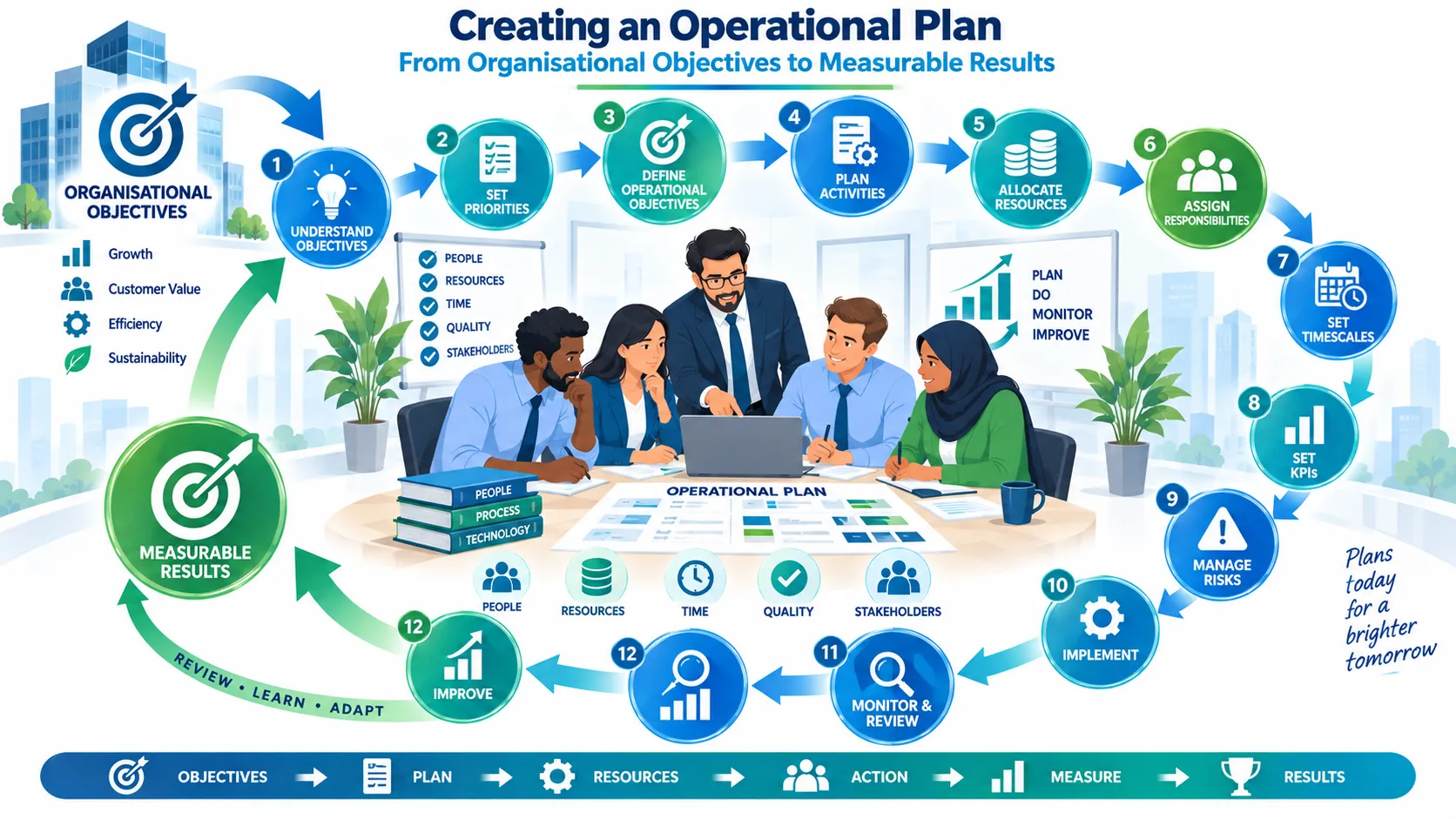
Understanding the Purpose of an Operational Plan
An operational plan is a structured document or management framework that sets out how organisational or departmental objectives will be achieved through specific activities and resources within defined timescales.
It translates broad organisational intentions into practical operational commitments.
For example, an organisation may have a strategic objective to improve customer satisfaction. This objective provides direction but does not explain precisely what employees need to do.
An operational plan could translate this objective into actions such as:
reduce customer response times;
improve employee training;
review complaint-handling procedures;
introduce service-quality monitoring;
improve customer communication;
establish monthly satisfaction measures.
The operational plan therefore answers several practical questions:
What are we trying to achieve?
Why is it important?
What activities need to be completed?
Who will do the work?
What resources are required?
When should activities be completed?
What risks could affect delivery?
What standards must be maintained?
How will success be measured?
How will progress be monitored?
What action will be taken if performance falls below expectations?
Relationship Between Organisational Objectives and Operational Planning
The starting point for creating an operational plan is a clear understanding of organisational objectives.
Organisational objectives describe specific results that the organisation intends to achieve. They provide direction for management decisions and help determine priorities.
Operational planning then translates these objectives into manageable activities.
A useful hierarchy is:
Organisation’s vision and mission
↓
Strategic direction
↓
Organisational objectives
↓
Departmental objectives
↓
Operational objectives
↓
Activities and deliverables
↓
Individual and team responsibilities
↓
Performance measures
↓
Operational results
This hierarchy demonstrates why operational planning must be aligned with organisational objectives.
If a team creates activities that do not contribute to organisational priorities, resources may be wasted. Conversely, when operational activities are clearly linked to organisational objectives, employees can understand why their work matters and managers can assess whether operational performance is contributing to organisational results.
Key Principles of an Effective Operational Plan
An effective operational plan should be:
Aligned
Every significant operational activity should support an agreed organisational or departmental objective.
Specific
The plan should clearly state what needs to be achieved rather than using vague intentions.
Measurable
Progress and outcomes should be capable of being assessed using appropriate indicators.
Realistic
The plan should reflect available resources, organisational capability and operational constraints.
Time-bound
Activities and objectives should have appropriate deadlines and milestones.
Accountable
Responsibilities should be clearly allocated.
Flexible
The plan should be capable of adaptation when circumstances change.
Risk-aware
Potential threats and opportunities should be identified and managed.
Quality-focused
The plan should define the standards expected from outputs and outcomes.
Communicable
Relevant employees and stakeholders should understand the plan and their role within it.
Step 1: Understand the Organisational Objectives
Before creating the operational plan, the manager should obtain and analyse the relevant organisational objectives.
This requires more than simply reading a strategic document. Managers need to understand the meaning and practical implications of each objective.
For every relevant organisational objective, the manager should consider:
What is the organisation trying to achieve?
Why has this objective been established?
What outcomes are expected?
Which departments contribute to the objective?
What timeframe applies?
What performance measures already exist?
What resources have been identified?
What risks could affect achievement?
For example, consider the objective:
“Improve customer service performance.”
This is directionally useful but may need to be translated into more precise operational outcomes.
The manager might determine that the organisation intends to:
reduce response times;
improve customer satisfaction;
reduce complaints;
improve first-contact resolution;
strengthen employee capability.
This interpretation provides a stronger basis for operational planning.
Step 2: Analyse the Current Operational Position
Before deciding what needs to change, managers should understand the current position.
This involves establishing a baseline.
A baseline is the current level of performance against which future improvement can be measured.
For example:
Current average response time: 48 hours
Desired response time: 24 hours
The gap between current and desired performance provides useful planning information.
Managers can analyse:
current performance;
existing resources;
workforce capability;
current processes;
technology;
customer feedback;
financial position;
quality performance;
risks;
operational constraints.
A useful diagnostic approach is to identify:
Current State
What is happening now?
Desired State
What should happen in the future?
Performance Gap
What is preventing the organisation from reaching the desired state?
Required Action
What operational activities will close the gap?
Step 3: Identify Operational Priorities
Not every organisational objective can receive equal attention at the same time.
Managers need to establish priorities based on organisational importance, urgency, risk, resources and expected impact.
Priority decisions may consider:
strategic importance;
customer impact;
regulatory requirements;
financial impact;
operational risk;
resource availability;
deadlines;
dependencies;
potential organisational benefit.
For example, if an organisation has limited resources and must choose between improving a low-risk administrative process and resolving a major customer-service failure, the latter may reasonably receive greater priority.
Effective prioritisation prevents operational plans from becoming overloaded.
Step 4: Translate Organisational Objectives into Operational Objectives
Organisational objectives are often broad. Managers must convert them into objectives that can be managed at operational level.
Suppose the organisational objective is:
“Improve service quality.”
An operational objective might be:
“Improve first-contact resolution from 70% to 85% within six months.”
This is much more useful because it identifies:
the area of performance;
the desired improvement;
the target;
the timeframe.
Operational objectives should ideally follow SMART principles.
Specific
The objective should clearly state what needs to be achieved.
Measurable
There should be a reliable method of assessing progress.
Achievable
The objective should be realistic within the available circumstances.
Relevant
The objective should contribute to organisational priorities.
Time-bound
A clear timeframe should be established.
SMART objectives help managers transform organisational ambition into measurable operational commitments.
Step 5: Identify Activities and Deliverables
Once operational objectives are established, managers should identify the activities required to achieve them.
An activity describes the work that needs to be undertaken.
A deliverable is the defined output produced by an activity.
For example:
Objective: Improve customer response time.
Activities:
analyse current workflow;
identify causes of delay;
redesign work allocation;
train employees;
introduce monitoring;
review performance.
Deliverables:
workflow analysis;
revised process;
trained employees;
performance dashboard;
monthly review report.
This distinction helps managers understand what work must happen and what tangible outputs should result.
Step 6: Break Activities into Manageable Tasks
Large operational activities should be divided into manageable tasks.
For example, “implement a new customer service system” may involve:
define system requirements;
review available options;
obtain approval;
select supplier;
configure the system;
test functionality;
train employees;
migrate relevant information;
launch the system;
monitor performance.
Breaking activities into tasks improves clarity and accountability.
It also makes it easier to identify dependencies.
Understanding Dependencies
A dependency exists when one activity cannot begin or cannot be completed until another activity has progressed.
For example:
System requirements
↓
Supplier selection
↓
System configuration
↓
Testing
↓
Staff training
↓
Implementation
If supplier selection is delayed, subsequent activities may also be delayed.
Managers should therefore identify important dependencies when developing the operational plan.
Step 7: Allocate Responsibilities
A plan should clearly identify who is responsible for each activity.
Responsibility allocation prevents confusion and supports accountability.
Managers should consider:
who owns the activity;
who carries out the work;
who approves decisions;
who provides specialist support;
who needs to be consulted;
who needs to receive information.
A responsibility matrix can be useful for complex operational plans.
For example:
| Operational activity | Responsible role | Supporting roles | Expected outcome |
|---|---|---|---|
| Review customer response process | Customer Service Manager | Team Leaders, Quality Officer | Revised workflow |
| Deliver staff training | Training Manager | Subject Specialists | Staff competence improved |
| Monitor response KPI | Performance Manager | Data Analyst | Monthly performance report |
| Review customer complaints | Service Manager | Customer Support Team | Corrective actions identified |
Clear allocation of responsibility makes the plan easier to implement and monitor.
Step 8: Assess and Allocate Resources
An operational plan must be realistic about resources.
Resources can include:
people;
finance;
time;
equipment;
technology;
information;
facilities;
materials;
specialist expertise.
Managers should determine what resources are required for each activity and whether they are available.
Workforce Resources
Consider:
number of employees;
skills;
competence;
availability;
workload;
training requirements.
Financial Resources
Consider:
budget;
operating costs;
capital expenditure;
procurement;
contingency funding.
Technological Resources
Consider:
systems;
software;
hardware;
connectivity;
technical support;
cybersecurity.
Time Resources
Consider:
employee availability;
activity duration;
deadlines;
dependencies;
competing priorities.
Resource allocation should reflect organisational priorities.
Step 9: Establish Timescales and Milestones
Operational plans require realistic timescales.
Managers should identify:
start dates;
completion dates;
interim deadlines;
milestones;
review points.
Milestones are important because they allow managers to assess progress before the final outcome is reached.
For example:
Month 1: Process analysis completed
Month 2: Revised process approved
Month 3: Employee training completed
Month 4: New process implemented
Month 5: Initial performance review
Month 6: Target performance assessed
This provides a clear operational pathway.
Step 10: Establish Key Performance Indicators
KPIs provide evidence of whether operational objectives are being achieved.
A KPI should be directly connected to an objective.
For example:
Objective: Reduce customer response times.
Possible KPI:
Average customer response time.
Additional indicators might include:
percentage of responses completed within target;
customer satisfaction;
complaint rate;
first-contact resolution;
backlog volume.
Managers should avoid using excessive KPIs. A small number of meaningful measures is generally more useful than a large number of irrelevant indicators.
Characteristics of Effective KPIs
Effective KPIs should be:
relevant;
measurable;
reliable;
understandable;
aligned with objectives;
time-sensitive;
actionable.
Managers should also consider whether a KPI encourages the right behaviour.
If employees are measured only on speed, they may compromise quality. Combining speed and quality measures can provide a more balanced view.
Step 11: Establish Quality Requirements
Operational plans should define not only what will be delivered but also the required quality.
Quality requirements may include:
accuracy;
reliability;
safety;
customer satisfaction;
compliance;
consistency;
service standards.
For example, an operational plan may require a team to process applications within two working days while maintaining an accuracy rate of at least 98%.
This prevents managers from achieving speed at the expense of quality.
Step 12: Identify and Manage Risks
Every operational plan contains uncertainty.
Managers should identify risks that could prevent successful delivery.
Potential risks include:
insufficient resources;
employee absence;
skills shortages;
technology failure;
budget reductions;
supplier delays;
regulatory changes;
customer demand changes;
operational disruption.
A risk assessment should consider:
risk description;
likelihood;
impact;
existing controls;
mitigation;
responsible owner.
Example
Risk: Key employees are unavailable during implementation.
Potential impact: Implementation delay.
Mitigation:
cross-train employees;
document key processes;
establish backup resources;
plan implementation around known availability.
Risk management makes the operational plan more resilient.
Step 13: Consider Stakeholder Requirements
Operational plans often affect multiple stakeholders.
Stakeholders may include:
employees;
customers;
suppliers;
senior leaders;
partner organisations;
regulators;
service users.
Managers should understand relevant expectations and requirements.
Stakeholder involvement can improve the operational plan because people directly affected by activities often have valuable practical knowledge.
For example, employees may identify workflow problems that senior managers are not aware of.
Customers may identify service issues that internal performance data does not fully explain.
Step 14: Check Legal, Organisational and Ethical Requirements
Before finalising the plan, managers should ensure that proposed activities are consistent with:
relevant legislation;
regulatory requirements;
organisational policies;
ethical expectations;
contractual commitments;
governance arrangements.
This step ensures that the plan is not only achievable but also responsible and compliant.
Managers should consider:
health and safety;
equality and inclusion;
data protection;
confidentiality;
employment requirements;
financial controls;
procurement;
ethical decision-making;
environmental responsibilities.
Step 15: Establish Monitoring Arrangements
A plan should specify how progress will be monitored.
Monitoring may include:
weekly team reviews;
monthly KPI reports;
quality audits;
financial reviews;
customer feedback;
risk reviews;
milestone assessments.
Monitoring should provide information that enables managers to act.
For example, if monthly performance falls below target, the manager should have a defined process for:
identifying the variance;
investigating the cause;
deciding corrective action;
assigning responsibility;
establishing a new review point.
Step 16: Establish Reporting Arrangements
Operational plans should specify how findings will be reported.
Reporting should communicate:
planned performance;
actual performance;
variance;
causes;
risks;
corrective actions;
resource implications;
future priorities.
Reports should be tailored to the audience.
Senior leaders may require a concise strategic summary, while operational teams may need detailed activity information.
Effective reporting ensures that operational performance contributes to wider management decision-making.
Step 17: Communicate the Operational Plan
Even a well-designed plan will fail if employees do not understand it.
Managers should communicate:
organisational objectives;
operational priorities;
expected outcomes;
responsibilities;
deadlines;
KPIs;
quality expectations;
risks;
reporting arrangements.
Communication should also explain why the plan matters.
Employees are more likely to engage when they understand the relationship between their work and organisational objectives.
Step 18: Implement the Plan
Implementation converts the plan into action.
Managers should:
confirm responsibilities;
release resources;
communicate expectations;
initiate activities;
monitor milestones;
manage risks;
resolve problems;
maintain quality.
Implementation should be actively managed rather than treated as automatic.
Managers need to remain visible and responsive throughout delivery.
Step 19: Monitor Performance Against the Plan
Managers should compare actual performance against planned performance.
For example:
| Measure | Planned | Actual | Variance | Management response |
|---|---|---|---|---|
| Customer response time | 24 hours | 31 hours | +7 hours | Review workflow and staffing |
| Customer satisfaction | 90% | 87% | -3 percentage points | Analyse feedback |
| Staff training completion | 100% | 96% | -4 percentage points | Complete outstanding training |
| Complaint resolution | 95% within target | 91% | -4 percentage points | Review escalation process |
The purpose of monitoring is not simply to identify poor performance. It is to support informed management action.
Step 20: Review and Adapt the Operational Plan
Operational plans should not be regarded as permanently fixed documents.
Changes may occur because of:
organisational priorities;
customer needs;
resource availability;
financial conditions;
employee capability;
technology;
legislation;
market conditions;
emerging risks.
Managers should therefore review the plan regularly.
Adaptation should be controlled and evidence-based.
The manager should determine:
what has changed;
why it has changed;
which activities are affected;
whether objectives remain relevant;
whether resources need adjustment;
whether timescales should change;
whether KPIs remain appropriate.
Example: Creating an Operational Plan for Customer Service Improvement
Consider an organisation whose organisational objective is:
“Improve customer satisfaction and service responsiveness.”
The middle manager needs to create an operational plan that translates this objective into practical action.
Current Situation
The department currently has:
average response time of 48 hours;
customer satisfaction of 78%;
high complaint levels;
inconsistent employee training;
limited performance monitoring.
Operational Objective
Reduce average customer response time from 48 hours to 24 hours and improve customer satisfaction from 78% to 88% within six months.
Planned Activities
The manager could establish:
analyse customer response data;
identify causes of delay;
review workforce allocation;
redesign workflow;
introduce service standards;
train employees;
establish a performance dashboard;
review complaints monthly;
introduce corrective actions;
evaluate performance after six months.
Resources
Required resources may include:
staff time;
training budget;
performance reporting tools;
management support;
process improvement expertise.
Responsibilities
The manager could assign:
team leaders to monitor daily workflow;
training staff to coordinate development;
data analysts to prepare KPI reports;
customer service employees to implement revised procedures.
KPIs
Possible KPIs include:
average response time;
percentage of responses completed within target;
customer satisfaction;
complaint volume;
first-contact resolution.
Risks
Potential risks include:
insufficient staffing;
increased customer demand;
employee resistance;
technology problems.
Review
The manager could conduct:
weekly operational reviews;
monthly KPI reporting;
quarterly management evaluation;
six-month outcome assessment.
This creates a complete connection between the organisational objective and practical operational management.
Example: Operational Plan for Workforce Capability
An organisation may have an objective to improve workforce capability.
A middle manager could create an operational objective:
“Ensure that all employees in customer-facing roles complete required service-skills training within four months and demonstrate improved performance against agreed service standards.”
The operational plan could include:
skills-gap analysis;
training needs analysis;
programme design;
training delivery;
competence assessment;
coaching;
performance monitoring.
KPIs might include:
percentage of employees trained;
assessment pass rate;
service-quality score;
customer satisfaction;
reduction in service errors.
This example shows how an organisational objective can be converted into measurable workforce activities.
Example: Operational Plan for Cost Efficiency
Suppose an organisation establishes an objective to improve cost efficiency without reducing service quality.
A manager could establish an operational objective to reduce avoidable operating expenditure by 7% over twelve months while maintaining agreed quality standards.
The plan might include:
expenditure analysis;
waste identification;
process review;
supplier analysis;
energy-efficiency measures;
resource utilisation improvements;
quality monitoring.
The manager should ensure that cost reduction does not simply transfer costs to employees or customers.
Relevant KPIs might include:
operating cost per service;
waste levels;
productivity;
customer satisfaction;
quality errors;
employee absence.
This demonstrates the importance of balancing financial performance with operational quality.
Example: Operational Plan for Digital Transformation
An organisation may have an objective to improve digital service delivery.
The operational manager may need to:
assess current systems;
identify user requirements;
establish technical requirements;
select appropriate technology;
train employees;
test the system;
implement the solution;
monitor user experience.
Potential risks could include:
implementation delays;
employee resistance;
technical failure;
insufficient training;
data security issues.
KPIs could include:
system availability;
user adoption;
employee training completion;
transaction processing time;
customer satisfaction;
number of technical incidents.
The operational plan should therefore integrate technology, people, processes, resources and risk.
The Role of Middle Managers in Creating Operational Plans
Middle managers play a critical role in converting organisational objectives into practical delivery.
They often need to balance competing expectations from senior leaders, employees, customers and other stakeholders.
Their responsibilities may include:
interpreting organisational objectives;
establishing departmental priorities;
consulting employees;
assessing operational capability;
allocating resources;
setting targets;
coordinating activities;
managing risks;
monitoring KPIs;
reporting performance;
implementing corrective action.
Middle managers also provide upward feedback.
If an operational plan cannot realistically achieve an organisational objective with available resources, the manager should communicate this rather than simply accepting an unrealistic target.
This creates a two-way relationship:
Organisational direction → Operational implementation → Performance evidence → Management feedback → Strategic review
Ensuring Vertical and Horizontal Alignment
Operational alignment occurs vertically and horizontally.
Vertical Alignment
Vertical alignment means connecting operational objectives with higher-level organisational priorities.
For example:
Strategic objective → Departmental objective → Team target → Individual activity
Horizontal Alignment
Horizontal alignment means coordinating activities between departments.
For example, a customer-service improvement plan may depend on:
IT providing reliable systems;
HR providing training;
Finance approving resources;
Operations redesigning processes;
Quality teams monitoring performance.
Without horizontal alignment, departments may work towards different priorities.
Common Mistakes When Creating Operational Plans
Managers should avoid several common planning errors.
Creating a Plan Without Understanding Strategy
Activities may become disconnected from organisational priorities.
Setting Too Many Objectives
An overloaded plan can dilute attention and resources.
Using Vague Objectives
Statements such as “improve service” are difficult to manage without measurable outcomes.
Ignoring Resource Constraints
A plan cannot be implemented effectively if required resources are unavailable.
Failing to Assign Responsibility
Unclear ownership can result in tasks being overlooked.
Using Too Many KPIs
Excessive measures can create administrative burden and reduce focus.
Focusing Only on Activities
Completing activities does not necessarily mean that desired outcomes have been achieved.
Ignoring Risk
Unexpected problems can significantly affect delivery.
Failing to Review the Plan
A plan that remains unchanged despite significant circumstances may become irrelevant.
Poor Communication
Employees may not understand what is expected or why the plan matters.
Key Benefits of Creating an Operational Plan
A well-designed operational plan provides several important benefits.
Strategic Alignment
It ensures that daily operational activity contributes to organisational objectives.
Clear Direction
Employees understand priorities and expected outcomes.
Improved Accountability
Responsibilities and ownership are clearly established.
Better Resource Management
Resources can be allocated according to organisational priorities.
Improved Performance Measurement
KPIs provide evidence of progress and outcomes.
Better Risk Management
Potential problems can be identified and addressed before they significantly affect delivery.
Improved Coordination
Activities across teams and departments can be aligned.
Better Decision-Making
Managers have structured information for monitoring and corrective action.
Greater Organisational Agility
Plans can be reviewed and adapted when circumstances change.
Improved Quality
Quality standards and outcome measures can be integrated into operational activity.
Key Concepts to Remember
The following concepts are central to creating an effective operational plan:
Organisational objectives define the outcomes the organisation intends to achieve.
Operational plans translate those objectives into practical activities.
Operational objectives should be specific, measurable, achievable, relevant and time-bound.
Activities should be linked directly to expected outcomes.
Responsibilities should be clearly allocated.
Resources should be matched to priorities.
Timescales and milestones support coordinated delivery.
KPIs provide evidence of performance.
Quality measures prevent output targets from being pursued at the expense of standards.
Risks should be identified and managed during planning.
Stakeholder requirements should be considered.
Legal, organisational and ethical requirements should be integrated into planning.
Monitoring allows actual performance to be compared with planned performance.
Reporting provides information for management decisions.
Operational plans should be reviewed and adapted when circumstances change.
Middle managers play an important role in connecting organisational direction with operational implementation.
Operational Planning Quality Checklist
Before approving an operational plan, a manager should confirm that:
organisational objectives are clearly understood;
operational objectives directly support organisational priorities;
current performance has been assessed;
performance gaps are identified;
activities and deliverables are clearly defined;
priorities have been established;
responsibilities are allocated;
resources are sufficient;
timescales are realistic;
milestones are included;
KPIs are relevant;
quality standards are defined;
risks are assessed;
contingency arrangements are considered where appropriate;
legal requirements are addressed;
organisational policies are reflected;
ethical considerations are included;
stakeholders have been appropriately considered;
communication arrangements are established;
monitoring arrangements are clear;
reporting arrangements are defined;
review points are established;
the plan can be adapted when circumstances change.
Professional Management Insight
Creating an operational plan is fundamentally an exercise in translating organisational intent into controlled action. The quality of the plan depends on how effectively the manager connects objectives, people, processes, resources, responsibilities, timescales, risks and performance measures.
A strong operational plan should enable an employee or team to understand not only what they are expected to do, but also why the activity matters, how it contributes to organisational objectives, what standard is required, what resources are available and how success will be assessed.
For middle managers, this requires both strategic awareness and operational competence. They must understand the organisation’s direction while also understanding the practical realities of implementation. They need to recognise when objectives are achievable, when resources are insufficient, when priorities conflict and when operational circumstances require a plan to be adapted.
The most effective approach is therefore not to create an operational plan once and treat it as a fixed document. Instead, operational planning should be viewed as a continuous management cycle:
Understand objectives → Analyse current position → Set priorities → Define operational objectives → Identify activities → Allocate responsibilities → Allocate resources → Establish timescales → Set KPIs → Assess risks → Implement → Monitor → Report → Review → Adapt
This cycle ensures that planning remains connected to actual performance.
An effective manager also understands that operational success should not be measured solely by whether activities were completed. The more important question is whether those activities produced the intended outcomes. A team may complete every planned task and still fail to improve customer satisfaction, quality, productivity or service outcomes. Managers must therefore distinguish between activity, output and outcome.
The final operational plan should provide a clear line of sight from organisational objectives to measurable results. Every significant activity should have a purpose, every responsibility should have an owner, every major resource requirement should be understood, every important risk should have an appropriate response and every key outcome should have a meaningful measure.
When operational planning is approached in this way, it becomes a powerful management tool rather than a purely administrative document. It supports strategic alignment, accountability, effective resource use, performance improvement, risk management, quality assurance and informed decision-making.
Ultimately, creating an operational plan in line with organisational objectives requires managers to answer five fundamental questions:
What does the organisation need to achieve?
What must our area achieve to contribute to that objective?
What activities, people and resources are required?
How will we know whether the plan is working?
How will we respond when performance, resources or circumstances change?
Managers who can answer these questions clearly are better equipped to turn organisational objectives into practical, measurable and sustainable operational results.