
Lesson no 1 : Understand the role of projects in delivering organisational strategy
Projects play a central role in helping organisations turn strategic intentions into practical and measurable results. While organisational strategy establishes the direction an organisation wants to take, projects provide a structured way to implement specific changes, introduce new services, improve processes, develop capabilities, respond to market opportunities and achieve defined organisational priorities. Understanding the relationship between projects and organisational strategy is therefore an essential management skill for anyone involved in planning, coordinating or delivering organisational initiatives.
An organisation may have strategic objectives relating to growth, operational efficiency, customer satisfaction, digital transformation, sustainability, quality improvement or service development. These objectives cannot usually be achieved through routine operational activities alone. Projects provide a focused and temporary structure through which people, resources, expertise and activities can be coordinated to deliver specific outcomes. A well-designed project should therefore have a clear connection to what the organisation is trying to achieve strategically.
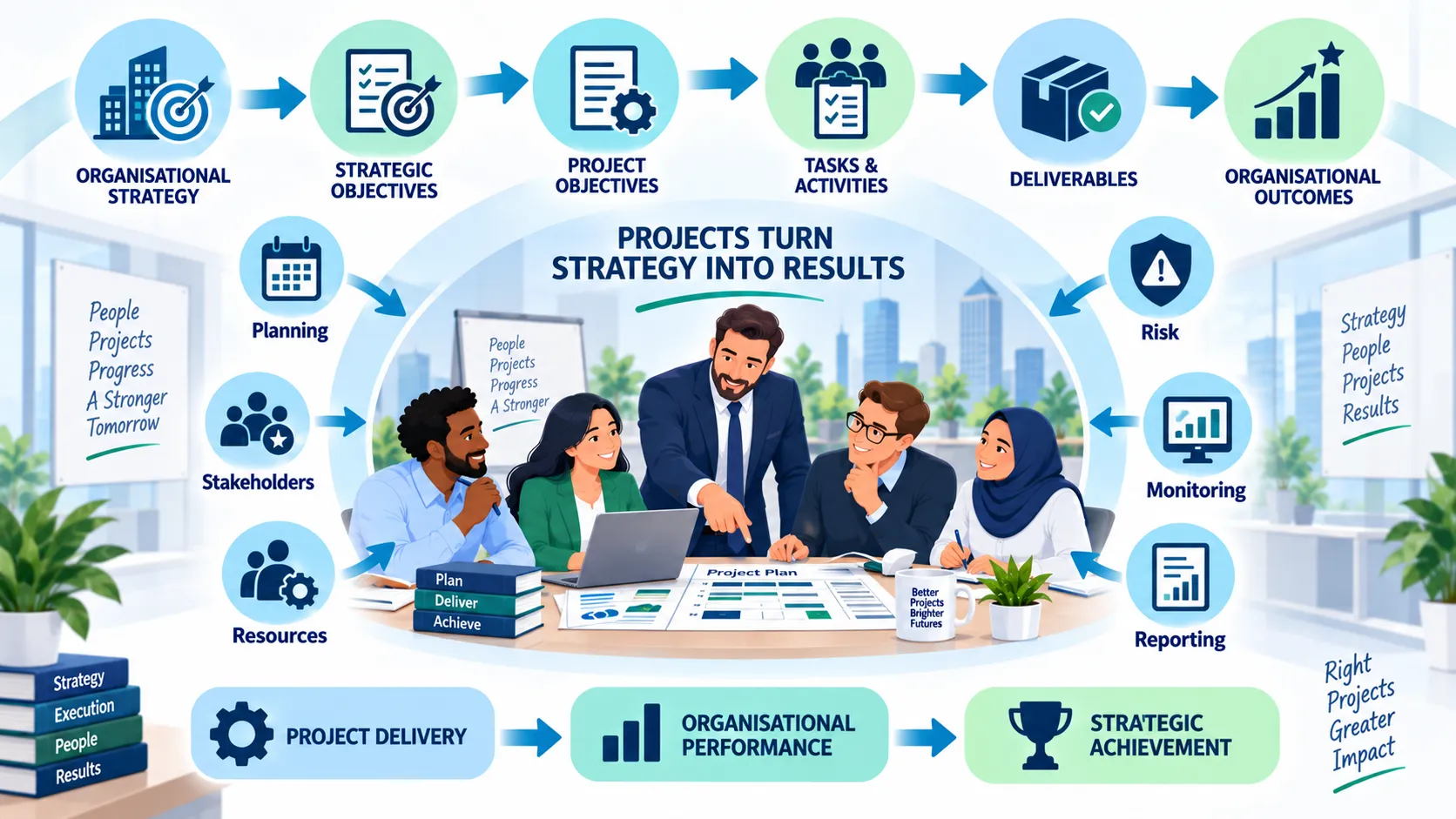
The relationship between strategy and projects can be viewed as a chain: Organisational Vision and Strategy → Strategic Objectives → Project Priorities → Project Activities → Project Deliverables → Organisational Outcomes. This connection helps managers understand why a project is being undertaken, what it is expected to achieve and how its results will contribute to wider organisational performance. For example, if an organisation’s strategy is to improve customer experience, a project may focus on implementing a new customer relationship system, redesigning service processes or developing staff capabilities.
Projects also enable organisations to manage change in a controlled and coordinated manner. Strategic priorities often require organisations to introduce new technologies, restructure processes, develop products or services, improve quality or respond to changing stakeholder expectations. Project management provides a framework for organising these activities around defined objectives, timescales, resources and responsibilities. This helps prevent strategic objectives from remaining broad statements of intent without practical implementation.
Effective project selection is particularly important. Organisations often have limited budgets, people, time and technical resources, meaning that not every proposed project can be undertaken. Managers therefore need to consider strategic alignment, expected benefits, available resources, risks, urgency and organisational priorities when determining which projects should receive support.
Projects must also remain aligned with strategy throughout their lifecycle. Strategic priorities can change because of market conditions, technology, regulation, financial pressures or stakeholder needs. Project managers and organisational leaders therefore need to monitor whether projects continue to provide strategic value and make appropriate adjustments when circumstances change.
By understanding the strategic role of projects, learners can recognise how project decisions influence organisational achievement. This lesson develops the foundation for evaluating project purpose, strategic alignment, organisational priorities, project contribution and the relationship between successful project delivery and long-term organisational results.
1.Analyse the Role of Projects in Delivering Organisational Strategy
Projects are one of the principal mechanisms through which organisations convert strategic intentions into practical, measurable and sustainable results. An organisational strategy may establish where an organisation wants to go, what it wants to improve, how it intends to compete or what value it wants to create for customers and stakeholders. However, strategy cannot deliver results through statements of intent alone. Projects provide a structured means of translating strategic priorities into defined objectives, activities, resources, responsibilities, deliverables and outcomes.
For managers and leaders, understanding the strategic role of projects is essential because project decisions can directly influence organisational performance. A project may involve introducing new technology, improving a business process, developing a service, opening a new facility, implementing a quality initiative, improving customer experience, reducing operating costs or responding to a change in the external environment. Each of these activities can contribute to strategic achievement when it is properly aligned with organisational priorities.
The strategic value of a project therefore depends not simply on whether it is completed on time and within budget, but on whether it produces outcomes that contribute to what the organisation is trying to achieve. A project can be efficiently managed and still provide limited strategic value if its objectives are poorly aligned with organisational priorities. Conversely, a strategically important project may require changes to scope, resources or timescales as circumstances develop. Effective managers must therefore look beyond project activity and consider the relationship between project outputs, organisational outcomes and strategic objectives.
Definition of a Project
A project is a temporary and structured initiative undertaken to achieve defined objectives or deliver specified outcomes. Unlike routine operational work, a project normally has a particular purpose, a defined beginning and end, identified resources, specific responsibilities and agreed deliverables.
Projects are often established because something needs to change, improve, develop or be created. This distinguishes projects from business-as-usual activities, which are generally ongoing and repetitive.
A project may therefore be understood through several defining characteristics:
Temporary: It has a defined start and intended completion point.
Purpose-driven: It exists to achieve a particular objective or outcome.
Defined scope: The work to be undertaken has identified boundaries.
Specific deliverables: It produces identifiable outputs, products, services or improvements.
Allocated resources: People, finances, technology, equipment and other resources are assigned.
Planned activities: Work is organised into tasks, activities, milestones and responsibilities.
Managed risk: Potential threats and opportunities are identified and addressed.
Stakeholder involvement: Individuals or groups affected by or contributing to the project are considered.
Performance monitoring: Progress is reviewed against agreed expectations.
Defined outcome: The project is intended to produce a meaningful result for the organisation.
For middle managers, recognising these characteristics is important because it helps distinguish genuine projects from routine management responsibilities. A project requires coordinated planning and control because its success depends on multiple activities, people and resources working together towards a defined result.
Definition of Organisational Strategy
Organisational strategy refers to the long-term direction and priorities that guide how an organisation intends to achieve its purpose and objectives. It provides a framework for deciding where resources should be focused, what changes should be pursued and what outcomes are considered important.
Strategy may address areas such as:
organisational growth;
financial sustainability;
operational efficiency;
customer satisfaction;
service quality;
innovation;
digital transformation;
workforce capability;
sustainability;
market development;
risk reduction;
organisational resilience;
regulatory or quality requirements.
Strategy establishes priorities, but it does not normally provide all the detailed actions required to achieve them. Projects help bridge this gap by translating broad strategic priorities into specific programmes of activity.
The Relationship Between Projects and Strategy
The relationship between strategy and projects can be represented as:
Organisational Strategy → Strategic Objectives → Project Priorities → Project Objectives → Tasks and Activities → Deliverables → Outcomes → Strategic Benefits
This relationship demonstrates that projects should not exist independently of organisational direction. A project should have a clear reason for being undertaken and that reason should be connected to an organisational need or strategic priority.
For example, an organisation may establish a strategic objective to improve customer service. This objective could lead to a project to introduce a new customer relationship management system. The project may involve selecting technology, designing processes, training employees, testing the system and implementing it. The immediate deliverable is the functioning system, but the strategic outcome may be improved customer response times, better customer information and increased satisfaction.
The project therefore becomes a mechanism through which strategy is implemented.
How Projects Translate Strategy into Action
Strategic plans often contain broad statements such as:
improve operational efficiency;
increase customer satisfaction;
expand market presence;
strengthen digital capability;
improve service quality;
reduce organisational risk;
develop workforce capability.
These statements provide direction but require practical implementation. Projects make implementation more manageable by converting strategic intentions into defined activities and responsibilities.
For example:
Strategic priority: Improve operational efficiency.
This may lead to:
Strategic objective: Reduce avoidable processing delays.
This may lead to:
Project objective: Redesign the customer application process.
This may involve:
mapping the existing process;
identifying delays;
consulting employees and customers;
designing a revised process;
testing the revised approach;
implementing new procedures;
training employees;
monitoring performance.
The resulting project can then be evaluated against measurable outcomes such as reduced processing time, fewer errors and improved customer satisfaction.
This illustrates why projects are important to strategy. They provide a controlled environment in which strategic objectives can be translated into specific action.
Strategic Alignment of Projects
Strategic alignment means ensuring that a project’s objectives, activities and expected outcomes support the priorities of the organisation. A strategically aligned project contributes to something the organisation has identified as important.
Managers should ask:
Why is this project necessary?
Which organisational objective does it support?
What strategic problem or opportunity does it address?
What benefits are expected?
Which stakeholders will be affected?
What resources are required?
What risks could affect strategic value?
How will success be measured?
What happens if the project is not undertaken?
Strategic alignment should be considered before project approval and throughout project implementation.
Why Strategic Alignment Matters
A project consumes organisational resources. Even a relatively small project can require employee time, management attention, finance, equipment, technology and stakeholder involvement. If these resources are invested in projects that have little strategic value, the organisation may lose opportunities to invest elsewhere.
Strong strategic alignment helps organisations:
prioritise projects that matter;
focus scarce resources;
avoid unnecessary initiatives;
improve decision-making;
strengthen accountability;
maintain organisational direction;
improve the likelihood of achieving strategic objectives;
communicate the purpose of projects to employees and stakeholders;
evaluate whether project benefits justify investment.
Strategic alignment is particularly important when an organisation has several competing projects. Managers may need to determine which project should receive resources first based on strategic importance, urgency, expected benefits, risk and organisational capacity.
Projects as Vehicles for Organisational Change
One of the most important roles of projects is to enable organisational change. Strategic development frequently requires organisations to change the way they operate.
Change may involve:
introducing new technology;
redesigning processes;
restructuring teams;
developing new services;
entering new markets;
improving quality systems;
implementing sustainability measures;
changing customer service models;
developing workforce capabilities;
responding to new external requirements.
Projects provide a structured framework for managing these changes.
Rather than attempting to introduce a major change through uncoordinated activities, an organisation can establish a project with defined objectives, responsibilities, resources, milestones and controls.
For middle managers, this is especially important because they often operate between strategic leadership and operational delivery. They may be responsible for translating strategic decisions into practical actions while also managing employees, resources, stakeholders and performance.
Projects and Strategic Transformation
Strategic transformation normally involves significant changes to how an organisation creates value or operates. Projects can form part of a broader transformation programme.
For example, an organisation seeking digital transformation may establish several projects:
implementation of a new digital platform;
migration of existing data;
employee digital skills development;
customer portal development;
cybersecurity improvement;
process automation.
Although each project has its own objectives, the projects collectively support the wider strategic transformation.
This demonstrates that individual projects can have both local objectives and strategic significance.
Projects and Organisational Objectives
Project objectives should be directly connected to organisational objectives wherever possible. Objectives provide the bridge between what the organisation wants to achieve and what the project team is expected to deliver.
A useful hierarchy is:
Organisational Vision
↓
Strategic Goals
↓
Strategic Objectives
↓
Project Objectives
↓
Project Activities
↓
Project Deliverables
↓
Organisational Outcomes
This hierarchy helps managers maintain a clear line of sight between strategic intent and practical delivery.
Project Objectives
Project objectives should establish what the project is expected to achieve. They should be sufficiently clear to guide decision-making and performance assessment.
Effective project objectives normally address:
the required result;
the scope of work;
expected quality;
timescale;
available resources;
relevant performance measures;
expected benefits.
For example, instead of stating:
“Improve customer service.”
A project objective could be:
“Implement a revised customer enquiry process that reduces average response time while maintaining agreed service quality standards.”
The second objective provides greater clarity because it indicates what needs to change and how the result may be assessed.
Projects and Resource Allocation
Resources are central to strategic project delivery. Organisations do not have unlimited resources, so managers must make decisions about where people, finance, equipment, technology and time should be allocated.
A strategically important project may require substantial investment. Managers therefore need to assess whether the expected benefits justify the resources committed.
Relevant resources may include:
human resources;
financial resources;
specialist expertise;
equipment;
technology;
facilities;
information;
supplier support;
management time;
stakeholder time.
Resource allocation should reflect strategic priorities.
For example, if an organisation has identified digital transformation as a major strategic priority but allocates insufficient technical expertise to its digital projects, the strategy may not be achieved despite having clear objectives.
Resource Constraints and Strategic Choice
Resource limitations can require difficult management decisions. An organisation may have several strategically valuable projects but insufficient resources to implement all of them simultaneously.
Managers may therefore need to consider:
strategic importance;
urgency;
expected benefits;
project risk;
resource availability;
dependencies;
financial implications;
stakeholder impact;
organisational capacity.
This makes project management a strategic management activity rather than simply an administrative function.
Projects and Risk Management
Projects can expose organisations to financial, operational, technological, reputational and strategic risks. Effective risk management helps managers understand what could prevent a project from achieving its intended objectives.
Project risks may include:
insufficient resources;
unrealistic timescales;
technology failure;
stakeholder resistance;
supplier problems;
cost increases;
communication failures;
unclear requirements;
changes in organisational priorities;
inadequate employee capability.
Risk management should therefore be integrated into project planning and strategic decision-making.
Strategic Risk and Project Risk
A project may be delivered successfully according to its original plan but still fail to create strategic value if external circumstances have changed.
For example, an organisation may begin a project to develop a particular service based on expected customer demand. During implementation, market conditions may change significantly. Continuing the project without reassessing its strategic value could result in resources being committed to an outcome that is no longer relevant.
Managers therefore need to consider both:
“Are we delivering the project correctly?”
and
“Is this still the right project for the organisation?”
This distinction is fundamental to strategic project management.
Projects and Stakeholder Relationships
Projects rarely operate in isolation. Their success often depends on effective relationships with people and groups who influence, support, deliver, use or are affected by the project.
Stakeholders may include:
senior leaders;
project team members;
employees;
customers;
suppliers;
contractors;
regulators;
partner organisations;
investors;
community representatives.
Stakeholder relationships can influence project acceptance, cooperation, resource availability, decision-making and implementation.
Strategic Importance of Stakeholder Engagement
A project may have technically sound objectives but fail to deliver strategic value if key stakeholders do not support or adopt its outcomes.
For example, a new organisational system may be successfully developed but provide limited value if employees do not understand how to use it or customers do not engage with the new service.
Effective stakeholder management therefore involves:
identifying relevant stakeholders;
understanding their interests;
assessing their influence;
communicating appropriately;
involving them where appropriate;
managing expectations;
responding to concerns;
maintaining relationships throughout the project.
For middle managers, stakeholder management is often a major leadership responsibility because they may need to coordinate different expectations while maintaining project objectives.
Projects and Monitoring Strategic Progress
Project monitoring provides information about whether activities are progressing towards intended results. However, monitoring should extend beyond task completion.
Managers should consider:
Are milestones being achieved?
Are resources being used effectively?
Are costs controlled?
Are risks changing?
Are stakeholders engaged?
Are deliverables meeting quality requirements?
Are project objectives still relevant?
Are expected benefits likely to be achieved?
Has the organisational context changed?
This broader approach helps managers distinguish between project progress and strategic progress.
Project Outputs Versus Strategic Outcomes
A project output is something produced by the project.
Examples include:
a new system;
a completed facility;
a new process;
a training programme;
a new product;
a completed report.
An organisational outcome is the change produced as a result of using or implementing that output.
Examples include:
improved productivity;
reduced costs;
increased customer satisfaction;
improved service quality;
increased revenue;
reduced risk;
improved employee capability.
The strategic benefit arises when these outcomes contribute to organisational objectives.
This distinction is essential because completing a project does not automatically mean that strategic benefits have been achieved.
Project Success and Strategic Success
Traditional project management often focuses on whether a project is delivered within agreed constraints such as time, cost and scope. These remain important, but strategic project management requires a wider assessment of success.
A project can be:
completed on time but fail to achieve expected benefits;
delivered within budget but produce limited stakeholder value;
technically successful but poorly adopted by users;
delivered according to scope but become strategically irrelevant;
delayed but ultimately deliver substantial strategic value.
Therefore, project success should be assessed against both delivery performance and organisational impact.
Key Dimensions of Project Success
Managers may consider:
achievement of project objectives;
quality of deliverables;
adherence to agreed timescales;
resource effectiveness;
cost management;
stakeholder satisfaction;
risk management;
user adoption;
operational improvement;
achievement of expected benefits;
contribution to strategic objectives.
This broader perspective supports better professional judgement.
The Role of Projects in Delivering Organisational Priorities
Projects enable organisations to prioritise practical action. Strategic plans may contain many objectives, but projects create defined mechanisms for implementing selected priorities.
For example, an organisation may have a strategic objective to improve sustainability. Relevant projects could include:
reducing energy consumption;
introducing sustainable procurement;
reducing waste;
improving recycling systems;
developing sustainable products;
improving environmental reporting.
Each project contributes to the broader strategic direction.
The manager’s responsibility is to ensure that project activities remain connected to the priority rather than becoming isolated technical exercises.
Project Selection and Strategic Prioritisation
Not every proposed project should automatically be approved. Organisations need to evaluate proposals according to strategic relevance and practical feasibility.
A project may be assessed against:
| Project Consideration | Key Definition | Management Question | Strategic Relevance |
|---|---|---|---|
| Strategic alignment | Degree to which the project supports organisational priorities | Does the project directly support a strategic objective? | Ensures resources support organisational direction |
| Expected benefits | Positive outcomes anticipated from the project | What measurable value should the project create? | Helps justify investment |
| Resources | People, finance, technology and other inputs required | Do we have sufficient capacity? | Supports realistic delivery |
| Risk | Potential events or conditions that could affect outcomes | What could prevent strategic benefits being achieved? | Supports informed decision-making |
| Stakeholder impact | Effect of the project on relevant individuals and groups | Who needs to support or adopt the outcome? | Influences implementation success |
| Time and urgency | Required delivery period and strategic timing | When must the outcome be achieved? | Supports organisational responsiveness |
| Feasibility | Practical ability to deliver the proposed project | Can the organisation realistically deliver it? | Prevents unrealistic commitments |
| Strategic contribution | Expected contribution to wider organisational achievement | How will the project improve organisational results? | Connects delivery with long-term objectives |
This type of assessment helps managers make evidence-based decisions about project priorities.
Projects and Organisational Performance
Projects can influence organisational performance in several ways. They may improve efficiency, reduce costs, increase revenue, improve customer experience, strengthen capability or reduce risk.
For example, a process improvement project may reduce processing time. The immediate project deliverable is the redesigned process, while the organisational benefits may include:
faster service;
reduced employee workload;
fewer errors;
improved customer satisfaction;
lower operating costs.
The strategic contribution may then be stronger competitiveness or improved organisational sustainability.
This demonstrates that the relationship between project activity and organisational performance is often indirect but significant.
Projects as a Mechanism for Innovation
Innovation is another important strategic area supported by projects. Organisations may use projects to explore new products, services, technologies, processes or business models.
Innovation projects can provide a controlled environment for:
testing new ideas;
evaluating technologies;
developing prototypes;
gathering customer feedback;
assessing feasibility;
learning from trials;
scaling successful approaches.
Projects therefore provide a way for organisations to manage uncertainty while pursuing strategic opportunities.
Balancing Innovation and Control
Innovation projects may involve greater uncertainty than routine projects. Managers must therefore balance creativity with appropriate controls.
Effective management may involve:
clear strategic purpose;
defined experimentation boundaries;
staged decision-making;
appropriate risk assessment;
stakeholder feedback;
resource controls;
measurable learning objectives;
review points.
The objective is not to eliminate uncertainty but to manage it responsibly.
Projects and Organisational Capability
Projects can also strengthen organisational capability. A project may leave the organisation with improved skills, knowledge, systems, processes or infrastructure.
For example, a technology implementation project may result in:
improved digital systems;
enhanced employee skills;
better data management;
improved reporting;
more efficient processes.
These capabilities may continue to generate value after the project has formally ended.
This is why managers should consider not only what the project delivers but also what the organisation becomes capable of doing as a result.
Projects and Continuous Improvement
Projects can support continuous improvement by addressing specific problems or opportunities. A project may be established after performance data identifies an area requiring significant improvement.
For example:
Performance issue: High levels of customer complaints.
Strategic objective: Improve customer satisfaction.
Project: Redesign customer complaint handling.
Activities:
analyse existing complaints;
identify recurring causes;
consult employees;
redesign procedures;
introduce improved communication;
train relevant staff;
implement the new process;
monitor outcomes.
Expected outcome: Faster and more effective complaint resolution.
Strategic benefit: Improved customer satisfaction and organisational reputation.
This illustrates how evidence from operational performance can lead to projects that directly support strategic improvement.
Projects and Organisational Change Capacity
An organisation’s ability to deliver strategy depends partly on its capacity to manage multiple projects and changes effectively. Too many simultaneous projects can create resource pressure, stakeholder fatigue and implementation problems.
Managers therefore need to consider organisational capacity.
Important considerations include:
availability of skilled employees;
leadership capacity;
financial resources;
technology;
stakeholder readiness;
competing projects;
operational workload;
organisational culture;
ability to absorb change.
A strategically important project may still need to be delayed if the organisation lacks the capacity to implement it successfully.
This requires managers to balance strategic urgency with realistic delivery capability.
The Role of Middle Managers in Strategic Project Delivery
Middle managers play a particularly important role because they frequently connect organisational strategy with operational implementation. They may not determine the entire organisational strategy, but they are often responsible for translating strategic priorities into practical project activity.
Their responsibilities may include:
interpreting strategic objectives;
communicating project purpose;
contributing to project planning;
allocating team resources;
coordinating project activities;
supporting employees through change;
managing stakeholder relationships;
identifying operational risks;
monitoring project progress;
escalating significant issues;
reporting project information;
evaluating outcomes;
ensuring project activities remain strategically aligned.
Middle managers therefore act as a critical link between strategic leadership and practical delivery.
Communicating the Strategic Purpose of a Project
Employees are more likely to understand and support project activity when they understand why the project matters.
Managers should be able to explain:
what the project is intended to achieve;
why the project is necessary;
how it supports organisational objectives;
what changes are expected;
who will be affected;
what responsibilities employees have;
how success will be assessed.
For example, rather than telling employees simply that a new system is being introduced, a manager could explain that the project supports the organisational objective of improving service efficiency and reducing processing delays.
This creates a clearer connection between individual activity and organisational purpose.
Managing Projects When Strategic Priorities Change
Organisational strategy is not always static. Changes in markets, technology, stakeholder expectations, financial circumstances, regulation or competitive conditions may require strategic priorities to change.
Projects must therefore be capable of responding appropriately.
Managers should periodically assess:
whether project objectives remain relevant;
whether assumptions remain valid;
whether expected benefits have changed;
whether risks have increased;
whether resources remain available;
whether stakeholders have new expectations;
whether project scope needs adjustment;
whether the project should continue, change or stop.
Stopping or changing a project is not necessarily evidence of poor management. If strategic circumstances have changed, continuing an obsolete project may represent poorer management than making a controlled change.
Practical Example: Digital Customer Service Project
Consider an organisation whose strategy is to improve customer experience through digital services.
A project is established to introduce an online customer portal.
The strategic objective is:
Improve accessibility and customer service efficiency.
The project objective is:
Design and implement an online portal that enables customers to complete common service requests digitally.
Key activities may include:
identifying customer requirements;
reviewing existing service processes;
selecting appropriate technology;
designing the portal;
testing functionality;
training employees;
communicating the change;
launching the system;
monitoring customer use.
Project deliverables may include:
operational online portal;
updated procedures;
trained employees;
customer guidance materials.
Expected organisational outcomes may include:
reduced processing time;
fewer manual transactions;
improved customer access;
reduced administrative workload.
Strategic benefits may include:
improved customer satisfaction;
greater operational efficiency;
stronger digital capability.
The example demonstrates that project activity is the mechanism through which the strategic intention becomes an organisational result.
Practical Example: Cost Reduction Project
An organisation may identify cost efficiency as a strategic priority because operating costs are increasing.
A project could focus on reducing unnecessary procurement expenditure.
The project may involve:
reviewing purchasing data;
identifying recurring expenditure;
analysing supplier arrangements;
identifying duplication;
developing improved procurement procedures;
implementing controls;
monitoring savings.
The project deliverable might be a revised procurement process.
However, the strategic outcome is not simply the existence of the new process. The strategic outcome is improved cost efficiency and financial sustainability.
This distinction helps managers assess whether the project has genuinely delivered value.
Practical Example: Workforce Capability Project
Suppose an organisation identifies workforce capability as a strategic priority.
A project may be established to develop employees’ capability in a critical technical area.
Project activities could include:
identifying capability requirements;
assessing current skills;
developing a structured learning programme;
providing practical development;
assessing capability;
monitoring workplace application.
The project deliverables may include trained employees and supporting resources.
The strategic outcomes may include:
improved productivity;
improved service quality;
reduced dependency on external expertise;
stronger organisational capability.
Again, the project contributes to strategy by creating capabilities that support longer-term organisational performance.
Common Problems When Projects Are Not Strategically Aligned
Poor strategic alignment can create significant problems.
Project Activity Without Strategic Purpose
A project may begin because someone has identified an interesting idea rather than because there is a clearly established organisational need.
Potential consequences include:
resource wastage;
unclear priorities;
weak stakeholder commitment;
difficulty measuring value;
competing organisational initiatives.
Scope Creep
Scope creep occurs when additional requirements are gradually added without appropriate evaluation of their effect on time, cost, resources and strategic objectives.
Managers should ask whether proposed changes:
support the strategic objective;
provide sufficient value;
affect project resources;
increase risk;
affect delivery timescales;
require formal approval.
Focusing Only on Delivery
A project team may become highly focused on completing tasks and meeting deadlines while losing sight of why the project exists.
This can result in:
technically completed projects;
limited user adoption;
weak organisational benefits;
poor strategic contribution.
Managers should therefore maintain strategic visibility throughout the project lifecycle.
Excessive Number of Projects
Running too many projects simultaneously can create:
employee workload pressure;
resource competition;
reduced focus;
stakeholder fatigue;
communication problems;
delays;
lower quality.
Strategic prioritisation helps organisations concentrate resources on the projects most capable of delivering meaningful results.
Evaluating the Strategic Contribution of Projects
Evaluation should determine whether a project has delivered the intended strategic contribution.
Managers can consider several questions:
Were the project objectives achieved?
Were expected deliverables produced?
Were resources used effectively?
Were stakeholder needs addressed?
Were risks managed appropriately?
Did the project produce the expected outcomes?
Were strategic benefits achieved?
What unintended outcomes occurred?
What lessons should be applied to future projects?
Does further action need to be taken after project completion?
Evaluation should not necessarily end when the final project task is completed. Some strategic benefits only become visible after implementation.
Key Benefits of Strategically Aligned Projects
Strategically aligned projects provide several organisational benefits.
Improved Strategic Implementation
Projects convert broad strategic priorities into practical programmes of work with clear responsibilities and deliverables.
Better Resource Utilisation
Resources can be directed towards initiatives that provide meaningful organisational value.
Greater Accountability
Clear project objectives allow managers and teams to understand who is responsible for specific activities and outcomes.
Improved Organisational Agility
Projects enable organisations to respond to changing technologies, customer needs, market conditions and organisational priorities.
Better Risk Management
Structured project planning allows risks to be identified, assessed and managed before they significantly affect outcomes.
Stronger Stakeholder Engagement
Clear project purpose and communication help stakeholders understand their role and influence.
Improved Performance Measurement
Projects create defined milestones, deliverables and outcomes that can be monitored and evaluated.
Greater Organisational Learning
Projects generate experience, knowledge and lessons that can improve future organisational decisions.
Improved Organisational Outcomes
When projects are properly aligned, their outputs and outcomes can contribute directly to improvements in efficiency, quality, customer satisfaction, capability, financial performance and organisational resilience.
A Practical Process for Linking Projects to Strategy
Managers can use the following process when assessing the strategic role of a project.
Step 1: Identify the Strategic Priority
Determine which organisational priority the project is intended to support.
Step 2: Define the Strategic Objective
Clarify the specific organisational result that needs to be achieved.
Step 3: Establish the Project Purpose
Explain why the project is required and what problem or opportunity it addresses.
Step 4: Define Project Objectives
Translate the strategic objective into measurable project objectives.
Step 5: Identify Deliverables
Determine what the project must produce.
Step 6: Identify Expected Outcomes
Establish what should change as a result of using the project deliverables.
Step 7: Identify Strategic Benefits
Determine how those outcomes contribute to organisational strategy.
Step 8: Assess Resources and Feasibility
Evaluate whether the organisation has the capacity to deliver the project effectively.
Step 9: Assess Stakeholders and Risks
Identify people who can influence project success and risks that could affect strategic outcomes.
Step 10: Monitor Strategic Alignment
Continue checking whether project activity remains relevant to organisational priorities.
Step 11: Evaluate Outcomes
Assess actual project results against intended objectives and strategic benefits.
Step 12: Capture Lessons
Use project experience to improve future planning, decision-making and organisational capability.
Professional Judgement in Strategic Project Management
Effective project management requires more than following a predetermined plan. Managers need professional judgement to determine whether project activity continues to represent the best use of organisational resources.
Professional judgement involves considering evidence, organisational priorities, stakeholder expectations, risks, resources and changing circumstances.
A manager should be able to recognise that:
successful task completion does not automatically equal strategic success;
a project may require adjustment when circumstances change;
resources should reflect strategic priorities;
stakeholders can influence the achievement of outcomes;
project risks can become strategic risks;
project outputs must lead to meaningful organisational outcomes;
project evaluation should consider benefits as well as delivery performance;
stopping or changing a project can sometimes be the most responsible decision.
Key Concepts to Remember
The following concepts provide a concise foundation for understanding the strategic role of projects:
Project: A temporary, structured initiative established to achieve defined objectives or outcomes.
Strategy: The organisation’s direction and priorities for achieving its purpose and objectives.
Strategic alignment: The extent to which project objectives and outcomes support organisational priorities.
Project objective: A defined result that the project is expected to achieve.
Deliverable: A specific output produced by project activities.
Outcome: The change produced through the use or implementation of project deliverables.
Strategic benefit: The positive organisational value created by project outcomes.
Stakeholder: An individual or group that can affect, be affected by or have an interest in the project.
Project risk: An uncertain event or condition that could affect project objectives or outcomes.
Resource: People, finance, technology, equipment, information, time or other inputs required for project delivery.
Project success: Achievement of relevant project objectives and the delivery of intended organisational value.
Summary
Projects provide a practical mechanism for delivering organisational strategy. They translate strategic priorities into defined objectives, activities, resources, deliverables and measurable outcomes. Their strategic importance lies not simply in completing planned tasks but in creating results that contribute to organisational priorities and long-term performance.
Effective managers therefore need to maintain a clear connection between strategy and project activity. This involves understanding the strategic purpose of a project, establishing appropriate objectives, allocating resources, managing stakeholders and risks, monitoring progress and evaluating outcomes. Projects should remain strategically relevant throughout their lifecycle rather than being treated as isolated initiatives.
The strongest approach recognises the complete relationship between strategic intention, project delivery and organisational benefit. When this relationship is clearly established, projects can support organisational change, innovation, efficiency, capability development, customer value and sustainable performance.
For practising and aspiring middle managers, the key lesson is that project management is not simply about managing tasks. It is about ensuring that coordinated project activity produces meaningful results for the organisation. A manager who understands this connection is better positioned to prioritise projects, make informed resource decisions, manage challenges, engage stakeholders and contribute to the successful implementation of organisational strategy.