
Lesson no 1 :Understand the role of innovation within organisations
Innovation plays an important role in helping organisations respond to changing customer expectations, emerging technologies, competitive pressures and new ways of working. For managers and leaders, innovation is not simply about creating completely new products or introducing advanced technology. It can involve improving an existing process, developing a new service, changing a working practice, using resources differently or introducing a better way of solving a workplace problem. Effective innovation enables organisations to turn ideas into practical improvements that create measurable value.
Within an organisation, innovation can influence performance at several levels. At an organisational level, it can support growth, competitiveness, productivity, operational efficiency and the achievement of strategic objectives. At team level, innovation can improve collaboration, problem-solving, workflows and the way employees respond to changing demands. At individual level, an innovative culture can encourage employees to contribute ideas, challenge inefficient practices and take greater ownership of improvement.
A key aspect of organisational innovation is the creation of a culture in which people feel able to suggest, explore and develop new ideas. A workplace that supports innovation encourages constructive questioning, experimentation, collaboration and learning. Leaders and middle managers have an important role in establishing this environment because employees are more likely to contribute innovative ideas when they understand organisational priorities, receive appropriate support and know that reasonable experimentation will be treated as part of improvement rather than automatically viewed as failure.
Innovation is also closely connected with entrepreneurship. Entrepreneurial thinking encourages individuals and teams to recognise opportunities, consider customer or organisational needs, assess risks and take initiative to create value. Within an organisation, this can involve developing an internal initiative, improving an existing service, identifying a new market opportunity or redesigning a process to achieve better results.
However, innovation should not be pursued simply because an idea appears new or interesting. Managers need to establish a clear rationale for innovation and assess whether an initiative is appropriate, feasible and aligned with organisational objectives. Factors such as cost, available resources, stakeholder expectations, operational impact, risks, technology, skills, customer requirements and expected benefits should be considered before significant resources are committed.
This lesson explores the role of innovation within organisations and examines how innovation can transform organisational, team and individual performance. Learners will consider different forms of workplace innovation, the relationship between innovation and organisational objectives, the importance of an innovative culture, the role of leadership and entrepreneurship, and the factors that influence successful innovation. The lesson will also establish how managers can recognise opportunities for innovation and connect ideas with practical workplace improvements.
Ultimately, innovation becomes valuable when an organisation can move beyond generating ideas and turn appropriate ideas into realistic initiatives, improved practices, processes, products or services. For managers and leaders, understanding this process is essential for creating workplaces that can adapt, improve and respond effectively to changing organisational and customer needs.
1.Examine the Reasons for Innovation in Organisations
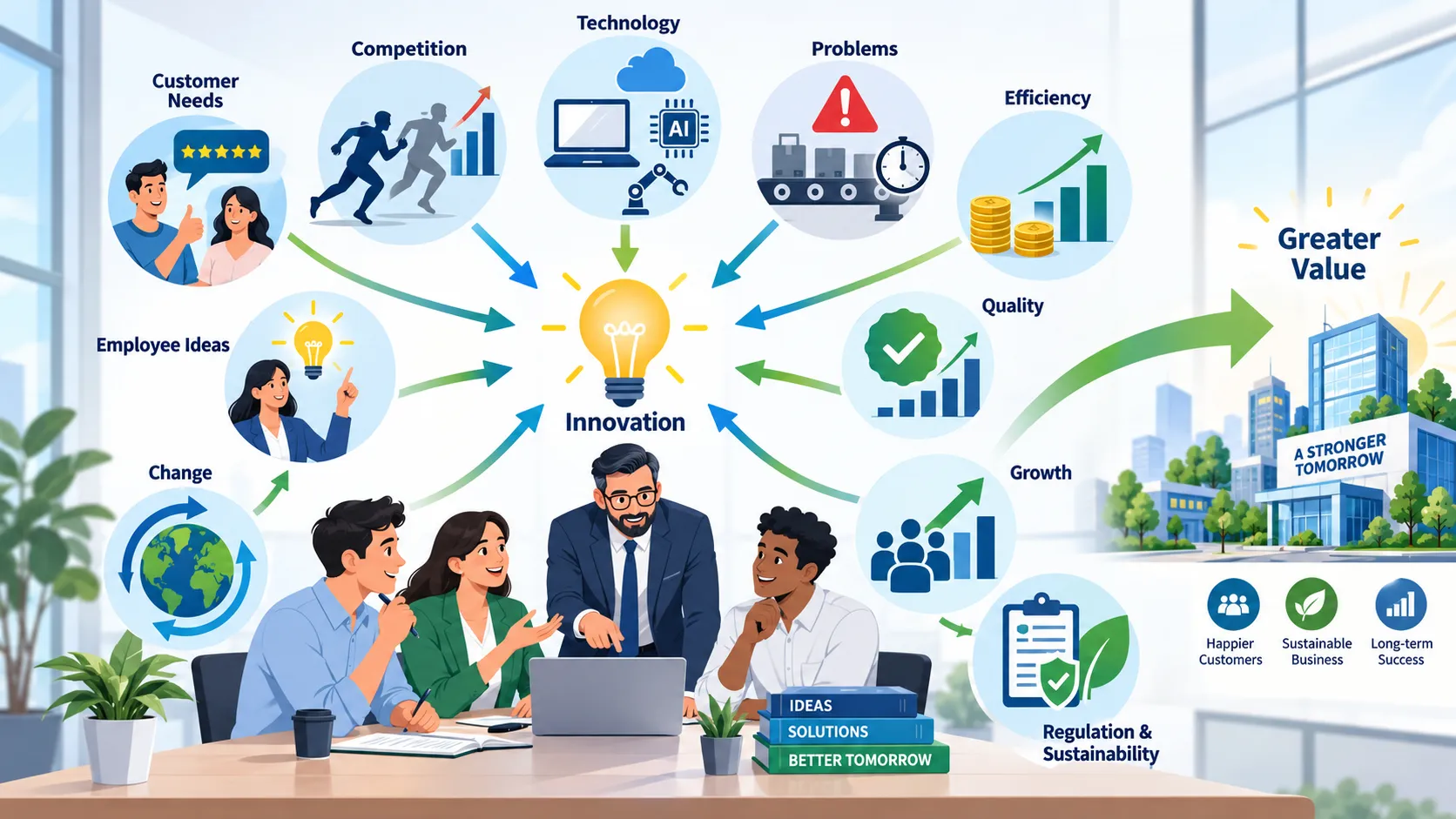
Innovation is a fundamental organisational capability that enables businesses and other organisations to respond to change, improve performance and create new sources of value. In a rapidly changing workplace, organisations cannot always rely on established products, services, processes and working practices. Customer expectations change, technology develops, competitors introduce new approaches, employees expect more effective ways of working, and economic or regulatory conditions can alter the environment in which organisations operate.
For managers and leaders, innovation should therefore be understood as a practical management activity rather than simply a creative exercise. Innovation occurs when an organisation takes a new or improved idea and applies it in a way that creates useful value. That value may involve improved productivity, better customer experience, reduced costs, higher quality, increased revenue, stronger employee performance, improved sustainability or greater organisational resilience.
Innovation can take many forms. An organisation may introduce a completely new product, improve an existing service, redesign an internal process, introduce a new working practice, adopt technology, change how teams collaborate or develop a new approach to solving a persistent workplace problem. The reason for innovation depends on the organisation’s circumstances, objectives and environment.
A key management responsibility is therefore to understand why innovation is necessary before deciding what innovation should be introduced. An idea may appear attractive, but innovation requires resources, leadership attention, employee involvement and sometimes significant organisational change. Managers need to establish a clear rationale and determine whether the expected benefits justify the costs, risks and disruption associated with implementation.
This part examines the major reasons organisations innovate and considers how these drivers influence organisational, team and individual performance.
What Is Innovation?
Innovation is the process of developing and implementing new or improved ideas, products, services, processes, methods or working practices that create value.
Innovation is different from invention. An invention may involve creating something completely new, whereas innovation can involve applying an existing idea in a new or improved way.
For example, an organisation does not need to invent a new communication technology to innovate. It might introduce an existing collaboration platform in a new way that reduces meeting time, improves information sharing and enables teams to work more effectively.
Innovation may therefore involve:
creating a new product
improving an existing product
introducing a new service
redesigning a business process
changing a working practice
introducing a new technology
improving customer experience
developing a new business model
improving resource utilisation
creating a new approach to employee engagement
finding a better solution to an operational problem
The important factor is that the idea is implemented and creates meaningful value.
Why Organisations Need Innovation
Organisations operate within environments that rarely remain static. Customer needs, technology, competition, employee expectations, economic conditions and regulations can all change.
An organisation that continues operating exactly as it did in the past may eventually find that its products, services or processes no longer meet current requirements.
Innovation provides a mechanism for adapting to these changes.
For managers, the key question is not simply:
“What new idea can we introduce?”
It is:
“What organisational need or opportunity could innovation address?”
This distinction helps prevent innovation from becoming disconnected from organisational objectives.
The Main Reasons for Innovation in Organisations
There are numerous reasons why organisations innovate. Some are proactive, where management identifies an opportunity before a problem develops. Others are reactive, where innovation is required because existing approaches are no longer effective.
The most important reasons include:
responding to changing customer needs
improving products and services
increasing competitiveness
responding to technological change
improving operational efficiency
reducing costs
improving quality
increasing productivity
solving organisational problems
supporting growth
entering new markets
responding to competitive pressure
improving employee performance
attracting and retaining talent
improving customer experience
responding to external change
managing risk and uncertainty
improving sustainability
meeting changing regulatory expectations
creating long-term organisational resilience
1. Responding to Changing Customer Needs
One of the strongest reasons for innovation is that customer expectations change.
Customers may expect:
faster service
greater convenience
improved quality
personalised experiences
digital access
greater transparency
competitive pricing
sustainable products
flexible service options
If an organisation fails to recognise these changes, customers may move towards competitors that provide a more suitable experience.
Innovation enables organisations to respond.
For example, a traditional service provider may introduce an online customer portal because customers increasingly expect to manage services digitally. The innovation is not necessarily the technology itself; the organisational innovation is the new way in which the service is delivered.
Management Implication
Managers should regularly gather information about customer expectations through:
customer feedback
complaints
surveys
reviews
sales data
customer behaviour
market research
service usage information
direct engagement
This information can reveal opportunities for innovation.
2. Improving Existing Products and Services
Innovation does not always mean launching something completely new. Organisations can innovate by improving existing products or services.
Improvements may focus on:
functionality
quality
design
reliability
accessibility
convenience
delivery
customer support
personalisation
For example, a training provider may improve its existing learning service by introducing interactive digital activities, automated progress tracking and flexible access arrangements.
The service remains recognisable, but the way value is delivered improves.
Why This Matters
Incremental innovation can be less risky than introducing a completely new offering because the organisation already understands the existing product, service and customer base.
However, incremental improvement should not become an excuse for avoiding more significant innovation where the environment requires it.
3. Increasing Competitiveness
Competitive pressure is another major driver of innovation.
Competitors may introduce:
lower-cost products
faster services
improved technology
better customer experiences
new distribution methods
innovative business models
An organisation may need to innovate to maintain its market position.
Innovation can create competitive advantage through:
differentiation
improved value
faster delivery
higher quality
lower operating costs
stronger customer relationships
unique products or services
Managers should monitor competitors without simply copying them. The objective is to understand market developments and determine how the organisation can create distinctive value.
4. Responding to Technological Change
Technology is one of the most visible drivers of organisational innovation.
Technological developments can create opportunities to:
automate processes
improve communication
analyse data
provide digital services
improve production
reduce administrative work
enhance customer experience
support remote collaboration
improve resource management
However, technology should not be adopted simply because it is new.
Managers should ask:
What problem will this technology solve?
What value will it create?
What resources will implementation require?
What skills are needed?
What risks exist?
How will employees and customers be affected?
How will success be measured?
Technology becomes innovation when it is applied effectively to create meaningful improvement.
5. Improving Operational Efficiency
Organisations often innovate because existing processes consume too much time, money or effort.
Operational inefficiency may be caused by:
duplicated activities
unnecessary approvals
manual data entry
inefficient workflows
poor scheduling
excessive waiting
unnecessary movement
outdated systems
communication failures
Process innovation can redesign how work is performed.
For example, an organisation may replace a paper-based approval process with a digital workflow. If this reduces processing time and errors while maintaining appropriate controls, it represents meaningful process innovation.
6. Reducing Costs
Cost pressure can encourage organisations to develop innovative ways of working.
Innovation may reduce costs through:
automation
improved resource utilisation
waste reduction
process redesign
energy efficiency
improved procurement
inventory optimisation
reduced rework
improved workforce scheduling
However, managers should distinguish between cost cutting and cost-saving innovation.
Cost cutting may simply remove resources. Innovation seeks to find a better way of achieving the required outcome.
For example, reducing customer-service staff may lower immediate costs but damage service quality. Introducing self-service technology for routine enquiries while retaining sufficient staff for complex cases may improve efficiency without unnecessarily reducing service capability.
7. Improving Quality
Quality improvement is a significant reason for innovation.
Organisations may innovate when they experience:
high defect rates
customer complaints
service failures
inconsistent outputs
rework
errors
reliability problems
Innovation can redesign processes to prevent problems rather than repeatedly correcting them.
For example, a manufacturer may introduce automated quality checks to identify defects earlier in the production process.
Quality-Focused Innovation Can Help:
reduce defects
improve consistency
reduce rework
increase reliability
improve customer satisfaction
strengthen reputation
8. Increasing Productivity
Productivity refers to the relationship between outputs and resource inputs.
A simplified measure is:
Productivity = Output ÷ Resource Input
Innovation can improve productivity by enabling organisations to achieve greater output using the same or an appropriate level of resources.
Examples include:
improved technology
process redesign
better scheduling
employee training
automation
improved equipment
workflow redesign
For example, if a team previously processed 100 customer cases using 50 staff hours and can now process 140 cases using the same 50 hours, productivity has improved.
Managers must ensure that productivity improvements do not reduce quality, employee wellbeing or customer outcomes.
9. Solving Workplace Problems
Innovation can emerge from problems that existing methods cannot adequately solve.
Workplace problems may include:
repeated delays
inefficient processes
customer complaints
resource shortages
communication problems
high operating costs
employee frustration
service inconsistencies
Managers should encourage employees to identify problems and suggest solutions.
Employees often have valuable practical knowledge because they experience operational processes directly.
Problem-to-Innovation Process
A manager can use:
PROBLEM → ROOT CAUSE → IDEA → EVALUATION → SOLUTION → IMPLEMENTATION → OUTCOME
This creates a direct connection between workplace problems and innovation initiatives.
10. Supporting Organisational Growth
Growth can create new resource and operational requirements.
An organisation experiencing growth may need to:
increase capacity
develop new products
enter new markets
improve processes
recruit new skills
introduce technology
redesign organisational structures
Innovation can help an organisation scale without simply increasing resources in proportion to demand.
For example, an organisation may use automation to support increased transaction volumes without requiring the same proportional increase in administrative staff.
11. Entering New Markets
Innovation can enable organisations to reach new customer groups or geographic markets.
This may involve:
adapting products
developing new services
creating digital delivery channels
changing pricing models
developing new partnerships
redesigning customer experiences
Before entering a new market, managers should assess:
customer needs
market demand
competitors
resources
financial requirements
risks
organisational capability
Innovation should therefore be supported by evidence rather than assumptions.
12. Responding to Competitive Pressure
Sometimes innovation is driven by direct competitive threats.
A competitor may introduce a service that customers prefer, use a more efficient operating model or provide a significantly improved customer experience.
The organisation may then need to innovate to remain viable.
However, simply copying a competitor may not provide sustainable advantage.
Managers should instead ask:
What customer need is the competitor meeting?
Why is its approach successful?
What are our organisational strengths?
What opportunity can we address differently?
What innovation would create distinctive value?
13. Improving Employee Performance
Innovation can also focus on internal employee performance.
Organisations may introduce:
new working practices
improved collaboration systems
flexible working arrangements
digital tools
better training approaches
improved performance-support systems
redesigned workflows
The purpose is to enable employees to work more effectively rather than simply increasing workload.
When employees have better tools and processes, they may spend less time on low-value administrative activity and more time on meaningful work.
14. Supporting Employee Engagement
A culture of innovation can encourage employees to contribute ideas.
Employees are more likely to participate when managers:
listen to suggestions
recognise useful ideas
encourage constructive challenge
provide appropriate resources
communicate organisational priorities
allow reasonable experimentation
Employee-generated innovation can be particularly valuable because employees often identify inefficiencies that managers do not see.
For example, a frontline employee may identify that customers repeatedly struggle with a particular step in a service process. That observation could become the starting point for service innovation.
15. Attracting and Retaining Talent
Employees increasingly consider the quality of an organisation’s working environment when deciding where to work.
An organisation that demonstrates:
innovation
learning
creativity
modern working practices
employee involvement
opportunities to contribute ideas
may create a more attractive environment for employees.
Innovation can therefore support workforce capability.
However, innovation should not become a superficial employee-engagement initiative. Employees need genuine opportunities to influence appropriate workplace improvements.
16. Improving Customer Experience
Customer experience can be improved through innovation in every stage of the customer journey.
Managers can examine:
how customers discover the organisation
how they purchase or access services
how they communicate with the organisation
how problems are resolved
how information is provided
how follow-up is managed
Innovation may remove unnecessary customer effort.
For example, an organisation may replace a lengthy manual registration process with a secure digital process that allows customers to complete information once and reuse it for future interactions.
17. Responding to Economic and Market Change
Economic conditions can affect resource availability, operating costs and customer behaviour.
Organisations may experience:
inflation
changing interest rates
supply-cost increases
reduced consumer spending
changing labour costs
exchange-rate pressures
Innovation can help organisations adapt.
Possible responses include:
redesigning processes
changing delivery methods
developing new products
improving resource efficiency
adopting alternative materials
introducing new revenue models
Managers should avoid treating every economic challenge as a reason for immediate cost reduction. Innovation may provide more sustainable solutions.
18. Responding to Regulatory and Legal Change
Changes in laws, regulations or industry standards may require organisations to alter how they operate.
Innovation may be needed to:
improve compliance systems
redesign processes
strengthen information management
improve safety
change product specifications
introduce monitoring technology
Regulatory innovation should ensure that new approaches remain compliant while also seeking opportunities to improve operational performance.
19. Improving Sustainability
Sustainability is an increasingly important reason for organisational innovation.
Organisations may seek to reduce:
energy consumption
material waste
emissions
unnecessary transport
water consumption
single-use materials
Innovation can involve:
sustainable product design
energy-efficient equipment
waste-reduction processes
circular resource practices
digital alternatives
improved logistics
For example, a business may redesign packaging to reduce material use while maintaining product protection.
Sustainability-focused innovation can support both environmental objectives and financial efficiency where appropriately designed.
20. Managing Risk and Uncertainty
Innovation can help organisations respond to emerging risks.
Risks may involve:
supply disruption
technology failure
changing customer demand
workforce shortages
market disruption
cybersecurity
operational dependencies
Organisations may innovate by developing alternative processes, technologies, suppliers or delivery methods.
For example, dependence on a single manual process may create operational vulnerability. Introducing a resilient digital workflow and documented contingency process can reduce that risk.
21. Building Organisational Resilience
Resilient organisations can adapt when circumstances change.
Innovation can improve resilience by creating:
flexible processes
alternative delivery channels
diversified supply arrangements
adaptable technology
cross-functional skills
stronger data capabilities
Resilience is particularly important because organisations cannot predict every future event.
Innovation provides mechanisms for adapting when assumptions change.
22. Creating New Revenue Opportunities
Innovation may create new ways of generating income.
This can involve:
new products
new services
subscription models
digital services
partnerships
new customer segments
complementary services
For example, an organisation that traditionally sells physical products may develop a digital support service connected to those products.
Managers should assess the commercial viability of such opportunities before committing significant resources.
23. Responding to Changing Technology and Digital Expectations
Customers and employees increasingly expect convenient digital experiences.
Organisations may innovate through:
online services
mobile access
digital payments
automated communication
data analytics
digital customer support
collaborative technologies
Digital innovation should always consider accessibility, security, data governance and user needs.
24. Improving Decision-Making
Innovation can improve how managers make decisions.
Data-driven management systems can provide:
real-time performance information
customer insights
resource information
predictive analysis
operational dashboards
Better information can enable managers to identify problems earlier and make more informed decisions.
25. Creating Strategic Differentiation
Innovation can help an organisation become distinctive.
Differentiation may come from:
product design
service quality
customer experience
delivery speed
technology
sustainability
organisational culture
A strong innovation strategy should therefore connect innovation with the organisation’s strategic position.
Proactive and Reactive Reasons for Innovation
Innovation drivers can be broadly divided into proactive and reactive reasons.
Proactive Innovation
Proactive innovation occurs when an organisation seeks improvement or opportunity before a significant problem forces change.
Examples include:
developing a new product before competitors
adopting emerging technology
improving processes before capacity becomes constrained
exploring new customer needs
Proactive innovation can create competitive advantage.
Reactive Innovation
Reactive innovation occurs in response to an existing problem or external pressure.
Examples include:
responding to customer complaints
replacing an outdated system
responding to a competitor
changing processes after regulatory requirements
addressing supply disruption
Reactive innovation can still be valuable, but organisations may have less time and flexibility.
Effective organisations aim to develop enough forward-looking capability to identify opportunities before they become urgent problems.
Internal and External Drivers of Innovation
Innovation can also be influenced by internal and external factors.
Internal Drivers
Internal drivers include:
organisational objectives
performance problems
employee ideas
resource inefficiencies
quality issues
cost pressures
operational capacity
leadership priorities
organisational culture
External Drivers
External drivers include:
customer expectations
competitors
technology
market trends
economic conditions
legislation
regulation
social changes
environmental pressures
supply-chain conditions
Managers should consider both categories when assessing the rationale for innovation.
Innovation and Organisational Objectives
Innovation should not operate separately from organisational strategy.
If the organisation’s objective is to increase customer satisfaction, innovation should contribute to that objective.
If the objective is to reduce operating costs, innovation should support more efficient resource use.
If the objective is to grow, innovation may focus on new products, services, markets or capacity.
The relationship can be expressed as:
ORGANISATIONAL OBJECTIVE → OPPORTUNITY/PROBLEM → INNOVATION IDEA → INITIATIVE → IMPLEMENTATION → MEASURABLE OUTCOME
This approach helps managers demonstrate why an innovation initiative is necessary.
How Managers Identify the Need for Innovation
Managers can use a structured process to identify whether innovation is required.
Step 1: Review Organisational Objectives
Understand what the organisation is trying to achieve.
Step 2: Examine Current Performance
Review:
KPIs
financial performance
customer feedback
quality
productivity
resource use
Step 3: Identify Gaps
Compare current performance with desired performance.
Step 4: Investigate Causes
Determine why the gap exists.
Step 5: Examine External Change
Review:
customer expectations
competitors
technology
regulation
market conditions
Step 6: Identify Opportunities
Determine where a new or improved approach could create value.
Step 7: Generate Ideas
Encourage managers, employees and relevant stakeholders to suggest possible solutions.
Step 8: Evaluate the Rationale
Consider:
expected benefits
cost
feasibility
risk
resources
strategic alignment
Step 9: Select the Most Appropriate Initiative
Prioritise ideas according to organisational value and feasibility.
Step 10: Establish Measures
Determine how success will be measured.
Evaluating the Rationale for Innovation
An innovation initiative should have a clear reason for being developed.
Managers should be able to answer:
What problem or opportunity does the innovation address?
Why is action needed now?
What happens if the organisation does nothing?
What benefits are expected?
Who will benefit?
What resources are required?
What risks exist?
How does the initiative support organisational objectives?
How will success be measured?
This prevents innovation from becoming driven purely by enthusiasm for new ideas.
Practical Example: Customer Service Innovation
A service organisation receives increasing customer complaints about long response times.
Management investigates and identifies that employees spend significant time manually entering customer information into multiple systems.
The organisation considers several options.
Option 1
Recruit additional employees.
Option 2
Increase overtime.
Option 3
Redesign the process and introduce integrated digital data capture.
Management selects Option 3 because it addresses the underlying process problem and may improve productivity without simply increasing labour input.
The innovation rationale includes:
reduced processing time
fewer data-entry errors
improved customer response
lower administrative effort
improved employee productivity
This illustrates how innovation can emerge from operational evidence.
Practical Example: Product Innovation
A manufacturer notices that customers increasingly request products with improved environmental characteristics.
Management evaluates market information and identifies an opportunity to redesign the product using more sustainable materials.
Before proceeding, management considers:
customer demand
material availability
product performance
cost
supplier capability
production requirements
environmental impact
The innovation is justified because it responds to changing customer expectations while potentially creating differentiation.
Practical Example: Working-Practice Innovation
A professional services organisation notices that employees spend excessive time attending meetings that provide limited value.
Employees suggest introducing:
shorter meeting formats
clearer agendas
asynchronous updates
defined decision owners
The organisation pilots the new approach.
After implementation, managers measure:
meeting hours
employee productivity
decision-making speed
employee feedback
The innovation is evaluated according to measurable outcomes rather than simply being accepted because it appears modern.
Practical Example: Process Innovation
A warehouse experiences repeated delays because employees manually search for stock.
Management introduces improved digital stock-location information and redesigns the picking process.
The initiative aims to improve:
picking speed
inventory accuracy
employee productivity
customer delivery performance
The manager monitors performance before and after implementation to determine whether the innovation has created measurable value.
Benefits of Innovation to Organisations
Improved Competitiveness
Innovation can help organisations differentiate themselves and respond to competitors.
Increased Productivity
Improved processes and technology can increase output from available resources.
Better Customer Experience
Innovation can make products and services more convenient, responsive and valuable.
Improved Quality
New methods can reduce errors, defects and inconsistencies.
Cost Efficiency
Innovation can reduce unnecessary resource consumption and operating costs.
Organisational Growth
New products, services and markets can create growth opportunities.
Employee Engagement
Employees may become more engaged when they are encouraged to contribute ideas.
Better Problem-Solving
Innovation provides structured ways to address persistent organisational problems.
Improved Resilience
Adaptable organisations are better positioned to respond to changing circumstances.
Sustainability
Innovation can reduce waste and improve responsible resource use.
Potential Risks of Innovation
Innovation can create significant benefits, but managers should also recognise potential risks.
These may include:
financial investment
implementation failure
employee resistance
technology problems
customer rejection
operational disruption
inadequate skills
unrealistic expectations
regulatory issues
cybersecurity risks
supplier dependency
Innovation therefore requires appropriate risk assessment.
A manager should ask:
What could go wrong, how serious would the impact be, and what controls are required?
Why Not Innovating Can Also Create Risk
Managers should recognise that maintaining the status quo can also create risk.
Failure to innovate may result in:
declining competitiveness
outdated products
inefficient processes
customer dissatisfaction
rising operating costs
loss of market share
reduced employee engagement
technology obsolescence
Therefore, innovation decisions should consider both:
Risk of innovating
and
Risk of not innovating
This provides a more balanced management perspective.
Creating an Innovation Culture
Innovation is more likely to succeed when organisational culture supports appropriate experimentation and idea development.
A supportive innovation culture encourages:
creativity
constructive challenge
employee suggestions
collaboration
learning
calculated risk-taking
evidence-based experimentation
knowledge sharing
Managers have a significant influence on culture through their own behaviour.
If managers reject every new idea because it challenges established practice, employees may stop contributing.
If managers support every idea without evaluating cost and risk, resources may be wasted.
Effective innovation leadership requires a balance between openness and disciplined evaluation.
The Role of Middle Managers in Innovation
Middle managers are often positioned between strategic leadership and operational employees.
This gives them an important role in translating organisational objectives into practical innovation initiatives.
They may:
identify operational problems
collect employee ideas
identify customer needs
evaluate opportunities
build business cases
coordinate resources
manage implementation
communicate change
monitor results
Middle managers therefore act as a bridge between innovation strategy and workplace execution.
Key Questions for Managers
When considering whether an organisation should innovate, managers should ask:
What has changed?
What problem are we trying to solve?
What opportunity exists?
What are customers telling us?
What are employees experiencing?
What are competitors doing?
What technology is becoming relevant?
Where are our processes inefficient?
Where are resources being wasted?
What happens if we do nothing?
What value could innovation create?
What resources would be required?
What risks could arise?
How will we measure success?
These questions help managers develop a clear rationale before committing organisational resources.
Key Benefits of Understanding the Reasons for Innovation
Understanding why innovation is required provides several management benefits.
Better Strategic Alignment
Managers can ensure innovation supports organisational priorities.
Better Investment Decisions
Resources can be directed towards initiatives with credible value.
Improved Prioritisation
Not every idea needs to be implemented. Understanding the rationale helps managers identify which opportunities deserve attention.
Reduced Innovation Risk
Clear analysis can identify potential weaknesses before implementation.
Stronger Stakeholder Support
A well-defined rationale makes it easier to explain why an innovation initiative is necessary.
Improved Implementation
When employees understand the reason for change, resistance may be reduced.
Better Measurement
A clear rationale makes it easier to establish meaningful success measures.
Common Mistakes When Justifying Innovation
Innovating Because Technology Is Available
New technology is not automatically a valuable innovation.
Focusing Only on Competitors
Copying competitors without understanding organisational context may produce poor results.
Ignoring Employees
Employees may have valuable insight into workplace problems and opportunities.
Ignoring Customer Needs
Innovation that does not create customer or organisational value may fail commercially.
Failing to Define the Problem
Managers should understand the underlying issue before selecting a solution.
Ignoring the Cost of Doing Nothing
The consequences of maintaining the status quo should be considered.
Measuring Activity Rather Than Outcomes
Launching a new system does not automatically mean the innovation has succeeded.
Success should be measured through outcomes such as:
improved productivity
reduced cost
better quality
improved customer satisfaction
increased revenue
reduced waste
Professional Management Perspective
Innovation should be viewed as a disciplined organisational capability rather than an isolated creative activity.
The strongest organisations create opportunities for ideas while maintaining appropriate evaluation and control. They encourage people to question inefficient practices but also require evidence that proposed initiatives can create meaningful value.
For middle managers, this means developing the ability to recognise signals of change and translate them into practical innovation opportunities.
A customer complaint may indicate a service innovation opportunity.
A recurring operational delay may indicate a process innovation opportunity.
Increasing costs may indicate an efficiency innovation opportunity.
Employee frustration may indicate a working-practice innovation opportunity.
Emerging technology may indicate an opportunity to redesign how work is performed.
Changing customer expectations may indicate a product or service innovation opportunity.
The manager’s role is to connect these signals with organisational objectives and determine whether an innovation initiative is justified.
A useful principle is:
Innovation should begin with a meaningful organisational need or opportunity, not simply with a desire to introduce something new.
This distinction is particularly important for responsible management. Innovation consumes resources and can create disruption. Managers therefore need to make informed choices about which ideas should be explored, which should be tested and which should not proceed.
The strongest innovation decisions consider both the opportunity created by change and the consequences of failing to respond.
Key Definitions
| Concept | Definition | Relevance to Organisational Innovation |
|---|---|---|
| Innovation | The implementation of a new or improved idea, product, service, process or working practice that creates value | Provides the practical mechanism for organisational improvement |
| Innovation driver | A factor that creates a reason or pressure for an organisation to innovate | Helps managers identify why change may be necessary |
| Incremental innovation | A gradual improvement to an existing product, service, process or practice | Supports continuous improvement with potentially lower implementation risk |
| Radical innovation | A significant change that substantially alters products, services, processes or organisational approaches | Can create major opportunities but may involve greater uncertainty |
| Process innovation | A new or improved way of producing, delivering or managing work | Can improve productivity, quality and efficiency |
| Product innovation | The development of a new or significantly improved product | Can create customer value and competitive differentiation |
| Service innovation | The development or improvement of how a service is designed or delivered | Can improve customer experience and service outcomes |
| Working-practice innovation | A new or improved method of organising or performing work | Can improve employee and operational performance |
| Innovation culture | An organisational environment that supports appropriate creativity, ideas, experimentation and improvement | Encourages employees to contribute to innovation |
| Innovation opportunity | A situation where a new or improved approach could create organisational value | Provides a potential starting point for an innovation initiative |
| Business case | A structured justification for investing resources in an initiative | Helps management assess benefits, costs, risks and feasibility |
| Competitive advantage | A capability or position that enables an organisation to perform more effectively than relevant competitors | Innovation can create or strengthen differentiation |
| Organisational resilience | The ability of an organisation to adapt and continue operating during changing or disruptive conditions | Innovation can strengthen adaptability and continuity |
| Value creation | The process of producing benefits for customers, employees, owners or other stakeholders | Provides a central test for whether innovation is worthwhile |
Summary
Organisations innovate for many interconnected reasons, but the central purpose is to create or protect organisational value in response to needs, opportunities and changing circumstances.
Innovation can be driven by changing customer expectations, competitive pressure, technological development, operational inefficiency, cost pressures, quality problems, growth opportunities, employee needs, sustainability requirements, regulatory change, market conditions and organisational risks.
Innovation may involve new products and services, but it can also involve improved processes, working practices, technology, customer experiences and organisational methods. This is particularly important for managers because many valuable innovations are relatively practical improvements that solve real workplace problems.
Effective innovation begins with understanding the reason for change. Managers should identify the current problem or opportunity, examine relevant evidence, understand stakeholder needs, consider external drivers and assess the consequences of both action and inaction.
A structured approach can be expressed as:
CHANGE OR PROBLEM → OPPORTUNITY → IDEA → RATIONALE → EVALUATION → INITIATIVE → IMPLEMENTATION → OUTCOME
Innovation should be aligned with organisational objectives and supported by appropriate analysis of cost, benefits, resources, risks and feasibility.
For middle managers and leaders, the ability to recognise why innovation is needed is as important as the ability to generate ideas. Managers must create an environment where employees can contribute ideas while ensuring that proposed initiatives are evaluated responsibly.
Ultimately, innovation is not simply about being new. It is about turning appropriate ideas into practical improvements that create meaningful value for the organisation, its teams, employees, customers and other stakeholders.
2.Analyse the Types of Innovation Within Organisations
Innovation is not limited to creating a completely new product or inventing a new technology. Within organisations, innovation can take many forms, including improvements to products and services, changes to processes, new ways of working, new uses of technology, improvements in customer experience, and changes to organisational structures or business models. For managers and leaders, understanding these different types of innovation is important because each type addresses different organisational needs and may require different resources, skills, leadership approaches and implementation methods.
The official aim of the Principles of Innovation unit emphasises the ability to identify opportunities for innovation in the workplace, analyse the rationale for developing initiatives and understand how ideas can be turned into reality. Therefore, recognising the type of innovation involved is an important management skill. A manager who can correctly identify whether an opportunity relates primarily to product, service, process, technological, organisational or business-model innovation is better positioned to select an appropriate approach for developing and implementing the idea.
Innovation should also be understood as a practical organisational activity rather than simply an abstract concept. An innovative idea has value when it responds to an opportunity, addresses a problem, improves performance, creates value for customers or stakeholders, or supports organisational objectives. The type of innovation provides a useful way of understanding what is changing, where the change will occur and how the organisation may need to respond.
For example, a company might introduce a new product to respond to changing customer expectations. A healthcare organisation might redesign its appointment process to reduce waiting times. A professional training provider might introduce an online learning platform to improve learner accessibility. A manufacturing organisation might automate part of its production process to improve productivity and quality. A management team might introduce a new flexible working model to improve employee engagement and organisational performance.
Although these examples are different, they all involve innovation because an existing product, service, process, technology, working practice or organisational approach is being changed to create improved value or performance.

What Is Innovation?
Innovation can be defined as the successful introduction and application of a new or significantly improved idea, product, service, process, method or organisational approach that creates value.
The concept of value is particularly important. Innovation does not necessarily mean that something must be completely original in the world. An organisation can innovate by adopting an existing idea in a new context, significantly improving an existing solution or combining existing technologies and practices in a more effective way.
Innovation may therefore involve:
Creating something new.
Improving an existing product or service.
Redesigning a business process.
Introducing a new technology.
Developing new working practices.
Improving customer experience.
Changing how employees collaborate.
Developing a new business model.
Finding more efficient ways to use resources.
Improving quality or reliability.
Developing new methods of delivering value.
Responding to emerging customer or market needs.
For managers, the key question is not simply “Is this new?” but “What value will this change create, for whom, and how will the organisation realise that value?”
Innovation and Invention: Understanding the Difference
Innovation and invention are related but should not be treated as identical concepts.
An invention normally refers to the creation of something that did not previously exist. It may involve a new technology, product, scientific discovery, process or mechanism.
Innovation is broader. It involves applying ideas successfully to create value. An organisation may innovate without inventing anything completely new.
For example, an organisation may use an existing artificial intelligence tool to improve customer service. The AI technology itself may not have been invented by the organisation, but the organisation is innovating by applying the technology to improve its customer support process.
Similarly, a retailer may introduce click-and-collect services using existing digital and logistics technologies. The organisation is not necessarily inventing the technology, but it is changing how customers interact with the organisation and how orders are fulfilled.
This distinction is particularly important for middle managers because organisations often have greater opportunities to innovate through adaptation, improvement and implementation than through scientific invention.
Why Managers Need to Understand Different Types of Innovation
Different innovation opportunities create different management requirements. A product innovation may require research, design, testing, marketing and customer feedback. A process innovation may require workflow analysis, staff training and performance measurement. A technological innovation may require investment, implementation planning, cybersecurity controls and new skills.
Managers therefore need to understand the characteristics of each type of innovation before deciding how an initiative should be developed.
Understanding innovation types enables managers to:
Identify where an innovation opportunity exists.
Describe the proposed change clearly.
Understand which organisational functions will be affected.
Identify appropriate stakeholders.
Estimate resource requirements.
Assess potential risks.
Select suitable implementation methods.
Develop meaningful performance measures.
Communicate the innovation effectively.
Anticipate resistance to change.
Evaluate whether the initiative supports organisational objectives.
A useful management principle is:
Opportunity → Type of Innovation → Rationale → Evaluation → Resources → Implementation → Measurement → Improvement
This progression connects the identification of innovation opportunities with the wider purpose of the unit.
Main Types of Innovation Within Organisations
Organisations can experience several different types of innovation. The boundaries between categories are not always completely separate because one initiative can involve multiple types of innovation simultaneously.
For example, introducing a new digital banking application may involve:
Product innovation because the organisation is offering a new digital product or feature.
Service innovation because the customer service experience has changed.
Technological innovation because new technology is being applied.
Process innovation because internal methods of handling customer transactions may change.
Organisational innovation if roles, responsibilities or structures are redesigned.
The following table provides a practical overview.
| Type of innovation | Definition | Typical organisational focus | Practical example |
|---|---|---|---|
| Product innovation | Development of a new or significantly improved product | Features, design, quality, functionality and customer value | A manufacturer launches a more energy-efficient appliance |
| Service innovation | Development or significant improvement of a service or service experience | Accessibility, convenience, responsiveness and customer experience | A training provider introduces personalised online learner support |
| Process innovation | Introduction of a new or significantly improved way of performing work | Efficiency, productivity, quality, cost and speed | A company automates invoice processing |
| Technological innovation | Application of new or improved technology to create organisational value | Digital capability, automation, data, systems and connectivity | An organisation introduces AI-supported customer enquiries |
| Organisational innovation | Introduction of new approaches to structure, management, roles or working practices | People, structure, collaboration and organisational capability | An organisation introduces cross-functional project teams |
| Business model innovation | Changing how an organisation creates, delivers or captures value | Revenue, customers, channels, partnerships and value proposition | A company moves from one-off sales to a subscription model |
| Marketing innovation | Introducing new approaches to marketing, positioning, promotion or customer engagement | Market reach, communication and customer acquisition | A business uses personalised digital campaigns based on customer preferences |
| Social innovation | Developing new approaches that address social needs while creating organisational or community value | Social impact, inclusion, community outcomes and sustainability | An organisation develops an affordable service for underserved customers |
Product Innovation
Product innovation involves developing a new product or making significant improvements to an existing product.
A product may be physical, digital or a combination of both. Product innovation can therefore occur in manufacturing, retail, technology, healthcare, education, financial services and many other sectors.
A product innovation might improve:
Functionality.
Design.
Reliability.
Safety.
Performance.
Accessibility.
Sustainability.
User experience.
Durability.
Integration with other products or systems.
Digital features.
For example, a manufacturer may redesign a household appliance so that it uses less energy while providing improved performance. The organisation has not necessarily created an entirely new category of product, but the significant improvement can provide additional customer value.
Why Organisations Pursue Product Innovation
Product innovation is often driven by changes in customer expectations, competitive pressure, technological developments or identified gaps in the market.
A manager may identify an opportunity when:
Customers are requesting features that are not currently available.
Competitors have introduced improved products.
Existing products are becoming outdated.
Customer complaints reveal weaknesses in current products.
New technology creates opportunities for improvement.
Production costs can be reduced through redesign.
Sustainability expectations are increasing.
The organisation wants to differentiate its offering.
Practical Example: Product Innovation
Consider a company that manufactures reusable water bottles. Customer feedback indicates that users want better temperature retention, easier cleaning and improved portability.
The organisation could respond by developing a redesigned bottle with:
Improved insulation.
A removable internal component for cleaning.
A redesigned lid.
Improved carrying features.
Recyclable materials.
This represents product innovation because the organisation is significantly improving an existing product in response to customer needs.
The manager’s role may include coordinating customer research, working with product designers, assessing costs, reviewing suppliers, managing testing and evaluating customer response.
Service Innovation
Service innovation involves creating a new service or significantly improving an existing service, delivery method or customer experience.
Service innovation is particularly important in organisations where customer interaction is a central part of organisational performance. This includes:
Healthcare.
Education and training.
Banking.
Hospitality.
Retail.
Professional services.
Telecommunications.
Transport.
Public services.
Consultancy.
Service innovation does not necessarily require a completely new service. It may involve making an existing service faster, easier, more personalised, more accessible or more convenient.
Examples of Service Innovation
Examples include:
Introducing 24-hour customer support.
Providing online appointment booking.
Offering personalised learner support.
Introducing mobile banking services.
Providing remote consultations.
Developing self-service customer portals.
Introducing faster delivery options.
Offering personalised service packages.
Providing multilingual customer support.
Analysing Service Innovation
Managers should examine both the organisation’s requirements and the customer’s experience.
Useful questions include:
What customer problem is the innovation solving?
Which part of the service experience requires improvement?
How will the change affect service quality?
Will employees require new skills?
What technology or resources are required?
How will customers respond?
What performance indicators will demonstrate success?
For example, if a training organisation receives frequent enquiries about course schedules, payment arrangements and assessment processes, it could introduce a central online learner portal. This may reduce repetitive administrative enquiries while improving learner access to information.
The innovation therefore creates value for both customers and the organisation.
Process Innovation
Process innovation involves introducing a new or significantly improved method of carrying out organisational activities.
Processes exist throughout organisations. They include:
Procurement.
Recruitment.
Customer service.
Production.
Order processing.
Finance.
Stock management.
Reporting.
Quality control.
Project management.
Complaint handling.
Administrative activities.
Process innovation is often associated with improvements in efficiency, productivity, quality, speed and reliability.
Process Innovation and Operational Performance
A process can become inefficient for many reasons. It may contain unnecessary steps, duplicated activities, manual data entry, delays, poor communication or inappropriate approval requirements.
A manager may therefore identify an innovation opportunity by examining:
Current process → Problem → Root cause → New approach → Implementation → Measurement
For example, suppose an organisation currently requires employees to complete a paper-based expense form, obtain physical signatures and submit the form to finance.
A process innovation could replace this with a digital workflow that:
Captures information electronically.
Automatically checks required fields.
Routes requests to the appropriate manager.
Sends approved claims to finance.
Creates an electronic record.
Provides status visibility.
The innovation could reduce processing time, administrative effort and errors.
Benefits of Process Innovation
Effective process innovation can contribute to:
Reduced processing time.
Lower operating costs.
Improved productivity.
Fewer errors.
Better quality.
Greater consistency.
Improved compliance.
Better customer experience.
Improved employee experience.
Better information visibility.
However, managers should avoid assuming that automation automatically represents successful innovation. A poor process that is simply automated may remain inefficient.
The better approach is to understand the process first, identify unnecessary activity and then determine whether technology or another intervention can improve it.
Technological Innovation
Technological innovation involves applying new or improved technology to create organisational value.
Technology is increasingly connected with other forms of innovation. Digital systems can support product development, service delivery, process improvement, customer engagement and organisational change.
Examples include:
Artificial intelligence.
Cloud computing.
Automation.
Data analytics.
Digital customer platforms.
Mobile applications.
Internet of Things technologies.
Digital collaboration systems.
Robotics.
Cybersecurity technologies.
Workflow management systems.
Technology as an Enabler of Innovation
Technology should usually be considered an enabler rather than the entire purpose of innovation.
A manager should not begin with:
“What technology can we buy?”
Instead, the starting question should be:
“What organisational problem or opportunity are we trying to address?”
Technology can then be evaluated as one possible solution.
For example, an organisation may experience long response times to routine customer enquiries. Management could investigate whether a knowledge base, chatbot, automated routing system or improved staff workflow could address the problem.
The technology should therefore support the organisational objective rather than being adopted simply because it is fashionable.
Practical Example: Technological Innovation
A logistics company may use GPS tracking, predictive analytics and digital dashboards to monitor vehicle movements and delivery performance.
The technology may enable managers to:
Identify delays.
Optimise routes.
Monitor vehicle utilisation.
Improve customer visibility.
Identify recurring operational problems.
Support better decision-making.
The innovation creates value because technology has been applied to improve organisational performance.
Organisational Innovation
Organisational innovation involves introducing new or significantly improved approaches to organisational structure, management, collaboration, roles, responsibilities or working practices.
This type of innovation recognises that organisations do not operate only through products and technology. How people work together can also be a major source of innovation.
Examples include:
Cross-functional teams.
Flexible working arrangements.
New management structures.
Decentralised decision-making.
New approaches to employee involvement.
Agile working methods.
New performance management approaches.
New collaboration practices.
Shared leadership responsibilities.
New approaches to knowledge management.
Why Organisational Innovation Matters
An organisation may have excellent products and technology but still perform poorly because its internal structures are ineffective.
For example, decisions may take too long because every decision requires approval from several management levels. A manager might recommend delegating defined decision-making authority to operational teams.
This could improve:
Decision speed.
Employee ownership.
Responsiveness.
Customer service.
Managerial capacity.
Accountability.
The change represents organisational innovation because it alters how organisational work and decision-making are structured.
Business Model Innovation
Business model innovation involves changing how an organisation creates, delivers and captures value.
This can be more significant than simply introducing a new product because it may affect the organisation’s overall commercial logic.
A business model can involve:
Customer segments.
Value propositions.
Revenue streams.
Pricing.
Distribution channels.
Partnerships.
Key resources.
Cost structures.
Customer relationships.
Examples of Business Model Innovation
Examples include:
Moving from product sales to subscriptions.
Introducing a freemium model.
Creating an online marketplace.
Developing direct-to-consumer distribution.
Introducing pay-per-use services.
Creating platform-based services.
Developing strategic partnerships.
Combining physical and digital delivery.
For example, a software company that historically sold permanent licences might introduce a subscription-based model that provides continuous updates and support.
The innovation is not merely a change in pricing. It changes how the organisation delivers value, generates revenue and maintains relationships with customers.
Management Considerations
Business model innovation can involve significant strategic implications. Managers should therefore consider:
Customer demand.
Financial sustainability.
Competitive response.
Revenue implications.
Cost structure.
Operational capability.
Technology requirements.
Stakeholder expectations.
Organisational risk.
Because business model changes can affect several organisational areas simultaneously, strong planning and stakeholder engagement are particularly important.
Marketing Innovation
Marketing innovation involves developing new approaches to how products and services are positioned, promoted, communicated or delivered to target customers.
Marketing innovation may involve:
New communication channels.
Personalised marketing.
Digital campaigns.
New pricing approaches.
New packaging.
New customer engagement methods.
New market positioning.
Influencer partnerships.
Data-driven customer segmentation.
New distribution channels.
For example, a professional training provider may traditionally rely on printed brochures and direct enquiries. It could introduce personalised digital campaigns based on learner interests, online information sessions and targeted content.
This represents marketing innovation because the organisation has changed how it communicates and engages with potential customers.
Marketing innovation should still be connected to the wider organisational strategy. Increased marketing activity is not necessarily innovation unless the approach itself represents a meaningful improvement or new method that creates value.
Social Innovation
Social innovation involves developing new approaches to address social needs or challenges while creating positive outcomes for individuals, communities or society.
It can occur within businesses, charities, public-sector organisations and social enterprises.
Examples include:
New approaches to community services.
Inclusive employment practices.
Affordable access models.
New approaches to education or training.
Community-based service delivery.
Social enterprise models.
Digital inclusion initiatives.
For example, an organisation may redesign its training service to improve access for individuals who cannot attend traditional classroom sessions. It could introduce flexible online learning, accessible resources and remote support.
The innovation creates value by addressing an access problem while potentially supporting organisational objectives.
Sustainability Innovation
Sustainability innovation involves developing products, services, processes or organisational practices that improve environmental or social sustainability while supporting organisational value.
This may involve:
Reducing energy consumption.
Minimising waste.
Reducing material use.
Improving recycling.
Using renewable energy.
Redesigning packaging.
Improving supply-chain sustainability.
Reducing unnecessary travel.
Developing sustainable products.
Improving resource efficiency.
For example, a manufacturing organisation may redesign its production process to reduce material waste.
The organisation may benefit through lower costs while also reducing environmental impact.
Sustainability innovation demonstrates why different innovation categories can overlap. A redesigned product may be product innovation and sustainability innovation at the same time. A new waste-reduction system may be process innovation and sustainability innovation.
Incremental and Radical Innovation
Innovation can also be analysed according to the degree of change involved.
Incremental innovation involves making relatively small, continuous improvements to existing products, services, processes or practices.
Examples include:
Improving an existing product feature.
Reducing processing time.
Introducing a small service improvement.
Updating an existing software feature.
Simplifying an administrative procedure.
Incremental innovation can be valuable because organisations do not always need dramatic transformation to improve performance.
Radical innovation involves a major departure from existing approaches and may significantly change products, services, markets, technologies or organisational practices.
Examples might include:
Moving from physical services to a fully digital model.
Introducing a completely new technology-based service.
Creating an entirely new revenue model.
Replacing a traditional production system with an automated operation.
Incremental Versus Radical Innovation
| Factor | Incremental innovation | Radical innovation |
|---|---|---|
| Degree of change | Relatively small | Significant |
| Risk | Often lower | Often higher |
| Investment | Usually moderate | May be substantial |
| Implementation | Often easier to manage | May require major organisational change |
| Employee impact | Usually limited | Potentially substantial |
| Customer impact | Often gradual | Potentially transformational |
| Time to implement | Often shorter | May take longer |
| Example | Improving an existing service process | Replacing the traditional service model with a digital platform |
Neither approach is automatically better.
The appropriate approach depends on the organisation’s objectives, resources, risk appetite, competitive environment and urgency.
Sustaining and Disruptive Innovation
Another useful distinction is between sustaining innovation and disruptive innovation.
Sustaining innovation generally improves existing products, services or approaches for existing customers or established markets.
Disruptive innovation involves a new approach that can significantly alter market expectations, customer behaviour or competitive structures.
For managers, this distinction can help when assessing the potential strategic impact of an innovation.
A small improvement to an existing service may strengthen current performance, while a new digital platform could change the way customers access the entire service.
Managers should therefore consider not only whether an innovation works, but also how it may affect the wider organisational and competitive environment.
Open and Closed Innovation
Innovation can also differ according to where ideas and knowledge originate.
Closed innovation relies primarily on internal knowledge, employees, research, expertise and organisational resources.
Open innovation involves using knowledge, ideas, technologies and capabilities from both inside and outside the organisation.
External sources may include:
Customers.
Suppliers.
Universities.
Consultants.
Technology providers.
Industry partners.
Start-ups.
Professional networks.
Research organisations.
Communities.
Open innovation can help organisations access expertise that they do not possess internally.
For example, an organisation developing a new digital service might work with an external technology company while involving internal employees and customers in the design process.
The manager must ensure that collaboration is supported by appropriate agreements concerning confidentiality, intellectual property, responsibilities, data protection and expected outcomes.
How Different Types of Innovation Overlap
In real organisations, innovation rarely fits perfectly into a single category.
A single initiative may involve several types simultaneously.
For example, imagine a healthcare organisation introduces a mobile application allowing patients to book appointments, receive reminders and communicate with healthcare professionals.
This could involve:
Service innovation because the way healthcare support is delivered has changed.
Technological innovation because a mobile platform has been introduced.
Process innovation because appointment administration has changed.
Organisational innovation if employee roles and workflows are redesigned.
Customer-experience innovation because access and communication have improved.
This illustrates an important management principle: innovation types are analytical categories, not rigid boxes.
Managers should identify the primary type of innovation while also recognising related changes across the organisation.
A Process for Identifying the Type of Innovation
Managers can use a structured process to classify an innovation opportunity.
Step 1: Identify the Opportunity or Problem
Start by understanding what needs to change.
The opportunity may arise from:
Customer feedback.
Employee suggestions.
Performance data.
Complaints.
Market changes.
Competitor activity.
Technology developments.
Regulatory expectations.
Resource pressures.
Strategic objectives.
Step 2: Identify What Is Changing
Ask what the proposed innovation actually changes.
Is it:
A product?
A service?
A process?
A technology system?
A working practice?
An organisational structure?
A business model?
A marketing approach?
A sustainability practice?
Step 3: Identify the Main Value Created
Determine what the innovation is expected to improve.
Potential outcomes include:
Revenue.
Cost.
Quality.
Productivity.
Customer satisfaction.
Employee experience.
Speed.
Accessibility.
Sustainability.
Compliance.
Resilience.
Competitive position.
Step 4: Identify the Primary Innovation Type
The manager should identify the category that most closely describes the central change.
For example:
Problem: Customer enquiries take too long to resolve.
Proposed solution: Introduce an AI-supported enquiry system.
Primary type: Technological innovation.
Associated types: Service and process innovation.
Step 5: Analyse Organisational Impact
The manager should then identify which departments, employees, customers and processes may be affected.
Questions include:
Who will use the innovation?
Who will manage it?
Which roles will change?
Which systems are affected?
What training is required?
What resources are needed?
What risks may arise?
Step 6: Evaluate Feasibility
An innovation idea should be assessed before implementation.
Consider:
Financial feasibility.
Technical feasibility.
Operational feasibility.
Human-resource requirements.
Legal and regulatory requirements.
Risk.
Customer acceptance.
Time requirements.
Organisational capability.
Step 7: Develop an Implementation Approach
Once the idea is considered viable, managers should determine how it can be introduced.
This may include:
Pilot testing.
Resource allocation.
Staff training.
Communication.
Stakeholder engagement.
Technology configuration.
Process redesign.
Performance measurement.
Step 8: Measure Outcomes
Innovation should produce measurable outcomes.
Possible measures include:
Cost reduction.
Revenue growth.
Processing time.
Error rates.
Customer satisfaction.
Employee engagement.
Productivity.
Service quality.
Adoption rates.
Environmental impact.
Practical Example: Innovation in a Training Organisation
Consider a professional training organisation experiencing increasing learner demand for flexible access to courses.
The organisation identifies several issues:
Learners cannot always attend fixed classroom sessions.
Administrative enquiries are increasing.
Learners want access to resources outside traditional working hours.
Competitors are offering more flexible learning options.
Management identifies an innovation opportunity.
Potential Innovation
The organisation decides to develop a digital learning environment that provides:
Online learning materials.
Digital assessments.
Learner progress tracking.
Online support.
Automated notifications.
Flexible access.
This initiative includes several innovation types.
Product innovation may be involved if the organisation develops a new digital learning product.
Service innovation occurs because the method of delivering learning support has changed.
Technological innovation occurs because digital systems enable the new model.
Process innovation occurs because enrolment, assessment and learner-support processes may be redesigned.
Organisational innovation may occur if staff roles and responsibilities change.
The manager therefore needs to treat the initiative as a connected innovation programme rather than viewing it only as a technology project.
Practical Example: Innovation in Retail
A retailer notices that customers frequently abandon purchases because queues are long.
Management considers several possible innovations.
One option is self-service checkout technology.
This represents technological innovation and process innovation.
Another option is a mobile ordering system that allows customers to order before arriving.
This may represent service innovation, technological innovation and process innovation.
A third option is to redesign the store layout to improve customer movement.
This could represent process and customer-experience innovation.
The manager should compare the alternatives rather than automatically selecting the most technologically advanced solution.
The best innovation is the one that provides the strongest combination of customer value, organisational value, feasibility and strategic alignment.
Practical Example: Innovation in Manufacturing
A manufacturing company experiences increasing production delays and quality problems.
Management investigates the causes and identifies:
Manual quality checks.
Equipment downtime.
Inconsistent production methods.
Limited visibility of production data.
Several innovation opportunities emerge.
A digital monitoring system could provide real-time equipment information.
This is technological innovation.
Automated quality inspection could reduce errors.
This is technological and process innovation.
Standardised production procedures could improve consistency.
This is process innovation.
A cross-functional production improvement team could change how operational decisions are made.
This is organisational innovation.
The organisation may therefore implement a combined innovation initiative.
Practical Example: Innovation in Financial Services
A financial services organisation notices that customers increasingly expect fast digital access to routine services.
Management may introduce:
Mobile account management.
Automated transaction notifications.
Digital customer verification.
AI-supported customer service.
Online application processes.
The initiative can involve technological, service and process innovation.
However, financial services also involve significant regulatory and information-security considerations. Therefore, managers must evaluate innovation alongside:
Data protection.
Cybersecurity.
Customer authentication.
Regulatory compliance.
Operational resilience.
Customer accessibility.
This illustrates why innovation management must consider both opportunity and responsible implementation.
Comparing Innovation Types
When evaluating different types of innovation, managers should consider several dimensions.
Strategic Impact
Does the innovation directly support organisational objectives?
A product innovation may support growth, while a process innovation may support efficiency.
Customer Impact
How will customers experience the change?
Service and product innovations often have direct customer impact, while internal process innovations may affect customers indirectly.
Employee Impact
Will employees need to change their roles, behaviours or skills?
Organisational and technological innovations may create substantial changes in working practices.
Resource Requirements
Managers should consider:
Finance.
People.
Technology.
Equipment.
Time.
Expertise.
External support.
Risk
Different innovations have different risk profiles.
A small process improvement may involve relatively limited risk, whereas a new business model may expose the organisation to significant financial and strategic uncertainty.
Time
Some innovations can be implemented quickly, while others require extensive development and testing.
Measurability
Managers should determine how success will be demonstrated.
A clearly defined innovation should have appropriate measures linked to its intended outcomes.
The Role of Middle Managers in Managing Different Types of Innovation
Middle managers have a particularly important role because they often connect strategic objectives with operational implementation.
Senior leaders may establish strategic priorities, while operational employees may work directly with customers, processes and systems. Middle managers frequently translate strategic innovation objectives into practical action.
Their responsibilities may include:
Identifying innovation opportunities.
Encouraging employee ideas.
Gathering customer feedback.
Analysing performance data.
Evaluating innovation proposals.
Building business cases.
Coordinating departments.
Allocating resources.
Managing implementation.
Communicating change.
Supporting employees.
Monitoring performance.
Escalating risks.
Capturing lessons learned.
A strong middle manager therefore acts as both an evaluator and an enabler of innovation.
Creating a Culture That Supports Different Types of Innovation
Innovation is more likely to succeed where employees are encouraged to identify problems and propose improvements.
A supportive innovation culture can include:
Open communication.
Constructive challenge.
Employee involvement.
Recognition of ideas.
Cross-functional collaboration.
Learning from mistakes.
Appropriate risk-taking.
Leadership support.
Access to information.
Time for improvement activity.
Managers should also avoid creating a culture where employees believe that every idea must succeed.
Innovation involves uncertainty. A responsible innovation culture allows controlled experimentation while ensuring that risks are assessed and managed.
Common Mistakes When Classifying Innovation
Managers can make several mistakes when analysing innovation types.
Mistake 1: Assuming Innovation Must Be Completely New
An improvement to an existing process can be innovation if it creates meaningful value.
Mistake 2: Assuming Technology Automatically Equals Innovation
Introducing new software is not necessarily useful innovation. The technology must solve a real problem or create meaningful value.
Mistake 3: Focusing Only on Products
Internal processes, services, organisational practices and business models can all be sources of innovation.
Mistake 4: Ignoring Employees
Employees often understand operational problems better than senior managers because they work directly with processes and customers.
Mistake 5: Ignoring Customers
An innovation that looks attractive internally may fail if customers do not value it.
Mistake 6: Failing to Consider Implementation
A strong idea has limited value if the organisation cannot implement it effectively.
Mistake 7: Measuring Activity Instead of Outcomes
Counting the number of ideas generated does not demonstrate successful innovation.
Managers should measure whether innovation creates the intended organisational, customer or employee outcomes.
Key Benefits of Understanding Innovation Types
Understanding different innovation types provides several benefits for organisations.
Better Opportunity Identification
Managers can identify innovation opportunities more accurately by understanding where change is required.
Better Decision-Making
Classifying an innovation helps managers consider appropriate resources, stakeholders, risks and implementation approaches.
Improved Resource Allocation
Different innovation initiatives require different combinations of finance, people, technology and expertise.
Stronger Strategic Alignment
Managers can assess whether an innovation supports organisational objectives.
Improved Stakeholder Communication
Clear classification makes it easier to explain what is changing and why.
Better Risk Management
Understanding the nature of an innovation helps managers identify likely operational, financial, technological and people-related risks.
Improved Performance Measurement
Managers can select measures that reflect the intended outcomes of the innovation.
Greater Organisational Adaptability
Organisations that understand multiple forms of innovation are better positioned to respond to changing customer, market, technological and operational conditions.
Key Concepts to Remember
Several concepts are particularly important when analysing innovation within organisations.
Innovation means applying new or significantly improved ideas to create value.
Innovation is broader than invention.
Product innovation changes products.
Service innovation changes services or service experiences.
Process innovation changes how work is performed.
Technological innovation applies technology to create organisational value.
Organisational innovation changes structures, management approaches or ways of working.
Business model innovation changes how value is created, delivered or captured.
Marketing innovation changes approaches to customer engagement and market communication.
Social innovation addresses social needs through new approaches.
Sustainability innovation seeks improved environmental or social outcomes alongside organisational value.
Incremental innovation involves relatively small improvements.
Radical innovation involves substantial change.
Open innovation uses internal and external sources of knowledge and ideas.
One innovation initiative can involve several innovation types.
Successful innovation must create meaningful value.
Innovation should be aligned with organisational objectives.
Managers must consider feasibility, resources, risks, stakeholders and implementation.
Innovation should be measured through outcomes rather than simply activity.
Innovation Type Selection Framework for Managers
A practical framework can help managers analyse an innovation opportunity.
| Management question | What the manager should identify | Example |
|---|---|---|
| What problem or opportunity exists? | Current gap or unmet need | Customers experience long waiting times |
| What is changing? | Product, service, process, technology or organisation | Customer service process |
| What is the primary innovation type? | Main category | Process innovation |
| Are other innovation types involved? | Secondary categories | Technological and service innovation |
| What value is expected? | Desired outcome | Faster response times |
| Who is affected? | Stakeholders | Customers, employees and managers |
| What resources are required? | People, finance, technology and time | Software, training and project staff |
| What risks exist? | Operational, financial, legal and people risks | Technology failure or poor adoption |
| How will success be measured? | KPIs and outcomes | Response time, satisfaction and cost |
| How will it be implemented? | Actions, responsibilities and timescales | Pilot, training and phased rollout |
Turning Innovation Types Into Practical Action
Identifying the type of innovation is only one stage of the innovation process. Managers must then consider how the idea can be converted into a practical initiative.
A useful approach is:
Identify
Identify the workplace problem, opportunity or unmet need.
Classify
Determine whether the proposed response represents product, service, process, technological, organisational, business model or another type of innovation.
Analyse
Examine why the innovation is needed and what value it could create.
Evaluate
Assess feasibility, resources, costs, benefits, risks and stakeholder expectations.
Plan
Develop an implementation plan with responsibilities, milestones and measures.
Test
Where appropriate, use a pilot or controlled trial before full implementation.
Implement
Introduce the innovation using appropriate change-management and communication methods.
Monitor
Track performance against agreed measures.
Learn
Review results, identify lessons and make improvements.
This approach ensures that innovation is not treated as an isolated idea. Instead, it becomes a managed process that connects opportunity identification with measurable organisational outcomes.
Summary
Innovation within organisations can take many forms. Product innovation can improve what an organisation offers, service innovation can improve how value is delivered to customers, process innovation can improve how work is performed, and technological innovation can provide new capabilities through digital or technical solutions. Organisational innovation can change structures and working practices, while business model innovation can change how an organisation creates, delivers and captures value.
Other forms, including marketing, social and sustainability innovation, demonstrate that innovation can affect customer relationships, communities and wider organisational responsibilities.
Innovation can also be classified according to the scale and source of change. Incremental innovation focuses on continuous improvements, while radical innovation involves more significant transformation. Open innovation uses knowledge and ideas from both internal and external sources.
For managers and leaders, the most important point is that these categories are not rigid. A single organisational initiative may involve several types of innovation at the same time. The manager’s responsibility is to understand the central opportunity, identify the relevant innovation types, analyse the rationale, assess feasibility and ensure that the idea can be implemented effectively.
The process can therefore be understood as:
Opportunity → Innovation Type → Rationale → Evaluation → Planning → Implementation → Outcomes → Learning
When managers understand the different types of innovation, they are better able to recognise opportunities in the workplace and determine how ideas can be developed into practical initiatives. This directly supports the wider purpose of innovation management: turning appropriate ideas into meaningful improvements that benefit the organisation, its people, customers and other stakeholders.
The key principle is that innovation is not simply about being new. Effective innovation is about identifying a meaningful opportunity, selecting an appropriate approach, creating value and successfully turning an idea into reality.
3.Evaluate Factors That Support a Culture of Innovation in Organisations
A culture of innovation is an organisational environment in which people are encouraged and enabled to identify opportunities, generate ideas, challenge existing approaches, experiment responsibly and contribute to improvements that create value. Innovation culture is not created simply by asking employees to “be innovative”. It develops when organisational leadership, systems, behaviours, resources and working practices consistently make innovation possible.
For practising and aspiring middle managers and leaders, understanding innovation culture is particularly important because managers often have a direct influence over the everyday environment in which employees work. Senior leaders may establish an organisational vision for innovation, but employees experience that culture through their immediate managers, team practices, communication, decision-making processes, performance expectations and responses to new ideas.
A strong innovation culture supports the purpose of the Principles of Innovation unit because it creates the conditions in which opportunities can be identified, ideas can be developed and appropriate initiatives can be turned into reality. An organisation may have excellent technology, financial resources and talented employees, but innovation can still fail if people are afraid to suggest ideas, managers reject experimentation, departments do not collaborate or employees are punished for reasonable mistakes.
Equally, an organisation should not interpret a culture of innovation as an environment in which every idea is automatically accepted. Effective innovation requires creativity combined with discipline. Ideas need to be assessed against organisational objectives, customer needs, available resources, risks, ethical considerations and expected value.
The central management challenge is therefore to create a culture where people feel confident to contribute ideas while ensuring that innovation is purposeful, responsible and aligned with organisational priorities.

What Is an Innovation Culture?
An innovation culture can be defined as a set of shared organisational values, behaviours, practices and conditions that encourage people to generate, discuss, evaluate, develop and implement new or improved ideas.
A positive innovation culture normally encourages employees to:
Identify problems and opportunities.
Question inefficient or outdated practices.
Suggest new approaches.
Share knowledge and experience.
Work collaboratively.
Experiment within appropriate boundaries.
Learn from unsuccessful attempts.
Use evidence to evaluate ideas.
Respond positively to constructive challenge.
Take appropriate and managed risks.
Focus on creating value.
Participate in continuous improvement.
Culture is therefore demonstrated through behaviour rather than statements alone.
An organisation might state that “innovation is one of our core values”, but if managers routinely reject employee suggestions, discourage questions and penalise every unsuccessful experiment, the actual culture is unlikely to support innovation.
This creates an important distinction between stated culture and experienced culture.
Stated Culture Versus Experienced Culture
Stated culture refers to what an organisation says it values.
Experienced culture refers to what employees actually experience through everyday behaviour and organisational systems.
For example, an organisation may state that it welcomes new ideas but require ten levels of approval before an employee can test a minor process improvement. Employees may quickly conclude that innovation is not genuinely encouraged.
Middle managers therefore have an important role in ensuring that organisational messages about innovation are reflected in everyday practice.
Why a Culture of Innovation Matters
Innovation requires more than individual creativity. People need an environment where ideas can move from initial thoughts to practical initiatives.
A supportive culture can help organisations:
Respond to changing customer expectations.
Identify workplace problems earlier.
Improve products and services.
Improve operational processes.
Increase productivity.
Encourage employee engagement.
Retain organisational knowledge.
Respond to technological developments.
Strengthen competitive capability.
Improve customer experience.
Identify new opportunities.
Develop more resilient ways of working.
Support continuous organisational improvement.
Without an innovation-supportive culture, employees may continue using familiar approaches even when those approaches no longer provide the best results.
This can create organisational inertia.
Organisational inertia occurs when established behaviours, systems or assumptions make it difficult for an organisation to change.
For example, employees may continue using a manual reporting process because “that is how we have always done it”, even though a digital system could significantly reduce administrative effort.
A culture of innovation helps challenge this mindset by encouraging employees to ask:
Why do we do this?
Is there a better way?
What problem are we trying to solve?
What do customers need now?
What has changed?
What opportunity are we missing?
What evidence supports a different approach?
Factor 1: Leadership Commitment
Leadership commitment is one of the most important factors supporting innovation.
Employees are more likely to contribute ideas when leaders demonstrate that innovation is a genuine organisational priority rather than a temporary management initiative.
Leadership commitment should be visible through:
Clear organisational priorities.
Investment in innovation.
Support for experimentation.
Recognition of useful ideas.
Open communication.
Appropriate resource allocation.
Participation in innovation activities.
Constructive responses to unsuccessful initiatives.
Willingness to challenge established practices.
Leaders also influence how employees interpret risk.
If leaders communicate that mistakes are unacceptable under all circumstances, employees may avoid experimentation. If leaders communicate that responsible experimentation is acceptable when risks have been assessed and controlled, employees may be more willing to explore new possibilities.
Evaluating Leadership Commitment
Managers should evaluate leadership commitment by looking at behaviour rather than statements.
Useful questions include:
Are leaders willing to allocate resources to innovation?
Are employees given opportunities to suggest improvements?
Do leaders listen to ideas from different levels of the organisation?
Are innovation objectives included in business planning?
Are managers rewarded for creating meaningful improvements?
Does leadership support appropriate experimentation?
Are unsuccessful but well-managed initiatives treated as learning opportunities?
Strong leadership commitment is more likely to create sustainable innovation than occasional motivational messages.
Factor 2: Psychological Safety
Psychological safety is the extent to which people feel able to express ideas, ask questions, admit mistakes and challenge existing approaches without fear of humiliation or unfair punishment.
This is particularly important for innovation because new ideas are inherently uncertain.
An employee may have an idea that initially appears unusual or incomplete. If the workplace environment is psychologically safe, the employee can discuss the idea and receive constructive feedback.
If the environment is unsafe, the employee may remain silent.
A manager can support psychological safety by:
Listening without immediately dismissing ideas.
Encouraging respectful disagreement.
Asking questions rather than making assumptions.
Acknowledging uncertainty.
Avoiding ridicule.
Separating people from ideas when providing criticism.
Encouraging learning from mistakes.
Thanking employees for raising problems.
Psychological safety does not mean removing accountability. Employees must still meet standards and manage risks appropriately. It means creating a professional environment in which people can participate honestly and constructively.
Factor 3: Employee Involvement and Participation
Employees are often a valuable source of innovation because they interact directly with customers, systems, processes and operational challenges.
A customer-service employee may recognise recurring customer problems that senior management rarely sees.
A warehouse employee may identify unnecessary movement within a process.
A finance employee may identify repetitive administrative activity.
A trainer may recognise recurring learner difficulties.
Employee involvement therefore expands the organisation’s ability to identify innovation opportunities.
Effective approaches include:
Suggestion systems.
Team improvement meetings.
Innovation workshops.
Employee surveys.
Cross-functional projects.
Improvement forums.
Problem-solving sessions.
Digital idea platforms.
Recognition programmes.
However, collecting ideas is not enough.
Employees need to see that appropriate ideas are reviewed and acted upon. If suggestions disappear into an administrative system without feedback, employees may eventually stop contributing.
Factor 4: Effective Communication
Communication is essential for innovation because ideas develop through discussion, challenge and knowledge sharing.
Strong communication enables employees to understand:
Why innovation is needed.
What problems the organisation is trying to solve.
Which opportunities are being prioritised.
How decisions about ideas are made.
What resources are available.
What risks must be considered.
What outcomes are expected.
What has been learned from previous initiatives.
Managers should communicate both successes and failures.
If only successful innovations are discussed, employees may develop unrealistic expectations about innovation. Sharing appropriate lessons from unsuccessful initiatives helps employees understand that experimentation involves uncertainty.
Two-Way Communication
Innovation communication should not be one-directional.
Managers should provide information while also creating opportunities for employees to respond.
Useful mechanisms include:
Team meetings.
One-to-one discussions.
Workshops.
Digital collaboration platforms.
Employee feedback surveys.
Innovation forums.
Cross-departmental meetings.
Two-way communication allows managers to identify concerns and barriers before they become major implementation problems.
Factor 5: Collaboration and Cross-Functional Working
Innovation frequently occurs when people with different knowledge and perspectives work together.
A marketing employee may understand customer expectations.
An operations employee may understand process constraints.
A finance professional may understand financial implications.
A technology specialist may understand technical feasibility.
A human-resource professional may understand workforce implications.
Bringing these perspectives together can produce stronger innovation decisions.
Cross-functional collaboration can help organisations:
Combine different expertise.
Identify hidden risks.
Challenge assumptions.
Develop more complete solutions.
Improve implementation planning.
Increase stakeholder ownership.
For example, before introducing a new customer-management system, an organisation could involve:
Customer-service staff.
IT specialists.
Finance.
Data protection specialists.
Managers.
Customers.
This creates a broader understanding of the innovation’s potential benefits and risks.
Factor 6: Time and Space for Innovation
Employees cannot always innovate effectively if every available minute is consumed by routine operational activity.
Innovation requires time for:
Thinking.
Research.
Discussion.
Testing.
Analysis.
Reflection.
Collaboration.
Problem-solving.
This does not necessarily mean that employees need large amounts of dedicated innovation time. Managers can create practical opportunities through structured team meetings, improvement projects, pilot activities and problem-solving sessions.
The key issue is whether employees have sufficient capacity to think beyond immediate tasks.
Evaluating Time Allocation
Managers should ask:
Are employees constantly working at maximum capacity?
Is there time to review inefficient processes?
Can teams test small improvements?
Are innovation activities recognised as legitimate work?
Are innovation responsibilities realistic alongside operational duties?
If innovation is treated as an additional task with no time or resources, employees may see it as a burden rather than an organisational priority.
Factor 7: Resources and Investment
Innovation requires resources.
Depending on the initiative, these may include:
Financial resources.
Employee time.
Specialist expertise.
Technology.
Equipment.
Data.
Training.
External expertise.
Research resources.
Project-management capability.
A culture of innovation therefore requires realistic resource planning.
Managers should avoid two extremes.
Under-resourcing can prevent good ideas from becoming reality.
Over-resourcing can create unnecessary costs and reduce organisational efficiency.
A sensible approach is to match resources to the scale, potential value and risk of the innovation.
Small process improvements may require limited resources, while a new product or business model may require substantial investment.
Factor 8: Recognition and Reward
Recognition can encourage employees to participate in innovation.
Recognition does not always have to be financial.
It can include:
Public acknowledgement.
Certificates.
Professional recognition.
Opportunities to lead projects.
Development opportunities.
Team celebrations.
Senior leadership recognition.
Inclusion in organisational communications.
However, reward systems should be designed carefully.
If employees are rewarded simply for generating large numbers of ideas, they may focus on quantity rather than quality.
A better approach is to recognise:
Useful ideas.
Constructive problem identification.
Effective collaboration.
Successful implementation.
Meaningful improvements.
Learning from experimentation.
Recognition should therefore support the behaviours the organisation actually wants to encourage.
Factor 9: Appropriate Risk-Taking
Innovation inevitably involves uncertainty.
A new product may not achieve expected demand.
A process improvement may create unexpected consequences.
A technology implementation may experience technical problems.
A new service model may require adjustments after customer feedback.
An organisation that refuses all risk may struggle to innovate.
However, innovation does not mean taking uncontrolled risks.
Managers should promote responsible risk-taking by establishing appropriate boundaries.
These may include:
Risk assessments.
Pilot projects.
Testing.
Approval thresholds.
Financial limits.
Data protection requirements.
Safety controls.
Compliance requirements.
Contingency plans.
Defined success and failure criteria.
The objective is to make experimentation safer and more informed, not reckless.
Factor 10: Tolerance of Failure and Learning
Innovation involves experimentation, which means some initiatives will not produce the expected results.
A mature innovation culture distinguishes between:
Negligent failure.
Avoidable failure.
Responsible experimentation that did not achieve the expected result.
These should not be treated identically.
If an employee ignored safety procedures and caused an avoidable problem, accountability is appropriate.
If a team carefully tested an innovative idea, assessed risks and followed agreed controls but the idea did not deliver the expected result, the organisation should examine what was learned.
A learning-oriented culture asks:
What did we expect?
What actually happened?
Why was there a difference?
What evidence did we gain?
What should we change?
Should the idea be modified, stopped or tested again?
This approach converts unsuccessful experimentation into organisational learning.
Factor 11: Continuous Learning and Development
Innovation depends on knowledge and capability.
Employees may need opportunities to develop skills in:
Creative thinking.
Problem-solving.
Data analysis.
Digital technology.
Project management.
Customer research.
Design thinking.
Risk assessment.
Communication.
Collaboration.
Change management.
Managers should identify capability gaps that could prevent innovation from succeeding.
For example, an organisation may introduce advanced data analytics but discover that employees lack the skills required to interpret the information effectively.
The technology itself is therefore not enough.
The organisation must develop the human capability needed to use it.
Factor 12: Access to Information and Data
Good innovation decisions require reliable information.
Managers and employees need access to relevant data about:
Customer behaviour.
Operational performance.
Costs.
Quality.
Complaints.
Employee experience.
Market trends.
Competitor activity.
Resource utilisation.
Technology performance.
Data can help identify innovation opportunities and evaluate whether an innovation is producing its intended outcomes.
For example, if customer complaints show that a particular service process creates repeated delays, managers can use this evidence to investigate process innovation.
However, data should not replace judgement. Quantitative information should be considered alongside employee knowledge, customer feedback and professional expertise.
Factor 13: Customer Focus
Customer needs are a major source of innovation opportunities.
Organisations can learn from:
Customer complaints.
Surveys.
Reviews.
Interviews.
Focus groups.
Usage data.
Service interactions.
Sales patterns.
Customer suggestions.
A strong innovation culture encourages employees to think from the customer’s perspective.
Managers can ask:
What frustrates our customers?
What do customers value most?
What has changed in customer expectations?
Which parts of the customer journey create difficulty?
What unmet needs exist?
What could make the customer experience easier?
Customer-focused innovation is more likely to create meaningful external value than innovation based solely on internal assumptions.
Factor 14: Entrepreneurial Thinking
Entrepreneurial thinking supports innovation by encouraging individuals to identify opportunities and consider how ideas can create value.
Entrepreneurial behaviour can include:
Opportunity recognition.
Initiative.
Creativity.
Resourcefulness.
Customer awareness.
Calculated risk-taking.
Persistence.
Adaptability.
Commercial awareness.
Within an organisation, this is sometimes described as intrapreneurship.
Intrapreneurship occurs when employees apply entrepreneurial thinking within an existing organisation to develop and implement new ideas.
Middle managers can support intrapreneurial behaviour by giving employees appropriate autonomy and encouraging them to develop practical solutions.
Factor 15: Autonomy and Empowerment
Employees are more likely to contribute to innovation when they have an appropriate degree of autonomy.
Autonomy means having the authority and freedom to make defined decisions within agreed boundaries.
For example, a customer-service team might be given authority to test a revised approach for handling routine customer enquiries without requiring senior approval for every small adjustment.
Empowerment can:
Increase ownership.
Improve decision speed.
Encourage creativity.
Strengthen accountability.
Improve employee engagement.
Reduce unnecessary bureaucracy.
However, empowerment must be matched with clear boundaries.
Employees should understand:
What decisions they can make.
What requires approval.
What risks must be escalated.
What resources are available.
What standards must be maintained.
Factor 16: Flexible Organisational Structures
Rigid organisational structures can make innovation difficult when information and decisions must pass through many layers.
Flexible structures can support innovation by enabling:
Faster communication.
Cross-functional collaboration.
Quicker decision-making.
Greater employee involvement.
Shared problem-solving.
Faster experimentation.
This does not mean that every organisation needs to remove hierarchy.
Rather, organisations should examine whether existing structures help or hinder innovation.
For example, a cross-functional project team may be created temporarily to develop a new customer service process without changing the entire organisational structure.
Factor 17: Constructive Challenge
Innovation requires people to challenge assumptions.
A strong innovation culture allows employees to ask difficult questions such as:
Why are we doing this?
Is this process still appropriate?
What evidence supports this approach?
Could another solution produce better results?
What would happen if we stopped doing this?
What are competitors doing differently?
Constructive challenge should be professional rather than confrontational.
Managers should create an environment where disagreement is treated as an opportunity to improve thinking.
Factor 18: Customer and Stakeholder Co-Creation
Innovation can become stronger when customers and other stakeholders participate in its development.
Co-creation involves working with stakeholders to understand needs, develop ideas or test solutions.
Stakeholders may include:
Customers.
Employees.
Suppliers.
Partners.
Regulators.
Community representatives.
Professional experts.
For example, before launching a new digital customer portal, an organisation could invite selected customers to test an early version and provide feedback.
This reduces the risk of designing a solution based entirely on internal assumptions.
Factor 19: Efficient Decision-Making
Innovation can be slowed when decision-making is unnecessarily complicated.
Managers should establish clear processes for evaluating innovation proposals.
A practical innovation decision process may involve:
Stage 1: Idea Submission
The employee or team explains the problem, opportunity and proposed idea.
Stage 2: Initial Screening
The organisation determines whether the idea is relevant to organisational objectives.
Stage 3: Evidence Gathering
The team collects information about customer needs, costs, feasibility and potential value.
Stage 4: Risk Assessment
Potential operational, financial, legal, technological and people-related risks are considered.
Stage 5: Business Case
The idea is developed into a practical proposal.
Stage 6: Decision
Appropriate management authority decides whether to proceed.
Stage 7: Pilot or Implementation
The innovation is tested or introduced.
Stage 8: Review
Results are evaluated and lessons are captured.
This structure prevents two common problems: rejecting ideas too quickly and approving ideas without sufficient evaluation.
Factor 20: Technology and Digital Capability
Digital capability can strengthen innovation by enabling organisations to:
Collect and analyse data.
Automate repetitive activities.
Collaborate remotely.
Develop digital services.
Test ideas.
Monitor performance.
Improve customer access.
Integrate information.
However, technology should support innovation rather than define it.
A technology-rich organisation can still have a weak innovation culture if employees are not encouraged to use technology creatively or if decision-making is overly restrictive.
Managers should therefore evaluate both technological capability and organisational readiness.
Factor 21: External Networks and Partnerships
Innovation can be strengthened through relationships outside the organisation.
External partners can provide:
Specialist knowledge.
New technologies.
Market intelligence.
Research.
Customer insight.
New distribution channels.
Complementary capabilities.
Partnerships may include suppliers, technology providers, professional bodies, universities, consultants, industry networks and other organisations.
Open collaboration can increase the range of ideas available to the organisation.
However, managers must consider issues such as confidentiality, intellectual property, data security, commercial interests and contractual responsibilities.
Factor 22: Diversity of Perspectives
Innovation benefits from different perspectives because people with different experiences may identify different problems and possibilities.
Diverse teams can contribute different:
Knowledge.
Experiences.
Professional expertise.
Customer perspectives.
Problem-solving approaches.
Cultural perspectives.
Technical capabilities.
The objective is not simply to create diversity in staffing but to create an environment where different perspectives are genuinely heard and considered.
Factor 23: Clear Organisational Purpose
Innovation should have direction.
Without a clear organisational purpose, employees may generate many ideas that do not contribute meaningfully to organisational objectives.
A clear purpose helps employees understand:
What the organisation is trying to achieve.
Which customer needs matter most.
Which problems have priority.
What values should guide decisions.
What outcomes innovation should support.
Managers should connect innovation opportunities to organisational objectives.
For example:
Organisational objective: Improve customer retention.
Identified problem: Customers experience slow responses.
Innovation opportunity: Improve customer enquiry handling.
Potential innovation: Introduce digital triage and improved knowledge resources.
Expected outcome: Faster responses and improved customer satisfaction.
This creates a clear relationship between innovation and organisational performance.
Factor 24: Performance Measurement
Innovation should be evaluated using appropriate measures.
Possible innovation measures include:
Number of ideas generated.
Number of ideas evaluated.
Number of pilots completed.
Implementation rate.
Customer satisfaction.
Employee satisfaction.
Processing time.
Productivity.
Cost reduction.
Revenue generated.
Error reduction.
Quality improvement.
Adoption rate.
Environmental impact.
However, the number of ideas generated should not be treated as the primary measure of innovation success.
An organisation could generate hundreds of ideas without implementing any valuable improvements.
Outcome-based measures are therefore more meaningful.
Factor 25: Recognition of Innovation as Part of Performance
If employees are expected to innovate but are assessed only on routine performance, innovation may receive little attention.
Managers should consider how innovation-related behaviours can be incorporated into performance discussions.
This might include:
Problem identification.
Improvement activity.
Collaboration.
Customer-focused innovation.
Knowledge sharing.
Implementation of improvements.
Learning from experimentation.
This signals that innovation is part of organisational performance rather than an optional activity.
Evaluating the Strength of an Innovation Culture
Managers can evaluate an organisation’s innovation culture by examining several dimensions.
| Factor | Strong innovation culture | Weak innovation culture | Management implication |
|---|---|---|---|
| Leadership | Leaders actively support and resource innovation | Innovation is discussed but rarely supported | Leadership behaviour must become more consistent |
| Employee voice | Employees regularly contribute ideas | Employees rarely suggest improvements | Create safe and accessible idea channels |
| Psychological safety | Constructive challenge is encouraged | Employees fear criticism | Develop respectful communication |
| Resources | Resources are matched to viable initiatives | Ideas are expected without resources | Establish realistic innovation budgets and capacity |
| Risk | Responsible experimentation is accepted | Either excessive risk avoidance or reckless experimentation | Introduce clear risk boundaries |
| Failure | Responsible failures generate learning | Failure is automatically punished | Introduce structured learning reviews |
| Collaboration | Teams share expertise across functions | Departments operate in isolation | Establish cross-functional working |
| Customer focus | Customer needs inform innovation | Ideas are mainly internally driven | Strengthen customer research |
| Decision-making | Ideas are evaluated efficiently | Excessive bureaucracy delays action | Simplify approval processes |
| Learning | Employees develop innovation-related capability | Skills remain static | Provide targeted development |
| Measurement | Outcomes and value are tracked | Activity is measured without impact | Introduce meaningful innovation KPIs |
| Recognition | Useful contributions are acknowledged | Innovation effort is invisible | Recognise valuable behaviours and outcomes |
This framework helps managers evaluate not only whether innovation culture exists, but also where improvements are required.
The Role of Middle Managers in Building Innovation Culture
Middle managers have a particularly significant role because they translate organisational expectations into everyday team behaviour.
A middle manager can influence innovation by:
Asking employees for improvement ideas.
Creating opportunities for team discussion.
Protecting appropriate time for innovation activity.
Supporting experimentation.
Challenging unnecessary bureaucracy.
Connecting employees with relevant specialists.
Escalating promising ideas.
Providing constructive feedback.
Recognising contributions.
Monitoring innovation outcomes.
Communicating organisational priorities.
Managers should also model innovative behaviour themselves.
For example, if a manager encourages employees to challenge existing processes but never challenges their own assumptions, employees may see innovation as merely a slogan.
Effective managers demonstrate curiosity, openness and willingness to learn.
Building an Innovation Culture: A Practical Management Process
A manager can use the following structured process to strengthen innovation culture.
Step 1: Assess the Existing Culture
Review current behaviours, policies, leadership practices and employee experiences.
Consider:
How are ideas currently received?
How quickly are ideas evaluated?
Are employees comfortable challenging processes?
How are mistakes treated?
How collaborative are teams?
Are resources available?
Step 2: Identify Cultural Barriers
Common barriers include:
Fear of failure.
Excessive bureaucracy.
Limited management support.
Lack of time.
Poor communication.
Departmental silos.
Limited skills.
Lack of resources.
Weak customer focus.
Resistance to change.
Step 3: Define Desired Innovation Behaviours
Managers should identify behaviours that support innovation.
These may include:
Curiosity.
Collaboration.
Constructive challenge.
Experimentation.
Customer focus.
Evidence-based decision-making.
Learning.
Initiative.
Step 4: Establish Innovation Mechanisms
Introduce practical systems for generating and evaluating ideas.
Examples include:
Idea forums.
Innovation workshops.
Improvement meetings.
Pilot programmes.
Cross-functional teams.
Digital suggestion systems.
Step 5: Provide Resources
Ensure that promising initiatives have appropriate:
Time.
Funding.
Skills.
Technology.
Management support.
Step 6: Create Safe Experimentation
Define appropriate boundaries for testing ideas.
This may involve:
Small-scale pilots.
Limited budgets.
Controlled trials.
Risk assessments.
Defined success criteria.
Step 7: Measure Outcomes
Track whether innovation creates the expected value.
Step 8: Learn and Improve
Review what worked, what did not work and what should change.
Step 9: Communicate Results
Share successful innovations and useful lessons from unsuccessful initiatives.
Step 10: Embed Successful Practices
Where an innovation proves valuable, incorporate it into normal organisational processes.
Practical Example: Developing an Innovation Culture in Customer Service
Imagine a customer-service department where employees receive frequent complaints about slow responses.
The manager could simply instruct employees to work faster. However, this may not address the underlying problem.
Instead, the manager creates an innovation-focused improvement process.
Employees are invited to identify causes of delay.
They identify:
Repetitive questions.
Poor access to information.
Unclear escalation procedures.
Duplicate data entry.
Inconsistent responses.
The manager creates a cross-functional team involving customer service, IT and operations.
The team proposes:
A central knowledge base.
Automated routing of enquiries.
Standardised response templates.
Clear escalation rules.
Improved performance dashboards.
The manager pilots the new approach with one team.
Results are measured using:
Average response time.
First-contact resolution.
Customer satisfaction.
Employee workload.
Error rates.
The pilot produces positive results, but employees identify several adjustments.
The organisation then improves the solution before wider implementation.
This example demonstrates several innovation-culture factors working together:
Employee participation.
Leadership support.
Psychological safety.
Cross-functional collaboration.
Appropriate experimentation.
Customer focus.
Data-based evaluation.
Learning.
Continuous improvement.
Practical Example: Innovation Culture in a Manufacturing Organisation
A manufacturing organisation wants to reduce production waste.
Rather than allowing only senior managers to develop the solution, employees working directly on production are invited to contribute.
Workers identify several opportunities:
Reducing material offcuts.
Improving machine setup.
Reducing unnecessary movement.
Improving maintenance scheduling.
The organisation creates small improvement teams and provides limited budgets for testing ideas.
One team tests a revised machine setup procedure.
The initial test produces mixed results.
Instead of abandoning the idea immediately, the team reviews the data and identifies a training issue.
After training is improved, the revised process produces better results.
This demonstrates why learning from controlled experimentation is important to innovation culture.
Practical Example: Innovation Culture in Education and Training
A training organisation notices that learners increasingly expect flexible access to learning resources.
Managers invite trainers, administrators and learners to discuss potential solutions.
The team identifies opportunities for:
Digital learning resources.
Improved learner dashboards.
Online support.
Automated reminders.
Flexible assessment scheduling.
Management does not immediately implement every idea.
Instead, ideas are evaluated against:
Learner needs.
Accessibility.
Cost.
Technology capability.
Staff capacity.
Data protection.
Assessment requirements.
A small pilot is then introduced.
Learner feedback and performance data are collected.
The organisation uses the evidence to improve the service before wider implementation.
This demonstrates how an innovation culture connects creativity with disciplined evaluation.
Barriers That Can Weaken an Innovation Culture
Even organisations that value innovation can experience cultural barriers.
Fear of Failure
Employees may avoid new ideas if unsuccessful outcomes are punished unfairly.
Excessive Bureaucracy
Too many approvals can discourage experimentation.
Short-Term Pressure
Managers focused exclusively on immediate operational targets may leave little capacity for innovation.
Lack of Resources
Good ideas may fail because employees lack the time, money or expertise required.
Departmental Silos
Limited collaboration can prevent knowledge sharing.
Poor Communication
Employees may not understand organisational priorities or how to contribute.
Management Resistance
Managers may reject ideas because they challenge established authority or routines.
Innovation Fatigue
Too many simultaneous change initiatives can overwhelm employees.
Lack of Follow-Through
Repeatedly collecting ideas without implementing any can reduce trust.
Misaligned Rewards
Rewarding activity rather than meaningful outcomes can encourage poor-quality innovation.
Managers should therefore treat cultural barriers as management issues rather than simply employee attitudes.
Balancing Innovation With Operational Stability
A strong innovation culture does not mean that an organisation should constantly change everything.
Organisations need stability as well as innovation.
Customers often expect consistent service.
Employees need clear processes.
Regulated activities require compliance.
Critical operations may not tolerate uncontrolled experimentation.
Managers therefore need to balance:
Innovation and stability.
Creativity and discipline.
Risk-taking and risk control.
Flexibility and consistency.
Speed and quality.
Experimentation and accountability.
A practical approach is to identify areas where experimentation is appropriate while protecting critical operational processes.
Innovation Culture and Change Management
Innovation frequently creates change.
Employees may need to:
Learn new systems.
Change responsibilities.
Adopt new processes.
Develop new skills.
Work with new teams.
Change established behaviours.
This means that innovation culture is closely connected with change management.
Managers should explain:
Why the innovation is needed.
What problem it addresses.
What will change.
What will remain unchanged.
How employees will be supported.
How success will be measured.
Resistance should not automatically be interpreted as negativity.
Employees may identify genuine risks that have not been considered by the innovation team.
Constructive resistance can therefore improve an innovation if managers listen and investigate legitimate concerns.
Evaluating the Overall Effectiveness of an Innovation Culture
To evaluate whether an organisation genuinely supports innovation, managers should consider evidence across several areas.
Input Indicators
These examine whether conditions for innovation exist.
Examples include:
Innovation resources.
Training.
Employee participation.
Leadership involvement.
Time allocated to improvement.
Process Indicators
These examine how ideas are handled.
Examples include:
Number of ideas reviewed.
Evaluation time.
Number of pilots.
Cross-functional participation.
Implementation speed.
Outcome Indicators
These examine whether innovation creates value.
Examples include:
Customer satisfaction.
Cost savings.
Revenue.
Productivity.
Quality.
Employee engagement.
Reduced errors.
Improved service delivery.
Outcome indicators are particularly important because an organisation can have an active innovation programme without producing meaningful organisational value.
Key Benefits of a Strong Innovation Culture
A well-developed innovation culture can provide substantial organisational benefits.
Improved Employee Engagement
Employees are more likely to feel valued when their knowledge and ideas are taken seriously.
Better Problem-Solving
Employees become more willing to identify root causes and develop alternative solutions.
Greater Responsiveness
The organisation can respond more effectively to customer, market and technological changes.
Stronger Collaboration
Innovation encourages people from different functions to share knowledge.
Improved Customer Experience
Customer needs become a central source of innovation opportunities.
Greater Adaptability
The organisation becomes more capable of adjusting to changing circumstances.
Improved Organisational Learning
Successful and unsuccessful initiatives generate knowledge that can improve future decisions.
Better Use of Resources
Innovation can identify more effective ways to use people, technology, finance and other resources.
Stronger Competitive Capability
Organisations that continuously improve may be better positioned to differentiate themselves and respond to competitors.
Key Concepts to Remember
The following concepts are central to evaluating an innovation culture:
Innovation culture is demonstrated through organisational behaviour, not only written values.
Leadership commitment is essential.
Employees need psychological safety to contribute ideas.
Employee involvement provides valuable operational insight.
Communication enables ideas to develop.
Cross-functional collaboration combines different expertise.
Innovation requires appropriate time and resources.
Recognition can reinforce desired innovation behaviours.
Responsible risk-taking is preferable to either excessive risk avoidance or uncontrolled experimentation.
Failure can provide valuable learning when experimentation has been properly managed.
Continuous learning develops innovation capability.
Data helps organisations identify opportunities and evaluate outcomes.
Customer needs are an important source of innovation.
Entrepreneurial thinking encourages opportunity recognition and initiative.
Empowerment can increase ownership and decision-making speed.
Diverse perspectives can improve innovation.
Clear organisational objectives provide direction.
Performance measurement should focus on meaningful outcomes.
Middle managers play a critical role in translating innovation strategy into everyday behaviour.
Innovation culture must balance creativity with accountability and operational stability.
Manager’s Innovation Culture Checklist
Managers can use the following questions to evaluate their own teams:
Can employees safely suggest new ideas?
Are problems openly discussed?
Do managers listen to suggestions?
Are employees involved in identifying opportunities?
Is constructive challenge encouraged?
Do teams collaborate across organisational boundaries?
Is sufficient time available for improvement activity?
Are resources available for viable ideas?
Are innovation decisions made efficiently?
Are risks assessed before experimentation?
Are responsible failures treated as learning opportunities?
Are successful ideas recognised?
Are customers involved in innovation decisions?
Is reliable data available?
Are employees developing relevant skills?
Are innovation activities aligned with organisational objectives?
Are innovation outcomes measured?
Are lessons communicated across the organisation?
Are successful innovations embedded into normal practice?
If many answers are negative, managers should investigate the cultural barriers preventing innovation.
From Innovation Culture to Innovation in Practice
The ultimate purpose of an innovation culture is not simply to create an environment where people have ideas. It is to enable worthwhile ideas to move towards implementation.
The progression can be understood as:
Opportunity → Idea → Discussion → Evaluation → Experimentation → Implementation → Measurement → Learning → Improvement
At each stage, organisational culture can either support or obstruct progress.
For example:
A psychologically safe culture encourages opportunity identification.
Employee participation supports idea generation.
Cross-functional collaboration improves evaluation.
Leadership commitment provides resources.
Responsible risk-taking enables experimentation.
Effective change management supports implementation.
Performance measurement demonstrates value.
Learning culture supports improvement.
This shows why innovation culture should be viewed as an organisational capability rather than a single initiative.
Summary
A culture of innovation provides the environment in which employees and leaders can identify opportunities, develop ideas, evaluate alternatives and support meaningful organisational improvements. It is particularly important because innovation does not happen automatically when an organisation has talented people or modern technology. People need appropriate cultural, structural and managerial conditions to turn ideas into practical outcomes.
Leadership commitment is one of the strongest foundations of innovation culture because leaders influence priorities, resources, risk attitudes and organisational behaviour. However, leadership alone is not sufficient. Psychological safety, employee involvement, effective communication, collaboration, resources, time, learning, customer focus, entrepreneurial thinking and appropriate decision-making processes must work together.
A strong innovation culture also recognises that innovation involves uncertainty. Organisations should therefore encourage responsible experimentation rather than demanding guaranteed success from every initiative. When carefully managed experiments do not achieve their intended results, managers should capture learning and use it to improve future decisions.
Middle managers have a particularly important role because they influence the everyday experience of employees. They can create opportunities for ideas, encourage constructive challenge, coordinate cross-functional collaboration, provide feedback, support pilots, manage risks and communicate outcomes.
The effectiveness of an innovation culture should ultimately be judged by whether it helps the organisation identify meaningful opportunities and convert appropriate ideas into valuable outcomes.
The overall management process can be summarised as:
Identify opportunities → Encourage ideas → Create psychological safety → Evaluate ideas → Provide resources → Test responsibly → Implement effectively → Measure outcomes → Learn → Improve
A genuinely innovative organisation is therefore not one where everyone constantly produces new ideas. It is one where people are encouraged to notice opportunities, challenge ineffective practices, collaborate on solutions, test appropriate ideas and learn from evidence. The strongest innovation cultures combine creativity with strategic direction, employee involvement, disciplined evaluation and effective implementation.
For managers and leaders, the key lesson is that culture determines whether innovation remains an idea or becomes organisational reality.