
Lesson no 1: Understand the rationale for managing performance within organisations
Managing performance is an essential responsibility for managers and leaders because the performance of individuals and teams directly influences the smooth running, effectiveness and achievement of an organisation. Organisations rely on employees to complete responsibilities, meet expected standards, contribute to objectives and respond effectively to changing operational requirements. Without a structured approach to performance management, employees may have unclear expectations, performance issues may remain unresolved, and opportunities to recognise strong contribution may be missed.
This lesson explores the rationale for managing performance within organisations and examines why performance management should be treated as an ongoing managerial responsibility rather than an occasional review activity. Effective performance management involves establishing clear expectations, communicating responsibilities, monitoring achievement, providing constructive feedback and supporting employees to maintain or improve their performance. It enables managers to understand whether individual and team contributions are aligned with organisational objectives and expected standards.
A key principle of performance management is clarity. Employees need to understand what is expected of them, how their performance will be assessed and how their responsibilities contribute to wider organisational priorities. Clear objectives and performance standards can provide direction while helping managers identify achievement and areas requiring improvement. Effective communication is therefore central to performance management, particularly when expectations, priorities or responsibilities change.
Managing performance also provides an opportunity to recognise and reinforce effective contribution. Employees who consistently meet or exceed expectations can be acknowledged through appropriate recognition and reward approaches. Recognition can reinforce desirable behaviours, demonstrate organisational appreciation and encourage continued contribution. Managers should ensure that recognition is fair, transparent and aligned with organisational values and performance expectations.
Performance management is equally important when performance falls below the required standard. Managers should identify underperformance promptly, establish the reasons behind the issue and provide appropriate support. Underperformance may arise from unclear expectations, insufficient skills, limited resources, workload, ineffective processes or other workplace factors. A professional approach focuses on understanding the underlying causes and agreeing practical actions rather than making assumptions or relying solely on punitive responses.
The lesson also considers how effective performance management contributes to individual and organisational achievement. When employees understand expectations, receive useful feedback, are appropriately supported and are recognised for effective contribution, organisations are better positioned to improve productivity, maintain standards and achieve their objectives.
For middle managers and leaders, understanding the rationale for managing performance provides an important foundation for making fair, evidence-based and supportive performance decisions. Effective performance management should ultimately create greater clarity, accountability, development and organisational effectiveness while maintaining a professional and respectful working environment.
1: Justify the Rationale for Managing Performance Within Organisations
Introduction
Managing the performance of staff is a fundamental responsibility of effective management. Organisations depend on employees to perform their roles to an agreed standard, contribute to organisational objectives and maintain the quality, productivity and reliability of workplace operations. However, effective performance cannot be assumed simply because employees have been appointed to appropriate roles. Performance needs to be understood, supported, monitored, reviewed and developed. This creates the rationale for performance management.
Performance management can be defined as a structured and continuing process through which managers and employees establish expectations, review performance, provide feedback, identify development requirements, recognise achievement and address performance concerns. It is not limited to an annual appraisal or formal review meeting. Effective performance management takes place throughout the employee’s working relationship with the organisation and involves regular communication between managers and employees.
The rationale for managing performance is therefore broader than identifying whether an employee has achieved a target. It involves creating a clear connection between organisational objectives, team responsibilities and individual contribution. Managers need to understand what the organisation is trying to achieve, what employees are expected to contribute, how achievement will be assessed and what support is required to enable employees to perform effectively.
For middle managers, this responsibility is particularly significant. Middle managers often translate organisational priorities into practical objectives for teams and individuals. They must balance operational requirements with employee capability, organisational standards and business priorities. They are also frequently responsible for recognising strong performance, identifying underperformance and initiating appropriate improvement actions.
A well-designed performance management approach can create clarity, accountability and continuous improvement. It can help employees understand what is expected, provide opportunities to receive constructive feedback and identify areas where additional support or development is needed. It can also help organisations recognise strong contribution and respond appropriately when performance falls below the required standard.
The rationale for managing performance can therefore be justified through its contribution to individual achievement, team effectiveness, organisational objectives, employee development, quality, productivity, accountability and sustainable organisational performance.
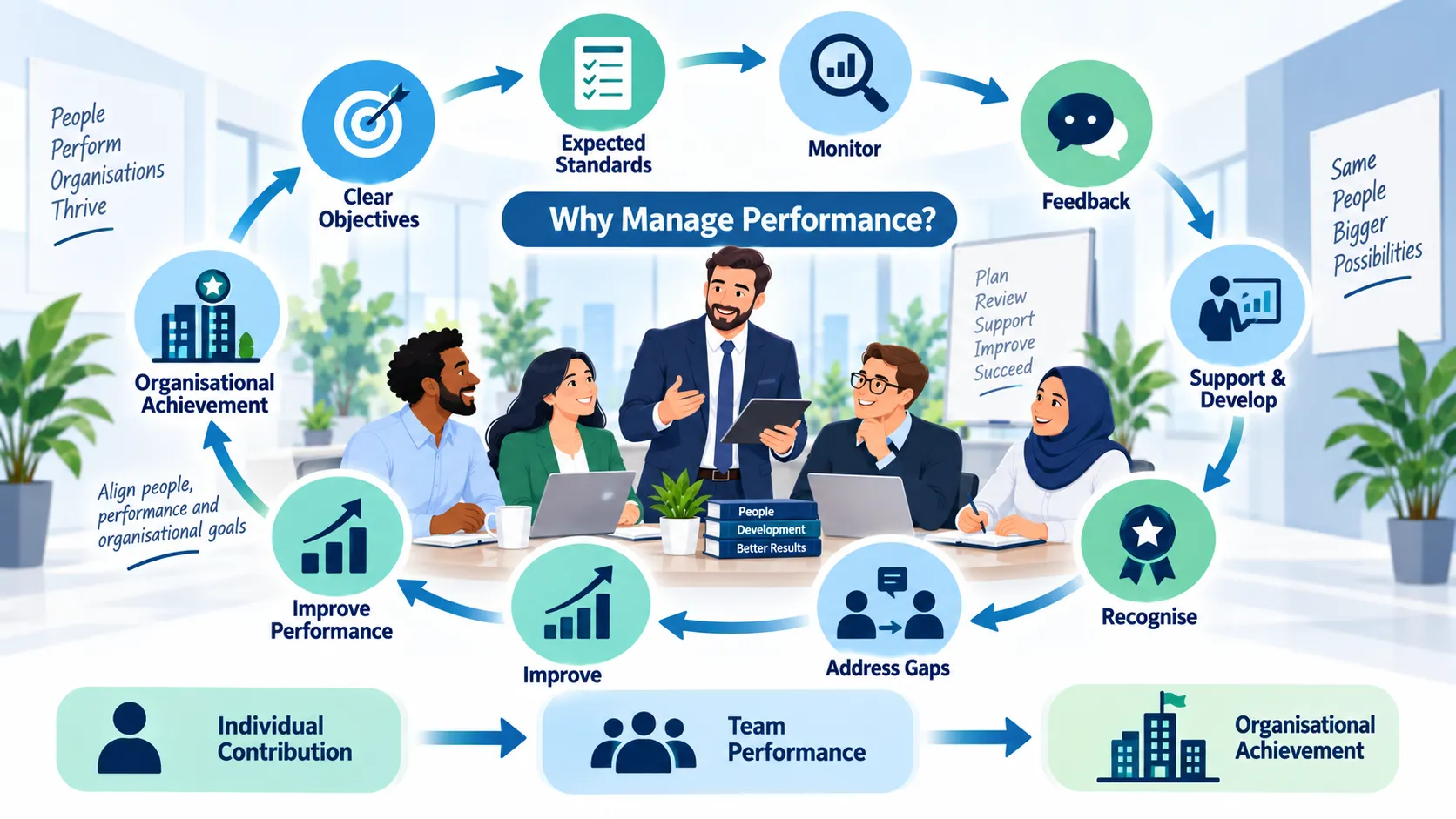
Understanding Performance Management
Definition of Performance Management
Performance management is the systematic and ongoing process of setting expectations, monitoring performance, providing feedback, supporting development, recognising achievement and addressing performance gaps to improve individual and organisational outcomes.
Performance management connects several managerial activities:
setting objectives;
establishing performance standards;
communicating expectations;
monitoring progress;
providing feedback;
recognising achievement;
identifying development needs;
addressing underperformance;
reviewing outcomes;
agreeing improvement actions.
These activities should operate as an integrated process rather than isolated management tasks.
Performance Management as an Ongoing Process
A common misunderstanding is that performance management is primarily an annual appraisal exercise. While formal performance reviews can be valuable, effective performance management is continuous.
Managers should regularly:
clarify expectations;
discuss progress;
identify challenges;
provide feedback;
recognise achievement;
address concerns;
support development;
review objectives.
Continuous performance management allows managers to identify issues before they become significant and provides employees with regular opportunities to understand how they are performing.
The Rationale for Managing Performance
Connecting Individual Contribution to Organisational Objectives
One of the strongest reasons for managing performance is to ensure that individual effort contributes to organisational objectives.
An organisation may have broad objectives relating to:
financial performance;
customer service;
operational efficiency;
quality;
productivity;
innovation;
service delivery;
organisational growth.
Employees contribute to these objectives through their individual responsibilities.
Performance management provides a mechanism for translating broad organisational priorities into meaningful individual and team expectations.
For example, if an organisation wants to improve customer service, a manager may establish team expectations relating to:
response times;
communication quality;
complaint handling;
service consistency;
customer feedback.
Employees can then understand how their individual responsibilities contribute to the wider organisational objective.
Providing Clarity
Employees need clarity about what successful performance means.
Without clear expectations, employees may have different interpretations of:
priorities;
standards;
responsibilities;
deadlines;
quality;
acceptable performance.
Performance management provides a structured opportunity to establish this clarity.
Managers should communicate:
what needs to be achieved;
why it matters;
expected standards;
relevant timescales;
available resources;
measures of achievement.
Clarity can reduce confusion and improve accountability.
Establishing Accountability
Accountability means that individuals understand what they are responsible for and are expected to account for their performance and results.
Performance management strengthens accountability by establishing:
defined responsibilities;
measurable or observable expectations;
agreed objectives;
performance standards;
review arrangements.
Accountability should not be interpreted simply as holding employees responsible when things go wrong. Effective accountability also involves providing the authority, resources, information and support required to perform effectively.
The Relationship Between Performance and Organisational Achievement
Individual Performance
Individual employees contribute directly to organisational performance through their:
knowledge;
skills;
behaviour;
productivity;
reliability;
decision-making;
customer interactions;
teamwork.
If individual performance is consistently strong, the organisation is more likely to achieve its objectives.
Team Performance
Individual performance does not occur in isolation.
Employees depend on colleagues for:
information;
coordination;
support;
resources;
communication;
shared problem-solving.
Effective performance management should therefore consider both individual contribution and team performance.
Organisational Performance
Organisational performance represents the collective outcomes achieved by the organisation.
These outcomes may include:
achievement of strategic objectives;
productivity;
quality;
customer satisfaction;
financial results;
operational reliability;
employee capability.
Performance management creates a connection between these organisational outcomes and the work carried out by individuals and teams.
Performance Management and Organisational Objectives
Translating Strategy into Performance Expectations
Strategic objectives can sometimes appear distant from employees’ everyday responsibilities.
A middle manager has an important role in translating organisational strategy into practical expectations.
The process may involve:
Understanding organisational objectives.
Identifying team contributions.
Establishing team objectives.
Identifying individual responsibilities.
Defining performance standards.
Agreeing appropriate measures.
Reviewing progress.
Adjusting expectations when circumstances change.
This process makes organisational strategy more meaningful to employees.
Maintaining Alignment
Performance management helps prevent individual activities from becoming disconnected from organisational priorities.
For example, an employee may be highly productive but focus on activities that do not contribute significantly to organisational objectives.
Effective performance management enables the manager to ask:
Is the employee focusing on the right priorities?
Does the work contribute to team objectives?
Are resources being used effectively?
Are performance measures aligned with organisational needs?
Alignment is therefore a key justification for managing performance.
Performance Standards
Definition of Performance Standards
Performance standards describe the level or quality of performance expected from an employee in a particular role.
Standards may relate to:
quality;
accuracy;
productivity;
behaviour;
reliability;
customer service;
compliance with procedures;
communication.
Clear standards provide a reference point for reviewing performance.
Characteristics of Effective Standards
Effective performance standards should generally be:
relevant to the role;
understandable;
achievable;
measurable or observable where appropriate;
aligned with organisational objectives;
communicated clearly;
reviewed when circumstances change.
Unrealistic standards can undermine motivation and trust.
Setting Performance Objectives
Definition of Performance Objectives
Performance objectives identify specific outcomes or achievements expected from an employee within an agreed period.
Objectives should provide sufficient clarity to answer:
What should be achieved?
Why is it important?
By when should it be achieved?
What standard applies?
How will achievement be assessed?
The Importance of Appropriate Objectives
Well-designed objectives can:
focus employee effort;
support prioritisation;
improve accountability;
enable performance review;
support motivation;
connect individual work with organisational priorities.
Managers should avoid creating excessive numbers of objectives because this can dilute focus.
Monitoring Performance
Definition of Performance Monitoring
Performance monitoring is the regular collection and review of information about employee or team performance against agreed expectations.
Monitoring can include:
reviewing work outputs;
examining performance measures;
observing workplace behaviour;
discussing progress;
reviewing customer feedback;
assessing quality;
checking completion of objectives.
Monitoring should be proportionate and purposeful.
Why Monitoring Is Necessary
Without monitoring, managers may discover performance problems too late.
Regular monitoring allows managers to:
identify achievement;
identify emerging problems;
provide timely support;
recognise progress;
adjust priorities;
respond to changing circumstances.
Monitoring should not become unnecessary surveillance. It should support performance and accountability.
Feedback as a Core Element of Performance Management
Definition of Feedback
Feedback is information provided to an employee about their performance, behaviour or results to reinforce effective practice or support improvement.
Effective feedback should be:
timely;
specific;
relevant;
evidence-based;
constructive;
focused on behaviour or outcomes;
connected with expectations.
Constructive Feedback
Constructive feedback should help employees understand:
what they are doing well;
what needs improvement;
why improvement matters;
what they can do differently;
what support is available.
Managers should avoid vague comments such as “do better” because they do not provide a clear basis for improvement.
Recognising Strong Performance
Why Strong Performance Should Be Managed
Performance management is not only about addressing problems.
Managers should identify employees who:
meet objectives consistently;
exceed expectations;
demonstrate valuable behaviours;
contribute beyond their immediate responsibilities;
support colleagues;
improve processes;
deliver high-quality outcomes.
Recognition reinforces the importance of effective performance.
Appropriate Recognition
Recognition may include:
verbal acknowledgement;
written recognition;
formal awards;
additional responsibility;
development opportunities;
team recognition;
appropriate organisational rewards.
Recognition should be fair and based on genuine contribution.
Performance and Motivation
Recognition can support motivation when employees believe that:
their contribution is noticed;
achievement is valued;
recognition is fair;
standards are meaningful.
However, managers should avoid creating unhealthy competition or recognising results achieved through inappropriate behaviour.
Managing Underperformance
Definition of Underperformance
Underperformance occurs when an employee’s performance consistently falls below agreed expectations or required standards.
Underperformance should be distinguished from:
a single mistake;
temporary difficulty;
reasonable learning periods;
circumstances outside the employee’s control.
Managers should consider evidence and context before concluding that underperformance exists.
Why Underperformance Must Be Managed
Unmanaged underperformance can affect:
productivity;
service quality;
team morale;
customer satisfaction;
workload distribution;
organisational objectives.
When poor performance is allowed to continue without appropriate intervention, other employees may perceive that standards are not being applied consistently.
Diagnosing the Causes of Underperformance
Managers should avoid assuming that underperformance is caused by lack of effort.
Possible causes include:
unclear expectations;
inadequate training;
insufficient resources;
workload;
ineffective processes;
lack of experience;
communication problems;
changing responsibilities;
inappropriate objectives;
personal circumstances where relevant to workplace support.
A structured diagnosis allows managers to determine the most appropriate response.
Performance Diagnosis Process
A manager can:
Gather relevant evidence.
Compare performance with agreed expectations.
Identify the specific performance gap.
Discuss the issue with the employee.
Listen to the employee’s explanation.
Identify potential causes.
Determine whether support is required.
Agree realistic improvement actions.
Establish review points.
Evaluate progress.
This process supports fairness and professional management.
Performance Improvement
Supporting Improvement
Where underperformance is linked to capability, managers may provide:
coaching;
training;
mentoring;
additional guidance;
clearer instructions;
resources;
reasonable monitoring;
opportunities to practise.
The objective is to give employees a realistic opportunity to improve.
Improvement Plans
A performance improvement plan may identify:
the performance issue;
expected standard;
required improvement;
agreed actions;
available support;
review dates;
evidence of improvement.
An improvement plan should be clear and proportionate.
Performance Management and Employee Development
Performance management provides an opportunity to identify development needs.
Employees may require development in:
technical skills;
communication;
leadership;
customer service;
digital capability;
problem solving;
decision-making.
Development should be connected with actual performance requirements.
Benefits of Linking Performance and Development
This can:
improve capability;
increase confidence;
address performance gaps;
prepare employees for greater responsibility;
support organisational capability;
improve engagement.
Performance discussions should therefore consider both current achievement and future capability requirements.
Performance Management and Employee Engagement
Employees are more likely to understand their contribution when managers:
communicate expectations;
provide feedback;
recognise achievement;
involve employees appropriately;
support development;
address problems fairly.
Effective performance management can therefore contribute to engagement.
However, performance management can have the opposite effect when it becomes:
overly controlling;
inconsistent;
unfair;
excessively target-driven;
focused only on weaknesses.
Managers must therefore consider how performance processes are experienced by employees.
Performance Management and Fairness
Procedural Fairness
Procedural fairness means that performance decisions are based on reasonable and consistently applied processes.
Managers should:
use relevant evidence;
explain expectations;
provide opportunities for employees to respond;
avoid arbitrary decisions;
apply standards consistently.
Consistency
Consistency does not necessarily mean treating every employee identically.
Employees may have different:
roles;
responsibilities;
capability levels;
development needs.
Fairness means applying appropriate standards and processes while considering relevant circumstances.
Ethical Performance Management
Performance management involves managerial authority, making ethical practice particularly important.
Managers should demonstrate:
honesty;
fairness;
respect;
confidentiality;
transparency;
consistency;
accountability.
Managers should avoid:
humiliating employees;
manipulating performance measures;
creating unrealistic expectations;
withholding relevant information;
showing favouritism;
using performance management as personal punishment.
Ethical performance management protects both employee dignity and organisational integrity.
Performance Measures and Indicators
Definition of Performance Measures
Performance measures are indicators used to assess whether expected outcomes or standards are being achieved.
Examples may include:
completion rates;
quality measures;
response times;
customer feedback;
productivity measures;
error rates;
project milestones.
Using Measures Appropriately
Measures should be:
relevant;
meaningful;
understandable;
proportionate;
aligned with objectives.
Managers should avoid focusing on measures simply because they are easy to count.
For example, counting the number of customer interactions may not accurately measure customer service quality if the quality of those interactions is ignored.
Balancing Quantitative and Qualitative Evidence
Effective performance management should consider different forms of evidence.
Quantitative Evidence
Examples include:
numerical targets;
completion rates;
productivity;
quality scores;
response times.
Qualitative Evidence
Examples include:
customer comments;
manager observations;
peer feedback;
employee reflection;
examples of problem solving.
A balanced approach reduces the risk of judging performance through a single narrow measure.
Performance Management and Team Effectiveness
Managers should consider how individual performance affects colleagues.
Poor individual performance can:
increase workload for colleagues;
delay team activities;
create conflict;
reduce morale.
Strong individual performance can:
support colleagues;
improve workflow;
share knowledge;
strengthen team capability.
Performance management should therefore consider the wider team impact.
Performance Management and Productivity
Productivity refers broadly to the effective use of resources to achieve outputs or outcomes.
Performance management can improve productivity by:
clarifying priorities;
reducing duplication;
identifying performance barriers;
improving capability;
addressing ineffective practices;
encouraging ownership.
However, productivity should not be measured simply by increasing the amount of work completed. Quality, sustainability and appropriate employee support must also be considered.
Performance Management and Quality
Quality is another important rationale for managing performance.
Clear performance standards can help employees understand:
required quality levels;
acceptable error rates;
customer expectations;
procedural requirements.
Managers can use performance reviews to identify recurring quality issues and determine whether improvement is needed in:
capability;
processes;
resources;
supervision;
communication.
Performance Management and Customer Outcomes
In customer-facing organisations, employee performance can have a direct effect on customers.
Performance management can support:
consistent service;
timely responses;
accurate information;
professional communication;
complaint resolution.
Managers should therefore consider customer outcomes when defining relevant performance expectations.
Performance Management and Risk
Performance management can also support organisational risk management.
Employees who understand:
responsibilities;
procedures;
standards;
authority boundaries
are better positioned to perform work consistently.
Managers can use performance monitoring to identify behaviours or practices that may create unnecessary risk.
Performance Management and Organisational Culture
Performance management contributes to organisational culture by communicating what the organisation values.
For example, if an organisation values:
collaboration;
customer service;
quality;
integrity;
innovation;
these values should be reflected in performance expectations and recognition.
If managers reward results while ignoring unethical behaviour, employees may receive conflicting messages about organisational values.
Performance Management and Accountability at Management Level
Managers are also accountable for managing performance effectively.
A manager should not simply expect employees to perform.
Managers must also consider whether they have:
communicated expectations;
provided resources;
offered support;
monitored progress;
provided feedback;
recognised achievement;
addressed problems appropriately.
This creates shared responsibility for effective performance.
The Performance Management Cycle
Stage 1: Plan
Establish:
objectives;
standards;
responsibilities;
measures;
timescales.
Stage 2: Communicate
Ensure employees understand:
expectations;
priorities;
available resources;
accountability.
Stage 3: Monitor
Review:
progress;
quality;
outcomes;
behaviours;
emerging challenges.
Stage 4: Review
Discuss:
achievement;
barriers;
development;
performance gaps.
Stage 5: Support
Provide:
coaching;
feedback;
training;
resources;
guidance.
Stage 6: Recognise
Acknowledge:
achievement;
improvement;
contribution;
behaviours aligned with organisational values.
Stage 7: Improve
Where performance is below standard:
identify causes;
agree actions;
establish review points;
monitor improvement.
Stage 8: Reassess
Review objectives and expectations as organisational or workplace circumstances change.
Practical Example: Customer Service Team
A customer service department has an organisational objective to improve customer satisfaction.
The manager translates this objective into team expectations relating to:
response times;
communication quality;
complaint resolution;
service consistency.
Individual employees receive clear expectations and regular feedback.
Employees who demonstrate strong performance receive appropriate recognition.
Where an employee’s performance falls below expectations, the manager reviews the evidence, discusses the issue and identifies whether additional coaching or training is required.
This demonstrates how performance management can connect individual contribution with organisational achievement.
Practical Example: Sales Team
A sales team has a target for increasing customer retention.
The manager does not focus only on sales volume. Performance management also considers:
quality of customer relationships;
follow-up;
accurate information;
customer feedback;
retention outcomes.
This prevents employees from focusing narrowly on one measure at the expense of wider organisational objectives.
Practical Example: Operational Team
An operational team experiences an increase in errors.
The manager reviews performance information and identifies that a new process has been introduced without adequate employee training.
Rather than immediately treating the issue as employee failure, the manager provides training and additional support.
Performance is monitored following the intervention.
This demonstrates why performance management should include diagnosis rather than automatic blame.
Practical Example: High-Performing Employee
An employee consistently exceeds agreed expectations and contributes ideas that improve team processes.
The manager recognises the contribution and discusses opportunities for increased responsibility.
The employee’s contribution is acknowledged through an appropriate organisational recognition mechanism.
This demonstrates that performance management should reinforce effective performance as well as address performance concerns.
Practical Example: Underperforming Employee
An employee repeatedly misses agreed deadlines.
The manager gathers evidence and discusses the issue with the employee.
The discussion identifies that priorities have not been clearly communicated and the employee is managing several competing responsibilities.
The manager clarifies priorities, agrees realistic deadlines and establishes regular review points.
This illustrates the importance of identifying the cause of a performance gap before deciding on corrective action.
Practical Example: New Employee
A new employee is not initially achieving the same productivity level as experienced colleagues.
The manager recognises that the employee is still developing role-specific capability.
The manager provides:
structured guidance;
coaching;
feedback;
opportunities to practise.
Performance is reviewed as capability develops.
This demonstrates the importance of considering context when assessing performance.
Practical Example: Team Performance Problem
A team has declining performance despite individual employees meeting their personal objectives.
The manager investigates and discovers poor coordination between team members.
The response focuses on:
communication;
shared priorities;
role clarity;
team coordination.
This demonstrates that effective performance management must consider both individual and collective performance.
Practical Example: Changing Organisational Priorities
An organisation changes its strategic priorities during the performance period.
Some existing employee objectives are no longer appropriate.
The manager reviews the objectives with employees and adjusts them to reflect the new organisational priorities.
This demonstrates that performance management should remain relevant rather than continuing to assess employees against outdated expectations.
Benefits of Managing Performance
Benefits for Employees
Effective performance management can provide:
greater clarity;
constructive feedback;
recognition;
development support;
improved capability;
increased confidence;
clearer accountability.
Benefits for Managers
Managers can benefit through:
better understanding of team performance;
earlier identification of problems;
improved communication;
stronger accountability;
better allocation of support;
more informed decisions.
Benefits for Organisations
Organisations can benefit through:
improved productivity;
stronger quality;
greater employee capability;
better customer outcomes;
improved alignment with objectives;
more consistent performance;
stronger organisational accountability.
Consequences of Failing to Manage Performance
Where performance is not managed effectively, organisations may experience:
unclear expectations;
inconsistent standards;
unresolved underperformance;
reduced productivity;
employee frustration;
poor customer outcomes;
increased workload for high performers;
lower morale;
missed organisational objectives.
Failure to recognise strong performance can also reduce employees’ perception that contribution is valued.
Common Weaknesses in Performance Management
Focusing Only on Annual Reviews
Annual reviews may be too infrequent to address emerging performance issues effectively.
Using Vague Expectations
Employees cannot perform consistently when standards are unclear.
Measuring the Wrong Things
A measure may be easy to calculate but fail to represent meaningful performance.
Ignoring Context
Managers may incorrectly attribute performance problems to employees when the actual causes involve systems, resources or unclear processes.
Avoiding Difficult Conversations
Managers sometimes delay addressing underperformance because they find difficult conversations uncomfortable.
This can allow problems to become more serious.
Overemphasising Targets
Excessive focus on numerical targets can encourage employees to prioritise measured activities at the expense of quality or organisational values.
Failing to Recognise Achievement
If strong performance is ignored, employees may question whether additional effort is valued.
Principles for Effective Performance Management
Managers should apply the following principles:
Establish clear expectations.
Connect individual objectives with organisational priorities.
Use relevant performance standards.
Monitor performance consistently.
Provide timely feedback.
Recognise strong contribution.
Address underperformance promptly.
Investigate causes before deciding on action.
Provide appropriate support.
Maintain fairness and consistency.
Protect employee dignity.
Use evidence when making decisions.
Review objectives when circumstances change.
Maintain appropriate accountability.
Encourage employee participation in performance discussions.
A Managerial Decision-Making Framework
When considering whether performance management action is required, managers can ask:
What is expected?
Identify the agreed performance standard or objective.
What is happening?
Review evidence of actual performance.
Is there a meaningful gap?
Determine whether performance differs significantly from expectations.
Why does the gap exist?
Explore possible causes rather than making assumptions.
What support is required?
Identify coaching, training, resources or clarification.
What action is appropriate?
Agree realistic improvement or recognition actions.
How will progress be reviewed?
Establish appropriate measures and review dates.
What is the organisational impact?
Consider effects on:
objectives;
quality;
productivity;
customers;
colleagues;
organisational values.
This framework supports evidence-based managerial judgement.
The Strategic Rationale for Managing Performance
Performance management has strategic importance because organisational strategy depends on people converting objectives into action.
A strategy may identify what an organisation wants to achieve, but performance management helps establish:
who is responsible;
what needs to be achieved;
what standards apply;
how progress will be monitored;
what support is required;
how achievement will be recognised;
how performance gaps will be addressed.
For middle managers, this creates an important link between strategic planning and operational execution.
Performance Management as a Continuous Improvement Mechanism
Performance management can support continuous improvement by creating regular opportunities to:
review outcomes;
identify weaknesses;
recognise strengths;
learn from experience;
improve processes;
develop capability.
The process should not simply ask whether an employee achieved an objective. It should also ask:
What contributed to success?
What prevented success?
What should continue?
What should change?
What support is required?
This creates a learning-oriented approach to performance.
Reflective Practice for Managers
Managers should regularly reflect on the effectiveness of their own performance management practices.
Useful questions include:
Are expectations clear?
Do employees understand how their work contributes to organisational objectives?
Am I providing timely feedback?
Do I recognise strong performance?
Do I address underperformance promptly?
Have I investigated the causes of performance problems?
Are my performance decisions evidence-based?
Do I apply expectations fairly?
Do employees have opportunities to contribute to performance discussions?
Are performance measures genuinely meaningful?
Am I providing sufficient support?
Do performance processes reflect organisational values?
Are objectives still relevant?
Does my approach support individual and organisational achievement?
Key Learning Points
The rationale for managing performance can be summarised through several core principles:
Performance management is an ongoing management responsibility.
It connects individual performance with organisational objectives.
Clear expectations provide direction and accountability.
Performance standards provide a basis for assessing achievement.
Monitoring enables managers to identify progress and emerging issues.
Feedback supports learning and improvement.
Recognition reinforces strong performance.
Underperformance should be addressed professionally and promptly.
Managers should investigate the causes of performance gaps.
Employees should receive appropriate support to improve.
Performance management should be fair and evidence-based.
Effective performance management considers both individual and team outcomes.
Performance measures should reflect meaningful organisational priorities.
Performance management can support productivity, quality and customer outcomes.
Ethical practice is essential when exercising managerial authority.
Performance objectives should be reviewed when organisational priorities change.
Effective performance management contributes to individual and organisational achievement.
Summary
The rationale for managing performance is based on the fundamental relationship between employee contribution and organisational achievement. Organisations depend on individuals and teams to deliver work to appropriate standards, achieve objectives, maintain quality and respond effectively to changing requirements. Performance management provides the structured approach required to support these outcomes.
Effective performance management begins with clear expectations. Employees need to understand their responsibilities, expected standards, objectives and contribution to organisational priorities. Managers have an important role in translating organisational objectives into practical expectations that employees can understand and act upon.
Performance management is not simply an annual appraisal. It is an ongoing cycle involving planning, communication, monitoring, feedback, support, recognition, improvement and review. Regular performance discussions enable managers to identify achievement, address emerging issues and provide timely support.
A further justification for managing performance is accountability. When responsibilities and standards are clear, employees are better positioned to understand what they are accountable for. Managers are also accountable for creating the conditions necessary for effective performance by providing appropriate resources, communication, support and feedback.
Managing performance is equally important for recognising strong performance. Employees who consistently meet or exceed expectations can contribute significantly to organisational success. Appropriate recognition can reinforce desirable behaviours, demonstrate appreciation and encourage continued contribution.
The management of underperformance is another essential component. Underperformance can affect productivity, quality, team morale, customer outcomes and organisational objectives if it remains unresolved. However, effective managers should not automatically assume that poor performance results from a lack of effort. They should examine possible causes such as capability, training, resources, workload, unclear expectations or ineffective processes.
A professional performance management process therefore involves gathering evidence, discussing concerns with employees, understanding the causes of performance gaps, providing appropriate support and agreeing realistic improvement actions. This approach supports fairness, accountability and employee development.
Performance management also contributes to organisational culture. What managers measure, recognise and address communicates what the organisation values. If managers consistently reward quality, collaboration, integrity and customer service, these behaviours are more likely to become embedded in workplace practice. Conversely, if managers focus only on numerical results while ignoring inappropriate behaviour, employees may receive conflicting messages about organisational expectations.
For middle managers, performance management provides a critical connection between organisational strategy and operational delivery. Managers must ensure that team and individual performance remain aligned with organisational priorities while responding to changing circumstances. This requires evidence-based judgement, effective communication and the ability to balance accountability with appropriate support.
Ultimately, the rationale for managing performance is not simply to control employee activity. It is to create clarity, support achievement, recognise contribution, address performance gaps and improve the organisation’s ability to achieve its objectives. When performance management is used effectively, it can contribute to stronger individual capability, improved team effectiveness, better organisational outcomes and a professional culture of accountability and continuous improvement.