
Lesson no 1 : Understand the principles of operational planning in an organisation
Operational planning is a fundamental management activity that enables an organisation to translate its strategic direction and organisational objectives into practical, coordinated and measurable actions. While strategic planning establishes where an organisation wants to go and what it wants to achieve, operational planning focuses on how those objectives will be delivered through day-to-day activities, resources, responsibilities, priorities and performance measures. For practising and aspiring middle managers and leaders, understanding the principles of operational planning is essential because operational plans provide a structured framework for turning organisational intentions into workplace results.
An effective operational plan connects the organisation’s wider priorities with the activities undertaken by teams, departments and individuals. Managers need to understand the organisation’s strategic objectives before developing operational priorities so that resources and activities are directed towards outcomes that genuinely support organisational goals. This requires managers to interpret strategic information, identify relevant operational requirements and establish clear priorities for their area of responsibility. Without this alignment, operational activity can become fragmented, resources may be used inefficiently and teams may focus on tasks that do not contribute sufficiently to organisational performance.
Operational planning involves more than simply creating a list of activities. It requires managers to establish clear objectives, measurable targets, responsibilities, resources, timescales, quality expectations, risks and performance indicators. Effective planning considers what needs to be achieved, who will be responsible, what resources are required, when activities should be completed and how performance will be measured. These elements provide managers with a practical framework for coordinating work and maintaining accountability.
A central principle of operational planning is the use of Key Performance Indicators (KPIs) and other appropriate measures. KPIs enable managers to monitor whether planned activities are producing the expected results. Effective measures should be relevant to organisational objectives and provide useful evidence about progress, quality, productivity, efficiency or outcomes. Managers must also be able to interpret performance information and identify when actual results differ from planned targets.
Operational planning is also a continuous management process rather than a one-time exercise. Organisational priorities, customer requirements, available resources, risks, market conditions and operational circumstances can change. Managers therefore need to monitor implementation, review performance and adapt operational plans when appropriate. This requires effective communication, problem-solving, decision-making and change management.
The lesson explores the principles of operational planning in an organisation, including the relationship between strategic and operational planning, setting operational objectives, establishing priorities, allocating resources, defining responsibilities and timescales, setting KPIs, managing risks, monitoring quality and outcomes, and reviewing performance. It also considers how effective operational planning supports coordination, accountability, efficient resource use and the achievement of organisational objectives.
By understanding these principles, managers can develop operational plans that are realistic, measurable and aligned with organisational priorities, while providing teams with clear direction about what needs to be achieved and how success will be assessed.
1.Assess the Relationship Between an Organisation’s Strategic Objectives and Operational Planning
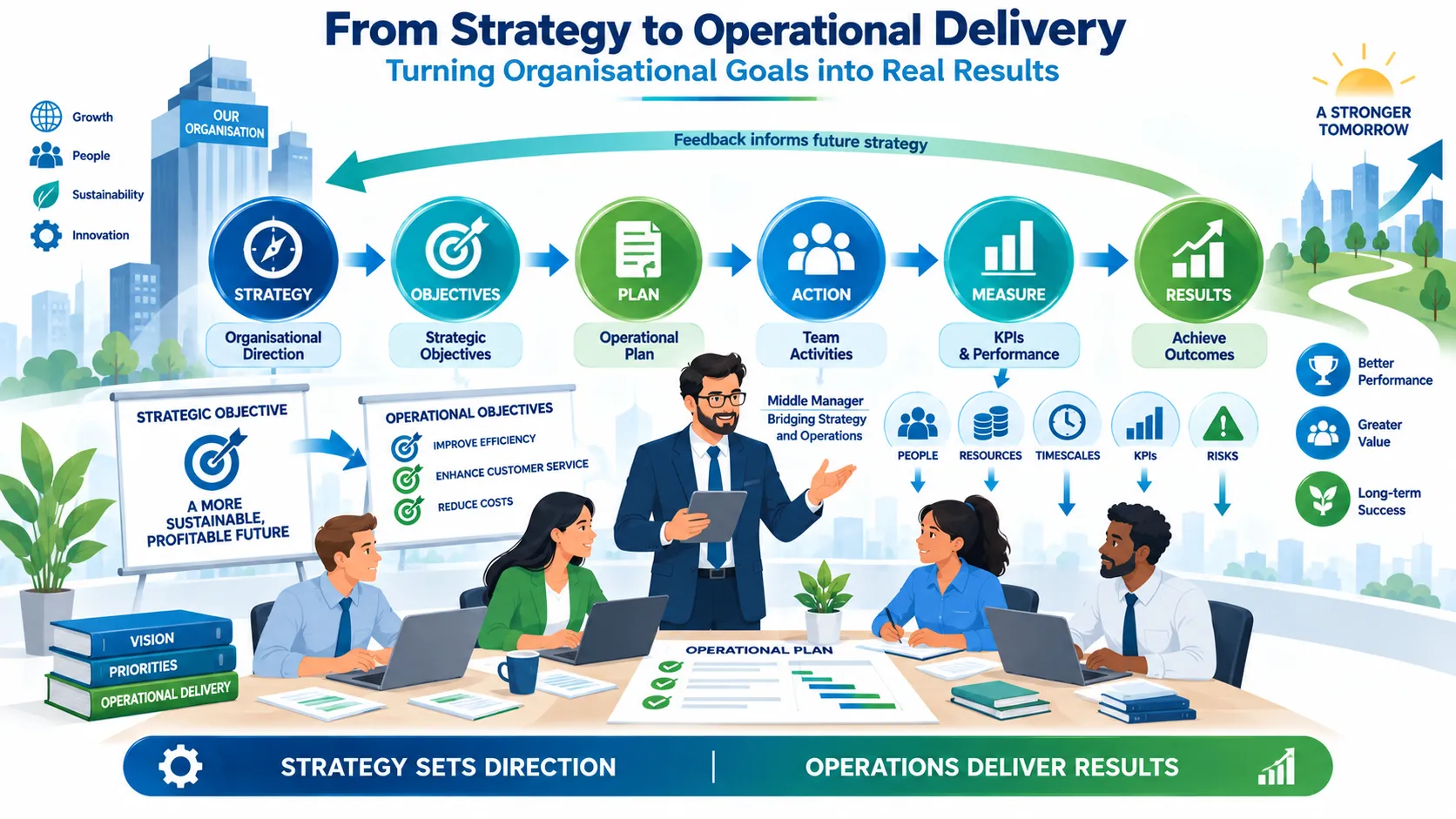
Understanding the relationship between an organisation’s strategic objectives and its operational planning is fundamental to effective management. Strategic objectives establish what an organisation is seeking to achieve over a defined period, while operational planning translates those intentions into practical activities, responsibilities, resources, timescales and performance measures. The two are therefore closely connected: strategy provides the direction, while operational planning provides the practical framework for delivering that direction.
For middle managers and leaders, this relationship is particularly important because they frequently operate between strategic leadership and operational teams. Senior leaders may establish organisational priorities, but managers are often responsible for interpreting those priorities and converting them into achievable plans for departments, functions or teams. The quality of this translation can have a direct influence on whether strategic objectives are successfully implemented.
A strong relationship between strategy and operations ensures that everyday activities contribute to organisational priorities. It also helps managers make informed decisions about resource allocation, performance expectations, risk management and improvement activities. Conversely, when operational plans are disconnected from strategic objectives, teams may remain busy without making meaningful progress towards organisational goals.
Assessing this relationship therefore requires more than identifying that strategy and operations are connected. Managers need to consider how objectives are translated, how alignment is maintained, how performance is measured, how resources support priorities, and how operational plans are reviewed when strategic circumstances change.
Understanding Strategic Objectives
Definition of Strategic Objectives
Strategic objectives are specific outcomes that an organisation intends to achieve in support of its overall strategic direction. They provide a clear expression of organisational priorities and establish what the organisation considers important over a particular period.
Strategic objectives normally sit within a broader hierarchy that may include:
Organisational vision
Organisational mission or purpose
Strategic priorities
Strategic objectives
Departmental objectives
Operational objectives
Team and individual activities
This hierarchy helps ensure that organisational intentions can be translated progressively into practical action.
For example, an organisation may have a strategic objective to improve customer satisfaction over the next three years. That objective provides direction, but it does not by itself explain exactly what every department or employee needs to do. Operational planning is required to translate the objective into practical actions.
A customer service department may therefore develop operational objectives such as:
Reduce average response times.
Introduce improved customer-feedback processes.
Increase first-contact resolution.
Provide targeted employee training.
Monitor customer complaints regularly.
Introduce monthly service-quality reviews.
These operational activities provide a practical route towards achieving the wider strategic objective.
Characteristics of Effective Strategic Objectives
Effective strategic objectives provide sufficient clarity to influence decision-making and planning. They should normally be:
Clearly defined.
Relevant to organisational priorities.
Measurable where appropriate.
Time-related.
Realistic but sufficiently challenging.
Supported by appropriate resources.
Communicated to relevant stakeholders.
Capable of being translated into operational action.
Strategic objectives do not necessarily provide detailed instructions about how activities should be completed. Instead, they establish the desired direction and results, leaving operational managers to determine appropriate implementation arrangements within organisational policies, resources and authority.
Understanding Operational Planning
Definition of Operational Planning
Operational planning is the process of translating organisational or strategic objectives into specific, coordinated and measurable activities that can be implemented within a defined operational area.
Operational planning focuses on practical delivery. It answers questions such as:
What needs to be achieved?
What activities need to be completed?
Who is responsible?
What resources are required?
When should activities be completed?
What standards or quality requirements apply?
What risks could affect delivery?
How will performance be measured?
How will progress be monitored?
What action will be taken if performance falls below expectations?
Operational plans may cover different periods depending on organisational requirements. Some organisations use annual operational plans, while others use quarterly, monthly or project-based planning arrangements.
Operational Planning Is More Than Task Scheduling
A common misunderstanding is that operational planning simply means listing tasks. Effective operational planning is considerably broader.
A strong operational plan connects:
Strategic objective → Operational objective → Activities → Resources → Responsibilities → Timescales → KPIs → Monitoring → Corrective action → Outcomes
This connection enables managers to understand not only what work needs to be completed but also why it matters and how its contribution will be evaluated.
The Strategic-to-Operational Planning Relationship
Strategy Provides Direction
The first relationship between strategic objectives and operational planning is that strategic objectives provide direction for operational decisions.
Managers should not develop operational plans in isolation. They need to understand the organisation’s priorities before deciding which activities should receive attention.
For example, if an organisation’s strategic priority is to improve digital service delivery, an operational manager should consider whether existing processes, staff capabilities, technology and customer-support arrangements are suitable for that direction.
The operational plan might include:
Reviewing existing digital processes.
Identifying service gaps.
Training employees.
Implementing improved systems.
Establishing service standards.
Monitoring customer usage.
Reviewing operational performance.
Without the strategic objective, these activities could appear as isolated improvement projects. With the strategic context, their purpose becomes clear.
Operational Planning Converts Strategy into Action
Strategic objectives provide direction but cannot normally be achieved through strategic statements alone.
Operational planning converts strategic intentions into practical implementation.
For example:
Strategic objective: Improve organisational efficiency.
Operational translation:
Review inefficient processes.
Identify unnecessary duplication.
Establish process-improvement targets.
Train relevant employees.
Introduce revised procedures.
Monitor processing times.
Measure resource savings.
Review results against targets.
This illustrates the vertical connection between organisational strategy and operational activity.
Operational Plans Make Strategic Objectives Actionable
Strategic objectives can sometimes remain too broad to guide everyday activity. Operational planning makes them actionable by defining specific activities and expected results.
A manager should therefore be able to answer:
“What does this strategic objective mean for my team, and what must my team do differently to contribute to it?”
This question is central to effective middle management.
The Hierarchy of Objectives
Organisational Objectives
At the highest relevant level, organisational objectives establish what the organisation intends to achieve.
Examples include:
Improving customer satisfaction.
Increasing operational efficiency.
Improving service quality.
Expanding service capacity.
Reducing avoidable costs.
Improving employee capability.
Strengthening digital service delivery.
Departmental Objectives
Departmental objectives translate organisational priorities into responsibilities for specific functions.
For example, an organisation seeking to improve customer satisfaction may establish a departmental objective for the customer service function to improve response quality and reduce unresolved complaints.
Operational Objectives
Operational objectives specify what should be achieved through day-to-day management.
Examples include:
Reduce average response time by an agreed percentage.
Achieve a defined service-quality standard.
Complete employee training within a specified period.
Reduce process errors.
Increase first-contact resolution.
Individual and Team Activities
Finally, operational objectives are translated into activities undertaken by teams and individuals.
This may include:
Handling customer enquiries.
Completing quality checks.
Updating records.
Attending training.
Reviewing performance data.
Implementing revised procedures.
The hierarchy ensures that individual activity has a visible relationship with wider organisational priorities.
Translating Strategic Objectives into Operational Plans
Step 1: Understand the Strategic Direction
Managers should first establish what the organisation is trying to achieve and why.
This may require reviewing:
Strategic plans.
Organisational priorities.
Corporate objectives.
Business performance information.
Leadership communications.
Customer requirements.
Regulatory expectations.
Market or operational changes.
Managers should avoid developing plans based only on assumptions about organisational priorities.
Step 2: Identify the Relevant Strategic Objectives
Not every strategic objective will apply equally to every department.
Managers need to determine which objectives directly or indirectly affect their operational area.
For example, a finance department may have a stronger role in cost-control objectives, while a learning and development function may contribute more directly to workforce capability objectives.
Step 3: Interpret the Strategic Objective
Managers should ask what the strategic objective means operationally.
For example:
Strategic objective: Improve service quality.
Possible operational implications include:
Quality standards.
Staff capability.
Process consistency.
Customer feedback.
Complaint management.
Performance monitoring.
Quality assurance.
Step 4: Establish Operational Objectives
The manager then converts the strategic requirement into specific operational objectives.
Operational objectives should be clear enough to guide action and measurement.
Step 5: Identify Activities and Deliverables
Each operational objective should be supported by practical activities.
For example:
Objective: Reduce customer response times.
Activities may include:
Analyse current response times.
Identify bottlenecks.
Review staffing arrangements.
Improve workflow.
Introduce response-time monitoring.
Review performance weekly.
Step 6: Allocate Responsibilities
Operational planning should establish who is accountable for delivery.
Responsibility should be clear at:
Management level.
Team level.
Individual activity level.
Supplier or partner level where relevant.
Ambiguous accountability can result in tasks being overlooked or duplicated.
Step 7: Allocate Resources
Managers need to determine whether the operational plan is achievable using available resources.
Resources may include:
People.
Finance.
Equipment.
Technology.
Facilities.
Time.
Specialist expertise.
Information.
Step 8: Establish Timescales and Milestones
Strategic objectives often operate over longer periods than operational activities. Managers therefore need to break longer-term objectives into achievable milestones.
For example:
Strategic objective: Improve digital capability over three years.
Operational milestones:
Quarter 1: Assess capability.
Quarter 2: Develop training programme.
Quarter 3: Train priority teams.
Quarter 4: Evaluate capability improvement.
Step 9: Establish KPIs
Key Performance Indicators provide measurable evidence of whether operational activity is contributing towards intended objectives.
Relevant KPIs might measure:
Productivity.
Quality.
Customer satisfaction.
Response times.
Costs.
Completion rates.
Error rates.
Service levels.
Outcome achievement.
Step 10: Monitor and Review
Operational plans must be monitored to establish whether activities are producing the expected results.
Managers should compare:
Planned performance → Actual performance → Variance → Cause → Corrective action
This creates a continuous relationship between planning and management control.
The Role of Key Performance Indicators in Strategic Alignment
Definition of KPIs
A Key Performance Indicator (KPI) is a measurable indicator used to assess performance against an important objective or expected result.
KPIs provide a bridge between strategic intentions and operational performance.
For example:
Strategic objective: Improve customer satisfaction.
Operational KPI: Customer satisfaction score.
Operational target: Achieve the agreed satisfaction level by the specified review date.
The KPI allows managers to assess whether operational activities are contributing towards the strategic objective.
Characteristics of Effective KPIs
Effective KPIs should be:
Relevant to objectives.
Clearly defined.
Measurable.
Consistent.
Understandable.
Practical to collect.
Reviewed regularly.
Supported by reliable data.
Capable of informing decisions.
A poor KPI may encourage activity without producing meaningful organisational value.
For example, measuring the number of customer calls answered may appear positive, but if customers remain dissatisfied, the measure may not adequately represent service effectiveness.
The Role of Resources in Strategic and Operational Alignment
Resource Allocation Should Reflect Strategic Priorities
Resources are limited in most organisations. Managers therefore need to allocate resources according to organisational priorities.
If an organisation identifies digital transformation as a strategic priority, but operational budgets provide no funding for technology, training or implementation, there is likely to be a disconnect between strategy and operations.
Effective operational planning therefore considers:
Available resources.
Required resources.
Resource gaps.
Competing priorities.
Resource constraints.
Resource dependencies.
Timing of resource requirements.
People as a Strategic and Operational Resource
Employees are often central to operational delivery.
Managers need to consider whether teams have:
Appropriate skills.
Sufficient capacity.
Clear responsibilities.
Suitable training.
Appropriate leadership.
Access to necessary information.
A strategic objective that depends on improved service quality cannot be delivered effectively if employees do not understand the required standards or lack the capability to meet them.
Strategic Alignment and Risk Management
Strategic objectives can create operational risks if they are not translated realistically.
For example, an organisation may seek rapid expansion. Operational managers may then face:
Recruitment challenges.
Training requirements.
Increased workload.
Supplier capacity problems.
Quality pressures.
Financial constraints.
Technology limitations.
Operational planning should identify these risks before implementation becomes difficult.
Managers should consider:
What could prevent the objective being achieved?
How likely is each risk?
What would be the impact?
Who owns the risk?
What controls are required?
What contingency arrangements may be needed?
Risk management therefore supports the practical delivery of strategic objectives.
Strategic Alignment and Quality Management
Strategic objectives frequently include expectations concerning quality.
For example, an organisation may have a strategic objective to become recognised for high-quality service.
Operational planning then needs to translate this ambition into measurable quality requirements.
This could involve:
Defining quality standards.
Establishing quality checks.
Monitoring errors.
Collecting customer feedback.
Reviewing complaints.
Conducting audits.
Training employees.
Taking corrective action.
Quality management therefore provides another mechanism through which operational activity contributes to strategy.
Strategic Alignment and Stakeholder Expectations
Operational plans should consider the expectations of stakeholders affected by strategic objectives.
Relevant stakeholders may include:
Employees.
Customers.
Senior leaders.
Suppliers.
Partners.
Regulators.
Service users.
Shareholders or owners.
Different stakeholders may have different priorities.
A strategic objective to reduce operational costs, for example, may create concerns among employees about workload or customers about service quality.
Middle managers therefore need to interpret strategic objectives while considering stakeholder implications.
The Role of Middle Managers in Connecting Strategy and Operations
Middle managers have a particularly important role because they often operate between strategic decision-makers and operational teams.
They may be responsible for:
Interpreting strategic objectives.
Communicating organisational priorities.
Translating objectives into departmental plans.
Allocating resources.
Establishing operational targets.
Monitoring KPIs.
Managing risks.
Supporting employees.
Reporting operational performance.
Escalating significant issues.
Recommending changes.
This means middle managers should not simply pass strategic messages downwards. They should interpret, translate, coordinate and provide feedback.
Strategic Communication Downwards
Managers need to communicate strategic priorities clearly so employees understand why operational activities matter.
For example:
“The organisation’s priority is improving customer experience. Our team’s operational focus is therefore reducing response times, improving first-contact resolution and monitoring customer feedback.”
This creates a clear connection between organisational strategy and team activity.
Operational Feedback Upwards
The relationship also works in the opposite direction.
Operational managers should provide senior leaders with evidence about:
What is working.
What is not working.
Resource pressures.
Emerging risks.
Stakeholder concerns.
Performance trends.
Required changes.
This creates a feedback loop between strategy and implementation.
The Importance of Two-Way Alignment
Strategic objectives should influence operational plans, but operational evidence should also influence strategic decision-making.
This can be represented as:
Strategic Direction → Operational Planning → Implementation → Performance Evidence → Management Review → Strategic Adjustment
This is important because organisational circumstances change.
For example, an organisation may establish a strategic target based on expected customer demand. During implementation, operational data may show that demand is significantly different from the original assumption. Senior leaders may then need to reconsider priorities or resources.
Operational information therefore contributes to strategic learning.
Assessing the Strength of Strategic and Operational Alignment
Managers should not assume that alignment exists simply because an operational plan mentions organisational objectives.
Alignment should be assessed systematically.
Alignment Question 1: Is There a Clear Link?
Each significant operational objective should have a clear connection to one or more organisational priorities.
Managers should ask:
Which strategic objective does this activity support?
What organisational outcome should result?
Is the connection direct or indirect?
Is the activity still strategically relevant?
Alignment Question 2: Are Resources Consistent with Priorities?
If strategic objectives are important, operational resources should reflect their importance.
Managers should compare:
Strategic priority → Required resources → Available resources → Resource gap
A significant gap may indicate that implementation will be difficult.
Alignment Question 3: Are Measures Appropriate?
Managers should assess whether KPIs actually measure meaningful progress towards strategic objectives.
A high volume of activity does not necessarily indicate successful achievement.
For example:
Number of training sessions delivered = activity measure.
Percentage of employees demonstrating required competence = outcome-oriented measure.
The second measure may provide stronger evidence of whether a capability objective is being achieved.
Alignment Question 4: Are Timescales Realistic?
Strategic ambitions should be translated into realistic operational milestones.
Managers should assess whether:
Activities can be completed within available capacity.
Dependencies have been considered.
Resources are available when required.
Risks have been incorporated.
Milestones are achievable.
Alignment Question 5: Are Responsibilities Clear?
An operational plan should make accountability visible.
Managers should assess whether:
Every significant activity has an owner.
Decision-making authority is clear.
Dependencies between teams are understood.
Escalation routes exist.
Benefits of Strong Strategic and Operational Alignment
Strong alignment provides several organisational benefits.
Better Resource Allocation
Resources can be directed towards activities that support important organisational priorities rather than being consumed by low-value activity.
Improved Employee Focus
Employees are more likely to understand priorities when operational tasks are clearly connected to organisational objectives.
Stronger Accountability
Clear links between objectives, responsibilities and KPIs make performance easier to evaluate.
Better Decision-Making
Managers can make decisions based on whether activities contribute to agreed priorities.
Improved Performance Monitoring
Strategic objectives provide context for interpreting operational performance.
Greater Organisational Coherence
Departments and teams are more likely to work towards shared outcomes rather than pursuing disconnected priorities.
Faster Identification of Misalignment
Regular reviews can identify activities that no longer contribute to organisational objectives.
Common Problems When Strategic and Operational Planning Are Poorly Connected
Activity Without Strategic Value
Teams may complete many tasks without making meaningful progress towards organisational objectives.
Conflicting Priorities
Different departments may establish operational priorities that compete with one another.
Resource Misallocation
Money, people and time may be invested in activities with limited strategic value.
Weak Performance Measurement
KPIs may measure activity rather than meaningful outcomes.
Employee Confusion
Employees may understand what they are doing but not why it matters.
Strategic Objectives That Remain Abstract
Senior leaders may communicate ambitious objectives without providing sufficient operational clarity.
Operational Plans That Become Outdated
Plans may remain unchanged even when strategic priorities or organisational circumstances have shifted.
Practical Example 1 – Customer Service Improvement
Consider an organisation that establishes the strategic objective:
“Improve customer experience and strengthen customer loyalty.”
The objective provides strategic direction but requires operational interpretation.
A customer service manager could establish operational objectives such as:
Improve response times.
Increase first-contact resolution.
Reduce avoidable complaints.
Improve employee capability.
Introduce regular customer-feedback analysis.
The operational plan may then specify:
Staff training.
Workflow review.
Revised procedures.
Additional quality checks.
Customer feedback collection.
Weekly performance monitoring.
KPIs could include:
Average response time.
First-contact resolution rate.
Customer satisfaction score.
Complaint resolution time.
Repeat-contact rate.
The manager can then assess whether operational performance is contributing to the strategic objective.
If customer satisfaction improves while response times remain poor, the manager may need to review whether additional operational action is required.
Practical Example 2 – Digital Transformation
Suppose an organisation’s strategic objective is:
“Increase the use of digital services to improve accessibility and operational efficiency.”
The operational planning implications could include:
Reviewing existing services.
Identifying suitable digital processes.
Assessing technology requirements.
Training employees.
Supporting customers.
Monitoring system performance.
Measuring adoption rates.
Potential KPIs could include:
Percentage of services available digitally.
Digital service usage.
Customer satisfaction.
Processing time.
Error rates.
Employee adoption.
The relationship is strong because the operational activities and measures directly support the strategic objective.
Practical Example 3 – Cost Efficiency
An organisation may establish a strategic objective to:
“Improve operational efficiency while maintaining service quality.”
An operational manager should avoid interpreting this simply as “reduce spending”.
Instead, the operational plan may focus on:
Identifying process duplication.
Reducing waste.
Improving workflow.
Reviewing supplier arrangements.
Automating suitable processes.
Monitoring productivity.
Protecting quality standards.
Relevant KPIs might include:
Cost per transaction.
Processing time.
Error rate.
Productivity.
Customer satisfaction.
Resource utilisation.
This example demonstrates why operational planning should consider multiple performance dimensions rather than pursuing one target in isolation.
Practical Example 4 – Workforce Capability
Suppose the organisation establishes a strategic objective to:
“Strengthen workforce capability to support future organisational requirements.”
The operational response could involve:
Identifying skills gaps.
Conducting capability assessments.
Establishing development priorities.
Delivering targeted training.
Monitoring competence.
Reviewing employee performance.
Evaluating operational impact.
The manager should assess not only whether training was delivered but whether employees developed the capabilities required by the strategic objective.
The Role of Performance Review
Strategic and operational alignment must be reviewed regularly because performance evidence may reveal that the original operational approach is ineffective.
A structured review can consider:
What strategic objective are we supporting?
What operational objectives were established?
What activities were planned?
What has actually been delivered?
What KPIs have been achieved?
What variances exist?
What caused the variances?
What risks have emerged?
Are resources still appropriate?
Are operational priorities still aligned?
What corrective action is required?
What information should be reported to senior leadership?
This approach makes operational planning a dynamic management process rather than a static document.
Adapting Operational Plans When Strategic Priorities Change
Strategic objectives can change because of:
Changes in customer expectations.
Financial pressures.
New organisational priorities.
Technology developments.
Regulatory requirements.
Market conditions.
Operational performance.
Emerging risks.
Changes in organisational capacity.
When this happens, operational plans should be reviewed.
Managers should avoid continuing activities simply because they were included in an earlier plan.
A structured change process should consider:
Change in strategic direction → Impact assessment → Operational plan review → Resource review → KPI review → Communication → Implementation → Monitoring
This protects the organisation from continuing to invest resources in activities that no longer provide sufficient value.
Strategic Alignment and Continuous Improvement
Effective operational planning supports continuous improvement because operational performance provides evidence about whether organisational approaches are working.
Managers can use:
KPI trends.
Customer feedback.
Quality data.
Financial information.
Risk information.
Employee feedback.
Performance reviews.
Lessons learned.
This information can identify opportunities to improve processes and operational plans.
Continuous improvement therefore creates another feedback loop:
Plan → Deliver → Measure → Review → Improve → Re-plan
Evaluating Different Levels of Alignment
Not all alignment is equally effective.
Strong Alignment
Strong alignment exists when:
Operational objectives clearly support strategic objectives.
Activities are directly relevant.
Resources support priorities.
KPIs measure meaningful performance.
Responsibilities are clear.
Risks are actively managed.
Performance is regularly reviewed.
Changes are incorporated into plans.
Partial Alignment
Partial alignment may occur when:
Activities broadly support strategy.
Some resources are available.
KPIs exist but are incomplete.
Some responsibilities are unclear.
Review processes are inconsistent.
Partial alignment may allow progress but creates weaknesses that can reduce effectiveness.
Weak Alignment
Weak alignment exists when:
Operational activities are disconnected from strategic objectives.
Resources are allocated without strategic priorities.
KPIs focus mainly on activity volume.
Employees lack clarity about organisational priorities.
Plans are rarely reviewed.
Strategic changes are not reflected operationally.
Weak alignment creates a high risk that operational effort will not produce the intended organisational results.
Key Concepts to Remember
The most important concepts in this part are:
Strategic objectives: Desired organisational results that support strategic direction.
Operational planning: Translating strategic objectives into practical activities and measurable operational outcomes.
Strategic alignment: The degree to which operational activities support organisational priorities.
Operational objectives: Specific results that teams or functions are expected to achieve.
KPIs: Measures used to assess important aspects of performance.
Resource alignment: Ensuring resources support organisational priorities.
Accountability: Clear ownership of operational responsibilities and results.
Performance monitoring: Comparing actual performance with planned expectations.
Corrective action: Intervention taken when performance does not meet expectations.
Feedback loop: Using operational evidence to inform management and strategic decisions.
Continuous improvement: Using performance evidence to improve operational processes and plans.
Key Benefits of Connecting Strategic Objectives with Operational Planning
When strategic objectives and operational planning are effectively connected, organisations are better positioned to:
Translate organisational priorities into practical action.
Establish clear operational direction.
Improve resource allocation.
Strengthen accountability.
Improve employee understanding of priorities.
Establish meaningful performance measures.
Identify performance gaps earlier.
Manage operational risks.
Improve coordination between departments.
Support evidence-based decision-making.
Maintain focus on organisational outcomes.
Respond more effectively to changing circumstances.
Strengthen communication between senior leaders and operational teams.
Improve the likelihood of achieving strategic objectives.
Practical Process for Middle Managers
A middle manager can use the following practical process to assess and maintain alignment:
1. Understand the Strategy
Review current organisational objectives and priorities.
2. Identify Relevance
Determine which strategic objectives affect the manager’s operational area.
3. Translate Objectives
Convert relevant strategic objectives into practical operational objectives.
4. Plan Activities
Identify the activities required to achieve each operational objective.
5. Allocate Resources
Ensure appropriate people, finance, technology, time and other resources are available.
6. Assign Accountability
Establish clear ownership and responsibilities.
7. Establish KPIs
Develop meaningful measures and targets.
8. Identify Risks
Assess threats that could prevent successful delivery.
9. Establish Milestones
Break longer-term objectives into manageable stages.
10. Monitor Performance
Compare planned and actual results.
11. Review Alignment
Assess whether activities continue to support strategic priorities.
12. Adapt Where Necessary
Modify operational plans when evidence, circumstances or strategic priorities change.
13. Report Findings
Provide clear evidence-based information to relevant stakeholders and senior management.
Managerial Judgement in Strategic and Operational Planning
Effective managers should recognise that alignment does not mean mechanically implementing every strategic instruction.
Professional judgement is required because managers may face competing priorities, limited resources and changing circumstances.
For example, a senior leader may request faster implementation of a new service. The operational manager may recognise that the current workforce lacks the capacity to implement the change without affecting existing service quality.
The manager should therefore assess:
Strategic importance.
Operational capacity.
Resource availability.
Quality implications.
Risks.
Stakeholder impact.
Timescales.
Alternative approaches.
The manager may then recommend a phased implementation rather than rejecting the strategic objective.
This illustrates an important principle: effective operational planning translates strategy realistically while protecting delivery quality and organisational performance.
Strategic Objectives, Operational Plans and Organisational Results
The ultimate purpose of alignment is not simply to produce a well-written operational plan. The purpose is to achieve meaningful organisational results.
The relationship can therefore be understood as:
Strategic Objective
↓
Operational Objective
↓
Operational Activities
↓
Resources and Responsibilities
↓
KPIs and Quality Measures
↓
Monitoring and Review
↓
Corrective Action and Improvement
↓
Operational Outcomes
↓
Contribution to Strategic Results
Each stage supports the next.
If the strategic objective is unclear, operational planning becomes difficult.
If operational objectives are poorly defined, activities may lack focus.
If resources are inadequate, implementation may fail.
If KPIs are inappropriate, managers may not recognise poor performance.
If monitoring is weak, problems may remain undetected.
If corrective action is ineffective, performance gaps may persist.
Therefore, effective project and operational management requires managers to consider the whole chain rather than treating individual planning elements separately.
Comparison of Strategic Objectives and Operational Planning
| Element | Strategic Objectives | Operational Planning | Relationship |
|---|---|---|---|
| Definition | Desired organisational results supporting strategic direction | Process of translating objectives into practical activities and measurable delivery | Operational planning turns strategic intentions into action |
| Primary focus | What the organisation wants to achieve and why | How objectives will be implemented and monitored | Strategy establishes direction; operations establish delivery |
| Timescale | Often medium- to long-term | Often shorter-term and implementation-focused | Operational milestones support longer-term objectives |
| Level | Organisation or major strategic function | Department, team or operational area | Operational plans cascade from strategic priorities |
| Activities | Defines desired results rather than detailed tasks | Specifies activities, deliverables and responsibilities | Activities should contribute to strategic outcomes |
| Resources | Establishes broad priorities and resource implications | Allocates people, finance, technology and other resources | Operational resources should reflect strategic priorities |
| Performance measures | Strategic outcomes and high-level success measures | KPIs, targets, milestones and operational indicators | Operational measures provide evidence of strategic progress |
| Risk | Considers major strategic threats and opportunities | Identifies and manages delivery-level risks | Operational risk information can inform strategic decisions |
| Review | Reviews strategic relevance and organisational direction | Reviews implementation, performance and corrective action | Operational evidence can trigger strategic review |
| Management role | Establishes direction and priorities | Converts priorities into coordinated action | Middle managers connect both levels |
| Success | Achievement of intended organisational results | Effective delivery of planned activities and outcomes | Operational success should contribute to strategic success |
Managerial Review Checklist
Before approving or implementing an operational plan, a manager should be able to answer “yes” to most of the following questions:
Is the operational plan clearly linked to current organisational objectives?
Can the team explain why each major activity is important?
Are operational objectives clearly defined?
Are priorities realistic?
Are responsibilities clearly allocated?
Are appropriate resources available?
Are timescales achievable?
Have dependencies been identified?
Have significant risks been assessed?
Are KPIs relevant to the intended results?
Can performance data be collected reliably?
Are quality requirements clear?
Are stakeholders appropriately engaged?
Are monitoring arrangements established?
Are corrective-action processes defined?
Is there a clear reporting route?
Can the plan be adapted if strategic priorities change?
If several answers are “no”, the operational plan may require further development before implementation.
Professional Management Insight
For practising and aspiring middle managers, the central lesson is that strategic objectives and operational planning should never be treated as separate management activities. Strategic objectives provide the organisation with direction and priorities, while operational planning determines how those priorities are converted into achievable actions and measurable results.
An effective manager acts as a bridge between these two levels. The manager interprets strategic expectations, translates them into operational objectives, allocates resources, establishes accountability, sets KPIs, manages risks, monitors performance and communicates evidence back to senior leadership.
The strongest operational plans therefore answer three fundamental questions:
Where is the organisation trying to go?
What must our operational area do to contribute?
How will we know whether our contribution is achieving the intended result?
When these questions are answered clearly, operational planning becomes a powerful mechanism for strategic execution rather than simply an administrative exercise.
Summary
Strategic objectives establish the outcomes and priorities an organisation wants to achieve, while operational planning translates those objectives into practical and measurable delivery arrangements. The relationship between the two is essential because strategic ambitions cannot normally be achieved without coordinated operational action.
Effective operational planning requires managers to understand organisational direction, identify relevant strategic priorities, establish operational objectives, define activities, allocate resources, assign responsibilities, establish realistic timescales, identify risks and develop appropriate KPIs. Performance must then be monitored and reviewed so that managers can identify variances, take corrective action and maintain alignment.
For middle managers and leaders, this relationship is particularly significant because they provide an important link between organisational strategy and operational delivery. They must communicate strategic priorities to teams while also providing senior leaders with accurate information about operational performance, risks, resource requirements and emerging issues.
The relationship is also dynamic. Operational evidence can influence strategic decision-making, while changes in strategic priorities should lead to appropriate changes in operational plans. This creates a continuous cycle of strategic direction, operational planning, implementation, monitoring, review and improvement.
Ultimately, effective alignment ensures that everyday organisational activity is purposeful, resources are directed towards meaningful priorities, performance can be measured and operational effort contributes to the achievement of strategic organisational results.
2.Evaluate the Use of Approaches to Operational Planning
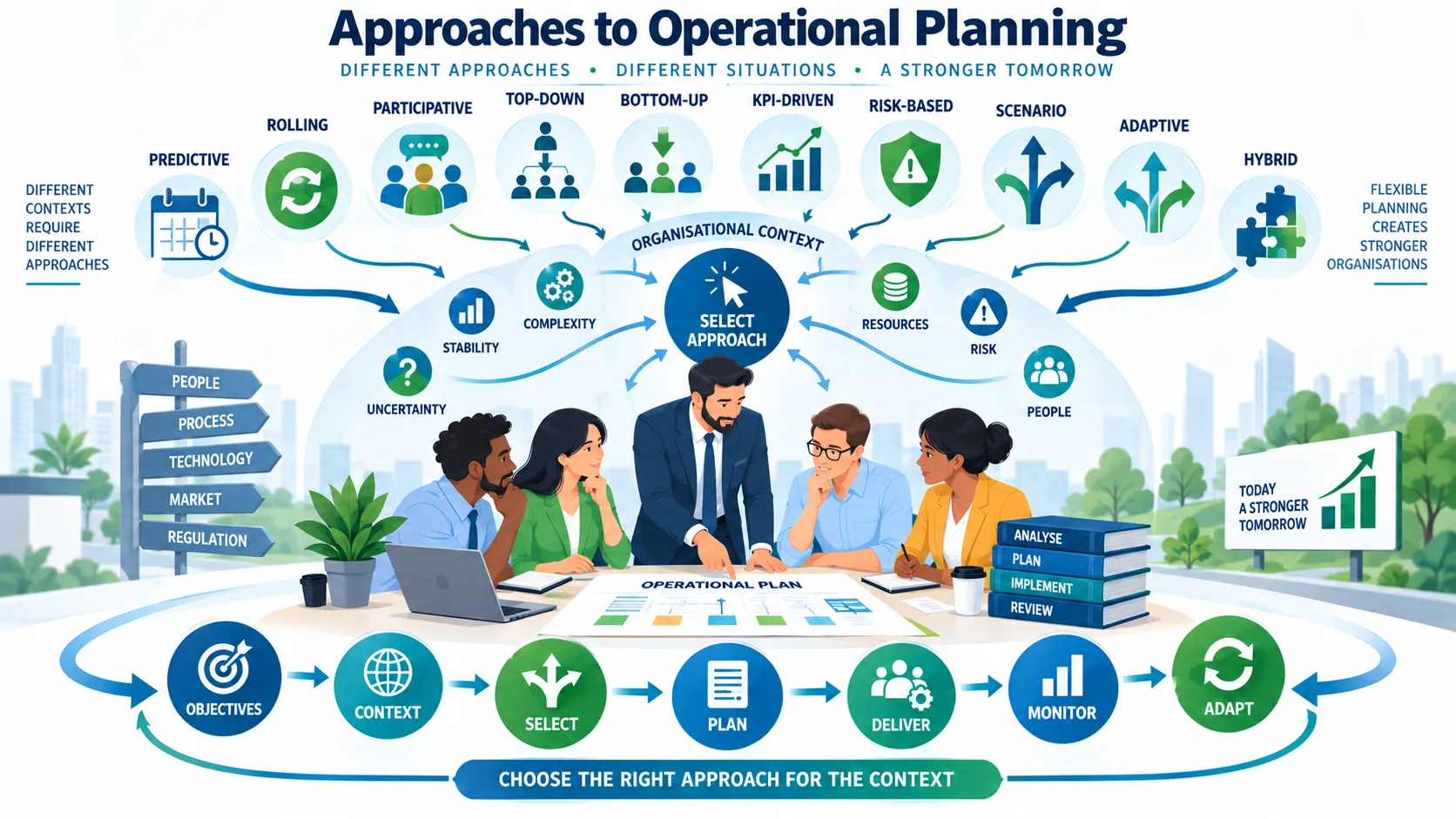
Operational planning provides the practical framework through which organisational objectives are translated into coordinated activities, responsibilities, resources, timescales and measurable results. However, there is no single operational planning approach that is appropriate for every organisation, department or operational situation. The most effective approach depends on factors such as the nature of the organisation, the complexity of its activities, the level of uncertainty, the available resources, the pace of change, stakeholder expectations and the degree of flexibility required.
For practising and aspiring middle managers and leaders, evaluating approaches to operational planning involves more than understanding how a particular planning method works. Managers need to consider why an approach is being used, what it is intended to achieve, how well it fits the operational context, what benefits it provides, what limitations it creates and whether it should be adapted or combined with another approach.
An operational plan should provide enough structure to coordinate activity while remaining sufficiently flexible to respond to changing circumstances. A highly detailed plan may provide strong control but become difficult to maintain when priorities change. Conversely, a highly flexible approach may enable rapid adaptation but create uncertainty about responsibilities, resources, deadlines and performance expectations.
The purpose of this part is therefore to examine and evaluate the principal approaches that managers can use to create and deliver operational plans and to develop the professional judgement required to select an appropriate approach.
Understanding Operational Planning Approaches
Definition of an Operational Planning Approach
An operational planning approach is a structured method used by managers to determine how organisational objectives will be translated into practical activities, resources, responsibilities, timescales, performance measures and review arrangements.
Different approaches place different emphasis on:
Detailed advance planning.
Short-term priorities.
Flexibility.
Team involvement.
Performance measurement.
Resource allocation.
Continuous review.
Risk management.
Stakeholder participation.
Organisational control.
The appropriate approach should reflect the operational environment rather than being selected simply because it is familiar.
Why Different Approaches Are Required
Organisations operate in different environments. A stable manufacturing process may benefit from detailed planning and predictable schedules, whereas a rapidly changing digital service may require shorter planning cycles and frequent adjustment.
Managers therefore need to consider:
Stability or volatility of the operating environment.
Size and complexity of the operation.
Availability of resources.
Level of uncertainty.
Number of stakeholders.
Regulatory requirements.
Dependence on technology.
Need for innovation.
Frequency of operational change.
Organisational culture.
Employee capability.
Importance of consistency.
Required speed of decision-making.
A strong manager understands that the best planning approach is usually the one that provides an appropriate balance between control and flexibility.
The Traditional or Predictive Approach to Operational Planning
Definition
A predictive operational planning approach involves establishing activities, resources, responsibilities, timescales and expected outcomes in advance, with implementation then managed against the agreed plan.
This approach is particularly useful where operational requirements are relatively predictable and activities can be defined with reasonable confidence.
The manager may establish:
Clear objectives.
Detailed activities.
Sequential tasks.
Defined milestones.
Resource requirements.
Responsibilities.
Fixed or planned timescales.
Performance indicators.
Monitoring arrangements.
Risk controls.
The approach creates a structured operational framework.
How the Predictive Approach Works
A typical process is:
Understand organisational objectives.
Define operational objectives.
Identify required activities.
Establish dependencies.
Allocate resources.
Assign responsibilities.
Establish timescales.
Identify risks.
Establish KPIs.
Implement the plan.
Monitor performance.
Compare actual results with planned results.
Take corrective action.
Review the plan.
This approach is often represented through operational schedules, work plans, resource plans, budgets and performance-monitoring frameworks.
Benefits of the Predictive Approach
The approach can provide strong control because managers and employees have a clear understanding of what should happen.
Key benefits include:
Clear direction.
Defined responsibilities.
Predictable scheduling.
Easier resource planning.
Clear accountability.
Easier budget control.
Structured monitoring.
Clear performance expectations.
Improved coordination.
Strong documentation.
It can be particularly valuable where consistency and reliability are important.
Limitations of the Predictive Approach
The main limitation is that it can become rigid.
If assumptions change, managers may need to revise substantial parts of the plan.
Potential limitations include:
Reduced flexibility.
Increased administrative effort.
Risk of outdated assumptions.
Slower response to emerging issues.
Excessive focus on adherence to the original plan.
Difficulty accommodating unexpected opportunities.
Potential resistance to changes in priorities.
A manager should therefore avoid assuming that a detailed plan is automatically a better plan.
Appropriate Contexts
A predictive approach may be particularly appropriate for:
Routine operational activity.
Stable service delivery.
Regulated environments.
Planned resource schedules.
Activities with established procedures.
Operations where quality consistency is critical.
Work involving predictable dependencies.
Rolling Operational Planning
Definition
Rolling planning involves developing an operational plan for a defined period while regularly extending and updating the plan as new information becomes available.
Instead of attempting to establish every detail far into the future, managers maintain greater detail for the immediate period and progressively develop later activities.
For example, a manager might maintain:
Detailed plans for the next month.
Broader priorities for the next quarter.
High-level direction for the following six months.
The plan is then reviewed regularly.
Why Rolling Planning Can Be Effective
Rolling planning recognises that the quality of information usually decreases as managers look further into the future.
Immediate activities may be highly predictable, while longer-term activities may depend on:
Demand.
Resource availability.
Organisational priorities.
Customer requirements.
Performance results.
Emerging risks.
Rolling planning allows managers to respond to new information without abandoning the overall direction.
Benefits
Greater flexibility.
More realistic short-term planning.
Regular incorporation of new information.
Better response to uncertainty.
Reduced risk of maintaining obsolete details.
Improved resource adjustment.
Supports continuous improvement.
Limitations
Rolling planning also requires discipline.
Without clear controls, frequent revisions can result in:
Unstable priorities.
Planning fatigue.
Confusion about commitments.
Reduced accountability.
Excessive short-term thinking.
Managers should therefore distinguish between legitimate adaptation and unnecessary continual change.
Short-Term Operational Planning
Definition
Short-term operational planning focuses on immediate or near-term activities required to maintain performance and achieve current operational objectives.
It may cover:
Daily.
Weekly.
Monthly.
Quarterly activities.
Short-term planning is particularly important for operational managers who need to respond to current workload, staffing, customer demand and performance information.
Practical Uses
A customer service manager may develop a weekly plan covering:
Staffing levels.
Work allocation.
Customer response targets.
Quality checks.
Escalated cases.
Team priorities.
A warehouse manager may plan:
Staff allocation.
Delivery schedules.
Stock movements.
Equipment requirements.
Safety checks.
Benefits
Short-term planning can provide:
Immediate clarity.
Faster decision-making.
Better workload management.
Rapid response to changes.
Clear daily or weekly priorities.
Limitations
Excessive emphasis on short-term planning can create a narrow operational focus.
Managers may become focused on immediate targets while overlooking:
Long-term organisational objectives.
Capability development.
Process improvement.
Future resource requirements.
Emerging strategic risks.
Short-term planning should therefore remain connected to broader organisational priorities.
Medium-Term Operational Planning
Medium-term planning provides a bridge between immediate operational activity and longer-term organisational priorities.
It may cover several months to approximately a year, depending on the organisation.
Managers may use medium-term plans to coordinate:
Workforce requirements.
Budgets.
Improvement programmes.
Training.
Capacity.
Service delivery.
Technology implementation.
Performance targets.
This approach is useful when managers need sufficient planning certainty without attempting to predict every operational detail far into the future.
Participative Operational Planning
Definition
Participative operational planning involves employees and relevant stakeholders contributing to the development of operational plans.
Instead of management creating the entire plan independently, people involved in delivery contribute their knowledge, experience and practical understanding.
Why Participation Matters
Employees often have detailed knowledge of operational processes that may not be visible to senior managers.
They may understand:
Practical workflow problems.
Customer behaviour.
Resource constraints.
Process inefficiencies.
Quality problems.
Workload pressures.
Operational dependencies.
Including this knowledge can improve plan quality.
Participative Planning Process
A manager may:
Communicate the organisational objective.
Explain the operational requirement.
Gather employee and stakeholder input.
Identify constraints and opportunities.
Develop possible approaches.
Evaluate suggestions.
Agree priorities.
Allocate responsibilities.
Establish measures.
Communicate the final plan.
Review implementation.
Benefits
Participative planning can:
Improve practical realism.
Increase employee ownership.
Improve commitment.
Identify operational risks earlier.
Increase quality of information.
Support innovation.
Strengthen communication.
Reduce resistance to implementation.
Limitations
Participation can require significant time and effective facilitation.
It may also create difficulties when:
Too many people are involved.
Stakeholders have conflicting priorities.
Decisions become slow.
Participants expect every suggestion to be accepted.
Accountability becomes unclear.
Managers therefore need to distinguish between consultation, participation and decision authority.
Top-Down Operational Planning
Definition
A top-down approach involves senior management establishing organisational priorities and operational requirements, which are then translated through management levels.
This approach can provide strong alignment and consistency.
For example:
Senior leadership objective → Departmental objective → Team objective → Individual activities
Benefits
Strong strategic alignment.
Consistent organisational priorities.
Clear direction.
Faster establishment of priorities.
Easier organisational coordination.
Limitations
A purely top-down approach may overlook operational knowledge.
Potential problems include:
Unrealistic targets.
Limited employee ownership.
Insufficient understanding of operational constraints.
Reduced engagement.
Weak feedback from frontline teams.
A strong organisation therefore often combines strategic direction from leadership with meaningful operational input from managers and employees.
Bottom-Up Operational Planning
Definition
Bottom-up planning allows operational teams to contribute significantly to the development of plans based on their knowledge of practical requirements.
This approach can provide valuable insight into:
Capacity.
Customer needs.
Process problems.
Resource requirements.
Operational risks.
Improvement opportunities.
Benefits
Strong operational realism.
Increased employee involvement.
Better identification of practical barriers.
Greater ownership.
Access to frontline knowledge.
Limitations
Without strategic coordination, bottom-up planning can result in:
Conflicting priorities.
Departmental optimisation.
Resource competition.
Inconsistent organisational direction.
The strongest application combines bottom-up operational intelligence with top-down strategic direction.
Management by Objectives
Definition
Management by Objectives (MBO) is an approach in which managers and employees establish clear objectives and assess performance against agreed results.
The approach places emphasis on:
Clear objectives.
Agreed targets.
Individual and team accountability.
Performance measurement.
Review.
Application to Operational Planning
A manager may establish an operational objective such as:
“Reduce average customer response time to the agreed service target by the end of the quarter.”
The manager then establishes:
Activities.
Responsibilities.
Resources.
KPI.
Target.
Review frequency.
Benefits
MBO can improve:
Clarity.
Accountability.
Performance focus.
Employee understanding.
Measurement.
Limitations
If objectives are poorly designed, employees may focus narrowly on individual targets rather than wider organisational outcomes.
Managers should therefore ensure that objectives are:
Relevant.
Achievable.
Measurable.
Aligned.
Balanced with quality and stakeholder requirements.
KPI-Driven Operational Planning
Definition
A KPI-driven approach places performance indicators at the centre of operational planning.
Managers begin by identifying the outcomes that need to be achieved and then determine the operational activities required to influence those measures.
For example:
Objective: Improve customer service.
KPIs:
Customer satisfaction.
Response time.
Complaint resolution.
First-contact resolution.
Operational activities are then designed to influence these measures.
Benefits
Strong performance focus.
Clear measurement.
Easier monitoring.
Evidence-based decision-making.
Early identification of performance gaps.
Limitations
The major risk is over-measurement or inappropriate measurement.
A KPI may encourage undesirable behaviour if it does not represent the wider objective.
For example, a team measured only on the number of cases completed might prioritise speed over quality.
Managers should therefore use a balanced set of indicators.
Quality-Focused Operational Planning
Quality-focused planning places emphasis on ensuring that operational activities consistently meet defined standards.
It may involve:
Quality standards.
Procedures.
Quality checks.
Audits.
Customer feedback.
Error monitoring.
Corrective action.
Continuous improvement.
This approach is especially important where quality failures could affect customers, safety, compliance or organisational reputation.
Evaluation
The strength of this approach is that it prevents operational plans from focusing solely on speed, cost or volume.
However, excessive quality controls can increase administrative workload or slow delivery.
Managers therefore need to establish quality requirements that are proportionate to operational risk and organisational expectations.
Risk-Based Operational Planning
Definition
Risk-based operational planning incorporates risk assessment directly into operational decision-making.
Rather than treating risk management as a separate activity, managers ask:
“What could prevent this operational objective from being achieved, and what should we do about it?”
Risk-Based Planning Process
Identify operational objectives.
Identify potential risks.
Assess probability and impact.
Prioritise significant risks.
Identify controls.
Assign risk ownership.
Establish contingency arrangements.
Monitor risk indicators.
Review risk exposure.
Adapt the operational plan where necessary.
Benefits
More realistic plans.
Better preparedness.
Reduced disruption.
Stronger decision-making.
Earlier identification of threats.
Improved resilience.
Limitations
Risk assessment can become excessive if managers attempt to plan for every conceivable event.
The objective should be proportionate risk management, focusing attention on risks that could materially affect objectives.
Scenario-Based Operational Planning
Definition
Scenario-based planning considers how operational plans might perform under different future circumstances.
Managers may consider:
Expected conditions.
More challenging conditions.
Significant disruption.
Increased demand.
Reduced resources.
Major changes in stakeholder requirements.
For example, a service manager may consider:
Scenario A: Normal demand.
Scenario B: Demand increases by 20%.
Scenario C: Staffing capacity decreases.
The manager can then identify appropriate responses.
Benefits
Improves preparedness.
Identifies vulnerabilities.
Supports contingency planning.
Encourages critical thinking.
Helps managers respond faster to change.
Limitations
Scenarios are not predictions. They are planning tools.
Managers should avoid treating one scenario as certain or developing unnecessarily complicated plans for unlikely events.
Flexible and Adaptive Operational Planning
Definition
Flexible operational planning allows managers to adjust activities, resources, priorities and timescales when circumstances change.
This is particularly important in environments characterised by:
Rapid technological change.
Uncertain demand.
Changing customer expectations.
Emerging risks.
Innovation.
Organisational transformation.
Flexibility does not mean a lack of structure. Effective flexible planning still requires:
Clear objectives.
Defined decision rights.
Performance measures.
Review points.
Change controls.
Accountability.
Benefits
Faster response.
Better adaptation.
Greater resilience.
Opportunity capture.
Reduced dependence on outdated assumptions.
Limitations
Excessive flexibility may result in:
Constant reprioritisation.
Unclear expectations.
Resource instability.
Reduced accountability.
Confusion.
The manager’s challenge is to establish controlled flexibility.
Agile-Informed Operational Planning
Definition
Agile-informed planning emphasises short planning cycles, frequent review, stakeholder feedback and adaptation based on emerging information.
Although originally associated strongly with certain development environments, its principles can inform operational planning where requirements change frequently.
A manager may establish:
Short planning cycles.
Priority backlogs.
Regular reviews.
Frequent stakeholder feedback.
Incremental delivery.
Continuous adjustment.
Benefits
Agile-informed approaches can support:
Rapid adaptation.
Early feedback.
Incremental improvement.
Greater stakeholder involvement.
Visibility of progress.
Faster identification of problems.
Limitations
This approach may be less suitable where:
Activities require strict regulatory sequencing.
Requirements are fixed.
Detailed advance planning is essential.
Changes are expensive.
Operational consistency is critical.
The appropriate lesson is not that agile planning is always better, but that its flexibility can be valuable in suitable contexts.
Hybrid Operational Planning
Definition
A hybrid approach combines elements of different planning approaches to reflect the needs of the organisation or operational environment.
For example, a manager may use:
Predictive annual objectives.
Quarterly operational reviews.
Monthly resource planning.
Weekly team planning.
Agile-style improvement cycles.
This allows strategic stability alongside operational flexibility.
Why Hybrid Planning Can Be Effective
Most real operational environments are not entirely stable or entirely unpredictable.
A hybrid approach can provide:
Strategic consistency.
Operational flexibility.
Structured resource planning.
Frequent performance review.
Adaptability.
Clear accountability.
Limitations
Hybrid approaches require strong management discipline.
If the different methods are poorly integrated, employees may be uncertain about:
Which plan takes priority.
Which deadlines are fixed.
Which activities can change.
Who has authority to modify the plan.
How performance will be measured.
The manager must therefore clearly define how the different planning mechanisms interact.
Digital Approaches to Operational Planning
Modern organisations often use digital systems to support operational planning.
Examples include:
Shared planning platforms.
Digital dashboards.
Workflow management systems.
Collaborative documents.
Scheduling systems.
Performance management tools.
Resource planning systems.
Digital tools can improve visibility and collaboration, particularly where teams operate across locations.
However, technology does not automatically produce effective planning.
Managers should consider:
Data quality.
User capability.
System integration.
Information security.
Accessibility.
Cost.
Reliability.
Ease of use.
The principle is:
Use technology to strengthen planning, not to replace management judgement.
Participative Versus Directive Approaches
Managers often need to decide how much employee involvement is appropriate.
A directive approach may be appropriate when:
Time is limited.
The decision is urgent.
Compliance requirements are strict.
Authority is clearly established.
The manager has sufficient information.
A participative approach may be more appropriate when:
Operational knowledge is widely distributed.
Employee commitment is important.
Innovation is required.
Change affects working practices.
Stakeholder acceptance is critical.
In practice, managers may combine both approaches.
For example, senior leadership may establish the required outcome, while operational teams contribute to determining how the outcome should be delivered.
Choosing the Appropriate Operational Planning Approach
The selection of an operational planning approach should be based on context rather than preference.
Managers should evaluate the following factors.
Stability
If the environment is stable, predictive planning may provide strong control.
If circumstances change frequently, rolling or adaptive planning may be more appropriate.
Complexity
Simple activities may require straightforward plans.
Complex operations may require:
Detailed dependencies.
Multiple stakeholders.
Risk management.
Resource coordination.
Integrated monitoring.
Uncertainty
High uncertainty increases the value of:
Scenario planning.
Rolling plans.
Frequent reviews.
Contingency planning.
Flexible resource allocation.
Time Pressure
Urgent operational circumstances may require a more directive approach with rapid decision-making.
However, managers should still maintain appropriate controls.
Employee Capability
Highly experienced teams may contribute effectively to participative or adaptive planning.
Less experienced teams may require greater structure, guidance and supervision.
Stakeholder Requirements
Where stakeholder support is essential, participative planning may produce stronger ownership.
Where requirements are legally defined, more formal planning may be required.
Risk Level
High-risk environments require stronger controls, documented responsibilities, monitoring and contingency arrangements.
Organisational Culture
Planning approaches should also reflect organisational culture.
An organisation that values collaboration may achieve better results through participative planning, while a highly regulated environment may require more formal controls.
Evaluating Operational Planning Approaches
Evaluation should consider both effectiveness and suitability.
Effectiveness
An approach is effective when it helps the organisation achieve intended results.
Managers should ask:
Were objectives achieved?
Were resources used effectively?
Were quality standards maintained?
Were risks controlled?
Were stakeholders appropriately engaged?
Did the approach support timely decisions?
Efficiency
An approach should not create unnecessary planning effort.
Managers should consider:
Time required.
Administrative burden.
Cost.
Number of meetings.
Reporting requirements.
System requirements.
Flexibility
Managers should assess whether the approach can adapt to legitimate changes.
Control
The approach should provide sufficient visibility and accountability.
Employee Engagement
Managers should assess whether employees understand and support the plan.
Strategic Alignment
The approach should continue to connect operational activity with organisational priorities.
Practical Example 1 – Healthcare Service
A healthcare service needs to maintain consistent service quality while responding to fluctuating demand.
A purely fixed annual plan may provide direction but may not respond adequately to changing demand.
A more appropriate approach could combine:
Annual strategic objectives.
Quarterly operational reviews.
Monthly workforce planning.
Weekly demand monitoring.
Daily resource adjustments.
Quality KPIs.
Risk monitoring.
This hybrid approach provides structure while maintaining operational responsiveness.
Practical Example 2 – Education and Training Organisation
An education provider has an organisational objective to improve learner achievement and learner experience.
The operational manager could develop an annual operational plan containing:
Learner-support objectives.
Staff development activities.
Quality assurance processes.
Assessment monitoring.
Learner feedback.
Performance indicators.
A rolling approach could then be used to review:
Learner attendance.
Assessment completion.
Learner satisfaction.
Quality issues.
Staff capacity.
If performance data indicates a problem, the operational plan can be adapted.
This demonstrates how predictive planning and rolling review can operate together.
Practical Example 3 – Customer Service Department
A customer service department faces unpredictable demand.
A rigid monthly plan may become outdated quickly.
A more effective approach could include:
Monthly service objectives.
Weekly staffing plans.
Daily workload monitoring.
Real-time performance dashboards.
Regular team reviews.
Flexible resource allocation.
The manager retains clear objectives but adapts operational activity according to actual demand.
Practical Example 4 – Organisational Change
An organisation introduces a new digital system.
The strategic objective is to improve operational efficiency.
The operational plan may use a hybrid approach:
Predictive elements:
Implementation deadline.
Budget.
Compliance requirements.
Major milestones.
Adaptive elements:
User feedback.
Training adjustments.
Process refinement.
Incremental improvements.
This approach recognises that some aspects of implementation are fixed while others require learning and adaptation.
Practical Example 5 – Operational Cost Reduction
A department is required to reduce operational costs without damaging service quality.
A simplistic approach might impose an immediate spending reduction.
A stronger operational planning approach would:
Understand the strategic requirement.
Analyse current costs.
Identify waste and duplication.
Assess operational risks.
Consult employees.
Identify improvement opportunities.
Establish cost and quality KPIs.
Implement changes.
Monitor results.
Review unintended consequences.
This demonstrates that operational planning should focus on value and outcomes rather than isolated cost reduction.
Common Mistakes in Operational Planning
Treating the Plan as a Static Document
Operational plans should be reviewed when circumstances change.
Overplanning
Excessive detail can consume management time and reduce flexibility.
Underplanning
Insufficient detail can create confusion about responsibilities, resources and deadlines.
Focusing Only on Activities
Managers should consider outcomes as well as completed tasks.
Using Too Many KPIs
Large numbers of indicators can create information overload.
Ignoring Employee Knowledge
Operational employees often possess valuable information about practical implementation.
Ignoring Risk
Plans should recognise what could prevent objectives from being achieved.
Failing to Connect Plans to Strategy
Operational activity should have a clear purpose within organisational priorities.
Changing the Plan Too Frequently
Flexibility should be controlled rather than continuous for its own sake.
Failing to Review Resources
A plan may become unrealistic if staffing, funding, equipment or technology changes.
A Practical Procedure for Developing an Effective Operational Plan
Stage 1: Understand Organisational Direction
Review strategic objectives and priorities.
Stage 2: Establish Operational Requirements
Identify what the operational area must achieve.
Stage 3: Select the Planning Approach
Determine whether predictive, rolling, participative, adaptive, risk-based or hybrid planning is most appropriate.
Stage 4: Define Operational Objectives
Translate strategic objectives into specific operational results.
Stage 5: Identify Activities
Determine what needs to happen to achieve the objectives.
Stage 6: Allocate Resources
Establish people, finance, technology, equipment and time requirements.
Stage 7: Assign Responsibilities
Clarify ownership and accountability.
Stage 8: Establish Timescales
Create realistic milestones and deadlines.
Stage 9: Identify Risks
Assess threats and establish responses.
Stage 10: Establish KPIs
Determine how progress and outcomes will be measured.
Stage 11: Engage Relevant Stakeholders
Consult people who will deliver, support or be affected by the plan.
Stage 12: Implement
Communicate the plan and begin delivery.
Stage 13: Monitor
Compare actual performance with planned expectations.
Stage 14: Review
Assess effectiveness, resource use, risks, quality and outcomes.
Stage 15: Adapt
Modify the operational plan where evidence or circumstances justify change.
Key Benefits of Effective Operational Planning
Effective operational planning can provide significant benefits for organisations and managers.
Strategic Alignment
Operational activity remains connected to organisational priorities.
Clear Direction
Employees understand what needs to be achieved.
Better Resource Management
Resources can be directed towards priority activities.
Stronger Accountability
Responsibilities and expected results are clearly defined.
Improved Performance
KPIs and monitoring help managers identify performance gaps.
Better Risk Management
Potential barriers can be identified before they become significant problems.
Improved Coordination
Teams can coordinate activities and dependencies more effectively.
Greater Adaptability
Appropriate planning approaches allow managers to respond to change.
Stronger Decision-Making
Managers have a structured basis for assessing performance and making adjustments.
Improved Organisational Outcomes
Well-aligned operational plans increase the likelihood that daily activities will contribute to meaningful organisational results.
Key Concepts to Remember
The following concepts are central to evaluating operational planning approaches:
Predictive planning: Establishing activities and resources in advance and managing delivery against the plan.
Rolling planning: Regularly updating operational plans as new information becomes available.
Participative planning: Involving employees and stakeholders in developing operational plans.
Top-down planning: Translating organisational priorities into operational requirements through management levels.
Bottom-up planning: Using operational knowledge and frontline input to shape plans.
Management by Objectives: Managing performance through agreed objectives and measurable results.
KPI-driven planning: Using performance indicators to guide operational priorities and monitoring.
Risk-based planning: Integrating risk assessment into operational planning.
Scenario planning: Testing plans against different possible circumstances.
Adaptive planning: Allowing operational activity to change in response to emerging information.
Hybrid planning: Combining different approaches to suit a complex operational environment.
Strategic alignment: Ensuring operational activities contribute to organisational priorities.
Controlled flexibility: Allowing appropriate adaptation while maintaining objectives, accountability and performance controls.
Managerial Decision Framework for Selecting an Approach
A middle manager can use the following framework when selecting an operational planning approach:
1. What are we trying to achieve?
Clarify the organisational and operational objectives.
2. How stable is the environment?
Determine whether circumstances are predictable or rapidly changing.
3. How complex is the operation?
Assess the number of activities, dependencies, stakeholders and resources involved.
4. How much uncertainty exists?
Identify assumptions, risks and external influences.
5. How quickly must decisions be made?
Consider operational urgency and the consequences of delay.
6. Who has relevant knowledge?
Determine whether employee and stakeholder participation could improve the plan.
7. What level of control is required?
Consider regulatory, quality, financial and operational requirements.
8. What should be fixed and what should remain flexible?
Separate firm commitments from areas where adaptation is appropriate.
9. How will performance be measured?
Select relevant KPIs and monitoring arrangements.
10. When will the plan be reviewed?
Establish formal review points and triggers for earlier review.
This framework helps managers avoid selecting a planning method simply because it is familiar.
Assessing the Overall Value of Different Approaches
There is no universally superior approach to operational planning. Each approach provides different advantages and limitations.
A predictive approach may offer stronger control in a stable environment but become restrictive in conditions of high uncertainty. Rolling planning provides flexibility but requires disciplined review. Participative planning improves operational insight and ownership but can require additional time. Top-down planning strengthens strategic alignment but may overlook frontline knowledge. Bottom-up planning provides practical intelligence but requires strategic coordination.
Risk-based planning improves preparedness, while scenario planning strengthens resilience. KPI-driven planning provides measurable control but can encourage narrow behaviour if indicators are poorly selected. Adaptive and agile-informed approaches can support rapid change but may be unsuitable where strict sequencing and predictability are essential.
The strongest managers therefore avoid treating approaches as competing ideologies. Instead, they assess the operational context and combine suitable methods where necessary.
For example, an organisation may use:
Strategic objectives + predictive annual plan + participative development + rolling quarterly reviews + KPI monitoring + risk-based planning + flexible weekly implementation
This integrated approach can provide both structure and adaptability.
Professional Management Insight
For middle managers and leaders, the key principle is that effective operational planning is not about producing the most detailed plan; it is about creating the most appropriate framework for achieving organisational objectives in the actual operating environment.
A plan should be sufficiently detailed to provide direction, accountability and control, but sufficiently flexible to respond to legitimate changes.
Managers should therefore continually ask:
Does this approach fit our operational environment?
Does it support organisational objectives?
Does it reflect available resources?
Does it involve the right people?
Does it provide sufficient control?
Can it respond to emerging risks?
Are the KPIs meaningful?
Does it support quality and outcomes?
Is the planning effort proportionate to the value it creates?
What evidence shows that the approach is working?
These questions encourage evidence-based professional judgement rather than mechanical application of planning methods.
Operational Planning as a Continuous Management Cycle
Effective operational planning should be understood as a continuous cycle:
Understand Direction → Set Objectives → Select Approach → Plan Activities → Allocate Resources → Implement → Measure → Review → Adapt → Improve
The cycle ensures that operational planning remains connected to organisational needs.
The planning process should not end when the operational plan is approved. Managers must continue to monitor implementation and assess whether the plan remains relevant.
If performance is strong, the manager may continue the current approach or identify opportunities for improvement.
If performance is below expectations, the manager may need to:
Reassess assumptions.
Investigate causes.
Reallocate resources.
Change activities.
Strengthen controls.
Review KPIs.
Increase stakeholder engagement.
Escalate significant issues.
Revise the operational plan.
This creates a dynamic relationship between planning and operational management.
Summary
Operational planning is essential for translating organisational objectives into practical activities and measurable results, but different operational environments require different planning approaches. Managers should therefore evaluate approaches according to their suitability, effectiveness, efficiency, flexibility, level of control, stakeholder requirements, resource implications and ability to support organisational outcomes.
Predictive planning provides structure and control where activities are relatively stable and predictable. Rolling planning enables managers to update plans as information changes. Participative planning uses employee and stakeholder knowledge to improve realism and ownership. Top-down planning supports strategic alignment, while bottom-up planning provides valuable operational insight. Management by Objectives and KPI-driven planning provide performance focus, while risk-based and scenario-based approaches strengthen preparedness and resilience.
Flexible, adaptive and agile-informed approaches can be valuable where circumstances change rapidly, while hybrid approaches allow managers to combine structure with flexibility. Digital planning tools can further improve visibility and coordination, but they should support rather than replace managerial judgement.
The most effective approach is therefore context-dependent. Managers should assess the nature of the organisation, the stability of the environment, operational complexity, uncertainty, stakeholder expectations, resource availability, risk exposure and required level of control before selecting or combining planning approaches.
Ultimately, effective operational planning provides a bridge between organisational intention and operational delivery. When the approach is appropriately selected, clearly communicated, properly resourced, measured through meaningful KPIs and regularly reviewed, it enables managers and teams to focus their effort on activities that contribute to organisational priorities and measurable results.