
Lesson no 1 : Understand the importance of effective and efficient resource use in organisations
Effective and efficient resource use is a fundamental requirement for successful organisational performance. Every organisation depends on a range of resources to achieve its objectives, deliver products or services, maintain quality and respond to changing customer and stakeholder needs. These resources may include people, finance, equipment, materials, technology, information, facilities, time and external services. Managers therefore need to understand not only what resources are available, but also how they should be planned, allocated, controlled and monitored to achieve the best possible results.
Effective resource use means using the right resources in a way that enables organisational objectives and expected outcomes to be achieved. Efficient resource use means achieving those outcomes while making the best possible use of available resources and avoiding unnecessary waste, duplication, delay or expenditure. Effectiveness is primarily concerned with achieving the intended result, whereas efficiency focuses on how economically and productively resources are used to achieve that result. Strong resource management requires managers to consider both dimensions together.
Resource decisions have a direct connection with organisational objectives and operational performance. Inadequate resources can create staff shortages, service delays, reduced quality, missed deadlines, equipment failures and increased operational risk. Conversely, over-resourcing can result in unnecessary expenditure, under-utilised employees or equipment, excess stock, unused capacity and reduced financial efficiency. Managers must therefore balance resource availability with organisational priorities, workload, expected outcomes, quality requirements and financial constraints.
This lesson examines why effective and efficient resource use matters across different organisational environments. Learners will explore the relationship between resources and organisational objectives, the consequences of inadequate and excessive resourcing, and the principles managers can use to improve resource utilisation. The lesson also considers how managers can monitor resource performance, identify waste and inefficiency, and make informed decisions about resource allocation.
Effective resource management is not simply about reducing costs. Excessive cost reduction can damage quality, employee capability or customer outcomes if essential resources are removed. Instead, managers should seek value for money, where resources are used appropriately to achieve the required level of quality and performance. This requires evidence-based decision-making, effective planning, monitoring and continuous review.
The lesson will also consider practical workplace situations involving workforce planning, financial resources, equipment, materials, technology and time management. Through these examples, learners will develop the ability to recognise resource problems, assess their impact and identify appropriate management responses.
By the end of the lesson, learners should understand that effective and efficient resource use is a continuous management responsibility. Managers must regularly assess whether resources are sufficient, appropriately allocated, productive and aligned with organisational objectives. Effective resource utilisation ultimately supports operational performance, financial sustainability, quality, productivity, organisational resilience and the achievement of planned objectives.
1.Analyse the Importance of Effective and Efficient Resource Use in Organisations
Effective and efficient resource use is one of the most important responsibilities of managers and leaders because organisational objectives can only be achieved when the necessary resources are available, appropriately allocated and used productively. Whether an organisation operates in healthcare, education, manufacturing, retail, hospitality, professional services, construction, technology or the public sector, managers must make decisions about how limited resources should be used to produce the required outputs and outcomes.
Resource management is not simply a matter of controlling expenditure. It involves understanding what the organisation needs, determining how much is required, allocating resources to priorities, monitoring their use and taking corrective action when resources are insufficient, excessive or being used inefficiently. A manager must therefore balance cost, quality, capacity, productivity, risk, customer expectations and organisational objectives.
The distinction between effectiveness and efficiency is particularly important. An organisation can be efficient without being effective if it uses resources economically but fails to achieve the intended outcome. Equally, it may be effective but inefficient if it achieves its objective while using considerably more resources than necessary. Strong management seeks to achieve both: the right outcomes using resources responsibly and productively.
For middle managers and operational leaders, this principle has practical significance because they frequently translate organisational objectives into day-to-day decisions concerning people, budgets, equipment, materials, technology, information, facilities and time. Their decisions can influence service quality, employee performance, customer satisfaction, financial sustainability and the organisation’s ability to meet its strategic priorities.
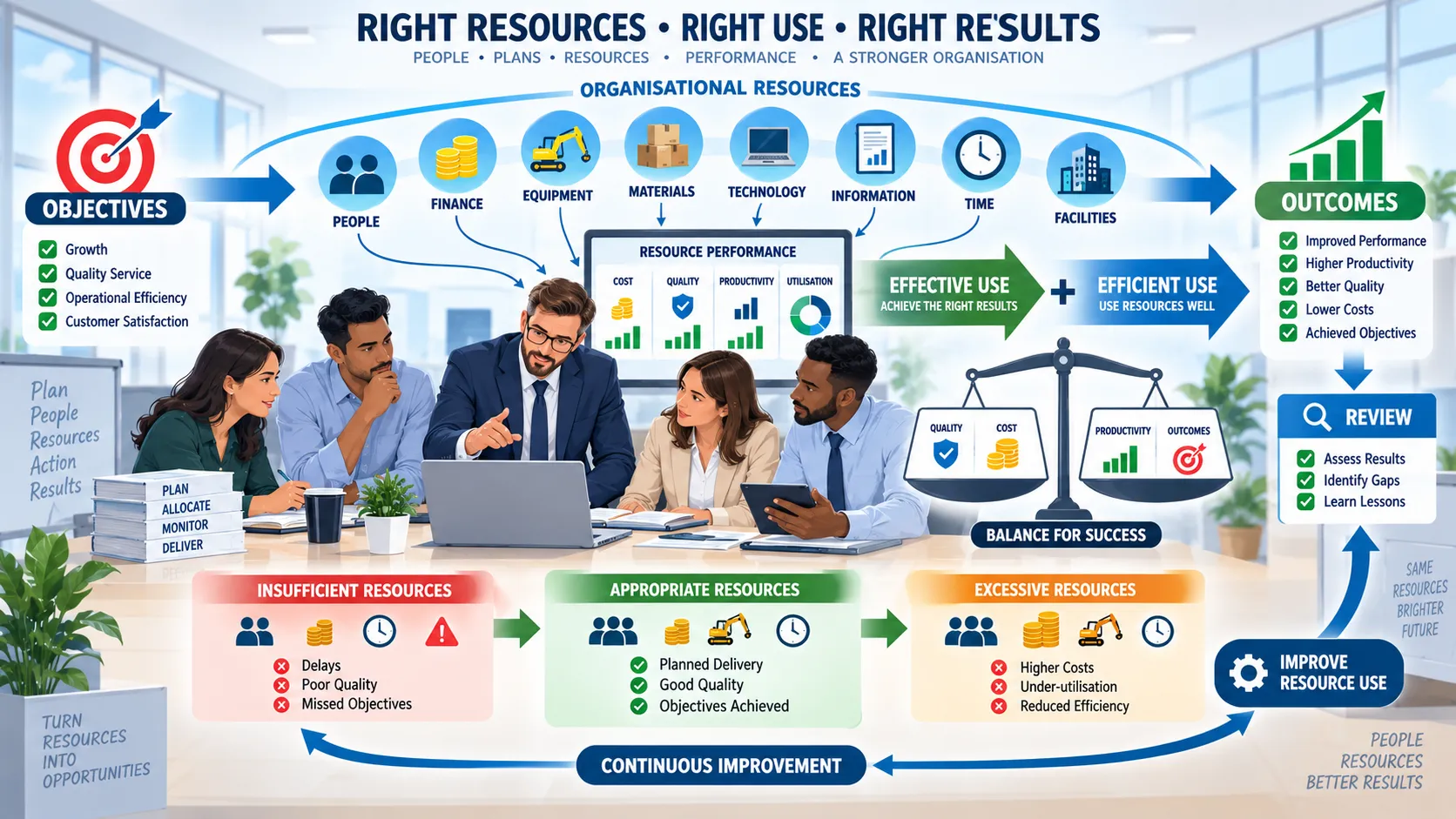
Understanding Organisational Resources
Definition of Resources
An organisational resource is any asset, input, capability or means that an organisation uses to perform activities, deliver products or services, achieve objectives and create value. Resources can be tangible, intangible, financial, human or technological.
The resources required by an organisation vary according to its sector, size, objectives, operating model and customers. A manufacturing organisation may require raw materials, machinery, production staff and warehouse space, while a training organisation may depend heavily on qualified tutors, learning technology, teaching materials, facilities and learner-support services.
Managers must recognise that resources are interconnected. A shortage in one resource can affect the performance of others. For example, purchasing sophisticated technology without providing sufficient trained employees may result in under-utilisation. Similarly, recruiting additional employees without providing appropriate equipment, workspace or systems may not increase productivity as expected.
Main Categories of Organisational Resources
Managers should understand the different resource categories because effective resource decisions depend on identifying the right combination of inputs.
Key organisational resources include:
Human resources – employees, managers, specialists, contractors and other people who contribute skills, knowledge and labour.
Financial resources – budgets, cash, investment, funding, revenue and available financial capacity.
Physical resources – buildings, offices, vehicles, machinery, tools, equipment and facilities.
Material resources – raw materials, consumables, stock, components and supplies.
Technological resources – hardware, software, digital platforms, systems, networks and technological infrastructure.
Information resources – operational data, management information, customer information, research, records and organisational knowledge.
Time resources – working hours, project time, production time, management capacity and available deadlines.
External resources – outsourced services, consultants, suppliers, contractors and specialist providers.
Intangible resources – intellectual property, organisational knowledge, reputation, processes, relationships and organisational capability.
The manager’s responsibility is not merely to identify these resources but to understand how they contribute to organisational performance. Resources should be considered in terms of their purpose, availability, cost, quality, capacity, risk and contribution to objectives.
Effective Resource Use
Definition of Effective Resource Use
Effective resource use means using organisational resources in a way that enables the organisation to achieve its intended objectives, outputs and outcomes.
Effectiveness therefore asks a fundamental management question:
Are the resources being used to achieve the result the organisation needs?
For example, an organisation may introduce a new customer service system to improve customer satisfaction. If the organisation purchases the system, installs it and trains employees but customer satisfaction does not improve, the resource investment may not have been effective in achieving its intended outcome.
Effectiveness is therefore closely connected with:
organisational objectives;
strategic priorities;
operational outcomes;
customer and stakeholder expectations;
service quality;
organisational performance;
intended results;
achievement of targets.
An effective resource decision is one that supports meaningful organisational results rather than simply increasing activity.
Effectiveness Versus Activity
Managers must distinguish between completing activities and achieving outcomes. Using resources to complete a large number of tasks does not automatically mean those resources have been used effectively.
For example, a training department may use significant resources to deliver 100 training sessions. The activity level appears high. However, if learners do not develop the required knowledge or workplace capability, the resources may not have produced the intended outcome.
Effective resource management therefore considers the relationship between:
Resources → Activities → Outputs → Outcomes
A manager should continually ask whether resources are contributing to the desired organisational result.
Efficient Resource Use
Definition of Efficient Resource Use
Efficient resource use means using resources productively and economically, while minimising unnecessary waste, duplication, delay, under-utilisation and avoidable cost.
Efficiency asks:
Are we achieving the required result with an appropriate level of resource use?
Efficiency does not necessarily mean choosing the cheapest option. A low-cost resource may produce poor quality, require frequent replacement or create additional operational costs. Efficient management therefore considers the relationship between resource inputs and the value or results generated.
For example, replacing reliable equipment with very low-cost equipment may initially reduce expenditure but could result in frequent breakdowns, lost production time and increased maintenance costs. The cheaper option may therefore be less efficient overall.
Efficiency and Productivity
Efficiency is closely related to productivity. Productivity considers the amount of useful output or result achieved from a given level of resources.
A manager might examine:
output per employee;
service users handled per working hour;
production units per machine hour;
revenue generated per resource investment;
completed tasks per available working day;
cost per service delivered;
materials used per unit of output.
However, productivity measures must be interpreted carefully. Increasing output while reducing quality or customer satisfaction may not represent genuine improvement.
The Relationship Between Effectiveness and Efficiency
Effectiveness and efficiency are complementary but different concepts.
| Concept | Definition | Key Management Question | Example |
|---|---|---|---|
| Effectiveness | Using resources to achieve intended objectives and outcomes | Are we achieving the right results? | A customer service team achieves its customer satisfaction target |
| Efficiency | Using resources productively and economically while minimising waste | Are we using resources well to achieve those results? | The team achieves the target without unnecessary staffing or overtime |
| Productivity | Relationship between useful output and resources used | How much useful output are we generating from available resources? | More customer enquiries resolved per working hour |
| Value for money | Achieving appropriate outcomes and quality in relation to resource cost | Are resources generating sufficient value? | A technology investment improves service quality without excessive cost |
A high-performing organisation seeks an appropriate balance. Managers should avoid assuming that reducing resources automatically improves efficiency. If resource reductions prevent objectives from being achieved, the organisation may become less effective.
Similarly, excessive resource allocation can support effectiveness in the short term but create unnecessary costs and reduce overall efficiency.
Why Effective and Efficient Resource Use Matters
Supporting Organisational Objectives
The most fundamental reason for effective resource use is that resources enable organisations to achieve their objectives. Organisational objectives identify what the organisation intends to accomplish, while resources provide the capacity required to deliver those intentions.
If resources are poorly aligned with objectives, operational activity can become disconnected from strategic priorities.
For example, if an organisation’s objective is to improve digital customer service but most available investment continues to support outdated manual processes, the organisation may struggle to achieve its objective.
Managers should therefore ensure that:
resources are linked to organisational priorities;
critical activities receive appropriate capacity;
resource decisions support measurable objectives;
resources are reviewed when priorities change;
investment is directed towards areas capable of producing meaningful outcomes.
Preventing Inadequate Resourcing
Inadequate resourcing occurs when an organisation does not have sufficient resources to perform required activities or achieve expected standards.
This can involve shortages of:
employees;
skills;
funding;
equipment;
materials;
technology;
information;
facilities;
time;
specialist expertise.
Under-resourcing can have serious operational consequences.
For example, if a customer service department has too few employees to manage demand, response times may increase. This can lead to customer dissatisfaction, employee pressure, increased complaints and reduced service quality.
Inadequate resources may also increase operational risk because employees may attempt to compensate for shortages by working excessive hours, bypassing procedures or reducing quality controls.
Consequences of Inadequate Resources
Managers should recognise early indicators of under-resourcing, such as:
persistent workload pressure;
missed deadlines;
declining service standards;
increased errors;
excessive overtime;
growing customer complaints;
equipment downtime;
insufficient stock;
inability to complete planned activities;
employee fatigue;
increased operational risk.
Effective managers respond by assessing the cause rather than automatically requesting additional resources. The problem may arise from poor allocation, inefficient processes or inappropriate priorities rather than an absolute shortage.
Managing the Risks of Over-Resourcing
Having more resources than necessary can also create problems. Over-resourcing occurs when the level of resources allocated significantly exceeds the organisation’s actual operational requirements.
Examples include:
employing more staff than workload requires;
purchasing equipment that remains under-used;
holding excessive inventory;
maintaining unnecessary facilities;
purchasing technology without a clear operational need;
allocating excessive budgets to low-priority activities.
Over-resourcing can increase financial pressure and reduce organisational efficiency.
For example, if an organisation purchases expensive equipment that is only used occasionally, the organisation may incur purchase, maintenance, storage and depreciation costs without generating sufficient value.
Managers therefore need to assess both current and anticipated demand before committing resources.
The Importance of Resource Balance
Effective resource management requires balance rather than simply maximising or minimising resource levels.
A useful management principle is:
Right Resource + Right Amount + Right Time + Right Place + Right Purpose
Managers should consider whether:
the correct resource has been selected;
the quantity is appropriate;
the resource is available when required;
it is allocated to the appropriate operational area;
it contributes directly to the intended objective.
This approach helps managers avoid both under-resourcing and over-resourcing.
Resource Use and Financial Performance
Controlling Unnecessary Expenditure
Resources have financial consequences. Every additional employee, piece of equipment, technology system, material purchase or external service represents a cost that needs to be justified in relation to organisational priorities and expected value.
Effective and efficient resource use helps managers control unnecessary expenditure by identifying:
duplication;
unused capacity;
avoidable purchasing;
excessive stock;
inefficient processes;
unnecessary overtime;
poorly utilised equipment;
inappropriate external services.
However, financial control should not become an isolated cost-cutting exercise.
Cost Reduction Versus Value
A common management mistake is to assume that the lowest cost option is always the most efficient.
For example, reducing staffing levels may reduce payroll costs but could increase:
waiting times;
errors;
customer complaints;
employee turnover;
overtime;
service recovery costs.
The manager should therefore consider total operational impact, rather than focusing on one cost figure.
Effective resource decisions consider:
Cost + Quality + Capacity + Risk + Outcomes + Long-Term Value
Resource Use and Quality
Resource decisions have a direct effect on quality.
Adequate staffing, appropriate equipment, suitable materials, reliable technology and sufficient time can all contribute to consistent quality.
Conversely, resource shortages may result in:
rushed work;
increased errors;
inadequate checking;
reduced customer support;
equipment failures;
lower service standards.
Managers must therefore avoid reducing resources in ways that undermine critical quality requirements.
Balancing Cost and Quality
Strong resource management seeks an appropriate balance between financial efficiency and required quality.
For example, a training provider may consider reducing the number of tutors to reduce costs. If this results in larger groups and reduced learner support, the financial saving may be outweighed by poorer learner outcomes.
A better management approach would be to examine workload, class sizes, technology, scheduling and staff deployment before deciding whether resources can genuinely be reduced.
Resource Use and Productivity
Effective resource management can improve organisational productivity by ensuring that resources are allocated where they generate the greatest operational contribution.
Managers can improve productivity through:
better workforce scheduling;
process improvement;
appropriate technology;
removal of unnecessary activities;
effective delegation;
improved workflow;
better use of equipment;
staff development;
demand-based resource allocation.
Productivity should always be interpreted alongside quality and outcomes. A team that completes more work but generates more errors may not have achieved genuine productivity improvement.
Resource Use and Employee Performance
Human resources are often the most important resource in service-based organisations. Managers therefore need to ensure that employees have the capacity, skills, tools and support required to perform effectively.
Effective use of human resources includes:
matching skills to responsibilities;
allocating workloads appropriately;
scheduling employees according to demand;
providing necessary equipment and technology;
developing employee capability;
avoiding unnecessary duplication;
monitoring workload;
supporting employee wellbeing;
using specialist expertise appropriately.
Poor workforce resource management can create either under-utilisation or excessive pressure.
Matching Skills to Tasks
Managers should consider capability as well as headcount.
Having ten employees does not necessarily mean an organisation has sufficient resources if none possesses the specialist skills required for a particular task.
For example, a digital transformation project may have sufficient employees but lack cybersecurity, data or systems expertise. The resource gap is therefore one of capability rather than quantity.
Resource Use and Technology
Technology can improve resource efficiency by automating repetitive tasks, improving information access, supporting communication and increasing operational visibility.
However, technology itself is a resource that requires careful management.
Managers should consider:
implementation cost;
operational need;
employee capability;
training requirements;
system compatibility;
maintenance;
security;
reliability;
expected benefits;
user adoption.
Technology should not be introduced simply because it is available. It should have a clear operational purpose and measurable contribution.
Resource Use and Time Management
Time is a finite organisational resource. Managers and employees have limited working hours, and poor use of time can create significant operational inefficiency.
Time can be wasted through:
unnecessary meetings;
duplicated tasks;
unclear responsibilities;
inefficient processes;
avoidable delays;
poor scheduling;
inadequate communication;
repeated correction of errors.
Effective time resource management involves prioritising activities according to organisational importance and operational urgency.
Managers should ensure that employee time is directed towards activities that contribute meaningfully to objectives.
Resource Use and Risk Management
Resource decisions are closely connected with operational risk.
Insufficient resources may increase risks relating to:
service continuity;
health and safety;
quality;
compliance;
customer satisfaction;
information management;
delivery deadlines.
Excessive resource commitments may create financial risks, particularly where demand is uncertain.
Managers should therefore assess resource-related risks before making significant allocation decisions.
Resource Risk Assessment Process
A practical resource risk assessment can follow these steps:
Identify the required objective or operational outcome.
Identify the resources required to achieve it.
Compare requirements with currently available resources.
Identify shortages, surpluses or capability gaps.
Assess the consequences of each gap or surplus.
Determine the likelihood and potential impact of the resource risk.
Identify possible controls or responses.
Allocate resources according to priority.
Monitor resource performance.
Review the decision when circumstances change.
This process supports evidence-based resource management.
Resource Use and Customer and Stakeholder Outcomes
Customers and stakeholders ultimately experience the consequences of resource decisions.
For example, insufficient customer service staffing can lead to longer response times. Poor technology can make services difficult to access. Inadequate materials can affect product quality.
Managers should therefore consider how resource decisions affect:
customer satisfaction;
service accessibility;
response times;
quality;
reliability;
stakeholder confidence;
organisational reputation.
Resource management should not be viewed solely from the internal perspective of the organisation.
The Importance of Resource Allocation
Definition of Resource Allocation
Resource allocation is the process of assigning available resources to specific activities, teams, services, projects or priorities in order to achieve organisational objectives.
Allocation decisions are particularly important when resources are limited.
Managers may need to determine:
which activities receive priority;
how many employees are required;
how budgets should be distributed;
which equipment should be purchased;
where technology investment is needed;
how available working time should be allocated.
Principles of Effective Resource Allocation
Effective resource allocation should be:
Strategically aligned – resources support organisational priorities.
Evidence-based – decisions use reliable performance and demand information.
Proportionate – resource levels reflect actual requirements.
Flexible – resources can be adjusted when circumstances change.
Transparent – allocation decisions can be explained and justified.
Fair – resources are allocated according to legitimate organisational needs.
Outcome-focused – resources contribute to measurable results.
Risk-aware – critical operational risks are considered.
A Practical Process for Improving Resource Use
Managers can use a structured process to assess and improve resource effectiveness and efficiency.
Step 1: Clarify the Organisational Objective
The manager should first understand what the organisation is trying to achieve.
Without a clear objective, it is difficult to determine whether resources are being used effectively.
The objective should provide a clear basis for deciding what resources are required and why.
Step 2: Identify Resource Requirements
The manager should identify all resources required to achieve the objective.
This may include:
people;
skills;
finance;
equipment;
materials;
technology;
information;
facilities;
time;
external support.
Step 3: Assess Current Resource Availability
The next step is to establish what resources are already available.
Managers should consider both quantity and quality.
For example, five employees may be available, but only two may have the required specialist capability.
Step 4: Identify Gaps and Surpluses
Managers should compare required resources with available resources.
This can reveal:
resource shortages;
excess capacity;
capability gaps;
under-utilised assets;
budget pressures;
capacity constraints.
Step 5: Assess Resource Value
Managers should evaluate the expected contribution of resources to organisational outcomes.
Questions may include:
What result will this resource support?
What will it cost?
What risks will it reduce?
What capacity will it create?
What quality improvement will it enable?
How will its effectiveness be measured?
Step 6: Prioritise Resource Allocation
Where resources are limited, managers should prioritise activities according to organisational importance, expected outcomes, risk and stakeholder needs.
Critical activities should normally receive sufficient resources to maintain required performance and quality.
Step 7: Implement Resource Decisions
Resources should then be allocated and deployed according to the agreed operational requirements.
Responsibilities should be clear so that managers and employees understand who controls and uses each resource.
Step 8: Monitor Resource Utilisation
Managers should monitor whether resources are being used as intended.
Relevant indicators may include:
budget utilisation;
staff utilisation;
equipment utilisation;
stock levels;
productivity;
service capacity;
overtime;
resource wastage;
cost per output;
cost per outcome.
Step 9: Evaluate Effectiveness and Efficiency
The manager should assess both the results achieved and the resources consumed.
This requires asking two questions:
Did the resources help achieve the intended objective?
Were the resources used appropriately and economically?
Step 10: Review and Improve
Resource management should be continuous.
Managers should adjust resource allocations when:
demand changes;
organisational priorities change;
performance falls below target;
resources become under-utilised;
costs increase;
new technology becomes available;
risks change;
customer expectations change.
Measuring Effective and Efficient Resource Use
Effective resource management requires measurable evidence.
Managers should select indicators that provide useful information about resource utilisation and organisational outcomes.
Useful Resource Performance Indicators
Examples include:
cost per unit of output;
cost per customer served;
employee productivity;
equipment utilisation;
stock turnover;
budget variance;
overtime levels;
service response time;
resource wastage;
customer satisfaction;
quality performance;
achievement of operational targets.
A strong measurement approach should avoid focusing on a single indicator.
For example, reducing cost per customer may appear positive, but if customer satisfaction simultaneously falls, the manager should investigate whether efficiency has been achieved at the expense of effectiveness.
The Role of Monitoring and Review
Resource use must be monitored because organisational conditions change.
A resource allocation decision that was appropriate six months ago may no longer be appropriate because demand, staffing, technology, costs or organisational priorities have changed.
Regular monitoring allows managers to identify:
emerging shortages;
unused capacity;
rising costs;
declining productivity;
quality problems;
changing demand;
resource-related risks.
Managers can then make timely adjustments rather than waiting until performance has significantly deteriorated.
Practical Example 1: Customer Service Department
A customer service department receives a significant increase in enquiries. Management initially responds by asking existing employees to work additional hours.
This may temporarily increase capacity, but sustained overtime could increase costs and employee fatigue.
The manager should analyse:
enquiry volumes;
peak demand periods;
staffing levels;
employee productivity;
response times;
customer satisfaction;
overtime costs;
opportunities for process improvement;
potential technology solutions.
A more effective resource response might involve adjusting staff schedules, improving self-service options and allocating additional resources during peak periods.
The key lesson is that effective resource use is not simply about adding more staff. It involves understanding demand and matching resources appropriately.
Practical Example 2: Education and Training Organisation
A training provider wants to improve learner outcomes.
The organisation has sufficient tutors but learners report limited access to digital learning resources.
The issue is therefore not necessarily a shortage of human resources. The resource gap may relate to technology and learning materials.
Management could consider:
digital learning platforms;
online resources;
tutor access to technology;
learner technical support;
digital skills;
resource utilisation;
learner satisfaction;
learner achievement.
The effectiveness of the investment should ultimately be assessed through improved learner outcomes rather than simply the number of digital resources purchased.
Practical Example 3: Manufacturing Organisation
A manufacturing organisation experiences frequent production delays.
Management initially believes that additional employees are required. However, investigation shows that production workers frequently wait for materials because inventory is poorly managed.
The underlying resource problem is therefore material availability and resource coordination rather than workforce numbers.
Improvement could involve:
better stock monitoring;
improved supplier coordination;
appropriate inventory levels;
clearer material scheduling;
monitoring production downtime.
This example demonstrates why managers should identify the underlying resource issue before committing additional resources.
Practical Example 4: Digital Transformation
An organisation invests heavily in a new digital system but finds that employees continue using old manual processes.
Although the technology resource is available, the organisation has not achieved effective resource use.
Possible reasons include:
insufficient training;
poor communication;
limited user involvement;
inadequate system support;
unclear processes;
lack of management follow-up.
The manager should therefore assess the complete resource system rather than judging the technology investment in isolation.
Common Management Mistakes in Resource Use
Focusing Only on Cost
One of the most common mistakes is treating resource efficiency as cost reduction.
Cost reduction can be beneficial, but reducing expenditure without considering quality, capacity and outcomes can damage organisational performance.
Over-Resourcing to Avoid Risk
Some managers allocate excessive resources because they want to eliminate uncertainty. However, excessive resource allocation can create unnecessary costs.
A better approach is to assess the actual level of risk and allocate proportionate resources.
Under-Resourcing Critical Activities
Managers may also underestimate resources required for high-priority activities.
This can lead to:
missed objectives;
service failures;
employee pressure;
poor quality;
increased risk.
Measuring Inputs Instead of Outcomes
Simply measuring the amount of money spent, number of employees employed or equipment purchased does not demonstrate effective resource use.
Managers should also assess the results generated.
Ignoring Resource Utilisation
Resources can exist but remain under-used.
For example, an organisation may own sophisticated equipment that employees rarely use. Managers should investigate why utilisation is low and whether the resource continues to provide value.
Failing to Review Resource Decisions
Resource requirements can change. A fixed allocation approach may therefore become inefficient over time.
Managers should establish regular review points.
Key Concepts for Managers and Leaders
The following concepts are central to effective and efficient resource use:
Resource Effectiveness
The degree to which resources contribute to achieving intended objectives and outcomes.
Resource Efficiency
The degree to which resources are used productively and economically with minimal unnecessary waste.
Resource Productivity
The relationship between resource inputs and useful outputs or results.
Resource Utilisation
The extent to which available resources are actually being used.
Resource Capacity
The amount of work or activity that available resources can reasonably support.
Resource Allocation
The process of assigning resources to activities, teams, priorities or objectives.
Resource Optimisation
The process of improving the use and allocation of resources to achieve the best appropriate organisational results.
Value for Money
Achieving appropriate quality and outcomes in relation to the resources and costs involved.
Resource Gap
The difference between resources required and resources currently available.
Key Benefits of Effective and Efficient Resource Use
Strong resource management can produce significant organisational benefits.
Financial Benefits
reduced unnecessary expenditure;
better budget control;
improved cost management;
reduced waste;
stronger financial sustainability;
improved value for money.
Operational Benefits
improved productivity;
better capacity management;
fewer delays;
improved workflow;
better resource utilisation;
stronger operational continuity.
People Benefits
better workload distribution;
improved employee productivity;
reduced unnecessary pressure;
improved capability utilisation;
clearer responsibilities.
Customer and Stakeholder Benefits
improved service quality;
faster response;
better customer experience;
increased reliability;
stronger stakeholder confidence.
Strategic Benefits
stronger alignment with organisational objectives;
improved ability to deliver strategic priorities;
better investment decisions;
improved organisational resilience;
stronger long-term performance.
Managerial Checklist for Effective and Efficient Resource Use
A middle manager can use the following checklist when reviewing resource use:
Are resources clearly linked to organisational objectives?
Are sufficient resources available to achieve required outcomes?
Are any resources significantly under-utilised?
Are critical activities appropriately resourced?
Are resources allocated according to organisational priorities?
Are resource costs justified by expected value?
Are quality standards being maintained?
Are resource-related risks being controlled?
Are employees using their skills effectively?
Is technology contributing to operational performance?
Is resource utilisation being measured?
Are performance and outcome indicators being monitored?
Is there evidence of unnecessary waste?
Are resource decisions reviewed regularly?
Can resources be reallocated when demand or priorities change?
Professional Management Insight
Effective and efficient resource use should be viewed as a strategic and operational management discipline, not simply an administrative responsibility. Managers influence organisational performance through everyday decisions about people, money, equipment, technology, materials, time and information.
The strongest managers do not automatically seek more resources or simply reduce existing resources. Instead, they assess what the organisation is trying to achieve, identify the resources genuinely required, understand constraints, evaluate risks and allocate resources according to priorities.
A particularly important management principle is:
More resources do not automatically produce better results.
Similarly:
Fewer resources do not automatically mean greater efficiency.
The objective is to establish an appropriate relationship between resource input, operational activity, output, quality and organisational outcome.
Managers should therefore use evidence to determine whether resources are:
Available → Appropriate → Allocated → Utilised → Monitored → Evaluated → Improved
This approach supports responsible decision-making and helps ensure that resource use contributes directly to organisational performance.
Summary
Effective and efficient resource use is essential for organisations seeking to achieve objectives while maintaining appropriate financial, operational and quality performance. Resources include people, finance, equipment, materials, technology, information, facilities, time and external services. Managers must understand how these resources interact and how their use influences organisational outcomes.
Effectiveness focuses on achieving the intended objectives and outcomes, while efficiency focuses on using resources productively and economically. Both are necessary for sustainable organisational performance. An organisation may be ineffective if it lacks sufficient resources, but it can also become inefficient when resources are excessive, poorly allocated or under-utilised.
Effective resource management requires managers to identify resource requirements, assess current availability, recognise gaps and surpluses, prioritise allocation, monitor utilisation and evaluate outcomes. Decisions should consider cost, quality, productivity, risk, capacity, customer expectations and strategic priorities rather than relying on cost alone.
Managers should also recognise the consequences of inadequate and excessive resourcing. Under-resourcing can contribute to delays, poor quality, employee pressure, increased risk and missed objectives. Over-resourcing can result in unnecessary expenditure, unused capacity and reduced financial efficiency.
A continuous approach to resource management enables organisations to respond to changing demand, operational priorities, technology, risks and stakeholder expectations. By connecting resource decisions to measurable organisational outcomes, managers can improve productivity, value for money, quality, operational performance and the achievement of organisational objectives.
Ultimately, effective and efficient resource use means ensuring that the right resources are available, in the right quantity, at the right time, for the right purpose, and are used in a way that delivers the required organisational results.
2.Examine Processes for Effective and Efficient Resource Use in Organisations
Effective and efficient resource use does not happen automatically. Organisations require structured processes to identify what resources are needed, determine how resources should be allocated, use them appropriately, monitor their performance and make adjustments when circumstances change. For practising and aspiring middle managers and leaders, understanding these processes is essential because resource decisions directly influence operational performance, financial control, service quality, productivity and the achievement of organisational objectives.
A resource management process provides a systematic way of moving from organisational objectives to practical resource decisions. Rather than simply asking whether more resources are needed, managers should determine what resources are required, why they are required, how much is required, when they are required, where they should be allocated and how their use will be measured.
The process should also recognise that organisational resources are limited. Budgets, employee time, equipment, facilities, materials and technology cannot normally be increased without consequence. Managers therefore need to make informed choices about priorities and ensure that available resources generate appropriate organisational value.
A useful resource management cycle can be represented as:
OBJECTIVES → IDENTIFY REQUIREMENTS → ASSESS RESOURCES → PLAN → ALLOCATE → USE → MONITOR → EVALUATE → IMPROVE
This cycle demonstrates that effective resource use is continuous rather than a one-off planning exercise.
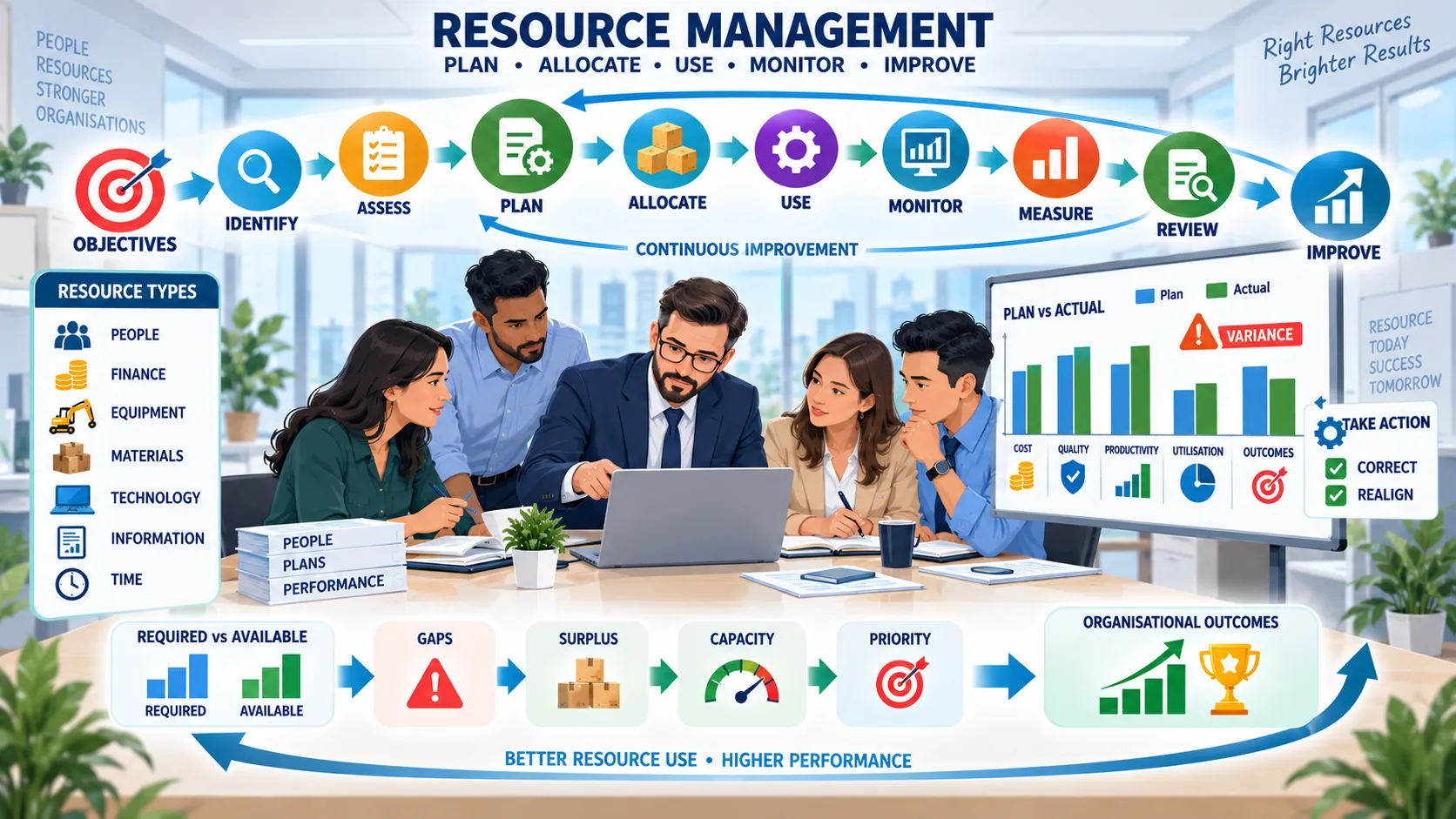
Understanding the Resource Management Process
Definition of Resource Management
Resource management is the systematic process of identifying, planning, acquiring, allocating, using, monitoring and reviewing organisational resources to support the achievement of objectives.
The process applies to different resource categories, including:
human resources;
financial resources;
physical resources;
materials and stock;
technology;
information;
facilities;
time;
external services;
specialist expertise.
The exact process will vary according to organisational context. However, the underlying principle remains consistent: resources should be matched to organisational requirements and managed in a way that supports effective outcomes and efficient use.
Effective Versus Efficient Resource Processes
An effective resource process ensures that resources contribute to achieving the intended organisational objective. An efficient resource process ensures that resources are used appropriately without unnecessary waste, duplication or expenditure.
Managers should therefore consider both questions:
Are the resources helping us achieve the required outcome?
Are we using those resources in the most appropriate and productive way?
For example, an organisation may have sufficient employees to deliver a service but allocate them poorly across different periods of demand. The organisation may therefore have adequate resources overall but still experience inefficient resource use.
The Resource Use Process
Step 1: Understand Organisational Objectives
The first stage in effective resource management is understanding what the organisation is trying to achieve.
Resources should not be planned independently from organisational objectives. The objective establishes the intended result, while resource planning determines what capacity is required to achieve that result.
For example, if an organisation has an objective to improve customer response times, managers may need to consider staffing levels, scheduling, technology, training and workflow.
The manager should establish:
the organisational objective;
relevant operational objectives;
expected outcomes;
required quality standards;
timescales;
performance targets;
stakeholder expectations.
This creates the foundation for resource decisions.
Why Objective Alignment Matters
Resource allocation that is disconnected from organisational priorities can result in waste.
For example, allocating substantial funding to a low-priority activity while a critical operational service lacks sufficient capacity represents poor resource management.
Managers should therefore ask:
Which objectives are highest priority?
Which activities are essential to achieving those objectives?
Which resources are critical?
Which resources are optional?
What consequences could arise if resources are insufficient?
This approach helps ensure that resource decisions support organisational direction.
Step 2: Identify Resource Requirements
Once objectives are understood, managers should determine what resources are required.
This involves considering the complete resource requirement rather than focusing on one category.
For example, implementing a new digital service may require:
software;
hardware;
employees with relevant skills;
training;
technical support;
budget;
implementation time;
data;
facilities;
external expertise.
A common management error is to identify the visible resource while overlooking supporting requirements.
Resource Requirement Questions
Managers should consider:
What activities need to be completed?
What people and skills are required?
What equipment is needed?
What materials are required?
What technology is required?
What budget is needed?
How much time is available?
What information is required?
What external expertise may be necessary?
What resources are required to maintain quality?
This produces a more complete resource requirement profile.
Step 3: Assess Existing Resources
The next process is to establish what resources are already available.
Managers should assess both quantity and capability.
For human resources, this means considering not only the number of employees but also:
qualifications;
experience;
technical skills;
management capability;
availability;
workload;
capacity;
development needs.
For physical and technological resources, managers should consider:
condition;
capacity;
reliability;
availability;
utilisation;
maintenance requirements;
compatibility.
For financial resources, managers should consider:
available budget;
committed expenditure;
projected costs;
financial restrictions;
competing priorities.
Step 4: Identify Resource Gaps
A resource gap exists when the resources currently available do not meet the requirements of the planned activity.
Resource gaps can involve quantity, quality, timing, capability or capacity.
For example, an organisation may have enough employees in total but lack sufficient employees during peak operating periods.
Resource gaps may include:
insufficient staffing;
missing specialist skills;
inadequate funding;
outdated equipment;
insufficient technology;
limited workspace;
insufficient stock;
inadequate information;
insufficient time.
Managers should assess the potential operational consequences of each gap.
Resource Gap Analysis
A useful process is:
Required Resources − Available Resources = Resource Gap
However, managers should not treat this as a purely numerical calculation. Capability and quality must also be considered.
For example, if three qualified technicians are required and three employees are available, the organisation appears fully resourced. However, if one technician is unavailable for a significant period, the actual operational capacity may be insufficient.
Step 5: Assess Resource Capacity
Definition of Capacity
Resource capacity refers to the amount of work or operational demand that available resources can reasonably support within a defined period.
Capacity planning is particularly important where demand fluctuates.
Managers should assess:
current workload;
expected demand;
peak periods;
employee availability;
equipment capacity;
production capacity;
service capacity;
facility capacity;
technology capacity.
Capacity should be considered in relation to both normal and exceptional demand.
Capacity and Demand
A resource management process should compare:
Available Capacity ↔ Expected Demand
If demand consistently exceeds capacity, the organisation may need to increase resources, improve productivity or redesign processes.
If capacity consistently exceeds demand, managers should consider whether resources are under-utilised.
Step 6: Prioritise Resource Requirements
Resources are usually constrained, meaning that managers cannot provide unlimited resources to every activity.
Prioritisation is therefore essential.
Managers should consider:
strategic importance;
operational urgency;
customer impact;
financial impact;
risk;
legal or regulatory requirements;
quality requirements;
expected organisational benefits;
resource availability.
Critical activities should receive appropriate priority because resource failure in these areas may significantly affect organisational performance.
Priority-Based Allocation
Managers can categorise activities as:
Critical – essential to organisational continuity or key objectives.
High priority – strongly connected to important organisational outcomes.
Medium priority – contributes to performance but has greater flexibility.
Lower priority – useful but less critical to immediate objectives.
This approach helps managers make defensible decisions when resources are limited.
Step 7: Develop a Resource Plan
Definition of a Resource Plan
A resource plan is a structured document or management framework identifying the resources required for planned activities, how resources will be obtained or allocated, who is responsible for them, when they are required and how their use will be monitored.
A resource plan may include:
resource type;
quantity;
required date;
responsible person;
estimated cost;
source;
allocation;
expected use;
performance measure;
risk;
review date.
A well-designed resource plan provides visibility and accountability.
Example Resource Planning Structure
| Resource | Requirement | Purpose | Responsibility | Monitoring Measure |
|---|---|---|---|---|
| Employees | 4 additional staff during peak periods | Meet increased service demand | Operations Manager | Response time and workload |
| Technology | New customer management system | Improve service processing | IT and Operations | System usage and service outcomes |
| Finance | £25,000 implementation budget | Support operational improvement | Finance Manager | Budget variance |
| Training | Staff training programme | Develop system capability | HR/Training Manager | Competency and adoption |
| Equipment | Additional service terminals | Increase operational capacity | Operations Team | Utilisation and downtime |
This type of structure allows managers to connect resource inputs with operational purposes and performance measures.
Step 8: Allocate Resources
Resource allocation involves assigning available resources to specific activities, teams, departments or priorities.
Effective allocation should reflect:
organisational objectives;
workload;
capability;
risk;
priority;
timing;
expected outcomes.
Managers should avoid allocating resources simply according to historical patterns.
For example, a department may have received the same staffing allocation for several years. If customer demand has increased significantly, maintaining the historical allocation may no longer be appropriate.
Principles of Effective Allocation
Resource allocation should be:
objective;
transparent;
evidence-based;
strategically aligned;
proportionate;
flexible;
accountable;
outcome-focused.
Step 9: Establish Resource Responsibilities
Resource use requires accountability.
Managers should clearly identify who is responsible for:
approving resources;
managing budgets;
using equipment;
monitoring stock;
managing staff capacity;
maintaining technology;
reporting resource issues;
reviewing resource performance.
Clear accountability prevents resources from being unmanaged or duplicated.
Responsibility Allocation
A manager may assign responsibilities to:
operational managers;
team leaders;
budget holders;
procurement staff;
finance teams;
HR teams;
IT specialists;
facilities managers;
employees using resources.
Responsibilities should match the individual’s authority and capability.
Step 10: Use Resources Effectively
Once resources have been allocated, managers must ensure that they are used for their intended purpose.
Effective use involves connecting resource utilisation to planned activities and expected outcomes.
For example, if a new technology system has been purchased to improve customer service, managers should monitor whether employees actually use the system and whether its use improves service performance.
Simply acquiring a resource does not demonstrate effective resource use.
Effective Resource Utilisation
Managers should monitor:
whether resources are available when required;
whether employees have the necessary skills;
whether equipment is operational;
whether technology is being used;
whether materials are available;
whether budgets are being used appropriately;
whether resources are contributing to planned outcomes.
Step 11: Monitor Resource Utilisation
Monitoring is a central part of effective resource management.
Managers need reliable information to determine whether resources are being used appropriately.
Relevant monitoring measures can include:
staff utilisation;
equipment utilisation;
budget expenditure;
stock levels;
material wastage;
overtime;
productivity;
service capacity;
resource downtime;
cost per output;
cost per outcome.
Monitoring should be regular enough to identify issues before they significantly affect performance.
Resource Monitoring Questions
A manager should ask:
Are resources being used as planned?
Are resources being under-used?
Are resources being over-used?
Are costs within expected levels?
Are resource shortages affecting performance?
Is resource use generating the expected outcome?
Is waste occurring?
Are there emerging resource risks?
Step 12: Compare Actual Use with Planned Use
Managers should compare actual resource utilisation against the resource plan.
This can reveal variances.
For example:
Planned staffing = 10 employees
Actual staffing = 8 employees
The difference may indicate a capacity issue, but the manager must investigate why the gap exists and what operational impact it creates.
Similarly:
Planned budget = £100,000
Actual expenditure = £115,000
The £15,000 variance requires investigation.
The manager should determine whether the difference results from:
increased demand;
unexpected costs;
poor resource planning;
inefficient use;
price increases;
additional requirements;
operational problems.
Step 13: Measure Resource Efficiency
Efficiency should be assessed through appropriate performance indicators.
Managers may examine:
cost per unit;
cost per customer;
output per employee;
equipment utilisation;
materials consumed per unit;
overtime levels;
resource wastage;
budget variance;
processing time;
service capacity.
Efficiency measures should be linked to meaningful outcomes.
For example, reducing cost per customer may appear positive, but if customer satisfaction declines substantially, the manager should investigate whether the apparent efficiency gain has damaged effectiveness.
Step 14: Measure Resource Effectiveness
Effectiveness focuses on whether resources have contributed to intended outcomes.
Managers can measure:
achievement of operational objectives;
quality outcomes;
customer satisfaction;
service improvement;
productivity;
target achievement;
completion of critical activities;
stakeholder outcomes.
The most useful measures are those that demonstrate a connection between resource use and organisational results.
Step 15: Identify Waste and Inefficiency
Definition of Resource Waste
Resource waste occurs when organisational resources are consumed without generating sufficient operational value or when resources are used unnecessarily.
Waste can involve:
excessive stock;
unnecessary purchasing;
duplicated work;
unused equipment;
avoidable overtime;
inefficient processes;
unnecessary meetings;
excessive energy consumption;
poor scheduling;
repeated correction of errors.
Managers should identify the underlying cause rather than simply reducing resources.
Questions for Identifying Waste
Managers can ask:
Is this resource genuinely required?
Is it being used fully?
Is there duplication?
Can the process be simplified?
Is there unnecessary delay?
Is the resource producing the expected result?
Could the resource be shared?
Could technology improve utilisation?
Could scheduling be improved?
Step 16: Take Corrective Action
Where resource monitoring identifies a problem, managers should take appropriate corrective action.
Possible responses include:
reallocating resources;
changing staff schedules;
improving processes;
reducing unnecessary activity;
increasing capacity;
arranging additional training;
repairing or replacing equipment;
adjusting stock levels;
improving technology utilisation;
reviewing budgets;
obtaining specialist support.
Corrective action should be proportionate to the problem.
Step 17: Review Resource Risks
Resource decisions should be reviewed from a risk perspective.
Managers should consider whether resource levels create risks relating to:
operational continuity;
service quality;
financial performance;
employee workload;
health and safety;
compliance;
customer satisfaction;
delivery timescales;
technology reliability.
Risk monitoring should be integrated into normal resource management rather than treated as a separate activity.
Step 18: Review Resource Performance
Resource management should include regular formal review points.
Reviews may take place:
weekly;
monthly;
quarterly;
at key operational milestones;
when demand changes;
when performance deteriorates;
when major costs change.
The frequency should reflect the nature and risk of the activity.
For example, a high-volume customer service operation may require weekly resource monitoring, while a stable administrative resource may be reviewed monthly.
Step 19: Reallocate Resources When Required
One of the most important management skills is the ability to adapt resource allocation.
Resources should not remain fixed simply because they were allocated at the beginning of a planning cycle.
Reallocation may be required when:
customer demand increases;
a strategic priority changes;
a project experiences delay;
a critical service becomes under-resourced;
equipment becomes unavailable;
staff capability changes;
technology changes;
financial pressures increase.
Managers should base reallocation decisions on evidence and organisational priorities.
Step 20: Learn and Improve
The final stage of the process is learning from resource performance.
Managers should identify:
what worked;
what did not work;
where resources were sufficient;
where resources were excessive;
where waste occurred;
which allocation decisions produced strong results;
which processes need improvement.
This information should influence future resource planning.
Processes for Different Resource Types
Human Resource Management
Human resources require careful planning because employee capability, availability and performance directly influence operational outcomes.
Managers should consider:
workforce numbers;
skills;
workload;
availability;
recruitment;
training;
scheduling;
performance;
employee development;
succession and continuity.
Effective workforce resource management means having sufficient people with appropriate skills at the right time.
Financial Resource Management
Financial resources need disciplined planning and monitoring.
Managers should:
establish budgets;
identify expected costs;
monitor expenditure;
compare actual costs with budgets;
investigate variances;
prioritise spending;
assess financial risks;
monitor value for money.
Financial monitoring should be connected with operational outcomes.
Physical Resource Management
Physical resources include:
buildings;
vehicles;
machinery;
equipment;
furniture;
facilities.
Managers should monitor:
availability;
utilisation;
maintenance;
condition;
replacement requirements;
operating costs;
safety.
Poor physical resource management can result in downtime, unnecessary expenditure and operational disruption.
Materials and Stock Management
Effective material management requires balancing availability with unnecessary stock.
Managers should monitor:
stock levels;
demand;
usage rates;
wastage;
storage requirements;
expiry;
ordering frequency;
supplier performance.
Too little stock may cause operational delays, while excessive stock may tie up financial resources and increase storage costs.
Technology Resource Management
Technology resources should be aligned with operational requirements.
Managers should evaluate:
functionality;
user needs;
system utilisation;
reliability;
training;
maintenance;
support;
cost;
expected benefits.
Technology investment should be evaluated through measurable operational outcomes rather than acquisition alone.
Information Resource Management
Information is an important organisational resource because managers rely on accurate information to make decisions.
Effective information resource use requires:
accurate data;
timely information;
appropriate access;
reliable reporting;
effective storage;
consistent data collection.
Poor information can lead to poor resource decisions.
Practical Example: Customer Service Resource Planning
A customer service department has experienced a 30% increase in customer enquiries.
The manager initially considers recruiting additional employees. However, before making the decision, the manager follows a structured process.
First, the manager reviews the organisational objective, which is to maintain customer satisfaction while improving response times.
The manager then analyses:
enquiry volumes;
peak periods;
current staffing;
employee productivity;
response times;
customer satisfaction;
overtime;
existing technology.
The analysis shows that demand is concentrated between 9:00 am and 1:00 pm. Staffing is evenly distributed throughout the day.
Instead of immediately recruiting additional staff, the manager adjusts working patterns to increase capacity during peak demand.
The manager then monitors:
response time;
customer satisfaction;
employee workload;
overtime;
enquiry volumes.
If performance improves without excessive additional cost, the resource allocation can be considered more efficient.
Practical Example: Healthcare Service
A healthcare service needs to reduce waiting times.
The manager identifies several possible resource requirements:
additional clinical staff;
administrative support;
appointment capacity;
digital booking technology;
improved scheduling.
Rather than automatically requesting additional employees, the manager reviews existing capacity.
The analysis identifies that appointment slots are available but are not being used efficiently because of scheduling gaps.
The manager improves scheduling and monitors waiting times.
If waiting times decline without significant additional resource expenditure, the organisation has improved efficiency while maintaining effectiveness.
This demonstrates why managers should examine resource utilisation before requesting additional resources.
Practical Example: Education Organisation
A training organisation wants to improve learner achievement.
Management considers purchasing additional learning technology. Before purchasing, the manager reviews current resource use.
The review identifies that existing technology is under-used because tutors have limited confidence in using it.
Instead of immediately purchasing additional systems, the organisation provides staff training and improves support.
Learner engagement and achievement are then monitored.
This may produce a stronger outcome than purchasing additional technology without addressing the underlying capability issue.
Practical Example: Manufacturing Organisation
A manufacturing business experiences increasing production costs.
Management initially considers reducing the workforce.
The operations manager instead examines:
material wastage;
machine downtime;
overtime;
production scheduling;
equipment utilisation;
defective products.
The review shows that machine downtime is causing significant production losses.
Investing in preventative maintenance may therefore produce greater efficiency than reducing staffing.
This example illustrates the importance of evidence-based resource decisions.
Common Barriers to Effective Resource Use
Poor Planning
Inadequate planning can result in resources being unavailable when required.
Weak Data
Managers cannot make reliable resource decisions if demand, utilisation and cost data are inaccurate.
Historical Allocation
Continuing to allocate resources based on previous arrangements may result in inefficient distribution.
Poor Communication
Resource decisions can fail when employees do not understand responsibilities or priorities.
Lack of Monitoring
Without monitoring, managers may not recognise under-utilisation, waste or shortages.
Resistance to Change
Employees may continue using established processes even when resources could be used more efficiently.
Short-Term Cost Focus
Managers may reduce expenditure without considering long-term quality and operational outcomes.
Key Benefits of Effective Resource Processes
A structured resource management process provides several organisational benefits.
Financial Benefits
improved budget control;
reduced unnecessary expenditure;
better cost visibility;
improved value for money;
reduced waste;
stronger financial sustainability.
Operational Benefits
improved capacity;
fewer delays;
better productivity;
improved workflow;
better resource utilisation;
stronger operational continuity.
Quality Benefits
improved service standards;
fewer errors;
more consistent delivery;
better customer outcomes;
improved reliability.
People Benefits
improved workload allocation;
better use of employee skills;
reduced unnecessary pressure;
clearer accountability;
improved workforce productivity.
Strategic Benefits
stronger alignment with organisational objectives;
better prioritisation;
improved organisational resilience;
stronger decision-making;
greater ability to respond to changing priorities.
Key Concepts
Resource Planning
The process of identifying future resource requirements and determining how they will be obtained, allocated and managed.
Resource Allocation
The assignment of available resources to specific activities, teams or organisational priorities.
Resource Utilisation
The extent to which available resources are actually being used.
Resource Capacity
The amount of work that available resources can reasonably support.
Resource Efficiency
The productive and economical use of resources while minimising unnecessary waste.
Resource Effectiveness
The extent to which resources contribute to achieving intended objectives and outcomes.
Resource Gap
The difference between resources required and resources currently available.
Resource Optimisation
The continuous improvement of resource allocation and utilisation to achieve appropriate organisational results.
Value for Money
The achievement of appropriate outcomes and quality in relation to the resources and costs involved.
Managerial Resource Review Checklist
Before approving or changing a resource allocation, managers should ask:
What organisational objective does this resource support?
What activities require the resource?
How much resource is genuinely required?
What resources are already available?
Are there capability gaps?
Are existing resources fully utilised?
What will the resource cost?
What outcome is expected?
What quality requirements apply?
What risks exist?
How will resource utilisation be measured?
Who is accountable for the resource?
What evidence supports the allocation?
When will the decision be reviewed?
Can the resource be reallocated if priorities change?
Professional Management Insight
Effective and efficient resource use is ultimately about making evidence-based choices under conditions of limited capacity. Managers rarely have unlimited budgets, employees, time, equipment or technology. The quality of management is therefore demonstrated through how effectively those resources are prioritised and deployed.
A strong manager does not automatically respond to a performance problem by requesting more resources. Instead, the manager investigates whether the problem is caused by:
insufficient resources;
poor allocation;
inefficient processes;
weak capability;
inappropriate scheduling;
poor utilisation;
unnecessary activity;
inadequate technology;
changing demand.
This distinction is essential.
For example, a team may report that it needs additional staff. Analysis may reveal that employees spend significant time on duplicated administrative activities. Improving the process may therefore release existing capacity without increasing headcount.
Equally, managers should not assume that efficiency always requires fewer resources. Where demand genuinely exceeds available capacity, additional resources may be necessary to protect quality and achieve objectives.
The strongest resource decisions therefore balance:
OBJECTIVES + CAPACITY + COST + QUALITY + RISK + PRODUCTIVITY + OUTCOMES
Resource management should also be viewed as a continuous cycle. Conditions change, and therefore resource requirements change. A manager who regularly reviews resource performance is better positioned to identify emerging shortages, excess capacity and opportunities for improvement.
Summary
Processes for effective and efficient resource use provide organisations with a structured method for ensuring that people, finance, equipment, materials, technology, information, time and other resources contribute appropriately to organisational objectives.
The process begins with understanding organisational objectives and identifying the resources required to achieve them. Managers then assess existing resources, identify gaps and surpluses, evaluate capacity, prioritise requirements and develop appropriate resource plans.
Resources must then be allocated according to organisational priorities, with clear responsibilities and appropriate monitoring arrangements. Managers should compare actual resource use with planned requirements, measure efficiency and effectiveness, identify waste, investigate variances and take corrective action where necessary.
Different resource categories require different management approaches. Human resources require attention to skills, capacity and workload. Financial resources require budgeting and expenditure monitoring. Physical resources require utilisation and maintenance management. Materials require appropriate stock control, while technology requires consideration of functionality, adoption and operational value.
Effective resource management also requires continuous review. Managers should adjust resource allocation when demand, priorities, risks, costs or operational conditions change.
The overall resource management process can therefore be summarised as:
UNDERSTAND OBJECTIVES → IDENTIFY REQUIREMENTS → ASSESS AVAILABILITY → IDENTIFY GAPS → PRIORITISE → PLAN → ALLOCATE → USE → MONITOR → MEASURE → CORRECT → REVIEW → IMPROVE
When this process is applied effectively, organisations can improve productivity, financial control, quality, operational performance, resource utilisation, value for money and the achievement of organisational objectives.