
Lesson No 1: Non-Conformity Management and Corrective Actions
In civil engineering and construction projects, maintaining consistent quality performance requires an effective system for identifying, controlling, and resolving non-conformities. Non-conformity management is a critical component of Quality Assurance (QA) and Quality Control (QC) processes that ensures construction activities, materials, workmanship, and completed works comply with approved specifications, design requirements, contractual obligations, and industry standards. A non-conformity occurs when a product, process, or activity does not meet established requirements, such as incorrect material usage, defective workmanship, failed inspection results, or deviations from approved construction procedures. Effective management of these issues enables QA/QC professionals to prevent recurring failures, reduce project risks, and maintain high standards of construction quality.
This lesson explores the complete process of non-conformity identification, documentation, investigation, corrective action implementation, and effectiveness monitoring from a QA/QC Construction Specialist perspective. Learners will develop an understanding of how to analyse quality failures, perform root cause analysis, prepare corrective action plans, and implement preventive measures that support continuous improvement. By applying structured non-conformity management practices, construction organisations can minimise rework, control costs, improve productivity, enhance compliance with quality management systems such as ISO 9001, and ensure the successful delivery of safe, reliable, and high-quality civil engineering projects.
1. Learn How to Identify, Document, and Manage Non-Conformities (Deviations from Project Specifications) That Arise During Civil Engineering Projects
Non-conformity management is a fundamental element of Quality Assurance (QA) and Quality Control (QC) systems within civil engineering projects. In construction, every activity, material, and process must comply with approved drawings, technical specifications, contractual requirements, safety standards, and quality procedures. However, during project execution, situations may occur where the completed work, materials used, or construction processes do not meet the defined requirements. These deviations are known as non-conformities.
A non-conformity does not always indicate a major failure; it represents any condition where actual performance differs from the expected standard. For example, incorrect reinforcement spacing, insufficient concrete strength, improper material storage, inaccurate dimensions, incomplete documentation, or failure to follow approved construction procedures can all be considered non-conformities. Effective identification and management of these issues are essential to prevent defects, reduce rework, control project costs, and ensure successful project delivery.
From a QA/QC Construction Specialist perspective, non-conformity management is not simply about finding mistakes or assigning responsibility. It is a structured improvement process that helps organisations understand quality failures, determine their causes, implement corrective actions, and prevent similar problems from occurring again. A well-managed non-conformity system supports continuous improvement and strengthens the overall quality performance of civil engineering projects.
Understanding Non-Conformities in Civil Engineering Projects
A non-conformity is defined as a failure to meet a specified requirement, standard, or expectation. In construction projects, requirements may come from several sources, including:
- Approved engineering drawings.
- Project specifications.
- Contract documents.
- Building regulations.
- International quality standards.
- Material standards.
- Inspection and testing requirements.
- Client expectations.
- Organisational procedures.
Non-conformities can occur at any stage of a construction project, including planning, procurement, material delivery, installation, testing, inspection, and completion.
Examples of civil engineering non-conformities include:
- Concrete strength results below specified requirements.
- Incorrect reinforcement size or spacing.
- Structural elements installed outside approved tolerances.
- Use of unapproved construction materials.
- Poor workmanship affecting durability.
- Incomplete inspection records.
- Failure to follow approved method statements.
- Incorrect surveying measurements.
- Defective welding connections.
- Improper storage of construction materials.
Identifying these issues at an early stage allows QA/QC teams to take corrective action before they affect project safety, performance, or completion schedules.
Importance of Identifying Non-Conformities Early
Early identification of non-conformities is one of the most effective strategies for maintaining construction quality. When quality issues are discovered during early stages, they are usually easier and less expensive to correct.
A proactive approach to identifying non-conformities helps construction organisations:
- Prevent major quality failures.
- Reduce costly rework.
- Minimise project delays.
- Improve construction efficiency.
- Maintain compliance with specifications.
- Protect structural safety.
- Improve client satisfaction.
- Strengthen quality management systems.
- Support successful project handover.
- Reduce future maintenance requirements.
For example, identifying incorrect reinforcement placement before concrete pouring allows engineers to correct the issue immediately. However, discovering the same problem after concrete has hardened may require expensive demolition and reconstruction.
Types of Non-Conformities in Civil Engineering
Non-conformities can be classified according to their source, severity, and impact on project performance.
Material Non-Conformities
Material-related non-conformities occur when construction materials fail to meet specified requirements.
Examples include:
- Concrete materials not meeting strength requirements.
- Steel products without required certification.
- Damaged pipes delivered to site.
- Incorrect aggregate grading.
- Expired construction chemicals.
- Materials supplied from unapproved sources.
Material non-conformities can affect structural performance, durability, and safety if not properly controlled.
Workmanship Non-Conformities
Workmanship non-conformities occur when construction activities are performed incorrectly or do not follow approved procedures.
Examples include:
- Poor concrete finishing.
- Incorrect installation methods.
- Improper welding techniques.
- Inadequate compaction.
- Incorrect alignment of structural components.
- Poor surface preparation.
These issues often result from insufficient training, inadequate supervision, or failure to follow approved work methods.
Process Non-Conformities
Process non-conformities occur when construction procedures are not followed according to approved quality requirements.
Examples include:
- Missing inspection approvals.
- Failure to complete required testing.
- Incorrect documentation procedures.
- Unapproved changes to construction methods.
- Failure to follow quality control plans.
Process failures can affect multiple areas of a project and may lead to repeated quality issues.
Documentation Non-Conformities
Documentation is a critical part of construction quality management. Documentation-related non-conformities occur when required records are incomplete, inaccurate, or unavailable.
Examples include:
- Missing inspection reports.
- Incorrect test certificates.
- Incomplete material approval records.
- Missing calibration certificates.
- Poor revision control of drawings.
Proper documentation provides evidence that construction activities were completed according to requirements.
Major and Minor Non-Conformities
Non-conformities are also classified based on their severity and impact.
Minor Non-Conformity
A minor non-conformity has limited impact and can usually be corrected without affecting project safety or performance.
Examples:
- Incorrect document formatting.
- Small procedural errors.
- Minor finishing defects.
Major Non-Conformity
A major non-conformity has significant impact on quality, safety, functionality, or compliance.
Examples:
- Structural defects.
- Failed material tests.
- Incorrect construction methods.
- Installation outside acceptable tolerances.
Major non-conformities require immediate investigation and corrective action.
Common Causes of Non-Conformities
Understanding the causes of non-conformities is essential for preventing recurrence. Most quality failures result from a combination of technical, procedural, and human factors.
Common causes include:
Inadequate Planning
Poor planning can create quality problems before construction begins.
Examples:
- Incorrect work sequencing.
- Insufficient resource planning.
- Lack of risk assessment.
- Poor coordination between teams.
Poor Communication
Communication failures between engineers, contractors, suppliers, and supervisors can lead to incorrect execution.
Examples:
- Misunderstood drawings.
- Unclear instructions.
- Delayed information sharing.
- Unapproved changes.
Lack of Training and Competence
Workers and supervisors require appropriate skills and knowledge to complete activities correctly.
Problems may occur due to:
- Insufficient technical training.
- Lack of awareness of procedures.
- Inexperienced personnel.
- Poor supervision.
Material and Equipment Issues
Quality problems may result from:
- Poor material selection.
- Incorrect storage.
- Equipment malfunction.
- Lack of calibration.
- Improper maintenance.
Failure to Follow Quality Procedures
Ignoring established quality procedures is a common cause of non-conformities.
Examples include:
- Skipping inspections.
- Using unapproved materials.
- Not following method statements.
- Missing required testing.
Table: Non-Conformity Classification in Civil Engineering Projects
| Type of Non-Conformity | Definition | Construction Example | Potential Impact |
|---|---|---|---|
| Material Non-Conformity | Failure of construction materials to meet required standards | Concrete strength below specification | Reduced structural performance |
| Workmanship Non-Conformity | Incorrect execution of construction activities | Poor reinforcement installation | Defects and rework |
| Process Non-Conformity | Failure to follow approved procedures | Missing inspection approval | Quality control failure |
| Documentation Non-Conformity | Incomplete or inaccurate quality records | Missing test certificates | Compliance issues |
| Major Non-Conformity | Significant deviation affecting safety or performance | Structural element failure | Serious project risk |
| Minor Non-Conformity | Limited issue with minimal impact | Small finishing defect | Local correction required |
Non-Conformity Identification Process
A systematic identification process ensures that quality issues are detected, recorded, and controlled effectively.
The process includes:
Site Inspection and Observation
QA/QC engineers regularly inspect construction activities to identify deviations from requirements.
Inspection activities include:
- Reviewing workmanship quality.
- Checking material compliance.
- Verifying dimensions.
- Monitoring construction methods.
- Confirming specification compliance.
Testing and Measurement
Testing provides objective evidence of whether construction outputs meet requirements.
Examples include:
- Concrete strength testing.
- Soil compaction testing.
- Welding inspection.
- Material verification.
- Dimensional surveys.
Review of Quality Records
Quality documentation helps identify issues that may not be visible during physical inspection.
Records reviewed include:
- Inspection reports.
- Laboratory results.
- Material certificates.
- Audit findings.
- Previous NCR records.
Practical Example
During the construction of a reinforced concrete building, the QA/QC team identified that reinforcement spacing in several structural beams did not match the approved engineering drawings. The issue was discovered during a pre-concrete inspection before concrete placement.
The QA/QC engineer documented the deviation, informed the responsible contractor, and prevented concrete pouring until the issue was corrected. The reinforcement was adjusted according to the approved design requirements, and a follow-up inspection confirmed compliance.
By identifying the non-conformity at an early stage, the project avoided potential structural problems, expensive corrective work, and future delays.
Documenting Non-Conformities in Civil Engineering Projects

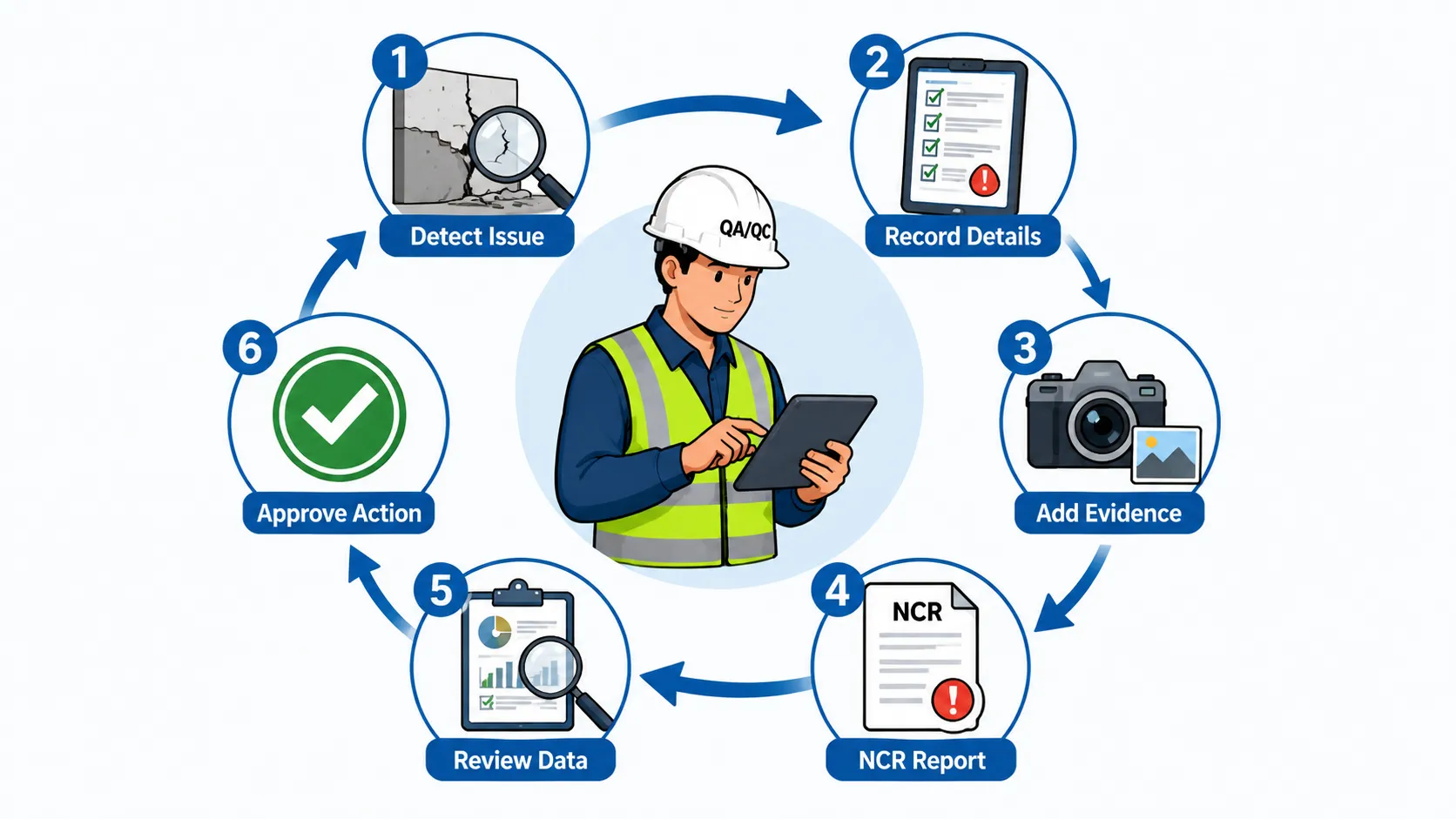
Effective documentation is a critical part of non-conformity management because it creates a clear record of quality issues, investigation findings, corrective actions, and final resolution. A properly documented non-conformity allows project teams to understand what happened, why it occurred, how it was corrected, and what measures were implemented to prevent recurrence.
For QA/QC Construction Specialists, documentation provides objective evidence that quality issues are being managed systematically according to project requirements and quality management procedures. It also supports communication between contractors, consultants, clients, and regulatory authorities by ensuring that all stakeholders have accurate information about quality performance.
A well-developed non-conformity record should include:
- Identification number of the non-conformity.
- Date and location where the issue occurred.
- Description of the observed deviation.
- Reference to applicable drawings, specifications, or standards.
- Supporting evidence such as photographs, test results, or inspection records.
- Classification of the non-conformity severity.
- Responsible person or department.
- Immediate corrective action taken.
- Root cause investigation results.
- Final approval and closure details.
Proper documentation ensures transparency and accountability throughout the construction process.
Non-Conformance Report (NCR) Process
A Non-Conformance Report (NCR) is one of the most commonly used quality management documents for recording and controlling deviations from project requirements. It provides a structured approach for managing quality issues from identification to closure.
The NCR process generally follows several stages.
Identification of Non-Conformity
The first stage involves detecting a deviation during construction activities.
Non-conformities may be identified through:
- Routine site inspections.
- Material testing.
- Internal quality audits.
- Client inspections.
- Laboratory results.
- Safety observations.
- Engineering reviews.
The QA/QC team must verify that the identified issue represents a genuine deviation from approved requirements.
Recording the Non-Conformity
Once confirmed, the issue is formally recorded in an NCR document.
The report should clearly explain:
- What happened.
- Where it happened.
- When it happened.
- Which requirement was not satisfied.
- Who identified the issue.
- What evidence supports the finding.
A clear description prevents misunderstandings and ensures appropriate corrective action.
Immediate Containment Action
Before investigating the root cause, immediate actions may be required to control the impact of the problem.
Containment actions may include:
- Stopping affected work activities.
- Isolating defective materials.
- Preventing further installation.
- Protecting completed work.
- Increasing inspections.
- Informing responsible personnel.
The purpose of containment is to prevent the problem from spreading to other areas of the project.
Investigation and Root Cause Analysis
After controlling the immediate issue, the project team investigates why the non-conformity occurred.
Root cause analysis methods include:
- Five Whys Analysis.
- Fishbone Diagram.
- Cause-and-Effect Analysis.
- Process Review.
- Failure Mode and Effects Analysis (FMEA).
The investigation should focus on identifying the actual cause rather than blaming individuals.
For example, if concrete fails strength testing, the root cause may not simply be “poor concrete quality.” Further investigation may identify:
- Incorrect batching procedures.
- Improper storage of materials.
- Equipment calibration issues.
- Poor supervision.
- Inadequate testing procedures.
Understanding the true cause allows organisations to develop effective solutions.
Corrective Action Planning
Corrective action refers to the measures implemented to eliminate the cause of a detected non-conformity and prevent the same issue from happening again.
A successful corrective action plan should include:
- Description of the identified problem.
- Root cause findings.
- Specific improvement actions.
- Responsible personnel.
- Required resources.
- Completion deadline.
- Verification process.
Examples of corrective actions include:
- Revising construction procedures.
- Retraining workers.
- Replacing defective materials.
- Repairing incorrect installations.
- Improving inspection procedures.
- Updating quality documentation.
- Increasing supervision.
Corrective actions should address both the immediate problem and the underlying process weakness.
Verification and Closure of Non-Conformities
A non-conformity should not be considered closed until the effectiveness of corrective actions has been verified.
The QA/QC team should confirm that:
- The original issue has been corrected.
- Corrective actions were properly implemented.
- Similar problems are unlikely to occur again.
- Quality requirements are satisfied.
- Supporting evidence is available.
Verification methods may include:
- Follow-up inspections.
- Additional testing.
- Document reviews.
- Site observations.
- Quality audits.
Once the corrective action is confirmed as effective, the NCR can be formally closed with approval from authorised personnel.
Preventive Actions and Continuous Improvement
While corrective actions address existing problems, preventive actions focus on eliminating potential future risks. A strong quality management system does not only correct failures; it learns from them and improves future performance.
Preventive actions may include:
- Updating work procedures.
- Improving training programmes.
- Revising inspection checklists.
- Conducting additional risk assessments.
- Improving supplier evaluation processes.
- Enhancing quality control plans.
Learning from previous non-conformities helps organisations develop stronger processes and achieve continuous improvement.
Benefits of Effective Non-Conformity Management
A structured non-conformity management system provides significant advantages for construction organisations.
Key benefits include:
- Improved construction quality.
- Reduced project risks.
- Lower rework costs.
- Better compliance with specifications.
- Faster resolution of quality issues.
- Improved communication between stakeholders.
- Enhanced client confidence.
- Stronger audit performance.
- Better project documentation.
- Increased productivity.
- Prevention of repeated failures.
- Continuous improvement of construction processes.
Effective management transforms quality problems into opportunities for organisational learning and improvement.
Practical Case Study
A contractor was constructing a major commercial building project involving reinforced concrete structures, mechanical installations, and finishing works. During a routine QA/QC inspection, engineers discovered that several concrete columns had visible surface defects and areas of honeycombing after formwork removal.
The QA/QC team immediately classified the issue as a non-conformity because the completed work did not meet the required quality standards. An NCR was issued, documenting the location, affected elements, inspection findings, photographs, and relevant specification requirements.
The project team implemented immediate containment actions by stopping further finishing activities in the affected area until the issue was investigated.
A root cause analysis was conducted using the Fishbone Diagram method. The investigation identified several contributing factors:
- Poor concrete vibration practices.
- Insufficient supervision during concrete placement.
- Limited worker awareness of correct compaction techniques.
- Inadequate monitoring during critical activities.
Based on the findings, corrective actions were implemented:
- Workers received additional training on concrete placement procedures.
- Supervisors increased monitoring during concrete pouring.
- Inspection checkpoints were strengthened.
- Concrete placement procedures were reviewed and updated.
- Additional quality checks were introduced.
After implementing these actions, follow-up inspections confirmed that the issue had been resolved. Subsequent concrete works showed improved surface quality with no repeated honeycombing problems.
This case demonstrates how effective non-conformity management prevents repeated failures, improves construction processes, and protects project quality.
Best Practices for Non-Conformity Management
To ensure effective management of construction non-conformities, organisations should adopt the following best practices:
- Establish clear procedures for identifying and reporting quality issues.
- Encourage early reporting of problems.
- Avoid blaming individuals and focus on process improvement.
- Maintain accurate NCR records.
- Perform proper root cause analysis.
- Assign clear responsibility for corrective actions.
- Monitor corrective action completion.
- Verify effectiveness before closing NCRs.
- Use lessons learned to improve future projects.
- Train employees on quality requirements.
- Integrate non-conformity management with the Quality Management System.
- Regularly review non-conformity trends.
Key Takeaways
- Non-conformities are deviations from approved project requirements, specifications, or standards.
- Early identification prevents costly defects and project delays.
- Documentation is essential for tracking quality issues and corrective actions.
- NCRs provide a structured method for controlling non-conformities.
- Root cause analysis helps identify the actual reason behind quality failures.
- Corrective actions eliminate existing problems and prevent recurrence.
- Preventive actions support continuous improvement.
- QA/QC professionals play a critical role in managing construction quality issues.
- Effective non-conformity management improves safety, productivity, and project performance.
- Quality failures should be treated as opportunities for improvement rather than only problems.
Non-Conformity Management and Corrective Actions are essential practices for achieving successful quality outcomes in civil engineering projects. A professional QA/QC approach requires more than identifying defects; it requires a systematic process for documenting issues, analysing causes, implementing effective solutions, and verifying improvements. By managing non-conformities effectively, construction organisations can reduce risks, control costs, improve productivity, and maintain compliance with project requirements.
For QA/QC Construction Specialists, the ability to identify, document, and manage non-conformities is a fundamental skill that supports continuous improvement and operational excellence. Through effective NCR management, root cause analysis, and corrective action implementation, organisations can strengthen their quality management systems and consistently deliver safe, reliable, and high-quality civil engineering projects that meet client expectations and industry standards.
2. Understand the Process of Implementing Corrective Actions to Address Non-Conformities and Prevent Recurrence, Ensuring That Projects Meet Quality Standards and Deadlines
Corrective actions are a fundamental element of effective Quality Assurance (QA) and Quality Control (QC) systems within civil engineering projects. During construction activities, non-conformities may occur due to various factors, including material defects, incorrect installation methods, inadequate procedures, equipment issues, human error, or ineffective communication. Simply identifying a quality problem is not enough; construction organisations must determine the cause of the issue, implement appropriate solutions, and verify that the problem has been permanently resolved. This structured approach is known as the corrective action process.
From a QA/QC Construction Specialist perspective, corrective actions are not only repair activities but strategic improvement measures designed to eliminate the root causes of quality failures. A properly implemented corrective action ensures that the same problem does not occur again, improving construction reliability, reducing project risks, and supporting continuous quality improvement. Effective corrective action management enables project teams to maintain compliance with engineering specifications, contractual requirements, international quality standards, and client expectations.
In modern construction environments, where projects operate under strict deadlines and complex technical requirements, corrective actions play a critical role in balancing quality performance with project efficiency. When managed effectively, corrective actions reduce rework, minimise delays, control costs, and ensure that construction activities continue according to approved quality plans.
Understanding Corrective Actions
A corrective action is a planned response implemented to eliminate the cause of an identified non-conformity or quality problem. The objective is not only to fix the immediate issue but also to prevent similar failures from happening in future construction activities.
For example, if concrete strength test results fail to meet project requirements, repairing the affected concrete alone may not solve the problem. A complete corrective action process requires investigating why the failure occurred, such as incorrect material proportions, poor batching control, inadequate curing, or improper testing procedures. Once the root cause is identified, appropriate actions can be implemented to improve the process.
Corrective actions may include:
- Revising construction procedures.
- Repairing defective work.
- Replacing unsuitable materials.
- Improving inspection methods.
- Providing additional workforce training.
- Recalibrating equipment.
- Strengthening supervision.
- Updating quality documentation.
- Improving communication between project teams.
- Modifying production processes.
The effectiveness of corrective actions depends on how accurately the root cause is identified and how successfully the implemented solution prevents recurrence.
Relationship Between Non-Conformities and Corrective Actions
Non-conformities and corrective actions are closely connected within a quality management system. A non-conformity represents a failure to meet a specified requirement, while corrective action represents the response used to remove the cause of that failure.
The relationship can be explained as:
Non-Conformity Identification → Investigation → Root Cause Analysis → Corrective Action → Verification → Prevention of Recurrence
A professional QA/QC process ensures that every significant non-conformity is evaluated and managed through a structured corrective action system.
Effective management requires:
- Accurate identification of the quality issue.
- Proper documentation of the deviation.
- Assessment of its impact.
- Investigation of the underlying cause.
- Development of appropriate corrective measures.
- Verification of effectiveness.
- Recording lessons learned.
Without corrective actions, organisations may repeatedly experience the same quality failures, resulting in increased costs, project delays, and reduced client confidence.
Importance of Implementing Corrective Actions
Corrective actions provide significant value to civil engineering projects by transforming quality problems into opportunities for improvement.
The importance of corrective action implementation includes:
- Preventing repeated quality failures.
- Maintaining compliance with project specifications.
- Improving construction processes.
- Reducing unnecessary rework.
- Controlling project costs.
- Protecting structural safety.
- Supporting timely project completion.
- Improving workforce performance.
- Enhancing client satisfaction.
- Strengthening quality management systems.
For construction organisations, corrective actions demonstrate commitment to continuous improvement rather than simply reacting to problems after they occur.
Key Principles of Effective Corrective Actions
Successful corrective action implementation depends on several important principles.
Evidence-Based Decision Making
Corrective actions should always be based on factual information rather than assumptions.
Reliable evidence may include:
- Inspection records.
- Laboratory test results.
- Photographic evidence.
- Survey data.
- Quality reports.
- Audit findings.
- Project documentation.
Using evidence ensures that corrective actions address the actual cause of the problem.
Root Cause Identification
The most important principle of corrective action is identifying the true reason behind the non-conformity.
Treating only the visible defect may provide a temporary solution but will not prevent recurrence.
Root cause analysis helps identify issues related to:
- Materials.
- Methods.
- Machinery.
- Manpower.
- Measurement.
- Environment.
For example, if repeated concrete defects occur, the root cause may not simply be poor concrete quality. The actual cause could be incorrect mixing procedures, inadequate vibration, poor curing practices, or insufficient worker training.
Timely Implementation
Corrective actions must be implemented quickly to prevent further impact on project progress and quality.
Delayed corrective action may result in:
- Additional defective work.
- Increased repair costs.
- Project schedule delays.
- Increased resource requirements.
- Greater safety risks.
Effectiveness Verification
A corrective action is only successful when it eliminates the cause of the problem.
Verification activities may include:
- Follow-up inspections.
- Additional testing.
- Process monitoring.
- Quality audits.
- Performance reviews.
Corrective Action Process in Civil Engineering Projects
A structured corrective action process ensures consistent management of quality issues.
Step 1: Identify the Non-Conformity
The first stage involves recognising and recording the quality problem.
Sources of identification include:
- Site inspections.
- Material testing.
- Internal audits.
- Client observations.
- Laboratory reports.
- Engineering reviews.
The issue must be clearly defined with supporting evidence.
Step 2: Evaluate the Impact
Before developing corrective actions, the project team must assess the seriousness of the issue.
Evaluation considers:
- Safety impact.
- Structural impact.
- Cost implications.
- Schedule impact.
- Compliance requirements.
- Affected project areas.
This helps determine the urgency and resources required.
Step 3: Conduct Root Cause Analysis
Root cause analysis determines why the non-conformity occurred.
Common methods include:
Five Whys Method
This technique repeatedly asks “why” until the fundamental cause is identified.
Example:
Problem:
Concrete strength failure occurred.
Why?
- Concrete strength was below requirement.
Why?
- The mix contained incorrect water content.
Why?
- Moisture levels were not checked before batching.
Root cause:
- Inadequate material control procedure.
Fishbone Diagram
This method categorises possible causes under:
- Materials.
- Methods.
- Machines.
- Manpower.
- Measurement.
- Environment.
It provides a systematic approach for analysing complex quality problems.
Step 4: Develop Corrective Action Plan
Once the root cause is identified, a corrective action plan is developed.
The plan should define:
- Problem description.
- Root cause.
- Required action.
- Responsible person.
- Completion date.
- Required resources.
- Verification method.
Table: Corrective Action Process in Civil Engineering
| Process Stage | Definition | Practical Example | Quality Improvement Outcome |
|---|---|---|---|
| Identify Problem | Detecting a deviation from requirements | Concrete test failure | Early recognition of quality issues |
| Evaluate Impact | Assessing the effect of the problem | Reviewing structural risk | Proper prioritisation |
| Root Cause Analysis | Finding the actual reason behind failure | Investigating incorrect batching | Prevents repeated problems |
| Action Planning | Developing improvement measures | Updating procedures | Structured problem resolution |
| Implementation | Applying corrective solutions | Training workers | Improved process performance |
| Verification | Confirming effectiveness | Follow-up inspection | Ensures permanent improvement |
Practical Example
During the construction of a highway drainage system, QA/QC engineers identified that several installed drainage pipes were not aligned according to approved drawings. The issue was recorded as a non-conformity, and immediate action was taken to prevent additional installation errors.
The investigation revealed that the main cause was incorrect interpretation of survey reference points by the installation team. The corrective action included:
- Reviewing the approved drawings.
- Conducting additional survey training.
- Improving communication between surveyors and installation workers.
- Introducing additional inspection checkpoints.
After implementation, follow-up inspections confirmed that pipe alignment met project requirements, and no further alignment issues occurred.
This example demonstrates that effective corrective actions address the underlying cause rather than simply correcting the visible defect.
Implementing Corrective Actions in Civil Engineering Projects
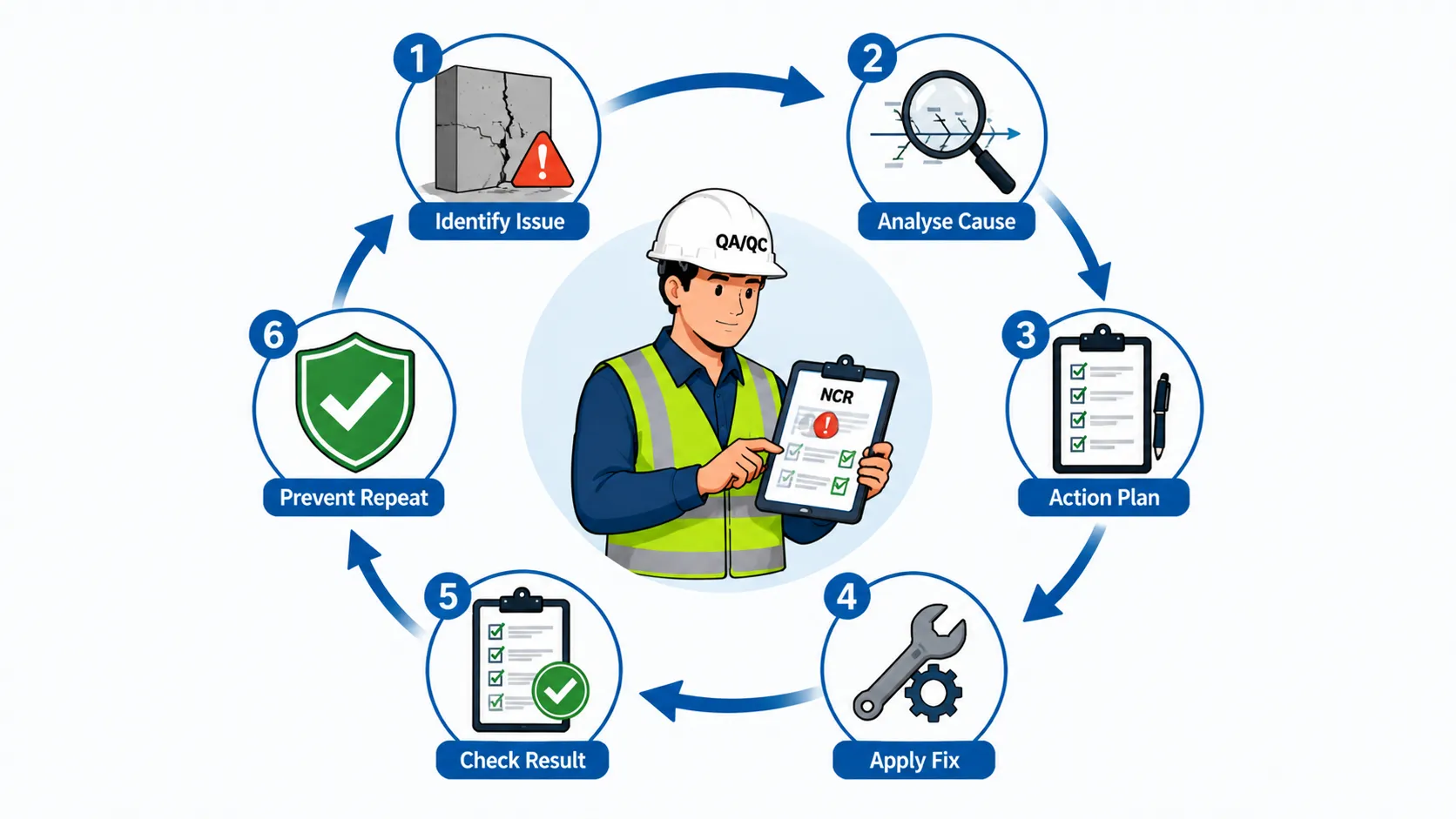
The successful implementation of corrective actions requires proper planning, coordination, and monitoring to ensure that identified quality issues are permanently resolved. In civil engineering projects, corrective actions often involve multiple teams, including QA/QC personnel, engineers, contractors, supervisors, suppliers, and project managers. Effective communication and clear responsibilities are essential to ensure that corrective measures are completed within the required timeframe without negatively affecting project progress.
A corrective action should not be considered complete simply because a repair has been performed. The primary objective is to remove the cause of the non-conformity and improve the construction process to prevent future recurrence.
A professional corrective action implementation process includes:
- Defining the required improvement action.
- Assigning responsibility to competent personnel.
- Establishing completion deadlines.
- Providing required resources.
- Monitoring implementation progress.
- Verifying the effectiveness of completed actions.
- Updating quality procedures where necessary.
Corrective Action Implementation Procedure
A structured implementation procedure helps ensure that corrective actions are managed consistently throughout the project lifecycle.
Step 1: Assign Responsibility
Every corrective action should have a clearly identified responsible person or department.
Responsibilities may include:
- QA/QC Engineer – Monitoring quality requirements.
- Site Engineer – Implementing technical corrections.
- Contractor – Completing required improvements.
- Supplier – Replacing defective materials.
- Project Manager – Providing resources and support.
Clear responsibility prevents delays and ensures accountability.
Step 2: Develop an Action Timeline
Corrective actions must include realistic completion dates based on the severity of the issue.
Critical issues may require immediate action, while minor issues may be addressed through planned improvement activities.
Factors affecting timelines include:
- Impact on safety.
- Effect on project schedule.
- Availability of resources.
- Complexity of corrective measures.
- Required approval processes.
Effective scheduling ensures that corrective actions do not create unnecessary project delays.
Step 3: Provide Required Resources
Successful corrective action requires adequate resources, including:
- Skilled personnel.
- Appropriate equipment.
- Approved materials.
- Technical support.
- Additional inspection resources.
- Training facilities.
Insufficient resources can prevent corrective actions from achieving their intended purpose.
Step 4: Implement Corrective Measures
The responsible team carries out the planned actions according to approved procedures.
Implementation activities may include:
- Repairing defective work.
- Replacing non-compliant materials.
- Modifying construction methods.
- Updating inspection procedures.
- Improving workforce skills.
- Revising quality documentation.
All activities should be properly recorded to maintain traceability.
Monitoring Corrective Action Effectiveness
Monitoring is a critical stage because it determines whether the corrective action has successfully eliminated the original problem.
A corrective action is considered effective when:
- The original non-conformity is resolved.
- Similar problems do not occur again.
- Quality requirements are achieved.
- Construction processes become more reliable.
- Project performance improves.
QA/QC teams verify effectiveness through:
- Follow-up inspections.
- Additional testing.
- Quality audits.
- Performance monitoring.
- Document reviews.
- Site observations.
For example, if additional worker training was introduced to reduce installation errors, the QA/QC team should monitor future installation activities to confirm that defect rates have decreased.
Preventing Recurrence of Non-Conformities
The ultimate goal of corrective action management is preventing the same problem from happening again. This requires organisations to identify weaknesses within their processes and improve their quality management systems.
Preventive measures may include:
- Updating method statements.
- Improving inspection and testing plans.
- Revising training programmes.
- Introducing additional quality checkpoints.
- Improving supplier evaluation.
- Enhancing communication procedures.
- Updating risk assessments.
- Strengthening supervision.
Prevention transforms individual quality issues into organisational learning opportunities.
Role of QA/QC Construction Specialists in Corrective Actions
QA/QC Construction Specialists play a central role in managing corrective actions and ensuring construction quality standards are maintained.
Their responsibilities include:
- Identifying quality deviations.
- Reviewing non-conformity reports.
- Supporting root cause investigations.
- Developing corrective action recommendations.
- Coordinating with project teams.
- Monitoring implementation progress.
- Verifying effectiveness.
- Maintaining quality records.
- Reporting quality performance to management.
A skilled QA/QC professional ensures that corrective actions are technically appropriate, practical, and aligned with project requirements.
Impact of Corrective Actions on Quality Standards
Effective corrective actions directly contribute to achieving and maintaining construction quality standards.
They help organisations:
- Maintain compliance with engineering specifications.
- Meet client expectations.
- Reduce defects.
- Improve workmanship.
- Strengthen quality control procedures.
- Support ISO 9001 quality management principles.
- Improve reliability of completed structures.
By continuously improving construction processes, corrective actions support long-term quality performance.
Impact of Corrective Actions on Project Deadlines
Quality problems can significantly affect project schedules if they are not managed effectively. Unresolved non-conformities may result in delays caused by rework, material replacement, additional inspections, or client rejection.
Effective corrective action management helps protect project timelines by:
- Detecting problems early.
- Reducing unnecessary rework.
- Improving workflow efficiency.
- Preventing repeated failures.
- Supporting better project coordination.
- Reducing disruption to ongoing activities.
For example, correcting reinforcement issues before concrete placement requires minimal effort. However, discovering the same issue after concrete curing may require demolition, redesign, and significant schedule delays.
Practical Example: Corrective Action for Concrete Quality Failure
During the construction of a multi-storey commercial building, concrete cube test results indicated that several samples failed to achieve the specified compressive strength requirements. The QA/QC team immediately recorded the issue as a non-conformity and investigated the cause.
The investigation included reviewing:
- Concrete mix design.
- Material certificates.
- Batching records.
- Transportation time.
- Placement methods.
- Curing procedures.
- Testing equipment calibration.
The root cause analysis identified that inconsistent curing practices were reducing concrete strength development. Workers were not applying sufficient curing protection during periods of high temperature.
Corrective actions implemented included:
- Revising concrete curing procedures.
- Training site workers.
- Increasing supervision during curing activities.
- Introducing additional curing inspections.
- Monitoring concrete performance more frequently.
Follow-up testing confirmed that concrete strength performance improved and no further failures occurred.
This example demonstrates how corrective actions protect structural quality while preventing future problems and maintaining project progress.
Industry Case Study
A contractor was constructing a major bridge project involving reinforced concrete foundations and structural elements. During routine inspection, QA/QC engineers discovered that several foundation reinforcement cages did not comply with approved design drawings. The spacing between reinforcement bars exceeded the specified tolerance, creating a potential structural performance risk.
The QA/QC team issued a Non-Conformance Report and immediately stopped concrete placement in the affected areas. The issue was investigated using root cause analysis methods.
The investigation identified several contributing factors:
- Incorrect interpretation of reinforcement drawings.
- Limited communication between design and site teams.
- Insufficient pre-installation verification.
- Lack of additional inspection checkpoints.
The corrective action plan included:
- Conducting reinforcement installation training.
- Improving drawing review procedures.
- Introducing pre-concrete approval inspections.
- Increasing coordination meetings between engineers and supervisors.
- Updating inspection checklists.
After implementing these corrective actions, the QA/QC team conducted follow-up inspections. The reinforcement installation process showed significant improvement, and no further non-conformities were identified.
The project achieved quality compliance without major delays because the issue was identified and corrected before concrete placement.
Key Benefits of Effective Corrective Action Management
Implementing effective corrective actions provides numerous advantages for construction organisations.
Key benefits include:
- Reduced recurrence of quality problems.
- Improved construction reliability.
- Lower repair and rework costs.
- Better project schedule control.
- Increased productivity.
- Enhanced safety performance.
- Improved client satisfaction.
- Stronger compliance with standards.
- Better documentation and traceability.
- Improved workforce competence.
- More efficient construction processes.
- Continuous organisational improvement.
Best Practices for Corrective Action Management
Construction organisations should follow professional practices to maximise corrective action effectiveness.
Recommended practices include:
- Establish clear corrective action procedures.
- Respond quickly to identified non-conformities.
- Focus on root causes rather than symptoms.
- Use evidence-based investigations.
- Assign clear responsibilities.
- Set realistic completion deadlines.
- Monitor corrective action progress.
- Verify effectiveness before closure.
- Maintain complete documentation.
- Share lessons learned across projects.
- Update procedures based on previous failures.
- Encourage a culture of continuous improvement.
Key Takeaways
- Corrective actions eliminate the causes of non-conformities and prevent recurrence.
- Effective corrective action requires identification, investigation, implementation, and verification.
- Root cause analysis is essential for developing successful solutions.
- QA/QC specialists play a key role in managing quality improvements.
- Corrective actions improve compliance with project specifications and quality standards.
- Proper implementation reduces rework, costs, and schedule delays.
- Verification ensures that corrective actions achieve permanent improvement.
- Preventive measures strengthen future construction performance.
- Quality problems can become opportunities for continuous improvement when managed correctly.
The implementation of corrective actions is a vital process for maintaining quality excellence in civil engineering projects. Addressing non-conformities requires more than repairing defective work; it requires a systematic approach to identifying root causes, developing effective solutions, implementing improvements, and verifying long-term effectiveness. A strong corrective action system enables construction organisations to reduce risks, improve processes, and consistently achieve project requirements.
For QA/QC Construction Specialists, effective corrective action management represents a proactive approach to quality improvement. By applying structured procedures, analysing failures, and preventing recurrence, professionals can ensure that projects meet quality standards, remain within planned schedules, and deliver safe, durable, and reliable infrastructure. Ultimately, corrective actions support continuous improvement and contribute to the successful completion of high-quality civil engineering projects.
3. Develop Skills in Conducting Root Cause Analysis to Determine the Underlying Issues of Non-Conformities and Apply Effective Solutions for Continual Quality Improvement
Root Cause Analysis (RCA) is a systematic problem-solving approach used by QA/QC professionals to identify the fundamental reasons behind non-conformities, defects, failures, and quality issues within civil engineering projects. In construction environments, simply correcting a visible defect is often insufficient because the same problem may occur repeatedly if the underlying cause is not identified and removed. Root Cause Analysis enables project teams to move beyond temporary solutions and develop permanent improvements that enhance construction quality, reliability, and efficiency.
Civil engineering projects involve complex interactions between materials, equipment, workforce, construction methods, environmental conditions, and management systems. Any weakness within these areas can contribute to quality failures. For example, a concrete strength failure may not only be caused by poor material quality but could result from incorrect batching procedures, inadequate curing, equipment calibration issues, or insufficient supervision. RCA helps QA/QC Construction Specialists investigate these contributing factors and determine the actual source of the problem.
From a professional QA/QC perspective, Root Cause Analysis is a critical component of non-conformity management and continual improvement. It supports organisations in reducing repeated failures, improving construction processes, controlling costs, and ensuring compliance with project specifications, quality standards, and client expectations. By developing RCA skills, construction professionals become capable of analysing problems objectively, recommending effective solutions, and strengthening overall project performance.
Understanding Root Cause Analysis (RCA)
Root Cause Analysis is defined as a structured method used to identify the primary reason behind a problem or non-conformity rather than focusing only on the immediate symptoms. The purpose of RCA is to understand why a failure occurred and determine what changes are required to prevent recurrence.
In civil engineering projects, RCA is commonly applied when dealing with:
- Material failures.
- Construction defects.
- Repeated inspection failures.
- Safety-related incidents.
- Equipment breakdowns.
- Process inefficiencies.
- Quality complaints.
- Schedule disruptions caused by technical issues.
A successful RCA process investigates the complete chain of events leading to the problem.
The basic RCA approach follows:
Problem Identification → Data Collection → Cause Investigation → Root Cause Identification → Solution Development → Verification → Continuous Improvement
This structured approach ensures that corrective actions are based on evidence rather than assumptions.
Importance of Root Cause Analysis in Non-Conformity Management
Non-conformities can create significant challenges for construction projects if their causes are not properly investigated. Repeated quality failures can increase project costs, delay completion dates, damage client relationships, and reduce organisational reputation.
Root Cause Analysis helps construction organisations by:
- Identifying the real cause of quality failures.
- Preventing repeated non-conformities.
- Improving construction procedures.
- Supporting effective corrective actions.
- Reducing unnecessary rework.
- Improving resource utilisation.
- Enhancing project reliability.
- Strengthening quality management systems.
- Supporting compliance with ISO-based quality practices.
- Encouraging continuous improvement.
For example, if several concrete surfaces show defects after completion, repairing each affected area individually may solve the immediate problem. However, RCA may reveal that the actual cause is poor concrete placement procedures or inadequate worker training. Addressing the real cause prevents future defects across the entire project.
Key Principles of Root Cause Analysis
Effective Root Cause Analysis depends on several important principles that guide professional investigation.
Focus on Causes, Not Symptoms
A common mistake in quality management is treating only the visible problem without investigating why it happened.
For example:
Problem:
A pipeline installation fails pressure testing.
Immediate response:
Repair the pipeline section.
RCA investigation:
The team discovers that incorrect joint preparation procedures caused leakage.
Permanent solution:
Improve installation procedures and provide additional worker training.
By focusing on the cause rather than the symptom, organisations achieve long-term improvement.
Use Evidence-Based Investigation
Root Cause Analysis should always rely on factual information collected from reliable sources.
Evidence may include:
- Inspection reports.
- Laboratory test results.
- Photographs.
- Survey records.
- Equipment data.
- Work procedures.
- Employee interviews.
- Quality audit findings.
Evidence-based analysis prevents incorrect assumptions and ensures that solutions address the actual problem.
Involve Relevant Stakeholders
Construction quality issues often involve multiple departments and stakeholders. Effective RCA requires collaboration between:
- QA/QC engineers.
- Site engineers.
- Supervisors.
- Contractors.
- Material suppliers.
- Laboratory technicians.
- Project managers.
Different perspectives help identify factors that may not be visible to one individual.
Implement Permanent Solutions
The objective of RCA is not temporary correction but permanent improvement.
Effective solutions should:
- Remove the underlying cause.
- Improve existing processes.
- Reduce future risks.
- Strengthen quality controls.
- Prevent similar failures.
Common Causes of Non-Conformities in Civil Engineering Projects
Understanding common causes of construction failures helps QA/QC professionals perform more effective investigations.
Material-Related Causes
Material problems are among the most common causes of construction non-conformities.
Examples include:
- Incorrect material specifications.
- Poor material storage.
- Expired products.
- Defective supplies.
- Inadequate material testing.
- Supplier quality issues.
Method-Related Causes
Construction methods directly influence quality performance.
Common issues include:
- Incorrect installation procedures.
- Failure to follow method statements.
- Poor construction sequencing.
- Inadequate inspection points.
- Unapproved process changes.
Equipment-Related Causes
Equipment reliability and accuracy affect construction outcomes.
Potential causes include:
- Poor maintenance.
- Incorrect calibration.
- Equipment failure.
- Improper operation.
- Outdated machinery.
Human-Related Causes
Human factors significantly influence construction quality.
Examples include:
- Lack of training.
- Poor communication.
- Insufficient supervision.
- Misinterpretation of drawings.
- Lack of awareness of quality requirements.
Environmental Causes
External conditions may affect construction performance.
Examples include:
- Extreme temperatures.
- Heavy rainfall.
- High humidity.
- Ground conditions.
- Limited site access.
Management and Process Causes
Organisational weaknesses can contribute to repeated quality issues.
Examples include:
- Poor planning.
- Weak quality procedures.
- Ineffective communication systems.
- Inadequate risk assessment.
- Lack of monitoring.
Root Cause Analysis Methods Used in Construction Quality Management
QA/QC professionals use various RCA techniques depending on the complexity of the problem. These methods provide structured approaches for identifying the true source of non-conformities.
Five Whys Analysis
The Five Whys method is a simple but effective technique that investigates a problem by repeatedly asking “Why?” until the fundamental cause is identified.
Example:
Problem:
Concrete wall surface contains cracks.
Why?
- Cracks appeared after curing.
Why?
- Concrete experienced excessive shrinkage.
Why?
- Moisture loss was not properly controlled.
Why?
- Curing procedures were not followed correctly.
Why?
- Workers lacked sufficient training on curing requirements.
Root Cause:
- Inadequate workforce training and supervision.
The Five Whys method is useful for straightforward problems where a clear cause-and-effect relationship exists.
Fishbone Diagram (Cause-and-Effect Analysis)
The Fishbone Diagram, also known as the Ishikawa Diagram, is used to identify multiple possible causes contributing to a problem.
Causes are commonly grouped into categories such as:
- Materials.
- Methods.
- Machines.
- Manpower.
- Measurement.
- Environment.
This method is particularly useful for complex construction problems involving multiple contributing factors.
Example:
Problem:
Poor concrete quality.
Possible causes:
Materials:
- Incorrect mix components.
Methods:
- Poor mixing procedures.
Machines:
- Batching equipment calibration issues.
Manpower:
- Lack of operator training.
Measurement:
- Incorrect testing procedures.
Environment:
- Poor curing conditions.
Fault Tree Analysis
Fault Tree Analysis (FTA) uses a logical diagram to identify how different failures combine to create a major problem.
It is commonly used for:
- Structural failures.
- Safety risks.
- Complex engineering problems.
The method helps engineers understand relationships between multiple failure causes and prioritise preventive measures.
Table: Root Cause Analysis Methods in Civil Engineering
| RCA Method | Definition | Suitable Application | Main Benefit |
|---|---|---|---|
| Five Whys | A questioning technique used to identify the underlying cause of a problem | Simple quality failures | Quick identification of basic causes |
| Fishbone Diagram | A visual method that categorises possible causes of a problem | Complex construction defects | Identifies multiple contributing factors |
| Fault Tree Analysis | A logical analysis method showing relationships between failures | Major technical risks | Supports detailed risk evaluation |
| Process Mapping | A method of reviewing workflow steps to identify weaknesses | Process-related issues | Improves construction procedures |
Practical Example
During a highway construction project, QA/QC inspectors identified repeated failures in asphalt compaction test results. Initially, the problem appeared to be related to material quality. However, the RCA process involved reviewing laboratory results, equipment records, construction methods, and operator activities.
The investigation identified that the main issue was inconsistent roller operation and insufficient monitoring of compaction temperatures. The corrective solution involved improving operator training, introducing temperature monitoring procedures, and increasing inspection frequency.
After implementing these improvements, asphalt compaction results became consistent, reducing rework and improving project productivity.
This example demonstrates how Root Cause Analysis enables construction teams to identify the real cause of quality problems and apply effective solutions.
Implementing Root Cause Analysis for Effective Quality Improvement
Conducting Root Cause Analysis is only valuable when the findings are converted into practical actions that improve construction performance. In civil engineering projects, the purpose of RCA is not simply to identify why a failure occurred but to develop and implement effective solutions that remove the source of the problem and prevent future recurrence.
A professional QA/QC Construction Specialist must ensure that RCA findings are properly communicated, corrective actions are realistic, responsibilities are assigned, and improvements are monitored. This approach transforms quality failures into learning opportunities and supports continual improvement throughout the project lifecycle.
The implementation process requires coordination between technical teams, site personnel, contractors, suppliers, and project management to ensure that solutions are effectively applied.
Root Cause Analysis Implementation Process
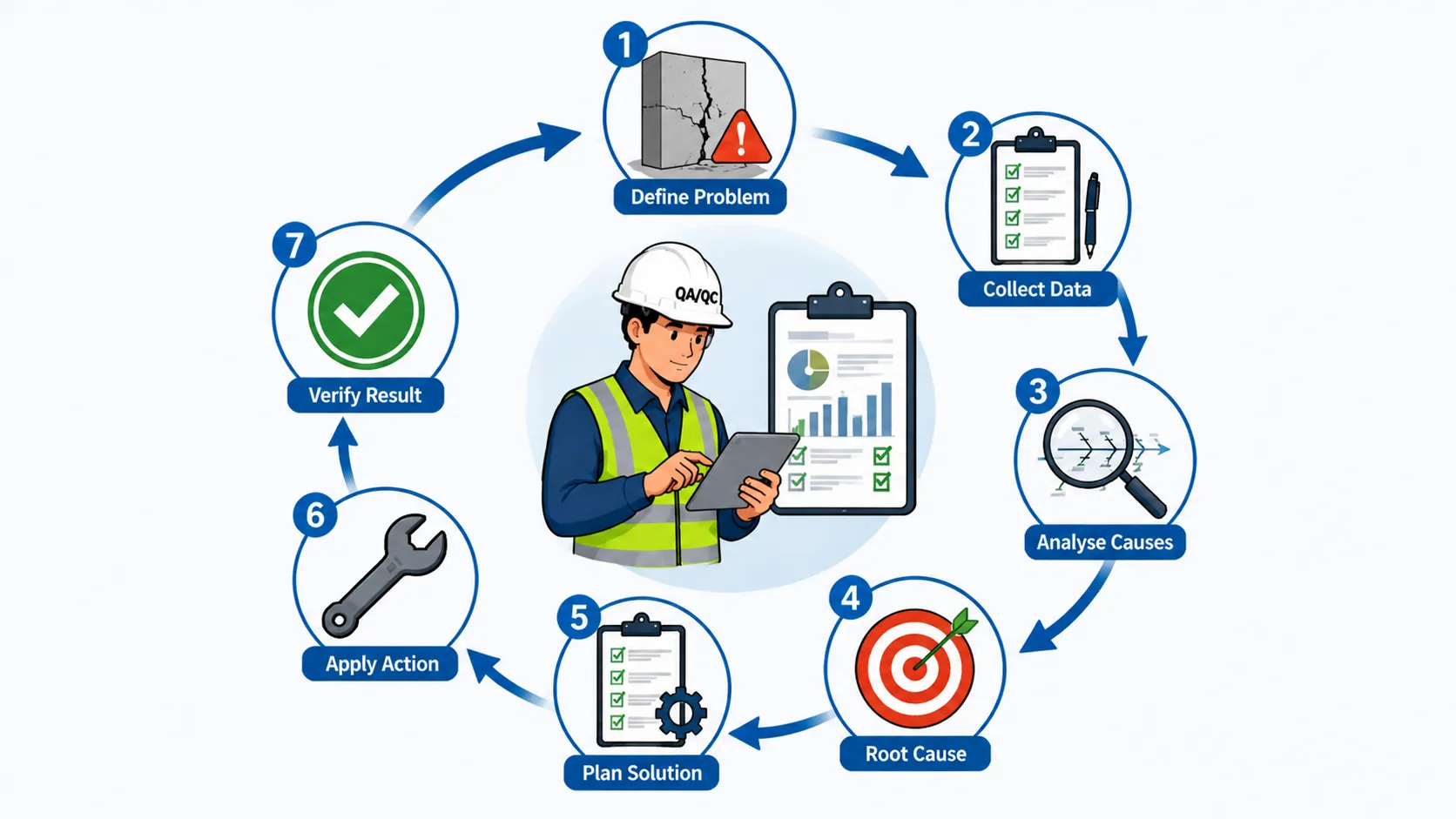
A structured RCA implementation process ensures that quality problems are investigated and resolved systematically.
Step 1: Define the Problem Clearly
The first step is to establish a clear understanding of the non-conformity or quality issue.
A well-defined problem statement should include:
- Description of the failure.
- Location of the issue.
- Date of occurrence.
- Affected construction activity.
- Required specification or standard.
- Actual performance compared with expected performance.
A clear problem definition prevents incorrect analysis and ensures that the investigation focuses on the actual issue.
For example:
Incorrect Problem Statement:
“Concrete quality is poor.”
Improved Problem Statement:
“Concrete cube test results for the foundation structure failed to achieve the specified compressive strength requirement during the third testing cycle.”
The second statement provides measurable information that supports effective investigation.
Step 2: Collect Relevant Data
Reliable data is essential for identifying the true cause of a problem. QA/QC professionals should collect all available information related to the non-conformity.
Data sources may include:
- Inspection reports.
- Material certificates.
- Laboratory test results.
- Construction drawings.
- Work method statements.
- Equipment records.
- Training records.
- Previous NCR reports.
- Site photographs.
- Employee interviews.
Data collection helps establish facts and prevents decisions based on assumptions.
Step 3: Analyse Possible Causes
After collecting information, the project team evaluates possible reasons for the failure.
The investigation should consider different categories:
Materials
Possible questions:
- Were approved materials used?
- Were materials stored correctly?
- Were supplier requirements followed?
Methods
Possible questions:
- Was the approved procedure followed?
- Were correct installation methods applied?
- Were inspections completed at required stages?
Equipment
Possible questions:
- Was equipment properly maintained?
- Was calibration completed?
- Was equipment operated correctly?
Workforce
Possible questions:
- Did workers have appropriate skills?
- Was adequate supervision provided?
- Was training completed?
Environment
Possible questions:
- Did weather conditions affect the activity?
- Were site conditions suitable?
This structured approach helps identify all possible contributing factors.
Step 4: Identify the Root Cause
After analysing possible causes, the team identifies the fundamental issue responsible for the non-conformity.
A confirmed root cause should:
- Be supported by evidence.
- Explain why the failure occurred.
- Be controllable through improvement actions.
- Prevent recurrence when corrected.
For example:
Problem:
Repeated welding defects.
Possible causes:
- Poor welding quality.
- Incorrect welding procedure.
- Lack of inspection.
Root Cause:
Insufficient welder training and inadequate procedure verification.
Corrective Solution:
Improve competency training and strengthen welding inspection controls.
Step 5: Develop and Apply Solutions
Once the root cause has been identified, appropriate solutions must be developed.
Effective solutions may include:
- Revising procedures.
- Improving training programmes.
- Updating inspection requirements.
- Changing suppliers.
- Improving equipment maintenance.
- Increasing quality monitoring.
- Modifying construction methods.
Solutions should be practical, measurable, and suitable for the project environment.
Applying Effective Solutions for Continual Quality Improvement
Continual quality improvement means continuously enhancing construction processes, systems, and performance based on lessons learned from previous experiences.
Root Cause Analysis contributes to continual improvement by helping organisations:
- Understand repeated failures.
- Improve working methods.
- Strengthen quality procedures.
- Increase workforce competence.
- Reduce construction risks.
- Improve productivity.
- Enhance project outcomes.
Instead of viewing non-conformities only as problems, successful organisations use them as opportunities to improve their overall quality management approach.
Monitoring and Verifying Implemented Solutions
After solutions are implemented, QA/QC teams must confirm whether the actions have achieved the desired results.
Verification activities include:
- Follow-up inspections.
- Additional testing.
- Performance monitoring.
- Internal audits.
- Process reviews.
- Quality trend analysis.
A corrective solution is considered successful when:
- The original problem is eliminated.
- Similar failures do not occur again.
- Quality performance improves.
- Construction standards are maintained.
For example, if additional worker training was introduced to reduce installation defects, the QA/QC team should monitor future work to confirm that defect rates have decreased.
Role of Documentation in Root Cause Analysis
Documentation ensures that RCA activities are traceable and can support future improvement.
Important records include:
- Problem descriptions.
- Investigation findings.
- Cause analysis reports.
- Corrective action plans.
- Verification records.
- Lessons learned documents.
Proper documentation allows organisations to build knowledge from previous projects and avoid repeating similar mistakes.
Industry Case Study: Root Cause Analysis Improving Construction Quality
A construction company was delivering a large reinforced concrete infrastructure project. During quality inspections, the QA/QC team identified repeated cracking in recently completed concrete sections. Although repairs were completed successfully, similar cracks continued appearing in other areas.
Instead of repeatedly repairing the defects, the QA/QC team initiated a Root Cause Analysis investigation.
The team collected information from:
- Concrete test results.
- Material records.
- Weather conditions.
- Construction procedures.
- Worker interviews.
- Curing inspection reports.
Using a Fishbone Diagram, the team analysed possible causes under materials, methods, equipment, manpower, measurement, and environmental conditions.
The investigation identified the main causes:
- Insufficient curing protection during hot weather.
- Inconsistent monitoring of curing activities.
- Limited worker awareness regarding temperature effects.
The team developed improvement solutions:
- Updated concrete curing procedures.
- Provided additional workforce training.
- Introduced additional inspection checkpoints.
- Increased environmental monitoring.
- Improved supervision during concrete placement.
After implementing these solutions, follow-up quality data showed a significant reduction in concrete cracking. The number of NCRs decreased, repair activities were reduced, and project progress improved.
This case demonstrates how Root Cause Analysis allows construction organisations to move from reactive problem-solving toward proactive quality improvement.
Key Benefits of Root Cause Analysis in Civil Engineering
Effective RCA provides significant advantages for construction projects and quality management systems.
Major benefits include:
- Prevention of repeated non-conformities.
- Improved construction quality.
- Reduced repair and rework costs.
- Better resource utilisation.
- Increased project efficiency.
- Improved compliance with specifications.
- Enhanced risk management.
- Stronger quality control processes.
- Improved workforce performance.
- Better decision-making.
- Increased client satisfaction.
- Improved organisational learning.
By identifying the true causes of failures, organisations can achieve sustainable improvements rather than temporary solutions.
Best Practices for Effective Root Cause Analysis
Construction organisations should follow professional practices to maximise the effectiveness of RCA.
Recommended practices include:
- Define problems clearly before investigation.
- Use reliable evidence and data.
- Involve experienced technical personnel.
- Avoid blaming individuals.
- Focus on process improvement.
- Use suitable RCA tools.
- Document investigation findings.
- Develop measurable solutions.
- Assign clear responsibilities.
- Monitor effectiveness after implementation.
- Share lessons learned across projects.
- Update quality procedures regularly.
Key Takeaways
- Root Cause Analysis identifies the underlying reasons behind non-conformities.
- Effective RCA prevents repeated quality failures.
- QA/QC professionals use RCA to support corrective actions and continual improvement.
- Evidence-based investigation leads to better solutions.
- Methods such as Five Whys, Fishbone Diagram, and Fault Tree Analysis support systematic problem-solving.
- Corrective solutions must address the root cause rather than only visible defects.
- Monitoring and verification ensure that improvements are effective.
- RCA improves quality, productivity, safety, and project reliability.
- Construction organisations benefit from learning from previous failures.
- Continuous improvement strengthens long-term project performance.
Root Cause Analysis is an essential skill for QA/QC Construction Specialists because it provides a structured approach for understanding and resolving quality problems in civil engineering projects. Effective RCA enables professionals to investigate non-conformities, identify underlying causes, develop appropriate solutions, and prevent future recurrence. Rather than focusing only on repairing defects, RCA encourages organisations to improve their construction processes and strengthen their quality management systems.
By applying systematic investigation methods, using reliable evidence, and implementing effective corrective solutions, construction teams can achieve continual quality improvement, reduce project risks, and enhance operational efficiency. The ability to conduct professional Root Cause Analysis supports successful project delivery by ensuring that civil engineering works meet required standards, remain within planned schedules, and achieve long-term reliability and performance.
Conclusion
Root Cause Analysis is a vital skill for QA/QC Construction Specialists as it enables them to identify the underlying causes of non-conformities rather than focusing only on visible defects. By applying structured techniques such as the Five Whys Method, Fishbone Diagram, and Fault Tree Analysis, construction professionals can investigate quality issues, evaluate contributing factors, and develop effective solutions that improve construction processes. A systematic RCA approach supports better decision-making, reduces repeated failures, and ensures that corrective actions address the actual source of problems.
Effective Root Cause Analysis contributes to continual quality improvement by helping civil engineering organisations enhance performance, reduce rework, control costs, and maintain compliance with project requirements and quality standards. By analysing previous failures, implementing preventive measures, and monitoring improvement outcomes, QA/QC teams can strengthen quality management systems and support successful project delivery. Developing RCA skills allows learners to contribute effectively to safer, more reliable, and higher-quality construction projects.
Root Cause Analysis is a vital skill for QA/QC Construction Specialists as it enables them to identify the underlying causes of non-conformities rather than focusing only on visible defects. By applying structured techniques such as the Five Whys Method, Fishbone Diagram, and Fault Tree Analysis, construction professionals can investigate quality issues, evaluate contributing factors, and develop effective solutions that improve construction processes. A systematic RCA approach supports better decision-making, reduces repeated failures, and ensures that corrective actions address the actual source of problems.
Effective Root Cause Analysis contributes to continual quality improvement by helping civil engineering organisations enhance performance, reduce rework, control costs, and maintain compliance with project requirements and quality standards. By analysing previous failures, implementing preventive measures, and monitoring improvement outcomes, QA/QC teams can strengthen quality management systems and support successful project delivery. Developing RCA skills allows learners to contribute effectively to safer, more reliable, and higher-quality construction projects.