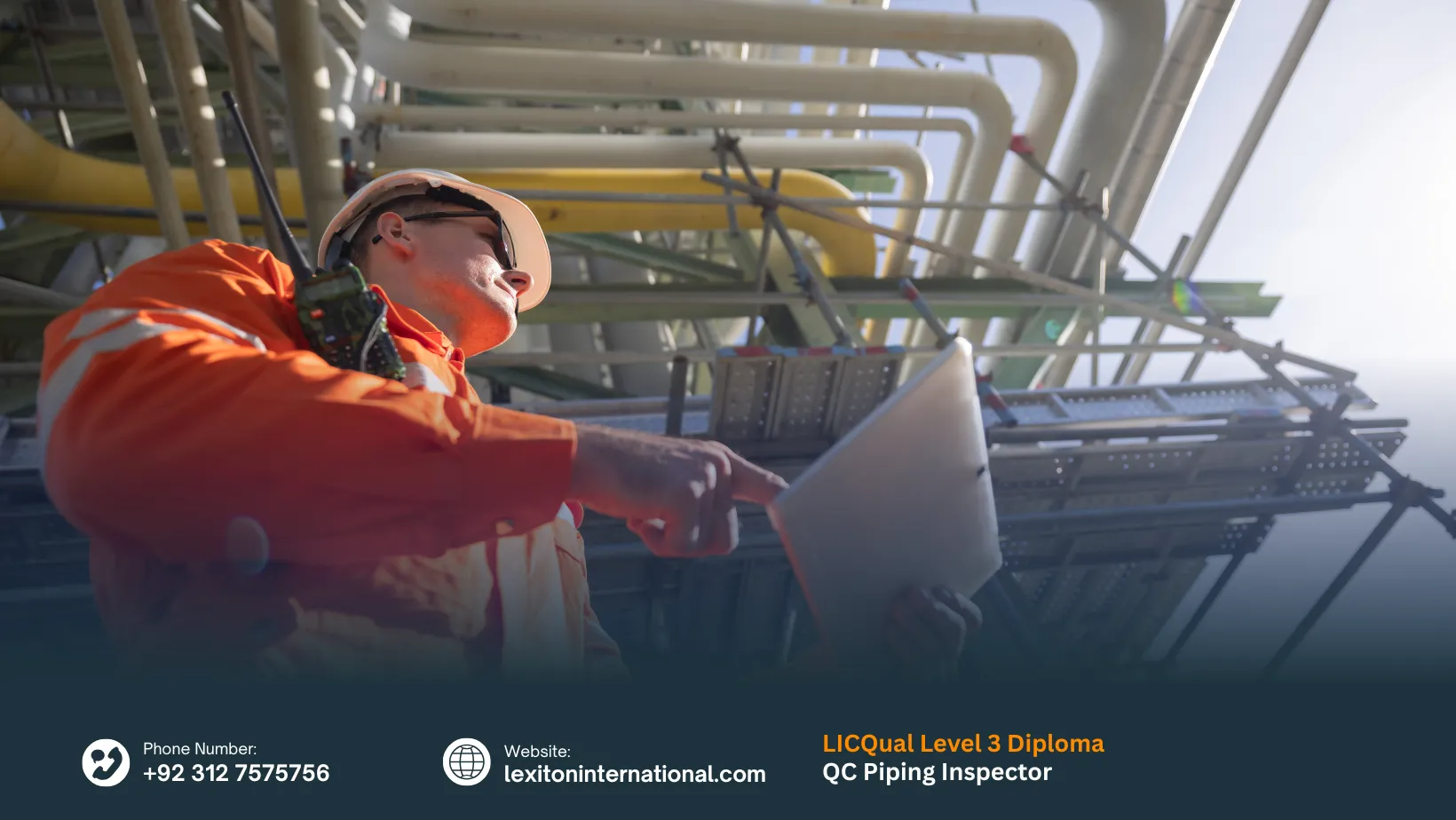
The LICQual Level 3 Diploma in QC Piping Inspector is a career-focused certification designed for individuals who want to build practical knowledge and professional competence in piping quality control and inspection. It provides a clear understanding of how piping systems are inspected, tested, and verified to ensure they meet recognised quality requirements and industry specifications. The course combines technical principles with real-world inspection practices, helping learners develop the confidence to carry out quality control responsibilities in a structured and professional manner.
Throughout this certification, learners gain a solid understanding of piping materials, fabrication processes, welding inspection, dimensional checks, non-destructive testing principles, documentation, and quality reporting. The course also introduces internationally recognised inspection procedures, safety awareness, and the importance of maintaining accuracy and compliance during every stage of a piping project. Each topic is presented in a practical and easy-to-follow way, making complex concepts more accessible for learners.
The LICQual Level 3 Diploma in QC Piping Inspector is designed to meet the growing demand for skilled quality control professionals across industries where piping systems play a vital role. By focusing on practical inspection techniques, quality assurance processes, and professional reporting standards, this certification equips learners with valuable knowledge that can be applied confidently in real workplace environments. It offers a strong foundation for developing inspection skills while supporting high standards of quality, reliability, and operational excellence.
- Age Requirements: Applicants must be 18 years or above at the time of enrollment.
- Professional Experience: No prior experience is required.
- Educational Background: Level 2 certification, high school, secondary school certificate, or equivalent.
- English Language Proficiency: Learners should have a good command of the English language.
Mandatory Units
Skills You Will Gain
1. Piping Codes and Standards (ASME, API, ANSI, ISO)
- Interpret and apply international piping codes and standards, such as ASME B31.3, API 1104, ANSI, and ISO, to ensure compliance in piping inspections.
- Identify the specific requirements of each standard and their relevance to different piping applications and industries.
- Evaluate piping systems against applicable codes to verify safety, quality, and regulatory adherence during inspections.
- Develop inspection checklists based on piping codes and standards to support consistent quality control processes.
2. Welding Inspection and NDT Fundamentals
- Conduct welding inspections to identify defects, such as cracks, porosity, or incomplete fusion, ensuring compliance with quality standards.
- Explain the principles and applications of basic non-destructive testing (NDT) methods, including ultrasonic, radiographic, and magnetic particle testing, for piping systems.
- Interpret NDT results to assess weld integrity and recommend corrective actions to maintain piping quality.
- Apply safe and effective welding inspection and NDT techniques in accordance with industry best practices and project specifications.
3. Piping Fabrication, Erection, and Installation Monitoring
- Monitor piping fabrication, erection, and installation processes to ensure adherence to design specifications and quality standards.
- Identify and address non-conformities, such as improper assembly or material defects, during piping fabrication and installation.
- Verify the correct execution of erection and installation procedures to ensure structural integrity and operational reliability.
- Collaborate with project teams to integrate quality control measures into all stages of piping fabrication and installation.
4. Dimensional Inspection, Tolerances, and Alignment Checks
- Perform dimensional inspections of piping components to verify compliance with design drawings and tolerances.
- Utilize precision tools, such as calipers and laser alignment devices, to conduct accurate alignment checks and dimensional measurements.
- Assess piping system alignments to ensure proper fit-up and functionality, addressing any deviations from specified tolerances.
- Document dimensional inspection findings to support quality control and ensure traceability in piping projects.
5. Inspection Documentation, Reporting, and Quality Records
- Prepare accurate and detailed inspection reports, documenting findings, non-conformities, and corrective actions for piping systems.
- Maintain comprehensive quality records, including material certifications, test results, and inspection logs, to ensure traceability and compliance.
- Utilize digital tools to streamline documentation and reporting processes, enhancing efficiency in quality control workflows.
- Communicate inspection outcomes effectively to project stakeholders, ensuring clarity and alignment with project requirements.
6. Practical Applications in QC Piping Inspection
- Apply QC inspection techniques in real-world or simulated piping projects to identify and resolve quality issues effectively.
- Analyze practical case studies to develop problem-solving skills for common piping inspection challenges, such as defect identification and compliance failures.
- Conduct hands-on inspections using industry-standard tools and methods to ensure piping systems meet quality and safety standards.
- Demonstrate the ability to integrate inspection principles, documentation, and reporting into practical QC processes for piping projects.
The LICQual Level 3 Diploma in QC Piping Inspector is designed for individuals who want to develop practical knowledge of piping inspection, quality control, and industry inspection procedures. It is suitable for those looking to strengthen their technical understanding and apply recognised quality standards in engineering and industrial environments.
Who Is This Course For?
- Individuals interested in quality control and piping inspection.
- Mechanical, production, and fabrication personnel seeking structured inspection knowledge.
- Welding inspectors who want to broaden their understanding of piping quality requirements.
- Quality control assistants working in industrial or construction environments.
- Technicians involved in piping fabrication, installation, or maintenance.
- Professionals responsible for inspection records and quality documentation.
- Employees working in oil and gas, petrochemical, power, manufacturing, or construction industries.
- Individuals looking to gain practical knowledge of international piping inspection practices.
- Team members involved in ensuring compliance with quality standards and engineering specifications.
- Anyone wishing to build a strong foundation in QC piping inspection principles and best practices.
The LICQual Level 3 Diploma in QC Piping Inspector provides a strong foundation for developing technical expertise in piping inspection and quality control. The knowledge and practical skills gained through this certification can support professional growth and increased responsibilities across a range of engineering and industrial sectors where quality assurance is essential.
Future Progression
- Perform piping inspection tasks with greater confidence and accuracy.
- Take on increased responsibilities in quality control and inspection activities.
- Apply recognised inspection codes, standards, and quality procedures in the workplace.
- Improve skills in welding inspection, dimensional verification, and inspection documentation.
- Contribute to quality assurance and compliance throughout piping projects.
- Support safe, reliable, and efficient piping installation and fabrication processes.
- Enhance technical expertise in industrial sectors such as oil and gas, petrochemicals, power generation, manufacturing, and construction.
- Strengthen professional competence in inspection reporting and quality record management.
- Play a more effective role in maintaining quality standards and operational excellence.
- Build practical expertise that supports long-term professional growth in quality inspection and engineering environments.
Curious About This Course?