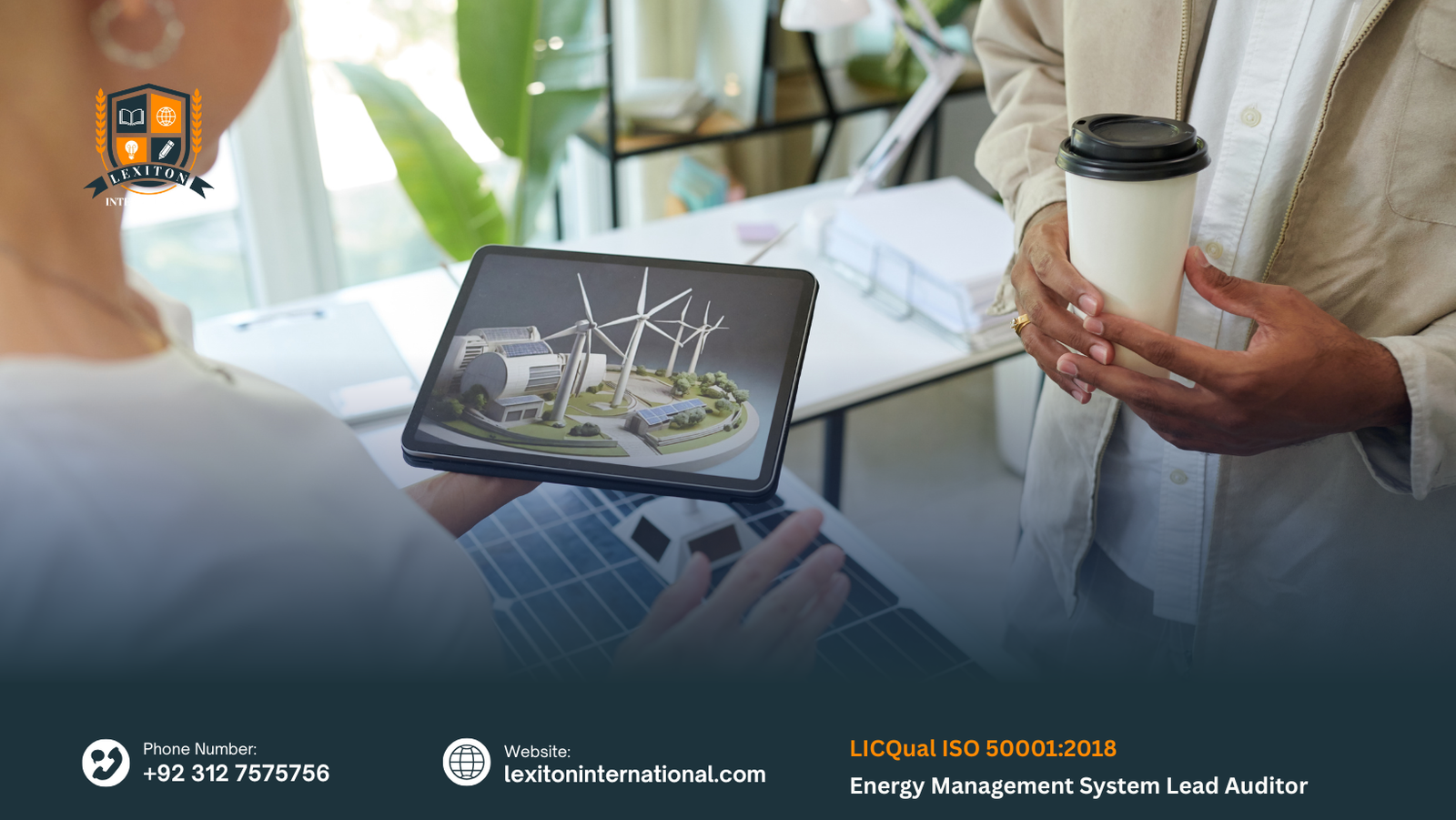
The LICQual ISO 50001:2018 Energy Management System Lead Auditor course is a specialized training program designed to equip professionals with the knowledge, skills, and auditing expertise required to assess and improve organizational energy management practices. ISO 50001:2018 is the globally recognized standard that provides a framework for establishing, implementing, maintaining, and improving energy management systems. Its purpose is to help organizations continually reduce energy use, lower costs, and improve energy performance while contributing to environmental sustainability.
This course provides a comprehensive understanding of the ISO 50001:2018 standard, focusing on its requirements, principles, and practical applications. Participants will explore how organizations can systematically manage energy, identify opportunities for efficiency, and integrate energy management into broader business strategies. The training emphasizes the importance of aligning energy performance with sustainability goals, regulatory compliance, and corporate social responsibility.
A central component of the program is the development of auditing competence. Learners will be trained to plan, conduct, and report on audits of energy management systems in accordance with ISO 19011 (guidelines for auditing management systems) and ISO/IEC 17021 (requirements for certification bodies). Through case studies, role-playing exercises, and simulated audits, participants will gain practical experience in identifying non-conformities, evaluating energy performance indicators, and recommending corrective actions.
The course also highlights the role of auditors in promoting continual improvement. Learners will examine how to assess energy baselines, monitor energy performance indicators, and evaluate the effectiveness of energy-saving initiatives. By engaging with real-world examples, participants will understand how organizations can achieve measurable reductions in energy consumption and greenhouse gas emissions.
- Age Requirement: Applicants should normally be 18 years of age or older at the time of enrollment.
- Educational Background: A Level 5 qualification (or equivalent) in engineering, environmental management, energy studies, or a related field is recommended. Learners with such a background are better positioned to understand the technical and operational aspects of ISO 50001
- Work Experience; No prior work experience is strictly required, making the course accessible to both recent graduates and career changers. However, learners with exposure to energy management, sustainability initiatives, or auditing roles will find it easier to connect theory with practice. For instance, an energy officer who has worked on reducing consumption in a manufacturing plant will quickly relate to the course content, while a quality auditor may already understand audit methodologies.
- English Language Proficiency: Since the course is delivered in English, applicants must demonstrate proficiency in both written and spoken English. This ensures learners can fully engage with course materials, technical documentation, and assessments. Evidence of prior study in English, equivalent qualifications, or workplace experience in an English-speaking environment may be accepted.
Mandatory Units
Skills You Will Gain
By the end of this course, learners will be able to:
Introduction to ISO 50001:2018 and Energy Management Systems
Upon completion of this unit, learners will be able to:
- Understand the structure and key concepts of ISO 50001:2018 and its role in improving energy performance.
- Explain the principles of energy management systems (EnMS) and their importance in achieving energy efficiency goals.
- Identify the benefits of implementing an EnMS and the strategic role it plays in reducing energy consumption and environmental impact.
- Evaluate an organization’s readiness to implement ISO 50001:2018.
Energy Policy, Objectives, and Planning in ISO 50001:2018
By the end of this unit, learners will be able to:
- Develop an energy policy that aligns with ISO 50001:2018 standards and organizational goals.
- Establish clear energy objectives and measurable targets that promote energy efficiency and sustainability.
- Conduct an energy review and establish energy baselines for effective planning.
- Create action plans to achieve energy performance objectives, including resource allocation and responsibility delegation.
Implementation and Operation of Energy Management Systems
Upon successful completion of this unit, learners will be able to:
- Implement and operate an energy management system that aligns with ISO 50001:2018 requirements.
- Define roles, responsibilities, and necessary resources for effective EnMS implementation.
- Integrate energy management practices into day-to-day operations and decision-making processes.
- Ensure stakeholder engagement and communication to support energy management efforts.
Energy Performance Monitoring, Measurement, and Analysis
After completing this unit, learners will be able to:
- Develop and apply monitoring techniques to track energy consumption and performance.
- Identify and use key performance indicators (KPIs) and metrics to evaluate energy efficiency.
- Analyze data to identify trends, inefficiencies, and areas for improvement in energy performance.
- Evaluate the effectiveness of energy management strategies based on performance measurements.
Internal Audits and Corrective Actions in Energy Management Systems
By the end of this unit, learners will be able to:
- Plan, conduct, and report on internal audits of energy management systems in accordance with ISO 50001:2018.
- Identify non-conformities in EnMS implementation and assess their impact on energy performance.
- Recommend corrective actions and preventive measures to resolve identified issues and ensure compliance.
- Ensure proper documentation of audit findings and corrective actions for continuous improvement.
Continuous Improvement and Review in Energy Management Systems
Upon completion of this unit, learners will be able to:
- Conduct management reviews to assess the ongoing effectiveness of the EnMS.
- Identify opportunities for continuous improvement based on audit results and performance analysis.
- Implement corrective and preventive actions to drive sustainable improvements in energy performance.
- Align the energy management system with changing business needs and evolving regulatory requirements.
The LICQual ISO 50001:2018 Energy Management System Lead Auditor course is designed for learners who want to develop strong expertise in energy efficiency, sustainability practices, and energy management auditing. It is suitable for professionals across industries aiming to improve energy performance and organizational compliance with international standards.
Who Is This Course For
- Energy managers responsible for monitoring and improving energy performance
- Engineers working in manufacturing, utilities, and industrial operations
- Environmental and sustainability officers managing carbon reduction goals
- Internal and external auditors conducting ISO 50001 assessments
- Facility managers overseeing energy use in large organizations
- Operations managers focused on cost control and efficiency improvement
- Consultants providing energy management and ISO advisory services
- Trainers delivering energy efficiency and auditing-related programs
- Professionals involved in sustainability reporting and compliance systems
- Individuals seeking expertise in energy management and auditing practices
The LICQual ISO 50001:2018 Energy Management System Lead Auditor course provides learners with strong expertise in energy auditing, sustainability systems, and compliance frameworks. It enables professionals to evaluate, manage, and improve energy performance across industries while supporting global efficiency and environmental goals.
Future Progression
- Roles in energy management system auditing and compliance leadership
- Positions as internal and external ISO 50001 auditors
- Opportunities in corporate energy efficiency and sustainability teams
- Employment in manufacturing, utilities, and industrial sectors
- Roles in facility and operations energy management functions
- Positions in consultancy firms specializing in ISO 50001 systems
- Work in regulatory and environmental compliance organizations
- Opportunities in sustainability reporting and carbon reduction programs
- Roles supporting organizational energy strategy and optimization
- Positions in international energy efficiency and climate initiatives
Curious About This Course?