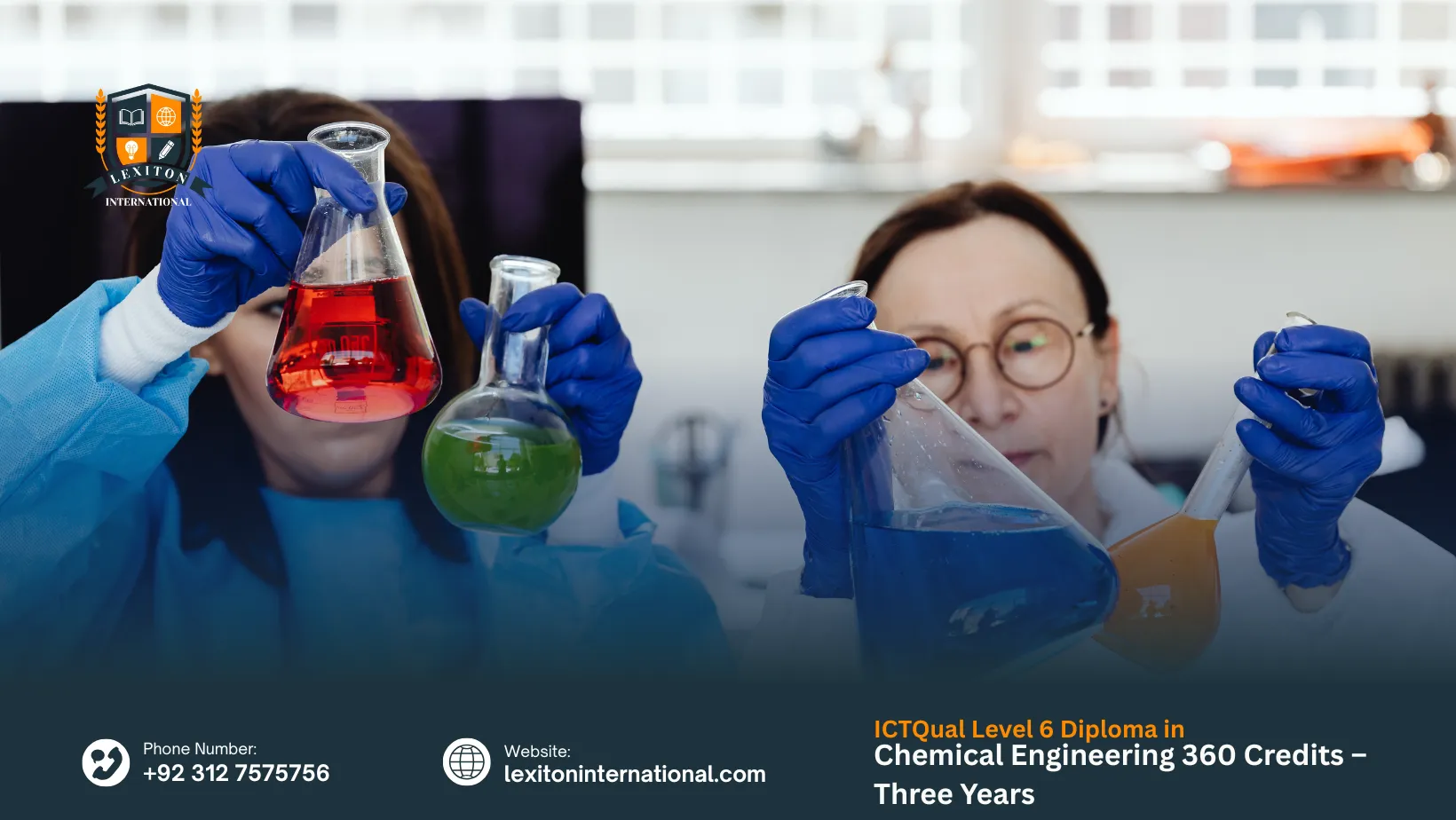
The ICTQual Level 6 Diploma in Chemical Engineering 360 Credits – Three Years is an advanced professional qualification designed to develop comprehensive knowledge and practical understanding of chemical engineering principles, industrial processes and engineering technologies. This three-year diploma provides Learners with an in-depth understanding of chemical process design, thermodynamics, fluid mechanics, heat and mass transfer, reaction engineering, process control and industrial safety.
The qualification is structured to equip Learners with the technical competencies required to understand, analyse and contribute to complex chemical engineering operations across various industrial sectors. Throughout the programme, Learners develop essential skills in problem-solving, process optimisation, engineering calculations, sustainable production and the application of engineering principles in real-world industrial environments.
The ICTQual Level 6 Diploma in Chemical Engineering is suitable for aspiring chemical engineers, engineering professionals and individuals seeking to advance their knowledge of chemical manufacturing, petrochemicals, pharmaceuticals, energy production and process industries. With its 360-credit structure and three-year duration, this qualification supports professional development and provides a strong foundation for progressing towards senior technical responsibilities, specialised engineering roles and further academic or professional development in chemical engineering.
To enrol in the ICTQual Level 6 Diploma in Chemical Engineering 360 Credits – Three Years, Learners should meet the following entry requirements to ensure they have the appropriate academic foundation, technical understanding and communication skills to complete this advanced chemical engineering qualification successfully.
- Age Requirements: Learners should generally be 18 years or above at the time of enrolment.
- Educational Background: Applicants should hold a Level 5 qualification or an equivalent recognised qualification in Chemical Engineering, Mechanical Engineering, Process Engineering, Applied Sciences or a related technical discipline.
- Professional Experience: Previous experience in chemical engineering, industrial processing, manufacturing, laboratory operations, petrochemical industries or related engineering environments is desirable.
- English Language Proficiency: Learners must have a good command of English to engage with course materials, assessments, and technical documentation effectively.
Mandatory Units
Year 1: Foundation of Chemical Engineering
Year 2: Advanced Chemical Engineering Concepts
Year 3: Specialization and Industry Application
Here are the Learning Outcomes for each study unit in the ICTQual Level 6 Diploma in Chemical Engineering 360 Credits – Three Year:
Year 1: Foundation of Chemical Engineering
Introduction to Chemical Engineering
- Understand the fundamental concepts and scope of chemical engineering.
- Recognize the role of chemical engineers in industry and society.
Basic Thermodynamics
- Apply the laws of thermodynamics to chemical processes.
- Analyze energy balances in closed and open systems.
Mathematics for Chemical Engineers
- Solve mathematical problems relevant to chemical engineering, including differential equations and linear algebra.
- Apply mathematical modeling to engineering systems.
Fluid Mechanics
- Understand the behavior of fluids in various engineering systems.
- Apply principles of fluid mechanics to solve real-world problems in chemical engineering.
Material and Energy Balances
- Apply material and energy balance equations to chemical processes.
- Solve complex problems involving multi-phase systems.
Introduction to Process Control
- Understand basic concepts of process control.
- Apply control strategies to simple chemical processes.
Chemistry for Chemical Engineers
- Apply principles of general and organic chemistry to chemical engineering.
- Understand chemical reactions and their kinetics in industrial applications.
Introduction to Reaction Engineering
- Understand the principles of chemical reaction engineering.
- Design and analyze simple chemical reactors.
Engineering Drawing and CAD
- Develop technical drawings using engineering drawing standards.
- Utilize computer-aided design (CAD) software for process design and visualization.
Professional Skills Development
- Develop effective communication and teamwork skills in a professional engineering context.
- Demonstrate leadership and problem-solving abilities in group projects.
Heat and Mass Transfer Fundamental
- Apply the principles of heat and mass transfer to chemical processes.
- Solve problems involving conduction, convection, and diffusion.
Chemical Engineering Principles
- Understand key chemical engineering principles such as conservation laws and reaction kinetics.
- Apply these principles to solve engineering problems.
Year 2: Advanced Chemical Engineering Concepts
Advanced Thermodynamics
- Apply advanced thermodynamic principles to complex chemical processes.
- Solve problems involving non-ideal mixtures and phase equilibria.
Heat Transfer
- Analyze and design heat exchange systems.
- Apply heat transfer principles to industrial processes.
Mass Transfer Operations
- Understand mass transfer operations like distillation, absorption, and filtration.
- Apply these operations to industrial processes.
Chemical Process Design
- Design chemical processes from the ground up, integrating material, energy, and safety considerations.
- Develop process flow diagrams and select appropriate equipment.
Industrial Chemistry
- Apply chemical principles to industrial processes and products.
- Analyze industrial chemical reactions and their economic implications.
Process Systems Engineering
- Apply systems thinking to the design and optimization of chemical processes.
- Utilize tools like process simulation and optimization software to enhance performance.
Fluid Dynamics and Flow Systems
- Understand the behavior of fluids in both laminar and turbulent flow regimes.
- Apply fluid dynamics to the design of pipelines, pumps, and other flow systems.
Reaction Engineering
- Design and optimize chemical reactors for industrial-scale applications.
- Analyze and solve complex reactor performance problems.
Environmental Engineering
- Understand the environmental impact of chemical processes.
- Develop strategies to minimize waste and pollution in chemical industries.
Process Control and Automation
- Apply control theory to chemical process systems.
- Implement automation strategies in industrial chemical processes.
Process Modeling and Simulation
- Use modeling and simulation tools to predict the behavior of chemical processes.
- Develop dynamic models for process analysis and optimization.
Engineering Materials
- Understand the properties and applications of materials used in chemical engineering.
- Select appropriate materials for specific engineering applications based on their properties.
Year 3: Specialization and Industry Application
Advanced Process Control
- Apply advanced control strategies to optimize complex chemical processes.
- Design and implement advanced control systems in industrial settings.
Process Safety and Risk Management
- Understand the principles of process safety and risk assessment.
- Develop strategies for preventing accidents and managing risks in chemical plants.
Chemical Plant Design
- Design and optimize large-scale chemical plants, considering economic, environmental, and safety factors.
- Develop detailed engineering designs for chemical plant operations.
Sustainable Chemical Engineering
- Apply sustainable engineering principles to reduce the environmental impact of chemical processes.
- Develop strategies for improving energy efficiency and waste reduction in chemical industries.
Separation Technology
- Understand and apply separation technologies such as filtration, distillation, and membrane processes.
- Design separation processes for specific industrial applications.
Computational Fluid Dynamics (CFD)
- Apply CFD tools to model and simulate fluid flow in complex chemical systems.
- Use CFD for optimization and design of chemical processes.
Advanced Materials Science
- Understand the properties and applications of advanced materials in chemical engineering.
- Design and select materials for innovative engineering solutions.
Process Optimization
- Apply optimization techniques to improve the efficiency and cost-effectiveness of chemical processes.
- Use data-driven methods to optimize process performance.
Industrial Placement / Internship
- Gain practical experience in the chemical engineering industry.
- Apply academic knowledge to solve real-world engineering problems in a professional setting.
Capstone Project
- Apply knowledge and skills gained throughout the program to a comprehensive, real-world chemical engineering project.
- Demonstrate problem-solving, research, and design abilities in a professional context.
Project Management for Chemical Engineers
- Develop project management skills specific to chemical engineering projects.
- Plan, execute, and evaluate projects, managing resources, time, and budgets.
Biochemical Engineering
- Apply chemical engineering principles to biological and biochemical processes.
- Design and optimize systems for the production of bio-based products and energy.
Who is This Course For?
The ICTQual Level 6 Diploma in Chemical Engineering 360 Credits – Three Years is designed for individuals who want to develop advanced technical knowledge, engineering competencies and professional expertise in chemical engineering and industrial process operations. This qualification is suitable for:
- Aspiring Chemical Engineers: Individuals seeking to build a professional career in chemical engineering, chemical processing and industrial production.
- Engineering Graduates: Learners with previous qualifications in chemical engineering, mechanical engineering, process engineering or related technical disciplines who wish to advance their knowledge.
- Chemical Engineering Professionals: Individuals working in chemical manufacturing, petrochemical, pharmaceutical and processing industries who want to strengthen their technical capabilities.
- Process Engineers and Technicians: Professionals involved in process operations, production monitoring, process optimisation and industrial engineering activities.
- Manufacturing and Production Professionals: Individuals seeking to understand chemical production systems, industrial processes, quality control and efficient manufacturing operations.
- Laboratory and Quality Control Personnel: Professionals interested in developing their understanding of chemical analysis, laboratory practices, testing procedures and industrial quality standards.
- Industrial and Plant Operations Personnel: Individuals working in chemical plants, refineries, energy facilities and other process-based industries who want to enhance their engineering knowledge.
- Career Changers: Individuals with relevant academic or technical backgrounds who wish to transition into chemical engineering and explore opportunities across chemical processing and related industrial sectors.
- Future Engineering Leaders: Professionals aspiring to progress towards senior technical, supervisory and engineering management responsibilities within chemical engineering organisations.
This three-year, 360-credit qualification is particularly suitable for Learners seeking comprehensive professional development and advanced knowledge of chemical engineering principles, process design, industrial safety, sustainable production and engineering applications.
Future Progression
Completing the ICTQual Level 6 Diploma in Chemical Engineering 360 Credits – Three Years can support Learners in developing their professional expertise and exploring further opportunities in chemical engineering, industrial processing, manufacturing and related engineering sectors.
After successfully completing this qualification, Learners may consider the following progression opportunities:
- Advanced Chemical Engineering Qualifications: Progress towards higher-level professional qualifications in chemical engineering, process engineering and related technical disciplines, subject to entry requirements.
- Further Academic Development: Explore relevant higher education opportunities in chemical engineering, industrial engineering, process technology and applied sciences, subject to institutional admission criteria and recognition of prior learning.
- Specialised Process Engineering: Develop expertise in process design, process optimisation, chemical reaction engineering, heat transfer, mass transfer and industrial process control.
- Petrochemical and Oil Industry Careers: Explore professional opportunities in petroleum processing, oil refining, gas processing, petrochemical production and industrial operations.
- Pharmaceutical and Chemical Manufacturing: Pursue career opportunities in pharmaceutical production, chemical manufacturing, quality assurance, production planning and process improvement.
- Environmental and Sustainable Engineering: Develop specialist knowledge in pollution control, waste management, environmental protection, sustainable chemical processes and resource efficiency.
- Industrial Safety and Risk Management: Progress towards specialised training in process safety, chemical hazard management, industrial risk assessment and engineering safety management.
- Quality Assurance and Process Control: Explore roles involving quality management, laboratory testing, chemical analysis, production monitoring and compliance with industrial standards.
- Professional Engineering Development: Work towards relevant professional memberships, certifications and competency-based development opportunities, subject to the requirements of the relevant professional institutions.
- Senior Engineering and Management Roles: With suitable industry experience and additional professional development, progress towards positions such as Chemical Engineering Manager, Process Engineering Manager, Production Manager or Technical Operations Manager.
Curious About This Course?