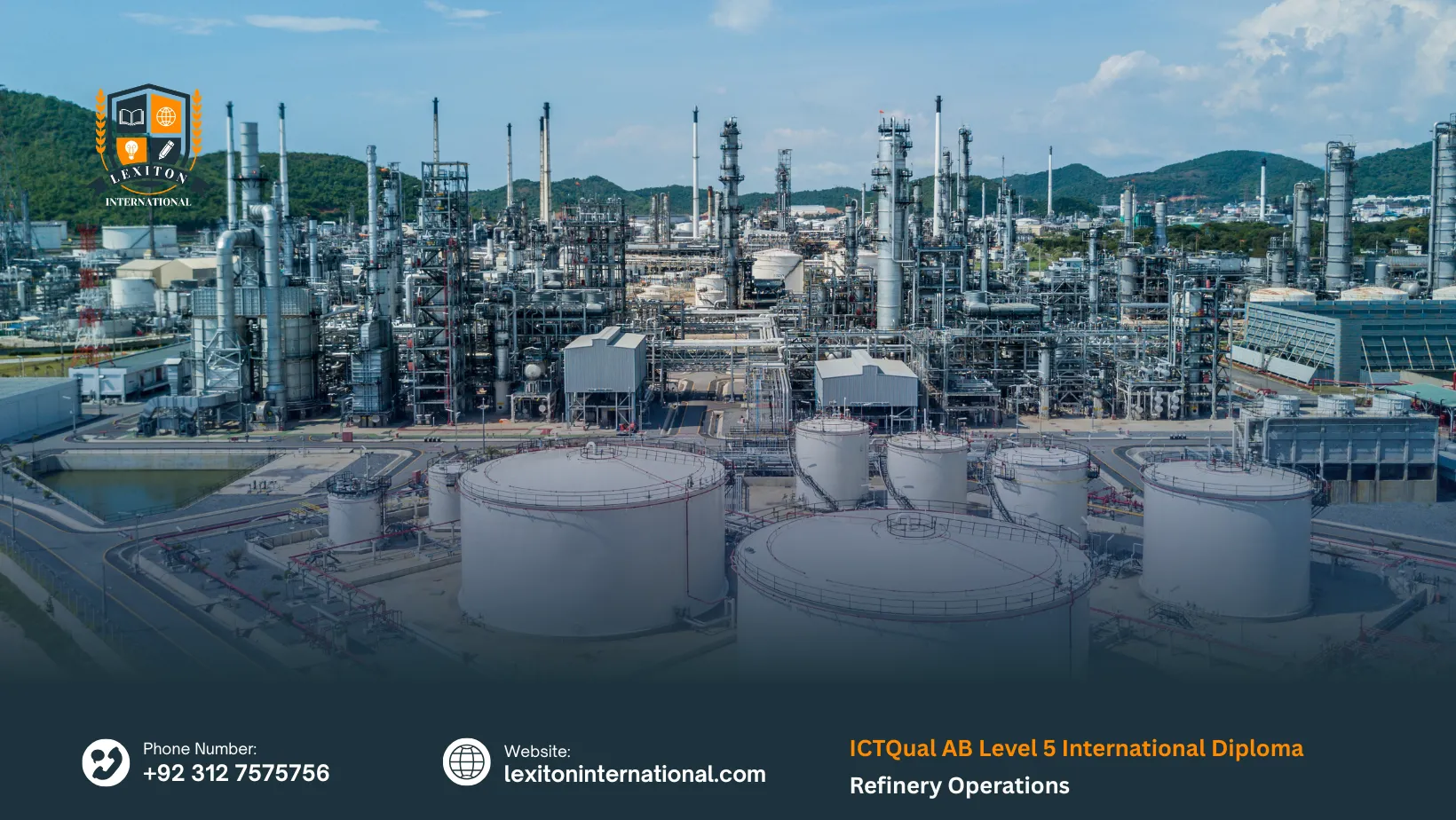
The ICTQual AB Level 5 International Diploma in Refinery Operations is an advanced technical qualification designed to provide learners with in-depth knowledge of modern petroleum refining processes. It focuses on how crude oil is transformed into valuable products such as fuels, lubricants, and petrochemicals that power industries and support global economies. This programme is ideal for individuals who want to build strong expertise in one of the most critical areas of the oil and gas sector.
The course covers key refinery operations including distillation, cracking processes, blending techniques, process control systems, and refinery safety standards. Learners also gain an understanding of plant operations, equipment functionality, and quality control measures used in large-scale industrial environments. Special attention is given to operational efficiency, environmental considerations, and compliance with international safety regulations, ensuring learners develop a well-rounded technical understanding.
By completing this diploma, learners gain the confidence to understand complex refinery systems and their role in global energy production. It enhances analytical thinking and technical awareness, enabling individuals to interpret industrial processes and operational challenges effectively. As refineries remain a vital part of the energy supply chain, this qualification supports learners in building strong competence within the downstream oil and gas industry.
- Age Requirement: Applicants should generally be 18 years or older at the time of enrollment to ensure readiness for technical learning.
- Educational Background: A secondary school qualification is the minimum requirement for entry. Preference is given to candidates with strong foundations in science, mathematics, or engineering-related fields, as these subjects provide the analytical and problem-solving skills necessary for refinery operations.
- Work Experience: No prior refinery experience is required, although any background in engineering, oil & gas, or industrial work is considered an advantage.
- English Language Proficiency: Learners should have a good command of English to understand technical content, instructions, and assessment materials effectively.
Mandatory Units
Year 1 – Foundation in Refinery Operations
Year 2 – Advanced Refinery Operations and Applications
Skills You Will Gain
Learning Outcomes for the ICTQual AB Level 5 International Diploma in Refinery Operations:
Year 1 – Foundation in Refinery Operations
Introduction to Refinery Operations
- Understand the role of refineries in the global energy supply chain.
- Explain the major processes involved in crude oil refining.
- Identify common refinery products and their applications.
- Recognise career pathways within refinery operations.
Fundamentals of Chemistry and Chemical Engineering
- Apply chemical principles to petroleum refining processes.
- Understand chemical bonding, reactions, and thermodynamics.
- Relate chemical engineering concepts to refinery operations.
- Solve basic chemical engineering calculations relevant to refining.
Petroleum Processing Basics
- Explain the stages of petroleum processing from crude oil to final products.
- Differentiate between primary, secondary, and tertiary processing methods.
- Analyse the importance of process integration in refining.
- Identify key process challenges in refining operations.
Refinery Equipment and Plant Layout
- Recognise the functions of major refinery equipment such as pumps, heat exchangers, and reactors.
- Understand refinery plant design and layout considerations.
- Identify equipment symbols and diagrams used in process engineering.
- Apply basic maintenance and operational principles to refinery equipment.
Health, Safety, and Environmental Practices in Refineries
- Apply international safety regulations and standards in refinery operations.
- Identify common workplace hazards and develop risk controls.
- Understand the environmental impact of refining processes.
- Implement safe work practices and emergency procedures.
Instrumentation and Process Control Fundamentals
- Understand the principles of process instrumentation.
- Describe measurement systems for pressure, temperature, and flow.
- Apply basic process control strategies in refinery operations.
- Analyse control system performance in maintaining refinery efficiency.
Mathematics and Physics for Process Engineering
- Apply algebra, calculus, and statistics to process engineering problems.
- Use mechanics, heat transfer, and fluid dynamics in refinery contexts.
- Solve quantitative problems related to refinery operations.
- Interpret mathematical and physical models in refining processes.
Crude Oil Properties and Distillation Processes
- Analyse the physical and chemical properties of crude oil.
- Explain fractional distillation and its importance in refining.
- Identify distillation products and their applications.
- Evaluate the efficiency of distillation processes.
Industrial Communication and Technical Reporting
- Develop effective technical writing and reporting skills.
- Use industry-standard formats for operational and safety reports.
- Apply professional communication in industrial settings.
- Present technical findings clearly and effectively.
Quality Assurance and Laboratory Practices
- Apply laboratory techniques to analyse crude oil and refined products.
- Understand principles of quality control in refinery operations.
- Interpret laboratory results for process improvement.
- Implement quality assurance procedures in line with industry standards.
Energy Efficiency and Utility Systems in Refineries
- Identify major utility systems used in refineries (steam, water, power).
- Evaluate energy consumption in refinery operations.
- Propose strategies to improve energy efficiency.
- Understand the role of utilities in safe and reliable refinery operation.
Academic and Research Skills for Refinery Studies
- Conduct literature reviews and evaluate technical sources.
- Develop academic writing and referencing skills.
- Design small-scale research projects in refinery operations.
- Apply critical thinking and problem-solving to refinery case studies.
Year 2 – Advanced Refinery Operations and Applications
Advanced Refining Processes (Cracking, Reforming, and Blending)
- Explain the principles of catalytic and thermal cracking.
- Understand reforming processes and their role in fuel quality improvement.
- Analyse blending operations for product specification.
- Evaluate process efficiency in advanced refining operations.
Catalytic Processes and Reaction Engineering
- Describe the role of catalysts in refinery processes.
- Understand reaction kinetics and reactor design.
- Analyse performance of catalytic processes.
- Apply reaction engineering principles to optimise refinery operations.
Process Optimisation and Plant Performance
- Identify key performance indicators in refinery operations.
- Apply optimisation techniques to improve refinery efficiency.
- Evaluate process data for performance monitoring.
- Recommend strategies for plant-wide optimisation.
Advanced Instrumentation and Automation in Refineries
- Understand the role of automation in modern refinery operations.
- Apply advanced control systems and digital monitoring tools.
- Analyse data from automated systems for decision-making.
- Evaluate the benefits of automation in improving safety and efficiency.
Maintenance Management and Reliability Engineering
- Understand maintenance strategies for refinery equipment.
- Apply reliability-centred maintenance principles.
- Analyse equipment performance and predict failures.
- Implement maintenance planning and scheduling systems.
Waste Management and Environmental Sustainability in Refining
- Identify waste streams in refinery operations.
- Apply methods for waste reduction and treatment.
- Understand environmental sustainability principles.
- Propose sustainable practices in refining operations.
Energy Economics and Refinery Project Evaluation
- Understand the financial aspects of refinery projects.
- Apply economic analysis to assess project feasibility.
- Use cost-benefit and risk analysis tools in refinery decision-making.
- Evaluate refinery investments from an economic perspective.
Digital Technologies in Refinery Operations (GIS, Remote Monitoring & AI)
- Apply GIS for mapping refinery infrastructure.
- Understand the use of remote monitoring in refinery processes.
- Analyse the role of AI and digital tools in predictive maintenance.
- Integrate digital technologies into refinery operations.
Risk Assessment and Emergency Response Planning
- Identify risks in refinery operations.
- Apply quantitative and qualitative risk assessment methods.
- Develop effective emergency response strategies.
- Ensure compliance with international safety standards.
Process Safety and Regulatory Compliance
- Understand process safety management frameworks.
- Apply industry regulations and legal requirements in refining.
- Analyse case studies of refinery accidents for lessons learned.
- Develop compliance strategies for safe operations.
Professional Practice, Ethics, and Global Industry Standards
- Apply ethical principles in refinery operations.
- Understand global industry standards and codes of practice.
- Demonstrate professional behaviour in industrial contexts.
- Evaluate ethical challenges in refinery operations.
Independent Research Project in Refinery Operations
- Design and execute an independent research project.
- Collect, analyse, and interpret technical data.
- Apply research findings to real-world refinery challenges.
- Present results in professional written and oral formats.
The ICTQual AB Level 5 International Diploma in Refinery Operations is designed for individuals who want to build practical skills and strong technical understanding of downstream oil and gas processes. It is ideal for learners aiming to work in refinery environments where precision, safety, and operational knowledge are essential.
Who Is This Course For
- Learners who want to start a career in refinery operations and petroleum processing plants.
- Individuals interested in understanding how crude oil is converted into usable fuel and chemical products.
- Aspiring technicians aiming to work in refinery units, process plants, and industrial facilities.
- Workers from mechanical or industrial backgrounds planning to enter the oil and gas sector.
- Learners who want to develop hands-on knowledge of plant operations and process systems.
- Individuals interested in monitoring, controlling, and maintaining refinery equipment.
- Candidates seeking entry-level roles in downstream energy and petrochemical industries.
- Professionals looking to strengthen their technical skills in industrial operations.
- People interested in working in large-scale energy production and processing environments.
- Anyone passionate about building a stable career in the global oil and gas refinery sector.
The ICTQual AB Level 5 International Diploma in Refinery Operations strengthens your technical capability for the downstream oil and gas sector by building practical knowledge of refining systems and industrial plant operations. It prepares you for hands-on roles where safety, precision, and process efficiency are essential
Future Progression
- Step into refinery support roles within oil and gas processing and production facilities.
- Contribute to daily plant operations focused on converting crude oil into valuable products.
- Work in process monitoring teams ensuring smooth and stable refinery performance.
- Assist in maintaining equipment efficiency and operational safety standards.
- Build opportunities in petrochemical plants and downstream energy industries.
- Join industrial teams managing large-scale refining and processing systems.
- Take part in operational control activities across complex refinery units.
- Strengthen eligibility for technical positions in global energy and refinery companies.
- Develop recognition for supporting safe and efficient industrial production processes.
Curious About This Course?