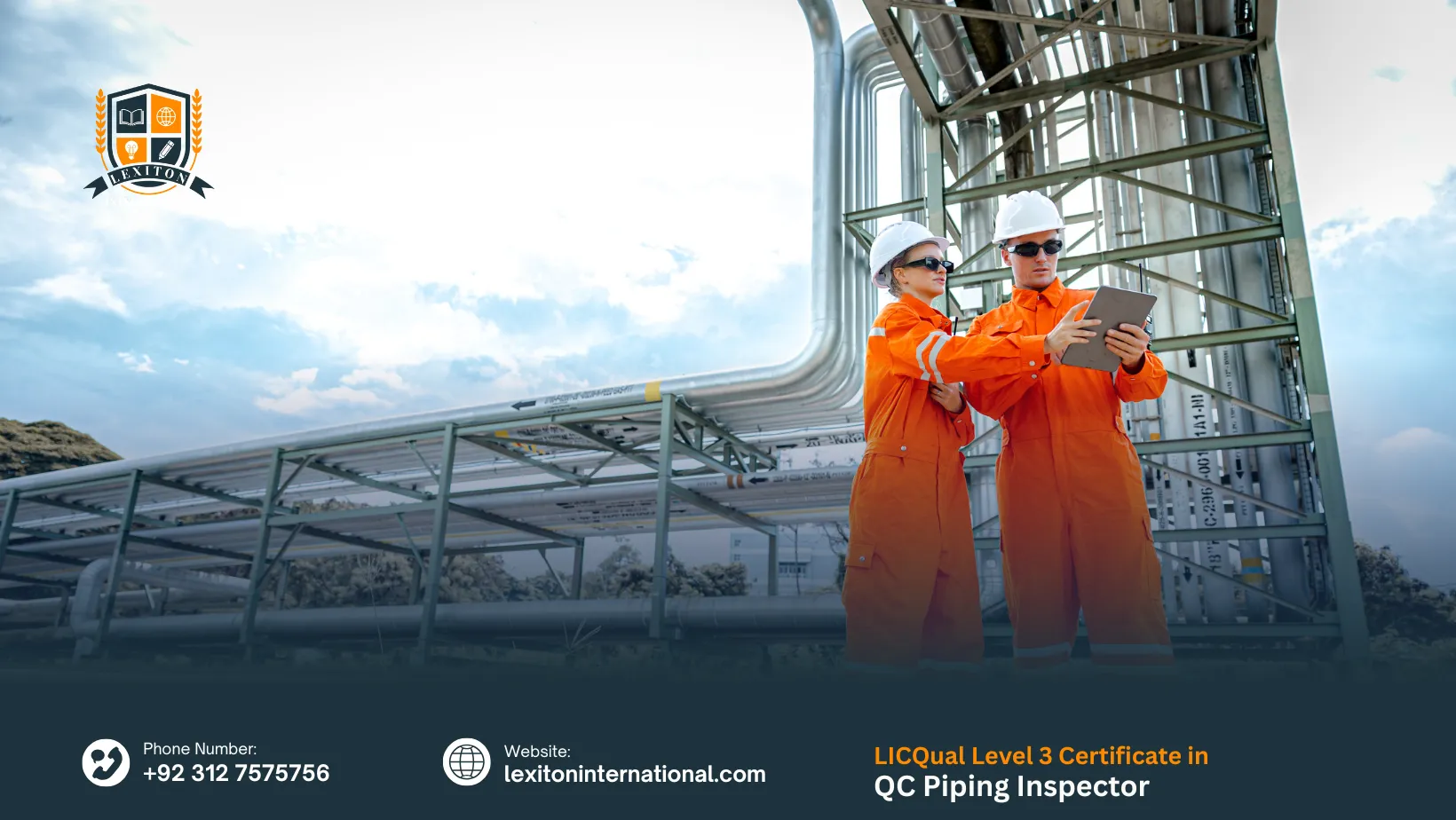
The LICQual Level 3 Certificate in QC Piping Inspector is a foundational qualification designed to provide learners with the essential knowledge and skills required to perform inspection and quality control tasks in piping projects. This program introduces participants to the principles of piping inspection, material evaluation, and compliance with industry standards. It emphasizes practical learning and equips learners with the ability to identify defects, ensure safety, and maintain quality in piping systems. By focusing on industry-relevant practices, the course prepares learners to take on inspection responsibilities with confidence and competence.
The course offers a detailed overview of piping inspection processes, covering topics such as material specifications, welding inspection, non-destructive testing methods, and adherence to international codes. Learners will gain practical insights into inspection techniques, documentation, and reporting, ensuring they can apply their knowledge effectively in real-world projects. The program is structured to reflect industry requirements, enabling participants to understand the importance of quality assurance and compliance in sectors such as construction, oil and gas, and manufacturing.
In addition, the qualification highlights the role of a QC Piping Inspector in maintaining safety and reliability across piping installations. Learners will explore case studies and practical scenarios to strengthen their problem-solving and analytical skills. The course ensures participants are prepared to meet inspection challenges, contribute to project success, and uphold high standards of quality and safety. By the end of the program, learners will have developed the competence to perform inspection duties effectively and support industry compliance requirements.
To enroll in the LICQual Level 3 Certificate in QC Piping Inspector, learners must meet certain entry requirements that ensure readiness for the course and alignment with industry standards. These requirements are designed to balance accessibility with professional relevance.
- Age Requirements: Applicants must be at least 18 years old to demonstrate maturity and readiness for vocational training.
- Qualification Requirements: A minimum of a secondary school certificate or equivalent qualification is required to show basic academic competency.
- Professional Experience: Prior exposure to engineering, construction, or technical fields is preferred, with at least 6 months of relevant work experience.
- Educational Background: Candidates should have a foundation in science, mathematics, or technical studies to support understanding of inspection concepts.
- Language Proficiency Requirement: Learners must possess basic English communication skills to engage with course materials and industry terminology effectively.
- Technical Aptitude Requirement: Applicants should demonstrate interest in engineering practices and the ability to work with inspection tools and documentation.
Mandatory Units
By the end of this course, applicants will be able to demonstrate practical knowledge, technical skills, and professional competence in piping inspection and quality control. The learning outcomes are designed to ensure learners gain both theoretical understanding and hands-on expertise across all essential areas of piping QA/QC practices.
Fundamentals of Piping Systems and Inspection Principles
- Explain the core components and functions of piping systems in industries such as oil and gas, petrochemicals, and construction.
- Describe the principles of quality control inspection and their importance in ensuring safety and reliability.
- Identify the roles and responsibilities of a QC piping inspector in maintaining compliance with project and industry standards.
- Apply basic inspection methodologies to monitor and verify the quality of piping systems during installation and operation.
- Demonstrate awareness of inspection workflows and reporting practices to support project quality assurance.
Introduction to Piping Materials, Fittings, and Components
- Identify common piping materials, fittings, and components such as pipes, valves, and flanges, and their industrial applications.
- Explain the properties of materials like carbon steel and stainless steel, and their suitability for different conditions.
- Assess the quality of fittings and components to ensure they meet project specifications and industry standards.
- Demonstrate knowledge of material selection processes to support effective quality control in piping inspections.
- Recognize how material choice impacts durability, safety, and long-term performance of piping systems.
Basics of Welding Processes and Joint Inspection
- Describe common welding processes used in piping systems, including TIG, MIG, and arc welding.
- Conduct inspections of welded joints to identify defects such as cracks, porosity, or incomplete fusion.
- Apply basic welding inspection techniques to verify weld integrity and adherence to welding procedure specifications (WPS).
- Recommend corrective actions for weld imperfections to maintain structural integrity.
- Document welding inspection findings to support compliance and quality assurance.
Piping Drawings, Symbols, and Isometric Reading
- Interpret piping drawings and isometric diagrams to identify components, dimensions, and specifications accurately.
- Recognize standard symbols and annotations used in piping drawings to support inspection and QA/QC processes.
- Apply isometric reading skills to verify alignment and configuration of piping systems during inspections.
- Evaluate piping layouts against design drawings to ensure compliance with project requirements.
- Use drawing interpretation skills to support inspection planning and reporting.
Visual Inspection Techniques and Defect Identification
- Perform visual inspections of piping systems using appropriate tools and techniques to identify surface defects.
- Identify common piping defects such as corrosion, misalignment, or surface cracks, and assess their impact.
- Document inspection findings accurately, including detailed reports on defects and corrective actions.
- Apply industry best practices to ensure thorough and effective visual inspections.
- Integrate visual inspection results into overall QA/QC documentation and workflows.
Safety, Health, and Environmental Considerations in Piping Inspection
- Identify health, safety, and environmental (HSE) risks associated with piping inspection activities.
- Apply safe work practices during inspections to ensure a secure working environment.
- Explain the environmental impact of piping operations and adopt sustainable practices to minimize waste and emissions.
- Ensure compliance with HSE regulations and industry standards during inspection processes.
- Promote a culture of safety and environmental responsibility in QA/QC activities.
By the end of this course, applicants will be able to confidently perform QC piping inspection duties, ensuring compliance with industry standards, maintaining safety and reliability, and contributing to the overall success of engineering projects.
The ideal learner for this course is someone who is motivated to build a career in piping inspection and quality control, with the right mix of technical interest, professional orientation, and personal attributes. This learner should be prepared to take on inspection responsibilities and contribute to maintaining safety and compliance in piping projects.
Technical Aptitude and Interest
- Shows genuine interest in piping systems and industrial inspection practices
- Possesses basic knowledge of technical drawings and engineering concepts
- Demonstrates curiosity about inspection methods and quality standards
- Comfortable working with inspection tools and documentation
- Motivated to apply theoretical learning in practical industry settings
Professional Orientation
- Aspires to work in industries such as oil and gas, construction, or manufacturing
- Values safety, compliance, and quality assurance in engineering projects
- Seeks recognition through vocational qualifications in inspection roles
- Displays readiness to take on inspection and reporting responsibilities
- Interested in contributing to project success through quality-focused tasks
Educational and Work Background
- Holds a secondary school certificate or equivalent qualification
- May have prior exposure to technical or vocational training
- Possesses some work experience in engineering or construction environments
- Understands the importance of science and mathematics in technical applications
- Prepared to build upon existing knowledge with structured training
Personal Attributes
- Detail-oriented and capable of identifying defects and non-conformities
- Strong analytical and problem-solving skills to address inspection challenges
- Effective communication skills for reporting and teamwork
- Demonstrates responsibility and accountability in professional tasks
- Adaptable to different project environments and inspection requirements
Commitment to Learning
- Willing to dedicate time and effort to mastering inspection practices
- Open to continuous improvement and professional development
- Seeks practical knowledge that can be directly applied in the workplace
- Values structured training and industry-recognized certification
- Motivated to achieve competence and recognition in QC inspection
By meeting these qualities, the ideal learner will be well-prepared to succeed in the LICQual Level 3 Certificate in QC Piping Inspector and contribute effectively to industry standards and practices.
Completing the LICQual Level 3 Certificate in QC Piping Inspector opens pathways for learners to advance their careers through further diplomas and specialized certifications. These progression opportunities allow learners to strengthen their expertise and expand their roles in QA/QC engineering.
Advanced Diplomas in QA/QC Engineering
- Progression to Level 4 or Level 5 Diplomas in QA/QC Engineering
- Focus on advanced inspection techniques and project quality management
- Greater emphasis on supervisory responsibilities within QA/QC teams
- Development of skills for managing complex engineering projects
- Recognition as a mid-level QA/QC professional
Specialized Certifications in Welding and NDT
- Attainment of certifications in welding inspection and non-destructive testing
- Enhanced expertise in ultrasonic, radiographic, and magnetic particle testing
- Ability to specialize in weld quality assurance for piping projects
- Recognition as a certified welding inspector or NDT technician
- Expanded career opportunities in oil and gas, construction, and manufacturing
Quality Management and Audit Certifications
- Progression to certifications in quality management systems (QMS)
- Training in ISO 9001 and related audit procedures
- Ability to conduct internal and external quality audits
- Development of skills for managing compliance across organizations
- Recognition as a quality management professional
Health, Safety, and Environmental Certifications
- Attainment of certifications in occupational health and safety
- Training in environmental compliance and sustainability practices
- Ability to integrate safety and environmental standards into QA/QC roles
- Recognition as a safety-conscious QC inspector
- Expanded opportunities in industries with strict safety regulations
Project and Construction QA/QC Pathways
- Progression to certifications in construction quality assurance
- Training in project-specific QA/QC documentation and reporting
- Ability to manage quality across large-scale construction projects
- Recognition as a construction QA/QC specialist
- Opportunities to work on international infrastructure projects
Industry-Specific QA/QC Certifications
- Attainment of certifications tailored to oil and gas, petrochemical, or power sectors
- Specialized training in sector-specific standards and compliance
- Ability to adapt QA/QC practices to industry-specific requirements
- Recognition as a sector-focused QA/QC inspector
- Enhanced career mobility across global industries
By pursuing these progression opportunities, learners can continue to strengthen their professional standing, expand their technical expertise, and secure advanced roles in QA/QC inspection across diverse industrial sectors.
Curious About This Course?