
Lesson no 1: Understand the different types and value of stakeholder relationships
Every organisation depends on relationships with people and groups who influence, support, use or are affected by its activities. These stakeholders may include customers, employees, suppliers, business partners, managers, investors, regulators, local communities and other relevant groups. The quality of these relationships can have a direct effect on organisational performance, reputation, customer satisfaction, operational efficiency and long-term sustainability. For this reason, stakeholder relationships should not be treated as informal interactions alone; they need to be understood, planned, developed and managed effectively.
Stakeholder relationships can differ significantly in their purpose, level of influence, expectations and contribution to an organisation. A customer relationship may focus on satisfaction, loyalty and service quality, while a supplier relationship may focus on reliability, quality, cost and continuity of supply. Relationships with employees may centre on engagement, communication, performance and collaboration, whereas partnerships may involve shared objectives, resources, expertise and mutual value creation. Understanding these differences enables managers to select appropriate approaches for developing and maintaining each relationship.
The value of stakeholder relationships extends beyond immediate business transactions. Strong relationships can improve communication, encourage collaboration, strengthen trust, support problem-solving and provide organisations with access to knowledge, resources and opportunities. Positive stakeholder relationships can also help organisations respond more effectively to changing customer needs, operational challenges and market conditions. Conversely, poorly managed relationships may result in misunderstandings, conflict, reduced trust, poor service, supply problems, employee disengagement and reputational damage.
This lesson examines the different types of stakeholder relationships and explains why they are valuable to organisations. Learners will explore the characteristics and purposes of relationships with key stakeholder groups and consider how stakeholder interests, expectations, influence and contribution can vary. The lesson will also examine how effective relationships can create mutual benefits and support organisational objectives.
Understanding stakeholder relationships is an important foundation for effective management because organisations rarely achieve their objectives in isolation. Managers need to recognise who their stakeholders are, understand what each relationship requires and appreciate the value that effective engagement can create. By developing this understanding, learners can make more informed professional decisions about how relationships should be established, maintained and strengthened in different organisational contexts.
1.Analyse the Types of Stakeholder Relationships Within Organisations
Understanding stakeholder relationships is a fundamental management and leadership responsibility. Organisations do not operate independently; they rely on a network of people, groups and organisations that provide resources, purchase products or services, perform work, influence decisions, provide expertise, establish requirements or are affected by organisational activities. These people and groups are commonly referred to as stakeholders.
For middle managers and leaders, understanding the different types of stakeholder relationships is particularly important because managers frequently operate between strategic decision-making and operational delivery. They must translate organisational priorities into practical action while maintaining productive relationships with employees, customers, suppliers, senior leaders, partners and other relevant groups. The effectiveness of these relationships can influence service quality, employee performance, operational efficiency, reputation, customer loyalty and the organisation’s ability to achieve its objectives.
Stakeholder relationships are not all the same. Different stakeholders have different interests, expectations, levels of influence, responsibilities and contributions. A customer may expect quality, value and responsive service, while a supplier may expect reliable communication, fair contractual arrangements and timely payment. Employees may expect support, recognition, development and effective leadership, whereas business partners may expect collaboration, shared value and achievement of agreed objectives.
Analysing stakeholder relationships therefore involves more than simply identifying who has an interest in an organisation. It requires managers to understand the purpose of each relationship, the value it creates, the expectations involved, the level of influence held by each stakeholder, potential areas of dependency or conflict, and the management approach required to maintain a productive relationship.
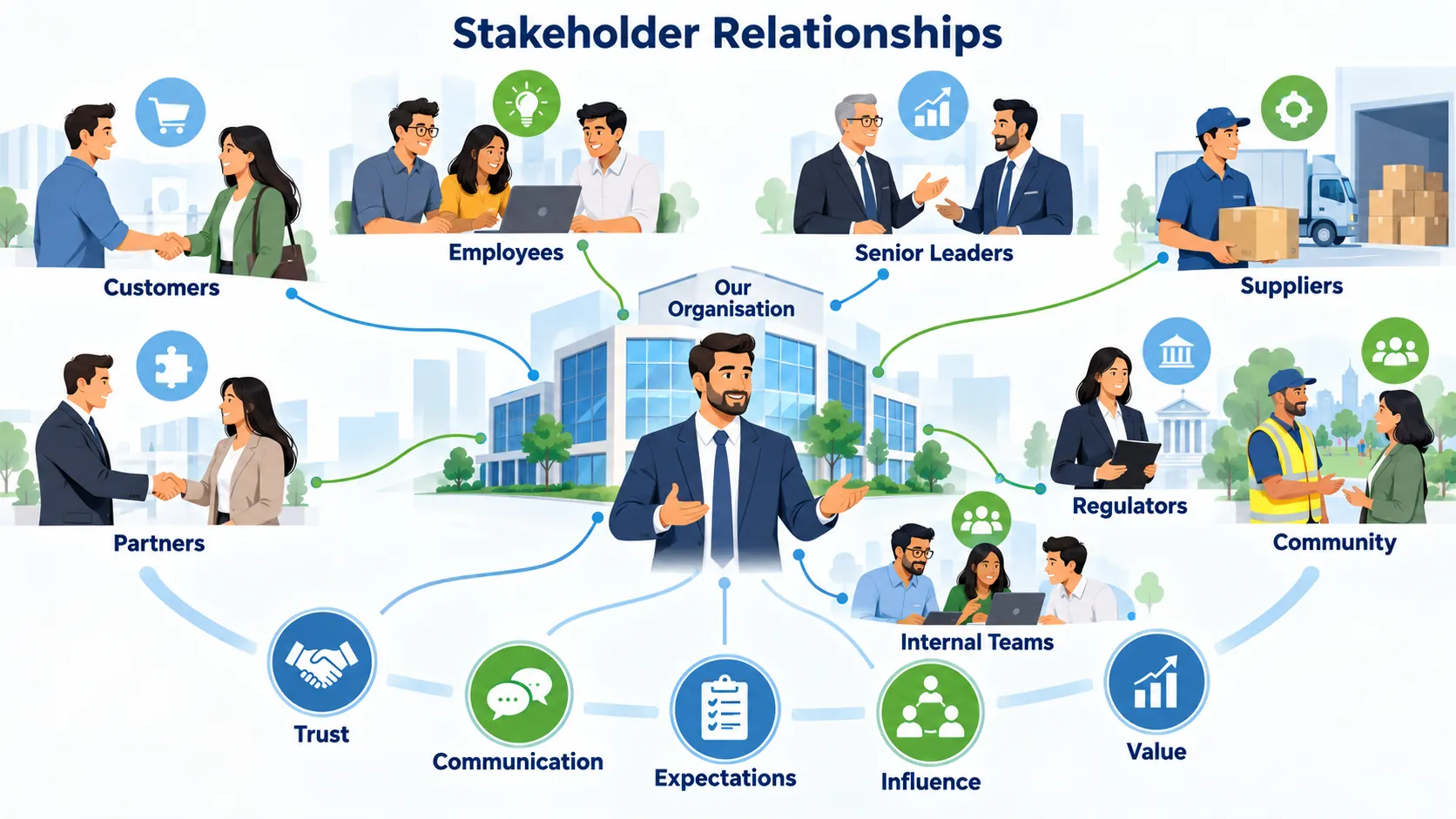
Understanding Stakeholders and Stakeholder Relationships
A stakeholder is an individual, group or organisation that can affect, influence, contribute to, or be affected by an organisation’s activities, decisions, performance or objectives. Stakeholders may exist inside or outside the organisation and can have different degrees of interest and influence.
A stakeholder relationship is the professional connection between an organisation and a stakeholder, developed through communication, interaction, cooperation, exchange, decision-making and shared or competing interests. The relationship may be formal, such as a contractual relationship with a supplier, or less formal, such as an ongoing relationship with a local community group.
The nature of a stakeholder relationship depends largely on why the relationship exists and what each party expects from it. Some relationships are primarily transactional, while others are collaborative and strategic. Understanding this distinction helps managers determine how much communication, engagement, negotiation and relationship development may be required.
Key characteristics of stakeholder relationships
Stakeholder relationships commonly involve several interconnected characteristics:
Purpose: the reason the relationship exists.
Expectations: what each party expects from the relationship.
Interests: what each stakeholder wants to achieve or protect.
Influence: the stakeholder’s ability to affect organisational decisions or outcomes.
Dependency: the extent to which one party relies on another.
Communication: how information is exchanged and understood.
Trust: the confidence that parties will act reliably and appropriately.
Value: the benefits created through the relationship.
Risk: potential problems that could damage the relationship or organisational performance.
Duration: whether the relationship is short-term, ongoing or strategically long-term.
Formality: whether the relationship is contractual, regulated, informal or partnership-based.
Managers should recognise that these characteristics can change over time. A stakeholder with limited influence during one project may become highly influential when circumstances change. Similarly, a supplier that initially provides a routine service may become strategically important if the organisation becomes heavily dependent on its specialist expertise.
Internal and External Stakeholder Relationships
One of the most useful ways to analyse stakeholder relationships is to distinguish between internal and external stakeholders.
Internal stakeholders are individuals or groups within the organisation who have an interest in its performance, decisions and activities. Typical internal stakeholders include employees, managers, senior leaders, internal teams and owners or shareholders where applicable.
External stakeholders are individuals, groups or organisations outside the organisation that influence, support, purchase from, regulate or are affected by its activities. These may include customers, suppliers, business partners, regulators, professional bodies, investors, local communities and other external groups.
The distinction is useful, but managers should not assume that internal stakeholders are always more important than external stakeholders. The significance of a relationship depends on the organisation’s circumstances and objectives.
For example, an external customer may have substantial influence over revenue and reputation, while an internal operations team may have significant influence over service delivery. A regulatory body may have relatively little day-to-day interaction with the organisation but may have considerable authority over whether certain activities can continue.
Internal stakeholder relationships
Internal stakeholder relationships are essential because organisational objectives are ultimately delivered through people and teams. Managers need effective relationships with colleagues, direct reports, other departments and senior decision-makers to coordinate work and achieve organisational priorities.
Important internal stakeholder groups can include:
Employees and team members
Line managers
Middle managers
Senior managers and organisational leaders
Human resources teams
Finance teams
Operations teams
Sales and marketing teams
Information technology teams
Quality and compliance functions
Project teams
Internal service departments
Each internal relationship may have a different purpose. A manager’s relationship with an employee may focus on performance, support and development, while the relationship with the finance department may focus on budgets, financial controls and resource allocation.
Effective internal relationships can support:
Clear communication
Team coordination
Employee engagement
Knowledge sharing
Problem-solving
Performance improvement
Organisational change
Resource management
Conflict resolution
Innovation and continuous improvement
Poor internal relationships can have the opposite effect. Departments may become isolated, information may not be shared effectively, decisions may be delayed and employees may become disengaged.
External stakeholder relationships
External stakeholder relationships connect the organisation with its wider operating environment. These relationships can provide access to customers, resources, specialist expertise, technology, markets, partnerships and important information.
Common external stakeholders include:
Customers and clients
Suppliers and contractors
Business partners
Investors and shareholders
Regulators and government organisations
Professional bodies
Local communities
Industry networks
Service providers
External consultants
Strategic alliances
External stakeholder relationships can have a direct effect on organisational reputation, competitiveness and sustainability. For example, customers influence revenue and reputation, suppliers influence quality and continuity, while strategic partners may provide specialist knowledge or access to new markets.
Customer Relationships
Customers are among the most important stakeholder groups for many organisations because they purchase, use or benefit from the organisation’s products or services. Customer relationships can range from highly transactional interactions to long-term strategic relationships.
A transactional customer relationship may involve a relatively simple exchange: the customer purchases a product or service and the organisation provides it. However, many organisations aim to develop longer-term relationships based on satisfaction, trust, reliability and ongoing value.
Purpose of customer relationships
Customer relationships may be established to:
Deliver products or services effectively
Understand customer needs
Improve customer satisfaction
Build customer loyalty
Encourage repeat business
Obtain feedback
Identify changing expectations
Resolve complaints
Strengthen organisational reputation
Create long-term value
For middle managers, customer relationships are particularly relevant because operational decisions can directly affect customer experience. Staffing levels, service processes, response times, quality standards and complaint handling can all influence the customer relationship.
Characteristics of effective customer relationships
Strong customer relationships generally involve:
Clear communication
Reliability
Responsiveness
Consistent quality
Understanding customer needs
Effective complaint handling
Appropriate personalisation
Transparency
Trust
Continuous improvement
Managers should avoid treating customer satisfaction as the only consideration. A sustainable customer relationship also requires the organisation to understand profitability, service capacity, operational feasibility and long-term value.
Practical example
A training organisation receives feedback that learners are waiting too long for responses to administrative enquiries. A middle manager analyses the issue and discovers that enquiries are being handled manually by a small administrative team.
The manager could introduce a structured enquiry process, establish response-time standards and create clearer communication channels. Customer feedback can then be reviewed alongside response times, complaint levels and learner satisfaction.
The relationship improves because the organisation is responding to a genuine stakeholder need while also improving an internal process.
Employee Relationships
Employees are internal stakeholders who contribute directly to organisational performance. The quality of employee relationships can affect productivity, engagement, retention, service quality, innovation and organisational culture.
Employee relationships are different from customer relationships because employees are not simply recipients of a service. They actively contribute labour, knowledge, skills, experience, creativity and organisational capability.
Purpose of employee relationships
Effective employee relationships help organisations:
Coordinate work
Support performance
Build trust
Communicate organisational priorities
Develop employee capability
Encourage engagement
Manage organisational change
Resolve workplace issues
Encourage innovation
Improve retention
Create a positive working environment
Managers have a particularly important role because employees often experience the organisation through their immediate manager. Leadership behaviour, communication quality, fairness and consistency can therefore strongly influence employee perceptions.
Employee expectations
Employees may expect:
Clear responsibilities
Appropriate resources
Fair treatment
Effective communication
Recognition
Constructive feedback
Development opportunities
Support from managers
Appropriate involvement in decisions
A respectful working environment
Managers must balance employee expectations with organisational objectives and operational requirements. Effective management does not mean agreeing to every employee request; it means listening, communicating clearly and making fair, evidence-based decisions.
Practical example
A customer-service department is experiencing declining performance. The manager initially considers introducing tighter performance monitoring. However, discussions with employees reveal that staff are struggling with outdated systems and unclear procedures.
Rather than assuming that employee performance is the only problem, the manager investigates the wider relationship between employees, processes, technology and management support. Improving the systems and clarifying procedures may produce better outcomes than simply increasing performance pressure.
This demonstrates why stakeholder analysis should consider underlying needs rather than relying on assumptions.
Supplier Relationships
Suppliers provide organisations with products, materials, services, technology, expertise or other resources required for operations. Supplier relationships can therefore range from routine purchasing arrangements to strategically important relationships.
A supplier relationship may be primarily transactional when an organisation purchases standard goods from multiple suppliers. However, it may become more strategic when the supplier provides specialised technology, critical materials, essential services or unique expertise.
Purpose of supplier relationships
Supplier relationships can support:
Reliable access to resources
Product and service quality
Cost management
Continuity of operations
Technical expertise
Innovation
Flexibility
Capacity management
Problem-solving
Operational efficiency
Factors affecting supplier relationships
Managers should consider:
Quality of supplied products or services
Reliability
Delivery performance
Cost
Communication
Responsiveness
Contractual requirements
Capacity
Risk
Dependency
Innovation capability
Long-term sustainability
A strong supplier relationship does not necessarily mean accepting every supplier proposal. Effective management involves clear expectations, appropriate performance monitoring, constructive communication and professional negotiation.
Practical example
A manufacturing organisation relies on a supplier for a specialist component. The supplier begins experiencing delivery delays. Rather than immediately ending the relationship, the purchasing manager meets with the supplier to understand the underlying issue.
The organisations agree on revised delivery arrangements, improved forecasting and clearer communication. At the same time, the manager assesses dependency risk and considers alternative supply options.
This demonstrates that stakeholder relationship management can involve both relationship development and risk management.
Business Partner Relationships
Business partners are organisations or individuals that work together to achieve shared or complementary objectives. Partnership relationships are generally more collaborative than straightforward purchasing relationships.
A partner may contribute:
Expertise
Technology
Market access
Resources
Networks
Facilities
Specialist knowledge
Brand capability
Distribution capacity
Complementary services
The relationship may create value that neither organisation could easily achieve alone.
Characteristics of partnership relationships
Effective partnerships usually require:
Shared objectives
Clear responsibilities
Mutual trust
Open communication
Complementary capabilities
Agreed expectations
Shared problem-solving
Appropriate governance
Performance monitoring
Willingness to manage differences
Partnership relationships can also involve greater complexity because both parties retain their own organisational objectives. Managers must therefore identify where interests align and where they may conflict.
Practical example
A professional training organisation partners with an external technology provider to deliver digital learning services. The training organisation provides subject expertise and learner access, while the technology provider supplies the digital platform and technical support.
The partnership creates mutual value, but it also requires agreement about responsibilities, service standards, communication, data handling and performance expectations.
Senior Leadership Relationships
Middle managers frequently have an important relationship with senior leaders because they translate strategic objectives into operational activity.
Senior leaders typically establish organisational direction, priorities and major strategic decisions. Middle managers then interpret these priorities and coordinate implementation within teams and departments.
Purpose of the relationship
The relationship between middle and senior management supports:
Strategic alignment
Resource allocation
Performance reporting
Risk escalation
Change implementation
Operational feedback
Decision-making
Organisational coordination
Middle managers should be able to communicate operational realities upward while translating strategic priorities downward.
For example, senior leadership may establish a target to improve customer satisfaction. A middle manager may translate this into practical service standards, employee responsibilities, monitoring arrangements and improvement activities.
This makes the relationship two-way rather than simply hierarchical.
Cross-Departmental Relationships
Many organisational objectives require cooperation between different departments. A manager may therefore need to build relationships with colleagues who have different responsibilities, priorities and professional perspectives.
For example, a new customer-service initiative may involve:
Customer service
Operations
Finance
Information technology
Human resources
Marketing
Quality assurance
Each department may have different concerns. IT may focus on technical feasibility, finance may focus on cost, HR may consider employee capability, and customer service may focus on user experience.
Value of cross-departmental relationships
Strong cross-functional relationships can improve:
Information sharing
Coordination
Problem-solving
Innovation
Decision-making
Resource use
Change implementation
Customer outcomes
Managers should recognise that departmental conflict is not always a sign of poor relationships. Different departments may legitimately have different priorities. The management challenge is to create sufficient alignment around shared organisational objectives.
Investor and Shareholder Relationships
In organisations where investors or shareholders are relevant stakeholders, these relationships can influence strategic decisions, financial priorities and expectations about organisational performance.
Investors may be interested in:
Financial performance
Organisational growth
Risk
Governance
Strategic direction
Sustainability
Long-term value
Managers may not deal directly with investors on a daily basis, but their operational decisions can contribute to the performance information reported to senior leadership and governance structures.
The relationship therefore requires accurate information, accountability and alignment with organisational objectives.
Regulatory and Professional Relationships
Regulators, government bodies and professional organisations can influence the way organisations operate. Their role may involve establishing standards, requirements, expectations or professional frameworks.
These relationships are often different from customer or supplier relationships because the organisation may not have the same freedom to negotiate requirements.
Examples of regulatory or professional stakeholders
Government departments
Regulatory bodies
Professional institutions
Accreditation organisations
Inspection bodies
Quality organisations
Industry bodies
Managers need to understand relevant requirements and ensure that operational activity is consistent with organisational responsibilities.
Effective relationships with these stakeholders can support:
Compliance
Organisational credibility
Quality assurance
Professional standards
Risk management
Reputation
Community and Wider Social Relationships
Organisations can affect local communities and wider society through employment, environmental impact, services, infrastructure use and economic activity.
Community stakeholders may include:
Local residents
Community organisations
Charities
Local authorities
Educational institutions
Public interest groups
The significance of these relationships depends on the organisation and its activities. A manufacturing facility, for example, may have a more direct community impact than a small professional services business.
Managers should consider how organisational activities affect wider stakeholders and whether communication or engagement is necessary.
Strategic, Collaborative and Transactional Relationships
Another important way of analysing stakeholder relationships is by considering the nature of the interaction.
Transactional relationships
A transactional relationship focuses primarily on an exchange of value. The parties have clearly defined requirements and usually limited interaction beyond the transaction.
Examples include:
Purchasing standard office supplies
Buying routine services
Processing a straightforward customer order
Using a standard external service
These relationships still require professionalism, reliability and communication, but they may not require intensive relationship development.
Collaborative relationships
A collaborative relationship involves ongoing cooperation between stakeholders to achieve shared objectives.
Examples include:
Cross-departmental projects
Long-term supplier relationships
Strategic partnerships
Joint service development
Co-creation with customers
These relationships require greater communication, trust and coordination.
Strategic relationships
A strategic stakeholder relationship is particularly important to achieving significant organisational objectives. It may involve substantial dependency, shared resources, specialist capability or long-term organisational value.
Examples include:
A technology partner supporting a core business system
A major strategic customer
A critical supplier
A long-term business alliance
Strategic relationships require careful management because problems can have significant organisational consequences.
Analysing Stakeholder Influence and Interest
Identifying stakeholder groups is only the beginning of effective relationship management. Managers should also analyse the level of influence and interest associated with each stakeholder.
Influence refers to the stakeholder’s ability to affect organisational decisions, resources, reputation or outcomes. Interest refers to how significantly the stakeholder cares about or is affected by the organisation’s activities.
A stakeholder may have high influence but low day-to-day interest, while another may have high interest but limited formal influence.
Stakeholder analysis considerations
Managers can consider:
What does the stakeholder want?
What does the stakeholder expect?
How much influence does the stakeholder have?
How strongly is the stakeholder affected?
What resources or expertise does the stakeholder provide?
What risks could arise if the relationship deteriorates?
What does the organisation need from the stakeholder?
What does the stakeholder need from the organisation?
How frequently should communication occur?
What level of involvement is appropriate?
This analysis helps managers avoid treating every stakeholder in exactly the same way.
Stakeholder Relationship Mapping
A simple stakeholder map can help managers determine the appropriate relationship-management approach.
| Stakeholder position | Typical management approach | Example |
|---|---|---|
| High influence, high interest | Manage closely | Major customer or strategic partner |
| High influence, lower interest | Keep satisfied and informed appropriately | Senior decision-maker or key investor |
| Lower influence, high interest | Keep informed and engaged appropriately | Employees affected by a change |
| Lower influence, lower interest | Monitor and provide relevant information | Peripheral external stakeholder |
The purpose of this approach is not to label stakeholders permanently. Stakeholder influence and interest can change as projects, organisational circumstances and stakeholder expectations develop.
Relationship Value and Mutual Benefit
A strong stakeholder relationship should create value for both the organisation and the stakeholder wherever practical.
For an organisation, value may include:
Revenue
Customer loyalty
Reliable supply
Employee performance
Specialist expertise
Innovation
Reputation
Operational efficiency
Market access
Risk reduction
Knowledge
Organisational capability
For stakeholders, value may include:
Quality products or services
Fair treatment
Reliable communication
Financial return
Professional development
Access to expertise
Problem resolution
Partnership opportunities
Convenience
Long-term security
Managers should therefore consider stakeholder relationships as exchanges of value rather than one-sided arrangements.
Trust as a Foundation of Stakeholder Relationships
Trust is an important foundation for sustainable stakeholder relationships. Stakeholders are more likely to cooperate when they believe that the organisation is reliable, transparent, fair and consistent.
Trust can be developed through:
Keeping commitments
Communicating honestly
Providing accurate information
Responding to concerns
Acting consistently
Treating stakeholders fairly
Accepting responsibility for mistakes
Following agreed processes
Trust can be damaged by:
Broken promises
Poor communication
Inconsistent decisions
Hidden information
Unfair treatment
Repeated service failures
Failure to address concerns
For managers, trust is particularly important during periods of organisational change or uncertainty because stakeholders may have concerns about how decisions will affect them.
Managing Different Stakeholder Expectations
Stakeholders rarely have identical expectations. In some situations, their interests may conflict.
For example, customers may want lower prices, employees may want higher rewards, suppliers may seek improved margins and shareholders may expect stronger financial performance.
Managers cannot always satisfy every stakeholder completely. Their responsibility is to understand the competing expectations and make balanced decisions that support organisational objectives.
A structured approach to managing expectations
Managers can:
Identify relevant stakeholders.
Understand their interests and expectations.
Assess their influence and impact.
Identify areas of alignment.
Identify potential conflicts.
Establish realistic expectations.
Communicate decisions clearly.
Agree responsibilities and standards.
Monitor relationship performance.
Review and adjust the relationship when circumstances change.
This approach helps prevent unrealistic expectations and reduces the likelihood of avoidable conflict.
Stakeholder Dependency and Power
Stakeholder relationships can also be analysed according to dependency. Dependency exists when one party relies significantly on another for resources, knowledge, access or outcomes.
For example, an organisation may depend heavily on a specialist supplier because replacing that supplier would be difficult. Similarly, a supplier may depend heavily on a major customer for revenue.
High dependency can create relationship risk. Managers should therefore consider whether critical relationships have appropriate contingency arrangements.
Important questions include:
How difficult would it be to replace this stakeholder?
What would happen if the relationship ended?
Does the stakeholder provide a critical resource?
Does the organisation have alternative options?
How much influence does the stakeholder have?
Is the relationship sustainable?
Understanding dependency enables managers to distinguish ordinary stakeholder relationships from strategically critical relationships.
Communication Across Different Stakeholder Relationships
Communication is central to almost every stakeholder relationship, but the method and frequency should reflect the stakeholder’s needs.
Customers may require responsive service communication, while suppliers may require forecasts and operational information. Employees may need regular team communication, while senior leaders may require concise performance reports.
Managers should consider:
Audience
Purpose
Timing
Communication channel
Level of detail
Confidentiality
Feedback requirements
Follow-up
Effective communication should be two-way wherever appropriate. Managers should not simply provide information; they should also create opportunities for stakeholders to provide feedback and raise concerns.
Conflict Within Stakeholder Relationships
Conflict can arise when stakeholders have different objectives, expectations, priorities or perceptions.
Common causes include:
Resource competition
Different priorities
Communication failures
Unclear responsibilities
Performance disagreements
Contractual disputes
Perceived unfairness
Changes in expectations
Operational pressures
Conflict is not necessarily destructive. When managed professionally, it can reveal important issues and lead to improved decisions.
Managers should aim to understand the underlying interests rather than focusing only on positions.
For example, a supplier may request a higher price. The organisation may initially reject the request because of cost pressures. Further discussion may reveal that the supplier is facing increased material costs. The parties may then explore alternative delivery arrangements, volumes or contract terms.
Digital and Remote Stakeholder Relationships
Modern organisations increasingly manage relationships through digital communication. Email, video meetings, customer platforms, collaboration systems and online service channels can make stakeholder engagement faster and more accessible.
However, digital communication can also create challenges.
Potential benefits include:
Faster communication
Greater accessibility
Improved information sharing
Wider stakeholder reach
Efficient documentation
Flexible collaboration
Potential challenges include:
Misunderstanding tone
Information overload
Delayed responses
Reduced personal connection
Communication fragmentation
Technology problems
Managers should select communication methods according to stakeholder requirements rather than assuming that one channel is suitable for everyone.
Relationship Lifecycle
Stakeholder relationships can change through different stages. Understanding this lifecycle helps managers determine how relationship-management activity should evolve.
Stage 1: Identification
The organisation identifies the stakeholder and determines why the stakeholder matters.
Stage 2: Establishment
Initial communication, expectations, responsibilities and objectives are established.
Stage 3: Development
The parties build familiarity, trust, communication and working arrangements.
Stage 4: Maintenance
The relationship is monitored and managed to ensure that expectations and performance remain appropriate.
Stage 5: Review
The organisation assesses whether the relationship continues to create appropriate value.
Stage 6: Renewal, adjustment or closure
The relationship may be strengthened, renegotiated, changed or ended depending on organisational requirements.
Not every relationship will follow these stages in exactly the same way. However, the lifecycle provides a useful framework for managers to understand how stakeholder relationships develop.
Process for Analysing Stakeholder Relationships
A structured stakeholder relationship analysis can be used when a manager needs to understand an existing or proposed relationship.
Step 1: Identify stakeholders
Determine who can influence, contribute to or be affected by the organisation or specific activity.
Step 2: Classify stakeholders
Determine whether each stakeholder is internal or external and identify the nature of the relationship.
Step 3: Identify the purpose
Clarify why the relationship exists and what outcomes it is intended to support.
Step 4: Assess interests and expectations
Determine what each stakeholder wants, values or expects from the relationship.
Step 5: Assess influence and impact
Consider how much influence the stakeholder has and how strongly the organisation’s decisions affect them.
Step 6: Assess value and dependency
Identify what each party contributes and how dependent the organisation is on the relationship.
Step 7: Identify risks and potential conflicts
Consider where misunderstandings, competing objectives, service failures or dependency risks may arise.
Step 8: Determine the appropriate relationship approach
Decide whether the relationship requires close management, regular communication, collaboration, monitoring or another appropriate approach.
Step 9: Establish communication arrangements
Agree suitable channels, frequency, responsibilities and escalation routes.
Step 10: Review the relationship
Monitor performance, feedback, expectations and outcomes and adjust the relationship-management approach when necessary.
Comparing Different Stakeholder Relationships
The following comparison demonstrates why managers should avoid using a single relationship-management approach for all stakeholders.
| Stakeholder | Main purpose of relationship | Typical expectations | Organisational value | Key management consideration |
|---|---|---|---|---|
| Customers | Deliver value and meet needs | Quality, reliability, responsiveness | Revenue, loyalty, reputation | Customer experience and service quality |
| Employees | Deliver organisational objectives | Support, fairness, communication | Skills, productivity, engagement | Leadership and employee engagement |
| Suppliers | Provide resources or services | Clear requirements, fair dealings, reliable payment | Continuity, quality, efficiency | Performance and dependency |
| Business partners | Achieve shared objectives | Collaboration, trust, mutual value | Expertise, market access, innovation | Shared goals and responsibilities |
| Senior leaders | Translate and deliver strategy | Performance, accountability, information | Direction and organisational alignment | Strategic communication |
| Regulators | Support compliance and standards | Accurate information and appropriate conduct | Credibility and risk control | Compliance and accountability |
| Community groups | Manage wider organisational impact | Responsible and transparent behaviour | Reputation and social relationships | Impact and communication |
| Internal departments | Coordinate organisational activity | Cooperation, information and resources | Efficiency and problem-solving | Cross-functional collaboration |
Practical Workplace Analysis: Training Organisation
Consider a professional training organisation that wants to improve learner satisfaction.
The organisation has several relevant stakeholders:
Learners as customers
Trainers as internal stakeholders
Administrative employees
Senior management
Technology providers
External awarding or professional bodies
Employers or organisational clients
Marketing partners
Each stakeholder relationship has a different purpose.
Learners require effective teaching, accessible resources, responsive support and reliable administration. Trainers need appropriate resources, clear expectations and communication. Technology providers need clear service requirements and effective communication. Senior management needs performance information and evidence that resources are being used appropriately.
If the organisation focuses only on learner satisfaction without considering employees, technology and operational capacity, the improvement may not be sustainable.
A strong manager therefore analyses the entire stakeholder network. The manager identifies how each relationship contributes to the learner experience and determines where improvement is required.
Practical Workplace Analysis: Manufacturing Organisation
A manufacturing business may depend on relationships with customers, suppliers, employees, logistics providers, regulators and technology partners.
Suppose a major customer requests faster delivery. The sales department may support the request because it strengthens the customer relationship. Operations may be concerned about production capacity. Employees may be concerned about workload. Suppliers may need to increase delivery frequency. Finance may need to assess the cost implications.
This situation demonstrates why stakeholder relationships are interconnected.
The manager cannot manage the customer relationship in isolation. The customer expectation creates consequences for internal employees, suppliers, logistics and financial performance.
An effective manager therefore analyses the stakeholder network before making a commitment.
Practical Workplace Analysis: Service Improvement
Imagine a healthcare-related service organisation receives repeated complaints about appointment delays. Customers want faster service, employees want manageable workloads and management wants improved efficiency.
A simplistic response might be to increase appointment numbers. However, stakeholder analysis could reveal that the problem is caused by inefficient scheduling, insufficient information before appointments and delays in processing documentation.
By understanding different stakeholder perspectives, the manager can develop a more appropriate response.
This demonstrates an important management principle: stakeholder relationships should be analysed in context rather than viewed as isolated interactions.
Key Benefits of Analysing Stakeholder Relationships
Effective stakeholder analysis can provide significant organisational benefits.
Improved decision-making
Managers gain a clearer understanding of who is affected by decisions and what consequences may result.
Stronger communication
Understanding stakeholder needs enables managers to choose more appropriate communication methods and messages.
Better resource allocation
Managers can identify which relationships require greater attention, time, resources or investment.
Improved customer satisfaction
Understanding customer expectations can support better products, services and experiences.
Greater employee engagement
Employees are more likely to contribute positively when their perspectives and needs are understood.
Improved supplier performance
Clear expectations, communication and performance management can strengthen supply relationships.
Reduced relationship risk
Early identification of dependencies, conflicts and concerns allows managers to take preventative action.
Stronger collaboration
Stakeholder analysis can identify opportunities for cooperation, co-creation and shared problem-solving.
Improved organisational reputation
Professional and responsible stakeholder relationships can strengthen trust and organisational credibility.
Greater organisational resilience
Strong relationships can provide access to support, information, resources and alternative solutions during periods of uncertainty or change.
Common Mistakes When Analysing Stakeholder Relationships
Managers should avoid several common weaknesses.
Treating all stakeholders equally
Equal treatment does not necessarily mean identical treatment. Different stakeholders have different needs and levels of influence.
Focusing only on powerful stakeholders
Stakeholders with limited formal power may still provide important knowledge, experience or feedback.
Assuming stakeholder interests are fixed
Interests and expectations can change as circumstances change.
Communicating without listening
Stakeholder management requires two-way communication and meaningful feedback.
Ignoring conflicting interests
Different stakeholder groups may have legitimate but competing priorities.
Failing to assess dependency
Critical relationships can create significant operational risk if alternative options are limited.
Measuring relationships only by short-term outcomes
Some stakeholder relationships create long-term value that may not be immediately visible through financial measures.
Relying on assumptions
Managers should use evidence, communication and stakeholder feedback rather than assuming they already understand stakeholder needs.
Managerial Application: Stakeholder Relationship Review
A middle manager can use a stakeholder relationship review to assess the quality and importance of key relationships.
The review should consider:
Who is the stakeholder?
Why is the stakeholder important?
What does the stakeholder expect?
What does the organisation expect?
What does each party contribute?
How much influence does the stakeholder have?
How strongly is the stakeholder affected?
What value does the relationship create?
What risks exist?
What conflicts could arise?
What communication is required?
What evidence indicates that the relationship is effective?
What improvements may be required?
This provides a practical framework for moving from simple stakeholder identification to meaningful relationship analysis.
Key Concepts to Remember
The most important concepts from this part include:
Stakeholders may be internal or external.
Stakeholder relationships exist for different purposes.
Customers, employees, suppliers and partners require different management approaches.
Stakeholder influence and interest can vary.
Stakeholder relationships can be transactional, collaborative or strategic.
Effective relationships should create appropriate value for relevant parties.
Trust, communication and reliability are important relationship foundations.
Stakeholder expectations may conflict.
Managers must balance stakeholder needs with organisational objectives.
Dependency can increase the strategic importance and risk of a relationship.
Stakeholder relationships should be reviewed as circumstances change.
Strong relationships can support performance, reputation, resilience and sustainability.
Effective stakeholder analysis supports better managerial decision-making.
Summary
Stakeholder relationships are a central component of organisational success because organisations depend on a wide range of people and groups to achieve their objectives. Customers provide revenue and feedback, employees provide knowledge and capability, suppliers provide essential resources, partners provide complementary expertise and strategic value, while senior leaders, regulators, professional bodies and communities can influence organisational direction, accountability and reputation.
For practising and aspiring middle managers, analysing these relationships requires more than producing a list of stakeholders. Managers need to understand the purpose of each relationship, stakeholder interests and expectations, levels of influence, organisational dependency, potential risks and the value created by the relationship. They also need to recognise that stakeholder relationships differ in nature. Some are primarily transactional, while others require ongoing collaboration or strategic management.
Effective stakeholder relationship analysis enables managers to make better decisions about communication, engagement, resource allocation, risk management and organisational priorities. It also helps managers recognise potential conflicts before they become significant problems and identify opportunities for collaboration and mutual value creation.
A professional approach begins with identifying relevant stakeholders and then analysing their interests, expectations, influence, impact, contribution and relationship needs. Managers can use stakeholder mapping, relationship reviews and structured communication processes to determine how each relationship should be managed.
The central principle is that no single stakeholder-management approach is appropriate for every situation. Effective managers adapt their approach according to the nature and importance of the relationship while maintaining fairness, professionalism, transparency and alignment with organisational objectives. When stakeholder relationships are understood, planned and managed effectively, they can become a significant source of organisational value, trust, cooperation, resilience and long-term success.
2.Examine the Benefits and Challenges for Organisations Working with Different Stakeholder Groups
Organisations rarely achieve their objectives by working alone. Their success depends on relationships with a wide range of stakeholder groups, including customers, employees, suppliers, business partners, senior leaders, investors, regulators, professional bodies, local communities and other relevant parties. Each stakeholder group can provide resources, knowledge, expertise, feedback, influence or support, but each can also introduce different expectations, risks and management challenges.
For middle managers and leaders, understanding both the benefits and challenges of stakeholder relationships is essential. Effective stakeholder management is not simply about maintaining positive relationships. It involves understanding what each stakeholder contributes, what they expect from the organisation, how their interests may align or conflict with organisational objectives, and how the relationship can be managed to create sustainable value.
A stakeholder relationship can create significant organisational benefits when it is based on clear expectations, effective communication, trust and mutual value. Customers can provide revenue and market insight, employees can contribute skills and innovation, suppliers can provide reliable resources and specialist expertise, and strategic partners can provide access to capabilities that the organisation may not possess internally.
At the same time, stakeholder relationships can create challenges. Stakeholders may have competing priorities, different expectations, unequal levels of influence or conflicting views about organisational decisions. A customer may want lower prices while the organisation needs to protect margins. Employees may want additional resources while management must control costs. Suppliers may request changes to contractual arrangements while the organisation wants consistency and predictability.
Effective managers therefore need to balance relationship development with organisational performance. The objective is not to satisfy every stakeholder request but to understand stakeholder needs, manage expectations professionally and make decisions that support organisational objectives while recognising legitimate stakeholder interests.
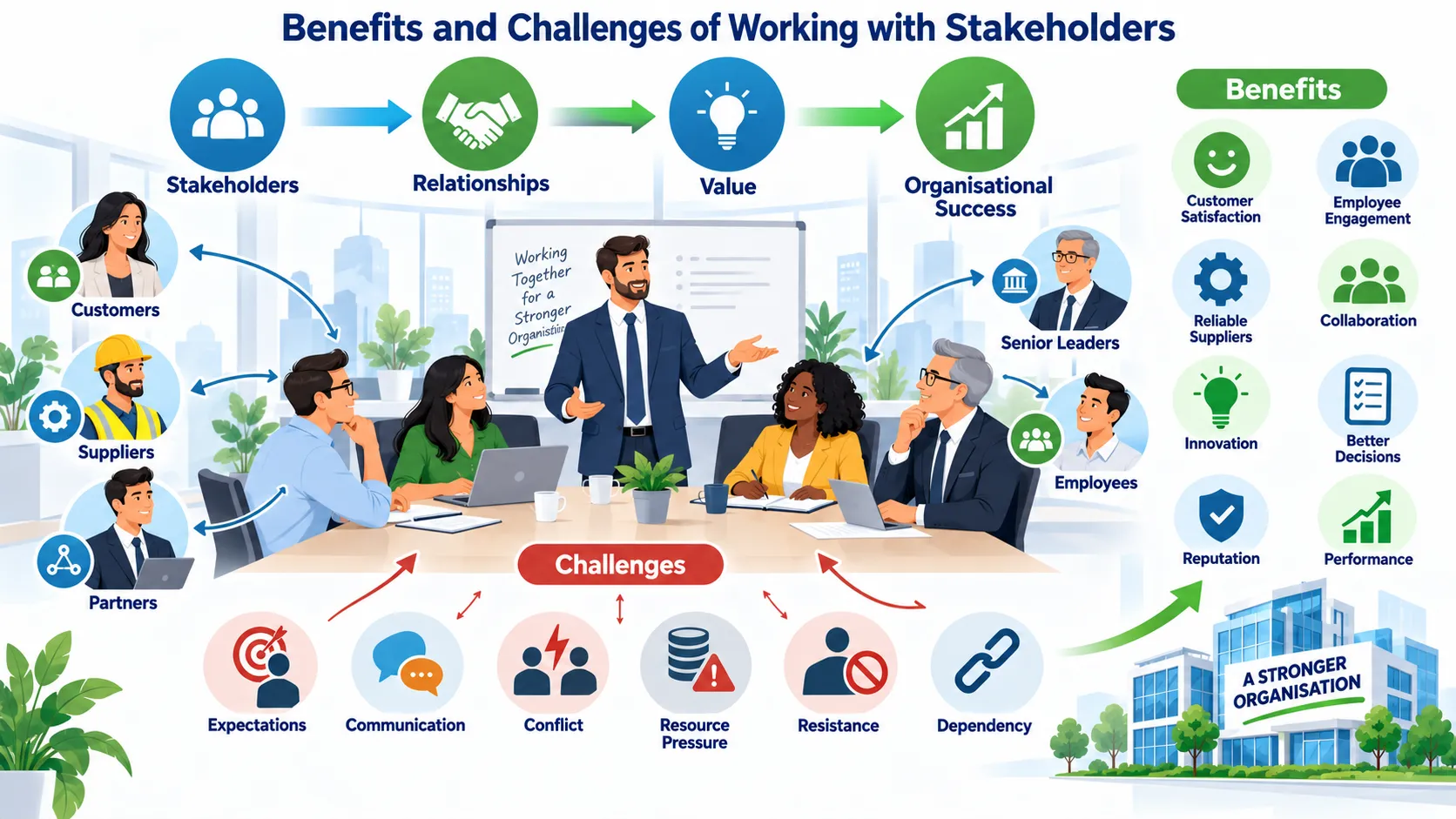
Understanding the Benefits of Stakeholder Relationships
Stakeholder relationships can provide value across almost every area of organisational activity. The exact benefits depend on the type of stakeholder, the purpose of the relationship and the organisation’s objectives.
Strong relationships can improve access to information, resources and expertise. They can also support better decision-making because stakeholders often have direct knowledge of customers, operations, technology, markets or workplace conditions.
For example, employees may understand operational problems that senior managers cannot easily see, while customers may identify service problems before they appear in formal performance data. Suppliers may have specialist knowledge about technology or materials, and business partners may understand emerging market opportunities.
Key benefits can include:
Improved communication and information sharing
Better understanding of stakeholder needs
Increased customer satisfaction and loyalty
Improved employee engagement
Greater access to specialist expertise
More reliable supply arrangements
Improved innovation and problem-solving
Better organisational decision-making
Stronger reputation and credibility
Improved operational efficiency
Increased resilience
Better risk identification
Access to new markets and opportunities
Greater capacity for collaboration
Improved long-term organisational sustainability
Benefits of Working with Customers
Customers are a critical stakeholder group because their decisions can directly affect organisational revenue, reputation and sustainability. Effective customer relationships allow organisations to understand what customers value and how their expectations are changing.
Customer relationships provide organisations with direct feedback about products, services and experiences. This information can identify weaknesses and opportunities for improvement.
Customer relationship benefits
Organisations can gain:
Customer feedback
Information about changing expectations
Improved service quality
Greater customer loyalty
Repeat business
Positive recommendations
Stronger reputation
Better understanding of market needs
Opportunities for product or service development
Early identification of customer dissatisfaction
Customer relationships can also support innovation. Customers may identify problems that internal teams have not considered, creating opportunities for new products, services or processes.
Practical example: Customer service improvement
A training organisation notices that learners are frequently asking for more flexible access to course materials. Instead of assuming that existing arrangements are adequate, management gathers learner feedback and discovers that many learners have work and family commitments.
The organisation responds by improving digital access and providing more flexible learning resources.
The benefit is not simply increased customer satisfaction. The organisation also gains better insight into its market and strengthens its ability to respond to changing stakeholder expectations.
Challenges of Working with Customers
Customer relationships can also create significant management challenges.
Customers may have expectations that are difficult or expensive to meet. Different customers may want different outcomes, making standardisation difficult.
Common challenges include:
Changing customer expectations
Difficult complaints
Service quality concerns
Unrealistic demands
Price sensitivity
Conflicting customer requirements
Negative feedback
High service expectations
Communication difficulties
Maintaining consistency across different customer groups
Managers must distinguish between listening to customers and agreeing to every request. Effective stakeholder management requires professional judgement.
A customer request may be valuable but operationally unrealistic. Managers may therefore need to explain limitations, negotiate alternatives and establish realistic expectations.
Benefits of Working with Employees
Employees are one of the organisation’s most important internal stakeholder groups because they contribute directly to operational performance.
Employees possess knowledge, skills, experience and practical understanding of how work is actually performed. This makes them an important source of organisational intelligence.
Employee relationship benefits
Effective employee relationships can contribute to:
Higher engagement
Improved productivity
Better communication
Greater innovation
Increased knowledge sharing
Stronger teamwork
Improved problem-solving
Greater employee commitment
Better service delivery
Stronger organisational culture
Improved retention
Better implementation of organisational change
Employees can also provide valuable ideas for improving processes because they often experience inefficiencies directly.
Practical example: Employee-led improvement
A customer-service team regularly experiences delays because employees must enter the same customer information into several systems.
The manager invites employees to suggest improvements. Staff identify duplication and recommend a simplified workflow.
The organisation benefits from a practical improvement while employees feel that their knowledge is valued. This can strengthen both operational performance and employee engagement.
Challenges of Working with Employees
Employee relationships can become challenging when organisational objectives conflict with employee expectations.
Employees may have concerns about:
Workload
Working arrangements
Performance expectations
Organisational change
Resources
Recognition
Development
Management decisions
Job security
Communication
Managers must also deal with different employee perspectives. One employee may welcome a new system while another may see it as disruptive.
Common employee relationship challenges
Resistance to change
Misunderstandings
Low engagement
Conflicting expectations
Communication breakdowns
Performance concerns
Perceived unfairness
Departmental conflict
Limited resources
Different working preferences
The manager’s role is to listen, clarify expectations, communicate the reasons for decisions and involve employees appropriately.
Benefits of Working with Suppliers
Suppliers can make a major contribution to organisational performance by providing materials, products, services, technology and specialist expertise.
A strong supplier relationship can provide greater reliability and operational continuity.
Supplier relationship benefits
Organisations may gain:
Reliable access to resources
Improved quality
Better delivery performance
Specialist expertise
Cost efficiencies
Innovation opportunities
Technical support
Greater flexibility
Better problem-solving
Improved supply continuity
Long-term supplier relationships can also improve communication. When suppliers understand the organisation’s requirements and operating environment, they may be better able to anticipate problems and suggest improvements.
Challenges of Working with Suppliers
Supplier relationships can become difficult when performance, cost, availability or expectations change.
Potential challenges include:
Delivery delays
Quality problems
Price increases
Contractual disagreements
Communication failures
Supplier dependency
Capacity limitations
Technology incompatibility
Supply disruption
Conflicting commercial interests
Managers need to balance relationship development with appropriate performance management.
A friendly supplier relationship should not prevent the organisation from addressing poor performance. Similarly, a supplier should not be treated as merely a source of goods when the relationship provides significant strategic value.
Benefits of Working with Business Partners
Business partnerships can allow organisations to combine resources and capabilities.
One organisation may possess technology while another has market knowledge. One may have specialist expertise while another has access to customers.
Partnership benefits
These may include:
Shared expertise
Access to new markets
Shared resources
Innovation
Reduced development time
Increased organisational capability
Joint problem-solving
Improved competitiveness
Access to specialist technology
Shared risk in suitable circumstances
Partnerships can be particularly valuable when an organisation cannot efficiently develop every required capability internally.
Practical example: Technology partnership
A training organisation wants to improve its online learning platform but does not have sufficient internal technical expertise.
It develops a relationship with a specialist technology provider. The training organisation contributes educational expertise and learner knowledge, while the technology partner provides technical capability.
The relationship creates value through complementary strengths.
Challenges of Working with Business Partners
Partnerships can be more complex than standard supplier relationships because both parties may have strategic objectives.
Potential challenges include:
Different organisational priorities
Disagreement over responsibilities
Unequal contributions
Different decision-making processes
Confidentiality concerns
Resource disagreements
Performance expectations
Dependency
Loss of control
Difficulties coordinating activities
Managers should therefore establish clear objectives, responsibilities, communication arrangements and performance expectations at the beginning of the relationship.
Benefits of Working with Senior Leaders
Middle managers have an important relationship with senior leaders because they often translate strategic direction into operational activity.
Effective relationships with senior management can provide:
Clear organisational direction
Access to resources
Strategic support
Faster decision-making
Escalation routes
Organisational visibility
Better alignment
Support for change initiatives
Middle managers also provide valuable operational information to senior leaders.
For example, senior management may believe that a new service process can be implemented immediately. The middle manager may identify capacity, training or technology constraints that need to be addressed first.
This two-way relationship improves strategic decision-making.
Challenges of Working with Senior Leaders
The relationship between middle and senior managers can become challenging when strategic expectations do not match operational realities.
Common challenges include:
Unrealistic targets
Resource constraints
Communication gaps
Different priorities
Limited decision-making authority
Pressure for rapid results
Differences in risk tolerance
Conflicting interpretations of strategy
Middle managers need to communicate operational evidence clearly and professionally rather than simply reporting problems.
A strong manager can explain the issue, provide evidence, identify options and recommend a practical response.
Benefits of Working Across Internal Departments
Cross-functional relationships allow different areas of an organisation to combine expertise.
A customer-service improvement project, for example, may involve customer service, IT, finance, HR, marketing and operations.
Each department can contribute a different perspective.
Benefits include:
Better coordination
Broader expertise
Faster problem-solving
Reduced duplication
Better resource use
Greater innovation
Improved decision-making
More effective implementation
Cross-functional working can prevent departments from developing solutions that solve one problem while creating another elsewhere.
Challenges of Cross-Departmental Relationships
Different departments often have different performance measures and priorities.
Finance may focus on cost control. Customer service may focus on customer satisfaction. Operations may focus on efficiency. HR may focus on employee capability.
These priorities can create tension.
Typical challenges include:
Departmental silos
Conflicting targets
Resource competition
Different professional language
Communication difficulties
Delayed decision-making
Blame between departments
Different interpretations of organisational priorities
Managers can address these challenges by focusing stakeholders on shared organisational outcomes rather than departmental interests alone.
Benefits of Working with Regulators and Professional Bodies
Regulatory and professional relationships can support organisational credibility, compliance and quality.
These stakeholders may provide standards, expectations, guidance or oversight relevant to organisational activities.
Potential benefits include:
Improved compliance
Stronger quality assurance
Professional credibility
Reduced regulatory risk
Clearer standards
Better organisational governance
Increased stakeholder confidence
For managers, understanding regulatory expectations can help prevent problems before they become operational or reputational issues.
Challenges of Regulatory Relationships
Regulatory requirements can create operational challenges when organisations need to adapt processes, systems or resources.
Potential challenges include:
Complex requirements
Additional administrative work
Compliance costs
Changes to organisational processes
Documentation requirements
Monitoring requirements
Conflicting operational priorities
Managers should treat compliance as part of responsible organisational management rather than as an isolated administrative activity.
Benefits of Working with Communities
Some organisations have significant relationships with local communities and wider social groups.
Effective community relationships can support:
Organisational reputation
Local trust
Social responsibility
Better understanding of local concerns
Community cooperation
Reputation management
Identification of local opportunities
For organisations whose activities directly affect communities, maintaining constructive communication can be particularly important.
Challenges of Community Relationships
Community stakeholders may have concerns about organisational activities even when the organisation believes those activities are beneficial.
Potential concerns may relate to:
Environmental impact
Noise
Traffic
Employment
Local resources
Community disruption
Transparency
Organisational responsibility
Managers need to listen to legitimate concerns and communicate openly rather than assuming that organisational priorities automatically take precedence.
Stakeholder Conflict and Competing Expectations
One of the most significant challenges of stakeholder management is that different stakeholder groups may want different outcomes.
Consider a business attempting to reduce operating costs.
Customers may expect prices to remain low. Employees may expect salaries and working conditions to improve. Suppliers may seek higher prices. Senior leaders may want stronger profitability.
These expectations cannot always be satisfied simultaneously.
Managers therefore need to identify areas of alignment and negotiate where appropriate.
Examples of competing stakeholder interests
Customers want lower prices while suppliers seek higher prices.
Employees want additional resources while management seeks cost control.
Senior leaders want rapid implementation while operational teams require more preparation.
Investors seek financial performance while communities may prioritise wider social considerations.
Customers want greater flexibility while employees require manageable workloads.
The manager’s responsibility is to understand these competing interests and make balanced decisions based on evidence, organisational objectives and stakeholder impact.
Stakeholder Relationship Risks
Stakeholder relationships can create risks when they are poorly managed.
Relationship risks may include:
Loss of trust
Poor communication
Reputational damage
Customer loss
Supplier disruption
Employee disengagement
Partnership failure
Regulatory problems
Conflict
Operational delays
Increased costs
Managers should identify relationship risks early rather than waiting until they become significant problems.
The Relationship Between Stakeholder Value and Organisational Value
An important management principle is that stakeholder value and organisational value are often interconnected.
For example, improving employee capability may improve service quality. Better service quality may improve customer satisfaction. Higher customer satisfaction may support loyalty and revenue. Increased revenue may strengthen organisational capacity.
This means that managers should avoid looking at stakeholder relationships in isolated terms.
A decision that appears expensive in one area may create value elsewhere.
Example
An organisation invests in employee training.
The immediate cost is a training expense. However, employees may become more capable, service quality may improve and customer complaints may decline.
The organisation should therefore consider the wider value rather than focusing only on the initial cost.
Process for Evaluating Stakeholder Benefits and Challenges
Managers can use a structured process to analyse stakeholder relationships.
Step 1: Identify the stakeholder group
Determine which stakeholders are relevant to the organisational activity or objective.
Step 2: Define the purpose of the relationship
Clarify why the organisation needs the relationship and what it is intended to achieve.
Step 3: Identify stakeholder contributions
Determine what the stakeholder provides.
This may include:
Money
Skills
Knowledge
Products
Services
Feedback
Technology
Influence
Market access
Operational support
Step 4: Identify stakeholder expectations
Determine what the stakeholder expects from the organisation.
Step 5: Identify organisational expectations
Determine what the organisation requires from the stakeholder.
Step 6: Assess benefits
Identify the value created by maintaining the relationship.
Step 7: Assess challenges
Identify potential barriers, conflicts, dependencies and risks.
Step 8: Assess influence and impact
Determine how strongly the stakeholder can affect organisational outcomes.
Step 9: Determine relationship priorities
Decide how much management attention and communication the relationship requires.
Step 10: Develop an appropriate management approach
Determine how the relationship should be communicated, monitored, developed and reviewed.
Step 11: Monitor relationship performance
Use appropriate indicators, feedback and evidence to determine whether the relationship remains effective.
Step 12: Review and improve
Adjust the relationship where circumstances, expectations or organisational objectives change.
Stakeholder Relationship Assessment Table
| Stakeholder group | Main benefits | Main challenges | Managerial priority |
|---|---|---|---|
| Customers | Loyalty, feedback, revenue and reputation | Complaints, changing expectations and service demands | Understand needs and maintain service quality |
| Employees | Skills, productivity, knowledge and innovation | Resistance, engagement issues and conflicting expectations | Communicate, support and involve appropriately |
| Suppliers | Resources, quality, reliability and expertise | Delays, costs, dependency and performance problems | Monitor performance and manage dependency |
| Business partners | Shared expertise, resources and market opportunities | Conflicting objectives and responsibilities | Establish shared goals and clear governance |
| Senior leaders | Direction, resources and strategic support | Pressure, competing priorities and communication gaps | Maintain strategic and operational alignment |
| Internal departments | Coordination, expertise and problem-solving | Silos, competing targets and resource conflicts | Encourage cross-functional collaboration |
| Regulators | Compliance, credibility and quality assurance | Requirements, administrative demands and change | Maintain accurate information and compliance |
| Communities | Trust, reputation and local cooperation | Concerns about organisational impact | Communicate transparently and responsibly |
Balancing Stakeholder Benefits and Challenges
Effective stakeholder management is about balance. Managers should not focus exclusively on benefits or challenges.
A relationship may produce substantial value while also requiring considerable management effort.
For example, a strategic supplier may provide specialist expertise and reliable products but may also create dependency. The appropriate response is not necessarily to end the relationship. Instead, the manager may strengthen performance monitoring, improve communication and develop contingency arrangements.
Similarly, a demanding customer may create pressure on service teams but also represent significant revenue and provide valuable market insight.
Managers therefore need to consider the overall relationship rather than judging it based on one isolated issue.
Managing Stakeholder Expectations
Expectation management is essential for maintaining sustainable relationships.
Managers should avoid making commitments that the organisation cannot realistically fulfil.
Effective expectation management involves:
Clarifying responsibilities
Agreeing realistic timescales
Explaining limitations
Communicating changes promptly
Confirming service standards
Providing progress updates
Addressing concerns early
Documenting important agreements
Reviewing expectations when circumstances change
When expectations are clear, misunderstandings and conflict are less likely to occur.
Building Trust Across Stakeholder Groups
Trust is particularly important when relationships involve uncertainty, dependency or long-term cooperation.
Managers can build trust by:
Keeping commitments
Communicating consistently
Providing accurate information
Listening to concerns
Acting fairly
Taking responsibility for mistakes
Following agreed procedures
Being transparent about constraints
Trust does not mean avoiding difficult conversations. In fact, professionally addressing problems can strengthen trust because stakeholders see that the organisation is willing to deal with issues openly.
Managing Difficult Stakeholder Relationships
Not every stakeholder relationship will be positive all the time. Managers need skills for handling difficult relationships professionally.
A structured approach can include:
Understand the issue
Determine what has caused the difficulty rather than responding only to the immediate disagreement.
Listen to the stakeholder
Allow the stakeholder to explain concerns and expectations.
Clarify facts
Separate evidence from assumptions or emotional reactions.
Identify shared interests
Look for areas where both parties want similar outcomes.
Explore options
Consider possible solutions rather than focusing only on the disagreement.
Agree actions
Establish clear responsibilities and timescales.
Follow up
Check whether the agreed solution has improved the relationship.
Practical Example: Customer and Employee Conflict
A customer requests a significant change to a service process. The customer believes the change will improve convenience. Employees argue that the change will create additional workload and increase the risk of errors.
The manager should not automatically prioritise either side.
Instead, the manager should:
Understand the customer’s underlying need.
Understand the employee concerns.
Assess operational implications.
Identify possible alternatives.
Consider resource requirements.
Evaluate service and organisational impact.
Agree a practical solution.
Monitor the outcome.
This approach demonstrates balanced stakeholder management.
Practical Example: Supplier and Finance Conflict
A key supplier requests a price increase because its operating costs have increased. Finance wants to minimise expenditure, while operations is concerned that changing suppliers could create disruption.
The manager should consider:
The supplier’s justification
Contractual arrangements
Alternative suppliers
Operational dependency
Quality implications
Cost implications
Relationship value
Long-term supply risk
The best decision may not simply be to accept or reject the price increase. Negotiation could identify alternative arrangements that protect both parties.
Practical Example: Senior Management and Employees
Senior leadership decides to introduce a new working process to improve efficiency. Middle managers are expected to implement the change.
Employees express concerns about workload and capability.
The middle manager can act as a bridge between stakeholders by:
Explaining the organisational reason for the change.
Gathering employee concerns.
Communicating operational issues to senior management.
Identifying training needs.
Clarifying responsibilities.
Supporting implementation.
Monitoring results.
Reporting feedback.
This illustrates the strategic importance of middle managers in stakeholder relationship management.
Using Stakeholder Feedback to Improve Organisational Performance
Stakeholder feedback can provide valuable evidence for organisational improvement.
Feedback can be collected through:
Surveys
Meetings
Interviews
Customer reviews
Complaint analysis
Performance data
Employee discussions
Supplier reviews
Partnership meetings
Formal evaluations
Managers should avoid collecting feedback without using it. Stakeholder engagement becomes less effective when stakeholders repeatedly provide information but see no meaningful response.
A strong feedback process therefore includes:
Collect feedback.
Analyse the information.
Identify recurring themes.
Determine priorities.
Develop appropriate actions.
Communicate decisions.
Implement improvements.
Review outcomes.
Provide feedback to stakeholders.
Measuring the Effectiveness of Stakeholder Relationships
Managers need evidence to determine whether stakeholder relationships are working effectively.
Possible indicators include:
Customer indicators
Customer satisfaction
Complaint levels
Repeat business
Response times
Customer retention
Employee indicators
Engagement
Retention
Absence patterns
Performance
Participation in improvement activities
Supplier indicators
Delivery performance
Quality
Response times
Contract performance
Cost stability
Partnership indicators
Achievement of shared objectives
Joint project performance
Communication effectiveness
Innovation outcomes
Mutual satisfaction
Internal relationship indicators
Project delivery
Cross-departmental response times
Problem resolution
Information-sharing effectiveness
Achievement of shared targets
Measurement should be appropriate to the purpose of the relationship.
Long-Term and Sustainable Stakeholder Relationships
A sustainable stakeholder relationship is one that can continue to create appropriate value over time without becoming unnecessarily dependent, unstable or damaging to either party.
Long-term relationship sustainability can be supported through:
Mutual value
Trust
Consistent communication
Fair expectations
Appropriate performance management
Flexibility
Continuous improvement
Effective conflict management
Clear responsibilities
Regular review
Managers should recognise that maintaining a relationship simply because it has existed for a long time is not sufficient. Relationships should continue to be reviewed against organisational needs and stakeholder expectations.
Key Principles for Middle Managers and Leaders
When managing different stakeholder groups, middle managers should apply several principles.
Understand before acting
Managers should understand stakeholder needs and the organisational context before making decisions.
Adapt the approach
Different stakeholder relationships require different levels and methods of engagement.
Focus on mutual value
Look for outcomes that create sustainable benefits for relevant stakeholders and the organisation.
Communicate clearly
Use appropriate communication methods and establish realistic expectations.
Listen actively
Stakeholder management requires understanding concerns, not simply communicating organisational decisions.
Manage conflict professionally
Different interests are normal. Managers should focus on evidence, shared interests and practical solutions.
Consider long-term consequences
A short-term decision may damage a relationship that creates substantial long-term value.
Monitor relationships
Stakeholder relationships should be reviewed rather than assumed to remain effective.
Escalate appropriately
Managers should recognise when an issue requires senior-level intervention or specialist support.
Key Concepts to Remember
The main concepts from this part include:
Different stakeholder groups provide different forms of organisational value.
Customer relationships can support satisfaction, loyalty, revenue and market insight.
Employee relationships can improve engagement, productivity, innovation and organisational capability.
Supplier relationships can support quality, reliability, resources and specialist expertise.
Business partnerships can combine complementary capabilities.
Senior management relationships support strategic alignment and resource decisions.
Cross-functional relationships improve coordination and problem-solving.
Regulatory relationships support compliance, credibility and quality assurance.
Community relationships can strengthen trust and reputation.
Stakeholders can have competing interests and expectations.
Stakeholder relationships can create both benefits and risks.
Strong communication and trust are foundations of effective relationships.
Managers should assess stakeholder influence, expectations, contribution, benefits and risks.
Stakeholder relationships should be monitored and reviewed over time.
Effective stakeholder management seeks sustainable and mutually beneficial outcomes.
Summary
Organisations gain significant value from working effectively with different stakeholder groups. Customers provide revenue, feedback and market insight. Employees provide knowledge, skills, creativity and operational capability. Suppliers provide resources, products, services and expertise. Business partners can provide complementary capabilities and market opportunities. Senior leaders provide strategic direction and resources, while internal departments contribute specialist knowledge and coordination. Regulators, professional bodies and communities can influence compliance, credibility, reputation and wider organisational relationships.
However, stakeholder relationships also create challenges. Stakeholders may have different expectations, competing interests, varying levels of influence and different interpretations of organisational priorities. Customers may demand greater value, employees may require additional support, suppliers may seek better commercial terms and senior leaders may expect faster performance. Managers must therefore balance these interests rather than attempting to satisfy every stakeholder request.
For middle managers, this balancing role is particularly important. They frequently operate between senior leadership, employees, customers and external stakeholders. They must translate organisational objectives into operational action while communicating stakeholder concerns back into the organisation. This requires strong communication, listening, negotiation, problem-solving, judgement and relationship-management skills.
A structured approach to stakeholder management begins by identifying the relevant stakeholder group and understanding the purpose of the relationship. Managers should then assess stakeholder contributions, expectations, influence, benefits, risks and potential conflicts. Appropriate communication and engagement methods can then be established, followed by regular monitoring and review.
The most effective stakeholder relationships are based on trust, clarity, mutual value, professional communication and realistic expectations. Managers should recognise that a relationship does not have to be free from disagreement to be effective. Constructive challenge and different perspectives can contribute to better decisions when they are handled professionally.
Ultimately, organisations achieve stronger and more sustainable performance when they understand both the value and the challenges associated with their stakeholder relationships. Effective stakeholder management enables managers to strengthen collaboration, manage expectations, reduce relationship risks, improve organisational performance and create sustainable value for the organisation and its relevant stakeholders.