
Lesson no 2 :Understand the process of managing innovation in an organisation
Innovation can provide organisations with opportunities to improve products and services, solve workplace problems, respond to changing customer expectations, strengthen operational performance and create new sources of value. However, having an innovative idea does not automatically result in successful innovation. Organisations need structured processes for identifying opportunities, developing ideas, evaluating their potential, securing appropriate resources, managing risks, gaining stakeholder support and turning suitable ideas into practical initiatives. Effective innovation management therefore provides the link between creativity and measurable organisational outcomes.
The process of managing innovation involves more than generating ideas. It requires managers and leaders to understand where opportunities exist, determine which ideas are worth developing and establish how those ideas can be tested, implemented and evaluated. A well-managed innovation process enables organisations to balance creativity with strategic priorities, financial considerations, operational requirements, customer expectations and organisational capability. This is particularly important for middle managers because they often translate strategic objectives into practical workplace action and coordinate employees, resources and stakeholders during implementation.
Innovation management can begin with identifying a problem, unmet need or opportunity. Opportunities may arise from customer feedback, employee suggestions, performance data, market developments, technological change, competitor activity, resource pressures or changes in organisational priorities. Once an opportunity has been recognised, managers need to encourage and capture relevant ideas rather than immediately selecting the first proposed solution. Ideas can then be screened against organisational objectives and assessed for their potential value, feasibility, resource requirements and risks.
The next stage involves developing promising ideas into realistic innovation initiatives. This may require research, consultation, business-case development, financial analysis, resource planning, risk assessment, stakeholder engagement and pilot testing. Managers need to establish clear responsibilities, timescales and performance measures so that the innovation can move from an initial concept towards implementation. Where uncertainty is significant, a controlled pilot or small-scale test can provide evidence before wider organisational adoption.
Managing innovation also requires effective leadership and communication. Employees need to understand why an innovation is necessary, what problem it addresses and how it may affect their work. Stakeholders may have different priorities, concerns and expectations, so managers must create opportunities for meaningful involvement and feedback. Resistance should not automatically be treated as a barrier; constructive concerns can identify risks or weaknesses that need to be addressed before implementation.
Risk management is another important part of the innovation process. New ideas involve uncertainty, and organisations need to determine which risks are acceptable and how they can be controlled. Financial, operational, technological, people-related, customer, legal and reputational considerations may all need to be examined. Responsible innovation involves encouraging appropriate experimentation while maintaining suitable controls and accountability.
Once an innovation has been implemented, managers need to evaluate whether it has achieved its intended outcomes. Measures may include improvements in customer satisfaction, quality, productivity, efficiency, revenue, cost, employee experience, service performance or other relevant organisational objectives. Evaluation should also identify lessons that can inform future innovation initiatives.
The overall process can therefore be viewed as:
Opportunity → Idea Generation → Screening → Evaluation → Development → Planning → Risk Management → Stakeholder Engagement → Testing → Implementation → Measurement → Learning and Improvement
Understanding this process enables managers to move beyond simply encouraging creativity. It helps them create a disciplined approach through which worthwhile ideas can be transformed into practical improvements. The objective is not to implement every new idea, but to identify opportunities, develop appropriate solutions, make informed decisions and ensure that innovation creates meaningful value for the organisation, its employees, customers and other stakeholders.
In this lesson, learners will explore the process of managing innovation within an organisation, including how innovation opportunities and ideas are identified, evaluated and developed; how resources, risks and stakeholders are managed; how innovation initiatives are implemented; and how outcomes are monitored and reviewed. The lesson will support learners in understanding how effective innovation management can turn an appropriate workplace idea into a realistic, measurable and sustainable organisational improvement.
1.Evaluate Methods Used to Drive Innovation in an Organisation
Innovation is increasingly important to organisational success because organisations operate in environments characterised by changing customer expectations, technological development, competitive pressure, economic uncertainty, changing workforce expectations and evolving regulatory requirements. However, innovation does not happen simply because an organisation asks employees to “be creative”. Effective innovation requires deliberate management practices that encourage people to identify opportunities, generate ideas, test possibilities, manage risk and convert promising ideas into practical improvements.
For middle managers and leaders, understanding how to drive innovation is particularly important because they often operate between strategic leadership and operational delivery. Senior leaders may establish the organisation’s strategic direction and innovation priorities, while operational teams understand customer needs, processes, service problems and day-to-day opportunities for improvement. Middle managers can connect these perspectives by creating the conditions in which useful ideas are identified, evaluated and implemented.
Driving innovation therefore involves much more than introducing new technology or launching new products. It can include improving an existing process, redesigning a service, changing working practices, developing a new product, introducing a new business model, improving customer experience, using data differently or creating a more effective way of organising people and resources.
The central management challenge is to distinguish between an idea and an innovation opportunity. An idea becomes a meaningful innovation initiative when there is a clear reason for pursuing it, a realistic opportunity to create value, sufficient organisational support and a practical route towards implementation.
A useful innovation progression is:
Opportunity → Idea → Evaluation → Experimentation → Implementation → Measurement → Learning → Improvement
Managers should therefore evaluate not only whether an innovation method generates ideas, but also whether it helps the organisation select the right ideas, reduce unnecessary risk, allocate resources appropriately and achieve measurable organisational value.
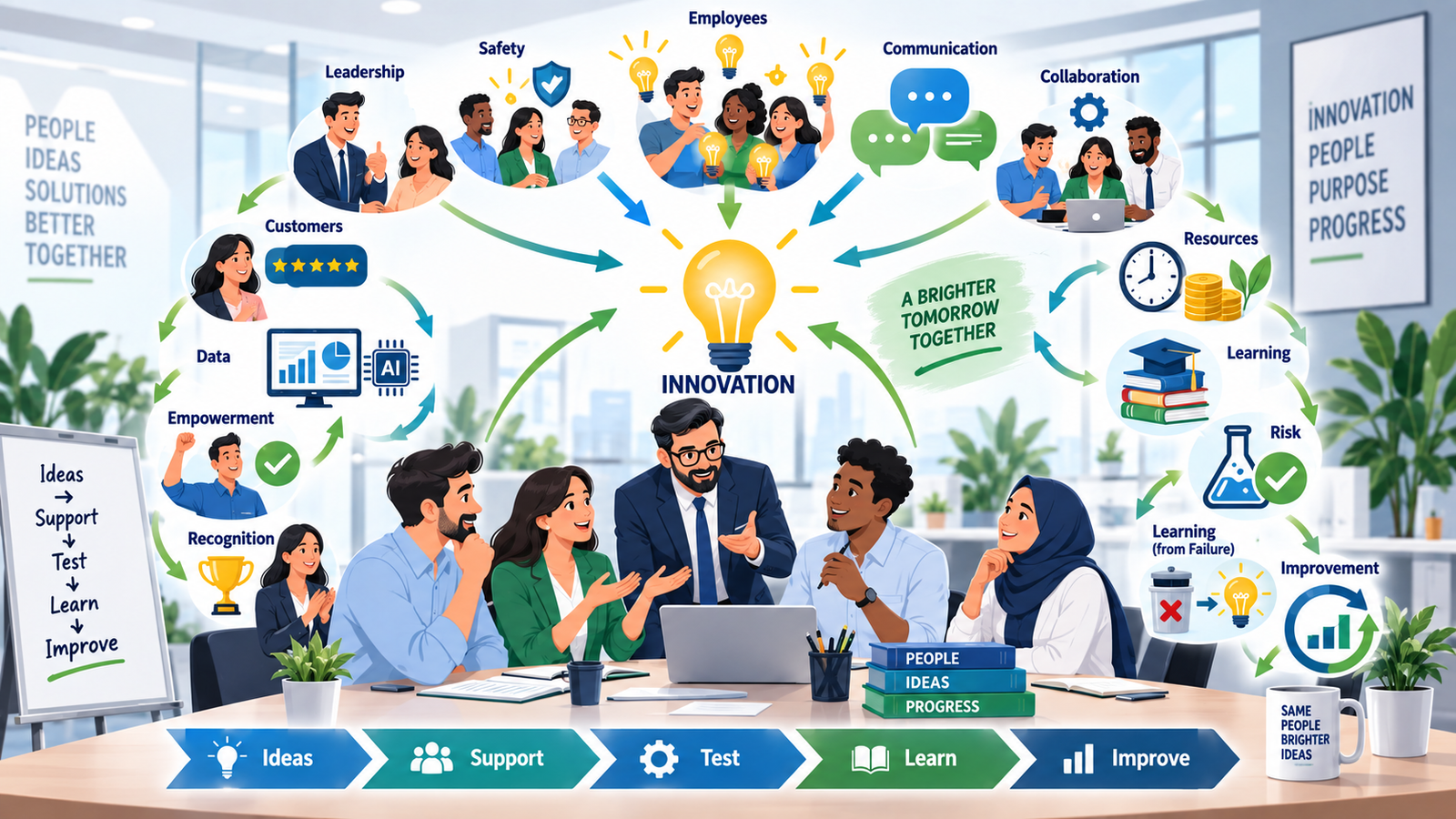
What Does It Mean to Drive Innovation?
To drive innovation means to create the organisational conditions, systems, behaviours and management practices that encourage useful new ideas and enable those ideas to become practical improvements.
Innovation can be driven through formal systems such as innovation programmes, idea-management platforms, research and development activities, pilot projects and structured improvement programmes. It can also be driven through everyday management behaviour, including encouraging employees to challenge inefficient processes, listening to customers, supporting experimentation and recognising useful contributions.
Driving innovation therefore has both a strategic and operational dimension.
At strategic level, leaders determine where innovation can contribute to organisational objectives. At operational level, managers create the conditions that enable employees and teams to contribute ideas and implement improvements.
For example, an organisation may identify customer waiting times as a strategic service-quality problem. A middle manager might then involve employees in identifying the causes, generate possible solutions, test a digital booking process and monitor whether waiting times improve.
The innovation is not simply the introduction of digital technology. The innovation is the improved way of delivering the service and the value created for customers and the organisation.
Innovation Is More Than Generating Ideas
A common misunderstanding is that innovation management is primarily about creativity and brainstorming. Creativity is important, but it represents only one stage of the innovation process.
An organisation could generate hundreds of ideas and still perform poorly if it cannot identify which ideas are valuable, feasible and aligned with organisational objectives.
Effective innovation management therefore requires managers to answer several questions:
What problem or opportunity are we trying to address?
Why does the issue matter?
Who will benefit from the innovation?
What value could the innovation create?
Is the idea aligned with organisational objectives?
What resources will be required?
What risks could arise?
Can the idea be tested before full implementation?
How will success be measured?
What evidence will determine whether the innovation should continue, change or stop?
This means that the effectiveness of an innovation method should be evaluated according to its ability to move ideas towards meaningful outcomes.
Key Concepts in Driving Organisational Innovation
Understanding several core concepts helps managers evaluate different innovation methods appropriately.
| Key concept | Definition | Management relevance |
|---|---|---|
| Innovation | The successful implementation of a new or significantly improved product, service, process, practice or organisational approach that creates value. | Helps managers focus on implemented value rather than ideas alone. |
| Creativity | The ability to generate original and potentially useful ideas. | Provides the input for innovation but does not guarantee implementation. |
| Innovation culture | A working environment where people are encouraged and supported to identify opportunities, contribute ideas, experiment and learn. | Creates conditions in which innovation can become continuous rather than occasional. |
| Intrapreneurship | Entrepreneurial behaviour demonstrated by employees within an existing organisation. | Encourages employees to identify opportunities and take ownership of improvement initiatives. |
| Experimentation | Testing an idea on a limited scale to gather evidence before wider implementation. | Reduces uncertainty and supports evidence-based decisions. |
| Innovation pipeline | A structured process for capturing, assessing, developing, testing and implementing innovation ideas. | Helps organisations manage multiple ideas systematically. |
| Open innovation | Using knowledge, ideas, technologies or partnerships from outside the organisation alongside internal capabilities. | Expands access to expertise and new perspectives. |
| Continuous improvement | An ongoing approach to making incremental improvements to products, services, processes and practices. | Supports sustained operational improvement and employee involvement. |
| Disruptive innovation | Innovation that can significantly alter existing markets, business models or customer expectations. | Can create major opportunities but may involve higher uncertainty and organisational change. |
| Innovation metrics | Measures used to evaluate innovation activity, progress and outcomes. | Enables managers to assess whether innovation is producing meaningful value. |
Methods Used to Drive Innovation in Organisations
Organisations use different methods to stimulate, develop and implement innovation. No single method is appropriate in every organisation. The effectiveness of each method depends on organisational objectives, culture, resources, risk appetite, industry conditions, workforce capability and the type of innovation being pursued.
A strong manager therefore evaluates methods according to their purpose rather than assuming that a method is automatically effective.
Leadership Commitment and Strategic Direction
One of the most important methods for driving innovation is visible leadership commitment.
Innovation can struggle when employees believe that management prioritises routine performance and short-term targets while only discussing innovation in principle. Leaders demonstrate commitment when they allocate resources, communicate priorities, support experimentation and respond constructively to new ideas.
Leadership commitment provides legitimacy. Employees are more likely to contribute ideas when they understand that management genuinely wants innovation rather than simply asking for suggestions without acting on them.
Effective leadership can include:
Communicating clear innovation priorities.
Linking innovation to organisational objectives.
Providing appropriate resources.
Encouraging constructive challenge.
Supporting controlled experimentation.
Recognising useful contributions.
Removing unnecessary barriers.
Reviewing innovation outcomes.
Accepting that some experiments will not produce the expected result.
Demonstrating openness to new approaches.
However, leadership commitment alone does not guarantee innovation.
A senior leader may publicly encourage innovation while organisational processes continue to discourage it. For example, employees may be told to experiment but require six levels of approval before testing a small improvement. In this situation, the stated culture and actual management system contradict each other.
Managers should therefore evaluate leadership commitment by looking at behaviour rather than statements.
Useful evaluation questions include:
Are leaders allocating time and resources to innovation?
Are managers allowed to test ideas within defined boundaries?
Are employees encouraged to challenge established practices?
Are innovation outcomes discussed during management reviews?
Does leadership respond constructively when an experiment does not work?
Creating an Innovation-Friendly Organisational Culture
Organisational culture has a significant influence on innovation because employees make decisions based on what they believe is accepted, rewarded and punished.
A culture that discourages questioning, treats mistakes harshly or rewards only short-term output can suppress innovation.
An innovation-friendly culture encourages people to identify problems and opportunities and to propose practical improvements.
Important cultural characteristics include:
Psychological safety.
Openness to ideas.
Trust between managers and employees.
Constructive challenge.
Collaboration.
Learning from unsuccessful experiments.
Recognition of innovation contributions.
Employee empowerment.
Customer focus.
Continuous improvement.
Appropriate risk-taking.
Psychological safety is particularly important. Employees need confidence that raising a problem or suggesting an alternative approach will not automatically result in criticism.
For example, a warehouse employee may identify that a picking process creates unnecessary movement. If the employee feels comfortable raising the issue, the organisation may discover an opportunity to improve productivity.
If employees believe that questioning established procedures will be interpreted as criticism of management, valuable opportunities may remain hidden.
The effectiveness of culture as an innovation method can be evaluated by examining employee behaviour and organisational outcomes.
Managers can consider:
How frequently employees submit improvement ideas.
Whether ideas are acted upon.
How quickly suggestions receive feedback.
Whether employees participate in experiments.
Whether teams share learning.
Whether unsuccessful experiments produce useful learning.
Whether innovation activity is distributed across the organisation.
Employee Idea Generation
Employees are often a valuable source of innovation because they understand operational processes and customer interactions.
An organisation can create structured mechanisms for employees to contribute ideas through:
Suggestion systems.
Digital idea platforms.
Team improvement meetings.
Innovation workshops.
Problem-solving sessions.
Employee surveys.
Continuous improvement boards.
Cross-functional projects.
Innovation challenges.
Internal competitions.
A strong employee idea system should not simply collect suggestions. It should provide a route for evaluation, feedback and implementation.
A poorly designed suggestion scheme can become ineffective if hundreds of ideas are collected but employees receive no response.
The effectiveness of employee idea generation can therefore be evaluated using measures such as:
Number of ideas submitted.
Percentage of ideas reviewed.
Time taken to provide feedback.
Percentage of ideas tested.
Percentage implemented.
Value created by implemented ideas.
Employee participation rate.
Employee satisfaction with the process.
The quality of the system is more important than the volume of ideas.
Intrapreneurship
Intrapreneurship involves encouraging employees to behave entrepreneurially within an established organisation.
Instead of waiting for senior management to identify every opportunity, employees are encouraged to recognise problems, explore opportunities and develop solutions.
For example, an employee in a training organisation may identify that learners struggle to locate course resources. Rather than simply reporting the problem, the employee may propose a redesigned digital resource system, develop a prototype and test it with a small group of learners.
Intrapreneurship can be particularly effective because employees often have direct knowledge of operational problems and customer needs.
However, it requires appropriate boundaries. Employees need enough autonomy to act while remaining aligned with organisational policies, budgets, quality standards, legal requirements and strategic priorities.
Managers should evaluate whether intrapreneurship is supported by:
Decision-making authority.
Access to information.
Time for innovation.
Coaching and mentoring.
Access to resources.
Senior sponsorship.
Clear risk boundaries.
Recognition and reward.
Cross-Functional Collaboration
Innovation often occurs when people from different functions combine their knowledge.
A finance professional may understand financial implications, an operations manager may understand process constraints, a technology specialist may understand digital possibilities and a customer-service employee may understand customer frustrations.
Bringing these perspectives together can produce stronger solutions.
Cross-functional innovation teams may include representatives from:
Operations.
Finance.
Marketing.
Human resources.
Information technology.
Customer service.
Sales.
Procurement.
Quality.
Compliance.
Product or service development.
The major advantage is diversity of knowledge.
However, cross-functional collaboration can also create conflict. Different departments may have different priorities, terminology and performance measures.
Managers should therefore establish:
A clear innovation objective.
Defined responsibilities.
Shared outcomes.
Decision-making arrangements.
Communication routines.
Conflict-resolution mechanisms.
Agreed evaluation criteria.
A cross-functional team should not be judged only by how many meetings it holds. Its effectiveness should be evaluated by the quality, speed and value of the innovation outcomes it produces.
Customer-Led Innovation
Customers can provide valuable information about unmet needs, service weaknesses and emerging expectations.
Customer-led innovation involves using customer insight to identify opportunities and develop new or improved products and services.
Methods include:
Customer surveys.
Interviews.
Focus groups.
Complaints analysis.
Online reviews.
Customer journey mapping.
Usage data.
Customer observation.
Feedback forums.
Co-creation workshops.
For example, a financial services organisation may discover through customer feedback that users find an application process confusing. Rather than simply training employees to explain the existing system, the organisation could redesign the application process.
The innovation opportunity is therefore identified through customer experience.
The effectiveness of customer-led innovation can be evaluated by measuring changes in:
Customer satisfaction.
Complaints.
Retention.
Service usage.
Customer effort.
Conversion rates.
Repeat purchases.
Service completion times.
Data-Driven Innovation
Data can help managers identify innovation opportunities that may not be obvious through personal observation.
Organisations can analyse:
Performance trends.
Customer behaviour.
Sales data.
Productivity.
Quality results.
Complaints.
Operational delays.
Resource utilisation.
Employee performance indicators.
Market information.
Suppose an organisation discovers that customer enquiries increase sharply at particular times but staffing remains constant. The data may reveal an opportunity to redesign workforce scheduling.
Data does not automatically create innovation. Managers still need to interpret the information, identify causes and develop appropriate responses.
A useful sequence is:
Data → Insight → Opportunity → Idea → Test → Evidence → Decision
Data-driven innovation is particularly useful when managers need evidence to justify investment.
Benchmarking
Benchmarking involves comparing organisational performance, processes or practices against relevant internal or external standards.
Benchmarking can identify performance gaps and reveal practices that may provide opportunities for improvement.
Managers may compare:
Service response times.
Production productivity.
Customer satisfaction.
Operating costs.
Employee turnover.
Digital service adoption.
Quality performance.
Resource utilisation.
Benchmarking should not mean copying another organisation blindly.
A practice that works well in one organisation may fail elsewhere because of different customers, technology, culture, resources or regulatory conditions.
The purpose of benchmarking is to stimulate questions such as:
“Why is this organisation achieving a different result?”
“What could we learn from its approach?”
“What would need to change for a similar approach to work here?”
Continuous Improvement Programmes
Continuous improvement is one of the most widely applicable methods for driving innovation.
It focuses on making regular, manageable improvements rather than waiting for major transformation.
Examples include:
Simplifying processes.
Removing unnecessary steps.
Reducing duplication.
Improving communication.
Reducing waste.
Improving quality.
Shortening service times.
Improving resource utilisation.
Automating repetitive activities.
Continuous improvement can be especially effective in operational environments because employees can identify small improvements based on everyday experience.
However, managers should recognise that continuous improvement is generally more suited to incremental innovation than major transformation.
A business facing a fundamentally changed market may require more than small process adjustments.
Innovation Workshops and Design Thinking
Structured innovation workshops can help teams move from problems to potential solutions.
A design-thinking approach commonly encourages managers and teams to:
Understand users and their needs.
Define the problem.
Generate ideas.
Develop possible solutions.
Prototype.
Test.
Learn and refine.
The strength of this approach is that it places users at the centre of innovation.
For example, an education provider seeking to improve learner engagement might observe how learners access digital resources, identify barriers, generate solutions and test a redesigned learning interface.
Design thinking can reduce the risk of developing solutions based purely on management assumptions.
Brainstorming and Structured Creativity Techniques
Brainstorming is a familiar technique for generating ideas. It can be useful when a team needs to produce a broad range of possible solutions.
Effective brainstorming should establish clear rules.
For example:
Define the problem before generating ideas.
Encourage quantity initially.
Avoid immediate criticism.
Build on others’ ideas.
Include different perspectives.
Record all relevant ideas.
Evaluate ideas after generation.
However, brainstorming has limitations.
Dominant personalities can influence discussions, quieter employees may contribute less, and teams may generate ideas that are exciting but impractical.
Managers can improve the method by combining brainstorming with individual idea generation, anonymous submissions, structured questioning and later feasibility assessment.
Experimentation and Pilot Projects
Experimentation is one of the most effective methods for reducing uncertainty.
Rather than introducing an innovation across the entire organisation immediately, managers can test it on a smaller scale.
A pilot may involve:
One department.
One customer group.
One product.
One location.
One process.
A limited period.
The pilot should have clear objectives and measures.
For example, a retailer considering self-service technology could introduce it in one branch before wider deployment.
Managers can then assess:
Customer response.
Employee response.
Cost.
Reliability.
Productivity.
Quality.
Operational issues.
Unintended consequences.
The key advantage is that evidence can be gathered before significant resources are committed.
Prototyping
Prototyping involves creating an early or simplified version of a product, service, process or solution so that it can be tested.
A prototype does not need to be perfect.
Its purpose is to answer important questions quickly and cheaply.
For example, before developing a complete customer portal, an organisation might create a basic prototype showing the proposed navigation and key functions.
Users can test the prototype and identify problems before major development costs are incurred.
Prototyping is particularly valuable when uncertainty is high.
Open Innovation
Open innovation involves using knowledge and ideas from outside the organisation as well as internal expertise.
External sources can include:
Customers.
Suppliers.
Universities.
Consultants.
Technology providers.
Industry networks.
Professional associations.
Start-ups.
Research organisations.
Strategic partners.
Open innovation can provide access to expertise that the organisation does not possess internally.
For example, a manufacturing organisation may work with a technology provider to develop a new monitoring system rather than attempting to create the technology internally.
However, managers must consider intellectual property, confidentiality, contractual responsibilities, data protection, quality and dependency on external partners.
Partnerships and External Collaboration
Strategic partnerships can drive innovation by combining complementary capabilities.
Two organisations may have different strengths that create a stronger combined solution.
For example:
A technology company may provide digital capability.
A logistics company may provide distribution expertise.
A training organisation may provide subject expertise.
A research organisation may provide technical knowledge.
The effectiveness of partnerships should be evaluated against clear objectives.
Managers should consider whether the partnership provides capabilities that would be difficult, slow or expensive to develop internally.
Technology-Enabled Innovation
Technology can act as an important driver of innovation, particularly through:
Automation.
Artificial intelligence.
Data analytics.
Cloud systems.
Digital platforms.
Mobile applications.
Collaboration tools.
Internet-connected devices.
Customer relationship systems.
Workflow automation.
However, technology should not be treated as innovation in itself.
Introducing expensive software does not necessarily create value.
Managers should begin with the problem or opportunity and then determine whether technology provides an appropriate solution.
A useful decision sequence is:
Problem → Requirement → Possible Solutions → Technology Assessment → Pilot → Evaluation → Implementation
This prevents technology from becoming a solution looking for a problem.
Evaluating the Effectiveness of Innovation Methods
A central requirement for managers is the ability to evaluate innovation methods rather than simply identify them.
Evaluation involves considering both strengths and limitations.
A method can be successful in one context and ineffective in another.
Strategic Alignment
The first consideration is whether the method supports organisational objectives.
For example, an organisation whose priority is improving customer satisfaction may gain more value from customer-led innovation than from an internal technology competition.
Managers should ask:
Does the method address an important organisational priority?
Does it support customer needs?
Does it contribute to strategic objectives?
Can its outcomes be connected to organisational performance?
Value Creation
Innovation should create meaningful value.
Value may take different forms:
Increased revenue.
Reduced costs.
Improved quality.
Faster service.
Higher customer satisfaction.
Improved employee experience.
Reduced risk.
Better resource utilisation.
Increased productivity.
Improved resilience.
Greater sustainability.
Managers should avoid evaluating innovation solely by the number of ideas generated.
Ten implemented ideas producing measurable value may be more valuable than one thousand suggestions that remain unused.
Feasibility
An innovative idea may be attractive but impossible or impractical to implement.
Managers should assess:
Financial feasibility.
Technical feasibility.
Operational feasibility.
Workforce capability.
Time requirements.
Regulatory requirements.
Resource availability.
Supplier capability.
Organisational readiness.
Feasibility assessment helps prevent enthusiasm from replacing evidence-based decision-making.
Risk
Innovation involves uncertainty.
Risk assessment should consider both the risks of implementing the innovation and the risks of not changing.
Potential innovation risks include:
Financial loss.
Operational disruption.
Customer dissatisfaction.
Technology failure.
Cybersecurity issues.
Compliance problems.
Employee resistance.
Reputational damage.
Supplier dependency.
Managers should therefore distinguish between reckless risk-taking and controlled experimentation.
The objective is not to eliminate all risk. It is to understand, manage and appropriately accept risk.
Resource Requirements
Innovation requires resources.
These may include:
Financial resources.
Staff time.
Specialist expertise.
Technology.
Equipment.
Data.
Training.
External support.
An organisation may have a good idea but insufficient capacity to implement it successfully.
Managers therefore need to evaluate whether the expected value justifies the required investment.
Speed and Responsiveness
Some innovation methods are relatively fast, while others require significant development.
For example, an employee suggestion may produce an immediate process improvement, while developing a new product may take several years.
The appropriate method depends partly on the urgency of the opportunity.
Managers should consider:
How quickly the opportunity is changing.
How quickly competitors are moving.
How long customers are willing to wait.
How long implementation will take.
Whether rapid experimentation is possible.
Employee Engagement
Innovation methods should encourage appropriate employee participation.
An effective method should help employees understand:
Why innovation matters.
How they can contribute.
What happens to their ideas.
How decisions are made.
How successful contributions are recognised.
Employee engagement is particularly important for process and workplace innovation because employees often possess practical knowledge that senior managers do not have.
Customer Impact
Managers should evaluate whether innovation improves customer value.
A technically impressive innovation may fail if customers do not need or want it.
Customer impact can be evaluated through:
Feedback.
Satisfaction.
Adoption.
Retention.
Complaints.
Customer effort.
Service outcomes.
Scalability
A pilot may work successfully on a small scale but become difficult or expensive to implement across the organisation.
Managers should therefore consider whether the innovation can be scaled.
Questions include:
Can the organisation provide sufficient resources?
Can employees be trained?
Can technology support larger demand?
Can quality be maintained?
Can suppliers support expansion?
Can the process be standardised where appropriate?
Sustainability
Innovation should not create short-term gains at the expense of long-term organisational performance.
Managers should consider environmental, social and financial sustainability.
For example, a new process may reduce labour costs but increase energy consumption significantly. The organisation should evaluate the complete impact rather than focusing on one performance measure.
A Structured Process for Driving Innovation
Middle managers can use a structured process to move from identifying opportunities to implementing innovation.
Step 1: Identify the Strategic or Operational Need
Start by understanding what needs to improve or what opportunity exists.
Sources can include:
Organisational objectives.
Customer feedback.
Performance data.
Employee suggestions.
Market changes.
Technology.
Competitor activity.
Operational problems.
Regulatory developments.
Step 2: Define the Opportunity
The opportunity should be clearly described.
Instead of stating:
“We need better technology.”
A manager might define the opportunity as:
“Customer service employees spend excessive time manually entering information into multiple systems, creating delays and increasing the risk of errors.”
The second statement provides a clearer basis for innovation.
Step 3: Generate Multiple Ideas
Managers should avoid becoming attached to the first solution.
Different ideas should be considered before selecting an approach.
Step 4: Screen the Ideas
Initial screening should remove ideas that are clearly unsuitable.
Consider:
Strategic fit.
Customer value.
Feasibility.
Cost.
Risk.
Resource requirements.
Time.
Step 5: Evaluate Promising Ideas
More detailed analysis can then be undertaken.
Managers may use:
Cost-benefit analysis.
SWOT analysis.
Risk assessment.
Feasibility studies.
Stakeholder analysis.
Business cases.
Benchmarking.
Scenario analysis.
Step 6: Develop a Prototype or Pilot
Where practical, test the idea on a controlled scale.
The objective is to gather evidence.
Step 7: Review the Evidence
Managers should compare results against agreed criteria.
Questions include:
Did the solution work?
Did customers benefit?
Did employees benefit?
Were costs acceptable?
Were risks controlled?
Did performance improve?
Step 8: Decide Whether to Scale, Adapt or Stop
Not every experiment should be implemented.
Possible decisions include:
Scale the innovation.
Modify it and test again.
Delay implementation.
Combine it with another idea.
Stop the initiative.
Stopping an ineffective experiment can represent good management when the decision is based on evidence.
Step 9: Implement and Manage Change
Successful innovation still requires implementation management.
This may involve:
Communication.
Training.
Resource allocation.
Process redesign.
Technology deployment.
Stakeholder engagement.
Performance monitoring.
Step 10: Measure Outcomes and Learn
After implementation, managers should evaluate actual results.
The organisation should capture learning and identify opportunities for further improvement.
Practical Example: Driving Innovation in Customer Service
Consider a customer service department experiencing long response times.
The manager begins by analysing customer complaints, service data and employee feedback.
The evidence shows that employees repeatedly enter the same information into several systems.
The manager establishes a cross-functional team involving customer service, IT and operations staff.
The team generates several ideas:
Create a shared customer information screen.
Automate repetitive data entry.
Redesign the workflow.
Introduce additional staff.
Create a self-service option.
Instead of immediately purchasing new software, the team evaluates each idea.
Automation appears promising, but the organisation first develops a small pilot.
The pilot is tested with a limited group of employees.
Results indicate that:
Data entry time decreases.
Errors decline.
Employee frustration reduces.
Customer response times improve.
The organisation then develops an implementation plan.
This example demonstrates that effective innovation is not simply about technology. It involves identifying a genuine opportunity, generating alternatives, evaluating them, testing an appropriate solution and measuring outcomes.
Practical Example: Innovation in a Training Organisation
A training organisation notices that learners frequently ask staff where to locate assessment guidance.
The manager identifies this as an opportunity to improve the learner experience.
Rather than simply sending more emails, the manager asks learners and tutors about the problem.
Several ideas emerge:
Redesign the learning platform navigation.
Create a central assessment information area.
Introduce automated reminders.
Create short learner guidance videos.
Develop a searchable resource system.
The manager evaluates each option based on learner value, cost, implementation time and technical feasibility.
A redesigned navigation structure is tested with a small group of learners.
Feedback shows that learners can locate information more quickly.
The organisation then implements the improved structure more widely.
The innovation is measured through:
Learner feedback.
Support enquiries.
Time required to locate resources.
Assessment-related queries.
Platform engagement.
This demonstrates customer-led, employee-supported and evidence-based innovation.
Practical Example: Innovation in a Manufacturing Organisation
A manufacturing company experiences increasing production delays.
The operations manager examines production data and discovers that equipment downtime is concentrated around several machines.
Rather than immediately replacing the equipment, the manager works with maintenance employees to identify the underlying causes.
The team develops several ideas:
Predictive maintenance.
Improved maintenance scheduling.
Operator training.
Replacement components.
Equipment monitoring sensors.
A small technology-enabled pilot is introduced.
The pilot provides information about equipment condition and identifies potential maintenance issues earlier.
The organisation evaluates the results before deciding whether to expand the system.
This example demonstrates how data, employee expertise, technology and experimentation can work together.
The Role of Middle Managers in Driving Innovation
Middle managers play a particularly important role because they can connect strategic ambition with operational reality.
They can translate organisational objectives into practical innovation priorities.
For example:
Strategic objective: Improve customer experience.
Operational evidence: Customers experience long waiting times.
Innovation opportunity: Redesign the service process.
Possible ideas: Digital booking, workflow redesign, additional self-service options.
Evaluation: Assess cost, customer value, risk and feasibility.
Pilot: Test the preferred solution.
Outcome: Measure waiting times and customer satisfaction.
Middle managers also have responsibility for maintaining operational stability while enabling change.
They must therefore balance:
Innovation with reliability.
Experimentation with risk control.
Creativity with commercial discipline.
Employee autonomy with accountability.
Speed with quality.
Short-term performance with long-term improvement.
Common Barriers to Driving Innovation
Even when organisations use formal innovation methods, barriers can reduce their effectiveness.
Fear of Failure
Employees may avoid proposing ideas because they fear criticism.
Excessive Bureaucracy
Complex approval processes can slow innovation.
Lack of Resources
Ideas may not progress because employees have no time, budget or expertise.
Poor Communication
Employees may not understand innovation priorities.
Organisational Silos
Departments may protect their own priorities rather than collaborate.
Short-Term Pressure
Managers may focus entirely on immediate performance and neglect improvement.
Lack of Follow-Through
Employees become disengaged when ideas are collected but ignored.
Poor Measurement
Without clear measures, organisations cannot determine whether innovation creates value.
Resistance to Change
Employees may resist innovations that they perceive as threatening, unnecessary or poorly designed.
Managers should treat these barriers as management issues rather than assuming that employees simply “do not like change”.
How Managers Can Improve the Effectiveness of Innovation Methods
Managers can strengthen innovation systems by creating a clear connection between ideas and organisational outcomes.
Useful practices include:
Define clear innovation priorities.
Make it easy for employees to contribute ideas.
Provide timely feedback.
Use transparent evaluation criteria.
Encourage cross-functional collaboration.
Test ideas before major investment where appropriate.
Use data to support decisions.
Provide appropriate resources.
Recognise useful contributions.
Communicate results.
Capture learning.
Stop unsuccessful initiatives when evidence supports doing so.
Scale successful innovations systematically.
An important principle is that innovation management should not become innovation bureaucracy. Excessively complicated systems can discourage participation.
The process should be proportionate to the scale and risk of the innovation.
A small process improvement may require only a short evaluation and controlled test, while a major product launch may require extensive financial, legal, technical and market analysis.
Measuring Innovation Performance
Managers need appropriate measures to determine whether innovation activity is effective.
Measures can be divided into activity, progress and outcome indicators.
Activity Measures
These show the level of innovation participation.
Examples include:
Number of ideas submitted.
Number of employees participating.
Number of innovation workshops.
Number of experiments initiated.
Progress Measures
These show whether ideas are moving through the innovation process.
Examples include:
Percentage of ideas screened.
Percentage of ideas tested.
Time from idea to pilot.
Percentage of pilots progressing to implementation.
Average development time.
Outcome Measures
These assess the value created.
Examples include:
Revenue generated.
Costs reduced.
Customer satisfaction improved.
Productivity increased.
Quality improved.
Service times reduced.
Employee engagement improved.
Waste reduced.
Risk reduced.
Outcome measures are generally more meaningful than activity measures because they demonstrate whether innovation is creating organisational value.
Evaluating Different Innovation Methods
Managers should recognise that different methods serve different purposes.
Employee suggestion systems are useful for capturing operational knowledge but may produce large volumes of low-priority ideas.
Customer research provides valuable insight into unmet needs but may not reveal technical feasibility.
Brainstorming generates ideas quickly but can be affected by group dynamics.
Cross-functional teams provide diverse perspectives but require effective coordination.
Experimentation reduces uncertainty but requires time and resources.
Open innovation expands access to external expertise but introduces partnership and intellectual-property considerations.
Technology can enable significant improvements but can also produce unnecessary expenditure if the underlying problem has not been clearly defined.
Therefore, the strongest approach is often a combination of methods.
For example:
Customer insight → Employee ideas → Cross-functional evaluation → Prototype → Pilot → Data analysis → Implementation
This creates a connected innovation system rather than relying on one technique.
Key Benefits of Effective Innovation Management
When innovation methods are appropriately selected and managed, organisations can achieve a wide range of benefits.
Organisational Benefits
Improved competitiveness.
Greater operational efficiency.
Better quality.
Reduced costs.
New revenue opportunities.
Improved resilience.
Stronger customer relationships.
Greater adaptability.
More effective use of resources.
Employee Benefits
Greater involvement.
Increased ownership.
Improved motivation.
Opportunities to develop problem-solving skills.
Greater autonomy.
Stronger collaboration.
Improved workplace practices.
Customer Benefits
Better products and services.
Faster service.
Greater convenience.
Improved quality.
More personalised experiences.
Better responsiveness to changing needs.
Key Principles for Managers
Managers responsible for innovation should remember several principles.
Innovation should start with a genuine opportunity, problem or need.
Creativity generates possibilities, but evaluation determines which ideas deserve attention.
Not every new idea is a good innovation.
Innovation should be connected to organisational objectives.
Customers and employees can both provide important innovation insight.
Experimentation can reduce uncertainty.
Risk should be managed rather than ignored.
Innovation requires appropriate resources.
Measurement should focus on meaningful outcomes.
Unsuccessful experiments can provide valuable learning.
Successful innovation requires effective implementation.
Innovation should be continuous rather than treated as a one-off event.
Innovation methods should be proportionate to the scale, cost and risk of the initiative.
A Manager’s Innovation Evaluation Framework
A practical framework for evaluating an innovation method is:
Purpose → Participation → Process → Feasibility → Risk → Resources → Testing → Outcomes → Learning
Managers can use this framework when reviewing any innovation approach.
Purpose
Does the method address an important organisational opportunity?
Participation
Does it involve the people with relevant knowledge?
Process
Does it provide a clear route from idea generation to implementation?
Feasibility
Can promising ideas realistically be delivered?
Risk
Does the method allow risks to be identified and controlled?
Resources
Are appropriate resources available?
Testing
Can uncertainty be reduced through pilots, prototypes or experiments?
Outcomes
Can value be measured?
Learning
Does the organisation capture lessons and use them to improve future innovation?
This framework helps managers move beyond asking “Is this a good innovation method?” and instead ask “Is this the right method for this particular organisational need?”
Summary
Driving innovation in an organisation requires more than encouraging employees to be creative. It involves establishing a structured environment in which opportunities can be identified, ideas generated, solutions evaluated, risks managed, resources allocated, experiments conducted and successful innovations implemented.
Organisations can drive innovation through leadership commitment, innovation culture, employee involvement, intrapreneurship, customer insight, data analysis, cross-functional collaboration, benchmarking, continuous improvement, design thinking, brainstorming, experimentation, prototyping, open innovation, partnerships and technology-enabled approaches.
However, each method has strengths and limitations. Effective managers therefore evaluate innovation methods according to strategic alignment, value creation, feasibility, risk, resources, employee engagement, customer impact, scalability, sustainability and measurable outcomes.
The role of the middle manager is particularly important because middle managers translate strategic priorities into operational action. They can identify workplace opportunities, bring employees and stakeholders together, evaluate ideas objectively, create controlled experiments and ensure that innovation contributes to measurable organisational improvement.
The most important principle is that innovation should be managed as a journey rather than treated as a collection of ideas:
Opportunity → Idea → Evaluation → Experimentation → Implementation → Measurement → Learning → Improvement
When this process is managed effectively, innovation becomes a practical organisational capability. It enables organisations to respond to change, improve products and services, solve operational problems, strengthen customer experience, engage employees and create sustainable value.
For practising and aspiring managers, the key skill is therefore not simply knowing different innovation techniques. It is being able to select, combine and evaluate the right methods for the right organisational context and then turn promising ideas into practical, measurable and sustainable improvements.
2.Examine the Process for Innovation in an Organisation
Innovation can provide organisations with opportunities to improve performance, respond to changing customer expectations, solve workplace problems, introduce new products and services, improve processes and create sustainable organisational value. However, successful innovation rarely happens by chance. An organisation needs a structured process that enables ideas to move from an initial opportunity or problem towards development, implementation and measurable outcomes.
The process for innovation in an organisation provides a systematic way of turning ideas into practical improvements. It helps managers determine which opportunities deserve attention, how ideas should be developed, what resources are required, how risks should be controlled and how outcomes should be measured. It also helps organisations avoid investing significant time and money in ideas that have limited value or are not feasible.
For practising and aspiring middle managers, understanding the innovation process is particularly important because middle managers frequently connect organisational strategy with operational delivery. Senior leaders may establish strategic priorities, while employees and operational teams often identify problems and opportunities through their daily work. Middle managers can bring these perspectives together and create a structured pathway through which opportunities become ideas, ideas become initiatives and initiatives produce measurable outcomes.
A useful way of understanding organisational innovation is:
Opportunity → Idea → Evaluation → Development → Planning → Testing → Implementation → Measurement → Learning → Improvement
This process should not always be treated as a rigid sequence. Innovation is often iterative. Testing may reveal that an idea needs to be redesigned, stakeholder feedback may change the proposed solution, or new evidence may reveal a better opportunity. Effective innovation therefore combines structure with flexibility.
The objective is not to make every idea succeed. The objective is to create a disciplined process that increases the likelihood that valuable ideas will be identified, developed and implemented while unsuitable ideas are rejected or modified at an appropriate stage.
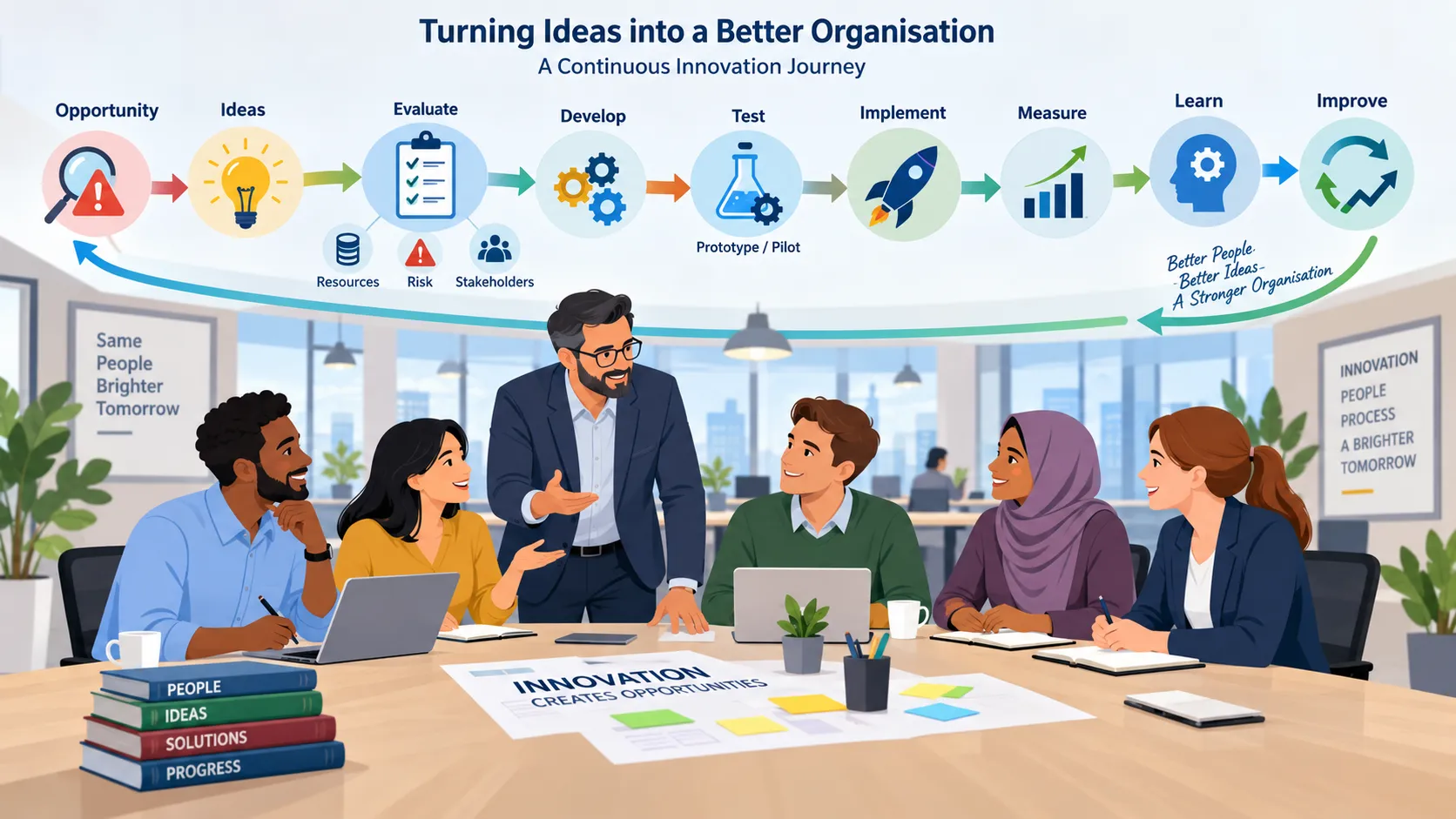
What Is the Innovation Process?
The innovation process is the structured series of activities used by an organisation to identify opportunities, generate and assess ideas, develop solutions, test them, implement appropriate innovations and evaluate their outcomes.
The process connects creativity with organisational action.
An employee might have an idea for improving customer service, but the idea alone does not constitute successful innovation. Management needs to understand the problem, determine whether the idea addresses a genuine need, assess feasibility, identify resources and risks, test the proposed solution and measure the resulting improvement.
For example, an employee may suggest introducing an automated customer enquiry system. The organisation should not automatically purchase technology simply because the idea sounds innovative. Managers should first understand why enquiries are taking too long, whether automation would improve the customer experience, what alternative solutions exist and whether the organisation has the resources and capability to implement the change.
This demonstrates an important management principle:
An innovation process should begin with a genuine organisational opportunity or need rather than an automatic preference for something new.
Why Organisations Need a Structured Innovation Process
Without a structured process, innovation activity can become inconsistent, expensive and difficult to manage.
One department may pursue ideas independently, another may duplicate work, and employees may stop contributing when they see that suggestions are not acted upon.
A structured process creates clarity about:
Where innovation opportunities come from.
Who can contribute ideas.
How ideas are recorded.
How ideas are assessed.
Which criteria are used for decision-making.
Who has authority to approve innovation initiatives.
What resources are available.
How risks are managed.
How testing should be conducted.
How implementation should be managed.
How outcomes are measured.
How organisational learning is captured.
A well-managed process also creates transparency. Employees can understand what happens after they submit an idea, while managers can demonstrate why certain ideas are progressed and others are not.
Key Concepts in the Organisational Innovation Process
| Key concept | Definition | Application within the innovation process |
|---|---|---|
| Innovation opportunity | A problem, unmet need, performance gap or possibility that could create value through change. | Provides the starting point for innovation activity. |
| Idea generation | The process of creating possible solutions to an identified opportunity. | Produces alternative approaches rather than relying on one solution. |
| Idea screening | An initial assessment used to identify ideas that are unsuitable, unrealistic or poorly aligned. | Prevents resources being wasted on inappropriate ideas. |
| Feasibility | The extent to which an innovation can realistically be developed and implemented. | Considers resources, technology, skills, finance, time and operational requirements. |
| Business case | A structured justification for an innovation initiative. | Explains expected benefits, costs, risks and strategic value. |
| Prototype | An early or simplified version of a proposed solution. | Allows ideas to be explored and tested before full implementation. |
| Pilot | A controlled implementation of an innovation on a limited scale. | Provides evidence about effectiveness and potential problems. |
| Stakeholder engagement | The process of involving people affected by or able to influence an innovation. | Builds support and improves the quality of decision-making. |
| Innovation implementation | The process of introducing an approved innovation into operational practice. | Converts the tested idea into actual organisational change. |
| Innovation measurement | The use of appropriate indicators to assess innovation activity, progress and outcomes. | Determines whether the innovation has created the expected value. |
| Organisational learning | The process of capturing and applying knowledge gained from innovation activity. | Strengthens future innovation capability. |
| Innovation pipeline | A managed flow of opportunities and ideas through assessment, development, testing and implementation. | Helps organisations manage multiple innovation initiatives systematically. |
Stage 1: Identify Innovation Opportunities
The first stage is identifying an opportunity for innovation.
An opportunity may arise from a problem, performance gap, customer requirement, technological development, employee suggestion, market change or strategic priority.
Managers should avoid assuming that innovation always begins with a solution. The organisation should first understand the opportunity.
For example, a manager might observe:
“Customer complaints have increased.”
This identifies a problem but not yet an innovation opportunity.
Further investigation may reveal:
“Customers are frustrated because they have to provide the same information repeatedly during different stages of the service process.”
This provides a more specific opportunity.
The manager can then explore how the process could be redesigned.
Sources of Innovation Opportunities
Innovation opportunities can be identified through:
Customer feedback.
Complaints.
Employee suggestions.
Performance data.
Quality problems.
Operational delays.
Resource inefficiency.
Market developments.
Competitor activity.
New technologies.
Regulatory changes.
Changes in customer behaviour.
New business opportunities.
Workforce feedback.
Supplier knowledge.
Strategic objectives.
Sustainability requirements.
Opportunity Identification Questions
Managers can ask:
What is not working effectively?
What could work better?
What are customers asking for?
Where are employees experiencing unnecessary difficulty?
What performance gaps exist?
What is changing in the external environment?
What new technology could create an opportunity?
What are competitors doing differently?
Where are resources being wasted?
What strategic objectives require new approaches?
The quality of opportunity identification influences every later stage.
If the wrong problem is defined, even an excellent solution may fail to create value.
Stage 2: Define the Problem or Opportunity
Once an opportunity has been identified, it should be clearly defined.
This stage is important because poorly defined problems can result in inappropriate solutions.
For example:
“We need a new digital system.”
This statement assumes that technology is the answer.
A better definition might be:
“Employees spend excessive time transferring information between systems, creating delays and increasing the risk of data-entry errors.”
This description identifies the underlying operational issue without prematurely selecting a solution.
Managers can use:
Problem → Evidence → Cause → Impact → Opportunity
The evidence establishes that the issue exists.
Cause analysis explores why it is occurring.
Impact analysis considers the consequences.
The opportunity then defines what could be improved.
Questions for Defining an Opportunity
What is the current situation?
What evidence demonstrates the problem?
Who is affected?
How significant is the impact?
What are the likely causes?
What would success look like?
Why does the issue need attention now?
What happens if nothing changes?
This creates a strong foundation for idea generation.
Stage 3: Generate Innovation Ideas
Once the opportunity has been clearly defined, managers can encourage the generation of possible solutions.
The objective is to create a range of options rather than immediately selecting the first idea.
Idea-generation methods may include:
Brainstorming.
Employee workshops.
Customer co-creation.
Design thinking.
Mind mapping.
Scenario planning.
Benchmarking.
Problem-solving groups.
Innovation challenges.
Digital suggestion platforms.
Cross-functional workshops.
External partnerships.
Technology exploration.
Different methods can be combined.
For example, an organisation could begin with customer research, conduct an employee workshop and then involve a technology specialist.
Creating Effective Idea-Generation Conditions
Employees are more likely to contribute when managers:
Explain the purpose of the activity.
Clearly define the problem.
Encourage different perspectives.
Avoid premature criticism.
Give employees sufficient time.
Record ideas systematically.
Provide feedback afterwards.
Explain how ideas will be evaluated.
An important principle is separating idea generation from idea evaluation.
If employees expect immediate criticism, they may avoid suggesting unconventional solutions.
Once a broad range of ideas has been generated, structured evaluation can take place.
Stage 4: Screen and Prioritise Ideas
Not every idea should receive equal attention.
Screening helps managers identify which ideas deserve further investigation.
Initial screening may consider:
Strategic alignment.
Customer value.
Feasibility.
Cost.
Risk.
Resources.
Timing.
Legal and regulatory requirements.
Organisational capability.
Potential impact.
A simple screening question is:
“Does this idea provide enough potential value to justify further investigation?”
Ideas that clearly fail essential criteria can be rejected early.
Other ideas may need additional evidence before a decision is made.
Idea Prioritisation
Organisations may categorise ideas as:
Immediate opportunities.
Short-term development opportunities.
Strategic opportunities.
Experimental opportunities.
Ideas requiring additional evidence.
Ideas that should not currently be pursued.
Prioritisation is important because organisational resources are limited.
A manager who attempts to implement every idea can create innovation overload.
Stage 5: Evaluate Feasibility
Promising ideas require more detailed evaluation.
Feasibility considers whether the organisation can realistically implement the proposed innovation.
Financial Feasibility
Managers consider:
Development costs.
Implementation costs.
Operating costs.
Training costs.
Technology costs.
Potential savings.
Potential revenue.
Return on investment.
Payback period.
Financial analysis helps determine whether the expected value justifies the investment.
Technical Feasibility
Questions may include:
Does the required technology exist?
Can existing systems support the solution?
Is specialist expertise required?
Can the technology integrate with current systems?
Are there cybersecurity considerations?
Can the technology scale?
Operational Feasibility
Managers should consider:
How the innovation will affect existing processes.
Whether employees can use it.
Whether customers can adopt it.
Whether operational capacity is sufficient.
Whether implementation will disrupt existing services.
Workforce Feasibility
An innovation may require:
New skills.
Training.
Recruitment.
Role changes.
New responsibilities.
Additional management support.
Legal and Regulatory Feasibility
Managers must consider applicable:
Laws.
Regulations.
Industry requirements.
Employment obligations.
Data protection requirements.
Health and safety requirements.
Contractual obligations.
Intellectual property considerations.
An innovation that creates unacceptable compliance risk cannot be considered feasible simply because it is commercially attractive.
Stage 6: Develop the Innovation Concept
Once an idea has demonstrated potential, it can be developed into a clearer innovation concept.
The concept should explain:
The problem or opportunity.
The proposed solution.
The intended users.
Expected benefits.
Required resources.
Potential risks.
Implementation requirements.
Success measures.
At this stage, the idea becomes more concrete.
For example:
Initial idea: “Create an online customer service system.”
Developed concept: “Create an online customer self-service portal that allows customers to submit common requests, track progress and access standard information, reducing avoidable enquiries and improving response times.”
The second description provides a much clearer basis for evaluation.
Stage 7: Build the Business Case
Significant innovation initiatives may require a formal business case.
A business case provides decision-makers with evidence about whether an initiative should proceed.
It can include:
Strategic rationale.
Problem or opportunity.
Proposed innovation.
Expected benefits.
Costs.
Resources.
Risks.
Stakeholder impact.
Implementation requirements.
Timescales.
Success measures.
Alternatives considered.
The business case should explain not only why the innovation is attractive but also why it is preferable to other options.
The Rationale for Innovation
Managers should be able to answer:
Why should the organisation implement this innovation?
Possible reasons include:
Improving customer experience.
Reducing costs.
Increasing productivity.
Improving quality.
Increasing revenue.
Responding to market changes.
Meeting changing customer expectations.
Reducing risk.
Improving employee experience.
Strengthening competitiveness.
Supporting strategic objectives.
Improving sustainability.
The rationale should be evidence-based wherever possible.
Stage 8: Assess Risks
Innovation involves uncertainty, so risk management should be integrated into the process.
Managers should identify:
What could go wrong?
How likely is it?
What would be the impact?
What controls are available?
Who owns the risk?
What contingency arrangements are required?
Innovation risk can involve:
Financial uncertainty.
Technical failure.
Operational disruption.
Customer rejection.
Employee resistance.
Quality problems.
Compliance failure.
Data risks.
Supplier dependency.
Reputational damage.
A strong innovation process does not attempt to eliminate all risk.
Instead, it seeks to make risk visible and manageable.
Stage 9: Engage Stakeholders
Innovation can affect many stakeholders.
These may include:
Employees.
Customers.
Managers.
Senior leaders.
Suppliers.
Partners.
Regulators.
Investors.
Service users.
Communities.
Stakeholder engagement should occur throughout the innovation process rather than only immediately before implementation.
Why Stakeholder Engagement Matters
Stakeholders can:
Provide useful knowledge.
Identify risks.
Challenge assumptions.
Improve the proposed solution.
Increase acceptance.
Provide implementation support.
Identify unintended consequences.
For example, an organisation developing a new employee scheduling system should involve employees before finalising the design.
Employees may identify practical problems that managers have overlooked.
Stage 10: Allocate Resources
Innovation requires appropriate resources.
Resource requirements may include:
Budget.
Employee time.
Specialist expertise.
Technology.
Equipment.
Materials.
Data.
Training.
External support.
Managers should consider opportunity cost.
If employees spend significant time on an innovation project, what other activities may be delayed?
Resource planning should therefore balance innovation with ongoing operational responsibilities.
Resource Planning Questions
Who will work on the innovation?
How much time is required?
What skills are needed?
What budget is available?
What technology is required?
What external support is necessary?
What existing resources can be reused?
What competing priorities could affect delivery?
Stage 11: Develop a Prototype
Where appropriate, a prototype can be developed before full implementation.
A prototype provides a practical representation of the proposed innovation.
Examples include:
A basic software interface.
A sample product.
A redesigned process.
A mock customer journey.
A trial service.
A sample training resource.
A simplified workflow.
The purpose is to learn.
A prototype should therefore be designed to answer important questions.
For example:
Can users understand it?
Does it solve the problem?
Is it technically workable?
Is it convenient?
What needs to change?
Stage 12: Conduct a Pilot
A pilot introduces the innovation on a limited scale.
For example, an organisation could test a new process in one department before implementing it across the organisation.
Piloting provides evidence about:
Effectiveness.
User response.
Cost.
Reliability.
Operational impact.
Unintended consequences.
Training requirements.
A pilot should have clear objectives and success criteria.
Example Pilot Measures
A customer service pilot could measure:
Average response time.
Customer satisfaction.
Number of complaints.
Employee productivity.
Error rate.
Cost per transaction.
Without clear measures, a pilot can become an informal trial that produces little useful evidence.
Stage 13: Evaluate Pilot Results
After testing, managers should review the evidence.
Possible outcomes include:
The innovation performs as expected.
The innovation performs better than expected.
The innovation produces mixed results.
The innovation requires modification.
The innovation is not effective.
The innovation creates unexpected risks.
Managers should avoid confirmation bias.
Confirmation bias occurs when people focus on evidence that supports their original idea while ignoring evidence that challenges it.
A professional innovation process should allow evidence to influence the decision.
Stage 14: Make an Implementation Decision
Following evaluation, management can decide whether to:
Implement.
Modify and retest.
Expand gradually.
Delay.
Combine with another solution.
Stop.
Stopping an innovation is not necessarily failure.
If testing demonstrates that an idea is unlikely to create sufficient value, stopping it can protect organisational resources.
This is one reason experimentation is important.
It allows organisations to learn before committing to large-scale implementation.
Stage 15: Implement the Innovation
Implementation converts the tested innovation into operational practice.
This stage may require:
Project planning.
Communication.
Employee training.
Resource allocation.
Technology deployment.
Process redesign.
Policy updates.
Supplier coordination.
Stakeholder support.
Change management.
Implementation should have clear responsibilities.
Managers should establish:
What needs to happen.
Who is responsible.
When activities must be completed.
What resources are required.
What risks need monitoring.
What success measures will be used.
Stage 16: Manage Resistance to Innovation
Resistance is a normal part of organisational change.
Employees may resist because they:
Do not understand the reason for change.
Fear job insecurity.
Lack confidence in the new process.
Have experienced unsuccessful initiatives previously.
Believe the existing system works well.
Have not been involved in decision-making.
Lack training.
Feel that the innovation increases workload.
Managers should not automatically interpret resistance as unwillingness.
Resistance can provide useful information.
Employees may identify genuine operational problems that management has overlooked.
Effective responses include:
Clear communication.
Employee involvement.
Training.
Consultation.
Demonstrating evidence.
Providing support.
Addressing practical concerns.
Using pilot results.
Giving employees opportunities to provide feedback.
Stage 17: Monitor Implementation
Implementation should be monitored to ensure that the innovation is operating as intended.
Managers can monitor:
Milestones.
Costs.
Quality.
Adoption.
Employee engagement.
Customer response.
Operational disruption.
Risk.
Resource utilisation.
Monitoring allows managers to identify problems early.
For example, if adoption of a new system is significantly lower than expected, managers can investigate whether training, usability or communication is responsible.
Stage 18: Measure Innovation Outcomes
The final objective is not simply to implement something new.
The organisation needs to determine whether the innovation created value.
Outcome measures may include:
Increased revenue.
Reduced costs.
Improved productivity.
Improved customer satisfaction.
Reduced complaints.
Improved quality.
Faster service.
Reduced waste.
Improved employee engagement.
Improved resource utilisation.
Reduced risk.
Increased market share.
Measures should be established before implementation where possible.
This creates a baseline against which results can be compared.
Example of Innovation Measurement
Before innovation:
Customer response time = 48 hours
After innovation:
Customer response time = 18 hours
The improvement provides evidence that the innovation has contributed to faster service.
However, managers should also assess whether the improvement created unintended consequences, such as increased errors or employee workload.
Stage 19: Capture Organisational Learning
Innovation should create knowledge even when the original idea does not succeed.
Managers should capture:
What worked?
What did not work?
Why did it happen?
What assumptions were incorrect?
What risks emerged?
What should be repeated?
What should be avoided?
What should be changed next time?
Learning can be recorded through:
Project reviews.
Lessons-learned reports.
Team discussions.
Knowledge repositories.
Management reviews.
Innovation databases.
Post-implementation reviews.
This prevents valuable knowledge from being lost when an innovation project ends.
Stage 20: Continuous Improvement
Successful innovation should not necessarily be treated as the end of the process.
Implementation can create new information and reveal additional opportunities.
For example:
Opportunity → Innovation → Implementation → Outcome → New Insight → New Opportunity
This creates a continuous innovation cycle.
Managers should therefore ask:
What could be improved further?
What did customers learn from the change?
What did employees learn?
What new opportunities have emerged?
Can the innovation be expanded?
Can the approach be applied elsewhere?
The Innovation Process as an Iterative Cycle
Although the innovation process is often presented in stages, real organisations rarely move through it in a perfectly straight line.
A pilot may reveal that the original problem was incorrectly defined.
Stakeholder feedback may lead to a redesigned solution.
Financial analysis may show that the original implementation plan is too expensive.
Technology testing may identify technical limitations.
Therefore, organisations may move backwards and forwards between stages.
For example:
Opportunity → Idea → Evaluation → Prototype → Feedback → Revised Idea → Testing → Implementation
This flexibility is a strength rather than a weakness.
A rigid process can prevent learning.
An uncontrolled process can create confusion.
Effective innovation requires structured flexibility.
Practical Example: Innovation in a Retail Organisation
A retail organisation identifies that customers frequently abandon purchases because checkout queues are too long.
Opportunity Identification
Managers analyse customer feedback and transaction data.
The evidence confirms that waiting times increase during peak periods.
Problem Definition
The problem is defined as:
“Peak-period checkout congestion is reducing customer satisfaction and contributing to lost sales.”
Idea Generation
The team develops several ideas:
Additional checkout staff.
Self-service checkouts.
Mobile checkout.
Improved staff scheduling.
Queue management technology.
Screening
The team evaluates the ideas based on:
Cost.
Customer convenience.
Implementation time.
Technology requirements.
Employee impact.
Expected benefits.
Pilot
Mobile checkout is tested in one store.
Measurement
The organisation measures:
Average waiting time.
Customer satisfaction.
Transaction completion.
Staff workload.
Technology reliability.
Decision
The pilot demonstrates improved customer flow, although some customers require assistance.
The organisation therefore modifies the approach by providing employee support near the mobile checkout area.
Implementation
The revised approach is introduced across additional stores.
This example demonstrates that innovation is a process of learning rather than simply selecting an idea and implementing it immediately.
Practical Example: Innovation in an Office Environment
An organisation identifies that employees spend significant time searching for documents.
The manager investigates and discovers that documents are stored across multiple systems with inconsistent naming conventions.
Several ideas are generated:
Create a central document management system.
Standardise file naming.
Introduce automated document classification.
Develop a shared knowledge portal.
Provide employee training.
The organisation evaluates each option.
Rather than immediately investing in new technology, it first standardises document naming and tests a shared structure.
The improvement reduces search time significantly.
The organisation then considers whether additional technology is justified.
This illustrates an important principle:
The most innovative solution is not necessarily the most technologically advanced solution.
Sometimes innovation involves simplifying an existing process.
Practical Example: Innovation in Employee Working Practices
An organisation notices that employee productivity varies significantly across different working arrangements.
Managers conduct employee surveys and analyse performance data.
The evidence suggests that some activities require concentrated individual work, while others require collaboration.
The organisation develops a flexible working model that separates collaborative activities from tasks requiring focused individual work.
A pilot is introduced within one department.
The organisation measures:
Productivity.
Employee satisfaction.
Team communication.
Customer outcomes.
Absence.
Quality.
The pilot results inform the final working model.
This is an example of organisational and workplace innovation rather than product innovation.
The Role of Managers Throughout the Innovation Process
Middle managers can contribute at every stage.
Opportunity Identification
Managers monitor performance and listen to employees and customers.
Idea Development
Managers create opportunities for teams to contribute solutions.
Evaluation
Managers apply objective criteria and evidence.
Resource Management
Managers balance innovation requirements with operational responsibilities.
Risk Management
Managers identify potential problems and establish controls.
Stakeholder Engagement
Managers communicate with people affected by the innovation.
Implementation
Managers coordinate people, processes and resources.
Measurement
Managers monitor outcomes and compare performance against agreed objectives.
Learning
Managers capture lessons and use them to improve future innovation.
This makes middle management central to the practical delivery of organisational innovation.
Common Problems in Managing the Innovation Process
Organisations can experience several problems.
Starting With Technology Instead of the Problem
Managers may become attracted to new technology without understanding the underlying need.
Generating Too Many Ideas
Large numbers of ideas can overwhelm limited organisational capacity.
Selecting Ideas Based on Enthusiasm
An exciting idea is not automatically a valuable idea.
Insufficient Testing
Organisations may implement innovations without gathering adequate evidence.
Weak Stakeholder Engagement
People affected by the innovation may not be involved until implementation.
Poor Resource Planning
Innovation may fail because staff time, skills or budget are insufficient.
Inadequate Measurement
Without baseline data and success measures, managers cannot determine whether the innovation has worked.
Failure to Learn
Organisations may repeat mistakes when lessons are not captured.
Treating Innovation as a One-Off Project
Innovation becomes less sustainable when it is viewed as an occasional initiative rather than an organisational capability.
Key Benefits of a Structured Innovation Process
A well-managed innovation process can provide significant benefits.
Better Decision-Making
Managers have a structured basis for comparing ideas.
Improved Resource Allocation
Resources can be directed towards ideas with stronger potential.
Reduced Unnecessary Risk
Testing and evaluation can reduce uncertainty before full investment.
Greater Employee Participation
Employees have clearer opportunities to contribute.
Improved Customer Outcomes
Customer needs can be incorporated throughout the process.
Stronger Strategic Alignment
Innovation initiatives can be linked directly to organisational objectives.
Improved Implementation
Planning and stakeholder engagement can reduce disruption.
Measurable Organisational Value
Clear performance measures help demonstrate results.
Organisational Learning
Successful and unsuccessful initiatives can both contribute to future capability.
A Practical Innovation Process for Managers
A manager can use the following framework when managing an innovation initiative:
1. Identify
Identify a problem, need, performance gap or opportunity.
2. Understand
Gather evidence and understand the causes and implications.
3. Generate
Create multiple possible solutions.
4. Screen
Remove ideas that are clearly unsuitable.
5. Evaluate
Assess strategic fit, value, feasibility, resources and risk.
6. Develop
Turn the preferred idea into a clear innovation concept.
7. Engage
Involve relevant stakeholders.
8. Plan
Develop resources, responsibilities, timescales and controls.
9. Prototype
Develop an early version where appropriate.
10. Pilot
Test the innovation on a controlled scale.
11. Measure
Assess evidence against agreed success criteria.
12. Decide
Implement, adapt, delay or stop.
13. Implement
Introduce the innovation into operational practice.
14. Monitor
Track performance, adoption, risk and resource use.
15. Learn
Capture lessons and organisational knowledge.
16. Improve
Refine the innovation and identify new opportunities.
How to Know Whether the Innovation Process Is Effective
The effectiveness of an innovation process can be assessed by considering several questions.
Is Innovation Linked to Organisational Objectives?
Innovation should contribute to meaningful organisational priorities.
Are Employees and Customers Involved?
Useful innovation requires access to relevant knowledge and perspectives.
Are Ideas Evaluated Objectively?
Decisions should be based on evidence rather than personality, hierarchy or enthusiasm alone.
Is Risk Controlled?
Innovation should allow experimentation while maintaining appropriate controls.
Are Resources Adequate?
Good ideas need sufficient capacity to progress.
Are Ideas Tested?
Where appropriate, pilots and prototypes should be used to reduce uncertainty.
Are Outcomes Measured?
Innovation should have measurable objectives.
Is Learning Captured?
Organisations should learn from both successful and unsuccessful initiatives.
Does the Process Create a Pipeline of Opportunities?
Innovation should become an ongoing capability rather than a one-time activity.
Innovation Process Checklist for Middle Managers
Before progressing an innovation initiative, managers can ask:
Have we clearly identified the opportunity?
What evidence supports the need for change?
Who is affected?
What are the likely causes of the problem?
Have we generated multiple ideas?
How have the ideas been screened?
What value could the proposed innovation create?
Is the innovation strategically aligned?
Is it financially feasible?
Is it technically feasible?
Do we have the required skills?
What resources are required?
What risks exist?
Have relevant stakeholders been involved?
Can the innovation be prototyped or piloted?
What will success look like?
How will results be measured?
Who is responsible for implementation?
How will resistance be managed?
How will learning be captured?
Summary
The process for innovation in an organisation provides a structured pathway for turning opportunities and ideas into practical, measurable improvements. It begins with identifying a genuine problem, need or opportunity and continues through problem definition, idea generation, screening, feasibility assessment, development, business-case preparation, risk management, stakeholder engagement, resource planning, prototyping, piloting, implementation, monitoring, measurement and organisational learning.
The process can be represented as:
Opportunity → Problem Definition → Idea Generation → Screening → Evaluation → Development → Planning → Testing → Implementation → Measurement → Learning → Improvement
Each stage has a different management purpose.
Opportunity identification ensures that innovation addresses something meaningful. Idea generation creates alternative solutions. Screening and evaluation ensure that resources are directed towards promising ideas. Feasibility and risk assessment establish whether the idea can realistically be delivered. Prototyping and piloting provide evidence before major commitment. Stakeholder engagement increases knowledge and acceptance. Implementation converts the innovation into operational practice. Measurement determines whether value has been created, while organisational learning ensures that knowledge gained from the process contributes to future innovation.
For middle managers, the innovation process is especially important because they are often responsible for translating strategic objectives into operational improvements. They can connect senior leadership priorities with employee knowledge, customer expectations and day-to-day organisational realities.
A successful innovation process is not necessarily one in which every idea reaches implementation. Instead, it is one that enables an organisation to identify worthwhile opportunities, make informed decisions, test assumptions, manage risk, allocate resources effectively and learn from evidence.
Innovation should therefore be understood as a continuous and iterative organisational capability. Once one innovation has been implemented, its outcomes can reveal new opportunities for improvement. This creates a cycle in which organisations continuously identify opportunities, develop ideas, test solutions, implement improvements, measure outcomes and learn.
For practising and aspiring managers, the most important principle is to create a clear connection between organisational need and innovation outcome:
Organisational Need → Innovation Opportunity → Idea → Evaluation → Development → Testing → Implementation → Measurable Value → Learning → Continuous Improvement
When this process is supported by effective leadership, employee involvement, customer insight, appropriate resources, responsible risk management and evidence-based decision-making, organisations are better positioned to turn innovative ideas into practical improvements that support performance, competitiveness, customer value and sustainable organisational success.
3.Discuss the Role of the Manager in Leading Innovation in an Organisation
Innovation can transform how organisations operate, compete, serve customers and respond to change. However, innovation does not become successful simply because an organisation has creative employees or access to advanced technology. It requires managers who can create the right conditions, provide direction, encourage ideas, manage competing priorities, assess opportunities, coordinate resources and lead people through change.
The role of the manager in leading innovation is therefore both strategic and practical. Managers translate organisational ambitions into actions that employees and teams can understand and implement. They create connections between organisational objectives, customer needs, employee knowledge, operational problems and opportunities for improvement.
For middle managers in particular, this role is highly significant. Middle managers often occupy the position between senior leadership and operational teams. They may receive strategic objectives from senior leaders while also having direct responsibility for employees, customers, processes, budgets and performance. This position allows them to identify opportunities for innovation and convert strategic priorities into practical initiatives.
A manager leading innovation needs to do more than encourage people to “think differently”. They need to establish a working environment where people can identify problems, challenge established practices, generate ideas, evaluate possibilities, experiment responsibly and implement improvements.
The manager’s role can be represented through the following progression:
Strategic Direction → Opportunity Identification → Idea Generation → Evaluation → Resource Allocation → Experimentation → Stakeholder Engagement → Implementation → Measurement → Learning → Improvement
The manager is not necessarily the person who creates every innovative idea. Instead, the manager acts as a facilitator, coordinator, decision-maker, coach, sponsor, risk manager and change leader.
The central responsibility is to help the organisation move from:
“I have an idea”
to:
“We have identified an opportunity, evaluated a solution, tested it, implemented it and demonstrated the value it creates.”

What Does It Mean to Lead Innovation?
Leading innovation means influencing people, processes and resources so that useful new ideas can be identified, developed and implemented to create organisational value.
Innovation leadership differs from conventional management because innovation involves greater uncertainty. Managers cannot always predict the final outcome of an innovative initiative.
Traditional management may focus heavily on consistency, control, efficiency and predictable performance. Innovation leadership must maintain these requirements while also creating space for experimentation, learning and change.
This creates an important managerial balance.
Managers must maintain:
Operational stability.
Quality.
Compliance.
Financial control.
Customer service.
Productivity.
Risk management.
At the same time, they must encourage:
Creativity.
Experimentation.
Constructive challenge.
New thinking.
Collaboration.
Learning.
Adaptability.
Continuous improvement.
Effective innovation leadership does not mean abandoning control. It means applying appropriate control while allowing enough flexibility for new ideas to develop.
The Manager as a Driver of Organisational Innovation
Managers influence innovation through their everyday behaviour.
Employees observe what managers pay attention to, what they reward, what they ignore and how they respond when something goes wrong.
For example, if a manager says that innovation is important but criticises employees whenever an experiment produces an unexpected result, employees may quickly learn that experimentation is unsafe.
Similarly, if a manager asks employees for ideas but never provides feedback, employees may stop contributing.
The manager therefore communicates the real innovation culture through behaviour.
Managers can demonstrate innovation leadership by:
Asking employees how processes could be improved.
Encouraging constructive challenge.
Listening to customer feedback.
Using data to identify opportunities.
Supporting appropriate experimentation.
Allocating resources to promising ideas.
Recognising useful contributions.
Communicating innovation priorities.
Removing unnecessary organisational barriers.
Learning from unsuccessful initiatives.
Measuring outcomes.
Sharing lessons across teams.
Key Concepts in Innovation Leadership
| Key concept | Definition | Role of the manager |
|---|---|---|
| Innovation leadership | The process of guiding people and resources to develop and implement new or improved approaches that create value. | Provides direction, support and decision-making. |
| Innovation culture | An organisational environment that encourages ideas, experimentation, learning and improvement. | Creates psychological safety and supports constructive challenge. |
| Intrapreneurship | Entrepreneurial behaviour demonstrated by employees within an established organisation. | Provides autonomy, support and appropriate boundaries. |
| Psychological safety | A climate where people feel able to raise concerns, ask questions and suggest ideas without fear of inappropriate criticism. | Encourages employee participation and honest communication. |
| Innovation champion | A person who actively promotes and supports an innovation initiative. | Builds momentum, secures support and removes barriers. |
| Innovation sponsor | A senior or influential person who provides authority, resources and organisational backing for an initiative. | Helps an innovation gain organisational legitimacy. |
| Change leadership | The process of guiding people through the transition created by organisational change. | Manages communication, resistance, capability and adoption. |
| Experimentation | Controlled testing of an idea to generate evidence and learning. | Defines boundaries, resources and success criteria. |
| Stakeholder engagement | Involving people who are affected by, influence or contribute to an innovation. | Builds support and improves solution quality. |
| Innovation metrics | Measures used to assess innovation activity, progress and outcomes. | Demonstrates whether innovation is creating value. |
Setting a Clear Direction for Innovation
One of the manager’s first responsibilities is to provide direction.
Innovation without direction can become unfocused. Employees may generate large numbers of ideas without understanding which organisational challenges matter most.
Managers should therefore connect innovation with organisational objectives.
For example, if an organisation’s objective is to improve customer experience, the manager might identify innovation priorities such as:
Reducing customer waiting time.
Simplifying customer journeys.
Improving digital access.
Reducing complaints.
Improving communication.
Increasing service personalisation.
This provides employees with a meaningful context for generating ideas.
A manager can communicate:
“What are we trying to achieve?”
“Why does it matter?”
“What problems are we trying to solve?”
“What opportunities should we explore?”
Clear direction does not mean telling employees exactly what solution to develop.
Instead, managers should define the challenge while allowing teams to explore possible solutions.
Identifying Opportunities for Innovation
Managers are often well positioned to identify innovation opportunities because they have access to performance information, employee feedback, customer information and operational knowledge.
Opportunities may come from:
Performance gaps.
Customer complaints.
Employee suggestions.
Repeated operational problems.
Market changes.
New technologies.
Competitor activity.
Resource pressures.
Quality problems.
Changing regulations.
New customer expectations.
Strategic priorities.
Managers should develop the habit of asking:
“What could work better?”
“Why is this process producing this result?”
“What are customers struggling with?”
“What are employees repeatedly reporting?”
“What is changing around us?”
“What opportunity exists if we approach this differently?”
This encourages proactive innovation rather than waiting for problems to become critical.
Creating an Innovation-Friendly Culture
Culture is one of the strongest areas in which managers can influence innovation.
A positive innovation culture encourages employees to participate actively in improvement.
Managers can contribute by creating an environment characterised by:
Trust.
Openness.
Collaboration.
Respect.
Constructive challenge.
Learning.
Appropriate autonomy.
Recognition.
Customer focus.
Continuous improvement.
Creating Psychological Safety
Employees need to feel comfortable raising ideas and concerns.
A manager can strengthen psychological safety by:
Listening without immediately judging.
Asking questions rather than making assumptions.
Thanking employees for raising problems.
Treating mistakes as opportunities for learning where appropriate.
Avoiding blame during controlled experimentation.
Encouraging quieter team members to contribute.
Separating the person from the idea during evaluation.
Psychological safety does not mean accepting poor performance or removing accountability.
It means creating an environment where people can discuss problems honestly and contribute ideas without inappropriate fear.
Encouraging Employee Creativity
Managers can encourage creativity by giving employees opportunities to think beyond existing procedures.
This can include:
Innovation workshops.
Problem-solving meetings.
Team challenges.
Improvement projects.
Idea-generation sessions.
Customer research.
Cross-functional projects.
Innovation days.
Employee suggestion systems.
Managers should ensure that creativity has a route towards action.
If employees repeatedly generate ideas without seeing any implementation or feedback, enthusiasm can decline.
The manager therefore needs to connect:
Creativity → Evaluation → Experimentation → Implementation
Managing the Innovation Pipeline
Managers may have to manage multiple innovation ideas at the same time.
Some ideas may be at the initial concept stage, while others may be undergoing testing or implementation.
An innovation pipeline can help managers understand where each initiative sits.
A simple pipeline may contain:
Opportunity identified.
Idea generated.
Initial screening.
Detailed evaluation.
Business case.
Prototype.
Pilot.
Implementation.
Measurement.
Review.
The manager’s responsibility is to ensure that ideas progress appropriately.
Not every idea should progress.
Some may be rejected because they:
Have limited value.
Are not aligned with strategy.
Are too risky.
Are financially unrealistic.
Duplicate existing initiatives.
Cannot be implemented with available resources.
Do not address a genuine customer or organisational need.
Rejecting an idea does not necessarily mean rejecting the employee who proposed it.
Managers should provide constructive feedback wherever appropriate.
Evaluating Innovation Ideas
Managers need to make objective decisions about innovation.
They should consider:
Strategic alignment.
Customer value.
Organisational benefit.
Cost.
Resource requirements.
Feasibility.
Risk.
Technical capability.
Workforce capability.
Implementation complexity.
Timescale.
Sustainability.
A useful management question is:
“What evidence would convince us that this idea is worth pursuing?”
This encourages evidence-based innovation rather than decision-making based purely on enthusiasm.
Allocating Resources for Innovation
Innovation requires resources, and managers are often responsible for deciding how those resources are used.
Resources can include:
Budget.
Employee time.
Skills.
Technology.
Equipment.
Data.
Materials.
External expertise.
Training.
Workspace.
Managers need to balance innovation investment with operational responsibilities.
For example, assigning several employees to an innovation project may reduce their availability for normal operational work.
This creates an opportunity-cost decision.
Managers should therefore evaluate:
Expected value.
Resource requirements.
Strategic importance.
Operational impact.
Risk.
Timing.
A small innovation may require limited resources, while a major organisational transformation may require substantial investment.
Managing Risk While Encouraging Innovation
Innovation involves uncertainty.
Managers should avoid two extremes.
The first is reckless experimentation with insufficient controls.
The second is excessive risk avoidance that prevents useful innovation.
Effective innovation leadership sits between these extremes.
Managers should:
Identify potential risks.
Assess probability and impact.
Establish appropriate controls.
Define experimentation boundaries.
Test ideas on a limited scale where possible.
Monitor results.
Prepare contingency arrangements.
Stop or modify initiatives when evidence requires it.
Risk management should be proportionate.
A minor process improvement does not necessarily require the same level of approval as a major technology implementation involving customer data.
Supporting Experimentation
Experimentation allows managers to test assumptions before making major commitments.
Managers can encourage experimentation by creating controlled conditions.
A useful experiment should establish:
What is being tested.
Why it is being tested.
Who is involved.
How long the test will run.
What resources are available.
What risks exist.
What success looks like.
What data will be collected.
How the results will be reviewed.
For example, a manager considering a new employee scheduling process might test it within one team for four weeks.
The manager could measure:
Productivity.
Employee satisfaction.
Customer outcomes.
Overtime.
Absence.
Operational issues.
The evidence can then inform the decision about wider implementation.
Leading Through Failure and Learning
Innovation does not guarantee success.
Some experiments will fail because:
The idea was based on incorrect assumptions.
Customers did not respond as expected.
The technology did not perform adequately.
Costs were higher than anticipated.
The solution did not solve the underlying problem.
Implementation was poorly managed.
A manager should distinguish between intelligent experimentation and avoidable failure.
An unsuccessful experiment can be valuable if it produces useful knowledge at an acceptable cost.
Managers should ask:
What did we expect?
What actually happened?
Why was there a difference?
What did we learn?
What should change?
Should we test again?
Should we stop?
This encourages learning rather than blame.
Managing Stakeholder Engagement
Innovation affects people, so managers need to engage stakeholders throughout the process.
Stakeholders may include:
Employees.
Customers.
Senior leaders.
Suppliers.
Partners.
Finance teams.
Technology teams.
Compliance teams.
Regulators.
Service users.
Different stakeholders can contribute different perspectives.
Employees may identify operational difficulties.
Customers may identify usability problems.
Finance professionals may identify cost implications.
Technology specialists may identify technical limitations.
Compliance specialists may identify regulatory risks.
Managers should therefore avoid treating stakeholder engagement as a final communication exercise.
It should be part of innovation development.
Communicating the Need for Innovation
Employees are more likely to support innovation when they understand why it is necessary.
Managers should explain:
What is changing.
Why change is required.
What problem exists.
What opportunity has been identified.
How the innovation supports organisational objectives.
What benefits are expected.
What will happen next.
How employees can contribute.
Communication should be two-way.
Managers should create opportunities for employees to ask questions and raise concerns.
Managing Resistance to Innovation
Resistance is a common feature of organisational innovation.
Employees may resist because they:
Fear job changes.
Do not understand the rationale.
Believe the current approach works.
Lack confidence in the proposed solution.
Have experienced poorly managed change.
Feel excluded from decisions.
Lack training.
Believe innovation will increase workload.
Managers should investigate the cause of resistance rather than simply labelling employees as “negative”.
Different causes require different responses.
For example:
Lack of knowledge → Training
Lack of understanding → Communication
Lack of involvement → Consultation
Practical difficulty → Process redesign
Fear of job impact → Honest discussion and support
Lack of confidence → Coaching and practice
Previous poor experiences → Evidence and visible management commitment
Developing Employee Capability for Innovation
Innovation depends partly on organisational capability.
Managers can support employees through:
Training.
Coaching.
Mentoring.
Knowledge sharing.
Cross-functional projects.
Problem-solving development.
Digital skills development.
Customer insight activities.
Leadership development.
Important innovation-related capabilities include:
Creativity.
Critical thinking.
Problem-solving.
Decision-making.
Collaboration.
Communication.
Data interpretation.
Digital capability.
Project management.
Risk awareness.
Change management.
Managers should identify capability gaps before expecting employees to deliver complex innovations.
Empowering Employees
Empowerment can increase innovation because employees are able to act on opportunities rather than waiting for every decision to move through a hierarchy.
Appropriate empowerment may involve allowing employees to:
Test small process improvements.
Make recommendations.
Access relevant information.
Lead improvement activities.
Work with colleagues from other departments.
Experiment within agreed boundaries.
Empowerment must be supported by accountability.
Employees need to understand:
What decisions they can make.
What decisions require approval.
What resources they can use.
What risks must be escalated.
What standards must be maintained.
Building Cross-Functional Innovation Teams
Managers can bring together people with different expertise.
For example, an innovation project might involve:
Operations.
Finance.
IT.
Marketing.
Customer service.
HR.
Quality.
Procurement.
The benefit is broader knowledge.
However, cross-functional teams require effective leadership.
Managers should establish:
A shared objective.
Clear roles.
Decision-making responsibilities.
Communication arrangements.
Timescales.
Performance measures.
Conflict-management processes.
The manager should prevent the team from becoming a discussion group without clear action.
Acting as an Innovation Champion
An innovation champion actively promotes and supports an innovation initiative.
The manager may act as the champion by:
Explaining the value of the innovation.
Building stakeholder support.
Securing resources.
Removing barriers.
Maintaining momentum.
Communicating progress.
Recognising contributors.
Protecting appropriate experimentation.
Escalating important decisions.
Innovation champions are particularly valuable when an initiative crosses organisational boundaries.
Influencing Senior Leadership
Middle managers often need to influence senior leaders to secure support for innovation.
A strong proposal should focus on:
The organisational problem.
Evidence.
Strategic alignment.
Customer impact.
Financial implications.
Risks.
Resource requirements.
Expected outcomes.
Implementation approach.
Managers should avoid presenting innovation as:
“This is a good idea because it is new.”
Instead:
“This initiative addresses a demonstrated performance problem, has been tested with users, requires a defined level of investment and is expected to reduce service delays by a measurable amount.”
This creates a stronger management case.
Balancing Innovation With Operational Performance
One of the most difficult responsibilities for managers is balancing innovation with day-to-day performance.
Operational teams still need to meet:
Customer commitments.
Quality standards.
Financial targets.
Service requirements.
Safety requirements.
Compliance obligations.
Innovation activities can consume time and resources.
Managers therefore need to determine how innovation work fits within normal operations.
Possible approaches include:
Allocating protected innovation time.
Using small pilot teams.
Scheduling experimentation during appropriate periods.
Reducing low-value activities.
Phasing implementation.
Using temporary project teams.
Establishing clear priorities.
The objective is to make innovation manageable rather than allowing it to compete uncontrollably with operational delivery.
Using Data to Lead Innovation
Managers should use evidence wherever possible.
Data can help identify:
Performance gaps.
Customer behaviour.
Resource inefficiency.
Quality problems.
Process delays.
Market trends.
Employee patterns.
Managers can then use data to establish baselines and measure innovation outcomes.
For example:
Before innovation:
Average service completion = 30 minutes
After innovation:
Average service completion = 20 minutes
The data provides evidence of improvement.
However, managers should avoid relying on one measure.
A process that becomes faster may also create quality problems.
Therefore, innovation measurement should consider multiple outcomes.
Setting Innovation Performance Measures
Managers should establish appropriate key performance indicators.
Measures may include:
Customer Measures
Customer satisfaction.
Complaints.
Retention.
Adoption.
Customer effort.
Operational Measures
Productivity.
Processing time.
Error rates.
Quality.
Resource utilisation.
Financial Measures
Revenue.
Cost savings.
Investment.
Return on investment.
Operating cost.
Employee Measures
Engagement.
Participation.
Skills development.
Employee experience.
Adoption of new practices.
Innovation Process Measures
Number of ideas.
Number of ideas tested.
Time from idea to pilot.
Percentage implemented.
Innovation investment.
Value generated.
Managers should prioritise outcome measures rather than relying only on the number of ideas generated.
Recognising and Rewarding Innovation
Recognition can reinforce innovation-supportive behaviour.
Recognition does not always need to be financial.
It may include:
Public acknowledgement.
Development opportunities.
Opportunities to lead projects.
Team recognition.
Internal awards.
Positive feedback.
Increased responsibility.
Managers should recognise both successful outcomes and valuable contributions to learning.
For example, an employee who identifies why a proposed innovation will not work may have provided significant value by preventing wasted investment.
Creating Accountability for Innovation
Innovation should not become an activity with no ownership.
Managers should establish:
Named initiative owners.
Clear responsibilities.
Defined milestones.
Agreed measures.
Review dates.
Decision points.
Accountability creates momentum.
Without ownership, innovation projects can remain indefinitely at the discussion stage.
Managing Innovation Across Different Organisational Contexts
The manager’s approach should reflect the context.
Small Organisation
Innovation may be informal and relationship-based.
Advantages can include:
Faster decision-making.
Shorter communication channels.
Greater flexibility.
Challenges may include:
Limited resources.
Limited specialist expertise.
Dependence on key individuals.
Large Organisation
Innovation may require more formal systems.
Advantages can include:
Greater resources.
Specialist teams.
Access to advanced technology.
Challenges can include:
Bureaucracy.
Multiple approval layers.
Organisational silos.
Slower decision-making.
Public or Regulated Organisation
Innovation may need to operate within strict legal, regulatory and accountability requirements.
Managers must balance:
Innovation.
Compliance.
Public value.
Risk.
Transparency.
Service quality.
Commercial Organisation
Innovation may focus strongly on:
Customer value.
Revenue.
Competitiveness.
Productivity.
Market growth.
Cost management.
The underlying principles remain similar, but the evaluation criteria may differ.
Practical Example: Manager Leading Customer Service Innovation
Consider a customer service manager whose team receives increasing complaints about slow response times.
The manager begins by analysing service data.
The data shows that employees spend significant time manually entering information into several systems.
The manager does not immediately purchase new software.
Instead, the manager:
Defines the problem.
Collects employee feedback.
Analyses customer complaints.
Involves IT and operations specialists.
Generates alternative solutions.
Evaluates cost and feasibility.
Selects a potential solution.
Develops a small pilot.
Establishes performance measures.
Tests the solution.
Reviews the evidence.
Refines the process.
Gains wider stakeholder support.
Implements the improvement.
Measures customer and operational outcomes.
The manager is leading innovation even though the original idea may have come from an employee.
The manager’s value comes from turning an operational problem into a structured innovation initiative.
Practical Example: Manager Leading Workplace Innovation
A team reports that meetings consume significant time without producing clear decisions.
The manager treats this as an opportunity to improve working practices.
The team explores several ideas:
Shorter meetings.
Clearer agendas.
Decision logs.
Asynchronous updates.
Fewer attendees.
Defined meeting outcomes.
The manager allows the team to pilot a revised meeting process for six weeks.
Measures include:
Meeting hours.
Number of meetings.
Decision completion.
Employee satisfaction.
Project progress.
The pilot shows that meeting time decreases while decision clarity improves.
The new approach is adopted more widely.
This demonstrates that innovation does not need to involve a new product or advanced technology. It can involve a new working practice.
Practical Example: Manager Leading Innovation in a Training Organisation
A training manager notices that learners frequently ask the same questions about assessment requirements.
The manager identifies this as an opportunity to improve learner experience and reduce repetitive administrative work.
The manager involves:
Tutors.
Learners.
Quality staff.
Learning technology staff.
Several ideas are developed:
A searchable assessment guidance area.
Short explanatory videos.
Improved course navigation.
Automated reminders.
Frequently asked questions.
The manager evaluates the ideas and selects a combined solution.
A small learner group tests the new resources.
The manager measures:
Learner satisfaction.
Number of repeated enquiries.
Time required to find information.
Tutor administrative workload.
Engagement with guidance resources.
The evidence demonstrates improvement.
The manager then coordinates wider implementation and continues monitoring outcomes.
Practical Example: Manager Leading Product Innovation
A product manager receives feedback that customers want a more flexible version of an existing product.
Instead of immediately launching a new version, the manager:
Analyses customer feedback.
Examines competitor offerings.
Assesses production capability.
Reviews costs.
Consults sales and operations.
Develops several concepts.
Creates a prototype.
Tests the prototype with selected customers.
Reviews feedback.
Refines the product.
Develops the implementation plan.
Monitors market response.
This demonstrates how the manager acts as a link between customer insight, internal capability and innovation delivery.
Leading Innovation Through Collaboration
Innovation rarely occurs effectively when managers operate in isolation.
Managers should build relationships across organisational boundaries.
Useful collaboration can occur with:
Other managers.
Employees.
Customers.
Suppliers.
Technology specialists.
External experts.
Professional networks.
Research organisations.
Strategic partners.
Collaboration can increase access to knowledge and reduce organisational blind spots.
However, managers must establish clear objectives and responsibilities.
Collaboration should produce progress rather than simply increase the number of meetings.
Managing Ethical and Responsible Innovation
Innovation can create unintended consequences.
Managers should therefore consider ethical implications.
Questions may include:
Could the innovation disadvantage particular customers?
Does it protect personal information?
Could automation affect employees?
Is the technology being used responsibly?
Are decisions transparent?
Could the innovation create unfair outcomes?
Are environmental impacts acceptable?
Does the innovation comply with organisational values?
Responsible innovation ensures that the pursuit of performance does not undermine trust, fairness or organisational responsibility.
Supporting Sustainable Innovation
Managers should consider the long-term effects of innovation.
An innovation may initially reduce costs but create new problems later.
For example, a cheaper supplier may reduce immediate expenditure but create quality or reliability issues.
Sustainable innovation considers:
Financial sustainability.
Operational sustainability.
Environmental impact.
Workforce impact.
Customer value.
Long-term organisational capability.
Managers should therefore evaluate total value rather than short-term benefits alone.
The Manager’s Innovation Leadership Process
A practical process for managers can be structured into the following stages.
Stage 1: Establish Direction
Connect innovation with organisational objectives.
Stage 2: Identify Opportunities
Use data, customer feedback and employee knowledge to identify problems and possibilities.
Stage 3: Engage People
Create opportunities for employees and stakeholders to contribute.
Stage 4: Generate Ideas
Use structured creativity and problem-solving techniques.
Stage 5: Evaluate
Assess strategic fit, value, feasibility, risk and resources.
Stage 6: Select
Choose initiatives that offer an appropriate balance between potential value and risk.
Stage 7: Plan
Define resources, responsibilities, timescales and measures.
Stage 8: Experiment
Use prototypes and pilots where appropriate.
Stage 9: Learn
Review evidence and modify the innovation.
Stage 10: Implement
Coordinate people, processes, technology and resources.
Stage 11: Monitor
Track performance, adoption, costs and risks.
Stage 12: Measure
Assess whether intended outcomes have been achieved.
Stage 13: Learn and Share
Capture lessons and communicate results.
Stage 14: Improve
Use learning to refine the innovation and identify new opportunities.
Common Mistakes Managers Make When Leading Innovation
Managers can unintentionally restrict innovation.
Mistake 1: Asking for Ideas Without Providing Resources
Employees may become frustrated when suggestions cannot be tested.
Mistake 2: Treating Every Idea as Equally Important
Resources become spread too thinly.
Mistake 3: Selecting Ideas Based on Seniority
Hierarchy should not automatically determine idea quality.
Mistake 4: Rejecting Ideas Too Early
Unusual ideas may have potential after modification.
Mistake 5: Avoiding Experimentation
Managers may demand certainty before allowing a pilot, even though evidence can only be generated through testing.
Mistake 6: Implementing Without Testing
Large-scale implementation can expose the organisation to unnecessary risk.
Mistake 7: Ignoring Employees
Operational employees may possess critical knowledge.
Mistake 8: Focusing Only on Technology
Innovation may involve process, service, product or working-practice changes.
Mistake 9: Measuring Activity Instead of Value
A large number of ideas does not prove that innovation is successful.
Mistake 10: Failing to Communicate Results
Employees need to see what happened to their ideas.
Key Benefits of Effective Innovation Leadership
When managers lead innovation effectively, organisations can benefit in several ways.
Organisational Benefits
Improved adaptability.
Greater competitiveness.
Better productivity.
Improved quality.
Reduced costs.
New market opportunities.
Improved resilience.
Better use of resources.
Employee Benefits
Greater engagement.
Increased ownership.
Improved motivation.
Stronger problem-solving capability.
Greater collaboration.
Increased opportunities to contribute.
Customer Benefits
Improved products.
Better services.
Faster response.
Greater convenience.
Improved quality.
Better customer experience.
Leadership Benefits
Managers also strengthen their own leadership capability by learning to:
Manage uncertainty.
Influence stakeholders.
Make evidence-based decisions.
Lead change.
Develop people.
Manage risk.
Allocate resources.
Balance competing priorities.
Evaluating the Manager’s Role in Innovation
The effectiveness of a manager’s innovation leadership can be evaluated through several questions.
Direction
Does the manager provide a clear innovation purpose?
Culture
Does the manager create an environment where employees can contribute?
Opportunity
Does the manager actively identify problems and opportunities?
Ideas
Does the manager encourage diverse ideas?
Evaluation
Are ideas assessed objectively?
Resources
Are appropriate resources allocated?
Risk
Are risks managed proportionately?
Stakeholders
Are relevant stakeholders involved?
Implementation
Does the manager convert ideas into practical action?
Measurement
Are outcomes measured?
Learning
Does the organisation learn from the results?
Improvement
Does successful innovation lead to further opportunities?
These questions help managers evaluate their effectiveness beyond simply asking whether an innovation was successful.
Manager’s Innovation Leadership Checklist
Before leading an innovation initiative, a manager should consider:
What organisational problem or opportunity are we addressing?
What evidence demonstrates the need?
How does the opportunity connect to organisational objectives?
Who should be involved?
How can employees contribute?
What ideas are available?
What criteria will be used to evaluate them?
What resources are required?
What risks exist?
Can the idea be tested?
What stakeholders need to be engaged?
How will resistance be managed?
What support and training will employees require?
How will implementation be coordinated?
What measures will demonstrate success?
How will learning be captured?
What will happen if the innovation does not achieve the expected result?
How can successful innovation be scaled or improved?
The Manager as a Connector
One of the most important roles of a middle manager is connecting different parts of the organisation.
The manager connects:
Strategy with operations.
Employees with leadership.
Customers with organisational decision-making.
Ideas with resources.
Innovation with risk management.
Experiments with evidence.
Implementation with performance measurement.
Learning with continuous improvement.
This connecting role is particularly important because innovation often fails when information remains isolated.
For example, the customer service team may understand customer problems, while IT understands technology and finance understands investment requirements. The manager can bring these perspectives together.
The Manager as a Coach
Managers should not always provide the solution themselves.
Instead, they can coach employees to develop their own thinking.
Useful coaching questions include:
What problem are you trying to solve?
What evidence supports this opportunity?
Who will benefit?
What alternatives have you considered?
What assumptions are you making?
What could go wrong?
How could we test this?
What resources would you need?
How would we measure success?
What would you change if the test failed?
This approach develops employee innovation capability rather than creating dependence on the manager.
The Manager as a Decision-Maker
Innovation requires decisions under uncertainty.
Managers may need to decide:
Which ideas to explore.
Which ideas to reject.
Which ideas require more evidence.
How much resource to allocate.
Whether to run a pilot.
Whether to scale an innovation.
Whether to modify the approach.
Whether to stop an initiative.
Good innovation decision-making combines evidence with judgement.
Managers rarely have perfect information, so they need to determine what level of uncertainty is acceptable.
The Manager as a Change Leader
An innovation that changes how people work is also a change-management challenge.
Managers need to help employees understand:
What is changing.
Why it is changing.
What the change means for them.
What support is available.
What behaviours are expected.
How success will be measured.
Successful innovation therefore requires both technical implementation and human adoption.
A technically excellent system will not produce value if employees do not use it effectively.
Summary
The manager plays a central role in leading innovation within an organisation. Managers do not necessarily create every innovative idea themselves. Their responsibility is to create the conditions in which useful ideas can emerge, be evaluated, tested and converted into practical organisational improvements.
Effective innovation leadership involves setting direction, identifying opportunities, encouraging creativity, creating psychological safety, involving employees, managing the innovation pipeline, evaluating ideas, allocating resources, managing risk, supporting experimentation, engaging stakeholders, communicating the need for change, developing employee capability, managing resistance, implementing innovations and measuring outcomes.
For middle managers, this role is particularly important because they connect strategic priorities with operational reality. They can translate organisational objectives into innovation challenges, bring employees and stakeholders together, secure resources, coordinate implementation and ensure that innovation produces measurable value.
The manager’s role can be summarised as:
Direction → Opportunity → Ideas → Evaluation → Resources → Experimentation → Stakeholder Engagement → Implementation → Measurement → Learning → Improvement
Effective innovation leadership also requires balance. Managers must encourage creativity without losing operational control, support experimentation without accepting reckless risk, empower employees while maintaining accountability and pursue innovation while continuing to deliver current organisational objectives.
The strongest innovation leaders understand that innovation is not simply about being creative or introducing something new. It is about solving meaningful problems, responding to opportunities and creating value.
A manager who successfully leads innovation therefore asks not only:
“What new idea can we introduce?”
but also:
“What organisational need are we addressing?”
“Who will benefit?”
“What evidence supports the opportunity?”
“How can we test the idea?”
“What resources and capabilities are required?”
“What risks must we manage?”
“How will we implement the change?”
“How will we know whether it worked?”
“What have we learned?”
These questions help turn innovation from an abstract organisational ambition into a practical management capability.
Ultimately, effective innovation leadership enables organisations to create an environment where employees are encouraged to contribute, customers influence improvement, managers make informed decisions, risks are managed responsibly and promising ideas are converted into measurable outcomes.
The manager becomes the critical link between innovation ambition and organisational reality:
Organisational Objective → Innovation Opportunity → Employee and Stakeholder Ideas → Evaluation → Experimentation → Implementation → Measurable Outcome → Organisational Learning → Continuous Innovation
When managers lead this process effectively, innovation becomes part of everyday organisational performance rather than an occasional project. It becomes a disciplined and continuous approach to improving products, services, processes, working practices, customer experience and organisational capability.
4.Analyse the Role of Stakeholders in the Innovation Process
Innovation rarely takes place successfully in isolation. Although an individual employee, manager or leader may identify an innovative idea, successful innovation usually depends on the involvement, knowledge, influence and support of a wider group of stakeholders. Stakeholders can help an organisation identify genuine opportunities, understand customer needs, challenge assumptions, provide specialist expertise, identify risks, allocate resources, support implementation and evaluate whether an innovation has created meaningful value.
The role of stakeholders in the innovation process is therefore much broader than simply approving or rejecting ideas. Stakeholders can contribute at different stages and in different ways, depending on their relationship with the organisation and their level of interest, influence, expertise and potential impact.
For practising and aspiring middle managers, stakeholder management is an essential part of innovation leadership. Middle managers often coordinate employees, customers, senior leaders, suppliers, technical specialists and other departments. They need to understand who should be involved, when they should be involved, what contribution they can make and how their interests should be managed.
A strong innovation process can be represented as:
Opportunity → Stakeholder Insight → Idea Generation → Evaluation → Development → Testing → Implementation → Measurement → Learning → Improvement
Stakeholders can influence almost every stage of this progression.
For example, customers may identify an unmet need, employees may identify an inefficient process, suppliers may suggest a new technology, finance specialists may evaluate investment requirements, IT specialists may assess technical feasibility and senior leaders may provide strategic direction and resources.
The manager’s role is to bring these perspectives together without allowing the innovation process to become unnecessarily complicated or dominated by a single stakeholder group.
Effective stakeholder involvement helps organisations move from assumptions to evidence and from isolated ideas to solutions that are more practical, relevant and sustainable.
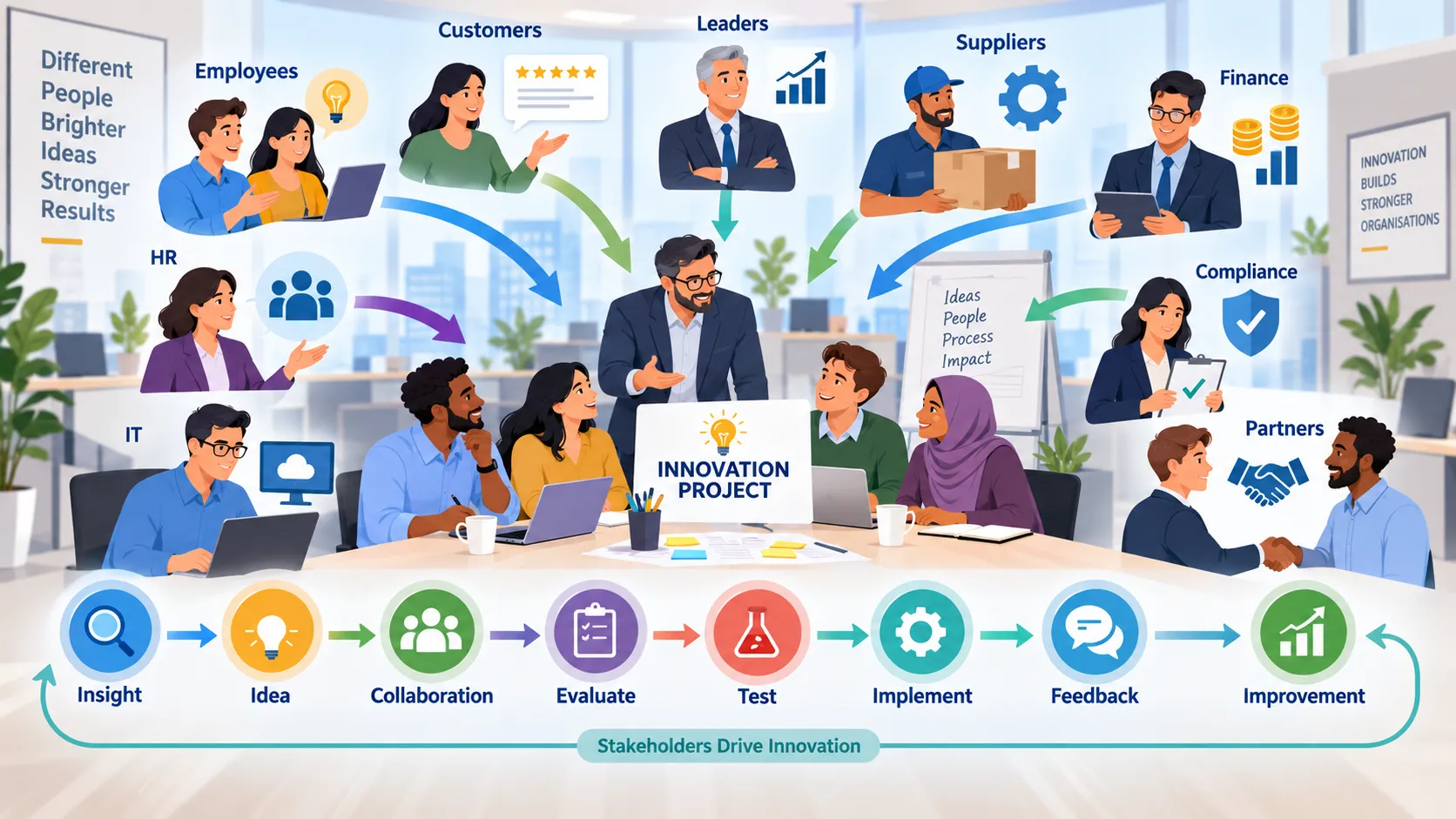
What Is a Stakeholder?
A stakeholder is an individual, group or organisation that can affect an organisation, is affected by its activities or has an interest in a particular decision, project or initiative.
In the context of innovation, stakeholders are people or groups who can influence, contribute to, benefit from, experience the consequences of or provide knowledge about an innovation initiative.
Stakeholders may be internal or external.
Internal stakeholders operate within the organisation, while external stakeholders are outside the organisation but may have an important relationship with it.
Examples include:
Employees.
Managers.
Senior leaders.
Customers.
Service users.
Suppliers.
Partners.
Investors.
Regulators.
Professional bodies.
Technology providers.
Consultants.
Local communities.
Industry networks.
Not every stakeholder needs to be involved in every stage of innovation.
The manager should determine the appropriate level of involvement based on the stakeholder’s influence, expertise, interest, potential impact and relationship with the innovation.
Why Stakeholders Matter in the Innovation Process
Stakeholders provide knowledge that may not be available to the person leading an innovation initiative.
An operations employee may understand why a process is inefficient. A customer may understand why a service is frustrating. A technology specialist may understand what digital solutions are possible. A finance manager may understand the financial implications. A regulator may identify compliance requirements.
If these perspectives are excluded, an innovation may be technically impressive but operationally unsuitable.
Stakeholder involvement can therefore improve:
Problem identification.
Customer understanding.
Idea generation.
Decision-making.
Feasibility assessment.
Risk management.
Resource planning.
Innovation design.
Implementation.
Employee adoption.
Customer acceptance.
Innovation outcomes.
Stakeholders can also identify unintended consequences.
For example, a manager may believe that automating a process will improve efficiency. Employees may identify that the proposed automation removes an important quality-control step. Early stakeholder involvement allows the organisation to investigate and redesign the solution before implementation.
Key Concepts in Stakeholder Involvement in Innovation
| Key concept | Definition | Application to innovation |
|---|---|---|
| Stakeholder | An individual, group or organisation that can affect, be affected by or have an interest in an innovation. | Helps managers identify who should be considered during innovation. |
| Stakeholder engagement | The planned process of communicating and working with stakeholders throughout an initiative. | Builds knowledge, support and participation. |
| Stakeholder analysis | A structured assessment of stakeholder interests, influence, impact and expectations. | Helps managers determine who should be prioritised. |
| Internal stakeholder | A stakeholder within the organisation, such as an employee, manager or department. | Provides operational knowledge and organisational capability. |
| External stakeholder | A stakeholder outside the organisation, such as a customer, supplier or regulator. | Provides market, technical, regulatory and customer perspectives. |
| Stakeholder influence | The ability of a stakeholder to affect decisions, resources or outcomes. | Helps determine the level of engagement required. |
| Stakeholder interest | The degree to which a stakeholder is concerned with or affected by an innovation. | Helps managers determine communication and involvement needs. |
| Co-creation | Developing an innovation collaboratively with relevant stakeholders. | Improves relevance and user acceptance. |
| Stakeholder resistance | Opposition or concern expressed by stakeholders regarding an innovation. | Can identify risks and barriers that require management. |
| Stakeholder buy-in | Willingness of relevant stakeholders to support an innovation initiative. | Supports implementation and adoption. |
| Stakeholder feedback | Information provided by stakeholders about an innovation or proposed change. | Enables refinement and evidence-based improvement. |
Types of Stakeholders in the Innovation Process
Understanding different stakeholder groups is important because each group may have different expectations and contributions.
Employees
Employees are often one of the most important sources of innovation.
They understand:
Daily operational processes.
Customer interactions.
Resource problems.
Repetitive tasks.
Quality issues.
Workplace frustrations.
Practical implementation challenges.
Employees may identify opportunities that managers cannot easily see.
For example, an employee who processes customer applications every day may recognise that a particular approval step adds little value but creates significant delay.
Employee involvement can therefore support process innovation, service improvement and workplace innovation.
However, employees may also be affected by innovation.
Automation, new systems or redesigned processes can change responsibilities, skills and workloads.
Managers should therefore involve employees not only as sources of ideas but also as stakeholders affected by implementation.
Middle Managers
Middle managers occupy an important position because they connect strategic and operational perspectives.
They can:
Translate strategic objectives into innovation priorities.
Identify operational opportunities.
Coordinate teams.
Facilitate stakeholder discussions.
Allocate resources.
Manage risk.
Support experimentation.
Communicate decisions.
Lead implementation.
Monitor outcomes.
Middle managers may also need to reconcile conflicting stakeholder expectations.
For example, senior leaders may want rapid implementation, employees may need more training time and customers may require additional testing before adoption.
The manager must balance these interests while maintaining the overall innovation objective.
Senior Leaders
Senior leaders provide strategic direction, authority and resources.
Their role may include:
Establishing innovation priorities.
Approving investment.
Supporting organisational change.
Removing strategic barriers.
Setting expectations.
Sponsoring major initiatives.
Reviewing outcomes.
Senior leadership support can significantly affect whether an innovation progresses.
However, senior leaders may not possess detailed operational knowledge.
This makes the manager’s role in communicating operational evidence particularly important.
Customers
Customers can provide direct insight into unmet needs, expectations and service problems.
Customer involvement can include:
Surveys.
Interviews.
Focus groups.
Feedback.
Complaints.
Product reviews.
Usage data.
Customer journey analysis.
Co-creation sessions.
Prototype testing.
Customers can help organisations understand whether an innovation solves a real problem.
For example, a company may develop a new digital service that managers believe is convenient. Customer testing may reveal that users find the interface confusing.
The organisation can then modify the solution before wider implementation.
Suppliers
Suppliers can provide expertise about:
New materials.
Technology.
Equipment.
Market developments.
Production methods.
Cost-saving opportunities.
Industry trends.
Supplier involvement can support product and process innovation.
However, managers should consider confidentiality, intellectual property, contractual responsibilities and dependency risks.
Technology Specialists
Technology specialists can evaluate:
Technical feasibility.
System compatibility.
Data requirements.
Cybersecurity.
Integration.
Scalability.
Digital infrastructure.
Their involvement is particularly important for technology-enabled innovation.
A manager may identify an opportunity for automation, but technology specialists can determine whether the proposed solution is technically realistic.
Finance Professionals
Finance stakeholders help evaluate:
Investment requirements.
Operating costs.
Expected savings.
Revenue potential.
Cash-flow implications.
Return on investment.
Financial risk.
Their role is important because an innovation may have strong strategic value but still require careful financial management.
Human Resources Professionals
HR stakeholders can help assess:
Workforce implications.
Skills requirements.
Training.
Role changes.
Recruitment.
Employee relations.
Workforce planning.
This becomes particularly important when innovation changes how employees work.
Compliance and Regulatory Stakeholders
Some innovation initiatives operate within legal or regulatory boundaries.
Relevant stakeholders may include:
Compliance teams.
Regulators.
Legal advisers.
Quality specialists.
Health and safety professionals.
Data protection specialists.
Their involvement helps ensure that innovation does not create unacceptable legal, ethical or regulatory exposure.
Stakeholder Analysis Before Starting Innovation
Managers should identify stakeholders early.
A simple stakeholder analysis can consider:
Influence + Interest + Impact + Expertise
Influence
How much ability does the stakeholder have to affect the innovation?
Interest
How concerned is the stakeholder about the initiative?
Impact
How significantly will the innovation affect them?
Expertise
What knowledge can the stakeholder contribute?
This helps managers determine the appropriate engagement strategy.
A stakeholder with high influence and high interest may require close involvement.
A stakeholder with high expertise but limited decision-making power may need to be consulted extensively.
A stakeholder with low influence and low interest may only require basic communication.
Mapping Stakeholders
A stakeholder map can help managers visualise relationships.
A useful approach is to classify stakeholders as:
Manage Closely
High influence and high interest.
These stakeholders should usually be actively involved.
Keep Satisfied
High influence but lower day-to-day interest.
They need sufficient information and confidence in the initiative.
Keep Informed
Lower influence but high interest.
They may need regular updates and opportunities to provide feedback.
Monitor
Lower influence and lower interest.
They may require limited communication unless their position changes.
This approach helps managers avoid two common problems:
Under-engaging important stakeholders.
Overloading low-priority stakeholders with unnecessary communication.
Stakeholders in Opportunity Identification
Stakeholders can help identify opportunities before an innovation idea is developed.
Employees may identify operational problems.
Customers may identify unmet needs.
Suppliers may identify new technologies.
Senior leaders may identify strategic opportunities.
Managers should create channels through which these insights can be collected.
Examples include:
Employee suggestion systems.
Customer feedback.
Team meetings.
Performance reviews.
Customer research.
Supplier meetings.
Market analysis.
Innovation workshops.
The important principle is to listen systematically rather than waiting for stakeholders to raise issues informally.
Stakeholders in Idea Generation
Once an opportunity has been identified, stakeholders can contribute to developing possible solutions.
Different perspectives can increase creativity.
For example, if a healthcare organisation wants to reduce appointment delays:
Patients can explain their experience.
Reception staff can explain booking problems.
Clinicians can identify operational constraints.
IT staff can explore digital options.
Finance staff can assess costs.
Managers can coordinate the process.
The combined knowledge can produce a stronger range of solutions than any one group working alone.
Stakeholders in Innovation Evaluation
Stakeholders can help managers determine whether an idea is practical.
Evaluation can consider:
Customer value.
Operational feasibility.
Financial impact.
Technical requirements.
Workforce implications.
Legal requirements.
Risk.
Sustainability.
Different stakeholders will naturally emphasise different criteria.
A finance team may focus on investment.
Customers may focus on convenience.
Employees may focus on usability.
IT may focus on technical compatibility.
The manager’s responsibility is to integrate these perspectives into a balanced decision.
Stakeholders in Innovation Development
During development, stakeholders can help shape the proposed solution.
This is particularly important when the innovation directly affects users.
For example, if an organisation is developing a new employee portal, employees should have opportunities to comment on:
Navigation.
Functionality.
Accessibility.
Information requirements.
Usability.
This reduces the risk of creating a solution that technically works but is difficult to use.
Co-Creation and Stakeholder Innovation
Co-creation involves developing solutions collaboratively with stakeholders.
Rather than asking stakeholders to approve a finished solution, the organisation involves them during development.
For example, customers might participate in:
Product design.
Service design.
Prototype testing.
Customer journey mapping.
Idea generation.
Employees might participate in:
Process redesign.
Workflow development.
Technology testing.
Workplace improvement.
Co-creation can improve relevance because people who will use or experience the innovation contribute directly to its design.
Stakeholder Role in Prototyping
Stakeholders can provide valuable feedback on prototypes.
A prototype allows stakeholders to interact with an early version of the innovation.
They can identify:
Usability problems.
Missing features.
Unnecessary complexity.
Accessibility issues.
Operational difficulties.
Customer concerns.
The manager can then use this feedback to refine the innovation.
This is often more effective than asking stakeholders to comment on an abstract concept.
Stakeholders in Pilot Testing
Stakeholders can also participate in pilots.
For example, a new process could be tested with:
One department.
One customer segment.
One location.
A selected group of employees.
Stakeholders can provide evidence about what works and what does not.
Managers should define the pilot carefully.
They should communicate:
Purpose.
Scope.
Duration.
Responsibilities.
Measures.
Feedback arrangements.
Risk controls.
Managing Stakeholder Expectations
Different stakeholders may expect different outcomes.
For example:
Senior leadership may expect cost reduction.
Employees may expect reduced workload.
Customers may expect better service.
Finance may expect financial return.
IT may expect realistic technical requirements.
Managers must make expectations visible and realistic.
They should communicate:
What the innovation is expected to achieve.
What it will not achieve.
What changes are likely.
What resources are available.
What risks exist.
How success will be measured.
What decisions have been made.
What remains uncertain.
Clear expectations reduce misunderstanding.
Managing Conflicting Stakeholder Interests
Conflict is common in innovation.
For example, a proposed innovation may:
Reduce costs but require employee training.
Improve speed but increase technology expenditure.
Improve customer convenience but create additional compliance requirements.
Increase automation but change employee responsibilities.
Managers should not assume that stakeholder conflict means the innovation should stop.
Instead, conflict can help reveal trade-offs.
A structured approach is:
Identify the conflicting interests.
Understand the reasons behind each position.
Gather evidence.
Identify shared objectives.
Explore alternative solutions.
Assess trade-offs.
Agree decision criteria.
Make a transparent decision.
Communicate the rationale.
The manager’s role is to facilitate constructive discussion rather than allowing stakeholder conflict to become personal.
Stakeholder Communication Throughout Innovation
Communication should continue throughout the innovation process.
Different stakeholders may need different information.
Senior Leaders
May require:
Strategic rationale.
Financial position.
Risks.
Progress.
Outcomes.
Employees
May require:
Reasons for change.
Practical implications.
Training.
Responsibilities.
Support.
Customers
May require:
Benefits.
Changes to service.
Availability.
Support.
Privacy or security information where relevant.
Suppliers
May require:
Technical requirements.
Delivery expectations.
Contractual responsibilities.
Implementation arrangements.
Effective communication should be:
Clear.
Timely.
Relevant.
Honest.
Two-way.
Consistent.
Stakeholders and Innovation Risk
Stakeholders can help identify risks that managers may not recognise.
Employees can identify operational risks.
Customers can identify service risks.
Technology specialists can identify technical risks.
Compliance professionals can identify regulatory risks.
Suppliers can identify supply risks.
Managers should therefore include stakeholder input in risk assessment.
Questions may include:
What could go wrong?
Who could be affected?
What assumptions are we making?
What has been overlooked?
What controls are required?
What contingency arrangements are needed?
Stakeholder involvement can make risk assessment more comprehensive.
Stakeholders and Resource Allocation
Innovation requires resources.
Stakeholders can help identify what is needed.
For example:
Finance can assess budget.
HR can assess workforce capacity.
IT can assess technology.
Procurement can assess suppliers.
Operations can assess implementation capacity.
The manager coordinates these inputs and determines whether the innovation can realistically be resourced.
Resource planning should consider both direct and indirect costs.
These may include:
Equipment.
Software.
Training.
Employee time.
Consultancy.
Maintenance.
Communication.
Change management.
Temporary productivity reduction.
Stakeholder Role in Implementation
Implementation is often where stakeholder involvement becomes most important.
Employees need to adopt new practices.
Customers need to understand changes.
Suppliers may need to alter deliveries.
Technology teams may need to provide support.
Managers need to coordinate the transition.
Successful implementation therefore requires stakeholder readiness.
Managers should consider:
Who needs to change?
What behaviour needs to change?
What support is required?
What training is required?
What concerns exist?
What communication is needed?
What performance measures will be monitored?
Stakeholders and Change Resistance
Stakeholder resistance can provide valuable information.
Resistance may indicate:
Poor communication.
Insufficient training.
Lack of involvement.
Fear of consequences.
Practical problems.
Poor solution design.
Lack of trust.
Previous negative experiences.
Managers should investigate resistance rather than automatically attempting to eliminate it.
For example, if employees resist a new software system because it is difficult to use, the problem may be the system rather than the employees.
Stakeholder feedback can therefore improve innovation quality.
Stakeholders and Innovation Adoption
An innovation creates value only when it is adopted and used appropriately.
Managers should therefore consider adoption throughout development.
Adoption may depend on:
Usability.
Perceived value.
Training.
Trust.
Communication.
Accessibility.
Convenience.
Compatibility with existing processes.
Stakeholders can help managers understand what is required for adoption.
Stakeholders in Measuring Innovation Outcomes
Stakeholders can also contribute to post-implementation evaluation.
Customers can assess:
Satisfaction.
Convenience.
Quality.
Service experience.
Employees can assess:
Workload.
Usability.
Productivity.
Workplace experience.
Managers can assess:
Performance.
Costs.
Productivity.
Risks.
Senior leaders can assess:
Strategic contribution.
Financial value.
Organisational impact.
A balanced evaluation therefore uses multiple perspectives.
Stakeholder Feedback as a Continuous Improvement Mechanism
Innovation should not stop when an initiative is implemented.
Stakeholder feedback can reveal further improvement opportunities.
For example:
Initial innovation → Customer feedback → Identified limitation → Revised solution → Improved outcome
This creates a continuous cycle.
Managers should therefore establish mechanisms for collecting feedback after implementation.
These may include:
Surveys.
Review meetings.
Customer interviews.
Performance data.
Employee feedback.
Complaint analysis.
Usage data.
Service reviews.
The Role of Stakeholders in Different Types of Innovation
Different types of innovation require different stakeholder involvement.
Product Innovation
Important stakeholders may include:
Customers.
Product teams.
Marketing.
Operations.
Suppliers.
Finance.
Service Innovation
Important stakeholders may include:
Customers.
Service employees.
Operations.
Technology teams.
Quality teams.
Process Innovation
Important stakeholders may include:
Employees.
Operations.
Quality.
IT.
Finance.
Technological Innovation
Important stakeholders may include:
IT.
Users.
Cybersecurity specialists.
Suppliers.
Customers.
Compliance teams.
Organisational Innovation
Important stakeholders may include:
Employees.
Managers.
HR.
Senior leadership.
Employee representatives.
Business Model Innovation
Important stakeholders may include:
Customers.
Finance.
Marketing.
Sales.
Strategic partners.
Senior leadership.
This demonstrates why stakeholder engagement should be tailored to the type of innovation being considered.
Practical Example: Customer Service Innovation
A customer service organisation wants to reduce waiting times.
The manager identifies several stakeholder groups.
Customers
Provide information about:
Waiting experiences.
Frustrations.
Preferred communication channels.
Employees
Explain:
Workflow problems.
Repetitive tasks.
Resource constraints.
IT
Assesses:
Automation options.
System integration.
Data requirements.
Finance
Evaluates:
Investment.
Expected savings.
Financial return.
Senior Leaders
Provide:
Strategic direction.
Approval.
Resources.
The manager brings these perspectives together.
Several solutions are considered, including:
Workflow redesign.
Additional staffing.
Self-service.
Automation.
Improved scheduling.
A pilot is developed.
Customer and employee feedback is collected.
The solution is refined before wider implementation.
This example demonstrates that stakeholder involvement improves both the quality of the idea and the likelihood of successful adoption.
Practical Example: Innovation in a Training Organisation
A training organisation wants to improve learner engagement with digital learning resources.
The manager identifies several stakeholders:
Learners.
Tutors.
Quality staff.
Learning technology staff.
Senior management.
Learners explain that resources are difficult to find.
Tutors explain that learners repeatedly ask where materials are located.
Technology specialists explain the limitations of the current platform.
Quality staff identify requirements for maintaining accurate and accessible learning materials.
The manager coordinates these perspectives.
A redesigned resource structure is developed and tested with a small learner group.
Feedback is collected.
The structure is refined before wider implementation.
The outcome is measured through:
Learner satisfaction.
Resource usage.
Repeated support enquiries.
Time required to locate information.
Tutor workload.
This demonstrates the value of involving users and operational stakeholders throughout innovation.
Practical Example: Supplier-Led Innovation
A manufacturing organisation works with a supplier that has developed a more efficient material.
The supplier proposes a new material that could reduce production waste.
The operations team assesses how it would affect production.
The quality team evaluates product standards.
Finance assesses the cost.
Procurement evaluates contractual implications.
Customers are consulted where product characteristics may change.
A small production test is conducted.
The organisation measures:
Waste.
Product quality.
Production time.
Material cost.
Customer response.
The innovation is adopted only after the evidence demonstrates sufficient value.
This illustrates how external stakeholders can contribute valuable knowledge while the organisation maintains appropriate evaluation and control.
Practical Example: Stakeholder Conflict During Innovation
Consider an organisation planning to introduce automation.
Senior leaders expect significant cost savings.
Employees are concerned about changes to their roles.
Customers want faster service but still expect access to human support.
IT wants sufficient time to test the technology.
Finance wants the investment controlled.
The manager must balance these interests.
The manager can:
Explain the strategic rationale.
Gather employee concerns.
Assess customer expectations.
Review technical feasibility.
Analyse financial implications.
Identify workforce impacts.
Develop safeguards.
Conduct a limited pilot.
Measure results.
Review stakeholder feedback.
Refine the implementation plan.
The innovation can therefore proceed in a controlled way without ignoring stakeholder concerns.
Stakeholder Engagement Process for Innovation
Managers can use a structured stakeholder engagement process.
Step 1: Identify Stakeholders
List individuals and groups who may affect or be affected by the innovation.
Step 2: Analyse Stakeholders
Assess:
Influence.
Interest.
Impact.
Expertise.
Expectations.
Step 3: Prioritise Stakeholders
Determine which stakeholders require close involvement and which need basic communication.
Step 4: Define Engagement Objectives
Decide what each stakeholder should contribute.
For example:
Customers provide needs.
Employees provide operational insight.
IT provides technical assessment.
Finance provides financial analysis.
Step 5: Select Engagement Methods
Use appropriate methods such as:
Workshops.
Interviews.
Surveys.
Meetings.
Focus groups.
Prototype testing.
Pilot feedback.
Digital platforms.
Step 6: Communicate Clearly
Explain:
Purpose.
Expected outcomes.
Roles.
Timescales.
Decisions.
Responsibilities.
Step 7: Gather and Analyse Feedback
Do not collect feedback simply to demonstrate consultation.
Evaluate it objectively.
Step 8: Resolve Conflicts
Identify areas of disagreement and use evidence and shared objectives to find solutions.
Step 9: Maintain Engagement
Continue communication throughout development and implementation.
Step 10: Review Stakeholder Outcomes
Assess whether stakeholders have been appropriately involved and whether the innovation has produced the intended value.
How Managers Can Improve Stakeholder Engagement
Effective stakeholder engagement requires deliberate management.
Managers should:
Identify stakeholders early.
Involve the right people at the right time.
Make expectations clear.
Listen actively.
Use evidence.
Encourage constructive challenge.
Provide feedback.
Communicate decisions.
Explain why decisions were made.
Manage conflicts professionally.
Avoid over-consultation.
Maintain confidentiality where necessary.
Recognise stakeholder contributions.
The objective is meaningful participation rather than consultation for its own sake.
Benefits of Effective Stakeholder Involvement
Better Innovation Ideas
Stakeholders provide different knowledge and perspectives.
Improved Customer Relevance
Customer involvement helps ensure that innovation addresses genuine needs.
Better Feasibility
Operational and technical stakeholders can identify practical limitations.
Improved Risk Management
Stakeholders can identify risks that may otherwise be overlooked.
Stronger Employee Engagement
Employees are more likely to support innovation when they are involved appropriately.
Greater Implementation Success
Stakeholder participation can increase understanding and adoption.
Better Resource Planning
Different departments can identify resource implications.
Improved Decision-Making
Managers gain access to broader evidence.
Stronger Organisational Learning
Feedback from stakeholders provides insight into what worked and what needs improvement.
Greater Innovation Sustainability
Stakeholder support can help innovations become embedded in normal organisational practice.
Risks of Poor Stakeholder Management
Poor stakeholder management can create significant problems.
Ignoring Employees
The organisation may miss practical knowledge and encounter resistance.
Ignoring Customers
The innovation may fail to address genuine customer needs.
Excluding Technical Specialists
The organisation may develop an idea that cannot realistically be implemented.
Ignoring Finance
The organisation may underestimate costs.
Weak Leadership Engagement
The innovation may lack authority or resources.
Poor Communication
Stakeholders may misunderstand the purpose or consequences.
Excessive Consultation
Decision-making may become slow and inefficient.
Stakeholder Dominance
One powerful stakeholder may influence the innovation excessively.
Unmanaged Conflict
Disagreement may prevent progress.
Managers therefore need to balance participation with decision-making discipline.
Stakeholder Engagement and Innovation Culture
Stakeholder involvement can strengthen an organisation’s wider innovation culture.
When employees and customers see that their contributions influence decisions, they are more likely to participate in future innovation.
A positive cycle can develop:
Participation → Ideas → Feedback → Implementation → Results → Trust → More Participation
However, if stakeholders repeatedly contribute ideas that are ignored without explanation, the opposite can occur:
Participation → Ideas → No Response → Frustration → Reduced Participation
Managers therefore need to close the feedback loop.
The Importance of Closing the Feedback Loop
When stakeholders provide feedback, managers should communicate what happened.
For example:
“Your feedback identified a problem with the proposed process. We have modified the design and will test the revised version.”
This demonstrates that stakeholder input has been taken seriously.
Even when feedback is not adopted, managers can explain:
“The suggestion was considered but could not be implemented because it would create significant compliance risks.”
This transparency supports trust.
Stakeholder Engagement and Ethical Innovation
Stakeholder involvement also supports responsible decision-making.
Some stakeholders may identify ethical concerns that would otherwise be overlooked.
For example:
Customers may raise privacy concerns.
Employees may identify fairness issues.
Community stakeholders may identify environmental impacts.
Compliance specialists may identify legal risks.
Managers should therefore consider stakeholder perspectives when evaluating not only whether an innovation is profitable, but whether it is responsible.
Stakeholder Engagement as a Management Capability
Effective stakeholder engagement requires several management skills.
These include:
Communication.
Negotiation.
Active listening.
Conflict management.
Influencing.
Facilitation.
Critical thinking.
Decision-making.
Emotional intelligence.
Relationship management.
Change management.
For middle managers, these skills are particularly important because they often need to influence people without having direct authority over every stakeholder involved.
A Practical Stakeholder Innovation Framework
Managers can use the following framework:
Identify → Analyse → Prioritise → Engage → Listen → Evaluate → Decide → Communicate → Implement → Review
Identify
Determine who is relevant.
Analyse
Understand influence, interest, impact and expertise.
Prioritise
Determine appropriate levels of involvement.
Engage
Create meaningful opportunities for participation.
Listen
Capture stakeholder insight and concerns.
Evaluate
Assess the information objectively.
Decide
Make evidence-based decisions.
Communicate
Explain decisions and next steps.
Implement
Coordinate stakeholder responsibilities.
Review
Evaluate outcomes and stakeholder experience.
This framework helps ensure that stakeholder management remains connected to the innovation process rather than becoming a separate administrative exercise.
Stakeholder Questions for Managers
Before progressing an innovation, managers should ask:
Who will be affected?
Who can influence the outcome?
Who has specialist knowledge?
Who will use the innovation?
Who will fund it?
Who will implement it?
Who may resist it?
Who can identify risks?
Who needs to approve it?
Who should be involved in testing?
Who can provide evidence about outcomes?
How will stakeholder feedback be collected?
How will disagreements be managed?
How will decisions be communicated?
How will stakeholder relationships be maintained after implementation?
Summary
Stakeholders play a central role in the innovation process because innovation is rarely successful when developed and implemented in isolation. Stakeholders provide knowledge, experience, resources, influence, feedback and support that can improve innovation decisions and outcomes.
Employees can identify operational problems and practical opportunities. Customers can reveal unmet needs and evaluate experiences. Senior leaders provide strategic direction, authority and resources. Suppliers and external partners can provide specialist expertise and new technologies. Finance professionals can assess investment and value. HR can assess workforce implications. Technology specialists can evaluate technical feasibility, while compliance and regulatory stakeholders can identify legal and ethical requirements.
Stakeholder involvement can occur throughout the innovation process:
Opportunity Identification → Idea Generation → Evaluation → Development → Testing → Implementation → Measurement → Learning
Effective managers identify the stakeholders who matter, analyse their influence and interests, determine the appropriate level of engagement and create meaningful opportunities for participation.
Stakeholder engagement should not mean allowing every stakeholder to make every decision. Managers remain responsible for maintaining strategic alignment, making appropriate decisions, managing resources and ensuring accountability. Instead, stakeholder engagement means ensuring that relevant knowledge and perspectives inform the decisions being made.
For middle managers, this is particularly important because they frequently act as the connection between senior leadership, employees, customers and operational functions. They must translate strategic objectives into practical innovation opportunities while ensuring that the people affected by innovation have an appropriate opportunity to contribute.
Strong stakeholder management can improve:
The quality of innovation ideas.
Understanding of customer needs.
Operational feasibility.
Risk identification.
Resource planning.
Employee engagement.
Customer acceptance.
Implementation.
Innovation adoption.
Measurement.
Organisational learning.
Poor stakeholder management can produce the opposite results. Organisations may develop solutions that customers do not want, employees do not understand, technology teams cannot support or finance cannot justify.
The manager should therefore view stakeholders not simply as people who approve or receive an innovation, but as potential contributors to the entire innovation journey.
A useful overall model is:
Stakeholder Insight → Opportunity → Idea → Collaboration → Evaluation → Development → Testing → Implementation → Feedback → Measurement → Learning → Improvement
The most effective innovation processes create a two-way relationship between the organisation and its stakeholders. Stakeholders provide insight and feedback, while the organisation communicates decisions, creates opportunities for participation and demonstrates how contributions have influenced outcomes.
Ultimately, the role of stakeholders in innovation is to help organisations make better decisions, create more relevant solutions, manage uncertainty and increase the likelihood that innovation will produce meaningful value.
For practising and aspiring managers, the key principle is clear: innovation is not simply about having a good idea; it is about bringing the right people together at the right stages, using their knowledge effectively and converting collective insight into practical, measurable and sustainable organisational improvement.
5.Evaluate Methods Used to Measure the Impact of Innovation in an Organisation
Innovation is only valuable to an organisation when it produces meaningful outcomes. An organisation may generate hundreds of ideas, launch new technologies or introduce new working practices, but these activities do not automatically demonstrate that innovation has been successful. Managers therefore need effective methods for measuring the impact of innovation and determining whether an initiative has achieved its intended purpose.
Measuring the impact of innovation involves collecting and analysing evidence about what changed as a result of an innovation. This may include changes in financial performance, customer experience, operational efficiency, productivity, quality, employee experience, market position, sustainability, risk and organisational capability.
For practising and aspiring middle managers, innovation measurement is an important management responsibility because it connects innovation activity with organisational performance. Managers need to demonstrate whether an innovation has created value, whether the resources invested were justified, whether expected benefits have been achieved and whether additional improvements are required.
A useful innovation measurement progression is:
Baseline → Innovation → Implementation → Measurement → Comparison → Evaluation → Learning → Improvement
The starting point is particularly important. Managers need to understand the situation before innovation so that they can compare it with the situation after implementation.
For example, if an organisation introduces a new customer service process, measuring customer satisfaction after implementation is useful, but it becomes much more meaningful when compared with customer satisfaction before the innovation.
Innovation impact measurement should therefore answer several important questions:
What problem or opportunity was the innovation intended to address?
What was the situation before the innovation?
What outcomes were expected?
What indicators will demonstrate success?
What changed after implementation?
How significant was the change?
Did the innovation create financial or non-financial value?
Were there unintended consequences?
Was the investment justified?
Can the innovation be improved or scaled?
What has the organisation learned?
The most effective innovation measurement systems combine quantitative data with qualitative evidence. Numbers can demonstrate measurable changes, while feedback and observation can explain why those changes occurred.
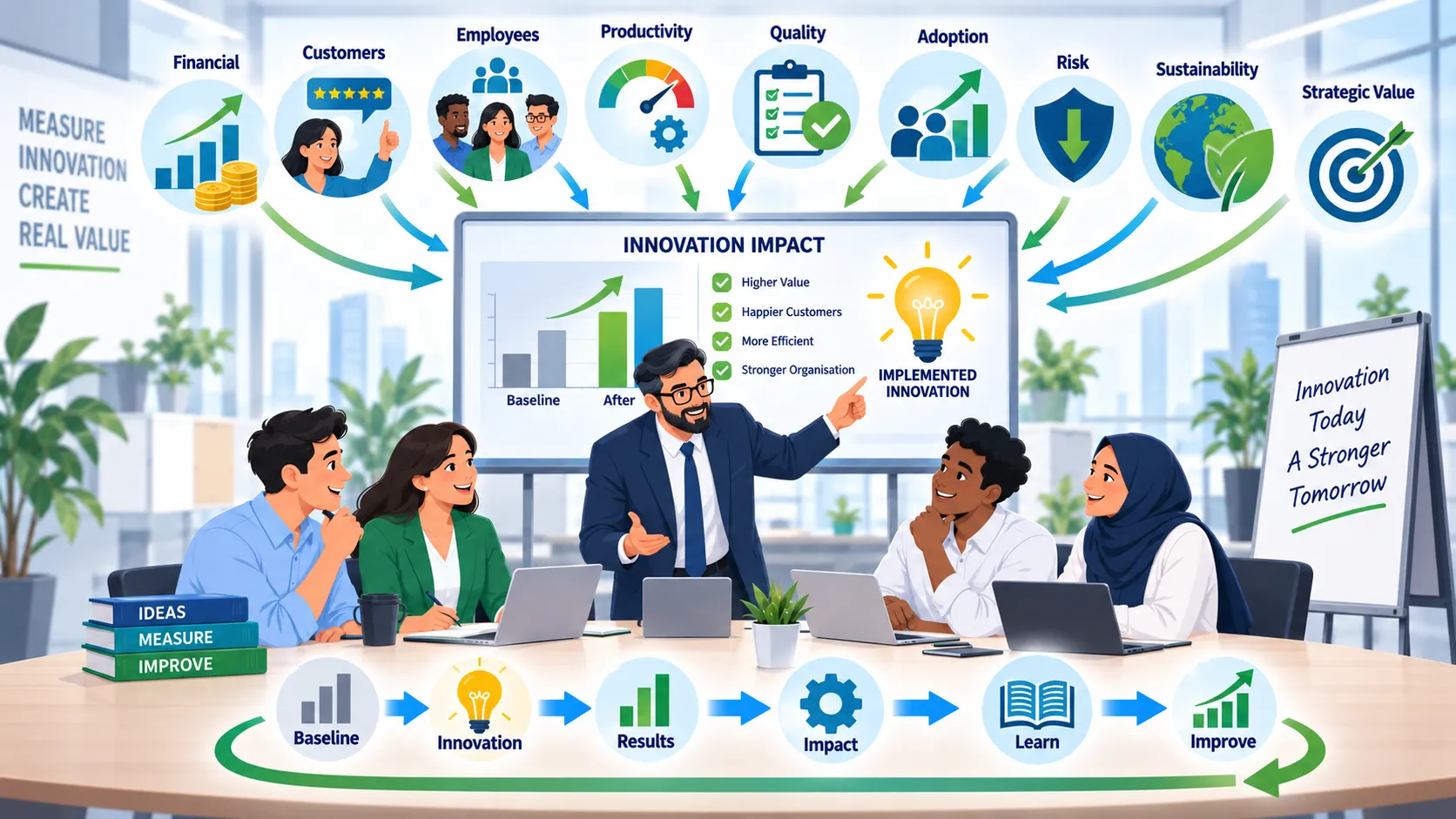
What Is the Impact of Innovation?
The impact of innovation refers to the changes produced by an innovation within an organisation, for its employees, customers, stakeholders, operations, finances or wider environment.
Impact can be positive, negative or mixed.
For example, a new digital system may reduce processing time and operating costs but initially increase employee training requirements.
Similarly, a new product may generate additional sales but also increase production complexity.
Managers should therefore evaluate innovation from multiple perspectives rather than assuming that one positive indicator proves overall success.
Innovation impact can include:
Financial improvement.
Revenue growth.
Cost reduction.
Productivity improvement.
Quality improvement.
Customer satisfaction.
Customer retention.
Employee engagement.
Reduced waste.
Improved resource utilisation.
Faster processes.
Reduced risk.
Improved organisational resilience.
Increased market competitiveness.
Improved sustainability.
Development of organisational capability.
Why Measuring Innovation Impact Matters
Measurement provides evidence for management decisions.
Without measurement, organisations may continue funding initiatives that are not creating sufficient value or stop initiatives that are actually producing important benefits.
Effective measurement helps managers:
Demonstrate whether objectives have been achieved.
Justify investment decisions.
Identify successful innovations.
Identify underperforming innovations.
Detect unintended consequences.
Compare expected and actual outcomes.
Improve implementation.
Support resource allocation.
Build organisational learning.
Decide whether an innovation should be scaled.
Identify opportunities for further improvement.
Measurement also strengthens accountability.
When an innovation has clear objectives and agreed measures, stakeholders can understand what the initiative is expected to achieve and how progress will be assessed.
Key Concepts in Measuring Innovation Impact
| Key concept | Definition | Management application |
|---|---|---|
| Innovation impact | The change created by an innovation for the organisation, customers, employees or other stakeholders. | Provides the basis for evaluating whether innovation has created value. |
| Baseline | The performance position before an innovation is introduced. | Allows managers to compare results before and after innovation. |
| KPI | A key performance indicator used to measure progress towards a specific objective. | Tracks whether innovation is achieving intended outcomes. |
| Output | The immediate product or activity produced by an innovation initiative. | Shows what has been delivered but not necessarily the value created. |
| Outcome | The change resulting from an innovation. | Demonstrates whether the innovation has achieved its intended effect. |
| Return on investment | A financial measure comparing the benefit or return from an investment with its cost. | Helps assess financial value. |
| Cost-benefit analysis | A comparison of expected or actual costs and benefits. | Supports investment and continuation decisions. |
| Benchmarking | Comparing performance against another organisation, standard or previous period. | Helps managers assess relative performance. |
| Customer impact | The effect of innovation on customer needs, satisfaction, experience or behaviour. | Determines whether innovation creates customer value. |
| Employee impact | The effect of innovation on employee experience, productivity, capability or engagement. | Identifies workforce benefits and unintended consequences. |
| Innovation adoption | The extent to which intended users accept and use the innovation. | Shows whether implementation has translated into actual use. |
| Innovation portfolio | A collection of innovation initiatives managed together. | Helps leaders balance different levels of risk, investment and potential value. |
Measuring Outputs Versus Measuring Outcomes
One of the most important distinctions in innovation measurement is the difference between outputs and outcomes.
An output describes what an organisation has produced or completed.
An outcome describes what changed because of it.
For example:
Output:
“A new customer service platform was launched.”
Outcome:
“Average customer response time reduced from 48 hours to 18 hours.”
The first statement confirms implementation.
The second provides evidence of impact.
Managers should therefore avoid measuring innovation only through activity indicators such as:
Number of ideas submitted.
Number of workshops.
Number of projects launched.
Number of employees involved.
Number of prototypes created.
These indicators are useful for understanding innovation activity, but they do not necessarily demonstrate value.
A stronger measurement system connects:
Activity → Output → Outcome → Impact
For example:
Employee ideas → New process → Faster processing → Improved customer satisfaction and reduced operating cost
Establishing a Baseline
A baseline provides a reference point against which future performance can be compared.
Before implementing an innovation, managers should establish the current position wherever practical.
Examples include:
Current customer satisfaction.
Current processing time.
Current operating cost.
Current error rate.
Current productivity.
Current employee engagement.
Current resource utilisation.
Current sales.
Current complaints.
For example:
Before innovation:
Average application processing time = 5 working days
After innovation:
Average application processing time = 2 working days
The baseline makes the improvement visible.
Without a baseline, managers may struggle to determine whether the innovation actually caused an improvement.
Setting Clear Innovation Objectives
Measurement begins with clear objectives.
An innovation objective should explain what the organisation wants to achieve.
Weak objective:
“Improve customer service.”
Stronger objective:
“Reduce average customer response time by at least 30% within six months while maintaining customer satisfaction above the agreed service standard.”
The stronger objective provides measurable criteria.
Good innovation objectives should ideally be:
Clear.
Relevant.
Measurable.
Time-bound.
Connected to organisational priorities.
Realistic but meaningful.
Financial Methods for Measuring Innovation Impact
Financial performance is often an important consideration when evaluating innovation.
However, not all innovation produces immediate financial returns.
Financial measurement can include:
Revenue growth.
Cost savings.
Profit contribution.
Return on investment.
Payback period.
Cost avoidance.
Margin improvement.
Cash-flow impact.
Total cost of ownership.
Return on Investment
Return on investment can help managers evaluate whether financial benefits justify investment.
A simplified calculation is:
ROI = (Financial Benefit − Investment Cost) ÷ Investment Cost × 100
For example, if an organisation invests £50,000 in a process innovation and achieves £75,000 in measurable financial benefit:
ROI = (£75,000 − £50,000) ÷ £50,000 × 100
ROI = 50%
This provides a financial perspective on the innovation.
However, managers should not use ROI in isolation.
An innovation may provide important strategic, customer or risk-reduction benefits that are not immediately captured in a financial calculation.
Cost-Benefit Analysis
Cost-benefit analysis compares the expected or actual costs of innovation with its benefits.
Costs may include:
Technology.
Staff time.
Training.
Equipment.
Consultancy.
Implementation.
Maintenance.
Communication.
Temporary disruption.
Benefits may include:
Revenue.
Cost savings.
Productivity.
Quality.
Customer satisfaction.
Reduced risk.
Improved employee experience.
Managers should consider both direct and indirect costs.
For example, a new digital system may appear inexpensive to purchase but require significant employee training and integration work.
Payback Period
Payback period measures how long it takes for the benefits generated by an innovation to recover the initial investment.
This can be useful when comparing different innovation opportunities.
For example, one innovation may require £100,000 and produce annual savings of £50,000.
The simple payback period would be approximately two years.
However, managers should also consider what happens after the payback period and whether non-financial benefits exist.
Measuring Revenue and Market Impact
For product, service and business-model innovation, managers may measure:
Sales growth.
Revenue from new products.
Revenue from new services.
Market share.
Customer acquisition.
Customer retention.
Average transaction value.
New customer segments.
Product adoption.
For example, an organisation launches a new service and tracks the proportion of total revenue generated by the new service over twelve months.
This can demonstrate commercial impact.
However, managers should distinguish between revenue growth caused by the innovation and growth caused by unrelated market conditions.
Measuring Productivity
Productivity measures the relationship between resources used and outputs achieved.
Innovation may improve productivity by:
Reducing unnecessary work.
Automating repetitive tasks.
Improving workforce allocation.
Reducing downtime.
Simplifying processes.
Improving equipment utilisation.
For example:
Before innovation:
100 applications processed by 10 employees per day.
After innovation:
130 applications processed by the same workforce per day.
The organisation can investigate whether the innovation contributed to the productivity improvement.
Managers should also ensure that productivity gains do not result in lower quality or excessive employee pressure.
Measuring Process Performance
Process innovation can be evaluated through operational measures.
These may include:
Processing time.
Cycle time.
Error rate.
Rework.
Queue time.
Waiting time.
Throughput.
Defect rate.
Process cost.
Resource utilisation.
For example, a manager redesigns an approval process.
Before:
Seven approval stages.
After:
Four approval stages.
Processing time falls from ten days to four days.
The manager can then investigate whether quality and compliance have remained satisfactory.
Measuring Quality
Innovation should not improve speed at the expense of quality.
Quality measures may include:
Defect rates.
Complaints.
Returns.
Errors.
Rework.
Service failures.
Compliance issues.
Customer satisfaction.
Managers should therefore use balanced measures.
For example, if a new automated process reduces processing time by 40% but doubles the error rate, the innovation cannot be considered successful simply because it is faster.
This illustrates the importance of evaluating multiple dimensions of performance.
Measuring Customer Impact
Customer impact is especially important for product and service innovation.
Managers can measure:
Customer satisfaction.
Customer loyalty.
Customer retention.
Complaints.
Net recommendation measures.
Customer effort.
Service usage.
Adoption.
Repeat purchasing.
Customer journey performance.
Qualitative feedback can also provide important evidence.
Customers may explain:
Why they prefer the new service.
What remains difficult.
What they value.
What they dislike.
What additional improvements they want.
Combining quantitative data with customer feedback gives managers a stronger understanding of impact.
Measuring Employee Impact
Innovation can significantly affect employees.
Managers should evaluate:
Employee engagement.
Productivity.
Workload.
Job satisfaction.
Absence.
Skills.
Training requirements.
Employee turnover.
Adoption of new systems.
Confidence with new processes.
For example, a new automated system may improve productivity but initially reduce employee confidence.
Managers should recognise that implementation impact may change over time.
Initial disruption does not necessarily mean that an innovation will fail, but it should be monitored and managed.
Measuring Innovation Adoption
Implementation does not guarantee adoption.
A system may be available but rarely used.
A new process may exist formally but employees may continue using the old method.
Managers can measure adoption through:
Usage rates.
Participation.
Compliance with the new process.
Frequency of use.
User activity.
Training completion.
Employee feedback.
For example:
Target adoption = 90%
Actual adoption = 62%
The manager now has evidence that implementation requires additional support.
The problem may involve training, usability, communication or resistance.
Measuring Strategic Impact
Some innovations are intended to support long-term strategic objectives.
Strategic impact can include:
Entry into new markets.
Improved competitiveness.
Increased organisational resilience.
Improved strategic capability.
Stronger customer relationships.
Improved organisational reputation.
Development of new capabilities.
Strategic outcomes may be harder to measure than direct financial benefits.
Managers may therefore need a combination of quantitative and qualitative indicators.
Measuring Innovation Through Benchmarking
Benchmarking involves comparing performance with:
Previous organisational performance.
Another department.
Industry standards.
Competitors.
Relevant external organisations.
Recognised best practice.
For example, an organisation may compare its customer response time with industry benchmarks.
If the innovation reduces response time from 48 hours to 18 hours but the industry average is 12 hours, the organisation has improved but still has an opportunity for further development.
Benchmarking should be used carefully because organisations operate in different contexts.
The objective is to learn rather than simply copy.
Measuring Innovation Through Balanced Scorecards
A balanced approach can help managers assess innovation from multiple perspectives.
A manager could examine:
Financial Perspective
Cost reduction.
Revenue.
Return on investment.
Customer Perspective
Satisfaction.
Retention.
Adoption.
Internal Process Perspective
Productivity.
Quality.
Processing time.
Learning and Capability Perspective
Employee skills.
Innovation capability.
Engagement.
Organisational learning.
This prevents managers from focusing exclusively on financial performance.
Measuring Innovation Through Key Performance Indicators
KPIs should connect directly to innovation objectives.
For example, if the innovation aims to improve service efficiency, appropriate KPIs may include:
Average processing time.
Cost per transaction.
Error rate.
Customer satisfaction.
Employee productivity.
If the innovation aims to develop a new product, appropriate KPIs may include:
Sales.
Customer adoption.
Repeat purchases.
Market share.
Product margin.
The key principle is:
Measure what matters to the innovation objective.
Managers should avoid collecting large quantities of data that do not influence decisions.
Leading and Lagging Indicators
Managers can use both leading and lagging indicators.
Leading indicators provide information about future performance.
Examples include:
Training completion.
Pilot participation.
Prototype testing.
Adoption intention.
Employee readiness.
Lagging indicators show results that have already occurred.
Examples include:
Revenue.
Cost savings.
Customer retention.
Productivity.
Quality.
A strong measurement system uses both.
Leading indicators can help managers identify problems early, while lagging indicators demonstrate actual outcomes.
Measuring Innovation at Different Stages
Measurement should not only occur after implementation.
Idea Stage
Managers may measure:
Number of ideas.
Diversity of ideas.
Strategic alignment.
Initial feasibility.
Development Stage
Managers may measure:
Development progress.
Resource use.
Prototype performance.
Stakeholder feedback.
Pilot Stage
Managers may measure:
User adoption.
Performance.
Cost.
Quality.
Risk.
Implementation Stage
Managers may measure:
Adoption.
Training.
Operational disruption.
Milestone achievement.
Post-Implementation Stage
Managers may measure:
Financial impact.
Customer impact.
Employee impact.
Productivity.
Quality.
Strategic outcomes.
This creates a complete innovation measurement cycle.
Measuring the Innovation Pipeline
Organisations with many innovation initiatives can measure the overall innovation pipeline.
Useful measures include:
Number of opportunities identified.
Number of ideas generated.
Number screened.
Number developed.
Number piloted.
Number implemented.
Percentage successfully scaled.
Average time from idea to pilot.
Average cost per innovation.
Value generated by innovation portfolio.
This helps leaders understand whether the organisation has a healthy flow of innovation activity.
However, pipeline volume should not become the primary measure.
A large pipeline with very few valuable outcomes may indicate poor idea selection.
Measuring Time to Innovation
Speed can be important, particularly in rapidly changing markets.
Managers may measure:
Time from opportunity identification to idea.
Time from idea to prototype.
Time from prototype to pilot.
Time from pilot to implementation.
Time from implementation to measurable benefit.
Reducing unnecessary delays can improve organisational responsiveness.
However, speed should not be prioritised at the expense of quality, safety, compliance or stakeholder readiness.
Measuring Innovation Adoption Over Time
Adoption should be monitored over an appropriate period.
For example:
Month 1 = 40%
Month 2 = 58%
Month 3 = 72%
Month 4 = 86%
This trend indicates increasing adoption.
Managers can then investigate what contributed to the improvement.
Possible factors include:
Better training.
Improved communication.
System improvements.
Peer support.
Leadership involvement.
Measuring Unintended Consequences
A strong innovation evaluation does not look only for positive results.
Managers should also ask:
“What changed that we did not expect?”
An innovation may produce:
Additional workload.
New risks.
Quality problems.
Customer confusion.
Employee dissatisfaction.
Supplier difficulties.
Unexpected costs.
For example, a self-service system may reduce staff workload but increase customer complaints because some customers struggle to use it.
The organisation should therefore evaluate the overall impact.
Using Qualitative Methods
Not every innovation impact can be captured through numerical data.
Qualitative methods can provide valuable insight.
These include:
Interviews.
Focus groups.
Observations.
Open-ended surveys.
Employee discussions.
Customer feedback.
Case studies.
Lessons-learned reviews.
Qualitative evidence can explain why quantitative results occurred.
For example, customer satisfaction may increase by 15%, but interviews can reveal that customers particularly value reduced waiting time.
This helps managers understand what aspects of the innovation create value.
Using Quantitative Methods
Quantitative methods provide measurable evidence.
Examples include:
Financial data.
Productivity figures.
Sales data.
Customer satisfaction scores.
Error rates.
Processing times.
Adoption percentages.
Cost data.
Quality measures.
Quantitative evidence is useful for comparing performance and identifying trends.
The strongest evaluations often combine quantitative and qualitative methods.
Before-and-After Comparison
A simple approach is comparing performance before and after innovation.
For example:
Before:
Customer satisfaction = 72%
After:
Customer satisfaction = 84%
This shows improvement.
However, managers should be cautious about assuming that the innovation caused the entire improvement.
Other factors may have changed.
This is why stronger evaluation may involve control groups, comparison periods or multiple evidence sources where practical.
Trend Analysis
Trend analysis examines performance over time.
For example, a manager could track monthly customer complaints before and after implementation.
If complaints were:
January = 240
February = 250
March = 245
April = 180
May = 165
June = 150
The downward trend may suggest that the innovation is contributing to improvement.
However, managers should consider other factors such as seasonal changes or changes in customer volume.
Benchmarking and Comparative Analysis
Managers can strengthen evaluation by comparing innovation outcomes with an appropriate benchmark.
Comparison may involve:
Previous performance.
Similar departments.
Industry performance.
Competitor performance.
Target performance.
Benchmarking can help answer:
“Is the improvement sufficient?”
An organisation may achieve a 10% improvement but discover that competitors have achieved 25%.
This may indicate that additional innovation is required.
Measuring Innovation Risk Reduction
Innovation can create value by reducing risk.
For example, a new compliance system may not directly generate revenue but may:
Reduce errors.
Improve regulatory compliance.
Reduce data loss.
Improve cybersecurity.
Reduce operational disruption.
Managers should therefore include risk-related measures where relevant.
Possible indicators include:
Number of incidents.
Compliance failures.
System downtime.
Error frequency.
Security events.
Operational disruptions.
Measuring Sustainability Impact
Innovation can support sustainability.
Managers may measure:
Energy consumption.
Waste.
Material use.
Carbon-related indicators.
Resource efficiency.
Recycling.
Environmental incidents.
For example, a manufacturing innovation may reduce material waste by 20%.
This can produce both environmental and financial benefits.
Measuring Organisational Learning
One of the less visible impacts of innovation is learning.
An organisation may gain:
New technical knowledge.
New management capability.
Improved problem-solving capability.
Better customer understanding.
New partnerships.
New processes.
Improved innovation capability.
Managers can assess learning through:
Skills gained.
Lessons captured.
New processes adopted.
Knowledge-sharing activity.
Employee capability.
Repeat use of successful methods.
Learning is particularly important when an innovation does not produce its original expected outcome.
Evaluating Innovation Against Original Objectives
At the end of an innovation initiative, managers should return to the original objectives.
For each objective, ask:
Was the objective achieved?
Was it partially achieved?
Was it not achieved?
Why?
What evidence supports the conclusion?
Were there unintended outcomes?
This creates accountability.
For example:
Objective: Reduce processing time by 30%.
Actual result: 42% reduction.
Conclusion: Objective exceeded.
Objective: Maintain customer satisfaction above 80%.
Actual result: 84%.
Conclusion: Objective achieved.
This provides a clear evidence-based evaluation.
A Structured Process for Measuring Innovation Impact
Managers can use the following process.
Step 1: Define the Purpose of Measurement
Determine what the evaluation needs to establish.
Step 2: Define Innovation Objectives
Clarify what the innovation is intended to achieve.
Step 3: Establish Baselines
Measure current performance before implementation.
Step 4: Select Appropriate Indicators
Choose financial, customer, operational, employee and strategic measures as appropriate.
Step 5: Set Targets
Determine what level of improvement would represent success.
Step 6: Establish Data Collection Methods
Determine:
What data is required.
Who will collect it.
How often it will be collected.
Where it will be stored.
How quality will be maintained.
Step 7: Monitor During Implementation
Track progress and identify emerging problems.
Step 8: Measure Post-Implementation Outcomes
Collect data after implementation.
Step 9: Compare Results
Compare actual performance with:
Baseline.
Target.
Previous performance.
Benchmark.
Step 10: Analyse Causes
Determine why results changed.
Step 11: Assess Unintended Consequences
Look for negative or unexpected outcomes.
Step 12: Evaluate Overall Value
Consider financial and non-financial benefits.
Step 13: Make a Management Decision
Decide whether to:
Continue.
Improve.
Scale.
Modify.
Pause.
Stop.
Step 14: Capture Learning
Document lessons for future innovation.
Practical Example: Measuring Customer Service Innovation
A customer service organisation introduces a new automated enquiry-routing process.
Objective
Reduce average response time by 30% while maintaining customer satisfaction.
Baseline
Average response time = 40 hours
Customer satisfaction = 78%
Pilot
The system is tested with one service team.
Results
Average response time = 24 hours
Customer satisfaction = 85%
Employee error rate = reduced by 15%
The manager now has evidence that the innovation has improved several performance measures.
However, the manager also reviews:
Employee feedback.
Customer comments.
System reliability.
Training requirements.
The results support wider implementation.
The manager continues monitoring the measures after scaling.
Practical Example: Measuring a New Product Innovation
A company introduces a new product designed for an emerging customer segment.
The manager establishes several measures:
Commercial
Revenue.
Units sold.
Gross margin.
Repeat purchases.
Customer
Satisfaction.
Product adoption.
Reviews.
Retention.
Operational
Production cost.
Defect rate.
Delivery performance.
After six months, sales are strong but product returns are higher than expected.
The innovation therefore cannot be evaluated solely as a commercial success.
The manager investigates the returns and discovers a design issue.
The product is modified.
A second measurement cycle begins.
This demonstrates that innovation measurement should support continuous improvement.
Practical Example: Measuring Workplace Innovation
An organisation introduces a new flexible working practice.
The manager establishes baseline measures:
Employee engagement.
Productivity.
Absence.
Customer service.
Employee turnover.
After implementation, the organisation measures the same indicators.
Results show:
Productivity increased.
Employee satisfaction increased.
Absence decreased.
Customer service remained stable.
The innovation therefore appears to have created positive value without damaging customer outcomes.
The organisation continues monitoring the measures to determine whether the improvement is sustainable.
Practical Example: Measuring Process Innovation
A training organisation redesigns its learner enrolment process.
Before innovation:
Average enrolment time = 25 minutes.
Error rate = 8%.
After innovation:
Average enrolment time = 14 minutes.
Error rate = 3%.
Learner satisfaction also increases.
The manager can conclude that the process innovation has created measurable operational and customer value.
The manager should then monitor whether these improvements remain stable over time.
Evaluating Different Measurement Methods
No single measurement method is suitable for every innovation.
Financial Measures
Useful for assessing commercial value.
Limitations:
May not capture strategic or social value.
Benefits may take time to appear.
Customer Measures
Useful for assessing customer relevance.
Limitations:
Feedback can be subjective.
Customer responses may change for reasons unrelated to the innovation.
Employee Measures
Useful for assessing workforce impact and adoption.
Limitations:
Perceptions may vary.
Short-term disruption may affect results.
Operational Measures
Useful for process and productivity innovation.
Limitations:
Improving one process measure may negatively affect another.
Benchmarking
Useful for understanding relative performance.
Limitations:
Different organisational contexts may make comparisons difficult.
Qualitative Research
Useful for understanding experiences and causes.
Limitations:
Can be time-consuming.
Findings may be difficult to quantify.
Quantitative Analysis
Useful for objective comparisons and trends.
Limitations:
Numbers may not explain why results occurred.
The strongest evaluation often combines several methods.
Avoiding Measurement Problems
Managers should be aware of common measurement errors.
Measuring Too Much
Collecting excessive data can create administrative burden.
Measuring Too Little
Insufficient evidence can make evaluation unreliable.
Measuring the Wrong Things
Indicators may not reflect the innovation’s actual objectives.
Ignoring Baselines
Without a baseline, change can be difficult to demonstrate.
Confusing Activity With Impact
A large number of ideas does not prove innovation success.
Ignoring Time
Some innovations require time before benefits become visible.
Ignoring Unintended Consequences
Positive results in one area may create negative effects elsewhere.
Assuming Correlation Means Causation
Two changes occurring at the same time do not necessarily mean one caused the other.
Focusing Only on Short-Term Results
Strategic innovation may create value over a longer period.
Measuring Innovation Across Time
Innovation impact can develop in stages.
Short-Term
Possible measures:
Adoption.
Training.
Implementation.
Early customer response.
Medium-Term
Possible measures:
Productivity.
Quality.
Customer satisfaction.
Cost reduction.
Long-Term
Possible measures:
Revenue.
Market position.
Organisational capability.
Strategic advantage.
Resilience.
Managers should therefore select measurement periods appropriate to the innovation.
A new customer service process may produce measurable benefits within weeks.
A major product innovation may require months or years before its full market impact becomes clear.
Communicating Innovation Results
Managers need to communicate evaluation results to stakeholders.
Reports can include:
Innovation objective.
Baseline.
Measures.
Target.
Actual results.
Financial impact.
Customer impact.
Employee impact.
Risks.
Unintended consequences.
Lessons learned.
Recommendations.
Communication should be evidence-based.
Managers should not exaggerate positive results or hide problems.
Transparent reporting strengthens trust and supports better decision-making.
Using Innovation Measurement to Support Future Decisions
Measurement should influence action.
If the innovation is successful, the organisation may:
Scale it.
Invest further.
Apply it elsewhere.
Integrate it into standard practice.
If results are mixed, the organisation may:
Modify the innovation.
Conduct further testing.
Provide additional training.
Improve implementation.
If results are poor, the organisation may:
Stop the initiative.
Redesign the solution.
Investigate the underlying problem.
Redirect resources.
This makes measurement a management tool rather than an administrative exercise.
The Role of the Manager in Measuring Innovation
Managers are responsible for connecting innovation activity with organisational performance.
Their responsibilities can include:
Defining objectives.
Establishing baselines.
Selecting measures.
Assigning data-collection responsibilities.
Monitoring performance.
Reviewing evidence.
Communicating results.
Managing corrective action.
Supporting continuous improvement.
Managers should also challenge weak evidence.
For example, if an innovation team claims that a new system “improved efficiency”, the manager should ask:
“What evidence demonstrates the improvement?”
“What was the baseline?”
“What measure was used?”
“Over what period?”
“Were there other factors that influenced the result?”
This encourages evidence-based innovation management.
Creating an Innovation Measurement Dashboard
A dashboard can provide managers with a concise view of innovation performance.
A typical dashboard may include:
Financial
Investment.
Cost savings.
Revenue.
ROI.
Customer
Satisfaction.
Adoption.
Complaints.
Retention.
Operational
Productivity.
Processing time.
Quality.
Errors.
Employee
Engagement.
Training.
Adoption.
Workload.
Innovation Pipeline
Ideas.
Pilots.
Implementations.
Successful initiatives.
A dashboard should remain focused on decision-useful information.
Innovation Measurement and Continuous Improvement
Measurement creates a feedback loop:
Innovation → Measurement → Evidence → Decision → Improvement → New Measurement
This means measurement is not the final step in innovation.
It is part of an ongoing learning process.
For example:
A process innovation improves speed.
Measurement identifies that quality has remained stable.
The organisation then identifies another opportunity to reduce cost.
A new innovation cycle begins.
This creates a culture of evidence-based continuous improvement.
Key Benefits of Measuring Innovation Impact
Effective innovation measurement provides several important benefits.
Better Resource Allocation
Managers can direct resources towards innovations producing stronger value.
Improved Accountability
Innovation initiatives have clear objectives and measures.
Better Decision-Making
Managers can make decisions based on evidence.
Reduced Waste
Poor-performing initiatives can be identified earlier.
Stronger Business Cases
Evidence supports future investment proposals.
Improved Customer Value
Customer outcomes can be monitored.
Better Employee Experience
Workforce impacts can be identified.
Improved Risk Management
Unexpected consequences can be detected.
Stronger Organisational Learning
Results provide information for future innovation.
Greater Innovation Credibility
Demonstrating measurable outcomes helps build organisational support for innovation.
A Manager’s Innovation Impact Evaluation Framework
A practical framework for managers is:
Purpose → Baseline → Objective → Measures → Target → Data → Comparison → Impact → Learning → Action
Purpose
Why is the innovation being measured?
Baseline
What was performance before implementation?
Objective
What was the innovation intended to achieve?
Measures
What indicators demonstrate progress?
Target
What level of performance represents success?
Data
How will evidence be collected?
Comparison
How does actual performance compare with the baseline and target?
Impact
What financial, customer, employee, operational and strategic changes occurred?
Learning
What has the organisation learned?
Action
Should the organisation continue, improve, scale, modify or stop the innovation?
This framework provides a practical approach for managers responsible for innovation outcomes.
Innovation Impact Measurement Checklist
Before evaluating an innovation, managers should ask:
What was the original problem or opportunity?
What did the innovation intend to achieve?
What was the baseline?
What measures are relevant?
What targets were established?
What data is available?
Is the data reliable?
What changed after implementation?
How significant was the change?
Can the change reasonably be connected to the innovation?
What financial benefits were achieved?
What customer benefits were achieved?
What employee impacts occurred?
What operational improvements occurred?
Were there unexpected negative consequences?
Did the innovation create strategic value?
Was the investment justified?
What should happen next?
What lessons should be captured?
Summary
Measuring the impact of innovation is essential because innovation should ultimately create meaningful organisational value. Generating ideas, conducting workshops, developing prototypes and launching new systems demonstrate innovation activity, but they do not by themselves prove that innovation has been successful.
Effective managers therefore distinguish between outputs, outcomes and wider impact.
A strong innovation measurement process begins with a clear objective and baseline. Managers then select appropriate indicators, establish targets, collect reliable data, compare actual performance with previous performance and analyse the causes of change.
Innovation impact can be measured across several dimensions:
Financial performance.
Revenue.
Cost.
Return on investment.
Productivity.
Process efficiency.
Quality.
Customer satisfaction.
Customer adoption.
Employee engagement.
Employee productivity.
Strategic performance.
Risk reduction.
Sustainability.
Organisational capability.
Learning.
No single measure is sufficient for every innovation. Financial measures can demonstrate commercial value, but they may not capture customer or employee benefits. Customer measures can demonstrate relevance, but customer behaviour may be influenced by external factors. Operational measures can demonstrate efficiency, but speed improvements may create quality problems if not balanced carefully. Qualitative feedback can explain why results occurred, while quantitative data provides measurable evidence.
The strongest approach is therefore a balanced evaluation using multiple sources of evidence.
The innovation measurement cycle can be summarised as:
Baseline → Objective → Measure → Target → Implement → Collect Data → Compare → Evaluate Impact → Learn → Improve
For middle managers, measurement is particularly important because they connect innovation with day-to-day organisational performance. They can ensure that innovation initiatives have clear objectives, appropriate measures, sufficient evidence and defined review points.
Managers should also remember that not every innovation will succeed immediately. An unsuccessful pilot can still create valuable organisational learning if it reveals incorrect assumptions, identifies customer needs or prevents a larger investment from being wasted.
Similarly, an apparently successful innovation should not automatically be considered complete. Managers should examine whether benefits are sustainable, whether unintended consequences have emerged and whether additional improvement is required.
The ultimate purpose of innovation measurement is therefore not simply to prove that an initiative worked. It is to support better management decisions.
Measurement should help managers determine:
Continue → Improve → Scale → Modify → Pause → Stop
The most effective organisations use innovation measurement as part of a continuous learning cycle. They identify opportunities, develop ideas, test solutions, measure results, learn from evidence and use that learning to identify new opportunities.
This creates a powerful connection between innovation and organisational performance:
Innovation Opportunity → Idea → Evaluation → Implementation → Measurement → Organisational Value → Learning → Continuous Innovation
For practising and aspiring managers, the key principle is clear: innovation should be measurable wherever practical, but measurement should focus on meaningful value rather than simply counting ideas or activities. The purpose of measuring innovation is to understand whether the organisation is solving the right problems, creating value for customers and stakeholders, improving performance, using resources responsibly and developing the capability to innovate continuously.
When managers establish clear objectives, reliable baselines, relevant KPIs, balanced performance measures, stakeholder feedback and structured evaluation processes, they can make stronger decisions about innovation and demonstrate how new ideas are contributing to measurable organisational outcomes.