
Lesson no 4 : Know how to monitor resource use in organisations
Effective resource management does not end when resources have been planned, purchased or allocated. Organisations must continuously monitor how resources are being used to ensure that they remain available, productive, cost-effective and aligned with organisational objectives. Poor monitoring can result in wasted materials, excessive expenditure, under-utilised equipment, inefficient use of technology, inappropriate allocation of staff time and reduced operational performance. For managers, monitoring resource use is therefore an essential part of maintaining control over organisational activities and achieving planned outcomes.
Resource monitoring involves systematically collecting, reviewing and interpreting information about the use, availability, cost, performance and condition of organisational resources. These resources may include people, equipment, materials, technology, facilities, financial resources, information and external services. Effective monitoring enables managers to compare actual resource use against planned requirements, budgets, performance standards and operational targets. Where differences or inefficiencies are identified, managers can investigate their causes and take appropriate corrective action.
Monitoring should focus not only on how much of a resource is being consumed, but also on whether the resource is being used effectively and efficiently. For example, a department may remain within its equipment budget but still experience poor performance if expensive equipment is frequently idle or unsuitable for the work required. Similarly, an organisation may have sufficient employees but experience delays because skills are poorly allocated or staff capacity is not matched to workload. Effective resource monitoring therefore considers both quantity and quality of resource utilisation.
Managers can use a range of methods and performance measures to monitor resource use. These may include budgets and expenditure reports, resource utilisation rates, inventory records, productivity measures, workload data, equipment performance records, staffing information, procurement records, key performance indicators (KPIs), variance analysis and management dashboards. Digital systems can also provide real-time or near-real-time information, allowing managers to identify emerging problems before they have a significant impact on performance.
An important part of resource monitoring is comparing actual performance with planned performance. Variances may indicate that more resources are being consumed than expected, resources are not being fully utilised, costs are increasing, demand has changed or original resource assumptions are no longer appropriate. Managers must assess whether a variance is temporary or persistent, determine its cause and decide whether corrective action is required. Corrective actions may include reallocating resources, adjusting schedules, controlling unnecessary expenditure, changing suppliers, improving processes, providing staff training or revising resource plans.
Effective monitoring also supports organisational accountability and value for money. Managers need reliable evidence to demonstrate that resources are being used responsibly and that expenditure contributes to organisational objectives. Regular monitoring can help identify waste, prevent avoidable costs, improve productivity, strengthen operational control and support informed management decisions.
This lesson explores how organisations can monitor resource use systematically and how managers can use resource information to improve performance. Learners will develop an understanding of monitoring methods, resource utilisation measures, variance analysis, reporting, performance indicators and corrective action. The lesson also considers how effective monitoring contributes to efficiency, cost control, sustainability, compliance and the achievement of organisational objectives.
1.Analyse Strategies Used to Predict and Manage Disruption in Resource Supply
Organisations depend on the reliable availability of resources to maintain operations and achieve strategic and operational objectives. Resources may include raw materials, components, equipment, technology, energy, financial resources, specialist services and externally provided expertise. When the supply of an important resource is interrupted, the consequences can extend beyond procurement delays. A disruption may reduce productivity, increase costs, delay customer deliveries, affect quality, create health and safety concerns and prevent an organisation from meeting contractual or regulatory obligations.
For middle managers and leaders, managing supply disruption is therefore not simply a purchasing responsibility. It requires forward planning, risk assessment, communication, supplier relationship management, data analysis, contingency planning and timely decision-making. Managers need to understand what resources are critical, where those resources come from, what could interrupt supply and how quickly the organisation could recover if disruption occurred.
Predicting disruption means identifying signals and conditions that indicate a possible future interruption before the interruption significantly affects operations. Managing disruption means putting appropriate controls, contingency arrangements and response actions in place so that the organisation can continue operating or recover quickly when a disruption occurs.
A strong resource-supply strategy combines prediction, prevention, preparedness, response and recovery. The objective is not to eliminate every possible disruption, because this is rarely realistic or financially efficient. Instead, organisations should identify the disruptions that could have the greatest effect, assess their likelihood and consequences, establish proportionate controls and maintain sufficient resilience to respond effectively.
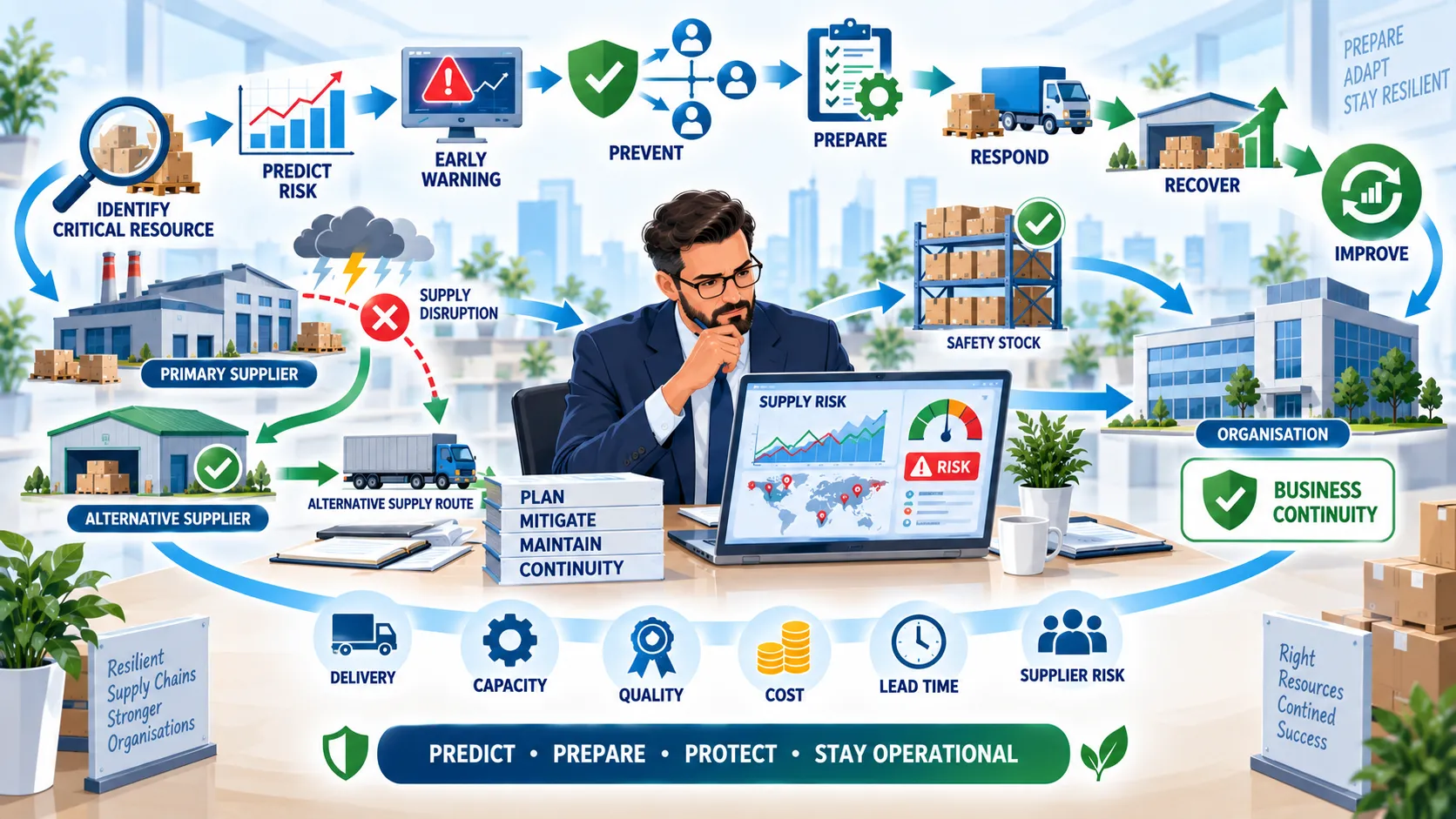
Understanding Resource Supply Disruption
Resource supply disruption occurs when an organisation cannot obtain a required resource in the expected quantity, quality, location, condition, timing or cost. The disruption may be temporary, such as a short delivery delay, or prolonged, such as the loss of a strategic supplier.
The impact depends heavily on the importance of the affected resource. A delay involving a non-critical office supply may have little operational consequence, while a shortage of a key production component could stop an entire manufacturing process.
Disruption can occur at any point in the supply chain. A supplier may experience production problems, transportation delays, labour shortages, financial difficulties, technology failures or shortages of its own inputs. External events such as severe weather, geopolitical instability, regulatory changes, infrastructure failures, cyber incidents or sudden changes in demand may also affect resource availability.
Key Characteristics of Supply Disruption
Important characteristics that managers should consider include:
Availability: whether the required resource can be obtained when needed.
Quantity: whether sufficient quantities can be supplied.
Quality: whether supplied resources meet required standards.
Timing: whether resources arrive within the required operational timeframe.
Cost: whether disruption causes significant price increases.
Reliability: whether supply can be maintained consistently.
Location: whether resources can reach the required operating site.
Capacity: whether suppliers have sufficient production or service capacity.
Continuity: whether supply can continue during adverse conditions.
Recoverability: how quickly supply can be restored after an interruption.
A manager should therefore avoid defining disruption simply as “late delivery”. A resource can technically arrive on time but still create disruption if the quantity is insufficient, the quality is unacceptable, the price becomes unaffordable or the resource cannot be used because it does not meet the required specification.
Why Organisations Need to Predict Resource Supply Disruption
Predicting disruption provides managers with an opportunity to act before operational performance is seriously affected. Without predictive approaches, organisations often respond only after a shortage has occurred. This can result in emergency purchasing, premium prices, rushed supplier selection, inefficient resource allocation and avoidable operational downtime.
Effective prediction provides an early-warning capability. Managers can identify emerging risks and determine whether preventive action is justified.
For example, if a key supplier’s delivery performance has deteriorated consistently over several months, this may indicate a developing capacity or financial problem. Waiting until the supplier completely fails could create unnecessary disruption. A manager could instead investigate the cause, discuss recovery plans, increase short-term stock, identify an alternative supplier or adjust ordering arrangements.
The ability to predict disruption is particularly important when resources have long lead times, limited suppliers or high switching costs.
Business Consequences of Unmanaged Supply Disruption
Supply disruption can affect several areas simultaneously:
production and service delivery
customer satisfaction
revenue generation
operational costs
cash flow
quality performance
employee productivity
project schedules
contractual commitments
regulatory compliance
organisational reputation
strategic objectives
The relationship is often cumulative. A shortage may cause production delays, which then cause late customer deliveries, which may result in complaints, compensation costs and reputational damage.
Key Concepts in Predicting and Managing Supply Disruption
Understanding several core concepts helps managers develop effective supply resilience strategies.
Supply Risk
Supply risk is the possibility that a supplier or supply chain will fail to provide a required resource at the expected quantity, quality, time or cost.
Supply risk can be influenced by:
supplier financial stability
supplier capacity
geographical concentration
dependence on a single supplier
raw material availability
transportation reliability
market conditions
regulatory requirements
technology dependencies
environmental conditions
geopolitical developments
Supply Resilience
Supply resilience is the organisation’s ability to anticipate, withstand, respond to and recover from supply disruption while maintaining critical operations.
A resilient organisation does not necessarily have unlimited resources. Instead, it has identified critical vulnerabilities and developed proportionate mechanisms for dealing with them.
Business Continuity
Business continuity refers to the organisation’s ability to continue critical activities during and after disruption.
Resource supply is an important component of business continuity because operations may depend on continuous access to materials, people, equipment, information, technology, utilities and external services.
Contingency Planning
Contingency planning involves developing alternative arrangements that can be activated if the normal supply arrangement fails.
Examples include:
alternative suppliers
emergency purchasing procedures
substitute materials
additional inventory
alternative transport arrangements
temporary equipment
cross-trained employees
alternative operating locations
Lead Time
Lead time is the period between initiating an order or requirement and receiving the resource.
Long lead times can increase exposure to disruption because there is less flexibility to replace a supplier or obtain emergency resources.
Safety Stock
Safety stock is additional inventory maintained to protect against uncertainty in demand or supply.
However, safety stock has a financial cost. It may require additional storage, insurance, handling and working capital. Managers therefore need to balance resilience against efficiency.
Strategies for Predicting Resource Supply Disruption
No single forecasting technique can identify every potential disruption. Effective managers normally combine several strategies to create a more complete picture of supply risk.
1. Demand Forecasting and Capacity Planning
Demand forecasting involves estimating future requirements for products, services or resources. Managers can analyse historical demand, seasonal patterns, customer orders, sales forecasts and strategic plans to determine future resource requirements.
Capacity planning then considers whether internal and external supply capacity will be sufficient to meet that expected demand.
For example, a business expecting a significant increase in customer orders may identify that its existing supplier cannot produce enough components during peak periods. The organisation can then negotiate additional capacity, place orders earlier or identify alternative sources.
Practical Demand Forecasting Process
A manager can use the following process:
Review historical demand.
Identify seasonal and cyclical patterns.
Review current orders and commitments.
Consider expected organisational growth or reduction.
Consult sales and operational forecasts.
Identify unusual or emerging demand patterns.
Estimate future resource requirements.
Compare expected demand with available supply capacity.
Identify potential shortages.
Develop preventive actions.
Forecasting becomes more valuable when managers regularly compare forecasts with actual demand and improve assumptions over time.
2. Supplier Performance Monitoring
Supplier performance data can provide important early-warning signals.
Managers should monitor trends rather than looking only at individual incidents. One late delivery may be insignificant, but a pattern of increasing delays can indicate a developing problem.
Useful supplier performance measures include:
on-time delivery percentage
order accuracy
defect rate
rejected deliveries
response time
lead-time reliability
price variance
service availability
complaint frequency
corrective-action performance
A supplier dashboard can help managers identify deterioration before it becomes a major disruption.
Example
Suppose a supplier’s on-time delivery performance changes from 97% to 94%, then 89%, then 82% over successive reporting periods. Although the supplier may still be delivering most orders, the downward trend should prompt investigation.
Possible causes could include:
increased customer demand
insufficient staffing
production equipment problems
transport capacity limitations
financial pressure
shortages of supplier inputs
The manager can investigate before the situation develops into a complete supply failure.
3. Supplier Financial Health Monitoring
A supplier’s financial position can directly affect its ability to maintain supply.
Financial difficulties may lead to:
reduced production
staff reductions
delayed purchasing
inability to maintain equipment
reduced service capacity
requests for early payment
business closure
For strategically important suppliers, organisations may conduct appropriate financial due diligence within legal, contractual and organisational requirements.
Managers may monitor available indicators such as:
significant changes in trading conditions
repeated requests for payment changes
persistent delivery deterioration
major organisational restructuring
loss of key contracts
reduced service capacity
significant price increases
Financial monitoring should be proportionate to supplier criticality and should respect confidentiality and applicable legal requirements.
4. Market and Environmental Scanning
Supply conditions are affected by external events. Managers can therefore use environmental scanning to identify emerging risks.
This may involve monitoring:
commodity prices
energy costs
labour-market conditions
transportation conditions
regulatory developments
trade restrictions
exchange-rate movements
weather risks
industry trends
technological developments
geopolitical developments
The purpose is not to predict every event. Instead, managers should identify external changes that could materially affect critical resources.
For example, if a major regulatory change is expected to affect the importation of a particular material, the procurement team may investigate alternative suppliers or compliant substitutes before the change takes effect.
5. Scenario Planning
Scenario planning allows managers to consider how different disruption conditions could affect resource availability.
Rather than relying on one forecast, managers can construct several plausible scenarios.
For example:
| Scenario | Potential Supply Condition | Likely Impact | Management Response |
|---|---|---|---|
| Normal | Supply remains stable | Minimal impact | Continue standard monitoring |
| Moderate disruption | Delivery delayed by 2–4 weeks | Operational pressure | Increase alternative supply and prioritise critical demand |
| Severe disruption | Main supplier unavailable | Major operational interruption | Activate contingency supplier and emergency resource plan |
| Prolonged disruption | Multiple suppliers affected | Strategic impact | Redesign sourcing and revise operational plans |
Scenario planning helps managers avoid being unprepared for situations that fall outside normal forecasts.
6. Supply Chain Mapping
Supply chain mapping involves identifying where critical resources originate and how they move through suppliers, distributors, transport providers and other intermediaries.
The purpose is to understand dependencies.
A simple supply chain may look like:
Raw Material Supplier → Component Supplier → Manufacturer → Distributor → Organisation
However, there may be hidden dependencies further upstream.
For example, an organisation may have two component suppliers but discover that both suppliers obtain a critical raw material from the same upstream producer. Although the organisation appears to have two suppliers, the underlying supply risk may still be concentrated.
Supply chain mapping can therefore reveal hidden single points of failure.
7. Critical Resource Identification
Not every resource requires the same level of monitoring.
Managers should classify resources according to their operational importance and supply risk.
Critical resources typically have one or more of the following characteristics:
operations cannot continue without them
there are few alternative suppliers
replacement lead time is long
substitution is difficult
switching costs are high
quality requirements are specialised
regulatory approval is required
disruption would affect customers significantly
disruption would create substantial financial loss
Critical resources should normally receive more frequent monitoring and stronger contingency arrangements.
8. Early-Warning Indicators
Early-warning indicators are measurable signs that a disruption may be developing.
Examples include:
increasing delivery delays
increasing defect rates
declining supplier responsiveness
rising prices
reduced supplier capacity
increasing lead times
inventory falling below agreed thresholds
sudden demand increases
repeated quality failures
transport disruptions
changes in supplier staffing
unusual order backlogs
Managers should establish thresholds that trigger investigation or action.
For example:
On-time delivery below 90% for two consecutive periods → supplier review required
The precise threshold should reflect organisational requirements and resource criticality.
9. Inventory and Stock-Level Monitoring
Inventory monitoring can help identify potential supply problems before operations are affected.
Managers can track:
current stock
minimum stock level
maximum stock level
reorder point
average consumption
lead time
safety stock
stock turnover
obsolete inventory
The reorder point should reflect expected demand during supplier lead time and an appropriate level of uncertainty protection.
For example, if an organisation normally consumes 100 units per week and a supplier requires two weeks to deliver, management needs to consider the expected 200-unit lead-time requirement plus an appropriate safety margin.
However, holding excessive stock can create its own problems, including:
higher storage costs
capital tied up in inventory
waste
deterioration
obsolescence
unnecessary insurance and handling costs
Therefore, inventory resilience must be balanced against efficiency.
10. Supplier Diversification
Supplier diversification involves reducing dependence on one source by developing multiple supply options.
This may include:
dual sourcing
multiple approved suppliers
regional suppliers
local suppliers
international suppliers
alternative service providers
Diversification can reduce the consequences of supplier failure. However, it may also increase procurement complexity and reduce economies of scale.
Managers therefore need to evaluate whether the additional resilience justifies the additional cost.
Strategies for Managing Resource Supply Disruption
Predicting disruption is only one part of effective resource management. Managers must also prepare practical responses.
11. Develop Contingency Supply Arrangements
A contingency supply arrangement identifies what will happen if the primary supplier cannot provide the required resource.
A contingency plan should specify:
the disruption trigger
responsible decision-maker
alternative supplier
required approval
estimated cost
expected lead time
required quality standard
communication process
activation procedure
recovery process
The plan should be documented and accessible to relevant personnel.
A contingency plan that exists only in a manager’s memory is unlikely to provide reliable organisational resilience.
12. Develop Alternative Suppliers
Alternative suppliers provide additional sourcing options when the primary source fails.
However, an alternative supplier should not be selected only after disruption occurs. Where the resource is critical, organisations should consider pre-qualifying alternative suppliers in advance.
This can reduce response time.
Pre-qualification may assess:
technical capability
quality
capacity
financial stability
delivery capability
compliance
insurance
sustainability
information security
previous performance
The objective is to ensure that the alternative supplier can be activated quickly without bypassing necessary controls.
13. Maintain Appropriate Safety Stock
Safety stock provides a buffer against temporary disruption.
The appropriate amount depends on:
demand variability
supplier reliability
lead time
resource criticality
storage cost
resource shelf life
cost of operational downtime
High-risk critical resources may justify greater protection than low-risk routine resources.
Managers should review safety-stock levels when demand, lead times or supplier reliability changes.
14. Establish Substitute Resources
Sometimes disruption can be managed by using an alternative resource rather than an alternative supplier.
For example, an organisation may identify an alternative material that meets required performance and safety standards.
Before substitution, managers must confirm:
specification compatibility
quality
safety
legal requirements
regulatory approval
technical performance
customer requirements
cost
operational implications
Substitution should never be based solely on availability.
15. Build Strong Supplier Relationships
Supplier relationships can become an important source of resilience.
Organisations that communicate regularly with key suppliers may obtain earlier information about emerging problems.
Effective supplier relationship management can include:
regular performance reviews
collaborative forecasting
capacity discussions
joint problem-solving
shared improvement plans
escalation arrangements
transparent communication
agreed service levels
A strong relationship does not remove contractual and commercial controls. Instead, it can improve communication and the ability to respond collectively to disruption.
16. Contractual Protection
Contracts can help define responsibilities and provide mechanisms for managing supply failure.
Depending on the context, contracts may address:
delivery requirements
quality standards
service levels
reporting
escalation
business continuity
alternative sourcing
performance remedies
termination
liability
force majeure
data and information requirements
Managers should work within organisational procurement, legal and governance arrangements when developing or reviewing contractual protections.
17. Cross-Training and Workforce Flexibility
Resource supply disruption can also affect people and skills.
If a critical activity depends entirely on one specialist employee, absence may create an operational bottleneck.
Managers can improve resilience through:
cross-training
documented procedures
skills matrices
job rotation
succession arrangements
temporary staffing options
knowledge-sharing systems
Workforce flexibility is particularly important where specialist knowledge is difficult to replace.
18. Emergency Procurement Procedures
Emergency procurement allows an organisation to obtain critical resources quickly when normal supply arrangements are disrupted.
However, emergency procurement should remain controlled.
Managers should establish:
what constitutes an emergency
who can authorise emergency procurement
which suppliers can be used
what documentation is required
what financial limits apply
how decisions will be recorded
how the procurement will be reviewed afterwards
Speed is important during disruption, but bypassing all governance can create financial, legal and reputational risks.
19. Prioritisation of Critical Resources
During severe disruption, an organisation may not have enough resources to satisfy every requirement.
Managers therefore need to establish priorities.
Critical activities should normally be identified before a crisis occurs.
Prioritisation may consider:
customer-critical activities
legally required services
health and safety
contractual obligations
revenue-critical operations
strategic priorities
vulnerable customers
operational dependencies
This enables scarce resources to be directed where they create the greatest organisational value.
20. Communication and Escalation
Effective communication is essential during supply disruption.
Managers should communicate appropriately with:
suppliers
procurement teams
finance
operations
senior management
employees
customers
logistics providers
compliance or legal teams
Communication should establish what has happened, what the likely impact is, what actions are being taken and what decisions are required.
Poor communication can make a manageable disruption significantly worse because different departments may respond inconsistently.
A Structured Process for Predicting and Managing Supply Disruption
Middle managers can apply a systematic process rather than responding reactively to every individual incident.
Step 1: Identify Critical Resources
List the resources that are essential to operational and strategic objectives.
Assess the consequences if each resource becomes unavailable.
Step 2: Map Supply Dependencies
Identify suppliers, upstream dependencies, logistics routes and alternative sources.
Look for single points of failure.
Step 3: Assess Supply Risk
Assess the likelihood and impact of different disruption scenarios.
A simple risk rating can combine:
Risk = Likelihood × Impact
Higher-risk resources should receive greater management attention.
Step 4: Establish Early-Warning Indicators
Define measurable indicators that may signal deterioration.
Examples include:
delivery performance
inventory levels
lead times
supplier quality
price movements
supplier capacity
Step 5: Monitor Trends
Collect information regularly and compare current performance with historical and planned performance.
Managers should focus on patterns rather than isolated events.
Step 6: Develop Preventive Controls
Introduce proportionate measures to reduce disruption likelihood or impact.
These may include:
supplier diversification
safety stock
contract controls
alternative specifications
supplier development
improved forecasting
Step 7: Develop Contingency Plans
Document what will happen if prevention fails.
Assign responsibilities and decision-making authority.
Step 8: Test the Contingency Arrangements
A contingency plan should be tested where practical.
Testing may involve:
simulation exercises
supplier communication tests
alternative supplier checks
emergency procurement exercises
stock availability checks
Testing can reveal weaknesses before an actual disruption occurs.
Step 9: Activate the Response When Required
When an early-warning threshold or disruption event is reached, managers should follow the agreed escalation and response process.
Step 10: Monitor Recovery
Once alternative arrangements are activated, managers should monitor whether the organisation is returning to stable operations.
Step 11: Review the Disruption
After the event, conduct a structured review.
Ask:
What happened?
What caused it?
When was the first warning sign?
Did the organisation recognise the warning?
Which controls worked?
Which controls failed?
Was the contingency plan effective?
What did the disruption cost?
What should change?
Step 12: Improve the Resource Strategy
Use lessons learned to update:
supplier arrangements
resource plans
risk registers
inventory policies
specifications
contracts
monitoring indicators
contingency plans
This creates a continuous improvement cycle.
Comparing Prevention, Preparedness, Response and Recovery
Effective disruption management can be understood through four connected management stages.
Prevention
Prevention aims to reduce the likelihood of disruption.
Examples include:
supplier diversification
supplier due diligence
preventive maintenance
quality controls
improved forecasting
contract management
Preparedness
Preparedness ensures the organisation is ready if disruption occurs.
Examples include:
contingency plans
alternative suppliers
safety stock
emergency procedures
communication plans
staff training
Response
Response involves immediate action when disruption occurs.
Examples include:
activating alternative suppliers
reallocating stock
prioritising critical activities
changing delivery arrangements
escalating decisions
Recovery
Recovery involves returning to stable operations and learning from the event.
Examples include:
restoring normal supply
reviewing costs
resolving supplier issues
updating risk assessments
improving contingency arrangements
These stages should not be treated as isolated activities. Effective resource resilience connects all four.
Using Technology to Predict and Manage Resource Disruption
Digital systems can significantly improve resource monitoring and supply-risk management.
Enterprise resource planning systems, procurement platforms, inventory systems and supplier-management tools can provide information about:
purchase orders
delivery dates
stock levels
supplier performance
expenditure
demand
lead times
quality problems
Dashboards can bring this information together so that managers can identify exceptions and trends.
For example, an automated dashboard could highlight:
stock below minimum level
overdue supplier deliveries
increased defect rates
unusual price changes
purchase orders approaching deadline
Technology does not replace management judgement. Data must be interpreted within the operational context.
Poor-quality data can produce misleading conclusions, while excessive alerts can cause managers to ignore genuinely important signals. Effective systems therefore require appropriate data quality, thresholds and governance.
Financial Considerations in Disruption Management
Managing disruption always involves financial choices.
Organisations must balance the cost of resilience against the potential cost of disruption.
For example, maintaining additional inventory may cost £20,000 annually, but if a shortage could cause £150,000 of lost production, the additional resilience may be justified.
However, not every risk requires expensive protection. Holding large stocks of every resource may create unnecessary financial pressure.
Managers should therefore consider:
cost of preventive controls
cost of contingency arrangements
cost of alternative suppliers
inventory carrying costs
emergency procurement costs
expected operational losses
customer compensation
reputational impact
recovery costs
The objective is to achieve an appropriate balance between efficiency and resilience.
Balancing Lean Resource Use with Resilience
Modern organisations often aim to minimise excess inventory, reduce waste and operate efficiently. These objectives can conflict with the need for resilience.
A highly lean supply model may reduce holding costs but increase vulnerability if a critical supplier fails.
Conversely, excessive resources may improve resilience but reduce financial efficiency.
Managers therefore need to determine an appropriate level of protection based on risk.
A useful principle is:
The higher the consequence of disruption, the stronger the justification for appropriate resilience measures.
This does not mean that every critical resource requires maximum stock or multiple suppliers. The response should be proportionate to the risk.
Practical Example 1: Manufacturing Organisation
A manufacturing organisation depends on a specialist component supplied by one overseas supplier. The component has a six-week lead time and cannot easily be substituted.
The procurement manager identifies this as a high-risk resource.
The organisation responds by:
mapping the supplier dependency
monitoring supplier delivery performance
reviewing demand forecasts
establishing a safety-stock policy
investigating a second supplier
checking alternative technical specifications
including continuity requirements in supplier management
establishing an escalation process
Several months later, the primary supplier reports production difficulties.
Because the organisation has already identified the risk, management activates the contingency arrangement and increases orders from the approved alternative supplier.
The organisation experiences additional procurement costs but avoids a complete production shutdown.
This example demonstrates the financial principle that the cost of resilience can be lower than the cost of disruption.
Practical Example 2: Technology Services
A business relies on an external cloud-based software provider for an important operational process.
The manager identifies the possibility of service interruption and develops a continuity strategy.
The organisation:
monitors supplier service-level performance
reviews contractual arrangements
identifies critical system dependencies
maintains secure data backups
documents manual fallback procedures
trains relevant employees
establishes supplier escalation contacts
When a temporary service outage occurs, employees switch to the documented fallback procedure while the supplier resolves the problem.
The organisation therefore experiences limited disruption rather than a complete operational failure.
Practical Example 3: Healthcare Resource Supply
A healthcare organisation depends on a reliable supply of essential consumables.
A shortage could directly affect service delivery and patient care.
Management therefore:
identifies critical consumables
establishes minimum stock levels
monitors usage rates
tracks supplier performance
identifies approved alternatives
communicates with suppliers regularly
establishes escalation arrangements
Because the consequences of shortage are significant, resource continuity receives a higher level of monitoring than routine administrative supplies.
Practical Example 4: Professional Services Organisation
A professional services organisation depends heavily on specialist staff.
One particular service is delivered by only two employees with a specialised skill set.
Management identifies this as a workforce resource risk.
Instead of relying exclusively on recruitment after a disruption occurs, the manager:
develops a skills matrix
cross-trains additional employees
documents key procedures
establishes temporary resource options
reviews workload allocation
monitors employee capacity
When one specialist becomes unavailable, another trained employee can temporarily undertake essential activities.
This demonstrates that resource supply disruption applies not only to physical materials but also to people, skills and knowledge.
Common Problems in Managing Resource Supply Disruption
Managers can encounter several weaknesses when developing supply resilience.
Over-Reliance on a Single Supplier
A single supplier may offer lower prices or simpler administration, but dependence can create significant vulnerability.
The solution is not always to replace the supplier. Management should assess whether the level of dependence is appropriate and whether contingency arrangements are sufficient.
Excessive Inventory
Holding excessive inventory can appear to be a simple solution to supply risk, but it can increase costs and create waste.
Inventory should therefore be based on evidence concerning demand, lead times and risk.
Reactive Rather Than Predictive Management
Some organisations begin contingency planning only after a disruption occurs.
This reduces the available response time and may force managers into expensive emergency decisions.
Poor Supplier Information
If supplier performance data is incomplete or inaccurate, managers may fail to identify deterioration.
Reliable data is therefore essential for early-warning systems.
Failure to Test Contingency Plans
A documented plan may appear effective but fail during an actual disruption.
Testing helps identify:
outdated contact details
unavailable alternative suppliers
unrealistic response times
unclear responsibilities
approval delays
inadequate stock
Focusing Only on Cost
Selecting the cheapest supply option may create greater long-term risk if the supplier has poor reliability, limited capacity or inadequate quality.
Effective resource management considers total value rather than purchase price alone.
Weak Cross-Functional Communication
Procurement may know that a supplier is experiencing difficulties while operations remain unaware.
This can prevent timely action.
Supply-risk management should therefore involve relevant functions rather than being isolated within procurement.
Key Benefits of Effective Disruption Management
A systematic approach to predicting and managing resource supply disruption can provide substantial organisational benefits.
Operational Continuity
The organisation is better able to maintain critical activities when supply conditions change.
Cost Control
Early action can reduce expensive emergency purchases, downtime and avoidable recovery costs.
Improved Customer Service
Reliable resource availability supports consistent delivery of products and services.
Better Risk Management
Managers gain clearer visibility of supply vulnerabilities and can prioritise resources appropriately.
Stronger Supplier Relationships
Regular monitoring and communication can improve collaboration and supplier accountability.
Improved Decision-Making
Managers have evidence available to support timely and proportionate decisions.
Greater Organisational Resilience
The organisation becomes better prepared to absorb shocks and recover from disruption.
Improved Resource Planning
Lessons from supply monitoring can inform future budgets, specifications, inventory levels and procurement strategies.
Better Value for Money
Resources can be protected without automatically creating excessive stock or unnecessary supplier arrangements.
A Manager’s Supply Disruption Monitoring Checklist
Middle managers can use the following checklist when reviewing resource supply resilience:
Have all critical resources been identified?
Is the importance of each resource clearly understood?
Are key suppliers and upstream dependencies mapped?
Is supplier performance monitored regularly?
Are lead times monitored?
Are inventory levels appropriate?
Are early-warning indicators established?
Are supplier risks assessed?
Are alternative suppliers available where justified?
Are substitute resources identified where appropriate?
Are contingency arrangements documented?
Are responsibilities clearly allocated?
Are emergency procurement procedures understood?
Are critical staff skills protected through cross-training?
Are contracts reviewed for appropriate continuity provisions?
Are supply risks discussed across relevant departments?
Are contingency plans tested?
Are financial implications considered?
Are disruption incidents reviewed after they occur?
Are lessons incorporated into future resource planning?
Professional Management Perspective
Effective resource supply management requires managers to move beyond the question, “Where can we buy this resource?” and ask a broader set of strategic questions:
How critical is this resource?
What could prevent us from obtaining it?
How early could we detect a problem?
How much disruption could we tolerate?
What alternatives are realistically available?
What would the disruption cost?
What level of resilience is financially justified?
Who needs to act if the risk increases?
How quickly can the organisation recover?
This approach changes resource management from a reactive purchasing activity into a proactive management discipline.
A mature organisation does not assume that suppliers will always perform exactly as expected. Instead, it recognises uncertainty and designs resource systems that can adapt to changing circumstances. Managers use data, supplier information, forecasting, risk analysis and operational knowledge to identify vulnerabilities and establish proportionate responses.
The strongest approach is also dynamic. Supply conditions change, organisational objectives change and resource requirements change. A supplier that was low risk last year may become high risk because of capacity constraints, market changes, financial difficulties or increased organisational dependence. Consequently, supply-risk assessments and contingency arrangements should be reviewed regularly.
Key Takeaways
Predicting and managing disruption in resource supply is an essential management capability because organisational performance depends on reliable access to appropriate resources.
Effective strategies combine predictive information with practical resilience measures. Managers should monitor demand, supplier performance, financial and market conditions, inventory levels, lead times and other early-warning indicators. They should also identify critical resources, map dependencies and assess the potential impact of disruption.
The most effective approach follows a continuous cycle:
IDENTIFY → PREDICT → ASSESS → PREVENT → PREPARE → RESPOND → RECOVER → IMPROVE
Managers should remember that resilience is not simply about holding more resources or paying more for supply. It is about making informed decisions concerning the appropriate balance between cost, availability, risk, flexibility and organisational performance.
When disruption occurs, organisations that have already established alternative suppliers, appropriate stock levels, contingency procedures, clear responsibilities and effective communication are more likely to maintain critical operations and recover quickly.
Ultimately, effective disruption management supports organisational objectives by helping ensure that the right resources remain available, at the right time, in the right condition and at an appropriate cost.
Key Definitions
| Term | Definition | Management Relevance |
|---|---|---|
| Resource supply disruption | A situation where a required resource cannot be obtained as expected in quantity, quality, timing, location or cost | Helps managers identify threats to operational continuity |
| Supply risk | The possibility that supply will fail or become unsuitable for organisational requirements | Supports prioritisation of risk controls |
| Supply resilience | The ability to anticipate, withstand, respond to and recover from supply disruption | Strengthens organisational continuity |
| Contingency planning | Preparing alternative arrangements for potential disruption | Enables faster and more controlled responses |
| Safety stock | Additional inventory held to protect against supply or demand uncertainty | Provides a buffer but creates carrying costs |
| Lead time | The time between placing an order or requirement and receiving the resource | Influences stock requirements and disruption exposure |
| Supplier diversification | Using more than one viable supply source where appropriate | Reduces excessive dependence on a single supplier |
| Early-warning indicator | A measurable signal that may indicate developing supply problems | Allows managers to act before disruption becomes severe |
| Scenario planning | Examining plausible future conditions and their potential organisational effects | Improves preparedness for different disruption levels |
| Business continuity | The ability to maintain critical activities during and after disruption | Connects resource resilience with organisational performance |
Summary
Strategies used to predict and manage disruption in resource supply are essential for maintaining organisational performance, controlling costs and achieving operational objectives. Effective managers recognise that supply disruption can originate from internal and external sources and can affect materials, equipment, technology, services, people, skills and other resources.
Prediction strategies such as demand forecasting, supplier performance monitoring, financial due diligence, market scanning, supply-chain mapping, scenario planning, inventory monitoring and early-warning indicators help organisations identify potential problems before they become critical.
Management strategies such as supplier diversification, contingency planning, safety stock, alternative resources, supplier relationship management, contractual controls, workforce flexibility, emergency procurement and resource prioritisation help organisations respond effectively when disruption occurs.
The most effective approach is integrated and continuous. Managers identify critical resources, assess risks, monitor indicators, establish preventive controls, prepare contingency arrangements, respond when necessary and review performance afterwards. This creates a cycle of continuous improvement and strengthens the organisation’s ability to maintain operations despite changing supply conditions.
For practising and aspiring middle managers and leaders, the central lesson is clear: resource resilience is created before disruption occurs. Effective prediction and preparation enable managers to make timely, evidence-based decisions rather than relying on expensive and reactive solutions when supply problems have already affected organisational performance.
2.Analyse Methods to Record, Monitor and Report on Resource Use
Effective resource management depends on having accurate, timely and relevant information about how organisational resources are being used. Managers cannot make reliable decisions about staffing, equipment, materials, technology, facilities or expenditure if they do not know what resources are available, how much is being consumed, what resources are being under-utilised and where actual performance differs from planned performance.
Recording, monitoring and reporting resource use are therefore closely connected management activities. Recording creates the evidence base, monitoring identifies changes and performance trends, and reporting communicates meaningful information to the people responsible for making decisions. When these activities are integrated, managers can identify inefficiencies, control costs, improve productivity, reduce waste, manage risks and ensure that resources contribute effectively to organisational objectives.
Resource monitoring should not be viewed simply as an administrative exercise. The purpose is to transform resource information into management insight and action. For example, recording the number of materials purchased provides basic information, but monitoring material consumption against production output can reveal whether waste is increasing. Similarly, recording employee working hours provides useful data, but comparing staff hours with workload, productivity and service outcomes provides much stronger evidence for resource planning.
For middle managers and leaders, the key challenge is to ensure that resource information is accurate enough to support decisions, relevant enough to answer management questions and timely enough to enable corrective action. Information that arrives after a significant problem has occurred may have limited management value.
The overall process can therefore be understood as:
RECORD → MONITOR → ANALYSE → REPORT → DECIDE → ACT → REVIEW
This cycle should operate continuously so that resource management becomes an evidence-based process rather than a reactive activity.
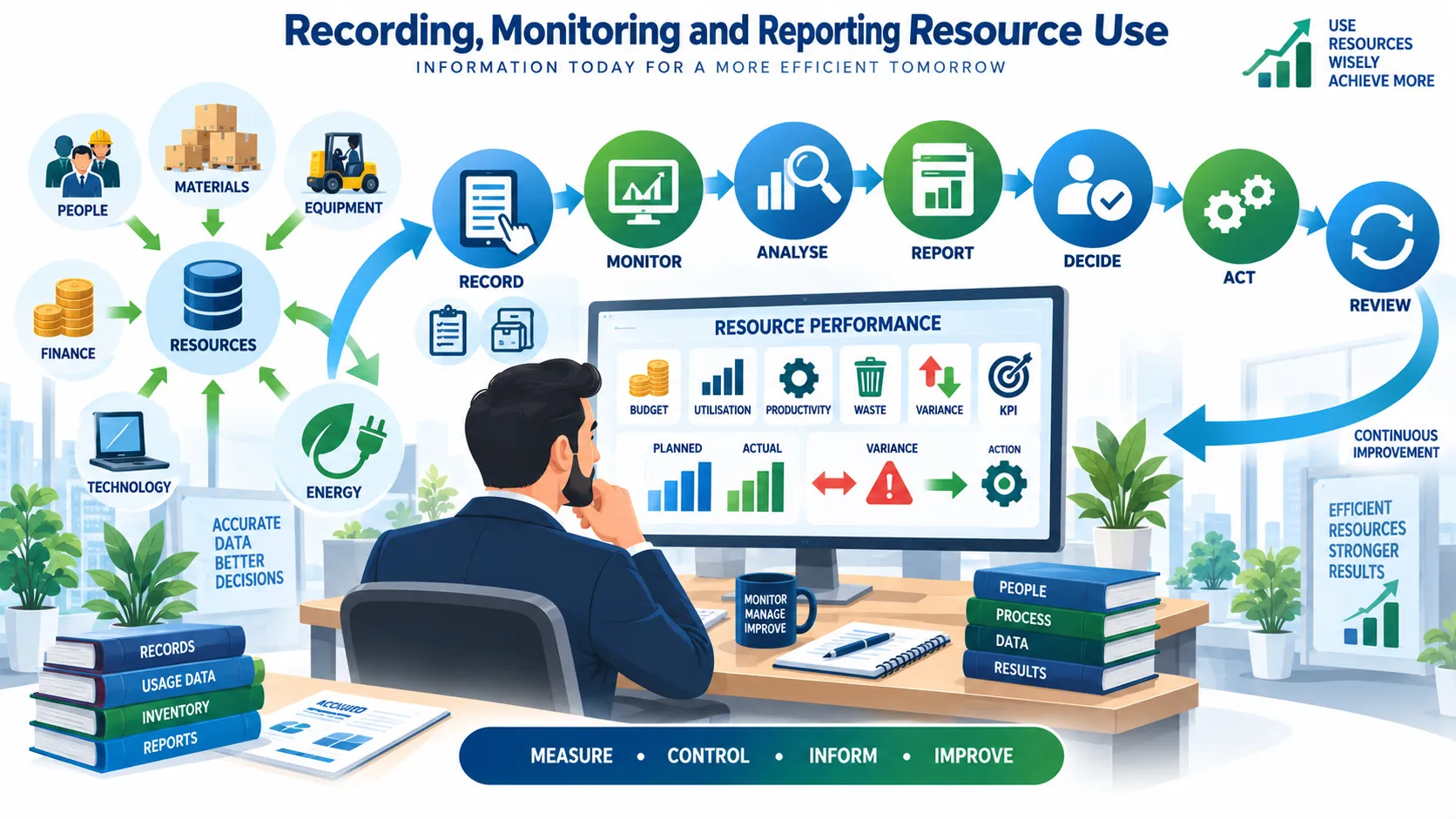
Understanding Resource Use
Resource use refers to the way an organisation obtains, allocates, consumes, operates, maintains and controls resources to achieve its objectives. Resources can be physical, human, financial, technological, informational or externally provided.
Examples include:
employee time and skills
machinery and equipment
raw materials and consumables
vehicles and transport
buildings and facilities
energy and utilities
software and digital systems
financial budgets
information and data
external suppliers and professional services
Monitoring resource use requires managers to consider both the amount of resources being used and the outcomes achieved from those resources.
An organisation may use a large quantity of resources but achieve excellent results, while another may use fewer resources but produce poor outcomes. Therefore, resource monitoring should consider efficiency, effectiveness, productivity, quality, cost and value for money rather than focusing on consumption alone.
Effective Resource Use
Effective resource use means using resources in ways that contribute to achieving intended organisational objectives.
For example, if an organisation purchases new software, effectiveness may be assessed by whether the software improves customer service, supports employees and contributes to the intended operational objectives.
Efficient Resource Use
Efficient resource use means achieving required outputs while minimising unnecessary consumption, cost, time, waste or effort.
For example, a production team that produces the same quantity and quality of products using fewer materials and less production time may be demonstrating improved efficiency.
Resource Productivity
Resource productivity considers the relationship between resources consumed and outputs achieved.
Examples include:
units produced per labour hour
customers served per employee
sales generated per employee
revenue per machine hour
output per kilogram of material
completed cases per staff member
service transactions per operating hour
Productivity measures help managers determine whether resource use is generating appropriate levels of output.
The Importance of Recording Resource Use
Accurate recording creates the foundation for effective monitoring and reporting. Without reliable records, managers may have to rely on assumptions, estimates or incomplete information.
Recording provides evidence about:
what resources were used
how much was used
when resources were used
where resources were used
who used or controlled them
what they cost
what output was achieved
whether usage complied with organisational requirements
Good records also create an audit trail. This is important when organisations need to demonstrate financial control, regulatory compliance, contractual performance or responsible resource management.
Examples of Resource Records
Organisations may maintain:
inventory records
purchase orders
invoices
timesheets
expense records
equipment registers
maintenance records
fuel records
energy consumption records
software licences
asset registers
budget reports
supplier performance records
project resource records
procurement records
stock movement records
The exact recording method should reflect the type, value, criticality and risk associated with the resource.
Principles of Effective Resource Recording
A resource-recording system should provide information that is accurate, consistent, accessible, secure and useful for decision-making.
Accuracy
Records should reflect actual resource use as closely as possible.
Incorrect quantities, duplicated entries or missing transactions can produce misleading management information.
Completeness
Important resource transactions should be recorded rather than selectively documenting only convenient information.
Timeliness
Information should be recorded sufficiently quickly to remain useful.
For example, daily stock movement may need to be recorded promptly if inventory is critical to production.
Consistency
The same definitions, units and recording methods should be applied over time.
If one department records equipment utilisation in hours and another records it as a percentage without an agreed methodology, comparisons may become unreliable.
Accessibility
Authorised managers should be able to access information when required.
Security
Resource records may contain commercially sensitive, financial, employee or supplier information and should therefore be appropriately protected.
Traceability
Managers should be able to identify where information came from and how it was calculated.
Methods Used to Record Resource Use
Different resources require different recording methods.
1. Inventory and Stock Records
Inventory records track the quantity and movement of physical resources.
They may record:
opening stock
purchases
receipts
issues
returns
damaged items
obsolete items
closing stock
reorder levels
Inventory systems are particularly important for organisations that depend on materials, components, consumables or finished goods.
For example, a warehouse manager may record the quantity of packaging materials received and issued each day. Comparing this information with production volumes can help identify unusual consumption or waste.
Benefits
improved stock visibility
reduced risk of shortages
identification of excess inventory
better purchasing decisions
improved stock control
support for forecasting
2. Timesheets and Workforce Records
Employee resource use can be recorded through timesheets, attendance systems, scheduling software and workload management systems.
Information may include:
hours worked
overtime
absence
allocated hours
project hours
customer-facing time
training time
productive time
Managers can compare labour hours with workload and outputs.
For example, if a service team records 1,000 labour hours in a month and completes 2,000 customer cases, management can calculate an output measure such as cases per labour hour.
However, managers should avoid treating employee time as a purely numerical resource. Quality, complexity, wellbeing, skills and service outcomes should also be considered.
3. Asset and Equipment Registers
An asset register records organisational equipment and other physical assets.
Information may include:
asset identification
location
ownership
purchase date
purchase cost
condition
maintenance history
usage
warranty
expected replacement date
Equipment utilisation can then be monitored to determine whether assets are being used effectively.
For example, if a piece of specialist equipment is available for 200 operating hours per month but is used for only 50 hours, the organisation may need to investigate whether the asset is under-utilised.
4. Financial Records
Financial systems record the monetary use of resources.
These may include:
budgets
expenditure
purchase costs
labour costs
operating costs
maintenance expenditure
supplier payments
capital expenditure
cost variances
Financial records allow managers to compare planned expenditure with actual expenditure.
A simple variance calculation is:
Cost Variance = Actual Cost − Planned Cost
If planned expenditure is £50,000 and actual expenditure is £56,000:
£56,000 − £50,000 = £6,000 adverse variance
Managers must then investigate why the variance occurred and whether corrective action is required.
5. Digital Resource Management Systems
Digital systems can combine information from multiple resource areas.
Examples include:
enterprise resource planning systems
inventory management systems
procurement platforms
workforce management systems
project management software
asset management systems
financial management systems
These systems can improve visibility and reduce manual data entry when appropriately configured.
6. Manual Logs and Checklists
Not every organisation requires sophisticated digital systems.
Manual records may be suitable for:
small teams
low-volume resource use
temporary projects
simple equipment
basic stock control
Examples include:
equipment checklists
vehicle logs
stock sheets
maintenance records
daily resource-use forms
The important principle is that the method should be proportionate to the resource and management need.
Monitoring Resource Use
Recording tells managers what has happened. Monitoring involves systematically reviewing information to determine what is happening and whether performance remains within acceptable limits.
Monitoring should compare actual resource use against appropriate standards or expectations.
These may include:
budgets
resource plans
operational targets
service standards
productivity targets
inventory thresholds
quality requirements
contractual commitments
legal or regulatory requirements
historical performance
forecast demand
Monitoring is most effective when it is regular and purposeful.
Monitoring Frequency
Different resources require different monitoring frequencies.
For example:
critical inventory may require daily monitoring
operational expenditure may require weekly or monthly review
strategic budgets may be reviewed monthly or quarterly
long-term asset utilisation may be reviewed monthly or quarterly
supplier performance may be reviewed monthly or according to contract requirements
The frequency should reflect the speed at which the resource situation can change and the consequences of failure.
Key Resource Monitoring Measures
Managers can use a range of performance indicators.
Resource Utilisation
Resource utilisation measures the extent to which available capacity is being used.
A simple utilisation calculation is:
Utilisation Rate = Actual Use ÷ Available Capacity × 100
For example, if equipment is available for 400 hours and used for 300 hours:
300 ÷ 400 × 100 = 75% utilisation
A low utilisation rate may indicate excess capacity, poor scheduling or reduced demand. However, extremely high utilisation may also create risk because there may be insufficient capacity to absorb unexpected demand or disruption.
Resource Consumption
Consumption measures how much of a resource is being used.
Examples include:
kilograms of material consumed
litres of fuel used
electricity consumed
staff hours used
software licences activated
budget expenditure
Consumption should normally be considered in relation to output.
Resource Productivity
Productivity links resources to outputs.
For example:
Productivity = Output ÷ Resource Input
If 500 units are produced using 100 labour hours:
500 ÷ 100 = 5 units per labour hour
Managers can monitor productivity trends over time.
Cost per Unit of Output
Cost-per-output measures help managers assess financial efficiency.
For example:
Cost per Unit = Total Resource Cost ÷ Units Produced
If £20,000 is spent to produce 4,000 units:
£20,000 ÷ 4,000 = £5 per unit
An increasing cost per unit may require investigation.
Waste Rate
Waste monitoring can be particularly valuable in manufacturing, hospitality, healthcare, construction and other resource-intensive environments.
A manager may monitor:
material waste
expired stock
damaged goods
rejected output
unused capacity
avoidable overtime
duplicate purchasing
Reducing waste can improve both financial and environmental performance.
Monitoring Through Key Performance Indicators
Key Performance Indicators (KPIs) provide measurable indicators of resource performance.
Examples include:
| Resource Area | Example KPI | What It Helps Managers Assess |
|---|---|---|
| Workforce | Output per labour hour | Labour productivity |
| Materials | Material waste percentage | Consumption efficiency |
| Equipment | Utilisation rate | Asset capacity use |
| Finance | Budget variance | Financial control |
| Inventory | Stock turnover | Inventory efficiency |
| Energy | Energy per unit produced | Operational efficiency |
| Suppliers | On-time delivery rate | Supply reliability |
| Technology | System availability | Technology reliability |
| Facilities | Space utilisation | Capacity efficiency |
KPIs should be selected carefully. Measuring too many indicators can create unnecessary administration and make important information harder to identify.
Good KPIs should be:
relevant
measurable
understandable
achievable
linked to objectives
timely
actionable
Variance Analysis
Variance analysis is one of the most useful methods for monitoring resource use.
A variance occurs when actual resource use differs from planned or expected use.
Variances can be:
favourable
adverse
positive
negative
temporary
persistent
expected
unexpected
The meaning depends on the context.
For example, spending less than budget may appear favourable, but if the underspend resulted from failing to purchase essential equipment, it could create operational problems.
Managers should therefore investigate the reason behind the variance rather than automatically assuming that lower resource consumption is better.
Common Resource Variances
Examples include:
labour cost variance
material cost variance
inventory variance
equipment utilisation variance
energy consumption variance
project resource variance
supplier cost variance
overtime variance
Trend Analysis
Trend analysis involves comparing resource-use information over multiple periods.
A single month’s data may not reveal much. However, six or twelve months of data may reveal a significant pattern.
For example, monthly energy consumption might be:
January: 10,000 units
February: 10,500 units
March: 11,200 units
April: 12,000 units
May: 13,100 units
The increasing trend may suggest equipment deterioration, increased operating hours, inefficient processes or changing production requirements.
Managers should investigate trends before assuming their cause.
Benchmarking Resource Use
Benchmarking involves comparing resource performance against an appropriate reference point.
This may include:
previous organisational performance
another department
another site
industry benchmarks
contractual standards
planned targets
Benchmarking can identify potential inefficiencies.
However, comparisons must be made carefully. Different departments may have different workloads, complexity levels or resource requirements.
Exception Reporting
Exception reporting focuses management attention on significant deviations rather than requiring managers to review every transaction.
Examples include:
inventory below minimum level
expenditure above threshold
equipment utilisation below target
supplier delivery below agreed standard
overtime above approved limit
unusual resource consumption
Exception reporting is particularly useful for middle managers because it allows attention to be directed towards areas requiring intervention.
Resource Dashboards
A resource dashboard presents key information in a visual format.
A dashboard may show:
budget versus actual expenditure
stock levels
utilisation rates
productivity
supplier performance
resource availability
outstanding issues
forecast requirements
The purpose is not simply to display information but to make important patterns easier to identify.
A good dashboard should answer questions such as:
Are resources being used as planned?
Where are significant variances occurring?
Which resources are at risk?
What requires management attention?
What action should be considered?
Reporting Resource Use
Reporting converts resource information into a form that supports management decisions.
A report should not simply reproduce raw data. It should explain what the data means and identify issues requiring attention.
Effective resource reports usually include:
current position
planned position
actual performance
significant variances
trends
causes
risks
actions
responsible managers
expected completion dates
Types of Resource Reports
Operational Resource Report
An operational report provides short-term information about resource availability and use.
It may cover:
stock
staffing
equipment
workload
service capacity
immediate risks
Financial Resource Report
A financial resource report focuses on expenditure and financial performance.
It may include:
budget
actual expenditure
variance
forecast
committed expenditure
corrective action
Management Performance Report
A management report provides a broader analysis of resource performance against organisational objectives.
It may include:
KPIs
productivity
quality
cost
capacity
risks
improvement actions
Supplier Resource Report
Supplier reporting can assess:
delivery performance
quality
cost
responsiveness
service levels
contract compliance
Principles of Effective Resource Reporting
Accuracy
Information must be sufficiently accurate for its intended purpose.
Relevance
Reports should contain information relevant to the decisions being made.
Clarity
Information should be presented in language that intended users can understand.
Timeliness
Reports should be available when decisions need to be made.
Comparability
Where appropriate, reports should compare:
actual versus planned
current versus previous period
department versus target
supplier versus agreed standard
Action Orientation
A useful report should identify what requires attention.
A report stating that “material consumption increased by 15%” is informative. A stronger report explains that the increase occurred because of higher production demand, identifies whether the consumption rate per unit also increased and recommends the appropriate management response.
The Process for Recording, Monitoring and Reporting Resource Use
Middle managers can apply a structured process to ensure resource information leads to effective decisions.
Step 1: Identify the Resource
Determine which resource needs to be monitored.
Examples include:
labour
equipment
inventory
materials
finance
technology
facilities
Step 2: Define the Management Objective
Establish why the resource is being monitored.
The objective may be:
controlling costs
reducing waste
improving productivity
maintaining availability
improving utilisation
supporting compliance
Step 3: Identify Required Data
Determine which information is necessary.
For example, monitoring equipment utilisation may require:
available hours
operating hours
downtime
maintenance periods
production output
Step 4: Establish Recording Methods
Choose an appropriate system.
This could include:
digital system
spreadsheet
timesheet
stock register
asset register
financial system
manual checklist
Step 5: Set Performance Standards
Define what acceptable performance looks like.
Examples include:
minimum stock level
maximum expenditure
utilisation target
productivity target
waste threshold
Step 6: Collect and Validate Data
Collect information consistently and check for errors.
Validation may involve:
duplicate checks
reconciliation
supervisor approval
automated controls
sample verification
Step 7: Monitor Actual Performance
Compare current resource use against the agreed standards.
Step 8: Analyse Variances and Trends
Investigate significant differences and patterns.
Step 9: Identify Causes
Managers should determine why performance has changed.
Possible causes include:
demand changes
poor scheduling
supplier problems
equipment failure
process inefficiency
inaccurate forecasts
employee absence
price changes
Step 10: Prepare the Resource Report
Present relevant information to the appropriate audience.
Step 11: Recommend Action
Reports should identify corrective or preventive actions where required.
Step 12: Implement and Monitor Actions
Assign responsibility and track progress.
Step 13: Review the Monitoring System
Managers should periodically assess whether the recording and reporting system remains appropriate.
Analysing Resource Data for Management Decisions
Data becomes valuable when it supports a decision.
Suppose a manager notices that material consumption has increased by 10%.
The manager should ask:
Has production increased?
Has material usage per unit increased?
Has material quality changed?
Has waste increased?
Has the production process changed?
Has the specification changed?
Is the recorded data accurate?
This demonstrates why resource monitoring should involve analysis rather than simply collecting numbers.
Root-Cause Analysis
Root-cause analysis can help managers identify the underlying reason for resource inefficiency.
A simple approach is to ask “why?” repeatedly until the underlying cause becomes clearer.
For example:
Material waste increased.
Why?
Because more products were rejected.
Why?
Because quality defects increased.
Why?
Because production equipment was operating inconsistently.
Why?
Because preventive maintenance was not completed on schedule.
The apparent resource problem is therefore material waste, but the underlying cause may be inadequate equipment maintenance.
Reporting Resource Use to Different Stakeholders
Different stakeholders require different levels of information.
Operational Teams
Operational teams may need detailed information about:
stock
equipment
staffing
workloads
immediate resource issues
Middle Managers
Middle managers generally need information that supports:
resource allocation
cost control
performance management
risk management
operational planning
corrective action
Senior Leaders
Senior leaders are more likely to require:
strategic trends
major variances
financial implications
significant risks
capacity issues
performance against organisational objectives
Finance Teams
Finance professionals may require:
expenditure
commitments
budget variance
forecasts
cost allocation
Procurement and Suppliers
Relevant supplier information may include:
order volumes
delivery performance
quality
pricing
contract performance
The same underlying data can therefore be presented differently depending on the decision-maker.
Data Quality and Governance
Effective resource monitoring depends on trustworthy data.
Poor data quality can arise from:
manual entry errors
inconsistent definitions
missing information
duplicated records
outdated information
incorrect calculations
unauthorised changes
Managers should therefore establish appropriate controls.
Data Quality Controls
These may include:
standardised templates
defined data ownership
validation rules
approval processes
reconciliations
audit trails
regular data reviews
controlled access
staff training
Data governance is particularly important when resource information contains confidential employee, financial, customer or supplier information.
Managers should ensure that information is collected, stored, accessed and shared in accordance with relevant organisational policies and applicable legal and regulatory requirements.
Using Technology to Improve Resource Monitoring
Technology can improve the speed and visibility of resource monitoring.
For example, an integrated system may automatically update inventory when goods are received or issued. This reduces manual recording and can provide managers with more current information.
Technology can also support:
automated alerts
dashboard reporting
forecasting
trend analysis
resource scheduling
expenditure monitoring
supplier performance tracking
asset management
However, digital transformation does not automatically produce better management. Systems need accurate data, appropriate configuration, trained users and clear processes.
Practical Example 1: Retail Organisation
A retail business monitors inventory across several stores.
Managers record:
stock received
stock sold
stock transferred
damaged stock
returned stock
closing stock
The organisation uses these records to monitor stock turnover and identify products that are selling slowly.
Management notices that one product has unusually high inventory levels.
Further analysis shows that demand was overestimated.
The manager responds by:
reducing future orders
reallocating stock to higher-demand stores
adjusting demand forecasts
reviewing supplier ordering schedules
The example demonstrates how recording and monitoring resource use can improve purchasing and reduce excess inventory.
Practical Example 2: Manufacturing Organisation
A manufacturing organisation monitors labour hours and material consumption.
Managers compare:
Labour hours → Production output
and
Material input → Finished output
The data shows that production volume has remained stable, but labour hours have increased.
Management investigates and discovers that equipment downtime has increased, requiring employees to spend more time waiting and resetting machinery.
The manager coordinates with maintenance and operations teams to address the equipment problem.
The resource monitoring process therefore identifies an operational issue that would not have been obvious from financial expenditure alone.
Practical Example 3: Professional Services Organisation
A professional services organisation monitors employee time across client projects.
Managers compare:
planned hours
actual hours
project outputs
project costs
client deliverables
One project consistently exceeds planned staff hours.
The manager investigates and identifies unclear client requirements as the main cause.
Management then improves the project briefing process and establishes clearer requirements at project initiation.
Resource monitoring has therefore supported both cost control and process improvement.
Practical Example 4: Facilities Management
A facilities team monitors energy consumption across organisational buildings.
The manager records monthly energy use and compares it with:
building occupancy
operating hours
seasonal conditions
previous periods
Energy consumption remains unusually high despite stable occupancy.
Further investigation identifies inefficient equipment and heating controls.
The organisation then introduces maintenance improvements and adjusts operating controls.
This demonstrates why resource monitoring should consider contextual factors rather than simply comparing raw consumption.
Practical Example 5: Technology Resource Management
An organisation pays for a large number of software licences.
A licence-management report identifies that many licences have not been used for several months.
Management reviews actual user requirements and reduces unnecessary licences at renewal.
This can reduce expenditure while maintaining sufficient access for employees who require the software.
The example illustrates how monitoring technology utilisation can contribute directly to financial efficiency.
Common Challenges in Recording, Monitoring and Reporting Resource Use
Collecting Too Much Data
More data does not necessarily mean better management.
Collecting unnecessary information can increase administration and make important indicators difficult to identify.
Managers should collect data that supports defined decisions and objectives.
Inconsistent Recording
Different departments may use different definitions or recording methods.
This makes comparison difficult.
Standard definitions and procedures can improve consistency.
Poor Data Quality
Incorrect information can lead to incorrect management decisions.
Data validation and reconciliation are therefore important.
Delayed Reporting
If resource reports arrive too late, managers may be unable to correct emerging problems.
Timeliness should reflect the speed and consequence of resource changes.
Focusing Only on Financial Measures
Cost is important, but resource performance also includes:
quality
productivity
availability
service outcomes
sustainability
risk
customer impact
Failure to Investigate Variances
A report may identify an adverse variance without explaining its cause.
Managers need to investigate significant differences.
Lack of Accountability
Monitoring is ineffective if no one is responsible for responding to problems.
Reports should identify action owners where appropriate.
Excessive Reliance on Technology
Technology can improve information availability, but managers still need judgement and contextual understanding.
Reporting Without Action
One of the most common weaknesses is producing reports that are reviewed but do not lead to decisions.
The purpose of reporting should ultimately be to support management action.
Key Benefits of Effective Resource Recording, Monitoring and Reporting
Better Resource Allocation
Managers can direct resources towards areas where they generate the greatest value.
Improved Cost Control
Regular monitoring can identify overspending, waste and inefficient resource consumption.
Improved Productivity
Resource-to-output measures help managers identify opportunities to improve performance.
Reduced Waste
Monitoring consumption and waste rates can highlight avoidable losses.
Improved Operational Continuity
Monitoring availability and utilisation can help prevent shortages and capacity problems.
Better Forecasting
Historical resource data provides evidence for future planning.
Improved Accountability
Clear records provide evidence of how resources have been used.
Stronger Decision-Making
Reliable management information supports evidence-based decisions.
Improved Compliance
Appropriate records can demonstrate that organisational and regulatory requirements have been considered.
Continuous Improvement
Resource data can reveal recurring problems and opportunities for process improvement.
Management Questions to Ask When Reviewing Resource Use
Middle managers can improve the quality of resource reviews by asking practical questions such as:
Are we using the right amount of each resource?
Are resources available when required?
Are any resources being under-utilised?
Are any resources being over-utilised?
Are actual costs within budget?
Are resource costs increasing?
Is productivity improving or declining?
Is waste increasing?
Are quality outcomes being maintained?
Are supplier performance levels acceptable?
Are there significant variances?
What caused those variances?
Are the causes temporary or persistent?
What risks are emerging?
What action is required?
Who is responsible for that action?
When should the result be reviewed?
These questions help managers move from basic monitoring towards meaningful resource management.
Developing an Effective Resource Monitoring Framework
An organisation can establish a resource monitoring framework using six connected components.
1. Resource Register
Identify the resources that require management attention.
2. Resource Measures
Define what will be measured.
3. Performance Standards
Establish targets, limits or expected levels.
4. Monitoring Schedule
Determine how frequently information will be reviewed.
5. Reporting Structure
Define who receives information and in what format.
6. Corrective Action
Establish how identified problems will be investigated and addressed.
This framework provides a practical foundation for consistent resource management.
Example Resource Monitoring Framework
A middle manager responsible for an operational department might establish the following approach:
Resource: Materials
Measure: Consumption per unit
Target: Agreed material usage level
Frequency: Weekly
Data source: Inventory and production systems
Report: Weekly resource dashboard
Trigger: Usage exceeds agreed threshold
Action: Investigate waste and production causes
Owner: Operations manager
Review: Following reporting period
This approach makes resource monitoring measurable and actionable.
Linking Resource Monitoring to Organisational Objectives
Resource monitoring should always be connected to organisational objectives.
If the organisational objective is to improve customer service, managers might monitor:
staff availability
service capacity
response times
technology availability
supplier reliability
If the objective is to reduce operating costs, managers might monitor:
expenditure
productivity
energy consumption
material waste
overtime
asset utilisation
If the objective is to improve sustainability, managers might monitor:
energy use
waste generation
resource consumption
recycling
transport efficiency
The measures selected should therefore reflect what the organisation is trying to achieve.
Continuous Improvement Cycle
Resource monitoring should contribute to continuous improvement.
A practical cycle is:
Plan
Define resource requirements, targets and monitoring methods.
Record
Collect accurate information about resource use.
Monitor
Compare actual performance against expectations.
Analyse
Identify variances, trends and causes.
Report
Communicate significant findings to relevant stakeholders.
Act
Implement corrective or improvement actions.
Review
Evaluate whether the action improved resource performance.
Improve
Update processes, targets or resource plans where necessary.
This creates an ongoing management system rather than a one-off reporting exercise.
Key Definitions
| Concept | Definition | Application in Resource Management |
|---|---|---|
| Resource recording | Systematically documenting resource availability, consumption, cost and use | Creates reliable evidence for monitoring |
| Resource monitoring | Regularly reviewing resource performance against agreed standards or plans | Identifies changes, risks and inefficiencies |
| Resource reporting | Communicating analysed resource information to relevant stakeholders | Supports management decisions and accountability |
| Resource utilisation | The extent to which available resource capacity is actually used | Helps identify under- or over-utilisation |
| Productivity | The relationship between outputs achieved and resources consumed | Helps assess operational efficiency |
| Variance | The difference between actual and planned performance | Highlights areas requiring investigation |
| KPI | A measurable indicator used to assess performance against an objective or target | Supports focused performance monitoring |
| Benchmarking | Comparing resource performance against an appropriate internal or external reference point | Identifies potential performance gaps |
| Exception reporting | Reporting significant deviations from agreed limits or expectations | Directs management attention towards priority issues |
| Resource efficiency | Achieving required outputs while minimising unnecessary resource consumption | Supports cost control and waste reduction |
| Resource effectiveness | Using resources in ways that contribute to intended organisational outcomes | Ensures resource use supports organisational objectives |
| Resource dashboard | A visual management tool displaying selected resource performance information | Provides rapid visibility of key resource issues |
| Trend analysis | Reviewing resource data over time to identify patterns or changes | Supports forecasting and early intervention |
Professional Management Perspective
For practising and aspiring middle managers, recording, monitoring and reporting resource use should be treated as a management control system rather than an administrative obligation.
The strongest managers do not simply ask, “How much have we spent?” They ask:
What resources have been used?
Why have they been used?
What outputs have been achieved?
Was the resource use planned?
Is the level of consumption sustainable?
What does the trend tell us about future requirements?
What action should management take?
This approach turns resource data into management intelligence.
Effective monitoring also requires balance. Managers must avoid both under-monitoring and over-monitoring. Too little monitoring can allow waste, overspending and resource shortages to develop unnoticed. Excessive monitoring can create unnecessary bureaucracy and consume resources that could otherwise be directed towards operational activity.
The appropriate approach is therefore proportionate monitoring. Critical, high-cost or high-risk resources should generally receive greater management attention than routine, low-value resources.
Managers should also recognise that resource performance cannot always be understood through a single measure. A reduction in expenditure may be positive from a financial perspective but negative if it reduces service quality. Similarly, high equipment utilisation may appear positive but could indicate excessive workload and increase maintenance or failure risk.
Good resource management therefore considers the relationship between:
COST + QUALITY + PRODUCTIVITY + AVAILABILITY + RISK + OUTCOMES
This balanced perspective enables managers to make decisions that support sustainable organisational performance rather than simply reducing resource consumption.
Summary
Recording, monitoring and reporting resource use are essential processes for effective organisational resource management. Recording creates accurate evidence about how resources are being used; monitoring compares actual performance with plans, targets and standards; reporting communicates meaningful findings to stakeholders so that appropriate decisions can be made.
Managers can use a wide range of methods, including inventory records, timesheets, asset registers, financial systems, digital resource platforms, KPIs, dashboards, variance analysis, trend analysis, benchmarking and exception reporting.
Effective resource monitoring should examine not only the amount of resources consumed but also the relationship between resource input and organisational output. Managers should consider utilisation, productivity, quality, cost, waste, availability and risk when evaluating resource performance.
A structured resource monitoring process involves identifying resources, defining objectives, selecting relevant data, establishing recording methods, setting standards, collecting and validating information, monitoring performance, analysing variances and trends, reporting findings, implementing corrective action and reviewing results.
The ultimate purpose of resource reporting is not simply to produce information. It is to support evidence-based management decisions. When resource information is accurate, timely, relevant and actionable, managers can identify inefficiencies, control expenditure, reduce waste, improve productivity, manage risks and align resource use more closely with organisational objectives.
The central management principle is:
Record accurately → monitor consistently → analyse intelligently → report clearly → act promptly → review continuously.
This cycle enables organisations to maintain better control over resources while improving efficiency, effectiveness, accountability and value for money.
3.Recommend Approaches to Improve Resource Use in Organisations
Effective resource use is fundamental to organisational performance. Organisations need sufficient resources to deliver products, services and strategic objectives, but resources also represent significant financial, operational and environmental commitments. Too few resources can create capacity problems, delays, poor quality and employee pressure, while excessive resources can increase costs, waste, under-utilisation and unnecessary complexity.
For managers and leaders, the challenge is therefore not simply to reduce resource consumption. The objective is to ensure that resources are used effectively, efficiently, responsibly and sustainably so that they generate the greatest possible contribution to organisational objectives.
Improving resource use involves examining how resources are planned, allocated, consumed, maintained, monitored and reviewed. Managers need to identify inefficiencies, understand their underlying causes, evaluate alternative approaches and recommend actions that provide an appropriate balance between cost, quality, productivity, risk and organisational outcomes.
Resource improvement can apply to many categories, including:
people and workforce capacity
financial resources
materials and inventory
equipment and machinery
technology and software
energy and utilities
facilities and workspace
vehicles and transport
information and data
external suppliers and services
An effective resource-improvement strategy should be evidence-based. Managers should use performance information, resource records, employee feedback, operational data, financial reports, customer information and risk assessments to understand the current position before recommending change.
The overall improvement cycle can be expressed as:
ASSESS → IDENTIFY → ANALYSE → PRIORITISE → IMPROVE → MEASURE → REVIEW → STANDARDISE
This approach ensures that resource improvement becomes a continuous management process rather than a one-off cost-reduction exercise.
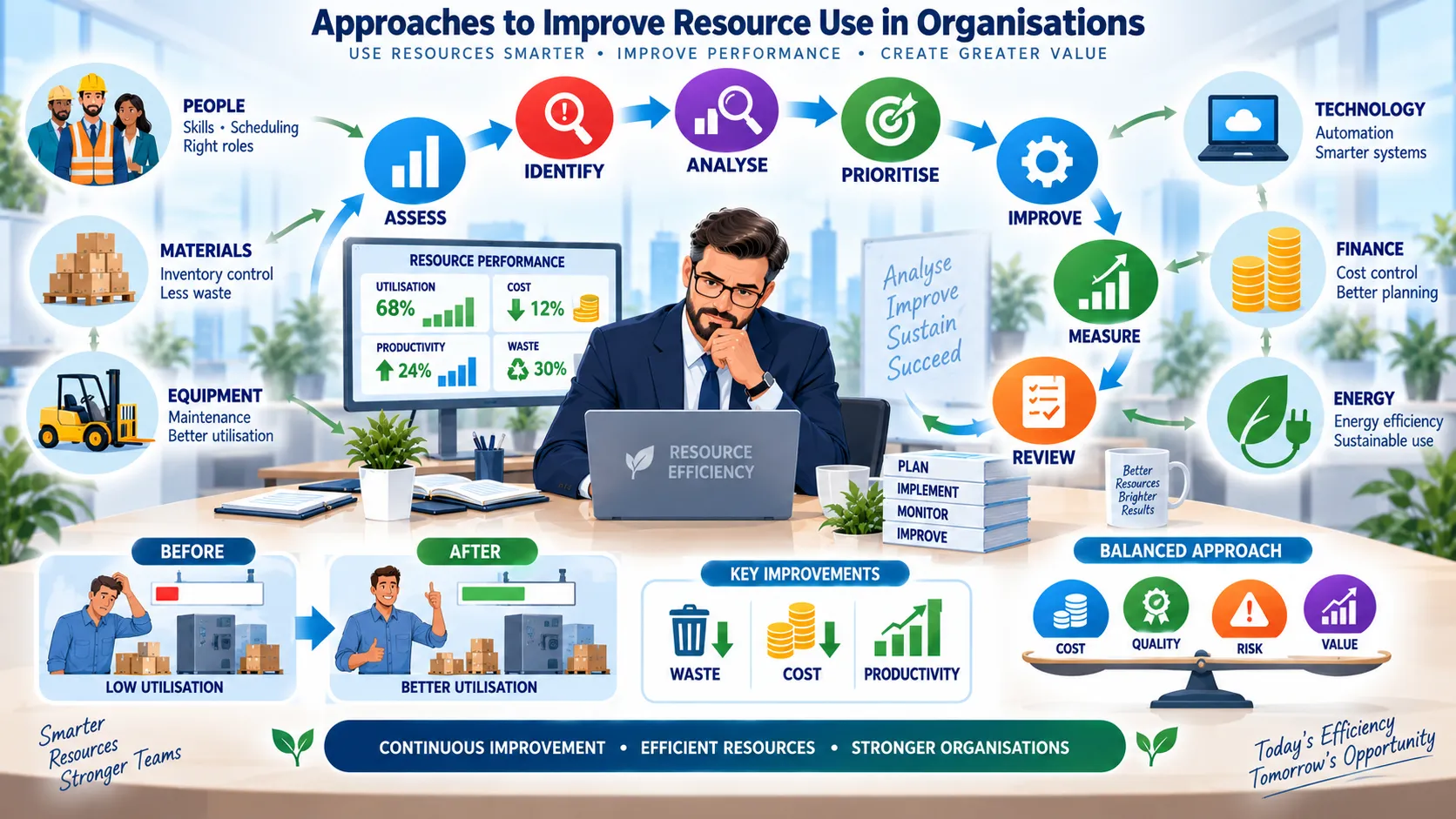
Understanding Resource Improvement
Resource improvement is the systematic process of identifying opportunities to use organisational resources more effectively and efficiently while maintaining or improving required levels of quality, service, compliance and performance.
The concept has two important dimensions.
Effectiveness asks whether resources are being used to achieve the intended organisational outcomes.
Efficiency asks whether those outcomes are being achieved with an appropriate level of resource input.
An organisation can therefore be efficient but ineffective. For example, a department may reduce staff hours significantly but subsequently fail to meet customer service requirements.
Similarly, an organisation can be effective but inefficient. It may achieve excellent customer outcomes but use excessive staff hours, materials or financial resources to do so.
The strongest management approach seeks an appropriate balance between both.
Resource Efficiency
Resource efficiency means achieving the required outputs while minimising unnecessary consumption, waste, time and cost.
Examples include:
reducing material waste
improving equipment utilisation
reducing unnecessary overtime
eliminating duplicated processes
reducing energy consumption
improving inventory turnover
removing unused software licences
Resource Effectiveness
Resource effectiveness means ensuring that resources contribute directly to organisational objectives.
Examples include:
allocating skilled employees to critical activities
investing in technology that improves service delivery
purchasing equipment that meets operational requirements
directing budgets towards high-priority objectives
maintaining sufficient stock of critical resources
Value for Money
Value for money means achieving an appropriate relationship between cost, quality, performance, risk and outcomes.
The cheapest option is not necessarily the best option.
For example, purchasing low-cost equipment that frequently fails may create higher maintenance costs, employee downtime and replacement expenditure.
Managers should therefore evaluate the total value generated by resource decisions, not just the initial purchase price.
Why Improving Resource Use Matters
Poor resource use can affect organisational performance in several ways.
Financial Impact
Inefficient resource use can increase:
operating costs
procurement expenditure
overtime
maintenance costs
inventory carrying costs
energy bills
waste disposal costs
Improving resource use can therefore contribute directly to better financial performance.
Operational Impact
Poor resource allocation can result in:
delays
bottlenecks
idle capacity
equipment downtime
stock shortages
excessive workloads
reduced productivity
Better resource use can improve operational reliability and capacity.
Quality Impact
Resource shortages or inappropriate resource allocation can reduce quality.
For example, insufficient staffing may increase errors, while poor-quality materials may increase product defects.
Customer Impact
Resource inefficiency can affect customer experience through:
delayed delivery
poor service
reduced availability
inconsistent quality
longer response times
Employee Impact
Poor resource management can contribute to:
excessive workloads
avoidable overtime
frustration
inefficient working practices
reduced engagement
Sustainability Impact
Efficient resource use can reduce:
material waste
energy consumption
unnecessary transport
emissions
disposal requirements
Sustainable resource management should therefore be integrated into operational decision-making.
Key Concepts for Improving Resource Use
Several management concepts provide a foundation for effective resource improvement.
Waste Reduction
Waste is any resource consumption that does not contribute appropriate value to organisational outcomes.
Waste may include:
unused materials
defective output
unnecessary movement
waiting time
duplicate work
excess inventory
avoidable energy consumption
unused technology licences
unnecessary administrative activity
Managers should distinguish between necessary resource use and avoidable consumption.
Resource Utilisation
Resource utilisation measures how much of available capacity is being used.
For example:
Utilisation Rate = Actual Resource Use ÷ Available Capacity × 100
If equipment is available for 500 hours but used for 400 hours:
400 ÷ 500 × 100 = 80% utilisation
However, maximum utilisation is not always desirable. Some spare capacity may be necessary to accommodate demand fluctuations, maintenance or emergencies.
Productivity
Productivity examines the relationship between outputs and resource inputs.
Productivity = Output ÷ Resource Input
For example, if a team processes 2,400 cases using 600 labour hours:
2,400 ÷ 600 = 4 cases per labour hour
Managers can use productivity measures to identify changes over time.
Capacity Management
Capacity management involves ensuring that resources are sufficient to meet expected demand without maintaining unnecessary excess capacity.
Managers need to consider:
current demand
forecast demand
available resources
resource constraints
peak periods
seasonal variations
contingency requirements
Continuous Improvement
Continuous improvement involves making systematic and ongoing improvements to processes, resource allocation and performance.
Rather than waiting for a major failure, managers regularly identify smaller opportunities for improvement.
Approaches to Improve Resource Use
1. Conduct a Resource Utilisation Review
A resource utilisation review provides a structured assessment of how resources are currently being used.
Managers should examine actual usage against planned or available capacity.
The review may cover:
workforce utilisation
equipment utilisation
inventory
financial expenditure
technology
facilities
energy
supplier resources
The purpose is to identify:
under-utilisation
over-utilisation
waste
bottlenecks
unnecessary expenditure
capacity gaps
Practical Process
Identify the resource.
Establish available capacity.
Measure actual use.
Compare actual and planned use.
Identify significant variances.
Investigate causes.
Assess operational consequences.
Recommend improvements.
Implement agreed changes.
Measure the outcome.
This provides an evidence-based foundation for resource improvement.
2. Improve Resource Planning
Many resource inefficiencies originate from poor planning.
Managers can improve planning by using:
historical data
demand forecasts
workload analysis
capacity planning
seasonal information
supplier lead times
financial forecasts
strategic objectives
Improved forecasting reduces the likelihood of both under-resourcing and over-resourcing.
For example, if historical data shows that customer demand increases significantly every December, management can plan staffing, inventory and supplier capacity in advance rather than relying on emergency measures.
3. Match Resources to Demand
Resources should be aligned with actual and forecast demand.
This can involve flexible allocation rather than maintaining identical resource levels throughout the year.
Managers may:
adjust staff schedules
move resources between departments
alter production schedules
increase inventory before peak periods
reduce unused capacity during low-demand periods
use temporary resources where appropriate
Matching resources to demand improves utilisation while maintaining service capacity.
4. Reallocate Under-Utilised Resources
Resources that are under-used may represent an opportunity for improvement.
Examples include:
unused equipment
vacant workspace
inactive software licences
surplus inventory
employees with unused capacity
vehicles with low utilisation
Before removing a resource, managers should understand why it is under-utilised.
Possible causes include:
low demand
poor scheduling
unsuitable location
lack of training
technical limitations
process bottlenecks
The solution may therefore be reallocation rather than disposal.
5. Eliminate Duplication
Duplication occurs when different teams or systems perform the same activity unnecessarily.
Examples include:
duplicate data entry
multiple inventory records
overlapping software
repeated approvals
duplicate reporting
unnecessary purchasing
Managers can map processes to identify where duplication occurs.
Removing duplication can reduce:
time
administrative effort
errors
technology costs
employee frustration
6. Improve Process Efficiency
Process improvement can significantly affect resource use.
Managers should examine the sequence of activities involved in delivering an output.
Questions may include:
Which activities add value?
Which activities create delays?
Where are approvals duplicated?
Where does work wait?
Where do errors occur?
Where are resources unnecessarily transferred?
Which activities could be simplified?
Process redesign may allow the same output to be achieved using fewer resources without reducing quality.
7. Automate Repetitive Activities
Technology can improve resource efficiency where activities are repetitive, predictable and suitable for automation.
Potential examples include:
automated data entry
invoice processing
stock alerts
appointment scheduling
routine reporting
workflow notifications
document generation
Automation can reduce manual effort and improve consistency.
However, managers should consider:
implementation cost
technology reliability
employee skills
information security
data quality
maintenance
user acceptance
regulatory requirements
Automation should be introduced where it creates genuine organisational value.
8. Improve Inventory Management
Inventory represents a significant resource for many organisations.
Improvement strategies may include:
setting appropriate reorder points
monitoring stock turnover
reducing obsolete inventory
improving demand forecasting
using inventory classification
improving supplier lead-time information
monitoring stock accuracy
reviewing safety-stock levels
Managers should aim to maintain enough stock to support operations without creating excessive financial and storage costs.
Inventory Classification
Resources can be classified according to factors such as:
value
criticality
usage
lead time
risk
High-value or operationally critical items may require closer monitoring than low-value routine supplies.
9. Improve Supplier Performance
Suppliers are an important external resource.
Poor supplier performance can increase resource costs and create operational inefficiencies.
Managers can improve supplier resource use by monitoring:
delivery reliability
quality
price
responsiveness
lead times
service performance
contract compliance
Where appropriate, supplier performance reviews can identify improvement actions.
For example, if repeated late deliveries cause production downtime, management may work with the supplier to identify the cause and agree corrective actions.
10. Develop Supplier Collaboration
For strategically important resources, collaboration may provide greater value than transactional purchasing.
Collaborative activities may include:
demand forecasting
joint planning
capacity discussions
quality improvement
delivery planning
problem-solving
innovation
Strong supplier relationships can improve reliability and reduce avoidable resource problems.
11. Introduce Preventive Maintenance
Equipment failure can create major resource inefficiencies.
When machinery fails unexpectedly, organisations may experience:
downtime
lost production
emergency repair costs
employee idle time
delayed customer deliveries
Preventive maintenance involves inspecting, servicing and maintaining equipment before major failure occurs.
Managers can monitor:
maintenance schedules
equipment condition
downtime
repair frequency
maintenance costs
asset age
Preventive maintenance can improve equipment availability and extend asset life.
12. Improve Workforce Allocation
People are often one of an organisation’s most significant resources.
Improving workforce resource use does not mean simply reducing headcount. It means ensuring that employees’ skills, time and capacity are appropriately matched to organisational requirements.
Managers can use:
workforce planning
skills matrices
workload analysis
flexible scheduling
cross-training
job rotation
capacity planning
For example, a skills matrix may show that one department has excess capacity in one skill while another department has a shortage. Subject to organisational requirements, managers may be able to improve resource allocation through training or temporary redeployment.
13. Reduce Unnecessary Overtime
Overtime may be necessary during peak periods, but persistent overtime can indicate resource-planning problems.
Managers should investigate:
workload levels
staffing levels
scheduling
productivity
absenteeism
process inefficiency
skills availability
Reducing unnecessary overtime can lower costs while improving workforce sustainability.
However, managers should not simply prohibit overtime if it is required to maintain critical services. The underlying cause should be addressed.
14. Improve Employee Skills
Resource efficiency can improve when employees have the skills required to perform tasks correctly the first time.
Training can reduce:
errors
rework
equipment misuse
processing delays
quality failures
Managers should identify skills gaps using:
performance information
competency assessments
employee feedback
quality data
operational requirements
Training should be targeted towards genuine resource and performance needs.
15. Improve Resource Sharing
Different departments may each hold resources that are not fully utilised.
Resource sharing can improve overall organisational utilisation.
Examples include:
shared equipment
shared meeting rooms
shared vehicles
shared specialist employees
shared software licences
shared facilities
Before introducing resource sharing, managers should establish clear responsibilities, access arrangements and scheduling systems.
16. Introduce Digital Resource Dashboards
Dashboards can provide managers with visibility of resource performance.
A resource dashboard may display:
budget versus actual expenditure
inventory levels
equipment utilisation
labour hours
productivity
supplier performance
resource availability
waste
performance trends
Dashboards are most useful when they highlight information that requires management attention.
17. Use Data Analytics and Forecasting
Historical resource data can support future decisions.
Managers can analyse patterns in:
demand
consumption
staffing
expenditure
inventory
equipment use
supplier performance
Forecasting can then support decisions about future resource requirements.
Managers should recognise that forecasts are estimates rather than guarantees. They should therefore be reviewed as conditions change.
18. Use Benchmarking
Benchmarking compares resource performance with an appropriate reference point.
Internal benchmarking may compare:
departments
teams
locations
periods
External benchmarking may compare organisational performance with suitable industry information.
Benchmarking can help identify areas that deserve further investigation.
However, managers should avoid assuming that another organisation’s resource level is automatically appropriate. Differences in scale, complexity, quality requirements and operating conditions must be considered.
19. Reduce Energy and Utility Consumption
Energy is an important operational resource and an area where efficiency improvements can produce financial and environmental benefits.
Managers can monitor:
electricity use
heating
cooling
water
fuel
energy per unit of output
Improvement measures may include:
efficient equipment
preventive maintenance
improved operating procedures
automated controls
employee awareness
reduced unnecessary operating time
Energy improvements should be measured against actual consumption to confirm whether expected benefits have been achieved.
20. Improve Workspace Utilisation
Facilities can represent substantial organisational expenditure.
Managers can assess:
occupancy
workspace utilisation
meeting-room usage
storage requirements
operating hours
maintenance costs
Where appropriate, organisations may redesign workspace or introduce flexible arrangements to better match facilities with actual requirements.
Any changes should consider operational needs, employee requirements, health and safety, accessibility and organisational policy.
21. Apply Total Cost of Ownership
Managers should consider the total cost of using a resource rather than only its purchase price.
Total cost may include:
acquisition
installation
training
maintenance
energy
support
replacement
disposal
For example, equipment costing £10,000 may appear cheaper than an alternative costing £12,000. However, if the cheaper equipment has significantly higher maintenance and energy costs, the £12,000 option may provide better long-term value.
22. Standardise Where Appropriate
Standardisation involves using consistent resources, specifications or processes where this creates value.
Examples include:
standard equipment
standard software
standard procedures
standard materials
standard reporting formats
Standardisation can reduce:
training requirements
maintenance complexity
procurement complexity
spare-part requirements
operational variation
However, excessive standardisation can restrict flexibility. Managers should therefore use it where the benefits outweigh the limitations.
23. Improve Resource Accountability
Clear accountability helps ensure that resources are managed responsibly.
Managers should establish:
resource owners
approval responsibilities
spending limits
monitoring responsibilities
reporting requirements
escalation arrangements
Employees should understand what resources they control and what standards apply to their use.
24. Introduce Resource-Use Policies and Procedures
Clear policies can establish expectations concerning:
purchasing
equipment use
inventory
energy
expenses
technology
vehicles
information
waste
Procedures should be practical and understandable.
Policies are more effective when supported by training, monitoring and management example.
25. Apply Continuous Improvement Techniques
Continuous improvement approaches encourage managers and employees to identify opportunities to improve resource use regularly.
Methods may include:
Plan–Do–Check–Act
root-cause analysis
process mapping
waste analysis
problem-solving workshops
employee suggestions
performance reviews
Small improvements can accumulate into significant organisational benefits.
Evaluating Which Approach to Recommend
Managers should not automatically implement every possible improvement. Each recommendation should be assessed against organisational circumstances.
A useful evaluation framework considers:
Cost
What investment is required?
Benefit
What financial, operational or strategic benefit is expected?
Feasibility
Can the organisation realistically implement the change?
Risk
Could the change create new operational, financial, legal or quality risks?
Quality
Will the improvement maintain or improve required standards?
People
How will employees be affected?
Sustainability
Will the approach support responsible resource use?
Time
How quickly can benefits be achieved?
Organisational Alignment
Does the recommendation support organisational objectives?
A Structured Process for Recommending Resource Improvements
Step 1: Establish the Current Position
Use resource records, monitoring information and performance reports to understand current resource use.
Step 2: Identify the Problem
Define the specific inefficiency.
For example:
“Equipment utilisation is 55%, significantly below the departmental target of 80%.”
Step 3: Investigate the Cause
Determine why the problem exists.
Possible causes include:
low demand
poor scheduling
equipment location
employee skills
maintenance issues
process design
Step 4: Identify Options
Develop several possible improvement approaches rather than immediately selecting one.
Step 5: Evaluate Options
Compare alternatives against:
cost
benefit
feasibility
risk
quality
people
sustainability
timescale
Step 6: Select the Preferred Recommendation
Choose the approach that provides the most appropriate balance between benefits and risks.
Step 7: Develop an Implementation Plan
Define:
actions
responsibilities
resources
timescales
measures
risks
Step 8: Communicate the Recommendation
Explain the reason for change and expected outcomes to relevant stakeholders.
Step 9: Implement
Put the agreed changes into practice.
Step 10: Measure Results
Compare actual performance with the expected improvement.
Step 11: Review and Adjust
If the expected improvement has not been achieved, investigate why and modify the approach.
Step 12: Standardise Successful Improvements
Where an improvement works effectively, incorporate it into normal organisational procedures.
Cost-Benefit Analysis for Resource Improvement
Cost-benefit analysis can help managers determine whether an improvement is worthwhile.
Managers should consider both direct and indirect costs and benefits.
Potential Costs
purchase costs
implementation costs
training
technology
consultancy
transition costs
maintenance
temporary disruption
Potential Benefits
reduced expenditure
improved productivity
reduced waste
improved quality
improved customer service
increased capacity
lower energy consumption
reduced operational risk
For example, an organisation may consider replacing inefficient equipment.
The manager calculates:
Expected Annual Benefit − Annual Operating Cost = Net Annual Benefit
A more comprehensive evaluation may also consider payback period, whole-life costs and non-financial benefits.
Risk Assessment Before Resource Improvement
Resource improvement can create new risks if poorly planned.
For example, reducing inventory may lower carrying costs but increase the risk of stock shortages.
Managers should consider:
operational risk
financial risk
quality risk
supply risk
technology risk
people risk
compliance risk
reputational risk
A recommended improvement should therefore be proportionate to both the expected benefit and the level of risk.
Managing Change When Improving Resource Use
Employees may resist changes to resource processes if they believe the change will increase workload, reduce autonomy or threaten their role.
Managers should therefore involve employees appropriately.
Effective change management may include:
explaining the reason for change
communicating expected benefits
consulting affected employees
providing training
testing changes
responding to concerns
monitoring implementation
Employee involvement can also generate valuable improvement ideas because staff often understand operational inefficiencies that may not be visible to senior management.
Practical Example 1: Improving Inventory Use
A manufacturing organisation regularly holds excessive quantities of certain materials.
The resource monitoring report shows:
low stock turnover
high storage costs
increasing obsolete inventory
limited demand for some materials
The manager investigates and discovers that purchasing decisions are based on outdated demand forecasts.
The recommended improvement is to:
update demand forecasting
introduce reorder points
classify materials by criticality
review slow-moving inventory
improve communication between sales, operations and procurement
The expected result is reduced excess inventory without increasing the risk of critical shortages.
Practical Example 2: Improving Equipment Utilisation
An organisation owns several specialist machines.
Monitoring shows that one machine has only 40% utilisation while another regularly operates near full capacity.
The manager investigates and identifies poor scheduling as the main cause.
The organisation redesigns the scheduling process and shares workloads between machines.
The result is improved overall capacity utilisation without immediately purchasing another machine.
This demonstrates an important management principle:
Improve utilisation of existing resources before automatically acquiring additional resources.
Practical Example 3: Improving Workforce Resource Use
A customer-service department experiences frequent overtime.
The manager analyses workload, employee schedules and service demand.
The data shows that customer enquiries peak at predictable times each week.
The manager recommends adjusting staff schedules so more employees are available during peak periods and fewer during low-demand periods.
The change reduces overtime while maintaining service capacity.
Practical Example 4: Improving Technology Resource Use
An organisation has numerous software licences.
Monitoring identifies that many licences are rarely used.
Management reviews user requirements and removes unnecessary licences at renewal while ensuring that essential users retain access.
The organisation reduces expenditure without negatively affecting operations.
Practical Example 5: Improving Energy Resource Use
A facilities manager identifies that energy consumption is increasing despite relatively stable occupancy.
The manager investigates equipment performance, operating schedules and energy data.
The review identifies that heating and cooling systems continue operating outside required hours.
The organisation introduces improved controls and operating procedures.
Energy consumption falls while employee comfort and operational requirements are maintained.
Practical Example 6: Improving Supplier Resource Use
A business frequently receives deliveries later than required.
Late deliveries cause:
production delays
employee waiting time
emergency purchasing
customer delivery problems
The manager reviews supplier performance and identifies recurring delivery failures.
Rather than immediately changing supplier, management conducts a supplier performance review and agrees an improvement plan.
The plan includes:
revised delivery schedules
performance monitoring
escalation procedures
clearer forecasting
agreed service expectations
The organisation then monitors whether delivery reliability improves.
Measuring the Success of Resource Improvements
Managers should define measures before implementing an improvement.
Potential measures include:
percentage reduction in waste
cost savings
utilisation improvement
productivity increase
reduction in downtime
reduction in inventory
reduction in energy use
reduction in overtime
improved supplier performance
improved customer outcomes
For example:
Before improvement: Equipment utilisation = 60%
Target: Equipment utilisation = 75%
After improvement: Equipment utilisation = 78%
The result indicates that the improvement exceeded the target, although managers should still verify that quality and operational risks have not increased.
Leading and Lagging Measures
Managers can use both leading and lagging indicators.
Leading Indicators
Leading indicators provide information about conditions that may influence future performance.
Examples include:
maintenance completion
training completion
stock below warning level
supplier risk indicators
resource planning accuracy
Lagging Indicators
Lagging indicators show what has already happened.
Examples include:
actual expenditure
completed output
waste
downtime
customer complaints
productivity results
Using both types provides a more complete management picture.
Avoiding False Efficiency
One of the most important leadership considerations is avoiding “false efficiency”.
False efficiency occurs when an organisation reduces resource consumption but creates greater costs or poorer outcomes elsewhere.
For example:
reducing staff may increase customer complaints
reducing maintenance may increase equipment failure
reducing inventory may increase stockouts
choosing cheaper materials may increase defects
reducing training may increase errors
removing administrative controls may increase compliance risk
Managers should therefore assess the whole system, not isolated resource costs.
Balancing Efficiency, Effectiveness and Resilience
Resource improvement should consider three connected objectives:
Efficiency: Are resources being used with minimal unnecessary consumption?
Effectiveness: Are resources producing the intended organisational outcomes?
Resilience: Can the organisation continue operating when conditions change?
For example, reducing inventory may improve efficiency but reduce resilience if stock levels become too low.
A strong recommendation balances all three.
Sustainability and Responsible Resource Use
Sustainable resource management involves meeting organisational requirements while reducing unnecessary environmental and social impacts.
Managers can consider:
energy efficiency
waste reduction
responsible procurement
resource reuse
recycling
sustainable materials
supplier sustainability
efficient transport
equipment lifecycle
responsible disposal
Sustainability should be incorporated into resource decisions where it aligns with organisational strategy, stakeholder expectations and applicable requirements.
Benefits of Improving Resource Use
Reduced Operating Costs
Efficient resource use can reduce unnecessary expenditure.
Improved Productivity
Better allocation and process design can increase output from available resources.
Reduced Waste
Monitoring and process improvement can reduce unnecessary consumption.
Improved Capacity
Better utilisation can increase effective capacity without requiring immediate additional resources.
Better Quality
Appropriate resource allocation can reduce errors and defects.
Improved Customer Service
Reliable and efficient resource use supports consistent service delivery.
Greater Employee Effectiveness
Better workforce allocation and appropriate technology can enable employees to focus on higher-value activities.
Improved Financial Performance
Cost savings and productivity improvements can contribute to stronger financial results.
Increased Organisational Resilience
Balanced resource planning can reduce vulnerability to shortages and disruption.
Improved Sustainability
Efficient resource use can reduce waste and unnecessary environmental impact.
Common Mistakes When Improving Resource Use
Treating Cost Reduction as the Only Objective
Reducing costs without considering quality, risk and outcomes can create long-term problems.
Removing Resources Without Analysis
A resource that appears expensive may be essential to quality, resilience or compliance.
Implementing Technology Without Process Review
Technology cannot automatically fix an inefficient process.
Ignoring Employees
Employees affected by resource changes need appropriate communication and involvement.
Failing to Measure Outcomes
Without measurement, managers cannot determine whether an improvement has delivered the expected benefit.
Making Changes Too Quickly
Rapid changes without testing can create operational disruption.
Ignoring Secondary Effects
A change in one resource area may affect another.
For example, reducing inventory may increase emergency procurement and transport costs.
Maintaining Unnecessary Resources
Managers should also avoid retaining resources simply because they have historically been available.
Resource requirements should be reviewed against current and future organisational needs.
Management Decision-Making Framework
A useful decision framework for middle managers is:
PURPOSE
What organisational objective will the improvement support?
CURRENT POSITION
How are resources currently being used?
PROBLEM
What specific inefficiency or performance issue exists?
CAUSE
Why is the problem occurring?
OPTIONS
What alternative approaches are available?
VALUE
What benefits could each option create?
RISK
What risks could each option introduce?
FEASIBILITY
Can the organisation realistically implement it?
IMPACT
How will employees, customers, suppliers and other stakeholders be affected?
MEASUREMENT
How will success be demonstrated?
This framework supports structured recommendations rather than decisions based solely on intuition.
Resource Improvement Action Plan
A practical action plan can translate recommendations into implementation.
| Improvement Area | Current Issue | Recommended Action | Performance Measure | Responsible Role | Review Point |
|---|---|---|---|---|---|
| Inventory | Excess slow-moving stock | Improve forecasting and reorder controls | Stock turnover | Operations Manager | Monthly |
| Equipment | Low utilisation | Improve scheduling and resource sharing | Utilisation rate | Department Manager | Monthly |
| Workforce | High overtime | Match staffing to demand patterns | Overtime hours | Team Manager | Weekly |
| Technology | Unused licences | Review and remove unnecessary licences | Active licence percentage | IT Manager | Quarterly |
| Energy | High consumption | Improve operating controls and maintenance | Energy per output unit | Facilities Manager | Monthly |
| Suppliers | Late deliveries | Supplier improvement plan | On-time delivery rate | Procurement Manager | Monthly |
A Practical Continuous Improvement Procedure
Managers can embed resource improvement into normal management practice through a recurring review cycle.
Monthly Review
Review:
resource consumption
expenditure
utilisation
productivity
waste
supplier performance
significant variances
Quarterly Review
Review:
resource forecasts
capacity
supplier risks
asset performance
technology utilisation
improvement projects
Annual Strategic Review
Review:
long-term resource requirements
organisational objectives
major investment needs
resource efficiency trends
sustainability
supply resilience
technology changes
This ensures that resource use remains aligned with organisational priorities.
Professional Management Perspective
For practising and aspiring middle managers, improving resource use requires a shift from simply controlling resources to optimising organisational value.
A manager should not automatically ask:
“How can we use less?”
A more useful question is:
“How can we achieve the required organisational outcomes using resources in the most effective, efficient, resilient and responsible way?”
This distinction is important.
Reducing the number of employees, lowering stock levels, reducing equipment maintenance or cutting expenditure may initially appear successful. However, if these actions cause lower quality, reduced customer satisfaction, increased operational risk or higher future costs, the organisation has not genuinely improved resource performance.
Managers should therefore use evidence to understand the entire relationship between resource inputs and organisational outcomes.
The strongest recommendations are usually those that:
solve an identified problem
address the underlying cause
support organisational objectives
provide measurable benefits
manage associated risks
involve relevant stakeholders
are financially realistic
maintain required quality
support operational resilience
can be monitored after implementation
Middle managers also have an important role in creating a culture of responsible resource use. Employees are more likely to use resources effectively when expectations are clear, managers demonstrate good practice and employees are encouraged to identify waste and improvement opportunities.
Resource improvement should therefore be treated as both a process issue and a leadership issue.
Key Takeaways
Improving resource use in organisations involves much more than reducing expenditure. It requires managers to examine how resources are planned, allocated, consumed, maintained and monitored and to identify opportunities to improve their contribution to organisational objectives.
Effective approaches include:
resource utilisation reviews
improved forecasting
demand and capacity matching
resource reallocation
process improvement
automation
inventory optimisation
supplier performance management
preventive maintenance
workforce planning
skills development
resource sharing
digital dashboards
data analytics
benchmarking
energy efficiency
workspace optimisation
total cost of ownership
standardisation
accountability
continuous improvement
The most appropriate approach depends on organisational context. Managers should evaluate each recommendation according to cost, benefit, feasibility, risk, quality, sustainability, people and strategic alignment.
Successful resource improvement follows a clear cycle:
ASSESS → IDENTIFY → ANALYSE → PRIORITISE → IMPLEMENT → MEASURE → REVIEW → IMPROVE
The central principle is that organisations should aim to achieve the right outcomes with the right resources, at the right time, at an appropriate cost and with acceptable levels of risk.
Key Definitions
| Term | Definition | Management Application |
|---|---|---|
| Resource optimisation | The process of achieving the best practical use of available organisational resources | Supports better allocation and organisational performance |
| Resource efficiency | Achieving required outputs while minimising unnecessary resource consumption | Helps reduce waste and operating costs |
| Resource effectiveness | Using resources in ways that contribute to intended organisational outcomes | Ensures resource decisions support organisational objectives |
| Resource utilisation | The proportion of available resource capacity that is actually used | Identifies under- and over-utilisation |
| Productivity | The relationship between outputs and resources used to produce them | Supports assessment of operational performance |
| Capacity management | Planning and controlling resources to match available capacity with demand | Reduces under- and over-resourcing |
| Waste reduction | Removing unnecessary resource consumption that does not create appropriate value | Improves efficiency and sustainability |
| Continuous improvement | An ongoing process of identifying and implementing incremental or significant improvements | Supports sustained performance development |
| Benchmarking | Comparing performance with an appropriate internal or external reference point | Identifies potential improvement opportunities |
| Total cost of ownership | The complete cost associated with acquiring, operating, maintaining and disposing of a resource | Supports better long-term purchasing and investment decisions |
| Resource allocation | Assigning available resources to activities, departments or objectives | Ensures resources are directed towards priority needs |
| Resource sharing | Using common resources across teams or departments where appropriate | Improves utilisation and reduces duplication |
| Corrective action | Action taken to address an identified resource or performance problem | Helps restore performance to the required level |
| Value for money | Achieving an appropriate balance between cost, quality, performance, risk and outcomes | Supports evidence-based resource decisions |
Summary
Organisations need to continually improve how resources are used because resources are limited and directly influence financial performance, operational delivery, quality, customer satisfaction, employee effectiveness and organisational resilience.
Effective resource improvement begins with understanding the current position. Managers should use accurate records, performance data, KPIs, financial information, employee feedback and operational evidence to identify inefficiencies. They should then investigate the underlying causes rather than treating symptoms.
A wide range of approaches can improve resource use. These include better planning and forecasting, matching resources to demand, reallocating under-utilised resources, improving processes, automating appropriate activities, optimising inventory, strengthening supplier performance, maintaining equipment, improving workforce allocation, sharing resources, using digital dashboards and applying data analytics.
However, improvement decisions must be balanced. The cheapest option is not necessarily the most efficient, and reducing resource consumption does not automatically improve organisational performance. Managers must consider cost, quality, productivity, effectiveness, resilience, risk, sustainability and organisational outcomes together.
A structured recommendation process enables managers to assess the current position, identify problems, investigate causes, develop options, evaluate costs and benefits, assess risks, select an appropriate approach, implement the change and measure results.
For middle managers and leaders, the ultimate goal is to create an environment where resources are used responsibly and continuously improved. This requires clear accountability, reliable information, employee involvement, appropriate technology, effective planning and regular performance review.
When resource improvement becomes part of everyday management practice, organisations are better positioned to control costs, reduce waste, improve productivity, maintain quality, strengthen resilience and achieve their strategic and operational objectives.