
Lesson no 4 :Know how to monitor and measure the outcome of operational planning
Monitoring and measuring the outcome of operational planning is an essential management activity because an operational plan must ultimately produce measurable results that contribute to organisational objectives. Creating a plan, allocating resources and completing activities do not automatically demonstrate success. Managers need to determine whether planned activities have been implemented effectively, whether expected outputs have been achieved, whether quality standards have been maintained and whether the intended organisational outcomes have been delivered.
Operational planning provides a structured framework for converting organisational objectives into practical activities, responsibilities, resources, timescales and performance measures. Monitoring provides the ongoing process of checking progress against these expectations, while measurement provides evidence of the level of performance achieved. Together, monitoring and measurement enable managers to identify performance gaps, understand emerging issues, evaluate results and take appropriate action.
For practising and aspiring middle managers, this capability is particularly important because they are often responsible for translating organisational priorities into measurable operational performance. They may need to monitor departmental targets, evaluate team performance, review resource utilisation, assess service quality, analyse customer or stakeholder feedback and report findings to senior management. Effective monitoring therefore supports both day-to-day operational control and wider organisational accountability.
A key principle is that managers should distinguish between activities, outputs and outcomes. An activity describes what has been done, while an output represents the immediate result produced by that activity. An outcome concerns the broader change or benefit resulting from the work. For example, delivering employee training is an activity, the number of employees completing the training is an output, while improved employee capability or improved workplace performance may represent an outcome. Monitoring only activity completion may therefore provide an incomplete picture of operational success.
Effective measurement requires appropriate performance indicators and reliable sources of information. Managers may use key performance indicators (KPIs), quality measures, financial indicators, productivity measures, completion rates, customer satisfaction, employee feedback, service standards and outcome measures. The measures selected should be relevant to the operational objectives and capable of providing useful information for management decisions.
Monitoring should also involve comparison. Managers need to compare actual performance against planned targets, agreed standards, milestones, budgets, timescales and expected outcomes. Where performance differs from expectations, the manager should investigate the reason for the variance rather than simply recording that a target has been missed. A performance gap may result from insufficient resources, unrealistic assumptions, changing circumstances, process weaknesses, capability issues or external factors.
Data and management information play an important role in this process. Managers should collect information systematically, assess its reliability and interpret trends rather than relying on isolated figures. Quantitative data can provide measurable evidence, while qualitative information such as customer feedback, employee observations and stakeholder comments can help explain why particular results have occurred. Combining different forms of evidence can provide a more balanced understanding of operational performance.
Monitoring and measurement should also support continuous improvement. When performance falls below expectations, managers should identify appropriate corrective action. When performance exceeds expectations, they should consider what has contributed to the success and whether effective practices can be applied elsewhere. Regular review therefore transforms performance information into organisational learning and improvement.
Quality must remain an important consideration throughout the monitoring process. A team may achieve productivity targets while customer satisfaction, service quality or employee wellbeing declines. Similarly, an operational activity may be completed within budget but fail to produce the intended outcome. Managers therefore need to use balanced measures rather than relying on a single indicator.
Effective reporting is another important element of monitoring operational outcomes. Managers should communicate relevant findings clearly to appropriate stakeholders, highlighting achievements, performance gaps, risks, trends, resource implications, corrective actions and areas requiring management attention. Reports should support informed decision-making rather than simply present large volumes of data.
The lesson therefore examines how managers can monitor operational implementation and measure the outcomes of operational planning using appropriate performance information, KPIs, quality measures, targets, milestones and feedback. It also considers how to compare actual performance with planned expectations, identify and analyse variances, evaluate the effectiveness of operational activities, report findings and use evidence to support corrective action and continuous improvement.
By developing these skills, learners can move beyond simply asking whether an operational plan has been completed and instead assess the more important questions: Did the plan achieve its objectives? Did it produce the expected outcomes? Was performance achieved efficiently and to the required quality? What does the evidence tell us? What needs to change?
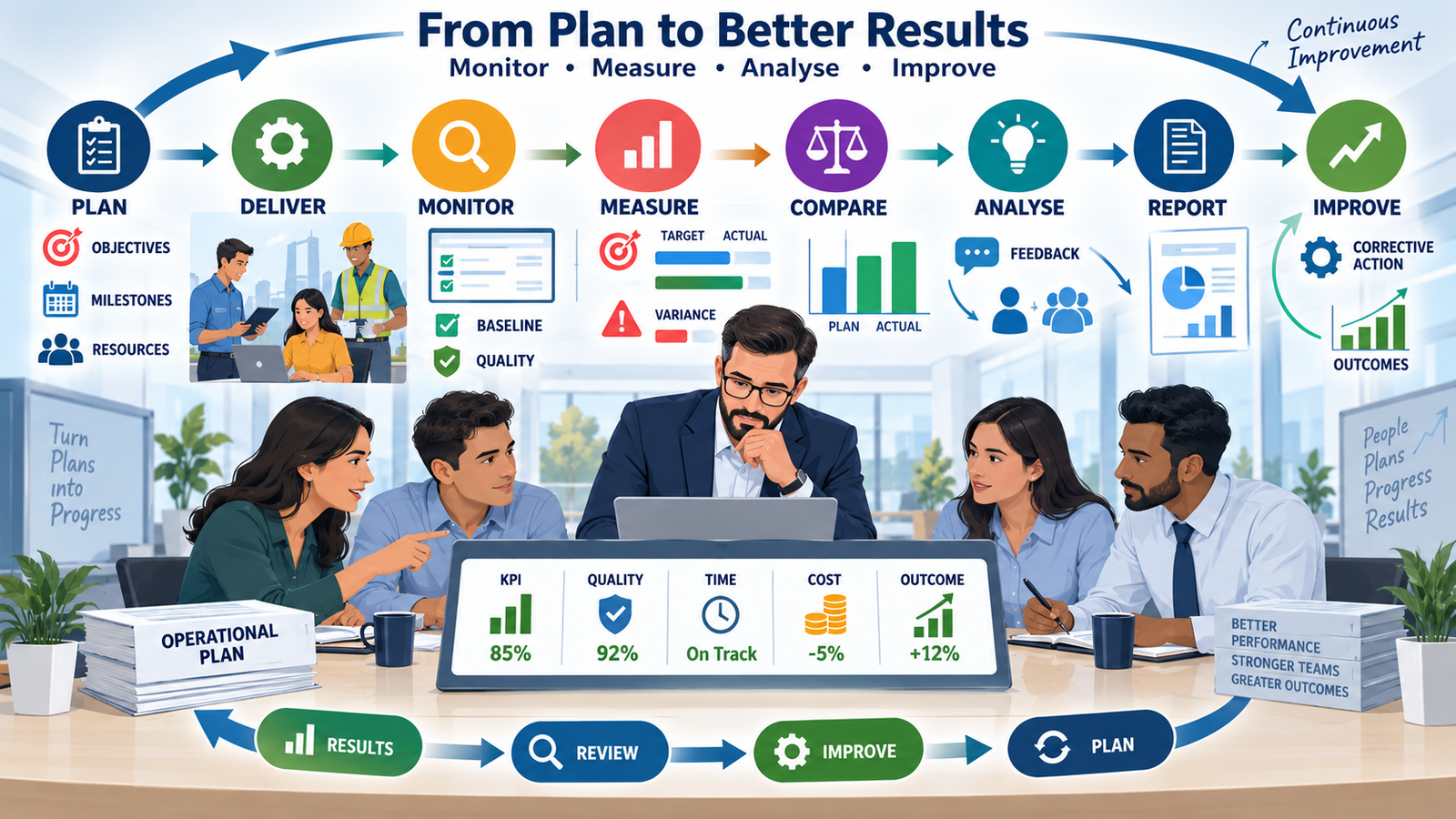
Effective operational monitoring and measurement therefore create a continuous management cycle:
PLAN → DELIVER → MONITOR → MEASURE → COMPARE → ANALYSE → REPORT → IMPROVE
This cycle enables managers to maintain operational control while ensuring that activities remain aligned with organisational objectives and continue to deliver meaningful, measurable and sustainable results.
1.Evaluate Methods to Monitor Progress and Measure the Outcomes of Operational Plans
Introduction
An operational plan translates organisational objectives into practical activities, responsibilities, resources, timescales, quality requirements and measurable targets. However, creating an operational plan is only the beginning of the management process. Managers must continually determine whether implementation is progressing as intended and whether the activities being delivered are producing the expected outcomes.
Monitoring progress and measuring outcomes are therefore central to effective operational management. Monitoring provides ongoing information about what is happening during implementation, while measurement provides evidence about the level of performance or results achieved. These activities enable managers to identify variances, understand emerging problems, assess resource use, maintain quality and determine whether operational objectives are being achieved.
For middle managers, this responsibility is particularly important because they often sit between strategic decision-makers and operational teams. They need to convert organisational objectives into measurable performance expectations and provide reliable information about what is happening at operational level. Effective monitoring allows them to intervene early, while effective measurement allows them to determine whether operational activity has created the intended value.
A strong monitoring and measurement system should answer several fundamental management questions:
Are planned activities being completed?
Are milestones being achieved?
Are resources being used as intended?
Are KPIs being achieved?
Is performance within agreed quality standards?
Are operational outcomes improving?
Are customers and stakeholders receiving the expected benefits?
Are risks affecting delivery?
Are actual results different from planned results?
What corrective action is required?
What can be learned for continuous improvement?
Monitoring and measurement should not become a purely administrative exercise. Their purpose is to generate useful information that supports management decisions and improves organisational performance.
Understanding Progress Monitoring and Outcome Measurement
Definition of Monitoring Progress
Monitoring progress is the systematic and ongoing process of collecting, reviewing and comparing information about operational activities and performance against agreed plans, targets, milestones, timescales and standards.
Monitoring is concerned primarily with what is happening during implementation.
Examples include:
Checking whether activities are on schedule.
Reviewing milestone completion.
Monitoring staff capacity.
Checking resource utilisation.
Tracking KPI performance.
Reviewing budget expenditure.
Monitoring quality indicators.
Identifying emerging risks.
Checking whether responsibilities are being fulfilled.
Monitoring should be continuous enough to identify significant deviations while remaining proportionate to the operational context.
Definition of Measuring Outcomes
Measuring outcomes is the process of determining whether operational activities have produced the intended results, benefits or changes in performance.
Outcomes are concerned with what has actually been achieved as a consequence of operational activity.
For example, an organisation may introduce a customer-service training programme.
Activity: Employees attend training.
Output: 100 employees complete the training.
Outcome: Customer-service performance improves.
Longer-term organisational outcome: Customer satisfaction and retention increase.
This distinction is important because completing activities does not necessarily demonstrate that the intended outcome has been achieved.
The Difference Between Activities, Outputs and Outcomes
Managers should understand the difference between these concepts when evaluating operational plans.
| Concept | Definition | Example | How It Can Be Measured |
|---|---|---|---|
| Activity | The work undertaken to implement the plan | Deliver customer-service training | Number of sessions delivered |
| Output | The immediate result produced by the activity | Employees complete training | Completion rate |
| Outcome | The change or benefit resulting from the activity | Improved service performance | Customer satisfaction or quality score |
| Organisational impact | Wider longer-term effect | Improved customer retention | Retention rate or business performance |
A common weakness in operational monitoring is focusing heavily on activities and outputs while paying insufficient attention to outcomes. Managers may report that all planned training sessions were delivered, for example, but fail to establish whether employee capability actually improved.
Why Monitoring and Measurement Matter
Effective monitoring and measurement provide managers with visibility over operational performance.
Without appropriate monitoring, managers may discover problems only after objectives have already been missed. Without outcome measurement, they may assume that completed activities have produced value when this may not be the case.
Key Benefits
Effective monitoring and measurement can:
Identify problems early.
Support evidence-based decision-making.
Improve accountability.
Strengthen resource management.
Protect quality.
Support risk management.
Improve forecasting.
Identify performance trends.
Demonstrate achievement.
Strengthen stakeholder confidence.
Support corrective action.
Enable continuous improvement.
Improve alignment with organisational objectives.
The value of monitoring therefore extends beyond reporting. It creates the evidence required for effective operational control.
Establishing a Monitoring Framework
Before implementation begins, managers should establish how progress will be monitored.
A monitoring framework should identify:
What will be monitored.
Why it will be monitored.
How information will be collected.
Who is responsible.
How frequently monitoring will occur.
What target or standard will be used.
How variances will be identified.
Who receives the information.
What action will follow poor performance.
Monitoring Framework Process
A practical process is:
Review the operational objectives.
Identify critical activities.
Establish milestones.
Select appropriate KPIs.
Define quality standards.
Establish baseline information.
Identify data sources.
Allocate monitoring responsibilities.
Set monitoring frequency.
Establish reporting arrangements.
Define escalation thresholds.
Establish review points.
This framework provides structure while allowing managers to adapt monitoring intensity to operational circumstances.
Using KPIs to Monitor Operational Progress
Key performance indicators are among the most widely used methods for monitoring operational performance.
A KPI should provide meaningful information about progress towards an important operational objective.
Examples include:
Customer satisfaction rate.
Response time.
Service completion rate.
Employee productivity.
Error rate.
Defect rate.
Budget variance.
Staff absence rate.
Training completion.
Complaint resolution time.
First-contact resolution rate.
Evaluating KPI Effectiveness
A KPI should be evaluated against several criteria.
Relevance
Does it measure something directly connected to the operational objective?
Clarity
Can employees and managers understand exactly what is being measured?
Reliability
Is the information collected consistently?
Measurability
Can the indicator be measured using available information?
Timeliness
Is the information available quickly enough to support management action?
Controllability
Can the operational team reasonably influence the result?
Balance
Does the KPI encourage the right behaviours without creating undesirable consequences?
Avoiding KPI Overload
Managers sometimes create too many performance indicators. Excessive measurement can result in:
Administrative burden.
Confusion about priorities.
Reduced focus.
Data-quality problems.
Increased reporting workload.
Excessive attention to minor indicators.
A smaller number of meaningful KPIs is often more effective than a large collection of poorly connected measures.
Baseline Measurement
A baseline provides a starting point against which future performance can be compared.
For example, if customer satisfaction is currently 72%, this provides a baseline for evaluating an operational improvement initiative.
A manager can then determine whether performance changes over time.
Baseline information may include:
Current performance.
Existing costs.
Current quality levels.
Existing customer satisfaction.
Current response times.
Current productivity.
Existing error rates.
Without a reliable baseline, it may be difficult to determine whether improvement has actually occurred.
Targets and Performance Standards
Targets define the level of performance that the operational plan is expected to achieve.
Examples include:
Respond to 95% of customer enquiries within 24 hours.
Reduce processing errors by 15%.
Achieve 90% completion of planned activities by the agreed milestone.
Maintain customer satisfaction above a defined threshold.
Targets should be realistic, relevant and aligned with organisational objectives.
Stretch Versus Realistic Targets
A target that is too low may fail to encourage improvement. A target that is unrealistic may damage motivation and encourage inappropriate behaviour.
Managers should therefore consider:
Historical performance.
Available resources.
Workforce capability.
External conditions.
Required improvement.
Operational constraints.
Milestone Monitoring
Milestones are important checkpoints within an operational plan.
Instead of waiting until the final completion date, managers can monitor progress at defined stages.
For example, an operational technology implementation may include:
Requirements completed.
System configured.
Testing completed.
Employees trained.
Pilot completed.
Full implementation completed.
Post-implementation review completed.
Milestone monitoring provides early warning when delivery is falling behind.
Benefits of Milestone Monitoring
Early identification of delays.
Better accountability.
Improved forecasting.
Easier stakeholder communication.
Clearer progress visibility.
Better management of dependencies.
Monitoring Timescales
Time is a critical operational resource.
Managers should compare actual completion dates against planned dates and assess the consequences of delays.
A small delay may be insignificant if there is sufficient contingency. However, a delay in a critical activity may affect several dependent activities.
Managers should therefore consider:
Planned completion date.
Actual completion date.
Remaining work.
Dependencies.
Available contingency.
Impact on final outcomes.
Monitoring Resource Use
Operational plans depend on effective use of resources.
Managers should monitor whether resources are:
Available when required.
Being used efficiently.
Allocated to priority activities.
Being consumed faster than expected.
Producing the expected results.
Resource monitoring may include:
Budget expenditure.
Staffing levels.
Equipment utilisation.
Technology capacity.
Working hours.
Supplier performance.
Resource Variance
A resource variance occurs when actual resource use differs significantly from the plan.
For example, if a project budget predicts £50,000 expenditure but £65,000 has already been spent at an intermediate stage, the manager needs to investigate why.
Possible causes include:
Higher supplier costs.
Additional work.
Poor estimates.
Scope changes.
Inefficiency.
Unexpected problems.
The appropriate response depends on the cause rather than simply the size of the variance.
Financial Monitoring
Financial performance is often an important element of operational monitoring.
Managers may review:
Actual expenditure.
Budget.
Forecast expenditure.
Cost per activity.
Cost per outcome.
Variances.
Savings.
Revenue contribution where relevant.
Financial monitoring should be connected to operational outcomes.
For example, spending below budget is not automatically positive if it results from failing to deliver important activities.
Quality Monitoring
Quality measurement ensures that operational performance is not judged solely by quantity, speed or cost.
Quality indicators may include:
Error rates.
Defect rates.
Customer complaints.
Customer satisfaction.
Audit findings.
Compliance rates.
Rework levels.
Service standards.
A balanced monitoring system should consider both productivity and quality.
Practical Example
A customer-service team reduces average response time from 48 hours to 20 hours. This appears to be a strong improvement.
However, customer complaints increase because employees are providing incomplete responses.
The manager should therefore recognise that response time has improved but service quality has deteriorated.
This illustrates why multiple measures are often necessary.
Customer and Stakeholder Feedback
Qualitative feedback can provide valuable information that quantitative indicators may not reveal.
Sources include:
Customer surveys.
Interviews.
Complaints.
Employee feedback.
Stakeholder meetings.
Focus groups.
Suggestion systems.
Review meetings.
Feedback can help managers understand:
Why performance has changed.
Whether services meet expectations.
Where operational barriers exist.
How employees experience new processes.
Whether intended outcomes are visible.
Feedback should be considered alongside quantitative evidence rather than automatically replacing it.
Management Information and Dashboards
Digital dashboards can provide managers with real-time or regularly updated performance information.
A useful dashboard might display:
KPI status.
Milestone progress.
Budget position.
Quality indicators.
Risk status.
Work volumes.
Customer satisfaction.
Outstanding actions.
Dashboards can improve visibility and support faster intervention.
However, managers should avoid assuming that dashboard information is automatically accurate. Data quality, definitions, collection methods and update frequency should be understood.
Trend Analysis
Managers should not always focus on individual results. Trends can reveal patterns that isolated data points may hide.
For example:
Customer satisfaction may decline gradually.
Error rates may increase each month.
Costs may consistently exceed forecasts.
Productivity may improve after training.
Trend analysis helps managers identify whether performance is:
Improving.
Declining.
Stable.
Fluctuating.
Showing seasonal variation.
This supports more informed decision-making.
Variance Analysis
Variance analysis involves comparing planned performance with actual performance.
Examples include:
Planned cost versus actual cost.
Planned completion date versus actual completion date.
Target KPI versus actual KPI.
Planned output versus actual output.
Expected outcome versus measured outcome.
Variance Analysis Process
Identify the variance.
Establish its size.
Determine whether it is significant.
Investigate the cause.
Assess the operational impact.
Decide whether action is required.
Implement corrective action.
Monitor the result.
Managers should distinguish between normal variation and significant performance problems.
RAG Status Monitoring
A Red-Amber-Green approach can provide a simple visual method of communicating operational status.
Green
Performance is on track and within agreed expectations.
Amber
There is a developing concern requiring management attention.
Red
Performance is significantly off track or a serious issue requires intervention.
RAG systems are useful for dashboards and management reports because they allow stakeholders to identify priorities quickly.
However, managers should define the criteria for each status clearly. Otherwise, different people may interpret colours inconsistently.
Audits and Reviews
Formal reviews and audits can provide independent or structured assessments of operational performance.
They may examine:
Compliance.
Quality.
Processes.
Documentation.
Resource use.
Performance.
Risk controls.
Audits can identify weaknesses that routine monitoring may overlook.
Benchmarking
Benchmarking involves comparing operational performance with another relevant standard, organisation, department or historical benchmark.
Managers may compare:
Service response times.
Cost per transaction.
Quality rates.
Customer satisfaction.
Productivity.
Benchmarking should be used carefully because organisations may operate in different contexts. A direct numerical comparison may be misleading if resources, customer groups, processes or operating environments differ.
Balanced Measurement
Effective operational measurement should provide a balanced view of performance.
Managers should consider appropriate combinations of:
Cost.
Time.
Quality.
Productivity.
Customer outcomes.
Employee outcomes.
Risk.
Resource utilisation.
A balanced approach reduces the likelihood that improving one measure will unintentionally damage another.
Measuring Short-Term and Long-Term Outcomes
Some operational outcomes can be measured quickly, while others take time to become visible.
For example:
Response time may improve immediately.
Error rates may reduce within weeks.
Customer satisfaction may take longer to change.
Customer retention may take several months.
Organisational efficiency may become clearer over a longer period.
Managers should therefore establish realistic measurement periods.
A failure to see immediate improvement does not necessarily mean that an intervention has failed. Conversely, an early positive result does not necessarily prove long-term success.
Outcome Measurement Methods
Managers can measure outcomes through:
Quantitative Measures
These include:
Percentages.
Volumes.
Rates.
Financial values.
Completion figures.
Time measurements.
Error frequencies.
Qualitative Measures
These include:
Customer feedback.
Employee feedback.
Stakeholder opinions.
Interviews.
Observations.
Narrative evidence.
Comparative Measures
These compare:
Before and after performance.
Actual versus target.
Current versus previous period.
Department versus benchmark.
The most appropriate method depends on the outcome being assessed.
Before-and-After Measurement
Before-and-after comparisons can help determine whether an operational intervention has produced improvement.
For example:
Before intervention: Average customer response time = 48 hours.
After intervention: Average customer response time = 26 hours.
The manager can determine that response time has improved.
However, the manager should also consider whether other factors contributed to the improvement. This is important because correlation does not necessarily prove that the operational intervention caused the entire change.
Measuring Outcome Quality
Managers should consider whether outcomes are not only achieved but achieved to the required standard.
For example, an organisation may aim to process 1,000 applications per month.
Achieving 1,000 applications does not necessarily mean the objective has been met if:
Error rates increased.
Customers experienced delays elsewhere.
Compliance standards were breached.
Rework increased.
Outcome measurement should therefore reflect the quality and usefulness of the result.
Monitoring Operational Risks
Risk monitoring should be integrated into operational performance monitoring.
Managers should review:
Existing risks.
New risks.
Changes in risk likelihood.
Changes in risk impact.
Effectiveness of controls.
Contingency arrangements.
For example, a staffing shortage may initially represent a moderate risk. If additional employees become unavailable, the risk may become significant and require immediate action.
Monitoring Corrective Actions
Identifying a performance problem is not enough. Managers must monitor whether corrective action has worked.
For example:
Problem: Error rate increased.
Corrective action: Additional employee training.
Monitoring: Compare error rates before and after training.
Review: Determine whether errors have reduced sufficiently.
If performance has not improved, the manager should investigate why and consider alternative action.
Using Root-Cause Analysis to Interpret Performance Results
Performance data show what is happening but do not always explain why.
For example, a KPI may show that productivity has fallen by 12%.
Possible causes could include:
Staff absence.
Increased workload complexity.
Technology problems.
Process changes.
Training.
Resource shortages.
Managers should investigate before deciding what action is appropriate.
Reporting Monitoring and Measurement Findings
Managers should communicate relevant findings to stakeholders in a clear and useful format.
An operational performance report may include:
Overall status.
Progress against objectives.
KPI performance.
Milestone status.
Resource position.
Quality performance.
Key risks.
Significant variances.
Corrective actions.
Forecast.
Decisions required.
Reports should distinguish between information and interpretation.
For example:
Information: Customer satisfaction fell from 86% to 79%.
Interpretation: The decline coincided with a significant increase in response times and may indicate service-capacity pressure.
The second statement provides management insight rather than simply presenting data.
Escalation of Performance Problems
Not every performance gap requires senior intervention.
Managers should establish thresholds for escalation.
Escalation may be appropriate when:
Performance significantly threatens organisational objectives.
Financial exposure exceeds delegated authority.
Legal or compliance concerns arise.
Critical service continuity is affected.
Significant stakeholder impact exists.
Risks exceed acceptable levels.
Corrective action requires additional authority or resources.
Effective escalation should be timely and evidence-based.
Monitoring Employee Performance
Operational plans are often delivered through individual and team performance.
Managers may monitor:
Completion of responsibilities.
Quality of work.
Productivity.
Attendance where relevant.
Achievement of agreed objectives.
Capability development.
Team collaboration.
Performance information should be interpreted fairly. Managers should consider whether employees have the necessary resources, authority, training and reasonable workload before concluding that poor results are caused by individual performance.
Practical Example: Healthcare Service
Consider a healthcare-related operational plan designed to improve appointment administration.
The plan may establish:
A target response time.
Appointment-processing milestones.
Quality standards.
Staff responsibilities.
A KPI for processing accuracy.
A customer or patient feedback measure.
The manager could monitor:
Number of appointments processed.
Average processing time.
Error rate.
Outstanding cases.
Customer feedback.
Staff workload.
If processing speed improves but errors increase, the manager should not consider the plan fully successful. The results indicate a trade-off that requires investigation.
Practical Example: Education and Training Organisation
An education and training organisation introduces an operational plan to improve learner support.
The plan includes a target for responding to learner enquiries within 24 hours.
The manager monitors:
Response time.
Number of enquiries.
Resolution rate.
Learner satisfaction.
Escalated cases.
Staff capacity.
Suppose response time improves from 36 hours to 20 hours but learner satisfaction remains unchanged.
The manager should investigate whether the problem is the speed of response, the quality of information provided or another aspect of the learner experience.
This demonstrates the importance of measuring outcomes rather than relying on a single activity-based indicator.
Practical Example: Customer Service Improvement
A customer service department introduces a plan to improve first-contact resolution.
The manager monitors:
First-contact resolution rate.
Average response time.
Customer satisfaction.
Complaint rate.
Repeat contacts.
If first-contact resolution increases but customer complaints also increase, the manager should investigate whether employees are closing cases prematurely to improve the KPI.
The example demonstrates why KPIs must be designed and interpreted carefully.
Practical Example: Cost Efficiency
An organisation introduces an operational plan to reduce administrative costs.
The manager measures:
Cost per transaction.
Staff hours.
Processing volume.
Error rates.
Customer satisfaction.
If cost per transaction decreases while errors and complaints increase, the manager should recognise that cost efficiency has been achieved at the expense of quality.
A stronger evaluation would assess whether the organisation has achieved sustainable efficiency rather than simply reduced expenditure.
Practical Example: Digital Transformation
An organisation implements a new digital system intended to improve productivity.
Managers monitor:
Implementation milestones.
User adoption.
Processing time.
Error rates.
System reliability.
Employee feedback.
Customer outcomes.
Successful system installation does not necessarily mean successful digital transformation. The organisation must determine whether the system has improved the intended operational outcomes.
Evaluating Different Monitoring Methods
Different methods provide different types of information.
KPI Monitoring
Strengths:
Clear.
Quantifiable.
Easy to track.
Useful for trends.
Supports comparison.
Limitations:
Can oversimplify performance.
May encourage gaming.
May overlook qualitative outcomes.
Requires reliable data.
Milestone Reviews
Strengths:
Supports early intervention.
Easy to communicate.
Useful for implementation plans.
Limitations:
Focuses strongly on progress stages.
Does not automatically demonstrate outcome quality.
Customer Feedback
Strengths:
Provides direct stakeholder insight.
Helps explain performance results.
Can identify issues not visible in numerical data.
Limitations:
Can be subjective.
Response rates may vary.
Feedback may not represent all customers.
Financial Monitoring
Strengths:
Supports cost control.
Provides measurable evidence.
Helps identify budget variances.
Limitations:
Financial performance alone does not demonstrate operational success.
Short-term savings may create longer-term costs.
Dashboards
Strengths:
Provides visual visibility.
Supports rapid review.
Can combine multiple indicators.
Limitations:
Dependent on data quality.
Can encourage excessive focus on visible metrics.
Requires appropriate design and interpretation.
Audits
Strengths:
Provides structured assurance.
Can identify compliance and quality weaknesses.
Supports accountability.
Limitations:
Can require significant time.
May provide periodic rather than continuous information.
Choosing the Appropriate Monitoring Method
Managers should select methods based on the operational context.
Factors to consider include:
Nature of the objective.
Importance of the activity.
Risk level.
Complexity.
Speed of change.
Available data.
Resource capacity.
Stakeholder expectations.
Required level of assurance.
Frequency of decision-making.
For a high-risk operational process, more frequent monitoring may be justified. For a stable, low-risk process, periodic review may be sufficient.
The Integrated Monitoring and Measurement Cycle
A strong operational monitoring system follows a continuous cycle:
Set → Baseline → Monitor → Measure → Compare → Analyse → Act → Review → Improve
Set
Establish objectives, targets and standards.
Baseline
Determine current performance.
Monitor
Collect information during implementation.
Measure
Determine actual performance and outcomes.
Compare
Assess actual performance against planned expectations.
Analyse
Investigate causes and implications.
Act
Implement corrective or improvement action.
Review
Evaluate whether the action worked.
Improve
Capture learning and strengthen future performance.
This cycle ensures that monitoring contributes directly to operational management.
Using Monitoring to Support Corrective Action
Managers should avoid treating monitoring as passive observation.
When performance deviates from the plan, they should determine whether action is required.
Possible corrective actions include:
Reallocating resources.
Adjusting priorities.
Providing additional training.
Revising processes.
Changing schedules.
Strengthening quality controls.
Addressing technology problems.
Escalating risks.
Revising targets where circumstances genuinely justify change.
Corrective action should be evidence-based and proportionate.
Monitoring the Impact of Changes to the Operational Plan
Operational plans may need to change during implementation.
When changes occur, managers should update the monitoring framework where necessary.
For example, if an activity is delayed by two months, the manager may need to:
Revise milestones.
Update forecasts.
Adjust resource requirements.
Reassess risks.
Communicate revised expectations.
Review KPIs.
Monitoring should therefore remain aligned with the current approved operational plan.
Continuous Improvement Through Measurement
Measurement should contribute to organisational learning.
Managers should ask:
What worked?
What did not work?
Why?
Which assumptions were incorrect?
Which processes created value?
Which resources were particularly effective?
What should be changed?
What should be repeated?
This transforms performance data into improvement knowledge.
Common Problems in Monitoring and Measurement
Measuring Too Much
Collecting excessive information can create administrative burden without improving decisions.
Measuring the Wrong Things
A poorly selected KPI may encourage behaviours that do not support organisational objectives.
Focusing Only on Outputs
Activity completion does not necessarily demonstrate successful outcomes.
Ignoring Qualitative Information
Customer and employee feedback may explain issues that numerical data cannot.
Poor Data Quality
Incorrect, incomplete or inconsistent information can produce misleading conclusions.
Infrequent Monitoring
Problems may remain unnoticed until corrective action becomes difficult.
Excessive Monitoring
Over-monitoring can reduce employee autonomy and create unnecessary administration.
Failure to Act
Monitoring has little value if managers identify problems but do not respond.
Failure to Review Corrective Action
Managers may implement solutions without checking whether they worked.
Key Concepts
The following concepts are central to effective monitoring and measurement of operational plans:
Operational monitoring: Ongoing review of implementation and performance.
Outcome measurement: Assessment of the results or benefits produced.
KPI: A measure used to assess performance against an important objective.
Baseline: The starting level of performance used for comparison.
Target: The intended level of performance.
Milestone: A significant checkpoint within an operational plan.
Variance: A difference between planned and actual performance.
Output: The immediate result of an activity.
Outcome: The change or benefit resulting from an activity.
Quality measure: An indicator of whether performance meets required standards.
Management information: Relevant information used to support operational decisions.
Trend analysis: Examination of performance patterns over time.
Corrective action: Action taken to address a performance problem.
Preventative action: Action intended to reduce the likelihood of future problems.
Continuous improvement: Ongoing effort to improve processes, performance and outcomes.
Managerial Checklist for Monitoring Operational Outcomes
Before evaluating an operational plan, managers should ask:
Objectives
Are the operational objectives clear?
Are they aligned with organisational priorities?
Are expected outcomes defined?
Measurement
Are appropriate KPIs established?
Is there a reliable baseline?
Are targets realistic?
Are quality and outcome measures included?
Data
Is information accurate?
Is it collected consistently?
Is it available at the right time?
Are both quantitative and qualitative sources considered?
Progress
Are activities on schedule?
Are milestones being achieved?
Are dependencies being managed?
Are resources being used as planned?
Outcomes
Are the intended results being achieved?
Are outputs being confused with outcomes?
Are customers and stakeholders experiencing the expected benefits?
Variance
Are there significant differences between planned and actual performance?
Have causes been investigated?
Is corrective action required?
Reporting
Are findings communicated clearly?
Are significant risks and issues escalated?
Does reporting support decision-making?
Improvement
What has been learned?
What should be changed?
Are successful practices being retained?
Has corrective action produced the intended improvement?
Professional Management Insight
Effective monitoring and measurement require more than collecting numbers. The role of the manager is to interpret information and convert it into informed action.
A KPI can tell a manager that performance has changed, but it may not explain why. A dashboard can show that a milestone is late, but it may not identify the underlying operational constraint. A customer survey can indicate dissatisfaction, but it may not reveal the process failure responsible.
Professional managerial judgement is therefore essential.
Managers should also recognise that operational performance is multidimensional. Cost, time, quality, productivity, customer experience, employee capability and risk can interact with one another. Improving one measure may unintentionally damage another. Effective managers therefore use balanced measurement and consider the wider organisational outcome.
Another important principle is proportionality. Monitoring systems should provide enough information to support effective control without creating unnecessary administrative burden. High-risk or rapidly changing activities may require frequent monitoring, whereas stable and low-risk activities may be reviewed less frequently.
Managers should also avoid the assumption that every variance represents failure. Operational environments contain natural variation, and some deviations may be caused by external circumstances outside the team’s direct control. The manager’s responsibility is to determine whether the variance is significant, understand its cause and decide whether intervention is justified.
Perhaps the most important principle is that monitoring should lead to action. If managers collect extensive information but do not use it to make decisions, resolve problems or improve performance, the monitoring system becomes an administrative exercise. Effective operational management creates a clear connection between evidence, interpretation, decision-making and action.
Summary
Monitoring progress and measuring outcomes are essential for determining whether an operational plan is being delivered effectively and whether it is producing the intended organisational results.
Managers should monitor activities, milestones, resources, KPIs, quality, risks, timescales and stakeholder feedback while also measuring outputs and outcomes. They should distinguish between completing planned activities and achieving meaningful results.
Effective monitoring methods include KPI tracking, milestone reviews, dashboards, financial monitoring, quality checks, audits, benchmarking, trend analysis, variance analysis and stakeholder feedback. Each method has advantages and limitations, so managers should select methods according to the operational context, risk, complexity, resources and information requirements.
A strong monitoring and measurement approach follows a continuous cycle:
Set → Baseline → Monitor → Measure → Compare → Analyse → Act → Review → Improve
When managers apply this cycle effectively, they can identify problems early, use resources more effectively, maintain quality, manage risks, support informed decision-making and demonstrate whether operational plans are delivering meaningful outcomes.
The ultimate purpose of monitoring is therefore not simply to determine whether work has been completed. It is to establish whether the organisation is achieving the right results, at the required quality, within acceptable resource and risk parameters, and in a way that contributes to wider organisational objectives.