
Lesson no 2 : Understand processes for initiating, planning and managing projects
Effective project management begins with a structured approach to initiating, planning and managing projects. For managers and leaders, understanding these processes is essential because a project must have a clear purpose, realistic objectives, appropriate resources and effective controls before meaningful results can be achieved. Poorly initiated or inadequately planned projects can experience unclear responsibilities, unrealistic timescales, resource shortages, unmanaged risks and stakeholder difficulties. A structured project management process helps managers establish direction and maintain control from the beginning through to successful delivery.
Project initiation establishes the foundation for the project. At this stage, managers need to understand the organisational need, define the project purpose, identify expected outcomes and consider whether the proposed project is achievable and aligned with organisational priorities. Key stakeholders should be identified early, while initial resources, constraints, risks and responsibilities should also be considered. Effective initiation provides a clear basis for deciding whether a project should proceed and what it is expected to achieve.
Planning then converts the project purpose into a practical delivery framework. Project planning involves defining scope, objectives, tasks, activities, milestones, timescales, resources, responsibilities, risks and communication requirements. Managers may use appropriate project management tools such as project plans, task schedules, work breakdown structures, responsibility matrices, risk registers and milestone plans to organise and control project activity. Good planning does not attempt to predict every possible event; instead, it creates a structured framework that enables the project team to respond effectively when circumstances change.
Managing a project involves coordinating people, activities and resources while monitoring progress against agreed objectives. Managers need to communicate effectively with project teams and stakeholders, manage resources responsibly, identify and respond to risks, resolve problems and ensure that activities remain focused on the intended outcomes. Regular monitoring enables managers to identify delays, resource pressures, emerging risks or changes in requirements before they significantly affect project performance.
Project management is therefore a continuous process rather than a single planning exercise. Managers may need to review and adjust activities as new information becomes available or organisational circumstances change. Effective project management combines planning, implementation, communication, resource management, risk management, monitoring and control to improve the likelihood of achieving successful project outcomes.
This lesson provides learners with a practical understanding of the processes used to initiate, plan and manage projects effectively. It focuses on how managers establish a strong project foundation, translate objectives into structured activities, allocate resources, manage stakeholders and risks, monitor progress and respond to project challenges. By developing these skills, practising and aspiring middle managers can make informed project decisions, improve project control and contribute to the successful achievement of organisational results.
1.Analyse the Process for Initiating Projects
Project initiation is the first formal stage of the project management process and provides the foundation on which the rest of the project is built. Before an organisation commits significant time, money, people or other resources to a project, managers need to establish why the project is required, what it is expected to achieve, whether it is realistic and feasible, who needs to be involved, and how the project will contribute to organisational priorities.
For middle managers and leaders, project initiation is particularly important because they frequently operate between strategic decision-makers and operational teams. They may be responsible for translating organisational priorities into practical projects, developing an initial business case, securing support, coordinating stakeholders and ensuring that proposed projects are realistic before implementation begins.
A poorly initiated project can create difficulties throughout its lifecycle. If the purpose is unclear, objectives may become inconsistent. If the scope is poorly understood, unnecessary activities may be added. If stakeholders are not identified early, resistance or communication problems may emerge later. If resources and risks are not considered during initiation, the project may encounter avoidable delays, cost pressures or quality problems.
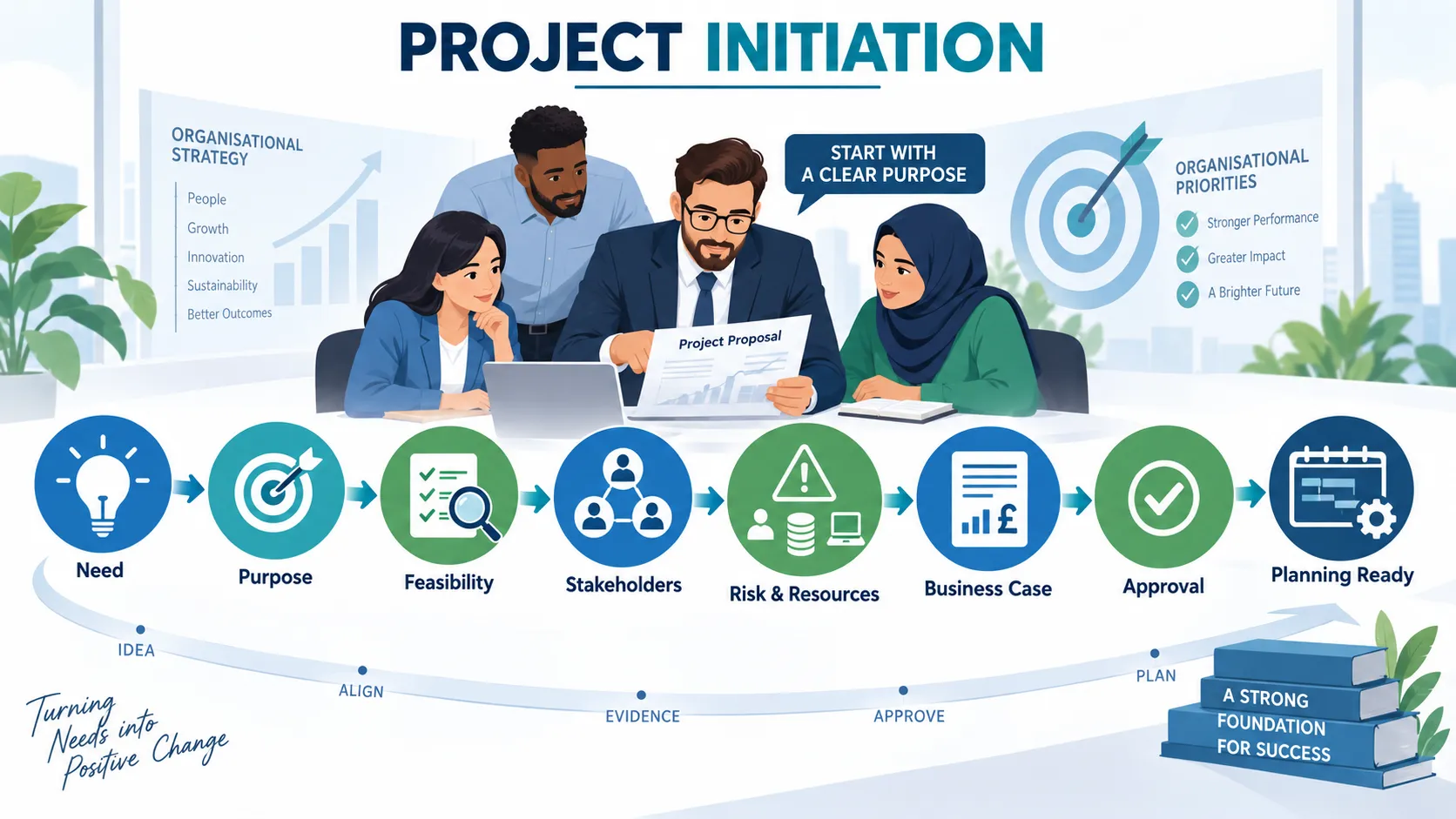
Effective project initiation therefore involves more than simply deciding to start a project. It is a structured process of identifying a need or opportunity, defining the project purpose, establishing desired outcomes, assessing feasibility, considering strategic alignment, identifying stakeholders, understanding initial resource requirements, recognising risks and constraints, establishing governance arrangements, and obtaining an informed decision about whether the project should proceed.
Understanding Project Initiation
Project initiation can be defined as the structured process used to determine whether a proposed project is necessary, appropriate, feasible and sufficiently defined to proceed into detailed planning and delivery.
Initiation creates an initial understanding of the project before significant resources are committed. It does not attempt to produce every detail of the final project plan. Instead, it establishes the foundations that enable detailed planning to take place effectively.
At initiation, managers should be able to answer fundamental questions such as:
Why is the project needed?
What problem, opportunity or organisational requirement is it addressing?
What should the project achieve?
What benefits are expected?
How does it support organisational strategy?
Who will be affected by the project?
Who has an interest in its success?
What resources may be required?
What constraints could affect delivery?
What major risks are already visible?
Is the project feasible?
Who will provide sponsorship and authority?
How will decisions be made?
What evidence is required before approval?
Should the organisation proceed, revise the proposal or stop the project?
The answers to these questions provide an initial basis for informed decision-making.
Why Project Initiation Matters
Project initiation matters because decisions made at the beginning of a project can significantly influence later performance. Although circumstances can change, early clarity reduces uncertainty and helps managers establish realistic expectations.
A strong initiation process can prevent the organisation from investing heavily in projects that are poorly defined, strategically irrelevant or unrealistic.
For example, an organisation may identify an opportunity to introduce a new customer relationship management system. It may be tempting to begin purchasing software immediately. However, effective initiation would first investigate the business need, existing systems, customer requirements, expected benefits, available budget, staff capability, implementation constraints, data requirements and stakeholder expectations.
The organisation may discover that the real problem is not the absence of software but inconsistent customer-service processes. In this situation, initiating the project properly could prevent a significant investment in technology that would not address the underlying problem.
Project initiation therefore protects organisational resources while improving the likelihood that approved projects will deliver meaningful results.
Identifying the Need for a Project
The first major activity in project initiation is identifying and defining the need for the project.
A project normally exists because an organisation needs to respond to a problem, opportunity, requirement, change or strategic priority. The initial need should be expressed clearly enough for decision-makers and stakeholders to understand why action is required.
A project may be initiated because of:
A strategic organisational priority
A performance problem
A customer requirement
A regulatory or compliance requirement
A technological opportunity
A service improvement opportunity
A need to reduce costs
A quality improvement requirement
A change in market conditions
A new organisational objective
A workforce development requirement
A process inefficiency
A risk that needs to be addressed
A requirement to introduce a new product or service
A need to replace outdated infrastructure or systems
The manager should avoid defining the project only in terms of the proposed solution. A strong initiation process starts with the underlying need.
For example, saying “We need a new training platform” defines a proposed solution. Saying “Learners are experiencing delays accessing training resources, completion rates are declining and staff are spending excessive time managing manual processes” describes the underlying need.
This distinction is important because there may be several possible solutions.
Problem-Based and Opportunity-Based Initiation
Projects may be initiated in response to a problem or to take advantage of an opportunity.
A problem-based project may involve:
Reducing customer complaints
Improving service reliability
Addressing quality failures
Replacing inefficient processes
Resolving recurring operational issues
An opportunity-based project may involve:
Launching a new service
Entering a new market
Introducing new technology
Developing a new customer proposition
Improving organisational capability
In both cases, the manager should establish evidence that the proposed project is worth considering.
Defining the Project Purpose
Once the need has been identified, the next step is to define the purpose of the project.
The project purpose explains the fundamental reason for undertaking the project. It provides a concise statement of what the project is intended to accomplish and why the organisation should invest in it.
A strong project purpose should be:
Clear
Relevant
Understandable
Connected to organisational priorities
Focused on the intended improvement or outcome
Meaningful to stakeholders
Realistic within the organisation’s circumstances
The purpose should not become unnecessarily detailed at the initiation stage. Detailed tasks belong in later planning activities.
For example:
Weak purpose:
“Implement a new software system.”
Stronger purpose:
“Improve customer-service efficiency and consistency by introducing an integrated digital customer-management system.”
The second statement provides a clearer explanation of the organisational reason behind the project.
Purpose Versus Project Activities
Middle managers should distinguish between what the project does and what the project is intended to achieve.
Activities describe work performed by the project.
Purpose describes why that work matters.
For example:
Activity: Train staff to use a new system.
Deliverable: Staff training programme completed.
Outcome: Employees can use the system effectively.
Benefit: Customer enquiries are processed more efficiently.
Strategic contribution: Improved customer experience and operational performance.
This chain helps prevent projects from becoming focused solely on completing tasks without achieving meaningful organisational outcomes.
Establishing Preliminary Project Objectives
After defining the purpose, managers should establish preliminary project objectives.
Project objectives describe the results the project intends to achieve. At initiation, objectives may remain relatively high-level. Detailed measures, milestones and performance indicators can be developed during the planning stage.
Good objectives should provide sufficient clarity about:
What the project intends to achieve
Who or what will be affected
The expected standard or level of performance
The intended timeframe
Any important constraints
How achievement will eventually be assessed
The SMART framework can support objective development:
Specific – clearly states what is to be achieved.
Measurable – provides a basis for assessing progress.
Achievable – realistic within available circumstances.
Relevant – connected to organisational needs.
Time-bound – linked to an appropriate timeframe.
For example:
“Improve the customer enquiry process” is too broad.
A more useful preliminary objective might be:
“Introduce a redesigned customer enquiry process that reduces average response time and improves consistency of service within six months.”
The detailed numerical targets may be confirmed during planning after sufficient baseline data has been reviewed.
Establishing Strategic Alignment
A proposed project should be assessed against organisational strategy before it receives significant commitment.
Strategic alignment means that the project supports relevant organisational priorities, objectives or strategic outcomes.
Middle managers should consider:
Which organisational priority does the project support?
What strategic problem or opportunity does it address?
Which organisational objectives will it contribute to?
What measurable organisational benefit could result?
Is the project consistent with organisational values and policies?
Does it support current business priorities?
Could the project conflict with another strategic initiative?
Is the project still relevant given current organisational circumstances?
Strategic alignment is particularly important where organisations have multiple competing projects.
An organisation may have limited funding, limited specialist staff and limited management capacity. It cannot necessarily deliver every proposed project at the same time.
Project initiation therefore provides an opportunity to determine whether a proposal deserves organisational attention.
Example of Strategic Alignment
Consider a training organisation whose strategy includes:
Improving learner experience
Expanding digital delivery
Increasing operational efficiency
Strengthening quality assurance
A proposed project to introduce an improved online learning platform could potentially support several strategic priorities.
However, the manager should not assume alignment simply because the project involves technology. The proposal needs to demonstrate how the platform would contribute to actual organisational outcomes.
This encourages evidence-based project selection rather than projects being approved because they appear modern or attractive.
Conducting an Initial Feasibility Assessment
Feasibility assessment is a critical part of project initiation.
Feasibility means determining whether the proposed project can realistically be delivered and whether doing so is worthwhile.
A project can be strategically attractive but operationally unrealistic. For example, an organisation may want to implement a major digital transformation project but lack sufficient funding, technical expertise, staff capacity or implementation time.
Initial feasibility assessment helps identify these issues before substantial resources are committed.
Key Areas of Feasibility
Managers may assess several dimensions of feasibility.
Technical Feasibility
Technical feasibility considers whether the organisation has access to the technology, infrastructure, expertise and systems required.
Questions may include:
Is the required technology available?
Can existing systems integrate with the proposed solution?
Is sufficient technical expertise available?
Are data and cybersecurity requirements manageable?
Can the technology be implemented within the proposed timeframe?
Financial Feasibility
Financial feasibility considers whether the project is affordable and whether the expected benefits justify the anticipated investment.
Managers may consider:
Estimated project costs
Staff costs
Equipment and technology costs
Supplier costs
Training costs
Ongoing operational costs
Contingency requirements
Expected financial or operational benefits
The purpose at initiation is not necessarily to produce a final cost forecast but to determine whether the project appears financially realistic.
Operational Feasibility
Operational feasibility considers whether the organisation can implement and sustain the proposed change.
This may include:
Staff capacity
Existing workloads
Organisational processes
Management capability
Customer impact
Operational disruption
Availability of facilities and infrastructure
Resource Feasibility
Resource feasibility examines whether the required people, skills, time and materials are likely to be available.
A project may fail even when funding exists if critical personnel are unavailable.
Legal and Regulatory Feasibility
Some projects require consideration of:
Legislation
Regulatory requirements
Contractual obligations
Data protection
Health and safety
Employment requirements
Professional standards
Organisational policies
Early identification of these issues can prevent significant problems later.
Developing the Initial Business Case
A business case provides a structured argument for why a project should be considered or approved.
At initiation, the business case may be preliminary rather than fully developed. It should nevertheless provide enough evidence to support an informed decision.
A typical initial business case may include:
The business problem or opportunity
Proposed project purpose
Strategic alignment
Preliminary objectives
Expected benefits
Initial costs
Resource requirements
Key risks
Constraints
Possible options
Feasibility considerations
Consequences of not proceeding
Recommended approach
The business case should explain not only the cost of doing the project but also the potential cost of not doing it.
Considering the “Do Nothing” Option
A useful initiation process considers what happens if the organisation does not proceed.
For example, failing to improve an outdated customer-management process could result in:
Increasing customer complaints
Higher administrative costs
Staff frustration
Lost business opportunities
Poor customer retention
Increased operational risk
Understanding the consequences of inaction can strengthen decision-making.
However, managers should avoid overstating benefits simply to obtain project approval. Professional project initiation requires balanced evidence.
Identifying Stakeholders During Initiation
Stakeholder identification should begin during project initiation because projects rarely operate in isolation.
A stakeholder is an individual, group or organisation that can affect the project, is affected by it, or has an interest in its activities or outcomes.
Potential stakeholders include:
Project sponsor
Senior management
Middle managers
Project team
Employees
Customers
Service users
Suppliers
Contractors
Regulators
Partners
Finance teams
IT teams
Human resources
Quality assurance teams
External organisations
Early stakeholder identification helps managers understand expectations, influence, concerns and potential sources of support or resistance.
Stakeholder Influence and Interest
Not every stakeholder requires the same level of involvement.
A manager may consider:
Level of influence
Level of interest
Impact of the project
Decision-making authority
Expertise
Potential support
Potential resistance
Stakeholder analysis should be proportionate to the scale and complexity of the project.
For a small internal project, a simple stakeholder list may be sufficient.
For a major organisational transformation, more detailed stakeholder mapping may be required.
Identifying the Project Sponsor
A project sponsor is typically a senior person who provides organisational authority, strategic support and oversight for the project.
The sponsor may:
Champion the project
Approve major decisions
Secure organisational support
Help resolve escalated issues
Provide strategic direction
Support resource allocation
Review project progress
Ensure continued business relevance
A project manager or middle manager may manage day-to-day activities, but the sponsor provides an important link between the project and organisational leadership.
Identifying the sponsor during initiation helps establish accountability and decision-making authority.
Establishing Initial Project Governance
Project governance refers to the structures, responsibilities, controls and decision-making arrangements used to direct and oversee a project.
During initiation, managers should establish an appropriate governance approach.
This may include:
Project sponsor
Project manager
Project team
Steering group
Decision-making authority
Reporting arrangements
Escalation procedures
Approval requirements
Review points
Change-control arrangements
Governance should be proportionate.
A small project does not necessarily need a complex committee structure. A large, high-risk transformation project may require more formal governance.
Importance of Clear Accountability
Unclear accountability can create delays and conflict.
For example, if nobody knows who can approve changes to the project scope, decisions may be repeatedly delayed.
Similarly, if responsibility for reporting project progress is unclear, senior stakeholders may not receive accurate information.
Initiation should therefore establish who is accountable for key project decisions.
Establishing the Initial Project Scope
Project scope describes the boundaries of the project and helps establish what the project will and will not address.
At initiation, the scope may be high-level.
Managers should identify:
What is included
What is excluded
Key deliverables
Main areas of activity
Intended users or beneficiaries
Geographic or organisational boundaries
Major assumptions
Key limitations
Scope clarity is essential because unclear boundaries can lead to scope creep.
Scope creep occurs when additional requirements or activities are gradually added without appropriate evaluation, approval or adjustment of resources, time and objectives.
Example of Scope Definition
Suppose an organisation initiates a project to redesign its employee onboarding process.
The initial scope may include:
Reviewing current onboarding processes
Consulting new employees
Designing standard onboarding materials
Creating a digital onboarding process
Training managers to use the new process
The scope may exclude:
Redesigning the entire HR information system
Rewriting all employment policies
Restructuring the organisation
Replacing payroll software
Clearly defining these boundaries helps prevent the project from becoming unnecessarily large.
Identifying Initial Resources
Projects require resources to achieve their objectives.
During initiation, managers should identify the broad categories of resources likely to be required.
These may include:
People
Skills and expertise
Time
Funding
Equipment
Technology
Facilities
Information
Materials
External suppliers
Management support
Resource assessment helps determine feasibility and highlights potential constraints.
For example, a project requiring specialist cybersecurity expertise may be unrealistic if the organisation has no internal capability and cannot secure an external specialist within the required timeframe.
Identifying Constraints
A project constraint is a limitation that may restrict how the project can be delivered.
Common constraints include:
Budget
Time
Staff availability
Skills
Technology
Procurement requirements
Regulatory obligations
Organisational capacity
Quality requirements
Existing operational commitments
The traditional project management environment often considers the relationship between time, cost and scope, sometimes referred to as the project management triangle.
Changes to one constraint can affect others.
For example:
Reducing the deadline may require additional resources.
Reducing the budget may require a smaller scope.
Increasing the scope may require additional time or funding.
Managers should recognise these relationships during initiation rather than treating constraints independently.
Identifying Initial Risks
Risk identification should begin as soon as the project is being considered.
A project risk is an uncertain event or condition that could affect project objectives if it occurs.
Risks can involve:
Financial issues
Resource shortages
Stakeholder resistance
Technical problems
Supplier failure
Delays
Quality issues
Regulatory changes
Data problems
Communication failures
Operational disruption
At initiation, managers do not need a fully developed risk register, but significant risks should be identified and considered.
Initial Risk Assessment
Managers can initially consider:
What could go wrong?
How likely is it?
What would happen if it occurred?
How quickly could it affect the project?
Can the risk be avoided?
Can it be reduced?
Who should own it?
Is the risk significant enough to affect the decision to proceed?
A high-risk project is not automatically a bad project. Some strategically important projects may involve substantial risk.
The key is whether the organisation understands the risk and has a credible approach for managing it.
Identifying Assumptions
An assumption is something believed to be true for planning or decision-making purposes, even though it may not yet be fully confirmed.
Examples include:
Key staff will remain available.
Funding will be approved.
A supplier will deliver within the expected timeframe.
Technology will integrate with existing systems.
Stakeholders will support the proposed change.
Required information will be available.
Assumptions matter because incorrect assumptions can create significant project risks.
Managers should therefore identify important assumptions during initiation and confirm them where possible.
Assessing Project Dependencies
A dependency exists when one activity, decision, resource or project relies on another.
During initiation, managers should identify major dependencies that could affect feasibility.
Examples include:
A technology project depending on procurement approval
A training project depending on the development of learning materials
A construction project depending on planning permission
A digital project depending on data migration
A service launch depending on regulatory approval
Understanding dependencies helps managers identify potential delays before detailed planning begins.
Considering Alternative Options
Project initiation should not automatically assume that the proposed solution is the only possible solution.
Managers should consider whether alternative approaches could achieve the same or better outcome.
Possible options might include:
Do nothing
Improve the existing process
Purchase an external solution
Develop an internal solution
Outsource part of the activity
Implement a pilot
Introduce the change gradually
Comparing options supports better decision-making.
An organisation may initially propose an expensive technology project but discover that process redesign and staff training could solve much of the underlying problem at significantly lower cost.
Evaluating Costs and Benefits
Cost-benefit thinking is an important part of project initiation.
Managers should identify likely costs and compare them with expected benefits.
Costs may include:
Capital expenditure
Staff time
Training
Technology
Consultancy
Procurement
Implementation
Change management
Operational disruption
Ongoing maintenance
Benefits may include:
Increased efficiency
Reduced costs
Improved quality
Increased revenue
Better customer experience
Reduced risk
Improved employee capability
Greater compliance
Improved organisational performance
Not all benefits are financial.
For example, improved customer satisfaction, stronger employee engagement or reduced regulatory risk may have substantial organisational value even when they are difficult to express as a direct monetary return.
Establishing Initial Success Criteria
Success criteria define how the organisation will determine whether the project has achieved what it was intended to achieve.
At initiation, these criteria may be high-level.
Examples include:
Project delivered within approved parameters
Required service implemented
Customer satisfaction improved
Process efficiency increased
Compliance achieved
Operational errors reduced
Staff capability improved
Strategic benefit realised
It is important to distinguish project delivery success from organisational benefit.
A project may deliver its planned outputs on time and within budget but fail to create the expected business benefit.
For example, a new digital system may be implemented successfully but remain unused by employees. The technical project may be considered complete, but the intended organisational outcome has not been achieved.
Developing an Initial Project Charter
A project charter is a document that formally establishes the project and provides an initial reference point for its purpose, objectives, authority and boundaries.
The precise format varies between organisations, but an initial project charter may contain:
Project title
Project purpose
Business need
Strategic alignment
Preliminary objectives
High-level scope
Key deliverables
Expected benefits
Project sponsor
Project manager
Key stakeholders
Initial resource requirements
Major risks
Constraints
Assumptions
Initial timescale
Governance arrangements
Approval requirements
The charter provides a common reference point for stakeholders before detailed planning begins.
Obtaining Project Approval
The final stage of initiation is normally an informed decision about whether the project should proceed.
Approval should be based on sufficient evidence rather than enthusiasm alone.
Decision-makers may consider:
Strategic importance
Feasibility
Expected benefits
Costs
Risks
Resource availability
Organisational capacity
Stakeholder support
Dependencies
Timing
Consequences of inaction
Possible decisions include:
Approve the project
Approve subject to conditions
Request further investigation
Modify the proposed scope
Delay the project
Reject the proposal
A professional manager should recognise that stopping or delaying an unsuitable project can be a successful management decision.
The Project Initiation Process
A structured initiation process can be represented as a sequence of connected activities.
Step 1: Identify the Need
Determine the problem, opportunity, requirement or strategic priority that may justify a project.
Step 2: Define the Purpose
Establish why the project is needed and what improvement it is intended to create.
Step 3: Establish Preliminary Objectives
Identify the major results the project is expected to achieve.
Step 4: Confirm Strategic Alignment
Determine how the project contributes to organisational strategy and priorities.
Step 5: Assess Feasibility
Evaluate technical, financial, operational, resource and regulatory considerations.
Step 6: Develop the Initial Business Case
Set out the rationale, costs, benefits, risks, options and consequences of proceeding or not proceeding.
Step 7: Identify Stakeholders
Identify individuals and groups affected by, interested in or able to influence the project.
Step 8: Establish Governance
Identify sponsorship, management responsibility, decision-making authority and reporting arrangements.
Step 9: Define High-Level Scope
Clarify what the project will and will not address.
Step 10: Identify Resources and Constraints
Establish the broad resource requirements and limitations that may affect delivery.
Step 11: Identify Risks, Assumptions and Dependencies
Recognise significant uncertainties and conditions that could affect project viability.
Step 12: Establish Initial Success Criteria
Define the broad measures that will eventually demonstrate project and organisational success.
Step 13: Obtain Approval
Present the project proposal to the appropriate decision-makers for approval, revision, delay or rejection.
Step 14: Transition to Detailed Planning
Once approved, move from initiation into structured project planning, where activities, schedules, resources, responsibilities, risks and controls are developed in greater detail.
Key Benefits of Effective Project Initiation
Effective initiation provides several important benefits to organisations.
Improved Strategic Alignment
It ensures that projects support organisational priorities rather than consuming resources without a clear strategic purpose.
Better Decision-Making
Managers and sponsors receive structured information that enables more informed decisions.
Greater Resource Efficiency
Early feasibility and resource assessment reduce the likelihood of committing resources to unrealistic projects.
Improved Stakeholder Understanding
Early stakeholder identification creates clearer expectations and provides opportunities to address concerns before implementation.
Reduced Project Risk
Early identification of risks, assumptions, constraints and dependencies gives managers more opportunity to respond proactively.
Stronger Accountability
Clearly identifying sponsors, managers and decision-makers reduces ambiguity about responsibilities.
Better Scope Control
High-level scope definition establishes boundaries and reduces unnecessary expansion.
Improved Project Planning
Detailed planning is more effective when the project purpose, objectives, stakeholders and constraints are already understood.
Greater Organisational Confidence
A well-structured initiation process demonstrates that the organisation is making evidence-based decisions about project investment.
Practical Workplace Example: Customer Service Improvement Project
Consider an organisation experiencing increasing customer complaints about slow responses to enquiries.
Senior management asks a middle manager to explore a project to improve customer response times.
The manager should not immediately instruct employees to change their processes.
Instead, the initiation process could involve:
Reviewing customer complaint data
Identifying current response times
Speaking with customer-service employees
Understanding customer expectations
Reviewing existing procedures
Identifying technology limitations
Defining the underlying problem
Considering alternative solutions
Identifying stakeholders
Estimating resource requirements
Assessing risks
Developing an initial business case
Establishing proposed objectives
Presenting the proposal for approval
The analysis may reveal that response delays are caused primarily by duplicated approval processes rather than insufficient staffing.
As a result, the project may focus on process redesign rather than immediately increasing headcount.
This demonstrates why project initiation should focus on understanding the need before committing to a particular solution.
Practical Workplace Example: Digital Learning Project
A training provider may identify an opportunity to improve its digital learning provision.
The proposed project could involve introducing a new learning management system.
During initiation, the manager could investigate:
Current learner experience
Existing platform limitations
Staff requirements
Learner access needs
Technical compatibility
Data protection requirements
Supplier availability
Budget
Implementation timeframe
Training requirements
Strategic priorities
Expected benefits
Stakeholders could include:
Senior management
Tutors
Learners
IT staff
Quality assurance staff
Finance
External technology suppliers
The manager could then compare several options rather than assuming that purchasing a new system is the only answer.
Practical Workplace Example: Operational Efficiency Project
A manufacturing or service organisation may identify excessive administrative costs.
The proposed project could seek to improve operational efficiency.
During initiation, the manager might discover:
Several teams perform similar administrative tasks.
Staff spend excessive time entering the same information into different systems.
Some processes remain paper-based.
Managers receive performance information too slowly.
Employees have different approaches to the same process.
The project purpose could therefore be defined around improving process efficiency and information flow.
The manager could establish preliminary objectives, assess feasibility, identify stakeholders and develop a business case before detailed planning begins.
Common Problems During Project Initiation
Project initiation can itself encounter challenges.
Starting with a Predetermined Solution
One common problem occurs when leaders decide on the solution before properly understanding the problem.
For example:
“We need a new system.”
This can prevent managers from considering simpler alternatives.
A better approach is:
“What problem are we trying to solve, and what options could address it?”
Inadequate Evidence
Projects may be proposed based on assumptions, opinions or isolated incidents rather than reliable information.
Managers should seek appropriate evidence, such as:
Performance data
Customer feedback
Staff feedback
Financial information
Audit findings
Operational records
Market information
Regulatory requirements
Unrealistic Expectations
Stakeholders may expect immediate results from projects that require significant time and resources.
Managers should establish realistic expectations during initiation.
Poor Stakeholder Identification
Failing to identify influential stakeholders can result in resistance later.
Underestimating Resources
Projects may be approved without considering the effect on existing workloads.
Ignoring Organisational Capacity
An organisation may theoretically have sufficient resources but still lack the capacity to deliver another major project alongside existing commitments.
Middle Manager’s Role in Project Initiation
Middle managers play an important role in converting strategic priorities into realistic project proposals.
Their responsibilities may include:
Identifying project opportunities
Analysing operational problems
Gathering evidence
Defining project purpose
Developing preliminary objectives
Assessing feasibility
Identifying stakeholders
Identifying risks and constraints
Estimating resource requirements
Supporting business-case development
Communicating with senior leaders
Engaging operational teams
Challenging unrealistic assumptions
Supporting project approval
Establishing initial governance arrangements
Middle managers also need to exercise professional judgement.
They should be willing to challenge proposals when evidence suggests that a project is not viable, poorly aligned or unnecessarily complex.
Project Initiation and Professional Judgement
Project initiation is not simply an administrative process. It requires judgement.
Two projects may appear equally attractive but have different strategic value, risk profiles and resource requirements.
A professional manager should therefore consider the broader organisational context.
For example, a project may have strong financial benefits but create substantial operational disruption. Another project may have smaller financial benefits but significantly reduce regulatory risk.
The appropriate decision depends on organisational priorities and circumstances.
Good judgement involves:
Evaluating evidence
Questioning assumptions
Considering alternatives
Balancing competing priorities
Understanding stakeholder perspectives
Recognising uncertainty
Assessing organisational capacity
Considering short- and long-term consequences
Project Initiation as a Decision Gate
Project initiation can be viewed as a decision gate between an idea and formal project planning.
An organisation should not automatically move every idea into implementation.
The initiation stage provides an opportunity to ask:
Is this project necessary?
Is it strategically relevant?
Is it feasible?
Is it worthwhile?
Do we understand the major risks?
Do we have sufficient resources and organisational capacity?
Are the right stakeholders identified?
Is there sufficient leadership support?
If the answer to these questions is positive, the project can progress to detailed planning with greater confidence.
If significant uncertainties remain, further investigation may be required.
Key Concepts to Remember
The most important concepts associated with project initiation include:
Project initiation: The structured process of establishing whether a project is necessary, feasible and appropriate to proceed.
Project purpose: The fundamental reason why the project is being undertaken.
Project objective: A defined result the project intends to achieve.
Strategic alignment: The degree to which a project supports organisational priorities and objectives.
Feasibility: The assessment of whether a project can realistically be delivered.
Business case: A structured justification for undertaking a project.
Stakeholder: A person or group that can affect, is affected by, or has an interest in the project.
Project sponsor: A senior person who provides organisational support, authority and strategic oversight.
Project scope: The boundaries defining what the project will and will not address.
Constraint: A limitation affecting project delivery, such as time, budget or resource availability.
Risk: An uncertain event or condition that could affect project objectives.
Assumption: Something accepted as true for planning purposes but which may require confirmation.
Dependency: A relationship in which one activity, decision or resource relies on another.
Governance: The structures and processes used to direct, control and oversee a project.
Success criteria: The measures used to determine whether the project has achieved its intended results.
Project Initiation Checklist for Managers
Before recommending that a project proceeds, a manager should be able to demonstrate that:
The business need has been clearly identified.
The underlying problem or opportunity is understood.
The project purpose is clearly stated.
Preliminary objectives have been established.
The project supports relevant organisational priorities.
Alternative approaches have been considered.
Initial feasibility has been assessed.
Expected benefits have been identified.
Major costs have been considered.
Key stakeholders have been identified.
Project sponsorship has been established.
Governance arrangements are understood.
Initial scope and boundaries are clear.
Major resources have been identified.
Important constraints are understood.
Significant risks have been identified.
Key assumptions have been considered.
Major dependencies have been recognised.
Initial success criteria have been identified.
The consequences of not proceeding have been considered.
Appropriate approval has been obtained.
The project is ready to move into detailed planning.
Summary
Analysing the process for initiating projects is essential for managers responsible for converting organisational priorities into practical results. Effective initiation creates the foundation for successful planning, implementation, monitoring and control.
The process begins by identifying a genuine business need, problem, opportunity or strategic requirement. Managers then define the project purpose and establish preliminary objectives before assessing strategic alignment. Initial feasibility assessment helps determine whether the proposed project is technically, financially, operationally, legally and resource-wise realistic.
Project initiation also requires the development of an initial business case, identification of stakeholders, establishment of sponsorship and governance, definition of high-level scope, consideration of resources and constraints, and identification of major risks, assumptions and dependencies.
The final decision to proceed should be based on evidence, organisational priorities, expected benefits, available resources and acceptable levels of risk.
For middle managers and leaders, effective project initiation demonstrates strategic thinking, commercial awareness, leadership judgement and the ability to connect organisational objectives with practical delivery. A well-initiated project gives the organisation a clearer purpose, stronger accountability, better resource allocation and a more reliable foundation for detailed project planning.
Ultimately, project initiation is about making the right decision before significant resources are committed. It ensures that projects are not simply started because an idea appears attractive, but because there is a clear organisational need, a credible opportunity to achieve meaningful results, and sufficient evidence that the project is worth pursuing.
| Project Initiation Element | Definition | Why It Matters | Practical Managerial Application |
|---|---|---|---|
| Business Need | The problem, opportunity or requirement creating the need for a project | Establishes the reason for action | Analyse performance data, customer feedback or strategic priorities |
| Project Purpose | The fundamental reason for undertaking the project | Provides direction and prevents activity without clear purpose | State the improvement or outcome the project is intended to create |
| Objectives | Defined results the project intends to achieve | Creates a basis for planning and measurement | Establish preliminary SMART objectives |
| Strategic Alignment | Connection between the project and organisational strategy | Helps prioritise projects and use resources effectively | Link the project to strategic objectives |
| Feasibility | Assessment of whether the project can realistically be delivered | Prevents unrealistic commitments | Review technical, financial, operational and resource factors |
| Business Case | Structured justification for undertaking the project | Supports evidence-based approval | Compare costs, benefits, risks and alternatives |
| Stakeholders | People or groups who affect, are affected by or have an interest in the project | Supports engagement and reduces resistance | Identify influence, interest and expectations |
| Governance | Structures for directing, controlling and overseeing the project | Establishes accountability and decision-making | Identify sponsor, project manager and escalation routes |
| Scope | Boundaries defining what is included and excluded | Helps control project size and prevent scope creep | Establish high-level inclusions and exclusions |
| Resources | People, skills, time, funding, technology and other inputs required | Determines whether delivery is realistic | Identify resource requirements and availability |
| Constraints | Limitations affecting project delivery | Helps managers establish realistic expectations | Consider budget, deadlines, staff capacity and regulations |
| Risk | Uncertain event or condition that could affect objectives | Enables proactive risk management | Identify significant risks and initial responses |
| Assumptions | Conditions believed to be true for planning purposes | Highlights uncertainty that requires validation | Record assumptions and confirm critical ones |
| Dependencies | Relationships where one element relies on another | Helps identify potential delays and sequencing issues | Identify approvals, systems, suppliers or projects that must be completed first |
| Success Criteria | Measures used to determine whether intended results have been achieved | Provides a basis for evaluating project performance | Define expected outputs, outcomes and benefits |
| Approval | Formal decision to proceed, modify, delay or reject the project | Prevents uncontrolled commitment of organisational resources | Present the initiation case to the appropriate decision-makers |
2.Examine the Impact of Legal, Organisational and Ethical Factors on Projects
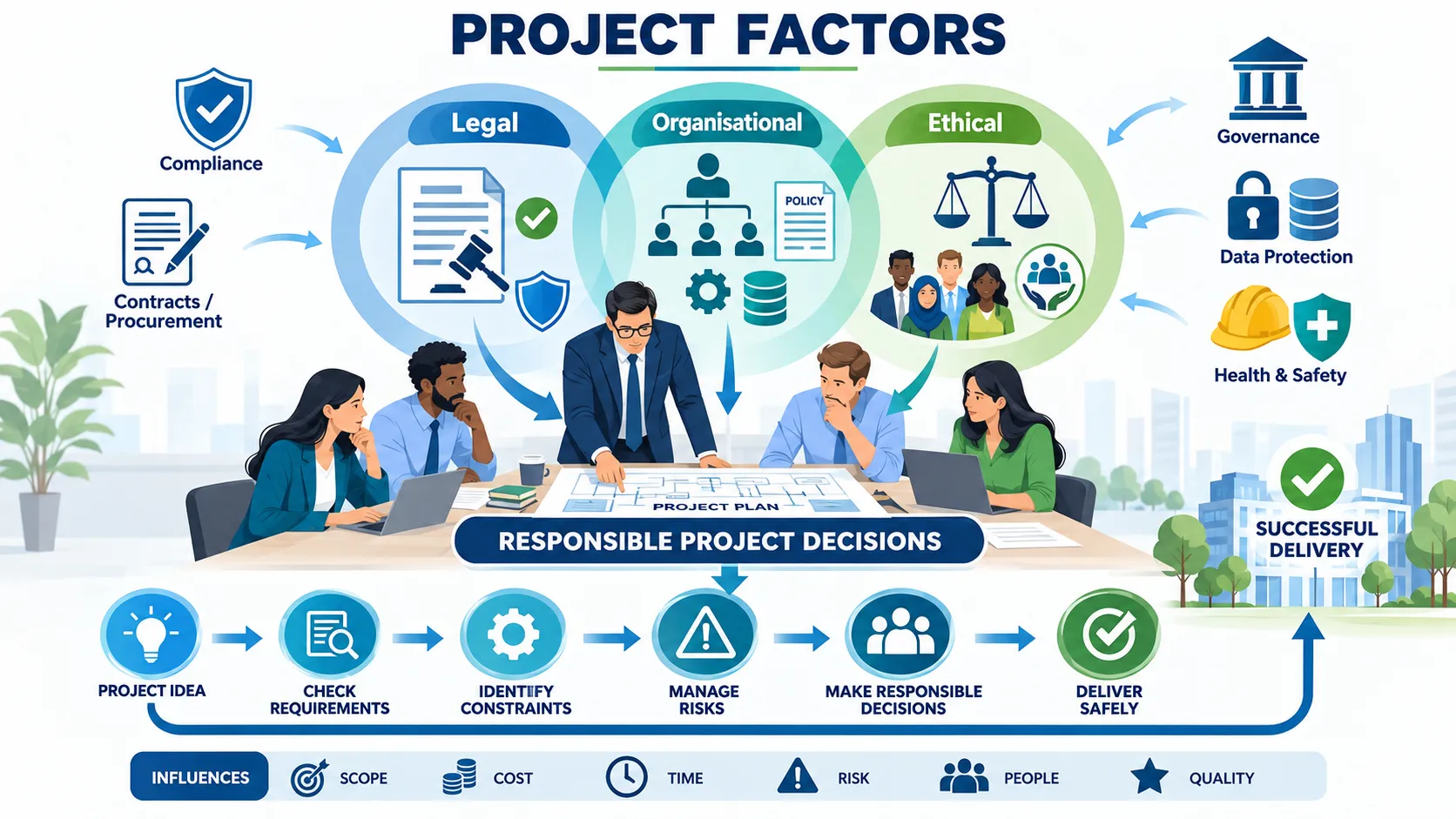
Projects do not operate independently of the organisation or the wider environment in which they are delivered. A project may have a clearly defined purpose, realistic objectives, sufficient resources and strong stakeholder support, yet still experience significant problems if legal requirements, organisational policies, professional standards or ethical responsibilities are not properly considered.
For middle managers and leaders, understanding these factors is essential because project decisions frequently affect employees, customers, service users, suppliers, organisational resources, information, finances and reputation. Managers may be responsible for translating organisational strategy into project activity while also ensuring that the project remains compliant with applicable laws, organisational requirements and ethical expectations.
Legal, organisational and ethical considerations should therefore be incorporated into project management from initiation through planning, implementation, monitoring, change control and closure. They should not be treated as issues that are checked only after a problem occurs.
A project can be legally compliant but ethically questionable. It can also be ethically well-intentioned but fail to comply with legal requirements. Similarly, a project may technically comply with external law but conflict with organisational policies, contractual commitments or established governance arrangements.
Effective project leadership requires managers to understand these different dimensions and recognise how they interact.
For example, a project involving employee performance data may need to comply with data protection requirements, organisational information-security procedures and ethical principles relating to privacy and fairness. A project manager who considers only one of these dimensions may expose the organisation to unnecessary risk.
The purpose of this section is therefore to examine how legal, organisational and ethical factors influence project decisions and delivery, and how managers can incorporate them into effective project governance.
Understanding Legal, Organisational and Ethical Factors
Before examining their impact, it is important to distinguish between legal, organisational and ethical factors.
Legal Factors
Legal factors are requirements arising from legislation, regulations, statutory duties, contracts and other legally enforceable obligations relevant to the project.
Depending on the nature and location of the project, these may relate to:
Employment
Health and safety
Data protection and privacy
Equality and discrimination
Intellectual property
Consumer protection
Financial controls
Procurement
Environmental requirements
Contract law
Industry-specific regulation
Information security
Corporate governance
Record keeping
Safeguarding
The precise legal requirements will depend on the organisation, sector, project and jurisdiction.
Organisational Factors
Organisational factors are internal structures, policies, procedures, standards, systems, resources and cultural expectations that influence how a project must be managed.
These can include:
Organisational strategy
Policies and procedures
Delegated authority
Governance structures
Financial controls
Procurement procedures
Quality standards
Human resource policies
Information-security procedures
Risk-management frameworks
Reporting requirements
Internal approval processes
Organisational culture
Available resources
Existing operational commitments
Organisational requirements may be more restrictive than minimum legal requirements because organisations often establish additional standards to manage risk, quality and reputation.
Ethical Factors
Ethical factors concern what is responsible, fair, honest and appropriate in the circumstances.
Ethical project management involves considering how decisions affect people and whether actions are consistent with principles such as:
Fairness
Integrity
Transparency
Respect
Accountability
Confidentiality
Inclusion
Professional responsibility
Avoidance of conflicts of interest
Responsible use of resources
Honest communication
Ethics becomes particularly important when managers face competing interests or situations where a legally permissible action may nevertheless produce an unfair or harmful outcome.
Why Legal, Organisational and Ethical Factors Matter in Projects
Projects involve decisions under conditions of uncertainty. Managers make decisions about budgets, resources, suppliers, people, information, priorities, timelines and changes.
Each decision can have legal, organisational and ethical implications.
For example, suppose a project team needs to reduce costs. A manager may consider reducing the number of staff involved. The decision may affect:
Employment obligations
Organisational restructuring procedures
Project capability
Workload
Employee wellbeing
Quality
Project delivery risk
Stakeholder confidence
A narrow focus on financial savings could therefore create wider problems.
Effective project management requires managers to consider the wider consequences of decisions rather than focusing only on immediate project performance.
Consequences of Ignoring These Factors
Failure to consider legal, organisational or ethical requirements can result in:
Legal claims
Regulatory action
Financial penalties
Contract disputes
Project delays
Project cancellation
Increased costs
Loss of stakeholder confidence
Reputational damage
Employee dissatisfaction
Customer complaints
Poor quality
Data breaches
Safety incidents
Unfair treatment
Loss of trust
Failure to achieve project benefits
These consequences can extend beyond the project itself and affect the wider organisation.
Legal Factors Affecting Project Initiation
Legal considerations should begin during project initiation.
When an organisation first considers a project, managers should establish whether the proposed activity creates legal obligations or restrictions.
For example, a project involving a new digital platform may involve:
Data protection requirements
Cybersecurity obligations
Intellectual property rights
Supplier contracts
Accessibility requirements
Consumer or service-user rights
A construction-related project may involve:
Planning requirements
Building regulations
Health and safety obligations
Environmental requirements
Contractor responsibilities
Insurance arrangements
The exact requirements will depend on the project and jurisdiction.
Legal Due Diligence at Initiation
Managers should consider:
Which laws and regulations are likely to apply?
Does the organisation need specialist legal advice?
Are licences or permissions required?
Are contracts involved?
Are personal or sensitive data involved?
Are employees or contractors affected?
Are intellectual property rights relevant?
Are there sector-specific regulatory requirements?
Are there health and safety implications?
Are procurement requirements triggered?
Are there specific reporting or record-keeping obligations?
Early identification allows these requirements to influence project scope, resources, timescales and budget.
Legal Factors and Project Planning
Once a project has been approved, legal requirements should be incorporated into detailed planning.
Legal obligations may affect:
Activities
Milestones
Responsibilities
Documentation
Resources
Training
Procurement
Approvals
Risk management
Quality assurance
Monitoring
Reporting
For example, if a project requires formal regulatory approval before implementation, that approval becomes a project dependency.
The project schedule must allow sufficient time for it.
A common project-management error is to create an ambitious implementation schedule and then discover that mandatory approvals cannot be obtained within the planned timeframe.
Legal Compliance as a Project Constraint
Legal requirements can act as constraints because they may limit what the project can do or determine how activities must be performed.
Examples include:
A required approval before implementation
Mandatory safety procedures
Restrictions on how information can be processed
Contractual requirements governing suppliers
Requirements to consult affected employees
Requirements for appropriate accessibility
Restrictions on the use of copyrighted materials
Managers should incorporate these constraints into the project plan rather than attempting to work around them.
Employment and Workforce Considerations
Projects often require employees to change their roles, responsibilities, working practices or workloads.
Employment-related legal requirements may therefore affect project delivery.
A project involving organisational restructuring, changes to working arrangements or changes in responsibilities may require appropriate processes relating to:
Employment contracts
Consultation
Working conditions
Equality
Health and safety
Pay and benefits
Working time
Employee rights
Managers should not assume that project urgency removes normal employment obligations.
Where significant workforce changes are proposed, appropriate HR and legal expertise should be involved.
Impact on Project Timescales
Employment processes can affect project schedules.
For example, if employees must be consulted before a proposed change is implemented, the consultation period becomes part of the project timeline.
Failing to include this requirement could result in unrealistic deadlines.
Health and Safety Considerations
Health and safety is an important legal and organisational consideration for many projects.
Projects may introduce:
New equipment
New working practices
Construction activity
Physical hazards
Changes to workplace layout
New technology
Additional workloads
Travel requirements
Operational disruption
Managers should assess relevant hazards and ensure appropriate controls are incorporated.
Health and Safety Responsibilities
Depending on the project, responsibilities may include:
Identifying hazards
Conducting risk assessments
Providing appropriate training
Establishing safe working procedures
Providing appropriate equipment
Monitoring compliance
Recording incidents
Escalating serious concerns
Ensuring contractors meet required standards
Health and safety should be considered throughout the project rather than treated as a one-time assessment.
Data Protection and Privacy
Many modern projects involve collecting, processing, storing or transferring information.
Examples include projects involving:
Customer databases
Employee records
Learner information
Health information
Financial information
Contact information
Performance data
Digital platforms
Online services
Data protection requirements can therefore have significant implications for project design.
Managers should consider:
What information is being collected?
Why is it required?
Who will access it?
How will it be stored?
How long will it be retained?
Who will it be shared with?
Are third-party suppliers involved?
What security controls are required?
What privacy information or notices may be required?
What happens if information is lost or compromised?
Where appropriate, specialist data protection or legal advice should be obtained.
Privacy by Design
Projects involving personal information should consider privacy from the beginning rather than adding controls after the system has been developed.
For example, a project developing an employee monitoring system should consider privacy implications before selecting technology or defining data collection processes.
This can influence:
System design
Data fields
Access permissions
Reporting
Retention periods
Security controls
Stakeholder communication
Equality and Non-Discrimination
Projects can affect people differently.
Equality considerations may therefore influence:
Recruitment
Service design
Access
Communication
Workplace changes
Training
Selection processes
Resource allocation
Technology design
Managers should consider whether project decisions could create unfair disadvantage or discrimination.
For example, introducing an online-only service may improve accessibility for some users while creating barriers for people with limited digital access or specific accessibility needs.
The project should therefore consider the needs of different user groups.
Intellectual Property
Intellectual property can become relevant where projects create, purchase, adapt or use:
Software
Training materials
Written content
Images
Designs
Branding
Databases
Research
Digital resources
Technical solutions
Managers should establish who owns intellectual property and whether the organisation has appropriate rights to use external materials.
For example, a project team cannot automatically assume that materials found online can be copied into training resources.
Intellectual property considerations may affect:
Procurement
Contracts
Project deliverables
Supplier relationships
Licensing costs
Documentation
Future use of project outputs
Contractual and Procurement Considerations
Many projects involve external suppliers.
Contracts may define:
Scope
Deliverables
Price
Payment arrangements
Timescales
Quality requirements
Service levels
Confidentiality
Data handling
Intellectual property
Liability
Termination arrangements
Managers should ensure that project plans reflect contractual commitments.
Procurement Governance
Organisations may have procurement procedures requiring:
Competitive quotations
Tendering
Supplier evaluation
Conflict-of-interest declarations
Approval thresholds
Due diligence
Contract approval
The project manager should not bypass procurement controls simply because a supplier appears suitable.
Failure to follow organisational procurement requirements can create financial, legal and reputational risks.
Organisational Policies and Procedures
Projects are delivered within an organisational environment.
Even where external law permits an activity, organisational policy may require additional controls.
Examples include:
Financial policies
Recruitment policies
Procurement policies
Data-management policies
Information-security policies
Equality policies
Health and safety procedures
Quality-assurance procedures
Communication policies
Risk-management procedures
Delegation-of-authority policies
Managers should identify which policies apply before project activities begin.
Why Organisational Policies Matter
Organisational policies provide consistency and control.
They help ensure that similar decisions are managed in similar ways across different departments and projects.
They also protect managers by clarifying:
Who can approve expenditure
Who can authorise changes
Who can access information
Who can enter contracts
Who can approve recruitment
Who must be consulted
How risks must be reported
Organisational Governance and Decision-Making
Governance determines how project decisions are authorised and controlled.
A project may require different approval levels depending on:
Project value
Risk
Strategic importance
Organisational impact
Legal complexity
Resource requirements
For example, a small departmental improvement project may be approved by a middle manager, while a major technology transformation may require executive or board-level approval.
Managers should understand their delegated authority.
Impact of Governance on Project Speed
Strong governance can improve control, but excessive governance can create unnecessary bureaucracy.
The objective is therefore proportionate governance.
Managers should ensure that:
Decision-making authority is clear.
Reporting requirements are appropriate.
Escalation routes are understood.
Approval processes are realistic.
Governance does not unnecessarily delay routine decisions.
Organisational Culture and Project Delivery
Organisational culture refers to shared values, behaviours, expectations and ways of working within an organisation.
Culture can have a significant effect on projects.
A culture that encourages:
Open communication
Learning
Accountability
Collaboration
Innovation
Constructive challenge
can support effective project delivery.
Conversely, a culture characterised by:
Blame
Fear
Excessive hierarchy
Poor communication
Resistance to change
Information hoarding
may make projects more difficult.
Culture and Project Risk
Project teams need to feel able to raise concerns.
If employees believe that reporting a problem will result in criticism, they may conceal information.
This can prevent managers from identifying risks early.
A psychologically safe environment therefore supports effective project monitoring and risk management.
Organisational Resources and Capacity
Organisational factors also include the availability and capacity of resources.
A project may be approved but compete with other organisational priorities.
Managers should consider:
Staff availability
Specialist expertise
Budget
Technology
Facilities
Management capacity
Operational workload
Competing projects
Resource conflicts can create delays and reduce quality.
Portfolio-Level Considerations
Organisations may have several projects operating simultaneously.
Managers should therefore understand whether the proposed project:
Competes for the same specialists
Requires the same technology
Depends on another project
Conflicts with another change programme
Uses shared suppliers
Requires the same senior decision-makers
Project success depends partly on how well the project fits into the wider organisational portfolio.
Ethical Factors in Project Management
Ethics becomes particularly important where managers have choices that affect different stakeholders in different ways.
An ethical decision considers more than whether something is technically permitted.
Managers should ask:
Is this decision fair?
Who may benefit?
Who may be disadvantaged?
Have stakeholders been treated respectfully?
Is information being communicated honestly?
Are conflicts of interest being managed?
Are resources being used responsibly?
Are vulnerable stakeholders being protected?
Would the decision withstand reasonable external scrutiny?
Ethical thinking encourages managers to consider consequences and responsibilities.
Ethical Principles Relevant to Projects
Integrity
Integrity means acting honestly and consistently with professional responsibilities.
Project managers demonstrate integrity by:
Reporting progress honestly
Disclosing problems
Avoiding manipulation of project data
Declaring conflicts of interest
Using organisational resources appropriately
Transparency
Transparency means providing appropriate information about decisions, assumptions, risks and performance.
A manager should not deliberately hide a significant project problem simply to maintain an appearance of success.
Fairness
Fairness requires managers to consider whether decisions are reasonable and equitable.
Examples include:
Fair allocation of project opportunities
Objective supplier selection
Consistent treatment of employees
Appropriate stakeholder consultation
Accountability
Accountability means accepting responsibility for decisions and their consequences.
Managers should be able to explain:
Why a decision was made
What evidence informed it
Who approved it
What risks were considered
What controls were applied
Respect
Project stakeholders should be treated with dignity and professionalism.
This includes employees, customers, suppliers, contractors and service users.
Conflicts of Interest
A conflict of interest occurs when personal, financial or other interests could influence, or appear to influence, professional judgement.
For example, a project manager may be involved in selecting a supplier owned by a close personal associate.
Even if the supplier is technically suitable, the relationship may create a perception of unfairness.
Managers should therefore:
Declare relevant conflicts
Follow organisational procedures
Avoid inappropriate involvement in decisions
Maintain transparent records
Seek independent review where necessary
Managing perceived conflicts can be as important as managing actual conflicts because stakeholder confidence depends on trust.
Ethical Use of Project Information
Project managers often have access to commercially or personally sensitive information.
Examples include:
Employee information
Customer information
Financial forecasts
Supplier pricing
Strategic plans
Performance data
Commercial negotiations
Ethical information management requires managers to use information only for legitimate purposes and share it appropriately.
Managers should avoid:
Unauthorised disclosure
Manipulation of information
Selective reporting designed to mislead
Sharing confidential information for personal benefit
Ethical Decision-Making Under Pressure
Projects often operate under time and budget pressures.
A manager may be tempted to:
Hide delays
Understate risks
Overstate benefits
Ignore quality concerns
Bypass approval procedures
Pressure employees excessively
Select a preferred supplier without proper evaluation
These behaviours may create short-term convenience but expose the project and organisation to greater long-term risk.
Ethical leadership requires managers to maintain professional standards even when delivery pressure increases.
Legal Compliance Versus Ethical Responsibility
Legal compliance and ethical responsibility overlap but are not identical.
An action may be legal but ethically questionable.
For example, an organisation might technically be permitted to collect certain operational information, but collecting excessive information about employees could still raise ethical concerns about privacy, trust and proportionality.
Similarly, a project may meet minimum legal requirements but still fail to consider accessibility, fairness or stakeholder wellbeing adequately.
Managers should therefore aim for responsible project management rather than treating legal compliance as the only standard.
The Impact of These Factors on Project Scope
Legal, organisational and ethical considerations can change project scope.
For example, a project to introduce a new customer platform may initially involve only software implementation.
After legal and ethical review, the scope may need to include:
Data protection assessment
Accessibility testing
Security controls
User consultation
Staff training
Privacy information
Data retention arrangements
These additions may increase project effort but are necessary to achieve responsible implementation.
The Impact on Project Cost
Legal, organisational and ethical requirements can increase project costs.
Costs may arise from:
Legal advice
Compliance reviews
Specialist consultants
Training
Security controls
Accessibility improvements
Additional quality assurance
Consultation
Documentation
Insurance
Testing
Managers should incorporate realistic compliance-related costs into project budgets.
Attempting to exclude these costs can create inaccurate business cases and unrealistic financial expectations.
The Impact on Project Timescales
Compliance requirements can also affect project schedules.
Activities may require:
Regulatory approval
Legal review
Procurement
Consultation
Testing
Security assessment
Training
Quality assurance
These activities should be built into the project schedule.
A project should not be described as “delayed” simply because mandatory compliance work takes time.
Instead, compliance activity should be recognised as part of responsible project delivery.
The Impact on Project Resources
Projects may require specialist expertise to address legal, organisational or ethical issues.
Resources may include:
Legal specialists
HR professionals
Data protection specialists
Information-security professionals
Procurement specialists
Quality managers
Health and safety professionals
Equality and accessibility specialists
External advisers
The project manager should identify specialist resource requirements early.
The Impact on Stakeholder Relationships
Legal, organisational and ethical factors strongly influence stakeholder trust.
Stakeholders are more likely to support a project when they believe that:
Their interests are considered.
Decisions are fair.
Information is accurate.
Risks are managed.
Personal information is protected.
Concerns can be raised.
Leaders are accountable.
Poor handling of these issues can quickly damage stakeholder confidence.
For example, employees may resist a workplace-monitoring project if they believe data will be collected secretly or used unfairly.
Transparent communication and ethical safeguards can improve acceptance.
The Impact on Project Risk
Legal, organisational and ethical issues should be incorporated into the project risk-management process.
Potential risks include:
Non-compliance
Regulatory changes
Contract disputes
Data breaches
Safety incidents
Stakeholder resistance
Reputational damage
Unethical supplier behaviour
Conflicts of interest
Poor governance
Policy violations
Managers should identify risk owners and establish proportionate controls.
Compliance Risk
Compliance risk is the possibility that failure to meet legal, regulatory or organisational requirements could adversely affect the project or organisation.
Controls may include:
Compliance reviews
Specialist advice
Approval gates
Audits
Training
Document controls
Monitoring
Internal assurance
The Impact on Project Quality
Quality is not simply about whether a deliverable functions.
A high-quality project output should also meet relevant:
Legal requirements
Organisational standards
Customer expectations
Professional standards
Ethical expectations
Accessibility requirements
Safety requirements
For example, a digital platform may function technically but still be poor quality if it excludes users with accessibility needs.
The Impact on Project Change Control
Projects rarely remain completely unchanged.
When a proposed change arises, managers should assess more than its impact on time and cost.
They should also ask:
Does the change create a legal issue?
Does it conflict with organisational policy?
Does it create new risks?
Does it affect stakeholder rights?
Does it change data-processing requirements?
Does it create an ethical concern?
Does it require additional approval?
This ensures that change control remains comprehensive.
Integrating Legal, Organisational and Ethical Factors into the Project Lifecycle
These factors should be considered throughout the project lifecycle.
Initiation
During initiation, managers should:
Identify relevant legal requirements.
Identify applicable organisational policies.
Identify ethical considerations.
Identify specialist advice requirements.
Assess major compliance risks.
Identify affected stakeholders.
Establish appropriate governance.
Planning
During planning, managers should:
Include compliance activities in the schedule.
Allocate appropriate resources.
Include relevant costs in the budget.
Define responsibilities.
Establish controls.
Develop appropriate documentation.
Include legal and ethical risks in the risk register.
Implementation
During implementation, managers should:
Monitor compliance.
Follow organisational procedures.
Maintain appropriate records.
Engage stakeholders.
Monitor ethical concerns.
Escalate issues promptly.
Ensure suppliers meet agreed requirements.
Monitoring and Control
Managers should regularly review:
Compliance status
Changes in legislation
Policy changes
Ethical concerns
Stakeholder feedback
Risk exposure
Supplier performance
Data and security controls
Closure
At project closure, managers should:
Confirm required obligations have been met.
Complete contractual requirements.
Archive appropriate records.
Review incidents and lessons learned.
Confirm ownership of project outputs.
Ensure information is retained or disposed of appropriately.
Evaluate ethical and stakeholder outcomes.
A Practical Compliance and Ethics Review Process
A middle manager can use the following process when reviewing a project.
Step 1: Identify Applicable Requirements
List relevant laws, regulations, contracts, organisational policies and professional standards.
Step 2: Identify Ethical Considerations
Consider fairness, transparency, confidentiality, stakeholder impact, conflicts of interest and responsible resource use.
Step 3: Identify Potential Gaps
Compare current project arrangements with required standards.
Step 4: Assess Risk
Determine the likelihood and potential impact of each issue.
Step 5: Assign Responsibility
Identify who is responsible for addressing each requirement.
Step 6: Build Controls into the Project
Include appropriate activities, approvals, checks, training and documentation.
Step 7: Monitor Compliance
Review requirements throughout project delivery.
Step 8: Escalate Significant Issues
Issues beyond the manager’s authority should be referred to the appropriate specialist or governance body.
Step 9: Record Decisions
Maintain appropriate evidence of decisions, approvals and actions.
Step 10: Review at Closure
Confirm that relevant requirements have been satisfied and capture lessons for future projects.
Practical Example: Implementing a New HR System
An organisation proposes a project to introduce a new HR management system.
The project appears straightforward because the primary objective is to replace an outdated system.
However, the project involves substantial legal, organisational and ethical considerations.
Legal Considerations
The project may involve:
Employee personal data
Data protection requirements
Employment records
Supplier contracts
Information-security requirements
Organisational Considerations
The organisation may require:
Procurement approval
IT security review
HR approval
Finance approval
Data governance
Staff training
Change management
Ethical Considerations
The project team should consider:
Who can access employee information?
Is employee monitoring proportionate?
Are decisions based on employee data fair?
Are employees informed about how their data will be used?
Are access rights appropriate?
The project scope, cost, schedule and resource requirements may all change as a result.
Practical Example: Introducing Employee Performance Analytics
Suppose a project proposes using software to analyse employee productivity.
The organisation may expect improved efficiency.
However, the project could create concerns about:
Privacy
Transparency
Employee trust
Accuracy of data
Bias
Fairness
Information security
The manager should therefore consider whether the proposed analytics are proportionate and whether employees understand how information will be used.
A legally compliant system may still damage employee trust if implemented without adequate transparency.
This demonstrates the importance of considering legal, organisational and ethical factors together.
Practical Example: Outsourcing a Project
An organisation decides to outsource part of a project to an external supplier.
The manager should consider:
Procurement requirements
Supplier due diligence
Contract terms
Data protection
Confidentiality
Intellectual property
Quality standards
Supplier ethics
Business continuity
Financial controls
The lowest-cost supplier is not automatically the best option.
A supplier offering a lower price may create greater risk if it has weak security, poor quality controls or inadequate capacity.
Effective project management therefore evaluates total value and risk rather than price alone.
Practical Example: Project Resource Reduction
A project is experiencing budget pressure, and the manager is asked to reduce staffing costs.
A simplistic response might be to remove several team members immediately.
A more responsible approach would consider:
Project objectives
Employment requirements
Workload
Critical skills
Quality
Health and wellbeing
Equality impacts
Delivery risk
Organisational policy
The manager may discover that reducing a particular specialist role would save money but create significant compliance or quality risk.
The better decision may therefore involve reducing non-essential scope rather than removing a critical capability.
Benefits of Integrating Legal, Organisational and Ethical Considerations
Reduced Legal Exposure
Early identification of legal requirements reduces the likelihood of non-compliance.
Better Project Governance
Clear responsibilities, approvals and controls strengthen project governance.
Improved Risk Management
Legal and ethical risks become visible rather than emerging unexpectedly.
Greater Stakeholder Trust
Transparent and responsible decision-making increases confidence.
Improved Decision Quality
Managers consider wider consequences rather than focusing on short-term project measures.
Better Resource Planning
Compliance and governance requirements are incorporated into realistic budgets and schedules.
Stronger Organisational Reputation
Responsible project delivery can protect organisational credibility.
Improved Sustainability of Outcomes
Projects are more likely to create lasting benefits when they consider legal, organisational and ethical requirements from the beginning.
Common Management Mistakes
Managers should avoid treating legal, organisational and ethical considerations as separate administrative exercises.
Common mistakes include:
Checking compliance only at the end
Assuming legal compliance automatically means ethical behaviour
Ignoring organisational policies
Failing to seek specialist advice
Underestimating compliance costs
Ignoring stakeholder concerns
Hiding problems from senior leaders
Treating governance as unnecessary bureaucracy
Selecting suppliers without adequate due diligence
Failing to document important decisions
Ignoring conflicts of interest
Assuming project urgency justifies bypassing controls
Failing to update risk assessments when circumstances change
Building a Responsible Project Culture
Middle managers can influence project culture through their own behaviour.
They can encourage responsible project management by:
Being honest about progress
Encouraging early reporting of problems
Challenging inappropriate behaviour
Recognising ethical concerns
Communicating decisions clearly
Respecting stakeholder perspectives
Following agreed governance
Protecting confidential information
Declaring conflicts of interest
Supporting learning from mistakes
A responsible project culture does not mean avoiding all risk. It means understanding risk and managing it appropriately.
Questions Managers Should Ask
At key project decision points, managers can use a structured set of questions.
Legal Questions
Are we complying with applicable legal requirements?
Have specialist requirements been identified?
Are contracts appropriate?
Are required permissions or approvals in place?
Are information and safety requirements being addressed?
Organisational Questions
Are we following organisational policies?
Is the project within delegated authority?
Are resources available?
Are governance arrangements appropriate?
Does the project conflict with other organisational priorities?
Ethical Questions
Is the decision fair?
Are stakeholders being treated respectfully?
Are we communicating honestly?
Are conflicts of interest managed?
Are vulnerable or disproportionately affected stakeholders considered?
Are organisational resources being used responsibly?
These questions can be incorporated into project review meetings and decision gates.
Key Concepts to Remember
The central concepts in this area include:
Legal factors: Laws, regulations, contractual obligations and statutory requirements that influence project activity.
Organisational factors: Internal policies, procedures, governance structures, resources, culture and standards affecting project delivery.
Ethical factors: Principles concerning fairness, integrity, transparency, accountability, respect and responsible decision-making.
Compliance: Meeting applicable legal, regulatory and organisational requirements.
Governance: The structures and processes used to direct, control and oversee project decisions.
Conflict of interest: A situation where personal or external interests could influence, or appear to influence, professional judgement.
Due diligence: Appropriate investigation and assessment before making significant project decisions.
Data protection: Requirements and controls relating to the appropriate handling of personal information.
Stakeholder trust: Confidence that stakeholders have in the organisation’s decisions, behaviour and project management.
Project risk: Uncertainty that could affect project objectives, including legal, organisational and ethical risks.
Accountability: Responsibility for decisions, actions and outcomes.
Transparency: Appropriate openness about decisions, information, risks and performance.
Integrated Impact of Legal, Organisational and Ethical Factors
Legal, organisational and ethical factors should not be treated as isolated areas.
They interact throughout the project.
For example, a project introducing artificial intelligence into customer service may involve:
Legal requirements relating to data protection and consumer rights
Organisational policies relating to technology, information security and governance
Ethical questions concerning transparency, bias, accountability and human oversight
These factors may influence:
Project scope
Project objectives
Budget
Timescale
Resources
Stakeholder engagement
Risk management
Supplier selection
Quality assurance
Governance
Reporting
Change control
Project success criteria
This demonstrates why middle managers require a broad project-management perspective.
Managerial Application: A Practical Review Framework
Before a major project moves from one stage to another, managers can apply a simple three-dimensional review.
Legal Review
Confirm that:
Applicable legal requirements are identified.
Necessary approvals are obtained.
Contracts are appropriate.
Relevant records are maintained.
Specialist advice is obtained where necessary.
Organisational Review
Confirm that:
The project supports organisational priorities.
Internal policies are followed.
Governance is appropriate.
Resources are available.
Delegated authority is respected.
Internal stakeholders are engaged.
Ethical Review
Confirm that:
Stakeholders are treated fairly.
Information is communicated honestly.
Conflicts of interest are managed.
Privacy and confidentiality are respected.
Decisions are proportionate.
Potential negative impacts are considered.
Using these three perspectives helps managers make more balanced project decisions.
Summary
Legal, organisational and ethical factors have a significant impact on every stage of project management. They influence whether projects can proceed, how they are designed, what resources are required, how stakeholders are engaged, how risks are controlled and how project success is evaluated.
Legal factors establish mandatory requirements arising from legislation, regulations, contracts and other legally enforceable obligations. These may relate to employment, health and safety, data protection, equality, intellectual property, procurement, environmental responsibilities and sector-specific regulation.
Organisational factors establish the internal environment within which the project operates. Policies, procedures, governance arrangements, delegated authority, organisational culture, resource availability, quality standards and strategic priorities can all influence project decisions and delivery.
Ethical factors require managers to consider fairness, integrity, transparency, accountability, respect and the wider consequences of project decisions. Ethical management becomes particularly important when different stakeholders experience different benefits, costs or risks.
These factors influence project scope, cost, timescales, resources, risk, quality, stakeholder relationships and governance. They should therefore be considered during initiation and incorporated into planning, implementation, monitoring, change control and closure.
For middle managers and leaders, effective management means going beyond asking whether a project can be delivered. They must also ask whether it should be delivered in the proposed way, whether it complies with relevant requirements, whether it aligns with organisational standards, and whether its implementation is fair, responsible and sustainable.
A project that is delivered on time and within budget but breaches legal requirements, violates organisational controls or damages stakeholder trust cannot be regarded as fully successful.
Responsible project leadership therefore requires an integrated approach:
Legal compliance + Organisational alignment + Ethical responsibility = Responsible project delivery
When these dimensions are embedded into project governance and decision-making, managers can reduce avoidable risk, strengthen stakeholder confidence, improve project quality and support sustainable organisational results.
Ultimately, the most effective project managers understand that successful project delivery is not simply about completing activities. It is about achieving intended outcomes while protecting people, resources, organisational interests and stakeholder trust.
3.Discuss the Use of Tools and Techniques to Plan and Manage Projects in Different Contexts
Effective project management depends on more than having a good project idea or a committed team. Managers need practical tools and techniques to translate objectives into structured activities, allocate resources, establish realistic timescales, manage dependencies, identify risks, communicate with stakeholders, monitor progress and control changes.
Project management tools provide a structured way of organising information and supporting decision-making. Techniques provide the methods managers use to apply those tools effectively. However, there is no single project management tool or technique that is appropriate for every project. The most effective approach depends on the project’s context.
A small internal improvement project may require little more than a project brief, action plan, simple schedule and risk log. A complex digital transformation programme may require a detailed work breakdown structure, dependency network, Gantt chart, resource plan, risk register, stakeholder matrix, issue log, change-control process, benefits framework and dashboard.
Middle managers therefore need to develop the ability to select, combine and adapt project tools rather than applying them mechanically.
The key principle is fit for purpose. Project management tools should provide enough structure and control to support successful delivery without creating unnecessary administration.
For practising and aspiring middle managers, this means understanding not only what a tool does but also:
When it should be used
Why it is useful
What information it requires
What decisions it supports
What limitations it has
How it should be adapted to the project context
How it supports communication and accountability
How it contributes to monitoring and control
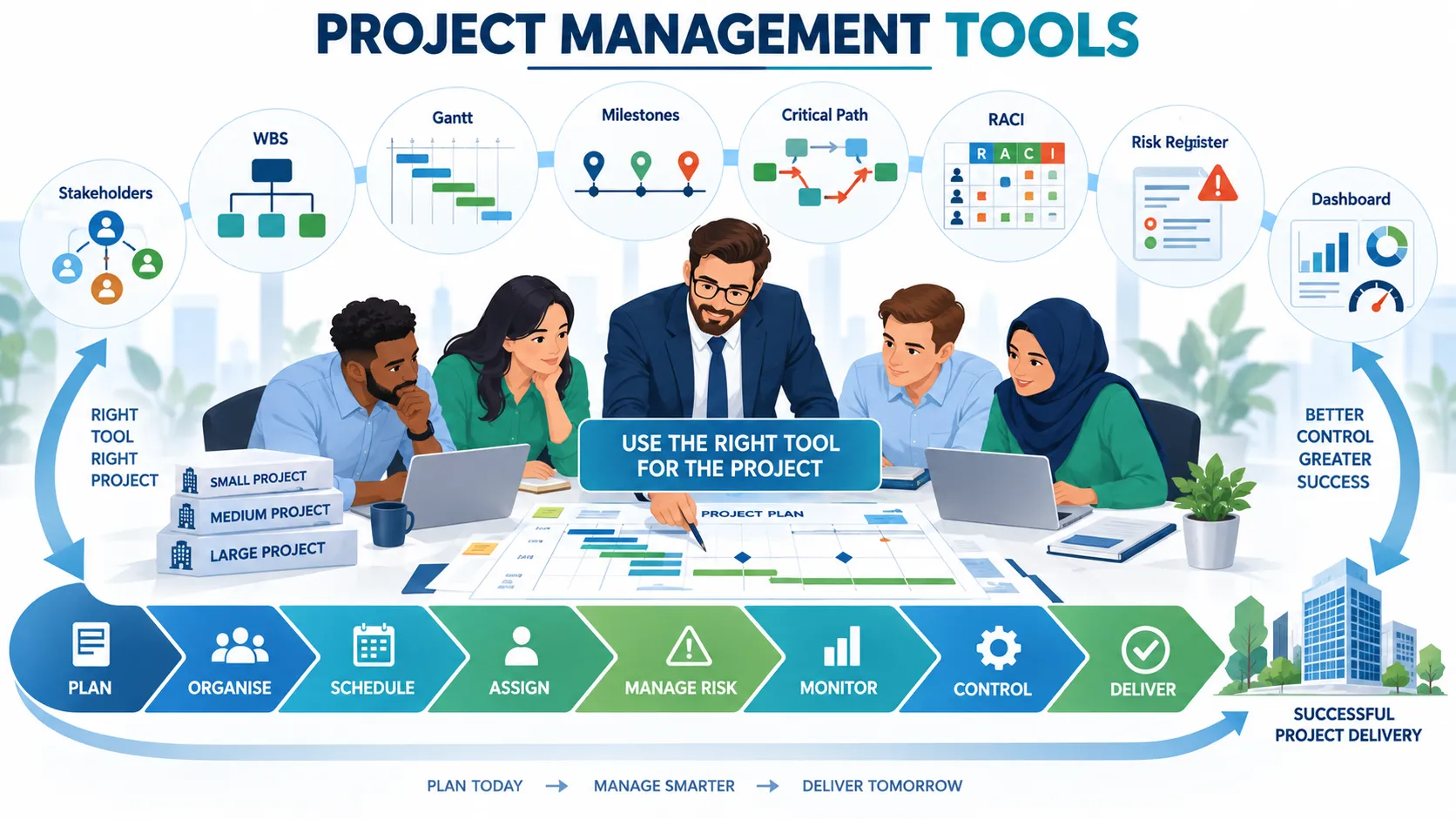
Understanding Project Management Tools and Techniques
A project management tool is a structured method, document, visual representation, software application or framework used to support project planning, coordination, monitoring or control.
A project management technique is an approach or method used by a manager or project team to perform project activities effectively.
Tools and techniques are closely connected.
For example:
A Gantt chart is a project management tool.
Scheduling is a project management technique.
A risk register is a tool.
Risk assessment is a technique.
A stakeholder matrix is a tool.
Stakeholder analysis is a technique.
A work breakdown structure is a tool.
Work decomposition is a technique.
Managers should select tools according to the decisions they need to make and the level of control required.
Why Project Tools Are Important
Project tools provide structure in environments where managers must coordinate multiple activities, people and resources.
They can help managers to:
Clarify project objectives
Define project scope
Break complex work into manageable components
Identify activities
Establish responsibilities
Sequence tasks
Estimate timescales
Allocate resources
Identify dependencies
Assess risks
Communicate expectations
Monitor progress
Control changes
Record decisions
Manage issues
Report project performance
Evaluate outcomes
Without appropriate tools, project information may become fragmented across emails, meetings, spreadsheets and individual memory.
This can lead to:
Missed deadlines
Unclear responsibilities
Duplication of work
Poor communication
Unmanaged dependencies
Resource conflicts
Weak risk management
Inaccurate reporting
However, using too many tools can create the opposite problem.
Excessive documentation can consume valuable management time and make the project unnecessarily bureaucratic.
The objective is therefore not to use as many tools as possible but to use the right tools at the right level of complexity.
Selecting Tools According to Project Context
The context of a project refers to the circumstances and characteristics that influence how the project should be managed.
Important contextual factors include:
Project size
Project complexity
Project duration
Budget
Number of stakeholders
Level of risk
Degree of uncertainty
Regulatory requirements
Organisational culture
Team experience
Geographic distribution
Technology requirements
Number of dependencies
Strategic importance
Level of change involved
A project involving five people over eight weeks should not necessarily be managed in exactly the same way as a multi-year transformation involving hundreds of stakeholders.
Small Projects
Small projects often benefit from simple tools such as:
Project brief
Action plan
Basic task list
Simple timeline
Responsibility list
Risk log
Progress tracker
The emphasis should be on clarity and usability.
Medium-Sized Projects
Medium-sized projects may require:
Work breakdown structure
Gantt chart
Detailed resource plan
Risk register
Stakeholder matrix
Communication plan
Milestone schedule
Issue log
Change log
Project dashboard
Large or Complex Projects
Large projects may require more formal systems, including:
Detailed work breakdown structures
Dependency networks
Critical-path analysis
Resource-loading
Formal risk registers
Benefits management
Governance boards
Change-control systems
Detailed reporting dashboards
Stage-gate reviews
Formal quality assurance
Project Brief
A project brief is an initial document that summarises the essential characteristics of a project.
It may include:
Project title
Business need
Project purpose
Objectives
Scope
Expected outcomes
Key deliverables
Stakeholders
Sponsor
Project manager
Initial timescale
Resources
Major risks
Constraints
Approval arrangements
The project brief provides a common point of reference.
Benefits of a Project Brief
A well-developed project brief can:
Establish clarity
Align stakeholders
Reduce ambiguity
Support project approval
Provide a foundation for planning
Clarify expectations
Support accountability
For a small project, the project brief may be a one- or two-page document.
For a major project, it may form part of a much larger initiation and governance framework.
Work Breakdown Structure
A Work Breakdown Structure (WBS) is a hierarchical decomposition of the total project work into smaller and more manageable components.
It answers a fundamental question:
What work needs to be completed to achieve the project objectives?
Instead of treating a project as one large activity, the manager breaks it into levels.
For example, a digital learning project might be divided into:
Project management
Requirements analysis
Platform configuration
Content migration
Testing
Staff training
Learner communication
Launch
Post-launch review
These areas can then be broken down further.
Benefits of a WBS
A WBS helps managers:
Understand the full scope of work
Avoid overlooking important activities
Estimate resources
Assign responsibilities
Develop schedules
Identify dependencies
Estimate costs
Monitor progress
Using a WBS in Different Contexts
For a small project, a simple task hierarchy may be sufficient.
For a complex project, the WBS can provide the foundation for detailed scheduling, budgeting, resource allocation and reporting.
The manager should avoid decomposing work to such a detailed level that the WBS becomes difficult to maintain.
Gantt Charts
A Gantt chart is a visual scheduling tool that represents project activities against time.
Activities are displayed along a timeline, allowing managers to see:
Start dates
End dates
Duration
Overlapping activities
Milestones
Dependencies
Progress
Gantt charts are particularly useful for communicating project schedules to stakeholders.
Example
A project implementing a new customer-service process might include:
Process analysis: Weeks 1–2
Stakeholder consultation: Weeks 2–3
Process design: Weeks 4–5
Testing: Weeks 6–7
Staff training: Weeks 8–9
Implementation: Week 10
Review: Weeks 11–12
The visual format makes the sequence easier to understand.
Benefits of Gantt Charts
They can help managers:
Communicate schedules
Identify overlapping work
Monitor deadlines
Identify delays
Coordinate activities
Explain project progress
Limitations
A Gantt chart can become difficult to interpret when:
There are hundreds of activities
Dependencies are highly complex
Requirements change frequently
Multiple projects overlap
The chart is not regularly updated
For highly complex projects, a Gantt chart may need to be supported by specialist scheduling techniques.
Milestone Planning
A milestone is a significant point or achievement within a project rather than a routine task.
Examples include:
Project approval
Design completed
Prototype approved
Testing completed
Staff trained
System launched
Regulatory approval obtained
Project handover completed
Milestones help managers focus on major achievements.
Benefits of Milestone Planning
Milestones can:
Provide clear checkpoints
Support senior reporting
Identify important deadlines
Improve stakeholder communication
Support stage-gate decisions
Provide evidence of progress
Milestones are especially useful for senior managers who need a concise overview rather than detailed task-level information.
Dependency Mapping
A dependency exists when one activity relies on another activity, decision, resource or external condition.
Dependency mapping helps managers understand relationships between activities.
For example:
Requirements approval → System configuration → Testing → Training → Implementation
If requirements approval is delayed, the downstream activities may also be affected.
Types of Dependencies
Dependencies may involve:
Internal activities
External suppliers
Regulatory approvals
Other projects
Resource availability
Technology
Management decisions
Understanding dependencies allows managers to identify potential bottlenecks.
Critical Path Analysis
Critical Path Analysis (CPA) is a scheduling technique used to identify the sequence of activities that determines the shortest possible project duration.
Activities on the critical path generally have little or no scheduling flexibility.
If a critical activity is delayed and no corrective action is taken, the overall project completion date may be affected.
Why Critical Path Analysis Matters
CPA can help managers:
Identify activities requiring close monitoring
Understand schedule sensitivity
Prioritise management attention
Assess the impact of delays
Identify opportunities to shorten project duration
For small, simple projects, formal critical-path analysis may not be necessary.
For large projects with many interdependent activities, it can be highly valuable.
Resource Planning
Resource planning involves identifying and allocating the people, skills, time, funding, equipment, technology and other resources needed to complete project activities.
A project schedule may look achievable until resource availability is considered.
For example, three project activities may all require the same specialist at the same time.
The problem is not necessarily the schedule itself but the resource constraint.
Resource Planning Considerations
Managers should assess:
Number of people required
Required skills
Availability
Workload
Equipment
Technology
Budget
External suppliers
Facilities
Training requirements
Resource Histograms and Capacity Views
For complex projects, managers may use visual tools to identify resource demand over time.
These can help identify:
Over-allocation
Under-utilisation
Resource peaks
Skills shortages
Conflicting project requirements
Resource planning is particularly important where staff work across multiple projects.
Responsibility Assignment Matrix
A Responsibility Assignment Matrix (RAM) links project activities to individuals or roles responsible for completing or approving them.
One common form is the RACI matrix, which identifies:
Responsible – the person or people carrying out the work.
Accountable – the person ultimately answerable for the result.
Consulted – people whose expertise or views should be obtained.
Informed – people who need to receive relevant information.
Benefits of RACI
A RACI matrix can:
Clarify accountability
Reduce duplication
Prevent gaps in responsibility
Improve communication
Support escalation
Reduce confusion within teams
For example, a project introducing a new training process may assign:
HR: Consulted
Quality team: Consulted
Project manager: Accountable
Training team: Responsible
Senior leadership: Informed
The precise allocation should reflect the organisation’s governance arrangements.
Risk Register
A risk register is a structured record of identified project risks and their assessment and management.
A typical risk register may include:
Risk description
Cause
Potential impact
Likelihood
Impact rating
Overall risk rating
Risk owner
Existing controls
Mitigation actions
Target date
Current status
Risk Identification Techniques
Managers can identify risks through:
Team workshops
Stakeholder consultation
Historical project information
Lessons learned
SWOT analysis
Expert judgement
Checklists
Scenario analysis
Environmental scanning
Risk Assessment
Risks are commonly assessed using likelihood and impact.
For example:
Low likelihood + high impact may require different treatment from:
High likelihood + moderate impact.
Managers should avoid relying solely on numerical scores. Professional judgement is also important.
Issue Log
A risk is uncertain.
An issue is a problem or situation that has already occurred or requires active management.
An issue log records current problems that may affect project delivery.
It may include:
Issue description
Date identified
Owner
Impact
Priority
Action required
Deadline
Status
Escalation requirements
Distinguishing between risks and issues helps managers respond appropriately.
Change Log and Change Control
Project requirements can change because of:
Stakeholder requests
New information
Regulatory changes
Technical discoveries
Business priorities
Resource changes
External events
A change log records proposed and approved changes.
Formal change control may require:
Change request submitted
Change described
Impact assessed
Stakeholders consulted
Cost and time implications considered
Risk implications assessed
Approval obtained
Project documentation updated
Change implemented
Outcome monitored
Why Change Control Matters
Without change control, projects may experience scope creep.
Change control does not mean rejecting every change.
It means ensuring that changes are considered systematically.
Stakeholder Analysis
Stakeholder analysis identifies stakeholder interests, influence, expectations and potential impact.
A stakeholder matrix may categorise stakeholders according to:
Level of influence
Level of interest
This can help managers determine appropriate engagement strategies.
For example:
High influence, high interest: Manage closely
High influence, low interest: Keep satisfied
Low influence, high interest: Keep informed
Low influence, low interest: Monitor appropriately
These categories should be treated as a practical guide rather than rigid rules.
Communication Plan
A communication plan establishes how project information will be shared.
It may identify:
Audience
Information required
Communication method
Frequency
Owner
Timing
Escalation route
Different stakeholders require different levels of information.
Senior leaders may need:
Overall status
Key risks
Major issues
Decisions required
Benefits
Budget position
Project team members may require:
Detailed tasks
Dependencies
Deadlines
Actions
Operational information
Benefits of a Communication Plan
A communication plan can:
Reduce misunderstandings
Improve stakeholder confidence
Support transparency
Ensure timely information
Clarify responsibilities
Reduce communication gaps
Project Dashboard
A project dashboard provides a concise visual overview of project performance.
Typical indicators may include:
Overall project status
Schedule
Budget
Risks
Issues
Milestones
Deliverables
Resource position
Benefits
Decisions required
Dashboards are especially useful for senior management and governance groups.
However, managers should ensure that dashboard indicators are meaningful.
Too many indicators can make the dashboard difficult to interpret.
Status Reports
A project status report communicates current project performance to stakeholders.
A concise status report may cover:
Work completed
Work planned
Progress against milestones
Budget
Schedule
Risks
Issues
Changes
Decisions required
Next steps
Good reporting should be:
Accurate
Relevant
Timely
Clear
Evidence-based
Proportionate
Managers should avoid reporting information simply because it is available. The report should focus on what stakeholders need to know and what action may be required.
SMART Objectives
SMART is a technique for improving the quality of objectives.
Objectives should be:
Specific
Measurable
Achievable
Relevant
Time-bound
For example:
Weak:
“Improve employee training.”
Stronger:
“Implement a standardised digital induction programme for all new employees within four months, with completion monitored through the organisation’s learning platform.”
SMART objectives support:
Planning
Accountability
Monitoring
Evaluation
Performance reporting
SWOT Analysis
SWOT analysis considers:
Strengths
Weaknesses
Opportunities
Threats
It can be useful during project initiation and planning.
For example, a digital transformation project might identify:
Strengths
Strong internal technical expertise
Weaknesses
Limited project-management capacity
Opportunities
Improved customer experience
Threats
Supplier dependency
SWOT analysis provides a structured way to consider internal and external factors.
PESTLE Analysis
PESTLE analysis considers external factors:
Political
Economic
Social
Technological
Legal
Environmental
It can be particularly useful for projects affected by external conditions.
For example, a project to expand services into a new market may be affected by:
Economic conditions
Technology infrastructure
Legal requirements
Social expectations
Environmental standards
PESTLE helps managers avoid viewing a project entirely from an internal perspective.
Benefits Mapping
Benefits mapping links project outputs to outcomes and organisational benefits.
A simplified chain may be:
Activities → Outputs → Outcomes → Benefits → Strategic Contribution
For example:
Activity: Develop staff training
Output: Training programme completed
Outcome: Staff capability improves
Benefit: Service quality improves
Strategic contribution: Customer satisfaction increases
This approach prevents managers from measuring success solely through completion of activities.
Agile Planning Techniques
Agile approaches can be useful where requirements are uncertain or expected to change.
Agile project environments often emphasise:
Short development cycles
Frequent feedback
Incremental delivery
Continuous prioritisation
Collaboration
Adaptability
Techniques may include:
Backlogs
User stories
Sprint planning
Daily coordination meetings
Sprint reviews
Retrospectives
Kanban boards
Agile techniques may be particularly appropriate for software development, digital products and innovative projects where requirements cannot be fully defined at the beginning.
Traditional or Predictive Planning Approaches
Traditional predictive approaches are often more suitable where:
Requirements are relatively stable
Work is sequential
Regulatory controls are strong
Scope needs to be defined early
Changes are relatively limited
Detailed forecasting is possible
Examples may include certain construction, infrastructure or compliance-driven projects.
Tools such as:
Detailed schedules
Gantt charts
Stage plans
Formal approval gates
Risk registers
Change-control systems
can provide appropriate control.
Choosing Between Agile and Predictive Approaches
Managers should not treat agile and predictive approaches as mutually exclusive in every situation.
A project may use a hybrid approach.
For example, an organisation implementing a new learning platform may use:
Formal governance and procurement controls
Predictive implementation milestones
Agile development for user-interface improvements
Iterative testing
Regular stakeholder feedback
The appropriate approach depends on uncertainty, risk, regulatory requirements, stakeholder needs and organisational capability.
Scenario 1: Small Internal Improvement Project
A department wants to improve its weekly reporting process.
The project involves four people and is expected to take six weeks.
A proportionate toolkit could include:
One-page project brief
Task list
Simple timeline
Responsibility matrix
Basic risk log
Weekly progress review
A highly complex project-management system would probably add little value.
The manager should focus on clarity, accountability and progress.
Scenario 2: Digital Transformation Project
An organisation is replacing several legacy systems with an integrated digital platform.
The project has:
Multiple departments
External suppliers
Significant budget
Data migration
Security requirements
Major operational impact
Multiple dependencies
A more sophisticated toolkit may be required.
This could include:
Detailed WBS
Gantt schedule
Dependency map
Critical-path analysis
Resource plan
Risk register
Issue log
Stakeholder matrix
Communication plan
Change-control process
Benefits framework
Governance dashboard
The complexity of the project justifies the additional management infrastructure.
Scenario 3: Regulatory Compliance Project
An organisation must implement a change to meet a new regulatory requirement.
In this context, legal and compliance considerations may dominate.
Useful tools may include:
Compliance checklist
Requirements register
Responsibility matrix
Risk register
Milestone plan
Evidence tracker
Approval log
Audit trail
Issue log
The project manager needs to ensure that evidence of compliance is maintained.
Scenario 4: Product Development Project
An organisation is developing a new digital product but does not yet fully understand customer requirements.
An agile approach may be appropriate.
The team may use:
Product backlog
User stories
Prioritisation
Short iterations
Prototype testing
Customer feedback
Sprint reviews
Retrospectives
The tools support learning and adaptation rather than attempting to predict every requirement at the beginning.
Scenario 5: Event Management Project
An organisation is planning a major professional conference.
The project may involve:
Venue
Speakers
Marketing
Registration
Technology
Catering
Suppliers
Health and safety
Finance
Useful tools could include:
Task breakdown
Gantt chart
Responsibility matrix
Supplier tracker
Risk register
Budget tracker
Event checklist
Communication plan
Milestone schedule
The tools should reflect the event deadline because the date is generally fixed.
Scenario 6: Organisational Change Project
A business is changing its operating model.
The project may affect:
Employees
Roles
Processes
Technology
Customers
Reporting structures
Useful techniques may include:
Stakeholder mapping
Change-impact assessment
Communication planning
Training needs analysis
Risk assessment
Readiness assessment
Benefits mapping
The project manager needs to recognise that successful implementation depends heavily on people, not simply task completion.
Scenario 7: Multi-Department Project
A project involves HR, finance, IT, operations and customer services.
Cross-functional projects often suffer from unclear ownership.
A RACI matrix can clarify responsibilities.
A stakeholder matrix can identify influence.
A communication plan can establish appropriate information flows.
A dependency map can identify where one department’s activity depends on another.
These tools reduce coordination problems.
Scenario 8: Remote or International Project Team
Projects involving geographically dispersed teams create additional communication challenges.
Managers may need:
Shared digital project workspace
Online task board
Central document repository
Meeting schedule
Decision log
Communication protocol
Time-zone planning
Progress dashboard
Managers should also consider cultural differences, communication styles and working practices.
The toolset should support transparency and shared access to current project information.
Scenario 9: High-Risk Project
Projects involving significant safety, financial, regulatory or reputational risk require stronger controls.
Managers may need:
Detailed risk register
Risk escalation process
Formal approvals
Contingency plans
Assurance reviews
Issue log
Decision log
Audit trail
Governance reporting
The higher the potential consequence of failure, the stronger the justification for formal controls.
Using Tools Throughout the Project Lifecycle
Project tools should evolve as the project progresses.
Initiation
Useful tools include:
Project brief
Business case
Stakeholder analysis
SWOT
PESTLE
Initial risk assessment
High-level scope statement
Planning
Useful tools include:
WBS
Gantt chart
Milestone plan
Resource plan
RACI
Risk register
Communication plan
Dependency map
Budget
Implementation
Useful tools include:
Task board
Progress tracker
Issue log
Change log
Risk register
Team meeting records
Status reports
Monitoring and Control
Useful tools include:
Dashboard
Performance indicators
Variance analysis
Risk register
Issue log
Change-control register
Milestone review
Closure
Useful tools include:
Completion checklist
Benefits review
Lessons-learned record
Handover documentation
Final report
Stakeholder feedback
Outstanding issue register
Using Tools to Monitor Project Performance
Tools should help managers identify whether actual performance differs from the approved plan.
Managers may compare:
Planned versus actual dates
Planned versus actual costs
Planned versus completed work
Expected versus actual resource use
Identified versus emerging risks
Planned versus achieved milestones
Variance analysis helps managers identify areas requiring intervention.
For example, if an activity planned for completion in Week 4 remains incomplete in Week 6, the manager should investigate the cause.
Possible causes could include:
Resource shortage
Dependency failure
Poor estimation
Scope change
Supplier delay
Technical problem
The tool identifies the variance; managerial judgement determines the response.
Using Tools for Decision-Making
Project tools should support decisions rather than simply record information.
For example, a risk register may show that a supplier has become a significant risk.
The manager may then decide to:
Increase monitoring
Develop a contingency supplier
Adjust the schedule
Change contractual controls
Escalate the issue
Similarly, a resource plan may show that the project requires a specialist who is unavailable.
The manager may consider:
Recruiting
Outsourcing
Reallocating resources
Rescheduling activities
Reducing scope
Tools therefore become valuable when information is translated into action.
Avoiding Tool Overload
A common mistake is assuming that sophisticated project management requires large amounts of documentation.
Managers should ask:
What decision or control does this tool support?
If a tool does not contribute meaningfully to:
Planning
Accountability
Risk management
Communication
Monitoring
Control
Decision-making
its value should be questioned.
Too many tools can result in:
Duplicate data
Administrative burden
Outdated information
Conflicting versions
Reduced team engagement
Excessive meetings
The best project-management system is one that people actually use consistently.
Digital Project Management Tools
Digital platforms can integrate multiple project-management functions.
Depending on the organisation and platform, these may include:
Task management
Scheduling
Document management
Communication
Dashboards
Risk tracking
Issue management
Reporting
Collaboration
Digital tools can be particularly valuable for distributed teams.
However, technology does not automatically create good project management.
A poorly designed process can remain poorly designed even when placed into sophisticated software.
Managers should establish sound project-management practices first and then use technology to support them.
Tool Selection Criteria for Managers
When selecting a project-management tool, managers should consider:
Project size
Complexity
Risk
Number of users
Stakeholder needs
Information requirements
Cost
Ease of use
Integration
Security
Accessibility
Reporting requirements
Organisational standards
Team capability
The selected tool should be appropriate for the people who need to use it.
A technically sophisticated tool may fail if the team cannot use it effectively.
Key Benefits of Using Appropriate Project Tools
Improved Planning
Tools make project activities, dependencies and resources more visible.
Greater Accountability
Responsibility matrices and task systems clarify ownership.
Better Communication
Schedules, dashboards and reports provide shared information.
Stronger Risk Management
Risk registers make uncertainty visible and support proactive responses.
Improved Resource Utilisation
Resource plans identify conflicts and capacity issues.
Better Schedule Control
Gantt charts, milestones and dependency analysis help managers identify delays.
More Effective Decision-Making
Structured information supports evidence-based decisions.
Improved Stakeholder Confidence
Clear reporting demonstrates that the project is being actively managed.
Greater Consistency
Standard tools can help organisations apply common project-management practices.
Limitations of Project Management Tools
Tools are valuable, but they have limitations.
A tool cannot:
Replace leadership
Resolve stakeholder conflict automatically
Guarantee accurate estimates
Eliminate uncertainty
Make ethical decisions
Replace professional judgement
Guarantee project success
A risk register, for example, does not manage risks by itself.
A manager must:
Understand the risk
Assign ownership
Implement controls
Monitor changes
Escalate appropriately
Similarly, a Gantt chart does not guarantee that activities will be completed on time.
Tools support management; they do not replace it.
Developing a Fit-for-Purpose Project Toolkit
A middle manager can develop a project toolkit using the following process.
Step 1: Understand the Project
Assess:
Size
Complexity
Risk
Duration
Stakeholders
Resources
Uncertainty
Step 2: Identify Management Requirements
Determine what needs to be controlled.
This might include:
Scope
Time
Cost
Resources
Risk
Quality
Stakeholders
Changes
Step 3: Select Essential Tools
Choose only the tools necessary to provide effective control.
Step 4: Establish Ownership
Identify who maintains each tool.
Step 5: Define Review Frequency
Determine how often information needs updating.
Step 6: Integrate Tools
Ensure information is consistent across:
Schedule
Risk register
Resource plan
Status reports
Dashboard
Step 7: Train Users
Ensure team members understand how and when to use the tools.
Step 8: Review Effectiveness
Ask whether the tools are genuinely improving project management.
Step 9: Adapt When Context Changes
As the project grows or becomes more complex, the toolkit may need to evolve.
Professional Judgement in Tool Selection
Effective project managers do not simply apply tools because they appear professional.
They consider whether each tool adds value.
For example, a simple six-week project involving three employees may not require formal critical-path software.
Conversely, a complex transformation with hundreds of interdependent activities may be difficult to manage using a simple spreadsheet alone.
Professional judgement involves balancing:
Control + Usability + Proportionality + Information Needs
The objective is sufficient control without unnecessary bureaucracy.
Key Concepts to Remember
The most important concepts from this section include:
Project brief: A concise summary of the project’s purpose, objectives, scope, stakeholders and key parameters.
Work Breakdown Structure: A hierarchical decomposition of project work into manageable components.
Gantt chart: A visual representation of project activities against time.
Milestone: A significant point or achievement in a project.
Dependency: A relationship where one activity, decision or resource relies on another.
Critical Path Analysis: A technique for identifying activities that determine the shortest achievable project duration.
Resource plan: A structured approach to identifying and allocating project resources.
RACI: A responsibility-assignment technique identifying Responsible, Accountable, Consulted and Informed roles.
Risk register: A structured record of identified project risks and their management.
Issue log: A record of problems that have occurred and require management.
Change log: A record of proposed, approved and implemented project changes.
Stakeholder analysis: The process of identifying stakeholder interests, influence and potential impact.
Communication plan: A structured approach to determining what information is communicated, to whom, how and when.
Project dashboard: A concise visual summary of project performance.
Benefits mapping: A method of linking project activities and outputs to outcomes, benefits and strategic contribution.
Agile planning: An adaptive approach based on incremental delivery, feedback and continuous prioritisation.
Predictive planning: An approach that seeks to define and schedule project work in greater detail before delivery.
Hybrid approach: A combination of predictive and adaptive methods selected according to project requirements.
Integrated Example: Planning a New Employee Onboarding Project
Consider an organisation planning a project to redesign employee onboarding.
The project objectives include:
Improve the consistency of onboarding
Reduce administrative delays
Improve the new employee experience
Introduce digital onboarding resources
The manager can select tools according to the project requirements.
Project Brief
Defines:
Purpose
Objectives
Scope
Stakeholders
Expected outcomes
WBS
Breaks the project into:
Current-state analysis
Stakeholder consultation
Process design
Content development
Digital configuration
Testing
Training
Implementation
Evaluation
Gantt Chart
Establishes:
Activity dates
Duration
Dependencies
Milestones
RACI
Clarifies:
Who completes each activity
Who approves decisions
Who must be consulted
Who receives information
Risk Register
Identifies risks such as:
Staff resistance
Technology problems
Delayed content
Insufficient resources
Stakeholder Matrix
Identifies:
HR
Managers
New employees
IT
Senior leadership
Communication Plan
Determines:
What each group needs to know
When information is required
Who communicates it
Which communication method should be used
Dashboard
Provides senior managers with:
Overall progress
Key milestones
Risks
Issues
Decisions required
Together, these tools provide a coherent management system.
Evaluating Whether Tools Are Working
Managers should periodically evaluate the effectiveness of their project-management tools.
Useful questions include:
Is information accurate?
Is information current?
Are people using the tools?
Are decisions being made more effectively?
Are risks being identified earlier?
Are responsibilities clearer?
Are stakeholders receiving appropriate information?
Are project delays being identified early?
Is administration proportionate?
Are the tools helping the team achieve project objectives?
If a tool creates significant administrative effort without improving control, it should be reviewed.
Summary
Project management tools and techniques provide the structure required to plan, coordinate, monitor and control project work. However, effective project management does not depend on using every available tool. It depends on selecting tools that are appropriate to the project’s context.
A project brief establishes the project’s purpose and parameters. A Work Breakdown Structure decomposes the work into manageable components. Gantt charts and milestone plans support scheduling. Dependency mapping and Critical Path Analysis help managers understand sequencing and schedule risk. Resource plans identify capacity requirements, while RACI matrices clarify responsibility and accountability.
Risk registers, issue logs and change-control systems support project control. Stakeholder analysis and communication plans help managers build effective relationships and maintain appropriate information flows. Dashboards and status reports provide concise performance information for decision-makers. Benefits mapping helps managers connect project activity to organisational outcomes.
Different contexts require different approaches. Small projects can often be managed with simple tools, whereas large, complex or high-risk projects may require formal governance and more sophisticated control systems. Projects operating in uncertain environments may benefit from agile or hybrid approaches, while projects with stable requirements and highly controlled environments may benefit from predictive planning.
The key principle for middle managers is proportionality. Tools should provide sufficient control without creating unnecessary bureaucracy.
A successful project-management toolkit should therefore reflect:
The project’s size
Its complexity
Its level of risk
Its timescale
Its stakeholder environment
Its resource requirements
The level of uncertainty
Organisational governance requirements
Managers should also remember that project tools are only aids to management. A risk register cannot manage a risk by itself. A Gantt chart cannot solve a delay. A dashboard cannot resolve stakeholder conflict. These tools provide information, structure and visibility, while managers provide leadership, judgement, communication and decision-making.
The most effective project manager therefore asks not “Which tools can I use?” but:
“What level of information, control and coordination does this project require, and which tools will provide it effectively?”
This approach enables managers to create project-management systems that are practical, proportionate and focused on achieving results.
| Tool or Technique | Definition | Primary Purpose | Most Useful Contexts | Key Benefit |
|---|---|---|---|---|
| Project Brief | High-level summary of the project’s purpose, objectives, scope and key parameters | Establish project direction | Most project types | Creates common understanding |
| Work Breakdown Structure | Hierarchical decomposition of project work | Define and organise project activities | Medium and complex projects | Clarifies total project work |
| Gantt Chart | Visual schedule showing activities against time | Plan and monitor timelines | Small to large projects | Makes timing and progress visible |
| Milestone Plan | Identification of significant project achievements | Monitor major checkpoints | Most project types | Provides clear progress markers |
| Dependency Map | Visual representation of relationships between activities | Understand sequencing | Complex and interdependent projects | Identifies potential bottlenecks |
| Critical Path Analysis | Technique for identifying activities determining project duration | Manage schedule sensitivity | Complex projects | Focuses attention on critical activities |
| Resource Plan | Structured plan for allocating people, skills, time and other resources | Manage capacity | Resource-intensive projects | Identifies shortages and conflicts |
| RACI Matrix | Assignment of Responsible, Accountable, Consulted and Informed roles | Clarify responsibilities | Cross-functional projects | Reduces ambiguity |
| Risk Register | Structured record of project risks and controls | Manage uncertainty | All projects, especially higher-risk projects | Supports proactive risk management |
| Issue Log | Record of current problems requiring action | Track active problems | Most projects | Improves issue ownership and resolution |
| Change Log | Record of proposed and approved changes | Control project change | Projects with changing requirements | Reduces uncontrolled scope change |
| Stakeholder Matrix | Analysis of stakeholder influence and interest | Plan engagement | Projects with multiple stakeholders | Supports targeted engagement |
| Communication Plan | Structured approach to project communications | Manage information flows | Complex and cross-functional projects | Improves transparency |
| Project Dashboard | Visual summary of key performance information | Support reporting and decision-making | Medium and large projects | Provides concise management information |
| SWOT Analysis | Analysis of strengths, weaknesses, opportunities and threats | Assess internal and external factors | Initiation and planning | Supports strategic thinking |
| PESTLE Analysis | Analysis of political, economic, social, technological, legal and environmental factors | Assess external environment | Complex or externally influenced projects | Identifies external influences |
| Benefits Map | Links activities and outputs to outcomes and benefits | Connect delivery to organisational value | Strategic projects | Focuses on meaningful results |
| Agile Backlog | Prioritised list of work or requirements | Manage evolving work | High-uncertainty and digital projects | Supports flexible prioritisation |
| Predictive Schedule | Detailed planned sequence of project activities | Control defined work | Stable and structured projects | Provides stronger upfront predictability |
| Hybrid Approach | Combination of predictive and adaptive techniques | Match methods to project context | Complex or mixed-context projects | Balances control and flexibility |
4.Analyse Techniques for Working Collaboratively with Stakeholders to Achieve Project Aims
Projects are delivered through people, relationships and coordinated action. Even when a project has a strong business case, realistic objectives, adequate funding and a well-developed plan, its success can be undermined if stakeholders are not effectively engaged and supported.
Stakeholders can influence project decisions, provide resources, contribute specialist knowledge, approve activities, use project outputs or experience the consequences of project changes. For middle managers and leaders, stakeholder collaboration is therefore a core project-management responsibility rather than an additional communication activity.
Stakeholder collaboration is the process of working constructively with people and groups who have an interest in, influence over, or are affected by a project, with the purpose of achieving shared project objectives and organisational outcomes.
Effective collaboration requires more than sending regular updates. It involves understanding stakeholder interests, establishing trust, communicating appropriately, encouraging participation, managing expectations, resolving disagreements, making decisions collectively where appropriate and maintaining relationships throughout the project lifecycle.
A middle manager often operates at the centre of these relationships. They may need to translate senior-management expectations into operational requirements, explain project decisions to employees, coordinate different departments, manage supplier relationships and represent stakeholder concerns to project sponsors.
The ability to collaborate effectively is therefore directly connected to project performance.
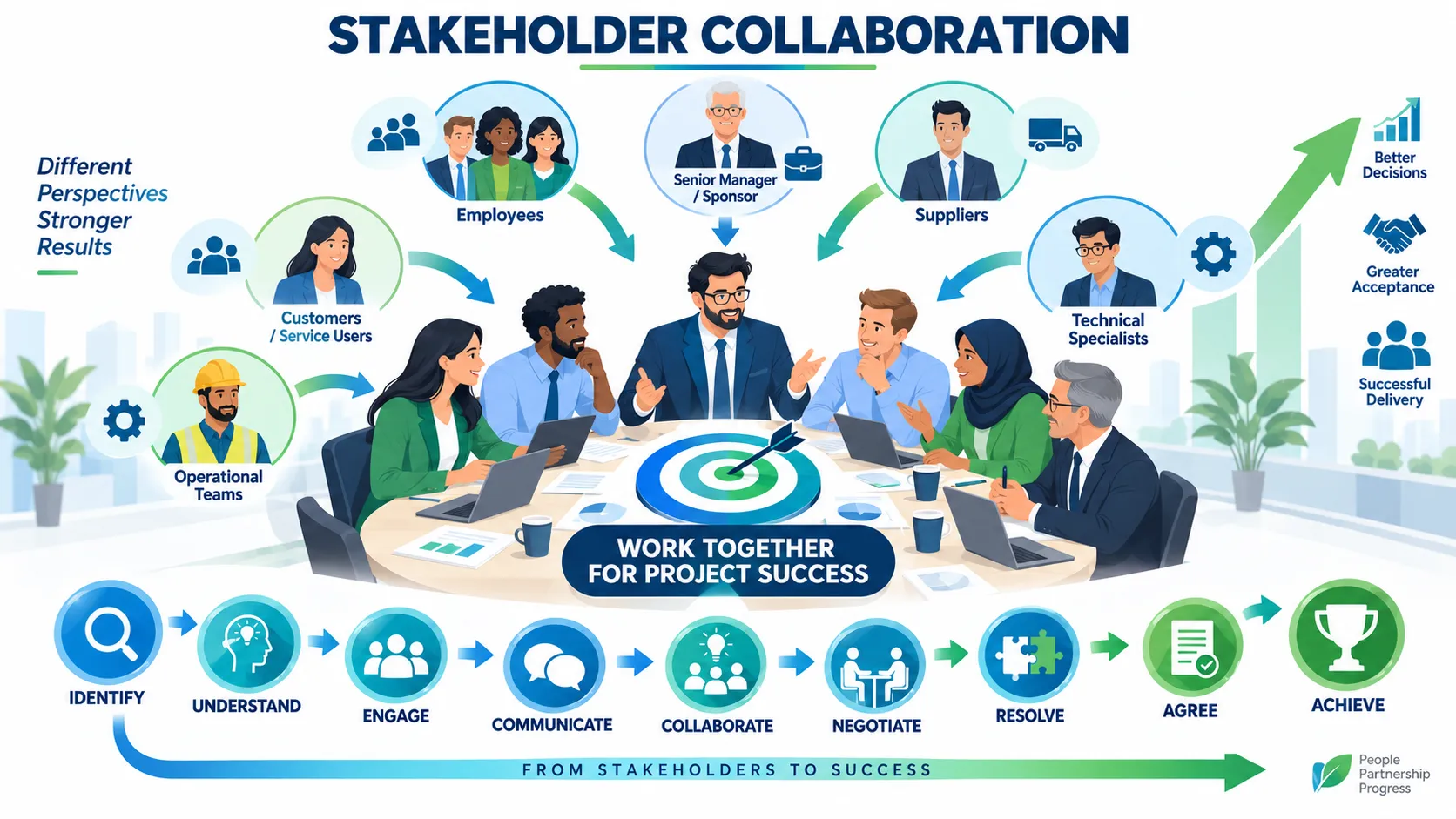
Understanding Project Stakeholders
A stakeholder is an individual, group or organisation that can affect a project, is affected by a project, or has an interest in its activities, decisions or outcomes.
Stakeholders can be internal or external.
Internal Stakeholders
Internal stakeholders operate within the organisation.
Examples include:
Project sponsor
Senior managers
Middle managers
Project manager
Project team
Employees
Finance
Human resources
Information technology
Procurement
Quality assurance
Operations
Marketing
Customer-service teams
Internal stakeholders may provide resources, expertise, approvals or operational support.
External Stakeholders
External stakeholders operate outside the organisation.
Examples include:
Customers
Service users
Suppliers
Contractors
Consultants
Regulators
Professional bodies
Business partners
Community representatives
Investors
Funding organisations
External stakeholders may have different expectations, contractual relationships or regulatory interests.
Why Stakeholder Collaboration Matters
Projects often involve competing priorities.
A senior manager may prioritise cost reduction.
An operational manager may prioritise service quality.
Employees may prioritise workload and usability.
Customers may prioritise convenience.
Finance may prioritise budget control.
The project manager must bring these perspectives together sufficiently to achieve the project aims.
Effective collaboration can help:
Improve decision-making
Identify requirements
Increase stakeholder ownership
Reduce resistance
Improve communication
Identify risks
Resolve issues
Access specialist knowledge
Improve project quality
Increase acceptance of project outcomes
Support organisational change
Strengthen trust
Poor stakeholder collaboration can create:
Misunderstandings
Resistance
Conflicting requirements
Delayed decisions
Poor-quality outputs
Scope changes
Resource problems
Escalated conflict
Loss of confidence
Project delays
Stakeholder Collaboration Versus Stakeholder Communication
Communication and collaboration are related but not identical.
Stakeholder communication involves providing and receiving information.
Stakeholder collaboration involves stakeholders actively contributing to planning, problem-solving, decision-making or delivery.
For example, sending employees an email explaining a new system is communication.
Inviting employees to test the system, provide feedback, identify operational problems and help redesign processes is collaboration.
Projects generally benefit from using both.
Levels of Stakeholder Engagement
Stakeholders may experience different levels of involvement:
Inform
Consult
Involve
Collaborate
Empower
The appropriate level depends on the stakeholder’s role, influence, knowledge and impact.
Not every stakeholder needs to participate in every decision.
The objective is appropriate involvement rather than maximum involvement.
Stakeholder Identification
The first step in effective collaboration is identifying who matters to the project.
Stakeholder identification should consider people who:
Make decisions
Provide resources
Approve project activity
Have specialist knowledge
Use project outputs
Are affected by project changes
Can support the project
Can create obstacles
Have legal or regulatory interests
Can influence other stakeholders
Managers should avoid assuming that only senior leaders are important stakeholders.
Employees, customers and technical specialists can have significant influence over project success.
Stakeholder Mapping
Stakeholder mapping is a technique used to assess stakeholders according to factors such as influence, interest, impact and level of involvement.
A commonly used approach is an influence-interest matrix.
High Influence, High Interest
These stakeholders should generally be managed closely.
Examples might include:
Project sponsor
Executive decision-maker
Key customer
Major operational owner
They may require:
Regular communication
Direct involvement in important decisions
Early escalation of significant issues
Active relationship management
High Influence, Low Interest
These stakeholders should generally be kept satisfied.
They may not require detailed operational information but need confidence that the project is well managed.
Low Influence, High Interest
These stakeholders should generally be kept informed and given suitable opportunities to contribute.
Examples could include:
Employees affected by changes
Service users
Operational staff
Low Influence, Low Interest
These stakeholders can usually be monitored with proportionate communication.
The matrix should not be static. Stakeholder influence and interest can change during a project.
Stakeholder Analysis
Stakeholder analysis involves understanding each stakeholder’s:
Interests
Expectations
Influence
Impact
Concerns
Knowledge
Potential support
Potential resistance
Decision-making authority
Preferred communication method
This information helps managers design appropriate engagement strategies.
For example, a technical specialist may have high influence because the project depends on their expertise even if they have little interest in strategic discussions.
A customer may have high interest but limited formal decision-making power.
Both stakeholders require different engagement approaches.
Understanding Stakeholder Expectations
Stakeholder expectations can influence project success.
Managers should establish:
What does the stakeholder expect?
What does the stakeholder need?
What does the stakeholder fear?
What does the stakeholder consider success?
What decisions do they need to influence?
What information do they require?
What constraints affect them?
Expectations should be discussed early because unrealistic expectations can become major sources of conflict.
Managing Unrealistic Expectations
A stakeholder may expect:
A faster delivery date
More features
Lower cost
Higher quality
Minimal disruption
These expectations may conflict.
Managers should explain trade-offs clearly.
For example, delivering additional functionality may require more time or funding.
The role of the manager is not simply to say “yes” to stakeholder requests but to help stakeholders understand the implications of decisions.
Building Trust with Stakeholders
Trust is one of the foundations of effective collaboration.
Stakeholders are more likely to cooperate when they believe project leaders:
Communicate honestly
Keep commitments
Listen to concerns
Treat people fairly
Make decisions consistently
Share relevant information
Admit problems
Protect confidential information
Follow agreed processes
Trust develops through repeated behaviour rather than one communication event.
Behaviours That Build Trust
Managers can build trust by:
Setting realistic expectations
Providing accurate progress information
Following through on commitments
Responding to concerns promptly
Giving credit to contributors
Explaining decisions
Avoiding unnecessary surprises
Admitting mistakes
Escalating serious issues appropriately
Establishing a Stakeholder Engagement Strategy
A stakeholder engagement strategy describes how the project will work with different stakeholder groups.
It may identify:
Stakeholder
Influence
Interest
Project impact
Desired relationship
Engagement approach
Communication needs
Frequency
Responsibility
Review date
Different stakeholders require different approaches.
For example:
Project sponsor: Strategic updates and decision discussions.
Project team: Frequent operational coordination.
Employees: Consultation, workshops and implementation updates.
Customers: Requirement gathering, testing and feedback.
Suppliers: Contract meetings, technical reviews and performance monitoring.
Collaborative Planning
Stakeholders should be involved in planning when their knowledge, authority or operational experience can improve the project.
Collaborative planning can involve:
Workshops
Planning meetings
Interviews
Focus groups
Requirement sessions
Process-mapping exercises
Design sessions
Prioritisation meetings
Stakeholder involvement can reveal information that the project team may otherwise overlook.
For example, an IT team may understand technical requirements, while frontline employees understand practical operational problems.
Combining these perspectives improves project planning.
Stakeholder Workshops
Workshops provide a structured environment for multiple stakeholders to contribute.
A workshop may be used to:
Define requirements
Identify risks
Analyse problems
Generate solutions
Prioritise features
Map processes
Review designs
Resolve disagreements
Effective workshops require clear objectives.
The facilitator should establish:
Purpose
Participants
Agenda
Decision requirements
Ground rules
Outputs
Follow-up actions
Brainstorming
Brainstorming is a collaborative technique used to generate ideas.
It can be particularly useful during:
Problem identification
Solution development
Risk identification
Process improvement
Innovation
Contingency planning
Managers should create an environment where participants can contribute ideas without immediate criticism.
Ideas can then be evaluated using agreed criteria.
Focus Groups
Focus groups involve structured discussions with selected participants who represent a particular stakeholder group.
They can help managers understand:
User needs
Experiences
Concerns
Preferences
Barriers
Reactions to proposed changes
For example, a project developing a new learner-support service could use a focus group to understand user expectations before finalising the service design.
Interviews
One-to-one stakeholder interviews can be useful where stakeholders have specialist knowledge or where sensitive issues need to be explored.
Interviews can uncover:
Detailed requirements
Hidden concerns
Organisational constraints
Political sensitivities
Historical problems
Stakeholder expectations
They can be particularly useful for senior stakeholders who may not participate fully in large workshops.
Surveys and Questionnaires
Surveys can gather information from large stakeholder groups.
They may be used to:
Establish baseline information
Identify preferences
Measure satisfaction
Gather feedback
Identify common concerns
However, surveys may lack the depth of interviews or workshops.
Managers should select the method according to the information required.
Co-Design
Co-design involves stakeholders actively contributing to the design of a product, service or process.
It is particularly useful when project outcomes directly affect users.
For example, a healthcare-service improvement project may involve:
Healthcare professionals
Patients or service users
Administrative staff
Quality specialists
Each group may identify different requirements.
Co-design can improve relevance and acceptance because stakeholders have helped shape the solution.
Collaborative Decision-Making
Project decisions should involve the appropriate stakeholders.
Not every decision needs consensus.
Managers should distinguish between:
Decisions requiring formal approval
Decisions requiring consultation
Decisions delegated to the project team
Routine operational decisions
Strategic decisions requiring senior involvement
Clear decision rights prevent confusion.
Decision-Making Techniques
Managers may use:
Consensus
Majority decision
Expert judgement
Weighted scoring
Cost-benefit analysis
Risk-based decision-making
Multi-criteria analysis
The method should reflect the importance and nature of the decision.
Consensus Building
Consensus means reaching a position that participants can broadly support, even if it is not everyone’s preferred option.
Consensus is useful when:
Stakeholder cooperation is essential
Multiple perspectives need to be integrated
Long-term commitment matters
The decision is complex
However, consensus should not become an excuse for indefinite discussion.
Managers should establish:
What decision must be made
Who has authority
What evidence is required
When the decision must be made
Managing Conflicting Stakeholder Interests
Stakeholder conflict is common.
For example:
Finance wants lower cost.
Operations wants higher staffing.
Customers want more features.
Senior management wants faster delivery.
The manager needs to identify the underlying interests rather than simply treating the situation as disagreement.
Conflict Resolution Process
A structured process can involve:
Step 1: Define the Issue
Clarify what the disagreement is actually about.
Step 2: Understand Each Perspective
Allow stakeholders to explain their concerns and priorities.
Step 3: Identify Common Interests
Look for shared objectives.
Step 4: Examine Evidence
Use data rather than assumptions.
Step 5: Develop Options
Identify potential solutions.
Step 6: Assess Trade-Offs
Consider cost, time, quality, risk and stakeholder impact.
Step 7: Agree the Decision Route
Determine who has authority to decide.
Step 8: Record the Decision
Document the agreed outcome and responsibilities.
Negotiation
Negotiation is a technique used to reach an acceptable agreement between parties with different interests.
Project negotiations may involve:
Scope
Budget
Deadlines
Resources
Supplier contracts
Responsibilities
Service levels
Requirements
Effective negotiation focuses on interests and evidence rather than personal positions.
For example, instead of asking:
“Why will you not agree to this deadline?”
the manager might ask:
“What conditions would need to be in place for this deadline to become achievable?”
This shifts the conversation towards problem-solving.
Active Listening
Active listening is an essential collaboration skill.
It involves:
Paying attention
Clarifying meaning
Asking appropriate questions
Summarising understanding
Recognising concerns
Avoiding premature judgement
Managers can use phrases such as:
“Can you explain what is causing the concern?”
“What impact would this change have on your team?”
“If I understand correctly, your main concern is…”
“What would a workable solution look like?”
Active listening can reduce misunderstanding and improve trust.
Effective Questioning
Managers can use open questions to encourage stakeholder participation.
Examples include:
“What challenges do you anticipate?”
“What would success look like for your team?”
“What requirements are essential?”
“What risks do you think we may be overlooking?”
“Which stakeholders should be involved?”
“What would make this change easier to implement?”
Questions can uncover information that closed questions may miss.
Stakeholder Communication
Communication should be tailored to the stakeholder.
Different communication methods include:
Meetings
Workshops
Reports
Dashboards
Emails
Presentations
Briefings
Interviews
Digital collaboration platforms
Newsletters
Surveys
Managers should consider:
Audience
Purpose
Urgency
Complexity
Sensitivity
Required action
Communication Frequency
Communication frequency should reflect stakeholder needs.
For example:
Project team: frequent operational communication
Sponsor: scheduled strategic updates
Governance group: formal reporting
Customers: milestone or change communications
Suppliers: contract and delivery meetings
Too little communication creates uncertainty.
Too much communication can create information overload.
The objective is relevant and timely communication.
Collaborative Digital Working
Modern projects often involve geographically distributed teams.
Digital collaboration tools can support:
Shared documents
Task management
Online meetings
Discussion channels
Project dashboards
Version control
Decision records
Managers should establish clear digital working practices.
These may include:
Where project information is stored
Which platform should be used
How decisions are recorded
How quickly messages should be answered
Which issues require escalation
How confidential information is protected
Working with Cross-Functional Stakeholders
Cross-functional projects involve people from different departments.
Each department may have different:
Objectives
Language
Priorities
Processes
Performance measures
Resources
A finance manager may focus on cost.
An IT manager may focus on security.
An operational manager may focus on usability.
The project leader must create a shared understanding of the overall project objective.
Techniques for Cross-Functional Collaboration
Managers can use:
Shared objectives
RACI matrices
Joint planning
Cross-functional workshops
Common performance measures
Shared dashboards
Regular coordination meetings
Clear escalation routes
Working with External Suppliers
Supplier collaboration is often essential for project success.
Effective supplier relationships require clarity around:
Deliverables
Responsibilities
Service levels
Deadlines
Quality
Communication
Escalation
Contract requirements
Change control
Managers should avoid treating suppliers as merely external task providers.
Where appropriate, collaborative supplier relationships can help identify:
Technical solutions
Delivery improvements
Risks
Cost-saving opportunities
Innovation opportunities
However, collaboration must remain consistent with procurement and contractual requirements.
Managing Stakeholder Resistance
Resistance does not necessarily mean that stakeholders are being difficult.
Resistance may indicate:
Genuine concern
Lack of information
Previous negative experience
Fear of job loss
Increased workload
Lack of trust
Loss of control
Lack of involvement
Unclear benefits
Managers should investigate the reason for resistance rather than immediately labelling it as opposition.
Responding to Resistance
Managers can:
Listen to concerns
Provide accurate information
Explain the purpose
Involve stakeholders in solutions
Clarify benefits
Address legitimate risks
Provide training
Allow appropriate time for adaptation
Escalate unresolved issues
Managing Stakeholder Expectations During Change
Projects often change how people work.
Stakeholders may need time to understand:
Why change is occurring
What will change
What will remain the same
How they will be affected
What support is available
When changes will occur
Transparent communication reduces uncertainty.
Managers should avoid promising benefits that cannot be guaranteed.
Stakeholder Feedback
Feedback should be collected throughout the project.
It can be obtained through:
Surveys
Meetings
Workshops
Interviews
Testing sessions
User groups
Reviews
Informal discussions
Feedback should be analysed rather than automatically accepted.
Managers should consider:
Is the feedback relevant?
Is it supported by evidence?
Is it consistent with project objectives?
What impact would acting on it have?
Does it require a scope change?
Who should make the decision?
Stakeholder Feedback Loops
A feedback loop involves:
Engage → Listen → Analyse → Respond → Communicate → Review
This demonstrates to stakeholders that their input has been considered.
If managers repeatedly ask for feedback but never explain what happened to it, stakeholder engagement can decline.
Collaborative Problem-Solving
Project problems often require stakeholders to work together.
A structured approach can include:
Define the problem.
Identify the root cause.
Gather evidence.
Generate possible solutions.
Assess options.
Select an appropriate response.
Assign responsibility.
Implement the solution.
Review the outcome.
Root Cause Analysis
Root cause analysis seeks to identify why a problem occurred rather than simply treating the immediate symptom.
Techniques can include:
Five Whys
Cause-and-effect diagrams
Process mapping
Data analysis
For example, if project training is delayed, the immediate issue may be “training materials are not ready”.
Root-cause analysis may reveal that requirements were unclear, which caused repeated redesign.
The appropriate response would therefore address the requirements process rather than simply asking the training team to work faster.
Managing Meetings Collaboratively
Project meetings should have a clear purpose.
Effective meetings should establish:
Objective
Participants
Agenda
Required decisions
Information needed
Actions
Owners
Deadlines
Managers should prevent meetings from becoming repetitive status-reporting sessions where no decisions are made.
Techniques for Effective Meetings
Managers can:
Circulate information in advance
Start and finish on time
Encourage balanced participation
Keep discussion focused
Record decisions
Assign actions
Confirm deadlines
Follow up
Facilitating Difficult Discussions
Difficult conversations may involve:
Missed deadlines
Poor performance
Conflicting requirements
Budget pressure
Resource shortages
Stakeholder dissatisfaction
Managers should remain:
Calm
Respectful
Evidence-based
Clear
Solution-focused
They should separate the person from the problem.
For example:
Instead of saying:
“Your team has caused the project delay.”
A more constructive approach is:
“The testing milestone is currently two weeks behind schedule. Can we examine the causes and agree what action is required?”
This focuses on the issue rather than assigning personal blame.
Stakeholder Collaboration and Project Scope
Stakeholder collaboration can help define and protect project scope.
Stakeholders can identify:
Essential requirements
Desirable requirements
Out-of-scope requests
Acceptance criteria
User expectations
Managers should distinguish between legitimate requirements and additional requests that could create scope creep.
Collaborative scope management means stakeholders understand the consequences of changing requirements.
Stakeholder Collaboration and Risk Management
Stakeholders can provide valuable information about risks.
For example:
Employees may identify operational risks.
IT specialists may identify technical risks.
Finance may identify financial risks.
Legal specialists may identify compliance risks.
Customers may identify service risks.
Suppliers may identify delivery risks.
A collaborative risk workshop can therefore improve the quality of the project risk register.
Stakeholder Collaboration and Resource Management
Stakeholders often control or influence resources.
For example:
Finance controls budgets.
HR supports workforce resources.
IT controls technical resources.
Procurement supports suppliers.
Operations provides operational capacity.
Managers need to negotiate resource requirements and understand competing priorities.
Collaboration can help identify:
Resource conflicts
Shared capabilities
Skills gaps
Training requirements
Alternative resource options
Stakeholder Collaboration and Project Quality
Stakeholders can define what “good quality” means from different perspectives.
For example:
Customers may focus on usability.
Operations may focus on reliability.
Finance may focus on value.
Regulators may focus on compliance.
Employees may focus on practicality.
Managers should therefore involve appropriate stakeholders when defining quality criteria and acceptance standards.
Stakeholder Collaboration and Benefits Realisation
Stakeholders are often essential to achieving project benefits.
A project may deliver a new system, but employees need to adopt it.
A project may redesign a process, but managers need to implement it.
A project may create a new service, but customers need to use it.
Therefore, stakeholders should be involved in understanding:
Expected benefits
Behaviour changes
Adoption requirements
Success measures
Ownership after implementation
Practical Example: New Learning Management System
A training organisation plans to implement a new learning management system.
Relevant stakeholders include:
Senior leadership
Tutors
Learners
IT
Quality assurance
Finance
Administration
External supplier
The project manager establishes a stakeholder engagement approach.
Tutors
Tutors participate in:
Requirements workshops
System demonstrations
User testing
Training
Learners
Learners participate in:
User research
Usability testing
Feedback surveys
IT
IT participates in:
Technical assessment
Security review
Integration planning
Quality Assurance
Quality staff participate in:
Compliance review
Assessment-process testing
Quality checks
This collaborative approach helps ensure the system meets different stakeholder requirements.
Practical Example: Customer Service Transformation
An organisation wants to redesign its customer-service process.
Instead of designing the process entirely at management level, the project team involves:
Customer-service staff
Customers
Operations
IT
Finance
Quality
Workshops identify:
Current pain points
Customer expectations
Process duplication
Technology barriers
Training requirements
The resulting project plan is more likely to address real operational issues.
Practical Example: Workplace Change Project
An organisation intends to introduce new working arrangements.
Stakeholders may include:
Employees
Managers
HR
Finance
IT
Senior leaders
Employees may raise concerns about:
Workload
Technology
Communication
Performance measurement
Work-life balance
Fairness
These concerns should be considered alongside organisational requirements.
Collaboration allows managers to identify practical solutions before implementation.
Practical Example: Supplier-Led Technology Project
A project involves an external technology supplier.
The supplier may understand technical limitations better than the internal project team.
Regular collaborative sessions can help identify:
Technical dependencies
Integration risks
Testing requirements
Training needs
Implementation options
However, collaboration should not replace formal contract management.
Measuring Stakeholder Engagement
Stakeholder engagement should be monitored.
Possible indicators include:
Meeting participation
Response rates
Feedback volume
Issue-resolution time
Stakeholder satisfaction
Decision turnaround
User adoption
Resistance levels
Number of unresolved concerns
Qualitative information is also important.
For example, a stakeholder may attend every meeting but remain dissatisfied.
Attendance alone does not demonstrate successful engagement.
Reviewing Stakeholder Relationships
Stakeholder relationships should be reviewed periodically.
Managers can ask:
Have stakeholder priorities changed?
Has their level of influence changed?
Are new stakeholders emerging?
Are existing stakeholders becoming less engaged?
Has resistance increased?
Are communication methods working?
Are stakeholders receiving enough information?
Are decisions being made effectively?
Stakeholder analysis should therefore be treated as a living process.
Ethical Collaboration with Stakeholders
Collaboration should be conducted ethically.
Managers should ensure:
Stakeholders are treated fairly.
Relevant information is not deliberately withheld.
Confidentiality is protected.
Conflicts of interest are declared.
Decisions are transparent.
Vulnerable groups are considered.
Stakeholder participation is meaningful.
Feedback is not manipulated.
Managers should avoid creating the appearance of consultation when decisions have already been made and stakeholder input cannot influence them.
Inclusive Stakeholder Collaboration
Inclusive collaboration means providing appropriate opportunities for different stakeholder groups to participate.
Managers should consider:
Accessibility
Communication needs
Language
Digital access
Working patterns
Cultural differences
Confidence levels
Professional hierarchy
Some stakeholders may be reluctant to challenge senior managers in formal meetings.
Alternative methods such as anonymous surveys or smaller group discussions may therefore provide more balanced information.
Benefits of Effective Stakeholder Collaboration
Improved Project Requirements
Stakeholders can identify requirements based on practical experience.
Better Decision-Making
Multiple perspectives provide more complete information.
Greater Ownership
People are more likely to support decisions they have helped shape.
Reduced Resistance
Early involvement can reduce uncertainty and improve acceptance.
Stronger Risk Identification
Stakeholders identify risks from different perspectives.
Improved Quality
User and specialist input improves project outputs.
Faster Problem Resolution
Collaborative relationships make it easier to identify and resolve issues.
Better Communication
Clear engagement structures reduce misunderstandings.
Greater Trust
Honest and respectful collaboration strengthens stakeholder confidence.
Improved Benefits Realisation
Stakeholder involvement increases the likelihood that project outputs will be adopted and used effectively.
Common Stakeholder Collaboration Mistakes
Managers should avoid:
Communicating only when something goes wrong
Treating every stakeholder identically
Overloading stakeholders with information
Ignoring frontline knowledge
Making promises that cannot be delivered
Failing to record decisions
Avoiding difficult conversations
Allowing dominant individuals to control discussions
Assuming silence means agreement
Treating resistance as personal opposition
Asking for feedback without acting on it
Failing to update stakeholder analysis
Confusing consultation with genuine collaboration
A Practical Stakeholder Collaboration Process
Middle managers can apply the following process.
Step 1: Identify Stakeholders
List internal and external stakeholders.
Step 2: Analyse Influence and Interest
Assess their ability to affect the project and their level of interest.
Step 3: Understand Expectations
Identify needs, concerns, desired outcomes and potential resistance.
Step 4: Define Engagement Requirements
Determine how each stakeholder should be involved.
Step 5: Establish Communication Channels
Select appropriate communication methods and frequency.
Step 6: Build Relationships
Develop trust through transparency, consistency and responsiveness.
Step 7: Involve Stakeholders in Appropriate Activities
Use workshops, interviews, testing, co-design and consultation.
Step 8: Manage Conflicts
Identify differences early and use evidence-based problem-solving.
Step 9: Record Decisions and Actions
Ensure agreements and responsibilities are documented.
Step 10: Monitor Engagement
Assess whether relationships and communication remain effective.
Step 11: Adapt the Engagement Strategy
Change the approach when stakeholder influence, expectations or project circumstances change.
Step 12: Maintain Relationships Through Closure
Continue appropriate communication until project outputs have been accepted and responsibilities transferred.
Key Concepts to Remember
The key concepts associated with stakeholder collaboration include:
Stakeholder: A person, group or organisation that can affect, is affected by, or has an interest in a project.
Stakeholder analysis: The systematic assessment of stakeholder interests, influence, expectations and impact.
Stakeholder mapping: A visual technique for categorising stakeholders according to factors such as influence and interest.
Stakeholder engagement: The process of involving and communicating with stakeholders throughout the project.
Collaboration: Working jointly with stakeholders to achieve shared project objectives.
Consultation: Seeking stakeholder views before making or confirming decisions.
Co-design: Involving stakeholders directly in designing project outputs or solutions.
Consensus: A broadly supported decision reached through collaborative discussion.
Negotiation: A process for reaching an acceptable agreement between parties with different interests.
Active listening: A communication technique involving attention, clarification and confirmation of understanding.
Stakeholder resistance: Opposition or reluctance arising from concerns, uncertainty, competing interests or perceived negative impacts.
Feedback loop: A process of gathering feedback, analysing it, responding and communicating the response.
Conflict resolution: A structured approach to addressing disagreement and reaching an appropriate outcome.
Stakeholder trust: Confidence that stakeholders have in the project team and its decisions.
Stakeholder engagement strategy: A planned approach for determining how different stakeholder groups will be involved and communicated with.
Managerial Reflection Questions
Middle managers can use the following questions to assess their stakeholder-management approach:
About Stakeholder Identification
Have all relevant stakeholders been identified?
Have indirect stakeholders been considered?
Could new stakeholders emerge later?
About Expectations
Do stakeholders have a shared understanding of project aims?
Are expectations realistic?
Have conflicting priorities been identified?
About Collaboration
Are stakeholders genuinely able to influence appropriate decisions?
Are frontline and specialist perspectives being included?
Are meetings producing useful outcomes?
About Communication
Is information reaching the right people?
Is communication timely?
Is the level of detail appropriate?
About Conflict
Are disagreements being addressed early?
Are decisions based on evidence?
Are people focusing on the issue rather than personalities?
About Trust
Are project problems being communicated honestly?
Are commitments being honoured?
Do stakeholders feel listened to?
About Results
Is stakeholder collaboration helping achieve project aims?
Are project outputs meeting user requirements?
Are stakeholders supporting implementation and adoption?
Summary
Working collaboratively with stakeholders is a fundamental requirement for successful project management. Projects depend on relationships between people who may have different responsibilities, interests, expectations, knowledge and priorities.
Effective stakeholder collaboration begins with identifying stakeholders and analysing their influence, interest, impact and expectations. Managers should then develop proportionate engagement strategies that determine how different stakeholders will be informed, consulted, involved or actively engaged in decision-making and delivery.
Techniques such as stakeholder mapping, workshops, interviews, focus groups, surveys, co-design, brainstorming, active listening, negotiation, collaborative decision-making and structured problem-solving can help managers obtain valuable information and build stakeholder ownership.
Collaboration is particularly important in cross-functional projects because different departments often have different priorities and measures of success. Similarly, supplier relationships, customer engagement and organisational change require managers to build relationships based on trust, clarity and mutual understanding.
Conflict should not automatically be viewed as a threat. Constructive disagreement can reveal different perspectives and identify risks that might otherwise remain hidden. Effective managers create a structured environment in which disagreements can be explored professionally, evidence can be considered and appropriate decisions can be made.
Stakeholder engagement must also be ethical and inclusive. Managers should communicate honestly, respect confidentiality, manage conflicts of interest, provide appropriate opportunities for participation and ensure that consultation is meaningful rather than symbolic.
The most effective stakeholder collaboration follows a continuous cycle:
Identify → Analyse → Engage → Collaborate → Communicate → Resolve → Review → Adapt
Stakeholder relationships should not be treated as a one-off project activity. Influence, expectations, concerns and levels of interest can change throughout the project lifecycle.
For middle managers and leaders, strong stakeholder collaboration demonstrates several important leadership capabilities:
Strategic communication
Relationship management
Negotiation
Conflict resolution
Inclusive leadership
Decision-making
Problem-solving
Emotional intelligence
Accountability
Change leadership
Ultimately, project success depends not only on having a good plan but on gaining the commitment and cooperation required to execute that plan.
A project team may develop an excellent solution, but if employees do not adopt it, customers do not use it, suppliers do not deliver it, or senior stakeholders do not support it, the project may fail to achieve its intended benefits.
Effective stakeholder collaboration therefore transforms project management from a purely task-focused activity into a people-centred leadership process.
| Stakeholder Collaboration Technique | Definition | Primary Purpose | Example of Use | Key Benefit |
|---|---|---|---|---|
| Stakeholder Mapping | Categorising stakeholders according to influence, interest or impact | Determine engagement priorities | Mapping senior leaders, employees and customers | Enables proportionate engagement |
| Stakeholder Analysis | Examining stakeholder needs, expectations, influence and concerns | Understand stakeholder relationships | Assessing support and resistance | Improves engagement strategy |
| Workshops | Structured group sessions focused on a defined objective | Generate ideas, requirements or solutions | Designing a new operational process | Encourages shared understanding |
| Interviews | One-to-one discussions with stakeholders | Gather detailed information | Understanding senior or specialist requirements | Provides depth and confidentiality |
| Focus Groups | Structured discussion with a selected stakeholder group | Explore experiences and preferences | Testing a new customer service | Captures user perspectives |
| Surveys | Structured collection of stakeholder responses | Gather information from larger groups | Measuring employee views | Efficiently gathers broad feedback |
| Brainstorming | Collaborative generation of ideas | Explore possible solutions | Identifying project risks and opportunities | Encourages creativity |
| Co-Design | Stakeholders directly contribute to designing the solution | Improve relevance and ownership | Designing a digital service with users | Increases acceptance |
| Active Listening | Deliberate listening with clarification and confirmation | Improve understanding | Exploring stakeholder concerns | Builds trust |
| Negotiation | Structured discussion to reach an acceptable agreement | Resolve competing interests | Agreeing scope, resources or deadlines | Supports workable compromises |
| Consensus Building | Developing broad stakeholder support for a decision | Build shared commitment | Agreeing a cross-department process | Strengthens ownership |
| Conflict Resolution | Structured approach to addressing disagreement | Resolve disputes constructively | Managing competing stakeholder priorities | Prevents escalation |
| Feedback Loop | Gather, analyse, respond to and communicate stakeholder feedback | Maintain two-way engagement | Reviewing user-testing results | Demonstrates that input is valued |
| RACI Matrix | Defines Responsible, Accountable, Consulted and Informed roles | Clarify participation and accountability | Cross-functional implementation | Reduces role confusion |
| Communication Plan | Defines what information is shared, with whom, how and when | Coordinate stakeholder communication | Providing sponsor and team updates | Improves transparency |
| Collaborative Problem-Solving | Stakeholders jointly analyse problems and develop solutions | Address project issues | Resolving implementation delays | Uses collective expertise |
| Digital Collaboration | Use of shared digital tools for communication and coordination | Support distributed project teams | Remote project delivery | Improves visibility and access |
| Stakeholder Review | Formal assessment of stakeholder relationships and engagement | Monitor changing needs and influence | Quarterly stakeholder review | Keeps engagement relevant |
5.Evaluate Methods for Monitoring Project Progress and the Impact of Financial Performance on Project Outcomes
Monitoring project progress is a fundamental management responsibility because a project can only be controlled effectively when managers have reliable information about what is happening compared with what was planned. Project plans establish intended objectives, activities, timescales, resources and costs, but actual performance can differ from the original plan because of changing requirements, resource constraints, unexpected risks, supplier problems, stakeholder decisions or external circumstances.
For middle managers and leaders, monitoring is therefore more than checking whether tasks have been completed. It involves collecting evidence, comparing actual performance with approved expectations, identifying variances, understanding their causes, assessing their likely consequences and taking appropriate corrective action.
Financial performance is an equally important part of project monitoring. Projects operate within financial constraints, and financial performance can directly influence the scope, quality, timing, resources and overall viability of a project. A project may be progressing well operationally but experiencing serious budget pressures. Conversely, a project may be under budget because important work has not yet been completed or because quality requirements have been reduced.
Effective managers therefore need to evaluate project performance from multiple perspectives rather than relying on a single measure.
Project monitoring should consider:
Time
Cost
Scope
Quality
Resources
Risk
Issues
Stakeholder engagement
Deliverables
Outcomes
Benefits
Financial performance
The central principle is that project monitoring should provide timely information that enables managers to make better decisions.
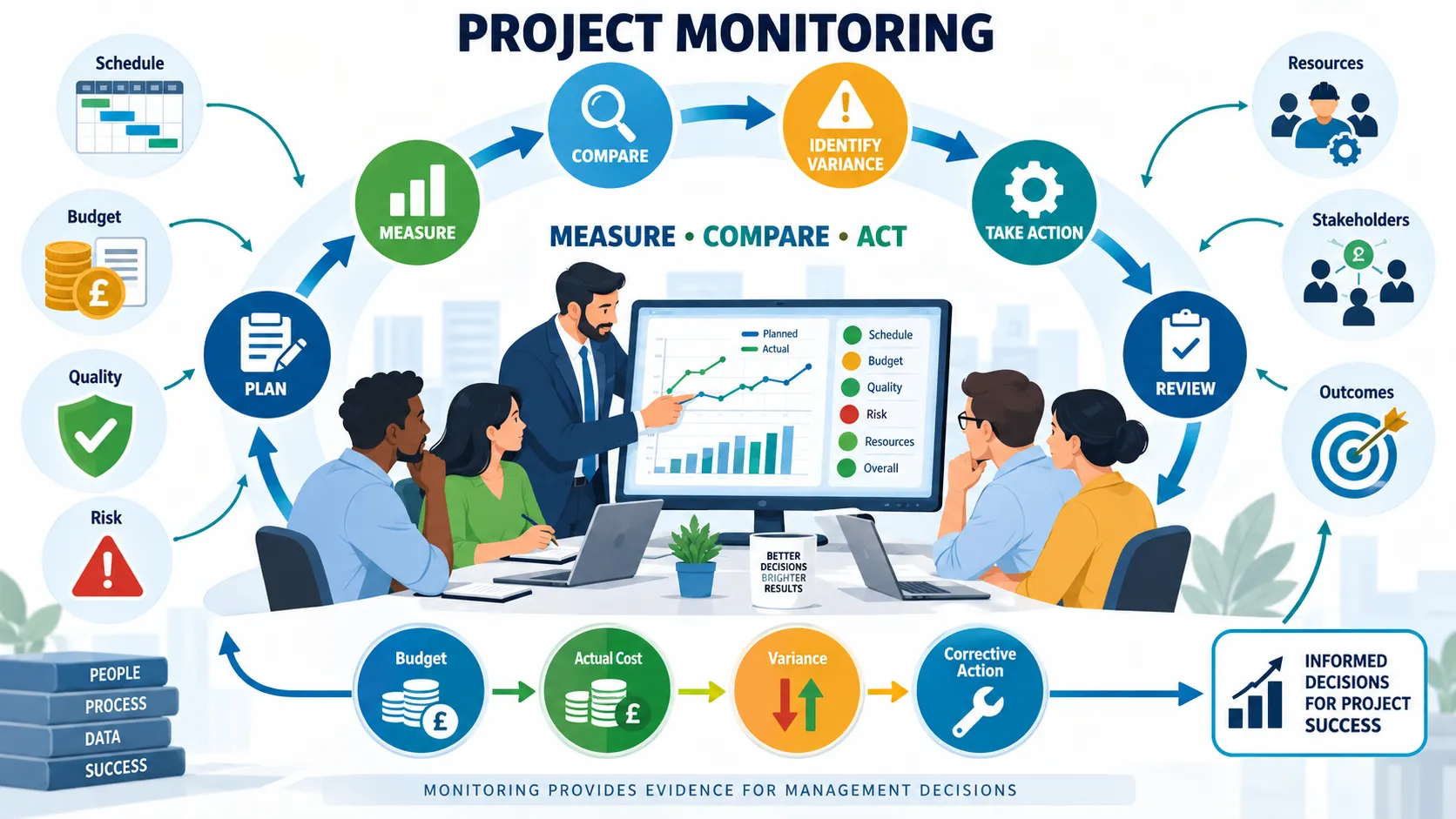
Understanding Project Monitoring
Project monitoring is the systematic collection, review and interpretation of information about project performance to determine whether the project is progressing towards its approved objectives.
Monitoring involves continuously or periodically assessing:
What was planned
What has actually happened
What remains to be completed
What has changed
What risks have emerged
What resources have been used
What financial position exists
What action is required
Monitoring provides the evidence needed for project control.
Monitoring Versus Controlling
Monitoring and controlling are related but different.
Monitoring involves observing and measuring project performance.
Controlling involves taking action when performance differs from expectations.
For example:
Monitoring identifies that a milestone is two weeks late.
Control involves investigating the cause and deciding how to respond.
The manager may:
Reallocate resources
Change sequencing
Increase support
Adjust scope
Escalate the issue
Revise the schedule
Therefore, monitoring without action has limited value.
Why Monitoring Project Progress Matters
Effective monitoring enables managers to identify problems early.
A small delay identified during Week 2 may be relatively easy to correct.
The same delay discovered shortly before implementation may be much more difficult and expensive to resolve.
Monitoring can therefore support:
Early identification of problems
Better decision-making
Improved accountability
Resource control
Risk management
Financial control
Stakeholder confidence
Quality assurance
Schedule management
Benefits tracking
It also provides evidence for reporting to sponsors and governance groups.
Establishing a Project Baseline
A baseline is an approved reference point against which actual project performance can be compared.
Baselines may be established for:
Scope
Schedule
Cost
Quality
Resources
Without an agreed baseline, managers may struggle to determine whether performance is genuinely off track.
For example, saying:
“The project is taking longer than expected”
is less useful than:
“The approved milestone was scheduled for 15 September, but the current forecast completion date is 29 September.”
The baseline provides an objective reference.
Monitoring Project Progress Against Objectives
Managers should regularly assess whether project activity remains aligned with project objectives.
For each objective, managers can ask:
What was the intended result?
What evidence shows progress?
What has been achieved?
What remains outstanding?
Is the expected outcome still achievable?
Has anything changed that could affect the objective?
This helps prevent projects from becoming focused solely on completing tasks.
Monitoring Deliverables
A deliverable is a tangible or verifiable output produced by the project.
Examples include:
A completed system
Training materials
A new process
A report
A facility
A prototype
A service
A policy
A digital platform
Managers can monitor:
Deliverable status
Completion percentage
Quality
Acceptance
Outstanding actions
Dependencies
However, managers should be careful when using percentage-complete measures because teams may report progress differently.
Clear completion criteria are therefore important.
Milestone Tracking
Milestones are significant points within a project.
Examples include:
Requirements approved
Design completed
Prototype accepted
Testing completed
Staff trained
System launched
Project handed over
Milestone tracking provides a relatively simple way to assess project progress.
Benefits of Milestone Tracking
Milestones:
Provide clear checkpoints
Support reporting
Identify delays
Help governance groups assess progress
Support stage-gate decisions
Create accountability
If a critical milestone is missed, managers should investigate the cause and assess downstream consequences.
Schedule Monitoring
Schedule monitoring compares planned dates with actual or forecast dates.
Managers should monitor:
Start dates
Completion dates
Duration
Dependencies
Milestones
Critical activities
Schedule variance
A useful schedule review asks:
Are activities being completed when planned?
If not, why not?
Will the delay affect the final completion date?
What action is required?
Schedule Variance
Schedule variance refers to the difference between planned progress and actual progress.
A delay does not automatically mean project failure.
Managers should consider:
Duration of delay
Criticality of affected activity
Available schedule float
Dependencies
Effect on final completion
Cost impact
Stakeholder impact
A two-day delay in a non-critical activity may have little consequence.
A two-day delay in a critical regulatory approval could significantly affect the project.
Gantt Charts for Monitoring
A Gantt chart can be used not only for planning but also for monitoring.
Managers can compare:
Planned start
Actual start
Planned finish
Actual finish
Current forecast
Progress
This provides a visual indication of schedule performance.
However, Gantt charts should be kept current.
An outdated schedule can create a false impression of control.
Critical Path Monitoring
For complex projects, managers can monitor activities on the critical path.
If a critical-path activity is delayed, managers should assess whether:
The project completion date will move
Additional resources can be allocated
Activities can be resequenced
Work can be accelerated
Scope can be adjusted
Critical-path monitoring helps focus management attention on activities with the greatest potential effect on project duration.
Task and Action Tracking
A task tracker records individual activities, owners and deadlines.
It may include:
Task
Owner
Start date
Due date
Status
Dependencies
Comments
Actions required
This is particularly useful for small and medium-sized projects.
Task tracking supports accountability because each action has a clear owner.
Traffic-Light Reporting
Traffic-light reporting provides a simple visual indication of project status.
A common approach is:
Green: On track
Amber: At risk or requiring management attention
Red: Significant problem or off track
Traffic-light systems can be applied to:
Schedule
Budget
Scope
Risk
Resources
Overall project status
Benefits
Traffic-light reporting:
Simplifies communication
Helps senior managers focus on exceptions
Supports rapid escalation
Provides a common reporting language
Limitations
Traffic lights can oversimplify complex situations.
A project marked green may still contain significant emerging risks.
Managers should therefore provide sufficient supporting information.
Project Dashboards
A project dashboard brings key performance information together in one place.
A dashboard may show:
Overall project status
Milestones
Schedule
Budget
Risks
Issues
Resources
Deliverables
Benefits
Decisions required
Dashboards are particularly useful for governance meetings.
However, managers should avoid filling dashboards with excessive indicators.
The most useful information is that which supports decisions.
Key Performance Indicators
A Key Performance Indicator (KPI) is a measurable indicator used to assess performance against an important objective or target.
Project KPIs might include:
Percentage of milestones achieved
Schedule variance
Budget variance
Number of unresolved high risks
Defect rate
Customer satisfaction
Staff adoption
Deliverable acceptance
Benefits achieved
KPIs should be relevant to project objectives.
A project should not measure something simply because it is easy to measure.
Quality Monitoring
A project can be on schedule and within budget while still producing poor-quality outputs.
Managers should therefore monitor quality alongside time and cost.
Quality indicators may include:
Defect rates
Rework
Testing results
Acceptance rates
Complaints
Compliance results
Customer feedback
Quality monitoring should be linked to agreed acceptance criteria.
Risk Monitoring
Risks identified during initiation and planning can change throughout delivery.
Managers should review:
Existing risks
New risks
Risk likelihood
Potential impact
Risk controls
Risk ownership
Residual risk
A risk that was low priority at project initiation may become critical later.
For example, a supplier initially considered reliable may begin experiencing financial difficulties.
The risk profile has therefore changed and requires reassessment.
Issue Monitoring
An issue is a problem that has already occurred or requires active management.
Managers should monitor:
Issue status
Impact
Owner
Actions
Deadlines
Escalation
Resolution
An effective issue-management process prevents problems from remaining unresolved.
Resource Monitoring
Resource monitoring assesses whether the project has the people, skills, equipment and capacity required.
Managers should monitor:
Staff availability
Workload
Skills
Absence
Contractor performance
Equipment availability
Technology
Resource utilisation
Resource shortages can directly affect schedule, quality and cost.
Stakeholder Monitoring
Stakeholder relationships can also be monitored.
Managers should assess:
Engagement
Satisfaction
Support
Resistance
Communication effectiveness
Decision-making participation
A project that is technically on track but losing stakeholder support may face serious implementation problems.
Financial Performance in Project Management
Financial performance refers to how effectively project expenditure, funding and financial resources are managed against approved expectations.
Financial monitoring involves comparing:
Approved budget
Actual expenditure
Committed expenditure
Forecast expenditure
Remaining budget
Expected final cost
Expected benefits
Financial performance can have a direct impact on project outcomes.
Understanding the Project Budget
A project budget is an approved financial plan showing the expected costs required to deliver the project.
Costs may include:
Staff
Equipment
Software
Materials
Suppliers
Consultancy
Training
Travel
Facilities
Implementation
Contingency
The budget provides a baseline for financial monitoring.
Actual Costs
Actual costs are the costs that have already been incurred.
Managers should compare actual expenditure against the budget.
For example:
Budget to date: £80,000
Actual expenditure: £95,000
This indicates a £15,000 adverse variance.
However, the manager should investigate why the variance exists.
The project may simply have completed more work than originally planned.
Therefore, financial information must be interpreted in context.
Committed Costs
Committed costs are financial obligations that the organisation has agreed to but may not yet have paid.
Examples include:
Supplier contracts
Purchase orders
Consultancy agreements
Equipment orders
Ignoring committed costs can make the project appear financially healthier than it actually is.
Forecast Costs
Forecast costs estimate what the project is expected to cost by completion.
Managers should regularly review forecasts based on:
Current expenditure
Remaining work
Known commitments
Emerging risks
Expected changes
A project can be within budget today but forecast to exceed budget at completion.
This is why forecasting is essential.
Budget Variance Analysis
Variance analysis compares planned financial performance with actual or forecast performance.
Managers may examine:
Budget variance
Cost variance
Forecast variance
Resource variance
A positive or negative variance should not be interpreted automatically as good or bad.
The manager must understand the reason.
Example
A project budget is £500,000.
Actual expenditure is £450,000.
At first glance, the project appears £50,000 under budget.
However, if £100,000 of planned work has not yet been completed, the apparent underspend may actually indicate delayed delivery.
Financial performance must therefore be considered alongside progress.
Cost Performance and Project Outcomes
Financial performance can influence project outcomes in several ways.
Impact on Scope
If costs increase significantly, managers may need to:
Reduce scope
Defer lower-priority features
Seek additional funding
Change the delivery approach
Impact on Quality
Budget pressure can create pressure to reduce quality.
This may involve:
Less testing
Reduced staffing
Cheaper materials
Reduced training
Such decisions can create greater long-term costs.
Impact on Schedule
Funding shortages can delay:
Procurement
Recruitment
Supplier payments
Equipment purchases
Implementation
Impact on Resources
Budget constraints may restrict:
Specialist recruitment
Training
Consultancy
Technology
Overtime
Impact on Risk
Reducing investment in risk controls can increase project exposure.
For example, reducing cybersecurity testing to save money may create greater downstream risk.
Cost-Benefit Analysis
Cost-benefit analysis compares expected project costs with expected benefits.
Benefits may be:
Financial
Operational
Strategic
Customer-related
Quality-related
Risk-related
Managers should consider both tangible and intangible benefits.
Example
A project requires £200,000 investment.
Expected measurable annual savings are £100,000.
However, it may also produce:
Better customer experience
Reduced operational risk
Improved employee capability
The manager should consider the complete value proposition rather than focusing only on immediate cash savings.
Return on Investment
Return on Investment (ROI) is a financial measure used to compare an investment with the return it generates.
A simplified calculation is:
ROI = (Return − Investment) ÷ Investment × 100
For example, if a project costs £100,000 and generates £130,000 in measurable return:
ROI = (£130,000 − £100,000) ÷ £100,000 × 100
ROI = 30%
ROI can support financial decision-making, but it should not be the only measure of project value.
Projects involving compliance, safety or strategic capability may be essential even when direct financial return is limited.
Earned Value Management
Earned Value Management (EVM) is a project-control technique that integrates scope, schedule and cost information to assess project performance.
Key concepts include:
Planned Value (PV): The budgeted value of work planned to be completed.
Earned Value (EV): The budgeted value of work actually completed.
Actual Cost (AC): The actual cost incurred for the completed work.
EVM can provide more meaningful information than simply comparing total spending with the budget.
Cost Performance Index
The Cost Performance Index (CPI) can be calculated as:
CPI = EV ÷ AC
A CPI:
Above 1 generally indicates favourable cost efficiency.
Around 1 indicates performance broadly in line with plan.
Below 1 indicates cost inefficiency.
Schedule Performance Index
The Schedule Performance Index (SPI) can be calculated as:
SPI = EV ÷ PV
A value:
Above 1 generally indicates progress ahead of the planned value.
Around 1 indicates progress broadly in line with plan.
Below 1 indicates progress behind planned value.
EVM can be particularly useful for larger and more complex projects where integrated cost and schedule control is required.
For small projects, simpler monitoring approaches may be more proportionate.
Forecasting Final Project Cost
Managers should not wait until the end of a project to determine whether the budget was sufficient.
They should forecast the expected final cost throughout the project.
Common approaches include reviewing:
Actual expenditure
Remaining budget
Committed costs
Remaining work
Emerging risks
Approved changes
Resource requirements
If the forecast exceeds the approved budget, early action becomes possible.
Financial Controls
Financial controls are processes used to ensure that project expenditure is authorised, accurate and appropriately managed.
Examples include:
Approval thresholds
Purchase orders
Budget monitoring
Supplier controls
Expense procedures
Financial reporting
Forecast reviews
Segregation of duties
Audit trails
Managers should understand their delegated financial authority.
They should not approve expenditure beyond their authority.
Monitoring Cash Flow
Cash flow refers to the movement of money into and out of the project or organisation.
A project may have a sufficient total budget but still experience short-term cash-flow pressures.
Managers may need to monitor:
Timing of payments
Supplier invoices
Funding releases
Payment milestones
Procurement schedules
Cash-flow issues can delay project activities if suppliers or resources cannot be paid as planned.
Financial Performance and Supplier Management
External suppliers can have significant financial impact.
Managers should monitor:
Contract value
Payments
Deliverables
Variations
Additional charges
Service performance
Contract milestones
A supplier may request additional payment because requirements have changed.
The manager should determine whether:
The change is legitimate
The contract allows it
The project has budget capacity
Approval is required
Scope should be adjusted
Monitoring Change Impact on Finances
Every significant project change should be assessed for financial implications.
Managers should ask:
What will the change cost?
Will it create ongoing costs?
Will it reduce another cost?
Will it affect resource requirements?
Will it delay the project?
Will it change expected benefits?
Is additional funding required?
This prevents changes from being accepted without understanding their financial consequences.
Financial Performance and Project Decision-Making
Financial data should support decisions rather than simply be reported.
For example, if a project is forecast to exceed budget by 15%, management may need to consider:
Reducing scope
Reprioritising activities
Renegotiating supplier arrangements
Reallocating resources
Seeking additional funding
Changing implementation sequencing
Pausing the project
Closing the project
The appropriate response depends on strategic importance, risk and expected benefits.
Financial Underperformance Does Not Always Mean Project Failure
A project exceeding its original budget is not automatically unsuccessful.
Managers need to consider:
Why the variance occurred
Whether it was approved
Whether additional benefits resulted
Whether external circumstances changed
Whether the revised investment remains justified
For example, an organisation may approve additional funding because a new regulatory requirement emerges.
The project may exceed its original budget but still achieve strong organisational value.
The key is whether financial changes are understood, controlled and appropriately authorised.
Financial Underspend Does Not Always Mean Success
Similarly, an underspend is not automatically positive.
A project may spend less because:
Activities were delayed
Resources were unavailable
Deliverables were reduced
Quality work was postponed
Suppliers have not yet invoiced
Scope was removed
Therefore, financial performance should always be considered alongside delivery performance.
Integrated Project Performance Monitoring
A mature monitoring system brings together different performance dimensions.
Managers should consider:
Scope + Time + Cost + Quality + Risk + Resources + Stakeholders + Benefits
A change in one area may affect others.
For example:
Budget reduction → Resource reduction → Slower delivery → Increased schedule risk → Reduced quality → Lower benefits
Understanding these relationships is central to effective project management.
Project Performance Review Meetings
Regular project reviews provide opportunities to assess performance and agree action.
A structured review may consider:
Progress
What has been completed?
What is behind schedule?
What is due next?
Finance
What has been spent?
What is committed?
What is forecast?
Are there variances?
Risk
What are the most significant risks?
Have new risks emerged?
Are controls effective?
Issues
What problems require action?
Who owns them?
What decisions are required?
Stakeholders
Are stakeholders engaged?
Are concerns emerging?
Benefits
Are expected benefits still achievable?
Exception Reporting
Exception reporting focuses attention on areas that differ significantly from approved expectations.
Examples include:
Major budget variance
Critical milestone delay
Significant risk increase
Major quality failure
Resource shortage
Scope change
This allows senior managers to focus on matters requiring intervention rather than reviewing every operational detail.
Corrective Action
Monitoring is valuable only when it leads to appropriate action.
Corrective actions may include:
Reallocating resources
Changing activity sequencing
Increasing management support
Revising schedules
Reducing scope
Improving quality controls
Renegotiating supplier arrangements
Increasing stakeholder engagement
Escalating decisions
Seeking additional funding
Managers should record actions and monitor whether they resolve the underlying problem.
Root Cause Analysis in Performance Monitoring
When performance deviates from plan, managers should identify the root cause.
For example, repeated schedule delays may initially appear to be caused by poor staff performance.
Further analysis may reveal:
Unclear requirements
Excessive approvals
Inadequate resources
Supplier dependencies
Poor planning
Addressing the root cause produces more sustainable improvement.
Project Reporting
Project reporting converts monitoring information into a form appropriate for stakeholders.
A report may include:
Overall status
Key achievements
Milestones
Schedule
Financial position
Risks
Issues
Changes
Resource position
Benefits
Decisions required
Next steps
Reporting should be:
Accurate
Timely
Concise
Evidence-based
Audience-appropriate
Benefits of Effective Project Monitoring
Early Problem Detection
Issues can be identified before they become more difficult to resolve.
Better Financial Control
Managers can identify cost pressures early.
Improved Accountability
Performance information clarifies responsibilities.
Stronger Decision-Making
Managers can base decisions on evidence.
Improved Stakeholder Confidence
Transparent reporting demonstrates active management.
Better Risk Management
Changes in risk exposure become visible.
Improved Resource Utilisation
Resource constraints can be identified and addressed.
Better Quality Control
Performance monitoring helps identify quality issues before final delivery.
Improved Benefits Realisation
Managers can assess whether project activity remains connected to intended organisational outcomes.
Limitations of Project Monitoring Methods
No monitoring method provides perfect information.
Data Quality Problems
If project information is inaccurate, decisions may also be inaccurate.
Reporting Delays
Information that is several weeks old may no longer support effective intervention.
Excessive Measurement
Too many indicators can create administrative burden.
False Precision
Numbers can create a false sense of certainty.
Focus on Outputs
Managers may concentrate on completed tasks rather than actual outcomes.
Manipulation of Reporting
Teams may sometimes present information too positively.
Strong governance and a culture of honest reporting are therefore important.
Practical Example: Technology Implementation Project
An organisation is implementing a new customer-management system.
The project has a budget of £400,000 and an approved implementation date of 1 December.
At the monthly review:
Development is 90% complete.
Testing is 60% complete.
The project has spent £350,000.
£30,000 of supplier costs are committed.
A key testing resource has become unavailable.
The implementation milestone is forecast to move by three weeks.
The manager should not simply report:
“90% of development completed.”
They should assess the integrated position.
The project has a significant schedule risk and limited remaining budget.
Possible actions include:
Reallocating testing resources
Prioritising critical testing
Reviewing non-essential scope
Escalating the resource issue
Revising the forecast
Communicating the likely schedule impact
This demonstrates why progress monitoring requires interpretation.
Practical Example: Training Programme Project
A project aims to develop and launch a new employee training programme.
The budget is £100,000.
After two months:
£55,000 has been spent.
Only 40% of planned content has been completed.
Several specialist contributors are unavailable.
The launch date remains unchanged.
A simple budget review might show that £45,000 remains.
However, progress monitoring reveals that delivery is behind plan.
The manager should investigate whether:
Additional resources are required
Content scope should change
Specialist suppliers should be used
The launch date should move
The financial position cannot be assessed independently from progress.
Practical Example: Cost Reduction Project
An organisation launches a project to reduce operating costs by £500,000 annually.
The project budget is £150,000.
During monitoring, the project is within budget but has generated only £100,000 of annual savings against an expected £250,000 at that stage.
The project is financially controlled but benefit performance is weak.
The manager needs to investigate:
Whether savings assumptions were realistic
Whether implementation is complete
Whether staff have adopted new processes
Whether additional actions are required
This demonstrates that financial control is only one dimension of project performance.
Practical Example: Regulatory Compliance Project
A compliance project has a fixed deadline.
The project team identifies that additional specialist advice is required, increasing costs by £40,000.
The project is now forecast to exceed its original budget.
However, the additional expenditure may be necessary to achieve legal compliance.
The manager should:
Assess the requirement
Document the reason
Update the financial forecast
Assess alternatives
Obtain appropriate approval
Communicate the impact
The objective is not simply to protect the original budget but to achieve the required outcome responsibly.
Evaluating Monitoring Methods According to Context
Different projects require different monitoring approaches.
Small Project
A small project may use:
Task list
Simple budget tracker
Weekly review
Milestone checklist
Risk log
Medium Project
A medium project may use:
Gantt chart
Dashboard
Risk register
Issue log
Budget tracker
Monthly status report
Large or Complex Project
A complex project may require:
Integrated schedule
Critical-path analysis
Formal cost management
Earned Value Management
Detailed risk reporting
Governance dashboards
Benefits tracking
Formal assurance reviews
The approach should remain proportionate.
Key Concepts to Remember
The key concepts in project monitoring and financial performance include:
Project monitoring: Systematic collection and review of information about project performance.
Project control: Actions taken to keep project performance aligned with approved expectations.
Baseline: Approved reference point against which performance is measured.
Milestone: Significant achievement or checkpoint within a project.
Schedule variance: Difference between planned and actual or forecast schedule performance.
Budget: Approved financial plan for the project.
Actual cost: Expenditure already incurred.
Committed cost: Financial obligation already agreed but not necessarily paid.
Forecast cost: Expected cost of completing the project.
Variance analysis: Comparison of planned and actual or forecast performance.
KPI: A measurable indicator used to assess important performance.
Dashboard: Visual summary of key project information.
Traffic-light reporting: Status system commonly using green, amber and red indicators.
Risk monitoring: Ongoing review of project risks and controls.
Issue monitoring: Tracking of problems requiring active management.
Cost-benefit analysis: Comparison of expected project costs and benefits.
ROI: Financial measure comparing investment with return.
Earned Value Management: Integrated method for assessing scope, schedule and cost performance.
CPI: Cost Performance Index, comparing earned value with actual cost.
SPI: Schedule Performance Index, comparing earned value with planned value.
Exception reporting: Reporting focused on significant deviations requiring attention.
Corrective action: Action taken to address performance problems or deviations.
Managerial Review Checklist
Before each formal project review, managers should be able to answer:
Scope
Is the project still delivering the approved scope?
Have changes been authorised?
Is scope creep occurring?
Schedule
Are milestones on track?
What activities are delayed?
Will delays affect the final completion date?
Cost
What has been spent?
What has been committed?
What is forecast at completion?
Are significant variances emerging?
Resources
Are the required people and skills available?
Are resources over-allocated?
Are resource changes affecting delivery?
Quality
Are deliverables meeting acceptance criteria?
Is rework increasing?
Are defects or complaints emerging?
Risk
What are the highest risks?
Have risk levels changed?
Are controls effective?
Stakeholders
Are stakeholders engaged?
Are concerns increasing?
Are decisions being delayed?
Benefits
Are expected outcomes still achievable?
Are benefits being realised?
Has the business case changed?
Summary
Effective project monitoring provides managers with the evidence required to understand whether a project remains on track and whether intervention is necessary. It involves comparing actual and forecast performance against approved baselines and examining scope, schedule, cost, resources, quality, risks, issues, stakeholders and benefits.
Methods such as milestone tracking, Gantt charts, task trackers, traffic-light reporting, dashboards, KPIs, risk registers, issue logs, critical-path analysis and formal performance reviews can all support project monitoring. The appropriate method depends on the project’s size, complexity, risk, duration and governance requirements.
Financial performance is an essential part of this monitoring process. Managers need to understand approved budgets, actual costs, committed costs, forecasts and financial variances. Cost-benefit analysis, ROI and, where appropriate, Earned Value Management can provide deeper insight into project financial performance.
However, financial information must always be interpreted alongside delivery information. An underspend may indicate good cost control, but it may also indicate delayed work. An overspend may indicate poor control, but it may also reflect an approved change, an unexpected requirement or an investment necessary to protect quality or compliance.
The most important principle is therefore integrated performance management.
Project managers should consider:
Scope + Schedule + Cost + Quality + Resources + Risk + Stakeholders + Benefits
A change in one area can affect the others.
For example, reducing the project budget may reduce resources, which may delay activities, increase quality risks and reduce the benefits achieved. Conversely, investing additional resources may increase cost but protect the schedule and improve the likelihood of achieving strategic benefits.
Effective monitoring should therefore lead to informed action. Managers should investigate variances, identify root causes, evaluate consequences and select appropriate corrective responses.
For middle managers and leaders, this demonstrates an important shift from simply reporting project performance to actively managing project performance.
The strongest project leaders do not wait until a project is clearly failing before responding. They use reliable monitoring information to identify emerging problems, engage stakeholders, make evidence-based decisions and intervene early.
Ultimately, successful project monitoring answers five fundamental management questions:
Where are we now?
Where should we be?
What is causing the difference?
What will happen if we do nothing?
What action should we take now?
When these questions are consistently addressed, monitoring becomes a powerful management tool that supports financial control, project governance, stakeholder confidence and the achievement of meaningful organisational results.
| Monitoring or Financial Method | Definition | What It Measures or Supports | Key Benefits | Most Appropriate Context |
|---|---|---|---|---|
| Milestone Tracking | Monitoring significant project checkpoints | Major achievements and schedule progress | Simple and easy to communicate | Most projects |
| Gantt Chart | Visual representation of activities against time | Schedule, duration and progress | Makes timing and delays visible | Small to large projects |
| Task Tracker | Record of activities, owners and deadlines | Individual task progress | Improves accountability | Small and medium projects |
| Traffic-Light Reporting | Status system using indicators such as green, amber and red | Overall status and exceptions | Supports rapid management attention | Most projects |
| Project Dashboard | Visual summary of key performance information | Schedule, cost, risk, issues and benefits | Supports decision-making | Medium and large projects |
| KPI Monitoring | Measurement of selected indicators against targets | Critical performance areas | Provides focused performance information | Most projects |
| Critical Path Analysis | Identification of activities determining project duration | Schedule sensitivity | Highlights activities requiring close control | Complex projects |
| Risk Register | Structured record of risks and responses | Project uncertainty | Supports proactive risk management | All projects |
| Issue Log | Record of current project problems | Active issues and resolution | Improves ownership and escalation | Most projects |
| Budget Monitoring | Comparison of approved budget with expenditure | Financial performance | Supports cost control | All projects |
| Variance Analysis | Comparison of planned and actual or forecast performance | Differences from baseline | Identifies areas requiring investigation | All projects |
| Cost-Benefit Analysis | Comparison of expected costs and benefits | Project value | Supports investment decisions | Initiation and major decisions |
| ROI | Comparison of investment with financial return | Financial return | Helps assess economic value | Projects with measurable financial benefits |
| Earned Value Management | Integrated scope, schedule and cost control method | Cost and schedule performance | Provides deeper performance insight | Large or complex projects |
| CPI | Earned value divided by actual cost | Cost efficiency | Identifies cost performance | Complex projects using EVM |
| SPI | Earned value divided by planned value | Schedule efficiency | Identifies progress performance | Complex projects using EVM |
| Forecasting | Estimation of expected final performance | Future cost, schedule and benefits | Enables early intervention | Medium and large projects |
| Exception Reporting | Reporting significant deviations from approved expectations | Problems requiring management action | Focuses attention on priorities | Governance and senior management |
| Benefits Monitoring | Tracking whether intended organisational benefits are being achieved | Outcomes and strategic value | Prevents output-only measurement | Strategic projects |
6.Discuss Methods for Reporting on Project Outcomes
Reporting on project outcomes is an essential part of effective project management because completing project activities does not, by itself, demonstrate that a project has been successful. A project may deliver all planned tasks and produce the expected outputs but fail to achieve the intended organisational outcomes or benefits. Effective reporting therefore needs to communicate not only what was delivered, but also what changed as a result, whether objectives were achieved, what benefits were realised, what challenges occurred and what should happen next.
For practising and aspiring middle managers and leaders, project outcome reporting provides an important link between project delivery and organisational decision-making. Managers need to communicate project results clearly to senior leaders, sponsors, project teams, operational managers and other stakeholders. They must also be able to distinguish between factual evidence, interpretation, lessons learned and recommendations.
A high-quality project outcome report should answer fundamental questions such as:
What was the project intended to achieve?
What was actually delivered?
Were the project objectives achieved?
What outcomes have been produced?
What benefits have been realised?
What was the final financial position?
Was the project completed within the approved timeframe?
Were quality requirements achieved?
What risks or issues affected delivery?
What stakeholder impact occurred?
What remains outstanding?
What lessons have been learned?
Who is responsible for sustaining the outcomes?
What actions or decisions are required after project closure?
Project reporting should therefore be viewed as a management process rather than simply an administrative requirement.
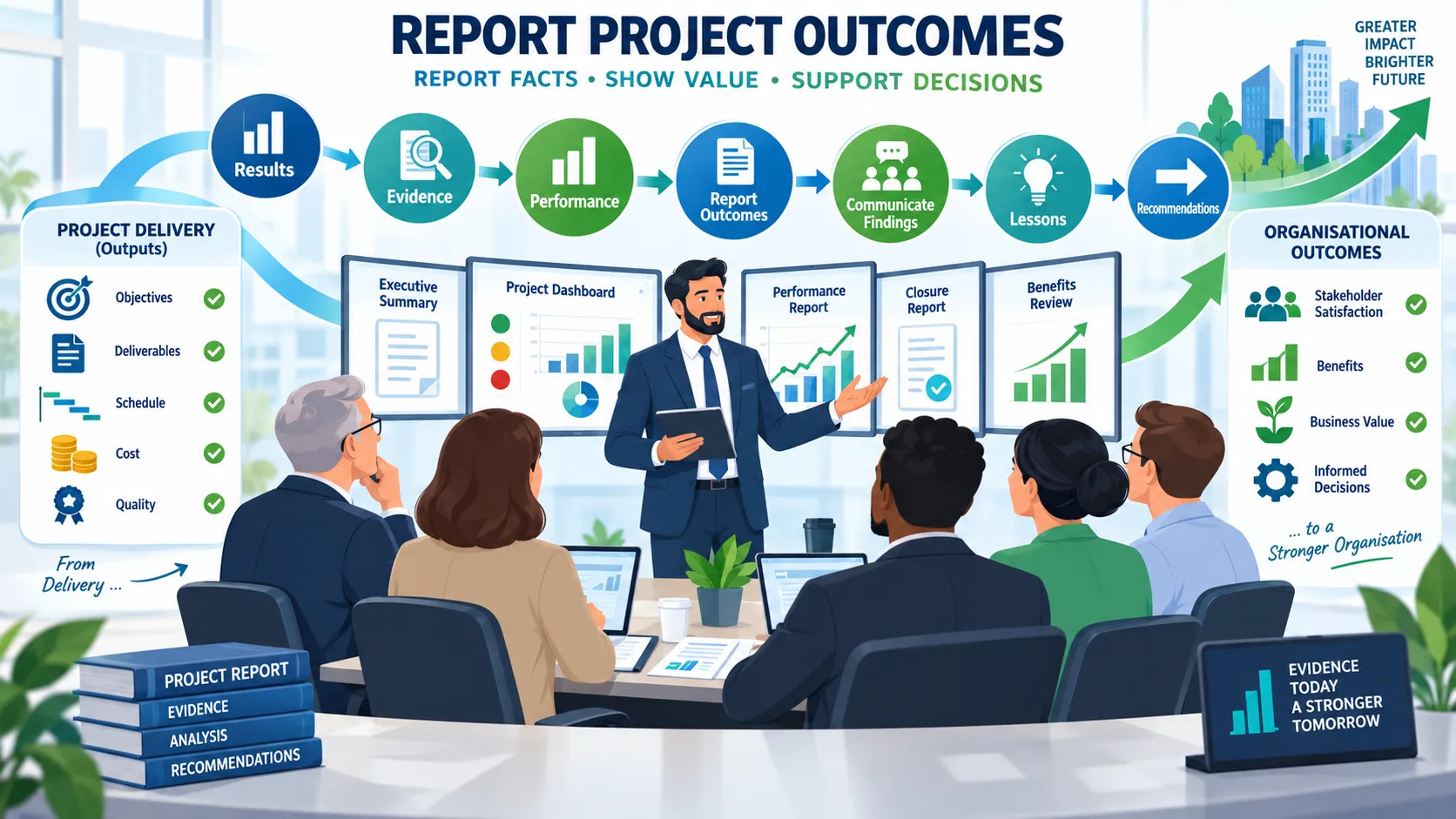
Understanding Project Outcomes
A project outcome is the change, improvement or result that occurs because of the project.
This is different from a project activity or output.
For example:
Activity: Develop staff training.
Output: Training programme completed.
Outcome: Employees demonstrate improved capability.
Benefit: Service quality improves.
Strategic contribution: Customer satisfaction increases.
This distinction is critical when reporting project results.
A report stating that “training materials were completed” provides evidence of an output.
A stronger report explains whether employees used the training, whether capability improved and whether this improvement contributed to the intended organisational benefit.
Outputs, Outcomes and Benefits
Project reporting should distinguish between three connected concepts.
Outputs are what the project produces.
Outcomes are the changes resulting from those outputs.
Benefits are the measurable advantages created by the outcomes.
For example, a digital customer-service project might produce:
Output: New customer-service platform.
Outcome: Employees process enquiries more efficiently.
Benefit: Response times decrease and customer satisfaction improves.
This structure helps managers report meaningful results rather than simply reporting task completion.
Why Project Outcome Reporting Matters
Outcome reporting provides accountability for organisational resources and decisions.
Projects consume:
Money
Staff time
Management attention
Technology
Equipment
Facilities
External expertise
Stakeholders therefore need evidence about what those resources achieved.
Effective reporting can:
Demonstrate project value
Support accountability
Inform senior decision-makers
Confirm whether objectives were achieved
Identify unresolved issues
Capture lessons
Support benefits realisation
Improve future project management
Strengthen stakeholder confidence
Poor reporting can create uncertainty about whether a project delivered value.
Project Outcome Reporting Throughout the Lifecycle
Although formal outcome reporting is often associated with project closure, reporting should occur throughout the project lifecycle.
Initiation Reporting
At initiation, reporting may include:
Business need
Project purpose
Objectives
Expected outcomes
Expected benefits
Initial costs
Key risks
Strategic contribution
Planning Reporting
During planning, managers may report:
Scope
Schedule
Resources
Budget
Risk
Stakeholders
Success criteria
Implementation Reporting
During delivery, reports may include:
Progress
Completed deliverables
Milestones
Financial performance
Risks
Issues
Changes
Stakeholder engagement
Closure Reporting
At closure, reporting becomes focused on:
Final deliverables
Objectives achieved
Outcomes
Benefits
Final costs
Final timescale
Quality
Stakeholder impact
Lessons learned
Outstanding actions
Post-Project Benefits Reporting
Some benefits cannot be measured immediately when the project closes.
A follow-up review may therefore be required after several months.
This is particularly important for projects involving:
Behaviour change
Process improvement
Financial savings
Customer experience
Workforce capability
Digital adoption
Strategic transformation
Establishing Outcome Reporting Criteria
Before reporting outcomes, managers need to establish what success means.
Success criteria should ideally have been defined during initiation and planning.
They may relate to:
Scope
Time
Cost
Quality
Customer experience
Employee experience
Operational performance
Risk reduction
Compliance
Strategic benefits
Managers should compare actual results with these agreed criteria.
For example:
Objective: Reduce average customer response time.
Target: Reduce response time from 48 hours to 24 hours.
Actual: Average response time reduced to 20 hours.
The report can therefore provide evidence that the performance target was achieved.
Measuring Project Outcomes
Outcome measurement involves collecting evidence about what changed as a result of the project.
Evidence may include:
Performance data
Financial information
Customer feedback
Employee feedback
Quality measures
Operational statistics
System data
Audit findings
Survey results
Interviews
Observation
Performance indicators
Managers should use evidence appropriate to the outcome being assessed.
Quantitative Measurement
Quantitative measures use numerical information.
Examples include:
Cost savings
Revenue increase
Response time
Error rate
Productivity
Completion rates
Customer satisfaction scores
Staff turnover
Processing time
Quantitative information can make project outcomes easier to compare.
Qualitative Measurement
Qualitative information provides insight into experiences, perceptions and explanations.
Examples include:
Stakeholder interviews
Employee feedback
Customer comments
Focus groups
Case studies
Observations
Qualitative evidence is particularly useful where outcomes involve behaviour, culture or stakeholder experience.
Using KPIs to Report Outcomes
A Key Performance Indicator (KPI) is a measurable indicator used to assess performance against an important objective.
Outcome reports may include KPIs such as:
Customer satisfaction
Employee engagement
Service response time
Defect rate
Cost reduction
Revenue growth
Productivity
Adoption rate
Compliance rate
The report should explain what the KPI means and how actual performance compares with the target.
Baseline and Post-Project Comparison
A baseline provides a reference point for measuring change.
For example:
Before project: Average processing time = 60 minutes.
After project: Average processing time = 40 minutes.
This indicates a 20-minute reduction.
Without baseline information, it can be difficult to determine whether the project created meaningful improvement.
Managers should therefore establish appropriate baseline measures where possible.
Before-and-After Analysis
Before-and-after analysis compares performance before project implementation with performance after implementation.
It can be used for:
Cost
Quality
Productivity
Customer experience
Response times
Employee capability
Error rates
However, managers should be cautious about assuming that all changes were caused by the project.
External circumstances may also have influenced results.
Comparing Planned and Actual Outcomes
Outcome reports should compare:
Planned objectives
Planned outputs
Planned outcomes
Actual outputs
Actual outcomes
Expected benefits
Realised benefits
This allows stakeholders to see the difference between expectations and results.
Variances should be explained rather than hidden.
Reporting Project Financial Outcomes
Financial reporting should show the final financial position.
It may include:
Approved budget
Actual expenditure
Committed costs
Final cost
Variance
Additional funding
Savings
Revenue
Financial benefits
Managers should explain significant financial variances.
For example, a project may have exceeded its budget because additional security controls were required.
The report should explain the reason and whether the additional expenditure created corresponding value.
Reporting Schedule Outcomes
The final report should compare:
Approved completion date
Actual completion date
Major milestone performance
Significant delays
Reasons for delays
A project completed later than planned is not necessarily unsuccessful.
Managers should explain:
Why the delay occurred
Whether the delay affected benefits
Whether stakeholders were informed
What corrective actions were taken
Reporting Quality Outcomes
Quality reporting should demonstrate whether deliverables met agreed requirements.
Evidence may include:
Testing results
Defect data
Acceptance records
Audit findings
Customer feedback
Quality reviews
A project should not be reported as successful simply because its deliverables were completed.
The quality of those deliverables must also be considered.
Reporting Scope Outcomes
Managers should assess whether the project delivered the approved scope.
The report may identify:
Completed scope
Removed scope
Added scope
Approved changes
Outstanding requirements
Any significant scope variation should be explained.
Reporting Stakeholder Outcomes
Stakeholder outcomes may include:
Satisfaction
Adoption
Engagement
Acceptance
Feedback
Concerns
Resistance
For projects involving organisational change, stakeholder outcomes can be particularly important.
For example, a new system may be technically operational but have low employee adoption.
The outcome report should identify this issue.
Reporting Risk Outcomes
The final report should consider:
Major risks identified
Risks that materialised
Effectiveness of risk responses
Residual risks
Risks transferred to operational management
This helps organisations learn from project experience.
Project Closure Report
A project closure report is a formal document summarising project performance, results and lessons at the end of the project.
A typical closure report may contain:
Project overview
Original purpose
Objectives
Scope
Deliverables
Outcomes
Benefits
Schedule
Budget
Quality
Risks
Issues
Stakeholder feedback
Lessons learned
Outstanding actions
Handover arrangements
Recommendations
The precise format will depend on organisational requirements.
Executive Summary
The executive summary provides senior decision-makers with a concise overview of the project.
It should normally communicate:
Why the project was undertaken
What was achieved
Major outcomes
Financial position
Significant variances
Major lessons
Outstanding matters
Recommended next steps
Senior leaders may not need every operational detail.
The executive summary should therefore focus on information relevant to strategic decision-making.
Management Report
A management report provides greater detail for project sponsors and managers.
It may include:
Performance analysis
Variances
Risks
Issues
Stakeholder outcomes
Benefits
Lessons
Recommendations
It provides a bridge between detailed project records and executive reporting.
Dashboard Reporting
A project dashboard can provide a concise visual summary.
It may display:
Overall status
Budget
Schedule
Milestones
Risks
Issues
Benefits
KPIs
Dashboards are useful where stakeholders need rapid understanding of project status.
For final reporting, dashboards can also summarise project outcomes.
Traffic-Light Reporting
Traffic-light reporting uses status indicators such as:
Green
Amber
Red
For example:
Cost: Green
Final expenditure within approved budget.
Schedule: Amber
Project completed one week later than planned.
Benefits: Green
Expected operational improvement achieved.
Traffic lights are useful for summary reporting but should be supported by explanatory information.
Written Narrative Reporting
Narrative reporting explains what happened and why.
A strong narrative should:
Present facts
Explain significant variances
Interpret evidence
Identify causes
Explain consequences
State actions taken
Identify recommendations
Narrative reporting is particularly useful when project outcomes are complex.
Presentation-Based Reporting
Managers may present project outcomes to:
Senior management
Project sponsors
Governance boards
Operational teams
Customers
Stakeholders
A presentation should focus on:
Purpose
Results
Outcomes
Benefits
Key performance information
Lessons
Recommendations
Visuals such as charts and diagrams can make complex information easier to understand.
Data Visualisation
Data visualisation presents numerical information in visual formats.
Examples include:
Bar charts
Line charts
Progress charts
KPI cards
Trend charts
Performance dashboards
Visualisation can make patterns and changes easier to understand.
However, managers should avoid using visual complexity simply to make reports appear sophisticated.
The visual should support understanding.
Benefits Realisation Reporting
A benefits realisation report focuses specifically on whether expected benefits have been achieved.
It may examine:
Expected benefit
Measurement method
Baseline
Target
Actual result
Benefit owner
Status
Remaining actions
For example:
Expected benefit: Reduce administrative processing time.
Baseline: 10 hours per week.
Target: 6 hours per week.
Actual: 5.5 hours per week.
This provides stronger evidence than simply stating that “the new process was implemented”.
Benefits Owner
A benefits owner is the person responsible for ensuring that an expected benefit is achieved and sustained after project delivery.
This is important because project teams may disband after closure.
Operational managers may then need to ensure that new processes continue to produce benefits.
Outcome reporting should therefore identify:
Who owns the benefit
How it will be measured
When it will be reviewed
What action is required to sustain it
Lessons Learned Reporting
A lessons learned report captures knowledge that can improve future projects.
Lessons may concern:
Planning
Stakeholder engagement
Resource management
Risk management
Procurement
Communication
Technology
Governance
Financial management
Change control
A useful lesson should explain:
What happened
Why it happened
What impact it had
What should be repeated
What should be changed
Conducting a Lessons-Learned Review
A structured review may involve:
Step 1: Gather Evidence
Review:
Project records
Reports
Issues
Risks
Stakeholder feedback
Step 2: Involve Key Participants
Invite appropriate:
Project team members
Stakeholders
Suppliers
Managers
Step 3: Identify What Worked
Consider successful practices.
Step 4: Identify What Did Not Work
Identify problems without creating a blame culture.
Step 5: Identify Root Causes
Understand why problems occurred.
Step 6: Develop Recommendations
Convert learning into practical actions.
Step 7: Share Learning
Make relevant lessons available to future project teams.
Reporting to Different Audiences
One of the most important reporting skills for middle managers is adapting information to the audience.
Senior Leaders
Senior leaders usually need:
Strategic outcomes
Benefits
Financial position
Major risks
Key decisions
Overall performance
Project Sponsor
The sponsor may need:
Overall project outcome
Objective achievement
Benefits
Variances
Outstanding risks
Lessons
Handover status
Project Team
The project team may need:
Detailed achievements
Technical outcomes
Lessons
Outstanding actions
Recognition
Handover information
Operational Managers
Operational managers may need:
Process changes
New responsibilities
Benefits
Performance measures
Support requirements
Ongoing ownership
Customers or Service Users
Customers may need:
What changed
Benefits
Service improvements
Important limitations
How to access the new service
Stakeholder-Focused Reporting
Managers should consider the information needs of stakeholders.
A technically accurate report can still be ineffective if it does not answer the questions stakeholders care about.
For example, finance may want detailed expenditure information, while customers may be more interested in service improvements.
Audience analysis therefore improves reporting effectiveness.
Reporting Negative Outcomes
Professional project reporting must include negative results as well as successes.
Managers should report:
Missed objectives
Budget overruns
Delays
Quality problems
Unachieved benefits
Unresolved risks
This does not mean presenting the project as a failure.
It means providing an accurate account of performance.
Honest reporting allows organisations to learn and make appropriate decisions.
Reporting Partial Success
Projects may achieve some objectives but not others.
For example:
Scope achieved: 100%
Schedule: 2 weeks late
Budget: 5% over
Customer satisfaction: target achieved
Financial savings: 70% of target
The report should explain the overall position rather than forcing the project into a simple “successful” or “unsuccessful” category.
Project outcomes are often multidimensional.
Reporting Unintended Outcomes
Projects can produce outcomes that were not originally expected.
These may be:
Positive
Negative
Short-term
Long-term
For example, a new digital system may improve customer response times but initially increase staff training requirements.
Managers should report significant unintended outcomes because they can affect organisational decisions.
Evidence-Based Reporting
Outcome reports should distinguish between:
Facts
Evidence
Interpretation
Opinion
Recommendation
For example:
Fact: Customer response time reduced from 48 hours to 22 hours.
Interpretation: The new workflow appears to have improved processing efficiency.
Recommendation: Continue monitoring response times for six months.
This structure improves professional credibility.
Data Accuracy and Validation
Before reporting project outcomes, managers should validate important information.
They should check:
Data sources
Calculations
Dates
Financial figures
KPI definitions
Stakeholder feedback
Completion evidence
Incorrect information can undermine stakeholder confidence.
Reporting Confidential and Sensitive Information
Project reports may contain sensitive information.
Managers should consider:
Personal information
Commercially sensitive information
Financial information
Supplier information
Security information
Employee information
Reports should follow relevant organisational information-management requirements.
Not every stakeholder should receive every piece of project information.
Reporting Project Value
Project outcome reporting should explain the value created.
Value may include:
Financial savings
Increased revenue
Improved efficiency
Better quality
Reduced risk
Improved customer experience
Improved employee capability
Increased compliance
Strategic progress
Value should be linked to evidence where possible.
Reporting Sustainability of Outcomes
A project may deliver an immediate result that does not continue over time.
For example, a training project may initially improve performance, but the improvement could decline if employees do not receive ongoing support.
Outcome reporting should therefore consider:
Ownership
Resources
Processes
Capability
Monitoring
Continuous improvement
This helps determine whether benefits are likely to be sustained.
Project Handover Reporting
Project closure often involves transferring responsibility to operational teams.
Handover reporting may include:
Deliverables
Processes
Documentation
Training
Support arrangements
Ownership
Outstanding issues
Maintenance requirements
A project is not fully complete if the organisation cannot effectively operate what has been delivered.
Recommendations in Outcome Reports
A project outcome report should provide recommendations where appropriate.
Recommendations may include:
Continue monitoring benefits
Address outstanding risks
Provide additional training
Improve a process
Conduct a post-implementation review
Extend the solution
Close remaining issues
Transfer ownership
Recommendations should be based on evidence rather than personal preference.
Post-Implementation Review
A post-implementation review evaluates whether the implemented project solution is working as intended after a suitable period of operation.
It may assess:
Actual performance
User adoption
Benefits
Operational problems
Stakeholder satisfaction
Sustainability
Unintended effects
The timing depends on the nature of the project.
A system implementation may require several months before meaningful benefits can be assessed.
Project Outcome Reporting Process
Middle managers can use a structured reporting process.
Step 1: Confirm Reporting Requirements
Identify:
Audience
Purpose
Format
Deadline
Approval requirements
Step 2: Confirm Success Criteria
Review the original objectives, targets and expected benefits.
Step 3: Collect Evidence
Gather relevant:
Performance data
Financial information
Feedback
Quality results
Project records
Step 4: Compare Planned and Actual Performance
Assess:
Scope
Time
Cost
Quality
Outcomes
Benefits
Step 5: Analyse Variances
Determine:
What changed?
Why?
What was the impact?
Step 6: Assess Outcomes
Determine what actually changed as a result of the project.
Step 7: Assess Benefits
Identify:
Benefits achieved
Benefits partially achieved
Benefits not yet realised
Step 8: Capture Lessons
Identify what should be repeated or changed.
Step 9: Develop Recommendations
Identify required actions.
Step 10: Validate the Report
Check data accuracy and obtain appropriate stakeholder input.
Step 11: Communicate Findings
Present the information in the format appropriate for each audience.
Step 12: Track Post-Project Actions
Ensure outstanding recommendations and benefits continue to be monitored.
Key Benefits of Effective Outcome Reporting
Accountability
Reporting demonstrates how organisational resources were used.
Transparency
Accurate reporting builds stakeholder confidence.
Better Decision-Making
Managers receive evidence to support future decisions.
Organisational Learning
Lessons help improve future projects.
Benefits Realisation
Reporting keeps attention on actual organisational value.
Improved Governance
Formal reporting supports project oversight.
Stakeholder Confidence
Clear reporting demonstrates responsible management.
Continuous Improvement
Lessons and recommendations support better future performance.
Common Problems with Project Outcome Reporting
Managers should avoid:
Reporting only activities
Ignoring outcomes
Hiding negative information
Using unsupported claims
Reporting too much detail
Reporting too little information
Using unclear measures
Failing to compare against baselines
Ignoring stakeholder perspectives
Treating budget underspend as automatic success
Ignoring sustainability
Failing to assign benefit ownership
Producing reports after decisions are already required
Using complicated visuals that obscure the message
Practical Example: Customer Service Improvement Project
An organisation completes a project to improve customer enquiry handling.
Original Objective
Reduce average response time from 48 hours to 24 hours.
Project Output
A redesigned customer-service workflow and supporting digital system.
Outcome
Average response time reduced to 20 hours.
Benefit
Customers receive faster responses.
Additional Evidence
Customer satisfaction increased from 78% to 86%.
Financial Outcome
The project finished £10,000 under budget.
The final report should therefore communicate:
The project achieved its main objective.
The response-time target was exceeded.
Customer satisfaction improved.
The project finished within budget.
The new process has been handed to the operational team.
Continued monitoring is recommended.
This is more meaningful than simply stating that the new system was installed.
Practical Example: Employee Training Project
An organisation completes a project to introduce a new employee training programme.
The project delivered:
Training materials
Digital modules
Instructor guidance
Assessment resources
However, post-project data shows:
95% of employees completed training.
Knowledge assessment scores improved.
Managers report improved consistency.
Some employees still require additional support.
The report should recognise both success and remaining needs.
A recommendation might be to conduct a follow-up review after six months.
Practical Example: Technology Transformation Project
A technology project is completed three weeks later than planned and 8% over budget.
However:
System reliability improved significantly.
Customer complaints decreased.
Employee adoption exceeded expectations.
Operational efficiency improved.
A balanced outcome report should present the full picture.
The project experienced cost and schedule variances but achieved strong operational outcomes.
This demonstrates why project success should be assessed across multiple dimensions.
Practical Example: Cost Reduction Project
A project was expected to produce £500,000 annual savings.
At closure, verified savings are £350,000.
The project delivered all planned outputs.
The report should not state simply:
“Project completed successfully.”
Instead, it should explain:
Planned savings
Actual savings
Reasons for the variance
Remaining opportunities
Whether additional action could achieve the outstanding £150,000
Who will own the remaining benefit
This provides a more accurate assessment of project performance.
Practical Example: Project with Unintended Consequences
A project introduces a new digital process designed to reduce administrative workload.
The project achieves its primary efficiency target.
However, the new process initially creates difficulties for employees with limited digital confidence.
Outcome reporting should identify this unintended consequence.
The recommended response may include:
Additional training
Improved guidance
User support
Accessibility review
This demonstrates responsible and comprehensive reporting.
Managerial Skills Required for Effective Outcome Reporting
Middle managers need several skills to report outcomes effectively.
Analytical Skills
Managers must interpret data and identify meaningful patterns.
Communication Skills
Managers must explain results clearly to different audiences.
Financial Awareness
Managers need to understand project costs, variances and benefits.
Critical Thinking
Managers must distinguish evidence from assumptions.
Stakeholder Management
Managers need to communicate sensitive results appropriately.
Professional Judgement
Managers must assess whether project outcomes genuinely represent success.
Presentation Skills
Managers may need to communicate results through reports, dashboards and presentations.
Key Concepts to Remember
The key concepts associated with project outcome reporting include:
Project outcome: The change or result produced by project activities and outputs.
Project output: A tangible or verifiable product, service or deliverable created by the project.
Benefit: A measurable advantage resulting from project outcomes.
Success criteria: Agreed measures used to determine whether project objectives have been achieved.
KPI: A measurable indicator used to assess important performance.
Baseline: An approved reference point against which actual performance can be compared.
Project closure report: A formal report summarising project performance and results at closure.
Benefits realisation: The process of identifying, measuring and sustaining expected project benefits.
Benefits owner: The person responsible for ensuring that a benefit is achieved and sustained.
Lessons learned: Knowledge captured from project experience to improve future work.
Post-implementation review: An assessment of whether the implemented solution is delivering intended results after a period of operation.
Variance: The difference between planned and actual performance.
Executive summary: A concise overview of the most important project findings for senior decision-makers.
Dashboard: A visual summary of selected project performance information.
Stakeholder reporting: Communication of project information tailored to the needs of relevant stakeholders.
Evidence-based reporting: Reporting based on reliable information, verified data and appropriate supporting evidence.
Managerial Outcome Reporting Checklist
Before finalising a project outcome report, managers should confirm that:
The original project purpose is stated.
Project objectives are clearly identified.
Planned and actual outcomes are compared.
Major deliverables are confirmed.
Scope performance is explained.
Schedule performance is reported.
Financial performance is reported.
Quality performance is assessed.
Stakeholder outcomes are considered.
Major risks and issues are reported.
Expected benefits are compared with realised benefits.
Unintended outcomes are considered.
Variances are explained.
Evidence has been validated.
Lessons learned have been captured.
Outstanding actions are identified.
Ownership of future benefits is clear.
Recommendations are evidence-based.
Information is appropriate for the intended audience.
Sensitive information is handled appropriately.
Post-project monitoring requirements are identified.
Summary
Reporting on project outcomes is a critical management activity because it demonstrates what a project has actually achieved and whether organisational resources have generated the intended value.
Effective outcome reporting goes beyond describing activities and deliverables. Managers need to distinguish between outputs, outcomes and benefits and provide evidence of the changes created by the project.
A strong reporting approach compares planned performance with actual performance across several dimensions, including:
Scope
Schedule
Cost
Quality
Resources
Risk
Stakeholder experience
Outcomes
Benefits
Methods such as project closure reports, executive summaries, management reports, dashboards, traffic-light reporting, KPI reporting, data visualisation, benefits realisation reports, lessons-learned reviews and post-implementation reviews can all support effective outcome reporting.
The method should be selected according to the audience and purpose. Senior leaders typically require concise information about strategic outcomes, benefits, financial performance, major risks and decisions. Project teams may require more detailed information about deliverables and lessons. Operational managers need information about implementation, ownership and sustainability. Customers and service users generally need clear information about changes and benefits that affect them.
Effective reporting should be accurate, transparent, evidence-based and proportionate. Managers should not hide delays, cost overruns, unachieved benefits or unintended consequences. Reporting negative information professionally allows organisations to make better decisions and learn from experience.
Financial performance should also be interpreted alongside operational and outcome performance. An underspend may reflect good financial control, but it may also indicate incomplete work. An overspend may represent poor cost management, but it may also have resulted from approved changes or additional investment needed to achieve quality, compliance or strategic outcomes.
Similarly, completion of all planned deliverables does not necessarily mean that a project has achieved its intended purpose. A system may be implemented without being adopted. A process may be redesigned without producing efficiency improvements. Training may be delivered without creating lasting capability.
Outcome reporting therefore needs to focus on the difference the project has made.
A useful reporting chain is:
Project Objectives → Deliverables → Outcomes → Benefits → Organisational Value
Middle managers and leaders play an important role in making this chain visible.
They need to:
Collect reliable evidence.
Compare actual and planned performance.
Analyse variances.
Explain causes and consequences.
Communicate results clearly.
Capture lessons.
Recommend appropriate action.
Support continued benefits realisation.
Project reporting should also continue after formal project closure where benefits take time to emerge. Assigning benefit ownership and establishing post-implementation reviews helps ensure that project value is sustained.
Ultimately, professional project outcome reporting answers five fundamental questions:
What did we plan to achieve?
What did we actually deliver?
What changed as a result?
What value or benefit has been created?
What should happen next?
When managers can answer these questions with reliable evidence and communicate the findings appropriately, project reporting becomes a powerful leadership and organisational-learning tool.
| Reporting Method | Definition | Primary Purpose | Key Information Included | Most Appropriate Use |
|---|---|---|---|---|
| Project Closure Report | Formal summary of project performance and final results | Confirm overall project completion and outcomes | Objectives, deliverables, cost, schedule, outcomes, benefits and lessons | Project closure |
| Executive Summary | Concise summary of key project findings | Support senior decision-making | Major outcomes, benefits, financial position, risks and recommendations | Senior leadership |
| Management Report | Detailed report for project managers and sponsors | Analyse project performance | Performance, variances, risks, issues and recommendations | Governance and management |
| Project Dashboard | Visual summary of key performance indicators | Provide rapid visibility | KPIs, milestones, cost, schedule, risks and benefits | Ongoing and final reporting |
| Traffic-Light Report | Status reporting using indicators such as green, amber and red | Highlight areas requiring attention | Status of cost, schedule, risk, quality and benefits | Governance meetings |
| KPI Report | Report focused on agreed performance indicators | Measure achievement against targets | Baselines, targets, actual results and trends | Outcome measurement |
| Benefits Realisation Report | Assessment of expected and actual benefits | Determine whether organisational value was achieved | Benefit, baseline, target, actual, owner and status | Strategic projects |
| Lessons-Learned Report | Record of knowledge gained from project experience | Improve future project performance | Successes, failures, causes and recommendations | Closure and organisational learning |
| Post-Implementation Review | Evaluation after implementation has been operating for a period | Assess sustainability and actual impact | Adoption, performance, benefits, issues and stakeholder experience | Projects requiring longer-term evaluation |
| Financial Report | Summary of project financial performance | Demonstrate financial accountability | Budget, actual cost, commitments, variance and benefits | All financially significant projects |
| Stakeholder Feedback Report | Summary and analysis of stakeholder views | Assess stakeholder experience and acceptance | Satisfaction, concerns, feedback and recommendations | Change and service projects |
| Performance Comparison | Comparison of baseline, target and actual results | Demonstrate measurable change | Before-and-after performance data | Improvement projects |
| Presentation | Verbal and visual communication of project results | Communicate findings interactively | Outcomes, benefits, performance, lessons and decisions | Leadership and stakeholder meetings |
| Data Visualisation | Visual representation of project performance data | Make trends and comparisons easier to understand | Charts, graphs, trends and indicators | Complex data reporting |
| Handover Report | Documentation transferring project outputs to operational ownership | Support continuity after project closure | Deliverables, responsibilities, support, issues and maintenance | Operational transition |
7.Assess Approaches for Project Closure
Project closure is the formal process of bringing a project to an organised and controlled end. It involves confirming that agreed project activities and deliverables have been completed or appropriately resolved, evaluating project performance, obtaining formal acceptance, transferring ongoing responsibilities, closing financial and contractual arrangements, capturing lessons learned and confirming what will happen to any remaining risks, issues and benefits.
Effective project closure is much more than announcing that a project has finished. A project may have completed its planned deliverables but still require important closure activities before responsibility can be transferred to operational teams. For example, users may need additional training, supplier contracts may need to be finalised, documentation may need to be archived, outstanding risks may need to be transferred to business owners and expected benefits may need to continue being monitored.
For middle managers and leaders, project closure is an important test of management discipline. Leaders need to determine whether the project has genuinely achieved its intended purpose, whether stakeholders accept the results, whether resources can be released, whether operational ownership is ready and whether the organisation has learned from the experience.
A well-managed closure process protects organisational value by ensuring that project results are properly embedded into normal operations.
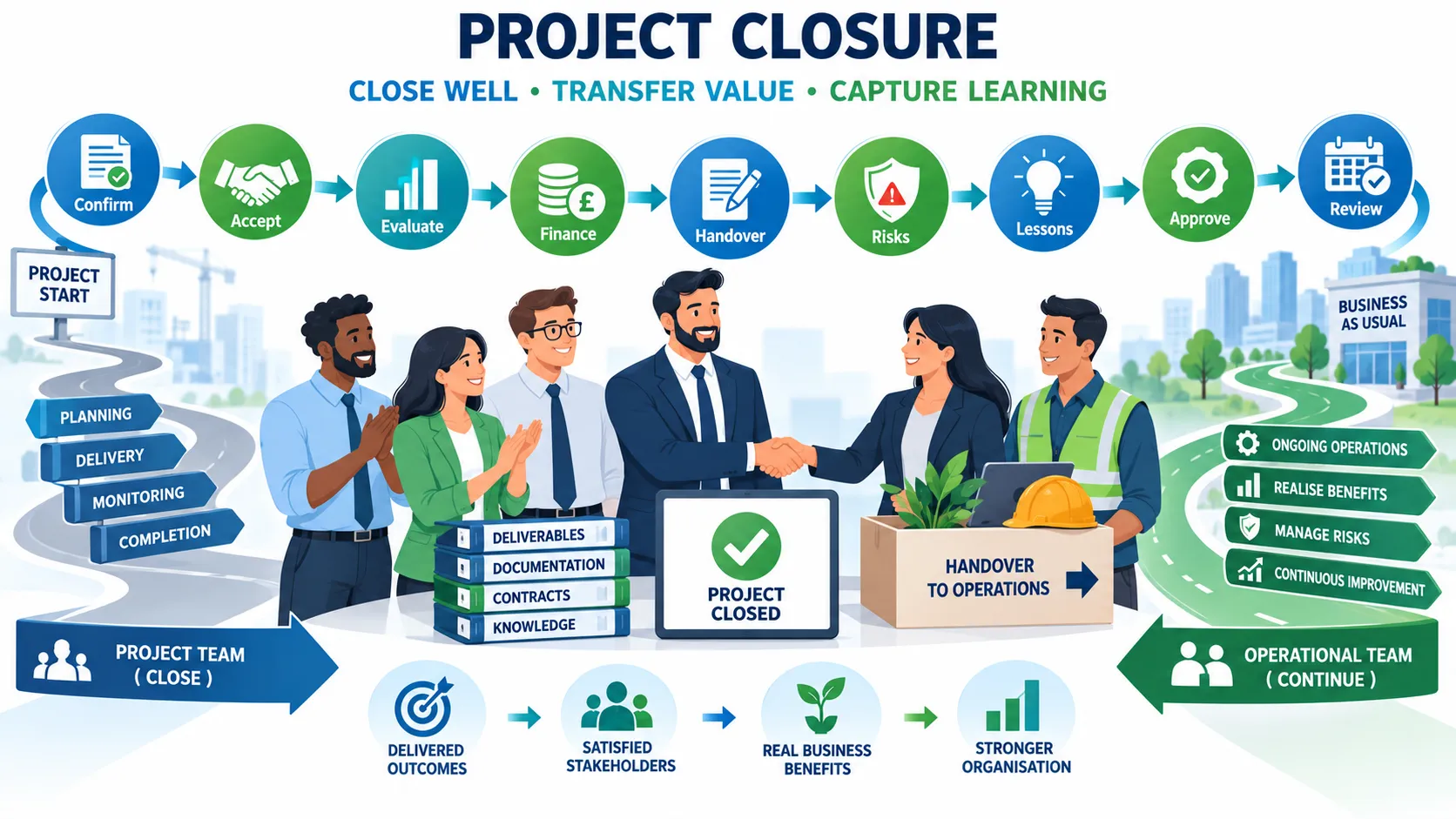
Understanding Project Closure
Project closure is the structured process used to formally complete a project and transition its outputs, responsibilities, resources and outstanding matters to the appropriate organisational owners.
Closure normally occurs when:
Project objectives have been achieved.
Agreed deliverables have been completed.
The project has reached an approved endpoint.
The business case no longer supports continuation.
A project has been terminated or cancelled.
The project has been superseded by another initiative.
The project has been transferred into business-as-usual operations.
Closure should therefore be based on an informed management decision rather than simply the passage of time.
Project Completion Versus Project Closure
Project completion and project closure are related but not identical.
Project completion generally refers to the completion of project work or deliverables.
Project closure refers to the formal process of confirming completion, evaluating results, transferring ownership and closing the project properly.
For example, a new customer relationship management system may be installed and technically operational. This represents completion of a major project deliverable.
However, the project may not be ready for closure until:
Users have been trained.
Documentation has been completed.
Outstanding defects have been addressed or transferred.
Supplier obligations have been resolved.
Operational ownership has been confirmed.
Benefits measures have been established.
Final financial information has been completed.
Lessons learned have been captured.
This distinction is important because premature closure can create operational problems.
Why Project Closure Matters
A structured closure process provides control over the transition from temporary project activity to ongoing organisational responsibility.
Without effective closure, organisations may experience:
Unclear ownership
Unresolved issues
Incomplete documentation
Uncontrolled costs
Lost learning
Unmanaged risks
Poor stakeholder acceptance
Unclear benefit ownership
Supplier disputes
Resource confusion
Difficulty demonstrating project value
Closure also provides an opportunity for managers to evaluate whether the project was successful.
The project can be assessed against:
Objectives
Scope
Schedule
Budget
Quality
Risk
Stakeholder expectations
Outcomes
Benefits
Approaches to Project Closure
There is no single closure approach that is appropriate for every project.
The most suitable approach depends on:
Project size
Complexity
Risk
Contractual requirements
Organisational governance
Type of deliverables
Degree of operational change
Stakeholder expectations
Whether benefits are immediate or long-term
Common approaches include:
Formal planned closure
Phased closure
Closure through operational handover
Closure following successful implementation
Early or premature closure
Closure following cancellation
Closure following project termination
Administrative closure
Benefits-focused closure
Hybrid closure
Managers should understand the strengths and limitations of each approach.
Formal Planned Closure
Formal planned closure is the conventional approach where a project reaches its intended endpoint and is closed through an agreed governance process.
The project manager or responsible manager confirms that closure criteria have been satisfied.
Typical activities include:
Confirming deliverables
Obtaining acceptance
Completing final testing
Reviewing project performance
Closing contracts
Finalising finances
Capturing lessons
Transferring ownership
Archiving records
Releasing resources
Producing the closure report
Obtaining formal approval
Benefits of Formal Planned Closure
Formal closure provides:
Clear accountability
Strong governance
Evidence of completion
Documented learning
Controlled transition
Financial accountability
Stakeholder assurance
It is particularly appropriate for projects with significant budgets, regulatory requirements or strategic importance.
Limitations
Formal closure can become bureaucratic if organisations require excessive documentation for small projects.
Managers should therefore ensure that the closure process is proportionate to project size and risk.
Phased Closure
Phased closure involves closing different components of a project at different times.
This approach can be useful for large or complex projects.
For example, a technology transformation project may include:
System development
Testing
Pilot implementation
User training
Organisation-wide implementation
Operational handover
The development phase may close before the full benefits-realisation phase is complete.
Benefits of Phased Closure
Phased closure can:
Reduce implementation risk
Allow learning between stages
Release resources progressively
Support controlled transition
Make complex projects easier to manage
Allow completed components to enter operation earlier
Risks of Phased Closure
Potential problems include:
Unclear project boundaries
Confusion about responsibility
Fragmented reporting
Duplicate activities
Difficulties determining final project completion
Clear governance and responsibility assignment are therefore essential.
Closure Through Operational Handover
Some projects are effectively closed by transferring their outputs into business-as-usual operations.
This approach is particularly relevant to:
Process improvement
Technology implementation
Training programmes
Service development
Organisational change
The project team completes the agreed work and operational management takes responsibility for ongoing performance.
Operational Handover Requirements
A successful handover should confirm:
Who owns the output.
Who manages the process.
Who maintains systems or equipment.
Who monitors performance.
Who owns outstanding risks.
Who owns expected benefits.
What support arrangements exist.
What documentation has been transferred.
The handover should be explicit rather than assumed.
Successful Implementation Closure
A project may close after the solution has been implemented and accepted.
For example, an organisation may implement a new learning management system.
Closure may occur after:
System testing
User acceptance
Staff training
Data migration
Go-live
Initial support
The project team may then close while the operational team continues managing the system.
This approach works well when implementation marks a clear transition point.
Early Closure
Early closure occurs when a project ends before all originally planned activities are completed.
This does not necessarily mean poor management.
A project may be closed early because:
Organisational priorities change.
Funding is withdrawn.
The business need changes.
A better solution becomes available.
External circumstances change.
Risks become unacceptable.
Expected benefits decline.
The project is no longer strategically aligned.
The important requirement is that early closure should be controlled and formally authorised.
Project Cancellation
A cancelled project is one that is stopped because continuing is no longer justified.
For example, a proposed technology project may be cancelled if the organisation determines that:
Costs have increased substantially.
The technology is becoming obsolete.
Expected benefits are no longer achievable.
A strategic priority has changed.
Cancellation should not simply mean stopping project activity.
Managers should still:
Secure project records.
Account for expenditure.
Resolve contractual obligations.
Communicate the decision.
Manage stakeholder expectations.
Capture lessons.
Transfer residual risks.
Close or renegotiate supplier arrangements.
Project Termination
Termination may occur when a project is deliberately stopped because continuing is considered inappropriate or impossible.
This may happen because of:
Serious risk
Major technical failure
Regulatory barriers
Loss of funding
Strategic change
Failure of the business case
Termination often requires more careful stakeholder and financial management than planned closure.
Administrative Closure
Administrative closure focuses on completing the formal organisational requirements associated with ending a project.
It may include:
Final reports
Document archiving
Financial reconciliation
Contract closure
Resource release
Record management
Governance sign-off
Administrative closure is necessary, but it should not replace evaluation of project outcomes and benefits.
Benefits-Focused Closure
A benefits-focused approach considers whether the project has created the expected organisational value.
This is particularly important when deliverables alone do not demonstrate success.
For example, implementing a new software system is an output.
The actual benefits may include:
Reduced processing time
Reduced errors
Improved customer experience
Reduced operating costs
The project may therefore require a benefits review after implementation.
Hybrid Closure
A hybrid approach combines different closure methods.
For example:
Formal project closure at implementation.
Operational handover to a business owner.
Benefits review six months later.
Post-implementation evaluation after twelve months.
This approach is often appropriate for complex organisational change projects.
Establishing Closure Criteria
Before closing a project, managers should establish clear closure criteria.
Closure criteria may include:
All required deliverables completed.
Deliverables accepted.
Quality requirements achieved.
Outstanding defects addressed or transferred.
Project objectives evaluated.
Financial records finalised.
Contracts closed.
Documentation completed.
Operational ownership confirmed.
Risks transferred.
Benefits ownership established.
Lessons captured.
Closure approval obtained.
Closure criteria should be measurable wherever possible.
Project Acceptance
Formal acceptance is a critical closure activity.
Acceptance confirms that an appropriate stakeholder or authorised representative agrees that the deliverable meets the agreed requirements.
Evidence may include:
Sign-off
Acceptance certificate
User acceptance testing
Quality approval
Inspection
Formal email confirmation
Governance approval
Acceptance reduces uncertainty about whether the project has delivered what was required.
Managing Outstanding Work
A common closure challenge is deciding what to do with incomplete work.
Not every outstanding activity should prevent closure.
Managers should assess:
Importance
Risk
Cost
Operational impact
Contractual requirements
Effect on benefits
Some work may need to be completed before closure.
Other work may appropriately transfer to operational teams or another project.
Outstanding Action Register
An outstanding action register can document:
Action
Owner
Deadline
Priority
Status
Required resources
Escalation route
This prevents unresolved tasks from disappearing when the project closes.
Final Project Review
A final project review evaluates overall performance.
The review should consider:
Scope Performance
Assess:
What was delivered?
What was not delivered?
What changed?
Were changes approved?
Schedule Performance
Assess:
Planned completion
Actual completion
Major delays
Reasons for delays
Financial Performance
Assess:
Approved budget
Actual expenditure
Variance
Financial benefits
Outstanding commitments
Quality Performance
Assess:
Quality standards
Defects
Acceptance
Customer or user satisfaction
Risk Performance
Assess:
Major risks
Risks realised
Effectiveness of responses
Residual risks
Stakeholder Performance
Assess:
Engagement
Satisfaction
Concerns
Acceptance
Communication effectiveness
Final Financial Closure
Financial closure confirms that project expenditure has been accurately recorded and outstanding financial matters resolved.
Managers should confirm:
Final invoices
Purchase orders
Supplier payments
Accruals
Budget transfers
Asset records
Final expenditure
Funding arrangements
Financial closure prevents costs from remaining incorrectly assigned to a completed project.
Contract Closure
Where suppliers or contractors have been involved, contractual closure may be required.
This can involve:
Confirming deliverables
Final acceptance
Final invoices
Warranty arrangements
Dispute resolution
Contract completion
Performance review
Documentation transfer
Managers should review contractual obligations before formally closing the project.
Resource Closure
Project resources should be released or reassigned in a controlled manner.
Resources may include:
Employees
Contractors
Equipment
Facilities
Technology
Budgets
Managers should communicate resource changes clearly.
For employees returning to operational roles, the transition should include:
New responsibilities
Handover activities
Knowledge transfer
Outstanding actions
Performance expectations
Knowledge Transfer
Project teams often develop valuable knowledge that could be lost after closure.
Knowledge transfer may involve:
Documentation
Training
Process guides
Technical manuals
Lessons learned
Workshops
Handover meetings
Knowledge repositories
Knowledge transfer is especially important when project team members will leave or return to other roles.
Document Closure and Archiving
Project records should be organised and retained according to organisational requirements.
Records may include:
Project charter
Business case
Project plans
Risk registers
Issue logs
Change records
Meeting records
Financial information
Contracts
Acceptance documentation
Testing results
Final reports
Lessons learned
Good record management supports:
Accountability
Audit
Future learning
Governance
Legal requirements
Organisational knowledge
Closing the Risk Register
Not every risk disappears at project closure.
Managers should review each remaining risk and determine whether it should be:
Closed
Accepted
Transferred
Escalated
Managed operationally
Assigned to another project
The transfer of residual risk should be documented.
Closing the Issue Log
Issues should be reviewed to determine whether they have:
Been resolved
Been accepted
Been transferred
Been escalated
Become operational responsibilities
Outstanding issues should have clear ownership.
Benefits Handover
Expected benefits may continue after project closure.
Managers should therefore establish:
Benefit owner
Measurement method
Baseline
Target
Review date
Reporting arrangements
For example, if a project aims to save £200,000 annually, the operational owner should continue measuring actual savings after the project team has closed.
Post-Implementation Review
A post-implementation review can assess whether the project solution is operating effectively.
It may examine:
User adoption
Performance
Reliability
Customer satisfaction
Operational impact
Financial benefits
Staff experience
Unexpected consequences
The review should take place at an appropriate time.
Immediate closure may confirm implementation, while a later review can confirm whether meaningful benefits have emerged.
Lessons Learned at Closure
Closure provides an important opportunity to capture organisational learning.
A lessons-learned review should examine:
What worked well?
What did not work well?
Why did it happen?
What should be repeated?
What should be changed?
What should future project managers know?
Lessons should be specific enough to support future action.
For example, “communication could be improved” is weak.
A stronger lesson is:
“Weekly stakeholder briefings reduced resistance during implementation; future change projects should introduce structured stakeholder briefings from the planning stage.”
Conducting an Effective Closure Review
A structured closure review can follow several stages.
Stage 1: Prepare
Gather:
Project plans
Performance data
Financial information
Risk records
Issue records
Stakeholder feedback
Stage 2: Compare
Compare planned and actual:
Scope
Time
Cost
Quality
Outcomes
Benefits
Stage 3: Analyse
Identify:
Variances
Causes
Consequences
Successful practices
Problems
Stage 4: Consult
Engage relevant:
Project team members
Sponsors
Stakeholders
Operational managers
Suppliers
Stage 5: Document
Record:
Findings
Lessons
Recommendations
Outstanding actions
Stage 6: Approve
Obtain appropriate governance approval.
Stage 7: Transfer
Transfer:
Outputs
Responsibilities
Risks
Benefits
Documentation
Stage 8: Close
Formally close the project and release project resources.
Stakeholder Communication During Closure
Project closure can create uncertainty if communication is poorly managed.
Stakeholders should understand:
What has been achieved.
What is changing.
What is being transferred.
Who owns the outputs.
What remains outstanding.
How benefits will be monitored.
Where to obtain support.
Communication should be tailored to stakeholder needs.
Communicating Success
Managers should recognise successful delivery without exaggerating results.
For example:
“The project delivered the new service platform within the approved budget and achieved the agreed implementation requirements.”
This is more credible than:
“The project was a complete success in every respect.”
Communicating Difficult Outcomes
Where objectives were not fully achieved, managers should communicate this professionally.
A useful structure is:
What was expected.
What happened.
Why the difference occurred.
What impact resulted.
What action is being taken.
This supports transparency and learning.
Project Closure Report
A formal closure report should provide a balanced summary of the project.
It may include:
Project purpose
Original objectives
Scope
Deliverables
Outcomes
Benefits
Schedule performance
Financial performance
Quality performance
Risk performance
Stakeholder feedback
Changes
Issues
Lessons learned
Outstanding actions
Handover arrangements
Recommendations
Formal closure decision
The report should provide sufficient evidence for stakeholders to understand whether closure is justified.
Assessing Different Closure Approaches
Managers should not select a closure approach simply because it is familiar.
They should assess the approach against project circumstances.
Small Internal Improvement Project
A lightweight closure may be appropriate.
The manager may use:
Short completion review
Simple performance summary
Action handover
Brief lessons-learned discussion
A large governance process could create unnecessary administration.
Major Technology Transformation
A formal or hybrid approach may be more appropriate.
It may require:
Formal acceptance
Technical handover
Financial closure
Contract closure
User adoption review
Benefits monitoring
Post-implementation review
Regulatory Compliance Project
Closure should provide strong evidence that required obligations have been met.
Documentation and formal approval may be particularly important.
Organisational Change Project
Phased or hybrid closure may be appropriate because behavioural and operational outcomes may continue developing after project activities finish.
Cancelled Project
A controlled early-closure process should be used.
The focus should include:
Financial reconciliation
Contract management
Stakeholder communication
Risk transfer
Lessons learned
Factors Influencing Closure Approach
Project Size
Large projects generally require greater formality.
Project Complexity
Complex projects may need phased or hybrid closure.
Risk
High-risk projects require stronger evidence and governance.
Regulatory Requirements
Regulated environments may require formal documentation and approval.
Contractual Commitments
Supplier arrangements may influence closure timing.
Benefits Timing
If benefits emerge slowly, post-project reviews may be required.
Stakeholder Expectations
Projects with many stakeholders may require more extensive acceptance and communication.
Operational Impact
Projects causing significant operational change need strong handover arrangements.
Evaluating Closure Effectiveness
A closure approach should be assessed according to whether it achieved its intended purpose.
Questions include:
Was the project formally closed?
Were deliverables accepted?
Were financial matters resolved?
Were contracts closed?
Were risks transferred?
Were issues assigned?
Was operational ownership established?
Were benefits assigned?
Were lessons captured?
Were stakeholders informed?
Were records archived?
Were resources released appropriately?
A closure process that simply produces paperwork without resolving these matters is not effective.
Benefits of Effective Project Closure
Stronger Accountability
Closure provides evidence of what the project achieved.
Better Governance
Formal closure demonstrates that project responsibilities have been completed appropriately.
Improved Resource Management
Resources can be released and reassigned effectively.
Better Financial Control
Final costs and commitments can be reconciled.
Improved Knowledge Management
Lessons and documentation are preserved.
Stronger Operational Continuity
Outputs are transferred to appropriate owners.
Improved Benefits Realisation
Benefit ownership and monitoring can continue.
Reduced Risk
Residual risks and issues are identified and assigned.
Better Stakeholder Confidence
Clear closure communication demonstrates professionalism.
Improved Future Project Performance
Lessons can inform future projects.
Common Mistakes in Project Closure
Closing Immediately After Delivery
Managers may assume that once the final deliverable exists, the project is finished.
This can leave:
Training incomplete
Documentation unfinished
Benefits unassigned
Risks unmanaged
Ignoring Outstanding Issues
Issues do not disappear simply because the project team has been disbanded.
Failing to Obtain Acceptance
Without formal acceptance, disagreements may arise later.
Treating Lessons Learned as an Administrative Exercise
Generic lessons provide little value.
Ignoring Benefits
Projects should not be judged only on deliverables.
Failing to Transfer Ownership
Operational teams need explicit responsibility.
Keeping the Project Open Indefinitely
The opposite problem is allowing a project to continue without a clear reason.
This consumes resources and weakens accountability.
Focusing Only on Positive Results
Professional closure requires balanced reporting.
Releasing Resources Too Early
Critical handover and knowledge-transfer activities may be disrupted.
Practical Example: New Learning Management System
An organisation introduces a new learning management system.
The project has:
Completed system configuration.
Migrated data.
Trained users.
Completed testing.
Launched the system.
A weak closure approach would simply declare the project complete.
A stronger approach would assess:
System acceptance
User adoption
Training completion
Outstanding technical issues
Supplier obligations
Data governance
Operational ownership
Support arrangements
Performance indicators
Expected benefits
The project team then transfers responsibility to the learning and technology teams.
A post-implementation review may occur six months later to assess:
User adoption
Course completion
Administrative efficiency
User satisfaction
System reliability
This demonstrates why project closure should include both immediate closure and longer-term benefits review.
Practical Example: Office Relocation Project
An organisation completes an office relocation.
The physical move has been completed, but closure should not occur until the manager confirms:
Building arrangements
IT connectivity
Security
Equipment
Employee access
Supplier invoices
Property obligations
Outstanding defects
Health and safety requirements
Operational ownership
A closure checklist can help prevent important tasks from being missed.
Practical Example: Cost-Reduction Project
A project aims to reduce operating costs by £500,000 annually.
At closure:
New procurement arrangements are implemented.
Supplier contracts have changed.
Initial savings are £300,000.
Further savings are expected.
The project should not claim that the full £500,000 benefit has already been achieved.
Instead:
Actual savings should be reported.
Remaining expected benefits should be assigned to a benefit owner.
A future review date should be established.
Outstanding actions should be transferred.
This provides a more accurate and responsible closure.
Practical Example: Project Cancelled Because of Strategic Change
An organisation begins a digital transformation project.
Halfway through implementation, organisational strategy changes and a different technology direction is approved.
The original project is cancelled.
A professional closure approach should include:
Formal cancellation approval
Financial reconciliation
Supplier negotiations
Data and intellectual property management
Stakeholder communication
Risk assessment
Documentation
Lessons learned
Resource reassignment
Although the project did not reach its original objectives, effective closure can still protect organisational value and generate important learning.
Practical Example: Regulatory Compliance Project
An organisation implements a new compliance process.
The project deliverables are completed, but closure requires evidence that:
Required controls are operational.
Employees understand their responsibilities.
Documentation is complete.
Monitoring arrangements exist.
Compliance ownership has transferred.
A formal closure approach is likely to be more appropriate because evidence and accountability are critical.
Leadership Role in Project Closure
Middle managers have a significant role in ensuring that closure is treated as a management activity rather than an administrative afterthought.
They need to:
Challenge premature closure.
Confirm evidence of completion.
Communicate honestly.
Secure stakeholder acceptance.
Ensure appropriate handover.
Protect organisational knowledge.
Review financial outcomes.
Ensure residual risks are owned.
Confirm benefits ownership.
Recognise team contributions.
Support organisational learning.
Creating a Positive Closure Culture
Closure should not be associated only with criticism.
Managers should recognise:
Achievements
Team contributions
Stakeholder support
Successful innovations
Effective problem-solving
Recognition can strengthen morale and reinforce positive project behaviours.
However, recognition should not prevent honest discussion about problems.
Ethical Considerations in Project Closure
Managers have an ethical responsibility to report project outcomes accurately.
They should not:
Hide cost overruns
Misrepresent benefits
Ignore known defects
Conceal risks
Manipulate performance data
Claim outcomes that cannot be evidenced
Transfer responsibilities without agreement
Ethical closure supports trust and organisational accountability.
Governance and Formal Closure Approval
Depending on organisational arrangements, formal closure may require approval from:
Project sponsor
Project board
Programme manager
Senior management
Governance committee
Client
Regulatory authority
The appropriate approval level depends on project size and organisational governance.
Formal approval confirms that the organisation accepts the project outcome and agrees that project resources and responsibilities can be closed or transferred.
Closure Decision-Making
A manager may use a structured decision framework.
Question 1: Have Deliverables Been Completed?
If no, determine whether remaining work must be completed or transferred.
Question 2: Have Deliverables Been Accepted?
If no, resolve acceptance issues.
Question 3: Have Objectives Been Evaluated?
Assess actual performance against agreed objectives.
Question 4: Have Financial Matters Been Resolved?
Confirm final costs and commitments.
Question 5: Have Risks and Issues Been Assigned?
Ensure no important matter is left without ownership.
Question 6: Has Operational Ownership Been Confirmed?
Identify the responsible operational manager or team.
Question 7: Have Benefits Been Assigned?
Confirm who will monitor and sustain benefits.
Question 8: Have Lessons Been Captured?
Ensure useful knowledge is documented.
Question 9: Has Closure Been Approved?
Obtain formal authorisation.
If these questions can be answered satisfactorily, the project is more likely to be ready for closure.
Closure Versus Continuous Improvement
Closure does not mean that improvement stops.
Once a project has been transferred into operations, continuous improvement may continue through:
Performance monitoring
Operational reviews
User feedback
Process improvement
Benefits reviews
The distinction is that project activity has ended while operational management continues.
Project Closure Maturity
Organisations can demonstrate different levels of closure maturity.
Basic Approach
The organisation closes projects when deliverables are completed.
Developing Approach
The organisation uses closure checklists and final reports.
Established Approach
The organisation evaluates:
Cost
Time
Quality
Outcomes
Benefits
Lessons
Advanced Approach
The organisation also:
Tracks benefits after closure.
Integrates lessons into future projects.
Uses standard governance.
Measures closure quality.
Maintains organisational knowledge.
Reviews project portfolio performance.
Mature organisations recognise closure as part of the complete project lifecycle.
Key Concepts to Remember
Project closure: The structured process of formally completing a project and transferring or resolving remaining responsibilities.
Project completion: The point at which project work or deliverables are completed.
Formal closure: Closure through an approved governance process.
Phased closure: Closing project components progressively.
Operational handover: Transfer of project outputs and responsibilities to business-as-usual teams.
Early closure: Ending a project before its original planned endpoint.
Project cancellation: Stopping a project because continuation is no longer justified.
Administrative closure: Completion of financial, contractual, documentation and governance requirements.
Benefits realisation: The process of confirming and sustaining expected organisational benefits.
Benefits owner: Person responsible for ensuring a benefit is achieved and sustained.
Post-implementation review: Review of actual performance and impact after implementation.
Lessons learned: Knowledge captured to improve future project performance.
Residual risk: Risk that remains after project activities have ended.
Handover: Formal transfer of responsibility, knowledge, outputs and outstanding matters.
Acceptance: Formal confirmation that agreed requirements or deliverables have been met.
Closure criteria: Conditions that must be satisfied before a project can be formally closed.
Project Closure Best-Practice Framework
A practical closure framework for managers is:
Confirm → Evaluate → Accept → Reconcile → Transfer → Learn → Approve → Close → Review
Confirm
Confirm deliverables, objectives and completion status.
Evaluate
Evaluate cost, time, quality, risks, outcomes and benefits.
Accept
Obtain formal stakeholder acceptance.
Reconcile
Complete financial and contractual reconciliation.
Transfer
Transfer outputs, risks, issues and benefits to appropriate owners.
Learn
Capture lessons and organisational knowledge.
Approve
Obtain formal closure approval.
Close
Archive records and release project resources.
Review
Conduct post-implementation or benefits reviews where required.
This framework helps managers maintain control while adapting the closure process to project circumstances.
Managerial Review Questions
Middle managers can use the following questions when assessing a proposed closure approach:
Is this project genuinely ready to close?
Are the original objectives clearly evaluated?
Have stakeholders accepted the deliverables?
Are there outstanding actions?
Who owns those actions?
Have all financial commitments been resolved?
Are supplier contracts complete?
Have residual risks been transferred?
Are benefits measurable?
Who owns the benefits?
Has operational ownership been established?
Has the project team transferred essential knowledge?
Have lessons been captured?
Are project records complete?
Has the closure report been approved?
Is a post-implementation review required?
Does the closure approach match the project’s size, complexity and risk?
Summary
Project closure is an essential stage of effective project management. It provides a structured mechanism for confirming that project work has been completed, evaluating results, transferring responsibilities and capturing organisational learning.
The most appropriate closure approach depends on project circumstances. Formal planned closure is suitable for many conventional projects, while phased, operational, early, cancellation, administrative, benefits-focused and hybrid approaches may be more appropriate in different contexts.
Effective closure should address much more than deliverable completion. Managers should evaluate:
Objectives
Scope
Time
Cost
Quality
Risk
Stakeholder acceptance
Outcomes
Benefits
Resources
Contracts
Operational ownership
Lessons learned
A particularly important distinction is between project completion and project closure. Completing a deliverable does not automatically mean that the project can be closed. Documentation, training, acceptance, financial reconciliation, risk transfer, operational handover and benefits ownership may still be required.
Project closure should also be proportionate. A small internal improvement project may require a simple closure review and handover, whereas a major transformation programme may require formal governance approval, extensive documentation, contractual closure and post-implementation benefits reviews.
Early closure and cancellation should also be managed professionally. A project that is no longer strategically justified should not continue simply because resources have already been invested. Equally, stopping a project should not mean abandoning accountability. Financial reconciliation, stakeholder communication, risk management, contract management and lessons learned remain important.
A strong closure process protects organisational value by ensuring that:
Deliverables are accepted → Results are evaluated → Responsibilities are transferred → Risks are managed → Benefits are owned → Learning is captured → Resources are released
For middle managers and leaders, effective closure demonstrates professional judgement. It requires the ability to balance governance, operational reality, stakeholder expectations, financial accountability and organisational learning.
The ultimate purpose of project closure is not simply to say that a project has ended. It is to ensure that the organisation can confidently answer:
What was the project intended to achieve?
What was actually delivered?
Were the objectives and outcomes achieved?
What benefits have been realised or remain to be realised?
Who now owns the outputs, risks and benefits?
What has the organisation learned?
What needs to happen next?
When these questions are answered clearly and supported by evidence, project closure becomes a valuable management and leadership process rather than an administrative formality.
| Approach to Project Closure | Definition | Key Process | Key Benefits | Potential Limitations | Suitable Context |
|---|---|---|---|---|---|
| Formal Planned Closure | Structured closure after planned objectives and deliverables are completed | Confirm completion, evaluate performance, obtain acceptance, reconcile finances, transfer ownership and obtain approval | Strong governance, accountability and clear completion evidence | Can become overly administrative | Major projects, strategic initiatives and regulated environments |
| Phased Closure | Different project components are closed progressively | Complete and accept individual phases before transferring responsibility | Supports complex delivery and progressive transition | May create unclear boundaries if poorly governed | Large technology, transformation and infrastructure projects |
| Operational Handover Closure | Project outputs are transferred into business-as-usual management | Confirm readiness, transfer knowledge, assign ownership and close project activities | Supports continuity and clear operational responsibility | Benefits may require longer-term monitoring | Process, technology, service and organisational change projects |
| Successful Implementation Closure | Project closes after implementation and acceptance of the solution | Test, implement, obtain acceptance, resolve critical issues and transfer support | Provides clear transition from implementation to operation | Implementation does not always prove long-term benefits | Technology and service implementation |
| Early Closure | Project ends before its planned completion date | Review justification, secure resources, resolve contracts, assess risks and document learning | Prevents continued investment where value has declined | May leave incomplete objectives | Strategic changes, funding changes or reduced business need |
| Cancellation Closure | Project is stopped because continuation is no longer justified | Approve cancellation, reconcile finances, manage contracts, communicate decision and capture lessons | Protects resources and prevents unjustified expenditure | Stakeholder disappointment and sunk costs may be significant | Projects affected by strategic, financial or external changes |
| Termination Closure | Project is formally stopped because continuation is impossible or inappropriate | Assess causes, protect organisational interests, manage risks and close obligations | Provides controlled response to serious problems | May involve significant financial, contractual or reputational consequences | High-risk or unsuccessful projects |
| Administrative Closure | Focuses on completing formal administrative requirements | Finalise documents, finances, contracts, records and resource arrangements | Supports governance, audit and accountability | May overlook outcomes and benefits if used alone | All projects as part of a wider closure process |
| Benefits-Focused Closure | Closure process emphasises whether intended organisational benefits have been achieved | Measure baselines, targets and actual benefits and assign benefit ownership | Links project delivery to organisational value | Benefits may not be immediately measurable | Strategic, efficiency and organisational change projects |
| Hybrid Closure | Combines multiple closure approaches | Formal closure, operational handover and later benefits or post-implementation reviews | Flexible and comprehensive | Requires clear governance and responsibilities | Complex transformation and strategic projects |
Final Management Insight
Effective project leaders understand that the end of project activity is not always the end of project impact.
A project may finish its implementation work today while its benefits continue developing for months or years. The responsibility of the project manager may end, but responsibility for the outcome must not disappear.
Therefore, the strongest closure approach is one that creates a clear bridge between project delivery and organisational performance.
A professionally closed project leaves the organisation with:
Accepted deliverables
Clear ownership
Resolved or transferred risks
Controlled finances
Completed documentation
Captured knowledge
Measurable benefits
Informed stakeholders
Released resources
Clear next steps
This is what turns project completion into sustainable organisational value.