
Lesson no 3 : Understand the impact of leadership within organisations
Leadership has a significant influence on how organisations operate, how employees perform, and how organisational objectives are achieved. Effective leadership extends beyond directing employees or making decisions; it involves influencing behaviour, shaping workplace relationships, establishing direction, developing people, and creating an environment in which individuals and teams can contribute effectively. For practising and aspiring middle managers, understanding the impact of leadership is essential because their everyday decisions and behaviours can directly affect employee engagement, performance, organisational culture and the achievement of strategic and operational objectives.
This lesson, Understand the Impact of Leadership Within Organisations, examines how leadership influences individuals, teams and the wider organisation. It considers the relationship between leadership behaviour and important organisational outcomes such as motivation, employee engagement, trust, communication, teamwork, performance, decision-making and change. Learners will explore how different leadership approaches can produce different outcomes depending on organisational circumstances, employee capability, workplace expectations and the nature of the task.
Leadership also has an important relationship with organisational culture and values. Managers communicate organisational expectations not only through formal policies but also through their everyday behaviour. The way a manager treats employees, makes decisions, responds to mistakes, manages performance, delegates responsibility and handles workplace challenges can reinforce or weaken the organisation’s stated values. Ethical leadership is therefore central to understanding leadership impact. Responsible leaders consider the consequences of their decisions for employees, customers, colleagues and other stakeholders while maintaining fairness, integrity, respect and accountability.
The lesson also considers the impact of leadership on empowerment. Managers can create greater employee ownership by providing appropriate responsibility, authority, information and support. Effective empowerment can encourage employees to contribute ideas, make appropriate decisions and take greater responsibility for outcomes. However, empowerment must operate within clear organisational boundaries and should be supported by suitable communication, resources, guidance and accountability.
Learners will also examine how leadership influences organisational performance during periods of change, uncertainty and challenge. Effective leaders can help employees understand organisational priorities, adapt to changing requirements, work collaboratively and maintain focus on shared objectives. Different leadership models and styles may have different effects, making professional judgement important when selecting and adapting an approach.
By the end of this lesson, learners will understand that leadership impact is multidimensional. Leadership can influence not only immediate performance but also employee relationships, organisational culture, ethical standards, empowerment, trust and long-term organisational effectiveness. Learners will develop the ability to consider how leadership behaviour affects people and organisational outcomes and how managers can use responsible, ethical and values-based leadership to create positive and sustainable workplace impact.
1: Evaluate How Leadership Supports the Achievement of Organisational Objectives
Introduction
Organisational objectives provide direction by establishing what an organisation intends to achieve over a defined period. Objectives may relate to financial performance, service quality, customer satisfaction, operational efficiency, employee development, innovation, growth, sustainability, quality improvement or other organisational priorities. Leadership plays a critical role in converting these objectives from statements of organisational intent into coordinated action by people and teams.
Leadership supports organisational objectives because organisations achieve results through people. Strategies, policies, procedures, technologies and financial resources are important, but their effectiveness depends significantly on how people understand priorities, make decisions, work together, respond to change and take responsibility for outcomes. Leaders provide direction, influence behaviour, build commitment and create conditions in which employees can contribute effectively.
For middle managers, this relationship is particularly important. Middle managers frequently translate strategic objectives into departmental or team-level activities. They must interpret organisational priorities, communicate expectations, allocate responsibilities, monitor performance, resolve problems and support employees. At the same time, they may need to communicate operational information upwards and help senior leaders understand practical challenges affecting implementation.
Leadership should therefore not be evaluated solely by whether a target has been achieved. Effective leadership also considers how the target was achieved, whether employees were treated fairly, whether organisational values were maintained, whether appropriate empowerment was provided, and whether the approach contributes to sustainable organisational effectiveness.
A strong leadership approach aligns people, purpose, values, resources and performance. It helps employees understand not only what the organisation wants to achieve but also why the objective matters and how their individual contribution supports the wider organisational purpose.
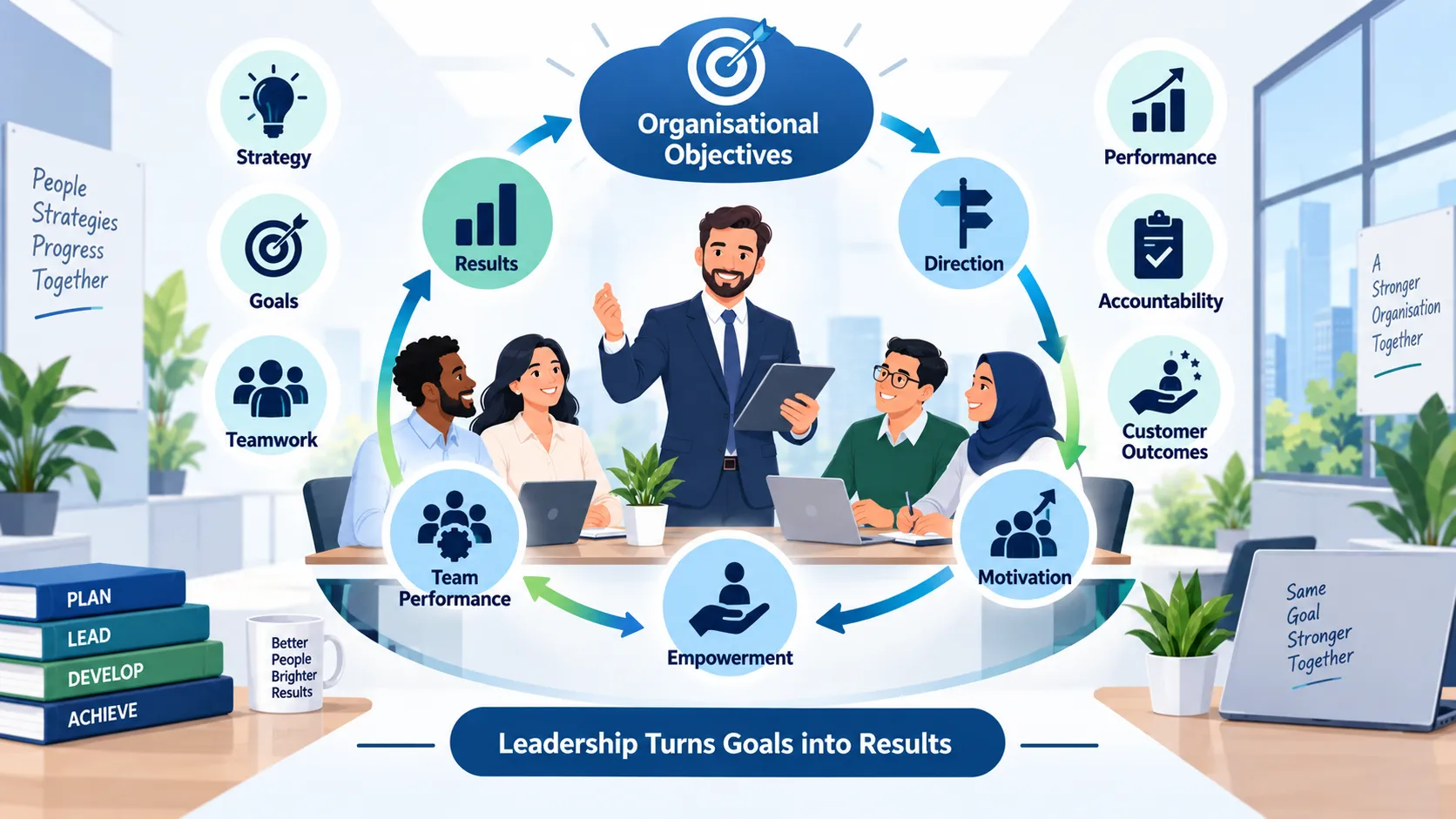
Understanding Organisational Objectives
Definition of Organisational Objectives
Organisational objectives are specific outcomes that an organisation aims to achieve in support of its overall purpose and strategic direction. They translate broad organisational intentions into clearer areas of expected achievement.
Objectives can operate at different levels:
organisational level;
strategic level;
departmental level;
team level;
individual level;
project level; and
operational level.
For leadership to support organisational objectives effectively, these different levels need to be connected.
For example, an organisation may have a strategic objective to improve customer satisfaction. A department may translate this into an objective to reduce response times. A team may then establish targets for responding to customer enquiries within an agreed period. Individual employees can contribute by applying effective communication and service procedures.
Leadership helps create the connection between these levels.
Common Types of Organisational Objectives
Organisations may establish objectives relating to:
financial performance;
revenue or cost control;
productivity;
customer satisfaction;
service quality;
operational efficiency;
employee engagement;
employee development;
innovation;
quality improvement;
risk reduction;
sustainability;
organisational growth;
stakeholder satisfaction;
digital transformation;
market performance; and
organisational culture.
The leadership approach required may vary according to the objective.
A cost-control objective may require strong planning and accountability, while an innovation objective may benefit from participation, empowerment and transformational leadership.
The Relationship Between Leadership and Organisational Objectives
Leadership provides the human mechanism through which organisational objectives are translated into behaviour and action.
A leader contributes by:
communicating organisational priorities;
creating understanding of objectives;
establishing direction;
motivating employees;
allocating responsibility;
encouraging collaboration;
empowering individuals;
supporting development;
monitoring progress;
resolving obstacles;
managing change;
reinforcing organisational values; and
maintaining ethical standards.
The relationship can be understood as a progression:
Objective → Direction → Communication → Employee Engagement → Action → Performance → Review → Improvement
Leadership influences every stage of this process.
Leadership Creates Direction and Focus
Communicating Organisational Purpose
Employees need to understand what the organisation is trying to achieve and why the objective matters. Leaders provide this sense of direction by communicating organisational priorities in a way that is relevant to their teams.
For example, a senior organisation may establish a strategic objective to improve customer retention. A middle manager should translate this into practical team expectations.
The manager may explain:
why customer retention matters;
how customer experience contributes to the objective;
what behaviours are expected;
how individual roles contribute;
what performance indicators will be used;
what support is available.
Without effective communication, employees may understand their individual tasks without understanding their relationship to the wider organisational objective.
Creating Alignment
Leadership helps align:
organisational strategy;
departmental priorities;
team activities;
individual responsibilities;
performance expectations.
Alignment reduces the risk that different teams work towards competing priorities.
For example, one department may prioritise speed while another prioritises quality. Effective leadership helps managers establish an appropriate balance so that employees understand the wider organisational objective rather than focusing exclusively on isolated departmental targets.
Leadership Influences Employee Motivation
Connecting Individual Contribution to Organisational Objectives
Employees are more likely to engage with objectives when they understand the value of their contribution.
Leaders can strengthen motivation by:
explaining purpose;
recognising achievement;
setting meaningful expectations;
providing appropriate autonomy;
involving employees in relevant decisions;
providing feedback;
supporting development;
acknowledging individual strengths; and
connecting work to organisational outcomes.
Motivation is particularly important when objectives require sustained effort or behavioural change.
Intrinsic and Extrinsic Factors
Managers may use different approaches to support motivation.
Extrinsic mechanisms may include:
recognition;
performance rewards;
progression opportunities;
formal incentives;
achievement recognition.
Intrinsic factors may include:
meaningful work;
responsibility;
autonomy;
achievement;
professional growth;
involvement;
recognition;
sense of contribution.
Effective leadership should not rely exclusively on rewards. Strong organisational leadership creates conditions where employees understand the purpose of their work and feel appropriately trusted and valued.
Leadership Builds Employee Engagement
Employee engagement refers to the degree to which employees are psychologically and behaviourally connected to their work, team and organisational purpose.
Leadership can influence engagement through:
communication;
trust;
recognition;
participation;
empowerment;
development;
fairness;
support;
meaningful responsibility.
Engaged employees may be more willing to contribute ideas, solve problems, support colleagues and take ownership of organisational outcomes.
However, engagement should not be confused with simply creating enthusiasm. Leaders must connect engagement with clear organisational objectives and accountability.
Leadership Supports Organisational Performance
Leadership influences performance by establishing expectations and creating conditions that enable employees to achieve them.
Performance can be supported through:
clear objectives;
appropriate resources;
defined responsibilities;
relevant skills;
constructive feedback;
performance monitoring;
coaching;
delegation;
empowerment;
recognition;
problem solving.
A leader should also identify barriers that prevent employees from performing effectively.
These may include:
insufficient resources;
unclear responsibilities;
inadequate training;
conflicting priorities;
poor communication;
ineffective processes;
excessive workload;
limited decision-making authority.
Leadership is therefore not simply about demanding better performance. It involves understanding what enables performance.
Leadership and Employee Empowerment
Definition of Empowerment
Empowerment involves enabling employees to take appropriate responsibility, make decisions within agreed boundaries and contribute actively to organisational objectives.
Empowerment can support organisational objectives because it reduces unnecessary dependency on managers and enables decisions to be made closer to operational activity.
Empowerment and Organisational Performance
An empowered employee may be able to:
resolve routine problems;
make appropriate decisions;
suggest improvements;
take ownership;
support colleagues;
manage delegated responsibilities;
identify risks;
contribute to innovation.
For empowerment to support organisational objectives, managers need to establish:
clear responsibilities;
decision-making boundaries;
appropriate authority;
relevant information;
necessary resources;
performance expectations;
accountability arrangements.
Empowerment without these foundations may create confusion rather than effectiveness.
Leadership and Delegation
Delegation is an important management and leadership technique for achieving organisational objectives.
Effective delegation involves transferring responsibility for suitable work while maintaining appropriate accountability.
A manager should:
Identify the task.
Determine whether delegation is appropriate.
Select a suitable employee.
Assess capability.
Explain the expected outcome.
Clarify authority and boundaries.
Provide resources.
Agree timescales.
Establish monitoring arrangements.
Provide support.
Review the outcome.
Provide feedback.
Delegation can support organisational objectives by increasing capacity, developing employee capability and allowing managers to focus on higher-priority responsibilities.
Leadership and Employee Capability
Organisational objectives can only be achieved effectively when employees have appropriate capability.
Leadership supports capability through:
coaching;
mentoring;
feedback;
training support;
delegation;
development planning;
exposure to new responsibilities;
knowledge sharing;
peer learning;
reflective practice.
A manager should assess whether employees have the knowledge, skills and confidence required to contribute to the objective.
Matching Leadership to Capability
Different employees may require different levels of support.
For example:
a new employee may require clearer direction;
a developing employee may benefit from coaching;
a competent employee may benefit from participation;
an experienced employee may be given greater autonomy.
This reflects situational leadership and helps ensure that leadership behaviour supports rather than obstructs performance.
Leadership and Organisational Culture
Definition of Organisational Culture
Organisational culture refers broadly to the shared behaviours, expectations, assumptions and ways of working that influence how people operate within an organisation.
Leadership has a significant impact on culture because employees observe what managers do rather than relying only on formal organisational statements.
A manager can reinforce a positive culture through:
respectful communication;
fair decision-making;
ethical conduct;
collaboration;
accountability;
inclusion;
empowerment;
recognition;
transparency.
Culture and Organisational Objectives
Culture can support organisational objectives when workplace behaviours are aligned with what the organisation is trying to achieve.
For example, an organisation seeking innovation may need a culture where employees can:
suggest ideas;
question existing processes;
experiment responsibly;
learn from appropriate mistakes;
collaborate;
take ownership.
A highly controlling culture may make innovation more difficult.
Similarly, an organisation focused on quality may need a culture that encourages:
attention to standards;
accountability;
continuous improvement;
professional responsibility;
openness about problems.
Leadership helps establish these behavioural conditions.
Leadership and Organisational Values
Definition of Organisational Values
Organisational values are principles that guide expected behaviour and decision-making within an organisation.
Examples include:
integrity;
respect;
fairness;
accountability;
professionalism;
collaboration;
inclusion;
responsibility;
customer focus;
innovation.
Leadership supports organisational objectives by demonstrating these values through everyday decisions.
Values Must Be Demonstrated
Values have limited influence when they exist only in organisational documents.
Leaders demonstrate values through:
how they allocate opportunities;
how they respond to mistakes;
how they handle conflict;
how they communicate difficult decisions;
how they manage performance;
how they use authority;
how they recognise employees;
how they respond to ethical concerns.
When leadership behaviour is consistent with organisational values, employees receive clearer signals about expected conduct.
Ethical Leadership and Organisational Objectives
Definition of Ethical Leadership
Ethical leadership involves influencing and guiding people in ways that demonstrate integrity, fairness, respect, accountability and responsible decision-making.
Ethical leadership supports organisational objectives because long-term organisational effectiveness depends on trust, credibility and responsible behaviour.
Leaders should consider:
how decisions affect employees;
how decisions affect customers;
how stakeholders may be affected;
whether decisions are fair;
whether authority is being used appropriately;
whether actions align with organisational values;
whether the methods used to achieve objectives are responsible.
Results and Methods
An important principle is that organisational performance should not be assessed solely through results.
Consider two managers who both achieve the same annual target.
Manager A achieves it through:
clear expectations;
employee empowerment;
fair performance management;
effective communication;
responsible resource use.
Manager B achieves it through:
intimidation;
excessive control;
unrealistic demands;
unfair allocation of work;
disregard for employee concerns.
The numerical outcome may appear similar, but the leadership impact is substantially different.
The second approach may damage:
trust;
employee engagement;
organisational culture;
employee retention;
reputation;
long-term performance.
Therefore, ethical leadership contributes to sustainable achievement rather than simply short-term target attainment.
Leadership Models and Organisational Objectives
Different leadership models can support organisational objectives in different circumstances.
Transformational Leadership
Transformational leadership can support objectives involving:
organisational change;
innovation;
improvement;
employee development;
shared vision;
cultural development.
It can create commitment around objectives and encourage employees to think beyond routine task completion.
Transactional Leadership
Transactional leadership can support objectives requiring:
clear performance standards;
measurable targets;
consistency;
accountability;
defined responsibilities;
compliance.
It can be particularly useful when employees need clarity about expected outcomes.
Participative Leadership
Participative leadership can support objectives by:
using employee expertise;
improving decision quality;
encouraging ownership;
generating ideas;
strengthening engagement;
supporting empowerment.
It may be particularly valuable where employees have important operational knowledge.
Situational Leadership
Situational leadership supports organisational objectives by enabling managers to adapt their approach according to:
employee capability;
employee confidence;
task complexity;
urgency;
risk;
organisational circumstances.
Servant-Oriented Leadership
Servant-oriented leadership can support objectives through:
employee development;
support;
trust;
collaboration;
empowerment;
ethical behaviour.
The strongest leadership practice does not assume that one model will always be suitable.
Evaluating Leadership Models Against Organisational Objectives
Managers should consider:
What is the objective?
What behaviour is required?
What employee capability exists?
How urgent is the objective?
What risks exist?
What organisational values apply?
What level of employee participation is appropriate?
What level of empowerment is appropriate?
What ethical considerations exist?
For example, a transformational approach may be useful for introducing a major organisational improvement, but transactional mechanisms may still be needed to establish measurable performance requirements.
This demonstrates that leadership models can complement one another.
Leadership and Strategic Alignment
Middle managers play an important role in translating strategic objectives into operational priorities.
Strategic alignment means ensuring that:
team objectives support organisational objectives;
individual responsibilities support team objectives;
resources support priorities;
performance measures reflect desired outcomes;
leadership behaviour reinforces strategy.
Example of Strategic Alignment
An organisation’s strategic objective is to improve customer satisfaction.
The middle manager might establish:
a departmental objective for faster response times;
team responsibilities for customer communication;
individual performance expectations;
regular customer feedback reviews;
coaching for employees;
empowerment for resolving routine customer issues.
The manager can then monitor whether these activities are contributing to the wider organisational objective.
Leadership and Communication
Communication is essential for converting organisational objectives into employee action.
Effective leadership communication should be:
clear;
relevant;
timely;
honest;
consistent;
accessible;
two-way.
Managers should communicate both expectations and purpose.
Effective Communication Process
A manager can use the following process:
Understand the organisational objective.
Identify what the team needs to know.
Translate strategic language into practical expectations.
Explain why the objective matters.
Clarify individual responsibilities.
Explain performance expectations.
Invite relevant questions.
Listen to concerns.
Confirm understanding.
Provide ongoing updates.
This process can reduce confusion and increase alignment.
Leadership and Teamwork
Many organisational objectives require collaboration between employees and departments.
Leadership supports teamwork by:
establishing shared objectives;
clarifying responsibilities;
encouraging communication;
managing conflict;
building trust;
recognising collective achievement;
supporting collaboration;
resolving barriers.
A manager should also ensure that individual objectives do not undermine team objectives.
For example, if employees are rewarded only for individual output, they may have less incentive to support colleagues. Leadership can reinforce collective responsibility by recognising collaborative behaviours and shared outcomes.
Leadership and Decision-Making
Leadership supports organisational objectives by improving the quality and timeliness of decisions.
Managers should consider:
available evidence;
organisational priorities;
risks;
employee expertise;
stakeholder interests;
ethical implications;
organisational values;
likely consequences.
Different leadership styles may support different decision-making situations.
A high-risk urgent decision may require clear direction, whereas a complex improvement decision may benefit from employee participation.
Leadership and Innovation
Innovation often requires employees to identify problems, propose ideas and experiment responsibly.
Leadership can support innovation by:
encouraging ideas;
listening to employees;
providing appropriate autonomy;
recognising initiative;
supporting responsible experimentation;
learning from appropriate failures;
removing unnecessary barriers.
Transformational and participative approaches may be particularly useful in innovation-focused contexts.
However, innovation still requires management controls relating to:
resources;
risk;
quality;
priorities;
accountability.
Leadership and Organisational Change
Organisations frequently need to change processes, technologies, structures or services to achieve objectives.
Leadership supports change by:
communicating the reason for change;
establishing a clear direction;
involving employees appropriately;
addressing concerns;
developing capability;
maintaining trust;
reinforcing values;
encouraging adaptability.
Middle managers are often responsible for turning change plans into workplace behaviour.
Practical Change Leadership Process
Managers can:
Explain the reason for change.
Clarify the desired outcome.
Identify affected employees.
Assess capability and concerns.
Communicate expectations.
Involve employees where appropriate.
Provide resources and support.
Delegate suitable responsibilities.
Monitor implementation.
Address emerging problems.
Review outcomes.
Reinforce learning.
Leadership and Performance Management
Performance management connects employee activity with organisational objectives.
Effective leadership supports performance management by:
establishing clear expectations;
monitoring progress;
providing feedback;
recognising achievement;
addressing performance gaps;
supporting development;
maintaining fairness.
Performance conversations should be conducted respectfully and professionally.
When performance is below expectations, managers should investigate possible causes rather than immediately assuming that the employee lacks commitment.
Potential causes may include:
unclear expectations;
inadequate resources;
insufficient skills;
conflicting priorities;
workload;
ineffective processes;
lack of support.
Leadership helps managers identify and address these factors.
Leadership and Accountability
Empowerment and accountability should operate together.
Employees can be empowered to make decisions, but they should understand:
what they are responsible for;
what authority they have;
what standards apply;
when escalation is required;
how outcomes will be reviewed.
Managers also remain accountable for ensuring that delegated responsibilities are appropriate.
This balance prevents two extremes:
excessive managerial control; and
uncontrolled employee autonomy.
Leadership and Stakeholder Outcomes
Organisational objectives frequently affect stakeholders, including:
employees;
customers;
suppliers;
partners;
regulators;
communities;
organisational owners.
Leadership should consider stakeholder impact when supporting objectives.
For example, a manager trying to reduce costs should consider whether proposed changes could:
reduce service quality;
create excessive employee workload;
increase operational risk;
damage customer relationships.
Responsible leadership therefore considers broader consequences rather than focusing on a single performance measure.
Leadership and Sustainable Organisational Performance
Short-term target achievement does not necessarily indicate effective leadership.
Sustainable performance requires consideration of:
employee capability;
organisational culture;
trust;
ethical standards;
stakeholder relationships;
resource use;
employee engagement;
continuous improvement.
A leadership approach that repeatedly achieves short-term results while damaging employee trust may become increasingly ineffective over time.
Leaders should therefore evaluate whether their methods create conditions for continued organisational success.
A Practical Framework for Evaluating Leadership Contribution
Managers can use the following framework to evaluate how leadership supports an organisational objective.
Step 1: Identify the Objective
Clarify:
what must be achieved;
why it matters;
what success looks like;
when it should be achieved.
Step 2: Identify People and Stakeholders
Determine:
who is responsible;
who is affected;
who has relevant expertise;
who needs support;
who needs to be consulted.
Step 3: Assess Organisational Context
Consider:
organisational culture;
organisational values;
available resources;
existing capabilities;
current workload;
operational pressures.
Step 4: Select an Appropriate Leadership Approach
Consider whether the situation requires:
direction;
participation;
coaching;
transformation;
empowerment;
structured performance management;
a combination of approaches.
Step 5: Communicate Purpose and Expectations
Explain:
what needs to happen;
why it matters;
individual responsibilities;
expected standards;
decision boundaries.
Step 6: Empower and Delegate
Identify:
responsibilities that can be delegated;
decisions employees can make;
support required;
resources needed;
accountability arrangements.
Step 7: Monitor Progress
Review:
performance;
quality;
employee engagement;
risks;
stakeholder outcomes;
progress towards the objective.
Step 8: Provide Feedback and Support
Use:
coaching;
feedback;
recognition;
development;
corrective support.
Step 9: Review Ethical and Cultural Impact
Ask:
Are organisational values being demonstrated?
Are employees being treated fairly?
Is authority being used responsibly?
Are stakeholders being considered?
Is the leadership approach strengthening or weakening culture?
Step 10: Evaluate and Adapt
Determine:
what worked;
what did not work;
whether the leadership approach was appropriate;
whether greater or less direction is required;
whether empowerment should be increased;
what should be improved.
Key Benefits of Leadership in Achieving Organisational Objectives
Clearer Direction
Leadership helps employees understand organisational priorities and their relationship to wider objectives.
Greater Employee Engagement
Employees can become more committed when they understand purpose and feel that their contribution matters.
Improved Performance
Clear expectations, appropriate support and effective leadership can improve individual and team performance.
Stronger Empowerment
Employees can take appropriate ownership when managers provide authority, information, resources and support.
Better Decision-Making
Participation and employee expertise can improve decisions where appropriate.
Stronger Organisational Culture
Leadership behaviour can reinforce values and desired workplace practices.
Improved Adaptability
Adaptive leadership can help teams respond to organisational change.
Greater Trust
Fair, ethical and consistent behaviour strengthens relationships.
Stronger Accountability
Effective leadership establishes clear responsibility while avoiding unnecessary control.
Improved Employee Development
Coaching, delegation and empowerment can develop employee capability.
Better Team Collaboration
Leadership can align employees around shared objectives and encourage constructive cooperation.
More Sustainable Performance
Ethical and responsible leadership can support long-term organisational effectiveness rather than short-term results alone.
Practical Example: Improving Customer Satisfaction
A customer service organisation establishes an objective to improve customer satisfaction.
The middle manager translates this objective into team priorities.
The manager:
communicates the organisational objective;
explains why customer experience matters;
reviews customer feedback;
identifies performance gaps;
involves employees in identifying causes;
provides coaching;
delegates improvement responsibilities;
empowers experienced employees to resolve routine issues;
establishes performance measures;
reviews progress;
recognises improvements.
Different leadership approaches may be combined.
Participative leadership can be used to identify problems. Coaching can develop capability. Empowerment can increase ownership. Transactional mechanisms can establish clear service standards. Transformational communication can connect the objective to wider organisational purpose.
The effectiveness of leadership can then be evaluated through:
customer feedback;
service performance;
employee engagement;
quality measures;
complaint levels;
employee capability.
Practical Example: Reducing Operational Costs
An organisation establishes an objective to reduce operational costs without reducing service quality.
A manager should avoid interpreting the objective simply as “spend less”.
Leadership requires consideration of:
where savings can be made;
employee impact;
customer impact;
operational risks;
service quality;
organisational values.
The manager may involve employees in identifying inefficient processes.
This can:
use employee knowledge;
encourage ownership;
identify practical improvements;
support innovation.
The manager can then delegate responsibility for selected improvements while establishing appropriate accountability.
Ethical leadership is particularly important because cost reduction should not be achieved through unfair treatment, unsafe practices or unreasonable workload expectations.
Practical Example: Implementing a New Technology
An organisation introduces a new digital platform to improve efficiency.
Employees have different levels of technical confidence.
A manager could apply situational leadership by:
providing more direction to employees who are unfamiliar with the technology;
using coaching for employees developing confidence;
involving experienced employees in implementation decisions;
empowering technically capable employees to support colleagues.
The manager should also:
communicate the reason for implementation;
provide appropriate resources;
establish clear expectations;
monitor progress;
gather feedback;
identify barriers;
reinforce organisational values.
Leadership therefore supports both technological implementation and employee adaptation.
Practical Example: Improving Team Productivity
A team has missed several performance targets.
A manager should first investigate the causes rather than immediately increasing control.
Possible causes may include:
unclear objectives;
inadequate resources;
workload;
skills gaps;
inefficient processes;
communication problems;
unclear responsibilities.
The manager may then:
clarify expectations;
provide coaching;
review workloads;
delegate appropriate responsibilities;
involve employees in process improvement;
establish performance measures;
monitor progress.
This approach combines management structure with leadership support.
Evaluating Leadership Effectiveness
Managers should use evidence to evaluate whether leadership is actually contributing to organisational objectives.
Potential indicators include:
achievement of agreed objectives;
employee performance;
team productivity;
service quality;
customer satisfaction;
employee engagement;
employee development;
innovation;
staff retention;
quality improvement;
stakeholder feedback;
reduction in avoidable problems.
However, quantitative indicators should be considered alongside qualitative evidence.
Managers should also ask:
Are employees taking ownership?
Is trust improving?
Are organisational values being demonstrated?
Are employees appropriately empowered?
Is communication effective?
Are ethical concerns being addressed?
Is the culture supporting the objective?
Risks of Poor Leadership in Achieving Organisational Objectives
Poor leadership can undermine organisational objectives through:
unclear direction;
weak communication;
excessive control;
inadequate empowerment;
poor decision-making;
low employee engagement;
weak accountability;
inconsistent standards;
resistance to change;
conflict;
poor culture;
unethical behaviour.
Excessive Control
Excessive control can prevent capable employees from making decisions and reduce ownership.
Insufficient Direction
Too little direction can create confusion and inconsistent performance.
Poor Communication
Employees may fail to understand priorities or how their work contributes.
Misaligned Incentives
Employees may focus on individual targets that conflict with wider organisational objectives.
Inconsistent Leadership Behaviour
Inconsistency can weaken trust and create uncertainty.
Ethical Failures
Unethical approaches can create short-term results but damage organisational reputation, culture and long-term performance.
Balancing Short-Term and Long-Term Objectives
Middle managers often face pressure to achieve immediate targets while maintaining long-term organisational effectiveness.
A manager may need to decide whether a short-term solution creates longer-term problems.
For example, reducing staff development activities may produce an immediate cost saving but create future capability gaps.
Responsible leadership considers:
immediate performance;
long-term capability;
employee engagement;
organisational culture;
stakeholder impact;
ethical implications.
This requires managers to look beyond immediate numerical results.
Leadership as a Continuous Process
Leadership should not be viewed as a single action used to achieve an objective. It is an ongoing process involving:
direction;
communication;
engagement;
empowerment;
monitoring;
feedback;
adaptation;
reflection.
Organisational objectives may change as circumstances develop. Effective leaders therefore review whether their approach remains appropriate.
A manager should be prepared to change their leadership behaviour when:
employee capability changes;
objectives change;
risk increases;
organisational priorities shift;
external conditions change;
performance data indicates a problem.
Reflective Leadership Practice
Reflection allows managers to evaluate their contribution to organisational objectives.
Managers can ask:
Did employees understand the objective?
Was communication clear?
Did the leadership style suit the situation?
Were employees appropriately empowered?
Was delegation effective?
Were organisational values demonstrated?
Were decisions ethical?
Did employees receive sufficient support?
Were stakeholders considered?
Did the approach produce sustainable outcomes?
What should be changed next time?
Reflective practice helps managers improve their leadership effectiveness over time.
Key Learning Points
The role of leadership in achieving organisational objectives can be summarised through the following principles:
Organisational objectives establish desired outcomes and direction.
Leadership helps convert objectives into coordinated human action.
Leaders communicate organisational purpose and priorities.
Leadership creates alignment between strategic, departmental, team and individual objectives.
Employee motivation and engagement can influence achievement of organisational objectives.
Empowerment can increase ownership and decision-making capacity.
Delegation can develop capability and increase organisational capacity.
Leadership supports employee development through coaching, feedback and responsibility.
Organisational culture influences how objectives are pursued.
Organisational values should be demonstrated through everyday leadership behaviour.
Ethical leadership considers both results and the methods used to achieve them.
Transformational leadership can support change, innovation and shared purpose.
Transactional leadership can provide structure, standards and accountability.
Participative leadership can support employee involvement and ownership.
Situational leadership allows managers to adapt behaviour to capability and circumstances.
Servant-oriented leadership can support employee development, trust and empowerment.
Effective communication connects organisational objectives with employee responsibilities.
Teamwork and collaboration can strengthen achievement of shared objectives.
Leadership supports responsible decision-making by considering evidence, risks, values and stakeholder impact.
Effective leadership balances direction with appropriate employee autonomy.
Leadership effectiveness should be evaluated using both performance outcomes and people-related indicators.
Poor leadership can undermine organisational objectives through weak communication, excessive control, poor empowerment and unethical behaviour.
Middle managers play a critical role in translating organisational strategy into operational action.
Leadership should be adapted when circumstances, employee capability, risk or objectives change.
Sustainable organisational performance requires ethical, responsible and values-based leadership.
Summary
Leadership is a critical contributor to the achievement of organisational objectives because organisations depend on people to translate strategy and plans into action. Leaders provide direction, communicate purpose, influence behaviour, develop capability, encourage collaboration and create conditions in which employees can contribute effectively.
For middle managers, leadership has particular importance because they often connect strategic organisational priorities with operational activity. They translate objectives into team expectations, allocate responsibility, monitor performance and support employees while maintaining alignment with organisational requirements.
Leadership supports organisational objectives through several interconnected mechanisms. Clear communication helps employees understand what must be achieved and why it matters. Motivation and engagement encourage employees to contribute. Empowerment and delegation create opportunities for employees to take ownership. Coaching and development build the capability required for performance. Effective teamwork and communication improve coordination. Appropriate leadership models provide managers with different ways of responding to workplace circumstances.
The relationship between leadership and organisational culture and values is equally important. Leaders reinforce culture through everyday behaviour, including how they communicate, make decisions, allocate opportunities, manage performance and respond to workplace problems. When leadership behaviour reflects organisational values, employees receive a consistent example of expected conduct.
Ethical leadership provides an essential foundation. Organisational objectives should not be pursued at any cost. Effective leaders consider fairness, respect, integrity, accountability and the impact of decisions on employees and stakeholders. A target achieved through unethical or irresponsible behaviour may create short-term results but damage trust, culture, reputation and sustainable performance.
No single leadership style is universally appropriate. Transformational leadership may support innovation and change, transactional leadership may provide structure and accountability, participative leadership may strengthen involvement and ownership, situational leadership may help managers adapt to employee capability and circumstances, while servant-oriented and coaching approaches can support development and empowerment.
The strongest leadership practice therefore involves professional judgement. Managers should evaluate the organisational objective, understand the people involved, assess the context, consider culture and values, identify ethical implications, select an appropriate leadership approach, establish empowerment and accountability, monitor outcomes and adapt when necessary.
Ultimately, leadership supports organisational objectives most effectively when it brings together direction, ethical behaviour, culture, values, empowerment, accountability, communication, employee development and performance. For practising and aspiring middle managers, the ability to connect these elements is fundamental to leading people responsibly and converting organisational objectives into meaningful and sustainable workplace outcomes.
2: Analyse the Concept of Empowerment and Trust in Leading Others
Introduction
Effective leadership depends on more than providing direction, allocating tasks and monitoring performance. Managers who lead others successfully must create conditions in which employees are able and willing to take responsibility, contribute ideas, make appropriate decisions and work towards shared organisational objectives. Two concepts are particularly important in creating these conditions: empowerment and trust.
Empowerment involves enabling employees to take appropriate responsibility, exercise decision-making authority within agreed boundaries and contribute actively to organisational objectives. Trust involves confidence in the reliability, capability, integrity and intentions of others. These concepts are closely connected because meaningful empowerment is difficult to achieve when managers do not trust employees, while employees are less likely to take ownership when managers constantly monitor, override or second-guess their decisions.
For practising and aspiring middle managers, analysing empowerment and trust requires more than defining the terms. Managers need to understand how the two concepts interact, how they influence employee behaviour, how they relate to organisational culture and values, and how they can be developed through practical leadership techniques.
Empowerment should not be confused with simply giving employees more work or removing managerial supervision. Similarly, trust should not be interpreted as allowing employees to act without accountability. Effective leadership requires an appropriate balance between autonomy and control, confidence and accountability, participation and managerial responsibility.
Empowerment and trust are also central to ethical leadership. When managers empower employees responsibly, they recognise employee capability and provide opportunities for meaningful contribution. When managers demonstrate trust through fair treatment, transparent communication and appropriate delegation, they can strengthen relationships and reinforce organisational values.
The purpose of this section is therefore to examine empowerment and trust as interconnected elements of leadership practice and to analyse how managers can use them to lead others effectively, ethically and responsibly.
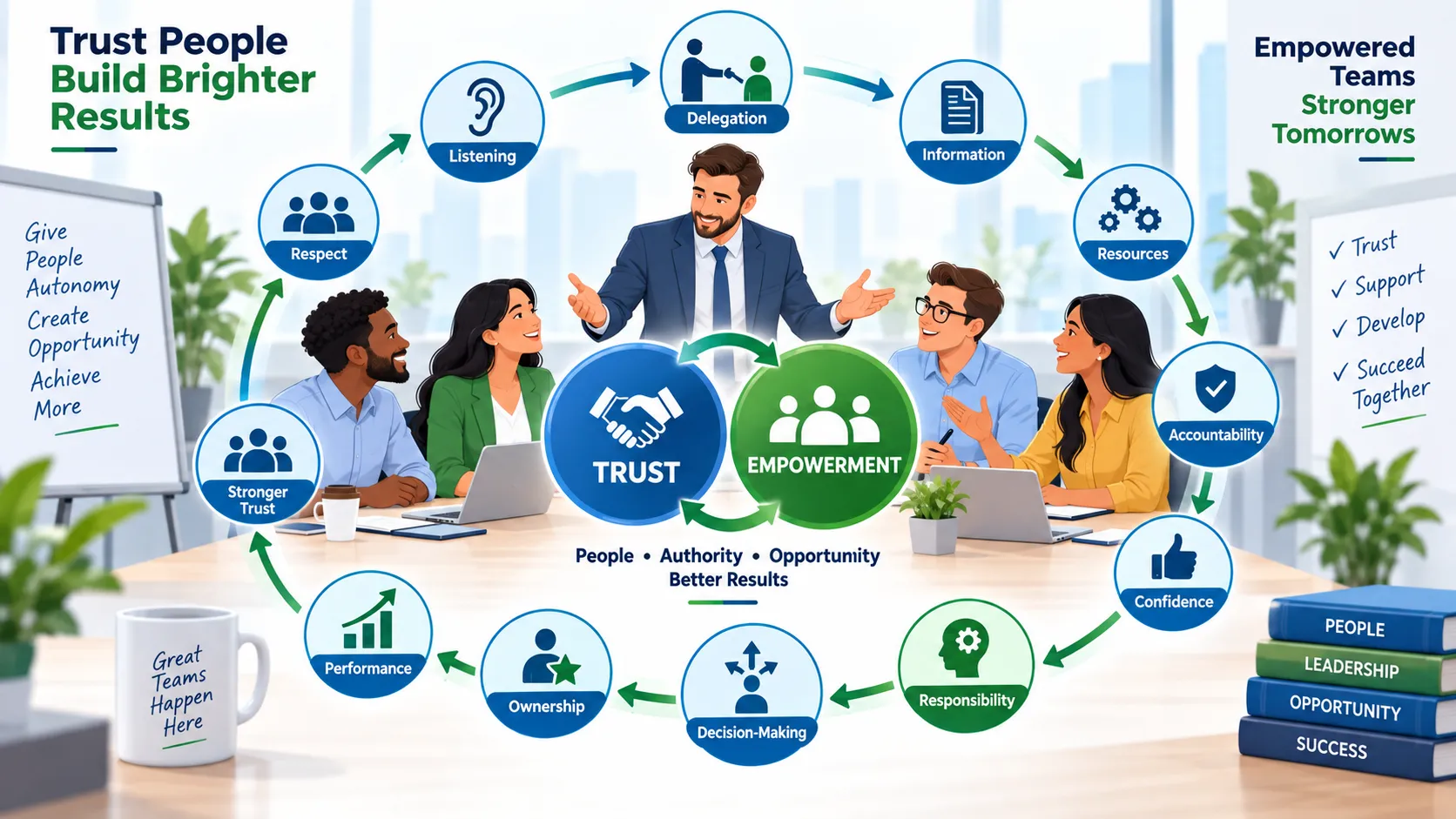
Understanding Empowerment
Definition of Empowerment
Empowerment is the process of enabling employees to take appropriate responsibility, make decisions within agreed boundaries, use their capabilities and contribute actively to organisational objectives.
Empowerment involves more than transferring tasks. It can involve transferring an appropriate combination of:
responsibility;
authority;
decision-making opportunity;
information;
resources;
autonomy;
accountability;
ownership.
An employee cannot be meaningfully empowered if they are given responsibility but lack the authority, resources or information needed to complete the responsibility effectively.
Empowerment as a Leadership Concept
Empowerment reflects a shift from leadership based primarily on control towards leadership that develops employee capability and ownership.
A controlling manager may ask:
“How can I ensure employees follow my instructions?”
An empowering manager is more likely to ask:
“How can I create the conditions for employees to make appropriate decisions and take ownership?”
This does not mean that managerial control disappears. Instead, control becomes more purposeful and proportionate.
The manager establishes:
clear expectations;
boundaries;
standards;
resources;
accountability;
support.
Within these boundaries, employees are given suitable opportunities to exercise judgement.
Understanding Trust
Definition of Trust
Trust in leadership is the confidence that individuals have in the capability, reliability, integrity and intentions of others.
Within a workplace, trust can operate between:
managers and employees;
colleagues;
teams;
departments;
managers and senior leaders;
employees and organisational leadership.
Trust is developed through repeated behaviour rather than through a single management action.
Characteristics of Trustworthy Leadership
Trust can be strengthened when managers demonstrate:
honesty;
consistency;
reliability;
competence;
fairness;
respect;
transparency;
accountability;
confidentiality where appropriate;
willingness to listen.
Employees are more likely to trust managers when what managers say is consistent with what they do.
The Relationship Between Empowerment and Trust
Empowerment and trust are mutually reinforcing.
When managers trust capable employees, they may be more willing to delegate responsibility and provide autonomy. When employees experience appropriate empowerment, they may become more confident and demonstrate greater ownership, which can strengthen managerial trust.
The relationship can be represented as:
Trust → Empowerment → Ownership → Capability → Confidence → Stronger Trust
However, this cycle can also work negatively.
Low trust may lead to:
excessive monitoring;
restricted authority;
limited delegation;
reduced employee autonomy.
This may result in:
employee dependency;
reduced initiative;
lower confidence;
limited development.
The manager may then interpret the lack of initiative as evidence that employees cannot be trusted, reinforcing the original problem.
Effective leadership aims to break this negative cycle.
Why Empowerment Matters in Leading Others
Empowerment can contribute to organisational effectiveness because managers cannot personally make every decision within complex organisations.
Employees often possess detailed knowledge of:
customers;
operational processes;
technical activities;
workplace problems;
service delivery;
stakeholder needs.
Empowering employees appropriately allows organisations to make better use of this knowledge.
Key Benefits of Empowerment
Effective empowerment can support:
greater employee ownership;
improved decision-making;
stronger motivation;
increased confidence;
employee development;
faster responses to routine problems;
greater innovation;
improved teamwork;
stronger accountability;
reduced unnecessary managerial dependency;
improved organisational responsiveness.
Empowerment can also help managers use their own time more effectively because routine decisions can be made at the appropriate organisational level.
Why Trust Matters in Leading Others
Trust influences how employees respond to managers and organisational expectations.
A high-trust environment can encourage employees to:
communicate openly;
raise concerns;
share ideas;
ask for support;
accept responsibility;
collaborate;
provide constructive feedback;
admit mistakes appropriately.
A low-trust environment may encourage employees to:
protect themselves;
avoid responsibility;
withhold information;
avoid taking initiative;
focus on compliance;
conceal mistakes.
Trust is therefore not simply a relationship issue. It can influence organisational performance.
The Dimensions of Empowerment
Responsibility
Employees need to understand what they are responsible for.
Responsibility should be:
clearly defined;
appropriate to capability;
connected to organisational objectives;
supported by relevant resources.
Authority
Responsibility without authority can create frustration.
If an employee is responsible for solving a problem but cannot make the decisions required to solve it, empowerment is incomplete.
Managers should clarify:
what decisions employees can make;
what decisions require approval;
what limits apply;
when escalation is required.
Information
Employees need relevant information to make informed decisions.
Managers should provide appropriate access to:
objectives;
procedures;
performance information;
customer information;
operational data;
organisational expectations.
Resources
Empowerment requires appropriate resources.
Resources may include:
time;
technology;
budget;
people;
information;
equipment;
training.
Capability
Employees need the knowledge and skills required to exercise responsibility.
Managers can support capability through:
coaching;
training;
mentoring;
feedback;
experience;
delegated assignments.
Accountability
Empowerment must include accountability.
Employees should understand:
expected outcomes;
performance standards;
reporting requirements;
review arrangements.
Accountability protects both the employee and the organisation by clarifying expectations.
The Dimensions of Trust
Competence
Managers need confidence that employees have, or can develop, the capability required for a responsibility.
Employees also need confidence in their manager’s competence.
Reliability
Trust increases when managers consistently:
meet commitments;
communicate changes;
follow through on decisions;
apply agreed processes.
Integrity
Integrity involves acting consistently with ethical principles and organisational values.
Managers demonstrate integrity by:
communicating honestly;
avoiding misleading behaviour;
acknowledging mistakes;
applying standards fairly.
Benevolence and Respect
Employees are more likely to trust leaders who demonstrate genuine respect for people.
This can include:
listening;
recognising contribution;
considering employee concerns;
avoiding unnecessary humiliation;
treating employees fairly.
Predictability
Employees need reasonable confidence about how managers will respond to situations.
Unpredictable leadership can create uncertainty and weaken trust.
Empowerment, Trust and Organisational Culture
Organisational culture influences whether empowerment and trust are encouraged or restricted.
A culture based on:
collaboration;
responsibility;
learning;
openness;
respect;
innovation
may provide favourable conditions for empowerment.
A culture characterised by:
excessive control;
fear;
blame;
secrecy;
inconsistent treatment
may make meaningful empowerment more difficult.
Leaders Shape Culture Through Behaviour
Managers reinforce culture through everyday actions.
They demonstrate cultural expectations by:
how they delegate;
how they respond to mistakes;
how they communicate;
how they recognise employees;
how they involve employees;
how they handle disagreement;
how they use authority.
If an organisation claims to value empowerment but managers require approval for every routine decision, employees may receive contradictory messages.
Empowerment and Organisational Values
Values provide principles that can guide empowerment and trust.
For example, if an organisation values accountability, managers should establish clear responsibilities and review arrangements.
If an organisation values respect, managers should allow employees to contribute without dismissing legitimate views.
If an organisation values integrity, managers should communicate honestly about the boundaries of employee decision-making.
If an organisation values collaboration, managers should encourage employees to share knowledge and solve problems collectively.
Values-Based Empowerment
Values-based empowerment involves ensuring that employee autonomy supports the organisation’s ethical and professional expectations.
Managers should therefore ask:
Does this empowerment opportunity support organisational values?
Are employees being treated fairly?
Are decision boundaries clear?
Is authority being exercised responsibly?
Are stakeholders protected?
Does the approach strengthen trust?
Ethical Empowerment
Empowerment Must Be Responsible
Empowerment is not automatically ethical simply because employees are given more freedom.
Managers need to ensure that employees have:
appropriate capability;
sufficient resources;
adequate information;
reasonable authority;
clear expectations;
appropriate support.
Giving responsibility without these conditions can expose employees to unnecessary risk.
Ethical Leadership and Trust
Trust also has an ethical dimension.
Managers should not use employee trust to:
avoid accountability;
transfer inappropriate responsibility;
conceal information;
manipulate employees;
avoid difficult decisions.
Similarly, employees should not be expected to accept decisions simply because they are told to “trust management”.
Trust should be based on credible and consistent behaviour.
Empowerment and Delegation
Relationship Between Delegation and Empowerment
Delegation is one practical mechanism through which empowerment can be developed.
Delegation involves assigning responsibility for an appropriate task or activity while maintaining suitable accountability.
Empowerment is broader because it can involve:
decision-making;
autonomy;
confidence;
ownership;
capability;
participation.
Effective Delegation Process
A manager can use the following process:
Identify an appropriate responsibility.
Determine whether delegation is suitable.
Select an employee according to capability and development needs.
Explain the expected outcome.
Clarify authority.
Establish boundaries.
Provide resources.
Agree timescales.
Establish monitoring arrangements.
Provide appropriate support.
Review progress.
Evaluate the outcome.
Provide constructive feedback.
The objective is to create ownership without abandoning managerial responsibility.
Empowerment and Decision-Making
Empowerment can improve organisational responsiveness by allowing decisions to be made closer to where relevant information exists.
For example, a customer service employee may be empowered to resolve a routine customer issue within a defined financial or procedural limit.
This can:
reduce unnecessary escalation;
improve response speed;
increase employee confidence;
improve customer experience;
reduce managerial workload.
However, managers must establish appropriate boundaries.
Employees should know:
what they can decide;
what they cannot decide;
what information they need;
when escalation is required.
Trust and Decision-Making
Trust influences whether managers are willing to allow employees to make decisions.
A manager with low trust may:
require excessive approval;
review every minor decision;
frequently override employees;
restrict access to information.
A manager with appropriate trust may:
establish decision boundaries;
provide relevant information;
allow employees to exercise judgement;
review outcomes rather than controlling every action.
The objective is not blind trust. It is informed and proportionate trust.
Building Trust Through Communication
Communication is fundamental to trust.
Managers can strengthen trust by:
communicating consistently;
explaining decisions;
admitting when information is incomplete;
listening to employee concerns;
providing timely updates;
avoiding misleading statements;
following through on commitments.
Two-Way Communication
Trust increases when employees can communicate upwards as well as receive information from managers.
Managers should create opportunities for:
questions;
feedback;
challenge;
suggestions;
concerns;
clarification.
An employee who feels safe raising a problem can help an organisation identify risks before they become more serious.
Trust and Psychological Safety
A trusted workplace should enable employees to raise reasonable concerns without fear of unfair treatment.
Managers can support this environment by:
responding calmly to concerns;
separating the issue from the individual;
avoiding unnecessary blame;
encouraging questions;
recognising honest mistakes where appropriate;
taking concerns seriously.
This does not mean removing accountability. Employees remain responsible for their actions, but they should be able to communicate legitimate problems.
Trust and Performance Management
Trust can influence how performance management is experienced.
A low-trust manager may approach performance management primarily through surveillance and control.
A high-trust manager can maintain accountability while using:
clear expectations;
evidence;
constructive feedback;
coaching;
development support;
fair review.
Managers should avoid assuming that trust means ignoring poor performance.
Trust and accountability should operate together.
Empowerment and Employee Development
Empowerment creates opportunities for employees to develop through meaningful responsibility.
Development may occur when employees:
lead projects;
make decisions;
solve problems;
coordinate activities;
mentor colleagues;
contribute to improvement;
manage delegated responsibilities.
Managers can support this process through:
coaching;
feedback;
reflection;
appropriate challenge;
support;
review.
The objective is to gradually increase capability and confidence.
Empowerment and Motivation
Employees may experience greater motivation when they have:
meaningful responsibility;
autonomy;
opportunities to contribute;
recognition;
confidence in their capability.
However, empowerment should be genuine. Giving employees responsibility without meaningful authority can create frustration rather than motivation.
Managers should therefore ensure that empowered employees have sufficient control over the areas for which they are responsible.
Trust and Employee Motivation
Trust can also influence motivation.
Employees who trust their managers may be more willing to:
contribute ideas;
accept responsibility;
engage with change;
collaborate;
communicate concerns.
Conversely, employees who believe managers will unfairly criticise or punish them may become more cautious and less willing to take initiative.
Empowerment and Innovation
Innovation often requires employees to identify problems and propose alternative approaches.
Empowering employees can support innovation by giving them:
appropriate autonomy;
access to information;
opportunities to experiment responsibly;
permission to suggest improvements;
responsibility for projects.
Managers should maintain appropriate controls around:
risk;
quality;
resources;
compliance;
stakeholder impact.
Empowerment should encourage responsible innovation rather than uncontrolled experimentation.
Trust and Innovation
Trust creates conditions in which employees may feel more comfortable suggesting ideas that challenge existing practices.
Managers can support innovation by:
listening to ideas;
asking constructive questions;
avoiding automatic rejection;
recognising useful contributions;
allowing responsible experimentation;
learning from appropriate failures.
This can strengthen a culture of continuous improvement.
Empowerment and Team Leadership
Empowerment should not be limited to individual employees. Teams can also be empowered to:
solve operational problems;
allocate suitable responsibilities;
develop improvement ideas;
coordinate activities;
review processes.
Team empowerment requires clear collective expectations and decision boundaries.
Managers should ensure that:
team responsibilities are understood;
roles are clear;
conflict is addressed;
accountability is maintained;
resources are available.
Trust Within Teams
Team trust involves confidence that colleagues will:
fulfil responsibilities;
communicate openly;
support one another;
act professionally;
respect agreed standards.
Managers can strengthen team trust by establishing:
shared objectives;
clear expectations;
respectful communication;
fair allocation of responsibilities;
constructive conflict management.
Empowerment and Leadership Styles
Different leadership styles influence empowerment in different ways.
Participative Leadership
Participative leadership can support empowerment by involving employees in decisions and encouraging contribution.
Transformational Leadership
Transformational leadership can support empowerment by encouraging employees to take ownership of improvement and shared objectives.
Situational Leadership
Situational leadership can support gradual empowerment by increasing autonomy as capability develops.
Servant-Oriented Leadership
Servant-oriented leadership can support empowerment through employee development, listening and support.
Transactional Leadership
Transactional leadership can provide the structures and accountability within which empowerment operates.
The most effective approach may combine these elements.
The Balance Between Empowerment and Control
A central leadership challenge is determining the appropriate level of control.
Excessive control may lead to:
dependency;
reduced initiative;
frustration;
limited development;
low ownership.
Insufficient control may lead to:
unclear expectations;
inconsistent performance;
increased risk;
weak accountability.
Effective managers aim for appropriate control, where employees have sufficient autonomy while organisational standards remain protected.
The Empowerment Continuum
Managers can think of empowerment as a continuum.
At one end:
Manager decides → Employee follows
In the middle:
Manager consults → Employee contributes
Further along:
Manager delegates → Employee decides within boundaries
At the highest appropriate level:
Employee owns responsibility → Manager provides oversight and support
The appropriate point depends on:
capability;
experience;
task;
risk;
urgency;
organisational requirements.
Building Trust: A Practical Process
Managers can deliberately develop trust through consistent behaviour.
Step 1: Establish Clear Expectations
Employees should understand:
responsibilities;
standards;
objectives;
decision boundaries.
Step 2: Demonstrate Reliability
Managers should:
keep commitments;
communicate changes;
follow through on agreed actions.
Step 3: Demonstrate Competence
Managers should show that they understand their responsibilities and can make informed decisions.
Step 4: Communicate Honestly
Managers should provide accurate information and avoid deliberately misleading employees.
Step 5: Listen
Managers should create opportunities for employees to raise:
concerns;
suggestions;
questions;
challenges.
Step 6: Apply Fairness
Managers should use consistent standards and avoid favouritism.
Step 7: Delegate Appropriately
Trust can be demonstrated by giving capable employees meaningful responsibility.
Step 8: Support Employees
Managers should provide guidance when employees need it rather than withdrawing completely.
Step 9: Hold People Accountable
Trust should coexist with clear performance expectations.
Step 10: Review and Learn
Managers should reflect on whether their behaviour is strengthening or weakening trust.
Building Empowerment: A Practical Process
A structured empowerment process can involve:
Identify an area suitable for employee ownership.
Assess employee capability.
Identify development needs.
Define responsibility.
Define authority.
Provide relevant information.
Provide necessary resources.
Establish boundaries.
Agree performance standards.
Provide support.
Allow appropriate autonomy.
Monitor outcomes.
Provide feedback.
Increase or adjust responsibility as appropriate.
This process allows empowerment to develop progressively.
Practical Example: Empowering a Customer Service Employee
A customer service manager wants to reduce unnecessary escalation of routine customer complaints.
Instead of requiring employees to refer every complaint to management, the manager establishes a defined decision framework.
Employees may resolve suitable issues within agreed limits.
The manager provides:
decision guidelines;
relevant customer information;
authority within defined boundaries;
training;
coaching;
feedback.
The employee gains greater autonomy while the manager retains overall accountability.
The potential benefits include:
faster customer responses;
increased employee confidence;
reduced managerial workload;
stronger employee ownership.
The manager should monitor whether decisions remain consistent with organisational values and service standards.
Practical Example: Trust During Organisational Change
An organisation introduces a new working process.
Employees are concerned about how the change will affect their responsibilities.
A manager could respond by providing a simple instruction and requiring strict compliance.
Alternatively, the manager could:
explain the reason for change;
listen to concerns;
identify employee expertise;
involve employees in implementation;
delegate suitable responsibilities;
provide regular updates;
acknowledge uncertainty honestly.
The second approach is more likely to strengthen trust and encourage ownership.
Practical Example: Developing an Emerging Team Leader
A manager identifies an employee with strong technical capability who needs experience in leadership.
The manager could gradually increase responsibility by asking the employee to:
coordinate a small project;
facilitate a team discussion;
monitor a defined process;
support a colleague;
report on progress.
The manager provides coaching and feedback while increasing autonomy as capability develops.
This approach combines:
trust;
empowerment;
delegation;
coaching;
employee development.
Practical Example: When Empowerment Goes Wrong
A manager assigns an employee responsibility for a complex project but provides no resources, unclear objectives and little authority.
When the project experiences difficulties, the manager criticises the employee for poor performance.
This is not effective empowerment.
The manager has transferred responsibility without providing the conditions required for success.
A better approach would establish:
clear objectives;
decision boundaries;
resources;
support;
performance measures;
review points.
Practical Example: When Trust Is Damaged
A manager promises employees that their suggestions will be considered but repeatedly ignores them without explanation.
Employees may conclude that participation is symbolic rather than genuine.
Trust may decline because there is a gap between the manager’s communication and behaviour.
The manager could rebuild trust by:
explaining decisions;
acknowledging previous communication gaps;
establishing clear participation expectations;
providing feedback on suggestions;
demonstrating consistent follow-through.
Analysing the Benefits of Empowerment and Trust
The combined effect of empowerment and trust can contribute to several organisational outcomes.
Improved Decision-Making
Employees closer to operational activity may possess useful information that improves decisions.
Faster Problem Solving
Empowered employees can resolve appropriate issues without unnecessary escalation.
Greater Employee Ownership
Responsibility and autonomy can encourage employees to take greater ownership of outcomes.
Stronger Employee Development
Meaningful responsibility provides opportunities to develop capability.
Greater Engagement
Employees may become more engaged when they feel trusted and able to contribute.
Stronger Innovation
Trust and empowerment can create conditions for ideas and improvement.
Better Team Relationships
Trust can strengthen communication and collaboration.
Stronger Organisational Culture
Empowering behaviour can reinforce values such as responsibility, collaboration and respect.
More Effective Managers
Managers can focus on higher-priority responsibilities when appropriate decisions are made at team level.
Risks and Limitations of Empowerment
Empowerment is not without risks.
Potential challenges include:
inappropriate decision-making;
insufficient employee capability;
unclear boundaries;
inconsistent standards;
excessive workload;
lack of resources;
confusion about accountability.
Managers can reduce these risks through:
clear expectations;
appropriate selection;
training;
coaching;
defined authority;
monitoring;
feedback.
Risks and Limitations of Trust
Trust can also be damaged when:
managers fail to keep commitments;
information is withheld unnecessarily;
standards are applied inconsistently;
employees experience favouritism;
mistakes are handled unfairly;
communication is misleading.
Trust can also become misplaced if managers assume that trust means ignoring evidence or performance concerns.
Professional trust should be based on behaviour and evidence rather than personal preference alone.
Measuring Empowerment and Trust
Managers should evaluate whether empowerment and trust are producing positive outcomes.
Possible indicators include:
employees making appropriate decisions;
reduced unnecessary escalation;
increased initiative;
improved employee confidence;
stronger engagement;
improved problem solving;
successful delegated projects;
constructive employee feedback;
improved teamwork;
consistent performance.
Qualitative indicators can include whether employees:
raise concerns openly;
suggest improvements;
accept responsibility;
challenge ideas constructively;
communicate problems early.
Reflective Questions for Managers
Managers can assess their own practice by asking:
Do I trust employees according to evidence and capability?
Do I give capable employees enough autonomy?
Do I retain control over decisions unnecessarily?
Do employees understand their decision boundaries?
Do I delegate responsibility effectively?
Do I provide sufficient resources?
Do I support employees when they encounter difficulties?
Do I respond fairly to mistakes?
Do I communicate honestly?
Do I follow through on commitments?
Do my actions reflect organisational values?
Do employees feel able to raise concerns?
Am I developing employee capability?
Is my approach strengthening or weakening trust?
Key Principles for Effective Empowerment and Trust
Managers should apply the following principles when leading others:
Empowerment should be appropriate to capability and context.
Responsibility should be matched with suitable authority.
Employees need information and resources to exercise responsibility effectively.
Empowerment requires clear accountability.
Trust should be based on consistent and credible behaviour.
Trust is developed over time.
Managers should communicate honestly and consistently.
Employees should have opportunities to contribute.
Participation should be genuine and transparent.
Delegation can be used to develop empowerment.
Coaching can increase capability and confidence.
Situational leadership can help managers adjust levels of support and autonomy.
Organisational values should guide empowerment and trust.
Ethical leadership requires responsible use of authority.
Empowerment should not become managerial withdrawal.
Trust should not become the absence of accountability.
Fair differentiation should not become favouritism.
Managers should monitor outcomes without unnecessarily controlling every activity.
Employees should be encouraged to raise legitimate concerns.
Feedback should be used to strengthen leadership practice.
Empowerment and trust should support organisational objectives as well as employee development.
Summary
Empowerment and trust are fundamental concepts in effective leadership because they influence how employees respond to responsibility, authority, decision-making and organisational objectives. Empowerment enables employees to take appropriate ownership, while trust provides the relational foundation that allows managers and employees to work with greater confidence and autonomy.
Effective empowerment requires more than delegating tasks. Employees need appropriate responsibility, authority, information, resources, capability, support and accountability. Managers must establish clear boundaries while allowing employees sufficient autonomy to exercise judgement. When these conditions are present, empowerment can support employee development, motivation, innovation, decision-making, problem solving and organisational performance.
Trust is developed through consistent behaviour. Managers build trust through honesty, reliability, competence, fairness, respect, transparency and accountability. Employees are more likely to take ownership and communicate openly when they believe that their managers will treat them fairly and respond responsibly.
The relationship between empowerment and trust is particularly important. Appropriate trust encourages managers to empower employees, while successful empowerment can strengthen confidence and demonstrate employee capability. This can create a positive cycle of trust, ownership, capability and confidence. Conversely, low trust can encourage excessive managerial control, which may reduce employee initiative and create dependency.
Both concepts are closely connected with organisational culture and values. Managers reinforce culture through their everyday behaviour, including delegation, communication, decision-making, performance management and responses to employee concerns. Where organisational values emphasise respect, collaboration, responsibility and integrity, empowerment and trust should be reflected in management practice.
Ethical leadership provides an essential foundation. Managers should not use empowerment to transfer inappropriate responsibility or avoid accountability. Similarly, trust should not be used to justify a lack of performance management or oversight. Responsible leadership requires an appropriate balance between autonomy and control, confidence and accountability.
Leadership models can also support the development of empowerment and trust. Participative leadership can increase employee involvement, transformational leadership can encourage ownership around shared objectives, situational leadership can adjust support according to capability, servant-oriented leadership can prioritise development and support, while transactional approaches can establish the standards and accountability within which empowerment operates.
For middle managers, the practical challenge is to create an environment where employees are trusted appropriately and empowered responsibly. This requires professional judgement, clear communication, effective delegation, coaching, feedback, monitoring and reflection.
Ultimately, effective leadership does not mean controlling every decision or abandoning control altogether. It means creating the right conditions for people to contribute, develop and take responsibility while maintaining ethical standards, organisational values and accountability. When empowerment and trust are deliberately developed, managers can strengthen employee ownership, organisational capability and the ability of teams to achieve shared objectives effectively and responsibly.
3: Examine Techniques for Creating a Cohesive Team
Introduction
A cohesive team is a group of individuals who work collaboratively towards shared objectives while maintaining constructive relationships, mutual respect, trust and a clear understanding of their responsibilities. Team cohesion does not mean that every employee thinks or behaves in the same way. Effective cohesion allows individuals with different skills, experiences, perspectives and responsibilities to work together productively while remaining aligned with common organisational objectives.
For practising and aspiring middle managers, creating a cohesive team is an important leadership responsibility. Managers frequently need to bring together people with different personalities, professional backgrounds, levels of experience, working preferences and expectations. They must create conditions where employees can communicate effectively, resolve differences constructively, support one another and remain focused on shared outcomes.
Team cohesion is closely connected to the wider principles of leadership explored throughout this unit. Ethical leadership provides the standards for fair and respectful treatment. Organisational culture and values influence how team members are expected to behave. Empowerment allows individuals to take meaningful responsibility. Trust provides the foundation for open communication and collaboration. Leadership styles determine how managers provide direction, involve employees, develop capability and support performance.
A cohesive team is therefore not created simply by placing employees together or organising team-building activities. Cohesion develops through deliberate management and leadership practices. Managers need to establish shared goals, clarify roles, build trust, encourage communication, manage conflict, recognise contribution, support development and create appropriate opportunities for employee participation and empowerment.
Creating team cohesion is also a continuous process. Teams change as employees join, leave, develop new capabilities, take on new responsibilities or respond to organisational change. A leadership approach that is effective at one stage of team development may need to be adapted later. Managers should therefore monitor team relationships and performance and intervene constructively when barriers to cohesion emerge.
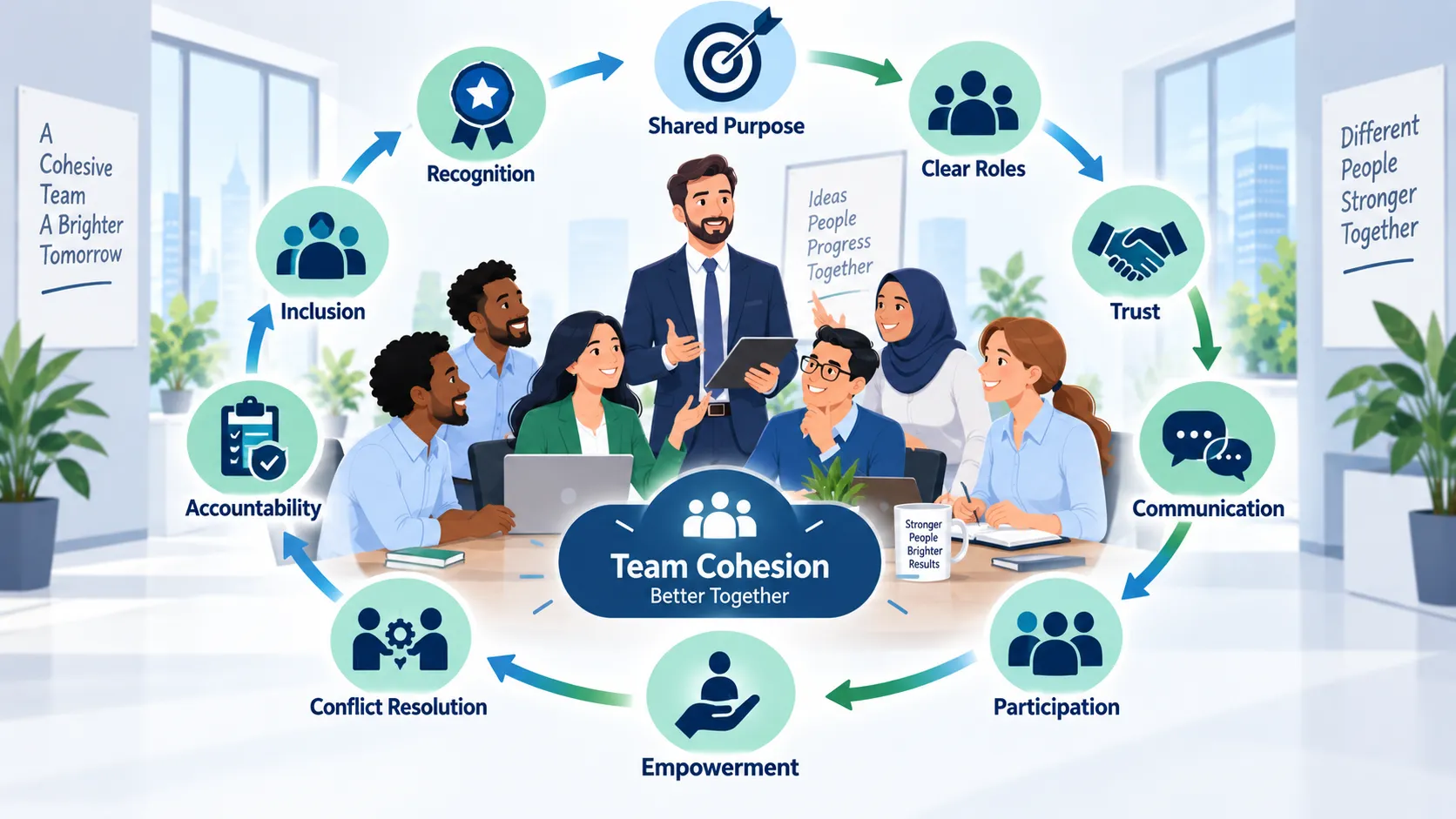
Understanding Team Cohesion
Definition of a Cohesive Team
A cohesive team is a group whose members demonstrate a strong sense of connection, shared purpose, mutual respect and willingness to cooperate while working towards common objectives.
Cohesion is reflected through behaviours such as:
constructive communication;
mutual support;
trust;
shared responsibility;
respect for differences;
collaboration;
reliable performance;
willingness to resolve conflict;
appropriate accountability;
knowledge sharing;
collective problem solving.
A cohesive team does not eliminate disagreement. Healthy disagreement can improve decision-making when team members feel able to challenge ideas respectfully.
Cohesion Versus Uniformity
Managers should distinguish between cohesion and uniformity.
Uniformity means that individuals are expected to think, behave or work in similar ways.
Cohesion means that individuals with differences can work together effectively.
A cohesive team can include:
different professional backgrounds;
different levels of experience;
different perspectives;
different skills;
different working approaches;
different personalities.
The manager’s responsibility is to establish shared standards and objectives while allowing appropriate individual differences.
Why Team Cohesion Matters
Team cohesion can directly influence organisational effectiveness because many organisational objectives depend on coordinated effort.
A cohesive team can support:
stronger communication;
better collaboration;
improved problem solving;
greater employee engagement;
stronger trust;
improved performance;
effective knowledge sharing;
increased accountability;
greater resilience during change;
reduced unnecessary conflict;
employee development;
innovation;
organisational learning.
Poor cohesion can produce:
communication breakdown;
interpersonal conflict;
duplication of work;
inconsistent performance;
employee disengagement;
information withholding;
mistrust;
poor coordination;
reduced productivity.
Managers should therefore treat cohesion as an important part of leadership practice rather than as an optional team-building activity.
The Role of Leadership in Team Cohesion
Leadership provides the behavioural framework within which team cohesion develops.
Managers influence cohesion through:
setting direction;
establishing expectations;
communicating clearly;
modelling organisational values;
demonstrating ethical behaviour;
building trust;
empowering employees;
managing conflict;
recognising contribution;
developing capability.
A manager’s behaviour becomes an important example for team members. If the manager communicates respectfully, listens to different perspectives and applies standards fairly, employees receive a clear model of expected behaviour.
If the manager regularly demonstrates favouritism, dismisses employee concerns or communicates inconsistently, team cohesion may deteriorate.
Establishing a Shared Purpose
Importance of Shared Purpose
A cohesive team needs a clear understanding of what it is collectively trying to achieve.
A shared purpose connects individual responsibilities with team and organisational objectives.
Managers should explain:
what the team is expected to achieve;
why the objective matters;
how the team’s work contributes to organisational priorities;
what successful performance looks like;
how team members depend on one another.
Without shared purpose, employees may focus exclusively on individual tasks.
Creating Team Objectives
Effective team objectives should provide:
clarity;
relevance;
achievable expectations;
measurable outcomes where appropriate;
appropriate timescales;
clear responsibilities.
Managers should ensure that team objectives align with organisational priorities.
For example, if the organisation’s objective is to improve customer satisfaction, a team objective might focus on response quality, service consistency or timely issue resolution.
Clarifying Roles and Responsibilities
Why Role Clarity Matters
Confusion about responsibilities can create tension and reduce cohesion.
Employees need to understand:
their own responsibilities;
their colleagues’ responsibilities;
decision-making boundaries;
reporting relationships;
shared responsibilities;
escalation procedures.
Role clarity reduces:
duplication;
conflict;
uncertainty;
unnecessary dependency;
gaps in responsibility.
Practical Techniques for Role Clarity
Managers can:
provide clear job expectations;
establish team responsibilities;
document key processes;
clarify decision boundaries;
discuss responsibilities during team meetings;
review roles when organisational changes occur.
Role clarity should not prevent collaboration. Employees should still support one another when appropriate.
Building Trust Within the Team
Trust is one of the most important foundations of cohesion.
Team members need confidence that colleagues will:
fulfil agreed responsibilities;
communicate honestly;
respect others;
support team objectives;
raise concerns appropriately;
act professionally.
Managers can build trust by:
keeping commitments;
applying standards consistently;
listening to employees;
responding fairly;
avoiding favouritism;
communicating openly;
acknowledging mistakes;
recognising contribution.
Trust Through Managerial Behaviour
Managers should demonstrate the behaviour they expect from employees.
For example, if the organisation values openness, the manager should be willing to acknowledge uncertainty and invite constructive questions.
If the organisation values accountability, the manager should accept responsibility for their own decisions.
If the organisation values respect, the manager should demonstrate respectful communication during difficult conversations.
Encouraging Open Communication
Communication as a Foundation of Cohesion
Effective communication allows team members to coordinate activities, share information, raise concerns and solve problems.
Managers should establish communication practices that support:
clarity;
consistency;
accessibility;
two-way dialogue;
timely information;
appropriate feedback.
Two-Way Communication
Managers should not treat team communication as a one-way process.
Effective two-way communication allows employees to:
ask questions;
provide suggestions;
raise concerns;
identify risks;
challenge assumptions;
share operational knowledge.
Managers should listen actively and avoid dismissing concerns simply because they challenge established practices.
Active Listening
Active listening is a practical leadership technique for strengthening team relationships.
It involves:
giving the speaker appropriate attention;
avoiding unnecessary interruption;
asking clarifying questions;
summarising understanding;
acknowledging relevant concerns;
responding constructively.
Active listening can help managers identify:
misunderstandings;
employee concerns;
conflict;
process problems;
development needs;
improvement opportunities.
Creating Psychological Safety Through Leadership Behaviour
A cohesive team should allow employees to raise legitimate concerns and contribute ideas without fear of unfair treatment.
Managers can encourage this by:
responding calmly to concerns;
separating people from problems;
encouraging respectful challenge;
recognising useful questions;
avoiding unnecessary blame;
treating mistakes as learning opportunities where appropriate.
Psychological safety does not remove accountability. Employees remain responsible for their actions and performance. It creates an environment in which legitimate communication and learning can take place.
Encouraging Participation
Participation can strengthen cohesion because employees are more likely to feel connected to decisions when they have appropriate opportunities to contribute.
Managers can use:
team discussions;
structured consultation;
improvement meetings;
problem-solving sessions;
feedback activities;
project groups.
Participation should be appropriate to the decision.
Managers should clearly communicate:
what employees can influence;
what has already been decided;
what constraints exist;
how contributions will be considered.
This protects trust by preventing participation from becoming symbolic.
Empowering Team Members
Empowerment and Cohesion
Empowerment can strengthen cohesion by encouraging team members to take ownership of shared outcomes.
Managers can empower employees through:
delegated responsibilities;
appropriate decision-making authority;
access to information;
resources;
coaching;
support;
opportunities to lead activities.
Empowerment can also encourage employees to support one another rather than relying exclusively on the manager.
Team Empowerment
A manager might empower a team to:
identify process improvements;
allocate appropriate tasks;
resolve routine operational issues;
develop solutions;
coordinate a project;
review performance information.
The manager remains accountable for appropriate oversight.
Delegation as a Team-Building Technique
Delegation can support cohesion when responsibilities are allocated transparently and according to capability.
Effective delegation can:
develop trust;
increase employee capability;
create shared responsibility;
improve workload distribution;
encourage collaboration;
develop leadership potential.
Managers should avoid consistently delegating important opportunities to the same individuals, as this can create perceptions of favouritism.
Effective Delegation Process
A manager should:
Identify the responsibility.
Consider whether delegation is appropriate.
Identify suitable team members.
Assess capability.
Clarify the desired outcome.
Define authority.
Provide resources.
Agree timescales.
Establish accountability.
Provide support.
Review progress.
Provide feedback.
Recognising Individual Strengths
Cohesive teams benefit when managers understand and use the strengths of team members.
Strengths may include:
technical expertise;
communication;
problem solving;
organisation;
creativity;
customer service;
analytical ability;
mentoring capability;
project coordination.
Managers can use strengths by:
assigning suitable responsibilities;
creating opportunities for knowledge sharing;
pairing complementary skills;
involving specialists in relevant decisions;
recognising contribution.
Managers should avoid labelling employees permanently. Capability can develop and may vary according to the task.
Developing Team Capability
Team cohesion improves when members have the skills required to contribute effectively.
Managers can support capability through:
coaching;
feedback;
mentoring;
training;
knowledge sharing;
peer learning;
delegated responsibilities;
project opportunities.
Peer Learning
Peer learning can strengthen both capability and relationships.
Employees can:
share knowledge;
demonstrate processes;
support new colleagues;
review solutions;
exchange practical experience.
This can create a culture in which expertise is shared rather than protected.
Managing Differences Within Teams
Teams naturally contain differences.
Differences may relate to:
experience;
expertise;
communication preferences;
working approaches;
confidence;
problem-solving methods.
Managers should not attempt to remove all differences. Instead, they should establish common expectations while creating respectful conditions for different perspectives.
Benefits of Constructive Difference
Diverse perspectives can support:
better problem solving;
improved decision-making;
innovation;
identification of risks;
broader understanding of stakeholders.
Cohesion should therefore involve managing differences constructively rather than eliminating them.
Managing Conflict Constructively
Understanding Team Conflict
Conflict can arise because of:
competing priorities;
unclear responsibilities;
communication problems;
resource constraints;
interpersonal differences;
disagreements about decisions;
perceived unfairness.
Conflict is not always negative. Constructive disagreement can help teams examine assumptions and identify better solutions.
Destructive Conflict
Conflict becomes problematic when it involves:
personal attacks;
disrespect;
repeated hostility;
information withholding;
avoidance;
undermining colleagues.
Managers should intervene when conflict begins to damage team functioning.
Conflict Management Process
A manager can:
Identify the issue.
Gather relevant information.
Listen to the people involved.
Separate facts from assumptions.
Identify underlying causes.
Review organisational expectations.
Encourage respectful discussion.
Agree practical actions.
Clarify responsibilities.
Monitor the situation.
Review whether relationships and performance improve.
Managers should remain impartial and avoid automatically taking sides.
Fairness and Consistency
Fairness is fundamental to team cohesion.
Employees need confidence that:
standards are applied consistently;
opportunities are allocated fairly;
concerns are heard;
performance is assessed objectively;
recognition is not based on favouritism.
Fairness does not necessarily mean treating everyone identically.
For example, a new employee may require more coaching than an experienced employee. This can be fair because support is being matched to capability.
Managers should be able to explain reasonable differences in support, responsibility and opportunity.
Recognition and Appreciation
Recognition can strengthen cohesion by demonstrating that contribution is noticed and valued.
Managers can recognise:
individual achievement;
teamwork;
problem solving;
support for colleagues;
innovation;
responsible behaviour;
progress.
Recognition should be:
genuine;
timely;
relevant;
fair;
connected to meaningful contribution.
Managers should also recognise collective achievement rather than focusing exclusively on high-profile individuals.
Feedback as a Cohesion Technique
Constructive feedback helps teams understand what is working and what needs improvement.
Effective feedback should be:
specific;
timely;
respectful;
evidence-based;
focused on behaviour and outcomes;
linked to expectations;
accompanied by appropriate support.
Managers should also create opportunities for employees to provide feedback to one another and to management.
Team Meetings as a Cohesion Technique
Well-designed team meetings can support:
information sharing;
problem solving;
coordination;
participation;
relationship building;
accountability.
Effective meetings should have:
a clear purpose;
relevant agenda;
appropriate participation;
clear decisions;
agreed actions;
follow-up.
Managers should avoid meetings that become purely information broadcasts when discussion is required.
Shared Problem Solving
Shared problem solving can strengthen team cohesion by encouraging employees to work together rather than compete for individual recognition.
A manager can facilitate a structured process:
Define the problem.
Gather relevant information.
Invite different perspectives.
Identify possible causes.
Generate potential solutions.
Evaluate options.
Agree an appropriate action.
Allocate responsibilities.
Monitor results.
Review learning.
This process supports participation and empowerment.
Establishing Team Norms
Definition of Team Norms
Team norms are shared expectations about how team members should behave and work together.
Norms may address:
communication;
meetings;
deadlines;
respectful behaviour;
information sharing;
decision-making;
conflict;
support;
accountability.
Managers should encourage teams to establish norms that are consistent with organisational culture and values.
Examples of Positive Team Norms
A team might agree to:
listen without unnecessary interruption;
challenge ideas respectfully;
communicate problems early;
meet agreed deadlines;
share relevant information;
support colleagues during pressure;
take responsibility for mistakes;
respect confidentiality.
These behaviours can strengthen trust and cohesion.
Leading by Example
One of the strongest techniques for creating cohesion is modelling the behaviour expected from others.
Managers should demonstrate:
respect;
integrity;
accountability;
fairness;
openness;
reliability;
collaboration.
If a manager expects employees to communicate respectfully but regularly interrupts or dismisses them, the manager weakens the credibility of the expectation.
Leadership behaviour therefore provides a practical demonstration of organisational culture and values.
Ethical Leadership and Team Cohesion
Ethical leadership is fundamental to sustainable team cohesion.
Managers should ensure that team practices are based on:
fairness;
respect;
honesty;
integrity;
accountability;
responsible use of authority.
Ethical leadership influences how managers handle:
performance problems;
disagreements;
recognition;
delegation;
employee concerns;
access to opportunities.
Ethical Decision-Making in Teams
When making decisions affecting team members, managers should consider:
relevant evidence;
organisational values;
fairness;
employee impact;
stakeholder impact;
confidentiality;
consistency;
accountability.
This helps managers avoid decisions based solely on personal preference.
Organisational Culture and Team Cohesion
Culture as a Context
Team cohesion does not develop independently of organisational culture.
A culture that values:
collaboration;
trust;
respect;
inclusion;
learning;
responsibility
can support cohesion.
A culture characterised by:
excessive competition;
fear;
blame;
secrecy;
inconsistent treatment
can make cohesion more difficult.
Middle Managers as Culture Carriers
Middle managers are often the people through whom employees experience organisational culture.
Managers reinforce culture through:
daily communication;
performance management;
delegation;
decision-making;
recognition;
conflict management;
empowerment.
Supporting Team Cohesion During Change
Change can temporarily weaken cohesion because employees may experience uncertainty.
Managers can support cohesion by:
communicating clearly;
explaining the reason for change;
acknowledging uncertainty;
involving employees appropriately;
providing support;
clarifying new responsibilities;
maintaining consistent values;
recognising concerns;
monitoring team relationships.
Change and Trust
Trust is especially important during change.
Employees may ask:
What will happen to my role?
Why is this change necessary?
Will workload change?
Will expectations change?
Can I raise concerns?
Managers should answer honestly and avoid providing false certainty.
Remote and Distributed Team Cohesion
Where teams work across different locations or communication channels, cohesion can require additional deliberate effort.
Managers may need to establish:
clear communication expectations;
regular team contact;
shared information systems;
clear responsibilities;
appropriate meeting routines;
opportunities for relationship building;
accessible support.
The fundamental principles remain the same: trust, clarity, communication, shared purpose and accountability.
Supporting New Team Members
New employees may require deliberate support to become integrated into the team.
Managers can:
introduce them to colleagues;
explain team objectives;
clarify responsibilities;
provide a suitable induction;
identify a peer support contact;
schedule early check-ins;
provide feedback;
encourage participation.
Existing team members can also play a role in welcoming new colleagues.
Handling Underperformance Without Damaging Cohesion
Underperformance can affect team relationships if other employees believe standards are being applied inconsistently.
Managers should address underperformance through:
clear expectations;
evidence;
respectful communication;
appropriate support;
coaching;
fair procedures;
monitoring.
Managers should avoid discussing confidential performance issues publicly.
This helps maintain both accountability and dignity.
Preventing Favouritism
Perceived favouritism can seriously damage cohesion.
Managers should ensure that opportunities such as:
project leadership;
development;
recognition;
responsibility;
flexible arrangements where applicable
are allocated according to reasonable and transparent criteria.
Managers should be prepared to explain decisions when appropriate.
Building Cohesion Through Shared Accountability
A cohesive team understands that individual actions can affect collective outcomes.
Managers can create shared accountability by:
establishing team objectives;
defining individual contributions;
reviewing collective performance;
recognising teamwork;
discussing interdependencies;
encouraging mutual support.
Shared accountability should not mean that individuals lose responsibility for their own performance.
Developing Collective Ownership
Collective ownership occurs when team members see organisational outcomes as a shared responsibility.
Managers can encourage this by:
communicating shared objectives;
involving employees in problem solving;
sharing relevant performance information;
delegating team responsibilities;
recognising collective achievements;
encouraging employees to support one another.
Creating Opportunities for Team Leadership
Team cohesion can be strengthened when employees have opportunities to lead activities.
Managers might allow employees to:
facilitate meetings;
lead improvement projects;
coordinate tasks;
mentor colleagues;
present ideas;
manage defined responsibilities.
This supports:
empowerment;
confidence;
capability;
trust;
shared responsibility.
Evaluating Team Cohesion
Managers should regularly evaluate whether their techniques are working.
Indicators of stronger cohesion may include:
improved communication;
greater collaboration;
employees helping colleagues;
constructive disagreement;
appropriate information sharing;
increased ownership;
stronger trust;
reduced unnecessary conflict;
improved team performance.
Indicators of weaker cohesion may include:
repeated interpersonal conflict;
information withholding;
poor communication;
silo behaviour;
blame;
employee disengagement;
excessive dependence on the manager.
A Practical Team Cohesion Development Process
Managers can use a structured process to develop cohesion.
Step 1: Assess the Current Team
Identify:
strengths;
weaknesses;
relationships;
capability;
communication patterns;
existing conflict.
Step 2: Clarify the Shared Purpose
Explain:
team objectives;
organisational priorities;
expected outcomes.
Step 3: Clarify Roles
Establish:
individual responsibilities;
shared responsibilities;
decision boundaries.
Step 4: Establish Behavioural Expectations
Agree standards for:
communication;
respect;
accountability;
collaboration.
Step 5: Build Trust
Demonstrate:
consistency;
fairness;
reliability;
integrity.
Step 6: Encourage Participation
Provide opportunities for:
ideas;
feedback;
discussion;
problem solving.
Step 7: Empower Employees
Provide:
appropriate responsibility;
authority;
information;
resources.
Step 8: Develop Capability
Use:
coaching;
feedback;
peer learning;
delegated responsibilities.
Step 9: Manage Conflict
Address issues early through:
listening;
impartiality;
constructive dialogue;
agreed actions.
Step 10: Recognise Contribution
Recognise:
individual achievement;
teamwork;
improvement;
responsible behaviour.
Step 11: Monitor Team Performance
Review:
outcomes;
relationships;
communication;
engagement;
collaboration.
Step 12: Adapt Leadership
Change the level of direction, support, participation or autonomy when circumstances require it.
Key Techniques for Creating a Cohesive Team
Managers can use a combination of techniques rather than relying on one method.
Shared Objectives
Establish clear team goals.
Connect team objectives with organisational priorities.
Explain why objectives matter.
Review objectives regularly.
Clear Roles
Define responsibilities.
Clarify decision boundaries.
Identify interdependencies.
Review responsibilities after change.
Trust Building
Keep commitments.
Communicate honestly.
Apply standards fairly.
Demonstrate reliability.
Communication
Encourage two-way dialogue.
Listen actively.
Share relevant information.
Address misunderstandings quickly.
Participation
Consult employees appropriately.
Encourage ideas.
Involve employees in problem solving.
Explain decision boundaries.
Empowerment
Delegate appropriate responsibility.
Provide authority.
Provide resources.
Encourage ownership.
Development
Coach employees.
Provide feedback.
Support peer learning.
Create development responsibilities.
Recognition
Recognise achievement.
Acknowledge teamwork.
Reinforce positive behaviours.
Avoid favouritism.
Conflict Management
Address conflict early.
Listen to different perspectives.
Focus on issues rather than personalities.
Agree practical actions.
Ethical Leadership
Demonstrate fairness.
Respect employee dignity.
Use authority responsibly.
Consider stakeholder impact.
Key Benefits of a Cohesive Team
Effective team cohesion can contribute to:
improved communication;
stronger trust;
better collaboration;
improved employee engagement;
greater employee ownership;
stronger problem solving;
improved decision-making;
greater knowledge sharing;
increased innovation;
reduced unnecessary conflict;
stronger accountability;
improved performance;
better adaptation to change;
stronger organisational culture;
improved employee development.
Practical Example: Creating Cohesion in a Customer Service Team
A customer service department has experienced declining performance and increased tension between team members.
The middle manager begins by reviewing team objectives and identifying the causes of the problem.
The manager discovers:
unclear responsibilities;
inconsistent communication;
limited information sharing;
perceptions of unequal workload;
insufficient feedback.
The manager then introduces a cohesion-building approach.
First, team objectives are clarified. Employees understand the relationship between their work and customer satisfaction.
Second, responsibilities are reviewed so that employees understand who is responsible for specific activities.
Third, regular team meetings are introduced to encourage information sharing and problem solving.
Fourth, employees are given opportunities to identify process improvements.
Fifth, experienced employees are empowered to support colleagues with complex customer issues.
Sixth, the manager introduces more consistent feedback and recognition.
Finally, the manager monitors both customer service performance and team relationships.
The approach combines management structure with leadership techniques.
Practical Example: Building Cohesion After Organisational Restructuring
A department has recently been reorganised. Employees now have new responsibilities and are uncertain about how their roles interact.
The manager recognises that uncertainty could create tension.
The manager therefore:
explains the purpose of the restructure;
clarifies responsibilities;
identifies shared objectives;
establishes communication routines;
invites questions;
encourages collaboration;
provides coaching;
delegates appropriate responsibilities.
The manager also monitors employee concerns and adjusts support where necessary.
This approach can help rebuild trust and establish a new team identity.
Practical Example: Resolving Conflict Between Team Members
Two employees disagree about responsibility for a recurring task.
Instead of immediately assigning blame, the manager meets with each employee and gathers information.
The manager identifies that the conflict has developed because responsibilities were never clearly defined.
The manager then:
clarifies the responsibility;
listens to both employees;
establishes a shared expectation;
encourages respectful communication;
monitors future interactions.
The manager also reviews whether other responsibilities are unclear.
This addresses the underlying organisational issue rather than simply treating the disagreement as an interpersonal problem.
Practical Example: Empowering a Team to Improve a Process
A team repeatedly experiences delays in a routine process.
The manager could personally redesign the process.
Instead, the manager establishes a structured improvement project and empowers team members to investigate the problem.
The manager provides:
access to relevant information;
a defined project scope;
decision-making boundaries;
appropriate resources;
review points.
Team members identify unnecessary steps and propose improvements.
The manager reviews the recommendations and supports implementation.
This approach develops:
empowerment;
teamwork;
ownership;
problem-solving capability;
trust.
Practical Example: Developing a Cohesive Team Through Coaching
A team contains several employees with strong technical skills but limited confidence in collaborative problem solving.
The manager uses coaching techniques by:
asking open questions;
encouraging employees to explain their reasoning;
supporting reflection;
providing constructive feedback;
gradually increasing responsibility.
Employees begin to rely less on the manager and more on one another.
This demonstrates how coaching can contribute to both capability and cohesion.
Practical Example: Maintaining Cohesion During High Pressure
A team faces an unusually demanding period.
The manager needs to maintain performance without creating unnecessary stress or conflict.
The manager:
clarifies priorities;
allocates responsibilities fairly;
communicates regularly;
identifies workload pressures;
encourages employees to support one another;
recognises effort;
remains available for concerns;
monitors performance.
The manager may temporarily provide greater direction because the situation requires coordination, while still maintaining respectful communication and appropriate empowerment.
Practical Example: Cohesion and Organisational Values
An organisation states that respect, collaboration and accountability are core values.
A team member repeatedly dismisses colleagues’ views during meetings.
The manager addresses the behaviour directly and explains how respectful participation supports team effectiveness and organisational values.
The manager also reinforces positive examples of collaboration.
This demonstrates that values need to be translated into observable behaviour.
Barriers to Team Cohesion
Managers should recognise common barriers.
Poor Communication
Information may not reach the people who need it.
Unclear Roles
Employees may disagree about responsibility.
Lack of Trust
Employees may withhold information or avoid responsibility.
Excessive Competition
Employees may prioritise personal outcomes over team success.
Inconsistent Management
Different employees may experience different standards without clear justification.
Poor Conflict Management
Small disagreements may develop into larger relationship problems.
Lack of Empowerment
Employees may become dependent on managerial approval.
Inadequate Resources
Employees may struggle to cooperate effectively when resources are insufficient.
Poor Leadership Behaviour
Managers can undermine cohesion through:
favouritism;
inconsistent communication;
excessive control;
disrespect;
failure to listen.
Overcoming Barriers to Cohesion
Managers can address barriers by:
clarifying expectations;
improving communication;
establishing team norms;
strengthening trust;
addressing conflict early;
reviewing workloads;
delegating appropriately;
providing coaching;
reinforcing organisational values;
applying standards fairly.
Leadership Style and Team Cohesion
Different leadership styles can influence team cohesion in different ways.
Participative Leadership
Can support:
involvement;
ownership;
communication;
trust.
Transformational Leadership
Can support:
shared purpose;
motivation;
change;
innovation.
Situational Leadership
Can support:
appropriate direction;
employee development;
adaptive support;
empowerment.
Servant-Oriented Leadership
Can support:
employee development;
listening;
trust;
support.
Transactional Leadership
Can support:
clarity;
accountability;
performance expectations.
Managers should evaluate which approach is appropriate rather than assuming that one style will always create cohesion.
Maintaining Cohesion Over Time
Team cohesion requires continuous attention.
Managers should regularly:
review team objectives;
assess relationships;
gather feedback;
recognise achievement;
address conflict;
develop employees;
review responsibilities;
monitor performance;
adapt leadership behaviour.
Team cohesion can weaken when:
new employees join;
experienced employees leave;
organisational structures change;
workloads increase;
objectives change;
external pressures increase.
Managers should therefore treat cohesion as an ongoing leadership responsibility.
Reflective Practice for Managers
Managers should regularly ask:
Do team members understand our shared objectives?
Are responsibilities clear?
Do employees trust one another?
Do employees trust me as their manager?
Can employees raise concerns?
Are differences handled respectfully?
Is conflict addressed early?
Are employees appropriately empowered?
Do I delegate fairly?
Do I recognise team contribution?
Am I modelling organisational values?
Is my leadership style appropriate for the team’s current needs?
Are performance expectations clear?
Does the team have the resources required?
What evidence shows that team cohesion is improving?
Key Learning Points
The creation of a cohesive team depends on deliberate and consistent leadership practice.
Key principles include:
A cohesive team works towards shared objectives while maintaining constructive relationships.
Cohesion does not require employees to be identical.
Shared purpose provides direction and connection.
Clear roles reduce uncertainty and unnecessary conflict.
Trust is a fundamental foundation of teamwork.
Managers build trust through reliable, fair and ethical behaviour.
Two-way communication strengthens team relationships.
Active listening helps managers understand concerns and perspectives.
Participation can increase ownership when it is genuine and transparent.
Empowerment gives employees appropriate responsibility and autonomy.
Delegation can support capability and team ownership.
Coaching can strengthen confidence and collaboration.
Recognition can reinforce constructive team behaviour.
Feedback supports continuous improvement.
Constructive conflict can improve decision-making.
Destructive conflict should be addressed promptly.
Fairness is essential to team cohesion.
Fair treatment does not always mean identical treatment.
Organisational culture influences team behaviour.
Managers reinforce organisational values through everyday actions.
Ethical leadership supports respectful and responsible teamwork.
Team cohesion should be maintained during organisational change.
Leadership style should be adapted to team capability and circumstances.
Shared accountability should operate alongside individual responsibility.
Team cohesion requires continuous monitoring and development.
Effective middle managers balance direction, support, participation, empowerment and accountability.
Summary
Creating a cohesive team is a central responsibility of effective leadership. A cohesive team is not simply a group of people who work together; it is a group that understands its shared purpose, communicates effectively, trusts one another, respects differences and accepts appropriate responsibility for collective outcomes.
Managers create cohesion through a combination of practical techniques. Establishing shared objectives gives the team direction. Clarifying roles reduces uncertainty. Communication allows information and concerns to move effectively across the team. Trust creates the confidence required for employees to contribute and take responsibility. Participation gives employees appropriate opportunities to influence decisions, while empowerment enables them to exercise responsibility within defined boundaries.
Delegation and coaching can strengthen capability and confidence. Recognition reinforces constructive behaviour, while feedback supports learning and performance improvement. Conflict should be addressed constructively because unresolved disagreement can damage trust and collaboration. At the same time, managers should recognise that disagreement itself is not necessarily negative. Respectful challenge can improve decisions and encourage critical thinking.
Ethical leadership is central to cohesion. Managers should demonstrate fairness, integrity, respect and responsible use of authority. Employees are more likely to trust leaders who apply standards consistently, communicate honestly and take responsibility for their decisions. Organisational values should be translated into observable workplace behaviour rather than remaining statements in organisational documents.
Leadership style also affects team cohesion. Participative leadership may strengthen involvement and ownership, transformational leadership may create shared purpose, situational leadership can adapt support to capability, servant-oriented leadership can strengthen development and trust, while transactional leadership can establish clarity and accountability. Effective managers should select and adapt approaches according to the circumstances rather than relying on one style.
For middle managers, creating cohesion also requires balancing individual and collective needs. Employees have different capabilities, experiences and working preferences, but they need shared expectations and objectives. Fairness should therefore be distinguished from identical treatment. Providing different levels of support according to capability can be appropriate when standards remain consistent and decisions are reasonable and transparent.
Ultimately, team cohesion is a continuous leadership process. Managers need to assess team relationships, communicate purpose, clarify responsibilities, build trust, empower employees, develop capability, recognise contribution, manage conflict and review outcomes. When these techniques are applied consistently and ethically, managers can create teams that are more collaborative, accountable, adaptable and capable of contributing effectively to organisational objectives.
A cohesive team therefore reflects the wider principles of this unit: ethical leadership, alignment with organisational culture and values, appropriate leadership approaches, empowerment, trust and practical techniques for leading others. The manager’s role is to create the conditions in which individuals can contribute their strengths while working together towards shared organisational success.
4: Assess the Need to Adapt Leadership Approaches to Meet Changing Needs
Introduction
Effective leadership is not based on using one leadership approach consistently in every situation. Organisations operate in environments characterised by changing priorities, workforce expectations, technologies, customer requirements, regulations, competitive pressures and economic conditions. Teams also change as employees gain experience, new people join, responsibilities develop and levels of confidence and capability increase. Consequently, leaders need to assess whether their existing leadership approach remains appropriate and adapt it when circumstances require a different response.
For middle managers, the ability to adapt leadership approaches is particularly important. Middle managers operate between organisational strategy and day-to-day operational delivery. They are expected to translate organisational objectives into practical action while responding to the changing needs of employees and teams. This requires managers to understand when employees need greater direction, when they need support and coaching, when they can be empowered to make decisions, and when stronger coordination or accountability is required.
Adapting leadership does not mean abandoning consistency. Effective adaptation maintains consistent ethical standards, organisational values, accountability and expectations while changing the way leadership is applied. A manager may therefore maintain the same commitment to fairness and respect while changing their communication method, decision-making approach or level of employee autonomy.
The central principle is that leadership should be appropriate to the circumstances. A newly established team may require clear direction and close support, whereas an experienced team may perform more effectively when given greater autonomy. During organisational change, employees may require increased communication and reassurance. During routine operations, the same employees may benefit from greater empowerment. A high-risk situation may require decisive leadership, while a complex improvement project may benefit from participative decision-making.
Assessing the need to adapt leadership approaches therefore involves understanding the current situation, identifying changing needs, evaluating the effectiveness of the existing approach, selecting an appropriate response and reviewing the resulting impact.
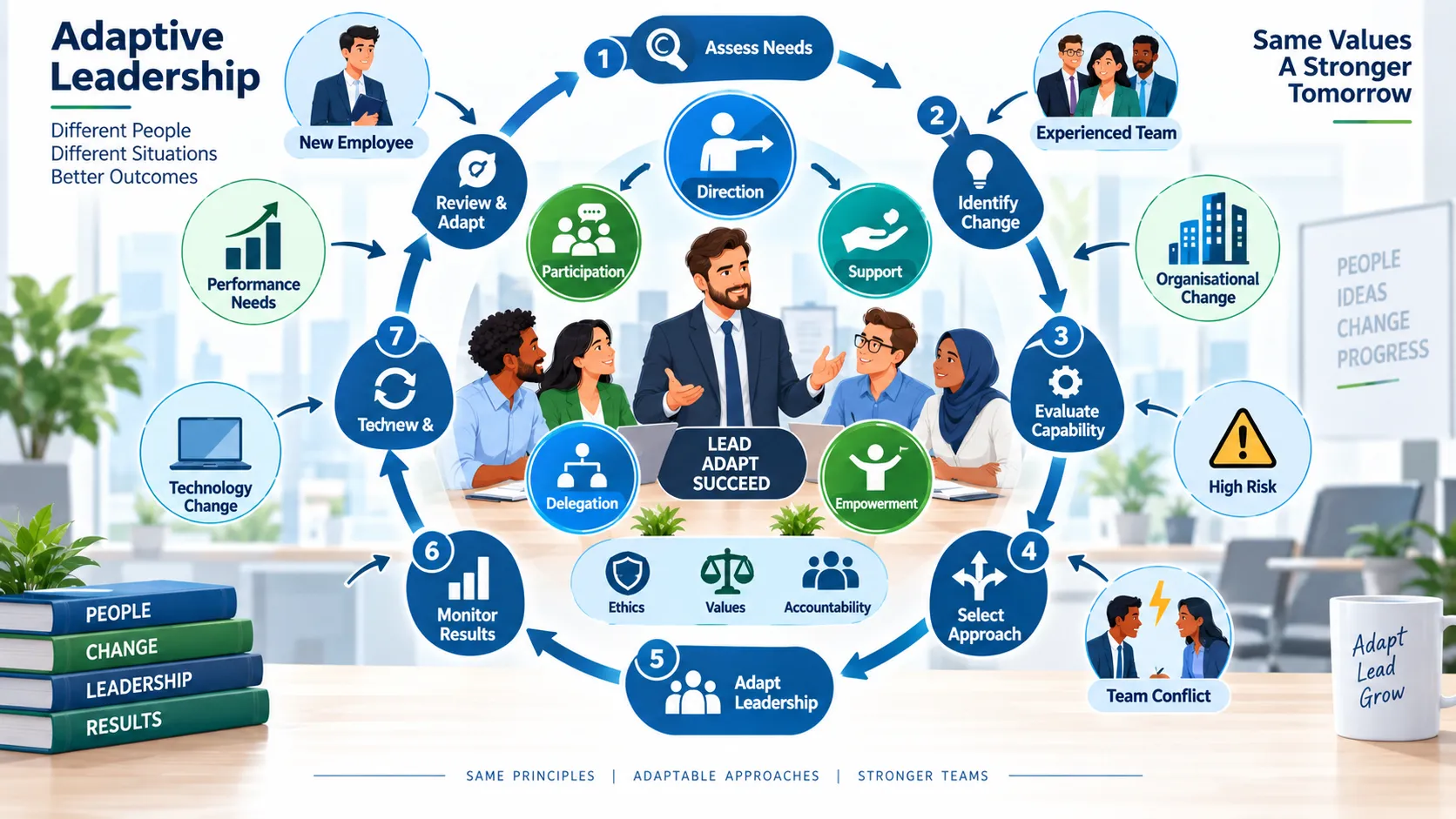
Understanding Adaptive Leadership Approaches
Definition of Leadership Adaptation
Leadership adaptation is the deliberate adjustment of a leader’s behaviour, communication, decision-making, level of direction, support, delegation or empowerment in response to changing circumstances and the needs of individuals, teams or organisations.
Adaptation may involve changing:
the level of managerial direction;
the amount of employee autonomy;
communication methods;
decision-making processes;
coaching and support;
delegation;
performance management;
team involvement;
conflict-management techniques;
change-management practices.
The purpose is not simply to change leadership behaviour for the sake of change. The purpose is to improve leadership effectiveness and ensure that the approach remains suitable for current needs.
Adaptation Versus Inconsistency
Managers should distinguish between appropriate adaptation and inconsistent management.
Appropriate adaptation means:
responding to genuine changes;
maintaining ethical standards;
explaining significant changes;
applying reasonable and fair expectations;
matching support to employee capability;
adjusting leadership according to risk and circumstances.
Inconsistency may involve:
changing expectations without explanation;
treating similar situations unfairly;
applying rules selectively;
changing decisions according to personal preference;
providing different opportunities without reasonable justification.
Effective leaders therefore adapt their approach while maintaining consistency in values, integrity, fairness and accountability.
Why Leadership Approaches Need to Change
Leadership approaches may need to change because organisational and human needs are not static.
Changes can occur in:
organisational strategy;
team composition;
employee capability;
employee expectations;
technology;
customer requirements;
operational risk;
market conditions;
organisational structure;
regulatory requirements;
workload;
organisational culture;
organisational values;
business priorities.
A leadership approach that worked effectively six months ago may not be equally effective after a major organisational change.
Changing Organisational Objectives
When organisational priorities change, managers may need to adjust how they lead their teams.
For example, an organisation may move from a period focused on stability to a period focused on innovation.
During stability, the manager may emphasise:
consistency;
process compliance;
efficiency;
quality control.
During innovation, the manager may need to emphasise:
experimentation;
creativity;
employee participation;
learning;
calculated risk-taking.
The underlying organisational values may remain unchanged, but leadership behaviours may need to adapt.
Assessing Changing Needs
Definition of Needs Assessment
A leadership needs assessment is a structured process of identifying changes in people, teams, tasks or organisational circumstances that may require an adjustment in leadership behaviour.
Managers should consider both internal and external factors.
Internal Factors
Internal factors may include:
employee capability;
team morale;
workload;
performance;
team relationships;
organisational restructuring;
changes in processes;
new technology;
employee turnover;
leadership changes.
External Factors
External factors may include:
customer expectations;
competitive pressures;
economic conditions;
technological developments;
regulatory changes;
industry trends;
supply-chain disruption;
changing stakeholder expectations.
Managers should avoid changing leadership approaches simply because external conditions have changed. They should assess whether the change actually affects the team’s needs.
Key Factors to Consider When Adapting Leadership
| Changing need or circumstance | Leadership response that may be appropriate | Key consideration |
|---|---|---|
| New or inexperienced employees | Greater direction, coaching and structured support | Build capability before increasing autonomy |
| Experienced and capable team | Increased empowerment and delegation | Maintain accountability and clear objectives |
| Organisational change | Clear communication, involvement and reassurance | Explain purpose and manage uncertainty |
| High-risk or urgent situation | Decisive direction and rapid decision-making | Protect safety, quality and organisational priorities |
| Complex problem | Participative and collaborative approach | Use team knowledge and diverse perspectives |
| Poor performance | Clear expectations, feedback and closer support | Address causes fairly and objectively |
| Strong team performance | Greater autonomy and ownership | Avoid unnecessary managerial control |
| Team conflict | Facilitation, listening and relationship management | Address underlying causes |
| New technology or processes | Coaching, communication and capability development | Allow time for learning and adjustment |
| Innovation requirement | Empowerment, participation and experimentation | Maintain appropriate risk controls |
Assessing Employee Capability
One of the most important factors influencing leadership adaptation is employee capability.
Capability includes:
knowledge;
technical skills;
experience;
confidence;
judgement;
problem-solving ability;
decision-making competence.
A highly experienced employee may require less direct supervision than someone who is new to the role.
Managers should therefore assess:
what employees currently know;
what they can do independently;
where they require support;
how confident they are;
how complex the task is;
what consequences may arise from errors.
Matching Leadership to Capability
Managers can adjust their approach by:
increasing direction where capability is limited;
providing coaching where employees are developing;
providing support where confidence is low;
increasing delegation where competence is demonstrated;
providing greater autonomy where employees consistently perform effectively.
This approach prevents both under-management and over-management.
Assessing Employee Confidence
Capability and confidence are not always identical.
An employee may possess strong technical knowledge but lack confidence in making independent decisions.
In such circumstances, a manager may need to provide:
encouragement;
coaching;
reassurance;
opportunities to practise;
constructive feedback;
gradual responsibility.
As confidence develops, the manager can increase autonomy.
Adapting Leadership to Team Development
Teams also change over time.
A newly established team may experience:
uncertainty;
unclear relationships;
limited understanding of responsibilities;
dependence on management.
A more mature team may demonstrate:
stronger trust;
established communication;
shared knowledge;
greater independence;
collective accountability.
The manager should therefore assess the team’s development rather than applying the same level of control throughout its lifecycle.
Situational Leadership Principles
Situational leadership emphasises adapting leadership behaviour according to the circumstances and the needs of followers.
Depending on the situation, managers may need to provide different combinations of:
direction;
support;
coaching;
participation;
delegation.
The practical value of situational thinking is that it encourages managers to ask:
What does this employee or team need now?
What level of direction is appropriate?
What level of support is required?
What can the employee manage independently?
What risks must be controlled?
Adapting the Level of Direction
Direction is appropriate when employees need clarity about:
what must be done;
how it should be approached;
when it should be completed;
what standards apply.
Higher direction may be appropriate when:
employees are inexperienced;
tasks are unfamiliar;
risks are significant;
deadlines are critical;
procedures must be followed precisely.
However, excessive direction can reduce:
autonomy;
initiative;
confidence;
ownership.
Managers should therefore reduce unnecessary direction as employee capability increases.
Adapting the Level of Support
Support may include:
coaching;
encouragement;
listening;
feedback;
problem solving;
resource provision.
Greater support may be required when:
employees are uncertain;
change is occurring;
confidence is low;
conflict exists;
performance difficulties have emerged.
Support should not become unnecessary dependency.
Adapting Empowerment
Empowerment should be adjusted according to capability, risk and organisational requirements.
A manager may increase empowerment when employees demonstrate:
competence;
reliability;
sound judgement;
accountability;
understanding of organisational objectives.
Empowerment may need to be temporarily reduced when:
risk increases;
employees lack essential capability;
urgent decisions are required;
regulatory requirements demand greater control;
serious performance concerns emerge.
The objective is not maximum autonomy at all times. The objective is appropriate autonomy.
Adapting Delegation
Delegation should also be dynamic.
A manager may initially delegate relatively straightforward responsibilities to a developing employee.
As capability improves, the manager can delegate:
more complex tasks;
broader responsibilities;
decision-making;
project leadership.
A structured approach may involve:
Assessing capability.
Selecting an appropriate responsibility.
Defining the required outcome.
Establishing authority boundaries.
Providing resources.
Agreeing timescales.
Providing appropriate support.
Monitoring progress.
Reviewing performance.
Increasing responsibility where appropriate.
Adapting Communication Approaches
Changing needs often require changes in communication.
Managers may use:
team meetings;
individual discussions;
written updates;
digital communication;
briefings;
workshops;
coaching conversations;
feedback sessions.
The communication method should reflect:
urgency;
complexity;
sensitivity;
audience;
organisational culture;
accessibility.
Communication During Routine Operations
Routine work may require:
concise updates;
regular meetings;
performance information;
task coordination.
Communication During Change
Change may require:
greater frequency;
greater explanation;
opportunities for questions;
feedback;
clarification.
Employees often need to understand not only what is changing but also why the change is occurring and how it affects their responsibilities.
Adapting Decision-Making Approaches
Leadership adaptation may involve changing who participates in decisions.
Directive Decision-Making
A manager may make the decision directly when:
time is limited;
risk is high;
information is confidential;
responsibility clearly rests with the manager.
Consultative Decision-Making
The manager may gather employee views before making the final decision.
This can be useful when:
employees have relevant expertise;
implementation depends on employee cooperation;
different perspectives are valuable.
Participative Decision-Making
The team may be significantly involved in developing the decision.
This can support:
ownership;
innovation;
commitment;
collective problem solving.
Delegated Decision-Making
Appropriate decisions may be transferred to employees or teams within defined boundaries.
This can strengthen:
empowerment;
accountability;
capability;
responsiveness.
Adapting Leadership During Organisational Change
Why Change Requires Adaptation
Organisational change can create uncertainty about:
roles;
responsibilities;
job processes;
technology;
performance expectations;
reporting relationships.
Managers may need to increase communication and support during the transition.
Effective Leadership During Change
Managers should:
explain the purpose of change;
communicate known information;
acknowledge uncertainty;
invite appropriate questions;
identify impacts on employees;
provide support;
clarify responsibilities;
maintain organisational values;
monitor team morale.
As employees become more confident with the new environment, the manager can gradually restore greater autonomy.
Adapting Leadership During Crisis or High-Risk Situations
Some circumstances require more directive leadership.
Examples may include:
serious operational disruption;
safety-critical situations;
significant service failures;
urgent deadlines;
major technology incidents.
In such circumstances, rapid decisions may be required.
The manager should:
establish priorities;
communicate clear instructions;
allocate responsibilities;
monitor risks;
maintain accountability;
review decisions as circumstances change.
However, directive leadership should not automatically continue after the crisis has passed.
Once stability returns, the manager should reassess whether greater employee participation and empowerment can be restored.
Adapting Leadership to High-Performing Teams
High-performing teams may become frustrated by unnecessary managerial intervention.
Managers can adapt by:
delegating more responsibility;
allowing employees to solve problems;
involving the team in decisions;
providing outcome-focused objectives;
reducing unnecessary supervision.
The manager remains responsible for:
strategic alignment;
organisational accountability;
risk oversight;
resource decisions;
performance expectations.
The change is therefore from controlling activity to enabling performance.
Adapting Leadership to Underperforming Teams
When performance declines, managers may need to increase clarity and support.
They should assess whether the problem results from:
unclear expectations;
insufficient capability;
workload;
inadequate resources;
motivation;
poor communication;
ineffective processes;
interpersonal conflict.
Managers should avoid assuming that poor performance automatically means low motivation.
A diagnostic approach allows the manager to identify the underlying issue before changing leadership behaviour.
Adapting Leadership to Conflict
Conflict may require a shift from routine management to relationship-focused leadership.
Managers may need to:
listen to different perspectives;
clarify facts;
facilitate discussion;
establish behavioural expectations;
identify underlying causes;
rebuild trust.
The manager may temporarily become more involved while relationships stabilise.
After resolution, excessive intervention should be reduced to encourage team independence.
Adapting Leadership to Employee Expectations
Workforces may contain employees with different expectations about:
communication;
autonomy;
development;
feedback;
recognition;
participation.
Managers should avoid making assumptions based on age, background or personality.
Instead, they should understand employees as individuals and focus on:
capability;
role requirements;
preferences where appropriate;
organisational expectations;
performance needs.
Adapting Leadership to Diversity
Effective leadership recognises that teams may contain differences in:
professional experience;
communication preferences;
cultural perspectives;
expertise;
working practices.
Managers should create inclusive conditions in which employees can contribute effectively.
This involves:
respectful communication;
fair opportunity;
accessible information;
listening to different perspectives;
avoiding assumptions;
applying standards appropriately.
Adapting Leadership to Organisational Culture
Leadership approaches should be compatible with organisational culture while also supporting positive cultural development.
For example, an organisation that values collaboration may benefit from:
participative decision-making;
team problem solving;
knowledge sharing.
An organisation operating in a highly regulated environment may require:
clear procedures;
stronger accountability;
documented decisions;
structured oversight.
Managers should understand cultural expectations while ensuring that organisational values are upheld ethically.
Adapting Leadership to Organisational Values
Leadership adaptation must not compromise core values.
For example, during a period of intense pressure, a manager may need to make decisions more quickly, but this does not justify:
disrespectful communication;
unfair treatment;
dishonesty;
inappropriate use of authority.
Values should remain stable even when leadership behaviour changes.
Adapting Leadership to Technology
Technology can change how teams communicate, collaborate and perform work.
Managers may need to:
provide additional guidance during implementation;
coach employees;
encourage experimentation;
monitor capability;
communicate new expectations;
empower employees once competence develops.
Technology adoption can fail when managers assume that employees will automatically understand new systems.
Assessing the Impact of Leadership Adaptation
Managers should evaluate whether a change in leadership approach is actually producing better outcomes.
Relevant indicators include:
performance;
engagement;
employee confidence;
communication;
collaboration;
decision quality;
customer outcomes;
productivity;
employee development;
team cohesion.
Managers should combine quantitative and qualitative evidence.
Quantitative Evidence
This may include:
performance measures;
productivity information;
quality indicators;
completion rates;
customer measures;
absence trends;
turnover information.
Qualitative Evidence
This may include:
employee feedback;
team discussions;
observations;
one-to-one conversations;
reflective reviews.
Neither type of evidence should automatically be treated as sufficient on its own.
A Structured Process for Adapting Leadership Approaches
Step 1: Identify the Change
Determine what has changed.
This may relate to:
people;
tasks;
objectives;
technology;
risk;
organisational structure;
external conditions.
Step 2: Assess the Impact
Consider how the change affects:
employees;
team performance;
organisational objectives;
stakeholders;
risk.
Step 3: Assess Current Capability
Review:
knowledge;
skills;
experience;
confidence;
decision-making ability.
Step 4: Evaluate the Existing Leadership Approach
Ask:
Is the current approach producing the desired outcomes?
Are employees appropriately supported?
Is the level of direction suitable?
Is there too much or too little control?
Is empowerment appropriate?
Are communication methods effective?
Step 5: Identify the Leadership Gap
Determine what needs to change.
The gap might involve:
communication;
direction;
support;
delegation;
empowerment;
decision-making;
conflict management.
Step 6: Select an Appropriate Approach
Choose a leadership response based on:
employee needs;
team needs;
task requirements;
organisational values;
risk;
urgency.
Step 7: Communicate the Change
Explain:
what is changing;
why it is changing;
what employees should expect;
what responsibilities remain unchanged.
Step 8: Implement the Adaptation
Apply the revised approach consistently.
Step 9: Monitor Results
Review:
performance;
employee response;
team relationships;
engagement;
risks.
Step 10: Review and Refine
If the adaptation is not producing the desired outcome, adjust it again.
Leadership adaptation should therefore be treated as a continuous cycle rather than a one-time decision.
Using Feedback to Adapt Leadership
Feedback provides important evidence about leadership effectiveness.
Managers should seek feedback from:
employees;
peers;
senior managers;
relevant stakeholders;
customers where appropriate.
Useful questions include:
Is communication clear?
Are employees receiving enough support?
Is there sufficient autonomy?
Are decisions made effectively?
Are expectations clear?
Does the manager listen?
Is accountability appropriate?
Feedback should be interpreted alongside performance evidence.
The Role of Emotional Intelligence
Emotional intelligence can support leadership adaptation because managers need to recognise:
their own emotional responses;
employee reactions;
interpersonal tensions;
changes in team morale.
Managers with strong emotional awareness can adjust communication and support more effectively.
This does not mean avoiding difficult conversations. It means managing them constructively.
Maintaining Ethical Standards During Adaptation
Leadership adaptation must remain ethical.
Managers should consider:
fairness;
transparency;
respect;
integrity;
confidentiality;
accountability.
For example, a manager may increase monitoring because performance or risk has deteriorated. This may be justified if it is proportionate and clearly communicated.
However, unnecessary surveillance or excessive control could damage trust.
Avoiding Over-Adaptation
Managers can also adapt too frequently.
Constantly changing:
priorities;
expectations;
communication;
responsibilities;
decision processes
can create uncertainty.
Managers should therefore adapt when there is a meaningful reason.
Effective adaptation should be:
evidence-based;
proportionate;
purposeful;
clearly communicated;
aligned with organisational values.
Avoiding Under-Adaptation
The opposite problem occurs when managers continue using an approach despite evidence that it is no longer effective.
Examples include:
continuing close supervision of highly capable employees;
using a highly directive style with an experienced team;
failing to increase communication during major change;
maintaining the same decision-making process during a crisis;
continuing to delegate responsibilities to employees who do not yet have the necessary capability.
Managers should regularly review whether their approach remains suitable.
Balancing Stability and Flexibility
Effective leadership requires both stability and flexibility.
Stability comes from:
clear values;
consistent standards;
organisational objectives;
accountability;
ethical expectations.
Flexibility comes from:
adapting communication;
adjusting support;
changing decision-making;
varying delegation;
responding to employee capability.
The strongest leadership approach combines these two dimensions.
Leadership Adaptation and Empowerment
Adaptation is particularly important when developing employee autonomy.
Managers should avoid two extremes:
Excessive Control
This can result in:
dependency;
reduced initiative;
slower decisions;
lower ownership.
Excessive Autonomy
This can result in:
unclear accountability;
poor decisions;
inconsistent standards;
unmanaged risk.
Appropriate Empowerment
Effective empowerment involves:
clear outcomes;
defined authority;
access to resources;
appropriate support;
accountability;
review.
Managers should increase or reduce autonomy according to evidence and circumstances.
Leadership Adaptation and Trust
Trust can be damaged when leadership changes appear arbitrary.
Managers should therefore explain significant adaptations.
For example:
“During the implementation phase, I will provide more frequent progress reviews because the process is new. Once the team is confident with the system, we will reduce these reviews and return greater responsibility to the team.”
This demonstrates that increased oversight is temporary and linked to a clear purpose.
Leadership Adaptation and Team Cohesion
Changes in leadership behaviour can affect team cohesion.
Managers should avoid creating:
confusion;
competition;
perceptions of favouritism;
inconsistent treatment.
When adapting approaches, managers should communicate the reason for changes and maintain shared team objectives.
Practical Example: New Employee
A new employee joins an established operational team.
The manager initially provides:
clear instructions;
structured objectives;
regular check-ins;
coaching.
As the employee demonstrates competence, the manager reduces direct supervision and delegates more responsibility.
This demonstrates adaptive leadership based on developing capability.
Practical Example: Experienced Employee
An experienced employee consistently achieves objectives and demonstrates sound judgement.
The manager recognises that continued close supervision may limit ownership.
The manager therefore:
delegates a project;
provides decision-making authority;
establishes outcome expectations;
agrees review points;
allows the employee to determine the detailed approach.
The manager remains available for support but avoids unnecessary intervention.
Practical Example: Organisational Restructuring
A department is reorganised and employees are uncertain about their responsibilities.
The manager temporarily increases communication and support.
The manager:
holds regular briefings;
clarifies roles;
invites questions;
explains organisational objectives;
identifies training needs.
As employees understand the new structure, communication becomes less frequent and responsibility is progressively delegated.
Practical Example: Performance Decline
A previously high-performing team experiences declining results.
The manager does not immediately impose stricter control.
Instead, the manager investigates:
workload;
resources;
capability;
communication;
process problems;
employee motivation;
changing objectives.
The investigation identifies a new process that employees have not been adequately trained to use.
The manager introduces coaching and temporary closer support.
Once capability improves, autonomy is restored.
Practical Example: High-Risk Operational Incident
A significant operational incident requires an immediate response.
The manager takes a more directive approach by:
establishing priorities;
assigning responsibilities;
controlling communication;
monitoring risks;
making time-sensitive decisions.
After the incident is resolved, the manager reviews the situation with the team and returns to a more participative approach for improvement planning.
This demonstrates that leadership adaptation can be temporary and situation-specific.
Practical Example: Encouraging Innovation
An organisation wants a team to identify innovative ways to improve service delivery.
A highly directive approach may restrict creativity.
The manager therefore:
establishes the desired outcome;
provides boundaries;
invites ideas;
facilitates discussion;
empowers employees to test appropriate solutions;
reviews learning.
The manager retains accountability for risk while allowing employees greater freedom to explore possibilities.
Practical Example: Team Conflict
A team experiences disagreement between two experienced employees.
The manager initially takes a facilitative role by:
listening to both perspectives;
clarifying facts;
identifying the underlying issue;
establishing behavioural expectations.
After the conflict is resolved, the manager does not continue intervening in every interaction.
Instead, responsibility for normal professional relationships returns to the employees.
Practical Example: Technology Implementation
A team is introduced to a new digital platform.
Although employees are technically experienced, they have limited knowledge of the new system.
The manager temporarily increases support through:
demonstrations;
coaching;
additional check-ins;
peer support.
As competence develops, employees are empowered to resolve routine issues independently and support colleagues.
Benefits of Adapting Leadership Approaches
Effective adaptation can provide several benefits.
Improved Employee Performance
Employees receive an appropriate level of direction and support.
Greater Empowerment
Capable employees receive opportunities to exercise responsibility.
Stronger Trust
Employees can see that management decisions respond to evidence rather than arbitrary preferences.
Improved Engagement
Employees may become more engaged when they receive appropriate involvement and autonomy.
Better Decision-Making
Managers can involve employees when their knowledge and experience add value.
Stronger Team Cohesion
Leadership can respond to changing relationships, responsibilities and team needs.
Greater Organisational Agility
Teams can respond more effectively to changing conditions.
Improved Change Management
Managers can provide greater support during transition and reduce it as confidence develops.
Better Risk Management
Leadership can become more directive when risk requires greater control.
Stronger Employee Development
Managers can gradually increase responsibility as capability develops.
Risks of Poor Leadership Adaptation
Failure to adapt can result in:
employee disengagement;
excessive dependence on managers;
reduced innovation;
poor communication;
unnecessary conflict;
ineffective change management;
reduced performance;
inappropriate levels of control;
unmanaged risk.
Poor adaptation can also damage trust.
For example, if a manager continues to control every decision after employees have demonstrated strong capability, employees may interpret this as a lack of confidence in them.
Indicators That Leadership Adaptation Is Needed
Managers should consider changing their approach when evidence shows:
repeated performance problems;
increased employee dependence;
reduced engagement;
communication difficulties;
unresolved conflict;
changing organisational priorities;
new technology;
changing customer expectations;
increased operational risk;
employee capability has significantly changed;
team structure has changed.
No single indicator should automatically trigger a leadership change. Managers should assess the wider situation.
A Leadership Adaptation Checklist
Before changing leadership behaviour, managers should consider:
People
What is the current level of employee capability?
What is the level of confidence?
What support is required?
What responsibilities can be delegated?
Team
Is the team cohesive?
Are relationships constructive?
Is communication effective?
Is conflict affecting performance?
Task
How complex is the work?
What level of risk exists?
How urgent is the situation?
How much employee discretion is appropriate?
Organisation
What objectives must be achieved?
What organisational values apply?
What cultural expectations exist?
What resources are available?
Leadership
Is my current approach effective?
Am I providing too much or too little direction?
Am I providing enough support?
Is empowerment appropriate?
Should decision-making be more participative?
Review
What evidence will show whether the adaptation worked?
When should the approach be reviewed?
What will I change if the desired outcome is not achieved?
Reflective Practice for Middle Managers
Managers should regularly reflect on how their leadership behaviour affects employees and organisational outcomes.
Useful reflection questions include:
Have I adapted my leadership approach when circumstances changed?
Do I provide the right level of direction?
Do I empower capable employees sufficiently?
Do I provide additional support when employees need it?
Have I confused consistency with treating every situation identically?
Do I explain why leadership approaches change?
Do I rely on evidence when adapting my approach?
How does my approach reflect organisational values?
Does my leadership support trust?
Does my leadership encourage team cohesion?
Am I adapting because circumstances genuinely require it?
Am I resisting change because my existing approach is familiar?
What feedback have I received about my leadership?
What evidence demonstrates the effectiveness of my approach?
Key Principles for Effective Leadership Adaptation
Managers should remember the following principles:
Leadership should respond to changing circumstances.
There is no single leadership approach that is effective in every situation.
Adaptation should be purposeful rather than arbitrary.
Employee capability should influence the level of direction and autonomy.
New employees may require greater structure and support.
Experienced employees may benefit from greater empowerment.
High-risk situations may require more directive leadership.
Complex problems may benefit from participation and collaboration.
Organisational change often requires increased communication.
Leadership should adapt while maintaining ethical standards.
Organisational values should remain consistent.
Adaptation should not become inconsistent or unfair treatment.
Trust can be strengthened when managers explain the reasons for changes.
Feedback and performance evidence should inform leadership decisions.
Managers should monitor the impact of leadership adaptations.
Leadership adaptation should support, rather than replace, accountability.
Empowerment should be matched to capability and risk.
Leadership approaches should be reviewed as team circumstances develop.
Summary
Effective leadership requires managers to recognise that people, teams and organisations continually change. The leadership approach that is appropriate in one situation may be less effective when circumstances change. Middle managers therefore need the ability to assess changing needs and adapt their leadership behaviour accordingly.
Adaptation may involve changing the level of direction, support, communication, participation, delegation, decision-making or empowerment. The appropriate response depends on factors such as employee capability, confidence, team development, task complexity, risk, organisational objectives, culture, values and external conditions.
The concept of adaptive leadership is particularly relevant to middle managers because they operate at the point where organisational priorities are translated into operational activity. They must maintain strategic alignment while responding to practical challenges within their teams. This requires managers to balance stability with flexibility.
Effective adaptation begins with assessment. Managers should identify what has changed, evaluate its impact, assess employee and team capability, review the effectiveness of their existing leadership approach and identify any leadership gap. They can then select an appropriate response, communicate the change, implement it and monitor the results.
Situational leadership principles provide a useful framework for this process because they encourage managers to adjust direction and support according to employee and task requirements. A new employee may need clear instructions and coaching, while an experienced employee may benefit from delegation and greater autonomy. Similarly, a crisis may require directive leadership, while an innovation project may benefit from participation and empowerment.
Leadership adaptation is also closely connected with trust and empowerment. Managers should not increase or reduce autonomy arbitrarily. Empowerment should reflect capability, risk and accountability. When changes in leadership behaviour are explained clearly, employees are more likely to understand why the approach has changed and maintain confidence in the manager.
Ethical leadership remains essential throughout the adaptation process. Managers may need to change how they lead, but they should not compromise fairness, respect, integrity, transparency or responsible use of authority. Organisational culture and values should provide stable principles even when leadership behaviours change.
The most effective managers therefore avoid both under-adaptation and over-adaptation. Under-adaptation occurs when managers continue using ineffective approaches despite changing circumstances. Over-adaptation occurs when managers change expectations or behaviours too frequently without sufficient evidence or explanation. Effective adaptation is evidence-based, proportionate, purposeful and clearly communicated.
Ultimately, adapting leadership approaches is a continuous management responsibility. Managers should observe changing needs, listen to employees, evaluate performance, seek feedback and reflect on their own leadership behaviour. By doing so, they can provide the right balance of direction, support, participation, empowerment and accountability at different stages of organisational and team development.
For practising and aspiring middle managers, the ability to adapt leadership approaches is therefore an important component of effective, ethical and responsible leadership. It enables managers to respond to changing needs while maintaining organisational purpose, team cohesion, trust, empowerment and performance.