Lesson no 2 : Understand leadership styles
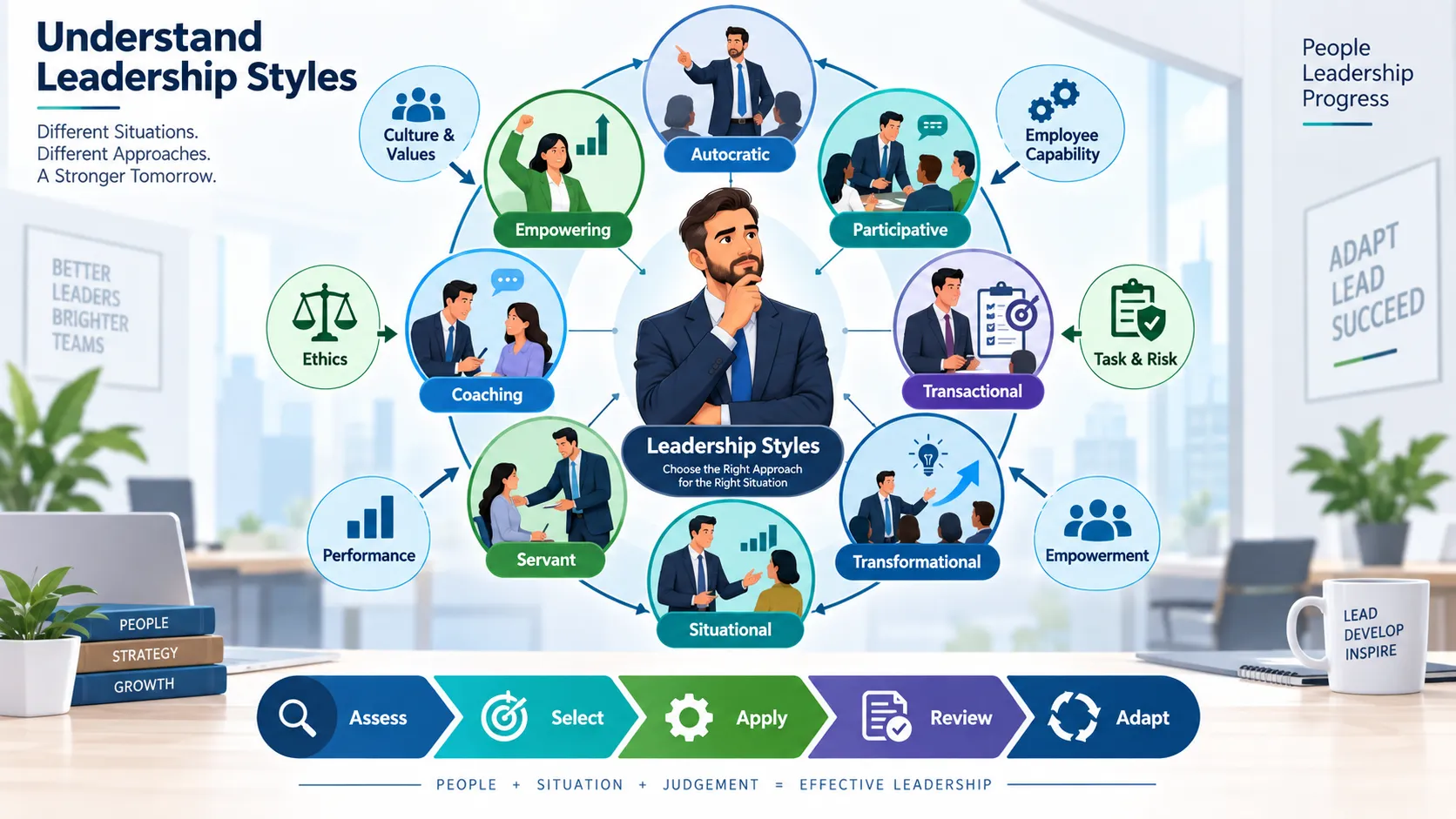
Leadership style refers to the way a manager or leader approaches influencing, guiding, supporting and communicating with individuals and teams. Different leadership styles can shape employee behaviour, motivation, engagement, decision-making and overall team performance. For managers working in modern organisations, understanding leadership styles is important because effective leadership is not based on using one approach in every situation. Leaders need to recognise the needs of their people, the organisational context and the nature of the task before selecting an appropriate approach.
This lesson, Understand Leadership Styles, introduces learners to the main characteristics and practical application of different leadership styles within organisational settings. It considers how leaders use different behaviours to provide direction, involve employees, delegate responsibility, encourage participation and support individual development. Understanding these differences enables managers to make more informed decisions about how they lead others and how their approach may affect workplace relationships and performance.
Leadership styles are also closely connected with organisational culture and values. A leadership approach should reflect appropriate standards of behaviour and support the values an organisation expects its managers and employees to demonstrate. For example, a workplace that values collaboration may benefit from leadership practices that encourage employee involvement and open communication, while situations involving significant risk or urgency may require clearer direction and faster decision-making.
The lesson also considers the importance of ethical and responsible leadership when selecting and applying leadership styles. Managers must recognise the impact of their behaviour on employees and other stakeholders. The use of authority should be fair, respectful and appropriate, while employees should be given suitable opportunities to contribute, develop and take responsibility. Leadership style should therefore support trust, accountability, empowerment and positive working relationships rather than relying solely on formal authority.
Learners will explore how leadership styles can be adapted according to different workplace situations, employee capability, confidence, organisational requirements and levels of responsibility. A manager may need to provide greater direction to an inexperienced employee while allowing an experienced team member greater autonomy. This ability to adapt leadership behaviour is particularly important for middle managers who regularly balance strategic expectations with operational responsibilities and the needs of their teams.
By the end of this lesson, learners will have a clearer understanding of different leadership styles, their key characteristics, potential benefits and limitations, and their relevance to workplace practice. They will be encouraged to consider how leadership style influences individuals and teams and how managers can select and adapt appropriate approaches to lead others effectively, ethically and responsibly within an organisation.
1: Examine the Relationship Between Management and Leadership
Introduction
Management and leadership are closely connected concepts within organisational practice, but they are not identical. In many workplaces, the terms manager and leader are used interchangeably because individuals in management positions are expected to perform both management and leadership responsibilities. However, understanding the distinction between management and leadership is important for managers who are responsible for achieving organisational objectives while also influencing, supporting and developing people.
Management is generally concerned with planning, organising, coordinating, controlling and monitoring resources and activities to achieve agreed objectives. Leadership is more strongly concerned with influencing, motivating, guiding and empowering people so that they understand organisational goals and are willing and able to contribute towards achieving them. Effective middle managers need to integrate both dimensions rather than treating them as completely separate activities.
A manager may have formal authority because of their organisational position, but effective leadership depends on more than authority. Employees are influenced by the manager’s behaviour, communication, integrity, decision-making, consistency and ability to build trust. This means that a manager can successfully administer processes and still be ineffective as a leader if they fail to engage people, communicate expectations or demonstrate ethical behaviour.
The relationship becomes particularly important when considering organisational culture and values. Management systems establish expectations about how work should be planned, monitored and controlled, while leadership behaviour demonstrates how those expectations should be translated into everyday workplace conduct. Where managers consistently demonstrate organisational values through their leadership behaviour, they can strengthen trust, accountability, inclusion and employee commitment.
For middle managers, this relationship is especially significant because they often operate between strategic leadership and operational delivery. They may be expected to implement organisational strategies, manage resources, meet performance requirements, communicate senior-level decisions and simultaneously support employees. Their effectiveness therefore depends on combining sound management practice with appropriate leadership approaches.
 Understanding Management
Management is the process of coordinating people, resources, information and activities to achieve defined organisational objectives. It provides the structure through which work is planned, responsibilities are allocated, performance is monitored and resources are used effectively.
Managers normally have formal responsibilities established through organisational structures. These responsibilities may include managing budgets, allocating workloads, establishing procedures, monitoring performance, maintaining standards, managing risks and ensuring that organisational policies are followed.
Management therefore provides an important foundation for organisational stability. Without effective management, organisations may experience unclear responsibilities, inefficient resource use, inconsistent processes, missed deadlines and weak performance control.
However, management should not be understood simply as controlling employees. Contemporary management practice involves creating the conditions in which people can perform effectively while maintaining appropriate accountability.
Key management responsibilities commonly include:
Planning: Establishing objectives, priorities, activities, resources and timescales.
Organising: Structuring work and allocating responsibilities appropriately.
Coordinating: Ensuring that people, teams and resources work together effectively.
Resource management: Making appropriate use of financial, human, physical and technological resources.
Performance management: Setting expectations, reviewing performance and addressing performance gaps.
Risk management: Identifying potential problems and implementing appropriate controls.
Decision-making: Making timely and evidence-informed operational decisions.
Monitoring: Reviewing progress against agreed objectives and standards.
Policy implementation: Ensuring that organisational policies and procedures are understood and applied.
Communication: Providing employees with clear information, expectations and feedback.
Problem solving: Identifying operational difficulties and implementing practical solutions.
Accountability: Ensuring that responsibilities and outcomes are appropriately monitored.
Effective management creates clarity. Employees should understand what needs to be achieved, who is responsible, what standards apply, what resources are available and how performance will be evaluated.
Understanding Leadership
Leadership is the process of influencing and guiding individuals or groups towards shared objectives. Leadership involves relationships, behaviour, communication, motivation, trust, decision-making and the ability to create commitment around a common purpose.
Unlike management, leadership does not depend entirely on formal organisational authority. An individual may demonstrate leadership through expertise, credibility, professional behaviour, communication skills, integrity or the ability to influence others positively.
Leadership is therefore strongly connected to the human dimension of organisational performance. Leaders help employees understand why organisational objectives matter and how their individual contributions connect with wider goals.
Effective leadership can involve:
establishing a clear sense of direction;
communicating organisational purpose and priorities;
motivating employees;
building trust;
encouraging participation;
developing employee capability;
empowering individuals;
supporting teamwork;
managing conflict constructively;
demonstrating ethical behaviour;
modelling organisational values;
providing feedback and recognition;
supporting employees through change;
encouraging accountability; and
adapting leadership behaviour to different situations.
Leadership is not simply about being charismatic or having a senior position. A quiet, consistent and supportive manager may demonstrate highly effective leadership through ethical decision-making, active listening, empowerment and reliable professional behaviour.
The Relationship Between Management and Leadership
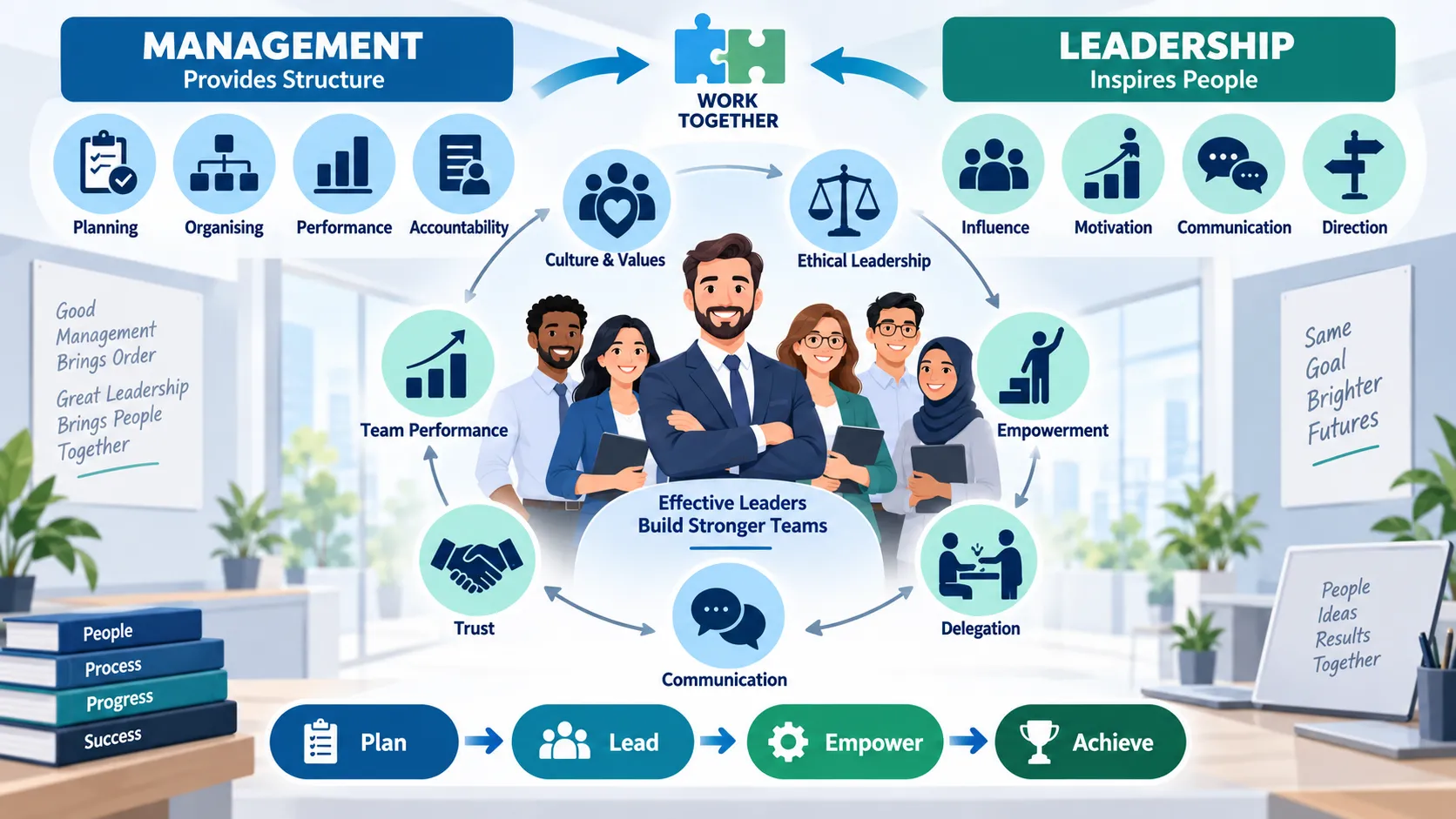
Management and leadership should be viewed as complementary rather than competing functions. Organisations require management to create structure and control, while leadership helps people understand, accept and contribute to organisational direction.
A manager may plan a project, allocate resources and establish deadlines. Leadership becomes evident when that manager explains the purpose of the project, gains employee commitment, listens to concerns, encourages collaboration and provides appropriate support.
Similarly, a manager may introduce a new organisational procedure. Management ensures that the procedure is implemented consistently. Leadership involves explaining the reasons for the change, recognising employee concerns, encouraging participation where appropriate and demonstrating the expected behaviours.
The relationship can therefore be understood through the following principle:
Management creates clarity and organisational control; leadership creates influence, commitment and direction through people.
In practice, effective managers need both.
Management and Leadership: Key Differences and Connections
Aspect Management Leadership Relationship in Practice Primary focus Planning and coordination Influence and direction Managers coordinate work while leaders create commitment Authority Usually based on formal role Can be based on trust, credibility and influence Effective managers combine formal authority with personal credibility Objectives Converts organisational objectives into plans and activities Creates understanding and commitment around objectives Both contribute to organisational performance People Allocates responsibilities and monitors performance Motivates, develops and empowers people Managers need leadership skills to engage employees Decision-making Often focuses on operational requirements Often considers direction, people and wider impact Good decisions require both operational judgement and leadership awareness Culture and values Implements policies, systems and standards Demonstrates and reinforces expected behaviours Managers influence culture through everyday leadership Change Plans, coordinates and controls implementation Builds understanding, commitment and adaptability Successful change requires both Accountability Monitors responsibilities and outcomes Encourages ownership and responsible behaviour Accountability is strengthened when employees understand and accept responsibility Communication Provides information and instructions Creates dialogue, meaning and engagement Effective communication requires both clarity and two-way interaction Empowerment Allocates appropriate responsibility Builds confidence, autonomy and ownership Delegation and empowerment can operate together Ethical practice Ensures procedures and standards are followed Models ethical behaviour and considers impact on people Ethical management and leadership reinforce one another Why Management and Leadership Must Work Together
Separating management and leadership too rigidly can create practical problems. A manager who focuses only on systems may achieve short-term compliance but struggle to build employee commitment. Conversely, a leader who inspires people but neglects planning, resource control or performance monitoring may create enthusiasm without reliable delivery.
An effective middle manager therefore needs to combine both perspectives.
Management helps answer questions such as:
What needs to be achieved?
What resources are required?
Who is responsible?
What procedures must be followed?
What standards apply?
What risks need to be controlled?
How will progress be monitored?
What outcomes are expected?
Leadership helps answer questions such as:
Why does this objective matter?
How can employees become committed to it?
How should people be supported?
How can individuals be empowered?
What leadership approach is appropriate?
How will organisational values influence behaviour?
How can trust be maintained?
How can ethical concerns be addressed?
How should communication be adapted to different employees?
How can people be encouraged to take ownership?
The strongest management practice brings these questions together.
Management as a Foundation for Leadership
Planning and Direction
Planning is a fundamental management responsibility, but it also has a leadership dimension. Employees are more likely to contribute effectively when they understand the direction of their work and how it connects to organisational priorities.
A manager may establish a departmental target, but leadership requires the manager to communicate the purpose behind the target and help employees understand their contribution.
Effective planning should therefore consider:
organisational objectives;
team objectives;
employee responsibilities;
available resources;
expected standards;
timescales;
potential risks;
stakeholder requirements;
ethical considerations; and
opportunities for employee contribution.
Where planning is unclear, employees may experience uncertainty and conflicting priorities. Where planning is clear but imposed without communication, employees may comply without genuine commitment.
Organising and Coordinating People
Management involves deciding how work should be organised. Leadership influences how effectively people respond to that structure.
A manager may allocate responsibilities according to job roles, skills and organisational requirements. However, leadership requires awareness of individual capability, confidence, motivation and development needs.
For example, allocating an important responsibility to an experienced employee may be an opportunity for empowerment. Giving the same responsibility to an inexperienced employee without appropriate support may create unnecessary pressure.
Managers should therefore consider:
employee capability;
experience;
confidence;
workload;
development needs;
role responsibilities;
appropriate autonomy;
available support; and
accountability arrangements.
Monitoring and Performance Management
Monitoring is essential to ensure that organisational objectives are being achieved. However, the way performance is monitored can influence employee attitudes.
A highly controlling approach may cause employees to feel that they are being watched rather than supported. A balanced approach can create accountability while encouraging learning and improvement.
Effective performance management may include:
clear expectations;
agreed performance standards;
regular progress reviews;
constructive feedback;
recognition of achievement;
identification of development needs;
support for improvement;
fair treatment;
appropriate documentation; and
agreed follow-up actions.
Leadership becomes particularly important when performance is below expectation. A manager needs to address the issue while maintaining dignity, fairness and respect.
Leadership as a Human Dimension of Management
Influence Rather Than Authority Alone
Formal authority gives managers the legitimate ability to make certain decisions, allocate work and establish expectations. However, relying exclusively on authority can weaken relationships.
Effective leaders influence people through:
credibility;
consistency;
communication;
professional competence;
fairness;
trust;
integrity;
active listening;
recognition;
support; and
appropriate delegation.
An employee may follow a manager because they have to, but stronger leadership encourages employees to understand, accept and take ownership of organisational objectives.
Motivation and Engagement
Management systems can establish performance expectations, but leadership plays an important role in creating motivation and engagement.
Managers can support motivation by:
communicating meaningful objectives;
recognising contribution;
providing constructive feedback;
giving employees appropriate autonomy;
involving employees in decisions where appropriate;
providing development opportunities;
creating psychologically supportive working relationships;
recognising individual strengths;
connecting individual roles to wider organisational objectives; and
treating employees fairly and respectfully.
Motivation should not be reduced to financial rewards. Employees can also be influenced by recognition, responsibility, achievement, development, trust and a sense of contribution.
Trust
Trust is one of the most important connections between management and leadership. Management creates formal expectations, while leadership demonstrates whether those expectations are applied consistently and fairly.
Trust can be strengthened when managers:
keep commitments;
communicate honestly;
explain decisions;
apply standards consistently;
acknowledge mistakes;
listen to employees;
protect appropriate confidentiality;
treat people with respect;
recognise contribution; and
demonstrate organisational values.
Trust can be damaged by inconsistent behaviour, favouritism, poor communication, excessive control or decisions that appear unethical.
The Role of Organisational Culture and Values
Understanding Organisational Culture
Organisational culture refers broadly to the shared patterns of behaviour, expectations, assumptions and working practices that influence how people operate within an organisation.
Culture affects how management and leadership are experienced by employees. A manager operating in a culture that values collaboration may be expected to involve employees in appropriate decisions. A culture that places strong emphasis on compliance and risk control may require more structured management processes.
However, organisational culture should not be treated as an excuse for poor leadership. Managers have a responsibility to reinforce appropriate values and ethical standards through their behaviour.
Understanding Organisational Values
Organisational values describe principles that guide expected behaviour and decision-making. These may include:
integrity;
respect;
accountability;
fairness;
inclusion;
professionalism;
customer focus;
collaboration;
innovation; and
responsibility.
Values become meaningful when they are reflected in management and leadership practice.
For example, if an organisation claims to value respect but managers regularly dismiss employee concerns, there is a gap between stated values and actual leadership behaviour.
Managers as Role Models
Middle managers are particularly important role models because employees often experience organisational culture through their immediate managers.
Managers reinforce culture by:
demonstrating expected behaviours;
communicating organisational values;
recognising behaviour that reflects those values;
challenging inappropriate conduct;
making fair decisions;
applying policies consistently;
encouraging respectful communication;
supporting inclusion;
accepting accountability; and
demonstrating ethical judgement.
This means that management and leadership behaviour can either strengthen or weaken organisational culture.
Ethical Leadership and Management
Meaning of Ethical Leadership
Ethical leadership involves influencing and guiding people in ways that are consistent with appropriate moral principles, organisational values, professional standards and responsible decision-making.
Ethical leadership requires managers to consider not only whether an action achieves an objective but also how that objective is achieved and what impact the decision may have on people and stakeholders.
An ethical manager should consider:
fairness;
honesty;
respect;
transparency;
accountability;
responsible use of authority;
employee wellbeing;
stakeholder impact;
confidentiality;
equality and inclusion; and
consistency with organisational values.
The Ethical Relationship Between Management and Leadership
Management and leadership have different emphases, but both involve ethical responsibility.
Management may require a manager to implement a policy. Ethical leadership requires consideration of whether the policy is being applied fairly and respectfully.
Management may require a manager to address poor performance. Ethical leadership requires the manager to distinguish between legitimate performance management and unfair or inappropriate treatment.
Management may require a manager to achieve a demanding target. Ethical leadership requires the manager to consider whether the methods used to achieve that target are responsible.
Therefore, ethical leadership provides an important behavioural dimension to management practice.
Practical Example: Ethical Performance Management
Consider a team where one employee is consistently failing to meet performance standards.
From a management perspective, the manager should:
review the agreed performance requirements;
gather relevant evidence;
identify the performance gap;
discuss the issue with the employee;
establish appropriate improvement actions;
monitor progress; and
maintain appropriate records.
From a leadership perspective, the manager should also:
communicate respectfully;
listen to the employee’s explanation;
avoid assumptions;
identify whether support is required;
provide reasonable opportunities for improvement;
maintain confidentiality;
apply standards fairly; and
preserve the employee’s dignity.
The combination creates a more responsible approach to performance management.
Leadership Models and Their Relationship with Management
The relationship between management and leadership becomes clearer when different leadership models are considered. Leadership models provide frameworks for understanding how managers can influence and guide others.
Transformational Leadership
Transformational leadership focuses on creating commitment around a shared purpose and encouraging people to contribute beyond basic task compliance.
A manager using transformational leadership may:
communicate a compelling organisational direction;
encourage innovation;
support employee development;
build commitment to shared goals;
challenge existing practices constructively;
encourage employees to take ownership; and
connect individual contribution with organisational purpose.
This can complement management activities such as planning and performance monitoring by creating stronger employee commitment.
Transactional Leadership
Transactional leadership focuses more strongly on clear expectations, responsibilities, performance and consequences.
It can be useful where:
tasks require clear standards;
compliance is important;
responsibilities need to be defined;
performance must be monitored;
procedures need to be followed; or
immediate clarity is required.
However, relying exclusively on transactional approaches may limit employee autonomy and participation. Managers should therefore consider whether the situation requires structured direction or greater empowerment.
Situational Leadership
Situational approaches recognise that leadership behaviour may need to change according to circumstances, employee capability and the nature of the task.
For example:
a new employee may require more direction;
a developing employee may benefit from coaching;
a competent employee may benefit from greater participation;
an experienced employee may be given greater autonomy.
This approach is particularly relevant to middle managers because teams often contain employees with different levels of experience and confidence.
Participative Leadership
Participative leadership involves employees in appropriate decisions and encourages contribution.
It can support:
employee engagement;
shared responsibility;
better understanding of workplace issues;
problem solving;
ownership;
trust; and
empowerment.
Participation does not mean that every decision must be made collectively. Effective managers must determine when consultation is appropriate and when timely managerial decision-making is required.
Servant-Oriented Leadership
Servant-oriented leadership places strong emphasis on supporting and developing others. It encourages managers to consider the needs, growth and contribution of employees.
This approach can support:
trust;
employee development;
listening;
collaboration;
empowerment;
ethical behaviour; and
supportive workplace relationships.
Managers should nevertheless maintain appropriate accountability and organisational focus.
Empowerment: Where Management and Leadership Meet
Definition of Empowerment
Empowerment is the process of enabling employees to take appropriate responsibility, make decisions within agreed boundaries and contribute actively to organisational objectives.
Empowerment is closely related to delegation, but the two concepts are not identical.
Delegation involves assigning responsibility or authority for a specific task or area of work. Empowerment is broader because it involves developing the employee’s confidence, capability and willingness to take ownership.
Effective Empowerment Requires Management and Leadership
Management establishes the boundaries within which empowerment can operate.
Managers need to clarify:
what decisions employees can make;
what responsibilities are being transferred;
what standards apply;
what resources are available;
what limits exist;
when escalation is required; and
how outcomes will be reviewed.
Leadership supports empowerment by:
building confidence;
providing trust;
encouraging initiative;
allowing appropriate autonomy;
providing coaching;
recognising contribution;
supporting learning from mistakes; and
encouraging ownership.
Without management, empowerment may become unclear. Without leadership, delegation may feel like simply passing work to employees.
Practical Example of Empowerment
A department manager asks an experienced team member to lead a small process-improvement project.
Management responsibilities may include:
defining the project objective;
agreeing the scope;
establishing timescales;
clarifying resources;
setting reporting requirements; and
identifying decision boundaries.
Leadership responsibilities may include:
expressing confidence in the employee;
encouraging ideas;
providing access to support;
allowing appropriate autonomy;
recognising progress;
encouraging collaboration; and
reviewing lessons learned.
The employee is therefore not simply given additional work. They are given an opportunity to take meaningful responsibility.
Communication as a Shared Management and Leadership Responsibility
Communication is one of the clearest areas where management and leadership overlap.
Management communication often provides:
instructions;
policies;
procedures;
deadlines;
performance information;
operational updates;
responsibilities; and
organisational requirements.
Leadership communication adds:
purpose;
encouragement;
dialogue;
listening;
clarification;
recognition;
reassurance;
influence; and
meaning.
Effective middle managers need to combine both.
Two-Way Communication
Leadership requires managers to listen as well as communicate.
Two-way communication can help managers:
identify operational problems;
understand employee concerns;
gather ideas;
identify development needs;
strengthen relationships;
support participation;
detect potential conflict; and
make better-informed decisions.
Managers should therefore avoid creating communication systems where information flows only from management to employees.
Delegation and Leadership
Delegation is a key management technique that also has a leadership dimension.
Effective delegation involves transferring responsibility for appropriate work while maintaining suitable accountability.
A structured delegation process may include:
Identify the task or responsibility.
Select an appropriate employee or team.
Assess capability and development needs.
Explain the required outcome.
Clarify authority and decision boundaries.
Provide necessary resources.
Agree timescales and standards.
Confirm how progress will be monitored.
Provide appropriate support.
Review the outcome and provide feedback.
Poor delegation may occur when managers give unclear instructions, fail to provide resources, retain unnecessary control or transfer responsibility without appropriate authority.
Good delegation can support empowerment, employee development and organisational effectiveness.
Decision-Making and Leadership
Managers make decisions at different levels of organisational activity. Some decisions may be routine and operational, while others may have significant consequences for employees, customers or stakeholders.
Effective decision-making requires managers to consider:
available evidence;
organisational objectives;
risks;
resources;
stakeholder interests;
employee impact;
organisational values;
ethical considerations;
legal and policy requirements; and
potential consequences.
Leadership adds the responsibility to communicate decisions appropriately and help employees understand their implications.
Ethical Decision-Making Process
A practical ethical decision-making process can include:
Identify the issue.
Clarify the facts.
Identify relevant stakeholders.
Consider organisational values and standards.
Identify possible options.
Assess potential consequences.
Consider fairness and ethical implications.
Select the most responsible option.
Communicate the decision appropriately.
Review the outcome and learn from the experience.
This approach helps managers avoid focusing solely on short-term operational outcomes.
Managing People Through Change
Change is another area where management and leadership must work together.
Management provides the structure for change by:
establishing plans;
allocating resources;
defining responsibilities;
setting milestones;
monitoring progress;
managing risks; and
coordinating implementation.
Leadership supports people through change by:
explaining why change is required;
acknowledging concerns;
communicating consistently;
encouraging participation;
maintaining trust;
supporting employees;
recognising uncertainty;
reinforcing organisational values; and
encouraging adaptability.
Employees may resist change when they do not understand its purpose or believe that decisions have been made without considering their concerns.
A strong manager therefore combines structured implementation with effective people leadership.
Managing Conflict Through Management and Leadership
Conflict can arise from competing priorities, communication problems, resource limitations, interpersonal differences or disagreements about decisions.
Management responses may involve:
clarifying responsibilities;
reviewing policies;
establishing procedures;
documenting issues;
addressing performance concerns; and
implementing agreed actions.
Leadership responses may involve:
active listening;
impartiality;
empathy;
respectful communication;
mediation;
encouraging dialogue;
identifying underlying concerns; and
rebuilding working relationships.
Managers should avoid automatically assuming that conflict is simply a disciplinary issue. Effective leadership requires understanding the situation before deciding on an appropriate response.
Middle Managers as the Link Between Strategy and Operations
Middle managers occupy a particularly important position within organisational leadership.
They often translate strategic priorities into operational activities while communicating operational realities back to senior leadership.
This can require managers to:
interpret organisational strategy;
communicate priorities;
allocate resources;
coordinate teams;
manage performance;
develop employees;
implement organisational change;
represent employee concerns;
reinforce organisational values;
manage competing priorities;
make operational decisions; and
maintain ethical standards.
The middle manager therefore acts as a bridge between organisational direction and employee experience.
Balancing Organisational and Employee Needs
Middle managers may sometimes experience tension between business requirements and employee needs.
For example, senior management may establish a demanding performance target. The middle manager must implement the target while considering:
available resources;
workload;
employee capability;
fairness;
operational risks;
customer requirements;
employee engagement; and
ethical implications.
Effective leadership does not mean ignoring organisational requirements. It means implementing them responsibly while considering their impact on people and stakeholders.
How Management and Leadership Influence Organisational Performance
Management and leadership contribute to performance in different but interconnected ways.
Management contributes through:
efficient resource use;
clear responsibilities;
structured processes;
performance monitoring;
risk control;
planning;
coordination; and
operational consistency.
Leadership contributes through:
motivation;
engagement;
trust;
commitment;
innovation;
collaboration;
empowerment;
employee development; and
positive workplace relationships.
When both operate effectively, organisations are better positioned to achieve sustainable performance.
Key Benefits of Integrating Management and Leadership
An integrated approach can contribute to:
clearer organisational direction;
stronger employee engagement;
improved accountability;
more effective communication;
better teamwork;
stronger trust;
improved decision-making;
greater employee ownership;
effective empowerment;
better adaptation to change;
stronger organisational culture;
more consistent values-based behaviour;
improved leadership credibility;
responsible use of authority;
better employee development; and
improved organisational performance.
Practical Workplace Example: Managing a Customer Service Team
Consider a middle manager responsible for a customer service department where customer satisfaction has declined.
From a management perspective, the manager should first analyse available information and establish what is causing the performance problem.
This may include:
reviewing customer feedback;
examining performance data;
identifying staffing issues;
reviewing workloads;
checking existing procedures;
identifying training requirements;
assessing resource availability; and
establishing improvement objectives.
The leadership dimension then requires the manager to engage the team.
The manager may:
explain the reasons for the improvement programme;
invite employees to identify operational problems;
listen to customer service staff;
recognise good performance;
provide coaching;
delegate improvement responsibilities;
empower experienced employees to suggest solutions;
establish shared objectives; and
demonstrate commitment to respectful and ethical treatment.
The manager is therefore combining management discipline with leadership influence.
Practical Workplace Example: Introducing a New Digital System
Suppose an organisation introduces a new digital system that changes how employees complete routine tasks.
A management-only approach might focus on:
implementation deadlines;
system access;
training schedules;
procedures;
compliance;
performance monitoring.
A combined management and leadership approach would additionally consider:
employee concerns;
different levels of digital confidence;
opportunities for participation;
appropriate training;
feedback;
individual support;
communication;
empowerment;
workload implications; and
ethical use of employee information.
A manager may provide greater direction to employees who are unfamiliar with the system while empowering experienced employees to act as workplace champions or peer supporters.
This demonstrates how leadership style can be adapted to employee capability and organisational circumstances.
Common Problems When Management Is Used Without Effective Leadership
Management without effective leadership can result in:
excessive reliance on authority;
low employee engagement;
limited initiative;
weak communication;
reduced trust;
resistance to change;
unnecessary employee dependency;
poor empowerment;
reduced ownership;
mechanical compliance;
limited innovation; and
strained manager-employee relationships.
For example, a manager may achieve deadlines by closely controlling every activity. Although the immediate target may be achieved, employees may become dependent on the manager and less willing to make decisions independently.
Common Problems When Leadership Is Used Without Effective Management
Leadership without sufficient management structure can also create difficulties.
Potential problems include:
unclear responsibilities;
inconsistent standards;
poor resource allocation;
weak accountability;
missed deadlines;
unclear decision boundaries;
inadequate performance monitoring;
inconsistent implementation; and
confusion about priorities.
A manager may create a highly supportive environment but fail to establish clear expectations. Employees may enjoy greater autonomy but lack sufficient clarity about what successful performance looks like.
The solution is not to choose management over leadership or leadership over management. The objective is to integrate both appropriately.
A Practical Framework for Integrating Management and Leadership
Managers can use the following process when approaching significant workplace responsibilities.
Step 1: Clarify the Organisational Objective
Determine:
what needs to be achieved;
why it matters;
what standards apply;
what timescales exist; and
which stakeholders are affected.
Step 2: Understand the People and Context
Consider:
employee capability;
experience;
confidence;
workload;
team relationships;
organisational culture;
organisational values;
available resources; and
external pressures.
Step 3: Establish the Management Structure
Define:
responsibilities;
resources;
procedures;
performance measures;
reporting arrangements;
decision boundaries; and
risk controls.
Step 4: Select an Appropriate Leadership Approach
Consider whether the situation requires:
clear direction;
coaching;
participation;
delegation;
empowerment;
support;
collaborative problem solving; or
a combination of approaches.
Step 5: Communicate Clearly
Explain:
what is happening;
why it is happening;
what employees need to do;
what support is available;
what decisions they can make; and
how progress will be reviewed.
Step 6: Apply Ethical and Values-Based Judgement
Check that actions are:
fair;
respectful;
responsible;
transparent where appropriate;
consistent with organisational values; and
mindful of employee and stakeholder impact.
Step 7: Empower Where Appropriate
Give employees suitable:
responsibility;
authority;
information;
resources;
confidence;
support; and
opportunities to contribute.
Step 8: Monitor and Adapt
Review:
performance;
employee response;
stakeholder outcomes;
emerging risks;
effectiveness of the leadership approach; and
whether greater or less direction is required.
Step 9: Reflect and Learn
After the activity, managers should consider:
What worked well?
What did not work?
Was the leadership style appropriate?
Were employees sufficiently empowered?
Were organisational values demonstrated?
Were decisions ethical and responsible?
What should be changed next time?
Developing Effective Management and Leadership Practice
Managers can strengthen the relationship between management and leadership through continuous reflection and development.
Developing Self-Awareness
Managers should understand how their own behaviour affects employees.
Useful reflection questions include:
How do employees experience my management style?
Do I rely too heavily on formal authority?
Do I listen effectively?
Do I provide sufficient direction?
Do I delegate appropriately?
Do I empower employees?
Do I demonstrate organisational values?
Am I consistent in my decisions?
How do I respond when challenged?
Do I adapt my approach to different employees?
Seeking Feedback
Feedback can help managers identify differences between their intended leadership behaviour and employees’ actual experiences.
Feedback may be gathered through:
one-to-one discussions;
team meetings;
structured reviews;
performance discussions;
peer feedback;
stakeholder feedback; and
reflective practice.
Managers should respond to feedback professionally rather than treating constructive criticism as a personal challenge.
Adapting Leadership Behaviour
Effective managers recognise that there is no single leadership style that will be equally effective in every situation.
Adaptation may be required because of:
employee experience;
employee confidence;
task complexity;
urgency;
risk;
organisational culture;
organisational values;
team capability;
stakeholder expectations; and
organisational change.
Adaptation should not mean abandoning ethical principles. The style may change, but responsible and ethical standards should remain consistent.
Management, Leadership and Responsible Use of Authority
Authority is necessary within organisations because managers need to make decisions, allocate resources and establish expectations. However, authority should be exercised responsibly.
Responsible use of authority means that managers should:
use power only for legitimate organisational purposes;
avoid intimidation;
apply standards consistently;
explain decisions where appropriate;
respect employee dignity;
avoid favouritism;
recognise legitimate employee concerns;
provide appropriate opportunities for participation;
maintain accountability; and
demonstrate organisational values.
A manager’s position provides authority, but ethical leadership determines how that authority is exercised.
Management and Leadership as Complementary Competencies
For practising and aspiring middle managers, management and leadership should be understood as complementary competencies.
Management competency enables a manager to:
organise work;
control resources;
coordinate activities;
manage performance;
establish accountability;
manage risk; and
achieve operational objectives.
Leadership competency enables a manager to:
influence people;
establish trust;
motivate employees;
communicate purpose;
empower individuals;
support development;
manage relationships;
demonstrate values; and
lead responsibly.
The most effective managers combine these competencies according to the circumstances rather than treating them as separate professional identities.
Key Learning Points
The relationship between management and leadership can be summarised through the following principles:
Management and leadership are different but interconnected.
Management provides structure, planning, coordination and control.
Leadership provides influence, direction, motivation and commitment.
Managers require leadership skills to work effectively through people.
Leaders operating within management roles require sufficient organisational structure to convert direction into effective action.
Formal authority is not the same as effective leadership influence.
Trust and credibility strengthen managerial authority.
Communication is central to both management and leadership.
Organisational culture influences how leadership and management are experienced.
Organisational values should be reflected in everyday managerial behaviour.
Ethical leadership requires managers to consider both outcomes and methods.
Empowerment enables employees to take appropriate responsibility and ownership.
Delegation can support empowerment when responsibility, authority and accountability are appropriately balanced.
Leadership models can help managers select appropriate approaches for different situations.
Situational approaches recognise differences in employee capability, confidence and context.
Participative approaches can support employee involvement and ownership.
Transformational approaches can strengthen commitment around shared objectives.
Transactional approaches can provide useful structure and clarity where standards and compliance are important.
Middle managers have an important role in translating organisational strategy into operational practice.
Effective middle managers balance organisational requirements with the needs of employees and stakeholders.
Leadership style should be adaptable while ethical standards remain consistent.
Effective management without leadership may result in compliance without commitment.
Effective leadership without management may result in commitment without sufficient structure.
Sustainable organisational effectiveness requires an appropriate combination of management and leadership.
Summary
Management and leadership are distinct but closely related dimensions of organisational practice. Management provides the structures, processes and controls required to plan work, coordinate resources, monitor performance and achieve organisational objectives. Leadership adds the human dimension by influencing, motivating, guiding, supporting and empowering people.
For middle managers, the relationship between these functions is particularly important because they are often responsible for translating organisational strategy into practical action. They must meet organisational requirements while also building effective relationships with employees, communicating priorities, supporting development and encouraging ownership.
The relationship is also central to ethical leadership and responsible management. Managers do not simply need to achieve targets; they need to consider how those targets are achieved and how decisions affect employees, customers and other stakeholders. Fairness, integrity, respect, accountability and responsible use of authority should therefore influence managerial and leadership behaviour.
Organisational culture and values further shape this relationship. Managers reinforce culture through their everyday decisions, communication, treatment of employees and response to workplace issues. Where management practice and leadership behaviour are consistent with organisational values, employees are more likely to experience greater clarity, trust and consistency.
Leadership models provide managers with useful ways of understanding and adapting their approach. Transformational, transactional, situational and participative approaches can each contribute in different circumstances. The key requirement is not to apply one model mechanically, but to consider the organisational context, employee capability, task requirements, ethical considerations and desired outcomes.
Empowerment provides another important connection between management and leadership. Management establishes the boundaries, resources and accountability required for employees to take responsibility, while leadership builds the confidence, trust and motivation needed for meaningful ownership.
Ultimately, effective management and leadership should work together. Management helps ensure that the organisation is organised, coordinated and accountable; leadership helps ensure that people understand, support and contribute to organisational direction. For practising and aspiring middle managers, developing the ability to integrate both is essential for leading others effectively, ethically and responsibly.
2: Evaluate Leadership Styles
Introduction
Leadership style refers to the characteristic way in which a manager or leader influences, guides, communicates with and supports individuals and teams. Leadership style affects how decisions are made, how authority is exercised, how employees participate, how responsibility is allocated and how managers respond to workplace challenges. For middle managers, understanding and evaluating leadership styles is essential because different approaches can produce different effects on employee motivation, engagement, trust, empowerment, performance and organisational culture.
Leadership style should not be considered simply as a personal preference. A manager may naturally prefer a particular way of leading, but effective leadership requires consideration of the organisational context, the nature of the task, employee capability, levels of risk, organisational values and the desired outcome. A style that works effectively in one situation may be inappropriate in another.
Evaluation therefore requires more than describing the characteristics of different leadership styles. Managers need to consider their strengths, limitations, appropriate applications, potential risks and likely impact on people and organisational objectives. They should also consider whether a leadership style supports ethical and responsible behaviour and whether it reinforces the organisation’s culture and values.
A leadership style can influence whether employees feel trusted, valued and empowered or controlled, excluded and undervalued. It can also affect whether employees take ownership of responsibilities or become dependent on managerial direction. For this reason, leadership style is closely connected to the concept of empowerment and to techniques such as delegation, communication, coaching, feedback, participation and decision-making.
For practising and aspiring middle managers, the objective is not to identify one universally superior leadership style. Instead, the objective is to develop the professional judgement required to select, adapt and evaluate leadership behaviour according to the circumstances while maintaining consistent ethical standards.
Understanding Leadership Style
Definition of Leadership Style
Leadership style can be defined as the pattern of behaviours, attitudes and methods a manager uses to influence, guide, motivate, communicate with and support employees or teams.
Leadership style may be demonstrated through everyday management behaviours, including:
how decisions are made;
how authority is exercised;
how information is communicated;
how employees are involved;
how responsibility is delegated;
how performance is monitored;
how feedback is provided;
how conflict is managed;
how employees are supported;
how mistakes are addressed;
how change is introduced; and
how organisational values are demonstrated.
Leadership style is therefore visible through behaviour rather than merely through a manager’s job title.
Why Leadership Styles Need to Be Evaluated
Evaluation is important because every leadership style involves potential advantages and disadvantages. A style that creates strong direction may reduce uncertainty but also limit employee autonomy if overused. A participative style may increase involvement but may be less appropriate where urgent decisions are required.
Managers should evaluate leadership styles according to questions such as:
Does the style support the organisational objective?
Is the approach appropriate for the situation?
Does it meet the needs of employees?
Does it support ethical behaviour?
Does it reflect organisational values?
Does it encourage appropriate empowerment?
Does it create accountability?
Does it support effective communication?
Does it build trust?
Does it encourage employee ownership?
What risks could result from using the style?
What adjustments may be required?
This approach moves leadership development from simple theoretical knowledge towards professional judgement.
Autocratic Leadership Style
Definition
Autocratic leadership is a style in which the leader retains significant decision-making authority and provides clear direction to employees. Decisions are generally made by the manager, with limited employee involvement in the decision-making process.
This approach can provide strong structure and clear accountability. It may be useful when decisions must be made quickly or where employees require clear direction.
However, excessive reliance on autocratic leadership can restrict participation and employee autonomy. If employees are rarely consulted or empowered, they may become dependent on managerial direction.
Key Characteristics
Autocratic leadership commonly involves:
centralised decision-making;
clear managerial authority;
direct instructions;
close supervision;
limited employee participation;
defined responsibilities;
strong managerial control; and
rapid decision-making.
Potential Benefits
When appropriately applied, autocratic leadership can:
provide clarity;
support rapid decision-making;
establish clear responsibility;
reduce uncertainty;
maintain consistency;
support situations involving significant risk;
provide direction to inexperienced employees; and
assist where immediate action is required.
Potential Limitations
Potential disadvantages include:
reduced employee participation;
lower perceived autonomy;
limited creativity;
possible dependence on the manager;
weaker ownership;
potential reduction in engagement;
limited opportunities for employee development; and
risk of creating an overly controlling culture.
Ethical Evaluation
Autocratic leadership is not automatically unethical. The ethical issue depends on how authority is exercised.
An ethical manager using a directive approach should still:
treat employees with respect;
explain decisions where appropriate;
avoid intimidation;
apply standards fairly;
consider employee and stakeholder impact;
provide opportunities for appropriate feedback; and
remain accountable for decisions.
The use of authority should be proportionate to the situation.
Practical Example
A middle manager is responsible for a workplace situation involving an immediate operational risk. A rapid decision is required to protect employees and maintain safe operations.
In this situation, a highly directive approach may be appropriate because delaying action to obtain extensive consultation could increase risk.
Once the immediate situation has been controlled, however, the manager could adopt a more participative approach to review what happened, identify improvements and involve employees in preventing recurrence.
This demonstrates why leadership style should be evaluated according to context rather than judged in isolation.
Democratic or Participative Leadership Style
Definition
Participative leadership involves employees in decision-making and encourages them to contribute ideas, information and perspectives before decisions are made.
The manager retains appropriate accountability but recognises that employees may possess valuable operational knowledge and expertise.
Key Characteristics
Participative leadership commonly includes:
consultation;
active listening;
employee involvement;
shared discussion;
collaborative problem solving;
open communication;
feedback;
shared responsibility; and
appropriate delegation.
Potential Benefits
Participative leadership can:
increase employee involvement;
improve ownership;
strengthen communication;
encourage innovation;
make better use of employee expertise;
improve trust;
support empowerment;
develop decision-making capability; and
strengthen team relationships.
Potential Limitations
However, participative leadership may:
take longer;
create difficulty where rapid decisions are needed;
produce disagreement;
create unrealistic expectations about employee influence;
become inefficient if every decision requires consultation; and
create uncertainty if the manager fails to clarify final accountability.
Ethical Evaluation
Participation can support ethical leadership because employees are given an opportunity to contribute and express legitimate concerns.
However, managers must be honest about the level of influence employees have. If a manager presents a decision as genuinely open to discussion when the outcome has already been determined, employees may perceive the process as manipulative.
Ethical participation therefore requires transparency about:
what is open for discussion;
what has already been decided;
why certain constraints exist;
how employee input will be considered; and
who remains accountable for the final decision.
Practical Example
A service team is experiencing repeated customer complaints. Rather than immediately imposing a new procedure, the manager holds a structured team discussion.
Employees identify:
gaps in information;
unnecessary process steps;
workload problems;
customer communication difficulties; and
opportunities for improvement.
The manager uses these contributions to develop an improvement plan.
This approach supports participation, empowerment and organisational learning while maintaining managerial accountability.
Democratic Leadership and Empowerment
Participative leadership has a particularly strong relationship with empowerment. When employees are encouraged to contribute ideas and participate in decisions, they can develop greater ownership of workplace outcomes.
Managers can strengthen empowerment by:
giving employees appropriate decision-making opportunities;
delegating defined responsibilities;
providing relevant information;
establishing clear boundaries;
encouraging initiative;
providing support;
recognising contribution; and
reviewing outcomes constructively.
Empowerment should not mean removing managerial responsibility. Managers remain accountable for ensuring that delegated authority is appropriate and that organisational requirements are maintained.
Laissez-Faire Leadership Style
Definition
Laissez-faire leadership involves giving employees substantial freedom and autonomy in determining how work is completed. The leader provides relatively limited direct supervision and allows capable employees to take responsibility for decisions and activities.
This style can be effective when employees have strong competence, experience and confidence.
Potential Benefits
Appropriate use can:
encourage autonomy;
strengthen ownership;
support creativity;
encourage initiative;
develop employee confidence;
reduce unnecessary managerial control; and
support experienced professionals.
Potential Limitations
Excessive use can create:
unclear expectations;
weak accountability;
inconsistent performance;
lack of direction;
poor coordination;
employee uncertainty; and
inadequate support.
The style is therefore highly dependent on employee capability and organisational context.
Practical Evaluation
A manager supervising highly experienced specialists may reasonably provide significant autonomy because employees possess the expertise required to make professional decisions.
The same approach may be inappropriate for a newly appointed employee who requires direction and support.
This demonstrates the importance of adapting leadership style to employee capability rather than applying autonomy indiscriminately.
Transactional Leadership Style
Definition
Transactional leadership focuses on clear expectations, performance requirements, responsibilities, rewards and consequences. The relationship between manager and employee is structured around agreed objectives and performance standards.
Transactional leadership has a strong connection with management because it provides structure and accountability.
Key Characteristics
It may involve:
clear objectives;
defined performance standards;
monitoring;
performance feedback;
rewards;
recognition;
corrective action;
formal responsibilities; and
measurable outcomes.
Potential Benefits
Transactional leadership can:
provide clarity;
support performance management;
establish accountability;
maintain consistent standards;
clarify responsibilities;
support routine operations; and
help employees understand performance expectations.
Potential Limitations
Potential limitations include:
reduced creativity;
excessive focus on measurable outcomes;
limited intrinsic motivation;
reduced autonomy;
transactional relationships;
potential overemphasis on compliance; and
limited attention to broader employee development.
Ethical Evaluation
Transactional leadership can support responsible management when expectations and consequences are applied fairly and transparently.
Problems may occur when managers use rewards or consequences unfairly, create unrealistic targets or encourage employees to prioritise results over ethical behaviour.
Managers should therefore ensure that:
targets are realistic;
performance measures are appropriate;
expectations are clear;
consequences are proportionate;
employees are treated fairly; and
ethical standards are not compromised to achieve targets.
Transformational Leadership Style
Definition
Transformational leadership focuses on inspiring and developing employees around a shared purpose, encouraging improvement, innovation and commitment to organisational objectives.
Transformational leadership can be particularly valuable when organisations are changing or seeking to improve performance and culture.
Key Characteristics
Transformational leaders may:
communicate a compelling purpose;
encourage innovation;
develop employees;
challenge established practices;
promote shared goals;
build commitment;
encourage initiative; and
support organisational improvement.
Potential Benefits
Transformational leadership can:
increase motivation;
strengthen engagement;
encourage innovation;
support employee development;
build shared commitment;
strengthen organisational identity;
encourage ownership; and
support change.
Potential Limitations
Possible limitations include:
excessive dependence on the leader’s vision;
unrealistic expectations;
insufficient attention to operational detail;
change fatigue;
pressure to support ambitious objectives; and
potential neglect of immediate management requirements.
A transformational manager still needs effective management systems to translate vision into practical action.
Ethical Evaluation
Transformational leadership can support ethical leadership when the shared vision is responsible, inclusive and aligned with organisational values.
However, strong influence can also create risks if employees feel pressured to accept the leader’s vision without sufficient opportunity for challenge.
Ethical transformational leadership should therefore encourage:
open communication;
legitimate challenge;
transparency;
respect;
inclusion;
accountability; and
responsible use of influence.
Situational Leadership
Definition
Situational leadership recognises that leadership behaviour should be adapted according to circumstances, including employee capability, experience, confidence, task requirements and organisational conditions.
This approach is particularly relevant to middle managers because teams often include employees with different levels of competence and experience.
Applying Situational Leadership
A manager may provide:
greater direction to an inexperienced employee;
coaching to an employee developing new skills;
greater participation for a capable employee;
substantial autonomy to an experienced employee.
The manager should continuously assess whether the current level of direction and support remains appropriate.
Potential Benefits
Situational leadership can:
improve adaptability;
recognise individual differences;
support employee development;
encourage empowerment;
prevent unnecessary control;
provide appropriate support; and
improve managerial responsiveness.
Potential Limitations
Potential limitations include:
difficulty accurately assessing employee capability;
inconsistent application;
employees perceiving differences as unfair treatment;
excessive changes in management behaviour;
manager judgement errors; and
insufficient consistency if adaptation is poorly explained.
Ethical Evaluation
Adapting leadership behaviour does not mean treating people unfairly. Managers must distinguish between appropriate differentiation and favouritism.
For example, providing additional support to a new employee because they are still developing competence can be justified. Giving one employee greater opportunities solely because of personal preference cannot.
Ethical situational leadership therefore requires:
objective judgement;
consistency of standards;
fairness;
transparent expectations;
appropriate support; and
clear reasons for differences in leadership behaviour.
Servant-Oriented Leadership
Definition
Servant-oriented leadership places strong emphasis on supporting employees, developing their capability and creating conditions in which people can contribute effectively.
The manager recognises that organisational success depends heavily on the capability and engagement of employees.
Key Characteristics
The approach may include:
active listening;
employee development;
support;
empathy;
collaboration;
empowerment;
ethical conduct;
recognition; and
concern for employee needs.
Potential Benefits
It can contribute to:
stronger trust;
employee development;
positive relationships;
greater empowerment;
stronger collaboration;
improved engagement;
ethical workplace behaviour; and
employee ownership.
Potential Limitations
Potential risks include:
insufficient managerial direction;
delayed decisions;
excessive focus on employee preferences;
difficulty managing poor performance;
confusion about accountability; and
potential conflict between employee needs and organisational requirements.
Servant-oriented leadership should not mean avoiding difficult decisions. Responsible leaders still need to maintain standards and accountability.
Coaching Leadership
Definition
Coaching leadership focuses on helping employees develop capability, confidence and problem-solving skills rather than simply providing answers or instructions.
It is particularly useful where the objective is employee development.
Coaching Techniques
A manager may:
ask open questions;
encourage reflection;
identify strengths;
explore development needs;
provide constructive feedback;
agree development objectives;
encourage employees to identify solutions;
provide appropriate guidance; and
review progress.
Benefits
Coaching leadership can:
develop capability;
strengthen confidence;
encourage ownership;
support empowerment;
improve problem-solving;
increase employee independence; and
strengthen succession within teams.
Limitations
Coaching may be less appropriate where:
an immediate decision is required;
an employee lacks sufficient competence for independent action;
there is significant risk;
a clear instruction is necessary; or
urgent corrective action is required.
Effective managers therefore need to know when coaching should be combined with more directive behaviour.
Charismatic Leadership
Definition
Charismatic leadership involves influencing employees through strong personal presence, communication, confidence and an ability to create enthusiasm around a purpose or direction.
Charismatic leaders can be highly influential, but the approach requires careful ethical management.
Potential Benefits
It can:
inspire commitment;
increase enthusiasm;
create a strong sense of purpose;
support organisational change;
improve communication; and
motivate employees during challenging circumstances.
Potential Risks
Potential concerns include:
overdependence on the leader;
personality-driven decision-making;
reduced critical challenge;
excessive loyalty;
difficulty maintaining leadership continuity; and
risk of influence being used irresponsibly.
Ethical Evaluation
Charisma should not replace accountability. Leaders must ensure that personal influence does not prevent employees from questioning decisions or raising concerns.
Authentic Leadership
Definition
Authentic leadership focuses on consistency between a leader’s values, behaviour and communication. Authentic leaders demonstrate self-awareness, transparency and a clear connection between personal conduct and stated principles.
Authentic leadership can contribute to trust when employees perceive managerial behaviour as consistent and genuine.
Key Characteristics
These may include:
self-awareness;
integrity;
transparency;
consistency;
ethical decision-making;
openness to feedback;
awareness of personal strengths and limitations; and
alignment between values and behaviour.
Potential Benefits
Authentic leadership can:
strengthen trust;
support ethical behaviour;
improve credibility;
encourage openness;
reinforce organisational values; and
strengthen relationships.
Potential Limitations
Being authentic does not mean sharing every personal opinion or acting without professional boundaries. Managers must balance openness with confidentiality, organisational responsibilities and professional conduct.
Evaluating Leadership Styles Against Organisational Culture
Leadership style should be considered in relation to organisational culture.
A culture that strongly values:
collaboration may benefit from participative leadership;
innovation may benefit from transformational leadership;
professional autonomy may benefit from empowering or laissez-faire approaches;
consistency and compliance may require stronger transactional structures;
employee development may benefit from coaching and servant-oriented approaches.
However, organisations rarely operate with only one cultural characteristic. Managers need to identify the dominant expectations while considering the needs of specific teams and situations.
Cultural Alignment
A leadership style is more likely to be effective when it supports positive cultural expectations.
For example, if an organisation promotes teamwork but managers consistently make decisions without consultation, employees may perceive a contradiction between organisational values and managerial behaviour.
Managers should therefore ask:
Does my leadership behaviour reinforce stated values?
Does my behaviour demonstrate the culture expected by the organisation?
Are employees experiencing consistency between organisational messages and managerial actions?
Does my approach encourage appropriate collaboration?
Does my behaviour support trust and accountability?
Evaluating Leadership Styles Against Organisational Values
Values should influence how leadership styles are applied.
For example, an organisation that values fairness should expect managers to:
apply standards consistently;
avoid favouritism;
explain decisions appropriately;
provide fair opportunities;
address concerns objectively.
An organisation that values empowerment should expect managers to:
delegate appropriately;
encourage employee decision-making;
provide information;
support development;
avoid unnecessary control.
An organisation that values integrity should expect managers to:
communicate honestly;
acknowledge mistakes;
avoid misleading employees;
maintain appropriate confidentiality; and
make responsible decisions.
The leadership style itself does not automatically determine whether leadership is ethical. The manager’s behaviour within that style is critical.
Evaluating Leadership Styles Through Empowerment
Empowerment provides an important basis for evaluating leadership styles.
A manager should consider whether their chosen approach:
enables employees to make appropriate decisions;
develops employee capability;
provides sufficient information;
creates ownership;
encourages initiative;
establishes appropriate autonomy;
maintains accountability; and
supports learning.
A highly directive approach may be necessary temporarily, but managers should consider whether continued control is preventing capable employees from developing.
Similarly, a highly autonomous approach may support empowerment but become irresponsible if employees do not have the competence or resources required.
Effective empowerment requires balance.
Leadership Styles and Employee Capability
Leadership style should reflect differences in employee capability.
New or Developing Employees
Employees who are new to a role may require:
clear expectations;
structured guidance;
demonstrations;
regular feedback;
closer monitoring;
accessible support; and
opportunities to build confidence.
Competent Employees
Employees with established competence may benefit from:
greater participation;
delegated responsibility;
coaching;
problem-solving opportunities;
appropriate autonomy; and
involvement in improvement decisions.
Highly Experienced Employees
Experienced employees may often benefit from:
substantial autonomy;
strategic involvement;
responsibility for projects;
mentoring opportunities;
decision-making authority; and
opportunities to contribute specialist expertise.
This does not mean that managers should categorise employees permanently. Capability can change according to the task. An experienced employee may require support when taking on a completely new responsibility.
Leadership Styles and the Nature of the Task
The task itself should influence leadership style.
Routine Tasks
Routine work with established procedures may benefit from:
clear expectations;
transactional structures;
appropriate monitoring;
defined responsibilities.
Complex Problems
Complex problems may benefit from:
participation;
collaboration;
coaching;
empowerment;
shared problem solving.
High-Risk Situations
High-risk situations may require:
rapid decision-making;
clear direction;
defined authority;
close coordination.
Change and Improvement
Organisational change may benefit from:
transformational leadership;
participative approaches;
coaching;
communication;
empowerment.
The same manager may therefore legitimately use different leadership approaches during the same working day.
Leadership Styles and Decision-Making
Decision-making provides another useful basis for evaluation.
Managers should consider:
urgency;
complexity;
risk;
employee expertise;
stakeholder impact;
available evidence;
organisational values;
level of accountability.
A directive approach may be appropriate for urgent decisions, whereas participative decision-making may be preferable where employee expertise can improve the outcome.
The key is not whether employees are always involved but whether the level of involvement is appropriate, ethical and clearly communicated.
Leadership Styles and Communication
Different leadership styles require different communication approaches.
A directive approach may require:
concise instructions;
clear expectations;
defined responsibilities;
immediate confirmation.
A participative approach may require:
questions;
listening;
discussion;
feedback;
explanation.
A coaching approach may require:
open questions;
reflection;
constructive feedback;
encouragement.
An empowering approach may require:
clarity about boundaries;
access to information;
trust;
outcome-focused communication.
Managers should therefore adapt communication without compromising clarity or honesty.
Leadership Styles and Performance Management
Leadership style influences how managers respond to performance.
A transactional approach may emphasise:
standards;
targets;
measurable outcomes;
corrective action.
A coaching approach may emphasise:
development;
reflection;
capability;
support.
A participative approach may involve employees in identifying solutions.
A responsible manager should select the approach based on the nature and seriousness of the performance issue.
Where there is a serious or repeated failure to meet standards, appropriate formal management action may be necessary. However, the manager should continue to communicate respectfully and apply procedures fairly.
Leadership Styles and Conflict Management
Leadership style also affects conflict resolution.
A highly directive approach may resolve an urgent disagreement quickly but may not address underlying concerns.
A participative approach may be more useful when employees need to discuss competing perspectives.
A coaching approach may help individuals understand their own contribution to conflict.
A servant-oriented approach may emphasise listening and relationship repair.
The appropriate response depends on:
seriousness;
urgency;
underlying causes;
relationships;
organisational procedures;
employee needs; and
potential impact.
Leadership Styles and Change Management
Change provides a strong test of leadership effectiveness.
Managers should evaluate whether their leadership approach helps employees:
understand the reason for change;
recognise its expected benefits;
express legitimate concerns;
develop required skills;
participate appropriately;
adapt to new expectations;
maintain performance; and
remain aligned with organisational values.
Transformational leadership may create commitment around change, while participative leadership can involve employees in implementation. Transactional management may then help establish clear responsibilities and performance expectations.
This demonstrates that leadership styles can complement one another rather than existing as completely separate choices.
A Practical Process for Evaluating Leadership Styles
Managers can use a structured process when deciding which leadership approach is most appropriate.
Step 1: Clarify the Objective
Identify:
what needs to be achieved;
why it matters;
what outcome is required;
what standards apply.
Step 2: Analyse the Context
Consider:
urgency;
complexity;
risk;
available resources;
organisational culture;
organisational values;
stakeholder expectations;
team relationships.
Step 3: Assess Employee Capability
Consider:
knowledge;
skills;
experience;
confidence;
motivation;
previous performance;
familiarity with the task.
Step 4: Identify Suitable Leadership Styles
Consider whether the situation would benefit from:
directive leadership;
participative leadership;
transactional leadership;
transformational leadership;
situational leadership;
coaching;
servant-oriented leadership;
empowering approaches; or
a combination.
Step 5: Evaluate Ethical Implications
Ask:
Is the approach fair?
Is authority being used responsibly?
Are employees being treated with dignity?
Does the approach reflect organisational values?
Are stakeholders likely to be affected?
Is employee participation being represented honestly?
Step 6: Establish Empowerment Opportunities
Identify:
what employees can decide;
what can be delegated;
what support is required;
what information must be provided;
what boundaries apply.
Step 7: Communicate the Approach
Explain:
expectations;
responsibilities;
decision-making boundaries;
available support;
performance requirements;
how feedback will be provided.
Step 8: Monitor Outcomes
Review:
employee response;
performance;
engagement;
quality;
teamwork;
stakeholder outcomes;
emerging risks.
Step 9: Adapt the Style
If the approach is not producing the desired outcome, managers should adjust their behaviour.
Step 10: Reflect and Learn
After the situation, consider:
Was the leadership style appropriate?
What worked?
What did not work?
Was employee capability assessed accurately?
Was empowerment sufficient?
Were organisational values demonstrated?
Was the approach ethical?
What could be done differently?
Key Benefits of Adapting Leadership Styles
Adapting leadership styles appropriately can provide several benefits.
Improved Employee Engagement
Employees may become more engaged when managers recognise their capability and provide meaningful opportunities to contribute.
Greater Empowerment
Appropriate delegation and autonomy can help employees develop ownership and confidence.
Stronger Trust
Consistent, fair and ethical leadership behaviour can strengthen trust.
Improved Performance
When employees receive the right balance of direction and autonomy, they are more likely to understand expectations and perform effectively.
Better Communication
Adapting communication to the situation can improve clarity and reduce misunderstanding.
Stronger Employee Development
Coaching, delegation and empowerment can provide opportunities for employees to develop skills.
Greater Organisational Adaptability
Managers who can adjust their leadership approach can respond more effectively to change and uncertainty.
Stronger Culture and Values
When leadership behaviour reflects organisational values, managers can reinforce desired cultural behaviours.
Better Decision-Making
Appropriate employee participation can bring additional knowledge and perspectives into decisions.
Responsible Use of Authority
Adapting leadership style helps managers avoid unnecessary control while retaining appropriate accountability.
Common Mistakes in Applying Leadership Styles
Managers should be aware of common errors that can reduce leadership effectiveness.
Using One Style in Every Situation
A manager may become overly dependent on their preferred leadership approach.
This can result in:
unnecessary control;
insufficient support;
weak employee participation;
inappropriate autonomy; or
ineffective communication.
Confusing Empowerment with Abdication
Empowerment does not mean leaving employees without guidance or accountability.
Effective empowerment requires:
clear boundaries;
sufficient resources;
appropriate authority;
support;
accountability.
Confusing Participation with Loss of Authority
Involving employees does not mean that managers lose responsibility. Managers can consult employees while retaining appropriate accountability.
Using Authority to Avoid Difficult Conversations
Managers should not rely on formal authority simply because it is easier than listening, explaining or coaching.
Failing to Consider Organisational Values
A leadership style may produce short-term results but damage organisational culture if it contradicts stated values.
Ignoring Ethical Consequences
Managers should consider how their behaviour affects employees and stakeholders rather than evaluating leadership only through immediate performance results.
Treating Employees Identically Rather Than Fairly
Fairness does not always mean identical treatment. Employees may require different levels of support according to capability, experience and circumstances, provided that decisions are reasonable and objective.
Practical Scenario: Choosing a Leadership Style
A middle manager is asked to implement a new customer service process. The team includes experienced employees, recently appointed staff and one employee who has demonstrated strong technical expertise but low confidence in leading others.
A single leadership style would not necessarily be appropriate.
The manager could:
provide clear direction regarding organisational requirements;
use participative leadership to gather employee suggestions;
use coaching to develop the less-confident employee;
delegate a process-improvement responsibility to an experienced employee;
use transactional management to establish performance standards;
use transformational communication to explain the wider purpose of the change.
This is an example of flexible leadership practice.
The manager is not changing organisational values or ethical standards. Instead, the manager is changing the method of leading according to circumstances.
Practical Scenario: Leadership Style and Organisational Culture
A department states that collaboration and employee empowerment are important organisational values. However, the department manager makes every operational decision without consultation and requires employees to seek approval for routine matters.
Although the manager may believe that this approach provides control, it creates a contradiction between stated organisational values and everyday leadership behaviour.
A more appropriate approach could involve:
identifying routine decisions that employees can make;
delegating suitable responsibilities;
creating clear decision boundaries;
encouraging employee suggestions;
establishing feedback mechanisms;
maintaining accountability; and
reviewing whether empowerment improves performance.
This demonstrates how leadership style can either reinforce or undermine organisational culture.
Practical Scenario: Leadership Style During a High-Pressure Situation
A critical operational problem occurs and immediate action is required.
A participative approach involving lengthy discussion may not be appropriate at the initial stage. The manager may need to provide clear direction and establish immediate responsibilities.
Once the situation is stabilised, the manager can move towards:
participative review;
employee feedback;
root-cause analysis;
coaching;
empowerment;
process improvement.
The evaluation demonstrates that leadership effectiveness depends partly on timing and context.
Developing Professional Judgement in Leadership
Professional leadership judgement involves selecting an approach based on evidence rather than personal preference.
Managers should develop the ability to assess:
what the organisation needs;
what employees need;
what the situation requires;
what risks exist;
what values apply;
what ethical considerations arise;
what authority is appropriate;
what level of empowerment is suitable.
Professional judgement also requires managers to recognise when their chosen approach is not working.
Indicators that a leadership style may need adjustment can include:
declining employee engagement;
repeated misunderstandings;
excessive dependency on the manager;
poor decision-making;
unresolved conflict;
increased resistance to change;
reduced initiative;
inconsistent performance;
loss of trust; and
concerns about fairness or ethical behaviour.
Reflective Evaluation of Personal Leadership Style
Managers should regularly reflect on how their leadership behaviour affects others.
Useful reflection questions include:
What leadership style do I use most naturally?
When is this style effective?
When might it become ineffective?
Do I provide too much or too little direction?
Do I empower employees appropriately?
Do I delegate responsibility effectively?
Do I listen to employees?
Do employees feel comfortable raising concerns?
Do my decisions reflect organisational values?
Do I use authority responsibly?
How do I respond to mistakes?
Do I adapt my approach to employee capability?
Do I maintain accountability while encouraging autonomy?
How does my leadership behaviour influence organisational culture?
Reflection helps managers move from habitual leadership behaviour towards deliberate and evidence-informed practice.
Leadership Style, Ethics and Responsible Practice
Ethical leadership should remain a consistent foundation regardless of the style being used.
A manager may be directive, participative, transformational, transactional or empowering, but should still demonstrate:
integrity;
fairness;
respect;
accountability;
honesty;
responsible use of authority;
appropriate confidentiality;
consideration of stakeholder impact;
alignment with organisational values.
This principle is important because leadership effectiveness cannot be measured only through immediate results.
A manager who achieves a target by creating fear, encouraging inappropriate behaviour or undermining employee dignity may achieve short-term performance but damage trust, culture and long-term organisational effectiveness.
Responsible leadership therefore requires managers to evaluate both:
the results achieved; and
the way those results were achieved.
Leadership Style and the Balance Between Control and Autonomy
One of the central challenges for middle managers is determining the appropriate balance between managerial control and employee autonomy.
Too much control can result in:
dependency;
reduced initiative;
low empowerment;
limited innovation;
employee frustration.
Too much autonomy without adequate support can result in:
uncertainty;
inconsistent standards;
weak accountability;
avoidable errors;
poor coordination.
The appropriate balance depends on:
employee capability;
task complexity;
risk;
urgency;
organisational requirements;
available resources;
employee confidence.
Effective leadership is therefore not about maximising control or maximising freedom. It is about providing the right level of direction, support and autonomy for the circumstances.
Integrating Multiple Leadership Styles
Experienced managers should not assume that leadership styles must be used separately.
A manager may combine approaches during one activity.
For example:
transactional leadership can establish performance standards;
participative leadership can gather employee ideas;
coaching can develop capability;
empowering leadership can transfer responsibility;
transformational leadership can communicate purpose;
situational leadership can determine the appropriate level of direction.
This integrated approach can provide greater flexibility.
The manager should nevertheless ensure that the combination remains coherent and does not create confusion about expectations or authority.
Key Learning Points
The evaluation of leadership styles can be summarised through the following principles:
Leadership style is the pattern of behaviour used to influence, guide and support others.
No single leadership style is universally effective.
Leadership styles should be evaluated according to context, people, task and organisational requirements.
Autocratic leadership can provide clarity and speed but may reduce participation if overused.
Participative leadership can strengthen involvement, trust and ownership but may require more time.
Laissez-faire leadership can support autonomy but may create uncertainty if employees require direction.
Transactional leadership can provide structure and accountability but may overemphasise compliance if poorly applied.
Transformational leadership can build commitment and encourage improvement but needs effective management structures.
Situational leadership supports adaptation to employee capability and workplace circumstances.
Servant-oriented leadership can strengthen support, development and empowerment but must retain accountability.
Coaching leadership supports employee development and ownership.
Charismatic leadership can inspire commitment but requires responsible use of influence.
Authentic leadership can strengthen credibility when behaviour is consistent with values.
Leadership style should reflect organisational culture and values.
Ethical standards should remain consistent even when leadership behaviour changes.
Empowerment should provide appropriate responsibility, authority, information and support.
Delegation can be used as a practical mechanism for developing empowerment.
Employee capability should influence the level of direction and autonomy provided.
Task urgency, risk and complexity should influence leadership style.
Communication should be adapted to the chosen leadership approach.
Participation should be genuine and transparent.
Managers should distinguish fair differentiation from favouritism.
Leadership effectiveness should be assessed through both outcomes and the methods used to achieve them.
Middle managers should develop professional judgement rather than relying on one preferred leadership style.
Reflection and feedback can help managers identify when leadership behaviour needs to change.
Summary
Evaluating leadership styles requires managers to move beyond simply identifying or describing different approaches. Effective evaluation considers the strengths, limitations, ethical implications, organisational relevance and potential impact of each style.
Autocratic leadership can provide direction and speed when circumstances require strong managerial control, while participative leadership can increase employee involvement and ownership. Transactional leadership can provide clarity and accountability, while transformational leadership can create commitment around organisational purpose and improvement. Situational leadership highlights the importance of adapting behaviour to employee capability and circumstances. Servant-oriented and coaching approaches can support employee development, trust and empowerment, while charismatic and authentic approaches demonstrate the importance of influence, credibility and values.
For middle managers, the central issue is not choosing a permanently preferred leadership style. It is developing the judgement to determine which approach, or combination of approaches, is most appropriate for the circumstances.
Leadership style should also be evaluated against the organisation’s culture and values. Managers influence organisational culture through everyday behaviour, including how they communicate, make decisions, delegate, manage performance, respond to conflict and treat employees. A mismatch between organisational values and managerial behaviour can weaken trust and undermine the credibility of the organisation.
Ethical leadership provides a consistent foundation across different styles. Regardless of whether a manager is being directive, participative, transformational or empowering, they should exercise authority responsibly, treat people fairly, communicate honestly and consider the impact of decisions on employees and stakeholders.
Empowerment is particularly important because effective leadership should not create unnecessary dependency on managers. Employees should receive appropriate responsibility, authority, information and support to take ownership of their work. At the same time, empowerment must operate within clear boundaries and accountability arrangements.
Ultimately, effective leadership involves purposeful adaptation. Managers should assess the organisational objective, understand the people involved, consider the task and risk, evaluate ethical and cultural implications, select an appropriate leadership approach, monitor outcomes and adapt when necessary. This enables middle managers to lead others with greater flexibility, confidence, accountability and responsibility while supporting organisational objectives and maintaining alignment with culture and values.