
Lesson no 1 : Understand leadership practice in an organisation
Leadership practice plays a vital role in shaping how organisations operate, how people work together and how effectively organisational objectives are achieved. In modern workplaces, effective leadership involves more than directing others or making decisions. Managers and leaders are expected to demonstrate ethical behaviour, communicate a clear sense of purpose, understand the influence of organisational culture and values, and create an environment in which individuals and teams can contribute with confidence.
This lesson, Understand Leadership Practice in an Organisation, introduces learners to the key principles and practices that influence leadership within different organisational contexts. It explores how leadership is shaped by the culture, values, policies and working environment of an organisation. Understanding these factors is essential because leadership practice does not take place in isolation. The behaviour and decisions of managers can influence workplace relationships, employee engagement, trust and overall organisational performance.
A central focus of this lesson is ethical leadership. Ethical leaders are expected to act responsibly, fairly and with integrity while considering the impact of their decisions on employees, stakeholders and the wider organisation. Managers must understand how ethical principles can guide leadership behaviour and support the development of trust and credibility. Ethical leadership can also contribute to a positive organisational culture by encouraging openness, respect, accountability and responsible decision-making.
The lesson also examines the relationship between organisational culture, values and leadership practice. Organisational culture refers to the shared behaviours, beliefs and ways of working that influence how people interact and perform their roles. Values provide a foundation for the standards and principles an organisation seeks to uphold. Leaders play an important role in communicating, demonstrating and reinforcing these values through their everyday actions. Learners will therefore consider how leadership behaviour can support or influence a positive and productive workplace culture.
In addition, learners will explore relevant leadership models and approaches that can help managers understand different ways of leading others. Leadership practice may vary depending on the needs of individuals, teams and the organisation. Effective managers need to recognise that a single leadership approach may not be suitable for every situation. By examining different models, learners can develop a broader understanding of how leadership theories and practical approaches can be applied in workplace settings.
Another important area is the concept of empowerment. Empowering others involves creating opportunities for individuals and teams to take responsibility, contribute ideas and participate in decision-making where appropriate. Managers can use effective communication, delegation, support and development opportunities to encourage greater confidence and involvement. Understanding how to empower others can help leaders build stronger working relationships and support improved team performance.
Throughout this lesson, learners will consider practical techniques and methods for leading others in an organisational environment. These may include effective communication, motivation, delegation, coaching, feedback and supportive decision-making. By connecting leadership principles with workplace practice, learners can develop a clearer understanding of how managers influence people and contribute to the achievement of shared organisational goals.
By the end of this lesson, learners will have a strong foundation for understanding leadership practice and the factors that shape effective leadership within an organisation. This knowledge will support further exploration of ethical leadership, organisational culture and values, leadership models, empowerment and practical methods for leading individuals and teams effectively.
1.Examine Leadership Practices Within Organisations
Leadership practice is a fundamental element of organisational success. Within modern organisations, leaders and managers are responsible for influencing people, guiding teams, supporting performance and creating conditions in which organisational objectives can be achieved. Leadership is not simply a position of authority. It is demonstrated through everyday behaviours, decisions, relationships, communication and actions.
For practising and aspiring middle managers, examining leadership practices within organisations is essential because leadership takes place within a specific organisational context. The way a manager leads may be influenced by the organisation’s culture, values, structure, strategy, workforce, industry and external environment. Effective leadership practice therefore requires managers to understand both what leaders do and why particular leadership approaches may be appropriate in different situations.
This section examines the nature of leadership practice, the factors that influence it and the different ways in which leadership can be demonstrated within organisations. Particular attention is given to ethical behaviour, organisational culture and values, leadership approaches, empowerment and practical methods for leading others.
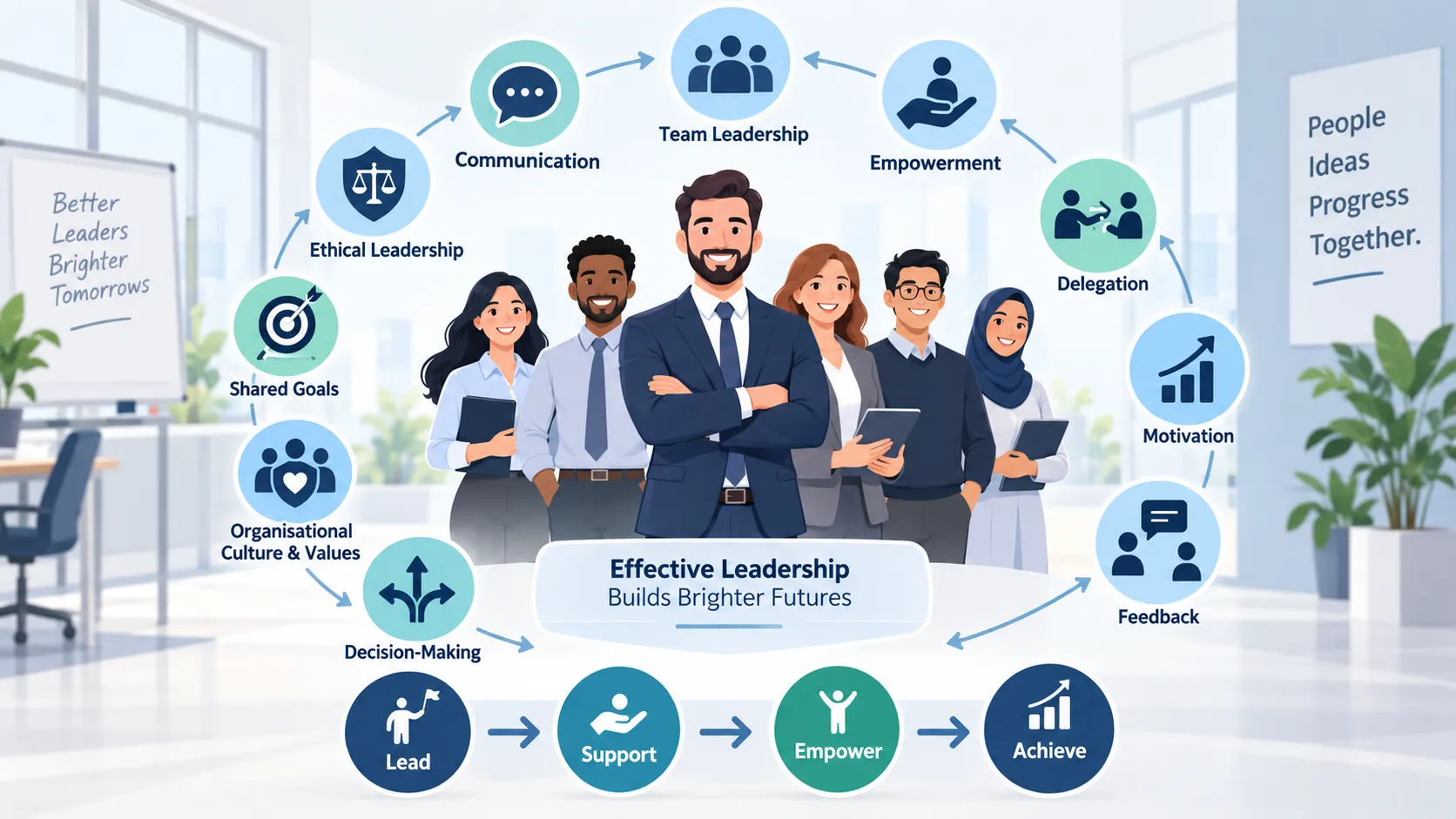
Understanding Leadership Practice
Leadership practice refers to the practical actions, behaviours and approaches used by individuals to influence, guide and support others towards shared objectives. It involves translating leadership principles and organisational expectations into everyday workplace behaviour.
A manager may demonstrate leadership practice when they:
communicate a clear direction to their team;
make responsible and informed decisions;
support employees during periods of change;
encourage collaboration and participation;
provide feedback and guidance;
delegate responsibilities appropriately;
resolve workplace issues;
motivate individuals and teams;
demonstrate organisational values through their behaviour; and
create opportunities for others to develop and contribute.
Leadership practice can occur at different levels within an organisation. Senior leaders may focus primarily on organisational strategy and long-term direction, while middle managers often play a critical role in connecting strategic objectives with day-to-day operations. They communicate organisational priorities to employees, manage resources, coordinate teams and ensure that organisational plans are translated into practical action.
For this reason, middle managers require a balanced combination of leadership and management capabilities. Management activities may focus on planning, organising and monitoring work, while leadership involves influencing, motivating and supporting people. In practice, these responsibilities frequently overlap.
Leadership and Management in Organisational Practice
Although leadership and management are closely connected, they are not identical concepts. Effective organisational practice often requires managers to perform both functions.
| Key Concept | Definition | Detailed Explanation |
|---|---|---|
| Leadership | The process of influencing and guiding individuals or groups towards shared goals. | Leadership focuses on people, direction, relationships and influence. It helps create commitment and encourages individuals to work towards a common purpose. |
| Management | The process of planning, organising, coordinating and controlling resources and activities. | Management focuses on ensuring that work is organised effectively and organisational objectives are achieved through appropriate processes and resource allocation. |
| Leadership Practice | The practical application of leadership behaviours and approaches in the workplace. | It includes communication, decision-making, motivation, ethical conduct, delegation, empowerment and relationship management. |
| Organisational Culture | Shared behaviours, beliefs and practices that influence how people work within an organisation. | Culture affects communication, decision-making, teamwork and the behaviours that are accepted or encouraged in the workplace. |
| Organisational Values | Principles and standards that guide expected behaviour and decision-making. | Leaders are expected to demonstrate organisational values consistently and encourage others to apply them in practice. |
| Empowerment | Providing individuals with appropriate authority, confidence, information and support to contribute and take responsibility. | Empowerment can increase participation, ownership and engagement when responsibilities are clearly defined and appropriate support is available. |
An effective middle manager may need to organise a project, establish deadlines and monitor progress while also motivating team members, addressing concerns and encouraging collaboration. The ability to combine these responsibilities is an important aspect of effective leadership practice.
The Importance of Context
Leadership practices cannot always be applied in exactly the same way across every organisation. A leadership approach that works effectively in one workplace may require adaptation in another.
For example, a manager leading a highly experienced professional team may use a more participative approach, encouraging team members to contribute specialist knowledge and participate in decision-making. In contrast, a manager responding to an urgent operational or safety-related situation may need to provide clear and immediate direction.
Leadership practice is therefore influenced by factors such as:
organisational objectives and strategic priorities;
organisational culture and values;
the nature of the industry or sector;
team size and structure;
employee experience and competence;
available resources;
organisational policies and procedures;
technological developments;
workplace change; and
external legal, economic and social factors.
The ability to understand context enables managers to make more appropriate leadership decisions.
The Purpose of Leadership Within Organisations
Leadership provides direction and helps people understand how their individual work contributes to wider organisational objectives. Without effective leadership, employees may experience uncertainty regarding priorities, responsibilities or expected standards of performance.
A key purpose of leadership is to create alignment between people and organisational goals. This does not mean that leaders simply instruct employees to complete tasks. Effective leaders communicate purpose and help individuals understand why particular objectives are important.
Leadership within organisations can support:
clarity of direction;
employee engagement;
effective communication;
stronger working relationships;
improved collaboration;
responsible decision-making;
organisational change;
innovation and problem-solving;
employee development; and
sustainable organisational performance.
Leadership as Influence Rather Than Authority
Formal authority can provide a manager with responsibility for making decisions and managing others, but authority alone does not guarantee effective leadership.
Leadership influence is often developed through:
trust;
credibility;
professional competence;
consistency;
effective communication;
fairness;
respect for others; and
the ability to understand different perspectives.
Employees may be more willing to follow a manager who demonstrates integrity and competence than one who relies solely on their formal position.
Practical Example: Building Influence
Consider a middle manager who has recently been appointed to lead an established team. The manager may have formal authority, but team members may initially be uncertain about their leadership style and expectations.
An effective approach may involve:
meeting with team members individually and collectively;
understanding existing responsibilities and challenges;
communicating expectations clearly;
listening to employee perspectives;
making decisions fairly and transparently;
following through on commitments; and
recognising positive contributions.
Over time, consistent behaviour can help the manager establish trust and strengthen their ability to influence the team.
Ethical Leadership Practice
Ethical leadership is a central element of responsible management and leadership. Ethical leaders consider not only whether a decision will achieve an organisational objective, but also whether the process and outcome are responsible, fair and consistent with appropriate principles and values.
Ethical leadership can involve:
honesty and transparency;
fairness in decision-making;
respect for individuals;
accountability;
responsible use of authority;
confidentiality where appropriate;
avoidance of conflicts of interest;
consistency between stated values and actual behaviour; and
consideration of the impact of decisions on others.
Ethical leadership is particularly important because managers often influence workplace standards through their own behaviour. Employees observe how leaders respond to challenges, treat colleagues and make decisions. When a leader consistently demonstrates integrity, this can contribute to a workplace culture based on trust and accountability.
Ethical Decision-Making in Practice
Managers may face situations in which different interests need to be balanced. For example, an organisation may need to improve productivity while employees are concerned about workload and wellbeing.
An ethical approach to decision-making may include the following process:
Step 1: Identify the Issue
The manager should clearly understand the nature of the decision or problem.
Questions may include:
What decision needs to be made?
Who may be affected?
What information is available?
What are the potential risks?
Step 2: Consider Organisational Values and Responsibilities
The manager should consider relevant organisational values, policies, professional responsibilities and legal requirements.
Step 3: Evaluate Available Options
Different options should be considered rather than selecting the first available solution.
The manager may assess:
potential benefits;
possible negative consequences;
fairness;
risks;
resource implications; and
the impact on different stakeholders.
Step 4: Consult Where Appropriate
Some decisions benefit from consultation with relevant employees, managers or specialists.
Consultation can:
provide additional information;
identify potential concerns;
improve understanding of different perspectives; and
increase confidence in the decision-making process.
Step 5: Make and Communicate the Decision
The decision should be communicated clearly and professionally. Where appropriate, the manager should explain the reasons for the decision.
Step 6: Review the Outcome
After implementation, the manager should consider whether the decision achieved the intended outcome and identify any lessons for future practice.
Organisational Culture and Leadership Practice
Organisational culture has a significant influence on leadership practice. Culture can be understood as the shared ways in which people behave, communicate and work together within an organisation.
Some organisations may have a highly collaborative culture in which employees are encouraged to share ideas and participate in decision-making. Others may operate through more formal structures with clearly defined levels of authority.
A manager’s leadership approach should recognise the existing culture while also considering whether aspects of that culture support organisational objectives and values.
How Leaders Influence Culture
Leaders influence organisational culture through everyday actions. Culture is not created only through written statements or policies. It is reinforced by what leaders consistently do.
Leaders can influence culture by:
modelling expected behaviours;
recognising positive contributions;
addressing inappropriate conduct;
communicating organisational values;
encouraging collaboration;
promoting inclusion and respect;
responding constructively to mistakes;
supporting learning and improvement; and
making decisions consistently.
For example, an organisation may state that teamwork is an important value. If managers regularly make decisions without consulting relevant team members, the practical experience of employees may conflict with the stated value. Conversely, leaders who encourage appropriate participation and collaboration demonstrate that teamwork is valued in practice.
The Role of Organisational Values
Values provide guidance regarding the standards and behaviours that an organisation considers important. Common organisational values may include:
integrity;
respect;
accountability;
collaboration;
excellence;
inclusion;
innovation; and
responsibility.
Effective leaders understand that values must be reflected in practical behaviour.
Example: Respect as a Leadership Value
A manager who values respect may demonstrate this by:
listening actively to others;
communicating professionally;
acknowledging different perspectives;
addressing inappropriate behaviour;
providing constructive feedback; and
treating employees fairly.
This demonstrates how organisational values can become part of everyday leadership practice.
Examining Different Leadership Approaches
Managers can examine different leadership approaches to understand how leaders influence others in varying organisational situations. Leadership models provide useful frameworks, but they should not be applied mechanically.
Effective leadership requires professional judgement.
Transformational Leadership
Transformational leadership focuses on inspiring and encouraging people to work towards a shared purpose. Leaders using this approach may focus on motivation, innovation and organisational improvement.
Key characteristics may include:
communicating a compelling vision;
encouraging innovation;
supporting employee development;
creating commitment to shared objectives; and
motivating people to achieve positive change.
Practical Application
A middle manager introducing a new service improvement initiative may explain the purpose of the change, encourage employees to contribute ideas and support individuals through the implementation process.
The potential benefit is increased engagement and ownership. However, managers must also ensure that enthusiasm for change is supported by realistic planning and resources.
Transactional Leadership
Transactional leadership focuses on clear expectations, responsibilities and performance requirements. It may involve monitoring performance and providing recognition or corrective action based on agreed standards.
This approach can be useful when:
tasks are clearly defined;
compliance is important;
performance standards must be monitored;
employees require clear direction; or
consistency is essential.
A limitation is that excessive reliance on transactional practices may reduce opportunities for creativity and participation.
Situational Leadership
Situational approaches emphasise the importance of adapting leadership behaviour according to the needs of the situation and the individuals involved.
A manager may need to consider:
employee competence;
employee confidence;
task complexity;
urgency;
available support; and
organisational risk.
For example, a new employee learning a complex process may require detailed guidance, while an experienced employee may benefit from greater autonomy.
The key principle is that effective leadership practice requires flexibility.
Participative Leadership
Participative leadership involves appropriate employee involvement in decision-making. Managers seek relevant perspectives and encourage individuals to contribute ideas.
Potential benefits include:
improved engagement;
access to wider knowledge and experience;
stronger collaboration;
increased ownership of decisions; and
improved problem-solving.
However, participation may not be appropriate for every decision. Urgent situations or matters requiring specialist authority may require a more direct approach.
Servant Leadership
Servant leadership places significant emphasis on supporting the needs, development and wellbeing of others. Leaders focus on helping individuals and teams perform effectively.
This may involve:
listening to employees;
supporting professional development;
removing barriers to performance;
encouraging collaboration; and
prioritising responsible relationships.
This approach can support a positive workplace environment when balanced with the need to maintain accountability and organisational standards.
Comparing Leadership Practices
Rather than viewing one leadership model as universally superior, managers should examine the strengths and limitations of different approaches.
Important considerations include:
What is the organisational objective?
What does the team need?
How experienced are the individuals involved?
How urgent is the situation?
What risks are present?
What organisational values should guide the decision?
How much participation is appropriate?
A reflective manager uses leadership knowledge to make informed choices rather than relying on a single preferred style.
Empowerment as a Leadership Practice
Empowerment is an important aspect of contemporary leadership practice. It involves enabling individuals to take appropriate responsibility, contribute to decisions and use their skills effectively.
Empowerment does not mean that a manager removes all supervision or accountability. Effective empowerment requires clear boundaries, appropriate authority, resources and support.
Key Elements of Empowerment
Managers can support empowerment through:
clear communication of responsibilities;
appropriate delegation;
access to relevant information;
opportunities to contribute ideas;
coaching and guidance;
recognition of competence;
development opportunities; and
constructive feedback.
When employees understand their responsibilities and feel trusted to contribute, they may demonstrate greater ownership of their work.
The Empowerment Process
A structured approach to empowerment may involve several stages.
Clarify the Purpose
Employees should understand the objective and expected outcomes.
Define Authority and Boundaries
The manager should clarify what decisions the individual can make independently and when additional approval is required.
Provide Resources and Information
Employees require appropriate access to information, tools and support.
Develop Capability
Training, coaching and experience may be necessary before greater responsibility is delegated.
Encourage Participation
Managers should create opportunities for employees to contribute ideas and solutions.
Review and Support
Empowerment should include feedback and support rather than complete withdrawal of managerial involvement.
Practical Example: Empowering a Team Member
A manager may ask an experienced employee to lead a small improvement project.
The manager could:
explain the required outcome;
agree on available resources;
clarify decision-making authority;
establish appropriate reporting arrangements;
provide access to relevant stakeholders;
offer coaching when required; and
review progress at agreed intervals.
This approach provides responsibility while maintaining appropriate support and accountability.
Communication as a Leadership Practice
Communication is one of the most important methods through which leaders influence and support others. Effective communication helps employees understand priorities, expectations and organisational objectives.
Leadership communication should be:
clear;
relevant;
respectful;
timely;
appropriate to the audience; and
open to feedback.
Managers should also recognise that communication is a two-way process. Listening is therefore an essential leadership capability.
Active Listening
Active listening involves giving appropriate attention to another person’s message and seeking to understand their perspective.
Managers can demonstrate active listening by:
giving the speaker appropriate attention;
asking relevant questions;
avoiding unnecessary interruption;
checking understanding;
recognising important concerns; and
responding constructively.
Active listening can improve workplace relationships and provide managers with valuable information about team concerns and opportunities.
Leading Through Feedback
Feedback is an important leadership practice because it supports performance and development.
Effective feedback should generally be:
specific;
based on observable behaviour or evidence;
timely;
respectful;
constructive; and
focused on improvement where appropriate.
For example, instead of stating that an employee’s work was “poor,” a manager can identify the specific issue, explain its impact and discuss what improvement is required.
This approach is more likely to support understanding and professional development.
Delegation as a Leadership Practice
Delegation involves assigning responsibility for appropriate tasks or activities while maintaining overall managerial accountability.
Effective delegation can:
develop employee capability;
improve workload management;
create opportunities for experience;
increase engagement; and
support succession and team development.
However, delegation should be planned carefully.
Effective Delegation Process
A manager should:
identify an appropriate task or responsibility;
select a suitable individual;
explain the expected outcome;
clarify authority and responsibilities;
provide necessary resources;
agree on timescales;
establish appropriate review arrangements; and
provide feedback following completion.
Delegation should not simply involve transferring unwanted work. It should be used as a purposeful leadership and development practice.
Motivation and Leadership
Leaders influence employee motivation through their behaviour, communication and management practices. While managers cannot directly control an individual’s motivation, they can create conditions that support engagement and commitment.
Leadership practices that may support motivation include:
recognising positive contributions;
providing meaningful feedback;
setting clear objectives;
involving employees appropriately;
providing development opportunities;
treating people fairly;
supporting manageable workloads; and
connecting individual responsibilities with organisational purpose.
Different individuals may be motivated by different factors. Effective managers therefore avoid assuming that all employees respond to the same incentives.
Leading Teams Effectively
Leadership within organisations frequently involves leading teams rather than individuals in isolation. Effective teams require clarity, communication and appropriate coordination.
A manager leading a team should consider:
the team’s purpose;
individual responsibilities;
collective objectives;
communication methods;
available resources;
working relationships; and
performance expectations.
Creating a Shared Purpose
Teams perform more effectively when members understand what they are working towards and how their contributions are connected.
A manager can support shared purpose by:
communicating organisational priorities;
establishing clear team objectives;
explaining expected outcomes;
identifying individual responsibilities; and
reviewing progress collectively.
Managing Different Perspectives
Teams may include individuals with different experiences, professional backgrounds and opinions. These differences can support creativity and problem-solving when managed constructively.
Effective leaders encourage respectful discussion and ensure that disagreements focus on ideas and workplace issues rather than personal conflict.
Leadership Practice During Organisational Change
Organisations frequently experience change as a result of new technology, changing customer requirements, restructuring or strategic developments.
Leadership practice becomes particularly important during periods of uncertainty.
Managers can support employees through change by:
communicating the purpose of the change;
explaining how individuals may be affected;
listening to concerns;
providing accurate information;
involving employees where appropriate;
supporting capability development; and
monitoring implementation.
Leaders should recognise that individuals may respond differently to change. Some employees may welcome new opportunities, while others may require additional support.
The Importance of Self-Awareness in Leadership Practice
Effective leadership begins with an awareness of personal behaviour and its impact on others. Managers should regularly reflect on their leadership practice.
Useful reflective questions include:
How do I communicate with different team members?
Do my actions reflect organisational values?
How do I respond to disagreement?
Do I listen effectively?
When should I provide direction, and when should I encourage participation?
How effectively do I delegate?
Do I empower others appropriately?
What feedback have I received about my leadership practice?
Self-awareness helps managers identify strengths and areas for improvement.
Using Feedback to Improve Leadership
Managers can gain valuable insight through feedback from:
line managers;
colleagues;
team members;
mentors;
performance reviews; and
structured professional development activities.
Feedback should be considered objectively and used to identify practical actions for improvement.
Benefits of Effective Leadership Practice
Effective leadership practice can provide significant benefits for individuals, teams and organisations.
Benefits for Employees
Employees may experience:
greater clarity about expectations;
increased confidence;
stronger professional relationships;
opportunities for participation;
improved access to feedback;
greater responsibility; and
enhanced development opportunities.
Benefits for Teams
Teams may benefit from:
improved communication;
stronger collaboration;
clearer objectives;
more effective problem-solving;
greater engagement; and
improved coordination.
Benefits for Organisations
Organisations may benefit from:
improved performance;
stronger workplace culture;
greater employee engagement;
better decision-making;
increased adaptability;
improved retention of capable employees; and
stronger alignment between organisational values and workplace practice.
Applying Leadership Practice in the Workplace
The examination of leadership practices should not remain purely theoretical. Managers should consider how leadership principles can be applied to real organisational situations.
A practical process for reviewing leadership practice may include:
Identify the Organisational Context
Consider the organisation’s:
objectives;
culture;
values;
structure;
workforce;
stakeholders; and
operational environment.
Identify the Leadership Requirement
Determine what the situation requires. For example:
clearer direction;
improved communication;
team development;
employee involvement;
ethical decision-making; or
support during change.
Select an Appropriate Approach
Consider which leadership practices may be most suitable. The approach should reflect the situation rather than personal preference alone.
Implement the Approach
Apply relevant techniques such as communication, coaching, delegation, participation or structured feedback.
Monitor the Impact
Consider whether the leadership approach is producing the intended results.
Reflect and Improve
Identify lessons and make adjustments where necessary.
This continuous process helps managers develop more effective and adaptable leadership practice.
Practical Workplace Scenario
Imagine that a middle manager is responsible for a team experiencing reduced performance and low morale. Team members report that they do not understand recent organisational changes and feel excluded from decisions affecting their work.
The manager should examine the situation rather than immediately adopting a single leadership response.
An appropriate approach could involve:
meeting with the team to understand concerns;
communicating relevant information clearly;
reviewing workload and performance expectations;
involving employees in identifying practical improvements;
delegating appropriate responsibilities;
providing support and feedback;
ensuring decisions are consistent with organisational values; and
monitoring changes in performance and engagement.
In this situation, effective leadership practice involves a combination of communication, ethical behaviour, participation and empowerment.
Key Considerations for Middle Managers and Leaders
Middle managers occupy an important position between senior organisational leadership and operational employees. They often have responsibility for translating organisational strategy into practical workplace action.
To lead effectively, middle managers should:
understand organisational objectives;
demonstrate ethical leadership;
recognise the influence of culture and values;
adapt leadership practices to different situations;
communicate clearly and listen actively;
empower others appropriately;
develop effective working relationships;
support employee development;
manage performance fairly; and
reflect regularly on their own leadership behaviour.
Leadership practice is therefore an ongoing professional responsibility rather than a fixed set of behaviours.
Summary
Examining leadership practices within organisations enables managers and aspiring leaders to understand how leadership influences people, teams and organisational performance. Effective leadership practice involves much more than formal authority. It requires managers to demonstrate ethical behaviour, understand organisational culture and values, communicate effectively and select appropriate approaches for different workplace situations.
Leadership models and approaches can provide useful frameworks for understanding how leaders influence others. However, effective managers apply professional judgement and recognise that leadership practices may need to change according to organisational circumstances, employee needs and the nature of the task.
Empowerment, delegation, communication, feedback, motivation and team leadership are all important elements of practical leadership. When these practices are applied responsibly, they can support employee engagement, capability development and organisational performance.
For practising and aspiring middle managers, the most important principle is that effective leadership must be contextual, ethical and purposeful. Leaders should understand the environment in which they operate, demonstrate organisational values through their behaviour and use appropriate techniques to guide, support and empower others. By regularly examining and reflecting on leadership practice, managers can strengthen their ability to build trust, influence positive workplace behaviour and contribute effectively to the achievement of organisational objectives.
2.Evaluate the Use of Theoretical Approaches to Responsible Leadership
Responsible leadership is increasingly recognised as an essential requirement for managers and leaders operating in complex organisational environments. Leaders are expected not only to achieve performance objectives but also to consider how their decisions, behaviours and leadership practices affect employees, stakeholders, communities and the wider organisation. Responsible leadership therefore requires a balance between achieving organisational goals and acting in an ethical, accountable, inclusive and sustainable manner.
Theoretical approaches to leadership provide managers with structured ways of understanding how leadership works and why different leadership behaviours may influence individuals and organisational outcomes. However, leadership theories should not be treated as fixed instructions that can be applied identically in every workplace. Their value lies in helping managers analyse situations, reflect on their own practice and make more informed decisions.
For practising and aspiring middle managers, evaluating theoretical approaches means considering both the strengths and limitations of leadership theories. A theoretical approach may provide useful guidance in one organisational context but be less suitable in another. Responsible leaders must therefore apply professional judgement and consider organisational culture, values, stakeholder expectations, ethical responsibilities and the needs of individuals and teams.
This section evaluates key theoretical approaches that can support responsible leadership practice. It considers how these approaches can contribute to ethical behaviour, employee empowerment, engagement, accountability and sustainable organisational performance.
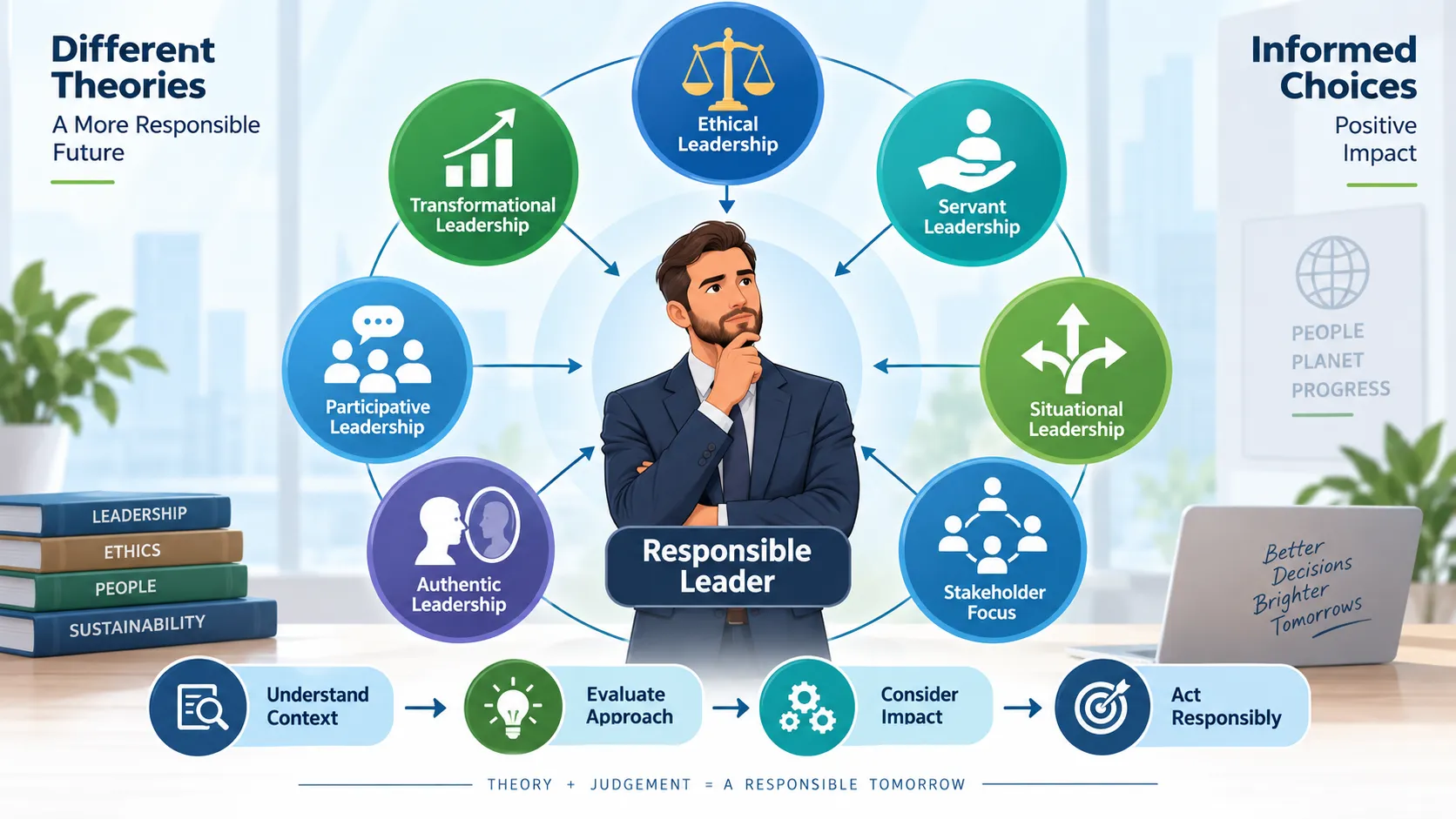
Understanding Responsible Leadership
Responsible leadership can be understood as leadership that recognises the consequences of decisions and actions while considering responsibilities towards different stakeholders. It requires leaders to exercise influence in ways that are consistent with ethical principles, organisational values and appropriate professional standards.
A responsible leader does not focus exclusively on short-term results. Instead, they consider how organisational objectives can be achieved while maintaining responsible relationships and practices.
Responsible leadership may involve:
acting with integrity and honesty;
making decisions fairly;
accepting accountability for actions;
respecting the rights and dignity of others;
considering different stakeholder perspectives;
promoting inclusion and participation;
using organisational resources responsibly;
supporting employee wellbeing;
addressing inappropriate behaviour;
considering long-term consequences; and
aligning leadership behaviour with organisational values.
Responsible leadership is particularly important for middle managers because they frequently make decisions that directly affect employees. Their approach to communication, delegation, performance management and decision-making can shape how organisational values are experienced in everyday practice.
The Role of Leadership Theory in Responsible Practice
Leadership theories provide frameworks that help managers understand different approaches to influencing and leading others. They can support professional practice by encouraging managers to consider:
how leadership behaviour affects others;
when particular leadership approaches may be appropriate;
the relationship between leadership and organisational culture;
the importance of motivation and engagement;
how power and authority should be used responsibly;
the role of participation and empowerment; and
the ethical implications of leadership decisions.
However, theories also have limitations. Many leadership models simplify complex human behaviour and may not fully reflect the realities of every organisation.
Responsible managers should therefore use theory as a tool for critical thinking, rather than as a set of rules.
Key Theoretical Approaches to Responsible Leadership
The following table provides an overview of important theoretical approaches that can inform responsible leadership practice.
| Theoretical Approach | Definition | Key Concepts | Contribution to Responsible Leadership |
|---|---|---|---|
| Ethical Leadership | Leadership based on moral principles, fairness, integrity and responsible behaviour. | Integrity, fairness, accountability, respect. | Supports trust, ethical decision-making and responsible use of authority. |
| Transformational Leadership | Leadership that inspires and motivates people towards a shared vision and positive change. | Vision, motivation, development, inspiration. | Can encourage engagement, development and collective responsibility. |
| Servant Leadership | Leadership that prioritises supporting and developing others while serving organisational and stakeholder needs. | Service, empathy, listening, development. | Promotes employee wellbeing, empowerment and responsible relationships. |
| Situational Leadership | Leadership behaviour adapted to the needs of individuals and the circumstances of the situation. | Flexibility, competence, confidence, support. | Encourages appropriate and responsive leadership rather than a single fixed style. |
| Participative Leadership | Leadership that involves individuals and teams in relevant decision-making. | Consultation, collaboration, inclusion, shared responsibility. | Supports engagement, transparency and employee voice. |
| Authentic Leadership | Leadership based on self-awareness, transparency and behaviour consistent with personal and organisational values. | Self-awareness, honesty, consistency, trust. | Encourages credible and values-based leadership. |
| Stakeholder-Oriented Leadership | Leadership that considers the interests and impact of decisions on different stakeholders. | Responsibility, sustainability, relationships, impact. | Supports balanced decision-making beyond short-term organisational interests. |
Ethical Leadership Theory
Ethical leadership is one of the most directly relevant theoretical approaches to responsible leadership. It focuses on the importance of moral behaviour, fairness, integrity and responsible decision-making.
Ethical leadership recognises that leaders influence not only organisational outcomes but also the standards of behaviour within the workplace. Employees often observe how managers make decisions, treat colleagues and respond to difficult situations.
An ethical leader is expected to demonstrate consistency between what they communicate and what they do.
Key Principles of Ethical Leadership
Ethical leadership is commonly associated with:
honesty in communication;
fairness in decision-making;
respect for individuals;
transparency where appropriate;
accountability;
responsible use of power;
confidentiality and professional discretion;
consistency with organisational values;
willingness to challenge inappropriate behaviour; and
consideration of the consequences of decisions.
Evaluating Ethical Leadership
A major strength of ethical leadership is that it provides a strong foundation for responsible management practice. It encourages managers to consider not only what decision is made but also how the decision is made.
For example, a manager may need to allocate limited training opportunities between employees. An ethical approach would involve establishing appropriate criteria, considering relevant development needs and avoiding favouritism.
Potential benefits include:
increased employee trust;
improved leadership credibility;
stronger alignment with organisational values;
more consistent decision-making;
improved workplace relationships; and
reduced tolerance for inappropriate conduct.
However, ethical leadership can also involve challenges.
Managers may encounter situations in which different ethical responsibilities conflict. For example, transparency may need to be balanced with confidentiality. A manager may also face pressure to achieve demanding performance targets while protecting employee wellbeing.
Therefore, ethical leadership requires judgement rather than simply following a single rule.
Practical Ethical Decision-Making Process
Responsible managers can use a structured process when evaluating difficult decisions.
Identify the Leadership Issue
The manager should clearly define:
what has happened;
what decision is required;
who may be affected; and
what information is available.
Consider Values and Responsibilities
Relevant considerations may include:
organisational values;
professional responsibilities;
workplace policies;
legal requirements;
stakeholder expectations; and
potential ethical concerns.
Evaluate Possible Actions
The manager should consider different options and their possible consequences.
Questions may include:
Is the action fair?
Who may benefit?
Who may experience negative consequences?
Is the decision consistent with organisational values?
Can the decision be explained transparently?
Are there alternative approaches?
Make and Communicate the Decision
The decision should be communicated appropriately, while respecting confidentiality where necessary.
Review the Outcome
The manager should reflect on:
whether the decision achieved its intended purpose;
whether any unintended consequences occurred; and
what could be improved in future situations.
Transformational Leadership and Responsible Leadership
Transformational leadership focuses on inspiring people to work towards a shared purpose and encouraging positive change. Leaders seek to motivate individuals, support development and create commitment to organisational goals.
This approach can contribute to responsible leadership when the organisational vision and change process are based on ethical and sustainable principles.
Key Features of Transformational Leadership
Transformational leaders may:
communicate a clear vision;
encourage innovation;
inspire employees;
support learning and development;
recognise individual contributions;
challenge existing practices;
encourage positive organisational change; and
create a sense of shared purpose.
Strengths of Transformational Leadership
A significant strength is its focus on motivation and employee development. This can be particularly valuable during organisational change or improvement initiatives.
For middle managers, transformational leadership can support responsible practice by encouraging employees to understand the wider purpose of their work.
Potential benefits include:
increased engagement;
stronger commitment to organisational objectives;
encouragement of innovation;
improved employee development;
greater willingness to support change; and
stronger collective purpose.
Limitations and Risks
Transformational leadership is not automatically responsible simply because it is inspirational. A leader’s vision and influence must also be evaluated ethically.
A highly influential leader could potentially encourage followers towards objectives that are not in their best interests.
Responsible managers should therefore ensure that transformational leadership is supported by:
ethical decision-making;
transparency;
stakeholder consideration;
appropriate accountability;
realistic planning; and
respect for employee wellbeing.
Practical Example
A middle manager is leading a digital transformation project that will significantly change how employees perform their roles.
A transformational approach could involve:
explaining the purpose of the transformation;
communicating the expected benefits;
encouraging employees to contribute ideas;
providing opportunities for skill development;
recognising concerns;
supporting individuals through the transition; and
celebrating progress.
The responsible element is demonstrated by ensuring that employees receive adequate support rather than simply demanding rapid adaptation.
Servant Leadership and Responsibility
Servant leadership focuses strongly on supporting and developing others. The approach suggests that effective leaders place significant importance on the needs of employees, teams and stakeholders.
Rather than focusing primarily on personal authority or status, the leader seeks to enable others to perform and develop.
Core Principles of Servant Leadership
Key principles may include:
listening;
empathy;
stewardship;
commitment to employee development;
community building;
empowerment;
ethical responsibility; and
awareness of the impact of leadership behaviour.
Contribution to Responsible Leadership
Servant leadership has a strong relationship with responsible leadership because it encourages managers to consider the needs and development of others.
A servant-oriented manager may:
remove barriers that prevent employees from performing effectively;
provide coaching and support;
encourage professional development;
listen to employee concerns;
create opportunities for participation; and
use authority responsibly.
Benefits
Potential benefits include:
stronger workplace relationships;
increased trust;
improved employee engagement;
greater opportunities for development;
a supportive organisational culture; and
stronger collaboration.
Limitations
A potential challenge is that managers must balance employee needs with organisational responsibilities. A leader cannot always satisfy every individual preference.
For example, an employee may prefer not to change their working practices, while the organisation requires new processes to meet strategic objectives.
Responsible servant leadership therefore requires balance. Supporting employees does not mean avoiding difficult decisions or failing to maintain performance standards.
Situational Leadership and Contextual Responsibility
Situational leadership is based on the principle that effective leadership behaviour should be adapted according to the circumstances and the needs of individuals.
A responsible leader recognises that people have different levels of experience, competence and confidence.
Applying Situational Leadership
A manager may need to consider:
the complexity of the task;
the experience of the employee;
the individual’s confidence;
the level of organisational risk;
the urgency of the situation;
the support available; and
the consequences of errors.
Different Leadership Responses
A new employee may require:
clear instructions;
close guidance;
frequent feedback; and
structured support.
An experienced employee may benefit from:
greater autonomy;
involvement in decision-making;
delegated responsibility; and
opportunities to mentor others.
Strengths
Situational leadership can support responsible practice because it discourages managers from assuming that one leadership approach is suitable for everyone.
Benefits include:
greater flexibility;
more appropriate support;
improved employee development;
better use of individual capabilities; and
responsiveness to changing circumstances.
Limitations
Managers may find it difficult to accurately assess employee readiness or competence. There is also a risk that frequent changes in leadership behaviour may create confusion if expectations are not communicated clearly.
Therefore, managers should combine situational judgement with consistent organisational values and clear communication.
Participative Leadership and Employee Voice
Participative leadership involves employees in relevant aspects of decision-making. The approach recognises that employees often possess valuable knowledge about operational processes, customer needs and workplace challenges.
Responsible leadership should create appropriate opportunities for employee voice.
Methods of Participation
Managers may encourage participation through:
team meetings;
consultation;
workshops;
problem-solving groups;
improvement projects;
suggestion systems;
employee surveys; and
collaborative planning activities.
Benefits of Participative Leadership
Participation can:
improve employee engagement;
increase ownership of decisions;
provide access to diverse perspectives;
improve problem-solving;
strengthen communication; and
support a culture of inclusion.
Responsible Use of Participation
Participation should be genuine. It can damage trust if managers repeatedly request employee opinions but ignore them without explanation.
Responsible managers should:
explain what decisions employees can influence;
provide relevant information;
consider contributions seriously;
communicate the outcomes of consultation; and
explain why particular suggestions may not be implemented.
Limitations
Participative leadership may not be suitable in every situation.
For example:
urgent decisions may require immediate action;
confidential matters may limit consultation;
specialist decisions may require technical expertise; and
extensive consultation may delay action.
Responsible leadership therefore involves determining when participation is appropriate.
Authentic Leadership and Values-Based Practice
Authentic leadership emphasises self-awareness, transparency and consistency between values and behaviour.
Authentic leaders seek to understand their strengths, limitations and personal impact on others.
Key Elements
Authentic leadership may involve:
self-awareness;
openness;
consistency;
values-based decision-making;
willingness to learn;
acceptance of constructive feedback; and
genuine professional relationships.
Contribution to Responsible Leadership
Authentic leadership can support trust because employees are more likely to develop confidence in leaders whose behaviour is consistent and credible.
For example, a manager who promotes openness should be willing to listen to constructive criticism. A manager who promotes accountability should accept responsibility for their own mistakes.
Benefits
This approach can support:
stronger trust;
credible leadership;
reflective practice;
improved communication; and
alignment between values and actions.
Potential Limitations
Authenticity does not mean that leaders should communicate every personal opinion or confidential matter.
Professional judgement remains essential. Leaders must balance openness with responsibilities relating to confidentiality, organisational interests and professional boundaries.
Stakeholder-Oriented Approaches to Responsible Leadership
Responsible leadership extends beyond the immediate relationship between a manager and their team. Leadership decisions may affect a wide range of stakeholders.
Stakeholders may include:
employees;
customers;
senior management;
shareholders or owners;
suppliers;
communities;
regulatory bodies; and
professional partners.
A stakeholder-oriented approach encourages leaders to consider the wider consequences of organisational decisions.
Stakeholder Evaluation Process
Responsible managers can follow a structured approach.
Identify Relevant Stakeholders
Determine who may be affected by the decision.
Understand Stakeholder Interests
Consider the different needs and expectations involved.
Assess Potential Impact
Identify possible positive and negative consequences.
Balance Competing Interests
Consider how organisational objectives can be achieved responsibly.
Communicate Appropriately
Engage relevant stakeholders where appropriate.
Review Outcomes
Evaluate whether the decision produced the intended and responsible results.
Benefits
Stakeholder-oriented leadership can support:
improved decision-making;
stronger organisational relationships;
increased awareness of consequences;
improved reputation;
sustainable practice; and
greater accountability.
Challenges
Stakeholder interests may conflict. Managers may need to balance:
cost and quality;
productivity and employee wellbeing;
short-term performance and long-term sustainability;
transparency and confidentiality.
There may not always be a perfect solution. Responsible leadership requires managers to make reasoned and accountable decisions.
Evaluating Theoretical Approaches Rather Than Selecting One Model
An important aspect of leadership development is recognising that no single theory provides a complete solution for every organisational challenge.
Managers should evaluate theories by considering:
relevance to the organisational context;
alignment with organisational values;
ethical implications;
impact on employees;
practical feasibility;
potential benefits;
possible limitations; and
likely consequences.
A Critical Evaluation Framework
Middle managers can use the following questions when evaluating a theoretical approach.
Relevance
Does the theory address the current leadership challenge?
Is the approach suitable for the team and organisation?
Ethical Alignment
Does the approach support fairness and responsible behaviour?
Could its application create ethical concerns?
Stakeholder Impact
Who may benefit?
Who may experience negative consequences?
Practical Application
Does the manager have the authority and resources required?
Can the approach be implemented effectively?
Flexibility
Can the approach be adapted to changing circumstances?
Outcomes
How will success be measured?
What indicators will demonstrate improvement?
Combining Theoretical Approaches in Practice
In real organisational settings, managers often combine elements from different theories.
For example, a responsible middle manager leading organisational change may:
use transformational leadership to communicate purpose and inspire commitment;
apply ethical leadership to ensure decisions are fair and responsible;
use participative leadership to involve employees;
apply situational leadership to provide different levels of support; and
demonstrate servant leadership by supporting employee development and wellbeing.
This integrated approach can be more realistic than attempting to apply a single theory to every situation.
The Relationship Between Responsible Leadership and Empowerment
Empowerment is an important practical outcome of responsible leadership.
A responsible manager recognises that employees should be given appropriate opportunities to contribute, develop and exercise responsibility.
However, empowerment must be supported by clear boundaries.
Responsible Empowerment Requires
clarity about responsibilities;
appropriate authority;
access to relevant information;
suitable resources;
development and training;
managerial support;
constructive feedback; and
accountability.
The Empowerment Process
Establish Clear Expectations
Employees should understand the required outcomes.
Assess Capability
Managers should consider the individual’s experience and development needs.
Delegate Appropriate Authority
Employees should know which decisions they can make.
Provide Support
Coaching and guidance should be available when needed.
Encourage Reflection
Employees should consider what they have learned.
Review Outcomes
The manager and employee should evaluate performance and identify future development needs.
This process demonstrates how leadership theory can be translated into practical responsible leadership behaviour.
Practical Example: Evaluating Leadership Approaches
Consider an organisation experiencing high employee turnover within one department. Employees report limited involvement in decisions, poor communication and a lack of development opportunities.
A middle manager could evaluate several approaches.
Ethical Leadership
The manager may review whether employees are treated fairly and whether concerns are addressed transparently.
Participative Leadership
The manager may introduce structured opportunities for employees to contribute to decisions affecting their work.
Servant Leadership
The manager may focus on understanding barriers to employee performance and providing development support.
Transformational Leadership
The manager may communicate a clearer team purpose and encourage employees to participate in improvement.
Situational Leadership
The manager may provide different levels of guidance and autonomy according to individual needs.
Rather than selecting only one approach, the manager can combine appropriate elements while ensuring that actions remain aligned with organisational values and objectives.
Benefits of Using Theoretical Approaches
Leadership theory can provide significant benefits when applied critically and responsibly.
Benefits for Managers
Theoretical approaches can help managers:
understand different leadership behaviours;
improve decision-making;
reflect on personal practice;
identify appropriate responses to workplace situations;
develop leadership flexibility; and
strengthen professional confidence.
Benefits for Employees
Effective application may support:
greater involvement;
improved communication;
increased trust;
development opportunities;
appropriate empowerment; and
stronger working relationships.
Benefits for Organisations
Organisations may benefit through:
stronger ethical culture;
improved employee engagement;
better decision-making;
increased adaptability;
improved organisational relationships; and
more sustainable performance.
Limitations of Leadership Theory
Leadership theories are valuable, but managers should understand their limitations.
Potential limitations include:
oversimplification of complex situations;
differences between theoretical assumptions and workplace realities;
cultural differences between organisations;
changes in organisational circumstances;
individual differences among employees; and
the risk of applying models mechanically.
A responsible manager should therefore avoid statements such as, “This theory always works.”
Professional leadership requires critical evaluation and adaptation.
Developing Responsible Leadership Practice
Managers can use leadership theories as part of an ongoing development process.
A practical process may include:
Step 1: Reflect on Current Practice
Consider:
How do I currently lead others?
What are my strengths?
What situations do I find challenging?
Step 2: Identify Relevant Theory
Explore leadership approaches that may provide useful insight.
Step 3: Evaluate Context
Consider organisational culture, values, objectives and employee needs.
Step 4: Select Appropriate Practices
Choose practical leadership behaviours that are relevant and responsible.
Step 5: Implement and Monitor
Apply the approach and observe its impact.
Step 6: Seek Feedback
Gather perspectives from relevant colleagues and team members.
Step 7: Reflect and Improve
Identify lessons and adapt future leadership practice.
This process supports continuous professional development and prevents leadership theory from becoming purely academic knowledge.
Key Principles for Middle Managers
When applying theoretical approaches to responsible leadership, middle managers should remember the following principles:
No single leadership theory is appropriate for every situation.
Leadership practice should reflect organisational values.
Ethical considerations should be integrated into decision-making.
Employees should be treated fairly and respectfully.
Participation and empowerment should be genuine and appropriate.
Leadership approaches should be adapted to individual and organisational needs.
Managers should consider the impact of decisions on stakeholders.
Accountability remains essential even when responsibility is delegated.
Leadership theory should support critical thinking rather than replace professional judgement.
Regular reflection is essential for continuous improvement.
Summary
Theoretical approaches to leadership provide valuable frameworks for understanding how managers can lead responsibly within organisations. Ethical leadership, transformational leadership, servant leadership, situational leadership, participative leadership, authentic leadership and stakeholder-oriented approaches each offer different perspectives on leadership behaviour and responsibility.
Ethical leadership provides a foundation for integrity, fairness and accountability. Transformational leadership can support engagement and positive change when guided by responsible values. Servant leadership emphasises support and development, while situational leadership encourages managers to adapt their behaviour to individual and organisational needs. Participative leadership promotes employee voice, and authentic leadership supports consistency between values and behaviour.
However, responsible leadership requires more than selecting a preferred theoretical model. Managers must critically evaluate the strengths and limitations of different approaches and consider the organisational context in which leadership takes place.
For practising and aspiring middle managers, the most effective approach is often to combine relevant elements from different theories while maintaining a clear commitment to ethical behaviour, accountability, employee empowerment and stakeholder responsibility. By using leadership theory as a framework for reflection and informed decision-making, managers can strengthen their leadership practice and contribute to a responsible, inclusive and effective organisational culture.
3.Analyse the Impact of Internal and External Factors on Leadership Practice
Leadership practice does not take place in isolation. The way managers and leaders make decisions, communicate, motivate employees, manage change and lead teams is influenced by a wide range of factors within and outside the organisation. Understanding these influences is essential for practising and aspiring middle managers because an approach that is effective in one situation may be unsuitable in another.
Internal factors arise from within the organisation. They include organisational culture, values, structure, strategy, resources, workforce capability, policies, technology and internal relationships. External factors arise from the wider environment in which the organisation operates. These may include economic conditions, legislation, technological developments, market competition, social change, stakeholder expectations and environmental pressures.
Analysing these factors enables managers to understand why leadership practice must often be flexible and responsive. Responsible leadership requires managers to consider how changing circumstances affect employees, organisational priorities and decision-making. Leaders must balance organisational objectives with ethical responsibilities, employee needs and wider stakeholder expectations.
This section examines the major internal and external factors that influence leadership practice and explains how middle managers can analyse these factors to make informed, responsible and effective leadership decisions.
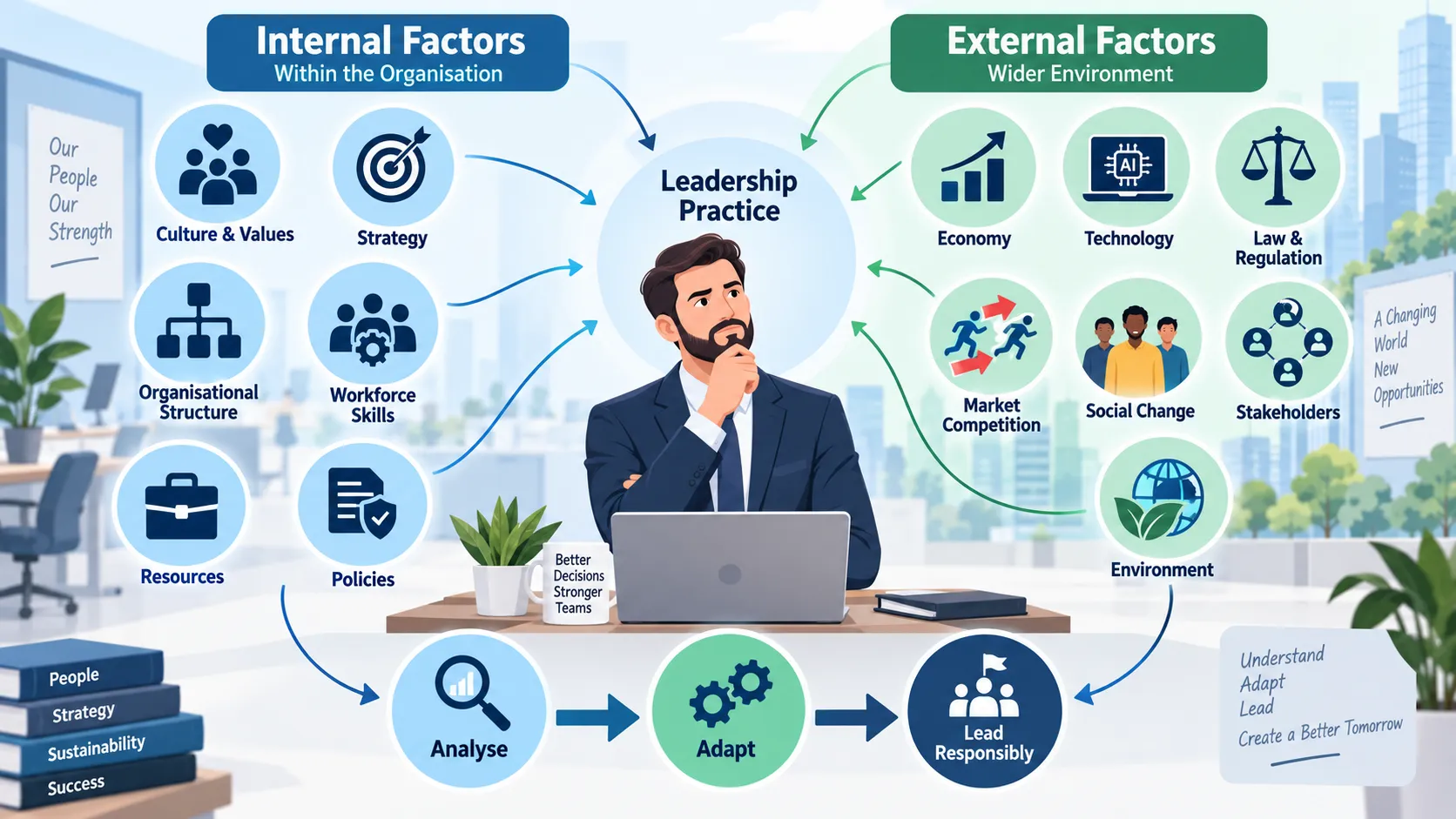
Understanding Internal and External Influences on Leadership
Leadership practice is shaped by context. Context refers to the circumstances and conditions in which leadership takes place.
A manager working in a rapidly changing technology business may need to encourage innovation and experimentation. A manager in a highly regulated healthcare, engineering or financial environment may need to place greater emphasis on compliance, risk management and procedural consistency.
Similarly, leadership practice may change when:
organisational priorities change;
new technology is introduced;
employee expectations develop;
economic conditions become uncertain;
new legislation is implemented;
customer requirements change;
organisational restructuring takes place; or
a significant external event affects operations.
Effective leaders therefore analyse their environment before deciding how to lead.
Key Internal and External Factors
| Factor | Definition | Key Concepts | Impact on Leadership Practice |
|---|---|---|---|
| Organisational Culture | Shared behaviours, beliefs and ways of working within an organisation. | Norms, behaviours, trust, communication. | Influences how leaders communicate, make decisions and manage people. |
| Organisational Values | Principles that guide expected organisational behaviour. | Integrity, respect, accountability, inclusion. | Requires leaders to demonstrate values consistently in practice. |
| Organisational Strategy | Long-term direction and priorities established by the organisation. | Objectives, priorities, performance. | Influences leadership focus, decision-making and resource allocation. |
| Organisational Structure | The arrangement of roles, responsibilities and reporting relationships. | Hierarchy, authority, accountability. | Determines levels of autonomy and decision-making authority. |
| Workforce Capability | The skills, knowledge and experience of employees. | Competence, development, confidence. | Influences the level of guidance, support and empowerment required. |
| Resources | The financial, human, technological and physical assets available. | Capacity, constraints, priorities. | Affects what leaders can implement and how resources are managed. |
| Legislation and Regulation | External legal and regulatory requirements affecting organisational activities. | Compliance, duty, accountability. | Requires leaders to ensure responsible and compliant practices. |
| Economic Environment | External financial and economic conditions. | Inflation, employment, growth, costs. | Can influence organisational priorities and leadership decisions. |
| Technology | Developments in digital systems, automation and communication tools. | Innovation, digitalisation, adaptation. | Requires leaders to manage change and develop new capabilities. |
| Social and Stakeholder Expectations | Changing expectations from employees, customers and communities. | Inclusion, wellbeing, sustainability, ethics. | Increases the importance of responsible and stakeholder-focused leadership. |
Internal Factors Affecting Leadership Practice
Internal factors are conditions that exist within the organisation and directly influence the way managers lead. Middle managers need to understand these factors because they are often responsible for translating organisational expectations into day-to-day practice.
Organisational Culture
Organisational culture has a major influence on leadership practice. It shapes the accepted ways in which people communicate, make decisions, respond to challenges and work together.
A collaborative culture may encourage leaders to consult employees and involve teams in problem-solving. A highly hierarchical culture may place greater emphasis on formal authority and approval processes.
Managers must understand the culture in which they operate.
Important cultural influences may include:
attitudes towards authority;
communication practices;
approaches to decision-making;
employee participation;
attitudes towards risk;
willingness to challenge existing practices;
approaches to learning from mistakes; and
expectations regarding teamwork.
How Culture Influences Leadership Behaviour
A manager’s leadership practice may be affected by whether the organisation encourages:
open communication;
employee involvement;
innovation;
individual accountability;
collaboration;
formal procedures; or
centralised decision-making.
For example, a manager joining an organisation with a highly traditional culture may find that employees are reluctant to challenge senior decisions. The manager may need to gradually build trust and create safe opportunities for employees to express ideas.
Practical Example
A middle manager leads a team in which employees rarely contribute during meetings. Rather than assuming that employees have no ideas, the manager should analyse possible cultural influences.
The team may:
be accustomed to managers making all decisions;
fear criticism;
lack confidence;
have experienced previous suggestions being ignored; or
come from a workplace culture with limited participation.
The manager may respond by:
asking specific questions;
providing opportunities for anonymous feedback;
recognising useful contributions;
explaining how suggestions will be considered; and
demonstrating that employee input can influence decisions.
This illustrates how understanding culture can support more appropriate leadership practice.
Organisational Values
Organisational values provide principles that guide expected behaviour. Leadership practice should demonstrate these values consistently.
Common values include:
integrity;
respect;
accountability;
collaboration;
inclusion;
innovation; and
customer focus.
A responsible leader must translate values from written statements into practical behaviour.
Example of Values in Practice
If an organisation identifies respect as a core value, leadership practice may include:
listening to employees;
communicating professionally;
treating people fairly;
respecting different perspectives;
addressing inappropriate behaviour; and
providing constructive feedback.
If leaders communicate values but behave inconsistently, employee trust may be reduced.
Organisational Strategy and Objectives
Organisational strategy provides direction and establishes priorities. Leadership practice must support the achievement of these objectives.
Middle managers often have a critical responsibility for translating strategic goals into practical activities.
This may involve:
setting team objectives;
allocating resources;
communicating priorities;
monitoring performance;
supporting change; and
identifying operational challenges.
Impact on Leadership Practice
If an organisation has a strategy focused on rapid growth, leaders may need to:
develop employee capability;
recruit new staff;
improve processes;
manage increased workloads; and
maintain service quality.
If the strategy focuses on sustainability, managers may need to:
encourage responsible resource use;
consider environmental impacts;
review operational practices; and
engage employees in improvement initiatives.
Leadership practice should therefore be aligned with organisational direction.
Organisational Structure
Organisational structure determines how responsibilities, authority and reporting relationships are arranged.
Common structures may include:
hierarchical structures;
functional structures;
matrix structures;
project-based structures; and
more decentralised structures.
Each structure can influence leadership practice.
Hierarchical Structures
In highly hierarchical organisations:
decision-making authority may be concentrated;
managers may have defined levels of responsibility;
communication may follow formal channels; and
approval processes may be more structured.
Leaders may need to operate within clearly defined authority limits.
Decentralised Structures
In decentralised organisations:
managers may have greater autonomy;
decision-making may occur closer to operational activities;
employees may have greater responsibility; and
empowerment may be more strongly encouraged.
Leaders may need to focus on coordination and maintaining alignment across different teams.
Workforce Capability and Experience
The skills, knowledge and confidence of employees directly influence leadership practice.
A manager leading an experienced and highly competent team may use greater delegation and empowerment.
A manager leading employees who are new to their roles may need to provide:
clearer direction;
additional training;
frequent feedback;
closer supervision; and
structured support.
Responsible leaders should avoid applying identical leadership behaviour to every employee.
Analysing Workforce Needs
Managers should consider:
What skills does the team currently possess?
Where are the capability gaps?
Which employees require additional support?
Who is ready for greater responsibility?
What development opportunities are required?
This analysis supports more effective delegation, coaching and empowerment.
Internal Resources and Constraints
Leadership decisions are often influenced by the resources available.
Resources may include:
financial budgets;
staffing;
equipment;
technology;
time;
facilities; and
specialist knowledge.
A manager may have an excellent improvement idea but lack the budget or authority to implement it immediately.
Responsible leadership requires managers to:
prioritise resources;
communicate constraints honestly;
identify alternative solutions;
avoid making unrealistic commitments; and
use available resources effectively.
Internal Policies and Procedures
Organisational policies and procedures provide frameworks for workplace behaviour and decision-making.
Relevant areas may include:
health and safety;
equality and inclusion;
performance management;
disciplinary procedures;
data protection;
employee wellbeing; and
information security.
Managers must understand that responsible leadership involves operating within appropriate organisational and professional boundaries.
Policies should not always be followed mechanically without understanding their purpose. Effective leaders understand why procedures exist and apply them consistently and appropriately.
Internal Communication
The quality of internal communication can significantly influence leadership effectiveness.
Poor communication may result in:
confusion;
duplicated work;
reduced employee confidence;
resistance to change;
workplace conflict; and
reduced trust.
Effective internal communication supports leaders by providing access to relevant information.
Managers should encourage:
clear upward communication;
effective communication with senior management;
regular team communication;
opportunities for feedback; and
appropriate sharing of information.
External Factors Affecting Leadership Practice
External factors are conditions outside the organisation that can influence leadership priorities and organisational decision-making.
Middle managers may not control these factors, but they must understand their impact and respond appropriately.
Political and Legal Factors
Government policies, legislation and regulatory requirements can significantly influence leadership practice.
Managers may need to consider requirements relating to:
employment law;
equality and inclusion;
health and safety;
environmental responsibilities;
consumer protection;
data protection; and
industry-specific regulation.
Impact on Leadership
Leaders may need to:
update workplace procedures;
provide employee training;
monitor compliance;
manage organisational risk;
communicate changes; and
address non-compliance.
Responsible leadership requires managers to ensure that performance objectives are not pursued at the expense of legal or ethical responsibilities.
Practical Example
A manager may face pressure to complete a project quickly. However, if employees have not received essential safety training, responsible leadership requires the manager to address the capability and compliance issue rather than simply demanding faster performance.
Economic Factors
Economic conditions can affect organisational priorities.
Examples include:
inflation;
increased operating costs;
changes in interest rates;
economic growth or recession;
labour market conditions; and
changing customer spending patterns.
Leadership Implications
During economic uncertainty, managers may need to:
manage limited budgets;
prioritise essential activities;
maintain employee morale;
communicate honestly about challenges;
identify efficiency improvements; and
support teams through uncertainty.
Economic pressure can create ethical leadership challenges. Managers may need to achieve efficiency while considering employee wellbeing and fairness.
Technological Developments
Technology is transforming how organisations operate and how people work.
Developments may include:
artificial intelligence;
automation;
digital communication platforms;
remote working technology;
data analytics; and
digital service delivery.
Leadership practice must adapt to technological change.
Managers may need to:
support employees in developing digital skills;
manage resistance to change;
address concerns about job security;
maintain effective communication in remote teams;
consider data and privacy responsibilities; and
encourage responsible use of technology.
Leading Digital Change
A responsible leadership process may involve:
Assessing the Change
Understand:
what technology is being introduced;
why it is required;
who will be affected; and
what risks may arise.
Communicating the Purpose
Employees should understand why the change is taking place.
Identifying Capability Needs
Managers should determine what training and support employees require.
Encouraging Participation
Where appropriate, employees should be involved in identifying implementation challenges.
Monitoring Impact
Managers should review the effect of technology on:
performance;
workload;
employee wellbeing;
communication; and
customer outcomes.
Social and Demographic Change
Social change influences employee expectations and organisational leadership practices.
Workforces may become increasingly diverse in terms of:
age;
professional experience;
cultural background;
working preferences; and
expectations regarding flexibility.
Responsible leaders should recognise diversity and avoid assuming that every employee has identical needs or expectations.
Inclusion and Leadership
Inclusive leadership involves creating an environment in which people are treated fairly and feel able to contribute.
Inclusive leaders may:
encourage different perspectives;
challenge inappropriate behaviour;
ensure access to opportunities;
communicate respectfully;
consider barriers to participation; and
make decisions based on appropriate evidence.
An inclusive approach can improve access to knowledge and perspectives within the organisation.
Market Competition
Competitive pressures can influence leadership priorities.
Organisations may need to:
improve customer service;
increase efficiency;
develop new products;
improve quality; or
respond to competitor activity.
Leaders may experience pressure to deliver results quickly.
Responsible leadership is important because competitive pressure should not encourage:
unethical behaviour;
unrealistic employee expectations;
poor-quality decision-making;
inappropriate use of resources; or
disregard for stakeholder responsibilities.
Customer and Stakeholder Expectations
Customers and other stakeholders increasingly expect organisations to demonstrate responsible behaviour.
Stakeholder expectations may relate to:
product quality;
customer service;
ethical conduct;
sustainability;
employee treatment;
social responsibility; and
transparency.
Managers should consider how their leadership decisions affect organisational relationships and reputation.
Environmental Factors and Sustainability
Environmental concerns increasingly influence organisational strategy and leadership practice.
Organisations may need to consider:
energy use;
waste management;
sustainable procurement;
carbon reduction;
environmental regulation; and
stakeholder expectations.
Middle managers can support sustainability through practical leadership actions.
Examples include:
reducing unnecessary resource use;
encouraging sustainable working practices;
identifying process improvements;
involving employees in environmental initiatives; and
monitoring relevant performance indicators.
Analysing the Combined Impact of Factors
Internal and external factors do not operate independently. They often interact.
For example, an external technological development may require internal changes to:
organisational strategy;
workforce capability;
resource allocation;
communication processes; and
leadership practice.
Similarly, external economic pressure may influence internal decisions relating to budgets, staffing and operational priorities.
Effective managers therefore analyse the wider picture.
Using Environmental Analysis
Managers can use structured approaches to identify relevant influences.
A simple process may involve examining:
internal strengths;
internal limitations;
external opportunities; and
external threats.
Managers should also consider:
political influences;
economic conditions;
social changes;
technological developments;
legal requirements; and
environmental pressures.
The purpose of analysis is not simply to create a list of factors. It is to understand how these factors may influence leadership decisions and workplace practice.
A Process for Analysing Factors Affecting Leadership
Middle managers can use the following process to analyse leadership influences.
Step 1: Identify the Leadership Situation
Clearly define the issue.
For example:
managing organisational change;
improving team performance;
responding to a new policy;
introducing technology; or
addressing employee concerns.
Step 2: Identify Internal Factors
Consider:
culture;
values;
strategy;
structure;
workforce capability;
resources; and
policies.
Step 3: Identify External Factors
Consider:
legislation;
economic conditions;
technology;
market competition;
stakeholder expectations; and
environmental developments.
Step 4: Analyse the Impact
Ask:
How does each factor affect the leadership challenge?
What opportunities does it create?
What risks does it create?
Who may be affected?
Step 5: Consider Ethical Responsibilities
Evaluate:
fairness;
employee wellbeing;
stakeholder impact;
organisational values; and
accountability.
Step 6: Select an Appropriate Leadership Response
The response may involve:
communication;
consultation;
delegation;
employee development;
policy implementation;
resource prioritisation; or
change management.
Step 7: Monitor and Review
Managers should assess whether the leadership response is producing the intended results.
Practical Example: Managing Organisational Change
Consider an organisation introducing new digital systems to improve customer service.
The middle manager must analyse both internal and external factors.
Internal Factors
These may include:
employees with different levels of digital capability;
limited training resources;
an organisational culture that is resistant to change;
existing workload pressures; and
organisational values relating to customer service.
External Factors
These may include:
technological developments;
changing customer expectations;
increased market competition; and
data protection requirements.
Leadership Response
The manager could:
communicate the reasons for change;
assess employee training needs;
provide appropriate support;
involve employees in identifying implementation issues;
address concerns honestly;
monitor workload;
ensure compliance with data requirements; and
review progress regularly.
This example demonstrates that leadership practice must respond to a combination of internal and external influences.
The Impact of Factors on Ethical Leadership
Internal and external pressures can create ethical challenges.
For example:
economic pressure may encourage cost-cutting;
competitive pressure may create unrealistic targets;
technological change may raise concerns about privacy;
organisational culture may discourage employees from speaking openly; or
limited resources may create difficult prioritisation decisions.
Responsible leaders should not ignore these pressures. Instead, they should analyse them and consider how organisational objectives can be achieved responsibly.
Ethical Questions for Managers
Before making significant leadership decisions, managers can ask:
Is this decision consistent with organisational values?
Who will be affected?
Are the benefits and risks understood?
Have relevant perspectives been considered?
Is the process fair?
Can the decision be justified?
What are the short-term and long-term consequences?
These questions support responsible and reflective leadership practice.
Adapting Leadership Practice to Changing Conditions
One of the most important leadership capabilities is adaptability.
Adaptability does not mean changing organisational values whenever circumstances change. Core ethical principles should remain consistent.
However, the methods used to lead people may need to change.
A manager may adapt:
communication methods;
levels of employee involvement;
approaches to delegation;
training and development activities;
performance management methods; and
support during change.
Example of Adaptability
During a stable period, a manager may provide employees with significant autonomy.
During a major organisational crisis, the same manager may need to:
communicate more frequently;
provide clearer direction;
make quicker decisions; and
increase support.
Once stability returns, greater participation and autonomy may again become appropriate.
This demonstrates that responsible leadership requires both consistency of values and flexibility of practice.
Benefits of Analysing Internal and External Factors
Systematic analysis can provide important benefits.
Benefits for Managers
Managers can:
make better-informed decisions;
anticipate challenges;
identify opportunities;
adapt leadership approaches;
improve risk awareness; and
strengthen professional judgement.
Benefits for Employees
Employees may benefit from:
more appropriate leadership support;
clearer communication;
better change management;
relevant development opportunities; and
fairer decision-making.
Benefits for Organisations
Organisations may benefit from:
improved adaptability;
stronger risk management;
better use of resources;
improved employee engagement;
stronger stakeholder relationships; and
more sustainable performance.
Common Challenges When Analysing Leadership Influences
Managers may face difficulties when attempting to analyse internal and external factors.
Common challenges include:
incomplete information;
rapidly changing circumstances;
conflicting stakeholder expectations;
limited authority;
resistance to change;
resource constraints; and
pressure to make decisions quickly.
Effective managers should avoid making assumptions without sufficient evidence.
Where appropriate, they should:
seek relevant information;
consult colleagues;
involve specialists;
review organisational data;
listen to employee perspectives; and
monitor changing conditions.
Practical Checklist for Middle Managers
When analysing factors affecting leadership practice, consider the following.
Internal Environment
What are the organisation’s key values?
What is the existing culture?
What are the strategic priorities?
How is authority structured?
What skills are available within the team?
What resources are available?
What internal policies affect the situation?
External Environment
Are there relevant legal or regulatory changes?
What economic pressures exist?
Are new technologies affecting the organisation?
Have customer expectations changed?
What competitive pressures exist?
Are there changing social expectations?
Are environmental responsibilities relevant?
Leadership Response
What leadership approach is appropriate?
How should employees be involved?
What communication is required?
What support or development is necessary?
What ethical issues must be considered?
How will success be monitored?
Summary
Internal and external factors have a significant influence on leadership practice. Managers do not operate independently of their organisational environment. Culture, values, strategy, structure, resources and workforce capability all shape the way leadership is practised within an organisation.
External influences such as legislation, economic conditions, technology, social change, market competition and stakeholder expectations can also create new opportunities and challenges for leaders.
Effective and responsible leadership requires managers to analyse these influences rather than applying a fixed leadership style in every situation. Middle managers should consider how internal and external conditions affect organisational priorities, employee needs and stakeholder expectations.
A systematic analysis process enables managers to identify relevant factors, assess their impact, consider ethical responsibilities and select appropriate leadership responses. This may involve adapting communication, increasing employee participation, developing workforce capability, managing change or responding to new risks.
The key principle is that effective leadership must be both context-aware and values-driven. Managers should remain flexible in their methods while maintaining a consistent commitment to ethical behaviour, accountability, respect and responsible decision-making. By understanding the internal and external factors that influence leadership practice, managers can lead individuals and teams more effectively and contribute to sustainable organisational success.