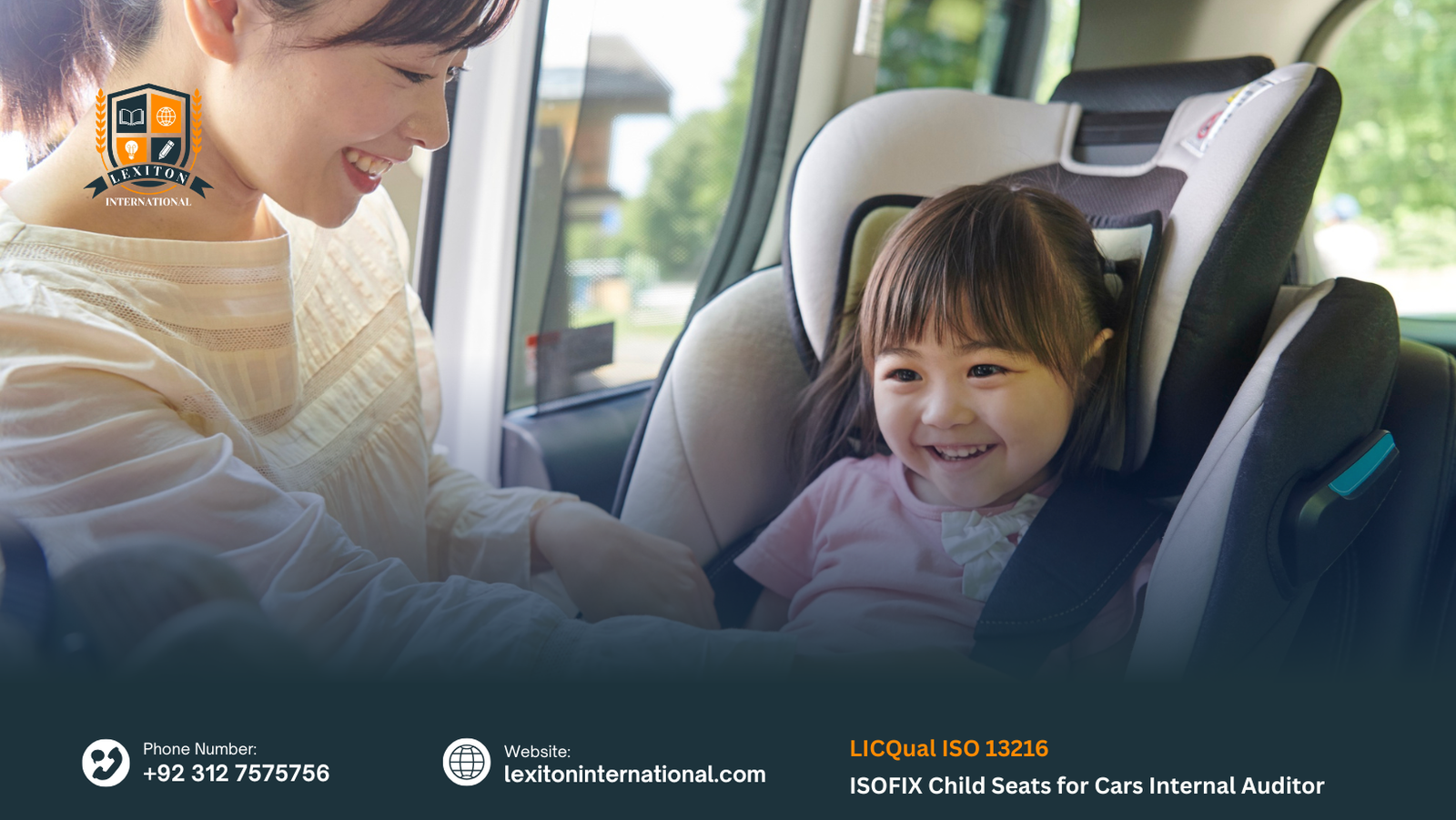
The LICQual ISO 13216 ISOFIX Child Seats for Cars Internal Auditor course is a specialized qualification designed for professionals who are responsible for ensuring the safety, compliance, and quality of child restraint systems in vehicles. It focuses on the ISO 13216 standard, which defines global requirements for ISOFIX child seat systems, helping learners understand how safety engineering and regulatory compliance work together to protect young passengers on the road.
The programme covers essential areas such as ISOFIX system design principles, installation requirements, safety performance criteria, regulatory frameworks, and internal auditing techniques. Learners gain a clear understanding of how child seat manufacturers and automotive safety systems must comply with international standards. It also highlights how audits are planned, conducted, and evaluated to ensure that ISOFIX systems meet strict safety and quality expectations.
By completing this qualification, learners develop strong auditing and compliance evaluation skills specific to automotive child safety systems. It enhances the ability to identify non-conformities, assess risk factors, and ensure adherence to ISO 13216 requirements. As child passenger safety remains a critical global concern, this certification provides valuable recognition for individuals committed to improving safety standards and ensuring reliable ISOFIX child seat systems in the automotive industry.
- Age Requirement: Applicants must be at least 16 years old at the time of enrollment.
- Educational Background: A foundation in engineering, automotive technology, management, or related disciplines is preferred, as it supports understanding of technical standards and their application in real-world scenarios.
- Professional Experience: At least one year of relevant work experience in automotive safety, compliance, auditing, or quality assurance is recommended, as it provides practical context for applying course knowledge.
- Language Proficiency; Since the course is delivered in English, learners must demonstrate good written and spoken English skills to engage effectively with course materials, discussions, and assessments.
Mandatory Units
Skills You Will Gain
By the end of this course, learners will be able to:
1. Introduction to ISO 13216 and ISOFIX Child Seat Standards
- Demonstrate a clear understanding of the ISO 13216 standard and its importance in ensuring child seat safety in cars.
- Identify the key components of the ISOFIX system and explain their relevance to child seat safety.
- Recognize the regulatory framework and requirements for ISOFIX child seats across different regions and markets.
2. Child Seat Design and Performance Requirements
- Understand the technical design specifications required for ISOFIX child seats, focusing on safety and durability.
- Identify the performance criteria for child seats, including crashworthiness, harness systems, and seat protection.
- Apply the design and performance requirements to ensure child seats meet safety and regulatory standards.
3. ISOFIX System: Installation and Compatibility
- Explain the function and importance of the ISOFIX system in securing child seats safely within vehicles.
- Assess the compatibility of ISOFIX child seats with various car models and ensure proper installation procedures are followed.
- Identify potential installation challenges and develop solutions for ensuring secure and correct installation.
4. Auditing and Compliance with ISO 13216
- Develop the skills to conduct internal audits to assess ISO 13216 compliance in child seat manufacturing processes.
- Identify and document non-conformities, and implement corrective actions to ensure compliance with ISOFIX standards.
- Understand the audit process and regulatory requirements for ISOFIX child seat certification and market acceptance.
5. Safety Testing and Evaluation of Child Seats
- Learn how to conduct various safety tests, such as crash tests, impact tests, and harness system evaluations.
- Analyze test results to determine the effectiveness and safety of ISOFIX child seats in different crash scenarios.
- Ensure that child seat products meet the necessary safety standards by evaluating their performance against ISO 13216 criteria.
6. Continual Improvement and Best Practices in Child Seat Safety
- Develop strategies for continuous improvement in the design, manufacturing, and safety of ISOFIX child seats.
- Implement best practices for improving product quality, ensuring compliance, and maintaining child seat safety standards.
- Foster innovation within child seat manufacturing to meet evolving safety standards and market demands.
The ideal learner for the LICQual ISO 13216 ISOFIX Child Seats for Cars Internal Auditor course is someone passionate about child safety in vehicles, committed to professional excellence, and eager to develop auditing expertise within the automotive safety sector. They are motivated to understand international safety standards and apply them to real-world compliance and quality systems.
Who Is This Course For
- Holds a Level 3 qualification or equivalent in engineering, automotive, or a related field
- Able to understand technical standards and apply them in structured environments
- Comfortable with theoretical and compliance-based learning approaches
- Has awareness of automotive safety or child restraint systems (preferred)
- Able to analyze risks and identify non-conformities in safety systems
- Good written and verbal communication skills in English
- Capable of preparing structured reports and documentation
- Demonstrates attention to detail and objective thinking in assessments
- Shows strong commitment to child safety, ethics, and professional responsibility
Learners completing this course will develop strong professional capability in automotive safety and compliance, enabling them to take on more responsible roles in child safety and ISOFIX-related systems. They will gain enhanced auditing competence and industry-relevant knowledge that supports long-term professional growth in safety-focused environments.
Future Progression
- Progress into senior roles within automotive safety, compliance, and quality assurance environments
- Take responsibility for auditing, inspection, and regulatory compliance activities
- Contribute to safety governance and risk management decision-making processes
- Strengthen professional credibility in child safety and vehicle restraint systems
- Develop deeper expertise in international automotive safety standards
- Improve ability to evaluate and manage technical compliance requirements
- Gain advanced understanding of safety frameworks and regulatory systems
- Enhance capability to lead safety improvement and quality assurance initiatives
- Build stronger analytical skills for identifying risks and system gaps
- Strengthen professional communication and reporting in compliance environments
Curious About This Course?