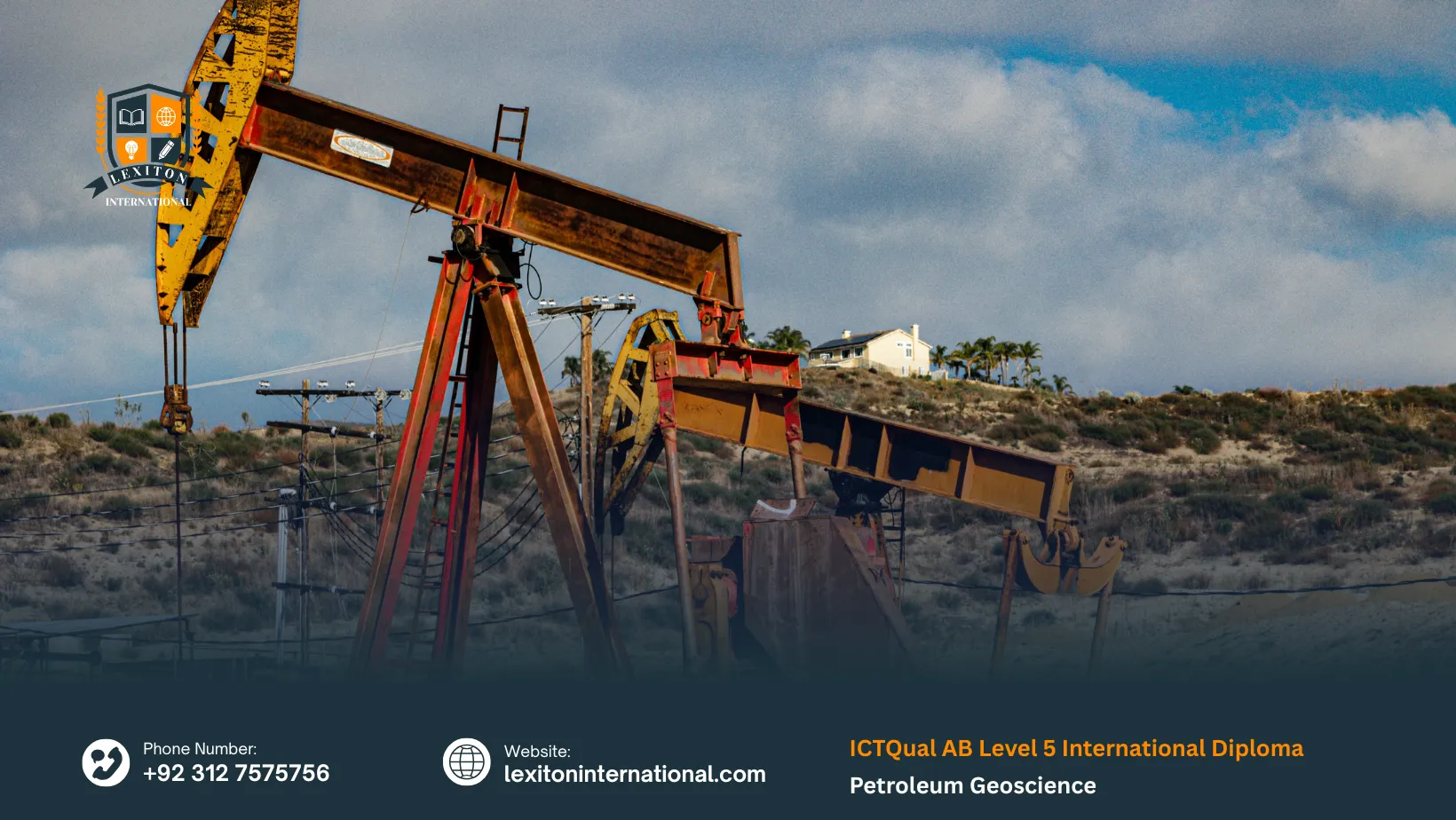
The ICTQual AB Level 5 International Diploma in Petroleum Geoscience is a comprehensive qualification designed to develop a strong understanding of the geological and geophysical principles that support oil and gas exploration. Petroleum geoscience is a key discipline within the energy sector, helping professionals identify, evaluate, and understand subsurface resources. This diploma provides learners with the knowledge required to interpret geological information and understand the processes involved in hydrocarbon exploration and reservoir evaluation.
The programme covers essential areas of petroleum geoscience, including sedimentology, stratigraphy, structural geology, seismic interpretation, reservoir characterization, and petroleum system analysis. Learners gain a detailed understanding of geological formations, subsurface structures, and exploration methods used within the oil and gas industry. The curriculum also explores how geological and geophysical data are used to support decision-making, resource assessment, and operational planning.
Designed for individuals interested in the science behind energy exploration, this internationally recognised qualification develops analytical thinking, technical knowledge, and industry awareness. It provides a solid understanding of the geological factors that influence hydrocarbon discovery and production, enabling learners to contribute effectively to exploration activities, reservoir studies, and resource evaluation within the global energy sector.
- Age Requirement: Learners should ideally be 18 years or older, as the course involves technical concepts, project work, and applied learning.
- Educational Background: A secondary school qualification is required. Preference is given to candidates with backgrounds in science, mathematics, geology, or engineering-related fields.
- Work Experience: Prior experience in oil and gas, energy, or industrial operations is beneficial but not mandatory. Candidates with exposure to geological or technical environments will find the course especially relevant.
- English Language Proficiency: Learners should have a good command of spoken and written English to understand technical content, participate in discussions, and complete assessments effectively.
Mandatory Units
Year 1 – Foundation in Petroleum Geoscience
- Introduction to Petroleum Geoscience
- Fundamentals of Geology and Earth Sciences
- Principles of Sedimentology and Stratigraphy
- Basics of Structural Geology
- Introduction to Geophysics and Seismic Methods
- Petroleum Geology: Source, Reservoir, and Seal Rocks
- Basin Analysis and Petroleum Systems
- Fundamentals of Reservoir Engineering
- Health, Safety, and Environmental Practices in the Energy Sector
- Mathematics and Physics for Geoscience
- Laboratory Techniques in Geological and Petroleum Studies
- Academic and Research Skills for Geoscience
Year 2 – Advanced Petroleum Exploration and Applications
- Advanced Seismic Interpretation and Reservoir Characterisation
- Petrophysics and Well Logging Analysis
- Exploration Geophysics and Prospect Evaluation
- Drilling Technology and Well Planning
- Reservoir Simulation and Modelling
- Geochemical Methods in Petroleum Exploration
- Energy Economics and Petroleum Project Evaluation
- Digital Technologies in Petroleum Geoscience (GIS & Remote Sensing)
- Risk Assessment and Decision-Making in Exploration Projects
- Sustainable Energy and the Future of Petroleum Resources
- Professional Practice, Ethics, and Global Industry Standards
- Independent Research Project in Petroleum Geoscience
Skills You Will Gain
Year 1 – Foundation in Petroleum Geoscience
Introduction to Petroleum Geoscience
- Understand the scope and significance of petroleum geoscience in global energy development.
- Identify key processes involved in hydrocarbon formation, migration, and trapping.
- Recognise major exploration and production activities in the petroleum industry.
- Evaluate different career pathways and applications of geoscience across the energy sector.
- Appreciate the role of petroleum geoscience in addressing global energy challenges.
Fundamentals of Geology and Earth Sciences
- Demonstrate knowledge of Earth’s structure, geological time scale, and plate tectonics.
- Classify rocks and minerals based on physical, chemical, and optical properties.
- Apply geological mapping, field observation, and sampling techniques.
- Interpret fundamental geologic processes such as volcanism, weathering, and erosion.
- Relate Earth science concepts to petroleum exploration and resource evaluation.
Principles of Sedimentology and Stratigraphy
- Explain sedimentary processes, depositional environments, and facies models.
- Analyse stratigraphic successions to reconstruct past environments.
- Interpret lithostratigraphic and biostratigraphic data for petroleum applications.
- Apply principles of correlation and sequence stratigraphy in basin analysis.
- Assess stratigraphic traps relevant to petroleum accumulation.
Basics of Structural Geology
- Identify folds, faults, fractures, and joints in geological formations.
- Apply stress and strain concepts to rock deformation analysis.
- Construct cross-sections and structural maps for petroleum exploration.
- Evaluate structural features relevant to hydrocarbon trapping.
- Relate tectonic activity to basin development and petroleum systems.
Introduction to Geophysics and Seismic Methods
- Understand the principles of geophysical exploration techniques.
- Explain seismic reflection and refraction methods and their applications.
- Interpret basic seismic data for subsurface imaging.
- Recognise the advantages and limitations of geophysical surveys.
- Relate geophysical data to geological and reservoir interpretation.
Petroleum Geology: Source, Reservoir, and Seal Rocks
- Describe the properties and roles of source, reservoir, and seal rocks.
- Understand hydrocarbon generation, maturation, and migration processes.
- Analyse the effectiveness of seals in petroleum trapping.
- Integrate geological data to evaluate petroleum system elements.
- Apply petroleum system concepts to exploration case studies.
Basin Analysis and Petroleum Systems
- Classify different types of sedimentary basins and their tectonic settings.
- Analyse basin evolution and subsidence history.
- Evaluate petroleum system components within a basin.
- Integrate seismic, stratigraphic, and structural data in basin analysis.
- Assess exploration potential of basins through risk and uncertainty analysis.
Fundamentals of Reservoir Engineering
- Understand porosity, permeability, and fluid properties in reservoirs.
- Explain concepts of primary, secondary, and enhanced recovery methods.
- Perform basic reservoir calculations including hydrocarbon in place.
- Assess production performance using simple reservoir models.
- Recognise the link between reservoir engineering and field development planning.
Health, Safety, and Environmental Practices in the Energy Sector
- Demonstrate knowledge of health, safety, and environmental regulations.
- Identify hazards and assess risks associated with petroleum operations.
- Apply safety measures and emergency response procedures.
- Evaluate environmental impacts of exploration and production activities.
- Promote sustainable practices within the petroleum sector.
Mathematics and Physics for Geoscience
- Apply algebra, calculus, and statistics to petroleum geoscience problems.
- Use mechanics, thermodynamics, and wave theory to explain geological phenomena.
- Perform quantitative calculations for exploration and reservoir studies.
- Interpret geoscience datasets using mathematical models.
- Develop analytical problem-solving skills in petroleum geoscience.
Laboratory Techniques in Geological and Petroleum Studies
- Conduct laboratory tests on rocks, minerals, and fluids.
- Use petrographic microscopes, core samples, and geochemical equipment.
- Record and interpret laboratory data for geological studies.
- Relate laboratory results to field exploration and production scenarios.
- Develop competency in safe laboratory practices and procedures.
Academic and Research Skills for Geoscience
- Develop academic writing, referencing, and presentation skills.
- Conduct literature reviews using credible scientific sources.
- Design small-scale research projects with defined aims and methods.
- Collect, analyse, and interpret data for research purposes.
- Present findings effectively through reports and oral communication.
Year 2 – Advanced Petroleum Exploration and Applications
Advanced Seismic Interpretation and Reservoir Characterisation
- Interpret 2D and 3D seismic data for structural and stratigraphic mapping.
- Identify key seismic attributes and their role in reservoir analysis.
- Integrate seismic and geological data for reservoir characterisation.
- Evaluate uncertainty in seismic interpretation.
- Apply seismic interpretation techniques to case studies.
Petrophysics and Well Logging Analysis
- Understand principles of well logging tools and measurements.
- Interpret log data to evaluate porosity, permeability, and fluid saturation.
- Integrate log analysis with core and seismic data.
- Assess reservoir properties using petrophysical methods.
- Apply petrophysical evaluation in exploration and production.
Exploration Geophysics and Prospect Evaluation
- Apply gravity, magnetic, and electromagnetic methods in petroleum exploration.
- Integrate multiple geophysical datasets for prospect assessment.
- Evaluate the geological risk of exploration prospects.
- Assess the commercial viability of identified prospects.
- Develop decision-making strategies based on geophysical data.
Drilling Technology and Well Planning
- Understand drilling rig types, components, and operations.
- Design well plans considering geological and engineering requirements.
- Apply safety and environmental measures during drilling.
- Evaluate drilling performance and problem-solving strategies.
- Relate drilling technology to exploration and production success.
Reservoir Simulation and Modelling
- Use software tools for reservoir simulation and production modelling.
- Analyse reservoir behaviour under different recovery methods.
- Forecast reservoir performance and hydrocarbon recovery.
- Optimise reservoir management using simulation results.
- Evaluate limitations and uncertainties of reservoir modelling.
Geochemical Methods in Petroleum Exploration
- Apply organic geochemistry for source rock analysis.
- Interpret biomarkers and isotopic data for hydrocarbon correlation.
- Use geochemical techniques to assess hydrocarbon generation potential.
- Integrate geochemical data with geological and geophysical studies.
- Evaluate exploration plays using geochemical evidence.
Energy Economics and Petroleum Project Evaluation
- Understand petroleum project cost structures and financial models.
- Conduct feasibility studies for exploration and development projects.
- Apply risk analysis tools in petroleum project evaluation.
- Assess economic performance using NPV, IRR, and cash flow models.
- Evaluate global market factors influencing petroleum economics.
Digital Technologies in Petroleum Geoscience (GIS & Remote Sensing)
- Apply GIS for mapping and spatial analysis in petroleum exploration.
- Use remote sensing for surface and subsurface geological interpretation.
- Integrate digital datasets for exploration decision-making.
- Apply digital workflows to reservoir characterisation.
- Evaluate the impact of digital technologies on petroleum exploration.
Risk Assessment and Decision-Making in Exploration Projects
- Identify geological, technical, and economic risks in petroleum projects.
- Apply quantitative and qualitative risk analysis methods.
- Evaluate exploration risk and uncertainty using industry tools.
- Develop risk mitigation strategies for exploration projects.
- Make informed decisions under conditions of uncertainty.
Sustainable Energy and the Future of Petroleum Resources
- Understand the challenges of energy transition and sustainability.
- Evaluate petroleum’s role in the global low-carbon economy.
- Analyse strategies for carbon capture and storage.
- Propose solutions for sustainable petroleum resource management.
- Assess the integration of renewable energy with petroleum operations.
Professional Practice, Ethics, and Global Industry Standards
- Demonstrate professional conduct in petroleum geoscience.
- Apply ethical principles in exploration and production practices.
- Understand global standards, codes, and regulations.
- Evaluate case studies of ethical dilemmas in petroleum operations.
- Promote responsible practices in the energy industry.
Independent Research Project in Petroleum Geoscience
- Design and execute an independent, original research project.
- Collect, analyse, and interpret geological and petroleum datasets.
- Apply appropriate research methods and analytical tools.
- Present findings in a structured research report.
- Defend research outcomes through professional presentations.
The ICTQual AB Level 5 International Diploma in Petroleum Geoscience is designed for individuals who want to build a strong foundation in earth sciences and understand how oil and gas resources are discovered beneath the surface. It is ideal for learners aiming to start a career in exploration, geology, and energy resource analysis.
Who Is This Course For
- Learners who want to begin a career in petroleum geoscience and exploration.
- Individuals interested in studying rocks, structures, and underground energy resources.
- Aspiring geologists aiming to work in the oil and gas industry.
- Students with science backgrounds looking to enter the energy sector.
- Technicians wanting to shift into geological and exploration-based roles.
- Individuals interested in seismic data and subsurface analysis.
- Candidates seeking entry-level opportunities in exploration companies.
- Learners who want to develop analytical and scientific thinking skills.
- Workers from technical fields planning to enter geoscience careers.
- Anyone passionate about earth science, discovery, and energy exploration.
The ICTQual AB Level 5 International Diploma in Petroleum Geoscience strengthens your technical foundation for the global energy exploration sector by developing core geological understanding and practical analytical skills. It prepares you for active roles where subsurface interpretation and resource evaluation are essential.
Future Progression
- Step into entry-level roles in geological exploration and oil and gas surveying projects.
- Support teams working on identifying and evaluating underground energy resources.
- Contribute to seismic interpretation and geological mapping activities.
- Work in field-based and laboratory environments focused on earth science analysis.
- Assist exploration teams in collecting and interpreting subsurface data.
- Build opportunities within upstream oil and gas exploration companies.
- Participate in resource assessment and reservoir identification tasks.
- Strengthen eligibility for technical positions in geoscience and energy sectors.
- Develop recognition for supporting exploration and discovery operations.
- Position yourself within a globally important industry focused on energy resource identification and development.
Curious About This Course?