
Lesson no 4 : Promote a culture of continuous improvement, safety, and high-quality standards.
Introduction
Promoting a culture of continuous improvement, safety and high-quality standards is essential for achieving long-term success in mechanical engineering projects and manufacturing environments. QA/QC professionals play a central role in influencing how teams approach their daily responsibilities, respond to problems and maintain compliance with approved technical, safety and quality requirements. A strong organisational culture ensures that quality and safety are not treated as separate inspection activities but are integrated into every stage of planning, production, inspection, testing and project delivery.
Continuous improvement involves regularly reviewing processes, identifying opportunities for improvement and implementing effective actions to enhance performance. In mechanical QA/QC, this may include analysing recurring non-conformities, improving inspection procedures, strengthening communication, reducing rework and using lessons learned from previous projects. Teams should be encouraged to identify problems early and contribute practical ideas for improving working methods.
A strong safety culture is equally important. Mechanical engineering activities can involve machinery, lifting operations, pressurised systems, welding, testing and material handling. Promoting safety requires clear procedures, effective communication, competent supervision and a shared commitment to recognising and controlling risks. Every team member should understand their responsibility for maintaining a safe working environment and reporting unsafe conditions.
High-quality standards are achieved when personnel consistently follow approved specifications, procedures, inspection requirements and project quality plans. Leaders must set clear expectations and demonstrate through their own actions that quality cannot be compromised for speed or production pressure.
This lesson explores how QA/QC professionals and project leaders can promote continuous improvement, strengthen safety awareness and encourage consistent high-quality performance. Learners will examine practical approaches for engaging teams, learning from quality failures, sharing lessons learned and developing a positive workplace culture where improvement, safety and quality are recognised as shared responsibilities.
By applying these principles, mechanical engineering teams can reduce defects, minimise rework, improve safety performance, strengthen compliance and support successful project delivery. The development of a positive quality culture ultimately helps organisations achieve reliable results while building confidence among clients, employees and other project stakeholders.
1. Develop Internal Engagement Programmes, Such as Regular Quality Tool-Box Talks, to Build Active Safety and High-Quality Awareness Among Workers
Developing a strong culture of continuous improvement, safety and high-quality performance requires more than written policies, inspection procedures and compliance requirements. Workers must actively understand, discuss and apply quality and safety principles in their daily activities. Internal engagement programmes provide a structured way of involving employees in the improvement of workplace practices and strengthening their awareness of the standards expected within mechanical engineering projects.
One of the most effective engagement methods is the regular quality and safety tool-box talk. A tool-box talk is a short, focused discussion delivered to workers before or during work activities. It addresses a specific safety, quality, technical or operational issue that is directly relevant to the work being performed. Unlike lengthy classroom-based sessions, tool-box talks are designed to be practical, accessible and closely connected to the immediate workplace environment.
In QA/QC mechanical engineering, internal engagement programmes can help workers understand why inspection requirements, approved procedures, material traceability, safe working practices and quality controls are important. They also create opportunities for workers to raise concerns, share experience and contribute ideas for improvement.
A successful engagement programme does not simply tell workers what to do. It encourages two-way communication and helps create a shared sense of responsibility for safety and quality.
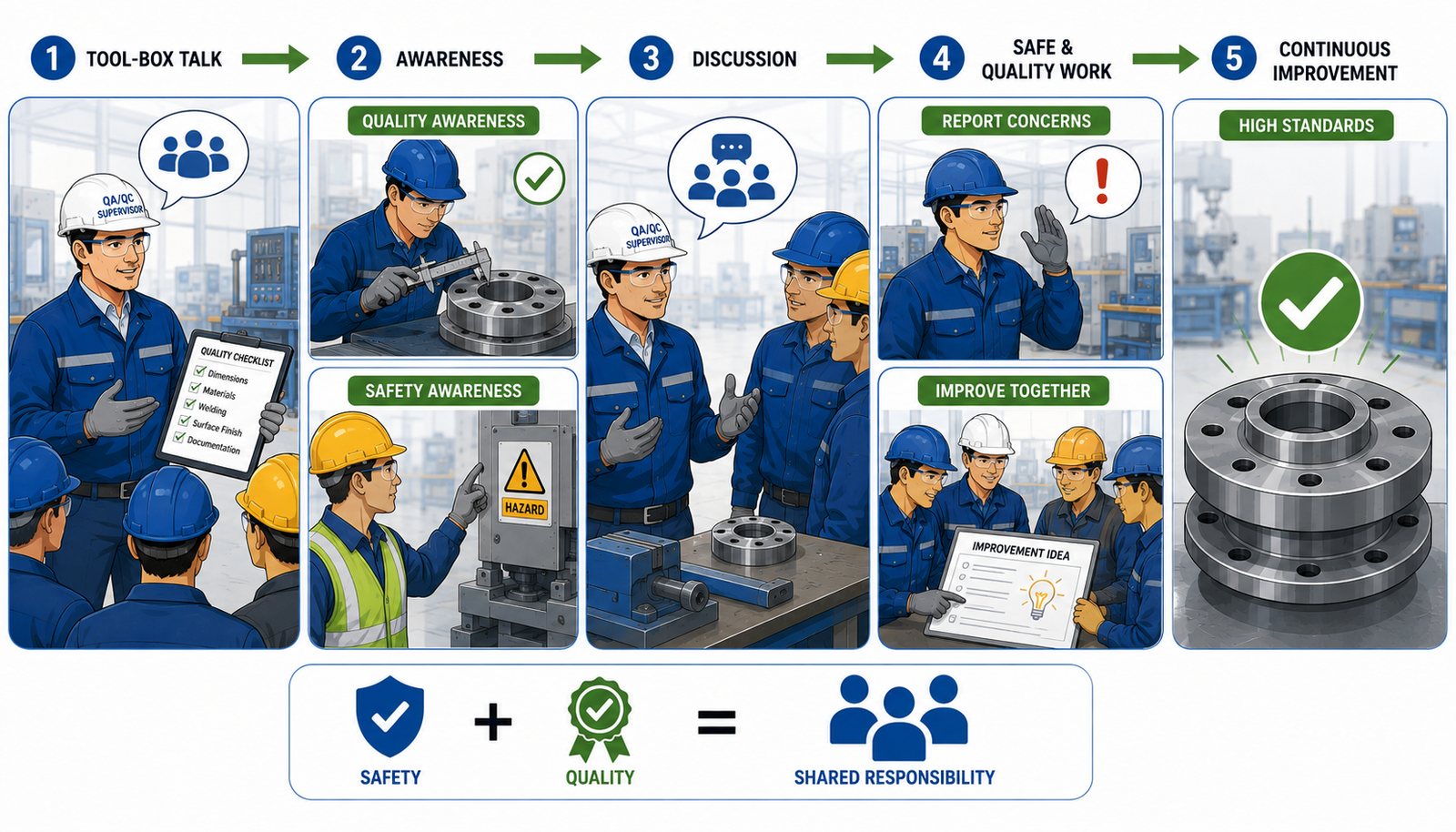
The Purpose of Internal Engagement Programmes
Internal engagement programmes are organised activities designed to involve workers, supervisors and technical personnel in improving awareness, communication and workplace performance.
The main purpose is to ensure that safety and quality expectations are understood and actively supported by the people performing the work.
An effective programme should aim to:
Increase awareness of workplace safety and quality requirements.
Encourage workers to identify hazards and quality risks.
Improve understanding of approved procedures.
Reduce recurring defects and unsafe practices.
Encourage early reporting of problems.
Strengthen communication between workers and management.
Promote shared responsibility for continuous improvement.
Reinforce lessons learned from previous incidents and non-conformities.
Improve worker confidence in raising concerns.
Support consistent compliance with project requirements.
Internal engagement should be treated as an ongoing process rather than a one-time training event. A strong culture develops through repeated communication, visible leadership and consistent reinforcement.
Understanding Quality and Safety Engagement
What Is Worker Engagement?
Worker engagement refers to the active involvement of personnel in workplace objectives, decisions and improvement activities. An engaged worker does not simply follow instructions without thought. They understand the importance of their work and recognise their role in achieving safe and high-quality outcomes.
In mechanical engineering environments, engaged workers are more likely to:
Check their work carefully.
Follow approved procedures.
Identify potential defects.
Report unsafe conditions.
Ask questions when requirements are unclear.
Participate in improvement discussions.
Support colleagues in maintaining standards.
Engagement therefore connects organisational expectations with daily workplace behaviour.
What Is Quality Awareness?
Quality awareness is the understanding that every work activity can influence the final quality, performance and reliability of a mechanical product, system or installation.
Workers should understand that quality is not the responsibility of the QA/QC department alone. Although inspectors verify compliance, quality must be created and maintained throughout the work process.
Quality awareness involves recognising:
The required specification.
Acceptance criteria.
Critical inspection points.
Common defects.
The importance of material traceability.
The consequences of poor workmanship.
The need for accurate records.
What Is Safety Awareness?
Safety awareness is the ability to recognise hazards, understand risks and take appropriate action to protect people, equipment and the working environment.
In mechanical workplaces, hazards may arise from:
Rotating machinery.
Lifting operations.
Welding and cutting.
Pressurised equipment.
Hot surfaces.
Sharp materials.
Heavy components.
Electrical equipment.
Moving vehicles.
Testing activities.
Safety awareness should encourage workers to think before acting and to recognise changing conditions.
Key Definitions and Concepts
| Term | Definition | Practical Application |
|---|---|---|
| Internal engagement programme | A planned series of activities designed to involve workers in organisational safety and quality objectives | Regular discussions, campaigns and improvement activities |
| Tool-box talk | A short, focused workplace discussion on a specific safety, quality or operational topic | Brief pre-task discussion before mechanical work begins |
| Quality awareness | Understanding how individual work affects conformity and final product performance | Workers check specifications and acceptance criteria |
| Safety awareness | Recognition of hazards, risks and appropriate controls | Workers identify unsafe conditions before starting work |
| Continuous improvement | Ongoing efforts to improve processes, performance and outcomes | Reviewing recurring defects and improving procedures |
| Worker participation | Active involvement of personnel in identifying and solving workplace problems | Workers suggest improvements during meetings |
| Quality culture | Shared values and behaviours that support consistent quality performance | Everyone accepts responsibility for quality |
| Safety culture | Shared commitment to preventing harm and managing workplace risks | Workers report hazards without unnecessary delay |
| Lessons learned | Knowledge gained from previous successes, failures or incidents | Sharing causes of repeated defects with the team |
| Feedback | Information provided to improve performance or understanding | Supervisors discuss inspection findings with workers |
The Importance of Regular Quality Tool-Box Talks
Making Quality Relevant to Daily Work
Workers may receive detailed training when they join an organisation or project. However, important information can be forgotten if it is not regularly reinforced.
Quality tool-box talks provide short reminders that connect directly with current work activities.
For example, before mechanical assembly begins, a tool-box talk may focus on:
Correct component identification.
Drawing revision checks.
Torque requirements.
Inspection hold points.
Prevention of foreign material contamination.
Before welding or fabrication activities, the discussion may address:
Approved procedures.
Material identification.
Joint preparation.
Inspection requirements.
Common quality defects.
This practical approach helps workers understand how general quality principles apply to the task they are about to perform.
Supporting Safety at the Same Time
Quality and safety often influence each other.
For example:
Poor housekeeping can create safety hazards and quality problems.
Incorrect material handling can damage equipment and injure workers.
Poor welding practices can create structural defects and exposure to workplace hazards.
Incorrect assembly can affect mechanical reliability and create operational risks.
Tool-box talks can therefore address both quality and safety where the topics are connected.
Principles for Designing an Effective Engagement Programme
Keep the Programme Relevant
Engagement activities should reflect actual workplace conditions.
Topics should be selected based on:
Current work activities.
Recent inspection findings.
Common defects.
Near misses.
Safety observations.
Changes to procedures.
Client requirements.
Project milestones.
Lessons learned.
A discussion that is directly related to the worker’s daily responsibilities is more likely to be understood and remembered.
Encourage Two-Way Communication
A tool-box talk should not become a one-direction lecture.
Workers should be encouraged to:
Ask questions.
Share previous experience.
Identify concerns.
Suggest improvements.
Discuss practical difficulties.
The supervisor should listen carefully and record significant issues requiring further action.
Use Clear and Simple Language
Technical requirements can be complex, but engagement discussions should communicate the essential message clearly.
The presenter should:
Avoid unnecessary jargon.
Use practical examples.
Demonstrate equipment where useful.
Refer to actual workplace conditions.
Explain the consequences of errors.
The objective is understanding rather than simply delivering information.
Keep Discussions Focused
A tool-box talk should normally address one main topic or a small number of closely related points.
For example:
Topic: Material Traceability
The discussion could focus on:
Why material identification matters.
How to check identification.
What to do when identification is missing.
How to prevent mixing of materials.
Trying to cover too many subjects in one short session can reduce effectiveness.
Developing a Structured Quality Tool-Box Talk Programme
Step 1: Identify Organisational Objectives
The engagement programme should support wider quality and safety objectives.
Possible objectives include:
Reducing repeated non-conformities.
Improving hazard reporting.
Increasing compliance with inspection procedures.
Improving housekeeping standards.
Reducing rework.
Strengthening material control.
Each engagement activity should contribute to a clear purpose.
Step 2: Identify Priority Topics
Topics should be selected using workplace evidence.
Useful sources include:
Non-conformance reports.
Inspection reports.
Audit findings.
Incident reports.
Near-miss reports.
Customer feedback.
Rework records.
Production performance data.
Priority topics may include:
Material identification.
Welding quality.
Mechanical assembly.
Calibration awareness.
Inspection hold points.
Housekeeping.
Safe material handling.
Use of measuring equipment.
Documentation accuracy.
Reporting defects.
Step 3: Create a Regular Schedule
Consistency is important when building culture.
The organisation may establish:
Daily short pre-task discussions.
Weekly quality tool-box talks.
Monthly safety and quality campaigns.
Periodic lessons-learned sessions.
The schedule should be realistic and integrated into project operations.
Step 4: Prepare the Discussion Material
Each talk should have a simple structure.
A useful format is:
Introduce the topic.
Explain why it matters.
Describe the main risk or quality issue.
Explain the required controls.
Give a practical example.
Ask workers for feedback.
Confirm the key action.
Preparation helps ensure the message is accurate and consistent.
Step 5: Deliver the Tool-Box Talk
The discussion should take place in a suitable location.
The presenter should:
Ensure workers can hear clearly.
Use relevant visual examples where appropriate.
Encourage participation.
Keep the discussion focused.
Confirm understanding.
The session should support the work rather than unnecessarily interrupt critical activities.
Step 6: Record Attendance and Key Actions
Records may include:
Date.
Topic.
Presenter.
Participants.
Main discussion points.
Questions raised.
Actions identified.
The purpose of recording is not simply administrative. It provides evidence that engagement activities occurred and helps track issues requiring follow-up.
Step 7: Follow Up on Identified Issues
Worker engagement loses credibility if concerns are repeatedly raised but never addressed.
Supervisors should:
Review concerns.
Assign responsible persons.
Establish completion dates.
Communicate outcomes.
This demonstrates that worker participation has value.
Examples of Quality Tool-Box Talk Topics
Material Traceability
A discussion may cover:
Checking material identification before use.
Preventing mixing of materials.
Maintaining identification during cutting.
Reporting missing identification.
Practical message: Never assume that an unmarked material is correct.
Inspection Before Work Progression
The discussion may explain:
Inspection hold points.
Required approvals.
When work must not continue.
The importance of inspection records.
Practical message: Complete required inspection stages before moving to the next activity.
Prevention of Mechanical Damage
Workers may discuss:
Correct lifting methods.
Protection of machined surfaces.
Storage requirements.
Prevention of impact damage.
Practical message: Proper handling protects both people and product quality.
Accurate Use of Measuring Equipment
The session may cover:
Selecting suitable measuring equipment.
Checking calibration status.
Preventing damage.
Recording measurements accurately.
Practical message: A measurement is only reliable when the equipment and method are suitable.
Building Active Worker Participation
Encourage Workers to Identify Problems
Workers often observe issues before they appear in formal inspection reports.
Organisations should encourage personnel to report:
Unsafe conditions.
Potential defects.
Unclear instructions.
Damaged materials.
Missing documentation.
Process weaknesses.
Early reporting allows problems to be addressed before they become major failures.
Create a Positive Reporting Culture
Workers may hesitate to report problems if they fear blame.
Leaders should focus on:
Understanding the issue.
Correcting the process.
Learning from mistakes.
Preventing recurrence.
Accountability remains important, but improvement should not be replaced by a culture of silence.
Recognise Positive Contributions
Recognition can reinforce desirable behaviour.
Examples include:
Acknowledging useful improvement ideas.
Recognising teams that reduce recurring defects.
Highlighting effective safety observations.
Sharing successful problem-solving examples.
Recognition does not always need to be financial. Professional acknowledgement can also strengthen engagement.
The Role of Supervisors and QA/QC Leaders
Leading by Example
Workers observe leadership behaviour.
If supervisors ignore procedures or bypass controls under production pressure, workers may conclude that quality and safety are optional.
Leaders should demonstrate:
Consistent compliance.
Respect for approved procedures.
Willingness to listen.
Professional decision-making.
Commitment to improvement.
Providing Constructive Feedback
Feedback should help workers improve performance.
Effective feedback should be:
Timely.
Specific.
Respectful.
Based on evidence.
Focused on improvement.
For example, rather than simply stating that a worker made an error, the supervisor should explain the relevant requirement and how the work can be improved.
Practical Example: Repeated Dimensional Errors
A mechanical workshop experiences repeated dimensional errors during component fabrication.
The QA/QC team reviews inspection data and identifies that the same measurement mistake occurs frequently.
A quality tool-box talk is organised.
The discussion covers:
The relevant drawing requirements.
Common measurement mistakes.
Correct equipment selection.
Calibration status.
Verification before production continues.
Workers are asked about practical difficulties. Several workers explain that the measurement method is unclear during a particular production stage.
The supervisor reviews the work instruction and introduces a clearer verification step.
The engagement programme has therefore achieved more than awareness. It has identified a practical improvement opportunity.
Practical Example: Improving Material Handling
A workshop experiences frequent surface damage to finished mechanical components.
A combined quality and safety tool-box talk is conducted.
Workers discuss:
Correct lifting points.
Suitable lifting accessories.
Protection of finished surfaces.
Safe storage methods.
Reporting damaged items.
The team agrees on improved handling arrangements and visual identification of designated storage areas.
The result may include:
Reduced product damage.
Less rework.
Improved safety.
Better workflow organisation.
Integrating Continuous Improvement into Engagement Activities
Use Workplace Data
Continuous improvement should be supported by evidence.
Useful performance information may include:
Number of defects.
Rework levels.
Inspection failures.
Repeat non-conformities.
Safety observations.
Near misses.
These results can help determine future engagement topics.
Apply the Improvement Cycle
A simple improvement approach may involve:
Identify → Discuss → Improve → Implement → Review
This cycle can be applied during regular engagement activities.
Identify
Recognise a quality or safety problem.
Discuss
Involve workers in understanding the issue.
Improve
Develop practical solutions.
Implement
Apply the agreed actions.
Review
Check whether the improvement has been effective.
This approach encourages workers to see themselves as contributors to improvement rather than passive recipients of instructions.
Key Benefits of Internal Engagement Programmes
Effective engagement programmes can provide significant benefits.
Improved Quality Performance
Workers who understand quality requirements are more likely to:
Follow approved procedures.
Identify errors early.
Protect materials.
Complete accurate records.
Improved Safety Awareness
Regular discussions help personnel remain alert to changing workplace conditions.
Reduced Rework
Early awareness and prevention can reduce:
Material waste.
Repeated repairs.
Inspection failures.
Project delays.
Stronger Communication
Tool-box talks provide a direct communication channel between:
Workers.
Supervisors.
QA/QC personnel.
Project management.
Greater Worker Ownership
When workers contribute ideas and see positive results, they are more likely to take ownership of workplace standards.
Common Problems and How to Avoid Them
Problem: Repeating the Same Generic Topics
Workers may lose interest if discussions are repetitive.
Improvement actions:
Use current workplace data.
Rotate relevant topics.
Include real examples.
Ask workers for suggestions.
Problem: One-Way Presentations
Long lectures reduce participation.
Improvement actions:
Ask questions.
Use demonstrations.
Encourage discussion.
Invite practical examples.
Problem: No Follow-Up
Workers may become disengaged if concerns are ignored.
Improvement actions:
Record significant issues.
Assign actions.
Review progress.
Communicate outcomes.
Problem: Too Much Technical Information
Complex information may confuse workers.
Improvement actions:
Focus on essential requirements.
Use simple language.
Provide practical examples.
Demonstrate correct practice.
Measuring the Effectiveness of Engagement Programmes
Engagement should be evaluated to determine whether it produces meaningful improvement.
Possible indicators include:
Reduction in recurring defects.
Increased reporting of hazards and quality concerns.
Improved inspection results.
Reduced rework.
Attendance and participation levels.
Number of improvement suggestions.
Closure rate for worker-raised concerns.
Measurement should focus on behavioural and performance improvements rather than attendance alone.
A Practical Engagement Programme Framework
An effective programme can follow the sequence below:
Plan
Identify organisational priorities and select relevant topics.
Prepare
Develop simple, accurate discussion material.
Engage
Conduct interactive tool-box talks and improvement activities.
Record
Document attendance, key messages and actions.
Act
Address significant concerns and implement improvements.
Review
Evaluate effectiveness using workplace evidence.
Improve
Update future engagement activities based on results.
Recommended Good Practice for QA/QC Mechanical Projects
To promote active safety and high-quality awareness, organisations should:
Schedule regular tool-box talks.
Link discussions to actual work activities.
Use inspection and incident data to select topics.
Encourage workers to ask questions.
Promote early reporting.
Share lessons learned.
Recognise positive contributions.
Ensure supervisors demonstrate the required standards.
Follow up on concerns.
Measure whether engagement improves workplace performance.
Conclusion
Developing internal engagement programmes is an essential strategy for promoting a culture of continuous improvement, safety and high-quality standards in mechanical engineering environments. Regular quality tool-box talks provide a practical method for communicating important requirements, discussing workplace risks and involving workers in the improvement of daily operations.
An effective programme should be relevant, interactive and connected to actual workplace conditions. Topics should be selected using evidence such as inspection findings, recurring non-conformities, safety observations and project requirements. Workers should not simply receive instructions; they should be encouraged to ask questions, identify concerns and contribute practical improvement ideas.
QA/QC leaders and supervisors have a particularly important responsibility in creating this culture. Their behaviour, communication and willingness to act on worker feedback strongly influence whether engagement activities are viewed as meaningful.
When properly designed and consistently implemented, internal engagement programmes can improve quality awareness, strengthen safety performance, reduce rework and encourage greater ownership of workplace standards. Most importantly, they help establish the understanding that safety and quality are shared responsibilities. Through regular communication, active participation and continual learning, mechanical engineering teams can create a workplace culture where improvement becomes part of everyday professional practice.
2.Establish an Open Reporting Loop Where Technicians Can Highlight Quality Issues or Suggest Process Improvements Without Fear of Penalty
An effective quality culture depends on the ability of technicians, inspectors, operators and other workers to communicate openly about problems. In mechanical engineering and manufacturing environments, the people performing work often identify quality issues, process weaknesses and potential risks before they become visible in formal inspection reports or major non-conformities. Their knowledge and observations are therefore valuable sources of information for improving quality performance.
An open reporting loop is a structured communication process through which workers can identify, report, discuss and follow up quality concerns or improvement opportunities. The process should allow technicians to raise concerns without an unreasonable fear of blame, humiliation or unfair penalty when they report genuine issues in good faith.
Creating such a system does not mean that organisations should ignore deliberate misconduct, reckless behaviour or intentional violations of approved procedures. Instead, it means distinguishing between honest reporting, human error, system weaknesses and unacceptable conduct. A positive reporting culture encourages transparency while maintaining appropriate professional accountability.
In QA/QC mechanical engineering, an open reporting loop can support the early detection of defects, improve process reliability, reduce rework and strengthen continuous improvement. It transforms reporting from a purely administrative activity into an active learning process.
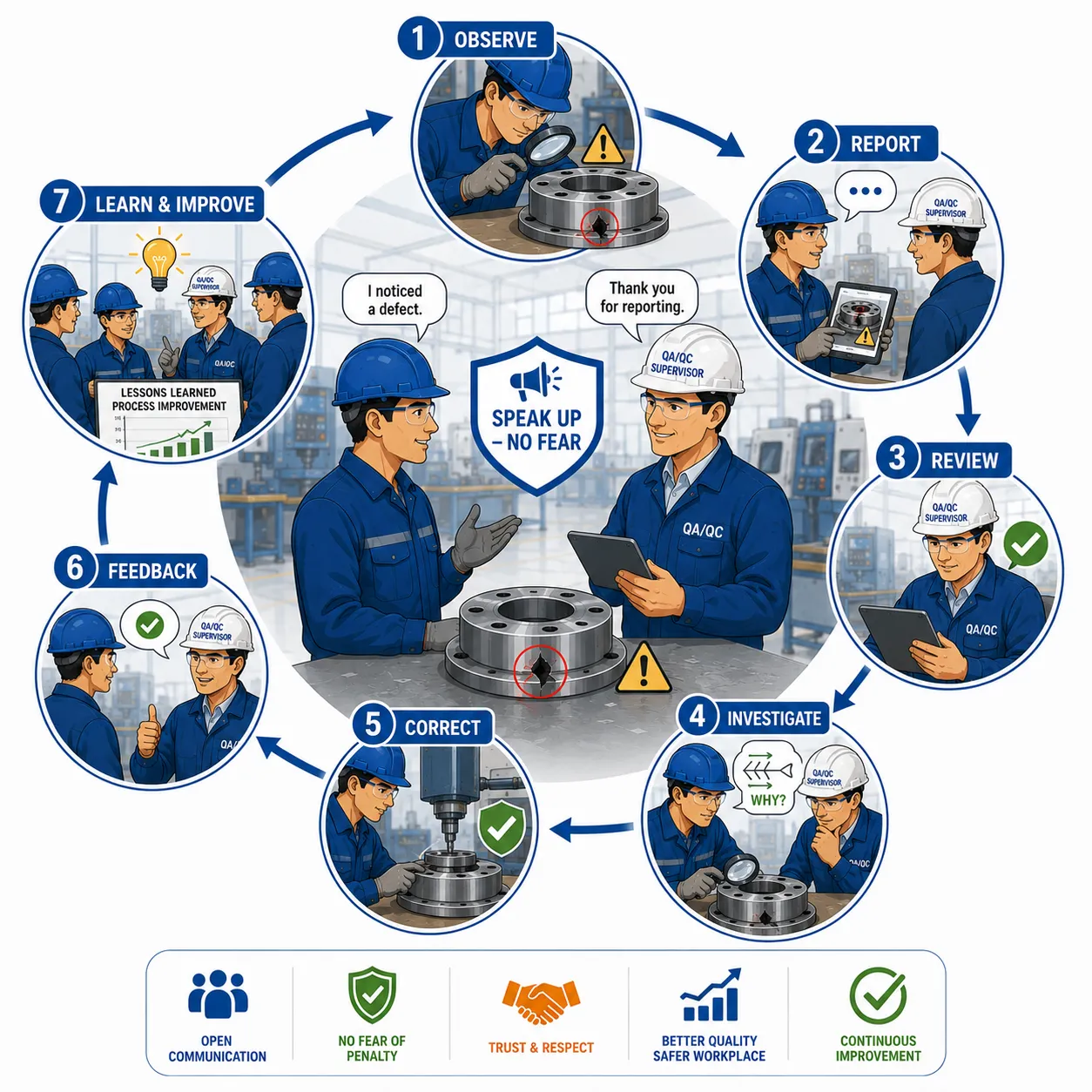
The Importance of Open Reporting in QA/QC
Mechanical projects often involve complex activities, including fabrication, machining, assembly, welding, material handling, inspection and testing. Problems may occur because of unclear instructions, incorrect materials, unsuitable tools, changing conditions or weaknesses in the work process.
If technicians believe that reporting a problem will automatically result in punishment, they may remain silent. This can allow a minor issue to develop into a serious quality failure.
An effective reporting culture encourages workers to communicate concerns at an early stage.
Open reporting can help organisations to:
Detect defects before further work is completed.
Prevent defective materials from progressing through production.
Identify weaknesses in procedures.
Improve communication between departments.
Reduce repeated non-conformities.
Capture valuable technical knowledge from technicians.
Strengthen trust between workers and management.
Support evidence-based continuous improvement.
Reduce unnecessary rework and waste.
Improve overall project performance.
Key Definitions and Concepts
| Term | Definition | Workplace Application |
|---|---|---|
| Open reporting | A system that encourages workers to communicate genuine concerns and observations without unreasonable fear of unfair punishment | A technician reports a possible material identification issue immediately |
| Reporting loop | A complete cycle in which an issue is reported, reviewed, acted upon and communicated back to the reporter | A defect report receives investigation, action and feedback |
| Psychological safety | A workplace environment in which people feel able to speak, ask questions and raise concerns respectfully | A technician challenges an unclear inspection requirement |
| Non-conformity | A failure to meet a specified requirement | A fabricated component does not meet an approved tolerance |
| Corrective action | Action taken to address the cause of an identified problem and reduce the likelihood of recurrence | Revising a procedure after investigating repeated defects |
| Process improvement | A planned change intended to improve efficiency, reliability, quality or control | Introducing an additional verification step |
| Feedback loop | The process of providing information about the outcome of a report or suggestion | Management informs workers that their proposal has been adopted |
| Root cause | The underlying reason why a problem occurred | Identifying inadequate instructions as the cause of repeated errors |
| Escalation | The formal transfer of an issue to a higher level of authority when required | A critical defect is referred to the QA/QC manager |
| Just culture | A balanced approach that encourages reporting while maintaining accountability for unacceptable conduct | Human error is analysed fairly, while deliberate violations are addressed appropriately |
Understanding the Open Reporting Loop
Reporting Is Only the First Step
A reporting system is incomplete if workers can submit concerns but never receive information about what happens next. An open reporting loop must include communication in both directions.
A complete reporting cycle should normally include:
Identification of an issue or improvement opportunity.
Submission of the report.
Initial review and classification.
Assessment of potential impact.
Investigation where necessary.
Decision on required action.
Implementation of improvement or corrective action.
Verification of effectiveness.
Feedback to the person or team that raised the issue.
The final feedback stage is particularly important. Workers are more likely to continue reporting when they know their concerns are taken seriously.
Creating a Closed-Loop Communication Process
The term “open reporting loop” refers to the freedom to raise concerns, while the operational process should also ensure that reports are properly closed through action and feedback.
A practical cycle can be represented as:
Observe → Report → Review → Investigate → Act → Verify → Feedback → Learn
Each stage contributes to an effective quality improvement system.
Building a Culture Without Fear of Unfair Penalty
Understanding Why Workers Remain Silent
Technicians may avoid reporting quality issues for several reasons.
Common concerns include:
Fear of being blamed for the problem.
Fear of disciplinary action.
Concern about damaging relationships with supervisors.
Belief that reporting will not lead to action.
Lack of confidence in the reporting process.
Pressure to maintain production speed.
Previous negative experiences.
Management must understand these barriers before expecting workers to report openly.
Promoting Fair Treatment
A fair reporting culture does not assume that every problem is caused by an individual worker. Many quality failures involve weaknesses in systems, procedures, communication or supervision.
When an issue is reported, the organisation should consider:
Was the procedure clear?
Were the correct resources available?
Was the person appropriately trained?
Were working conditions suitable?
Was there adequate supervision?
Was the problem foreseeable?
Did the process contain effective controls?
This approach encourages learning rather than immediate blame.
Maintaining Appropriate Accountability
A non-punitive approach must not be misunderstood as the absence of professional responsibility.
There is an important difference between:
A genuine mistake.
A misunderstanding caused by unclear instructions.
A system weakness.
Repeated failure requiring further support.
Deliberate disregard of approved requirements.
Professional leaders should apply fair and evidence-based judgement when assessing these situations.
Designing an Effective Reporting System
Step 1: Define What Should Be Reported
Workers should understand the types of issues that require reporting.
These may include:
Suspected material defects.
Incorrect material identification.
Dimensional non-conformities.
Damaged components.
Calibration concerns.
Missing inspection records.
Unclear technical instructions.
Repeated process failures.
Potential quality risks.
Opportunities to improve a procedure.
Clear guidance helps prevent uncertainty.
Step 2: Provide Simple Reporting Channels
Reporting should be accessible to all relevant personnel.
Possible channels include:
Direct reporting to a supervisor.
QA/QC observation forms.
Digital reporting systems.
Improvement suggestion forms.
Regular team meetings.
Tool-box talk discussions.
Designated reporting contacts.
The organisation should avoid making the reporting process unnecessarily complicated.
Step 3: Allow Appropriate Confidentiality
Some workers may feel uncomfortable reporting certain issues publicly.
Where appropriate, organisations may provide confidential reporting arrangements.
Confidentiality should be managed carefully to ensure that:
Reports are treated professionally.
Relevant information reaches authorised personnel.
Sensitive concerns are protected appropriately.
Investigations remain evidence-based.
Step 4: Acknowledge the Report
Workers should receive confirmation that their report has been received.
Acknowledgement can:
Build trust.
Confirm that the issue is being considered.
Reduce uncertainty.
Encourage future participation.
Even when immediate action is not possible, communication should be maintained.
Step 5: Assess the Issue
The responsible person should determine:
The nature of the concern.
Potential quality impact.
Immediate risks.
Whether work can continue.
Whether escalation is required.
Critical issues may require immediate containment actions.
Step 6: Investigate the Cause
Where the issue is significant or recurring, a structured investigation may be required.
The investigation should examine:
What happened?
Where did it occur?
When did it occur?
Which process was involved?
What controls were expected?
Why did the controls fail?
The purpose should be to understand the problem accurately rather than simply identify someone to blame.
Step 7: Implement Action
Actions may include:
Correcting the immediate defect.
Revising a procedure.
Providing additional guidance.
Improving inspection controls.
Changing the sequence of work.
Introducing additional verification.
The selected action should address the identified cause or process weakness.
Step 8: Provide Feedback
The person who raised the issue should, where appropriate, receive information about:
What was found.
What action was taken.
Whether their suggestion was adopted.
What further improvements may follow.
Feedback completes the reporting loop.
Encouraging Technicians to Suggest Improvements
Technicians as Sources of Practical Knowledge
Technicians work directly with equipment, materials and processes. They may identify practical weaknesses that are not obvious during management-level planning.
Their suggestions may relate to:
Improving access for inspection.
Simplifying documentation.
Preventing material damage.
Improving tool availability.
Reducing unnecessary movement.
Strengthening verification controls.
Organisations should recognise that practical knowledge from the workforce is a valuable resource.
Creating Formal Improvement Opportunities
Improvement suggestions can be encouraged through:
Quality improvement meetings.
Suggestion systems.
Tool-box talks.
Lessons-learned sessions.
Improvement workshops.
Workers should understand how suggestions will be evaluated.
The Role of QA/QC Leaders
Demonstrating Openness
QA/QC leaders must demonstrate through their behaviour that reporting is welcomed.
They should:
Listen without immediate judgement.
Ask clarifying questions.
Thank workers for raising genuine concerns.
Avoid public humiliation.
Focus on evidence.
Follow up consistently.
A leader who says “report problems” but reacts negatively when problems are reported creates distrust.
Asking Constructive Questions
When reviewing an issue, useful questions include:
What did you observe?
When did you first notice the issue?
What requirement may be affected?
What action has already been taken?
What do you believe could prevent recurrence?
These questions encourage professional discussion.
Practical Scenario: Incorrect Material Identification
A technician preparing components for assembly notices that one material label does not match the information expected from the work documentation.
The technician is concerned that reporting the issue may delay production.
In an effective reporting culture, the technician should:
Stop the affected material from progressing if required by procedure.
Report the concern promptly.
Preserve relevant identification information.
Allow QA/QC personnel to review the evidence.
The issue should then be assessed to determine whether:
The label is incorrect.
The documentation is incorrect.
The material has been mixed.
Further verification is required.
The technician should receive feedback regarding the outcome.
This approach protects quality and reinforces the value of early reporting.
Practical Scenario: A Process Improvement Suggestion
Technicians repeatedly experience delays because an inspection record is completed manually at several different stages.
One technician suggests a clearer sequence that reduces duplicate entries while maintaining traceability.
The organisation should:
Record the suggestion.
Assess its impact on compliance.
Consult relevant stakeholders.
Trial the improvement where appropriate.
Verify that quality requirements remain satisfied.
If successful, the revised process can be standardised.
The technician should be informed of the outcome.
Integrating Reporting with Continuous Improvement
Using Reports as Improvement Data
Reports should not simply be stored and forgotten. They can provide valuable information about trends.
QA/QC teams can analyse:
Frequently reported defects.
Repeated process weaknesses.
Common documentation errors.
Areas with high levels of rework.
Recurring suggestions.
Trend analysis can help organisations identify priorities for improvement.
Learning From Repeated Issues
A repeated problem may indicate that corrective action has not addressed the underlying cause.
For example, repeated dimensional errors may continue because:
The measuring method is unclear.
Equipment selection is unsuitable.
Instructions are incomplete.
Verification occurs too late.
The reporting system should therefore support deeper analysis when problems recur.
Establishing Clear Roles and Responsibilities
Technicians and Workers
Technicians should:
Report genuine quality concerns promptly.
Provide accurate information.
Follow approved escalation procedures.
Participate in improvement discussions.
Support corrective actions.
Supervisors
Supervisors should:
Receive reports professionally.
Take appropriate immediate action.
Avoid unfair blame.
Escalate significant concerns.
Communicate outcomes.
QA/QC Personnel
QA/QC personnel should:
Assess quality impact.
Verify technical evidence.
Support investigations.
Monitor trends.
Verify corrective action effectiveness.
Project and Senior Management
Management should:
Provide adequate reporting resources.
Support fair reporting practices.
Review significant trends.
Remove barriers to communication.
Demonstrate commitment to improvement.
Benefits of an Open Reporting Loop
An effective reporting culture can produce significant organisational benefits.
Early Detection of Problems
Technicians may identify concerns before:
Components are installed.
Defects become widespread.
Materials are incorporated into completed work.
Early detection reduces the cost and complexity of correction.
Reduced Rework
When problems are reported promptly, organisations can prevent further defective work.
This can reduce:
Material waste.
Labour costs.
Project delays.
Re-inspection requirements.
Improved Trust
Workers are more likely to engage when they believe management listens and responds fairly.
Better Process Knowledge
Reports and suggestions provide practical information about how processes operate in real working conditions.
Stronger Continuous Improvement
An active reporting system creates a continuous source of improvement opportunities.
Common Barriers and Practical Solutions
Barrier: Fear of Blame
Solution:
Apply fair investigation practices.
Focus initially on facts and evidence.
Distinguish error from deliberate misconduct.
Encourage respectful communication.
Barrier: Reporting Takes Too Long
Solution:
Simplify forms.
Use accessible digital systems.
Provide clear reporting routes.
Barrier: No Feedback
Solution:
Establish response time expectations.
Track open reports.
Communicate decisions.
Barrier: Production Pressure
Solution:
Reinforce that quality concerns must be reported.
Provide clear escalation procedures.
Support appropriate decisions to contain critical issues.
Barrier: Suggestions Are Ignored
Solution:
Maintain an improvement register.
Assign responsible reviewers.
Provide feedback even when suggestions cannot be implemented.
Measuring the Effectiveness of the Reporting System
The effectiveness of an open reporting loop should be reviewed regularly.
Useful indicators may include:
Number of quality concerns reported.
Number of improvement suggestions submitted.
Percentage of reports acknowledged promptly.
Time taken to close reports.
Number of recurring issues.
Corrective action effectiveness.
Worker participation levels.
A low number of reports does not always indicate good performance. It may also indicate that workers are reluctant to report.
Leaders should therefore interpret data carefully.
Developing a Strong Reporting Procedure
Establish Clear Reporting Principles
The organisation should communicate that:
Genuine reporting is encouraged.
Concerns will be reviewed fairly.
Retaliation for good-faith reporting is unacceptable.
Reports will be handled professionally.
Appropriate accountability remains in place.
Define Escalation Levels
The reporting procedure should identify which issues require:
Immediate supervisor attention.
QA/QC review.
Management escalation.
Immediate containment.
This prevents confusion during urgent situations.
Maintain Traceability
Reports should be traceable through the improvement process.
Records may include:
Issue description.
Date reported.
Location or process.
Initial action.
Investigation findings.
Corrective action.
Verification results.
Closure information.
Traceability demonstrates that issues have been managed systematically.
Professional Judgement in Open Reporting
Leaders must apply professional judgement when balancing openness and accountability.
They should consider:
The seriousness of the issue.
Potential consequences.
Available evidence.
Whether procedures were clear.
Whether the individual had appropriate competence.
Whether the issue was reported promptly.
The objective should be to make fair, consistent decisions that protect both quality and organisational integrity.
A Practical Open Reporting Workflow
A clear workflow can be structured as follows:
Identify
A technician observes a quality concern or improvement opportunity.
Contain
Immediate action is taken where necessary to prevent further impact.
Report
The concern is communicated through an approved channel.
Acknowledge
The organisation confirms receipt.
Assess
The relevant personnel determine priority and potential impact.
Investigate
The underlying cause or process weakness is examined where required.
Improve
Corrective or improvement actions are developed and implemented.
Verify
The effectiveness of actions is checked.
Feedback
The outcome is communicated to the reporter and relevant team.
Learn
Lessons are shared to prevent recurrence and improve future work.
Recommended Good Practice
Organisations seeking to establish an effective open reporting culture should:
Provide multiple accessible reporting channels.
Encourage early reporting of concerns.
Protect good-faith reporting from unfair retaliation.
Maintain professional accountability.
Respond to reports promptly.
Communicate outcomes clearly.
Analyse recurring issues.
Record and evaluate improvement suggestions.
Recognise valuable worker contributions.
Train supervisors in constructive responses.
Conclusion
Establishing an open reporting loop is a fundamental requirement for promoting continuous improvement, safety and high-quality standards in mechanical engineering and manufacturing environments. Technicians and other workers possess valuable practical knowledge and are often the first people to identify quality issues or process weaknesses.
For this knowledge to support organisational improvement, workers must feel able to report genuine concerns without an unreasonable fear of blame or unfair penalty. A successful system should therefore combine psychological safety, clear reporting procedures, fair investigation and appropriate professional accountability.
The reporting process must also be a complete loop. Workers should not only be able to raise concerns; they should see that reports are acknowledged, assessed, acted upon and followed by meaningful feedback. This strengthens trust and encourages continued participation.
QA/QC leaders, supervisors and managers play a critical role in establishing this environment. Their response to reported problems determines whether workers remain silent or become active contributors to quality improvement.
When properly implemented, an open reporting loop can support earlier problem detection, reduced rework, stronger communication and more effective continuous improvement. By treating technicians as valuable contributors to organisational learning, mechanical engineering projects can develop a culture in which identifying problems and suggesting improvements becomes a normal and respected part of professional practice.
3.Reward and Promote Exemplary Quality Practices on the Shop Floor to Sustain Long-Term Commitment to Operational Excellence
Achieving high-quality performance in mechanical engineering and manufacturing requires more than inspection procedures, technical specifications and corrective actions. Organisations must also create an environment in which workers recognise that excellent quality practices are valued, appreciated and actively promoted. Rewarding exemplary behaviour can reinforce positive workplace habits and encourage individuals and teams to maintain high standards over the long term.
On the shop floor, quality is demonstrated through everyday actions. These actions may include correctly identifying materials, following approved procedures, performing accurate measurements, protecting finished components, reporting defects promptly and preventing non-conforming work from progressing. When these behaviours are recognised, they become visible examples for others to follow.
A well-designed recognition and reward system should not focus only on production output or the absence of reported problems. Such an approach can unintentionally discourage workers from reporting defects or quality concerns. Instead, recognition should reward the behaviours that actively support quality, safety, continuous improvement and operational excellence.
The purpose of rewarding exemplary quality practices is therefore not simply to provide incentives. It is to strengthen a positive organisational culture in which doing the right thing is consistently recognised and where workers understand that quality performance is an important professional achievement.
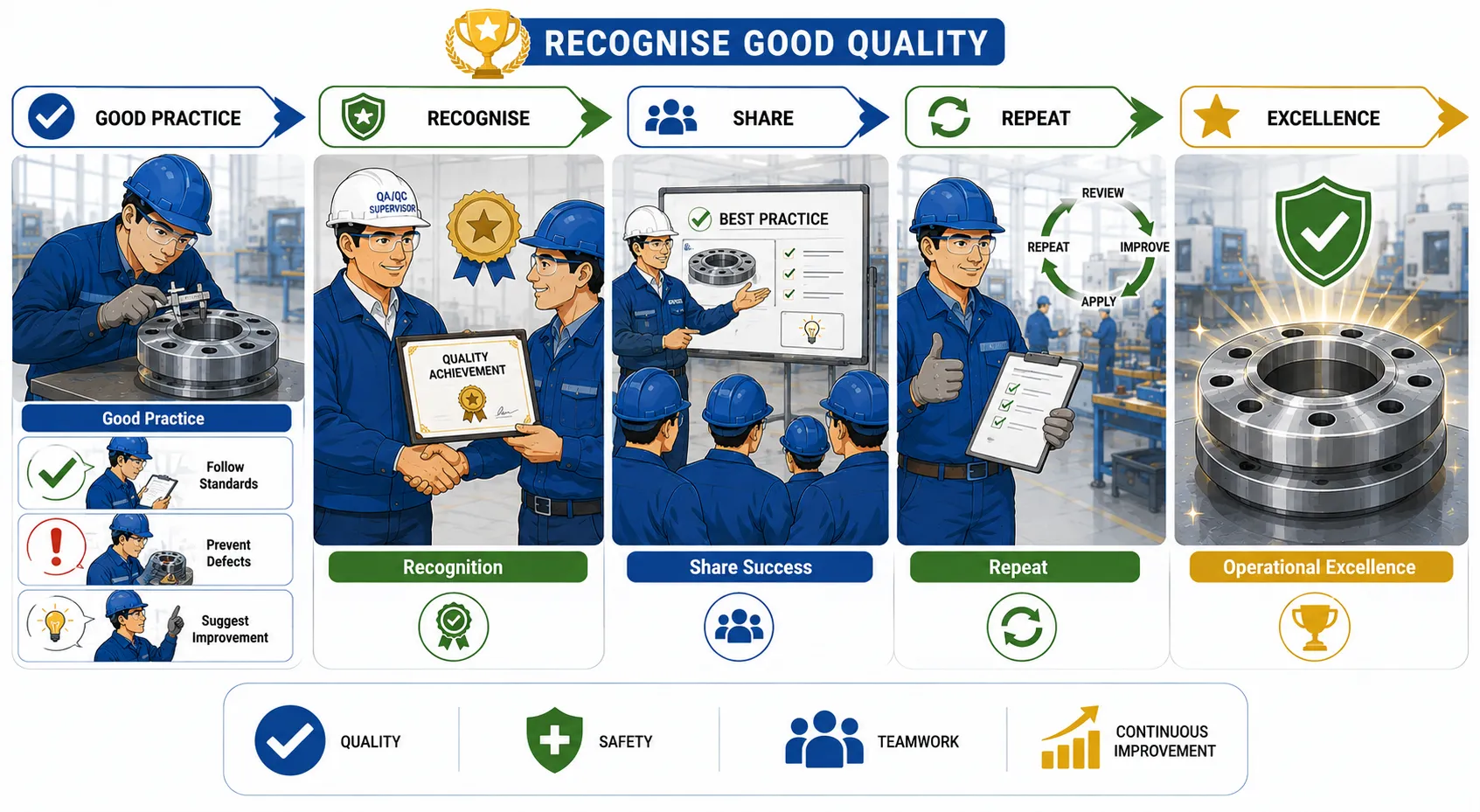
Understanding Operational Excellence
Operational excellence is the sustained ability of an organisation to deliver reliable, efficient and high-quality outcomes while continually improving its processes and performance.
In a mechanical engineering environment, operational excellence involves balancing several important objectives:
Consistent quality performance.
Safe working practices.
Efficient use of resources.
Compliance with approved procedures.
Reduction of defects and rework.
Effective teamwork and communication.
Continuous improvement.
Reliable delivery against project requirements.
Operational excellence is not achieved through one successful inspection or a single improvement project. It requires consistent behaviour and long-term commitment.
The Role of Recognition in Quality Culture
Recognition helps employees understand which behaviours the organisation considers valuable.
For example, a technician who stops work to report an incorrect material identification may prevent a significant quality failure. Although stopping work may initially affect production progress, recognising this decision reinforces the message that protecting quality is more important than concealing problems or continuing with uncertain work.
Similarly, a worker who proposes an improvement that reduces repeated measurement errors should be recognised for contributing to organisational learning.
Effective recognition can help organisations:
Reinforce desirable quality behaviours.
Increase worker motivation.
Encourage participation in improvement activities.
Promote positive role models.
Strengthen teamwork.
Support a long-term quality culture.
Increase confidence in reporting concerns.
Key Definitions and Concepts
| Term | Definition | Practical Application |
|---|---|---|
| Recognition | Formal or informal acknowledgement of positive behaviour or achievement | A supervisor publicly acknowledges a technician who prevented a quality failure |
| Reward | A benefit or incentive provided in recognition of performance or contribution | A team receives recognition for a successful improvement initiative |
| Exemplary practice | Behaviour that demonstrates a high standard and should be used as a positive example | Correctly identifying and containing non-conforming material |
| Quality culture | Shared values and behaviours that support consistent quality performance | Workers take responsibility for preventing defects |
| Operational excellence | Sustained high performance achieved through quality, efficiency and continuous improvement | A workshop consistently meets requirements while reducing waste |
| Positive reinforcement | Encouragement of desirable behaviour through recognition or reward | A useful improvement suggestion is acknowledged and implemented |
| Continuous improvement | Ongoing efforts to improve processes and performance | A team reviews recurring defects and improves controls |
| Quality ownership | Personal responsibility for contributing to quality outcomes | A technician checks work before requesting inspection |
| Performance indicator | A measure used to monitor progress or achievement | Tracking reduction in repeated non-conformities |
| Role model | An individual whose behaviour provides a positive example for others | An experienced inspector demonstrates professional quality practices |
Why Rewarding Quality Practices Matters
Reinforcing the Right Workplace Behaviours
Workers respond to the behaviours that organisations consistently recognise and reinforce. If management only rewards speed and production volume, workers may believe that output is more important than quality.
A balanced recognition programme should therefore make quality behaviours visible.
Examples include:
Reporting a defect early.
Preventing non-conforming work from progressing.
Maintaining accurate documentation.
Protecting material traceability.
Following inspection requirements.
Suggesting process improvements.
Supporting colleagues in understanding procedures.
Recognition should communicate that quality is achieved through professional behaviour rather than simply through final inspection results.
Supporting Long-Term Motivation
Short-term campaigns may temporarily increase awareness, but sustained operational excellence requires continued engagement.
Long-term commitment is more likely when workers:
Understand organisational expectations.
Receive constructive feedback.
See positive behaviour recognised.
Believe their contributions matter.
Have opportunities to improve.
Recognition programmes should therefore be consistent rather than limited to occasional awards.
Principles of an Effective Quality Recognition Programme
Reward Behaviour, Not Just Final Results
A final result may appear successful even when poor practices occurred during production.
For example, a component may eventually pass inspection after extensive rework. Rewarding the final output alone could ignore the inefficient process that produced unnecessary defects.
Recognition should therefore consider:
Quality of work practices.
Compliance with procedures.
Early problem identification.
Improvement contributions.
Teamwork.
Prevention of defects.
Maintain Fairness and Transparency
Workers should understand how recognition decisions are made.
The programme should clearly explain:
Which behaviours may be recognised.
Who can nominate individuals.
How nominations are reviewed.
What evidence is required.
What forms of recognition may be provided.
Fairness is essential for maintaining trust.
Avoid Creating Competition That Damages Teamwork
Recognition programmes can become ineffective if workers compete in unhealthy ways.
For example, rewarding only one individual may discourage collaboration when quality achievements were the result of team effort.
Organisations should balance:
Individual recognition.
Team recognition.
Formal awards.
Informal appreciation.
The objective is to strengthen quality culture rather than create unnecessary competition.
Link Recognition to Organisational Values
Recognition should support the organisation’s wider objectives.
Examples of recognised values may include:
Quality.
Safety.
Integrity.
Accountability.
Continuous improvement.
Teamwork.
Every recognition activity should reinforce at least one meaningful organisational value.
Types of Quality Recognition
Informal Recognition
Informal recognition can occur during normal workplace activities.
Examples include:
Thanking a worker for reporting a concern.
Acknowledging good practice during a tool-box talk.
Providing positive feedback after an inspection.
Highlighting a useful suggestion.
Informal recognition is valuable because it can be immediate and directly connected to the behaviour being recognised.
Formal Recognition
Formal recognition may involve structured programmes.
Examples include:
Quality achievement awards.
Improvement contribution certificates.
Team recognition events.
Annual quality excellence awards.
Formal commendations.
Formal recognition should be supported by clear criteria.
Team-Based Recognition
Many quality achievements involve cooperation between several functions.
A team may be recognised for:
Reducing recurring defects.
Improving a manufacturing process.
Successfully completing a corrective action programme.
Improving inspection efficiency.
Team recognition reinforces collaboration.
Development-Based Recognition
Recognition does not always need to involve a physical reward.
Professional development opportunities can also demonstrate appreciation.
Examples include:
Additional technical training.
Participation in improvement projects.
Leadership development opportunities.
Increased technical responsibilities.
This approach links recognition with long-term professional growth.
Developing a Structured Reward and Recognition Process
Step 1: Define Quality Behaviours to Be Recognised
The organisation should identify specific examples of exemplary practice.
Possible criteria include:
Consistent compliance with procedures.
Early detection of quality issues.
Valuable improvement suggestions.
Strong documentation practices.
Effective prevention of recurring defects.
Professional inspection performance.
Positive leadership in quality activities.
Criteria should focus on observable behaviour.
Step 2: Establish Clear Nomination Procedures
Workers and supervisors should understand how positive contributions can be nominated.
A nomination may include:
Description of the behaviour.
Date and location.
Quality benefit.
Supporting evidence.
Names of involved personnel.
Simple nomination procedures encourage participation.
Step 3: Review the Evidence
Recognition should be based on credible information.
Evidence may include:
Inspection records.
Improvement results.
Supervisor observations.
Non-conformity prevention records.
Worker feedback.
Evidence-based recognition increases fairness.
Step 4: Select an Appropriate Form of Recognition
The type of recognition should reflect the contribution.
Possible methods include:
Verbal appreciation.
Certificate of recognition.
Team acknowledgement.
Professional development opportunity.
Internal communication feature.
The reward should remain proportionate and appropriate.
Step 5: Promote the Example
Recognition should also create learning opportunities.
When appropriate, the organisation can explain:
What happened.
What positive behaviour was demonstrated.
Why the action was important.
What others can learn.
This transforms individual recognition into organisational learning.
Step 6: Review Programme Effectiveness
The organisation should periodically evaluate whether the programme supports the intended culture.
Questions may include:
Are workers participating?
Are recognised behaviours aligned with quality objectives?
Is recognition perceived as fair?
Has improvement activity increased?
Are quality behaviours becoming more consistent?
Promoting Exemplary Practices on the Shop Floor
Make Good Practice Visible
Positive quality behaviours should not remain unnoticed.
Organisations may use:
Quality noticeboards.
Tool-box talks.
Team meetings.
Internal newsletters.
Lessons-learned sessions.
The focus should remain on practical learning rather than excessive publicity.
Use Real Workplace Examples
Workers can often relate more easily to actual examples.
For instance:
A technician notices that a calibrated measuring instrument has been damaged. Rather than continuing to use it, the technician removes it from service and reports the issue.
This action can be promoted as an example of:
Quality ownership.
Professional judgement.
Prevention of inaccurate measurement.
Share Lessons From Successes
Lessons learned should not focus only on failures.
Successful practices can also provide valuable learning.
Teams can examine:
What worked well?
Why was it effective?
How can the practice be repeated?
Can it be applied elsewhere?
This creates a positive improvement culture.
Practical Example: Preventing a Material Mix-Up
A technician receives several similar-looking materials for fabrication.
During the identification check, the technician notices that one item does not have the required traceability information.
The technician:
Stops the material from being used.
Separates it from verified materials.
Reports the issue to the supervisor.
Assists with checking the documentation.
Further investigation confirms that the material had been placed in the incorrect storage area.
The organisation recognises the technician’s professional behaviour.
The example is shared during a quality meeting to reinforce:
Material traceability.
Early reporting.
Prevention rather than correction.
The recognition is not simply for “finding an error”. It is for applying the correct quality behaviour.
Practical Example: A Team Improvement Initiative
A workshop experiences repeated delays because inspection requests are submitted after work is already ready for the next stage.
A team consisting of technicians, supervisors and QA/QC personnel reviews the workflow.
The team introduces:
Earlier inspection planning.
Clearer communication.
A daily inspection schedule.
The revised process reduces delays and improves coordination.
The team is formally recognised for its contribution.
The example demonstrates that operational excellence is often achieved through collective effort.
Linking Recognition With Continuous Improvement
Encourage Improvement Suggestions
Recognition programmes should support workers who identify opportunities to improve processes.
Useful suggestions may relate to:
Simplifying work sequences.
Improving inspection access.
Reducing material handling damage.
Improving documentation.
Preventing repeated defects.
The organisation should assess suggestions objectively.
Recognise Learning From Problems
A quality culture should value constructive learning.
For example, a team may investigate a recurring non-conformity and develop an effective corrective action.
Recognition can focus on:
Honest analysis.
Collaboration.
Effective problem-solving.
Verified improvement.
This prevents the organisation from focusing only on fault finding.
The Role of Supervisors and QA/QC Leaders
Identify Positive Performance
Supervisors should actively observe good practices rather than focusing only on mistakes.
They should recognise workers who:
Follow procedures consistently.
Ask appropriate technical questions.
Support quality awareness.
Report problems early.
Help prevent recurrence.
Provide Specific Recognition
General statements such as “good job” may be appreciated but provide limited learning value.
Specific recognition is more effective.
For example:
“Your decision to stop the material from progressing when the identification was unclear prevented a potential traceability failure.”
This clearly identifies the behaviour that should be repeated.
Maintain Consistency
Recognition should not depend solely on personal relationships.
Leaders should apply the same standards across:
Shifts.
Departments.
Teams.
Job roles.
Consistency strengthens trust.
Key Benefits of Rewarding Exemplary Quality Practices
Improved Worker Engagement
Workers are more likely to participate actively when they know positive contributions are valued.
Stronger Quality Ownership
Recognition reinforces the idea that every person contributes to quality.
Increased Reporting
Workers may become more willing to:
Report concerns.
Identify defects.
Suggest improvements.
Reduced Rework
Positive reinforcement of preventive behaviour can reduce repeated errors.
Better Teamwork
Team recognition encourages collaboration across functions.
Sustained Operational Excellence
Regular reinforcement helps quality become part of normal workplace behaviour.
Avoiding Common Problems
Problem: Rewarding Only Production Speed
This may create pressure to prioritise output over quality.
Better approach:
Balance production measures with quality indicators.
Recognise prevention and improvement.
Reward correct decisions even when they require additional time.
Problem: Ignoring Quiet Contributors
Some workers may consistently demonstrate excellent practices without seeking attention.
Better approach:
Encourage peer nominations.
Use supervisor observations.
Recognise consistent performance.
Problem: Unclear Selection Criteria
Unclear criteria can create perceptions of unfairness.
Better approach:
Publish criteria.
Use evidence.
Apply consistent review processes.
Problem: Rewarding Lack of Reported Problems
A department with no reported defects may simply have weak reporting.
Better approach:
Evaluate quality behaviour.
Encourage transparent reporting.
Review objective performance evidence.
Measuring the Impact of Recognition
Recognition programmes should be evaluated using relevant indicators.
Possible measures include:
Number of improvement suggestions.
Participation in quality activities.
Reduction in recurring defects.
Reduction in rework.
Worker feedback.
Quality audit results.
Completion of improvement actions.
Measurement should examine whether the programme supports genuine improvement rather than simply counting awards.
Building Recognition Into Daily Operations
Recognition is most effective when integrated into routine activities.
Organisations can include positive recognition in:
Daily team briefings.
Weekly quality meetings.
Tool-box talks.
Performance discussions.
Improvement reviews.
Regular integration prevents recognition from becoming an isolated annual event.
A Practical Recognition Workflow
A structured process may follow these stages:
Observe
Identify exemplary quality behaviour or improvement activity.
Record
Document the behaviour and relevant evidence.
Assess
Review the contribution against agreed criteria.
Recognise
Provide appropriate acknowledgement or reward.
Share
Communicate the positive practice where useful.
Replicate
Encourage other teams to apply the successful practice.
Review
Assess the wider impact on quality culture and performance.
Professional and Ethical Considerations
Recognition systems should be managed ethically.
Organisations should avoid:
Favouritism.
Discrimination.
Misleading performance claims.
Excessive competition.
Recognition that encourages unsafe behaviour.
The system should respect diversity and provide fair opportunities for all workers to receive recognition based on genuine contribution.
Creating Quality Role Models
Exemplary workers can influence workplace culture by demonstrating expected standards.
Quality role models may show:
Attention to detail.
Respect for procedures.
Willingness to report concerns.
Professional integrity.
Commitment to learning.
However, role models should not be treated as individuals who are expected to solve every problem. Their positive practices should be supported by effective organisational systems.
Long-Term Strategies for Sustaining Operational Excellence
Sustained excellence requires continuous effort.
Organisations should:
Maintain regular recognition activities.
Update recognition criteria as objectives change.
Connect rewards with measurable quality behaviours.
Encourage peer recognition.
Share successful practices.
Review programme effectiveness.
Link recognition with training and development.
Long-term commitment develops when positive quality practices become normal workplace expectations.
Recommended Good Practice for Mechanical Engineering Organisations
To reward and promote exemplary quality practices effectively, organisations should:
Recognise quality behaviour promptly.
Use clear and transparent criteria.
Balance individual and team recognition.
Reward prevention as well as results.
Promote improvement suggestions.
Share successful workplace examples.
Avoid incentives that encourage concealment of problems.
Link recognition to organisational quality objectives.
Provide development opportunities where appropriate.
Review the programme regularly.
Conclusion
Rewarding and promoting exemplary quality practices is an important strategy for sustaining long-term commitment to operational excellence in mechanical engineering and manufacturing environments. Recognition reinforces the behaviours that organisations want workers to repeat, including early problem reporting, procedural compliance, quality ownership and continuous improvement.
An effective recognition programme must be fair, transparent and based on meaningful evidence. It should reward positive behaviours and contributions rather than focusing only on production speed or final output. Individual achievements should be balanced with team recognition to encourage cooperation and shared responsibility.
Supervisors and QA/QC leaders play a central role by identifying positive practices, providing specific feedback and ensuring that recognition is applied consistently. Successful examples should also be shared across the organisation so that individual achievements become opportunities for wider learning.
When integrated into daily operations, recognition can increase worker engagement, strengthen trust and encourage active participation in quality improvement. Over time, these repeated positive reinforcements help create a workplace culture in which quality is not viewed as an additional responsibility but as a normal part of professional conduct.
By rewarding the right behaviours, promoting successful practices and linking recognition to continuous improvement, organisations can sustain commitment to safety, quality and operational excellence while supporting reliable and efficient mechanical engineering performance.