
Lesson No 1: Work Equipment and Platforms
Work equipment and platforms are essential elements in maintaining safe and controlled working conditions when employees need to access elevated areas for construction, maintenance, installation, inspection, and repair activities. This lesson introduces learners to the different types of work equipment and access platforms, including ladders, scaffolding systems, mobile elevated work platforms (MEWPs), and other temporary access solutions used across industrial and commercial environments. It explains the importance of selecting suitable equipment, understanding equipment limitations, and applying safe working procedures to reduce risks associated with elevated tasks.
From a construction HSE and workplace safety management perspective, correct selection and use of work equipment play a vital role in preventing accidents, improving productivity, and ensuring compliance with occupational safety requirements. This lesson focuses on the principles of equipment suitability, inspection, maintenance, stability, and safe operation. Learners will develop an understanding of how workplace conditions, task requirements, environmental factors, and worker competence influence the choice of appropriate access equipment.
The lesson also explores the responsibilities of employers, supervisors, and workers in managing work equipment effectively. It highlights the importance of following manufacturer instructions, conducting pre-use checks, maintaining equipment records, and identifying unsafe conditions before starting work. By understanding the characteristics and applications of ladders, scaffolding, MEWPs, and other access systems, learners will be able to make informed decisions, support effective risk control measures, and contribute to safer workplace practices across construction, engineering, maintenance, and industrial sectors.
1. Identify Various Types of Work Equipment and Platforms Used in Working at Height, Including Ladders, Scaffolding, and MEWPs
Introduction to Work Equipment and Platforms
Work equipment and platforms are essential safety resources used in construction, engineering, maintenance, electrical installation, manufacturing, and industrial environments where workers need to access elevated areas. Selecting the correct equipment is a fundamental part of workplace safety because unsuitable access solutions can increase the likelihood of falls, instability, equipment failure, and injuries. Employers and workers must understand the purpose, limitations, and safe application of different types of equipment before starting any task involving elevated work.
Effective management of work equipment requires careful planning, hazard identification, equipment selection, inspection, and correct operation. Ladders, scaffolding systems, and Mobile Elevated Work Platforms (MEWPs) are commonly used solutions, but each type of equipment is designed for specific tasks and working conditions. A ladder may be appropriate for a short inspection activity, while scaffolding or powered platforms may be more suitable for complex tasks requiring longer working periods, multiple workers, or movement across elevated areas.
From an occupational safety perspective, equipment should always be selected based on risk assessment findings, task requirements, environmental conditions, and the competence of the user. Understanding different work platforms allows organisations to improve safety performance, reduce workplace incidents, and maintain compliance with recognised health and safety practices.
Importance of Selecting Suitable Work Equipment
Choosing suitable work equipment is a critical step in preventing accidents and ensuring workers can complete tasks safely and efficiently. The incorrect selection of access equipment may create additional hazards, including unstable working positions, overreaching, falls, structural failure, and unsafe movement.
A suitable work platform should provide:
- Safe access to elevated locations.
- A stable working position.
- Adequate space for tools and materials.
- Protection against falling risks.
- Appropriate load capacity.
- Compliance with manufacturer instructions.
Before selecting equipment, organisations should consider:
- The height of the task.
- Duration of the work activity.
- Number of workers involved.
- Required tools and materials.
- Workplace conditions.
- Potential hazards.
For example, using a small ladder for a long-duration maintenance task may create unnecessary risks because workers may become fatigued or lose balance. In such cases, a scaffold platform or MEWP may provide a safer and more suitable solution.
Key Concepts of Work Equipment and Platforms
| Term | Definition | Safety Importance |
|---|---|---|
| Work Equipment | Any tool, machine, device, or system used by workers to perform workplace activities | Ensures tasks are completed using suitable and safe resources |
| Access Equipment | Equipment designed to provide safe movement to elevated areas | Reduces unsafe climbing practices |
| Working Platform | A stable surface where workers perform tasks while elevated | Provides safer working conditions |
| Ladder | Portable equipment used mainly for access and short-duration tasks | Suitable when used within safe limitations |
| Scaffolding | Temporary structure providing working platforms and access routes | Supports longer and more complex activities |
| MEWP | Powered equipment designed to lift workers to elevated positions | Provides flexible and controlled access |
Types of Work Equipment Used for Elevated Tasks
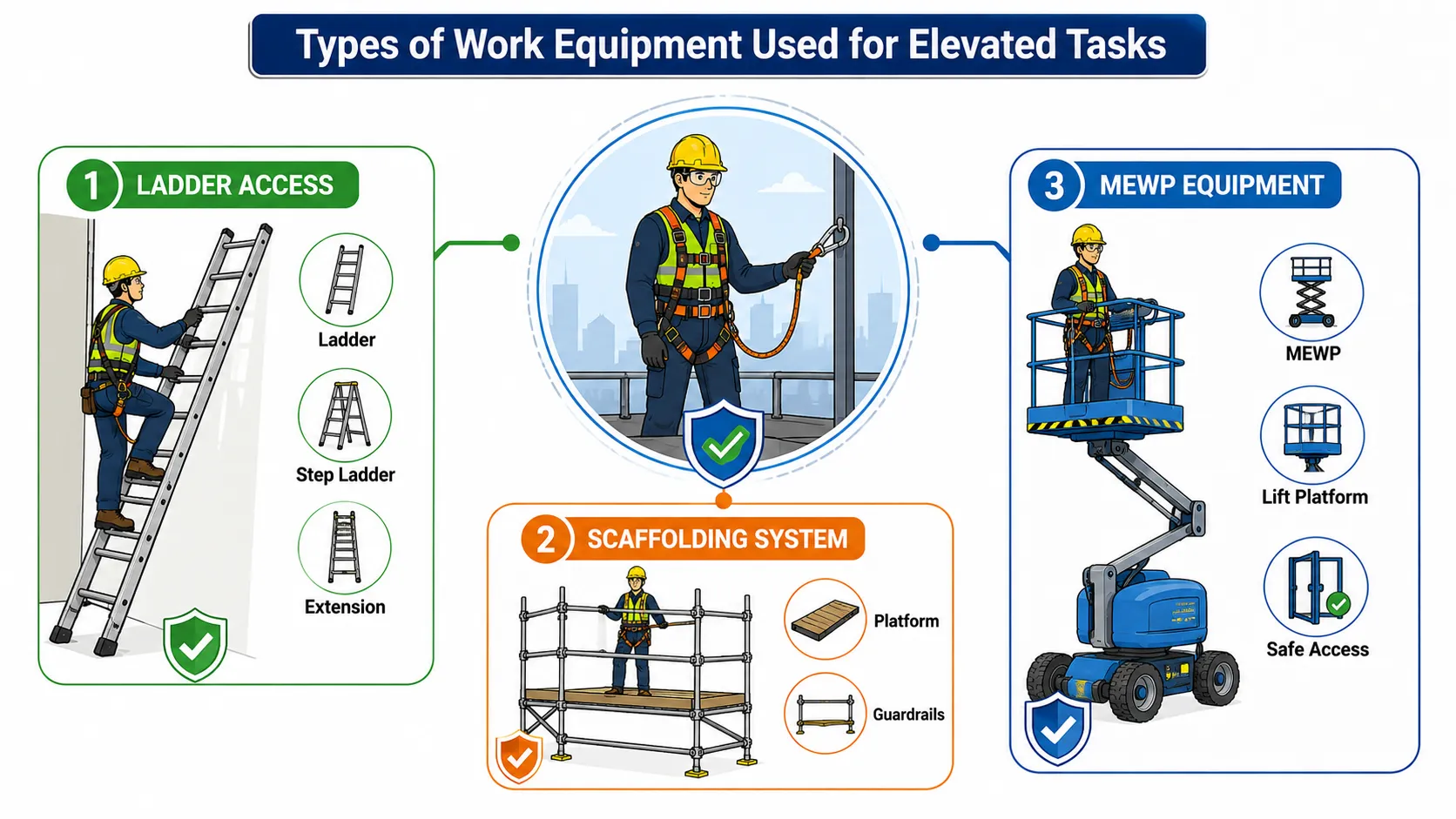
Ladders
Ladders are one of the most commonly recognised types of access equipment used in workplaces. They are portable, easy to store, and useful for tasks where workers require temporary access to elevated areas. However, ladders provide limited working space and stability compared with larger platforms, meaning they must only be used where they are appropriate.
Ladders are commonly used for:
- Short-duration maintenance activities.
- Inspection work.
- Accessing storage areas.
- Minor repair tasks.
- Electrical checks and adjustments.
Before using a ladder, workers should ensure:
- The ladder is suitable for the task.
- The ladder is in good condition.
- The surface is stable.
- The equipment is positioned correctly.
- The worker understands safe use requirements.
Types of Ladders
Step Ladders
Step ladders are self-supporting ladders that can stand independently without requiring support from another structure. They are commonly used for low-level work where workers need temporary access.
Typical applications include:
- Indoor maintenance.
- Changing light fittings.
- Accessing equipment at low levels.
- Inspection activities.
Safe use practices include:
- Checking locking mechanisms before use.
- Ensuring all feet are stable.
- Avoiding uneven surfaces.
- Preventing excessive sideways movement.
Workers should avoid:
- Standing on unsafe steps.
- Overstretching.
- Moving the ladder while occupied.
Extension Ladders
Extension ladders are adjustable ladders that allow users to reach greater heights. They are often used for external maintenance and access purposes.
Common applications include:
- Roof access.
- Building inspections.
- External repairs.
Important safety considerations include:
- Correct positioning against a secure surface.
- Maintaining stability.
- Checking extension locks.
- Avoiding unsuitable weather conditions.
Limitations of Ladders
Although ladders are useful, they have several limitations that must be considered during planning.
Ladders:
- Provide limited workspace.
- May restrict movement.
- Are unsuitable for many long-duration tasks.
- Offer less stability than fixed platforms.
Alternative equipment should be considered when:
- Workers need both hands continuously.
- Heavy materials are required.
- Multiple workers need access.
- The task requires extended working time.
Scaffolding Systems
Understanding Scaffolding
Scaffolding is a temporary structure designed to provide stable working platforms and safe access for workers performing tasks at elevated levels. It is widely used in construction projects, building maintenance, industrial facilities, and engineering activities.
Unlike ladders, scaffolding provides:
- Larger working areas.
- Increased stability.
- Space for tools and materials.
- Additional protective features.
Scaffolding is commonly used for:
- Building construction.
- Painting activities.
- External repairs.
- Mechanical installation.
- Electrical work.
Main Components of Scaffolding
Standards
Standards are vertical support components that transfer the weight of the scaffold structure to the ground.
Ledgers
Ledgers are horizontal supports that connect standards and improve structural stability.
Platforms
Platforms provide the working surface where workers stand and complete tasks.
Guardrails
Guardrails provide protection by reducing the risk of workers falling from platform edges.
Toe Boards
Toe boards prevent tools and materials from falling from elevated platforms.
Types of Scaffolding
Fixed Scaffolding
Fixed scaffolding remains in one position during a project and provides a stable solution for extended activities.
Advantages include:
- Strong support structure.
- Large working area.
- Suitable for multiple workers.
Common uses include:
- Construction projects.
- Building refurbishment.
- Industrial maintenance.
Mobile Scaffold Towers
Mobile scaffold towers include wheels that allow movement between different working locations.
They are commonly used for:
- Internal maintenance.
- Electrical installation.
- Facility management tasks.
Safe operation requires:
- Locking wheels before use.
- Maintaining stability.
- Avoiding movement while occupied.
- Following manufacturer guidance.
Scaffolding Safety Requirements
Safe scaffolding use requires:
- Correct assembly.
- Competent installation.
- Regular inspection.
- Suitable access routes.
- Compliance with load limits.
Workers should never:
- Remove guardrails without authorisation.
- Overload platforms.
- Use damaged scaffolding.
- Modify structures without approval.
Mobile Elevated Work Platforms (MEWPs)
Understanding MEWPs
Mobile Elevated Work Platforms (MEWPs) are powered access machines designed to raise workers safely to elevated working positions. They are commonly used where workers need controlled movement, greater height access, and improved flexibility.
MEWPs are widely used in:
- Construction projects.
- Electrical installation.
- Warehouse maintenance.
- Industrial inspections.
- Building services.
Types of MEWPs
Scissor Lifts
Scissor lifts move vertically using a folding support mechanism.
They are suitable for:
- Straight vertical access.
- Indoor maintenance.
- Tasks requiring a larger platform area.
Benefits include:
- Stable working platform.
- Space for tools.
- Improved worker positioning.
Boom Lifts
Boom lifts use an extendable arm to provide access to difficult locations.
They are suitable for:
- External building work.
- Telecommunications tasks.
- Electrical maintenance.
Safety requirements include:
- Trained operators.
- Equipment inspection.
- Stable ground conditions.
- Correct load management.
MEWP Safety Procedures
Before operating a MEWP, workers should:
- Complete required training.
- Inspect equipment condition.
- Check ground stability.
- Confirm weather conditions.
- Follow operating instructions.
Workers should avoid:
- Exceeding platform capacity.
- Standing on guardrails.
- Operating without authorisation.
- Ignoring warning systems.
Process for Selecting Appropriate Work Equipment
Step 1: Assess the Task
Before choosing equipment, evaluate:
- Required working height.
- Task duration.
- Tools needed.
- Worker movement requirements.
Step 2: Evaluate the Environment
Consider:
- Ground conditions.
- Available working space.
- Weather conditions.
- Nearby hazards.
Step 3: Check Equipment Suitability
Confirm:
- Equipment condition.
- Inspection status.
- Load capacity.
- Manufacturer requirements.
Step 4: Confirm User Competence
Workers should have:
- Appropriate training.
- Knowledge of safe operation.
- Understanding of equipment limitations.
Practical Example: Electrical Maintenance Activity
Scenario
An electrical maintenance team needs to replace lighting systems inside a large warehouse. The task requires workers to access ceiling-level equipment and carry electrical tools.
Equipment Assessment
A ladder may not provide the best solution because:
- Workers need stable positioning.
- Tools must be used safely.
- The task may require movement.
A MEWP may be more suitable because:
- It provides a stable platform.
- Workers can move safely between locations.
- Equipment and tools can be supported.
Outcome
Selecting appropriate equipment improves safety, reduces fatigue, and supports efficient completion of the task.
Practical Example: Building Repair Project
Scenario
A maintenance team needs to repair external sections of a commercial building over several days.
Suitable Equipment Choice
Scaffolding may be selected because:
- Multiple workers require access.
- Materials need to be available.
- A stable platform is required.
Safety Benefits
The scaffold provides:
- Stable working surfaces.
- Edge protection.
- Improved access management.
Key Benefits of Suitable Work Equipment
Improved Safety
Correct equipment selection helps organisations:
- Reduce fall risks.
- Prevent unsafe access methods.
- Improve worker confidence.
Increased Productivity
Suitable platforms allow workers to:
- Complete tasks efficiently.
- Maintain better working positions.
- Access difficult areas safely.
Improved Compliance
Effective equipment management supports:
- Workplace safety requirements.
- Organisational procedures.
- Industry best practices.
Responsibilities of Workers and Supervisors
Worker Responsibilities
Workers should:
- Use equipment according to instructions.
- Complete pre-use checks.
- Report defects immediately.
- Follow training requirements.
Supervisor Responsibilities
Supervisors should:
- Provide suitable equipment.
- Ensure workers are competent.
- Monitor safe practices.
- Arrange inspections and maintenance.
Conclusion
Understanding different types of work equipment and platforms, including ladders, scaffolding, and MEWPs, is essential for maintaining safe working environments. Each type of equipment has specific applications, benefits, and limitations that must be considered before use.
Effective equipment selection involves proper planning, risk assessment, inspection, and safe operation. By applying good equipment management practices, organisations can reduce hazards, improve workplace efficiency, and support safer working conditions across construction, engineering, maintenance, and industrial sectors.
2. Demonstrate Safe Use, Positioning, and Securing of Ladders and Stepladders
Introduction to Safe Ladder and Stepladder Practices
Ladders and stepladders are widely used pieces of access equipment in construction, maintenance, electrical installation, facilities management, and industrial workplaces. They provide a practical solution for reaching elevated areas when tasks are suitable for short-duration and low-risk activities. However, incorrect selection, poor positioning, or unsafe use can result in serious incidents such as falls, slips, and injuries. Therefore, understanding how to safely use, position, and secure ladders and stepladders is an essential workplace safety skill.
Safe ladder use requires more than simply placing a ladder against a surface and climbing. Workers must understand equipment limitations, inspect ladders before use, select the correct type of ladder, position it correctly, and apply suitable securing methods. Effective ladder management helps create safer working conditions and ensures that tasks are completed efficiently while reducing unnecessary risks.
From an occupational safety management perspective, ladders should only be used when they are the most suitable option for the task. Employers and workers must consider the working environment, task duration, height requirements, weather conditions, and potential hazards before selecting ladder-based access equipment.
Key Concepts of Ladder and Stepladder Safety
| Key Concept | Definition | Safety Importance |
|---|---|---|
| Ladder Selection | Choosing a ladder that matches the task, height, and working conditions | Ensures suitable equipment is used safely |
| Ladder Positioning | Placing the ladder correctly on a stable surface and suitable angle | Prevents slipping and instability |
| Ladder Securing | Using methods to prevent ladder movement during use | Improves worker stability and reduces fall risks |
| Pre-Use Inspection | Checking ladder condition before every use | Identifies defects before work begins |
| Three-Point Contact | Maintaining two hands and one foot or two feet and one hand in contact while climbing | Improves balance and control |
| Stepladder | A self-supporting ladder designed for standing access | Provides stable access for appropriate tasks |
Understanding the Correct Use of Ladders and Stepladders
Ladders and stepladders must always be used according to their intended purpose and manufacturer instructions. They are designed mainly for access and short-duration work where a stable position can be maintained. Using them outside their limitations can increase the possibility of loss of balance or falls.
Workers should understand that ladders are not suitable for every elevated task. Activities requiring long working periods, heavy tools, significant movement, or continuous use of both hands may require alternative equipment such as scaffolding or powered access platforms.
Situations Where Ladders May Be Suitable
Ladders may be appropriate for:
- Short maintenance activities.
- Inspection work.
- Changing light fittings.
- Accessing elevated storage areas.
- Minor repair tasks.
- Quick adjustments or checks.
Before using a ladder, workers should confirm:
- The ladder is suitable for the required height.
- The equipment is in good condition.
- The work area is safe.
- The task can be completed without excessive reaching.
- The worker has received appropriate instruction.
Selecting the Correct Ladder Type
Selecting the correct ladder is an important part of preventing accidents. Different ladder designs are suitable for different tasks, and choosing unsuitable equipment can create additional hazards.
Step Ladders
Step ladders are self-supporting access equipment that can stand independently without being supported against another structure.
They are commonly used for:
- Indoor maintenance.
- Electrical inspection tasks.
- Low-level installation work.
- Cleaning activities.
Safe step ladder practices include:
- Fully opening the ladder before use.
- Ensuring locking mechanisms are secure.
- Placing all feet on a stable surface.
- Keeping the ladder positioned correctly.
Workers should avoid:
- Standing on the top cap unless designed for that purpose.
- Leaning outside the ladder frame.
- Using damaged or unstable stepladders.
- Moving the ladder while standing on it.
Leaning Ladders
Leaning ladders require support against a strong and stable structure.
They are commonly used for:
- Accessing roofs.
- External maintenance.
- Inspection activities.
Important safety requirements include:
- Ensuring the supporting surface is strong.
- Preventing movement at the base.
- Maintaining correct positioning.
- Securing the ladder when required.
Ladder Pre-Use Inspection Process
A pre-use inspection is an essential safety procedure that identifies damage or defects before equipment is used. Regular inspection helps prevent equipment failure and ensures ladders remain suitable for workplace activities.
Inspection Procedure
Before using a ladder, workers should check:
- Side rails for cracks or damage.
- Steps and rungs for wear.
- Hinges and joints.
- Rubber feet or anti-slip surfaces.
- Locking mechanisms.
- Labels and manufacturer markings.
Workers should look for:
- Bent sections.
- Loose components.
- Missing parts.
- Corrosion.
- Oil, grease, or chemical contamination.
- Signs of excessive wear.
Actions When Defects Are Found
If a ladder is damaged:
- Stop using it immediately.
- Remove it from the work area.
- Report the defect.
- Label it as unsafe.
- Arrange repair or replacement.
Workers should never:
- Use damaged ladders temporarily.
- Attempt unauthorised repairs.
- Ignore minor defects.
Correct Positioning of Ladders

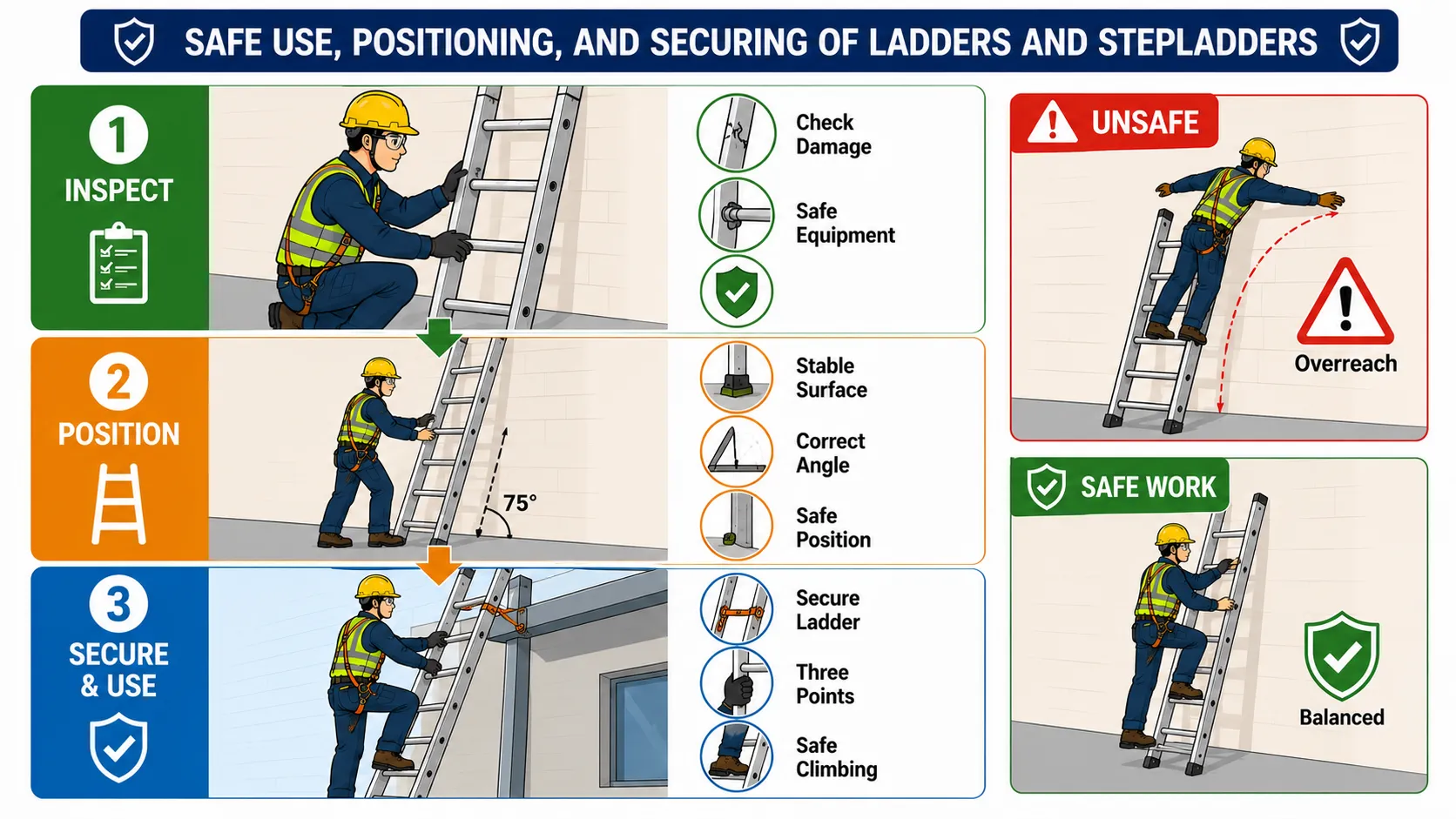
Correct positioning is one of the most important factors in preventing ladder-related incidents. A correctly positioned ladder provides better stability and reduces movement during use.
Preparing the Work Area
Before placing a ladder, workers should:
- Remove unnecessary obstacles.
- Check the ground surface.
- Identify nearby hazards.
- Ensure sufficient lighting.
- Control access around the work area.
The ladder should be positioned:
- On a flat and stable surface.
- Away from slippery areas.
- Against a strong supporting structure where required.
- In a location protected from vehicle or pedestrian movement.
Safe Ladder Positioning Practices
Workers should ensure:
- The ladder is fully opened if using a stepladder.
- The ladder is not placed on unstable objects.
- The base is secure.
- The equipment remains stable throughout the task.
Unsafe positioning includes:
- Placing ladders on boxes or temporary platforms.
- Using ladders on uneven surfaces.
- Leaning ladders against weak structures.
- Positioning ladders near uncontrolled traffic areas.
Securing Ladders During Use
Securing a ladder reduces the risk of movement, slipping, and instability. Where there is a possibility of displacement, suitable securing methods should be applied.
Methods of Securing Ladders
Ladders may be secured by:
- Tying the ladder at suitable points.
- Using stabilising accessories.
- Ensuring firm footing.
- Using appropriate anti-slip devices.
Benefits of securing ladders include:
- Improved stability.
- Reduced movement.
- Increased worker confidence.
- Lower risk of falls.
When Additional Securing Is Required
Additional securing measures may be necessary when:
- The ladder is used outdoors.
- Ground conditions are uncertain.
- The ladder is exposed to movement risks.
- The task requires repeated climbing.
Workers should never rely only on their body weight to hold a ladder in place.
Safe Climbing Techniques
Correct climbing methods are essential for maintaining balance and reducing fall risks.
Workers should:
- Face the ladder while climbing.
- Maintain three-point contact.
- Keep the body centred between ladder rails.
- Wear suitable footwear.
- Keep hands free when climbing where possible.
Workers should avoid:
- Carrying heavy objects while climbing.
- Looking away while climbing.
- Jumping from ladders.
- Overreaching beyond a safe position.
Safe Working Practices on Stepladders
Stepladders provide stability when used correctly, but unsafe behaviour can quickly create hazards.
Good Working Practices
Workers should:
- Ensure the stepladder is fully opened.
- Check locking systems.
- Maintain a balanced position.
- Keep both feet secure.
- Avoid excessive side movement.
Unsafe Working Practices
Workers should not:
- Stand on unsuitable upper steps.
- Use a damaged stepladder.
- Place objects under the ladder to increase height.
- Work in unsafe environmental conditions.
Practical Example: Electrical Maintenance Activity
Scenario
An electrician is required to replace ceiling lights in an office building. The task requires access to a moderate height and involves using hand tools.
Risk Assessment
The worker considers:
- Required height.
- Task duration.
- Equipment needed.
- Stability of the working area.
Safe Approach
The electrician should:
- Select a suitable stepladder.
- Inspect the ladder before use.
- Place it on a level surface.
- Ensure the locking mechanism is engaged.
- Maintain safe climbing practices.
Outcome
By selecting and using the ladder correctly, the worker reduces the risk of falling and completes the task safely.
Practical Example: External Building Inspection
Scenario
A maintenance worker needs to inspect roof drainage systems on a commercial building.
Safety Considerations
The worker evaluates:
- Ground conditions.
- Weather conditions.
- Required access height.
- Ladder stability.
Correct Procedure
The worker should:
- Select an appropriate extension ladder.
- Position it correctly.
- Secure it where required.
- Avoid working during unsuitable weather.
Key Benefits of Safe Ladder Management
Improved Workplace Safety
Correct ladder practices help:
- Reduce fall incidents.
- Prevent equipment-related injuries.
- Improve worker confidence.
Increased Work Efficiency
Safe ladder use allows workers to:
- Complete suitable tasks effectively.
- Maintain better control.
- Reduce interruptions caused by unsafe conditions.
Improved Equipment Reliability
Regular inspection and correct handling help:
- Extend equipment lifespan.
- Prevent unexpected failures.
- Maintain safe working standards.
Responsibilities of Workers and Supervisors
Worker Responsibilities
Workers should:
- Use ladders according to instructions.
- Complete pre-use inspections.
- Follow safe positioning procedures.
- Report damaged equipment.
Supervisor Responsibilities
Supervisors should:
- Provide suitable ladders.
- Ensure workers are trained.
- Monitor safe practices.
- Remove unsafe equipment from service.
Conclusion
Safe use, positioning, and securing of ladders and stepladders are essential elements of effective workplace safety management. Although ladders are simple access tools, they require proper selection, inspection, positioning, and handling to prevent accidents.
By applying correct ladder safety procedures, workers can reduce risks, improve task performance, and create safer working environments. Understanding equipment limitations, following safe practices, and ensuring ladders are properly maintained supports a strong safety culture across construction, maintenance, electrical, and industrial workplaces.
3. Apply Proper Procedures for Erecting, Using, and Dismantling Scaffolding
Introduction to Safe Scaffolding Procedures
Scaffolding is one of the most widely used temporary access systems in construction, engineering, maintenance, and industrial environments. It provides stable working platforms that allow workers to safely access elevated areas while carrying out activities such as installation, inspection, repair, painting, and maintenance work. However, scaffolding can create significant risks if it is incorrectly designed, erected, used, altered, or dismantled. Therefore, following proper scaffolding procedures is essential to protect workers, maintain structural stability, and prevent workplace incidents.
Effective scaffolding management requires a systematic approach that includes planning, risk assessment, competent installation, regular inspection, safe use, and controlled dismantling. Every stage of the scaffolding lifecycle must be completed according to safety procedures, manufacturer guidance, and workplace requirements. Workers involved in scaffolding activities must understand their responsibilities and recognise the importance of maintaining safe working conditions throughout the process.
From an occupational health and safety perspective, scaffolding should only be erected, modified, and dismantled by trained and competent individuals. A properly managed scaffold provides a secure working environment, improves productivity, and supports compliance with workplace safety standards.
Key Concepts of Scaffolding Safety
| Key Concept | Definition | Importance |
|---|---|---|
| Scaffolding | A temporary structure used to provide access and working platforms at elevated levels | Creates a stable and safer working area |
| Erection | The process of assembling scaffold components to create a safe structure | Ensures correct installation and stability |
| Inspection | A systematic examination of scaffold condition and safety features | Identifies defects before use |
| Load Capacity | The maximum weight a scaffold can safely support | Prevents structural failure and overloading |
| Guardrails | Protective barriers installed around platform edges | Reduces fall risks |
| Dismantling | The controlled removal of scaffold components after use | Prevents collapse and unsafe conditions |
Understanding Scaffolding Systems
Purpose of Scaffolding
Scaffolding provides temporary access and working platforms where normal ground-level access is not possible. It allows workers to perform tasks safely while maintaining stability and reducing the need for unsafe climbing methods.
Scaffolding is commonly used for:
- Building construction.
- External repairs.
- Electrical installation.
- Mechanical maintenance.
- Industrial plant work.
- Painting and finishing activities.
The main purposes of scaffolding include:
- Providing safe access to elevated work areas.
- Supporting workers, tools, and materials.
- Creating stable working positions.
- Improving task efficiency.
- Reducing risks associated with unsafe access.
Main Components of Scaffolding
A scaffold consists of several important components that work together to provide strength and stability.
Standards
Standards are vertical support members that transfer the weight of the scaffold structure to the ground.
Their functions include:
- Supporting scaffold loads.
- Maintaining structural alignment.
- Providing the main framework.
Ledgers
Ledgers are horizontal components that connect standards and provide additional strength.
They help:
- Maintain scaffold stability.
- Support working platforms.
- Improve structural integrity.
Transoms
Transoms support scaffold boards and distribute loads across the structure.
They provide:
- Platform support.
- Improved weight distribution.
- Increased stability.
Scaffold Boards and Platforms
Platforms provide the working surface where workers stand and complete tasks.
They should:
- Be properly secured.
- Have suitable strength.
- Be free from damage.
Guardrails and Toe Boards
Guardrails protect workers from falling from platform edges.
Toe boards help prevent:
- Tools falling.
- Materials slipping from platforms.
- Risks to workers below.
Procedure for Erecting Scaffolding
Planning Before Scaffold Erection
Before erecting scaffolding, proper planning must take place to ensure the structure is suitable for the intended task.
Planning should include:
- Assessing workplace hazards.
- Selecting suitable scaffold type.
- Checking ground conditions.
- Determining required height.
- Evaluating load requirements.
A pre-installation assessment should consider:
- Nearby electrical hazards.
- Weather conditions.
- Access requirements.
- Surrounding structures.
- Public safety concerns.
Preparing the Work Area
Before assembly begins, the area should be prepared properly.
Important preparation activities include:
- Clearing unnecessary materials.
- Establishing a safe working zone.
- Checking ground stability.
- Controlling access by unauthorised persons.
- Ensuring sufficient space for assembly.
Workers should ensure:
- The ground is level and capable of supporting loads.
- The area is free from hazards.
- Required components are available and undamaged.
Assembly Process
Scaffolding should be erected according to an organised procedure.
The process generally includes:
- Positioning base plates and supports.
- Installing vertical standards.
- Connecting horizontal supports.
- Adding platforms and boards.
- Installing guardrails and toe boards.
- Checking structural stability.
During erection:
- Components should be inspected before installation.
- Correct connections should be used.
- The structure should remain stable at every stage.
- Workers should follow approved procedures.
Importance of Competent Scaffold Installation
Only trained and competent individuals should erect scaffolding because incorrect assembly can result in:
- Structural instability.
- Scaffold collapse.
- Worker falls.
- Damage to property.
Competent scaffold workers understand:
- Assembly requirements.
- Component limitations.
- Load restrictions.
- Inspection procedures.
Safe Use of Scaffolding
Pre-Use Inspection
Before workers access a scaffold, it must be inspected to confirm that it remains safe.
Inspection checks should include:
- Platform condition.
- Guardrail installation.
- Toe board security.
- Structural stability.
- Access arrangements.
Workers should confirm:
- The scaffold has been approved for use.
- Any inspection information is current.
- No unauthorised changes have been made.
Safe Working Practices on Scaffolding
Workers using scaffolding should:
- Keep platforms clear.
- Follow load limits.
- Use designated access routes.
- Maintain good housekeeping.
- Report defects immediately.
Workers should avoid:
- Overloading platforms.
- Removing protective barriers.
- Throwing materials from height.
- Making unauthorised modifications.
Managing Materials and Tools
Tools and materials placed on scaffolding must be managed carefully.
Safe practices include:
- Keeping materials organised.
- Avoiding excessive loads.
- Preventing items from falling.
- Removing unnecessary materials.
Poor material management can result in:
- Platform instability.
- Falling object hazards.
- Reduced working space.
Scaffold Inspection and Maintenance
Importance of Regular Inspection
Regular inspection ensures scaffolding remains safe throughout its use.
Inspections help identify:
- Damaged components.
- Loose connections.
- Missing protective features.
- Structural problems.
Inspections should be completed:
- Before initial use.
- After significant changes.
- After severe weather.
- At regular intervals according to requirements.
Maintenance Requirements
Effective scaffold maintenance includes:
- Replacing damaged components.
- Tightening connections.
- Removing unsafe sections.
- Keeping records of inspections.
Workers should never continue using scaffolding that shows signs of damage.
Procedure for Dismantling Scaffolding
Planning the Dismantling Process
Dismantling scaffolding requires the same level of planning as erection.
Before dismantling:
- Confirm the scaffold is no longer required.
- Establish a safe dismantling area.
- Remove tools and materials.
- Inform affected workers.
Safe Dismantling Sequence
Scaffolding should be dismantled systematically.
The process includes:
- Removing materials from platforms.
- Removing upper sections first.
- Taking components down carefully.
- Storing components safely.
Workers should:
- Follow the planned dismantling sequence.
- Maintain structural stability.
- Prevent uncontrolled movement.
Hazards During Dismantling
Dismantling activities can create risks including:
- Falling components.
- Scaffold instability.
- Worker falls.
- Damage to equipment.
Control measures include:
- Using competent workers.
- Restricting access below.
- Using suitable handling methods.
- Maintaining communication.
Practical Example: Commercial Building Maintenance Project
Scenario
A maintenance company is required to repair external walls of a commercial building. The project requires workers to access multiple elevated areas over several weeks.
Scaffold Planning
Before work begins, the team:
- Assesses the building structure.
- Selects suitable scaffolding.
- Reviews load requirements.
- Plans access routes.
Erection Process
Competent workers:
- Prepare the ground area.
- Assemble scaffold components.
- Install platforms and protective barriers.
- Complete safety checks.
Safe Use
Workers:
- Access the scaffold using approved routes.
- Keep platforms organised.
- Follow load limits.
- Report defects.
Dismantling
After project completion:
- Materials are removed.
- Scaffold sections are dismantled safely.
- Components are inspected and stored.
Outcome
Proper scaffolding procedures reduce risks, improve efficiency, and support safe completion of the maintenance project.
Benefits of Following Proper Scaffolding Procedures
Improved Worker Protection
Effective procedures help:
- Reduce fall risks.
- Prevent scaffold collapse.
- Improve working conditions.
Increased Productivity
A properly designed scaffold allows workers to:
- Access areas efficiently.
- Carry out tasks comfortably.
- Reduce unnecessary delays.
Better Equipment Management
Correct procedures support:
- Longer equipment life.
- Reduced damage.
- Improved reliability.
Regulatory Compliance
Following recognised scaffolding practices helps organisations:
- Meet safety requirements.
- Demonstrate effective risk control.
- Maintain professional standards.
Responsibilities of Workers and Supervisors
Worker Responsibilities
Workers should:
- Use scaffolding correctly.
- Follow safety instructions.
- Report defects.
- Avoid unsafe modifications.
Supervisor Responsibilities
Supervisors should:
- Ensure competent personnel are involved.
- Monitor safe practices.
- Arrange inspections.
- Control workplace risks.
Conclusion
Applying proper procedures for erecting, using, and dismantling scaffolding is essential for maintaining safe working environments in construction, engineering, and industrial workplaces. Scaffolding provides valuable access solutions, but its safety depends on correct planning, competent installation, regular inspection, and responsible use.
By understanding scaffold components, following safe procedures, managing risks, and ensuring controlled dismantling, workers and organisations can reduce accidents, improve productivity, and create safer elevated working environments. Effective scaffolding management is a key element of professional workplace safety practice.
4. Operate Mobile Elevated Work Platforms (MEWPs) Safely, Adhering to Operational Guidelines
Introduction to Mobile Elevated Work Platform (MEWP) Safety
Mobile Elevated Work Platforms (MEWPs) are specialised access machines designed to safely lift workers, tools, and equipment to elevated working positions. They are widely used in construction, electrical installation, building maintenance, industrial facilities, warehouses, manufacturing environments, and engineering projects where workers need controlled access above ground level. MEWPs provide significant advantages by improving accessibility, reducing manual handling risks, and creating stable working positions; however, they must be operated correctly to prevent accidents and equipment-related incidents.
Safe MEWP operation requires more than simply controlling the machine. Operators must understand equipment capabilities, workplace hazards, operational limitations, and emergency procedures before beginning any task. Incorrect operation, poor planning, unsuitable ground conditions, or failure to follow manufacturer instructions can result in serious incidents such as falls, overturning, collisions, and mechanical failures.
A safe MEWP system depends on three key factors: suitable equipment selection, competent operators, and effective workplace controls. Employers, supervisors, and operators must work together to ensure that MEWPs are inspected, maintained, and used according to approved safety procedures. Proper operation improves workplace safety, supports legal compliance, and increases efficiency when completing elevated tasks.
Key Concepts of MEWP Safety
| Key Concept | Definition | Importance |
|---|---|---|
| Mobile Elevated Work Platform (MEWP) | Powered equipment designed to lift workers and tools to elevated working positions | Provides controlled access to high-level work areas |
| Operator Competence | The knowledge, skills, and experience required to operate equipment safely | Reduces unsafe operation and human error |
| Pre-Use Inspection | A safety check completed before operating the MEWP | Identifies faults before equipment use |
| Safe Working Load (SWL) | The maximum weight the platform can safely carry | Prevents overloading and instability |
| Ground Assessment | Evaluation of surface conditions before equipment operation | Reduces overturning and stability risks |
| Emergency Controls | Systems used during equipment failure or emergency situations | Supports safe response and rescue |
Understanding Different Types of MEWPs
MEWPs are available in different designs depending on the working environment, required height, access limitations, and movement requirements. Selecting the correct type of MEWP is essential because each machine has specific operating characteristics and restrictions.
Scissor Lifts
Scissor lifts are designed to move vertically using a folding support mechanism. They provide a stable working platform suitable for tasks where workers need upward access without significant horizontal movement.
Common applications include:
- Electrical installation work.
- Ceiling maintenance.
- Warehouse inspections.
- Lighting replacement.
- Internal building repairs.
Advantages of scissor lifts include:
- Large working platform area.
- Increased stability.
- Space for tools and materials.
- Efficient vertical access.
Safe operation requires:
- Checking ground stability before use.
- Staying within platform capacity limits.
- Keeping guardrails secured.
- Following operating instructions.
Boom Lifts
Boom lifts use an extendable arm to provide both vertical and horizontal access. They are useful where workers need to reach difficult locations or work around obstacles.
Common applications include:
- External building maintenance.
- Telecommunications installation.
- Industrial inspections.
- Electrical infrastructure work.
Important safety considerations include:
- Understanding machine movement limitations.
- Maintaining safe clearance from structures.
- Checking environmental conditions.
- Using appropriate fall protection equipment where required.
Vertical Mast Lifts
Vertical mast lifts are compact access platforms designed for low-level indoor activities where space is limited.
They are commonly used for:
- Facility maintenance.
- Retail repairs.
- Electrical inspections.
- Indoor installation work.
Benefits include:
- Easy movement in restricted areas.
- Simple operation.
- Reduced setup requirements.
Pre-Operation Safety Procedures
Before operating any MEWP, workers must complete appropriate preparation activities to ensure the equipment and workplace conditions are safe.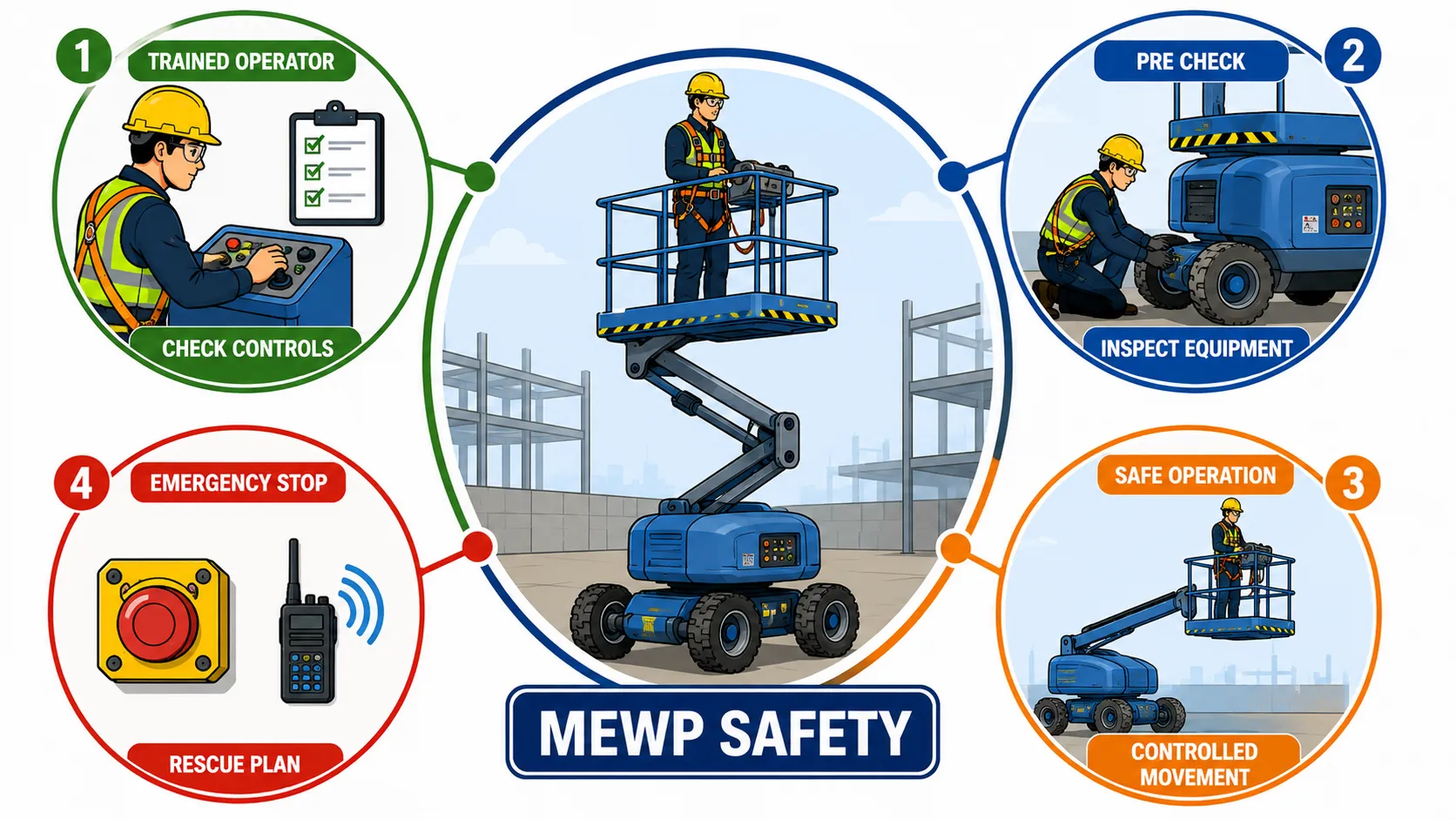
Confirming Operator Competence
Only trained and authorised individuals should operate MEWPs. Competent operators understand the equipment controls, limitations, and safety procedures required for safe operation.
Operators should have knowledge of:
- Machine operating controls.
- Safety devices.
- Emergency systems.
- Load restrictions.
- Workplace hazards.
Employers should ensure:
- Operators receive suitable training.
- Competence is regularly maintained.
- Only authorised personnel access equipment.
Carrying Out Pre-Use Inspections
A pre-use inspection is a critical safety procedure that identifies faults before operation begins. Equipment should never be used without confirming that it is safe and functional.
Inspection checks should include:
- Hydraulic systems.
- Tyres and wheels.
- Platform condition.
- Guardrails.
- Control systems.
- Emergency stop functions.
- Warning indicators.
Operators should look for:
- Fluid leaks.
- Damaged components.
- Faulty controls.
- Missing safety features.
- Unusual noises.
- Signs of excessive wear.
If problems are identified:
- Stop using the equipment.
- Report defects immediately.
- Remove unsafe equipment from service.
Assessing Workplace Conditions
The surrounding environment has a major impact on MEWP safety. Even properly maintained equipment can become unsafe if operated in unsuitable conditions.
Ground Condition Assessment
Before operation, operators should check:
- Surface stability.
- Ground level.
- Slopes.
- Hidden hazards.
- Weight-bearing capacity.
Unsafe conditions may include:
- Soft ground.
- Uneven surfaces.
- Unstable areas.
- Excessive gradients.
Identifying Nearby Hazards
Operators must identify hazards such as:
- Overhead structures.
- Electrical equipment.
- Moving vehicles.
- Pedestrian routes.
- Other machinery.
Control measures may include:
- Establishing exclusion zones.
- Using warning signs.
- Assigning a spotter where necessary.
- Maintaining communication.
Weather Considerations
Weather conditions can affect MEWP stability and safe operation.
Operators should consider:
- Strong winds.
- Heavy rainfall.
- Poor visibility.
- Extreme temperatures.
Operations should be stopped when weather conditions create unacceptable risks.
Safe MEWP Operating Procedures
Starting and Setting Up the Equipment
Before raising the platform, operators should complete final safety checks.
The operator should:
- Confirm the equipment inspection is complete.
- Check control functions.
- Ensure the working area is clear.
- Confirm correct positioning.
The machine should be started according to manufacturer guidance.
Operating the Elevated Platform
During operation, workers should:
- Remain inside the platform area.
- Keep both feet on the platform floor.
- Maintain awareness of surroundings.
- Follow movement controls carefully.
Operators should avoid:
- Sudden movements.
- Exceeding weight limits.
- Leaning outside guardrails.
- Using unauthorised methods to gain additional height.
Safe Movement of MEWPs
When moving a MEWP, operators should:
- Check the travel route.
- Maintain clear visibility.
- Control speed appropriately.
- Avoid obstacles.
Safe movement practices include:
- Lowering the platform when required.
- Communicating with ground workers.
- Avoiding crowded areas.
- Monitoring surrounding activities.
Use of Personal Protective Equipment (PPE)
Depending on the equipment type and workplace requirements, operators may need suitable PPE when using MEWPs.
Required safety equipment may include:
- Safety helmets.
- Safety footwear.
- High-visibility clothing.
- Fall protection equipment where required.
Workers should ensure:
- PPE fits correctly.
- Equipment is inspected.
- Safety procedures are followed.
Emergency Procedures for MEWPs
Emergency planning is an essential part of MEWP safety management. Unexpected situations may occur, including equipment failure, power loss, or worker emergencies.
Common Emergency Situations
Examples include:
- Control system failure.
- Platform becoming stuck.
- Medical emergency.
- Mechanical breakdown.
Emergency Response Actions
Operators should:
- Remain calm.
- Stop operation if possible.
- Use emergency controls.
- Contact support personnel.
- Follow rescue procedures.
Workers should understand:
- Emergency lowering systems.
- Communication methods.
- Rescue arrangements.
Practical Example: Electrical Installation Project
Scenario
An electrical maintenance team is installing lighting systems in a large industrial warehouse. The work requires workers to access high ceilings and move between multiple locations.
Planning Process
Before starting work, the team:
- Assesses the working area.
- Selects a suitable MEWP.
- Reviews load requirements.
- Checks ground conditions.
Safe Operation
The operator:
- Completes pre-use inspection.
- Confirms controls are functioning.
- Establishes a safe working zone.
- Operates within equipment limits.
Outcome
The correct use of the MEWP provides stable access, improves efficiency, and reduces risks associated with unsafe access methods.
Practical Example: Warehouse Maintenance Task
Scenario
A maintenance worker needs to inspect ventilation equipment installed several metres above the warehouse floor.
Safety Considerations
The worker evaluates:
- Available space.
- Floor condition.
- Required height.
- Presence of other workers.
Safe Procedure
The worker:
- Selects suitable equipment.
- Checks machine condition.
- Maintains safe operation.
- Communicates with nearby personnel.
Result
Effective planning and safe operation allow the task to be completed efficiently while maintaining workplace safety.
Benefits of Safe MEWP Operation
Improved Workplace Safety
Safe MEWP operation helps:
- Reduce fall risks.
- Prevent equipment accidents.
- Improve worker confidence.
- Control workplace hazards.
Increased Productivity
MEWPs support:
- Faster access to elevated areas.
- Improved worker positioning.
- Efficient completion of maintenance tasks.
Reduced Equipment Damage
Correct operation helps:
- Extend equipment service life.
- Reduce mechanical failures.
- Improve reliability.
Improved Safety Compliance
Following operational guidelines supports:
- Workplace safety standards.
- Organisational procedures.
- Effective risk management.
Responsibilities of MEWP Operators and Supervisors
Operator Responsibilities
Operators should:
- Complete equipment inspections.
- Follow manufacturer instructions.
- Use controls correctly.
- Report defects.
- Maintain safe working practices.
Supervisor Responsibilities
Supervisors should:
- Ensure operator training.
- Provide suitable equipment.
- Monitor working practices.
- Arrange inspections and maintenance.
Conclusion
Operating Mobile Elevated Work Platforms (MEWPs) safely requires proper training, careful preparation, regular inspection, and strict compliance with operational guidelines. MEWPs provide effective solutions for accessing elevated work areas, but their safety depends on competent operation, suitable equipment selection, and effective workplace controls.
By understanding different MEWP types, completing pre-use checks, assessing environmental conditions, following safe operating procedures, and preparing for emergencies, workers can reduce risks and improve workplace safety. Proper MEWP management supports safer and more efficient activities across construction, engineering, electrical, maintenance, and industrial environments.