Lesson no 1 : Understand global mechanical engineering standards and regulatory requirements.
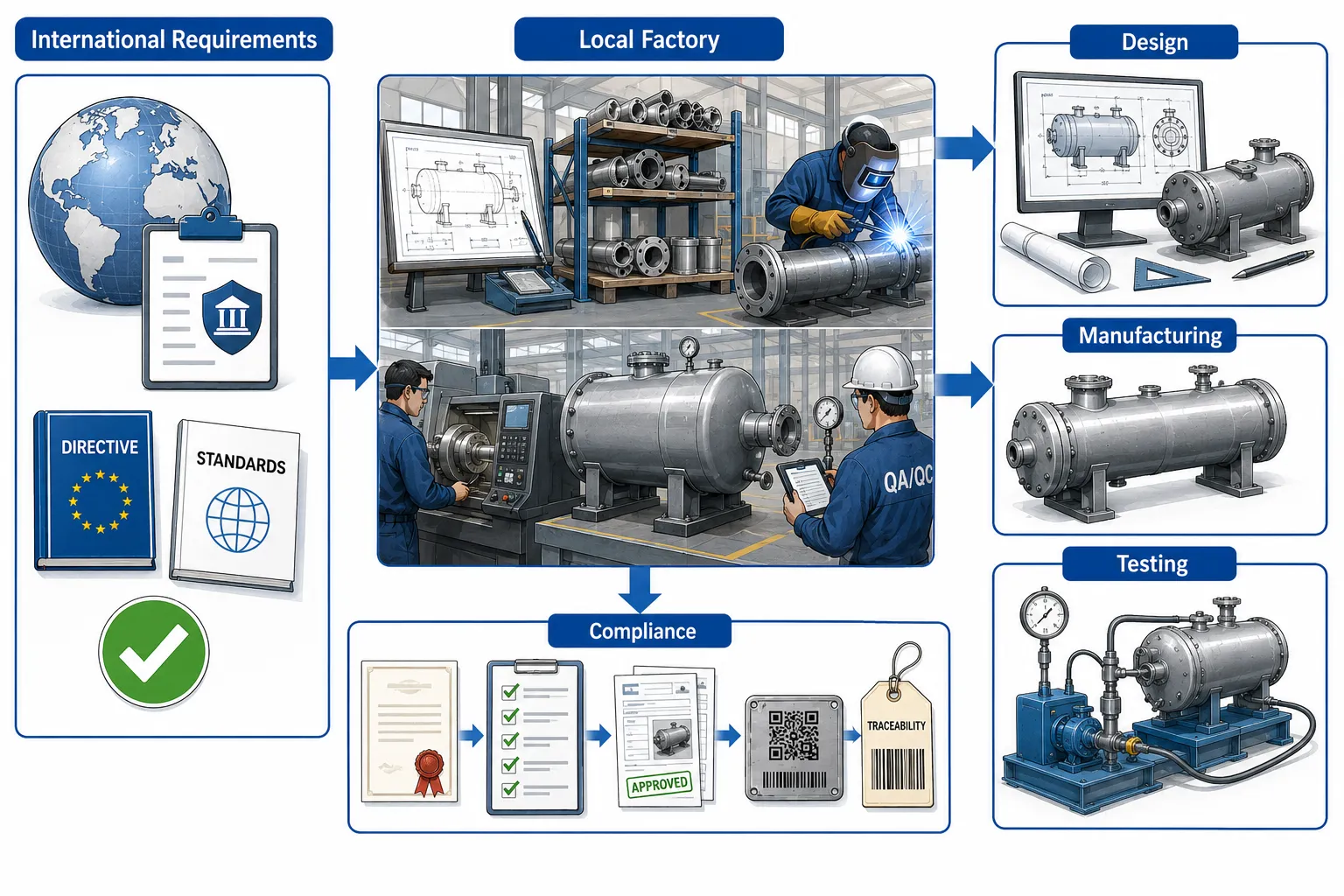
Global mechanical engineering projects operate within a structured framework of technical standards, engineering codes, statutory regulations, contractual specifications, and industry requirements. These requirements establish consistent expectations for the design, manufacture, fabrication, inspection, testing, installation, operation, and maintenance of mechanical equipment and systems. For professionals working in Quality Assurance and Quality Control (QA/QC), understanding these requirements is essential because compliance directly influences mechanical integrity, product quality, operational reliability, safety, and acceptance of engineering work.
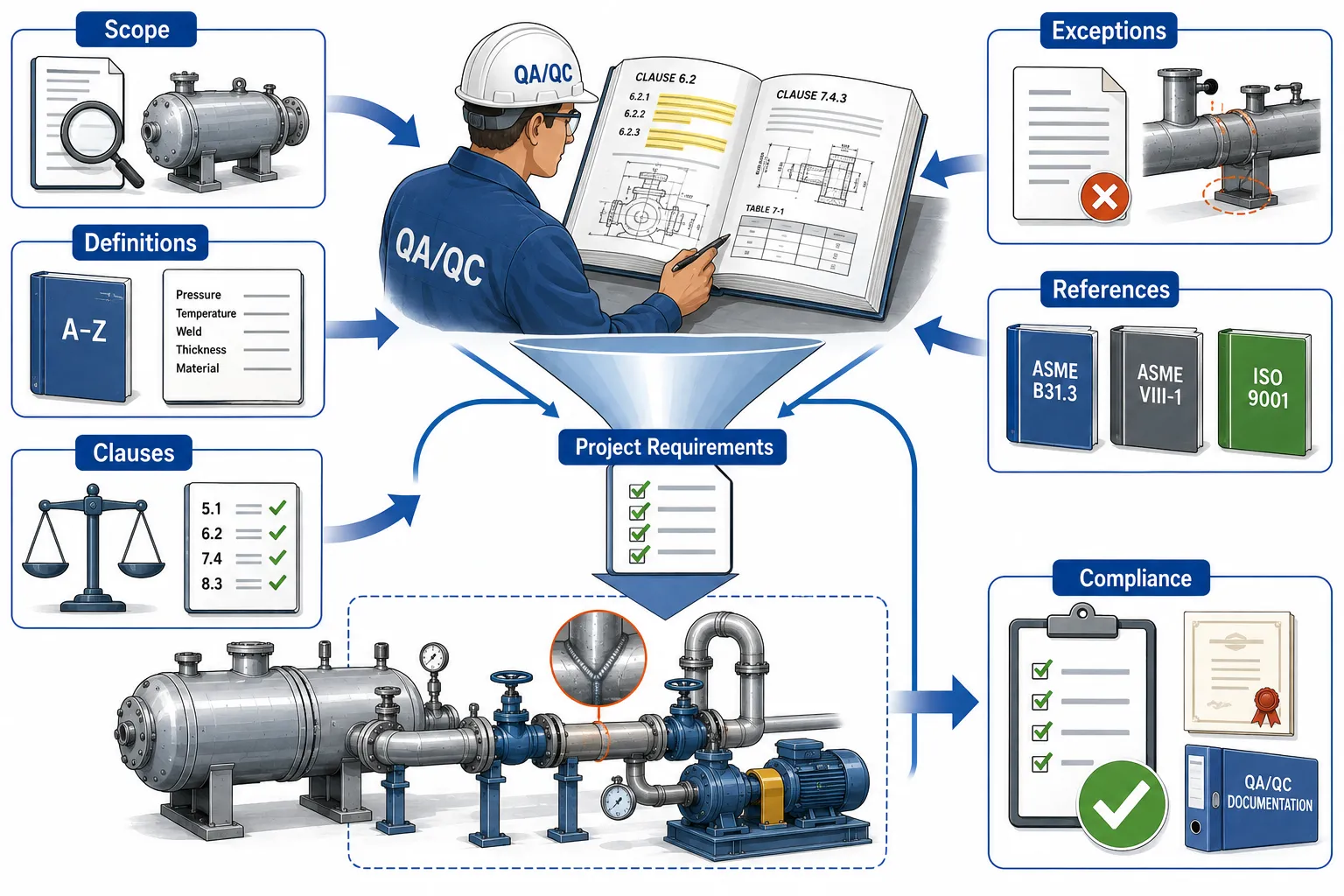
The lesson “Understand Global Mechanical Engineering Standards and Regulatory Requirements” introduces Learners to the role and significance of internationally recognised mechanical engineering standards and regulatory frameworks. Learners will explore how standards provide technical requirements and recommended practices for materials, components, equipment, piping systems, pressure-containing systems, welding, inspection, testing, quality documentation, and related engineering activities. The lesson also examines the distinction between standards, codes, regulations, specifications, and procedures, helping Learners understand how these different requirements interact within an engineering project.
In international projects, requirements may originate from several sources, including national legislation, international standards organisations, industry-specific codes, client specifications, project requirements, manufacturers’ instructions, and contractual obligations. A QA/QC professional must therefore be able to identify which requirements are applicable to a particular mechanical activity and ensure that inspection and quality-control processes reflect those requirements. Failure to identify or correctly interpret applicable requirements can result in non-conformities, rejected materials, inadequate inspection, project delays, increased costs, or compromised mechanical integrity.
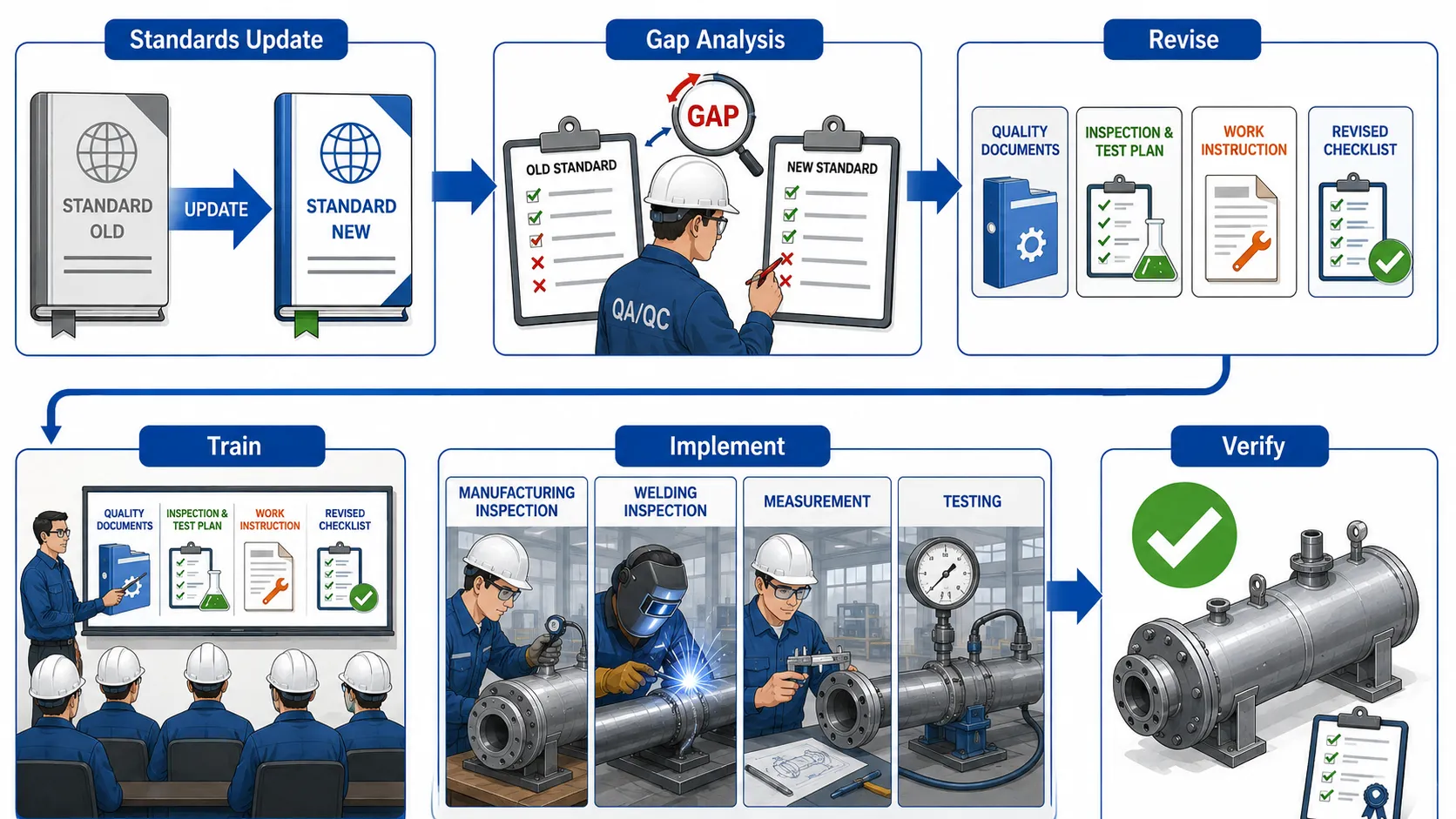
The lesson further develops Learners’ understanding of compliance verification. This includes reviewing technical documents, identifying applicable standards and codes, checking material and equipment documentation, confirming inspection and testing requirements, maintaining traceability, and recording evidence of conformity. Learners will also recognise the importance of using current and approved editions of applicable standards and ensuring that any project-specific requirements are properly incorporated into QA/QC activities.
By developing this knowledge, Learners will be better prepared to support consistent, evidence-based quality decisions within mechanical engineering projects. The lesson provides a foundation for applying international requirements to practical QA/QC activities and contributes to the development of professional competence in globally oriented mechanical engineering environments.
1.Critically Evaluate the Specific Scopes and Differences Between Major Global Engineering Codes, Such as ASME, API, ISO, and EN Standards
Mechanical engineering projects increasingly operate across national and international boundaries, requiring organisations to work with recognised engineering standards, codes, specifications, and regulatory requirements. These documents establish technical expectations for the design, manufacture, fabrication, inspection, testing, operation, maintenance, and quality management of mechanical equipment and systems. For QA/QC professionals, understanding the scope and differences between major global engineering standards is essential because the correct application of a standard can directly influence mechanical integrity, safety, reliability, conformity, and project acceptance.
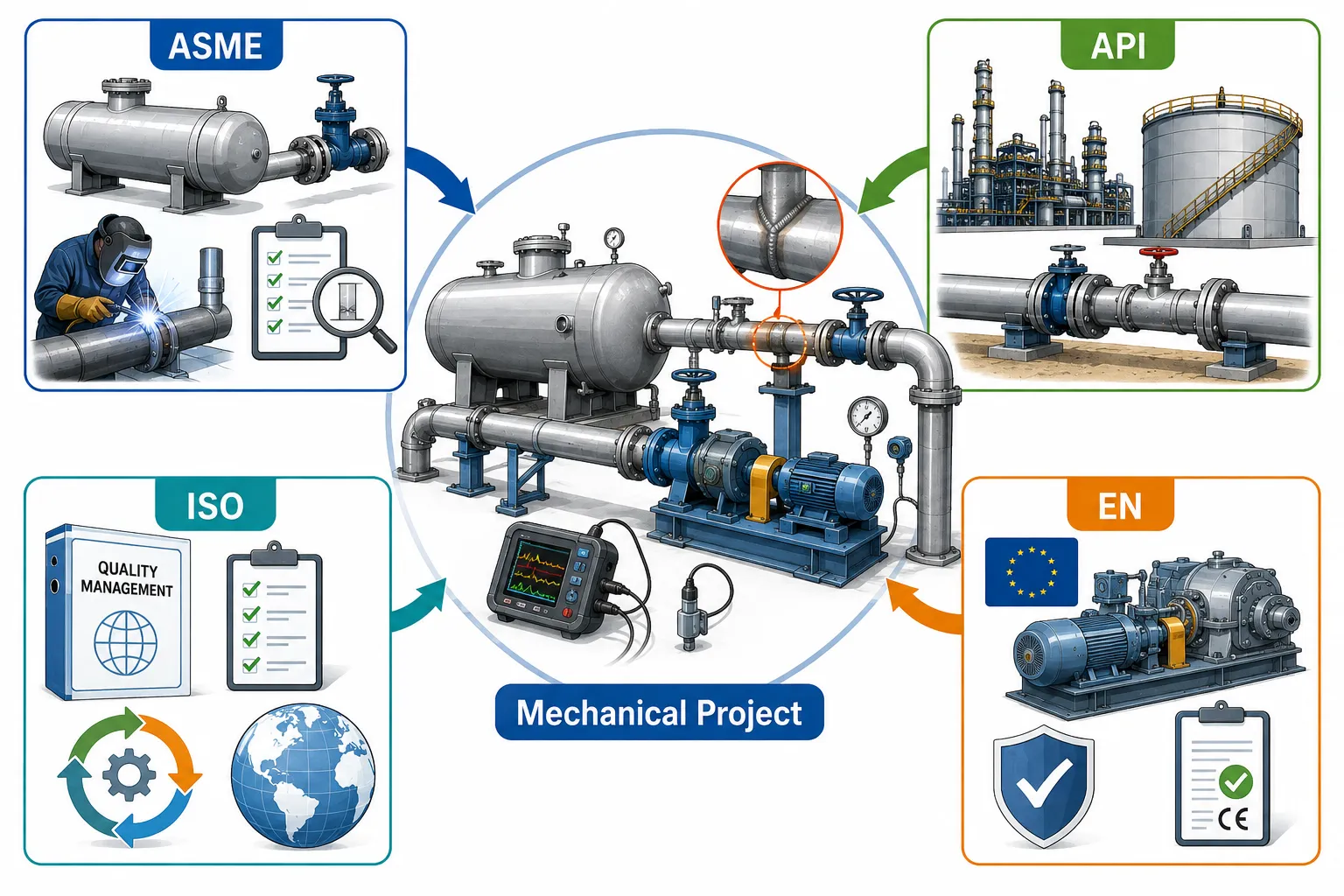
Among the most influential frameworks encountered in mechanical engineering are those developed or published by ASME, API, ISO, and EN standards organisations. Although these systems can overlap in their application, they are not interchangeable. Each has a particular purpose, technical scope, terminology, development process, and area of industry influence. ASME is strongly associated with mechanical engineering codes, pressure equipment, piping, boilers, and related technical requirements. API develops standards and recommended practices with a strong emphasis on the petroleum, petrochemical, natural gas, and related energy industries. ISO develops international consensus standards across a very broad range of engineering, industrial, quality, safety, environmental, and management topics. EN standards form part of the European standardisation framework and are particularly important where European technical and regulatory requirements apply.
A professional QA/QC approach therefore requires more than simply knowing the names of these standards. Learners must be able to evaluate what each framework covers, where it applies, what type of requirement it establishes, how it interacts with legislation and project specifications, and when one standard may be used alongside another.
Understanding Standards, Codes, Regulations and Specifications
Before comparing ASME, API, ISO, and EN standards, it is important to distinguish the terms commonly used in mechanical engineering compliance.
Standard
A standard is an agreed technical document that establishes requirements, specifications, guidelines, characteristics, methods, or practices for consistent use.
Standards may address:
Materials
Dimensions
Manufacturing processes
Testing methods
Quality management
Inspection
Safety
Environmental performance
Product characteristics
Engineering practices
A standard may be voluntary in general application but become effectively mandatory when it is referenced by legislation, a contract, a client specification, a certification scheme, or another controlling requirement.
Code
An engineering code generally establishes structured technical rules for specific engineering activities, systems, or equipment. Codes may contain detailed requirements concerning design, construction, inspection, testing, examination, and acceptance.
Examples include codes dealing with:
Boilers
Pressure vessels
Process piping
Nuclear components
Welding
Structural integrity
Pressure-containing equipment
Regulation
A regulation is a legal requirement established by a competent governmental or regulatory authority. Unlike a general voluntary standard, a regulation has legal force within its applicable jurisdiction.
Regulations may establish requirements relating to:
Health and safety
Pressure equipment
Environmental protection
Product conformity
Workplace safety
Import and export controls
Equipment operation
Inspection and certification
Specification
A project or client specification establishes particular requirements for a project, product, service, or activity. Specifications may reference one or more standards and can add requirements beyond those standards.
QA/QC professionals should therefore avoid assuming that compliance with one standard automatically means complete project compliance.
Key Concepts for Comparing Global Engineering Frameworks
When evaluating ASME, API, ISO, and EN standards, Learners should consider several important dimensions.
Scope
Scope identifies what the standard or code covers and the activities, equipment, materials, processes, or organisations to which it applies.
Technical Purpose
The technical purpose explains why the document exists and what engineering or quality problem it is intended to address.
Industry Application
Different standards have different areas of industry influence. Some are broad and cross-sector, while others are strongly associated with particular industries.
Geographic Application
Some standards are globally used, while others have particular significance within specific national or regional regulatory environments.
Compliance Status
A standard may be voluntary in isolation but become contractually or legally required when incorporated into another controlling document.
Verification Requirements
Different standards establish different expectations for inspection, testing, documentation, certification, qualification, or conformity assessment.
Overview of ASME Standards and Codes
The American Society of Mechanical Engineers (ASME) develops a wide range of engineering codes and standards. Its publications are particularly influential in mechanical engineering, pressure equipment, piping, power generation, and related industries.
ASME documents are widely used internationally, although their use does not automatically replace applicable national legislation or project requirements.
Major Areas Associated With ASME
ASME’s engineering framework includes requirements and guidance relevant to areas such as:
Boilers
Pressure vessels
Process piping
Power piping
Nuclear components
Welding and brazing
Materials
Pressure testing
Mechanical component design
Inspection and examination
Construction and fabrication
One of the most recognised groups is the ASME Boiler and Pressure Vessel Code (BPVC), which contains extensive requirements for pressure-containing equipment and related activities.
QA/QC Significance of ASME
For QA/QC professionals, ASME requirements can be particularly important when controlling:
Material traceability
Welding procedures
Welder qualifications
Fabrication requirements
Non-destructive examination
Pressure testing
Inspection records
Documentation
Code compliance
Certification activities
The QA/QC professional should always identify the specific ASME section or standard applicable to the equipment rather than treating “ASME” as one single technical requirement.
Understanding API Standards
The American Petroleum Institute (API) develops standards, recommended practices, specifications, and related documents with a strong focus on the petroleum and natural gas industries.
API documents are extensively used in:
Oil and gas
Refineries
Petrochemical facilities
Process plants
Storage facilities
Pipeline operations
Drilling
Production facilities
Energy infrastructure
Major Areas Associated With API
API standards address a wide variety of equipment and operational activities, including:
Pressure equipment
Storage tanks
Refinery equipment
Inspection practices
Pipeline systems
Drilling equipment
Production equipment
Mechanical integrity
In-service inspection
Equipment maintenance
Petroleum industry materials and processes
QA/QC Significance of API
API requirements can support quality activities involving:
Equipment inspection
In-service inspection
Mechanical integrity
Repair and alteration
Welding
Storage tanks
Pressure equipment
Pipeline-related activities
Inspection planning
Reliability and maintenance
API documents may therefore complement other engineering codes rather than replace them.
Understanding ISO Standards
The International Organization for Standardization (ISO) develops international consensus standards covering a very broad range of sectors and disciplines.
ISO differs from ASME and API in that its portfolio is much broader than mechanical engineering alone.
ISO standards cover areas such as:
Quality management
Environmental management
Occupational health and safety
Information security
Manufacturing
Materials
Testing
Measurement
Engineering processes
Industrial products
Management systems
ISO and Mechanical QA/QC
ISO standards can support mechanical QA/QC through requirements relating to organisational processes, quality management, competence, documentation, risk-based thinking, monitoring, corrective action, and continual improvement.
For example, an organisation may use an ISO quality management standard to establish its overall quality management system while using an ASME or API code for specific technical requirements.
This illustrates an important distinction:
ISO may establish the management framework, while ASME or API may establish specific technical requirements for equipment or engineering activities.
Understanding EN Standards
EN standards are European Standards developed through the European standardisation system. They are relevant to engineering and industrial activities throughout Europe and may be adopted as national standards by European countries.
EN standards cover numerous areas, including:
Mechanical engineering
Materials
Machinery
Structural engineering
Welding
Pressure equipment
Manufacturing
Testing
Safety
Product requirements
EN standards can become particularly important when mechanical equipment is designed, manufactured, supplied, installed, or placed on the European market.
EN Standards and European Regulatory Requirements
A key consideration is the relationship between EN standards and European legislation.
In certain regulated areas, legislation establishes essential requirements while harmonised standards may provide recognised technical methods for demonstrating conformity.
QA/QC professionals should therefore understand that:
An EN standard is not automatically identical to a regulation.
Applicable legislation must still be identified.
The relevant edition and status of the standard must be confirmed.
Project specifications may establish additional requirements.
Conformity assessment may involve additional processes.
Comparative Scope of ASME, API, ISO and EN
| Framework | Primary Scope | Typical Mechanical Applications | QA/QC Emphasis | Geographic/Industry Influence |
|---|---|---|---|---|
| ASME | Mechanical engineering codes and standards | Boilers, pressure vessels, piping, power systems, welding | Design, fabrication, inspection, testing and code compliance | International, strongly influential in mechanical and pressure equipment |
| API | Petroleum and natural gas industry standards and practices | Refineries, tanks, pipelines, process equipment and oilfield equipment | Inspection, integrity, maintenance, equipment quality and industry practices | International, particularly strong in energy industries |
| ISO | Broad international consensus standards | Quality systems, materials, testing, engineering processes and management | Management systems, processes, conformity and technical standardisation | Global and cross-industry |
| EN | European Standards | Machinery, pressure equipment, materials, welding and engineering products | Product conformity, technical requirements and European compliance | European/regional, with wider international use |
Critical Difference Between ASME and API
ASME and API can both appear on the same mechanical engineering project, particularly in energy and process industries, but their purposes may differ.
ASME is strongly associated with engineering design and construction requirements for specific mechanical equipment and systems.
API is strongly associated with petroleum and natural gas industry equipment, inspection, operation, maintenance, and integrity practices.
For example, a pressure-containing component may be designed and constructed according to an applicable ASME code while an API document may provide additional inspection or in-service integrity requirements.
Therefore, a QA/QC professional should ask:
What equipment is being controlled?
Is the requirement related to design and construction?
Is it related to operation or inspection?
Is it related to maintenance or mechanical integrity?
What does the project specification require?
Which code or standard has been formally identified as applicable?
Critical Difference Between ISO and Technical Engineering Codes
ISO standards can operate at both technical and management-system levels, but many ISO management standards do not prescribe the detailed engineering design requirements found in specialised mechanical codes.
For example, a quality management standard may establish requirements concerning:
Document control
Competence
Process control
Risk management
Non-conformity
Corrective action
Monitoring
Continual improvement
An engineering code may instead establish requirements concerning:
Component design
Material selection
Welding
Examination
Pressure testing
Acceptance criteria
Therefore, ISO compliance should not automatically be interpreted as compliance with a specific mechanical design code.
Critical Difference Between EN and Other Global Frameworks
EN standards have a particular relationship with European standardisation and regulatory requirements.
A mechanical product intended for a European market may need to satisfy applicable European legislation as well as relevant standards and technical documentation requirements.
Learners should therefore understand that EN compliance must be evaluated within the appropriate European regulatory context.
Key considerations include:
Applicable European legislation
Applicable harmonised standards where relevant
Product category
Manufacturer responsibilities
Conformity assessment
Technical documentation
National implementation
Current standard edition
Standards Are Not Automatically Interchangeable
One of the most important professional principles is that standards should not be treated as interchangeable simply because they address similar subjects.
For example:
An ISO standard may establish a quality management requirement.
An ASME code may establish pressure equipment requirements.
An API standard may address petroleum equipment or inspection.
An EN standard may establish European product or engineering requirements.
Each document must be reviewed according to its scope and intended application.
Understanding the Hierarchy of Requirements
A mechanical project may involve several layers of requirements.
Legal Requirements
These are mandatory requirements established by applicable legislation or regulation.
Contractual Requirements
These arise from the project contract and client requirements.
Technical Codes
These provide specific engineering requirements for particular equipment or activities.
Standards
These establish recognised technical or management requirements.
Project Specifications
These translate project-specific needs into controlled technical requirements.
Procedures
Procedures describe how an organisation or project will perform an activity.
A QA/QC professional must understand how these requirements interact rather than applying a single document in isolation.
Process for Identifying the Correct Standard or Code
Step 1: Identify the Equipment or Activity
Determine exactly what is being designed, manufactured, inspected, tested, installed, operated, or maintained.
Examples include:
Pressure vessel
Process piping
Boiler
Storage tank
Pump
Compressor
Welding activity
Mechanical support
Inspection activity
Step 2: Identify the Project Location
Determine the country or region where the equipment will be manufactured, installed, supplied, or operated.
Step 3: Review Contractual Requirements
Check:
Client specifications
Purchase orders
Technical specifications
Inspection requirements
Approved drawings
Contract documents
Step 4: Identify Applicable Regulations
Determine whether national or regional legislation establishes mandatory requirements.
Step 5: Identify Applicable Codes and Standards
Determine which ASME, API, ISO, EN, or other standards are referenced by the project.
Step 6: Confirm the Applicable Edition
Standards are revised periodically. The applicable edition should be confirmed against project documentation and contractual requirements.
Step 7: Identify Conflicting Requirements
Where multiple documents apply, determine whether they complement one another or establish different requirements.
Step 8: Seek Authorised Technical Clarification
Where requirements are unclear or conflicting, clarification should be obtained through the approved engineering, quality, client, or regulatory process.
Practical Example: Pressure Equipment Project
Consider a pressure-containing mechanical system being manufactured for an international industrial facility.
The project may specify:
An applicable ASME pressure equipment code
An API inspection requirement
An ISO-certified quality management system
Relevant EN or regional regulatory requirements
Client-specific inspection requirements
The QA/QC professional should not assume that one document replaces the others.
Instead, each requirement should be mapped to its purpose.
Possible Requirement Mapping
ASME: Technical design, construction, examination and testing requirements.
API: Industry-specific inspection or integrity requirements where applicable.
ISO: Organisational quality management processes.
EN/regulatory requirements: Applicable European product and conformity requirements.
Client specification: Additional project-specific requirements.
This approach creates a structured compliance framework.
Practical Example: Piping Fabrication
A piping fabrication project may involve multiple requirements covering materials, welding, inspection, testing, documentation and quality management.
The QA/QC professional may need to verify:
Correct material grade
Material certification
Traceability
Welding procedure qualification
Welder qualification
Welding inspection
NDT requirements
Dimensional inspection
Pressure testing
Final documentation
Applicable code compliance
The key professional skill is identifying which document controls each requirement.
Practical Example: Oil and Gas Facility
An oil and gas facility may use both ASME and API requirements.
For example:
ASME may provide requirements for applicable pressure-containing systems.
API may provide inspection and mechanical integrity practices for petroleum equipment.
ISO standards may support the organisation’s quality management system.
EN standards may apply where European equipment or regulatory requirements are relevant.
The QA/QC professional must establish a clear compliance matrix showing where each requirement applies.
Common Errors in Applying Global Standards
Treating Standards as Identical
ASME, API, ISO and EN documents have different scopes and purposes.
Using an Incorrect Edition
Applying an outdated edition can create compliance problems.
Ignoring Project Specifications
Client specifications may establish requirements beyond the referenced standard.
Confusing Standards With Regulations
A standard and a legal regulation are not automatically equivalent.
Assuming Certification Equals Technical Compliance
An organisation’s certification to a management standard does not automatically prove that every mechanical component complies with a specific engineering code.
Failing to Check Jurisdiction
National and regional regulatory requirements can influence which standards are applicable.
Applying Requirements Outside Their Scope
A document should not be applied to equipment or activities outside its defined scope without appropriate technical justification.
Key Benefits of Understanding Global Codes
Improved Compliance
Learners can identify applicable requirements more accurately.
Better QA/QC Planning
Correct standards support appropriate inspection and testing plans.
Reduced Non-Conformities
Understanding requirements reduces the likelihood of incorrect materials, procedures, inspections, and documentation.
Improved Technical Communication
Professionals can communicate more effectively with engineers, inspectors, contractors, clients, and regulatory bodies.
Improved International Project Capability
Knowledge of globally recognised frameworks supports work across different jurisdictions and industries.
Better Risk Management
Correctly identified standards help organisations control technical and compliance risks.
Improved Documentation
Standards provide structured requirements for records, inspection evidence, certificates, and conformity documentation.
Role of the QA/QC Professional
A QA/QC professional is not expected to memorise every requirement contained within every international standard. Instead, professional competence involves knowing how to identify, access, interpret, verify, and apply the relevant requirements.
Key responsibilities may include:
Reviewing applicable codes and standards
Checking project specifications
Identifying applicable regulatory requirements
Confirming document revisions
Preparing or reviewing compliance matrices
Verifying material certification
Reviewing inspection requirements
Checking test requirements
Maintaining traceability
Recording non-conformities
Supporting corrective action
Maintaining quality records
Escalating technical conflicts appropriately
Compliance Matrix as a QA/QC Tool
A compliance matrix can help organisations establish which standard or requirement applies to each project activity.
A typical matrix may identify:
Project activity
Equipment or component
Applicable code
Applicable standard
Regulatory requirement
Inspection requirement
Testing requirement
Responsible person
Evidence of compliance
Status
This provides traceability between the technical requirement and the evidence demonstrating conformity.
Evaluating Conflicting Requirements
International projects may occasionally contain requirements from several sources that appear different or potentially conflicting.
A professional approach is to:
Identify the exact requirement.
Confirm the scope of each document.
Determine which requirement has contractual or legal precedence.
Review project specifications.
Consult the responsible engineering authority.
Obtain formal clarification where required.
Document the agreed interpretation.
Apply the approved requirement consistently.
QA/QC personnel should avoid making unilateral technical decisions where the issue involves design authority, regulatory interpretation, or contractual precedence.
Key Learning Points
Learners should understand that:
ASME, API, ISO and EN standards have different scopes and purposes.
ASME is strongly associated with mechanical engineering codes and pressure equipment.
API has strong relevance to petroleum, natural gas and energy industries.
ISO provides broad international standards across many sectors and includes important management-system frameworks.
EN standards operate within the European standardisation framework.
A standard is not automatically the same as a regulation.
A management-system certification does not automatically prove technical equipment compliance.
Several standards may legitimately apply to one project.
Project specifications may add requirements to published standards.
Applicable editions must be verified.
Jurisdiction and regulatory requirements must be considered.
Compliance should be demonstrated through objective evidence.
QA/QC professionals should use compliance matrices and controlled documentation where appropriate.
Conflicting technical requirements should be formally clarified rather than resolved through assumption.
Conclusion
Critically evaluating ASME, API, ISO, and EN standards requires Learners to move beyond simply recognising the names of major engineering organisations. Each framework has a distinct scope, purpose, technical emphasis, and application context. ASME provides highly influential mechanical engineering codes and standards, particularly for pressure equipment, piping, boilers, power systems, and related activities. API provides standards and practices with strong relevance to petroleum, natural gas, process, and energy industries. ISO provides broad international standards covering technical, organisational, quality, and management requirements across numerous sectors. EN standards form an important part of the European standardisation framework and can be particularly significant when European technical and regulatory requirements apply.
For QA/QC professionals, the critical skill is knowing which requirement applies, why it applies, how it interacts with other requirements, and what evidence demonstrates compliance. A mechanical project may legitimately use several frameworks simultaneously, with each addressing a different aspect of quality, safety, engineering integrity, inspection, or conformity.
Effective standards management therefore involves identifying the equipment and activity, reviewing jurisdiction and contractual requirements, confirming applicable regulations and codes, checking the correct editions, evaluating interactions between requirements, documenting the compliance basis, and seeking authorised clarification when conflicts arise.
By developing these skills, Learners can support more consistent QA/QC decisions, reduce non-conformities, improve inspection planning, strengthen technical documentation, and contribute effectively to the successful delivery of international mechanical engineering projects.