
Lesson No 1: Root Cause Analysis (RCA) and Problem-Solving in Mechanical Engineering
Root Cause Analysis (RCA) and problem-solving are essential disciplines in mechanical engineering that enable professionals to identify the underlying causes of equipment failures, quality defects, and process inefficiencies rather than simply addressing their visible symptoms. This unit introduces learners to structured investigative techniques used in quality assurance and quality control (QA/QC) to analyse mechanical failures, production issues, and maintenance challenges. Learners will explore industry-recognised RCA methodologies such as the 5 Whys, Fishbone (Ishikawa) Diagram, Pareto Analysis, and Fault Tree Analysis, developing the skills needed to perform systematic investigations and make evidence-based decisions that improve product quality and operational performance.
Throughout this unit, learners will gain practical knowledge of applying problem-solving frameworks to real-world mechanical engineering scenarios, including manufacturing, fabrication, maintenance, inspection, and equipment reliability. The unit emphasises the importance of collecting accurate data, identifying contributing factors, implementing effective corrective and preventive actions (CAPA), and verifying the effectiveness of solutions. By mastering Root Cause Analysis techniques, learners will be equipped to minimise recurring failures, enhance workplace safety, improve production efficiency, ensure compliance with engineering standards, and contribute to continuous improvement initiatives across a wide range of mechanical engineering environments.
Root Cause Analysis (RCA) and problem-solving are essential disciplines in mechanical engineering that enable professionals to identify the underlying causes of equipment failures, quality defects, and process inefficiencies rather than simply addressing their visible symptoms. This unit introduces learners to structured investigative techniques used in quality assurance and quality control (QA/QC) to analyse mechanical failures, production issues, and maintenance challenges. Learners will explore industry-recognised RCA methodologies such as the 5 Whys, Fishbone (Ishikawa) Diagram, Pareto Analysis, and Fault Tree Analysis, developing the skills needed to perform systematic investigations and make evidence-based decisions that improve product quality and operational performance.
Throughout this unit, learners will gain practical knowledge of applying problem-solving frameworks to real-world mechanical engineering scenarios, including manufacturing, fabrication, maintenance, inspection, and equipment reliability. The unit emphasises the importance of collecting accurate data, identifying contributing factors, implementing effective corrective and preventive actions (CAPA), and verifying the effectiveness of solutions. By mastering Root Cause Analysis techniques, learners will be equipped to minimise recurring failures, enhance workplace safety, improve production efficiency, ensure compliance with engineering standards, and contribute to continuous improvement initiatives across a wide range of mechanical engineering environments.
1. Explain the Concept and Importance of Root Cause Analysis (RCA) in Identifying and Resolving Quality Issues in Mechanical Engineering
Understanding Root Cause Analysis (RCA) in Mechanical Engineering
Root Cause Analysis (RCA) is a systematic problem-solving approach used in mechanical engineering to identify the fundamental reasons behind failures, defects, non-conformities, and operational problems. In Quality Assurance (QA) and Quality Control (QC) environments, RCA helps engineers move beyond treating visible symptoms and focus on discovering the actual factors that caused an issue. By identifying and eliminating the root cause, organisations can prevent repeated failures, improve product quality, enhance equipment reliability, and achieve continuous improvement.
In mechanical engineering industries, quality issues can occur due to various factors, including design weaknesses, material defects, manufacturing errors, incorrect installation, inadequate maintenance, equipment malfunction, human errors, and ineffective inspection processes. A QA/QC Mechanical Engineer uses Root Cause Analysis techniques to investigate these problems through evidence collection, technical evaluation, and structured analysis to determine why the failure occurred and what actions are required to prevent recurrence.
Unlike simple corrective actions that only repair a defective component, RCA focuses on developing permanent solutions. For example, replacing a failed bearing may restore equipment operation temporarily, but identifying why the bearing failed such as poor lubrication, misalignment, excessive loading, or incorrect installation allows engineers to implement preventive measures that improve long-term equipment performance.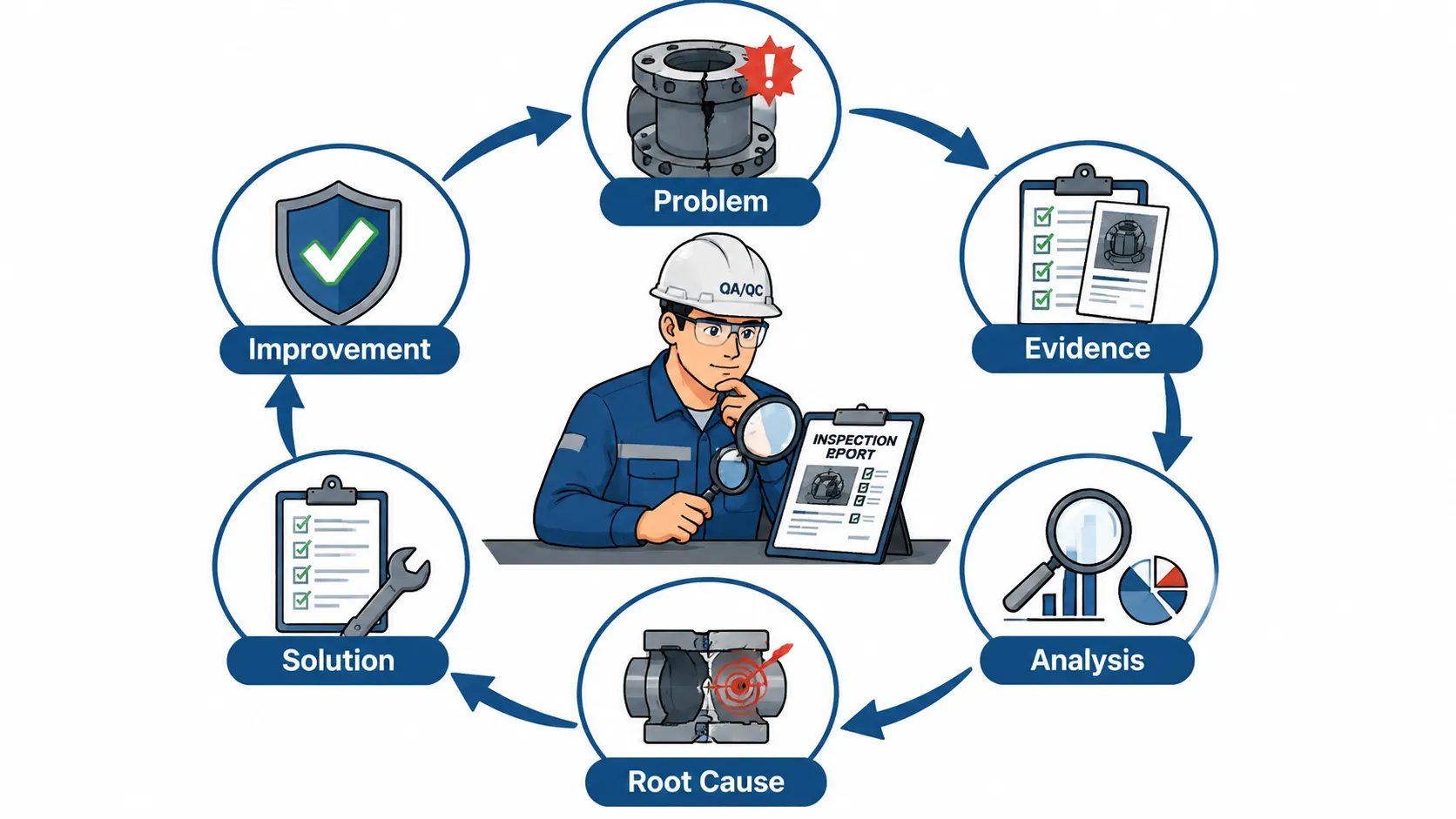
Definition of Root Cause Analysis (RCA)
Root Cause Analysis can be defined as:
“A structured and systematic process used to identify the underlying causes of a problem or failure and implement effective corrective actions to prevent recurrence.”
In mechanical engineering, RCA involves analysing technical information, operational conditions, manufacturing processes, inspection results, and maintenance history to determine the actual reason behind a quality issue.
The main purpose of RCA is not only to find what happened but also to understand:
- Why the problem occurred.
- What factors contributed to the failure.
- How the issue can be prevented in the future.
- What improvements are required in processes or systems.
Difference Between Symptoms and Root Causes
A key concept in Root Cause Analysis is understanding the difference between a symptom and the actual root cause.
A symptom is the visible indication of a problem, while the root cause is the underlying reason responsible for creating that problem.
For example:
A manufacturing company discovers cracks in welded joints of pressure vessels.
Symptom:
- Weld cracks detected during inspection.
Possible Root Causes:
- Incorrect welding parameters.
- Poor weld preparation.
- Improper heat treatment.
- Inadequate welder training.
- Incorrect material selection.
- Failure to follow welding procedures.
If the company only repairs the cracked welds, the same problem may occur again. However, if the root cause is identified and corrected, future failures can be prevented.
Importance of Root Cause Analysis in QA/QC Mechanical Engineering
Root Cause Analysis plays a critical role in mechanical engineering quality management because it enables organisations to identify weaknesses in their processes and develop effective solutions.
For QA/QC Mechanical Engineers, RCA is an essential tool for:
- Investigating product failures.
- Analysing inspection failures.
- Reducing recurring defects.
- Improving manufacturing quality.
- Supporting corrective and preventive actions.
- Enhancing equipment reliability.
- Maintaining compliance with engineering standards.
Mechanical engineering systems often involve complex interactions between materials, machines, processes, and human activities. Therefore, identifying the true cause of a problem requires a structured engineering approach rather than assumptions.
Role of RCA in Identifying Quality Issues
Quality issues in mechanical engineering can affect product performance, safety, reliability, and customer satisfaction. RCA provides a systematic method for investigating these issues.
Common quality problems where RCA is applied include:
Manufacturing Defects
RCA helps identify causes of:
- Incorrect dimensions.
- Machining errors.
- Surface defects.
- Material inconsistencies.
- Assembly problems.
Welding Failures
Mechanical engineers use RCA to investigate:
- Cracks.
- Porosity.
- Lack of fusion.
- Weld distortion.
- Incomplete penetration.
Equipment Failures
RCA supports investigations into:
- Bearing failures.
- Pump breakdowns.
- Gear damage.
- Shaft fractures.
- Excessive vibration.
- Leakage problems.
Inspection and Testing Failures
RCA helps determine why inspection problems occur, such as:
- Incorrect inspection procedures.
- Poor calibration.
- Inadequate testing methods.
- Human interpretation errors.
Key Concepts of Root Cause Analysis
Evidence-Based Investigation
An effective RCA process depends on accurate and reliable information.
Engineers analyse:
- Inspection reports.
- Non-Destructive Testing (NDT) results.
- Maintenance records.
- Material certificates.
- Engineering drawings.
- Production data.
- Equipment history.
- Failure photographs.
Using factual evidence prevents incorrect conclusions and ensures effective decision-making.
Systematic Problem Analysis
RCA follows a logical approach rather than relying on assumptions.
The investigation typically involves:
- Defining the problem clearly.
- Collecting relevant information.
- Analysing possible causes.
- Identifying the root cause.
- Implementing corrective actions.
- Verifying effectiveness.
This structured approach ensures that problems are solved permanently.
Prevention of Recurring Failures
The main objective of RCA is preventing the same problem from happening again.
Through RCA, organisations can:
- Improve engineering procedures.
- Strengthen quality controls.
- Enhance maintenance strategies.
- Improve employee competency.
- Upgrade equipment reliability.
Root Cause Analysis Process in Mechanical Engineering
A professional RCA process generally follows several important stages:
1. Problem Identification
The first step is clearly defining the quality issue.
Engineers identify:
- What failed?
- Where did the failure occur?
- When did it occur?
- What was the impact?
2. Data Collection
Relevant technical information is collected, including:
- Inspection results.
- Testing records.
- Manufacturing documents.
- Maintenance history.
- Operating conditions.
3. Cause Evaluation
Engineers analyse possible causes related to:
- Materials.
- Equipment.
- Processes.
- Personnel.
- Environment.
- Inspection methods.
4. Root Cause Identification
The team determines the primary reason responsible for the failure.
A valid root cause should:
- Explain why the problem occurred.
- Be supported by evidence.
- Be preventable through corrective action.
5. Corrective and Preventive Action
Solutions are implemented to remove the cause and prevent recurrence.
Actions may include:
- Updating procedures.
- Improving inspection methods.
- Training employees.
- Replacing defective equipment.
- Enhancing maintenance plans.
Key Concepts and Benefits of Root Cause Analysis
| Concept | Definition | Mechanical Engineering Application | Benefit |
|---|---|---|---|
| Root Cause | The fundamental reason behind a failure or defect | Identifying incorrect welding parameters causing cracks | Prevents repeated failures |
| Symptom | Visible indication of a problem | Weld crack detected during inspection | Helps identify investigation requirements |
| Corrective Action | Action taken to eliminate the identified cause | Revising welding procedures | Improves quality performance |
| Preventive Action | Action taken to avoid future problems | Operator training and process improvement | Reduces future risks |
| Evidence Analysis | Evaluation of technical information | Reviewing NDT reports and maintenance data | Supports accurate decisions |
Practical Example: RCA in Mechanical Manufacturing
A manufacturing company producing industrial pumps experienced repeated failures of pump bearings.
Initial observation showed:
- Bearings failed after short operating periods.
- Production downtime increased.
- Maintenance costs increased.
The company replaced damaged bearings several times, but failures continued.
A QA/QC Mechanical Engineer conducted a Root Cause Analysis and reviewed:
- Maintenance records.
- Installation procedures.
- Alignment measurements.
- Lubrication practices.
The investigation identified that the main cause was incorrect shaft alignment during installation.
Corrective actions included:
- Improving installation procedures.
- Providing technician training.
- Introducing alignment verification checks.
- Updating maintenance instructions.
As a result:
- Bearing failures were reduced.
- Equipment reliability improved.
- Maintenance costs decreased.
- Production efficiency increased.
Case Study: Root Cause Analysis of Weld Quality Failure
Background
A fabrication company manufacturing pressure vessels experienced repeated weld rejection during quality inspection. Non-Destructive Testing (NDT) identified internal weld defects, including porosity and lack of fusion.
Investigation
The QA/QC team reviewed:
- Welding procedures.
- Welder qualification records.
- Material information.
- Inspection reports.
- Welding equipment condition.
The investigation found that welding parameters were not consistently controlled and some equipment required calibration.
Corrective Actions
The company implemented:
- Welding procedure improvements.
- Equipment calibration schedules.
- Additional welding inspections.
- Employee competency training.
Outcome
After implementing RCA recommendations:
- Weld rejection rates decreased.
- Product quality improved.
- Customer approval increased.
- Production delays were reduced.
This demonstrates how RCA helps mechanical engineering organisations achieve long-term quality improvement.
Conclusion
Root Cause Analysis (RCA) is an essential problem-solving methodology used by QA/QC Mechanical Engineers to identify and eliminate the true causes of quality issues, failures, and operational problems. By focusing on underlying causes rather than temporary solutions, RCA enables organisations to improve product reliability, reduce defects, enhance safety, and achieve continuous improvement.
In mechanical engineering environments, effective RCA supports better decision-making, stronger quality management systems, improved maintenance strategies, and compliance with industry requirements. Through systematic investigation, evidence-based analysis, and implementation of corrective actions, Root Cause Analysis helps organisations deliver safer, more reliable, and higher-quality mechanical products and systems.
2. Apply Problem-Solving Tools and Techniques (5 Whys, Fishbone Diagram, and FMEA) to Determine the Underlying Causes of Mechanical Failures or Quality Defects
In mechanical engineering, identifying and correcting failures requires more than repairing damaged components or replacing defective parts. Quality issues, equipment failures, manufacturing defects, and operational problems often occur due to hidden causes within materials, processes, equipment, human activities, or management systems. For this reason, QA/QC Mechanical Engineers use structured problem-solving tools and techniques to investigate failures, analyse contributing factors, and determine the underlying causes that create recurring problems.
Problem-solving methodologies such as the 5 Whys, Fishbone Diagram (Ishikawa Diagram), and Failure Mode and Effects Analysis (FMEA) are widely applied in mechanical engineering industries to support Root Cause Analysis (RCA). These tools provide a systematic approach for analysing failures in manufacturing, fabrication, maintenance, welding, inspection, and mechanical equipment operations.
From a QA/QC Mechanical Engineer perspective, applying these techniques helps organisations move from reactive problem-solving to proactive quality improvement. Instead of only correcting visible defects, engineers can identify why failures occur and implement effective corrective and preventive actions (CAPA) to prevent recurrence.
Mechanical industries including oil and gas, power generation, automotive, aerospace, construction, and heavy manufacturing depend on these problem-solving techniques to improve reliability, reduce downtime, enhance safety, and maintain compliance with engineering specifications and international quality standards.
Importance of Applying Problem-Solving Tools in Mechanical Engineering
Mechanical systems are complex and involve interactions between materials, machines, processes, environmental conditions, and human factors. When failures occur, determining the actual cause can be challenging without a structured investigation approach.
Problem-solving tools help QA/QC professionals to:
- Identify the actual cause of mechanical failures.
- Reduce repeated defects and equipment breakdowns.
- Improve manufacturing and maintenance processes.
- Support evidence-based engineering decisions.
- Enhance product reliability and safety.
- Reduce repair costs and production losses.
- Improve quality management systems.
- Support continuous improvement activities.
- Prevent future non-conformities.
- Increase customer confidence.
A professional problem-solving approach ensures that corrective actions address the source of the issue rather than temporarily treating symptoms.
Understanding the Concept of Problem-Solving Techniques
Definition of Problem-Solving Tools
Problem-solving tools are structured methods used to collect information, analyse failures, identify possible causes, and develop effective solutions for engineering problems.
In mechanical engineering, these tools are used to investigate issues such as:
- Equipment failures.
- Welding defects.
- Material failures.
- Production errors.
- Quality non-conformities.
- Maintenance problems.
- Design-related issues.
These techniques support engineers in making logical decisions based on technical evidence rather than assumptions.
Key Principles of Effective Problem-Solving
Effective problem-solving in mechanical engineering follows several important principles:
- Clearly define the problem before investigation.
- Collect accurate technical data.
- Analyse all possible contributing factors.
- Identify the actual root cause.
- Develop corrective and preventive actions.
- Verify the effectiveness of implemented solutions.
- Document lessons learned.
The 5 Whys Technique for Root Cause Identification
Concept of the 5 Whys Method
The 5 Whys technique is a simple but powerful root cause analysis method used to identify the fundamental reason behind a failure by repeatedly asking the question “Why?”
The purpose of this method is to move beyond the immediate cause and discover the deeper process or system failure responsible for the problem.
Although it is called the “5 Whys,” the number of questions may vary depending on the complexity of the issue. The investigation continues until the actual root cause is identified.
Process of Applying the 5 Whys Technique
A typical 5 Whys investigation follows these steps:
Step 1: Define the Problem
The problem must be clearly described using factual information.
Example:
“Hydraulic pump failure occurred during operation.”
Step 2: Ask the First Why
Engineers identify the immediate reason.
Why did the hydraulic pump fail?
Answer:
The pump stopped due to bearing damage.
Step 3: Continue Asking Why
The investigation continues deeper.
Why was the bearing damaged?
Answer:
The bearing was not properly lubricated.
Why was lubrication insufficient?
Answer:
The lubrication schedule was not followed.
Why was the schedule not followed?
Answer:
The maintenance monitoring system was ineffective.
Why was the monitoring system ineffective?
Answer:
There was no automated maintenance tracking process.
Identified Root Cause
The root cause was not the bearing failure itself but the ineffective maintenance control system.
Mechanical Engineering Applications of 5 Whys
The 5 Whys technique can be applied to:
- Bearing failures.
- Welding defects.
- Equipment breakdowns.
- Leakage problems.
- Manufacturing errors.
- Repeated inspection failures.
- Poor maintenance performance.
Benefits of the 5 Whys Technique
The method provides several advantages:
- Simple and easy to apply.
- Requires limited resources.
- Encourages logical thinking.
- Helps identify hidden process weaknesses.
- Supports corrective action planning.
- Improves problem-solving efficiency.
Fishbone Diagram (Ishikawa Diagram) for Mechanical Failure Analysis
Concept of Fishbone Diagram
The Fishbone Diagram, also known as the Ishikawa Diagram or Cause-and-Effect Diagram, is a visual problem-solving tool used to identify and organise possible causes of a failure or quality problem.
The diagram resembles a fish skeleton, where:
- The head represents the problem.
- The main bones represent categories of possible causes.
- Smaller branches represent specific contributing factors.
This method is particularly useful when failures involve multiple causes.
Main Categories Used in Fishbone Analysis
QA/QC Mechanical Engineers commonly analyse failures using the following categories:
Man (People)
This category examines human-related factors.
Examples:
- Lack of training.
- Incorrect operation.
- Poor workmanship.
- Failure to follow procedures.
- Communication problems.
Machine (Equipment)
This focuses on equipment-related causes.
Examples:
- Machine wear.
- Poor calibration.
- Equipment malfunction.
- Incorrect settings.
- Lack of maintenance.
Material
This investigates material-related issues.
Examples:
- Incorrect material grade.
- Material defects.
- Contamination.
- Poor storage conditions.
Method
This examines process-related causes.
Examples:
- Incorrect procedures.
- Poor inspection methods.
- Inadequate manufacturing processes.
- Incorrect welding parameters.
Measurement
This evaluates inspection and monitoring systems.
Examples:
- Incorrect measuring equipment.
- Poor calibration.
- Inaccurate inspection results.
- Missing quality checks.
Environment
This considers external conditions affecting performance.
Examples:
- Temperature variations.
- Humidity.
- Corrosive conditions.
- Poor working environment.
Applying Fishbone Analysis in Mechanical Engineering
A QA/QC Mechanical Engineer may use a Fishbone Diagram when investigating repeated weld failures.
Problem:
“Pressure vessel weld defects detected during inspection.”
Possible causes:
People:
- Insufficient welder training.
Machine:
- Welding equipment calibration issue.
Material:
- Incorrect filler material.
Method:
- Incorrect welding parameters.
Measurement:
- Inadequate inspection frequency.
Environment:
- Poor temperature control during welding.
This approach allows engineers to consider all possible causes before selecting corrective actions.
Comparison of Problem-Solving Tools in Mechanical Engineering
| Problem-Solving Tool | Definition | Main Purpose | Mechanical Engineering Application |
|---|---|---|---|
| 5 Whys | A questioning technique used to identify the deeper cause of a problem | Discover the root cause through logical questioning | Investigating equipment failures and repeated defects |
| Fishbone Diagram | A visual cause-and-effect analysis method | Identify multiple possible causes of a failure | Analysing welding defects, manufacturing issues, and process failures |
| FMEA | A structured risk analysis method used to evaluate possible failure modes | Prevent failures before they occur | Improving equipment design, maintenance, and manufacturing reliability |
Practical Example: Using Problem-Solving Tools for Mechanical Failure Investigation
A manufacturing company experienced repeated failures of rotating equipment bearings. The failures caused production interruptions and increased maintenance costs.
The QA/QC Mechanical Engineer conducted an investigation using structured problem-solving techniques.
Using the 5 Whys method:
- The bearing failed because of excessive wear.
- Excessive wear occurred due to insufficient lubrication.
- Lubrication was insufficient because maintenance intervals were missed.
- Maintenance intervals were missed because monitoring was ineffective.
The Fishbone Diagram identified additional contributing factors:
- Inadequate maintenance procedure.
- Lack of operator awareness.
- Incorrect lubricant selection.
- Poor monitoring system.
The investigation revealed that the failure was not caused by the bearing itself but by weaknesses in the maintenance management process.
Corrective actions included:
- Updating maintenance procedures.
- Training operators.
- Introducing lubrication monitoring.
- Improving inspection schedules.
The result was improved equipment reliability, reduced downtime, and lower maintenance costs.
Conclusion
Applying problem-solving tools such as the 5 Whys, Fishbone Diagram, and FMEA is essential for QA/QC Mechanical Engineers responsible for identifying and resolving mechanical failures and quality defects. These techniques provide structured approaches for analysing problems, identifying root causes, and developing effective corrective and preventive actions.
By using these methods, engineering professionals can move beyond temporary repairs and create long-term improvements in manufacturing processes, equipment reliability, product quality, and operational safety. Effective application of problem-solving tools supports continuous improvement, reduces recurring failures, improves compliance with engineering standards, and helps organisations achieve reliable and sustainable mechanical engineering performance.
3. Demonstrate How to Gather and Analyse Data to Support Root Cause Analysis (RCA) Efforts, Including Using Historical Data, Inspection Results, and Material Specifications
In mechanical engineering, successful Root Cause Analysis (RCA) depends on the ability to collect, evaluate, and interpret accurate technical data. A QA/QC Mechanical Engineer cannot identify the true cause of a failure or quality defect through observation alone. Reliable RCA requires systematic data gathering from multiple sources, including historical records, inspection results, material specifications, manufacturing documents, maintenance information, and operational data.
Data-driven Root Cause Analysis enables engineers to move from assumptions to evidence-based decision-making. By analysing factual information, engineers can identify failure patterns, determine contributing factors, verify defect causes, and develop effective corrective and preventive actions (CAPA). This approach is widely used in industries such as oil and gas, power generation, aerospace, automotive, construction, fabrication, and heavy manufacturing, where mechanical failures can result in safety risks, production losses, and increased operational costs.
For QA/QC Mechanical Engineers, effective data collection and analysis are essential skills for investigating welding failures, equipment breakdowns, material defects, corrosion problems, dimensional errors, and non-conformities identified during inspection activities.
Importance of Data in Root Cause Analysis
Data provides the foundation for a reliable RCA investigation. Without accurate information, engineers may identify incorrect causes and implement ineffective solutions.
Quality-related problems in mechanical engineering often involve multiple contributing factors, including:
Material properties.
Manufacturing processes.
Equipment conditions.
Operating environments.
Inspection methods.
Maintenance practices.
Human factors.
By collecting relevant data from different sources, engineers can establish relationships between failures and their underlying causes.
Effective data analysis helps organisations to:
Identify recurring failure patterns.
Confirm the actual cause of defects.
Reduce repeated quality issues.
Improve inspection effectiveness.
Enhance equipment reliability.
Support engineering decisions.
Improve maintenance strategies.
Reduce repair costs.
Prevent future failures.
Improve compliance with quality standards.
Types of Data Required for RCA in Mechanical Engineering
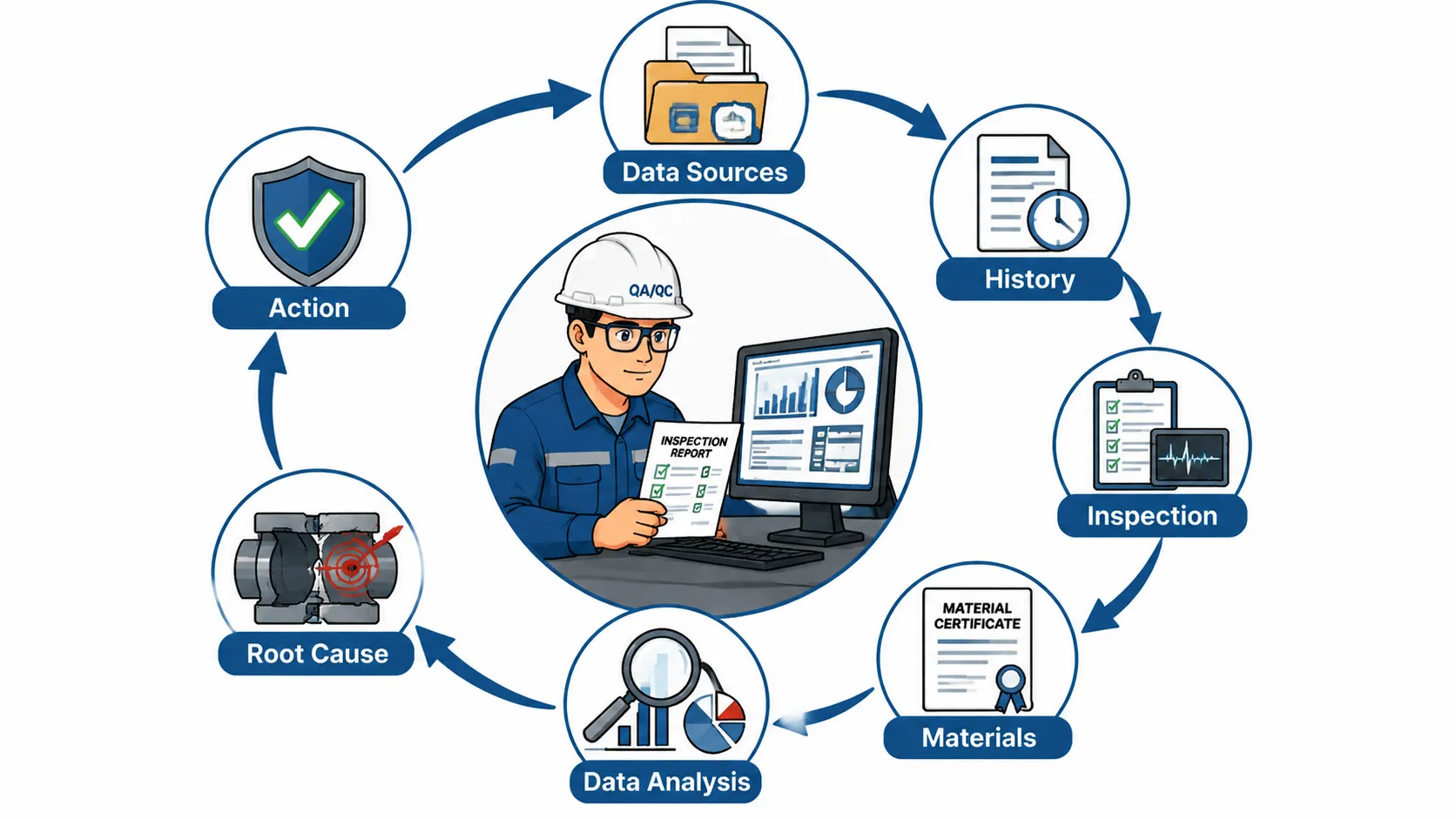
A QA/QC Mechanical Engineer uses different categories of data during RCA investigations. Each type of data provides specific information required to understand the failure mechanism.
Historical Data Analysis
Historical data refers to previously recorded information related to equipment performance, manufacturing activities, inspection results, maintenance activities, and past failures.
Historical records help engineers identify trends and determine whether a problem is isolated or recurring.
Examples of historical data include:
Previous inspection reports.
Maintenance records.
Equipment failure history.
Production records.
Previous RCA reports.
Customer complaints.
Non-conformance reports (NCRs).
Repair records.
Quality audit findings.
Importance of Historical Data in RCA
Historical information allows engineers to answer important questions:
Has this failure occurred before?
How frequently does the problem happen?
Under what conditions does the failure occur?
Were previous corrective actions effective?
Are there repeated process weaknesses?
For example, if a pump repeatedly experiences seal failure, historical maintenance records may reveal that failures occur after a specific operating period or under certain pressure conditions. This information helps engineers identify the actual contributing factors.
Using Inspection Results for RCA Investigation
Inspection results are one of the most important sources of technical evidence during Root Cause Analysis. Inspection data provides information about the physical condition of components and helps engineers identify defects and failure mechanisms.
Common inspection data sources include:
Visual Inspection (VT).
Ultrasonic Testing (UT).
Radiographic Testing (RT).
Magnetic Particle Testing (MT).
Dye Penetrant Testing (PT).
Dimensional inspection reports.
Thickness measurement records.
Pressure testing results.
Analysing Inspection Results
QA/QC Mechanical Engineers analyse inspection results by reviewing:
Defect type.
Defect location.
Defect size.
Defect frequency.
Severity level.
Acceptance criteria.
Inspection conditions.
For example, if ultrasonic testing detects repeated internal weld defects, engineers can analyse the location and pattern of defects to determine whether the issue is related to:
Welding technique.
Material condition.
Welding parameters.
Operator competency.
Manufacturing procedure.
Inspection results transform observations into measurable evidence that supports accurate RCA decisions.
Reviewing Material Specifications During RCA
Material specifications play a critical role in mechanical failure investigations because incorrect material selection or poor material quality can significantly affect component performance.
Material-related RCA investigations involve reviewing:
Material certificates.
Chemical composition.
Mechanical properties.
Heat treatment records.
Material grade.
Manufacturing standards.
Supplier documentation.
Engineers compare actual material properties with required specifications to determine whether the material contributed to failure.
Examples of material-related problems include:
Incorrect alloy selection.
Low material strength.
Excessive hardness.
Poor corrosion resistance.
Material contamination.
Manufacturing defects.
For example, a pipeline failure may occur because the installed material does not meet the required corrosion resistance specification. Reviewing material documentation can confirm whether incorrect material selection contributed to the failure.
Data Collection Process for RCA
A structured data collection process improves the accuracy and effectiveness of RCA investigations.
Step 1: Define the Problem
The first step is clearly identifying the issue.
Engineers should record:
Component involved.
Failure description.
Location of failure.
Date of occurrence.
Operational conditions.
Impact on quality or safety.
Step 2: Identify Required Data Sources
The investigation team determines what information is required.
Possible sources include:
Engineering drawings.
Inspection reports.
Material documents.
Maintenance history.
Manufacturing records.
Operating data.
Step 3: Collect and Organise Data
Collected information should be organised systematically.
Activities include:
Reviewing documents.
Comparing records.
Analysing trends.
Identifying abnormal conditions.
Recording findings.
Step 4: Analyse Data and Identify Patterns
Engineers evaluate information to identify relationships between causes and failures.
Analysis methods include:
Trend analysis.
Failure comparison.
Defect classification.
Statistical evaluation.
Technical comparison.
Step 5: Validate Findings
Before identifying the root cause, engineers confirm that conclusions are supported by evidence.
Validation may include:
Additional inspections.
Testing.
Engineering calculations.
Expert review.
Process verification.
Data Sources Used in RCA
| Data Source | Definition | Example Application in Mechanical Engineering | RCA Benefit |
|---|---|---|---|
| Historical Data | Previous records showing past performance and failures | Reviewing repeated equipment breakdowns | Identifies failure trends |
| Inspection Results | Technical information obtained from inspection activities | Analysing weld defects from NDT reports | Provides evidence of defect conditions |
| Material Specifications | Technical requirements defining material properties | Comparing actual material grade with required standard | Identifies material-related causes |
| Maintenance Records | Documentation of equipment servicing activities | Reviewing lubrication and repair history | Detects maintenance-related failures |
| Manufacturing Records | Information about production processes | Reviewing welding parameters and fabrication records | Identifies process weaknesses |
Practical Example: Data Analysis for Equipment Failure RCA
A manufacturing facility experienced repeated cracking in a rotating machine shaft. The initial assumption was that the shaft material was defective.
The QA/QC Mechanical Engineer collected and analysed:
Previous failure reports.
Material certificates.
Operating conditions.
Vibration monitoring data.
Inspection records.
The analysis showed:
Material specification was correct.
Shaft dimensions met design requirements.
Excessive vibration levels existed during operation.
Misalignment caused additional stress on the shaft.
The actual root cause was poor alignment, not material failure.
Corrective actions included:
Improving alignment procedures.
Increasing vibration monitoring.
Updating maintenance practices.
Training maintenance personnel.
The result was improved equipment reliability and elimination of repeated shaft failures.
Case Study: RCA Investigation of Pipeline Weld Defects
Background
An oil and gas company experienced repeated weld rejection during pipeline fabrication inspections. Radiographic Testing identified internal weld defects in several joints.
Data Collection
The QA/QC team collected:
Previous welding inspection reports.
Welder qualification records.
Welding procedure documents.
Material certificates.
Environmental records.
Repair history.
Data Analysis
The investigation identified:
Weld defects occurred mainly during specific shifts.
Welding parameters were inconsistent.
Some welding equipment calibration records were outdated.
Root Cause Identification
The main cause was poor control of welding parameters and inadequate equipment monitoring.
Corrective Actions
The company implemented:
Welding procedure improvements.
Equipment calibration schedules.
Additional inspection checkpoints.
Welding staff training.
Outcome
The organisation achieved:
Reduced weld rejection rates.
Improved fabrication quality.
Lower repair costs.
Increased customer confidence.
Key Benefits of Data-Based RCA
Using accurate data during Root Cause Analysis provides several advantages:
Improves failure investigation accuracy.
Prevents incorrect conclusions.
Supports permanent corrective actions.
Reduces recurring defects.
Enhances product reliability.
Improves maintenance planning.
Supports engineering compliance.
Strengthens quality management systems.
Improves decision-making.
Reduces operational risks.
Conclusion
Gathering and analysing reliable data is a fundamental requirement for effective Root Cause Analysis in mechanical engineering. QA/QC Mechanical Engineers use historical data, inspection results, material specifications, and technical records to understand failures, identify contributing factors, and determine the true root causes of quality issues.
A structured data-driven RCA approach allows organisations to move beyond temporary repairs and implement long-term solutions. By applying accurate data collection and analysis methods, mechanical engineering professionals can improve product quality, enhance equipment reliability, reduce operational costs, and support continuous improvement throughout the engineering lifecycle.
4. Propose Corrective Actions Based on Root Cause Findings to Prevent Future Occurrences of Similar Issues
In mechanical engineering, identifying the root cause of a failure or quality defect is only the first stage of an effective problem-solving process. The true objective of Root Cause Analysis (RCA) is to use investigation findings to develop and implement corrective actions that eliminate the source of the problem and prevent similar issues from occurring in the future. For QA/QC Mechanical Engineers, proposing suitable corrective actions is a critical responsibility because ineffective solutions can result in repeated failures, increased operational costs, production delays, and potential safety risks.
Corrective actions are structured improvements implemented after identifying the root cause of a non-conformity, equipment failure, manufacturing defect, or quality issue. These actions are designed to remove the identified cause, restore compliance with engineering requirements, and strengthen processes to achieve long-term reliability. In contrast to temporary repairs that only address visible symptoms, effective corrective actions focus on permanent improvement.
Mechanical engineering industries such as oil and gas, power generation, manufacturing, automotive, aerospace, and construction rely on corrective action processes to improve equipment performance, product quality, and operational safety. QA/QC professionals use RCA findings, inspection results, failure reports, and engineering data to develop solutions that prevent recurrence and support continuous improvement.
Understanding Corrective Actions in Root Cause Analysis
Definition of Corrective Action
Corrective action can be defined as:
“A planned action taken to eliminate the root cause of an identified problem, defect, or non-conformity in order to prevent its recurrence.”
In mechanical engineering, corrective actions are developed after determining why a failure occurred. The action must directly address the root cause rather than only repairing the damaged component.
For example:
A welded pipeline joint fails inspection due to lack of fusion.
A temporary solution:
- Repair the defective weld only.
A corrective action:
- Review welding parameters.
- Improve welding procedures.
- Retrain welders.
- Introduce additional process monitoring.
The corrective action prevents the same welding defect from occurring again.
Importance of Corrective Actions in QA/QC Mechanical Engineering
Corrective actions are an essential part of Quality Assurance and Quality Control systems because they transform failure investigations into measurable improvements.
For QA/QC Mechanical Engineers, effective corrective actions help to:
- Eliminate recurring defects.
- Improve product reliability.
- Reduce equipment failures.
- Increase operational safety.
- Improve manufacturing processes.
- Reduce maintenance costs.
- Support regulatory compliance.
- Enhance customer satisfaction.
- Strengthen quality management systems.
- Promote continuous improvement.
Mechanical failures often involve multiple contributing factors, therefore corrective actions must be carefully planned and technically justified.
Principles of Effective Corrective Actions
A successful corrective action should follow several important principles.
Address the Root Cause
The most important principle is ensuring that the action eliminates the actual cause of the problem.
Corrective actions should:
- Target the failure mechanism.
- Remove process weaknesses.
- Improve system controls.
- Prevent repeated failures.
For example, replacing damaged bearings does not solve the problem if the actual cause is poor lubrication practices.
Use Evidence-Based Decisions
Corrective actions should be based on reliable engineering information.
Relevant evidence includes:
- RCA findings.
- Inspection reports.
- NDT results.
- Maintenance records.
- Material specifications.
- Engineering calculations.
- Failure analysis data.
Using evidence ensures that solutions are technically appropriate.
Ensure Long-Term Effectiveness
A corrective action should provide sustainable improvement rather than a short-term solution.
Effective actions should:
- Improve procedures.
- Strengthen controls.
- Reduce risks.
- Improve employee competency.
- Enhance monitoring systems.
Process of Developing Corrective Actions
Step 1: Review Root Cause Findings
Before proposing corrective actions, engineers review RCA results to confirm the actual cause of failure.
The review includes:
- Identified root causes.
- Contributing factors.
- Failure mechanisms.
- Process weaknesses.
- Risk level.
A clear understanding of the root cause ensures appropriate solutions are selected.
Step 2: Identify Possible Solutions
The engineering team develops potential corrective actions based on the identified problem.
Possible solutions include:
- Process modification.
- Equipment improvement.
- Procedure revision.
- Additional inspection.
- Staff training.
- Material replacement.
- Maintenance improvement.
Step 3: Evaluate Corrective Action Options
Each proposed action should be evaluated based on:
- Technical effectiveness.
- Cost impact.
- Implementation time.
- Safety improvement.
- Regulatory requirements.
- Long-term benefits.
The selected solution should provide maximum improvement with acceptable resources.
Step 4: Implement Corrective Actions
Implementation requires proper planning and control.
Activities may include:
- Updating procedures.
- Communicating changes.
- Training employees.
- Modifying equipment.
- Improving inspection plans.
- Monitoring implementation progress.
Step 5: Verify Effectiveness
After implementation, QA/QC engineers must confirm whether the corrective action successfully prevented recurrence.
Verification methods include:
- Follow-up inspections.
- Performance monitoring.
- Quality audits.
- Testing activities.
- Failure trend analysis.
If problems continue, additional RCA may be required.
Types of Corrective Actions in Mechanical Engineering
Corrective actions vary depending on the type of failure and root cause.
Process-Based Corrective Actions
These actions improve engineering and manufacturing processes.
Examples:
- Revising fabrication procedures.
- Improving welding controls.
- Updating inspection requirements.
- Standardising production methods.
Equipment-Based Corrective Actions
These actions address machinery-related problems.
Examples:
- Equipment calibration.
- Component replacement.
- Preventive maintenance improvement.
- Machine upgrades.
Material-Based Corrective Actions
These actions address material-related failures.
Examples:
- Changing material specifications.
- Improving supplier control.
- Enhancing material inspection.
- Updating storage procedures.
Human-Factor Corrective Actions
These actions address competency and procedural issues.
Examples:
- Employee training.
- Improved work instructions.
- Competency assessment.
- Increased supervision.
Corrective Action and Preventive Action (CAPA) Approach
Corrective and Preventive Action (CAPA) is a quality management approach that combines actions taken after failures with measures designed to prevent future risks.
Corrective actions focus on:
- Removing existing problems.
- Repairing quality weaknesses.
- Eliminating identified causes.
Preventive actions focus on:
- Identifying potential risks.
- Improving processes before failures occur.
- Strengthening quality controls.
Together, CAPA provides a complete framework for continuous improvement.
Corrective Action Examples in Mechanical Engineering
Welding Defect Example
Problem:
Repeated weld cracks detected during inspection.
Root Cause:
Incorrect welding parameters and insufficient welder training.
Corrective Actions:
- Update welding procedures.
- Calibrate welding equipment.
- Retrain welding personnel.
- Increase inspection frequency.
Result:
Reduced weld defects and improved fabrication quality.
Equipment Failure Example
Problem:
Repeated pump failures during operation.
Root Cause:
Poor maintenance planning and incorrect lubrication practices.
Corrective Actions:
- Introduce preventive maintenance schedules.
- Improve lubrication procedures.
- Monitor equipment condition.
Result:
Improved equipment reliability and reduced downtime.
Corrective Action Management Table
| Concept | Definition | Mechanical Engineering Application | Quality Improvement Benefit |
|---|---|---|---|
| Corrective Action | Action taken to eliminate the identified cause of a problem | Improving welding procedures after weld failure | Prevents repeated defects |
| Root Cause Finding | Identification of the fundamental reason behind failure | Discovering incorrect maintenance practices | Supports effective solutions |
| Preventive Action | Action taken to reduce future risks | Introducing additional inspection controls | Reduces probability of failure |
| Verification | Confirming that corrective actions are effective | Follow-up testing after repair | Ensures long-term improvement |
| Continuous Improvement | Ongoing enhancement of processes and systems | Updating QA/QC procedures | Improves overall performance |
Practical Workplace Example: Corrective Action After Mechanical Failure
A manufacturing company experienced repeated failures of pressure vessel welds during final inspection.
The initial response was repairing rejected welds; however, the same defects continued to appear.
The QA/QC Mechanical Engineer conducted an RCA investigation and identified:
- Incorrect welding parameters.
- Inconsistent welder practices.
- Poor monitoring of welding conditions.
Based on these findings, corrective actions were proposed:
- Revision of welding procedures.
- Additional welder training.
- Improved welding parameter monitoring.
- Increased inspection checkpoints.
After implementation:
- Weld rejection rates decreased.
- Production efficiency improved.
- Repair costs reduced.
- Customer approval increased.
This example demonstrates that effective corrective actions must address the cause of failure rather than only repairing the final defect.
Case Study: Corrective Actions for Pipeline Quality Failure
Background
An oil and gas company experienced repeated leakage problems in a newly installed pipeline system. Inspection revealed welding defects in several joints.
Root Cause Findings
The investigation identified:
- Incorrect welding procedure application.
- Inadequate monitoring of welding conditions.
- Insufficient inspection during fabrication.
Corrective Actions Implemented
The company introduced:
- Updated welding procedures.
- Additional welder qualification checks.
- Improved inspection planning.
- Regular equipment calibration.
- Enhanced quality documentation.
Outcome
Following corrective action implementation:
- Pipeline defects were significantly reduced.
- Reliability improved.
- Safety risks decreased.
- Client confidence increased.
- Quality compliance was achieved.
Key Benefits of Effective Corrective Actions
Implementing corrective actions based on RCA findings provides several advantages:
- Prevents recurrence of failures.
- Improves mechanical system reliability.
- Reduces production interruptions.
- Minimises repair costs.
- Enhances workplace safety.
- Improves product quality.
- Strengthens QA/QC processes.
- Supports compliance with engineering standards.
- Improves customer satisfaction.
- Encourages continuous improvement.
Conclusion
Proposing corrective actions based on Root Cause Analysis findings is a fundamental responsibility of QA/QC Mechanical Engineers. Effective corrective actions ensure that failures are not simply repaired but are permanently prevented through technical improvements, process control, and quality enhancement.
By analysing root causes, selecting appropriate solutions, implementing improvements, and verifying effectiveness, engineering organisations can reduce recurring problems, improve equipment reliability, and maintain high-quality performance. A structured corrective action approach strengthens mechanical engineering operations, supports continuous improvement, and ensures that products and systems meet safety, reliability, and quality requirements.
5. Implement Preventive Actions in Response to RCA Findings and Monitor Their Effectiveness Over Time
In mechanical engineering quality management, identifying the root cause of a failure is only valuable when organisations use the findings to prevent similar problems from occurring in the future. Preventive actions are systematic improvements developed from Root Cause Analysis (RCA) findings to eliminate potential risks, strengthen engineering processes, and improve long-term reliability. For QA/QC Mechanical Engineers, implementing preventive actions is a proactive approach that reduces the likelihood of recurring defects, equipment failures, and quality non-conformities.
Unlike corrective actions, which focus on eliminating the cause of an existing problem, preventive actions focus on identifying possible future risks and improving systems before failures occur. By analysing RCA results, historical data, inspection trends, and operational performance, engineers can introduce controls that prevent similar issues across other components, processes, or projects.
Modern mechanical engineering industries, including oil and gas, power generation, manufacturing, aerospace, automotive, and construction, rely on preventive action strategies to maintain equipment reliability, improve product quality, enhance safety performance, and achieve continuous improvement. Effective preventive actions ensure that lessons learned from previous failures are transformed into permanent improvements within engineering systems.
For QA/QC Mechanical Engineers, monitoring the effectiveness of preventive actions is equally important. A preventive measure is only successful when evidence confirms that risks have been reduced and quality performance has improved over time.
Understanding Preventive Actions in Mechanical Engineering
Definition of Preventive Action
Preventive action can be defined as:
“A planned and systematic measure implemented to eliminate potential causes of future failures, defects, or non-conformities before they occur.”
In mechanical engineering, preventive actions are developed by analysing risks, reviewing RCA findings, and improving processes, equipment, materials, or procedures.
Examples of preventive actions include:
Introducing additional inspection checkpoints.
Updating maintenance procedures.
Improving operator training.
Revising engineering specifications.
Enhancing quality control systems.
Implementing predictive monitoring techniques.
The main objective of preventive actions is to reduce risk and improve reliability before a failure happens.
Difference Between Corrective and Preventive Actions
Understanding the difference between corrective and preventive actions is essential for effective quality management.
Corrective Actions
Corrective actions are implemented after a problem has occurred.
Examples:
Repairing defective equipment.
Replacing damaged components.
Correcting manufacturing errors.
Revising procedures after a failure.
Purpose:
Remove the cause of an existing problem.
Prevent the same issue from happening again.
Preventive Actions
Preventive actions are implemented before a problem occurs.
Examples:
Improving inspection plans.
Introducing additional quality checks.
Monitoring equipment conditions.
Conducting risk assessments.
Purpose:
Reduce the possibility of future failures.
Improve overall system reliability.
Importance of Preventive Actions Based on RCA Findings
Preventive actions are a critical part of continuous improvement because they convert failure investigations into opportunities for organisational improvement.
For QA/QC Mechanical Engineers, preventive actions help to:
Prevent repeated mechanical failures.
Improve product reliability.
Reduce operational risks.
Strengthen manufacturing processes.
Enhance inspection effectiveness.
Improve equipment performance.
Reduce maintenance costs.
Increase workplace safety.
Support engineering standards.
Improve customer satisfaction.
Mechanical failures often provide valuable learning opportunities. When RCA findings are properly analysed, organisations can improve future designs, procedures, and quality systems.
Key Principles of Effective Preventive Actions
Risk-Based Thinking
Preventive actions should be based on identifying potential risks before they become failures.
Engineers evaluate:
Failure probability.
Severity of consequences.
Operating conditions.
Component importance.
Historical failure patterns.
Risk-based thinking allows organisations to focus resources on the areas with the highest potential impact.
Process Improvement Approach
Preventive actions should improve the overall system rather than focusing on individual mistakes.
Effective improvements may include:
Process standardisation.
Improved documentation.
Better inspection methods.
Enhanced training systems.
Improved equipment controls.
Continuous Monitoring
Preventive actions require continuous evaluation to confirm that they remain effective.
Monitoring helps determine:
Whether risks have decreased.
Whether failures have reduced.
Whether processes are performing correctly.
Whether additional improvements are required.
Process of Implementing Preventive Actions

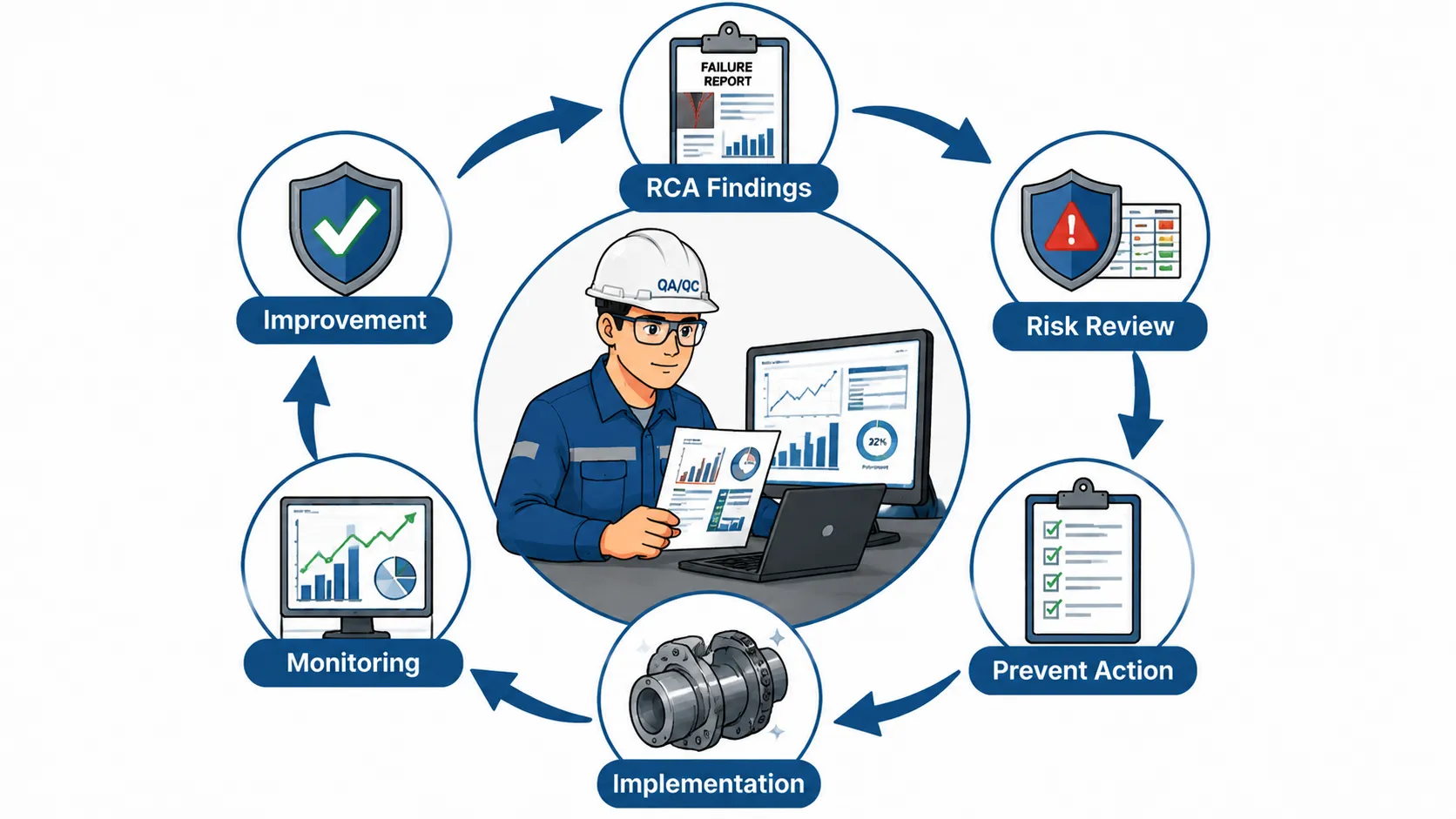
Step 1: Review RCA Findings
The first step is analysing RCA results to identify potential risks and improvement opportunities.
Engineers review:
Root causes.
Contributing factors.
Failure patterns.
Process weaknesses.
Previous corrective actions.
A clear understanding of RCA findings ensures that preventive actions target the correct areas.
Step 2: Identify Preventive Opportunities
Engineers evaluate where improvements can reduce future risks.
Possible areas include:
Design improvements.
Manufacturing processes.
Inspection activities.
Maintenance programmes.
Training systems.
Supplier controls.
Step 3: Develop Preventive Action Plans
A preventive action plan should clearly define:
The identified risk.
Required improvement.
Responsible personnel.
Implementation timeline.
Required resources.
Success criteria.
A well-defined plan ensures effective implementation and accountability.
Step 4: Implement Preventive Measures
Implementation activities may include:
Updating engineering procedures.
Revising inspection plans.
Improving equipment maintenance.
Training employees.
Modifying production processes.
Introducing monitoring systems.
Step 5: Monitor Effectiveness
After implementation, QA/QC engineers evaluate whether preventive actions achieve the intended results.
Monitoring methods include:
Quality performance analysis.
Equipment reliability monitoring.
Inspection trend reviews.
Internal audits.
Failure rate comparison.
Customer feedback evaluation.
Methods Used to Monitor Preventive Action Effectiveness
Performance Indicators
Key performance indicators (KPIs) help measure improvement.
Examples include:
Reduction in defect rates.
Decreased equipment failures.
Improved inspection acceptance rates.
Reduced maintenance downtime.
Increased production reliability.
Inspection and Testing Results
Inspection data provides evidence of whether preventive actions are successful.
Engineers review:
NDT results.
Dimensional inspection reports.
Material testing records.
Quality inspection findings.
Audits and Reviews
Regular audits confirm whether improved processes are being followed.
Audits evaluate:
Procedure compliance.
Documentation accuracy.
Employee practices.
Equipment condition.
Trend Analysis
Comparing performance data over time helps identify whether improvements are sustainable.
Engineers analyse:
Failure frequency.
Defect trends.
Maintenance history.
Production performance.
Preventive Action Implementation Table
| Concept | Definition | Mechanical Engineering Example | Benefit |
|---|---|---|---|
| Preventive Action | A planned improvement to avoid future failures | Introducing vibration monitoring for rotating equipment | Reduces unexpected breakdowns |
| Risk Assessment | Evaluation of potential failures and consequences | Analysing pressure vessel failure risks | Improves safety planning |
| Monitoring | Continuous evaluation of performance after improvement | Reviewing equipment condition data | Confirms effectiveness |
| Process Improvement | Enhancement of procedures and systems | Updating welding procedures | Improves quality consistency |
| Verification | Checking whether preventive actions achieve results | Reviewing inspection trends after implementation | Ensures long-term success |
Practical Example: Preventive Action After Equipment Failure
A manufacturing facility experienced repeated failures of rotating equipment bearings.
RCA findings identified:
Poor lubrication practices.
Inadequate maintenance intervals.
Lack of equipment condition monitoring.
Corrective actions repaired existing equipment problems.
However, preventive actions were introduced to avoid future failures:
Installation of vibration monitoring systems.
Improved lubrication schedules.
Regular equipment condition assessments.
Maintenance staff training.
After several months of monitoring:
Bearing failures decreased.
Equipment availability improved.
Maintenance costs reduced.
Production reliability increased.
This demonstrates how preventive actions transform RCA findings into long-term operational improvements.
Case Study: Preventive Actions for Pressure Vessel Quality Improvement
Background
A chemical processing company experienced repeated pressure vessel weld defects during manufacturing inspections.
RCA Findings
The investigation identified:
Inconsistent welding procedures.
Limited monitoring of welding parameters.
Variation in operator practices.
Preventive Actions Implemented
The company introduced:
Automated welding parameter monitoring.
Additional welder competency assessments.
Improved inspection planning.
Regular procedure reviews.
Enhanced quality documentation.
Effectiveness Monitoring
The QA/QC team monitored:
Weld rejection rates.
Inspection results.
Repair frequency.
Production quality data.
Outcome
After implementation:
Weld defects significantly reduced.
Production efficiency improved.
Customer confidence increased.
Quality compliance strengthened.
The case demonstrates how preventive actions based on RCA findings create sustainable improvements.
Key Benefits of Implementing Preventive Actions
Effective preventive actions provide significant advantages:
Prevent future failures.
Reduce operational risks.
Improve equipment reliability.
Enhance product quality.
Reduce maintenance expenses.
Improve workplace safety.
Strengthen quality systems.
Support continuous improvement.
Increase customer confidence.
Improve engineering performance.
Reduce production interruptions.
Enhance compliance with standards.
Conclusion
Implementing preventive actions based on Root Cause Analysis findings is an essential responsibility of QA/QC Mechanical Engineers. Preventive actions allow organisations to move from reactive problem-solving to proactive quality management by identifying risks and improving systems before failures occur.
Through effective planning, implementation, and continuous monitoring, preventive actions help reduce recurring problems, improve mechanical reliability, enhance safety, and strengthen engineering processes. By analysing RCA findings and measuring long-term effectiveness, organisations can achieve continuous improvement, maintain quality standards, and ensure reliable performance throughout the mechanical engineering lifecycle.
6. Evaluate the Impact of Root Cause Solutions on Overall Product Quality, Performance, and Process Efficiency
In mechanical engineering quality management, identifying the root cause of a failure is only the beginning of the improvement process. After implementing corrective and preventive solutions, QA/QC Mechanical Engineers must evaluate their effectiveness to determine whether the solutions have achieved the desired improvements in product quality, mechanical performance, and process efficiency.
Evaluation of root cause solutions is a critical stage of Root Cause Analysis (RCA) because it confirms whether the implemented actions have successfully eliminated the original problem or whether further improvements are required. Without proper evaluation, organisations cannot determine if quality issues have been permanently resolved or if similar failures may occur again.
From a QA/QC Mechanical Engineer perspective, evaluating RCA solutions involves analysing measurable evidence such as defect rates, inspection results, equipment performance data, production efficiency, maintenance records, customer feedback, and process monitoring results. This data-driven approach ensures that engineering decisions are based on facts rather than assumptions.
Industries such as oil and gas, manufacturing, aerospace, automotive, power generation, and construction rely on RCA evaluation to improve reliability, reduce operational risks, and maintain compliance with engineering specifications and quality standards.
Understanding the Evaluation of Root Cause Solutions
Definition of Root Cause Solution Evaluation
Root cause solution evaluation can be defined as:
“The systematic process of measuring and analysing the effectiveness of corrective and preventive actions implemented after Root Cause Analysis to determine their impact on quality, performance, and operational efficiency.”
The purpose of evaluation is to confirm whether:
- The root cause has been eliminated.
- The failure has been prevented from recurring.
- Product quality has improved.
- Equipment performance has increased.
- Processes have become more efficient.
- Quality objectives have been achieved.
Importance of Evaluating RCA Solutions
A solution cannot be considered successful only because a problem disappears temporarily. Engineers must verify whether improvements are sustainable over time.
Evaluation helps organisations to:
- Confirm effectiveness of corrective actions.
- Identify remaining risks.
- Prevent repeated failures.
- Improve product reliability.
- Reduce operational losses.
- Support continuous improvement.
- Increase customer satisfaction.
- Strengthen quality management systems.
For example, repairing a damaged mechanical component may restore operation, but evaluating long-term performance determines whether the actual failure mechanism has been eliminated.
Impact of Root Cause Solutions on Product Quality
Improving Product Reliability
One of the major impacts of effective RCA solutions is improved product quality and reliability.
When root causes are eliminated, products are less likely to experience:
- Manufacturing defects.
- Material failures.
- Assembly problems.
- Welding defects.
- Dimensional errors.
- Performance issues.
QA/QC Mechanical Engineers evaluate product improvements through:
- Inspection results.
- Defect reduction trends.
- Customer complaints.
- Non-conformance reports.
- Final acceptance testing.
Reducing Defects and Non-Conformities
A successful RCA solution should reduce the frequency of defects within production or engineering processes.
Engineers monitor:
- Defect occurrence rates.
- Rejection percentages.
- Repair requirements.
- Scrap levels.
- Inspection failures.
For example, if a manufacturing company identifies incorrect machining parameters as the root cause of dimensional defects, improving machining controls should result in:
- Fewer rejected components.
- Reduced rework.
- Improved dimensional accuracy.
- Better product consistency.
Improving Compliance with Specifications
Root cause solutions help ensure that products meet:
- Engineering drawings.
- Customer requirements.
- Industry standards.
- Inspection criteria.
- Quality management requirements.
Evaluation confirms that improvements maintain compliance throughout the product lifecycle.
Impact of Root Cause Solutions on Mechanical Performance
Enhancing Equipment Reliability
Mechanical equipment performance depends on reliable components and effective operating conditions.
RCA solutions can improve:
- Equipment availability.
- Operating stability.
- Service life.
- Maintenance performance.
- Failure resistance.
Examples include:
- Improving lubrication systems to reduce bearing failures.
- Updating welding procedures to improve structural strength.
- Enhancing inspection methods to detect early defects.
Reducing Equipment Failures
Effective RCA solutions reduce unexpected breakdowns by eliminating failure causes.
Engineers evaluate improvements through:
- Failure frequency.
- Mean Time Between Failures (MTBF).
- Maintenance history.
- Equipment condition monitoring.
A reduction in repeated failures indicates that the RCA solution has been successful.
Increasing Safety Performance
Mechanical failures can create serious safety risks. Root cause solutions improve safety by reducing the probability of equipment failure.
Safety improvements may include:
- Stronger inspection controls.
- Improved maintenance procedures.
- Better operational practices.
- Enhanced risk management.
Impact of Root Cause Solutions on Process Efficiency
Improving Manufacturing Processes
RCA solutions often identify weaknesses within production systems.
Process improvements may include:
- Improved work instructions.
- Better equipment settings.
- Enhanced employee training.
- Optimised production methods.
- Improved quality checkpoints.
These improvements help organisations achieve more consistent production results.
Reducing Waste and Rework
Poor quality creates additional costs through:
- Material waste.
- Repair activities.
- Production delays.
- Additional inspections.
Effective RCA solutions reduce these losses by preventing defects before they occur.
Benefits include:
- Lower operational costs.
- Faster production cycles.
- Better resource utilisation.
- Increased productivity.
Improving Maintenance Efficiency
RCA solutions also improve maintenance activities by identifying failure patterns and improving maintenance strategies.
Examples:
- Moving from reactive maintenance to preventive maintenance.
- Improving spare parts management.
- Increasing inspection frequency for critical equipment.
- Using condition monitoring techniques.
Process for Evaluating Root Cause Solutions
Step 1: Define Evaluation Objectives
The first step is identifying what improvements need to be measured.
Evaluation objectives may include:
- Reducing defects.
- Improving equipment reliability.
- Increasing production efficiency.
- Reducing maintenance costs.
- Improving safety performance.
Step 2: Establish Performance Indicators
QA/QC engineers use measurable indicators to evaluate success.
Common indicators include:
- Defect rate.
- Equipment downtime.
- Repair frequency.
- Production output.
- Inspection acceptance rate.
- Customer complaints.
Step 3: Collect Performance Data
Data is collected after implementing solutions.
Sources include:
- Inspection reports.
- Production records.
- Maintenance documents.
- Quality audits.
- Customer feedback.
- Equipment monitoring systems.
Step 4: Compare Before and After Results
Engineers compare performance before and after RCA implementation.
The comparison evaluates:
- Whether defects decreased.
- Whether reliability improved.
- Whether processes became faster.
- Whether costs were reduced.
Step 5: Confirm Long-Term Effectiveness
Long-term monitoring ensures that improvements remain effective.
Activities include:
- Regular audits.
- Trend analysis.
- Performance reviews.
- Follow-up inspections.
Evaluation Methods for RCA Solutions
Quality Performance Analysis
Quality improvements are measured by analysing:
- Defect reduction.
- Inspection results.
- Product acceptance rates.
- Customer satisfaction.
Equipment Performance Monitoring
Mechanical performance is evaluated using:
- Operating data.
- Failure history.
- Maintenance records.
- Condition monitoring results.
Process Efficiency Measurement
Process improvements are assessed through:
- Production time.
- Resource usage.
- Downtime reduction.
- Workflow improvements.
Comparison Table: Impact Evaluation of RCA Solutions
| Evaluation Area | Definition | Measurement Methods | Expected Improvement |
|---|---|---|---|
| Product Quality | The ability of products to meet required specifications and performance expectations | Inspection results, defect rates, customer feedback | Reduced defects and improved reliability |
| Mechanical Performance | The ability of equipment and components to operate effectively | Failure records, downtime analysis, condition monitoring | Increased equipment life and reliability |
| Process Efficiency | The ability to produce quality results with minimum waste and resources | Production data, cycle time, cost analysis | Reduced waste and improved productivity |
| Safety Performance | Reduction of risks associated with mechanical failures | Incident records, risk assessments | Safer operations |
| Continuous Improvement | Ongoing enhancement of engineering processes | Audits, performance reviews | Sustainable quality improvement |
Practical Workplace Example: Evaluating RCA Solution Impact
A manufacturing company experienced repeated failures of hydraulic systems used in production equipment.
Initial Problem:
- Frequent hydraulic leakage.
- Production interruptions.
- Increased maintenance costs.
RCA Findings:
The investigation identified:
- Incorrect sealing materials.
- Poor maintenance procedures.
- Inadequate inspection frequency.
Implemented Solutions:
The company introduced:
- Improved sealing specifications.
- Updated maintenance procedures.
- Additional inspection checks.
Evaluation Results:
After six months of monitoring:
- Leakage incidents decreased.
- Equipment availability increased.
- Maintenance costs reduced.
- Production efficiency improved.
The evaluation confirmed that the RCA solutions successfully improved quality and operational performance.
Case Study: Improving Pressure Vessel Manufacturing Quality
Background
A pressure vessel manufacturer experienced repeated weld failures during final inspection.
RCA Investigation
The investigation identified:
- Incorrect welding parameters.
- Limited monitoring of welding activities.
- Inconsistent operator practices.
Solutions Implemented
The company introduced:
- Updated welding procedures.
- Additional welder training.
- Improved inspection controls.
Impact Evaluation
The QA/QC team monitored:
- Weld rejection rates.
- Repair frequency.
- Inspection results.
- Customer approval records.
Outcome
The organisation achieved:
- Significant reduction in weld defects.
- Improved product quality.
- Reduced manufacturing delays.
- Increased customer confidence.
This demonstrates how evaluating RCA solutions ensures that improvements deliver measurable engineering benefits.
Key Benefits of Evaluating Root Cause Solutions
Effective evaluation provides several advantages:
- Confirms that solutions are effective.
- Prevents recurrence of failures.
- Improves product quality.
- Enhances equipment reliability.
- Increases process efficiency.
- Reduces operational costs.
- Improves safety performance.
- Supports continuous improvement.
- Strengthens quality management systems.
- Improves engineering decision-making.
Conclusion
Evaluating the impact of root cause solutions is an essential activity in mechanical engineering quality management. QA/QC Mechanical Engineers must verify whether implemented actions have successfully improved product quality, mechanical performance, and process efficiency.
Through effective monitoring, data analysis, and performance evaluation, organisations can confirm that RCA solutions provide long-term benefits rather than temporary improvements. By measuring defect reduction, equipment reliability, process efficiency, and quality performance, engineering teams can achieve continuous improvement and maintain high standards of safety, reliability, and operational excellence.