
Lesson No 1: Mechanical Engineering Quality Management Systems (QMS)
Mechanical Engineering Quality Management Systems (QMS) provide a structured framework that enables organisations to consistently deliver high-quality mechanical products, components, and engineering services. From a QA/QC Mechanical Engineer perspective, a QMS integrates quality planning, process control, inspection procedures, documentation management, risk assessment, auditing, and continuous improvement practices to ensure that mechanical manufacturing and engineering activities meet customer requirements, technical specifications, and international quality expectations. In industries such as manufacturing, fabrication, automotive, oil and gas, power generation, and industrial equipment, an effective QMS is essential for controlling production risks, improving reliability, and maintaining consistent engineering performance.
A well-developed Mechanical Engineering Quality Management System helps organisations move from reactive defect correction to proactive quality prevention. It ensures that quality is considered throughout the complete product lifecycle, including design development, material selection, manufacturing processes, assembly, testing, and final inspection. By implementing systematic QA/QC processes, engineering organisations can reduce failures, minimise waste, improve operational efficiency, enhance customer satisfaction, and achieve compliance with recognised quality standards such as ISO-based management systems. This unit develops learners’ understanding of how QMS principles are applied in real mechanical engineering environments to support safe, reliable, and high-performance products.
1. Explain the Fundamental Principles of Quality Management Systems (QMS) in Mechanical Engineering
A Quality Management System (QMS) is a structured framework of policies, procedures, processes, responsibilities, and resources used by an organisation to ensure that products and services consistently meet defined quality requirements. In mechanical engineering industries, a QMS provides a systematic approach for controlling design activities, manufacturing operations, inspection processes, testing procedures, and continuous improvement activities.
From a QA/QC Mechanical Engineer perspective, a QMS is not limited to checking finished products for defects. It is a complete quality management approach that begins at the planning stage and continues throughout the entire product lifecycle. The purpose of a QMS is to prevent errors, control engineering processes, reduce risks, improve efficiency, and ensure that mechanical products perform safely and reliably in their intended applications.
Mechanical engineering industries such as manufacturing, fabrication, automotive, aerospace, oil and gas, power generation, and industrial equipment production depend heavily on effective QMS implementation. These industries require precise control of materials, production methods, inspection activities, and documentation because even minor quality failures can result in equipment damage, operational downtime, financial losses, and safety risks.
A well-implemented QMS enables organisations to create consistent working methods, improve communication between departments, comply with international standards, and achieve long-term business success.
Understanding the Fundamental Principles of QMS
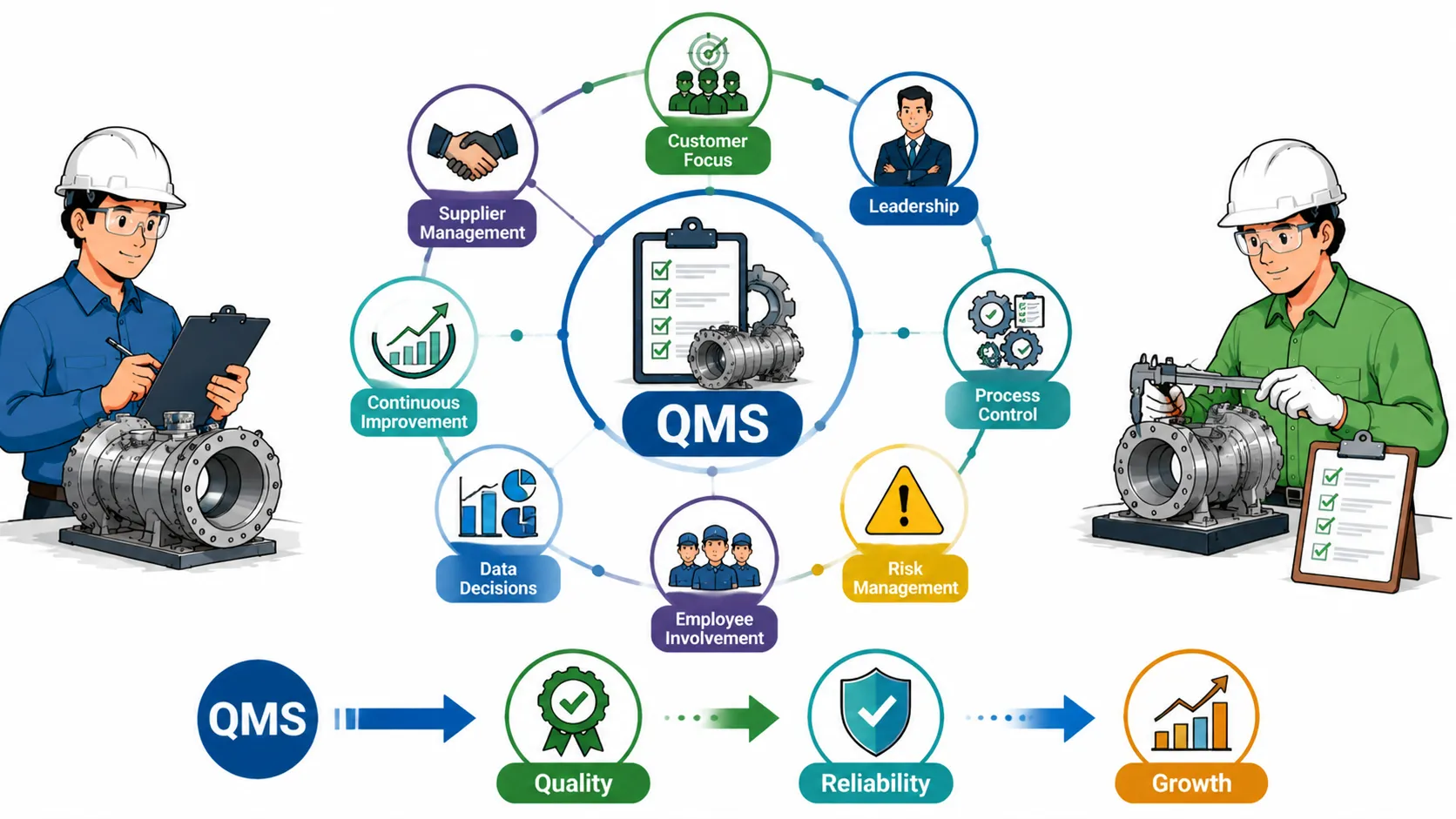
Definition of Quality Management System
A Quality Management System is an organised set of processes and procedures designed to manage and improve quality performance within an organisation.
In mechanical engineering, a QMS ensures that:
- Engineering processes are controlled.
- Product requirements are clearly defined.
- Manufacturing activities follow approved procedures.
- Quality risks are identified and managed.
- Products meet technical specifications.
- Continuous improvement is achieved.
A QMS connects different departments, including engineering, production, procurement, inspection, maintenance, and management, to create a unified approach toward achieving quality objectives.
Principle 1: Customer Focus
Importance of Customer Requirements in Mechanical Engineering
Customer focus is one of the most important principles of quality management. Mechanical engineering organisations must understand customer expectations and ensure that products meet required performance, safety, reliability, and quality standards.
A successful QMS begins by identifying customer needs before design and production activities start.
Customer-focused quality management involves:
- Understanding technical specifications.
- Reviewing customer drawings and requirements.
- Defining acceptance criteria.
- Monitoring customer satisfaction.
- Responding to customer feedback.
For example, when manufacturing industrial machinery, engineers must understand operating conditions, load requirements, environmental factors, and performance expectations before production begins.
Benefits of Customer Focus
Customer focus helps organisations:
- Improve product reliability.
- Increase customer confidence.
- Reduce complaints.
- Develop long-term relationships.
- Improve market reputation.
Principle 2: Leadership Commitment
Role of Leadership in QMS Implementation
Leadership plays a critical role in establishing and maintaining an effective Quality Management System. Management must provide direction, resources, and support to ensure quality objectives are achieved.
In mechanical engineering organisations, leaders influence quality culture by ensuring that employees understand the importance of following procedures and maintaining standards.
Leadership responsibilities include:
- Establishing quality policies.
- Setting measurable quality objectives.
- Providing necessary resources.
- Supporting employee training.
- Encouraging continuous improvement.
Without leadership commitment, QMS activities may become ineffective because quality requires involvement from every level of the organisation.
Principle 3: Process Approach
Managing Mechanical Engineering Processes
The process approach focuses on managing activities as connected processes rather than separate tasks. Mechanical engineering operations involve many interconnected stages, including design, procurement, manufacturing, inspection, and delivery.
A QMS ensures that each process has:
- Defined inputs and outputs.
- Assigned responsibilities.
- Performance measurements.
- Monitoring methods.
- Improvement opportunities.
For example, in mechanical component manufacturing:
Material Selection
↓
Machining Process
↓
Inspection
↓
Assembly
↓
Testing
↓
Final Approval
Each stage affects the quality of the final product.
Advantages of Process-Based Quality Management
The process approach provides:
- Better workflow control.
- Improved communication.
- Reduced process variation.
- Faster identification of problems.
- Increased operational efficiency.
Principle 4: Risk-Based Thinking
Managing Quality Risks in Mechanical Engineering
Risk-based thinking is a fundamental QMS principle that focuses on identifying potential problems before they occur. Mechanical engineering processes involve many risks related to materials, equipment, production methods, and human performance.
QA/QC professionals use risk assessment methods to identify possible failures and implement preventive actions.
Common quality risks include:
- Incorrect material selection.
- Manufacturing errors.
- Equipment failure.
- Incorrect measurements.
- Poor supplier performance.
- Documentation errors.
Risk management activities include:
- Identifying potential risks.
- Evaluating risk impact.
- Developing preventive measures.
- Monitoring risk controls.
For example, during pressure equipment manufacturing, engineers assess risks related to welding quality, material strength, and testing requirements before production begins.
Principle 5: Employee Involvement
Importance of Competent Personnel
Employees are essential contributors to quality performance. A successful QMS requires skilled and trained personnel who understand their responsibilities and follow established procedures.
In mechanical engineering environments, employees involved in design, manufacturing, inspection, and testing must have appropriate knowledge and skills.
Employee involvement includes:
- Technical training.
- Awareness of quality requirements.
- Participation in improvement activities.
- Reporting quality issues.
- Following safety procedures.
Benefits include:
- Improved workmanship.
- Reduced human errors.
- Increased productivity.
- Stronger quality culture.
Principle 6: Evidence-Based Decision Making
Using Quality Data for Improvement
Effective quality decisions should be based on accurate information and reliable data. A QMS requires organisations to collect, analyse, and use quality information to improve performance.
Quality data may include:
- Inspection results.
- Testing records.
- Defect reports.
- Audit findings.
- Customer feedback.
QA/QC engineers use this information to:
- Identify trends.
- Analyse failures.
- Improve processes.
- Make informed decisions.
For example, analysing defect records may reveal that machining errors are caused by incorrect equipment calibration, allowing corrective actions to be implemented.
Principle 7: Continuous Improvement
Improving Mechanical Engineering Quality Performance
Continuous improvement is a key principle that encourages organisations to regularly improve their processes, products, and quality systems.
Mechanical engineering industries must continuously adapt to new technologies, customer expectations, and industry requirements.
Continuous improvement activities include:
- Reviewing process performance.
- Implementing corrective actions.
- Updating procedures.
- Improving production methods.
- Applying lessons learned.
A strong improvement culture helps organisations remain competitive and maintain high-quality standards.
Principle 8: Relationship Management
Managing Suppliers and Partners
Mechanical engineering organisations depend on suppliers for materials, components, and services. Effective supplier management is essential for maintaining consistent quality.
A QMS ensures suppliers meet required standards through:
- Supplier evaluation.
- Material verification.
- Performance monitoring.
- Quality audits.
For example, a manufacturer producing mechanical equipment must ensure that steel suppliers provide materials that meet required specifications and certification requirements.
QMS Principles Application in Mechanical Engineering
| QMS Principle | Application in Mechanical Engineering | Quality Outcome |
|---|---|---|
| Customer Focus | Understanding specifications and performance needs | Improved customer satisfaction |
| Leadership | Establishing quality policies and objectives | Strong quality culture |
| Process Approach | Controlling manufacturing processes | Consistent product quality |
| Risk-Based Thinking | Identifying and controlling quality risks | Reduced failures |
| Employee Involvement | Training and engaging personnel | Improved workmanship |
| Evidence-Based Decisions | Using inspection and testing data | Better decision-making |
| Continuous Improvement | Improving processes and procedures | Increased efficiency |
| Relationship Management | Controlling supplier quality | Reliable materials and components |
QMS Implementation Process in Mechanical Engineering
Quality Planning
The first stage of QMS implementation involves establishing quality objectives and requirements.
Activities include:
- Defining customer expectations.
- Identifying applicable standards.
- Preparing quality plans.
- Establishing inspection procedures.
Process Documentation
Documentation ensures that activities are performed consistently.
Important documents include:
- Quality manuals.
- Work instructions.
- Inspection procedures.
- Testing records.
- Calibration certificates.
Quality Monitoring
Monitoring ensures that processes remain effective.
Activities include:
- Internal audits.
- Inspection reviews.
- Performance measurement.
- Defect analysis.
Corrective and Preventive Actions
When problems occur, organisations must identify causes and implement solutions.
The process includes:
- Recording non-conformities.
- Investigating causes.
- Applying corrective actions.
- Verifying effectiveness.
Practical Example: QMS in Mechanical Manufacturing
A company producing industrial pumps experienced quality issues due to inconsistent manufacturing processes.
The organisation implemented a structured QMS approach.
Actions included:
- Developing manufacturing procedures.
- Improving inspection methods.
- Training employees.
- Monitoring supplier quality.
- Analysing defect data.
After implementation:
- Product defects decreased.
- Production efficiency improved.
- Customer complaints reduced.
- Delivery performance increased.
This example demonstrates how QMS principles directly improve mechanical engineering performance.
Case Study: QMS Implementation in Industrial Equipment Production
Project Background
A mechanical engineering company manufacturing industrial machinery faced repeated product failures and customer complaints. Investigations showed that quality problems were caused by inconsistent production methods, poor documentation control, and inadequate inspection procedures.
QMS Improvement Actions
The organisation introduced a comprehensive Quality Management System.
The QA team:
- Created standard operating procedures.
- Developed quality plans.
- Introduced internal audits.
- Improved documentation control.
The QC team:
- Increased inspection activities.
- Improved testing procedures.
- Monitored manufacturing accuracy.
Employees received training to improve awareness of quality responsibilities.
Case Study Outcome
After implementing QMS principles, the organisation achieved:
- Improved product reliability.
- Reduced manufacturing defects.
- Better customer satisfaction.
- Improved operational efficiency.
The case study demonstrates that a QMS is not only a quality control tool but also a strategic system that supports business improvement.
Key Benefits of Quality Management Systems in Mechanical Engineering
Product Quality Benefits
- Improves reliability of mechanical products.
- Reduces defects and failures.
- Ensures compliance with specifications.
- Enhances product performance.
Operational Benefits
- Improves process efficiency.
- Reduces waste and rework.
- Strengthens documentation control.
- Supports better resource management.
Business Benefits
- Increases customer confidence.
- Improves organisational reputation.
- Supports market competitiveness.
- Encourages sustainable growth.
Professional Benefits
- Improves QA/QC practices.
- Develops engineering discipline.
- Supports compliance with international standards.
- Enhances workplace quality culture.
Conclusion
The fundamental principles of Quality Management Systems provide the foundation for achieving consistent quality performance in mechanical engineering industries. A QMS integrates customer focus, leadership, process control, risk management, employee involvement, data-driven decisions, continuous improvement, and supplier management to create a complete quality framework.
For QA/QC Mechanical Engineers, understanding QMS principles is essential for controlling manufacturing processes, preventing defects, improving reliability, and ensuring that mechanical products meet customer and industry requirements.
A successful Quality Management System transforms quality from a final inspection activity into an organisation-wide approach where every process contributes to producing safe, reliable, and high-performance mechanical products.
2. Identify the Key Components of a QMS, Including Quality Policies, Procedures, Objectives, and Performance Measures
A Quality Management System (QMS) is a structured framework that enables mechanical engineering organisations to consistently achieve required quality standards through planned processes, controlled procedures, measurable objectives, and continuous improvement activities. In mechanical engineering industries, a QMS ensures that products, components, and manufacturing operations meet customer requirements, technical specifications, safety expectations, and industry standards.
From a QA/QC Mechanical Engineer perspective, a successful QMS is built on several interconnected components that guide how an organisation manages quality throughout the product lifecycle. These components include quality policies, quality procedures, quality objectives, and performance measurement systems. Together, they establish a systematic approach for preventing defects, controlling engineering processes, monitoring results, and improving overall operational performance.
In industries such as mechanical manufacturing, fabrication, automotive, aerospace, power generation, and industrial equipment production, quality cannot depend only on final inspection. A strong QMS creates a culture where quality is planned from the beginning of a project and maintained through every stage, including design, procurement, production, testing, and final delivery.
The effective implementation of QMS components helps organisations reduce manufacturing risks, improve efficiency, increase customer confidence, and maintain compliance with recognised quality requirements.
Understanding the Structure of a Quality Management System
Definition of QMS Components
QMS components are the essential elements that define how an organisation plans, manages, controls, and improves quality performance.
These components provide a framework for:
- Establishing quality direction.
- Defining responsibilities.
- Controlling engineering activities.
- Measuring performance.
- Identifying improvement opportunities.
A mechanical engineering QMS normally includes:
- Quality policy.
- Quality procedures.
- Quality objectives.
- Performance measures.
- Documentation control.
- Internal audits.
- Corrective and preventive actions.
- Continuous improvement processes.
Each component has a specific role in ensuring that mechanical products and processes achieve consistent quality results.
Quality Policy as a Foundation of QMS
Definition of Quality Policy
A quality policy is a formal statement created by an organisation’s leadership that defines its commitment to achieving quality standards and satisfying customer requirements.
The quality policy provides overall direction for quality management activities and establishes the organisation’s approach toward continuous improvement.
In mechanical engineering organisations, the quality policy communicates:
- Commitment to product reliability.
- Compliance with technical requirements.
- Focus on customer satisfaction.
- Commitment to process improvement.
- Responsibility for maintaining quality standards.
Importance of Quality Policy in Mechanical Engineering
A quality policy acts as a guiding principle for all departments involved in engineering activities.
For example, a mechanical manufacturing company may establish a quality policy focused on producing safe and reliable machine components through controlled manufacturing processes and continuous improvement.
The quality policy helps employees understand:
- What quality means within the organisation.
- Why quality requirements are important.
- How their responsibilities contribute to product performance.
Key Characteristics of an Effective Quality Policy
A successful quality policy should be:
- Clear and understandable.
- Relevant to organisational activities.
- Aligned with customer expectations.
- Supported by management.
- Communicated to employees.
- Reviewed regularly.
Role of QA/QC Engineers in Quality Policy Implementation
QA/QC engineers support quality policy implementation by:
- Translating quality commitments into practical procedures.
- Monitoring compliance.
- Conducting audits.
- Identifying improvement areas.
- Supporting quality awareness.
Quality Procedures and Process Control
Definition of Quality Procedures
Quality procedures are documented methods that describe how specific activities must be performed to achieve consistent quality outcomes.
Procedures convert quality policies into practical actions by defining responsibilities, processes, inspection requirements, and acceptance criteria.
In mechanical engineering environments, procedures ensure that activities are completed correctly and consistently.
Examples of Quality Procedures
Common QMS procedures include:
- Material inspection procedures.
- Welding inspection procedures.
- Equipment calibration procedures.
- Non-destructive testing procedures.
- Manufacturing process procedures.
- Document control procedures.
- Non-conformance management procedures.
Importance of Procedures in Mechanical Engineering
Mechanical engineering processes involve complex operations where consistency is essential.
Quality procedures help to:
- Reduce human errors.
- Standardise work practices.
- Improve process reliability.
- Support employee training.
- Maintain product consistency.
For example, a welding procedure specifies welding parameters, approved materials, inspection requirements, and acceptance standards to ensure weld quality.
Quality Objectives and Their Importance
Definition of Quality Objectives
Quality objectives are measurable targets established by an organisation to improve quality performance and achieve strategic goals.
Unlike a general quality policy, objectives provide specific goals that can be monitored and evaluated.
Examples include:
- Reducing manufacturing defects.
- Improving inspection efficiency.
- Increasing customer satisfaction.
- Reducing production waste.
- Improving delivery performance.
Characteristics of Effective Quality Objectives
Quality objectives should be:
- Specific.
- Measurable.
- Achievable.
- Relevant.
- Time-based.
For example:
A mechanical manufacturing company may establish an objective to reduce component rejection rates by 20% within one year.
Role of Quality Objectives in QMS Performance
Quality objectives help organisations:
- Measure improvement.
- Identify priorities.
- Allocate resources effectively.
- Evaluate department performance.
- Support decision-making.
QA/QC teams use objectives to monitor whether quality systems are achieving expected results.
Performance Measures in Quality Management Systems
Definition of Performance Measures
Performance measures are indicators used to evaluate how effectively a QMS is operating.
They provide evidence about whether processes are achieving quality objectives and meeting organisational expectations.
In mechanical engineering, performance measurement helps identify strengths, weaknesses, and improvement opportunities.
Common QMS Performance Measures
Mechanical engineering organisations may monitor:
- Defect rates.
- Customer complaints.
- Inspection results.
- Production efficiency.
- Rework percentage.
- Audit findings.
- Delivery performance.
Importance of Performance Measurement
Performance measures enable organisations to:
- Identify quality problems early.
- Analyse trends.
- Improve processes.
- Make data-based decisions.
- Monitor continuous improvement.
For example, analysing defect rates in a machining process can help engineers identify whether equipment calibration or operator training needs improvement.
Key Components of QMS in Mechanical Engineering
| QMS Component | Definition | Mechanical Engineering Application | Main Benefit |
|---|---|---|---|
| Quality Policy | Formal statement of quality commitment | Defines organisational quality direction | Creates quality culture |
| Quality Procedures | Documented methods for performing activities | Controls manufacturing and inspection processes | Ensures consistency |
| Quality Objectives | Measurable quality improvement targets | Reduces defects and improves performance | Supports improvement |
| Performance Measures | Indicators used to evaluate results | Tracks production and quality performance | Enables better decisions |
| Documentation Control | Management of quality records | Maintains engineering traceability | Improves accountability |
| Internal Audits | Systematic review of processes | Checks QMS effectiveness | Identifies improvement areas |
| Corrective Actions | Solutions to quality problems | Prevents repeated failures | Improves reliability |
QMS Documentation and Record Control
Importance of Quality Documentation
Documentation is an essential component of a QMS because it provides evidence that processes are controlled and requirements are being followed.
Mechanical engineering organisations require accurate records to demonstrate compliance and maintain traceability.
Important quality documents include:
- Quality manuals.
- Inspection reports.
- Test certificates.
- Calibration records.
- Manufacturing records.
- Audit reports.
Benefits of Documentation Control
Effective document control provides:
- Accurate information management.
- Better communication.
- Improved traceability.
- Reduced errors caused by outdated information.
For example, engineering drawings must be properly controlled to ensure production teams use the latest approved version.
QMS Procedures for Continuous Improvement
Corrective and Preventive Actions
A strong QMS does not only identify problems; it ensures that problems are prevented from happening again.
Corrective action involves:
- Identifying quality problems.
- Investigating causes.
- Implementing solutions.
- Monitoring effectiveness.
Preventive action involves:
- Identifying potential risks.
- Improving processes.
- Preventing future failures.
Continuous Improvement Process
The continuous improvement cycle includes:
This approach allows organisations to continuously enhance quality performance.
Practical Example: QMS Components in Mechanical Manufacturing
A company producing industrial gear assemblies experienced increased customer complaints due to inconsistent product performance.
The organisation reviewed its QMS components.
Quality policy improvement:
- Management strengthened commitment to product reliability.
Procedure improvement:
- Manufacturing and inspection procedures were updated.
Objective setting:
- The company established a target to reduce assembly defects.
Performance measurement:
- Defect rates and customer complaints were monitored monthly.
After implementing these improvements:
- Product reliability increased.
- Customer complaints reduced.
- Production efficiency improved.
This example shows how QMS components work together to improve mechanical engineering performance.
Case Study: Implementing QMS Components in an Engineering Organisation
Project Background
A mechanical equipment manufacturer faced challenges including production delays, inconsistent product quality, and increased rework costs. Investigation showed that the organisation lacked clear quality procedures and measurable quality objectives.
QMS Improvement Actions
The organisation introduced a structured QMS approach.
Quality policy actions:
- Developed a clear quality commitment statement.
- Communicated quality expectations to employees.
Procedure improvements:
- Created standard manufacturing procedures.
- Improved inspection documentation.
Objective development:
- Established measurable targets for defect reduction.
Performance monitoring:
- Introduced quality performance reports.
- Analysed production data regularly.
Case Study Outcome
After implementing improved QMS components, the organisation achieved:
- Reduced product defects.
- Improved manufacturing consistency.
- Better customer satisfaction.
- Improved operational control.
Case Study Conclusion
The case study demonstrates that quality policies, procedures, objectives, and performance measures are essential components of an effective QMS. When properly implemented, these elements create a structured approach that improves mechanical engineering quality and business performance.
Key Benefits of Effective QMS Components
Quality Benefits
- Improves product reliability.
- Reduces manufacturing defects.
- Ensures consistent performance.
- Supports compliance requirements.
Operational Benefits
- Improves process control.
- Reduces waste and rework.
- Enhances productivity.
- Improves resource utilisation.
Business Benefits
- Increases customer confidence.
- Strengthens market reputation.
- Supports sustainable growth.
- Improves competitiveness.
Professional Benefits
- Provides clear quality responsibilities.
- Supports effective QA/QC practices.
- Improves engineering discipline.
- Develops a quality-focused workplace culture.
Conclusion
The key components of a Quality Management System provide the foundation for effective quality control and continuous improvement in mechanical engineering industries. Quality policies establish organisational direction, procedures define controlled working methods, objectives provide measurable improvement targets, and performance measures evaluate whether quality goals are being achieved.
For QA/QC Mechanical Engineers, understanding these QMS components is essential for managing engineering processes, reducing risks, improving product reliability, and supporting successful manufacturing operations.
A well-designed QMS transforms quality management from a reactive inspection process into a proactive system that ensures consistent performance, customer satisfaction, and long-term organisational success.
Understand How to Implement a QMS Within a Mechanical Engineering Environment to Meet Industry Standards
Introduction to Quality Management System Implementation in Mechanical Engineering
Implementing a Quality Management System (QMS) within a mechanical engineering environment requires a structured approach that integrates quality principles, engineering processes, documentation systems, inspection methods, and continuous improvement practices. A properly implemented QMS ensures that mechanical products, components, and manufacturing operations consistently meet customer requirements, regulatory expectations, and recognised industry standards.
From a QA/QC Mechanical Engineer perspective, QMS implementation is not simply the introduction of quality documents or inspection checklists. It is a complete organisational process that establishes how quality is planned, controlled, measured, and improved throughout the product lifecycle. In mechanical engineering industries, a QMS connects design, procurement, production, inspection, testing, maintenance, and management activities to create a controlled system that reduces risks and improves product reliability.
Industries such as mechanical manufacturing, automotive, aerospace, fabrication, energy, and industrial equipment production require strong quality management systems because product failures can result in safety hazards, financial losses, production delays, and customer dissatisfaction. By implementing a QMS effectively, organisations can achieve consistent product quality, improve operational efficiency, and demonstrate compliance with international quality standards such as ISO-based management systems and industry-specific requirements.
A successful QMS implementation requires commitment from leadership, involvement of employees, effective documentation, process monitoring, performance evaluation, and continuous improvement.
Understanding the Purpose of QMS Implementation
Definition of QMS Implementation
QMS implementation is the process of establishing, integrating, and maintaining a structured quality management framework within an organisation to control processes and achieve defined quality objectives.
In mechanical engineering environments, QMS implementation involves:
- Defining quality requirements.
- Establishing quality policies.
- Developing engineering procedures.
- Controlling manufacturing processes.
- Implementing inspection and testing methods.
- Monitoring performance.
- Improving processes continuously.
The objective is to create a reliable system where quality is built into every engineering activity rather than being checked only after production.
Importance of QMS Implementation in Mechanical Engineering
Ensuring Product Quality and Reliability
Mechanical engineering products often operate under demanding conditions involving pressure, temperature, loads, vibration, and environmental factors. Therefore, maintaining consistent quality is essential for safe and reliable operation.
A QMS helps organisations ensure:
- Correct material selection.
- Accurate manufacturing processes.
- Proper inspection procedures.
- Reliable testing methods.
- Consistent product performance.
For example, a manufacturer producing industrial pumps must control material quality, machining accuracy, assembly procedures, and performance testing to ensure safe operation.
Meeting Industry Standards and Customer Requirements
Industry standards provide guidelines for quality, safety, and technical performance. A QMS helps organisations establish processes that meet these requirements.
Implementation supports compliance through:
- Controlled procedures.
- Documented evidence.
- Internal audits.
- Performance monitoring.
- Corrective actions.
Meeting recognised standards improves customer confidence and strengthens organisational reputation.
Key Stages of Implementing a QMS
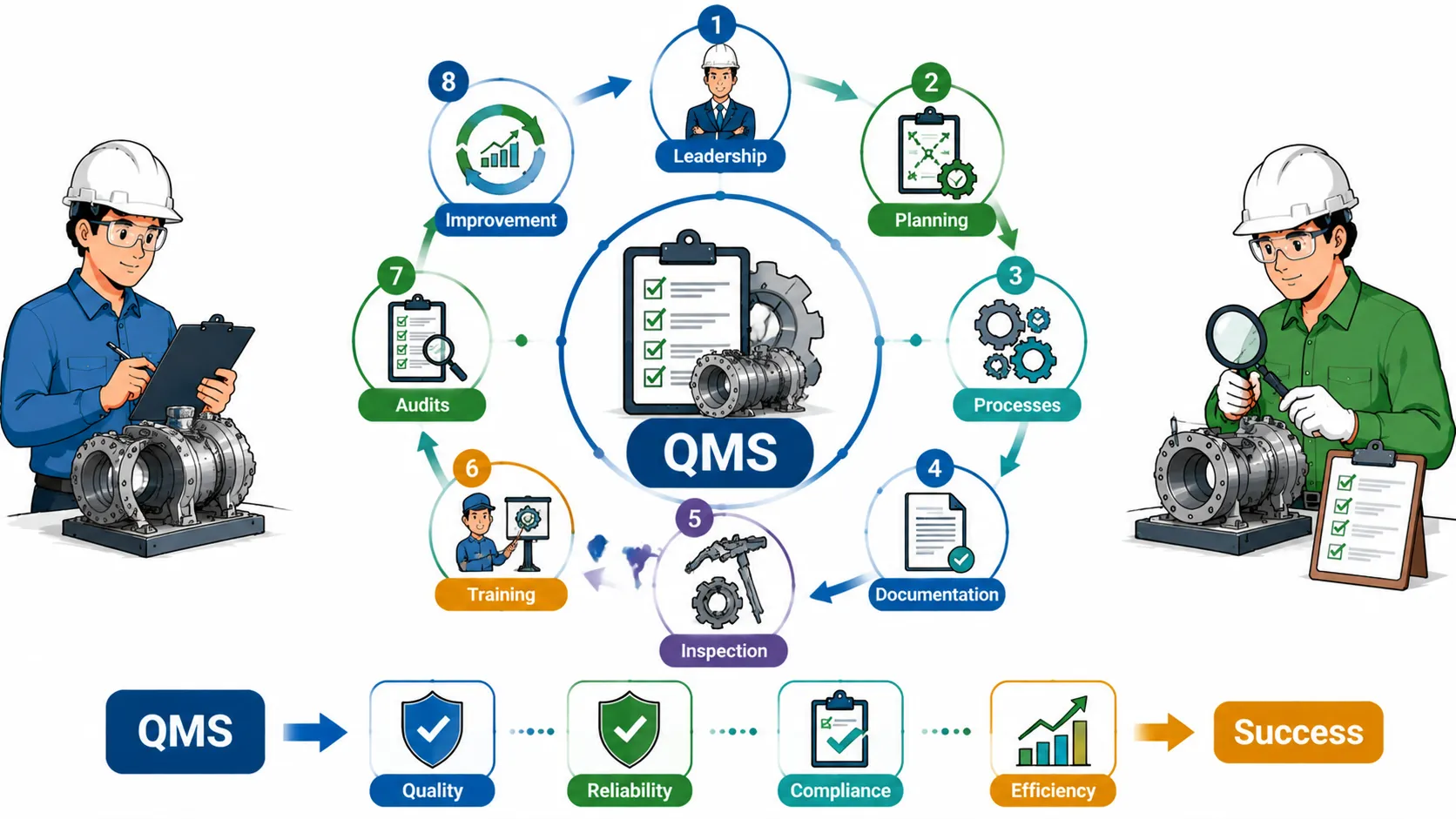
Stage 1: Establishing Leadership Commitment
Role of Management Support
The first step in QMS implementation is gaining commitment from organisational leadership. Management must provide direction, resources, and support to develop an effective quality system.
Without leadership involvement, quality initiatives may fail because employees may not understand the importance of following procedures and maintaining standards.
Management responsibilities include:
- Creating a quality vision.
- Developing quality policies.
- Allocating resources.
- Supporting employee training.
- Reviewing quality performance.
A strong leadership approach creates a positive quality culture throughout the organisation.
Stage 2: Defining Quality Policy and Objectives
Developing Quality Direction
A quality policy defines the organisation’s commitment to achieving and improving quality performance.
The policy should communicate:
- Commitment to customer satisfaction.
- Compliance with standards.
- Focus on continuous improvement.
- Responsibility for quality performance.
Quality objectives convert the policy into measurable targets.
Examples include:
- Reducing manufacturing defects.
- Improving inspection accuracy.
- Reducing customer complaints.
- Increasing production efficiency.
In mechanical engineering, objectives should relate directly to manufacturing performance and product reliability.
Stage 3: Identifying and Mapping Engineering Processes
Process Identification
A QMS requires organisations to understand and control their key processes.
Mechanical engineering processes may include:
- Product design.
- Material procurement.
- Machining.
- Welding.
- Assembly.
- Testing.
- Inspection.
- Product delivery.
Process mapping helps identify:
- Process inputs.
- Process outputs.
- Responsible personnel.
- Quality checkpoints.
- Possible risks.
Process Control Methods
Effective process control involves:
- Standard operating procedures.
- Work instructions.
- Inspection criteria.
- Equipment controls.
- Employee training.
These controls ensure activities are completed consistently.
Stage 4: Developing QMS Documentation
Importance of Documentation
Documentation is a critical element of QMS implementation because it provides evidence that processes are controlled and requirements are being followed.
Mechanical engineering organisations require documentation to maintain traceability and demonstrate compliance.
Important QMS documents include:
- Quality manuals.
- Engineering procedures.
- Inspection plans.
- Test reports.
- Calibration records.
- Material certificates.
- Audit records.
Document Control Process
Effective document control ensures that:
- Current documents are available.
- Old documents are removed.
- Changes are approved.
- Records are maintained.
For example, updated engineering drawings must be controlled to prevent production teams from using outdated specifications.
Stage 5: Implementing Quality Control and Inspection Processes
Establishing Inspection Systems
Quality Control ensures that products meet required specifications through inspection and testing activities.
QC implementation includes:
- Incoming material inspection.
- In-process inspection.
- Final product inspection.
- Performance testing.
Common inspection activities include:
- Dimensional measurement.
- Visual inspection.
- Welding inspection.
- Non-destructive testing.
- Functional testing.
Role of QA in Inspection Management
Quality Assurance ensures that inspection processes are properly planned and controlled.
QA activities include:
- Developing inspection procedures.
- Reviewing inspection results.
- Conducting audits.
- Managing corrective actions.
Stage 6: Employee Training and Awareness
Importance of Competent Personnel
A QMS can only succeed when employees understand their responsibilities and have the required skills.
Training should cover:
- Quality procedures.
- Safety requirements.
- Inspection methods.
- Documentation practices.
- Problem-solving techniques.
Employee awareness improves:
- Process consistency.
- Product quality.
- Workplace responsibility.
Stage 7: Monitoring Performance and Conducting Audits
Measuring QMS Effectiveness
Performance monitoring helps organisations determine whether the QMS is achieving expected results.
Common performance indicators include:
- Defect rates.
- Production efficiency.
- Customer complaints.
- Rework levels.
- Audit findings.
Internal Quality Audits
Internal audits evaluate whether processes comply with QMS requirements.
Audit activities include:
- Reviewing procedures.
- Checking records.
- Interviewing employees.
- Identifying improvement opportunities.
Audits help organisations identify weaknesses before they create major quality problems.
Stage 8: Corrective Actions and Continuous Improvement
Managing Non-Conformities
Non-conformities occur when products or processes fail to meet requirements.
Examples include:
- Incorrect dimensions.
- Material defects.
- Failed inspections.
- Documentation errors.
The corrective action process includes:
- Identifying the problem.
- Investigating the root cause.
- Implementing solutions.
- Verifying effectiveness.
Continuous Improvement Approach
A successful QMS requires ongoing improvement through:
- Process optimisation.
- Technology improvements.
- Employee feedback.
- Data analysis.
- Lessons learned.
QMS Implementation Framework in Mechanical Engineering
| QMS Implementation Stage | Main Activities | Mechanical Engineering Application | Expected Result |
|---|---|---|---|
| Leadership Commitment | Establish quality direction | Management support for engineering quality | Strong quality culture |
| Quality Planning | Define policies and objectives | Manufacturing quality targets | Clear quality goals |
| Process Control | Map and control processes | Production and inspection control | Consistent operations |
| Documentation | Create controlled records | Drawings, procedures, inspection reports | Better traceability |
| Quality Control | Perform inspections and testing | Component verification | Reduced defects |
| Training | Develop employee competence | Operator and inspector training | Improved workmanship |
| Auditing | Review QMS effectiveness | Process and documentation audits | Continuous improvement |
| Corrective Actions | Resolve quality problems | Defect prevention | Improved reliability |
Practical Example: QMS Implementation in Mechanical Manufacturing
A company producing precision mechanical components experienced problems with inconsistent product dimensions and increased customer complaints.
The organisation implemented a structured QMS.
Actions included:
- Developing quality procedures.
- Introducing inspection checkpoints.
- Training production employees.
- Improving equipment calibration.
- Monitoring defect data.
After implementation:
- Manufacturing errors reduced.
- Product consistency improved.
- Customer satisfaction increased.
- Production efficiency improved.
This example demonstrates how QMS implementation improves both technical performance and business outcomes.
Case Study: QMS Implementation in an Industrial Equipment Company
Project Background
An industrial equipment manufacturer faced repeated failures in manufactured components due to inconsistent production processes and weak quality controls.
Management decided to implement a comprehensive QMS to improve reliability.
Implementation Actions
The organisation introduced:
Quality planning:
- Developed quality objectives.
- Defined customer requirements.
Process improvement:
- Standardised manufacturing procedures.
- Introduced process monitoring.
Quality control:
- Improved inspection activities.
- Increased testing accuracy.
Employee development:
- Provided quality training.
- Improved awareness of responsibilities.
Results Achieved
After QMS implementation:
- Product failures decreased.
- Production processes became more controlled.
- Customer confidence improved.
- Operational costs reduced.
Case Study Conclusion
The case study demonstrates that QMS implementation provides a systematic approach for improving mechanical engineering quality. A properly implemented system supports compliance, reduces risks, and creates long-term organisational improvement.
Key Benefits of Implementing a QMS in Mechanical Engineering
Quality Benefits
- Improved product reliability.
- Reduced defects.
- Better process control.
- Increased compliance.
Operational Benefits
- Improved production efficiency.
- Reduced waste.
- Better resource management.
- Improved workflow.
Business Benefits
- Increased customer satisfaction.
- Stronger market reputation.
- Reduced operational costs.
- Improved competitiveness.
Engineering Benefits
- Better documentation.
- Improved problem-solving.
- Enhanced quality culture.
- More effective QA/QC practices.
Conclusion
Implementing a Quality Management System within a mechanical engineering environment requires a structured approach involving leadership commitment, quality planning, process control, documentation, inspection, training, auditing, and continuous improvement.
A QMS enables organisations to manage quality proactively by preventing problems, controlling engineering activities, and improving product performance. For QA/QC Mechanical Engineers, understanding QMS implementation is essential for ensuring that mechanical products meet industry standards, customer expectations, and safety requirements.
An effective QMS transforms quality management into an integrated engineering practice that supports reliable products, efficient processes, and sustainable organisational success.
4. Apply the Process Approach Within QMS to Ensure Effective Planning, Control, and Improvement of Mechanical Processes
The process approach is one of the fundamental principles of a Quality Management System (QMS) that focuses on managing organisational activities as interconnected processes rather than isolated tasks. In mechanical engineering environments, this approach enables organisations to understand how different engineering activities interact with each other and how each process contributes to achieving consistent product quality.
From a QA/QC Mechanical Engineer perspective, the process approach provides a structured method for planning, controlling, monitoring, and improving mechanical processes throughout the product lifecycle. Instead of focusing only on final product inspection, organisations identify critical processes, define responsibilities, establish controls, measure performance, and continuously improve operations.
Mechanical engineering industries involve complex activities such as design development, material procurement, machining, fabrication, welding, assembly, testing, and final inspection. Each activity influences the quality of the final product. A weakness in one process can affect the performance, safety, and reliability of the entire system.
By applying the process approach within QMS, organisations can achieve:
- Better process control.
- Reduced manufacturing risks.
- Improved product reliability.
- Effective resource utilisation.
- Continuous improvement.
- Compliance with industry standards.
A process-based QMS creates a systematic environment where every engineering activity contributes towards achieving quality objectives.
Understanding the Process Approach in QMS
Definition of Process Approach
The process approach is a quality management method where organisational activities are identified, managed, and improved as connected processes that work together to achieve planned outcomes.
A process consists of:
- Inputs.
- Activities.
- Resources.
- Controls.
- Outputs.
- Performance measures.
In mechanical engineering, a process approach ensures that each stage, from design to final inspection, operates effectively and contributes to overall product quality.
For example:
Each stage depends on the previous stage and influences the next stage.
Importance of Process Approach in Mechanical Engineering QMS
Improving Process Understanding
The process approach helps engineering teams understand how different activities are connected.
For example, incorrect material selection can affect machining performance, product durability, and final operational reliability. By viewing activities as connected processes, engineers can identify potential problems earlier.
The process approach supports:
- Clear understanding of workflows.
- Defined process responsibilities.
- Improved communication.
- Better quality control.
Supporting Effective Quality Planning
Planning is a critical element of mechanical engineering quality management. The process approach allows organisations to establish quality requirements before activities begin.
Quality planning includes:
- Identifying process requirements.
- Defining acceptance criteria.
- Allocating resources.
- Establishing inspection points.
- Identifying potential risks.
For example, before manufacturing a pressure component, engineers must define material requirements, fabrication procedures, welding standards, and testing methods.
Applying the Process Approach for Effective Planning
Process Identification and Mapping
Identifying Mechanical Engineering Processes
The first step in applying the process approach is identifying all processes involved in producing a mechanical product.
Common mechanical engineering processes include:
- Product design.
- Engineering calculations.
- Material procurement.
- Manufacturing.
- Welding and fabrication.
- Assembly.
- Inspection.
- Testing.
- Delivery.
Process identification helps organisations understand where quality controls are required.
Developing Process Maps
Process maps visually represent the sequence of activities and interactions between processes.
A process map identifies:
- Process inputs.
- Process activities.
- Responsible personnel.
- Required resources.
- Expected outputs.
Benefits of process mapping include:
- Improved workflow understanding.
- Easier identification of risks.
- Better process control.
- Reduced confusion between departments.
Defining Process Responsibilities
Role of Personnel in Process Management
A successful QMS requires clearly defined responsibilities for each process.
In mechanical engineering environments:
QA engineers are responsible for:
- Developing quality procedures.
- Monitoring compliance.
- Conducting audits.
- Supporting improvement activities.
QC inspectors are responsible for:
- Performing inspections.
- Measuring components.
- Conducting tests.
- Recording results.
Production teams are responsible for:
- Following approved procedures.
- Maintaining process standards.
- Reporting quality issues.
Clear responsibilities prevent errors and improve accountability.
Process Control Within Mechanical Engineering QMS
Establishing Process Controls
Process control ensures that mechanical activities are performed according to defined requirements.
Control methods include:
- Standard operating procedures.
- Work instructions.
- Inspection plans.
- Equipment calibration.
- Quality checkpoints.
For example, during machining operations, process controls may include:
- Approved machining parameters.
- Tool inspection.
- Dimensional checks.
- Operator verification.
Monitoring Process Performance
Monitoring allows organisations to evaluate whether processes are producing expected results.
Performance monitoring includes:
- Defect analysis.
- Inspection results.
- Production efficiency.
- Customer feedback.
- Audit findings.
Data collected from monitoring activities helps engineers identify improvement opportunities.
Process Measurement and Performance Evaluation
Importance of Measuring Mechanical Processes
Measurement is essential for understanding whether processes are effective.
A QMS uses performance indicators to evaluate process success.
Common mechanical engineering quality measures include:
- Defect percentage.
- Rework levels.
- Production downtime.
- Inspection failure rates.
- Customer complaints.
Performance measurement helps organisations make informed decisions.
Example of Process Measurement
A company manufacturing precision components monitors dimensional inspection results.
If measurement data shows increasing dimensional variation, engineers can investigate:
- Machine calibration.
- Tool condition.
- Operator methods.
- Material changes.
This prevents larger quality problems.
Process Improvement Within QMS
Continuous Improvement Approach
The process approach supports continuous improvement by regularly evaluating and improving engineering processes.
Improvement activities include:
- Identifying process weaknesses.
- Analysing quality data.
- Implementing corrective actions.
- Updating procedures.
- Applying new technologies.
Continuous improvement helps organisations maintain competitive performance.
Corrective and Preventive Actions
When problems occur, organisations must identify causes and prevent recurrence.
The improvement process includes:
- Detecting the problem.
- Investigating root causes.
- Implementing corrective actions.
- Checking effectiveness.
For example, if welding defects repeatedly occur, engineers analyse welding procedures, equipment settings, and operator skills to identify the cause.
Process Approach Application in Mechanical Engineering
| Process Approach Element | Definition | Mechanical Engineering Application | Quality Benefit |
|---|---|---|---|
| Process Identification | Recognising activities required to achieve results | Mapping design, manufacturing, and inspection processes | Better workflow control |
| Process Planning | Defining requirements and resources | Creating production and inspection plans | Reduces process risks |
| Process Control | Managing activities according to standards | Controlling machining, welding, and assembly | Improves consistency |
| Process Monitoring | Measuring process performance | Analysing defects and inspection data | Early problem detection |
| Process Improvement | Enhancing process effectiveness | Corrective actions and optimisation | Continuous quality improvement |
| Process Documentation | Recording procedures and results | Maintaining engineering records | Improved traceability |
Practical Example: Process Approach in Mechanical Manufacturing
A company producing industrial gear systems experienced problems with inconsistent product quality.
The organisation applied the process approach within its QMS.
Process Planning Improvements
The company:
- Identified critical manufacturing stages.
- Defined quality requirements.
- Established inspection points.
Process Control Improvements
The company introduced:
- Standard machining procedures.
- Equipment calibration schedules.
- Operator instructions.
Process Monitoring Improvements
The company monitored:
- Dimensional accuracy.
- Production defects.
- Customer feedback.
Results Achieved
After implementing the process approach:
- Manufacturing consistency improved.
- Defects reduced.
- Production efficiency increased.
- Customer satisfaction improved.
This demonstrates how process management creates better control over mechanical engineering activities.
Case Study: Implementing Process Approach in an Automotive Component Manufacturer
Project Background
An automotive component manufacturer faced repeated quality issues caused by inconsistent production methods. Components frequently failed dimensional inspections, resulting in increased rework and delayed deliveries.
The organisation decided to improve its QMS using the process approach.
Implementation Activities
The QA/QC team analysed the complete production process.
Actions included:
Process identification:
- Reviewed manufacturing stages.
- Identified critical quality points.
Process control:
- Introduced standard operating procedures.
- Improved inspection methods.
Process monitoring:
- Collected production data.
- Analysed defect trends.
Process improvement:
- Applied corrective actions.
- Updated manufacturing procedures.
Case Study Results
The company achieved:
- Reduced component defects.
- Improved production efficiency.
- Better quality consistency.
- Increased customer confidence.
Case Study Conclusion
The case study demonstrates that the process approach helps mechanical engineering organisations move from reactive problem-solving to proactive quality management. By controlling and improving processes, companies can achieve reliable products and sustainable quality performance.
Key Benefits of Applying Process Approach in QMS
Quality Benefits
- Improves product consistency.
- Reduces defects.
- Enhances reliability.
- Supports compliance with standards.
Operational Benefits
- Improves workflow efficiency.
- Reduces waste.
- Enhances communication.
- Provides better process control.
Business Benefits
- Increases customer satisfaction.
- Reduces operational costs.
- Improves organisational reputation.
- Supports continuous growth.
Engineering Benefits
- Provides structured processes.
- Improves decision-making.
- Supports effective QA/QC activities.
- Strengthens engineering discipline.
Conclusion
The process approach is a critical element of an effective Quality Management System in mechanical engineering environments. It enables organisations to manage activities as interconnected processes, ensuring that every stage contributes to achieving quality objectives.
By applying the process approach, mechanical engineering organisations can effectively plan activities, control manufacturing operations, monitor performance, and implement continuous improvement. QA/QC professionals play an important role in maintaining process effectiveness through documentation, inspection, analysis, and corrective actions.
A process-based QMS creates a reliable framework that improves product quality, reduces risks, supports industry standards, and ensures long-term success in mechanical engineering operations.
5. Evaluate the Importance of Continuous Improvement (e.g., PDCA Cycle) in Enhancing Product and Process Quality in Mechanical Engineering
Continuous improvement is a fundamental principle of an effective Quality Management System (QMS) that focuses on regularly improving products, processes, and organisational performance. In mechanical engineering industries, continuous improvement enables organisations to identify weaknesses, eliminate recurring problems, optimise manufacturing activities, and enhance product reliability over time.
From a QA/QC Mechanical Engineer perspective, continuous improvement is not a one-time activity but an ongoing systematic approach that ensures engineering processes continue to meet changing customer requirements, technological developments, and industry expectations. Mechanical products are often produced through complex processes involving design, material selection, machining, fabrication, assembly, and testing. Even well-controlled processes can experience variations, defects, or efficiency challenges; therefore, continuous improvement is essential for maintaining quality performance.
The Plan-Do-Check-Act (PDCA) cycle is one of the most widely used continuous improvement methods within Quality Management Systems. It provides a structured framework for identifying improvement opportunities, implementing solutions, evaluating results, and standardising successful practices.
By applying continuous improvement principles, mechanical engineering organisations can achieve:
- Improved product quality.
- Reduced manufacturing defects.
- Increased operational efficiency.
- Lower production costs.
- Better customer satisfaction.
- Stronger compliance with quality standards.
A culture of continuous improvement transforms quality management from a reactive approach into a proactive system focused on prevention, innovation, and long-term performance enhancement.
Understanding Continuous Improvement in QMS
Definition of Continuous Improvement
Continuous improvement is the systematic and ongoing effort to enhance products, services, processes, and quality management systems by identifying opportunities for improvement and implementing effective solutions.
In mechanical engineering, continuous improvement focuses on improving:
- Manufacturing processes.
- Product performance.
- Inspection methods.
- Equipment efficiency.
- Employee practices.
- Quality control systems.
The main objective is to achieve better results through gradual improvements rather than waiting for major failures to occur.
Importance of Continuous Improvement in Mechanical Engineering
Mechanical engineering industries operate in highly competitive environments where quality, cost, and efficiency directly influence business success. Organisations must continuously improve their processes to remain competitive and meet customer expectations.
Continuous improvement helps organisations:
- Prevent repeated quality problems.
- Improve manufacturing consistency.
- Reduce waste and resource losses.
- Increase production efficiency.
- Enhance product reliability.
- Adapt to new technologies.
For example, a manufacturer producing precision mechanical components may continuously improve machining processes to reduce dimensional errors and increase production accuracy.
Role of Continuous Improvement Within Quality Management Systems
Supporting Quality Objectives
Continuous improvement directly supports QMS objectives by ensuring that quality targets are regularly reviewed and improved.
Examples of improvement objectives include:
- Reducing product defects.
- Increasing inspection accuracy.
- Improving production cycle time.
- Reducing customer complaints.
- Enhancing equipment performance.
QA/QC engineers use performance data to identify whether improvement actions are achieving expected outcomes.
Preventing Quality Problems
Traditional quality approaches often focus on detecting defects after they occur. Continuous improvement focuses on preventing problems before they affect customers.
Preventive improvement activities include:
- Process analysis.
- Risk identification.
- Equipment improvement.
- Employee training.
- Procedure updates.
This approach reduces the cost associated with rework, repairs, and product failures.
The PDCA Cycle for Continuous Improvement
Understanding the PDCA Cycle
The PDCA cycle, also known as the Deming Cycle, is a systematic improvement method used to manage and enhance processes.
The four stages of PDCA are:
- Plan.
- Do.
- Check.
- Act.
The cycle is repeated continuously to achieve ongoing improvement.
In mechanical engineering environments, PDCA helps organisations analyse problems, test solutions, measure results, and implement effective improvements.
Stage 1: Plan
Identifying Problems and Improvement Opportunities
The planning stage involves analysing current processes and identifying areas where improvement is required.
QA/QC engineers collect information from:
- Inspection reports.
- Customer complaints.
- Production data.
- Audit findings.
- Performance measurements.
During this stage, organisations:
- Define the problem.
- Analyse possible causes.
- Establish improvement objectives.
- Develop an action plan.
For example, if a manufacturing company experiences repeated component failures, engineers investigate possible causes such as incorrect machining parameters or material issues.
Planning Activities in Mechanical Engineering
Important planning activities include:
- Reviewing process performance.
- Identifying quality risks.
- Setting measurable targets.
- Selecting improvement methods.
- Allocating resources.
Effective planning ensures that improvement actions are controlled and focused.
Stage 2: Do
Implementing Improvement Actions
The Do stage involves applying the planned improvements on a controlled basis.
In mechanical engineering environments, implementation may involve:
- Modifying production procedures.
- Improving equipment settings.
- Training employees.
- Introducing new inspection methods.
- Testing improved designs.
Small-scale testing is often used before applying changes throughout the entire production system.
For example, a manufacturer may test a new machining technique on a limited production batch before full implementation.
Importance of Controlled Implementation
Controlled implementation helps organisations:
- Reduce improvement risks.
- Evaluate effectiveness.
- Identify unexpected issues.
- Gather practical feedback.
Stage 3: Check
Evaluating Improvement Results
The Check stage focuses on measuring whether implemented changes have achieved the desired improvement.
QA/QC engineers evaluate:
- Quality performance data.
- Inspection results.
- Production efficiency.
- Customer feedback.
Evaluation methods include:
- Data analysis.
- Process audits.
- Performance comparisons.
- Quality reviews.
For example, after improving a welding process, engineers compare defect rates before and after implementation to determine effectiveness.
Stage 4: Act
Standardising Successful Improvements
The Act stage involves implementing successful improvements permanently and applying lessons learned across relevant processes.
Actions may include:
- Updating procedures.
- Revising work instructions.
- Training employees.
- Establishing new standards.
If improvements are unsuccessful, organisations restart the PDCA cycle to identify alternative solutions.
The Act stage ensures that improvements become part of normal operations.
PDCA Cycle Application in Mechanical Engineering
| PDCA Stage | Definition | Mechanical Engineering Application | Quality Improvement Outcome |
|---|---|---|---|
| Plan | Identify problems and develop solutions | Analyse defects and create improvement plans | Clear improvement direction |
| Do | Implement planned changes | Test new processes or procedures | Controlled improvement implementation |
| Check | Evaluate results | Review inspection data and performance | Evidence-based decisions |
| Act | Standardise successful improvements | Update procedures and training | Long-term quality enhancement |
Continuous Improvement Tools Used in Mechanical Engineering
Root Cause Analysis
Root Cause Analysis helps engineers identify the actual reason behind quality problems rather than only correcting symptoms.
Common methods include:
- Fishbone Diagram.
- 5 Why Analysis.
- Failure analysis.
Applications include:
- Investigating component failures.
- Reducing manufacturing defects.
- Improving process reliability.
Statistical Process Control (SPC)
SPC uses statistical techniques to monitor process performance and identify variations.
Mechanical engineering applications include:
- Monitoring machining accuracy.
- Controlling production variation.
- Improving process stability.
Benefits include:
- Early problem detection.
- Reduced defects.
- Improved consistency.
Corrective and Preventive Actions
Corrective and preventive actions support continuous improvement by addressing existing problems and preventing future failures.
The process involves:
- Identifying non-conformities.
- Investigating causes.
- Implementing solutions.
- Monitoring effectiveness.
Practical Example: Continuous Improvement in Mechanical Manufacturing
A company manufacturing hydraulic components experienced increasing rejection rates during final inspection.
The QA/QC team applied the PDCA approach.
Plan
Engineers analysed inspection records and identified dimensional variation during machining as the main issue.
Do
The company:
- Improved machine calibration.
- Updated machining instructions.
- Trained operators.
Check
The team reviewed production data and compared defect rates before and after improvements.
Act
Successful improvements were incorporated into standard manufacturing procedures.
Results
The organisation achieved:
- Reduced component rejection.
- Improved production accuracy.
- Lower rework costs.
- Increased customer satisfaction.
This example demonstrates how continuous improvement improves both product quality and manufacturing performance.
Case Study: PDCA Implementation in Automotive Component Production
Project Background
An automotive component manufacturer experienced repeated failures in manufactured parts due to inconsistent production processes. The failures resulted in customer complaints, increased costs, and production delays.
The organisation decided to apply the PDCA cycle as part of its QMS improvement strategy.
Improvement Process
Plan Stage
The QA team analysed failure data and identified process variation as the main cause.
Improvement objectives were established:
- Reduce component defects.
- Improve production consistency.
- Increase inspection effectiveness.
Do Stage
The company implemented:
- Improved process controls.
- Additional operator training.
- Updated inspection procedures.
Check Stage
Performance data was reviewed to measure improvement results.
The organisation monitored:
- Defect rates.
- Production efficiency.
- Customer feedback.
Act Stage
Successful improvements were standardised throughout production.
Case Study Outcome
The organisation achieved:
- Improved product reliability.
- Reduced manufacturing failures.
- Better customer satisfaction.
- Improved operational efficiency.
Case Study Conclusion
The case study shows that continuous improvement through the PDCA cycle provides a structured method for solving quality problems and enhancing mechanical engineering processes.
Key Benefits of Continuous Improvement in Mechanical Engineering
Product Quality Benefits
Continuous improvement helps organisations:
- Improve product reliability.
- Reduce defects.
- Enhance performance.
- Increase customer confidence.
Process Benefits
Continuous improvement supports:
- Better manufacturing control.
- Reduced process variation.
- Improved efficiency.
- Optimised resource usage.
Business Benefits
Organisations benefit through:
- Reduced operational costs.
- Increased competitiveness.
- Stronger market reputation.
- Improved customer relationships.
Engineering Benefits
QA/QC professionals benefit through:
- Better problem-solving skills.
- Improved process understanding.
- Enhanced decision-making.
- Stronger quality management practices.
Conclusion
Continuous improvement is an essential element of Quality Management Systems in mechanical engineering industries. It enables organisations to continuously evaluate, improve, and optimise their products and processes to achieve higher levels of quality and efficiency.
The PDCA cycle provides a practical and systematic approach for managing improvement activities by helping organisations plan solutions, implement changes, evaluate results, and standardise successful improvements.
For QA/QC Mechanical Engineers, continuous improvement is a key responsibility that supports defect prevention, process optimisation, customer satisfaction, and compliance with industry standards. By creating a culture of continuous improvement, mechanical engineering organisations can achieve reliable products, efficient operations, and sustainable long-term success.
6. Demonstrate an Understanding of Documentation Control and Its Role in Maintaining Compliance with QMS Requirements
Documentation control is a fundamental element of a Quality Management System (QMS) that ensures quality-related information is properly created, reviewed, approved, updated, distributed, and maintained throughout an organisation. In mechanical engineering industries, documentation control provides the foundation for consistent manufacturing practices, reliable inspection activities, process traceability, and compliance with quality requirements.
From a QA/QC Mechanical Engineer perspective, documentation control is not simply the storage of files and records. It is a systematic process that ensures the right information is available to the right people at the right time. Mechanical engineering operations involve complex activities such as design development, material selection, machining, fabrication, welding, assembly, testing, and final inspection. Each activity requires accurate and controlled documentation to ensure that processes are performed according to approved requirements.
An effective documentation control system helps organisations prevent errors caused by outdated drawings, incorrect procedures, missing inspection records, or uncontrolled changes. It supports compliance with QMS requirements by providing evidence that processes are properly managed and that products are manufactured according to defined specifications.
In industries such as mechanical manufacturing, automotive, aerospace, energy, and industrial equipment production, documentation control plays a critical role in maintaining product quality, ensuring traceability, supporting audits, and improving operational efficiency.
Understanding Documentation Control in QMS
Definition of Documentation Control
Documentation control is the structured process used by an organisation to manage the creation, approval, modification, distribution, storage, and disposal of quality-related documents and records.
The purpose of documentation control is to ensure:
- Accurate information is available.
- Only approved documents are used.
- Changes are properly managed.
- Historical records are maintained.
- Quality evidence is preserved.
Within a QMS, documentation control ensures that employees follow the latest approved procedures and requirements during engineering activities.
Importance of Documentation Control in Mechanical Engineering
Maintaining Process Consistency
Mechanical engineering processes require a high level of accuracy and repeatability. Controlled documents provide employees with standard instructions for performing tasks correctly.
For example, a welding procedure specification defines:
- Welding parameters.
- Approved materials.
- Required equipment.
- Inspection requirements.
- Acceptance criteria.
Without controlled documentation, different operators may follow different methods, resulting in inconsistent product quality.
Ensuring Product Traceability
Traceability is essential in mechanical engineering because organisations must be able to track materials, processes, inspections, and test results throughout the product lifecycle.
Documentation control supports traceability through:
- Material certificates.
- Inspection reports.
- Manufacturing records.
- Test documentation.
- Calibration certificates.
For example, if a mechanical component fails during operation, quality engineers can review records to identify the material batch, manufacturing process, inspection results, and responsible personnel.
Role of Documentation Control in QMS Compliance
Supporting Quality Standards Requirements
Quality Management Systems require organisations to maintain documented information to demonstrate that processes are controlled and effective.
Documentation control helps organisations meet compliance requirements by ensuring:
- Procedures are approved.
- Records are maintained.
- Changes are controlled.
- Evidence is available during audits.
In mechanical engineering environments, compliance depends on maintaining accurate documentation related to design, production, inspection, and testing activities.
Providing Evidence During Audits
Internal and external audits require organisations to demonstrate that their QMS processes are functioning effectively.
Controlled documents provide evidence of:
- Process implementation.
- Employee responsibilities.
- Inspection activities.
- Corrective actions.
- Continuous improvement activities.
Without proper documentation control, organisations may struggle to prove compliance with quality requirements.
Types of Documents Controlled Within a Mechanical Engineering QMS

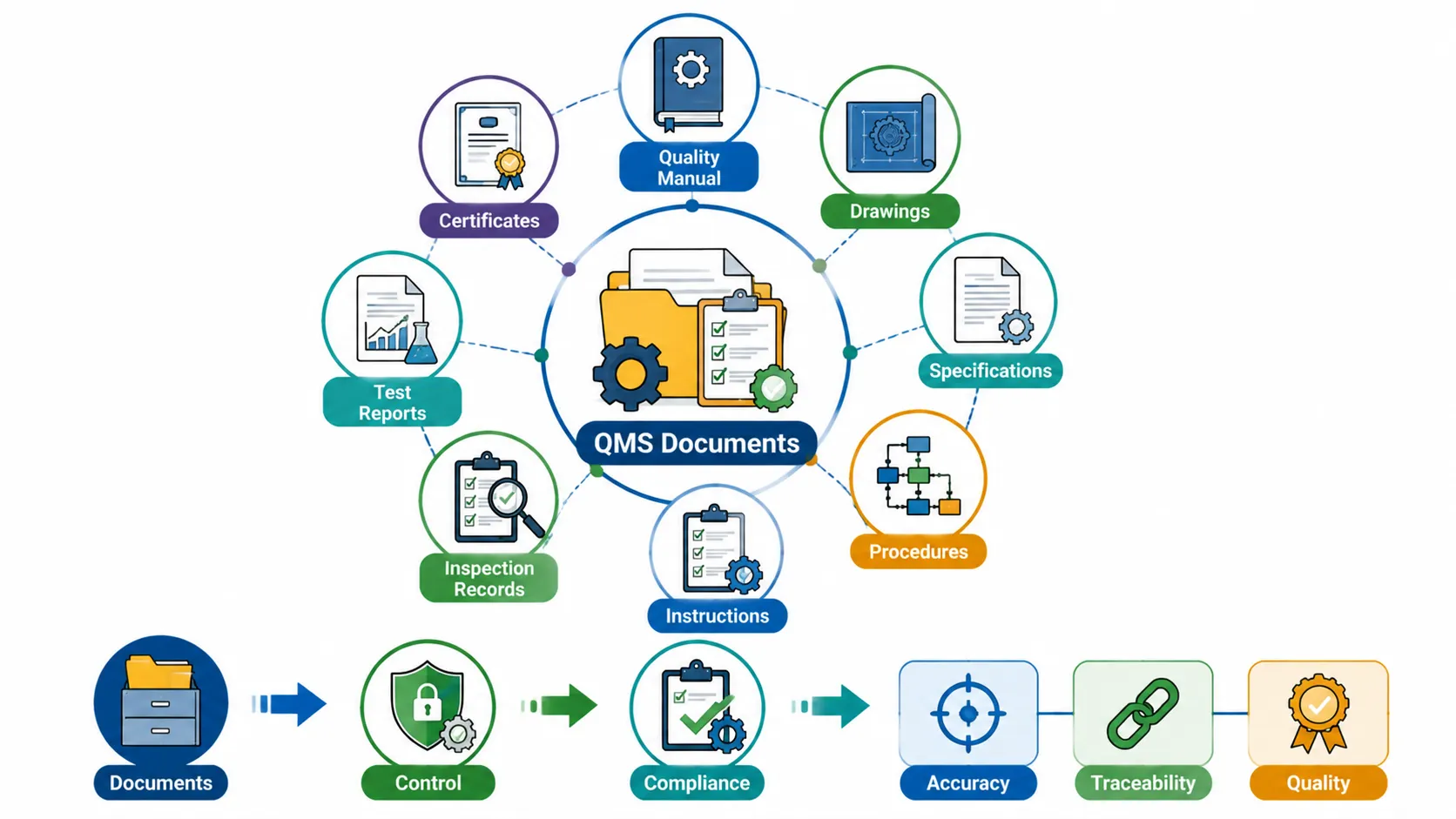
Quality Manuals
Purpose of Quality Manuals
A quality manual provides an overview of an organisation’s Quality Management System structure, policies, and responsibilities.
It explains:
- Quality objectives.
- Organisational responsibilities.
- QMS processes.
- Quality commitments.
Quality manuals provide direction for employees and demonstrate organisational commitment to quality management.
Engineering Drawings and Specifications
Importance of Controlled Engineering Documents
Engineering drawings and technical specifications define product requirements and manufacturing details.
They include information such as:
- Dimensions.
- Tolerances.
- Material requirements.
- Surface finishes.
- Assembly instructions.
Documentation control ensures that production teams always use the latest approved drawings.
Using outdated drawings can result in:
- Incorrect manufacturing.
- Product rejection.
- Increased rework.
- Customer complaints.
Work Instructions and Procedures
Standardising Engineering Activities
Work instructions provide detailed guidance on how specific activities should be performed.
Examples include:
- Machining procedures.
- Welding instructions.
- Inspection methods.
- Testing procedures.
Controlled work instructions improve:
- Employee understanding.
- Process consistency.
- Manufacturing accuracy.
Inspection and Testing Records
Maintaining Quality Evidence
Inspection and testing records demonstrate that products meet specified requirements.
Examples include:
- Dimensional inspection reports.
- Non-destructive testing reports.
- Pressure test records.
- Functional testing results.
These records provide objective evidence of product quality.
Document Control Process in QMS
Document Creation and Identification
Establishing Document Structure
The first stage of document control is creating documents according to organisational requirements.
Each document should have clear identification details, including:
- Document title.
- Document number.
- Revision level.
- Approval status.
- Effective date.
This information helps users identify whether a document is current and approved.
Document Review and Approval
Ensuring Accuracy Before Use
Before documents are released, they must be reviewed and approved by authorised personnel.
The review process ensures:
- Technical accuracy.
- Compliance with requirements.
- Practical usability.
- Correct information.
For example, a manufacturing procedure should be reviewed by engineering and quality departments before implementation.
Document Distribution and Access Control
Ensuring Availability of Approved Information
Controlled distribution ensures employees have access to current documents.
Organisations manage document access through:
- Electronic systems.
- Controlled copies.
- Restricted permissions.
Benefits include:
- Preventing unauthorised changes.
- Avoiding outdated information.
- Improving communication.
Document Revision and Change Management
Controlling Document Changes
Engineering processes often require updates due to:
- Design improvements.
- Customer requirements.
- Process changes.
- Quality improvements.
A change management process ensures modifications are properly reviewed and approved.
The process includes:
- Identifying required changes.
- Reviewing impacts.
- Approving revisions.
- Updating affected documents.
Document Storage and Record Retention
Maintaining Historical Information
Quality records must be stored securely to maintain evidence of completed activities.
Record retention supports:
- Traceability.
- Legal requirements.
- Customer requirements.
- Quality investigations.
Records may include:
- Inspection reports.
- Audit findings.
- Training records.
- Calibration certificates.
Documentation Control Process in Mechanical Engineering QMS
| Documentation Control Activity | Definition | Mechanical Engineering Application | Quality Benefit |
|---|---|---|---|
| Document Creation | Developing quality-related information | Creating procedures and drawings | Provides standard guidance |
| Review and Approval | Checking accuracy before release | Engineering and quality approval | Prevents incorrect information |
| Revision Control | Managing document updates | Controlling drawing changes | Prevents outdated usage |
| Distribution Control | Providing approved documents | Sharing procedures with teams | Ensures correct information access |
| Record Management | Maintaining evidence of activities | Storing inspection and test records | Supports traceability |
| Document Disposal | Removing obsolete information | Eliminating outdated documents | Reduces errors |
Practical Example: Documentation Control in Mechanical Manufacturing
A company producing industrial machinery experienced repeated manufacturing errors because production teams were using outdated engineering drawings.
The QA/QC department reviewed the documentation control system and identified weaknesses.
Improvement Actions
The organisation implemented:
- Document numbering systems.
- Revision control procedures.
- Electronic document management.
- Approval workflows.
Production teams received access only to current approved documents.
Results Achieved
After improving documentation control:
- Manufacturing errors reduced.
- Product quality improved.
- Rework costs decreased.
- Audit performance improved.
This example demonstrates how effective documentation control directly supports quality performance.
Case Study: Documentation Control Improvement in a Fabrication Company
Project Background
A fabrication company producing mechanical structures faced quality issues caused by inconsistent procedures and missing inspection records.
During an internal audit, the organisation discovered:
- Uncontrolled work instructions.
- Missing testing records.
- Incorrect document versions.
The company decided to strengthen its documentation control system.
Implementation Actions
Document Management Improvements
The company:
- Created a document control procedure.
- Assigned document responsibilities.
- Introduced revision tracking.
Record Management Improvements
The organisation improved:
- Inspection record storage.
- Material traceability.
- Testing documentation.
Employee Training
Employees received training on:
- Document usage.
- Revision checking.
- Record completion.
Case Study Outcome
After implementation:
- Document accuracy improved.
- Quality compliance increased.
- Production errors reduced.
- Audit results improved.
Case Study Conclusion
The case study shows that documentation control is a critical QMS element that supports consistency, traceability, and compliance. Effective control of quality documents enables mechanical engineering organisations to maintain reliable processes and deliver high-quality products.
Key Benefits of Documentation Control in Mechanical Engineering
Quality Benefits
Documentation control provides:
- Improved process consistency.
- Better product reliability.
- Reduced manufacturing errors.
- Stronger quality assurance.
Compliance Benefits
It supports:
- Successful audits.
- Standard compliance.
- Regulatory requirements.
- Customer confidence.
Operational Benefits
Organisations achieve:
- Better communication.
- Improved workflow.
- Reduced duplication.
- Faster problem investigation.
Engineering Benefits
QA/QC professionals benefit through:
- Better traceability.
- Improved decision-making.
- Effective problem-solving.
- Reliable quality records.
Conclusion
Documentation control is an essential component of a successful Quality Management System in mechanical engineering environments. It ensures that quality information is accurate, controlled, accessible, and properly maintained throughout the product lifecycle.
For QA/QC Mechanical Engineers, effective documentation control supports process consistency, product traceability, audit compliance, and continuous improvement. By managing engineering documents and records systematically, organisations can reduce risks, improve operational performance, and ensure that mechanical products meet required quality standards.
A strong documentation control system transforms quality management from a collection of records into a structured approach that supports reliability, compliance, and long-term engineering success.