
Lesson No 1: Materials and Processes in Quality Control for Mechanical Engineering
Materials and manufacturing processes are the foundation of mechanical engineering quality control because the performance, safety, and reliability of mechanical components depend on selecting suitable materials and controlling production processes effectively. In industries such as oil and gas, aerospace, automotive, power generation, marine, construction, and heavy manufacturing, QA/QC Mechanical Engineers play a critical role in ensuring that materials meet required specifications and that manufacturing processes produce components with consistent quality and long-term operational reliability.
From a QA/QC Mechanical Engineer perspective, understanding materials and processes is essential for preventing defects, reducing failures, and maintaining compliance with engineering standards. Mechanical components are exposed to demanding conditions such as high pressure, extreme temperatures, vibration, corrosion, and repeated loading. Therefore, engineers must evaluate material properties, manufacturing methods, processing conditions, and inspection requirements to ensure that products can perform safely throughout their service life.
This lesson provides a comprehensive introduction to the role of materials and manufacturing processes in mechanical engineering quality control. Learners will explore how material selection, mechanical properties, manufacturing techniques, and process controls influence product quality and reliability. The lesson focuses on how QA/QC professionals analyse material characteristics, monitor production activities, identify potential quality risks, and apply inspection methods to verify compliance with technical requirements.
In modern engineering environments, quality control is not limited to final inspection; it begins with understanding raw materials and continues throughout every stage of manufacturing. Incorrect material selection, improper processing parameters, or inadequate process monitoring can result in defects such as cracking, corrosion, dimensional inaccuracies, surface damage, weak mechanical performance, and premature component failure. Effective quality control practices help organisations detect these issues early and implement improvements before products reach operational use.
The role of materials in mechanical engineering quality control involves evaluating important characteristics such as:
- Chemical composition and material grade.
- Mechanical properties including strength, hardness, toughness, and fatigue resistance.
- Resistance to corrosion, wear, and environmental conditions.
- Suitability for specific engineering applications.
- Compliance with material specifications and industry standards.
Mechanical engineering processes also have a significant impact on product quality. Manufacturing activities such as casting, forging, welding, machining, heat treatment, and surface finishing require proper control to achieve the desired component performance. QA/QC Mechanical Engineers monitor these processes through inspection plans, process documentation, testing methods, and quality verification procedures.
This lesson also highlights the relationship between materials, manufacturing processes, and quality assurance systems. By understanding how process variations affect material behaviour and component performance, engineers can identify risks, improve manufacturing consistency, and support continuous improvement initiatives. Effective process control ensures that mechanical products are produced according to approved drawings, specifications, customer requirements, and international quality expectations.
1. Identify Various Materials Commonly Used in Mechanical Engineering and Their Properties That Impact Quality
Introduction to Engineering Materials in Mechanical Engineering Quality Control
Materials are one of the most important factors influencing the quality, reliability, and performance of mechanical engineering components. In every mechanical system, the selection of appropriate materials directly affects product strength, durability, safety, manufacturing efficiency, and service life. From pipelines and pressure vessels to automotive components, aerospace structures, and industrial machinery, engineers must carefully evaluate material characteristics before selecting them for specific applications.
From the perspective of a QA/QC Mechanical Engineer, understanding engineering materials is essential for controlling product quality throughout the manufacturing lifecycle. Material-related failures are among the major causes of mechanical defects, including cracking, corrosion, deformation, fatigue failure, and premature component breakdown. Therefore, quality professionals must verify that materials comply with approved specifications, possess the required mechanical properties, and are suitable for the intended operating environment.
In modern mechanical engineering industries, commonly used materials include metals, polymers, composites, ceramics, and specialised alloys. Each material category has unique properties that influence manufacturing processes, inspection requirements, and final product performance. Effective quality control requires engineers to understand these properties and evaluate whether the selected material can meet design requirements, industry standards, and customer expectations.
This lesson focuses on identifying common engineering materials used in mechanical applications and analysing their properties that directly impact quality, reliability, and operational performance.
Understanding Engineering Materials in Mechanical Engineering
Definition of Engineering Materials
Engineering materials are substances selected and processed to manufacture mechanical components, structures, machines, and industrial products. These materials are chosen based on their physical, chemical, and mechanical properties to ensure they can withstand specific operating conditions.
In mechanical engineering quality control, materials are evaluated based on:
- Strength and load-carrying capability.
- Resistance to wear and corrosion.
- Ability to withstand temperature variations.
- Manufacturing suitability.
- Long-term reliability.
- Compliance with technical specifications.
A QA/QC Mechanical Engineer must ensure that the selected material matches the design requirements and intended service conditions.
Importance of Material Selection in Quality Control
Correct material selection is a critical quality decision because material properties directly influence component performance.
Poor material selection can result in:
- Reduced component lifespan.
- Unexpected mechanical failures.
- Increased maintenance requirements.
- Safety risks.
- Production defects.
- Customer dissatisfaction.
For example, selecting a material with poor corrosion resistance for an offshore pipeline application can lead to rapid deterioration and potential operational failure.
Effective material selection helps organisations achieve:
- Improved product reliability.
- Better mechanical performance.
- Reduced failure rates.
- Increased operational safety.
- Compliance with engineering standards.
Types of Materials Commonly Used in Mechanical Engineering
Mechanical engineering uses a wide range of materials depending on application requirements. The major categories include metals, polymers, composites, and ceramics.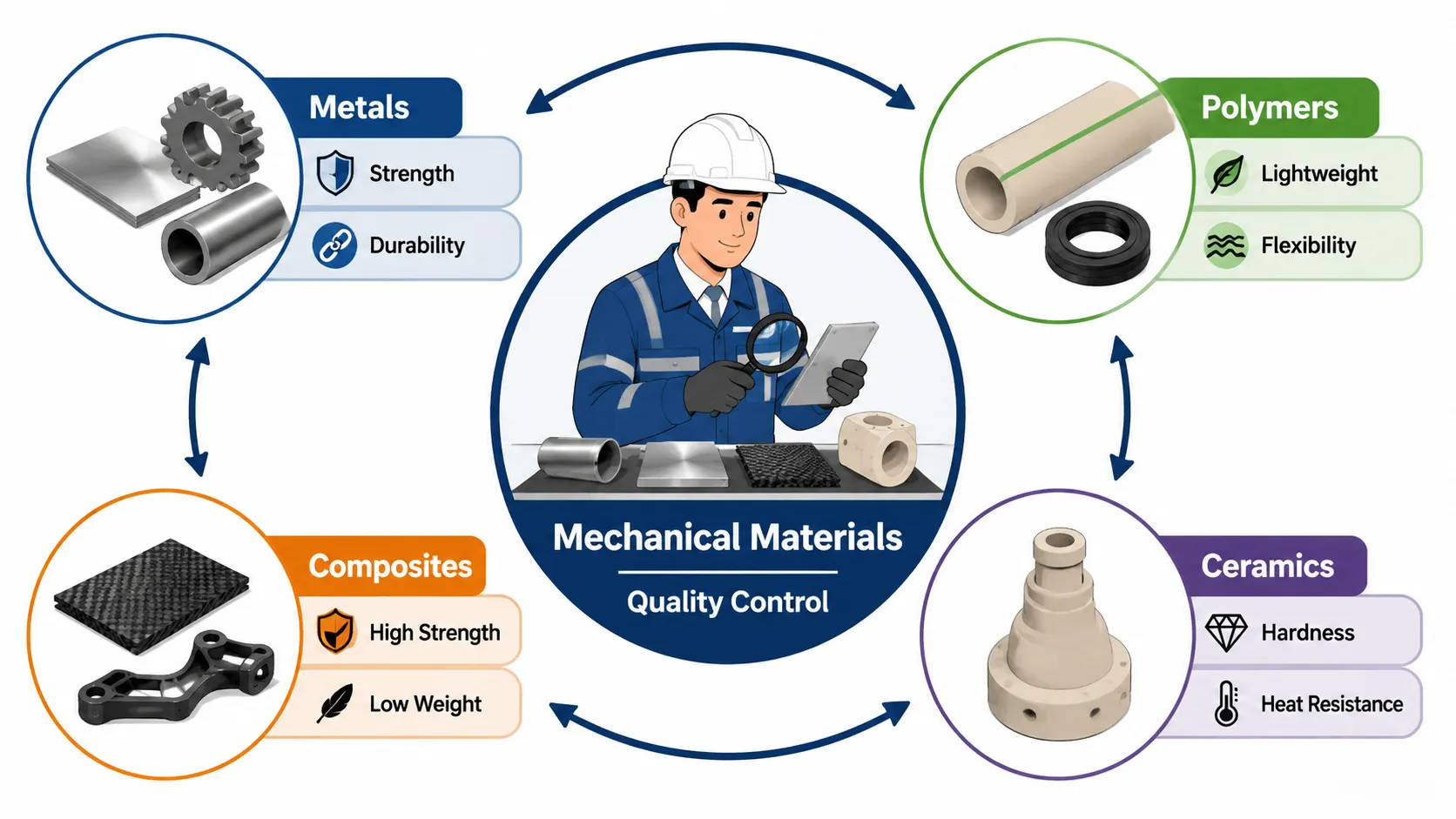
Metals and Alloys
Definition of Metals
Metals are engineering materials known for their high strength, durability, electrical conductivity, and ability to withstand mechanical loads. They are among the most widely used materials in mechanical engineering due to their excellent structural properties.
Common engineering metals include:
- Steel.
- Stainless steel.
- Aluminium.
- Copper.
- Titanium.
- Cast iron.
Steel
Steel is one of the most commonly used materials in mechanical engineering because of its high strength, toughness, and versatility.
Common applications include:
- Pressure vessels.
- Pipelines.
- Structural components.
- Machine parts.
- Automotive components.
Important quality-related properties of steel include:
- High tensile strength.
- Good weldability.
- Resistance to mechanical stress.
- Ability to withstand heavy loads.
QA/QC engineers inspect steel materials by verifying:
- Material certificates.
- Chemical composition.
- Mechanical test results.
- Surface condition.
- Dimensional accuracy.
Stainless Steel
Stainless steel is widely used where corrosion resistance is required.
Applications include:
- Chemical processing equipment.
- Food processing machinery.
- Medical equipment.
- Marine components.
Important properties include:
- Excellent corrosion resistance.
- High durability.
- Good temperature resistance.
- Hygienic surface characteristics.
Quality control considerations include:
- Correct material grade verification.
- Corrosion resistance testing.
- Weld quality inspection.
- Surface examination.
Aluminium
Aluminium is a lightweight metal commonly used in industries where weight reduction is important.
Applications include:
- Aerospace components.
- Automotive parts.
- Heat exchangers.
- Lightweight structures.
Key properties include:
- Low density.
- Good corrosion resistance.
- High strength-to-weight ratio.
- Good machinability.
However, QA/QC engineers must consider:
- Lower strength compared with some steels.
- Sensitivity to certain manufacturing processes.
- Welding challenges.
Polymers
Definition of Polymers
Polymers are materials made from long molecular chains and are commonly used where lightweight, corrosion resistance, and chemical resistance are required.
Examples include:
- Polyethylene.
- PVC.
- Nylon.
- PTFE.
- Polypropylene.
Properties of Polymers Affecting Quality
Important polymer characteristics include:
- Low weight.
- Chemical resistance.
- Electrical insulation.
- Corrosion resistance.
- Flexibility.
Applications include:
- Pipes.
- Seals.
- Bearings.
- Protective coatings.
- Insulation materials.
From a QA/QC perspective, engineers must evaluate:
- Material compatibility.
- Temperature limitations.
- Chemical resistance.
- Dimensional stability.
For example, polymer pipes used in industrial applications must be inspected to ensure they can withstand pressure and environmental conditions.
Composite Materials
Definition of Composite Materials
Composite materials are created by combining two or more different materials to achieve improved performance characteristics.
Common examples include:
- Carbon fibre reinforced polymers.
- Fiberglass composites.
- Reinforced plastics.
Composite materials are widely used in:
- Aerospace structures.
- Automotive components.
- Marine applications.
- High-performance mechanical systems.
Properties of Composite Materials
Important properties include:
- High strength-to-weight ratio.
- Excellent corrosion resistance.
- High stiffness.
- Reduced weight.
Quality control challenges include:
- Detecting internal defects.
- Ensuring correct fibre orientation.
- Controlling manufacturing processes.
Inspection methods may include:
- Visual inspection.
- Ultrasonic testing.
- Dimensional inspection.
Ceramic Materials
Definition of Ceramics
Ceramics are non-metallic materials known for high hardness, temperature resistance, and wear resistance.
Applications include:
- Heat-resistant components.
- Cutting tools.
- Electrical components.
Key properties include:
- High temperature resistance.
- Excellent hardness.
- Chemical stability.
However, ceramics have limitations:
- Low toughness.
- Brittle behaviour.
- Difficult machining.
QA/QC engineers must carefully evaluate their suitability before application.
Comparison of Common Mechanical Engineering Materials
| Material Type | Definition | Key Properties | Common Applications | Quality Considerations |
|---|---|---|---|---|
| Steel | Iron-based alloy with carbon content | High strength, toughness, weldability | Structures, pipelines, machinery | Material grade, chemical composition, strength testing |
| Stainless Steel | Corrosion-resistant steel alloy | Corrosion resistance, durability | Chemical equipment, marine components | Grade verification, corrosion inspection |
| Aluminium | Lightweight metal material | Low weight, corrosion resistance | Aerospace, automotive parts | Strength verification, manufacturing control |
| Polymers | Long-chain synthetic materials | Lightweight, chemical resistance | Pipes, seals, coatings | Temperature resistance, material compatibility |
| Composites | Combination of different materials | High strength-to-weight ratio | Aerospace, marine structures | Internal defect detection, manufacturing quality |
| Ceramics | Hard non-metallic materials | Heat resistance, hardness | Cutting tools, high-temperature parts | Brittleness assessment, surface inspection |
Material Properties That Impact Quality
Mechanical Properties
Mechanical properties determine how materials behave under applied forces.
Important properties include:
Strength
Strength is the ability of a material to withstand external forces without failure.
It affects:
- Load capacity.
- Structural safety.
- Component reliability.
Hardness
Hardness measures resistance to surface damage and wear.
It influences:
- Component lifespan.
- Wear resistance.
- Surface durability.
Toughness
Toughness describes the ability to absorb energy before breaking.
It is important for:
- Impact resistance.
- Heavy-duty applications.
- Safety-critical components.
Fatigue Resistance
Fatigue resistance determines how well materials perform under repeated loading.
Important for:
- Rotating equipment.
- Shafts.
- Aircraft components.
Chemical Properties Affecting Quality
Chemical properties influence material behaviour in different environments.
Important factors include:
- Corrosion resistance.
- Chemical stability.
- Oxidation resistance.
For example, materials used in chemical plants must resist aggressive chemicals to maintain long-term reliability.
Thermal Properties Affecting Quality
Mechanical components often operate under extreme temperatures.
Important thermal properties include:
- Heat resistance.
- Thermal expansion.
- Thermal conductivity.
Incorrect thermal properties can cause:
- Distortion.
- Cracking.
- Dimensional changes.
Role of QA/QC Mechanical Engineer in Material Quality Control
QA/QC Mechanical Engineers are responsible for ensuring that materials meet project and engineering requirements.
Their responsibilities include:
- Reviewing material specifications.
- Checking material certificates.
- Verifying supplier documentation.
- Conducting material inspections.
- Monitoring testing activities.
- Confirming compliance with standards.
- Managing material non-conformities.
Material quality control activities include:
- Incoming material inspection.
- Chemical testing.
- Mechanical testing.
- Dimensional verification.
- Traceability management.
Practical Workplace Example: Material Selection for Pressure Equipment
A manufacturing company planned to produce pressure vessels for a chemical processing facility.
Quality Challenge
The equipment required:
- High pressure resistance.
- Corrosion protection.
- Long service life.
Material Evaluation
The QA/QC team assessed:
- Material strength.
- Corrosion resistance.
- Temperature capability.
- Welding suitability.
Selected Material
Stainless steel was selected because it provided:
- Improved corrosion resistance.
- Suitable mechanical strength.
- Better performance in chemical environments.
Outcome
The correct material selection resulted in:
- Improved equipment reliability.
- Reduced maintenance requirements.
- Successful inspection approval.
- Increased customer confidence.
Case Study: Material Failure Investigation in Mechanical Equipment
Background
A manufacturing company experienced repeated cracking in mechanical shafts during operation.
Investigation
The QA/QC team reviewed:
- Material certificates.
- Mechanical test results.
- Operating conditions.
- Manufacturing records.
Findings
The investigation identified that:
- Incorrect material grade was used.
- Required fatigue resistance was not achieved.
Corrective Actions
The company:
- Selected the correct material specification.
- Improved supplier verification.
- Increased material testing.
Outcome
The improved material control process resulted in:
- Reduced component failures.
- Improved equipment performance.
- Better quality assurance.
Key Benefits of Understanding Engineering Materials
Understanding materials provides several advantages:
- Improves material selection decisions.
- Reduces mechanical failures.
- Enhances product reliability.
- Supports effective inspection planning.
- Improves manufacturing quality.
- Reduces maintenance costs.
- Increases customer satisfaction.
- Supports compliance with engineering standards.
Conclusion
Understanding materials and their properties is essential for effective quality control in mechanical engineering. Metals, polymers, composites, and ceramics each provide unique advantages and limitations that influence component performance, manufacturing requirements, and inspection strategies.
For QA/QC Mechanical Engineers, proper material evaluation ensures that mechanical products meet safety, reliability, and performance expectations. By analysing material properties, verifying specifications, and controlling material quality throughout the production process, engineers can prevent failures, improve product consistency, and support continuous improvement within modern mechanical engineering industries.
2. Explain the Role of Materials Selection in the Design and Manufacturing of Mechanical Products
Introduction to Materials Selection in Mechanical Engineering Quality Control
Materials selection is one of the most important decisions in mechanical engineering design and manufacturing because the chosen material directly influences the quality, reliability, safety, performance, and service life of mechanical products. Every mechanical component, from simple machine parts to complex industrial systems, depends on materials that can withstand specific operating conditions such as mechanical loads, temperature variations, corrosion, wear, vibration, and environmental exposure.
From the perspective of a QA/QC Mechanical Engineer, materials selection is not only a design activity but also a critical quality control responsibility. Selecting an unsuitable material can lead to manufacturing defects, premature failures, increased maintenance costs, and safety risks. Therefore, engineers must evaluate material properties, application requirements, manufacturing processes, and quality standards before approving materials for production.
In modern mechanical engineering industries, materials selection is integrated into every stage of the product lifecycle, including design development, prototype manufacturing, production, inspection, maintenance, and improvement activities. Industries such as oil and gas, automotive, aerospace, power generation, marine, and heavy manufacturing rely on effective materials selection processes to ensure that mechanical products achieve the required performance and comply with international engineering standards.
This lesson explains the role of materials selection in mechanical product design and manufacturing, focusing on how QA/QC Mechanical Engineers evaluate material characteristics, support engineering decisions, prevent quality issues, and ensure that manufactured components meet technical and operational requirements.
Understanding Materials Selection in Mechanical Engineering
Definition of Materials Selection
Materials selection is the systematic process of choosing the most suitable material for a mechanical component based on design requirements, operating conditions, manufacturing processes, cost considerations, and quality expectations.
The selection process considers factors such as:
- Mechanical properties.
- Chemical resistance.
- Thermal behaviour.
- Manufacturing compatibility.
- Availability.
- Cost effectiveness.
- Service environment.
- Required standards.
A correctly selected material ensures that a component can perform safely and efficiently throughout its intended service life.
Importance of Materials Selection in Product Quality
Material selection has a direct impact on the final quality of mechanical products. The wrong material choice can create weaknesses that may not be detected during manufacturing but appear during operation.
Poor material selection may result in:
- Component cracking.
- Excessive wear.
- Corrosion damage.
- Deformation.
- Fatigue failure.
- Reduced equipment reliability.
- Increased maintenance requirements.
Effective materials selection helps organisations achieve:
- Improved product performance.
- Reduced manufacturing defects.
- Longer component lifespan.
- Better operational safety.
- Lower lifecycle costs.
- Improved customer satisfaction.
Role of Materials Selection in Mechanical Product Design
Supporting Functional Requirements
The primary role of material selection in design is ensuring that the material can perform the required function under expected operating conditions.
Mechanical engineers consider:
- Applied loads.
- Operating temperature.
- Pressure conditions.
- Environmental exposure.
- Required service life.
For example, a pressure vessel operating in a chemical processing plant requires materials with:
- High strength.
- Corrosion resistance.
- Pressure resistance.
- Temperature stability.
Selecting an inappropriate material could compromise equipment safety and reliability.
Improving Mechanical Performance
Material properties determine how a component behaves during operation.
Important properties include:
Strength
Strength determines the ability of a material to withstand applied forces without failure.
High-strength materials are required for:
- Structural components.
- Shafts.
- Pressure equipment.
- Heavy machinery parts.
Hardness
Hardness affects resistance to wear and surface damage.
Materials with suitable hardness are used for:
- Gears.
- Cutting tools.
- Bearings.
- Wear-resistant components.
Toughness
Toughness allows materials to absorb energy without sudden failure.
It is important for:
- Impact-loaded components.
- Safety-critical equipment.
- Heavy industrial applications.
Fatigue Resistance
Fatigue resistance determines how well materials perform under repeated loading conditions.
It is essential for:
- Rotating equipment.
- Automotive components.
- Aerospace structures.
Role of Materials Selection in Manufacturing Processes
Ensuring Manufacturing Compatibility
A selected material must be compatible with the intended manufacturing process.
Different materials require different production methods, including:
- Casting.
- Forging.
- Welding.
- Machining.
- Heat treatment.
- Surface finishing.
QA/QC Mechanical Engineers evaluate whether materials can be processed effectively without creating defects.
Examples:
- Some steels provide excellent weldability.
- Aluminium requires controlled welding procedures.
- Composite materials require specialised manufacturing techniques.
Reducing Manufacturing Defects
Correct material selection helps reduce production-related problems.
Material-related manufacturing defects may include:
- Cracking during welding.
- Distortion during heat treatment.
- Poor surface finish.
- Dimensional instability.
By selecting suitable materials, organisations can improve:
- Manufacturing consistency.
- Process efficiency.
- Inspection results.
- Product reliability.
Factors Considered During Materials Selection
Mechanical Requirements
Mechanical requirements define how the material must perform under operational conditions.
Engineers evaluate:
- Tensile strength.
- Yield strength.
- Hardness.
- Impact resistance.
- Fatigue strength.
These properties ensure that components can safely withstand operational loads.
Environmental Conditions
The operating environment significantly influences material selection.
Engineers consider exposure to:
- Moisture.
- Chemicals.
- High temperatures.
- Corrosive environments.
- Radiation.
- Extreme weather conditions.
For example:
- Stainless steel is selected for corrosion-resistant applications.
- Heat-resistant alloys are selected for high-temperature systems.
Manufacturing Requirements
Materials must support efficient production processes.
Considerations include:
- Weldability.
- Machinability.
- Formability.
- Heat treatment response.
- Availability of processing methods.
Economic Considerations
Cost is also an important factor in material selection.
Engineers balance:
- Material purchase cost.
- Manufacturing cost.
- Maintenance cost.
- Expected service life.
A low-cost material may create higher expenses if it fails frequently.
Materials Selection Process in Mechanical Engineering
Step 1: Define Product Requirements
The first step is identifying the functional requirements of the component.
Engineers analyse:
- Operating conditions.
- Performance requirements.
- Safety expectations.
- Service environment.
Step 2: Identify Suitable Material Options
Engineers compare different materials based on:
- Strength.
- Durability.
- Corrosion resistance.
- Manufacturing suitability.
Step 3: Evaluate Material Properties
Material properties are reviewed through:
- Technical specifications.
- Material certificates.
- Laboratory testing.
- Previous performance data.
Step 4: Select and Approve Material
The final material is selected according to:
- Design requirements.
- Engineering standards.
- Customer specifications.
- Quality requirements.
Step 5: Verify Material Quality
QA/QC engineers confirm:
- Correct material grade.
- Proper documentation.
- Compliance with specifications.
- Inspection acceptance.
Comparison Table: Role of Materials Selection in Mechanical Engineering
| Area | Definition | Quality Impact | Example Application |
|---|---|---|---|
| Mechanical Performance | Ability of material to withstand operational forces | Improves reliability and prevents failure | Steel shafts and gears |
| Manufacturing Compatibility | Ability of material to be processed effectively | Reduces production defects | Weldable steel components |
| Environmental Resistance | Ability to withstand operating conditions | Prevents corrosion and degradation | Stainless steel pipelines |
| Cost Effectiveness | Balance between material cost and performance | Reduces lifecycle expenses | Industrial machinery components |
| Safety Compliance | Ability to meet engineering requirements | Improves operational safety | Pressure vessels and structural parts |
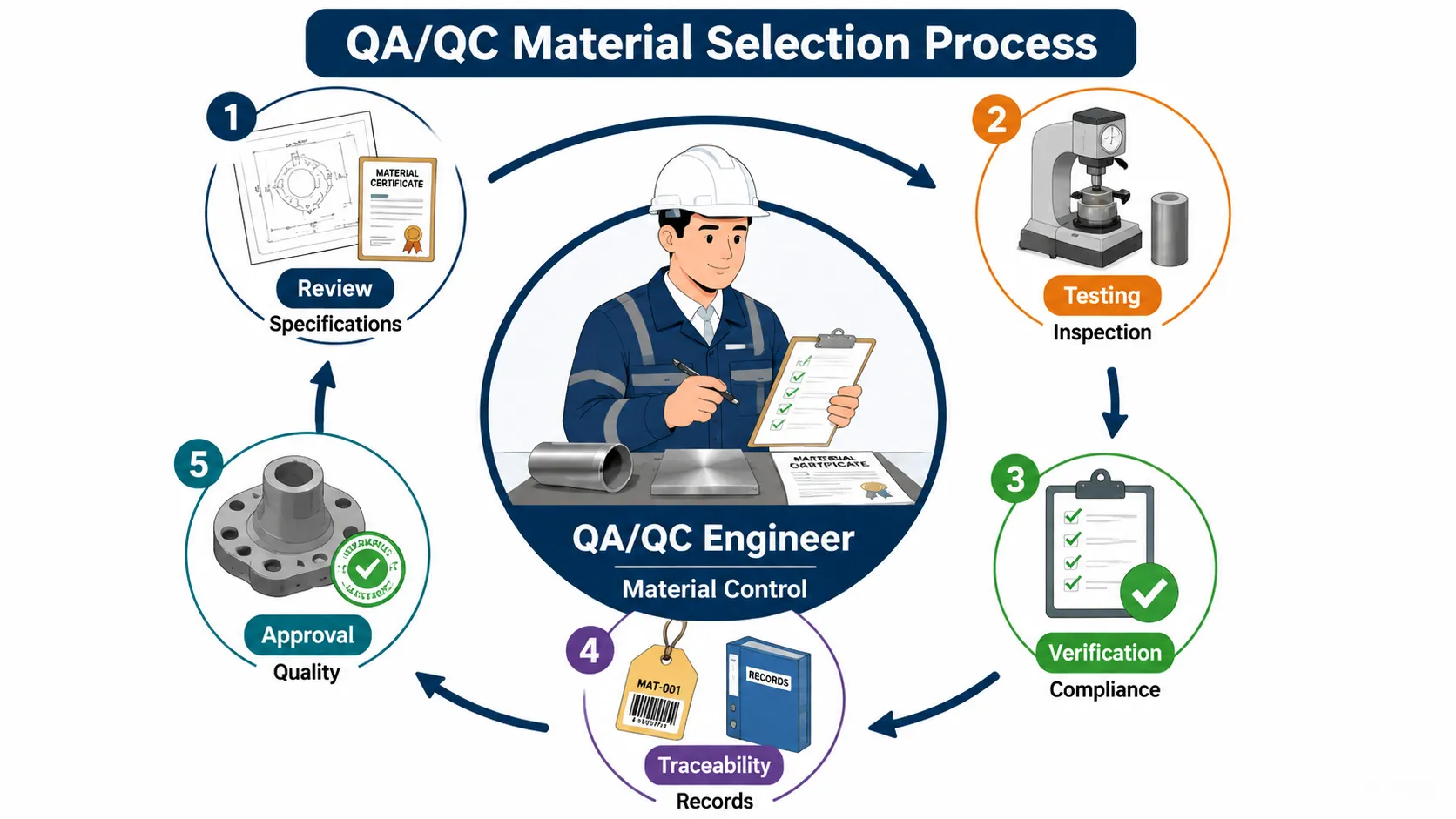
Role of QA/QC Mechanical Engineer in Materials Selection
QA/QC Mechanical Engineers play an important role in ensuring that selected materials meet quality requirements.
Their responsibilities include:
- Reviewing material specifications.
- Checking supplier documentation.
- Verifying material certificates.
- Confirming compliance with standards.
- Monitoring material testing.
- Managing material traceability.
- Conducting inspection activities.
- Controlling non-conforming materials.
Quality control activities include:
- Incoming material inspection.
- Chemical composition verification.
- Mechanical testing review.
- Visual inspection.
- Dimensional checking.

Practical Workplace Example: Material Selection for Industrial Pump Components
Background
A manufacturing company was designing pump components for a chemical processing facility. The components would operate under continuous exposure to chemicals and mechanical stress.
Material Selection Challenge
The engineering team needed a material that could provide:
- High strength.
- Corrosion resistance.
- Long operational life.
Evaluation Process
The QA/QC team reviewed:
- Operating conditions.
- Material specifications.
- Mechanical properties.
- Chemical resistance.
Selected Material
Stainless steel was selected because it provided:
- Strong corrosion resistance.
- Suitable mechanical strength.
- Better durability.
Outcome
The correct material selection resulted in:
- Reduced component failure.
- Improved equipment reliability.
- Lower maintenance requirements.
- Successful quality approval.
Case Study: Failure Caused by Incorrect Material Selection
Background
A company experienced repeated failures in mechanical brackets used in industrial equipment.
Investigation
The QA/QC team analysed:
- Failure reports.
- Material certificates.
- Operating conditions.
- Stress requirements.
Root Cause
The investigation identified that the selected material lacked sufficient fatigue resistance.
Corrective Action
The company:
- Selected a stronger material grade.
- Updated material approval procedures.
- Improved supplier verification.
Results
After implementing improvements:
- Component failures decreased.
- Equipment reliability improved.
- Production interruptions were reduced.
This case demonstrates how effective materials selection prevents quality issues and improves mechanical product performance.
Key Benefits of Effective Materials Selection
Proper materials selection provides several engineering advantages:
- Improves product quality.
- Enhances component reliability.
- Reduces manufacturing defects.
- Increases equipment service life.
- Supports safety requirements.
- Improves manufacturing efficiency.
- Reduces maintenance costs.
- Supports compliance with standards.
- Increases customer confidence.
- Enables better engineering decisions.
Conclusion
Materials selection plays a critical role in the design and manufacturing of mechanical products because it determines how effectively components perform under real operating conditions. For QA/QC Mechanical Engineers, understanding material properties, manufacturing requirements, and application conditions is essential for preventing defects and ensuring product reliability.
By selecting appropriate materials, engineers can improve mechanical performance, reduce failure risks, control manufacturing quality, and achieve compliance with engineering specifications. Effective materials selection is therefore a fundamental quality control practice that supports safe, durable, and high-performing mechanical products across global engineering industries.
3. Understand the Key Manufacturing Processes in Mechanical Engineering and Their Impact on Product Quality
Introduction to Manufacturing Processes in Mechanical Engineering Quality Control
Manufacturing processes are fundamental activities in mechanical engineering that transform raw materials into finished components and products used across industrial applications. The quality, reliability, dimensional accuracy, and performance of mechanical products depend significantly on how manufacturing processes are selected, controlled, and monitored. Processes such as casting, forging, machining, welding, and additive manufacturing are widely used in industries including oil and gas, automotive, aerospace, power generation, marine, construction, and heavy machinery manufacturing.
From the perspective of a QA/QC Mechanical Engineer, understanding manufacturing processes is essential for ensuring that products meet engineering specifications, customer requirements, and international quality standards. Each manufacturing method introduces specific advantages, limitations, and potential quality risks. Poor process control can result in defects such as cracks, dimensional inaccuracies, porosity, distortion, surface damage, and reduced mechanical performance.
Effective quality control requires engineers to understand how manufacturing processes influence material behaviour, component properties, inspection requirements, and final product performance. QA/QC professionals evaluate process parameters, monitor production activities, review inspection results, and implement corrective actions to maintain consistent manufacturing quality.
This lesson explains the major manufacturing processes used in mechanical engineering, including casting, forging, machining, welding, and additive manufacturing. It explores their principles, applications, quality considerations, inspection requirements, and impact on mechanical product reliability.
Importance of Manufacturing Processes in Mechanical Engineering Quality Control
Manufacturing processes directly influence the final characteristics of mechanical components. Even when the correct material is selected, an uncontrolled manufacturing process can reduce product quality and create operational risks.
The manufacturing process affects:
- Component strength.
- Surface finish.
- Dimensional accuracy.
- Material structure.
- Mechanical performance.
- Product reliability.
- Service life.
A QA/QC Mechanical Engineer must ensure that manufacturing activities are performed according to:
- Engineering drawings.
- Technical specifications.
- Approved procedures.
- Quality management requirements.
- Customer expectations.
Role of QA/QC Mechanical Engineer in Manufacturing Process Control
QA/QC Mechanical Engineers are responsible for monitoring manufacturing activities and ensuring that production processes achieve the required quality standards.
Their responsibilities include:
- Reviewing manufacturing procedures.
- Inspecting production activities.
- Verifying process parameters.
- Conducting quality inspections.
- Identifying manufacturing defects.
- Reviewing test results.
- Ensuring compliance with specifications.
- Managing non-conformities.
- Supporting continuous improvement.
Quality control activities may include:
- Incoming material inspection.
- In-process inspection.
- Dimensional verification.
- Non-destructive testing.
- Final product inspection.
Overview of Key Manufacturing Processes
The major manufacturing processes used in mechanical engineering include:
- Casting.
- Forging.
- Machining.
- Welding.
- Additive Manufacturing.
Each process has different operating principles and quality requirements.
Casting Process in Mechanical Engineering
Definition of Casting
Casting is a manufacturing process where molten material, usually metal, is poured into a mould and allowed to solidify into the required shape.
Casting is commonly used for producing complex components that are difficult to manufacture through conventional methods.
Applications include:
- Engine blocks.
- Pump bodies.
- Valve components.
- Machine frames.
- Industrial equipment parts.
Casting Process Steps
The basic casting process includes:
- Pattern preparation.
- Mould creation.
- Melting material.
- Pouring molten material.
- Solidification.
- Removal of casting.
- Surface finishing.
- Inspection.
Quality Factors in Casting
Casting quality depends on controlling:
- Material temperature.
- Cooling rate.
- Mould quality.
- Pouring technique.
- Solidification conditions.
Common casting defects include:
- Porosity.
- Shrinkage cavities.
- Cracks.
- Inclusions.
- Surface defects.
QA/QC inspection methods include:
- Visual inspection.
- Dimensional inspection.
- Radiographic testing.
- Ultrasonic testing.
Impact of Casting on Product Quality
Proper casting control provides:
- Complex component manufacturing.
- Reduced material waste.
- Good structural performance.
- Cost-effective production.
Poor casting control can lead to:
- Reduced strength.
- Internal defects.
- Premature component failure.
Forging Process in Mechanical Engineering
Definition of Forging
Forging is a manufacturing process where metal is shaped by applying compressive forces through pressing or hammering.
Forged components generally have improved strength due to refined grain structure.
Applications include:
- Shafts.
- Gears.
- Connecting rods.
- Heavy machinery components.
Forging Process Steps
The forging process involves:
- Heating raw material.
- Applying mechanical force.
- Shaping the material.
- Cooling and finishing.
- Inspection.
Quality Considerations in Forging
Important factors include:
- Temperature control.
- Force application.
- Material flow.
- Cooling conditions.
Common forging defects include:
- Surface cracks.
- Incorrect dimensions.
- Internal defects.
- Material flow problems.
QA/QC engineers monitor:
- Forging temperature.
- Dimensional accuracy.
- Mechanical properties.
- Surface condition.
Impact of Forging on Product Quality
Advantages include:
- High strength.
- Improved fatigue resistance.
- Better structural integrity.
- Increased component reliability.
However, poor forging control may result in:
- Reduced mechanical performance.
- Hidden internal defects.
- Dimensional problems.
Machining Process in Mechanical Engineering
Definition of Machining
Machining is a manufacturing process where unwanted material is removed from a workpiece to achieve the required shape, size, and surface finish.
Common machining operations include:
- Turning.
- Milling.
- Drilling.
- Grinding.
Applications include:
- Shafts.
- Bearings.
- Precision components.
- Machine parts.
Machining Process Requirements
Machining quality depends on:
- Cutting speed.
- Feed rate.
- Tool condition.
- Machine accuracy.
- Cooling methods.
Quality Issues in Machining
Common machining defects include:
- Incorrect dimensions.
- Poor surface finish.
- Tool marks.
- Material overheating.
- Deformation.
QA/QC inspections include:
- Dimensional measurement.
- Surface roughness testing.
- Visual inspection.
- Coordinate measuring machine inspection.
Impact of Machining on Product Quality
Controlled machining provides:
- High dimensional accuracy.
- Improved surface quality.
- Better component performance.
- Precise manufacturing results.
Poor machining control may cause:
- Assembly problems.
- Increased wear.
- Reduced reliability.
Welding Process in Mechanical Engineering
Definition of Welding
Welding is a joining process that uses heat, pressure, or both to permanently connect materials.
Welding is widely used in:
- Pipelines.
- Pressure vessels.
- Structural components.
- Industrial equipment.
Common Welding Methods
Examples include:
- Shielded Metal Arc Welding (SMAW).
- Gas Metal Arc Welding (GMAW).
- Gas Tungsten Arc Welding (GTAW).
Welding Quality Factors
Welding quality depends on:
- Welding procedure.
- Welder qualification.
- Heat input.
- Material compatibility.
- Inspection control.
Common welding defects include:
- Cracks.
- Porosity.
- Lack of fusion.
- Undercut.
- Incomplete penetration.
QA/QC inspection methods include:
- Visual testing.
- Ultrasonic testing.
- Radiographic testing.
- Dye penetrant testing.
Impact of Welding on Product Quality
Effective welding control provides:
- Strong joints.
- Structural reliability.
- Safe operation.
Poor welding control can result in:
- Structural failure.
- Leakage.
- Reduced component lifespan.
Additive Manufacturing Process
Definition of Additive Manufacturing
Additive manufacturing is a modern production method where components are created by adding material layer by layer based on digital design information.
It is commonly known as:
- 3D printing.
- Layer manufacturing.
Applications include:
- Aerospace components.
- Prototypes.
- Medical devices.
- Complex mechanical parts.
Additive Manufacturing Process Steps
The process includes:
- Digital design creation.
- Material preparation.
- Layer-by-layer production.
- Post-processing.
- Quality inspection.
Quality Considerations in Additive Manufacturing
Important factors include:
- Layer bonding.
- Material consistency.
- Printing parameters.
- Dimensional accuracy.
Common defects include:
- Layer separation.
- Porosity.
- Surface irregularities.
- Dimensional errors.
QA/QC methods include:
- Visual inspection.
- Dimensional measurement.
- Non-destructive testing.
Comparison of Manufacturing Processes
| Manufacturing Process | Definition | Main Advantages | Common Quality Issues | Inspection Methods |
|---|---|---|---|---|
| Casting | Producing components by pouring molten material into moulds | Complex shapes, cost-effective production | Porosity, shrinkage, cracks | Visual, RT, UT |
| Forging | Shaping metals using compressive forces | High strength and durability | Cracks, dimensional errors | Dimensional testing, material testing |
| Machining | Removing material to achieve precise dimensions | High accuracy and surface finish | Tool marks, incorrect dimensions | Measurement, surface inspection |
| Welding | Joining materials using heat or pressure | Strong permanent joints | Cracks, porosity, lack of fusion | VT, UT, RT, PT |
| Additive Manufacturing | Building components layer by layer | Complex designs, reduced waste | Layer defects, porosity | Visual, dimensional, NDT |
Manufacturing Process Selection and Quality Impact
Selecting the correct manufacturing process is essential for achieving product requirements.
Engineers consider:
- Component design.
- Material properties.
- Production quantity.
- Required accuracy.
- Cost requirements.
- Operating conditions.
For example:
- Forging is preferred for high-strength shafts.
- Casting is suitable for complex shapes.
- Machining is used for precision components.
- Welding is used for large assembled structures.
- Additive manufacturing is useful for complex lightweight designs.
Practical Workplace Example: Manufacturing Quality Control of Pressure Vessel Components
Background
A company was manufacturing pressure vessels for an industrial facility. The components required high strength and leak prevention.
Manufacturing Processes Used
The production involved:
- Material preparation.
- Welding of vessel sections.
- Machining of connection points.
- Final inspection.
QA/QC Activities
The QA/QC team performed:
- Welding inspection.
- Dimensional checks.
- Non-destructive testing.
- Documentation review.
Quality Issue Identified
Radiographic testing detected internal weld porosity.
Corrective Action
The company:
- Repaired the defective weld.
- Reviewed welding parameters.
- Increased process monitoring.
Outcome
The improved process control resulted in:
- Better weld quality.
- Increased product reliability.
- Successful customer approval.
Case Study: Machining Process Improvement
Background
A manufacturing company experienced repeated dimensional errors in precision mechanical components.
Investigation
The QA/QC team reviewed:
- Machine settings.
- Tool conditions.
- Inspection records.
Findings
The root cause was identified as:
- Incorrect cutting parameters.
- Worn machining tools.
Corrective Actions
The company:
- Improved machine calibration.
- Introduced tool monitoring.
- Updated machining procedures.
Results
The improvement achieved:
- Reduced rejection rates.
- Better dimensional accuracy.
- Improved production efficiency.
Key Benefits of Understanding Manufacturing Processes
Knowledge of manufacturing processes helps engineers to:
- Improve product quality.
- Reduce manufacturing defects.
- Select suitable production methods.
- Improve inspection planning.
- Increase reliability.
- Reduce production costs.
- Support compliance requirements.
- Improve customer satisfaction.
- Enhance continuous improvement.
Conclusion
Understanding key manufacturing processes is essential for effective quality control in mechanical engineering. Processes such as casting, forging, machining, welding, and additive manufacturing significantly influence the quality, reliability, and performance of mechanical products.
For QA/QC Mechanical Engineers, controlling manufacturing processes ensures that components meet design requirements, safety standards, and customer expectations. By understanding process principles, identifying potential defects, and applying appropriate inspection methods, engineers can improve product reliability, reduce failures, and support successful manufacturing operations across global mechanical engineering industries.
4. Assess the Effects of Different Manufacturing Processes on Material Properties and Product Performance
Introduction to the Relationship Between Manufacturing Processes, Material Properties, and Product Performance
Manufacturing processes have a significant influence on the final properties, quality, and performance of mechanical engineering products. Although material selection determines the basic characteristics of a component, the manufacturing process can modify the internal structure, surface condition, dimensional accuracy, and mechanical behaviour of the material. Therefore, understanding how manufacturing methods affect material properties is essential for producing reliable, safe, and high-performing mechanical components.
From the perspective of a QA/QC Mechanical Engineer, evaluating the effect of manufacturing processes on materials is a critical quality control activity. Processes such as casting, forging, machining, welding, heat treatment, and additive manufacturing can improve or reduce material performance depending on how they are controlled. Incorrect process parameters, poor workmanship, or inadequate monitoring can introduce defects that affect strength, durability, corrosion resistance, and service life.
Modern mechanical engineering industries rely on effective process control to ensure that manufactured components meet design requirements and international quality standards. Industries such as oil and gas, aerospace, automotive, power generation, marine, and heavy manufacturing must carefully assess manufacturing effects because components often operate under high loads, extreme temperatures, pressure conditions, and corrosive environments.
This lesson explains how different manufacturing processes influence material properties and product performance. It focuses on the role of QA/QC Mechanical Engineers in evaluating process impacts, controlling manufacturing risks, and ensuring that mechanical products achieve the required quality, reliability, and operational performance.
Importance of Evaluating Manufacturing Effects on Materials
Manufacturing processes can significantly change the physical and mechanical characteristics of materials. During production, materials may experience:
- Heating and cooling cycles.
- Mechanical deformation.
- Material removal.
- Joining operations.
- Surface modification.
- Layer-by-layer formation.
These activities can affect:
- Material strength.
- Hardness.
- Toughness.
- Fatigue resistance.
- Corrosion behaviour.
- Surface quality.
- Dimensional accuracy.
A QA/QC Mechanical Engineer must understand these effects to determine whether a manufacturing process is suitable for a specific application.
Effective evaluation helps organisations to:
- Prevent material-related failures.
- Improve product reliability.
- Reduce manufacturing defects.
- Control production quality.
- Increase equipment lifespan.
- Maintain customer confidence.
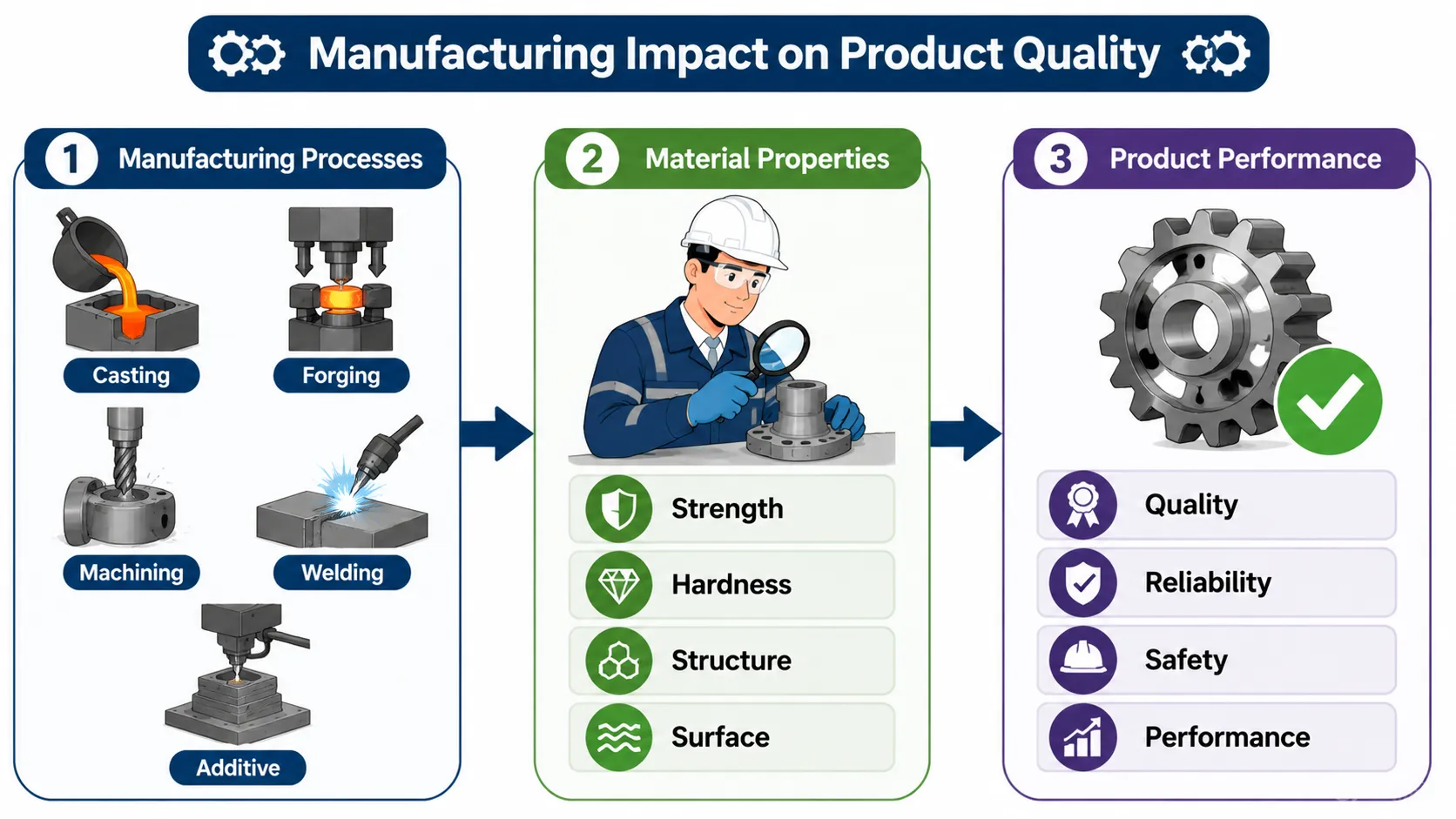
How Manufacturing Processes Influence Material Properties
Changes in Material Structure
Manufacturing processes can alter the internal structure of materials.
For example:
- Forging can refine grain structure and improve strength.
- Welding can create heat-affected zones.
- Casting can introduce internal porosity.
- Heat treatment can modify hardness and toughness.
The internal structure directly affects how components perform during operation.
Changes in Mechanical Properties
Manufacturing processes influence important mechanical properties such as:
- Tensile strength.
- Yield strength.
- Hardness.
- Ductility.
- Toughness.
- Fatigue resistance.
Poor process control may reduce these properties and increase the risk of failure.
Changes in Surface Properties
Manufacturing processes also affect surface characteristics.
Important surface factors include:
- Surface roughness.
- Wear resistance.
- Corrosion resistance.
- Dimensional accuracy.
For precision mechanical components, surface quality is essential for proper operation.
Effects of Casting Process on Material Properties and Product Performance
Understanding Casting Effects
Casting involves pouring molten material into a mould and allowing it to solidify. It is widely used for producing complex mechanical components.
Common applications include:
- Engine blocks.
- Pump housings.
- Valve bodies.
- Machine frames.
Casting can provide cost-effective manufacturing but requires careful process control.
Effects of Casting on Material Properties
Positive Effects
Proper casting processes can provide:
- Ability to manufacture complex shapes.
- Reduced machining requirements.
- Efficient material usage.
- Good structural performance.
Negative Effects
Poor casting control may cause:
- Porosity.
- Shrinkage defects.
- Internal voids.
- Inclusions.
- Uneven material structure.
These defects can reduce:
- Strength.
- Fatigue resistance.
- Pressure capability.
QA/QC Considerations for Casting
QA/QC engineers monitor:
- Melting temperature.
- Mould quality.
- Cooling rate.
- Material composition.
- Defect detection results.
Inspection methods include:
- Visual inspection.
- Radiographic testing.
- Ultrasonic testing.
- Dimensional inspection.
Effects of Forging Process on Material Properties and Product Performance
Understanding Forging Effects
Forging shapes metals through compressive forces using presses or hammers. It is commonly used for high-strength components.
Applications include:
- Shafts.
- Gears.
- Connecting rods.
- Heavy machinery parts.
Effects of Forging on Material Properties
Positive Effects
Forging improves:
- Grain structure.
- Mechanical strength.
- Toughness.
- Fatigue resistance.
Forged components are often preferred for safety-critical applications because of their improved structural integrity.
Negative Effects
Incorrect forging conditions may cause:
- Cracking.
- Incorrect dimensions.
- Internal stress.
- Material flow defects.
QA/QC Considerations for Forging
Engineers control:
- Heating temperature.
- Forging pressure.
- Cooling conditions.
- Final dimensions.
Quality verification includes:
- Mechanical testing.
- Dimensional inspection.
- Surface examination.
Effects of Machining Process on Material Properties and Product Performance
Understanding Machining Effects
Machining removes unwanted material to achieve precise dimensions and surface finishes.
Common machining operations include:
- Turning.
- Milling.
- Drilling.
- Grinding.
Machining is widely used for producing accurate mechanical components.
Effects of Machining on Material Properties
Positive Effects
Controlled machining improves:
- Dimensional accuracy.
- Surface finish.
- Component fit.
- Assembly performance.
Negative Effects
Poor machining practices may cause:
- Surface damage.
- Residual stresses.
- Overheating.
- Reduced fatigue life.
- Incorrect dimensions.
For example, excessive cutting temperatures can affect surface hardness and component performance.
QA/QC Considerations for Machining
QA/QC engineers evaluate:
- Machine calibration.
- Tool condition.
- Cutting parameters.
- Surface quality.
Inspection methods include:
- Dimensional measurement.
- Surface roughness testing.
- Coordinate measurement.
Effects of Welding Process on Material Properties and Product Performance
Understanding Welding Effects
Welding joins materials using heat, pressure, or both. It is essential for manufacturing large structures and assemblies.
Applications include:
- Pipelines.
- Pressure vessels.
- Storage tanks.
- Structural frameworks.
Effects of Welding on Material Properties
Positive Effects
Proper welding provides:
- Strong permanent joints.
- Efficient fabrication.
- Reliable structural connections.
Negative Effects
Welding can introduce:
- Heat-affected zones.
- Residual stresses.
- Distortion.
- Cracks.
- Porosity.
- Reduced corrosion resistance.
The heat generated during welding can change the microstructure of surrounding material.
QA/QC Considerations for Welding
QA/QC engineers control:
- Welding procedures.
- Welder qualification.
- Heat input.
- Welding parameters.
- Inspection requirements.
Inspection methods include:
- Visual testing.
- Ultrasonic testing.
- Radiographic testing.
- Dye penetrant testing.
Effects of Additive Manufacturing on Material Properties and Product Performance
Understanding Additive Manufacturing Effects
Additive manufacturing creates components by adding material layer by layer from digital models.
Applications include:
- Aerospace parts.
- Prototype components.
- Complex mechanical designs.
Effects on Material Properties
Positive Effects
Additive manufacturing provides:
- Lightweight structures.
- Complex geometries.
- Reduced material waste.
- Design flexibility.
Negative Effects
Potential issues include:
- Layer bonding problems.
- Porosity.
- Surface irregularities.
- Directional strength variations.
QA/QC Considerations
Engineers evaluate:
- Printing parameters.
- Material consistency.
- Layer quality.
- Dimensional accuracy.
Inspection methods include:
- Visual inspection.
- Dimensional testing.
- Non-destructive testing.
Comparison Table: Effects of Manufacturing Processes on Materials and Performance
| Manufacturing Process | Definition | Effect on Material Properties | Impact on Product Performance | Common Quality Risks |
|---|---|---|---|---|
| Casting | Forming components by solidifying molten material in moulds | May create structural changes and internal defects | Suitable for complex components | Porosity, shrinkage, inclusions |
| Forging | Shaping materials using compressive forces | Improves grain structure and strength | High durability and fatigue resistance | Cracks, deformation |
| Machining | Removing material to achieve required shape | Improves accuracy but may create surface stresses | Better fitting and precision | Surface damage, dimensional errors |
| Welding | Joining materials through heat or pressure | Creates heat-affected zones and stress changes | Provides strong structural joints | Cracks, distortion, porosity |
| Additive Manufacturing | Building components layer by layer | Creates unique structures and material behaviour | Enables complex lightweight products | Layer defects, porosity |
Role of QA/QC Mechanical Engineer in Evaluating Manufacturing Effects
QA/QC Mechanical Engineers ensure that manufacturing processes do not negatively affect material performance.
Their responsibilities include:
- Reviewing manufacturing procedures.
- Approving process parameters.
- Monitoring production activities.
- Evaluating inspection results.
- Reviewing test certificates.
- Identifying manufacturing defects.
- Performing quality audits.
- Implementing corrective actions.
They ensure that:
- Materials maintain required properties.
- Processes meet specifications.
- Products achieve expected performance.
- Defects are identified before operation.
Practical Workplace Example: Welding Process Impact on Pressure Vessel Quality
Background
A company manufactured pressure vessels for a chemical processing plant. The vessels required strong welded joints because they would operate under high pressure.
Quality Challenge
The QA/QC team needed to ensure that welding did not reduce material performance.
Inspection Activities
The team performed:
- Welding procedure review.
- Visual inspection.
- Radiographic testing.
- Ultrasonic testing.
Issue Identified
Radiographic inspection detected internal weld porosity.
Corrective Action
The company:
- Repaired defective weld areas.
- Adjusted welding parameters.
- Improved process monitoring.
Outcome
The improved welding control resulted in:
- Better weld integrity.
- Increased pressure vessel reliability.
- Reduced failure risks.
- Successful quality approval.
Case Study: Forging Process Improvement for Mechanical Shafts
Background
A manufacturing company experienced premature failure of forged shafts used in heavy machinery.
Investigation
The QA/QC team analysed:
- Manufacturing records.
- Material test results.
- Operating conditions.
Findings
The investigation identified improper cooling conditions after forging.
Corrective Actions
The company:
- Improved cooling procedures.
- Increased process monitoring.
- Updated quality inspection requirements.
Results
The improvements achieved:
- Increased shaft strength.
- Improved fatigue resistance.
- Reduced equipment downtime.
Key Benefits of Evaluating Manufacturing Process Effects
Understanding manufacturing effects provides several benefits:
- Improves product reliability.
- Prevents manufacturing failures.
- Supports better process selection.
- Enhances quality control planning.
- Reduces repair and rejection costs.
- Improves safety performance.
- Extends component service life.
- Supports compliance with engineering standards.
- Increases customer satisfaction.
- Encourages continuous improvement.
Conclusion
Manufacturing processes have a direct influence on material properties and the performance of mechanical products. Processes such as casting, forging, machining, welding, and additive manufacturing can improve component performance when properly controlled, but they can also introduce defects and weaknesses if not managed effectively.
For QA/QC Mechanical Engineers, understanding these effects is essential for maintaining product quality and reliability. By evaluating manufacturing methods, monitoring process parameters, applying appropriate inspection techniques, and controlling production risks, engineers can ensure that mechanical components meet required specifications and perform safely throughout their operational life.
Effective control of manufacturing processes is therefore a key element of mechanical engineering quality management, supporting reliable products, reduced failures, and successful industrial operations.
5. Evaluate the Potential for Defects in Materials and Processes and Recommend Methods for Detection and Correction
Introduction to Material and Process Defects in Mechanical Engineering Quality Control
Defects in materials and manufacturing processes are among the major factors that influence the quality, reliability, and performance of mechanical engineering products. During the manufacturing lifecycle, materials may develop imperfections due to incorrect material selection, poor process control, improper handling, environmental conditions, or inaccurate manufacturing parameters. These defects can reduce mechanical strength, affect dimensional accuracy, shorten service life, and create safety risks during operation.
From the perspective of a QA/QC Mechanical Engineer, identifying, evaluating, and controlling defects is an essential responsibility within mechanical quality management. Engineers must understand how defects such as porosity, distortion, dimensional inaccuracies, cracks, inclusions, and surface imperfections develop, how they affect product performance, and which inspection methods can be used to detect and correct them.
Modern engineering industries such as oil and gas, aerospace, automotive, power generation, marine, and heavy manufacturing depend on effective defect prevention strategies to ensure that components meet technical specifications and international quality requirements. A defect that remains undetected during manufacturing can lead to equipment failure, unexpected downtime, increased maintenance costs, and operational hazards.
This lesson explains the potential defects that can occur in materials and manufacturing processes, focusing on common issues such as porosity, distortion, and dimensional inaccuracies. It also discusses inspection techniques, corrective actions, preventive measures, and the role of QA/QC Mechanical Engineers in maintaining product quality.
Understanding Manufacturing and Material Defects
Definition of Material and Process Defects
A defect is an undesirable condition or imperfection in a material, component, or manufactured product that prevents it from meeting required quality standards, design specifications, or performance expectations.
Defects may occur due to:
- Material problems.
- Manufacturing process errors.
- Equipment limitations.
- Human error.
- Incorrect process parameters.
- Poor quality control practices.
A defect does not always mean that a component is unusable. Engineers evaluate the severity, location, and impact of defects against acceptance criteria before making quality decisions.
Importance of Defect Evaluation in Mechanical Engineering
Defect evaluation is important because it helps organisations:
- Prevent equipment failures.
- Improve product reliability.
- Reduce manufacturing waste.
- Maintain safety standards.
- Improve production efficiency.
- Reduce repair costs.
- Meet customer requirements.
QA/QC Mechanical Engineers evaluate defects to determine:
- Defect type.
- Defect size.
- Defect location.
- Defect severity.
- Effect on component performance.
Common Defects in Materials and Manufacturing Processes
Mechanical engineering components can experience different types of defects depending on the material and manufacturing method.
Common defects include:
- Porosity.
- Distortion.
- Dimensional inaccuracies.
- Cracks.
- Inclusions.
- Lack of fusion.
- Surface defects.
- Material weaknesses.
Each defect requires suitable detection methods and corrective actions.
Porosity Defects in Mechanical Engineering
Definition of Porosity
Porosity refers to the presence of small holes, cavities, or trapped gases within a material or manufactured component. It commonly occurs during casting, welding, and additive manufacturing processes.
Porosity can reduce:
- Mechanical strength.
- Pressure resistance.
- Fatigue performance.
- Structural reliability.
Causes of Porosity
Porosity may develop due to:
- Gas trapped during solidification.
- Poor welding technique.
- Contaminated materials.
- Incorrect process parameters.
- Improper material preparation.
Examples include:
- Gas bubbles trapped inside cast components.
- Air pockets inside weld joints.
- Voids between additive manufacturing layers.
Impact of Porosity on Product Quality
Porosity can cause:
- Reduced load-carrying capability.
- Leakage in pressure equipment.
- Reduced fatigue life.
- Early component failure.
For safety-critical components, even small amounts of porosity may require further investigation.
Detection Methods for Porosity
QA/QC engineers use different inspection techniques depending on the application.
Common methods include:
Radiographic Testing (RT)
Used to detect internal cavities and voids.
Advantages:
- Provides permanent inspection records.
- Shows internal defects clearly.
Applications:
- Weld inspection.
- Casting inspection.
- Pressure equipment.
Ultrasonic Testing (UT)
Used to identify internal discontinuities.
Advantages:
- Detects hidden defects.
- Provides depth information.
Applications:
- Thick components.
- Welded structures.
Visual Inspection
Used for identifying visible surface indications.
Correction Methods for Porosity
Corrective actions include:
- Repair welding.
- Improving welding parameters.
- Removing contaminated materials.
- Controlling manufacturing conditions.
- Improving process monitoring.
Preventive measures include:
- Proper material preparation.
- Equipment calibration.
- Operator training.
- Approved manufacturing procedures.
Distortion Defects in Mechanical Engineering
Definition of Distortion
Distortion is an unwanted change in the shape or dimensions of a component caused by manufacturing stresses, heat effects, or incorrect processing conditions.
Distortion commonly occurs during:
- Welding.
- Heat treatment.
- Casting.
- Machining.
Causes of Distortion
Major causes include:
- Uneven heating and cooling.
- Excessive welding heat input.
- Incorrect clamping methods.
- Residual stresses.
- Improper manufacturing sequence.
Impact of Distortion on Product Quality
Distortion can result in:
- Incorrect component alignment.
- Assembly problems.
- Reduced operational performance.
- Dimensional non-compliance.
For example, welding distortion in a pipeline section may affect proper installation and create additional stress during operation.
Detection Methods for Distortion
QA/QC engineers detect distortion using:
- Dimensional inspection.
- Visual examination.
- Measuring instruments.
- Coordinate measuring machines (CMM).
Inspection tools include:
- Vernier calipers.
- Micrometers.
- Laser measurement systems.
Correction Methods for Distortion
Corrective actions include:
- Mechanical straightening.
- Controlled heating methods.
- Adjusting welding sequence.
- Improving fixture design.
- Modifying process parameters.
Preventive actions include:
- Welding procedure control.
- Proper component positioning.
- Heat management.
Dimensional Inaccuracy Defects
Definition of Dimensional Inaccuracy
Dimensional inaccuracy occurs when the final dimensions of a manufactured component do not match the required engineering drawings or specifications.
Examples include:
- Incorrect length.
- Incorrect diameter.
- Incorrect hole position.
- Incorrect surface dimensions.
Causes of Dimensional Errors
Dimensional inaccuracies may occur due to:
- Incorrect machine settings.
- Tool wear.
- Poor calibration.
- Operator errors.
- Material deformation.
- Incorrect process parameters.
Impact on Product Performance
Dimensional errors can cause:
- Poor component fit.
- Assembly failures.
- Increased wear.
- Reduced efficiency.
- Product rejection.
Precision components require strict dimensional control to function correctly.
Detection Methods for Dimensional Inaccuracies
QA/QC engineers use:
- Dimensional inspection.
- Coordinate measuring machines.
- Engineering drawings comparison.
- Surface measurement tools.
Inspection activities include:
- Checking dimensions.
- Verifying tolerances.
- Confirming alignment.
Correction Methods for Dimensional Errors
Corrective actions include:
- Re-machining components.
- Adjusting machine settings.
- Replacing worn tools.
- Improving calibration procedures.
Preventive measures include:
- Regular equipment maintenance.
- Operator training.
- Process monitoring.
Other Common Manufacturing Defects
Cracks
Cracks are fractures within materials that reduce structural integrity.
Causes:
- Excessive stress.
- Welding problems.
- Fatigue loading.
- Material weaknesses.
Detection methods:
- Ultrasonic testing.
- Magnetic particle testing.
- Dye penetrant testing.
Correction methods:
- Repair procedures.
- Component replacement.
- Process improvement.
Inclusions
Inclusions are unwanted materials trapped inside a component.
Causes:
- Poor material quality.
- Contamination.
- Manufacturing problems.
Detection methods:
- Radiographic testing.
- Ultrasonic testing.
Correction methods:
- Improved material control.
- Manufacturing process improvement.
Defect Detection and Correction Process
A professional QA/QC defect management process includes several stages.
Step 1: Identify the Defect
Engineers collect information about:
- Defect location.
- Defect type.
- Manufacturing stage.
- Component condition.
Step 2: Perform Inspection and Analysis
Inspection methods are selected based on:
- Material type.
- Defect characteristics.
- Component application.
Methods include:
- Visual testing.
- Non-destructive testing.
- Dimensional inspection.
Step 3: Evaluate Defect Severity
Engineers compare findings with:
- Engineering specifications.
- Acceptance criteria.
- Customer requirements.
The component may be classified as:
- Accepted.
- Repaired.
- Rejected.
- Further investigation required.
Step 4: Implement Corrective Actions
Corrective actions may include:
- Repairing defects.
- Changing process parameters.
- Improving procedures.
- Replacing defective materials.
Step 5: Prevent Recurrence
Preventive actions include:
- Process improvement.
- Additional inspections.
- Employee training.
- Updated quality procedures.
Comparison Table: Defects, Detection, and Correction Methods
| Defect Type | Definition | Common Causes | Detection Methods | Correction Methods |
|---|---|---|---|---|
| Porosity | Internal cavities or trapped gases | Poor welding, casting problems | RT, UT, Visual Inspection | Repair welding, process improvement |
| Distortion | Unwanted shape or dimensional change | Heat effects, residual stress | Dimensional inspection, CMM | Straightening, process adjustment |
| Dimensional Inaccuracy | Incorrect component measurements | Machine errors, poor calibration | Measurement tools, CMM | Re-machining, calibration improvement |
| Cracks | Material separation or fracture | Stress, fatigue, welding issues | UT, MT, PT | Repair or replacement |
| Inclusions | Foreign material trapped inside component | Material contamination | RT, UT | Material control improvement |
Role of QA/QC Mechanical Engineer in Defect Management
QA/QC Mechanical Engineers are responsible for ensuring that defects are properly identified, evaluated, and controlled.
Their responsibilities include:
- Reviewing inspection results.
- Selecting appropriate testing methods.
- Analysing defect severity.
- Approving corrective actions.
- Monitoring repair activities.
- Maintaining quality records.
- Supporting continuous improvement.
They ensure:
- Products meet specifications.
- Defects do not reach customers.
- Manufacturing processes remain controlled.
Practical Workplace Example: Weld Porosity Detection in Pipeline Manufacturing
Background
An oil and gas company manufactured a high-pressure pipeline system requiring strict quality control.
Defect Identification
During radiographic testing, inspectors detected internal porosity in weld joints.
Investigation
The QA/QC team reviewed:
- Welding parameters.
- Material preparation.
- Operator procedures.
Root Cause
The investigation identified:
- Incorrect welding settings.
- Poor surface cleaning before welding.
Corrective Actions
The company:
- Repaired defective welds.
- Improved welding procedures.
- Increased inspection frequency.
Outcome
The improved process achieved:
- Better weld quality.
- Reduced defect occurrence.
- Increased pipeline reliability.
- Successful project approval.
Case Study: Dimensional Error in Machined Components
Background
A manufacturing company experienced repeated rejection of precision components.
Investigation
The QA/QC team reviewed:
- Machine calibration records.
- Inspection reports.
- Tool condition.
Findings
The root cause was:
- Worn machining tools.
- Incorrect machine settings.
Corrective Actions
The company:
- Replaced damaged tools.
- Improved calibration schedules.
- Increased dimensional checks.
Results
The improvements achieved:
- Reduced rejection rates.
- Improved production efficiency.
- Better product consistency.
Key Benefits of Effective Defect Detection and Correction
Effective defect management provides:
- Improved product reliability.
- Reduced manufacturing failures.
- Increased customer confidence.
- Better safety performance.
- Lower production costs.
- Improved process control.
- Reduced waste.
- Enhanced quality assurance systems.
- Better compliance with standards.
- Continuous improvement opportunities.
Conclusion
Evaluating defects in materials and manufacturing processes is a critical responsibility within mechanical engineering quality control. Defects such as porosity, distortion, dimensional inaccuracies, cracks, and inclusions can significantly affect product performance, safety, and service life if they are not identified and corrected.
For QA/QC Mechanical Engineers, effective defect management requires understanding defect causes, applying suitable inspection methods, analysing results, and implementing corrective and preventive actions. Through proper quality control practices, organisations can reduce failures, improve manufacturing efficiency, and ensure that mechanical products meet required engineering standards and operational expectations.
6. Apply Quality Control Methods to Ensure Materials and Processes Meet Specified Mechanical and Performance Standards
Introduction to Quality Control Methods in Mechanical Engineering
Quality control methods are essential practices used in mechanical engineering to verify that materials, manufacturing processes, and finished products meet defined technical specifications, performance requirements, and industry standards. In modern engineering industries, maintaining consistent product quality requires systematic inspection, testing, monitoring, and documentation throughout the complete manufacturing lifecycle. Effective quality control ensures that mechanical components are safe, reliable, durable, and capable of performing under their intended operating conditions.
From the perspective of a QA/QC Mechanical Engineer, quality control is not limited to identifying defects after production; it is a proactive approach that begins with material verification and continues through manufacturing, inspection, testing, and final acceptance. Engineers must ensure that raw materials comply with approved specifications, manufacturing processes are properly controlled, and final components achieve required mechanical properties and performance standards.
Industries such as oil and gas, aerospace, automotive, power generation, marine, construction, and heavy manufacturing depend on strong quality control systems because mechanical failures can result in safety hazards, operational downtime, financial losses, and regulatory issues. By applying effective quality control methods, organisations can reduce defects, improve manufacturing efficiency, increase equipment reliability, and achieve customer satisfaction.
This assessment criterion explains how QA/QC Mechanical Engineers apply quality control methods to ensure materials and processes meet specified mechanical and performance standards. It covers inspection techniques, testing procedures, process monitoring, documentation control, standards compliance, practical applications, and continuous improvement approaches.
Importance of Quality Control in Mechanical Engineering
Quality control plays a critical role in ensuring that engineering products achieve the required level of performance and reliability. Mechanical components often operate under challenging conditions involving:
- High mechanical loads.
- Extreme temperatures.
- Pressure variations.
- Corrosive environments.
- Continuous operation.
- Repeated stress cycles.
Without effective quality control, defects can remain undetected and may lead to:
- Component failure.
- Equipment breakdown.
- Safety risks.
- Increased maintenance costs.
- Reduced product lifespan.
Effective quality control helps organisations:
- Verify material quality.
- Maintain manufacturing consistency.
- Prevent defects.
- Improve product reliability.
- Reduce waste and rework.
- Support compliance with engineering standards.
Understanding Quality Control Methods in Mechanical Engineering
Definition of Quality Control
Quality control is a systematic process of inspecting, testing, measuring, and evaluating materials, processes, and products to confirm that they meet established requirements.
Quality control focuses on:
- Detecting defects.
- Measuring performance.
- Verifying specifications.
- Ensuring compliance.
- Improving manufacturing reliability.
For QA/QC Mechanical Engineers, quality control provides objective evidence that engineering components are suitable for their intended applications.
Material Quality Control Methods
Material Inspection and Verification
Material inspection is the first stage of quality control in mechanical engineering. Before manufacturing begins, engineers verify that incoming materials meet required specifications.
Material verification includes:
- Checking material certificates.
- Confirming material grade.
- Reviewing supplier documentation.
- Performing visual inspection.
- Verifying dimensions.
Material certificates provide important information including:
- Chemical composition.
- Mechanical properties.
- Heat treatment details.
- Manufacturing information.
Importance of Material Testing
Material testing ensures that materials possess the required properties for their intended application.
Common material tests include:
Tensile Testing
Tensile testing evaluates:
- Strength.
- Yield behaviour.
- Elongation.
- Material performance under load.
Hardness Testing
Hardness testing determines resistance to:
- Wear.
- Surface damage.
- Deformation.
Impact Testing
Impact testing evaluates:
- Toughness.
- Resistance to sudden loading.
Chemical Testing
Chemical analysis verifies:
- Material composition.
- Alloy content.
- Compliance with specifications.
Process Quality Control Methods
Manufacturing Process Monitoring
Manufacturing processes must be controlled to ensure consistent product quality.
QA/QC Mechanical Engineers monitor:
- Production parameters.
- Equipment settings.
- Process procedures.
- Operator performance.
- Inspection results.
Process monitoring helps identify problems before they affect final products.
Control of Manufacturing Parameters
Different processes require specific controls.
Examples include:
Welding Control
Engineers monitor:
- Welding procedures.
- Heat input.
- Welding consumables.
- Welder qualifications.
- Welding environment.
Machining Control
Engineers control:
- Cutting speed.
- Tool condition.
- Machine calibration.
- Dimensional accuracy.
Casting Control
Engineers monitor:
- Melting temperature.
- Mould condition.
- Cooling rate.
- Material quality.
Inspection Methods Used in Quality Control
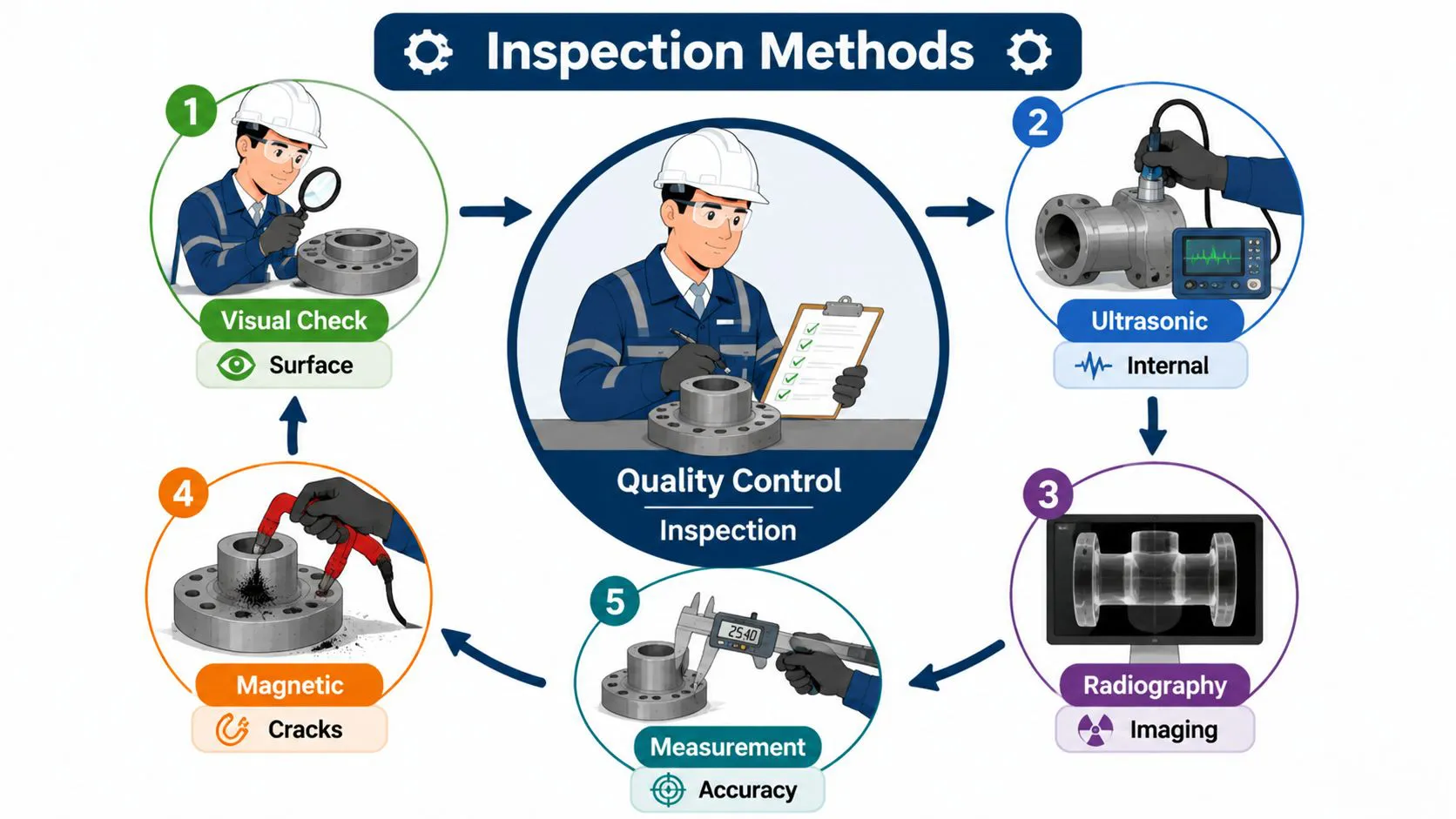
Visual Inspection
Visual inspection is one of the most common quality control methods.
It is used to identify:
- Surface defects.
- Cracks.
- Corrosion.
- Welding irregularities.
- Physical damage.
Advantages include:
- Simple application.
- Low cost.
- Quick results.
Non-Destructive Testing (NDT)
NDT methods allow engineers to inspect components without causing damage.
Common NDT methods include:
Ultrasonic Testing (UT)
Used for detecting:
- Internal cracks.
- Material discontinuities.
- Thickness variations.
Radiographic Testing (RT)
Used for identifying:
- Internal weld defects.
- Porosity.
- Inclusions.
Magnetic Particle Testing (MT)
Used for detecting:
- Surface cracks.
- Near-surface defects.
Dye Penetrant Testing (PT)
Used for identifying:
- Surface-breaking defects.
NDT provides valuable information about component integrity and supports quality decisions.
Dimensional Quality Control
Dimensional inspection ensures that components meet design requirements.
Engineers verify:
- Length.
- Diameter.
- Thickness.
- Alignment.
- Tolerance limits.
Common measurement tools include:
- Vernier calipers.
- Micrometers.
- Coordinate measuring machines.
- Gauges.
Incorrect dimensions can cause:
- Assembly problems.
- Poor performance.
- Equipment failure.
Quality Standards and Compliance Requirements
Mechanical engineering quality control requires compliance with recognised standards and specifications.
Common references include:
- ASME standards.
- ASTM material specifications.
- API requirements.
- ISO quality management systems.
Standards help organisations maintain:
- Consistent quality.
- Safety requirements.
- Reliable performance.
- Customer confidence.
QA/QC engineers ensure that inspection activities and documentation align with applicable standards.
Quality Control Process in Mechanical Engineering
Step 1: Review Technical Requirements
The QA/QC engineer reviews:
- Engineering drawings.
- Material specifications.
- Customer requirements.
- Inspection plans.
This ensures clear quality expectations before production begins.
Step 2: Inspect Incoming Materials
Activities include:
- Material verification.
- Documentation review.
- Testing confirmation.
- Identification control.
Step 3: Monitor Manufacturing Activities
Engineers monitor:
- Process conditions.
- Production parameters.
- Work procedures.
- Quality checkpoints.
Step 4: Perform Inspection and Testing
Inspection activities may include:
- Visual examination.
- Dimensional inspection.
- Mechanical testing.
- Non-destructive testing.
Step 5: Evaluate Results
Inspection results are compared against:
- Acceptance criteria.
- Engineering specifications.
- Quality requirements.
Step 6: Documentation and Reporting
Quality records include:
- Inspection reports.
- Test certificates.
- Non-conformance reports.
- Corrective action records.
Comparison Table: Quality Control Methods in Mechanical Engineering
| Quality Control Method | Definition | Purpose | Application Example |
|---|---|---|---|
| Material Inspection | Verification of incoming materials against specifications | Ensures correct material quality | Checking steel certificates |
| Mechanical Testing | Evaluation of material properties | Confirms strength and performance | Tensile testing |
| Visual Inspection | Direct examination of components | Detects visible defects | Weld surface inspection |
| NDT Testing | Inspection without damaging components | Identifies internal and surface defects | Pipeline weld testing |
| Dimensional Inspection | Measurement of component size and tolerance | Ensures design accuracy | Machined component checking |
| Process Monitoring | Control of manufacturing activities | Maintains production consistency | Welding parameter control |
Role of QA/QC Mechanical Engineer in Quality Control
QA/QC Mechanical Engineers are responsible for ensuring that materials and processes meet required standards.
Their responsibilities include:
- Preparing inspection plans.
- Reviewing technical documents.
- Verifying material compliance.
- Monitoring manufacturing activities.
- Conducting inspections.
- Reviewing test results.
- Managing quality records.
- Investigating defects.
- Supporting corrective actions.
They also ensure:
- Inspection equipment is calibrated.
- Procedures are followed correctly.
- Personnel are qualified.
- Quality requirements are achieved.
Practical Workplace Example: Quality Control of Pipeline Manufacturing
Background
An oil and gas company manufactured high-pressure pipeline systems requiring strict quality control.
Quality Requirements
The pipeline required:
- Correct material properties.
- Strong welded joints.
- Dimensional accuracy.
- Long-term reliability.
Quality Control Activities
The QA/QC team performed:
- Material certificate verification.
- Visual weld inspection.
- Ultrasonic testing.
- Dimensional checks.
- Documentation review.
Issue Identified
Ultrasonic testing detected an internal weld discontinuity.
Corrective Action
The company:
- Repaired the weld.
- Repeated inspection.
- Reviewed welding procedures.
Outcome
The quality control process achieved:
- Improved pipeline reliability.
- Reduced failure risk.
- Successful project approval.
- Compliance with engineering requirements.
Case Study: Improving Manufacturing Quality Through Process Control
Background
A manufacturing company experienced repeated defects in machined components.
Investigation
The QA/QC team analysed:
- Inspection records.
- Machine settings.
- Production data.
Root Cause
The investigation identified:
- Incorrect machining parameters.
- Poor tool maintenance.
Corrective Actions
The company:
- Updated machining procedures.
- Improved equipment maintenance.
- Increased inspection frequency.
Results
The improvements achieved:
- Reduced rejection rates.
- Improved dimensional accuracy.
- Increased production efficiency.
Key Benefits of Applying Quality Control Methods
Effective quality control provides many benefits:
- Improved product reliability.
- Reduced manufacturing defects.
- Better material performance.
- Increased equipment safety.
- Reduced maintenance costs.
- Improved customer satisfaction.
- Stronger compliance with standards.
- Enhanced production efficiency.
- Better decision-making.
- Continuous improvement opportunities.
Conclusion
Applying quality control methods is essential for ensuring that mechanical engineering materials, manufacturing processes, and finished products meet required performance standards. Through material verification, process monitoring, inspection techniques, testing procedures, and documentation control, QA/QC Mechanical Engineers ensure that engineering products achieve the required levels of safety, reliability, and quality.
Effective quality control prevents defects before they become operational problems and supports continuous improvement throughout the manufacturing lifecycle. By applying systematic quality practices and maintaining compliance with engineering standards, organisations can produce reliable mechanical components that deliver safe and efficient performance in demanding industrial environments.