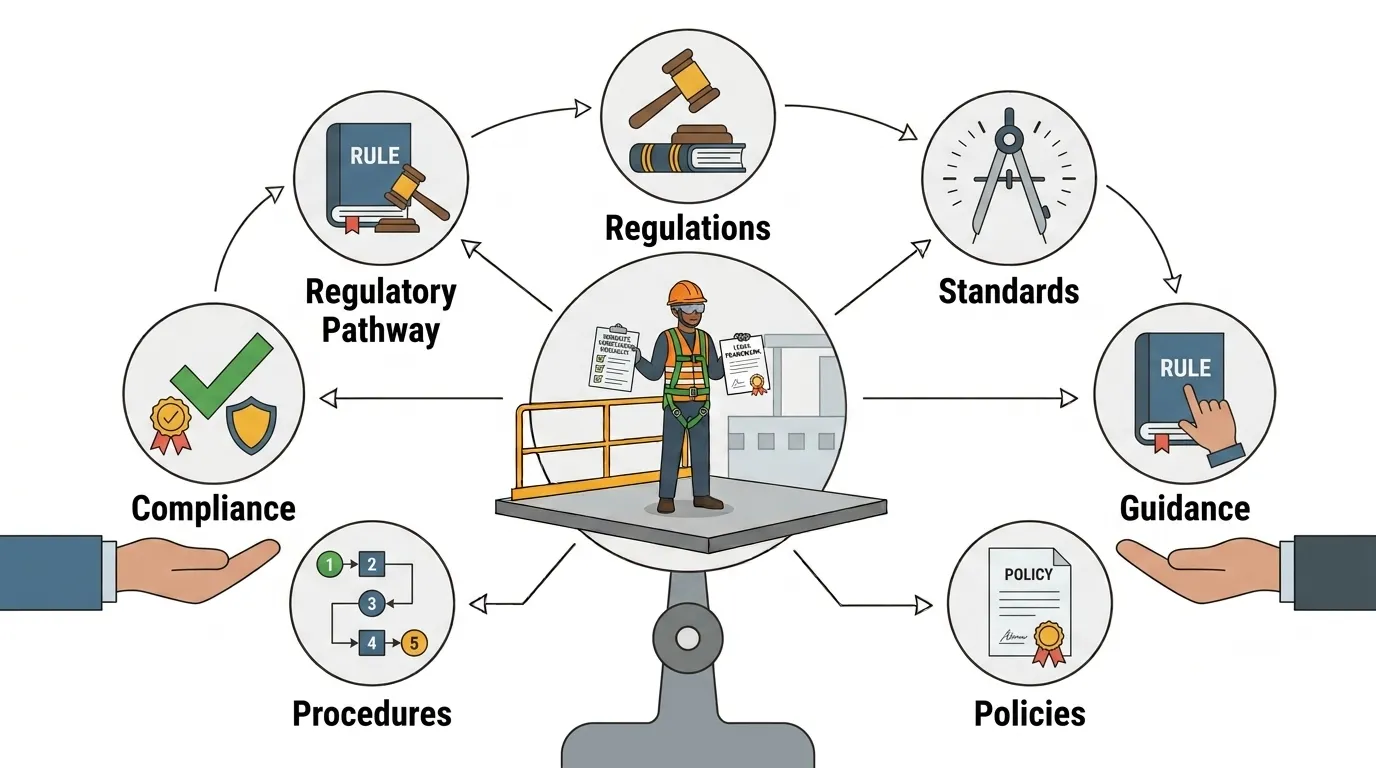
Lesson No 1: Legislation and Regulations
Working at height is a high-risk activity that requires effective safety management, careful planning, and compliance with workplace health and safety legislation. Regulations provide the legal framework for controlling fall hazards, defining the responsibilities of employers, supervisors, and workers, and ensuring that suitable precautions are implemented before any elevated work begins. Understanding these requirements is essential for preventing accidents, protecting workers, and maintaining safe working environments across construction, engineering, maintenance, and industrial sectors.
This lesson introduces learners to the role of legislation and regulations in work at height safety. It explains how legal requirements influence risk assessments, safe systems of work, worker training, equipment inspections, supervision, and emergency planning. Learners will develop an understanding of why organisations must follow recognised safety requirements and how compliance helps reduce workplace risks, improve safety performance, and create a strong health and safety culture.
From a construction HSE and workplace risk management perspective, legislation is not only a legal responsibility but also a practical tool for improving safety standards and operational control. By completing this lesson, learners will understand the importance of regulatory compliance, the duties of individuals involved in work at height activities, and how applying legal principles supports accident prevention, effective risk control, and safer workplaces worldwide.
1. Gain Knowledge of National and International Regulations Governing Work at Height
Introduction to Work at Height Regulations
Work at height activities are performed across many industries, including construction, engineering, maintenance, manufacturing, telecommunications, utilities, and facilities management. Due to the serious risks associated with falls from elevated locations, governments and international organisations have developed legislation, regulations, and safety standards to protect workers and ensure that employers implement effective control measures.
Understanding national and international regulations governing work at height is an essential part of occupational health and safety training. These regulations establish minimum safety requirements for planning work activities, assessing risks, selecting suitable equipment, providing worker training, and maintaining safe working environments. Compliance with these requirements helps organisations reduce workplace accidents, improve safety performance, and protect workers from serious injuries or fatalities.
For learners completing the ICTQual Level 1 Award in Work at Height, knowledge of regulatory frameworks provides the foundation for understanding why safety procedures are required and how legal responsibilities influence workplace practices. Regulations are not only legal obligations but also practical tools that guide organisations in preventing falls and managing workplace hazards effectively.
Understanding the Purpose of Work at Height Regulations
Work at height regulations are designed to control risks by ensuring that employers and workers follow systematic safety practices before, during, and after elevated work activities. These regulations focus on preventing falls rather than responding after an accident has occurred.
The main objectives of work at height regulations include:
- Preventing falls from elevated areas.
- Ensuring risks are assessed before work begins.
- Requiring suitable equipment and protective systems.
- Ensuring workers receive appropriate training.
- Establishing employer and employee responsibilities.
- Promoting safe planning and supervision.
- Improving workplace safety culture.
Effective regulations encourage organisations to adopt a proactive approach where hazards are identified and controlled before they result in incidents.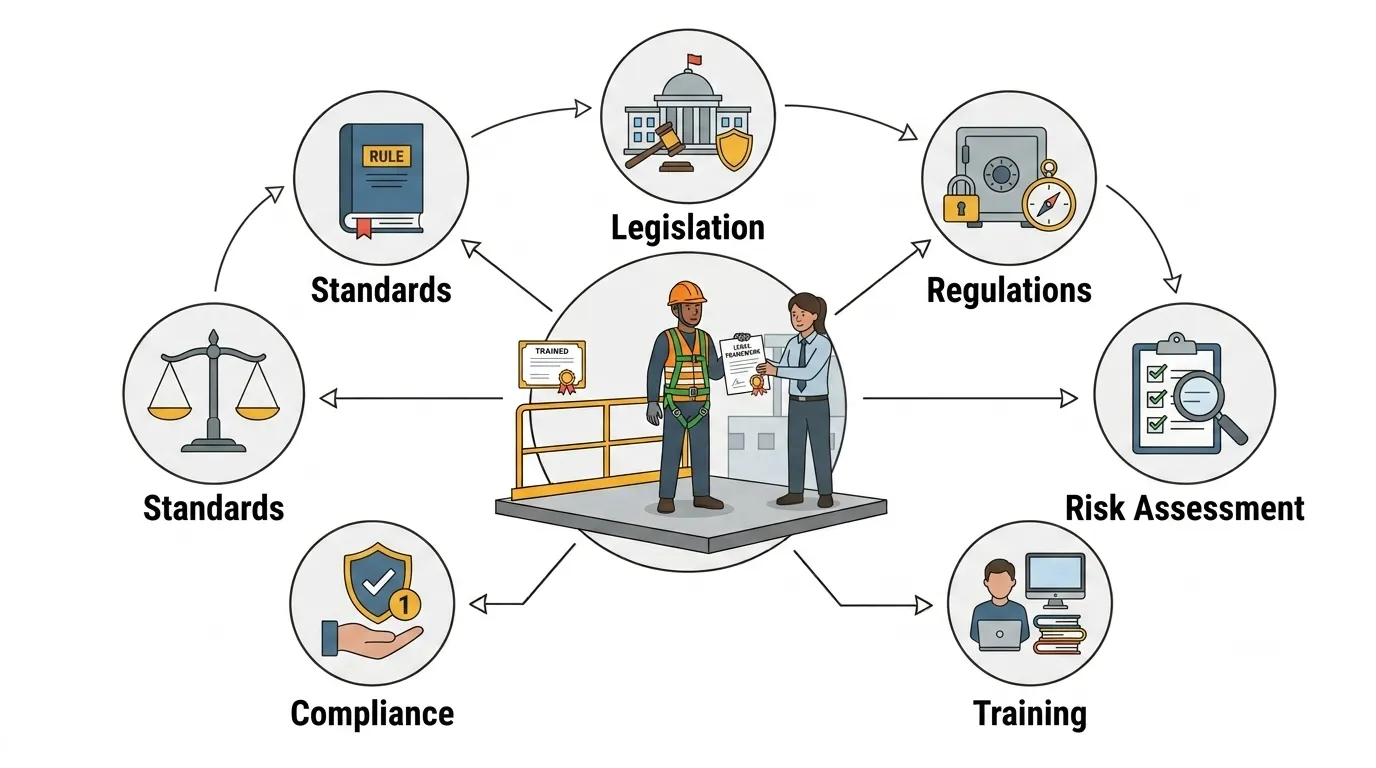
Key Concepts of Work at Height Legislation
Understanding the terminology used in work at height regulations helps learners interpret safety requirements correctly.
| Key Concept | Definition | Importance in Work at Height Safety |
|---|---|---|
| Legislation | Laws created by governments to establish mandatory safety requirements | Provides legal obligations for employers and workers |
| Regulation | Detailed rules explaining how legal requirements must be applied | Provides practical guidance for controlling workplace risks |
| Risk Assessment | A systematic process of identifying hazards and evaluating risks | Helps determine suitable safety controls before work begins |
| Competence | The ability of a person to perform a task safely through knowledge, skills, and experience | Ensures workers can complete activities correctly |
| Safe System of Work | A planned method for completing tasks while controlling hazards | Reduces the likelihood of accidents |
| Fall Protection | Equipment and procedures designed to prevent or reduce injury from falls | Protects workers during elevated activities |
National Regulations Governing Work at Height
National regulations are developed by individual countries to establish workplace safety requirements according to local legal systems, industrial conditions, and occupational safety priorities. Although specific laws differ between countries, most national frameworks follow similar principles focused on preventing falls and protecting workers.
National regulations commonly require employers to:
- Identify work at height hazards.
- Complete suitable risk assessments.
- Provide safe access and working platforms.
- Supply appropriate personal protective equipment (PPE).
- Ensure workers are trained and competent.
- Maintain and inspect equipment regularly.
- Provide adequate supervision.
Workers also have responsibilities under most national safety systems, including:
- Following workplace safety procedures.
- Using equipment correctly.
- Attending required training.
- Reporting unsafe conditions.
- Avoiding actions that may endanger themselves or others.
Examples of National Work at Height Regulations
Different countries have developed specific regulations to manage work at height risks.
United Kingdom
In the United Kingdom, work at height activities are primarily controlled through the Work at Height Regulations 2005. These regulations establish requirements for avoiding unnecessary work at height, planning tasks properly, using suitable equipment, and ensuring workers are competent.
Key principles include:
- Avoid work at height where possible.
- Use suitable equipment when work at height cannot be avoided.
- Prevent falls through collective protection measures.
- Minimise consequences where falls cannot be prevented.
United States
In the United States, work at height safety is regulated through occupational safety requirements developed by the Occupational Safety and Health Administration (OSHA). These requirements establish standards for fall protection, scaffolding, ladders, and elevated work platforms.
Key requirements include:
- Providing fall protection systems.
- Training workers about fall hazards.
- Maintaining safe workplace conditions.
- Inspecting equipment before use.
Other National Safety Frameworks
Many countries have their own occupational safety legislation covering work at height, including:
- Construction safety regulations.
- Industrial safety requirements.
- Workplace health and safety laws.
- Equipment inspection standards.
- Worker competency requirements.
Although regulations vary, the common objective remains the same: reducing fall-related injuries and improving workplace safety.
International Regulations and Safety Standards
International regulations and standards provide globally recognised principles that help organisations maintain consistent safety practices across different countries and industries.
Many multinational organisations use international standards to establish common safety expectations, especially when operating across multiple regions.
Important international frameworks include:
International Labour Organization (ILO) Safety Principles
The International Labour Organization promotes global workplace safety practices and encourages countries to develop effective occupational health and safety systems.
The ILO approach focuses on:
- Protecting workers from occupational hazards.
- Developing safe working conditions.
- Encouraging employer responsibility.
- Supporting worker training and awareness.
ISO Occupational Health and Safety Management Systems
The ISO 45001 standard provides a structured framework for managing workplace health and safety risks. While it is not specifically limited to work at height, it supports organisations in developing systems that identify hazards, control risks, and improve safety performance.
ISO 45001 principles include:
- Leadership commitment.
- Worker participation.
- Hazard identification.
- Risk assessment.
- Continuous improvement.
International Safety Guidance for Work at Height
International safety guidance commonly recommends the following approach:
Avoid Work at Height Where Possible
Organisations should first consider whether the task can be completed without exposing workers to fall risks.
Examples:
- Using ground-level equipment.
- Completing assembly work before installation.
- Using remote inspection technology.
Prevent Falls Through Safe Systems
Where work at height is necessary, organisations should use preventive controls such as:
- Guardrails.
- Safe platforms.
- Proper access systems.
- Restricted access areas.
Reduce the Impact of Falls
Where falls cannot be completely prevented, organisations should use protective systems such as:
- Safety harnesses.
- Fall arrest systems.
- Rescue procedures.
Regulatory Compliance Process for Work at Height
Following regulations requires a structured approach to managing work at height activities.
Step 1: Identify the Need for Work at Height
Before starting any activity, organisations should determine:
- Why work at height is required.
- The level of risk involved.
- Alternative methods available.
Step 2: Conduct a Risk Assessment
A risk assessment should identify:
- Potential fall hazards.
- Workplace conditions.
- Equipment requirements.
- Worker competence needs.
Step 3: Select Suitable Control Measures
Control measures may include:
- Eliminating unnecessary height work.
- Installing collective protection.
- Providing suitable PPE.
- Establishing safe procedures.
Step 4: Provide Training and Supervision
Workers must understand:
- Safety procedures.
- Equipment use.
- Emergency actions.
- Reporting requirements.
Step 5: Monitor and Review Safety Performance
Organisations should regularly review:
- Equipment condition.
- Worker performance.
- Incident reports.
- Effectiveness of safety controls.
Practical Example: Applying Work at Height Regulations
A construction company plans to install external lighting on a commercial building. Before starting work, the company reviews the task requirements and identifies that workers must operate several metres above ground level.
The organisation applies regulatory principles by:
- Completing a risk assessment.
- Selecting a suitable mobile elevated work platform.
- Providing worker training.
- Inspecting equipment before use.
- Establishing emergency procedures.
Through compliance with work at height regulations, the company reduces fall risks and ensures workers can complete the task safely.
Key Benefits of Understanding Work at Height Regulations
Knowledge of national and international regulations provides several benefits for workers and organisations.
Benefits for Workers
- Improved awareness of workplace hazards.
- Better understanding of safety responsibilities.
- Increased confidence when performing tasks.
- Reduced likelihood of accidents.
- Improved ability to identify unsafe conditions.
Benefits for Organisations
- Improved legal compliance.
- Reduced workplace injuries.
- Better safety management systems.
- Improved reputation and professionalism.
- Reduced accident-related costs.
Benefits for Safety Professionals
- Stronger risk assessment practices.
- Improved workplace inspections.
- Better safety training delivery.
- More effective incident prevention strategies.
Conclusion
Understanding national and international regulations governing work at height is essential for maintaining safe and compliant workplaces. These regulations provide clear guidance on managing fall risks, ensuring worker competence, selecting suitable equipment, and implementing effective safety controls.
For learners studying the ICTQual Level 1 Award in Work at Height, knowledge of regulatory requirements develops a strong foundation for safe workplace behaviour. By understanding how legislation influences work practices, workers and organisations can reduce accidents, improve safety performance, and contribute to safer working environments across global industries.
2. Understand the Legal Responsibilities of Employers and Employees to Ensure Workplace Safety
Introduction to Legal Responsibilities in Work at Height Safety
Work at height activities require cooperation between employers and employees to ensure that workplace risks are identified, controlled, and managed effectively. Health and safety legislation places clear responsibilities on organisations and individuals to prevent accidents, reduce exposure to hazards, and maintain safe working conditions. Understanding these legal duties is essential for creating a workplace where everyone involved in elevated work activities understands their role in preventing falls and protecting others.
Employers have a legal responsibility to provide safe systems of work, suitable equipment, competent workers, and effective supervision. Employees also have important responsibilities, including following safety procedures, using equipment correctly, participating in training, and reporting hazards. Both parties must work together to maintain compliance with national and international safety requirements related to work at height.
For learners studying the ICTQual Level 1 Award in Work at Height, understanding these responsibilities develops awareness of workplace safety expectations and helps learners recognise how individual actions contribute to accident prevention. Effective safety management depends on shared responsibility, communication, and commitment from everyone involved.
Key Concepts of Employer and Employee Responsibilities
Understanding the difference between employer and employee duties helps clarify how workplace safety responsibilities are distributed.
| Key Concept | Definition | Importance in Workplace Safety |
|---|---|---|
| Employer Responsibility | The legal duty of an organisation to provide a safe working environment and protect employees from workplace hazards | Ensures risks are properly controlled before work begins |
| Employee Responsibility | The duty of workers to follow safety procedures and take reasonable care of their own safety and others | Supports effective implementation of safety measures |
| Duty of Care | A responsibility to take reasonable actions to prevent harm to others | Creates a safer working environment |
| Competence | Having sufficient knowledge, training, skills, and experience to perform tasks safely | Ensures workers can complete work at height safely |
| Safe System of Work | A planned method of carrying out tasks while controlling hazards | Reduces the possibility of accidents |
| Workplace Compliance | Following legal requirements, safety standards, and organisational procedures | Helps prevent violations and improves safety performance |

Employer Responsibilities for Work at Height Safety
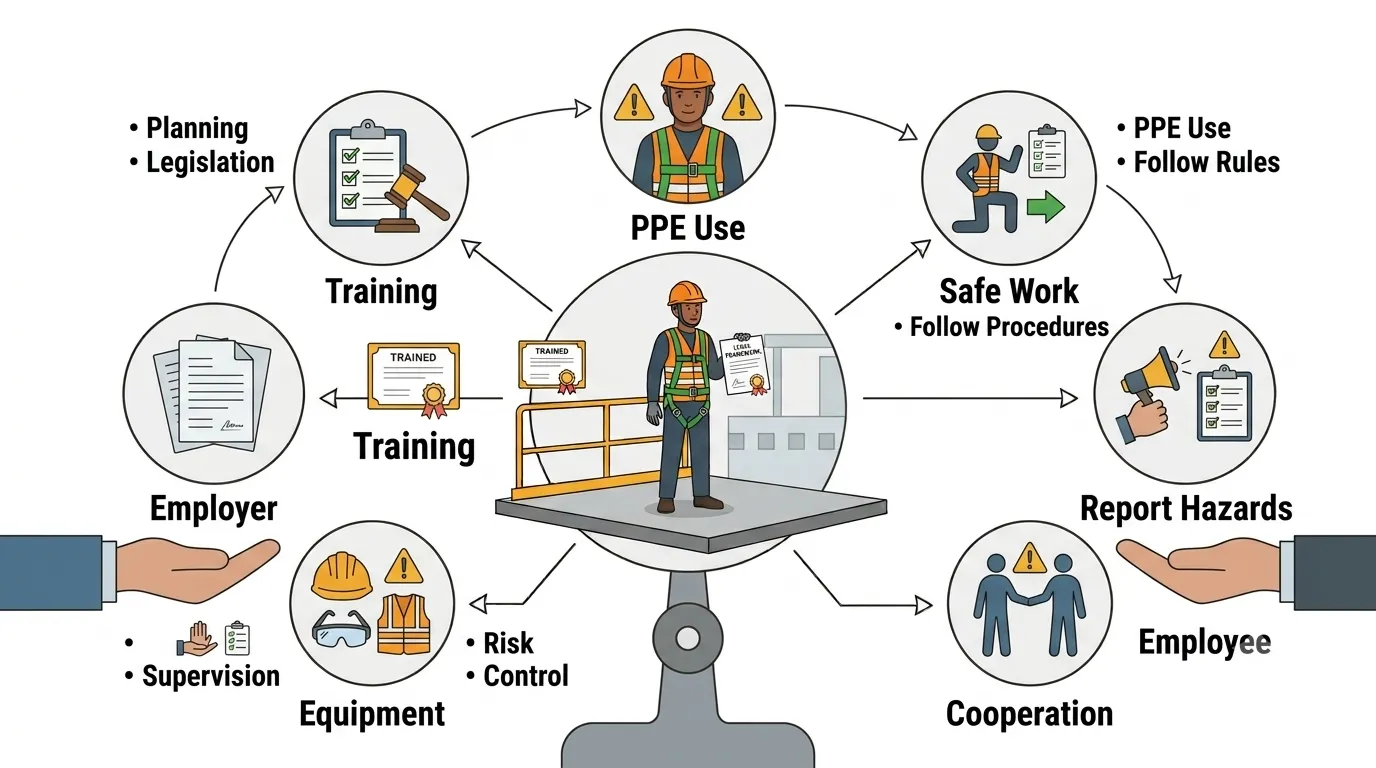
Employers play a central role in managing work at height risks. They must ensure that workplace activities are planned, organised, and controlled to prevent falls and protect workers from harm.
The primary responsibility of an employer is to identify hazards and introduce suitable control measures before allowing work at height activities to begin.
Employers must ensure:
Work at height is avoided where possible.
Tasks involving height are properly planned.
Suitable risk assessments are completed.
Appropriate equipment is provided.
Workers receive adequate training.
Safety procedures are communicated clearly.
Equipment is inspected and maintained.
Competent supervision is available.
Providing Safe Systems of Work
A safe system of work is a structured approach that explains how a task should be completed safely. Employers must develop procedures that consider the hazards involved and provide clear instructions for workers.
A safe system of work may include:
Task planning requirements.
Equipment selection procedures.
Access and working methods.
Emergency arrangements.
Inspection requirements.
Communication procedures.
For example, before allowing roof maintenance work, an employer should determine the safest access method, assess weather conditions, provide suitable fall protection, and ensure workers understand the procedure.
Conducting Risk Assessments
Risk assessment is one of the most important legal responsibilities of employers. It involves identifying hazards, evaluating risks, and implementing control measures.
A work at height risk assessment should consider:
The height of the work area.
The possibility of falling.
The type of surface being accessed.
Environmental conditions.
Equipment requirements.
Worker competence.
Emergency response arrangements.
The risk assessment process normally follows these steps:
Step 1: Identify Hazards
Employers should identify situations that could cause harm, such as:
Unprotected edges.
Unsafe ladders.
Poor access routes.
Damaged equipment.
Slippery surfaces.
Step 2: Evaluate Risks
The employer should consider:
Likelihood of an accident occurring.
Possible severity of injury.
Number of workers exposed.
Step 3: Apply Control Measures
Suitable controls may include:
Installing guardrails.
Providing safe platforms.
Using fall protection equipment.
Improving training and supervision.
Providing Suitable Equipment and PPE
Employers are responsible for providing equipment that is suitable for the work activity and maintaining it in safe working condition.
Work at height equipment may include:
Ladders.
Scaffolding systems.
Mobile elevated work platforms (MEWPs).
Safety harnesses.
Fall arrest systems.
Guardrails and barriers.
Employers must ensure:
Equipment is appropriate for the task.
Equipment is inspected regularly.
Defective equipment is removed from use.
Workers understand correct usage methods.
Providing equipment alone is not enough; employers must also ensure workers are trained to use it correctly.
Ensuring Worker Training and Competence
Employers have a responsibility to ensure that workers involved in work at height activities are competent and properly trained.
Training should cover:
Recognition of work at height hazards.
Safe working procedures.
Equipment use.
PPE requirements.
Emergency procedures.
Reporting responsibilities.
Competent workers are more likely to recognise unsafe conditions and make safer decisions during workplace activities.
Providing Supervision and Monitoring
Supervision is essential, especially where workers are inexperienced or tasks involve higher risks.
Employers should provide supervision to ensure:
Procedures are followed.
Equipment is used correctly.
Unsafe behaviours are corrected.
Hazards are reported.
Safety standards are maintained.
Regular monitoring also allows organisations to identify areas where improvements are needed.
Employee Responsibilities for Work at Height Safety
Employees also have legal responsibilities to contribute to workplace safety. While employers provide the systems and resources, workers must use them correctly and behave responsibly.
Employees must take reasonable care of:
Their own health and safety.
The safety of colleagues.
Workplace equipment and procedures.
Following Safety Procedures
Workers must follow the instructions and procedures provided by their employer.
Employees should:
Use approved access methods.
Follow safe working practices.
Wear required PPE.
Avoid unsafe shortcuts.
Follow emergency instructions.
Ignoring safety procedures can increase risks and may place other workers at danger.
Using Equipment Correctly
Employees are responsible for using equipment according to training and instructions.
Workers should:
Check equipment before use.
Report damaged equipment.
Use PPE correctly.
Avoid modifying safety equipment.
Store equipment properly.
For example, a worker using a safety harness must ensure it is correctly fitted and connected according to workplace procedures.
Participating in Training
Employees must actively participate in safety training and apply the knowledge gained in their daily activities.
Training participation helps workers:
Understand hazards.
Improve safety awareness.
Develop practical skills.
Recognise unsafe situations.
Workers should ask questions if they are unsure about a procedure or equipment requirement.
Reporting Hazards and Unsafe Conditions
Employees have an important role in identifying and reporting workplace hazards.
Examples of hazards that should be reported include:
Damaged ladders.
Missing guardrails.
Unsafe scaffolding.
Poor working conditions.
Defective PPE.
Early reporting allows employers to take corrective action before accidents occur.
Practical Example: Shared Safety Responsibilities
A construction company plans to install electrical equipment on the roof of a new building.
The employer responsibilities include:
Completing a risk assessment.
Providing suitable access equipment.
Training workers.
Inspecting safety equipment.
Providing supervision.
The employee responsibilities include:
Attending training.
Using PPE correctly.
Following procedures.
Reporting unsafe conditions.
By working together, both employer and employee contribute to preventing falls and maintaining a safe workplace.
Benefits of Understanding Legal Responsibilities
Understanding legal duties provides benefits for workers, employers, and organisations.
Benefits for Employers
Improved legal compliance.
Reduced workplace accidents.
Better safety performance.
Improved employee confidence.
Reduced financial losses caused by incidents.
Benefits for Employees
Greater awareness of workplace risks.
Improved confidence when completing tasks.
Better understanding of safety expectations.
Increased protection from workplace hazards.
Benefits for Organisations
Stronger safety culture.
Improved reputation.
Better operational efficiency.
Reduced downtime caused by accidents.
Importance of Shared Safety Responsibility
Workplace safety cannot be achieved by employers or employees working independently. Effective safety management requires cooperation, communication, and commitment from everyone.
A strong safety culture is created when:
Employers provide resources and leadership.
Workers follow procedures and report risks.
Supervisors monitor workplace activities.
Everyone values accident prevention.
Shared responsibility ensures that safety becomes part of everyday workplace behaviour rather than simply a legal requirement.
Conclusion
Understanding the legal responsibilities of employers and employees is essential for effective work at height safety management. Employers must provide safe systems of work, suitable equipment, training, supervision, and risk controls, while employees must follow procedures, use equipment correctly, and report hazards.
For learners completing the ICTQual Level 1 Award in Work at Height, recognising these responsibilities helps develop professional safety awareness and encourages responsible workplace behaviour. When employers and employees work together, organisations can reduce fall risks, improve compliance, and create safer working environments across construction, engineering, maintenance, and industrial sectors.
3. Apply Legal Requirements to Workplace Scenarios to Ensure Compliance
Introduction to Applying Legal Requirements in Workplace Scenarios
Understanding workplace legislation and regulations is only effective when these requirements can be applied correctly in real working situations. In work at height activities, legal compliance involves translating regulatory principles into practical actions that protect workers, control hazards, and ensure safe completion of tasks. Employers, supervisors, and employees must understand how legal requirements influence everyday decisions, including planning work, selecting equipment, completing risk assessments, and responding to unsafe conditions.
Workplace scenarios provide an opportunity to apply legal requirements to realistic situations and evaluate whether safety practices meet regulatory expectations. By analysing different work at height examples, learners can identify compliance failures, recommend suitable control measures, and understand how legislation supports accident prevention.
For learners completing the ICTQual Level 1 Award in Work at Height, developing the ability to apply legal requirements in workplace situations is essential for building practical safety awareness. Regulations are not only theoretical concepts; they guide actions taken before, during, and after work activities to ensure workers are protected from fall hazards.
Key Concepts of Applying Legal Requirements
Applying legal requirements means using workplace safety regulations, procedures, and standards to make informed decisions during work activities. It requires understanding the responsibilities of individuals and ensuring that safety controls are implemented correctly.
| Key Concept | Definition | Application in Workplace Scenarios |
|---|---|---|
| Legal Compliance | Following applicable laws, regulations, and safety requirements | Ensures work activities meet required safety standards |
| Risk Control | Actions taken to eliminate or reduce workplace hazards | Prevents falls and protects workers |
| Workplace Scenario | A realistic situation where safety decisions must be made | Helps apply regulations to practical tasks |
| Safety Procedure | A documented method for completing work safely | Provides clear instructions for workers |
| Compliance Monitoring | Checking whether safety requirements are being followed | Identifies improvements and prevents failures |
| Corrective Action | Steps taken to fix unsafe conditions or behaviours | Reduces the chance of repeated incidents |
Importance of Applying Regulations in Real Workplaces
Work at height regulations are designed to prevent accidents, but their effectiveness depends on how they are applied in daily workplace activities. Organisations must move beyond simply knowing legal requirements and ensure that these requirements influence planning, supervision, and worker behaviour.
Applying regulations correctly helps organisations:
- Identify hazards before work begins.
- Select suitable safety equipment.
- Improve workplace decision-making.
- Reduce fall-related incidents.
- Maintain legal compliance.
- Develop a positive safety culture.
A workplace that applies legal requirements effectively is more likely to identify risks early and prevent accidents before they occur.
Applying Legal Requirements During Work Planning
Work planning is one of the first stages where legal requirements must be applied. Before any work at height activity begins, organisations must consider whether the task is necessary, how it will be completed, and what controls are required.
Effective work planning includes:
- Identifying the nature of the work activity.
- Determining whether work at height can be avoided.
- Selecting appropriate access methods.
- Assessing environmental conditions.
- Establishing emergency procedures.
- Assigning competent workers.
Practical Example: Roof Maintenance Planning
A maintenance company needs to repair a damaged roof section. Before allowing workers onto the roof, the employer applies legal requirements by:
- Completing a risk assessment.
- Selecting suitable access equipment.
- Checking weather conditions.
- Providing fall protection.
- Ensuring workers are trained.
This demonstrates how regulations influence planning decisions and help prevent unsafe work practices.
Applying Legal Requirements Through Risk Assessment
Risk assessment is a key requirement for managing work at height activities. It allows organisations to identify hazards and determine suitable control measures before workers are exposed to risks.
The risk assessment process involves:
Identifying Hazards
Workers and supervisors should identify hazards such as:
- Unprotected edges.
- Fragile surfaces.
- Unsafe access routes.
- Poor weather conditions.
- Defective equipment.
Evaluating Risks
The organisation should consider:
- Likelihood of a fall occurring.
- Potential severity of injury.
- Number of workers affected.
Implementing Controls
Suitable controls may include:
- Installing guardrails.
- Using approved platforms.
- Providing safety harnesses.
- Improving supervision.
- Restricting access to dangerous areas.
Applying Regulations to Equipment Selection
Legal requirements require employers to provide equipment that is suitable for the task and maintained in safe condition. Selecting incorrect equipment can increase the risk of falls and create additional hazards.
When selecting work at height equipment, organisations should consider:
- The height and duration of the task.
- The working environment.
- The number of workers involved.
- Equipment stability.
- Inspection requirements.
Examples of suitable equipment include:
- Ladders for appropriate short-duration tasks.
- Scaffolding for extended work activities.
- Mobile elevated work platforms for controlled access.
- Fall protection systems where necessary.
Workplace Scenario 1: Unsafe Ladder Use
Situation
A worker is asked to replace a light fitting in a warehouse. The worker uses an old ladder that has not been inspected recently.
Compliance Issues
The situation creates several legal and safety concerns:
- Equipment inspection requirements have not been followed.
- The worker may not have suitable access equipment.
-
The risk of falling has not been properly controlled.
Correct Legal Application
The employer should:
- Inspect and approve equipment before use.
- Provide suitable access methods.
- Ensure workers understand safe ladder practices.
The employee should:
- Avoid using damaged equipment.
- Report unsafe conditions.
- Follow workplace procedures.
Workplace Scenario 2: Scaffold Safety Compliance
Situation
A construction team is using scaffolding for external building work. During the project, workers remove guardrails temporarily but continue working without restoring protection.
Compliance Issues
Potential failures include:
- Lack of effective fall prevention.
- Failure to maintain safe working conditions.
- Poor supervision.
Correct Legal Application
The organisation should:
- Stop unsafe work.
- Restore protective measures.
- Inspect the scaffold.
- Remind workers of safety responsibilities.
This example demonstrates how regulations must be actively applied throughout changing workplace conditions.
Applying Employee Responsibilities in Workplace Situations
Employees play an important role in ensuring legal compliance. Workers must apply safety requirements during their daily activities and avoid behaviours that increase risks.
Employees should:
- Attend required training.
- Follow safe work procedures.
- Use PPE correctly.
- Inspect equipment before use.
- Report hazards immediately.
- Stop work when conditions become unsafe.
Example: Reporting Unsafe Conditions
A worker notices that a safety harness has visible damage before starting a task. Instead of using the equipment, the worker reports the issue to the supervisor.
This action demonstrates:
- Awareness of legal responsibilities.
- Proper safety behaviour.
- Commitment to workplace protection.
Applying Employer Responsibilities in Workplace Situations
Employers must ensure that safety systems are effective and properly implemented. Providing procedures alone is not enough; employers must verify that safety measures are working.
Employers should:
- Provide suitable training.
- Monitor workplace activities.
- Review safety procedures.
- Maintain equipment.
- Investigate incidents.
- Improve safety systems.
Compliance Monitoring and Continuous Improvement
Applying legal requirements requires ongoing monitoring. Workplace conditions can change, and safety systems must be reviewed regularly.
Compliance monitoring activities include:
- Workplace inspections.
- Equipment checks.
- Safety observations.
- Training reviews.
- Incident investigations.
Continuous improvement helps organisations identify weaknesses and strengthen their safety management approach.
Benefits of Applying Legal Requirements in Workplace Scenarios
Correct application of regulations provides significant benefits for workers and organisations.
Benefits for Workers
Applying legal requirements helps workers:
- Understand workplace expectations.
- Reduce exposure to hazards.
- Improve confidence when completing tasks.
- Work safely with appropriate equipment.
- Protect themselves and colleagues.
Benefits for Employers
Organisations benefit through:
- Reduced workplace accidents.
- Improved legal compliance.
- Better safety performance.
- Reduced financial losses.
- Stronger workplace reputation.
Benefits for Safety Management Systems
Effective application supports:
- Better risk management.
- Improved safety culture.
- More effective training programmes.
- Stronger workplace communication.
Practical Compliance Process for Work at Height Activities
A structured compliance process ensures that legal requirements are consistently applied.
Step 1: Review Legal Requirements
Identify applicable regulations, standards, and workplace procedures.
Step 2: Assess the Task
Evaluate:
- Hazards.
- Equipment needs.
- Worker competence.
- Environmental conditions.
Step 3: Implement Controls
Apply suitable measures such as:
- Safe access systems.
- PPE.
- Training.
- Supervision.
Step 4: Monitor Performance
Check whether procedures are being followed correctly.
Step 5: Improve Safety Measures
Update procedures based on:
- Workplace observations.
- Incident findings.
- Changes in regulations.
Conclusion
Applying legal requirements to workplace scenarios ensures that regulations become practical safety actions rather than simple rules. Work at height activities require careful planning, effective risk assessment, suitable equipment, competent workers, and continuous monitoring to maintain compliance.
For learners completing the ICTQual Level 1 Award in Work at Height, understanding how to apply legal requirements develops the ability to recognise unsafe situations and make informed safety decisions. By applying legislation correctly in real workplace scenarios, employers and employees can reduce fall risks, improve compliance, and create safer working environments across construction, engineering, maintenance, and industrial sectors.
4. Identify and Interpret Key Regulatory Documents and Standards Relevant to Work at Height
Introduction to Regulatory Documents and Standards for Work at Height
Work at height activities require careful control because mistakes in planning, equipment selection, or worker behaviour can result in serious injuries or fatalities. Regulatory documents and safety standards provide essential guidance for organisations to manage these risks effectively. These documents explain legal duties, technical requirements, recommended practices, and safety procedures that help employers and workers maintain safe working environments.
Understanding and interpreting regulatory documents is an important skill for health and safety professionals, supervisors, and workers involved in elevated work activities. These documents help organisations identify their responsibilities, establish safe systems of work, select appropriate equipment, and ensure that workplace activities meet required safety expectations.
For learners completing the ICTQual Level 1 Award in Work at Height, knowledge of key regulatory documents and standards provides a foundation for understanding how workplace safety requirements are developed and applied. Regulations explain what organisations must achieve, while standards provide guidance on how safety objectives can be implemented effectively.
Importance of Regulatory Documents in Work at Height Safety
Regulatory documents act as a reference point for controlling workplace hazards and ensuring consistent safety practices. They provide structured information that supports decision-making during planning, risk assessment, training, and supervision.
The main purposes of regulatory documents include:
- Establishing legal safety responsibilities.
- Defining minimum workplace safety requirements.
- Providing guidance for hazard control.
- Supporting risk assessment processes.
- Improving consistency in safety practices.
- Helping organisations demonstrate compliance.
Without clear regulatory guidance, organisations may use inconsistent approaches that increase the possibility of workplace accidents.
Key Concepts of Regulatory Documents and Standards
Understanding common terminology helps learners correctly interpret safety documentation.
Key Concept Definition Importance in Work at Height Safety Regulation A legally enforceable requirement established by authorities Defines mandatory safety duties and responsibilities Standard A recognised document providing technical guidance and best practices Helps organisations achieve consistent safety performance Code of Practice Recommended methods for achieving compliance with safety requirements Provides practical workplace guidance Guidance Document Supporting information explaining how requirements can be applied Helps workers understand safe procedures Policy An organisation’s commitment and approach to managing safety Establishes workplace safety expectations Procedure A detailed method explaining how a task should be completed Provides step-by-step safety instructions Understanding Different Types of Safety Documents
Work at height safety is influenced by different categories of documents. Each document serves a specific purpose and supports workplace risk management.
Legislation and Regulations
Legislation and regulations are created by government authorities and establish legal requirements that organisations must follow.
Examples of regulatory requirements include:
- Providing safe working conditions.
- Carrying out risk assessments.
- Providing worker training.
- Maintaining equipment.
- Preventing unnecessary exposure to hazards.
Regulations generally explain what must be achieved rather than providing detailed instructions for every workplace situation.
For example, a regulation may require employers to prevent falls from height, while workplace procedures explain the specific equipment and methods used to achieve this requirement.
Codes of Practice
Codes of practice provide practical guidance on how organisations can meet legal requirements. They are often developed by safety authorities, professional organisations, or industry bodies.
Codes of practice may cover:
- Safe ladder use.
- Scaffold safety.
- Fall protection systems.
- Equipment inspection.
- Worker competency.
They help employers understand accepted safety approaches and improve workplace practices.
Technical Standards
Technical standards provide detailed specifications for equipment, systems, and safety practices. They are often developed internationally to ensure consistency and reliability.
Examples include standards related to:
- Safety harness design.
- Personal protective equipment.
- Access equipment.
- Fall arrest systems.
- Equipment testing.
Standards help manufacturers, employers, and workers ensure that safety equipment performs effectively.
Key Regulatory Documents Relevant to Work at Height
Several important documents influence how organisations manage work at height activities.
Work at Height Regulations
Work at height regulations provide the foundation for controlling fall risks. They establish requirements for planning, organising, and performing work safely.
Important principles include:
- Avoiding unnecessary work at height.
- Using suitable equipment.
- Preventing falls where possible.
- Reducing consequences if falls occur.
- Ensuring worker competence.
These regulations guide employers in developing safe work systems and controlling workplace hazards.
Occupational Health and Safety Management Standards
Occupational health and safety management standards provide frameworks for managing workplace risks systematically.
These standards focus on:
- Leadership responsibility.
- Worker involvement.
- Hazard identification.
- Risk control.
- Continuous improvement.
They help organisations integrate work at height safety into broader workplace safety systems.
Equipment Manufacturer Instructions
Manufacturer instructions are important regulatory references because they explain the correct use, limitations, inspection requirements, and maintenance procedures for equipment.
Workers should follow manufacturer guidance when using:
- Harnesses.
- Ladders.
- Scaffolding components.
- Mobile elevated work platforms.
- Fall protection equipment.
Ignoring manufacturer instructions can reduce equipment effectiveness and increase risk.
How to Interpret Regulatory Documents
Interpreting safety documents requires understanding the meaning and purpose of the information provided. Workers and supervisors should not only read documents but also understand how requirements apply to practical situations.
The interpretation process includes:
Step 1: Identify the Purpose of the Document
Before applying information, determine:
- Who created the document.
- Why it was developed.
- Which activities it applies to.
For example, a scaffold safety standard will apply differently from a general workplace safety policy.
Step 2: Identify Key Requirements
Important information should be highlighted, including:
- Legal responsibilities.
- Safety requirements.
- Equipment standards.
- Training expectations.
- Inspection requirements.
Step 3: Apply Requirements to Workplace Activities
The information should then be translated into practical actions.
Examples:
- Regulation requirement → Complete risk assessment.
- Standard requirement → Use approved safety equipment.
- Procedure requirement → Follow inspection steps.
Step 4: Review and Update Information
Safety documents should be reviewed regularly because:
- Regulations may change.
- Equipment technology improves.
- Workplace conditions develop.
Keeping documents current supports ongoing compliance.
Applying Regulatory Documents in Workplace Scenarios
Regulatory documents become valuable when they are applied to real workplace situations.
Practical Example 1: Roof Maintenance Work
A company plans to carry out repairs on a commercial roof.
Using regulatory documents, the organisation should:
- Review work at height requirements.
- Complete a risk assessment.
- Select suitable access equipment.
- Provide fall protection.
- Train workers.
The documents help ensure that the work is planned safely and completed according to recognised requirements.
Practical Example 2: Scaffold Inspection
A construction company uses scaffolding for building maintenance.
Relevant documents help determine:
- Inspection frequency.
- Safe access requirements.
- Guardrail requirements.
- Worker responsibilities.
By following recognised standards, the company reduces the likelihood of scaffold-related incidents.
Practical Example 3: Equipment Selection
A maintenance team needs to select fall protection equipment.
Regulatory documents help them evaluate:
- Equipment suitability.
- User requirements.
- Inspection procedures.
- Compatibility with the task.
This ensures workers receive appropriate protection.
Benefits of Understanding Regulatory Documents and Standards
Knowledge of regulatory documents provides significant benefits for individuals and organisations.
Benefits for Workers
Workers benefit through:
- Better understanding of safety requirements.
- Increased awareness of workplace responsibilities.
- Improved confidence using equipment.
- Reduced exposure to hazards.
- Improved ability to identify unsafe conditions.
Benefits for Employers
Employers benefit through:
- Improved legal compliance.
- Reduced accident risks.
- Better safety management systems.
- Improved workplace reputation.
- More effective training programmes.
Benefits for Safety Management Systems
Organisations can achieve:
- Improved hazard control.
- Better documentation.
- Stronger inspection processes.
- Consistent safety procedures.
- Continuous improvement.
Common Mistakes When Using Regulatory Documents
Incorrect interpretation of safety documents can create workplace risks.
Common mistakes include:
- Ignoring updated requirements.
- Using outdated documents.
- Applying standards incorrectly.
- Failing to train workers.
- Treating documents as paperwork only.
To avoid these issues, organisations should ensure that safety documents are understood, communicated, and applied correctly.
Process for Maintaining Regulatory Compliance
A structured approach helps organisations maintain compliance with work at height requirements.
Review Applicable Documents
Identify relevant:
- Regulations.
- Standards.
- Codes of practice.
- Company procedures.
Communicate Requirements
Ensure workers understand:
- Their responsibilities.
- Required safety actions.
- Equipment requirements.
Implement Controls
Apply:
- Training programmes.
- Risk assessments.
- Inspection systems.
- Safe work procedures.
Monitor Effectiveness
Evaluate:
- Workplace performance.
- Incident records.
- Worker feedback.
- Inspection findings.
Improve Safety Practices
Update procedures based on:
- Changes in regulations.
- Lessons from incidents.
- New safety technologies.
Conclusion
Identifying and interpreting key regulatory documents and standards is essential for effective work at height safety management. These documents provide the knowledge and guidance required to control hazards, meet legal responsibilities, and establish safe working practices.
For learners completing the ICTQual Level 1 Award in Work at Height, understanding regulatory documents develops the ability to connect safety requirements with practical workplace actions. By correctly interpreting regulations, standards, and procedures, workers and organisations can improve compliance, prevent falls, and create safer working environments across construction, engineering, maintenance, and industrial sectors.