
Lesson No 1: Introduction to Quality Control and Quality Assurance in Mechanical Engineering
Quality Control (QC) and Quality Assurance (QA) are essential components of modern mechanical engineering systems, ensuring that products, equipment, and manufacturing processes achieve the required standards of performance, safety, reliability, and compliance. In mechanical engineering industries, where precision and operational efficiency are critical, QA/QC practices help organisations prevent failures, reduce defects, control production risks, and deliver high-quality engineering solutions. This section introduces the fundamental concepts of Quality Control and Quality Assurance in Mechanical Engineering, explaining how professional QA/QC engineers apply systematic approaches to maintain quality throughout the complete engineering lifecycle.
From a QA/QC Mechanical Engineer perspective, Quality Assurance focuses on developing effective quality management systems, procedures, inspection plans, and preventive strategies to ensure quality is built into every stage of engineering activities. Quality Control focuses on inspection, testing, measurement, and verification processes to identify defects and confirm that mechanical components, materials, and systems meet approved specifications. Together, QA and QC create a structured framework that supports manufacturing, fabrication, maintenance, equipment installation, and industrial project execution by improving reliability, reducing operational risks, and achieving customer satisfaction.
This topic explores the roles, responsibilities, and practical applications of QA/QC professionals in mechanical engineering environments, including quality planning, inspection processes, testing methods, documentation control, non-conformance management, and continuous improvement practices. Learners will develop an understanding of how experienced QA/QC engineers evaluate engineering processes, implement corrective actions, and ensure compliance with technical requirements and industry expectations.
By understanding the relationship between Quality Assurance and Quality Control, mechanical engineering professionals can contribute effectively to producing safe, durable, and high-performing engineering products. Strong QA/QC knowledge enables engineers, inspectors, technicians, and supervisors to identify quality challenges, make informed decisions, and support successful project delivery across industries such as manufacturing, fabrication, automotive, energy, oil and gas, construction, and industrial maintenance.
1. Define the Concepts of Quality Control (QC) and Quality Assurance (QA) and Explain Their Roles in Mechanical Engineering
Quality management is a fundamental element of modern mechanical engineering projects, manufacturing operations, fabrication activities, and industrial production systems. In highly competitive engineering environments, organisations must ensure that mechanical components, machinery, assemblies, and systems are produced according to approved specifications, customer requirements, safety expectations, and international quality standards. This requirement has increased the importance of professional Quality Control (QC) and Quality Assurance (QA) systems.
From a QA/QC Mechanical Engineering perspective, quality is not only about identifying defects after production; it is a complete management approach that focuses on preventing errors, controlling processes, improving performance, and ensuring consistent engineering outcomes. Quality Assurance establishes the systems and procedures required to achieve reliable results, while Quality Control focuses on inspecting, testing, and verifying that the final product or process meets defined quality criteria.
Mechanical engineering industries including manufacturing, oil and gas, power generation, automotive, aerospace, construction equipment, and industrial maintenance depend heavily on effective QA/QC practices. A failure in quality control can lead to equipment breakdowns, safety hazards, production delays, financial losses, and reduced customer confidence. Therefore, trained QA/QC professionals play a critical role in monitoring engineering activities and maintaining quality throughout the project lifecycle.
This unit introduces learners to the meaning, purpose, processes, and practical applications of Quality Assurance and Quality Control within mechanical engineering environments.
Understanding Quality Assurance (QA) in Mechanical Engineering
Definition of Quality Assurance (QA)
Quality Assurance (QA) is a systematic and planned approach used to ensure that engineering processes are properly designed, controlled, and implemented to consistently produce quality outcomes. QA focuses on preventing defects before they occur by establishing effective procedures, standards, documentation systems, and management controls.
In mechanical engineering, Quality Assurance involves developing a structured quality framework that guides design, procurement, manufacturing, installation, inspection, testing, and maintenance activities. QA ensures that every stage of an engineering process follows approved procedures and complies with project requirements.
A QA system does not only check the final product; instead, it evaluates whether the entire process used to create that product is reliable and capable of achieving the required quality standards.
Key Concepts of Quality Assurance
The main concepts associated with Quality Assurance include:
Prevention-based approach: QA focuses on preventing mistakes rather than correcting failures after they occur.
Process control: QA ensures that engineering processes are properly planned, documented, and monitored.
Quality planning: Establishing quality objectives, inspection requirements, procedures, and responsibilities before project execution.
Standardisation: Ensuring activities are performed consistently using approved methods and procedures.
Continuous improvement: Identifying opportunities to improve engineering processes and increase efficiency.
Compliance management: Ensuring operations comply with technical specifications, industry standards, and client requirements.
Role of Quality Assurance in Mechanical Engineering
In mechanical engineering projects, QA provides the foundation for achieving reliable and consistent quality performance. QA professionals are responsible for developing and maintaining systems that support successful engineering delivery.
The major roles of QA include:
Preparing Quality Management Plans (QMP) for mechanical engineering projects.
Establishing inspection and testing procedures.
Reviewing technical specifications and engineering drawings.
Ensuring approved materials and components are used.
Controlling engineering documentation and records.
Conducting internal quality audits.
Monitoring supplier and subcontractor quality performance.
Ensuring compliance with organisational and industry standards.
Supporting corrective and preventive action processes.
For example, during the manufacturing of a pressure vessel, QA activities begin before fabrication starts. The QA engineer reviews material certificates, welding procedures, inspection requirements, and testing plans to ensure the manufacturing process will achieve the required quality level.
Understanding Quality Control (QC) in Mechanical Engineering
Definition of Quality Control (QC)
Quality Control (QC) is the operational process of inspecting, testing, measuring, and verifying engineering products or activities to confirm that they meet specified quality requirements. Unlike QA, which focuses on preventing problems, QC focuses on identifying and correcting defects through inspection and testing activities.
In mechanical engineering, QC involves checking whether manufactured components, machinery parts, assemblies, and installations comply with approved drawings, technical specifications, tolerances, and performance requirements.
QC activities are usually performed during and after production processes to detect deviations and ensure that only acceptable products are delivered to customers.
Key Concepts of Quality Control
Important QC concepts include:
Inspection: Physical examination of materials, components, and equipment.
Testing: Performing mechanical, dimensional, functional, or performance tests.
Measurement: Comparing actual results against specified requirements.
Defect identification: Detecting non-conforming products or processes.
Corrective action: Implementing solutions to remove identified problems.
Verification: Confirming that requirements have been successfully achieved.
Documentation: Recording inspection results and quality findings.
Role of Quality Control in Mechanical Engineering
Quality Control plays a direct role in ensuring that mechanical engineering outputs meet required standards. QC inspectors and engineers verify the accuracy, reliability, and safety of engineering products through systematic examination.
Major responsibilities of QC professionals include:
Conducting incoming material inspections.
Performing dimensional inspections using measuring instruments.
Checking welding quality and fabrication workmanship.
Carrying out mechanical testing procedures.
Inspecting machinery components before installation.
Identifying non-conforming materials or products.
Preparing inspection reports.
Monitoring repair and rework activities.
Ensuring final products meet acceptance criteria.
For example, in a mechanical fabrication workshop, QC inspectors may inspect welded joints using visual inspection, dimensional checks, and non-destructive testing methods to confirm that fabricated components meet project specifications.
Difference Between Quality Assurance and Quality Control
Although QA and QC are closely connected, they serve different purposes within mechanical engineering quality management systems.
| Aspect | Quality Assurance (QA) | Quality Control (QC) |
|---|---|---|
| Definition | A planned system of processes and procedures designed to prevent quality problems. | A verification process used to identify defects and confirm product compliance. |
| Main Focus | Process improvement and defect prevention. | Product inspection and defect detection. |
| Approach | Proactive approach. | Reactive and corrective approach. |
| Objective | Ensure processes consistently produce quality results. | Ensure completed products meet required specifications. |
| Activities | Quality planning, audits, procedures, documentation control, process monitoring. | Inspection, testing, measurement, verification, and reporting. |
| Responsibility | Quality managers, QA engineers, project teams. | QC inspectors, testing engineers, inspection personnel. |
| Example | Developing welding procedures before fabrication begins. | Inspecting welded joints after fabrication. |
Relationship Between QA and QC in Mechanical Engineering Projects

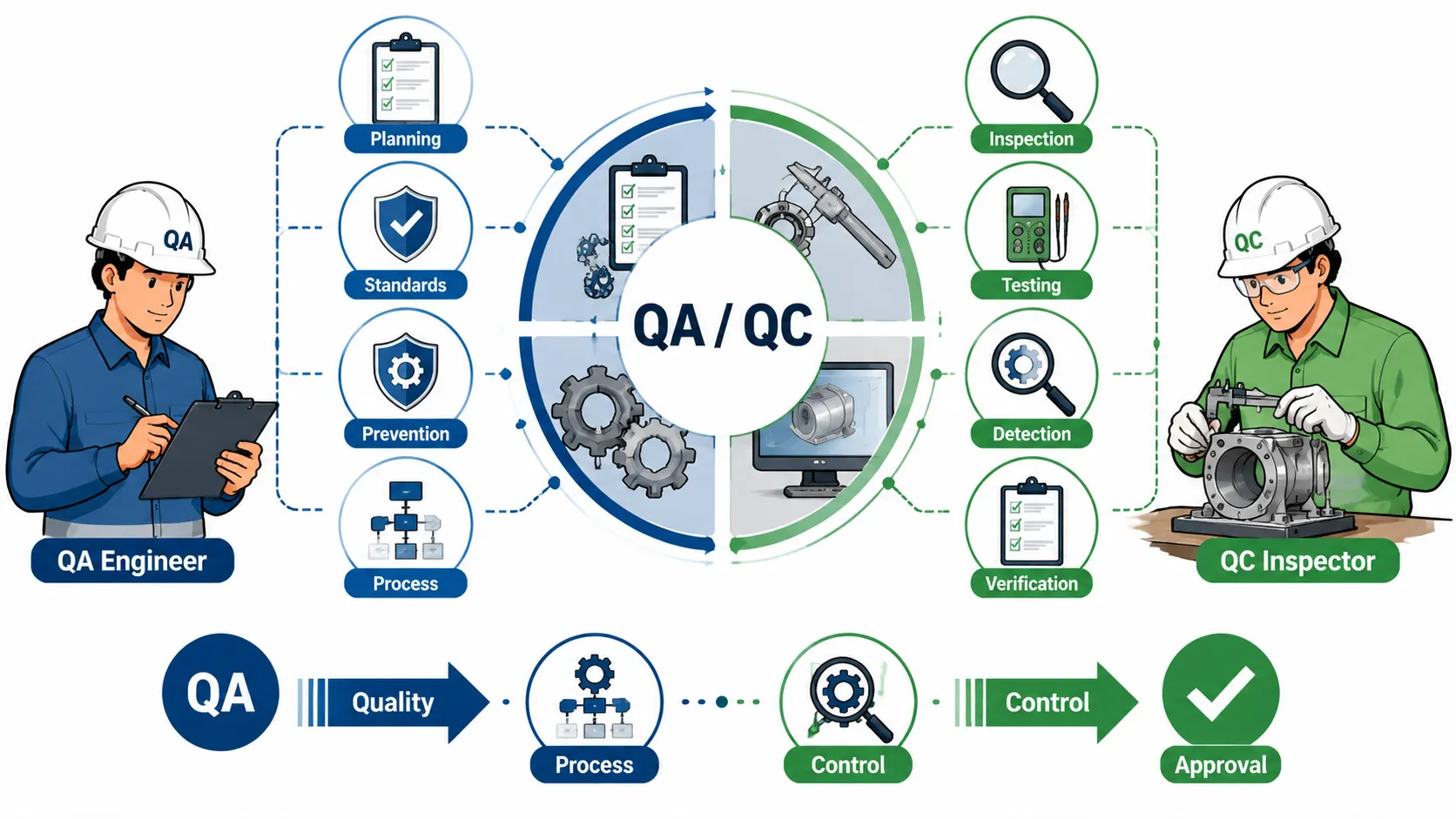
Integrated Quality Management Approach
Successful mechanical engineering projects require both QA and QC systems working together. QA establishes the framework for achieving quality, while QC confirms that the expected quality has been achieved.
The relationship can be explained as:
QA creates the processes.
QC verifies the results.
QA prevents problems.
QC identifies problems.
QA improves systems.
QC improves product reliability.
A strong quality management system requires continuous communication between QA engineers, QC inspectors, production teams, project managers, suppliers, and clients.
Quality Management Process in Mechanical Engineering
A typical QA/QC process follows these stages:
Quality Planning
At the beginning of a project, quality requirements are identified. Engineers review specifications, drawings, standards, and customer expectations.
Key activities include:
Preparing quality plans.
Defining inspection requirements.
Selecting testing methods.
Assigning quality responsibilities.
Process Implementation
During manufacturing or construction activities, approved procedures are followed.
Activities include:
Monitoring production processes.
Ensuring correct material usage.
Controlling workmanship standards.
Maintaining quality records.
Inspection and Testing
QC personnel perform inspections to confirm compliance.
Examples include:
Dimensional inspection.
Material testing.
Welding inspection.
Equipment performance testing.
Non-Conformance Management
When defects are identified, corrective actions are implemented.
The process includes:
Recording non-conformities.
Investigating root causes.
Implementing corrective measures.
Verifying improvements.
Final Quality Verification
Before project completion, final inspections ensure all requirements have been achieved.
Practical Examples of QA and QC Applications in Mechanical Engineering
Example 1: Manufacturing of Mechanical Components
A company producing industrial machine components must ensure accuracy and reliability.
QA activities include:
Developing manufacturing procedures.
Selecting approved suppliers.
Establishing inspection standards.
QC activities include:
Measuring component dimensions.
Checking surface finish.
Performing functional tests.
The combination of QA and QC ensures components operate safely and efficiently.
Example 2: Mechanical Equipment Installation Project
During installation of pumps, compressors, or industrial machinery:
QA ensures:
Installation procedures are approved.
Qualified personnel perform the work.
Documentation requirements are followed.
QC ensures:
Equipment alignment is correct.
Connections meet specifications.
Performance testing is completed successfully.
Case Study: QA/QC Application in Industrial Mechanical Fabrication
Project Background
A mechanical engineering company was contracted to manufacture and install a large industrial heat exchanger system for a processing facility. The project required strict quality control because the equipment would operate under high temperature and pressure conditions.
Quality Assurance Activities
The QA team developed a Quality Management Plan before fabrication began. They reviewed material specifications, welding procedures, inspection requirements, and testing standards.
Key QA actions included:
Approving qualified welding procedures.
Reviewing supplier documentation.
Establishing inspection checkpoints.
Controlling engineering documents.
Quality Control Activities
During fabrication, QC inspectors monitored production activities.
QC activities included:
Checking incoming materials.
Inspecting welding operations.
Performing dimensional verification.
Conducting pressure testing.
During inspection, a welding defect was identified. The QC team reported the issue, and corrective action was implemented. The defective weld was repaired and tested again.
Case Study Outcome
Because QA procedures were established early and QC inspections were performed throughout production, the company successfully delivered a reliable heat exchanger system that met customer requirements.
This example demonstrates that QA prevents quality failures through effective planning, while QC ensures final engineering outputs meet required standards.
Key Benefits of Effective QA and QC Systems in Mechanical Engineering
Implementing strong QA/QC practices provides several advantages:
Improves product reliability and performance.
Reduces manufacturing errors and defects.
Enhances workplace safety.
Minimises project delays and additional costs.
Increases customer satisfaction.
Supports compliance with engineering standards.
Improves operational efficiency.
Strengthens organisational reputation.
Encourages continuous improvement.
Provides better control over engineering processes.
Quality Assurance and Quality Control are essential components of successful mechanical engineering operations. QA provides the structured systems, procedures, and preventive strategies required to achieve consistent quality, while QC ensures that mechanical products, components, and processes meet established requirements through inspection and testing.
For mechanical engineering professionals, understanding the difference and relationship between QA and QC is fundamental to achieving safe, reliable, and high-performance engineering outcomes. A skilled QA/QC professional contributes significantly to project success by preventing failures, improving processes, controlling risks, and ensuring compliance with technical and customer expectations.
By developing knowledge of QA and QC principles, learners of the LICQual Level 3 Certificate in Quality Control and Quality Assurance (QA/QC) in Mechanical Engineering gain the essential foundation required to progress into professional quality inspection, engineering supervision, and quality management roles.
2. Distinguish Between Quality Control (QC) and Quality Assurance (QA) in Mechanical Manufacturing and Production
In mechanical manufacturing and production environments, maintaining consistent quality is essential for producing reliable, safe, and high-performance components and equipment. Industries such as automotive manufacturing, aerospace, oil and gas, power generation, fabrication, and industrial machinery depend on effective quality management systems to ensure that products meet engineering specifications, customer requirements, and regulatory expectations.
From a QA/QC Mechanical Engineering perspective, Quality Assurance (QA) and Quality Control (QC) are two interconnected but different functions. Although both aim to achieve product quality, they operate at different stages of the manufacturing process and focus on different objectives. QA is primarily a preventive approach that focuses on improving and controlling manufacturing processes, while QC is a verification approach that focuses on inspecting and testing products to identify defects or deviations.
A successful mechanical production system requires both QA and QC working together. QA establishes the systems, procedures, and standards required for producing quality products, while QC confirms that the manufactured components actually meet the required quality criteria through inspections, measurements, and testing activities.
Understanding the distinction between QA and QC enables mechanical engineering professionals to effectively manage production risks, reduce manufacturing defects, improve operational efficiency, and deliver products that satisfy client expectations.
Understanding Quality Assurance (QA) in Mechanical Manufacturing
Definition of Quality Assurance (QA)
Quality Assurance (QA) is a structured and systematic process used to ensure that manufacturing activities are planned, controlled, and executed according to approved quality standards. QA focuses on preventing quality problems before they occur by establishing effective systems, procedures, and controls throughout the manufacturing lifecycle.
In mechanical manufacturing, QA begins before production starts. It involves reviewing engineering drawings, selecting approved materials, establishing manufacturing procedures, defining inspection requirements, and ensuring that production teams follow documented processes.
QA does not directly focus on finding defective products. Instead, it ensures that the manufacturing process is capable of consistently producing products that meet required specifications.
Key Concepts of Quality Assurance
The important concepts of QA in mechanical manufacturing include:
- Process Prevention: Identifying possible risks before production begins and implementing controls to prevent failures.
- Quality Planning: Developing quality plans, procedures, inspection schedules, and responsibilities.
- Standard Compliance: Ensuring manufacturing processes follow technical standards and customer specifications.
- Documentation Control: Managing drawings, procedures, reports, and quality records.
- Process Improvement: Analysing production performance and improving manufacturing methods.
- Risk Management: Identifying potential quality risks and implementing preventive actions.
Role of QA in Mechanical Production
QA professionals are responsible for ensuring that the entire production system operates effectively and consistently.
Major QA responsibilities include:
- Developing Quality Management Plans.
- Reviewing engineering specifications and production requirements.
- Establishing manufacturing procedures.
- Approving suppliers and materials.
- Ensuring employee competency and training.
- Conducting quality audits.
- Monitoring production processes.
- Managing technical documentation.
- Implementing preventive actions.
- Supporting continuous improvement initiatives.
For example, during the manufacturing of industrial pumps, a QA engineer ensures that approved materials are selected, manufacturing procedures are followed, welding processes are qualified, and inspection requirements are established before production begins.
Understanding Quality Control (QC) in Mechanical Manufacturing
Definition of Quality Control (QC)
Quality Control (QC) is the process of examining, measuring, testing, and verifying manufactured products to ensure they comply with specified quality requirements. QC focuses on identifying defects, errors, or deviations during or after production activities.
Unlike QA, which focuses on preventing problems, QC focuses on detecting problems through inspection and testing. QC activities provide evidence that the final product meets required technical specifications.
In mechanical manufacturing, QC inspectors examine components, assemblies, and equipment using inspection tools, testing methods, and measurement techniques.
Key Concepts of Quality Control
The main concepts of QC include:
- Inspection: Physical examination of manufactured components.
- Testing: Performing functional, mechanical, or performance tests.
- Measurement: Comparing actual dimensions with engineering drawings.
- Defect Identification: Detecting problems that affect product quality.
- Non-Conformance Control: Managing products that do not meet requirements.
- Corrective Action: Repairing or correcting identified defects.
- Quality Verification: Confirming that products satisfy acceptance criteria.
Role of QC in Mechanical Production
QC professionals are responsible for verifying that manufacturing outputs meet required standards.
Major QC responsibilities include:
- Inspecting raw materials before production.
- Checking component dimensions.
- Monitoring fabrication activities.
- Inspecting welding quality.
- Performing mechanical tests.
- Conducting final product inspections.
- Recording inspection results.
- Preparing quality reports.
- Managing rejected or defective products.
- Confirming corrective actions.
For example, during the production of a gearbox assembly, QC inspectors verify machining accuracy, surface finish, component alignment, and operational performance before the equipment is approved for delivery.
Key Differences Between QA and QC in Mechanical Manufacturing
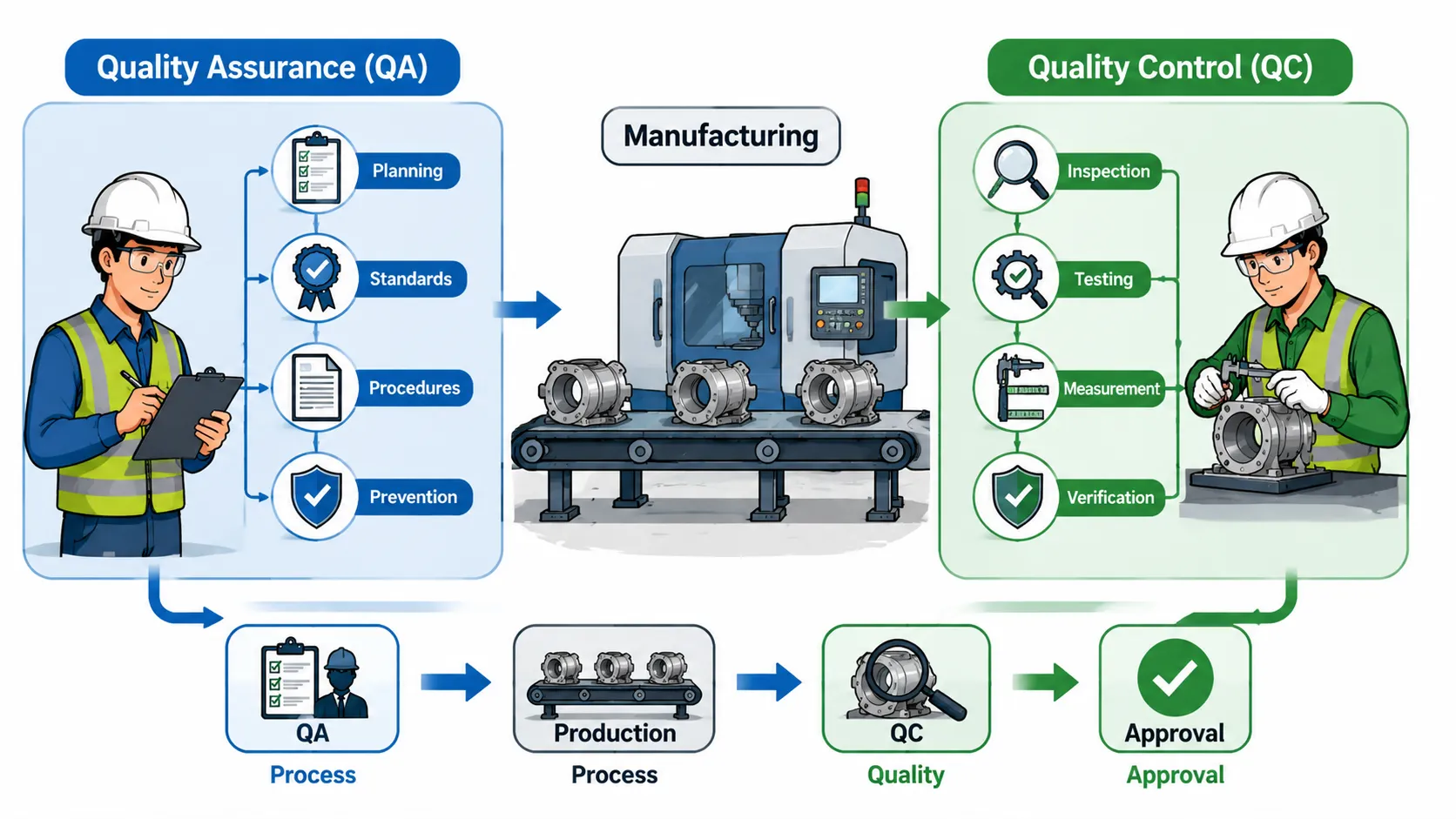
The following table explains the main differences between Quality Assurance and Quality Control:
| Aspect | Quality Assurance (QA) | Quality Control (QC) |
|---|---|---|
| Definition | A planned system that ensures manufacturing processes consistently produce quality products. | A process of inspection and testing used to verify that products meet quality requirements. |
| Main Purpose | Prevent defects before they occur. | Identify defects after or during production. |
| Approach | Proactive approach. | Reactive and corrective approach. |
| Focus Area | Manufacturing processes and systems. | Manufactured products and components. |
| Timing | Starts before production and continues throughout the process. | Mainly performed during and after production. |
| Main Activities | Quality planning, audits, procedures, process improvement. | Inspection, testing, measurement, verification. |
| Responsibility | QA engineers, quality managers, production management. | QC inspectors, testing technicians, inspection engineers. |
| Example | Creating welding procedures before fabrication. | Inspecting completed welds for defects. |
| Objective | Build a reliable production system. | Confirm product compliance. |
QA and QC Processes in Mechanical Manufacturing
Quality Assurance Process
QA follows a structured process to ensure manufacturing reliability.
Quality Planning
Before production begins, QA engineers establish quality requirements.
Activities include:
- Reviewing customer specifications.
- Preparing quality control plans.
- Defining inspection points.
- Selecting approved suppliers.
- Establishing production procedures.
Process Control
During manufacturing, QA monitors whether production activities follow approved procedures.
Process control includes:
- Monitoring manufacturing methods.
- Ensuring correct equipment usage.
- Checking employee competency.
- Reviewing production records.
Quality Auditing
QA audits manufacturing activities to confirm compliance.
Audit activities include:
- Reviewing documentation.
- Checking procedures.
- Identifying improvement opportunities.
- Monitoring corrective actions.
Quality Control Process
QC follows inspection and verification activities.
Incoming Material Inspection
Before materials enter production:
- Material certificates are reviewed.
- Dimensions are checked.
- Material quality is verified.
In-Process Inspection
During production:
- Machining accuracy is checked.
- Welding operations are inspected.
- Assembly processes are monitored.
Final Inspection
Before product delivery:
- Functional testing is completed.
- Final dimensions are verified.
- Quality documentation is reviewed.
Practical Examples of QA and QC in Mechanical Manufacturing
Example 1: CNC Machining Production
A manufacturing company produces precision mechanical components using CNC machines.
QA Activities:
- Developing machining procedures.
- Selecting suitable materials.
- Establishing tolerance requirements.
- Training machine operators.
QC Activities:
- Measuring component dimensions.
- Checking surface finish.
- Verifying tolerances.
- Approving finished parts.
The combination of QA and QC ensures that components achieve the required accuracy and reliability.
Example 2: Welding Fabrication Process
In mechanical fabrication projects, welding quality is critical.
QA ensures:
- Welding procedures are approved.
- Welders are qualified.
- Correct materials are selected.
- Welding standards are followed.
QC ensures:
- Weld appearance is acceptable.
- Weld dimensions meet requirements.
- Defects are identified.
- Testing is completed.
Case Study: QA and QC Implementation in Mechanical Equipment Manufacturing
Project Background
A mechanical manufacturing company was producing large industrial compressors for an energy project. The equipment required high reliability because it would operate continuously under demanding conditions.
The company implemented both QA and QC systems to ensure manufacturing quality.
Quality Assurance Activities
The QA team developed a comprehensive quality plan before production.
Key QA actions included:
- Reviewing engineering drawings.
- Establishing manufacturing procedures.
- Approving material suppliers.
- Defining inspection requirements.
- Conducting process audits.
These activities ensured that production processes were controlled from the beginning.
Quality Control Activities
During manufacturing, QC inspectors monitored production activities.
QC activities included:
- Inspecting raw materials.
- Checking machining accuracy.
- Inspecting welded components.
- Performing pressure testing.
- Conducting final equipment verification.
During final inspection, QC identified a dimensional deviation in one component. The issue was reported, corrected, and re-inspected before approval.
Case Study Outcome
The successful integration of QA and QC allowed the company to deliver high-quality compressors that met customer requirements. The QA system prevented major production issues, while QC ensured that final products achieved the required performance standards.
This case demonstrates that QA and QC are not separate activities but complementary systems that work together to achieve manufacturing excellence.
Key Benefits of Effective QA and QC Integration
Implementing effective QA and QC systems provides significant advantages in mechanical manufacturing:
Quality Improvement Benefits
- Reduces manufacturing defects.
- Improves product reliability.
- Maintains consistent production standards.
- Enhances engineering performance.
Operational Benefits
- Reduces production waste.
- Minimises rework and repair costs.
- Improves manufacturing efficiency.
- Supports continuous improvement.
Business Benefits
- Increases customer confidence.
- Improves company reputation.
- Supports compliance with industry requirements.
- Provides competitive advantage.
Safety Benefits
- Reduces equipment failures.
- Improves operational safety.
- Prevents failures in critical mechanical systems.
- Protects workers and end users.
Quality Assurance and Quality Control are essential elements of mechanical manufacturing and production management. While QA focuses on establishing reliable processes, preventing defects, and improving manufacturing systems, QC focuses on inspecting products, identifying defects, and verifying compliance.
For mechanical engineering professionals, understanding the difference between QA and QC is essential for managing production quality effectively. QA creates the foundation for successful manufacturing, while QC provides confirmation that products meet required standards.
A strong QA/QC system ensures that mechanical components and equipment are safe, reliable, efficient, and suitable for industrial applications. Learners completing the LICQual Level 3 Certificate in Quality Control and Quality Assurance (QA/QC) in Mechanical Engineering develop the essential knowledge required to support professional quality management practices in modern mechanical manufacturing environments.
3. Explain the Significance of Quality Standards and Regulations (e.g., ISO 9001, ASME) in Mechanical Engineering
Quality standards and regulations are essential elements of modern mechanical engineering because they provide a structured framework for designing, manufacturing, inspecting, testing, and maintaining engineering products and systems. In industries such as manufacturing, fabrication, automotive, aerospace, oil and gas, power generation, and industrial equipment production, quality standards ensure that mechanical components and systems achieve the required levels of safety, reliability, performance, and durability.
From a QA/QC Mechanical Engineering perspective, quality standards are not only documents containing technical requirements; they represent a complete approach for controlling engineering activities and reducing risks throughout the product lifecycle. They help organisations establish consistent procedures, improve production processes, manage defects, and demonstrate compliance with customer and regulatory expectations.
Mechanical engineering projects often involve complex systems where even minor quality failures can result in equipment breakdown, production losses, environmental risks, or safety incidents. Therefore, implementing recognised standards such as ISO 9001 and ASME codes allows engineering organisations to maintain professional quality management systems and deliver products that meet international expectations.
Quality standards support engineers, inspectors, manufacturers, and project teams by providing clear requirements for materials, manufacturing processes, inspection methods, documentation, and acceptance criteria.
Understanding Quality Standards and Regulations
Definition of Quality Standards
Quality standards are internationally recognised guidelines, specifications, and requirements that define acceptable levels of quality for products, services, and processes. They provide organisations with a systematic method for controlling activities and achieving consistent results.
In mechanical engineering, quality standards establish requirements related to:
- Material selection
- Manufacturing processes
- Equipment design
- Inspection procedures
- Testing methods
- Documentation control
- Safety requirements
- Performance verification
Quality standards help organisations move from informal quality practices to controlled and measurable quality management systems.
Definition of Engineering Regulations
Engineering regulations are mandatory or industry-specific requirements established by regulatory bodies, professional organisations, or authorities to ensure safety, reliability, and compliance.
Unlike general quality guidelines, regulations often define minimum requirements that must be followed during engineering activities.
Examples include:
- Pressure equipment requirements
- Welding regulations
- Material specifications
- Safety codes
- Inspection requirements
- Equipment certification procedures
Mechanical engineers must understand both quality standards and regulations because compliance directly affects product acceptance, operational safety, and legal responsibilities.
Importance of Quality Standards in Mechanical Engineering
Quality standards play a critical role throughout mechanical engineering design, manufacturing, and maintenance activities.
The major importance of quality standards includes:
- Establishing consistent engineering practices.
- Improving product reliability and performance.
- Reducing manufacturing errors and defects.
- Supporting safe operation of mechanical systems.
- Improving customer confidence.
- Ensuring compliance with industry requirements.
- Reducing project risks and unexpected failures.
- Improving communication between suppliers, manufacturers, and clients.
- Supporting continuous improvement.
In mechanical manufacturing environments, quality standards provide a common language between engineers, production teams, inspectors, and customers. They ensure that everyone understands the required quality expectations.
ISO 9001 Quality Management System in Mechanical Engineering
Overview of ISO 9001
ISO 9001 is an internationally recognised quality management system standard that provides requirements for organisations to establish, implement, maintain, and improve effective quality management systems.
In mechanical engineering industries, ISO 9001 helps organisations control their processes and ensure consistent delivery of products that meet customer requirements.
The standard focuses on process management rather than only final product inspection. It encourages organisations to identify risks, control activities, monitor performance, and continuously improve operations.
Key Concepts of ISO 9001
The main principles of ISO 9001 include:
- Customer focus
- Leadership commitment
- Process approach
- Risk-based thinking
- Evidence-based decision making
- Continuous improvement
- Relationship management
Role of ISO 9001 in Mechanical Manufacturing
ISO 9001 supports mechanical engineering organisations by providing a structured approach for managing quality activities.
Applications include:
- Developing quality management procedures.
- Controlling engineering documents.
- Managing supplier quality.
- Monitoring production performance.
- Recording inspection results.
- Handling customer complaints.
- Implementing corrective actions.
- Improving manufacturing processes.
For example, a company manufacturing industrial pumps can use ISO 9001 principles to control material purchasing, production processes, inspection activities, and customer feedback systems.
ASME Standards in Mechanical Engineering
Overview of ASME Standards
ASME (American Society of Mechanical Engineers) develops internationally recognised engineering codes and standards related to mechanical systems, pressure equipment, manufacturing, and safety.
ASME standards are widely used in industries where mechanical reliability and safety are critical, especially in pressure vessels, boilers, piping systems, and power generation equipment.
ASME requirements provide engineers and manufacturers with technical guidance for design, material selection, fabrication, inspection, and testing.
Importance of ASME Standards
ASME standards are important because they:
- Improve mechanical equipment safety.
- Define technical manufacturing requirements.
- Establish inspection criteria.
- Support reliable engineering design.
- Provide internationally accepted practices.
- Reduce risks associated with mechanical failures.
Examples of ASME Applications
ASME standards are commonly applied in:
- Pressure vessel manufacturing.
- Boiler fabrication.
- Industrial piping systems.
- Welding processes.
- Mechanical equipment design.
- Power plant components.
For example, when manufacturing a pressure vessel, engineers must follow ASME requirements related to material selection, welding procedures, inspection methods, and pressure testing to ensure safe operation.
Relationship Between ISO 9001 and ASME Standards
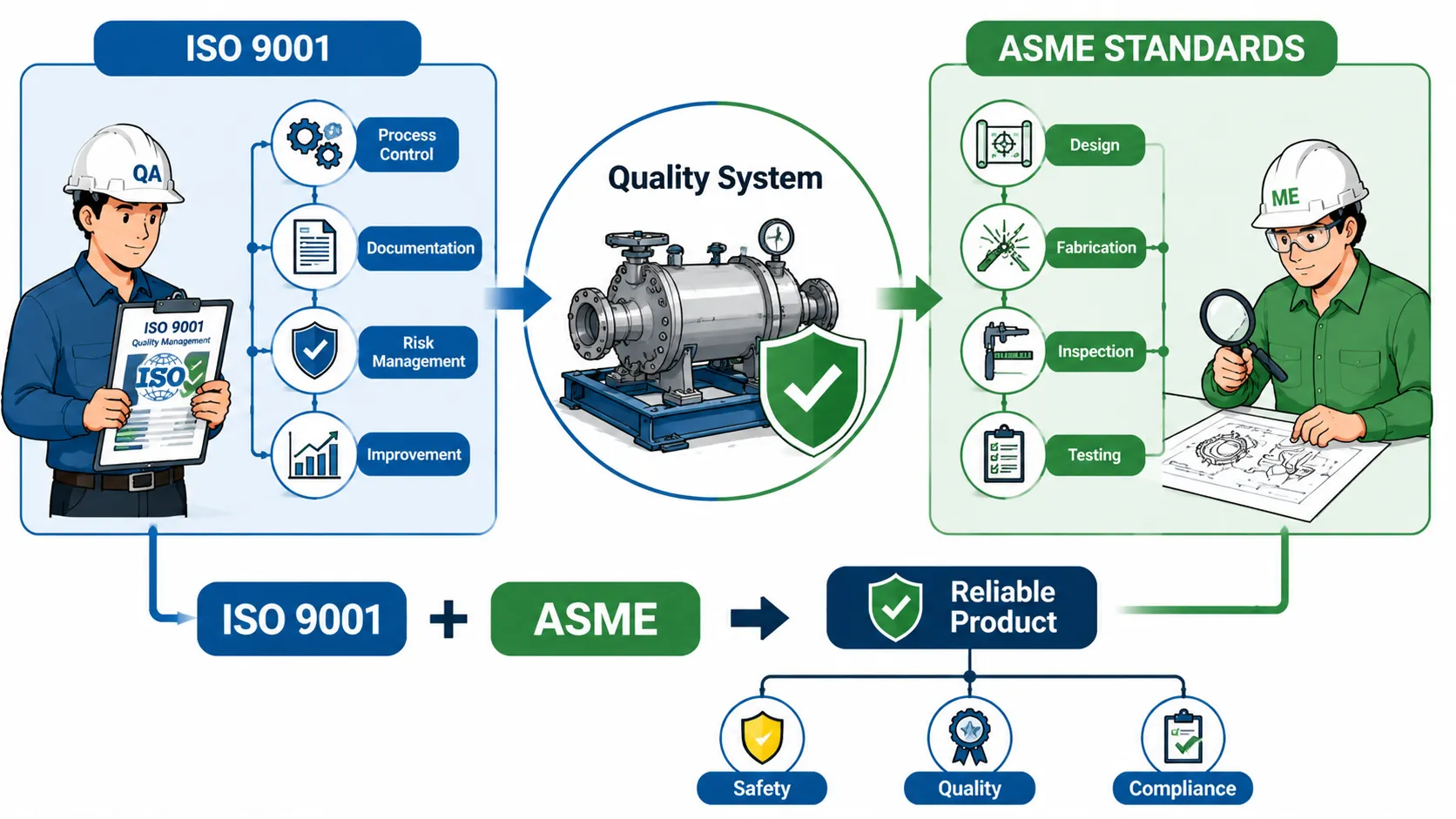
ISO 9001 and ASME standards serve different but complementary purposes in mechanical engineering.
ISO 9001 focuses on the management system used to control quality processes, while ASME focuses on technical engineering requirements for specific mechanical products and applications.
| Aspect | ISO 9001 | ASME Standards |
|---|---|---|
| Main Purpose | Establishes a quality management system. | Defines technical engineering requirements. |
| Primary Focus | Process control and continuous improvement. | Mechanical design, fabrication, and safety. |
| Application Area | All types of organisations and industries. | Mechanical engineering applications. |
| Main Users | Quality managers, engineers, organisations. | Mechanical designers, manufacturers, inspectors. |
| Example | Controlling manufacturing procedures. | Designing and testing pressure equipment. |
| Quality Approach | Management system based. | Technical standard based. |
Both systems support effective QA/QC practices by ensuring that mechanical engineering activities are controlled and verified.
Quality Standards Implementation Process in Mechanical Engineering
Quality Planning
The first stage involves identifying quality requirements before project execution.
Activities include:
- Reviewing customer specifications.
- Identifying applicable standards.
- Preparing quality plans.
- Establishing inspection requirements.
- Assigning responsibilities.
Process Control
During production, organisations must ensure that approved processes are followed.
Process control activities include:
- Monitoring manufacturing operations.
- Controlling materials.
- Maintaining equipment calibration.
- Ensuring qualified personnel perform tasks.
Inspection and Testing
Quality standards define how products should be inspected and tested.
Activities include:
- Dimensional inspection.
- Material verification.
- Welding inspection.
- Functional testing.
- Performance evaluation.
Documentation and Records Management
Quality standards require accurate documentation to provide evidence of compliance.
Important records include:
- Inspection reports.
- Test certificates.
- Material certificates.
- Calibration records.
- Non-conformance reports.
- Corrective action records.
Practical Examples of Quality Standards in Mechanical Engineering
Example 1: Automotive Component Manufacturing
An automotive manufacturer produces engine components requiring high accuracy and reliability.
Quality standards help control:
- Material selection.
- Machining processes.
- Dimensional accuracy.
- Final testing.
QA activities ensure manufacturing processes are controlled, while QC activities verify that components meet specifications.
Example 2: Pressure Equipment Manufacturing
A company manufactures industrial pressure vessels.
Quality standards ensure:
- Approved materials are used.
- Welding procedures are qualified.
- Inspections are completed.
- Pressure testing is performed.
ASME requirements provide technical guidance, while ISO 9001 ensures effective quality management processes.
Case Study: Application of ISO 9001 and ASME in Mechanical Equipment Production
Project Background
A mechanical engineering company was contracted to manufacture pressure vessels for an industrial processing facility. Because the equipment would operate under high pressure and temperature conditions, strict quality requirements were necessary.
Quality Management Approach
The organisation implemented an ISO 9001-based quality management system and followed ASME requirements for pressure equipment manufacturing.
Quality Assurance Activities
The QA team:
- Developed quality procedures.
- Reviewed engineering specifications.
- Controlled supplier approvals.
- Established inspection plans.
- Managed documentation.
Quality Control Activities
The QC team:
- Inspected incoming materials.
- Verified welding quality.
- Conducted dimensional checks.
- Performed pressure testing.
- Prepared inspection reports.
During production, a material documentation issue was identified. The QA team reviewed supplier records, while QC inspectors verified the material before approval. The issue was resolved without affecting the project schedule.
Case Study Outcome
By applying ISO 9001 quality management principles and ASME technical requirements, the company successfully produced safe and reliable pressure equipment. The integrated approach reduced risks, improved product confidence, and ensured compliance with customer expectations.
Key Benefits of Applying Quality Standards and Regulations
Effective implementation of quality standards provides many benefits in mechanical engineering.
Technical Benefits
- Improves product reliability.
- Enhances equipment safety.
- Reduces engineering failures.
- Ensures consistent manufacturing quality.
Operational Benefits
- Improves production efficiency.
- Reduces waste and rework.
- Supports better process control.
- Improves documentation management.
Business Benefits
- Increases customer trust.
- Improves market reputation.
- Supports international project opportunities.
- Enhances organisational competitiveness.
Professional Benefits
- Improves engineering decision-making.
- Supports career development.
- Strengthens QA/QC capabilities.
- Increases understanding of industry expectations.
Quality standards and regulations are fundamental components of successful mechanical engineering operations. Standards such as ISO 9001 and ASME provide organisations with structured methods for controlling processes, ensuring technical compliance, and achieving reliable engineering outcomes.
ISO 9001 supports quality management by improving processes, documentation, risk control, and continuous improvement, while ASME standards provide technical requirements for safe and reliable mechanical design and manufacturing.
For QA/QC Mechanical Engineers, understanding and applying quality standards is essential for maintaining product integrity, reducing failures, and ensuring that mechanical systems perform safely throughout their operational life.
Learners completing the LICQual Level 3 Certificate in Quality Control and Quality Assurance (QA/QC) in Mechanical Engineering develop valuable knowledge of international quality practices required to support modern mechanical manufacturing, inspection, and quality management environments.
4. Recognize the Stages of Product Development Where QA/QC Measures Are Applied, from Design to Manufacturing and Final Inspection
In mechanical engineering, product development is a structured process that transforms an initial concept into a fully functional and reliable product. Whether developing industrial machinery, automotive components, pressure equipment, manufacturing parts, or mechanical assemblies, every stage of development requires effective Quality Assurance (QA) and Quality Control (QC) measures to ensure the final product meets technical specifications, safety requirements, customer expectations, and industry standards.
From a QA/QC Mechanical Engineering perspective, quality cannot be achieved by inspecting the final product only. Quality must be planned, controlled, monitored, and verified throughout the entire product development lifecycle. Applying QA/QC measures from the early design stage helps organisations prevent failures, reduce production risks, minimise costs, and improve product performance.
The product development process involves several key stages, including design planning, engineering design, material selection, prototype development, manufacturing, assembly, testing, and final inspection. At each stage, QA focuses on ensuring that correct processes and procedures are followed, while QC verifies that outputs meet defined requirements through inspection and testing.
A professional QA/QC system ensures that quality is built into the product rather than added after production. This approach is widely used in mechanical manufacturing industries where reliability, safety, and precision are critical.
Understanding the Role of QA/QC in Product Development
Definition of QA/QC Application in Product Development
QA/QC application in product development refers to the systematic implementation of quality planning, process controls, inspections, testing activities, and improvement methods throughout the product lifecycle.
Quality Assurance activities focus on:
- Preventing design and manufacturing errors.
- Establishing quality procedures.
- Managing risks.
- Controlling engineering processes.
- Ensuring compliance with standards.
Quality Control activities focus on:
- Inspecting materials and components.
- Measuring product characteristics.
- Testing performance.
- Identifying defects.
- Confirming product acceptance.
In mechanical engineering, both functions work together to ensure that products are safe, reliable, cost-effective, and suitable for their intended application.
Product Development Lifecycle and QA/QC Stages
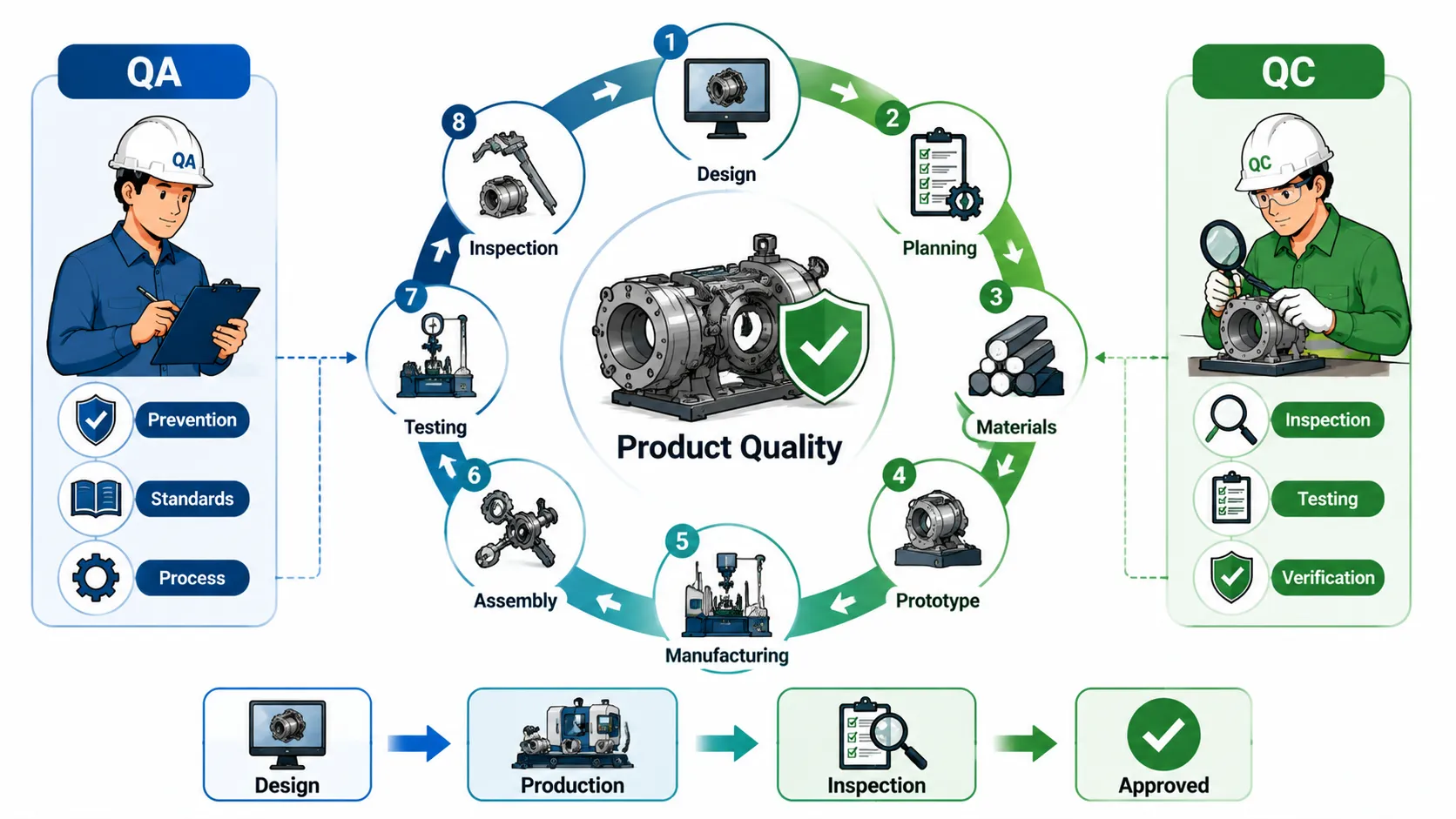
Mechanical product development consists of multiple stages where quality activities are applied. Each stage has specific QA/QC responsibilities.
The major stages include:
- Concept and design planning.
- Engineering design and development.
- Material selection and procurement.
- Prototype development.
- Manufacturing and production.
- Assembly and integration.
- Testing and validation.
- Final inspection and product release.
Stage 1: Concept Development and Design Planning
Importance of Quality at the Concept Stage
The concept stage is the foundation of product development. Decisions made during this phase influence product performance, manufacturing requirements, cost, and reliability.
QA activities begin by ensuring that customer requirements, technical specifications, and project objectives are clearly defined.
At this stage, QA professionals support the development team by identifying quality requirements and potential risks before detailed design begins.
QA/QC Measures Applied
Quality activities include:
- Reviewing customer requirements.
- Identifying applicable standards and regulations.
- Defining product performance expectations.
- Establishing initial quality objectives.
- Conducting risk assessments.
- Preparing quality planning documents.
QC involvement may include:
- Reviewing previous product performance data.
- Analysing historical defects.
- Identifying possible inspection requirements.
For example, when developing a new industrial pump design, engineers must consider operating pressure, temperature conditions, material requirements, and maintenance expectations before starting detailed design.
Stage 2: Engineering Design and Development
Quality Control During Design Activities
The design stage is one of the most important phases because design errors can create major problems during manufacturing and operation.
QA ensures that design processes follow approved procedures, while QC verifies that design outputs meet technical requirements.
QA Activities During Design
Key QA measures include:
- Establishing design review procedures.
- Controlling engineering drawings.
- Managing design changes.
- Ensuring compliance with standards.
- Reviewing calculation procedures.
QC Activities During Design
QC activities include:
- Checking design dimensions.
- Verifying tolerances.
- Reviewing material specifications.
- Confirming technical requirements.
Important design quality checks include:
- Strength calculations.
- Performance analysis.
- Safety evaluations.
- Manufacturability assessment.
A well-controlled design process reduces production problems and improves product reliability.
Stage 3: Material Selection and Procurement
Importance of Material Quality Control
Materials directly influence the strength, durability, and performance of mechanical products. Incorrect material selection can lead to premature failure, corrosion, deformation, or safety risks.
QA ensures that material purchasing procedures are controlled, while QC verifies that supplied materials meet specifications.
QA Measures
QA activities include:
- Approving suppliers.
- Establishing purchasing procedures.
- Defining material requirements.
- Reviewing supplier quality systems.
QC Measures
QC activities include:
- Inspecting incoming materials.
- Checking material certificates.
- Performing material testing.
- Verifying dimensions and condition.
Common material quality checks include:
- Chemical composition testing.
- Hardness testing.
- Mechanical property verification.
- Visual inspection.
For example, in pressure vessel manufacturing, QC inspectors verify that steel plates meet required specifications before fabrication begins.
Stage 4: Prototype Development and Testing
Role of QA/QC During Prototype Production
Prototype development allows engineers to evaluate product performance before full-scale manufacturing.
QA ensures that prototype development follows controlled procedures, while QC evaluates whether the prototype meets design expectations.
QA Activities
QA controls:
- Prototype manufacturing procedures.
- Testing plans.
- Documentation requirements.
- Design review processes.
QC Activities
QC performs:
- Dimensional inspection.
- Functional testing.
- Performance evaluation.
- Failure analysis.
Prototype testing helps identify design weaknesses and provides opportunities for improvement before production begins.
Stage 5: Manufacturing and Production
Quality Control During Manufacturing
Manufacturing is the stage where product specifications are converted into physical components. Effective QA/QC systems are essential to maintain consistent production quality.
QA focuses on controlling manufacturing processes, while QC verifies product characteristics.
QA Manufacturing Controls
QA activities include:
- Developing manufacturing procedures.
- Training production personnel.
- Monitoring process performance.
- Conducting process audits.
- Managing production documentation.
QC Manufacturing Controls
QC activities include:
- In-process inspections.
- Dimensional measurements.
- Welding inspections.
- Surface finish checks.
- Machine operation verification.
Manufacturing QC may involve:
- Vernier caliper measurements.
- Coordinate measuring machines.
- Non-destructive testing.
- Functional checks.
Stage 6: Assembly and Integration
Quality Management During Assembly
Mechanical products often consist of multiple components that must work together correctly. Assembly errors can affect product safety and performance.
QA ensures assembly procedures are properly established, while QC confirms correct installation and alignment.
QA Activities
- Preparing assembly procedures.
- Defining installation requirements.
- Controlling assembly documentation.
QC Activities
- Checking component alignment.
- Verifying connections.
- Inspecting fasteners.
- Testing assembled systems.
For example, during gearbox assembly, QC inspectors verify gear alignment, lubrication systems, and operational performance.
Stage 7: Testing and Validation
Importance of Product Testing
Testing confirms whether the final product performs according to design requirements.
QA ensures testing procedures are properly controlled, while QC performs verification activities.
QA Testing Controls
QA activities include:
- Developing testing procedures.
- Establishing acceptance criteria.
- Ensuring calibrated equipment is used.
QC Testing Activities
QC performs:
- Functional testing.
- Performance testing.
- Safety testing.
- Reliability testing.
Testing results provide evidence that products are ready for customer use.
Stage 8: Final Inspection and Product Release
Final Quality Verification
The final inspection stage confirms that completed products satisfy all requirements before delivery.
At this stage, QC performs detailed inspections, while QA reviews documentation and confirms compliance.
QA Final Review
QA verifies:
- Quality records are complete.
- Procedures were followed.
- Non-conformities were resolved.
- Customer requirements were achieved.
QC Final Inspection
QC verifies:
- Product dimensions.
- Surface condition.
- Functional performance.
- Documentation accuracy.
Only products that pass final inspection are approved for release.
QA/QC Application Across Product Development Stages
| Product Development Stage | QA Activities | QC Activities | Main Quality Objective |
|---|---|---|---|
| Concept Planning | Define requirements and quality objectives | Review previous product issues | Establish quality expectations |
| Design Development | Control design procedures and reviews | Verify drawings and specifications | Prevent design errors |
| Material Selection | Approve suppliers and material requirements | Inspect incoming materials | Ensure material quality |
| Prototype Development | Control prototype processes | Test prototype performance | Improve product design |
| Manufacturing | Control production procedures | Perform inspections and measurements | Maintain production quality |
| Assembly | Establish assembly standards | Verify installation accuracy | Ensure correct integration |
| Testing | Control testing procedures | Perform performance tests | Confirm product reliability |
| Final Inspection | Review quality documentation | Final product verification | Approve product release |
Practical Example: QA/QC in Industrial Machine Manufacturing
A company was developing a new industrial cutting machine for a manufacturing facility. The product required high precision because incorrect performance could affect production efficiency and worker safety.
During the design stage:
QA reviewed design procedures and ensured compliance with engineering standards.
QC verified:
- Component dimensions.
- Material requirements.
- Design specifications.
During manufacturing:
QA monitored production processes, while QC inspected machined components and assembly accuracy.
During final inspection:
QC performed operational testing, and QA reviewed all quality documentation before product approval.
The structured QA/QC approach helped the company deliver a reliable machine with reduced defects and improved customer satisfaction.
Case Study: Quality Control Approach in Automotive Component Production
Project Background
An automotive manufacturer developed a new transmission component requiring high accuracy and durability.
The company implemented QA/QC controls throughout the product development process.
QA Implementation
The QA team:
- Established quality procedures.
- Reviewed engineering requirements.
- Controlled supplier approval.
- Monitored production processes.
QC Implementation
The QC team:
- Inspected raw materials.
- Checked machining accuracy.
- Performed dimensional testing.
- Conducted performance evaluation.
During prototype testing, QC identified excessive wear in one component. The design team modified the component specification, and QA updated the manufacturing procedure.
Case Study Outcome
By applying QA/QC measures from design through final inspection, the company improved product reliability, reduced manufacturing failures, and successfully launched the improved component.
Key Benefits of Applying QA/QC Throughout Product Development
Effective QA/QC implementation provides several advantages:
Product Quality Benefits
- Improves reliability and performance.
- Reduces defects and failures.
- Ensures compliance with specifications.
- Enhances product safety.
Manufacturing Benefits
- Reduces waste and rework.
- Improves production efficiency.
- Controls manufacturing processes.
- Supports continuous improvement.
Business Benefits
- Increases customer satisfaction.
- Reduces operational costs.
- Improves company reputation.
- Supports competitive advantage.
QA/QC measures must be applied throughout every stage of mechanical product development, from initial design planning to final inspection and product release. Quality cannot be achieved only through final testing; it must be integrated into every process that influences product performance.
Quality Assurance provides the systems, procedures, and preventive controls required to achieve consistent results, while Quality Control verifies that products meet defined requirements through inspection and testing.
For mechanical engineering professionals, understanding where and how QA/QC measures are applied enables better decision-making, improved manufacturing control, and successful delivery of safe and reliable products. The implementation of effective QA/QC practices throughout the product lifecycle is essential for achieving engineering excellence and maintaining international quality standards.
5. Describe the Relationship Between Quality Management Practices and Overall Business Success in Mechanical Engineering Industries
Quality management is one of the most important strategic elements that influences the success and sustainability of mechanical engineering organisations. In industries such as manufacturing, fabrication, automotive, aerospace, oil and gas, power generation, industrial equipment, and mechanical construction, quality is not only a technical requirement but also a major business factor that affects customer satisfaction, operational efficiency, profitability, reputation, and long-term growth.
From a QA/QC Mechanical Engineering perspective, successful organisations do not treat quality as an isolated inspection activity. Instead, they integrate quality management practices into every area of business operations, including design, procurement, production, inspection, maintenance, supply chain management, and customer service. Effective quality management ensures that engineering products and services consistently meet required standards while reducing failures, waste, and operational risks.
Mechanical engineering industries operate in highly competitive environments where customers expect reliable products, safe equipment, accurate performance, and timely project delivery. Poor quality can result in equipment failures, product recalls, production delays, increased costs, and damage to organisational reputation. On the other hand, strong quality management systems create business advantages by improving efficiency, strengthening customer relationships, and supporting continuous improvement.
Quality management practices connect engineering performance with business success by ensuring that technical activities contribute positively to organisational objectives.
Understanding Quality Management Practices in Mechanical Engineering
Definition of Quality Management
Quality management refers to the coordinated activities, systems, procedures, and strategies used by an organisation to achieve consistent quality performance and continuous improvement.
In mechanical engineering industries, quality management includes planning, controlling, assuring, and improving the processes involved in producing mechanical products and delivering engineering services.
A complete quality management approach includes:
- Quality planning.
- Quality assurance.
- Quality control.
- Quality improvement.
- Risk management.
- Performance monitoring.
Quality management ensures that engineering organisations do not only identify problems but also prevent problems through effective systems and controlled processes.
Key Concepts of Quality Management
The main concepts of quality management include:
- Customer focus: Understanding and meeting customer requirements.
- Process control: Managing engineering activities through controlled procedures.
- Continuous improvement: Improving products, processes, and operational performance.
- Risk-based thinking: Identifying and reducing potential failures.
- Evidence-based decisions: Using quality data for improvement.
- Employee involvement: Ensuring all employees contribute to quality objectives.
- Standard compliance: Following recognised engineering standards and regulations.
These principles help mechanical engineering organisations achieve consistent performance and maintain competitive advantage.
Relationship Between Quality Management and Business Performance
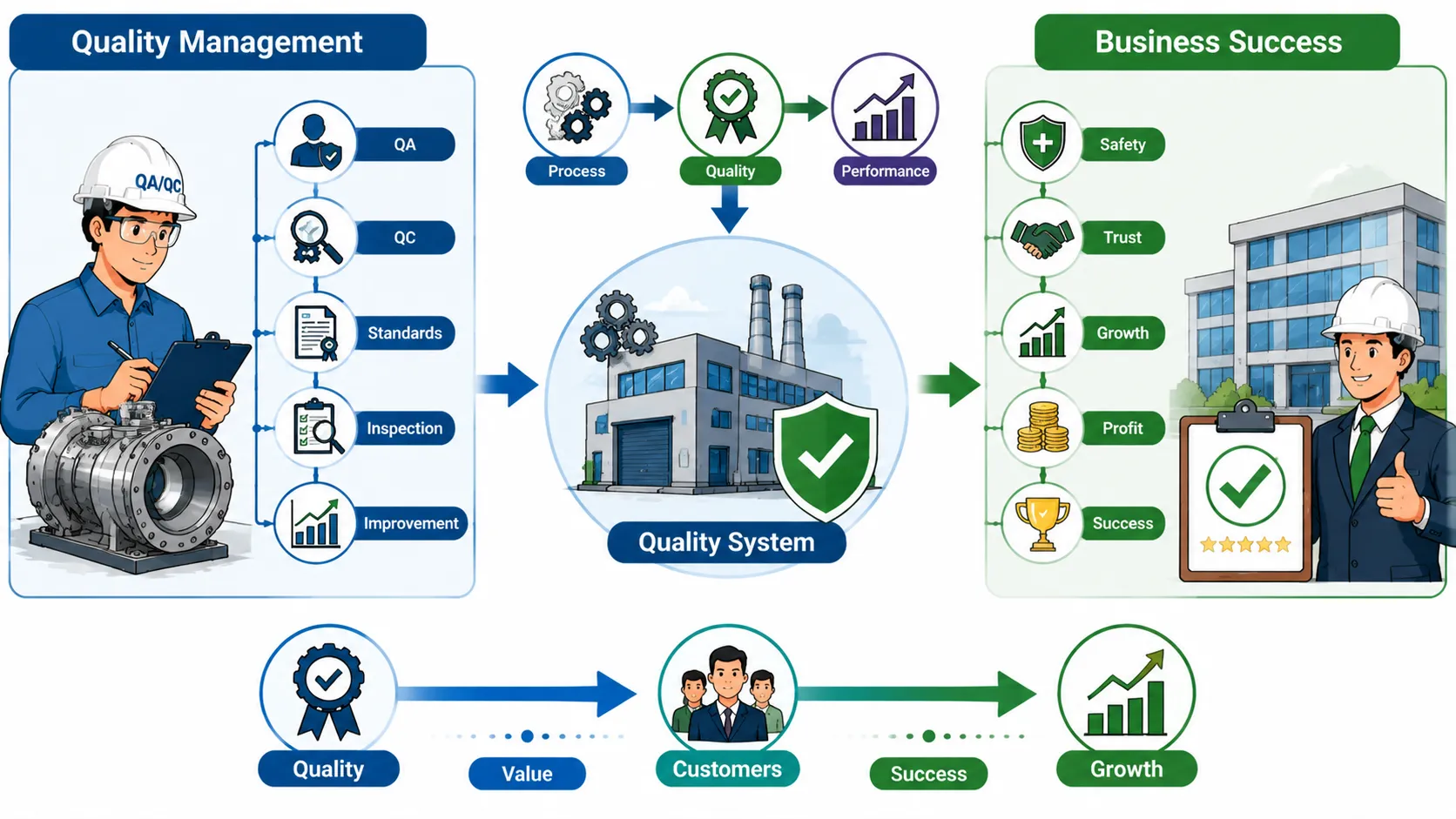
Quality as a Business Strategy
In modern mechanical engineering industries, quality management is directly connected with business success. Organisations that effectively manage quality are better positioned to control costs, improve productivity, increase customer confidence, and achieve sustainable growth.
Quality management influences business performance by improving both technical outcomes and organisational efficiency.
The relationship can be explained as:
A company that produces high-quality mechanical products gains stronger market recognition and develops long-term relationships with customers.
Role of Quality Management in Reducing Operational Costs
Cost Control Through Quality Improvement
Poor quality creates significant financial losses for mechanical engineering organisations. Defective products, rework, material waste, production delays, and equipment failures increase operational expenses.
Effective quality management helps reduce these costs by preventing problems before they occur.
Quality practices reduce costs through:
- Improved process efficiency.
- Reduced material waste.
- Lower rework requirements.
- Fewer product failures.
- Better resource utilisation.
- Improved production planning.
For example, a manufacturing company producing mechanical components can reduce machining errors by implementing controlled production procedures and regular quality inspections.
Impact of Quality Management on Customer Satisfaction
Building Customer Trust Through Quality
Customer satisfaction is one of the strongest indicators of business success. Mechanical engineering customers expect products that are reliable, safe, durable, and compliant with specifications.
Quality management supports customer satisfaction by ensuring:
- Products meet technical requirements.
- Deliveries are completed on time.
- Defects are minimised.
- Customer expectations are understood.
- Performance remains consistent.
Satisfied customers are more likely to provide repeat business and recommend the organisation to others.
In industries such as aerospace and energy, customer confidence depends heavily on an organisation’s ability to demonstrate strong quality management systems.
Quality Management and Operational Efficiency
Improving Engineering Processes
Mechanical engineering companies rely on complex processes involving design, procurement, manufacturing, inspection, and testing. Without effective quality management, these processes can become inefficient and difficult to control.
Quality management improves efficiency by:
- Standardising work procedures.
- Improving communication between departments.
- Reducing process variations.
- Establishing clear responsibilities.
- Improving workflow management.
Efficient processes allow organisations to complete projects faster while maintaining quality requirements.
Role of QA/QC Practices in Business Success
Contribution of Quality Assurance
Quality Assurance supports business success by creating systems that prevent quality problems.
QA activities include:
- Developing quality management plans.
- Establishing procedures.
- Conducting audits.
- Managing documentation.
- Controlling supplier quality.
- Implementing preventive actions.
Effective QA reduces business risks by ensuring that processes are reliable before production begins.
Contribution of Quality Control
Quality Control supports business success by verifying that products meet required standards.
QC activities include:
- Material inspection.
- Dimensional checks.
- Testing procedures.
- Product verification.
- Defect identification.
- Corrective actions.
QC ensures that customers receive products that meet expected quality levels.
Quality Management Practices and Business Benefits
| Quality Management Practice | Application in Mechanical Engineering | Business Impact |
|---|---|---|
| Quality Planning | Developing quality plans and procedures before production | Reduces project risks |
| Quality Assurance | Controlling processes and preventing defects | Improves reliability |
| Quality Control | Inspecting and testing products | Ensures customer satisfaction |
| Continuous Improvement | Improving processes using quality data | Increases efficiency |
| Supplier Quality Management | Monitoring supplier performance | Improves material reliability |
| Risk Management | Identifying possible failures | Reduces operational losses |
| Documentation Control | Managing technical records | Supports compliance and traceability |
Quality Management Process in Mechanical Engineering Organisations
Quality Planning Stage
Quality planning establishes the foundation for successful engineering operations.
Activities include:
- Defining customer requirements.
- Identifying applicable standards.
- Preparing quality objectives.
- Establishing inspection requirements.
- Assigning quality responsibilities.
A well-developed quality plan ensures that all departments understand their quality responsibilities.
Quality Implementation Stage
During project execution, quality systems must be effectively implemented.
Activities include:
- Monitoring production processes.
- Ensuring procedures are followed.
- Controlling materials and equipment.
- Maintaining quality records.
Quality Monitoring Stage
Performance monitoring helps organisations identify improvement opportunities.
Activities include:
- Reviewing inspection results.
- Analysing defect trends.
- Measuring process performance.
- Conducting quality audits.
Quality Improvement Stage
Continuous improvement ensures long-term business success.
Activities include:
- Correcting recurring problems.
- Improving production methods.
- Updating procedures.
- Applying lessons learned.
Practical Examples of Quality Management Supporting Business Success
Example 1: Mechanical Manufacturing Company
A company producing industrial machine parts experienced frequent customer complaints due to dimensional errors.
The organisation implemented improved quality management practices.
Actions included:
- Introducing process monitoring.
- Improving operator training.
- Increasing inspection frequency.
- Updating manufacturing procedures.
Results:
- Reduced product defects.
- Improved customer satisfaction.
- Lower production costs.
- Increased repeat orders.
This example shows how quality management directly improves business performance.
Example 2: Industrial Equipment Manufacturer
A company manufacturing pressure equipment implemented a stronger QA/QC system.
Quality improvements included:
- Better supplier control.
- Improved documentation.
- More effective testing procedures.
- Enhanced inspection processes.
The company achieved:
- Reduced production delays.
- Improved compliance.
- Increased customer confidence.
Case Study: Quality Management Transformation in Mechanical Engineering Industry
Project Background
A mechanical engineering company specialising in industrial machinery production faced several business challenges. The organisation experienced high levels of rework, delayed deliveries, and customer complaints caused by inconsistent manufacturing quality.
Management decided to improve its quality management system to increase operational performance.
Quality Improvement Implementation
The company introduced structured QA/QC practices.
The QA team:
- Developed improved quality procedures.
- Established process control methods.
- Implemented internal audits.
- Improved supplier evaluation.
The QC team:
- Increased inspection activities.
- Improved testing methods.
- Introduced better defect reporting.
- Monitored corrective actions.
Business Results
After implementing improved quality management practices, the company achieved:
- Reduced manufacturing defects.
- Faster production cycles.
- Improved customer satisfaction.
- Lower operational costs.
- Increased market competitiveness.
Case Study Conclusion
The case study demonstrates that quality management is not only a technical requirement but also a strategic business tool. Effective QA/QC practices improve engineering performance while creating measurable business benefits.
Key Benefits of Quality Management Practices in Mechanical Engineering Industries
Technical Benefits
- Improves product reliability.
- Enhances engineering accuracy.
- Reduces equipment failures.
- Supports compliance with standards.
Operational Benefits
- Improves productivity.
- Reduces waste.
- Minimises rework.
- Strengthens process control.
Business Benefits
- Increases customer loyalty.
- Improves organisational reputation.
- Supports business growth.
- Creates competitive advantage.
Strategic Benefits
- Encourages innovation.
- Supports continuous improvement.
- Improves decision-making.
- Builds long-term sustainability.
QA/QC practices provide the foundation for preventing failures, improving production performance, reducing costs, and maintaining customer confidence. Companies that integrate quality management into their business strategy are better prepared to compete in global engineering markets.
For mechanical engineering professionals, understanding the relationship between quality management and business success is essential because quality is not only about producing defect-free products; it is about creating value, improving performance, and supporting long-term organisational growth.
Learners completing the LICQual Level 3 Certificate in Quality Control and Quality Assurance (QA/QC) in Mechanical Engineering develop the knowledge required to support effective quality systems and contribute to successful mechanical engineering operations.
6. Identify the Tools and Techniques Used in QA/QC to Ensure the Quality of Mechanical Products
In mechanical engineering industries, ensuring product quality requires more than final inspection. Modern manufacturing organisations use a wide range of Quality Assurance (QA) and Quality Control (QC) tools and techniques to monitor processes, identify risks, verify product performance, and achieve consistent engineering outcomes. These tools help engineers, inspectors, and production teams maintain quality throughout the entire product lifecycle, from material selection and design verification to manufacturing, assembly, testing, and final product approval.
From a QA/QC Mechanical Engineering perspective, quality tools provide a structured approach for controlling manufacturing processes and reducing the possibility of defects. Mechanical products such as machine components, pressure equipment, automotive parts, industrial machinery, and fabricated assemblies require accurate measurements, reliable materials, controlled production methods, and effective inspection procedures to meet customer and industry requirements.
Quality Assurance tools mainly focus on preventing problems by improving processes, managing risks, and establishing effective systems. Quality Control techniques focus on detecting defects through inspection, measurement, testing, and verification activities. When these tools are applied together, organisations can improve product reliability, reduce production costs, increase customer satisfaction, and maintain compliance with engineering standards.
Understanding QA/QC Tools and Techniques
Definition of QA/QC Tools
QA/QC tools are systematic methods, instruments, procedures, and techniques used by engineering professionals to plan, monitor, inspect, and improve the quality of mechanical products and manufacturing processes.
These tools support engineers in:
- Identifying potential quality risks.
- Controlling manufacturing processes.
- Measuring product characteristics.
- Detecting defects.
- Analysing quality problems.
- Implementing corrective actions.
- Improving production performance.
In mechanical engineering, selecting the correct QA/QC tools depends on factors such as product complexity, manufacturing method, material type, safety requirements, and industry standards.
Importance of QA/QC Tools in Mechanical Product Quality
Effective use of quality tools helps organisations achieve:
- Consistent product performance.
- Reduced manufacturing errors.
- Improved production efficiency.
- Better control of engineering processes.
- Early identification of defects.
- Reduced waste and rework.
- Compliance with customer requirements.
- Improved workplace safety.
Mechanical engineering industries depend on accurate quality monitoring because even small defects in components can result in equipment failure, operational downtime, or safety risks.
Quality Planning Tools Used in QA Systems
Quality Management Plan
A Quality Management Plan is one of the most important QA tools used to define how quality requirements will be achieved throughout a project or manufacturing process.
It establishes:
- Quality objectives.
- Inspection requirements.
- Testing procedures.
- Responsibilities of quality personnel.
- Documentation requirements.
- Acceptance criteria.
In mechanical manufacturing, a quality management plan ensures that all departments understand their role in achieving product quality.
For example, during the production of industrial machinery, the quality plan defines material inspection requirements, machining checks, welding inspections, and final testing procedures.
Process Flow Diagrams
Process flow diagrams are visual tools used to represent manufacturing steps and identify quality control points.
They help engineers understand:
- Production sequence.
- Critical manufacturing stages.
- Inspection locations.
- Possible failure points.
Benefits include:
- Better process understanding.
- Improved workflow control.
- Easier identification of quality risks.
Inspection and Measurement Tools in Quality Control
Dimensional Inspection Tools
Dimensional inspection tools are widely used in mechanical engineering to verify whether components meet specified measurements and tolerances.
Common tools include:
- Vernier calipers.
- Micrometers.
- Height gauges.
- Dial indicators.
- Coordinate Measuring Machines (CMM).
These tools are used to measure:
- Length.
- Diameter.
- Thickness.
- Surface dimensions.
- Component alignment.
Accurate measurement ensures that mechanical parts fit correctly and operate safely.
Coordinate Measuring Machine (CMM)
A Coordinate Measuring Machine is an advanced inspection tool used for precise measurement of complex mechanical components.
CMM systems measure:
- Three-dimensional geometry.
- Component accuracy.
- Surface positions.
- Manufacturing tolerances.
Applications include:
- Aerospace components.
- Automotive parts.
- Precision machinery.
CMM technology improves inspection accuracy and reduces measurement errors.
Non-Destructive Testing (NDT) Techniques
Overview of NDT Methods
Non-Destructive Testing techniques are quality control methods used to inspect materials and components without damaging their usability.
NDT is essential in industries where component failure could create serious safety risks.
Common NDT techniques include:
- Visual Testing (VT).
- Ultrasonic Testing (UT).
- Radiographic Testing (RT).
- Magnetic Particle Testing (MT).
- Liquid Penetrant Testing (PT).
Visual Testing (VT)
Visual inspection is one of the simplest and most widely used QC techniques.
Inspectors examine components for:
- Surface defects.
- Cracks.
- Corrosion.
- Welding problems.
- Manufacturing irregularities.
Benefits include:
- Low cost.
- Quick identification of visible defects.
- Easy implementation.
Ultrasonic Testing (UT)
Ultrasonic testing uses high-frequency sound waves to identify internal defects within materials.
It is commonly used for:
- Weld inspection.
- Thickness measurement.
- Detecting internal cracks.
Advantages include:
- Accurate internal inspection.
- No damage to components.
- Suitable for critical equipment.
Radiographic Testing (RT)
Radiographic testing uses radiation technology to identify internal defects.
Applications include:
- Weld examination.
- Pressure equipment inspection.
- Critical structural components.
It helps identify:
- Internal cracks.
- Voids.
- Welding defects.
Quality Control Testing Techniques
Mechanical Testing
Mechanical testing evaluates the physical properties and performance of materials and components.
Common tests include:
- Tensile testing.
- Hardness testing.
- Impact testing.
- Fatigue testing.
These tests determine whether materials can withstand operational conditions.
Functional Testing
Functional testing verifies whether a mechanical product operates according to design requirements.
Examples include:
- Machine performance testing.
- Equipment operation checks.
- Load testing.
- Pressure testing.
Functional testing ensures that final products perform safely under expected working conditions.
Statistical Quality Control Techniques
Statistical Process Control (SPC)
Statistical Process Control is a quality monitoring technique that uses statistical methods to analyse manufacturing processes.
SPC helps engineers:
- Identify process variations.
- Monitor production stability.
- Prevent defects.
- Improve consistency.
Common SPC tools include:
- Control charts.
- Process capability analysis.
- Data analysis methods.
For example, a manufacturing company producing precision shafts can use SPC to monitor diameter variations during machining operations.
Quality Control Charts
Quality control charts provide visual information about process performance over time.
They help identify:
- Normal process variation.
- Unexpected changes.
- Production problems.
Benefits include:
- Early problem detection.
- Better decision-making.
- Improved process control.
Root Cause Analysis Tools
Fishbone Diagram
The Fishbone Diagram, also known as the Cause-and-Effect Diagram, is used to identify possible causes of quality problems.
It helps engineers analyse issues related to:
- Materials.
- Machines.
- Methods.
- Personnel.
- Environment.
- Measurement.
For example, if a mechanical component fails during testing, engineers can use a Fishbone Diagram to identify whether the cause was material quality, machining error, or incorrect assembly.
5 Why Analysis
The 5 Why method is a problem-solving technique used to identify the root cause of defects.
The process involves repeatedly asking why a problem occurred until the underlying cause is identified.
Benefits include:
- Effective problem solving.
- Prevention of repeated failures.
- Improved process improvement.
QA/QC Tools and Techniques Comparison Table
| QA/QC Tool or Technique | Main Purpose | Application in Mechanical Engineering | Quality Benefit |
|---|---|---|---|
| Quality Management Plan | Establish quality requirements | Project and manufacturing planning | Prevents quality issues |
| Process Flow Diagram | Visualise processes | Production workflow control | Improves process understanding |
| Vernier Caliper | Measure dimensions | Component inspection | Ensures accuracy |
| CMM | Precision measurement | Complex component inspection | Improves measurement reliability |
| NDT Methods | Detect hidden defects | Weld and material inspection | Improves safety |
| Mechanical Testing | Evaluate material properties | Component verification | Confirms performance |
| SPC | Monitor process variation | Manufacturing control | Reduces defects |
| Fishbone Diagram | Identify causes of problems | Quality investigation | Supports corrective action |
| 5 Why Analysis | Find root causes | Defect prevention | Improves processes |
Practical Examples of QA/QC Tools in Mechanical Engineering
Example 1: Manufacturing of Industrial Components
A company produces precision mechanical components for industrial machinery.
QA tools used:
- Quality management plan.
- Process flow diagrams.
- Supplier quality checks.
QC tools used:
- Dimensional inspection.
- Surface testing.
- Functional testing.
The combination of these tools ensures components meet required specifications before delivery.
Example 2: Welding Quality Inspection
A fabrication company manufactures pressure equipment requiring high reliability.
QA activities include:
- Approved welding procedures.
- Qualified welding personnel.
- Inspection planning.
QC activities include:
- Visual inspection.
- Ultrasonic testing.
- Radiographic testing.
These techniques ensure weld quality and prevent equipment failure.
Case Study: Improving Product Quality Using QA/QC Tools
Project Background
A mechanical manufacturing company producing industrial machine parts experienced increased customer complaints due to component failures and dimensional errors.
The organisation introduced improved QA/QC practices to identify and solve quality issues.
Quality Improvement Actions
The QA team implemented:
- Updated quality management procedures.
- Process flow analysis.
- Supplier evaluation systems.
The QC team introduced:
- Advanced dimensional inspection.
- Statistical process control.
- Root cause analysis.
During investigation, engineers discovered that inconsistent machining processes were causing dimensional variations.
Corrective actions included:
- Improving machine calibration.
- Increasing inspection frequency.
- Training production staff.
Case Study Outcome
After implementing improved QA/QC tools, the company achieved:
- Reduced product defects.
- Improved manufacturing consistency.
- Increased customer satisfaction.
- Lower production costs.
This case demonstrates that effective quality tools help organisations identify problems, improve processes, and achieve business success.
Key Benefits of Using QA/QC Tools and Techniques
Product Quality Benefits
- Improves product reliability.
- Reduces manufacturing defects.
- Ensures compliance with specifications.
- Enhances product performance.
Operational Benefits
- Improves production efficiency.
- Reduces waste and rework.
- Supports better decision-making.
- Increases process control.
Business Benefits
- Builds customer confidence.
- Reduces operational costs.
- Improves organisational reputation.
- Supports market competitiveness.
Safety Benefits
- Prevents equipment failures.
- Reduces workplace risks.
- Improves mechanical system reliability.
- Supports safe operation.
Conclusion
QA/QC tools and techniques are essential for ensuring the quality of mechanical products throughout the manufacturing lifecycle. These tools enable engineering organisations to prevent defects, control processes, verify product performance, and continuously improve operations.
Quality Assurance tools such as quality planning, process control, and risk management help establish reliable manufacturing systems, while Quality Control techniques such as inspection, testing, measurement, and defect analysis confirm that products meet required standards.
For QA/QC Mechanical Engineers, understanding and applying these tools is critical for maintaining product reliability, improving manufacturing efficiency, and achieving customer satisfaction. The effective use of quality tools supports mechanical engineering industries in producing safe, durable, and high-performance products that meet international quality expectations.