
Lesson 8: Reflect on personal learning and professional development through research.
Research in electrical engineering QA/QC is not only a process for investigating technical problems and improving project quality; it is also an important mechanism for developing professional competence, critical thinking and reflective practice. Lesson 8: Reflect on Personal Learning and Professional Development Through Research focuses on how research activities can help electrical engineering professionals evaluate their knowledge, identify areas for improvement and strengthen their future professional practice.
Through research, learners encounter real QA/QC challenges involving inspection, testing, data collection, quality standards, defect analysis, technical decision-making and workplace improvement. Reflecting on these experiences enables learners to examine what they already understand, where knowledge gaps exist and how research findings have influenced their professional judgement. This process encourages continuous learning rather than treating professional development as a one-time activity.
The lesson explores how to critically reflect on research methods, evidence, findings and workplace applications. Learners consider how their research experience has developed skills such as data analysis, problem-solving, technical communication, evidence-based decision-making and quality improvement. Reflection also involves evaluating strengths and limitations, identifying lessons learned and establishing realistic objectives for continuing professional development.
For electrical engineering QA/QC professionals, reflective learning can contribute to improved inspection strategies, stronger quality management, better interpretation of technical information and more effective responses to complex workplace problems. It also supports the development of professional confidence and accountability when making engineering decisions based on evidence.
The lesson therefore connects research with professional growth through a continuous cycle:
Research → Experience → Reflection → Learning → Improvement → Professional Development
By completing this lesson, learners can develop a more structured approach to evaluating their research experience and using the knowledge gained to strengthen future electrical engineering QA/QC practice. The emphasis is on critical reflection, evidence-based learning and continuous professional improvement within changing electrical engineering environments.
Critically Reflect on the Advanced Cognitive and Practical Skills Developed During the QA/QC Research Project
Critical reflection on a QA/QC research project is an essential component of advanced professional development in electrical engineering. Completing a research investigation does more than produce findings about a particular quality problem; it develops the learner’s ability to think analytically, evaluate evidence, solve complex workplace problems, make informed professional judgements and apply research knowledge to electrical engineering practice. Reflection provides a structured opportunity to examine how these capabilities developed, how effectively they were applied and how they can be strengthened for future professional responsibilities.
For an electrical engineering QA/QC professional, reflection should move beyond simply describing what happened during the research project. A descriptive statement might explain that data were collected, analysed and compared with industry requirements. A critical reflection goes further by examining why particular methods were selected, whether they were appropriate, what difficulties were encountered, how decisions affected the research outcome, what assumptions influenced the investigation and what could be improved in future work.
At Level 6 diploma standard, critical reflection requires learners to evaluate the relationship between their research experience and professional capability. This includes considering the development of advanced cognitive skills such as analysis, synthesis, evaluation, interpretation, problem-solving and professional judgement, alongside practical skills such as data collection, inspection, quality analysis, technical communication and implementation planning.
The reflective process can therefore be represented as:
Research Experience → Evidence of Learning → Critical Reflection → Identified Strengths and Gaps → Improvement Actions → Continuing Professional Development
This approach makes reflection an active professional-development process rather than a simple personal summary.
Understanding Critical Reflection in Electrical QA/QC Research
Critical reflection involves systematically examining an experience to determine what was learned, how knowledge and skills were applied, what worked effectively, what limitations existed and how future practice could be improved.
In electrical QA/QC research, reflection may involve evaluating:
Research methodology selection.
Data collection procedures.
Data quality.
Analytical techniques.
Interpretation of electrical quality data.
Comparison against standards and benchmarks.
Problem-solving strategies.
Technical decision-making.
Quality-control processes.
Communication with stakeholders.
Research limitations.
Implementation recommendations.
Critical reflection should be evidence-based. Learners should support their observations with examples from the research project rather than making general statements such as “my analytical skills improved”.
A stronger reflection might state that analysis of inspection and testing records required the learner to identify recurring defect patterns, distinguish significant anomalies from isolated events and evaluate whether the available evidence was sufficient to support a particular conclusion.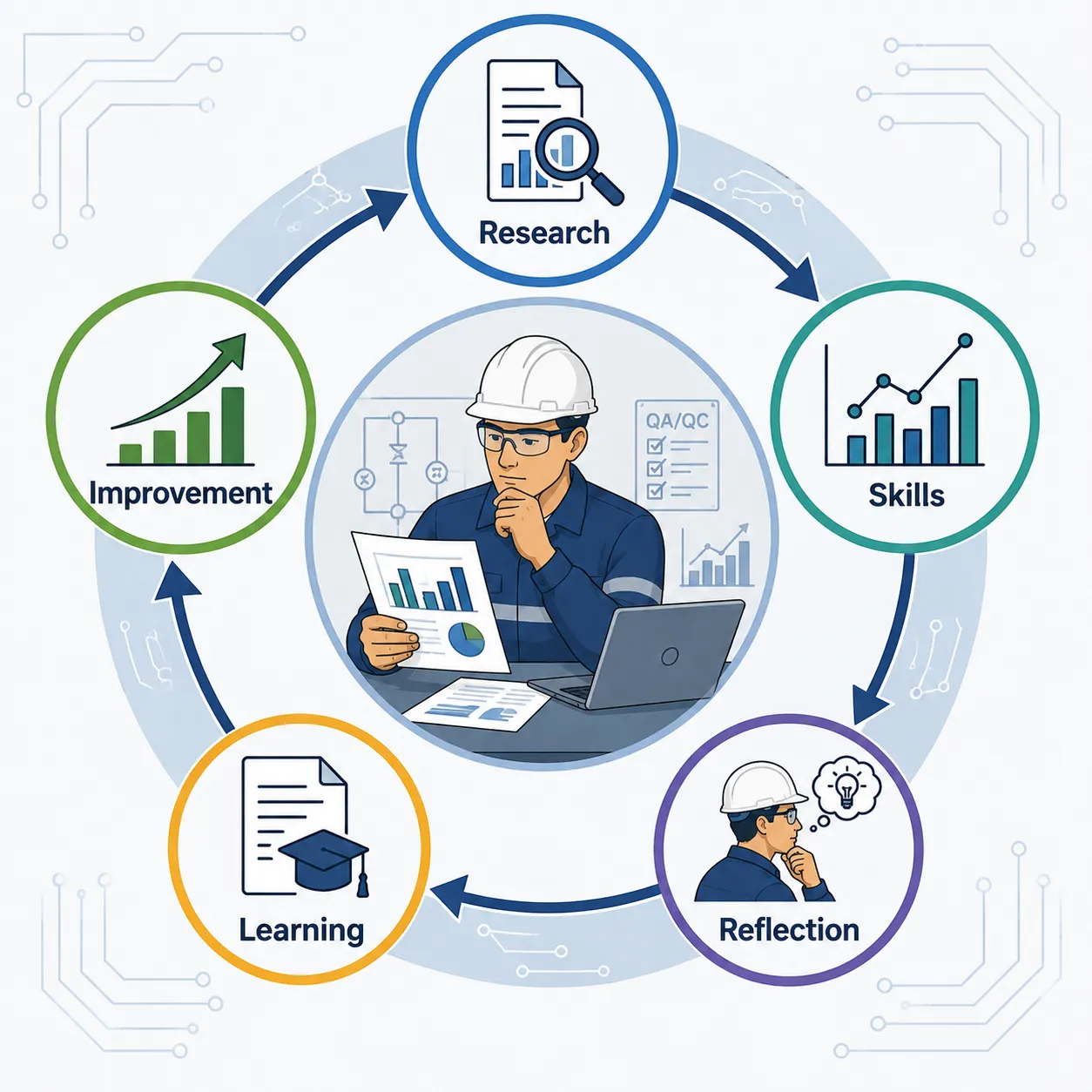
Key Concepts and Definitions
| Key concept | Definition | Application in electrical QA/QC research |
|---|---|---|
| Critical Reflection | Systematic evaluation of experience, learning and professional practice | Reviewing how research decisions affected QA/QC findings |
| Cognitive Skill | Mental capability used to understand, analyse and evaluate information | Interpreting complex quality datasets |
| Practical Skill | Ability to apply knowledge through workplace activity | Collecting inspection and testing data |
| Analytical Thinking | Breaking information into components to understand relationships | Identifying causes of recurring defects |
| Critical Thinking | Evaluating evidence before reaching a judgement | Assessing whether findings support a recommendation |
| Professional Judgement | Evidence-informed decision-making within professional responsibilities | Selecting proportionate QA/QC controls |
| Problem Solving | Structured process for identifying and addressing problems | Developing responses to recurring non-conformities |
| Reflective Practice | Using experience and evaluation to improve future practice | Applying lessons learned to future projects |
| Metacognition | Awareness and evaluation of one’s own thinking and learning | Recognising limitations in research reasoning |
| Self-Evaluation | Assessment of personal performance against defined expectations | Reviewing research strengths and weaknesses |
| Transferable Skill | Capability applicable across different professional contexts | Data analysis and technical communication |
| Continuing Professional Development | Structured development of professional knowledge and competence | Planning further learning based on research gaps |
| Research Competence | Ability to conduct and evaluate systematic investigation | Designing and completing QA/QC research |
| Evidence-Based Practice | Using reliable evidence to inform professional decisions | Applying research findings to quality processes |
Why Critical Reflection Matters in QA/QC Research
Electrical engineering quality problems can involve technical, organisational and human factors. A research project may therefore challenge assumptions and require the researcher to adapt their approach.
Critical reflection helps the learner understand:
How technical decisions were made.
Why particular research methods were selected.
Whether the evidence was sufficient.
How uncertainty influenced conclusions.
Which skills were effective.
Which skills require development.
How research findings can influence future practice.
Reflection also supports professional accountability. An engineer who can critically evaluate their own decisions is better positioned to identify weaknesses before they become recurring problems.
Difference Between Description and Critical Reflection
Descriptive Reflection
A descriptive approach might state:
“I collected QA/QC records and analysed the defects.”
This explains an activity but provides little insight into learning.
Critical Reflection
A critical approach might state:
“The initial review of QA/QC records identified recurring defects, but the analysis demonstrated that frequency alone was insufficient to establish significance. Additional comparison of defect type, work phase and inspection stage was required to distinguish recurring process weaknesses from isolated events. This developed my ability to evaluate data in context rather than relying on a single indicator.”
The second approach demonstrates:
Analysis.
Evaluation.
Learning.
Professional development.
Future application.
Advanced Cognitive Skills Developed Through Research
A Level 6 QA/QC research project can develop several advanced cognitive capabilities.
Analytical Thinking
Analytical thinking involves examining information systematically and identifying relationships between different variables.
During QA/QC research, learners may analyse:
Defect frequencies.
Testing results.
Inspection findings.
NCR trends.
Rework records.
Process performance.
Quality indicators.
The research process can demonstrate that technical information rarely provides a complete explanation by itself.
For example, a high defect rate may initially appear to indicate poor installation quality. Further analysis may reveal that the defects are concentrated within a particular work package, installation phase or shift pattern. This requires the learner to move from simple observation to contextual analysis.
Critical Thinking
Critical thinking requires questioning assumptions and evaluating evidence before reaching conclusions.
Research encourages learners to ask:
Is the evidence sufficiently reliable?
Is the sample representative?
Could another factor explain the result?
Is the relationship causal or merely associated?
Are the conclusions proportionate to the evidence?
Are the research limitations significant?
These questions strengthen professional decision-making.
Evaluation
Evaluation involves determining the significance, quality or suitability of evidence, methods and outcomes.
A learner may evaluate:
Research methods.
Data reliability.
Data validity.
Industry benchmarks.
QA/QC practices.
Research limitations.
Proposed interventions.
For example, a research finding may indicate that a revised inspection procedure is associated with fewer defects. Evaluation requires consideration of whether other project changes could also have influenced the result.
Synthesis
Synthesis involves bringing information from different sources together to develop a coherent understanding.
A QA/QC researcher may synthesise:
Inspection records.
Testing results.
Interviews.
Observations.
Industry requirements.
Research literature.
Quality reports.
The ability to synthesise information is particularly valuable when no single source provides a complete explanation.
Problem Solving
Research projects frequently require learners to move from identifying a problem to developing a practical response.
A typical problem-solving pathway is:
Problem → Evidence → Causes → Options → Evaluation → Recommendation → Review
This develops a structured approach to workplace problem-solving.
Practical Skills Developed During the Research Project
Advanced cognitive skills should be considered alongside practical capability.
Practical research skills may include:
Planning data collection.
Reviewing technical records.
Conducting structured observations.
Organising datasets.
Applying quality-control procedures.
Maintaining research records.
Comparing findings against benchmarks.
Preparing technical reports.
Communicating findings.
Developing recommendations.
The combination of cognitive and practical skills is particularly important because electrical QA/QC professionals must convert technical information into workplace decisions.
Developing Data Collection Skills
Data collection requires consistency and accuracy.
During the research project, learners may have developed skills in:
Identifying relevant data sources.
Defining data requirements.
Selecting appropriate records.
Applying systematic collection procedures.
Recording observations consistently.
Checking data completeness.
Maintaining traceability.
Critical reflection should consider whether the original data collection strategy was effective.
Questions may include:
Were all relevant data available?
Were some records incomplete?
Did the collection method introduce bias?
Were data recorded consistently?
Would a different collection method improve reliability?
Developing Data Analysis Skills
Research can significantly strengthen analytical capability.
Learners may have developed the ability to:
Organise raw data.
Categorise defects.
Identify patterns.
Compare performance.
Examine relationships.
Identify anomalies.
Interpret trends.
Distinguish significant findings from isolated events.
Reflection should consider not only whether the analysis was completed but whether the analytical approach was appropriate.
Developing Interpretation Skills
Interpretation requires understanding what the data mean in context.
For example, a reduction in defect frequency may appear positive, but the researcher should consider:
Was less work completed?
Did the work type change?
Did the workforce change?
Were inspection criteria modified?
Was data collection consistent?
This develops a more sophisticated understanding of quality performance.
Developing Professional Judgement
One of the most important outcomes of research is the development of professional judgement.
Professional judgement involves:
Understanding available evidence.
Recognising limitations.
Considering risk.
Evaluating alternatives.
Balancing quality and practicality.
Reaching proportionate conclusions.
Research can demonstrate that professional decisions should not be based solely on instinct or the most convenient explanation.
Developing Research Methodological Skills
The research project can strengthen understanding of:
Qualitative methods.
Quantitative methods.
Mixed-method approaches.
Sampling.
Data collection.
Data analysis.
Research limitations.
Validity.
Reliability.
Reflection should consider whether the chosen methodology was appropriate.
For example:
“The mixed-method approach provided quantitative evidence of defect frequency while qualitative observations helped explain possible process weaknesses.”
This demonstrates understanding of methodological value.
Developing Technical Communication
Research requires the ability to communicate technical information clearly.
Skills may include:
Technical report writing.
Structured argument.
Data presentation.
Visualisation.
Executive summaries.
Research presentations.
Stakeholder communication.
Reflection should consider whether technical communication was sufficiently clear for different audiences.
Developing Visual Communication Skills
Electrical QA/QC research often involves complex information.
Learners may develop the ability to communicate findings through:
Charts.
Tables.
Process diagrams.
Trend graphs.
Quality dashboards.
Flow diagrams.
Reflection can consider whether visual aids improved understanding or whether they could be made more concise.
Developing Evidence-Based Decision-Making
Research encourages decisions based on evidence rather than assumption.
For example, instead of stating:
“Inspection should be increased because quality is poor.”
a stronger evidence-based conclusion might be:
“Inspection records indicate recurring defects at a defined process stage, supporting targeted progressive verification rather than a general increase in inspection activity.”
This demonstrates proportionality and evidence-based reasoning.
Developing Standards and Benchmarking Skills
Comparing findings against recognised industry requirements can develop the ability to:
Interpret technical criteria.
Identify gaps.
Compare performance.
Assess conformity.
Understand benchmark limitations.
Reflection should consider how standards influenced research interpretation.
Developing Workplace Problem-Solving Skills
Research may expose problems that are not solved by one technical intervention.
Learners may develop the ability to consider:
People.
Process.
Materials.
Equipment.
Documentation.
Supervision.
Programme.
Communication.
This broader perspective supports systems-oriented problem-solving.
Developing Risk-Based Thinking
QA/QC decisions often involve prioritisation.
Research can help learners assess:
Likelihood.
Consequence.
Defect severity.
Recurrence.
Control effectiveness.
Reflection should examine whether risk influenced the research priorities appropriately.
Developing Adaptability
Research rarely proceeds exactly as initially planned.
Possible challenges include:
Missing data.
Access limitations.
Changing project conditions.
Stakeholder availability.
Incomplete records.
Unexpected findings.
Adapting while maintaining methodological integrity is an important professional skill.
Critical Reflection on Research Strengths
A strong reflective evaluation should identify specific strengths.
Potential strengths include:
Systematic data collection.
Appropriate methodology.
Clear research objectives.
Effective data analysis.
Strong evidence synthesis.
Appropriate use of QA/QC records.
Effective technical communication.
Practical recommendations.
The learner should explain why each strength mattered.
For example:
“Using multiple data sources strengthened the investigation because inspection records alone did not provide sufficient context to interpret the causes of recurring defects.”
Critical Reflection on Research Limitations
Critical reflection also requires acknowledging weaknesses.
Possible limitations include:
Limited sample size.
Restricted project access.
Incomplete records.
Time constraints.
Limited stakeholder participation.
Measurement limitations.
Potential researcher bias.
A limitation should be connected to its effect on the research.
For example:
“Limited access to historical records restricted the ability to compare long-term defect trends.”
This is stronger than simply stating:
“The research had limited data.”
Learning From Research Challenges
Challenges can create significant professional learning.
For example, incomplete records may teach the learner that:
Data quality affects conclusions.
Documentation is part of quality management.
Research planning should include data availability checks.
Similarly, stakeholder availability may demonstrate the importance of:
Early communication.
Scheduling.
Alternative evidence sources.
Reflecting on Research Method Selection
A critical reflection should consider whether the selected methodology remained appropriate throughout the project.
Questions include:
Did the methodology answer the research question?
Did it capture sufficient evidence?
Were qualitative and quantitative sources complementary?
Did limitations affect interpretation?
Would a different approach improve future research?
This encourages methodological maturity.
Reflecting on Data Reliability and Validity
Learners should consider whether collected information accurately represented the research problem.
Reflection may examine:
Data source reliability.
Consistency.
Completeness.
Measurement procedures.
Sampling.
Verification.
A strong reflection might identify that triangulation improved confidence in findings.
Triangulation and Learning
Triangulation involves examining an issue using different evidence sources.
For example:
Inspection records + Testing results + Interviews + Observation
If these sources indicate a similar pattern, confidence in the interpretation may increase.
Reflection should consider whether triangulation improved the research quality.
Developing Reflective Problem-Solving
Research may demonstrate that an initial solution was incomplete.
For example:
Initial assumption:
“Defects are caused by insufficient worker competence.”
Further investigation:
Competence was adequate.
Procedures were inconsistent.
Inspection occurred late.
Acceptance criteria were unclear.
Learning outcome:
The researcher developed a more comprehensive problem-solving approach.
This is a strong example of cognitive development.
Reflecting on Professional Decision-Making
Professional decisions should be reviewed against:
Evidence.
Technical requirements.
Risk.
Cost.
Feasibility.
Stakeholder impact.
The learner should ask:
Did I consider enough evidence?
Did I challenge my initial assumptions?
Did I consider alternative solutions?
Did I recognise uncertainty?
Was my recommendation proportionate?
Reflecting on Ethical Research Practice
Research involving workplace information requires professional integrity.
Learners should consider:
Accuracy.
Confidentiality.
Responsible reporting.
Honest representation of evidence.
Avoidance of unsupported claims.
A researcher should not modify or selectively present data simply to support a preferred conclusion.
Developing Ethical Professional Behaviour
Research can strengthen:
Accountability.
Transparency.
Objectivity.
Respect for evidence.
Confidentiality.
Professional responsibility.
These qualities are directly relevant to electrical QA/QC practice.
Practical Example: Reflecting on Defect Analysis
Research Experience
The learner investigated recurring cable termination defects.
Initial Approach
The learner initially focused on defect frequency.
Learning
Further analysis showed that defect location, installation stage and inspection timing were also important.
Skill Developed
Analytical thinking became more sophisticated because the learner moved from simple frequency analysis to contextual interpretation.
Future Application
The learner plans to use multi-variable analysis when investigating similar quality problems.
This demonstrates genuine professional development.
Practical Example: Reflecting on Data Collection
Research Experience
Inspection records were incomplete across some work packages.
Challenge
The learner could not immediately compare all work packages.
Learning
Data availability and consistency should be assessed before finalising the research design.
Skill Developed
Research planning and data-quality assessment.
Future Application
Future investigations will include an early data-availability review.
Practical Example: Reflecting on Stakeholder Communication
Research Experience
Technical findings were initially difficult for non-specialist stakeholders to interpret.
Learning
Technical accuracy alone does not guarantee effective communication.
Skill Developed
Audience-focused technical communication.
Future Application
Future reports will use concise explanations, structured visuals and clearly defined implications.
Practical Example: Reflecting on Professional Judgement
Research Experience
Several potential QA/QC interventions were identified.
Challenge
The most technically comprehensive option required significant resources.
Learning
Technical effectiveness must be balanced against feasibility and project constraints.
Skill Developed
Evidence-based professional judgement.
Future Application
Future recommendations will be assessed against technical benefit, implementation requirements, risk and proportionality.
Reflective Learning Process
A structured reflection can follow:
Step 1: Identify the Experience
What research activity or challenge occurred?
Step 2: Identify the Skill
Which cognitive or practical skill was involved?
Step 3: Evaluate Performance
How effectively was the skill applied?
Step 4: Identify Evidence
What demonstrates the learning?
Step 5: Identify Limitations
What could have been done better?
Step 6: Identify Learning
What has changed in understanding or capability?
Step 7: Plan Improvement
What action will strengthen the skill?
Step 8: Transfer Learning
How will the learning be applied to future QA/QC work?
Skills Development Mapping
| Research experience | Skill developed | Evidence of development | Future application |
|---|---|---|---|
| Analysing defect records | Analytical thinking | Identified recurring patterns | Improve future defect investigations |
| Comparing findings with standards | Evaluation | Identified conformity gaps | Strengthen compliance reviews |
| Conducting interviews | Communication | Obtained contextual evidence | Improve stakeholder engagement |
| Reviewing inconsistent records | Critical thinking | Recognised data limitations | Improve data-quality checks |
| Developing recommendations | Problem solving | Proposed evidence-based controls | Support QA/QC improvement |
| Presenting findings | Technical communication | Explained complex results | Improve stakeholder presentations |
| Assessing limitations | Reflective judgement | Qualified conclusions | Strengthen future research |
| Planning implementation | Strategic thinking | Developed practical actions | Improve quality interventions |
Evaluating Cognitive Development
A useful reflection should consider progression.
Initial Level
The learner may have focused primarily on identifying problems.
Developing Level
The learner begins analysing relationships between variables.
Advanced Level
The learner evaluates evidence, challenges assumptions and considers alternative explanations.
Professional Level
The learner integrates evidence, risk, technical requirements and practical constraints to make defensible decisions.
This progression demonstrates higher-order learning.
Evaluating Practical Development
Practical development may progress from:
Knowledge → Assisted Application → Independent Application → Critical Evaluation → Professional Adaptation
For example, a learner may initially follow an inspection procedure exactly as written. Through research experience, they may develop the ability to recognise when the procedure does not adequately address a particular risk and identify evidence-supported improvement opportunities.
Identifying Transferable Skills
Research develops capabilities that can be applied beyond the original project.
Transferable skills include:
Analytical thinking.
Data interpretation.
Problem-solving.
Technical writing.
Presentation.
Stakeholder communication.
Planning.
Decision-making.
Risk assessment.
Quality improvement.
These capabilities can support future electrical engineering QA/QC responsibilities.
Connecting Reflection With Professional Development
Reflection should lead to specific development objectives.
For example:
Research gap:
Limited advanced statistical interpretation.
Development objective:
Strengthen quantitative data-analysis capability.
Action:
Complete relevant professional learning and apply techniques to future QA/QC datasets.
Evidence:
Improved analysis of quality trends.
Review:
Evaluate capability after the next research or quality-improvement project.
Developing a Personal Professional Development Plan
A professional development plan may include:
Skill to improve.
Current capability.
Development gap.
Learning objective.
Development activity.
Target timeframe.
Evidence of achievement.
Review date.
Potential development areas include:
Advanced data analysis.
Research methodology.
Technical reporting.
Quality auditing.
Risk-based thinking.
Digital QA/QC systems.
Leadership.
Stakeholder communication.
Reflective Practice and Continual Improvement
Reflection should form part of an ongoing cycle.
The cycle can be represented as:
Experience → Reflection → Learning → Action → New Experience → Further Reflection
This approach means professional development does not stop when the research project is completed.
Benefits of Critical Reflection
Improved Self-Awareness
The learner develops a clearer understanding of professional strengths and weaknesses.
Stronger Analytical Capability
Research experience encourages deeper interpretation of technical information.
Better Professional Judgement
Reflection helps learners understand how evidence influenced decisions.
Improved Problem Solving
Learners become more aware of how different variables interact.
Stronger Technical Communication
Reflection identifies communication weaknesses and opportunities.
Improved Research Practice
Future investigations can benefit from lessons learned.
Greater Professional Adaptability
Learners become better prepared to respond to changing project conditions.
More Targeted Professional Development
Identified gaps can be converted into realistic development objectives.
Common Weaknesses in Critical Reflection
Learners should avoid:
Simply describing research activities.
Claiming skills improved without evidence.
Ignoring limitations.
Focusing only on strengths.
Blaming external factors for every difficulty.
Making unsupported claims.
Repeating the research findings without discussing learning.
Treating reflection as a personal opinion exercise.
Failing to identify future development actions.
Separating learning from workplace application.
Moving From Reflection to Action
The most valuable reflection produces an action-oriented outcome.
For example:
Reflection:
“I found it difficult to interpret complex quality datasets.”
Learning:
“Single-variable analysis was insufficient for understanding the defect pattern.”
Development action:
“Develop stronger capability in multi-variable data analysis and apply it to future QA/QC investigations.”
This creates a clear connection between experience and professional development.
Advanced Reflective Questions
A Level 6 learner can use questions such as:
About Knowledge
What new technical knowledge did the research develop?
Which concepts became clearer through practical application?
About Analysis
How did my approach to analysing evidence change?
Did I challenge my original assumptions?
About Problem Solving
Which problem-solving approach was most effective?
What alternative approaches could have been considered?
About Methodology
Was the research method appropriate?
What would I change in a future investigation?
About Professional Judgement
How did evidence influence my decisions?
Did I recognise uncertainty appropriately?
About Practical Skills
Which workplace skills improved?
Where did I require additional support?
About Future Development
What capability should I strengthen next?
How will I measure improvement?
Case Study: Reflecting on a QA/QC Research Project
Background
A Level 6 learner conducts research into recurring electrical installation defects on a live project. The investigation examines inspection records, testing results, NCRs and workplace observations.
Initial Challenge
The learner initially assumes that the defects are primarily associated with installation technique.
Research Development
Data analysis identifies that defects are concentrated during particular work phases. Further investigation reveals interactions between:
Workload.
Inspection timing.
Documentation.
Supervision.
Procedure interpretation.
Cognitive Development
The learner develops stronger systems thinking and recognises that a quality problem cannot always be explained by one variable.
Practical Development
The learner improves:
Data organisation.
Inspection-record analysis.
Technical communication.
Stakeholder questioning.
Recommendation development.
Professional Judgement
Instead of recommending additional training alone, the learner proposes:
Progressive inspection.
Clearer acceptance criteria.
Targeted briefing.
Improved documentation.
Performance monitoring.
Reflection
The learner recognises that the most significant development was not simply technical knowledge but the ability to evaluate multiple evidence sources and formulate a proportionate response.
Future Development
The learner identifies advanced data analysis and research methodology as areas for continued development.
Case Study Conclusion
The case demonstrates how a QA/QC research project can produce development beyond the immediate research outcome. The learner develops analytical thinking, methodological awareness, professional judgement, technical communication and practical problem-solving capability. More importantly, critical reflection converts these experiences into a structured professional development pathway.
Conclusion
Critically reflecting on the advanced cognitive and practical skills developed during a QA/QC research project enables learners to understand how research experience has influenced their professional capability. The process involves more than describing activities or listing newly acquired skills. It requires learners to examine the decisions they made, evaluate the effectiveness of their approaches, recognise limitations, challenge assumptions and identify how research learning can improve future electrical engineering practice.
A well-developed reflection demonstrates growth in analytical thinking, critical evaluation, problem-solving, data interpretation, research methodology, technical communication and professional judgement. It also recognises that effective QA/QC practice requires professionals to combine technical knowledge with the ability to interpret evidence within complex workplace contexts. By examining both successful decisions and areas requiring improvement, learners can develop greater self-awareness and make more informed professional choices in future projects.
Critical reflection also creates a direct connection between research and continuing professional development. Lessons learned from data collection, analysis, standards comparison, stakeholder engagement and recommendation development can be translated into specific development objectives. This creates a continuous cycle of experience, reflection, learning, action and improvement. For electrical engineering QA/QC professionals, this approach supports stronger technical performance, more effective quality decision-making and a sustained commitment to professional competence.
2. Evaluate Personal Performance in Managing Complex Research Tasks, Unpredictable Challenges, and Time Constraints
Evaluating personal performance during a complex electrical engineering QA/QC research project is an important part of advanced professional development. Research projects rarely progress exactly according to the original plan. Data may be incomplete, stakeholders may become unavailable, technical information may change, project priorities may shift, and unexpected quality issues may emerge during investigation. At the same time, researchers are expected to maintain methodological rigour, meet deadlines, protect data quality and communicate findings professionally.
For electrical engineering QA/QC professionals, personal performance evaluation should therefore consider much more than whether the research project was completed on time. It should examine how effectively the researcher planned activities, prioritised competing demands, responded to uncertainty, managed technical challenges, maintained research quality and adapted to changing circumstances. A project completed quickly but with weak data, poorly controlled methodology or unsupported conclusions cannot be considered fully successful.
At Level 6 diploma standard, learners should critically evaluate their own performance using evidence from the research process. This includes identifying strengths, weaknesses, successful strategies, missed opportunities and areas requiring further professional development. The evaluation should be balanced and objective. It should recognise personal achievements while also acknowledging limitations and explaining how future performance could be improved.
The central reflective process can be represented as:
Research Planning → Task Management → Challenge Response → Time Management → Quality Control → Performance Evaluation → Learning → Improvement
This approach connects research experience with professional competence and continuing development within electrical engineering QA/QC.
Understanding Personal Performance Evaluation
Personal performance evaluation is the systematic assessment of how effectively an individual managed the responsibilities, decisions, challenges and outcomes associated with a research project.
Within an electrical QA/QC research context, this may include evaluating:
Research planning.
Task prioritisation.
Data collection.
Data analysis.
Technical problem-solving.
Stakeholder communication.
Time management.
Adaptability.
Decision-making.
Quality control.
Documentation.
Risk management.
Research integrity.
Meeting milestones.
The purpose is not to judge personal performance emotionally. Instead, the learner should use evidence to determine what was effective, what was less effective and what should be changed in future projects.
Key Concepts and Definitions
| Key concept | Definition | Application in QA/QC research |
|---|---|---|
| Personal Performance | Effectiveness of an individual in completing assigned research responsibilities | Managing investigation activities and deliverables |
| Self-Evaluation | Structured assessment of one’s own performance | Reviewing research strengths and weaknesses |
| Reflective Practice | Learning from experience to improve future performance | Evaluating how challenges were handled |
| Time Management | Organising activities to achieve objectives within available time | Managing data collection, analysis and reporting deadlines |
| Prioritisation | Ranking activities according to importance and urgency | Completing critical data analysis before lower-priority tasks |
| Adaptability | Ability to adjust appropriately to changing conditions | Modifying research plans when data access changes |
| Resilience | Ability to maintain effective performance during difficulties | Continuing research despite unexpected obstacles |
| Research Risk | Potential event that could affect research quality or delivery | Missing data affecting analysis |
| Contingency Planning | Preparing alternative actions for foreseeable disruptions | Identifying alternative data sources |
| Milestone | Defined point used to monitor progress | Completion of data collection |
| Critical Task | Activity with significant effect on research outcomes | Validating primary research data |
| Research Quality | Degree to which research processes and outputs are reliable and appropriate | Maintaining accurate evidence and defensible conclusions |
| Performance Gap | Difference between expected and actual performance | Delayed analysis caused by poor scheduling |
| Corrective Action | Action taken to improve an identified weakness | Revising the research schedule |
| Continuous Improvement | Ongoing process of improving performance | Applying lessons to future investigations |
Why Personal Performance Evaluation Matters
Complex research requires professionals to manage technical and organisational demands simultaneously. A researcher may have strong technical knowledge but struggle with:
Time allocation.
Documentation.
Stakeholder coordination.
Prioritisation.
Managing unexpected changes.
Conversely, an individual may have strong organisational skills but need further development in advanced data analysis or methodological evaluation.
Personal performance evaluation helps identify these differences.
It can reveal:
Which skills were strongest.
Which activities consumed excessive time.
Which decisions were effective.
Which problems were anticipated successfully.
Which problems were handled reactively.
Where research quality was protected.
Where performance could have been more efficient.
Managing Complex Research Tasks
A complex QA/QC research project may involve multiple activities occurring simultaneously.
Typical tasks include:
Defining research objectives.
Reviewing technical literature.
Developing research questions.
Selecting methodology.
Collecting primary data.
Reviewing existing quality records.
Analysing datasets.
Comparing findings with industry benchmarks.
Evaluating limitations.
Developing recommendations.
Preparing the research report.
Presenting findings.
Effective performance requires these tasks to be coordinated rather than completed randomly.
Breaking Complex Tasks Into Manageable Activities
One effective strategy is task decomposition.
For example:
Research objective:
“Investigate recurring electrical quality defects.”
This can be divided into:
Identify relevant defect categories.
Obtain inspection records.
Review testing results.
Categorise defects.
Analyse trends.
Identify contributing factors.
Compare findings.
Develop conclusions.
Formulate recommendations.
Breaking the research into smaller activities makes progress easier to monitor.
Establishing Research Priorities
Not every task has equal importance.
Priority should consider:
Impact on research validity.
Deadline.
Dependency on other tasks.
Resource availability.
Technical significance.
Risk of delay.
For example, validating data should normally receive greater priority than formatting the final report because unreliable data could undermine the entire research outcome.
Understanding Task Dependencies
Research activities are often interconnected.
For example:
Data collection → Data validation → Data analysis → Findings → Conclusions → Recommendations
If data collection is delayed, subsequent activities may also be affected.
Reflecting on performance should therefore consider whether dependencies were recognised early enough.
Managing Multiple Workstreams
A research project may require simultaneous management of:
Technical investigation.
Data collection.
Stakeholder communication.
Documentation.
Literature review.
Reporting.
A professional approach is to divide work into defined workstreams and establish deadlines for each.
This helps prevent one demanding task from consuming all available time.
Time Management in Research
Time management is particularly important because research tasks can expand unexpectedly.
For example, analysing a complex QA/QC dataset may take longer than anticipated because:
Records require cleaning.
Categories are inconsistent.
Data are missing.
Additional verification is required.
Effective time management therefore requires both scheduling and flexibility.
Developing a Research Timeline
A useful research timeline can include:
Planning Phase
Define scope.
Establish objectives.
Identify resources.
Data Collection Phase
Identify sources.
Collect information.
Validate records.
Analysis Phase
Organise data.
Analyse patterns.
Interpret findings.
Evaluation Phase
Compare findings.
Assess limitations.
Develop conclusions.
Reporting Phase
Draft findings.
Develop recommendations.
Review final report.
Presentation Phase
Prepare visual aids.
Rehearse.
Respond to stakeholder questions.
Using Milestones
Milestones help determine whether the research remains on schedule.
Useful milestones include:
Research plan approved.
Data sources confirmed.
Data collection completed.
Data validation completed.
Analysis completed.
Findings reviewed.
Draft report completed.
Final report submitted.
Presentation completed.
Managing Unpredictable Challenges
Unpredictable challenges are common in live electrical engineering environments.
Examples include:
Unexpected project changes.
Missing quality records.
Restricted site access.
Stakeholder unavailability.
Equipment problems.
Changes in project priorities.
Additional technical findings.
Delayed information.
Unexpected data anomalies.
The ability to respond appropriately is an important component of professional performance.
Distinguishing Predictable and Unpredictable Problems
Not every challenge is genuinely unpredictable.
For example:
Limited stakeholder availability may be foreseeable.
Data-access problems may be foreseeable.
Tight reporting deadlines may be foreseeable.
A strong researcher should identify foreseeable risks early and prepare mitigation strategies.
Truly unexpected issues may still occur, but good planning reduces their impact.
Contingency Planning
Contingency planning involves preparing alternatives before problems occur.
For example:
Primary data source:
Inspection records.
Potential alternative:
Testing records and verified quality reports.
If inspection records become temporarily unavailable, the research may continue using alternative evidence while documenting the limitation.
Managing Data-Related Challenges
Data problems can significantly affect research timelines.
Common challenges include:
Missing records.
Duplicate records.
Inconsistent terminology.
Different reporting formats.
Incorrect entries.
Unclear dates.
Incomplete inspection information.
The researcher should not simply ignore these problems.
Appropriate responses may include:
Data cleaning.
Verification.
Categorisation.
Cross-checking.
Documenting limitations.
Seeking supplementary evidence.
Maintaining Research Quality Under Time Pressure
Time pressure creates a significant professional challenge.
A researcher may be tempted to:
Skip data validation.
Reduce evidence review.
Ignore anomalies.
Shorten analysis.
Make assumptions.
Present incomplete findings.
These actions may save time but undermine research quality.
A better approach is to identify critical quality controls that must be maintained even when time is limited.
Quality-Critical Activities
These may include:
Data verification.
Evidence traceability.
Methodological consistency.
Accurate analysis.
Clear documentation.
Proper interpretation.
Transparent limitations.
Lower-priority activities, such as formatting refinements, may be adjusted if necessary.
Prioritising Under Pressure
A practical decision framework is:
High Importance + High Urgency
Complete immediately.
High Importance + Lower Urgency
Schedule carefully.
Lower Importance + High Urgency
Delegate or streamline where possible.
Lower Importance + Lower Urgency
Complete after critical research activities.
This prevents time pressure from automatically determining priorities.
Evaluating Personal Decision-Making
Critical reflection should examine significant decisions made during the project.
Questions include:
Why was this decision made?
What evidence supported it?
What alternatives existed?
What were the consequences?
Was the decision made early enough?
Would I make the same decision again?
For example, if the researcher changed from a purely quantitative approach to a mixed-method approach, the reflection should explain why the change was justified.
Managing Scope Creep
Research projects can expand when additional issues emerge.
For example, an investigation into termination defects may identify separate concerns involving:
Material quality.
Documentation.
Testing.
Supervision.
The researcher must determine which issues fall within the research scope.
Scope control prevents the project from becoming unmanageable.
Handling Scope Changes Professionally
When a potential new issue appears, consider:
Relevance.
Evidence strength.
Research objectives.
Available time.
Available resources.
Impact on research quality.
If the issue is relevant but outside the defined scope, it may be documented as a recommendation for future research rather than added to the current investigation.
Managing Stakeholder Challenges
Stakeholders may have different expectations.
Potential challenges include:
Delayed responses.
Conflicting priorities.
Different interpretations.
Limited availability.
Requests for additional information.
Professional performance requires:
Clear communication.
Defined deadlines.
Appropriate escalation.
Accurate documentation.
Respectful engagement.
Communication Under Time Constraints
When time is limited, communication should remain concise but complete.
A useful structure is:
Issue.
Impact.
Required action.
Deadline.
Responsible person.
This reduces unnecessary communication delays.
Managing Research Risk
Research risk management involves identifying events that could affect:
Data quality.
Research validity.
Schedule.
Resources.
Stakeholder participation.
Conclusions.
A risk register can help.
| Research risk | Potential impact | Mitigation | Contingency |
|---|---|---|---|
| Missing records | Reduced evidence | Early data review | Use verified alternative sources |
| Stakeholder delay | Delayed qualitative data | Early scheduling | Use alternative participants |
| Data inconsistency | Analysis errors | Data validation | Reclassify records |
| Time pressure | Reduced analysis quality | Prioritisation | Reduce non-critical activities |
| Scope expansion | Schedule overrun | Scope control | Record for future research |
Evaluating Personal Response to Risk
Reflection should consider whether risks were:
Identified early.
Monitored.
Communicated.
Mitigated effectively.
It should also identify risks that were missed.
For example:
“I recognised the risk of stakeholder availability but underestimated the time required to clean historical QA/QC records.”
This provides useful evidence of learning.
Developing Resilience
Resilience in research does not mean simply working longer hours.
It involves:
Remaining focused.
Adapting plans.
Maintaining research quality.
Seeking appropriate support.
Reprioritising activities.
Learning from setbacks.
A resilient researcher does not allow an unexpected obstacle to automatically compromise the research methodology.
Maintaining Professional Integrity During Difficulties
Time pressure should not justify:
Fabricating data.
Omitting inconvenient findings.
Misrepresenting evidence.
Making unsupported conclusions.
Hiding limitations.
Professional integrity remains essential regardless of project pressure.
Evaluating Personal Strengths
Potential strengths may include:
Technical knowledge.
Analytical thinking.
Organisation.
Communication.
Adaptability.
Problem-solving.
Research planning.
Attention to detail.
Each strength should be supported by evidence.
For example:
“I maintained data traceability despite receiving records in multiple formats by establishing a consistent classification structure.”
This demonstrates a specific capability.
Evaluating Personal Weaknesses
Weaknesses should be identified objectively.
Examples include:
Underestimating analysis time.
Delaying stakeholder communication.
Difficulty prioritising tasks.
Over-investing in low-priority details.
Limited experience with advanced data-analysis techniques.
A weakness becomes professionally useful when it is connected to an improvement action.
Turning Performance Gaps Into Development Objectives
A useful process is:
Performance Gap → Cause → Development Need → Action → Evidence → Review
Example:
Performance gap:
Analysis took longer than planned.
Possible cause:
Limited experience with complex datasets.
Development need:
Advanced data-analysis capability.
Action:
Develop structured data-analysis skills.
Evidence:
Reduced analysis time and improved interpretation in future research.
Review:
Evaluate performance during the next QA/QC investigation.
Reflecting on Time Estimation
One common research-management weakness is underestimating how long complex activities require.
For example:
Planned:
Three days for data cleaning.
Actual:
Six days.
A critical reflection should examine why.
Potential causes:
Data formats were inconsistent.
Duplicate records were discovered.
Additional validation was required.
The learning may be:
“Future research schedules should include contingency time for data-quality verification.”
Using Lessons Learned
Lessons learned should be recorded while the experience is still recent.
Useful categories include:
What Worked Well
Early stakeholder engagement.
Structured data collection.
Clear research objectives.
What Did Not Work Well
Underestimated analysis time.
Late identification of data limitations.
What Should Change
Conduct earlier data audit.
Include contingency time.
Establish alternative evidence sources.
Developing a Personal Research Workflow
A more effective future workflow may include:
Define scope.
Identify critical outputs.
Map dependencies.
Assess data availability.
Establish milestones.
Identify risks.
Develop contingency actions.
Allocate time buffers.
Monitor progress.
Review performance.
Using Progress Monitoring
Progress should be monitored throughout the project.
Useful indicators include:
Percentage of planned data collected.
Number of datasets validated.
Completed analysis sections.
Outstanding stakeholder responses.
Completed milestones.
Remaining research tasks.
Monitoring enables early corrective action.
Recognising Early Warning Signs
Warning signs may include:
Repeated missed deadlines.
Growing task backlog.
Unvalidated data accumulating.
Stakeholder responses becoming delayed.
Research scope expanding.
Analysis becoming increasingly rushed.
Recognising these signs early allows the researcher to adjust before the final deadline.
Practical Example: Managing Missing QA/QC Data
Situation
The researcher expects complete inspection records but discovers that several work packages have missing information.
Immediate Response
The researcher:
Identifies missing records.
Assesses their significance.
Searches for alternative verified sources.
Documents limitations.
Performance Evaluation
A positive aspect is adaptability.
A weakness may be that data availability was not assessed early enough.
Learning
Future projects should include an initial data-access audit.
Practical Example: Managing an Unexpected Technical Finding
Situation
A research project investigating termination defects identifies a separate recurring testing anomaly.
Challenge
The anomaly is relevant but could expand the research scope.
Response
The researcher evaluates:
Relevance.
Evidence.
Time available.
Research objectives.
The issue is documented as a related finding but not allowed to undermine the original scope.
Learning
The researcher develops stronger scope-control skills.
Practical Example: Managing Stakeholder Delay
Situation
A key stakeholder becomes unavailable during data collection.
Response
The researcher:
Reviews the research dependency.
Contacts an alternative qualified source.
Uses available documentary evidence.
Records the limitation.
Learning
Future projects should identify alternative participants or evidence sources earlier.
Practical Example: Managing a Tight Reporting Deadline
Situation
Analysis takes longer than expected and the final reporting deadline approaches.
Effective Response
The researcher prioritises:
Data validation.
Key analysis.
Evidence-based conclusions.
Recommendations.
Less critical formatting refinements are completed afterwards.
Learning
The researcher learns to distinguish research-critical work from presentation enhancements.
Case Study: Personal Performance During a Complex QA/QC Research Project
Background
A Level 6 learner conducts a research project investigating recurring electrical quality defects across several installation activities.
The original plan assumes that inspection records will be readily available and that data analysis will require limited time.
Challenge 1: Data Availability
Several historical records are incomplete.
The learner responds by:
Identifying missing information.
Cross-checking testing records.
Using verified alternative evidence.
Recording data limitations.
Challenge 2: Scope Expansion
The research identifies additional documentation weaknesses.
The learner determines that the issue is relevant but outside the central research question.
Rather than expanding the entire project, the issue is recorded as a recommendation for future investigation.
Challenge 3: Time Pressure
Data cleaning takes longer than anticipated.
The learner reviews the research schedule and prioritises:
Data validation.
Core analysis.
Conclusions.
Recommendations.
Challenge 4: Stakeholder Availability
A stakeholder becomes unavailable.
The learner uses documentary evidence and engages another appropriate source.
Performance Evaluation
The learner demonstrates:
Adaptability.
Problem-solving.
Prioritisation.
Research integrity.
Technical judgement.
However, the learner also identifies areas for improvement:
Earlier data-access assessment.
More realistic time estimation.
Stronger contingency planning.
Development Actions
The learner decides to:
Include data audits at project initiation.
Add contingency time to research schedules.
Establish alternative evidence sources.
Review milestones more frequently.
Case Study Conclusion
The case demonstrates that professional performance is not measured solely by whether unexpected problems occur. It is also measured by how effectively those problems are identified, controlled and learned from. The learner’s ability to maintain research quality while adapting to uncertainty provides evidence of developing professional competence.
Evaluating Performance Against Expected Standards
Personal evaluation should compare actual performance against predefined expectations.
For example:
| Performance area | Expected standard | Actual performance | Development action |
|---|---|---|---|
| Data management | Accurate and traceable | Achieved with additional checking | Improve early data validation |
| Time management | Meet milestones | Some analysis delays | Improve estimation |
| Problem solving | Respond appropriately | Adapted effectively | Maintain approach |
| Stakeholder communication | Timely engagement | Some delays | Engage earlier |
| Research quality | Evidence-based conclusions | Maintained | Continue |
| Scope management | Maintain defined boundaries | Achieved | Continue |
| Contingency planning | Prepare alternatives | Developed during project | Plan earlier |
This provides a structured basis for reflection.
Evaluating Efficiency and Effectiveness
Efficiency asks:
“How well were resources and time used?”
Effectiveness asks:
“Did the research activities achieve the intended outcome?”
A researcher may be effective but inefficient.
For example, the final research outcome may be strong, but excessive time may have been spent analysing low-priority data.
Conversely, a researcher may be efficient but ineffective if tasks were completed quickly but evidence quality was poor.
Professional performance requires both.
Evaluating the Quality of Personal Decisions
For significant decisions, consider:
Evidence available at the time.
Alternatives considered.
Risks identified.
Consequences.
Outcome.
Learning.
This prevents hindsight from unfairly influencing reflection.
Developing Better Time Management Strategies
Future strategies may include:
Time blocking.
Milestone planning.
Priority ranking.
Task dependencies.
Contingency buffers.
Progress reviews.
Early escalation.
Scope control.
These methods can help researchers manage complex investigations more effectively.
Developing Better Contingency Strategies
Future contingency planning may include:
Alternative data sources.
Backup stakeholder contacts.
Additional analysis time.
Document-access alternatives.
Alternative communication methods.
The purpose is not to predict every problem but to reduce vulnerability to foreseeable disruptions.
Developing Better Research Planning
A stronger future research plan should identify:
Scope.
Objectives.
Deliverables.
Data sources.
Resources.
Dependencies.
Risks.
Milestones.
Contingencies.
Review points.
Key Benefits of Evaluating Personal Performance
Greater Self-Awareness
The learner understands professional strengths and development needs.
Better Time Management
Past scheduling problems can inform future planning.
Improved Adaptability
Unexpected challenges can be managed more effectively.
Stronger Research Quality
Reflection highlights weaknesses that could affect future investigations.
Improved Professional Judgement
Learners become more aware of how decisions influence outcomes.
Better Problem Solving
Experience provides a foundation for future complex problems.
Stronger Planning
Lessons learned improve future project preparation.
Improved Professional Development
Specific performance gaps can be converted into measurable learning objectives.
Common Mistakes in Personal Performance Evaluation
Learners should avoid:
Describing events without evaluating them.
Claiming success without evidence.
Blaming external circumstances.
Ignoring personal responsibility.
Focusing only on weaknesses.
Focusing only on strengths.
Treating time pressure as an excuse for poor research quality.
Ignoring unexpected consequences.
Failing to identify future improvements.
Setting vague development goals.
Advanced Reflective Questions
A Level 6 learner can ask:
Planning
Did I plan the research realistically?
Did I identify dependencies early enough?
Time Management
Which activities took longer than expected?
Why did this occur?
How will I estimate similar activities in future?
Problem Solving
How did I respond to unexpected challenges?
Did I consider alternative solutions?
Research Quality
Did time pressure affect evidence quality?
Which controls protected research integrity?
Adaptability
How effectively did I adjust my approach?
Did adaptation remain consistent with the research objectives?
Professional Development
Which capability developed most significantly?
Which capability requires further improvement?
Personal Development Action Plan
A practical development plan may use:
Development Area
Advanced data analysis.
Current Position
Able to perform basic trend analysis but requires additional capability with complex datasets.
Development Objective
Improve interpretation of multi-variable QA/QC datasets.
Development Activity
Undertake structured learning and apply techniques to future quality investigations.
Evidence
Demonstrate improved analysis in a subsequent project.
Review
Evaluate performance against defined criteria.
This converts reflection into measurable professional development.
Conclusion
Evaluating personal performance in managing complex research tasks, unpredictable challenges and time constraints is an important part of developing advanced professional competence in electrical engineering QA/QC. A research project provides a realistic environment in which learners must combine technical knowledge, analytical thinking, planning, communication, problem-solving and professional judgement. The ability to reflect critically on how these capabilities were applied allows learners to identify not only what they achieved but also how their performance can be improved.
Effective evaluation should consider the entire research process, from initial planning and data collection through analysis, interpretation, reporting and presentation. It should examine how well tasks were prioritised, whether milestones were realistic, how dependencies were managed and whether research quality was maintained when unexpected difficulties occurred. Challenges such as missing QA/QC records, stakeholder delays, changing project conditions and unexpected technical findings should be treated as opportunities to evaluate adaptability, resilience and professional decision-making rather than simply as obstacles.
A strong reflection also recognises that successful research is not defined by the absence of problems. Professional capability is demonstrated by identifying problems early, assessing their potential impact, developing appropriate responses, protecting research integrity and learning from the outcome. By converting performance gaps into specific development objectives, learners can establish a continuous cycle of reflection, improvement and professional development.
For electrical engineering QA/QC professionals, this reflective capability supports better future research planning, more effective time management, stronger risk management and more reliable technical decision-making. It ensures that lessons from one investigation are transferred into future projects, helping professionals become increasingly capable of managing complex and unpredictable quality challenges while maintaining evidence-based standards of research and engineering practice.
3. Identify Specific Areas Where the Research Process Has Enhanced Occupational Competence in Electrical Quality Management
Research within electrical engineering quality assurance and quality control is not only an academic activity; it can directly strengthen occupational competence by developing the knowledge, skills, judgement and behaviours required to manage quality effectively in professional environments. A well-designed QA/QC research project requires the researcher to investigate real or realistic quality problems, collect and evaluate evidence, interpret technical information, compare performance against requirements, develop recommendations and consider how findings can be applied to workplace processes. Each of these activities can contribute to professional capability.
Occupational competence in electrical quality management involves more than knowing inspection procedures or technical requirements. A competent professional must be able to interpret evidence, identify quality risks, evaluate processes, make defensible decisions, communicate technical information and contribute to continual improvement. Research provides an opportunity to develop these capabilities systematically because it requires the learner to examine problems rather than simply follow established instructions.
For a Level 6 electrical engineering QA/QC learner, identifying specific areas of occupational development is therefore an important reflective activity. The learner should demonstrate how research changed or strengthened their ability to perform professional tasks. Rather than stating that “research improved my skills”, the reflection should identify the specific competence, explain how the research developed it and provide evidence of the improvement.
The relationship can be represented as:
Research Activity → Skill Development → Occupational Competence → Workplace Application → Improved Quality Performance
This approach enables learners to demonstrate that research has produced measurable professional value rather than remaining separate from occupational practice.
Understanding Occupational Competence in Electrical Quality Management
Occupational competence refers to the ability to apply relevant knowledge, skills, judgement and professional behaviours effectively within a workplace context.
In electrical quality management, competence may involve:
- Understanding quality requirements.
- Planning inspection and testing activities.
- Collecting accurate quality data.
- Analysing defects and trends.
- Identifying quality risks.
- Evaluating non-conformities.
- Interpreting technical evidence.
- Communicating findings.
- Developing corrective and preventive actions.
- Monitoring quality performance.
- Supporting continual improvement.
- Making evidence-based decisions.
Research can strengthen these capabilities because the learner must move from information gathering to analysis, evaluation and practical application.
Key Concepts and Definitions
| Key concept | Definition | Application in electrical quality management |
|---|---|---|
| Occupational Competence | Ability to perform professional duties effectively using appropriate knowledge and skills | Applying QA/QC principles to electrical project activities |
| Quality Management | Coordinated activities used to direct and control quality | Managing inspection, testing and improvement processes |
| Quality Assurance | Planned arrangements providing confidence that requirements will be achieved | Establishing controlled QA/QC procedures |
| Quality Control | Operational activities used to verify conformity | Inspection and testing of electrical installations |
| Professional Judgement | Evidence-informed decision-making within professional responsibilities | Selecting proportionate quality controls |
| Technical Competence | Ability to apply technical knowledge appropriately | Interpreting electrical inspection and testing results |
| Analytical Competence | Ability to examine evidence and identify meaningful relationships | Analysing recurring defect patterns |
| Data Literacy | Ability to collect, assess and interpret data appropriately | Evaluating QA/QC datasets |
| Risk-Based Thinking | Considering likelihood, consequence and controls when making decisions | Prioritising significant quality risks |
| Corrective Action | Action intended to address an identified non-conformity or problem | Addressing recurring installation defects |
| Preventive Improvement | Action intended to reduce the likelihood of recurrence | Strengthening progressive verification |
| Traceability | Ability to connect quality records to activities, evidence and decisions | Linking inspection results to installation work |
| Continual Improvement | Ongoing effort to improve processes and performance | Using research findings to strengthen QA/QC systems |
| Reflective Practice | Evaluation of experience to improve future professional performance | Identifying competence developed through research |
Why Research Can Enhance Occupational Competence
Traditional workplace learning often focuses on performing established procedures. Research requires the learner to understand why those procedures exist, whether they are effective and how they could be improved.
This creates a deeper level of professional capability.
For example, a QA/QC professional may routinely complete an inspection checklist. Through research, the professional may begin to recognise:
- Which inspection points are most significant.
- Which defects recur.
- Why particular defects occur.
- Which controls are effective.
- Where documentation weaknesses exist.
- How inspection results can inform improvement.
The individual therefore progresses from procedural competence towards analytical and evaluative competence.
Identifying Competence Enhancement Through Evidence
A strong reflection should use the following structure:
Previous Capability
What could the learner do before the research?
Research Experience
What research activity developed the capability?
New Capability
What can the learner now do more effectively?
Evidence
What demonstrates the improvement?
Workplace Application
How can the enhanced competence be used professionally?
For example:
Before research:
Able to record inspection findings.
Research experience:
Analysed several months of inspection records to identify recurring patterns.
Enhanced competence:
Able to interpret defect trends and identify potential process weaknesses.
Workplace application:
Use trend analysis to support targeted quality improvement.
Enhancement of Technical Knowledge
Research can strengthen technical knowledge by requiring learners to investigate electrical quality requirements in greater depth.
Research may require examination of:
- Inspection criteria.
- Testing requirements.
- Quality procedures.
- Technical specifications.
- Acceptance criteria.
- Project documentation.
- Industry benchmarks.
- Quality performance indicators.
The learner develops a more integrated understanding of how technical requirements influence quality management.
Enhancement of Analytical Competence
Analytical competence is one of the most significant areas developed through QA/QC research.
A researcher may need to examine:
- Defect frequency.
- Defect categories.
- Testing outcomes.
- Inspection trends.
- NCR patterns.
- Rework records.
- Process performance.
Instead of simply recording that defects occurred, the researcher investigates relationships between:
- Defect type.
- Work stage.
- Location.
- Frequency.
- Inspection timing.
- Installation conditions.
This develops the ability to interpret quality information more critically.
Enhancement of Data Collection Competence
Research strengthens the ability to collect data systematically.
The learner may develop competence in:
- Identifying relevant sources.
- Establishing collection criteria.
- Maintaining consistency.
- Checking completeness.
- Recording evidence.
- Maintaining traceability.
This is directly transferable to workplace QA/QC activities.
Enhancement of Data Validation
Research teaches learners that collected information cannot automatically be treated as reliable.
Data may require:
- Cross-checking.
- Verification.
- Categorisation.
- Cleaning.
- Comparison.
- Source assessment.
This competence is important when making quality decisions based on inspection and testing information.
Enhancement of Data Interpretation
Data interpretation moves beyond calculation.
A QA/QC professional must understand what a result means within its technical context.
For example, an increase in defect frequency may result from:
- Increased work volume.
- A new installation team.
- Changed inspection criteria.
- Increased inspection intensity.
- Actual deterioration in quality.
Research develops the competence to consider these alternative explanations.
Enhancement of Problem-Solving Capability
Research develops structured problem-solving.
A professional may progress from:
“Defects are occurring.”
to:
“What type of defects are occurring?”
Then:
“Where and when are they occurring?”
Then:
“What factors are associated with them?”
Then:
“Which intervention is proportionate?”
This progression strengthens occupational competence.
Enhancement of Root-Cause Thinking
Research encourages professionals to distinguish symptoms from underlying causes.
For example:
Symptom:
Repeated cable termination failures.
Potential underlying factors:
- Procedure inconsistency.
- Inspection timing.
- Competence.
- Supervision.
- Documentation.
The researcher develops the ability to investigate contributing factors rather than simply correcting visible defects.
Enhancement of Risk-Based Quality Management
Research can strengthen the ability to prioritise quality issues.
Not every defect requires the same response.
A professional may evaluate:
- Frequency.
- Severity.
- Consequence.
- Recurrence.
- Detectability.
- Existing controls.
This supports more effective allocation of QA/QC resources.
Enhancement of Professional Judgement
Professional judgement is strengthened when research requires decisions under uncertainty.
For example, evidence may indicate that a quality problem exists, but the available data may not establish a single definitive cause.
The learner must determine:
- What can be concluded confidently.
- What remains uncertain.
- What action is justified.
- What additional evidence may be required.
This is a valuable occupational competence because real engineering environments rarely provide perfect information.
Enhancement of Evidence-Based Decision-Making
Research provides direct experience in connecting decisions with evidence.
Instead of relying on assumptions, the professional learns to ask:
- What evidence supports this decision?
- Is the evidence reliable?
- Are alternative explanations possible?
- Is the proposed action proportionate?
This improves quality-management decision-making.
Enhancement of Quality Improvement Capability
Research can help professionals move from defect detection to process improvement.
Traditional quality control may identify:
“Defect found.”
Research-oriented quality management asks:
“Why did this defect occur, and what can prevent recurrence?”
This shift is fundamental to continual improvement.
Enhancement of Corrective Action Development
Research can improve the ability to develop meaningful corrective actions.
A strong corrective action should address the identified problem and, where evidence supports it, the factors contributing to recurrence.
Possible actions include:
- Procedure revision.
- Targeted training.
- Progressive inspection.
- Improved documentation.
- Increased supervision.
- Process monitoring.
The appropriate response should depend on the evidence.
Enhancement of Preventive Thinking
Research encourages professionals to consider prevention.
For example:
Instead of repeatedly correcting defective terminations at final inspection, a research-informed professional may recommend earlier verification.
This changes the focus from:
Detection → Correction
towards:
Prevention → Early Detection → Correction → Verification
Enhancement of Inspection and Testing Competence
Research can strengthen understanding of the relationship between inspection and testing.
Inspection may identify visible or process-related issues, while testing provides evidence about technical performance.
The researcher can learn how these evidence sources complement each other.
This supports better:
- Inspection planning.
- Test-result interpretation.
- Defect investigation.
- Release decisions.
Enhancement of Quality Documentation Skills
Research requires careful documentation.
The learner may develop competence in:
- Recording evidence.
- Maintaining research notes.
- Structuring technical findings.
- Maintaining traceability.
- Presenting conclusions.
- Supporting recommendations.
These skills transfer directly to professional QA/QC documentation.
Enhancement of Traceability
Traceability is particularly important in electrical quality management.
Research can strengthen the ability to connect:
Material → Installation → Inspection → Testing → Finding → Corrective Action → Verification
This improves confidence in quality records and supports future investigations.
Enhancement of Technical Reporting
Research reports require structured communication of complex information.
The learner develops the ability to:
- Present findings clearly.
- Use appropriate technical terminology.
- Distinguish evidence from interpretation.
- Explain limitations.
- Formulate conclusions.
- Develop practical recommendations.
These capabilities are valuable when preparing:
- Quality reports.
- NCR responses.
- Audit findings.
- Investigation reports.
- Management reports.
Enhancement of Stakeholder Communication
QA/QC professionals regularly communicate with:
- Electrical engineers.
- Project managers.
- Supervisors.
- Contractors.
- Clients.
- Consultants.
- Testing teams.
Research develops the ability to communicate evidence rather than simply opinions.
For example, instead of saying:
“Quality is getting worse.”
a research-informed professional might explain:
“Inspection data show an increase in recurring termination defects during the defined installation phase, with the highest frequency occurring during periods of compressed inspection activity.”
This is more precise and professionally useful.
Enhancement of Visual Communication
Research often involves complex datasets that are difficult to explain through text alone.
Learners can develop competence in:
- Trend charts.
- Comparative tables.
- Process diagrams.
- Quality dashboards.
- Defect distributions.
Effective visual communication supports faster understanding among stakeholders.
Enhancement of Research Methodology
Research strengthens understanding of methodological choices.
Learners may develop competence in selecting between:
- Qualitative research.
- Quantitative research.
- Mixed-method research.
They also learn to consider:
- Research objectives.
- Data availability.
- Research limitations.
- Reliability.
- Validity.
This methodological competence can support future workplace investigations.
Enhancement of Evidence Evaluation
Research requires professionals to evaluate whether evidence is sufficiently strong to support a conclusion.
The learner develops the ability to consider:
- Source reliability.
- Data completeness.
- Sample limitations.
- Potential bias.
- Consistency.
- Context.
This prevents overconfident conclusions.
Enhancement of Standards Comparison
Comparing research findings against industry requirements can strengthen competence in:
- Benchmarking.
- Gap identification.
- Conformity evaluation.
- Quality improvement.
The learner develops a clearer understanding that compliance should be assessed against relevant requirements rather than personal expectations.
Enhancement of Quality Benchmarking
Research can develop the ability to compare:
Current performance → Benchmark → Gap → Improvement
For example:
- Current first-pass acceptance.
- Relevant project target.
- Identified performance gap.
- Proposed intervention.
This provides a structured basis for improvement planning.
Enhancement of Strategic Thinking
Research can move the learner beyond individual defects towards system-level quality management.
Instead of asking only:
“How should this defect be corrected?”
the professional begins asking:
“What process conditions allow this defect to recur?”
This is an important progression towards strategic QA/QC competence.
Enhancement of Implementation Planning
Research findings are only valuable when they can be applied.
The learner may develop competence in:
- Defining implementation objectives.
- Assigning responsibilities.
- Identifying resources.
- Establishing milestones.
- Managing risks.
- Selecting KPIs.
- Evaluating effectiveness.
This supports the transition from research to workplace improvement.
Enhancement of Change Management Awareness
Research recommendations may require changes to:
- Procedures.
- Inspection plans.
- Checklists.
- Work instructions.
- Training.
- Documentation.
The learner develops awareness that technical improvement must be implemented in a controlled way.
Enhancement of Continual Improvement
Research supports the cycle:
Identify → Investigate → Analyse → Improve → Monitor → Review
This aligns research with the broader principles of quality management.
Enhancement of Reflective Practice
Research enables the learner to evaluate their own professional performance.
Reflection may identify:
- Strong analytical skills.
- Weak time management.
- Improved communication.
- Methodological gaps.
- Improved decision-making.
This creates a direct link between research and occupational development.
Enhancement of Adaptability
Live research can involve:
- Missing information.
- Changing priorities.
- Stakeholder delays.
- Unexpected results.
The learner develops the ability to adapt without compromising the fundamental research objectives.
Enhancement of Time Management
Research strengthens the ability to:
- Set milestones.
- Prioritise critical tasks.
- Manage dependencies.
- Allocate analysis time.
- Build contingency.
This can transfer directly into project-based QA/QC work.
Enhancement of Digital and Data Skills
Where digital tools are used, research may strengthen:
- Spreadsheet analysis.
- Data categorisation.
- Trend identification.
- Digital reporting.
- Quality dashboards.
The important competence is not simply using software but applying it appropriately to quality information.
Enhancement of Communication Between QA/QC and Engineering Functions
Research often reveals that quality issues cross departmental boundaries.
For example:
Design → Procurement → Installation → Inspection → Testing → Commissioning
The learner develops a broader understanding of interfaces and the importance of communication between functions.
Competence Development Mapping
| Research activity | Competence developed | Workplace application | Evidence of enhancement |
|---|---|---|---|
| Defect-data analysis | Analytical competence | Trend analysis | Identified recurring patterns |
| Standards comparison | Benchmarking competence | Gap evaluation | Identified conformity gaps |
| Data validation | Quality-data competence | Record verification | Improved evidence reliability |
| Root-cause investigation | Problem-solving | Corrective action | Identified contributing factors |
| Recommendation development | Professional judgement | Quality improvement | Produced evidence-based actions |
| Technical reporting | Communication | QA/QC reporting | Clearer findings |
| Stakeholder engagement | Interpersonal competence | Quality coordination | Improved evidence gathering |
| Implementation planning | Strategic competence | Process improvement | Developed action plans |
| Reflection | Self-evaluation | CPD planning | Identified development needs |
| KPI development | Performance management | Quality monitoring | Established measurable indicators |
Practical Example: Developing Defect-Analysis Competence
Initial Capability
The learner could identify and record electrical defects during inspection.
Research Experience
The research required analysis of defect records across several work packages.
Enhanced Competence
The learner developed the ability to:
- Categorise defects.
- Identify trends.
- Compare work stages.
- Recognise recurring patterns.
- Investigate contributing factors.
Workplace Application
The learner can now contribute more effectively to:
- NCR trend analysis.
- Quality meetings.
- Corrective-action planning.
- Process improvement.
Practical Example: Developing Evidence-Based Decision-Making
Research Situation
The research identifies an increase in testing failures.
Initial Response
The learner considers additional testing.
Further Analysis
Research shows that many failures originated from earlier installation defects.
Enhanced Competence
The learner recognises that additional final testing alone may not address the underlying issue.
Workplace Application
The learner can recommend earlier verification and preventive controls where supported by evidence.
Practical Example: Developing Risk-Based Quality Management
Research Situation
Several quality issues are identified.
Analysis
Not all have equal significance.
Enhanced Competence
The learner prioritises issues based on:
- Frequency.
- Consequence.
- Recurrence.
- Existing controls.
Workplace Application
QA/QC resources can be directed towards higher-priority quality risks.
Practical Example: Developing Technical Communication
Research Situation
Complex datasets need to be presented to project stakeholders.
Challenge
Detailed technical information may be difficult for non-specialists to interpret.
Enhanced Competence
The learner develops concise charts, tables and explanations.
Workplace Application
The same capability can support:
- Management reviews.
- Client reports.
- Quality meetings.
- Corrective-action discussions.
Practical Example: Developing Process-Improvement Competence
Research Finding
Defects repeatedly appear during final inspection.
Analysis
Earlier verification is inconsistent.
Recommendation
Introduce progressive verification.
Enhanced Competence
The learner understands how research can be translated into process improvement.
Workplace Application
The learner can participate in:
- ITP reviews.
- Procedure improvement.
- Inspection planning.
- Quality-control optimisation.
Case Study: Research Enhancing Occupational Competence
Project Background
A Level 6 learner conducts research into recurring quality problems within an electrical installation project. The investigation uses inspection records, testing results, non-conformity records and workplace observations.
Initial Professional Capability
Before the research, the learner was capable of carrying out routine QA/QC activities but had limited experience in analysing quality data systematically.
Research Activities
The learner:
- Defined the research problem.
- Selected a suitable methodology.
- Collected quality data.
- Validated records.
- Categorised defects.
- Analysed patterns.
- Compared findings with established requirements.
- Evaluated potential causes.
- Developed recommendations.
- Considered implementation.
Competence Development
The research enhanced:
- Analytical thinking.
- Data interpretation.
- Problem-solving.
- Professional judgement.
- Technical reporting.
- Stakeholder communication.
- Quality improvement planning.
Occupational Transfer
The learner can now contribute more effectively to:
- Quality trend reviews.
- Root-cause investigations.
- Corrective-action development.
- QA/QC improvement planning.
- Management reporting.
Reflective Evaluation
The learner identifies that research developed a more questioning approach to quality management. Instead of accepting recurring defects as isolated installation problems, the learner now examines process relationships and supporting evidence.
Case Study Conclusion
The research has therefore enhanced occupational competence by developing capabilities that can be directly applied to workplace quality management. The most significant development is the ability to move from routine quality control towards evidence-based analysis and continual improvement.
Identifying Specific Competence Gains
A learner should avoid broad statements such as:
“My research improved my professional skills.”
Instead, specific competence gains might include:
- Improved ability to analyse quality datasets.
- Improved ability to evaluate evidence reliability.
- Improved ability to identify recurring defect patterns.
- Improved ability to conduct structured investigations.
- Improved ability to formulate corrective actions.
- Improved ability to compare findings against benchmarks.
- Improved ability to communicate technical findings.
- Improved ability to develop implementation plans.
- Improved ability to prioritise quality risks.
- Improved ability to reflect on professional performance.
Linking Competence to Occupational Tasks
The strongest reflection connects research learning directly with professional duties.
| Enhanced competence | Occupational task |
|---|---|
| Data analysis | Quality trend monitoring |
| Critical thinking | Defect investigation |
| Professional judgement | Corrective-action decisions |
| Risk assessment | Quality-risk prioritisation |
| Technical communication | QA/QC reporting |
| Benchmarking | Standards comparison |
| Problem solving | Recurring defect reduction |
| Planning | Inspection programme development |
| Stakeholder communication | Quality coordination |
| Reflective practice | Professional development |
Measuring Occupational Competence Enhancement
Competence development can be evaluated using evidence such as:
- Improved research outputs.
- More accurate data interpretation.
- Better quality reports.
- More structured recommendations.
- Improved stakeholder feedback.
- Greater independence.
- Reduced need for supervision.
- Successful application of research findings.
The learner should avoid claiming competence solely because a research activity was completed.
Evidence of Increased Professional Independence
Research can increase independence when learners become able to:
- Define problems.
- Identify relevant evidence.
- Analyse information.
- Evaluate alternatives.
- Make recommendations.
- Defend conclusions.
This represents progression from following instructions towards professional judgement.
Linking Research to Continuing Professional Development
The research process may identify areas for further development.
For example:
Research competence:
Strong defect analysis.
Development gap:
Advanced statistical analysis.
CPD objective:
Develop more advanced data-analysis capability.
Workplace application:
Use advanced analysis for future quality-performance monitoring.
This creates a continuous development pathway.
Benefits of Enhanced Occupational Competence
Improved Quality Decisions
Professionals can make decisions using stronger evidence.
Better Defect Prevention
Research-informed thinking supports prevention rather than repeated correction.
Improved Quality Data Management
Professionals become better able to validate and interpret quality information.
Stronger Corrective Actions
Actions are more likely to address evidence-supported causes.
Improved Stakeholder Communication
Technical findings can be explained more effectively.
Better Risk Prioritisation
Resources can be directed towards significant quality issues.
Stronger Continual Improvement
Research becomes a mechanism for improving established processes.
Greater Professional Confidence
Evidence-based competence supports more confident professional judgement.
Common Weaknesses When Identifying Competence Gains
Learners should avoid:
- Claiming every research activity represents competence.
- Confusing knowledge acquisition with occupational competence.
- Providing no workplace examples.
- Describing skills without evidence.
- Ignoring areas that remain underdeveloped.
- Making unsupported claims of professional expertise.
- Focusing only on technical skills.
- Ignoring communication and decision-making.
- Failing to identify future development.
A Structured Process for Identifying Competence Enhancement
Step 1: Identify Research Activities
List significant activities completed during the project.
Step 2: Identify Skills Used
Determine which cognitive, practical and interpersonal skills were required.
Step 3: Compare Capability
Consider capability before and after the research.
Step 4: Identify Evidence
Use research outputs and experiences to demonstrate development.
Step 5: Link to Occupational Tasks
Explain how the capability can be applied professionally.
Step 6: Evaluate the Significance
Determine whether the improvement is minor, moderate or substantial.
Step 7: Identify Remaining Gaps
Recognise areas requiring additional development.
Step 8: Establish CPD Actions
Create realistic development objectives.
Advanced Reflective Framework
A useful Level 6 framework is:
Experience
What research activity was undertaken?
Capability
What occupational skill did it require?
Development
What changed in the learner’s capability?
Evidence
What demonstrates the change?
Application
Where can the capability be used professionally?
Evaluation
How significant is the improvement?
Development Need
What still requires improvement?
Transfer
How will the learning be applied to future projects?
This provides a clear structure for reflective occupational-development analysis.
Conclusion
The research process can significantly enhance occupational competence in electrical quality management when learners actively connect research activities with professional capabilities. Through data collection, analysis, interpretation, standards comparison, problem-solving, recommendation development and implementation planning, the researcher develops more than academic knowledge. These activities strengthen practical capabilities that can be transferred directly into electrical QA/QC responsibilities.
The most important competence gains may include analytical thinking, evidence evaluation, data management, professional judgement, risk-based decision-making, technical communication, defect investigation and continual improvement. Research also strengthens the learner’s ability to move beyond routine inspection and testing towards a deeper understanding of why quality problems occur and how evidence can be used to improve processes. By identifying these specific areas of development, learners can demonstrate clear links between research experience and occupational performance.
Ultimately, reflective identification of competence enhancement enables research to become part of a continuous professional-development cycle. The learner can identify what has improved, provide evidence of the improvement, apply the capability to future electrical engineering QA/QC activities and identify further development needs. This approach supports greater professional independence, stronger evidence-based quality decisions, improved defect prevention and more effective continual improvement. For Level 6 electrical engineering professionals, the ability to demonstrate and evaluate these competence gains provides strong evidence that research has contributed meaningfully to occupational capability and professional practice.
4. Formulate a Continuous Professional Development Plan Based on the Self-Assessment of the Research Experience
A continuous professional development plan is an important outcome of reflective learning because it converts experience into measurable future improvement. In electrical engineering quality assurance and quality control, professional competence must develop continuously as projects, technologies, quality systems, engineering practices, digital tools and organisational expectations change. A QA/QC professional who completes a research project should therefore use the experience not only to evaluate what was learned but also to determine which capabilities require further development.
Self-assessment provides the foundation for this process. During a QA/QC research project, the learner may have developed stronger skills in data collection, technical analysis, research methodology, standards comparison, professional judgement, problem-solving, technical communication and quality improvement. At the same time, the research experience may reveal limitations such as difficulty managing complex datasets, insufficient experience with advanced analytical methods, weaknesses in time planning, limited confidence in presenting technical findings or a need for deeper understanding of particular quality-management processes.
A continuous professional development plan should convert these observations into specific, realistic and measurable objectives. Rather than stating that a learner intends to “improve professional skills”, an effective plan identifies the exact competence requiring development, explains why it matters, defines the development activity, establishes an appropriate timeframe and specifies how achievement will be demonstrated.
The overall process can be represented as:
Self-Assessment → Identify Gaps → Set Objectives → Select Development Activities → Apply Learning → Measure Improvement → Review → Update Plan
This creates an ongoing professional-development cycle in which research experience becomes a foundation for future occupational competence.
Understanding Continuous Professional Development in Electrical QA/QC
Continuous professional development refers to the structured and ongoing process through which professionals maintain, improve and extend their knowledge, skills, competence and professional effectiveness.
For electrical QA/QC professionals, CPD may address areas such as:
Electrical quality management.
Inspection and testing.
Quality assurance systems.
Quality control techniques.
Data analysis.
Research methodology.
Risk-based quality management.
Root-cause analysis.
Technical reporting.
Auditing.
Digital quality systems.
Leadership and communication.
Continual improvement.
CPD should not be viewed only as attendance at formal courses. Professional development can also occur through structured workplace experience, research, technical reading, mentoring, professional discussions, project reviews and application of newly acquired knowledge.
Key Concepts and Definitions
| Key concept | Definition | Application in electrical QA/QC |
|---|---|---|
| Continuous Professional Development | Ongoing process of improving professional knowledge, skills and competence | Maintaining and extending QA/QC capability |
| Self-Assessment | Structured evaluation of current capability and performance | Identifying strengths and development gaps |
| Competence Gap | Difference between current capability and required capability | Identifying weaknesses in data analysis |
| Development Objective | Specific capability that an individual intends to improve | Developing advanced quality-data interpretation |
| CPD Activity | Planned activity undertaken to achieve a development objective | Training, research, mentoring or workplace application |
| Learning Outcome | Capability expected after development activity | Ability to evaluate complex QA/QC datasets |
| Action Plan | Structured set of activities, responsibilities and timescales | Planning technical development |
| Performance Indicator | Evidence used to determine whether development has succeeded | Improved accuracy of quality analysis |
| Reflective Practice | Learning from professional experience | Reviewing research performance |
| Transfer of Learning | Applying new knowledge or skills to workplace activities | Using research techniques in future investigations |
| Competence Evidence | Demonstration that a capability has been developed | Improved technical reports or quality investigations |
| Review Point | Scheduled opportunity to assess progress | Monthly or quarterly CPD evaluation |
| Development Priority | Area requiring focused professional improvement | Advanced data analysis |
| Professional Growth | Progressive improvement in occupational capability | Greater independence in QA/QC decision-making |
Why a CPD Plan Should Be Based on Self-Assessment
A generic development plan may identify common professional topics, but it does not necessarily address an individual’s actual competence gaps. Self-assessment makes CPD more targeted.
For example, two QA/QC professionals may complete the same research project but identify different development needs.
One professional may need to improve:
Statistical analysis.
Data visualisation.
Research methodology.
Another may identify:
Stakeholder communication.
Leadership.
Time management.
Presentation skills.
A self-assessment therefore allows professional development to be personalised and evidence-based.
Linking Research Experience to CPD
The research project should be treated as a source of professional evidence.
The learner can examine:
What was easy?
What was difficult?
Which skills improved?
Which activities required additional support?
Which tasks consumed more time than expected?
Which decisions were difficult?
Which technical areas remain uncertain?
Which feedback was received?
Which research outcomes can be transferred to workplace practice?
These questions help identify meaningful development priorities.
The Self-Assessment Process
A structured self-assessment can follow several stages.
Review the Research Objectives
The learner should first revisit the original research objectives and determine whether they were achieved.
Consider:
Were the objectives clearly addressed?
Was sufficient evidence collected?
Were the findings reliable?
Were the conclusions defensible?
Were recommendations practical?
This provides an initial assessment of research competence.
Review the Research Methodology
The learner should evaluate how effectively the methodology was selected and applied.
Consider:
Was the methodology appropriate?
Were data collection methods effective?
Were limitations recognised?
Was the research process systematic?
Could another method have produced stronger evidence?
This may reveal development needs in research design.
Review Data Management
The learner should assess:
Data collection.
Data organisation.
Data validation.
Data analysis.
Data interpretation.
Potential development gaps might include advanced data-analysis techniques or improved digital data management.
Review Technical Decision-Making
The learner should identify situations where professional judgement was required.
Questions include:
What evidence influenced the decision?
Were alternative approaches considered?
Were risks evaluated?
Was the decision proportionate?
Was uncertainty recognised?
This can reveal whether further development in professional judgement is required.
Identifying Strengths
An effective CPD plan should not focus exclusively on weaknesses.
Strengths should be retained and developed further.
Potential strengths include:
Strong technical knowledge.
Effective research planning.
Analytical capability.
Data collection.
Quality documentation.
Problem-solving.
Technical communication.
Stakeholder engagement.
Professional judgement.
Adaptability.
A strength may become an advanced-development opportunity.
For example, a learner with strong basic data analysis may develop advanced quality analytics.
Identifying Development Gaps
A development gap exists when current capability does not fully meet the requirements of current or anticipated professional responsibilities.
Examples include:
Limited experience with complex datasets.
Difficulty interpreting multiple variables.
Limited confidence presenting research findings.
Inconsistent time estimation.
Limited experience developing quality KPIs.
Need for stronger root-cause analysis.
Limited experience with digital QA/QC systems.
The gap should be described specifically rather than using vague language.
Prioritising Development Needs
Not every development gap requires immediate action.
Priorities can be determined according to:
Impact on current role.
Safety or quality significance.
Frequency of use.
Professional responsibility.
Organisational requirements.
Future responsibilities.
Personal career objectives.
Difficulty of development.
Available resources.
A high-impact competence gap should normally receive greater attention than a low-impact improvement.
Establishing SMART Development Objectives
A useful CPD objective should be:
Specific
Clearly identify the competence.
Measurable
Define how achievement will be demonstrated.
Achievable
Ensure the objective is realistic.
Relevant
Connect it to professional responsibilities.
Time-Bound
Establish a target completion period.
For example:
“Improve advanced QA/QC data-analysis capability by completing structured development activities and applying multi-variable analysis to at least one future quality investigation within six months.”
This is more useful than:
“Improve data analysis.”
Developing a CPD Action Plan
A professional CPD plan should identify:
Development area.
Current competence.
Development gap.
Objective.
Activity.
Resources.
Timescale.
Evidence.
Review method.
Expected workplace benefit.
Example
Development area:
Technical data analysis.
Current capability:
Able to organise and interpret basic QA/QC datasets.
Gap:
Limited experience analysing multiple interacting variables.
Objective:
Develop advanced analytical capability.
Activity:
Structured learning combined with workplace application.
Evidence:
Completed analysis and improved quality-investigation report.
Review:
Evaluate application after the next QA/QC investigation.
Selecting Appropriate CPD Activities
Different development needs require different learning approaches.
Formal Learning
Formal activities may include:
Professional training.
Structured courses.
Workshops.
Seminars.
Technical assessments.
These may be appropriate when the learner requires structured knowledge development.
Workplace Learning
Workplace development may include:
Taking responsibility for a quality investigation.
Supporting an audit.
Reviewing QA/QC procedures.
Analysing quality trends.
Participating in improvement projects.
This can be particularly valuable for developing applied competence.
Research-Based Learning
Research itself can continue to support CPD.
Examples include:
Reviewing technical literature.
Conducting focused investigations.
Evaluating quality trends.
Comparing alternative QA/QC approaches.
Investigating recurring defects.
Collaborative Learning
Development can also involve:
Mentoring.
Peer review.
Technical discussions.
Professional communities.
Team problem-solving.
Linking CPD Activities to Competence
Each activity should have a clear purpose.
For example:
Development need:
Improve root-cause analysis.
Suitable activity:
Participate in a structured quality investigation.
Evidence:
Documented root-cause analysis and corrective-action recommendation.
Workplace benefit:
Improved ability to address recurring defects.
This ensures CPD is outcome-focused.
Developing Advanced Analytical Competence
If research identified difficulty interpreting complex datasets, the CPD plan should address that gap directly.
Potential activities include:
Advanced data-analysis training.
Practical quality-data exercises.
Trend-analysis projects.
Data visualisation development.
Statistical interpretation activities.
Workplace application could include:
Defect trend analysis.
Rework analysis.
Inspection performance monitoring.
Quality KPI evaluation.
Developing Research Methodology
If the research experience revealed uncertainty about methodology, development could focus on:
Research design.
Sampling.
Qualitative methods.
Quantitative methods.
Mixed-method approaches.
Validity.
Reliability.
Research limitations.
The objective should be to improve future investigations rather than simply accumulate theoretical knowledge.
Developing Professional Judgement
Professional judgement can be developed through reflective workplace experience.
Activities may include:
Reviewing complex quality decisions.
Participating in quality meetings.
Evaluating alternative corrective actions.
Supporting technical investigations.
Reviewing lessons learned.
Evidence may include documented decision rationales and feedback from experienced professionals.
Developing Technical Communication
If self-assessment identifies communication as a development need, activities may include:
Technical writing practice.
Presentation practice.
Report review.
Visual communication exercises.
Stakeholder briefing activities.
Improvement can be demonstrated through:
Clearer reports.
Better visual aids.
More concise explanations.
Improved stakeholder feedback.
Developing Time Management
If research activities exceeded planned time, the CPD plan should examine the underlying cause.
Possible causes include:
Poor estimation.
Insufficient planning.
Failure to identify dependencies.
Excessive attention to low-priority tasks.
Lack of contingency time.
Development activities may include:
Project-planning practice.
Milestone planning.
Task prioritisation.
Progress monitoring.
Reflective time reviews.
Developing Risk Management Capability
Research challenges can reveal gaps in risk planning.
The learner may develop:
Risk identification.
Risk assessment.
Mitigation planning.
Contingency development.
Risk monitoring.
Workplace application may include quality-risk registers and investigation planning.
Developing Quality Improvement Competence
A CPD plan may focus on moving from defect detection to prevention.
Development areas include:
Root-cause analysis.
Corrective action.
Preventive action.
Process mapping.
Quality performance monitoring.
Continual improvement.
The learner should demonstrate how new skills improve quality-management outcomes.
Developing Digital QA/QC Capability
Modern electrical quality management increasingly involves digital records and data.
Development may include:
Digital quality platforms.
Electronic inspection records.
Data dashboards.
Spreadsheet-based analysis.
Digital document control.
Quality-performance reporting.
The purpose should remain professional application rather than technology adoption for its own sake.
CPD Development Matrix
| Development area | Self-assessment finding | Development objective | Suggested activity | Evidence |
|---|---|---|---|---|
| Data analysis | Complex datasets required significant effort | Improve advanced analysis | Structured learning and project application | Improved analysis report |
| Research methodology | Some uncertainty in method selection | Strengthen research design | Methodology development | Improved research plan |
| Technical communication | Complex findings were difficult to explain | Improve stakeholder communication | Report and presentation practice | Improved presentation |
| Time management | Analysis exceeded planned time | Improve estimation and prioritisation | Planning and review exercises | Better milestone performance |
| Professional judgement | Alternative solutions required deeper evaluation | Strengthen evidence-based decisions | Complex case reviews | Decision records |
| Risk management | Some research risks were identified late | Improve early risk identification | Risk-planning activities | Research risk register |
| Quality improvement | Focus initially centred on defect correction | Strengthen preventive thinking | Improvement project | Reduced recurring defects |
| Reflection | Learning was initially descriptive | Develop critical reflection | Reflective review | Structured CPD record |
Setting Development Priorities
A practical prioritisation method is:
Priority 1: Critical Competence
Development directly affects current quality responsibilities.
Priority 2: Performance Improvement
Development improves effectiveness in existing duties.
Priority 3: Professional Expansion
Development prepares the learner for broader responsibilities.
Priority 4: Long-Term Development
Development supports future professional objectives.
This prevents the CPD plan from becoming overloaded.
Establishing Timeframes
Development activities should have realistic timescales.
Examples:
Short Term
Within one to three months:
Technical reading.
Mentoring.
Focused workshops.
Reflective reviews.
Medium Term
Three to six months:
Structured training.
Workplace improvement projects.
Advanced analytical application.
Longer Term
Six to twelve months:
Major competence development.
Broader responsibility.
Larger improvement projects.
Advanced professional learning.
The exact timeframe should reflect the complexity and importance of the development objective.
Measuring CPD Effectiveness
Completing an activity does not automatically prove competence.
For example:
“Attended a data-analysis course.”
This demonstrates participation.
Stronger evidence would be:
“Applied the data-analysis techniques to a QA/QC dataset and produced an improved trend analysis that supported identification of recurring defects.”
The second demonstrates transfer of learning.
Types of CPD Evidence
Evidence may include:
Certificates.
Research reports.
Technical presentations.
Quality investigations.
Reflective records.
Project outputs.
Data-analysis examples.
Feedback.
Performance reviews.
Improvement results.
Professional development logs.
Evidence should demonstrate actual development rather than simply attendance.
Measuring Workplace Transfer
The key question is:
“How has the learning changed professional performance?”
Possible indicators include:
Faster analysis.
Better quality decisions.
Improved documentation.
Reduced recurring defects.
Improved stakeholder understanding.
Better risk identification.
More effective corrective actions.
Establishing Review Points
A CPD plan should be reviewed regularly.
At each review, consider:
What has been completed?
What has been learned?
What evidence exists?
Has workplace performance improved?
Is the objective still relevant?
Has a new development need emerged?
This ensures the plan remains dynamic.
Adapting the CPD Plan
Professional development should not remain fixed when circumstances change.
A development objective may need to change because:
Job responsibilities change.
New project requirements emerge.
A competence gap becomes more significant.
A development activity proves ineffective.
New technology is introduced.
Research identifies a new area requiring attention.
Adaptation is therefore part of effective CPD.
Case Study: Developing a CPD Plan From Research Experience
Background
A Level 6 learner completes a QA/QC research project investigating recurring electrical installation defects. The project requires data collection, analysis, standards comparison, stakeholder engagement and recommendations.
Self-Assessment Findings
The learner identifies several strengths:
Strong technical understanding.
Effective data collection.
Good quality documentation.
Strong problem-solving ability.
However, several development needs are also identified:
Complex data analysis required significant time.
Some stakeholder communication was initially difficult.
Research methodology selection could have been more systematic.
Time estimates for analysis were optimistic.
Development Priorities
The learner prioritises:
Advanced data analysis.
Research methodology.
Technical communication.
Time management.
Development Objectives
The learner establishes measurable objectives for each area.
Activities
The plan combines:
Structured learning.
Workplace application.
Mentoring.
Reflective review.
Future research activity.
Evidence
Evidence includes:
Improved analysis.
Revised research planning.
Stakeholder presentations.
Better project scheduling.
Review
After several months, the learner evaluates whether the new skills have improved workplace performance.
Case Study Conclusion
The case demonstrates how self-assessment can transform research experience into a practical professional-development plan. The learner does not simply record what was learned; the learner identifies specific competence gaps and establishes targeted actions for improvement.
Example CPD Plan
| Objective | Activity | Timescale | Evidence | Workplace benefit |
|---|---|---|---|---|
| Improve complex data analysis | Advanced data-analysis learning | 3 months | Applied analysis | Better defect trends |
| Improve research design | Research-methodology development | 4 months | Revised research plan | Stronger investigations |
| Improve technical communication | Presentation and report practice | 2 months | Stakeholder presentation | Clearer findings |
| Improve time management | Milestone and priority planning | Ongoing | Improved schedule performance | More reliable delivery |
| Improve root-cause analysis | Quality investigation participation | 6 months | Investigation report | Better corrective actions |
| Improve risk-based thinking | Quality-risk assessment activities | 4 months | Risk assessment evidence | Better prioritisation |
Developing a Reflective CPD Cycle
A sustainable professional-development process can follow:
Assess
Evaluate current competence.
Identify
Determine development gaps.
Plan
Establish objectives and activities.
Apply
Use learning in professional situations.
Measure
Evaluate the outcome.
Reflect
Determine what changed.
Review
Update the development plan.
Repeat
Begin the next development cycle.
This prevents CPD from becoming a one-off administrative exercise.
Benefits of a Research-Based CPD Plan
Targeted Development
Learning activities address actual competence gaps.
Stronger Professional Capability
Research findings are converted into practical improvement.
Improved QA/QC Performance
Enhanced skills support better quality decisions.
Greater Professional Independence
Learners become more capable of managing complex tasks.
Better Problem Solving
Research experience informs future investigations.
Stronger Evidence-Based Practice
Professional decisions become increasingly supported by evidence.
Improved Adaptability
The professional becomes better prepared for changing project conditions.
Continual Learning
Development becomes an ongoing professional habit.
Common Weaknesses in CPD Planning
Learners should avoid:
Setting vague objectives.
Choosing activities without identifying a competence gap.
Focusing only on certificates.
Setting too many objectives.
Ignoring workplace application.
Failing to establish evidence.
Using unrealistic timescales.
Never reviewing progress.
Ignoring feedback.
Treating CPD as a one-time requirement.
Developing SMART CPD Objectives for QA/QC
Data Analysis
Weak objective:
“Learn more about data.”
Improved objective:
“Develop the ability to analyse multi-variable QA/QC datasets and apply the techniques to a future electrical quality investigation within six months.”
Technical Communication
Weak objective:
“Improve presentations.”
Improved objective:
“Develop the ability to present complex QA/QC findings using concise visual aids and deliver at least one structured technical presentation within four months.”
Time Management
Weak objective:
“Manage time better.”
Improved objective:
“Improve research task estimation by using milestone planning and progress reviews during the next QA/QC investigation.”
Linking CPD With Occupational Responsibilities
The strongest development objectives should have a direct relationship with workplace responsibilities.
For example:
Quality responsibility:
Investigate recurring defects.
Development need:
Advanced root-cause analysis.
CPD activity:
Participate in structured quality investigations.
Evidence:
Completed investigation report.
Workplace outcome:
Improved corrective-action recommendations.
This demonstrates the occupational value of CPD.
Developing Long-Term Professional Growth
A CPD plan should contain both immediate and longer-term development.
Short-term priorities may include:
Improving current technical weaknesses.
Strengthening research methods.
Improving reporting.
Medium-term priorities may include:
Managing more complex investigations.
Leading quality-improvement activities.
Developing advanced data capability.
Long-term development may involve:
Greater quality-management responsibility.
Advanced technical leadership.
Strategic quality improvement.
The plan should remain aligned with the individual’s professional role and responsibilities.
Self-Assessment Questions for CPD Planning
Research Capability
Which research activities did I perform most effectively?
Which activities required additional support?
Technical Capability
Which electrical QA/QC areas became stronger?
Which technical areas require further development?
Analytical Capability
Can I interpret complex datasets confidently?
Can I distinguish patterns from isolated findings?
Professional Judgement
Can I evaluate alternative solutions?
Can I justify decisions using evidence?
Communication
Can I explain complex findings clearly?
Can I adapt communication to different stakeholders?
Management
Can I manage competing research priorities?
Can I plan realistic timescales?
Future Development
Which three competencies should I prioritise?
What evidence will demonstrate improvement?
Maintaining a CPD Record
A professional CPD record can contain:
Development objective.
Activity completed.
Date.
Learning achieved.
Evidence.
Workplace application.
Reflective comments.
Further action.
A reflective entry could state:
“Application of structured data-analysis techniques improved my ability to identify recurring quality patterns. However, additional development is required in interpreting relationships between multiple variables. This will be addressed through further applied analysis during future QA/QC investigations.”
This demonstrates continuous learning rather than simple attendance.
From Research Reflection to Professional Action
The complete transition can be structured as:
Research experience
↓
Self-assessment
↓
Strength identification
↓
Competence-gap identification
↓
Development priorities
↓
SMART objectives
↓
CPD activities
↓
Workplace application
↓
Evidence collection
↓
Performance review
↓
Updated CPD plan
This process ensures that professional development remains connected to actual occupational performance.
Conclusion
Formulating a continuous professional development plan from self-assessment of research experience enables learners to transform research learning into sustained professional growth. The research project provides valuable evidence of current capability, including strengths in technical analysis, data management, problem-solving, professional judgement, communication and quality improvement. At the same time, challenges experienced during the investigation can reveal specific competence gaps that should become priorities for future development.
An effective CPD plan should therefore be specific, evidence-based, measurable and connected to occupational responsibilities. Rather than listing generic training activities, it should identify what capability needs to improve, why that improvement is important, what activity will support development, how learning will be applied and what evidence will demonstrate successful improvement. This approach makes professional development purposeful and directly relevant to electrical engineering QA/QC practice.
The value of the plan extends beyond the immediate research project. Through regular self-assessment, targeted learning, workplace application and review, the learner develops a continuous improvement mindset. Research findings become a source of professional learning, while workplace experience provides opportunities to test and strengthen that learning. This creates an ongoing cycle in which each project contributes to greater technical competence, stronger analytical capability and more effective professional judgement.
For electrical quality management professionals, a research-based CPD plan can support improved quality performance by strengthening the ability to investigate problems, interpret evidence, manage risks, communicate findings and implement appropriate improvements. It also encourages professionals to remain adaptable as electrical engineering practices, technologies, quality systems and project environments evolve. Ultimately, the ability to formulate, implement and regularly review a personalised CPD plan demonstrates a commitment to continuous learning, occupational competence and evidence-based professional practice.