
Lesson 8: Recommend Strategic Improvements to Enhance Organisational QA/QC Performance
Enhancing organisational QA/QC performance requires a strategic approach that moves beyond identifying quality issues and focuses on developing sustainable improvements across systems, processes and workplace practices. This lesson explores how advanced QA/QC professionals evaluate current quality performance, identify improvement opportunities and recommend strategic actions that strengthen compliance, operational efficiency and continuous improvement within electrical engineering organisations.
In complex electrical workplaces, effective quality management depends on strong processes, competent personnel, reliable documentation systems and proactive risk management. Strategic improvement recommendations require the ability to analyse audit outcomes, performance data, stakeholder feedback and operational challenges to determine where improvements will deliver the greatest impact. This involves evaluating existing QA/QC frameworks, identifying performance gaps and developing practical solutions that align with organisational objectives.
This lesson focuses on advanced methods for improving organisational QA/QC performance through evidence-based decision-making, process optimisation, quality culture development and effective implementation strategies. Learners will develop the skills required to recommend improvements that enhance quality systems, reduce recurring defects, improve compliance performance and support long-term project reliability.
By applying strategic improvement principles, QA/QC leaders can help organisations achieve higher standards of quality excellence, improve stakeholder confidence and create a culture of continual improvement. The ability to recommend and implement effective QA/QC strategies is essential for professionals responsible for leading quality transformation in demanding electrical engineering environments.
1: Critically Evaluate Organisational QA/QC Performance Data to Identify Systemic Weaknesses and Operational Gaps
Effective organisational QA/QC performance management depends on the ability to collect, interpret and evaluate quality-related information to identify weaknesses within systems, processes and operational activities. In complex electrical engineering environments, performance data provides valuable insight into whether quality management systems are achieving their intended objectives or whether underlying problems are affecting compliance, reliability and project outcomes.
Critically evaluating QA/QC performance data requires more than reviewing individual defects or isolated failures. Advanced QA/QC professionals must analyse patterns, trends and relationships across multiple sources of information to identify systemic weaknesses that may affect the entire organisation. These weaknesses may exist within procedures, communication systems, competency management, inspection processes, supplier controls or corrective action mechanisms.
Organisational QA/QC performance data enables leaders to make evidence-based decisions by highlighting areas where improvements are required. Through effective data analysis, organisations can move from reactive problem-solving towards proactive quality improvement strategies that reduce risks, improve efficiency and strengthen overall quality performance.
In electrical engineering projects, quality failures can have significant consequences, including safety risks, operational failures, regulatory non-compliance, financial losses and reduced stakeholder confidence. Therefore, the ability to evaluate performance data and identify operational gaps is a critical leadership capability for senior QA/QC professionals.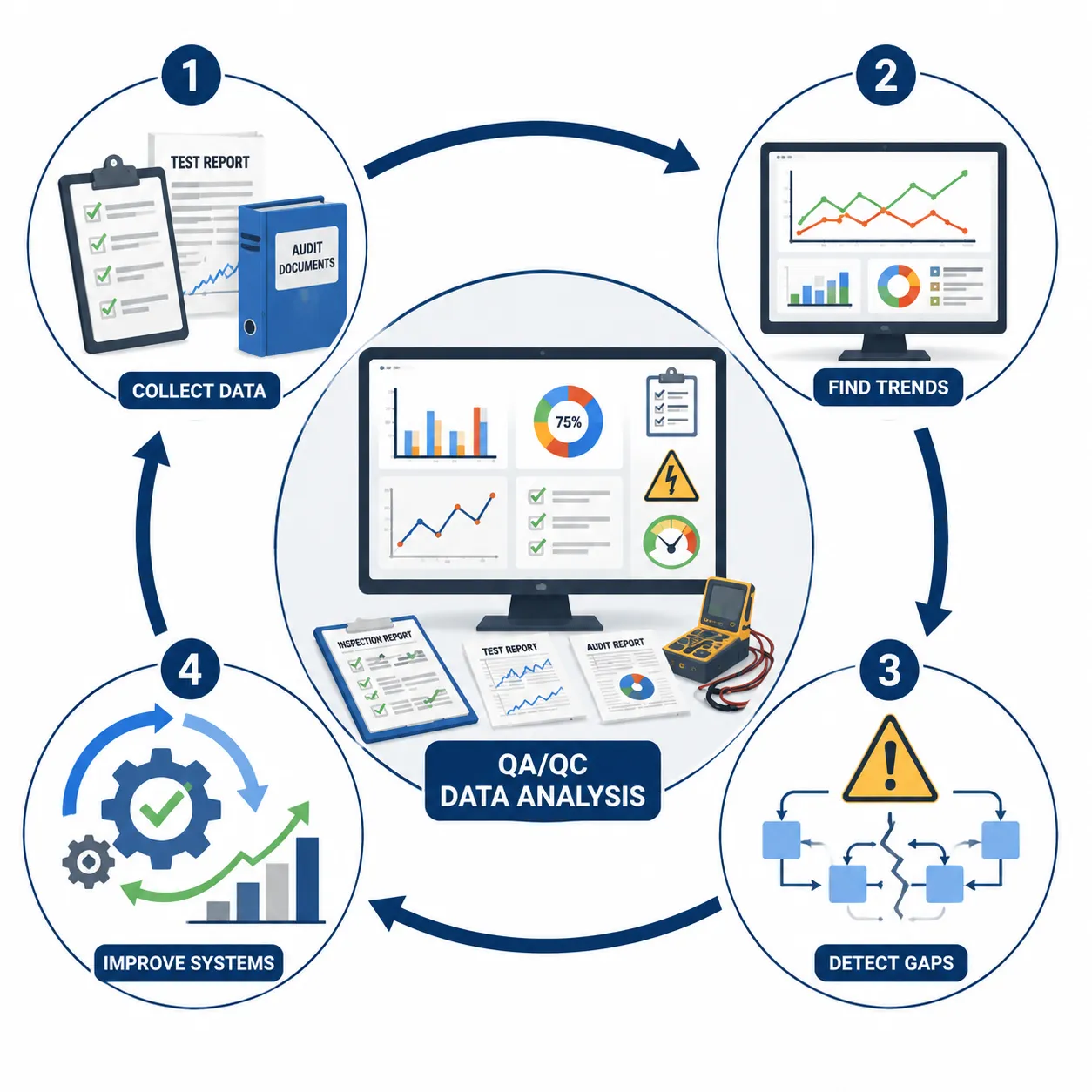
Understanding Organisational QA/QC Performance Evaluation
Organisational QA/QC performance evaluation is the systematic assessment of quality-related information to determine how effectively an organisation’s quality management processes are operating.
The purpose of evaluation is to understand:
- Whether quality objectives are being achieved.
- Whether processes are effective.
- Whether risks are being controlled.
- Whether repeated failures exist.
- Whether improvement opportunities are available.
Performance evaluation provides a complete view of quality capability by analysing both successful outcomes and areas requiring improvement.
In electrical QA/QC environments, performance evaluation may include analysis of:
- Inspection performance.
- Testing results.
- Non-conformance trends.
- Audit findings.
- Corrective action effectiveness.
- Supplier performance.
- Documentation accuracy.
- Project quality indicators.
A professional evaluation approach identifies not only what problems exist but also why they occur and how they can be prevented.
Key Concepts and Definitions of QA/QC Performance Analysis
| Key Concept | Definition | Application in Electrical QA/QC Performance Evaluation |
|---|---|---|
| QA/QC Performance Data | Information collected to measure quality effectiveness | Analysing project quality results |
| Quality Metric | A measurable indicator used to evaluate performance | Monitoring defect rates and compliance |
| Systemic Weakness | A fundamental problem within organisational processes | Identifying repeated quality failures |
| Operational Gap | Difference between expected and actual performance | Finding process improvement needs |
| Trend Analysis | Evaluation of performance changes over time | Identifying increasing defect patterns |
| Root Cause Analysis | Investigation of underlying causes of problems | Preventing repeated failures |
| Non-Conformance Analysis | Review of failures against requirements | Improving compliance performance |
| Corrective Action Effectiveness | Assessment of whether actions solve problems | Verifying improvement success |
| Quality Benchmarking | Comparing performance against standards | Identifying improvement opportunities |
| Continuous Improvement | Ongoing enhancement of processes and systems | Strengthening organisational quality culture |
Importance of Evaluating QA/QC Performance Data
Quality performance data provides organisations with objective information about how effectively their systems are functioning.
Without proper evaluation, organisations may:
- Repeat the same mistakes.
- Apply ineffective solutions.
- Miss emerging risks.
- Waste resources.
- Experience recurring quality failures.
Advanced evaluation helps organisations understand the relationship between processes, people and performance outcomes.
For example, if an electrical project experiences repeated cable installation defects, simply correcting individual installations may not solve the problem. A deeper evaluation may reveal:
- Inadequate installation procedures.
- Insufficient workforce training.
- Weak supervision.
- Poor inspection planning.
This demonstrates the difference between correcting symptoms and improving systems.
Sources of Organisational QA/QC Performance Data
Effective evaluation requires information from multiple sources because quality performance is influenced by many interconnected factors.
Inspection and Testing Data
Inspection and testing information provides direct evidence of technical performance.
Examples include:
- Electrical test results.
- Installation inspection records.
- Commissioning reports.
- Equipment verification records.
This data helps determine whether technical requirements are being achieved.
Audit Data
Audit information provides insight into system effectiveness.
Audit data may identify:
- Process weaknesses.
- Documentation issues.
- Compliance gaps.
- Management system failures.
Non-Conformance Records
Non-conformance reports provide important information about quality failures.
Analysis may identify:
- Common defect types.
- Frequent problem areas.
- Responsible processes.
- Repeated failures.
Corrective Action Records
Corrective action data helps evaluate whether previous improvements have been successful.
Important questions include:
- Was the root cause identified?
- Was the action completed?
- Did the problem return?
Customer and Stakeholder Feedback
Stakeholder feedback provides information about:
- Service quality.
- Communication effectiveness.
- Reliability concerns.
- Improvement expectations.
Analysing QA/QC Performance Indicators
Performance indicators allow organisations to measure quality effectiveness objectively.
Important QA/QC indicators include:
Defect Rate
Measures the number of defects identified during activities.
Analysis helps determine:
- Whether defects are increasing.
- Which processes require improvement.
- Whether corrective actions are effective.
Non-Conformance Frequency
Shows how often requirements are not achieved.
High non-conformance frequency may indicate:
- Weak procedures.
- Poor supervision.
- Training issues.
Corrective Action Closure Rate
Measures how effectively problems are resolved.
Low closure rates may indicate:
- Ineffective management control.
- Resource limitations.
- Poor accountability.
Audit Finding Trends
Audit trends reveal whether quality systems are improving or declining.
Increasing audit findings may indicate:
- Weak process control.
- Ineffective monitoring.
- Poor implementation.
Process for Critically Evaluating QA/QC Performance Data
A structured evaluation process ensures accurate conclusions.
Step 1: Collect Relevant Performance Information
The first stage involves gathering appropriate data from different sources.
The evaluation should consider:
- Historical performance.
- Current project results.
- Previous audit findings.
- Defect records.
- Stakeholder feedback.
Relevant information allows accurate analysis.
Step 2: Validate Data Quality
Before analysing information, the accuracy of data must be confirmed.
Validation includes:
- Checking record completeness.
- Confirming evidence accuracy.
- Reviewing reporting consistency.
- Identifying missing information.
Poor-quality data can result in incorrect conclusions.
Step 3: Identify Performance Trends
Trend analysis helps identify whether performance is improving or declining.
Examples include:
- Increasing defect frequency.
- Longer corrective action completion times.
- Repeated audit observations.
Trends provide early warnings of systemic issues.
Step 4: Compare Actual Performance Against Expectations
Performance should be evaluated against:
- Quality objectives.
- Project requirements.
- Industry expectations.
- Organisational standards.
This identifies performance gaps.
Step 5: Determine Root Causes
Identifying causes is essential for sustainable improvement.
Common root causes include:
- Poor procedures.
- Lack of training.
- Ineffective communication.
- Weak monitoring systems.
- Resource limitations.
Identifying Systemic Weaknesses in QA/QC Systems
Systemic weaknesses are problems embedded within organisational processes rather than individual mistakes.
Examples include:
Weak Document Control Systems
Indicators:
- Missing records.
- Incorrect revisions.
- Poor traceability.
Potential causes:
- Ineffective document procedures.
- Lack of responsibility.
- Poor communication.
Ineffective Inspection Processes
Indicators:
- Repeated defects.
- Late identification of problems.
- Inconsistent inspection results.
Potential causes:
- Poor inspection planning.
- Limited resources.
- Lack of competency.
Weak Corrective Action Management
Indicators:
- Repeated non-conformities.
- Delayed closure.
- Temporary solutions.
Potential causes:
- Poor root cause analysis.
- Lack of monitoring.
Inadequate Competency Management
Indicators:
- Repeated technical errors.
- Poor workmanship.
- Testing failures.
Potential causes:
- Insufficient training.
- Lack of competency assessment.
Evaluating Operational Gaps
Operational gaps represent differences between expected performance and actual workplace practices.
Common operational gaps include:
Communication Gaps
Examples:
- Poor information sharing.
- Unclear responsibilities.
- Delayed reporting.
Impact:
- Increased errors.
- Reduced coordination.
Process Implementation Gaps
Examples:
- Procedures exist but are not followed.
- Quality controls are inconsistent.
Impact:
- Reduced system effectiveness.
Resource Gaps
Examples:
- Insufficient inspection personnel.
- Limited technical resources.
Impact:
- Reduced quality monitoring capability.
Root Cause Analysis Techniques for QA/QC Improvement
Advanced QA/QC professionals use structured methods to identify underlying causes.
Five Whys Analysis
This technique investigates problems by repeatedly asking why an issue occurred.
Example:
Problem:
Repeated electrical testing failures.
Why?
Incorrect installation practices.
Why?
Technicians lacked updated instructions.
Why?
Procedure changes were not communicated.
Root cause:
Weak communication and training systems.
Cause-and-Effect Analysis
This method evaluates possible causes across categories:
- People.
- Processes.
- Equipment.
- Materials.
- Environment.
It provides a complete understanding of complex problems.
Practical Example: Evaluating Electrical QA/QC Performance Data
Situation
An electrical construction project experiences increasing quality failures during installation and testing.
Performance Data Review
The QA/QC team analyses:
- Inspection records.
- Non-conformance reports.
- Testing results.
- Contractor performance data.
Findings
Analysis identifies:
- Repeated installation defects.
- Increasing inspection failures.
- Delayed corrective actions.
Root Cause Evaluation
The investigation identifies:
- Insufficient supervision.
- Inconsistent procedures.
- Limited workforce training.
Improvement Recommendations
The organisation implements:
- Additional competency training.
- Improved inspection planning.
- Stronger quality monitoring.
Outcome
Defect rates reduce and project quality performance improves.
Case Study: Identifying Systemic Quality Weaknesses
Background
An industrial electrical organisation experienced repeated quality problems across multiple projects.
Data Evaluation
The QA/QC team reviewed:
- Audit results.
- Defect records.
- Customer feedback.
- Corrective action history.
Analysis Results
The organisation identified:
- Weak quality communication.
- Poor document control.
- Inconsistent process application.
Improvement Actions
Management introduced:
- Updated procedures.
- Improved reporting systems.
- Enhanced training programmes.
Case Study Conclusion
The evaluation demonstrated that analysing organisational QA/QC data enables leaders to identify deeper system weaknesses and implement improvements that create long-term quality benefits.
Benefits of Effective QA/QC Performance Data Evaluation
Effective evaluation provides:
- Early identification of quality risks.
- Improved decision-making.
- Reduced recurring defects.
- Stronger compliance performance.
- Better resource allocation.
- Improved operational efficiency.
- Enhanced stakeholder confidence.
- Stronger quality culture.
- Improved continuous improvement processes.
Key Learning Points
Learners should understand that:
- QA/QC data provides valuable insight into organisational performance.
- Effective evaluation requires multiple data sources.
- Trends reveal systemic problems.
- Root cause analysis supports sustainable improvement.
- Operational gaps must be identified objectively.
- Performance indicators support strategic decisions.
- Data-driven improvement strengthens quality systems.
- Senior QA/QC professionals must analyse beyond individual failures.
- Quality performance depends on effective processes and people.
- Continuous evaluation supports organisational excellence.
Conclusion
Critically evaluating organisational QA/QC performance data enables professionals to identify systemic weaknesses, operational gaps and improvement opportunities. Through structured analysis, trend evaluation and root cause investigation, organisations can move from reactive quality control towards proactive quality improvement.
By using evidence-based evaluation methods, QA/QC leaders can strengthen quality systems, improve compliance performance and support long-term reliability across complex electrical engineering environments.
2: Formulate Advanced, Strategic Recommendations to Improve Overall Quality Management Systems in the Electrical Sector
Improving quality management systems in the electrical sector requires a strategic approach that focuses on long-term performance enhancement, risk reduction and continuous improvement. Modern electrical engineering projects involve complex systems, strict compliance requirements, multiple stakeholders and increasing expectations for safety, reliability and operational efficiency. Therefore, QA/QC leaders must move beyond traditional quality control methods and develop advanced recommendations that strengthen organisational quality capability.
Strategic quality improvement recommendations are developed through detailed evaluation of existing quality management systems, analysis of performance data, identification of operational weaknesses and consideration of future organisational needs. These recommendations should not only address current problems but also create sustainable systems that prevent recurring failures and improve overall project performance.
In electrical engineering environments, quality management systems influence every stage of project delivery, including design review, procurement, installation, inspection, testing, commissioning and maintenance. Effective improvement strategies ensure that quality processes are integrated into daily operations rather than treated as separate compliance activities.
Advanced QA/QC professionals must be able to evaluate existing systems, identify improvement opportunities and recommend practical solutions that align with technical standards, organisational objectives and stakeholder expectations.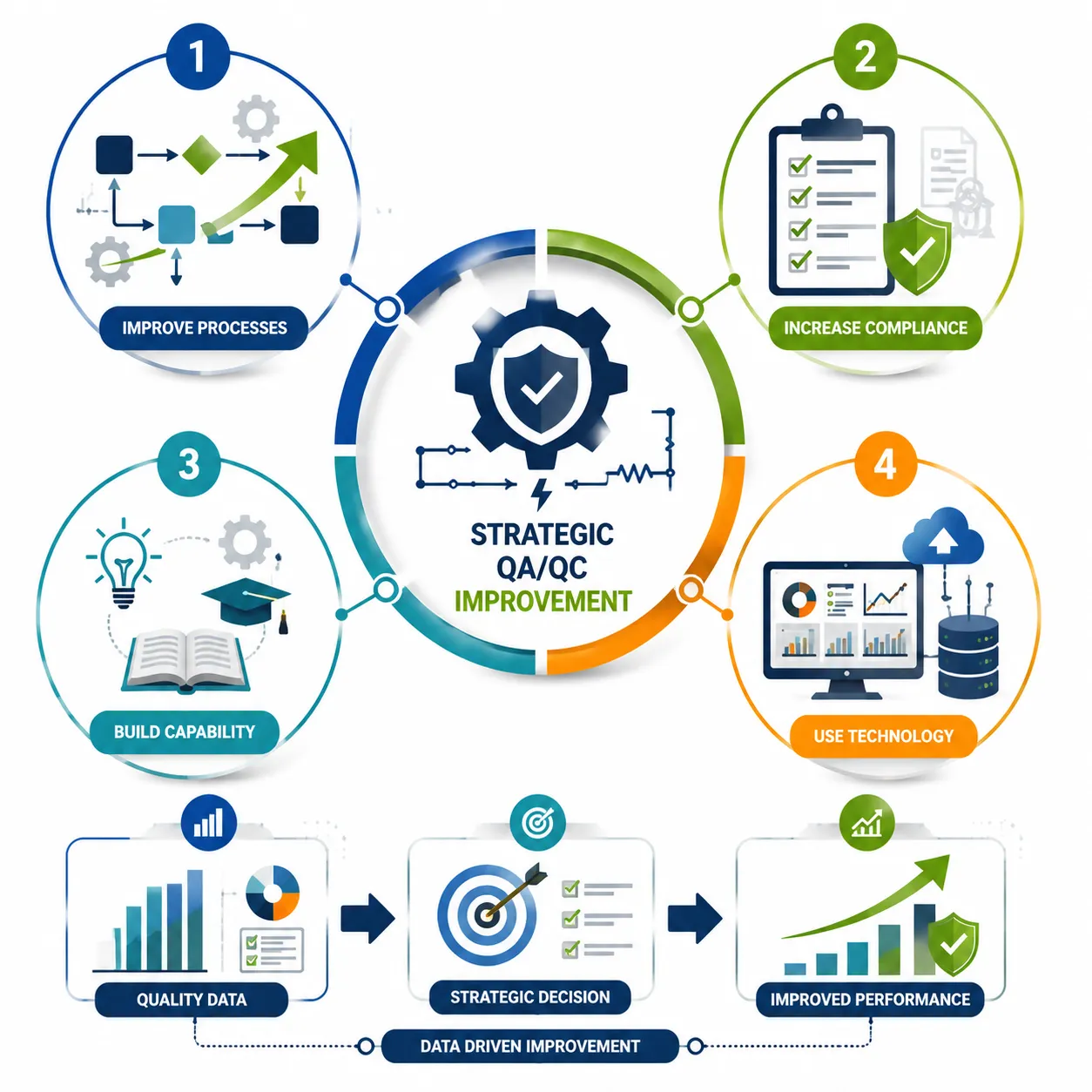
Understanding Strategic Recommendations in Electrical Quality Management Systems
Strategic recommendations are evidence-based proposals designed to improve organisational performance by addressing weaknesses, strengthening processes and creating measurable improvements.
Unlike short-term corrective actions that address individual problems, strategic recommendations focus on broader system improvement.
For example:
A corrective action may involve repairing a defective electrical installation.
A strategic recommendation may involve improving:
- Installation procedures.
- Workforce competency systems.
- Inspection planning.
- Quality monitoring processes.
- Technical supervision frameworks.
Strategic recommendations create improvements that prevent similar problems from occurring in future projects.
In the electrical sector, strategic recommendations should consider:
- Safety requirements.
- Compliance obligations.
- Project complexity.
- Technological developments.
- Workforce capability.
- Operational reliability.
- Stakeholder expectations.
Key Concepts and Definitions of Quality Management System Improvement
| Key Concept | Definition | Application in Electrical QA/QC Systems |
|---|---|---|
| Quality Management System (QMS) | A structured framework controlling quality processes and activities | Managing electrical project quality performance |
| Strategic Recommendation | Evidence-based proposal for long-term improvement | Enhancing organisational QA/QC capability |
| Continuous Improvement | Ongoing process of improving systems and performance | Developing stronger quality practices |
| Process Optimisation | Improving efficiency and effectiveness of existing processes | Reducing defects and improving workflow |
| Quality Culture | Shared organisational commitment to quality standards | Encouraging proactive quality behaviour |
| Risk-Based Improvement | Prioritising improvements according to risk impact | Focusing on critical electrical activities |
| Performance Measurement | Using indicators to evaluate improvement success | Monitoring defect reduction and compliance |
| Digital Quality Management | Using technology to manage quality information | Improving documentation and reporting |
| Competency Management | Developing workforce knowledge and skills | Improving technical performance |
| Corrective and Preventive Action | Actions to remove causes and prevent future issues | Reducing repeated quality failures |
Evaluating Existing Quality Management Systems Before Improvement
Before developing strategic recommendations, organisations must evaluate their current quality management systems.
A successful improvement strategy begins with understanding:
- Existing processes.
- Current performance levels.
- Quality weaknesses.
- Resource limitations.
- Future requirements.
A detailed evaluation helps identify whether current systems are effective or require significant improvement.
The evaluation process should consider:
- Effectiveness of quality procedures.
- Compliance performance.
- Audit outcomes.
- Non-conformance trends.
- Stakeholder feedback.
- Employee competency levels.
Without proper evaluation, improvement recommendations may address symptoms rather than actual causes.
Areas Requiring Strategic Quality Improvement
Electrical organisations should evaluate several key areas when developing improvement strategies.
Quality Procedures and Processes
Quality procedures provide the foundation for consistent performance.
Evaluation should consider:
- Are procedures clearly defined?
- Are employees following approved processes?
- Are procedures regularly updated?
- Do procedures reflect current project requirements?
Improvement recommendations may include:
- Updating quality procedures.
- Simplifying workflows.
- Improving process communication.
- Introducing process monitoring.
Inspection and Testing Systems
Inspection and testing activities are essential for verifying electrical quality.
Potential improvement areas include:
- Inspection planning.
- Testing frequency.
- Inspector competency.
- Equipment calibration.
- Test documentation.
Strategic recommendations may include:
- Developing risk-based inspection plans.
- Increasing verification activities for critical systems.
- Improving digital test record management.
Documentation and Information Management
Effective documentation ensures traceability and accountability.
Common weaknesses include:
- Missing records.
- Incorrect document revisions.
- Poor information sharing.
- Delayed approvals.
Strategic improvements may involve:
- Implementing digital document control systems.
- Improving approval workflows.
- Establishing document ownership responsibilities.
Developing Evidence-Based Improvement Strategies
Strategic recommendations must be based on reliable evidence rather than assumptions.
Evidence sources may include:
- Audit findings.
- Quality performance indicators.
- Non-conformance records.
- Customer feedback.
- Project reviews.
- Risk assessments.
A structured improvement process includes:
Step 1: Identify Performance Gaps
The organisation should determine where current performance does not meet expectations.
Examples:
- High defect rates.
- Delayed corrective actions.
- Poor inspection effectiveness.
Step 2: Analyse Root Causes
Understanding why problems occur is essential.
Possible causes include:
- Weak procedures.
- Insufficient training.
- Poor communication.
- Inadequate supervision.
Step 3: Develop Strategic Solutions
Solutions should address system-level weaknesses.
Examples:
- Improving competency frameworks.
- Strengthening quality monitoring.
- Introducing digital quality tools.
Step 4: Implement and Monitor Improvements
Improvement actions require:
- Defined responsibilities.
- Implementation timelines.
- Performance measurements.
- Review processes.
Improving Quality Management Through Risk-Based Approaches
Modern electrical quality management requires organisations to focus resources on areas with the highest potential impact.
Risk-based improvement ensures that critical activities receive appropriate attention.
High-risk areas may include:
- High-voltage installations.
- Protection systems.
- Electrical safety systems.
- Commissioning activities.
- Critical infrastructure projects.
Strategic recommendations may include:
- Increasing monitoring of high-risk activities.
- Improving risk assessment procedures.
- Strengthening technical reviews.
Benefits include:
- Reduced failures.
- Improved safety.
- Better resource allocation.
- Enhanced reliability.
Strengthening Compliance Management Systems
Electrical organisations operate within strict technical and regulatory environments.
Strong compliance management systems help ensure that activities meet required standards.
Improvement strategies may include:
- Regular compliance reviews.
- Updated technical procedures.
- Improved regulatory monitoring.
- Enhanced audit programmes.
A proactive compliance approach prevents organisations from reacting only after failures occur.
Enhancing Competency and Workforce Development
Human capability is a major factor affecting quality performance.
Even strong procedures may fail if employees lack appropriate skills and knowledge.
Strategic competency improvements include:
- Regular technical training.
- Competency assessments.
- Leadership development.
- Practical skills verification.
Benefits include:
- Reduced human errors.
- Improved workmanship.
- Increased confidence.
- Better technical performance.
Building a Strong Quality Culture
A strong quality culture ensures that every employee understands their responsibility for maintaining standards.
Quality culture improvement requires:
- Leadership commitment.
- Employee involvement.
- Open communication.
- Recognition of quality performance.
Organisations should encourage employees to:
- Report problems early.
- Suggest improvements.
- Follow procedures consistently.
- Take ownership of quality outcomes.
A positive quality culture changes quality from a compliance requirement into an organisational value.
Digital Transformation of Quality Management Systems
Technology plays an increasingly important role in improving electrical QA/QC performance.
Digital quality management systems can improve:
- Data accuracy.
- Document control.
- Reporting speed.
- Performance monitoring.
Digital improvement strategies may include:
- Electronic inspection records.
- Mobile quality applications.
- Automated reporting dashboards.
- Digital audit management systems.
Advantages include:
- Faster access to information.
- Reduced documentation errors.
- Improved decision-making.
Improving Corrective and Preventive Action Systems
Corrective action systems should focus on preventing repeated failures.
Weak corrective action systems often result in:
- Repeated defects.
- Temporary solutions.
- Ineffective improvements.
Strategic improvements include:
- Better root cause analysis.
- Clear responsibility assignment.
- Effectiveness verification.
- Management monitoring.
A strong preventive approach reduces future quality risks.
Measuring the Success of Quality Improvements
Strategic improvements require performance measurement to determine effectiveness.
Useful quality indicators include:
- Reduction in defects.
- Improved audit results.
- Faster corrective action closure.
- Increased compliance rates.
- Improved stakeholder satisfaction.
Measurement ensures that improvement actions create real value.
Practical Example: Improving Electrical QA/QC Performance
Project Situation
An electrical engineering organisation experiences repeated commissioning delays due to quality failures.
Performance Evaluation
The QA/QC team analyses:
- Testing failures.
- Inspection records.
- Audit findings.
- Contractor performance.
Identified Weaknesses
The analysis identifies:
- Poor inspection planning.
- Limited technical communication.
- Inconsistent documentation.
Strategic Recommendations
The organisation introduces:
- Improved inspection procedures.
- Digital quality tracking.
- Additional technical training.
- Enhanced supervision.
Result
The organisation achieves:
- Reduced defects.
- Improved compliance.
- Faster commissioning.
- Higher stakeholder confidence.
Case Study: Strategic Improvement of an Electrical Quality Management System
Background
A large electrical infrastructure company experienced repeated quality issues across multiple projects.
The organisation identified that traditional corrective actions were not preventing repeated failures.
Evaluation Process
The QA/QC leadership team reviewed:
- Audit reports.
- Quality performance data.
- Non-conformance trends.
- Employee feedback.
Identified Problems
The evaluation revealed:
- Weak process standardisation.
- Inconsistent training.
- Limited quality data analysis.
Strategic Improvements Implemented
The organisation introduced:
- Standardised quality procedures.
- Improved competency management.
- Digital quality monitoring.
- Risk-based auditing.
Outcome
The organisation achieved:
- Better compliance performance.
- Reduced recurring defects.
- Improved operational efficiency.
- Stronger quality culture.
Case Study Conclusion
The case demonstrates that strategic quality improvement requires a system-wide approach. By analysing performance data and implementing targeted improvements, organisations can strengthen quality management systems and achieve sustainable performance enhancement.
Key Benefits of Strategic QA/QC Improvement Recommendations
Effective strategic recommendations provide:
- Improved quality performance.
- Reduced operational risks.
- Stronger compliance capability.
- Better resource utilisation.
- Increased stakeholder confidence.
- Reduced recurring failures.
- Improved project reliability.
- Enhanced workforce capability.
- Stronger quality culture.
- Long-term organisational improvement.
Key Learning Points
Learners should understand that:
- Strategic recommendations must be evidence-based.
- Quality improvements should address root causes.
- Electrical QMS effectiveness depends on strong processes and competent people.
- Risk-based approaches improve resource allocation.
- Digital systems strengthen quality management.
- Continuous improvement creates long-term value.
- Quality culture influences organisational success.
- Performance measurement confirms improvement effectiveness.
- Strategic planning supports sustainable QA/QC development.
- Effective recommendations improve electrical sector performance.
Conclusion
Formulating advanced strategic recommendations enables electrical sector organisations to improve quality management systems, strengthen compliance and enhance operational reliability. Effective recommendations require detailed analysis of current performance, identification of systemic weaknesses and development of practical improvement strategies.
By implementing evidence-based improvements, organisations can create stronger QA/QC frameworks, reduce risks and achieve continuous quality excellence across complex electrical engineering operations.
3: Develop a Comprehensive Implementation Plan for Proposed Strategic Improvements, Addressing Potential Interacting Factors
Implementing strategic QA/QC improvements within the electrical sector requires a structured and carefully controlled approach that converts improvement recommendations into practical actions. A successful implementation plan ensures that identified quality weaknesses are addressed effectively while considering technical requirements, organisational objectives, resource availability and stakeholder expectations.
In complex electrical engineering environments, improvement initiatives rarely operate independently. Changes introduced in one area can influence other parts of the quality management system. For example, introducing additional inspection controls may improve compliance performance but may also affect project schedules, workforce requirements and operational workflows. Therefore, implementation planning must consider the interaction between technical, human, operational and management factors.
A comprehensive implementation plan provides a clear pathway for achieving quality improvement objectives. It defines what actions must be completed, who is responsible, what resources are required, how risks will be controlled and how success will be measured. Effective planning ensures that improvements become integrated into organisational processes rather than temporary responses to quality problems.
Senior QA/QC professionals must be capable of developing implementation strategies that support sustainable improvement, minimise disruption and strengthen overall quality management performance across electrical engineering operations.
Understanding Strategic Improvement Implementation Planning
Strategic improvement implementation planning is the process of organising, coordinating and managing activities required to introduce improvements into an existing quality management system.
The purpose of an implementation plan is to ensure that proposed improvements are:
- Clearly defined.
- Realistically achievable.
- Properly resourced.
- Effectively communicated.
- Monitored for success.
An implementation plan transforms strategic recommendations into operational actions.
For example, a recommendation to “improve electrical inspection effectiveness” must be converted into specific activities such as:
- Reviewing inspection procedures.
- Training inspection personnel.
- Updating checklists.
- Introducing monitoring systems.
- Measuring inspection performance.
Without a structured implementation approach, improvement initiatives may fail due to unclear responsibilities, insufficient resources or poor stakeholder engagement.
Key Concepts and Definitions of Implementation Planning
| Key Concept | Definition | Application in Electrical QA/QC Improvement |
|---|---|---|
| Implementation Plan | A structured document defining actions required to achieve improvement objectives | Managing quality system improvements |
| Strategic Improvement | A long-term action designed to enhance organisational performance | Improving QA/QC capability |
| Change Management | The process of controlling and supporting organisational change | Introducing new quality processes |
| Resource Allocation | Assigning required resources to improvement activities | Providing staff, technology and budget |
| Implementation Risk | Potential issue affecting improvement success | Managing project disruption risks |
| Stakeholder Engagement | Involving relevant parties in improvement activities | Ensuring acceptance and cooperation |
| Performance Monitoring | Measuring progress against objectives | Tracking improvement effectiveness |
| Quality Improvement Objective | Desired outcome from improvement activities | Reducing defects and improving compliance |
| Implementation Timeline | Schedule defining completion stages | Managing improvement milestones |
| Continuous Improvement Cycle | Ongoing process of evaluation and enhancement | Maintaining quality development |
Importance of a Comprehensive Implementation Plan
A comprehensive implementation plan provides direction and control during improvement activities. It ensures that all stakeholders understand what needs to happen and how success will be achieved.
Without effective planning, organisations may experience:
- Poor coordination.
- Resistance to change.
- Resource shortages.
- Delayed implementation.
- Inconsistent outcomes.
In electrical QA/QC environments, implementation planning is particularly important because quality improvements may affect:
- Installation activities.
- Testing processes.
- Commissioning schedules.
- Supplier relationships.
- Workforce responsibilities.
A structured plan allows organisations to introduce improvements without compromising operational performance.
Translating Strategic Recommendations into Action Plans
The first stage of implementation planning is converting strategic recommendations into specific actions.
A strategic recommendation should be developed into:
Improvement Objective
Defines what the organisation wants to achieve.
Example:
Improve electrical inspection reliability.
Required Actions
Defines activities required to achieve the objective.
Examples:
- Review inspection procedures.
- Train inspectors.
- Introduce digital inspection records.
Responsible Personnel
Identifies who will manage implementation.
Examples:
- QA/QC manager.
- Project quality engineer.
- Technical supervisor.
Resources Required
Defines necessary support.
Examples:
- Training resources.
- Software systems.
- Additional personnel.
Success Measures
Defines how improvement effectiveness will be evaluated.
Examples:
- Reduced defects.
- Improved audit results.
- Faster corrective action closure.
Developing Implementation Objectives
Clear objectives are essential for successful improvement implementation.
Effective objectives should be:
- Specific.
- Measurable.
- Achievable.
- Relevant.
- Time-based.
Examples of implementation objectives:
- Reduce electrical installation non-conformities by improving inspection controls.
- Increase corrective action closure rates through improved monitoring.
- Improve documentation accuracy through digital quality management systems.
Clear objectives provide direction and allow progress measurement.
Planning Implementation Activities
Implementation activities should be organised into logical stages.
A typical improvement implementation process includes:
Stage 1: Preparation and Assessment
Activities include:
- Reviewing current processes.
- Confirming improvement requirements.
- Identifying stakeholders.
- Assessing implementation risks.
Stage 2: Development
Activities include:
- Creating procedures.
- Preparing resources.
- Developing training materials.
- Establishing monitoring systems.
Stage 3: Implementation
Activities include:
- Introducing improvements.
- Supporting employees.
- Monitoring progress.
- Resolving issues.
Stage 4: Evaluation
Activities include:
- Reviewing performance.
- Measuring outcomes.
- Identifying further improvements.
Managing Resources During Implementation
Effective resource management is essential for improvement success.
Resources may include:
- Skilled personnel.
- Financial investment.
- Technology systems.
- Training resources.
- Management support.
Resource planning should consider:
- Availability of qualified staff.
- Project workload.
- Implementation costs.
- Required technical expertise.
Poor resource planning may result in incomplete improvements or reduced effectiveness.
Managing Human Factors During Implementation
People are one of the most important factors affecting quality improvement success.
Employees may experience uncertainty when new systems or procedures are introduced.
Effective human management requires:
- Clear communication.
- Employee involvement.
- Training support.
- Leadership commitment.
Potential challenges include:
- Resistance to change.
- Lack of understanding.
- Limited technical confidence.
- Increased workload concerns.
These issues should be addressed through effective change management.
Change Management Strategies for QA/QC Improvements
Change management ensures that improvement initiatives are successfully adopted.
Effective approaches include:
Communication Strategy
Employees should understand:
- Why the change is required.
- How it improves performance.
- What their role will be.
Training and Development
Training should provide:
- Technical understanding.
- Practical application skills.
- Confidence in new processes.
Leadership Support
Managers should:
- Demonstrate commitment.
- Provide resources.
- Encourage participation.
Addressing Interacting Technical Factors
Electrical QA/QC improvements often involve interconnected technical systems.
Examples include:
- Design requirements.
- Installation procedures.
- Testing processes.
- Documentation systems.
- Equipment performance.
A change in one area may influence another.
For example:
Introducing additional testing requirements may improve reliability but may affect:
- Project timelines.
- Testing resources.
- Commissioning schedules.
Implementation planning must consider these interactions.
Managing Operational Factors
Operational factors influence how improvements function in real workplace environments.
Important considerations include:
- Existing workflows.
- Production schedules.
- Site conditions.
- Contractor activities.
- Resource availability.
Improvement plans should avoid creating unnecessary operational disruption.
Strategies include:
- Gradual implementation.
- Pilot testing.
- Feedback collection.
- Controlled rollout.
Stakeholder Engagement During Implementation
Stakeholder involvement is essential because quality improvements affect multiple groups.
Stakeholders may include:
- Senior management.
- QA/QC teams.
- Electrical engineers.
- Contractors.
- Suppliers.
- Clients.
Effective engagement includes:
- Regular communication.
- Progress updates.
- Feedback opportunities.
- Clear responsibilities.
Strong stakeholder involvement increases acceptance and implementation success.
Identifying and Managing Implementation Risks
Every improvement initiative involves potential risks.
Common implementation risks include:
- Lack of resources.
- Employee resistance.
- Poor communication.
- Technical difficulties.
- Schedule impacts.
Risk management should include:
Risk Identification
Determine possible challenges.
Risk Assessment
Evaluate likelihood and impact.
Risk Control
Develop mitigation actions.
Examples:
- Additional training.
- Resource adjustment.
- Improved communication.
Monitoring Implementation Progress
Monitoring ensures that improvement activities remain effective.
Performance monitoring methods include:
- Quality indicators.
- Audit reviews.
- Progress reports.
- Stakeholder feedback.
Important measures may include:
- Reduction in defects.
- Improved compliance results.
- Faster issue resolution.
- Increased process efficiency.
Monitoring allows organisations to identify problems early.
Evaluating Improvement Effectiveness
Implementation success should be evaluated against original objectives.
Evaluation should determine:
- Were objectives achieved?
- Did quality performance improve?
- Were risks reduced?
- Are improvements sustainable?
Effectiveness evaluation prevents organisations from assuming that changes automatically create benefits.
Practical Example: Implementing a Digital QA/QC Improvement System
Project Situation
An electrical engineering organisation experiences problems with document control and inspection record management.
Identified Issue
Audit findings reveal:
- Missing inspection records.
- Delayed approvals.
- Poor document traceability.
Strategic Improvement
The organisation decides to implement a digital quality management system.
Implementation Plan
Actions include:
- Selecting digital tools.
- Training employees.
- Updating procedures.
- Monitoring usage.
Interacting Factors Considered
The organisation evaluates:
- Employee capability.
- Project workflow.
- Data security.
- System integration.
Outcome
The organisation achieves:
- Improved documentation accuracy.
- Faster information access.
- Better audit performance.
Case Study: Implementing Strategic QA/QC Improvements in an Electrical Organisation
Background
A large electrical contractor identified repeated quality failures across multiple projects. Previous corrective actions had reduced individual problems but had not improved overall performance.
Improvement Planning Approach
The organisation developed an implementation plan focusing on:
- Process improvement.
- Workforce development.
- Digital monitoring.
- Risk-based quality controls.
Implementation Activities
The organisation:
- Updated quality procedures.
- Introduced competency assessments.
- Improved inspection planning.
- Established performance monitoring.
Challenges Managed
The implementation team addressed:
- Employee concerns.
- Training requirements.
- Project schedule pressures.
Results
The organisation achieved:
- Reduced non-conformities.
- Improved quality consistency.
- Stronger compliance performance.
Case Study Conclusion
The case demonstrates that successful QA/QC improvement requires structured planning, effective change management and consideration of interacting factors. A comprehensive implementation approach ensures that improvements become embedded within organisational processes.
Benefits of Effective Implementation Planning
A strong implementation plan provides:
- Clear improvement direction.
- Better resource utilisation.
- Reduced implementation risks.
- Improved stakeholder cooperation.
- Stronger quality performance.
- Sustainable process improvement.
- Enhanced compliance capability.
- Improved operational efficiency.
- Better organisational learning.
- Long-term quality excellence.
Key Learning Points
Learners should understand that:
- Strategic recommendations require structured implementation.
- Improvement plans must define actions and responsibilities.
- Human factors strongly influence success.
- Technical and operational factors must be considered together.
- Risk management supports effective implementation.
- Stakeholder engagement improves acceptance.
- Monitoring confirms improvement effectiveness.
- Continuous evaluation maintains quality performance.
- Successful implementation creates sustainable benefits.
- Effective planning strengthens electrical QA/QC systems.
Conclusion
Developing a comprehensive implementation plan enables organisations to successfully introduce strategic QA/QC improvements while managing technical, operational and human factors. Effective planning ensures that improvement recommendations are converted into practical actions that deliver measurable quality benefits.
Through structured implementation, risk management and continuous monitoring, electrical sector organisations can strengthen quality management systems, improve compliance performance and achieve long-term operational reliability.
4: Justify Strategic Recommendations to Organisational Leaders Based on the Critical Analysis of Complex Quality Data
Effective QA/QC leadership requires more than identifying quality problems and proposing improvements. Senior quality professionals must be able to justify strategic recommendations to organisational leaders using accurate analysis of complex quality data. The ability to connect technical findings with organisational priorities, operational risks, financial impacts and long-term performance objectives is essential for gaining leadership support and implementing meaningful improvements.
In complex electrical engineering environments, organisational leaders make decisions based on evidence, risk assessment and expected value. Therefore, QA/QC professionals must transform detailed quality information into clear strategic arguments that demonstrate why specific improvements are necessary. This involves analysing performance trends, identifying systemic weaknesses, evaluating consequences and presenting recommendations that support organisational success.
Strategic justification ensures that quality improvements are not viewed as additional costs or administrative activities but as investments that improve reliability, compliance, efficiency and stakeholder confidence. By presenting evidence-based recommendations, QA/QC leaders can influence decision-making and encourage proactive improvements within the organisation.
Electrical sector organisations operate under demanding conditions where quality failures can result in safety incidents, operational disruption, financial losses and reputational damage. Therefore, the ability to justify quality improvement strategies using critical analysis of complex data is a key leadership skill.
Understanding Strategic Justification in QA/QC Leadership
Strategic justification is the process of explaining and supporting proposed improvement actions through evidence, analysis and logical reasoning. It demonstrates why a recommendation is required and how it will contribute to organisational objectives.
A strong justification should explain:
- The current quality situation.
- The identified weaknesses.
- The risks associated with maintaining current practices.
- The expected benefits of improvement.
- The resources required.
- The long-term organisational value.
For example, recommending an advanced digital quality management system should not be justified only by stating that technology is available. The recommendation should demonstrate:
- Current documentation problems.
- Time lost through manual processes.
- Risk of compliance failures.
- Expected improvement in efficiency and traceability.
This approach helps leaders understand the strategic importance of quality improvements.
Key Concepts and Definitions Related to Strategic Recommendation Justification
| Key Concept | Definition | Application in Electrical QA/QC Leadership |
|---|---|---|
| Strategic Justification | Evidence-based explanation supporting a proposed decision | Supporting quality improvement recommendations |
| Quality Data Analysis | Evaluation of quality information to identify trends and weaknesses | Analysing defects and compliance performance |
| Business Case | Structured argument explaining value, cost and benefits | Gaining management approval |
| Risk Evaluation | Assessment of potential consequences of quality issues | Demonstrating improvement necessity |
| Evidence-Based Decision Making | Using verified information to guide decisions | Supporting reliable management choices |
| Cost-Benefit Analysis | Comparison of investment and expected benefits | Evaluating improvement value |
| Performance Indicator | Measurement used to evaluate quality outcomes | Monitoring improvement effectiveness |
| Strategic Alignment | Ensuring recommendations support organisational goals | Connecting QA/QC improvements with business objectives |
| Leadership Communication | Professional presentation of information to decision-makers | Influencing senior management |
| Continuous Improvement | Ongoing enhancement of systems and processes | Maintaining quality excellence |
Importance of Using Complex Quality Data for Strategic Decisions
Modern electrical projects generate significant amounts of quality information. However, data alone does not create improvement. The value comes from analysing information and converting it into meaningful conclusions.
Complex quality data may include:
- Audit results.
- Inspection performance.
- Testing outcomes.
- Non-conformance trends.
- Corrective action records.
- Supplier performance.
- Customer feedback.
- Safety observations.
Critical analysis allows QA/QC leaders to identify:
- Repeated failures.
- Process weaknesses.
- Emerging risks.
- Ineffective controls.
- Improvement opportunities.
Without proper analysis, organisations may make decisions based on assumptions rather than evidence.
Data-driven recommendations provide stronger justification because they demonstrate:
- The scale of the problem.
- The potential consequences.
- The expected improvement value.
Analysing Quality Data Before Making Recommendations
Before presenting recommendations to organisational leaders, QA/QC professionals must critically analyse available information.
The analysis process includes:
Reviewing Historical Performance Data
Historical data helps identify long-term trends.
Examples:
- Increasing defect frequency.
- Repeated audit findings.
- Delayed corrective actions.
Historical analysis helps determine whether problems are isolated events or systemic issues.
Identifying Performance Gaps
Performance gaps occur when actual results do not meet expected standards.
Examples:
- High defect rates compared with targets.
- Slow corrective action completion.
- Inconsistent inspection results.
Evaluating Risk Impact
Quality issues should be assessed according to their potential consequences.
Risk considerations include:
- Electrical safety impact.
- Operational reliability.
- Compliance exposure.
- Financial consequences.
- Stakeholder confidence.
Determining Root Causes
Recommendations should address causes rather than symptoms.
Root causes may include:
- Weak procedures.
- Limited competency.
- Poor communication.
- Inadequate monitoring systems.
Developing Evidence-Based Strategic Recommendations
Strategic recommendations should be developed from clear evidence and structured analysis.
A strong recommendation includes:
Identified Problem
Clearly define the issue.
Example:
“Repeated electrical testing failures indicate weaknesses in verification processes.”
Supporting Evidence
Provide relevant data.
Example:
“Audit records show a 30% increase in testing-related non-conformities over six months.”
Strategic Impact
Explain why the issue matters.
Example:
“The current trend increases commissioning risks and operational reliability concerns.”
Proposed Solution
Define improvement actions.
Example:
“Introduce risk-based testing procedures and improve technical competency verification.”
Expected Benefits
Explain the value.
Example:
“Improved testing reliability, reduced delays and enhanced compliance confidence.”
Building a Business Case for Quality Improvements
Organisational leaders often require a clear business justification before approving improvements.
A quality improvement business case should consider:
Operational Benefits
Examples:
- Improved project efficiency.
- Reduced rework.
- Better workflow control.
Compliance Benefits
Examples:
- Improved regulatory alignment.
- Reduced audit risks.
- Stronger documentation control.
Financial Benefits
Examples:
- Lower failure costs.
- Reduced corrective work.
- Improved resource utilisation.
Strategic Benefits
Examples:
- Stronger market reputation.
- Increased stakeholder confidence.
- Improved organisational capability.
Communicating Quality Risks to Organisational Leaders
One of the key responsibilities of QA/QC leaders is explaining risks clearly.
Technical teams may understand detailed issues, but senior leaders need strategic information.
Effective risk communication should explain:
What is the Issue?
Example:
“Repeated installation defects have been identified.”
Why Does it Matter?
Example:
“The issue may affect electrical reliability and project handover.”
What Could Happen Without Action?
Example:
“Future failures may result in operational disruption and increased costs.”
What Action is Recommended?
Example:
“Strengthen inspection controls and improve workforce competency.”
Evaluating Cost and Benefit of Strategic Recommendations
Quality improvements often require investment.
QA/QC leaders must demonstrate that the benefits justify the resources required.
Evaluation should consider:
Implementation Costs
Examples:
- Training expenses.
- Technology investment.
- Additional resources.
Avoided Costs
Examples:
- Reduced rework.
- Fewer failures.
- Lower corrective action expenses.
Long-Term Value
Examples:
- Improved reliability.
- Enhanced reputation.
- Better operational performance.
A recommendation should demonstrate value rather than focus only on immediate cost.
Prioritising Strategic Improvement Recommendations
Organisations may identify multiple improvement opportunities. Therefore, recommendations must be prioritised.
Priority factors include:
- Risk level.
- Compliance impact.
- Operational importance.
- Resource requirements.
- Expected benefits.
High-priority recommendations usually involve:
- Safety-critical issues.
- Repeated failures.
- Major compliance weaknesses.
Lower-priority recommendations may include:
- Process efficiency improvements.
- Administrative enhancements.
Presenting Recommendations to Senior Management
Professional communication is essential when presenting recommendations.
A successful presentation should include:
Executive Summary
Provides:
- Main findings.
- Key risks.
- Recommended actions.
Evidence Overview
Explains:
- Data sources.
- Analysis methods.
- Performance trends.
Strategic Recommendation
Defines:
- Proposed improvement.
- Required resources.
- Implementation approach.
Expected Outcomes
Explains:
- Quality benefits.
- Risk reduction.
- Operational improvements.
Managing Challenges During Strategic Discussions
QA/QC leaders may face challenges when presenting improvement recommendations.
Common challenges include:
- Budget concerns.
- Competing priorities.
- Resistance to change.
- Lack of understanding.
Effective responses include:
- Presenting evidence clearly.
- Explaining long-term value.
- Demonstrating risk reduction.
- Aligning recommendations with organisational objectives.
Practical Example: Justifying a Quality Improvement Strategy in an Electrical Project
Project Situation
An electrical engineering organisation experiences repeated commissioning delays caused by quality issues.
Data Analysis
QA/QC leaders analyse:
- Inspection failures.
- Testing records.
- Audit findings.
- Corrective action history.
Identified Weaknesses
The analysis identifies:
- Poor inspection coordination.
- Limited documentation control.
- Inconsistent technical verification.
Strategic Recommendation
The QA/QC team recommends:
- Digital quality management implementation.
- Improved inspection planning.
- Additional technical training.
Management Justification
The recommendation is supported by:
- Reduced rework costs.
- Improved compliance.
- Faster project completion.
- Increased reliability.
Outcome
Senior management approves the improvement strategy, resulting in improved quality performance.
Case Study: Using Quality Data to Influence Organisational Improvement Decisions
Background
An electrical infrastructure company experienced repeated quality problems across several projects. Previous corrective actions addressed individual failures but did not improve overall performance.
Data Analysis Approach
The QA/QC team analysed:
- Five-year defect trends.
- Audit findings.
- Customer feedback.
- Testing performance.
Findings
The analysis identified:
- Weak process standardisation.
- Limited competency monitoring.
- Ineffective corrective action processes.
Strategic Recommendations
The team proposed:
- Improved quality procedures.
- Digital monitoring systems.
- Enhanced workforce development.
Leadership Decision
Management approved the recommendations after reviewing:
- Risk reduction benefits.
- Operational improvements.
- Long-term value.
Case Study Conclusion
The case demonstrates that strategic recommendations gain organisational support when they are supported by reliable data, clear analysis and strong alignment with business objectives.
Benefits of Justifying Strategic QA/QC Recommendations
Effective justification provides:
- Stronger management support.
- Improved investment decisions.
- Better resource allocation.
- Reduced quality risks.
- Improved compliance performance.
- Enhanced organisational confidence.
- Stronger continuous improvement culture.
- Better alignment between QA/QC and business goals.
- Increased operational reliability.
- Improved stakeholder trust.
Key Learning Points
Learners should understand that:
- Strategic recommendations require strong evidence.
- Complex quality data supports better decisions.
- QA/QC leaders must communicate value clearly.
- Recommendations should address root causes.
- Business impact must be considered.
- Risk evaluation strengthens justification.
- Senior leaders need strategic information.
- Quality improvements should align with organisational objectives.
- Data-driven decisions improve quality performance.
- Effective communication influences successful implementation.
Conclusion
Justifying strategic recommendations to organisational leaders requires the ability to analyse complex quality data and translate technical findings into meaningful strategic information. QA/QC professionals must demonstrate how proposed improvements address risks, enhance performance and support organisational objectives.
Through evidence-based analysis, effective communication and structured decision-making, quality leaders can influence management actions, strengthen quality management systems and drive continuous improvement within the electrical sector.