
Lesson 7: Develop strategies for adopting emerging technologies in QA/QC.
The rapid development of emerging technologies is transforming Quality Assurance and Quality Control (QA/QC) practices across modern electrical engineering projects. Technologies such as artificial intelligence, Internet of Things (IoT) monitoring, digital inspection systems, Building Information Modelling (BIM), digital twins, automated testing, predictive analytics, remote monitoring, advanced sensors, and data-driven quality management are creating new opportunities to improve inspection accuracy, traceability, reliability, efficiency, and project performance. For electrical QA/QC professionals, understanding how these technologies can be evaluated and strategically adopted is increasingly important for managing complex sustainable electrical installations.
Developing an effective technology adoption strategy requires more than identifying the latest digital tools. Electrical QA/QC professionals must critically assess whether an emerging technology addresses a genuine quality problem, improves existing processes, produces reliable evidence, and provides measurable value. This includes evaluating technical compatibility, data quality, cybersecurity, workforce competence, implementation costs, interoperability, system reliability, regulatory and contractual requirements, and potential impacts on established QA/QC procedures. A structured adoption strategy should therefore connect emerging technology with project objectives, risk management, inspection and testing requirements, commissioning, documentation, performance monitoring, and continual improvement.
This lesson develops the professional knowledge required to evaluate and strategically introduce emerging technologies into electrical QA/QC systems. Learners will examine how technology can support proactive quality management, automated data collection, predictive defect identification, real-time performance monitoring, digital traceability, and evidence-based decision-making. Particular attention is given to selecting appropriate technologies, assessing implementation risks, managing organisational change, validating technology outputs, developing adoption plans, and measuring effectiveness. Through professional examples and workplace-focused analysis, learners will develop the ability to make informed QA/QC technology decisions that support quality, safety, sustainability, reliability, efficiency, and long-term performance in contemporary electrical engineering projects.
1: Critically Assess the Readiness of an Electrical Organisation or Project to Adopt Specific Emerging QA/QC Technologies
The adoption of emerging technologies in electrical Quality Assurance and Quality Control (QA/QC) requires careful assessment of organisational and project readiness before implementation. Technologies such as artificial intelligence (AI), Internet of Things (IoT) sensors, digital inspection platforms, Building Information Modelling (BIM), digital twins, automated testing, predictive analytics, remote inspection, cloud-based quality management systems, computer vision, and real-time monitoring can significantly improve the way electrical quality is planned, inspected, tested, recorded, analysed, and verified. However, the availability of a technology does not automatically mean that an organisation or project is ready to use it effectively.
Readiness refers to the extent to which an electrical organisation or project has the technical capability, people, processes, infrastructure, data, resources, governance, leadership, and quality culture necessary to adopt and operate an emerging QA/QC technology successfully. A technically advanced solution may fail to deliver its intended benefits if project teams lack competence, existing systems cannot integrate with it, data is unreliable, responsibilities are unclear, or management has not established appropriate controls. Therefore, readiness assessment should be evidence-based and should consider both organisational capability and project-specific circumstances.
At Level 6, electrical QA/QC professionals are expected to critically assess technology adoption rather than simply recommend new technology because it appears innovative. The professional should establish the quality problem that the technology is intended to address, evaluate the current level of readiness, identify capability gaps, assess risks and constraints, compare available options, and determine whether adoption should proceed, be modified, delayed, or rejected. This approach ensures that emerging technology supports measurable quality improvement rather than creating additional complexity, cost, data-management problems, or operational risks.
Understanding Technology Readiness in Electrical QA/QC
Technology readiness is the overall ability of an organisation or project to introduce, operate, manage, and sustain a particular technology within its QA/QC environment.
It includes more than purchasing software, sensors, cameras, testing equipment, or digital platforms. A technology is only useful when the surrounding system is capable of using its outputs effectively.
Technology readiness may involve:
- Technical infrastructure
- Digital connectivity
- Data availability
- Data quality
- Staff competence
- Management support
- Quality procedures
- Cybersecurity
- System interoperability
- Financial resources
- Project requirements
- Supplier support
- Governance
- Change management
- Performance measurement
- Maintenance capability
For example, an electrical contractor may purchase an AI-supported defect detection system for installation inspections. However, if the organisation does not have sufficient image data, trained personnel, suitable cameras, reliable connectivity, or procedures for verifying AI-generated findings, the organisation may not be ready for full-scale adoption.
Meaning of Emerging QA/QC Technologies
Emerging QA/QC technologies are technologies that are developing rapidly or are being increasingly applied to improve quality management, inspection, testing, verification, monitoring, analysis, and decision-making.
Examples include:
- Artificial intelligence
- Machine learning
- Internet of Things sensors
- Computer vision
- Digital inspection platforms
- BIM-based QA/QC
- Digital twins
- Predictive analytics
- Automated testing
- Remote inspection
- Drone-supported inspection
- Cloud-based quality systems
- Mobile quality applications
- Real-time dashboards
- Advanced condition monitoring
- Automated defect detection
- Digital commissioning systems
The suitability of each technology depends on the problem being addressed.
An organisation should not begin with the question:
“Which new technology should we purchase?”
A stronger QA/QC approach begins with:
“What quality problem are we trying to solve, and which technology, if any, can address it effectively?”
Key Definitions and Concepts
| Term | Definition | Relevance to QA/QC Technology Adoption |
|---|---|---|
| Technology readiness | The ability of an organisation or project to successfully adopt and operate a technology | Determines whether adoption is realistic |
| Digital maturity | The level of organisational capability in using digital systems, data, processes, and technologies | Indicates organisational capacity for digital QA/QC |
| Emerging technology | A developing technology with potential to introduce new capabilities or improve existing processes | Provides opportunities for QA/QC improvement |
| Interoperability | The ability of different systems or technologies to exchange and use information effectively | Determines whether new technology can work with existing systems |
| Data quality | The accuracy, completeness, consistency, reliability, and suitability of data | Determines the reliability of technology outputs |
| Competence | The knowledge, skills, experience, and capability required to perform an activity effectively | Determines whether personnel can operate and interpret technology |
| Change readiness | The willingness and ability of people and processes to accept and implement change | Influences adoption success |
| Technology risk | Potential negative consequences associated with introducing or operating a technology | Supports informed technology decisions |
| Pilot project | A controlled limited-scale implementation used to evaluate a technology before wider adoption | Reduces large-scale implementation risk |
| Scalability | The ability of a technology to expand effectively as project or organisational requirements increase | Determines long-term suitability |
| Cybersecurity | Protection of digital systems, data, networks, and devices against unauthorised access or disruption | Essential for connected QA/QC technologies |
| Return on investment | The value obtained from an investment compared with its associated cost | Supports commercial evaluation |
| Proof of concept | A limited demonstration that establishes whether a technology can perform its intended function | Provides early evidence of feasibility |
| Technology governance | Structures, responsibilities, controls, and decision-making arrangements governing technology use | Supports controlled adoption |
Why Readiness Assessment Is Essential
Emerging technology adoption can introduce significant benefits, but it can also create new risks.
A readiness assessment helps determine whether the organisation or project can manage:
- New digital workflows
- Additional data
- New technical interfaces
- Cybersecurity requirements
- Staff training
- Software maintenance
- Hardware maintenance
- Data validation
- Technology suppliers
- System integration
- Changes to responsibilities
- New inspection methods
- Revised documentation requirements
Without a readiness assessment, organisations may invest in technologies that are technically impressive but operationally unsuitable.
A successful readiness assessment should therefore answer five fundamental questions:
- What quality problem needs to be addressed?
- Is the proposed technology appropriate for that problem?
- Is the organisation or project capable of implementing it?
- What gaps must be addressed before adoption?
- How will effectiveness be measured after implementation?
Organisational Readiness Versus Project Readiness
An important distinction exists between organisational readiness and project readiness.
Organisational readiness
Organisational readiness concerns the wider capability of the electrical organisation.
It includes:
- Leadership commitment
- Digital strategy
- Technical capability
- Financial resources
- Staff competence
- IT infrastructure
- Cybersecurity
- Data governance
- Quality culture
- Technology support
- Procurement capability
- Change management
Project readiness
Project readiness concerns whether a specific electrical project can adopt and use the technology effectively.
It includes:
- Project scope
- Programme
- Contract requirements
- Site conditions
- Existing systems
- Contractor capability
- Connectivity
- Available data
- Technology interfaces
- Client requirements
- Quality objectives
- Project resources
An organisation may have excellent digital capability but a particular project may not be ready because of poor connectivity, contractual restrictions, limited programme time, or incompatible legacy systems.
Establishing the Current QA/QC Baseline
Before evaluating emerging technology, the professional should establish the current state of QA/QC.
The baseline should consider:
- Current inspection processes
- Existing testing methods
- Quality documentation
- Defect rates
- Rework levels
- Inspection duration
- Reporting time
- Data quality
- Traceability
- Corrective-action performance
- Commissioning performance
- Existing digital systems
This baseline is important because the organisation cannot determine whether a new technology provides value unless current performance is understood.
For example, if digital inspection software is proposed to reduce inspection reporting time, the organisation should establish the current average reporting time before implementation.
Potential baseline indicators could include:
- Average inspection completion time
- Average defect closure time
- Number of incomplete records
- Number of repeated defects
- Percentage of missing test records
- Time required to retrieve quality evidence
- Number of manual data-entry errors
Identifying the Quality Problem
Technology adoption should be linked to a clearly defined quality problem.
Possible problems include:
- Repeated installation defects
- Slow inspection reporting
- Poor document traceability
- Inconsistent inspection records
- Delayed corrective action
- Limited equipment monitoring
- Difficulty identifying deterioration
- Inadequate performance data
- Excessive manual data entry
- Poor coordination between project teams
The problem should be specific enough to measure.
For example:
Weak problem statement:
“Quality management is inefficient.”
Stronger problem statement:
“Inspection records require excessive manual processing, resulting in delayed defect reporting and limited visibility of outstanding corrective actions.”
The second statement provides a clearer basis for assessing whether digital inspection technology could provide value.
Assessing Technical Infrastructure
Emerging technologies often require reliable technical infrastructure.
The organisation should assess:
- Internet connectivity
- Network capacity
- Mobile connectivity
- Cloud access
- Hardware
- Sensors
- Cameras
- Data storage
- Server capability
- Power supply
- Software compatibility
- Device availability
For IoT monitoring, for example, the project may require reliable connectivity between sensors, gateways, monitoring platforms, and user interfaces.
If connectivity is unreliable, real-time monitoring may not provide reliable results.
Technical readiness should therefore be evaluated before technology procurement.
Assessing Data Readiness
Data is one of the most important factors in emerging technology adoption.
AI, predictive analytics, digital twins, dashboards, and automated systems depend on reliable data.
Data readiness should consider:
- Accuracy
- Completeness
- Consistency
- Availability
- Accessibility
- Format
- Historical depth
- Validation
- Ownership
- Security
For example, an organisation may wish to introduce predictive analytics for electrical equipment failure. However, if previous maintenance records are incomplete or equipment identifiers are inconsistent, the analytical system may produce unreliable conclusions.
This means data improvement may need to occur before advanced analytics can be introduced effectively.
Assessing Workforce Competence
Technology adoption is strongly influenced by people.
Personnel may need competence in:
- Digital platforms
- Data interpretation
- Sensor configuration
- Software operation
- Automated inspection
- AI output interpretation
- Cybersecurity awareness
- Digital documentation
- Technical troubleshooting
The organisation should determine whether existing personnel have the necessary capability.
A readiness assessment should identify:
- Current competence
- Required competence
- Training gaps
- Specialist support requirements
- Manufacturer training
- Internal technical resources
Technology should not be considered ready merely because the software has been purchased.
Assessing Leadership and Management Readiness
Leadership commitment is critical because technology adoption may require changes to established procedures, responsibilities, resources, and working practices.
Management should demonstrate:
- Clear objectives
- Resource commitment
- Decision-making support
- Change leadership
- Quality ownership
- Training support
- Performance review
Without leadership support, technology adoption may remain a pilot project that never becomes integrated into normal QA/QC practice.
Assessing Quality Culture
Technology should support a positive quality culture rather than attempting to replace professional responsibility.
The organisation should assess whether personnel:
- Report defects openly
- Use quality data
- Follow procedures
- Accept digital workflows
- Participate in improvement
- Understand quality objectives
- Respond to technology-generated findings
If staff view digital monitoring as surveillance rather than a quality improvement tool, adoption may face resistance.
Effective change management should therefore explain:
- Why the technology is being introduced
- What problem it addresses
- How it affects employees
- What training is available
- How performance will be measured
Assessing Existing QA/QC Processes
A new technology should fit into the existing quality management system where appropriate.
The professional should examine:
- Quality plans
- Inspection and Test Plans
- Inspection procedures
- Testing procedures
- Non-conformity procedures
- Corrective-action processes
- Document control
- Commissioning procedures
- Handover procedures
The question is not simply whether technology can perform a task.
The question is:
“How will the technology integrate into the controlled QA/QC process?”
For example, if a mobile inspection application identifies a defect, the organisation needs a defined process for:
- Recording the defect
- Assigning responsibility
- Setting corrective-action requirements
- Reviewing evidence
- Closing the defect
- Verifying effectiveness
- Retaining records
Assessing System Interoperability
Interoperability is particularly important for electrical projects because many systems may need to exchange information.
Potential systems include:
- BIM
- ERP systems
- Document management
- Asset management
- Energy management
- Building management
- SCADA
- IoT platforms
- Digital inspection applications
The new technology should be assessed for:
- Data exchange
- File formats
- APIs where applicable
- System compatibility
- Integration requirements
- Duplicate data entry
- Information consistency
Poor interoperability can increase workload and create data inconsistencies.
Assessing Cybersecurity Readiness
Connected QA/QC technologies can create cybersecurity considerations.
These may involve:
- Cloud platforms
- IoT sensors
- Remote monitoring
- Mobile devices
- Digital dashboards
- Connected testing equipment
- Remote access
The organisation should consider:
- Access controls
- Authentication
- User permissions
- Data protection
- Software updates
- Device security
- Backup
- Incident response
- Supplier security
Cybersecurity should be incorporated into technology readiness rather than treated as a separate issue after implementation.
Assessing Financial Readiness
Technology adoption involves more than the initial purchase price.
The organisation should consider:
- Software licensing
- Hardware
- Sensors
- Installation
- Integration
- Training
- Technical support
- Maintenance
- Upgrades
- Cybersecurity
- Data storage
- Replacement
A low-cost technology may become expensive if it requires extensive integration or specialist support.
Similarly, a higher-cost system may provide strong lifecycle value if it significantly reduces defects, rework, inspection time, or equipment failures.
Assessing Return on Investment
Return on investment should be assessed using measurable benefits.
Potential benefits include:
- Reduced inspection time
- Reduced rework
- Faster defect closure
- Improved traceability
- Reduced equipment failures
- Improved energy performance
- Improved reporting
- Reduced manual data entry
- Better resource allocation
The professional should compare these benefits against:
- Purchase cost
- Implementation cost
- Training cost
- Maintenance cost
- Integration cost
Technology should be justified by measurable project or organisational value.
Assessing Regulatory and Contractual Readiness
Technology adoption must also consider applicable requirements and contractual obligations.
The organisation should verify whether technology-generated records are acceptable for:
- Client requirements
- Quality audits
- Contractual evidence
- Inspection records
- Testing documentation
- Handover
- Asset management
The technology should support required evidence rather than creating uncertainty about the validity or completeness of records.
Assessing Supplier Readiness
The technology supplier can significantly influence adoption success.
Supplier assessment should consider:
- Technical capability
- Product maturity
- Support arrangements
- Training
- Documentation
- Cybersecurity
- Integration capability
- Upgrade strategy
- Response time
- Long-term availability
The organisation should also assess the supplier’s ability to support the technology throughout the expected project or asset lifecycle.
Technology-Specific Readiness Assessment
Different technologies require different readiness criteria.
Artificial Intelligence
AI adoption may require:
- Reliable datasets
- Clearly defined use cases
- Technical expertise
- Human verification
- Data governance
- Appropriate validation
- Clear responsibility
AI should support professional judgement rather than automatically replace engineering decisions.
Internet of Things
IoT adoption may require:
- Sensors
- Connectivity
- Data infrastructure
- Device management
- Cybersecurity
- Calibration
- Monitoring capability
Digital Inspection Systems
Digital inspection platforms may require:
- Mobile devices
- Reliable connectivity
- Standardised inspection forms
- User training
- Workflow integration
- Document-control processes
BIM-Based QA/QC
BIM adoption may require:
- BIM capability
- Common information structures
- Model coordination
- Defined information requirements
- Trained personnel
- Software compatibility
Digital Twins
Digital twins may require:
- Reliable asset information
- Real-time or periodic data
- System integration
- Asset identification
- Data governance
- Skilled users
Predictive Analytics
Predictive analytics may require:
- Historical data
- Consistent asset records
- Reliable sensor data
- Analytical capability
- Defined failure indicators
- Monitoring infrastructure
Readiness Gap Analysis
A gap analysis compares the current state with the requirements needed for successful technology adoption.
For example:
| Readiness Area | Current State | Required State | Gap | Potential Action |
|---|---|---|---|---|
| Data | Inconsistent records | Standardised data | High | Clean and standardise data |
| Skills | Basic digital skills | Specialist competence | Medium | Provide training |
| Connectivity | Limited site coverage | Reliable connectivity | High | Improve infrastructure |
| Processes | Paper-based inspections | Digital workflows | Medium | Redesign QA/QC process |
| Cybersecurity | Basic controls | Technology-specific controls | High | Strengthen security |
| Leadership | General support | Formal sponsorship | Medium | Establish governance |
| Integration | Separate systems | Connected workflows | High | Conduct integration assessment |
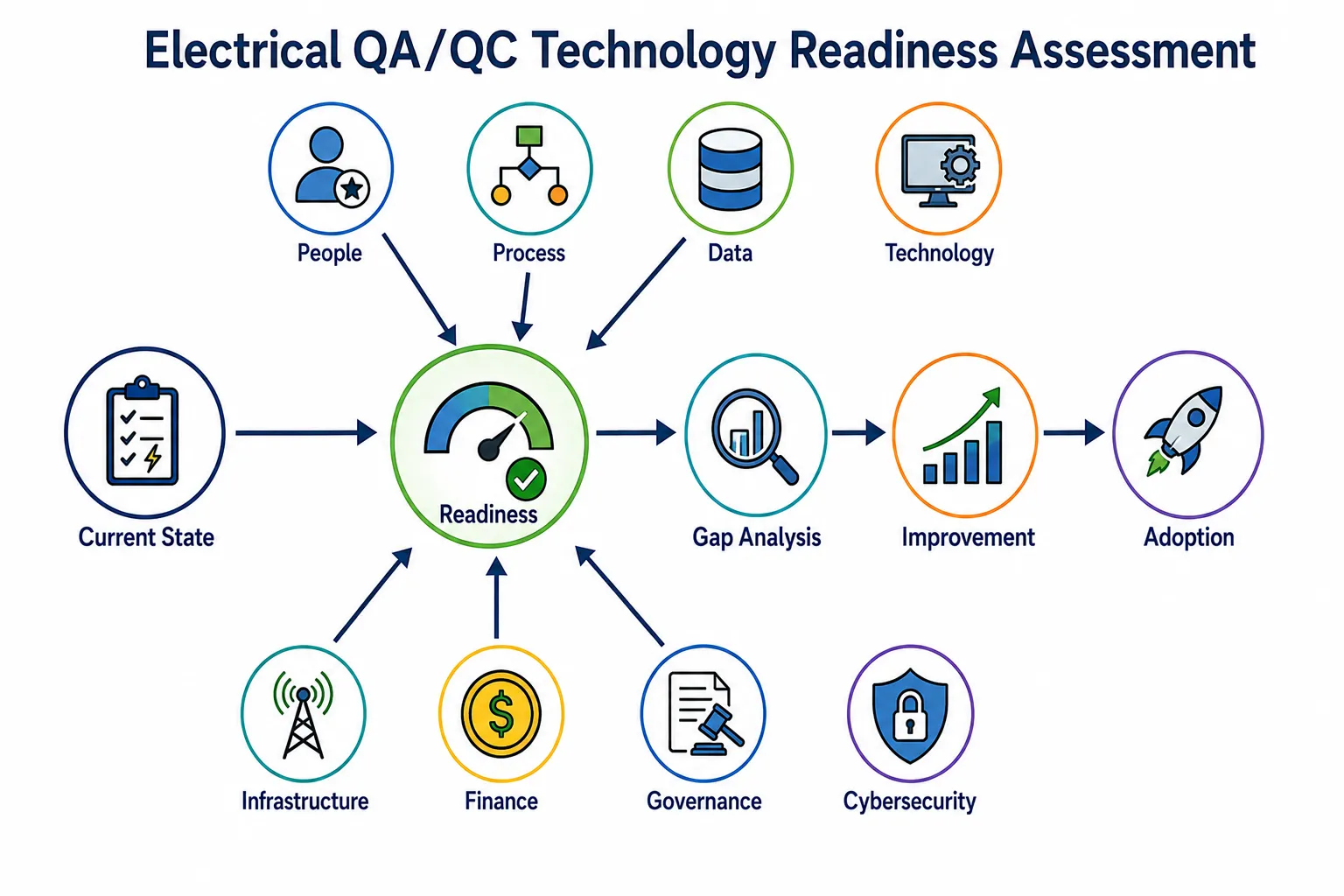
This allows the organisation to identify what must be addressed before adoption.
Developing a Readiness Scoring Framework
A scoring system can help compare readiness across different areas.
Potential categories include:
- Technology
- People
- Process
- Data
- Infrastructure
- Governance
- Finance
- Cybersecurity
- Integration
- Supplier support
Each category could be assessed using a defined scale such as:
- Low readiness
- Developing readiness
- Moderate readiness
- High readiness
- Advanced readiness
The scoring method should be applied consistently and supported by evidence.
Pilot Testing Before Full Adoption
Where readiness is uncertain, a pilot project can provide valuable evidence.
A pilot should have:
- Defined objectives
- Limited scope
- Clear success criteria
- Defined timeframe
- Responsible personnel
- Risk controls
- Data collection
- Evaluation criteria
For example, a digital inspection platform could initially be tested on one electrical installation work package rather than the entire project.
The pilot could measure:
- Inspection completion time
- Defect reporting time
- User adoption
- Data accuracy
- Record completeness
- Defect closure time
The results can then determine whether broader implementation is justified.
Practical Case Study: Digital Inspection Platform
Consider an electrical organisation that currently uses paper-based inspection forms.
The organisation experiences:
- Delayed inspection reporting
- Lost records
- Inconsistent formats
- Slow defect closure
- Difficulty accessing historical information
Management proposes a digital inspection platform.
A readiness assessment identifies:
Strengths
- Strong management support
- Experienced QA/QC personnel
- Existing cloud infrastructure
- Good mobile device availability
Gaps
- Limited user training
- Inconsistent inspection templates
- Weak site connectivity
- No defined digital defect workflow
The organisation is therefore not fully ready for immediate organisation-wide adoption.
A professional recommendation would be to:
- Standardise inspection templates
- Improve connectivity
- Define digital workflows
- Train personnel
- Conduct a controlled pilot
- Measure performance
This demonstrates critical readiness assessment rather than automatic technology adoption.
Practical Case Study: AI-Assisted Electrical Inspection
Consider a project team considering computer vision or AI-assisted inspection for identifying installation defects.
Previous inspection records are largely paper-based and contain limited photographic information.
The organisation has:
- Strong technical QA/QC competence
- Limited AI expertise
- Poor historical image data
- Good digital infrastructure
The technology may appear attractive, but the organisation has a significant data-readiness gap.
The appropriate approach may be:
- Define a narrow use case
- Collect high-quality inspection images
- Establish defect classifications
- Train relevant personnel
- Validate AI outputs
- Maintain human verification
- Conduct a pilot
- Evaluate accuracy before wider adoption
This avoids relying on an AI system without sufficient evidence.
Practical Case Study: IoT Electrical Monitoring
Consider a sustainable electrical installation where the project team proposes IoT sensors to monitor equipment condition.
The project has:
- Reliable network infrastructure
- Skilled electrical engineers
- Existing energy monitoring
- Strong cybersecurity procedures
However, previous projects have experienced inconsistent sensor calibration.
The project may therefore have high overall readiness but a specific technical gap.
The QA/QC strategy should address:
- Sensor selection
- Calibration
- Installation verification
- Data validation
- Alarm thresholds
- Maintenance
- Cybersecurity
This illustrates why readiness should be assessed at component level rather than using a single general judgement.
Evaluating Human Readiness
Human factors can determine whether technology succeeds.
The professional should consider whether users:
- Understand the technology
- Trust its outputs
- Know its limitations
- Can interpret data
- Can respond to alerts
- Can troubleshoot basic issues
- Understand revised responsibilities
Training should be specific to the actual technology and work process.
For example, an engineer using predictive analytics needs to understand that a prediction is not automatically a confirmed equipment failure. Engineering judgement and verification remain necessary.
Evaluating Process Readiness
Technology may require existing processes to be redesigned.
For example, digital inspection may change:
Traditional process:
Inspection → Paper form → Supervisor review → Manual report → Defect register
Digital process:
Inspection → Mobile record → Evidence upload → Automated workflow → Defect assignment → Verification → Digital closure
The organisation must ensure that responsibilities, approvals, records, and escalation procedures remain controlled.
Evaluating Organisational Change Readiness
Technology adoption can affect roles and responsibilities.
Potential changes include:
- New QA/QC roles
- New data responsibilities
- Revised inspection processes
- New approval workflows
- Additional technical support
- Changed reporting arrangements
Change management should therefore include:
- Communication
- Training
- User involvement
- Feedback
- Leadership support
- Performance monitoring
Identifying Adoption Risks
A readiness assessment should identify risks such as:
- Poor data quality
- Inadequate training
- System failure
- Cybersecurity weaknesses
- Integration problems
- High implementation costs
- Supplier dependency
- User resistance
- Inaccurate automated outputs
- Excessive complexity
- Poor maintenance
- Lack of technical support
Each risk should be evaluated according to likelihood and consequence.
Deciding Whether an Organisation Is Ready
A final readiness decision should not simply be “ready” or “not ready”.
Possible decisions include:
Ready for immediate adoption
The organisation has adequate capability, infrastructure, people, processes, and resources.
Ready with conditions
The technology can be adopted if identified gaps are addressed.
Ready for pilot only
There is sufficient capability for controlled testing but insufficient evidence for full deployment.
Not currently ready
Significant gaps prevent responsible adoption.
Technology not suitable
The organisation may be capable of adoption, but the technology does not provide sufficient value or does not address the identified quality problem.
This distinction demonstrates professional judgement.
Key Benefits of Readiness Assessment
Reduces technology adoption risk
Readiness assessment identifies capability gaps before significant investment is made.
Improves technology selection
The organisation can select technologies that match actual needs and capabilities.
Protects QA/QC integrity
Technology is introduced within controlled quality processes rather than outside them.
Improves resource allocation
Training, infrastructure, data improvement, and technical support can be prioritised according to identified gaps.
Supports better investment decisions
Organisations can compare expected benefits with implementation costs and risks.
Improves workforce capability
Skills gaps can be identified and addressed before technology deployment.
Strengthens data quality
Data-readiness assessment highlights weaknesses that could undermine technology performance.
Supports sustainable implementation
Technology adoption becomes part of long-term quality improvement rather than a short-term innovation initiative.
Common Mistakes in Assessing Technology Readiness
Professionals should avoid:
- Selecting technology before defining the quality problem
- Assuming expensive technology is automatically better
- Treating technology demonstrations as proof of project suitability
- Ignoring staff competence
- Ignoring data quality
- Ignoring cybersecurity
- Failing to assess system interoperability
- Underestimating implementation costs
- Ignoring maintenance requirements
- Relying entirely on supplier claims
- Implementing technology across the entire project without a pilot
- Failing to establish success criteria
- Assuming automation removes the need for professional judgement
- Ignoring user feedback
- Measuring adoption rather than actual quality improvement
Recommended Readiness Assessment Process
Step 1: Define the QA/QC problem
Identify the specific quality, inspection, testing, monitoring, or performance issue.
Step 2: Identify the proposed technology
Determine what technology could potentially address the problem.
Step 3: Establish the current baseline
Measure current performance using relevant indicators.
Step 4: Assess organisational readiness
Evaluate:
- Leadership
- People
- Skills
- Finance
- Processes
- Governance
Step 5: Assess project readiness
Evaluate:
- Scope
- Site
- Infrastructure
- Data
- Programme
- Contractor capability
- Technology interfaces
Step 6: Assess technology suitability
Determine:
- Functionality
- Compatibility
- Reliability
- Scalability
- Integration
- Support
Step 7: Conduct gap analysis
Compare current capability with adoption requirements.
Step 8: Evaluate risks
Identify:
- Technical
- Operational
- Financial
- Cybersecurity
- People
- Quality risks
Step 9: Develop an adoption strategy
Possible actions include:
- Training
- Infrastructure improvements
- Data preparation
- Process redesign
- Pilot implementation
Step 10: Establish success criteria
Define measurable indicators.
Step 11: Conduct a pilot where appropriate
Test the technology under controlled conditions.
Step 12: Make the adoption decision
Determine whether to:
- Adopt
- Adapt
- Pilot further
- Delay
- Reject
Measuring Readiness and Adoption Success
Readiness assessment should be connected with measurable outcomes.
Potential indicators include:
- Inspection time reduction
- Defect detection rate
- Defect closure time
- Data accuracy
- Record completeness
- User adoption
- System availability
- Equipment monitoring coverage
- Rework reduction
- Testing efficiency
- Cost savings
- Energy-performance improvement
The organisation should distinguish between technology adoption and technology effectiveness.
A system can be widely adopted but fail to improve quality.
The ultimate measure should therefore be whether the technology produces meaningful and sustainable QA/QC improvement.
Strategic Professional Judgement
A Level 6 QA/QC professional should be able to challenge technology proposals when evidence does not support adoption.
For example, a technology may:
- Be technically advanced
- Have a strong supplier
- Receive positive market attention
- Offer numerous features
Yet it may still be unsuitable if:
- The quality problem is poorly defined
- Data is inadequate
- Users lack competence
- Integration is impossible
- Costs exceed benefits
- Cybersecurity risks are unacceptable
- Project conditions are unsuitable
Professional judgement requires balancing innovation with quality, safety, reliability, sustainability, cost, programme, and organisational capability.
Conclusion
Critically assessing the readiness of an electrical organisation or project to adopt emerging QA/QC technologies is an essential professional capability in modern electrical engineering. Technologies such as AI, IoT, digital inspection platforms, BIM, digital twins, predictive analytics, automated testing, computer vision, and real-time monitoring can provide significant opportunities to improve quality management, but their success depends on more than technological capability alone. Effective adoption requires appropriate infrastructure, reliable data, competent personnel, strong processes, management support, cybersecurity, system interoperability, financial resources, supplier capability, and a culture that supports controlled innovation.
A robust readiness assessment begins by identifying the actual QA/QC problem and establishing a reliable baseline. The professional can then evaluate whether the proposed technology is technically appropriate and whether the organisation and project possess the capabilities required to implement it. This includes assessing people, processes, data, infrastructure, governance, finance, cybersecurity, interoperability, supplier support, and project-specific requirements. Where gaps exist, these should be addressed through targeted actions such as training, data improvement, process redesign, infrastructure development, or controlled pilot testing.
The most important principle is that emerging technology should be adopted because it provides a demonstrable improvement to QA/QC performance, not simply because it is innovative. A successful technology strategy connects the technology to measurable objectives such as reducing defects, improving inspection efficiency, strengthening traceability, accelerating corrective action, improving testing, enhancing monitoring, or increasing confidence in electrical system performance.
For a Level 6 electrical QA/QC professional, readiness assessment therefore requires critical analysis and professional judgement. The appropriate outcome may be immediate adoption, conditional adoption, pilot implementation, delayed adoption, or rejection of the proposed technology. This decision should be supported by evidence and should consider current project risks, technical requirements, workforce capability, sustainability objectives, lifecycle value, and quality performance.
When readiness is assessed systematically, emerging technologies can be introduced in a controlled and responsible manner. The resulting QA/QC system can become more proactive, data-driven, traceable, efficient, and responsive while maintaining professional oversight and engineering judgement. This provides a strong foundation for adopting emerging technologies that contribute to safer, more reliable, sustainable, compliant, and high-performing electrical installations.
2: Develop a Comprehensive, Strategic Plan for the Phased Adoption of New Technological Tools in Quality Management
The adoption of new technological tools in electrical Quality Assurance and Quality Control (QA/QC) should be managed as a structured strategic change rather than as a simple technology purchasing exercise. Emerging technologies such as artificial intelligence (AI), Internet of Things (IoT) monitoring, digital inspection platforms, Building Information Modelling (BIM), digital twins, predictive analytics, automated testing, computer vision, cloud-based quality management systems, mobile inspection applications, and real-time performance dashboards can transform quality management. However, introducing these technologies across an electrical organisation or project without adequate planning can create integration problems, unreliable data, workforce resistance, cybersecurity risks, duplicated processes, unnecessary expenditure, and uncertainty about responsibility. A phased adoption strategy provides a controlled pathway in which technology is evaluated, tested, refined, implemented, monitored, and progressively expanded according to evidence.
A comprehensive strategic plan should connect technology adoption with the organisation’s quality objectives, project requirements, risk profile, sustainability targets, workforce capability, digital maturity, financial capacity, and long-term operational needs. The plan should clearly establish what technology is being introduced, why it is required, what quality problem it addresses, what benefits are expected, what risks may arise, who is responsible, what resources are required, how the technology will be tested, and what evidence will determine whether wider deployment is justified. For a Level 6 electrical QA/QC professional, phased adoption requires strategic judgement because not every technology should be introduced at the same speed or scale. A low-risk digital inspection application may be suitable for rapid deployment, whereas AI-assisted defect detection, digital twins, or interconnected IoT monitoring may require extensive data preparation, pilot testing, cybersecurity assessment, specialist competence, and integration work before full implementation.
Understanding Phased Technology Adoption
Phased adoption is a controlled approach in which a new technology is introduced progressively rather than being deployed throughout an organisation or project simultaneously.
A typical adoption sequence may include:
- Strategic planning
- Technology selection
- Readiness assessment
- Gap analysis
- Preparation
- Pilot implementation
- Evaluation
- Controlled expansion
- Full deployment
- Performance monitoring
- Continual improvement
The purpose is to reduce implementation risk while allowing the organisation to learn from each phase.
For example, an organisation intending to introduce a digital inspection platform across ten electrical projects may initially select one representative project for a controlled pilot. The pilot can establish whether inspectors can use the platform effectively, whether connectivity is adequate, whether digital records meet project requirements, whether defect reporting becomes faster, and whether users require additional training. Lessons from the pilot can then be incorporated before the system is introduced across additional projects.
Strategic Technology Adoption Versus Immediate Implementation
Immediate implementation involves purchasing and deploying a technology across the intended environment with limited staged evaluation.
A strategic phased approach instead asks:
- What problem does the technology solve?
- Is the problem significant?
- Is the technology appropriate?
- Is the organisation ready?
- What risks exist?
- What preparation is required?
- Can the technology be tested on a limited scale?
- What evidence will demonstrate success?
- When should expansion occur?
- What conditions would justify stopping or modifying the adoption?
This approach protects the quality management system from uncontrolled technological change.
Key Definitions and Concepts
| Term | Definition | Application in QA/QC Technology Adoption |
|---|---|---|
| Phased adoption | Progressive introduction of technology through controlled stages | Reduces implementation risk and allows learning |
| Strategic plan | A structured framework defining objectives, actions, resources, responsibilities, risks, and measures | Provides direction for technology adoption |
| Pilot | Limited implementation used to evaluate a technology before wider deployment | Provides evidence of feasibility and effectiveness |
| Technology roadmap | A planned sequence showing how technology will be introduced and developed | Aligns adoption with organisational objectives |
| Deployment | The process of putting a technology into operational use | Converts planning into implementation |
| Scalability | Ability to expand technology use without unacceptable performance or cost increases | Determines whether pilot results can support wider adoption |
| Change management | Structured management of people, processes, responsibilities, and behaviours during change | Supports workforce acceptance |
| Technology governance | Controls and responsibilities governing technology selection, use, monitoring, and review | Maintains accountability |
| Key Performance Indicator | A measurable indicator used to evaluate performance | Determines whether adoption objectives are being achieved |
| Success criterion | A defined condition that must be achieved for adoption to be considered successful | Supports objective evaluation |
| Rollback plan | A defined method for returning to an earlier process if implementation fails | Reduces disruption during technology deployment |
| Continuous improvement | Ongoing enhancement based on evidence and performance | Supports long-term technology effectiveness |
Establishing Strategic Objectives
A technology adoption plan should begin with clearly defined objectives.
The objectives should be connected to actual QA/QC requirements rather than general statements about digital transformation.
Potential objectives include:
- Reduce inspection reporting time
- Improve defect identification
- Improve defect closure
- Increase record traceability
- Reduce manual data entry
- Improve equipment monitoring
- Detect deterioration earlier
- Improve testing efficiency
- Strengthen commissioning evidence
- Improve sustainability monitoring
- Improve access to quality information
- Reduce rework
- Improve quality decision-making
Each objective should be measurable where possible.
For example:
Weak objective:
“Improve digital quality management.”
Stronger objective:
“Reduce average inspection reporting time while maintaining or improving record completeness and traceability.”
The stronger objective provides a basis for measuring whether the technology has delivered value.
Defining the Business and Quality Case
Before committing resources, the organisation should establish why the technology is needed.
The business and quality case should consider:
- Current quality problem
- Current process limitations
- Expected benefits
- Implementation costs
- Operational costs
- Risks
- Required skills
- Integration requirements
- Sustainability implications
- Long-term value
The technology should demonstrate a credible relationship between investment and quality improvement.
Establishing the Current-State Baseline
A baseline provides the reference point against which technology performance can be evaluated.
Potential baseline measures include:
- Inspection duration
- Defect detection rate
- Defect closure time
- Rework frequency
- Documentation errors
- Missing records
- Testing delays
- Commissioning defects
- Data retrieval time
- Quality reporting time
Without a baseline, it becomes difficult to demonstrate whether the new technology has actually improved performance.
Defining the Target State
The strategic plan should describe what successful adoption will look like.
The target state may involve:
- Digital inspection workflows
- Real-time quality dashboards
- Automated defect notifications
- Integrated quality records
- Improved traceability
- Predictive equipment monitoring
- Automated data analysis
- Faster corrective action
- Improved performance verification
The target state should be realistic and aligned with organisational capability.
Developing a Technology Adoption Roadmap
A technology roadmap provides a structured sequence for implementation.
A typical roadmap can include:
Phase 1: Strategy and Preparation
- Define objectives
- Identify quality problems
- Assess readiness
- Identify stakeholders
- Establish governance
- Develop budget
- Define success criteria
Phase 2: Technology Selection
- Identify potential solutions
- Compare functionality
- Assess compatibility
- Review supplier capability
- Assess cybersecurity
- Evaluate lifecycle costs
Phase 3: Preparation
- Improve data
- Prepare infrastructure
- Develop procedures
- Train key personnel
- Configure systems
- Establish workflows
Phase 4: Pilot
- Select representative project
- Deploy limited technology
- Monitor performance
- Gather user feedback
- Identify defects and limitations
Phase 5: Evaluation
- Compare results against baseline
- Assess benefits
- Analyse risks
- Review costs
- Evaluate user competence
- Determine scalability
Phase 6: Controlled Expansion
- Expand to additional projects
- Refine procedures
- Strengthen training
- Monitor performance
Phase 7: Full Deployment
- Integrate into standard QA/QC processes
- Establish governance
- Monitor KPIs
- Conduct periodic reviews
Phase 8: Continual Improvement
- Review performance
- Update technology
- Address emerging risks
- Improve workflows
- Capture lessons learned
Technology Selection Strategy
Selecting technology should be based on evidence and project requirements.
The organisation should compare technologies according to:
- Functionality
- Reliability
- Compatibility
- Scalability
- Usability
- Security
- Data capability
- Supplier support
- Training requirements
- Lifecycle cost
- Integration capability
The most technologically advanced solution is not necessarily the most appropriate.
A simpler system may provide greater value if it:
- Solves the identified problem
- Is easier to use
- Requires less training
- Integrates effectively
- Produces reliable data
- Has lower lifecycle cost
Prioritising Technologies
Not all technologies should be introduced simultaneously.
Prioritisation can consider:
- Quality impact
- Risk reduction
- Implementation complexity
- Cost
- Readiness
- Strategic importance
- Data requirements
- Workforce capability
For example:
High-priority
Digital inspection where paper-based reporting is creating significant delays.
Medium-priority
IoT monitoring where infrastructure is available but sensor integration requires development.
Longer-term
AI-based predictive analytics where sufficient historical data has not yet been established.
This prevents the organisation from attempting too many technological changes simultaneously.
Building a Technology Portfolio
An organisation may require several technologies rather than a single platform.
For example:
Digital Inspection → Quality Database → Analytics → Dashboard → Predictive Monitoring
The strategic plan should consider how these technologies interact.
A poorly coordinated portfolio can create:
- Duplicate systems
- Multiple data sources
- Conflicting records
- Additional administrative work
- Integration problems
The goal should be an integrated technology ecosystem rather than a collection of disconnected tools.
Preparing Data for Technology Adoption
Data preparation is particularly important for AI, predictive analytics, digital twins, and advanced monitoring.
The adoption plan should establish:
- Data standards
- Naming conventions
- Equipment identification
- Data ownership
- Data validation
- Data storage
- Access controls
- Data retention
- Backup
Poor-quality data can undermine even highly sophisticated technology.
Preparing the Workforce
Technology adoption should include a workforce development strategy.
Training may cover:
- System operation
- Digital inspection
- Data interpretation
- Defect reporting
- Dashboard use
- Cybersecurity
- Troubleshooting
- Technology limitations
- Quality procedures
Different users may require different levels of competence.
For example:
Inspectors
Need competence in:
- Mobile inspection
- Digital evidence capture
- Defect classification
- Record completion
QA/QC Engineers
May require:
- Data analysis
- Dashboard interpretation
- Quality trend analysis
- System administration
Managers
May require:
- KPI interpretation
- Decision-making
- Governance
- Investment evaluation
Change Management Strategy
Introducing new technology changes established working practices.
Resistance may occur because personnel:
- Prefer existing methods
- Fear increased monitoring
- Lack confidence
- Do not understand the benefits
- Have concerns about workload
- Have insufficient training
A change management strategy should therefore include:
- Early communication
- User involvement
- Training
- Demonstrations
- Feedback mechanisms
- Management support
- Recognition of concerns
- Continuous support
Users should understand that technology is intended to improve quality processes rather than simply add administrative requirements.
Establishing Governance
Technology adoption should have clear governance.
Governance should define:
- Who approves technology
- Who owns the system
- Who manages data
- Who approves changes
- Who monitors performance
- Who manages cybersecurity
- Who provides technical support
- Who decides whether expansion should occur
Clear accountability prevents technology from becoming disconnected from the QA/QC management system.
Developing Pilot Projects
A pilot is one of the most valuable elements of phased adoption.
The pilot should be:
- Limited
- Controlled
- Measurable
- Representative
- Time-bound
- Supported by trained personnel
The pilot should test both technical performance and organisational usability.
For example, a digital inspection pilot should evaluate:
- Inspection completion time
- Record accuracy
- User adoption
- Connectivity
- Defect reporting
- Evidence quality
- System reliability
Selecting the Pilot Project
The pilot should be representative but manageable.
Selection criteria may include:
- Appropriate project complexity
- Suitable technology application
- Available technical support
- Representative users
- Measurable quality activities
- Controlled risk
Avoid selecting a pilot that is either unrealistically simple or excessively complex.
Defining Pilot Success Criteria
Success criteria should be established before the pilot begins.
Possible criteria include:
- Reduced reporting time
- Improved record completeness
- Reduced data-entry errors
- Faster defect notification
- Improved traceability
- Positive user adoption
- Stable system performance
- Acceptable implementation cost
This prevents the pilot from being judged subjectively after completion.
Monitoring Pilot Performance
The pilot should collect evidence throughout implementation.
Evidence may include:
- System data
- User feedback
- Inspection records
- Quality reports
- Defect statistics
- Time measurements
- Training records
- Technical issues
Performance should be compared against the baseline.
Evaluating Pilot Results
The pilot evaluation should ask:
- Did the technology solve the intended problem?
- Did quality performance improve?
- Did the technology create new risks?
- Was it easy to use?
- Was the data reliable?
- Were users adequately trained?
- Was the cost acceptable?
- Could it be scaled?
- What changes are required?
The answer may be:
- Proceed
- Proceed with modifications
- Conduct another pilot
- Delay
- Reject
Developing a Scale-Up Strategy
If the pilot is successful, adoption should expand progressively.
A possible scale-up sequence is:
Pilot Project → One Workstream → Multiple Projects → Business Unit → Organisation-Wide
At each stage, performance should be reviewed.
This prevents problems from spreading across the organisation before they are identified.
Managing Technology Integration
The adoption plan should identify how the new system will connect with existing processes and systems.
Integration may involve:
- Quality management systems
- Asset management
- Document management
- BIM
- ERP
- Energy management
- Maintenance systems
The integration strategy should minimise:
- Duplicate data entry
- Conflicting records
- Manual transfers
- Uncontrolled data changes
Cybersecurity Planning
Technology adoption should include cybersecurity controls from the beginning.
Consider:
- User authentication
- Access permissions
- Device security
- Data encryption where appropriate
- Software updates
- Backup
- Incident response
- Supplier security
- Remote access
Cybersecurity responsibilities should be clearly allocated.
Managing Technology Change
Emerging technology changes rapidly.
The strategic plan should therefore include mechanisms for:
- Software updates
- Hardware upgrades
- New functionality
- Cybersecurity improvements
- User feedback
- Procedure revisions
However, technology changes should remain controlled.
Uncontrolled updates can alter system functionality and potentially affect QA/QC processes.
Managing Technology Failure
Technology should never become a single point of failure for quality management.
The plan should establish:
- Backup processes
- Manual contingency procedures
- Data recovery
- System outage procedures
- Technical support
- Escalation arrangements
For example, if a digital inspection system becomes unavailable on site, inspectors should have a controlled alternative process that maintains evidence and traceability.
Financial Planning
The adoption plan should consider total lifecycle cost.
Costs may include:
- Software
- Hardware
- Sensors
- Licences
- Integration
- Training
- Data preparation
- Technical support
- Maintenance
- Upgrades
- Cybersecurity
- Replacement
Benefits may include:
- Reduced rework
- Faster inspections
- Reduced defects
- Improved equipment reliability
- Reduced administrative effort
- Better performance monitoring
The financial case should consider both short-term and long-term value.
Developing Key Performance Indicators
KPIs should measure whether adoption is achieving its intended objectives.
Potential QA/QC technology KPIs include:
- Inspection completion time
- Defect detection rate
- Defect closure time
- Rework rate
- Data accuracy
- Record completeness
- System availability
- User adoption
- Testing efficiency
- Corrective-action performance
- Equipment failure detection
- Cost per inspection
KPIs should be meaningful and linked to the original quality problem.
Practical Case Study: Phased Digital Inspection Adoption
Consider an electrical organisation using paper-based inspection forms across several projects.
The organisation identifies:
- Slow reporting
- Lost records
- Delayed defect notification
- Difficult record retrieval
- Inconsistent inspection formats
A digital inspection platform is proposed.
Phase 1: Preparation
The organisation:
- Standardises inspection templates
- Defines digital workflows
- Identifies users
- Assesses connectivity
- Establishes training requirements
Phase 2: Pilot
One project uses the platform for selected inspection activities.
The organisation measures:
- Inspection duration
- Reporting time
- Record completeness
- Defect closure time
Phase 3: Evaluation
The results demonstrate:
- Faster reporting
- Better record accessibility
- Improved defect visibility
- Some connectivity problems
The organisation addresses the connectivity issue before expansion.
Phase 4: Controlled expansion
The system is introduced to additional projects.
Phase 5: Full deployment
The digital inspection system becomes part of the standard QA/QC workflow.
This demonstrates how phased adoption can identify problems before organisation-wide deployment.
Practical Case Study: IoT Condition Monitoring
An electrical organisation wants to introduce IoT monitoring for critical equipment.
Previous maintenance data shows recurring failures but insufficient information about deterioration.
Initial strategy
The organisation:
- Identifies critical equipment
- Defines monitoring requirements
- Reviews available sensors
- Assesses connectivity
- Establishes data standards
Pilot
Sensors are installed on selected equipment.
The pilot evaluates:
- Data accuracy
- Sensor reliability
- Alarm performance
- Network stability
- User response
Expansion
After successful validation, monitoring is expanded to additional critical assets.
The strategy demonstrates that IoT adoption should develop progressively from defined risk rather than installing sensors indiscriminately.
Practical Case Study: AI-Assisted Defect Detection
An electrical QA/QC organisation wants to introduce AI-assisted visual inspection.
The organisation has limited historical image data.
A strategic adoption plan could involve:
Preparation
- Establish defect categories
- Collect quality images
- Standardise image capture
- Train inspectors
Pilot
- Test AI on a limited inspection category
- Compare AI results with expert inspections
- Record false positives
- Record missed defects
Evaluation
The organisation should assess:
- Detection accuracy
- False-positive rate
- False-negative rate
- User confidence
- Time savings
Controlled expansion
Only after sufficient validation should the system be expanded.
The AI should remain subject to appropriate human verification where engineering judgement is required.
Practical Case Study: BIM-Based QA/QC
An organisation wants to integrate QA/QC activities into BIM workflows.
A phased approach may include:
Phase 1
Establish BIM capability and information requirements.
Phase 2
Link selected quality records to model elements.
Phase 3
Use BIM for inspection coordination.
Phase 4
Integrate commissioning records.
Phase 5
Connect relevant asset information with operational systems.
This approach allows the organisation to develop capability progressively rather than attempting complete digital integration immediately.
Establishing Decision Gates
Decision gates are formal review points between adoption phases.
A decision gate may ask:
- Are objectives being achieved?
- Are risks controlled?
- Is the technology reliable?
- Are users competent?
- Is the cost acceptable?
- Is data quality satisfactory?
- Is wider deployment justified?
Possible decisions include:
- Proceed
- Modify
- Repeat pilot
- Pause
- Stop
Decision gates provide governance and prevent uncontrolled expansion.
Risk Management for Phased Adoption
Technology adoption risks should be managed throughout the roadmap.
Potential risks include:
Technical risks
- System failure
- Poor integration
- Inaccurate outputs
People risks
- User resistance
- Skills shortages
- Training gaps
Data risks
- Poor quality
- Missing information
- Incorrect data
Cybersecurity risks
- Unauthorised access
- Data compromise
- Vulnerabilities
Financial risks
- Cost escalation
- Underestimated support requirements
Operational risks
- Workflow disruption
- Overdependence on technology
The adoption plan should establish controls for each significant risk.
Benefits of Phased Technology Adoption
Reduced implementation risk
Limited deployment allows problems to be identified before wider implementation.
Better workforce adaptation
Personnel have time to learn new processes and develop competence.
Improved investment decisions
Pilot evidence provides stronger information for financial decisions.
Better technology selection
Real project experience provides evidence of whether the technology is suitable.
Improved quality performance
Successful technologies can reduce defects, delays, rework, and reporting problems.
Stronger data management
Progressive implementation allows data standards and governance to develop.
Better organisational learning
Each phase creates lessons that can improve subsequent phases.
Greater stakeholder confidence
Clients, project teams, and management can see evidence of performance before wider deployment.
Improved scalability
Technologies can be expanded only after demonstrating that infrastructure, people, processes, and systems can support them.
Common Mistakes in Technology Adoption Planning
Organisations should avoid:
- Deploying technology everywhere immediately
- Choosing technology before defining the quality problem
- Ignoring baseline performance
- Underestimating training
- Ignoring data preparation
- Failing to establish KPIs
- Relying entirely on supplier demonstrations
- Ignoring cybersecurity
- Failing to test interoperability
- Expanding before evaluating pilot results
- Ignoring user feedback
- Treating technology as a replacement for professional judgement
- Failing to establish contingency arrangements
- Measuring adoption rather than quality improvement
- Ignoring lifecycle costs
Strategic Adoption Checklist
Before moving from planning to implementation, the QA/QC professional should confirm that:
- The quality problem is clearly defined
- Technology objectives are measurable
- Current performance has been established
- Readiness has been assessed
- Technology suitability has been evaluated
- Data requirements are understood
- Workforce competence requirements are defined
- Infrastructure is adequate
- Cybersecurity has been assessed
- Integration requirements are understood
- Costs have been evaluated
- Risks have been identified
- Pilot requirements are established
- Success criteria are defined
- Decision gates are established
- Contingency arrangements are available
- Responsibilities are allocated
- Monitoring arrangements are defined
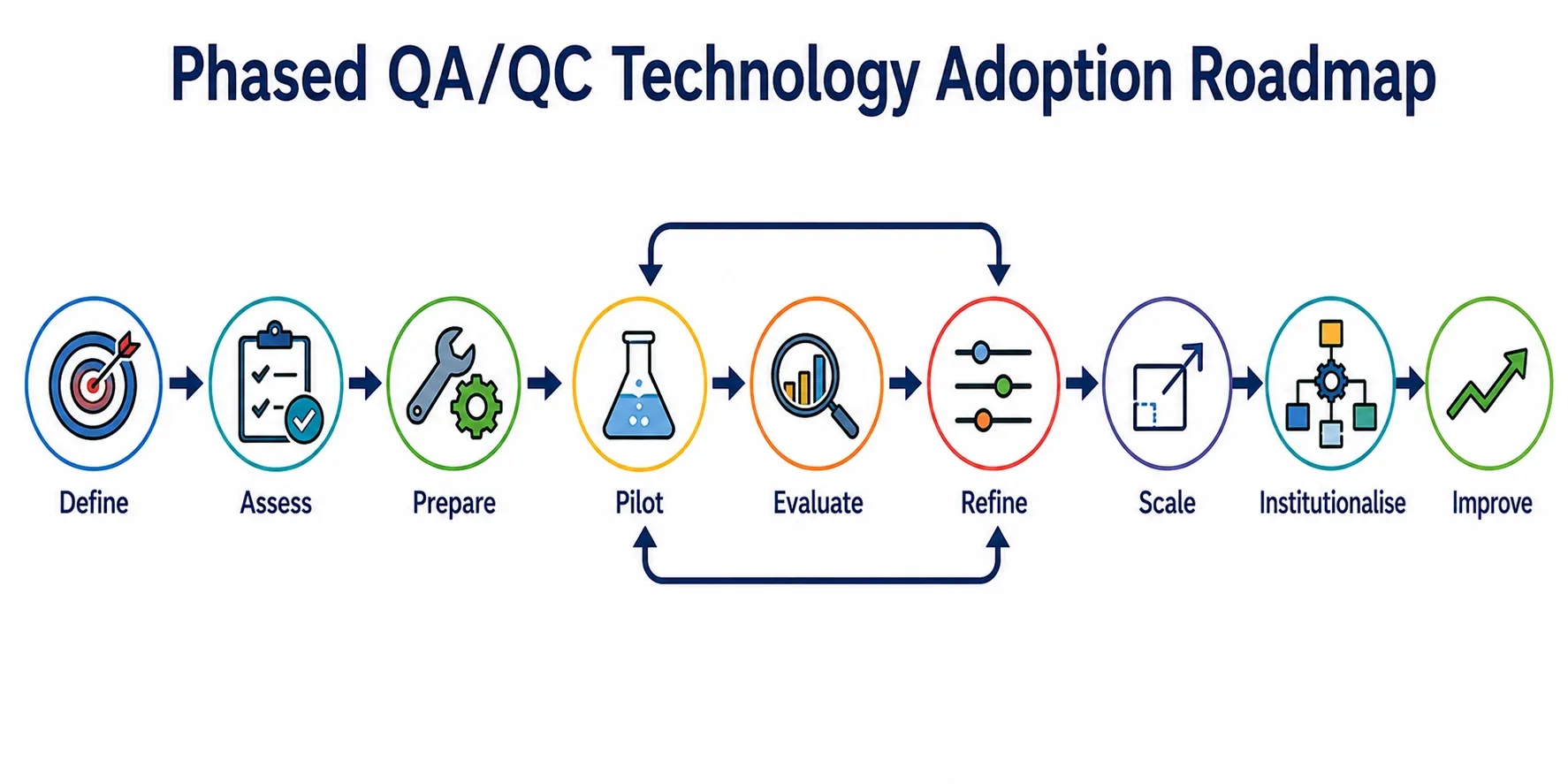
Recommended Phased Adoption Process
Phase 1: Define
Identify:
- Quality problem
- Strategic objectives
- Technology requirements
- Expected benefits
Phase 2: Assess
Evaluate:
- Readiness
- Risks
- Costs
- Infrastructure
- Data
- Competence
Phase 3: Prepare
Develop:
- Procedures
- Training
- Data standards
- Governance
- Infrastructure
Phase 4: Pilot
Test:
- Technology
- Workflows
- User capability
- Data quality
- Integration
Phase 5: Evaluate
Measure:
- KPIs
- Costs
- Benefits
- Risks
- User feedback
Phase 6: Refine
Modify:
- Procedures
- Training
- Technology configuration
- Integration
- Governance
Phase 7: Scale
Expand progressively to:
- Additional workstreams
- Additional projects
- Additional business units
Phase 8: Institutionalise
Integrate the technology into:
- QA/QC procedures
- Quality plans
- Inspection and Test Plans
- Training
- Governance
- Performance management
Phase 9: Improve
Continue to:
- Monitor
- Review
- Update
- Optimise
-
Capture lessons learned

Role of the Senior Electrical QA/QC Professional
A senior QA/QC professional has a central role in ensuring that technology adoption remains aligned with quality objectives.
Responsibilities may include:
- Identifying quality improvement opportunities
- Reviewing technology proposals
- Assessing risks
- Evaluating readiness
- Developing adoption requirements
- Defining quality KPIs
- Supporting pilot projects
- Reviewing technology-generated evidence
- Challenging unreliable outputs
- Supporting training
- Monitoring performance
- Advising management
- Ensuring integration with QA/QC procedures
The professional should remain objective and evidence-based, recognising that technology is a tool for improving quality rather than an objective in itself.
Measuring Long-Term Adoption Success
Technology adoption should continue to be evaluated after full deployment.
Long-term indicators may include:
- Sustained defect reduction
- Reduced rework
- Improved inspection efficiency
- Better data quality
- Improved traceability
- Faster corrective action
- Reduced equipment failures
- Improved energy performance
- Improved commissioning outcomes
- Higher user competence
- Lower lifecycle costs
The organisation should periodically compare current performance against the original baseline and adoption objectives.
Strategic Importance of Continual Improvement
Emerging technology will continue to evolve. A technology that is effective today may require modification as new capabilities become available.
The strategic plan should therefore establish periodic review.
Reviews may consider:
- Technology performance
- User feedback
- New functionality
- Cybersecurity developments
- Emerging alternatives
- Cost changes
- Project requirements
- Quality trends
This creates a technology adoption cycle rather than a one-time implementation project.
Conclusion
A comprehensive phased technology adoption strategy enables electrical organisations to introduce emerging QA/QC technologies in a controlled, measurable, and risk-informed manner. The strategy should begin with a clearly defined quality problem and establish measurable objectives before selecting a suitable technological solution. Readiness, data, infrastructure, workforce competence, cybersecurity, interoperability, financial requirements, supplier support, and organisational change should then be evaluated before implementation. Pilot projects and formal decision gates provide valuable opportunities to test the technology, identify weaknesses, collect evidence, and refine processes before wider deployment.
For Level 6 electrical QA/QC professionals, the strategic objective is not simply to introduce more technology but to ensure that technological adoption produces measurable improvements in quality management, inspection, testing, traceability, performance monitoring, defect prevention, and decision-making. A progressive roadmap from preparation and pilot implementation through controlled expansion, full deployment, and continual improvement allows organisations to manage change responsibly while protecting quality, safety, sustainability, reliability, cost, and operational performance. When technology adoption is supported by clear governance, competent personnel, reliable data, defined KPIs, effective risk controls, and ongoing evaluation, emerging tools can become an integrated part of a modern electrical QA/QC system rather than an isolated digital initiative.
3: Formulate Practical Strategies to Train Personnel and Manage the Transition to Advanced Technological QA/QC Methods
The adoption of advanced technologies is changing the way electrical Quality Assurance and Quality Control (QA/QC) activities are planned, inspected, tested, documented, monitored, and evaluated. Technologies such as artificial intelligence (AI), Internet of Things (IoT) sensors, digital inspection platforms, Building Information Modelling (BIM), digital twins, predictive analytics, automated testing, computer vision, cloud-based quality management systems, mobile applications, and real-time quality dashboards can significantly improve the accuracy, speed, traceability, and consistency of QA/QC activities. However, technology alone does not create quality improvement. The effectiveness of any technological QA/QC system depends heavily on the competence of the personnel responsible for operating it, interpreting its outputs, responding to findings, and integrating it into established quality processes.
For an electrical organisation, transitioning from conventional QA/QC methods to advanced technological approaches can involve substantial changes in working practices. Inspectors may move from paper-based checklists to mobile applications, engineers may begin analysing real-time quality data, commissioning teams may use automated testing platforms, and managers may rely on digital dashboards for quality decision-making. These changes can create opportunities for improved performance but may also introduce resistance, competency gaps, confusion over responsibilities, data-quality problems, and excessive dependence on automated outputs. A structured workforce and transition strategy is therefore required to ensure that personnel are prepared before, during, and after implementation.
At Level 6, the electrical QA/QC professional should be capable of developing a strategic workforce development approach rather than simply arranging software training. The professional must identify the competencies required for each role, compare them with existing capability, develop targeted learning interventions, verify competence, support implementation, manage resistance, establish communication arrangements, and monitor whether personnel are actually using the technology effectively. The transition should also protect professional engineering judgement. Advanced technology should support inspection, testing, analysis, and decision-making while appropriate human oversight remains in place for significant quality, safety, compliance, and engineering decisions.
Understanding Workforce Transition in Advanced QA/QC
Workforce transition is the controlled movement of personnel from existing QA/QC practices to new technology-supported methods.
It can involve changes to:
- Roles and responsibilities
- Inspection procedures
- Testing processes
- Documentation
- Data management
- Reporting
- Communication
- Decision-making
- Competency requirements
- Quality governance
- Performance monitoring
For example, a traditional electrical inspection process may involve:
Paper Checklist → Manual Inspection → Paper Evidence → Manual Report → Defect Register
An advanced digital process may involve:
Digital Checklist → Mobile Inspection → Photographic Evidence → Automated Workflow → Digital Defect Management → Dashboard
The technology changes the workflow, but the fundamental quality objective remains the same: ensuring that electrical work conforms to specified requirements and performs reliably.
Key Definitions and Concepts
| Term | Definition | Application to QA/QC Transition |
|---|---|---|
| Workforce readiness | The ability of personnel to operate effectively within the new technological environment | Determines whether implementation can proceed successfully |
| Digital competence | The ability to use digital systems and technology appropriately | Supports accurate technology use |
| Competence | Demonstrated ability to perform required tasks to the specified standard | Confirms that personnel can apply training in practice |
| Training Needs Analysis | A structured assessment comparing existing capability with required competence | Identifies development requirements |
| Change management | A structured process for managing people and organisational changes | Supports successful transition |
| Technology champion | A trained user who provides peer support during implementation | Helps colleagues adopt new methods |
| User acceptance | The extent to which personnel appropriately accept and use the new system | Indicates transition progress |
| Human oversight | Professional review of technology-generated information or decisions | Prevents inappropriate reliance on automation |
| Competency verification | Assessment confirming that personnel can perform required tasks correctly | Provides evidence of readiness |
| Transition plan | A structured programme for moving from existing to new processes | Controls implementation |
| Legacy system | An existing process or technology retained from previous operations | Requires controlled transition or retirement |
| Blended learning | Combination of classroom, online, practical, and workplace learning | Supports comprehensive technology training |
| Continuous learning | Ongoing development after initial implementation | Maintains workforce capability as technology evolves |
Why Personnel Training Is Essential
Advanced QA/QC technologies can produce large amounts of information, but information is only valuable when personnel can interpret and act upon it correctly.
Effective training helps personnel:
- Understand the purpose of the technology
- Operate systems correctly
- Enter accurate information
- Interpret digital outputs
- Identify abnormal results
- Recognise system limitations
- Report defects accurately
- Maintain traceability
- Protect sensitive information
- Respond to alerts
- Escalate significant findings
- Apply professional judgement
Poorly trained personnel can introduce new quality risks.
For example, an IoT monitoring system may generate an abnormal temperature alarm. An inadequately trained user may assume that the equipment has failed immediately. A competent user should instead understand that the alarm may result from an actual equipment condition, sensor error, communication problem, calibration issue, or incorrect threshold. Appropriate verification is therefore required before a final decision is made.
Identifying the Required Competencies
Before training begins, the organisation should determine what personnel need to know and what they need to be able to do.
Competency requirements may include:
- Technical QA/QC knowledge
- Digital literacy
- Software operation
- Data interpretation
- Inspection procedures
- Testing procedures
- Cybersecurity awareness
- Digital documentation
- Analytical skills
- Problem-solving
- Communication
- Risk assessment
- Technology troubleshooting
- Engineering judgement
Competencies should be related to the individual’s actual role.
Electrical Inspectors
Inspectors may require competence in:
- Mobile inspection systems
- Digital checklists
- Photographic evidence
- Measurement entry
- Defect recording
- Digital approvals
- Record submission
QA/QC Engineers
Engineers may require:
- Data analysis
- Dashboard interpretation
- Quality trend analysis
- Predictive information
- Digital reporting
- Technology validation
Commissioning Personnel
Commissioning personnel may require:
- Automated testing systems
- Digital test records
- System configuration
- Data interpretation
- Functional testing
- Performance verification
QA/QC Managers
Managers may require:
- Technology governance
- KPI interpretation
- Risk management
- Investment evaluation
- Change management
- Performance monitoring
Conducting a Training Needs Analysis
A Training Needs Analysis (TNA) should establish the difference between current capability and required future capability.
The process can be represented as:
Current Competence → Required Competence → Gap → Training Response → Verification
The assessment should identify:
- Existing knowledge
- Existing technical skills
- Existing digital capability
- Experience with similar systems
- Required future competence
- Competency gaps
- Priority training areas
Training should not be based solely on job titles. Personnel in the same role may have different levels of digital capability.
Assessing Existing Workforce Capability
Existing capability can be assessed through:
- Knowledge tests
- Interviews
- Practical demonstrations
- Workplace observation
- Digital skills assessments
- Previous training records
- Performance reviews
- Supervised system use
For example, an experienced electrical inspector may possess excellent technical inspection knowledge but limited experience with digital inspection applications. It would therefore be inefficient to repeat basic inspection training. The training should concentrate on digital workflows while maintaining the inspector’s existing technical strengths.
Developing a Competency Matrix
A competency matrix can help management identify workforce readiness.
| Role | Required Competency | Current Capability | Gap | Action |
|---|---|---|---|---|
| Electrical Inspector | Digital inspection | Basic | High | Practical training |
| QA/QC Engineer | Data analysis | Intermediate | Medium | Advanced workshop |
| Commissioning Engineer | Automated testing | Basic | High | Specialist training |
| QA/QC Manager | Technology governance | Basic | High | Management development |
| Site Supervisor | Digital reporting | Intermediate | Medium | Guided practice |
| System Administrator | Platform management | Intermediate | Medium | Technical training |
The matrix should be updated as personnel develop.
Designing Role-Specific Training
One general technology course may not be appropriate for every employee.
Training should be divided according to responsibilities.
Operational Training
Focus on:
- System navigation
- Inspection entry
- Evidence collection
- Defect recording
- Basic troubleshooting
Technical Training
Focus on:
- Data interpretation
- System configuration
- Analytics
- Technical validation
- Integration
Management Training
Focus on:
- KPIs
- Dashboards
- Strategic decisions
- Technology risks
- Governance
Administrative Training
Focus on:
- User management
- Records
- Access controls
- Document management
- System administration
Developing a Structured Training Programme
A comprehensive programme should normally include several stages.
Awareness Training
Personnel should understand:
- Why the technology is being introduced
- What problem it addresses
- Expected benefits
- Expected changes
- Potential limitations
- Impact on their role
Knowledge Training
Personnel should understand:
- Technology functions
- QA/QC procedures
- Data requirements
- Security requirements
- Reporting requirements
Practical Training
Personnel should practise:
- System operation
- Inspection
- Data entry
- Evidence capture
- Defect reporting
- Corrective-action workflows
Workplace Application
Personnel should use the technology during actual work under appropriate supervision.
Competence Verification
Personnel should demonstrate that they can perform required activities correctly.
Continuing Development
Personnel should receive further training when:
- Systems change
- Procedures change
- New functions are introduced
- Performance weaknesses are identified
Using Blended Learning
A blended approach can combine:
- Classroom sessions
- Online modules
- Demonstrations
- Practical workshops
- Simulations
- Manufacturer training
- Workplace coaching
- Mentoring
- Supervised activities
This approach is particularly useful for electrical QA/QC because learners need both conceptual understanding and practical competence.
Practical Technology Training
Training should simulate realistic QA/QC activities.
For a digital inspection platform, personnel could practise:
- Selecting an inspection
- Opening a checklist
- Recording measurements
- Adding photographs
- Recording a defect
- Assigning corrective action
- Uploading evidence
- Submitting the record
- Reviewing closure
This provides stronger preparation than a simple software demonstration.
Scenario-Based Training
Scenario-based training should be used for advanced technology because technology outputs often require professional interpretation.
For example:
An automated monitoring system identifies an unusual electrical parameter.
The learner should determine:
- Whether the data appears credible
- Whether the sensor requires verification
- Whether the equipment requires physical inspection
- Whether the condition requires escalation
- What evidence should be recorded
- Who should be notified
This develops decision-making rather than simple button-clicking ability.
Training Personnel to Recognise Technology Limitations
One of the most important aspects of advanced QA/QC training is teaching users that technology is not infallible.
Personnel should understand that:
- Sensors can fail
- Data can be incomplete
- AI can produce incorrect classifications
- Algorithms can generate false positives
- Automated testing can be incorrectly configured
- Digital systems can become unavailable
- Communication networks can fail
- Software outputs can require professional verification
A core training principle should therefore be:
Technology Output → Professional Evaluation → Quality Decision
rather than:
Technology Output → Automatic Decision
Human Oversight and Professional Accountability
Human oversight remains particularly important where decisions affect:
- Electrical safety
- Equipment acceptance
- Significant non-conformities
- Critical testing
- Commissioning
- Protection systems
- Compliance
- Engineering changes
- Asset performance
Personnel should know when technology-generated information must be escalated to a competent engineer or QA/QC professional.
Managing Resistance to Technological Change
Resistance to change is common when organisations introduce new QA/QC technology.
Personnel may resist because they:
- Prefer established processes
- Lack confidence
- Fear increased workload
- Believe technology will replace their role
- Have insufficient training
- Do not understand the purpose
- Have experienced unsuccessful digital projects
- Consider the existing process adequate
Resistance should be investigated rather than simply criticised.
Understanding the Reasons for Resistance
Management should determine whether resistance results from:
- Skills gaps
- Communication problems
- Poor system design
- Insufficient resources
- Previous negative experiences
- Lack of involvement
- Fear of job displacement
- Excessive administrative requirements
The appropriate response depends on the underlying cause.
Communication Strategy
Communication should begin before implementation.
Personnel should receive clear information about:
- The reason for change
- The quality problem being addressed
- Expected benefits
- Changes to responsibilities
- Training arrangements
- Implementation stages
- Support arrangements
- Performance expectations
Communication should continue throughout the transition.
Involving Personnel in the Transition
Personnel involvement can improve adoption because users often understand operational challenges that management or technology suppliers may overlook.
Personnel can participate in:
- Workflow design
- Technology demonstrations
- Pilot projects
- Testing
- Procedure development
- Feedback sessions
- Improvement reviews
This creates greater ownership of the transition.
Establishing Technology Champions
Technology champions can support colleagues during implementation.
Their responsibilities may include:
- Demonstrating system functions
- Supporting new users
- Identifying common problems
- Providing feedback
- Supporting troubleshooting
- Encouraging correct use
- Communicating recurring issues to management
Technology champions should have sufficient competence and credibility among their colleagues.
Developing a Controlled Transition Plan
Transition should not normally occur without a defined implementation pathway.
A suitable sequence may be:
Existing Process → Preparation → Training → Pilot → Supervised Use → Controlled Cutover → New Process → Review
Each stage should have defined responsibilities and success criteria.
Managing Legacy Processes
Existing systems may need to remain available temporarily.
However, prolonged use of parallel systems can create:
- Duplicate records
- Conflicting information
- Additional workload
- Unclear responsibilities
- Data inconsistencies
The transition plan should define:
- Which system is the official record
- When the legacy system will be retired
- How historical records will be retained
- How data will be transferred
- How duplicate records will be controlled
Establishing a Controlled Cutover
A cutover is the formal transition from the old process to the new process.
Before cutover, the organisation should confirm:
- Personnel are trained
- Competence is verified
- Procedures are approved
- Technology is operational
- Data is available
- User access is configured
- Technical support is available
- Contingency procedures exist
This reduces the likelihood of operational disruption.
Supporting Personnel After Implementation
Training should not end when the technology goes live.
Support can include:
- Helpdesk services
- Technology champions
- On-site assistance
- Quick-reference guides
- Troubleshooting instructions
- Refresher sessions
- Coaching
- Manufacturer support
Early support is particularly important because users may encounter problems that were not identified during training.
Updating QA/QC Procedures
Technology adoption should be reflected in controlled procedures.
A technology-supported QA/QC procedure may define:
- Purpose
- Scope
- Responsibilities
- System operation
- Inspection steps
- Data requirements
- Evidence requirements
- Approval
- Escalation
- Record retention
- Contingency arrangements
Procedures should also specify where human verification is mandatory.
Integrating Technology into the Quality Management System
Advanced technology should not operate as a separate activity.
It should connect with:
- Quality plans
- Inspection and Test Plans
- Inspection procedures
- Non-conformity management
- Corrective actions
- Testing
- Commissioning
- Document control
- Auditing
- Management review
This integration ensures that digital technology contributes to controlled quality management.
Training for Digital Inspection Systems
Digital inspection training should cover several areas.
Digital workflow
Personnel should learn:
- User access
- Inspection selection
- Checklist completion
- Data entry
- Submission
Evidence management
Personnel should learn:
- Photograph requirements
- Measurement recording
- Document attachment
- Comments
- Traceability
Defect management
Personnel should understand:
- Defect identification
- Classification
- Assignment
- Corrective action
- Verification
- Closure
Record management
Personnel should understand:
- Approval
- Revision control
- Data accuracy
- Record retention
Training for IoT-Based QA/QC Monitoring
Personnel using IoT systems should understand:
- Sensor purpose
- Sensor location
- Data transmission
- Calibration
- Data validation
- Alarm thresholds
- Communication failures
- Maintenance
- Escalation
Training should include situations where a sensor reading conflicts with physical inspection evidence.
Training for AI-Assisted QA/QC
AI-related training should cover:
- Purpose of AI
- Input data
- Output interpretation
- False positives
- False negatives
- Human verification
- Data limitations
- Escalation
- Record keeping
Personnel should understand that AI-generated results require appropriate validation, particularly when decisions have significant quality or safety implications.
Training for Automated Testing
Automated testing equipment requires both technical and digital competence.
Training may include:
- Test configuration
- Test sequencing
- Equipment operation
- Calibration
- Data capture
- Test-result interpretation
- Abnormal-result handling
- Data storage
- Reporting
Personnel should be able to identify when a test result requires investigation rather than simply accepting an automated pass or fail.
Training for BIM and Digital Twins
Personnel using BIM or digital twins may require competence in:
- Model information
- Asset identification
- Data linking
- Inspection status
- Commissioning records
- Asset information
- Model updates
The objective is to ensure that digital representations are based on verified project information.
Training for Predictive Analytics
Predictive QA/QC tools require personnel to understand:
- Historical data
- Trends
- Performance indicators
- Anomalies
- Predictions
- Data limitations
- Verification requirements
A prediction should be treated as evidence requiring appropriate assessment, not automatically as a confirmed failure.
Developing Competency Verification
Training attendance does not necessarily demonstrate competence.
Competence should be verified through:
- Practical demonstrations
- Workplace observation
- Scenario assessments
- Simulations
- Knowledge assessments
- Supervised activities
- Review of completed digital records
For critical technology, authorisation should be based on demonstrated competence.
Monitoring Performance During Transition
The organisation should monitor whether technology adoption is producing the intended results.
Useful indicators include:
- User error rate
- Training completion
- Competency assessment
- System usage
- Inspection completion
- Record completeness
- Defect reporting
- Defect closure
- Corrective-action performance
- Support requests
If quality performance deteriorates after implementation, management should investigate whether the cause is technology, training, process design, or another factor.
Gathering Personnel Feedback
Feedback should be collected systematically.
Personnel may identify:
- Difficult system functions
- Missing training
- Poor workflow design
- Connectivity problems
- Excessive data entry
- Unclear responsibilities
- Inadequate support
Feedback can then be used to improve:
- Training
- Procedures
- System configuration
- Support arrangements
Developing a Continuous Learning Strategy
Emerging technology evolves continuously. Training should therefore continue after implementation.
Continuing development may include:
- Refresher training
- New feature training
- Technology updates
- Case studies
- Lessons learned
- Workshops
- Advanced data-analysis training
- User forums
This ensures that competence remains current.
Managing Technology Updates
Technology updates should be controlled because significant changes can affect established QA/QC processes.
Before implementing a major update, consider:
- New functions
- Changed workflows
- Data structures
- Security requirements
- User interfaces
- Reporting
- Integration
Where necessary, personnel should receive update-specific training.
Practical Case Study: Digital Inspection Platform
An electrical contractor currently uses paper inspection forms and wants to introduce a digital inspection platform.
The organisation identifies:
- Delayed reporting
- Missing records
- Slow defect notification
- Difficult record retrieval
- Inconsistent inspection forms
Initial workforce assessment
The organisation finds:
- Strong electrical competence
- Limited digital experience
- Good availability of mobile devices
- Limited experience with digital evidence
Training response
The organisation develops:
- Awareness session
- Platform demonstration
- Practical workshop
- Simulated inspection
- Supervised site inspection
- Competence verification
Transition approach
The system is first introduced to selected users on a controlled project.
Performance is monitored using:
- Reporting time
- Record completeness
- User errors
- Defect closure
- User feedback
The organisation then adjusts training and procedures before wider deployment.
Practical Case Study: IoT Monitoring
A project introduces IoT sensors to monitor critical electrical equipment.
The workforce has strong maintenance knowledge but limited experience interpreting sensor data.
Training focuses on:
- Sensor operation
- Data interpretation
- Alarm response
- Sensor validation
- Escalation
- Maintenance
Workplace scenario
An abnormal temperature reading appears on the dashboard.
The trained employee should:
- Check the sensor status
- Review recent trends
- Compare relevant information
- Conduct appropriate physical verification
- Escalate if required
- Record the investigation
This approach prevents automatic decisions based solely on one digital reading.
Practical Case Study: AI-Assisted Inspection
An organisation introduces AI-assisted visual inspection.
Personnel are trained to:
- Capture suitable images
- Submit images correctly
- Review AI findings
- Identify potential false results
- Conduct physical verification
- Record final decisions
The AI system supports the inspection process, but final quality decisions remain subject to appropriate professional verification.
Practical Case Study: Automated Electrical Testing
A project introduces automated test equipment to reduce manual recording.
Personnel are trained in:
- Equipment setup
- Test configuration
- Test sequence
- Calibration
- Data recording
- Result interpretation
- Abnormal results
- Reporting
Competence is verified through supervised testing before independent use is authorised.
Managing Different Levels of User Adoption
Personnel will not necessarily develop competence at the same rate.
Some users may:
- Adopt quickly
- Require additional support
- Need repeated practice
- Require specialist training
Management should therefore monitor actual adoption rather than assuming that attendance at training means successful implementation.
Useful indicators include:
- Correct system use
- User confidence
- Error rates
- Support requests
- Record quality
- Quality performance
Addressing Concerns About Job Replacement
Employees may believe that advanced technology will eliminate their roles.
The organisation should explain that technology may reduce repetitive activities while increasing the importance of:
- Technical analysis
- Data interpretation
- Engineering judgement
- Risk management
- Technology governance
- Quality improvement
- Decision-making
The workforce strategy should focus on developing these higher-level capabilities.
Managing Transition Risks
Technology transition may create several risks.
Competency risks
- Insufficient training
- Incorrect operation
- Poor data interpretation
Operational risks
- Workflow disruption
- System downtime
- Confusion between old and new processes
Quality risks
- Incorrect records
- Missed defects
- Incorrect automated results
People risks
- Resistance
- Low confidence
- Poor communication
Cybersecurity risks
- Weak passwords
- Uncontrolled access
- Unauthorised data use
Business risks
- Cost escalation
- Supplier dependency
- Delayed implementation
These risks should be identified and controlled within the transition plan.
Developing Contingency Arrangements
Technology should not become a single point of failure.
The organisation should establish:
- Backup procedures
- Data recovery
- Manual contingency processes
- Alternative communication
- Technical support
- System outage procedures
- Escalation arrangements
For example, if a digital inspection platform becomes unavailable during critical site activities, a controlled contingency method should allow quality evidence to continue being collected without compromising traceability.
Technology Competency Register
A technology competency register can track workforce capability.
It may record:
- Employee
- Role
- Technology
- Training completed
- Assessment result
- Authorisation
- Refresher requirement
- Competency limitations
This enables management to identify who is authorised to perform technology-supported activities.
Aligning Training With the Adoption Roadmap
Training should progress alongside technology implementation.
| Adoption Phase | Personnel Activity | Training Focus |
|---|---|---|
| Define | Identify affected roles | Awareness |
| Assess | Identify competency gaps | Training needs |
| Prepare | Develop capability | Knowledge and practical skills |
| Pilot | Support selected users | Supervised application |
| Evaluate | Review performance | Competence verification |
| Refine | Address weaknesses | Refresher training |
| Scale | Extend user capability | Wider workforce training |
| Institutionalise | Embed new methods | Standard procedures |
| Improve | Maintain capability | Continuous learning |
This prevents technology from progressing faster than workforce capability.
Benefits of Effective Personnel Training
Improved technology adoption
Competent personnel are more likely to use systems correctly.
Reduced user errors
Training improves the accuracy of data entry, inspections, records, and reports.
Improved quality performance
Technology produces greater value when supported by competent QA/QC professionals.
Better data quality
Personnel understand the importance of accurate and complete information.
Improved traceability
Correct digital record management creates stronger quality evidence.
Faster defect management
Personnel can identify, record, assign, and close defects more efficiently.
Greater workforce confidence
Practical training reduces uncertainty and resistance.
Better risk management
Personnel are more capable of recognising abnormal technology outputs.
Improved organisational learning
Feedback and lessons learned can be incorporated into future training.
Sustainable technology adoption
Continuing development prevents workforce competence from becoming outdated.
Common Mistakes in Technology Transition
Organisations should avoid:
- Providing identical training to every role
- Focusing only on software operation
- Ignoring existing competence
- Treating attendance as competence
- Launching technology without preparation
- Failing to involve users
- Ignoring resistance
- Providing inadequate post-launch support
- Maintaining parallel systems indefinitely
- Failing to define the official record
- Ignoring cybersecurity training
- Treating AI outputs as automatically correct
- Failing to update procedures
- Allowing untrained users to operate critical technology
- Ignoring user feedback
- Failing to reassess competence after significant updates
Recommended Personnel Transition Process
Step 1: Identify affected personnel
Determine who will operate, manage, approve, maintain, or interact with the technology.
Step 2: Conduct a Training Needs Analysis
Compare current competence against future requirements.
Step 3: Develop role-specific training
Create different learning pathways for inspectors, engineers, managers, supervisors, and administrators.
Step 4: Communicate the change
Explain:
- Purpose
- Benefits
- Responsibilities
- Timeline
- Support
Step 5: Deliver training
Combine:
- Knowledge
- Demonstration
- Practice
- Simulation
- Workplace application
Step 6: Verify competence
Assess practical performance.
Step 7: Begin controlled implementation
Introduce technology within a limited and supervised environment.
Step 8: Provide implementation support
Use:
- Technology champions
- Helpdesk support
- Coaching
- Refresher training
Step 9: Monitor adoption
Measure:
- Usage
- Errors
- Quality results
- User confidence
Step 10: Review and refine
Modify:
- Training
- Procedures
- Technology configuration
- Support
Step 11: Expand implementation
Progressively introduce the technology to additional users or projects.
Step 12: Maintain competence
Continue learning, reassessment, and development.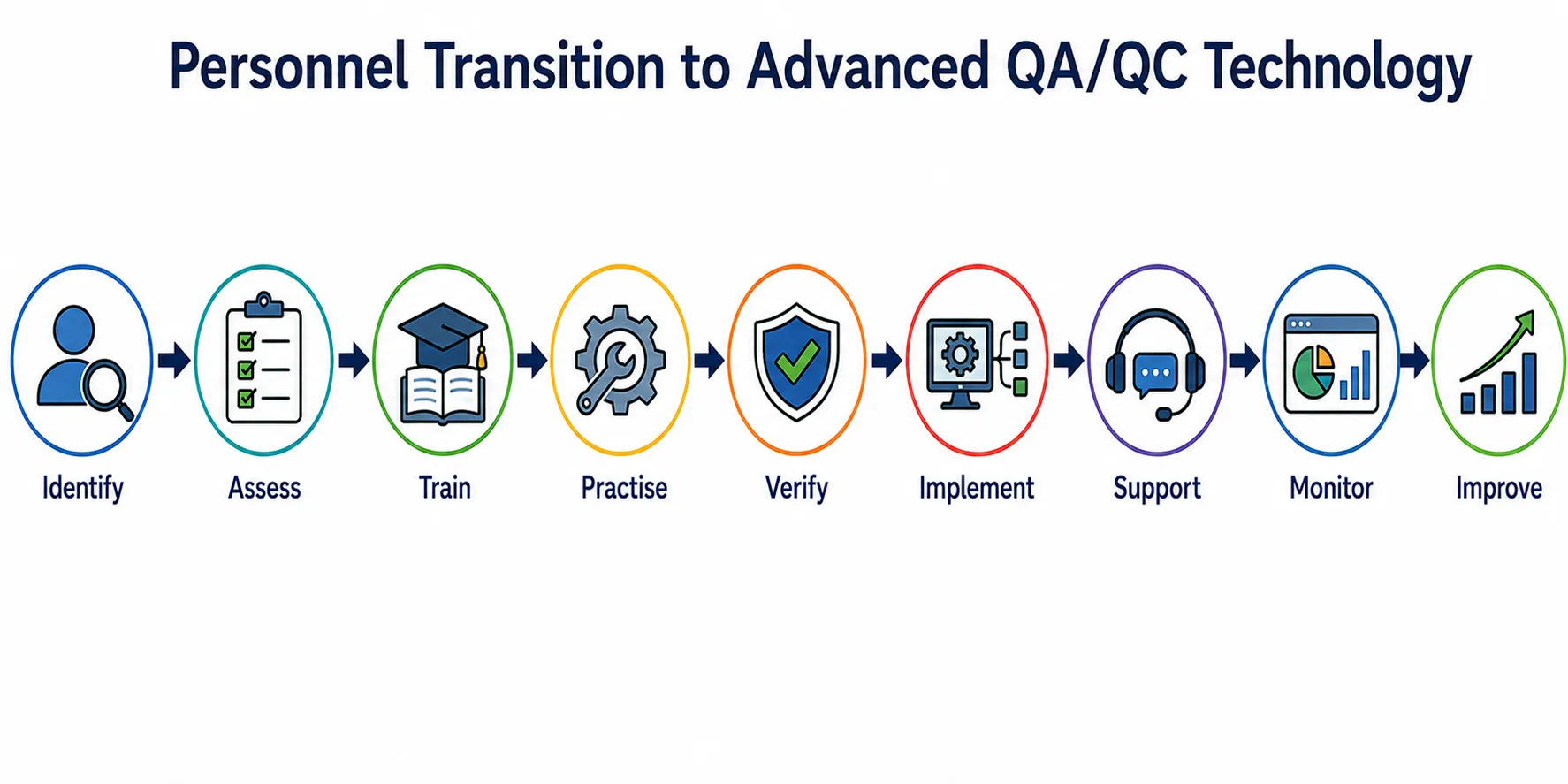
Measuring Training Effectiveness
Training effectiveness should be assessed at several levels.
Knowledge
Can the employee explain the purpose and limitations of the technology?
Skill
Can the employee operate the technology correctly?
Application
Can the employee use it effectively during actual QA/QC activities?
Behaviour
Does the employee consistently follow the revised process?
Results
Has the technology-supported process improved quality performance?
Possible indicators include:
- Competency assessment scores
- Practical assessment results
- User error rates
- Record completeness
- Inspection efficiency
- Defect reporting
- Corrective-action closure
- System utilisation
- Quality trends
Role of the Senior Electrical QA/QC Professional
The senior electrical QA/QC professional should provide leadership throughout workforce transition.
Key responsibilities include:
- Identifying competency requirements
- Conducting training needs analysis
- Reviewing technology risks
- Supporting technology selection
- Developing training strategies
- Establishing competence requirements
- Supporting pilot implementation
- Reviewing technology outputs
- Establishing human oversight
- Monitoring quality KPIs
- Advising management
- Supporting continual improvement
The professional should ensure that technological adoption remains aligned with quality objectives and engineering principles.
Strategic Workforce Development Framework
A comprehensive workforce strategy can be structured around seven interconnected elements:
Competence → Training → Practice → Verification → Support → Performance → Improvement
Competence
Identify what personnel need to know and do.
Training
Provide structured learning appropriate to each role.
Practice
Allow personnel to apply the technology under controlled conditions.
Verification
Confirm that personnel can perform required tasks correctly.
Support
Provide assistance during implementation.
Performance
Monitor whether personnel and technology are producing expected results.
Improvement
Use evidence and feedback to strengthen capability.
This framework can be incorporated into an organisation’s technology adoption strategy.
Long-Term Workforce Capability
The objective should not be to train employees only for one technology.
Personnel should progressively develop transferable capabilities such as:
- Digital literacy
- Data interpretation
- Analytical thinking
- Technology evaluation
- Problem-solving
- Systems thinking
- Risk assessment
- Professional judgement
- Quality leadership
These capabilities enable the workforce to adapt as new technologies emerge.
Conclusion
Successful transition to advanced technological QA/QC methods depends on developing a workforce that is technically competent, digitally capable, adaptable, and able to exercise professional judgement. Training should begin with a structured assessment of current and required competencies and should then provide role-specific learning through awareness, knowledge development, practical exercises, supervised workplace application, and formal competence verification. Personnel should understand both the capabilities and limitations of technologies such as AI, IoT, digital inspection platforms, automated testing, BIM, digital twins, and predictive analytics, ensuring that technology-generated information is appropriately evaluated before important quality decisions are made.
For Level 6 electrical QA/QC professionals, managing technological transition is a strategic responsibility that extends beyond delivering training sessions. It requires effective communication, user involvement, change management, technology champions, controlled implementation, procedure development, contingency planning, performance monitoring, and continuing professional development. When workforce development is integrated with the technology adoption roadmap, organisations can reduce resistance, improve digital competence, strengthen data quality, maintain human oversight, and achieve sustainable improvements in inspection, testing, traceability, defect management, commissioning, and quality decision-making.
4: Evaluate the Potential Risks and Interacting Factors Associated with Integrating Emerging Technologies into Live Electrical Projects
Integrating emerging technologies into a live electrical project requires a significantly higher level of risk evaluation than implementing the same technology in a controlled laboratory or isolated test environment. A live project contains active construction, installation, inspection, testing, commissioning, procurement, subcontractor activities, energised systems, temporary services, operational interfaces, and changing site conditions. Introducing technologies such as artificial intelligence (AI), Internet of Things (IoT) sensors, digital inspection platforms, automated testing systems, Building Information Modelling (BIM), digital twins, computer vision, predictive analytics, remote monitoring, and cloud-based quality management systems can improve Quality Assurance and Quality Control (QA/QC), but these technologies can also create technical, operational, human, cybersecurity, data, contractual, and quality risks.
The principal challenge is that emerging technology does not operate independently from the existing project environment. Its performance can be affected by network reliability, equipment compatibility, data quality, workforce competence, software configuration, environmental conditions, cybersecurity controls, project programme pressures, supplier capability, and existing QA/QC procedures. Similarly, the introduction of technology can affect other project activities. A digital inspection system may change reporting workflows; IoT monitoring may introduce additional network requirements; automated testing may alter commissioning sequences; and AI-assisted inspection may change how inspectors classify and verify defects. These interactions mean that risk assessment must consider not only individual technology risks but also the relationships between different systems, people, processes, and project constraints.
For a Level 6 electrical QA/QC professional, the objective is therefore not simply to identify whether a technology can fail. The professional must critically evaluate how technology-related risks interact with electrical engineering requirements, quality objectives, safety considerations, programme constraints, cost pressures, sustainability targets, contractual obligations, and human decision-making. The assessment should determine whether risks can be controlled adequately, whether additional safeguards are required, whether implementation should be phased, and whether the technology remains appropriate for use within the live project environment.
Understanding Risk in Emerging Electrical QA/QC Technology
Risk can be understood as the potential for uncertainty to affect project objectives. In technology-enabled QA/QC, risks may arise from the technology itself, the way it is implemented, the people using it, the information it processes, or the environment in which it operates.
Technology-related risks may involve:
- System failure
- Incorrect data
- Poor connectivity
- Software incompatibility
- Sensor failure
- Incorrect configuration
- Cybersecurity vulnerabilities
- Inadequate training
- Human error
- Over-reliance on automation
- Poor system integration
- Inadequate maintenance
- Supplier dependency
- Data loss
- Unclear responsibilities
The professional should distinguish between the existence of a risk and the consequences of that risk. A minor software inconvenience may have limited impact, whereas an incorrect automated test result affecting a critical electrical system could have serious quality and operational consequences.
Key Definitions and Concepts
| Term | Definition | Relevance to Live Electrical QA/QC Projects |
|---|---|---|
| Emerging technology risk | Potential adverse consequence associated with introducing a developing technology | Helps identify technology-specific uncertainties |
| Integration risk | Risk created when new technology interacts with existing systems or processes | Important for connected electrical projects |
| Interface risk | Risk arising at the boundary between systems, organisations, or responsibilities | Can cause failures between otherwise functioning systems |
| Data integrity | Accuracy, completeness, consistency, and reliability of information | Essential for trustworthy digital QA/QC records |
| Cybersecurity risk | Potential compromise of systems, devices, networks, or data | Important for connected QA/QC technologies |
| Human-factor risk | Risk caused by human capability, behaviour, communication, or decision-making | Can undermine otherwise effective technology |
| Residual risk | Risk remaining after controls are implemented | Supports final implementation decisions |
| Technology dependency | Reliance on a technology for important project activities | Can create vulnerability during system failure |
| Interoperability | Ability of different systems to exchange and use information effectively | Supports integrated digital QA/QC |
| Failure mode | A specific way in which a system, process, or component may fail | Supports structured technology risk analysis |
| Risk interaction | Situation where one risk influences or increases another risk | Important when multiple technologies operate together |
| Contingency | Planned alternative response if the primary technology or process fails | Maintains project continuity |
| Human oversight | Professional review of technology-generated information or decisions | Prevents inappropriate automation reliance |
| Live project | Active project where construction, installation, testing, commissioning, or operational activities are occurring | Creates additional integration constraints |
Why Risk Evaluation Is Essential
A technology may perform successfully during a demonstration but behave differently when exposed to real project conditions.
For example, a digital inspection application may operate correctly in an office environment but encounter:
- Poor site connectivity
- Device damage
- Battery limitations
- Multiple users
- Inconsistent data entry
- Changing inspection requirements
- Integration problems
Similarly, IoT sensors may produce reliable readings during controlled testing but experience interference, environmental exposure, communication failure, calibration problems, or incorrect installation on site.
Risk evaluation therefore needs to consider the complete operating environment.
Identifying the Technology Being Integrated
The first step is to establish exactly what technology is being introduced.
This may include:
- AI-assisted inspection
- IoT sensors
- Digital inspection applications
- Automated test equipment
- BIM-based QA/QC
- Digital twins
- Remote monitoring
- Computer vision
- Predictive analytics
- Cloud-based quality systems
- Real-time dashboards
The professional should identify:
- Purpose
- Functions
- Inputs
- Outputs
- Interfaces
- Users
- Dependencies
- Criticality
This creates a clear basis for risk evaluation.
Identifying the Intended Quality Benefit
Risk should always be considered alongside the intended benefit.
A technology might be introduced to:
- Improve inspection efficiency
- Increase defect detection
- Improve traceability
- Reduce rework
- Improve testing
- Monitor equipment
- Improve commissioning
- Strengthen data analysis
- Improve sustainability verification
The professional should ask whether the expected benefit justifies the associated risks.
Assessing Technical Risks
Technical risks may arise from the technology’s physical or software characteristics.
Potential issues include:
- Incompatible software
- Incorrect configuration
- Hardware failure
- Sensor failure
- Network failure
- Software bugs
- Inadequate capacity
- Poor integration
- Calibration problems
- Data transmission errors
Technical risks should be evaluated according to their potential impact on quality and project delivery.
Assessing Data Risks
Data is fundamental to many emerging technologies.
AI, predictive analytics, digital twins, IoT systems, and dashboards may depend heavily on accurate information.
Data risks include:
- Missing information
- Incorrect information
- Duplicate records
- Inconsistent naming
- Poor historical data
- Incorrect measurements
- Unvalidated sensor readings
- Incorrect data mapping
- Uncontrolled changes
Poor data can create false confidence.
For example, an analytics system may identify apparently normal equipment performance because its historical dataset contains incomplete failure records. The analytical output may therefore appear reliable while being based on inadequate evidence.
Assessing Cybersecurity Risks
Connected technologies increase the digital attack surface of a project.
Cybersecurity considerations may include:
- Unauthorised access
- Weak authentication
- Uncontrolled user permissions
- Unsecured devices
- Remote access
- Data transmission
- Cloud storage
- Software vulnerabilities
- Poor update management
The risk is particularly important where technology connects with operational electrical systems or critical infrastructure.
The QA/QC professional should coordinate with appropriate technical and cybersecurity personnel rather than assuming that a technology is secure simply because it is supplied by a reputable vendor.
Assessing Human-Factor Risks
People remain an important part of technology-enabled QA/QC.
Human risks may arise from:
- Insufficient training
- Misinterpretation
- Poor communication
- Resistance to change
- Excessive confidence in automation
- Incorrect data entry
- Failure to escalate
- Misunderstanding system limitations
A highly automated system can still produce poor quality outcomes if users misunderstand its outputs.
Automation Bias
Automation bias occurs when personnel place excessive confidence in an automated recommendation or result.
For example, an AI system may classify an installation photograph as acceptable. An inspector may accept the result without conducting appropriate verification.
A competent QA/QC process should establish:
Automated Result → Professional Review → Verification → Quality Decision
The level of human oversight should increase where the consequence of an incorrect decision is significant.
Assessing Process Risks
Technology can change existing QA/QC workflows.
Potential process risks include:
- Duplicate data entry
- Unclear approvals
- Delayed notifications
- Incorrect workflow configuration
- Missing inspection stages
- Unclear defect ownership
- Poor document control
- Confusion between old and new processes
The professional should map the current process and proposed future process before implementation.
Assessing Interface Risks
Many technology failures occur at interfaces rather than within individual components.
Examples include:
- Sensor to gateway
- Gateway to cloud platform
- Inspection application to quality database
- BIM model to asset system
- Testing equipment to reporting platform
- Contractor system to client system
An interface risk may occur when one system sends information that another system cannot correctly interpret.
Therefore, interface testing should form part of the QA/QC strategy.
Assessing Electrical System Interfaces
Technology may interact directly or indirectly with electrical systems.
Examples include:
- Monitoring sensors
- Protection monitoring
- Automated testing
- Energy management
- Building management
- SCADA interfaces
- Battery monitoring
- Solar PV monitoring
The professional should establish whether technology integration could affect:
- Electrical operation
- Protection
- Control
- Monitoring
- Testing
- Commissioning
- Safety
Where technology interacts with critical systems, the risk assessment should be more rigorous.
Environmental Risks
Electrical projects operate in environments that may affect technology.
Consider:
- Temperature
- Moisture
- Dust
- Vibration
- Electromagnetic interference
- Physical impact
- Poor lighting
- Limited connectivity
For example, an inspection tablet may be exposed to harsh site conditions, while a sensor may be installed in an environment outside its intended operating range.
Environmental suitability should therefore be verified before deployment.
Programme and Schedule Risks
Technology integration can affect project schedules.
Potential risks include:
- Delayed procurement
- Installation delays
- Software configuration
- Training requirements
- Pilot testing
- Integration testing
- Technical troubleshooting
A technology that requires extensive commissioning should not be introduced without considering the project programme.
However, programme pressure should not justify removing critical verification activities.
Cost Risks
Technology-related costs may exceed initial expectations.
Costs may include:
- Hardware
- Software
- Licences
- Training
- Integration
- Cybersecurity
- Technical support
- Maintenance
- Data storage
- Upgrades
- Replacement
The organisation should consider lifecycle cost rather than purchase price alone.
Supplier and Vendor Risks
Emerging technology can create dependency on specialist suppliers.
Supplier risks include:
- Limited support
- Delayed response
- Product discontinuation
- Proprietary systems
- Inadequate documentation
- Limited training
- Integration limitations
- Unclear maintenance responsibilities
The project should establish supplier responsibilities clearly.
Contractual Risks
Technology integration may affect contractual responsibilities.
Questions may include:
- Who owns the data?
- Who validates technology outputs?
- Who maintains the system?
- Who provides technical support?
- Who is responsible for incorrect data?
- Who approves technology-generated records?
- What evidence must be retained?
These matters should be clarified within appropriate project governance and contractual arrangements.
Interacting Risks
The most important feature of technology risk evaluation is understanding that risks may interact.
For example:
Poor Connectivity → Missing Data → Incomplete Inspection Record → Delayed Defect Identification → Programme Impact
Another interaction could be:
Insufficient Training → Incorrect Data Entry → Poor Analytics → Incorrect Management Decision → Quality Risk
A cybersecurity issue could result in:
Unauthorised Access → Data Manipulation → Incorrect Quality Information → Inappropriate Acceptance Decision
These chains demonstrate why individual risks should not always be considered in isolation.
Risk Interaction Matrix
| Risk Factor | Interacting Factor | Potential Consequence | Typical Control |
|---|---|---|---|
| Poor connectivity | Digital inspection | Missing records | Offline capability and synchronisation |
| Poor training | Automated systems | Incorrect interpretation | Competence assessment |
| Sensor failure | IoT monitoring | False equipment condition | Calibration and validation |
| Poor data | Predictive analytics | Unreliable prediction | Data quality controls |
| Cybersecurity weakness | Cloud QA/QC | Data compromise | Access and security controls |
| Software incompatibility | BIM integration | Information errors | Interface testing |
| Programme pressure | Technology commissioning | Incomplete verification | Planned commissioning time |
| Supplier dependency | Critical technology | Support delays | Defined service arrangements |
| Legacy system | New platform | Duplicate records | Controlled transition |
| Automation bias | AI inspection | Missed defects | Human verification |

Risk Assessment Process
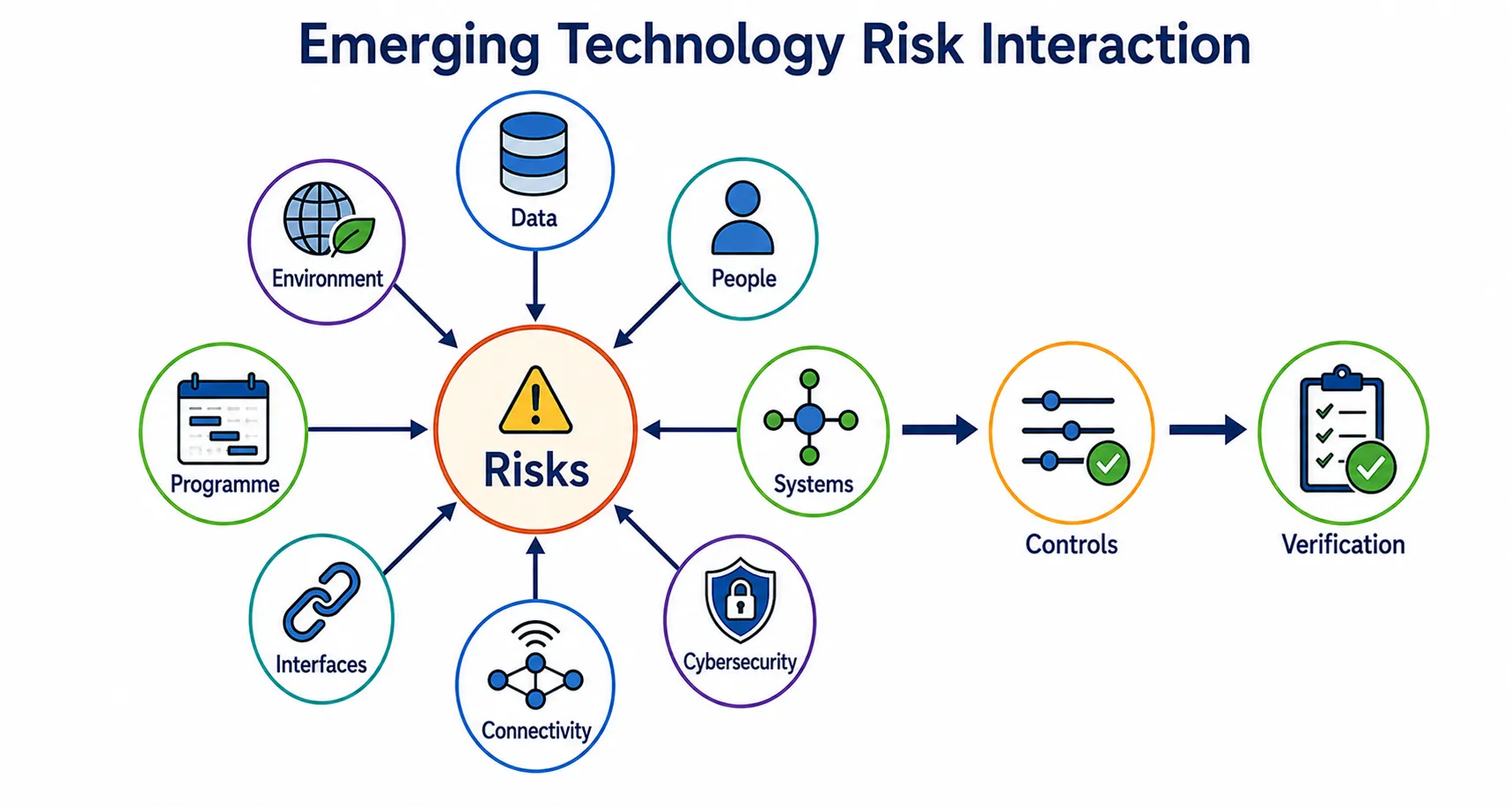
A structured process should be followed.
Step 1: Identify the technology
Define the technology and its intended function.
Step 2: Identify affected activities
Determine which QA/QC and project activities will change.
Step 3: Identify hazards and risks
Consider:
- Technical
- Human
- Data
- Cybersecurity
- Operational
- Financial
- Programme
- Contractual
- Interface
Step 4: Identify interactions
Determine whether one risk can increase another.
Step 5: Assess likelihood and consequence
Evaluate the significance of each risk.
Step 6: Establish controls
Develop appropriate preventive and corrective measures.
Step 7: Determine residual risk
Reassess the risk after controls are applied.
Step 8: Define escalation
Establish when a risk requires management or specialist review.
Step 9: Monitor
Review technology performance throughout implementation.
Step 10: Update
Modify the risk assessment when conditions change.
Failure Mode Analysis
A useful approach is to examine how technology could fail.
For each technology, ask:
- What can fail?
- Why could it fail?
- What would happen?
- How would failure be detected?
- What controls exist?
- What contingency is available?
For example, an IoT sensor could fail because of:
- Battery depletion
- Physical damage
- Calibration drift
- Network failure
- Software configuration
The consequence could be inaccurate monitoring.
Controls could include:
- Maintenance
- Calibration
- Battery monitoring
- Data validation
- Alarm checks
Risk Controls
Controls should be proportionate to risk.
Potential controls include:
- Training
- Competence verification
- System testing
- Data validation
- Calibration
- Cybersecurity controls
- Access controls
- Backup
- Redundancy
- Human verification
- Pilot testing
- Interface testing
- Contingency procedures
- Supplier support
Verification and Validation
Verification and validation are important before relying on technology-generated information.
Verification
Determines whether the technology has been implemented according to specified requirements.
Validation
Determines whether the technology is suitable for its intended purpose.
For example, an automated testing system may be installed correctly but still require validation to confirm that it produces appropriate results for the intended electrical application.
Maintaining Human Oversight
Human oversight is particularly important when technology:
- Makes recommendations
- Classifies defects
- Predicts failures
- Generates acceptance information
- Monitors critical equipment
- Produces safety-related information
The professional should define when human review is mandatory.
Managing Technology Failure During Live Work
A live project should have contingency arrangements.
If the primary technology fails, the project may need:
- Controlled manual procedures
- Backup equipment
- Alternative communication
- Data recovery
- Offline operation
- Technical support
- Escalation procedures
The contingency method should maintain quality evidence and traceability.
Practical Case Study: Digital Inspection System
An electrical project introduces a mobile digital inspection platform.
The main risks identified are:
- Poor site connectivity
- Incorrect user permissions
- Incomplete training
- Device failure
The risks interact.
Poor connectivity may prevent records from synchronising, while inadequate training may result in incomplete records.
Controls include:
- Offline functionality
- Synchronisation checks
- User training
- Competency verification
- Device backup
- Daily record review
The project should conduct a pilot before full implementation.
Practical Case Study: IoT Equipment Monitoring
A sustainable electrical installation introduces sensors to monitor critical equipment.
During testing, one sensor produces abnormal readings.
The project team investigates and discovers that:
- The sensor is functioning
- Data transmission is stable
- Calibration is outside the required range
The incident demonstrates why technology outputs should not automatically be treated as evidence of equipment failure.
The appropriate QA/QC response is to:
- Verify calibration
- Correct the sensor
- Validate readings
- Review affected data
- Document the event
Practical Case Study: AI-Assisted Inspection
A project uses AI-supported image analysis to identify potential electrical installation defects.
The AI system identifies several possible defects.
During physical verification, some findings are confirmed while others are false positives.
This demonstrates that:
- AI can support inspection
- Automated classification is not always conclusive
- Human verification remains necessary
- Performance should be measured
- The system should be refined using validated information
The QA/QC plan should therefore define acceptable AI use and human review requirements.
Practical Case Study: Automated Testing
An electrical commissioning team introduces automated testing equipment.
The equipment completes tests rapidly, but the project programme is under pressure.
A concern arises that personnel may accept automated results without reviewing abnormal readings.
The QA/QC professional should ensure:
- Test configuration is verified
- Equipment status is checked
- Calibration is confirmed
- Results are reviewed
- Abnormal results are investigated
- Test records are controlled
Speed should not override quality assurance.
Assessing Cybersecurity and Quality Together
Cybersecurity should be considered part of quality risk where digital systems hold important project evidence.
A compromised quality system could result in:
- Altered records
- Missing records
- Incorrect status
- Unauthorised changes
- Loss of traceability
Controls should include:
- User access management
- Authentication
- Permissions
- Audit trails
- Backup
- Controlled changes
Assessing Data Integrity
Data integrity should be maintained throughout the technology lifecycle.
This includes:
- Data creation
- Data entry
- Data transmission
- Data processing
- Data storage
- Data retrieval
- Data modification
- Data archiving
The organisation should know which information is the authoritative record.
Assessing Technology Dependency
Excessive dependence on one technology can create project vulnerability.
For critical processes, consider:
- What happens if the system fails?
- Can work continue?
- Can records be recovered?
- Is there an alternative?
- How quickly can support be obtained?
Technology should improve resilience rather than create a single point of failure.
Assessing Interoperability
Before integrating systems, verify:
- Data formats
- Interfaces
- Communication
- Identification structures
- Data mapping
- Permissions
- Synchronisation
Integration testing should be completed before the technology becomes essential to live project activities.
Assessing Change Management Risks
Technology integration may require changes to:
- Procedures
- Roles
- Responsibilities
- Training
- Reporting
- Inspection methods
Poorly managed change can create confusion.
A controlled change process should establish:
- What changes
- Why it changes
- Who approves it
- Who is affected
- What training is required
- How effectiveness is verified
Monitoring Risk During Implementation
Risk assessment should continue after technology deployment.
Monitor:
- System failures
- User errors
- Data quality
- Security incidents
- Defect trends
- Support requests
- Performance
- User feedback
New risks may emerge during actual operation.
Evaluating Residual Risk
After controls are applied, the professional should determine whether the remaining risk is acceptable.
Possible outcomes include:
- Accept
- Monitor
- Further control required
- Escalate
- Delay implementation
- Stop implementation
The decision should be supported by evidence and project requirements.
Key Benefits of Integrated Risk Evaluation
Improved project resilience
Contingency arrangements reduce disruption when technology fails.
Better quality decisions
Reliable technology outputs support stronger professional judgement.
Reduced implementation risk
Potential failures can be identified before they affect critical activities.
Improved system integration
Interface risks can be addressed before deployment.
Better workforce capability
Training and competence controls reduce human-factor risks.
Improved data integrity
Data controls increase confidence in digital QA/QC evidence.
Stronger cybersecurity
Security considerations reduce the risk of unauthorised access and data compromise.
Better project control
Technology risks can be incorporated into wider project risk management.
Common Mistakes in Technology Risk Assessment
Organisations should avoid:
- Assessing technology in isolation
- Ignoring interactions between risks
- Relying entirely on supplier claims
- Ignoring human factors
- Assuming automation is error-free
- Ignoring data quality
- Neglecting cybersecurity
- Failing to test interfaces
- Introducing technology without contingency arrangements
- Ignoring environmental conditions
- Underestimating training requirements
- Failing to review residual risk
- Allowing programme pressure to remove critical verification
- Treating pilot success as proof of universal suitability
- Failing to update the risk assessment
Recommended Risk Evaluation Framework
Identify
Identify:
- Technology
- Purpose
- Users
- Interfaces
- Dependencies
Analyse
Assess:
- Technical risks
- Data risks
- Human risks
- Cybersecurity
- Operational risks
- Financial risks
- Programme risks
Evaluate interactions
Consider how risks influence each other.
Control
Establish:
- Preventive controls
- Verification
- Training
- Monitoring
- Contingency
Validate
Test the technology under realistic project conditions.
Monitor
Track:
- Performance
- Failures
- User errors
- Data quality
Review
Update risk assessments when:
- Technology changes
- Project conditions change
- New risks emerge
- Performance deteriorates
Professional Decision-Making
A Level 6 QA/QC professional should not automatically recommend technology adoption simply because the technology appears innovative.
The professional should ask:
- Does it address a genuine quality problem?
- Are the risks understood?
- Can the organisation control them?
- Are personnel competent?
- Is the technology reliable enough?
- Is the data trustworthy?
- Can the technology integrate safely?
- Is contingency available?
- Is the residual risk acceptable?
- Does the expected benefit justify the risk?
Where these questions cannot be answered satisfactorily, implementation should be delayed, modified, restricted to a pilot, or reconsidered.
Technology Risk Review Checklist
Before integrating emerging technology into a live electrical project, confirm:
- The technology purpose is clearly defined
- The affected QA/QC processes are identified
- Technical risks have been assessed
- Data risks have been assessed
- Cybersecurity risks have been assessed
- Human-factor risks have been considered
- Interface risks have been evaluated
- Workforce competence is adequate
- Environmental conditions are suitable
- Supplier support is available
- Programme impacts are understood
- Costs have been evaluated
- Contractual responsibilities are clear
- Human oversight is defined
- Testing and validation are complete
- Contingency arrangements exist
- Residual risk is acceptable
- Monitoring arrangements are established
Conclusion
Evaluating the risks and interacting factors associated with emerging technology integration is essential when introducing advanced QA/QC methods into live electrical projects. Technologies such as AI, IoT, automated testing, digital inspection platforms, BIM, digital twins, and predictive analytics can improve inspection, testing, traceability, monitoring, and decision-making, but their effectiveness depends on technical reliability, data integrity, workforce competence, cybersecurity, interoperability, appropriate procedures, and controlled implementation. Risk assessment should therefore consider the complete project environment rather than evaluating each technology in isolation. Particular attention should be given to interacting risks, such as poor connectivity leading to incomplete records, inadequate training producing incorrect data, or weak validation causing unreliable automated results.
For a Level 6 electrical QA/QC professional, effective risk evaluation requires evidence-based judgement throughout the technology lifecycle. Risks should be identified, analysed, controlled, validated, monitored, and reviewed as project conditions evolve. Human oversight, contingency planning, interface testing, competence verification, cybersecurity controls, and data validation are particularly important where technology influences critical quality or engineering decisions. The appropriate outcome may be adoption, conditional adoption, pilot implementation, further risk reduction, or rejection. By evaluating technology risks alongside quality, safety, cost, programme, sustainability, and operational considerations, electrical organisations can introduce emerging technologies responsibly while maintaining the integrity and reliability of their QA/QC systems.