
Lesson 6: Manage stakeholder expectations in high‑pressure project environments.
Managing stakeholder expectations is a fundamental leadership capability for senior electrical QA/QC professionals working on complex and high-pressure engineering projects. Electrical projects involve multiple stakeholders, including clients, consultants, contractors, suppliers, project managers, engineering teams and regulatory authorities, each with different priorities relating to quality, safety, cost, programme and technical performance. Effective stakeholder management ensures that these competing expectations are understood, communicated and aligned with approved project requirements.
In high-pressure project environments, stakeholder expectations can change rapidly because of programme delays, technical defects, design changes, resource constraints, commercial pressures and emerging compliance issues. QA/QC leaders must therefore communicate clearly, establish realistic expectations and provide accurate information without compromising electrical quality, safety or professional integrity. Effective management requires more than routine communication; it involves stakeholder analysis, risk-based prioritisation, negotiation, conflict management, transparent reporting and evidence-based decision-making.
This lesson develops advanced knowledge and practical skills for managing stakeholder expectations within electrical QA/QC operations. Learners will examine how to identify stakeholder needs, assess influence and priorities, establish communication strategies, manage conflicting expectations and maintain professional relationships during challenging project conditions. Emphasis is placed on balancing stakeholder demands with technical requirements, quality objectives, project milestones and long-term electrical system reliability.
By completing this lesson, learners will be able to apply strategic stakeholder management techniques to complex electrical QA/QC situations, communicate quality risks effectively and support collaborative decision-making under pressure. The lesson also develops the ability to maintain stakeholder confidence while protecting technical standards, compliance obligations and safety-critical requirements. These skills are essential for QA/QC engineers and project leaders responsible for delivering reliable, compliant and high-quality electrical engineering projects.
Critically Analyse the Differing Priorities and Expectations of Various Stakeholders in a Complex Electrical Project
Complex electrical engineering projects involve multiple stakeholders who influence project decisions, quality outcomes, safety performance and overall delivery success. Each stakeholder group has different responsibilities, objectives and expectations based on their role within the project lifecycle. For senior QA/QC professionals, understanding these differing priorities is essential because stakeholder expectations can directly affect inspection activities, quality decisions, compliance requirements and engineering performance.
Electrical projects such as industrial facilities, power systems, commercial buildings, infrastructure developments and large-scale installations require coordination between clients, consultants, contractors, suppliers, engineers, regulatory authorities and internal project teams. While all stakeholders generally aim for successful project completion, their definitions of success may vary significantly. For example, a client may prioritise reliability and long-term operational performance, while a contractor may focus on achieving programme milestones and controlling costs.
Effective QA/QC leadership requires critical analysis of these different expectations rather than simply responding to individual demands. Quality professionals must evaluate stakeholder requirements, identify potential conflicts, establish communication strategies and ensure that project decisions remain aligned with technical standards, safety obligations and contractual requirements.
Understanding Stakeholders in Complex Electrical Projects
A stakeholder is any individual, organisation or group that can influence, be influenced by or have an interest in the outcome of an electrical project. Stakeholders may have direct involvement in project execution or indirect influence through regulatory, commercial or operational requirements.
In electrical QA/QC environments, stakeholders contribute to decisions related to:
- Design approval.
- Material selection.
- Installation quality.
- Inspection requirements.
- Testing and commissioning.
- Compliance verification.
- Project acceptance.
- Long-term operation and maintenance.
Understanding stakeholder expectations enables QA/QC professionals to manage relationships effectively while protecting project quality objectives.
Key Concepts and Definitions in Stakeholder Management
| Key Concept | Definition | Application in Electrical QA/QC Projects |
|---|---|---|
| Stakeholder | A person, group or organisation affected by project activities | Identifying clients, contractors and regulatory bodies |
| Stakeholder Expectation | The desired outcome or requirement expected from a project | Understanding quality, cost and delivery demands |
| Stakeholder Priority | The most important objective for a stakeholder group | Managing safety, schedule or budget concerns |
| Stakeholder Analysis | A process of identifying stakeholder influence and interests | Developing engagement strategies |
| Stakeholder Engagement | Building communication and relationships with project participants | Maintaining cooperation during project challenges |
| Quality Objective | A defined target related to technical performance and compliance | Achieving required electrical standards |
| Project Constraint | A limitation affecting delivery decisions | Managing time, cost and resources |
| Conflict Management | Resolving disagreements between competing priorities | Balancing quality and commercial requirements |
| Technical Compliance | Meeting specified engineering and regulatory requirements | Ensuring electrical systems are safe and reliable |
| Risk-Based Approach | Making decisions based on potential consequences | Prioritising critical quality issues |
Importance of Analysing Stakeholder Priorities in Electrical QA/QC
Stakeholder analysis is a critical skill because electrical projects operate within complex environments where different expectations may compete with each other.
For example:
- A client may demand premium-quality equipment.
- A contractor may request cost reductions.
- A project manager may require faster completion.
- A consultant may require strict technical compliance.
- A supplier may propose alternative materials due to availability issues.
Without proper analysis, these differences can create:
- Quality disputes.
- Project delays.
- Communication failures.
- Incorrect decisions.
- Increased technical risks.
- Stakeholder dissatisfaction.
Senior QA/QC professionals must identify these differences early and develop strategies that support balanced decision-making.
Major Stakeholder Groups and Their Priorities

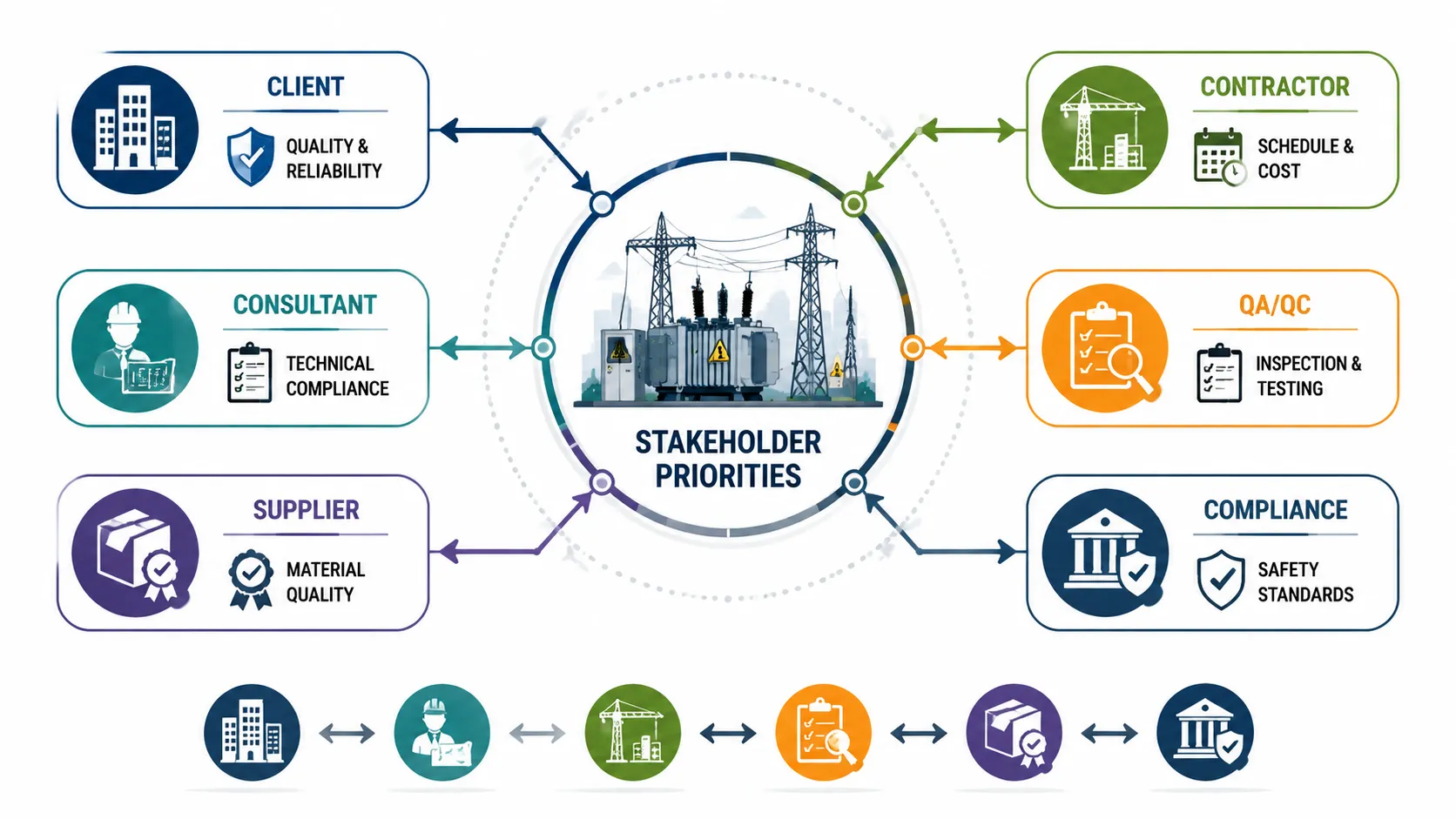
Client or Project Owner Expectations
The client is usually one of the most influential stakeholders because they define project objectives and success criteria. Their main interest is achieving a reliable electrical system that meets operational requirements.
Clients commonly prioritise:
- Long-term system reliability.
- Safety performance.
- Compliance with specifications.
- Operational efficiency.
- Asset value.
- Minimal future maintenance issues.
However, clients may also experience commercial pressures that influence their expectations.
Examples include:
- Requesting faster completion.
- Seeking cost reductions.
- Changing project requirements.
A QA/QC leader must ensure that client expectations remain aligned with technical feasibility and quality requirements.
Consultant and Design Engineer Expectations
Consultants and design engineers focus on ensuring that the project meets engineering principles, design requirements and applicable standards.
Their priorities often include:
- Correct design implementation.
- Technical accuracy.
- Compliance with specifications.
- Design integrity.
- Performance verification.
Consultants may have concerns when project teams attempt to modify designs without proper technical review.
QA/QC professionals must ensure:
- Design changes are controlled.
- Technical approvals are obtained.
- Documentation remains accurate.
Contractor Expectations
Contractors are responsible for executing construction and installation activities. Their priorities often relate to:
- Completing work within schedule.
- Managing resources efficiently.
- Controlling costs.
- Meeting contractual obligations.
Contractors may face challenges such as:
- Labour shortages.
- Material delays.
- Unexpected site conditions.
These pressures can sometimes conflict with QA/QC requirements.
Common conflicts include:
- Requests for faster inspections.
- Pressure to accept incomplete work.
- Requests to reduce testing activities.
A professional QA/QC approach requires understanding contractor challenges while maintaining essential quality controls.
Project Manager Expectations
Project managers are responsible for coordinating overall project delivery.
Their priorities usually include:
- Meeting deadlines.
- Managing budgets.
- Coordinating stakeholders.
- Achieving project milestones.
Project managers often balance multiple competing objectives, which may create pressure on quality teams.
Examples include:
- Requesting faster approval processes.
- Prioritising critical activities.
- Managing client expectations.
QA/QC professionals should support project management through solutions rather than creating unnecessary barriers.
Supplier and Manufacturer Expectations
Suppliers and manufacturers contribute through:
- Equipment supply.
- Technical information.
- Product certification.
- Warranty support.
Their priorities may include:
- Delivering products on time.
- Meeting commercial agreements.
- Maintaining customer relationships.
Potential conflicts may occur when:
- Alternative products are proposed.
- Delivery delays occur.
- Technical documents are incomplete.
QA/QC teams must evaluate supplier proposals objectively using technical evidence.
Regulatory and Compliance Authorities
Regulatory authorities focus on protecting public safety and ensuring legal compliance.
Their priorities include:
- Meeting safety requirements.
- Following approved standards.
- Maintaining documentation.
- Ensuring competent practices.
Unlike commercial stakeholders, regulatory bodies cannot compromise essential safety requirements.
QA/QC professionals must ensure that:
- Required inspections are completed.
- Compliance evidence is available.
- Records are accurate.
Internal QA/QC Team Expectations
QA/QC teams are responsible for maintaining quality assurance throughout the project.
Their priorities include:
- Accurate inspections.
- Reliable testing.
- Defect identification.
- Documentation control.
- Continuous improvement.
However, QA/QC personnel may experience pressure from other stakeholders.
Effective leadership requires:
- Supporting professional judgement.
- Encouraging communication.
- Protecting technical independence.
Analysing Conflicting Stakeholder Expectations
Conflicts between stakeholders are common in complex electrical projects.
A QA/QC professional must analyse:
- The importance of each requirement.
- The potential risks.
- The technical implications.
- The contractual obligations.
- The long-term consequences.
Common Stakeholder Conflicts
Quality Versus Project Schedule
A contractor may request faster completion, while QA/QC requires sufficient inspection time.
Example:
A contractor requests immediate approval of cable installation before completing inspection records.
A balanced response involves:
- Reviewing critical requirements.
- Prioritising inspections.
- Maintaining evidence.
- Communicating risks.
Quality Versus Cost
A project team may seek cheaper alternatives to reduce expenditure.
Potential risks include:
- Reduced reliability.
- Lower performance.
- Increased maintenance costs.
The QA/QC team should evaluate lifecycle impact rather than focusing only on initial cost.
Technical Compliance Versus Operational Pressure
Operational teams may require rapid system availability.
However:
- Testing cannot be ignored.
- Safety requirements must remain satisfied.
- Documentation must be complete.
Stakeholder Analysis Process for Electrical QA/QC Projects
Identify Stakeholders
The first step is identifying all parties involved.
Consider:
- Internal teams.
- External organisations.
- Regulatory bodies.
- End users.
- Suppliers.
Evaluate Stakeholder Influence
Stakeholders should be assessed based on:
- Decision-making authority.
- Project impact.
- Technical influence.
- Level of interest.
Understand Stakeholder Expectations
Gather information about:
- Required outcomes.
- Concerns.
- Priorities.
- Risks.
Develop Engagement Strategies
Different stakeholders require different communication approaches.
Examples:
- Technical discussions with engineers.
- Progress updates with clients.
- Compliance evidence with regulators.
- Coordination meetings with contractors.
Monitor Changing Expectations
Stakeholder priorities may change during project execution.
QA/QC leaders should continuously review:
- New risks.
- Design changes.
- Programme impacts.
- Commercial pressures.
Practical Example: Managing Stakeholder Priorities During Electrical Installation
Project Situation
A large industrial electrical installation project is approaching completion. The client wants early operation, the contractor wants final payment approval, and the QA/QC team identifies incomplete testing documentation.
Stakeholder Priorities
Client:
- Early operational use.
- Reliable system performance.
Contractor:
- Project completion.
- Payment release.
QA/QC Team:
- Verified testing.
- Complete documentation.
Project Manager:
- Meeting contractual milestones.
Professional Evaluation
The QA/QC leader analyses:
- Safety implications.
- Testing requirements.
- Contract obligations.
- Operational risks.
Instead of rejecting progress completely, the team develops a controlled approach:
- Complete critical testing.
- Record outstanding items.
- Establish corrective actions.
- Maintain communication.
Outcome
The project progresses while protecting quality and stakeholder confidence.
Case Study: Balancing Stakeholder Expectations in a Power Infrastructure Project
Background
A power infrastructure project faced significant pressure due to delayed completion. The client demanded faster handover, while contractors requested reduced inspection requirements.
The QA/QC team identified concerns related to:
- Incomplete testing records.
- Documentation gaps.
- Installation quality issues.
Stakeholder Analysis
The QA/QC leader reviewed:
- Client operational requirements.
- Contractor delivery pressures.
- Regulatory expectations.
- Technical risks.
Actions Implemented
The project team:
- Improved communication meetings.
- Prioritised safety-critical inspections.
- Created a recovery plan.
- Maintained quality documentation.
Result
The project achieved successful completion without compromising electrical safety.
Case Study Conclusion
The case demonstrates that effective stakeholder management requires understanding different priorities while maintaining professional quality standards. Successful QA/QC leadership involves collaboration, communication and balanced decision-making.
Benefits of Understanding Stakeholder Expectations
Effective stakeholder analysis provides:
- Improved communication.
- Reduced conflicts.
- Better project coordination.
- Stronger stakeholder relationships.
- Faster issue resolution.
- Improved quality outcomes.
- Better risk management.
- Increased trust.
- Enhanced project performance.
- Improved decision-making.
Common Mistakes in Stakeholder Management
Ignoring Stakeholder Differences
Different stakeholders have different objectives.
Poor Communication
Lack of information creates misunderstanding.
Prioritising One Stakeholder Unfairly
Balanced decisions are essential.
Focusing Only on Short-Term Goals
Long-term reliability must be considered.
Failing to Document Decisions
Records provide accountability.
Key Learning Points
Learners should understand that:
- Stakeholders have different priorities and expectations.
- QA/QC leaders must analyse stakeholder influence.
- Quality decisions require balanced judgement.
- Communication is essential for successful engagement.
- Technical requirements must remain protected.
- Conflicts should be managed professionally.
- Risk-based thinking supports better decisions.
- Stakeholder relationships influence project success.
- Ethical leadership improves trust.
- Effective stakeholder management supports reliable electrical systems.
Conclusion
Complex electrical projects require effective management of diverse stakeholder expectations. Each stakeholder group has different objectives related to quality, cost, safety, compliance and project delivery. Senior QA/QC professionals must critically analyse these differences and develop strategies that support cooperation while protecting technical standards.
By understanding stakeholder priorities, managing conflicts and maintaining transparent communication, QA/QC leaders can achieve successful project outcomes without compromising electrical safety, reliability or professional responsibilities.
2: Develop Advanced Communication Strategies to Effectively Manage Stakeholder Expectations Regarding QA/QC Outcomes
Effective communication is a fundamental leadership capability in complex electrical QA/QC environments. Technical quality outcomes, inspection findings, compliance issues and project risks must be communicated clearly to multiple stakeholders who often have different levels of technical knowledge, responsibilities and priorities. Senior QA/QC professionals must therefore develop advanced communication strategies that ensure stakeholders understand quality expectations, project realities and the implications of engineering decisions.
In high-pressure electrical projects, communication is not limited to sharing information. It involves managing expectations, building trust, influencing decisions, resolving misunderstandings and supporting collaborative problem-solving. Poor communication can result in incorrect assumptions, delayed corrective actions, stakeholder conflicts and reduced confidence in QA/QC processes.
Advanced QA/QC communication requires a structured approach that combines technical accuracy, transparency, professional judgement and stakeholder awareness. Effective leaders communicate quality information in a way that supports decision-making while maintaining compliance with specifications, standards and safety requirements.
Importance of Strategic Communication in Electrical QA/QC Management
Electrical projects involve complex technical activities including design verification, material approval, installation inspection, testing, commissioning and final acceptance. Each stage generates quality information that must be communicated effectively.
Stakeholders depend on QA/QC communication to understand:
- Current quality performance.
- Inspection progress.
- Non-conformance status.
- Testing results.
- Compliance levels.
- Project risks.
- Corrective action requirements.
A successful QA/QC leader ensures that communication supports both technical decision-making and stakeholder confidence.
Poor communication can create:
- Misunderstanding of quality requirements.
- Delayed approvals.
- Incorrect assumptions.
- Increased project risks.
- Conflicts between stakeholders.
- Reduced trust in QA/QC teams.
Advanced communication strategies help prevent these issues by creating clear information pathways.
Understanding Stakeholder Communication Requirements
Different stakeholders require different types of information. A major responsibility of QA/QC leaders is adapting communication methods according to stakeholder needs.
For example:
- A client may require a summary of quality performance.
- A contractor may require technical clarification.
- A project manager may require progress and risk information.
- A regulator may require compliance evidence.
- An engineering team may require detailed technical findings.
Effective communication is therefore based on understanding:
- Who needs information.
- What information is required.
- When information is needed.
- How information should be presented.
- What decisions depend on that information.
Key Concepts and Definitions in QA/QC Communication
| Key Concept | Definition | Application in Electrical QA/QC |
|---|---|---|
| Stakeholder Communication | Exchange of information between project participants | Sharing quality updates and requirements |
| Communication Strategy | Planned approach for managing information flow | Defining reporting methods and frequency |
| Quality Reporting | Structured presentation of QA/QC performance information | Providing inspection and testing summaries |
| Transparency | Providing accurate and complete information | Reporting defects and risks honestly |
| Active Listening | Understanding stakeholder concerns before responding | Managing technical discussions |
| Technical Translation | Explaining complex information clearly | Presenting engineering issues to non-technical stakeholders |
| Feedback Loop | Process of receiving and responding to information | Improving QA/QC processes |
| Escalation Process | Formal method for raising unresolved issues | Managing critical quality risks |
| Stakeholder Engagement | Building effective working relationships | Maintaining project cooperation |
| Communication Control | Managing consistency and accuracy of information | Preventing conflicting reports |
Developing a Communication Strategy for QA/QC Outcomes
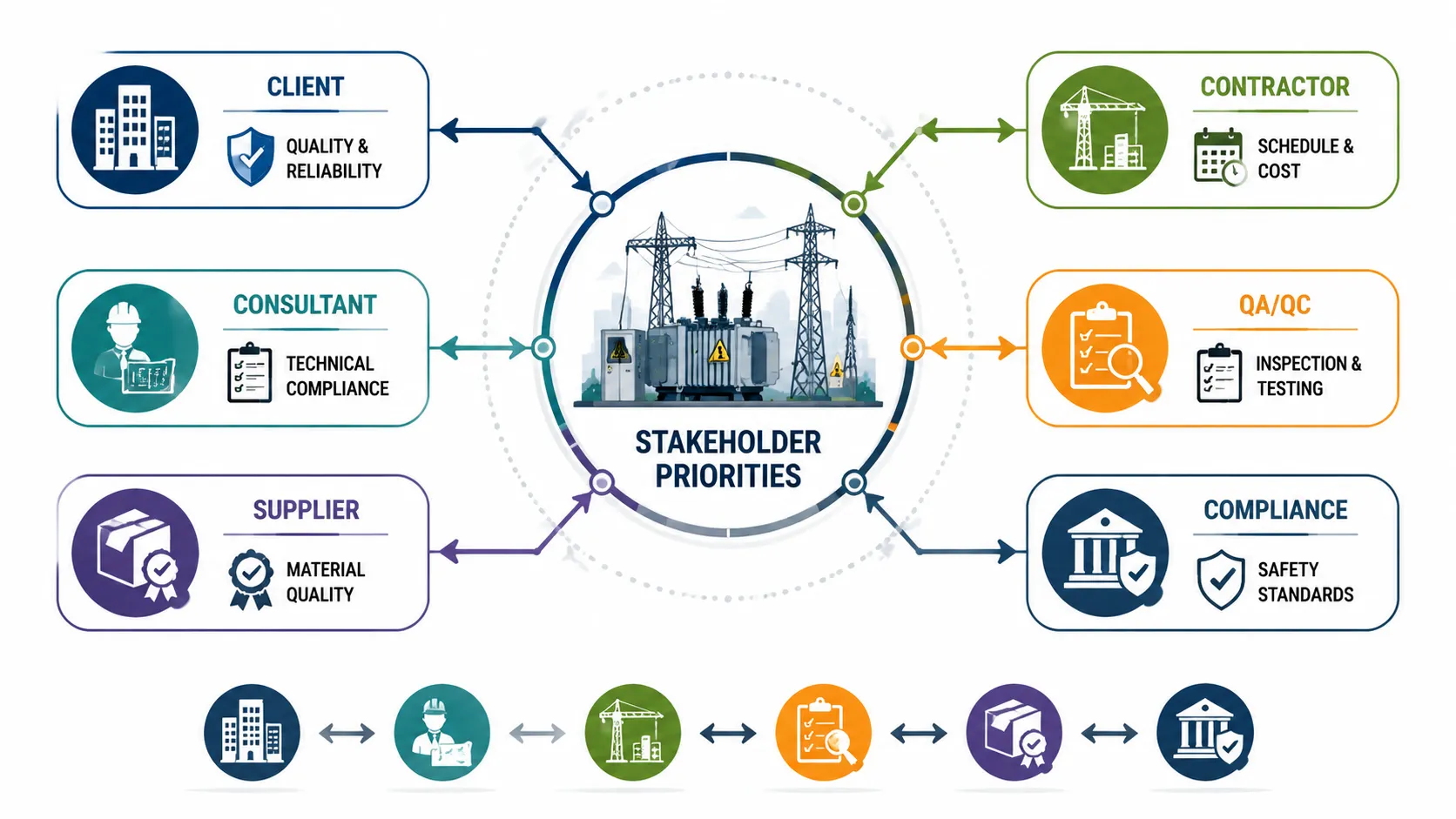
A communication strategy ensures that quality information reaches the correct stakeholders at the appropriate time.
A structured communication strategy should include:
- Stakeholder identification.
- Information requirements.
- Communication channels.
- Reporting frequency.
- Responsibility assignment.
- Escalation procedures.
Step 1: Identify Communication Stakeholders
The first stage is identifying all individuals and groups who require QA/QC information.
Stakeholders may include:
- Client representatives.
- Project directors.
- Project managers.
- Design engineers.
- Construction teams.
- Inspectors.
- Suppliers.
- Regulatory authorities.
- Operations teams.
Understanding stakeholder roles helps determine communication priorities.
Step 2: Determine Information Requirements
Different stakeholders require different levels of detail.
Examples:
Client Communication
Focus on:
- Overall quality performance.
- Compliance status.
- Major risks.
- Project readiness.
Contractor Communication
Focus on:
- Inspection requirements.
- Defect correction.
- Technical clarification.
- Work acceptance criteria.
Management Communication
Focus on:
- Quality trends.
- Project risks.
- Performance indicators.
- Improvement actions.
Step 3: Select Appropriate Communication Methods
Communication methods should match the complexity and importance of information.
Common QA/QC communication methods include:
- Quality reports.
- Inspection meetings.
- Technical presentations.
- Progress reviews.
- Emails and formal correspondence.
- Digital quality management systems.
- Audit discussions.
Step 4: Establish Reporting Frequency
Regular communication prevents surprises and improves stakeholder confidence.
Examples:
Daily:
- Inspection coordination.
- Immediate quality issues.
Weekly:
- Quality progress reports.
- Defect tracking.
Monthly:
- Performance reviews.
- Trend analysis.
Project milestones:
- Acceptance decisions.
- Final quality reviews.
Advanced Communication Techniques for QA/QC Leaders
Using Evidence-Based Communication
QA/QC communication should always be supported by evidence.
Evidence may include:
- Inspection records.
- Test results.
- Photographs.
- Compliance documents.
- Non-conformance reports.
- Corrective action records.
Evidence-based communication prevents disagreements because decisions are supported by facts.
Example
Instead of stating:
“The installation quality is poor.”
A professional QA/QC report should state:
“The inspection identified six installation deviations against approved drawings, requiring corrective action before acceptance.”
This approach provides clarity and professionalism.
Communicating Technical Information to Different Audiences
Electrical QA/QC leaders must communicate complex technical information clearly.
Technical stakeholders may understand:
- Engineering terminology.
- Testing procedures.
- Standards requirements.
Non-technical stakeholders may require:
- Simple explanations.
- Business impacts.
- Risk summaries.
Effective communication involves adjusting language without reducing technical accuracy.
Managing Difficult Quality Conversations
QA/QC professionals frequently need to communicate:
- Rejected work.
- Failed tests.
- Delayed approvals.
- Corrective actions.
- Compliance concerns.
These conversations require professionalism and emotional intelligence.
A structured approach includes:
Explain the Issue Clearly
Provide:
- Facts.
- Evidence.
- Applicable requirements.
Explain the Impact
Discuss:
- Safety implications.
- Quality risks.
- Project consequences.
Provide Solutions
Recommend:
- Corrective actions.
- Alternative approaches.
- Recovery plans.
Maintain Professional Relationships
The objective is solving the issue, not creating conflict.
Communication During Non-Conformance Management
Non-conformance communication is one of the most sensitive QA/QC responsibilities.
Effective communication should ensure:
- The issue is clearly understood.
- Responsibilities are defined.
- Corrective actions are agreed.
- Completion is verified.
A professional NCR communication process includes:
- Identification of the problem.
- Evidence submission.
- Root cause discussion.
- Corrective action planning.
- Verification.
- Closure confirmation.
Managing Stakeholder Expectations During Quality Issues
Quality problems can create stakeholder uncertainty.
Effective communication should:
- Provide early notification.
- Explain the situation accurately.
- Avoid unnecessary technical complexity.
- Present solutions.
- Maintain confidence.
Example Scenario
A major electrical component fails testing before commissioning.
Poor communication:
“The equipment failed and cannot proceed.”
Effective communication:
“Testing identified a performance issue with the component. The QA/QC team has initiated corrective action, reviewed technical options and developed a recovery plan to protect safety and project objectives.”
Communication Strategies During High-Pressure Situations
High-pressure environments require calm and structured communication.
Common high-pressure situations include:
- Commissioning deadlines.
- Client escalation.
- Major defects.
- Regulatory inspections.
- Project delays.
Effective strategies include:
- Communicating early.
- Prioritising critical information.
- Avoiding emotional responses.
- Providing realistic solutions.
- Maintaining transparency.
Stakeholder Engagement Through Quality Meetings
Quality meetings provide opportunities to align expectations.
Effective QA/QC meetings should include:
- Clear objectives.
- Relevant participants.
- Accurate information.
- Action tracking.
- Responsibility assignment.
Typical discussion areas include:
- Inspection progress.
- Open defects.
- Testing status.
- Risks.
- Improvement actions.
Using Digital Tools for QA/QC Communication
Modern electrical projects increasingly use digital systems to improve communication.
Digital QA/QC tools support:
- Real-time reporting.
- Document control.
- Inspection tracking.
- Data analysis.
- Stakeholder access.
Benefits include:
- Faster information sharing.
- Improved traceability.
- Reduced communication errors.
- Better decision-making.
Practical Example: Managing Client Expectations During Project Delays
Project Situation
An electrical infrastructure project experiences delays due to equipment approval issues. The client expects completion according to the original programme.
Communication Challenge
The QA/QC leader must communicate:
- Current quality status.
- Technical reasons.
- Project impact.
- Recovery actions.
Effective Communication Approach
The QA/QC team:
- Provides evidence of the issue.
- Explains technical implications.
- Presents corrective actions.
- Updates stakeholders regularly.
Result
The client maintains confidence because communication is transparent and solution-focused.
Case Study: Improving Stakeholder Confidence Through QA/QC Communication
Background
A large commercial electrical project experienced repeated stakeholder complaints because quality information was inconsistent.
Problems included:
- Delayed reporting.
- Conflicting information.
- Poor defect communication.
- Limited stakeholder engagement.
Communication Improvement Strategy
The QA/QC leadership team implemented:
- Weekly quality review meetings.
- Standard reporting templates.
- Clear escalation procedures.
- Stakeholder-specific communication plans.
Outcomes
Following implementation:
- Quality information became more reliable.
- Stakeholder confidence improved.
- Defect resolution became faster.
- Project coordination improved.
Case Study Conclusion
The case demonstrates that effective QA/QC communication is not simply information sharing; it is a strategic tool for managing expectations, reducing conflict and improving project outcomes.
Benefits of Advanced QA/QC Communication Strategies
Effective communication provides:
- Improved stakeholder trust.
- Faster issue resolution.
- Better project coordination.
- Reduced conflicts.
- Improved decision-making.
- Stronger quality culture.
- Better risk management.
- Increased transparency.
- Improved compliance performance.
- Enhanced project success.
Common Communication Failures in QA/QC Management
Providing Information Too Late
Delays increase uncertainty.
Using Excessive Technical Language
Stakeholders may misunderstand key issues.
Hiding Quality Problems
This damages trust.
Inconsistent Reporting
Creates confusion.
Failing to Listen
Stakeholder concerns may remain unresolved.
Not Documenting Decisions
Reduces accountability.
Key Learning Points
Learners should understand that:
- Effective communication is essential for QA/QC leadership.
- Different stakeholders require different information.
- Evidence-based reporting improves trust.
- Transparency supports better decisions.
- Difficult conversations require professionalism.
- Communication strategies reduce project conflicts.
- Quality reports must be accurate and clear.
- Stakeholder confidence depends on reliable information.
- Digital tools improve communication efficiency.
- Strategic communication supports successful electrical project delivery.
Conclusion
Advanced communication strategies are essential for managing stakeholder expectations in complex electrical QA/QC environments. Effective QA/QC leaders must communicate quality outcomes clearly, transparently and professionally while considering the different needs of clients, contractors, engineers and regulatory stakeholders.
By developing structured communication processes, using evidence-based reporting and maintaining open stakeholder engagement, professionals can build trust, resolve challenges and support successful delivery of safe, reliable and compliant electrical systems.
3: Apply Practical Negotiation Skills to Align Stakeholder Demands with Realistic and Compliant Electrical Quality Standards
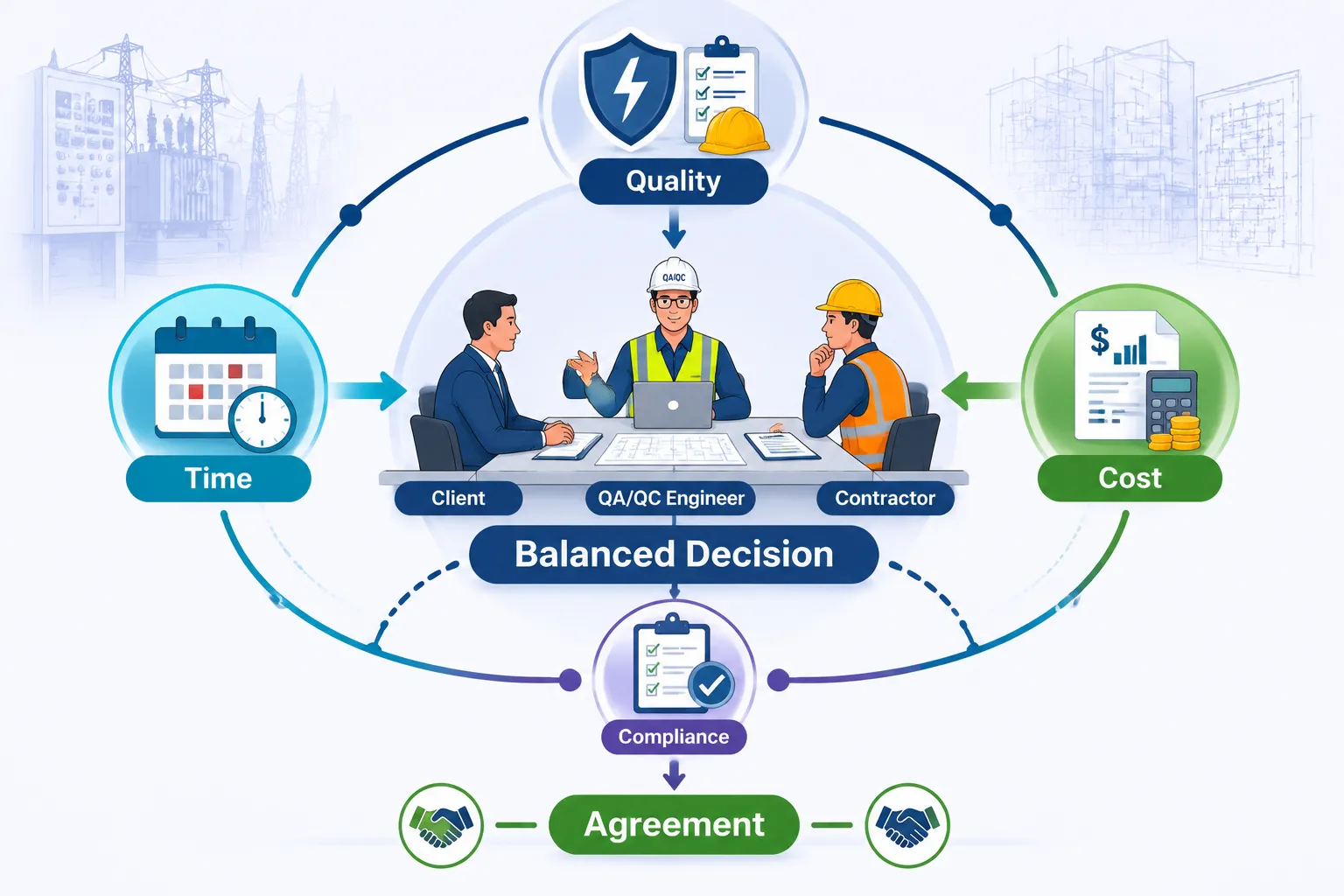
In complex electrical engineering projects, stakeholder demands frequently differ due to varying responsibilities, objectives and pressures. Clients may prioritise reliability and operational performance, contractors may focus on programme delivery and cost control, while QA/QC professionals must protect compliance, safety and technical integrity. Effective negotiation skills enable QA/QC leaders to create balanced solutions that satisfy stakeholder expectations without compromising essential electrical quality standards.
Negotiation in QA/QC environments is not about reducing requirements or accepting unacceptable compromises. Instead, it is a structured process of understanding stakeholder needs, analysing constraints, presenting evidence-based solutions and reaching agreements that maintain technical compliance. Senior QA/QC professionals must use professional judgement to distinguish between flexible project arrangements and non-negotiable safety or regulatory requirements.
Practical negotiation skills are particularly important during high-pressure project conditions where stakeholders may request faster approvals, reduced inspections, alternative materials or modified acceptance criteria. A skilled QA/QC leader can manage these situations by combining technical knowledge, communication ability, risk assessment and collaborative problem-solving.
Understanding Negotiation in Electrical QA/QC Management
Negotiation is the process of reaching an agreement between different parties with potentially competing interests. Within electrical QA/QC projects, negotiation involves balancing technical requirements with practical project realities while maintaining compliance.
Successful QA/QC negotiation requires:
- Understanding stakeholder objectives.
- Identifying areas of agreement.
- Explaining technical requirements.
- Managing disagreements professionally.
- Developing acceptable solutions.
- Maintaining quality standards.
The purpose of negotiation is not to reduce quality expectations but to achieve realistic approaches that support successful project delivery.
Importance of Negotiation Skills for QA/QC Leaders
Electrical projects involve multiple situations where negotiation is required, including:
- Resolving quality disputes.
- Managing inspection schedules.
- Agreeing corrective actions.
- Evaluating alternative materials.
- Managing project delays.
- Aligning contractor performance with specifications.
Without effective negotiation, disagreements may result in:
- Project delays.
- Increased costs.
- Poor stakeholder relationships.
- Quality compromises.
- Escalation of conflicts.
Strong negotiation skills help QA/QC leaders maintain professional relationships while protecting technical standards.
Key Concepts and Definitions in QA/QC Negotiation
| Key Concept | Definition | Application in Electrical QA/QC |
|---|---|---|
| Negotiation | Process of reaching agreement between parties with different interests | Resolving quality and project conflicts |
| Stakeholder Alignment | Creating agreement between stakeholder expectations and project objectives | Balancing client and contractor needs |
| Compliance Requirement | Mandatory technical or regulatory condition | Maintaining electrical safety standards |
| Negotiation Strategy | Planned approach used to achieve a suitable outcome | Managing quality discussions |
| Compromise | Agreement where parties adjust positions while maintaining acceptable outcomes | Finding practical solutions |
| Non-Negotiable Requirement | Requirement that cannot be reduced due to safety or compliance | Protecting critical testing requirements |
| Evidence-Based Negotiation | Using technical information to support decisions | Presenting inspection findings |
| Collaborative Negotiation | Working together to solve problems | Developing shared solutions |
| Conflict Resolution | Managing disagreements to achieve positive outcomes | Resolving quality disputes |
| Risk-Based Decision | Selecting options based on potential consequences | Evaluating quality alternatives |
Principles of Effective QA/QC Negotiation
Effective negotiation should be based on professional principles rather than personal opinions.
Key principles include:
- Maintaining technical integrity.
- Understanding stakeholder priorities.
- Using objective evidence.
- Focusing on solutions.
- Protecting safety requirements.
- Communicating clearly.
- Building long-term relationships.
A QA/QC leader should always separate negotiable project arrangements from mandatory quality obligations.
Identifying Negotiable and Non-Negotiable Requirements
One of the most important negotiation skills is understanding what can and cannot be adjusted.
Non-Negotiable Requirements
These typically include:
- Electrical safety requirements.
- Regulatory obligations.
- Mandatory testing.
- Approved design criteria.
- Critical inspection activities.
- Compliance documentation.
These requirements must remain protected regardless of project pressure.
Potentially Negotiable Areas
These may include:
- Inspection scheduling.
- Resource allocation.
- Work sequencing.
- Reporting formats.
- Recovery plans.
- Communication arrangements.
A professional negotiator identifies flexibility without reducing essential quality.
Negotiation Process for Electrical QA/QC Challenges
Step 1: Understand Stakeholder Positions
Before negotiation begins, the QA/QC leader should understand:
- What stakeholders want.
- Why they want it.
- What constraints exist.
- What risks are involved.
For example:
A contractor requesting reduced inspections may actually be responding to schedule pressure rather than rejecting quality requirements.
Understanding the underlying issue supports better solutions.
Step 2: Gather Technical Evidence
Negotiation decisions should be supported by:
- Inspection records.
- Test results.
- Standards requirements.
- Design documents.
- Risk assessments.
- Previous project data.
Evidence prevents negotiations from becoming opinion-based discussions.
Step 3: Identify Common Objectives
Although stakeholders may have different priorities, they often share common goals.
Examples include:
- Successful project completion.
- Safe electrical operation.
- Client satisfaction.
- Reduced future failures.
Finding common objectives creates a collaborative environment.
Step 4: Develop Practical Options
Effective negotiation requires creating solutions.
Possible options include:
- Increasing inspection resources.
- Changing work sequences.
- Introducing additional controls.
- Prioritising critical activities.
- Developing recovery schedules.
Step 5: Agree and Document Outcomes
All negotiated agreements should be:
- Clearly recorded.
- Communicated to relevant parties.
- Assigned with responsibilities.
- Monitored for completion.
Documentation ensures accountability.
Balancing Stakeholder Demands with Electrical Quality Standards
A common challenge for QA/QC leaders is balancing stakeholder expectations with technical requirements.
Examples include:
Client Demand for Faster Completion
Client priority:
- Early operational availability.
- Reduced delays.
QA/QC priority:
- Complete verification.
- Confirm system reliability.
Negotiation approach:
- Explain quality risks.
- Prioritise critical inspections.
- Develop realistic completion plans.
Contractor Request for Reduced Inspection Activities
Contractor priority:
- Faster progress.
- Resource efficiency.
QA/QC response:
- Review inspection requirements.
- Identify essential checks.
- Improve coordination.
The goal is efficiency without reducing assurance.
Practical Negotiation Techniques for QA/QC Professionals
Active Listening
Effective negotiation begins with understanding stakeholder concerns.
Active listening involves:
- Allowing stakeholders to explain issues.
- Asking relevant questions.
- Confirming understanding.
- Avoiding immediate judgement.
Benefits include:
- Better relationships.
- Reduced conflict.
- Improved problem-solving.
Interest-Based Negotiation
Interest-based negotiation focuses on underlying needs rather than fixed positions.
Example:
Stakeholder position:
“We need fewer inspections.”
Underlying interest:
“We need to avoid schedule delays.”
Possible solution:
“Improve inspection planning and increase coordination rather than removing inspections.”
Evidence-Based Discussion
Technical discussions should focus on facts.
Examples:
Instead of:
“The work is unacceptable.”
Use:
“The installation does not meet approved requirements due to identified deviations.”
This approach maintains professionalism.
Solution-Focused Negotiation
Professional negotiation should focus on:
- What can be achieved.
- How problems can be resolved.
- What actions are required.
Avoid:
- Blame.
- Personal criticism.
- Unproductive arguments.
Managing Difficult Negotiations
Some situations involve strong disagreement or pressure.
Examples:
- Rejected materials.
- Failed tests.
- Delayed approvals.
- Client complaints.
Effective approaches include:
- Remaining professional.
- Using evidence.
- Explaining consequences.
- Offering alternatives.
- Escalating appropriately.
Scenario 1: Negotiating Quality Requirements During Project Delay
Situation
An electrical installation project experiences significant delays. The contractor requests approval of partially completed work to recover the schedule.
Stakeholder Demands
Contractor:
- Faster progress.
- Reduced delays.
Project manager:
- Meeting milestones.
QA/QC team:
- Verified quality compliance.
Negotiation Approach
The QA/QC leader:
- Reviews critical requirements.
- Explains risks.
- Identifies flexible areas.
- Maintains essential inspections.
- Creates an agreed recovery plan.
Outcome
The project progresses while maintaining quality assurance.
Scenario 2: Negotiating Alternative Equipment Approval
Situation
A specified electrical component is unavailable. The supplier proposes an alternative product.
Negotiation Considerations
The QA/QC team evaluates:
- Technical compatibility.
- Performance requirements.
- Certification evidence.
- Long-term reliability.
Negotiated Solution
The alternative is accepted only after:
- Technical review.
- Formal approval.
- Documentation update.
This protects both project progress and compliance.
Scenario 3: Negotiating Corrective Actions for Defective Work
Situation
A contractor completes electrical installation work with identified defects.
Stakeholder Positions
Contractor:
- Wants quick closure.
QA/QC:
- Requires proper correction.
Negotiation Strategy
The QA/QC leader:
- Explains defect impact.
- Agrees realistic correction timelines.
- Defines verification requirements.
- Maintains documentation.
Communication Skills During Negotiation
Successful negotiation requires effective communication.
Important skills include:
- Clear explanation.
- Professional confidence.
- Technical accuracy.
- Respectful discussion.
- Controlled emotions.
- Constructive feedback.
Case Study: Negotiating Stakeholder Expectations in a Complex Electrical Project
Project Background
A large industrial electrical project faced pressure due to delays and increasing costs. The contractor requested reduced inspection activities, while the client demanded full quality assurance.
Challenge
The QA/QC leader needed to balance:
- Client expectations.
- Contractor limitations.
- Project schedule.
- Technical requirements.
Negotiation Process
The QA/QC team:
- Analysed stakeholder concerns.
- Reviewed technical risks.
- Presented evidence.
- Proposed practical solutions.
Actions included:
- Improving inspection coordination.
- Prioritising critical activities.
- Increasing communication frequency.
- Establishing clear responsibilities.
Result
The project achieved progress without reducing essential quality requirements.
Case Study Conclusion
The case demonstrates that effective negotiation allows QA/QC leaders to manage competing demands while protecting electrical safety and compliance. Professional negotiation creates cooperation rather than conflict and supports successful project outcomes.
Benefits of Effective QA/QC Negotiation Skills
Strong negotiation provides:
- Improved stakeholder relationships.
- Reduced project conflicts.
- Better quality decisions.
- Faster problem resolution.
- Increased stakeholder confidence.
- Improved compliance management.
- Better project coordination.
- Reduced unnecessary delays.
- Stronger quality culture.
- Sustainable project success.
Common Negotiation Mistakes in QA/QC Management
Accepting Pressure Without Analysis
Creates unnecessary risks.
Focusing Only on Stakeholder Demands
May compromise technical requirements.
Ignoring Evidence
Reduces decision credibility.
Poor Communication
Creates misunderstanding.
Failing to Document Agreements
Reduces accountability.
Treating Negotiation as Conflict
Prevents collaborative solutions.
Key Learning Points
Learners should understand that:
- Negotiation is essential in complex QA/QC environments.
- Quality requirements must remain protected.
- Evidence strengthens negotiation outcomes.
- Stakeholder interests should be understood.
- Practical solutions support project success.
- Communication is central to negotiation.
- Compliance requirements cannot be compromised.
- Collaborative approaches improve relationships.
- Documentation supports accountability.
- Effective negotiation balances project needs with technical integrity.
Conclusion
Practical negotiation skills enable QA/QC leaders to manage complex stakeholder expectations while maintaining realistic and compliant electrical quality standards. Effective negotiation requires understanding stakeholder priorities, using evidence-based discussions and developing solutions that support both project delivery and technical integrity.
By applying structured negotiation approaches, electrical QA/QC professionals can resolve conflicts, improve stakeholder relationships and ensure that quality, safety and compliance remain central throughout the project lifecycle.
4: Adapt Stakeholder Management Approaches to Mitigate Risks in Unpredictable, High-Pressure Project Environments
Complex electrical engineering projects rarely progress exactly according to the original plan. Changes in design, material availability, programme requirements, testing outcomes, resource limitations, technical defects and commercial pressures can rapidly alter project conditions. In these circumstances, stakeholder management becomes a critical component of electrical QA/QC leadership because stakeholder behaviour, expectations and decisions can significantly influence the level of project risk.
High-pressure environments require more than a fixed stakeholder communication plan. QA/QC leaders must continuously assess stakeholder priorities, recognise emerging risks, adapt communication methods and modify engagement approaches according to changing circumstances. A strategy that works during normal project conditions may become ineffective during commissioning, major defect resolution, regulatory inspection or significant programme recovery.
Adapting stakeholder management means maintaining the fundamental objectives of quality, safety and compliance while changing the way stakeholders are engaged. The approach may involve increased communication frequency, stronger escalation mechanisms, more focused technical reporting, collaborative problem-solving, targeted negotiations or additional management involvement.
The objective is not simply to satisfy every stakeholder demand. The objective is to create sufficient understanding, cooperation and accountability to control project risks while protecting the technical integrity of the electrical system.
Understanding Stakeholder Risk in High-Pressure Electrical Projects
Stakeholder risk occurs when the actions, expectations, decisions or communication behaviour of project stakeholders create uncertainty or negatively influence project objectives. Such risks may be technical, commercial, operational, programme-related or quality-related.
For example, a client requesting accelerated handover may unintentionally increase pressure on inspection and testing activities. A contractor experiencing resource shortages may request changes to inspection sequences. A supplier facing production delays may propose alternative equipment. A project manager under commercial pressure may prioritise milestone achievement.
Each situation requires careful analysis rather than automatic acceptance or rejection.
Stakeholder-related risks may include:
- Delayed technical approvals.
- Incomplete information.
- Conflicting instructions.
- Uncontrolled design changes.
- Pressure to reduce inspections.
- Disputes over non-conformities.
- Delayed corrective actions.
- Unrealistic completion expectations.
- Poor communication between teams.
- Unclear accountability.
Why Stakeholder Management Must Adapt to Changing Conditions
A stakeholder management approach should reflect the current risk environment. During stable project phases, routine meetings and scheduled reporting may be sufficient. During high-pressure situations, more direct and frequent engagement may be necessary.
For example, a weekly quality meeting may be appropriate during normal installation activities. However, when a critical electrical defect is discovered shortly before commissioning, the QA/QC leader may need:
- Immediate technical meetings.
- Daily progress updates.
- Senior management involvement.
- Rapid escalation.
- Focused risk reporting.
- Documented action tracking.
Adaptability therefore becomes a leadership capability rather than simply an administrative activity.
Key Concepts and Definitions
| Key Concept | Definition | Application in Electrical QA/QC |
|---|---|---|
| Stakeholder Risk | Risk arising from stakeholder actions, expectations or decisions | Managing pressure for premature acceptance |
| Adaptive Stakeholder Management | Adjusting engagement methods according to changing project conditions | Increasing communication during critical defects |
| High-Pressure Environment | Project condition involving significant time, technical or commercial pressure | Managing commissioning deadlines |
| Risk Escalation | Moving an issue to an appropriate higher authority | Escalating unresolved safety concerns |
| Stakeholder Influence | Ability of a stakeholder to affect project decisions | Managing client and contractor influence |
| Risk Communication | Sharing relevant risk information with affected stakeholders | Reporting quality risks before handover |
| Contingency Planning | Preparing alternative responses to uncertain events | Developing recovery plans for failed testing |
| Stakeholder Mapping | Categorising stakeholders according to influence and interest | Prioritising engagement |
| Critical Stakeholder | Stakeholder whose decisions significantly affect project outcomes | Managing client or regulatory requirements |
| Decision Escalation | Formal transfer of unresolved decisions to appropriate authority | Escalating technical disputes |
| Collaborative Problem-Solving | Working with stakeholders to develop practical solutions | Resolving installation quality problems |
| Risk-Based Engagement | Adjusting stakeholder involvement according to risk | Increasing engagement for safety-critical issues |
Identifying Stakeholder-Related Risks Early
Effective risk mitigation begins with early identification. QA/QC leaders should not wait until stakeholder conflict becomes a major project problem.
Early warning indicators may include:
- Repeated requests for faster approvals.
- Increased disagreement over inspection findings.
- Delayed responses to quality queries.
- Frequent design changes.
- Unclear responsibilities.
- Repeated documentation errors.
- Increasing numbers of unresolved NCRs.
- Supplier performance concerns.
- Conflicting instructions from different stakeholders.
These indicators should be analysed to determine whether they represent isolated communication problems or developing systemic risks.
Stakeholder Mapping for High-Pressure Projects
Stakeholder mapping helps QA/QC leaders determine who requires the greatest attention.
Stakeholders can be assessed according to:
- Level of influence.
- Level of interest.
- Technical responsibility.
- Decision-making authority.
- Risk exposure.
High-Influence, High-Interest Stakeholders
These stakeholders require close engagement.
Examples may include:
- Client representatives.
- Project directors.
- Lead consultants.
- Senior project managers.
Engagement may involve:
- Regular quality reviews.
- Direct escalation.
- Performance dashboards.
- Risk discussions.
High-Influence, Lower-Interest Stakeholders
These stakeholders should receive concise information focused on significant issues.
Communication may include:
- Executive summaries.
- Key risk reports.
- Escalation notifications.
Lower-Influence, High-Interest Stakeholders
These may include:
- QA/QC inspectors.
- Site engineers.
- Supervisors.
They often require detailed operational communication.
Adapting Communication During High-Pressure Conditions
Communication should become more focused as risk increases.
During normal conditions, communication may include:
- Weekly reports.
- Routine meetings.
- Standard inspection updates.
During critical conditions, communication may require:
- Immediate notifications.
- Daily coordination.
- Direct technical briefings.
- Escalation reports.
- Action trackers.
The content should also become more decision-oriented.
Instead of providing excessive background information, reports should clearly identify:
- What happened.
- What the risk is.
- What evidence exists.
- What decision is required.
- Who is responsible.
- When action is required.
Risk-Based Stakeholder Engagement
Not every stakeholder requires the same level of engagement.
A risk-based approach considers:
- Severity of the issue.
- Probability of occurrence.
- Stakeholder influence.
- Urgency.
- Potential consequences.
For example, a minor documentation correction may require routine communication, while a failed safety-critical test may require immediate involvement from senior technical and project stakeholders.
Risk-Based Engagement Priorities
Stakeholder engagement should increase when:
- Safety risks increase.
- Compliance concerns emerge.
- Technical uncertainty increases.
- Stakeholder disagreement intensifies.
- Project deadlines become critical.
- Decisions have significant long-term consequences.
Managing Unpredictable Project Changes
Unpredictability is common in complex electrical projects. A QA/QC leader should develop flexible stakeholder management methods rather than relying entirely on fixed plans.
Unexpected changes may involve:
- Equipment failure.
- Material shortages.
- Design revisions.
- Failed commissioning tests.
- Unexpected site conditions.
- Contractor resource changes.
- Regulatory observations.
When conditions change, the leader should reassess:
- Stakeholder priorities.
- Risk exposure.
- Communication requirements.
- Decision-making authority.
- Project constraints.
Process for Adapting Stakeholder Management
Step 1: Detect the Change
Identify what has changed and why.
Questions include:
- Has the technical situation changed?
- Has project urgency increased?
- Has stakeholder influence changed?
- Has a new risk emerged?
Step 2: Assess the Risk
Evaluate:
- Safety impact.
- Quality impact.
- Compliance impact.
- Programme impact.
- Commercial impact.
Step 3: Reassess Stakeholders
Determine:
- Who is affected?
- Who needs to know?
- Who has decision authority?
- Who can contribute to the solution?
Step 4: Adapt Engagement
Modify:
- Meeting frequency.
- Reporting format.
- Communication channels.
- Escalation routes.
Step 5: Implement Controls
Establish:
- Responsibilities.
- Deadlines.
- Verification requirements.
- Monitoring arrangements.
Step 6: Review Effectiveness
Check whether:
- Risks are reducing.
- Stakeholders understand their responsibilities.
- Corrective actions are progressing.
- Communication remains effective.
Managing Stakeholder Pressure During Critical Defects
A critical defect can rapidly increase pressure across a project.
For example, a major electrical installation fails a required test immediately before commissioning.
The client may demand completion.
The contractor may request acceptance of temporary measures.
The project manager may seek programme recovery.
The QA/QC team must protect technical integrity.
An adaptive stakeholder approach would involve:
- Immediate risk communication.
- Technical review.
- Clear responsibility allocation.
- Daily action monitoring.
- Senior stakeholder involvement.
- Controlled recovery planning.
The QA/QC leader should avoid emotional or defensive communication and instead provide objective information.
Practical Example: Failed Electrical Testing Before Commissioning
Project Situation
An industrial electrical system is scheduled for commissioning within five days. During testing, a significant performance issue is identified.
Initial Stakeholder Reactions
The client requests immediate clarification.
The contractor proposes repeating the test without investigating the underlying issue.
The project manager requests a recovery programme.
The QA/QC team requires technical investigation.
Adaptive Response
The QA/QC leader:
- Confirms the test result.
- Reviews test conditions.
- Identifies potential causes.
- Communicates the risk.
- Coordinates technical investigation.
- Establishes corrective action responsibilities.
- Provides daily progress updates.
Result
The project stakeholders receive reliable information while the technical issue is controlled through a structured process.
Managing Conflicting Stakeholder Instructions
High-pressure environments can produce contradictory instructions.
For example:
- The client requests accelerated completion.
- The consultant requires additional verification.
- The contractor wants immediate approval.
- The QA/QC team identifies unresolved defects.
The QA/QC leader should not attempt to satisfy all instructions simultaneously.
Instead, the leader should:
- Identify the conflict.
- Review contractual and technical requirements.
- Clarify responsibilities.
- Establish priorities.
- Escalate unresolved issues.
Escalation as a Risk Management Tool
Escalation should not be viewed as failure. Appropriate escalation ensures that important issues reach the correct decision-making level.
Escalation may be required when:
- A safety issue remains unresolved.
- Stakeholders disagree on technical requirements.
- Corrective actions are repeatedly delayed.
- A project decision exceeds the QA/QC leader’s authority.
- Compliance requirements are disputed.
An effective escalation should include:
- Clear issue description.
- Supporting evidence.
- Risk assessment.
- Stakeholder positions.
- Recommended options.
- Required decision.
Maintaining Technical Independence Under Pressure
One of the most important responsibilities of a QA/QC leader is protecting technical independence.
Stakeholder pressure may involve:
- Requests for premature acceptance.
- Requests to reduce inspections.
- Pressure to close NCRs.
- Requests to change quality records.
An adaptive stakeholder strategy should remain collaborative without compromising professional judgement.
The leader should:
- Explain technical requirements.
- Present evidence.
- Offer compliant alternatives.
- Escalate inappropriate pressure.
- Maintain accurate documentation.
Managing Commercial and Programme Risks Through Stakeholder Engagement
Quality management does not operate independently from commercial and programme considerations.
QA/QC leaders should understand:
- Contract milestones.
- Resource limitations.
- Procurement constraints.
- Client priorities.
- Recovery requirements.
However, commercial awareness should be used to identify solutions rather than justify unacceptable quality reductions.
For example, if inspections are delaying progress, possible solutions include:
- Increasing inspection resources.
- Improving work sequencing.
- Providing earlier inspection notifications.
- Coordinating multiple inspection teams.
- Prioritising critical work fronts.
Stakeholder Engagement During Corrective Action
Corrective actions often involve several stakeholder groups.
Effective management requires:
- Clear responsibility.
- Agreed deadlines.
- Technical requirements.
- Verification criteria.
A corrective action should not be considered complete simply because a stakeholder states that the work has been corrected.
The QA/QC team should verify:
- Actual correction.
- Compliance.
- Supporting evidence.
- Effectiveness.
Building Stakeholder Resilience
Stakeholder resilience refers to the ability of project relationships and communication systems to remain effective during disruption.
Resilient stakeholder management includes:
- Clear communication channels.
- Defined responsibilities.
- Established escalation procedures.
- Reliable reporting.
- Strong professional relationships.
- Prepared contingency arrangements.
These measures help prevent unexpected events from becoming uncontrolled project failures.
Practical Example: Material Supply Disruption
Situation
A critical electrical component is delayed due to supply-chain problems.
Stakeholder Priorities
Client:
- Maintain completion date.
Contractor:
- Avoid work stoppage.
Supplier:
- Resolve delivery problem.
QA/QC:
- Ensure any replacement remains compliant.
Adaptive Approach
The QA/QC leader:
- Reviews the technical requirements.
- Engages procurement and supplier representatives.
- Evaluates proposed alternatives.
- Communicates potential schedule impacts.
- Coordinates technical approval.
The objective is to protect compliance while exploring realistic project recovery options.
Managing Regulatory Stakeholders During High-Pressure Projects
Regulatory or compliance stakeholders may have authority over specific project activities.
When regulatory requirements become critical, communication should be:
- Accurate.
- Formal.
- Evidence-based.
- Timely.
QA/QC leaders should avoid:
- Providing incomplete information.
- Making unsupported claims.
- Hiding unresolved issues.
Instead, they should prepare:
- Compliance records.
- Inspection evidence.
- Testing results.
- Corrective action status.
Using Performance Information to Manage Stakeholders
Quality performance indicators can support stakeholder engagement.
Useful indicators may include:
- Inspection completion rate.
- NCR trends.
- Corrective action closure rate.
- Testing completion.
- Repeat defect frequency.
- Documentation completion.
These indicators help stakeholders understand whether risk is increasing or decreasing.
Adapting Leadership Style to Stakeholder Risk
Different situations require different leadership approaches.
Collaborative Approach
Useful when:
- Stakeholders have shared objectives.
- A technical solution requires cooperation.
Directive Approach
May be necessary when:
- Immediate safety action is required.
- Critical controls must be implemented quickly.
Coaching Approach
Useful when:
- Stakeholders or team members need greater understanding.
Facilitative Approach
Useful when:
- Multiple stakeholders need to develop a shared solution.
The underlying ethical and technical requirements should remain consistent even when the leadership approach changes.
Case Study: Managing Stakeholders During a High-Pressure Electrical Project
Project Background
A major industrial electrical installation project is approaching energisation. Several issues emerge simultaneously:
- A critical equipment delivery is delayed.
- Testing identifies an unexpected defect.
- The client requests early energisation.
- The contractor is under commercial pressure.
- The project manager is concerned about programme impact.
The situation creates significant stakeholder uncertainty.
Initial Risk Analysis
The QA/QC leader identifies:
- Safety risk.
- Programme risk.
- Commercial risk.
- Technical uncertainty.
- Stakeholder conflict.
Stakeholder Priorities
The client prioritises:
- Operational availability.
The contractor prioritises:
- Programme and commercial performance.
The project manager prioritises:
- Milestone recovery.
The QA/QC team prioritises:
- Technical compliance and safe energisation.
Adapted Stakeholder Strategy
The QA/QC leader establishes:
- Daily technical coordination meetings.
- A central action tracker.
- Clear escalation routes.
- Evidence-based reporting.
- Defined decision responsibilities.
The leader also separates:
- Safety-critical decisions.
- Programme recovery decisions.
- Commercial discussions.
Corrective and Risk Management Actions
The team:
- Investigates the technical defect.
- Reviews alternative equipment options.
- Maintains essential testing.
- Provides regular client updates.
- Establishes realistic recovery milestones.
Outcome
Stakeholders gain a clearer understanding of the project position. Technical risks are controlled, communication improves and recovery actions become coordinated.
Case Study Conclusion
The case demonstrates that adaptive stakeholder management is particularly valuable when multiple project variables change simultaneously. Effective leadership requires continuous reassessment rather than relying on a fixed communication strategy. By aligning stakeholders around evidence, risk and realistic objectives, QA/QC leaders can reduce uncertainty while protecting electrical safety and quality.
Benefits of Adaptive Stakeholder Management
Effective adaptive stakeholder management can provide:
- Earlier identification of risks.
- Faster escalation of critical issues.
- Improved stakeholder trust.
- Better communication.
- Reduced project conflict.
- Stronger quality performance.
- Improved corrective action management.
- Better decision-making.
- Reduced uncertainty.
- Improved project resilience.
- Greater technical accountability.
- Stronger compliance performance.
Common Mistakes in High-Pressure Stakeholder Management
Using the Same Communication Approach for Every Situation
Different risk levels require different engagement strategies.
Communicating Too Late
Delayed information can increase stakeholder uncertainty.
Overloading Stakeholders With Technical Information
Excessive detail may obscure the actual decision required.
Hiding Bad News
Short-term avoidance can create larger long-term risks.
Allowing Commercial Pressure to Override Technical Judgement
This can compromise quality and safety.
Failing to Escalate
Unresolved critical issues may become more serious.
Ignoring Stakeholder Concerns
Stakeholder concerns may contain valuable risk information.
Failing to Reassess Stakeholders
Influence and priorities can change throughout the project.
Practical Checklist for QA/QC Leaders
Before managing a high-pressure stakeholder issue, consider:
- What has changed?
- What is the immediate risk?
- Which stakeholders are affected?
- Who has decision authority?
- What technical evidence is available?
- What requirements apply?
- What expectations are realistic?
- Which aspects are negotiable?
- Which requirements are mandatory?
- What communication frequency is appropriate?
- Does the issue require escalation?
- What actions must be documented?
- How will effectiveness be monitored?
Key Learning Points
Learners should understand that:
- Stakeholder risks can increase rapidly in unpredictable projects.
- Stakeholder management must adapt to changing circumstances.
- Risk level should influence communication intensity.
- Critical quality issues require timely escalation.
- Technical independence must be maintained.
- Stakeholder concerns should be actively considered.
- Evidence-based communication reduces uncertainty.
- Commercial pressure should not override essential safety requirements.
- Corrective actions require stakeholder coordination.
- Clear responsibilities reduce project risk.
- Contingency planning improves project resilience.
- Adaptive leadership supports effective QA/QC performance.
Conclusion
Adapting stakeholder management approaches is essential when electrical projects operate under unpredictable and high-pressure conditions. Changing technical, commercial, programme and operational circumstances can rapidly alter stakeholder priorities and increase project risk. Effective QA/QC leaders must therefore continuously reassess stakeholder influence, expectations and risk exposure while adapting communication, engagement and escalation strategies.
A successful approach maintains flexibility without compromising technical integrity. Through risk-based engagement, transparent communication, collaborative problem-solving and timely escalation, QA/QC professionals can manage uncertainty, strengthen stakeholder confidence and protect the quality and safety of electrical systems throughout the project lifecycle.