
Lesson 6: Critically Analyse Case Studies of Sustainable Electrical Projects
Sustainable electrical projects are increasingly important as the electrical engineering sector focuses on energy efficiency, renewable energy integration, reduced environmental impact, resource conservation, and long-term system performance. For Quality Assurance and Quality Control (QA/QC) professionals, sustainability must be integrated with electrical safety, reliability, compliance, durability, and quality throughout design, procurement, installation, inspection, testing, commissioning, and operation. This lesson develops learners’ ability to examine sustainable electrical projects and understand how effective QA/QC practices contribute to achieving both technical and environmental objectives.
Through the critical analysis of case studies, learners will explore sustainable electrical applications such as solar photovoltaic systems, energy-efficient electrical infrastructure, smart electrical technologies, energy management systems, battery storage, and digital monitoring solutions. The lesson examines project objectives, quality management approaches, inspection and testing requirements, sustainability measures, technical challenges, resource efficiency, environmental considerations, and project outcomes. Learners will evaluate what contributed to project success, identify weaknesses or quality risks, and consider how alternative approaches could improve performance.
The lesson focuses on developing higher-level professional judgement by connecting sustainability with quality, cost, programme, compliance, safety, and technical performance. Learners will use evidence from case studies to identify effective QA/QC strategies, evaluate lessons learned, and formulate recommendations for future sustainable electrical projects. By developing these analytical skills, learners can better support continuous improvement, informed decision-making, and the delivery of electrical systems that achieve reliable performance while meeting sustainability and quality objectives.
1: Critically Deconstruct Complex Case Studies of Sustainable Electrical Projects to Identify Key QA/QC Success Factors
Sustainable electrical projects combine electrical engineering requirements with objectives such as energy efficiency, renewable energy integration, reduced environmental impact, resource optimisation, reliability, and long-term system performance. For electrical Quality Assurance and Quality Control (QA/QC) professionals, evaluating such projects requires more than confirming whether installation activities were completed according to drawings and specifications. A complex sustainable electrical project must be examined across its complete lifecycle, from concept and design through procurement, construction, inspection, testing, commissioning, handover, and operation. This enables professionals to determine whether quality controls genuinely supported the intended technical and sustainability outcomes.
Critical deconstruction involves breaking a complex case study into its key technical, managerial, environmental, commercial, and quality components and examining how these elements interacted. The purpose is to identify the factors that contributed to successful QA/QC performance, understand the causes of deficiencies, assess the effectiveness of quality controls, and determine whether the project achieved its defined requirements. In sustainable electrical engineering, this approach is particularly important because a system can be technically functional while still failing to achieve its expected energy efficiency, environmental performance, reliability, maintainability, or lifecycle objectives.
At Level 6, learners should move beyond describing what happened in a project. They should critically analyse why particular decisions were made, evaluate their consequences, compare alternative approaches, interpret available evidence, and reach justified professional conclusions. This requires consideration of technical specifications, inspection and test plans, design verification, material control, installation quality, non-conformity management, commissioning results, performance data, stakeholder coordination, and continual improvement. Case study analysis therefore provides an important method for developing professional QA/QC judgement and applying quality management principles to complex sustainable electrical projects.
Understanding Sustainable Electrical Project Case Studies
A sustainable electrical project case study presents information about a real or representative project where environmental responsibility, energy efficiency, renewable energy, resource conservation, reduced emissions, or lifecycle performance forms a significant part of the project objectives.
Examples can include:
- Solar photovoltaic installations
- Wind power electrical infrastructure
- Battery energy storage systems
- Renewable-energy microgrids
- Energy-efficient commercial buildings
- Smart electrical distribution systems
- Electric vehicle charging infrastructure
- Industrial energy-efficiency projects
- Building energy management systems
- High-efficiency motor and drive systems
- Smart lighting installations
- Data-centre energy optimisation
- Hybrid renewable energy systems
- Smart-grid projects
- Electrification and decarbonisation programmes
A case study should not be treated simply as a narrative describing project activities. It should be analysed as a source of evidence. The QA/QC professional needs to investigate the relationship between project objectives, technical requirements, quality controls, construction activities, inspection and testing, commissioning, and actual performance.
A useful case study may contain information relating to:
- Project objectives
- Client requirements
- Electrical design criteria
- Sustainability targets
- Applicable standards and regulations
- Technical specifications
- Procurement arrangements
- Contractor responsibilities
- Quality management procedures
- Inspection and Test Plans
- Materials and equipment
- Installation methods
- Testing and commissioning
- Non-conformities
- Corrective actions
- Quality records
- Energy-performance data
- Environmental performance
- Handover documentation
- Operational performance
- Maintenance requirements
The professional must determine which information is relevant to quality performance and how different project factors influenced the final outcome.
Meaning of Critical Deconstruction
Critical deconstruction is a systematic process of separating a complex project into individual components and analysing how those components contributed to, or affected, the overall project outcome.
The process involves asking questions such as:
- What was the original project objective?
- What were the electrical quality requirements?
- What sustainability targets were established?
- Were the requirements measurable?
- Were design assumptions technically justified?
- Which standards and specifications applied?
- Were quality risks identified during planning?
- Were competent personnel involved?
- Were materials appropriately selected and verified?
- Were inspection activities properly planned?
- Were testing requirements clearly defined?
- Were non-conformities effectively controlled?
- Were corrective actions implemented?
- Did commissioning demonstrate required performance?
- Did the completed system achieve sustainability targets?
- What evidence demonstrates project success?
- Which QA/QC controls had the greatest influence on performance?
This approach changes the analysis from “what happened?” to “why did it happen, what evidence supports the outcome, and what quality factors influenced it?”
Description Versus Critical Analysis
One of the most important distinctions at Level 6 is the difference between describing a project and critically analysing it.
A descriptive approach might state:
“The project involved the installation of a large solar photovoltaic system. The system was inspected and commissioned before being connected to the building electrical network.”
This provides information but limited analysis.
A critical approach would examine:
- Why photovoltaic technology was selected
- Whether the design reflected the building’s actual energy demand
- Whether environmental conditions were considered
- How equipment specifications were established
- Whether suppliers were appropriately evaluated
- How installation quality was controlled
- Whether cable and connection quality was verified
- Whether earthing and protection arrangements were tested
- How inverter settings were checked
- Whether monitoring systems were validated
- Whether commissioning results met acceptance criteria
- Whether expected energy generation was achieved
- Whether operational performance remained consistent
- What QA/QC controls contributed to successful performance
Critical analysis therefore establishes relationships between decisions, controls, risks, evidence, and outcomes.
Key Concepts in Sustainable Electrical QA/QC Case Study Analysis
Several concepts are particularly important when analysing sustainable electrical projects.
Quality Assurance
Quality assurance refers to planned and systematic processes intended to provide confidence that specified quality requirements will be achieved.
It commonly includes:
- Quality management systems
- Procedures
- Competence requirements
- Design controls
- Supplier controls
- Audits
- Document control
- Process monitoring
- Continual improvement
Quality assurance is primarily concerned with creating reliable processes that reduce the likelihood of defects occurring.
Quality Control
Quality control involves inspection, testing, measurement, verification, and corrective activities used to determine whether completed work conforms to specified requirements.
Typical activities include:
- Material inspections
- Installation inspections
- Electrical testing
- Functional testing
- Commissioning
- Non-conformity reporting
- Defect verification
- Acceptance inspections
QA and QC must operate together. Strong procedures without effective inspection may fail to identify defects, while extensive inspection without sound processes may result in repeated failures.
Sustainability
Sustainability in electrical engineering involves achieving required electrical performance while considering environmental impact, energy consumption, resource use, emissions, lifecycle performance, and long-term operational requirements.
It can involve:
- Renewable energy
- Energy efficiency
- Reduced energy losses
- Sustainable materials
- Waste reduction
- Lifecycle optimisation
- Efficient equipment
- Smart energy management
- Reduced carbon emissions
Lifecycle Performance
Lifecycle performance considers how an electrical system performs from initial design through construction, operation, maintenance, modification, and eventual replacement or disposal.
This prevents QA/QC decisions from being focused exclusively on project completion.
For example, a low-cost component may pass installation inspection but require frequent replacement. A more durable component with higher initial cost could provide better lifecycle value and reliability.
Key QA/QC Success Factors
Successful sustainable electrical projects usually depend on several interconnected QA/QC factors rather than one individual activity.
Important success factors include:
- Clearly defined project requirements
- Measurable sustainability objectives
- Robust design verification
- Competent engineering personnel
- Effective quality planning
- Risk-based inspection
- Appropriate Inspection and Test Plans
- Approved materials
- Supplier quality control
- Component traceability
- Competent installation
- Effective supervision
- Calibrated test equipment
- Accurate quality records
- Effective non-conformity management
- Root-cause analysis
- Corrective action
- Rigorous commissioning
- Reliable performance monitoring
- Effective stakeholder communication
- Digital quality management
- Continual improvement
These factors should be assessed as an interconnected system.
For example, selecting high-efficiency electrical equipment does not automatically guarantee energy efficiency. The equipment may be incorrectly sized, incorrectly installed, poorly configured, inadequately commissioned, or poorly maintained. Therefore, the QA/QC analysis needs to examine the complete chain from selection to operational performance.
Analysing Project Context
The first stage of critical case study analysis is to understand the project context.
The analyst should establish:
- Project type
- Project location
- Electrical system capacity
- Project scope
- Client requirements
- Sustainability objectives
- Project duration
- Technical constraints
- Environmental conditions
- Existing electrical infrastructure
- Planned technologies
- Operational requirements
- Stakeholder expectations
Context determines whether a particular QA/QC approach was appropriate.
For example, a solar PV installation in a high-temperature, dusty environment may require different equipment-selection and maintenance considerations from a similar installation in a cooler environment. Environmental conditions can influence equipment performance, enclosure selection, cable systems, ventilation, cleaning requirements, and inspection frequency.
Analysing Client Requirements
Client requirements provide the foundation for quality planning.
Sustainable electrical project requirements may include:
- Energy consumption reduction
- Renewable energy generation
- Carbon reduction
- Improved electrical efficiency
- Reduced operational costs
- Increased system reliability
- Improved energy monitoring
- Reduced maintenance requirements
- Improved equipment lifespan
- Sustainable material selection
The QA/QC professional should determine whether these objectives were translated into measurable technical requirements.
Important questions include:
- Were sustainability objectives clearly defined?
- Were performance indicators established?
- Were acceptance criteria documented?
- Were responsibilities allocated?
- Were sustainability requirements included in procurement?
- Were performance requirements included in commissioning?
- Was operational performance subsequently monitored?
A sustainability objective that cannot be measured creates difficulties for quality verification.
For example, stating that a project should “improve energy efficiency” is less useful than establishing a defined energy-performance target against which actual results can be assessed.
Evaluating Design Quality
Design quality is a fundamental QA/QC success factor because many project outcomes are determined before construction begins.
A critical design review should consider:
- Load calculations
- Demand assessment
- Equipment selection
- Cable sizing
- Voltage-drop calculations
- Short-circuit calculations
- Protection coordination
- Earthing design
- Power quality
- Renewable energy integration
- Energy storage
- Monitoring systems
- Energy efficiency
- Equipment reliability
- Maintainability
- Future expansion
- Environmental conditions
The analyst should determine whether the design adequately addressed both electrical requirements and sustainability objectives.
For example, integrating renewable generation into an existing electrical system can affect:
- Protection settings
- Fault levels
- Power flow
- Voltage regulation
- Harmonic performance
- Isolation arrangements
- Earthing
- Monitoring
- Control systems
A sustainable design cannot be considered successful if it introduces unacceptable electrical safety or reliability risks.
Design Review and Verification
Design review should be conducted systematically before construction.
Important verification activities may include:
- Checking calculations
- Reviewing drawings
- Confirming equipment specifications
- Verifying interfaces
- Checking regulatory requirements
- Reviewing environmental conditions
- Assessing maintainability
- Confirming sustainability requirements
- Reviewing protection arrangements
- Checking manufacturer requirements
The case study should investigate whether design reviews were:
- Planned
- Documented
- Conducted by competent personnel
- Independently checked where required
- Coordinated between disciplines
- Updated following design changes
Weak design control can create significant downstream QA/QC problems.
A design error discovered during construction may result in:
- Rework
- Material wastage
- Programme delays
- Additional cost
- Quality risks
- Safety risks
- Sustainability impacts
Procurement and Supplier Quality
Sustainable electrical projects often depend on specialist products and technologies. Supplier quality can therefore have a major influence on project outcomes.
Relevant equipment may include:
- Solar modules
- Inverters
- Battery systems
- Smart meters
- Sensors
- Energy management systems
- Variable-speed drives
- High-efficiency motors
- Protection equipment
- Communication devices
- Monitoring systems
Supplier assessment may include:
- Technical capability
- Product specifications
- Manufacturer experience
- Certification
- Quality history
- Factory testing
- Inspection arrangements
- Warranty provisions
- Technical support
- Spare-parts availability
The QA/QC professional should determine whether procurement decisions were based only on initial cost or whether lifecycle quality and performance were considered.
A lower purchase price does not necessarily represent better value if the equipment has:
- Higher energy losses
- Greater failure frequency
- Shorter service life
- Higher maintenance requirements
- Limited technical support
- Difficult spare-parts availability
Material and Equipment Verification
Delivered materials should be checked against approved specifications.
Important controls include:
- Manufacturer identification
- Product model
- Technical rating
- Certification
- Delivery condition
- Serial numbers
- Storage requirements
- Environmental suitability
- Compatibility
- Traceability
- Inspection records
Sustainable electrical equipment must also be assessed in relation to expected energy and lifecycle performance.
For example, selecting a high-efficiency motor is only useful if it is correctly sized for the application and operates within appropriate conditions.
Installation Quality
Installation workmanship has a direct effect on electrical safety, reliability, efficiency, and lifecycle performance.
Case study analysis should examine:
- Installer competence
- Approved installation procedures
- Cable routing
- Cable termination
- Earthing and bonding
- Equipment mounting
- Electrical segregation
- Labelling
- Protection installation
- Environmental protection
- Mechanical support
- Access for maintenance
- Workmanship inspections
Special attention should be given to interfaces between different specialist contractors.
For example, a renewable energy installation may involve separate teams responsible for:
- Mechanical mounting
- Electrical installation
- Inverter installation
- Protection systems
- Monitoring
- Communications
- Commissioning
Poor coordination between these teams can create quality problems even when each individual team performs its own work correctly.
Inspection and Test Plans
An Inspection and Test Plan provides a structured framework for verifying critical project activities.
An effective ITP should identify:
- Activity requiring inspection
- Inspection method
- Testing requirement
- Acceptance criteria
- Responsible personnel
- Hold points
- Witness points
- Documentation
- Test equipment
- Calibration requirements
- Approval requirements
Critical activities should receive appropriate levels of control.
Depending on project scope, important electrical testing may include:
- Continuity testing
- Insulation resistance testing
- Polarity verification
- Earthing verification
- Protective device testing
- Functional testing
- Protection coordination verification
- Power quality testing
- Communication testing
- Renewable system performance testing
- Battery system testing
The case study should determine whether testing was sufficient to demonstrate both compliance and intended performance.
Testing and Commissioning
Commissioning is an important opportunity to establish whether the completed system performs as intended.
A critical analysis should examine whether commissioning verified:
- Electrical safety
- Functional operation
- Protection operation
- Equipment configuration
- Communication
- Monitoring
- Control sequences
- Energy performance
- Renewable energy output
- Alarm functions
- Emergency functions
- System integration
There is an important distinction between functional testing and performance verification.
For example, demonstrating that an energy management system can control lighting is not the same as demonstrating that the system achieves the required energy reduction under normal operating conditions.
Similarly, confirming that a solar PV system produces electricity does not demonstrate that it achieves its expected energy yield.
Non-Conformity Management
Non-conformities provide valuable evidence when analysing project quality.
The analyst should determine:
- What non-conformities occurred?
- Where did they occur?
- How significant were they?
- How were they identified?
- Who was responsible?
- What immediate action was taken?
- What caused the problem?
- Was corrective action implemented?
- Was effectiveness verified?
A mature QA/QC system should not simply repair defects. It should identify and address underlying causes.
A typical process is:
- Identify the non-conformity.
- Record the issue.
- Assess its significance.
- Implement containment where necessary.
- Investigate the cause.
- Define corrective action.
- Assign responsibility.
- Complete the corrective action.
- Verify effectiveness.
- Close the record.
- Consider whether wider preventive measures are required.
This provides stronger evidence of quality management maturity than simply reporting the number of defects.
Root-Cause Analysis
Critical case study analysis should investigate underlying causes rather than focusing only on visible symptoms.
For example:
“Cable termination failed inspection.”
This identifies the immediate problem.
Further analysis should ask:
- Was the correct procedure available?
- Was the installer competent?
- Was the correct tool used?
- Was the manufacturer requirement understood?
- Was supervision adequate?
- Was inspection completed at the appropriate stage?
- Were similar terminations affected?
Potential root causes could include:
- Inadequate training
- Poor procedure control
- Incorrect tooling
- Inadequate supervision
- Unclear technical information
- Procurement errors
- Poor communication
Root-cause analysis allows the professional to determine whether the failure was isolated or evidence of a wider systemic weakness.
Digital QA/QC Evidence
Digital technologies increasingly influence sustainable electrical QA/QC.
Case studies may include:
- BIM models
- Mobile inspection applications
- Digital checklists
- IoT sensors
- Energy dashboards
- Automated monitoring
- Digital commissioning records
- Cloud document management
- Predictive maintenance systems
- AI-assisted diagnostics
The professional should evaluate whether digital tools produced genuine quality improvements.
Important considerations include:
- Data accuracy
- Data completeness
- Data validation
- System interoperability
- Data security
- User competence
- Information accessibility
- Data interpretation
- Response to alerts
- Record retention
Technology should not be considered successful simply because it was installed. Its value should be assessed according to whether it improved decision-making, defect detection, performance monitoring, or quality control.
Evaluating Sustainability Performance
Sustainability performance should be supported by measurable evidence.
Relevant indicators can include:
- Energy consumption
- Renewable energy generation
- Energy efficiency
- Carbon reduction
- System losses
- Material utilisation
- Waste reduction
- Equipment lifecycle
- Maintenance frequency
- Reliability
- Availability
- Operational performance
The analyst should compare:
- Planned performance
- Installed performance
- Commissioned performance
- Operational performance
This comparison can reveal whether the project’s sustainability objectives were genuinely achieved.
For example, if a solar PV system was designed to achieve a specific annual energy output but actual performance is significantly lower, the QA/QC professional should investigate the reason rather than simply recording the shortfall.
Possible causes include:
- Incorrect design assumptions
- Shading
- Equipment performance
- Installation defects
- Cable losses
- Inverter configuration
- Monitoring errors
- Maintenance issues
- Environmental conditions
Practical Case Study: Solar Photovoltaic Installation
Consider a commercial building where a rooftop solar photovoltaic system has been installed to reduce grid electricity consumption.
At first review, the project appears successful because:
- PV modules were installed
- Inverters were connected
- Electrical testing was completed
- The system was commissioned
- Energy monitoring was activated
However, critical QA/QC analysis requires deeper investigation.
The professional should examine:
- Whether the PV system was correctly sized
- Whether building demand was properly assessed
- Whether roof loading was evaluated
- Whether shading was considered
- Whether modules were suitable for environmental conditions
- Whether mounting systems were correctly installed
- Whether DC and AC cabling were properly controlled
- Whether connectors were correctly installed
- Whether earthing and bonding were verified
- Whether inverter configuration was correct
- Whether protective devices were tested
- Whether monitoring systems were validated
- Whether commissioning data was complete
- Whether expected energy generation was achieved
Suppose operational data later shows that the system generates less energy than expected.
The analyst should investigate the complete chain of potential causes rather than immediately concluding that the equipment is defective.
Possible contributing factors could include:
- Incorrect initial modelling
- Unexpected shading
- Module soiling
- Inverter configuration
- Cable losses
- Poor connector installation
- Monitoring inaccuracies
- Maintenance deficiencies
This demonstrates how critical case study analysis can connect construction QA/QC with long-term system performance.
Practical Case Study: Energy-Efficient Industrial Facility
Consider an industrial facility that introduces high-efficiency motors, variable-speed drives, smart meters, and automated control systems to reduce energy consumption.
The project should be assessed against multiple performance requirements.
The QA/QC analysis should consider:
- Existing energy baseline
- Motor selection
- Motor sizing
- Drive compatibility
- Harmonic performance
- Protection
- Cable systems
- Control logic
- Installation quality
- Commissioning
- Monitoring
- Operator training
- Maintenance
A reduction in electricity consumption alone does not necessarily demonstrate complete project success.
The analyst should also determine whether:
- Production output remained stable
- Equipment reliability was maintained
- Power quality remained acceptable
- Maintenance requirements remained manageable
- Energy savings were sustained
- Operators understood the new controls
- Monitoring data was accurate
This demonstrates why sustainable electrical QA/QC must consider quality, performance, operational requirements, and sustainability together.
Practical Case Study: Battery Energy Storage
Battery energy storage systems introduce additional QA/QC complexity because electrical, thermal, control, safety, and operational systems interact.
A case study should consider:
- Battery technology
- Capacity
- Environmental conditions
- Battery management system
- Electrical protection
- Thermal management
- Monitoring
- Emergency isolation
- Installation
- Testing
- Commissioning
- Maintenance
- System integration
The analyst should determine whether the project treated the battery system as an integrated electrical system rather than simply as an item of equipment.
Effective QA/QC requires consideration of the interfaces between:
- Battery modules
- Battery management systems
- Inverters
- Protection
- Cooling
- Monitoring
- Building systems
- Emergency arrangements
- Grid connection
Documentation as Evidence of Quality
Project records provide important evidence for case study analysis.
Relevant documents may include:
- Approved drawings
- Technical specifications
- Quality plans
- Method statements
- Risk assessments
- Inspection and Test Plans
- Material approval records
- Inspection reports
- Test certificates
- Calibration certificates
- Non-conformity reports
- Corrective action records
- Commissioning documentation
- As-built drawings
- Operation and maintenance manuals
- Performance records
- Handover documentation
The quality of documentation can reveal the maturity of the QA/QC system.
Poor documentation may indicate:
- Weak document control
- Incomplete verification
- Poor traceability
- Communication problems
- Inadequate handover
- Weak quality governance
However, documentation should not be accepted as proof of quality without considering the underlying evidence. A completed inspection form does not automatically prove that the inspection was performed effectively.
Stakeholder Coordination
Sustainable electrical projects commonly involve multiple stakeholders with different responsibilities and priorities.
These can include:
- Client
- Electrical consultant
- Main contractor
- Electrical contractor
- QA/QC engineers
- Sustainability specialists
- Suppliers
- Manufacturers
- Testing specialists
- Commissioning engineers
- Facility managers
- Regulatory bodies
- Building operators
Critical analysis should examine whether responsibilities were clearly allocated and whether communication was effective.
Poor coordination can result in:
- Conflicting requirements
- Delayed approvals
- Design changes
- Incorrect installation
- Procurement problems
- Repeated inspections
- Commissioning delays
- Unclear responsibility
Effective communication therefore represents an important QA/QC success factor.
Balancing Sustainability and Electrical Quality
Sustainability objectives should not override fundamental electrical requirements.
A sustainable electrical solution should be evaluated against:
- Safety
- Reliability
- Compliance
- Energy efficiency
- Environmental performance
- Maintainability
- Durability
- Technical compatibility
- Lifecycle cost
- Operational requirements
For example, an advanced digital energy management system may offer substantial energy-saving potential. However, if it is poorly integrated with existing electrical infrastructure or operators are not adequately trained, its actual performance may be significantly below expectations.
The QA/QC professional should therefore assess both technological potential and practical implementation.
Structured Process for Deconstructing a Case Study
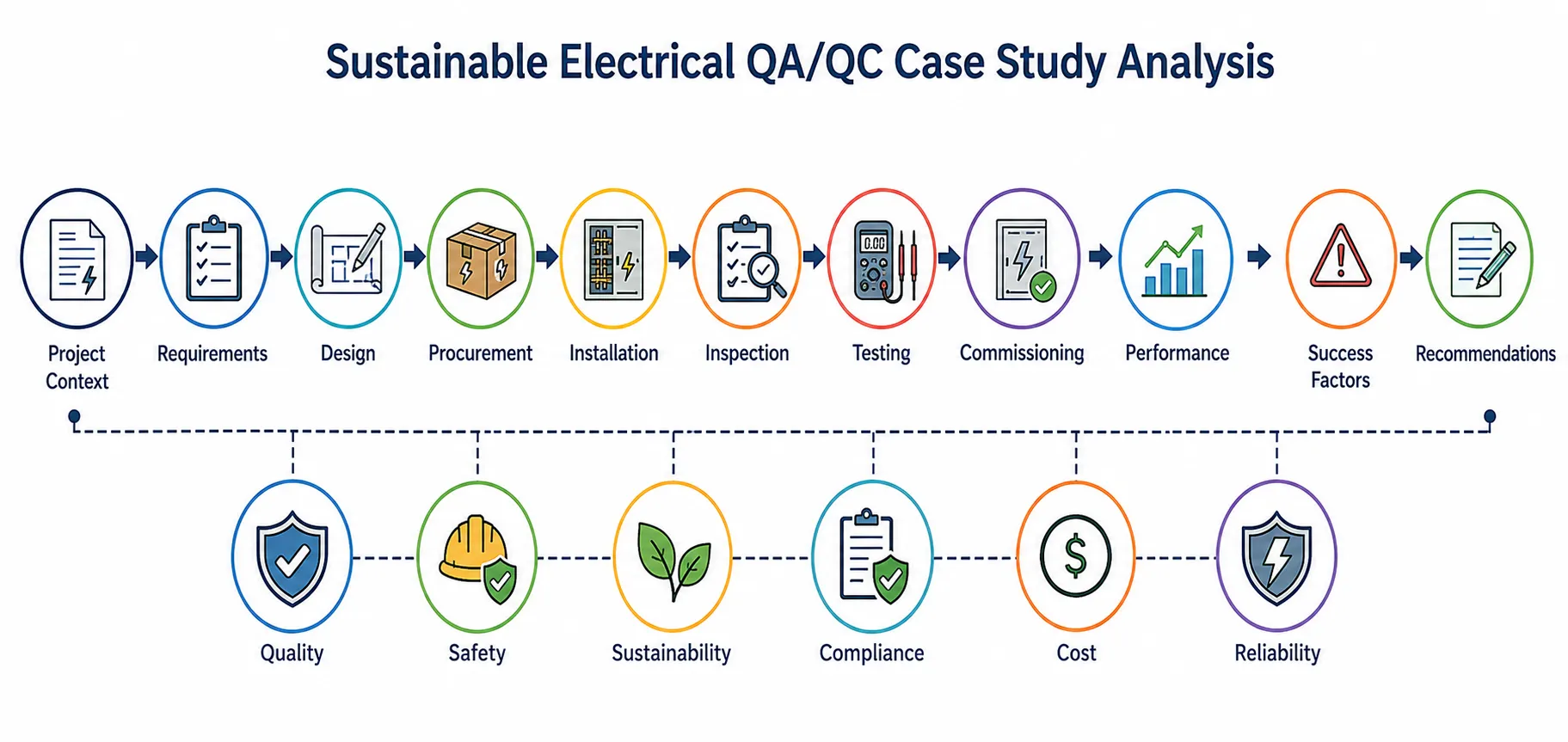
Stage 1: Establish the project context
Identify:
- Project scope
- Project location
- Electrical systems
- Sustainability objectives
- Stakeholders
- Constraints
- Performance requirements
Stage 2: Identify quality requirements
Review:
- Specifications
- Drawings
- Standards
- Contract requirements
- Acceptance criteria
- Inspection requirements
- Testing requirements
Stage 3: Map the project lifecycle
Consider:
- Design
- Procurement
- Construction
- Inspection
- Testing
- Commissioning
- Handover
- Operation
- Maintenance
Stage 4: Identify quality risks
Assess:
- Design risks
- Procurement risks
- Installation risks
- Testing risks
- Supplier risks
- Interface risks
- Environmental risks
- Operational risks
Stage 5: Evaluate QA/QC controls
Examine:
- Quality plans
- ITPs
- Inspection procedures
- Testing procedures
- Competence
- Traceability
- Documentation
- Non-conformity control
Stage 6: Analyse outcomes
Compare:
- Planned performance
- Actual performance
- Quality requirements
- Sustainability objectives
- Cost performance
- Programme performance
- Operational results
Stage 7: Determine key success factors
Ask:
- Which controls were most effective?
- What evidence demonstrates effectiveness?
- Which decisions supported quality?
- Which processes reduced risk?
- Which technologies improved monitoring?
Stage 8: Identify weaknesses
Consider:
- What failed?
- Why did it fail?
- Was the failure isolated?
- Was there a systemic cause?
- Was corrective action effective?
Stage 9: Develop evidence-based recommendations
Recommendations should be:
- Technically realistic
- Evidence-based
- Measurable
- Proportionate
- Relevant
- Practical
-
Consistent with project objectives

Key Benefits of Critical Case Study Deconstruction
Improved professional judgement
Critical case study analysis enables QA/QC professionals to distinguish between superficial compliance and genuine project quality.
Better risk identification
Reviewing previous project problems can help identify similar risks during future project planning.
Stronger quality planning
Case study evidence can support improvements to:
- Quality plans
- Inspection strategies
- Testing procedures
- Supplier controls
- Documentation systems
Improved sustainability performance
Analysing actual project outcomes helps determine which sustainability measures produced measurable improvements.
More effective decision-making
Evidence-based analysis allows professionals to compare alternative technical and quality approaches more effectively.
Improved lifecycle thinking
Case studies encourage consideration of operational reliability, maintenance, energy performance, and long-term system value.
Stronger continual improvement
Identifying successful controls and recurring weaknesses can support improvements to organisational QA/QC procedures and quality management systems.
Common Analytical Errors
Learners should avoid treating a case study as a simple project summary.
Common weaknesses include:
- Describing rather than analysing
- Focusing only on positive outcomes
- Ignoring failures
- Treating sustainability only as an environmental issue
- Ignoring electrical safety
- Assuming certification guarantees quality
- Ignoring lifecycle performance
- Failing to investigate root causes
- Making unsupported recommendations
- Ignoring cost and programme
- Treating digital data as automatically accurate
- Ignoring stakeholder responsibilities
- Failing to examine commissioning evidence
- Focusing on installation while ignoring operational performance
A strong Level 6 analysis should connect evidence, technical decisions, quality controls, risks, outcomes, and professional judgement.
Key Analytical Questions for Learners
When reviewing a sustainable electrical project, learners should consider:
Project objectives
- What problem was the project designed to solve?
- What were the sustainability objectives?
- What electrical performance requirements were established?
Design
- Was the design technically appropriate?
- Were sustainability requirements incorporated?
- Were calculations and interfaces verified?
Procurement
- Were suppliers appropriately assessed?
- Were materials and equipment compliant?
- Was lifecycle performance considered?
Installation
- Was work completed according to approved requirements?
- Were competent personnel used?
- Were critical activities inspected?
Testing
- Were appropriate tests completed?
- Were acceptance criteria established?
- Was test equipment suitable and calibrated?
Commissioning
- Did the system perform as intended?
- Were sustainability objectives verified?
- Were defects corrected before handover?
Performance
- Did actual results match planned results?
- Was energy performance maintained?
- Were reliability and maintenance requirements achieved?
QA/QC success factors
- Which quality controls had the greatest influence?
- What evidence supports this conclusion?
- Which risks were effectively controlled?
- Which processes could be strengthened?
Conclusion
Critically deconstructing sustainable electrical project case studies provides a structured method for understanding how QA/QC decisions influence electrical safety, reliability, sustainability, cost, programme, compliance, and lifecycle performance. The process requires learners to move beyond simply describing project activities and instead examine the relationships between requirements, design decisions, procurement, installation, inspection, testing, commissioning, non-conformity management, documentation, stakeholder coordination, and operational results.
A complex sustainable electrical project should be considered successful only when its technical and sustainability objectives are supported by reliable evidence. Effective QA/QC contributes to this outcome by ensuring that requirements are clearly defined, designs are verified, materials are controlled, installation activities are inspected, systems are tested, commissioning is properly completed, and performance is monitored. Critical analysis also helps identify whether apparent project success resulted from effective quality management or from temporary or external factors.
For Level 6 electrical QA/QC professionals, the ability to deconstruct case studies is therefore an important analytical and decision-making skill. It enables professionals to identify key QA/QC success factors, understand the causes of quality outcomes, evaluate evidence, recognise systemic weaknesses, and develop technically justified recommendations. Applied consistently, this approach supports more reliable sustainable electrical projects and strengthens the connection between quality management, environmental performance, technical excellence, and long-term operational value.
2: Evaluate the Methodologies Used in Past Projects to Overcome Unpredictable Sustainability and Quality Challenges
Sustainable electrical projects operate within environments where technical requirements, environmental conditions, supply chains, regulations, energy demands, stakeholder expectations, and emerging technologies can change during project delivery. These uncertainties can create challenges that are difficult to predict during the initial planning stage. A methodology that appears suitable during design may require modification when actual site conditions, equipment performance, environmental constraints, supply limitations, or operational requirements become known. For electrical Quality Assurance and Quality Control (QA/QC) professionals, evaluating how previous projects responded to such challenges is therefore essential for understanding the effectiveness of quality management approaches and determining whether project methodologies were sufficiently flexible, evidence-based, and risk-focused.
The evaluation of past project methodologies requires more than identifying which procedures were used. A professional QA/QC analysis should examine why a particular methodology was selected, what uncertainty it was intended to address, how it was implemented, what evidence demonstrated its effectiveness, and whether the approach produced sustainable and reliable results. This includes evaluating risk-based inspection, adaptive quality planning, design review, predictive monitoring, digital data analysis, supplier quality management, commissioning strategies, root-cause analysis, corrective action, contingency planning, and continuous performance monitoring.
At Level 6, learners should critically assess the strengths and limitations of different methodologies rather than assuming that a successful outcome automatically proves that the methodology was effective. A project may achieve its final objectives despite weaknesses in its quality system because of additional resources, favourable environmental conditions, experienced personnel, or corrective interventions. Conversely, a project may experience difficulties even when an appropriate methodology was selected because of external factors that could not reasonably have been anticipated. Effective evaluation therefore requires consideration of evidence, context, risk, proportionality, performance, and long-term sustainability.
Understanding Unpredictable Sustainability and Quality Challenges
Unpredictable challenges are conditions that cannot be completely defined or quantified during the initial project planning stage. They may emerge because of changing circumstances, incomplete information, complex system interactions, environmental variability, technological uncertainty, or external events.
In sustainable electrical projects, unpredictable challenges may include:
- Unexpected environmental conditions
- Unanticipated energy demand
- Variations in renewable energy generation
- Equipment performance below predicted levels
- Supply-chain disruption
- Delayed specialist components
- Changes in regulatory requirements
- Technology integration problems
- Unexpected power-quality issues
- Unforeseen site constraints
- Incompatible existing infrastructure
- Digital system interoperability problems
- Unexpected maintenance requirements
- Changing stakeholder expectations
- Extreme weather conditions
- Unexpected material degradation
- Commissioning failures
- Data-quality problems
- Cybersecurity concerns
- Changes in operational patterns
These challenges do not necessarily indicate poor planning. Complex projects will always contain some degree of uncertainty. The important question is whether the project methodology was capable of detecting uncertainty early, responding proportionately, controlling its consequences, and incorporating new information into decision-making.
Meaning of Methodology in Electrical QA/QC
A methodology is a structured approach used to plan, execute, monitor, control, and evaluate project activities.
Within electrical QA/QC, methodologies can include:
- Risk-based quality planning
- Inspection and Test Plans
- Design verification
- Supplier quality assurance
- Factory acceptance testing
- Site acceptance testing
- Statistical quality monitoring
- Digital inspection systems
- Predictive analytics
- Condition monitoring
- Root-cause analysis
- Corrective and preventive action
- Continuous commissioning
- Performance monitoring
- Change-control procedures
- Technical audits
- Independent verification
A methodology should not be evaluated only by whether it was documented. The professional should determine whether it was appropriately designed for the project’s risk profile and whether it was actually implemented.
Key Definitions and Concepts
| Term | Definition | Application in QA/QC Evaluation |
|---|---|---|
| Uncertainty | A condition where future circumstances, outcomes, or influencing factors cannot be fully predicted | Determines the need for flexible and adaptive quality controls |
| Risk | The effect of uncertainty on project objectives | Helps prioritise quality and sustainability controls |
| Adaptive methodology | A structured approach that can be modified when new evidence or conditions emerge | Supports response to changing technical and environmental conditions |
| Risk-based inspection | Inspection activities prioritised according to risk, consequence, and probability | Directs resources towards critical systems and activities |
| Predictive monitoring | Monitoring data used to identify potential failures or performance problems before they occur | Supports proactive quality management |
| Root-cause analysis | A systematic process for identifying underlying causes of a problem | Prevents repeated defects and failures |
| Corrective action | Action taken to address the cause of an identified problem | Restores conformity and reduces recurrence |
| Performance monitoring | Systematic measurement of actual system performance against defined requirements | Determines whether sustainability and quality objectives are being achieved |
| Change control | A controlled process for reviewing, approving, implementing, and recording changes | Prevents uncontrolled technical and quality changes |
| Resilience | The ability of a system or project process to withstand disruption and recover effectively | Supports continuity under unpredictable conditions |
| Contingency planning | Preparation of alternative actions for foreseeable disruptions or failures | Reduces the consequences of unexpected events |
| Methodology effectiveness | The extent to which a selected approach achieves its intended objectives | Provides the basis for evaluating past project approaches |
Why Methodology Evaluation Is Important
Past projects contain valuable evidence about how quality systems perform under real conditions. A methodology may appear effective when reviewed on paper but reveal significant weaknesses when exposed to actual project complexity.
Evaluation helps determine:
- Whether risks were correctly identified
- Whether inspection resources were appropriately allocated
- Whether quality procedures were proportionate
- Whether monitoring detected emerging problems
- Whether corrective actions addressed root causes
- Whether digital tools improved decision-making
- Whether supplier controls were effective
- Whether contingency arrangements worked
- Whether sustainability objectives remained achievable
- Whether project teams adapted appropriately
The purpose is not simply to identify successful methodologies. It is to understand the conditions under which particular methodologies were effective and where their limitations became apparent.
Evaluating Risk-Based Quality Management
Risk-based quality management is particularly valuable for sustainable electrical projects because not every component, process, or activity presents the same level of risk.
A project team may classify activities according to:
- Probability of failure
- Consequence of failure
- Safety significance
- Environmental significance
- Cost impact
- Programme impact
- Reliability impact
- Regulatory significance
- Difficulty of detection
High-risk activities may then receive greater levels of inspection, testing, verification, supervision, or independent review.
Evaluation criteria
When reviewing a past project, the QA/QC professional should consider:
- Were risks identified systematically?
- Were sustainability risks included?
- Were technical risks updated during project delivery?
- Were high-risk activities prioritised?
- Were inspection resources aligned with risk?
- Were emerging risks captured?
- Were risk controls reviewed for effectiveness?
- Did risk assessments change when project conditions changed?
A methodology can be considered stronger when it allows risk assessments to evolve rather than treating the initial risk register as a fixed document.
Adaptive Quality Planning
Traditional quality planning may establish procedures at the beginning of a project and apply them throughout delivery. This can be effective for predictable work, but sustainable electrical projects often involve changing conditions.
Adaptive quality planning allows the project team to modify controls when new evidence becomes available.
For example, if early installation inspections reveal repeated termination defects, the project may respond by:
- Increasing inspection frequency
- Reviewing installation procedures
- Retraining personnel
- Introducing additional supervision
- Revising inspection points
- Reviewing tooling
- Investigating supplier information
This approach demonstrates that quality management is responsive rather than static.
Strengths
- Responds to emerging risks
- Supports continuous improvement
- Uses actual project evidence
- Allows resources to be redirected
- Reduces repeated failures
- Supports complex technology integration
Limitations
- Requires competent decision-makers
- Can create additional documentation
- May increase inspection requirements
- Requires effective communication
- Can become inconsistent if change control is weak
The professional should therefore evaluate whether adaptations were formally controlled rather than introduced informally.
Design Review as a Methodology for Managing Uncertainty
Design review is one of the most effective methods for reducing uncertainty before construction begins.
Past projects may have used:
- Multidisciplinary design reviews
- Independent technical checks
- Constructability reviews
- Energy-performance modelling
- Digital coordination
- Protection studies
- Equipment compatibility assessments
- Failure-mode analysis
- Lifecycle assessments
A strong design review methodology should identify problems before they become construction defects.
For sustainable electrical systems, particular attention should be given to:
- Renewable energy integration
- Battery systems
- Energy management systems
- Power-quality implications
- Protection coordination
- Equipment compatibility
- Future expansion
- Environmental conditions
- Maintenance access
- Digital interfaces
Evaluating effectiveness
The analyst should compare the issues identified during design review with problems that later occurred during construction and operation.
If repeated construction problems were not identified during design, this may indicate that the design review methodology was incomplete or insufficiently focused on constructability.
Scenario-Based Risk Evaluation
One methodology used on complex projects is scenario analysis. Instead of considering only the expected operating condition, project teams evaluate alternative conditions.
Examples include:
- High energy demand
- Low renewable generation
- Equipment failure
- Grid interruption
- Extreme temperature
- Communication failure
- Battery system fault
- Loss of monitoring
- Supply-chain disruption
- Major equipment replacement
The purpose is to determine whether the electrical system and QA/QC controls remain effective under abnormal conditions.
This methodology can help identify weaknesses that may not be visible during routine testing.
Supplier Quality Management
Supply chains are a major source of uncertainty in electrical projects. Sustainable systems may rely on specialist components with long lead times and complex technical requirements.
Past projects may have used:
- Supplier prequalification
- Technical audits
- Factory inspections
- Factory Acceptance Testing
- Sample testing
- Manufacturer documentation review
- Production inspections
- Delivery inspections
- Supplier performance monitoring
A strong supplier methodology should evaluate both technical capability and quality-system maturity.
Evaluation questions
The analyst should ask:
- Were critical suppliers identified early?
- Were supplier risks assessed?
- Were technical specifications clear?
- Were products independently verified?
- Was factory testing conducted?
- Were delivery inspections performed?
- Were components traceable?
- Were supplier defects monitored?
- Was supplier performance reviewed?
Supplier quality methodologies are particularly important when project sustainability depends on the performance of specialist equipment.
Factory Acceptance Testing
Factory Acceptance Testing can reduce uncertainty before equipment reaches site.
Depending on the system, FAT may verify:
- Electrical functionality
- Protection
- Control logic
- Communication
- Alarm functions
- Measurement accuracy
- Equipment configuration
- Software functionality
- Safety functions
For complex equipment, FAT can identify problems before installation.
However, FAT has limitations. A component may pass factory testing but still fail to perform correctly once integrated into the wider electrical system.
Therefore, the methodology should be evaluated alongside:
- Site Acceptance Testing
- Integration testing
- Commissioning
- Operational monitoring
Site Acceptance Testing
Site Acceptance Testing confirms whether installed equipment performs correctly under actual site conditions.
It can identify issues related to:
- Installation
- Configuration
- Wiring
- Communication
- Environmental conditions
- Integration
- Protection
- Control systems
When evaluating a past project, the professional should determine whether SAT was appropriately designed to address site-specific uncertainty rather than merely repeating factory tests.
Predictive Maintenance and Condition Monitoring
Predictive approaches can help address uncertainty by identifying changes in equipment condition before failure occurs.
Electrical condition monitoring may involve:
- Thermal imaging
- Power-quality monitoring
- Insulation monitoring
- Partial discharge analysis
- Vibration monitoring for rotating equipment
- Energy consumption trends
- Battery health monitoring
- Temperature monitoring
- Equipment alarm analysis
The value of predictive monitoring depends on whether collected data is accurate and whether the project team acts on the information.
A monitoring system that generates alerts but receives no effective response provides limited QA/QC value.
Data Analytics for Quality and Sustainability
Modern sustainable electrical projects generate significant amounts of data.
Data may include:
- Energy consumption
- Renewable generation
- Equipment temperature
- Voltage
- Current
- Power factor
- Harmonic distortion
- Equipment alarms
- Failure frequency
- Inspection results
- Maintenance history
Analytical methodologies can identify:
- Performance trends
- Abnormal conditions
- Recurring defects
- Energy inefficiencies
- Equipment degradation
- Maintenance requirements
Evaluating data-driven methodologies
The professional should assess:
- Data quality
- Data frequency
- Measurement accuracy
- Sensor reliability
- Data storage
- Data interpretation
- Alert thresholds
- Response procedures
- Decision-making processes
Poor-quality input data can produce misleading conclusions, making data validation an important part of QA/QC.
Digital QA/QC Methodologies
Digital QA/QC systems are increasingly used to manage complex projects.
These may include:
- Mobile inspection applications
- Digital checklists
- BIM-based quality management
- Cloud document systems
- Digital punch lists
- Automated dashboards
- IoT monitoring
- Digital commissioning records
- AI-assisted defect detection
Digital systems can improve:
- Accessibility
- Traceability
- Reporting speed
- Data consistency
- Real-time visibility
- Communication
- Record management
However, digitalisation does not automatically improve quality.
Potential limitations include:
- Incorrect data entry
- Poor system integration
- Cybersecurity risks
- User resistance
- Inadequate training
- Software limitations
- Data overload
- Poor interpretation
The methodology should therefore be evaluated based on measurable improvement rather than technology adoption alone.
Root-Cause Analysis Methodologies
When unpredictable quality problems occur, root-cause analysis provides a structured way to understand why they happened.
Common approaches include:
- Five Whys
- Cause-and-effect analysis
- Fault-tree analysis
- Failure-mode analysis
- Trend analysis
- Evidence-based investigation
The quality professional should determine whether past projects focused on immediate correction or investigated underlying causes.
For example, if repeated cable termination defects occurred, simply replacing defective terminations would provide short-term correction. A stronger methodology would investigate:
- Personnel competence
- Tools
- Procedures
- Material compatibility
- Supervision
- Work environment
- Inspection timing
- Manufacturer requirements
This helps determine whether the issue was individual, procedural, technical, or systemic.
Corrective and Preventive Action
Corrective action should address the cause of an existing problem, while preventive thinking focuses on reducing the possibility of recurrence or similar failure.
An effective methodology includes:
- Problem identification
- Immediate containment
- Investigation
- Root-cause determination
- Corrective action
- Responsibility allocation
- Implementation
- Verification
- Effectiveness review
- Formal closure
When evaluating past projects, learners should determine whether corrective actions were genuinely effective.
Evidence of effectiveness may include:
- Reduced defect recurrence
- Improved inspection results
- Improved equipment performance
- Reduced rework
- Improved process compliance
- Improved reliability
Change-Control Methodologies
Sustainable electrical projects frequently experience technical changes because of:
- Design development
- Equipment availability
- Regulatory changes
- Site conditions
- Client requirements
- Technology improvements
- Supplier substitutions
Uncontrolled changes can introduce significant quality risks.
A formal change-control process should include:
- Change identification
- Technical justification
- Impact assessment
- Risk review
- Cost assessment
- Programme assessment
- Sustainability assessment
- Approval
- Implementation
- Documentation
- Verification
The professional should determine whether past projects adequately evaluated the consequences of changes.
A substitute electrical component, for example, may have similar basic ratings but different:
- Efficiency
- Protection characteristics
- Communication protocols
- Environmental ratings
- Maintenance requirements
Therefore, substitution should not be approved solely because the replacement has the same nominal electrical rating.
Contingency Planning
Contingency planning provides alternative approaches for conditions that may disrupt project objectives.
Examples include:
- Alternative suppliers
- Spare equipment
- Backup power arrangements
- Additional testing capacity
- Alternative installation sequences
- Additional technical resources
- Temporary monitoring systems
- Emergency maintenance arrangements
A contingency strategy should be evaluated based on:
- Relevance
- Availability
- Response time
- Technical suitability
- Cost
- Effectiveness
A contingency plan that exists only as a document but cannot realistically be implemented provides limited value.
Practical Case Study: Solar PV Project Facing Unpredictable Performance
Consider a large commercial solar PV project where the expected annual energy yield was based on design modelling.
During early operation, actual generation was lower than expected.
The project team used several methodologies:
- Performance monitoring
- Thermal inspection
- Inverter data analysis
- Site inspection
- Cleaning assessment
- Shading review
- Electrical testing
The investigation identified that some modules experienced higher-than-expected temperature conditions and that sections of the installation were affected by environmental contamination.
The project team responded by:
- Revising cleaning intervals
- Adjusting monitoring thresholds
- Reviewing thermal conditions
- Improving maintenance procedures
- Monitoring affected sections more frequently
Evaluation of the methodology
The methodology was effective because it:
- Used actual operational data
- Combined digital and physical inspection
- Investigated multiple potential causes
- Avoided immediately assuming equipment failure
- Introduced targeted corrective measures
- Continued monitoring after intervention
However, the evaluation should also consider whether the environmental conditions could have been anticipated during design and whether the original maintenance strategy adequately reflected local conditions.
This demonstrates why methodology evaluation should consider both response effectiveness and opportunities for earlier risk identification.
Practical Case Study: Industrial Energy-Efficiency Project
Consider an industrial facility where variable-speed drives and high-efficiency motors were introduced to reduce energy consumption.
During commissioning, unexpected harmonic distortion was identified.
The project team used:
- Power-quality monitoring
- Technical investigation
- Equipment manufacturer consultation
- Harmonic analysis
- Control-system review
- Corrective design modifications
The team determined that the interaction between multiple drives and existing electrical infrastructure contributed to the issue.
The response included:
- Revised filtering
- Updated settings
- Additional monitoring
- Protection verification
- Repeat commissioning tests
Evaluation
The methodology demonstrated strong adaptive QA/QC because the team responded to measured evidence rather than relying solely on design assumptions.
However, a critical evaluation should ask whether harmonic assessment should have been undertaken earlier during design.
This illustrates an important distinction:
- Reactive methodology responds effectively after a problem occurs.
- Preventive methodology attempts to identify the problem before implementation.
A mature project should use both.
Practical Case Study: Battery Energy Storage System
A battery energy storage project may encounter unexpected temperature variation between battery sections.
An effective methodology could involve:
- Continuous temperature monitoring
- Battery management system data
- Alarm thresholds
- Thermal inspection
- Manufacturer consultation
- Electrical testing
- Maintenance review
If the project identifies a developing abnormality before it causes a system failure, predictive monitoring has demonstrated value.
However, evaluation should consider:
- Whether the sensors were correctly calibrated
- Whether alarm thresholds were appropriate
- Whether personnel understood the alarms
- Whether response procedures were defined
- Whether the root cause was identified
- Whether the condition recurred
This demonstrates that technology is only one part of a successful QA/QC methodology. Competence, procedures, data quality, and decision-making are equally important.
Comparing Methodologies Used in Past Projects
Different methodologies may address the same challenge in different ways.
For example, an unpredictable equipment failure could be managed through:
Reactive inspection
The equipment is inspected after a problem occurs.
Advantages:
- Simple
- Low initial monitoring cost
- Appropriate for low-risk equipment
Limitations:
- Failure may already have occurred
- Potential operational disruption
- Limited predictive capability
Preventive inspection
Equipment is inspected at predetermined intervals.
Advantages:
- Planned intervention
- Predictable maintenance
- Reduced likelihood of unnoticed deterioration
Limitations:
- May result in unnecessary inspections
- Fixed intervals may not reflect actual condition
Condition-based monitoring
Inspection frequency is influenced by actual equipment condition.
Advantages:
- More targeted
- Uses real performance information
- Can identify deterioration earlier
Limitations:
- Requires reliable monitoring
- Requires trained personnel
- May require higher initial investment
Predictive analytics
Data is analysed to identify patterns associated with future failure.
Advantages:
- Potentially identifies problems early
- Supports proactive maintenance
- Can improve resource allocation
Limitations:
- Dependent on data quality
- Requires analytical capability
- May generate false alarms
The correct methodology depends on risk, system complexity, available resources, consequence of failure, and required performance.
Evaluating Methodology Effectiveness
A methodology should be evaluated using evidence rather than assumptions.
Relevant indicators include:
- Reduction in defects
- Reduction in rework
- Reduction in downtime
- Improved inspection results
- Improved commissioning outcomes
- Improved energy performance
- Reduced equipment failure
- Faster corrective action
- Improved traceability
- Reduced environmental impact
- Improved stakeholder satisfaction
The analyst should compare project conditions before and after implementation where reliable data is available.
For example:
If a digital inspection system was introduced, the evaluation should determine whether it actually reduced:
- Inspection delays
- Missing records
- Duplicate inspections
- Defect closure time
- Document-control errors
Simply stating that “a digital system was implemented” does not demonstrate effectiveness.
Key Factors When Evaluating Past Methodologies
Appropriateness
Was the methodology suitable for the project’s complexity and risk profile?
Effectiveness
Did it achieve its intended objective?
Efficiency
Did it achieve the objective without unnecessary resources or effort?
Adaptability
Could the methodology respond when circumstances changed?
Reliability
Did the methodology produce consistent results?
Evidence
Was its effectiveness supported by measurable information?
Sustainability
Did the methodology support long-term environmental and operational performance?
Integration
Was the methodology integrated with other project controls?
Competence
Did personnel have the skills necessary to implement it?
Scalability
Could the methodology be applied effectively to projects of different sizes or complexity?
Key Benefits of Evaluating Past Project Methodologies
Improved risk management
Evaluation helps identify which approaches successfully controlled uncertainty and which risks remained insufficiently controlled.
Better QA/QC planning
Past evidence can improve future:
- Quality plans
- Inspection strategies
- Testing procedures
- Supplier controls
- Commissioning plans
More effective resource allocation
Risk-based methodologies help direct QA/QC resources towards activities with the greatest potential consequences.
Improved sustainability performance
Evaluating past approaches helps determine whether sustainability objectives were achieved in measurable terms.
Reduced recurrence of quality problems
Root-cause and corrective-action methodologies can reduce repeated defects.
Better technology adoption
Evaluation helps determine whether digital tools, IoT systems, analytics, BIM, and AI actually improve quality outcomes.
Stronger organisational learning
Systematic evaluation transforms individual project experience into reusable organisational knowledge and improved procedures.
Common Weaknesses in Methodology Evaluation
Learners should avoid several common analytical errors.
These include:
- Assuming project success proves methodology effectiveness
- Evaluating procedures without considering implementation
- Ignoring external factors
- Focusing only on technical outcomes
- Ignoring sustainability performance
- Treating all risks as equally important
- Failing to assess data quality
- Ignoring competence requirements
- Failing to investigate root causes
- Confusing correction with corrective action
- Ignoring lifecycle performance
- Evaluating technology without evaluating user capability
- Making recommendations without supporting evidence
- Failing to consider cost and resource implications
A rigorous evaluation should consider both positive and negative evidence.
Recommended Evaluation Framework
A structured framework can be used when analysing a methodology from a past project.
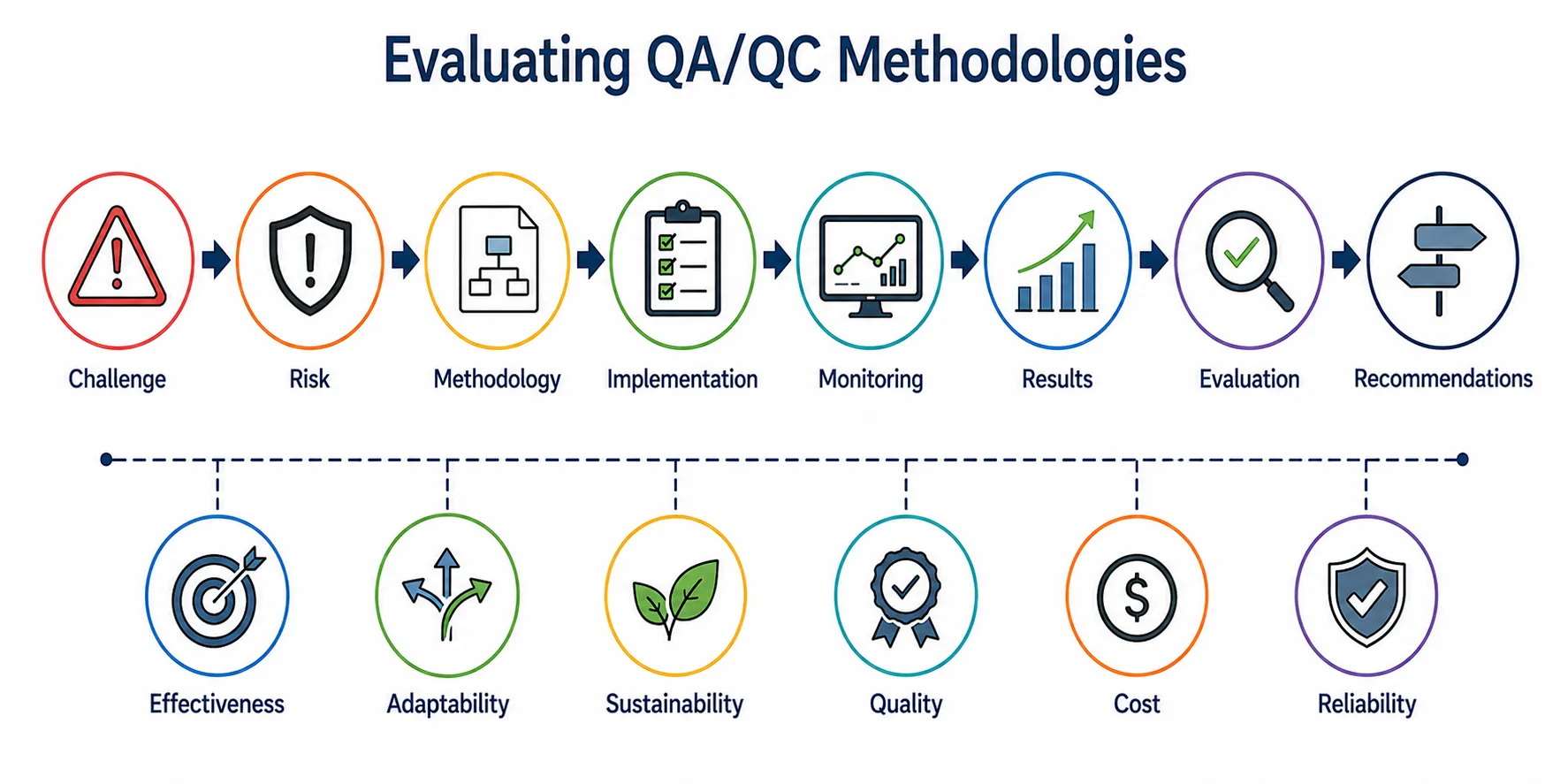
Step 1: Identify the challenge
Determine:
- What happened?
- Why was it significant?
- What project objectives were affected?
Step 2: Identify the methodology
Determine:
- What approach was used?
- Who implemented it?
- When was it introduced?
- What resources were required?
Step 3: Establish the intended outcome
Determine:
- What was the methodology designed to achieve?
- What acceptance criteria existed?
- What performance indicators were established?
Step 4: Examine implementation
Assess:
- Competence
- Resources
- Procedures
- Supervision
- Communication
- Documentation
Step 5: Analyse results
Compare:
- Expected outcome
- Actual outcome
- Quality performance
- Sustainability performance
- Cost
- Programme
- Reliability
Step 6: Identify limitations
Consider:
- What did not work?
- Why?
- Was the limitation predictable?
- Could another methodology have performed better?
Step 7: Determine effectiveness
Assess whether the methodology was:
- Appropriate
- Effective
- Efficient
- Adaptable
- Sustainable
- Evidence-based
Step 8: Formulate professional recommendations
Recommendations should identify:
- What should be retained
- What should be modified
- What controls should be strengthened
- What evidence should be collected
- How implementation should be monitore
Integrating Methodologies Across the Project Lifecycle
No single methodology is sufficient for complex sustainable electrical projects. Effective QA/QC usually requires several methodologies operating together.
For example:
Design stage:
- Risk assessment
- Design verification
- Energy modelling
- Technical review
Procurement stage:
- Supplier assessment
- Factory testing
- Material verification
Construction stage:
- Inspection and Test Plans
- Competence controls
- Installation inspection
- Material traceability
Commissioning stage:
- Site Acceptance Testing
- Functional testing
- Performance verification
Operational stage:
- Condition monitoring
- Data analytics
- Predictive maintenance
- Performance review
Corrective stage:
- Non-conformity management
- Root-cause analysis
- Corrective action
- Effectiveness verification
This integrated approach creates multiple opportunities to identify and control uncertainty.
Conclusion
Evaluating methodologies used in past sustainable electrical projects provides electrical QA/QC professionals with an evidence-based approach to understanding how complex and unpredictable challenges can be managed. Sustainable electrical projects are influenced by changing environmental conditions, renewable energy variability, technological integration, supply-chain uncertainty, equipment performance, operational requirements, and evolving stakeholder expectations. Consequently, quality management must be capable of responding to uncertainty rather than relying exclusively on fixed procedures established at project commencement.
A robust evaluation examines the methodology’s suitability, implementation, effectiveness, limitations, resource requirements, adaptability, and measurable outcomes. Risk-based quality management, adaptive quality planning, design verification, supplier quality control, factory and site acceptance testing, predictive monitoring, data analytics, digital QA/QC, root-cause analysis, corrective action, change control, and contingency planning can each provide valuable mechanisms for managing uncertainty. However, their effectiveness depends on competent implementation, reliable information, appropriate resources, and integration with the wider project quality management system.
For Level 6 electrical QA/QC professionals, the critical issue is not simply identifying which methodology a previous project used. The objective is to determine why it was selected, how effectively it responded to the challenge, what evidence demonstrates its performance, what limitations affected the outcome, and whether an alternative approach could have produced a better result. This analytical capability enables professionals to make stronger quality decisions, improve sustainability performance, reduce recurring defects, strengthen resilience, and develop QA/QC strategies that are better suited to the complexity of modern electrical engineering projects.
3: Synthesize Lessons Learned from Comprehensive Case Studies to Inform Strategic Decision-Making in Current Electrical Contexts
Sustainable electrical engineering is becoming increasingly complex as projects combine conventional electrical infrastructure with renewable energy, energy storage, smart technologies, digital monitoring, automation, energy management systems, and emerging technologies. In this environment, Quality Assurance and Quality Control (QA/QC) professionals need more than technical knowledge of inspection and testing. They must be able to interpret evidence from previous projects, identify patterns, understand why particular outcomes occurred, and use this knowledge to support strategic decisions in current electrical contexts. Case studies provide an important source of evidence because they demonstrate how quality principles, sustainability requirements, technical decisions, project constraints, and human factors interact in real or realistic project environments.
Synthesising lessons from case studies means bringing together information from different project experiences and converting it into meaningful knowledge that can influence current decision-making. This is different from simply listing what went well or what went wrong. A synthesis considers multiple sources of evidence, compares different approaches, identifies recurring patterns, evaluates their relevance to the current project, and determines which conclusions can reasonably be transferred. For electrical QA/QC professionals, this process can support decisions relating to design verification, supplier selection, inspection and testing, commissioning, digital technologies, sustainability, risk management, resource allocation, maintenance, and continuous improvement.
At Level 6, learners should demonstrate the ability to move from evidence to professional judgement. A previous project’s experience should not automatically be copied into a new project because electrical systems, environmental conditions, technologies, regulations, stakeholders, budgets, operational requirements, and risk profiles may differ. The professional must therefore determine which lessons are transferable, which require modification, and which are no longer relevant. Strategic decision-making requires this contextual judgement so that experience becomes a useful input to current project planning rather than an uncritical template.
Understanding Synthesis in Electrical QA/QC
Synthesis is the process of combining information from different sources to develop a broader understanding, identify relationships, and produce a reasoned conclusion or strategic recommendation.
In electrical QA/QC, synthesis may involve combining evidence from:
- Previous project case studies
- Quality audit findings
- Non-conformity records
- Inspection reports
- Testing results
- Commissioning records
- Supplier performance
- Maintenance data
- Energy-performance data
- Failure investigations
- Stakeholder feedback
- Digital monitoring systems
- Risk registers
- Technical reviews
- Sustainability assessments
The purpose is to identify information that can improve decisions in a current electrical context.
For example, if several previous solar PV projects experienced underperformance because of shading, inadequate cleaning, inaccurate modelling, or poor monitoring, a QA/QC professional may synthesise these findings and recommend that future projects include more detailed shading analysis, performance monitoring, maintenance planning, and commissioning verification.
The important point is that the professional is not simply repeating individual findings. The professional is identifying a pattern across evidence and using that pattern to influence current decision-making.
Synthesis Versus Simple Lessons Listing
There is an important difference between identifying lessons and synthesising them.
A basic project review might state:
- Project A experienced cable termination defects.
- Project B experienced inverter configuration problems.
- Project C experienced monitoring failures.
A synthesis would examine the relationship between these outcomes and identify a broader issue, such as weaknesses in installation competence, commissioning verification, technical training, or interface management.
The synthesis might therefore conclude that future projects should strengthen:
- Competence verification
- Specialist installation procedures
- Interface coordination
- Pre-commissioning inspections
- Functional testing
- Digital monitoring validation
This represents a higher level of professional reasoning because multiple individual observations have been converted into a strategic quality improvement.
Key Definitions and Concepts
| Term | Definition | Application to Electrical QA/QC |
|---|---|---|
| Synthesis | Combining information from different sources to develop an integrated conclusion | Helps transform case study evidence into strategic knowledge |
| Case study | A detailed examination of a project, situation, process, or outcome | Provides evidence for evaluating past decisions and performance |
| Lesson | An insight gained from an experience that may influence future practice | Identifies useful knowledge from previous projects |
| Transferability | The extent to which a finding can reasonably be applied to another context | Prevents inappropriate copying of past approaches |
| Strategic decision-making | Selecting actions that support wider organisational, technical, commercial, and sustainability objectives | Connects QA/QC evidence with current project priorities |
| Evidence-based decision | A decision supported by reliable information and analysis | Reduces reliance on assumptions |
| Contextual analysis | Evaluation of information in relation to specific project conditions | Determines whether previous experience remains relevant |
| Benchmarking | Comparing current or planned performance with previous or external performance | Helps establish realistic improvement targets |
| Trend analysis | Examination of data over time to identify recurring patterns | Helps identify persistent quality or performance problems |
| Knowledge transfer | Applying relevant experience and information from one project to another | Supports organisational learning |
| Strategic risk | A risk capable of significantly affecting long-term project or organisational objectives | Helps prioritise high-impact QA/QC decisions |
| Continuous improvement | Systematic enhancement of processes and performance over time | Converts project experience into improved QA/QC practice |
Why Case Study Synthesis Matters
Modern electrical projects are often delivered under significant technical and commercial pressure. Project teams may need to achieve sustainability targets while controlling cost, maintaining programme, meeting regulatory requirements, and ensuring electrical safety and reliability.
Previous project evidence can help reduce uncertainty.
Effective synthesis can support decisions concerning:
- Technology selection
- Design approaches
- Quality planning
- Inspection intensity
- Testing requirements
- Supplier selection
- Contractor competence
- Digital QA/QC systems
- Sustainability targets
- Maintenance strategies
- Commissioning methods
- Resource allocation
- Risk controls
- Performance monitoring
The value comes from understanding not only what happened but why it happened and whether the same conditions exist in the current project.
Sources of Lessons from Electrical Case Studies
A comprehensive case study can provide evidence from many stages of the project lifecycle.
Design evidence
This may include:
- Design review findings
- Calculation errors
- Coordination issues
- Design changes
- Constructability problems
- Protection challenges
- Energy modelling results
Procurement evidence
This may include:
- Supplier performance
- Equipment quality
- Delivery problems
- Material substitutions
- Factory testing
- Product reliability
Construction evidence
This may include:
- Installation defects
- Workmanship issues
- Competence problems
- Supervision deficiencies
- Material handling
- Interface problems
Testing and commissioning evidence
This may include:
- Failed tests
- Protection issues
- Configuration errors
- Functional failures
- Integration problems
- Performance shortfalls
Operational evidence
This may include:
- Energy consumption
- Equipment failures
- Maintenance requirements
- Reliability
- Availability
- Renewable energy output
- Power-quality performance
Quality management evidence
This may include:
- Audit findings
- Non-conformities
- Corrective actions
- Inspection trends
- Document-control issues
- Repeated defects
The professional should bring these different evidence categories together before reaching strategic conclusions.
Identifying Patterns Across Case Studies
One of the most valuable purposes of synthesis is identifying recurring patterns.
A single failure may be an isolated event. Repeated similar failures across different projects may indicate a systemic issue.
For example:
Project A:
- Poor cable termination quality
Project B:
- Incorrect cable termination tools
Project C:
- Repeated termination defects
Project D:
- Insufficient installer competence
The combined evidence may indicate that the organisation requires stronger controls over:
- Competence assessment
- Installation procedures
- Tool verification
- Supervision
- Inspection hold points
The strategic decision is therefore based on a pattern rather than an individual incident.
Distinguishing Recurring Problems from Isolated Events
Not every problem should result in a major organisational change.
A professional should determine whether an issue is:
- Isolated
- Recurrent
- Systemic
- Supplier-specific
- Technology-specific
- Location-specific
- Contractor-specific
- Environmental
- Design-related
This prevents overreaction.
For example, a single delivery delay caused by an unusual international disruption may not justify changing the entire procurement system. However, repeated delays from the same supplier may justify supplier reassessment or alternative sourcing.
Strategic decision-making therefore requires proportionality.
Evaluating the Quality of Case Study Evidence
Not all case study evidence has the same reliability.
Evidence should be assessed according to:
- Source credibility
- Data accuracy
- Completeness
- Relevance
- Timeliness
- Consistency
- Verification
- Context
For example, a documented commissioning test may provide stronger evidence than an informal statement that the system “performed well.”
Similarly, operational energy data collected over twelve months may provide stronger evidence of sustainability performance than a short-term commissioning measurement.
From Evidence to Strategic Decision
The movement from case study evidence to strategic decision can be represented as a structured process:
Evidence → Analysis → Pattern → Relevance → Options → Evaluation → Decision → Implementation → Monitoring
Each stage has a specific purpose.
Evidence
Collect reliable information from previous projects.
Analysis
Examine the evidence to understand causes and consequences.
Pattern
Determine whether similar outcomes appear repeatedly.
Relevance
Assess whether the findings apply to the current project.
Options
Develop possible responses.
Evaluation
Compare options against:
- Quality
- Safety
- Sustainability
- Cost
- Programme
- Reliability
- Compliance
Decision
Select the most appropriate approach.
Implementation
Introduce the selected measure through controlled procedures.
Monitoring
Measure whether the decision produces the intended result.
This final monitoring stage is essential because a strategic decision should not be assumed to be effective simply because it was implemented.
Contextualising Lessons for Current Projects
A major challenge in applying previous experience is ensuring that lessons remain relevant.
The current project may differ in:
- Location
- Scale
- Technology
- Climate
- Electrical architecture
- Regulations
- Client requirements
- Contractor capability
- Budget
- Programme
- Operational profile
- Sustainability objectives
Therefore, a lesson should be tested against the current context.
For example, a maintenance strategy developed for a large industrial solar PV installation may not be directly applicable to a small commercial rooftop system.
The professional should determine:
- What conditions were present in the original project?
- Which conditions exist in the current project?
- Which factors are different?
- Which aspects of the lesson remain relevant?
- What modifications are required?
This process improves transferability.
Developing a Lesson Transferability Assessment
A useful professional approach is to evaluate each lesson before applying it.
Original lesson
Identify exactly what happened and what was learned.
Original context
Determine:
- Technology
- Environment
- Project scale
- Risk profile
- Stakeholders
- Regulatory environment
Current context
Determine whether equivalent conditions exist.
Transferability
Assess whether the lesson is:
- Directly transferable
- Transferable with modification
- Relevant only as background
- Not applicable
Implementation
If applicable, determine how the lesson should be incorporated into current procedures.
This prevents the common mistake of treating historical experience as universally applicable.
Strategic Decision-Making in Current Electrical Contexts
Current electrical contexts increasingly involve emerging technologies and complex system interactions.
Examples include:
- Renewable energy integration
- Battery energy storage
- Smart grids
- Artificial intelligence
- Internet of Things
- Building energy management
- Electric vehicle charging
- Digital twins
- Advanced metering
- Automated inspection
- Predictive maintenance
These technologies introduce new QA/QC requirements.
Case study synthesis can help professionals determine:
- Which technologies have demonstrated reliability
- Which risks repeatedly occur
- Which inspection methods are effective
- What competence requirements are needed
- What commissioning tests should be included
- What digital controls require verification
- What maintenance approaches are appropriate
Using Case Studies for Technology Selection
Technology selection should consider more than initial functionality.
A strategic evaluation can consider:
- Technical performance
- Reliability
- Efficiency
- Compatibility
- Safety
- Maintainability
- Lifecycle cost
- Environmental impact
- Supplier capability
- Availability of spare parts
- Workforce competence
- Digital integration
For example, if previous projects demonstrate recurring problems with a particular monitoring technology, the current project team should investigate whether those problems resulted from:
- Product limitations
- Poor configuration
- Inadequate training
- Communication infrastructure
- Incorrect sensor selection
- Data integration problems
The appropriate strategic response may be to change the technology, improve implementation, or strengthen training rather than automatically rejecting the technology.
Practical Case Study: Solar PV Portfolio
Consider an organisation that has completed several solar PV projects.
The project reviews identify:
Project 1:
- Strong installation quality
- Lower-than-expected energy yield
Project 2:
- Good energy performance
- Repeated inverter alarms
Project 3:
- High energy yield
- Poor maintenance records
Project 4:
- Strong monitoring
- Repeated cable termination defects
A simple review might treat each project separately.
A synthesis identifies broader patterns:
- Energy modelling requires stronger validation
- Inverter commissioning requires more detailed verification
- Maintenance documentation needs improvement
- Installation competence requires stronger control
The organisation can then develop a strategic QA/QC approach covering the entire portfolio.
Potential actions include:
- Standardised design review
- Enhanced commissioning procedures
- Improved installer competency requirements
- Digital performance monitoring
- Standardised maintenance documentation
- Risk-based inspection
The strategic value comes from converting several project experiences into one integrated improvement strategy.
Practical Case Study: Battery Storage Projects
Suppose an organisation has delivered multiple battery energy storage projects.
Past case studies show:
- One project experienced thermal management problems.
- Another experienced communication failures.
- Another required repeated battery balancing.
- Another had inadequate emergency response procedures.
Synthesising these findings may identify a broader requirement for stronger control of:
- Environmental monitoring
- Battery management systems
- Communication interfaces
- Commissioning procedures
- Emergency arrangements
- Operator training
The strategic decision is not simply to “improve battery quality.” It is to establish a comprehensive battery QA/QC framework covering design, installation, testing, monitoring, operation, and emergency response.
Practical Case Study: Industrial Energy Efficiency
Consider several industrial facilities implementing variable-speed drives.
Past projects show that:
- Some achieved significant energy savings.
- Some experienced harmonic issues.
- Some required additional operator training.
- Some had poor baseline energy data.
Synthesis may indicate that future projects should include:
- Better baseline measurement
- Early power-quality assessment
- Detailed drive selection
- Harmonic evaluation
- Operator training
- Post-installation energy verification
The organisation can then improve its standard project methodology based on evidence.
Using Failure Data for Strategic Decisions
Failure data is particularly valuable because repeated failures may indicate systemic weaknesses.
Data may be categorised according to:
- Equipment type
- Manufacturer
- Installation team
- Project location
- Failure mode
- Failure frequency
- Time to failure
- Repair cost
- Operational impact
Trend analysis can reveal whether a particular issue deserves strategic intervention.
For example, if multiple projects show premature failures in the same equipment category, the organisation may need to review:
- Supplier selection
- Product specifications
- Installation requirements
- Environmental suitability
- Commissioning
- Maintenance
This provides a more rational basis for decision-making than responding to isolated incidents.
Integrating Sustainability into Strategic Decisions
Sustainability should be integrated into QA/QC decisions rather than treated as a separate project objective.
When reviewing previous projects, professionals should consider:
- Energy performance
- Carbon reduction
- Resource efficiency
- Waste generation
- Equipment lifecycle
- Maintenance requirements
- Replacement frequency
- Material durability
- Operational efficiency
For example, a component that has a low initial purchase cost but requires frequent replacement may generate greater environmental impact and lifecycle cost than a more durable alternative.
Strategic QA/QC decisions should therefore consider long-term consequences.
Cost, Quality and Sustainability Trade-Offs
Strategic decision-making often involves competing priorities.
A decision may affect:
- Capital cost
- Operational cost
- Quality
- Programme
- Sustainability
- Reliability
- Safety
A more sustainable technology may have higher initial cost but lower operating cost.
A more rigorous inspection methodology may increase short-term project effort but reduce rework.
A higher-quality component may cost more initially but provide longer service life.
The professional should therefore evaluate the total impact rather than selecting options solely on initial price.
Using Risk-Based Prioritisation
Not every lesson from a previous project deserves the same strategic priority.
Lessons can be prioritised according to:
- Safety impact
- Quality impact
- Environmental impact
- Financial impact
- Programme impact
- Frequency
- Detectability
- Regulatory significance
- Reputational impact
High-consequence recurring problems should generally receive greater management attention than isolated low-impact issues.
Strategic QA/QC Decision Matrix
A professional decision-making process may evaluate potential actions against several criteria.
| Decision Factor | Key Question | Strategic Consideration |
|---|---|---|
| Safety | Could failure create a significant safety consequence? | High-risk safety issues require strong controls |
| Quality | Could the issue compromise system conformity or reliability? | Strengthen inspection, testing or design controls |
| Sustainability | Could the decision affect energy or environmental performance? | Evaluate lifecycle and environmental consequences |
| Cost | What are capital and lifecycle costs? | Avoid decisions based only on initial expenditure |
| Programme | Could the measure affect project delivery? | Balance additional controls against schedule requirements |
| Reliability | Could the decision affect availability or service life? | Consider long-term system performance |
| Compliance | Are regulatory or contractual requirements affected? | Ensure current requirements remain satisfied |
| Transferability | Is the previous lesson relevant to the current context? | Adapt rather than blindly copy historical practice |
Integrating Lessons into Quality Management Systems
Case study findings become strategically valuable when they are incorporated into organisational processes.
Potential mechanisms include:
- Updating quality procedures
- Revising inspection checklists
- Updating ITP templates
- Revising technical specifications
- Improving supplier requirements
- Updating competency criteria
- Strengthening commissioning procedures
- Revising risk registers
- Developing new training
- Improving digital QA/QC systems
- Updating maintenance requirements
This converts individual project experience into organisational capability.
Embedding Case Study Findings into Project Planning
Case study synthesis should ideally occur before major project decisions are finalised.
During project initiation, the team can review:
- Previous project failures
- Successful approaches
- Supplier performance
- Technology performance
- Inspection trends
- Commissioning issues
- Maintenance records
- Sustainability outcomes
The findings can then influence:
- Design requirements
- Procurement strategy
- Quality plans
- Risk registers
- Inspection requirements
- Testing strategies
- Resource planning
This creates a proactive approach rather than waiting for similar problems to occur.
Knowledge Transfer Between Projects
Knowledge transfer is particularly important for organisations delivering multiple electrical projects.
Effective mechanisms include:
- Project close-out reviews
- Technical workshops
- QA/QC forums
- Digital knowledge repositories
- Standardised case study reports
- Lessons registers
- Technical alerts
- Training sessions
- Updated procedures
Knowledge should be communicated in a form that project teams can actually use.
For example, a complex technical report may be less useful to site personnel than an updated inspection checklist accompanied by a short technical briefing.
Measuring Whether Strategic Decisions Work
A strategic decision should be monitored after implementation.
Relevant indicators may include:
- Defect frequency
- Rework
- Inspection failures
- Testing failures
- Commissioning defects
- Equipment failures
- Energy performance
- Maintenance requirements
- Corrective-action closure
- Project delays
- Supplier performance
For example, if previous projects demonstrated recurring cable termination defects and a new competency and inspection programme is introduced, the organisation should measure whether termination-related non-conformities actually decrease.
Without measurement, the organisation cannot confidently determine whether the strategic intervention worked.
Practical Process for Synthesising Case Study Evidence
Stage 1: Collect evidence
Gather relevant information from previous projects.
Sources may include:
- Quality reports
- Audit findings
- Test results
- NCRs
- Commissioning records
- Performance data
- Maintenance records
Stage 2: Classify evidence
Group findings according to:
- Design
- Procurement
- Installation
- Testing
- Commissioning
- Operation
- Sustainability
- Technology
Stage 3: Identify recurring patterns
Look for:
- Repeated defects
- Repeated successes
- Common causes
- Technology-specific problems
- Supplier-related issues
Stage 4: Determine causes
Use structured analysis to identify why outcomes occurred.
Stage 5: Assess relevance
Compare previous project conditions with the current project.
Stage 6: Evaluate alternatives
Consider different responses and their likely consequences.
Stage 7: Select strategic actions
Choose measures that best support:
- Quality
- Safety
- Sustainability
- Reliability
- Cost
- Programme
Stage 8: Implement controls
Integrate selected measures into:
- Quality plans
- Specifications
- ITPs
- Procedures
- Training
Stage 9: Monitor results
Measure whether the intervention improves performance.
Stage 10: Review effectiveness
Determine whether further modification is required.
Key Benefits of Case Study Synthesis
Improved strategic decision-making
Professionals can make decisions using evidence from previous project outcomes rather than relying solely on assumptions or individual experience.
Reduced repeat failures
Recurring problems can be identified and addressed systematically.
Better risk management
Historical evidence can strengthen current risk identification and mitigation.
Improved quality planning
Previous project experience can inform inspection, testing, commissioning, and documentation requirements.
Better technology decisions
Case study evidence can reveal whether emerging technologies have performed effectively under comparable conditions.
Improved sustainability
Historical performance data can help identify approaches that genuinely improve energy efficiency and environmental performance.
Stronger resource allocation
QA/QC resources can be directed towards recurring or high-consequence risks.
Improved organisational knowledge
Project-specific experience can become reusable organisational knowledge.
Common Weaknesses in Applying Case Study Findings
Professionals should avoid assuming that every previous project lesson should automatically be transferred.
Common weaknesses include:
- Copying procedures without considering context
- Treating one project as representative of all projects
- Ignoring differences in technology
- Ignoring environmental differences
- Focusing only on failures
- Ignoring successful practices
- Using unreliable data
- Making decisions without evidence
- Failing to involve technical specialists
- Ignoring commercial implications
- Ignoring sustainability outcomes
- Failing to monitor implementation
- Treating historical information as permanently valid
- Failing to update procedures after new evidence emerges
Critical thinking is therefore essential.
Strategic Decision-Making Scenario
Consider a current electrical infrastructure project where the client intends to integrate renewable generation, battery storage, and smart energy monitoring.
The project team reviews five previous projects.
The review identifies:
- Frequent communication problems between digital systems
- Inconsistent commissioning documentation
- Delayed battery equipment deliveries
- Repeated protection-setting errors
- Improved energy performance where monitoring was implemented early
The project team can synthesise these findings and establish strategic controls.
These may include:
- Early interface testing
- Detailed communication-protocol verification
- Standardised commissioning documentation
- Early procurement of critical battery components
- Independent protection-setting verification
- Early installation of energy monitoring
The important point is that each decision is connected to evidence from previous projects.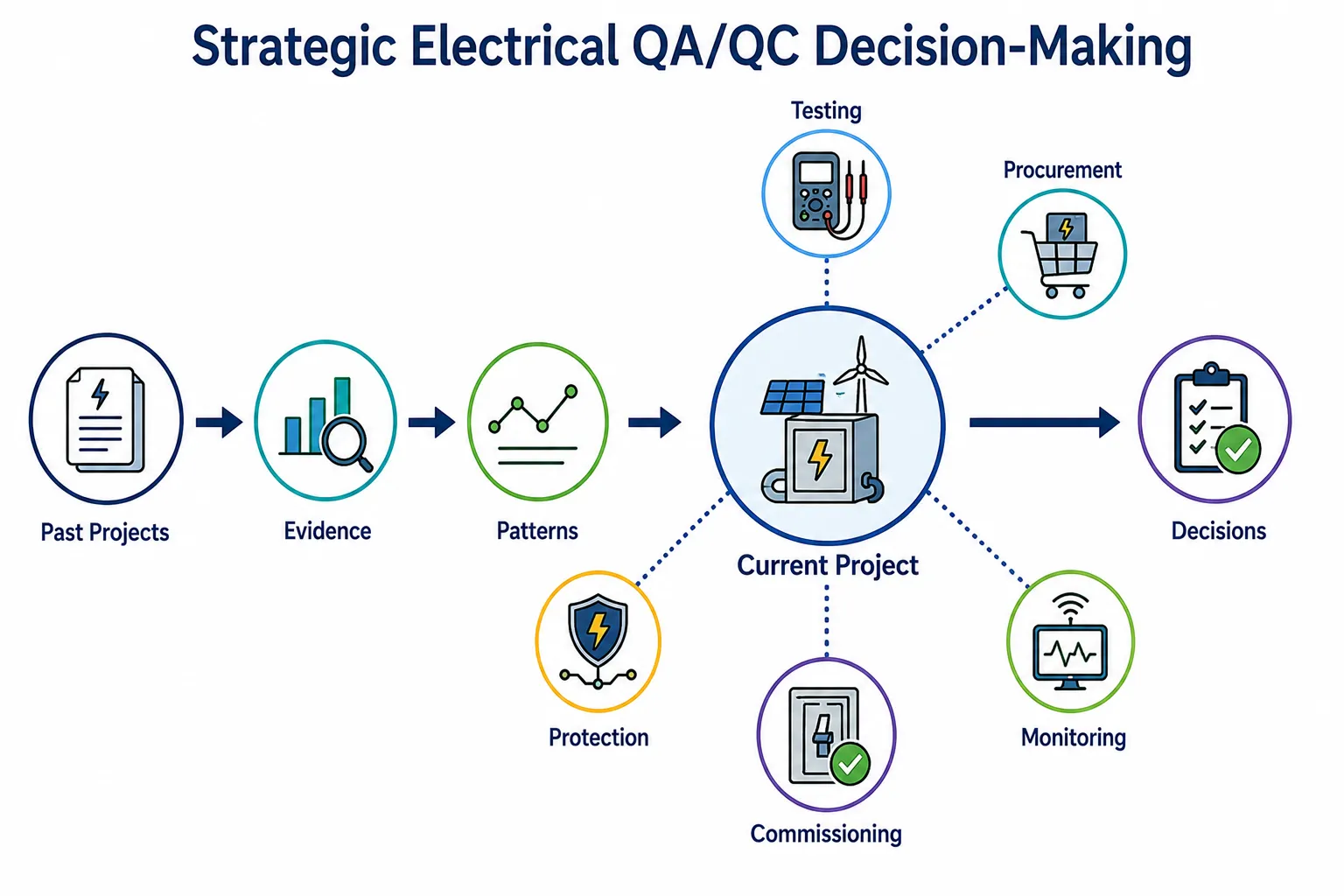
Strategic Decision-Making and Professional Judgement
Strategic decisions should not be delegated entirely to historical data.
Professional judgement remains essential because current conditions may differ from previous projects.
The QA/QC professional should consider:
- Current project risk
- New technology
- Current regulations
- Current supplier capability
- Current environmental conditions
- Client objectives
- Available resources
- Programme constraints
- Lifecycle requirements
Evidence provides a foundation for decision-making, but professional judgement determines how that evidence should be interpreted and applied.
Conclusion
Synthesising lessons from comprehensive electrical case studies enables QA/QC professionals to convert project experience into strategic knowledge that can influence current electrical engineering decisions. The process requires more than collecting individual observations. It involves examining evidence from multiple projects, identifying recurring patterns, understanding root causes, evaluating the reliability of information, determining transferability, considering current project conditions, comparing possible responses, and selecting appropriate actions based on quality, safety, sustainability, cost, programme, compliance, and reliability.
For sustainable electrical projects, this capability is increasingly important because technologies and project environments are changing rapidly. Renewable energy systems, battery storage, smart electrical infrastructure, IoT monitoring, AI-supported diagnostics, digital quality management, and advanced energy-management systems introduce new opportunities as well as new risks. Previous case studies can provide valuable evidence about how these technologies perform, but their findings must be interpreted within the context of the current project.
A mature QA/QC approach therefore treats case studies as a source of evidence rather than a collection of rules to be copied. Successful methodologies should be examined to determine why they worked, while failures should be investigated to identify systemic causes and opportunities for improvement. Where similar patterns appear across several projects, they can provide a strong basis for strategic action. Where project circumstances differ, the professional must adapt the findings rather than applying them without modification.
The ultimate value of case study synthesis is the ability to make better-informed decisions before problems occur. By integrating relevant evidence into design reviews, procurement strategies, quality plans, inspection and testing procedures, commissioning programmes, risk management, sustainability planning, and operational monitoring, electrical QA/QC professionals can strengthen project resilience and improve long-term performance. This transforms previous project experience into a practical decision-making resource and supports the delivery of safer, more reliable, compliant, efficient, and sustainable electrical systems in current and future project environments.
4: Apply Advanced Insights Gained from Case Study Analysis to Improve the QA/QC Planning of a Future Sustainable Installation
Sustainable electrical installations are becoming increasingly sophisticated as projects incorporate renewable energy systems, energy-efficient equipment, battery energy storage, smart monitoring, digital controls, advanced protection systems, and data-driven performance management. This increased complexity requires QA/QC planning to move beyond traditional inspection and testing arrangements. Quality must be considered from the earliest design and procurement decisions through installation, commissioning, handover, and operational performance. Previous project experience provides valuable evidence that can be used to strengthen this planning process and reduce the likelihood of recurring defects, performance failures, delays, rework, and sustainability shortfalls.
Applying advanced insights from case study analysis means taking verified knowledge from previous projects and converting it into specific improvements within the QA/QC plan for a future sustainable electrical installation. This may involve strengthening design verification, increasing control over critical equipment, introducing risk-based inspection points, improving contractor competency requirements, enhancing testing and commissioning procedures, integrating digital quality records, or establishing stronger performance verification. The objective is not to copy an earlier project’s procedures without consideration. Instead, the QA/QC professional must determine which lessons are relevant to the future installation, assess the current project’s specific risks, and incorporate appropriate controls into the quality planning process.
At Level 6, effective application requires strategic professional judgement. Learners should be able to interpret evidence from previous projects, identify transferable insights, assess their relevance to a new project, and translate those insights into measurable QA/QC requirements. This involves connecting historical evidence with current design information, project specifications, sustainability objectives, risk assessments, procurement strategies, inspection and test plans, commissioning requirements, and operational expectations. The result should be a proactive QA/QC plan that anticipates potential problems rather than relying primarily on inspection to discover defects after they occur.
Understanding Advanced QA/QC Planning
QA/QC planning is the systematic process of establishing the quality requirements, responsibilities, procedures, inspections, tests, records, acceptance criteria, resources, and controls necessary to achieve the required project outcomes.
For a sustainable electrical installation, QA/QC planning should consider:
- Design requirements
- Electrical safety
- Technical compliance
- Sustainability objectives
- Energy performance
- Equipment quality
- Supplier capability
- Installation workmanship
- Inspection requirements
- Testing requirements
- Commissioning
- Digital monitoring
- Documentation
- Maintenance
- Lifecycle performance
Advanced QA/QC planning adds another dimension by using evidence from previous projects to improve these controls.
For example, if case studies demonstrate repeated commissioning problems with battery storage systems, a future QA/QC plan should not simply state that commissioning will be completed. It should identify the specific failure patterns and establish additional verification requirements around battery management systems, protection, communication interfaces, thermal monitoring, emergency functions, and performance testing where relevant to the project.
From Case Study Insight to QA/QC Action
A useful distinction must be made between identifying a lesson and applying a lesson.
A case study may reveal:
“Previous projects experienced repeated defects during inverter commissioning.”
The QA/QC planner must then determine:
- Why did the defects occur?
- Were they caused by design, procurement, installation, configuration, or testing?
- Were the same conditions present in the future project?
- What control would prevent recurrence?
- Who should be responsible?
- At what project stage should the control be implemented?
- What evidence will demonstrate that the control was effective?
The final QA/QC planning response might include:
- Enhanced design review
- Manufacturer configuration verification
- Pre-commissioning checklist
- Specialist competency verification
- Communication-interface testing
- Functional testing
- Documented acceptance criteria
- Independent verification of critical settings
This is the difference between passive learning and active quality improvement.
Key Definitions and Concepts
| Term | Definition | Application to Future QA/QC Planning |
|---|---|---|
| Advanced insight | A significant conclusion developed through detailed analysis of evidence and project experience | Helps identify improvements beyond routine quality controls |
| QA/QC planning | Systematic preparation of processes and controls used to achieve specified quality requirements | Establishes how quality will be managed throughout the project |
| Transferable lesson | Knowledge from a previous project that remains relevant to another project after contextual evaluation | Supports evidence-based improvement |
| Risk-based planning | Allocating quality controls according to the significance and likelihood of potential failure | Concentrates resources on critical activities |
| Preventive control | A measure designed to reduce the likelihood of a defect occurring | Moves QA/QC from reactive inspection towards prevention |
| Acceptance criteria | Defined conditions that must be satisfied before work, equipment, or a system is accepted | Provides objective evidence of conformity |
| Hold point | A defined stage where work cannot proceed until specified verification or approval is completed | Prevents critical activities progressing without adequate control |
| Witness point | A defined stage where an authorised party may observe an inspection or test | Provides additional oversight for significant activities |
| Quality objective | A defined quality-related result that the project intends to achieve | Provides a basis for measuring performance |
| Performance verification | The process of confirming that an installed system achieves required functional or performance outcomes | Connects construction quality with operational requirements |
| Lessons integration | The controlled incorporation of relevant previous project experience into current processes | Converts historical experience into practical improvement |
| Quality maturity | The capability of an organisation to consistently plan, control, measure, and improve quality | Helps determine how sophisticated QA/QC planning should be |
Why Case Study Insights Should Influence QA/QC Planning
Historical project evidence can reveal risks that may not be obvious from specifications alone.
Case studies can highlight:
- Repeated installation defects
- Supplier quality problems
- Design coordination failures
- Inadequate commissioning
- Poor documentation
- Weak competency controls
- Digital integration problems
- Energy-performance shortfalls
- Maintenance difficulties
- Unexpected environmental impacts
- Recurring non-conformities
Using this information during planning allows the future project team to introduce preventive measures.
The benefits include:
- Earlier identification of potential problems
- Better allocation of QA/QC resources
- Stronger inspection strategies
- More effective testing
- Improved commissioning
- Reduced rework
- Better supplier control
- Improved sustainability performance
- Stronger project documentation
- Better lifecycle outcomes
Establishing the Future Project Quality Context
Before applying lessons from previous projects, the QA/QC professional should establish the context of the future installation.
Important considerations include:
- Project scope
- Installation type
- System capacity
- Site conditions
- Electrical architecture
- Sustainability objectives
- Client requirements
- Applicable technical requirements
- Project programme
- Procurement strategy
- Contractor capability
- Technology selection
- Operational requirements
- Maintenance expectations
The future project should then be compared with previous case studies.
This comparison helps determine whether historical lessons are directly applicable, applicable with modification, or unsuitable for the new context.
Identifying Transferable Insights
Not every lesson from a previous project should automatically be incorporated into a future QA/QC plan.
A structured evaluation should ask:
What happened previously?
Identify the actual quality event, success, failure, or performance outcome.
Why did it happen?
Determine the technical, organisational, environmental, procedural, or human factors involved.
What was the consequence?
Assess the effect on:
- Safety
- Quality
- Sustainability
- Cost
- Programme
- Reliability
- Compliance
Is the same risk present?
Compare the previous project with the future installation.
What control would improve the outcome?
Identify the most appropriate preventive or verification measure.
This process prevents unnecessary controls from being added simply because they were used on another project.
Risk-Based QA/QC Planning
One of the most important applications of case study insights is risk-based QA/QC planning.
Previous project evidence can be used to identify high-risk activities.
These may include:
- Critical electrical connections
- Protection systems
- Renewable energy interfaces
- Battery storage
- High-voltage equipment
- Earthing systems
- Control systems
- Communication interfaces
- Energy monitoring
- Specialist equipment
- Commissioning activities
The future QA/QC plan can then allocate stronger controls to these areas.
Potential controls include:
- Additional inspection points
- Independent verification
- Specialist testing
- Increased supervision
- Additional documentation
- Hold points
- Witness points
- Factory testing
- Site acceptance testing
- Performance verification
This approach prevents QA/QC resources from being distributed equally across activities regardless of risk.
Strengthening Design QA/QC
Case studies frequently demonstrate that construction defects originate from inadequate design information.
Future QA/QC planning should therefore incorporate lessons from previous design-related problems.
Design QA/QC may include:
- Multidisciplinary design review
- Electrical calculation verification
- Protection coordination review
- Equipment compatibility checks
- Constructability assessment
- Sustainability review
- Energy-performance assessment
- Interface review
- Maintainability review
- Design change control
For sustainable installations, design review should also consider how selected technologies interact.
For example, integrating solar PV, battery storage, energy management, and existing distribution infrastructure requires careful consideration of system interfaces. A design that works for each individual component may still create problems when the components operate together.
Improving Procurement Controls
Previous supplier problems can provide valuable information for future procurement planning.
If case studies show recurring issues with:
- Late delivery
- Poor documentation
- Incorrect equipment
- Product substitution
- Defective components
- Inadequate technical support
- Inconsistent quality
then the future QA/QC plan should strengthen supplier controls.
Possible measures include:
- Supplier prequalification
- Technical evaluation
- Approved vendor lists
- Product verification
- Factory inspections
- Factory Acceptance Testing
- Documentation review
- Material traceability
- Delivery inspections
- Supplier performance monitoring
Critical components may require greater control than routine materials.
Improving Material Traceability
Traceability becomes particularly important when a future installation contains critical or specialist equipment.
Case study evidence may demonstrate that difficulties occurred because project teams could not determine:
- Equipment origin
- Serial numbers
- Installation locations
- Inspection status
- Test results
- Warranty information
- Replacement history
Future QA/QC planning can address this through:
- Unique equipment identification
- Serial-number recording
- Digital registers
- Material inspection records
- Installation-location records
- Test-result association
- Handover documentation
This creates a stronger information trail from procurement to operation.
Strengthening Contractor Competence Requirements
Case studies can reveal that technically sophisticated equipment does not guarantee quality if installation personnel lack appropriate competence.
Future QA/QC planning should consider:
- Competence verification
- Relevant experience
- Specialist training
- Manufacturer training
- Electrical qualifications
- Testing competence
- Digital-system competence
- Supervision arrangements
Competence requirements should be proportionate to the complexity and risk of the installation.
For example, specialist battery systems, protection systems, digital energy-management systems, and renewable energy interfaces may require personnel with specific technical knowledge.
Developing a Stronger Inspection and Test Plan
The Inspection and Test Plan should reflect lessons from previous projects.
A future ITP should identify:
- Activity
- Inspection requirement
- Test requirement
- Acceptance criteria
- Responsibility
- Hold points
- Witness points
- Required documentation
- Test equipment
- Calibration requirements
- Approval requirements
Historical defects can help determine where additional inspection points are required.
For example, if previous projects experienced repeated cable termination failures, the future ITP may introduce:
- Additional inspection before energisation
- Installer verification
- Torque verification where applicable
- Visual inspection
- Test-result recording
- Independent inspection for critical circuits
The exact control should be based on the technical requirements and risk profile of the future installation.
Improving Testing Strategies
Testing should provide meaningful evidence that electrical systems meet specified requirements.
Case study insights can identify tests that were:
- Missing
- Performed too late
- Poorly documented
- Inadequately interpreted
- Not repeated after corrective action
Future planning can therefore strengthen:
- Test sequencing
- Test procedures
- Acceptance criteria
- Test equipment
- Calibration
- Competence
- Witness arrangements
- Result documentation
- Retesting requirements
Testing should be integrated with the project lifecycle rather than treated as a final administrative activity.
Strengthening Commissioning Planning
Commissioning is one of the most important areas where case study insights can improve future QA/QC.
Previous projects may reveal:
- Configuration errors
- Protection-setting problems
- Communication failures
- Control-system issues
- Monitoring problems
- Integration failures
- Incomplete documentation
- Performance shortfalls
Future commissioning planning should therefore consider:
- Pre-commissioning checks
- Functional testing
- System integration
- Control verification
- Protection verification
- Communication testing
- Monitoring validation
- Performance testing
- Defect closure
- Retesting
- Handover documentation
For complex sustainable installations, commissioning should demonstrate not only that equipment operates but that interconnected systems perform together as intended.
Integrating Digital QA/QC
Case studies involving digital technologies can provide insights into how future projects should use digital QA/QC tools.
Potential applications include:
- Digital inspection forms
- BIM-based quality coordination
- Cloud documentation
- Mobile defect reporting
- IoT monitoring
- Automated dashboards
- Digital commissioning records
- Equipment performance tracking
However, the future QA/QC plan should also address:
- Data accuracy
- User competence
- System interoperability
- Cybersecurity
- Data ownership
- Backup arrangements
- Access control
- Data validation
Digital technology should support the quality process rather than become a substitute for professional inspection and engineering judgement.
Applying Predictive Insights
Where previous projects have generated sufficient operational data, predictive insights can be incorporated into future QA/QC planning.
For example, previous projects may show that particular equipment experiences performance deterioration under certain conditions.
The future project can respond by planning:
- Additional monitoring
- Condition-based inspections
- Performance thresholds
- Early-warning alerts
- Increased maintenance attention
- Additional commissioning verification
This allows the QA/QC strategy to become more proactive.
Integrating Sustainability into QA/QC Planning
Sustainability requirements should be converted into measurable quality and performance requirements.
These may relate to:
- Energy efficiency
- Renewable energy generation
- Reduced energy losses
- Equipment efficiency
- Resource utilisation
- Waste reduction
- Lifecycle performance
- Maintenance requirements
The QA/QC plan should establish how these objectives will be verified.
For example:
A sustainability objective such as “reduce energy consumption” should be connected to:
- Baseline measurement
- Defined performance indicators
- Monitoring systems
- Commissioning requirements
- Operational verification
This creates a measurable connection between sustainability objectives and QA/QC activities.
Practical Case Study: Future Solar PV Installation
Suppose an organisation is planning a new commercial solar PV installation.
Previous projects identified several recurring issues:
- Underestimated shading
- Inadequate monitoring
- Connector installation defects
- Incomplete commissioning documentation
- Poor maintenance planning
The future QA/QC plan can incorporate these insights.
Design controls
- Detailed site assessment
- Shading evaluation
- Energy-yield verification
- Equipment compatibility review
- Design coordination
Procurement controls
- Approved equipment
- Supplier verification
- Technical documentation review
- Material traceability
Installation controls
- Competency verification
- Installation procedure
- Connector inspection
- Cable inspection
- Earthing verification
Commissioning controls
- Inverter configuration
- Functional testing
- Monitoring validation
- Performance verification
- Documentation review
Operational controls
- Energy monitoring
- Performance review
- Maintenance planning
- Defect trend analysis
This demonstrates how previous project experience can directly improve future QA/QC planning.
Practical Case Study: Future Battery Storage Installation
Suppose previous battery projects experienced:
- Communication failures
- Temperature-related alarms
- Inadequate commissioning
- Inconsistent emergency procedures
The future QA/QC plan could incorporate:
- Early interface review
- Battery management system verification
- Temperature monitoring validation
- Communication testing
- Protection verification
- Emergency-function testing
- Specialist commissioning
- Operator training
- Performance monitoring
The important point is that the future controls are based on evidence rather than generic assumptions.
Practical Case Study: Energy-Efficient Industrial Installation
Previous industrial projects may have demonstrated that energy-saving technologies were installed correctly but failed to achieve expected savings because baseline consumption was poorly established.
A future project could therefore include:
- Pre-installation energy baseline
- Equipment performance requirements
- Energy monitoring
- Control-system verification
- Commissioning measurements
- Post-installation performance review
This shows that QA/QC should verify not only installation conformity but also relevant performance outcomes.
Developing Acceptance Criteria from Previous Experience
Case studies can help identify where acceptance criteria need to be strengthened.
Acceptance criteria should be:
- Clear
- Measurable
- Relevant
- Technically justified
- Consistent with project requirements
- Capable of verification
Where previous projects experienced ambiguity, future QA/QC planning should avoid vague requirements.
For example, “system operates correctly” is less useful than defining specific functional and performance requirements that can be objectively tested.
Improving Documentation and Records
Case studies can reveal weaknesses in documentation that later affect maintenance, audits, defect investigation, or system modification.
Future QA/QC planning should define requirements for:
- Inspection records
- Test certificates
- Equipment registers
- Calibration records
- Non-conformity records
- Corrective actions
- Commissioning records
- As-built information
- Operation and maintenance documentation
- Performance records
Digital documentation can improve accessibility, but document-control requirements must remain clear.
Integrating Non-Conformity Trends into Future Planning
Previous non-conformity records can be analysed to identify recurring defects.
For example:
| Previous Finding | Possible Future QA/QC Response |
|---|---|
| Repeated termination defects | Strengthen competency and inspection controls |
| Incomplete test records | Improve testing documentation and review |
| Equipment substitutions | Strengthen change-control procedures |
| Commissioning errors | Introduce additional pre-commissioning checks |
| Monitoring failures | Validate sensors and communication interfaces |
| Supplier defects | Strengthen supplier quality assessment |
| Poor traceability | Improve equipment identification and records |
| Repeated rework | Review design and installation procedures |
This transforms historical quality data into practical planning controls.
Developing a Future QA/QC Planning Framework
A future sustainable installation can use a structured planning framework.
Stage 1: Review previous evidence
Analyse:
- Case studies
- NCRs
- Audit findings
- Test failures
- Commissioning issues
- Performance data
Stage 2: Identify transferable insights
Determine:
- Recurring issues
- Successful controls
- Root causes
- Technology-specific risks
Stage 3: Compare project contexts
Assess:
- Scope
- Technology
- Site
- Risk
- Contractor capability
- Sustainability objectives
Stage 4: Prioritise risks
Rank risks according to:
- Consequence
- Likelihood
- Detectability
- Safety
- Quality
- Sustainability
- Cost
- Programme
Stage 5: Define QA/QC controls
Establish:
- Inspections
- Tests
- Hold points
- Witness points
- Verification
- Documentation
Stage 6: Assign responsibilities
Identify responsibility for:
- Design verification
- Material approval
- Installation inspection
- Testing
- Commissioning
- Documentation
- Performance verification
Stage 7: Establish acceptance criteria
Define measurable requirements for critical activities.
Stage 8: Plan monitoring
Determine how quality and performance will be monitored.
Stage 9: Verify effectiveness
Use inspection, testing, commissioning, and operational evidence.
Stage 10: Update the QA/QC strategy
Modify controls when new evidence or project conditions require changes.
Key Benefits of Applying Case Study Insights
Reduced recurrence of defects
Previous failure patterns can be addressed before they appear in the new installation.
Improved risk management
Historical evidence helps identify risks that may not be immediately obvious.
Stronger QA/QC planning
Case studies can improve the quality plan, ITP, testing strategy, and commissioning programme.
Better resource allocation
QA/QC resources can be concentrated on activities with higher risk and greater consequence.
Improved sustainability performance
Historical performance data can help establish realistic and measurable sustainability controls.
Better supplier management
Previous supplier performance can inform future procurement decisions.
Improved commissioning
Past commissioning problems can be translated into stronger verification procedures.
Better lifecycle performance
Future QA/QC planning can incorporate maintenance and operational experience from previous projects.
Improved organisational learning
Project experience becomes part of an organised quality improvement process rather than remaining with individual project teams.
Common Mistakes When Applying Case Study Insights
Historical knowledge should be applied carefully.
Common mistakes include:
- Copying old procedures without reviewing current conditions
- Treating every historical problem as a current risk
- Ignoring changes in technology
- Ignoring changes in project scale
- Ignoring environmental differences
- Failing to validate previous conclusions
- Adding excessive inspection without risk justification
- Using outdated technical information
- Failing to establish measurable acceptance criteria
- Focusing only on construction quality
- Ignoring operational performance
- Treating digital monitoring as automatically reliable
- Failing to assign responsibilities
- Implementing controls without monitoring effectiveness
Effective application requires judgement, proportionality, and current project analysis.
Measuring the Effectiveness of Improved QA/QC Planning
The future project should measure whether the new planning approach actually improves performance.
Potential indicators include:
- Number of non-conformities
- Rework percentage
- Inspection failure rate
- Testing failure rate
- Commissioning defects
- Corrective-action closure time
- Supplier defects
- Equipment failures
- Energy-performance results
- Documentation completeness
- Handover quality
- Maintenance issues
For example, if previous projects experienced frequent commissioning failures and enhanced commissioning controls are introduced, the future project should measure whether commissioning defects decrease.
This closes the improvement cycle.
Strategic Role of the QA/QC Professional
The QA/QC professional plays an important role in translating case study evidence into practical project controls.
This involves:
- Reviewing historical project evidence
- Identifying relevant trends
- Challenging assumptions
- Evaluating current project risks
- Advising project management
- Supporting design reviews
- Strengthening procurement controls
- Developing inspection strategies
- Reviewing testing requirements
- Supporting commissioning
- Monitoring quality performance
- Promoting continual improvement
The professional should also ensure that quality improvements remain proportionate to the actual risk.
Conclusion
Applying advanced insights from case study analysis to future sustainable electrical installations enables QA/QC planning to become more proactive, evidence-based, and strategically focused. Instead of developing quality plans solely from standard templates or generic procedures, professionals can use verified project experience to identify recurring risks, strengthen preventive controls, improve inspection and testing, enhance supplier management, strengthen commissioning, and establish more effective performance verification.
The key is not to copy previous project methods without evaluation. Every future installation has its own technical characteristics, environmental conditions, technologies, stakeholders, contractual requirements, sustainability objectives, and risk profile. Previous lessons must therefore be assessed for relevance and transferability before being incorporated into the QA/QC plan. A control that was highly effective on one project may require modification on another, while a previous failure may reveal a risk that should be addressed at an earlier project stage.
A mature QA/QC planning approach connects historical evidence with current project requirements. It uses case studies, non-conformity trends, inspection results, testing records, commissioning experience, supplier performance, and operational data to establish stronger controls. These insights can then be translated into design reviews, procurement requirements, competency controls, Inspection and Test Plans, acceptance criteria, testing procedures, commissioning strategies, digital monitoring, and lifecycle performance verification.
For Level 6 electrical QA/QC professionals, this capability demonstrates the transition from routine quality control to strategic quality management. The professional is not simply checking whether work conforms to requirements but is using evidence to anticipate problems, improve planning, allocate resources effectively, strengthen sustainability performance, and support better technical decisions. When applied systematically, case study-based QA/QC planning can reduce recurring defects, improve project reliability, enhance energy and environmental performance, and contribute to the successful delivery of safe, compliant, efficient, and sustainable electrical installations.